WO2011125720A1 - バイオマス資源由来ポリウレタン及びその製造方法並びにバイオマス資源由来ポリエステルポリオール - Google Patents
バイオマス資源由来ポリウレタン及びその製造方法並びにバイオマス資源由来ポリエステルポリオール Download PDFInfo
- Publication number
- WO2011125720A1 WO2011125720A1 PCT/JP2011/057984 JP2011057984W WO2011125720A1 WO 2011125720 A1 WO2011125720 A1 WO 2011125720A1 JP 2011057984 W JP2011057984 W JP 2011057984W WO 2011125720 A1 WO2011125720 A1 WO 2011125720A1
- Authority
- WO
- WIPO (PCT)
- Prior art keywords
- acid
- derived
- polyurethane
- dicarboxylic acid
- less
- Prior art date
- Legal status (The legal status is an assumption and is not a legal conclusion. Google has not performed a legal analysis and makes no representation as to the accuracy of the status listed.)
- Ceased
Links
Classifications
-
- C—CHEMISTRY; METALLURGY
- C08—ORGANIC MACROMOLECULAR COMPOUNDS; THEIR PREPARATION OR CHEMICAL WORKING-UP; COMPOSITIONS BASED THEREON
- C08G—MACROMOLECULAR COMPOUNDS OBTAINED OTHERWISE THAN BY REACTIONS ONLY INVOLVING UNSATURATED CARBON-TO-CARBON BONDS
- C08G18/00—Polymeric products of isocyanates or isothiocyanates
- C08G18/06—Polymeric products of isocyanates or isothiocyanates with compounds having active hydrogen
- C08G18/28—Polymeric products of isocyanates or isothiocyanates with compounds having active hydrogen characterised by the compounds used containing active hydrogen
- C08G18/40—High-molecular-weight compounds
- C08G18/42—Polycondensates having carboxylic or carbonic ester groups in the main chain
- C08G18/4236—Polycondensates having carboxylic or carbonic ester groups in the main chain containing only aliphatic groups
- C08G18/4238—Polycondensates having carboxylic or carbonic ester groups in the main chain containing only aliphatic groups derived from dicarboxylic acids and dialcohols
-
- A—HUMAN NECESSITIES
- A43—FOOTWEAR
- A43B—CHARACTERISTIC FEATURES OF FOOTWEAR; PARTS OF FOOTWEAR
- A43B1/00—Footwear characterised by the material
-
- A—HUMAN NECESSITIES
- A43—FOOTWEAR
- A43B—CHARACTERISTIC FEATURES OF FOOTWEAR; PARTS OF FOOTWEAR
- A43B13/00—Soles; Sole-and-heel integral units
- A43B13/02—Soles; Sole-and-heel integral units characterised by the material
- A43B13/04—Plastics, rubber or vulcanised fibre
-
- C—CHEMISTRY; METALLURGY
- C07—ORGANIC CHEMISTRY
- C07C—ACYCLIC OR CARBOCYCLIC COMPOUNDS
- C07C59/00—Compounds having carboxyl groups bound to acyclic carbon atoms and containing any of the groups OH, O—metal, —CHO, keto, ether, groups, groups, or groups
- C07C59/235—Saturated compounds containing more than one carboxyl group
- C07C59/245—Saturated compounds containing more than one carboxyl group containing hydroxy or O-metal groups
-
- C—CHEMISTRY; METALLURGY
- C07—ORGANIC CHEMISTRY
- C07C—ACYCLIC OR CARBOCYCLIC COMPOUNDS
- C07C69/00—Esters of carboxylic acids; Esters of carbonic or haloformic acids
- C07C69/34—Esters of acyclic saturated polycarboxylic acids having an esterified carboxyl group bound to an acyclic carbon atom
-
- C—CHEMISTRY; METALLURGY
- C07—ORGANIC CHEMISTRY
- C07C—ACYCLIC OR CARBOCYCLIC COMPOUNDS
- C07C69/00—Esters of carboxylic acids; Esters of carbonic or haloformic acids
- C07C69/34—Esters of acyclic saturated polycarboxylic acids having an esterified carboxyl group bound to an acyclic carbon atom
- C07C69/40—Succinic acid esters
-
- C—CHEMISTRY; METALLURGY
- C07—ORGANIC CHEMISTRY
- C07C—ACYCLIC OR CARBOCYCLIC COMPOUNDS
- C07C69/00—Esters of carboxylic acids; Esters of carbonic or haloformic acids
- C07C69/66—Esters of carboxylic acids having esterified carboxylic groups bound to acyclic carbon atoms and having any of the groups OH, O—metal, —CHO, keto, ether, acyloxy, groups, groups, or in the acid moiety
-
- C—CHEMISTRY; METALLURGY
- C07—ORGANIC CHEMISTRY
- C07C—ACYCLIC OR CARBOCYCLIC COMPOUNDS
- C07C69/00—Esters of carboxylic acids; Esters of carbonic or haloformic acids
- C07C69/66—Esters of carboxylic acids having esterified carboxylic groups bound to acyclic carbon atoms and having any of the groups OH, O—metal, —CHO, keto, ether, acyloxy, groups, groups, or in the acid moiety
- C07C69/67—Esters of carboxylic acids having esterified carboxylic groups bound to acyclic carbon atoms and having any of the groups OH, O—metal, —CHO, keto, ether, acyloxy, groups, groups, or in the acid moiety of saturated acids
- C07C69/675—Esters of carboxylic acids having esterified carboxylic groups bound to acyclic carbon atoms and having any of the groups OH, O—metal, —CHO, keto, ether, acyloxy, groups, groups, or in the acid moiety of saturated acids of saturated hydroxy-carboxylic acids
-
- C—CHEMISTRY; METALLURGY
- C07—ORGANIC CHEMISTRY
- C07C—ACYCLIC OR CARBOCYCLIC COMPOUNDS
- C07C69/00—Esters of carboxylic acids; Esters of carbonic or haloformic acids
- C07C69/66—Esters of carboxylic acids having esterified carboxylic groups bound to acyclic carbon atoms and having any of the groups OH, O—metal, —CHO, keto, ether, acyloxy, groups, groups, or in the acid moiety
- C07C69/67—Esters of carboxylic acids having esterified carboxylic groups bound to acyclic carbon atoms and having any of the groups OH, O—metal, —CHO, keto, ether, acyloxy, groups, groups, or in the acid moiety of saturated acids
- C07C69/675—Esters of carboxylic acids having esterified carboxylic groups bound to acyclic carbon atoms and having any of the groups OH, O—metal, —CHO, keto, ether, acyloxy, groups, groups, or in the acid moiety of saturated acids of saturated hydroxy-carboxylic acids
- C07C69/70—Tartaric acid esters
-
- C—CHEMISTRY; METALLURGY
- C07—ORGANIC CHEMISTRY
- C07C—ACYCLIC OR CARBOCYCLIC COMPOUNDS
- C07C69/00—Esters of carboxylic acids; Esters of carbonic or haloformic acids
- C07C69/66—Esters of carboxylic acids having esterified carboxylic groups bound to acyclic carbon atoms and having any of the groups OH, O—metal, —CHO, keto, ether, acyloxy, groups, groups, or in the acid moiety
- C07C69/67—Esters of carboxylic acids having esterified carboxylic groups bound to acyclic carbon atoms and having any of the groups OH, O—metal, —CHO, keto, ether, acyloxy, groups, groups, or in the acid moiety of saturated acids
- C07C69/675—Esters of carboxylic acids having esterified carboxylic groups bound to acyclic carbon atoms and having any of the groups OH, O—metal, —CHO, keto, ether, acyloxy, groups, groups, or in the acid moiety of saturated acids of saturated hydroxy-carboxylic acids
- C07C69/704—Citric acid esters
-
- C—CHEMISTRY; METALLURGY
- C08—ORGANIC MACROMOLECULAR COMPOUNDS; THEIR PREPARATION OR CHEMICAL WORKING-UP; COMPOSITIONS BASED THEREON
- C08G—MACROMOLECULAR COMPOUNDS OBTAINED OTHERWISE THAN BY REACTIONS ONLY INVOLVING UNSATURATED CARBON-TO-CARBON BONDS
- C08G18/00—Polymeric products of isocyanates or isothiocyanates
- C08G18/06—Polymeric products of isocyanates or isothiocyanates with compounds having active hydrogen
- C08G18/08—Processes
- C08G18/14—Manufacture of cellular products
-
- C—CHEMISTRY; METALLURGY
- C08—ORGANIC MACROMOLECULAR COMPOUNDS; THEIR PREPARATION OR CHEMICAL WORKING-UP; COMPOSITIONS BASED THEREON
- C08G—MACROMOLECULAR COMPOUNDS OBTAINED OTHERWISE THAN BY REACTIONS ONLY INVOLVING UNSATURATED CARBON-TO-CARBON BONDS
- C08G18/00—Polymeric products of isocyanates or isothiocyanates
- C08G18/06—Polymeric products of isocyanates or isothiocyanates with compounds having active hydrogen
- C08G18/28—Polymeric products of isocyanates or isothiocyanates with compounds having active hydrogen characterised by the compounds used containing active hydrogen
- C08G18/40—High-molecular-weight compounds
- C08G18/42—Polycondensates having carboxylic or carbonic ester groups in the main chain
- C08G18/4236—Polycondensates having carboxylic or carbonic ester groups in the main chain containing only aliphatic groups
- C08G18/4238—Polycondensates having carboxylic or carbonic ester groups in the main chain containing only aliphatic groups derived from dicarboxylic acids and dialcohols
- C08G18/4241—Polycondensates having carboxylic or carbonic ester groups in the main chain containing only aliphatic groups derived from dicarboxylic acids and dialcohols from dicarboxylic acids and dialcohols in combination with polycarboxylic acids and/or polyhydroxy compounds which are at least trifunctional
-
- C—CHEMISTRY; METALLURGY
- C08—ORGANIC MACROMOLECULAR COMPOUNDS; THEIR PREPARATION OR CHEMICAL WORKING-UP; COMPOSITIONS BASED THEREON
- C08G—MACROMOLECULAR COMPOUNDS OBTAINED OTHERWISE THAN BY REACTIONS ONLY INVOLVING UNSATURATED CARBON-TO-CARBON BONDS
- C08G18/00—Polymeric products of isocyanates or isothiocyanates
- C08G18/06—Polymeric products of isocyanates or isothiocyanates with compounds having active hydrogen
- C08G18/28—Polymeric products of isocyanates or isothiocyanates with compounds having active hydrogen characterised by the compounds used containing active hydrogen
- C08G18/40—High-molecular-weight compounds
- C08G18/42—Polycondensates having carboxylic or carbonic ester groups in the main chain
- C08G18/4266—Polycondensates having carboxylic or carbonic ester groups in the main chain prepared from hydroxycarboxylic acids and/or lactones
- C08G18/4286—Polycondensates having carboxylic or carbonic ester groups in the main chain prepared from hydroxycarboxylic acids and/or lactones prepared from a combination of hydroxycarboxylic acids and/or lactones with polycarboxylic acids or ester forming derivatives thereof and polyhydroxy compounds
-
- C—CHEMISTRY; METALLURGY
- C08—ORGANIC MACROMOLECULAR COMPOUNDS; THEIR PREPARATION OR CHEMICAL WORKING-UP; COMPOSITIONS BASED THEREON
- C08G—MACROMOLECULAR COMPOUNDS OBTAINED OTHERWISE THAN BY REACTIONS ONLY INVOLVING UNSATURATED CARBON-TO-CARBON BONDS
- C08G18/00—Polymeric products of isocyanates or isothiocyanates
- C08G18/06—Polymeric products of isocyanates or isothiocyanates with compounds having active hydrogen
- C08G18/28—Polymeric products of isocyanates or isothiocyanates with compounds having active hydrogen characterised by the compounds used containing active hydrogen
- C08G18/65—Low-molecular-weight compounds having active hydrogen with high-molecular-weight compounds having active hydrogen
- C08G18/66—Compounds of groups C08G18/42, C08G18/48, or C08G18/52
- C08G18/6633—Compounds of group C08G18/42
- C08G18/6637—Compounds of group C08G18/42 with compounds of group C08G18/32 or polyamines of C08G18/38
- C08G18/664—Compounds of group C08G18/42 with compounds of group C08G18/32 or polyamines of C08G18/38 with compounds of group C08G18/3203
-
- C—CHEMISTRY; METALLURGY
- C08—ORGANIC MACROMOLECULAR COMPOUNDS; THEIR PREPARATION OR CHEMICAL WORKING-UP; COMPOSITIONS BASED THEREON
- C08G—MACROMOLECULAR COMPOUNDS OBTAINED OTHERWISE THAN BY REACTIONS ONLY INVOLVING UNSATURATED CARBON-TO-CARBON BONDS
- C08G18/00—Polymeric products of isocyanates or isothiocyanates
- C08G18/06—Polymeric products of isocyanates or isothiocyanates with compounds having active hydrogen
- C08G18/70—Polymeric products of isocyanates or isothiocyanates with compounds having active hydrogen characterised by the isocyanates or isothiocyanates used
- C08G18/72—Polyisocyanates or polyisothiocyanates
- C08G18/74—Polyisocyanates or polyisothiocyanates cyclic
- C08G18/76—Polyisocyanates or polyisothiocyanates cyclic aromatic
- C08G18/7657—Polyisocyanates or polyisothiocyanates cyclic aromatic containing two or more aromatic rings
-
- C—CHEMISTRY; METALLURGY
- C08—ORGANIC MACROMOLECULAR COMPOUNDS; THEIR PREPARATION OR CHEMICAL WORKING-UP; COMPOSITIONS BASED THEREON
- C08G—MACROMOLECULAR COMPOUNDS OBTAINED OTHERWISE THAN BY REACTIONS ONLY INVOLVING UNSATURATED CARBON-TO-CARBON BONDS
- C08G18/00—Polymeric products of isocyanates or isothiocyanates
- C08G18/06—Polymeric products of isocyanates or isothiocyanates with compounds having active hydrogen
- C08G18/70—Polymeric products of isocyanates or isothiocyanates with compounds having active hydrogen characterised by the isocyanates or isothiocyanates used
- C08G18/72—Polyisocyanates or polyisothiocyanates
- C08G18/74—Polyisocyanates or polyisothiocyanates cyclic
- C08G18/76—Polyisocyanates or polyisothiocyanates cyclic aromatic
- C08G18/7657—Polyisocyanates or polyisothiocyanates cyclic aromatic containing two or more aromatic rings
- C08G18/7664—Polyisocyanates or polyisothiocyanates cyclic aromatic containing two or more aromatic rings containing alkylene polyphenyl groups
- C08G18/7671—Polyisocyanates or polyisothiocyanates cyclic aromatic containing two or more aromatic rings containing alkylene polyphenyl groups containing only one alkylene bisphenyl group
-
- C—CHEMISTRY; METALLURGY
- C08—ORGANIC MACROMOLECULAR COMPOUNDS; THEIR PREPARATION OR CHEMICAL WORKING-UP; COMPOSITIONS BASED THEREON
- C08G—MACROMOLECULAR COMPOUNDS OBTAINED OTHERWISE THAN BY REACTIONS ONLY INVOLVING UNSATURATED CARBON-TO-CARBON BONDS
- C08G63/00—Macromolecular compounds obtained by reactions forming a carboxylic ester link in the main chain of the macromolecule
- C08G63/02—Polyesters derived from hydroxycarboxylic acids or from polycarboxylic acids and polyhydroxy compounds
- C08G63/06—Polyesters derived from hydroxycarboxylic acids or from polycarboxylic acids and polyhydroxy compounds derived from hydroxycarboxylic acids
-
- C—CHEMISTRY; METALLURGY
- C08—ORGANIC MACROMOLECULAR COMPOUNDS; THEIR PREPARATION OR CHEMICAL WORKING-UP; COMPOSITIONS BASED THEREON
- C08G—MACROMOLECULAR COMPOUNDS OBTAINED OTHERWISE THAN BY REACTIONS ONLY INVOLVING UNSATURATED CARBON-TO-CARBON BONDS
- C08G63/00—Macromolecular compounds obtained by reactions forming a carboxylic ester link in the main chain of the macromolecule
- C08G63/02—Polyesters derived from hydroxycarboxylic acids or from polycarboxylic acids and polyhydroxy compounds
- C08G63/12—Polyesters derived from hydroxycarboxylic acids or from polycarboxylic acids and polyhydroxy compounds derived from polycarboxylic acids and polyhydroxy compounds
- C08G63/16—Dicarboxylic acids and dihydroxy compounds
-
- C—CHEMISTRY; METALLURGY
- C08—ORGANIC MACROMOLECULAR COMPOUNDS; THEIR PREPARATION OR CHEMICAL WORKING-UP; COMPOSITIONS BASED THEREON
- C08G—MACROMOLECULAR COMPOUNDS OBTAINED OTHERWISE THAN BY REACTIONS ONLY INVOLVING UNSATURATED CARBON-TO-CARBON BONDS
- C08G63/00—Macromolecular compounds obtained by reactions forming a carboxylic ester link in the main chain of the macromolecule
- C08G63/02—Polyesters derived from hydroxycarboxylic acids or from polycarboxylic acids and polyhydroxy compounds
- C08G63/12—Polyesters derived from hydroxycarboxylic acids or from polycarboxylic acids and polyhydroxy compounds derived from polycarboxylic acids and polyhydroxy compounds
- C08G63/16—Dicarboxylic acids and dihydroxy compounds
- C08G63/20—Polyesters having been prepared in the presence of compounds having one reactive group or more than two reactive groups
-
- C—CHEMISTRY; METALLURGY
- C08—ORGANIC MACROMOLECULAR COMPOUNDS; THEIR PREPARATION OR CHEMICAL WORKING-UP; COMPOSITIONS BASED THEREON
- C08G—MACROMOLECULAR COMPOUNDS OBTAINED OTHERWISE THAN BY REACTIONS ONLY INVOLVING UNSATURATED CARBON-TO-CARBON BONDS
- C08G63/00—Macromolecular compounds obtained by reactions forming a carboxylic ester link in the main chain of the macromolecule
- C08G63/02—Polyesters derived from hydroxycarboxylic acids or from polycarboxylic acids and polyhydroxy compounds
- C08G63/60—Polyesters derived from hydroxycarboxylic acids or from polycarboxylic acids and polyhydroxy compounds derived from the reaction of a mixture of hydroxy carboxylic acids, polycarboxylic acids and polyhydroxy compounds
-
- C—CHEMISTRY; METALLURGY
- C09—DYES; PAINTS; POLISHES; NATURAL RESINS; ADHESIVES; COMPOSITIONS NOT OTHERWISE PROVIDED FOR; APPLICATIONS OF MATERIALS NOT OTHERWISE PROVIDED FOR
- C09D—COATING COMPOSITIONS, e.g. PAINTS, VARNISHES OR LACQUERS; FILLING PASTES; CHEMICAL PAINT OR INK REMOVERS; INKS; CORRECTING FLUIDS; WOODSTAINS; PASTES OR SOLIDS FOR COLOURING OR PRINTING; USE OF MATERIALS THEREFOR
- C09D175/00—Coating compositions based on polyureas or polyurethanes; Coating compositions based on derivatives of such polymers
- C09D175/04—Polyurethanes
- C09D175/06—Polyurethanes from polyesters
-
- C—CHEMISTRY; METALLURGY
- C09—DYES; PAINTS; POLISHES; NATURAL RESINS; ADHESIVES; COMPOSITIONS NOT OTHERWISE PROVIDED FOR; APPLICATIONS OF MATERIALS NOT OTHERWISE PROVIDED FOR
- C09J—ADHESIVES; NON-MECHANICAL ASPECTS OF ADHESIVE PROCESSES IN GENERAL; ADHESIVE PROCESSES NOT PROVIDED FOR ELSEWHERE; USE OF MATERIALS AS ADHESIVES
- C09J175/00—Adhesives based on polyureas or polyurethanes; Adhesives based on derivatives of such polymers
- C09J175/04—Polyurethanes
- C09J175/06—Polyurethanes from polyesters
-
- C—CHEMISTRY; METALLURGY
- C08—ORGANIC MACROMOLECULAR COMPOUNDS; THEIR PREPARATION OR CHEMICAL WORKING-UP; COMPOSITIONS BASED THEREON
- C08G—MACROMOLECULAR COMPOUNDS OBTAINED OTHERWISE THAN BY REACTIONS ONLY INVOLVING UNSATURATED CARBON-TO-CARBON BONDS
- C08G2110/00—Foam properties
- C08G2110/0008—Foam properties flexible
-
- C—CHEMISTRY; METALLURGY
- C08—ORGANIC MACROMOLECULAR COMPOUNDS; THEIR PREPARATION OR CHEMICAL WORKING-UP; COMPOSITIONS BASED THEREON
- C08G—MACROMOLECULAR COMPOUNDS OBTAINED OTHERWISE THAN BY REACTIONS ONLY INVOLVING UNSATURATED CARBON-TO-CARBON BONDS
- C08G2410/00—Soles
Definitions
- the present invention relates to a novel polyester polyol-based biomass resource-derived biopolyurethane, a method for producing the same, and a biomass-resource-derived polyester polyol. Specifically, it can be used in a wide range of applications such as synthetic / artificial leather made from biomass-polyester-derived polyester polyol, foamed resin for shoe soles, thermoplastic resin, thermosetting resin, paint, laminate adhesive and elastic fiber.
- the present invention relates to a polyester polyol-based biomass resource-derived polyurethane excellent in physical property balance such as useful mechanical properties and molding operability.
- polyols are polyether types typified by polypropylene glycol and polytetramethylene glycol, polyester polyol types typified by dicarboxylic acid polyesters, It is classified into a polylactone type typified by caprolactone and a polycarbonate type obtained by reacting a carbonate source with a diol (Non-patent Document 1).
- the polyether type is said to be inferior in mechanical strength such as abrasion resistance and bending resistance, heat resistance and weather resistance, although it is excellent in hydrolysis resistance, flexibility and stretchability.
- the conventional polyester type is improved in heat resistance and weather resistance, but has low hydrolysis resistance in the ester portion and cannot be used depending on the application.
- Polylactones are grades that are superior in hydrolysis resistance compared to adipate, but the hydrolysis cannot be completely suppressed due to the presence of ester groups.
- the polycarbonate type is excellent in hydrolysis resistance and durability, there is a drawback that the polyol itself and the polyurethane produced from this as a raw material have high solution viscosity and poor handling operability. Further, it has been proposed to use these polyester type, polyether type, polylactone type and polycarbonate type by mixing and copolymerizing them, but these drawbacks cannot be completely compensated.
- polyester polyols are mainly polyester polyols synthesized from adipic acid, but nitric acid oxidation is used in the production of adipic acid, and the warming effect accompanying CO 2 is higher than that of CO 2 .
- nitric acid oxidation is used in the production of adipic acid, and the warming effect accompanying CO 2 is higher than that of CO 2 .
- polyester polyols having various structures have been proposed.
- a dicarboxylic acid other than adipic acid that does not use nitric acid oxidation in its production
- succinic acid and another diol are mixed to form a copolyester polyol, specifically, an oligomer of succinic acid and ethylene glycol Has been proposed (Patent Document 1).
- polyester polyols using petroleum-derived succinic acid and polyurethanes produced therefrom are known and industrially produced, but polyester polyols made from succinic acid are generally poor in handling.
- Patent Document 2 a technology for producing a polyester polyol using biosuccinic acid obtained from a fermentation method as a raw material has been disclosed (Patent Document 2).
- Patent Document 2 a technology for producing a polyester polyol using biosuccinic acid obtained from a fermentation method as a raw material has been disclosed (Patent Document 2).
- the polyurethane using the polyester polyol produced by the technique described in Patent Document 2 exhibits only mechanical properties equivalent to those obtained when using polyester polyol made from petroleum resource-derived succinic acid.
- the polyester polyol obtained by any of the above methods has a balance of physical properties of the polyester polyol itself, good handleability, hue, and ease of reaction control when used as a polyurethane or a balance of mechanical properties. Therefore, their development was awaited.
- Patent Document 1 uses succinic acid obtained from petroleum resources.
- malic acid is by-produced and mixed into succinic acid as an impurity.
- mixing of malic acid which is an excessive impurity, adversely affects the physical properties of polyurethane, particularly the ease of reaction control and flexibility.
- succinic acid obtained from petroleum resources usually contains about 1500 to 5000 ppm of malic acid relative to succinic acid, and its content varies greatly depending on the production lot. Therefore, as a result of intensive studies, it has been found that the polyurethane obtained from the succinic acid has not only constant physical properties but also difficult to operate stably in the production process. Furthermore, it was clarified that control of the amount of malic acid is important for the stable production of polyurethane from succinic acid. However, it is not easy industrially to remove malic acid.
- malic acid is considered to play a role of adjusting the strength of the polyurethane and adjusting the solution viscosity at the time of production, and is not necessarily unnecessary as a component coexisting with succinic acid, As a result of intensive studies, it was found that the content of the polyurethane should be controlled to an appropriate amount in adjusting the performance of the desired polyurethane.
- malic acid is also produced as a by-product in the production of biosuccinic acid (see International Publication No. 2005/030973), but compared with succinic acid obtained from petroleum resources, fermentation reaction of biosuccinic acid Although the malic acid content at the end is significantly higher, the malic acid content is generally reduced in subsequent purification steps.
- Patent Document 2 discloses a biopolyurethane using biosuccinic acid, but the succinic acid raw material used for biopolyurethane is disclosed when purified and used, but details of the process and the like are described. Absent.
- Patent Document 2 describes that the physical properties of the obtained polyester polyol and polyurethane are equivalent to those obtained using succinic acid obtained from petroleum resources. That is, the amount of malic acid cannot be controlled by the usual conventional purification method, and it is still difficult to produce a practical level of polyurethane.
- biopolyurethane produced by the technique of Patent Document 2 still has a problem of coloring, and it has not yet reached a technique that can produce biopolyurethane at a practical level.
- the present invention has been made in view of the background art, and the problem is that it is easy to control the molecular weight, has excellent mechanical properties such as flexibility, and has a low coloration, and a bio for producing a biopolyurethane. It is to provide a polyester polyol.
- the present inventors have controlled the content of a specific organic acid in biopolyurethane to a specific range, more specifically, included in a dicarboxylic acid.
- an organic acid having a pKa value at 25 ° C. of 3.7 or less hereinafter sometimes simply referred to as an organic acid
- the molecular weight in the production of the polyurethane By being able to greatly influence the mechanical properties such as flexibility and elongation of the obtained polyurethane, it is a practical level of biopolyurethane with excellent mechanical properties and manufacturing stability, and also a raw material for biopolyurethane.
- the inventors have found that a polyester polyol can be obtained, and have reached the present invention.
- the gist of the present invention is as follows. 1.
- a process for producing a polyurethane comprising at least a step of producing a polyester polyol by reacting a dicarboxylic acid and an aliphatic diol, and a step of reacting the polyester polyol and a polyisocyanate compound, wherein the dicarboxylic acid is derived from a biomass resource. It contains at least one component, the organic acid content in the dicarboxylic acid is more than 0 ppm and 1000 ppm or less with respect to the dicarboxylic acid, and the pKa value at 25 ° C. of the organic acid is 3.7 or less.
- a method for producing a biomass resource-derived polyurethane 2. 2.
- a biomass resource-derived polyurethane comprising at least one component, wherein the content of the organic acid unit is more than 0 mol% and not more than 0.09 mol% with respect to the dicarboxylic acid unit.
- 14 14.
- a polyester polyol comprising at least a dicarboxylic acid unit, an aliphatic diol unit, and an organic acid unit having a pKa value at 25 ° C. of 3.7 or less as a constituent unit, wherein the dicarboxylic acid is derived from a biomass resource.
- a biomass resource-derived polyester polyol for polyurethane production wherein the content of the organic acid unit is more than 0 mol% and 0.09 mol% or less with respect to the dicarboxylic acid unit. 16.
- a pKa value at 25 ° C. represented by malic acid in the dicarboxylic acid is used.
- the organic acid content of 3.7 or less is controlled to a specific amount or less. Therefore, since the polyurethane resin manufactured using the polyester polyol manufactured by this process has a linear structure and is excellent in hue, it can be used for various applications.
- the polyurethane reaction is easily controlled by passing through a control step (for example, a purification step) of an organic acid having a pKa value at 25 ° C. of 3.7 or less.
- the biomass resource-derived polyurethane of the present invention produced using the polyester polyol produced by the above process is excellent in flexibility while maintaining the mechanical strength and heat resistance, which are the characteristics of a conventional polyurethane derived from polyester polyol. It has the characteristics. Further, the obtained polyurethane solution has a low viscosity, and has the characteristics that the operability of molding or coating is enhanced.
- artificial leather or synthetic leather produced using the biomass resource-derived polyurethane of the present invention polyurethane resin for shoe soles, paints or coating agents, cast polyurethane, adhesives or sealants may contain succinic acid derived from petroleum. It is extremely useful industrially because it is more flexible and stretchable than polyurethane produced using the polyester polyol as a raw material, and the handleability is improved.
- biomass resource-derived polyurethane of the present invention is very useful because it is derived from plants as a preferred embodiment, is an environmentally friendly resin, and improves biodegradability.
- the method for producing a biomass resource-derived polyurethane of the present invention comprises a step of reacting an aliphatic diol and a dicarboxylic acid to produce a polyester polyol, And a process for reacting an isocyanate compound, wherein the dicarboxylic acid contains a component derived from at least one biomass resource, and the pKa value at 25 ° C. in the dicarboxylic acid is 3.7 or less.
- the organic acid content is more than 0 ppm and 1000 ppm.
- the biomass resource-derived polyurethane of the present invention is a biomass resource-derived polyurethane containing at least a constituent unit of an aliphatic diol unit, a dicarboxylic acid unit, a polyisocyanate unit, and an organic acid unit having a pKa value at 25 ° C. of 3.7 or less.
- the dicarboxylic acid unit is derived from biomass resources, and the content of the organic acid unit is more than 0 mol% and 0.09 mol% or less with respect to the dicarboxylic acid unit. .
- the polyurethane as used in the present invention indicates polyurethane or polyurethane urea unless otherwise specified, and it has been conventionally known that these two types of resins have substantially the same physical properties.
- polyurethane is produced using a short-chain polyol as a chain extender
- polyurethane urea is produced using a polyamine compound as a chain extender. is there.
- Dicarboxylic acid examples include aliphatic dicarboxylic acids or mixtures thereof, aromatic dicarboxylic acids or mixtures thereof, and aromatics.
- the mixture of dicarboxylic acid and aliphatic dicarboxylic acid is mentioned. Among these, those containing an aliphatic dicarboxylic acid as a main component are preferable.
- the main component means that the content with respect to all dicarboxylic acid units is usually preferably 50 mol% or more, more preferably 60 mol% or more, and further preferably 70 mol% or more. Preferably, it is 90 mol% or more and it is especially preferable.
- aromatic dicarboxylic acid examples include terephthalic acid and isophthalic acid.
- aromatic dicarboxylic acid derivatives include lower alkyl esters of aromatic dicarboxylic acids.
- Specific examples of the lower alkyl ester of aromatic dicarboxylic acid include methyl ester, ethyl ester, propyl ester and butyl ester.
- terephthalic acid and isophthalic acid are preferred as the aromatic dicarboxylic acid.
- aromatic dicarboxylic acid derivative dimethyl terephthalate and dimethyl isophthalate are preferable.
- the desired aromatic polyester polyol polyurethane can be produced by using any aromatic dicarboxylic acid such as polyester of dimethyl terephthalate or 1,4-butanediol.
- aliphatic dicarboxylic acid examples include aliphatic dicarboxylic acids or derivatives thereof.
- the aliphatic dicarboxylic acid preferably has 2 to 40 carbon atoms. Further, it is preferably a chain or alicyclic dicarboxylic acid.
- aliphatic dicarboxylic acid having 2 to 40 carbon atoms and being a linear or alicyclic dicarboxylic acid include oxalic acid, succinic acid, glutaric acid, adipic acid, sebacic acid, and dodecane. Examples include diacid, dimer acid, and cyclohexanedicarboxylic acid.
- adipic acid, succinic acid, sebacic acid or a mixture thereof is preferable from the viewpoint of physical properties of the obtained polymer, and those having succinic acid as a main component are particularly preferable.
- Examples of the derivatives of aliphatic dicarboxylic acids include, for example, lower alkyl esters such as methyl esters, ethyl esters, propyl esters, and butyl esters of aliphatic dicarboxylic acids, and cyclic acids of aliphatic dicarboxylic acids such as succinic anhydride. An anhydride etc. are mentioned. Of these, the derivatives of aliphatic dicarboxylic acids are more preferably methyl esters of adipic acid and succinic acid, or mixtures thereof.
- dicarboxylic acids can be used alone or in combination of two or more.
- the dicarboxylic acid used in the present invention contains at least one component derived from biomass resources.
- Preferable components derived from biomass resources contained in dicarboxylic acid include, for example, adipic acid, succinic acid, and sebacic acid, and among these, succinic acid is particularly preferable.
- the term “dicarboxylic acid contains at least one component derived from biomass resources” means that when one dicarboxylic acid is used, a mixture of, for example, succinic acid, which is a petroleum-derived raw material, and succinic acid, for example, derived from a biomass resource. In the case of a mixture of two or more types of dicarboxylic acids, it is sufficient that at least one dicarboxylic acid is derived from a biomass resource, which is a mixture of a dicarboxylic acid derived from a biomass resource and a dicarboxylic acid derived from petroleum. Also good.
- the biomass resource-derived dicarboxylic acid is preferably 20 mol% or more, more preferably 40% mol or more, still more preferably 60% mol or more, Most preferably, it is 90 mol% or more.
- At least one component of the dicarboxylic acid is derived from biomass resources.
- succinic acid is used as the at least one component of the dicarboxylic acid. It means that all of the succinic acid is derived from biomass resources.
- Biomass resources as used in the present invention are those in which solar light energy is converted and stored in the form of starch, sugar, cellulose, etc., by the photosynthetic action of plants, animal bodies that grow by eating plants, and plants Includes products made by processing the body or animal body.
- a more preferable biomass resource is a plant resource.
- Plant resources include, for example, wood, rice straw, rice husk, rice bran, old rice, corn, sugar cane, cassava, sago palm, okara, corn cob, tapioca cass, bagasse, vegetable oil dregs, straw, buckwheat, soybeans, fats, waste paper, paper residue , Marine product residues, livestock excrement, sewage sludge and food waste.
- plant resources such as wood, rice straw, rice husk, rice bran, old rice, corn, sugarcane, cassava, sago palm, okara, corn cob, tapioca cass, bagasse, vegetable oil residue, straw, buckwheat, soybeans, oils, waste paper and paper residue More preferred are wood, rice straw, rice husk, old rice, corn, sugar cane, cassava, sago palm, straw, oil, waste paper and papermaking residue, and most preferred are corn, sugar cane, cassava and sago palm.
- These biomass resources generally contain many alkali metals and alkaline earth metals such as elemental nitrogen, Na, K, Mg and Ca.
- biomass resources are not particularly limited.
- the biomass resources are converted into carbon sources through known pretreatment and saccharification processes such as chemical treatment such as acid and alkali, biological treatment using microorganisms, and physical treatment. Be guided.
- the process usually includes, for example, a micronization process by pretreatment such as chipping, scraping and crushing of biomass resources, although not particularly limited. If necessary, a grinding process is further included in a grinder or a mill.
- the biomass resources thus refined are further guided to a carbon source through pretreatment and saccharification processes.
- Specific methods include, for example, chemical methods such as acid treatment with a strong acid such as sulfuric acid, nitric acid, hydrochloric acid or phosphoric acid, alkali treatment, ammonia freeze steaming explosion method, solvent extraction, supercritical fluid treatment and oxidant treatment, , Pulverization, steam explosion method, microwave treatment, electron beam irradiation and other physical methods, and biological treatments such as hydrolysis by microorganisms or enzyme treatment.
- Examples of the carbon source derived from the biomass resource include hexoses such as glucose, mannose, galactose, fructose, sorbose, and tagatose, pentoses such as arabinose, xylose, ribose, xylulose, ribulose, pentose, saccharose, starch, and cellulose.
- hexoses such as glucose, mannose, galactose, fructose, sorbose, and tagatose
- pentoses such as arabinose, xylose, ribose, xylulose, ribulose, pentose, saccharose, starch, and cellulose.
- Disaccharides or polysaccharides such as butyric acid, caproic acid, caprylic acid, capric acid, lauric acid, myristic acid, palmitic acid, palmitoleic acid, stearic acid, oleic acid, linoleic acid, linolenic acid, monoctinic acid, arachidic acid, eicosene Fatty acids such as acid, arachidonic acid, behenic acid, erucic acid, docosapentaenoic acid, docosahexaenoic acid, lignoceric acid and ceracolonic acid, and glycerin, mannitol, xylitol and ribitol Fermentable carbohydrates such as Li alcohols. Among these, glucose, maltose, fructose, sucrose, lactose, trehalose and cellulose are preferable.
- fermentation methods by microorganism conversion using microorganisms capable of producing dicarboxylic acid or chemical conversion methods including reaction steps such as hydrolysis, dehydration reaction, hydration reaction, oxidation reaction, and the fermentation method
- a dicarboxylic acid is synthesized by a combination with the chemical conversion method.
- the fermentation method by microbial conversion is preferable.
- the microorganism having dicarboxylic acid-producing ability is not particularly limited as long as it is a microorganism having dicarboxylic acid-producing ability, and examples thereof include enteric bacteria such as Escherichia coli, Bacillus bacteria, and coryneform bacteria. Among these, it is preferable to use an aerobic microorganism, a facultative anaerobic microorganism, or a microaerobic microorganism.
- Examples of the aerobic microorganism include Coryneform Bacterium, Bacillus genus bacteria, Rhizobium genus bacteria, Arthrobacter genus bacteria, Mycobacterium genus bacteria, Rhodococcus genus bacteria, and Rhodococcus genus bacteria.
- Examples include Rhodococcus bacteria, Nocardia bacteria, and Streptomyces bacteria, with coryneform bacteria being more preferred.
- the coryneform bacterium is not particularly limited as long as it is classified as such, and examples thereof include bacteria belonging to the genus Corynebacterium, bacteria belonging to the genus Brevibacterium, and bacteria belonging to the genus Arthrobacter. Among these, those belonging to the genus Corynebacterium or Brevibacterium are preferable, such as Corynebacterium glutamicum, Brevibacterium flavum, Brevibacterium ammoniagenes or Brevibacterium ammevines. Bacteria classified as Bacterium lactofermentum are further preferred.
- Reaction conditions such as reaction temperature and pressure in microbial conversion will depend on the activity of microorganisms such as selected cells or molds, but suitable conditions for obtaining dicarboxylic acids are selected in each case. do it.
- neutralizing agents are usually used because the metabolic activity of microorganisms decreases or the activity of microorganisms stops when the pH is lowered, and the production yield deteriorates or the microorganisms die. .
- the pH in the reaction system is measured by a pH sensor, and the pH is adjusted by adding a neutralizing agent so that it falls within a predetermined pH range.
- the pH value is adjusted to a range where the activity is most effectively exhibited according to the type of microorganism used.
- a neutralizing agent Continuous addition or intermittent addition may be sufficient.
- Examples of the neutralizing agent include ammonia, ammonium carbonate, urea, alkali metal hydroxide, alkaline earth metal hydroxide, alkali metal carbonate, and alkaline earth metal carbonate. Among these, ammonia, ammonium carbonate, and urea are preferable.
- alkali (earth) metal hydroxide examples include NaOH, KOH, Ca (OH) 2 and Mg (OH) 2 , and mixtures thereof.
- alkali (earth) metal carbonates e.g., Na 2 CO 3, K 2 CO 3, CaCO 3, etc. MgCO 3 and NaKCO 3, etc., as well as, or mixtures thereof.
- the pH value is adjusted to a range in which the activity is most effectively exhibited depending on the type of microorganism used, but generally it is preferably in the range of pH 4 to 10, more preferably pH 6 to 9. The range of the degree.
- the fermentation broth after microbial conversion may be concentrated as appropriate in consideration of operability and efficiency in the subsequent purification process.
- concentration method For example, the method of distribute
- the fermented liquid when using a fermented liquid, it is preferable to use the fermented liquid after removing microorganisms.
- the method for removing microorganisms is not particularly limited, and for example, sedimentation separation, centrifugal separation, filtration separation, and a combination thereof may be used. Industrially, it is performed by a method such as centrifugal separation or membrane filtration separation.
- centrifugation examples include centrifugal sedimentation and centrifugal filtration.
- the operating conditions are not particularly limited, but it is usually preferable to perform the separation with a centrifugal force of 100 G to 100,000 G.
- the operation can be used either continuously or batchwise.
- membrane filtration separation examples include microfiltration and ultrafiltration, and these may be combined.
- the material of the film is not particularly limited, and examples thereof include organic films such as polyolefin, polysulfine, polyacrylonitrile, and polyvinylidene fluoride, and films of inorganic materials such as ceramic.
- As an operation method either a dead end type or a cross flow type can be used.
- a method of performing membrane filtration after roughly removing the microorganisms by centrifugation or the like is also used.
- a typical example of the method for producing dicarboxylic acid is a method for producing dicarboxylic acid from an aqueous solution containing dicarboxylic acid obtained from biomass resources, which includes the following steps IV.
- An extraction step in which an aqueous solution containing a dicarboxylic acid and a solvent for phase separation from the aqueous solution are mixed to recover the dicarboxylic acid in the solvent II.
- Crystallization step of depositing dicarboxylic acid from the liquid after the extraction phase concentration step IV.
- Crystallization mother liquor recycling step for returning at least a part of the crystallization mother liquor after recovering the dicarboxylic acid obtained in the solid-liquid separation step to any step prior to the crystallization step.
- the extraction step when producing dicarboxylic acid from an aqueous solution containing dicarboxylic acid obtained from biomass resources, an aqueous solution containing dicarboxylic acid and a solvent that is phase-separated from the aqueous solution are mixed, and the dicarboxylic acid is recovered in the solvent. It is a process.
- the extraction step preferably includes a contact step in which an aqueous solution containing a dicarboxylic acid and a solvent to be phase-separated with the aqueous solution are mixed and contacted, and a phase separation step in which the liquid is phase-separated after the contact step.
- the aqueous solution and the solvent are phase-separated, but in some cases, a phase containing a solid content (hereinafter sometimes referred to as an intermediate phase) may be formed at the phase interface.
- a phase containing a solid content hereinafter sometimes referred to as an intermediate phase
- the extracted phase the phase containing a solid content
- the extracted residual phase the phase containing a solid content
- a solvent capable of phase separation with the aqueous solution is added to the aqueous solution containing dicarboxylic acid, and after sufficient mixing, in the phase separation step, the extraction phase, the intermediate phase, and the extracted residual phase are respectively
- the extraction phase, the intermediate phase, and the extracted residual phase can be separated and recovered by, for example, a method of taking out from the vicinity of these phases through the discharge port or a method of taking them out sequentially from the bottom of the contacted container.
- the intermediate phase containing a large amount of solids can be taken out together with the extraction phase, or can be taken out together with the extracted residual phase.
- the contact step when the contact step is performed by continuous operation, mixing obtained by contact mixing with an aqueous solution containing a dicarboxylic acid and a mixer unit having a mixer that contacts and mixes the aqueous solution and a solvent capable of phase separation.
- a contact device hereinafter referred to as a mixer-settler type extractor
- a phase separation step a step of phase separation by standing the liquid.
- Solid content When a fermentation method using microorganisms is used to obtain dicarboxylic acid from a biomass resource-derived raw material, polymers having higher-order structures such as proteins are usually present as impurities in the fermentation broth. Proteins and the like are usually highly water-soluble, and most of them are distributed to the aqueous solution phase in the extraction operation. However, by contacting with the solvent during the extraction process, the higher order structure is destroyed or denatured, and there are some that become a solid content without being dissolved in water or solvent.
- the solid content generated in the extraction process tends to gather mainly in the vicinity of the liquid-liquid interface.
- the extracted phase and the extracted residual phase are recovered by removing the solid content, there is no problem in operation.
- the extraction phase containing dicarboxylic acid recovered in the extraction process may be concentrated because the dicarboxylic acid concentration is low, but if there is a solid content, the solid content adheres to the heating surface such as a reboiler, is burnt, and heat transfer efficiency is improved. make worse. Furthermore, there are cases where quality problems occur depending on subsequent processes.
- the solid content contains a large amount of protein denatured products and a large amount of nitrogen atom-containing components. Therefore, if the solid content is mixed into the final product, it may affect the color of the polymer. Therefore, it is preferable to remove the solid content generated in the extraction process in the extraction process.
- the solid content removal method is not particularly limited, but it is preferable to selectively remove only the solid content.
- a solvent is added to a fermentation broth containing dicarboxylic acid and mixed well, and then an extraction phase, an intermediate phase containing a lot of solids, and a residual phase can be separated and recovered.
- a mixer-settler type extractor consisting of a mixer part that mixes the fermentation liquor and solvent and a settler part that separates the mixed liquid into liquids. Can be recovered respectively.
- the mixer may be any system as long as the fermentation broth and the solvent are sufficiently mixed, and examples thereof include a stirring tank and a static mixer.
- examples thereof include a stirring tank and a static mixer.
- the mixer is preferably a static mixer from the viewpoint of the wide allowable operation range and equipment cost.
- the type of the settler is not particularly limited. Examples include a type in which the extraction phase, the intermediate phase, and the extracted residual phase are recovered in a single tank type, and a type in which the extracted phase, the intermediate phase, and the extracted residual phase are recovered in a multi-tank type.
- the intermediate phase rich in solids includes an extraction phase and a residual phase
- the solid phase is separated, and the solid content and the extracted phase and / or the residual phase are separated, and the extracted phase and / or the residual phase is recovered.
- the solid-liquid separation method is not particularly limited, and examples thereof include sedimentation separation and filtration separation.
- solid content may be separated by sedimentation in a gravity field, or solid content may be separated by sedimentation in a centrifugal force field.
- centrifugal sedimentation is preferred because of its sedimentation rate.
- the method may be batch operation or continuous operation. Examples of the continuous centrifugal sedimentator include a screw decanter and a separation plate centrifugal sedimentator.
- the method is classified into filter medium, filtration pressure and continuous operation or batch operation, and any method is not particularly limited as long as the solid content can be separated from the extraction phase and / or the extraction residual phase.
- the aperture of the filter medium is preferably 0.1 ⁇ m or more and 10 ⁇ m or less. By setting the aperture of the filter medium to 0.1 ⁇ m or more, the permeation flux is not too small and it is possible to prevent the filtration from taking too long. On the other hand, when the thickness is 10 ⁇ m or less, the solid content is sufficiently separated.
- Teflon registered trademark
- the system may be a continuous system or a batch system.
- the contact device may be any device as long as it can contact the aqueous solution containing the dicarboxylic acid and the solvent, and can recover the solvent phase and the aqueous solution phase, but a device capable of further removing the solid content is preferable. Of these, the above-mentioned mixer-settler type extraction device is preferable because it is simple and easy to operate.
- the mixer may be of any type as long as the aqueous solution containing the dicarboxylic acid and the aqueous solution and the phase-separable solvent are sufficiently mixed, and examples thereof include a container having a stirrer and a static mixer.
- a container having a stirrer air bubbles such as air entrained in the container due to stirring adhere to the solid matter generated and significantly impede the phase separation of the solid matter in the subsequent settler. It is preferable to stir under conditions that do not involve the above.
- the mixer is preferably a static mixer from the viewpoint of wide operating tolerance and equipment cost.
- the settler may be of any type as long as it can phase-separate the liquid after bringing the aqueous solution containing the dicarboxylic acid into contact with the solvent capable of phase separation.
- one tank collects the extracted phase, intermediate phase and residual phase
- multi-tank type recovers the extracted phase, intermediate phase and residual phase, respectively, and each phase is recovered by centrifugation using a rotating device. And what to do.
- the intermediate phase containing a large amount of solid usually contains at least one liquid selected from the liquid of the extraction phase and the liquid of the extraction residual phase, the intermediate phase is separated into solid and liquid, At least one liquid selected from the liquids can be separated and recovered.
- the recovered liquid can be returned to the process after the phase separation process, or can be reused for the process before the contact process. Recycling is preferable because the production efficiency of dicarboxylic acid can be increased.
- the solid-liquid separation method is not particularly limited, and examples thereof include methods such as sedimentation separation and filtration separation.
- sedimentation separation the solid content may be separated by sedimentation in a gravitational field, or the solid content may be separated by sedimentation in a centrifugal field. In order to increase the sedimentation speed, centrifugal sedimentation is preferred.
- the operation method of solid-liquid separation may be batch operation or continuous operation.
- Examples of the continuous centrifugal sedimentator include a screw decanter and a separation plate centrifugal sedimentator.
- the method is classified into filter medium, filtration pressure, and continuous operation or batch operation, and any method is not particularly limited as long as the solid content can be separated from the extraction phase and / or the extraction residual phase.
- the aperture of the filter medium is preferably 0.1 ⁇ m or more and 10 ⁇ m or less. By setting the aperture of the filter medium to 0.1 ⁇ m or more, the permeation flux does not become too small, and it can be prevented that the filtration takes too much time. On the other hand, when the thickness is 10 ⁇ m or less, the solid content is sufficiently separated.
- the material of the filter medium needs to be insoluble in a solvent, and it is preferable to use a material made of a fluorine resin such as tetrafluoroethylene.
- Filtration can be either a vacuum type, a pressure type or a centrifugal type.
- the system may be a continuous system or a batch system.
- the solvent used in the contacting step is not particularly limited as long as it is phase-separated from an aqueous solution containing a dicarboxylic acid, but the ratio of inorganic value / organic value (hereinafter abbreviated as I / O value). Is preferably 0.2 or more and 2.3 or less, and more preferably 0.3 or more and 2.0 or less. By using such a solvent, dicarboxylic acid can be selectively extracted and efficiently separated from impurities.
- a solvent having a boiling point of 40 ° C. or higher at normal pressure (1 atm) is preferable, and a solvent having a boiling point of 60 ° C. or higher at normal pressure is more preferably used.
- the boiling point in a normal pressure is 120 degrees C or less, More preferably, a boiling point is 100 degrees C or less, Especially preferably, the solvent whose boiling point is 90 degrees C or less is used.
- Inorganic values and organic values have been proposed by an organic conceptual diagram ["systematic organic qualitative analysis” Jun Fujita, Kazama Shobo (1974)], and have been preset for the functional groups constituting organic compounds.
- the organic value and the inorganic value are calculated based on the numerical values, and the ratio is obtained.
- Examples of the solvent having an I / O value of 0.2 or more and 2.3 or less and a boiling point of 40 ° C. or more at normal pressure include ketone solvents such as methyl ethyl ketone, methyl isobutyl ketone and acetone, and ethers such as tetrahydrofuran and dioxane.
- Examples thereof include system solvents, ester solvents such as ethyl acetate, nitrile solvents such as acetonitrile, and alcohols having 3 or more carbon chains such as propanol, butanol and octanol.
- dicarboxylic acid can be selectively extracted into a solvent, and highly water-soluble saccharides, amino acids and inorganic salts are mainly distributed in an aqueous solution phase.
- the by-product salt generated in the protonation step of the dicarboxylate is distributed to the aqueous phase and can be easily separated from the dicarboxylic acid.
- ammonium sulfate when the by-product salt is ammonium sulfate, almost all is recovered in the aqueous solution phase.
- ammonium sulfate can be recovered as ammonium sulfate containing an organic component by treatment such as concentration, crystallization, and drying together with the amino acid and saccharide recovered in the aqueous solution phase.
- the ammonium sulfate is useful as a fertilizer because it contains an organic substance in a moderate amount.
- the operation of bringing the aqueous solution containing the dicarboxylic acid into contact with the solvent that can be phase-separated with the aqueous solution may be performed in one step or in multiple steps, but is preferably performed in multiple steps.
- the solvent may be flowed in parallel or countercurrent with respect to the aqueous solution containing dicarboxylic acid.
- a contact process may be performed continuously and may be performed batchwise.
- an aqueous solution containing dicarboxylic acid and a solvent are mixed with a mixer settler and then separated into liquids, and the extraction phase, intermediate phase, and extracted residual phase are separated and recovered, and the intermediate phase is separated into solid and liquid and separated and recovered.
- the obtained liquid is phase-separated as necessary and then returned to the steps after the phase separation step.
- the dicarboxylic acid is extracted into the solvent by a contact process in which the solvent as described above is brought into contact with the aqueous solution containing the dicarboxylic acid.
- the solvent is preferably added in a volume of 0.5 to 5 with respect to volume 1 at the temperature at the time of contact with the aqueous solution containing dicarboxylic acid, and more preferably in a volume of 1 to 3 with respect to volume 1. .
- the temperature at the time of contact is not particularly limited as long as it is a temperature at which dicarboxylic acid is extracted, but 30 to 60 ° C. is preferable.
- the contact temperature is set to 30 ° C. or higher, problems such as an increase in the viscosity of the solvent are prevented, and the time required for sedimentation of the generated solid content is prevented, thereby preventing the solvent phase from floating. Suppresses mixing of minutes.
- the contact temperature is 60 ° C. or lower, the extraction rate of dicarboxylic acid is prevented from being lowered, and the efficiency is good.
- the time for contact is not particularly limited as long as the dicarboxylic acid is sufficiently extracted, and it is usually preferably 1 second to 5 hours depending on the contact apparatus and contact conditions. By setting the contact time to 1 second or longer, extraction of the dicarboxylic acid into the solvent phase is sufficient. On the other hand, by setting the contact time to 5 hours or less, it is efficient to prevent the contact device from becoming unnecessarily large, and to prevent the denaturation of proteins coexisting with the dicarboxylic acid from proceeding, thereby increasing the solid content. Suppress.
- the pressure at the time of contact is not particularly limited as long as the dicarboxylic acid is sufficiently extracted, but when it is continuously used, it is usually operated at atmospheric pressure.
- phase separation operation The phase separation operation in the phase separation step can be performed by standing in a tank for a certain period of time or can be performed by a centrifugal separator.
- the mixer-settler type extractor as described above has a settler part that causes phase separation by allowing the mixed liquid obtained by contact mixing to stand, and by allowing the liquid to stand for a certain time in the settler part. Phase separation is possible.
- the phase separation step may be carried out continuously or batchwise.
- the temperature at the time of phase separation is not particularly limited as long as each phase can be separated, but it is preferably 30 to 60 ° C. and is preferably treated at the same temperature as the contact operation.
- the phase separation temperature is set to 30 ° C. or higher, it is possible to prevent the liquid viscosity from becoming high and to easily separate the solid content, to prevent the solid content from being mixed into the solvent phase, and to suppress the amount of the solvent mixed into the solid content. Can do.
- the phase separation temperature to 60 ° C. or lower, it is possible to prevent the dicarboxylic acid from being back-extracted into the aqueous solution during the phase separation process.
- the time for phase separation is not particularly limited as long as each phase is phase-separated, and usually 1 minute to 5 hours, although it depends on the contact apparatus, contact conditions, and phase separation method.
- phase separation time By setting the phase separation time to 1 minute or longer, phase separation is sufficient, preventing the aqueous solution or solid content from being mixed into the solvent phase, and conversely preventing the solvent or solid content from mixing into the aqueous solution phase. it can.
- the separation time is set to 5 hours or less, it is possible to prevent the phase separation apparatus from becoming unnecessarily large and efficient.
- the pressure at the time of phase separation is not particularly limited as long as the dicarboxylic acid is sufficiently extracted, but when it is continuously carried out, it is usually operated at atmospheric pressure.
- the dicarboxylic acid and / or the dicarboxylic acid salt is an aqueous solution containing the dicarboxylic acid.
- the amount extracted into the solvent that phase separates from the aqueous solution is preferably protonated by adding an acid to the aqueous solution.
- the hydrogen ion concentration (pH) of the fermentation liquor may be adjusted in order to advance the fermentation efficiently.
- dicarboxylic acid is present as an aqueous salt solution, and thus protonation is particularly preferable.
- dicarboxylic acid is present as an ammonium salt, so that protonation with an acid is preferably performed.
- the protonation step of adding an acid to an aqueous solution containing a dicarboxylic acid may be a step performed at any stage as long as it is a step prior to the extraction step. Since the acid used in the protonation step needs to be salt-exchanged with the dicarboxylate, an acid stronger than the dicarboxylic acid, that is, an acid having an acid dissociation constant pKa smaller than the dicarboxylic acid, usually an acid having a pKa of less than 4 is used. It is preferable.
- the acid to be used may be an organic acid, an inorganic acid, a monovalent acid or a polyvalent acid, but an inorganic acid is preferred.
- sulfuric acid is used in the protonation step, ammonium sulfate is generated as a by-product salt.
- the inorganic salt is a by-product salt, it is preferable because an improvement in liquid-liquid separation property due to a salting-out effect by the by-product salt can be expected in the extraction step.
- the amount of acid to be added depends on the strength of the acid used, but usually 0.1 to 5 times the amount of cation constituting the dicarboxylate is added.
- acid addition is adjusted by pH.
- the pH depends on the acid strength pKa of the dicarboxylic acid, it is at least pKa or less.
- it is operated at a pH below 4.
- the pH is preferably controlled at 1 or more.
- the dicarboxylic acid concentration in the extraction phase is dilute, a concentration operation is required.
- the concentration is not particularly limited, but it is preferable that the solubility of the dicarboxylic acid in the final concentrated solution is not more than the saturation solubility and is as close to the saturation solubility as possible.
- the solvent used for extraction often forms the lowest azeotropic composition with water, and the azeotropic composition often has a composition in which the ratio of the solvent is larger than that of water. Therefore, a large amount of the solvent is distilled off with the concentration operation, and the concentration of the solvent in the concentrated liquid often decreases compared with that before the concentration.
- Dicarboxylic acids obtained from biomass-derived raw materials generally contain a large amount of highly water-soluble impurities, so in the subsequent crystallization process, a system with water is expected to have a higher purification effect than a system in which a solvent coexists. it can. In addition, if the solvent remains up to the subsequent step, the recovery becomes more difficult. Therefore, the concentration of the solvent after concentration is preferably 1% or less.
- the crystallization step is usually a step of precipitating a dicarboxylic acid in a solution containing the extraction phase using a difference in solubility of the dicarboxylic acid, but the dicarboxylic acid is extracted from the solution containing the extraction phase. Any method may be used as long as it precipitates as a solid.
- a cooling crystallization method in which crystallization is performed using the temperature dependence of solubility by changing the solution temperature, and a dicarboxylic acid in the solution is evaporated by evaporating the solvent from the solution by an operation such as heating or decompression.
- Examples thereof include a method for crystallization by increasing the acid concentration, and a method using a combination thereof.
- cooling crystallization for example, a method of circulating a solution containing an extraction phase to an external heat exchanger or the like and cooling, and a pipe through which a refrigerant flows are put into the solution containing the extraction phase. There are methods. *
- the method of volatilizing the solvent in the solution by reducing the pressure in the apparatus and cooling with the heat of vaporization of the solvent prevents the heat transfer from being inhibited by the precipitation of dicarboxylic acid at the heat exchange interface.
- the dicarboxylic acid in the solution is concentrated, which is preferable from the viewpoint of crystallization yield.
- the crystallization operation may be a batch operation or a continuous operation. However, it is possible to reduce the variation in the particle size of the solid dicarboxylic acid obtained, which is necessary for efficient and crystallization in mass production. Continuous operation is preferred for reasons such as reducing energy.
- the crystallization apparatus does not need to be a special crystallization tank, and a known stirring tank can be used.
- the dicarboxylic acid slurry obtained by crystallization separates the dicarboxylic acid crystal and the mother liquor by solid-liquid separation operation.
- the separation method is not particularly limited, and examples thereof include filtration separation and sedimentation separation.
- the operation may be batch or continuous.
- efficient solid-liquid separators include, for example, a continuous centrifugal filter and a centrifugal sedimentator such as a decanter.
- the wet cake recovered by the solid-liquid separation operation can be rinsed with cold water or the like depending on the required purity of the dicarboxylic acid.
- At least a part of the mother liquor and / or cleaning liquid obtained in the solid-liquid separation step can be recycled to a step prior to the crystallization step.
- the process to recycle is not particularly limited, it can be recycled to the extraction process and the concentration process.
- the extraction tower When recycling to the extraction process, the extraction tower becomes large, but impurities that are easily distributed to the aqueous phase (small distribution coefficient) can be selectively removed from within the recycling system. On the other hand, when it is recycled to the concentration step, the extraction tower can be made small, but all nonvolatile impurities accumulate in the recycling system.
- purge water is usually discarded after treating organic substances such as activated sludge, but purge water contains dicarboxylic acid and has a low pH, so it is effective as a deactivation treatment agent for spent cells recovered by fermentation operation.
- Recycling can determine the amount and place of recycling according to the required dicarboxylic acid specifications.
- the dicarboxylic acid obtained by the above-described method may require further purification treatment or application of a drying step.
- the purification from fermentation broth containing dicarboxylic acid it is possible to reduce the amount of many elements such as nitrogen elements contained in biomass resources, nitrogen elements derived from fermentation bacteria, ammonia, sulfur-containing impurities and metal cations. Often important. Further, it is necessary to reduce the content of coloring components and odor components contained in the dicarboxylic acid, or to reduce the amount of impurities that absorb in the ultraviolet region of 250 to 300 nm until the average absorbance is 0.05 or less. There is a case.
- Such impurity removal methods include, for example, a decolorization step using an adsorbent such as activated carbon, an ion exchange step of removing coexisting ions with an ion exchange resin, and a hydrogen treatment for the purpose of hydrogenating the coexisting unsaturated dicarboxylic acid. Processes such as a process and a crystallization process for further refinement are included.
- Examples of the odor component removing method include a deodorizing method using an adsorbent such as activated carbon, a washing and removing method using an organic solvent, a crystallization method, and an aeration method.
- the hydrogen treatment is effective.
- decarboxylic acid deodorization methods for example, when succinic acid is included as a component derived from biomass resources, a small amount of fumaric acid may be contained in the dicarboxylic acid-containing liquid. When this is done, not only the odor components in the dicarboxylic acid can be easily removed, but also succinic acid is generated from fumaric acid, and the yield of succinic acid can be improved at the same time, so the hydrotreating method is a particularly excellent technique.
- the aliphatic dicarboxylic acid is treated with hydrogen and crystallized.
- a method in which purification treatment such as activated carbon treatment or the like is further combined is effective.
- the hydrogen treatment may be performed in either a batch type or a continuous type, and can be performed according to a conventionally known method.
- a specific method of hydrogen treatment for example, a solution containing succinic acid and a hydrogenation catalyst are allowed to coexist in a pressure reactor, and hydrogen treatment is performed by introducing hydrogen gas while stirring the mixture.
- the method of separating the succinic acid-containing reaction liquid from the hydrogenation catalyst and removing it from the reactor, and circulating the succinic acid-containing solution and hydrogen gas from the bottom of the reactor using a fixed-bed multitubular or single-tube reactor The succinic acid-containing reaction solution after the treatment, and hydrogen treatment from the lower part of the reactor and the succinic acid-containing solution from the upper part to perform the hydrogen treatment, and the succinic acid-containing reaction after the treatment.
- the method of taking out a liquid is mentioned.
- hydrogenation catalyst known homogeneous and heterogeneous noble metal-containing hydrogenation catalysts can be used. Specific examples include, but are not limited to, hydrogenation catalysts containing noble metals such as ruthenium, rhodium, palladium and platinum. Among these, hydrogenation catalysts containing palladium and platinum are preferred, and palladium is particularly preferred. A hydrogenation catalyst is more preferred.
- These hydrogenation catalysts can be used with the above compounds containing noble metals as they are or in the presence of a ligand such as an organic phosphine, but heterogeneous noble metal-containing catalysts for reasons of ease of catalyst separation. Is preferred.
- a compound containing these noble metals can be subjected to hydrogen treatment in the presence of a metal oxide such as silica, titanium, zirconia and activated alumina, or a composite metal oxide thereof, or activated carbon.
- a metal oxide such as silica, titanium, zirconia and activated alumina, or a composite metal oxide thereof, or activated carbon.
- the amount of noble metal supported is usually preferably 0.1 to 10% by weight of the carrier.
- the carrier is not particularly limited, but silica or activated carbon is preferable, and activated carbon is particularly preferable because of a small amount of metal elution during hydrogen treatment.
- the aspect of performing the hydrogen treatment with a hydrogenation catalyst in which a noble metal is supported on a carrier such as silica or titanium, zirconia and activated alumina or a composite metal oxide thereof, or activated carbon is used. It shall be included in the definition of the aspect which performs a hydrogen treatment with a hydrogenation catalyst in the presence of any adsorbent selected from the group of activated carbon.
- Examples of the solvent containing components derived from biomass resources during the hydrogen treatment include water, organic acids such as acetic acid and propionic acid, esters such as ethyl acetate, methanol, ethanol, propanol, isopropanol, butanol, 2 Alcohols such as ethyl-1-hexanol and isobutanol, ethers such as diethyl ether, di-n-butyl ether, diisopropyl ether, di-n-butyl ether, tetrahydrofuran and dioxane, ketones such as acetone, methyl ethyl ketone and diethyl ketone , Nitriles such as acetonitrile, and mixed solvents thereof. Of these, water is most preferred.
- the water is usually preferably deionized water, distilled water, river water, well water, tap water, etc., and if necessary, succinic acid is crystallized from the succinic acid-containing reaction solution in the subsequent step after the hydrogenation reaction.
- the solution after separation can be used repeatedly.
- the succinic acid concentration in the solution may be equal to or lower than the saturation solubility at the liquid temperature.
- the content of fumaric acid of unsaturated dicarboxylic acid contained in succinic acid subjected to hydrotreating is preferably 0.01% by weight or more, more preferably 0%, based on the weight of succinic acid. 0.05% by weight or more and the upper limit is preferably 10% by weight or less, and more preferably 5% by weight or less.
- the hydrogen to be used may be pure hydrogen, but it may be diluted with an inert gas such as nitrogen, helium and argon.
- the carbon monoxide concentration in the hydrogen gas is usually preferably 10,000 ppm or less, more preferably 2000 ppm or less, and even more preferably 1000 ppm or less because there is a concern about the influence on the hydrogen treatment efficiency.
- the lower limit of the hydrogen pressure during the hydrogen treatment is usually preferably 0.1 MPa or more, and the upper limit is usually preferably 5 MPa or less, more preferably 3 MPa or less, still more preferably 1 MPa or less. .
- the reaction rate can be improved, and it can be prevented that it takes too much time to complete the reaction.
- the pressure to 5 MPa or less, it is possible to prevent the succinic acid hydride such as butanediol and tetrahydrofuran from being formed as a by-product depending on the catalyst or reaction conditions.
- the lower limit of the temperature during the hydrogen treatment is usually preferably 30 ° C or higher, more preferably 50 ° C or higher, and the upper limit is usually preferably 150 ° C or lower, more preferably 120 ° C or lower. .
- the reaction temperature By setting the reaction temperature to 30 ° C. or higher, the reaction rate can be improved and it can be prevented that it takes too long to complete the reaction.
- the temperature By controlling the temperature to 150 ° C. or lower, it is possible to prevent by-products of succinic acid hydride and to increase the amount of by-products such as malic acid when using water as a solvent.
- crystallization solvent in the crystallization treatment examples include water, organic acids such as acetic acid and propionic acid, esters such as ethyl acetate, methanol, ethanol, propanol, isopropanol, butanol, 2-ethyl-1-hexanol and isobutanol.
- Alcohols such as diethyl ether, di-n-butyl ether, diisopropyl ether, di-n-butyl ether, ethers such as tetrahydrofuran and dioxane, ketones such as acetone, methyl ethyl ketone and diethyl ketone, nitriles such as acetonitrile, and the like Or a mixed solvent thereof.
- water is most preferred. As water, deionized water, distilled water, river water, well water, tap water and the like are usually preferable.
- the crystallization temperature can be selected from a range of preferably about 0 to 90 ° C, more preferably about 0 to 85 ° C.
- the cooling rate can be selected from a range of preferably about 1 to 120 ° C./hr, more preferably about 5 to 60 ° C./hr, and is preferably performed under normal pressure (for example, about 1 atm), reduced pressure or increased pressure.
- the aging time can be appropriately selected from the range of preferably about 0.1 to 5 hours, more preferably about 0.5 to 4 hours, and still more preferably about 0.5 to 2 hours.
- the amount of impurities present in the ultraviolet region of 250 to 300 nm contained in succinic acid can be reduced until the average absorbance is 0.05 or less. Good.
- activated carbon used any known ones such as coal-based, wood-based, coconut-based, and resin-based can be used.
- activated carbon activated by various activated carbons such as coal-based, wood-based, coconut grain-based, and resin-based materials by gas activation method, steam activation method, chemical activation method such as zinc chloride and phosphoric acid, etc. Can do.
- Calgon CPG Calgon CAL
- Calgon SGL Diasorb W
- Diahop MS10 Diahop M010
- Diahop MS16 Diahop MS16
- Diahop 6MD Diahop 6MW
- Diahop 8ED Diahop ZGN4 and CENTUR
- Mitsubishi Chemical Calgon, Inc. Japan Norit Corporation
- palm kernel charcoal and wood charcoal are preferable because impurities that absorb in the ultraviolet region of 250 to 300 nm contained in aliphatic dicarboxylic acid, particularly succinic acid, can be efficiently removed.
- activated carbon activated by a gas activation method, a steam activation method, a chemical activation method such as zinc chloride and phosphoric acid, or the like is preferred from the viewpoint of efficiently removing aliphatic dicarboxylic acid, particularly coloring components of succinic acid, Among them, a steam activated method and activated carbon activated with chemicals such as zinc chloride and phosphoric acid are preferred, and activated carbon activated with chemicals such as zinc chloride and phosphoric acid is particularly preferred.
- the shape of the activated carbon used may be any of powdered charcoal, crushed charcoal, formed charcoal, and fibrous activated carbon. When packed in a column and used, granular or granular activated carbon is preferable because of the suppression of tower pressure.
- the activated carbon treatment either a batch method of mixing with activated carbon and then separating by filtration, or a method of passing through a packed bed of activated carbon is possible.
- the treatment time is preferably 5 minutes to 5 hours in the case of a batch method, more preferably 10 minutes to 2 hours, and in the case of a packed bed method, the SV (space velocity) is usually 0.1 to 20 hr ⁇ 1 is preferable.
- the treatment temperature is usually preferably 20 to 90 ° C.
- purification operations such as ion exchange column treatment may be used in combination.
- the ion exchange column treatment is to remove ions by passing a liquid to be treated through a column filled with an ion exchange resin.
- the ion exchange resin should be selected according to the ions contained in the liquid to be treated and the required purity of succinic acid. For example, anion exchange is performed to remove anions such as sulfate ions and chloride ions. In order to remove cations such as metal ions and ammonium ions from the resin (OH type), a cation exchange resin (H type) can be used, but both of them may be used as necessary.
- anion exchange is performed to remove anions such as sulfate ions and chloride ions.
- a cation exchange resin H type
- both of them may be used as necessary.
- Ion exchange resins are classified into strongly acidic cation exchange resins, weakly acidic cation exchange resins, strongly basic anion exchange resins, and weakly basic anion exchange resins depending on the strength of the functional group as an acid or base. Although it is classified into a gel type and a porous type, the ion exchange resin used here is not particularly limited. However, in consideration of the efficiency of ion exchange, it is preferable to use a strongly acidic cation exchange resin or a strongly basic anion exchange resin having a stronger strength as an acid or a base. Further, it is preferable to use a more versatile and inexpensive gel type without any special reason that the shape is also a porous type. Specifically, Diaion SK1B (H type) is exemplified as a cation exchange resin, and Diaion SA10A is exemplified as an anion exchange resin.
- the ion exchange column treatment can be performed within a temperature range higher than the temperature at which succinic acid is dissolved in the liquid to be treated and lower than the heat resistance temperature of the ion exchange resin. That is, with a cation exchange resin, the treatment is usually preferably carried out at 20 to 100 ° C., depending on the succinic acid concentration in the solution to be treated. On the other hand, since anion exchange resins have lower heat resistance than cation exchange resins, it is usually preferable to perform the treatment at 10 to 80 ° C. In the case of using an anion exchange column treatment from the viewpoint of the treatment temperature, a step in which the column treatment can be performed at a low temperature with a low succinic acid concentration is preferable.
- the liquid flow treatment method is not particularly limited, but it is preferable to treat at a normal space velocity (SV) of 0.1 to 10 hr ⁇ 1 and a superficial velocity of 1 to 20 m / hr.
- SV space velocity
- a superficial velocity 1 to 20 m / hr.
- the ion concentration is measured regularly or periodically at the column outlet, and if ion leakage is observed at the column outlet, the ion exchange resin is regenerated.
- the regeneration of the ion exchange resin can be carried out in accordance with a normal method, with an acid such as sulfuric acid and hydrochloric acid for the cation exchange resin and an alkali such as caustic soda for the anion exchange resin.
- the obtained dicarboxylic acid When the obtained dicarboxylic acid is used as a polymer raw material, it may be necessary to reduce the amount of impurities that absorb in the ultraviolet region of 250 to 300 nm to an average absorbance of 0.05 or less. In that case, the average absorbance is preferably 0.03 or less, and particularly preferably 0.01 or less. When an aliphatic dicarboxylic acid having a high average absorbance is used as a polymer raw material, the produced polymer may be significantly colored.
- the absorbance is a value measured with an ultraviolet-visible absorption spectrophotometer by placing a 3.0 wt% aqueous succinic acid solution in a quartz cell having an optical path length of 1 cm. .
- the absorbance was measured using an ultraviolet-visible absorption spectrophotometer (Hitachi spectrophotometer UV-3500), but can be measured using a commercially available ultraviolet-visible absorption spectrophotometer.
- the absorbance (A) is the absorbance when measured at an optical path length of 1 cm, and is a value calculated according to the following definition.
- the average absorbance in the ultraviolet region of 250 to 300 nm is a value obtained by dividing the sum of absorbance measured every 1 nm between 250 and 300 nm by 51. *
- Average absorbance (total absorbance every 1 nm between 250 and 300 nm) / 51
- the impurities that absorb in the ultraviolet region of 250 to 300 nm are not particularly limited, and examples thereof include compounds having a nitrogen element or compounds having aromaticity.
- examples of the compound include oxygen-containing heteroaromatic compounds such as furan, nitrogen-containing heteroaromatic compounds such as pyrrole, pyridine, and pyrazine, and benzene-based aromatic compounds such as phenol, benzaldehyde, and benzoic acid.
- Dihydroxybenzoates such as monohydroxybenzoic acid, pyrocatechuic acid and protocatechuic acid such as acid, methylpyridinedicarboxylic acid, pyrazine, 2-methylpyrazine, dimethylpyrazine, trimethylpyrazine, tetramethylpyrazine, phenol, benzoic acid, salicylic acid and creosote acid
- Aromatic aldehydes such as trihydroxybenzoic acid such as acid and gallic acid, benzaldehyde, methylbenzaldehyde and dimethylbenzaldehyde, and the like It includes mixtures of.
- the said compound may contain an isomer, the illustration of the said compound shall include all the isomers.
- these impurity removal methods include, for example, a method of combining a plurality of activated carbon species, and a combination of activated carbon treatment and the above hydrogen treatment or crystallization treatment. A method is mentioned.
- the insoluble component may be mixed in the fermentation-derived dicarboxylic acid solution. Such mixing of insoluble components is a factor that reduces the efficiency of the above-described impurity removal by activated carbon and the subsequent purification process, and therefore it is preferable to remove insoluble components in advance.
- the removal of insoluble components is, for example, a process from the induction of succinate produced by fermentation to succinic acid to the activated carbon treatment process, and the fermentation-derived succinic acid solution is subjected to a known membrane permeation treatment.
- the method carried out using is preferred.
- the powdered activated carbon is allowed to coexist to adsorb insoluble components to improve the permeability of the membrane permeation treatment, or the above-mentioned impurities are simultaneously adsorbed and removed together with the insoluble components using appropriate powdered activated carbon.
- the above-mentioned impurities are simultaneously adsorbed and removed together with the insoluble components using appropriate powdered activated carbon.
- removing impurities by combining crystallization or / and activated carbon treatment and hydrogen treatment there is no particular limitation, but since impurities are efficiently removed, crystallization or crystallization before the hydrogen treatment step is performed.
- a process of performing an activated carbon treatment step is preferably used, and is also preferably used in removing impurities from a succinic acid solution derived from biomass resources.
- the succinic acid recovered by crystallization can be dried by a conventional method, depending on its use.
- the water content of succinic acid is preferably 0.1 to 2% by weight, and more preferably 0.2 to 1% by weight.
- the drying method is not particularly limited, and a direct heating method in which heating is performed directly with warm air by a heating type, an indirect heating method using steam, or the like can be used.
- Examples of the dryer using warm air include a box dryer, a band dryer, and a rotary dryer.
- Examples of the dryer by indirect heating include a drum dryer and a disk dryer.
- the operating pressure may be normal pressure or reduced pressure.
- the operation method may be batch operation or continuous operation.
- the heating surface temperature is preferably 20 to 200 ° C., more preferably 50 to 150 ° C. By setting the temperature to 20 ° C. or higher, it is possible to prevent a high vacuum from being required for drying. Moreover, it can prevent that a succinic acid spin-dry
- the dicarboxylic acid can be purified to the same extent by the method described below.
- a purification method in the case where the dicarboxylic acid is succinic acid will be described as an example.
- a reaction crystallization step for producing succinic acid by reacting monocarboxylic acid with ammonium succinate or a solution thereof fermented and produced by microorganisms as described above, and precipitating the produced succinic acid, A multi-stage approach in the presence of coexistence is also effective.
- the monocarboxylic acid to be used is not particularly limited as long as it is a monocarboxylic acid capable of converting ammonium succinate to succinic acid, but acetic acid or propionic acid is preferable.
- reaction crystallization process is performed in multiple stages” means that after the first stage of reaction crystallization was performed by adding monocarboxylic acid to the ammonium succinate reaction solution, the precipitation was performed by the first stage of reaction crystallization.
- a succinic acid ammonium salt intermediate such as succinic acid monoammonium salt is separated, a monocarboxylic acid is newly added to the separated intermediate, and second-stage reaction crystallization is performed. It means repeating separation and reaction crystallization with monocarboxylic acid.
- Such multistage reaction crystallization is particularly effective when there are many impurities or when succinic acid in the mother liquor is recovered by recrystallization.
- Multistage means two or more stages, preferably 2 to 4 stages, but the total number of stages of reaction crystallization can be arbitrarily set depending on the reaction scale, required purity, and the like. . It is preferable to set the total number of stages in advance by conducting a preliminary experiment or the like regarding the number of stages in which reaction crystallization is performed to obtain free succinic acid in the final stage.
- crystallization apparatus used in the reaction crystallization process
- a commonly used crystallization tank can be used as well as a stirring tank, and any apparatus capable of obtaining crystals by a solid-liquid equilibrium phenomenon can be used.
- a shape and a method are not ask
- crystal Oslo type, draft tube type, stirring tank type, Swenson type, and the like can be mentioned.
- the reaction crystallization conditions differ between the final stage and the rest (previous stage).
- the amount of monocarboxylic acid added is preferably equimolar or more with respect to ammonium succinate.
- the amount is preferably 5 times or less. The optimum value increases or decreases depending on the amount of ammonia or water that coexists.
- the upper limit of the amount of acetic acid is governed by solubility, which is remarkably temperature dependent. Furthermore, since the viscosity is high in the region where the pH is high and filtration takes time, the weight ratio of ammonia and acetic acid is more preferably 14 or more. On the other hand, when a large amount of acetic acid is used, energy is required for recovery. The weight ratio of ammonia and acetic acid is preferably 100 or less, and more preferably 30 or less.
- propionic acid is used, the lower limit of pH is larger than that of acetic acid. Since the upper limit of pH is determined by the equilibrium relationship and solubility of the salt exchange reaction, it is equivalent to acetic acid. Therefore, the condition is narrower than acetic acid.
- the temperature and pressure conditions in the previous stage are not particularly limited, but may be limited depending on the type and amount of alcohol or monocarboxylic acid used and the crystallizer.
- the temperature is preferably 0 ° C. to 50 ° C., for example, although the pressure varies depending on the crystallizer used. Below, it is preferable to set it as 5 KPa or more.
- the reaction crystallization is carried out in the presence of alcohol, and monovalent alcohol is preferred as the alcohol to be coexisted. Further, alcohol having 1 to 3 carbon atoms is preferable. In particular, methanol, ethanol, 1-propanol and 2-propanol are preferable.
- Alcohol is added in the previous stage, and the addition amount is preferably 5% by weight or more and 40% by weight or less based on the total weight of the ammonium succinate reaction solution and the monocarboxylic acid.
- the viscosity of the mixture of ammonium succinate and acetic acid decreases, so the efficiency of reaction crystallization increases.
- a saccharide is mixed in the ammonium succinate solution as in the case where the ammonium succinate solution is produced by fermentation using microorganisms, there is an effect of separating the saccharide.
- reaction crystallization was performed by adding alcohol in the previous stage, ammonium succinate was recovered, and in the final stage, the monocarboxylic acid was added with the alcohol concentration in the reaction system in the range of 0.1 ppm to 10%. Then, reaction crystallization is performed. In the final stage, it is preferable to carry out reaction crystallization without adding alcohol.
- the reaction crystallization system may contain water, but in this case, the water concentration in the final reaction crystallization tank is preferably 10% or less. Therefore, it is preferable to simultaneously remove alcohol and water in the slurry by filtering, drying and washing the slurry containing ammonium succinate obtained in the crystallization tank immediately before the final stage.
- the slurry from the crystallization tank in the previous stage is separated from the mother liquor by normal filtration or centrifugation (centrifugal decanter), acetic acid, etc.
- water or alcohol can be separated by appropriately combining washing and rinsing using the final stage filtrate (mother liquor), drying or distillation of the solution.
- the crystals containing succinic acid or the concentrated liquid are obtained from the slurry obtained in the previous stage by an arbitrary method, and succinic acid is obtained by performing crystallization in the final stage using acetic acid.
- the crystallization conditions in the final stage are preferably in the range of 1 ppm to 10% for alcohol and in the range of 1 ppm to 10% for water, and more preferably 5% or less for water and alcohol, respectively.
- the pH at which succinic acid is obtained is generally about 2.1 (dissolved state) to about 4.5 (filtrate). This corresponds to a weight ratio of ammonia to acetic acid of 13.4 or more.
- the weight ratio of ammonia and acetic acid is 1:14 or more, filtration can be prevented from taking a long time. Therefore, the weight ratio of ammonia and acetic acid is more preferably 1:14 or more.
- the weight ratio of ammonia and acetic acid is preferably 1: 100 or less, more preferably 1:50 or less, and 1:30 or less in order to prevent energy from being required for recovery by using a large amount of acetic acid. Particularly preferred.
- the melting point of acetic acid of 16 ° C. is the lower limit
- the upper limit is governed by the solubility, and usually 40 ° C. or lower is preferable. More preferably, it is 20 degreeC or more and 35 degrees C or less.
- the upper limit is governed by the solubility, and is preferably 60 ° C or lower. More preferably, it is 15 degreeC or more and 40 degrees C or less.
- the amount of acetic acid added in the final stage of crystallization is preferably about 0.8 to 3.5 times by weight with respect to the crystals obtained in the previous stage.
- an ordinary crystallization apparatus such as a crystal Oslo type, a draft tube type, a stirring tank type, and a Swenson type can be used.
- Succinic acid can be obtained by subjecting the obtained slurry to solid-liquid separation using general methods such as filtration and centrifugation. When the crystals are washed with cold water and acetic acid, succinic acid with higher purity can be obtained.
- Succinic acid precipitated in the final stage is separated and collected by a conventional method.
- the separation method for example, normal filtration operation, pressure filtration or vacuum filtration with Nutsche, and centrifugation can be used.
- the mother liquor after the succinic acid is collected in the final stage can be reused to wash the slurry obtained in the previous stage. Furthermore, you may deionize with a cation exchange resin etc. as needed.
- the crystals of succinic acid thus obtained can be further subjected to heat drying or vacuum drying as necessary.
- Dicarboxylic acids derived from biomass resources contain nitrogen atoms as impurities due to the biomass resources, the fermentation process, and the purification process including the acid neutralization step.
- nitrogen atoms such as amino acids, proteins, ammonium salts, urea and microorganisms are included.
- nitrogen compound or metal cation having a pKa value at 25 ° C. of 3.7 or less contained in the dicarboxylic acid by the purification method as described above. Is important to. *
- the organic acid having a pKa value of 3.7 or less at 25 ° C. contained in the dicarboxylic acid derived from the biomass resource by the above-described method has a lower limit value usually exceeding 0 ppm relative to the dicarboxylic acid, Preferably it is 0.001 ppm or more, more preferably 0.01 ppm or more, more preferably 0.05 ppm or more, particularly preferably 0.07 ppm or more, and most preferably 0.1 ppm or more.
- the upper limit is usually 1000 ppm or less, preferably 800 ppm or less, more preferably 600 ppm or less.
- the amount of the organic acid having a pKa value at 25 ° C. contained in the dicarboxylic acid of not more than 3.7 ppm exceeds 1000 ppm, the viscosity of the polyester polyol as the polyurethane raw material increases, and the handling operability deteriorates. Due to gelation during the conversion reaction, the molecular weight tends to be abnormally high, the molecular weight distribution is abnormally large, and the polyurethane has poor mechanical properties such as flexibility and elongation. Moreover, when there is too much, the content tends to vary, and not only the physical properties of the resulting polyurethane are not constant, but also in the production process, it tends to be difficult to operate stably.
- the organic acid content having a pKa value of 3.7 or less at 25 ° C. it is possible to control the organic acid content having a pKa value of 3.7 or less at 25 ° C. by combining the fermentation conditions as described above and purification conditions such as extraction and crystallization. Moreover, you may adjust by adding an organic acid to dicarboxylic acid with little organic acid amount as needed. Moreover, the nitrogen atom content or the sulfur atom content contained in the dicarboxylic acid derived from biomass resources can be controlled by going through a process for controlling the organic acid content within a suitable range. Usually, a dicarboxylic acid suitable for obtaining a practical polymer can be obtained.
- the nitrogen atom content contained in the dicarboxylic acid derived from the biomass resource by the above-mentioned method is a mass ratio with respect to the dicarboxylic acid in the dicarboxylic acid, and preferably the upper limit is usually 2000 ppm or less. Preferably it is 1000 ppm or less, More preferably, it is 100 ppm or less, Most preferably, it is 50 ppm or less.
- the lower limit is usually preferably 0.01 ppm or more, more preferably 0.05 ppm or more, still more preferably 0.1 ppm or more, still more preferably 1 ppm or more, particularly preferably 10 ppm or more for reasons of economic efficiency of the purification step. is there.
- the nitrogen atom content is measured by a known method such as elemental analysis or an amino acid analyzer and a method of separating amino acids and ammonia in a sample under biological amino acid separation conditions and detecting them by ninhydrin color development. Value.
- Use of a dicarboxylic acid having a nitrogen atom content in the above range is advantageous in reducing coloring of the resulting polyurethane and polyester polyol. It also has the effect of suppressing the delay of the polymerization reaction of polyurethane and polyester polyol.
- sulfur atoms may be contained by a purification treatment including a neutralization step with an acid.
- the impurities containing sulfur atoms include sulfuric acid, sulfate, sulfurous acid, organic sulfonic acid, and organic sulfonate.
- the sulfur atom content contained in the dicarboxylic acid is a mass ratio to the dicarboxylic acid in the dicarboxylic acid, and the upper limit is preferably preferably 100 ppm or less, more preferably 20 ppm or less, still more preferably 10 ppm or less, Particularly preferred is 5 ppm or less, and most preferred is 0.5 ppm or less.
- the lower limit is usually preferably 0.001 ppm or more, more preferably 0.01 ppm or more, still more preferably 0.05 ppm or more, and particularly preferably 0.1 ppm or more.
- the sulfur atom content contained in the dicarboxylic acid is a value measured by a known elemental analysis method. *
- the oxygen concentration in the tank for storing the dicarboxylic acid connected to the polymerization system is controlled to a certain value or less. Also good. Thereby, coloring by the oxidation reaction of the nitrogen source which is an impurity of polyurethane can be prevented.
- a tank is usually used to control the oxygen concentration and store the raw materials.
- the apparatus is not particularly limited as long as the apparatus can control the oxygen concentration other than the tank.
- the kind of the storage tank is not specifically limited, and a known metal, or those having an inner surface such as glass or resin lining, or a glass or resin container may be used. From the viewpoint of strength, etc., those made of metal or those lining them are preferably used.
- ⁇ ⁇ Known materials are used for the metal tank. Specifically, for example, carbon steel, ferritic stainless steel, martensitic stainless steel such as SUS410, austenitic stainless steel such as SUS310, SUS304, and SUS316, clad steel, cast iron, copper, copper alloy, aluminum, inconel, Hastelloy, titanium and the like can be mentioned.
- the lower limit of the oxygen concentration in the dicarboxylic acid storage tank is not particularly limited with respect to the total volume of the storage tank, but it is usually preferably 0.00001% or more, more preferably 0.01% or more.
- the upper limit is preferably 16% or less, more preferably 14% or less, and still more preferably 12% or less.
- the oxygen concentration in the dicarboxylic acid storage tank By setting the oxygen concentration in the dicarboxylic acid storage tank to the lower limit or more, it is economically advantageous to prevent the facility or the management process from becoming complicated. On the other hand, the coloring of the manufactured polyurethane can be suppressed by setting it to the upper limit or less.
- the lower limit of the temperature in the dicarboxylic acid storage tank is usually preferably ⁇ 50 ° C. or higher, more preferably 0 ° C. or higher.
- the upper limit is usually preferably 200 ° C. or lower, more preferably 100 ° C. or lower, and further preferably 50 ° C. or lower.
- the lower limit of the humidity in the dicarboxylic acid storage tank is not particularly limited with respect to the total volume of the storage tank, but it is usually preferably 0.0001% or more, more preferably 0.001% or more, and still more preferably. Is 0.01% or more, most preferably 0.1% or more, and the upper limit is preferably 80% or less, more preferably 60% or less, and further preferably 40% or less.
- the management process is prevented from becoming complicated, which is economically advantageous. Moreover, by setting it as 80% or less, adhesion of dicarboxylic acid to a storage tank or piping and blocking of dicarboxylic acid can be prevented, and when a storage tank is metal, tank corrosion etc. can be prevented.
- the pressure in the dicarboxylic acid storage tank is usually preferably atmospheric pressure (normal pressure).
- the dicarboxylic acid used in the present invention is usually preferably one with little coloring.
- the upper limit of the yellowness (YI value) of the dicarboxylic acid used in the present invention is usually preferably 50 or less, more preferably 20 or less, still more preferably 10 or less, still more preferably 6 or less, particularly
- the lower limit is not particularly limited, but it is usually preferably ⁇ 20 or more, more preferably ⁇ 10 or more, further preferably ⁇ 5 or more, particularly preferably ⁇ 3 or more. Most preferably, it is -1 or more.
- a dicarboxylic acid having a YI value of 50 or less coloring of the polyurethane to be produced can be suppressed.
- the use of a dicarboxylic acid having a YI value of ⁇ 20 or more is economically advantageous in that it does not require a very large capital investment for its production and does not require much production time.
- the YI value in this specification is a value measured by a method based on JIS-K7105.
- Aliphatic diol used in the present invention is not particularly limited as long as it is an aliphatic and alicyclic compound having two OH groups, but the lower limit of the number of carbon atoms is preferably 2 or more. Yes, an aliphatic diol having an upper limit value of preferably 10 or less, more preferably 6 or less.
- the diol unit is derived from an aromatic diol and / or an aliphatic diol, and a known compound can be used, but an aliphatic diol is preferably used.
- aliphatic diol examples include, for example, ethylene glycol, 1,3-propanediol, 2-methyl-1,3-propanediol, neopentyl glycol, 1,5-pentanediol, 3-methyl-1,5. -Pentanediol, 1,2-butanediol, 1,6-hexanediol, decamethylene glycol, 1,9-nonanediol, 1,4-butanediol, 1,4-cyclohexanedimethanol and the like. These may be used alone or as a mixture of two or more.
- ethylene glycol, 1,4-butanediol, 1,3-propanediol, 2-methyl-1,3-propanediol and 3-methyl-1,5-pentanediol are preferred.
- ethylene glycol and 1,4-butanediol and mixtures thereof are preferred, and those having 1,4-butanediol as the main component or 1,4-butanediol are particularly preferred.
- the main component here is usually preferably at least 50 mol%, more preferably at least 60 mol%, still more preferably at least 70 mol%, particularly preferably at least 90 mol%, based on all diol units. Show. These diols may be used alone or in combination of two or more.
- diol having a branched structure 2-methyl-1,3-propanediol and 3-methyl-1,5-pentanediol are particularly preferable.
- the resulting polyurethane has increased mechanical strength, and when a diol having an odd number of carbon atoms or a branched structure is used, the handling property of the polyester polyol is improved.
- aromatic diol having a value of preferably 6 or more and an upper limit value of usually preferably 15 or less can be mentioned.
- aromatic diol examples include, for example, hydroquinone, 1,5-dihydroxynaphthalene, 4,4′-dihydroxydiphenyl, bis (p-hydroxyphenyl) methane and bis (p-hydroxyphenyl) -2,2-propane. Etc.
- the content of the aromatic diol in the total amount of diol is usually preferably 30 mol% or less, more preferably 20 mol% or less, still more preferably 10 mol% or less.
- both terminal hydroxy polyethers may be used in combination with the above aliphatic diols or may be used alone.
- the lower limit of the number of carbon atoms is usually preferably 4 or more, more preferably 10 or more, and the upper limit is usually preferably 1000 or less, more preferably 200 or less, Preferably it is 100 or less.
- both terminal hydroxy polyethers include diethylene glycol, triethylene glycol, polyethylene glycol, polypropylene glycol, polytetramethylene glycol, poly 1,3-propanediol and poly 1,6-hexamethylene glycol. .
- a copolymerized polyether of polyethylene glycol and polypropylene glycol can be used.
- the content of these both terminal hydroxy polyethers is preferably 90% by weight or less, more preferably 50% by weight or less, still more preferably 30% by weight or less as the content in the polyester. is there.
- these diols may be derived from biomass resources.
- the diol compound may be produced directly from a carbon source such as glucose by a fermentation method, or dicarboxylic acid, dicarboxylic acid anhydride or cyclic ether obtained by the fermentation method is converted into a diol compound by a chemical reaction. May be.
- 1,4-butanediol is produced by chemical synthesis from succinic acid, succinic anhydride, succinic acid ester, maleic acid, maleic acid anhydride, maleic acid ester, tetrahydrofuran and ⁇ -butyrolactone obtained by fermentation.
- 1,4-butanediol may be produced from 1,3-butadiene obtained by a fermentation method.
- the method of hydrogenating succinic acid with a reduction catalyst to obtain 1,4-butanediol is efficient and preferable.
- Examples of the catalyst for hydrogenating succinic acid include Pd, Ru, Re, Rh, Ni, Cu and Co and compounds thereof. More specifically, for example, Pd / Ag / Re, Ru / Ni / Co / ZnO, Cu / Zn oxide, Cu / Zn / Cr oxide, Ru / Re, Re / C, Ru / Sn, Ru / Pt / Sn, Pt / Re / alkali, Pt / Re, Pd / Co / Re, Cu / Si, Cu / Cr / Mn, ReO / CuO / ZnO, CuO / CrO, Pd / Re, Ni / Co, Pd / CuO / CrO3, phosphoric acid Ru, Ni / Co, Co / Ru / Mn, Cu / Pd / KOH and Cu / Cr / Zn.
- Ru / Sn or Ru / Pt / Sn is preferable in terms of catalytic activity.
- a method of producing a diol compound from biomass resources by a combination of known organic chemical catalytic reactions is also actively used.
- a diol such as butanediol can be easily produced by a combination of a known dehydration reaction and catalytic reaction.
- Diol derived from biomass resource origin may contain nitrogen atoms as impurities due to biomass resource origin, fermentation treatment and purification treatment including acid neutralization step.
- nitrogen atoms derived from amino acids, proteins, ammonia, urea or fermenting bacteria are included.
- the nitrogen atom content contained in the diol produced by the fermentation method is a mass ratio with respect to the diol in the diol, and the upper limit is preferably usually 2000 ppm or less, more preferably 1000 ppm or less, still more preferably 100 ppm. Hereinafter, it is most preferably 50 ppm or less.
- the lower limit is not particularly limited, it is usually preferably 0.01 ppm or more, more preferably 0.05 ppm or more, still more preferably 0.1 ppm or more, more preferably 1 ppm or more, for reasons of economic efficiency of the purification step, Especially preferably, it is 10 ppm or more.
- the polymerization reaction is delayed, the carboxyl terminal quantity of the polyester polyol is increased, coloring, partial gelation, and stability decrease. Etc. can be prevented.
- the lower limit or more it is possible to prevent the purification process from becoming complicated and economically advantageous.
- the nitrogen atom content contained in the dicarboxylic acid raw material and the diol is a mass ratio with respect to the above-mentioned raw material total, and the upper limit is usually preferably 2000 ppm or less, more preferably 1000 ppm or less. More preferably, it is 100 ppm or less, and most preferably 50 ppm or less. Although a minimum in particular is not restrict
- sulfur atoms When using a diol produced by a fermentation method, sulfur atoms may be contained by a purification treatment including a neutralization step with an acid.
- impurities containing sulfur atoms include sulfuric acid, sulfurous acid, and organic sulfonates.
- the sulfur atom content contained in the diol is a mass ratio with respect to the diol in the diol, and the upper limit is usually preferably 100 ppm or less, more preferably 20 ppm or less, still more preferably 10 ppm or less, particularly preferably. 5 ppm or less, most preferably 0.5 ppm or less.
- the lower limit is not particularly limited, but is usually preferably 0.001 ppm or more, more preferably 0.01 ppm or more, still more preferably 0.05 ppm or more, and particularly preferably 0.1 ppm or more.
- the sulfur atom content contained in the diol is not more than the above upper limit, it is possible to prevent a delay in the polymerization reaction, an increase in the number of carboxyl terminals of the polyester polyol, coloring, partial gelation, and a decrease in stability. it can. On the other hand, by setting it to the lower limit or more, it is possible to prevent the purification process from becoming complicated and economically advantageous.
- the sulfur atom content is a value measured by a known elemental analysis method.
- the sulfur atom content contained in the dicarboxylic acid raw material and the diol is preferably a mass ratio with respect to the above-mentioned raw material total, and the upper limit is usually 100 ppm or less in terms of atoms, more It is preferably 20 ppm or less, more preferably 10 ppm or less, particularly preferably 5 ppm or less, and most preferably 0.5 ppm or less.
- the lower limit is not particularly limited, but is usually preferably 0.001 ppm or more, more preferably 0.01 ppm or more, still more preferably 0.05 ppm or more, and particularly preferably 0.1 ppm or more.
- the biomass resource-derived diol obtained by the above-mentioned method in order to suppress the coloration of polyurethane due to the impurities, in the tank for storing the diol linked to the polymerization system
- the oxygen concentration or temperature may be controlled.
- the above control suppresses the coloring of the impurity itself and the oxidation reaction of the diol promoted by the impurity. For example, when 1,4-butanediol is used, diol oxidation such as 2- (4-hydroxybutyloxy) tetrahydrofuran is generated. It is possible to prevent the polyurethane from being colored by an object.
- a tank is usually used to control the oxygen concentration and store the raw materials.
- the apparatus is not particularly limited as long as the apparatus can control the oxygen concentration other than the tank.
- the kind of the storage tank is not specifically limited, and for example, a known metal, or an inner surface of which is lined with glass, resin or the like, or a glass or resin container is used. From the viewpoint of strength and the like, metal or those with lining on them can be mentioned.
- the material for the metal tank known materials are used. Specifically, for example, carbon steel, ferritic stainless steel, martensitic stainless steel such as SUS410, and austenitic stainless steel such as SUS310, SUS304, and SUS316. , Clad steel, cast iron, copper, copper alloy, aluminum, inconel, hastelloy and titanium.
- the lower limit of the diol concentration in the storage tank is not particularly limited with respect to the total volume of the storage tank, but it is usually preferably 0.00001% or more, more preferably 0.0001% or more, and still more preferably. Is 0.001% or more, most preferably 0.01% or more, and the upper limit is usually preferably 10% or less, more preferably 5% or less, still more preferably 1% or less, and most preferably 0.1%. % Or less.
- the oxygen concentration in the diol storage tank 0.00001% or more, the management process is prevented from becoming complicated, which is economically advantageous. Further, by setting the oxygen concentration to 10% or less, it is possible to prevent an increase in coloring of the polymer due to the oxidation reaction product of diol.
- the lower limit of the storage temperature in the diol storage tank is usually preferably 15 ° C or higher, more preferably 30 ° C or higher, still more preferably 50 ° C or higher, most preferably 100 ° C or higher, and the upper limit is 230 ° C. It is preferably not higher than ° C, more preferably not higher than 200 ° C, still more preferably not higher than 180 ° C, and most preferably not higher than 160 ° C.
- the storage temperature in the diol storage tank By setting the storage temperature in the diol storage tank to 15 ° C. or higher, it is possible to prevent the temperature increase at the time of polyester production, making the polyester production economically advantageous and solidifying depending on the type of diol. To prevent. On the other hand, by setting the temperature to 230 ° C. or lower, it is possible to suppress the vaporization of the diol and prevent the need for a high-pressure compatible storage facility, which is economically advantageous and can prevent deterioration of the diol.
- the pressure in the diol storage tank is usually preferably a slight pressurization with dry nitrogen or dry air. If the pressure is too low or too high, the management facilities become complicated and economically disadvantageous.
- the upper limit of the content of the oxidation product of the diol used for producing a polymer having a good hue is usually preferably 10000 ppm or less, more preferably 5000 ppm or less, still more preferably 3000 ppm or less, most preferably in the diol. Preferably it is 2000 ppm or less.
- the lower limit is not particularly limited, but is usually preferably 1 ppm or more, more preferably 10 ppm or more, and further preferably 100 ppm or more for reasons of economic efficiency of the purification step.
- the diol is usually purified by distillation.
- the polyurethanes produced from the polyester polyol produced by the reaction of components mainly composed of various compounds belonging to the categories of dicarboxylic acid units and diol units listed above are the polyurethanes of the present invention. include.
- polyester polyol used for the production of the biomass resource-derived polyurethane of the present invention include the following polyester polyols.
- polyester polyols using succinic acid include polyester polyols of succinic acid and ethylene glycol, polyester polyols of succinic acid and 1,3-propylene glycol, succinic acid and 2-methyl-1,3-propanediol.
- polyesters using oxalic acid include polyester polyols of oxalic acid and ethylene glycol, polyester polyols of oxalic acid and 1,3-propylene glycol, and oxalic acid and 2-methyl-1,3-propanediol.
- polyester polyols using adipic acid examples include polyester polyols of adipic acid and ethylene glycol, polyester polyols of adipic acid and 1,3-propylene glycol, and adipic acid and 2-methyl-1,3-propane.
- Polyester polyol with diol polyester polyol with adipic acid and 3-methyl-1,5-pentanediol, polyester polyol with adipic acid and neopentyl glycol, polyester polyol with adipic acid and 1,6-hexamethylene glycol, Examples thereof include polyester polyols of adipic acid and 1,4-butanediol and polyester polyols of adipic acid and 1,4-cyclohexanedimethanol.
- a polyester polyol in which the above dicarboxylic acid is combined is also a preferable combination, a polyester polyol of succinic acid, adipic acid and ethylene glycol, a polyester polyol of succinic acid, adipic acid and 1,4-butanediol, terephthalic acid and And polyester polyols of adipic acid and 1,4-butanediol, and polyester polyols of terephthalic acid, succinic acid and 1,4-butanediol.
- the molecular weight of these polyester polyols is usually preferably from 500 to 5000, more preferably from 700 to 4000, and still more preferably from 800 to 3000, in terms of hydroxyl value.
- the molecular weight is usually preferably from 500 to 5000, more preferably from 700 to 4000, and still more preferably from 800 to 3000, in terms of hydroxyl value.
- the molecular weight distribution of these polyester polyols as measured by GPC is usually preferably from 1.2 to 4.0, more preferably from 1.5 to 3.5, still more preferably 1.8. ⁇ 3.0.
- GPC gel permeation chromatography
- polyester polyols may be used alone or in combination of two or more. Further, it may be used by mixing with polyether polyol or polycarbonate diol, or may be used as a copolymer polyol by modification.
- polyester polyols are preferably liquid at 40 ° C. when the urethane reaction is carried out in the absence of a solvent, more preferably the viscosity at 40 ° C. is 15000 mPa ⁇ s or less.
- Organic acid having a pKa value of 3.7 or less at 25 ° C examples include, for example, Chemical Handbook (Basic) p1054 to 1058, Maruzen Publishing (1966). ), CRC Handbook of chemistry and Physics, 7th Edition, p8-43 to 8-56, CRC Press (1995).
- the lower limit value of the pKa value is preferably 2.0 or more, more preferably 2.5 or more, particularly preferably 3.1 or more, and the upper limit value is preferably 3.5 or less.
- the pKa value of the compound in that case is the lowest value.
- the organic acid having a pKa value at 25 ° C. of 3.7 or lower is not particularly limited. Among them, organic acids having 3 or more active hydrogen groups in one molecule are preferable, and malic acid, citric acid, tartaric acid and Mixtures are more preferred, malic acid and mixtures thereof are most preferred, with malic acid being particularly preferred.
- malic acid when succinic acid is used as a raw material, malic acid may be contained in the raw material succinic acid depending on the method for producing succinic acid.
- a malic acid-containing succinic acid can be selected, and a polyester polyol can be produced in combination with a diol component by adding malic acid as it is or as necessary.
- An organic acid having 3 or more active hydrogen groups per molecule has a lower pKa value than an organic acid having 2 or less active hydrogen groups per molecule due to the influence of, for example, a hydroxyl group at the ⁇ -position of the carbonyl group.
- the malic acid having a pKa value of 3.4 at 25 ° C. when the malic acid having a pKa value of 3.4 at 25 ° C. is described as an example, if the content of malic acid in succinic acid exceeds 1000 ppm, the branched structure in the polyester polyol increases. It becomes easy to cause gelation and high molecular weight during the reaction, making it difficult to control the reaction, and it is impossible to obtain a linear polyurethane having excellent physical properties. On the other hand, if not contained at all, the mechanical strength tends to decrease depending on the application.
- the content of the organic acid having a pKa value at 25 ° C. in the dicarboxylic acid of 3.7 or less is usually lower than 0 ppm, preferably 0.001 ppm or more, relative to the dicarboxylic acid. More preferably, it is 0.01 ppm or more, More preferably, it is 0.05 ppm or more, Especially preferably, it is 0.07 ppm or more, Most preferably, it is 0.1 ppm or more. Moreover, an upper limit is 1000 ppm or less normally, Preferably it is 800 ppm or less, More preferably, it is 600 ppm or less.
- the analysis (detection) method of organic acids having a pKa value of 3.7 or less at 25 ° C. in this specification is divided into two cases, and analysis is performed according to this method.
- the organic acid is 100 ppm or more: Analyze using high performance liquid chromatography. Specifically, the column is manufactured by Shinwa Kako Co., Ltd. ULTRON PS-80H 8.0 mmI. D. A column equivalent to 30 cm is used, the column temperature is kept at 60 ° C., and 0.1% -perchloric acid aqueous solution is used as an eluent at a flow rate of 1.0 mL / min to fractionate each component. Detection uses an RI detector and a UV detector depending on the sensitivity of the component to be analyzed.
- the content of the organic acid in the dicarboxylic acid exceeds 1000 ppm, the viscosity of the polyester polyol as the polyurethane raw material increases, the handling operability deteriorates, or the molecular weight is reduced due to gelation during the polyurethane reaction. There is a tendency to become a polyurethane having an abnormally high molecular weight distribution or a poor mechanical property such as flexibility and elongation. Moreover, when the content of the organic acid in the dicarboxylic acid exceeds 1000 ppm, the content tends to vary, and not only the physical properties of the resulting polyurethane are not constant, but also it is difficult to operate stably in the production process. Tend.
- polyisocyanate compound used in the present invention examples include 2,4- or 2,6-tolylene diisocyanate, xylylene diisocyanate, 4,4'-diphenylmethane diisocyanate (MDI), paraphenylene diisocyanate.
- MDI 4,4'-diphenylmethane diisocyanate
- Aromatic diisocyanates such as 1,5-naphthalene diisocyanate and tolidine diisocyanate and aliphatic diisocyanates having an aromatic ring such as ⁇ , ⁇ , ⁇ ′, ⁇ ′-tetramethylxylylene diisocyanate, methylene diisocyanate, propylene diisocyanate, lysine diisocyanate, Aliphatic diisocyanates such as 2,2,4- or 2,4,4-trimethylhexamethylene diisocyanate and 1,6-hexamethylene diisocyanate 1,4-cyclohexane diisocyanate, methylcyclohexane diisocyanate (hydrogenated TDI), 1-isocyanate-3-isocyanate methyl-3,5,5-trimethylcyclohexane (IPDI), 4,4'-dicyclohexylmethane diisocyanate and isopropylidene dicyclohexyl And alicyclic di
- a highly reactive aromatic polyisocyanate is particularly preferable, and tolylene diisocyanate (TDI) and diphenylmethane diisocyanate (hereinafter sometimes referred to as MDI) are particularly preferable.
- TDI tolylene diisocyanate
- MDI diphenylmethane diisocyanate
- a part of the NCO group of the polyisocyanate may be modified by urethane, urea, burette, allophanate, carbodiimide, oxazolidone, amide, imide, etc., and the polynuclear substance contains isomers other than the above.
- the amount of these polyisocyanate compounds used is usually preferably from 0.1 equivalents to 10 equivalents, more preferably 0.8 equivalents, based on 1 equivalent of the hydroxyl group and amino group of the polyester polyol and the chain extender. Is 1.5 equivalents, more preferably 0.9 equivalents to 1.05 equivalents. *
- a chain extender having two or more active hydrogens may be used as necessary.
- Chain extenders are mainly classified into compounds having two or more hydroxyl groups and compounds having two or more amino groups. Of these, short-chain polyols, specifically compounds having two or more hydroxyl groups, are preferred for polyurethane applications, and polyamine compounds, specifically compounds having two or more amino groups, are preferred for polyurethane urea applications. *
- the polyurethane resin of the present invention it is more preferable in view of physical properties to use a compound having a molecular weight (number average molecular weight) of 500 or less as a chain extender because the rubber elasticity of the polyurethane elastomer is improved.
- Examples of the compound having two or more hydroxyl groups include ethylene glycol, diethylene glycol, triethylene glycol, propylene glycol, dipropylene glycol, tripropylene glycol, 1,3-propanediol, 1,2-butanediol, 1, 3-butanediol, 1,4-butanediol, 2,3-butanediol, 3-methyl-1,5-pentanediol, neopentyl glycol, 2-methyl-1,3-propanediol, 2-methyl-2 -Propyl-1,3-propanediol, 2-butyl-2-ethyl-1,3-propanediol, 1,5-pentanediol, 1,6-hexanediol, 2-methyl-2,4-pentanediol, 2,2,4-trimethyl-1,3-pentanediol, 2-e 1,3-hexanediol,
- Examples of the compound having two or more amino groups include aromatic diamines such as 2,4- or 2,6-tolylenediamine, xylylenediamine and 4,4′-diphenylmethanediamine, ethylenediamine, 1,2- Propylenediamine, 1,6-hexanediamine, 2,2-dimethyl-1,3-propanediamine, 2-methyl-1,5-pentanediamine, 1,3-diaminopentane, 2,2,4- or 2, Aliphatic diamines such as 4,4-trimethylhexanediamine, 2-butyl-2-ethyl-1,5-pentanediamine, 1,8-octanediamine, 1,9-nonanediamine and 1,10-decanediamine; Amino-3-aminomethyl-3,5,5-trimethylcyclohexane (IPDA), 4,4'-dicyclohexyl Tanjiamin (hydrogenated MDA), isopropylidene cyclohexyl-4,4'-
- ethylene glycol diethylene glycol, 1,3-propanediol, 1,4-butanediol, 3-methyl-1,5-pentanediol, neopentyl glycol, 2-methyl-1,3 are preferable in the present invention.
- chain extenders are preferably those having a hydroxyl group when using an aromatic polyisocyanate, and those having an amino group when using an aliphatic polyisocyanate. These chain extenders may be used alone or in combination of two or more. Although the usage-amount of these chain extenders is not specifically limited, It is preferable that they are 0.1 equivalent or more and 10 equivalent or less normally with respect to 1 equivalent of polyester polyols. *
- the obtained polyurethane and polyurethane urea resin are prevented from becoming too hard, desired characteristics are obtained, and they are easily soluble in a solvent and easy to process. Moreover, by setting it as 0.1 equivalent or more, sufficient strength, elastic recovery performance, or elastic retention performance can be obtained without the obtained polyurethane and polyurethane urea resin being too soft, and high temperature characteristics can be improved.
- a chain terminator having one active hydrogen group can be used as necessary for the purpose of controlling the molecular weight of the polyurethane resin.
- chain terminators include aliphatic monools such as ethanol, propanol, butanol and hexanol having a hydroxyl group, and aliphatic monoamines such as diethylamine, dibutylamine, monoethanolamine and diethanolamine having an amino group. These may be used alone or in combination of two or more.
- crosslinking agent having three or more active hydrogen groups can be used as necessary.
- these cross-linking agents trimethylolpropane, glycerin, isocyanate-modified products thereof, polymeric MDI, and the like can be used.
- pigments such as titanium dioxide, coloring such as dyes and carbon black Agents, hydrolysis inhibitors such as carbodiimide compounds, short glass fibers, carbon fibers, alumina, talc, graphite, melamine and clay, fillers, lubricants, oils, surfactants, other inorganic extenders and organic solvents It is done.
- foaming agents such as water and a substitute Freon. It is particularly useful for polyurethane foam for shoe soles.
- the method for producing a biomass resource-derived polyester polyol comprising at least the aliphatic diol unit, dicarboxylic acid unit and organic acid unit having a pKa value at 25 ° C. of 3.7 or less as a constituent unit according to the present invention is derived from a biomass resource.
- the polyester polyol is not particularly limited as long as the polyester polyol can be produced so that the content of the organic acid unit is more than 0 mol% and 0.09 mol% or less based on the dicarboxylic unit.
- a dicarboxylic acid component derived from a non-biomass resource may be used in combination with a dicarboxylic acid component derived from a biomass resource.
- adipic acid, sebacic acid, etc. preferable.
- ethylene glycol, diethylene glycol, 1,4-butanediol and the like are preferably used alone or as a mixture from the viewpoints of price and performance, but are not limited thereto.
- the reaction tank in which the oxygen concentration during the polyester polyol production reaction is controlled to a specific value or less.
- the polyester polyol may be produced in the inside.
- the polyester polyol is colored by the oxidation reaction of the nitrogen compound as an impurity, or produced by the oxidation reaction of 1,4-butanediol when, for example, 1,4-butanediol is used as the diol. Since the coloring of the polyester polyol by a diol oxidation reaction product such as 4-hydroxybutyloxy) tetrahydrofuran can be suppressed, a polyester polyol having a good hue can be produced.
- the production reaction means that a raw material is charged into an esterification reaction tank, and a polymer having a desired viscosity is produced in the reaction tank at normal pressure or reduced pressure from the time when the temperature rise is started. It is defined as the time until the pressure is restored.
- the lower limit of the oxygen concentration in the reaction tank during the production reaction is not particularly limited, but it is usually preferably 1.0 ⁇ 10 ⁇ 9 % or more, more preferably 1.0 ⁇ . is 10 -7% or more, preferably the upper limit is usually not more than 10%, more preferably 1% or less, more preferably 0.1% or less, and most preferably 0.01% or less.
- the dicarboxylic acid When supplying dicarboxylic acid derived from biomass resources to the reaction vessel, if the dicarboxylic acid is solid, it can be supplied to the reaction vessel in the form of the supplied solid. It is important to operate before starting the esterification reaction so that the oxygen concentration in the reaction tank during the supply or after the supply becomes a desired concentration. When adjusting the oxygen concentration, the raw material dicarboxylic acid may rise to the gas phase, making it difficult to operate. Therefore, the particle size (average particle diameter) of the raw material dicarboxylic acid at the time of supply is 0.01 mm to 100 mm, preferably 0.05 mm. It is preferable to employ ⁇ 10 mm.
- dicarboxylic acid derived from biomass resources when supplying dicarboxylic acid derived from biomass resources to a reaction vessel as a polyester polyol raw material, dicarboxylic acid is supplied in a molten state, or a dissolution tank with a raw material polyol or an appropriate solvent is provided in front of the reaction vessel. It can also be supplied to the reaction layer as a raw material solution or suspension.
- the oxygen concentration and humidity may be controlled when a method of transferring the dicarboxylic acid from the storage tank to the reactor is taken.
- corrosion in the transfer pipe due to the sulfur component as an impurity can be prevented, and coloring due to the oxidation reaction of the nitrogen source can be suppressed, and a polyester polyol having a good hue can be produced.
- the type of transfer pipe include, for example, a commonly known metal, those having a lining such as glass and resin on the inner surface thereof, and a container made of glass or resin. From the viewpoint of strength, etc., those made of metal or those subjected to lining are preferable.
- the material for the metal tank known materials are used. Specifically, for example, carbon steel, ferritic stainless steel, martensitic stainless steel such as SUS410, and austenitic stainless steel such as SUS310, SUS304, and SUS316. , Clad steel, cast iron, copper, copper alloy, aluminum, inconel, hastelloy and titanium.
- the lower limit of the oxygen concentration in the transfer pipe is not particularly limited with respect to the total volume of the transfer pipe, but it is usually preferably 0.00001% or more, and more preferably 0.01% or more.
- the upper limit is usually preferably 16% or less, more preferably 14% or less, and still more preferably 12% or less.
- the lower limit of the humidity in the transfer pipe is not particularly limited, but it is usually preferably 0.0001% or more, more preferably 0.001% or more, still more preferably 0.01% or more, and most preferably 0.00. It is preferably 1% or more, and the upper limit is preferably 80% or less, more preferably 60% or less, and still more preferably 40% or less.
- the humidity in the transfer pipe By making the humidity in the transfer pipe 0.0001% or more, it is economically advantageous to prevent the management process from becoming complicated. Moreover, corrosion of a storage tank or piping can be prevented by setting it as 80% or less. Furthermore, by controlling the humidity in the transfer pipe to 80% or less, problems such as adhesion of dicarboxylic acid to the storage tank or piping, blocking of dicarboxylic acid, etc. can be prevented, and corrosion of piping due to these adhesion phenomena can be suppressed. it can.
- the lower limit of the temperature in the transfer tube is usually preferably ⁇ 50 ° C. or higher, more preferably 0 ° C. or higher.
- the upper limit is usually preferably 200 ° C. or lower, more preferably 100 ° C. or lower, still more preferably 50 ° C. or lower.
- the pressure in the transfer pipe is usually preferably from 0.1 kPa to 1 MPa, and more preferably from 0.05 MPa to 0.3 MPa from the viewpoint of operability.
- the amount of the diol used in producing the polyester polyol is substantially equimolar to the amount of diol necessary to become a polyester polyol having a desired molecular weight with respect to the number of moles of the dicarboxylic acid or derivative thereof. Since there is distillation during ester condensation and / or transesterification, it is preferably used in an excess of 0.1 to 20 mol%.
- the ester condensation and / or transesterification reaction is preferably performed in the presence of an esterification catalyst.
- the addition timing of the esterification catalyst is not particularly limited, and may be added at the time of charging the raw material, or after removing water to some extent or at the start of pressure reduction.
- the raw material dicarboxylic acid When dicarboxylic acid is used as a raw material, the raw material dicarboxylic acid exhibits an autocatalytic action. It is common to add a different esterification catalyst. At this time, when the esterification catalyst different from the raw material component is added, the final esterification reaction rate is preferably 1/3 or less, more preferably 1/5 or less, compared to the esterification reaction rate in the initial stage of the non-addition reaction. It is preferable that the reaction is easy to control.
- esterification catalyst examples include compounds containing a Group 1 to Group 14 metal element excluding hydrogen and carbon in the periodic table. Specifically, for example, at least one or more selected from the group consisting of titanium, zirconium, tin, antimony, cerium, germanium, zinc, cobalt, manganese, iron, aluminum, magnesium, calcium, strontium, sodium and potassium Examples thereof include compounds containing organic groups such as carboxylates, alkoxy salts, organic sulfonates or ⁇ -diketonates containing metals, and inorganic compounds such as metal oxides and halides described above, and mixtures thereof.
- the catalyst component may be contained in a polyester polyol raw material derived from biomass resources for the above reasons.
- the raw material may be used as it is as a raw material containing a metal without purification.
- the catalyst is preferably a compound that is liquid during the esterification reaction or that dissolves in the desired polyester polyol because the reaction rate increases when it is melted or dissolved during the ester condensation reaction.
- titanium compound for example, tetraalkyl titanate is preferable, and specifically, tetra-n-propyl titanate, tetraisopropyl titanate, tetra-n-butyl titanate, tetra-t-butyl titanate, tetraphenyl titanate, tetracyclohexyl titanate. , Tetrabenzyl titanate and mixed titanates thereof.
- titanium compounds examples include titanium (oxy) acetylacetonate, titanium tetraacetylacetonate, titanium (diisoproxide) acetylacetonate, titanium bis (ammonium lactate) dihydroxide, and titanium bis (ethylacetoacetate) diisopropoxy.
- titanium oxide or a composite oxide containing titanium and silicon for example, titania / silica composite oxide
- titanium oxide or a composite oxide containing titanium and silicon for example, titania / silica composite oxide
- titanium oxide or a composite oxide containing titanium and silicon for example, titania / silica composite oxide
- titanium (oxy) acetylacetonate, titanium tetraacetylacetonate, titanium bis (ammonium lactate) dihydroxide, polyhydroxytitanium stearate Preferred are rate, titanium lactate, butyl titanate dimer, titanium oxide and titania / silica composite oxide, tetra-n-butyl titanate, titanium (oxy) acetylacetonate, titanium tetraacetylacetonate, polyhydroxy titanium stearate, titanium lactate Butyl titanate dimer and titania / silica composite oxide are more preferred, especially tetra-n-butyl titanate, poly
- zirconium compound examples include zirconium tetraacetate, zirconium acetate acetate, zirconium tris (butoxy) stearate, zirconyl diacetate, zirconium oxalate, zirconyl oxalate, potassium potassium oxalate, poly Examples include hydroxyzirconium stearate, zirconium ethoxide, zirconium tetra-n-propoxide, zirconium tetraisopropoxide, zirconium tetra-n-butoxide, zirconium tetra-t-butoxide and zirconium tributoxyacetylacetonate and mixtures thereof.
- zirconium oxide for example, zirconium oxide or a composite oxide containing, for example, zirconium and silicon is also preferably used.
- germanium compound examples include inorganic germanium compounds such as germanium oxide and germanium chloride, and organic germanium compounds such as tetraalkoxygermanium.
- germanium oxide, tetraethoxygermanium, tetrabutoxygermanium, and the like are preferable, and germanium oxide is particularly preferable.
- the amount of catalyst used in the case of using a metal compound as these esterification catalysts is preferably such that the lower limit is usually 1 ppm or more, more preferably 3 ppm or more, and the upper limit is usually as the amount of metal relative to the polyester polyol to be produced. It is preferably 30000 ppm or less, more preferably 1000 ppm or less, still more preferably 250 ppm or less, and particularly preferably 130 ppm or less. When the amount of the catalyst used is 30000 ppm or less, not only is it economically advantageous, but also the thermal stability of the polyester polyol can be improved. Moreover, the polymerization activity of polyester polyol can be improved by setting it as 1 ppm or more.
- the lower limit of the reaction temperature of the ester condensation reaction and / or transesterification reaction between the dicarboxylic acid component and the diol component is preferably 150 ° C or higher, more preferably 180 ° C or higher, and the upper limit is usually 260 ° C or lower. Is preferable, and more preferably 250 ° C. or lower.
- the reaction atmosphere is usually an inert gas atmosphere such as nitrogen and argon.
- the reaction pressure is usually preferably from normal pressure to 10 Torr, more preferably from normal pressure to 100 Torr.
- the lower limit of the reaction time is usually preferably 10 minutes or more, and the upper limit is usually preferably 10 hours or less, more preferably 5 hours or less.
- the esterification reaction is carried out at normal pressure or reduced pressure.
- the reaction rate is balanced, and the boiling point of the raw material diol and an azeotropic solvent are coexistent, the decompression time and degree of pressure are adopted according to the boiling point.
- the reaction is performed at normal pressure at the start of the esterification reaction, and after the expected esterification reaction rate becomes 1 ⁇ 2 or less of the initial rate, depressurization is started at a preferable time. preferable.
- it may be before or after the catalyst addition timing.
- a known vertical or horizontal stirred tank reactor can be used as a reactor for producing polyester.
- a method using a stirred tank reactor equipped with a vacuum exhaust pipe connecting a vacuum pump and the reactor can be mentioned.
- a condenser is connected between the vacuum exhaust pipe connecting the vacuum pump and the reactor, and a volatile component or unreacted raw material generated during the polycondensation reaction in the condenser is recovered.
- the reaction is judged solely by the outflow amount of the distillate component, and the end point of the reaction is determined.
- the appropriate outflow amount depends on the boiling point (ease of outflow) of the raw material polyol component.
- the reaction end point is determined by the acid value during the reaction.
- a treatment for adjusting the polyester polyol to a desired molecular weight (recondensation or depolymerization by adding a raw material diol) is added.
- Reaction control is determined based on the acid value.
- the end point of the reaction is determined based on the outflow amount.
- the acid value used as the end point of the reaction is preferably 1.0 or less, more preferably 0.5 or less, and still more preferably 0.2 or less.
- a preferable water content at the end of the reaction is preferably 200 ppm or less, more preferably 100 ppm or less, and even more preferably 50 ppm or less.
- an azeotropic solvent that forms two phases and does not have active hydrogen can be added to carry out the reaction.
- the azeotropic solvent is not particularly limited as long as it has such performance, but inexpensive aromatic compounds such as benzene and toluene are generally used.
- the polyester polyol production reaction after the polyester polyol production reaction, it can be supplied to the storage or urethanization reaction as it is, or after the treatment for deactivating the added catalyst, it can be supplied to the storage or urethanization reaction.
- a catalyst deactivating additive such as phosphorous acid triester, which is not suitable for a method that may cause damage to the polyester polyol structure such as water treatment. It is.
- the biomass resource-derived polyester polyol of the present invention is a polyester polyol containing at least an aliphatic diol unit, a dicarboxylic acid unit, and an organic acid unit having a pKa value at 25 ° C. of 3.7 or less as a constituent unit, It contains at least one component derived from biomass resources, and the content of the organic acid unit is more than 0 mol% and 0.09 mol% or less with respect to the dicarboxylic acid unit.
- the lower limit of the content of the organic acid unit is not particularly limited, but is preferably 9 ⁇ 10 ⁇ 8 mol% or more, more preferably 9 ⁇ 10 ⁇ 7 mol% or more, and still more preferably based on the dicarboxylic acid unit. Is 4.5 ⁇ 10 ⁇ 6 mol% or more, particularly preferably 6.3 ⁇ 10 ⁇ 6 mol% or more, most preferably 9 ⁇ 10 ⁇ 6 mol% or more, and the upper limit is 9 ⁇ 10 ⁇ 2 mol% or less. It is preferably 7.2 ⁇ 10 ⁇ 2 mol% or less, more preferably 5.4 ⁇ 10 ⁇ 2 mol% or less.
- the content of the organic acid unit is 0.09 mol% or less
- the viscosity of the polyester polyol as the polyurethane raw material is increased, the handling operability is deteriorated, or the molecular weight is increased due to gelation during the polyurethane reaction.
- the content of the organic acid unit is 0.09 mol% or less
- the content of the organic acid unit is likely to vary, and the physical properties of the obtained polyurethane are not constant, and the operation is stably performed in the manufacturing process. Tend to be difficult.
- the content of the organic acid unit is more than 0 mol%, it is possible to prevent the dicarboxylic acid purification process from becoming complicated, which is economically advantageous, and to improve the mechanical strength when polyurethane is used. Can do.
- the polyester polyol of the present invention is not particularly limited whether it is solid at room temperature or liquid (liquid), but it is preferably liquid at room temperature for handling.
- the molecular weight of these polyester polyols is usually preferably 500 to 5000, more preferably 700 to 4000, and still more preferably 800 to 3000, in terms of hydroxyl value.
- the molecular weight is usually preferably 500 to 5000, more preferably 700 to 4000, and still more preferably 800 to 3000, in terms of hydroxyl value.
- the molecular weight distribution of these polyester polyols as measured by GPC is usually preferably from 1.2 to 4.0, more preferably from 1.5 to 3.5, still more preferably 1.8. ⁇ 3.0.
- GPC gel permeation chromatography
- the nitrogen atom content other than the functional group covalently bonded to the polyester polyol of the present invention is preferably 1000 ppm or less with respect to the mass of the polyester polyol.
- the nitrogen atom content other than the functional group covalently bonded to the polyester polyol is preferably 500 ppm or less, more preferably 100 ppm or less, still more preferably 50 ppm or less, of which 40 ppm or less is preferable, and 30 ppm or less is more preferable. 20 ppm or less is most preferable.
- the nitrogen atom content other than the functional group covalently bonded to the polyester polyol is mainly derived from the nitrogen atom in the raw material, but the nitrogen atom included other than the functional group covalently bonded to the polyester polyol. When the content is 20 ppm or less, coloring is reduced.
- the polyester polyol produced in the present invention is usually preferably a polyester polyol with little coloring.
- the upper limit of the value represented by the Hazen color number of the polyester polyol of the present invention is usually preferably 50 or less, more preferably 40 or less, still more preferably 30 or less.
- the lower limit is not particularly limited, but it is usually preferably 1 or more, more preferably 2 or more, and further preferably 5 or more.
- a polyester polyol having an APHA value of 50 or less has an advantage that, for example, the usage of a polyurethane film or sheet using polyester polyol as a raw material is not limited.
- a polyester polyol having an APHA value of 1 or more is economically advantageous because the production process for producing the polyester polyol is not complicated and an extremely expensive equipment investment is not required.
- the method for producing a biomass-resource-derived polyurethane in the present invention is a polyurethane production method comprising at least a step of reacting an aliphatic diol and a dicarboxylic acid to produce a polyester polyol, and a step of reacting the polyester polyol with a polyisocyanate compound.
- the dicarboxylic acid as a raw material contains at least one component derived from biomass resources, and the content of organic acid having a pKa value of 3.7 or less at 25 ° C.
- the biomass-resource-derived polyurethane in the dicarboxylic acid is more than 0 ppm and 1000 ppm
- the biomass-resource-derived polyurethane can be produced so that at least the dicarboxylic acid used as a raw material falls within the above range.
- a polyurethane comprising at least one unit, a polyisocyanate unit, and an organic acid unit having a pKa value at 25 ° C.
- a biomass resource-derived polyurethane can be produced in which the content of the organic acid unit is more than 0 mol% and 0.09 mol% or less based on the dicarboxylic acid unit.
- the polyurethane of the present invention may be produced by reacting in bulk, that is, without a solvent, or may be reacted in a solvent excellent in solubility of polyurethane such as an aprotic polar solvent.
- An example of a production method in the presence of an aprotic solvent is shown below, but there is no particular limitation as long as it is in the presence of an aprotic solvent.
- Examples of the production method include a one-stage method and a two-stage method.
- the one-step method is a method in which a biomass resource-derived polyester polyol, a polyisocyanate compound, and a chain extender are reacted together.
- the two-step method is a method in which a biomass resource-derived polyester polyol and a polyisocyanate compound are first reacted to prepare a prepolymer having isocyanate groups at both ends, and then the prepolymer and a chain extender are reacted (hereinafter referred to as an isocyanate group). Also called the terminal two-stage method).
- a method of reacting a prepolymer and a polyisocyanate after preparing a prepolymer having hydroxyl groups at both ends can also be mentioned.
- the two-stage method at the end of the isocyanate group comprises a step of preparing an intermediate sealed with isocyanate at both ends corresponding to the soft segment of the polyurethane by reacting the polyester polyol with one or more equivalents of polyisocyanate in advance. It is going to be.
- the chain extender is a diamine
- the reaction rate with the isocyanate group is greatly different from that of the hydroxyl group of the polyester polyol. Therefore, it is more preferable to carry out the polyurethane urea formation by the prepolymer method.
- the one-stage method is also called a one-shot method, and is a method in which a reaction is performed by charging together a biomass-resource-derived polyester polyol, a polyisocyanate compound, and a chain extender.
- the amount of each compound used may be the amount described above.
- the one-shot method may or may not use a solvent.
- the polyisocyanate component and the polyol component may be used in a low pressure foaming machine or a high pressure foaming machine, or may be stirred and mixed using a high-speed rotary mixer.
- examples of the solvent include ketones such as acetone, methyl ethyl ketone, methyl isobutyl ketone and cyclohexanone, ethers such as dioxane and tetrahydrofuran, hydrocarbons such as hexane and cyclohexane, and aromatics such as toluene and xylene.
- ketones such as acetone, methyl ethyl ketone, methyl isobutyl ketone and cyclohexanone
- ethers such as dioxane and tetrahydrofuran
- hydrocarbons such as hexane and cyclohexane
- aromatics such as toluene and xylene.
- Hydrocarbons esters such as ethyl acetate and butyl acetate, halogenated hydrocarbons such as chlorobenzene, trichlene and perchlene, and ⁇ -butyrolactone, dimethyl sulfoxide, N-methyl-2-pyrrolidone, N, N-dimethylformamide And aprotic polar solvents such as N, N-dimethylacetamide and mixtures of two or more thereof.
- an aprotic polar solvent when producing polyurethane, is preferable from the viewpoint of solubility, which is a feature of the present invention.
- preferred specific examples of the aprotic polar solvent include methyl ethyl ketone, methyl isobutyl ketone, N, N-dimethylacetamide, N, N-dimethylformamide, N-methyl-2-pyrrolidone and dimethyl sulfoxide, , N-dimethylformamide and N, N-dimethylacetamide are particularly preferred.
- the lower limit of the reaction equivalent ratio of NCO / active hydrogen group is preferably usually 0.50, more preferably 0.8.
- the upper limit is preferably 1.5, more preferably 1.2.
- reaction equivalent ratio 1.5 or less, it is possible to prevent an excessive isocyanate group from causing a side reaction and undesirably affecting the physical properties of the polyurethane. Moreover, by setting it as 0.50 or more, it can prevent that the molecular weight of the polyurethane obtained rises sufficiently and a problem arises in an intensity
- each component is usually reacted preferably at 0 to 100 ° C., but this temperature is preferably adjusted by the amount of solvent, the reactivity of raw materials used, reaction equipment, and the like. If the temperature is too low, the progress of the reaction is too slow, and the solubility of the raw materials and the polymer is low, so that the productivity is poor. On the other hand, if the temperature is too high, side reactions and decomposition of the polyurethane resin occur. The reaction may be performed while degassing under reduced pressure. *
- reaction can be added with a catalyst, a stabilizer or the like, if necessary.
- the catalyst examples include triethylamine, tributylamine, dibutyltin dilaurate, stannous octylate, acetic acid, phosphoric acid, sulfuric acid, hydrochloric acid, and sulfonic acid.
- stabilizer examples include 2,6-dibutyl-4-methylphenol, distearyl thiodipropionate, di- ⁇ -naphthylphenylenediamine and tri (dinonylphenyl) phosphite. *
- the two-stage method also called a prepolymer method, produces a prepolymer in which a polyisocyanate component and a polyol component are usually reacted in a reaction equivalent ratio of preferably 1.0 to 10.00.
- the prepolymer can be subjected to a two-stage reaction in which an active hydrogen compound component such as a polyisocyanate component, a polyhydric alcohol and an amine compound is added.
- Particularly useful is a method in which a polyisocyanate compound of an equivalent amount or more is reacted with a polyol component to form a NCO prepolymer at both ends, and then a short chain diol or diamine as a chain extender is allowed to act to obtain a polyurethane.
- the two-stage method may or may not use a solvent.
- a solvent examples of the solvent include ketones such as acetone, methyl ethyl ketone, methyl isobutyl ketone and cyclohexanone, ethers such as dioxane and tetrahydrofuran, hydrocarbons such as hexane and cyclohexane, and aromatic carbonization such as toluene and xylene.
- esters such as ethyl acetate and butyl acetate, halogenated hydrocarbons such as chlorobenzene, trichlene and perchlene, ⁇ -butyrolactone, dimethyl sulfoxide, N-methyl-2-pyrrolidone, N, N-dimethylformamide and N And aprotic polar solvents such as N-dimethylacetamide and mixtures of two or more thereof.
- esters such as ethyl acetate and butyl acetate
- halogenated hydrocarbons such as chlorobenzene, trichlene and perchlene
- ⁇ -butyrolactone dimethyl sulfoxide
- N-methyl-2-pyrrolidone N, N-dimethylformamide
- aprotic polar solvents such as N-dimethylacetamide and mixtures of two or more thereof.
- an aprotic polar solvent when producing polyurethane, is preferable from the viewpoint of solubility, which is a feature of the present invention.
- preferred specific examples of the aprotic polar solvent include N, N-dimethylacetamide, N, N-dimethylformamide, N-methyl-2-pyrrolidone and dimethyl sulfoxide, more preferably N, N-dimethylformamide and N, N-dimethylacetamide is particularly preferred.
- a polyisocyanate compound and a polyester polyol may be directly reacted without using a solvent to synthesize a prepolymer, or (2) of (1)
- the prepolymer may be synthesized by the method and then used after being dissolved in a solvent, or (3) the polyisocyanate and the polyol may be reacted using a solvent from the beginning.
- the polyurethane coexists with the solvent by dissolving the chain extender in the solvent or simultaneously introducing the prepolymer and the chain extender into the solvent. It is important to obtain *
- the lower limit of the reaction equivalent ratio of NCO / active hydrogen group is usually preferably 1, more preferably 1.1, and the upper limit is usually preferably 10, more preferably 5, still more preferably. Is in the range of 3.
- the amount of the chain extender is not particularly limited, but the lower limit is usually preferably 0.8, more preferably 1, and the upper limit is usually 2 with respect to the equivalent amount of NCO groups contained in the prepolymer. It is preferable that it is in the range of 1.2. *
- the ratio By setting the ratio to 2 or less, it is possible to prevent excessive isocyanate groups from causing side reactions and undesirably affecting the physical properties of the polyurethane. Moreover, by setting the ratio to 0.8 or more, it is possible to prevent the resulting polyurethane from sufficiently increasing the molecular weight and causing problems in strength and thermal stability.
- each component is usually reacted preferably at 0 to 250 ° C., but this temperature is preferably adjusted by the amount of solvent, the reactivity of raw materials used, reaction equipment, and the like. If the temperature is too low, the progress of the reaction is too slow, and the solubility of the raw materials and the polymer is low, so that the productivity is poor. On the other hand, if the temperature is too high, side reactions and decomposition of the polyurethane resin occur. The reaction may be performed while degassing under reduced pressure. *
- a catalyst, a stabilizer and the like can be added as necessary.
- the catalyst examples include triethylamine, tributylamine, dibutyltin dilaurate, stannous octylate, acetic acid, phosphoric acid, sulfuric acid, hydrochloric acid, and sulfonic acid.
- the chain extender is highly reactive, such as a short-chain aliphatic amine, it is preferable to carry out without adding a catalyst.
- stabilizer examples include 2,6-dibutyl-4-methylphenol, distearyl thiodipropionate, di- ⁇ -naphthylphenylenediamine and tri (dinonylphenyl) phosphite. *
- the amount added is larger than when using a commonly used petroleum-derived dicarboxylic acid. Is preferred. Also, since the viscosity of the resulting polyurethane is low during the production of the polyurethane of the present invention, it is preferable to lower the temperature a little when using a petroleum-derived succinic acid in the post-treatment and processing of the polyurethane. Good handling, safety and economy.
- Artificial leather or synthetic leather has a base fabric, an adhesive layer, and a skin layer as main components.
- the skin layer is obtained by mixing the polyurethane resin obtained in the present invention with other resins, antioxidants, ultraviolet absorbers, etc., to prepare a polyurethane resin solution, and mixing this with a colorant and an organic solvent. It consists of a layer formulation.
- a hydrolysis inhibitor, a pigment, a dye, a flame retardant, a filler, a crosslinking agent, and the like can be added to the polyurethane resin solution as necessary.
- resins examples include polyurethane resins other than those of the present invention, poly (meth) acrylic resins, vinyl chloride-vinyl acetate copolymers, vinyl chloride-vinyl propionate copolymers, polyvinyl butyral resins, fiber bases, and the like. Resin, polyester resin, epoxy resin and phenoxy resin, polyamide resin, and the like.
- cross-linking agent examples include organic polyisocyanates, crude MDI, trimethylolpropane TDI adducts, and polyisocyanate compounds such as triphenylmethane triisocyanate.
- the base fabric examples include tetron / rayon, cotton wool cloth, knitted fabric, nylon tricot, and the like.
- the two-pack type polyurethane resin which consists of a polyurethane resin, a polyisocyanate compound, and a catalyst is mentioned, for example.
- examples of the polyisocyanate compound include a TDI adduct of trimethylolpropane.
- examples of the catalyst include amine-based or tin-based catalysts.
- the artificial leather and synthetic leather of the present invention can be used for clothing, shoes, bags, and the like.
- the process for producing a polyurethane foam for a shoe sole using the polyester polyol mainly comprises (1) reacting and foaming a polyisocyanate component and a polyol component to produce a polyurethane foam. And (2) an isocyanate prepolymer obtained by reacting a polyisocyanate component and a polyol component with a polyol component and reacting and foaming the polyurethane.
- There is a method of using a polyol component containing the polyester polyol as a polyol component used as a raw material for an isocyanate prepolymer when producing a foam hereinafter referred to as production method B).
- the polyol component containing the said polyester polyol is used as a polyol component used when making a polyurethane foam react by making a polyol component and a polyisocyanate component react and foam.
- the polyol component may contain other polyester polyols, polyether polyols such as polypropylene glycol and polyoxytetramethylene glycol, polycaprolactone polyols, and polycarbonate polyols. These may be used alone or in combination of two or more.
- a typical example of the polyisocyanate component used in the manufacturing method A is an isocyanate prepolymer.
- the isocyanate prepolymer can be obtained by stirring and reacting a polyisocyanate monomer and a polyol in a conventional manner in the presence of an excess of the polyisocyanate monomer.
- polyisocyanate monomer examples include tolylene diisocyanate, m-phenylene diisocyanate, p-phenylene diisocyanate, xylylene diisocyanate, diphenylmethane diisocyanate, hexamethylene diisocyanate, isophorone diisocyanate, polymethylene polyphenyl diisocyanate, dimethyl-4,4-biphenylene.
- polyisocyanate compounds such as diisocyanate, and modified products thereof such as carbodiimide modified products.
- the NCO% of the isocyanate prepolymer is preferably 15% or more, more preferably 17% or more, from the viewpoint of preventing the molding with a low-pressure foaming machine from becoming difficult due to the increase in viscosity. From the viewpoint of avoiding a decrease in the measurement accuracy of the foaming machine, it is preferably 25% or less, more preferably 23% or less, and further preferably 22% or less.
- the isocyanate prepolymer exhibits a liquid state at a temperature of 15 ° C. or higher and can be discharged even at a low pressure, for example, a polyurethane foam can be easily produced even at a molding temperature of 40 to 50 ° C.
- the polyisocyanate component and the polyol component are reacted, it is preferable to adjust the ratio of the two so that the isocyanate index is 95 to 110.
- a polyurethane foam can be produced by mixing and stirring a polyisocyanate component and a polyol component with a molding machine, injecting the mixture into a mold, and foaming. More specifically, for example, after adjusting the temperature of the polyol component to a temperature of about 40 ° C. using a tank or the like, using a foaming machine such as an automatic mixing injection type foaming machine and an automatic mixing injection type foaming machine.
- a polyurethane foam can be produced by mixing and reacting a polyol component and a polyisocyanate component.
- the urethane shoe sole after mixing the polyisocyanate component and the polyol component, the urethane shoe sole can be formed by a foaming machine that is usually adjusted to a temperature of about 40 to 50 ° C.
- an isocyanate prepolymer obtained by reacting a polyisocyanate component and a polyol component and a polyol component are reacted and foamed to produce a polyurethane foam, and used to prepare an isocyanate prepolymer.
- a polyol component containing the polyester polyol is used as the polyol component to be used.
- the polyester polyol of the present invention is used as the polyester polyol contained in the polyol component used when preparing the isocyanate prepolymer.
- a polyisocyanate component which is a manufacturing raw material of an isocyanate prepolymer the polyisocyanate monomer etc. which are used by the manufacturing method A are mentioned, for example.
- polyisocyanate monomer examples are the same as the specific examples of the polyisocyanate monomer used in production method A. Of those exemplified, 4,4-diphenylmethane diisocyanate is used alone or 4,4-diphenylmethane diisocyanate and its carbodiimide-modified product are preferably used in combination.
- the viscosity of the resulting isocyanate prepolymer can be suitably maintained, so that a polyurethane foam having excellent mechanical strength can be obtained.
- the polyol component can contain other polyester polyols in addition to the polyester polyol.
- As another polyester polyol component the same thing as what is used by the manufacturing method A is illustrated, for example.
- the content of the polyester polyol in the polyol component is preferably 10 to 100% by weight, more preferably 50 to 100% by weight, and the content of the other polyester polyol is preferably 0 to 90% by weight, more preferably Is 0 to 50% by weight.
- the ratio of the polyisocyanate component and the polyol component is preferably adjusted so that the equivalent ratio of NCO groups / OH groups is usually preferably about 5 to 30.
- an isocyanate prepolymer is obtained by mixing a polyisocyanate component, a polyol component and, if necessary, an additive by a conventional method, stirring and reacting.
- the NCO% of the isocyanate prepolymer thus obtained is preferably at least 12%, more preferably at least 14% from the viewpoint of reducing the viscosity and facilitating molding with a low-pressure foaming machine. From the viewpoint of improving the measurement accuracy of the foaming machine, it is preferably 25% or less, more preferably 23% or less, and still more preferably 22% or less.
- the isocyanate prepolymer exhibits a liquid state at a temperature of 15 ° C. or higher and can be discharged even at a low pressure, for example, a polyurethane foam can be satisfactorily produced even at a molding temperature of 40 to 50 ° C.
- polyurethane foam is obtained by reacting and foaming the isocyanate prepolymer and the polyol component.
- Examples of the polyol component used for the reaction with the isocyanate prepolymer include the same polyols as those other than the polyester polyol used for the polyol component in Production Method A.
- a chain extender may be appropriately added in an appropriate amount to the polyol component used for the reaction with the isocyanate prepolymer, if necessary.
- the ratio of the two is preferably adjusted so that the isocyanate index is preferably 95 to 110.
- a polyurethane foam can be produced by mixing and stirring an isocyanate prepolymer, a polyol component and, if necessary, an additive with a molding machine, injecting the mixture into a molding die, and foaming. More specifically, for example, the polyol component is usually adjusted to a temperature of about 40 ° C. using a tank or the like, and then the isocyanate is produced using a foaming machine such as an automatic mixing injection type foaming machine or an automatic mixing injection type foaming machine.
- a polyurethane foam can be produced by mixing and reacting with a prepolymer.
- the urethane shoe sole after mixing the isocyanate prepolymer and the polyol component, the urethane shoe sole can be formed by a foaming machine which is usually adjusted to a temperature of about 40 to 50 ° C.
- the resulting polyurethane foam can sufficiently improve the mechanical strength such as tensile strength and tear strength, although the amount of resin per unit volume is reduced. it can.
- the density of the molded product of the polyurethane foam obtained by the production method A or the production method B is preferably 0.15 to 1.0 g / cm 3 , more preferably from the viewpoint of achieving sufficient mechanical strength and reducing the density. Is 0.2 to 0.4 g / cm 3 .
- the biomass resource-derived polyurethane of the present invention is a polyurethane comprising at least a constituent unit of an aliphatic diol unit, a dicarboxylic acid unit, a polyisocyanate unit, and an organic acid unit having a pKa value at 25 ° C. of 3.7 or less,
- the dicarboxylic acid contains at least one component derived from biomass resources, and the content of the organic acid unit is more than 0 mol% and 0.09 mol% or less based on the dicarboxylic acid unit.
- the lower limit of the content of the organic acid unit is not particularly limited, but is preferably 9 ⁇ 10 ⁇ 8 mol% or more, more preferably 9 ⁇ 10 ⁇ 7 mol% or more, and still more preferably 4, with respect to the dicarboxylic acid unit. 5 ⁇ 10 ⁇ 6 mol% or more, particularly preferably 6.3 ⁇ 10 ⁇ 6 mol% or more, most preferably 9 ⁇ 10 ⁇ 6 mol% or more, and the upper limit is preferably 9 ⁇ 10 ⁇ 2 mol% or less. More preferably, it is 7.2 ⁇ 10 ⁇ 2 mol% or less, and further preferably 5.4 ⁇ 10 ⁇ 2 mol% or less.
- the content of the organic acid unit exceeds 0.09 mol%, the molecular weight is abnormally high or the molecular weight distribution is abnormally large due to gelation or the like in the polyurethane reaction. It tends to be a polyurethane with poor properties.
- the content of the organic acid unit exceeds 0.09 mol%, the content tends to vary, and the physical properties of the resulting polyurethane are not constant, and the manufacturing process is stable. Tend to be difficult.
- by setting it to more than 0 mol% there is a tendency to become polyurethane having high mechanical strength.
- the biomass resource-derived polyurethane of the present invention preferably exhibits the following physical properties.
- the physical properties of the polyurethane of the present invention will be described by taking as an example a polyurethane of an aliphatic diol and an aliphatic dicarboxylic acid such as polybutylene succinate or polybutylene succinate adipate, and a tensile stress of 5 to 15 Mpa and an elongation at break of 300 to 1500%. It is preferable to possess a very wide range of physical properties such as.
- a specific application when targeted, it can be a polyurethane having an arbitrary wide range of characteristics beyond the above-mentioned range. These characteristics can be arbitrarily adjusted by changing the types of polyurethane raw materials and additives, polymerization conditions, molding conditions, and the like according to the purpose of use.
- composition ratio of the polyurethane copolymer is preferably such that the molar ratio of the diol unit and the dicarboxylic acid unit is substantially equal.
- the upper limit of the sulfur atom content in the polyurethane of the present invention is preferably 50 ppm or less, more preferably 5 ppm or less, still more preferably 3 ppm or less, and most preferably 0. 3 ppm or less.
- the lower limit is not particularly limited, but is preferably 0.0001 ppm or more, more preferably 0.001 ppm or more, still more preferably 0.01 ppm or more, particularly preferably 0.05 ppm or more, and most preferably. Is 0.1 ppm or more.
- the thermal stability or hydrolysis resistance of polyurethane can be improved. Moreover, by setting it as 0.001 ppm or more, it prevents that refining cost becomes high remarkably, and is economically advantageous in manufacture of a polyurethane.
- the polymer of the present invention particularly in the case of polyurethane using a raw material derived from biomass resources, for example, volatile organic components such as tetotehydrofuran and acetaldehyde tend to be contained in the polyurethane.
- the upper limit of the content of the volatile organic component is preferably 10,000 ppm or less in the polyurethane, more preferably 3000 ppm or less, still more preferably 1000 ppm or less, and most preferably 500 ppm or less.
- the lower limit is not particularly limited, but it is usually preferably 1 ppb or more, more preferably 10 ppb or more, and still more preferably 100 ppb or more.
- the volatile content By setting the volatile content to 10000 ppm or less, it can be prevented from causing odor, and foaming during melt molding or deterioration of storage stability can be prevented. On the other hand, by setting it to 1 ppb or more, an extremely expensive equipment investment for producing the polymer is unnecessary, and it is economically advantageous without requiring much production time.
- the polyurethane produced in the present invention is usually preferably a polyurethane with little coloring.
- the upper limit of the YI value (in accordance with JIS-K7105) of the polyurethane of the present invention is usually preferably 20 or less, more preferably 10 or less, still more preferably 5 or less, particularly preferably 3 or less.
- the lower limit is not particularly limited, but it is usually preferably ⁇ 20 or more, more preferably ⁇ 5 or more, and further preferably ⁇ 1 or more.
- Polyurethane having a YI value of 20 or less has the advantage that the intended use of films and sheets is not limited.
- a polyurethane having a YI value of ⁇ 20 or more is economically advantageous because the production process for producing the polymer does not become complicated and an extremely large capital investment is not required.
- the weight average molecular weight of the polyurethane by GPC measurement varies depending on the use, it is usually preferably 10,000 to 1,000,000, more preferably 50,000 to 500,000, still more preferably 100,000 to 400,000, as the polyurethane polymerization solution. Particularly preferred is 100,000 to 300,000.
- the solution viscosity is prevented from becoming too high, and the handleability is improved. Moreover, it can prevent that the physical property of the obtained polyurethane falls too much by setting it as 10,000 or more. By setting the molecular weight distribution to 1.5 or more, it is possible to prevent the economics of polyurethane production from being excessively deteriorated and to improve the elastic modulus of the obtained polyurethane. Moreover, by making it 3.5 or less, it prevents that a solution viscosity becomes high too much, a handleability improves, and prevents the elasticity modulus of the polyurethane obtained too high, and an elastic recovery property improves.
- the weight average molecular weight of polyurethane is usually preferably 10,000 to 1,000,000, more preferably. Is from 50,000 to 500,000, more preferably from 100,000 to 400,000, particularly preferably from 150,000 to 350,000.
- Mw / Mn is preferably 1.5 to 3.5, more preferably 1.8 to 2.5, and still more preferably 1.9 to 2.3.
- the melt viscosity is prevented from becoming too high, and the handleability is improved. Moreover, by setting it as 50,000 or more, it can prevent that the physical property of the polyurethane obtained falls too much.
- the molecular weight distribution is 1.5 or more, the economical efficiency of polyurethane production is improved, and the elastic modulus of the obtained polyurethane can be improved.
- the melt viscosity is prevented from becoming too high, the handleability is improved, the elasticity of the resulting polyurethane is prevented from becoming too high, and the elastic recovery property is improved. Can do.
- polyurethane solution produced in the present invention (hereinafter also referred to as polyurethane solution) is less prone to gelation, has a good storage stability such as a small change in viscosity over time, and has a low thixotropic property. It is also convenient for processing into films and yarns. *
- the content of polyurethane is usually preferably 1 to 99% by weight, more preferably 5 to 90% by weight, still more preferably 10%, based on the total weight of the polyurethane solution obtained by dissolving polyurethane in an aprotic solvent. It is ⁇ 70% by weight, particularly preferably 15 to 50% by weight.
- the polyurethane solution is not particularly specified, but is preferably stored in an inert gas atmosphere such as nitrogen or argon when stored over a long period of time.
- the polyurethane and its urethane prepolymer solution produced in the present invention can express various properties, and are widely used for foams, elastomers, paints, fibers, adhesives, flooring materials, sealants, medical materials, artificial leather, and the like. be able to.
- the polyurethane, polyurethane urea and urethane prepolymer solution produced in the present invention can also be used for cast polyurethane elastomers.
- rolls such as rolling rolls, papermaking rolls, office equipment and pretension rolls, forklifts, solid tires such as automobile vehicles neutrals, trolleys and transporters, casters, and conveyor belt idlers, guide rolls, pulleys, steel pipe linings, ores Used in industrial products such as rubber screens, gears, connection rings, liners, pump impellers, cyclone cones and cyclone liners.
- it is used for belts, paper feed rolls, squeegees, copying cleaning blades, snow plows, toothed belts, and surface rollers for OA equipment. *
- the polyurethane and the urethane prepolymer solution produced in the present invention are also applied for use as a thermoplastic elastomer.
- a thermoplastic elastomer for example, it can be used as tubes or hoses, spiral tubes, fire hoses, etc. in pneumatic equipment, coating equipment, analytical equipment, physics and chemistry equipment, metering pumps, water treatment equipment and industrial robots used in the food and medical fields.
- the belts such as round belts, V-balts, and flat belts are used in various transmission mechanisms, spinning machines, packing equipment, and printing machines.
- examples of automobile parts include oil stoppers, gear boxes, spacers, chassis parts, interior parts, and tire chain substitutes.
- Further examples include films such as keyboard films and automobile films, curl cords, cable sheaths, bellows, transport belts, flexible containers, binders, synthetic leather, depinning products, and adhesives.
- the polyurethane and its urethane prepolymer solution produced in the present invention can also be used as a solvent-based two-component paint, and can be applied to wood products such as musical instruments, Buddhist altars, furniture, decorative plywood and sports equipment. It can also be used for automobile repair as tar epoxy urethane. *
- the polyurethane and its urethane prepolymer solution produced in the present invention can be used as components of moisture-curable one-component paints, blocked isocyanate solvent paints, alkyd resin paints, urethane-modified synthetic resin paints, UV-curable paints, etc. It is.
- plastic bumper paints for example, plastic bumper paints, strippable paints, magnetic tape coatings, floor tiles, flooring, paper, wood-printed film and other overprint varnishes, wood varnishes, high processing coil coats, optical fiber protective coatings, solder resists It can be applied as a top coat for metal printing, a base coat for vapor deposition, a white coat for food cans, and the like.
- the polyurethane and the urethane prepolymer solution produced in the present invention are applied as adhesives to shoes, footwear, magnetic tape binders, decorative paper, wood and structural members, etc., and as low temperature adhesives and hot melt components. Can also be used. *
- the polyurethane and its urethane prepolymer solution produced in the present invention are magnetic recording media, ink, casting, fired brick, graft material, microcapsule, granular fertilizer, granular agricultural chemical, polymer cement mortar, resin mortar, rubber chip binder. It can be used for recycled foam and glass fiber sizing.
- the polyurethane and its urethane prepolymer solution produced in the present invention can be used as a component of a fiber processing agent for shrink-proofing, anti-molding, water-repellent processing, and the like.
- the polyurethane, polyurethane urea and its urethane prepolymer solution produced in the present invention are used as a sealant caulking, such as a concrete wall, induction joint, sash area, wall-type PC joint, ALC joint, board joint, and composite glass sealant. It can be used for heat insulating sash sealants and automotive sealants.
- the polyurethane produced in the present invention is suitable for use in polyurethane for shoe soles, synthetic leather, and artificial leather. Moreover, when using the polyurethane manufactured by this invention, you may have frame
- the number average molecular weight of the polyester polyol was determined from the hydroxyl value (OH value mg KOH / g).
- the molecular weight of the obtained polyurethane solution was measured by using a GPC apparatus manufactured by Shimadzu Corporation (column TSKgelSuperHZM-N, the solvent was N, N-dimethylacetamide with lithium bromide added), and the polystyrene equivalent weight average molecular weight was determined as the molecular weight. did.
- the polyurethane resin test piece was a strip having a width of 10 mm, a length of 100 mm, and a thickness of 50 to 100 ⁇ m, and measurement was performed using a tensile tester [Tensilon RTC-1210A manufactured by Orientec Co., Ltd.]. The test was carried out at a temperature of 23 ° C. (55% relative humidity) at a distance between chucks of 20 mm and a tensile speed of 200 mm / min. Ten points were measured per sample, and the average values were used for the breaking stress and breaking elongation.
- Terminal carboxyl group amount The value obtained by dissolving the obtained polyester in benzyl alcohol and titrating with 0.1 N NaOH, which is the carboxyl group equivalent per 1 ⁇ 10 6 g.
- Reference example 1 Provide example 1 ⁇ Production of succinic acid fermentation strain> (A) Extraction of genomic DNA of Brevibacterium flavum MJ233 strain Brevibacterium flavum MJ233 was established on April 28, 1975 at the Institute of Microbial Technology of the Ministry of International Trade and Industry (currently the National Institute of Advanced Industrial Science and Technology). Patent Biological Deposit Center) (deposited as FERM P-3068 at Tsukuba 1-1, Higashi 1-chome, Ibaraki, Japan, 305-8586 Japan) and deposited on May 1, 1981 as an international deposit under the Budapest Treaty It has been transferred and deposited with the accession number of FERM BP-1497.
- a medium [urea 2 g, (NH 4 ) 2 SO 4 7 g, KH 2 PO 4 0.5 g, K 2 HPO 4 0.5 g, MgSO 4 .7H 2 O 0.5 g, FeSO 4 ⁇ 7H 2 O 6 mg, MnSO 4. 4-5H 2 O 6 mg, biotin 200 ⁇ g, thiamine 200 ⁇ g, yeast extract 1 g, casamino acid 1 g, glucose 20 g, dissolved in 1 L of distilled water] In 10 ml, Brevibacterium flavum MJ-233 strain until the late logarithmic growth phase The cells were cultured, and the cells were collected by centrifugation (10000 G, 5 minutes).
- the obtained cells were suspended in 0.15 ml of a 10 mM NaCl / 20 mM Tris buffer solution (pH 8.0) / 1 mM EDTA ⁇ 2Na solution containing lysozyme at a concentration of 10 mg / ml.
- proteinase K was added to the suspension so that the final concentration was 100 ⁇ g / ml, and the mixture was incubated at 37 ° C. for 1 hour.
- sodium dodecyl sulfate was added to a final concentration of 0.5%, and the mixture was incubated at 50 ° C. for 6 hours for lysis.
- (B) Construction of a plasmid for PC promoter substitution The DNA fragment of the N-terminal region of the pyruvate carboxylase gene derived from Brevibacterium flavum MJ233 strain was obtained using the DNA prepared in (A) above as a template and the entire genome sequence was reported. This was performed by PCR using synthetic DNA (SEQ ID NO: 1 and SEQ ID NO: 2) designed based on the sequence of the gene of Corynebacterium glutamicum ATCC13032 strain (Cgl0689 of GenBank Database Accession No. BA00000036). The DNA of SEQ ID NO: 1 used was phosphorylated at the 5 ′ end.
- composition of reaction solution 1 ⁇ L of template DNA, 0.2 ⁇ L of Pfx DNA polymerase (manufactured by Invitrogen), 1 ⁇ concentrated buffer, 0.3 ⁇ M each primer, 1 mM MgSO 4 , 0.25 ⁇ M dNTPs were mixed to make a total volume of 20 ⁇ L.
- DNA thermal cycler PTC-200 manufactured by MJ Research
- a cycle consisting of 94 ° C. for 20 seconds, 60 ° C. for 20 seconds and 72 ° C. for 1 minute was repeated 35 times.
- the heat retention at 94 ° C. in the first cycle was 1 minute 20 seconds
- the heat retention at 72 ° C. in the final cycle was 4 minutes.
- Confirmation of the amplification product was performed by separating by 0.75% agarose (SeaKem GTG agarose: manufactured by FMCBioProducts) gel electrophoresis and then visualized by ethidium bromide staining to detect a fragment of about 0.9 kb. Recovery of the target DNA fragment from the gel was performed using QIAQuick Gel Extraction Kit (manufactured by QIAGEN), and this was used as the PC gene N-terminal fragment.
- agarose SeaKem GTG agarose: manufactured by FMCBioProducts
- the TZ4 promoter fragment constitutively highly expressed from Brevibacterium flavum MJ233 strain is a PCR using the plasmid pMJPC1 (Japanese Patent Laid-Open No. 2005-95169) as a template and the synthetic DNA described in SEQ ID NO: 3 and SEQ ID NO: 4. It was prepared by. The DNA of SEQ ID NO: 4 used was phosphorylated at the 5 'end. *
- composition of reaction solution Template DNA 1 ⁇ L, PfxDNA polymerase (manufactured by Invitrogen) 0.2 ⁇ L, 1 ⁇ concentration attached buffer, 0.3 ⁇ M each primer, 1 mM MgSO 4 , 0.25 ⁇ M dNTPs were mixed to make a total volume of 20 ⁇ L.
- DNA thermal cycler PTC-200 manufactured by MJ Research
- a cycle consisting of 94 ° C. for 20 seconds, 60 ° C. for 20 seconds and 72 ° C. for 30 seconds was repeated 25 times.
- the heat retention at 94 ° C. in the first cycle was 1 minute 20 seconds
- the heat retention at 72 ° C. in the final cycle was 3 minutes.
- the amplification product was confirmed by separation by 1.0% agarose (SeaKem GTG agarose: manufactured by FMC BioProducts) gel electrophoresis and visualization by ethidium bromide staining to detect a fragment of about 0.5 kb. Recovery of the target DNA fragment from the gel was performed using QIAQuick Gel Extraction Kit (manufactured by QIAGEN), and this was used as the TZ4 promoter fragment.
- the PC gene N-terminal fragment prepared above and the TZ4 promoter fragment were mixed, and ligation kit ver. 2 (manufactured by Takara Shuzo), cleaved with the restriction enzyme PstI, separated by 1.0% agarose (SeaKem GTG agarose: manufactured by FMCBioProducts) gel electrophoresis, and a DNA fragment of about 1.0 kb was extracted with QIAQuick Gel Extraction Kit (Manufactured by QIAGEN) was used as a TZ4 promoter :: PC gene N-terminal fragment.
- E. coli plasmid pHSG299 (manufactured by Takara Shuzo) were mixed with DNA prepared by cutting with PstI, and ligation kit ver. 2 (Takara Shuzo) were used for connection.
- Escherichia coli DH5 ⁇ strain
- the recombinant Escherichia coli thus obtained was smeared on an LB agar medium containing 50 ⁇ g / ml kana machine and 50 ⁇ g / ml X-Gal. Clones that formed white colonies on this medium were subjected to liquid culture by a conventional method, and then plasmid DNA was purified.
- the obtained plasmid DNA was cleaved with the restriction enzyme PstI, whereby an inserted fragment of about 1.0 kb was recognized, and this was named pMJPC17.1.
- the DNA fragment of the 5 ′ upstream region of the pyruvate carboxylase gene derived from Brevibacterium flavum MJ233 strain was obtained from Corynebacterium glutamicum ATCC13032, in which the entire genome sequence has been reported using the DNA prepared in (A) as a template. It was carried out by PCR using synthetic DNA (SEQ ID NO: 5 and SEQ ID NO: 6) designed based on the sequence of the gene of the strain (GenBank Database Accession No. BA000036).
- composition of reaction solution 1 ⁇ L of template DNA, 0.2 ⁇ L of Pfx DNA polymerase (manufactured by Invitrogen), 1 ⁇ concentrated buffer, 0.3 ⁇ M each primer, 1 mM MgSO 4 , 0.25 ⁇ M dNTPs were mixed to make a total volume of 20 ⁇ L.
- DNA thermal cycler PTC-200 manufactured by MJ Research
- a cycle consisting of 94 ° C. for 20 seconds, 60 ° C. for 20 seconds and 72 ° C. for 30 seconds was repeated 35 times.
- the heat retention at 94 ° C. in the first cycle was 1 minute 20 seconds
- the heat retention at 72 ° C. in the final cycle was 5 minutes.
- the amplification product was confirmed by separation by 1.0% agarose (SeaKem GTG agarose: manufactured by FMC BioProducts) gel electrophoresis and visualization by ethidium bromide staining, and a fragment of about 0.7 kb was detected. Recovery of the target DNA fragment from the gel was performed using a QIAQuick Gel Extraction Kit (manufactured by QIAGEN).
- the recovered DNA fragment was phosphorylated at the 5 'end with T4 polynucleotide kinase (T4 Polynucleotide Kinase: Takara Shuzo), and then ligated kit ver. 2 (Takara Shuzo) was used to bind to the SmaI site of E. coli vector pUC119 (Takara Shuzo), and Escherichia coli (DH5 ⁇ strain) was transformed with the resulting plasmid DNA.
- the recombinant Escherichia coli thus obtained was smeared on an LB agar medium containing 50 ⁇ g / ml ampicillin and 50 ⁇ g / ml X-Gal.
- Clones that formed white colonies on this medium were subjected to liquid culture by a conventional method, and then plasmid DNA was purified.
- the obtained plasmid DNA was subjected to a PCR reaction using the synthetic DNAs shown in SEQ ID NO: 7 and SEQ ID NO: 6 as primers.
- Reaction solution composition 1 ng of the above plasmid, Ex-Taq DNA polymerase (manufactured by Takara Shuzo Co., Ltd.) 0.2 ⁇ L, 1 ⁇ concentration attached buffer, 0.2 ⁇ M each primer, 0.25 ⁇ M dNTPs were mixed to make a total volume of 20 ⁇ L.
- DNA thermal cycler PTC-200 manufactured by MJ Research
- a cycle consisting of 94 ° C. for 20 seconds, 60 ° C. for 20 seconds and 72 ° C. for 50 seconds was repeated 20 times.
- the heat retention at 94 ° C. in the first cycle was 1 minute 20 seconds
- the heat retention at 72 ° C. in the final cycle was 5 minutes.
- pMJPC5.1 a plasmid that recognizes an amplification product of about 0.7 kb was selected and named pMJPC5.1.
- pMJPC17.1 and pMJPC5.1 were cut with restriction enzyme XbaI and mixed, and ligation kit ver. 2 (Takara Shuzo) were used for connection.
- the DNA fragment cleaved with restriction enzyme SacI and restriction enzyme SphI was separated by 0.75% agarose (SeaKem GTG agarose: manufactured by FMCBioProducts) gel electrophoresis, and a DNA fragment of about 1.75 kb was manufactured by QIAQUICK Gel Extraction Kit (QIAGEN Kit) ).
- a DNA fragment in which the TZ4 promoter was inserted between the 5 ′ upstream region and the N-terminal region of the PC gene was prepared by cutting the plasmid pKMB1 containing the sacB gene (Japanese Patent Laid-Open No. 2005-95169) with SacI and SphI. Mixed with DNA and ligation kit ver. 2 (Takara Shuzo) were used for connection. Escherichia coli (DH5 ⁇ strain) was transformed with the obtained plasmid DNA. The recombinant Escherichia coli thus obtained was smeared on an LB agar medium containing 50 ⁇ g / ml kana machine and 50 ⁇ g / ml X-Gal.
- Plasmid DNA was purified. By cutting the obtained plasmid DNA with restriction enzymes SacI and SphI, an insert fragment of about 1.75 kb was recognized, which was designated as pMJPC17.2.
- the strain grown on this medium is a plasmid in which pMJPC17.2 is a plasmid that cannot be replicated in Brevibacterium flavum MJ233 strain, so the PC gene of the plasmid and the same gene on the genome of Brevibacterium flavum MJ233 strain As a result of homologous recombination with the kanamycin, the kanamycin resistance gene and sacB gene derived from the plasmid should be inserted on the genome.
- the above homologous recombinant strain was subjected to liquid culture in an LBG medium containing 25 ⁇ g / ml of kanamycin. A portion equivalent to about 1 million cells of this culture was smeared on a 10% sucrose-containing LBG medium. As a result, sacB gene was removed by the second homologous recombination and sucrose-insensitive sucrose strains were obtained.
- the strains thus obtained those in which the TZ4 promoter derived from pMJPC17.2 is inserted upstream of the PC gene and those that have returned to the wild type are included.
- neutralizing agent ammonium bicarbonate: 171 g, 28% ammonia water: 354 g, distilled water: 529 g.
- the reaction solution thus prepared was centrifuged (15000 G, 5 minutes) to obtain a supernatant (hereinafter sometimes referred to as a succinic acid fermentation broth).
- Table 2 below shows the composition analysis results of the supernatant.
- Succinic acid was produced from a succinic acid fermentation broth that was an aqueous solution containing an aliphatic dicarboxylic acid obtained from a biomass resource-derived raw material obtained as described above.
- the aqueous succinic acid solution after the addition of sulfuric acid is composed of a jacketed static mixer (Noritake 1/4 (1) -N40-174-0 (inner diameter ⁇ 5 mm, number of elements 24)) and three tanks with jackets of 600 ml, 400 ml and 300 ml.
- the succinic acid was continuously extracted by mixing with a methyl ethyl ketone (hereinafter sometimes abbreviated as MEK) solution and liquid-separated using a settling formula.
- MEK methyl ethyl ketone
- the extraction phase overflowed the weir between the first tank and the second tank and was supplied to the second tank.
- insoluble components that could not be separated in the first tank were allowed to settle to the bottom, and only the clear extraction phase was allowed to overflow the weir between the second tank and the third tank and supplied to the third tank.
- the clear extraction phase was overflowed from the vicinity of the liquid interface to recover the extraction phase, and finally the extraction phase 688 g, the extracted residual phase 1613 g, and the intermediate phase 173 g were recovered.
- the intermediate phase was subjected to pressure filtration with a PTFE membrane filter having an opening of 0.5 ⁇ m to recover 172 g of the clarified liquid.
- the extracted residual phase was supplied from the top of the tower at a rate of 200 g / hour, and a MEK solution adjusted in advance to a water content of 10% by weight was allowed to flow from the bottom of the tower at a rate of 200 g / hour.
- the continuous phase was the extracted residual phase
- the dispersed phase was the MEK phase (light liquid dispersion).
- the temperature of the extraction tower was controlled at 30 ° C. by passing warm water through the jacket. Finally, 1777 g of the extracted phase was recovered.
- the recovered extracted phase was combined with the clarified liquid recovered by the mixer settler, and the total amount of the liquid containing the aliphatic dicarboxylic acid was 2637 g.
- the results were as shown in Table 3 below. Analysis of organic acids and saccharides was performed by high performance liquid chromatography under the same conditions as in Table 2.
- the recovered extracted phase substantially removes MEK by continuous distillation.
- the distilled distillate is recovered as an azeotropic composition of MEK and water, that is, 11% by weight hydrated MEK.
- succinic acid may precipitate depending on the degree of concentration of the kettle residue. Therefore, 190 g of water was added to 2637 g of the extraction phase so that the distilled distillate was 11 wt% hydrous MEK and the kettle residue was 30 wt% succinic acid solution.
- Distillation was performed using an atmospheric pressure continuous distillation apparatus equipped with a packed column having an inner diameter of ⁇ 40 mm, a 500-ml round bottom flask, and a distillation apparatus packed with a ⁇ 5 mm coil pack to a height of 30 cm. Distillation was carried out by stabilizing the inside of the system by total return distillation, then setting the return ratio to 1 and performing continuous distillation. The residue in the kettle after distillation was 432 g. The results of analyzing the composition are shown in Table 4 below.
- ⁇ Crystal> The liquid from which MEK was distilled off was transferred to a jacketed 500 ml separable flask, and kept warm at 80 ° C. by passing warm water through the jacket while stirring. Then, using a circulating thermostat with a program, the warm water flowing through the jacket was cooled to 20 ° C. over 1 hour, succinic acid was cooled and crystallized, and after reaching 20 ° C., it was further aged at 20 ° C. for 1 hour. The resulting slurry was vacuum filtered to separate the crystallization mother liquor.
- the obtained wet cake of the crystallized product was washed with 250 g of cold water to recover the washing liquid, and a wet cake containing succinic acid as a main component was obtained. Further, the obtained wet cake was dried at 80 ° C. under the maximum pressure using a vacuum dryer, and finally 114 g of succinic acid was recovered.
- Table 5 The results of composition analysis of the obtained succinic acid are shown in Table 5 below. Analysis of organic acids and saccharides was performed by high performance liquid chromatography under the same conditions as in Table 2.
- the crystallization mother liquor and the cleaning liquid were mixed to obtain a recovered liquid of 562 g, and the composition thereof was as shown in Table 6 below. Analysis of organic acids and saccharides was performed by high performance liquid chromatography under the same conditions as in Table 2.
- Reference example 3 ⁇ Protonation> 98% sulfuric acid was added to 1384 g of the succinic acid fermentation broth to adjust the pH to 2.5. Here, the addition amount of 98% sulfuric acid was 138 g. To this protonated liquid, 281 g corresponding to half of the recovered liquid recovered in Reference Example 2 was added to prepare 1803 g of an aqueous succinic acid solution.
- the resulting aqueous succinic acid solution was charged into a 500 ml induction stirring autoclave made of SUS316, 5% Pd / C (Wako catalog 326-81672, catalyst amount: 0.06 wt% based on succinic acid)
- hydrogen treatment was carried out under the conditions of a hydrogen pressure of 0.8 MPa, a reaction temperature of 80 ° C., and a reaction time of 3 hours.
- all fumaric acid contained in the crude succinic acid in an amount of 1.3% by weight based on succinic acid was derived into succinic acid.
- the catalyst was filtered off.
- the hydrogen treatment liquid had almost no odor.
- This hydrogen-treated succinic acid aqueous solution was subjected to ion exchange treatment [cation exchange resin [Diaion SK1B-H (manufactured by Mitsubishi Chemical Corporation): H type]] at 80 ° C. to remove cations contained in a trace amount.
- ion exchange treatment [cation exchange resin [Diaion SK1B-H (manufactured by Mitsubishi Chemical Corporation): H type]] at 80 ° C. to remove cations contained in a trace amount.
- the aqueous solution of succinic acid subjected to the ion exchange treatment was cooled to 20 ° C. in about 90 minutes with stirring, and further kept at 20 ° C. for 1 hour to precipitate crystals.
- the concentrations of Na, K, Mg, Ca, and NH4 ions were all 1 ppm or less, the sulfur atom content was less than 1 ppm, and the nitrogen atom content was 2 ppm.
- a 3.0 wt% succinic acid aqueous solution of the obtained succinic acid was prepared, and the average absorbance at 250 to 300 nm of the spectrum measured using Hitachi spectrophotometer Hitachi UV-3500 was 0.01 or less. .
- Example 1 Manufacture of polyester polyol> 260 g (2.2 mol) of succinic acid having a malic acid content of 0.2 ppm (purified and prepared by fermentation) and 296 g of 3-methyl-1,5-pentanediol as a polyhydric alcohol (2.5 mol) was charged into a 1 L four-necked flask equipped with a thermometer, induction stirrer, oil-water separator with cooler, and dropping funnel. Thereafter, the operation of reducing the pressure to 30 Torr and returning the pressure with nitrogen was repeated several times to perform nitrogen replacement in the reactor.
- TPT tetraisopropoxy titanium
- the molecular weight in terms of hydroxyl value was calculated as follows, considering the polyol as a diol.
- Hydroxyl value conversion molecular weight KOH molecular weight [g / mol] / Hydroxyl value [mgKOH / g] ⁇ 1000 ⁇ 2
- Polyester polyol 43.3 mg of a sample was dissolved in 0.7 ml of deuterated chloroform (containing 0.05 v / v TMS) and then transferred to an NMR sample tube having an outer diameter of 5 mm.
- a 1H-NMR spectrum was measured at room temperature using a Bruker AVANCE400 spectrometer. The standard of chemical shift was TMS signal of 0.00 ppm.
- TMS signal was 0.00 ppm.
- the peak of malic ester is detected at 5.43 ppm.
- the amount of malic acid unit charged relative to the raw material succinic acid unit was 0.2 ppm, and the malic acid unit was not detected in the above NMR measurement because malic acid detection limit was 500 ppm.
- ⁇ Polyurethane production 1> Into a 1 L separable flask, 102.2 g of the polyester polyol produced by the above method (number average molecular weight calculated from the hydroxyl value of about 2000) was charged, and the flask was immersed in an oil bath set at 55 ° C., and N, N-dimethyl was heated. Formamide (DMF) was added and dissolved. Stirring was started at about 100 rpm, 4.51 g of 1,4-butanediol was further added as a chain extender, and 0.024 g of tin octylate was added dropwise.
- DMF 1,4-butanediol
- ⁇ Preparation of polyurethane physical property evaluation sample> Using the obtained polyurethane solution, a doctor blade was used to apply a uniform film thickness on a polyethylene film and dried with a dryer to obtain a polyurethane film. The tensile strength test of this film was carried out by the method for measuring film properties described above. .
- the breaking stress of the urethane film properties was 7.9 MPa, the breaking elongation was 1270%, the elastic modulus was low, and the physical properties were excellent in elongation.
- Comparative Example 1 260 g (2.2 mol) of succinic acid (produced using maleic anhydride as a raw material and using commercially available succinic acid) with a malic acid content of 5000 ppm and 3-methyl-1,5-polyhydric alcohol Using 296 g (2.5 mol) of pentanediol as a raw material, a polyester polyol having a hydroxyl value of 55.1 (hydroxyl value conversion molecular weight 2036) was produced by the above-described polyester polyol production method. The polyester polyol had an APHA of 20. As a result of NMR measurement, the malic acid unit, that is, the crosslinked structure was 0.47 mol% with respect to the succinic acid unit.
- MDI diphenylmethane diisocyanate
- the malic acid unit that is, the crosslinked structure was 0.52 mol% with respect to the succinic acid unit.
- the urethane film had a breaking stress of 9.9 MPa, a breaking elongation of 910%, a high elastic modulus, and a low elongation.
- Comparative Example 2 260 g (2.2 mol) of succinic acid having a malic acid content of 1700 ppm (using succinic acid prepared by purifying maleic anhydride as a raw material) and 3-methyl-1 as the other alcohol , 5-pentanediol 296 g (2.5 mol) was used as a raw material, and a polyester polyol having a hydroxyl value of 54.1 (hydroxyl value converted molecular weight 2074) was produced by the above-described polyester polyol production method. The polyester polyol had an APHA of 20. As a result of NMR measurement, the malic acid unit, that is, the crosslinked structure was 0.16 mol% with respect to the succinic acid unit.
- polyester polyol 10 3.7 g as raw material, 4.51 g of 1,4-butanediol and 25.3 g of diphenylmethane diisocyanate (MDI) (1.01 equivalent of hydroxyl group) as a chain extender, the polyurethane production as described above Polyurethane was produced by the production method 1.
- MDI diphenylmethane diisocyanate
- the malic acid unit that is, the crosslinked structure was 0.19 mol% with respect to the succinic acid unit.
- the weight average molecular weight of this urethane solution was abnormally increased to 490,000 at the time of film production, the evaluation was interrupted.
- Example 2 71 g (0.6 mol) of succinic acid with a malic acid content of 0.2 ppm (purified and prepared from succinic acid produced by fermentation), 88 g (0.6 mol) of adipic acid (commercial product)
- a polyester polyol having a hydroxyl value of 61.0 (hydroxyl value conversion molecular weight 1839) was obtained in the same manner as in Example 1 except that 162 g (1.4 mol) of 3-methyl-1,5-pentanediol was used as a raw material alcohol. Manufactured.
- the polyester polyol had an APHA of 25, and a polyester polyol with little coloration was obtained even when mixed with petroleum-derived dicarboxylic acid.
- Example 3 160 g (1.4 mol) of succinic acid with malic acid content of 500 ppm (prepared by adding malic acid to succinic acid produced by fermentation) and 3-methyl-1,5-pentanediol as polyhydric alcohol A polyester polyol having a hydroxyl value of 56.9 (hydroxyl value converted molecular weight 1972) was produced in the same manner as in Example 1 except that 179 g (1.5 mol) was used as a raw material and the upper limit of the reaction temperature was about 190 ° C. did.
- ⁇ Polyurethane production 2> A 1 L separable flask was charged with 56.8 g of a polyester polyol produced by the above method (number average molecular weight of about 2000 calculated from the hydroxyl value), and after nitrogen substitution three times, the pressure was reduced to 20 Torr and attached to a 100 ° C. oil bath. Dehydration was performed for 1 hour. After 1 hour, it was once cooled and re-pressured with nitrogen. At this time, the moisture content of the polyester polyol was 110 ppm. Subsequently, the flask was immersed in an oil bath at 60 ° C. and N, N-dimethylacetamide (DMAc) was added and dissolved while heating.
- DMAc N-dimethylacetamide
- the amount of MDI added was determined in consideration of the amount of water.
- the amount of water after dehydrating the polyol and the amount of water contained in the solvent used were measured, and the amount of MDI added was 100% with respect to the number of hydroxyl groups in the polyester polyol and chain extender and the number of active hydrogens contained in the measured amount of water. Calculated and added (MDI equivalent to active hydrogen).
- MDI equivalent with respect to active hydrogen is represented by the following formula.
- MDI equivalent to active hydrogen (NCO [mol]) / (number of polyester polyol hydroxyl groups [mol] + number of chain extender hydroxyl groups [mol] + moisture [mol] in polyester polyol + moisture [mol] in solvent))
- MDI Diphenylmethane diisocyanate
- MDI diphenylmethane diisocyanate
- Example 4 160 g (1.4 mol) of succinic acid having a malic acid content of 0.2 ppm (purified and prepared from succinic acid produced by fermentation) and 178 g of 3-methyl-1,5-pentanediol as a polyhydric alcohol (1.5 mol) was used as a raw material, and a polyester polyol having a hydroxyl value of 52.6 (hydroxyl value converted molecular weight 2133) was produced in the same manner as in Example 1 except that the upper limit of the reaction temperature was 190 ° C.
- Polyurethane was produced by the production method of Production 2. The water content at this time was 0.014 g (0.00078 mol) in total in the polyester polyol and the solvent.
- polyurethane described above using 58.9 g of the polyester polyol as a raw material, 2.61 g of 1,4-butanediol and 14.7 g of diphenylmethane diisocyanate (MDI) (1.00 equivalent of active hydrogen) as a chain extender.
- Polyurethane was produced by the production method of Production 2. The water content in the system at this time was 0.028 g (0.0016 mol) in total in the polyester polyol and the solvent.
- the polyurethane film could not be obtained with a sufficient mechanical strength of 5.3 MPa as the breaking stress of the urethane film.
- Polyurethane was produced by the production method of Production 2. The water content in the system at this time was 0.025 g (0.0014 mol) in total in the polyester polyol and the solvent.
- the breaking stress of the urethane film was 14.4 MPa.
- Table 10 shows the results of Examples 3 to 4 and Comparative Examples 3 to 4.
- Example 5 ⁇ Polyester polyol production 2> 170 g (1.5 mol) of succinic acid with a malic acid content of 0.2 ppm (purified and prepared from succinic acid produced by fermentation), 110 g (1.8 mol) of ethylene glycol as a polyhydric alcohol and 1 , 4-butanediol (80 g, 0.9 mol) was charged into a 1 L four-necked flask equipped with a thermometer, induction stirrer, and cooler. Thereafter, the operation of reducing the pressure to 30 Torr and returning the pressure with nitrogen was repeated several times to perform nitrogen replacement in the reactor.
- the temperature was lowered to 160 ° C., and the hydroxyl value of the flask contents was measured.
- the removal of further diol is added when the hydroxyl value is larger than 56.0, and when it is smaller, a raw material polyhydric alcohol corresponding to the hydroxyl value of 56.0 is added,
- the mixture was heated and stirred at 190 ° C. for an arbitrary time to carry out a depolymerization reaction, and the hydroxyl value was adjusted to around 56.0.
- a polyester polyol having a hydroxyl value of 55.8 (hydroxyl value converted molecular weight 2011) was produced.
- polyurethane was produced by the production method of polyurethane production 2 described above except that it was used.
- the water content in the system at this time was 0.029 g (0.0016 mol) in total in the polyester polyol and the solvent.
- a polyester polyol is produced using a dicarboxylic acid having a pKa value of 3.7 or less and an organic acid content of more than 1000 ppm as a raw material, and a polyurethane is produced using the polyester polyol. It was found that since the produced polyester polyol and polyurethane have a crosslinked structure, the crosslinked structure causes gelation and abnormal high molecular weight during the polyisocyanate reaction, making it difficult to control the reaction. Furthermore, it was found that the physical properties of the obtained polyurethane were hard and the elongation was low.
- a polyester polyol is produced using a dicarboxylic acid having a pKa value of 3.7 or less and an organic acid content of 0 ppm (less than the detection limit) as a raw material, and the polyester polyol is used to produce a polyurethane. It was found that the molecular weight of the produced polyester polyol and polyurethane was not sufficiently increased, and the mechanical strength of the resulting polyurethane was lowered.
- a polyester polyol is produced using a dicarboxylic acid having a pKa value of 3.7 or less and an organic acid content of more than 0 ppm and not more than 1000 ppm as a raw material, and polyurethane is produced using the polyester polyol.
- a polyurethane having sufficient mechanical strength can be obtained while the molecular weight and the like are easily controlled during the polyisocyanate reaction due to the moderate presence of a crosslinked structure in the manufactured polyester polyol and polyurethane.
- polyester polyols using succinic acid as a dicarboxylic acid as a raw material are difficult to control during polyurethane reaction, and it has been considered that the physical properties of polyurethanes using them are hard and have low elongation.
- succinic acid as a raw material
- the biomass resource-derived polyurethane using the biomass resource-derived polyester polyol of the present invention as a raw material is easy to control the reaction and has a low solution viscosity, so it has good operability and is easy to cast and apply. Can be used in polyurethane applications.
Landscapes
- Chemical & Material Sciences (AREA)
- Organic Chemistry (AREA)
- Chemical Kinetics & Catalysis (AREA)
- Health & Medical Sciences (AREA)
- Medicinal Chemistry (AREA)
- Polymers & Plastics (AREA)
- Engineering & Computer Science (AREA)
- Materials Engineering (AREA)
- Manufacturing & Machinery (AREA)
- Life Sciences & Earth Sciences (AREA)
- Wood Science & Technology (AREA)
- Polyurethanes Or Polyureas (AREA)
- Preparation Of Compounds By Using Micro-Organisms (AREA)
- Polyesters Or Polycarbonates (AREA)
- Synthetic Leather, Interior Materials Or Flexible Sheet Materials (AREA)
- Dispersion Chemistry (AREA)
- Textile Engineering (AREA)
- Paints Or Removers (AREA)
- Adhesives Or Adhesive Processes (AREA)
- Purses, Travelling Bags, Baskets, Or Suitcases (AREA)
- Footwear And Its Accessory, Manufacturing Method And Apparatuses (AREA)
- Manufacture Of Macromolecular Shaped Articles (AREA)
- Biological Depolymerization Polymers (AREA)
- Organic Low-Molecular-Weight Compounds And Preparation Thereof (AREA)
Abstract
Description
1.ジカルボン酸および脂肪族ジオールを反応させポリエステルポリオールを製造する工程と、該ポリエステルポリオールおよびポリイソシアネート化合物を反応させる工程とを少なくとも含むポリウレタンの製造方法であって、該ジカルボン酸がバイオマス資源から誘導された少なくとも一つの成分を含み、該ジカルボン酸中の有機酸の含有量がジカルボン酸に対して0ppm超1000ppm以下であり、該有機酸の25℃におけるpKa値が3.7以下であることを特徴とする、バイオマス資源由来ポリウレタンの製造方法。
2.前記ジカルボン酸の少なくとも一つの成分が、バイオマス資源から誘導されたものであることを特徴とする前項1に記載のバイオマス資源由来ポリウレタンの製造方法。
3.前記ジカルボン酸がバイオマス資源から誘導されたコハク酸を含む前項1または2に記載のバイオマス資源由来ポリウレタンの製造方法。
4.前記25℃におけるpKa値が3.7以下の有機酸が活性水素基を1分子に3個以上有する前項1~3のいずれか1項に記載のバイオマス資源由来ポリウレタンの製造方法。
5.前記25℃におけるpKa値が3.7以下の有機酸が、リンゴ酸、酒石酸およびクエン酸から選ばれる少なくとも1種である前項1~4のいずれか1項に記載のバイオマス資源由来ポリウレタンの製造方法。
6.前項1~5のいずれか1項に記載の製造方法で得られたバイオマス資源由来ポリウレタン。
7.ジカルボン酸単位、脂肪族ジオール単位、ポリイソシアネート単位、25℃におけるpKa値が3.7以下である有機酸単位、を少なくとも構成単位として含むポリウレタンであって、該ジカルボン酸がバイオマス資源から誘導された少なくとも一つの成分を含み、該有機酸単位の含有量が、ジカルボン酸単位に対し0モル%超0.09モル%以下であることを特徴とするバイオマス資源由来ポリウレタン。
8.前記ジカルボン酸の少なくとも一つの成分が、バイオマス資源から誘導されたものであることを特徴とする前項7に記載のバイオマス資源由来ポリウレタン。
9.前記ジカルボン酸がバイオマス資源から誘導されたコハク酸を含む前項7または8に記載のバイオマス資源由来ポリウレタン。
10.前記脂肪族ジオール単位が、エチレングリコール単位および1,4-ブタンジオール単位の少なくとも一方を含む前項7~9のいずれか1項に記載のバイオマス資源由来ポリウレタン。
11.前記25℃におけるpKa値が3.7以下の有機酸単位が活性水素基を1分子に3個以上有する有機酸単位である前項7~10のいずれか1項に記載のバイオマス資源由来ポリウレタン。
12.前記25℃におけるpKa値が3.7以下の有機酸単位が、リンゴ酸、酒石酸およびクエン酸から選ばれる少なくとも1種である前項7~11のいずれか1項に記載のバイオマス資源由来ポリウレタン。
13.YI値(JIS-K7105に準拠)が20以下である前項7~12のいずれか1項に記載のバイオマス資源由来ポリウレタン。
14.GPC測定による分子量分布(Mw/Mn)が1.5~3.5である前項6~13のいずれか1項に記載のバイオマス資源由来ポリウレタン。
15.ジカルボン酸単位、脂肪族ジオール単位および25℃におけるpKa値が3.7以下である有機酸単位を少なくとも構成単位として含むポリエステルポリオールであって、該ジカルボン酸がバイオマス資源から誘導された少なくとも一つの成分を含み、該有機酸単位の含有量が、該ジカルボン酸単位に対し0モル%超0.09モル%以下であるポリウレタン製造用のバイオマス資源由来ポリエステルポリオール。
16.前記ジカルボン酸の少なくとも一つの成分が、バイオマス資源から誘導されたものであることを特徴とする前項15に記載のバイオマス資源由来ポリエステルポリオール。
17.前記ジカルボン酸がバイオマス資源から誘導されたコハク酸を含む前項15または16に記載のバイオマス資源由来ポリエステルポリオール。
18.数平均分子量が500以上5000以下である前項15~17のいずれか1項に記載のバイオマス資源由来ポリエステルポリオール。
19.前記有機酸単位が、リンゴ酸、酒石酸およびクエン酸から選ばれる少なくとも1種である前項15~18のいずれか1項に記載のバイオマス資源由来ポリエステルポリオール。
20.ハーゼン色数で表した値(APHA値:JIS-K0101に準拠)が50以下である前項15~19のいずれか1項に記載のバイオマス資源由来ポリエステルポリオール。
21.前項6~14のいずれか1項に記載のバイオマス資源由来ポリウレタンを用いて製造した人工皮革または合成皮革。
22.前項6~14のいずれか1項に記載のバイオマス資源由来ポリウレタンを用いて製造した靴底用ポリウレタン。
本発明のバイオマス資源由来ポリウレタン(本明細書では、単にバイオポリウレタン、ポリウレタンという場合がある)の製造方法は、脂肪族ジオールおよびジカルボン酸を反応させポリエステルポリオールを製造する工程と、該ポリエステルポリオールおよびポリイソシアネート化合物を反応させる工程とを少なくとも含むポリウレタンの製造方法であって、該ジカルボン酸が少なくとも一つのバイオマス資源から誘導された成分を含み、該ジカルボン酸中の25℃におけるpKa値が3.7以下の有機酸の含有量が0ppm超1000ppmであることを特徴とする。
本発明に用いるジカルボン酸成分(本発明では単にジカルボン酸という場合がある)としては、例えば、脂肪族ジカルボン酸またはそれらの混合物、芳香族ジカルボン酸またはそれらの混合物、および芳香族ジカルボン酸と脂肪族ジカルボン酸との混合物が挙げられる。これらの中でも脂肪族ジカルボン酸を主成分とするものが好ましい。
I.ジカルボン酸を含む水溶液と該水溶液と相分離する溶剤とを混合し、ジカルボン酸を溶剤中に回収する抽出工程
II.抽出工程で回収されたジカルボン酸を濃縮する工程であって、該濃縮により抽出相中の水濃度が上昇する抽出相濃縮工程
III.抽出相濃縮工程後の液からジカルボン酸を析出させる晶析工程
IV.晶析工程で析出したジカルボン酸を回収する固液分離工程
V.固液分離工程で得られたジカルボン酸を回収した後の晶析母液の少なくとも一部を晶析工程より前のいずれかの工程に戻す晶析母液リサイクル工程
以下に、各工程の実施の形態につき詳細に説明するが、本明細書におけるジカルボン酸とコハク酸との表記については、特に制限なく両者に適用可能とする。
抽出工程は、バイオマス資源から得られたジカルボン酸を含む水溶液から、ジカルボン酸を製造するにあたって、ジカルボン酸を含む水溶液と該水溶液と相分離する溶剤とを混合し、ジカルボン酸を溶剤中に回収する工程である。抽出工程は、通常、ジカルボン酸を含む水溶液と、該水溶液と相分離する溶剤とを混合し接触させる接触工程と、接触工程後に液を相分離させる相分離工程を含むことが好ましい。
バイオマス資源由来原料からジカルボン酸を得る際に微生物による発酵法を用いた場合、通常、発酵液にはタンパク質など高次構造を有した高分子類が不純物として存在する。タンパク質などは通常水溶性が高く、抽出操作においてはその殆どが水溶液相へ分配される。ただし抽出過程で溶剤と接触することにより、その高次構造が破壊、変性し、水にも溶剤にも溶解せず固形分になるものが一部存在する。
固形分の除去方法は特に拘らないが、固形分のみを選択的に除くことが好ましい。
接触装置はジカルボン酸を含む水溶液と溶剤との接触並びに溶剤相および水溶液相の回収ができればどのような装置であっても構わないが、更に固形分の除去ができる装置が好ましい。なかでも装置が簡単で操作も容易な、前記のミキサーセトラー型抽出装置が好ましい。
セトラーは、ジカルボン酸を含む水溶液と、該水溶液と相分離可能な溶剤とを接触させた後の液を相分離することが可能なものであれば如何なる方式であってもよい。例えば、一槽で抽出相、中間相および抽残相をそれぞれ回収するもの、多槽式で抽出相、中間相および抽残相をそれぞれ回収するもの、並びに回転装置による遠心分離により各相を回収するものなどが挙げられる。
接触工程において使用される溶剤は、ジカルボン酸を含有する水溶液と相分離するものであれば特に制限は無いが、無機性値/有機性値の比(以下、I/O値と略記することがある)が0.2以上2.3以下であることが好ましく、0.3以上2.0以下であることがより好ましい。このような溶剤を用いることにより、ジカルボン酸を選択的に抽出して、効率よく夾雑不純物と分離できる。
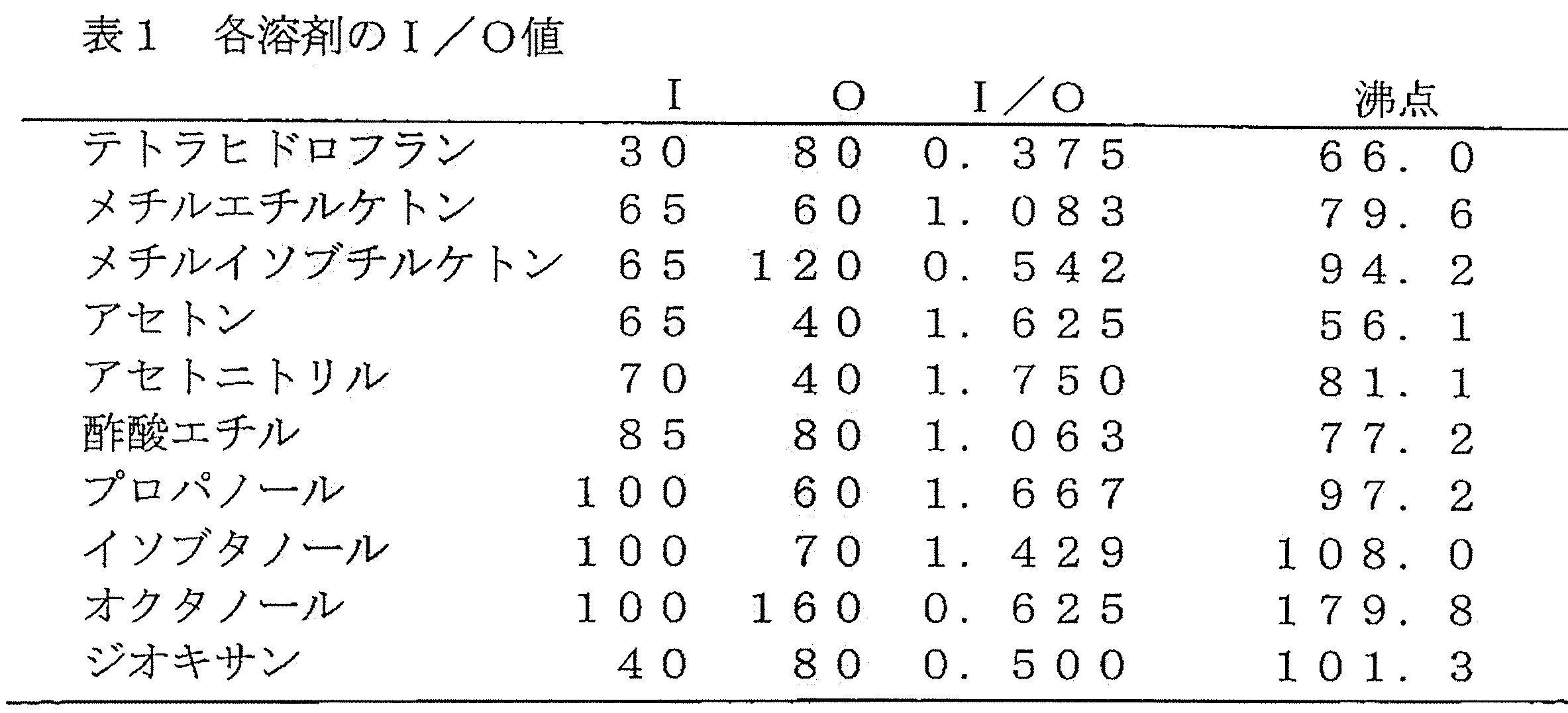
接触工程における、ジカルボン酸を含む水溶液と、該水溶液と相分離可能な溶剤とを接触させる操作は、一段で行っても、多段で行ってもよいが、多段で行うことが好ましい。
相分離工程における相分離操作は、槽で一定時間静置することでも可能であるし、遠心分離装置により行うこともできる。上記のようなミキサーセトラー型抽出機では、接触混合することにより得られた混合液を静置することで相分離させるセトラー部を有しており、セトラー部において液を一定時間静置することにより相分離することができる。相分離工程は連続的に行われてもよいし、回分的に行われても構わない。
抽出工程でジカルボン酸を溶剤中に回収する際に、該ジカルボン酸を含有する水溶液において、ジカルボン酸が塩の水溶液として存在する場合、ジカルボン酸および/またはジカルボン酸の塩が、ジカルボン酸を含む水溶液と相分離する溶剤中に抽出される量が少ない場合があるため、当該水溶液に酸を加えてプロトン化することが好ましい。
一般に、抽出相におけるジカルボン酸濃度は希薄であるため濃縮操作が必要となる。濃縮度は特に限定されるものではないが、最終濃縮液中のジカルボン酸の溶解度が飽和溶解度以下であり、かつ極力飽和溶解度に近いほうが好ましい。
晶析工程は、通常、抽出相を含有する溶液中のジカルボン酸を、ジカルボン酸の溶解度差などを利用して固体のジカルボン酸を析出させる工程であるが、抽出相を含有する溶液からジカルボン酸を固体として析出させる工程であれば、どのような方法によるものであっても構わない。
晶析で得られたジカルボン酸スラリーは、固液分離操作によりジカルボン酸結晶及び母液を分離する。分離方法は特に限定するものではなく、例えば、ろ過分離および沈降分離などが挙げられる。また操作はバッチでも連続でもよい。例えば効率の良い固液分離機として、例えば、連続式の遠心ろ過機およびデカンター等の遠心沈降機などが挙げられる。
固液分離工程で得られた母液および/または洗浄液の少なくとも一部は、晶析工程より前の工程にリサイクルすることができる。リサイクルする工程は特に限定はないが、抽出工程および濃縮工程へリサイクルできる。
上述の方法で得られたジカルボン酸は、更なる精製処理や乾燥工程の適用が必要な場合がある。すなわち、ジカルボン酸を含む発酵液からの精製においては、バイオマス資源に含まれる窒素元素の他、発酵菌由来の窒素元素やアンモニア、硫黄含有不純物ならびに金属カチオン等の多くの不純物の量を減らすことが重要である場合が多い。また、ジカルボン酸中に含まれる着色成分や臭気成分の含有量を低減させたり、250~300nmの紫外線領域に吸収を示す不純物量を平均吸光度が0.05以下になるまで低減させることが必要な場合がある。
本発明に用いる脂肪族ジオールとは、2個のOH基を有する脂肪族および脂環式化合物であれば特に制限はされないが、炭素数の下限値が好ましくは2以上であり、上限値が好ましくは10以下、より好ましくは6以下の脂肪族ジオールが挙げられる。
25℃でのpKaの値が3.7以下の有機酸としては、例えば、化学便覧(基礎編)p1054~1058、丸善出版(1966)やCRC Handbook of chemistry and Physics、7th Edition、p8-43~8-56、CRC Press(1995)に記載の有機酸が挙げられる。
本発明において用いられるポリイソシアネート化合物としては、例えば、2,4-もしくは2,6-トリレンジイソシアネート、キシリレンジイソシアネート、4,4′-ジフェニルメタンジイソシアネート(MDI)、パラフェニレンジイソシアネート、1,5-ナフタレンジイソシアネート、トリジンジイソシアネート等の芳香族ジイソシアネートおよびα,α,α′,α′-テトラメチルキシリレンジイソシアネート等の芳香環を有する脂肪族ジイソシアネート、メチレンジイソシアネート、プロピレンジイソシアネート、リジンジイソシアネート、2,2,4-または2,4,4-トリメチルヘキサメチレンジイソシアネートおよび1,6-ヘキサメチレンジイソシアネート等の脂肪族ジイソシアネート、1,4-シクロヘキサンジイソシアネート、メチルシクロヘキサンジイソシアネート(水添TDI)、1-イソシアネート-3-イソシアネートメチル-3,5,5-トリメチルシクロヘキサン(IPDI)、4,4′-ジシクロヘキシルメタンジイソシアネートおよびイソプロピリデンジシクロヘキシル-4,4′-ジイソシアネート等の脂環族ジイソシアネート等が挙げられる。これらは単独使用でも2種以上の併用でもよい。
更に本発明のポリウレタン樹脂には、上記以外に必要に応じて他の添加剤を加えてもよい。これらの添加剤としては、例えば、CYANOX1790[CYANAMID(株)製]、IRGANOX245、IRGANOX1010[以上、チバ・スペシャリティー・ケミカルズ(株)製]、Sumilizer GA-80(住友化学(株)製)および2,6-ジブチル-4-メチルフェノール(BHT)等の酸化防止剤、TINUVIN622LD、TINUVIN765[以上、チバ・スペシャリティー・ケミカルズ(株)製]、SANOL LS-2626、LS-765[以上、三共(株)製]等の光安定剤、TINUVIN328およびTINUVIN234(以上、チバ・スペシャリティー・ケミカルズ(株)製)等の紫外線吸収剤、ジメチルシロキサンポリオキシアルキレン共重合体等のシリコン化合物、赤燐、有機リン化合物、リンおよびハロゲン含有有機化合物、臭素または塩素含有有機化合物、ポリリン酸アンンモニウム、水酸化アルミニウム、酸化アンチモン等の添加および反応型難燃剤、二酸化チタン等の顔料、染料およびカーボンブラック等の着色剤、カルボジイミド化合物等の加水分解防止剤、ガラス短繊維、カーボンファイバー、アルミナ、タルク、グラファイト、メラミンおよび白土等のフィラー、滑剤、油剤、界面活性剤、その他の無機増量剤並びに有機溶媒などが挙げられる。また、水並びに代替フロン等の発泡剤も加えてもよい。特に靴底用ポリウレタンフォームには有用である。
本発明の脂肪族ジオール単位、ジカルボン酸単位および25℃におけるpKa値が3.7以下である有機酸単位を少なくとも構成単位として含むバイオマス資源由来ポリエステルポリオールの製造方法は、ジカルボン酸がバイオマス資源から誘導された少なくとも一つの成分を含み、有機酸単位の含有量が、ジカルボン単位に対し0モル%超0.09モル%以下となるようにポリエステルポリオールを製造することができれば特に制限されない。
本発明のバイオマス資源由来ポリエステルポリオールは、脂肪族ジオール単位、ジカルボン酸単位、25℃におけるpKa値が3.7以下である有機酸単位を少なくとも構成単位として含むポリエステルポリオールであって、該ジカルボン酸がバイオマス資源から誘導された少なくとも一つの成分を含み、該有機酸単位の含有量が、該ジカルボン酸単位に対し0モル%超0.09モル%以下である。
本発明におけるバイオマス資源由来ポリウレタンの製造方法は、脂肪族ジオールとジカルボン酸を反応させ、ポリエステルポリオールを製造する工程と、該ポリエステルポリオールをポリイソシアネート化合物と反応させる工程とを少なくとも含むポリウレタンの製造方法であって、原料である該ジカルボン酸がバイオマス資源から誘導された少なくとも一つの成分を含み、該ジカルボン酸中の25℃におけるpKa値が3.7以下の有機酸の含有量が0ppm超1000ppmであることを特徴とするものであり、少なくとも原料として用いるジカルボン酸が当該範囲になるようにバイオマス資源由来ポリウレタンを製造することができれば特に制限されない。
一段法とは、ワンショット法とも呼ばれ、バイオマス資源由来ポリエステルポリオール、ポリイソシアネート化合物および鎖延長剤を一緒に仕込むことで反応を行う方法である。各化合物の使用量は、上記記載の量を使用すればよい。
二段法は、プレポリマー法ともよばれ、あらかじめポリイソシアネート成分とポリオール成分とを、通常、反応当量比を好ましくは1.0~10.00で反応させたプレポリマーを製造する。次いで該プレポリマーにポリイソシアネート成分、多価アルコールおよびアミン化合物等の活性水素化合物成分を加える2段階反応させることもできる。特にポリオール成分に対して当量以上のポリイソシアネート化合物を反応させて両末端NCOプレポリマーを作り、続いて鎖延長剤である短鎖ジオールまたはジアミンを作用させてポリウレタンを得る方法が有用である。
本発明の人工皮革または合成皮革について詳細に説明する。人工皮革または合成皮革は、基布と接着剤層と表皮層とを主要構成要素とする。表皮層は本発明で得られたポリウレタン樹脂にその他の樹脂、酸化防止剤および紫外線吸収剤等を混合し、ポリウレタン樹脂溶液を作成し、これに着色剤および有機溶剤等を混合して得られる表皮層配合液からなる。ポリウレタン樹脂溶液には、その他必要に応じて、加水分解防止剤、顔料、染料、難燃剤、充填材および架橋剤などを添加することができる。
本発明のバイオマス資源由来ポリウレタンは、脂肪族ジオール単位、ジカルボン酸単位、ポリイソシアネート単位および25℃におけるpKa値が3.7以下である有機酸単位、を少なくとも構成単位として含むポリウレタンであって、該ジカルボン酸がバイオマス資源から誘導された少なくとも一つの成分を含み、該有機酸単位の含有量が、該ジカルボン酸単位に対し0モル%超0.09モル%以下である。
本発明で製造されるポリウレタンおよびそのウレタンプレポリマー溶液は、多様な特性を発現させることができ、フォーム、エラストマー、塗料、繊維、接着剤、床材、シーラント、医用材料、人工皮革等に広く用いることができる。
ポリエステルポリオールの数平均分子量は水酸基価(OH価 mg KOH/g)より求めた。
得られたポリウレタン溶液の分子量測定は、(株)島津製作所製GPC装置 (カラムTSKgelSuperHZM-N,溶媒は臭化リチウム添加N,N-ジメチルアセトアミド)を使用し、標準ポリスチレン換算重量平均分子量を分子量とした。
ポリウレタン樹脂試験片は幅10mm、長さ100mm、厚み50~100μmの短冊状とし、引張試験機[(株)オリエンテック製テンシロンRTC-1210A]を用いて測定した。チャック間距離20mm、引張速度200mm/分にて、温度23℃(相対湿度55%)の条件下で実施した。1サンプルにつき10点測定し、破断応力、破断伸度はその平均値を採用した。
JIS-K0101に準拠の方法で測定した。
試料数10mgを石英ボートへ採取して、全窒素分析計(三菱化学社製TN-10型)を用いて試料を燃焼し、化学発光法により決定した。
試料約0.1gを白金製ボートに採取して石英管管状炉(三菱化学社製AQF-100(濃縮システム))で燃焼し、燃焼ガス中の硫黄分を0.1%-過酸化水素水で吸収させた。その後、吸収液中の硫酸イオンをイオンクロマトグラフ(Dionex社製 ICS-1000型)を用いて測定した。
JIS-K7105の方法に基づいて測定した。
日立分光光度計UV-3500を用いて測定し、本明細書の[発明を実施するための形態]に定義した方法で求めた。
カラム:信和化工(株)製 ULTRON PS-80H 8.0mmI.D.× 30cm
温度:60℃
溶離液:0.1%-過塩素酸水溶液 1.0mL/min
注入:10μl
検出:RI検出器 または UV検出器
リンゴ酸検出限界は100ppmであった。
カラム:三菱化学製 MCI GEL CK08EH(8.0mm×300mmL.)
温度:60℃
溶離液:0.02%蟻酸水溶液 1.0mL/min
注入:3μl
検出:ESI-SIM(negative) m/z133.2(リンゴ酸擬分子イオンシグナル)
リンゴ酸検出限界はS/N=3としたとき0.05ppmであった。
装置:日立アミノ酸分析計 L-8900
分析条件:生体アミノ酸分離条件-ニンヒドリン発色法(570nm,440nm)
標準品:PF(和光アミノ酸混合液ANII型0.8ml+B型0.8ml→10ml)
注入量:10μl
試料10mg或いは100mgを精秤し、純水で1ml定容としたものを、200μl分注、乾固し、塩酸雰囲気下150℃、1時間加熱し、タンパク質を加水分解処理した。これを乾固させた後純水200μlを加えて再溶解させ、0.45μmフィルターでろ過後、ろ液をアミノ酸の分析に供した。加水分解前後の総アミノ酸量の増分をタンパク質量と見なした。
<コハク酸発酵菌株の作製>
(A)ブレビバクテリウム・フラバムMJ233株ゲノムDNAの抽出
ブレビバクテリウム・フラバムMJ233は、1975年4月28日に通商産業省工業技術院微生物工業技術研究所(現独立行政法人 産業技術総合研究所 特許生物寄託センター)(〒305-8566 日本国茨城県つくば市東1丁目1番地1 中央第6)に受託番号FERM P-3068として寄託され、1981年5月1日にブダペスト条約に基づく国際寄託に移管され、FERM BP-1497の受託番号で寄託されている。
ブレビバクテリウム・フラバムMJ233株由来ピルベートカルボキシラーゼ遺伝子のN末端領域のDNA断片の取得は、上記(A)で調製したDNAを鋳型とし、全ゲノム配列が報告されているコリネバクテリウム・グルタミカム ATCC13032株の該遺伝子の配列(GenBank Database Accession No.BA000036のCgl0689)を基に設計した合成DNA(配列番号1および配列番号2)を用いたPCRによって行った。尚、配列番号1のDNAは5’末端がリン酸化されたものを用いた。
ブレビバクテリウム・フラバムMJ233/ΔLDH(LDH活性が低下した株:特開2005-95169)の形質転換に用いるプラスミドDNAは、pMJPC17.2のプラスミドDNA用いて塩化カルシウム法(Journal of Molecular Biology,53,159,1970)により形質転換した大腸菌JM110株から再調製した。ブレビバクテリウム・フラバムMJ233/ΔLDH株の形質転換は電気パルス法(Res.Microbiol.、Vol.144,p.181~185,1993)によって行い、得られた形質転換体をカナマイシン 25μg/mlを含むLBG寒天培地[トリプトン10g、イーストエキストラクト5g、NaCl 5g、グルコース 20g、および寒天15gを蒸留水1Lに溶解]に塗抹した。
(A)種培養
尿素:4g、硫酸アンモニウム:14g、リン酸1カリウム:0.5g、リン酸2カリウム0.5g、硫酸マグネシウム・7水和物:0.5g、硫酸第一鉄・7水和物:20mg、硫酸マンガン・水和物:20mg、D-ビオチン:200μg、塩酸チアミン:200μg、酵母エキス:1g、カザミノ酸:1gを蒸留水に溶解、1000mlに調整した培地100mlを500mlの三角フラスコにいれ、121℃、20分加熱滅菌した。これを室温まで冷やし、あらかじめ滅菌した50%グルコース水溶液を4ml添加し、上記で構築したブレビバクテリウム・フラバムMJ233/PC-5/ΔLDH株を接種して16時間30℃にて振とう(160rpm)培養した。
硫酸アンモニウム:3.0g、85%リン酸:6.7g、塩化カリウム:4.9g、硫酸マグネシウム・7水和物:1.5g、硫酸第一鉄・7水和物:120mg、硫酸マンガン・水和物:120mg、コーンスティープリカー(王子コーンスターチ社製)30.0g、10N水酸化カリウム水溶液:11.0g、消泡剤(CE457:日本油脂製):2.5gを蒸留水に溶解して調整した培地2.0Lを5Lの発酵糟に入れ、121℃、20分加熱滅菌した。
85%リン酸:1.6g、硫酸マグネシウム・7水和物:1.1g、硫酸第一鉄・7水和物:43mg、硫酸マンガン・水和物:43mg、10N水酸化カリウム水溶液:2.86gを蒸留水に溶解、42mlに調整後、121℃、20分加熱滅菌処理し、反応濃縮培地を作製した。
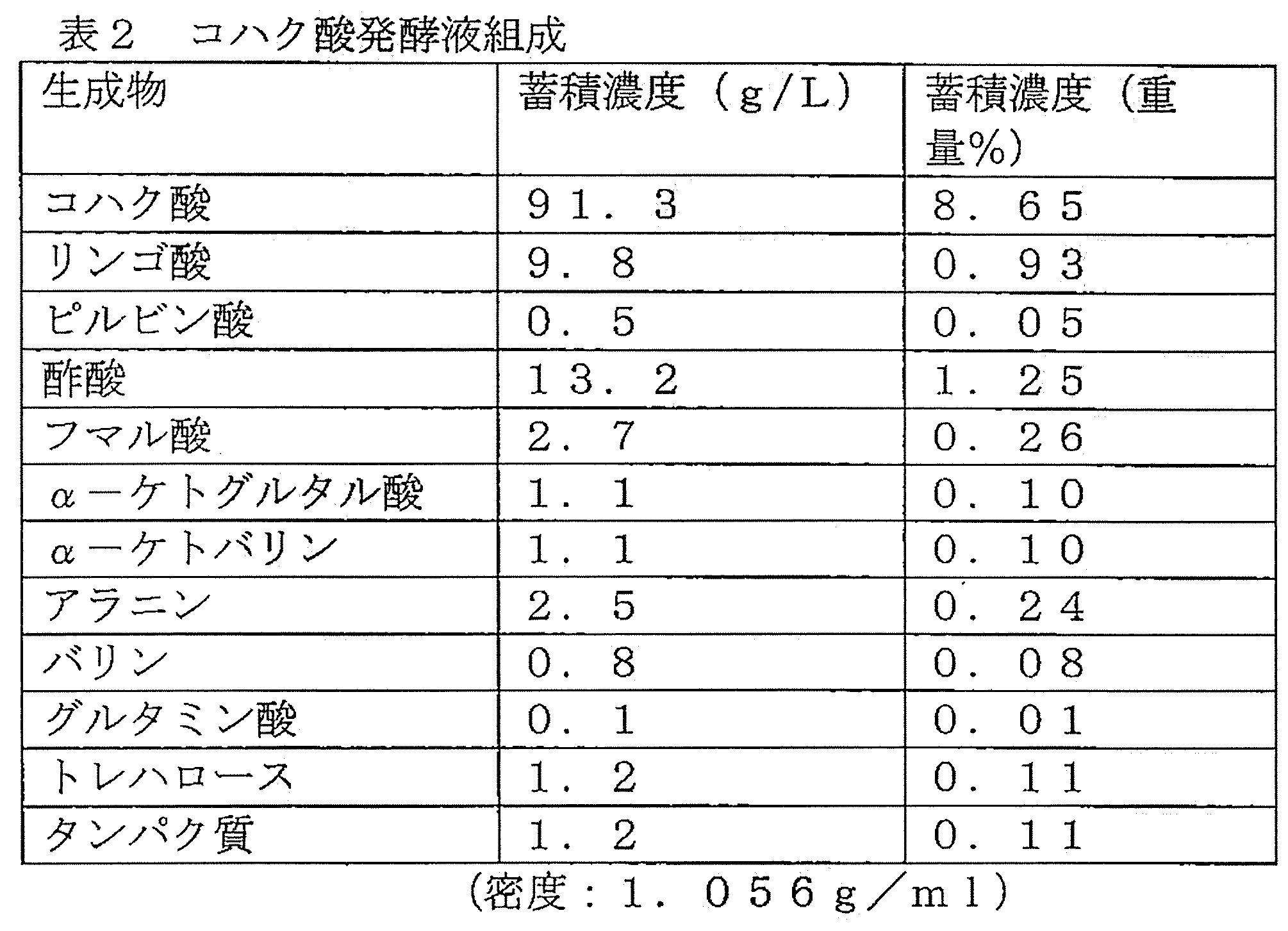
カラム:信和化工(株)製 ULTRON PS-80H 8.0mmI.D.×30cm
温度:60℃
溶離液:0.1%-過塩素酸水溶液 1.0mL/min
注入:3μl
検出:RI検出器またはUV検出器
リンゴ酸検出限界:100ppm
上記のようにして得られた、バイオマス資源由来原料から得られた脂肪族ジカルボン酸を含む水溶液であるコハク酸発酵液から、コハク酸を製造した。
上述のコハク酸発酵液1500gに、98%硫酸を加えpHを2.5に調整した。ここで98%硫酸添加量は150gであった。
硫酸添加後のコハク酸水溶液は、ジャケット付スタティックミキサー(ノリタケ1/4(1)-N40-174-0(内径Φ5mm、エレメント数24))および各槽が600ml、400ml、300mlのジャケット付3槽式のセトラーを用い、メチルエチルケトン(以下、MEKと略記することがある)溶液と混合、液々分離することでコハク酸を連続抽出した。
回収した抽残相1613gは、内径Φ20mm,高さ2mのジャケット付攪拌型連続抽出塔(理論段10段)を用い、10%含水MEK1613g(MEK溶液(重量)/コハク酸水溶液(重量)=1.0(重量/重量))で連続抽出した。

回収した抽出相は連続蒸留によりMEKを実質的に除去する。ここで蒸留留出液はMEKと水の共沸組成物、すなわち11重量%含水MEKとして回収されるが、釜残液の濃縮度合い次第ではコハク酸が析出する懸念がある。そこで蒸留留出液が11重量%含水MEK、釜残液が30重量%コハク酸溶液となるよう抽出相2637gに対し190gの水を添加した。
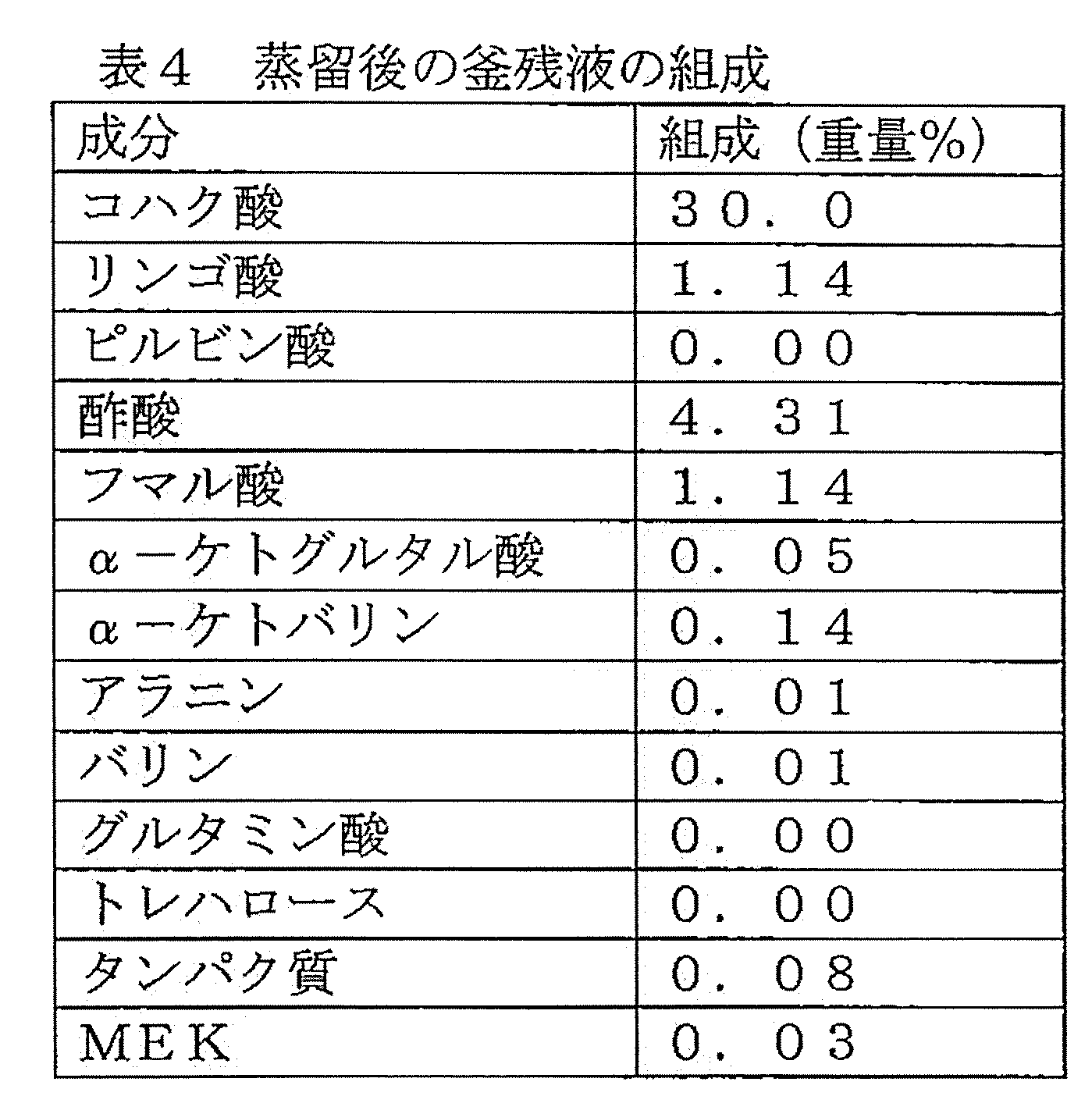
MEKを留去した液はジャケット付500mlセパラブルフラスコへ移し、攪拌下ジャケットに温水を通水することで80℃に保温した。その後プログラム付循環恒温槽を用い、ジャケットへ通水する温水を1時間かけて20℃まで冷却し、コハク酸を冷却晶析し、20℃到達後更に20℃で1時間熟成した。得られたスラリーは真空ろ過して晶析母液を分離した。


<プロトン化>
前記コハク酸発酵液1384gに、98%硫酸を加えpH2.5とした。ここで98%硫酸添加量は138gであった。このプロトン化した液に、参考例2で回収された回収液の半分に当たる281gを加え、コハク酸水溶液1803gを調整した。
参考例2と同様の方法で、コハク酸水溶液を10%含水MEKで抽出した。ミキサーセトラーではコハク酸水溶液に対し0.5重量倍の10%含水MEKをそれぞれ20g/分、10g/分で供給し、回収した中間相は加圧ろ過、抽残相は更に抽残相に対し1.0重量倍の10%含水MEKで向流多段連続抽出を行った。結果、抽出相2882g、抽残相1593gを回収した。その組成は以下の通りであった。
参考例2と同様の方法で蒸留を行い、コハク酸濃縮液438gを回収した。その組成は下記表7の通りであった。有機酸および糖類の分析は、表2と同等条件の高速液体クロマトグラフィで実施した。
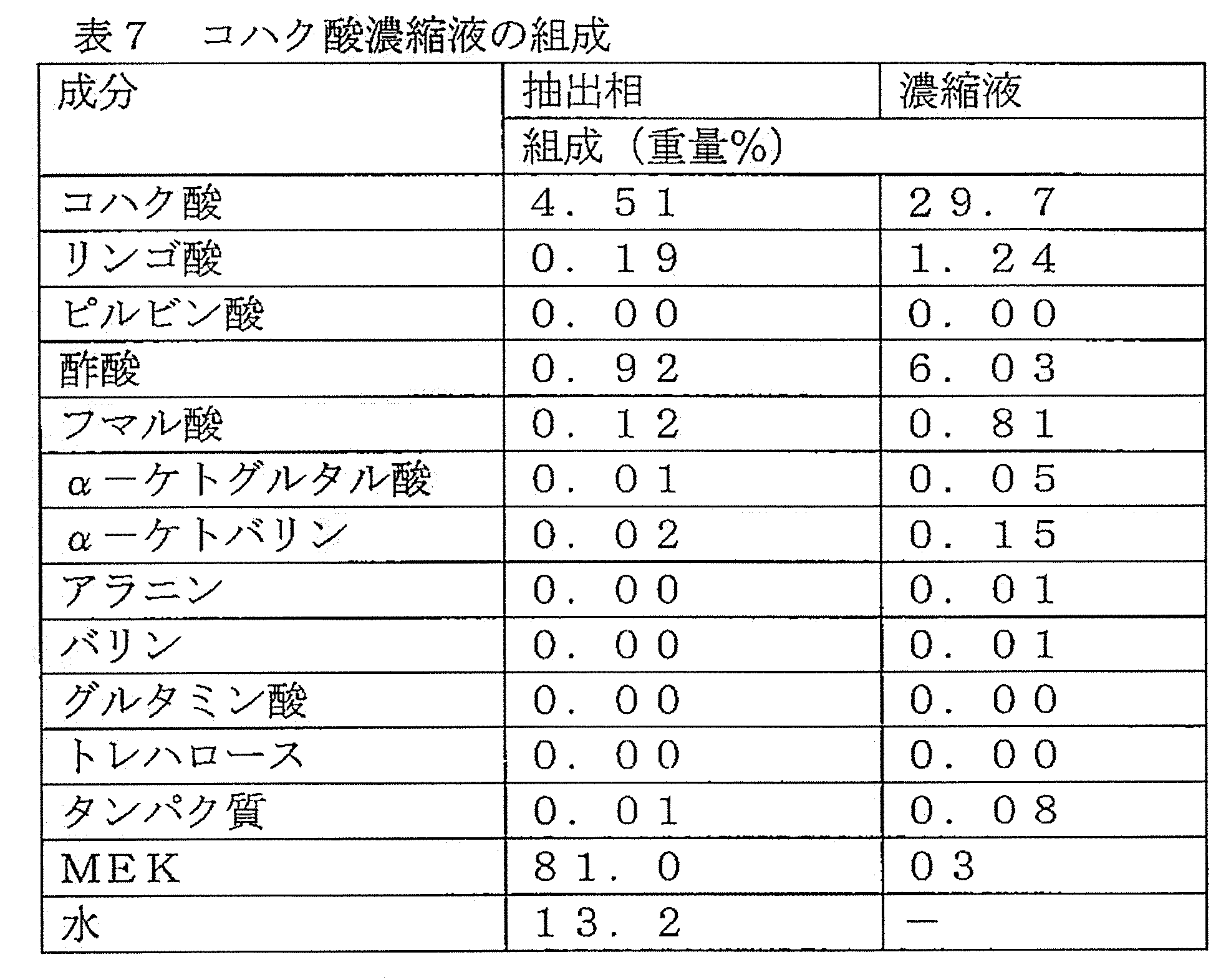
参考例2と同様の方法で晶析を行い、コハク酸113gと晶析母液および洗浄液の混合液である回収液568gを回収した。下記表8に得られたコハク酸の組成を、下記表9に得られた回収液の組成を示す。有機酸および糖類の分析は、表2と同等条件の高速液体クロマトグラフィで実施した。
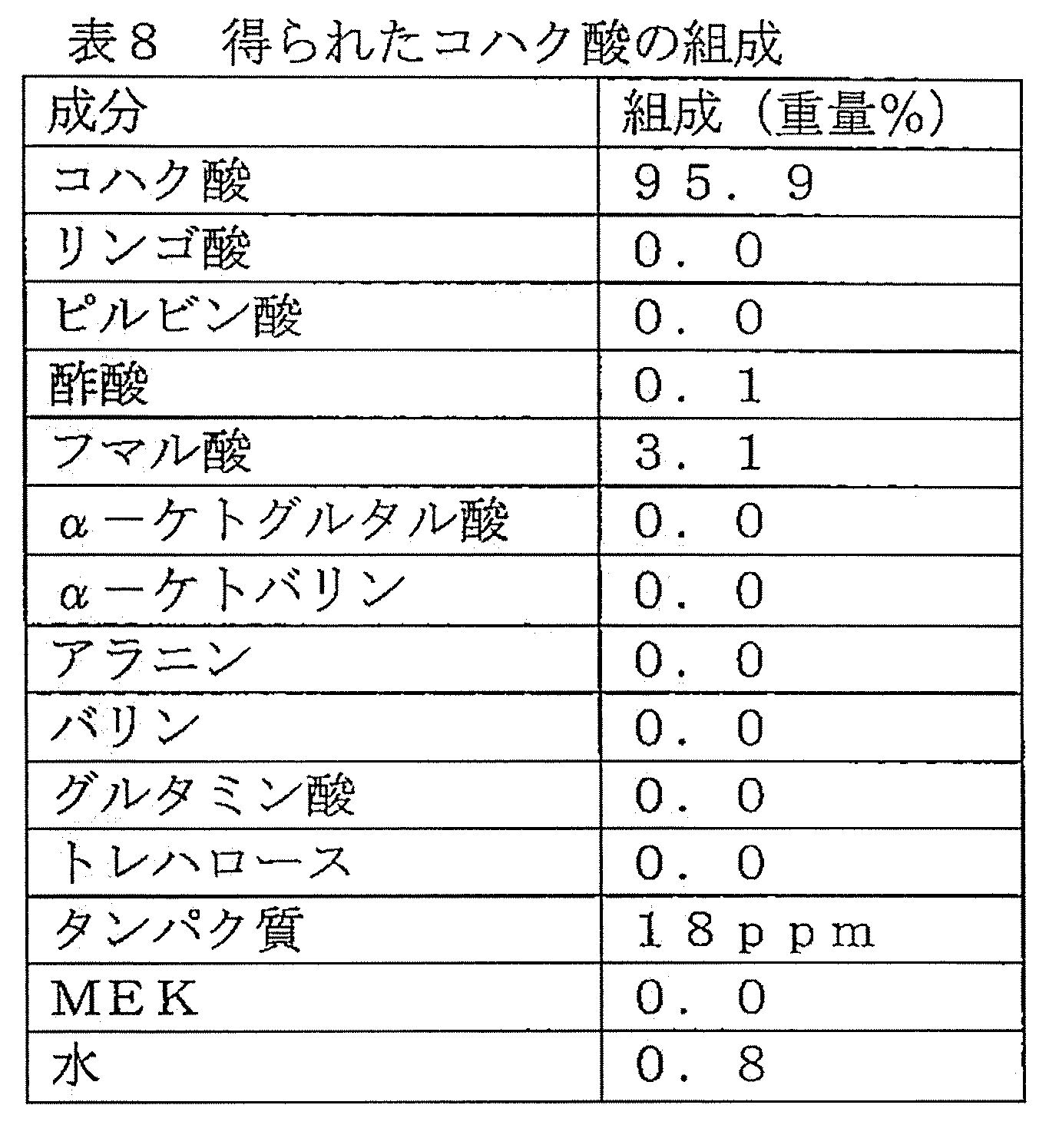
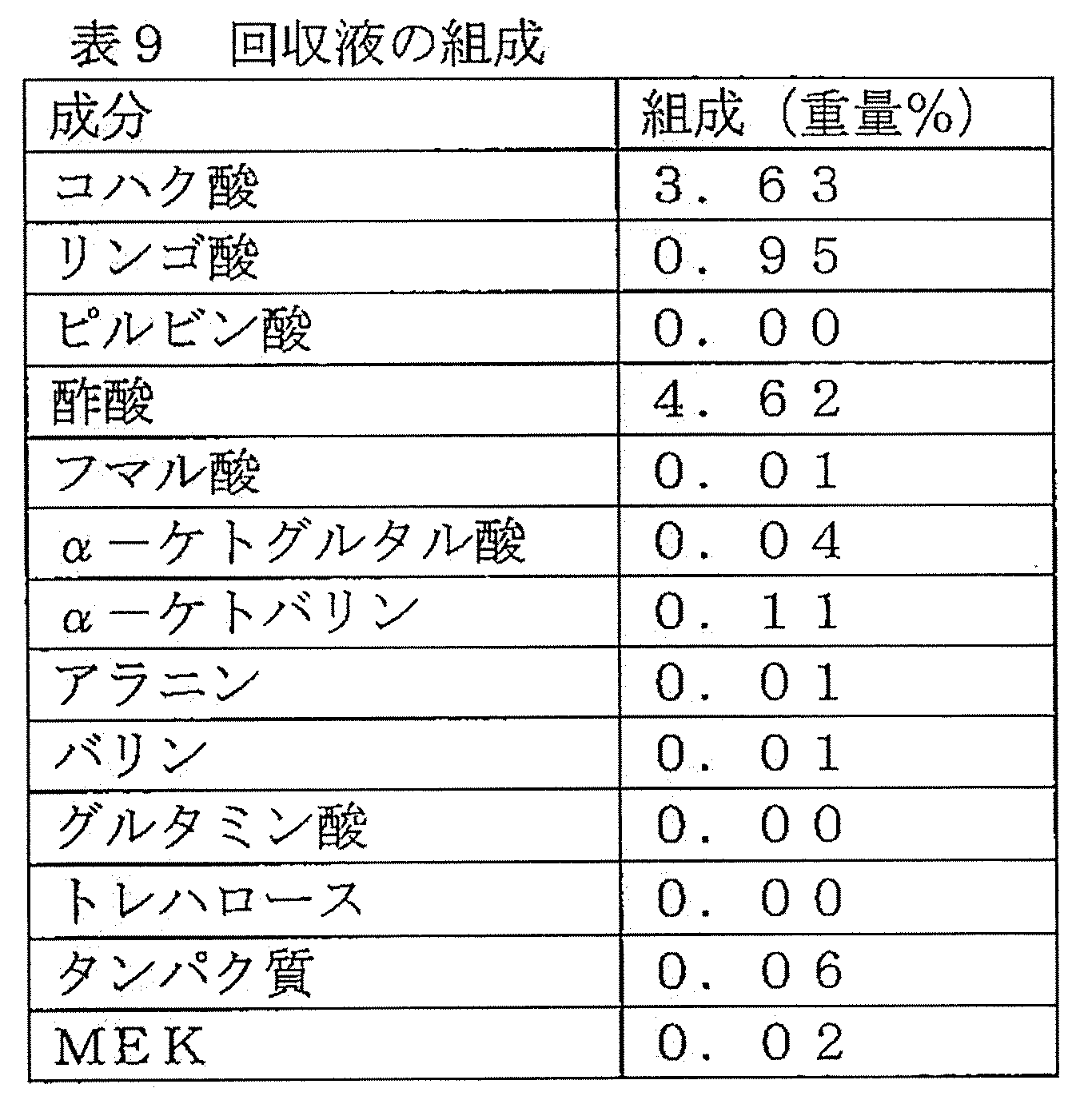
上記のように得られた粗結晶から、30wt%の粗コハク酸水溶液を80℃で調製した後、コハク酸に対して0.3wt%量の粉末状の薬液賦活した活性炭ダイヤホープ8ED(三菱化学カルゴン株式会社製)を加えた。活性炭処理は、スリーワンモーターを用いて200rpmで攪拌しながら80℃で2時間実施した。
<ポリエステルポリオール製造>
リンゴ酸の含有量が0.2ppmとなるコハク酸(発酵法により製造したコハク酸を精製し調製した)260g(2.2モル)と多価アルコールとして3-メチル-1,5-ペンタンジオール296g(2.5モル)を温度計、誘導攪拌器、冷却器付き油水分離器、滴下ロートを装着した1L四つ口フラスコに仕込んだ。その後、30Torrまで減圧、窒素で復圧の作業を数回繰り返し、反応器内の窒素置換を行った。
ポリエステルポリオール:試料43.3mgを重クロロホルム(0.05v/vTMS含)0.7mlに溶かした後、外径5mmのNMR試料管に移した。Bruker社製AVANCE400分光計を用い、室温で1H-NMRスペクトルを測定した。化学シフトの基準はTMSのシグナルを0.00ppmとした。ポリエステルポリオールのコハク酸単位中のリンゴ酸量の測定において、リンゴ酸エステルのピークのは5.43ppmに検出される。検出限界は、S/N=3とした場合、コハク酸単位に対して500ppmであった。
1Lセパラブルフラスコに上記方法で製造したポリエステルポリオール(水酸基価より算出した数平均分子量2000前後)102.2gを仕込み、55℃設定のオイルバスにフラスコを漬けて加温しつつN,N-ジメチルホルムアミド(DMF)を加えて溶解させた。約100rpmで攪拌を開始し、更に鎖延長剤として1,4-ブタンジオールを4.51gを添加し、オクチル酸スズを0.024g滴下した。
ポリウレタン:試料約40mgを外径5mmのNMR試料管にはかりとり、DMF-d7 を約1.0ml加えて溶かした。Bruker社製AVANCE400分光計を用い、室温で1H-NMRスペクトルを測定した。化学シフトの基準は、DMFのメチル基の低磁場側のシグナルを2.91ppmとした。ポリウレタンのコハク酸単位中のリンゴ酸量の測定において、リンゴ酸エステルのピークのは5.46ppmに検出される。検出限界は、S/N=3とした場合、コハク酸単位に対して300ppmであった。したがって、原料コハク酸単位に対するリンゴ酸単位の仕込み量は0.2ppmで、上述のNMR測定では、リンゴ酸検出限界300ppmのためリンゴ酸単位は検出されなかった。
得られたポリウレタン溶液を用い、ドクターブレードにてポリエチレンフィルム上に均一膜厚に塗布し、乾燥機で乾燥しポリウレタンフィルムを得、このフィルムの引っ張り強度試験を上述のフィルム物性の測定方法により実施した。ウレタンフィルム物性の破断応力は7.9MPa、破断伸度は1270%で弾性率が低く、非常に伸度に優れた物性であった。
リンゴ酸の含有量が5000ppmとなるコハク酸(無水マレイン酸を原料として製造され、市販されているコハク酸を使用)260g(2.2モル)と多価アルコールとして3-メチル-1,5-ペンタンジオール296g(2.5モル)を原料として用い、上記記載のポリエステルポリオール製造方法で水酸基価55.1(水酸基価換算分子量2036)のポリエステルポリオールを製造した。該ポリエステルポリオールのAPHAは20であった。NMR測定の結果、リンゴ酸単位、つまり架橋構造はコハク酸単位に対し0.47モル%であった。
リンゴ酸の含有量が1700ppmとなるコハク酸(無水マレイン酸を原料として製造されたものに精製をかけ調製したコハク酸を使用)260g(2.2モル)と他価アルコールとして3-メチル-1,5-ペンタンジオール296g(2.5モル)を原料として用い、上記記載のポリエステルポリオール製造方法で水酸基価54.1(水酸基価換算分子量2074)のポリエステルポリオールを製造した。該ポリエステルポリオールのAPHAは20であった。NMR測定の結果、リンゴ酸単位、つまり架橋構造はコハク酸単位に対し0.16モル%であった。
リンゴ酸の含有量が0.2ppmとなるコハク酸(発酵法により製造したコハク酸を精製し調製した)71g(0.6モル)、アジピン酸(市販品)88g(0.6モル)と多価アルコールとして3-メチル-1,5-ペンタンジオール162g(1.4モル)を原料として用いた以外、実施例1と同様にして、水酸基価61.0(水酸基価換算分子量1839)のポリエステルポリオールを製造した。該ポリエステルポリオールのAPHAは25であり、石油由来のジカルボン酸と混合して使用しても着色の少ないポリエステルポリオールが得られた。
リンゴ酸の含有量が500ppmとなるコハク酸(発酵法により製造したコハク酸にリンゴ酸を添加し調製した)160g(1.4モル)と多価アルコールとして3-メチル-1,5-ペンタンジオール179g(1.5モル)を原料として用い、反応温度の上限を約190℃とした以外は実施例1と同様の方法で、水酸基価56.9(水酸基価換算分子量1972)のポリエステルポリオールを製造した。
1Lセパラブルフラスコに上記方法で製造したポリエステルポリオール(水酸基価より算出した数平均分子量2000前後)56.8gを仕込み、窒素置換を3回行った後、20Torrに減圧し、100℃のオイルバスにつけ脱水を1時間行った。1時間経過後、いったん冷却し窒素によって復圧した。このときのポリエステルポリオール水分量は110ppmであった。つづけて60℃のオイルバスにフラスコを漬けて加温しつつN,N-ジメチルアセトアミド(DMAc)を加えて溶解させた。約100rpmで攪拌を開始し、更に鎖延長剤として1,4-ブタンジオールを2.55g添加し、オクチル酸スズを0.012g滴下した。このときの水分量はポリエステルポリオールと溶媒中で合計0.025g(0.0014モル)であった。
活性水素に対するMDI当量=(NCO[mol])/(ポリエステルポリオール水酸基数[mol]+鎖延長剤水酸基数[mol]+ポリエステルポリオール中の水分[mol]+溶媒中の水分[mol])
リンゴ酸の含有量が0.2ppmとなるコハク酸(発酵法により製造したコハク酸を精製し調整した)160g(1.4モル)と多価アルコールとして3-メチル-1,5-ペンタンジオール178g(1.5モル)を原料として用い、反応温度の上限を190℃とした以外は実施例1と同様の方法で、水酸基価52.6(水酸基価換算分子量2133)のポリエステルポリオールを製造した。
リンゴ酸の含有量が検出限界未満となるコハク酸(リンゴ酸含有量が0.2ppmである発酵法により製造したコハク酸をさらに晶析精製し、リンゴ酸含有量をコハク酸に対しLC-MSでの検出限界未満としたコハク酸を使用)160g(1.4モル)と多価アルコールとして3-メチル-1,5-ペンタンジオール177g(1.5モル)を原料として用い、反応温度の上限を190℃とした以外は実施例1と同様の方法で、水酸基価55.2(水酸基価換算分子量2033)のポリエステルポリオールを製造した。
リンゴ酸の含有量が5000ppmとなるコハク酸(発酵法により製造したコハク酸にリンゴ酸を添加し調整したコハク酸を使用)159g(1.4モル)と他価アルコールとして3-メチル-1,5-ペンタンジオール178g(1.5モル)を原料として用い、反応温度の上限を190℃とした以外は実施例1と同様の方法で水酸基価56.3(水酸基価換算分子量1993)のポリエステルポリオールを製造した。

<ポリエステルポリオール製造2>
リンゴ酸の含有量が0.2ppmとなるコハク酸(発酵法により製造したコハク酸を精製し調製した)170g(1.5モル)と多価アルコールとしてエチレングリコール110g(1.8モル)と1,4ブタンジオール80g(0.9モル)を温度計、誘導攪拌器、冷却器を装着した1L四つ口フラスコに仕込んだ。その後、30Torrまで減圧、窒素で復圧の作業を数回繰り返し、反応器内の窒素置換を行った。
Claims (22)
- ジカルボン酸および脂肪族ジオールを反応させポリエステルポリオールを製造する工程と、該ポリエステルポリオールおよびポリイソシアネート化合物を反応させる工程とを少なくとも含むポリウレタンの製造方法であって、該ジカルボン酸がバイオマス資源から誘導された少なくとも一つの成分を含み、該ジカルボン酸中の有機酸の含有量がジカルボン酸に対して0ppm超1000ppm以下であり、該有機酸の25℃におけるpKa値が3.7以下であることを特徴とする、バイオマス資源由来ポリウレタンの製造方法。
- 前記ジカルボン酸の少なくとも一つの成分が、バイオマス資源から誘導されたものであることを特徴とする請求項1に記載のバイオマス資源由来ポリウレタンの製造方法。
- 前記ジカルボン酸がバイオマス資源から誘導されたコハク酸を含む請求項1または2に記載のバイオマス資源由来ポリウレタンの製造方法。
- 前記25℃におけるpKa値が3.7以下の有機酸が活性水素基を1分子に3個以上有する請求項1~3のいずれか1項に記載のバイオマス資源由来ポリウレタンの製造方法。
- 前記25℃におけるpKa値が3.7以下の有機酸が、リンゴ酸、酒石酸およびクエン酸から選ばれる少なくとも1種である請求項1~4のいずれか1項に記載のバイオマス資源由来ポリウレタンの製造方法。
- 請求項1~5のいずれか1項に記載の製造方法で得られたバイオマス資源由来ポリウレタン。
- ジカルボン酸単位、脂肪族ジオール単位、ポリイソシアネート単位、25℃におけるpKa値が3.7以下である有機酸単位、を少なくとも構成単位として含むポリウレタンであって、該ジカルボン酸がバイオマス資源から誘導された少なくとも一つの成分を含み、該有機酸単位の含有量が、ジカルボン酸単位に対し0モル%超0.09モル%以下であることを特徴とするバイオマス資源由来ポリウレタン。
- 前記ジカルボン酸の少なくとも一つの成分が、バイオマス資源から誘導されたものであることを特徴とする請求項7に記載のバイオマス資源由来ポリウレタン。
- 前記ジカルボン酸がバイオマス資源から誘導されたコハク酸を含む請求項7または8に記載のバイオマス資源由来ポリウレタン。
- 前記脂肪族ジオール単位が、エチレングリコール単位および1,4-ブタンジオール単位の少なくとも一方を含む請求項7~9のいずれか1項に記載のバイオマス資源由来ポリウレタン。
- 前記25℃におけるpKa値が3.7以下の有機酸単位が活性水素基を1分子に3個以上有する有機酸単位である請求項7~10のいずれか1項に記載のバイオマス資源由来ポリウレタン。
- 前記25℃におけるpKa値が3.7以下の有機酸単位が、リンゴ酸、酒石酸およびクエン酸から選ばれる少なくとも1種である請求項7~11のいずれか1項に記載のバイオマス資源由来ポリウレタン。
- YI値(JIS-K7105に準拠)が20以下である請求項7~12のいずれか1項に記載のバイオマス資源由来ポリウレタン。
- GPC測定による分子量分布(Mw/Mn)が1.5~3.5である請求項6~13のいずれか1項に記載のバイオマス資源由来ポリウレタン。
- ジカルボン酸単位、脂肪族ジオール単位および25℃におけるpKa値が3.7以下である有機酸単位を少なくとも構成単位として含むポリエステルポリオールであって、該ジカルボン酸がバイオマス資源から誘導された少なくとも一つの成分を含み、該有機酸単位の含有量が、該ジカルボン酸単位に対し0モル%超0.09モル%以下であるポリウレタン製造用のバイオマス資源由来ポリエステルポリオール。
- 前記ジカルボン酸の少なくとも一つの成分が、バイオマス資源から誘導されたものであることを特徴とする請求項15に記載のバイオマス資源由来ポリエステルポリオール。
- 前記ジカルボン酸がバイオマス資源から誘導されたコハク酸を含む請求項15または16に記載のバイオマス資源由来ポリエステルポリオール。
- 数平均分子量が500以上5000以下である請求項15~17のいずれか1項に記載のバイオマス資源由来ポリエステルポリオール。
- 前記有機酸単位が、リンゴ酸、酒石酸およびクエン酸から選ばれる少なくとも1種である請求項15~18のいずれか1項に記載のバイオマス資源由来ポリエステルポリオール。
- ハーゼン色数で表した値(APHA値:JIS-K0101に準拠)が50以下である請求項15~19のいずれか1項に記載のバイオマス資源由来ポリエステルポリオール。
- 請求項6~14のいずれか1項に記載のバイオマス資源由来ポリウレタンを用いて製造した人工皮革または合成皮革。
- 請求項6~14のいずれか1項に記載のバイオマス資源由来ポリウレタンを用いて製造した靴底用ポリウレタン。
Priority Applications (11)
| Application Number | Priority Date | Filing Date | Title |
|---|---|---|---|
| BR112012025093A BR112012025093A8 (pt) | 2010-03-31 | 2011-03-30 | Método para produzir um poliuretano derivado de recursos de biomassa, poliuretano derivado de recursos de biomassa e couro artificial ou couro sintético |
| CN201180016195.3A CN102822223B (zh) | 2010-03-31 | 2011-03-30 | 来自生物质资源的聚氨酯及其制造方法以及来自生物质资源的聚酯多元醇 |
| KR1020127027895A KR101640966B1 (ko) | 2010-03-31 | 2011-03-30 | 바이오매스 자원 유래 폴리우레탄 및 그 제조 방법 그리고 바이오매스 자원 유래 폴리에스테르폴리올 |
| EP11765620.7A EP2554559B1 (en) | 2010-03-31 | 2011-03-30 | Polyurethane derived from biomass resources, method for producing same, and polyester polyol derived from biomass resources |
| KR1020157019374A KR101697889B1 (ko) | 2010-03-31 | 2011-03-30 | 바이오매스 자원 유래 폴리우레탄 및 그 제조 방법 그리고 바이오매스 자원 유래 폴리에스테르폴리올 |
| EP18207984.8A EP3486267B1 (en) | 2010-03-31 | 2011-03-30 | Biomass-resource-derived polyurethane, method for producing same, and biomass-resource-derived polyester polyol |
| US13/632,992 US9394397B2 (en) | 2010-03-31 | 2012-10-01 | Biomass-resource-derived polyurethane, method for producing same, and biomass-resource-derived polyester polyol |
| US13/871,414 US9290614B2 (en) | 2010-03-31 | 2013-04-26 | Biomass-resource-derived polyurethane, method for producing same, and biomass-resource-derived polyester polyol |
| US15/174,069 US9963537B2 (en) | 2010-03-31 | 2016-06-06 | Biomass-resource-derived polyurethane, method for producing same, and biomass-resource-derived polyester polyol |
| US15/936,535 US10351658B2 (en) | 2010-03-31 | 2018-03-27 | Biomass-resource-derived polyurethane, method for producing same, and biomass-resource-derived polyester polyol |
| US16/413,862 US10619000B2 (en) | 2010-03-31 | 2019-05-16 | Biomass-resource-derived polyurethane, method for producing same, and biomass-resource-derived polyester polyol |
Applications Claiming Priority (2)
| Application Number | Priority Date | Filing Date | Title |
|---|---|---|---|
| JP2010082393 | 2010-03-31 | ||
| JP2010-082393 | 2010-03-31 |
Related Child Applications (1)
| Application Number | Title | Priority Date | Filing Date |
|---|---|---|---|
| US13/632,992 Continuation US9394397B2 (en) | 2010-03-31 | 2012-10-01 | Biomass-resource-derived polyurethane, method for producing same, and biomass-resource-derived polyester polyol |
Publications (1)
| Publication Number | Publication Date |
|---|---|
| WO2011125720A1 true WO2011125720A1 (ja) | 2011-10-13 |
Family
ID=44762663
Family Applications (1)
| Application Number | Title | Priority Date | Filing Date |
|---|---|---|---|
| PCT/JP2011/057984 Ceased WO2011125720A1 (ja) | 2010-03-31 | 2011-03-30 | バイオマス資源由来ポリウレタン及びその製造方法並びにバイオマス資源由来ポリエステルポリオール |
Country Status (7)
| Country | Link |
|---|---|
| US (5) | US9394397B2 (ja) |
| EP (3) | EP2998332A1 (ja) |
| JP (4) | JP5682407B2 (ja) |
| KR (2) | KR101697889B1 (ja) |
| CN (3) | CN105037683B (ja) |
| BR (1) | BR112012025093A8 (ja) |
| WO (1) | WO2011125720A1 (ja) |
Cited By (3)
| Publication number | Priority date | Publication date | Assignee | Title |
|---|---|---|---|---|
| CN103694458A (zh) * | 2013-12-11 | 2014-04-02 | 高鼎精细化工(昆山)有限公司 | 一种生物基聚酯多元醇及其制备方法和应用 |
| US10351657B2 (en) | 2015-12-24 | 2019-07-16 | Mitsubishi Chemical Corporation | Polyester polyol, polyurethane resin, and production processes therefor |
| CN110607138A (zh) * | 2019-05-23 | 2019-12-24 | 南通康尔乐复合材料有限公司 | 一种超薄发泡泡棉制备工艺 |
Families Citing this family (64)
| Publication number | Priority date | Publication date | Assignee | Title |
|---|---|---|---|---|
| EP2944332B1 (en) | 2009-07-10 | 2016-08-17 | Boston Scientific Scimed, Inc. | Use of nanocrystals for a drug delivery balloon |
| JP5682407B2 (ja) | 2010-03-31 | 2015-03-11 | 三菱化学株式会社 | バイオマス資源由来ポリウレタン及びその製造方法 |
| JP5686372B2 (ja) * | 2010-04-02 | 2015-03-18 | 本田技研工業株式会社 | バイオポリウレタン樹脂を用いてなる合成擬革及び該合成擬革の製造方法 |
| JP2012097184A (ja) * | 2010-11-02 | 2012-05-24 | Sanyo Chem Ind Ltd | スラッシュ成形用樹脂粉末組成物 |
| FR2987840B1 (fr) | 2012-03-09 | 2015-05-29 | Novance | Polyester polyether polyol |
| JP5955075B2 (ja) * | 2012-04-24 | 2016-07-20 | 八商商事株式会社 | シリコーン樹脂からなるすべり止め部材の製造方法とその方法により製造されたすべり止め部材及びこのすべり止め部材を取り付けた腰裏 |
| EA201891123A1 (ru) | 2012-06-05 | 2019-02-28 | Дженоматика, Инк. | Способы получения сложного полиэфира и полиуретана |
| JP2016524017A (ja) | 2013-07-02 | 2016-08-12 | ビーエーエスエフ ソシエタス・ヨーロピアBasf Se | 再生可能な原料を主原料とするポリウレタン |
| KR101638794B1 (ko) * | 2014-02-24 | 2016-07-12 | 주식회사 노루홀딩스 | 천연물질 유도체를 함유한 바이오매스 폴리우레탄 수지 및 이의 제조방법 |
| JP6296827B2 (ja) * | 2014-02-27 | 2018-03-20 | 大日精化工業株式会社 | 接着剤組成物 |
| WO2015185744A1 (en) * | 2014-06-05 | 2015-12-10 | Dsm Ip Assets B.V. | Polyester polyols and polyurethanes |
| US20160102168A1 (en) * | 2014-09-17 | 2016-04-14 | Trent University | Bio-based diisocyanate and chain extenders in crystalline segmented thermoplastic polyester urethanes |
| JP6428101B2 (ja) * | 2014-09-26 | 2018-11-28 | 住友電気工業株式会社 | 光ファイバ心線及び光ファイバテープ心線 |
| TR201903112T4 (tr) * | 2015-03-12 | 2019-03-21 | Lubrizol Advanced Mat Inc | Isıyla-eriyen yapışkanlara yönelik kristal termoplastik poliüretan bileşim. |
| WO2017209399A1 (ko) * | 2016-05-30 | 2017-12-07 | 주식회사 삼양사 | 바이오매스 유래 단량체를 포함하는 폴리에스테르 수지 및 그 제조방법, 및 그 수지를 포함하는 분체 도료 조성물 |
| CN121046162A (zh) * | 2016-07-27 | 2025-12-02 | 弗门尼舍有限公司 | 制备微胶囊的方法 |
| JP2018051788A (ja) * | 2016-09-26 | 2018-04-05 | 大日本印刷株式会社 | 積層体およびそれを備える包装製品 |
| JP2018051790A (ja) * | 2016-09-26 | 2018-04-05 | 大日本印刷株式会社 | 積層体およびそれを備える包装製品 |
| JP6666324B2 (ja) * | 2017-11-29 | 2020-03-13 | サカタインクス株式会社 | 軟包装用ラミネート用印刷インキ組成物 |
| EP3556818A4 (en) | 2016-12-15 | 2020-08-19 | Sakata INX Corporation | COMPOSITION OF PRINTING INK FOR SOFT PACKAGING LAMINATE |
| JP6636483B2 (ja) * | 2016-12-15 | 2020-01-29 | サカタインクス株式会社 | 軟包装用ラミネート用印刷インキ組成物 |
| KR102406170B1 (ko) * | 2017-05-18 | 2022-06-07 | 현대자동차주식회사 | 자동차 내장재용 친환경 인조피혁 및 그 제조방법 |
| WO2019008095A1 (en) * | 2017-07-05 | 2019-01-10 | Basf Se | Tpu tubes |
| IT201700117459A1 (it) * | 2017-10-18 | 2019-04-18 | Frumat Srl | Composizione per la realizzazione di un laminato composto da materiale vegetale in particolare scarti di mele e procedimento per la realizzazione di un laminato composto da materiale vegetale in particolare scarti di mele e laminato realizzato mediante detto procedimento |
| JP7172052B2 (ja) * | 2018-02-16 | 2022-11-16 | 大日本印刷株式会社 | 包装材料及び包装製品 |
| JP2019189948A (ja) * | 2018-04-18 | 2019-10-31 | 東レ株式会社 | 人工皮革用基体および人工皮革 |
| WO2020105089A1 (ja) * | 2018-11-19 | 2020-05-28 | 株式会社アシックス | 靴底用部材、靴、及び、靴底用部材の製造方法 |
| CN109810666B (zh) * | 2018-12-21 | 2020-10-30 | 中山市康和化工有限公司 | 一种具有降解特性的聚氨酯胶粘剂及其制备方法 |
| EP3919185A4 (en) * | 2019-01-31 | 2022-10-12 | Toyobo Co., Ltd. | FAST ADLING POLYESTER FILM AND METHOD OF MAKING THERE |
| CN109793307B (zh) * | 2019-02-22 | 2021-08-06 | 丹阳市六都鞋业有限公司 | 一种电绝缘劳保皮鞋及其制作工艺 |
| JP6906001B2 (ja) * | 2019-03-15 | 2021-07-21 | 東洋インキScホールディングス株式会社 | グラビアまたはフレキソインキ、およびその利用 |
| EP3964537B1 (en) * | 2019-06-25 | 2024-11-13 | DIC Corporation | Moisture-curable polyurethane resin composition, adhesive and multilayer body |
| CA3141437A1 (en) * | 2019-08-16 | 2021-02-25 | Covestro Intellectual Property Gmbh & Co. Kg | Process for the decomposition of polyether-polyurethane |
| CN114258442B (zh) * | 2019-09-20 | 2023-09-15 | Dic株式会社 | 透湿防水布帛 |
| JP7004115B2 (ja) * | 2019-09-20 | 2022-01-21 | Dic株式会社 | 湿気硬化型ポリウレタン樹脂組成物、接着剤、及び、積層体 |
| JP6981578B2 (ja) * | 2019-09-20 | 2021-12-15 | Dic株式会社 | 湿気硬化型ポリウレタン樹脂組成物、接着剤、及び、積層体 |
| TWI796542B (zh) * | 2020-01-02 | 2023-03-21 | 長春人造樹脂廠股份有限公司 | 高延展性脂肪族聚酯 |
| JP7111124B2 (ja) * | 2020-03-31 | 2022-08-02 | 東洋インキScホールディングス株式会社 | グラビアまたはフレキソインキ、およびその利用 |
| IT202000013387A1 (it) | 2020-06-05 | 2021-12-05 | Mogu S R L | Metodo di rivestimento di feltri fungini e materiali compositi a base biologica da essi ottenuti |
| BR112022026540A2 (pt) | 2020-06-25 | 2023-01-17 | Dow Global Technologies Llc | Composições de poliol poliéster aromático líquido, reativa a isocianato e formadora de espuma, processos para produzir uma composição de poliol poliéster e formadora de espuma, e, produto de espuma de poliuretano ou poli-isocianurato |
| CN114181925B (zh) * | 2020-09-14 | 2025-01-17 | 武汉禾元生物科技股份有限公司 | 一种重组蛋白酶k工业化纯化及冻干方法 |
| KR102496773B1 (ko) * | 2020-11-13 | 2023-02-06 | 김태완 | 박과 식물을 이용한 식물성 가죽을 제조하는 방법 |
| US20240209141A1 (en) | 2021-06-29 | 2024-06-27 | Dow Global Technologies Llc | Polyol and foam made therefrom |
| JPWO2023021973A1 (ja) * | 2021-08-17 | 2023-02-23 | ||
| JP2025534496A (ja) | 2021-10-19 | 2025-10-15 | ペルシスキン,エス.エル. | 柿ピューレから作られた植物起源の皮革様材料 |
| CN116063975B (zh) * | 2021-11-02 | 2025-07-29 | 浙江华峰合成树脂有限公司 | 一种聚氨酯胶黏剂及其制备和应用 |
| MX2024004758A (es) * | 2021-11-16 | 2024-05-27 | Fuller H B Co | Composiciones adhesivas de fusion en caliente reactivas sustentables. |
| KR102477866B1 (ko) * | 2021-12-01 | 2022-12-15 | 유니온화성(주) | 바이오매스 함유 폴리에스터 폴리올 제품 및 이의 제조 방법 |
| AR127937A1 (es) | 2021-12-17 | 2024-03-13 | Dow Global Technologies Llc | Polioles que contienen imida, método para elaborar polioles que contienen imida y método para usar los polioles imida |
| JP7295539B1 (ja) | 2021-12-17 | 2023-06-21 | トリプルエー株式会社 | 合成皮革用ウレタン樹脂系プレポリマー及び合成皮革の製造方法 |
| JP2023098699A (ja) * | 2021-12-28 | 2023-07-10 | Dic株式会社 | 湿式成膜物 |
| EP4469500A4 (en) * | 2022-01-25 | 2026-01-21 | Univ California | LOW-VISCOSITY, ALGAE-BASED, RENEWABLE POLYESTER-POLYOLS FOR BIODEGRADABLE THERMOPLASTIC POLYURETHANE |
| US12134675B2 (en) | 2022-02-22 | 2024-11-05 | Evoco Limited | Biobased polyurethane elastomer memory foam compositions |
| KR102434601B1 (ko) * | 2022-07-25 | 2022-08-24 | 다우산업(주) | 향상된 내균열성 및 항균성을 갖는 친환경 고탄성 퍼티제 조성물 및 이를 이용한 crs-d 균열보수공법 |
| KR102694285B1 (ko) * | 2022-08-26 | 2024-08-09 | 박희대 | 바이오매스 기반 tpu를 함유하는 친환경 열가소성 폴리우레탄 원사 |
| IT202200018588A1 (it) | 2022-09-12 | 2024-03-12 | Intercos Italiana | “Composizione cosmetica per prodotti cosmetici, contenente un poliuretano lineare o ramificato con elevato indice di origine naturale (NOI)” |
| KR20250094673A (ko) | 2022-10-25 | 2025-06-25 | 다우 글로벌 테크놀로지스 엘엘씨 | 이미드-함유 폴리올, 이미드-함유 폴리올의 제조 방법 및 이미드-함유 폴리올의 사용 방법 |
| WO2024092234A1 (en) * | 2022-10-27 | 2024-05-02 | Cruz Foam, Inc. | Microwave processing of foamed packing materials |
| AT526756A1 (de) * | 2022-11-22 | 2024-06-15 | Wenatex Forschung Entw Produktion Gmbh | Biologisch abbaubarer polyurethanschaum |
| CN116102698A (zh) * | 2022-11-24 | 2023-05-12 | 中国林业科学研究院林产化学工业研究所 | 一种修饰没食子酸阻燃聚氨酯弹性体及其制备方法 |
| WO2024135690A1 (ja) * | 2022-12-21 | 2024-06-27 | 株式会社イノアックコーポレーション | ポリウレタンフォーム、及びポリウレタンフォーム製造用組成物 |
| CN116102710B (zh) * | 2022-12-29 | 2024-08-20 | 浙江旭川树脂有限公司 | 一种聚氨酯湿法树脂及其制备方法和应用 |
| TWI882326B (zh) * | 2023-04-28 | 2025-05-01 | 財團法人紡織產業綜合研究所 | 人造皮革及其製造方法 |
| CN117757032B (zh) * | 2023-12-19 | 2024-06-14 | 华南农业大学 | 自催化生物基水性聚氨酯乳液及其制备方法与应用 |
Citations (7)
| Publication number | Priority date | Publication date | Assignee | Title |
|---|---|---|---|---|
| WO2005030973A1 (ja) | 2003-09-30 | 2005-04-07 | Ajinomoto Co., Inc. | 発酵液からのコハク酸の精製方法 |
| JP2005095169A (ja) | 2003-08-28 | 2005-04-14 | Mitsubishi Chemicals Corp | コハク酸の製造方法 |
| WO2008104541A1 (de) | 2007-02-28 | 2008-09-04 | Basf Se | Verfahren zur herstellung von polyesteralkoholen |
| JP2008274092A (ja) * | 2007-04-27 | 2008-11-13 | Mitsui Chemicals Polyurethanes Inc | 制振吸音材、およびその製造方法 |
| JP2009096824A (ja) | 2007-10-12 | 2009-05-07 | Kawasaki Kasei Chem Ltd | イソシアネートプレポリマー及びポリウレタンエラストマー |
| WO2010035837A1 (ja) * | 2008-09-29 | 2010-04-01 | 三菱化学株式会社 | コハク酸およびその製造方法 |
| WO2011064151A1 (en) * | 2009-11-24 | 2011-06-03 | Dsm Ip Assets B.V. | Process for the crystallization of succinic acid |
Family Cites Families (17)
| Publication number | Priority date | Publication date | Assignee | Title |
|---|---|---|---|---|
| JPS5930500B2 (ja) | 1976-05-07 | 1984-07-27 | 東北大学金属材料研究所長 | 溶湯注ぎかけによる金属線の製造法 |
| JPS5930500A (ja) | 1982-08-14 | 1984-02-18 | Nippon Steel Corp | 成型炭の製造方法 |
| US5436056A (en) * | 1991-12-20 | 1995-07-25 | Showa Highpolymer Co., Ltd. | Method of producing a high molecular weight aliphatic polyester and film thereof |
| JPH05179017A (ja) * | 1991-12-27 | 1993-07-20 | Showa Highpolymer Co Ltd | 高分子量脂肪族ポリエステルを用いて成形してなるフィルム |
| JPH05295098A (ja) * | 1992-04-23 | 1993-11-09 | Showa Highpolymer Co Ltd | 高分子量脂肪族ポリエステルの製造方法 |
| KR100331585B1 (ko) * | 1993-04-29 | 2002-12-06 | 가부시키가이샤 구라레 | 열가소성 폴리우레탄 함유 조성물, 이의 제조방법, 이를 포함하는 성형품 및 탄성섬유 및 이들의 제조방법 |
| JP3739470B2 (ja) * | 1996-02-29 | 2006-01-25 | 三菱化学エムケーブイ株式会社 | 農業用展張フイルム |
| JP4635475B2 (ja) * | 2003-05-21 | 2011-02-23 | 三菱化学株式会社 | 脂肪族ポリエステル及びその製造方法 |
| WO2004104067A1 (ja) * | 2003-05-21 | 2004-12-02 | Mitsubishi Chemical Corporation | 脂肪族ポリエステル及びその製造方法 |
| JP4301918B2 (ja) * | 2003-11-06 | 2009-07-22 | 三菱化学株式会社 | ポリエステルの製造方法 |
| US7498462B2 (en) | 2004-02-09 | 2009-03-03 | Mitsubishi Rayon Co., Ltd. | Process for producing α,β-unsaturated carboxylic acid |
| JP2006328375A (ja) * | 2005-04-26 | 2006-12-07 | Mitsubishi Chemicals Corp | ポリエステルの製造方法 |
| JP5428127B2 (ja) * | 2006-10-06 | 2014-02-26 | 三菱化学株式会社 | ポリエステルの製造方法 |
| JP5176649B2 (ja) * | 2008-03-28 | 2013-04-03 | 三菱化学株式会社 | ポリエステルの製造方法 |
| US20100055467A1 (en) | 2008-09-02 | 2010-03-04 | Ppg Industries Ohio, Inc. | Coating compositions comprising the reaction product of a biomass derived polyol and a lactide |
| JP2010082393A (ja) | 2008-10-03 | 2010-04-15 | Kimiko Oki | 傘倒れ防止クリップ |
| JP5682407B2 (ja) * | 2010-03-31 | 2015-03-11 | 三菱化学株式会社 | バイオマス資源由来ポリウレタン及びその製造方法 |
-
2011
- 2011-03-29 JP JP2011073099A patent/JP5682407B2/ja not_active Expired - Fee Related
- 2011-03-30 EP EP15184944.5A patent/EP2998332A1/en not_active Withdrawn
- 2011-03-30 EP EP11765620.7A patent/EP2554559B1/en active Active
- 2011-03-30 WO PCT/JP2011/057984 patent/WO2011125720A1/ja not_active Ceased
- 2011-03-30 CN CN201510387263.7A patent/CN105037683B/zh active Active
- 2011-03-30 CN CN201510387265.6A patent/CN104892884B/zh active Active
- 2011-03-30 EP EP18207984.8A patent/EP3486267B1/en active Active
- 2011-03-30 CN CN201180016195.3A patent/CN102822223B/zh active Active
- 2011-03-30 KR KR1020157019374A patent/KR101697889B1/ko active Active
- 2011-03-30 BR BR112012025093A patent/BR112012025093A8/pt active Search and Examination
- 2011-03-30 KR KR1020127027895A patent/KR101640966B1/ko not_active Expired - Fee Related
-
2012
- 2012-10-01 US US13/632,992 patent/US9394397B2/en not_active Expired - Fee Related
-
2013
- 2013-04-26 US US13/871,414 patent/US9290614B2/en active Active
-
2015
- 2015-01-14 JP JP2015005341A patent/JP5930500B2/ja active Active
- 2015-12-24 JP JP2015252153A patent/JP2016074917A/ja not_active Withdrawn
-
2016
- 2016-06-06 US US15/174,069 patent/US9963537B2/en active Active
-
2017
- 2017-08-04 JP JP2017151598A patent/JP6380631B2/ja active Active
-
2018
- 2018-03-27 US US15/936,535 patent/US10351658B2/en active Active
-
2019
- 2019-05-16 US US16/413,862 patent/US10619000B2/en active Active
Patent Citations (7)
| Publication number | Priority date | Publication date | Assignee | Title |
|---|---|---|---|---|
| JP2005095169A (ja) | 2003-08-28 | 2005-04-14 | Mitsubishi Chemicals Corp | コハク酸の製造方法 |
| WO2005030973A1 (ja) | 2003-09-30 | 2005-04-07 | Ajinomoto Co., Inc. | 発酵液からのコハク酸の精製方法 |
| WO2008104541A1 (de) | 2007-02-28 | 2008-09-04 | Basf Se | Verfahren zur herstellung von polyesteralkoholen |
| JP2008274092A (ja) * | 2007-04-27 | 2008-11-13 | Mitsui Chemicals Polyurethanes Inc | 制振吸音材、およびその製造方法 |
| JP2009096824A (ja) | 2007-10-12 | 2009-05-07 | Kawasaki Kasei Chem Ltd | イソシアネートプレポリマー及びポリウレタンエラストマー |
| WO2010035837A1 (ja) * | 2008-09-29 | 2010-04-01 | 三菱化学株式会社 | コハク酸およびその製造方法 |
| WO2011064151A1 (en) * | 2009-11-24 | 2011-06-03 | Dsm Ip Assets B.V. | Process for the crystallization of succinic acid |
Non-Patent Citations (7)
| Title |
|---|
| "CRC Handbook of Chemistry and Physics, 7th Edition,", 1995, CRC PRESS, pages: 8 - 43,8-56 |
| "Systematic Organic Qualitative Analysis", 1974, FUJITA, YUZURU, KAZAMASHOBO CO., LTD., article "Organic Conception Diagram" |
| JOURNAL OF MOLECULAR BIOLOGY, vol. 53, 1970, pages 159 |
| KAGAKU-BINRAN: "Chemical Handbook", 1966, MARUZEN PUBLISHING CO., LTD., pages: 1054 - 1058 |
| MATSUNAGA, KATSUJI: "Foundations and Applications in Polyurethanes", November 2006, CMC PUBLISHING CO., LTD, pages: 96 |
| RES. MICROBIOL., vol. 144, 1993, pages 181 - 185 |
| See also references of EP2554559A4 |
Cited By (4)
| Publication number | Priority date | Publication date | Assignee | Title |
|---|---|---|---|---|
| CN103694458A (zh) * | 2013-12-11 | 2014-04-02 | 高鼎精细化工(昆山)有限公司 | 一种生物基聚酯多元醇及其制备方法和应用 |
| CN103694458B (zh) * | 2013-12-11 | 2016-06-01 | 高鼎精细化工(昆山)有限公司 | 一种生物基聚酯多元醇及其制备方法和应用 |
| US10351657B2 (en) | 2015-12-24 | 2019-07-16 | Mitsubishi Chemical Corporation | Polyester polyol, polyurethane resin, and production processes therefor |
| CN110607138A (zh) * | 2019-05-23 | 2019-12-24 | 南通康尔乐复合材料有限公司 | 一种超薄发泡泡棉制备工艺 |
Also Published As
Similar Documents
| Publication | Publication Date | Title |
|---|---|---|
| JP6380631B2 (ja) | バイオマス資源由来ポリウレタンを用いた人工皮革または合成皮革を含む靴 | |
| JP6286877B2 (ja) | ポリエステル及びポリウレタンの製造方法 | |
| JP5703551B2 (ja) | コハク酸の製造方法 | |
| JP6048159B2 (ja) | ポリウレタンの製造方法 | |
| CA2874111C (en) | Production methods of polyester and polyurethane | |
| JP2006321995A (ja) | ポリエステルの製造方法 |
Legal Events
| Date | Code | Title | Description |
|---|---|---|---|
| WWE | Wipo information: entry into national phase |
Ref document number: 201180016195.3 Country of ref document: CN |
|
| 121 | Ep: the epo has been informed by wipo that ep was designated in this application |
Ref document number: 11765620 Country of ref document: EP Kind code of ref document: A1 |
|
| WWE | Wipo information: entry into national phase |
Ref document number: 1201005121 Country of ref document: TH |
|
| NENP | Non-entry into the national phase |
Ref country code: DE |
|
| ENP | Entry into the national phase |
Ref document number: 20127027895 Country of ref document: KR Kind code of ref document: A |
|
| WWE | Wipo information: entry into national phase |
Ref document number: 2011765620 Country of ref document: EP |
|
| REG | Reference to national code |
Ref country code: BR Ref legal event code: B01A Ref document number: 112012025093 Country of ref document: BR |
|
| ENP | Entry into the national phase |
Ref document number: 112012025093 Country of ref document: BR Kind code of ref document: A2 Effective date: 20121001 |