WO2011122339A1 - 揚げ物用油脂組成物 - Google Patents
揚げ物用油脂組成物 Download PDFInfo
- Publication number
- WO2011122339A1 WO2011122339A1 PCT/JP2011/056162 JP2011056162W WO2011122339A1 WO 2011122339 A1 WO2011122339 A1 WO 2011122339A1 JP 2011056162 W JP2011056162 W JP 2011056162W WO 2011122339 A1 WO2011122339 A1 WO 2011122339A1
- Authority
- WO
- WIPO (PCT)
- Prior art keywords
- oil
- ascorbic acid
- ppm
- fat
- fat composition
- Prior art date
- Legal status (The legal status is an assumption and is not a legal conclusion. Google has not performed a legal analysis and makes no representation as to the accuracy of the status listed.)
- Ceased
Links
Classifications
-
- A—HUMAN NECESSITIES
- A23—FOODS OR FOODSTUFFS; TREATMENT THEREOF, NOT COVERED BY OTHER CLASSES
- A23D—EDIBLE OILS OR FATS, e.g. MARGARINES, SHORTENINGS OR COOKING OILS
- A23D9/00—Other edible oils or fats, e.g. shortenings or cooking oils
-
- A—HUMAN NECESSITIES
- A23—FOODS OR FOODSTUFFS; TREATMENT THEREOF, NOT COVERED BY OTHER CLASSES
- A23D—EDIBLE OILS OR FATS, e.g. MARGARINES, SHORTENINGS OR COOKING OILS
- A23D9/00—Other edible oils or fats, e.g. shortenings or cooking oils
- A23D9/007—Other edible oils or fats, e.g. shortenings or cooking oils characterised by ingredients other than fatty acid triglycerides
-
- A—HUMAN NECESSITIES
- A23—FOODS OR FOODSTUFFS; TREATMENT THEREOF, NOT COVERED BY OTHER CLASSES
- A23B—PRESERVATION OF FOODS, FOODSTUFFS OR NON-ALCOHOLIC BEVERAGES; CHEMICAL RIPENING OF FRUIT OR VEGETABLES
- A23B20/00—Preservation of edible oils or fats
- A23B20/30—Preservation of other edible oils or fats, e.g. shortenings or cooking oils
-
- A—HUMAN NECESSITIES
- A23—FOODS OR FOODSTUFFS; TREATMENT THEREOF, NOT COVERED BY OTHER CLASSES
- A23D—EDIBLE OILS OR FATS, e.g. MARGARINES, SHORTENINGS OR COOKING OILS
- A23D9/00—Other edible oils or fats, e.g. shortenings or cooking oils
- A23D9/007—Other edible oils or fats, e.g. shortenings or cooking oils characterised by ingredients other than fatty acid triglycerides
- A23D9/013—Other fatty acid esters, e.g. phosphatides
-
- A—HUMAN NECESSITIES
- A23—FOODS OR FOODSTUFFS; TREATMENT THEREOF, NOT COVERED BY OTHER CLASSES
- A23L—FOODS, FOODSTUFFS OR NON-ALCOHOLIC BEVERAGES, NOT OTHERWISE PROVIDED FOR; PREPARATION OR TREATMENT THEREOF
- A23L5/00—Preparation or treatment of foods or foodstuffs, in general; Food or foodstuffs obtained thereby; Materials therefor
- A23L5/10—General methods of cooking foods, e.g. by roasting or frying
-
- A—HUMAN NECESSITIES
- A23—FOODS OR FOODSTUFFS; TREATMENT THEREOF, NOT COVERED BY OTHER CLASSES
- A23L—FOODS, FOODSTUFFS OR NON-ALCOHOLIC BEVERAGES, NOT OTHERWISE PROVIDED FOR; PREPARATION OR TREATMENT THEREOF
- A23L5/00—Preparation or treatment of foods or foodstuffs, in general; Food or foodstuffs obtained thereby; Materials therefor
- A23L5/10—General methods of cooking foods, e.g. by roasting or frying
- A23L5/11—General methods of cooking foods, e.g. by roasting or frying using oil
-
- A—HUMAN NECESSITIES
- A23—FOODS OR FOODSTUFFS; TREATMENT THEREOF, NOT COVERED BY OTHER CLASSES
- A23L—FOODS, FOODSTUFFS OR NON-ALCOHOLIC BEVERAGES, NOT OTHERWISE PROVIDED FOR; PREPARATION OR TREATMENT THEREOF
- A23L5/00—Preparation or treatment of foods or foodstuffs, in general; Food or foodstuffs obtained thereby; Materials therefor
- A23L5/10—General methods of cooking foods, e.g. by roasting or frying
- A23L5/19—General methods of cooking foods, e.g. by roasting or frying using chemicals before or during cooking, e.g. liquid cooking media other than water or oil; Cooking using inert particles, e.g. fluidised bed cooking
-
- A—HUMAN NECESSITIES
- A23—FOODS OR FOODSTUFFS; TREATMENT THEREOF, NOT COVERED BY OTHER CLASSES
- A23L—FOODS, FOODSTUFFS OR NON-ALCOHOLIC BEVERAGES, NOT OTHERWISE PROVIDED FOR; PREPARATION OR TREATMENT THEREOF
- A23L5/00—Preparation or treatment of foods or foodstuffs, in general; Food or foodstuffs obtained thereby; Materials therefor
- A23L5/40—Colouring or decolouring of foods
- A23L5/41—Retaining or modifying natural colour by use of additives, e.g. optical brighteners
-
- C—CHEMISTRY; METALLURGY
- C11—ANIMAL OR VEGETABLE OILS, FATS, FATTY SUBSTANCES OR WAXES; FATTY ACIDS THEREFROM; DETERGENTS; CANDLES
- C11B—PRODUCING, e.g. BY PRESSING RAW MATERIALS OR BY EXTRACTION FROM WASTE MATERIALS, REFINING OR PRESERVING FATS, FATTY SUBSTANCES, e.g. LANOLIN, FATTY OILS OR WAXES; ESSENTIAL OILS; PERFUMES
- C11B5/00—Preserving by using additives, e.g. anti-oxidants
-
- C—CHEMISTRY; METALLURGY
- C11—ANIMAL OR VEGETABLE OILS, FATS, FATTY SUBSTANCES OR WAXES; FATTY ACIDS THEREFROM; DETERGENTS; CANDLES
- C11B—PRODUCING, e.g. BY PRESSING RAW MATERIALS OR BY EXTRACTION FROM WASTE MATERIALS, REFINING OR PRESERVING FATS, FATTY SUBSTANCES, e.g. LANOLIN, FATTY OILS OR WAXES; ESSENTIAL OILS; PERFUMES
- C11B5/00—Preserving by using additives, e.g. anti-oxidants
- C11B5/0021—Preserving by using additives, e.g. anti-oxidants containing oxygen
- C11B5/0028—Carboxylic acids; Their derivates
-
- A—HUMAN NECESSITIES
- A23—FOODS OR FOODSTUFFS; TREATMENT THEREOF, NOT COVERED BY OTHER CLASSES
- A23V—INDEXING SCHEME RELATING TO FOODS, FOODSTUFFS OR NON-ALCOHOLIC BEVERAGES AND LACTIC OR PROPIONIC ACID BACTERIA USED IN FOODSTUFFS OR FOOD PREPARATION
- A23V2002/00—Food compositions, function of food ingredients or processes for food or foodstuffs
Definitions
- the present invention relates to an oil and fat composition for deep-fried food that has excellent heat resistance during cooking, and particularly suppresses heating coloring, acid value increase, and heating odor.
- Edible oils and fats such as soybean oil, rapeseed oil and palm oil are used alone or in a blend of several kinds as oils for cooking fried foods such as fries and tempura.
- cooking that is performed by adding ingredients to edible fats and oils heated to a high temperature, that is, deep-fried food cooking, various deteriorations occur due to the influence of oxygen, heat, moisture, components eluted from the ingredients, and the like.
- Heating fats and oils causes reactions such as thermal oxidation, thermal decomposition, thermal polymerization, hydrolysis, etc., resulting in coloring, acid value increase, viscosity increase, expression of heated odor, etc., deteriorating cooking environment and fried food quality Therefore, it cannot be used for a long time.
- Patent Document 1 discloses a method in which heat deterioration can be suppressed by containing a small amount of phosphorus in the oil. Moreover, in patent document 2, the method which can improve a heat deterioration odor is shown by making ascorbic acid contain in fats and oils.
- Patent Document 1 is not necessarily effective in suppressing an increase in acid value, as shown in a comparative example described later.
- Patent Document 2 has not been able to obtain a sufficient effect for suppressing heating coloration and suppressing increase in acid value, as shown in a comparative example described later.
- the present invention is to provide an oil and fat composition that not only suppresses heating coloring and heating odor during cooking, but also can suppress an increase in acid value and can withstand long-term use.
- heating and coloring of oils and fats, an increase in acid value, and heating odors result in a predetermined amount of phosphorus and ascorbic acid and / or ascorbic acid derivatives in edible oils and fats. It discovered that it can suppress by containing. That is, by containing edible oils and fats with a phosphorus content of 0.1 ppm to 10 ppm and ascorbic acid and / or ascorbic acid derivatives in an amount of 2 ppm to 130 ppm as an ascorbic acid equivalent, heating coloring suppression and heating odor suppression of edible fats and oils are suppressed. The effect can be remarkably improved, and the effect of suppressing an increase in acid value, which was not effective by itself, has been found and the present invention has been completed.
- the phosphorus-derived component contained in the oil and fat composition of the present invention includes oils and fats, lecithin, phosphoric acid, phosphates and the like that contain a large amount of various phosphorus components such as crude oil and degummed oil, as will be described later. There are no particular restrictions on the type of oil or fat used in crude oil or degummed oil, and it can be used.
- lecithin plant lecithin such as soybean lecithin, rapeseed lecithin, corn lecithin, safflower lecithin, or animal lecithin such as egg yolk lecithin is used.
- the above lecithin is purified to a high purity obtained by removing impurities such as neutral lipids, fatty acids, carbohydrates, proteins, inorganic salts, sterols, pigments from natural unpurified lecithin (crude lecithin), crude lecithin. Any of the prepared lecithins (purified lecithins) may be used.
- it may be a modified lecithin such as fractionated lecithin obtained by fractionating phosphatidylcholine in lecithin, lysolecithin obtained by lysing lecithin, or enzyme lecithin obtained by enzymatic degradation.
- a modified lecithin such as fractionated lecithin obtained by fractionating phosphatidylcholine in lecithin, lysolecithin obtained by lysing lecithin, or enzyme lecithin obtained by enzymatic degradation.
- the phosphates include tripotassium phosphate, tricalcium phosphate, trimagnesium phosphate, diammonium hydrogen phosphate, ammonium dihydrogen phosphate, dipotassium hydrogen phosphate, potassium dihydrogen phosphate, monohydrogen phosphate.
- the oil / fat composition of the present invention is required to contain a predetermined amount of phosphorus, but there is no particular limitation on the method of containing phosphorus in the composition.
- a method of adding a phosphorus-derived component to the refined edible fat is preferable in terms of easy adjustment of a small amount of phosphorus.
- Examples of the phosphorus-derived component include intermediate oils and fats such as crude oil, degummed oil, and crude refined oil obtained by pressing, extraction, and extraction, and phosphorus such as lecithin, phosphoric acid, and phosphate. At least one selected from the group consisting of compounds can be used.
- the phosphorus-derived component is preferably pressed oil and / or extracted oil, degummed oil, lecithin, or phosphoric acid and / or phosphate.
- the crude oil means fats and oils obtained from oil raw materials by a pressing method, an extracting method, a extracting method or the like.
- the said degummed oil means the fats and oils which removed the gum from the crude oil in the degumming process.
- the said intermediate fats and oils mean the fats and oils etc. which omitted a part of oil refinement processes, such as degumming and deoxidation.
- phosphorus-derived component is used to mean a component that contains phosphorus and serves as a raw material for the oil and fat composition.
- ascorbic acid and ascorbic acid derivatives are, for example, ascorbic acid, ascorbate, sodium ascorbyl phosphate, magnesium ascorbyl phosphate, ascorbyl tetrahexyldecanoate, ascorbate and the like.
- Preferred is ascorbic acid and / or ascorbic acid ester, more preferred is ascorbic acid ester, and most preferred is ascorbyl palmitate. Since ascorbic acid has low solubility in fats and oils, there is difficulty in reproducibility, but ascorbic acid esters have good solubility in fats and oils and are easy to handle.
- the ascorbic acid ester is obtained by esterifying a fatty acid with ascorbic acid and improving the oil solubility of ascorbic acid.
- the oil and fat composition obtained according to the present invention is characterized by containing a phosphorus content of 0.1 ppm to 10 ppm and an ascorbic acid and / or ascorbic acid derivative as an ascorbic acid equivalent of 2 ppm to 130 ppm.
- the oil and fat composition obtained according to the present invention can sufficiently satisfy all of the effects of heating coloring, acid value increase and heating odor control, and is required for long-term heat resistance. It is optimal as an oil and fat composition.
- the type of edible oil and fat used in the present invention is not particularly limited as long as it is used as an edible oil.
- Specific examples include vegetable oils such as soybean oil, rapeseed oil, palm oil, corn oil, olive oil, sesame oil, safflower oil, sunflower oil, cottonseed oil, rice oil, fallen raw oil, palm kernel oil, coconut oil, beef fat, pork fat, etc.
- antioxidants such as sodium metabisulfite, sodium metabisulfite, sodium metabisulfite, sodium metabisulfite, sodium metabisulfite, sodium metabisulfite, sodium metabisulfite, sodium metabisulfite, sodium metabisulfite, sodium metabisulfite, sodium metabisulfite, sodium metabisulfite, sodium metabisulfite, sodium metabisulfite, sodium metabisulfite, sodium metabisulfite, sodium metabisulfite, sodium metabisulfite, sodium metabisulfite, sodium metabisulfite, sodium metabisulfite, sodium metabisulfite, sodium metabisulfite, sodium metabisulfite, sodium metabisulfite, sodium metabisulfite, sodium metabisulfite, sodium metabisulfite, sodium metabisulfite, sodium metabisulfite, sodium metabisulfite, sodium metabisulfite, sodium metabisulfite, sodium metabisulfite, sodium metabisulfite
- the above edible oil can be produced by obtaining crude oil from the oil raw material by pressing and / or solvent extraction, and further extracting and refining the crude oil.
- Compressed extraction is performed by applying high pressure to the raw material to squeeze out the oil in the cells.
- Squeezed extraction is suitable for oily raw materials with relatively high oil content such as sesame.
- Solvent extraction is performed by bringing oil seeds as raw materials into contact with the residue after pressing or squeezing and extracting the oil as a solvent solution, and distilling off the solvent from the resulting solution to obtain an oil.
- Solvent extraction is suitable for raw materials with low oil content such as soybean. Hexane is used as the solvent.
- a general purification process of vegetable oil can be applied. That is, in general, impurities are removed in the order of (extracted oil) crude oil ⁇ degummed oil ⁇ deoxidized oil ⁇ decolorized oil ⁇ deodorized oil (refined oil), and operations between them are “degumming treatment” and “deacidification”. In general, degumming treatment, deoxidizing treatment, decoloring treatment, deodorizing treatment and the like are adopted as the steps of “treatment”, “decoloring treatment”, and “deodorizing treatment”.
- the degumming process is a process of hydrating and removing the gums mainly composed of phospholipids contained in the oil.
- a deoxidation process is a process of removing the free fatty acid contained in oil as soap by processing with alkaline water.
- the decolorization treatment is a process of removing the pigment contained in the oil by adsorbing it on the activated clay.
- Deodorization treatment is a step of removing odorous components contained in oil by steam distillation under reduced pressure.
- crude oil that has been extracted and / or solvent-extracted may be used as it is, or the crude oil that has been subjected to a simple washing treatment may be used for food.
- the phosphorus-derived component contained in the oil / fat composition of the present invention includes crude oil obtained by the pressing method, extraction method, extraction method, etc., and intermediate oil / fat that omits some steps such as degumming and deoxidation. At least one selected from the above can be used, and there is no particular limitation on the type of the feedstock.
- the phosphorus content of the oil and fat composition of the present invention is 0.1 ppm or more and 10 ppm or less, preferably 0.8 ppm or more and 10 ppm or less, more preferably 0.8 ppm or more and 8.0 ppm or less, and most preferably 1. It is 0 ppm or more and 5.0 ppm or less. If the phosphorus content is small, the effect of suppressing heat coloring is insufficient, while if it is large, heat coloring may be promoted.
- oil and fat composition of the present invention it is essential to contain at least one of ascorbic acid or an ascorbic acid derivative.
- the addition amount of the ascorbic acid and / or ascorbic acid derivative of the present invention is 2 ppm or more and 130 ppm or less as an ascorbic acid equivalent. Even if there is too little ascorbic acid equivalent, too much heat resistance may not be acquired.
- the remaining ascorbic acid equivalent is preferably 2 ppm to 28 ppm, more preferably 2 ppm to 9 ppm, and most preferably 4 ppm to 9 ppm.
- the remaining ascorbic acid equivalent is preferably 2 ppm to 28 ppm, more preferably 2 ppm to 9 ppm, and most preferably 4 ppm to 9 ppm.
- the ascorbic acid equivalent when an ascorbic acid ester is added, is preferably 10 ppm or more and 130 ppm or less. More preferably, it is 10 ppm or more and 50 ppm or less. Even if there is little ascorbic acid ester and there is too much, heat resistance is inadequate.
- the ascorbic acid ester does not particularly define the fatty acid to be bound, but is preferably ascorbic acid stearate or ascorbyl palmitate. More preferred is ascorbyl palmitate.
- a predetermined amount of ascorbic acid ester can be added to the oil and fat, heated to 50 to 130 ° C., and stirred to be added to the oil and fat.
- the present invention provides a food fried with an oil and fat composition containing an edible fat and oil containing a phosphorus content of 0.1 ppm to 10 ppm and an ascorbic acid and / or ascorbic acid derivative as an ascorbic acid equivalent of 2 ppm to 130 ppm. .
- Examples of the food include tempura, croquettes, tonkatsu, fried chicken, fried fish, fried potatoes, fried tofu, fried rice cake, snack confectionery, donuts, and instant noodles.
- the present invention comprises an edible fat or oil containing a phosphorus content of 0.1 ppm to 10 ppm and an ascorbic acid and / or ascorbic acid derivative as an ascorbic acid equivalent of 2 ppm to 130 ppm.
- a method for suppressing the increase in acid value is provided.
- Parts means parts by weight.
- Phosphorus component Phosphoric acid (Wako Pure Chemical Industries, Ltd.) Soy-derived degummed oil (phosphorus content: 70 or 200 ppm, manufactured by J-Oil Mills Co., Ltd.) Rapeseed-derived degummed oil (phosphorus content: 80 ppm, manufactured by J-Oil Mills Co., Ltd.)
- Ascorbic acid and ascorbic acid derivatives Ascorbic acid (manufactured by DSM Nutrition Japan KK, L-ascorbic acid) Molecular weight 176.12 Ascorbyl palmitate (Mitsubishi Chemical Foods, L-ascorbyl palmitate) Molecular weight 414.54
- Oils and fats were added into a sealable container, and 5% metaphosphoric acid aqueous solution equivalent to the fats and oils and doubles of hexane were added, followed by shaking and stirring. After standing, the absorbance at 246 nm of the aqueous layer was measured. Separately, a calibration curve was prepared with a known amount of an ascorbic acid aqueous solution and quantified.
- Volatile component analysis 600 g of fats and oils were put on a magnetic dish and heated at 180 ° C. for 80 hours. The fats and oils heated for 80 hours were analyzed using GC-MS (manufactured by Agilent Technologies, 6890N / 5975BinertXL). The analysis conditions are shown below. 50 mg of fats and oils were taken into the analysis cup, heated to 180 ° C., helium gas was allowed to flow in the head space portion, and the volatilized components were collected for 10 minutes. Phenomenex ZB-WAXplus (60 m ⁇ 0.25 mm.d., film thickness 0.25 ⁇ m) was used as the column, and the temperature condition was 40 ° C.
- Example 1 The refined soybean oil was heated to 70 ° C., and 1 part by weight of 0.5% ascorbic acid aqueous solution was added to and mixed with 100 parts by weight of the refined soybean oil. Dehydration was performed for 20 minutes while stirring under reduced pressure conditions of 70 ° C. and 40 Torr or less. After filtration, an oil / fat composition was prepared by adding 2 parts by weight of soybean degummed oil (oil obtained by adding water to the extracted oil and hydrating the gum containing phospholipid as a main component). As a result of confirming the residual amount of ascorbic acid, it was 8.6 ppm as an ascorbic acid equivalent.
- Example 2 The refined soybean oil was heated to 100 ° C., and 0.01 part by weight of ascorbyl palmitate was added to 100 parts by weight of the refined soybean oil. Ascorbic acid palmitate added fat was prepared by mixing at 100 ° C. for 10 minutes. 30 parts by weight of the obtained ascorbyl palmitate-added oil / fat was added to 70 parts by weight of purified soybean oil. Furthermore, 2 parts by weight of soybean degummed oil was added to prepare an oil and fat composition.
- Example 3 The refined soybean oil was heated to 70 ° C., and 1 part by weight of 0.5% ascorbic acid aqueous solution was added to and mixed with 100 parts by weight of the refined soybean oil. Dehydration was performed for 20 minutes while stirring under reduced pressure conditions of 70 ° C. and 40 Torr or less. After filtration, 2 parts by weight of soybean degummed oil was added to prepare an oil and fat composition. As a result of confirming the residual amount of ascorbic acid, it was 5.0 ppm as an ascorbic acid equivalent.
- Examples 4 and 5 The refined soybean oil was heated to 100 ° C., and 0.03 part by weight of ascorbyl palmitate was added to 100 parts by weight of the refined soybean oil. By mixing at 100 ° C. for 10 minutes, an ascorbyl palmitate-containing oil and fat composition was obtained. The oil composition containing ascorbyl palmitate was added to refined soybean oil so as to have the composition shown in Table 1. Furthermore, 2 parts by weight of soybean degummed oil was added to prepare an oil and fat composition.
- Example 6 The refined soybean oil was heated to 100 ° C., and 0.003 part by weight of ascorbyl palmitate was added to 100 parts by weight of the refined soybean oil.
- An oil / fat composition was prepared by adding 2 parts by weight of rapeseed degummed oil to an oil / fat composition obtained by mixing at 100 ° C. for 10 minutes.
- Example 7 The refined soybean oil was heated to 100 ° C., and 0.003 part by weight of ascorbyl palmitate was added to 100 parts by weight of the refined soybean oil.
- An oil and fat composition was prepared by adding 0.0005 parts by weight of phosphoric acid to an oil and fat composition obtained by mixing at 100 ° C. for 10 minutes.
- Example 11 to 16 The refined soybean oil was heated to 100 ° C., and ascorbic acid palmitate was added to the final ascorbic acid equivalent to 0.0012 parts by weight with respect to 100 parts by weight of the refined soybean oil. After mixing at 100 ° C. for 10 minutes, an oil / fat composition was prepared by further adding soybean degummed oil so as to have the compositions shown in Tables 2 and 3.
- Tables 1 to 5 show the oil and fat compositions of Examples 1 to 16 and Comparative Examples 1 to 8.
- Test Example 1 Using the oil and fat compositions of Examples 1 and 2 and Comparative Examples 1 to 4, a fly test was conducted. The results are shown in Table 6. The color tone and acid value were expressed as relative values when Comparative Example 1 was taken as 100.
- Test Example 2 Using the oil and fat compositions of Examples 1-2 and Comparative Examples 1-3, and 5, volatile components during heating were measured. The total value of the peak areas of the volatile components of Comparative Example 1 was taken as 100, and the relative value was calculated. The results are shown in Table 7.
- Example 3 Example 1 and Comparative Example 1 and Example 2 and Comparative Example 1 were subjected to sensory odor sensory evaluation. The results are shown in Table 8.
- Test Example 4 Using the oil and fat compositions of Examples 1 and 3 and Comparative Example 1, a fly test was performed. The relative value was calculated by setting the result of Comparative Example 1 to 100. The results are shown in Table 9.
- Test Example 5 Using the oil and fat compositions of Examples 2, 4, 5 and Comparative Examples 1 and 2, a fly test was conducted. The relative value was calculated by setting the result of Comparative Example 1 to 100. The results are shown in Table 10.
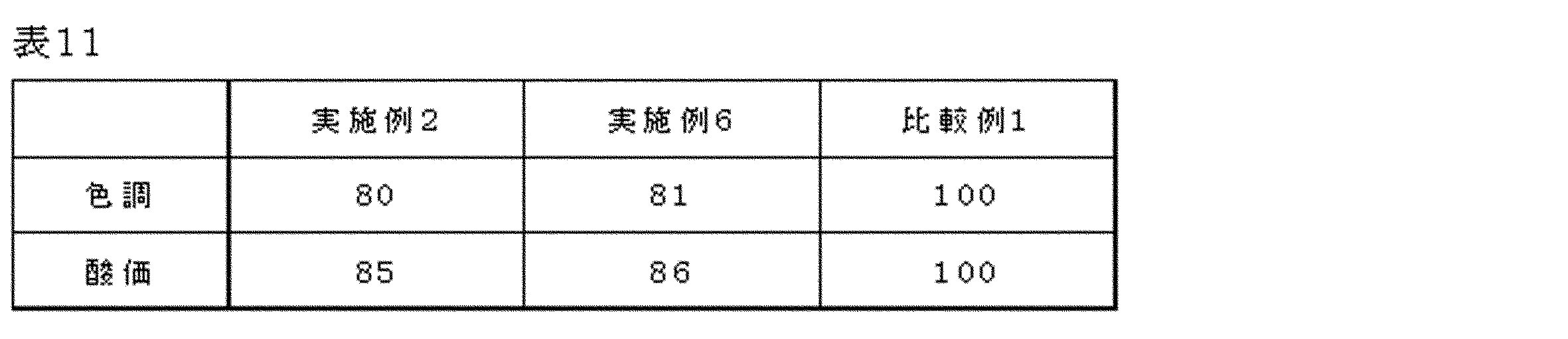
- Test Example 6 Using the oil and fat compositions of Examples 2 and 6 and Comparative Example 1, a fly test was performed. The relative value was calculated by setting the result of Comparative Example 1 to 100. The results are shown in Table 11.
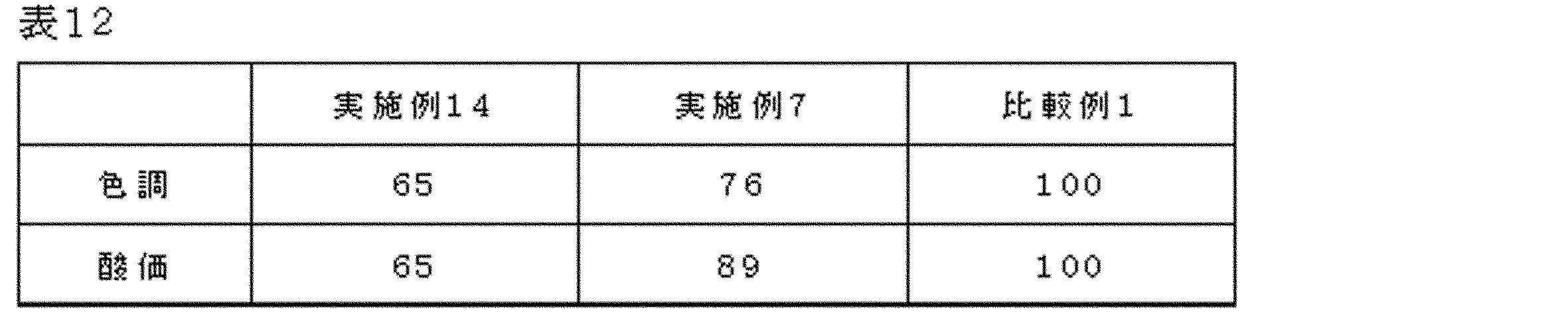
- Test Example 7 A simple heating test was conducted using the oil and fat compositions of Examples 14 and 7 and Comparative Example 1. The relative value was calculated by setting the result of Comparative Example 1 to 100. The results are shown in Table 12.
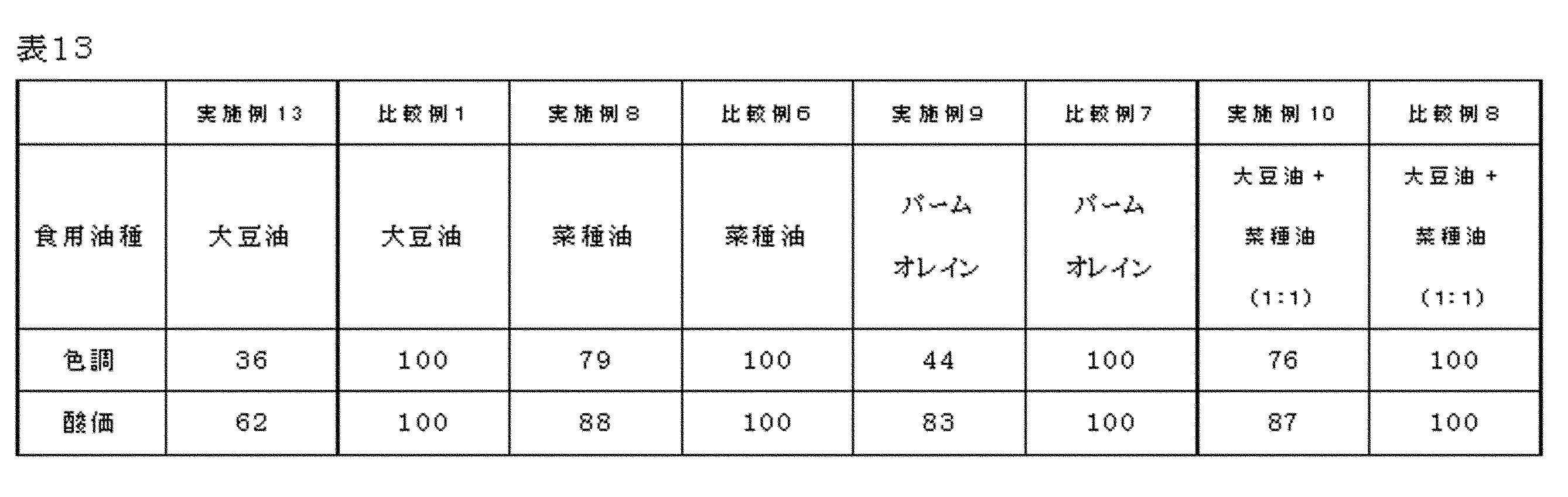
- Test Example 8 A simple heating test was conducted using the oil and fat compositions of Examples 8, 9, 10, and 13 and Comparative Examples 1, 6, 7, and 8. The relative value was calculated by setting the result of the same comparative example as the edible oil species as the base to 100. The results are shown in Table 13.
- Test Example 8 A simple heating test was performed using the oil and fat compositions of Examples 11 to 16 and Comparative Example 1. The relative value was calculated by setting the result of Comparative Example 1 to 100. The results are shown in Table 14.
- Example 9 Using the oil and fat composition of Example 1 and Comparative Example 1, croquettes (New potato croquette manufactured by Ajinomoto Frozen Foods Co., Ltd.) and fried chicken (fried chicken from Ajinomoto Frozen Foods Co., Ltd.) were cooked. It was confirmed that the food cooked with the oil and fat composition of Example 1 had a deteriorated flavor lower than that prepared with the oil and fat composition of Comparative Example 1 and could be eaten without any problems even when it was 60 hours fried.
- croquettes New potato croquette manufactured by Ajinomoto Frozen Foods Co., Ltd.
- fried chicken fried chicken from Ajinomoto Frozen Foods Co., Ltd.
Landscapes
- Chemical & Material Sciences (AREA)
- Life Sciences & Earth Sciences (AREA)
- Engineering & Computer Science (AREA)
- Food Science & Technology (AREA)
- Polymers & Plastics (AREA)
- Oil, Petroleum & Natural Gas (AREA)
- Health & Medical Sciences (AREA)
- Nutrition Science (AREA)
- Chemical Kinetics & Catalysis (AREA)
- Wood Science & Technology (AREA)
- Organic Chemistry (AREA)
- General Chemical & Material Sciences (AREA)
- Emergency Medicine (AREA)
- Zoology (AREA)
- Edible Oils And Fats (AREA)
- Fats And Perfumes (AREA)
- General Preparation And Processing Of Foods (AREA)
- Biochemistry (AREA)
Abstract
Description
精製大豆油(株式会社J-オイルミルズ社製、大豆白絞油 リン分検出されず)
精製菜種油(株式会社J-オイルミルズ社製、菜種白絞油 リン分検出されず)
精製パーム油(株式会社J-オイルミルズ社製、精製パームオレイン リン分検出されず)
リン酸(株式会社和光純薬工業社製)
大豆由来脱ガム油(株式会社J-オイルミルズ社製 リン分:70もしくは200ppm)
菜種由来脱ガム油(株式会社J-オイルミルズ社製 リン分:80ppm)
アスコルビン酸(DSMニュートリションジャパン株式会社製、L-アスコルビン酸) 分子量 176.12
アスコルビン酸パルミテート(三菱化学フーズ株式会社製、L-アスコルビン酸パルミチン酸エステル) 分子量 414.54
3Lフライヤー(マッハ機器株式会社製、MACHフライヤーF-3H)に油脂3.4Kgを張り込み、180℃に加温し、冷凍鶏唐揚げ(味の素冷凍食品株式会社製、若鶏唐揚げ)400gを5分間フライし、2時間間隔で同様の作業を5回繰り返し、10時間の試験を行った。これと同様の操作を6日間繰り返した。フライ開始から60時間後の試料について色調、および酸価を測定した。
ステンレス容器(直径5cm)に油脂10gを張り込み、180℃で6時間加熱した。得られた油脂組成物の酸価および色調を測定した。
ICP発光分光分析装置iCAP6000(サーモフィッシャーサイエンティフィック株式会社製)を用いて高周波プラズマ発光分光法により分析した。
密閉可能な容器中に油脂を加え油脂と等量の5%メタリン酸水溶液と油脂2倍量のヘキサンを加え、振とう撹拌を行った。静置後水層部の246nmの吸光度を測定した。別途既知量のアスコルビン酸水溶液で検量線を作成し定量を行った。
ロビボンド比色計(THE TINTOMETER.LTD社製 PFX990)により1インチセルを用いて測定し、10R+Y値を算出した。
基準油脂分析試験法2.3.1-1996に基づき、試料1gに含まれる遊離脂肪酸を中和するのに要する水酸化カリウム量(mg)を測定した。
磁性皿に油脂600gを張り込み、180℃で80時間加熱した。80時間加熱した油脂についてGC-MS(Agilent Technologies社製、6890N/5975BinertXL)を用いて分析を行った。分析条件を下記に示す。分析用カップに油脂50mgを取り、180℃に加温し、ヘッドスペース部分にヘリウムガスを流し、揮発した成分を10分間捕集した。カラムはPhenomenex社ZB-WAXplus(60m×0.25mmi.d.、膜厚0.25μm)を用い、温度条件は40℃(10分)→2℃/分昇温→100℃→5℃/分昇温→210℃(10分)とした。キャリアガスはヘリウムを用いた。揮発性成分の中から油脂の主成分である脂肪酸の分解物として知られている23成分(Butanal、Hexanal、Pentanal、Nonanal、Heptanal、2-Pentenal、2-Butenal、2-Propenal、2-Hexenal、2-Heptenal、2-Octenal、2-Decenal、2-Nonenal、2-Undecenal、2,4-Heptadienal、2,4-Nonadienal、2,4-Decadienal、2-Pentene-1-ol、1-Octen-3-ol、1-Pentanol、1-Heptanol、Octane、2-Pentylfuran)のピーク面積の合計を算出した。
磁性皿に油脂600gを張り込み、180℃で80時間加熱した油脂の油面から15cmの高さのにおいについて、専門パネラー20名により全体のにおいの強さと劣化臭の強さを官能的に評価した。評点は、5点:非常に強い、4点:強い、3点:普通、2点:弱い、1点:非常に弱い、0点:無臭とした。評価結果はパネラーの平均点で示し、有意差検定を行った。
精製大豆油を70℃に加温し、精製大豆油100重量部に対して0.5%アスコルビン酸水溶液を1重量部加えて混合した。70℃、40Torr以下の減圧条件下で撹拌しながら20分間脱水処理を行った。ろ別した後、大豆脱ガム油(抽出油に水を添加し、リン脂質を主成分とするガム質を水和処理した油)を2重量部添加して油脂組成物を調製した。アスコルビン酸残存量を確認した結果、アスコルビン酸当量として、8.6ppmであった。
精製大豆油を100℃に加温し、精製大豆油100重量部に対してアスコルビン酸パルミテートを0.01重量部加えた。100℃、10分間混合しアスコルビン酸パルミテート添加油脂を調製した。精製大豆油70重量部に対して、得られたアスコルビン酸パルミテート添加油脂を30重量部加えた。さらに、大豆脱ガム油を2重量部添加して油脂組成物を調製した。
精製大豆油を70℃に加温し、精製大豆油100重量部に対して0.5%アスコルビン酸水溶液を1重量部加えて混合した。70℃、40Torr以下の減圧条件下で撹拌しながら20分間脱水処理を行った。ろ別した後、大豆脱ガム油を2重量部添加して油脂組成物を調製した。アスコルビン酸残存量を確認した結果、アスコルビン酸当量として、5.0ppmであった。
精製大豆油を100℃に加温し、精製大豆油100重量部に対してアスコルビン酸パルミテートを0.03重量部加えた。100℃、10分間混合することでアスコルビン酸パルミテート含有油脂組成物を得た。表1に示す組成になるよう精製大豆油にアスコルビン酸パルミテート含有油脂組成物を加えた。さらに、大豆脱ガム油を2重量部添加して油脂組成物を調製した。
精製大豆油を100℃に加温し、精製大豆油100重量部に対して、アスコルビン酸パルミテートを0.003重量部加えた。100℃、10分間混合することで得られる油脂組成物に、菜種脱ガム油を2重量部添加して油脂組成物を調製した。
精製大豆油を100℃に加温し、精製大豆油100重量部に対してアスコルビン酸パルミテートを0.003重量部加えた。100℃、10分間混合することで得られる油脂組成物に、リン酸を0.0005重量部添加して油脂組成物を調製した。
精製菜種油、精製パームオレイン、又は精製大豆油と精製菜種油のブレンド油(1:1)をそれぞれ100℃に加温し、前記食用油100重量部に対してアスコルビン酸パルミテートを0.003重量部加えた。さらに、大豆脱ガム油を2重量部添加して油脂組成物を調製した。
精製大豆油を100℃に加温し、精製大豆油100重量部に対してアスコルビン酸パルミテートを最終的にアスコルビン酸当量として0.0012重量部になるように加えた。100℃、10分間混合した後に、さらに、表2、3に示す組成になるように大豆脱ガム油を添加して油脂組成物を調製した。
通常の精製工程を経て製造した精製大豆油を用いた。
精製大豆油100重量部に対し、大豆脱ガム油を2重量部添加して油脂組成物を調製した。
精製大豆油を70℃に加温し、精製大豆油100重量部に対して0.5%アスコルビン酸水溶液を1重量部加えて混合した。70℃、40Torr以下の減圧条件下で撹拌しながら20分間脱水処理を行い、ろ別して油脂組成物を調製した。アスコルビン酸残存量を確認した結果、アスコルビン酸当量として、5.2ppmであった。
精製大豆油70重量部に対して、実施例2で得られたアスコルビン酸パルミテート添加油脂を30重量部加え、油脂組成物を調製した。
精製大豆油を100℃に加温し、精製大豆油100重量部に対してアスコルビン酸パルミテートを0.011重量部加えた。100℃、10分間混合し、油脂組成物を調製した。
通常の精製工程を経て製造した精製菜種油を用いた。
通常の精製工程を経て製造した精製パームオレインを用いた。
通常の精製工程を経て製造した精製大豆油と精製菜種油を1:1でブレンドしたものを用いた。

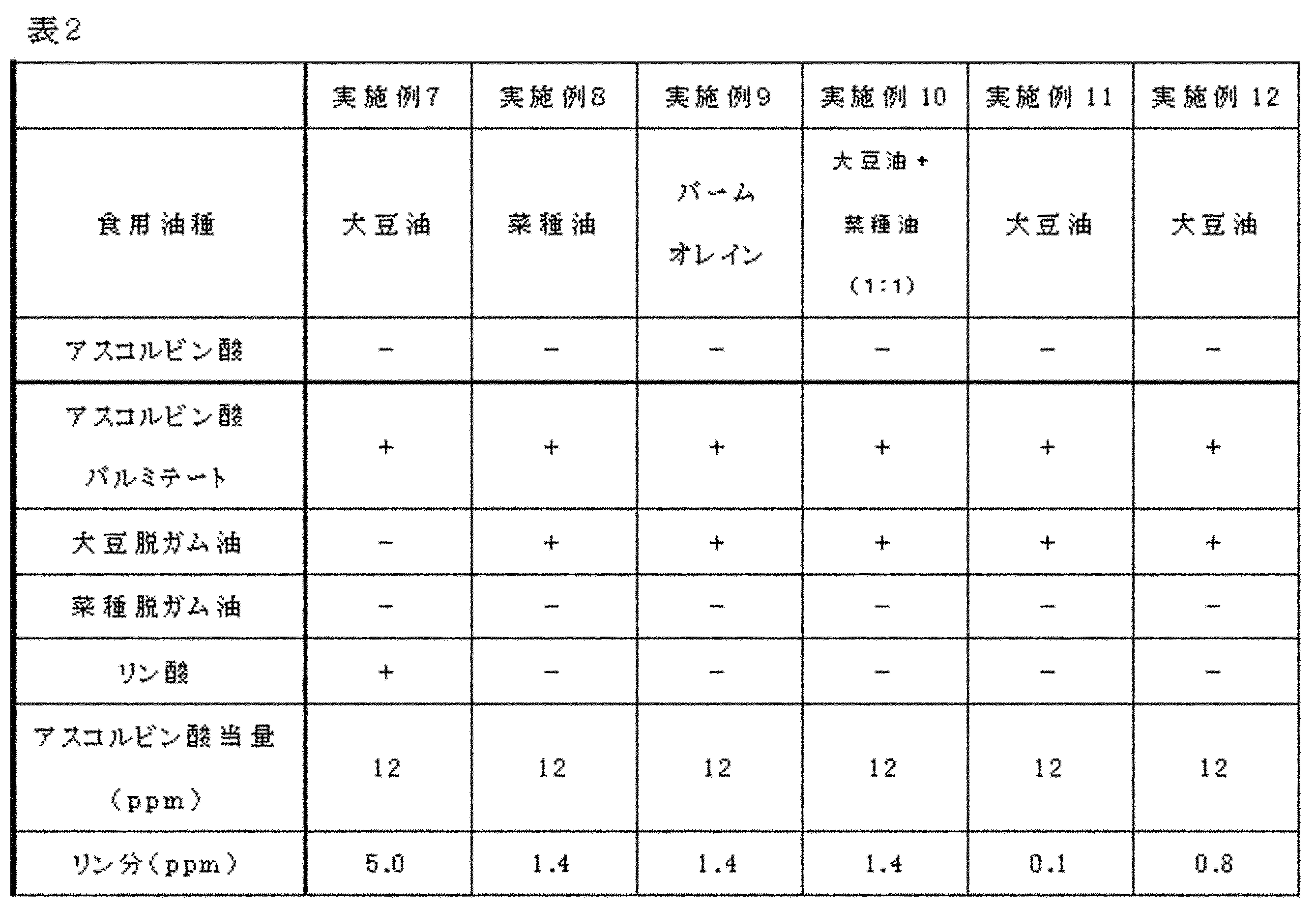
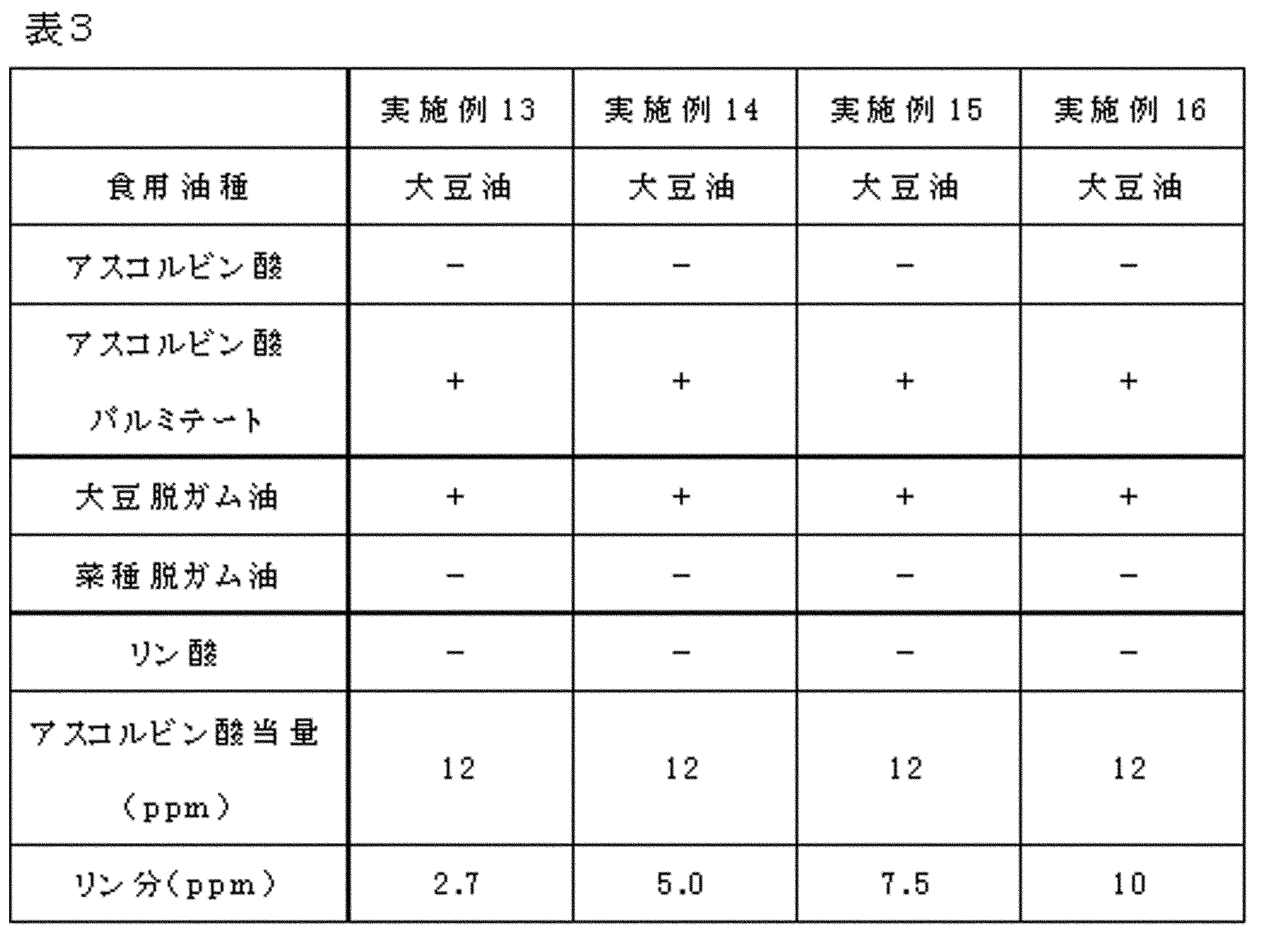
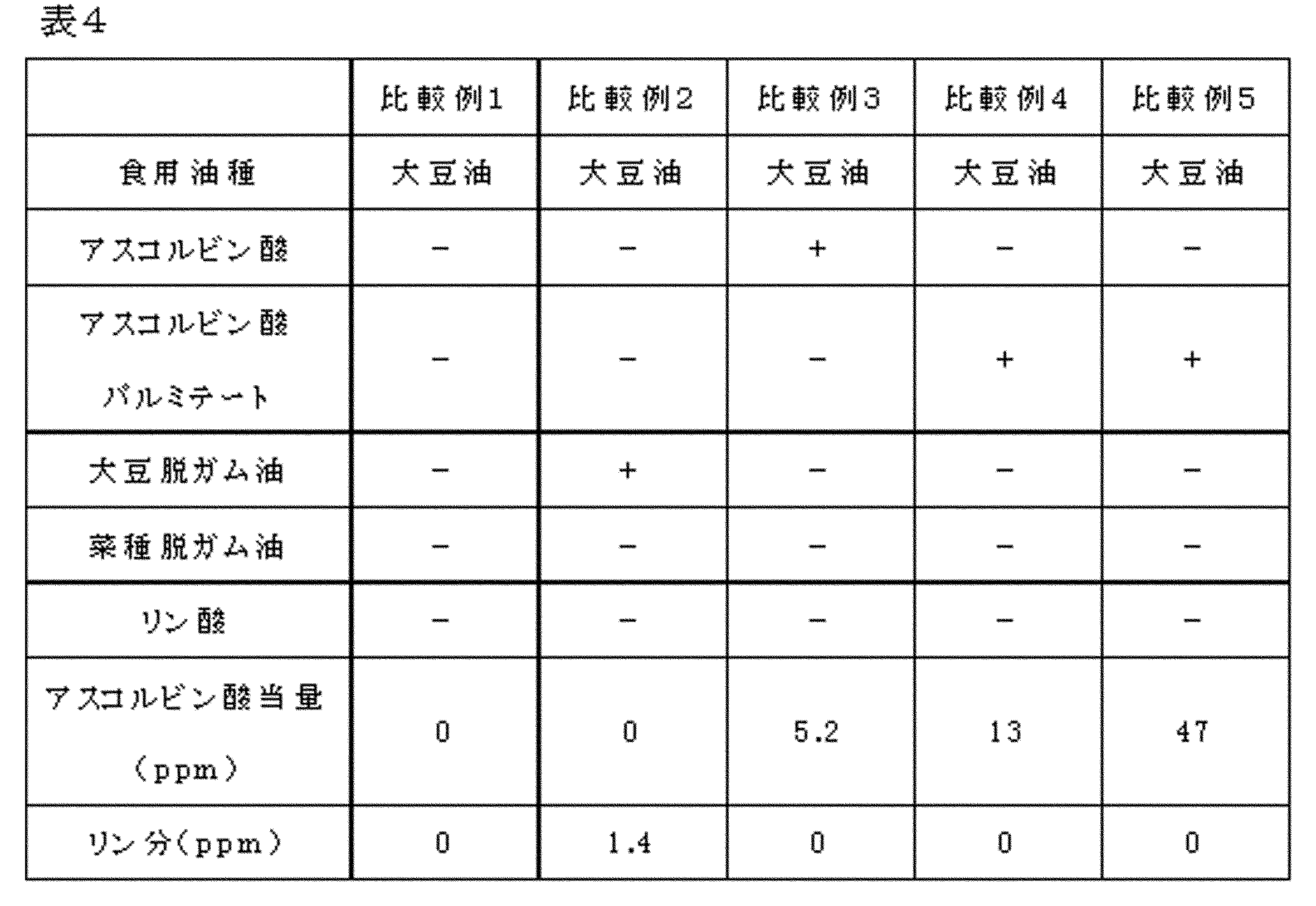

実施例1~2、比較例1~4の油脂組成物を用いて、フライ試験をおこなった。その結果を表6に示す。色調および酸価は比較例1を100とした時の相対値で表示した。
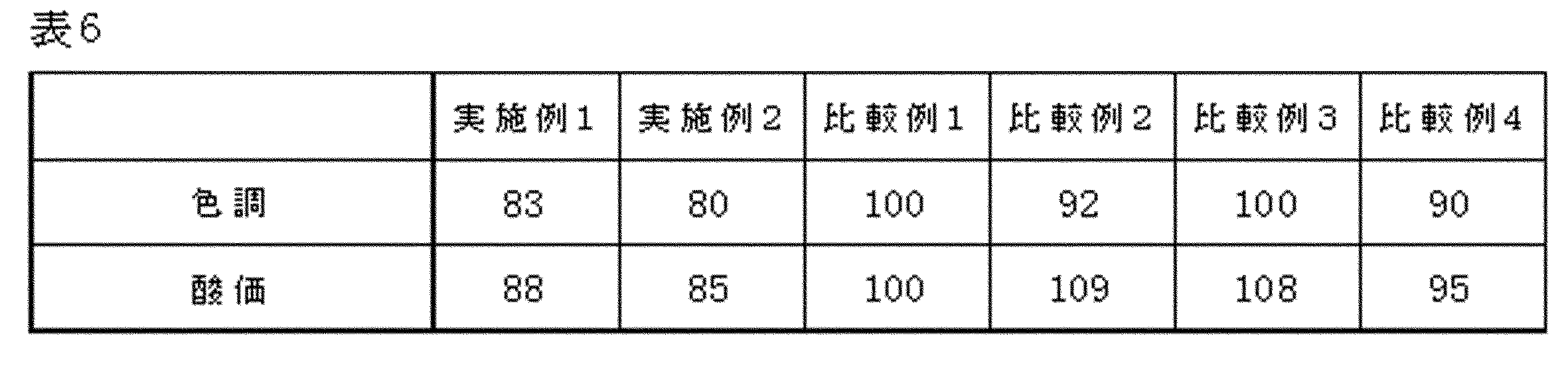
一方、リン分のみ添加した比較例2では、色調は低値を示すものの、酸価は比較例1よりも高値であった。アスコルビン酸を添加した比較例3では、比較例1に比べ、色調に違いは見られず、酸価は比較例1よりも高値となった。従って、酸価の点で、比較例2および3では、油脂の加熱耐性が劣っていることが分かった。また、アスコルビン酸パルミテートを添加した比較例4では、色調ならびに酸価がわずかに低値を示したが、十分ではなかった。
実施例1~2、比較例1~3、および5の油脂組成物を用いて、加熱時の揮発性成分測定を行った。比較例1の揮発性成分のピーク面積の合計を100として、その相対値を算出した。その結果を表7に示す。

一方、リン分のみ添加した比較例2、アスコルビン酸のみ添加した比較例3、アスコルビン酸パルミテートのみ添加した比較例5では、無添加の比較例1に比して、加熱臭の原因となる揮発性成分の低減効果は約20%にすぎなかった。
実施例1と比較例1、実施例2と比較例1について加熱臭官能評価をおこなった。その結果を表8に示す。

実施例1、3、および比較例1の油脂組成物を用いて、フライ試験を行った。比較例1の結果を100として、その相対値を算出した。その結果を表9に示す。

実施例2、4、5、比較例1、および2の油脂組成物を用いて、フライ試験を行った。比較例1の結果を100として、その相対値を算出した。その結果を表10に示す。

実施例2、6および比較例1の油脂組成物を用いて、フライ試験を行った。比較例1の結果を100として、その相対値を算出した。その結果を表11に示す。
実施例14、7および比較例1の油脂組成物を用いて、簡易加熱試験を行った。比較例1の結果を100として、その相対値を算出した。その結果を表12に示す。
実施例8、9、10、13および比較例1、6、7、8の油脂組成物を用いて、簡易加熱試験を行った。ベースとなる食用油種と同一の比較例の結果を100として、その相対値を算出した。その結果を表13に示す。
実施例11~16および比較例1の油脂組成物を用いて、簡易加熱試験を行った。比較例1の結果を100として、その相対値を算出した。その結果を表14に示す。

実施例1、比較例1の油脂組成物を用いてコロッケ(味の素冷凍食品株式会社製Newポテトコロッケ)及び鶏唐揚げ(味の素冷凍食品株式会社製若鶏唐揚げ)を調理した。フライ60時間時であっても、実施例1の油脂組成物で調理した食品は、比較例1の油脂組成物で調理したものより劣化風味が低く、問題なく食することができることを確認した。
Claims (10)
- リン分を0.1ppm以上10ppm以下、かつ、アスコルビン酸及び/又はアスコルビン酸誘導体をアスコルビン酸当量として2ppm以上130ppm以下含有することを特徴とする揚げ物用油脂組成物。
- 前記アスコルビン酸誘導体がアスコルビン酸エステルである請求項1に記載の揚げ物用油脂組成物。
- アスコルビン酸当量が10ppm以上130ppm以下である請求項2に記載の揚げ物用油脂組成物。
- リン分の由来が、原油及び中間的油脂から選ばれる少なくとも一種である請求項1に記載の揚げ物用油脂組成物。
- 請求項1に記載の揚げ物用油脂組成物で揚げた食品。
- 食用油脂にリン分を0.1ppm以上10ppm以下、かつ、アスコルビン酸及び/又はアスコルビン酸誘導体をアスコルビン酸当量として2ppm以上130ppm以下含有させることを特徴とする揚げ物用油脂組成物の酸価上昇抑制方法。
- 食用油脂にリン分を0.1ppm以上10ppm以下、かつ、アスコルビン酸及び/又はアスコルビン酸誘導体をアスコルビン酸当量として2ppm以上130ppm以下含有させることを特徴とする揚げ物用油脂組成物の加熱着色抑制方法。
- 食用油脂にリン分を0.1ppm以上10ppm以下、かつ、アスコルビン酸及び/又はアスコルビン酸誘導体をアスコルビン酸当量として2ppm以上130ppm以下含有させることを特徴とする揚げ物用油脂組成物の製造方法。
- 食用油脂へアスコルビン酸の0.2~1%水溶液を加え、50~100℃の温度、1~50Torrの減圧下で攪拌しながら脱水処理し、ろ別後、リン分の由来成分を添加することを特徴とする請求項8に記載の揚げ物用油脂組成物の製造方法。
- 食用油脂へアスコルビン酸エステルを加え、50~130℃に加温し、次いで、リン分の由来成分を添加することを特徴とする請求項8に記載の揚げ物用油脂組成物の製造方法。
Priority Applications (4)
| Application Number | Priority Date | Filing Date | Title |
|---|---|---|---|
| US13/576,725 US20120301583A1 (en) | 2010-03-29 | 2011-03-16 | Oil and Fat Composition for Deep Frying |
| CN201180005001.XA CN102655760B (zh) | 2010-03-29 | 2011-03-16 | 油炸食物用油脂混合物 |
| KR1020127023109A KR20130018234A (ko) | 2010-03-29 | 2011-03-16 | 디프 튀김용 유지 조성물 |
| US14/848,567 US20160000108A1 (en) | 2010-03-29 | 2015-09-09 | Oil and Fat Composition for Deep Frying |
Applications Claiming Priority (2)
| Application Number | Priority Date | Filing Date | Title |
|---|---|---|---|
| JP2010074903A JP4713673B1 (ja) | 2010-03-29 | 2010-03-29 | 揚げ物用油脂組成物 |
| JP2010-074903 | 2010-03-29 |
Related Child Applications (2)
| Application Number | Title | Priority Date | Filing Date |
|---|---|---|---|
| US13/576,725 A-371-Of-International US20120301583A1 (en) | 2010-03-29 | 2011-03-16 | Oil and Fat Composition for Deep Frying |
| US14/848,567 Division US20160000108A1 (en) | 2010-03-29 | 2015-09-09 | Oil and Fat Composition for Deep Frying |
Publications (1)
| Publication Number | Publication Date |
|---|---|
| WO2011122339A1 true WO2011122339A1 (ja) | 2011-10-06 |
Family
ID=44292660
Family Applications (1)
| Application Number | Title | Priority Date | Filing Date |
|---|---|---|---|
| PCT/JP2011/056162 Ceased WO2011122339A1 (ja) | 2010-03-29 | 2011-03-16 | 揚げ物用油脂組成物 |
Country Status (6)
| Country | Link |
|---|---|
| US (2) | US20120301583A1 (ja) |
| JP (1) | JP4713673B1 (ja) |
| KR (1) | KR20130018234A (ja) |
| CN (1) | CN102655760B (ja) |
| TW (1) | TWI511670B (ja) |
| WO (1) | WO2011122339A1 (ja) |
Cited By (2)
| Publication number | Priority date | Publication date | Assignee | Title |
|---|---|---|---|---|
| WO2013172348A1 (ja) * | 2012-05-16 | 2013-11-21 | 不二製油株式会社 | 食用油脂及びそれを含有する食品並びにその製造方法 |
| JP2015039369A (ja) * | 2013-08-23 | 2015-03-02 | 花王株式会社 | 油脂組成物の製造方法 |
Families Citing this family (15)
| Publication number | Priority date | Publication date | Assignee | Title |
|---|---|---|---|---|
| JP6303253B2 (ja) * | 2012-03-29 | 2018-04-04 | 不二製油株式会社 | 食用油脂及びそれを含有する食品 |
| KR101289575B1 (ko) * | 2012-09-07 | 2013-07-24 | 박충만 | 로스트 치킨의 제조방법 |
| JP5462985B1 (ja) | 2012-10-04 | 2014-04-02 | 株式会社J−オイルミルズ | 油脂組成物及びその製造方法 |
| JP5457587B1 (ja) * | 2013-05-29 | 2014-04-02 | 株式会社J−オイルミルズ | 油脂の劣化評価方法 |
| JP6398156B2 (ja) * | 2013-07-09 | 2018-10-03 | 不二製油株式会社 | 冷菓用油脂 |
| SG11201600090QA (en) * | 2013-07-09 | 2016-02-26 | Fuji Oil Holdings Inc | Frozen confectionery, and oil and fat for producing confectionery |
| EP3378323B1 (en) * | 2013-11-13 | 2019-09-25 | Fuji Oil Holdings Inc. | Fat containing polyunsaturated fatty acid |
| CN103710148B (zh) * | 2013-12-25 | 2015-03-25 | 南海油脂工业(赤湾)有限公司 | 一种延缓游离脂肪酸量上升的油脂添加剂及油脂保存方法 |
| EP3162222A4 (en) * | 2014-06-24 | 2018-01-24 | Kao Corporation | Manufacturing method for liquid seasoning containing oil phase and water phase |
| MY194302A (en) * | 2016-03-22 | 2022-11-27 | Sime Darby Plantation Sdn Bhd | Process for producing a heat stable edible oil and/or fat composition |
| KR101899365B1 (ko) | 2016-12-06 | 2018-09-17 | 롯데푸드 주식회사 | 산화안정성이 개선된 튀김용 유지 조성물 |
| JP6811701B2 (ja) * | 2017-12-15 | 2021-01-13 | 不二製油株式会社 | 食用油脂及びそれを含有する食品 |
| TWI766142B (zh) * | 2018-01-31 | 2022-06-01 | 日商J 制油股份有限公司 | 油炸調理用油脂組成物之安定化方法 |
| JP7368079B2 (ja) * | 2018-07-04 | 2023-10-24 | 日清オイリオグループ株式会社 | 加熱用油脂組成物、加熱用油脂組成物の製造方法、油脂組成物の加熱による劣化を抑制する方法 |
| CA3153652A1 (en) | 2019-09-17 | 2021-03-25 | J-Oil Mills, Inc. | Frying oil deterioration assessment device and frying oil deterioration assessment method |
Citations (4)
| Publication number | Priority date | Publication date | Assignee | Title |
|---|---|---|---|---|
| JPH0551593A (ja) * | 1991-08-26 | 1993-03-02 | Nisshin Oil Mills Ltd:The | 食用油の製造法 |
| WO2001096506A1 (fr) * | 2000-06-12 | 2001-12-20 | Fuji Oil Company, Limited | Procede servant a produire de la graisse |
| JP4159102B1 (ja) * | 2008-02-08 | 2008-10-01 | 株式会社J−オイルミルズ | 加熱耐性に優れた揚げ物用油脂組成物の製造方法 |
| JP2009533064A (ja) * | 2006-04-11 | 2009-09-17 | マーテック バイオサイエンシーズ コーポレーション | 長鎖多価不飽和脂肪酸を含む食品製品、およびそれらを調製するための方法 |
Family Cites Families (18)
| Publication number | Priority date | Publication date | Assignee | Title |
|---|---|---|---|---|
| US2728784A (en) * | 1954-03-17 | 1955-12-27 | Eastman Kodak Co | Stabilization of oxidizable materials and stabilizers therefor |
| JPS5483910A (en) * | 1977-12-16 | 1979-07-04 | Nisshin Oil Mills Ltd:The | Production of fats and oils for foods |
| JPS5944344B2 (ja) * | 1978-11-17 | 1984-10-29 | 田辺製薬株式会社 | 抗酸化剤 |
| JPS6239684A (ja) * | 1985-08-12 | 1987-02-20 | House Food Ind Co Ltd | 酸化防止用組成物 |
| JP3561571B2 (ja) * | 1996-02-02 | 2004-09-02 | 岡常商事株式会社 | 酸化防止剤製剤 |
| JP3020469B2 (ja) * | 1997-11-21 | 2000-03-15 | 植田製油株式会社 | トコフェロールの抗酸化性改良法 |
| BR0107933A (pt) * | 2000-01-28 | 2004-01-06 | Procter & Gamble | Compostos de arginina saborosos e seus usos para saúde cardiovascular |
| JP2002291408A (ja) * | 2001-03-30 | 2002-10-08 | Yoshihara Oil Mill Ltd | 食用油 |
| JP2004018678A (ja) * | 2002-06-17 | 2004-01-22 | Ikeda Shokken Kk | ステロール脂肪酸エステル組成物及び該組成物を含有する食品 |
| US20050112261A1 (en) * | 2003-11-21 | 2005-05-26 | Davis Robert J. | Churros and method for making same |
| JP2005218380A (ja) * | 2004-02-06 | 2005-08-18 | Nisshin Oillio Group Ltd | 油脂組成物 |
| JP4365260B2 (ja) * | 2004-04-23 | 2009-11-18 | 太田油脂株式会社 | なたね香味油の製造法 |
| KR101236972B1 (ko) * | 2004-07-02 | 2013-02-22 | 삼성전자주식회사 | 사이클론 응축장치 및 이 사이클론 응축장치를 구비한 세탁기 및 건조기 |
| TWI397582B (zh) * | 2004-11-04 | 2013-06-01 | Monsanto Technology Llc | 油組合物之製備方法 |
| JP2008167685A (ja) * | 2007-01-11 | 2008-07-24 | Fuji Oil Co Ltd | 風味付けされた油脂の製造法 |
| JP4095111B1 (ja) * | 2007-08-29 | 2008-06-04 | 株式会社J−オイルミルズ | 加熱耐性に優れた揚げ物用油脂組成物の製造方法 |
| US8168244B2 (en) * | 2008-05-01 | 2012-05-01 | General Mills Marketing, Inc. | High fiber pastry product |
| JP4560590B1 (ja) * | 2009-03-27 | 2010-10-13 | 日清オイリオグループ株式会社 | 加熱調理用食用油脂およびその製造方法 |
-
2010
- 2010-03-29 JP JP2010074903A patent/JP4713673B1/ja active Active
-
2011
- 2011-03-16 WO PCT/JP2011/056162 patent/WO2011122339A1/ja not_active Ceased
- 2011-03-16 US US13/576,725 patent/US20120301583A1/en not_active Abandoned
- 2011-03-16 KR KR1020127023109A patent/KR20130018234A/ko not_active Ceased
- 2011-03-16 CN CN201180005001.XA patent/CN102655760B/zh active Active
- 2011-03-28 TW TW100110547A patent/TWI511670B/zh active
-
2015
- 2015-09-09 US US14/848,567 patent/US20160000108A1/en not_active Abandoned
Patent Citations (4)
| Publication number | Priority date | Publication date | Assignee | Title |
|---|---|---|---|---|
| JPH0551593A (ja) * | 1991-08-26 | 1993-03-02 | Nisshin Oil Mills Ltd:The | 食用油の製造法 |
| WO2001096506A1 (fr) * | 2000-06-12 | 2001-12-20 | Fuji Oil Company, Limited | Procede servant a produire de la graisse |
| JP2009533064A (ja) * | 2006-04-11 | 2009-09-17 | マーテック バイオサイエンシーズ コーポレーション | 長鎖多価不飽和脂肪酸を含む食品製品、およびそれらを調製するための方法 |
| JP4159102B1 (ja) * | 2008-02-08 | 2008-10-01 | 株式会社J−オイルミルズ | 加熱耐性に優れた揚げ物用油脂組成物の製造方法 |
Non-Patent Citations (1)
| Title |
|---|
| MANCINI-FILHO J. ET AL.: "Effects of Selected Chemical Treatments on Quality of Fats Used for Deep Frying", JAOCS, vol. 63, no. 11, 1986, pages 1452 - 1456 * |
Cited By (3)
| Publication number | Priority date | Publication date | Assignee | Title |
|---|---|---|---|---|
| WO2013172348A1 (ja) * | 2012-05-16 | 2013-11-21 | 不二製油株式会社 | 食用油脂及びそれを含有する食品並びにその製造方法 |
| JPWO2013172348A1 (ja) * | 2012-05-16 | 2016-01-12 | 不二製油株式会社 | 食用油脂及びそれを含有する食品並びにその製造方法 |
| JP2015039369A (ja) * | 2013-08-23 | 2015-03-02 | 花王株式会社 | 油脂組成物の製造方法 |
Also Published As
| Publication number | Publication date |
|---|---|
| US20120301583A1 (en) | 2012-11-29 |
| CN102655760B (zh) | 2015-01-14 |
| KR20130018234A (ko) | 2013-02-20 |
| JP4713673B1 (ja) | 2011-06-29 |
| JP2011205924A (ja) | 2011-10-20 |
| US20160000108A1 (en) | 2016-01-07 |
| CN102655760A (zh) | 2012-09-05 |
| TWI511670B (zh) | 2015-12-11 |
| TW201132287A (en) | 2011-10-01 |
Similar Documents
| Publication | Publication Date | Title |
|---|---|---|
| JP4713673B1 (ja) | 揚げ物用油脂組成物 | |
| JP4095111B1 (ja) | 加熱耐性に優れた揚げ物用油脂組成物の製造方法 | |
| TWI572290B (zh) | Grease composition | |
| JP4560590B1 (ja) | 加熱調理用食用油脂およびその製造方法 | |
| JP2013081473A (ja) | 種子油組成物 | |
| JP5688207B2 (ja) | 食用油の製造方法及び該方法により製造された食用油 | |
| JP5635747B2 (ja) | 再精製パーム軟質油並びに該再精製パーム軟質油を含有する食用油脂組成物及び飲食品 | |
| JP2017029044A (ja) | 食用油脂 | |
| JP2011120543A (ja) | 米糠由来不けん化物含有油脂組成物 | |
| JP4931095B1 (ja) | 油脂組成物の製造方法 | |
| JP6125819B2 (ja) | 食用油脂 | |
| JP7341687B2 (ja) | 精製油脂の製造方法、及び精製油脂 | |
| JP2015119728A (ja) | 揚げ物用油脂組成物の製造方法 | |
| JP2012157286A (ja) | 加熱調理用油脂組成物およびその製造方法 | |
| JP2025090860A (ja) | 油脂組成物及びその製造方法 | |
| JP5143067B2 (ja) | 食用油脂の製造方法およびそれから得られる食用油脂 | |
| JP4159102B1 (ja) | 加熱耐性に優れた揚げ物用油脂組成物の製造方法 | |
| JPWO2019151007A1 (ja) | フライ調理用油脂組成物の着色の抑制方法 | |
| JP5850647B2 (ja) | ルウ用油脂及びそれを用いたルウ | |
| JP2023122717A (ja) | フライ用油脂組成物 | |
| JP2022059434A (ja) | フライ用油脂組成物 | |
| JPWO2020166422A1 (ja) | フライ調理用油脂組成物の着色抑制方法、フライ調理用油脂組成物の製造方法及び着色抑制剤 | |
| JP7368079B2 (ja) | 加熱用油脂組成物、加熱用油脂組成物の製造方法、油脂組成物の加熱による劣化を抑制する方法 | |
| WO2022230737A1 (ja) | 食用油脂組成物、異風味抑制方法、異風味抑制剤、及び揚げ物の製造方法 | |
| WO2022163370A1 (ja) | 着色抑制剤、着色抑制剤の製造方法、食用油脂組成物、及び食品の着色抑制方法 |
Legal Events
| Date | Code | Title | Description |
|---|---|---|---|
| WWE | Wipo information: entry into national phase |
Ref document number: 201180005001.X Country of ref document: CN |
|
| 121 | Ep: the epo has been informed by wipo that ep was designated in this application |
Ref document number: 11762577 Country of ref document: EP Kind code of ref document: A1 |
|
| WWE | Wipo information: entry into national phase |
Ref document number: 5230/CHENP/2012 Country of ref document: IN |
|
| WWE | Wipo information: entry into national phase |
Ref document number: 13576725 Country of ref document: US |
|
| ENP | Entry into the national phase |
Ref document number: 20127023109 Country of ref document: KR Kind code of ref document: A |
|
| WWE | Wipo information: entry into national phase |
Ref document number: 1201004725 Country of ref document: TH |
|
| NENP | Non-entry into the national phase |
Ref country code: DE |
|
| 122 | Ep: pct application non-entry in european phase |
Ref document number: 11762577 Country of ref document: EP Kind code of ref document: A1 |