WO2011105266A1 - 防振ゴム組成物 - Google Patents
防振ゴム組成物 Download PDFInfo
- Publication number
- WO2011105266A1 WO2011105266A1 PCT/JP2011/053277 JP2011053277W WO2011105266A1 WO 2011105266 A1 WO2011105266 A1 WO 2011105266A1 JP 2011053277 W JP2011053277 W JP 2011053277W WO 2011105266 A1 WO2011105266 A1 WO 2011105266A1
- Authority
- WO
- WIPO (PCT)
- Prior art keywords
- component
- rubber composition
- group
- vibration
- methacrylate
- Prior art date
- Legal status (The legal status is an assumption and is not a legal conclusion. Google has not performed a legal analysis and makes no representation as to the accuracy of the status listed.)
- Ceased
Links
Images

Classifications
-
- C—CHEMISTRY; METALLURGY
- C08—ORGANIC MACROMOLECULAR COMPOUNDS; THEIR PREPARATION OR CHEMICAL WORKING-UP; COMPOSITIONS BASED THEREON
- C08K—Use of inorganic or non-macromolecular organic substances as compounding ingredients
- C08K5/00—Use of organic ingredients
- C08K5/04—Oxygen-containing compounds
- C08K5/10—Esters; Ether-esters
- C08K5/101—Esters; Ether-esters of monocarboxylic acids
-
- C—CHEMISTRY; METALLURGY
- C08—ORGANIC MACROMOLECULAR COMPOUNDS; THEIR PREPARATION OR CHEMICAL WORKING-UP; COMPOSITIONS BASED THEREON
- C08K—Use of inorganic or non-macromolecular organic substances as compounding ingredients
- C08K3/00—Use of inorganic substances as compounding ingredients
- C08K3/34—Silicon-containing compounds
- C08K3/36—Silica
-
- C—CHEMISTRY; METALLURGY
- C08—ORGANIC MACROMOLECULAR COMPOUNDS; THEIR PREPARATION OR CHEMICAL WORKING-UP; COMPOSITIONS BASED THEREON
- C08K—Use of inorganic or non-macromolecular organic substances as compounding ingredients
- C08K5/00—Use of organic ingredients
- C08K5/04—Oxygen-containing compounds
- C08K5/09—Carboxylic acids; Metal salts thereof; Anhydrides thereof
- C08K5/098—Metal salts of carboxylic acids
-
- C—CHEMISTRY; METALLURGY
- C08—ORGANIC MACROMOLECULAR COMPOUNDS; THEIR PREPARATION OR CHEMICAL WORKING-UP; COMPOSITIONS BASED THEREON
- C08K—Use of inorganic or non-macromolecular organic substances as compounding ingredients
- C08K5/00—Use of organic ingredients
- C08K5/54—Silicon-containing compounds
- C08K5/548—Silicon-containing compounds containing sulfur
Definitions
- the present invention relates to an anti-vibration rubber composition, and more particularly, to an anti-vibration rubber composition used for an engine mount or the like for suppressing a support function and vibration transmission of an engine such as an automobile.
- an anti-vibration rubber composition is used in automobiles for the purpose of reducing vibration and noise.
- Such an anti-vibration rubber composition has high rigidity, high strength, and suppression of vibration transmission, so the value of dynamic magnification [dynamic spring constant (Kd) / static spring constant (Ks)] Is required to be small (low dynamic magnification).
- Kd dynamic spring constant
- Ks static spring constant
- carbon black was used as a reinforcing agent, and it was dealt with by controlling factors such as the amount of carbon black added, particle size, and structure. It was insufficient as a countermeasure.
- an anti-vibration rubber composition in which silica is used instead of carbon black, which is a reinforcing agent, so as to achieve a lower dynamic magnification than when carbon black is used (for example, Patent Documents). 1, 2).
- those having a large primary particle diameter small BET specific surface area
- the specific surface area is 25 to 100 m 2 / g
- the ⁇ thermal weight reduction rate defined by “the difference between the thermal weight reduction rate at 1000 ° C. and the thermal weight reduction rate at 150 ° C. in thermogravimetry” is 3
- An anti-vibration rubber composition containing 20 to 80 parts by weight of silica of 0.0% or more has been proposed (Patent Document 3).
- the anti-vibration rubber composition described in Patent Document 3 uses silica having a large primary particle diameter, and thus can reduce the dynamic magnification compared to the case where normal silica is used.
- silica having a large size is used, the interaction between the silica and the rubber becomes weak, so that the durability of the vibration-proof rubber is inferior.
- the anti-vibration rubber composition is also required to have heat resistance, but those described in the above patent documents are insufficient in terms of heat resistance.
- the improvement in heat resistance of the anti-vibration rubber composition is usually established by the addition of an anti-aging agent and the optimization of the vulcanization system.
- this method may hinder durability and low dynamic magnification. is there.
- the vibration-proof rubber composition that can sufficiently satisfy all of heat resistance, durability, rigidity, and low dynamic magnification does not exist yet, and there is still room for improvement.
- the present invention has been made in view of such circumstances, and an object of the present invention is to provide a vibration-proof rubber composition that is excellent in heat resistance, durability, and rigidity and can achieve a low dynamic magnification.
- the anti-vibration rubber composition of the present invention contains the following (C) and (D) components together with the following (A) and (B) components, and the above (B) component:
- the blending amount is 10 to 100 parts by weight per 100 parts by weight of component (A).
- ( ⁇ ) Silanol group density on the silica surface calculated by the Sears titration method is 3.0 or more / nm 2 or more.
- the average particle size is 10 ⁇ m or less.
- BET specific surface area 15 to 60 m 2 / g.
- R 1 is an alkyl polyether group —O— (R 5 —O) m —R 6 , and m is 1 to 30 on average. In the repeating number m, R 5 is the same or different C 1 to C 30 hydrocarbon group.
- R 6 is a monovalent alkyl, alkenyl, aryl or aralkyl group containing at least 11 C atoms.
- Two of R 2 are the same or different and are the same as the above R 1 or a C 1 -C 12 alkyl group or R 7 O group.
- R 7 is H, methyl, ethyl, propyl, a (R 8 ) 3 Si group, or a C 9 to C 30 monovalent alkyl, alkenyl, aryl, aralkyl group.
- R 8 is a C 1 -C 30 alkyl or alkenyl group.
- R 3 is at least one divalent C 1 -C 30 hydrocarbon group selected from the group consisting of aliphatic, aromatic, mixed aliphatic and aromatic.
- R 4 is H, CN or (C ⁇ O) —R 9 .
- R 9 is at least one monovalent C 1 -C 30 hydrocarbon group selected from the group consisting of aliphatic, aromatic, mixed aliphatic and aromatic.
- the present inventor has conducted extensive research in order to obtain a vibration-proof rubber composition that is excellent in heat resistance, durability, and rigidity and can achieve a low dynamic magnification.
- specific silica (B component) having all the above characteristics ( ⁇ ) to ( ⁇ ) is blended at a specific ratio with respect to the diene rubber (A component), and together with the above general formula (1) )
- a specific vulcanization aid (D component) such as zinc monomethacrylate, and a vibration-insulating rubber composition
- the silica of the component (B) has high dispersibility by satisfying all the above-mentioned regulations ( ⁇ ) to ( ⁇ ), and also has high reactivity with diene rubbers and silane coupling agents. . And it has been found that blending such silica at a specific ratio greatly contributes to the improvement of durability and the reduction of dynamic ratio of the vibration-proof rubber composition.
- the silane coupling agent of the component (C) has a long-chain alkyl polyether group [preferably —O— (CH 2 CH 2 O) m —C 13 H 27 ]. The dispersibility of silica is greatly improved. Moreover, since the said silane coupling agent can exhibit the above effects in a small amount, the addition amount can be suppressed.
- the silane coupling agent has a small sulfur (S) ratio in the coupling agent itself, the total amount of sulfur in the vibration-insulating rubber composition can be suppressed, and the heat resistance can be improved accordingly.
- the specific vulcanization aid such as zinc monomethacrylate as the component (D) can significantly improve the heat resistance without inhibiting the durability and low dynamic ratio of the vibration-proof rubber composition.
- the anti-vibration rubber composition of the present invention can achieve the intended purpose as described above due to the effect of each component.
- the anti-vibration rubber composition of the present invention has a specific ratio of special silica (B component) having all the characteristics ( ⁇ ) to ( ⁇ ) to the diene rubber (A component). And a specific silane coupling agent (component C) and a specific vulcanization aid (component D) such as zinc monomethacrylate. Therefore, all of heat resistance, durability, rigidity, and reduction in dynamic magnification can be highly satisfied.
- the anti-vibration rubber composition of the present invention comprising the above-mentioned components has particularly improved heat resistance, so that the anti-vibration of engine mounts, stabilizer bushes, suspension bushes, etc. used in automobile vehicles, etc. It is suitably used as a material.
- damping dampers for computer hard disks damping dampers for general household electrical appliances such as washing machines, damping walls for buildings in the construction and housing fields, damping damping (damping) dampers, etc. It can also be used for devices and seismic isolation devices.
- the anti-vibration rubber composition of the present invention comprises a diene rubber (component A), a specific silica (component B), a specific silane coupling agent (component C), and a specific vulcanization such as zinc monomethacrylate.
- An auxiliary agent (component D) is blended, and the amount of the specific silica (component B) is set to a specific ratio with respect to the diene rubber (component A).
- diene rubber examples include natural rubber (NR), isoprene rubber (IR), butadiene rubber (BR), styrene-butadiene rubber (SBR), acrylonitrile-butadiene rubber (NBR), and ethylene-propylene. -Diene rubber (EPDM). These may be used alone or in combination of two or more. Among these, natural rubber is preferably used in terms of strength and low dynamic magnification.
- the specific silica (B component) used together with the diene rubber (A component) needs to have all of the following characteristics ( ⁇ ), ( ⁇ ), and ( ⁇ ).
- ⁇ Silanol group density on the silica surface calculated by the Sears titration method is 3.0 or more / nm 2 or more.
- the average particle size is 10 ⁇ m or less.
- BET specific surface area of 15 to 60 m 2 / g.
- the silanol group density on the silica surface of the component (B) calculated by the Sears titration method needs to be 3.0 / nm 2 or more. Yes, preferably in the range of 3 to 30 / nm 2 .
- the silanol group is a functional group that becomes a bonding group with a silane coupling agent and also a reactive group with a diene rubber.
- regulation since it is inferior to the reactivity (binding property) with a silane coupling agent (C component) and a diene rubber (A component), there exists a tendency for durability to deteriorate. In other words, it does not sufficiently react with the silane coupling agent and diene rubber, and the physical properties of the rubber tend to decrease.
- the silanol group density on the silica surface in the present invention was determined by the Sears titration measured by the method described in GW Analyze (Analytical Chemistry), vol. 28, No. 12, 1956, 1982-1983. Can be calculated.
- the relationship between the Sears titration amount and the silanol group amount is based on the following ion exchange reaction.
- Examples of the method for calculating the silanol group density include the above-mentioned Sears titration method, and the loss on ignition (TG) measurement method and the like.
- TG loss on ignition
- the measurement of the silanol group density by the Sears titration method described above is a method of counting only —OH on the surface of the silica aggregate.
- the silanol group density calculated by the Sears titration method is preferable because it is a measurement method that expresses a state close to the actual state.
- the characteristic ( ⁇ ) defines the average particle size of the component (B) silica.
- the average particle size of the component (B) silica is 10 ⁇ m or less. It is necessary to be within a range of 2 to 10 ⁇ m. That is, if the average particle diameter is too larger than the above-mentioned regulation, the agglomerates are large and the silica itself acts as a foreign substance, so that the physical properties are lowered and the dynamic magnification is increased due to the aggregation of silica.
- the said average particle diameter is an average particle diameter measured by the Coulter method, and means a secondary particle diameter.
- the manner of, BET specific surface area of the silica of the component (B) is required to be in the range of 15 ⁇ 60m 2 / g, preferably from 15 ⁇ 35m 2 / The range of g.
- the BET specific surface area of the silica is too smaller than the above definition, the primary particle size becomes too large, and the contact area itself with the diene rubber (component A) itself becomes small, so sufficient reinforcement cannot be obtained,
- the tensile strength at break (TSb) and elongation at break (Eb) are deteriorated, conversely, if the BET specific surface area is too large (exceeding 60 m 2 / g), the primary particle size becomes too small and the aggregation of primary particles is strong. Therefore, the dispersibility is deteriorated and the dynamic characteristics are deteriorated.
- the BET specific surface area of the silica is, for example, measured by degassing the sample at 200 ° C. for 15 minutes and then using a mixed gas (N 2 70%, He 30%) as an adsorbed gas. It can be measured by an apparatus (Micro Data Corp., 4232-II).
- Examples of the method for preparing the silica include a reaction formulation of precipitation method silica.
- a method of adding sodium silicate and mineral acid for a certain period of time while controlling pH and temperature can be employed.
- the precipitated silica slurry obtained by the above method is filtered and washed with a filter capable of cake washing (for example, a filter press, a belt filter, etc.) to remove by-product electric field.
- a filter capable of cake washing for example, a filter press, a belt filter, etc.
- the obtained silica cake is dried with a dryer.
- the silica cake is slurried and dried by a spray drier.
- the cake may be left standing and dried by a heating oven or the like.
- the dried silica thus obtained is subsequently adjusted to a predetermined average particle size by a pulverizer, and if necessary, coarse particles are cut by a classifier to prepare silica.
- This pulverization / classification operation is aimed at adjusting the average particle diameter and cutting coarse particles, and the pulverization method (for example, airflow pulverizer, impact pulverizer, etc.) is not particularly limited.
- the classification method for example, wind type, sieving type is not particularly limited.
- the compounding amount of the silica (component B) is 10 to 100 parts, preferably 20 to 70 parts, with respect to 100 parts by weight (hereinafter referred to as “parts”) of the diene rubber (component A). It is a range. That is, if the blending amount is too small, there is a tendency that a certain level of reinforcing property cannot be satisfied. Conversely, if the blending amount is too large, the dynamic magnification becomes high or the silica addition amount is too large. This is because they tend to work as foreign substances and the physical properties tend to decrease.
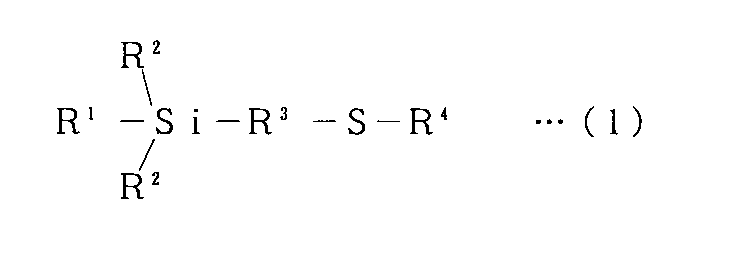
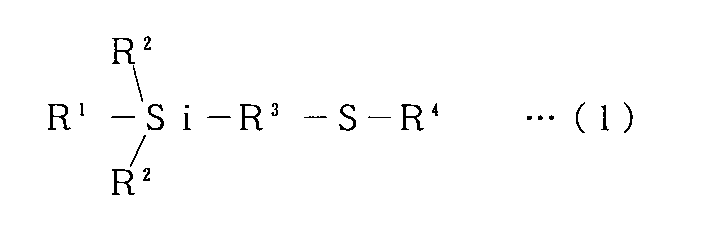
- silane coupling agent (C component) used together with the components (A) and (B), a silane coupling agent represented by the following general formula (1) is used.
- R 1 is an alkyl polyether group —O— (R 5 —O) m —R 6 , and m is 1 to 30 on average.
- R 5 is the same or different C 1 to C 30 hydrocarbon group.
- R 6 is a monovalent alkyl, alkenyl, aryl or aralkyl group containing at least 11 C atoms.
- Two of R 2 are the same or different and are the same as the above R 1 or a C 1 -C 12 alkyl group or R 7 O group.
- R 7 is H, methyl, ethyl, propyl, a (R 8 ) 3 Si group, or a C 9 to C 30 monovalent alkyl, alkenyl, aryl, aralkyl group.
- R 8 is a C 1 -C 30 alkyl or alkenyl group.
- R 3 is at least one divalent C 1 -C 30 hydrocarbon group selected from the group consisting of aliphatic, aromatic, mixed aliphatic and aromatic.
- R 4 is H, CN or (C ⁇ O) —R 9 .
- R 9 is at least one monovalent C 1 -C 30 hydrocarbon group selected from the group consisting of aliphatic, aromatic, mixed aliphatic and aromatic.
- the specific silane coupling agent (component C) is the length of R 3 in the general formula (1) (carbon number) ⁇ [length of R 6 (carbon number) ⁇ (length of R 5 (carbon number)]. ) ⁇ m)] is preferable.
- the specific silane coupling agent (component C) may be a mixture of various silane coupling agents represented by the general formula (1) or a condensation product thereof.
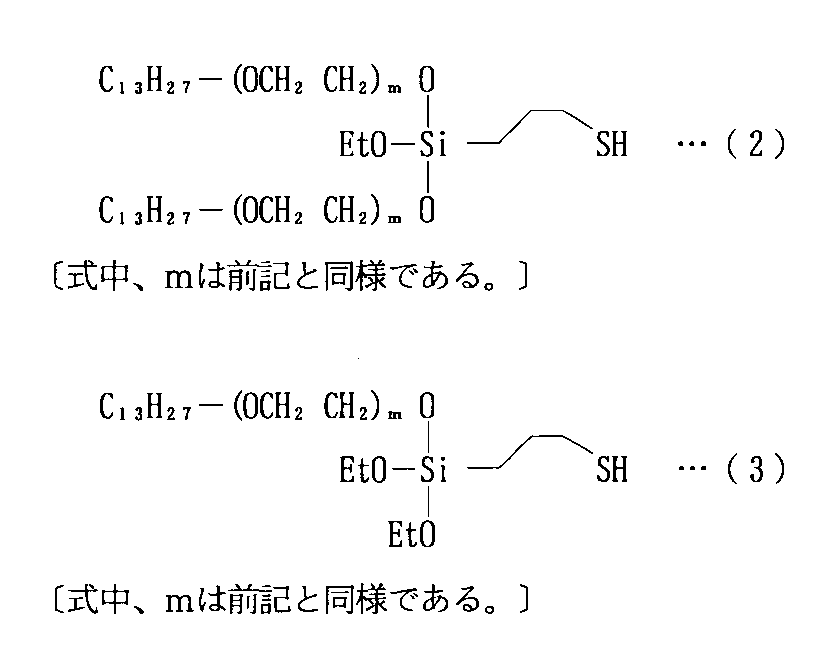
- component C those represented by the following general formula (2), those represented by the general formula (3), or a mixture thereof are preferable.
- the amount of the specific silane coupling agent (component C) is preferably in the range of 0.5 to 10 parts, particularly preferably 2 to 8 parts, relative to 100 parts of the diene rubber (component A). Range. That is, if the blending amount of the silane coupling agent is too small, the effect of improving the dispersibility of silica is reduced. Conversely, if the blending amount of the silane coupling agent is too large, the heat resistance tends to deteriorate. Because.
- the specific vulcanization aid (component D) used together with the components (A) to (C) includes zinc monomethacrylate, 2-tert-butyl-6- (3-tert-butyl-2- Hydroxy-5-methylbenzyl) -4-methylphenyl acrylate, stearyl methacrylate, tridecyl methacrylate, polypropylene glycol monomethacrylate, phenol EO modified acrylate, nonylphenol EO modified acrylate, N-acryloyloxyethyl hexahydrophthalimide, isobornyl methacrylate, tetrahydro Furfuryl acrylate, 2-phenoxyethyl methacrylate, ethoxylated (2) hydroxyethyl methacrylate, isodecyl methacrylate and the like are used.
- the rubber composition since the rubber composition is inferior in storage stability, it must process a product immediately after kneading
- a metal (meth) acrylate in addition to the vulcanization aid of the component (D).
- the metal (meth) acrylate include zinc monomethacrylate, zinc monoacrylate, zinc dimethacrylate, zinc diacrylate and the like, and these may be used alone or in combination of two or more.
- the blending amount of the specific vulcanization aid (component D) is preferably in the range of 0.5 to 10 parts, particularly preferably 1 to 6 parts, relative to 100 parts of the diene rubber (component A). It is a range. That is, if the blending amount of the specific vulcanization aid is less than the above range, the desired heat aging prevention effect cannot be obtained. Conversely, if the blending amount exceeds the above range, the crosslinked state of the rubber composition changes, and the This is because the vibration and sag resistance deteriorate.
- the blending amount is preferably in the range of 0.5 to 10 parts with respect to 100 parts of the diene rubber (component A). Particularly preferred is the range of 1.0 to 6.0 parts.
- the vibration-proof rubber composition of the present invention for example, when zinc monomethacrylate is contained as described above, there are advantages such as extremely high heat resistance, but on the other hand, gas is generated and prevented. Since the vibration isolator composition is foamed, there is a risk of inducing poor fusion of the anti-vibration rubber composition and poor adhesion of the anti-vibration rubber (vulcanized body).
- the vibration-proof rubber composition of the present invention preferably contains an adsorbent filler such as zeolite, sepiolite, and hydrotalcite together with the components (A) to (D). These adsorbent fillers are used alone or in combination of two or more.
- magnesium oxide which is a general adsorption filler may inhibit the heat resistance which is one of the subjects of this invention.
- zeolite a part of silicon element in the crystal lattice made of silicon dioxide is replaced with aluminum element, the entire crystal lattice is negatively charged, and a charge such as sodium, calcium, potassium is taken in, so that the charge is reduced.
- the said zeolite contains all four elements, silicon, aluminum, sodium, and calcium, from a gas adsorbent viewpoint.
- the amount of the adsorbent filler is preferably in the range of 2 to 15 parts, particularly preferably in the range of 2 to 10 parts with respect to 100 parts of the diene rubber (component A). That is, if the blending amount of the adsorbent filler is less than the above range, the desired foaming suppression effect cannot be obtained. Conversely, if the blending amount exceeds the above range, the dynamic ratio increases and the vibration-proof rubber characteristics deteriorate.
- the above-mentioned components (A) to (D), the above-mentioned adsorption filler, etc., vulcanizing agent, vulcanization accelerator, anti-aging agent, process oil Carbon black or the like may be appropriately blended as necessary.
- the anti-vibration rubber composition of the present invention uses special silica (component B) instead of carbon black conventionally used as a reinforcing agent, and substantially uses carbon black as a reinforcing agent. Although it is preferable that it is not contained (carbon black is not contained), it may be contained as long as it does not affect the properties of the vibration-insulating rubber composition of the present invention.
- vulcanizing agent examples include sulfur (powder sulfur, precipitated sulfur, insoluble sulfur) and the like. These may be used alone or in combination of two or more.
- the blending amount of the vulcanizing agent is preferably in the range of 0.3 to 7 parts, particularly preferably in the range of 1 to 5 parts with respect to 100 parts of the diene rubber (component A). That is, when the blending amount of the vulcanizing agent is too small, a sufficient cross-linking structure cannot be obtained, and dynamic magnification and tendency to sag resistance are deteriorated. Conversely, when the blending amount of the vulcanizing agent is too large. This is because the heat resistance tends to decrease.
- vulcanization accelerator examples include vulcanization accelerators such as thiazole, sulfenamide, thiuram, aldehyde ammonia, aldehyde amine, guanidine, and thiourea. These may be used alone or in combination of two or more. Among these, a sulfenamide-based vulcanization accelerator is preferable from the viewpoint of excellent crosslinking reactivity.
- the blending amount of the vulcanization accelerator is preferably in the range of 0.5 to 7 parts, particularly preferably in the range of 0.5 to 5 parts with respect to 100 parts of the diene rubber (component A). .
- thiazole vulcanization accelerator examples include dibenzothiazyl disulfide (MBTS), 2-mercaptobenzothiazole (MBT), 2-mercaptobenzothiazole sodium salt (NaMBT), and 2-mercaptobenzothiazole zinc salt (ZnMBT). Etc. These may be used alone or in combination of two or more. Among these, dibenzothiazyl disulfide (MBTS) and 2-mercaptobenzothiazole (MBT) are preferably used because they are particularly excellent in crosslinking reactivity.
- sulfenamide vulcanization accelerator examples include N-oxydiethylene-2-benzothiazolylsulfenamide (NOBS), N-cyclohexyl-2-benzothiazolylsulfenamide (CBS), Nt -Butyl-2-benzothiazoylsulfenamide (BBS), N, N'-dicyclohexyl-2-benzothiazoylsulfenamide and the like.
- thiuram vulcanization accelerator examples include tetramethylthiuram disulfide (TMTD), tetraethylthiuram disulfide (TETD), tetrabutylthiuram disulfide (TBTD), tetrakis (2-ethylhexyl) thiuram disulfide (TOT), tetrabenzylthiuram.
- TMTD tetramethylthiuram disulfide
- TETD tetraethylthiuram disulfide
- TBTD tetrabutylthiuram disulfide
- TOT tetrakis (2-ethylhexyl) thiuram disulfide
- TOT tetrabenzylthiuram.
- examples thereof include disulfide (TBzTD).
- anti-aging agent examples include carbamate-based anti-aging agents, phenylenediamine-based anti-aging agents, phenol-based anti-aging agents, diphenylamine-based anti-aging agents, quinoline-based anti-aging agents, imidazole-based anti-aging agents, and waxes. can give. These may be used alone or in combination of two or more.
- the blending amount of the anti-aging agent is preferably in the range of 1 to 10 parts, particularly preferably in the range of 2 to 5 parts with respect to 100 parts of the diene rubber (component A).
- process oil examples include naphthenic oil, paraffinic oil, and aroma oil. These may be used alone or in combination of two or more.
- the blending amount of the process oil is preferably in the range of 1 to 50 parts, particularly preferably in the range of 3 to 30 parts with respect to 100 parts of the diene rubber (component A).
- the anti-vibration rubber composition of the present invention can be prepared, for example, as follows. That is, the diene rubber (A component), the specific silica (B component), the specific silane coupling agent (C component), the specific vulcanization aid (D component), and if necessary, Antiaging agent, process oil and the like are appropriately blended, and these are kneaded from a temperature of about 50 ° C. using a Banbury mixer or the like, and kneaded at 100 to 160 ° C. for about 3 to 5 minutes. Next, a vulcanizing agent, a vulcanization accelerator, and the like are appropriately blended in this, and kneaded using an open roll under predetermined conditions (for example, 50 ° C.
- the obtained anti-vibration rubber composition can be vulcanized at a high temperature (150 to 170 ° C.) for 5 to 30 minutes to produce an anti-vibration rubber.
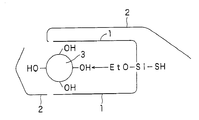
- the silane coupling agent represented by the general formula (2) is taken as an example. This will be specifically described.
- EtO groups (ethoxy groups) in the silane coupling agent are chemically bonded to OH groups on the surface of the silica 3, and as a result, long chains in the silane coupling agent are obtained.
- the alkyl polyether group [—O— (CH 2 CH 2 O) m —C 13 H 27 ] (the bonding group of 1 and 2 shown in the drawing) wraps around the entire silica 3. As shown in FIG.
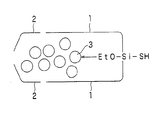
- FIG. 3 is a schematic diagram showing a state of chemical bonding between a plurality of silicas 3 (the surface OH groups are omitted) and a specific silane coupling agent.
- the dispersibility of silica (component B) is improved by the above-described bonds. Therefore, the addition amount of a specific silane coupling agent (C component) can be suppressed. Therefore, according to the present invention, it is possible to realize a low dynamic magnification of the vibration-insulating rubber composition, to suppress the total sulfur amount in the vibration-insulating rubber composition, and to improve heat resistance.
- silane coupling agent (i) In the general formula (2), m is 5, a silane coupling agent (manufactured by Evonik Degussa, VPSi363)
- Silica (i) Silanol group density: 10.1 pieces / nm 2 , average particle size: 5.7 ⁇ m, BET specific surface area: 20 m 2 / g silica (TB5012, manufactured by Tosoh Silica Corporation)
- silica (ii) Silanol group density: 14.4 pieces / nm 2 , average particle size: 5 ⁇ m, BET specific surface area: 15 m 2 / g of silica (prototype)
- Silica (iii) Silica prepared with a silanol group density of 3.0 / nm 2 , an average particle size of 10 ⁇ m, and a BET specific surface area of 60 m 2 / g (prototype)
- Silica (iv) Silanol group density: 2.4 units / nm 2 , average particle size: 12 ⁇ m, BET specific surface area: 92 m 2 / g silica (Nipseal ER, manufactured by Tosoh Silica Corporation)
- Silica (v) Silanol group density: 2.6 units / nm 2 , average particle size: 20 ⁇ m, BET specific surface area: 210 m 2 / g silica (Nipseal VN3, manufactured by Tosoh Silica Corporation)
- CBS N-cyclohexyl-2-benzothiazolylsulfenamide
- TMTD Tetramethylthiuram disulfide
- Zinc monomethacrylate (PRO11542, manufactured by Sartomer)
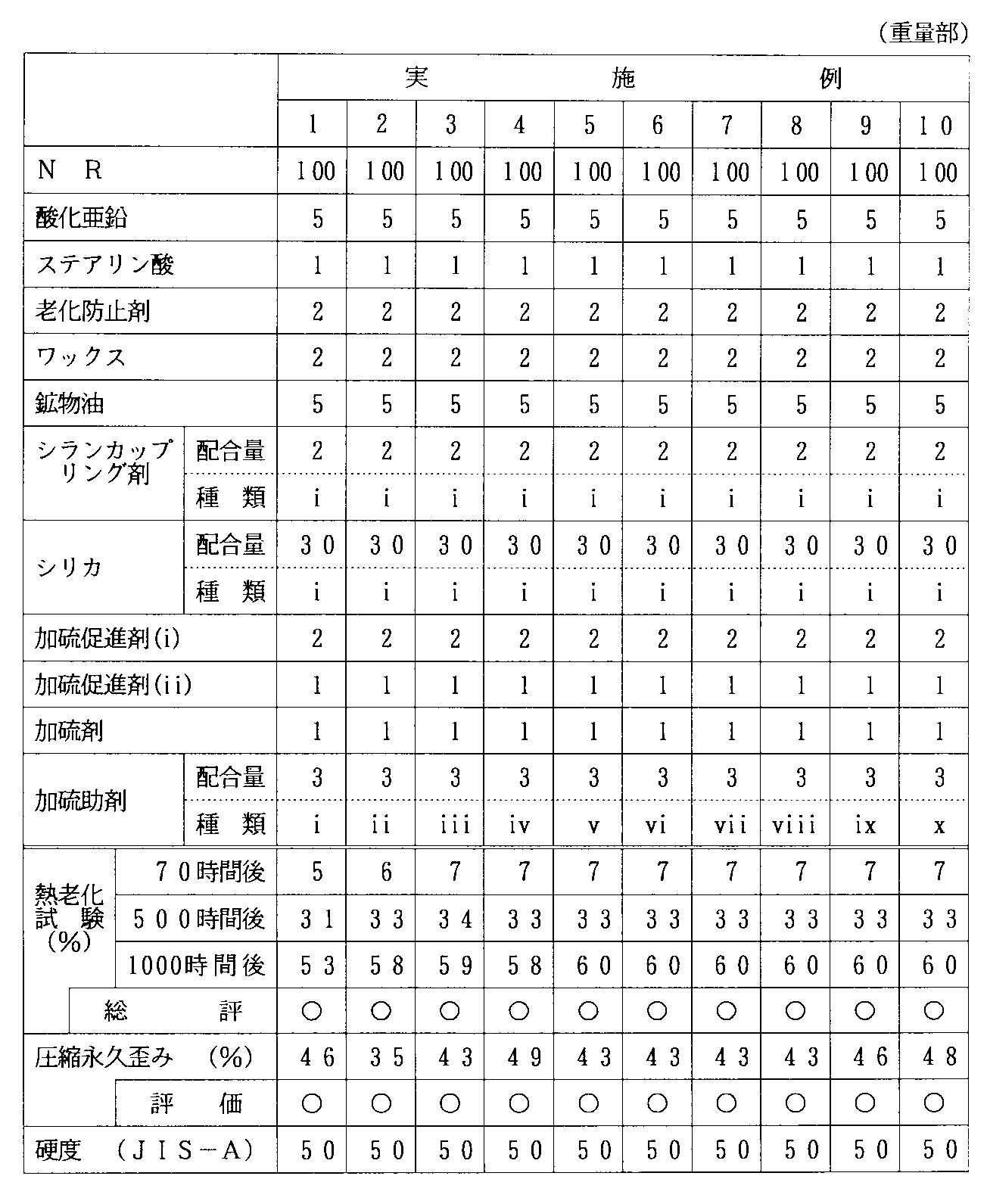
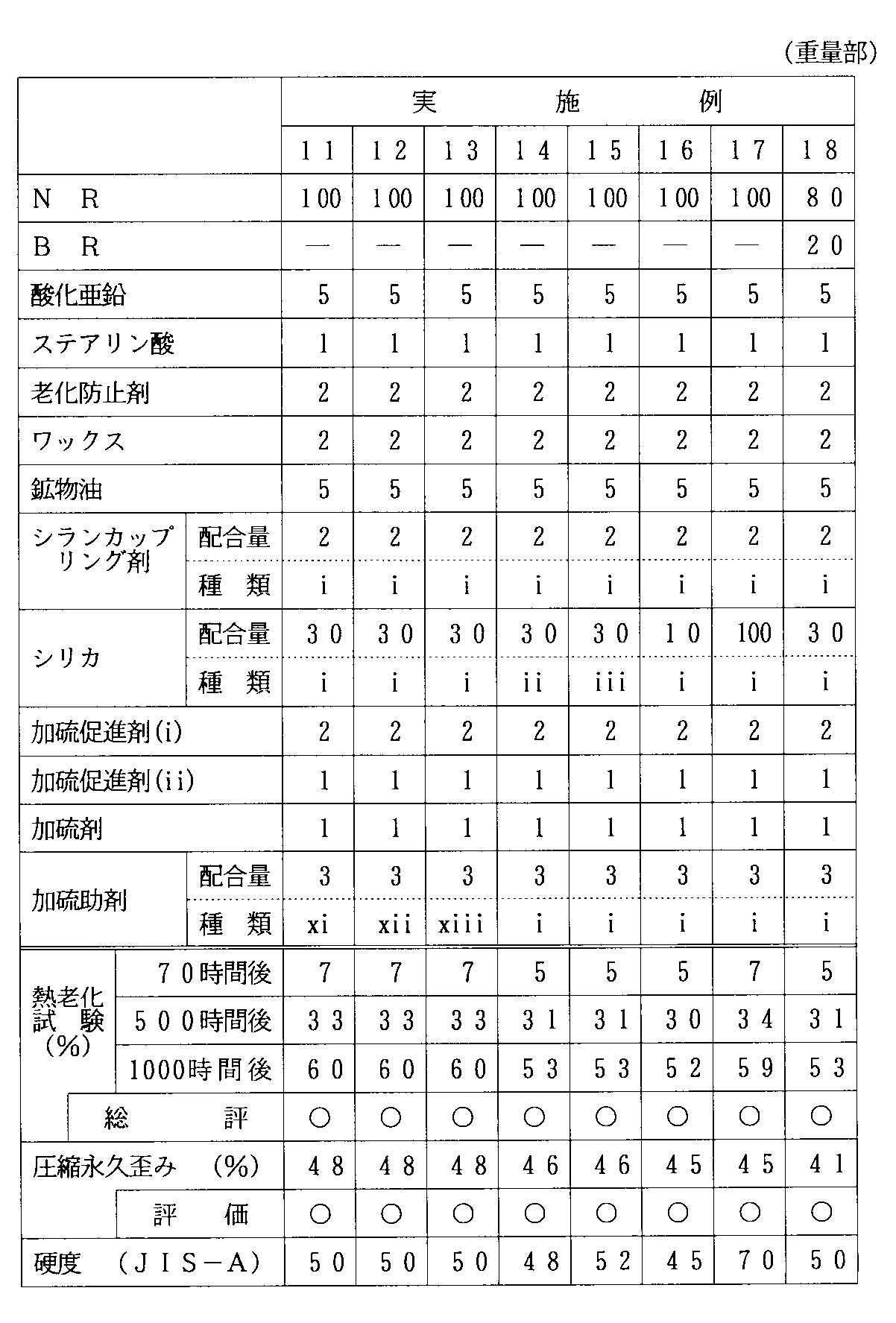
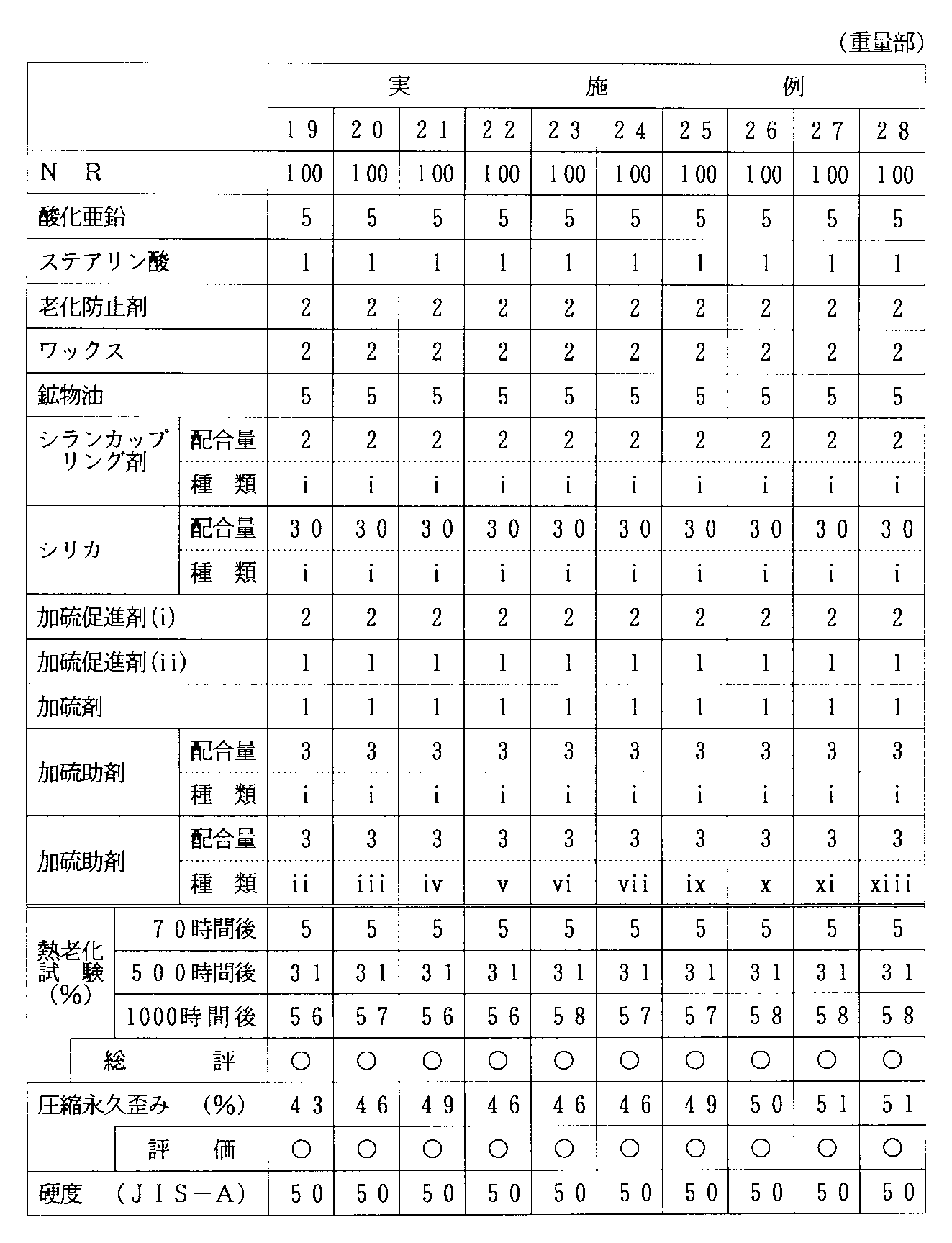
- Example 1 NR 100 parts, zinc oxide 5 parts, stearic acid 1 part, anti-aging agent 2 parts, wax 2 parts, mineral oil 5 parts, silane coupling agent (i) 2 parts, silica (i) 30 And 3 parts of vulcanization aid (i) were blended and kneaded for 5 minutes at 140 ° C. using a Banbury mixer. Next, 1 part of the vulcanizing agent, 2 parts of the vulcanization accelerator (i) and 1 part of the vulcanization accelerator (ii) are blended in this, and kneaded at 60 ° C. for 5 minutes using an open roll. Thus, a vibration-proof rubber composition was prepared.
- Thermal aging test Each anti-vibration rubber composition was press-molded (vulcanized) under the conditions of 160 ° C. ⁇ 20 minutes to produce a rubber sheet having a thickness of 2 mm. Then, a JIS No. 5 dumbbell was punched out from this rubber sheet, and the elongation at break (Eb) was measured using this dumbbell according to JIS K6251. In addition, this measurement is an initial (before heat aging) rubber sheet, a rubber sheet after heat aging in an atmosphere of 100 ° C. ⁇ 70 hours, and after heat aging in an atmosphere of 100 ° C. ⁇ 500 hours. The test was performed on the rubber sheet after heat aging in an atmosphere of 100 ° C. ⁇ 1000 hours.
- the degree of reduction in elongation at break (difference from the initial value) with each heat aging time was determined, and the values are shown in Tables 1 to 5 below.
- the degree of reduction in thermal break elongation required for the present invention is 10.0% or less after 70 hours of heat aging, 40.0% or less after 500 hours of heat aging, and 1000 hours after heat aging. It is 60.0% or less.
- Those satisfying all of these requirements were indicated as “ ⁇ ” in the general reviews shown in Tables 1 to 5 below, and those not satisfying were indicated as “X”.
- compression set Each anti-vibration rubber composition was press-molded (vulcanized) under the conditions of 160 ° C. ⁇ 30 minutes to prepare a test piece. Next, in accordance with JIS K6262, the compression set after 100 ° C. ⁇ 500 hours was measured while the test piece was compressed by 25%. In this test, the compression set required for the present invention is less than 55%. Those satisfying this requirement were indicated as “ ⁇ ” in the evaluations shown in Tables 1 to 5 below, and those not satisfying were indicated as “x”.
- Examples 19 to 28 in which specific mono (meth) acrylate is blended together with zinc monomethacrylate as a vulcanization aid, are excellent in the effect of preventing heat aging.
- Comparative Examples 1 and 2 since the vulcanization aid is different from that of the present invention, the heat resistance (heat aging prevention property) is deteriorated.
- Comparative Example 3 since the silane coupling agent is a general mercapto silane coupling agent different from that of the present invention, deterioration in heat resistance and compression set is observed.
- Comparative Example 4 the blending amount of silica was too small, heat resistance and compression set were slightly deteriorated, and further, the desired rubber hardness was not obtained, and the reinforcing property and the spring rigidity could not be secured.
- the vulcanization formation it contracted by cooling, causing a problem in the shape and size.
- Comparative Example 5 since the amount of silica is too large, deterioration of heat resistance and compression set is observed.
- Comparative Examples 6 and 7 since the silanol group density and average particle diameter of silica deviate from the provisions of the present invention (and Comparative Example 6 deviates from the BET specific surface area), the compression set is deteriorated. Be looked at.
- the anti-vibration rubber composition of the present invention is preferably used as an anti-vibration material for engine mounts, stabilizer bushes, suspension bushes, etc. used in automobile vehicles, etc. It can also be used for damping dampers for general household electrical appliances such as machines, damping walls for buildings in the field of construction and housing, damping and damping devices such as damping (damping) dampers, and seismic isolation devices .
Landscapes
- Chemical & Material Sciences (AREA)
- Health & Medical Sciences (AREA)
- Chemical Kinetics & Catalysis (AREA)
- Medicinal Chemistry (AREA)
- Polymers & Plastics (AREA)
- Organic Chemistry (AREA)
- Compositions Of Macromolecular Compounds (AREA)
- Springs (AREA)
Abstract
Description
(A)ジエン系ゴム。
(B)下記の特性(α)、(β)、(γ)のすべてを備えているシリカ。
(α)シアーズ滴定法により算出されるシリカ表面のシラノール基密度が3.0個/nm2以上。
(β)平均粒子径が10μm以下。
(γ)BET比表面積が15~60m2/g。
(C)下記の一般式(1)で表されるシランカップリング剤。
R2は、その2つが同じかまたは異なり、上記R1と同じか、C1~C12のアルキル基またはR7O基である。そして、R7は、H、メチル、エチル、プロピル、(R8)3Si基、またはC9~C30の一価のアルキル,アルケニル,アリール,アラルキル基である。R8は、C1~C30のアルキルまたはアルケニル基である。
R3は、脂肪族、芳香族、混合脂肪族および芳香族からなる群から選ばれた少なくとも一つの二価のC1~C30炭化水素基である。
R4は、H、CNまたは(C=O)-R9である。そして、R9は、脂肪族、芳香族、混合脂肪族および芳香族からなる群から選ばれた少なくとも一つの一価のC1~C30炭化水素基である。〕
(D)モノメタクリル酸亜鉛、2-tert-ブチル-6-(3-tert-ブチル-2-ヒドロキシ-5-メチルベンジル)-4-メチルフェニルアクリレート、ステアリルメタクリレート、トリデシルメタクリレート、ポリプロピレングリコールモノメタクリレート、フェノールEO変性アクリレート、ノニルフェノールEO変性アクリレート、N-アクリロイルオキシエチルヘキサヒドロフタルイミド、イソボニルメタクリレート、テトラヒドロフルフリルアクリレート、2-フェノキシエチルメタクリレート、エトキシ化(2)ヒドロキシエチルメタクリレートおよびイソデシルメタクリレートからなる群から選ばれた少なくとも一つ。
(α)シアーズ滴定法により算出されるシリカ表面のシラノール基密度が3.0個/nm2以上。
(β)平均粒子径が10μm以下。
(γ)BET比表面積が15~60m2/g。

R2は、その2つが同じかまたは異なり、上記R1と同じか、C1~C12のアルキル基またはR7O基である。そして、R7は、H、メチル、エチル、プロピル、(R8)3Si基、またはC9~C30の一価のアルキル,アルケニル,アリール,アラルキル基である。R8は、C1~C30のアルキルまたはアルケニル基である。
R3は、脂肪族、芳香族、混合脂肪族および芳香族からなる群から選ばれた少なくとも一つの二価のC1~C30炭化水素基である。
R4は、H、CNまたは(C=O)-R9である。そして、R9は、脂肪族、芳香族、混合脂肪族および芳香族からなる群から選ばれた少なくとも一つの一価のC1~C30炭化水素基である。〕
天然ゴム
ブタジエンゴム(Nipol BR1220、日本ゼオン社製)
酸化亜鉛2種、堺化学工業社製
ルーナックS30、花王社製
オゾノン6C、精工化学社製
サンノック、大内新興化学社製
ナフテン系オイル(出光興産社製、ダイアナプロセスNM-280)
前記一般式(2)において、mが5であるシランカップリング剤(エボニックデグサ社製、VPSi363)
下記の構造式(4)で表されるメルカプト系シランカップリング剤(KBM-803、信越化学工業社製)

シラノール基密度:10.1個/nm2、平均粒子径:5.7μm、BET比表面積:20m2/gのシリカ(TB5012、東ソーシリカ社製)
シラノール基密度:14.4個/nm2、平均粒子径:5μm、BET比表面積:15m2/gとなるように調製したシリカ(試作品)
シラノール基密度:3.0個/nm2、平均粒子径:10μm、BET比表面積:60m2/gとなるように調製したシリカ(試作品)
シラノール基密度:2.4個/nm2、平均粒子径:12μm、BET比表面積:92m2/gのシリカ(ニプシールER、東ソーシリカ社製)
シラノール基密度:2.6個/nm2、平均粒子径:20μm、BET比表面積:210m2/gのシリカ(ニプシールVN3、東ソーシリカ社製)
合成ゼオライト(ミズカシーブス5AP、水澤化学工業社製)
合成ゼオライト(ミズカライザーDS、水澤化学工業社製)
ハイドロタルサイト(DHT4A、協和化学工業社製)
N-シクロヘキシル-2-ベンゾチアゾリルスルフェンアミド(CBS)(ノクセラーCZ、大内新興化学社製)
テトラメチルチウラムジスルフィド(TMTD)(サンセラーTT、三新化学工業社製)
硫黄、軽井沢精錬所社製
モノメタクリル酸亜鉛(PRO11542、サートマー社製)
2-tert-ブチル-6-(3-tert-ブチル-2-ヒドロキシ-5-メチルベンジル)-4-メチルフェニルアクリレート(スミライザーGM、住友化学社製)
ステアリルメタクリレート(SR324、サートマー社製)
トリデシルメタクリレート(SR493、サートマー社製)
ポリプロピレングリコールモノメタクリレート(SR604、サートマー社製)
フェノールEO変性アクリレート(M101A、東亞合成社製)
ノニルフェノールEO変性アクリレート(M111、東亞合成社製)
N-アクリロイルオキシエチルヘキサヒドロフタルイミド(M140、東亞合成社製)
イソボニルメタクリレート(SR423、サートマー社製)
テトラヒドロフルフリルアクリレート(SR285、サートマー社製)
2-フェノキシエチルメタクリレート(SR340、サートマー社製)
エトキシ化(2)ヒドロキシエチルメタクリレート(SR570、サートマー社製)
イソデシルメタクリレート(SR242、サートマー社製)
エトキシポリエチレングリコール(550)モノメタクリレート(SR552、サートマー社製)
ラウリルメタクリレート(SR313、サートマー社製)
NR100部と、酸化亜鉛5部と、ステアリン酸1部と、老化防止剤2部と、ワックス2部と、鉱物油5部と、シランカップリング剤(i)2部と、シリカ(i)30部と、加硫助剤(i)3部とを配合し、これらをバンバリーミキサーを用いて、140℃で5分間混練を行った。つぎに、これに、加硫剤1部と、加硫促進剤(i)2部と、加硫促進剤(ii)1部とを配合し、オープンロールを用いて、60℃で5分間混練することにより、防振ゴム組成物を調製した。
後記の表1~表5に示すように、各成分の配合量等を変更する以外は、実施例1に準じて、防振ゴム組成物を調製した。
各防振ゴム組成物を、160℃×20分の条件でプレス成形(加硫)して、厚み2mmのゴムシートを作製した。そして、このゴムシートから、JIS5号ダンベルを打ち抜き、このダンベルを用い、JIS K6251に準拠して、破断伸び(Eb)を測定した。なお、この測定は、初期(熱老化させる前)のゴムシート、100℃×70時間の雰囲気下で熱老化させた後のゴムシート、100℃×500時間の雰囲気下で熱老化させた後のゴムシート、100℃×1000時間の雰囲気下で熱老化させた後のゴムシートに対して行った。そして、各熱老化時間による破断伸びの減少度合(初期との差)を求め、その値を後記の表1~表5に示した。なお、この試験において、本発明に要求される熱破断伸びの減少度合は、70時間熱老化後で10.0%以下、500時間熱老化後で40.0%以下、1000時間熱老化後で60.0%以下である。そして、これらの要求を全て満たすものを、後記の表1~表5に示す総評において「○」と表記し、満たさないものを「×」と表記した。
各防振ゴム組成物を、160℃×30分の条件でプレス成形(加硫)し、テストピースを作製した。つぎに、JIS K6262に従い、上記テストピースを25%圧縮させたまま、100℃×500時間後の圧縮永久歪みを測定した。なお、この試験において、本発明に要求される圧縮永久歪みは、55%未満である。そして、この要求を満たすものを、後記の表1~表5に示す評価において「○」と表記し、満たさないものを「×」と表記した。
各防振ゴム組成物を用いて、JIS K6253-1997の「加硫ゴム物理試験方法」における「デュロメータ硬さ試験」に定められる、テストピース(厚み2mm)を作製した。各テストピースを用いて、上記JIS K-6253-1997の「加硫ゴム物理試験方法」における「デュロメータ硬さ試験」に準じて、タイプAデュロメータにより、テストピースの硬度(JIS-A)を測定した。


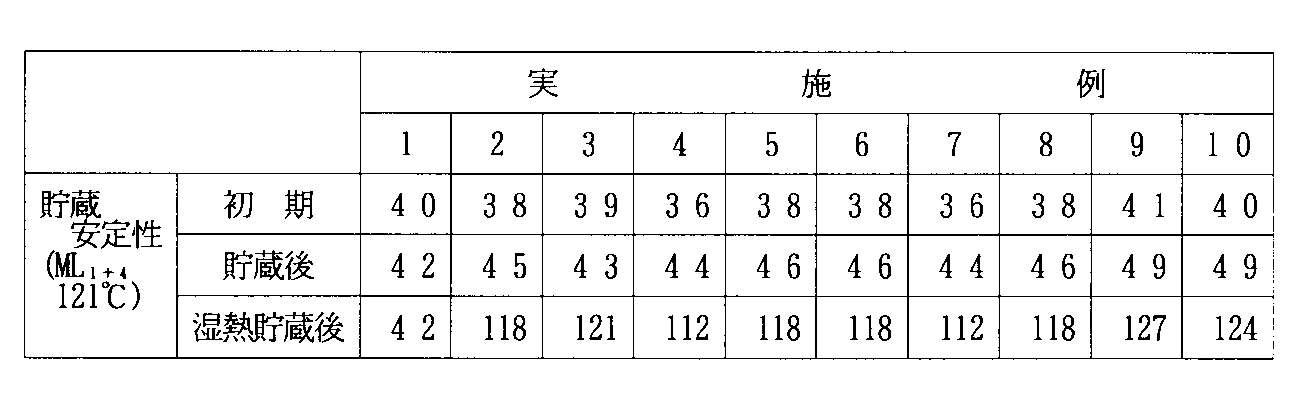
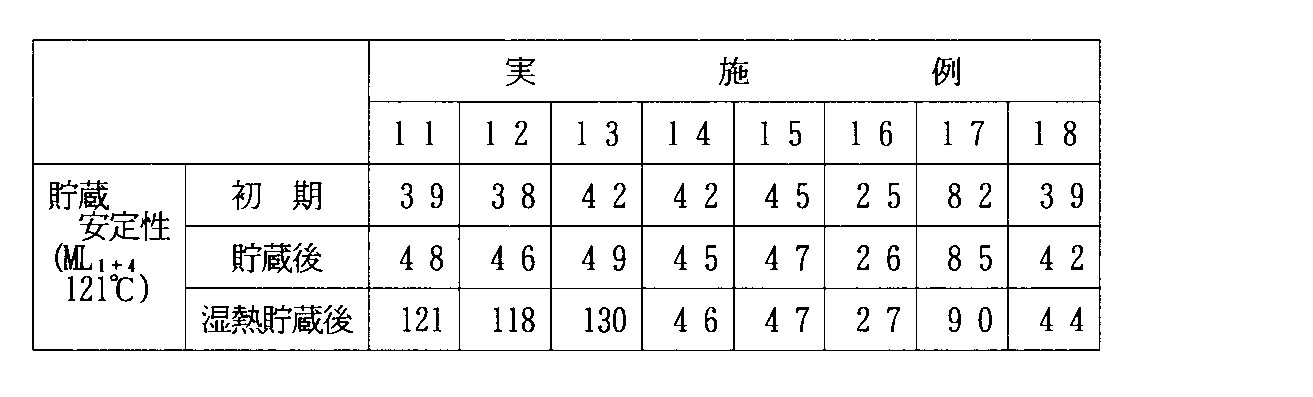
上記調製のゴム組成物における未加硫粘度の経時的変動を見るため、調製直後(初期)、常温常湿雰囲気下に72時間放置後(貯蔵後)、および、温度40℃×湿度95%RH雰囲気下に168時間放置後(湿熱貯蔵後)のムーニー粘度(ML1+4 121℃)を、東洋精機製作所社製のムーニー粘度測定器により測定した。


2 -C13H27
3 シリカ
Claims (7)
- 下記の(A)および(B)成分とともに、下記の(C)および(D)成分を含有し、上記(B)成分の配合量が(A)成分100重量部に対して10~100重量部であることを特徴とする防振ゴム組成物。
(A)ジエン系ゴム。
(B)下記の特性(α)、(β)、(γ)のすべてを備えているシリカ。
(α)シアーズ滴定法により算出されるシリカ表面のシラノール基密度が3.0個/nm2以上。
(β)平均粒子径が10μm以下。
(γ)BET比表面積が15~60m2/g。
(C)下記の一般式(1)で表されるシランカップリング剤。

R2は、その2つが同じかまたは異なり、上記R1と同じか、C1~C12のアルキル基またはR7O基である。そして、R7は、H、メチル、エチル、プロピル、(R8)3Si基、またはC9~C30の一価のアルキル,アルケニル,アリール,アラルキル基である。R8は、C1~C30のアルキルまたはアルケニル基である。
R3は、脂肪族、芳香族、混合脂肪族および芳香族からなる群から選ばれた少なくとも一つの二価のC1~C30炭化水素基である。
R4は、H、CNまたは(C=O)-R9である。そして、R9は、脂肪族、芳香族、混合脂肪族および芳香族からなる群から選ばれた少なくとも一つの一価のC1~C30炭化水素基である。〕
(D)モノメタクリル酸亜鉛、2-tert-ブチル-6-(3-tert-ブチル-2-ヒドロキシ-5-メチルベンジル)-4-メチルフェニルアクリレート、ステアリルメタクリレート、トリデシルメタクリレート、ポリプロピレングリコールモノメタクリレート、フェノールEO変性アクリレート、ノニルフェノールEO変性アクリレート、N-アクリロイルオキシエチルヘキサヒドロフタルイミド、イソボニルメタクリレート、テトラヒドロフルフリルアクリレート、2-フェノキシエチルメタクリレート、エトキシ化(2)ヒドロキシエチルメタクリレートおよびイソデシルメタクリレートからなる群から選ばれた少なくとも一つ。 - 上記(D)成分が、モノメタクリル酸亜鉛と、2-tert-ブチル-6-(3-tert-ブチル-2-ヒドロキシ-5-メチルベンジル)-4-メチルフェニルアクリレート,ステアリルメタクリレート,トリデシルメタクリレート,ポリプロピレングリコールモノメタクリレート,フェノールEO変性アクリレート,ノニルフェノールEO変性アクリレート,イソボニルメタクリレート,テトラヒドロフルフリルアクリレート,2-フェノキシエチルメタクリレートまたはイソデシルメタクリレートのモノ(メタ)アクリレートとを併用したものである請求項1記載の防振ゴム組成物。
- 上記(C)成分のシランカップリング剤の配合量が、上記(A)成分100重量部に対して0.5~10重量部である請求項1または2記載の防振ゴム組成物。
- 上記(D)成分の配合量が、上記(A)成分100重量部に対して0.5~10重量部である請求項1~3のいずれか一項に記載の防振ゴム組成物。
- 上記(A)~(D)成分とともに、金属(メタ)アクリレートを含有する請求項1~4のいずれか一項に記載の防振ゴム組成物。
- 上記(A)~(D)成分とともに、ゼオライト,セピオライトおよびハイドロタルサイトからなる群から選ばれた少なくとも一つの吸着フィラーを含有する請求項1~5のいずれか一項に記載の防振ゴム組成物。
- 請求項1~6のいずれか一項に記載の防振ゴム組成物の加硫体。
Priority Applications (3)
| Application Number | Priority Date | Filing Date | Title |
|---|---|---|---|
| DE112011100689T DE112011100689T5 (de) | 2010-02-26 | 2011-02-16 | Vibrationsisolierende Kautschukzusammensetzung |
| CN2011800105830A CN102770486A (zh) | 2010-02-26 | 2011-02-16 | 防振橡胶组合物 |
| US13/561,709 US20120289640A1 (en) | 2010-02-26 | 2012-07-30 | Vibration-isolating rubber composition |
Applications Claiming Priority (4)
| Application Number | Priority Date | Filing Date | Title |
|---|---|---|---|
| JP2010-043045 | 2010-02-26 | ||
| JP2010043045 | 2010-02-26 | ||
| JP2010-207167 | 2010-09-15 | ||
| JP2010207167A JP2011195807A (ja) | 2010-02-26 | 2010-09-15 | 防振ゴム組成物 |
Related Child Applications (1)
| Application Number | Title | Priority Date | Filing Date |
|---|---|---|---|
| US13/561,709 Continuation US20120289640A1 (en) | 2010-02-26 | 2012-07-30 | Vibration-isolating rubber composition |
Publications (1)
| Publication Number | Publication Date |
|---|---|
| WO2011105266A1 true WO2011105266A1 (ja) | 2011-09-01 |
Family
ID=44506680
Family Applications (1)
| Application Number | Title | Priority Date | Filing Date |
|---|---|---|---|
| PCT/JP2011/053277 Ceased WO2011105266A1 (ja) | 2010-02-26 | 2011-02-16 | 防振ゴム組成物 |
Country Status (5)
| Country | Link |
|---|---|
| US (1) | US20120289640A1 (ja) |
| JP (1) | JP2011195807A (ja) |
| CN (1) | CN102770486A (ja) |
| DE (1) | DE112011100689T5 (ja) |
| WO (1) | WO2011105266A1 (ja) |
Cited By (1)
| Publication number | Priority date | Publication date | Assignee | Title |
|---|---|---|---|---|
| JP2008239885A (ja) * | 2007-03-28 | 2008-10-09 | Tokai Rubber Ind Ltd | 防振ゴム組成物 |
Families Citing this family (6)
| Publication number | Priority date | Publication date | Assignee | Title |
|---|---|---|---|---|
| JP6135041B2 (ja) * | 2012-04-02 | 2017-05-31 | 横浜ゴム株式会社 | ゴム組成物および空気入りタイヤ |
| WO2015074197A1 (zh) * | 2013-11-20 | 2015-05-28 | 丹阳博德电子有限公司 | 一种发动机用减震橡胶及其制备方法 |
| DE102015015391B4 (de) * | 2015-12-01 | 2019-03-14 | IG AMEK GmbH | Dämpfungsvorrichtung zur Dämpfung von mechanischen Schwingungen |
| CN112011062B (zh) * | 2019-05-29 | 2022-06-24 | 彤程新材料集团股份有限公司 | 一种非硅烷聚合物偶联剂、制备方法及可硫化橡胶组合物 |
| JP2023096769A (ja) * | 2021-12-27 | 2023-07-07 | 住友理工株式会社 | 防振ゴム組成物および防振ゴム部材 |
| WO2023153405A1 (ja) * | 2022-02-14 | 2023-08-17 | デンカ株式会社 | ゴム組成物、加硫物、及び加硫成形体 |
Citations (8)
| Publication number | Priority date | Publication date | Assignee | Title |
|---|---|---|---|---|
| JPS6327542A (ja) * | 1986-07-22 | 1988-02-05 | Kawaguchi Kagaku Kogyo Kk | ゴム組成物 |
| JPS63265938A (ja) * | 1987-04-24 | 1988-11-02 | Kinugawa Rubber Ind Co Ltd | ゴム組成物 |
| JPH1171491A (ja) * | 1997-06-27 | 1999-03-16 | Tosoh Corp | 防振ゴム用クロロプレンゴム組成物 |
| JP2005320376A (ja) * | 2004-05-06 | 2005-11-17 | Bando Chem Ind Ltd | 免震積層体用ゴム組成物及びこれを用いた免震積層体 |
| JP2008007546A (ja) * | 2006-06-27 | 2008-01-17 | Toyo Tire & Rubber Co Ltd | 防振ゴム組成物及び防振ゴム |
| JP2008180327A (ja) * | 2007-01-25 | 2008-08-07 | Toyo Tire & Rubber Co Ltd | 防振ゴム用ゴム組成物 |
| JP2009256576A (ja) * | 2008-03-25 | 2009-11-05 | Tokai Rubber Ind Ltd | 防振ゴム組成物 |
| JP2010077299A (ja) * | 2008-09-26 | 2010-04-08 | Tokai Rubber Ind Ltd | 防振ゴム組成物 |
Family Cites Families (6)
| Publication number | Priority date | Publication date | Assignee | Title |
|---|---|---|---|---|
| JP2842449B2 (ja) | 1990-02-09 | 1999-01-06 | 富士通株式会社 | Tcnq錯体導電性膜の形成方法 |
| JP4143820B2 (ja) | 2002-11-20 | 2008-09-03 | 日本ゼオン株式会社 | アクリルゴム組成物 |
| JP2006199899A (ja) | 2005-01-24 | 2006-08-03 | Toyo Tire & Rubber Co Ltd | 防振ゴム組成物及び防振ゴム |
| JP2009067836A (ja) * | 2007-09-11 | 2009-04-02 | Sumitomo Chemical Co Ltd | ゴム組成物および防振材 |
| JP2009138046A (ja) * | 2007-12-04 | 2009-06-25 | Sumitomo Chemical Co Ltd | ゴム組成物および防振材 |
| JP2009242574A (ja) * | 2008-03-31 | 2009-10-22 | Yokohama Rubber Co Ltd:The | ジエン系ゴム組成物 |
-
2010
- 2010-09-15 JP JP2010207167A patent/JP2011195807A/ja active Pending
-
2011
- 2011-02-16 CN CN2011800105830A patent/CN102770486A/zh active Pending
- 2011-02-16 WO PCT/JP2011/053277 patent/WO2011105266A1/ja not_active Ceased
- 2011-02-16 DE DE112011100689T patent/DE112011100689T5/de not_active Ceased
-
2012
- 2012-07-30 US US13/561,709 patent/US20120289640A1/en not_active Abandoned
Patent Citations (8)
| Publication number | Priority date | Publication date | Assignee | Title |
|---|---|---|---|---|
| JPS6327542A (ja) * | 1986-07-22 | 1988-02-05 | Kawaguchi Kagaku Kogyo Kk | ゴム組成物 |
| JPS63265938A (ja) * | 1987-04-24 | 1988-11-02 | Kinugawa Rubber Ind Co Ltd | ゴム組成物 |
| JPH1171491A (ja) * | 1997-06-27 | 1999-03-16 | Tosoh Corp | 防振ゴム用クロロプレンゴム組成物 |
| JP2005320376A (ja) * | 2004-05-06 | 2005-11-17 | Bando Chem Ind Ltd | 免震積層体用ゴム組成物及びこれを用いた免震積層体 |
| JP2008007546A (ja) * | 2006-06-27 | 2008-01-17 | Toyo Tire & Rubber Co Ltd | 防振ゴム組成物及び防振ゴム |
| JP2008180327A (ja) * | 2007-01-25 | 2008-08-07 | Toyo Tire & Rubber Co Ltd | 防振ゴム用ゴム組成物 |
| JP2009256576A (ja) * | 2008-03-25 | 2009-11-05 | Tokai Rubber Ind Ltd | 防振ゴム組成物 |
| JP2010077299A (ja) * | 2008-09-26 | 2010-04-08 | Tokai Rubber Ind Ltd | 防振ゴム組成物 |
Cited By (1)
| Publication number | Priority date | Publication date | Assignee | Title |
|---|---|---|---|---|
| JP2008239885A (ja) * | 2007-03-28 | 2008-10-09 | Tokai Rubber Ind Ltd | 防振ゴム組成物 |
Also Published As
| Publication number | Publication date |
|---|---|
| JP2011195807A (ja) | 2011-10-06 |
| CN102770486A (zh) | 2012-11-07 |
| DE112011100689T5 (de) | 2013-02-28 |
| US20120289640A1 (en) | 2012-11-15 |
Similar Documents
| Publication | Publication Date | Title |
|---|---|---|
| JP2009256576A (ja) | 防振ゴム組成物 | |
| JP5890679B2 (ja) | ゴム組成物の製造方法 | |
| CN102341451B (zh) | 防振橡胶组合物 | |
| WO2011105266A1 (ja) | 防振ゴム組成物 | |
| JP7037986B2 (ja) | 電気自動車用防振ゴム組成物および電気自動車用防振ゴム部材 | |
| JP7553258B2 (ja) | 防振ゴム組成物および防振ゴム部材 | |
| JP5376884B2 (ja) | 防振ゴム組成物 | |
| JP6657491B1 (ja) | 防振ゴム組成物および防振ゴム部材 | |
| JP7285258B2 (ja) | 防振ゴム組成物およびその製造方法、ならびに防振ゴム部材 | |
| JP7409936B2 (ja) | 防振ゴム組成物および防振ゴム部材 | |
| JP7364483B2 (ja) | 防振ゴム組成物および防振ゴム部材 | |
| JP2011174034A (ja) | 防振ゴム組成物 | |
| JP2006199792A (ja) | 防振ゴム用ゴム組成物及び防振ゴム | |
| JP5108352B2 (ja) | 防振ゴム組成物 | |
| JP6644962B1 (ja) | 防振ゴム組成物および防振ゴム部材 | |
| JP2014077050A (ja) | 防振ゴム用ゴム組成物および防振ゴム | |
| JP5568493B2 (ja) | 防振ゴム組成物 | |
| JP2006143860A (ja) | 防振ゴム | |
| JP7840150B2 (ja) | 防振ゴム組成物および防振ゴム部材 | |
| WO2023127787A1 (ja) | 防振ゴム組成物および防振ゴム部材 | |
| JP5830058B2 (ja) | 防振ゴム組成物及び防振ゴム |
Legal Events
| Date | Code | Title | Description |
|---|---|---|---|
| WWE | Wipo information: entry into national phase |
Ref document number: 201180010583.0 Country of ref document: CN |
|
| 121 | Ep: the epo has been informed by wipo that ep was designated in this application |
Ref document number: 11747230 Country of ref document: EP Kind code of ref document: A1 |
|
| WWE | Wipo information: entry into national phase |
Ref document number: 112011100689 Country of ref document: DE Ref document number: 1120111006896 Country of ref document: DE |
|
| 122 | Ep: pct application non-entry in european phase |
Ref document number: 11747230 Country of ref document: EP Kind code of ref document: A1 |