WO2011052452A1 - リチウムイオン二次電池負極用炭素粒子、リチウムイオン二次電池用負極及びリチウムイオン二次電池 - Google Patents
リチウムイオン二次電池負極用炭素粒子、リチウムイオン二次電池用負極及びリチウムイオン二次電池 Download PDFInfo
- Publication number
- WO2011052452A1 WO2011052452A1 PCT/JP2010/068488 JP2010068488W WO2011052452A1 WO 2011052452 A1 WO2011052452 A1 WO 2011052452A1 JP 2010068488 W JP2010068488 W JP 2010068488W WO 2011052452 A1 WO2011052452 A1 WO 2011052452A1
- Authority
- WO
- WIPO (PCT)
- Prior art keywords
- secondary battery
- lithium ion
- ion secondary
- negative electrode
- carbon particles
- Prior art date
- Legal status (The legal status is an assumption and is not a legal conclusion. Google has not performed a legal analysis and makes no representation as to the accuracy of the status listed.)
- Ceased
Links
Classifications
-
- H—ELECTRICITY
- H01—ELECTRIC ELEMENTS
- H01M—PROCESSES OR MEANS, e.g. BATTERIES, FOR THE DIRECT CONVERSION OF CHEMICAL ENERGY INTO ELECTRICAL ENERGY
- H01M4/00—Electrodes
- H01M4/02—Electrodes composed of, or comprising, active material
- H01M4/36—Selection of substances as active materials, active masses, active liquids
- H01M4/58—Selection of substances as active materials, active masses, active liquids of inorganic compounds other than oxides or hydroxides, e.g. sulfides, selenides, tellurides, halogenides or LiCoFy; of polyanionic structures, e.g. phosphates, silicates or borates
- H01M4/583—Carbonaceous material, e.g. graphite-intercalation compounds or CFx
- H01M4/587—Carbonaceous material, e.g. graphite-intercalation compounds or CFx for inserting or intercalating light metals
-
- C—CHEMISTRY; METALLURGY
- C01—INORGANIC CHEMISTRY
- C01B—NON-METALLIC ELEMENTS; COMPOUNDS THEREOF; METALLOIDS OR COMPOUNDS THEREOF NOT COVERED BY SUBCLASS C01C
- C01B32/00—Carbon; Compounds thereof
- C01B32/20—Graphite
-
- C—CHEMISTRY; METALLURGY
- C01—INORGANIC CHEMISTRY
- C01B—NON-METALLIC ELEMENTS; COMPOUNDS THEREOF; METALLOIDS OR COMPOUNDS THEREOF NOT COVERED BY SUBCLASS C01C
- C01B32/00—Carbon; Compounds thereof
- C01B32/20—Graphite
- C01B32/21—After-treatment
-
- H—ELECTRICITY
- H01—ELECTRIC ELEMENTS
- H01M—PROCESSES OR MEANS, e.g. BATTERIES, FOR THE DIRECT CONVERSION OF CHEMICAL ENERGY INTO ELECTRICAL ENERGY
- H01M10/00—Secondary cells; Manufacture thereof
- H01M10/05—Accumulators with non-aqueous electrolyte
- H01M10/052—Li-accumulators
- H01M10/0525—Rocking-chair batteries, i.e. batteries with lithium insertion or intercalation in both electrodes; Lithium-ion batteries
-
- C—CHEMISTRY; METALLURGY
- C01—INORGANIC CHEMISTRY
- C01P—INDEXING SCHEME RELATING TO STRUCTURAL AND PHYSICAL ASPECTS OF SOLID INORGANIC COMPOUNDS
- C01P2002/00—Crystal-structural characteristics
- C01P2002/70—Crystal-structural characteristics defined by measured X-ray, neutron or electron diffraction data
- C01P2002/77—Crystal-structural characteristics defined by measured X-ray, neutron or electron diffraction data by unit-cell parameters, atom positions or structure diagrams
-
- C—CHEMISTRY; METALLURGY
- C01—INORGANIC CHEMISTRY
- C01P—INDEXING SCHEME RELATING TO STRUCTURAL AND PHYSICAL ASPECTS OF SOLID INORGANIC COMPOUNDS
- C01P2004/00—Particle morphology
- C01P2004/60—Particles characterised by their size
- C01P2004/61—Micrometer sized, i.e. from 1-100 micrometer
-
- C—CHEMISTRY; METALLURGY
- C01—INORGANIC CHEMISTRY
- C01P—INDEXING SCHEME RELATING TO STRUCTURAL AND PHYSICAL ASPECTS OF SOLID INORGANIC COMPOUNDS
- C01P2006/00—Physical properties of inorganic compounds
- C01P2006/12—Surface area
-
- C—CHEMISTRY; METALLURGY
- C01—INORGANIC CHEMISTRY
- C01P—INDEXING SCHEME RELATING TO STRUCTURAL AND PHYSICAL ASPECTS OF SOLID INORGANIC COMPOUNDS
- C01P2006/00—Physical properties of inorganic compounds
- C01P2006/14—Pore volume
-
- H—ELECTRICITY
- H01—ELECTRIC ELEMENTS
- H01M—PROCESSES OR MEANS, e.g. BATTERIES, FOR THE DIRECT CONVERSION OF CHEMICAL ENERGY INTO ELECTRICAL ENERGY
- H01M4/00—Electrodes
- H01M4/02—Electrodes composed of, or comprising, active material
- H01M4/13—Electrodes for accumulators with non-aqueous electrolyte, e.g. for lithium-accumulators; Processes of manufacture thereof
- H01M4/133—Electrodes based on carbonaceous material, e.g. graphite-intercalation compounds or CFx
-
- Y—GENERAL TAGGING OF NEW TECHNOLOGICAL DEVELOPMENTS; GENERAL TAGGING OF CROSS-SECTIONAL TECHNOLOGIES SPANNING OVER SEVERAL SECTIONS OF THE IPC; TECHNICAL SUBJECTS COVERED BY FORMER USPC CROSS-REFERENCE ART COLLECTIONS [XRACs] AND DIGESTS
- Y02—TECHNOLOGIES OR APPLICATIONS FOR MITIGATION OR ADAPTATION AGAINST CLIMATE CHANGE
- Y02E—REDUCTION OF GREENHOUSE GAS [GHG] EMISSIONS, RELATED TO ENERGY GENERATION, TRANSMISSION OR DISTRIBUTION
- Y02E60/00—Enabling technologies; Technologies with a potential or indirect contribution to GHG emissions mitigation
- Y02E60/10—Energy storage using batteries
Definitions
- the present invention relates to carbon particles for a negative electrode of a lithium ion secondary battery, a negative electrode for a lithium ion secondary battery, and a lithium ion secondary battery.
- the present invention relates to a negative electrode for a lithium ion secondary battery that is suitable for use in portable devices, electric vehicles, power storage, etc. and has a high capacity and excellent quick charge characteristics, and a lithium ion secondary battery using the negative electrode.
- Examples of using graphite as the negative electrode active material include natural graphite particles, artificial graphite particles graphitized with coke, artificial graphite particles graphitized with organic polymer materials and pitch, graphite particles obtained by pulverizing these, and the like. These graphite particles are mixed with an organic binder and an organic solvent to form a graphite paste. The graphite paste is applied to the surface of the copper foil, and the solvent is dried and molded to form a negative electrode for a lithium ion secondary battery. I use it. By using graphite for the negative electrode, the problem of content short circuit due to lithium dendrite is solved, and the charge / discharge characteristics are improved (for example, see Patent Document 1).
- the treatment described in Patent Document 2 is a treatment characterized by repeatedly applying to the particles a weak force that does not break the bond between the graphite layers. Therefore, the treated particles have many pores of 2 ⁇ 10 to 2 ⁇ 10 4 ⁇ in the particles. If the particle has a large number of pores with a size of 2 ⁇ 10 to 2 ⁇ 10 to 2 ⁇ 10 4 ⁇ , the organic binder enters the pores in the particle during the preparation of the negative electrode, and the conductivity of the particle The present inventors have found that this is reduced.
- the present inventors made a negative electrode by using carbon particles having a specific shape parameter and a specific crystal structure. It has been found that the carbon particles in the state exhibit a preferable pore volume and circularity of the particle cross section, and are excellent in rapid charge characteristics with a high capacity.
- the particles have a large number of pores, and the conductivity of the carbon particles decreases due to the organic binder component entering the pores in the particles. Found that there is a tendency to. Furthermore, it has been found that in the conventional method, the particles are too spherical and the interparticle conductivity tends to decrease. Thus, it has been found that by making the pores of a specific size of the carbon particles below a certain level and further making the circularity of the cross section of the particles a certain range, adverse effects on the quick charge characteristics can be avoided. Based on these findings, the present invention has been achieved.
- the present invention is characterized by the matters described in the following (1) to (8).
- the pore volume of 2 ⁇ 10 to 2 ⁇ 10 4 pores is 0.1 ml / g or less per mass of carbon particles, and the interlayer distance d (002) of the graphite crystal determined by X-ray diffraction measurement Is a carbon particle for a negative electrode of a lithium ion secondary battery having a crystallite size Lc in the C-axis direction of 500 ⁇ or more and a circularity of the particle cross section of 0.6 to 0.9.
- a negative electrode for a lithium secondary battery comprising the carbon particles for a lithium ion secondary battery negative electrode according to any one of (1) to (6) above.
- a lithium ion secondary battery having the negative electrode according to (7) and a positive electrode containing a lithium compound.
- the present invention has a high capacity and can suppress the organic binder from entering the pores in the carbon particles during the production of the negative electrode, thereby suppressing the decrease in conductivity due to the addition of an excessive organic binder. it can. Furthermore, a decrease in interparticle contact can be suppressed, and a decrease in interparticle conductivity can be suppressed.
- the carbon particle for lithium ion secondary battery negative electrodes excellent in the quick charge characteristic can be obtained.
- the carbon particles for the negative electrode of the lithium ion secondary battery of the present invention have a pore volume of 2 ⁇ 10 to 2 ⁇ 10 4 ⁇ pores of 0.1 ml / g or less per mass of carbon particles.
- the required interlayer distance d (002) of the graphite crystals is 3.38 mm or less, the crystallite size Lc in the C-axis direction is 500 mm or more, and the circularity of the particle cross section is 0.6 to 0.9.
- the carbon particles used for the negative electrode preferably have a pore volume of 2 ⁇ 10 to 2 ⁇ 10 4 ⁇ pores of 0.1 ml / g or less, and 0.08 ml / g or less per mass of carbon particles. More preferably, it is more preferably 0.04 ml / g or less.
- the pore volume can be determined by pore size distribution measurement by mercury porosimetry using the carbon particles of the present invention (for example, Autopore 9520 manufactured by Shimadzu Corporation).
- the pore size can also be determined by measuring the pore size distribution by mercury porosimetry.
- the standard size of the pore volume was set to 2 ⁇ 10 to 2 ⁇ 10 4 ⁇ ⁇ because the reduction of pores having a small pore volume is effective in improving the quick charge characteristics. is there.
- the present invention in order to make the pore volume of the carbon particles in the above range, it can be adjusted by pressure treatment, modification by mechanical treatment, coating treatment or the like.
- carbon adjusted by a coating treatment described later is used.
- the particles are mainly characterized by having an exothermic peak at 550 to 650 ° C. by differential thermal analysis in an air stream. As described later, this is because the carbon particles having the exothermic peak are subjected to an appropriate carbon coating treatment on the graphite particles serving as a nucleus. By using low crystalline carbon in this “carbon coating treatment”, the above exothermic peak is obtained.
- the area of the exothermic peak at a temperature rise of 5 ° C./min is most preferably 100 ⁇ V ⁇ s / mg or more and 2100 ⁇ V ⁇ s / mg or less.
- the coating treatment for adjusting the pore volume of the 2 ⁇ 10 to 2 ⁇ 10 4 pores to 0.1 ml / g or less per mass of carbon particles is performed using a material other than low crystalline carbon. Can also be done. However, for example, when resin is used, the exothermic peak in the differential thermal analysis in the air stream is in a region different from 550 to 650 ° C.
- a more preferable exothermic peak area is 200 to 2100 ⁇ V ⁇ s / mg, more preferably 1100 to 2100 ⁇ V ⁇ s / mg from the viewpoint of reducing the pore volume.
- the coating process for adjusting the pore volume is, for example, by attaching an organic compound (carbon precursor) that leaves carbonaceous material to the surface of the carbon particles by heat treatment, and then modifying the surface by firing (low crystal For example, carbon).
- the method for attaching the organic compound to the surface of the carbon particles is not particularly limited.
- Examples of the material used for coating include petroleum pitch, naphthalene, anthracene, phenanthrolen, coal tar, phenol resin, and polyvinyl alcohol.
- the coating amount may be adjusted. That is, if the coating amount is large, the area of the exothermic peak tends to increase.
- an electrode material of a lithium ion secondary battery is mixed with a solvent and an organic binder to form a slurry, which is applied to a copper foil or the like as a current collector, and the solvent is dried and molded.
- a solvent and an organic binder for example, scaly graphite having a small circularity has a plate-like shape, so that the fluidity when mixed with a solvent and a binder is poor, and the density of the negative electrode for a lithium ion secondary battery to be produced varies greatly. And there exists a tendency for adhesiveness with a negative electrode electrical power collector to fall. As a result, the charge / discharge characteristics of the obtained lithium ion secondary battery tend to deteriorate.
- the contact between the particles tends to be point contact, and the conductivity tends to decrease. Further, the contact area between the particles tends to decrease due to the expansion and contraction of the particles due to repeated insertion and extraction of lithium into and from the graphite crystal. As a result, the charge / discharge characteristics tend to be adversely affected.
- the contour of the particle cross-sectional image in the state of being a negative electrode for a lithium ion secondary battery has a pseudo-polygonal shape. It will have.
- the contact area between carbon particles increases and it can be set as the shape which is easy to maintain the electroconductivity between carbon particles.
- the contact area between the carbon particles does not decrease, and good charge / discharge characteristics can be obtained.
- the circularity of the carbon particles of the present invention is measured as follows. First, the cross section of the particle is photographed and obtained by the following formula.
- Circularity (perimeter of equivalent circle) / (perimeter of particle cross-sectional image)
- the “equivalent circle” is a circle having the same area as the particle cross-sectional image.
- the peripheral length of the particle cross-sectional image is the length of the contour line of the captured particle cross-sectional image.
- the circularity in the present invention is magnified to 1000 times with a scanning electron microscope, 10 carbon particles are arbitrarily selected, the circularity of each carbon particle is measured by the above method, and the average value is taken. Average circularity.
- a sample electrode is prepared, the electrode is embedded in an epoxy resin, mirror-polished, and observed with a scanning electron microscope.
- the sample electrode is manufactured as follows. First, using a mixture of 97 parts by mass of carbon particles as a negative electrode material and 3 parts by mass of polyvinylidene fluoride resin as an organic binder, the viscosity at 25 ° C. of the mixture is 1500 to 2500 mPa ⁇ s. A paint to which N-methyl-2-pyrrolidone has been added is prepared. And after apply
- the measuring method of a viscosity is as follows. Using a viscometer (manufactured by Brookfield, product name: DV-III, spindle: SC4-18 # 14), the viscosity is measured at a rotation speed of 100 rpm and a temperature of 25 ° C.
- the perimeter of the equivalent circle and the perimeter of the increase in particle cross section can be obtained, for example, by analysis software attached to the scanning electron microscope.
- the carbon particles for a negative electrode of a lithium ion secondary battery of the present invention preferably have a non-spherical shape having an acute angle or an obtuse angle, including a linear portion in the contour line in the shape of the particle cross section.
- the shape of the particle cross section may include a contour line having a dent and a curved portion.
- spheroidized natural graphite or spheroidized artificial graphite having a circularity of 0.9 to 1.0 is used as a raw material for the carbon particles.
- it can be adjusted by modifying the graphite that is the raw material of the carbon particles.
- Spherical natural graphite having a circularity of 0.9 to 1.0 and spheroidized artificial graphite as raw materials for carbon particles will be described later, but flat natural graphite particles such as scaly natural graphite and scaly natural graphite will be described later. Or obtained by subjecting artificial graphite particles to mechanical treatment for modification treatment.
- the interlaminar distance d (002) of the graphite crystal of the carbon particles is a value calculated from the measurement by wide angle X-ray diffraction of the carbon particles used for the negative electrode for the lithium ion secondary battery, and this value is 3.38 cm.
- a range of 3.35 to 3.37 mm is more preferable.
- d (002) exceeds 3.38 mm, the discharge capacity tends to decrease.
- the theoretical value of d (002) of pure graphite crystal is usually 3.35 mm or more.
- the d (002) of the carbon particles of the present invention is measured by irradiating the carbon particles with X-rays (CuK ⁇ rays) and measuring the diffraction lines with a goniometer. From the diffraction peak corresponding to the carbon d (002) plane appearing in the vicinity of 24 to 26 °, calculation is performed using the Bragg equation.
- natural graphite having high crystallinity or artificial graphite having high crystallinity may be used in order to set the d (002) of the carbon particles to 3.38 cm or less.
- heat treatment may be performed at a temperature of 2000 ° C. or higher.
- the crystallite size Lc in the C-axis direction of the carbon particles is also a value calculated from measurement by wide-angle X-ray diffraction. If this value is less than 500 mm, the discharge capacity tends to be small.
- the carbon particles used for the negative electrode for an ion secondary battery have Lc of 500% or more. Although there is no restriction
- the measurement of Lc of the carbon particles of the present invention is performed by a usual method, and specifically, it is performed as follows.
- the crystallite size Lc is calculated based on the Gakushin method using a wide-angle X-ray diffractometer.
- natural graphite with high crystallinity or artificial graphite with high crystallinity may be used.
- heat treatment may be performed at a temperature of 2000 ° C. or higher.
- the carbon particles of the present invention preferably have an N 2 specific surface area of 10 m 2 / g or less, more preferably 6 m 2 / g or less, and still more preferably 4 m 2 / g or less, determined by nitrogen adsorption measurement at 77K. .
- N 2 specific surface area 10 m 2 / g or less, more preferably 6 m 2 / g or less, and still more preferably 4 m 2 / g or less, determined by nitrogen adsorption measurement at 77K. .
- the specific surface area exceeds 10 m 2 / g, the irreversible capacity of the first cycle of the obtained lithium ion secondary battery tends to be large, the energy density is small, and many organic binders are used when producing a negative electrode. There is a tendency to require agents.
- the specific surface area is more preferably from 0.3 to 4 m 2 / g, more preferably from 0.3 to 2 m 2 / g, from the viewpoint that the cycle characteristics and
- the N 2 specific surface area obtained by measuring the nitrogen adsorption at 77K can be a known method such as the BET method (nitrogen gas adsorption method).
- mechanical surface modification treatment, coating treatment, pulverization, and the like may be performed in order to make the N 2 specific surface area obtained by measuring nitrogen adsorption at 77 K of carbon particles 10 m 2 / g or less. Further, when the particle size is decreased, the specific surface area tends to increase, and when the particle size is increased, the specific surface area tends to decrease.
- the carbon particles of the present invention preferably have a true specific gravity of 2.2 or more. More preferably, it is 2.200-2.270. If the true specific gravity is less than 2.2, the charge / discharge capacity per volume of the lithium ion secondary battery tends to decrease, and the initial charge / discharge efficiency tends to decrease.
- the true specific gravity can be determined by a pycnometer method using butanol.
- natural graphite having high crystallinity or artificial graphite having high crystallinity may be used.
- heat treatment may be performed at a temperature of 2000 ° C. or higher.
- the carbon particles of the present invention preferably have an average particle size in the range of 1 to 100 ⁇ m as measured by a laser diffraction particle size distribution meter. More preferably, it is 1 to 80 ⁇ m, and further preferably 5 to 30 ⁇ m.
- the average particle size is 100 ⁇ m or more, the coating property is poor when applied to a paste, and the rapid charge / discharge characteristics tend to be inferior.
- the average particle size is 1 ⁇ m or less, the particles cannot efficiently participate in the electrochemical reaction with lithium ions, and the capacity and cycle characteristics tend to decrease.
- the average particle size is calculated as 50% D when measured with a laser diffraction particle size distribution meter.
- particles having a desired size may be obtained using a pulverizer or a sieve.
- the bulk density of the carbon particles of the present invention is preferably 0.7 g / ml or more.
- the upper limit of the bulk density is not particularly limited, but is usually 1.5 g / ml or less.
- a graduated cylinder with a capacity of 100 ml is slanted, and 100 ml of sample powder is gradually added to it using a spoon, and the graduated cylinder is dropped 30 times from a height of 5 cm after plugging the graduated cylinder.
- the tap density is 30 times that can be calculated from the mass and volume of the sample powder.
- particles of a desired size may be obtained using a pulverizer or a sieve.
- carbon particles whose graphite crystal interlayer distance d (002) determined by X-ray diffraction measurement is 3.38 mm or less and crystallite size Lc in the C-axis direction is 500 mm or more include, for example, scaly natural graphite, scaly Heat treatment may be performed at 2000 ° C. or higher, preferably 2600 to 3000 ° C. using flat natural graphite particles such as natural graphite.
- the following modification treatment is performed.
- flat natural graphite particles having an average particle diameter of 1 to 100 ⁇ m and a circularity of 0.2 to 0.55 are used as a preferred raw material, subjected to mechanical treatment, and the average particle diameter of carbon particles is 5 to 50 ⁇ m and circular.
- Spherical natural graphite having a degree of 0.9 to 1.0 is obtained.
- the mechanical treatment refers to a treatment in which the particles collide with a part of the processing apparatus or particles.
- the spheroidized natural graphite is subjected to pressure treatment.
- the method for pressurizing the spheroidized natural graphite is not particular limitation.
- the raw graphite is placed in a rubber mold or the like and water is used as a pressurizing medium for isostatic pressure.
- the pressurizing process include a press and an isotropic press using an air pressure using a gas such as air as a pressurizing medium.
- raw material graphite may be filled in a mold, and pressure treatment may be applied in a certain direction by uniaxial pressing.
- the pressure of the pressure medium for the spherical natural graphite is preferably 50 to 2000 kgf / cm 2 , more preferably 300 to 2000 kgf / cm 2 , and 500 to 1000 kgf / cm 2 . More preferably.
- the pressure is less than 50 kgf / cm 2 , the effect of improving the cycle characteristics of the obtained lithium ion secondary battery tends to be small.
- the pressure exceeds 2000 kgf / cm 2 , the specific surface area of the obtained carbon particles for a lithium ion secondary battery negative electrode increases, and as a result, the irreversible capacity of the first cycle of the obtained lithium ion secondary battery increases. Tend to be.
- the obtained carbon particles are likely to aggregate together, and therefore it is preferable to perform treatment such as crushing and sieving after the pressure treatment.
- treatment such as crushing and sieving after the pressure treatment.
- carbon particles do not aggregate, it is not necessary to crush.
- the negative electrode for a lithium ion secondary battery according to the present invention forms the negative electrode layer by mixing the carbon particles with an organic binder and a solvent or water, applying the mixture to a current collector, drying the solvent or water, and applying pressure. And a negative electrode for a lithium ion secondary battery.
- the organic binder examples include polymer compounds such as polyethylene, polypropylene, ethylene propylene rubber, butadiene rubber, styrene butadiene rubber, carboxymethyl cellulose, polyvinylidene fluoride, polyethylene oxide, polyepichlorohydrin, polyacrylonitrile, and the like.
- the carbon particles for the negative electrode of the lithium ion secondary battery of the present invention have an organic bond in the pores when the negative electrode is made of polyvinylidene fluoride or the like, which is hydrophobic and easily compatible with the carbon particles, as an organic binder. The effect which suppresses that a dressing enters is exhibited more.
- the mixing ratio of the carbon particles and the organic binder is preferably 1 to 20 parts by mass of the organic binder with respect to 100 parts by mass of the carbon particles.
- the solvent used for mixing the carbon particles and the organic binder is not particularly limited, and N-methylpyrrolidone, dimethylacetamide, dimethylformamide, ⁇ -butyrolactone and the like are used.
- the current collector for example, a foil or mesh of nickel, copper or the like can be used.
- the density of the mixture layer (negative electrode layer) containing the carbon particles and the organic binder on the current collector is 1.40 to 1.90 g / cm 3. Is preferred. Above the density is more preferably 1.45 ⁇ 1.80g / cm 3, more preferably 1.50 ⁇ 1.70g / cm 3.
- the energy density per volume of the lithium ion secondary battery obtained using this negative electrode is reduced. Can be bigger.
- the density of the negative electrode layer containing the carbon particles and the organic binder is less than 1.40 g / cm 3 , the energy density per volume of the obtained lithium secondary battery tends to be small.
- the density of the negative electrode layer containing the carbon particles and the organic binder exceeds 1.90 g / cm 3 , the pouring property of the electrolytic solution when producing a lithium ion secondary battery tends to deteriorate. In addition, there is a tendency that rapid charge / discharge characteristics and cycle characteristics of a lithium ion secondary battery to be manufactured are deteriorated.
- the density of the negative electrode layer containing the carbon particles and the organic binder can be calculated from the measured values of the mass and volume of the negative electrode layer containing the carbon particles and the organic binder.
- the density of the negative electrode layer containing the carbon particles and the organic binder after integration of the negative electrode layer into the current collector is appropriately adjusted by, for example, the pressure at the time of integral molding, the clearance of a device such as a roll press, etc. can do.
- a positive electrode containing a lithium compound is placed facing the separator via a separator, and an electrolytic solution is injected.
- the positive electrode containing a lithium compound for example, can be used alone or as a mixture of LiNiO 2, LiCoO 2, LiMn 2 O 4 or the like.
- the positive electrode can be obtained by forming a positive electrode layer on the current collector surface in the same manner as the negative electrode.
- the electrolytic solution is, for example, a lithium salt such as LiClO 4 , LiPF 4 , LiAsF, LiBF 4 , LiSO 3 CF 4 dissolved in, for example, ethylene carbonate, diethyl carbonate, dimethoxyethane, dimethyl carbonate, methyl ethyl carbonate tetrahydrofuran, etc. Can be used. Also, a solid or gel so-called polymer electrolyte can be used in place of the electrolytic solution.
- a lithium salt such as LiClO 4 , LiPF 4 , LiAsF, LiBF 4 , LiSO 3 CF 4 dissolved in, for example, ethylene carbonate, diethyl carbonate, dimethoxyethane, dimethyl carbonate, methyl ethyl carbonate tetrahydrofuran, etc.
- a solid or gel so-called polymer electrolyte can be used in place of the electrolytic solution.
- separator for example, a nonwoven fabric, a cloth, a microporous film, or a combination thereof having a polyolefin as a main component such as polyethylene or polypropylene can be used. It can also be used as coated with inorganic compounds such as SiO 2 or Al 2 O 3 in the aforementioned separator.
- a separator when it is set as the structure where the positive electrode and negative electrode of the lithium ion secondary battery to produce are not directly contacted, it is not necessary to use a separator.
- the structure of the lithium ion secondary battery of the present invention is not particularly limited. Usually, a positive electrode and a negative electrode, and a separator provided as necessary, are wound into a flat spiral to form a wound electrode group. Or these are laminated
- the lithium ion secondary battery of the present invention is not particularly limited, but is used as a paper-type battery, a button battery, a coin-type battery, a laminated battery, a cylindrical battery, or the like.
- Example 1 Production of negative electrode for lithium ion secondary battery Spherical natural graphite (average particle size 22 ⁇ m, circularity 0.95, specific surface area 5.0 m 2 / g, true specific gravity 2.25, Lc> 1000 ⁇ , d (002 ) After filling and sealing 3.354 mm, bulk density 0.72 g / ml) into a rubber container, the rubber container is isotropic with a hydrostatic pressure press at a pressure of 1000 kgf / cm 2 of the pressurized medium. A pressure treatment was performed. Subsequently, it was pulverized by a cutter mill to obtain carbon particles used for a negative electrode for a lithium secondary battery.
- Spherical natural graphite average particle size 22 ⁇ m, circularity 0.95, specific surface area 5.0 m 2 / g, true specific gravity 2.25, Lc> 1000 ⁇ , d (002 ) After filling and sealing 3.354 mm, bulk density 0.72 g / ml) into a rubber container, the rubber container
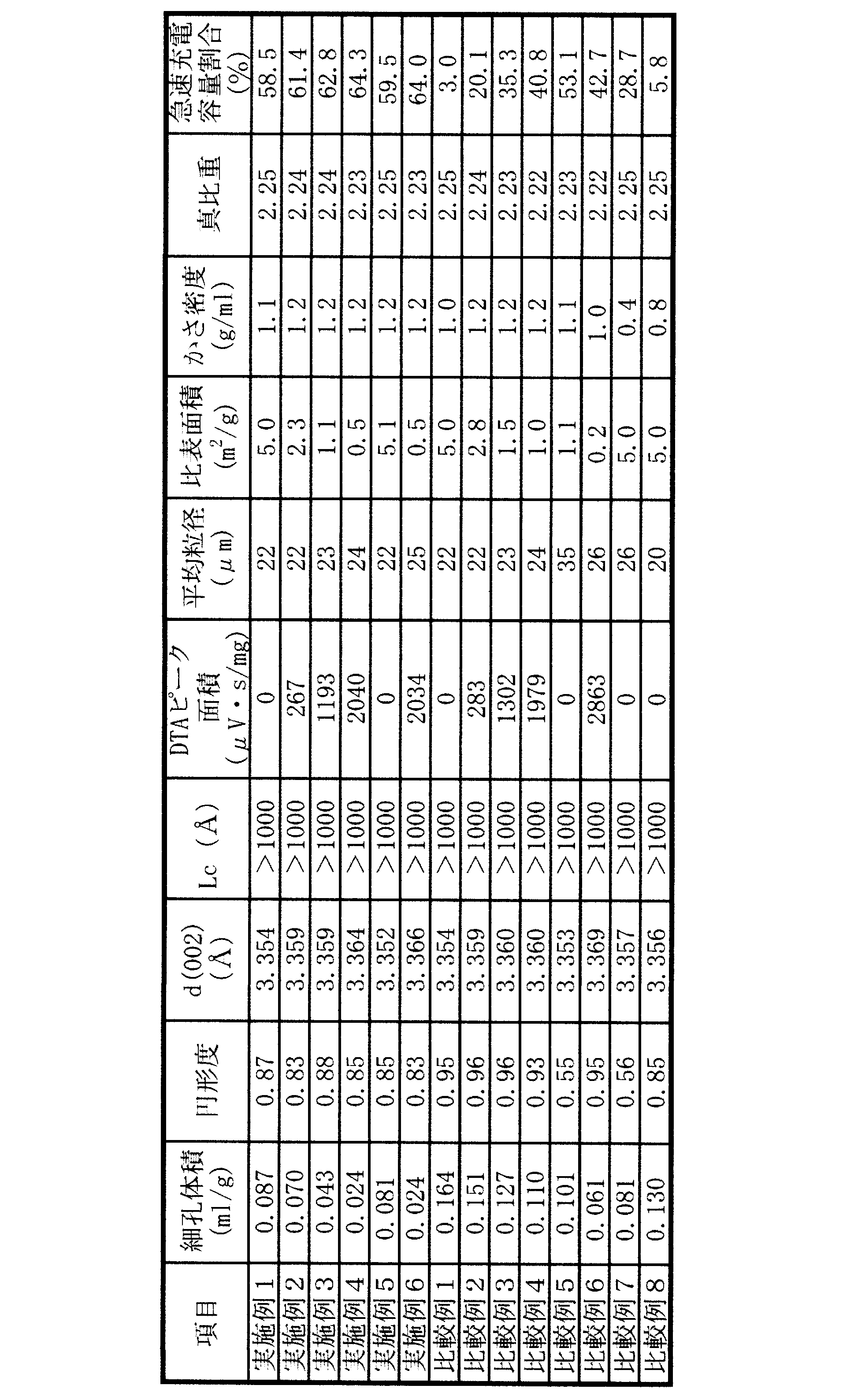
- Table 1 shows the characteristics of the obtained negative electrode material samples such as the pore volume, circularity, d (002), and Lc of the carbon particles used in the obtained negative electrode for a lithium ion secondary battery.
- the circularity was measured by preparing a sample electrode as follows. 97 parts by mass of carbon particles, polyvinylidene fluoride (PVDF 5% NMP (N-methyl-2-pyrrolidone) dispersion) as an organic binder (manufacturer: Kureha Chemical Co., Ltd., product name: PVDF # 9305) 3 parts by mass Part of the mixture was used as a solid content to prepare a paint in which NMP was added so that the viscosity at 25 ° C. was 1600 mPa ⁇ s. Next, this was coated on a 10 ⁇ m copper foil so as to have a thickness of about 70 ⁇ m, and then dried at 120 ° C. for 1 hour, and the resultant was used as a sample electrode.
- PVDF 5% NMP N-methyl-2-pyrrolidone
- the circularity was measured with a scanning electron microscope (VE-7800 manufactured by Keyence Corporation) after the sample electrode was embedded in an epoxy resin and then mirror-polished.
- the viscosity of the paint was determined with a viscometer (manufactured by Brookfield, product name: DV-III (spindle: SC4-18 # 14, temperature: 25 ° C., rotation speed: 100 rpm)).
- the perimeter of the equivalent circle and the perimeter of the increase in the particle cross section were obtained by analysis software (VE-7800 observation application) attached to the scanning electron microscope.
- the sample electrode was produced as follows. A mixture of 97 parts by mass of carbon particles and 3 parts by mass of polyvinylidene fluoride (PVDF 5% NMP dispersion) (manufacturer: Kureha Chemical Co., Ltd., product name: PVDF # 9305) as an organic binder, A paint to which NMP was added was prepared so that the viscosity at 1 ° C. was 1600 mPa ⁇ s. Subsequently, this was coated on a 10 ⁇ m copper foil so as to have a thickness of about 70 ⁇ m, and then dried at 120 ° C. for 1 hour, and used as a sample electrode. After drying, it was pressed to 1.65 g / cm 3 and punched into a 14 mm ⁇ circular shape as a sample electrode (negative electrode) for evaluation of the charge capacity.
- PVDF 5% NMP dispersion manufactured so that the viscosity at 1 ° C. was 1600 mPa ⁇ s.
- this was coated on a 10
- the evaluation battery was produced by injecting an electrolyte solution with a CR2016 coin cell facing the negative electrode and metallic lithium through a 40 ⁇ m polypropylene separator.
- the electrolyte was prepared by adding 0.5% by weight of vinylene carbonate to a mixed solvent of ethyl carbonate (EC) and methyl ethyl carbonate (MEC) in a volume ratio of 3 to 7, and dissolving LiPF 6 to a concentration of 1 mol / L.
- EC ethyl carbonate
- MEC methyl ethyl carbonate
- the battery was charged to 0 V with a constant current of 0.38 mA (0.1 C; 0.25 mA / cm 2 ), and the constant current charge capacity at 0.1 C was measured. Discharging was performed at a constant current of 0.38 mA to a voltage value of 1.5V.
- the quick charge capacity ratio was calculated based on the following formula.
- Example 2 (Examples 2, 3, and 4) Using the same spheroidized natural graphite as in Example 1, isotropic pressure treatment was similarly performed and pulverized with a cutter mill to obtain similar carbon particles.
- Petroleum pitch (softening point 80 ° C., carbonization rate 50%, average particle size 80 ⁇ m) 40 g (Example 2), 120 g (Example 3), 200 g (Example 4) to 1000 g of the obtained carbon particles, respectively. And mixed at room temperature.
- the obtained pitch-coated graphite particles were heated to 900 ° C. at a rate of temperature increase of 20 ° C./h under nitrogen flow to obtain carbon-coated graphite particles.
- the obtained carbon-coated graphite particles were passed through a 250 mesh standard sieve to obtain carbon particles for a lithium ion secondary battery negative electrode.
- Table 1 shows the characteristics of the obtained carbon particles for a lithium ion secondary battery negative electrode of each example.
- Example 5 The same spheroidized natural graphite as that used in Example 1 was filled in a mold and subjected to a pressure treatment in a fixed direction at 1000 kgf / cm 2 from the top with a uniaxial press in the same manner as in Example 1. Carbon particles for a negative electrode of a lithium ion secondary battery were obtained.
- Table 1 shows the characteristics of the obtained carbon particles for the negative electrode of the lithium ion secondary battery of each Example.
- Example 6 The same spheroidized natural graphite as used in Example 1 was subjected to pressure treatment in a certain direction as in Example 5, and crushed with a cutter mill to obtain carbon particles similar to those in Example 5. Petroleum pitch 200g was put in each 1000g of obtained carbon particles, and it mixed at room temperature. The obtained pitch-coated graphite particles were heated to 900 ° C. at a rate of temperature increase of 20 ° C./h under nitrogen flow to obtain carbon-coated graphite particles. The obtained carbon-coated graphite particles were passed through a 250 mesh standard sieve to obtain carbon particles for a lithium ion secondary battery negative electrode. Table 1 shows the characteristics of the obtained carbon particles for a lithium ion secondary battery negative electrode of each example.
- Example 1 (Comparative Example 1) In Example 1, the same experiment was conducted except that the rubber container was not subjected to an isotropic pressure treatment using a hydrostatic press. Table 1 shows the characteristics of the obtained carbon particles for the negative electrode of a lithium ion secondary battery.
- the obtained carbon-coated graphite particles were passed through a 250 mesh standard sieve to obtain carbon particles for a lithium ion secondary battery negative electrode.
- Table 1 shows the characteristics of the obtained carbon particles for a negative electrode of a lithium ion secondary battery of each comparative example.
- Example 6 The same spheroidized natural graphite as used in Example 1 was subjected to isotropic pressure treatment in the same manner and crushed with a cutter mill to obtain the same carbon particles as in Example 1. Petroleum pitch 400g was put in each 1000g of obtained carbon particles, and it mixed at room temperature. The obtained pitch-coated graphite particles were heated to 900 ° C. at a rate of temperature increase of 20 ° C./h under nitrogen flow to obtain carbon-coated graphite particles. The obtained carbon-coated graphite particles were passed through a 250 mesh standard sieve to obtain carbon particles for a lithium ion secondary battery negative electrode. Table 1 shows the characteristics of the obtained carbon particles for a lithium ion secondary battery negative electrode of each example.
- the present invention it is possible to provide a carbon particle for a lithium ion secondary battery negative electrode having a high capacity and more excellent quick charge characteristics, a negative electrode for a lithium ion secondary battery, and a lithium ion secondary battery using the same.
Landscapes
- Chemical & Material Sciences (AREA)
- Inorganic Chemistry (AREA)
- Organic Chemistry (AREA)
- Chemical Kinetics & Catalysis (AREA)
- Electrochemistry (AREA)
- General Chemical & Material Sciences (AREA)
- Geology (AREA)
- General Life Sciences & Earth Sciences (AREA)
- Life Sciences & Earth Sciences (AREA)
- Engineering & Computer Science (AREA)
- Materials Engineering (AREA)
- Manufacturing & Machinery (AREA)
- Battery Electrode And Active Subsutance (AREA)
- Carbon And Carbon Compounds (AREA)
Abstract
Description
ここで「相当円」とは、粒子断面像と同じ面積を持つ円である。粒子断面像の周囲長とは、撮像した粒子断面像の輪郭線の長さである。本発明における円形度は、走査式電子顕微鏡で倍率1000倍に拡大し、任意に10個の炭素粒子を選択し、上記方法にて個々の炭素粒子の円形度を測定し、その平均値をとった平均円形度である。負極とした場合の炭素粒子断面像の撮影法としては、試料電極を作製し、その電極をエポキシ樹脂に埋め込んだ後、鏡面研磨して、走査式電子顕微鏡で観察を行う。
(1)リチウムイオン二次電池用負極の作製
球状化天然黒鉛(平均粒径22μm、円形度0.95、比表面積5.0m2/g、真比重2.25、Lc>1000Å、d(002)3.354Å、かさ密度0.72g/ml)をゴム製の容器に充填、密閉したのち、該ゴム製容器を静水圧プレス機で、加圧媒体の圧力1000kgf/cm2で、等方性加圧処理を行った。ついでカッターミルで解砕し、リチウム二次電池用負極に用いる炭素粒子を得た。
試料電極は、下記の様にして作製した。炭素粒子97質量部、有機系結着剤としてポリフッ化ビニリデン(PVDF5%NMP分散液)(製造元:クレハ化学工業(株)、製品名:PVDF#9305)3質量部の混合物を固形分として、25℃における粘度が1600mPa・sとなるようにNMPを加えた塗料を作製した。次いで、これを10μmの銅箔上に70μm程度の厚みになるように塗工後、120℃で1時間乾燥させて得られたものを試料電極として用いた。乾燥後、1.65g/cm3となるようプレスし、試料電極(負極)として、充電容量評価用に14mmφの円形状に打ち抜いた。
電極密度1.65g/cm3の試料電極を用いた。試料電極評価条件は25℃雰囲気下、0.38mA(0.25mA/cm2)の定電流で0Vまで充電し、続いて0Vの定電圧で電流値が0.04mAになるまで充電した。次いで、0.38mAの定電流で1.5Vの電圧値まで放電を行った。

実施例1と同様の球状化天然黒鉛を用い、同様に等方性加圧処理を行い、カッターミルで解砕し、同様の炭素粒子を得た。得られた炭素粒子1000gに対し石油系ピッチ(軟化点80℃、炭化率50%、平均粒径80μm)40g(実施例2)、120g(実施例3)、200g(実施例4)をそれぞれに入れ、室温で混合した。得られたピッチ被覆黒鉛質粒子を窒素流通下、20℃/hの昇温速度で900℃まで昇温し、炭素被覆黒鉛質粒子とした。得られた炭素被覆黒鉛質粒子を250メッシュの標準篩に通し、リチウムイオン二次電池負極用炭素粒子とした。得られた各実施例のリチウムイオン二次電池負極用炭素粒子の特性を表1に示す。
実施例1に用いたものと同じ球状化天然黒鉛を金型に充填し、一軸プレスで上部から1000kgf/cm2で一定方向に加圧処理を行った以外は、実施例1と同様の方法でリチウムイオン二次電池負極用炭素粒子を得た。
実施例1に用いたものと同じ球状化天然黒鉛を、実施例5と同様に一定方向に加圧処理を行い、カッターミルで解砕し、実施例5と同様の炭素粒子を得た。得られた炭素粒子1000gに対し石油系ピッチ200gをそれぞれに入れ、室温で混合した。得られたピッチ被覆黒鉛質粒子を窒素流通下、20℃/hの昇温速度で900℃まで昇温し、炭素被覆黒鉛質粒子とした。得られた炭素被覆黒鉛質粒子を250メッシュの標準篩に通し、リチウムイオン二次電池負極用炭素粒子とした。得られた各実施例のリチウムイオン二次電池負極用炭素粒子の特性を表1に示す。
実施例1において、該ゴム製容器を静水圧プレス機での等方性加圧処理を行わないこと以外は、同様の実験を行った。得られたリチウムイオン二次電池負極用炭素粒子の特性を表1に示す。
実施例2、3、4において、該ゴム製容器を静水圧プレス機での等方性加圧処理を行わないこと以外は、同様の実験を行った。具体的には、実施例1で用いた同様の球状化天然黒鉛1000gに対し石油系ピッチ(軟化点80℃、炭化率50%、平均粒径80μm)40g(比較例2)、120g(比較例3)、200g(比較例4)をそれぞれに入れ、室温で混合した。得られたピッチ被覆黒鉛質粒子を窒素流通下、20℃/hの昇温速度で900℃まで昇温し、炭素被覆黒鉛質粒子とした。得られた炭素被覆黒鉛質粒子を250メッシュの標準篩に通し、リチウムイオン二次電池負極用炭素粒子とした。得られた各比較例のリチウムイオン二次電池負極用炭素粒子の特性を表1に示す。
鱗片状黒鉛(平均粒径35μm、円形度0.55、比表面積1.1m2/g)をリチウムイオン二次電池負極用炭素粒子として用いた。この炭素粒子の特性を表1に示す。
実施例1に用いたものと同じ球状化天然黒鉛を、同様に等方性加圧処理を行い、カッターミルで解砕し、実施例1と同様の炭素粒子を得た。得られた炭素粒子1000gに対し石油系ピッチ400gをそれぞれに入れ、室温で混合した。得られたピッチ被覆黒鉛質粒子を窒素流通下、20℃/hの昇温速度で900℃まで昇温し、炭素被覆黒鉛質粒子とした。得られた炭素被覆黒鉛質粒子を250メッシュの標準篩に通し、リチウムイオン二次電池負極用炭素粒子とした。得られた各実施例のリチウムイオン二次電池負極用炭素粒子の特性を表1に示す。
鱗片状黒鉛(平均粒径26μm、円形度0.56、比表面積5.0m2/g)をリチウムイオン二次電池負極用炭素粒子として用いた。この炭素粒子の特性を表1に示す。
球状化天然黒鉛(平均粒径20μm、円形度0.85、比表面積5.0m2/g、真比重2.25、Lc>1000Å、d(002)3.356Å、かさ密度0.8g/ml)をリチウムイオン二次電池負極用炭素粒子として用いた。この炭素粒子の特性を表1に示す。
Claims (8)
- 2×10~2×10⁴Åの細孔の細孔体積が、炭素粒子質量あたり0.1ml/g以下であり、X線回折測定より求められる黒鉛結晶の層間距離d(002)が3.38Å以下であり、C軸方向の結晶子サイズLcが500Å以上であり、粒子断面の円形度が0.6~0.9であるリチウムイオン二次電池負極用炭素粒子。
- 空気気流中における示差熱分析で550℃以上650℃以下に発熱ピークを有し、昇温5℃/minにおけるピーク面積が100μV・s/mg以上2100μV・s/mg以下である請求項1記載のリチウムイオン二次電池負極用炭素粒子。
- レーザー回折式粒度分布計により測定される平均粒径が1~100μmである請求項1又は2記載のリチウムイオン二次電池負極用炭素粒子。
- 77Kでの窒素吸着測定より求めたN2比表面積が10m2/g以下である請求項1~3のいずれか一項に記載のリチウムイオン二次電池負極用炭素粒子。
- かさ密度が0.7g/ml以上である請求項1~4のいずれか一項に記載のリチウムイオン二次電池負極用炭素粒子。
- 真比重が2.2以上である請求項1~5のいずれか一項に記載のリチウムイオン二次電池負極用炭素粒子。
- 請求項1~6のいずれか一項に記載のリチウムイオン二次電池負極用炭素粒子を含有するリチウム二次電池用負極。
- 請求項7に記載の負極及びリチウム化合物を含む正極を有するリチウムイオン二次電池。
Priority Applications (7)
| Application Number | Priority Date | Filing Date | Title |
|---|---|---|---|
| KR1020127010407A KR101845369B1 (ko) | 2009-10-27 | 2010-10-20 | 리튬 이온 이차전지 음극용 탄소 입자, 리튬 이온 이차전지용 음극 및 리튬 이온 이차전지 |
| CN201080048216.5A CN102576874B (zh) | 2009-10-27 | 2010-10-20 | 锂离子二次电池负极用碳粒子、锂离子二次电池用负极以及锂离子二次电池 |
| US13/503,879 US9450246B2 (en) | 2009-10-27 | 2010-10-20 | Carbon particles for negative electrode of lithium ion secondary battery, negative electrode for lithium ion secondary battery, and lithium ion secondary battery |
| EP10826584.4A EP2495789A4 (en) | 2009-10-27 | 2010-10-20 | CARBON PARTICLES FOR THE NEGATIVE ELECTRODE OF A LITHIUMION SECONDARY BATTERY, NEGATIVE ELECTRODE FOR A LITHIUMION SECONDARY BATTERY, AND A LITHIUMION SECONDARY BATTERY |
| KR1020187008948A KR101878129B1 (ko) | 2009-10-27 | 2010-10-20 | 리튬 이온 이차전지 음극용 탄소 입자, 리튬 이온 이차전지용 음극 및 리튬 이온 이차전지 |
| CA2778407A CA2778407C (en) | 2009-10-27 | 2010-10-20 | Carbon particles for negative electrode of lithium ion secondary battery, negative electrode for lithium ion secondary battery, and lithium ion secondary battery |
| JP2011538369A JP5887934B2 (ja) | 2009-10-27 | 2010-10-20 | リチウムイオン二次電池負極用炭素粒子、リチウムイオン二次電池用負極及びリチウムイオン二次電池 |
Applications Claiming Priority (2)
| Application Number | Priority Date | Filing Date | Title |
|---|---|---|---|
| JP2009246798 | 2009-10-27 | ||
| JP2009-246798 | 2009-10-27 |
Publications (1)
| Publication Number | Publication Date |
|---|---|
| WO2011052452A1 true WO2011052452A1 (ja) | 2011-05-05 |
Family
ID=43921876
Family Applications (1)
| Application Number | Title | Priority Date | Filing Date |
|---|---|---|---|
| PCT/JP2010/068488 Ceased WO2011052452A1 (ja) | 2009-10-27 | 2010-10-20 | リチウムイオン二次電池負極用炭素粒子、リチウムイオン二次電池用負極及びリチウムイオン二次電池 |
Country Status (8)
| Country | Link |
|---|---|
| US (1) | US9450246B2 (ja) |
| EP (1) | EP2495789A4 (ja) |
| JP (2) | JP5887934B2 (ja) |
| KR (2) | KR101845369B1 (ja) |
| CN (1) | CN102576874B (ja) |
| CA (1) | CA2778407C (ja) |
| TW (1) | TWI527299B (ja) |
| WO (1) | WO2011052452A1 (ja) |
Cited By (18)
| Publication number | Priority date | Publication date | Assignee | Title |
|---|---|---|---|---|
| WO2014007035A1 (ja) * | 2012-07-02 | 2014-01-09 | 株式会社 日立製作所 | 負極材、リチウムイオン二次電池用負極、リチウムイオン二次電池およびそれらの製造方法 |
| US20140065486A1 (en) * | 2012-08-29 | 2014-03-06 | Sumitomo Bakelite Co., Ltd. | Negative-electrode material, negative electrode active material, negative electrode, and alkali metal ion battery |
| JP2014191924A (ja) * | 2013-03-26 | 2014-10-06 | Mitsubishi Chemicals Corp | 非水系二次電池用炭素材の製造方法及びその製造方法によって得られた炭素材 |
| JP2014528631A (ja) * | 2011-12-09 | 2014-10-27 | エルジー・ケム・リミテッド | 球状化天然黒鉛を負極活物質として含むリチウム二次電池 |
| JP2014232728A (ja) * | 2013-05-29 | 2014-12-11 | ポスコ ケムテック | リチウム二次電池用負極活物質、その製造方法およびこれを含むリチウム二次電池 |
| JP2015109255A (ja) * | 2013-12-04 | 2015-06-11 | ポスコ ケムテック | リチウム二次電池用負極活物質、その製造方法およびこれを含むリチウム二次電池 |
| JP2015135809A (ja) * | 2013-12-16 | 2015-07-27 | Jfeケミカル株式会社 | リチウムイオン二次電池負極材用炭素質被覆黒鉛粒子およびその製造方法、リチウムイオン二次電池負極ならびにリチウムイオン二次電池 |
| US20150333316A1 (en) * | 2012-12-07 | 2015-11-19 | Sumitomo Bakelite Co., Ltd. | Negative-electrode material, negative-electrode active material, negative electrode, and alkali metal ion battery |
| US9368796B2 (en) | 2011-10-21 | 2016-06-14 | Show A Denko K.K. | Graphite material, carbon material for battery electrode, and battery |
| WO2016194355A1 (ja) * | 2015-06-01 | 2016-12-08 | Jfeケミカル株式会社 | リチウムイオン二次電池負極材料用炭素質被覆黒鉛粒子、リチウムイオン二次電池負極およびリチウムイオン二次電池 |
| JP2016225287A (ja) * | 2015-06-01 | 2016-12-28 | Jfeケミカル株式会社 | リチウムイオン二次電池負極材料用炭素質被覆黒鉛粒子、リチウムイオン二次電池負極およびリチウムイオン二次電池 |
| JP2016225286A (ja) * | 2015-06-01 | 2016-12-28 | Jfeケミカル株式会社 | リチウムイオン二次電池負極材料用黒鉛質粒子、リチウムイオン二次電池負極およびリチウムイオン二次電池 |
| US20170092951A1 (en) * | 2015-09-29 | 2017-03-30 | Toyota Jidosha Kabushiki Kaisha | Lithium ion secondary battery |
| WO2020196914A1 (ja) | 2019-03-28 | 2020-10-01 | 三菱ケミカル株式会社 | 非水系二次電池用負極材原料、非水系二次電池用負極材、非水系二次電池用負極及び非水系二次電池 |
| JP7224563B1 (ja) * | 2021-08-17 | 2023-02-17 | Jfeケミカル株式会社 | 炭素質被覆黒鉛粒子、リチウムイオン二次電池用負極およびリチウムイオン二次電池 |
| JP7224562B1 (ja) * | 2021-08-17 | 2023-02-17 | Jfeケミカル株式会社 | 炭素質被覆黒鉛粒子、リチウムイオン二次電池用負極およびリチウムイオン二次電池 |
| WO2023021957A1 (ja) * | 2021-08-17 | 2023-02-23 | Jfeケミカル株式会社 | 炭素質被覆黒鉛粒子、リチウムイオン二次電池用負極およびリチウムイオン二次電池 |
| WO2023021959A1 (ja) * | 2021-08-17 | 2023-02-23 | Jfeケミカル株式会社 | 炭素質被覆黒鉛粒子、リチウムイオン二次電池用負極およびリチウムイオン二次電池 |
Families Citing this family (13)
| Publication number | Priority date | Publication date | Assignee | Title |
|---|---|---|---|---|
| JP5306418B2 (ja) * | 2010-07-09 | 2013-10-02 | 日新製鋼株式会社 | 銅被覆鋼箔、負極用電極及び電池 |
| TWI481105B (zh) * | 2012-02-06 | 2015-04-11 | Kureha Corp | 非水電解質二次電池用碳質材料 |
| WO2015152113A1 (ja) * | 2014-03-31 | 2015-10-08 | Necエナジーデバイス株式会社 | 黒鉛系負極活物質材料、負極及びリチウムイオン二次電池 |
| KR101685832B1 (ko) * | 2014-07-29 | 2016-12-12 | 주식회사 엘지화학 | 흑연 2차 입자 및 이를 포함하는 리튬 이차전지 |
| US20210288311A1 (en) * | 2016-09-30 | 2021-09-16 | Panasonic Intellectual Property Management Co., Ltd. | Positive electrode for non-aqueous electrolyte secondary batteries |
| US10615406B2 (en) | 2017-03-17 | 2020-04-07 | Tdk Corporation | Negative electrode for lithium ion secondary battery and lithium ion secondary battery |
| WO2018207333A1 (ja) * | 2017-05-11 | 2018-11-15 | 日立化成株式会社 | リチウムイオン二次電池用負極材、リチウムイオン二次電池用負極材の製造方法、リチウムイオン二次電池用負極及びリチウムイオン二次電池 |
| CN109713213A (zh) * | 2017-10-26 | 2019-05-03 | 中国科学院上海硅酸盐研究所 | 一种具有功能性界面修饰层的金属锌负极及其制备方法和应用 |
| KR102251112B1 (ko) * | 2018-04-26 | 2021-05-11 | 삼성에스디아이 주식회사 | 리튬 이차 전지용 음극 및 이를 포함하는 리튬 이차 전지 |
| US10601047B1 (en) * | 2019-04-02 | 2020-03-24 | Chongqing Jinkang New Energy Automobile Co., Ltd. | Pre-cracked anode particles for high-rate charging applications |
| JP7815626B2 (ja) * | 2021-02-01 | 2026-02-18 | 株式会社Gsユアサ | 負極、蓄電素子、及びそれらの製造方法 |
| KR20240043257A (ko) * | 2022-09-27 | 2024-04-03 | 에스케이온 주식회사 | 리튬 이차 전지용 음극 및 이를 포함하는 리튬 이차 전지 |
| CN117525378A (zh) * | 2024-01-08 | 2024-02-06 | 贝特瑞新材料集团股份有限公司 | 负极材料及其制备方法、负极极片及锂离子电池 |
Citations (9)
| Publication number | Priority date | Publication date | Assignee | Title |
|---|---|---|---|---|
| JPS6223433A (ja) | 1985-07-24 | 1987-01-31 | Kashima Eng Kk | 触媒抜出用アンロ−ダ |
| JP2000294243A (ja) * | 1999-04-12 | 2000-10-20 | Hitachi Chem Co Ltd | リチウム二次電池負極用炭素粉末、その製造法、リチウム二次電池用負極及びリチウム二次電池 |
| JP2005050807A (ja) * | 2003-07-16 | 2005-02-24 | Kansai Coke & Chem Co Ltd | リチウムイオン二次電池用負極材料およびその製造方法、並びに、該負極材料を使用したリチウムイオン二次電池用負極及びリチウムイオン二次電池 |
| JP3787030B2 (ja) | 1998-03-18 | 2006-06-21 | 関西熱化学株式会社 | 鱗片状天然黒鉛改質粒子、その製造法、および二次電池 |
| JP2007039289A (ja) * | 2005-08-04 | 2007-02-15 | Toda Kogyo Corp | 球状多孔性炭素粒子粉末及びその製造法 |
| JP2007324067A (ja) * | 2006-06-02 | 2007-12-13 | Nippon Carbon Co Ltd | リチウム二次電池用負極及び負極活物質 |
| WO2008026380A1 (en) * | 2006-08-31 | 2008-03-06 | Toyo Tanso Co., Ltd. | Carbon material for negative electrode for lithium ion rechargeable battery, carbon material for negative electrode for low crystalline carbon-impregnated lithium ion rechargeable battery, negative electrode plate, and lithium ion rechargeable battery |
| JP2009238584A (ja) * | 2008-03-27 | 2009-10-15 | Hitachi Chem Co Ltd | リチウムイオン二次電池負極用炭素粒子、リチウムイオン二次電池用負極及びリチウムイオン二次電池 |
| JP2009246798A (ja) | 2008-03-31 | 2009-10-22 | Fujitsu Ltd | 送信方法、無線基地局および無線通信方法 |
Family Cites Families (8)
| Publication number | Priority date | Publication date | Assignee | Title |
|---|---|---|---|---|
| EP1220349B1 (en) * | 1996-08-08 | 2008-11-26 | Hitachi Chemical Co., Ltd. | Graphite particles and lithium secondary battery using the same as negative electrode |
| JP3305995B2 (ja) * | 1996-12-26 | 2002-07-24 | 日立化成工業株式会社 | リチウム二次電池負極用黒鉛粒子 |
| JP4751502B2 (ja) * | 1999-11-19 | 2011-08-17 | 第一工業製薬株式会社 | ポリマー電池 |
| US7816037B2 (en) * | 2002-01-25 | 2010-10-19 | Toyo Tanso Co., Ltd. | Anode material for lithium ion secondary battery |
| US7563543B2 (en) * | 2003-07-16 | 2009-07-21 | The Kansai Coke And Chemicals Co., Ltd. | Negative electrode of lithium ion secondary battery obtained by isostatically pressing a spherical graphite to eliminate voids therein |
| KR100793691B1 (ko) * | 2003-07-16 | 2008-01-10 | 간사이네쯔카가꾸가부시끼가이샤 | 리튬이온 2차전지용 부극재료, 그 제조방법, 그부극재료를 사용한 리튬이온 2차전지용 부극 및 리튬이온2차전지 |
| CN102931434B (zh) * | 2005-10-20 | 2015-09-16 | 三菱化学株式会社 | 锂二次电池以及其中使用的非水电解液 |
| JP5127706B2 (ja) * | 2006-05-31 | 2013-01-23 | 三洋電機株式会社 | 高電圧充電型非水電解質二次電池 |
-
2010
- 2010-10-20 US US13/503,879 patent/US9450246B2/en active Active
- 2010-10-20 KR KR1020127010407A patent/KR101845369B1/ko active Active
- 2010-10-20 CA CA2778407A patent/CA2778407C/en active Active
- 2010-10-20 CN CN201080048216.5A patent/CN102576874B/zh active Active
- 2010-10-20 EP EP10826584.4A patent/EP2495789A4/en not_active Withdrawn
- 2010-10-20 KR KR1020187008948A patent/KR101878129B1/ko active Active
- 2010-10-20 JP JP2011538369A patent/JP5887934B2/ja active Active
- 2010-10-20 WO PCT/JP2010/068488 patent/WO2011052452A1/ja not_active Ceased
- 2010-10-26 TW TW099136418A patent/TWI527299B/zh active
-
2015
- 2015-05-07 JP JP2015094812A patent/JP6123839B2/ja active Active
Patent Citations (9)
| Publication number | Priority date | Publication date | Assignee | Title |
|---|---|---|---|---|
| JPS6223433A (ja) | 1985-07-24 | 1987-01-31 | Kashima Eng Kk | 触媒抜出用アンロ−ダ |
| JP3787030B2 (ja) | 1998-03-18 | 2006-06-21 | 関西熱化学株式会社 | 鱗片状天然黒鉛改質粒子、その製造法、および二次電池 |
| JP2000294243A (ja) * | 1999-04-12 | 2000-10-20 | Hitachi Chem Co Ltd | リチウム二次電池負極用炭素粉末、その製造法、リチウム二次電池用負極及びリチウム二次電池 |
| JP2005050807A (ja) * | 2003-07-16 | 2005-02-24 | Kansai Coke & Chem Co Ltd | リチウムイオン二次電池用負極材料およびその製造方法、並びに、該負極材料を使用したリチウムイオン二次電池用負極及びリチウムイオン二次電池 |
| JP2007039289A (ja) * | 2005-08-04 | 2007-02-15 | Toda Kogyo Corp | 球状多孔性炭素粒子粉末及びその製造法 |
| JP2007324067A (ja) * | 2006-06-02 | 2007-12-13 | Nippon Carbon Co Ltd | リチウム二次電池用負極及び負極活物質 |
| WO2008026380A1 (en) * | 2006-08-31 | 2008-03-06 | Toyo Tanso Co., Ltd. | Carbon material for negative electrode for lithium ion rechargeable battery, carbon material for negative electrode for low crystalline carbon-impregnated lithium ion rechargeable battery, negative electrode plate, and lithium ion rechargeable battery |
| JP2009238584A (ja) * | 2008-03-27 | 2009-10-15 | Hitachi Chem Co Ltd | リチウムイオン二次電池負極用炭素粒子、リチウムイオン二次電池用負極及びリチウムイオン二次電池 |
| JP2009246798A (ja) | 2008-03-31 | 2009-10-22 | Fujitsu Ltd | 送信方法、無線基地局および無線通信方法 |
Non-Patent Citations (1)
| Title |
|---|
| See also references of EP2495789A4 |
Cited By (29)
| Publication number | Priority date | Publication date | Assignee | Title |
|---|---|---|---|---|
| US9368796B2 (en) | 2011-10-21 | 2016-06-14 | Show A Denko K.K. | Graphite material, carbon material for battery electrode, and battery |
| US9853289B2 (en) * | 2011-12-09 | 2017-12-26 | Lg Chem, Ltd. | Lithium secondary battery comprising spherical graphite as anode active material |
| JP2014528631A (ja) * | 2011-12-09 | 2014-10-27 | エルジー・ケム・リミテッド | 球状化天然黒鉛を負極活物質として含むリチウム二次電池 |
| WO2014007035A1 (ja) * | 2012-07-02 | 2014-01-09 | 株式会社 日立製作所 | 負極材、リチウムイオン二次電池用負極、リチウムイオン二次電池およびそれらの製造方法 |
| JP2014011093A (ja) * | 2012-07-02 | 2014-01-20 | Hitachi Ltd | 負極材、リチウムイオン二次電池用負極、リチウムイオン二次電池およびそれらの製造方法 |
| US20140065486A1 (en) * | 2012-08-29 | 2014-03-06 | Sumitomo Bakelite Co., Ltd. | Negative-electrode material, negative electrode active material, negative electrode, and alkali metal ion battery |
| CN103682346A (zh) * | 2012-08-29 | 2014-03-26 | 住友电木株式会社 | 负极材料、负极活性物质、负极以及碱金属离子电池 |
| CN103682346B (zh) * | 2012-08-29 | 2016-12-21 | 住友电木株式会社 | 负极材料、负极活性物质、负极以及碱金属离子电池 |
| US20150333316A1 (en) * | 2012-12-07 | 2015-11-19 | Sumitomo Bakelite Co., Ltd. | Negative-electrode material, negative-electrode active material, negative electrode, and alkali metal ion battery |
| JP2014191924A (ja) * | 2013-03-26 | 2014-10-06 | Mitsubishi Chemicals Corp | 非水系二次電池用炭素材の製造方法及びその製造方法によって得られた炭素材 |
| JP2014232728A (ja) * | 2013-05-29 | 2014-12-11 | ポスコ ケムテック | リチウム二次電池用負極活物質、その製造方法およびこれを含むリチウム二次電池 |
| JP2015109255A (ja) * | 2013-12-04 | 2015-06-11 | ポスコ ケムテック | リチウム二次電池用負極活物質、その製造方法およびこれを含むリチウム二次電池 |
| JP2015135809A (ja) * | 2013-12-16 | 2015-07-27 | Jfeケミカル株式会社 | リチウムイオン二次電池負極材用炭素質被覆黒鉛粒子およびその製造方法、リチウムイオン二次電池負極ならびにリチウムイオン二次電池 |
| JP2018190732A (ja) * | 2013-12-16 | 2018-11-29 | Jfeケミカル株式会社 | リチウムイオン二次電池負極材用炭素質被覆黒鉛粒子の製造方法 |
| JP2016225286A (ja) * | 2015-06-01 | 2016-12-28 | Jfeケミカル株式会社 | リチウムイオン二次電池負極材料用黒鉛質粒子、リチウムイオン二次電池負極およびリチウムイオン二次電池 |
| JP2016225287A (ja) * | 2015-06-01 | 2016-12-28 | Jfeケミカル株式会社 | リチウムイオン二次電池負極材料用炭素質被覆黒鉛粒子、リチウムイオン二次電池負極およびリチウムイオン二次電池 |
| JP2018163886A (ja) * | 2015-06-01 | 2018-10-18 | Jfeケミカル株式会社 | リチウムイオン二次電池負極材料用炭素質被覆黒鉛粒子、リチウムイオン二次電池負極およびリチウムイオン二次電池 |
| WO2016194355A1 (ja) * | 2015-06-01 | 2016-12-08 | Jfeケミカル株式会社 | リチウムイオン二次電池負極材料用炭素質被覆黒鉛粒子、リチウムイオン二次電池負極およびリチウムイオン二次電池 |
| US20170092951A1 (en) * | 2015-09-29 | 2017-03-30 | Toyota Jidosha Kabushiki Kaisha | Lithium ion secondary battery |
| US10658665B2 (en) * | 2015-09-29 | 2020-05-19 | Toyota Jidosha Kabushiki Kaisha | Lithium ion secondary battery having a negative electrode active material formed of a graphite material and a conductive carbon material different from the graphite material |
| KR20210143796A (ko) | 2019-03-28 | 2021-11-29 | 미쯔비시 케미컬 주식회사 | 비수계 이차 전지용 부극재 원료, 비수계 이차 전지용 부극재, 비수계 이차 전지용 부극 및 비수계 이차 전지 |
| WO2020196914A1 (ja) | 2019-03-28 | 2020-10-01 | 三菱ケミカル株式会社 | 非水系二次電池用負極材原料、非水系二次電池用負極材、非水系二次電池用負極及び非水系二次電池 |
| US12525611B2 (en) | 2019-03-28 | 2026-01-13 | Mitsubishi Chemical Corporation | Raw material of negative electrode material for nonaqueous secondary batteries, negative electrode material for nonaqueous secondary batteries, negative electrode for nonaqueous secondary batteries, and nonaqueous secondary battery |
| JP7224563B1 (ja) * | 2021-08-17 | 2023-02-17 | Jfeケミカル株式会社 | 炭素質被覆黒鉛粒子、リチウムイオン二次電池用負極およびリチウムイオン二次電池 |
| JP7224562B1 (ja) * | 2021-08-17 | 2023-02-17 | Jfeケミカル株式会社 | 炭素質被覆黒鉛粒子、リチウムイオン二次電池用負極およびリチウムイオン二次電池 |
| WO2023021957A1 (ja) * | 2021-08-17 | 2023-02-23 | Jfeケミカル株式会社 | 炭素質被覆黒鉛粒子、リチウムイオン二次電池用負極およびリチウムイオン二次電池 |
| WO2023021959A1 (ja) * | 2021-08-17 | 2023-02-23 | Jfeケミカル株式会社 | 炭素質被覆黒鉛粒子、リチウムイオン二次電池用負極およびリチウムイオン二次電池 |
| US11804594B2 (en) | 2021-08-17 | 2023-10-31 | Jfe Chemical Corporation | Carbonaceous substance-coated graphite particles, negative electrode for lithium ion secondary battery, and lithium ion secondary battery |
| US11804593B2 (en) | 2021-08-17 | 2023-10-31 | Jfe Chemical Corporation | Carbonaceous substance-coated graphite particles, negative electrode for lithium ion secondary battery and lithium ion secondary battery |
Also Published As
| Publication number | Publication date |
|---|---|
| JP6123839B2 (ja) | 2017-05-10 |
| JP5887934B2 (ja) | 2016-03-16 |
| TW201131871A (en) | 2011-09-16 |
| TWI527299B (zh) | 2016-03-21 |
| CN102576874A (zh) | 2012-07-11 |
| KR101878129B1 (ko) | 2018-07-12 |
| CA2778407C (en) | 2018-03-06 |
| EP2495789A4 (en) | 2016-07-13 |
| KR101845369B1 (ko) | 2018-04-04 |
| EP2495789A1 (en) | 2012-09-05 |
| CA2778407A1 (en) | 2011-05-05 |
| US9450246B2 (en) | 2016-09-20 |
| US20120219863A1 (en) | 2012-08-30 |
| KR20180035944A (ko) | 2018-04-06 |
| CN102576874B (zh) | 2015-07-15 |
| KR20120103575A (ko) | 2012-09-19 |
| JPWO2011052452A1 (ja) | 2013-03-21 |
| JP2015181116A (ja) | 2015-10-15 |
Similar Documents
| Publication | Publication Date | Title |
|---|---|---|
| JP6123839B2 (ja) | リチウムイオン二次電池負極用炭素粒子、リチウムイオン二次電池用負極及びリチウムイオン二次電池 | |
| KR101368474B1 (ko) | 리튬 이차 전지용 음극 활물질, 이의 제조방법 및 이를 포함하는 리튬 이차 전지 | |
| CN105659417B (zh) | 负极活性材料和包含其的锂二次电池 | |
| KR101461220B1 (ko) | 리튬 이차 전지용 음극 활물질, 이의 제조 방법, 그리고 이를 포함하는 음극 및 리튬 이차 전지 | |
| CN104507865B (zh) | 正极活性物质及其制备方法 | |
| JP5473886B2 (ja) | リチウムイオン二次電池用負極材料、リチウムイオン二次電池負極およびリチウムイオン二次電池 | |
| CN100464446C (zh) | 锂二次电池用负极材料及其制备方法和使用该材料的锂二次电池用负极和锂二次电池 | |
| JP5540470B2 (ja) | リチウムイオン二次電池負極用炭素粒子、リチウムイオン二次電池用負極及びリチウムイオン二次電池 | |
| KR20210089720A (ko) | 금속 이온 배터리용 전기활성 물질 | |
| JP6256346B2 (ja) | リチウムイオン二次電池用負極材料、リチウムイオン二次電池用負極及びリチウムイオン二次電池 | |
| JP6279713B2 (ja) | 電極用炭素質成形体、及びその製造方法 | |
| JP2012033375A (ja) | 非水系二次電池用炭素材料 | |
| WO2019186828A1 (ja) | リチウムイオン二次電池用負極材、リチウムイオン二次電池用負極材の製造方法、リチウムイオン二次電池用負極材スラリー、リチウムイオン二次電池用負極、及びリチウムイオン二次電池 | |
| TW201921781A (zh) | 二次電池用負極活性物質及二次電池 | |
| JP5817872B2 (ja) | リチウムイオン二次電池負極用炭素粒子、リチウムイオン二次電池用負極及びリチウムイオン二次電池 | |
| JP2000003708A (ja) | 被覆炭素材料、その製造方法、ならびにそれを用いたリチウム二次電池 | |
| JP5551883B2 (ja) | メソフェーズ小球体および炭素材料の製造方法ならびにリチウムイオン二次電池 | |
| JP2010267629A (ja) | リチウム二次電池用負極及びリチウム二次電池 | |
| JP5990872B2 (ja) | リチウム二次電池負極材、リチウム二次電池用負極及びリチウム二次電池 |
Legal Events
| Date | Code | Title | Description |
|---|---|---|---|
| WWE | Wipo information: entry into national phase |
Ref document number: 201080048216.5 Country of ref document: CN |
|
| 121 | Ep: the epo has been informed by wipo that ep was designated in this application |
Ref document number: 10826584 Country of ref document: EP Kind code of ref document: A1 |
|
| WWE | Wipo information: entry into national phase |
Ref document number: 2011538369 Country of ref document: JP |
|
| WWE | Wipo information: entry into national phase |
Ref document number: 2778407 Country of ref document: CA |
|
| ENP | Entry into the national phase |
Ref document number: 20127010407 Country of ref document: KR Kind code of ref document: A |
|
| WWE | Wipo information: entry into national phase |
Ref document number: 13503879 Country of ref document: US |
|
| NENP | Non-entry into the national phase |
Ref country code: DE |
|
| WWE | Wipo information: entry into national phase |
Ref document number: 2010826584 Country of ref document: EP |