WO2010073899A1 - 油脂及び油脂の製造方法 - Google Patents
油脂及び油脂の製造方法 Download PDFInfo
- Publication number
- WO2010073899A1 WO2010073899A1 PCT/JP2009/070487 JP2009070487W WO2010073899A1 WO 2010073899 A1 WO2010073899 A1 WO 2010073899A1 JP 2009070487 W JP2009070487 W JP 2009070487W WO 2010073899 A1 WO2010073899 A1 WO 2010073899A1
- Authority
- WO
- WIPO (PCT)
- Prior art keywords
- oil
- lauric
- fats
- fat
- oils
- Prior art date
- Legal status (The legal status is an assumption and is not a legal conclusion. Google has not performed a legal analysis and makes no representation as to the accuracy of the status listed.)
- Ceased
Links
Images


Classifications
-
- A—HUMAN NECESSITIES
- A23—FOODS OR FOODSTUFFS; TREATMENT THEREOF, NOT COVERED BY OTHER CLASSES
- A23D—EDIBLE OILS OR FATS, e.g. MARGARINES, SHORTENINGS OR COOKING OILS
- A23D9/00—Other edible oils or fats, e.g. shortenings or cooking oils
- A23D9/02—Other edible oils or fats, e.g. shortenings or cooking oils characterised by the production or working-up
-
- C—CHEMISTRY; METALLURGY
- C11—ANIMAL OR VEGETABLE OILS, FATS, FATTY SUBSTANCES OR WAXES; FATTY ACIDS THEREFROM; DETERGENTS; CANDLES
- C11B—PRODUCING, e.g. BY PRESSING RAW MATERIALS OR BY EXTRACTION FROM WASTE MATERIALS, REFINING OR PRESERVING FATS, FATTY SUBSTANCES, e.g. LANOLIN, FATTY OILS OR WAXES; ESSENTIAL OILS; PERFUMES
- C11B7/00—Separation of mixtures of fats or fatty oils into their constituents, e.g. saturated oils from unsaturated oils
-
- A—HUMAN NECESSITIES
- A23—FOODS OR FOODSTUFFS; TREATMENT THEREOF, NOT COVERED BY OTHER CLASSES
- A23D—EDIBLE OILS OR FATS, e.g. MARGARINES, SHORTENINGS OR COOKING OILS
- A23D9/00—Other edible oils or fats, e.g. shortenings or cooking oils
-
- A—HUMAN NECESSITIES
- A23—FOODS OR FOODSTUFFS; TREATMENT THEREOF, NOT COVERED BY OTHER CLASSES
- A23G—COCOA; COCOA PRODUCTS, e.g. CHOCOLATE; SUBSTITUTES FOR COCOA OR COCOA PRODUCTS; CONFECTIONERY; CHEWING GUM; ICE-CREAM; PREPARATION THEREOF
- A23G1/00—Cocoa; Cocoa products, e.g. chocolate; Substitutes therefor
- A23G1/30—Cocoa products, e.g. chocolate; Substitutes therefor
-
- A—HUMAN NECESSITIES
- A23—FOODS OR FOODSTUFFS; TREATMENT THEREOF, NOT COVERED BY OTHER CLASSES
- A23G—COCOA; COCOA PRODUCTS, e.g. CHOCOLATE; SUBSTITUTES FOR COCOA OR COCOA PRODUCTS; CONFECTIONERY; CHEWING GUM; ICE-CREAM; PREPARATION THEREOF
- A23G1/00—Cocoa; Cocoa products, e.g. chocolate; Substitutes therefor
- A23G1/30—Cocoa products, e.g. chocolate; Substitutes therefor
- A23G1/32—Cocoa products, e.g. chocolate; Substitutes therefor characterised by the composition containing organic or inorganic compounds
- A23G1/36—Cocoa products, e.g. chocolate; Substitutes therefor characterised by the composition containing organic or inorganic compounds characterised by the fats used
- A23G1/38—Cocoa butter substitutes
-
- C—CHEMISTRY; METALLURGY
- C11—ANIMAL OR VEGETABLE OILS, FATS, FATTY SUBSTANCES OR WAXES; FATTY ACIDS THEREFROM; DETERGENTS; CANDLES
- C11B—PRODUCING, e.g. BY PRESSING RAW MATERIALS OR BY EXTRACTION FROM WASTE MATERIALS, REFINING OR PRESERVING FATS, FATTY SUBSTANCES, e.g. LANOLIN, FATTY OILS OR WAXES; ESSENTIAL OILS; PERFUMES
- C11B7/00—Separation of mixtures of fats or fatty oils into their constituents, e.g. saturated oils from unsaturated oils
- C11B7/0075—Separation of mixtures of fats or fatty oils into their constituents, e.g. saturated oils from unsaturated oils by differences of melting or solidifying points
-
- C—CHEMISTRY; METALLURGY
- C11—ANIMAL OR VEGETABLE OILS, FATS, FATTY SUBSTANCES OR WAXES; FATTY ACIDS THEREFROM; DETERGENTS; CANDLES
- C11C—FATTY ACIDS FROM FATS, OILS OR WAXES; CANDLES; FATS, OILS OR FATTY ACIDS BY CHEMICAL MODIFICATION OF FATS, OILS, OR FATTY ACIDS OBTAINED THEREFROM
- C11C3/00—Fats, oils, or fatty acids by chemical modification of fats, oils, or fatty acids obtained therefrom
-
- C—CHEMISTRY; METALLURGY
- C11—ANIMAL OR VEGETABLE OILS, FATS, FATTY SUBSTANCES OR WAXES; FATTY ACIDS THEREFROM; DETERGENTS; CANDLES
- C11C—FATTY ACIDS FROM FATS, OILS OR WAXES; CANDLES; FATS, OILS OR FATTY ACIDS BY CHEMICAL MODIFICATION OF FATS, OILS, OR FATTY ACIDS OBTAINED THEREFROM
- C11C3/00—Fats, oils, or fatty acids by chemical modification of fats, oils, or fatty acids obtained therefrom
- C11C3/04—Fats, oils, or fatty acids by chemical modification of fats, oils, or fatty acids obtained therefrom by esterification of fats or fatty oils
- C11C3/10—Ester interchange
Definitions
- the present invention relates to fats and oils and a method for producing the fats, and particularly relates to a no-temper type hard butter having a low trans fatty acid content and a low lauric acid content, and a method for producing the same.
- Hard butter used as a substitute for cocoa butter is generally classified into temper type and no temper type.
- Temper type hard butter is made from a similar fat having a symmetric triglyceride structure similar to that of cocoa butter, so it can be easily blended with cocoa butter and is called CBE (cocoa butter equivalent).
- no temper type hard butter has similar melting properties to cocoa butter, but the oil and fat structure is completely different, and can be broadly divided into lauric acid type and non-lauric acid type. Both lauric acid type and non-lauric acid type have low compatibility with cocoa butter, but it is cheaper than cocoa butter and does not require cumbersome tempering work. Widely used.
- lauric acid type hard butters are known that are typically hardened by hydrogenating a hard part (palm kernel stearin) obtained by fractionating palm kernel oil.
- the melting properties of this type of hard butter are extremely sharp, but the compatibility with cocoa butter is extremely poor, so the mixing ratio of cocoa butter must be reduced as much as possible. It will be poor.
- 50% or more of the fatty acids constituting the hard butter is lauric acid, there is a problem that the flavor is extremely deteriorated when hydrolysis occurs due to poor storage conditions.
- non-lauric acid type hard butters are also referred to as trans acid type hard butters.
- liquid oils such as low melting point palm olein or soybean oil are hydroisomerized and further required
- a hard part or a medium melting point part obtained by fractionating a product obtained by adding isomerized hydrogen according to the above is known.
- Non-lauric acid type hard butter is slightly sharper in melting properties than lauric acid type, but has better compatibility with cocoa butter than lauric acid type, and contains relatively more cocoa butter than lauric acid type. can do.
- non-lauric acid type hard butter contains a large amount of trans fatty acid, its use has been avoided since the adverse health effects of trans fatty acid have been recognized.
- a hard butter for example, a hard butter composed of a mixture of a slightly hydrogenated oil of fat rich in SUS type triglyceride and a fat rich in SSU type triglyceride is known (see Patent Document 1).
- the hard butter described in Patent Document 1 is a non-lauric acid type, it is not superior in melting properties (melting in the mouth) than the conventional non-lauric acid type hard butter and still contains a trans fatty acid.
- an object of the present invention is to provide a no-temper type hard butter having a good melting property (melted in the mouth) and compatibility with cacao butter, a low content of trans fatty acid and a low content of lauric acid, and a method for producing the same. .
- the present invention obtains a mixed oil by mixing a lauric raw material fat and a non-lauric raw material fat, and then separates the mixed oil to obtain a mixed oil soft part and / or mixed oil.
- a method for producing an oil or fat characterized in that a hard part is obtained.
- the present invention provides a method for producing fats and oils characterized in that the mixed oil soft part (not temper type hard butter) is obtained.
- the present invention provides 2 to 12% by mass of a triglyceride (CN28 to 36TG) having an iodine number of 6 to 24 and a total of 28 to 36 carbon atoms of constituent fatty acid residues.
- the mass ratio ((CN38-46TG) / (CN48-56TG)) of the triglyceride having a total carbon number of the constituent fatty acid residues of 38 to 46 and the triglyceride having a total carbon number of the constituent fatty acid residues of 48 to 56 is
- the oil and fat (no temper type hard butter) is 0.6 to 2.0.
- a no-temper type hard butter having a good melting property (melted in the mouth) and compatibility with cacao butter, a low trans fatty acid content and a low lauric acid type content, and a method for producing the same.
- the mixed oils are separated and mixed oil soft parts and / or A step of obtaining a mixed oil hard portion.
- the lauric raw material fat is preferably lauric fat, transesterified oil of lauric fat and non-lauric fat, and / or a fractionated soft oil thereof.
- lauric fats and / or transesterified oils of lauric fats and non-lauric fats may be referred to as “raw oil A”.
- FIG. 1 is a diagram showing an outline of a manufacturing flow of fats and oils according to the first embodiment
- FIG. 2 is a diagram showing an outline of a manufacturing flow of fats and oils according to the second embodiment
- FIG. 3 is a reference diagram showing an outline of a typical production flow of palm middle-melting fractionated oil or trans acid type hard butter that can be used as a substitute for cocoa butter.
- a lauric raw material fat soft part obtained by fractionating raw material fat A (fractionated olein a)
- a non-lauric raw material fat raw material fat B
- mixed oil is obtained by mixing lauric raw material fat (raw fat A) and non-lauric raw fat (raw fat B) in the second embodiment shown in FIG.
- the hard butter that is the target is obtained in the soft part (fractionated olein).
- the first embodiment shown in FIG. 1 is more preferable in that a mixed oil soft part having a good melting property (melting in the mouth) is obtained.
- the hard part (medium melting point part) which is a target object is obtained by fractionation.
- the quality tends to vary depending on the amount of the soft part remaining in the hard part (oil crystal) during fractionation. This is particularly noticeable in dry fractionation. Since the hard butter in the production method of the present invention is obtained in the soft part, the quality of the obtained soft part is stable even if there is some fluctuation in the yield due to the crystalline state during fractionation. And is particularly suitable for dry fractionation.
- the lauric raw material fat (raw raw material fat A) is a fat having a lauric acid content of 10% by mass or more among the fatty acids constituting the fat. And / or transesterified oils of lauric fats and non-lauric fats and oils.
- the lauric fats and oils are fats and oils in which lauric acid is 30% by mass or more among fatty acids constituting the fats and oils, such as palm oil, palm kernel oil, palm kernel olein obtained by separating them, palm kernel stearin and the like. Fractionated oils, oils and fats obtained by transesterifying them, and hardened oils thereof (for example, palm kernel extremely hardened oil, palm kernel olein extremely hardened oil), and the like. In this Embodiment, 1 type, or 2 or more types chosen from these can be used.
- the lauric fats and oils that are commercially available may be used.
- product name refined palm oil commercially available from Nisshin Oillio Group Co., Ltd.
- trade name palm kernel hydrogenated oil commercially available from Nisshin Oillio Group Ltd.
- product name: RBD Palm Some nuclear oils are commercially available from Mitsubishi Corporation.
- the non-lauric fats and oils are fats and fats that make up fats and oils, and fatty acids having 16 or more carbon atoms exceed 90% by mass.
- 1 type, or 2 or more types chosen from these can be mixed and used.
- Non-lauric fats and oils are preferably cured (hydrogenated) to increase the saturated fatty acid content in order to obtain hardness, and the cured (hydrogenated) treatment has an iodine value of less than 2 in order to suppress the production of trans fatty acids. It is preferable to be extremely cured.
- palm-based fats and oils are preferable because they have a low iodine value, so that hydrogen consumption can be reduced during extreme curing.
- palm oil and palm oil fractionation oil can be used as the palm oil and fat.
- palm olein and palm stearin which are one-stage fractionated oils of palm oil
- palm olein palm super olein
- palm oils include mid-fraction
- palm olein soft palm
- palm stearin hard stearin
- the palm oils are used after being extremely cured until the iodine value becomes less than 2.
- palm extremely hardened oil and palm stearin extremely hardened oil are preferable.
- palm stearin (iodine value 5 to 25, preferably 5 to 15) having a saturated fatty acid content of 16 or more carbon atoms can be used without being extremely cured.
- the lauric raw material fat is a transesterified oil of the lauric fat and the non-lauric fat.
- the lauric oil / fat is preferably palm core hardened oil, palm core olein hardened oil, or palm core stearin
- the non-lauric fat / oil is palm hardened oil, palm stearin hardened oil, or palm.
- it is stearin (iodine value 5-25).
- a transesterified oil of a palm kernel extremely hardened oil (laurin oil) and a palm extremely hardened oil (non-laurin oil) or a palm kernel olein extremely hardened oil (laurin oil) and a palm stearin extremely hardened oil non- Transesterified oils with lauric fats and oils, and transesterified oils of palm kernel stearin (lauric fats and oils) with palm stearin (non-lauric fats and oils) having an iodine value of 5 to 25 are preferred.
- the mixing ratio of the lauric fat and non-lauric fat during transesterification is preferably 30:70 to 70:30, more preferably 40:60 to 60:40, and most preferably 45:50. 55-55: 45. It is preferable for the mixing ratio to be in the above-mentioned range since it is easy to balance the melting of the mouth and the heat resistance.
- Transesterified oil of lauric fat and non-lauric fat as lauric raw fat is a saturated fatty acid having 12 to 34% by mass of lauric acid as a fatty acid constituting transesterified fat and oil and having 16 or more carbon atoms. Is 45 to 75% by mass, and the iodine value is preferably 0 to 20.
- the fatty acid composition of fats and oils can be measured by gas chromatography according to AOCS Ce1f-96.
- the method of transesterification is not particularly limited and can be carried out by a conventional method. Either transesterification using a synthetic catalyst such as sodium methoxide or enzymatic transesterification using lipase as a catalyst is performed. be able to.
- Enzymatic transesterification can be carried out either by transesterification with a high 1,3-specificity or transesterification with poor positional specificity.
- Examples of the lipase preparation capable of performing transesterification with a high 1,3-position specificity include immobilized lipases derived from Rhizom Coalmy High (Lipozyme TLIM, Lipozyme RMIM, etc. manufactured by Novozymes).
- lipase preparations capable of performing transesterification with poor position specificity include lipases derived from Alcaligenes genus (for example, lipase QLM, lipase PL, etc., manufactured by Meisei Sangyo Co., Ltd.), lipases derived from Candida genus (for example, Sangyo Co., Ltd. lipase OF).
- Alcaligenes genus for example, lipase QLM, lipase PL, etc., manufactured by Meisei Sangyo Co., Ltd.
- lipases derived from Candida genus for example, Sangyo Co., Ltd. lipase OF.
- the chemical transesterification is performed, for example, by sufficiently drying the raw oil and fat, adding 0.1 to 1% by mass of sodium methoxide to the raw oil and fat, and then reducing the pressure at 80 to 120 ° C. for 0.5 to 1 hour.
- the reaction can be carried out with stirring.
- lipase powder or immobilized lipase is added in an amount of 0.02 to 10% by mass, preferably 0.04 to 5% by mass, and then 40 to 80 ° C., preferably 40 to 40%.
- the reaction can be carried out with stirring at 70 ° C. for 0.5 to 48 hours, preferably 0.5 to 24 hours.
- lauric raw material fats and oils soft part obtained by separating raw oil and fat A (fractionated olein a)
- a soft part fractionated olein a obtained by fractionating the raw material fats and oils A, in particular, transesterified oils of lauric fats and non-lauric fats and oils. It is done.
- the separation method is not particularly limited, but can be carried out by dry fractionation, emulsification fractionation, solvent fractionation, etc., and particularly economically by dry fractionation.
- Dry fractionation generally cools the fractionated raw oil and fat while stirring in a tank to precipitate crystals, and then compresses and / or filters the hard part (crystal fraction) and the soft part (liquid fraction). It can be done by obtaining.
- the fractionation temperature varies depending on the required properties of the fractionated fat and oil, but can be carried out at 33 to 43 ° C.
- dry fractionation is performed on a transesterified oil obtained by transesterifying a palm core hardened oil (lauric oil) and a palm hardened oil (non-lauric oil) at a 50:50 (mass ratio)
- Soft part (fractionated olein a) (melting point: about 40 ° C) obtained by fractionating temperature 38-41 ° C, or palm kernel olein extremely hardened oil (lauric oil) and palm stearin extremely hardened oil (non-lauric)
- soft part (fractionated olein a) melting point: about 40 ° C) obtained by dry fractionation (separation temperature 38-41 ° C) of the transesterified oil obtained by transesterification with 50:50 (mass ratio)
- soft part (fractionated olein a) (melting point: about 40 ° C) obtained by dry fractionation (separation temperature 38-41 ° C) of the transesterified oil obtained by transesterification with 50:50
- the non-lauric raw material fat (raw fat B) is the total content of palmitic acid and stearic acid in which the constituent fatty acids are one or more of the above-mentioned non-lauric fats and oils. 55-80 mass% (preferably 60-80 mass%), oleic acid content 10-40 mass% (preferably 15-40 mass%), polyunsaturated fatty acid content 0-15 mass% (preferably 0-10) (Mass%). It is preferable that the non-lauric raw material fat contains transesterified oil.
- the constituent fatty acid is in the above range, when only the transesterified oil is used as the non-lauric raw material fat, the production of the monosaturated diunsaturated triglyceride can be reduced with respect to the disaturated monounsaturated triglyceride after the transesterification.
- fractionating after mixing with lauric raw material fats and oils it is easy to obtain hard butter having an appropriate hardness in the soft part.
- the raw material fat of the transesterified fat is a mixed oil of a non-lauric fat and a non-hardened oil and / or a palm fat.
- a mixed oil of a non-lauric fat and a non-hardened oil and / or a palm fat is obtained by appropriately mixing palm oil and fat and adjusting the iodine value to 15 to 45.
- it can be obtained by mixing an extremely hardened oil of non-lauric fat and oil with a fat having a oleic acid content of 50% by mass or more with non-lauric fat and oil and adjusting the iodine value to 15 to 45.
- the non-lauric raw material fat has an iodine value of 15 to 45 (preferably 20 to 35), palm stearin, or a mixed oil of palm stearin and other palm fats
- the transesterified oil is preferably used. Further, it is preferably an oil and fat obtained by transesterification of a mixed oil having a mass ratio of 65:35 to 85:15 between the extremely hardened oil of palm oil and the rapeseed oil having an oleic acid content of 50% by mass or more.
- the method of mixing the lauric raw material fat and the non-lauric raw material fat to obtain the mixed oil is not particularly limited, but the mixing ratio (mass ratio) of the lauric raw material fat and the non-lauric raw material fat Is preferably 20:80 to 80:20, more preferably 30:70 to 70:30, and still more preferably 40:60 to 60:40.
- the mixing is preferably performed in a state where the fats and oils are completely dissolved.
- Step of separating mixed oil The method of fractionation in the step of obtaining the mixed oil soft part and / or mixed oil hard part by fractionating the mixed oil is not particularly limited, but can be performed by dry fractionation, emulsification fractionation, solvent fractionation, etc., in particular, dry fractionation. Can be economical.
- the dry fractionation method can be performed in the same manner as described above.
- the fractionation temperature is suitably 35 to 41 ° C.
- the mixed oil soft part (fractionated olein b in FIG. 1, fractionated olein c in FIG. 2) and / or the mixed oil hard part (fractionated stearin b in FIG. 1, fractionated stearin c in FIG. 2) Obtainable.
- the obtained mixed oil hard part has a melting point of 44 to 58 ° C., a trans fatty acid content of 5% by mass or less, and a lauric acid content of 3 to 17% by mass.
- the melting point is 48 to 55 ° C.
- the trans fatty acid content is 1% by mass or less
- the lauric acid content is 5 to 15% by mass.
- the said mixed oil hard part can be used as hard fats and oils for plastic fat compositions, such as margarine, shortening, filling, etc., for example.
- the obtained mixed oil soft part has a melting point of 32 to 42 ° C., a trans fatty acid content of 5% by mass or less, and a lauric acid content of 10 to 25% by mass.
- the melting point is 33 to 39 ° C.
- the trans fatty acid content is 1% by mass or less
- the lauric acid content is 13 to 22% by mass.
- the mixed oil soft part can be used as a substitute fat or oil for cocoa butter, that is, as a no-temper type hard butter.
- the mixed oil soft part (not temper type hard butter) can be used for oily foods such as creams, fillings and coatings in addition to chocolates, and can be used in an amount of 5 to 100% by mass in fats and oils of oily foods.
- the obtained mixed oil soft part has an iodine value of 6 to 24, 2 to 12% by mass of triglycerides (CN28 to 36TG) having 28 to 36 carbon atoms in total, and the constituent fatty acid residues.
- the mass ratio ((CN38-46TG) / (CN48-56TG)) of triglycerides having a total carbon number of residues of 38 to 46 and triglycerides having a total carbon number of constituent fatty acid residues of 48 to 56 is 0. 6 to 2.0.
- the mixed oil soft part that is, triglyceride (i.e., iodine value is 6 to 24, and the total number of carbon atoms of constituent fatty acid residues is 28 to 36) CN28 to 36TG) 2 to 12% by mass, triglyceride (CN38 to 46TG) having a total carbon number of 38 to 46 of the constituent fatty acid residues 35 to 60% by mass, and the total carbon number of the constituent fatty acid residues of 48 to 56 Triglyceride (CN48-56TG) 30-55% by mass, the mass ratio of triglycerides having a total of 38 to 46 carbon atoms of constituent fatty acid residues to triglycerides having a total of 48 to 56 carbon atoms of constituent fatty acid residues ((CN38 -46TG) / (CN48-56TG)) is
- the fats and oils preferably have an iodine value of 8 to 20, triglycerides (CN28 to 36TG) having a total of 28 to 36 carbon atoms and 3 to 10% by weight of constituent fatty acids. 40-56% by mass of triglycerides (CN38-46TG) having a total carbon number of residues of 38-46, 30-52% by mass of triglycerides (CN48-56TG) having a total of 48-56 carbon atoms of constituent fatty acid residues, The mass ratio ((CN38-46TG) / (CN48-56TG)) of triglycerides having a total carbon number of constituent fatty acid residues of 38 to 46 and triglycerides having a total carbon number of constituent fatty acid residues of 48 to 56 is 0.8 to 1.8.
- the triglyceride composition according to carbon number based on the number of carbon atoms of the constituent fatty acid residue is JAOCS. vol. 70, 11, 1111
- the fat preferably has a mass ratio of SUS to S2U (SUS / S2U) of 0.34 to 0.94, more preferably 0.34 to 0.74.
- it is 0.34 to 0.54 (wherein S is a saturated fatty acid having 16 or more carbon atoms, U is an unsaturated fatty acid having 16 or more carbon atoms, and SUS is 1,3 of triglycerides)
- S is a saturated fatty acid having 16 or more carbon atoms
- U is an unsaturated fatty acid having 16 or more carbon atoms
- SUS 1,3 of triglycerides
- the fatty acid constituting the position is S and the fatty acid constituting the 2 position is U
- S2U represents a triglyceride composed of 2 S and 1 U as the constituent fatty acid irrespective of the position).
- a mass ratio of SUS to S2U in the above range is preferable because good mouth melting and bloom resistance can be obtained.
- the SUS / S2U ratio is described in J. High Resolut. Chromatogr. , 18, 105-107 (1995), and SUS and SSU (the fatty acid constituting the 1,2-, 2-, or 3-position of triglyceride is S, and it constitutes the 3- or 1-position by silver ion column chromatography) It is calculated
- the fat and oil (no temper type hard butter) preferably has an SFC at 25 ° C. of 45 to 70%, more preferably 48 to 67%, and most preferably 52 to 65%.
- the SFC at 30 ° C. is preferably 23 to 48%, more preferably 25 to 46%, most preferably 30 to 40%, and the SFC at 35 ° C. is preferably 5 to 25%, more preferably Is 5-20%, most preferably 8-20%.
- the value of SFC can be measured according to the IUPAC method 2.150a Solid determination Fats by NMR.
- the no-temper type hard butter according to the present embodiment has a low lauric acid content, the compatibility with cocoa butter, which is a disadvantage inherent in lauric acid-rich substitute fats, is improved, and chocolate with a rich cocoa flavor is obtained. Moreover, it becomes difficult to generate a soapy odor (an unpleasant odor that is generated when oils and fats are hydrolyzed for some reason to produce free fatty acids), which is the same defect.
- the manufacturing method according to the first embodiment shown in FIG. 1 and the manufacturing method according to the second embodiment shown in FIG. Therefore, it is possible to produce oils and fats satisfying various physical properties such as a meltable mouth type (a snapping property is required) and a coating type (a certain stickiness is required) (the first embodiment is (The second embodiment is suitable for manufacturing a coating type).
- the mixed oil hard part manufactured together with the mixed oil soft part can be used as a hard fat for margarine or the like, it is possible to provide an efficient (having cost merit) method for manufacturing the mixed oil soft part.
- a no-temper type hard butter having a good melting property (melted in the mouth) and compatibility with cocoa butter, a low trans fatty acid content and a low lauric acid content, and a method for producing the same are provided. can do.
- a transesterified oil (raw material fat A) or a raw material obtained by transesterifying a mixed oil of palm stearin (iodine value 36) extremely hardened oil 50% by mass and palm kernel olein extremely hardened oil 50% by weight
- the fractioned olein a of fat / oil A was used, and as the non-lauric raw material fat / oil (raw fat / oil B), palm stearin (iodine value 23, total content of palmitic acid and stearic acid 75.6% by mass, oleic acid content 18.0)
- Transesterified oil (mass%, polyunsaturated fatty acid content 4.1 mass%) transesterified oil (hereinafter referred to as B1) or mixed oil of palm stearin (iodine value 25) and palm olein (iodine value 56) (mass ratio 70) : 30, iodine value 34, total content of palmitic acid and stearic acid
- the raw material fats and oils are sufficiently dried, sodium methoxide is added in an amount of 0.2% by mass to the raw material fats and oils, and the mixture is stirred at 80 to 120 ° C. for 0.5 to 1 hour under reduced pressure. The reaction was carried out.
- Example 1 will be described below as an example.
- raw oil A is dry fractionated at 38-41 ° C. to obtain a soft part (fractionated olein a), and 70% by mass of the soft part (fractionated olein a) and raw oil B (B1) 30% by mass was completely dissolved and mixed to obtain a mixed oil (iodine number 7.5, melting point 45.5 ° C.).
- the mixed oil was subjected to dry fractionation at 36 to 39 ° C. to obtain a mixed oil soft part (fractionated olein b) and a mixed oil hard part (fractionated stearin b).
- Examples 2, 3, and 6 were mixed oil soft parts ( Fractionated olein b) and mixed oil hard part (fractionated stearin b) were produced.
- the mixed oil soft part (fractionated olein c) and mixed oil hard part (fractionated stearin c) was manufactured.
- Reference Example 1 is an example of a typical high trans acid type hard butter
- Reference Example 2 is an example of a typical lauric acid type hard butter.
- the mixed oil soft parts (fractionated oleins b and c) obtained in Examples 1 to 6 have a low trans fatty acid content and a low lauric acid type content. I understand. Further, from the measurement results (SFC values) shown in Tables 4 to 6, the mixed oil soft parts (fractionated oleins b and c) obtained in Examples 1 to 6 have good melting properties (melted in the mouth). I understand.
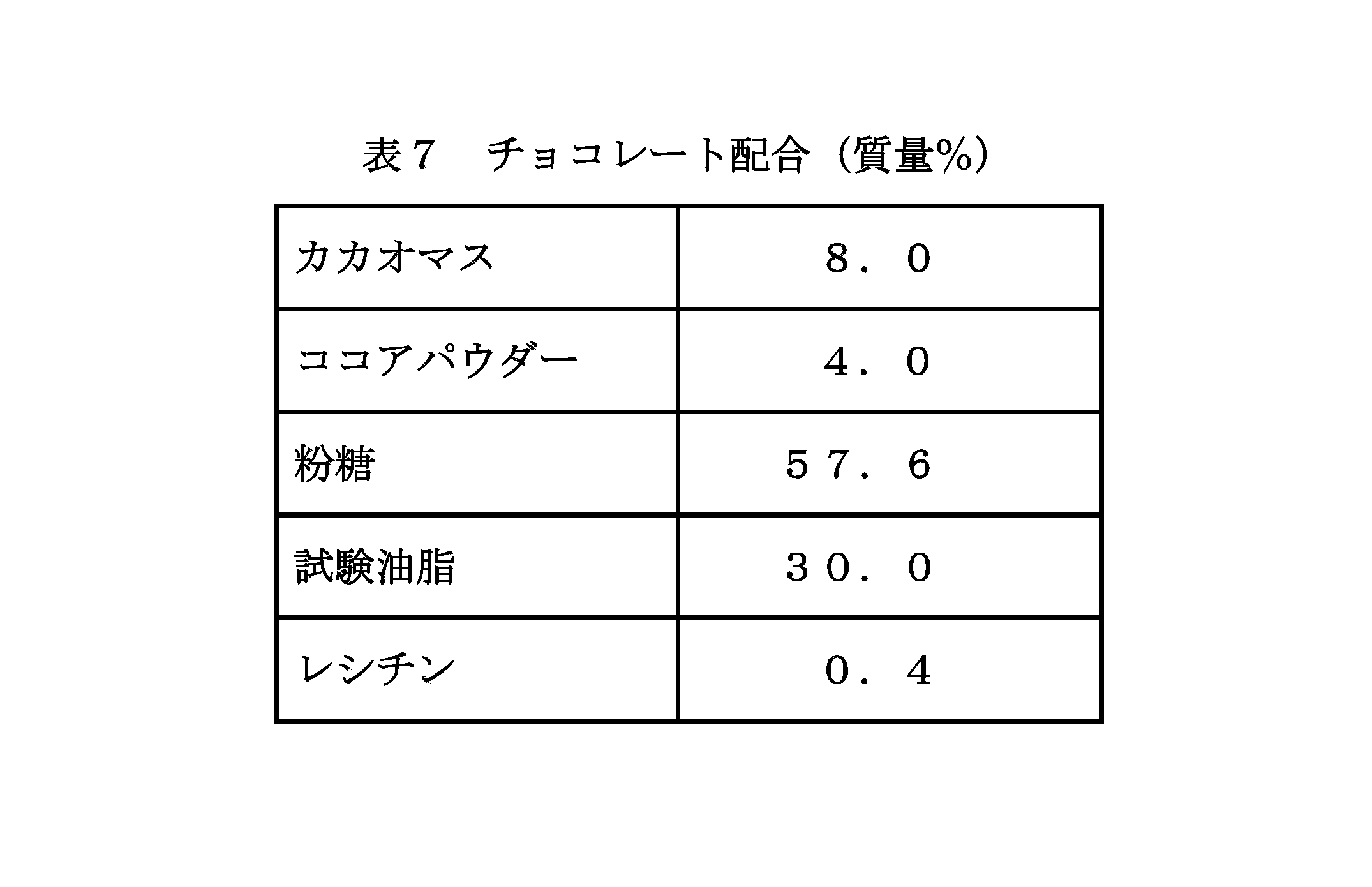
- Example 2 As shown in FIG. 4, for Example 2 and Reference Example 1 in which the SFC values are very similar, a chocolate was prototyped according to the formulation in Table 7, and tasting evaluation was conducted by five specialized panelists. The chocolate used in Example 2 was evaluated to have a good melt in the mouth at least as much as the chocolate used in Reference Example 1.
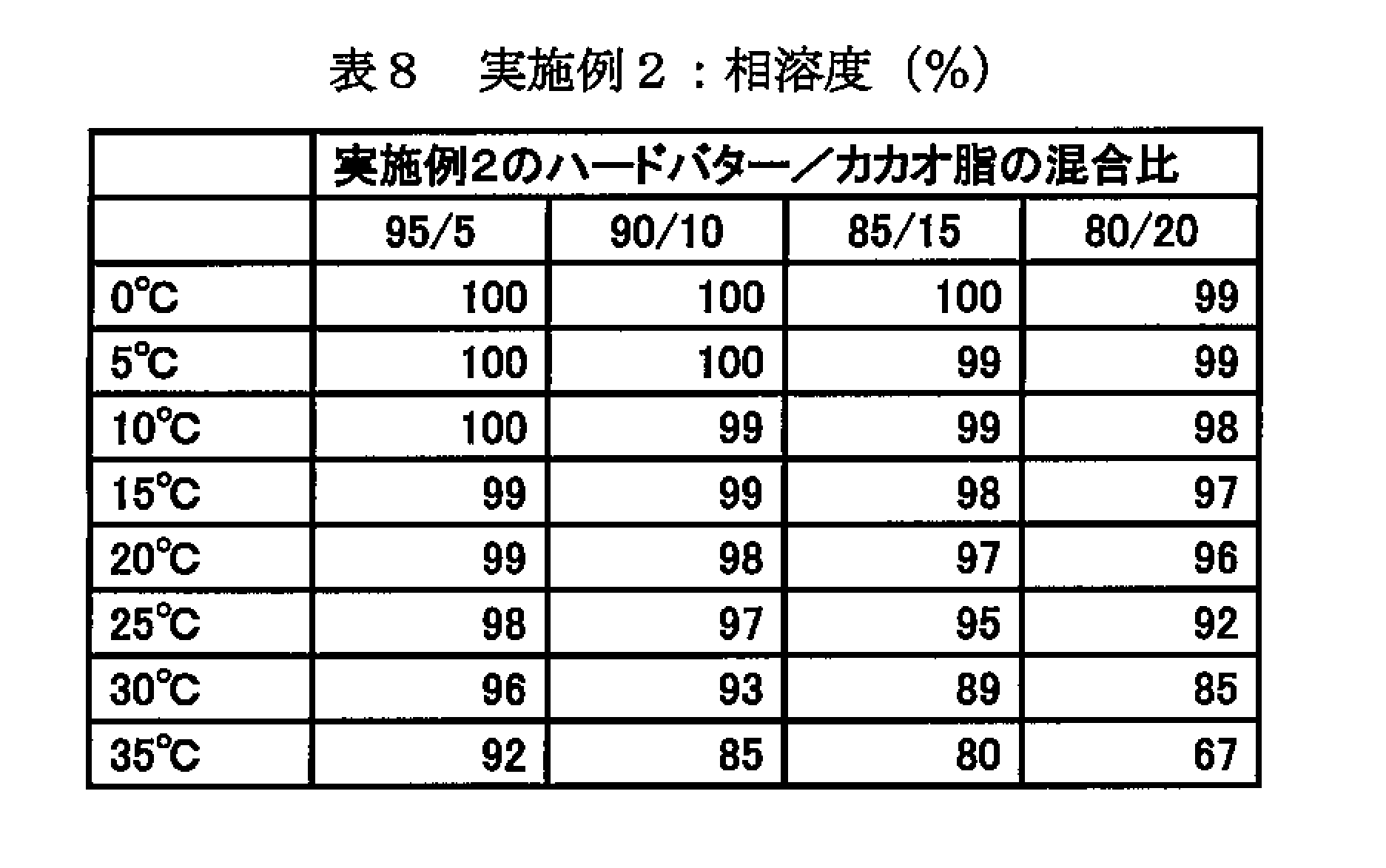
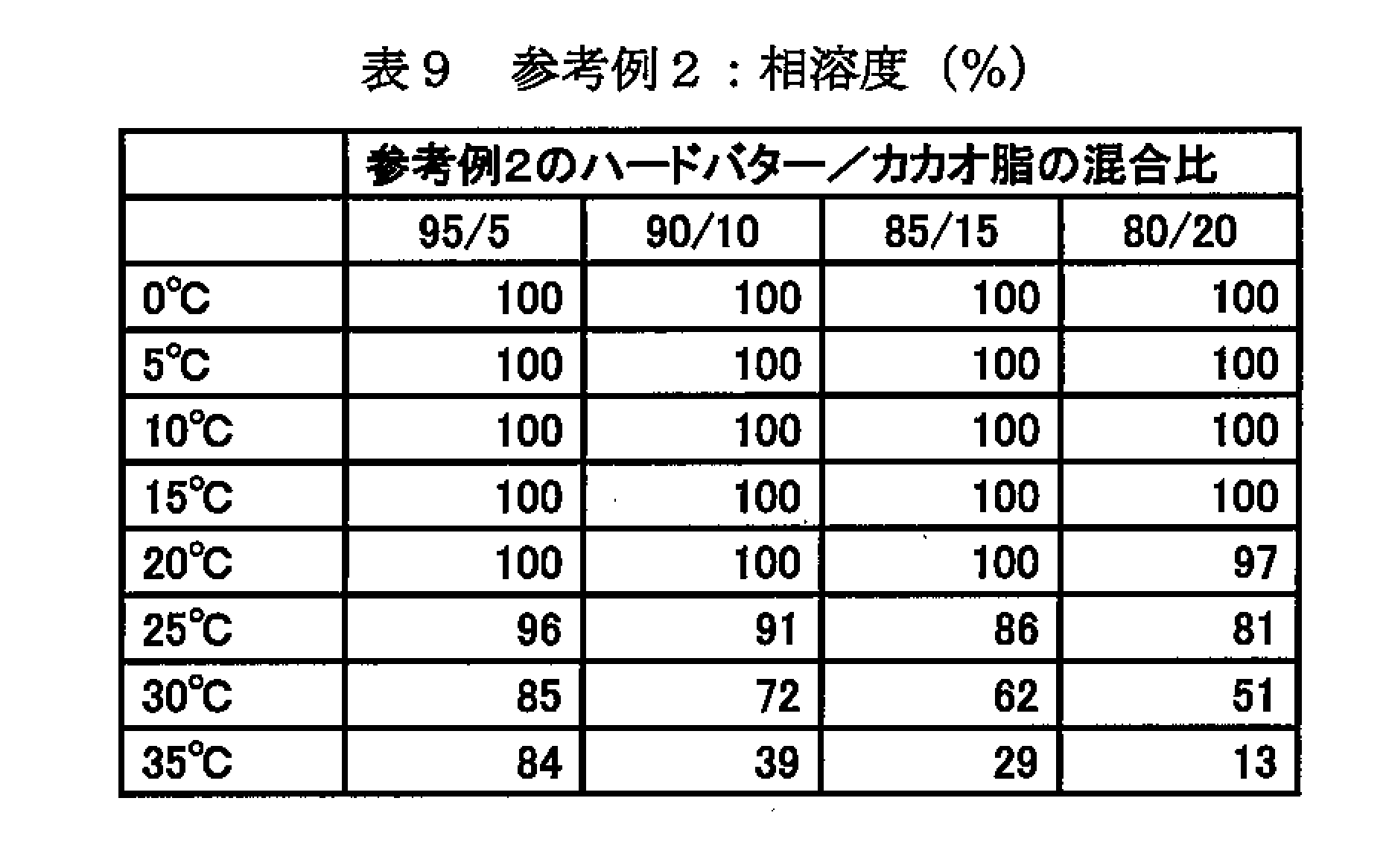
- Table 8 and Table 9 show that the mixed oil soft part (fractionated olein b) obtained in Example 2 has better compatibility with cocoa butter than the hard butter of Reference Example 2.
Landscapes
- Chemical & Material Sciences (AREA)
- Life Sciences & Earth Sciences (AREA)
- Engineering & Computer Science (AREA)
- Oil, Petroleum & Natural Gas (AREA)
- Food Science & Technology (AREA)
- Polymers & Plastics (AREA)
- Wood Science & Technology (AREA)
- Chemical Kinetics & Catalysis (AREA)
- Organic Chemistry (AREA)
- General Chemical & Material Sciences (AREA)
- Inorganic Chemistry (AREA)
- Edible Oils And Fats (AREA)
- Fats And Perfumes (AREA)
- Confectionery (AREA)
- Lubricants (AREA)
Abstract
Description
特に、上記混合油軟質部(ノーテンパー型ハードバター)を得ることを特徴とする油脂の製造方法を提供する。
本発明の実施の形態に係る油脂の製造方法は、ラウリン系原料油脂と、非ラウリン系原料油脂とを混合して混合油を得た後、当該混合油を分別して混合油軟質部及び/又は混合油硬質部を得る工程を有する。ここで、ラウリン系原料油脂は、ラウリン系油脂、ラウリン系油脂と非ラウリン系油脂とのエステル交換油、及び/又は、これらの分別軟質油であることが好ましい。以下、ラウリン系油脂、及び/又は、ラウリン系油脂と非ラウリン系油脂とのエステル交換油を「原料油脂A」と記載することがある。
本発明の実施の形態において、ラウリン系原料油脂(原料油脂A)とは、油脂を構成する脂肪酸のうちラウリン酸含量が10質量%以上の油脂であり、好ましい態様の1つとして、ラウリン系油脂、及び/または、ラウリン系油脂と非ラウリン系油脂とのエステル交換油が挙げられる。
なお、油脂の脂肪酸組成は、AOCS Ce1f-96に準じて、ガスクロマトグラフィー法で測定できる。
ラウリン系原料油脂の別の好ましい態様の1つとしては、上記の原料油脂A、特にラウリン系油脂と非ラウリン系油脂とのエステル交換油、を分別して得られる軟質部(分別オレインa)が挙げられる。
本発明の実施の形態において、非ラウリン系原料油脂(原料油脂B)とは、上述した非ラウリン系油脂の1種又は2種以上を原料油脂とした構成脂肪酸がパルミチン酸とステアリン酸の合計含量55~80質量%(好ましくは60~80質量%)、オレイン酸含量10~40質量%(好ましくは15~40質量%)、多価不飽和脂肪酸含量0~15質量%(好ましくは0~10質量%)である油脂である。非ラウリン系原料油脂は、エステル交換油が含まれることが好ましい。構成脂肪酸が上記範囲であると、非ラウリン系原料油脂としてエステル交換油のみを使用する場合において、エステル交換後にジ飽和モノ不飽和トリグリセリドに対してモノ飽和ジ不飽和トリグリセリドの生成を少なくできるので、ラウリン系原料油脂と混合後分別する場合、軟質部に適度な硬度を有するハードバターを得やすい。
ラウリン系原料油脂と、非ラウリン系原料油脂とを混合して混合油を得る方法は、特に限定されるものではないが、ラウリン系原料油脂と非ラウリン系原料油脂との混合割合(質量比)が20:80~80:20であることが好ましく、30:70~70:30であることがより好ましく、40:60~60:40であることが更に好ましい。混合は油脂が完全に溶解した状態で行うことが好ましい。
上記混合油を分別して混合油軟質部及び/又は混合油硬質部を得る工程における分別の方法は、特に限定されないが、ドライ分別、乳化分別、溶剤分別等により行なうことができ、特に、ドライ分別により経済的に行なうことができる。ドライ分別の方法は、前述した方法と同様に行なうことができる。軟質部に一般的なハードバターを得る場合、分別温度は35~41℃が適当である。
得られた混合油硬質部は、融点が44~58℃であり、トランス脂肪酸含量が5質量%以下であり、かつラウリン酸含量が3~17質量%である。好ましくは、融点が48~55℃であり、トランス脂肪酸含量が1質量%以下であり、かつラウリン酸含量が5~15質量%である。当該混合油硬質部は、例えば、マーガリン、ショートニング、フィリング等、可塑性油脂組成物用の硬質油脂として使用できる。
得られた混合油軟質部は、融点が32~42℃であり、トランス脂肪酸含量が5質量%以下であり、かつラウリン酸含量が10~25質量%である。好ましくは、融点が33~39℃であり、トランス脂肪酸含量が1質量%以下であり、かつラウリン酸含量が13~22質量%である。当該混合油軟質部は、カカオ脂の代用の油脂、すなわち、ノーテンパー型ハードバターとして使用できる。当該混合油軟質部(ノーテンパー型ハードバター)は、チョコレート類の他、クリーム、フィリング、コーティング等の油性食品に使用でき、油性食品の油脂中に5~100質量%使用できる。
上述した通り、本実施の形態に係る上記油脂の製造方法により、上記混合油軟質部、すなわち、ヨウ素価が6~24であり、構成脂肪酸残基の炭素数の合計が28~36のトリグリセリド(CN28~36TG)2~12質量%、構成脂肪酸残基の炭素数の合計が38~46のトリグリセリド(CN38~46TG)35~60質量%、構成脂肪酸残基の炭素数の合計が48~56のトリグリセリド(CN48~56TG)30~55質量%、構成脂肪酸残基の炭素数の合計が38~46のトリグリセリドと構成脂肪酸残基の炭素数の合計が48~56のトリグリセリドとの質量比((CN38~46TG)/(CN48~56TG))が、0.6~2.0である油脂(ノーテンパー型ハードバター)を得ることができる。
なお、構成脂肪酸残基の炭素数による炭素数別トリグリセリド組成は、JAOCS.vol.70,11,1111-1114(1993)に準じて、ガスクロマトグラフィー法で測定できる。
なお、SUS/S2U比は、J.High Resolut.Chromatogr.,18,105-107(1995)に準じて、銀イオンカラムクロマトグラフィーによりSUSとSSU(トリグリセリドの1,2位もしくは2,3位を構成する脂肪酸がSであり、3位もしくは1位を構成する脂肪酸がUであるトリグリセリド)との組成比を分析することにより求められる。
本発明の実施の形態によれば、以下の効果を奏する。
(1)ラウリン酸含量がラウリン酸型ハードバターの半分以下でありながら融解性状(口溶け)が良好で、加工適性に優れた(テンパリング作業が不要)ノーテンパー型ハードバター及びその製造方法を提供することができる。
図1(第1の実施の形態に係る実施例)及び図2(第2の実施の形態に係る実施例)の製造フローに従って、表1~3に記載の条件下で、実施例1~6の混合油軟質部及び混合油硬質部の製造を行なった。
まず、図1の製造フローに従って、原料油脂Aを38~41℃でドライ分別して軟質部(分別オレインa)を得て、この軟質部(分別オレインa)70質量%と原料油脂B(B1)30質量%を完全に溶解混合して混合油(ヨウ素価7.5、融点45.5℃)を得た。次に、当該混合油を36~39℃でドライ分別して、混合油軟質部(分別オレインb)及び混合油硬質部(分別ステアリンb)を得た。
なお、脂肪酸組成はAOCS Ce1f-96、炭素数別トリグリセリド組成及びジグリセリド含量はJAOCS.vol.70,11,1111-1114(1993)、SUS/S2U比はJ.High Resolut.Chromatogr.,18,105-107(1995)、にそれぞれ準拠した方法により測定した。
また、IUPAC法2.150a Solid Content determination in Fats by NMRに従って、SFCの測定を行い、測定結果を表4~6に示した。

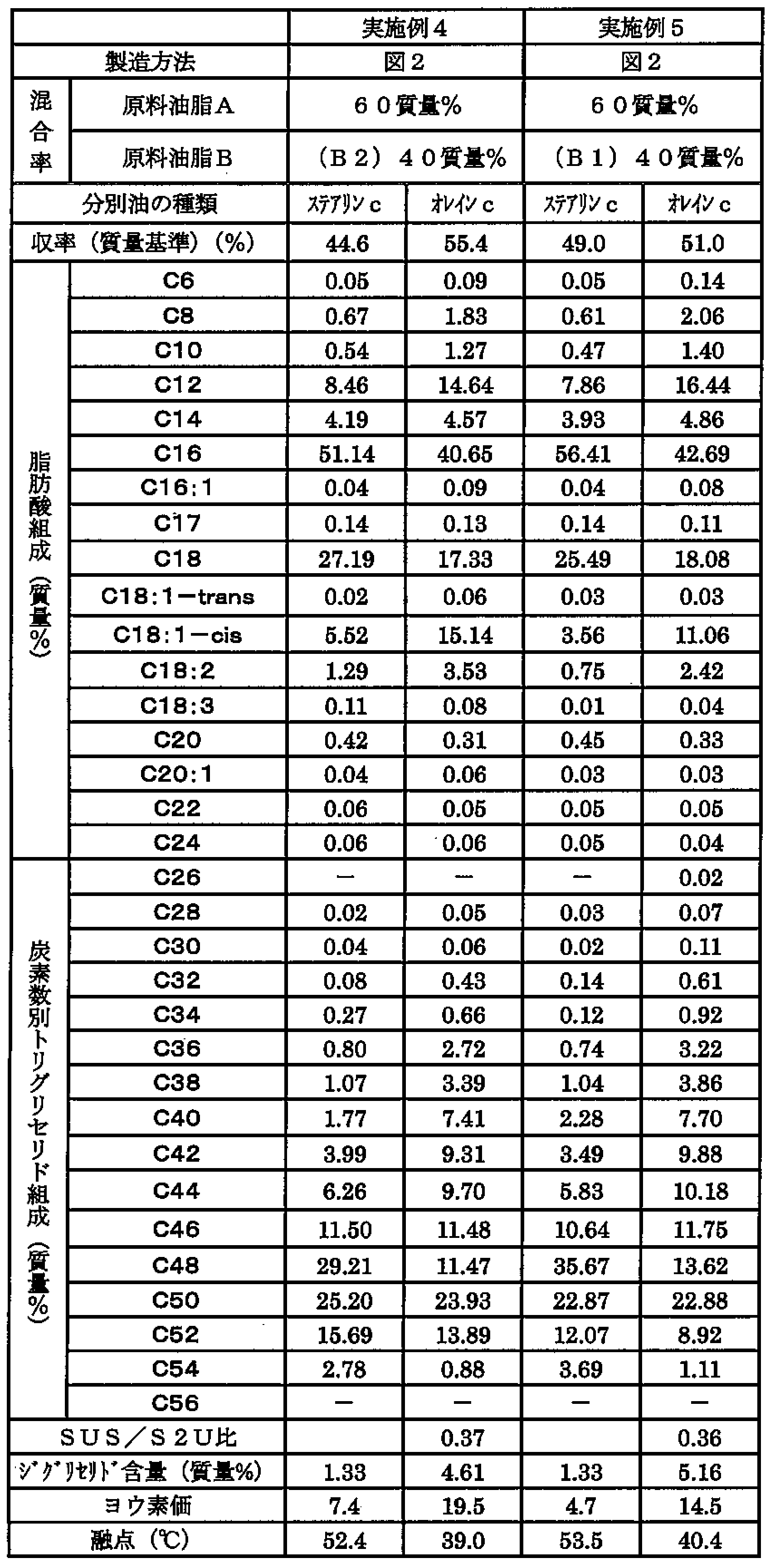
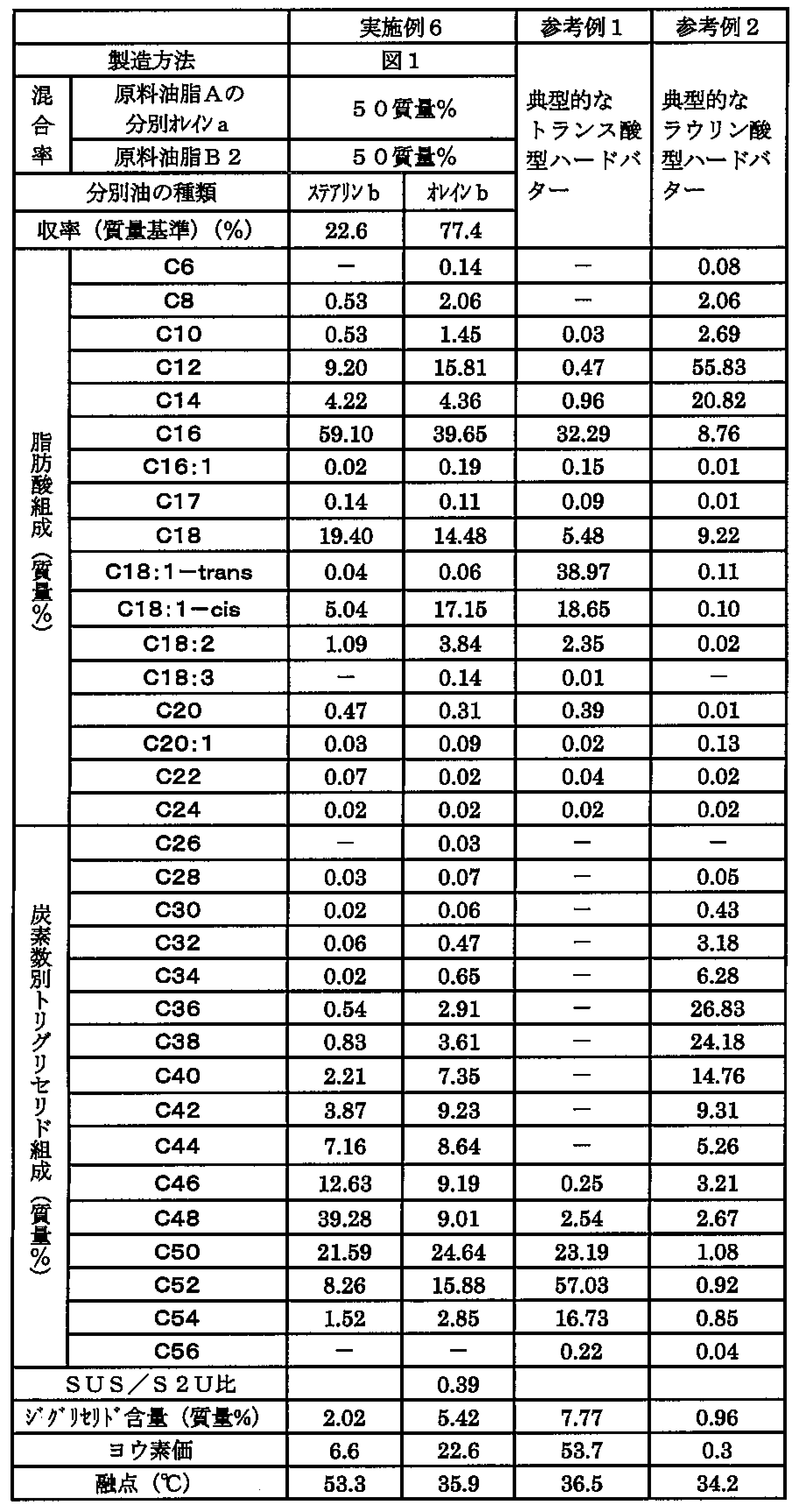
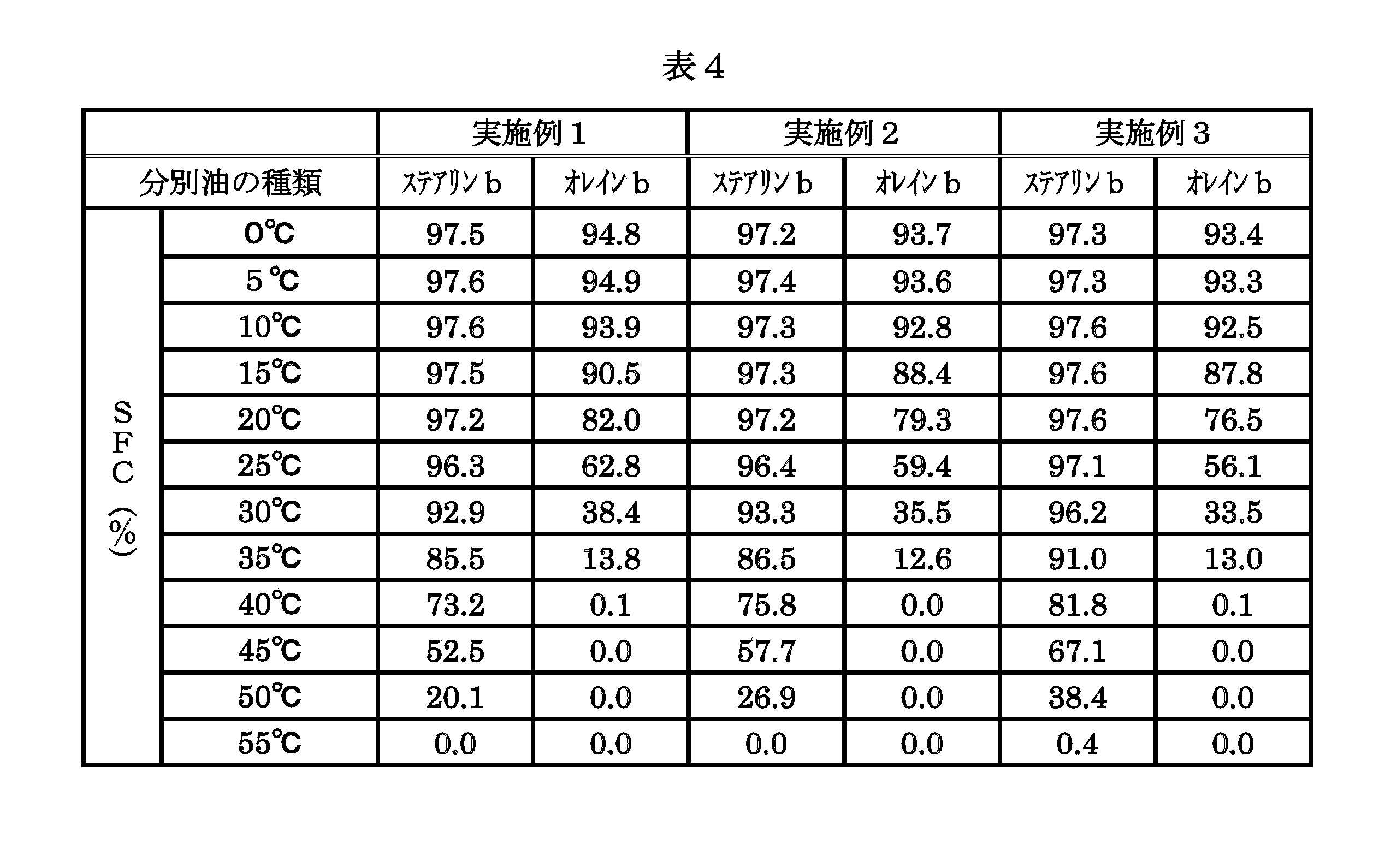
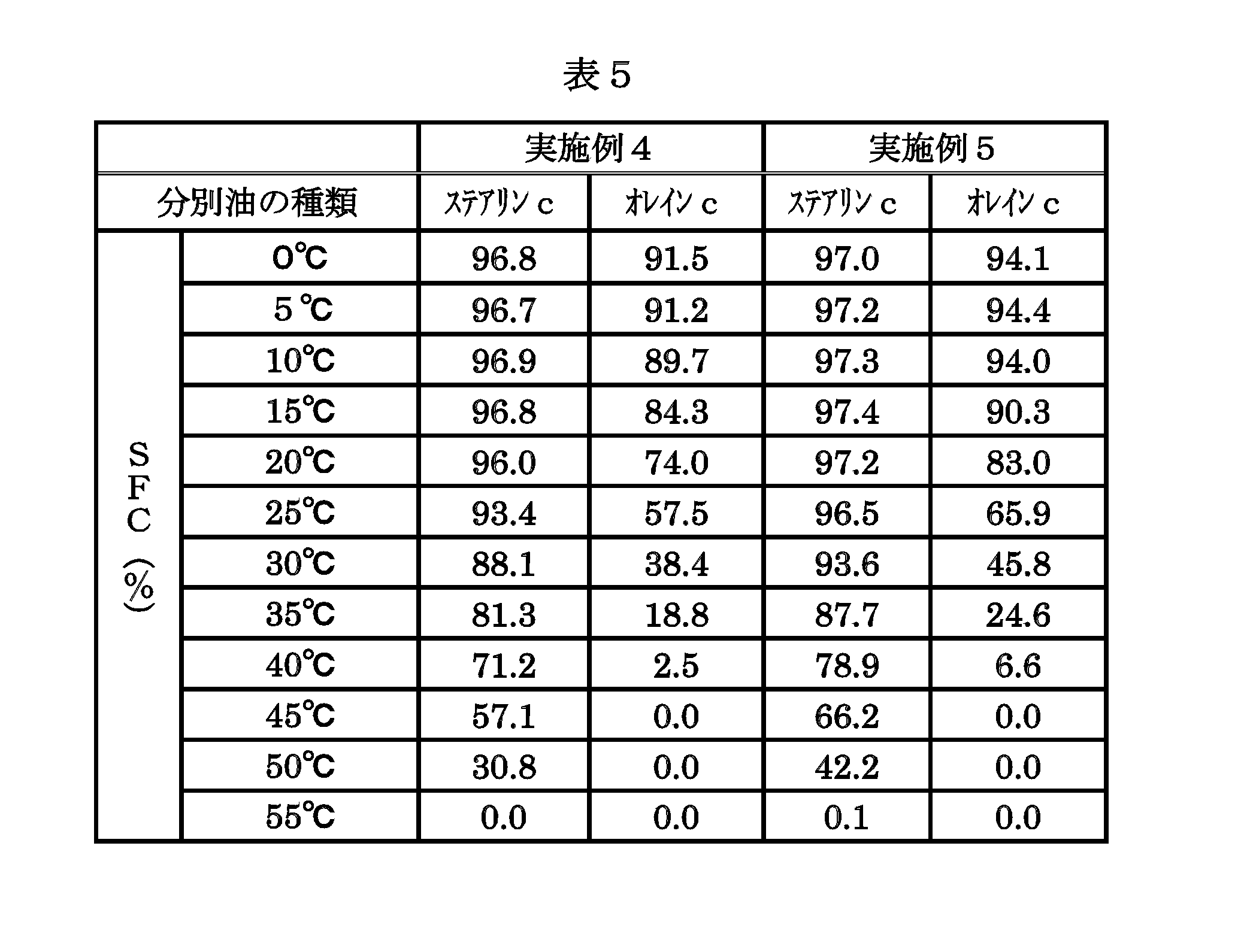

図4に示したようにSFC値が非常に近似している実施例2及び参考例1について、表7の配合に従ってチョコレートの試作を行い、専門パネラ5名により試食評価したところ、パネラ全員が実施例2使用のチョコレートは参考例1使用のチョコレートと同等以上に口溶けが良好であると評価した。
実施例2及び参考例2について、カカオ脂との相溶性の評価をハードバターとカカオ脂との混合比(ハードバター/カカオ脂)が95/5、90/10、85/15、80/20における各測定温度において測定したSFCに基づいて以下の式に従って相溶度を計算した。各混合比、各温度における相溶度が高いほどカカオ脂との相溶性が良好である。
相溶度(%)=(各混合比各温度における実測SFC)/(該温度におけるハードバター実測SFCとカカオ脂実測SFCとに基づく、該混合比による加重平均SFC)×100
評価結果(測定結果)を表8及び表9に示す。
Claims (14)
- ラウリン系原料油脂と、非ラウリン系原料油脂とを混合して混合油を得た後、前記混合油を分別して混合油軟質部及び/又は混合油硬質部を得ることを特徴とする油脂の製造方法。
- 前記ラウリン系原料油脂は、ラウリン系油脂、及び/又は、ラウリン系油脂と非ラウリン系油脂とのエステル交換油であることを特徴とする請求項1記載の油脂の製造方法。
- 前記ラウリン系原料油脂は、ラウリン系油脂の分別軟質油、及び/又は、ラウリン系油脂と非ラウリン系油脂とのエステル交換油の分別軟質油であることを特徴とする請求項1記載の油脂の製造方法。
- 前記ラウリン系油脂は、パーム核極度硬化油、パーム核オレイン極度硬化油又はパーム核ステアリンであることを特徴とする請求項2又は請求項3に記載の油脂の製造方法。
- 前記非ラウリン系油脂は、パーム極度硬化油、パームステアリン極度硬化油又はヨウ素価5~25のパームステアリンであることを特徴とする請求項2~4のいずれか1項に記載の油脂の製造方法。
- 前記非ラウリン系原料油脂は、エステル交換油であり、構成脂肪酸がパルミチン酸とステアリン酸の合計含量55~80質量%、オレイン酸含量10~40質量%、多価不飽和脂肪酸含量0~15質量%であることを特徴とする請求項1~5のいずれか1項に記載の油脂の製造方法。
- 前記非ラウリン系原料油脂は、ヨウ素価15~45のパーム系油脂を原料油脂としたエステル交換油であることを特徴とする請求項1~6のいずれか1項に記載の油脂の製造方法。
- 前記ラウリン系原料油脂と前記非ラウリン系原料油脂との混合割合(質量比)は、20:80~80:20であることを特徴とする請求項1~7のいずれか1項に記載の油脂の製造方法。
- 前記混合油硬質部は、融点が44~58℃であり、トランス脂肪酸含量が5質量%以下であり、かつラウリン酸含量が3~17質量%であることを特徴とする請求項1~8のいずれか1項に記載の油脂の製造方法。
- 前記混合油軟質部は、融点が32~42℃であり、トランス脂肪酸含量が5質量%以下であり、かつラウリン酸含量が10~25質量%であることを特徴とする請求項1~9のいずれか1項に記載の油脂の製造方法。
- ヨウ素価が6~24であり、
構成脂肪酸残基の炭素数の合計が28~36のトリグリセリド(CN28~36TG)2~12質量%、
構成脂肪酸残基の炭素数の合計が38~46のトリグリセリド(CN38~46TG)35~60質量%、
構成脂肪酸残基の炭素数の合計が48~56のトリグリセリド(CN48~56TG)30~55質量%、
構成脂肪酸残基の炭素数の合計が38~46のトリグリセリドと構成脂肪酸残基の炭素数の合計が48~56のトリグリセリドとの質量比((CN38~46TG)/(CN48~56TG))が、0.6~2.0であることを特徴とする油脂。 - SUSとS2Uとの質量比(SUS/S2U)が0.34~0.94であることを特徴とする請求項11記載の油脂。
(ただし、Sは炭素数16以上の飽和脂肪酸であり、Uは炭素数16以上の不飽和脂肪酸であり、SUSはトリグリセリドの1,3位置を構成する脂肪酸がSであり、2位置を構成する脂肪酸がUであるトリグリセリドであり、S2Uは位置に関係なく、構成脂肪酸としてSが2個とUが1個からなるトリグリセリドを表す) - 融点が32~42℃であり、トランス脂肪酸含量が5質量%以下であり、かつラウリン酸含量が10~25質量%であることを特徴とする請求項11又は請求項12に記載の油脂。
- 請求項1~10のいずれか1項に記載の油脂の製造方法により得られる前記混合油軟質部、又は、請求項11~13のいずれか1項に記載の油脂、を含有することを特徴とする油性食品。
Priority Applications (2)
| Application Number | Priority Date | Filing Date | Title |
|---|---|---|---|
| CN200980151513XA CN102257107B (zh) | 2008-12-22 | 2009-12-07 | 油脂及油脂的制备方法 |
| KR1020117017032A KR101483336B1 (ko) | 2008-12-22 | 2009-12-07 | 유지 및 유지의 제조 방법 |
Applications Claiming Priority (2)
| Application Number | Priority Date | Filing Date | Title |
|---|---|---|---|
| JP2008326618A JP5570113B2 (ja) | 2008-12-22 | 2008-12-22 | 油脂及び油脂の製造方法 |
| JP2008-326618 | 2008-12-22 |
Publications (1)
| Publication Number | Publication Date |
|---|---|
| WO2010073899A1 true WO2010073899A1 (ja) | 2010-07-01 |
Family
ID=42287515
Family Applications (1)
| Application Number | Title | Priority Date | Filing Date |
|---|---|---|---|
| PCT/JP2009/070487 Ceased WO2010073899A1 (ja) | 2008-12-22 | 2009-12-07 | 油脂及び油脂の製造方法 |
Country Status (5)
| Country | Link |
|---|---|
| JP (1) | JP5570113B2 (ja) |
| KR (1) | KR101483336B1 (ja) |
| CN (1) | CN102257107B (ja) |
| MY (1) | MY156320A (ja) |
| WO (1) | WO2010073899A1 (ja) |
Cited By (12)
| Publication number | Priority date | Publication date | Assignee | Title |
|---|---|---|---|---|
| JP2012188584A (ja) * | 2011-03-11 | 2012-10-04 | Adeka Corp | 油脂のドライ分別方法 |
| CN103533840A (zh) * | 2011-05-25 | 2014-01-22 | 不二制油株式会社 | 用于巧克力的脂肪组合物 |
| JP2015043732A (ja) * | 2013-08-28 | 2015-03-12 | ミヨシ油脂株式会社 | 油脂組成物及び可塑性油脂組成物 |
| WO2015099160A1 (ja) * | 2013-12-26 | 2015-07-02 | ミヨシ油脂株式会社 | 油脂組成物 |
| JP2018048345A (ja) * | 2012-08-10 | 2018-03-29 | ミヨシ油脂株式会社 | エステル交換油脂組成物の製造方法およびエステル交換油脂組成物 |
| WO2020025555A1 (en) * | 2018-07-31 | 2020-02-06 | Bunge Loders Croklaan B.V. | Fat composition |
| WO2022164364A1 (en) * | 2021-01-27 | 2022-08-04 | Aak Ab (Publ) | A vegetable fat composition for edible applications |
| WO2023054291A1 (ja) * | 2021-09-29 | 2023-04-06 | 不二製油グループ本社株式会社 | 低トランス、非テンパリング型チョコレート類用油脂 |
| WO2023190977A1 (ja) * | 2022-03-31 | 2023-10-05 | 不二製油グループ本社株式会社 | チョコレート改良用油脂 |
| JP7544170B1 (ja) | 2023-03-29 | 2024-09-03 | 不二製油株式会社 | チョコレート類用油脂 |
| JP7544171B1 (ja) | 2023-03-29 | 2024-09-03 | 不二製油株式会社 | チョコレート類用油脂 |
| WO2024203270A1 (ja) * | 2023-03-29 | 2024-10-03 | 不二製油グループ本社株式会社 | チョコレート類用油脂 |
Families Citing this family (20)
| Publication number | Priority date | Publication date | Assignee | Title |
|---|---|---|---|---|
| JP5781268B2 (ja) * | 2009-12-02 | 2015-09-16 | 花王株式会社 | ハードバター |
| WO2013161808A1 (ja) * | 2012-04-24 | 2013-10-31 | 株式会社明治 | 油脂移行を抑制した焼成複合菓子 |
| TWI626888B (zh) * | 2012-04-25 | 2018-06-21 | Meiji Co Ltd | Baking composite dessert and manufacturing method thereof |
| MY181371A (en) * | 2012-05-10 | 2020-12-21 | Nisshin Oillio Group Ltd | Oil and fat composition suitable for non-tempering hard butter |
| JP5584351B1 (ja) * | 2013-12-27 | 2014-09-03 | ミヨシ油脂株式会社 | 可塑性油脂組成物及び可塑性油脂組成物を用いた食品 |
| JP6466063B2 (ja) * | 2014-01-22 | 2019-02-06 | ミヨシ油脂株式会社 | 水産加工食品用油脂組成物とそれを用いた可塑性油脂組成物及び水産加工食品 |
| JP6466062B2 (ja) * | 2014-01-22 | 2019-02-06 | ミヨシ油脂株式会社 | コーティング用油脂組成物 |
| JP6255264B2 (ja) * | 2014-02-05 | 2017-12-27 | ミヨシ油脂株式会社 | 粉末油脂とそれを用いた飲食品 |
| JP6276050B2 (ja) * | 2014-02-07 | 2018-02-07 | ミヨシ油脂株式会社 | 水中油型乳化物 |
| JP6366495B2 (ja) * | 2014-12-22 | 2018-08-01 | 日清オイリオグループ株式会社 | 油脂組成物及び該油脂組成物を使用した油性食品 |
| JP6225278B2 (ja) * | 2015-06-15 | 2017-11-01 | 日清オイリオグループ株式会社 | 可塑性油脂組成物 |
| CN108289469A (zh) * | 2015-12-02 | 2018-07-17 | 日清奥利友集团株式会社 | 包覆用油脂组合物 |
| JP6654029B2 (ja) * | 2015-12-03 | 2020-02-26 | ミヨシ油脂株式会社 | コーティング用油脂組成物 |
| US11178885B2 (en) | 2016-02-22 | 2021-11-23 | Fuji Oil Holdings Inc. | Transesterified oil and plastic oil/fat composition using same as hardstock |
| CN105831370B (zh) * | 2016-03-22 | 2019-09-13 | 江南大学 | 一种制备类可可脂的方法 |
| CN110049683A (zh) * | 2016-12-22 | 2019-07-23 | 日清奥利友集团株式会社 | 巧克力 |
| WO2019176964A1 (ja) * | 2018-03-12 | 2019-09-19 | 株式会社カネカ | ココアバター相溶性向上剤およびその製造方法、並びに、ノーテンパリング型チョコレート及びその油脂組成物 |
| JP7467855B2 (ja) * | 2018-09-28 | 2024-04-16 | 不二製油株式会社 | ラウリン系ハードバター組成物及びそれを含有するチョコレート様食品 |
| KR20230058628A (ko) * | 2020-09-02 | 2023-05-03 | 가부시키가이샤 아데카 | 제과용 유지 조성물 |
| JP7530937B2 (ja) * | 2022-08-05 | 2024-08-08 | 日清オイリオグループ株式会社 | チョコレート用油脂組成物及びチョコレート |
Citations (5)
| Publication number | Priority date | Publication date | Assignee | Title |
|---|---|---|---|---|
| JPS5083402A (ja) * | 1973-10-09 | 1975-07-05 | ||
| JPS5721499A (en) * | 1980-05-30 | 1982-02-04 | Unilever Nv | Fat dry fractionation |
| JPH0341195A (ja) * | 1989-05-23 | 1991-02-21 | Unilever Nv | 向流乾式分別結晶化 |
| JPH10506535A (ja) * | 1994-12-22 | 1998-06-30 | ユニリーバー・ナームローゼ・ベンノートシャープ | マーガリン脂ブレンド及びこの脂ブレンドを含む可塑性w/o乳化物スプレッド |
| JP2000212590A (ja) * | 1999-01-20 | 2000-08-02 | Nisshin Oil Mills Ltd:The | 改質油脂の製造方法および該改質油脂 |
Family Cites Families (2)
| Publication number | Priority date | Publication date | Assignee | Title |
|---|---|---|---|---|
| MY122480A (en) * | 2000-05-29 | 2006-04-29 | Premium Vegetable Oils Sdn Bhd | Trans free hard structural fat for margarine blend and spreads |
| JPWO2005094598A1 (ja) | 2004-03-31 | 2008-02-14 | 不二製油株式会社 | ハードバター及びその製造法 |
-
2008
- 2008-12-22 JP JP2008326618A patent/JP5570113B2/ja active Active
-
2009
- 2009-12-07 KR KR1020117017032A patent/KR101483336B1/ko active Active
- 2009-12-07 MY MYPI2011002819A patent/MY156320A/en unknown
- 2009-12-07 WO PCT/JP2009/070487 patent/WO2010073899A1/ja not_active Ceased
- 2009-12-07 CN CN200980151513XA patent/CN102257107B/zh active Active
Patent Citations (5)
| Publication number | Priority date | Publication date | Assignee | Title |
|---|---|---|---|---|
| JPS5083402A (ja) * | 1973-10-09 | 1975-07-05 | ||
| JPS5721499A (en) * | 1980-05-30 | 1982-02-04 | Unilever Nv | Fat dry fractionation |
| JPH0341195A (ja) * | 1989-05-23 | 1991-02-21 | Unilever Nv | 向流乾式分別結晶化 |
| JPH10506535A (ja) * | 1994-12-22 | 1998-06-30 | ユニリーバー・ナームローゼ・ベンノートシャープ | マーガリン脂ブレンド及びこの脂ブレンドを含む可塑性w/o乳化物スプレッド |
| JP2000212590A (ja) * | 1999-01-20 | 2000-08-02 | Nisshin Oil Mills Ltd:The | 改質油脂の製造方法および該改質油脂 |
Non-Patent Citations (1)
| Title |
|---|
| YUSHI-YURYO HANDBOOK, 25 May 1988 (1988-05-25) * |
Cited By (20)
| Publication number | Priority date | Publication date | Assignee | Title |
|---|---|---|---|---|
| JP2012188584A (ja) * | 2011-03-11 | 2012-10-04 | Adeka Corp | 油脂のドライ分別方法 |
| CN103533840A (zh) * | 2011-05-25 | 2014-01-22 | 不二制油株式会社 | 用于巧克力的脂肪组合物 |
| JP2018048345A (ja) * | 2012-08-10 | 2018-03-29 | ミヨシ油脂株式会社 | エステル交換油脂組成物の製造方法およびエステル交換油脂組成物 |
| JP2015043732A (ja) * | 2013-08-28 | 2015-03-12 | ミヨシ油脂株式会社 | 油脂組成物及び可塑性油脂組成物 |
| WO2015099160A1 (ja) * | 2013-12-26 | 2015-07-02 | ミヨシ油脂株式会社 | 油脂組成物 |
| JP7434320B2 (ja) | 2018-07-31 | 2024-02-20 | ブンヘ ロデルス クロクラーン ベスローテン フェンノートシャップ | 脂肪組成物 |
| WO2020025555A1 (en) * | 2018-07-31 | 2020-02-06 | Bunge Loders Croklaan B.V. | Fat composition |
| JP2021532835A (ja) * | 2018-07-31 | 2021-12-02 | ブンヘ ロデルス クロクラーン ベスローテン フェンノートシャップ | 脂肪組成物 |
| US12245606B2 (en) | 2018-07-31 | 2025-03-11 | Bunge Loders Croklaan B.V. | Fat composition |
| WO2022164364A1 (en) * | 2021-01-27 | 2022-08-04 | Aak Ab (Publ) | A vegetable fat composition for edible applications |
| WO2023054291A1 (ja) * | 2021-09-29 | 2023-04-06 | 不二製油グループ本社株式会社 | 低トランス、非テンパリング型チョコレート類用油脂 |
| JP7318840B1 (ja) * | 2021-09-29 | 2023-08-01 | 不二製油株式会社 | 低トランス、非テンパリング型チョコレート類用油脂 |
| WO2023190977A1 (ja) * | 2022-03-31 | 2023-10-05 | 不二製油グループ本社株式会社 | チョコレート改良用油脂 |
| JP7477054B2 (ja) | 2022-03-31 | 2024-05-01 | 不二製油株式会社 | チョコレート改良用油脂 |
| JPWO2023190977A1 (ja) * | 2022-03-31 | 2023-10-05 | ||
| JP7544170B1 (ja) | 2023-03-29 | 2024-09-03 | 不二製油株式会社 | チョコレート類用油脂 |
| JP7544171B1 (ja) | 2023-03-29 | 2024-09-03 | 不二製油株式会社 | チョコレート類用油脂 |
| WO2024203270A1 (ja) * | 2023-03-29 | 2024-10-03 | 不二製油グループ本社株式会社 | チョコレート類用油脂 |
| JP2024141369A (ja) * | 2023-03-29 | 2024-10-10 | 不二製油株式会社 | チョコレート類用油脂 |
| JP2024141370A (ja) * | 2023-03-29 | 2024-10-10 | 不二製油株式会社 | チョコレート類用油脂 |
Also Published As
| Publication number | Publication date |
|---|---|
| CN102257107B (zh) | 2013-08-28 |
| MY156320A (en) | 2016-02-15 |
| KR101483336B1 (ko) | 2015-01-16 |
| JP2010144158A (ja) | 2010-07-01 |
| JP5570113B2 (ja) | 2014-08-13 |
| KR20110104070A (ko) | 2011-09-21 |
| CN102257107A (zh) | 2011-11-23 |
Similar Documents
| Publication | Publication Date | Title |
|---|---|---|
| JP5570113B2 (ja) | 油脂及び油脂の製造方法 | |
| JP5613980B2 (ja) | チョコレート用油脂組成物 | |
| JP4651734B1 (ja) | 油脂の製造方法 | |
| JP5358041B1 (ja) | ノンテンパリング型ハードバターに適した油脂組成物 | |
| JP7853922B2 (ja) | 脂肪組成物を調製する方法 | |
| JP4880803B2 (ja) | 油脂組成物及びその製造方法 | |
| JP5421496B1 (ja) | 油脂組成物及び可塑性油脂組成物 | |
| JP5998932B2 (ja) | 非ラウリン、非トランス、非テンパリング型製菓用油脂及びその製造法 | |
| JP2009284899A (ja) | 非ラウリン、低トランス及び非テンパー型ハードバター組成物 | |
| WO2008029642A1 (fr) | Huile ou matières grasses alimentaires, leur procédé de production et composition à base d'huile ou de matières grasses contenant du chocolat | |
| WO2013061750A1 (ja) | 油脂組成物および該油脂組成物を使用した油性食品 | |
| JP6103039B2 (ja) | 食感劣化抑制油脂及びこれを配合してなるチョコレート用油脂 | |
| JP5830582B2 (ja) | 油脂 | |
| JP2016140313A (ja) | 油性食品用油脂組成物、及びこれを含有する油性食品類 | |
| JP2008306944A (ja) | ノーテンパー型ハードバター組成物 | |
| HK1163149A (en) | Fat and the method for preparing the same | |
| JP5724872B2 (ja) | ブルーム防止剤及びブルーム耐性に優れたチョコレート類 | |
| WO2024190465A1 (ja) | チョコレート用油脂組成物 | |
| WO2025004842A1 (ja) | チョコレート類用油脂 |
Legal Events
| Date | Code | Title | Description |
|---|---|---|---|
| WWE | Wipo information: entry into national phase |
Ref document number: 200980151513.X Country of ref document: CN |
|
| 121 | Ep: the epo has been informed by wipo that ep was designated in this application |
Ref document number: 09834702 Country of ref document: EP Kind code of ref document: A1 |
|
| NENP | Non-entry into the national phase |
Ref country code: DE |
|
| ENP | Entry into the national phase |
Ref document number: 20117017032 Country of ref document: KR Kind code of ref document: A |
|
| 122 | Ep: pct application non-entry in european phase |
Ref document number: 09834702 Country of ref document: EP Kind code of ref document: A1 |