WO2007088884A1 - 厚膜レジスト膜形成用のポジ型レジスト組成物、厚膜レジスト積層体およびレジストパターン形成方法 - Google Patents
厚膜レジスト膜形成用のポジ型レジスト組成物、厚膜レジスト積層体およびレジストパターン形成方法 Download PDFInfo
- Publication number
- WO2007088884A1 WO2007088884A1 PCT/JP2007/051589 JP2007051589W WO2007088884A1 WO 2007088884 A1 WO2007088884 A1 WO 2007088884A1 JP 2007051589 W JP2007051589 W JP 2007051589W WO 2007088884 A1 WO2007088884 A1 WO 2007088884A1
- Authority
- WO
- WIPO (PCT)
- Prior art keywords
- group
- alkyl group
- resist
- acid
- structural unit
- Prior art date
- Legal status (The legal status is an assumption and is not a legal conclusion. Google has not performed a legal analysis and makes no representation as to the accuracy of the status listed.)
- Ceased
Links
Classifications
-
- G—PHYSICS
- G03—PHOTOGRAPHY; CINEMATOGRAPHY; ANALOGOUS TECHNIQUES USING WAVES OTHER THAN OPTICAL WAVES; ELECTROGRAPHY; HOLOGRAPHY
- G03F—PHOTOMECHANICAL PRODUCTION OF TEXTURED OR PATTERNED SURFACES, e.g. FOR PRINTING, FOR PROCESSING OF SEMICONDUCTOR DEVICES; MATERIALS THEREFOR; ORIGINALS THEREFOR; APPARATUS SPECIALLY ADAPTED THEREFOR
- G03F7/00—Photomechanical, e.g. photolithographic, production of textured or patterned surfaces, e.g. printing surfaces; Materials therefor, e.g. comprising photoresists; Apparatus specially adapted therefor
- G03F7/004—Photosensitive materials
- G03F7/039—Macromolecular compounds which are photodegradable, e.g. positive electron resists
-
- G—PHYSICS
- G03—PHOTOGRAPHY; CINEMATOGRAPHY; ANALOGOUS TECHNIQUES USING WAVES OTHER THAN OPTICAL WAVES; ELECTROGRAPHY; HOLOGRAPHY
- G03F—PHOTOMECHANICAL PRODUCTION OF TEXTURED OR PATTERNED SURFACES, e.g. FOR PRINTING, FOR PROCESSING OF SEMICONDUCTOR DEVICES; MATERIALS THEREFOR; ORIGINALS THEREFOR; APPARATUS SPECIALLY ADAPTED THEREFOR
- G03F7/00—Photomechanical, e.g. photolithographic, production of textured or patterned surfaces, e.g. printing surfaces; Materials therefor, e.g. comprising photoresists; Apparatus specially adapted therefor
- G03F7/004—Photosensitive materials
- G03F7/039—Macromolecular compounds which are photodegradable, e.g. positive electron resists
- G03F7/0392—Macromolecular compounds which are photodegradable, e.g. positive electron resists the macromolecular compound being present in a chemically amplified positive photoresist composition
-
- G—PHYSICS
- G03—PHOTOGRAPHY; CINEMATOGRAPHY; ANALOGOUS TECHNIQUES USING WAVES OTHER THAN OPTICAL WAVES; ELECTROGRAPHY; HOLOGRAPHY
- G03F—PHOTOMECHANICAL PRODUCTION OF TEXTURED OR PATTERNED SURFACES, e.g. FOR PRINTING, FOR PROCESSING OF SEMICONDUCTOR DEVICES; MATERIALS THEREFOR; ORIGINALS THEREFOR; APPARATUS SPECIALLY ADAPTED THEREFOR
- G03F7/00—Photomechanical, e.g. photolithographic, production of textured or patterned surfaces, e.g. printing surfaces; Materials therefor, e.g. comprising photoresists; Apparatus specially adapted therefor
- G03F7/004—Photosensitive materials
- G03F7/0045—Photosensitive materials with organic non-macromolecular light-sensitive compounds not otherwise provided for, e.g. dissolution inhibitors
-
- G—PHYSICS
- G03—PHOTOGRAPHY; CINEMATOGRAPHY; ANALOGOUS TECHNIQUES USING WAVES OTHER THAN OPTICAL WAVES; ELECTROGRAPHY; HOLOGRAPHY
- G03F—PHOTOMECHANICAL PRODUCTION OF TEXTURED OR PATTERNED SURFACES, e.g. FOR PRINTING, FOR PROCESSING OF SEMICONDUCTOR DEVICES; MATERIALS THEREFOR; ORIGINALS THEREFOR; APPARATUS SPECIALLY ADAPTED THEREFOR
- G03F7/00—Photomechanical, e.g. photolithographic, production of textured or patterned surfaces, e.g. printing surfaces; Materials therefor, e.g. comprising photoresists; Apparatus specially adapted therefor
- G03F7/004—Photosensitive materials
- G03F7/027—Non-macromolecular photopolymerisable compounds having carbon-to-carbon double bonds, e.g. ethylenic compounds
- G03F7/028—Non-macromolecular photopolymerisable compounds having carbon-to-carbon double bonds, e.g. ethylenic compounds with photosensitivity-increasing substances, e.g. photoinitiators
-
- G—PHYSICS
- G03—PHOTOGRAPHY; CINEMATOGRAPHY; ANALOGOUS TECHNIQUES USING WAVES OTHER THAN OPTICAL WAVES; ELECTROGRAPHY; HOLOGRAPHY
- G03F—PHOTOMECHANICAL PRODUCTION OF TEXTURED OR PATTERNED SURFACES, e.g. FOR PRINTING, FOR PROCESSING OF SEMICONDUCTOR DEVICES; MATERIALS THEREFOR; ORIGINALS THEREFOR; APPARATUS SPECIALLY ADAPTED THEREFOR
- G03F7/00—Photomechanical, e.g. photolithographic, production of textured or patterned surfaces, e.g. printing surfaces; Materials therefor, e.g. comprising photoresists; Apparatus specially adapted therefor
- G03F7/004—Photosensitive materials
- G03F7/0046—Photosensitive materials with perfluoro compounds, e.g. for dry lithography
-
- G—PHYSICS
- G11—INFORMATION STORAGE
- G11B—INFORMATION STORAGE BASED ON RELATIVE MOVEMENT BETWEEN RECORD CARRIER AND TRANSDUCER
- G11B5/00—Recording by magnetisation or demagnetisation of a record carrier; Reproducing by magnetic means; Record carriers therefor
- G11B5/127—Structure or manufacture of heads, e.g. inductive
- G11B5/31—Structure or manufacture of heads, e.g. inductive using thin films
- G11B5/3163—Fabrication methods or processes specially adapted for a particular head structure, e.g. using base layers for electroplating, using functional layers for masking, using energy or particle beams for shaping the structure or modifying the properties of the basic layers
-
- Y—GENERAL TAGGING OF NEW TECHNOLOGICAL DEVELOPMENTS; GENERAL TAGGING OF CROSS-SECTIONAL TECHNOLOGIES SPANNING OVER SEVERAL SECTIONS OF THE IPC; TECHNICAL SUBJECTS COVERED BY FORMER USPC CROSS-REFERENCE ART COLLECTIONS [XRACs] AND DIGESTS
- Y10—TECHNICAL SUBJECTS COVERED BY FORMER USPC
- Y10S—TECHNICAL SUBJECTS COVERED BY FORMER USPC CROSS-REFERENCE ART COLLECTIONS [XRACs] AND DIGESTS
- Y10S430/00—Radiation imagery chemistry: process, composition, or product thereof
- Y10S430/1053—Imaging affecting physical property or radiation sensitive material, or producing nonplanar or printing surface - process, composition, or product: radiation sensitive composition or product or process of making binder containing
- Y10S430/1055—Radiation sensitive composition or product or process of making
- Y10S430/114—Initiator containing
- Y10S430/122—Sulfur compound containing
-
- Y—GENERAL TAGGING OF NEW TECHNOLOGICAL DEVELOPMENTS; GENERAL TAGGING OF CROSS-SECTIONAL TECHNOLOGIES SPANNING OVER SEVERAL SECTIONS OF THE IPC; TECHNICAL SUBJECTS COVERED BY FORMER USPC CROSS-REFERENCE ART COLLECTIONS [XRACs] AND DIGESTS
- Y10—TECHNICAL SUBJECTS COVERED BY FORMER USPC
- Y10S—TECHNICAL SUBJECTS COVERED BY FORMER USPC CROSS-REFERENCE ART COLLECTIONS [XRACs] AND DIGESTS
- Y10S430/00—Radiation imagery chemistry: process, composition, or product thereof
- Y10S430/1053—Imaging affecting physical property or radiation sensitive material, or producing nonplanar or printing surface - process, composition, or product: radiation sensitive composition or product or process of making binder containing
- Y10S430/1055—Radiation sensitive composition or product or process of making
- Y10S430/114—Initiator containing
- Y10S430/126—Halogen compound containing
-
- Y—GENERAL TAGGING OF NEW TECHNOLOGICAL DEVELOPMENTS; GENERAL TAGGING OF CROSS-SECTIONAL TECHNOLOGIES SPANNING OVER SEVERAL SECTIONS OF THE IPC; TECHNICAL SUBJECTS COVERED BY FORMER USPC CROSS-REFERENCE ART COLLECTIONS [XRACs] AND DIGESTS
- Y10—TECHNICAL SUBJECTS COVERED BY FORMER USPC
- Y10T—TECHNICAL SUBJECTS COVERED BY FORMER US CLASSIFICATION
- Y10T428/00—Stock material or miscellaneous articles
- Y10T428/26—Web or sheet containing structurally defined element or component, the element or component having a specified physical dimension
- Y10T428/263—Coating layer not in excess of 5 mils thick or equivalent
- Y10T428/264—Up to 3 mils
- Y10T428/265—1 mil or less
Definitions
- the present invention relates to a positive resist composition for forming a thick film resist film, a thick film resist laminate, and a resist pattern forming method.
- a resist film having a resist composition force is formed on a substrate, and light, electron beam, etc. are passed through a photomask in which a predetermined pattern is formed on the resist film.
- a step of forming a resist pattern having a predetermined shape on the resist film is performed by performing selective exposure with radiation and developing the resist.
- a resist composition that changes its characteristics so that the exposed portion dissolves in the developer is a positive type, and a resist composition that changes its characteristics when the exposed portion does not dissolve in the developer is called a negative type.
- a resist material having high resolution is required.
- a chemically amplified resist composition containing a base resin and an acid generator that generates an acid upon exposure is used.
- a positive chemically amplified resist contains a resin component that increases alkali solubility by the action of an acid and an acid generator component that generates acid by exposure. When acid is generated from the acid generator by light, the exposed portion becomes alkali-soluble.
- the resin component of the chemically amplified positive resist composition is derived from a resin prepared by protecting the hydroxyl group of polyhydroxystyrene (PHS) resin with an acid dissociable, dissolution inhibiting group, or (meth) acrylic acid.
- PHS polyhydroxystyrene
- a resin having a carboxy group of a resin (acrylic resin) having a structural unit as a main chain is protected with an acid dissociable, dissolution inhibiting group.
- acid dissociable, dissolution inhibiting groups examples include 1-chain ether groups typified by ethoxyethyl groups, so-called acetal groups such as cyclic ether groups typified by tetrahydrovinyl groups, and tertiary groups typified by tert butyl groups.
- Alkyl groups; tertiary alkoxy carbo yl groups typified by tert butoxy carbo ls are used (see, for example, Patent Document 1).
- a resist film formed using a resist composition in the manufacture of a semiconductor element or the like is usually a thin film having a thickness of about 100 to 800 nm, but the resist composition has a larger film thickness, for example, It is also used to form thick resist films with a thickness of 1 ⁇ m or more.
- connection terminals that have protruding electrode force are provided on the upper surface of a support such as a substrate
- the bump force that protrudes from the support is also required.
- a thick resist film is used to form connection terminals composed of connection terminals, support posts called metal posts protruding from the support, and solder balls formed thereon.
- a thick resist film is formed on a support, exposed through a predetermined mask pattern, visualized, and portions where bumps and metal posts are formed are selectively removed ( A stripped resist pattern is formed, and the removed part (non-resist part) is filled with a conductor such as copper, gold, nickel, or solder, and then the resist pattern around it is removed. be able to.
- a photosensitive resin composition having a quinonediazide group-containing compound used for forming a pump or wiring is disclosed! Speak (see, for example, Patent Document 2).
- the resist pattern formed as described above can be used in a plating process using the resist pattern as a frame, an etching process using the resist pattern as a mask, a high energy implantation process, and the like. Therefore, MEMS (Mi cro Electro Mechanical Systems).
- MEMS is an advanced small system that integrates various fine structures (functional elements such as sensors, conductor structures such as wiring and connection terminals) on a support by micromachining technology.
- Patent Document 3 describes a method of manufacturing a microphone device such as a magnetic head using a resist pattern having a specific shape formed using a positive resist composition containing novolac resin. .
- Patent Document 1 Japanese Patent Application Laid-Open No. 2002-341538
- Patent Document 2 JP 2002-258479 A
- Patent Document 3 Japanese Patent Laid-Open No. 2002-110536
- the conventionally used non-chemically amplified type resist resist composition as described in Patent Documents 2 and 3 cannot be sufficiently finely processed, and a fine resist pattern, for example, 400 nm or less. It is difficult to form a resist pattern having dimensions.
- the present invention has been made in view of the above circumstances, and is a positive resist composition for forming a thick resist film capable of forming a thick resist resist having a good shape, and the positive resist composition. It is an object of the present invention to provide a thick film resist laminate and a resist pattern forming method used.
- the present invention employs the following configuration.
- the first aspect of the present invention is a positive resist composition for forming a thick resist film having a thickness of 1 to 15 m,
- a resin component that has acid dissociable, dissolution inhibiting groups and increases alkali solubility by the action of acid (
- the resin component (A) has a weight average molecular weight having a structural unit (al) in which hydroxystyrene power is also induced and a structural unit (a2) derived from an acrylate ester group containing an acid dissociable, dissolution inhibiting group. Containing 20000 to 50000 polymer compound (A1),
- the nitrogen-containing organic compound (D) is a positive resist composition containing a chain-like tertiary aliphatic amine.
- the second aspect (aspect) of the present invention is a thick film in which a thick resist film having a film thickness of 1 to 15 m which is the positive resist composition strength of the first aspect (aspect) is laminated on a support. It is a resist laminate.
- the third aspect (aspect) of the present invention is a step of forming a thick resist film having a film thickness of 1 to 15 111 on a support using the positive resist composition of the first aspect (aspect),
- the resist pattern forming method includes a step of selectively exposing the thick resist film and a step of forming the resist pattern by alkali developing the thick resist film.
- structural unit means a monomer unit (monomer unit) that constitutes a resin component (polymer compound).
- “Hydroxystyrene” means narrowly-defined hydroxystyrene, and those in which the ⁇ -position hydrogen atom of narrowly-defined hydroxystyrene is substituted with other substituents such as a halogen atom, an alkyl group, a halogenated alkyl group, and the like.
- the concept includes derivatives.
- the “structural unit derived from hydroxystyrene” means a structural unit formed by cleavage of the ethylenic double bond of hydroxystyrene.
- the structure derived from hydroxystyrene The unit “ ⁇ -position (the carbon atom at the position)” is the carbon atom to which the benzene ring is attached, unless otherwise specified.
- a structural unit derived from an acrylate ester means a structural unit formed by cleavage of an ethylenic double bond of an acrylate ester.
- “Acrylic acid ester” is a concept that includes not only an acrylic acid ester in which a hydrogen atom is bonded to the carbon atom at position a but also a substituent (an atom or group other than a hydrogen atom) bonded to the position a.
- the substituent include a halogen atom such as a fluorine atom, an alkyl group, and a halogenated alkyl group.
- the ⁇ -position (the carbon atom at the position) of the structural unit from which the acrylate power is also derived is a carbon atom to which a carbo group is bonded, unless otherwise specified.
- (Meth) acrylic acid refers to one or both of methacrylic acid and acrylic acid.
- the “alkyl group” includes linear, branched and cyclic monovalent saturated hydrocarbon groups.
- a “lower alkyl group” is an alkyl group having 1 to 5 carbon atoms.
- Exposure is a concept that includes general irradiation of radiation, and includes irradiation of an electron beam. The invention's effect
- a positive resist composition for forming a thick resist film capable of forming a thick resist pattern having a good shape, a thick resist resist laminate and a resist using the positive resist composition A pattern forming method can be provided.
- FIG. 1A In a step of forming a magnetic film pattern by a plating method using a resist pattern as a frame, a plating seed layer is formed on the upper surface of a substrate, and a slit-like resist is formed thereon by the conventional lithography described above. It is a schematic diagram for explaining a process of obtaining a pattern.
- FIG. 1B In the process of forming a magnetic film pattern by the plating method using the resist pattern as a frame, a step of forming a magnetic film by applying a plating in the trench portion (concave portion) surrounded by the obtained resist pattern It is a schematic diagram for demonstrating.
- the magnetic film pattern can be obtained by removing the resist pattern in the process of forming the magnetic film pattern by the plating method using the resist pattern as a frame. It is a schematic diagram for demonstrating a process.
- the positive resist composition of the present invention is used for forming a thick film resist film having a thickness of 1 to 15 m, has an acid dissociable, dissolution inhibiting group, and increases alkali solubility by the action of an acid.
- Fat component (A) hereinafter referred to as (A) component
- acid generator component (B) hereinafter referred to as (B) component
- component nitrogen-containing organic compound (D) (hereinafter referred to as “component”).
- component nitrogen-containing organic compound
- a positive resist composition when an acid is generated from the component (B) by exposure, the acid dissociates the acid dissociable, dissolution inhibiting group of the component (A) and increases alkali solubility. Therefore, in the formation of the resist pattern, when the resist film having the positive resist composition strength formed on the support is selectively exposed, the alkali solubility in the exposed area is increased and alkali development can be performed. it can.
- Component (A) is a structural unit derived from hydroxy resin (A) and a structural unit (a2) derived from an acrylate ester containing an acid dissociable, dissolution inhibiting group. ) And a polymer compound (A1) having a weight average molecular weight of 20000 to 50,000.
- the structural unit (al) is a structural unit from which hydroxystyrene power is also derived. It contains the polymer compound (A1) having the structural unit (a 1) and the structural unit (a2) described later, and has a mass average molecular weight in a specific range, so that it is formed using the positive resist composition. Thus, a resist pattern having a good shape can be formed on the thick resist film. In addition, the dry etching resistance is improved by having the structural unit (a 1).
- R represents a hydrogen atom, a lower alkyl group having 1 to 5 carbon atoms, a halogen atom or a halogenated lower alkyl group having 1 to 5 carbon atoms
- R 6 represents a lower alkyl group having 1 to 5 carbon atoms
- P represents an integer of 1 to 3
- q represents an integer of 0 to 2.
- R represents a hydrogen atom, a lower alkyl group, a halogen atom or a halogenated lower alkyl group.
- the lower alkyl group of R is an alkyl group having 1 to 5 carbon atoms, and a methyl group, an ethyl group, a propyl group, an isopropyl group, an n-butyl group, an isobutyl group, which are preferably linear or branched alkyl groups, are preferred.
- a methyl group, an ethyl group, a propyl group, an isopropyl group, an n-butyl group, an isobutyl group, which are preferably linear or branched alkyl groups, are preferred.
- the methyl group is preferred industrially.
- halogen atom examples include a fluorine atom, a chlorine atom, a bromine atom, and an iodine atom, and a fluorine atom is particularly preferable.
- the no- or rogenated lower alkyl group is one in which a part or all of the above-mentioned lower alkyl group having 1 to 5 carbon atoms is substituted with a halogen atom.
- the halogen-lower alkyl group a straight-chain or branched-chain halogen-lower alkyl group is preferred, particularly a trifluoromethyl group, a pentafluoroethyl group, a heptafluoropropyl group, a nonafluorobutyl group. Most preferred is a trifluoromethyl group (one CF) where a fluorinated lower alkyl group such as
- R is more preferably a hydrogen atom or a hydrogen atom that is preferably a methyl group.
- Examples of the lower alkyl group having 1 to 5 carbon atoms of R 6 include those similar to the lower alkyl group of R.
- q is an integer of 0-2. Of these, q is preferably 0 or 1, and particularly preferably 0 from an industrial viewpoint.
- substitution position of R 6 is when q is 1. Any of 1-position, m-position and p-position is acceptable. Furthermore, when q is 2, any substitution position can be combined.
- p is an integer of 1 to 3, preferably 1.
- the substitution position of the hydroxyl group may be any of the o-position, m-position and p-position when p is 1.
- the p-position is preferred because it is readily available and inexpensive.
- any substitution position can be combined.
- one type or a mixture of two or more types can be used as the structural unit (al).
- the proportion of the structural unit (al) is preferably 10 to 95 mol% with respect to all the structural units constituting the polymer compound (A1). More preferred is 30 to 80 mol%, and further preferred is 60 to 70 mol%. Within the above range, moderate alkali solubility can be obtained, and the balance with other structural units is good.
- the structural unit (a2) is a structural unit derived from an acrylate ester having an acid dissociable, dissolution inhibiting group.
- structural unit (a2) for example, a structural unit represented by the following general formula (a2-1) can be exemplified.
- R is the same as R in (al-1) above, and R 1 represents an organic group having an acid dissociable, dissolution inhibiting group or an acid dissociable, dissolution inhibiting group.
- the “acid dissociable, dissolution inhibiting group” refers to a group that is dissociated by the acid when the acid of the component (B) is generated by exposure and is released from the component (A) after exposure.
- the “organic group having an acid dissociable, dissolution inhibiting group” means an acid dissociable, dissolution inhibiting group, an acid group or an atom that is not dissociated by an acid (that is, an acid dissociable, dissolution inhibiting group that is not dissociated by an acid, A group composed of (A) a group or atom that remains bonded to the component even after dissociation).
- an acid dissociable, dissolution inhibiting group and an organic group having an acid dissociable, dissolution inhibiting group may be collectively referred to as “an acid dissociable, dissolution inhibiting group-containing group”.
- the acid dissociable, dissolution inhibiting group is not particularly limited, and for example, from among many proposed resins for resist compositions such as for KrF excimer laser and ArF excimer laser. It can be appropriately selected and used. Specifically, the following chain-tertiary alkoxycarbonyl groups and chain-like tertiary groups exemplified in the following acid dissociable, dissolution inhibiting groups (I) and (II), and the acid dissociable, dissolution inhibiting group-containing group (IV). Examples include tertiary alkoxy carboalkyl groups.
- the organic group having an acid dissociable, dissolution inhibiting group is not particularly limited.
- many of the proposed resins for resist yarn and composition such as for KrF excimer laser and ArF excimer laser are used.
- Specific examples include the organic groups having the acid dissociable, dissolution inhibiting groups listed above.
- the organic group having an acid dissociable, dissolution inhibiting group ( ⁇ ) has the following acid dissociable, dissolution inhibiting groups.
- Organic group (II) and the like can be mentioned.
- the acid dissociable, dissolution inhibiting group (I) is a chain or cyclic tertiary alkyl group.
- the chain tertiary alkyl group preferably has 4 to 10 carbon atoms, more preferably 4 to 8 carbon atoms. More specifically, examples of the chain-like tertiary alkyl group include a tert-butyl group and a tert-amyl group.
- a cyclic tertiary alkyl group is a monocyclic or polycyclic monovalent saturated hydrocarbon group containing a tertiary carbon atom on the ring.
- the cyclic tertiary alkyl group preferably has 4 to 12 carbon atoms, and more preferably 5 to LO. More specific examples of the cyclic tertiary alkyl group include 1-methylcyclopentyl group, 1-ethylcyclopentyl group, 1-methylcyclohexyl group, 1-methylcyclohexyl group, 2-methyl-2-adamantyl group, 2 —Ethyl-2-adamantyl group and the like can be mentioned.
- a chain-like tertiary alkyl group is preferable in that the effect of the present invention, that is, a thick-film resist pattern having a good shape can be formed, and the effect is excellent.
- a tert-butyl group is preferred.
- the acid dissociable, dissolution inhibiting group ( ⁇ ) is a group represented by the following general formula ( ⁇ ).
- X represents an aliphatic cyclic group, an aromatic cyclic hydrocarbon group or a lower alkyl group having 1 to 5 carbon atoms
- R 2 represents a hydrogen atom or a lower alkyl group having 1 to 5 carbon atoms
- X and R 2 are each independently an alkylene group having 1 to 5 carbon atoms, and the end of X and the end of R 2 may be bonded
- R 3 is a lower alkyl group having 1 to 5 carbon atoms
- X represents an aliphatic cyclic group, an aromatic cyclic hydrocarbon group, or a lower alkyl group having 1 to 5 carbon atoms.
- aliphatic in the present specification and claims is a relative concept with respect to aromatics, and is defined to mean groups, compounds, etc. that do not have aromaticity.
- the “aliphatic cyclic group” means a monocyclic group or polycyclic group having no aromaticity, and may be either saturated or unsaturated, but is usually preferably saturated.
- the aliphatic cyclic group in X is a monovalent aliphatic cyclic group.
- many aliphatic cyclic groups have been proposed for conventional ArF resists, and the intermediate forces of those can be selected and used as appropriate.
- Specific examples of the aliphatic cyclic group include an aliphatic monocyclic group having 5 to 7 carbon atoms and an aliphatic polycyclic group having 10 to 16 carbon atoms.
- Examples of the aliphatic monocyclic group having 5 to 7 carbon atoms include groups in which one hydrogen atom has been removed from a monocycloalkane, specifically, one hydrogen atom from cyclopentane, cyclohexane or the like. Examples include groups excluding.
- Examples of the aliphatic polycyclic group having 10 to 16 carbon atoms include groups in which one hydrogen atom has been removed from bicycloalkane, tricycloalkane, tetracycloalkane and the like. Specific examples include groups in which one hydrogen atom has been removed from a polycycloalkane such as adamantane, norbornane, isobornane, tricyclodecane, and tetracyclodecane.
- an adamantyl group, a norbornyl group, and a tetracyclodode- yl group are industrially preferable, and an adamantyl group is particularly preferable.
- aromatic cyclic hydrocarbon group represented by X examples include aromatic polycyclic groups having 10 to 16 carbon atoms. Specific examples include groups in which one hydrogen atom has been removed from naphthalene, anthracene, phenanthrene, pyrene, and the like. Specific examples include 1 naphthyl group, 2-naphthyl group, 1-anthracyl group, 2-anthracyl group, 1-phenanthryl group, 2-phenanthryl group, 3 phenanthryl group, 1-pyrenyl group, and the like. 2 A naphthyl group is particularly preferred industrially.
- the lower alkyl group for X the same as the lower alkyl group for R in the above formula (al-1) can be mentioned, and a methyl group or an ethyl group is more preferable, and an ethyl group is most preferable.
- examples of the lower alkyl group for R 2 include the same as the lower alkyl group for R in the above formula (al-1). Industrially, a methyl group or an ethyl group is preferred, and a methyl group is particularly preferred.
- R 3 represents a lower alkyl group or a hydrogen atom.
- Examples of the lower alkyl group for R 3 include the same as the lower alkyl group for R 3 .
- R 3 is preferably a hydrogen atom industrially.
- X and R 2 are each independently an alkylene group having 1 to 5 carbon atoms, and the end of X and the end of R 2 may be bonded to each other! /.
- a cyclic group is formed by R 2 , X, the oxygen atom to which X is bonded, and the carbon atom to which the oxygen atom and R 2 are bonded.
- 4- to 7-membered rings are preferred. 4- to 6-membered rings are more preferred.
- Specific examples of the cyclic group include a tetrahydrovinyl group and a tetrahydrofuran group.
- the acid dissociable, dissolution inhibiting group ( ⁇ ) is excellent in the effect of the present invention, that is, in the effect of being able to form a thick film resist pattern having a good shape. Therefore, R 3 is a hydrogen atom, and R 2 is preferably a hydrogen atom or a lower alkyl group.
- Specific examples include, for example, a group in which X is a lower alkyl group, that is, 1 alkoxy
- alkyl group examples include 1-methoxyethyl group, 1 ethoxyethyl group, 1 isopropoxycetyl group, 1 n butoxychetyl group, 1 tert butoxychetyl group, methoxymethyl group, ethoxymethyl group, isopropoxymethyl group, n butoxymethyl group, tert-butoxy group.
- Examples include dimethyl group.
- examples of the group in which X is an aliphatic cyclic group include 1-cyclohexyloxychetyl group, 1 1- (2-adamantyl) oxymethyl group, and 1 1 (1 -Adamantyl) oxetyl group and the like.
- Examples of the group in which X is an aromatic cyclic hydrocarbon group include a 11- (2-naphthyl) oxetyl group represented by the following formula ( ⁇ -b).
- 1 ethoxyethyl group is particularly preferred.
- the organic group (III) having an acid dissociable, dissolution inhibiting group is a group represented by the following general formula (III).
- the organic group ( ⁇ ) having such a structure when an acid is generated from the component (B) by exposure, the acid causes an oxygen atom bonded to Y to a carbon atom bonded to R 4 and R 5 . The bond is broken, and -C (R 4 ) (R 5 ) —OX ′ is dissociated.
- X ′ represents an aliphatic cyclic group, an aromatic cyclic hydrocarbon group or a lower alkyl group having 1 to 5 carbon atoms
- R 4 represents a hydrogen atom or a lower alkyl group having 1 to 5 carbon atoms.
- X and R 4 are each independently an alkylene group having 1 to 5 carbon atoms, and the end of X may be bonded to the end of R 4 R 5 is a lower alkyl group having 1 to 5 carbon atoms
- Y represents an aliphatic cyclic group.
- the aliphatic cyclic group X ', the aromatic cyclic hydrocarbon group or the lower alkyl group having 1 to 5 carbon atoms may be an aliphatic group X in the above formula (II). Examples thereof are the same as the cyclic group, aromatic cyclic hydrocarbon group or lower alkyl group having 1 to 5 carbon atoms.
- Examples of the lower alkyl group having 1 to 5 carbon atoms of R 4 include the same as the lower alkyl group having 1 to 5 carbon atoms of R 2 .
- Examples of the lower alkyl group having 1 to 5 carbon atoms of R 5 include the same as the lower alkyl group having 1 to 5 carbon atoms of R 3 .
- Examples of the aliphatic cyclic group for Y include an aliphatic cyclic group in X above and a group obtained by removing one hydrogen atom.
- the acid dissociable, dissolution inhibiting group-containing group (IV) includes the acid dissociable, dissolution inhibiting groups (I) to (II) and the organic group (III) having an acid dissociable, dissolution inhibiting group (hereinafter referred to as “acid”). Dissociable, dissolution-inhibiting groups, etc. (I) to ( ⁇ ) ”are sometimes classified as)! These are oxalic acid-dissociable, dissolution-inhibiting group-containing groups.
- the acid dissociable, dissolution inhibiting group-containing group (IV) is not classified into the above-mentioned acid dissociable, dissolution inhibiting group-containing groups (I) to (III) among the conventionally known acid dissociable, dissolution inhibiting group-containing groups! Acid-dissociable, dissolution inhibiting group-containing groups can be used.
- acid dissociable, dissolution inhibiting groups that are not classified in (i) to (m) include chain tertiary alkoxycarbo groups, chain tertiary alkoxy forces. Examples thereof include a l-alkyl group.
- the chain tertiary alkoxy carbo group preferably has 4 to 10 carbon atoms, more preferably 4 to 8 carbon atoms.
- Specific examples of the chain-like tertiary alkoxycarbonyl group include a tert-butoxycarbonyl group and a tert-amyloxycarbonyl group.
- the chain tertiary alkoxy carboalkyl group preferably has 4 to 10 carbon atoms, more preferably 4 to 8 carbon atoms.
- As the chain-like tertiary alkoxycarbonylalkyl group specifically, te Examples thereof include rt butoxycarboromethyl group and tert amyloxycarboromethyl group.
- the acid dissociable, dissolution inhibiting group-containing group in the structural unit (a2) is excellent in the effect of the present invention, that is, the effect of being able to form a thick resist pattern having a good shape.
- Inhibitory groups, etc. (I) to (ii) Group force consisting of forces It is preferred to contain at least one selected from the group forces, and it is particularly preferred to contain an acid dissociable, dissolution inhibiting group (I).
- one type or a mixture of two or more types can be used as the structural unit (a2).
- the proportion of the structural unit (a2) is preferably 1 to 80 mol% with respect to all the structural units constituting the polymer compound (A1). most preferably from 1 to 50 mole 0/0 more preferably tool 1 to 40 mole 0/0 are particularly preferred instrument 2-35 mol 0/0.
- the polymer compound (A1) may further contain other structural units other than the structural units (al) and (a2)! / ⁇ .
- specific examples of the other structural units include the following structural units (a3) to (a5).
- the structural unit (a3) is a structural unit derived from styrene.
- the polymer compound (A1) preferably has the structural unit (a3).
- styrene refers to styrene in the narrow sense, and those in which the ⁇ -position hydrogen atom of styrene in the narrow sense is substituted with other substituents such as a halogen atom, an alkyl group, a halogenated alkyl group, and derivatives thereof.
- a concept that includes “Structural unit derived from styrene” means a structural unit formed by cleavage of an ethylenic double bond of styrene.
- the hydrogen atom of the phenyl group may be substituted with a substituent such as a lower alkyl group having 1 to 5 carbon atoms.
- structural unit (a3) structural units represented by general formula (a3-l) shown below can be exemplified.
- R is the same as R in (al-1) above, R 7 represents a lower alkyl group having 1 to 5 carbon atoms, and r represents an integer of 0 to 3. ]
- examples of R include the same as R in the formula (al-1).
- Examples of the lower alkyl group having 1 to 5 carbon atoms of R 7 include the same as the lower alkyl group having 1 to 5 carbon atoms of R 6 in the above formula (al-1).
- r is an integer of 0-3. Of these, r is preferably 0 or 1, particularly preferably 0.
- the substitution position of R 7 may be any of o-position, m-position and p-position when r is 1 to 3, and any substitution position may be combined when r is 2 or 3. it can.
- one type may be used alone, or two or more types may be used in combination.
- the proportion of the structural unit (a3) is preferably 1 to 20 mol% with respect to all the structural units constituting the high molecular compound (A1). ⁇ 15 mol% is more preferred 5 ⁇ 15 mol% is particularly preferred. Within this range, the balance with other structural units that are highly effective by having the structural unit (a 3) is good.
- the structural unit (a4) is a structural unit in which the hydrogen atom of the hydroxyl group in the structural unit (al) is substituted with an acid dissociable, dissolution inhibiting group-containing group.
- an acid dissociable, dissolution inhibiting group-containing group in the structural unit (a4) include the same groups as those described above for the structural unit (a2). Among them, the acid dissociable, dissolution inhibiting group, etc. (I) to (v)
- the group force as a force The inclusion of at least one selected from the group forces can form the effect of the present invention, that is, a good-thick film resist pattern.
- it preferably contains an acid dissociable, dissolution inhibiting group (I) or ( ⁇ ).
- one type or a mixture of two or more types can be used as the structural unit (a4).
- the proportion of the structural unit (a4) in the polymer compound (A1) is 5 to 5 with respect to all the structural units constituting the polymer compound (A1). It is preferably 50 mol%, more preferably 5 to 45 mol%, more preferably 10 to 40 mol%, and even more preferably 15 to 40 mol%.
- the structural unit (a5) is a structural unit derived from an acrylate ester having an alcoholic hydroxyl group.
- the effect of the present invention that is, the effect that a thick resist pattern having a good shape can be formed is further improved.
- the structural unit (a5) include structural units having a chain or cyclic alkyl group having an alcoholic hydroxyl group. That is, the structural unit (a5) is preferably a structural unit derived from an acrylate ester having a linear or cyclic alkyl group containing an alcoholic hydroxyl group.
- Structural Unit (a5) Strength When it has a structural unit derived from an acrylate ester having an alcoholic hydroxyl group-containing cyclic alkyl group (hereinafter sometimes simply referred to as “a structural unit having a hydroxyl group-containing cyclic alkyl group”). In addition, the resolution is improved and the etching resistance is improved.
- the structural unit (a5) may be a structural unit derived from an acrylate ester having an alcoholic hydroxyl group-containing chain alkyl group (hereinafter, simply referred to as “structural unit having a hydroxyl group-containing chain alkyl group”). ) Increases the hydrophilicity of the entire component (A), The affinity with the image liquid is increased and the resolution is improved.
- Examples of the structural unit having a hydroxyl group-containing cyclic alkyl group include a structural unit in which a hydroxyl group-containing cyclic alkyl group is bonded to an ester group [—c (o) o—] of an acrylate ester.
- the “hydroxyl group-containing cyclic alkyl group” is a group in which a hydroxyl group is bonded to a cyclic alkyl group.
- hydroxyl groups are preferably bonded, and more preferably one.
- the cyclic alkyl group may be monocyclic or polycyclic, but is preferably a polycyclic group.
- the cyclic alkyl group preferably has 5 to 15 carbon atoms! / ,.
- cyclic alkyl group examples include the following.
- Examples of the monocyclic cyclic alkyl group include groups in which 1 to 4 hydrogen atoms have been removed from cycloalkane. More specifically, examples of the monocyclic cyclic alkyl group include groups in which 1 to 4 hydrogen atoms have been removed from cyclopentane or cyclohexane, and among these, a cyclohexyl group is preferred. ! /.
- Examples of the polycyclic cyclic alkyl group include groups in which 1 to 4 hydrogen atoms have been removed from bicycloalkane, tricycloalkane, tetracycloalkane and the like. More specifically, groups obtained by removing 1 to 4 hydrogen atoms from polycycloalkanes such as adamantane, norbornane, isobornane, tricyclodecane, and tetracyclododecane are exemplified. Many such cyclic alkyl groups have been proposed as constituting acid dissociable, dissolution inhibiting groups in, for example, a resin composition for a photoresist composition for ArF excimer laser processes! Can be used. Of these, a cyclohexyl group, adamantyl group, norbornyl group, and tetracyclododecanyl group are preferred because they are commercially available.
- a cyclohexyl group and an adamantyl group are preferred, and an adamantyl group is particularly preferred.
- a structural unit having a hydroxyl group-containing cyclic alkyl group for example, a structural unit (a5-1) represented by the following general formula (a5-1) is preferable.
- R is the same as R in (al-1) above, and s is an integer of 1 to 3.] ]
- examples of R include the same as R in the formula (al-1).
- s is an integer of 1 to 3, and 1 is most preferable.
- the bonding position of the hydroxyl group is not particularly limited, but it is preferable that the hydroxyl group is bonded to the 3rd position of the adamantyl group!
- Examples of the structural unit having a hydroxyl group-containing chain alkyl group include a structural unit in which a chain hydroxyalkyl group is bonded to an ester group [c (o) o] of an acrylate ester.
- the “chain hydroxyalkyl group” means a group in which part or all of the hydrogen atoms in a chain (straight chain or branched chain) alkyl group are substituted with a hydroxyl group.
- a structural unit (a5-2) represented by the following general formula (a5-2) is particularly preferable.
- R in the formula (a5-2) is the same as R in the general formula (a4-1).
- the chain hydroxyalkyl group of R 8 is preferably a lower hydroxyalkyl group having 1 to 10 carbon atoms, more preferably a lower hydroxyalkyl group having 2 to 8 carbon atoms, and further preferably a carbon number. 2 to 4 linear lower hydroxyalkyl groups.
- the number of hydroxyl groups and the bonding position in the hydroxyalkyl group are not particularly limited. Usually, the number of hydroxyl groups is one, and the bonding position is preferably the terminal of the alkyl group.
- the structural unit (a5) may be used alone or in combination of two or more.
- the proportion of the structural unit (a5) in the polymer compound (A1) is 5 to the total of all the structural units of the polymer compound (A1). ⁇ 50 mol% is preferred 5 to 45 mol% is more preferred 10 to 40 mol% is more preferred 15 to 40 mol% is particularly preferred.
- the effect of containing the structural unit (a5) by being at least the lower limit of the above range, that is, the effect of being able to form a thick film resist pattern having a good shape is less than the upper limit that is high. Good lance with the structural unit.
- the polymer compound (A1) may contain other structural units (a6) other than the structural units (al) to (a5) as long as the effects of the present invention are not impaired.
- the structural unit (a6) is not classified into the structural units (al) to (a5) described above, and is not particularly limited as long as it is other structural units.
- ArF excimer lasers for ArF excimer lasers, for KrF positive excimer lasers (preferably Can be used for resists such as ArF excimer laser), which have been known for their strength.
- the polymer compound (A1) is preferably a copolymer containing at least the structural units (al) and (a2).
- the strong copolymer may be a structural unit (al) and (a2) a powerful copolymer, and also has structural units (al) and (a2), and further has structural units (a3), It may be a copolymer having at least one of (a4) and (a5).
- the quaternary copolymer (A1-4-2), which also has a force, is particularly preferred.
- the original copolymer (A1-3) is preferred.
- the proportion of the structural unit (al) is 10 to 95 mol 0 with respect to all the structural units constituting the ternary copolymer (A1-3). It is preferable / 0 device 20 to 85 mole 0/0, more preferably tool 30-80 mol% and more preferably tool 60-70 mol% is especially preferred.
- the proportion of the structural unit (a2), and most preferably particularly preferably fixture 2-35 mol% and more preferably fixture 1-50 mole% 1 to 80 mole 0/0 is preferred instrument 1 to 60 mole 0/0 .
- the proportion of the structural unit (a3) from 1 to 20 mol 0/0 is it is preferred instrument 3-15 mole 0/0, more preferably tool 5 to 15 mole 0/0 and particularly good preferable.
- the polymer compound (A1) is particularly preferably a copolymer containing three structural units represented by the following general formula (A-11).
- R is the same as R in (al-1) above, and R 9 is a tertiary alkyl group having 4 to 12 carbon atoms.
- the polymer compound (A1) is obtained by polymerizing a monomer for deriving each structural unit by a conventional method, for example, a known radical polymerization using a radical polymerization initiator such as azobis sobuti-tolyl (AIBN).
- a radical polymerization initiator such as azobis sobuti-tolyl (AIBN).
- AIBN azobis sobuti-tolyl
- a monomer in which the hydroxyl group of hydroxystyrene is protected with a protecting group such as a acetyl group and a monomer corresponding to the structural unit (a2) are prepared, and these monomers are copolymerized by a conventional method. Thereafter, the protective group can be replaced with a hydrogen atom to form a structural unit (al) by hydrolysis.
- the polymer compound (A1) has a mass average molecular weight (Mw; converted to polystyrene by gel permeation chromatography (GPC), the same shall apply hereinafter) force within the range of 0000 to 50000.
- Mw mass average molecular weight
- GPC gel permeation chromatography
- the effect of the present invention that is, the effect that a thick resist pattern having a good shape can be formed is obtained.
- the rectangularity of the resist pattern shape is improved, the reduction of the film loss, etc.
- An effect is obtained.
- effects such as improvement in heat resistance and etching resistance of the thick resist film obtained using the positive resist composition can be obtained.
- Diffeta is a general defect detected when a resist pattern after development is observed from directly above, for example, using a surface defect observation device (trade name “KLA”) manufactured by KLA Tencor. Such defects include, for example, scum after development, bubbles, dust, bridges between resist patterns, uneven color, and precipitates. The improvement of the differential becomes important as a resist pattern with high resolution is required.
- Mwi, 20000-40000 power is preferable, 20000-30000 power ⁇ more preferable! / ⁇ .
- the lower the degree of dispersion (MwZMn (number average molecular weight)) of the polymer compound (A1) the better (closer to monodispersion), and the better the resolution.
- the degree of dispersion is 1.0 to 5.0 force S, preferably 1.0 to 3.0 force, more like a girl, 1. 0 to 2.5 force the best girl! / ⁇ .
- the polymer compound (A1) may be used alone or in combination of two or more.
- the ratio of the polymer compound (A1) is preferably 50 to 100 mass for the effect of the present invention. / 0 , more preferably 80 to: LOO% by mass, most preferably 100% by mass.
- the component (A) in addition to the polymer compound (A1), in general, a chemically amplified type such as PHS-based resin and acrylic-based resin as long as the effects of the present invention are not impaired. It may be used as a positive resist resin and may contain a resin.
- the content of the component (A) should be adjusted according to the thickness of the resist film to be formed.
- the component (B) is represented by the general formula (I): R 4 "SO— [where R 4 " is a linear or branched group having 4 carbon atoms.
- An acid salt-based acid generator (hereinafter, also referred to as component (B1)) having a key-on moiety represented by the formula: represents an alkyl group or a fluorinated alkyl group. This improves the resist pattern shape. The reason why the force mowing effect is obtained, but not certain, (B) component force generated acid, R 4 "carbon number of 3 or less, for example, R 4" carbon number of is compared to a 1 It is presumed that this is because it is difficult to diffuse in the resist film. In addition, it is superior in safety with less impact on the environment, etc. than R 4 "with 5 or more carbon atoms.
- alkyl groups R 4 is especially Yogu also be straight-chain or branched, straight-chain alkyl group (Sunawa Chi n- butyl group) is preferred.
- the fluorinated alkyl group for R 4 ′′ is a group in which part or all of the hydrogen atoms of the alkyl group are substituted with fluorine atoms.
- the fluorination rate of the fluorinated alkyl group (which is completely substituted with fluorine atoms)
- the ratio of the number of fluorine atoms in the fluorinated alkyl group to the total number of hydrogen atoms in the alkyl group in a non-reacted state is preferably 10 to 100%, more preferably 50 to 100%.
- a perfluoroalkyl group in which all of the hydrogen atoms of the alkyl group are substituted with fluorine is preferred because the strength of the acid increases.
- R 4 ′′ is preferably a linear fluorinated alkyl group, more preferably a linear alkyl group or a fluorinated alkyl group, and particularly preferably a nonafluoro- ⁇ -butyl group.
- the component (B1) is not particularly limited as long as it has an anion portion represented by the above general formula (I), and has so far been an ohmic salt system for chemical amplification resists. Those proposed as acid generators can be used.
- the component (B1) includes, for example, an acid generator (b-0) represented by the following general formula (b-0).
- R 51 represents a linear or branched alkyl group having 4 carbon atoms as defined above for R 4 "or A fluorinated alkyl group
- R 52 represents a hydrogen atom, a hydroxyl group, a halogen atom, a linear or branched alkyl group, a linear or branched halogenated alkyl group, or a linear or branched alkoxy group
- R 53 has a substituent and may be an aryl group
- u ′′ is an integer of 1 to 3.
- R 52 is a hydrogen atom, a hydroxyl group, a halogen atom, are straight or branched chain alkyl group, a linear or branched Harogeni spoon alkyl group or a linear or branched ⁇ alkoxy group, .
- examples of the halogen atom include a fluorine atom, a bromine atom, a chlorine atom, and an iodine atom, and a fluorine atom is preferable.
- the alkyl group is linear or branched, and preferably has 1 to 5 carbon atoms, more preferably 1 to 4 and most preferably 1 to 3.
- the linear or branched halogenated alkyl group is a group in which part or all of the hydrogen atoms in the linear or branched alkyl group are substituted with halogen atoms.
- the alkyl group here is the same as the “alkyl group” in R 52 .
- Examples of the halogen atom to be substituted include the same as those described for the “norogen atom” in R 52 above.
- the halogenated alkyl group it is more preferable that 50 to 100% of the total number of hydrogen atoms are replaced with halogen atoms, which is desirable.
- the alkoxy group is linear or branched, and the carbon number thereof is preferably 1 to 5, particularly 1 to 4, and more preferably 1 to 3.
- R 52 is preferably a hydrogen atom.
- R 53 may have a substituent but may be an aryl group, and the structure of the basic ring (matrix ring) may be a naphthyl group, a phenyl group, an anthracene group, or the like. From the viewpoint of the effect of the present invention and the absorption of exposure light such as ArF excimer laser, the phenyl group is desirable.
- substituents examples include a hydroxyl group and a lower alkyl group (straight or branched chain, preferably having 1 to 5 carbon atoms, particularly preferably a methyl group).
- aryl group for R 53 those having no substituent are more preferable.
- Preferable examples of the acid generator (b-O) include the following.
- R 5 “ ⁇ R 6 ” each independently represents an aryl group or a linear, branched or cyclic alkyl group; R 4 ” A linear or branched alkyl group or a fluorinated alkyl group; at least one of “ ⁇ ” represents an aryl group, and at least one of R 5 “to R 6 ” represents an aryl group.
- the aryl group of R lw to R 3 ′′ is not particularly limited, for example, an aryl group having 6 to 20 carbon atoms, and the aryl group has an alkyl group or an alkoxy group in which some or all of the hydrogen atoms are alkyl groups or alkoxy groups. , It may or may not be substituted with a halogen atom or the like.
- an aryl group having 6 to: LO is preferable because it can be synthesized at low cost. Specific examples include a phenyl group and a naphthyl group.
- the alkyl group that may be substituted with a hydrogen atom in the aryl group is preferably a methyl group, an ethyl group, a propyl group, an n-butyl group, or a tert-butyl group. Is the most preferred.
- alkoxy group that may be substituted with a hydrogen atom of the aryl group, a methoxy group and an ethoxy group are preferred, with an alkoxy group having 1 to 5 carbon atoms being preferred.
- the halogen atom that may be substituted for the hydrogen atom of the aryl group is preferably a fluorine atom.
- the “ ⁇ ” alkyl group is not particularly limited, and examples thereof include a linear, branched or cyclic alkyl group having 1 to 10 carbon atoms. From the viewpoint of excellent resolution, the number of carbon atoms is preferably 1 to 5. Specifically, methyl group, ethyl group, n-propyl group, isopyl pill group, n butyl group, isobutyl group, n pentyl group, cyclopentyl group, hexyl group, cyclohexyl group, nonyl group, decanyl group A methyl group is preferable because it is excellent in resolution and can be synthesized at low cost.
- R lw to R 3 ′′ are most preferably a phenyl group or a naphthyl group, respectively.
- R 5 ′′ to R 6 ′′ each independently represents an aryl group or an alkyl group.
- ⁇ R 6 at least one represents an aryl group. Most preferably, R 5 "to R 6 are all aryl groups.
- Examples of the aryl group of R 5 "to R 6 include those similar to the aryl group of R1" to R 3 ".
- Examples of the alkyl group for R 5 "to R 6 " include the same alkyl groups as for,, to ".
- R 5 ′′ to R 6 ′′ are phenol groups.
- the acid generator (b-1) include nonafluorobutane sulfonate of triphenylsulfodium, nonafluorobutane sulfonate of tri (4 methylphenol) sulfone, dimethyl (4-Hydroxynaphthyl) sulfonum nonafluorobutanesulfonate Nonafluorobutane sulfonate of monophenyl dimethylsulfone, nonafluorobutane sulfonate of diphenylmonomethylsulfo-um, nonafluorobutane sulfonate of (4 methylphenol) diphenyl sulfone Nonafluorobutane sulfonate of (4-methoxyphenyl) diphenyl sulfone, nonafluorobutane sulfonate of tri (4-tert-butyl) phenol, diphenyl (1 Non-
- onium salts in which the ionic part of these onium salts is substituted with n-butanesulfonate can also be used.
- the acid generator (b-2) diphenol-dioxide Nonafluorobutane sulfonate and bis (4-tertbutylbutyl) odo-um nonafluorobutane sulfonate.
- an ome salt in which the key-on part of these ome salts is substituted with n-butane sulfonate can also be used.
- one type of these acid generators may be used alone, or two or more types may be used in combination.
- the proportion of the component (B1) is preferably 10 to: LOO mass%, more preferably 50 to: LOO mass%, and most preferably 100 mass% for the effect of the present invention. It is.
- an acid generator other than the component (B1) (hereinafter referred to as the component (B2)) may be contained as long as the effects of the present invention are not impaired. .
- the component (B2) is not particularly limited as long as it does not correspond to the component (B1), and those that have been proposed as acid generators for chemically amplified resists can be used.
- acid generators include onium salt-based acid generators such as ododonium salts and sulfo-um salts (excluding the component (B1)), oxime sulfonate-based acid generators, Diazomethane acid generators such as bisalkyl or bisarylsulfol diazomethanes, poly (bissulfol) diazomethanes, nitrobenzyl sulfonate acid generators, iminosulfonate acid generators, disulfone acid generators Various types are known.
- Examples of the onium salt acid generator other than the component (B1) include those represented by the general formula (I).
- R 4 is a linear, branched or cyclic alkyl group (excluding a linear or branched alkyl group having 4 carbon atoms), or a linear, branched or cyclic fluorinated alkyl group.
- an acid salt-based acid generator having a cation moiety which is a group (excluding a linear or branched fluorinated alkyl group having 4 carbon atoms).
- the linear or branched alkyl group or fluorinated alkyl group preferably has 1 to 3, 5 to 10 carbon atoms, more preferably 1 to 3, 5 to 8 carbon atoms. Most preferably, it has 1 to 3 carbon atoms.
- the cyclic alkyl group or fluorinated alkyl group preferably has 4 to 12 carbon atoms, preferably 5 to carbon atoms, more preferably 6 to LO, and most preferably 6 to LO. That's right.
- the fluorination rate of the fluorinated alkyl group is preferably 10 to 100%, more preferably 50 to 100%, and particularly preferred because all the hydrogen atoms are substituted with fluorine atoms, since the strength of the acid is increased. .
- Preferred examples of the strong acid generator include R 51 in the above general formula (b-0) and R 4 ′′ in the above general formula (b-1) or (b-2) are the above alkyl group or fluorinated alkyl. And the like (specifically, the following alkyl groups or fluorinated alkyl groups described in the description of the acid salt acid generator other than the component (B1)). Togashi.
- ohmic salts in which the ionic part of these ohmic salts is replaced by methanesulfonate, n-propanesulfonate, or n-octanesulfonate!
- the anion part is replaced with a caron part represented by the following general formula (b-3) or (b-4).
- a -um salt-based acid generator can also be used (the cation moiety is the same as (b-1) or (b-2)).
- X represents a C 2-6 alkylene group in which at least one hydrogen atom is replaced by a fluorine atom; ⁇ ", ⁇ "each independently represents at least one hydrogen atom is fluorine. Represents an alkyl group having 1 to 10 carbon atoms substituted with an atom.
- X is a straight or branched chain in which at least one hydrogen atom is replaced with a fluorine atom.
- the alkylene group has 2 to 6 carbon atoms, preferably 3 to 5 carbon atoms, and most preferably 3 carbon atoms.
- ⁇ "and ⁇ " are each independently a linear or branched alkyl group in which at least one hydrogen atom is substituted with a fluorine atom, and the carbon number of the alkyl group is 1 to: LO, preferably Has 1 to 7 carbon atoms, more preferably 1 to 3 carbon atoms.
- the carbon number of the alkylene group of X "or the carbon number of the alkyl group of ⁇ " and ⁇ " is preferably as small as possible because it has good solubility in the resist solvent within the above carbon number range. ⁇ .
- U is preferred because of its improved transparency to electron beams, and the proportion of fluorine atoms in the alkylene group or alkyl group, that is, the fluorination rate is preferably 70 to: LOO%, more preferably 90 to: L00%. Most preferably, it is a perfluoroalkylene group or a perfluoroalkyl group in which all hydrogen atoms are substituted with fluorine atoms.
- the oxime sulfonate acid generator is a compound having at least one group represented by the following general formula (B-1), and generates acid upon irradiation with radiation. It is what has.
- Such oxime sulfonate acid generators are widely used for chemically amplified resist compositions, and can be arbitrarily selected and used.
- R 31 and R 32 each independently represents an organic group.
- the organic group of R 31 and R 32 is a group containing a carbon atom, and an atom other than a carbon atom (for example, a hydrogen atom, an oxygen atom, a nitrogen atom, a sulfur atom, a halogen atom (a fluorine atom, a chlorine atom, etc. ) Etc.).
- an atom other than a carbon atom for example, a hydrogen atom, an oxygen atom, a nitrogen atom, a sulfur atom, a halogen atom (a fluorine atom, a chlorine atom, etc. ) Etc.
- a linear, branched or cyclic alkyl group or aryl group is preferable. These alkyl groups and aryl groups may have a substituent.
- the substituent For example, a fluorine atom, a linear, branched or cyclic alkyl group having 1 to 6 carbon atoms and the like are not particularly limited.
- “having a substituent” means that part or all of the hydrogen atoms of the alkyl group or aryl group are substituted with a substituent.
- the alkyl group preferably has 1 to 20 carbon atoms.
- the carbon number 1 to 10 is more preferable.
- the carbon number 1 to 8 is more preferable, and the carbon number 1 to 4 is particularly preferable.
- a partially or completely halogenated alkyl group (hereinafter sometimes referred to as a halogenated alkyl group) is particularly preferable.
- the partially halogenated alkyl group means an alkyl group in which a part of hydrogen atoms is substituted with a halogen atom, and the completely halogenated alkyl group means that all the hydrogen atoms are halogen atoms. It means an alkyl group substituted by.
- the halogen atom include a fluorine atom, a chlorine atom, an fluorine atom, and an iodine atom, and a fluorine atom is particularly preferable. That is, the halogenated alkyl group is preferably a fluorinated alkyl group! /.
- the aryl group is preferably 4 to 20 carbon atoms, preferably 4 to 20 carbon atoms, more preferably 6 to 10 carbon atoms, more preferably LO.
- a partially or completely halogenated aryl group is particularly preferable.
- a partially halogenated aryl group means an aryl group in which a part of hydrogen atoms is substituted with a halogen atom, and a completely halogenated aryl group means that all hydrogen atoms are halogenated.
- R 31 is particularly preferably an alkyl group having 1 to 4 carbon atoms having no substituent or a fluorinated alkyl group having 1 to 4 carbon atoms.
- organic group for R 32 a linear, branched or cyclic alkyl group, aryl group or cyan group is preferable.
- alkyl group and aryl group for R 32 include the same alkyl groups and aryl groups as those described above for R 31 .
- R 32 is particularly preferably a cyano group, an alkyl group having 1 to 8 carbon atoms having no substituent, or a fluorinated alkyl group having 1 to 8 carbon atoms.
- oxime sulfonate-based acid generator More preferred are those represented by the following general formula (
- Examples thereof include compounds represented by B-2) or (B-3).
- R 33 represents a cyano group, an alkyl group having no substituent, or a halogenalkyl group.
- R 34 is an aryl group.
- R 35 represents an alkyl group having no substituent or a halogenated alkyl group.
- R 36 represents a cyano group, an alkyl group having no substituent, or a halogenalkyl group.
- R 37 is a divalent or trivalent aromatic hydrocarbon group.
- R 38 is an alkyl group having no substituent or a halogenated alkyl group.
- p ' is 2 or 3.
- the alkyl group or the halogenated alkyl group has 1 to LO carbon atoms.
- a preferred carbon number of 1-8 is more preferred.
- a carbon number of 1-6 is most preferred.
- R 33 is more preferably a fluorinated alkyl group, preferably a halogenated alkyl group.
- the fluorinated alkyl group in R 33 is preferably fluorinated with 50% or more of the hydrogen atom of the alkyl group, more preferably 70% or more, and even more preferably 90% or more. I like it! /
- the aryl group of R 3 includes aromatic carbon such as a phenyl group, a biphenyl group, a fluorenyl group, a naphthyl group, an anthracyl group, and a phenanthryl group.
- Etc Among these, a fluorenyl group is preferable.
- the aryl group of R 34 may have a substituent such as an alkyl group having 1 to 10 carbon atoms, a halogenated alkyl group, or an alkoxy group.
- the alkyl group or halogenated alkyl group in the substituent preferably has 1 to 8 carbon atoms, more preferably 1 to 4 carbon atoms. Yes.
- the halogenated alkyl group is preferably a fluorinated alkyl group.
- the alkyl group or halogenated alkyl group having no substituent for R 35 preferably has 1 to 10 carbon atoms, more preferably 1 to 8 carbon atoms, and more preferably 1 to 6 carbon atoms. Most preferred. R 35 is more preferably a fluorinated alkyl group, preferably a halogenated alkyl group.
- the fluorinated alkyl group in R 35 preferably has 50% or more of the hydrogen atoms of the alkyl group fluorinated, more preferably 70% or more, and even more preferably 90% or more. This is preferable because the strength of the acid is increased. Most preferably, it is a fully fluorinated alkyl group in which a hydrogen atom is 100% fluorine-substituted.
- an alkyl group or a halogenated alkyl group having no substituent of R 36 is an alkyl having no substituent of R 33 above. Examples thereof are the same as the group or the halogenalkyl group.
- Examples of the divalent or trivalent aromatic hydrocarbon group for R 37 include groups in which the aryl group strength of R 34 is one or two hydrogen atoms removed.
- P ′ ′ is preferably 2.
- oxime sulfonate-based acid generators include ⁇ - (p-toluenesulfo-oxyximino) monobenzyl cyanide, ⁇ - ( ⁇ closed-mouth benzenesulfo-oxyoximino) -benzyl cyanide, ⁇ - ( 4-Nitrobenzenesulfo-luoxyimino) -Benzyl cyanide, Hiichi (4-troo 2 trifluoromethylbenzenesulfo-ruximino) Benzyl cyanide, ⁇ - (Benzenesulfo-ruximino) —4-Clorobenzoylcia-do , ⁇ (Benzenesulfo-Luximinomino) — 2, 4 Dichlorobenzil cyanide, ⁇ — (Benzenesulfo-Luximinomino) — 2, 6 Dichlorobenzil cyanide, ⁇ (Benzenesulfo
- bisalkyl or bisarylsulfol diazomethanes include bis (isopropylsulfol) diazomethane, bis (p toluenesulfol) diazomethane, bis (1 , 1-dimethylethylsulfol) diazomethane, bis (cyclohexylsulfol) diazomethane, bis (2,4 dimethylphenylsulfol) diazomethane, and the like.
- diazomethane acid generators disclosed in JP-A-11-035551, JP-A-11-035552 and JP-A-11-035573 can also be suitably used.
- poly (bissulfol) diazomethanes include 1,3 bis (phenylsulfol diazomethylsulfol) pronone, 1, 4 disclosed in JP-A-11 322707.
- one type of these acid generators may be used alone, or two or more types may be used in combination.
- the content of the component (B) in the positive resist composition of the present invention is excellent in the effect of the present invention, that is, the effect that a thick film resist pattern having a good shape can be formed.
- the content is preferably in the range of 0.1 to 10 parts by mass with respect to 100 parts by mass of the component, more preferably 0.1 to 5 parts by mass, and still more preferably 0.3 to 3 parts by mass. Good shape with the above range Can be formed. Further, it is preferable because a uniform solution can be obtained and storage stability is improved.
- the positive resist composition of the present invention further contains a component (D), and it is necessary to contain a chain-like tertiary aliphatic amine as the component (D).
- a component (D) such as a tertiary aliphatic amine
- the post exposure stability of the latent image formed by the pattern-wise exposure of the resist layer improves.
- any known one can be used, for example, three hydrogen atoms such as ammonia (NH 3).
- amines (trialkylamine or tri (alkyl alcohol) amine) substituted with an alkyl group having 12 or less carbon atoms or a hydroxyalkyl group.
- trialkylamine examples include trimethylamine, triethylamine, tri-n-propylamine, tri-n-butylamine, tri-n-hexylamine, tri-n-pentylamine, tri-n-heptylamine, Examples thereof include tri-n-octylamine, tri-n-nonylamine, tri-n-de-lamine, tri-n-dodecylamine and the like.
- tri (alkyl alcohol) amines include triethanolamine, triisoprono V-lamine, tri-n-octanolamine and the like.
- the chain-like tertiary aliphatic amine may be used alone or in combination of two or more.
- the ratio of the chain-like tertiary aliphatic amine is preferably 10 to L00% by mass, more preferably 50 to L00% by mass for the effect of the present invention. Most preferred is 100% by mass.
- a nitrogen-containing organic compound other than the tertiary aliphatic amine may be contained as long as the effects of the present invention are not impaired.
- Nitrogen-containing organic compounds other than tertiary aliphatic amines may be arbitrarily used since they are publicly known without any particular limitation. Specific examples include cyclic amines and aliphatic amines other than tertiary aliphatic amines.
- aliphatic amine means ammonia (NH 2).
- the aliphatic group has carbon atoms
- Cyclic amine means an amine having a ring structure in the molecule, which may be aliphatic or aromatic.
- Examples of the cyclic amine include a heterocyclic compound containing a nitrogen atom as a hetero atom.
- the heterocyclic compound may be monocyclic (aliphatic monocyclic ammine) or polycyclic (aliphatic polycyclic ammine).
- aliphatic monocyclic amine examples include piperidine and piperazine.
- Aliphatic polycyclic amines having 6 to 10 carbon atoms are preferred, specifically 1, 5
- aliphatic amines other than tertiary aliphatic amines include ammonia NH hydrogen
- Amines in which one of the three atoms is substituted with an alkyl or hydroxyalkyl group having 12 or less carbon atoms (monoalkylamine or mono (alkyl alcohol) amine); ammonia NH
- amine dialkylamine or di (alkyl alcohol) amine
- alkyl group having 12 or less carbon atoms or a hydroxyalkyl group is exemplified.
- monoalkylamine include n-hexylamine, n-heptylamine, n-octylamine, n-noramine, n-decylamine and the like.
- dialkylamines include jetylamine, di-n-propylamine, di-n-ptylamine, di-n-octylamine, dicyclohexylamine, etc.
- di (alkyl alcohol) amines include diethanolamine, diisopropanamine. Examples include noluamine and di-n-octanolamine.
- the content of the component (D) is usually used in the range of 0.01 to 5.0 parts by mass with respect to 100 parts by mass of the component (A). Since it is excellent in the effect of the present invention, that is, the effect that a thick resist pattern having a good shape can be formed, it is preferably within the range of 0.01 to 0.3 mass parts. More preferred is 2 parts by weight.
- the positive resist composition of the present invention it is possible to prevent sensitivity deterioration, resist pattern shape, lasing time, etc. 3 ⁇ 4C ⁇ 3 ⁇ 4Hpost exposure stability of the latent image formed by the patent-wise exposure of the resist layer).
- it contains at least one compound (E) (hereinafter referred to as the (E) component) selected as an optional component, organic rubonic acid, and phosphorus oxoacid and the group power of its derivatives. Can be made.
- organic carboxylic acid for example, acetic acid, malonic acid, citrate, malic acid, succinic acid, benzoic acid, salicylic acid and the like are suitable.
- Examples of phosphorus oxoacids and derivatives thereof include phosphoric acid, phosphonic acid, and phosphinic acid. Among these, phosphonic acid is particularly preferred.
- Examples of derivatives of phosphorus oxoacids include esters in which the hydrogen atom of the oxoacid is substituted with a hydrocarbon group.
- Examples of the hydrocarbon group include an alkyl group having 1 to 5 carbon atoms and a carbon number of 6 ⁇ 15 aryl groups and the like.
- phosphoric acid derivatives examples include phosphoric acid esters such as di-butyl phosphate and diphenyl phosphate.
- Examples of the phosphonic acid derivatives include phosphonic acid esters such as phosphonic acid dimethyl ester, phosphonic acid diol n-butenoresestenole, phenolinophosphonic acid, phosphonic acid diphenolinoestenole, and phosphonic acid dibenzyl ester.
- phosphonic acid esters such as phosphonic acid dimethyl ester, phosphonic acid diol n-butenoresestenole, phenolinophosphonic acid, phosphonic acid diphenolinoestenole, and phosphonic acid dibenzyl ester.
- phosphinic acid derivatives include phosphinic acid esters such as phenylphosphinic acid.
- one type may be used alone, or two or more types may be used in combination.
- the component (E) an organic carboxylic acid is preferred, and salicylic acid is particularly preferred.
- the content of the component (E) is usually in the range of 0.01 to 5.0 parts by mass with respect to 100 parts by mass of the component (A). It is preferable to be within the range of 0.01 to 0.3 mass parts because it is excellent in the effect, that is, the effect of forming a thick resist pattern having a good shape. 0.01 to 0.15 mass Part is more preferred.
- a miscible additive for example, an additional resin for improving the performance of the resist film, and a surface activity for improving the coating property.
- An agent, a dissolution inhibitor, a plasticizer, a stabilizer, a colorant, an antihalation agent, a dye, and the like can be appropriately added.
- a dissolution inhibitor because the effect of the present invention, that is, the effect that a thick film resist pattern having a good shape can be further improved.
- a dissolution inhibitor By using a dissolution inhibitor, the difference in solubility (dissolution contrast) between the exposed and unexposed areas is improved, and the resolution and resist pattern shape are improved.
- the dissolution inhibitor is not particularly limited, and conventionally, for example, those proposed as dissolution inhibitors for resist compositions such as for KrF excimer laser and Ar F excimer laser can be appropriately selected and used. it can.
- the dissolution inhibitor for example, a part or all of the hydrogen atoms of the phenolic hydroxyl group in the polyhydric phenolic compound having two or more phenolic hydroxyl groups is substituted with an acid dissociable dissolution inhibiting group. And a compound (a compound in which a phenolic hydroxyl group is protected by an acid dissociable, dissolution inhibiting group).
- Examples of the acid dissociable, dissolution inhibiting group include the same groups as those listed above for the structural unit (a2).
- Examples of the polyhydric phenol compound in which the phenolic hydroxyl group is protected with an acid dissociable, dissolution inhibiting group include compounds represented by the following general formula (f1).
- R 21 to R 26 are each independently an alkyl group having 1 to 10 carbon atoms or an aromatic hydrocarbon group, and may contain a hetero atom in the structure thereof; d, g Is independently an integer greater than or equal to 1, h is an integer greater than or equal to 0, and d + g + h is less than or equal to 5; e is an integer greater than or equal to 1, i,; Independently 0 or an integer greater than or equal to 1, e + i + j is less than or equal to 4; f and k are each independently an integer greater than or equal to 1, 1 is an integer greater than or equal to 0, And f + k + l is 5 or less; m is an integer from 1 to 20]
- the alkyl group in R 21 to R 26 may be linear, branched, straight-chain or branched lower alkyl group Yogu 1 to 5 carbon atoms or cyclic or cyclic carbon atoms 5-6, An alkyl group is preferred.
- the aromatic hydrocarbon group in R 21 to R 26 is preferably a phenyl group, tolyl group, xylyl group, mesityl group, phenethyl group, naphthyl group, etc., preferably having 6 to 15 carbon atoms. .
- the alkyl group or aromatic hydrocarbon group may contain a hetero atom such as an oxygen atom, a nitrogen atom, or a sulfur atom in the structure.
- R 21 to R 26 are all lower alkyl groups having 1 to 5 carbon atoms.
- d and g are each independently an integer of 1 or more, preferably 1 or 2, h is 0 or 1 or more, preferably an integer not exceeding 2, and d + g + h is 5 or less is there.
- e is an integer of 1 or more, preferably 1 or 2
- i is 0 or an integer of 1 or more
- j is an integer of 0 or 1 or more, preferably not more than 2
- e + i + j Is 4 or less.
- f and k are each independently an integer of 1 or more, preferably 1 or 2, 1 is 0 or 1 or more, preferably an integer not exceeding 2, and f + k + 1 is 5 or less. .
- n is an integer of 1 to 20, preferably 2 to 10.
- Examples of the dissolution inhibitor include cross-linkable polybutyl ether compounds.
- a compound having two or more butyl ether groups in which atoms are bonded to carbon atoms By containing such a compound, the rectangularity of the resist pattern is further improved.
- the crosslinkable polyvinyl ether compound acts as a crosslinking agent for the component (A). It is presumed that the above effect is exhibited. That is, the crosslinkable polyvinyl ether compound undergoes a crosslinking reaction with the component (A) by heating during pre-beta, and forms an alkali-insoluble resist layer on the entire surface of the substrate. Thereafter, the crosslinking is decomposed by the action of the acid generated from the component (B) at the time of exposure, and the exposed part changes to alkali-soluble, and the unexposed part remains insoluble in alkali, so that the dissolution contrast is estimated to improve. .
- crosslinkable polyvinyl ether compound examples include JP-A-6-148889, JP-A-6-230574, etc., and any one of these may be selected and used. Can do.
- a part of the hydroxyl group of the alcohol represented by the following general formula (f2) preference is given to compounds which are all etherified by replacing their hydrogen atoms with vinyl groups!
- Rb is a group obtained by removing b hydrogen atoms from a linear group, branched group or cyclic alkane, and may have a substituent. Also, there are oxygen bonds (ether bonds) in the alkanes!
- b represents an integer of 2, 3 or 4.
- ethylene glycol dibutyl ether triethylene glycol dibutyl ether, 1,3 butanediol divinyl ether, tetramethylene glycol divinino enotenole, neopentino glycinoresinobi-nore ethenore, trimethylono replon trivinyl ether, Trimethylolethane tribule ether, hexanediol dibule ether, 1,4-cyclohexanediol divininole ether, tetraethylene glycol divinyl ether, pentaerythritol divinyl ether, pentaerythritol tert-butyl ether, cyclohexanedimethanol di Examples include butyl ether. Among these, crosslinkable divinyl ether compounds are more preferred.
- crosslinkable polyvinyl ether compound those represented by the following general formula (f3) are also preferred.
- R 27 represents a branched or linear alkylene having 1 to 10 carbon atoms. Or a group represented by the following general formula (f4).
- R 27 may have a substituent or may contain an oxygen bond (ether bond) in the main chain.
- each independently represents a branched or straight chain alkylene group having 1 to L0 carbon atoms which may have a substituent, and the alkylene group May contain an oxygen bond (ether bond) in the main chain!
- Each c is independently 0 or 1.
- R 28 in the general formula (f-4) is an alkylene group having 1 carbon atom.
- (Methylene group) and c is 1 are preferred.
- the positive resist composition of the present invention can be produced by dissolving the above materials in an organic solvent (hereinafter sometimes referred to as component (S)).
- each component to be used it is sufficient if each component to be used can be dissolved into a uniform solution. Any one of conventionally known solvents for chemically amplified resists can be used. Two or more kinds can be appropriately selected and used.
- latatones such as ⁇ -butyrolatatane
- ketones such as acetone, methyl ethyl ketone, cyclohexanone, methyl- ⁇ -amyl ketone, methyl isoamyl ketone, 2-heptanone
- a compound having an ester bond such as ethylene glycol monoacetate, diethylene glycol monoacetate, propylene glycol monoacetate, or dipropylene glycol monoacetate
- Derivatives of polyhydric alcohols such as compounds having an ether bond such as monoethanoloquine ether, monophenyl ether, such as noetinoreethenore, monopropinoreethenore, monobutinoreethenore, etc .; like dioxane Cyclic ethers,
- EL methyl acetate, ethyl acetate, butyl acetate, methyl pyruvate, ethyl pyruvate, methyl methoxypropionate, ethoxypropionate, and the like; azo monole, ethino leveno eno ethenore, credinole Aromatic organics such as methylenoatenore, diphene-noleatenore, dibenzenoleatenore, phenenolenore, butinolefenenoleatenore, ethinorebenzene, jetylbenzene, amylbenzene, isopropylbenzene, toluene, xylene, cymene, mesitylene A solvent etc. can be mentioned.
- organic solvents can be used alone or as a mixed solvent of two or more.
- PGMEA propylene glycol monomethyl ether acetate
- PGME propylene glycol monomethyl ether
- EL EL
- a mixed solvent in which PGMEA and a polar solvent are mixed is preferable.
- the mixing ratio may be appropriately determined in consideration of the compatibility between PGMEA and the polar solvent, but is preferably 1: 9 to 9: 1, more preferably 2: 8 to 8: 2. Preferably within range! /.
- the mass ratio of PGMEA: EL is preferably 1: 9 to 9: 1, more preferably 2: 8 to 8: 2.
- the mass ratio of PGMEA: PGME is preferably 1: 9 to 9: 1, more preferably 2: 8 to 8: 2, and most preferably 5: 5-8: 2.
- a mixed solvent of at least one selected from among PGMEA, PGME and EL and ⁇ -petit-mouthed rataton is also preferable.
- the mixing ratio of the former and the latter is preferably 70:30 to 95: 5.
- the amount of component (S) used is not particularly limited, but is a concentration that can be applied to a support such as a substrate and is appropriately set according to the coating film thickness.
- a positive resist composition is used. It is used so that the solid content concentration is 2 to 50% by mass, preferably 10 to 40% by mass, particularly preferably 15 to 40% by mass.
- the positive resist composition of the present invention comprises a thick resist film having a thickness of 1 to 15 m on a support.
- a thick resist film with a film thickness of 15 m or less can form a resist pattern with a good shape.
- the resist pattern formed on a thick resist film having a thickness of 1 ⁇ m or more can be used for various applications such as MEMS manufacturing described later.
- the thickness of the thick resist film formed using the positive resist composition of the present invention is preferably 2 to 10 ⁇ m, more preferably 3 to 8 ⁇ m.
- the positive photoresist composition of the present invention is suitably used for the thick film resist laminate and the resist pattern forming method of the present invention described later.
- the thick film resist laminate of the present invention is obtained by laminating a thick film resist film having a thickness of 1 to 15 m, which serves as the positive resist composition of the present invention, on a support.
- the support is not particularly limited, and a conventionally known one can be used.
- Examples thereof include a substrate for electronic parts and a substrate on which a predetermined wiring pattern is formed.
- Examples of the substrate include a metal substrate such as silicon, silicon nitride, titanium, tantalum, noradium, titanium tungsten, copper, chromium, iron, aluminum, gold, and nickel, and a glass substrate.
- As a material for the wiring pattern for example, copper, solder, chromium, aluminum, nickel, gold or the like is used.
- a substrate having an organic or inorganic antireflection film provided on the surface of the substrate (between the substrate and the positive resist composition coating layer) as described above may be used. Tochidaru.
- the positive resist composition of the present invention has a material force on the surface of the support on which the thick resist film is formed. Even with the materials listed above, for example, a trailing phenomenon occurs at the interface between the pattern and the support. A resist pattern excellent in the verticality of the nail shape can be obtained.
- the thick film resist laminate can be produced using a conventionally known method except that the positive resist composition of the present invention is used.
- a solution of the positive resist composition is used as a support.
- it can be produced by applying a desired thick film to form a coating film and then subjecting it to a heat treatment (pre-beta (post-beta (PAB)) treatment) to remove the organic solvent in the coating film.
- pre-beta post-beta (PAB)
- PAB post-beta
- the method for applying the positive resist composition solution onto the support is not particularly limited, and methods such as spin coating, slit coating, roll coating, screen printing, and applicator can be employed. .
- the prebeta treatment conditions after coating the positive resist composition of the present invention on the support vary depending on the type of each component in the composition, the blending ratio, the coating film thickness, etc.
- 60 to 150 (preferably 70 to 140 °, 0.5 to 60 minutes (preferably 1 to 50 minutes).
- the film thickness of the thick resist film in the thick film resist laminate is as described above.
- a step of forming a thick resist film having a film thickness of 1 to 15 m on the support using the positive resist composition of the present invention, a step of selectively exposing the thick film resist film, and the above thickness A step of forming a resist pattern by alkali-developing the resist film.
- the resist pattern forming method of the present invention can be performed, for example, as follows.
- a thick resist film is formed on a support. This step can be performed by the same method as described in the method for producing the thick film resist laminate.
- the formed thick resist film is selectively exposed (for example, KrF excimer laser light is selectively exposed through a desired mask pattern by a KrF exposure apparatus or the like), and then P EB (post-exposure heating) is performed.
- PEB treatment conditions vary depending on the type of each component in the composition, blending ratio, coating film thickness, etc. Normally 60 to 150 ° C (preferably 70 to 140 ° C), 0.5 to 60 About 1 minute (preferably 1 to 50 minutes).
- the PEB-treated thick film resist laminate is developed using an alkaline developer, for example, a 0.1 to 10% by weight tetramethyl ammonium hydroxide aqueous solution.
- an alkaline developer for example, a 0.1 to 10% by weight tetramethyl ammonium hydroxide aqueous solution.
- the wavelength used for the exposure is not particularly limited, ArF excimer laser, KrF excimer laser, F excimer laser, EUV (extreme ultraviolet), VUV (vacuum ultraviolet), EB (electron beam),
- the positive resist composition according to the present invention is particularly effective for a KrF excimer laser.
- a thick resist film having a thickness in the range of 1 to 15 m is formed into a film having a good shape.
- a resist pattern can be formed.
- the resist pattern obtained as described above is excellent in rectangularity, and is useful as a frame when performing etching, a mask when performing etching, and the like. Therefore, the positive resist composition, thick film resist laminate and resist pattern forming method of the present invention can be used for various applications.
- MEMS Micro Electro Mechanical Systems
- MEMS is an advanced small system that integrates various fine structures (such as functional elements such as sensors, conductor structures such as wiring and connection terminals) on a substrate using micromachining technology. is there.
- MEMS magnetic heads of magnetic recording media, perpendicular magnetic heads, MRA M [(Magnetic Random Access Memory): GMR (giant magnetoresistive) film or TMR (tunnel magnetoresistive) film with magnetoresistance effect V, non-volatile memory for device. ], CCD (charge coupled device), microphone mouth lens, etc.
- MRA M Magnetic Random Access Memory: GMR (giant magnetoresistive) film or TMR (tunnel magnetoresistive) film with magnetoresistance effect V, non-volatile memory for device.
- CCD charge coupled device
- microphone mouth lens etc.
- the shape of the resist pattern deteriorates when heated at a high temperature, for example, 130 ° C. There is.
- the polymer compound (A1) used in the present invention is excellent in heat resistance because of its high Mw, and in particular, when the polymer compound (A1) contains the structural unit (a3), it further has heat resistance. improves. Therefore, the resist pattern formed according to the present invention is excellent in heat resistance and is useful for the process as described above.
- the positive resist composition, thick film resist laminate and resist pattern forming method of the present invention can form a thick resist film having a good shape, and thus are useful for an ion implantation process. .
- An object diffusion layer is formed.
- the formation of the impurity diffusion layer is usually performed in two stages, introduction and diffusion of impurities.
- impurities such as phosphorus and boron are ionized in a vacuum and accelerated by a high electric field.
- implantation! / ion implantation
- the resist pattern is used as a mask when the impurity ions are selectively implanted into the support surface by implantation. Therefore, the resist pattern used in the implantation process is required to have excellent shape characteristics in order to implant ions into a desired portion of the support. In particular, a resist pattern used in a high energy implantation process that is higher in energy than a normal implantation process is required to have a thick film for resistance to the process.
- the present invention can form a thick resist pattern having a good shape, and is therefore useful for an implantation process, particularly for a high energy implantation process.
- FIG. 1A to FIG. 1C are schematic views (side sectional views) showing respective steps of manufacturing a write part (write head part) of a magnetic head.
- a fine trench-type resist pattern is formed, and the resist pattern is used as a frame to perform the fine magnetic film pattern.
- the method of forming is used. More specifically, first, as shown in FIG. 1A, a metal seed layer 11 is formed on the upper surface of a base material (not shown) on which a desired laminated structure is formed on a substrate, and the above-described conventional lithography is applied to the substrate. Thus, a slit-like resist pattern 12 having a substantially rectangular cross section is obtained.
- the trench portion (recessed portion) surrounded by the obtained resist pattern 12 The magnetic film 13 ′ is formed by applying a plating in the parentheses.
- the resist pattern 12 is removed to obtain a magnetic film pattern 13 having a rectangular cross section.
- HMDS hexamethylsilazane
- Example 1 in which the type of component (A) was changed and Comparative Examples 1 to 3 were compared, Example 1 using (A) -1 corresponding to the polymer compound (A1) was As a result, an LZS pattern with a high rectangularity and a high cross-sectional shape was formed.
- Comparative Example 1 using (A) -2 which has the same structural unit as (A) -1, but has a molecular weight of less than 20000, has a rounded top portion and has a patterned sidewall. Slightly tapered and the film was reduced.
- the cross-sectional shape of Comparative Example 3 using (A) -4 was a skirt shape, the top portion was rounded, and the middle of the pattern was narrow.
- Example 8 in which the blending amount of the component (B), the component (D) and the component (E) is half that of Example 1 is more rectangular and good. Shape.
- a positive resist composition for forming a thick resist film capable of forming a thick resist pattern having a good shape, a thick resist laminate and a resist using the positive resist composition A pattern forming method can be provided.
Landscapes
- Physics & Mathematics (AREA)
- Spectroscopy & Molecular Physics (AREA)
- General Physics & Mathematics (AREA)
- Materials For Photolithography (AREA)
- Exposure And Positioning Against Photoresist Photosensitive Materials (AREA)
Abstract
このポジ型レジスト組成物は、 膜厚1~15μmの厚膜レジスト膜形成用のポジ型レジスト組成物であって、ヒドロキシスチレンから誘導される構成単位(a1)と、酸解離性溶解抑制基を含むアクリル酸エステルから誘導される構成単位(a2)とを有する質量平均分子量20000~50000の高分子化合物(A1)を含有する樹脂成分(A)と、一般式(I):R4”SO3
-(式中、R4”は、炭素数4の直鎖または分岐状のアルキル基またはフッ素化アルキル基を表す)で表されるアニオン部を有するオニウム塩系酸発生剤を含有し、露光により酸を発生する酸発生剤成分(B)と、第3級脂肪族アミンを含有する含窒素有機化合物(D)とを含む。
Description
厚膜レジスト膜形成用のポジ型レジスト組成物、厚膜レジスト積層体およ びレジストパターン形成方法
技術分野
[0001] 本発明は、厚膜レジスト膜形成用のポジ型レジスト組成物、厚膜レジスト積層体およ びレジストパターン形成方法に関する。
本願は、 2006年 2月 2曰に、日本に出願された特願 2006— 025770号に基づき 優先権を主張し、その内容をここに援用する。
背景技術
[0002] フォトリソグラフィー技術においては、例えば基板の上にレジスト組成物力もなるレジ スト膜を形成し、前記レジスト膜に対し、所定のパターンが形成されたフォトマスクを 介して、光、電子線等の放射線にて選択的露光を行い、現像処理を施すことにより、 前記レジスト膜に所定形状のレジストパターンを形成する工程が行われる。露光した 部分が現像液に溶解する特性に変化するレジスト組成物をポジ型、露光した部分が 現像液に溶解しな 、特性に変化するレジスト組成物をネガ型と 、う。
[0003] 近年、半導体素子や液晶表示素子の製造においては、リソグラフィー技術の進歩 により急速に微細化が進んで 、る。微細化の手段としては露光光の短波長化が一般 的に行われており、具体的には、従来は、 g線、 i線に代表される紫外線が用いられて いたが、現在では、 KrFエキシマレーザー(248nm)が導入され、さらに、 ArFエキシ マレーザー(193nm)が導入され始めている。また、それより短波長の Fエキシマレ
2 一ザ一(157nm)や、 EUV (極紫外線)、電子線、 X線などについても検討が行われ ている。
また、微細な寸法のパターンを再現するためには、高解像性を有するレジスト材料 が必要である。カゝかるレジスト材料として、ベース榭脂と、露光により酸を発生する酸 発生剤とを含有する化学増幅型のレジスト組成物が用いられて ヽる。たとえばポジ型 の化学増幅型レジストは、酸の作用によりアルカリ可溶性が増大する榭脂成分と、露 光により酸を発生する酸発生剤成分とを含有しており、レジストパターン形成時に、露
光により酸発生剤から酸が発生すると、露光部がアルカリ可溶性となる。 化学増幅型ポジ型レジスト組成物の榭脂成分としては、ポリヒドロキシスチレン (PH S)系榭脂の水酸基を酸解離性溶解抑制基で保護した榭脂や、(メタ)アクリル酸から 誘導される構成単位を主鎖に有する榭脂 (アクリル系榭脂)のカルボキシ基を酸解離 性溶解抑制基で保護した榭脂などが一般的に用いられている。
酸解離性溶解抑制基としては、 1 エトキシェチル基に代表される鎖状エーテル基 ゃテトラヒドロビラ-ル基に代表される環状エーテル基等のいわゆるァセタール基; te rt ブチル基に代表される第 3級アルキル基; tert ブトキシカルボ-ル基に代表さ れる第 3級アルコキシカルボ-ル基等が用いられている(例えば、特許文献 1参照)。
[0004] 半導体素子等の製造においてレジスト組成物を用いて形成されるレジスト膜は、通 常、 100〜800nm程度の薄膜であるが、レジスト組成物は、それよりも厚い膜厚、た とえば膜厚 1 μ m以上の厚膜レジスト膜を形成するためにも使用されている。
たとえば、 LSI (Large Scale Integration)などを電子機器に搭載するために、 基板などの支持体の上面に突起電極力 なる接続端子を設ける多ピン薄膜実装方 法においては、支持体力 突出するバンプ力もなる接続端子や、支持体から突出す るメタルポストと呼ばれる支柱と、その上に形成されたノヽンダボールとからなる接続端 子などを形成するために厚膜レジスト膜が用いられている。具体例を挙げると、たとえ ば、支持体上に厚膜レジスト膜を形成し、所定のマスクパターンを介して露光し、現 像して、バンプやメタルポストを形成する部分が選択的に除去 (剥離)されたレジスト パターンを形成し、この除去された部分 (非レジスト部)に銅、金、ニッケル、ハンダな どの導体をメツキによって埋め込んだ後、その周囲のレジストパターンを除去すること により形成することができる。
力かる厚膜レジスト膜形成用途に用いられるレジスト組成物としては、たとえば、パ ンプ形成用や配線形成用として用いられるキノンジアジド基含有化合物を有するポ ジ型感光性榭脂組成物が公開されて!ヽる (例えば特許文献 2参照)。
[0005] 上述のようにして形成されるレジストパターンは、前記レジストパターンをフレームと したメツキ工程、レジストパターンをマスクとしたエッチング工程やハイエナジーインプ ランテーシヨン工程等に利用できる。そのため、これらの工程が行われる MEMS (Mi
cro Electro Mechanical Systems)の製造等に用いることができる。
MEMSは、マイクロマシユング技術により支持体上に様々な微細構造体 (センサ等 の機能素子、配線、接続用端子等の導体構造体など)を集積化した高度な小型シス テムであり、たとえば、特許文献 3には、ノボラック榭脂を含有するポジ型レジスト組成 物等を用いて形成した特定の形状のレジストパターンを用いて磁気ヘッド等のマイク 口デバイスを製造する方法が記載されて!ヽる。
特許文献 1 :特開 2002— 341538号公報
特許文献 2:特開 2002— 258479号公報
特許文献 3:特開 2002— 110536号公報
発明の開示
発明が解決しょうとする課題
現在、微細化の要求はますます高まって 、る。たとえば、磁気記録媒体の記録密 度向上のためには、上述したような磁気記録媒体へ打ち込む磁気面積の微細化を 達成することが要求され、磁気面積の微細化のためには、微細なレジストパターンを 形成し、これにより微細な磁性膜パターンを形成することが必要である。
しかし、特許文献 2, 3等に記載されるような従来用いられている非化学増幅型のポ ジ型レジスト組成物では、充分な微細加工ができず、微細なレジストパターン、たとえ ば 400nm以下の寸法のレジストパターンを形成することは困難である。
そこで、半導体素子等の製造等に用いられている化学増幅型ポジ型レジスト組成 物を用いることが考えられる。しかし、上記のような従来の化学増幅型ポジ型レジスト 組成物では、現像後に得られるレジストパターン側壁の垂直性が悪カゝつたり、トップ 形状が丸みを帯びたり、逆に裾引き形状になるなど、矩形性が低い。また、パターン 倒れが生じたり、レジスト膜が膜減るなど、形状がよくないという問題がある。
本発明は、上記事情に鑑みてなされたものであって、形状の良好な厚膜のレジスト ノ ターンを形成できる厚膜レジスト膜形成用のポジ型レジスト組成物、前記ポジ型レ ジスト組成物を用いた厚膜レジスト積層体およびレジストパターン形成方法を提供す ることを目的とする。
課題を解決するための手段
[0007] 上記の目的を達成するために、本発明は以下の構成を採用した。
すなわち、本発明の第一の態様 (aspect)は、膜厚 1〜15 mの厚膜レジスト膜形 成用のポジ型レジスト組成物であって、
酸解離性溶解抑制基を有し、酸の作用によりアルカリ可溶性が増大する榭脂成分 (
A)と、露光により酸を発生する酸発生剤成分 (B)と、含窒素有機化合物 (D)とを含 有し、
前記榭脂成分 (A)が、ヒドロキシスチレン力も誘導される構成単位 (al)と、酸解離 性溶解抑制基を含むアクリル酸エステルカゝら誘導される構成単位 (a2)とを有する質 量平均分子量 20000〜50000の高分子化合物(A1)を含有し、
前記酸発生剤成分 (B)が、一般式 (I): R4"SO— 中、 R4"は、炭素数 4の直鎖ま
3
たは分岐状のアルキル基、または炭素数 4の直鎖または分岐状のフッ素化アルキル 基を表す]で表されるァ-オン部を有するォ-ゥム塩系酸発生剤を含有し、
前記含窒素有機化合物 (D)が鎖状の第 3級脂肪族ァミンを含有するポジ型レジス ト組成物である。
本発明の第二の態様 (aspect)は、支持体上に、前記第一の態様 (aspect)のポジ型 レジスト組成物力 なる膜厚 1〜15 mの厚膜レジスト膜が積層されている厚膜レジ スト積層体である。
本発明の第三の態様 (aspect)は、支持体上に、前記第一の態様 (aspect)のポジ型 レジスト組成物を用いて膜厚 1〜15 111の厚膜レジスト膜を形成する工程、前記厚 膜レジスト膜を選択的に露光する工程、および前記厚膜レジスト膜をアルカリ現像し てレジストパターンを形成する工程を含むレジストパターン形成方法である。
[0008] なお、本明細書および請求の範囲において、「構成単位」とは、榭脂成分 (高分子 化合物)を構成するモノマー単位 (単量体単位)を意味する。
「ヒドロキシスチレン」とは、狭義のヒドロキシスチレン、および狭義のヒドロキシスチレ ンの α位の水素原子がハロゲン原子、アルキル基、ハロゲン化アルキル基等の他の 置換基に置換されたもの、ならびにそれらの誘導体を含む概念とする。「ヒドロキシス チレンから誘導される構成単位」とは、ヒドロキシスチレンのエチレン性二重結合が開 裂して構成される構成単位を意味する。なお、ヒドロキシスチレンカゝら誘導される構成
単位の α位(ひ位の炭素原子)」とは、特に断りがない限り、ベンゼン環が結合してい る炭素原子のことである。
「アクリル酸エステルカゝら誘導される構成単位」とは、アクリル酸エステルのエチレン 性二重結合が開裂して構成される構成単位を意味する。「アクリル酸エステル」は、 a位の炭素原子に水素原子が結合して 、るアクリル酸エステルのほか、 a位に置換 基 (水素原子以外の原子または基)が結合しているものも含む概念とする。置換基と しては、フッ素原子等のハロゲン原子、アルキル基、ハロゲン化アルキル基等が挙げ られる。なお、アクリル酸エステル力も誘導される構成単位の α位(ひ位の炭素原子) とは、特に断りがない限り、カルボ-ル基が結合している炭素原子のことである。 「 (メタ)アクリル酸」は、メタクリル酸とアクリル酸の一方又は両方を言う。 「アルキル基」は、特に断りがない限り、直鎖状、分岐鎖状および環状の 1価の飽和 炭化水素基を包含するものとする。
「低級アルキル基」は、炭素原子数 1〜5のアルキル基である。
「露光」は放射線の照射全般を含む概念とし、電子線の照射も含まれる。 発明の効果
[0009] 本発明によれば、形状の良好な厚膜のレジストパターンを形成できる厚膜レジスト 膜形成用のポジ型レジスト組成物、前記ポジ型レジスト組成物を用いた厚膜レジスト 積層体およびレジストパターン形成方法を提供できる。
図面の簡単な説明
[0010] [図 1A]レジストパターンをフレームとして、メツキ法により磁性膜パターンを形成する 工程において、基材上面にメツキシード層を形成し、その上に上記した従来のリソグ ラフィーにより、スリット状のレジストパターンを得る工程を説明するための模式図であ る。
[図 1B]レジストパターンをフレームとして、メツキ法により磁性膜パターンを形成するェ 程において、得られたレジストパターンで囲まれたトレンチ部(凹部)内にメツキを施し て磁性膜を形成する工程を説明するための模式図である。
[図 1C]レジストパターンをフレームとして、メツキ法により磁性膜パターンを形成する 工程において、レジストパターンを除去することによって、磁性膜パターンが得られる
工程を説明するための模式図である。
符号の説明
[0011] 11· ··メツキシード層、 12· ··レジストパターン、 13,···磁性膜、 13· ··磁性膜パターン 発明を実施するための最良の形態
[0012] 《ポジ型レジスト糸且成物》
本発明のポジ型レジスト組成物は、膜厚 1〜15 mの厚膜レジスト膜形成用として 用いられるものであり、酸解離性溶解抑制基を有し、酸の作用によりアルカリ可溶性 が増大する榭脂成分 (A) (以下、(A)成分という)と、露光により酸を発生する酸発生 剤成分 (B) (以下、(B)成分という)と、含窒素有機化合物 (D) (以下、(D)成分という )とを含む。
力かるポジ型レジスト組成物においては、露光により(B)成分から酸が発生すると、 前記酸が (A)成分の酸解離性溶解抑制基を解離させ、アルカリ可溶性を増大させる 。そのため、レジストパターンの形成において、支持体上に形成された前記ポジ型レ ジスト組成物力 なるレジスト膜に対して選択的に露光すると、露光部のアルカリ可溶 性が増大し、アルカリ現像することができる。
[0013] < (A)成分 >
(A)成分は、前記榭脂成分 (A)が、ヒドロキシスチレンカゝら誘導される構成単位 (al )と、酸解離性溶解抑制基を含むアクリル酸エステルカゝら誘導される構成単位 (a2)と を有する質量平均分子量 20000〜50000の高分子化合物 (A1)を含有する必要が ある。
[0014] ,高分子化合物 (A1)
構成単位 (al)は、ヒドロキシスチレン力も誘導される構成単位である。構成単位 (a 1)と後述する構成単位 (a2)とを有する高分子化合物 (A1)を含有し、特定範囲の質 量平均分子量を有することにより、前記ポジ型レジスト組成物を用いて形成される厚 膜レジスト膜に良好な形状のレジストパターンが形成できるものとなる。また、構成単 位 (a 1 )を有することによりドライエッチング耐性が向上する。
構成単位 (al)としては、たとえば、下記一般式 (al— 1)で表される構成単位が例 示できる。
[0015] [化 1]

[上記式中、 Rは水素原子、炭素数 1〜5の低級アルキル基、ハロゲン原子または炭 素数 1〜 5のハロゲン化低級アルキル基を表し; R6は炭素数 1〜 5の低級アルキル基 を表し; pは 1〜3の整数を表し; qは 0〜2の整数を表す。 ]
[0016] 一般式 (al— 1)中、 Rは水素原子、低級アルキル基、ハロゲン原子またはハロゲン 化低級アルキル基を表す。
Rの低級アルキル基は、炭素数 1〜5のアルキル基であり、直鎖または分岐鎖状の アルキル基が好ましぐメチル基、ェチル基、プロピル基、イソプロピル基、 n—ブチル 基、イソブチル基、 tert—ブチル基、ペンチル基、イソペンチル基、ネオペンチル基 などが挙げられる。工業的にはメチル基が好ま 、。
ハロゲン原子としては、フッ素原子、塩素原子、臭素原子、ヨウ素原子等が挙げら れ、特にフッ素原子が好ましい。
ノ、ロゲン化低級アルキル基は、上述した炭素数 1〜5の低級アルキル基の一部また は全部の水素原子がハロゲン原子で置換されたものである。本発明にお 、ては水素 原子が全部ハロゲンィ匕されて ヽることが好まし ヽ。ハロゲンィ匕低級アルキル基として は、直鎖または分岐鎖状のハロゲンィ匕低級アルキル基が好ましぐ特に、トリフルォロ メチル基、ペンタフルォロェチル基、ヘプタフルォロプロピル基、ノナフルォロブチル 基等のフッ素化低級アルキル基がより好ましぐトリフルォロメチル基(一 CF )が最も
3 好ましい。
Rとしては、水素原子またはメチル基が好ましぐ水素原子がより好ましい。
[0017] R6の炭素数 1〜5の低級アルキル基としては、 Rの低級アルキル基と同様のものが 挙げられる。
qは 0〜2の整数である。これらのうち、 qは 0または 1であることが好ましぐ特に工業 上 0であることが好ましい。
R6の置換位置は、 qが 1である場合には、。一位、 m—位、 p—位のいずれでもよぐ さらに、 qが 2の場合には、任意の置換位置を組み合わせることができる。
pは 1〜3の整数であり、好ましくは 1である。
水酸基の置換位置は、 pが 1である場合、 o—位、 m—位、 p—位のいずれでもよい 力 容易に入手可能で低価格であることから p—位が好ましい。さらに、 pが 2または 3 の場合には、任意の置換位置を組み合わせることができる。
[0018] 構成単位 (al)は 1種または 2種以上を混合して用いることができる。
高分子化合物 (A1)中、構成単位 (al)の割合は、高分子化合物 (A1)を構成する 全構成単位に対し、 10〜95モル%であることが好ましぐ 20〜85モル%がより好ま しぐ 30〜80モル%がさらに好ましぐ 60〜70モル%が特に好ましい。前記範囲内 であると、適度なアルカリ溶解性が得られるとともに、他の構成単位とのバランスが良 好である。
[0019] 構成単位 (a2)は、酸解離性溶解抑制基を有するアクリル酸エステルから誘導され る構成単位である。
構成単位 (a2)としては、たとえば、下記一般式 (a2— 1)で表される構成単位が例 示できる。
[0020] [化 2]

[式中、 Rは上記 (al— l)の Rと同様であり、 R1は酸解離性溶解抑制基又は酸解離 性溶解抑制基を有する有機基を表す。 ]
ここで、「酸解離性溶解抑制基」とは、上述したように、露光により(B)成分力も酸が 発生した際に、前記酸により解離し、露光後に (A)成分から脱離する基を意味する。
また、「酸解離性溶解抑制基を有する有機基」とは、酸解離性溶解抑制基と、酸で 解離しな!ヽ基又は原子 (すなわち酸により解離せず、酸解離性溶解抑制基が解離し た後も (A)成分に結合したままの基または原子)とから構成される基を意味する。 以下、酸解離性溶解抑制基と、酸解離性溶解抑制基を有する有機基とを総称して 「酸解離性溶解抑制基含有基」 ヽぅことがある。
[0022] 酸解離性溶解抑制基としては、特に限定されず、例えば KrFエキシマレーザー用、 ArFエキシマレーザー用等のレジスト組成物用の榭脂にお 、て、多数提案されて ヽ るものの中から適宜選択して用いることができる。具体的には、下記酸解離性溶解抑 制基 (I)及び (II)、ならびに酸解離性溶解抑制基含有基 (IV)に例示する鎖状第 3級 アルコキシカルボ-ル基、鎖状第 3級アルコキシカルボ-ルアルキル基等が挙げられ る。
酸解離性溶解抑制基を有する有機基としては、特に限定されず、例えば KrFェキ シマレーザー用、 ArFエキシマレーザー用等のレジスト糸且成物用の榭脂において、 多数提案されているものの中から適宜選択して用いることができる。具体的には、上 記で挙げた酸解離性溶解抑制基を有する有機基等が挙げられ、たとえば酸解離性 溶解抑制基 (Π)を有する有機基として、下記酸解離性溶解抑制基を有する有機基 (I Π)等が挙げられる。
[0023] ·酸解離性溶解抑制基 (I)
酸解離性溶解抑制基 (I)は、鎖状または環状の第 3級アルキル基である。 鎖状の第 3級アルキル基の炭素数は 4〜 10が好ましぐ 4〜8がより好ましい。鎖状 第 3級アルキル基として、より具体的には、 tert—ブチル基、 tert—ァミル基等が挙 げられる。
環状の第 3級アルキル基は、環上に第 3級炭素原子を含む単環または多環式の 1 価の飽和炭化水素基である。環状の第 3級アルキル基の炭素数は 4〜 12が好ましく 、 5〜: LOがより好ましい。環状第 3級アルキル基として、より具体的には、 1—メチルシ クロペンチル基、 1ーェチルシクロペンチル基、 1ーメチルシクロへキシル基、 1ーェ チルシクロへキシル基、 2—メチルー 2—ァダマンチル基、 2—ェチルー 2—ァダマン チル基等が挙げられる。
酸解離性溶解抑制基 (I)としては、本発明の効果、即ち形状の良好な厚膜のレジス トパターンを形成できると 、う効果に優れる点で、鎖状の第 3級アルキル基が好ましく 、特に tert—ブチル基が好ましい。
[0024] ·酸解離性溶解抑制基 (II)
酸解離性溶解抑制基 (Π)は、下記一般式 (Π)で表される基である。
[0025] [化 3]

[式中、 Xは脂肪族環式基、芳香族環式炭化水素基または炭素数 1〜5の低級アル キル基を表し、 R2は水素原子または炭素数 1〜5の低級アルキル基を表し、もしくは Xおよび R2がそれぞれ独立に炭素数 1〜5のアルキレン基であって Xの末端と R2の 末端とが結合していてもよぐ R3は炭素数 1〜5の低級アルキル基または水素原子を 表す。]
[0026] 式 (Π)中、 Xは脂肪族環式基、芳香族環式炭化水素基または炭素数 1〜5の低級 アルキル基を表す。
ここで、本明細書および請求の範囲における「脂肪族」とは、芳香族に対する相対 的な概念であって、芳香族性を持たない基、化合物等を意味するものと定義する。「 脂肪族環式基」は、芳香族性を持たない単環式基または多環式基であることを意味 し、飽和または不飽和のいずれでもよいが、通常は飽和であることが好ましい。
Xにおける脂肪族環式基は 1価の脂肪族環式基である。脂肪族環式基は、例えば 、従来の ArFレジストにぉ 、て多数提案されて 、るものの中力も適宜選択して用いる ことができる。脂肪族環式基の具体例としては、例えば、炭素数 5〜7の脂肪族単環 式基、炭素数 10〜16の脂肪族多環式基が挙げられる。炭素数 5〜7の脂肪族単環 式基としては、モノシクロアルカンから 1個の水素原子を除いた基が例示でき、具体 的には、シクロペンタン、シクロへキサンなどから 1個の水素原子を除いた基などが挙 げられる。炭素数 10〜16の脂肪族多環式基としては、ビシクロアルカン、トリシクロア ルカン、テトラシクロアルカンなどから 1個の水素原子を除いた基などを例示できる。
具体的には、ァダマンタン、ノルボルナン、イソボルナン、トリシクロデカン、テトラシク ロドデカンなどのポリシクロアルカンから 1個の水素原子を除いた基などが挙げられる
。これらの中でもァダマンチル基、ノルボルニル基、テトラシクロドデ力-ル基が工業 上好ましぐ特にァダマンチル基が好ましい。
Xの芳香族環式炭化水素基としては、炭素数 10〜16の芳香族多環式基が挙げら れる。具体的には、ナフタレン、アントラセン、フエナントレン、ピレンなどから 1個の水 素原子を除いた基などを例示できる。具体的には、 1 ナフチル基、 2—ナフチル基 、 1—アントラセ-ル基、 2—アントラセ-ル基、 1—フエナントリル基、 2—フエナントリ ル基、 3 フエナントリル基、 1ーピレニル基等が挙げられ、 2 ナフチル基が工業上 特に好ましい。
Xの低級アルキル基としては、上記式(al— 1)の Rの低級アルキル基と同様のもの が挙げられ、メチル基またはェチル基がより好ましぐェチル基が最も好ましい。
[0027] 式 (Π)中、 R2の低級アルキル基としては、上記式(al— 1)の Rの低級アルキル基と 同様のものが挙げられる。工業的にはメチル基又はェチル基が好ましぐ特にメチル 基が好ましい。
R3は低級アルキル基または水素原子を表す。 R3の低級アルキル基としては、 の 低級アルキル基と同様のものが挙げられる。 R3は、工業的には水素原子であることが 好ましい。
[0028] また、式 (Π)においては、 Xおよび R2がそれぞれ独立に炭素数 1〜5のアルキレン 基であって、 Xの末端と R2の末端とが結合して 、てもよ!/、。
この場合、式 (Π)においては、 R2と、 Xと、 Xが結合した酸素原子と、前記酸素原子 および R2が結合した炭素原子とにより環式基が形成されている。前記環式基としては
、 4〜7員環が好ましぐ 4〜6員環がより好ましい。前記環式基の具体例としては、テ トラヒドロビラ-ル基、テトラヒドロフラ -ル基等が挙げられる。
[0029] 酸解離性溶解抑制基 (Π)としては、本発明の効果、即ち形状の良好な厚膜のレジ ストパターンを形成できるという効果に優れることから、 R3が水素原子であり、且つ R2 が水素原子または低級アルキル基であることが好ましい。
具体例としては、たとえば Xが低級アルキル基である基、すなわち 1 アルコキシァ
ルキル基としては、 1ーメトキシェチル基、 1 エトキシェチル基、 1 iso プロポキ シェチル基、 1 n ブトキシェチル基、 1 tert ブトキシェチル基、メトキシメチル 基、エトキシメチル基、 iso プロポキシメチル基、 n ブトキシメチル基、 tert—ブトキ シメチル基等が挙げられる。
また、 Xが脂肪族環式基である基としては、 1ーシクロへキシルォキシェチル基、 1 一(2—ァダマンチル)ォキシメチル基、下記式 (Π— a)で表される 1一(1ーァダマン チル)ォキシェチル基等が挙げられる。
Xが芳香族環式炭化水素基である基としては、下記式 (Π— b)で表される 1一(2— ナフチル)ォキシェチル基等が挙げられる。
これらの中でも特に、 1 エトキシェチル基が好ましい。
[0030] [化 4]

[0031] ·酸解離性溶解抑制基を有する有機基 (III)
酸解離性溶解抑制基を有する有機基 (III)は、下記一般式 (III)で表される基であ る。かかる構造を有する有機基 (ΠΙ)においては、露光により(B)成分から酸が発生 すると、前記酸により、 Yに結合した酸素原子と、 R4および R5が結合した炭素原子と の間の結合が切れて、 -C (R4) (R5)—OX'が解離する。
[0032] [化 5]
Y—— o C— 0
[式中、 X'は脂肪族環式基、芳香族環式炭化水素基または炭素数 1〜5の低級アル キル基を表し、 R4は水素原子または炭素数 1〜5の低級アルキル基を表し、もしくは
X,および R4がそれぞれ独立に炭素数 1〜5のアルキレン基であって X,の末端と R4 の末端とが結合していてもよぐ R5は炭素数 1〜5の低級アルキル基または水素原子 を表し、 Yは脂肪族環式基を表す。 ]
[0033] 式 (III)中、 X'の脂肪族環式基、芳香族環式炭化水素基または炭素数 1〜5の低 級アルキル基としては、上記式 (II)中の Xの脂肪族環式基、芳香族環式炭化水素基 または炭素数 1〜5の低級アルキル基と同様のものが挙げられる。
R4の炭素数 1〜5の低級アルキル基は、 R2の炭素数 1〜5の低級アルキル基と同様 のものが挙げられる。
R5の炭素数 1〜5の低級アルキル基は、 R3の炭素数 1〜5の低級アルキル基と同様 のものが挙げられる。
Yの脂肪族環式基としては、上記 Xにおける脂肪族環式基力 さらに水素原子を 1 つ除いた基が挙げられる。
[0034] '酸解離性溶解抑制基含有基 (IV)
酸解離性溶解抑制基含有基 (IV)は、上記酸解離性溶解抑制基 (I)〜 (II)および 酸解離性溶解抑制基を有する有機基 (III) (以下、これらをまとめて「酸解離性溶解 抑制基等 (I)〜 (ΠΙ)」と ヽぅことがある。 )に分類されな!ヽ酸解離性溶解抑制基含有 基である。
酸解離性溶解抑制基含有基 (IV)としては、従来公知の酸解離性溶解抑制基含有 基のうち、上記酸解離性溶解抑制基等 (I)〜 (III)に分類されな!ヽ任意の酸解離性 溶解抑制基含有基が使用できる。
具体的には、たとえば酸解離性溶解抑制基等 (i)〜(m)に分類されない酸解離性 溶解抑制基としては、鎖状第 3級アルコキシカルボ-ル基、鎖状第 3級アルコキシ力 ルポ-ルアルキル基等が挙げられる。
鎖状第 3級アルコキシカルボ-ル基の炭素数は 4〜 10が好ましぐ 4〜8がより好ま しい。鎖状第 3級アルコキシカルボ-ル基として、具体的には、 tert—ブトキシカルボ -ル基、 tert—ァミルォキシカルボニル基等が挙げられる。
鎖状第 3級アルコキシカルボ-ルアルキル基の炭素数は 4〜 10が好ましぐ 4〜8 力 り好ましい。鎖状第 3級アルコキシカルボニルアルキル基として、具体的には、 te
rt ブトキシカルボ-ルメチル基、 tert アミルォキシカルボ-ルメチル基等が挙げ られる。
[0035] 構成単位 (a2)における酸解離性溶解抑制基含有基としては、本発明の効果、即 ち形状の良好な厚膜のレジストパターンを形成できるという効果に優れることから、酸 解離性溶解抑制基等 (I)〜 (ΠΙ)力 なる群力 選択される少なくとも 1種を含むこと が好ましぐ特に、酸解離性溶解抑制基 (I)を含むことが好ましい。
[0036] 構成単位 (a2)は 1種または 2種以上を混合して用いることができる。
高分子化合物 (A1)中、構成単位 (a2)の割合は、高分子化合物 (A1)を構成する 全構成単位に対し、 1〜80モル%であることが好ましぐ 1〜60モル%がより好ましく 、 1〜50モル0 /0がさらに好ましぐ 1〜40モル0 /0が特に好ましぐ 2〜35モル0 /0が最も 好ましい。下限値以上とすることによりレジスト組成物とした際にパターンを得ることが でき、上限値以下とすることにより他の構成単位とのバランスが良好である。
[0037] [他の構成単位]
高分子化合物 (A1)は、前記構成単位 (al)および (a2)に加えて、さらに、前記構 成単位 (al)および (a2)以外の他の構成単位を含有してもよ!/ヽ。他の構成単位とし て具体的には、たとえば下記構成単位 (a3)〜(a5)等が挙げられる。
[0038] ·構成単位 (a3)
構成単位 (a3)は、スチレンカゝら誘導される構成単位である。本発明において、高分 子化合物 (A1)は、構成単位 (a3)を有することが好ま ヽ。構成単位 (a3)を含有さ せ、その含有量を調整することにより、高分子化合物 (A1)のアルカリ現像液に対す る溶解性を調整でき、それによつて、厚膜レジスト膜のアルカリ溶解性をコントロール でき、形状をさらに向上させることができる。
ここで、「スチレン」とは、狭義のスチレン、および狭義のスチレンの α位の水素原子 がハロゲン原子、アルキル基、ハロゲンィ匕アルキル基等の他の置換基に置換された もの、ならびにそれらの誘導体を含む概念とする。「スチレンから誘導される構成単位 」とは、スチレンのエチレン性二重結合が開裂して構成される構成単位を意味する。 スチレンは、フエニル基の水素原子が炭素数 1〜5の低級アルキル基等の置換基で 置換されていても良い。
構成単位 (a3)としては、下記一般式 (a3— l)で表される構成単位が例示できる。
[0039] [化 6]

[式中、 Rは上記(al— l)の Rと同様であり、 R7は炭素数 1〜5の低級アルキル基を 表し、 rは 0〜3の整数を表す。 ]
[0040] 式(a3— 1)中、 Rとしては、それぞれ、上記式(al— l)中の Rと同様のものが挙げら れる。
R7の炭素数 1〜5の低級アルキル基としては、上記式 (al— l)中の R6の炭素数 1 〜5の低級アルキル基と同様のものが挙げられる。
rは、 0〜3の整数である。これらのうち、 rは 0または 1であることが好ましぐ特にェ 業上 0であることが好まし 、。
R7の置換位置は、 rが 1〜3である場合には o—位、 m—位、 p—位のいずれでもよく 、rが 2または 3の場合には任意の置換位置を組み合わせることができる。
[0041] 構成単位 (a3)としては、 1種を単独で用いてもよぐ 2種以上を組み合わせて用い てもよい。
高分子化合物 (A1)が構成単位 (a3)を有する場合、構成単位 (a3)の割合は、高 分子化合物 (A1)を構成する全構成単位に対し、 1〜20モル%が好ましぐ 3〜15モ ル%がより好ましぐ 5〜15モル%が特に好ましい。この範囲内であると、構成単位 (a 3)を有することによる効果が高ぐ他の構成単位とのバランスも良好である。
[0042] ·構成単位 (a4)
構成単位 (a4)は、前記構成単位 (al)における水酸基の水素原子が酸解離性溶 解抑制基含有基で置換されてなる構成単位である。カゝかる構成単位 (a4)を有するこ とにより、エッチング耐性および解像性が向上する。
構成単位 (a4)における酸解離性溶解抑制基含有基としては、前記構成単位 (a2) において挙げたものと同様のものが挙げられる。なかでも、酸解離性溶解抑制基等 (I )〜 (ΠΙ)力 なる群力 選択される少なくとも 1種を含むことが本発明の効果、即ち形 状の良好な厚膜のレジストパターンを形成できるという効果に優れるため好ましぐ特 に酸解離性溶解抑制基 (I)または (Π)を含むことが好ま ヽ。
[0043] 構成単位 (a4)は 1種または 2種以上を混合して用いることができる。
高分子化合物 (A1)が構成単位 (a4)を有する場合、高分子化合物 (A1)中、構成 単位 (a4)の割合は、高分子化合物 (A1)を構成する全構成単位に対し、 5〜50モ ル%であることが好ましぐ 5〜45モル%がより好ましぐ 10〜40モル%がさらに好ま しぐ 15〜40モル%が特に好ましい。下限値以上とすることにより構成単位 (a4)を配 合することによる本発明の効果、即ち形状の良好な厚膜のレジストパターンを形成で きるという効果が高ぐ上限値以下とすることにより他の構成単位とのノ《ランスが良好 である。
[0044] ·構成単位 (a5)
構成単位 (a5)は、アルコール性水酸基を有するアクリル酸エステルカゝら誘導される 構成単位である。カゝかる構成単位 (a5)を有することにより、本発明の効果、即ち形状 の良好な厚膜のレジストパターンを形成できるという効果がさらに向上する。
好ましい構成単位 (a5)としては、アルコール性水酸基を有する鎖状または環状ァ ルキル基を有する構成単位が例示できる。すなわち、構成単位 (a5)は、アルコール 性水酸基含有鎖状または環状アルキル基を有するアクリル酸エステルから誘導され る構成単位であることが好まし 、。
構成単位 (a5)力 アルコール性水酸基含有環状アルキル基を有するアクリル酸ェ ステルから誘導される構成単位 (以下、単に「水酸基含有環状アルキル基を有する構 成単位」ということがある。)を有すると、解像性が高まるとともにエッチング耐性も向上 する。
また、構成単位 (a5)が、アルコール性水酸基含有鎖状アルキル基を有するアタリ ル酸エステルから誘導される構成単位 (以下、単に「水酸基含有鎖状アルキル基を 有する構成単位」ということがある。)を有すると、(A)成分全体の親水性が高まり、現
像液との親和性が高まって解像性が向上する。
[0045] 「水酸基含有環状アルキル基を有する構成単位」
水酸基含有環状アルキル基を有する構成単位としては、例えば、アクリル酸エステ ルのエステル基 [— c (o) o— ]に水酸基含有環状アルキル基が結合して 、る構成 単位等が挙げられる。ここで、「水酸基含有環状アルキル基」とは、環状アルキル基 に水酸基が結合して 、る基である。
水酸基は例えば 1〜3個結合していることが好ましぐさらに好ましくは 1個である。 環状アルキル基は、単環でも多環でもよいが、多環式基であることが好ましい。また 、環状アルキル基の炭素数は 5〜 15であることが好まし!/、。
環状アルキル基の具体例としては以下のものが挙げられる。
単環式の環状アルキル基としては、シクロアルカンから 1個〜 4個の水素原子を除 いた基等が挙げられる。より具体的には、単環式の環状アルキル基としては、シクロ ペンタン、シクロへキサンから 1個〜 4個の水素原子を除いた基が挙げられ、これらの なかでもシクロへキシル基が好まし!/、。
多環式の環状アルキル基としては、ビシクロアルカン、トリシクロアルカン、テトラシク ロアルカンなどから 1個〜 4個の水素原子を除いた基などが挙げられる。より具体的 には、ァダマンタン、ノルボルナン、イソボルナン、トリシクロデカン、テトラシクロドデカ ンなどのポリシクロアルカンから 1個〜 4個の水素原子を除いた基などが挙げられる。 なお、この様な環状アルキル基は、例えば ArFエキシマレーザープロセス用のホト レジスト組成物用榭脂において、酸解離性溶解抑制基を構成するものとして多数提 案されて!、るものの中力も適宜選択して用いることができる。これらの中でもシクロへ キシル基、ァダマンチル基、ノルボルニル基、テトラシクロドデカニル基が工業上入手 しゃすぐ好ましい。
これら例示した単環式基、多環式基の中でも、シクロへキシル基、ァダマンチル基 が好ましぐ特にァダマンチル基が好ましい。
水酸基含有環状アルキル基を有する構成単位の具体例として、たとえば下記一般 式 (a5— 1)で表される構成単位 (a5 - l)が好まし 、。
[0046] [化 7]

[式中、 Rは上記(al— l)の Rと同様であり、 sは 1〜3の整数である。 ]
[0047] 式(a5— 1)中、 Rとしては、上記式(al— l)における Rと同様のものが挙げられる。
sは 1〜3の整数であり、 1が最も好ましい。
水酸基の結合位置は、特に限定しないが、ァダマンチル基の 3位の位置に水酸基 が結合して 、ることが好まし!/、。
[0048] 「水酸基含有鎖状アルキル基を有する構成単位」
水酸基含有鎖状アルキル基を有する構成単位としては、例えば、アクリル酸エステ ルのエステル基 [ c (o) o ]に鎖状のヒドロキシアルキル基が結合して 、る構成単 位等が挙げられる。ここで、「鎖状のヒドロキシアルキル基」とは、鎖状 (直鎖または分 岐鎖状)のアルキル基における水素原子の一部または全部が水酸基で置換されてな る基を意味する。
水酸基含有鎖状アルキル基を有する構成単位としては、特に、下記一般式 (a5— 2 )で表される構成単位 (a5 - 2)が好まし 、。
[0049] [化 8]

[式中、 Rは上記(al— l)の Rと同様であり、 R"は鎖状のヒドロキシアルキル基である 。 ]
[0050] 式(a5— 2)中の Rは、上記一般式(a4— 1)の Rと同様である。
R8の鎖状のヒドロキシアルキル基は、好ましくは炭素数が 1〜10の低級ヒドロキシァ ルキル基であり、より好ましくは炭素数 2〜8の低級ヒドロキシアルキル基であり、さら に好ましくは炭素数 2〜4の直鎖状の低級ヒドロキシアルキル基である。
ヒドロキシアルキル基における水酸基の数、結合位置は特に限定するものではな ヽ 力 通常は水酸基の数は 1つであり、また、結合位置はアルキル基の末端が好ましい
[0051] 構成単位 (a5)は 1種または 2種以上を混合して用いることができる。
高分子化合物 (A1)が構成単位 (a5)を有する場合、高分子化合物 (A1)中、構成 単位 (a5)の割合は、高分子化合物 (A1)の全構成単位の合計に対して、 5〜50モ ル%が好ましぐ 5〜45モル%がより好ましぐ 10〜40モル%がさらに好ましぐ 15〜 40モル%が特に好ましい。上記範囲の下限値以上であることにより構成単位 (a5)を 含有することによる効果、即ち形状の良好な厚膜のレジストパターンを形成できるとい う効果が高ぐ上限値以下であることにより他の構成単位とのノ《ランスが良好である。
[0052] 高分子化合物 (A1)は、本発明の効果を損なわない範囲で、上記構成単位 (al) 〜(a5)以外の他の構成単位 (a6)を含んで 、てもよ 、。
構成単位 (a6)は、上述の構成単位 (al)〜(a5)に分類されな 、他の構成単位で あれば特に限定するものではなぐ ArFエキシマレーザー用、 KrFポジエキシマレー ザ一用(好ましくは ArFエキシマレーザー用)等のレジスト用榭脂に用いられるものと して従来力も知られている多数のものが使用可能である。
[0053] 本発明において、高分子化合物 (A1)は、少なくとも構成単位 (al)および (a2)を 含む共重合体であることが好まし 、。
力かる共重合体としては、構成単位 (al)および (a2)力 なる共重合体であっても よぐまた、構成単位 (al)および (a2)を有し、さらに構成単位 (a3)、 (a4)、(a5)のう ちの少なくとも 1つとを有する共重合体であってもよい。本発明の効果、即ち形状の 良好な厚膜のレジストパターンを形成できるという効果に優れることから、構成単位 (a 1)および (a2)力もなる 2元共重合体 (Al— 2);構成単位 (al)、 (a2)および (a3)か らなる 3元共重合体 (Al— 3) ;構成単位 (al)、 (a2)、 (a3)および (a4)力もなる 4元
共重合体 (Al— 4— 1) ;構成単位 (al)、 (a2)、 (a3)および (a5)力もなる 4元共重合 体 (A1— 4— 2)等が好ましぐ特に、 3元共重合体 (A1— 3)が好ましい。
[0054] 3元共重合体 (A1— 3)中、構成単位 (al)の割合は、 3元共重合体 (A1— 3)を構 成する全構成単位に対して、 10〜95モル0 /0であることが好ましぐ 20〜85モル0 /0が より好ましぐ 30〜80モル%がさらに好ましぐ 60〜70モル%が特に好ましい。構成 単位(a2)の割合は、 1〜80モル0 /0が好ましぐ 1〜60モル0 /0がより好ましぐ 1〜50 モル%が特に好ましぐ 2〜35モル%が最も好ましい。構成単位 (a3)の割合は、 1〜 20モル0 /0であることが好ましぐ 3〜15モル0 /0がより好ましぐ 5〜15モル0 /0が特に好 ましい。
[0055] 高分子化合物 (A1)としては、特に、下記一般式 (A— 11)に示す 3つの構成単位 を含む共重合体が好ましい。
[0056] [化 9]

[式中、 Rは上記(al— 1)の Rと同様であり、 R9は炭素数 4〜 12の第 3級アルキル基 である。 ]
[0057] 高分子化合物 (A1)は、各構成単位を誘導するモノマーを常法、例えばァゾビスィ ソブチ口-トリル (AIBN)のようなラジカル重合開始剤を用いた公知のラジカル重合 等によって重合させることによって得ることができる。その一例としては、例えば、ヒド ロキシスチレンの水酸基をァセチル基等の保護基で保護したモノマーと、構成単位 ( a2)に相当するモノマーとを調製し、これらのモノマーを常法により共重合させた後、 加水分解により、前記保護基を水素原子で置換して構成単位 (al)とすること〖こよつ て製造できる。
[0058] 高分子化合物(A1)は、質量平均分子量(Mw;ゲルパーミエーシヨンクロマトグラフ ィー(GPC)によるポリスチレン換算、以下同様。)力 0000〜50000の範囲内であ
る。
質量平均分子量が 20000以上であることにより本発明の効果、即ち形状の良好な 厚膜のレジストパターンを形成できるという効果が得られ、たとえばレジストパターン 形状の矩形性の向上、膜減りの低減等の効果が得られる。また、前記ポジ型レジスト 組成物を用 ヽて得られる厚膜レジスト膜の耐熱性の向上、エッチング耐性の向上等 の効果も得られる。
質量平均分子量が 50000以下であることにより、レジスト溶剤に対する溶解性を充 分に確保できる。そのため、ディフエタトの発生も抑制できる。ディフエタトとは、例えば KLAテンコール社の表面欠陥観察装置(商品名「KLA」)により、現像後のレジスト ノ ターンを真上から観察した際に検知される不具合全般のことである。この不具合と は、例えば現像後のスカム、泡、ゴミ、レジストパターン間のブリッジ、色むら、析出物 等である。ディフエタトの改善は、高解像性のレジストパターンが要求されるようになる につれて重要となる。
Mwiま、 20000〜40000力好ましく、 20000〜30000力 ^より好まし!/ヽ。 また、高分子化合物 (A1)の分散度 (MwZMn (数平均分子量) )が小さ!/、ほど (単 分散に近いほど)、解像性に優れ、好ましい。分散度は 1. 0〜5. 0力 S好ましく、 1. 0 〜3. 0力 り女子ましく、 1. 0〜2. 5力最ち女子まし!/ヽ。
[0059] 高分子化合物 (A1)は、 1種単独であってもよぐ 2種以上を併用してもよい。
(A)成分中、高分子化合物 (A1)の割合は、本発明の効果のためには、好ましくは 50〜100質量。 /0、より好ましくは 80〜: LOO質量%であり、最も好ましくは 100質量% である。
[0060] 本発明においては、(A)成分として、本発明の効果を損なわない範囲で、高分子 化合物 (A1)に加えて、 PHS系榭脂、アクリル系榭脂等の、一般に化学増幅型ポジ 型レジスト用榭脂として用いられて 、る榭脂を含有してもよ 、。
[0061] 本発明のポジ型レジスト組成物において、(A)成分の含有量は、形成しょうとするレ ジスト膜厚に応じて調整すればょ ヽ。
[0062] < (B)成分 >
(B)成分は、一般式 (I): R4"SO—[式中、 R4"は、炭素数 4の直鎖または分岐状の
アルキル基またはフッ素化アルキル基を表す]で表されるァ-オン部を有するォ-ゥ ム塩系酸発生剤(以下、(B1)成分ということがある。)を含有する。これにより、レジス トパターン形状が向上する。力かる効果が得られる理由としては、定かではないが、( B)成分力 発生した酸が、 R4"の炭素数が 3以下、たとえば R4"の炭素数が 1である ものに比べて、レジスト膜中を拡散しにくいためではないかと推測される。また、 R4"の 炭素数が 5以上のものに比べて、環境等に対する影響が少なぐ安全性に優れてい る。
[0063] R4"のアルキル基は、直鎖状でも分岐状でもよぐ特に、直鎖状アルキル基 (すなわ ち n—ブチル基)が好まし 、。
R4"のフッ素化アルキル基は、前記アルキル基の水素原子の一部または全部がフ ッ素原子で置換された基である。前記フッ化アルキル基のフッ素化率 (フッ素原子で 全く置換されていない状態のアルキル基の全水素原子の個数に対する、前記フッ素 化アルキル基中のフッ素原子の個数の割合)は、好ましくは 10〜100%、さらに好ま しくは 50〜 100%であり、特に、アルキル基の水素原子の全部がフッ素で置換され たパーフルォロアルキル基(すなわちノナフルォロブチル基) ί 酸の強度が強くなる ので好ましい。
R4"としては、直鎖状のアルキル基またはフッ素化アルキル基が好ましぐ直鎖状の フッ素化アルキル基がより好ましぐ特にノナフルオロー η—ブチル基が好ましい。
[0064] (B1)成分としては、上記一般式 (I)で表されるァニオン部を有するものであれば特 に限定されず、これまでィ匕学増幅型レジスト用のォ-ゥム塩系酸発生剤として提案さ れて 、るものを使用することができる。
好ま 、 (B1)成分としては、例えば下記一般式 (b— 0)で表される酸発生剤 (b-0 )が挙げられる。
[0065] [化 10]

[式中、 R51は、上記 R4"と同様の炭素数 4の直鎖または分岐状のアルキル基または
フッ素化アルキル基であり; R52は、水素原子、水酸基、ハロゲン原子、直鎖若しくは 分岐鎖状のアルキル基、直鎖若しくは分岐鎖状のハロゲンィ匕アルキル基、または直 鎖若しくは分岐鎖状のアルコキシ基であり; R53は置換基を有して 、てもよ 、ァリール 基であり; u"は 1〜3の整数である。 ]
[0066] R52は、水素原子、水酸基、ハロゲン原子、直鎖若しくは分岐鎖状のアルキル基、 直鎖若しくは分岐鎖状のハロゲンィ匕アルキル基、または直鎖若しくは分岐鎖状のァ ルコキシ基である。
R52において、ハロゲン原子としては、フッ素原子、臭素原子、塩素原子、ヨウ素原 子などが挙げられ、フッ素原子が好ましい。
R52において、アルキル基は、直鎖または分岐鎖状であり、その炭素数は好ましくは 1〜5であり、特に 1〜4がさらに好ましぐさらには 1〜3であることが最も望ましい。
R52において、直鎖または分岐鎖状のハロゲンィ匕アルキル基は、上記直鎖または分 岐鎖状のアルキル基中の水素原子の一部または全部がハロゲン原子で置換された 基である。ここでのアルキル基は、前記 R52における「アルキル基」と同様のものが挙 げられる。置換するハロゲン原子としては上記 R52〖こおける「ノヽロゲン原子」について 説明したものと同様のものが挙げられる。ハロゲンィ匕アルキル基において、水素原子 の全個数の 50〜100%がハロゲン原子で置換されていることが望ましぐ全て置換さ れていることがより好ましい。
R52において、アルコキシ基としては、直鎖状または分岐鎖状であり、その炭素数は 好ましくは 1〜5、特に 1〜4、さらには 1〜3であることが望ましい。
R52としては、これらの中でも水素原子が好ましい。
[0067] R53は置換基を有して 、てもよ 、ァリール基であり、置換基を除!、た基本環 (母体環 )の構造としては、ナフチル基、フエ-ル基、アントラセ-ル基などが挙げられ、本発 明の効果や ArFエキシマレーザーなどの露光光の吸収の観点から、フエ-ル基が望 ましい。
置換基としては、水酸基、低級アルキル基 (直鎖または分岐鎖状であり、その好まし い炭素数は 1〜5であり、特にメチル基が好ましい)などを挙げることができる。
R53のァリール基としては、置換基を有しな 、ものがより好まし 、。
u"は 1〜3の整数であり、 2または 3であることが好ましぐ特に 3であることが望まし い。
[0068] 酸発生剤 (b - O)の好ましいものとしては、以下の様なものを挙げることができる。
[0069] [化 11]

[0070] 上記の酸発生剤 (b— O)の他の(B1)成分として、好ましいものとしては、例えば下 記一般式 (b— 1)で表される酸発生剤 (b— 1)、下記一般式 (b— 2)で表される酸発 生剤 (b— 2)が挙げられる。
[0071] [化 12]
R4"SO- 3 ... (b一 2)

[式中、 "〜 ", R5"〜R6"は、それぞれ独立に、ァリール基または直鎖状、分岐 状または環状のアルキル基を表し; R4"は上記と同様の炭素数 4の直鎖または分岐 状のアルキル基またはフッ素化アルキル基であり; "〜 "のうち少なくとも 1っはァ リール基を表し、 R5"〜R6"のうち少なくとも 1っはァリール基を表す。 ]
[0072] 式 (b— 1)中、 "〜 "はそれぞれ独立にァリール基またはアルキル基を表す。 R 〜 "のうち、少なくとも 1っはァリール基を表す。 ,,〜 "のうち、 2以上がァリー ル基であることが好ましぐ Rlw〜R3"のすべてがァリール基であることが最も好ましい
Rlw〜R3"のァリール基としては、特に制限はなぐ例えば、炭素数 6〜20のァリー ル基であって、前記ァリール基は、その水素原子の一部または全部がアルキル基、 アルコキシ基、ハロゲン原子等で置換されていてもよぐされていなくてもよい。ァリー
ル基としては、安価に合成可能なことから、炭素数 6〜: LOのァリール基が好ましい。 具体的には、たとえばフエ-ル基、ナフチル基が挙げられる。
前記ァリール基の水素原子が置換されていても良いアルキル基としては、炭素数 1 〜5のアルキル基が好ましぐメチル基、ェチル基、プロピル基、 n ブチル基、 tert -ブチル基であることが最も好ま 、。
前記ァリール基の水素原子が置換されていても良いアルコキシ基としては、炭素数 1〜5のアルコキシ基が好ましぐメトキシ基、エトキシ基が最も好ましい。
前記ァリール基の水素原子が置換されていても良いハロゲン原子としては、フッ素 原子であることが好ましい。
"〜 "のアルキル基としては、特に制限はなぐ例えば炭素数 1〜10の直鎖状 、分岐状または環状のアルキル基等が挙げられる。解像性に優れる点から、炭素数 1 〜5であることが好ましい。具体的には、メチル基、ェチル基、 n—プロピル基、イソプ 口ピル基、 n ブチル基、イソブチル基、 n ペンチル基、シクロペンチル基、へキシ ル基、シクロへキシル基、ノニル基、デカニル基等が挙げられ、解像性に優れ、また 安価に合成可能なことから好ましいものとして、メチル基を挙げることができる。
これらの中で、 Rlw〜R3"は、それぞれ、フエ-ル基またはナフチル基であることが 最も好ましい。
[0073] 式 (b— 2)中、 R5"〜R6"はそれぞれ独立にァリール基またはアルキル基を表す。 R
5,,〜R6,,のうち、少なくとも 1っはァリール基を表す。 R5"〜R6,,のすべてがァリール基 であることが最も好ましい。
R5"〜R 6,,のァリール基としては、 R1"〜R 3"のァリール基と同様のものが挙げられる
R5"〜R6"のアルキル基としては、 ,,〜 "のアルキル基と同様のものが挙げられ る。
これらの中で、 R5"〜R6"はすべてフエ-ル基であることが最も好ましい。
[0074] 酸発生剤(b— 1)の具体例としては、トリフエ-ルスルホユウムのノナフルォロブタン スルホネート、トリ(4 メチルフエ-ル)スルホ-ゥムのノナフルォロブタンスルホネー ト、ジメチル(4ーヒドロキシナフチル)スルホ-ゥムのノナフルォロブタンスルホネート
、モノフエ-ルジメチルスルホ -ゥムのノナフルォロブタンスルホネート、ジフエ-ルモ ノメチルスルホ -ゥムのノナフルォロブタンスルホネート、(4 メチルフエ-ル)ジフエ ニルスルホ-ゥムのノナフルォロブタンスルホネート、(4ーメトキシフエ-ル)ジフエ- ルスルホ -ゥムのノナフルォロブタンスルホネート、トリ(4—tert—ブチル)フエ-ルス ルホ-ゥムのノナフルォロブタンスルホネート、ジフエ-ル(1一(4ーメトキシ)ナフチ ル)スルホ-ゥムのノナフルォロブタンスルホネート、ジ( 1—ナフチル)フエ-ルスルホ ユウムのノナフルォロブタンスルホネートなどが挙げられる。また、これらのォ-ゥム塩 のァ-オン部が n—ブタンスルホネートに置換されたォ-ゥム塩も用いることができる 酸発生剤(b— 2)の具体例としては、ジフエ-ルョードニゥムのノナフルォロブタンス ルホネート、ビス(4—tert ブチルフエ-ル)ョード-ゥムのノナフルォロブタンスル ホネートなどが挙げられる。また、これらのォ -ゥム塩のァ-オン部が n—ブタンスル ホネートに置換されたォ-ゥム塩も用いることができる。
[0075] (B1)成分としては、これらの酸発生剤を 1種単独で用いてもよいし、 2種以上を組 み合わせて用いてもよい。
(B)成分中、(B1)成分の割合は、本発明の効果のためには、好ましくは 10〜: LOO 質量%、より好ましくは 50〜: LOO質量%であり、最も好ましくは 100質量%である。
[0076] 本発明においては、(B)成分として、本発明の効果を損なわない範囲で、(B1)成 分以外の酸発生剤 (以下、(B2)成分という。)を含有してもよい。
(B2)成分としては、(B1)成分に相当しないものであれば特に限定されず、これま で化学増幅型レジスト用の酸発生剤として提案されているものを使用することができ る。このような酸発生剤としては、これまで、ョードニゥム塩やスルホ -ゥム塩などのォ -ゥム塩系酸発生剤 (ただし (B1)成分を除く。)、ォキシムスルホネート系酸発生剤、 ビスアルキルまたはビスァリールスルホ-ルジァゾメタン類、ポリ(ビススルホ -ル)ジ ァゾメタン類などのジァゾメタン系酸発生剤、ニトロべンジルスルホネート系酸発生剤 、イミノスルホネート系酸発生剤、ジスルホン系酸発生剤など多種のものが知られて いる。
[0077] (B1)成分以外のォニゥム塩系酸発生剤としては、例えば、上記一般式 (I)におけ
る R4"が、直鎖、分岐鎖若しくは環状のアルキル基 (ただし炭素数 4の直鎖または分 岐鎖状のアルキル基は除く。)、または直鎖、分岐鎖若しくは環状のフッ素化アルキ ル基 (ただし炭素数 4の直鎖または分岐鎖状のフッ素化アルキル基は除く。 )であるァ ユオン部を有するォ-ゥム塩系酸発生剤が挙げられる。
前記直鎖若しくは分岐鎖状のアルキル基またはフッ素化アルキル基は、炭素数 1 〜3, 5〜10であることが好ましぐ炭素数 1〜3, 5〜8であることがさらに好ましぐ炭 素数 1〜3であることが最も好ましい。
前記環状のアルキル基またはフッ素化アルキル基は、炭素数 4〜 12であることが好 ましぐ炭素数 5〜: LOであることがさらに好ましぐ炭素数 6〜: LOであることが最も好ま しい。
前記フッ素化アルキル基のフッ素化率は、好ましくは 10〜100%、さらに好ましくは 50〜100%であり、特に水素原子をすベてフッ素原子で置換したもの力 酸の強度 が強くなるので好ましい。
力かる酸発生剤の好ましいものとしては、上記一般式 (b— 0)における R51や、上記 一般式 (b— 1)または (b— 2)における R4"が上記アルキル基またはフッ素化アルキ ル基 (上述の(B1)成分以外のォ-ゥム塩系酸発生剤で説明したアルキル基または フッ素化アルキル基)であるものが例示でき、具体的には以下の様なものを挙げるこ とがでさる。
[化 13]

[0080] また、前記一般式 (b— 1)又は (b— 2)において、ァニオン部を下記一般式 (b— 3) 又は (b— 4)で表されるァ-オン部に置き換えたォ-ゥム塩系酸発生剤も用いること ができる (カチオン部は (b— 1)又は (b— 2)と同様)。
[0081] [化 14]

[式中、 X"は、少なくとも 1つの水素原子がフッ素原子で置換された炭素数 2〜6のァ ルキレン基を表し; Υ"、 Ζ"は、それぞれ独立に、少なくとも 1つの水素原子がフッ素 原子で置換された炭素数 1〜10のアルキル基を表す。 ]
[0082] X"は、少なくとも 1つの水素原子がフッ素原子で置換された直鎖状または分岐状の
アルキレン基であり、前記アルキレン基の炭素数は 2〜6であり、好ましくは炭素数 3 〜5、最も好ましくは炭素数 3である。
Υ"、 Ζ"は、それぞれ独立に、少なくとも 1つの水素原子がフッ素原子で置換された 直鎖状または分岐状のアルキル基であり、前記アルキル基の炭素数は 1〜: LOであり 、好ましくは炭素数 1〜7、より好ましくは炭素数 1〜3である。
X"のアルキレン基の炭素数または Υ"、 Ζ"のアルキル基の炭素数は、上記炭素数 の範囲内において、レジスト溶媒への溶解性も良好である等の理由により、小さいほ ど好まし ヽ。
また、 X"のアルキレン基または Υ"、 Ζ"のアルキル基において、フッ素原子で置換さ れている水素原子の数が多いほど、酸の強度が強くなり、また 200nm以下の高エネ ルギ一光や電子線に対する透明性が向上するので好ま U、。前記アルキレン基また はアルキル基中のフッ素原子の割合、すなわちフッ素化率は、好ましくは 70〜: LOO %、さらに好ましくは 90〜: L00%であり、最も好ましくは、全ての水素原子がフッ素原 子で置換されたパーフルォロアルキレン基またはパーフルォロアルキル基である。
[0083] 本明細書において、ォキシムスルホネート系酸発生剤とは、下記一般式 (B— 1)で 表される基を少なくとも 1つ有する化合物であって、放射線の照射によって酸を発生 する特性を有するものである。この様なォキシムスルホネート系酸発生剤は、化学増 幅型レジスト組成物用として多用されているので、任意に選択して用いることができる
[0084] [化 15]
― c= ― 0― S02― R31
R32 . , , ( B - 1 )
(式 (B— 1)中、 R31、 R32はそれぞれ独立に有機基を表す。 )
[0085] R31、 R32の有機基は、炭素原子を含む基であり、炭素原子以外の原子 (たとえば水 素原子、酸素原子、窒素原子、硫黄原子、ハロゲン原子 (フッ素原子、塩素原子等) 等)を有していてもよい。
R31の有機基としては、直鎖、分岐または環状のアルキル基またはァリール基が好 ましい。これらのアルキル基、ァリール基は置換基を有していても良い。前記置換基
としては、特に制限はなぐたとえばフッ素原子、炭素数 1〜6の直鎖、分岐または環 状のアルキル基等が挙げられる。ここで、「置換基を有する」とは、アルキル基または ァリール基の水素原子の一部または全部が置換基で置換されていることを意味する アルキル基としては、炭素数 1〜20が好ましぐ炭素数 1〜10がより好ましぐ炭素 数 1〜8がさらに好ましぐ炭素数 1〜6が特に好ましぐ炭素数 1〜4が最も好ましい。 アルキル基としては、特に、部分的または完全にハロゲンィ匕されたアルキル基 (以下 、ハロゲン化アルキル基ということがある)が好ましい。なお、部分的にハロゲンィ匕され たアルキル基とは、水素原子の一部がハロゲン原子で置換されたアルキル基を意味 し、完全にハロゲンィ匕されたアルキル基とは、水素原子の全部がハロゲン原子で置 換されたアルキル基を意味する。ハロゲン原子としては、フッ素原子、塩素原子、臭 素原子、ヨウ素原子等が挙げられ、特にフッ素原子が好ましい。すなわち、ハロゲン 化アルキル基は、フッ素化アルキル基であることが好まし!/、。
ァリール基は、炭素数 4〜20が好ましぐ炭素数 4〜: LOがより好ましぐ炭素数 6〜1 0が最も好ましい。ァリール基としては、特に、部分的または完全にハロゲン化された ァリール基が好ましい。なお、部分的にハロゲン化されたァリール基とは、水素原子 の一部がハロゲン原子で置換されたァリール基を意味し、完全にハロゲンィ匕されたァ リール基とは、水素原子の全部がハロゲン原子で置換されたァリール基を意味する。
R31としては、特に、置換基を有さない炭素数 1〜4のアルキル基、または炭素数 1 〜4のフッ素化アルキル基が好まし 、。
[0086] R32の有機基としては、直鎖、分岐または環状のアルキル基、ァリール基またはシァ ノ基が好ましい。 R32のアルキル基、ァリール基としては、前記 R31で挙げたアルキル 基、ァリール基と同様のものが挙げられる。
R32としては、特に、シァノ基、置換基を有さない炭素数 1〜8のアルキル基、または 炭素数 1〜8のフッ素化アルキル基が好ましい。
[0087] ォキシムスルホネート系酸発生剤として、さらに好ましいものとしては、下記一般式(
B- 2)または (B— 3)で表される化合物が挙げられる。
[0088] [化 16]
R34— C=N― O― S02— R35
R33 ( B - 2 )
[式 (B— 2)中、 R33は、シァノ基、置換基を有さないアルキル基またはハロゲンィ匕ァ ルキル基である。 R34はァリール基である。 R35は置換基を有さないアルキル基または ハロゲン化アルキル基である。 ]
[0089] [化 17]
 」 P ■ · ■ ( S ~ 3 )
[式 (B— 3)中、 R36はシァノ基、置換基を有さないアルキル基またはハロゲンィ匕アル キル基である。 R37は 2または 3価の芳香族炭化水素基である。 R38は置換基を有さな いアルキル基またはハロゲン化アルキル基である。 p',は 2または 3である。 ]
[0090] 前記一般式(B— 2)にお!/、て、 R33の置換基を有さな!/、アルキル基またはハロゲン 化アルキル基は、炭素数が 1〜: LOであることが好ましぐ炭素数 1〜8がより好ましぐ 炭素数 1〜6が最も好ましい。
R33としては、ハロゲンィ匕アルキル基が好ましぐフッ素化アルキル基がより好ましい
R33におけるフッ素化アルキル基は、アルキル基の水素原子が 50%以上フッ素化さ れていることが好ましぐより好ましくは 70%以上、さらに好ましくは 90%以上フッ素 化されて!/、ることが好まし!/、。
[0091] R3のァリール基としては、フエ-ル基、ビフエ-ル (biphenyl)基、フルォレ -ル(fl uorenyl)基、ナフチル基、アントラセル(anthracyl)基、フエナントリル基等の、芳香 族炭化水素の環力 水素原子を 1つ除いた基、およびこれらの基の環を構成する炭 素原子の一部が酸素原子、硫黄原子、窒素原子等のへテロ原子で置換されたへテ ロアリール基等が挙げられる。これらのなかでも、フルォレニル基が好ましい。
R34のァリール基は、炭素数 1〜10のアルキル基、ハロゲン化アルキル基、アルコキ シ基等の置換基を有して 、ても良 、。前記置換基におけるアルキル基またはハロゲ ン化アルキル基は、炭素数が 1〜8であることが好ましぐ炭素数 1〜4がさらに好まし
い。また、前記ハロゲン化アルキル基は、フッ素化アルキル基であることが好ましい。
[0092] R35の置換基を有さないアルキル基またはハロゲンィ匕アルキル基は、炭素数が 1〜 10であることが好ましぐ炭素数 1〜8がより好ましぐ炭素数 1〜6が最も好ましい。 R35としては、ハロゲンィ匕アルキル基が好ましぐフッ素化アルキル基がより好ましい
R35におけるフッ素化アルキル基は、アルキル基の水素原子が 50%以上フッ素化さ れていることが好ましぐより好ましくは 70%以上、さらに好ましくは 90%以上フッ素 化されていること力 発生する酸の強度が高まるため好ましい。最も好ましくは、水素 原子が 100%フッ素置換された完全フッ素化アルキル基である。
[0093] 前記一般式(B— 3)にお!/、て、 R36の置換基を有さな 、アルキル基またはハロゲン 化アルキル基としては、上記 R33の置換基を有さな 、アルキル基またはハロゲンィ匕ァ ルキル基と同様のものが挙げられる。
R37の 2または 3価の芳香族炭化水素基としては、上記 R34のァリール基力もさらに 1 または 2個の水素原子を除 、た基が挙げられる。
R38の置換基を有さな 、アルキル基またはハロゲンィ匕アルキル基としては、上記 5 の置換基を有さないアルキル基またはハロゲンィ匕アルキル基と同様のものが挙げら れる。
P' 'は好ましくは 2である。
[0094] ォキシムスルホネート系酸発生剤の具体例としては、 α—(p トルエンスルホ-ル ォキシィミノ)一ベンジルシア-ド、 α - (ρ クロ口ベンゼンスルホ -ルォキシィミノ) —ベンジルシア-ド、 α - (4—二トロベンゼンスルホ -ルォキシィミノ)—ベンジルシ アニド、 ひ一(4 -トロー 2 トリフルォロメチルベンゼンスルホ -ルォキシィミノ) ベンジルシア-ド、 α - (ベンゼンスルホ -ルォキシィミノ)—4—クロ口べンジルシア -ド、 α (ベンゼンスルホ -ルォキシィミノ)— 2, 4 ジクロロべンジルシア-ド、 α —(ベンゼンスルホ -ルォキシィミノ)— 2, 6 ジクロロべンジルシア-ド、 α (ベン ゼンスルホ -ルォキシィミノ) 4—メトキシベンジルシア-ド、 α - (2—クロ口べンゼ ンスルホ -ルォキシィミノ)—4—メトキシベンジルシア-ド、 α - (ベンゼンスルホ- ルォキシィミノ)—チェン— 2—ィルァセトニトリル、 (X - (4—ドデシルベンゼンスルホ
-ルォキシィミノ)—ベンジルシア-ド、 α - [ (ρ トルエンスルホ -ルォキシィミノ) - 4—メトキシフエ-ル]ァセトニトリル、 α [ (ドデシルベンゼンスルホ -ルォキシィミノ )—4—メトキシフエ-ル]ァセトニトリル、 at - (トシルォキシィミノ)—4—チェ-ルシア -ド、 α (メチルスルホ -ルォキシィミノ)— 1—シクロペンテ-ルァセトニトリル、 α - (メチルスルホ -ルォキシィミノ)— 1—シクロへキセ-ルァセトニトリル、 OC - (メチ ルスルホ -ルォキシィミノ) 1ーシクロヘプテュルァセトニトリル、 α (メチルスルホ -ルォキシィミノ)— 1—シクロオタテュルァセトニトリル、 at - (トリフルォロメチルスル ホ -ルォキシィミノ)— 1—シクロペンテ-ルァセトニトリル、 α - (トリフルォロメチルス ルホ -ルォキシィミノ)ーシクロへキシルァセトニトリル、 α (ェチルスルホ-ルォキ シィミノ)—ェチルァセトニトリル、 OC - (プロピルスルホ -ルォキシィミノ)—プロピルァ セト-トリル、 α - (シクロへキシルスルホ -ルォキシィミノ)—シクロペンチルァセトニ トリル、 a - (シクロへキシルスルホ -ルォキシィミノ)—シクロへキシルァセトニトリル、 a - (シクロへキシルスルホ -ルォキシィミノ)— 1—シクロペンテ-ルァセトニトリル、 a - (ェチルスルホ -ルォキシィミノ)— 1—シクロペンテ-ルァセトニトリル、 α (ィ ソプロピルスルホ -ルォキシィミノ)— 1—シクロペンテ-ルァセトニトリル、 a - (η— ブチルスルホニルォキシィミノ) 1ーシクロペンテ二ルァセトニトリル、 α (ェチルス ルホ -ルォキシィミノ)— 1—シクロへキセ-ルァセトニトリル、 α - (イソプロピルスル ホ -ルォキシィミノ) 1ーシクロへキセ-ルァセトニトリル、 ひ (η—ブチルスルホ- ルォキシィミノ) 1ーシクロへキセ-ルァセトニトリル、 α (メチルスルホ -ルォキシ ィミノ)—フエ-ルァセトニトリル、 OC - (メチルスルホ -ルォキシィミノ)—ρ—メトキシフ ェ-ルァセトニトリル、 α - (トリフルォロメチルスルホ -ルォキシィミノ)—フエ-ルァ セト-トリル、 α - (トリフルォロメチルスルホ -ルォキシィミノ)—p—メトキシフエ-ル ァセトニトリル、 at - (ェチルスルホニルォキシィミノ)—p—メトキシフエ二ルァセトニト リル、 α—(プロピルスルホ -ルォキシィミノ) p メチルフエ-ルァセトニトリル、 α (メチルスルホ -ルォキシィミノ) ρ ブロモフエ-ルァセトニトリルなどが挙げられ る。
また、特開平 9 - 208554号公報 (段落 [0012]〜 [0014]の [化 18]〜 [化 19] )に 開示されて!、るォキシムスルホネート系酸発生剤、 WO2004Z074242A2 (65〜8
5頁目の Examplel〜40)に開示されているォキシムスルホネート系酸発生剤も好適 に用いることができる。
また、好適なものとして以下のものを例示することができる。
[化 18]

[0096] 上記例示化合物の中でも、下記の 4つの化合物が好ましい
[0097] [化 19]
C H9-02S— 0― H=C ~ i ~ C=N— o一 so2一 C HA
C IN J C!N
H3C― C=N― OS02—— (GH2)3CH3
H3C—— C=N― OS02 (CH£)3CH3

[0098] ジァゾメタン系酸発生剤のうち、ビスアルキルまたはビスァリールスルホ -ルジァゾメ タン類の具体例としては、ビス(イソプロピルスルホ -ル)ジァゾメタン、ビス(p トルェ ンスルホ -ル)ジァゾメタン、ビス( 1 , 1—ジメチルェチルスルホ -ル)ジァゾメタン、ビ ス(シクロへキシルスルホ -ル)ジァゾメタン、ビス(2, 4 ジメチルフエ-ルスルホ-ル )ジァゾメタン等が挙げられる。
また、特開平 11— 035551号公報、特開平 11— 035552号公報、特開平 11— 03 5573号公報に開示されているジァゾメタン系酸発生剤も好適に用いることができる。 また、ポリ(ビススルホ -ル)ジァゾメタン類としては、例えば、特開平 11 322707 号公報に開示されている、 1, 3 ビス(フエ-ルスルホ-ルジァゾメチルスルホ -ル) プロノ ン、 1, 4 ビス(フエ-ルスルホ-ルジァゾメチルスルホ -ル)ブタン、 1, 6 ビ ス(フエ-ルスルホ-ルジァゾメチルスルホ -ル)へキサン、 1 , 10—ビス(フエ-ルス ルホ-ルジァゾメチルスルホ -ル)デカン、 1, 2—ビス(シクロへキシルスルホ -ルジ ァゾメチルスルホ -ル)ェタン、 1, 3 ビス(シクロへキシルスルホ-ルジァゾメチルス ルホ -ル)プロパン、 1, 6 ビス(シクロへキシルスルホ-ルジァゾメチルスルホ -ル) へキサン、 1, 10—ビス(シクロへキシルスルホ-ルジァゾメチルスルホ -ル)デカンな どを挙げることができる。
[0099] (B2)成分としては、これらの酸発生剤を 1種単独で用いてもよいし、 2種以上を組 み合わせて用いてもよい。
[0100] 本発明のポジ型レジスト組成物中の(B)成分の含有量は、本発明の効果、即ち形 状の良好な厚膜のレジストパターンを形成できるという効果に優れることから、(A)成 分 100質量部に対し、 0. 1〜10質量部の範囲内であることが好ましぐ 0. 1〜5質量 部がより好ましぐ 0. 3〜3質量部がさらに好ましい。上記範囲とすることで良好な形
状のレジストパターンを形成できる。また、均一な溶液が得られ、保存安定性が良好 となるため好ましい。
[0101] < (D)成分 >
本発明のポジ型レジスト組成物は、さらに (D)成分を含有し、(D)成分として、鎖状 の第 3級脂肪族ァミンを含有する必要がある。これにより、レジストパターン形状が向 上し、たとえば側壁の垂直性が高ぐ矩形性に優れたレジストパターンが得られる。か 力る効果が得られる理由としては、定かではないが、第 3級脂肪族ァミンはレジスト膜 中で均一に分散し、(B)から発生した酸の拡散を効果的に抑制できるためではない 力と推測される。また、第 3級脂肪族ァミン等の (D)成分を含有することにより、レジス ト組成物の引き置き経時安定性(post exposure stability of the latent image formed b y the pattern-wise exposure of the resist layer) 向上する。
[0102] 鎖状の第 3級脂肪族ァミンとしては、既に多種多様なものが提案されているので、 公知のものから任意に用いれば良ぐたとえばアンモニア(NH )の 3つの水素原子
3
のすべてが炭素数 12以下のアルキル基またはヒドロキシアルキル基で置換されたァ ミン(トリアルキルアミンまたはトリ(アルキルアルコール)ァミン)が挙げられる。
トリアルキルァミンの具体例としては、トリメチルァミン、トリェチルァミン、トリ— n—プ 口ピルァミン、トリ— n—ブチルァミン、トリ— n—へキシルァミン、トリ— n—ペンチルァ ミン、トリ一 n—ヘプチルァミン、トリ一 n—ォクチルァミン、トリ一 n—ノニルァミン、トリ一 n—デ力-ルァミン、トリ—n—ドデシルァミン等が挙げられる。
トリ(アルキルアルコール)ァミンの具体例としては、トリエタノールァミン、トリイソプロ ノ V—ルァミン、トリ一 n—ォクタノールァミン等が挙げられる。
[0103] 鎖状の第 3級脂肪族ァミンは、 1種を単独で用いてもよぐ 2種以上を併用してもよ い。
(D)成分中、鎖状の第 3級脂肪族ァミンの割合は、本発明の効果のためには、好ま しくは 10〜: L00質量%、より好ましくは 50〜: L00質量%であり、最も好ましくは 100質 量%である。
[0104] 本発明においては、(D)成分として、本発明の効果を損なわない範囲で、第 3級脂 肪族ァミン以外の含窒素有機化合物を含有してもよ ヽ。
第 3級脂肪族ァミン以外の含窒素有機化合物としては、特に制限はなぐ公知のも のから任意に用いれば良い。具体的には、環式ァミン、第 3級脂肪族ァミン以外の脂 肪族ァミン等が挙げられる。
[0105] ここで、本発明にお 、て、本発明にお 、て、「脂肪族ァミン」とは、アンモニア (NH )
3 の 3つの水素原子のうち、少なくとも 1つが 1価の脂肪族基で置換された構造を有し、 かつ分子内に環構造を有さない鎖状のアミンを意味する。前記脂肪族基は炭素数が
1 12であることが好ましい。
「環式ァミン」は、分子内に環構造を有するアミンを意味し、脂肪族であっても芳香 族であってもよ 、ものとする。
[0106] 環式ァミンとしては、たとえば、ヘテロ原子として窒素原子を含む複素環化合物が 挙げられる。前記複素環化合物としては、単環式のもの (脂肪族単環式ァミン)であつ ても多環式のもの (脂肪族多環式ァミン)であってもよ 、。
脂肪族単環式ァミンとして、具体的には、ピぺリジン、ピぺラジン等が挙げられる。 脂肪族多環式ァミンとしては、炭素数が 6 10のものが好ましぐ具体的には、 1, 5
—ジァザビシクロ [4. 3. 0]— 5 ノネン、 1, 8 ジァザビシクロ [5. 4. 0]— 7 ゥン デセン、へキサメチレンテトラミン、 1, 4ージァザビシクロ [2. 2. 2]オクタン等が挙げ られる。
第 3級脂肪族ァミン以外の脂肪族ァミンとしては、たとえば、アンモニア NHの水素
3 原子の 1つを、炭素数 12以下のアルキル基またはヒドロキシアルキル基で置換したァ ミン(モノアルキルアミンまたはモノ(アルキルアルコール)ァミン);アンモニア NHの
3 水素原子の 2つを、炭素数 12以下のアルキル基またはヒドロキシアルキル基で置換 したアミン(ジアルキルアミンまたはジ(アルキルアルコール)ァミン)等が挙げられる。 モノアルキルァミンの具体例としては、 n—へキシルァミン、 n—ヘプチルァミン、 n— ォクチルァミン、 n—ノ-ルァミン、 n—デシルァミン等が挙げられる。
ジアルキルァミンの具体例としては、ジェチルァミン、ジ—n—プロピルァミン、ジー n プチルァミン、ジ n—ォクチルァミン、ジシクロへキシルァミン等が挙げられる ジ(アルキルアルコール)ァミンの具体例としては、ジエタノールァミン、ジイソプロパ
ノールァミン、ジ n—ォクタノールァミン等が挙げられる。
これらは単独で用いてもょ 、し、 2種以上を組み合わせて用いてもょ 、。
[0107] ポジ型レジスト組成物中、(D)成分の含有量は、(A)成分 100質量部に対して、通 常、 0. 01〜5. 0質量部の範囲で用いられ、特に、本発明の効果、即ち形状の良好 な厚膜のレジストパターンを形成できるという効果に優れることから、 0. 01〜0. 3質 量部の範囲内であることが好ましぐ 0. 01〜0. 2質量部がより好ましい。
[0108] <任意成分 >
本発明のポジ型レジスト組成物には、感度劣化の防止や、レジストパターン形状、 ラ Iさ さ経時 ¾C †¾Hpost exposure stability of the latent image formed by the patte rn-wise exposure of the resist layer)等の向上の目的で、任意の成分として、有機力 ルボン酸、ならびにリンのォキソ酸およびその誘導体力 なる群力 選択される少なく とも 1種の化合物 (E) (以下、(E)成分という)を含有させることができる。
有機カルボン酸としては、例えば、酢酸、マロン酸、クェン酸、リンゴ酸、コハク酸、 安息香酸、サリチル酸などが好適である。
リンのォキソ酸およびその誘導体としては、リン酸、ホスホン酸、ホスフィン酸等が挙 げられ、これらの中でも特にホスホン酸が好まし 、。
リンのォキソ酸の誘導体としては、たとえば、上記ォキソ酸の水素原子を炭化水素 基で置換したエステル等が挙げられ、前記炭化水素基としては、炭素数 1〜5のアル キル基、炭素数 6〜15のァリール基等が挙げられる。
リン酸の誘導体としては、リン酸ジー n ブチルエステル、リン酸ジフヱ-ルエステル 等のリン酸エステルなどが挙げられる。
ホスホン酸の誘導体としては、ホスホン酸ジメチルエステル、ホスホン酸ージー n— ブチノレエステノレ、フエ二ノレホスホン酸、ホスホン酸ジフエ二ノレエステノレ、ホスホン酸ジ ベンジルエステル等のホスホン酸エステルなどが挙げられる。
ホスフィン酸の誘導体としては、フエ-ルホスフィン酸等のホスフィン酸エステルなど が挙げられる。
[0109] (E)成分は、 1種を単独で用いてもよぐ 2種以上を併用してもよい。
(E)成分としては、有機カルボン酸が好ましぐ特にサリチル酸が好ましい。
ポジ型レジスト組成物中、(E)成分の含有量は、(A)成分 100質量部に対して、通 常、 0. 01〜5. 0質量部の範囲で用いられ、特に、本発明の効果、即ち形状の良好 な厚膜のレジストパターンを形成できるという効果に優れることから、 0. 01〜0. 3質 量部の範囲内であることが好ましぐ 0. 01〜0. 15質量部がより好ましい。
[0110] 本発明のポジ型レジスト組成物には、さらに所望により、混和性のある添加剤、例え ばレジスト膜の性能を改良するための付加的榭脂、塗布性を向上させるための界面 活性剤、溶解抑制剤、可塑剤、安定剤、着色剤、ハレーション防止剤、染料などを適 宜、添加'含有させることができる。
[0111] 本発明においては、特に、溶解抑制剤を含有させることが、本発明の効果、即ち形 状の良好な厚膜のレジストパターンを形成できるという効果がさらに向上するため好 ましい。溶解抑制剤を用いることで、露光部と未露光部の溶解性の差 (溶解コントラス ト)が向上して、解像性やレジストパターン形状が良好となる。
溶解抑制剤としては、特に限定されず、従来、例えば KrFエキシマレーザー用、 Ar Fエキシマレーザー用等のレジスト組成物用の溶解抑制剤として提案されているもの の中力 適宜選択して用いることができる。
[0112] 溶解抑制剤として、具体的には、たとえば、 2以上のフエノール性水酸基を有する 多価フエノールイヒ合物におけるフエノール性水酸基の水素原子の一部または全部が 酸解離性溶解抑制基で置換されて!ヽる化合物 (フエノール性水酸基が酸解離性溶 解抑制基で保護されている化合物)が挙げられる。
酸解離性溶解抑制基としては、上記構成単位 (a2)で挙げたものと同様のものが挙 げられる。
フエノール性水酸基が酸解離性溶解抑制基で保護されて 、な 、状態の多価フエノ ール化合物としては、たとえば、下記一般式 (f 1)で表される化合物が挙げられる。
[0113] [化 20]

[0114] R21〜R26におけるアルキル基は、直鎖状、分岐状、環状のいずれでもよぐ炭素数 1〜5の直鎖状または分岐状低級アルキル基、または炭素数 5〜6の環状アルキル基 が好ましい。
R21〜R26における芳香族炭化水素基は、炭素数 6〜15であることが好ましぐフエ -ル基、トリル基、キシリル基、メシチル基、フ ネチル基、ナフチル基などが挙げら れる。
前記アルキル基または芳香族炭化水素基は、その構造中に、酸素原子、窒素原子 、硫黄原子等のへテロ原子を含んでもよい。
これらの中でも R21〜R26が全て炭素数 1〜5の低級アルキル基であることが好まし い。
[0115] d、 gはそれぞれ独立に 1以上、好ましくは 1〜2の整数であり、 hは 0または 1以上、 好ましくは 2を超えない整数であり、かつ d+g+hが 5以下である。
eは 1以上、好ましくは 1〜2の整数であり、 iは 0または 1以上の整数であり、 jは 0また は 1以上、好ましくは 2を超えない整数であり、かつ e+i+jが 4以下である。
f、 kはそれぞれ独立に 1以上、好ましくは 1〜2の整数であり、 1は 0または 1以上、好 ましくは 2を超えない整数であり、かつ f+k+1が 5以下である。
mは 1〜20、好ましくは 2〜 10の整数である。
[0116] また、溶解抑制剤としては、架橋性ポリビュルエーテルィ匕合物が挙げられる。
架橋性ポリビニルエーテル化合物は、ビニルォキシ基 (CH =CH— O— )の酸素
2
原子が炭素原子に結合したビュルエーテル基を 2以上有する化合物である。かかる 化合物を含有することにより、レジストパターンの矩形性がさらに向上する。
架橋性ポリビニルエーテル化合物は、前記 (A)成分に対して架橋剤として作用す
ることによって上記効果を発揮すると推測される。すなわち架橋性ポリビニルエーテ ル化合物は、プレベータ時の加熱により(A)成分との架橋反応が進行し、基板全面 にアルカリ不溶ィ匕レジスト層を形成する。その後、露光時に(B)成分から発生した酸 の作用により前記架橋が分解され、露光部はアルカリ可溶性へ変化し、未露光部は アルカリ不溶のまま変化しないため、溶解コントラストが向上すると推測される。
[0117] 架橋性ポリビニルエーテル化合物として、具体的には、特開平 6— 148889号公報 、特開平 6— 230574号公報等に多数列挙されており、これらの中から任意に選択し て使用することができる。特に、熱架橋性と酸による分解性に起因するレジストプロフ アイル形状、及び露光部と未露光部のコントラストの特性を考慮すると、下記一般式( f 2)で表されるアルコールの水酸基の一部又は全部を、その水素原子をビニル基 で置換することにより、エーテル化した化合物が好まし!/、。
Rb- (OH) · '· (ί 2)
b
一般式 (f— 2)中、 Rbは、直鎖基、分岐基又は環基のアルカンから b個の水素原子 を除いた基であり、置換基を有していてもよい。また、アルカン中には酸素結合 (エー テル結合)が存在して 、てもよ!/、。
bは 2、 3または 4の整数を示す。
具体的には、エチレングリコールジビュルエーテル、トリエチレングリコールジビュル エーテル、 1, 3 ブタンジオールジビニルエーテル、テトラメチレングリコールジビニ ノレエーテノレ、ネオペンチノレグリコーノレジビ-ノレエーテノレ、トリメチローノレプロノ ントリビ ニルエーテル、トリメチロールェタントリビュルエーテル、へキサンジオールジビュル エーテル、 1, 4ーシクロへキサンジオールジビニノレエーテル、テトラエチレングリコー ルジビニルエーテル、ペンタエリスリトールジビニルエーテル、ペンタエリスリトーノレトリ ビュルエーテル、シクロへキサンジメタノールジビュルエーテルなどが挙げられる。こ れらの中では、架橋性ジビニルエーテルィ匕合物がより好ま U 、。
[0118] 架橋性ポリビニルエーテル化合物としては、下記一般式 (f 3)で示すものも好まし い。
CH =CH-0-R27-0-CH = CH · '· (ί— 3)
2 2
一般式 (f 3)において、 R27は、炭素数 1〜10の分岐鎖状、直鎖状のアルキレン
基、または下記一般式 (f 4)で表される基である。
R27は、置換基を有していてもよぐまた、主鎖に酸素結合 (エーテル結合)を含んで いても良い。
[0119] [化 21]

[0120] 一般式 (f 4)中、 は、それぞれ独立に、置換基を有していてもよい炭素原子数 1〜: L0の分岐鎖状、直鎖状のアルキレン基であり、前記アルキレン基は、主鎖に酸 素結合 (エーテル結合)を含んで!/、ても良 、。
cは、それぞれ独立に、 0または 1である。
[0121] R27としては、 C H C H OC H C H OC H OC H—、及び一般
4 8 2 4 2 4 2 4 2 4 2 4
式 (f 4)で表される基等が好ましぐ中でも一般式 (f 4)で表される基が好ましぐ 特に一般式 (f— 4)における R28が炭素数が 1のアルキレン基 (メチレン基)で、 cが 1 のもの(シクロへキサンジメタノールジビュルエーテル [以下、 CHDVEと略記する]) が好ましい。
[0122] 本発明のポジ型レジスト組成物は、上記材料を有機溶剤(以下、(S)成分ということ がある)に溶解させて製造することができる。
(S)成分としては、使用する各成分を溶解し、均一な溶液とすることができるもので あればよぐ従来、化学増幅型レジストの溶剤として公知のものの中から任意のものを 1種または 2種以上適宜選択して用いることができる。
例えば、 γ ブチロラタトン等のラタトン類;アセトン、メチルェチルケトン、シクロへ キサノン、メチルー η—アミルケトン、メチルイソアミルケトン、 2—へプタノンなどのケト ン類;エチレングリコール、ジエチレングリコール、プロピレングリコール、ジプロピレン グリコールなどの多価アルコール類及びその誘導体;エチレングリコールモノァセテ ート、ジエチレングリコールモノアセテート、プロピレングリコールモノアセテート、また はジプロピレングリコールモノアセテート等のエステル結合を有する化合物;前記多 価アルコール類または前記エステル結合を有する化合物のモノメチルエーテル、モ
ノエチノレエーテノレ、モノプロピノレエーテノレ、モノブチノレエーテノレ等のモノァノレキノレエ 一テルまたはモノフエ-ルエーテル等のエーテル結合を有する化合物等の多価アル コール類の誘導体;ジォキサンのような環式エーテル類や、乳酸メチル、乳酸ェチル
(EL)、酢酸メチル、酢酸ェチル、酢酸ブチル、ピルビン酸メチル、ピルビン酸ェチル 、メトキシプロピオン酸メチル、エトキシプロピオン酸ェチルなどのエステル類;ァ-ソ 一ノレ、ェチノレべンジノレエーテノレ、クレジノレメチノレエーテノレ、ジフエ-ノレエーテノレ、ジ ベンジノレエーテノレ、フエネト一ノレ、ブチノレフエニノレエーテノレ、ェチノレベンゼン、ジェ チルベンゼン、ァミルベンゼン、イソプロピルベンゼン、トルエン、キシレン、シメン、メ シチレン等の芳香族系有機溶剤などを挙げることができる。
これらの有機溶剤は単独で用いてもよぐ 2種以上の混合溶剤として用いてもょ 、。 中でも、プロピレングリコールモノメチルエーテルアセテート(PGMEA)、プロピレン グリコールモノメチルエーテル(PGME)、 ELが好ましい。
また、 PGMEAと極性溶剤とを混合した混合溶媒は好ましい。その配合比(質量比 )は、 PGMEAと極性溶剤との相溶性等を考慮して適宜決定すればよいが、好ましく は 1: 9〜9: 1、より好ましくは 2: 8〜8: 2の範囲内とすることが好まし!/、。
より具体的には、極性溶剤として ELを配合する場合は、 PGMEA:ELの質量比は 、好ましくは 1 : 9〜9 : 1、より好ましくは 2 : 8〜8: 2である。また、極性溶剤として PGM Eを配合する場合は、 PGMEA: PGMEの質量比は、好ましくは 1: 9〜9: 1、より好ま しくは 2: 8〜8: 2であり、最も好ましくは 5: 5〜8: 2である。
また、(S)成分として、その他には、 PGMEA, PGME及び ELの中力 選ばれる少 なくとも 1種と γ—プチ口ラタトンとの混合溶剤も好ましい。この場合、混合割合として は、前者と後者の質量比が好ましくは 70: 30〜95: 5とされる。
(S)成分の使用量は特に限定しないが、基板等の支持体に塗布可能な濃度で、塗 布膜厚に応じて適宜設定されるものであるが、一般的にはポジ型レジスト組成物中の 固形分濃度が 2〜50質量%、好ましくは 10〜40質量%、特に好ましくは 15〜40質 量%の範囲内となる様に用いられる。
<厚膜レジスト膜 >
本発明のポジ型レジスト組成物は、支持体上に、膜厚 1〜 15 mの厚膜レジスト膜
を形成するために用いられるものであり、膜厚 15 m以下の厚膜レジスト膜であれば 、形状の良好なレジストパターンを形成できる。また、膜厚 1 μ m以上の厚膜レジスト 膜に形成されるレジストパターンは、後述する MEMSの製造等の種々の用途に利用 できる。
本発明のポジ型レジスト組成物を用いて形成される厚膜レジスト膜の膜厚は、好ま しくは 2〜10 μ mであり、より好ましくは 3〜8 μ mである。
本発明のポジ型ホトレジスト組成物は、後述する本発明の厚膜レジスト積層体およ びレジストパターン形成方法に好適に用いられる。
[0124] 《厚膜レジスト積層体〉〉
本発明の厚膜レジスト積層体は、支持体上に、上記本発明のポジ型レジスト組成物 力 なる膜厚 1〜15 mの厚膜レジスト膜が積層されているものである。
支持体としては、特に限定されず、従来公知のものを用いることができ、例えば、電 子部品用の基板や、これに所定の配線パターンが形成されたものなどを例示するこ とができる。前記基板としては、例えば、シリコン、窒化シリコン、チタン、タンタル、ノ ラジウム、チタンタングステン、銅、クロム、鉄、アルミニウム、金、ニッケルなどの金属 製の基板やガラス基板などが挙げられる。配線パターンの材料としては、例えば銅、 ハンダ、クロム、アルミニウム、ニッケル、金などが用いられる。
また、支持体としては、上記のような基板の表面 (基板とポジ型レジスト組成物の塗 布層との間)に、有機系または無機系の反射防止膜が設けられているものを用いるこ とちでさる。
本発明のポジ型レジスト組成物は、厚膜レジスト膜が形成される支持体表面の材質 力 上記に挙げた材質であっても、例えばパターンと支持体との界面における裾引き 現象などが生じにくぐ形状の垂直性に優れたレジストパターンが得られる。
[0125] 厚膜レジスト積層体の製造は、上記本発明のポジ型レジスト組成物を用いる以外は 従来公知の方法を用いて行うことができ、例えば、ポジ型レジスト組成物の溶液を、 支持体上に、所望の厚膜となるよう塗布して塗膜を形成し、加熱処理 (プレベータ (ポ ストアプライベータ (PAB) )処理)して塗膜中の有機溶剤を除去することによって製造 できる。
ポジ型レジスト組成物の溶液を支持体上へ塗布する方法としては、特に制限はなく 、スピンコート法、スリットコート法、ロールコート法、スクリーン印刷法、アプリケーター 法などの方法を採用することができる。
本発明のポジ型レジスト組成物を支持体上に塗布した後のプレベータ処理の条件 は、組成物中の各成分の種類、配合割合、塗布膜厚などによって異なるが、通常は
、 60〜150で(好ましくは70〜140° で、 0. 5〜60分間(好ましくは 1〜50分間)程 度である。
厚膜レジスト積層体における厚膜レジスト膜の膜厚は上述したとおりである。
[0126] 《レジストパターン形成方法》
支持体上に、上記本発明のポジ型レジスト組成物を用いて膜厚 1〜15 mの厚膜 レジスト膜を形成する工程、前記厚膜レジスト膜を選択的に露光する工程、および前 記厚膜レジスト膜をアルカリ現像してレジストパターンを形成する工程を含む。
[0127] 本発明のレジストパターン形成方法は例えば以下の様にして行うことができる。
まず、支持体上に厚膜レジスト膜を形成する。本工程は、上記厚膜レジスト積層体 の製造方法に示したのと同様の方法で行うことができる。
つぎに、形成した厚膜レジスト膜を選択的に露光 (例えば KrF露光装置などにより、 KrFエキシマレーザー光を所望のマスクパターンを介して選択的に露光)した後、 P EB (露光後加熱)を施す。 PEB処理の条件は、組成物中の各成分の種類、配合割 合、塗布膜厚などによって異なる力 通常は、 60〜150°C (好ましくは 70〜140°C) で、 0. 5〜60分間(好ましくは 1〜50分間)程度である。
つぎに、 PEB処理後の厚膜レジスト積層体を、アルカリ現像液、例えば 0. 1〜10質 量%テトラメチルアンモ-ゥムヒドロキシド水溶液を用いて現像処理する。
このようにして、マスクパターンに忠実なレジストパターンを得ることができる。
[0128] 露光に用いる波長は、特に限定されず、 ArFエキシマレーザー、 KrFエキシマレー ザ一、 Fエキシマレーザー、 EUV (極紫外線)、 VUV (真空紫外線)、 EB (電子線)、
2
X線、軟 X線等の放射線を用いて行うことができる。本発明にカゝかるポジ型レジスト組 成物は、特に、 KrFエキシマレーザーに対して有効である。
[0129] 本発明によれば、 1〜15 mの範囲内の膜厚の厚膜レジスト膜に形状の良好なレ
ジストパターンを形成できる。
そのため、上記のようにして得られたレジストパターンは、矩形性に優れたものであ り、メツキを行う際のフレーム、エッチングを行う際のマスク等として有用である。そのた め、本発明のポジ型レジスト組成物、厚膜レジスト積層体およびレジストパターン形成 方法は、種々の用途に利用できる。
力かる用途の 1つとして、たとえば、メツキ工程やエッチング工程が行われる MEMS (Micro Electro Mechanical Systems)の製造等が挙げられる。
MEMSは、上述したように、マイクロマシユング技術により、基板上に様々な微細 構造体 (センサ等の機能素子、配線、接続用端子等の導体構造体など)を集積化し た高度な小型システムである。
MEMSとして、具体的には、磁気記録媒体の磁気ヘッド、垂直磁気ヘッド、 MRA M [ (Magnetic Random Access Memory):磁気抵抗効果をもつ GMR (giant magnetoresistive)膜や TMR (tunnel magnetoresistive)膜を己'隐素子に用 V、た不揮発性メモリ。 ]、 CCD (電荷結合素子(charge coupled device) )、マイク 口レンズ等が例示できる。
[0130] また、 MEMSの製造等においては、その後工程で、例えば後述するイオンミリング 等の種々のエッチングが行われるため、その際に負荷される熱に対する耐熱性等も 求められる。
上述したような従来の化学増幅型のポジ型レジスト組成物を用いた場合、高温、た とえば 130°Cで加熱した際に、レジストパターンが熱ダレを起こすなど形状が悪ィ匕す る問題がある。これに対し、本発明において用いられる高分子化合物 (A1)は、 Mw が高いことから耐熱性に優れており、特に、高分子化合物 (A1)が構成単位 (a3)を 含むと更に耐熱性が向上する。そのため、本発明により形成されるレジストパターン は、耐熱性にも優れており、上記のようなプロセスに有用である。
[0131] また、本発明のポジ型レジスト組成物、厚膜レジスト積層体およびレジストパターン 形成方法は、形状の良好な厚膜のレジストパターンを形成できることから、イオンイン プランテーションプロセス用としても有用である。
半導体素子や液晶表示素子、 MEMS等の製造においては、支持体表面に不純
物拡散層を形成することが行われている。不純物拡散層の形成は、通常、不純物を 導入と拡散の二段階で行われており、導入の方法の 1つとして、リンやホウ素などの 不純物を真空中でイオンィ匕し、高電界で加速して支持体表面に打ち込むイオンイン プランテーション(以下、インプランテーションと!/、う)プロセスがある。
レジストパターンは、インプランテーションにより支持体表面に選択的に不純物ィォ ンを打ち込む際のマスクとして利用される。そのため、前記インプランテーションプロ セスに用いられるレジストパターンには、支持体の所望の箇所にイオンを注入するた めに、形状特性に優れることが求められる。特に、通常のインプランテーション工程よ りも高 、エネルギーで行うハイエナジーインプランテーションプロセスにお 、て用いら れるレジストパターンには、前記プロセスに対する耐性のために、厚膜ィ匕が求められ る。
しかし、上述したように、従来の化学増幅型レジスト組成物を用いて形成される厚膜 レジスト膜にレジストパターンを形成した場合、レジストパターンの形状が悪いという問 題がある。
これに対し、本発明は、形状の良好な厚膜のレジストパターンを形成できるため、ィ ンプランテーションプロセス用、特にハイエナジーインプランテーションプロセス用とし て有用である。
以下に、本発明を用いた MEMSの製造プロセスの一例を図 1A〜図 1Cを用いて 説明する。
図 1A〜図 1Cは、磁気ヘッドのライト部(書き込み用ヘッド部)製造の各工程を示す 模式図 (側断面図)である。
図 1A〜図 1Cに示すように、磁気記録媒体の磁気ヘッドのライト部製造工程では、 微細なトレンチ型レジストパターンを形成し、前記レジストパターンをフレームとしてメ ツキを行うことによって微細な磁性膜パターンを形成する手法が用いられている。 より具体的には、まず図 1Aに示すように、基板上に所望の積層構造が形成された 基材(図示略)上面にメツキシード層 11を形成し、その上に上記した従来のリソグラフ ィ一により、断面がほぼ矩形状の、スリット状のレジストパターン 12を得る。
次に、図 1Bに示すように、得られたレジストパターン 12で囲まれたトレンチ部(凹部
)内にメツキを施して磁性膜 13'を形成する。
その後、図 1Cに示すように、レジストパターン 12を除去することによって、断面が矩 形の磁性膜パターン 13が得られる。
実施例 1
[0133] 以下、本発明を実施例及び比較例により具体的に説明するが、本発明はこれらの 例に限定されるものではない。
以下の実施例および比較例で用いた材料を以下に示す。
[(A)成分]
'(八)ー1:下記ー般式(1)にぉぃて、 1 1:21=66.5:8.5:25(モル比)である共 重合体。 Mw=22, 000。 Mw/Mn=2.1。
• (A)— 2:下記一般式(2)にお!/、て、 X1 1: z1 = 60: 15: 25 (モル比)である共重合 体。 Mw=12, 000。 Mw/Mn=2.1。
• (A)— 3:下記一般式(3)にお!/、て X3 :y3 = 75: 25 (モル比)である共重合体。 Mw = 11, 000。 MwZMn=l.5。
• (A) 4:下記一般式 (4)において x4:y4=62:38(モル比)である共重合体。 Mw = 18, 000。 MwZMn=l.5。
[0134] [化 22]

[0135] [化 23]

[0136] [(B)成分]
• (B)— 1〜(B)— 6:それぞれ、下記化学式で表される化合物。
[0137] [化 24]

し 4, Q^^3 (B) — 3 CFaS03" ; B ) — 4
CF3S03

(B) -5 B - 6
[(D)成分]
•(D)— 1:トリェチルァミン。
•(D) -2:トリエタノールァミン。
•(D) -3:トリイソプロパノールァミン,
• (D)—4:へキサメチレンテトラミン。
[ (E)成分]
•(E)— 1 :サリチル酸。
[その他の成分]
•DI- 22 :下記に示す化合物。
• CHDVE:下記に示す化合物。
[化 25]

[0140] [実施例 1〜8,比較例 1〜8]
表 1〜5に示す各成分と、(S)成分として PGMEと PGMEAの混合溶剤(質量比 8 : 2)とを混合、溶解して固形分濃度 28質量%のポジ型レジスト組成物を調製した。 表 1〜5中、 [ ]内に示す配合量の単位は質量部である。
[0141] [表 1]

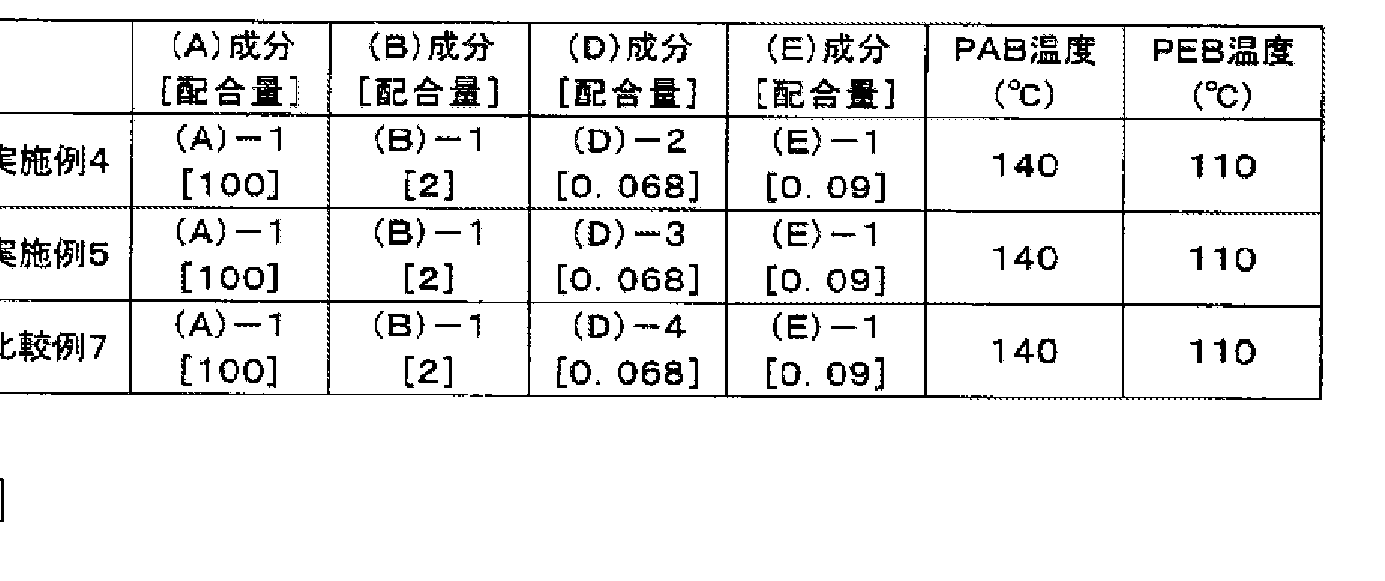
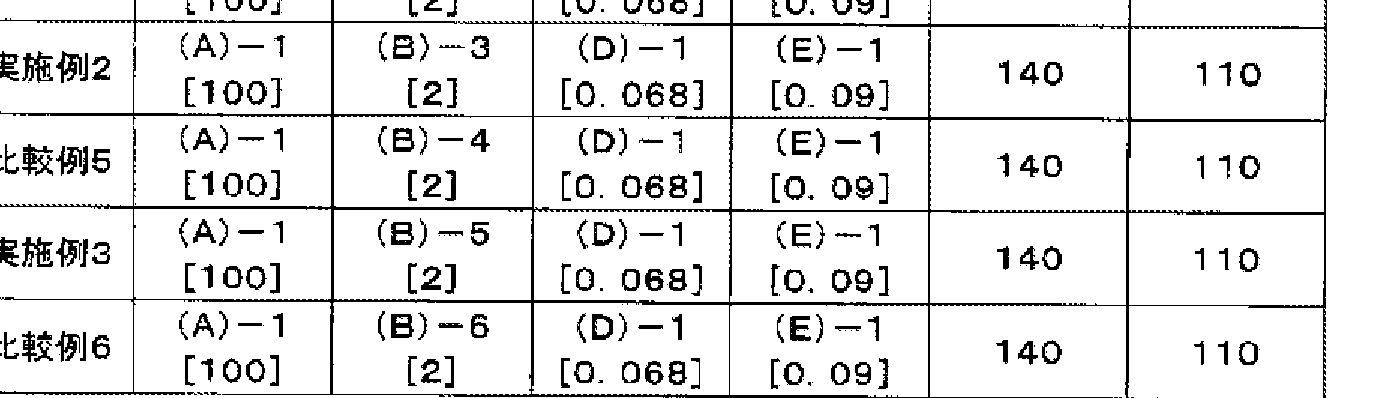
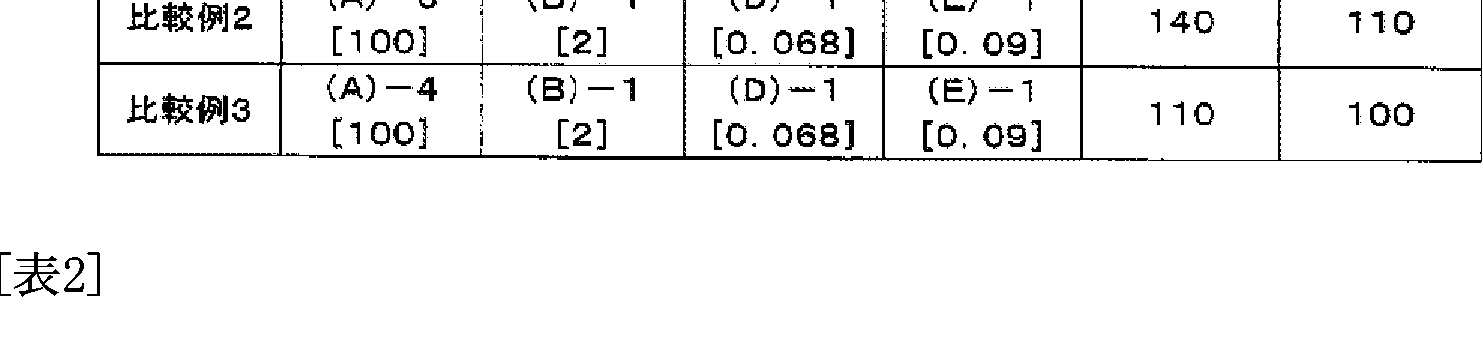

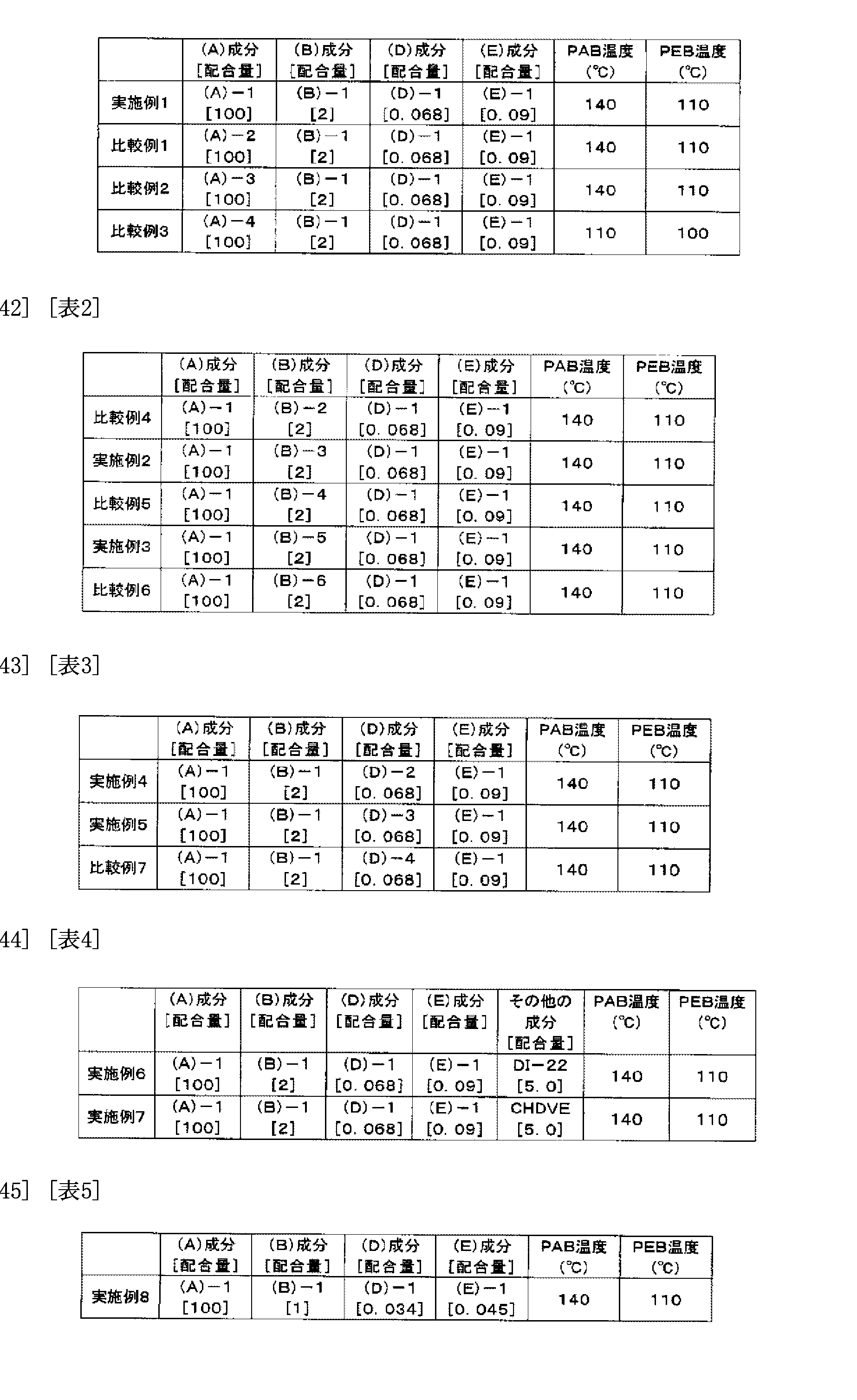
[0146] [レジストパターン形状の評価]
表面にへキサメチルシラザン (HMDS)処理を施した Si基板上に、上記で得られた ポジ型レジスト組成物を、スピンナーを用いて塗布し、ホットプレート上で、表 1〜5〖こ 示す PAB温度で 150秒間プレベータ処理して乾燥させることにより膜厚 5000nmの レジスト膜を形成した。
ついで、 KrF露光装置 NSR—S203B (Nikon社製、 NA (開口数) =0. 55, σ = 0. 49)〖こより、 KrFエキシマレーザー(248nm)をマスク(バイナリー)を介して選択 的に照射した。
そして、表 1〜5に示す PEB温度で 150秒間 PEB処理し、さらに 23°Cにて 2. 38質 量0 /0テトラメチルアンモ-ゥムヒドロキシド水溶液で 120秒間現像し、その後 30秒間、 純水を用いて水リンスした。振り切り乾燥を行った後、 100°Cで 60秒間加熱して乾燥 させてレジストパターンを形成した。
[0147] このようにしてレジストパターンを形成した基板を、走査型電子顕微鏡 (SEM)によ り観察した。
その結果、実施例 1〜8は、すべて、ライン幅 750nm、ピッチ 1500nmのラインアン ドスペース (LZS)パターンが解像して 、た。
[0148] また、(A)成分の種類を変えた実施例 1と比較例 1〜3とを比較すると、高分子化合 物 (A1)に相当する (A)—1を用いた実施例 1は、ノターン側壁の垂直性が高ぐ矩 形性の高 、断面形状の LZSパターンが形成された。
一方、(A)—1と同じ構成単位を有しているものの、分子量が 20000未満の(A) - 2を用いた比較例 1は、トップ部分が丸みを帯びた形状であり、パターン側壁が若干 テーパー形状となっており、また、膜減りが生じていた。
(A)—3を用いた比較例 2は、断面形状は裾引き形状となっており、また、トップ部 分が丸みを帯びていた。
(A)—4を用いた比較例 3の断面形状は裾引き形状となっており、また、トップ部分 が丸みを帯び、パターン中程が細くなつていた。
[0149] (B)成分の種類を変えた実施例 1〜3と比較例 4〜6とを比較すると、ァニオン部が ノナフルォロブタンスルホネートイオン(C F SO―)である(B)— 1, (B) - 3, (B) -
5を用いた実施例 1, 2, 3は、いずれも、側壁の垂直性が高ぐ矩形性が高力つた。 一方、ァ-オン部がトリフルォロメタンスルホネートイオン(CF SO―)である(B) - 2
3 3
, (B) -4, (B)— 6を用いた比較例 4, 5, 6は、いずれも、断面形状が裾引き形状と なっており、パターン上部が非常に細くなつていた。
[0150] (D)成分の種類を変えた実施例 1, 4, 5と比較例 7とを比較すると、鎖状の第 3級脂 肪族ァミンを用いた実施例 1, 4, 5は、ノターン側壁の垂直性が高ぐ矩形性の高い 断面形状であった。これらの中では、使用した第 3級脂肪族ァミンの分子量が小さい ほど形状が良好であった。
一方、環式ァミンを用いた比較例 7は、トップ部分が丸みを帯びていた。
[0151] さらに、実施例 1, 6, 7を比較すると、いずれも良好な形状であった力 DI— 22を 添加した実施例 6、および CHDVEを添加した実施例 7が、実施例 1よりも良好な形 状であり、特に実施例 7の形状が、非常に矩形性の高い良好なものであった。
また、実施例 1, 8を比較すると、(B)成分、(D)成分および (E)成分の配合量が実 施例 1の半分である実施例 8の方が、より矩形性が高く良好な形状であった。
産業上の利用可能性
[0152] 本発明によれば、形状の良好な厚膜のレジストパターンを形成できる厚膜レジスト 膜形成用のポジ型レジスト組成物、前記ポジ型レジスト組成物を用いた厚膜レジスト 積層体およびレジストパターン形成方法を提供できる。
Claims
[1] 膜厚 1〜15 mの厚膜レジスト膜形成用のポジ型レジスト組成物であって、
酸解離性溶解抑制基を有し、酸の作用によりアルカリ可溶性が増大する榭脂成分 ( A)と、露光により酸を発生する酸発生剤成分 (B)と、含窒素有機化合物 (D)とを含 有し、
前記榭脂成分 (A)が、ヒドロキシスチレン力も誘導される構成単位 (al)と、酸解離 性溶解抑制基を含むアクリル酸エステルカゝら誘導される構成単位 (a2)とを有する質 量平均分子量 20000〜50000の高分子化合物(A1)を含有し、
前記酸発生剤成分 (B)が、一般式 (I): R4"SO " (式中、 R4"は、炭素数 4の直鎖ま
3
たは分岐状のアルキル基、または炭素数 4の直鎖または分岐状のフッ素化アルキル 基を表す)で表されるァ-オン部を有するォ-ゥム塩系酸発生剤を含有し、
前記含窒素有機化合物 (D)が鎖状の第 3級脂肪族ァミンを含有するポジ型レジス ト組成物。
[2] 前記榭脂成分 (A)が、さらに、スチレンから誘導される構成単位 (a3)を有する請求 項 1記載のポジ型レジスト組成物。
[3] 支持体上に、請求項 1に記載のポジ型レジスト組成物力もなる膜厚 1〜15 mの厚 膜レジスト膜が積層されて 、る厚膜レジスト積層体。
[4] 支持体上に、請求項 1に記載のポジ型レジスト組成物を用いて膜厚 1〜 15 mの 厚膜レジスト膜を形成する工程、前記厚膜レジスト膜を選択的に露光する工程、およ び前記厚膜レジスト膜をアルカリ現像してレジストパターンを形成する工程を含むレ ジストパターン形成方法。
Priority Applications (1)
| Application Number | Priority Date | Filing Date | Title |
|---|---|---|---|
| US12/162,775 US8133653B2 (en) | 2006-02-02 | 2007-01-31 | Positive resist composition for forming thick-film resist, thick-film resist laminate, and method of forming resist pattern |
Applications Claiming Priority (2)
| Application Number | Priority Date | Filing Date | Title |
|---|---|---|---|
| JP2006025770A JP4937594B2 (ja) | 2006-02-02 | 2006-02-02 | 厚膜レジスト膜形成用のポジ型レジスト組成物、厚膜レジスト積層体およびレジストパターン形成方法 |
| JP2006-025770 | 2006-02-02 |
Publications (1)
| Publication Number | Publication Date |
|---|---|
| WO2007088884A1 true WO2007088884A1 (ja) | 2007-08-09 |
Family
ID=38327455
Family Applications (1)
| Application Number | Title | Priority Date | Filing Date |
|---|---|---|---|
| PCT/JP2007/051589 Ceased WO2007088884A1 (ja) | 2006-02-02 | 2007-01-31 | 厚膜レジスト膜形成用のポジ型レジスト組成物、厚膜レジスト積層体およびレジストパターン形成方法 |
Country Status (5)
| Country | Link |
|---|---|
| US (1) | US8133653B2 (ja) |
| JP (1) | JP4937594B2 (ja) |
| KR (1) | KR101039545B1 (ja) |
| TW (1) | TWI370952B (ja) |
| WO (1) | WO2007088884A1 (ja) |
Cited By (2)
| Publication number | Priority date | Publication date | Assignee | Title |
|---|---|---|---|---|
| CN108351592A (zh) * | 2015-11-05 | 2018-07-31 | 富士胶片株式会社 | 感光化射线性或感放射线性树脂组合物、图案形成方法及电子器件的制造方法 |
| WO2019131447A1 (ja) * | 2017-12-28 | 2019-07-04 | 東京応化工業株式会社 | レジストパターン形成方法 |
Families Citing this family (18)
| Publication number | Priority date | Publication date | Assignee | Title |
|---|---|---|---|---|
| JP5028242B2 (ja) * | 2007-12-13 | 2012-09-19 | 東京応化工業株式会社 | レジスト組成物およびレジストパターン形成方法 |
| JP5266842B2 (ja) * | 2008-03-31 | 2013-08-21 | 大日本印刷株式会社 | ポジ型レジスト組成物、及び当該ポジ型レジスト組成物を用いたパターン形成方法 |
| JP5451569B2 (ja) * | 2009-10-16 | 2014-03-26 | 富士フイルム株式会社 | 感光性樹脂組成物、硬化膜、硬化膜の形成方法、有機el表示装置、及び、液晶表示装置 |
| JP6238635B2 (ja) * | 2013-08-09 | 2017-11-29 | 東京応化工業株式会社 | 化学増幅型感光性樹脂組成物及びそれを用いたレジストパターンの製造方法 |
| KR102202975B1 (ko) * | 2014-07-09 | 2021-01-14 | 동우 화인켐 주식회사 | 후막 패턴 구조 및 그의 형성 방법 |
| JP6811004B2 (ja) * | 2015-01-21 | 2021-01-13 | 東京応化工業株式会社 | マイクロレンズパターン製造用ポジ型感光性樹脂組成物 |
| TWI743132B (zh) * | 2016-07-20 | 2021-10-21 | 日商東京應化工業股份有限公司 | 微透鏡圖型製造用正型感光性樹脂組成物及其之用途 |
| JP6894749B2 (ja) * | 2016-07-20 | 2021-06-30 | 東京応化工業株式会社 | マイクロレンズパターン製造用ポジ型感光性樹脂組成物及びその用途 |
| WO2019009143A1 (ja) * | 2017-07-04 | 2019-01-10 | 富士フイルム株式会社 | 赤外線受光素子の製造方法、光センサの製造方法、積層体、レジスト組成物およびキット |
| KR102134381B1 (ko) * | 2017-07-31 | 2020-07-15 | 주식회사 엘지화학 | 포지티브형 포토레지스트 조성물, 이로부터 제조되는 패턴, 및 패턴 제조방법 |
| CN110914757B (zh) * | 2017-08-31 | 2023-12-22 | 富士胶片株式会社 | 感光化射线性或感放射线性树脂组合物、抗蚀剂膜、图案形成方法及固体摄像元件的制造方法 |
| JP6931707B2 (ja) | 2017-09-13 | 2021-09-08 | 富士フイルム株式会社 | 感活性光線性又は感放射線性樹脂組成物、レジスト膜の製造方法、パターン形成方法、及び電子デバイスの製造方法 |
| CN112602019B (zh) | 2018-09-05 | 2025-02-28 | 富士胶片株式会社 | 感光化射线性或感放射线性树脂组合物、抗蚀剂膜、图案形成方法及电子器件的制造方法 |
| JP7414457B2 (ja) | 2018-11-20 | 2024-01-16 | 東京応化工業株式会社 | レジスト組成物及びレジストパターン形成方法 |
| KR102738548B1 (ko) | 2020-02-20 | 2024-12-04 | 도오꾜오까고오교 가부시끼가이샤 | 후막 레지스트막 형성용 레지스트 조성물, 후막 레지스트 적층체 및 레지스트 패턴 형성 방법 |
| JP2024520263A (ja) | 2021-05-28 | 2024-05-24 | メルク パテント ゲゼルシャフト ミット ベシュレンクテル ハフツング | 厚膜レジスト組成物およびそれを用いたレジスト膜の製造方法 |
| TW202343138A (zh) | 2022-03-01 | 2023-11-01 | 德商默克專利有限公司 | 離子植入厚膜阻劑組成物、使用其之加工基板之製造方法、及使用其之裝置之製造方法 |
| CN120188109A (zh) | 2022-11-15 | 2025-06-20 | 默克专利有限公司 | 厚膜化学增幅正型抗蚀剂组合物及使用其的制造抗蚀剂膜的方法 |
Citations (8)
| Publication number | Priority date | Publication date | Assignee | Title |
|---|---|---|---|---|
| JPH1172920A (ja) * | 1997-08-27 | 1999-03-16 | Jsr Corp | 感放射線性樹脂組成物 |
| JPH11143079A (ja) * | 1997-09-02 | 1999-05-28 | Jsr Corp | 感放射線性樹脂組成物 |
| JPH11305441A (ja) * | 1998-04-23 | 1999-11-05 | Tokyo Ohka Kogyo Co Ltd | 化学増幅型ポジ型ホトレジスト |
| JP2001166478A (ja) * | 1999-12-03 | 2001-06-22 | Jsr Corp | 感放射線性樹脂組成物 |
| JP2004302434A (ja) * | 2003-03-14 | 2004-10-28 | Tokyo Ohka Kogyo Co Ltd | 化学増幅型ポジ型レジスト組成物 |
| JP2006003861A (ja) * | 2004-05-19 | 2006-01-05 | Mitsui Chemicals Inc | ポジ型感光性レジスト組成物およびその製造方法 |
| JP2006018015A (ja) * | 2004-07-01 | 2006-01-19 | Tokyo Ohka Kogyo Co Ltd | ポジ型レジスト組成物及びレジストパターン形成方法 |
| JP2006018017A (ja) * | 2004-07-01 | 2006-01-19 | Tokyo Ohka Kogyo Co Ltd | 化学増幅型レジスト組成物およびレジストパターン形成方法 |
Family Cites Families (22)
| Publication number | Priority date | Publication date | Assignee | Title |
|---|---|---|---|---|
| US5258257A (en) * | 1991-09-23 | 1993-11-02 | Shipley Company Inc. | Radiation sensitive compositions comprising polymer having acid labile groups |
| JP3206989B2 (ja) | 1992-11-13 | 2001-09-10 | 富士写真フイルム株式会社 | ポジ型感光性材料 |
| JPH06230574A (ja) | 1993-02-05 | 1994-08-19 | Fuji Photo Film Co Ltd | ポジ型感光性組成物 |
| JP3798458B2 (ja) | 1996-02-02 | 2006-07-19 | 東京応化工業株式会社 | オキシムスルホネート化合物及びレジスト用酸発生剤 |
| JP3198915B2 (ja) * | 1996-04-02 | 2001-08-13 | 信越化学工業株式会社 | 化学増幅ポジ型レジスト材料 |
| US5945517A (en) * | 1996-07-24 | 1999-08-31 | Tokyo Ohka Kogyo Co., Ltd. | Chemical-sensitization photoresist composition |
| JP3980124B2 (ja) | 1997-07-24 | 2007-09-26 | 東京応化工業株式会社 | 新規ビススルホニルジアゾメタン |
| JP3854689B2 (ja) | 1997-07-24 | 2006-12-06 | 東京応化工業株式会社 | 新規な光酸発生剤 |
| JP3865473B2 (ja) | 1997-07-24 | 2007-01-10 | 東京応化工業株式会社 | 新規なジアゾメタン化合物 |
| US6120972A (en) * | 1997-09-02 | 2000-09-19 | Jsr Corporation | Radiation-sensitive resin composition |
| US6153733A (en) * | 1998-05-18 | 2000-11-28 | Tokyo Ohka Kogyo Co., Ltd. | (Disulfonyl diazomethane compounds) |
| JP3935267B2 (ja) | 1998-05-18 | 2007-06-20 | 東京応化工業株式会社 | 新規なレジスト用酸発生剤 |
| TWI250379B (en) * | 1998-08-07 | 2006-03-01 | Az Electronic Materials Japan | Chemical amplified radiation-sensitive composition which contains onium salt and generator |
| JP3712047B2 (ja) * | 2000-08-14 | 2005-11-02 | 信越化学工業株式会社 | レジスト材料及びパターン形成方法 |
| JP2002110536A (ja) * | 2000-10-05 | 2002-04-12 | Tdk Corp | レジストパターン、レジストパターンの作製方法、薄膜のパターニング方法、及びマイクロデバイスの製造方法 |
| JP3710717B2 (ja) | 2001-03-06 | 2005-10-26 | 東京応化工業株式会社 | 厚膜用ポジ型ホトレジスト組成物、ホトレジスト膜およびこれを用いたバンプ形成方法 |
| JP2002341538A (ja) | 2001-05-11 | 2002-11-27 | Fuji Photo Film Co Ltd | 電子線またはx線用ポジ型レジスト組成物 |
| JP4057807B2 (ja) * | 2001-12-03 | 2008-03-05 | 東京応化工業株式会社 | 微細レジストパターン形成方法 |
| WO2004074242A2 (en) | 2003-02-19 | 2004-09-02 | Ciba Specialty Chemicals Holding Inc. | Halogenated oxime derivatives and the use thereof as latent acids |
| JP4131864B2 (ja) * | 2003-11-25 | 2008-08-13 | 東京応化工業株式会社 | 化学増幅型ポジ型感光性熱硬化性樹脂組成物、硬化物の形成方法、及び機能素子の製造方法 |
| EP1720072B1 (en) * | 2005-05-01 | 2019-06-05 | Rohm and Haas Electronic Materials, L.L.C. | Compositons and processes for immersion lithography |
| US7255970B2 (en) * | 2005-07-12 | 2007-08-14 | Az Electronic Materials Usa Corp. | Photoresist composition for imaging thick films |
-
2006
- 2006-02-02 JP JP2006025770A patent/JP4937594B2/ja not_active Expired - Fee Related
-
2007
- 2007-01-30 TW TW096103368A patent/TWI370952B/zh active
- 2007-01-31 US US12/162,775 patent/US8133653B2/en active Active
- 2007-01-31 KR KR1020087019840A patent/KR101039545B1/ko active Active
- 2007-01-31 WO PCT/JP2007/051589 patent/WO2007088884A1/ja not_active Ceased
Patent Citations (8)
| Publication number | Priority date | Publication date | Assignee | Title |
|---|---|---|---|---|
| JPH1172920A (ja) * | 1997-08-27 | 1999-03-16 | Jsr Corp | 感放射線性樹脂組成物 |
| JPH11143079A (ja) * | 1997-09-02 | 1999-05-28 | Jsr Corp | 感放射線性樹脂組成物 |
| JPH11305441A (ja) * | 1998-04-23 | 1999-11-05 | Tokyo Ohka Kogyo Co Ltd | 化学増幅型ポジ型ホトレジスト |
| JP2001166478A (ja) * | 1999-12-03 | 2001-06-22 | Jsr Corp | 感放射線性樹脂組成物 |
| JP2004302434A (ja) * | 2003-03-14 | 2004-10-28 | Tokyo Ohka Kogyo Co Ltd | 化学増幅型ポジ型レジスト組成物 |
| JP2006003861A (ja) * | 2004-05-19 | 2006-01-05 | Mitsui Chemicals Inc | ポジ型感光性レジスト組成物およびその製造方法 |
| JP2006018015A (ja) * | 2004-07-01 | 2006-01-19 | Tokyo Ohka Kogyo Co Ltd | ポジ型レジスト組成物及びレジストパターン形成方法 |
| JP2006018017A (ja) * | 2004-07-01 | 2006-01-19 | Tokyo Ohka Kogyo Co Ltd | 化学増幅型レジスト組成物およびレジストパターン形成方法 |
Cited By (5)
| Publication number | Priority date | Publication date | Assignee | Title |
|---|---|---|---|---|
| CN108351592A (zh) * | 2015-11-05 | 2018-07-31 | 富士胶片株式会社 | 感光化射线性或感放射线性树脂组合物、图案形成方法及电子器件的制造方法 |
| US11181820B2 (en) | 2015-11-05 | 2021-11-23 | Fujifilm Corporation | Actinic ray-sensitive or radiation-sensitive resin composition, pattern forming method, and method for manufacturing electronic device |
| WO2019131447A1 (ja) * | 2017-12-28 | 2019-07-04 | 東京応化工業株式会社 | レジストパターン形成方法 |
| JP2019120766A (ja) * | 2017-12-28 | 2019-07-22 | 東京応化工業株式会社 | レジストパターン形成方法 |
| JP7080049B2 (ja) | 2017-12-28 | 2022-06-03 | 東京応化工業株式会社 | レジストパターン形成方法 |
Also Published As
| Publication number | Publication date |
|---|---|
| JP2007206425A (ja) | 2007-08-16 |
| JP4937594B2 (ja) | 2012-05-23 |
| KR101039545B1 (ko) | 2011-06-09 |
| TW200745757A (en) | 2007-12-16 |
| US8133653B2 (en) | 2012-03-13 |
| TWI370952B (en) | 2012-08-21 |
| US20090023102A1 (en) | 2009-01-22 |
| KR20080081370A (ko) | 2008-09-09 |
Similar Documents
| Publication | Publication Date | Title |
|---|---|---|
| WO2007088884A1 (ja) | 厚膜レジスト膜形成用のポジ型レジスト組成物、厚膜レジスト積層体およびレジストパターン形成方法 | |
| JP4485922B2 (ja) | ネガ型レジスト組成物 | |
| WO2007138893A1 (ja) | ポジ型レジスト組成物およびレジストパターン形成方法 | |
| WO2008012999A1 (en) | Positive resist composition and method of forming resist pattern | |
| JP4152810B2 (ja) | ポジ型レジスト組成物およびレジストパターン形成方法 | |
| JP4772288B2 (ja) | ホトレジスト組成物用樹脂、ホトレジスト組成物、およびレジストパターン形成方法 | |
| WO2007046388A1 (ja) | ポジ型レジスト組成物、サーマルフロー用ポジ型レジスト組成物およびレジストパターン形成方法 | |
| WO2007108253A1 (ja) | 厚膜レジスト膜形成用のポジ型レジスト組成物、厚膜レジスト積層体およびレジストパターン形成方法 | |
| WO2006082740A1 (ja) | ポジ型レジスト組成物およびレジストパターン形成方法 | |
| WO2005057287A1 (ja) | ポジ型レジスト組成物およびレジストパターン形成方法 | |
| WO2007148492A1 (ja) | ポジ型レジスト組成物およびレジストパターン形成方法 | |
| WO2007148525A1 (ja) | ポジ型レジスト組成物およびレジストパターン形成方法 | |
| JP2004175981A (ja) | 樹脂の製造方法、樹脂、レジスト組成物、レジストパターン形成方法 | |
| WO2006134739A1 (ja) | ポジ型レジスト組成物およびレジストパターン形成方法 | |
| WO2006059569A1 (ja) | ポジ型レジスト組成物およびレジストパターン形成方法 | |
| JP4493938B2 (ja) | ポジ型レジスト組成物及びレジストパターン形成方法 | |
| TWI300165B (en) | Resin for resist, positive resist composition and resist pattern formation method | |
| WO2007138797A1 (ja) | ポジ型レジスト組成物およびレジストパターン形成方法 | |
| US8097396B2 (en) | Positive resist composition and method for forming resist pattern | |
| WO2006051769A1 (ja) | レジストパターンの形成方法 | |
| WO2006080151A1 (ja) | レジストパターン形成方法 | |
| JP2005010488A (ja) | ポジ型レジスト組成物 | |
| WO2005052693A1 (ja) | ポジ型レジスト組成物及びレジストパターン形成方法 | |
| WO2007055272A1 (ja) | ポジ型レジスト組成物およびレジストパターン形成方法 | |
| WO2007108223A1 (ja) | 厚膜レジスト膜の形成方法およびレジストパターン形成方法 |
Legal Events
| Date | Code | Title | Description |
|---|---|---|---|
| 121 | Ep: the epo has been informed by wipo that ep was designated in this application | ||
| WWE | Wipo information: entry into national phase |
Ref document number: 12162775 Country of ref document: US |
|
| NENP | Non-entry into the national phase |
Ref country code: DE |
|
| WWE | Wipo information: entry into national phase |
Ref document number: 1020087019840 Country of ref document: KR |
|
| 122 | Ep: pct application non-entry in european phase |
Ref document number: 07713749 Country of ref document: EP Kind code of ref document: A1 |