WO2007023908A1 - 膜形成用材料およびパターン形成方法 - Google Patents
膜形成用材料およびパターン形成方法 Download PDFInfo
- Publication number
- WO2007023908A1 WO2007023908A1 PCT/JP2006/316629 JP2006316629W WO2007023908A1 WO 2007023908 A1 WO2007023908 A1 WO 2007023908A1 JP 2006316629 W JP2006316629 W JP 2006316629W WO 2007023908 A1 WO2007023908 A1 WO 2007023908A1
- Authority
- WO
- WIPO (PCT)
- Prior art keywords
- group
- film
- pattern
- forming material
- etching
- Prior art date
- Legal status (The legal status is an assumption and is not a legal conclusion. Google has not performed a legal analysis and makes no representation as to the accuracy of the status listed.)
- Ceased
Links
Classifications
-
- H—ELECTRICITY
- H10—SEMICONDUCTOR DEVICES; ELECTRIC SOLID-STATE DEVICES NOT OTHERWISE PROVIDED FOR
- H10P—GENERIC PROCESSES OR APPARATUS FOR THE MANUFACTURE OR TREATMENT OF DEVICES COVERED BY CLASS H10
- H10P76/00—Manufacture or treatment of masks on semiconductor bodies, e.g. by lithography or photolithography
- H10P76/20—Manufacture or treatment of masks on semiconductor bodies, e.g. by lithography or photolithography of masks comprising organic materials
- H10P76/204—Manufacture or treatment of masks on semiconductor bodies, e.g. by lithography or photolithography of masks comprising organic materials of organic photoresist masks
-
- C—CHEMISTRY; METALLURGY
- C09—DYES; PAINTS; POLISHES; NATURAL RESINS; ADHESIVES; COMPOSITIONS NOT OTHERWISE PROVIDED FOR; APPLICATIONS OF MATERIALS NOT OTHERWISE PROVIDED FOR
- C09D—COATING COMPOSITIONS, e.g. PAINTS, VARNISHES OR LACQUERS; FILLING PASTES; CHEMICAL PAINT OR INK REMOVERS; INKS; CORRECTING FLUIDS; WOODSTAINS; PASTES OR SOLIDS FOR COLOURING OR PRINTING; USE OF MATERIALS THEREFOR
- C09D183/00—Coating compositions based on macromolecular compounds obtained by reactions forming in the main chain of the macromolecule a linkage containing silicon, with or without sulfur, nitrogen, oxygen, or carbon only; Coating compositions based on derivatives of such polymers
- C09D183/04—Polysiloxanes
-
- G—PHYSICS
- G03—PHOTOGRAPHY; CINEMATOGRAPHY; ANALOGOUS TECHNIQUES USING WAVES OTHER THAN OPTICAL WAVES; ELECTROGRAPHY; HOLOGRAPHY
- G03F—PHOTOMECHANICAL PRODUCTION OF TEXTURED OR PATTERNED SURFACES, e.g. FOR PRINTING, FOR PROCESSING OF SEMICONDUCTOR DEVICES; MATERIALS THEREFOR; ORIGINALS THEREFOR; APPARATUS SPECIALLY ADAPTED THEREFOR
- G03F7/00—Photomechanical, e.g. photolithographic, production of textured or patterned surfaces, e.g. printing surfaces; Materials therefor, e.g. comprising photoresists; Apparatus specially adapted therefor
- G03F7/004—Photosensitive materials
-
- G—PHYSICS
- G03—PHOTOGRAPHY; CINEMATOGRAPHY; ANALOGOUS TECHNIQUES USING WAVES OTHER THAN OPTICAL WAVES; ELECTROGRAPHY; HOLOGRAPHY
- G03F—PHOTOMECHANICAL PRODUCTION OF TEXTURED OR PATTERNED SURFACES, e.g. FOR PRINTING, FOR PROCESSING OF SEMICONDUCTOR DEVICES; MATERIALS THEREFOR; ORIGINALS THEREFOR; APPARATUS SPECIALLY ADAPTED THEREFOR
- G03F7/00—Photomechanical, e.g. photolithographic, production of textured or patterned surfaces, e.g. printing surfaces; Materials therefor, e.g. comprising photoresists; Apparatus specially adapted therefor
- G03F7/004—Photosensitive materials
- G03F7/0042—Photosensitive materials with inorganic or organometallic light-sensitive compounds not otherwise provided for, e.g. inorganic resists
-
- G—PHYSICS
- G03—PHOTOGRAPHY; CINEMATOGRAPHY; ANALOGOUS TECHNIQUES USING WAVES OTHER THAN OPTICAL WAVES; ELECTROGRAPHY; HOLOGRAPHY
- G03F—PHOTOMECHANICAL PRODUCTION OF TEXTURED OR PATTERNED SURFACES, e.g. FOR PRINTING, FOR PROCESSING OF SEMICONDUCTOR DEVICES; MATERIALS THEREFOR; ORIGINALS THEREFOR; APPARATUS SPECIALLY ADAPTED THEREFOR
- G03F7/00—Photomechanical, e.g. photolithographic, production of textured or patterned surfaces, e.g. printing surfaces; Materials therefor, e.g. comprising photoresists; Apparatus specially adapted therefor
- G03F7/004—Photosensitive materials
- G03F7/0045—Photosensitive materials with organic non-macromolecular light-sensitive compounds not otherwise provided for, e.g. dissolution inhibitors
-
- G—PHYSICS
- G03—PHOTOGRAPHY; CINEMATOGRAPHY; ANALOGOUS TECHNIQUES USING WAVES OTHER THAN OPTICAL WAVES; ELECTROGRAPHY; HOLOGRAPHY
- G03F—PHOTOMECHANICAL PRODUCTION OF TEXTURED OR PATTERNED SURFACES, e.g. FOR PRINTING, FOR PROCESSING OF SEMICONDUCTOR DEVICES; MATERIALS THEREFOR; ORIGINALS THEREFOR; APPARATUS SPECIALLY ADAPTED THEREFOR
- G03F7/00—Photomechanical, e.g. photolithographic, production of textured or patterned surfaces, e.g. printing surfaces; Materials therefor, e.g. comprising photoresists; Apparatus specially adapted therefor
- G03F7/004—Photosensitive materials
- G03F7/075—Silicon-containing compounds
- G03F7/0755—Non-macromolecular compounds containing Si-O, Si-C or Si-N bonds
-
- G—PHYSICS
- G03—PHOTOGRAPHY; CINEMATOGRAPHY; ANALOGOUS TECHNIQUES USING WAVES OTHER THAN OPTICAL WAVES; ELECTROGRAPHY; HOLOGRAPHY
- G03F—PHOTOMECHANICAL PRODUCTION OF TEXTURED OR PATTERNED SURFACES, e.g. FOR PRINTING, FOR PROCESSING OF SEMICONDUCTOR DEVICES; MATERIALS THEREFOR; ORIGINALS THEREFOR; APPARATUS SPECIALLY ADAPTED THEREFOR
- G03F7/00—Photomechanical, e.g. photolithographic, production of textured or patterned surfaces, e.g. printing surfaces; Materials therefor, e.g. comprising photoresists; Apparatus specially adapted therefor
- G03F7/26—Processing photosensitive materials; Apparatus therefor
- G03F7/40—Treatment after imagewise removal, e.g. baking
-
- H—ELECTRICITY
- H10—SEMICONDUCTOR DEVICES; ELECTRIC SOLID-STATE DEVICES NOT OTHERWISE PROVIDED FOR
- H10P—GENERIC PROCESSES OR APPARATUS FOR THE MANUFACTURE OR TREATMENT OF DEVICES COVERED BY CLASS H10
- H10P50/00—Etching of wafers, substrates or parts of devices
- H10P50/20—Dry etching; Plasma etching; Reactive-ion etching
- H10P50/28—Dry etching; Plasma etching; Reactive-ion etching of insulating materials
- H10P50/286—Dry etching; Plasma etching; Reactive-ion etching of insulating materials of organic materials
- H10P50/287—Dry etching; Plasma etching; Reactive-ion etching of insulating materials of organic materials by chemical means
-
- H—ELECTRICITY
- H10—SEMICONDUCTOR DEVICES; ELECTRIC SOLID-STATE DEVICES NOT OTHERWISE PROVIDED FOR
- H10P—GENERIC PROCESSES OR APPARATUS FOR THE MANUFACTURE OR TREATMENT OF DEVICES COVERED BY CLASS H10
- H10P50/00—Etching of wafers, substrates or parts of devices
- H10P50/73—Etching of wafers, substrates or parts of devices using masks for insulating materials
Definitions
- the present invention relates to a film forming material capable of forming a metal oxide film such as a silica (SiO 2) film, and a film.
- the present invention relates to a turn forming method.
- Such a fine pattern becomes a force of an organic material, and is formed by a technique such as a lithography method or a nanoimprint method.
- a resist pattern is formed using a resist composition containing a resin component.
- Resist compositions include positive resist compositions and negative resist compositions.
- a film made of a positive resist composition is insoluble in an alkali developer before exposure and has a property of becoming soluble after exposure.
- a film made of a negative resist composition is soluble in an alkaline developer before exposure and becomes insoluble after exposure.
- the positive resist composition when forming a pattern using a positive resist composition, the positive resist composition is applied onto a substrate and dried to form a coating (resist film). Then, when this resist film is selectively exposed and developed with an alkali developer, the exposed portion that is soluble in the alkali developer is removed, and a resist pattern is formed.
- a semiconductor or the like is manufactured through a process of processing the substrate by etching using the resist pattern as a mask.
- etching wet etching or dry etching is used, and dry etching is mainly used (see Patent Document 1). Since such a pattern is used as a mask, it must have excellent etching resistance.
- a film having anti-reflective ability (Bottom Anti-Reflective Coating) between the substrate and the film for forming the pattern as described above).
- BARC Bottom Anti-Reflective Coating
- the BARC method is commonly used!
- As the BARC an organic film (organic BARC) formed mainly from an organic material such as a film forming resin is used.
- the organic BARC is usually etched using a pattern (upper layer pattern) formed thereon as a mask, and is used together with the upper layer pattern as a mask when etching the substrate.
- the upper layer pattern is used as a mask when etching organic BARC, it needs to have higher etching resistance than organic BARC, that is, to have an etching selectivity with respect to organic BARC.
- VOG method VOG method
- SOG (spin-on-glass) method etc.
- the SOG method applies a film in which a key compound is dissolved in an organic solvent (hereinafter also referred to as an SOG solution) and heat-treats it to form a film containing SiO as a main component (hereinafter referred to as an SOG film).
- Patent Document 1 Japanese Unexamined Patent Publication No. 2003-167346
- Patent Document 2 Japanese Patent Publication No. 8-3074 (Japanese Patent Laid-Open No. 63-241076)
- Patent Document 3 Japanese Patent No. 2739902 (Japanese Patent Laid-Open No. 5-244052)
- Patent Document 4 Japanese Patent No. 3228714 (Japanese Patent Laid-Open No. 11-6369)
- a metal oxide film such as the silica-based film described above is considered to have excellent etching resistance. Therefore, it is conceivable to use a metal oxide film as a material for forming a pattern. That is, a pattern made of a metal oxide film or a pattern in which the surface of a pattern such as a resist pattern is covered with a metal oxide film is considered to have high etching resistance.
- a pattern made of a metal oxide film or a pattern in which the surface of a pattern such as a resist pattern is covered with a metal oxide film is considered to have high etching resistance.
- etching selectivity with respect to an organic film means an apparent appearance of the coating pattern and the organic film when etching is performed using a coating pattern coated with a metal oxide film as a mask. It means the above etching selectivity.
- the present invention provides a film forming material capable of forming a film having a high etching resistance and a high etching selectivity with respect to an organic film at a low temperature, and pattern formation using the film forming material It is an object to provide a method.
- the present invention adopts the following configuration.
- the first aspect of the present invention includes a metal compound (W) capable of generating a hydroxyl group by hydrolysis, and a solvent (S) obtained by dissolving this, wherein the solvent (S) is the metal compound ( W) is a film-forming material containing a solvent (S1) having a boiling point of 155 ° C. or higher that does not have a functional group that reacts with W).
- the second aspect of the present invention is a laminate comprising a substrate and an organic film. Coating the pattern formed on the organic film with the film forming material of the first aspect; and using the pattern coated with the film forming material as a mask. And a pattern forming method including a step of performing chinching.
- alkyl group includes linear, branched and cyclic monovalent saturated hydrocarbon groups unless otherwise specified. It shall be.
- the “alkylene group” includes linear, branched and cyclic divalent saturated hydrocarbon groups unless otherwise specified.
- a film forming material capable of forming a film having a high etching resistance at a low temperature and a high etching selectivity with respect to an organic film, and the film forming material are provided.
- the pattern forming method used can be provided.
- FIG. 1A is an explanatory view showing an example of the procedure of a pattern forming method using the film forming material of the present invention.
- FIG. 1B is an explanatory diagram showing an example of a procedure of a pattern forming method using the film forming material of the present invention.
- FIG. 1C is an explanatory view showing an example of a procedure of a pattern forming method using the film forming material of the present invention.
- FIG. 1D is an explanatory diagram showing an example of a procedure of a pattern forming method using the film forming material of the present invention.
- the metal compound (W) is a compound that can generate a hydroxyl group by hydrolysis.
- Surface of the film-forming material containing the metal compound (W) for example, an organic film described later
- the metal compound (W) reacts with moisture in the atmosphere or the applied water even at low temperatures (for example, about room temperature). Then, a hydroxyl group is generated by hydrolysis. Then, the generated hydroxyl groups are dehydrated and condensed, and a plurality of metal compound (W) molecules are bonded to each other to form a dense metal oxide film (hereinafter simply referred to as a film) having a high film density. Is done. Since such a dense film contains a metal oxide, it has excellent etching resistance and a high etching selectivity with respect to the organic film.
- the film is formed on a pattern such as a resist pattern
- the pattern has a reactive group such as a carboxy group or a hydroxyl group
- the pattern is generated from the reactive group of the pattern and the metal oxide (W). Reacts with hydroxyl group
- the film (metal oxide film) formed on the pattern may be referred to as a coating layer.
- the metal compound (W) for example, a metal compound having a functional group capable of generating a hydroxyl group by hydrolysis can be used.
- the functional group is directly bonded to the metal atom.
- the number of functional groups is preferably 2 or more with respect to one metal atom, preferably 2 to 4, and particularly preferably 4.
- the hydroxyl groups generated by hydrolysis undergo dehydration condensation, and a plurality of metal compound (W) molecules are continuously bonded to form a firm film.
- Examples of the functional group capable of generating a hydroxyl group by hydrolysis include an alkoxy group, an isocyanate group, and a carbonyl group.
- the halogen atom is also included in the functional group in the present invention.
- alkoxy group a linear or branched lower alkoxy group having 1 to 5 carbon atoms, For example, methoxy group (—O—Me), ethoxy group (—O—Et), n-propoxy group (—O—n Pr), isopropoxy group (—O—iPr), n-butoxy group (—O—nBu) ) And the like.
- the halogen atom include a chlorine atom, a fluorine atom, a bromine atom, and an iodine atom, and among them, a chlorine atom is preferable.
- alkoxy groups and isocyanate groups are reactive groups such as carboxy groups and hydroxyl groups on the pattern surface, particularly when the film-forming material is applied onto the pattern to form a coating layer. Is preferably present because it undergoes a condensation reaction with it. As a result, the hydroxyl group formed after the hydrolysis and the reactive group on the pattern surface undergo a condensation reaction, and the coating layer and the pattern surface adhere firmly.
- carbocyclic groups and halogen atoms are present on the surface of the pattern such as carboxy groups and hydroxyl groups, particularly when the film-forming material is applied onto the pattern to form a coating layer. Then, since it adsorb
- an isocyanate group and a halogen atom are particularly preferable because an isocyanate group and a halogen atom (especially a chlorine atom) are preferable because they are highly active and can easily form a film without any heat treatment.
- the metal constituting the metal compound (W) includes boron, caustic, germanium, antimony, selenium, tellurium, and the like in addition to ordinary metals.
- Suitable metals constituting the metal compound (W) include, for example, titanium, zirconium, anorium, niobium, silicon, boron, lanthanides, yttrium, norium, cobalt, iron, zirconium. Tantalum and the like, and titanium and key are preferable, and key is particularly preferable.
- the number of metal atoms in the metal compound (W) may be 1 or 2 or more, preferably 1.
- the metal compound (W) may have an atom or an organic group other than the above-mentioned "functional group capable of generating a hydroxyl group by hydrolysis".
- the atom include a hydrogen atom.
- the organic group include an alkyl group (preferably a lower alkyl group having 1 to 5 carbon atoms) and the like. And an ethyl group and a methyl group are preferable.
- Examples of the metal compound (W) include the following.
- metal alkoxides examples include the following.
- titanium butoxide Ti (0—nBu)
- zirconium propoxide Zr (0—nPr
- Rare earth gold such as recon tetramethoxide (Si (O— Me)), boron ethoxide (B (0— Et))
- Double alkoxide compounds such as norlium titanium alkoxide (BaTi (OR 60 )) (where “R ⁇ ” is a lower alkyl group having 1 to 5 carbon atoms, and X is an integer of 2 to 4); Methyltrimethoxysilane (MeSi (0— Me)), Jetyljetoxysilane (Et Si (0—
- Examples thereof include metal alkoxide compounds having a ligand such as acetylacetone and having two or more alkoxy groups.
- fine particles of an alkoxide sol or alkoxide gel obtained by adding a small amount of water to the metal alkoxides and partially hydrolyzing and condensing them can also be used.
- a binuclear or cluster type alkoxide compound having a plurality of types of metal elements, a polymer based on a metal alkoxide compound cross-linked one-dimensionally through an oxygen atom, and the like are also included in the metal alkoxides.
- the metal compound having an isocyanate group includes two compounds represented by the general formula "M (NCO)"
- tetraisocyanate silane Si (NCO)
- Ti titanium tetraisocyanate
- Zr zirconium tetraisocyanate
- aluminum triisocyanate aluminum triisocyanate
- the metal compound having a halogen atom has a general formula "M (X)" (M is a metal atom).
- X is a kind selected from fluorine atom, chlorine atom, bromine atom and iodine atom.
- N is an integer of 2 to 4, and a halogenated metal compound having 2 or more (preferably 2 to 4) halogen atoms.
- the compound having a rhogen atom may be a metal complex.
- TiCl tetrachloro titanium
- SiCl tetrachlorosilane
- Examples of the metal complex include cobalt chloride (CoCl 3).
- Examples of the metal compound having a carbonyl group include metal carbonyls such as titanium oxoacetyl acetate (TiO (CH2CO3COO) 2) and pentacarbonyliron (Fe (CO) 2).
- metal carbonyls such as titanium oxoacetyl acetate (TiO (CH2CO3COO) 2) and pentacarbonyliron (Fe (CO) 2).
- an isocyanate group and a Z or halogen atom can be formed because a metal oxide film having a particularly high activity, a high etching resistance, and a high etching resistance can be easily formed without any heat treatment.
- the number of keys in one molecule of the key compound may be 1 or 2 or more, preferably 1.
- a compound represented by the following general formula (S-1) is preferable.
- W represents an isocyanate group (NCO group) or a halogen atom, and a plurality of Ws may be the same or different from each other.
- a is an integer of 2 to 4, and is preferably 4.
- W is an isocyanate group or a halogen atom.
- the halogen atom is the same as described above, and is preferably a chlorine atom. Of these, isocyanate groups are preferred.
- the metal compound (W) may be used alone or in combination of two or more.
- the film-forming material of the present invention is one in which the metal compound (W) is dissolved in a solvent (S), and the solvent (S) has a boiling point that does not have a functional group that reacts with the metal compound (W). 155 ° C or higher It is necessary to contain the above solvent (SI). This ensures high etching resistance at low temperatures.
- a film portion having a high selectivity with respect to the organic film can be formed.
- the pattern is formed when the pattern is formed on the organic film of the laminate including the substrate and the organic film.
- the film-forming material is applied to form a coating film, when the solvent in the coating film does not exist on the upper surface or upper surface and side surface of the pattern but exists on the organic film, the upper surface or upper surface of the pattern and
- the metal compound (W) is hydrolyzed by moisture in the atmosphere on the side surface, causing chemical adsorption with the pattern surface and becoming an oxide, but the metal compound (W) is hydrolyzed on the organic film. For example, it remains in a state where it can be washed away with a solvent.
- the etching selectivity with respect to the organic film is further improved.
- the solvent (S) remains with little volatilization between the patterns until cleaning, so the metal compound (W ) Remains as it is after cleaning, but the metal compound (W) on the surface of the organic film, which is relatively weakly adhered, is removed by cleaning, and as a result, a metal oxide film is hardly formed on the surface of the organic film. It is presumed that.
- the solvent (S1) does not have a functional group that reacts with the metal compound (W) and has a boiling point of 155 ° C or higher. As long as it is the above and can dissolve the metal compound (W) to be used, it can be selected from conventionally known organic solvents.
- Examples of the functional group that reacts with the metal compound (W) include a group having a carbon-carbon double bond such as a vinyl group, a hydroxyl group, a carboxy group, and a halogen atom. If the functional group does not have such a functional group, the metal compound (W) is stably present in the solvent (S), so that the film forming ability is excellent.
- the boiling point of the solvent (S1) is more preferably 160 ° C or higher, and further preferably 165 ° C or higher.
- the upper limit of the boiling point is not particularly limited, but is preferably 300 ° C. or lower, more preferably 250 ° C. or lower in consideration of applicability and the like.
- the solvent (S1) is preferably an aliphatic compound because it is excellent in the effects of the present invention.
- aliphatic in the present specification is a relative concept with respect to aromatics. Defined as meaning a group, compound or the like that does not have aromaticity.
- Aliphatic compound means an aromatic compound having no aromaticity.
- the aliphatic compound may be a chain compound having no ring in its structure, or a cyclic compound having a ring in its structure.
- a compound is preferred.
- the cyclic compound is preferably a hydrocarbon, particularly a saturated hydrocarbon.
- cyclic compounds include monocycloalkanes, polycycloalkanes such as bicycloalkanes, tricycloalkanes, and tetracycloalkanes, and compounds in which substituents such as alkyl groups are bonded to these rings. .
- the solvent (S1) it is preferable to select a solvent having a small influence on the environment.
- solvents whose starting materials are natural substances include, for example, terpene solvents obtained from plant essential oil components (for example, monocyclic monoterpenes such as p-menthane, o-menthane, and m-menthane described later, and pinane). And bicyclic monoterpenes).
- the film-forming material of the present invention is formed by using a pattern (resist pattern)
- a pattern coating material used in the etching process with a mask as a mask it is preferable to select a solvent (S1) that does not dissolve the pattern. For this reason, when the coating layer is formed on the pattern surface using the film-forming material of the present invention, the pattern shape is hardly damaged.
- R 21 to R 23 are each independently a hydrogen atom or a linear or branched alkyl group, and at least two of R 21 to R 23 are alkyl groups, and the alkyl group May be bonded to a carbon atom other than the carbon atom to which the alkyl group is bonded in the cyclohexane ring to form a ring.
- the linear or branched alkyl group of R 21 to R 23 is more preferably 1 to 3 carbon atoms, which is preferably a lower alkyl group having 1 to 5 carbon atoms.
- Specific examples include a methyl group, an ethyl group, a propyl group, an isopropyl group, an n-butyl group, an isobutyl group, a pentyl group, an isopentyl group, and a neopentyl group. Of these, a methyl group or an isopropyl group is preferred.
- At least two alkyl groups of R 21 to R 23 are the same or different. A little.
- R 21 to R 23 is a branched alkyl group, and it is particularly preferable that at least one is an isopropyl group.
- the compound (s-1) particularly preferably has both an isopropyl group and a methyl group.
- alkyl groups R 21 to R 23 may combine to form a ring with the carbon atoms other than carbon atom of the alkyl group is bonded in the cyclohexane ring, even.
- an alkyl group is “bonded to a carbon atom other than the carbon atom to which the alkyl group is bonded in the cyclohexane ring to form a ring”, by removing one hydrogen atom from the alkyl group.
- R 21 to R 23 are not particularly limited, but at least two alkyl group forces are respectively 1-position and 4-position (para-position) or 1-position and 3-position of cyclohexane ring ( It is preferably bonded to the meta position.
- Specific examples of the compound represented by the formula (s-1) include p-menthane (boiling point about 170 ° C), m-menthane (boiling point about 170 ° C), o-menthane (boiling point about 170 ° C). ° C), pinane (boiling point: about 169 ° C) and the like. These structures are shown below.
- the solvent (S1) is preferably p-menthane because the effects of the present invention are excellent.
- the solvent (S1) may be used alone or in combination of two or more.
- the ratio of the solvent (SI) in the solvent) is preferably in the range of 50-: LOO mass%. 80-: LOO mass% is more preferable, and most preferably 100 mass%.
- the solvent (S) may contain a solvent (S2) other than the solvent (S1) as long as the effects of the present invention are not impaired!
- Examples of the solvent (S2) include methanol, ethanol, propanol, n-hexane, n-heptane, toluene, benzene, cumene and the like. From the point that a dense film can be formed, n-heptane (boiling point about 98 ° C) and tamen (boiling point about 152 ° C) are preferred.
- the solvent (S2) may be used alone or in combination of two or more.
- the amount of the solvent (S) used is not particularly limited, but preferably the molar concentration in the film-forming material (the total of the metal compound (W) and an organic compound described later used as necessary).
- the concentration is 1 to 200 mM, preferably 50 to 150 mM, more preferably 50 to LOOmM. A molar concentration within this range is preferable because a more uniform film can be formed.
- the film forming material should contain optional components.
- Examples of the optional component include organic compounds. As a result, a composite film of a metal oxide and an organic compound can be formed.
- the organic compound is not particularly limited as long as it is soluble in the solvent (S) described above.
- the term “dissolution” as used herein is not limited to the case where the organic compound is dissolved alone, but also includes the case where it is dissolved in a solvent such as black mouth form by complexing with a metal alkoxide, such as 4-phenylazobenzoic acid. It is.
- the organic compound has a plurality of reactive groups (preferably a hydroxyl group or a carboxy group) from the viewpoint of further strengthening the strength of the film and the adhesion to the pattern, and at room temperature (25 ° C). It is preferable to use a solid property!
- an organic compound for example, it has a hydroxyl group or a carboxy group such as polyacrylic acid, polybutyl alcohol, polybutylphenol, polymethacrylic acid, polyglutamic acid, etc.
- a hydroxyl group or a carboxy group such as polyacrylic acid, polybutyl alcohol, polybutylphenol, polymethacrylic acid, polyglutamic acid, etc.
- Preferably used are high molecular weight compounds; polysaccharides such as starch, glycogen, and colominic acid; disaccharides such as glucose and mannose; monosaccharides; Borphylin compounds having a hydroxyl group or a carboxy group at the terminal, dendrimers, and the like.
- a cationic polymer compound can also be preferably used.
- Metal alkoxides and metal acid hydrates can interact strongly with the cations of the cationic polymer compound so that a strong bond can be realized.
- Specific examples of the cationic polymer compound include PDDA (polydimethyldiallyl ammonium chloride), polyethyleneimine, polylysine, chitosan, and a dendrimer having an amino group at the terminal.
- These organic compounds function as structural components for forming a thin film having high mechanical strength.
- as a functional site for imparting a function to the obtained thin film or as a component for removing holes after film formation and forming pores corresponding to the molecular shape in the thin film. Is also possible.
- the organic compounds can be used alone or in combination.
- the blending amount is 100 parts by weight of metal compound (W).
- 0.1 to 50 parts by weight is preferable 1 to 20 parts by weight is particularly preferable.
- the film forming material of the present invention has high etching resistance and can form a film that can be formed at a low temperature. Therefore, the process for etching using the pattern formed on the substrate as a mask is possible. It is useful as a pattern coating material used in the above.
- the silica film has been formed by a method that requires high-temperature treatment such as the SOG method.
- high-temperature treatment such as the SOG method.
- the pattern to be covered by the high-temperature treatment is thermally damaged. Will be caused.
- the film forming material of the present invention can form a metal oxide film at a low temperature, the coating layer having high etching resistance without impairing the shape of the pattern covered with the film forming material. Can be formed.
- the pattern to be coated includes a nanoimprint pattern, a resist pattern using a resist composition, and the like, and a resist pattern is preferable from the viewpoint of fine processing.
- the film-forming material of the present invention is suitably used when the pattern is formed on the organic film of a laminate including a substrate and an organic film. That is, the film forming material of the present invention is particularly preferably used for the pattern forming method of the present invention described below.
- the aspect ratio is expressed as the ratio of the pattern height to the width below the pattern (substrate side).
- the etching of the organic film may be performed by oxygen plasma etching, CF gas or
- the film-forming material of the present invention exhibits good etching resistance even with respect to the etching method. Among them, oxygen plasma etching is preferred.
- the pattern forming method of the present invention includes a step of coating a pattern formed on the organic film of a laminate including a substrate and an organic film with the film forming material of the present invention, and the film forming method And etching the organic film using a pattern coated with a material as a mask.
- Each step can be performed using a conventionally known method except that the film forming material of the present invention is used.
- the pattern covered with the film forming material can be formed by using a conventionally known pattern forming technique such as an imprint method or a lithography method.
- a conventionally known pattern forming technique such as an imprint method or a lithography method.
- the lithospheric method is preferable for forming a fine pattern with high accuracy.
- Examples of the pattern include a nanoimprint pattern and a resist pattern using a resist composition as described above, and a resist pattern is preferred!
- LD shows an example of the procedure of the pattern forming method of the present invention.
- the pattern formation method is
- a step of forming a laminated body by forming an organic film 2A on a substrate 1 (hereinafter referred to as a stacked body forming step),
- a step of forming the covering layer 5 using the film forming material of the present invention (hereinafter referred to as a covering layer forming step);
- the organic film 2A underneath is etched to form an organic film pattern 2B as shown in FIG. 1D (hereinafter referred to as an etching process). And done.
- an organic film 2A is formed on a substrate 1.
- the substrate 1 is not particularly limited, and a conventionally known substrate can be used. Examples thereof include a substrate for electronic parts and a substrate on which a predetermined wiring pattern is formed. More specifically, a silicon substrate, a metal substrate such as copper, chromium, iron, and aluminum, a glass substrate, and the like can be given. As a material for the wiring pattern, for example, copper, aluminum, nickel, gold or the like can be used.
- the organic film 2A is formed by, for example, applying an organic film material in which a resin component or the like is dissolved in an organic solvent to the substrate 1 with a spinner or the like, preferably at 200 to 300 ° C for 30 to 300 seconds, preferably It can be formed by beta treatment under heating conditions of 60 to 180 seconds.
- the thickness of the organic film 2A is preferably 10 to 500 nm, more preferably 50 to 450 nm. By setting it within this range, there are effects such that a pattern with a high aspect ratio can be formed and sufficient etching resistance can be ensured during substrate etching.
- the organic film material will be described later.
- resist pattern forming step Next, a resist film 3A is formed on the organic film 2A in the laminated body composed of the substrate 1 and the organic film 2A thus formed.
- a resist composition is applied on the organic film 2A with a spinner or the like. It can be formed by applying a prebeta for 40 to 120 seconds, preferably 60 to 90 seconds under the temperature condition of C.
- the thickness of the resist film 3A is preferably 50 to 500 nm, more preferably 50 to 450 nm. By setting it within this range, there are effects that a resist pattern can be formed with high resolution and sufficient resistance to etching is obtained.
- the material for the resist composition will be described later.
- PEB post-exposure heating
- 40 to 120 seconds preferably 60 to 90 seconds
- TMAH Umuhidorokishido
- the resist composition is a positive type.
- a coating layer 5 is formed on the resist pattern 3B using the film forming material of the present invention.
- a film-forming material is applied to the surface of resist pattern 3B to form a coating film, and then the coating film 5 is washed with an organic solvent and dried to form coating layer 5
- the metal compound (W) in the coating film is gradually hydrolyzed by moisture in the air to generate a hydroxyl group, and this hydroxyl group is dehydrated and condensed to form a metal oxide on the surface of the resist pattern 3B.
- a thin film (covering layer 5) is formed.
- the film forming material contains an organic material, a composite thin film of the organic material and the metal oxide is formed. According to this method, a film can be formed at a low temperature (for example, room temperature).
- the resist pattern 3B has a reactive group (preferably a hydroxyl group or a carboxy group). Then, this reactive group and the functional group of the metal compound (W) contained in the film forming material react or adsorb, which is preferable because the bond between the resist pattern 3B and the coating layer 5 becomes strong.
- a reactive group preferably a hydroxyl group or a carboxy group.
- the operation for forming the coating layer 5 is preferably performed in an inert gas atmosphere from the viewpoint of reactivity control. In this case, it will be processed without using moisture in the air.
- a method for applying the film forming material a known method can be used. For example, a method of immersing the laminate on which the resist pattern 3B is formed in the film forming material (dip coating method), film shape An example is a method in which the composition material is applied onto the resist pattern 3B by spin coating. It can also be formed by a method such as an alternating adsorption method.
- the temperature at which the film-forming material is applied onto the resist pattern 3B (application temperature) varies depending on the activity of the metal compound (W) used, and cannot be generally limited. What is necessary is just to determine within the range of 0-100 degreeC.
- the time required for applying a film-forming material on the resist pattern 3B and drying it (including coating, washing, and adsorption treatment performed as necessary), that is, the coating film before hydrolysis
- the contact time between the resist pattern 3B and the temperature between the resist pattern 3B (contact temperature) varies depending on the activity of the metal compound (W) used, and cannot be generally limited. Specifically, it may be determined within 1 second to 2 hours within the same range as the coating temperature.
- the same solvents as those mentioned as the solvent (S) for the film-forming material can be preferably used.
- a method of supplying an organic solvent to the surface of a coating film made of a film-forming material by spraying or the like, and then sucking excess organic solvent under reduced pressure, or a method of immersing and cleaning in an organic solvent A spray cleaning method, a steam cleaning method, and the like are preferably employed.
- a temperature condition during the cleaning the temperature of the operation of applying the film forming material is preferably employed.
- the film-forming material is applied to the surface of the resist pattern 3B, and then washed.
- a film having excellent film thickness uniformity can be formed. That is, when cleaning is performed, for example, the metal compound (W) adsorbed mainly by weak physical adsorption is removed, and the chemically adsorbed metal compound (W) remains uniformly on the surface of the resist pattern 3B.
- a nanometer-level thin film is formed with a uniform film thickness, extremely high accuracy, and high reproducibility. Therefore, the intensive cleaning operation is particularly effective when chemical adsorption occurs between the resist pattern 3B and the metal compound (W).
- the coating layer 5 has an excellent etching selectivity with respect to the organic film 2A. That is, the organic film material usually used as organic BARC or the like has almost no reactive group such as a hydroxyl group, and therefore, chemical adsorption hardly occurs with the metal compound (W). On the other hand, since the resist pattern contains a relatively large amount of reactive groups such as hydroxyl groups, chemical adsorption tends to occur. However, physical adsorption may occur in any layer, and if cleaning is not performed, a coating layer is formed on the surface of the organic film 2A due to excess metal compound (W), and the etching selectivity is reduced. There is a fear. However, by performing the cleaning operation, a coating layer is formed on the surface of the organic film 2A, and the etching selection ratio is improved.
- chemical adsorption in the present specification means between a reactive group (preferably a hydroxyl group or a carboxy group) present on the surface of the resist pattern 3B or the organic film 2A and the metal compound (W).
- a reactive group preferably a hydroxyl group or a carboxy group
- W metal compound
- a chemical bond covalent bond, hydrogen bond, coordination bond, etc.
- electrostatic bond ion bond, etc.
- W metal compound
- “physical adsorption” is a state in which a metal compound (W) or its metal ion is bonded to the surface of the resist pattern 3B or the organic film 2A by weak intermolecular forces such as van der Waalska. Means.
- the membrane surface is dried.
- a drying method a known method with no particular limitation can be used.
- a drying gas such as nitrogen gas may be used.
- a film forming material is applied using a spinner, the material is shaken off as it is. Let's dry it.
- the coating film and water are brought into contact with each other to hydrolyze the metal compound (W) on the film surface, thereby generating a hydroxyl group on the film surface. Hydrolysis may be performed.
- a coating layer in which a plurality of coating films are laminated is formed, and the thickness of the coating layer 5 can be adjusted as described later. That is, the hydroxyl group formed on the surface of the coating film and the metal compound (W) in the coating film formed by coating the film-forming material thereon reacts and adheres firmly to form a plurality of coating films. A laminated coating layer is obtained.
- the sol-gel method in which the coating film is brought into contact with water is the most common. More specifically, there are a method of applying water to the surface of the coating film, and a method of immersing the laminate on which the coating film is formed in an organic solvent containing a small amount of water.
- the metal compound (W) includes a compound having high reactivity with water, it is hydrolyzed by reacting with water vapor in the atmosphere by leaving it in the air. May be.
- deionized water As water, it is preferable to use deionized water in order to prevent contamination of impurities and produce high-purity metal oxides.
- the thickness of the coating layer 5 is preferably 0.1 nm or more, more preferably 0.5 to 50 nm, and even more preferably 1 to 30 nm. By setting the thickness to 0.1 nm or more and 50 nm or less, there is an effect that sufficient resistance to etching, preferably dry etching can be obtained.
- the thickness of the coating layer 5 can be adjusted, for example, by repeatedly applying, cleaning, and hydrolyzing the film-forming material. That is, a uniform film having a desired thickness is formed by applying a film-forming material to form a coating film, washing it, leaving it if necessary, and repeating a series of hydrolysis treatments. A thin film can be formed.
- a coating layer 5 having a thickness of several nm to several tens of nm, specifically, lnm force of 50 nm, depending on conditions, of several hundred nm, specifically 200 nm, can be accurately formed.
- a film forming material containing a metal alkoxide containing one kind of metal atom such as silicon tetraisocyanate or titanium butoxide is used as the metal compound (w)
- a thin film having a thickness of several angstroms is formed depending on contact conditions. Sequential lamination can be performed. In this case, the increase in film thickness per cycle corresponds to the number of times the film forming material is stacked.
- the metal compound (W) when fine particles of alkoxide gel or the like are used as the metal compound (W), a thin film having a thickness of about 60 nm can be laminated per cycle.
- the film thickness when forming a coating film using a film-forming material by the spin coating method, by changing the concentration of the solvent used, the metal compound (W), the spin speed, etc., the film thickness is several nm, specifically 2 nm, They can be controlled arbitrarily up to about 200nm.
- the total thickness (height) size of the organic film pattern 2B, the resist pattern 3B, and the coating layer 5 takes into consideration the aspect ratio of the target pattern and the time required for etching the organic film 2A. From the balance of throughput, the total is preferably 1 ⁇ m or less, more preferably 0. or less, and most preferably 0.5 m or less.
- the total lower limit is not particularly limited, but is preferably 0.01 ⁇ m or more, more preferably 0.05 ⁇ m or more.
- the resist pattern 3B covered with the coating layer 5 is used as a mask, and the organic film 2A underneath is preferably etched by dry etching.
- the organic film 2A and the organic film pattern 2B are formed, and a high aspect ratio pattern in which the resist pattern 3B is laminated on the organic film pattern 2B can be formed (FIG. 1D).
- the etching method includes oxygen plasma etching and CF gas from the viewpoint that the resist pattern 3B is sufficiently protected against etching by the coating layer 5 and production efficiency.
- Oxygen plasma etching is preferred where etching with 4 gas or CHF gas is preferred Among them, as will be described later, the organic film 2A is etched by oxygen plasma etching such as novolac resin and halogen gas, specifically CF gas or CHF gas, etc.
- the material strength is relatively high resistance to 4 3 fluorocarbon gases.
- etching of the substrate 1 or the like is performed using a halogen gas such as a fluorocarbon-based gas. Therefore, by forming the organic film 2A from such a material, oxygen is formed when forming the organic film pattern 2B.
- the etching resistance can be improved by using plasma etching, and the etching resistance can be improved in a subsequent process using a halogen gas such as a fluorocarbon-based gas for etching the substrate 1 or the like.
- a semiconductor device or the like can be manufactured by performing a process of processing the substrate 1 thereunder by etching using the pattern thus obtained as a mask.
- Etching using halogen gas is preferred at this time, etching using fluorocarbon gas is preferred, especially etching using CF gas or CHF gas
- the covering layer 5 exhibits the function of protecting the resist pattern 3B when the organic film 2A is etched, but when the substrate 1 is etched, it exhibits the function of protecting the organic film pattern 2B and the pattern that also has the resist pattern 3B force.
- the etching resistance of this laminated pattern can be improved.
- the coating layer 5 is provided on the upper surface and the sidewall of the resist pattern 3B has been described.
- the coating layer 5 is provided only on the upper surface and is not provided on the sidewall. You can also.
- the method of forming a pattern in which the organic film 2A and the resist film 3A are laminated has been described.
- a coating layer having a film forming material force is formed on the pattern directly formed on the substrate 1.
- the pattern having the coating layer as a mask, the underlying substrate can be etched.
- the pattern is protected by the coating layer, so that it can withstand severe etching conditions with high etching resistance.
- the resist composition contains an organic compound having a hydrophilic group and a molecular weight of 500 or more.
- the hydrophilic group when a hydrophilic group is present on the pattern surface, the hydrophilic group can be used as a functional group (reactive group) that interacts with the material of the coating layer formed on the pattern. Thereby, a coating layer with high adhesiveness with a pattern can be formed. In addition, a high-density coating layer can be formed on the pattern, and a pattern with a good mechanical strength can be obtained.
- the molecular weight of the organic compound is 500 or more, a nano-level pattern can be easily formed.
- Organic compounds having a molecular weight of 500 or more blended in the resist composition are roughly classified into low molecular compounds having a molecular weight of 500 to 2000 and high molecular compounds having a molecular weight of more than 2000.
- the “molecular weight” is the weight average molecular weight in terms of polystyrene measured by GPC (gel permeation chromatography).
- the hydrophilic group in the organic compound contained in the resist composition is preferably a hydroxyl group, a carboxy group, a carbo group (C (O)-), an ester group (ester bond; C (O) -O-).
- a hydroxyl group particularly an alcoholic hydroxyl group or a phenolic hydroxyl group, a carboxy group, and an ester group are more preferable.
- a carboxy group, an alcoholic hydroxyl group, and a phenolic hydroxyl group are particularly preferred because they easily form a coating layer on the pattern surface.
- a pattern with small line edge roughness can be formed at the nano level, which is preferable.
- the content ratio of the hydrophilic group in the organic compound contained in the resist composition affects the amount per unit area of the hydrophilic group present on the pattern surface. Therefore, the adhesion and density of the coating layer formed on the pattern can be affected.
- the organic compound When the organic compound is the polymer compound, it preferably has a hydrophilic group of 0.2 equivalent or more, more preferably 0.5 to 0.8 equivalent, still more preferably 0.6 to 0.75 equivalent. It is. This is because if the polymer compound has a structural unit having a hydrophilic group and other structural units, the former structural unit is 20 mol% or more, more preferably 50 to 80 mol%, still more preferably 60 mol% to It means 75 mol%.
- structural unit and “unit” mean a monomer unit constituting a polymer.
- Resist compositions include a positive type and a negative type.
- the resist composition is preferably a positive type.
- the resist composition is a chemical amplification type containing an acid generator component (B) (hereinafter referred to as component (B)) that generates an acid upon exposure. Preferably there is.
- the exposure includes radiation of electron beams and other radiation.
- an alkali-soluble resin or a resin that can be alkali-soluble (hereinafter referred to as component (A)) can be used as the organic compound.
- component (A) an alkali-soluble resin or a resin that can be alkali-soluble
- the former has a so-called negative-type radiation sensitivity, and the latter has a so-called positive-type radiation sensitivity.
- a crosslinking agent is blended in the resist composition together with the component (B).
- the acid acts to cause crosslinking between the component (A) and the crosslinking agent, resulting in alkali insolubility.
- the cross-linking agent for example, an amino-based cross-linking agent such as melamine, urea or glycoluril having a methylol group or alkoxymethyl group is usually used.
- component (A) is an alkali-insoluble resin having a mild acid dissociable, dissolution inhibiting group.
- the acid is dissociated by the acid dissociation. By dissociating the solubility-inhibiting group, the component (A) becomes alkali-soluble.
- the organic compound is a compound having an acid dissociable, dissolution inhibiting group in addition to the hydrophilic group.
- the hydrophilic group may also serve as an acid dissociable, dissolution inhibiting group.
- the former unit comprises a unit having a hydrophilic group and a unit having an acid dissociable, dissolution inhibiting group, having a mass average molecular weight of more than 2000 and not more than 30000, the former unit Is 20 mol% or more, preferably 50 mol% or more.
- the mass average molecular weight is more preferably 3000 or more and 30000 or less, and further preferably 5000 or more and 20000 or less.
- the proportion of the unit having a hydrophilic group is more preferably 60 mol% or more, and even more preferably 75 mol% or more.
- the upper limit is not particularly limited !, but is preferably 80 mol% or less.
- the unit having a hydrophilic group is a unit having a carboxy group, an alcoholic hydroxyl group, or a phenolic hydroxyl group, and more preferably acrylic acid, methacrylic acid, or an ( ⁇ lower alkyl) acrylic acid having an alcoholic hydroxyl group.
- Ester, Hydroxystyrene Force unit is a unit having a carboxy group, an alcoholic hydroxyl group, or a phenolic hydroxyl group, and more preferably acrylic acid, methacrylic acid, or an ( ⁇ lower alkyl) acrylic acid having an alcoholic hydroxyl group.
- Ester, Hydroxystyrene Force unit is a unit having a carboxy group, an alcoholic hydroxyl group, or a phenolic hydroxyl group, and more preferably acrylic acid, methacrylic acid, or an ( ⁇ lower alkyl) acrylic acid having an alcoholic hydroxyl group.
- Ester, Hydroxystyrene Force unit is a unit having a carboxy group, an alcoholic
- the hydrophilic group preferably has 1 to 20 equivalents, more preferably 2 to 10 equivalents, per molecule of the low molecular compound.
- “having 1 to 20 equivalents of hydrophilic group per molecule” means that 1 to 20 hydrophilic groups are present in one molecule.
- Examples of radiation-sensitive resist compositions containing a polymer compound as an organic compound include: (A-1) a polymer compound having a hydrophilic group and an acid dissociable, dissolution inhibiting group, and (ii) acid generation. And a resist composition containing an agent.
- Examples of radiation-sensitive resist compositions containing a low molecular compound as an organic compound include ( ⁇ —2) a low molecular compound having a hydrophilic group and an acid dissociable, dissolution inhibiting group, and ( ⁇ ) an acid. Examples thereof include a resist composition containing a generator.
- the component (A-1) and the component ( ⁇ 2) can be used in combination.
- component (A-1) and the component () -2) as long as it is an organic compound having a hydrophilic group and a molecular weight of 500 or more, an organic compound usually used for a chemically amplified resist is used. One or a mixture of two or more compounds can be used. This will be specifically described below.
- a novolak candy having a hydrophilic group and an acid dissociable, dissolution inhibiting group Suitable examples include fats, hydroxystyrene-based resins, lower alkyl) acrylate ester resins, copolymer units derived from hydroxystyrene force and (lower alkyl) acrylate units. Used.
- “-lower alkyl) acrylic acid” means one or both of ⁇ -lower alkylacrylic acid and acrylic acid.
- “—Lower alkyl) acrylate” refers to one or both of ⁇ -lower alkyl acrylate and acrylate.
- a Lower alkyl acrylic acid refers to those having a lower alkyl group bonded to the carbon atom to which the carboxylic group of acrylic acid is bonded.
- “(A-Lower alkyl) acrylic acid ester” represents an ester derivative of “( ⁇ lower alkyl) acrylic acid”.
- (OC—lower alkyl) acrylic acid ester-derived structural unit is a structural unit formed by the cleavage of the ethylenic double bond of (OC—lower alkyl) acrylic acid ester. Sometimes referred to as a lower alkyl) acrylate unit.
- the “structural unit derived from hydroxystyrene” is a structural unit formed by cleavage of the ethylenic double bond of hydroxystyrene or lower alkylhydroxystyrene, and may hereinafter be referred to as a hydroxystyrene unit.
- “ ⁇ lower alkylhydroxystyrene” indicates that the lower alkyl group is bonded to the carbon atom to which the phenyl group is bonded.
- the lower alkyl group bonded to the steric position is: C1-C5 alkyl group, linear or branched alkyl group is preferred, methyl group, ethyl group, propyl group, isopropyl group, ⁇ -butyl group, isobutyl group, tert butyl group, pentyl Group, isopentyl group, neopentyl group and the like.
- the oil component suitable as the component is not particularly limited! ⁇ is, for example, at least one selected from the group consisting of a unit having a phenolic hydroxyl group such as the following structural unit (al), the following structural unit (a2) and the following structural unit (a3) Constituent units with acid dissociable, dissolution inhibiting groups, and alkali-insoluble like (a4) used as needed And a resin component of a positive resist having the following units.
- the resin component has increased alkali solubility by the action of acid.
- the action of the acid generated from the acid generator upon exposure causes cleavage in the structural unit (a2) or the structural unit (a3), which is initially insoluble in an alkaline developer.
- cocoa butter its alkali solubility increases.
- a chemically amplified positive pattern can be formed by exposure and development.
- the structural unit (al) is a unit having a phenolic hydroxyl group, and is preferably a unit from which a hydroxystyrene force represented by the following general formula (I) is also derived.
- R represents a hydrogen atom or a lower alkyl group.
- R represents a hydrogen atom or a lower alkyl group.
- the lower alkyl group is as described above, and a hydrogen atom or a methyl group is particularly preferable.
- the description of R is the same below.
- the bonding position of OH to the benzene ring is not particularly limited, but the 4 position (para position) described in the formula is preferred! /.
- the structural unit (al), the terms of forming a pattern, 40 to 80 mole 0/0 during ⁇ , rather preferably has is preferably contained 50 to 75 mol%.
- the structural unit (al) is contained in the resin in an amount of 50 mol% or more, more preferably 60 mol% or more, and even more preferably 75%. More than mol%.
- the upper limit is not particularly limited, but is 80 mol% or less. Above range If so, a good coating layer can be formed on the pattern due to the presence of the phenolic hydroxyl group, and a pattern having a good shape can be obtained. In addition, the adhesion between the pattern and the coating layer is good.
- the structural unit (a2) is a structural unit having an acid dissociable, dissolution inhibiting group, and is represented by the following general formula ( ⁇ ).
- R is the same as above, and X represents an acid dissociable, dissolution inhibiting group.
- the acid dissociable, dissolution inhibiting group X is an alkyl group having a tertiary carbon atom, and the tertiary carbon atom of the tertiary alkyl group is bonded to the ester group [C (O) O].
- Examples thereof include a releasable dissolution inhibiting group, a tetrahydrovinyl group, and a cyclic acetal group such as a tetrahydrofuranyl group.
- the carbon number of the group X is preferably 3-17.
- Such an acid dissociable, dissolution inhibiting group X is used, for example, in a chemical amplification type positive resist composition, and any intermediate force other than those described above can be used arbitrarily.
- R is the same as above, and R u , R and R "each independently represents a lower alkyl group (which may be either a straight chain or a branched chain. Preferably, it has 1 to 5 carbon atoms. Or, among R 11 , R 12 and R 13 , R 11 is a lower alkyl group, and R 12 and R 13 are bonded to form a monocyclic or polycyclic alicyclic group (alicyclic ring). The carbon number of the formula group preferably forms 5 to 12)! /, May! /.
- R U , R 12 , and R 13 are all methyl groups.
- R is the same as above, and R 14 is a lower alkyl group (which may be linear or branched, preferably has 1 to 5 carbon atoms.)]
- R 14 is a lower alkyl group (which may be linear or branched, preferably has 1 to 5 carbon atoms.)
- V Also preferred are those represented by the following general formula (V) as those having an acid dissociable, dissolution inhibiting group containing a polycyclic alicyclic group! /.
- R is the same as defined above, and R lb and R lb are each independently a lower alkyl group (which may be either a straight chain or a branched chain, preferably has 1 to 5 carbon atoms). . ]
- the structural unit (a3) is a structural unit having an acid dissociable, dissolution inhibiting group, and has the following general formula (
- the acid dissociable, dissolution inhibiting group X ′ is a tertiary alkyloxycarbonyl group such as a tert-butyloxycarbonyl group or a tert-amyloxycarbol group; Tertiary alkyloxycarboalkyl groups such as rumethyl group, tert-butyloxycarboruethyl group; Tertiary alkyl groups such as tert-butyl group, tert-amyl group; Tetrahydrobiral group, tetrahydrofuranyl group A cyclic acetal group such as a group; an alkoxyalkyl group such as an ethoxychetyl group and a methoxypropyl group.
- X ′ preferably has 4 to 10 carbon atoms.
- a tert-butyloxycarbonyl group a tert-butyloxycarboromethyl group, a tert-butyl group, a tetrahydrovinyl group, and an ethoxyethyl group are preferable.
- V can be used, and any of the intermediate forces other than those described above can be arbitrarily used.
- the bonding position of the group (— ⁇ ′) bonded to the benzene ring is not particularly limited, but the position 4 (para position) shown in the formula is preferred! /, .
- the structural unit (a4) is an alkali-insoluble unit and is represented by the following general formula (VII).
- R is the same as above, R 4 ′ represents a lower alkyl group, and ⁇ ′ represents 0 or an integer of 1 to 3.
- the lower alkyl group for R 4 ′ is preferred to have either a straight chain or branched chain carbon number. It is 1-5.
- n ′ is preferably 0 or a force 0 indicating an integer of 1 to 3.
- the structural unit (a4) is present in the resin component in an amount of 1 to 40 mol%, preferably 5 to 25 mol%. By setting it to 1 mol% or more, the effect of improving the shape (particularly, improving film loss) is enhanced, and by setting it to 40 mol% or less, it is possible to balance with other structural units.
- the constituent unit (al) and at least one selected from the group consisting of the constituent unit (a2) and the constituent unit (a3) force are essential and optional.
- (A4) may be included. Further, a copolymer having all these units may be used, or a mixture of polymers having one or more of these units may be used. Alternatively, these may be combined.
- the component (A-1) can optionally contain any component other than the structural units (al), (a2), (a3), and (a4). These structural units The ratio is preferably 80 mol% or more, more preferably 90 mol% or more, and most preferably 100 mol%.
- the monomer for deriving (a3) is preferably a mixture of polyhydroxystyrene protected with a tertiary alkyloxycarbonyl group and polyhydroxystyrene protected with a 1 alkoxyalkyl group.
- the mass ratio when mixing is, for example, 1Z9-9Z1, preferably 2Z8-8Z2, Preferably it is 28-55.
- the polystyrene equivalent weight average molecular weight of component (A-1) by GPC is greater than 2000, preferably ⁇ is greater than 2000 ⁇ 30000, more preferably ⁇ is 3000 or more and 30000 or less, more preferably 5000. More than 20000.
- the component (A-1) is obtained by polymerizing a material monomer of the structural unit by a known method. Can be obtained.
- ( ⁇ -lower alkyl) A resin component comprising an ( ⁇ -lower alkyl) acrylic acid ester resin is more preferable.
- a resin having the structural unit (a5) derived from the (ex-lower alkyl) acrylate ester group containing an acid dissociable, dissolution inhibiting group is preferable.
- the a-lower alkyl group is the same as described above.
- the acid dissociable, dissolution inhibiting group in the structural unit (a5) has an alkali dissolution inhibiting property that makes the entire (A-1 ′) component insoluble to alkali insoluble before exposure, and at the same time, an acid generated from the (B) component after exposure It is a group that dissociates by action and changes the entire component (A-1 ') to alkali-soluble.
- a resin for ArF excimer laser resist compositions can be appropriately selected and used from among many proposed ones.
- a group that forms a cyclic or chain tertiary alkyl ester with a carboxy group of ( ⁇ -lower alkyl) acrylic acid, or a cyclic or chain alkoxyalkyl group is widely known.
- the “group that forms a tertiary alkyl ester” is a group that forms an ester by substituting the hydrogen atom of the carboxy group of acrylic acid. That is, a structure in which the tertiary carbon atom of a chain-like or cyclic tertiary alkyl group is bonded to the oxygen atom at the terminal of the carbonyloxy group [-C (O) -0-] of the acrylate ester. Indicates. In this tertiary alkyl ester, when an acid acts, the bond is broken between the oxygen atom and the tertiary carbon atom.
- the tertiary alkyl group is an alkyl group having a tertiary carbon atom.
- Examples of the group that forms a chain-like tertiary alkyl ester include a tert butyl group and a tert amyl group.
- Examples of the group that forms the cyclic tertiary alkyl ester include those exemplified in the “acid dissociable, dissolution inhibiting group containing an alicyclic group” described later.
- the "cyclic or chain-like alkoxyalkyl group” forms an ester by substituting for a hydrogen atom of a carboxy group. That is, the alkoxyalkyl group is bonded to the terminal oxygen atom of the carboxylic acid group [C (O) —O—] of the acrylate ester to form a structure. In a powerful structure, the bond between the oxygen atom and the alkoxyalkyl group is broken by the action of an acid.
- Examples of such cyclic or chain alkoxyalkyl groups include 1-methoxymethyl group, 1 ethoxyethyl group, 1 isopropoxycetyl, 1-cyclohexyloxychetyl group, 2 adamantoxymethyl group, 1-methyladaman Examples thereof include a toximethyl group, a 4-oxo-2-adamantoxymethyl group, a 1-adamantoxetyl group, and a 2-adamantoxetyl group.
- aliphatic is as defined above, and “aliphatic cyclic group” means a monocyclic group or polycyclic group having no aromaticity.
- the aliphatic cyclic group may be either monocyclic or polycyclic, and may be appropriately selected from among many proposed, for example, ArF resists.
- a polycyclic alicyclic group is preferable for the point of resistance to etching.
- the alicyclic group is preferably a hydrocarbon group, and particularly preferably a saturated hydrocarbon group (alicyclic group).
- Examples of monocyclic alicyclic groups include groups in which one hydrogen atom has been removed from a cycloalkane.
- Examples of the polycyclic alicyclic group include groups obtained by removing one hydrogen atom from bicycloalkane, tricycloalkane, tetracycloalkane and the like.
- examples of the monocyclic alicyclic group include a cyclopentyl group and a cyclohexyl group.
- examples of the polycyclic alicyclic group include groups obtained by removing one hydrogen atom from a polycycloalkane such as adamantane, norbornane, isobornane, tricyclodecane, and tetracyclododecane.
- an adamantyl group obtained by removing one hydrogen atom from adamantane a norborn group obtained by removing one hydrogen atom from norbornane
- a tricyclodecanyl group obtained by removing one hydrogen atom from tricyclodecane One hydrogen atom was removed from tetracyclododecane Tetracyclodode group is preferred in industry.
- the structural unit (a5) is preferably at least one selected from the following general formulas () to () forces.
- a unit derived from a lower alkyl) acrylate ester having a cyclic alkoxyalkyl group as described above at its ester part specifically a 2-adamantoxymethyl group, 1-methyla Aliphatic polycyclic alkyloxy lower alkyl lower alkyl which may have a substituent such as damantoxymethyl group, 4-oxo-2adamantoxymethyl group, 1-adamantoxetyl group, 2-adamantoxychetyl group, etc.
- R is the same as above, and R 1 is a lower alkyl group.
- R is the same as above, and R 2 and R 3 are each independently a lower alkyl group.
- R is the same as above, and R 4 is a tertiary alkyl group.
- the hydrogen atom or lower alkyl group for R is the same as described above for the hydrogen atom or lower alkyl group bonded to the a- position of the acrylate ester described above. .
- a linear or branched alkyl group having 1 to 5 carbon atoms is preferable.
- Specific examples include a methyl group, an ethyl group, a propyl group, an isopropyl group, an n-butyl group, and an isobutyl group.
- the lower alkyl group for R 2 and R 3 is preferably each independently a linear or branched alkyl group having 1 to 5 carbon atoms.
- R 2 and R 3 are both methyl groups.
- Specific examples include structural units derived from 2- (1-adamantyl) -2-propyl atelate.
- R 4 is a chain-like tertiary alkyl group or a cyclic tertiary alkyl group.
- Examples of the chain-like tertiary alkyl group include a tert-butyl group and a tert-amyl group, and the tert-butyl group is industrially preferable.
- the cyclic tertiary alkyl group is the same as that exemplified in the above-mentioned “acid dissociable, dissolution inhibiting group containing an aliphatic cyclic group”, and includes a 2-methyl-2-adamantyl group, 2-ethi Examples include 2-2-adamantyl group, 2- (1-adamantyl) -2-propyl group, 1-ethylsyl hexyl group, 1-ethylcyclopentyl group, 1-methylcyclohexyl group, 1-methylcyclopentyl group, etc. it can.
- the group 1 COOR 4 may be bonded to the 3 or 4 position of the tetracyclododecanyl group shown in the formula, but the bonding position cannot be specified.
- the carboxy group residue of the attalylate structural unit is also bonded to the 8 or 9 position shown in the formula.
- the structural unit (a5) can be used alone or in combination of two or more.
- the proportion of the structural unit (a5) is 20 to 60 mol% with respect to the total of all the structural units constituting the component (A-1 ′). 30 to 50 mol% is more preferred, and 35 to 45 mol% is most preferred.
- a pattern can be obtained by setting it to the lower limit value or more, and by setting it to the upper limit value or less, it is possible to balance with other structural units.
- the (a lower alkyl) acrylate ester resin preferably has a structural unit (a6) derived from an acrylate ester force having a rataton ring in addition to the structural unit (a5).
- the structural unit (a6) is effective in increasing the adhesion of the resist film to the substrate and increasing the hydrophilicity with the developer.
- a covering layer with high adhesion to the pattern can be formed.
- a lower alkyl group or a hydrogen atom is bonded to the ⁇ -position carbon atom.
- the lower alkyl group bonded to the ⁇ -position carbon atom is the same as described for the structural unit (a5), and is preferably a methyl group.
- the structural unit (a6) a structural unit in which a monocyclic group consisting of a latathone ring or a polycyclic cyclic group having a latathone ring is bonded to the ester side chain portion of the acrylate ester can be mentioned.
- the Rataton ring means one ring containing o c (o) structure, and this is counted as the first ring. Therefore, here, in the case of only a ratatone ring, it is called a monocyclic group, and in the case of having another ring structure, it is called a polycyclic group regardless of the structure.
- the structural unit (a6) has, for example, a monocyclic group except one ⁇ -petit-mouth rataton force hydrogen atom, or a polycyclic group excluding one rataton-containing bicycloalkane force hydrogen atom. Etc.
- the structural unit (a6) is preferably at least one selected from, for example, the following general formulas (IV ′) to (Vi).
- R is the same as above, and R 5 and R 6 each independently represents a hydrogen atom or a lower alkyl group.
- R 5 and R 6 are each independently a hydrogen atom or a lower alkyl group, preferably a hydrogen atom.
- the lower alkyl group is preferably a linear or branched alkyl group having 1 to 5 carbon atoms, and includes a methyl group, an ethyl group, a propyl group, an isopropyl group, an n-butyl group, and an isobutyl group.
- Industrially preferred is a methyl group
- the structural unit (a6) can be used alone or in combination of two or more.
- the proportion of the structural unit (a6) in the (a lower alkyl) acrylate ester resin component is preferably 20 to 60 mol% with respect to the total of all the structural units constituting the component (A-1 '). 20 to 50 mol% is more preferred. 30 to 45 mol% is most preferred. Lithographic properties are improved by setting the value to the lower limit or higher, and balancing with other structural units can be achieved by setting the upper limit or lower. [0124]
- the component (A-1 ') in addition to the structural unit (a5), or in addition to the structural units (a5) and (a6) Furthermore, it preferably has a structural unit (a7) derived from an acrylate ester containing a polar group-containing polycyclic group.
- the structural unit (a7) increases the hydrophilicity of the entire (oc lower alkyl) acrylate ester resin component, increases the affinity with the developer, improves the alkali solubility in the exposed area, and improves the resolution. Contributes to improvement.
- a coating layer having high adhesion to the pattern can be formed.
- a lower alkyl group or a hydrogen atom is bonded to the ⁇ -position carbon atom.
- the lower alkyl group bonded to the ⁇ -position carbon atom is the same as described for the structural unit (a5), and is preferably a methyl group.
- Examples of the polar group include a hydroxyl group, a cyano group, a carboxy group, and an amino group, and a hydroxyl group is particularly preferable.
- polycyclic group among the aliphatic cyclic groups exemplified in the above-mentioned “a acid dissociable, dissolution inhibiting group containing an aliphatic cyclic group” which is the unit (a5), a polycyclic one is used as appropriate. Select and use.
- the structural unit (a7) is preferably at least one selected from the following general formulas ( ⁇ ′) to ( ⁇ ′).
- R in the formula ( ⁇ ') is the same as R in the above formulas () to ( ⁇ ).
- n is 1 and the hydroxyl group is bonded to the 3-position of the adamantyl group are preferable.
- k 1
- the cyan group is bonded to the 5th or 6th position of the norbornal group.
- the structural unit (a7) can be used alone or in combination of two or more.
- the proportion of the structural unit (a7) is preferably 10 to 50 mol% with respect to the total of all structural units constituting the component (A-1 '). 15 to 40 mol% is more preferable, and 20 to 35 mol% is more preferable. Lithographic properties are improved by setting it to the lower limit value or more, and balancing with other structural units can be achieved by setting the upper limit value or less.
- the (a lower alkyl) acrylate ester resin component may contain structural units other than the structural units (a5) to (a7), but preferably these structural units (a5) total ⁇ (a7) is, based on the combined total of all the structural units, 70 to: LOO mol% and it is preferred instrument 80 to:! LO 0 mole 0/0 and more preferably a /,.
- the (a lower alkyl) acrylate ester resin component may contain a structural unit (a8) other than the structural units (a5) to (a7).
- the structural unit (a8) is not particularly limited as long as it is not classified into the structural units (a5) to (a7) described above. /.
- a structural unit containing a polycyclic aliphatic hydrocarbon group and derived from an ( ⁇ -lower alkyl) acrylic ester force is preferable.
- the polycyclic aliphatic hydrocarbon group is appropriately selected from, for example, polycyclic ones among the aliphatic cyclic groups exemplified in the aforementioned “acid dissociable, dissolution inhibiting group containing an aliphatic cyclic group”. Can be used.
- the structural unit (a8) is most preferably an acid non-dissociable group.
- structural unit (a8) include those having the following structures (i) to (ii).
- the proportion of the structural unit (a8) in the (a lower alkyl) acrylate ester resin component is the sum of all the structural units constituting the component ( ⁇ -1 '). in contrast, and more preferably to 253 mole 0/0 preferably tool 5 to 20 mol 0/0.
- the (a lower alkyl) acrylate ester resin component is preferably a copolymer having at least the structural units (a5), (a6) and (a7).
- copolymers include the structural units (a5), (a6) and (a7) powerful copolymers, and the structural units (a5), (a6), (a7) and ( a8) Copolymers and the like that can also be used.
- the (a lower alkyl) acrylate ester resin component is obtained by, for example, known radical polymerization using a monomer related to each structural unit, for example, a radical polymerization initiator such as azobisisobutyryl-tolyl (AIBN). It can be obtained by polymerization.
- a radical polymerization initiator such as azobisisobutyryl-tolyl (AIBN). It can be obtained by polymerization.
- the acid dissociable, dissolution inhibiting group is dissociated by the acid whose (a5) unit is generated from the component (B), and carboxylic acid is generated. Due to the presence of the generated carboxylic acid, a coating layer having high adhesion to the pattern can be formed.
- the mass average molecular weight of the (a lower alkyl) acrylate ester resin component is, for example, 30000 or less, preferably 20000 or less, preferably 12000 or less Force S is more preferable, and most preferably 10000 or less.
- the lower limit is not particularly limited, but it is preferable in terms of suppressing pattern collapse and improving resolution. It is 4000 or more, more preferably 5000 or more.
- the component (A-2) has a molecular weight of 500 or more and 2000 or less, has a hydrophilic group, and an acid dissociable, dissolution inhibiting group X or X ′ as exemplified in the above description of (A-1). As long as it has, it can be used without particular limitation.
- the component (A-2) contains, for example, a part of the hydrogen atom of the hydroxyl group of a low molecular weight phenol compound known as a heat sensitizer in a non-chemically amplified g-line or i-line resist.
- a heat sensitizer in a non-chemically amplified g-line or i-line resist.
- Those substituted with the above-mentioned acid dissociable, dissolution inhibiting group can be arbitrarily used from those preferred.
- Examples of the low molecular weight phenol compound that can be used include the following.
- the acid dissociable, dissolution inhibiting group is not particularly limited, and examples thereof include those described above.
- o-humic salts include diphenyl-trifluoromethane sulfonate, (4-methoxyphenol) felt-trifluoromethanesulfonate, bis
- Examples of oxime sulfonate compounds include at- (methylsulfo-oxyximino) -phenylacetonitrile, ⁇ - (methylsulfonyloxyximino) - ⁇ -methoxyphenylacetonitrile, a- (trifluoro) Methylsulfo-luoxyimino) -phenylacetonitrile, ⁇ - (trifluoromethylsulfonyloximino) - ⁇ -methoxyphenylacetonitrile, ⁇ - (ethylsulfo-ruximino) - ⁇ -methoxyphenylacetonitrile, ⁇ - ( Propylsulfo-hydroxyimino) - ⁇ -methylphenylacetonitrile, ⁇ - (methylsulfo-luoxyimino) - ⁇ -bromophenylacetonitrile, and the like. Of these, a- (methylsulfo-oxyx
- an ohm salt and Z or bis (alkylsulfol) are preferred, among which an onium salt and Z or a diazomethane acid generator are preferred.
- Diazomethane is preferred.
- one type of acid generator may be used alone, or two or more types may be used in combination.
- Component (B) is used in an amount of 1 to 20 parts by mass, preferably 2 to: LO parts by mass with respect to 100 parts by mass of (A-1) component and Z or (A-2) component.
- Amines particularly secondary lower aliphatic amines, are preferably tertiary lower aliphatic amines. .
- the lower aliphatic amine is an alkyl or alkyl alcohol amine having 5 or less carbon atoms
- examples of the secondary and tertiary amines include trimethylamine, jetylamine, triethylamine, di- n — Forces such as propylamine, tri-n-propylamine, tripentylamine, diethanolamine, triethanolamine, triisopropanolamine, etc.
- Tertiary alforce such as triethanolamine, triisopropanolamine, etc. preferable.
- Component (D) is usually used in the range of 0.01 to 5.0 parts by mass with respect to 100 parts by mass of component (A-1) and component Z or (A-2).
- an organic carboxylic acid or phosphorus is further added as an optional component (E).
- the oxo acid or its derivative can be contained.
- the component (D) and the component (E) can be used in combination, or one force can be used.
- organic carboxylic acids examples include malonic acid, succinic acid, malic acid, succinic acid, and benzoic acid. Acid, salicylic acid and the like are preferred.
- Phosphorus oxoacids or derivatives thereof include phosphoric acid, phosphoric acid di-n-butyl ester, phosphoric acid diphenyl ester and other phosphoric acid or derivatives such as esters thereof, phosphonic acid, phosphonic acid dimethyl ester, phosphonic acid.
- Phosphonic acids such as acid-di-n-butyl ester, phenol phosphonic acid, phosphonic acid diphenyl ester, phosphonic acid dibenzyl ester and derivatives thereof, such as phosphinic acid, phenol phosphinic acid, etc.
- Derivatives such as phosphinic acid and esters thereof are mentioned, and among these, phosphonic acid is particularly preferable.
- Component (E) is used in a proportion of 0.01 to 5.0 parts by mass per 100 parts by mass of component (A-1) and component Z or (A-2).
- the resist composition further contains, if desired, miscible additives, for example, an additional resin for improving the performance of the coating film of the resist composition, a surfactant for improving the coating property, A dissolution inhibitor, a plasticizer, a stabilizer, a colorant, an antihalation agent, and the like can be added as appropriate.
- miscible additives for example, an additional resin for improving the performance of the coating film of the resist composition, a surfactant for improving the coating property, A dissolution inhibitor, a plasticizer, a stabilizer, a colorant, an antihalation agent, and the like can be added as appropriate.
- the resist composition can be produced by dissolving the material in an organic solvent.
- any solvent can be used as long as it can dissolve each component to be used to form a uniform solution, and one or two of the conventionally known solvents for resist compositions can be used. These can be appropriately selected and used.
- latones such as ⁇ -butarate rataton; ketones such as acetone, methyl ethyl ketone, cyclohexanone, methyl isoamyl ketone, 2-heptanone; ethylene glycolone, ethylene glycolanol monoacetate, diethylene glycol , Diethylene glycol mono-monoacetate, propylene glycol, propylene glycol mono-acetate, propylene glycol monomethyl ether acetate (PGMEA), dipropylene glycol, or dipropylene glycol mono-acetate, the above polyhydric alcohol or polynoco alcoholate Polyhydric alcohols and their derivatives, such as monoethinoreethenole, monoethinoleetenore, monopropinoleate, monobutyl ether or monophenyl ether Cyclic ethers such as oxane; methyl lactate, ethyl lactate (EL), methyl acetate, ethyl
- organic solvents can be used alone or as a mixed solvent of two or more.
- the amount of the organic solvent to be used is not particularly limited, but an amount that provides a liquid having a concentration that can be applied to a solid substrate is used.
- the resist composition is a radiation-sensitive composition known as a resist composition other than those listed in the above embodiment, and is an organic compound having a hydrophilic group.
- a composition containing the compound can be suitably used.
- a radiation-sensitive composition other than a chemically amplified type containing a photosensitive component such as a novolak resin or hydroxystyrene resin or a photosensitive component such as a naphthoquinone diazide group-containing compound can also be used as a resist composition.
- a sensitizer can be included.
- the compound is also an essential organic compound in the resist composition. This contributes to the effect of the present invention.
- the organic film is an organic film that can be etched by conventional etching, preferably dry etching. This organic film is desirably insoluble in an alkali developer used for development after exposure.
- the organic film material used to form the organic film does not necessarily require sensitivity to electron beams or light, such as a resist film.
- V, etc. which are commonly used in the manufacture of semiconductor elements and liquid crystal display elements, can be used with resists and greases.
- the organic film material is preferably a material that can form an organic film that can be etched, particularly dry-etched. ,.
- a material capable of forming an organic film capable of etching such as oxygen plasma etching as described above is preferable.
- Such an organic film material may be a material conventionally used for forming an organic film such as an organic BARC.
- an organic BARC for example, ARC series manufactured by Brew Science , Rohm and Knows AR series, Tokyo Ohka Kogyo SWK series.
- oxygen plasma etching is used in the etching process, the organic film is etched by oxygen plasma etching and is applied to a halogen gas, specifically, a fluorocarbon gas such as CF gas or CHF gas. Resistance
- an organic film containing at least one kind of rosin component selected from the group power consisting of novolac rosin, acrylic rosin, and soluble polyimide may be formed between the organic BARC and the substrate.
- These materials are suitable because they are easy to perform etching such as oxygen plasma etching, and at the same time have high resistance to a fluorocarbon gas.
- novolak rosin and acryl resin having an alicyclic moiety or aromatic ring in the side chain are preferably used because they are inexpensive and widely used and excellent in dry etching resistance of fluorocarbon gases. Used.
- novolac resin those commonly used in positive resist compositions can be used, and i-line and g-line positive resists containing novolac resin as a main component are also used. Is possible.
- Novolak rosin is a rosin obtained by, for example, addition condensation of an aromatic compound having a phenolic hydroxyl group (hereinafter simply referred to as "phenol") and an aldehyde in the presence of an acid catalyst. .
- phenol phenolic hydroxyl group
- phenols include: phenol, o cresol, m cresol, p tale zonore, o ethino leuenore, m- ethino leuenore, p ethino leuenore, o butylphenol, m butylphenol, p Butylphenol, 2, 3 xylenol, 2,4 xylenol, 2,5 xylenol, 2,6 xylenol, 3,4 xylenol, 3,5 xylenol, 2, 3, 5 trimethylphenol, 3, 4, 5 trimethylphenol P, p-phenol, resorcinol, hydroquinone, hydroquinone monomethyl ether, pyrogallol, phloroglicinol, hydroxydiphenol, bisphenol A, gallic acid, gallic acid ester, a naphthol, j8-naphthol, etc. It is done.
- aldehyl
- the catalyst for the addition condensation reaction is not particularly limited.
- hydrochloric acid, nitric acid, sulfuric acid, formic acid, oxalic acid, acetic acid and the like are used as the acid catalyst.
- Mw mass average molecular weight
- 3000 or more is preferable, 5000 or more is more preferable, 6000 or more is more preferable, and 7000 or more is more preferable.
- the upper limit is preferably 50000 or less, more preferably 30000 or less, more preferably 10000 or less, force S, and more preferably 9000 or less.
- Mw is 3000 or more, devices that are difficult to sublime when betaed at high temperatures are less likely to be contaminated. Also, by setting Mw to 5000 or more, it is preferable because it has excellent etching resistance against fluorocarbon gases.
- the Mw is 50000 or less, good embedding characteristics with respect to a substrate having fine irregularities are excellent, and if it is 10000 or less, there is a tendency to dry etching, which is preferable.
- the Mw force is 5000 to 50000, preferably 8000 to 30000, and has a molecular weight of 500 or less, preferably 200 or less.
- Novolak succinic acid is preferably 1% by mass or less, more preferably 0.8% by mass or less in the Chillon chromatography method. The lower the content of the low nuclei, the more preferable it is, and preferably 0% by mass.
- the content of the low nucleus having a molecular weight of 500 or less is 1% by mass or less, so that the embedding property with respect to the substrate having fine irregularities is improved.
- the reason why the embedding property is improved by reducing the content of the low nuclei is not clear, but it is assumed that the degree of dispersion becomes small.
- low molecular weight less than 500 molecular weight is detected as a low molecular fraction having a molecular weight of 500 or less when prayed by the GPC method using polystyrene as a standard.
- Low-nuclear bodies with a molecular weight of 500 or less include monomers that do not polymerize, those that have a low degree of polymerization, such as those that have 2-5 molecules of phenol condensed with aldehydes, depending on the molecular weight. It is.
- the content (mass%) of low-nuclear bodies with a molecular weight of 500 or less is graphed by analyzing the results of this GPC method with the horizontal axis representing the fraction number and the vertical axis representing the concentration. It is measured by determining the percentage (%) of the area under the curve of the following low molecular fraction.
- the acrylic resin those generally used in positive resist compositions can be used.
- the acrylic resin has a structural unit derived from a polymerizable compound having an ether bond and a carboxy group. Polymerizable compound force An acrylic resin containing a derived structural unit can be mentioned.
- polymerizable compounds having an ether bond examples include 2-methoxyethyl (meth) acrylate, methoxytriethylene glycol (meth) acrylate, 3-methoxybutyl (meth) acrylate, ethyl carbitol (meth) acrylate.
- examples include (meth) acrylic acid derivatives having ether bonds and ester bonds such as acrylate, phenoxypolyethylene glycol (meth) acrylate, methoxypolypropylene glycol (meth) acrylate, and tetrahydrofurfuryl (meth) acrylate. can do. These compounds can be used alone or in combination of two or more.
- (meth) acrylate refers to one or both of attalate and metatalate.
- polymerizable compounds having a carboxy group examples include monocarboxylic acids such as acrylic acid, methacrylic acid, and crotonic acid; dicarboxylic acids such as maleic acid, fumaric acid, and itaconic acid; 2-methacryloyloxychetyl succinate.
- monocarboxylic acids such as acrylic acid, methacrylic acid, and crotonic acid
- dicarboxylic acids such as maleic acid, fumaric acid, and itaconic acid
- 2-methacryloyloxychetyl succinate examples include compounds having a carboxy group and an ester bond, such as acid, 2-methacryloyloxychetyl maleic acid, 2-methacryloyloxychetyl phthalic acid, 2-methacryloyloxychetylhexahydrophthalic acid, etc.
- the soluble polyimide is a polyimide that can be made liquid by an organic solvent.
- rosin components may be used singly or as a mixture of two or more.
- the organic film can be formed, for example, by applying a solution obtained by dissolving the above-described rosin component or the like in an organic solvent on a substrate according to a conventional method.
- organic solvent examples include those exemplified as the organic solvent in the resist composition described above. Similar ones can be used.
- the pattern surface is formed using the film forming material of the present invention.
- the etching resistance of the pattern can be improved.
- the film formed from the film forming material of the present invention has a high etching selection ratio with respect to the organic film, it is suitable for a process of two or more layers using an organic film and a resist film as described above. A high aspect ratio pattern can be formed.
- the film forming material of the present invention it is possible to cover a pattern by low-temperature treatment (a film can be formed by heat treatment or a film can be formed without heat treatment). Since the processing method is simple, the pattern forming method of the present invention can improve the production efficiency and reduce the cost, and can be applied to patterns having various material strengths.
- a pattern by low-temperature treatment a film can be formed by heat treatment or a film can be formed without heat treatment. Since the processing method is simple, the pattern forming method of the present invention can improve the production efficiency and reduce the cost, and can be applied to patterns having various material strengths.
- the 77nm organic film (BARC) is formed by heating at 215 ° C for 90 seconds. Formed.
- This resist composition was spin-coated on the organic film, and pre-betaned at 105 ° C for 90 seconds to form a resist film.
- the resist pattern (dimensions) was developed on the resist film by developing for 60 seconds using 2.38 mass% tetramethylammonium hydroxide aqueous solution. (A hole pattern with a diameter of 160 nm and a height of 300 nm) was formed.
- This film-forming material is evenly applied on the resist pattern by spin coating (lOOrpm for 10 seconds), washed with p-menthane (500rpm for 10 seconds), and further at 2 OOOrpm for 10 seconds. For 10 seconds at 3000 rpm for 10 seconds.
- a uniform coating layer (silicon oxide film (SiO)) is formed on the resist pattern surface.
- This coating layer was an ultrathin film having a thickness of about 1 nm.
- etching is performed using the RIE (reactive ion etching) apparatus RIE-10NR (product name, manufactured by Samco) under the following etching conditions ( Organic film (BA RC) etching was performed by performing oxygen plasma etching.
- RIE reactive ion etching
- sccm is measured at latm (atmospheric pressure 1, 013 hPa) at 23 ° C).
- Example 1 the experiment was conducted in the same manner except that p-menthane of the film forming material was changed to limonene (boiling point: about 176 ° C.) represented by the following chemical formula.
- the film forming material could not be adjusted.
- the organic film could be etched while maintaining the resist pattern before etching. From this result, it was confirmed that by using the film forming material of the present invention, a film having high etching resistance and high etching selectivity with respect to the organic film could be formed at a low temperature of room temperature. did it.
- a film forming material capable of forming a film having a high etching resistance at a low temperature and a high etching selectivity with respect to an organic film, and the film forming material.
- the pattern forming method used can be provided. Therefore, the present invention is extremely useful industrially.
Landscapes
- Chemical & Material Sciences (AREA)
- Physics & Mathematics (AREA)
- General Physics & Mathematics (AREA)
- Organic Chemistry (AREA)
- Materials Engineering (AREA)
- Wood Science & Technology (AREA)
- Engineering & Computer Science (AREA)
- Life Sciences & Earth Sciences (AREA)
- Chemical Kinetics & Catalysis (AREA)
- Spectroscopy & Molecular Physics (AREA)
- Materials For Photolithography (AREA)
- Photosensitive Polymer And Photoresist Processing (AREA)
- Drying Of Semiconductors (AREA)
- Formation Of Insulating Films (AREA)
- Exposure Of Semiconductors, Excluding Electron Or Ion Beam Exposure (AREA)
- Application Of Or Painting With Fluid Materials (AREA)
Abstract
低温で、高い耐エッチング性を有し、かつ有機膜に対して高いエッチング選択比を有する膜を形成可能な膜形成用材料、および該膜形成用材料を用いたパターン形成方法が提供される。上記膜形成材料は、加水分解により水酸基を生成し得る金属化合物(W)と、これを溶解している溶剤(S)を含み、この溶剤(S)が、上記金属化合物(W)と反応する官能基を有さない沸点155°C以上の溶剤(S1)を含有する。上記パターン形成方法は、基板と有機膜とを備えた積層体の当該有機膜上に形成されたパターンを、上記膜形成用材料を用いて被覆し、このパターンをマスクとして前記有機膜のエッチングを行うことを包含する。
Description
明 細 書
膜形成用材料およびパターン形成方法
技術分野
[0001] 本発明は、シリカ(SiO )膜等の金属酸ィ匕物膜を形成できる膜形成用材料およびパ
2
ターン形成方法に関する。
本願は、 2005年 8月 26日に日本国に出願された特願 2005— 245573号、及び 2 005年 12月 26日に日本国に出願された特願 2005— 372022号に基づき優先権を 主張し、その内容をここに援用する。
背景技術
[0002] 基板の上に微細なパターンを形成し、これをマスクとしてエッチングを行うことによつ て該パターンの下層を加工する技術 (パターン形成技術)は、半導体産業の IC作成 等に広く採用され、大きな注目を浴びている。
[0003] この様な微細パターンは有機材料力 なり、例えばリソグラフィ一法やナノインプリン ト法等の技術によって形成される。
たとえばリソグラフィ一法にぉ 、ては、榭脂成分を含むレジスト組成物を用いてレジ ストパターンが形成される。
レジスト組成物にはポジ型レジスト組成物とネガ型レジスト組成物がある。ポジ型レ ジスト組成物カゝらなる被膜は、露光前はアルカリ現像液に対して不溶性であり、露光 後は可溶性になる特性を有する。ネガ型レジスト組成物からなる被膜は露光前はァ ルカリ現像液に対して可溶性であり、露光後は不溶性になる特性を有する。
そのため、例えばポジ型レジスト組成物を用いてパターンを形成する際には、基板 の上にポジ型レジスト組成物を塗布し、乾燥し、被膜 (レジスト膜)を形成する。そして 、このレジスト膜を選択的に露光し、アルカリ現像液で現像すると、アルカリ現像液に 可溶性となった露光部が除去され、レジストパターンが形成される。
そして、上記レジストパターンをマスクとして、基板をエッチングにより加工する工程 を経て半導体等が製造される。エッチングには、ウエットエッチングまたはドライエッチ ングが用いられ、ドライエッチングが主に用いられる(特許文献 1参照)。
このようなパターンは、マスクとして用いられるため、優れた耐ェッチング性を有する こと力 S必要とされる。
[0004] また、上述のようなパターン形成技術においては、上述のような基板とパターンを形 成するための被膜との間に、反射防止能を有する膜 (BARC (Bottom Anti-Refl ective Coating) )を介在させる BARC法が一般的に行われて!/、る。 BARCとして は、主に、被膜形成用榭脂等の有機材料カゝら形成される有機膜 (有機 BARC)が用 いられている。有機 BARCは、通常、その上に形成されたパターン (上層パターン)を マスクとしてエッチングされ、前記上層パターンとともに、基板をエッチングする際の マスクとして使用される。
この場合、上層パターンは、有機 BARCのエッチングを行う際のマスクとして用いら れるため、有機 BARCよりも高い耐ェッチング性を有すること、すなわち有機 BARC に対してエッチング選択比を有することが必要とされる。
[0005] 一方、従来より、 SiO膜等のシリカ系被膜の形成には、化学気相成長法 (以下、 C
2
VD法ということがある)、 SOG (spin— on— glass)法等が用いられている。 SOG法と は、一般的に、ケィ素化合物を有機溶剤に溶解した溶液 (以下 SOG溶液ということも ある)を塗布し、加熱処理することによって、 SiOを主成分とする膜 (以下 SOG被膜と
2
V、うことがある)を形成する方法である(たとえば特許文献 2〜4参照)。
特許文献 1 :特開 2003— 167346号公開公報
特許文献 2:特公平 8 - 3074号公報 (特開平 63— 241076号)
特許文献 3:特許第 2739902号公報 (特開平 5— 244052号)
特許文献 4:特許第 3228714号公報 (特開平 11— 6369号)
発明の開示
発明が解決しょうとする課題
[0006] 上述のシリカ系被膜のような金属酸ィ匕物膜は、優れた耐ェッチング性を有するとさ れている。そのため、パターンを形成する材料として、金属酸化物膜を用いることが 考えられる。すなわち、金属酸ィ匕物膜からなるパターンや、レジストパターン等のバタ ーンの表面を金属酸ィ匕物膜で被覆したパターンは、高 、耐エッチング性を有すると 考えられる。
[0007] し力しながら、これまで、このような用途に使用できる金属酸ィ匕物膜を形成できる膜 形成用材料は、本発明者等が知る限り、存在していない。
たとえば、耐ェツチング性に優れた良質な金属酸ィ匕物膜を得るためには、たとえば CVD法や SOG法の場合、 400°C以上の高温で焼成し、緻密な金属酸化物膜とする 必要があるが、このような高温プロセスは、時間やコストがかかり、製造効率が悪い等 の問題がある。
特に、レジストパターン等のパターンの表面を被覆する場合には重大な問題がある 。たとえば、微細パターン表面に金属酸ィ匕物膜を形成させた際に、パターンとパター ンとの間の隙間が金属酸化物で埋まってしまい、該パターンをマスクとしたエッチング が困難になる。また、膜形成の際に高温処理が必要なため、被覆されるパターンの 形状を保つことが困難である。
さらに、パターンの下に有機 BARCなどの有機膜が設けられている場合には、パタ ーン表面に金属酸ィ匕物膜を形成する際に、パターンの抜けている部分の有機膜表 面上も金属酸化物膜で被覆されてしまう。そのため、金属酸化物膜で被覆されたバタ ーン (被覆パターン)をマスクとしてエッチングを行う際に、金属酸化物膜によって有 機膜のエッチングが阻害され、見力 4ナ上、被覆パターンと有機膜との間で充分なエツ チング選択比が得られな 、と 、う問題もある。
[0008] したがって、上述のような、基板の上に形成されたパターンをマスクとしてエッチング をするプロセスを行うパターン形成技術分野においては、低温 (たとえば室温)で、耐 エッチング性が高ぐかつパターンの抜けている部分の有機膜表面上には形成され にくぐ見かけ上の有機膜に対するエッチング選択比が高い膜を形成可能な材料が 求められる。以下、本明細書において、「有機膜に対するエッチング選択比」とは、金 属酸ィ匕物膜で被覆された被覆パターンをマスクとしてエッチングを行う際の、該被覆 ノ ターンと有機膜との見かけ上のエッチング選択比を意味する。
よって、本発明は、低温で、高い耐ェッチング性を有し、かつ有機膜に対して高い エッチング選択比を有する膜を形成可能な膜形成用材料、および該膜形成用材料 を用いたパターン形成方法を提供することを課題とする。
課題を解決するための手段
[0009] 上記の目的を達成するために、本発明は以下の構成を採用した。
本発明の第一の態様は、加水分解により水酸基を生成し得る金属化合物 (W)と、 これを溶解して ヽる溶剤 (S)とを含み、前記溶剤 (S)が、前記金属化合物 (W)と反応 する官能基を有さない沸点 155°C以上の溶剤(S1)を含有する膜形成用材料である 本発明の第二の態様は、基板と有機膜とを備えた積層体の前記有機膜上に形成さ れたパターンを、前記第一の態様の膜形成用材料を用いて被覆する工程と、 前記膜形成用材料を用いて被覆されたパターンをマスクとして前記有機膜のエツ チングを行う工程とを有するパターン形成方法である。
[0010] なお、本明細書および特許請求の範囲にぉ 、て、「アルキル基」は、特に断りがな い限り、直鎖状、分岐鎖状および環状の 1価の飽和炭化水素基を包含するものとす る。また、「アルキレン基」は、特に断りがない限り、直鎖状、分岐鎖状および環状の 2 価の飽和炭化水素基を包含するものとする。
発明の効果
[0011] 本発明によれば、低温で、高い耐ェッチング性を有し、かつ有機膜に対して高いェ ツチング選択比を有する膜を形成可能な膜形成用材料、および該膜形成用材料を 用いたパターン形成方法を提供できる。
図面の簡単な説明
[0012] [図 1A]本発明の膜形成用材料を用いたパターン形成方法の手順の一例を示した説 明図である。
[図 1B]本発明の膜形成用材料を用いたパターン形成方法の手順の一例を示した説 明図である。
[図 1C]本発明の膜形成用材料を用いたパターン形成方法の手順の一例を示した説 明図である。
[図 1D]本発明の膜形成用材料を用いたパターン形成方法の手順の一例を示した説 明図である。
符号の説明
[0013] 1…基板、 2A…有機膜、 2B…有機膜パターン、 3Α· ··レジスト膜、 3Β· ··レジストパタ
ーン、 4· · 'マスク、 5· ··被覆層
発明を実施するための最良の形態
[0014] 《膜形成用材料〉〉
[金属化合物 (W) ]
金属化合物 (W)は、加水分解により水酸基を生成し得る化合物である。 カゝかる金属化合物 (W)を含有する膜形成用材料を表面 (たとえば後述する有機膜
)の上に塗布すると、または塗布後さらに水、好ましくは脱イオン水を塗布すると、低 温 (たとえば室温程度)であっても、金属化合物 (W)が大気中の水分や塗布した水と 反応し、加水分解により水酸基を生成する。そして、生成した水酸基同士が脱水縮 合し、複数の金属化合物 (W)分子同士が結合して、膜密度の高い緻密な金属酸ィ匕 物膜 (以下、単に被膜ということがある)が形成される。このような緻密な被膜は、金属 酸化物を含有していることから、耐ェツチング性に優れ、また、有機膜に対して高い エッチング選択比を有する。さらに、レジストパターン等のパターン上に当該被膜を 形成する場合において、前記パターンがカルボキシ基、水酸基等の反応基を有する ものであると、該パターンの反応基と、金属酸化物 (W)から生成した水酸基とが反応
(脱水縮合、吸着等)して、パターン表面に強固に密着した被膜が形成される。
以下、パターン上に形成された被膜 (金属酸ィ匕物膜)を被覆層ということがある。
[0015] 金属化合物 (W)としては、たとえば、加水分解により水酸基を生成し得る官能基を 有する金属化合物を使用することができる。
官能基は金属原子に直接結合して 、ることが望まし 、。
官能基の数は、金属原子 1つに対して 2以上であることが好ましぐ 2〜4であること が好ましぐ特には 4であることが望ましい。 2以上の官能基を有することにより、加水 分解によって生成された水酸基どうしが脱水縮合し、複数の金属化合物 (W)分子同 士が連続的に結合して強固な被膜が形成される。
[0016] 加水分解により水酸基を生成し得る官能基としては、アルコキシ基、イソシァネート 基、カルボニル基等が挙げられる。また、ハロゲン原子も同様の機能を有するので、 本発明にお ヽてはハロゲン原子も官能基に含まれる。
アルコキシ基としては、炭素数 1〜5の直鎖状または分岐状の低級アルコキシ基、
たとえばメトキシ基(— O— Me)、エトキシ基(— O— Et)、 n—プロポキシ基(— O— n Pr)、イソプロポキシ基(— O— iPr)、 n—ブトキシ基(— O— nBu)等が挙げられる。 ハロゲン原子としては、塩素原子、フッ素原子、臭素原子、ヨウ素原子等が挙げら れ、中でも塩素原子が好ましい。
上記の中で、アルコキシ基、イソシァネート基は、特に、当該膜形成用材料がバタ ーン上に塗布されて被覆層が形成される場合に、パターン表面にカルボキシ基、水 酸基等の反応基が存在すると、これと縮合反応するため好ましい。これにより、加水 分解後に形成される水酸基とパターン表面の反応基とが縮合反応して、被覆層とパ ターン表面とが強固に密着する。
上記の中で、カルボ-ル基、ハロゲン原子は、特に、当該膜形成用材料がパターン 上に塗布されて被覆層が形成される場合に、パターン表面にカルボキシ基、水酸基 等の反応基が存在すると、これに吸着するため好ましい。これにより、加水分解後に 形成される水酸基と該表面の反応基とが吸着し、被覆層とパターン表面とが強固に 密着する。
これらの中でも、イソシァネート基、ハロゲン原子 (特に塩素原子)が、高活性で、加 熱処理を特に行わずとも簡便に被膜を形成することができるため好ましぐ特に、イソ シァネート基が好ましい。
[0017] 本発明において、金属化合物 (W)を構成する金属には、通常の金属の他に、ホウ 素、ケィ素、ゲルマニウム、アンチモン、セレン、テルル等も含まれるものとする。 金属化合物 (W)を構成する金属として、好適なものとしては、例えばチタン、ジルコ ユウム、ァノレミ-ゥム、ニオブ、ケィ素、ホウ素、ランタ-ド、イットリウム、ノ リウム、コバ ルト、鉄、ジルコニウム、タンタル等が挙げられ、チタン、ケィ素が好ましぐ特にケィ 素が好ましい。
また、金属化合物 (W)中の金属原子の数は 1であっても 2以上であってもよぐ好ま しくは 1である。
[0018] 金属化合物 (W)は、上記「加水分解により水酸基を生成し得る官能基」以外の原 子や有機基を有していてもよい。該原子としては、たとえば水素原子が挙げられる。 該有機基としては、例えばアルキル基 (好ましくは炭素数 1〜5の低級アルキル基)等
が挙げられ、ェチル基、メチル基が好ましい。
[0019] 金属化合物 (W)としては、例えば以下のものを挙げることができる。
アルコキシ基を有する金属化合物(以下、「金属アルコキシド類」と 、うことがある)と しては、以下のものが挙げられる。
例えば、チタンブトキシド(Ti (0—nBu) )、ジルコニウムプロポキシド(Zr (0—nPr
4
) )、アルミニウムブトキシド(Al(O-nBu) )、ニオブブトキシド(Nb (0— nBu) )、シ
4 3 5 リコンテトラメトキシド(Si (O— Me) )、ホウ素エトキシド (B (0— Et) )等の希土類金
4 3
属以外の金属アルコキシド化合物;
ランタ-ドイソプロボキシド(Ln (0— iPr) )、イットリウムイソプロポキシド(Y(0— iPr
3
) )等の希土類金属の金属アルコキシドィ匕合物;
3
ノ リウムチタンアルコキシド(BaTi (OR60) )等のダブルアルコキシド化合物(なお、 ここでの「R∞」は炭素数 1〜5の低級アルキル基であり、 Xは 2〜4の整数である); メチルトリメトキシシラン(MeSi (0— Me) )、ジェチルジェトキシシラン(Et Si (0—
3 2
Et) )等の、 2個以上のアルコキシ基を有し、かつアルコキシ基以外の有機基を有す
2
る金属アルコキシドィ匕合物;
ァセチルアセトン等の配位子を有し、 2個以上のアルコキシ基を有する金属アルコ キシドィ匕合物等が挙げられる。
[0020] また、上記金属アルコキシド類に少量の水を添加し、部分的に加水分解および縮 合させて得られるアルコキシドゾルまたはアルコキシドゲルの微粒子を用いることもで きる。
さらには、チタンブトキシドテトラマー(C H 0 [Ti(OC H ) O] C H )等の、複数個
4 9 4 9 2 4 4 9
または複数種の金属元素を有する二核またはクラスター型のアルコキシド化合物や、 酸素原子を介して一次元に架橋した金属アルコキシド化合物に基づく高分子等も、 上記金属アルコキシド類に含まれる。
[0021] イソシァネート基を有する金属化合物としては一般式「M (NCO) 」で表される 2個
X
以上のイソシァネート基を有する化合物が挙げられる(Mは金属原子であり、ここでの Xは 2〜4の整数である)。
具体的には、テトライソシァネートシラン (Si (NCO) )、チタンテトライソシァネート(
Ti (NCO) )、ジルコニウムテトライソシァネート(Zr (NCO) )、アルミニウムトリイソシ
4 4
ァネート (Al(NCO) )等が挙げられる。
3
[0022] ハロゲン原子を有する金属化合物としては、一般式「M (X )」(Mは金属原子であ
1 n
り、 Xはフッ素原子、塩素原子、臭素原子及び ヨウ素原子から選ばれる一種であり
1
、 nは 2〜4の整数である)で表される 2個以上(好ましくは 2〜4)のハロゲン原子を有 するハロゲンィ匕金属化合物が挙げられる。
ノ、ロゲン原子を有する化合物は金属錯体であってもよい。
具体的には、テトラクロ口チタン (TiCl )、テトラクロロシラン (SiCl )等が挙げられる
4 4
。また、金属錯体として、塩化コバルト (CoCl )等も挙げられる。
2
[0023] カルボ二ル基を有する金属化合物としては、チタニウムォキソァセチルアセテート( TiO (CH COCH COO) )、ペンタカルボニル鉄(Fe (CO) )等の金属カルボニル
3 2 2 5
化合物、及びこれらの多核クラスターが挙げられる。
[0024] これらの中でも、特に高活性で、加熱処理を特に行わずとも簡便に、耐ェツチング 性の高 、金属酸ィ匕物膜を形成することができることから、イソシァネート基および Zま たはハロゲン原子を 2個以上 (好ましくは 2〜4個)有するケィ素化合物が好ま 、。
該ケィ素化合物の 1分子中のケィ素の数は 1であっても 2以上であってもよぐ好ま しくは 1である。中でも、以下の一般式 (S— 1)で表される化合物が好ましい。
SiW · · · (S- 1)
a
[式中、 aは 2〜4の整数、 Wはイソシァネート基 (NCO基)またはハロゲン原子を示し 、複数の Wは相互に同じであっても異なっていてもよい。 ]
[0025] 式(S— 1)中、 aは 2〜4の整数であり、 4であることが望ましい。
Wはイソシァネート基またはハロゲン原子であり、ハロゲン原子については上記と同 様であり、塩素原子であることが望ましい。これらの中でも、イソシァネート基が好まし い。
[0026] 金属化合物 (W)は 1種単独で用いてもよぐ 2種以上を混合して用いてもよい。
[0027] [溶剤(S) ]
本発明の膜形成用材料は、前記金属化合物 (W)が溶剤 (S)に溶解したものであり 、前記溶剤 (S)が、前記金属化合物 (W)と反応する官能基を有さない沸点 155°C以
上の溶剤(SI)を含有する必要がある。これにより、低温で高い耐ェッチング性を有し
、かつ有機膜に対して高 ヽ選択比を有する膜部分を形成可能となる。
その理由は、定かではないが、金属化合物 (W)と反応しない高沸点の溶剤(S1)を 含有することにより、当該膜形成用材料をパターン等の表面に塗布した後、金属化 合物 (W)が加水分解して膜になるまでの間に溶剤 (S)が、パターンとパターンの間 の谷部にて、ほとんど揮発することなく残って 、るためと推測される。
すなわち、基板の上に形成されたパターンをマスクとしてエッチングをするプロセス において、前記パターンが、基板と有機膜とを備えた積層体の前記有機膜上に形成 されたものである場合に、パターン上に膜形成用材料を塗布して塗膜を形成した後、 該塗膜中の溶剤がパターンの上面又は上面及び側面では存在せず有機膜上に存 在するときは、パターンの上面又は上面及び側面にて金属化合物 (W)が雰囲気中 の水分により加水分解を受け、パターン表面とィ匕学吸着を起こしたり、酸化物となつ たりするが、有機膜上では金属化合物 (W)が加水分解されず、例えば、溶剤によつ て洗浄除去可能な状態のままである。一方、金属化合物 (W)が加水分解して膜にな る前に溶剤がパターン表面のみならず、有機膜上からも揮発してしまうと、金属化合 物 (W)が、パターン表面だけでなぐ有機膜表面にも物理的に吸着してしまい、有機 膜表面でも化学的吸着を起こしたり、金属酸化物膜が形成されたりして、見かけ上の 有機膜に対するエッチング選択比を低下させていたと考えられる。 これに対し、本 発明においては、溶剤(S1)を含有することにより、溶剤(S)の揮発が抑制され、これ らの問題が改善されると推測される。
特に、後述するように、パターンを載せた有機膜上に前記膜形成用材料を塗布後、 ノターンと有機膜の表面の洗浄を行うと、有機膜に対するエッチング選択比がさらに 向上する。これは、洗浄を行うまでの間、溶剤(S)がパターン間の谷部にほとんど揮 発することなく残っているため、化学的吸着等により比較的強く付着しているパターン 表面の金属化合物 (W)は洗浄してもそのまま残るが、比較的弱く付着している有機 膜表面の金属化合物 (W)は洗浄により除去され、その結果、有機膜表面には金属 酸ィ匕物膜がほとんど形成されないためと推測される。
溶剤 (S1)としては、金属化合物 (W)と反応する官能基を有さず、沸点が 155°C以
上であり、かつ使用する金属化合物 (W)を溶解できるものであればよぐ従来公知の 有機溶剤から選択して用いることができる。
金属化合物 (W)と反応する官能基としては、たとえばビニル基等の炭素 炭素二 重結合を有する基や、水酸基、カルボキシ基、ハロゲン原子などが挙げられる。かか る官能基を有さな 、ものであると、金属化合物 (W)が溶剤 (S)中にお 、て安定に存 在するため、膜形成能に優れる。
溶剤(S1)の沸点は、 160°C以上がより好ましぐ 165°C以上がさらに好ましい。また 、沸点の上限は、特に制限はないが、塗布性等を考慮すると、 300°C以下が好ましく 、 250°C以下がより好ましい。
[0029] 溶剤(S1)は、本発明の効果に優れることから、脂肪族化合物であることが好ましい ここで、本明細書における「脂肪族」とは、芳香族に対する相対的な概念であって、 芳香族性を持たない基、化合物等を意味するものと定義する。「脂肪族化合物」は、 芳香族性を持たな 、ィ匕合物であることを意味する。
脂肪族化合物としては、その構造中に環を含まない鎖式ィ匕合物であってもよぐま た、その構造中に環を有する環式ィ匕合物であってもよぐ環式ィ匕合物が好ましい。ま た、環式ィ匕合物は、炭化水素であることが好ましぐ特に飽和の炭化水素であること が好ましい。
このような環式化合物としては、例えば、モノシクロアルカンや、ビシクロアルカン、トリ シクロアルカン、テトラシクロアルカン等のポリシクロアルカン、これらの環にアルキル 基等の置換基が結合した化合物などを例示できる。
[0030] また、溶剤 (S 1)としては、環境に対する影響の小さい溶剤を選択することが好まし い。
このような溶剤としては、出発原料が天然物質である溶剤が挙げられる。 出発原料が天然物質である溶剤としては、たとえば植物の精油成分力 得られるテ ルペン系溶剤(たとえば後述する p—メンタン、 o—メンタン、 m—メンタン等の単環式 モノテルペンや、ピナン等の二環式モノテルペンなど)等が挙げられる。
[0031] さらに、本発明の膜形成用材料を、基板の上に形成されたパターン (レジストパター
ン等)をマスクとしてエッチングをするプロセスに用いられるパターン被覆材料として 用いる場合には、溶剤(S1)は、パターンを溶解しないものを選択して用いることが好 ましい。これ〖こより、当該パターン表面に本発明の膜形成用材料を用いて被覆層を 形成する際に、パターンの形状を損ないにくい。
[0032] 溶剤(S1)としては、特に、下記一般式 (s—l)で表される化合物(以下、化合物(s
1)という)が、金属化合物 (W)と反応せず、本発明の効果に優れること、環境に対 する影響が少な 、こと、レジストパターンを溶解しな 、こと等の点で好まし 、。
[0033] [化 1]

[式中、 R21〜R23はそれぞれ独立に水素原子、または直鎖状もしくは分岐状のアルキ ル基であって、 R21〜R23のうち少なくとも 2つはアルキル基であり、該アルキル基は、 シクロへキサン環における当該アルキル基が結合した炭素原子以外の炭素原子と結 合して環を形成していてもよい。 ]
[0034] 式 (s— 1)中、 R21〜R23のうち、少なくとも 2つは直鎖状または分岐状のアルキル基 である。すなわち、化合物(s— 1)は、 R21〜R23のうち 2つが直鎖状または分岐状のァ ルキル基であり、且つ他の 1つが水素原子であってもよぐ R21〜R23がすべて直鎖状 または分岐状のアルキル基であってもよい。本発明においては、 R21〜R23のうち 2つ が直鎖状または分岐状のアルキル基であることが好ましい。
[0035] R21〜R23の直鎖状または分岐状のアルキル基としては、炭素数 1〜5の低級アルキ ル基が好ましぐ炭素数 1〜3がさらに好ましい。具体的には、メチル基、ェチル基、 プロピル基、イソプロピル基、 n ブチル基、イソブチル基、ペンチル基、イソペンチ ル基、ネオペンチル基等が挙げられる。中でも、メチル基またはイソプロピル基が好 ましい。
R21〜R23のうちの少なくとも 2つのアルキル基は、それぞれ、同一でも異なっていて
ちょい。
本発明においては、 R21〜R23の少なくとも 1つが分岐状のアルキル基であることが好 ましぐ特に、少なくとも 1つがイソプロピル基であることが好ましい。
化合物(s— 1)は、特に、イソプロピル基およびメチル基の両方を有することが好ま しい。
[0036] R21〜R23のアルキル基は、シクロへキサン環における当該アルキル基が結合した炭 素原子以外の炭素原子と結合して環を形成して 、てもよ 、。
ここで、アルキル基が、「シクロへキサン環における当該アルキル基が結合した炭素 原子以外の炭素原子と結合して環を形成している」とは、当該アルキル基から水素原 子を 1つ除いた基(アルキレン基)によって、シクロへキサン環上の、当該アルキル基 が結合した炭素原子と、それ以外の炭素原子との間が架橋されていることを意味する
[0037] R21〜R23の結合位置は、特に限定されないが、少なくとも 2つのアルキル基力 それ ぞれ、シクロへキサン環の 1位と 4位 (パラ位)、または 1位と 3位 (メタ位)に結合してい ることが好ましい。
[0038] 式 (s— 1)で表される化合物として、具体的には、 p—メンタン (沸点約 170°C)、 m —メンタン (沸点約 170°C)、 o—メンタン (沸点約 170°C)、ピナン (沸点約 169°C)等 が挙げられる。これらの構造を下記に示す。
本発明においては、特に、本発明の効果に優れることから、溶剤(S1)が p—メンタ ンであることが好ましい。
[0039] [化 2]

Pーメンタン m—メンタン o—メンタン ピ +ン 溶剤(S1)は 1種単独で用いてもよぐ 2種以上を混合して用いてもよい。
溶剤 )中、溶剤(SI)の割合は、 50〜: LOO質量%の範囲内であることが好ましぐ 80〜: LOO質量%がより好ましぐ最も好ましくは 100質量%である。
[0041] 本発明においては、溶剤(S)は、本発明の効果を損なわない範囲で、溶剤(S1)以 外の溶剤 (S2)を含有してもよ!/、。
溶剤(S2)としては、例えばメタノール、エタノール、プロパノール、 n—へキサン、 n —ヘプタン、トルエン、ベンゼン、クメン等を挙げることができ、緻密な膜が形成できる 点から、 n—ヘプタン (沸点約 98°C)、タメン (沸点約 152°C)が好ましい。
溶剤(S2)は 1種単独で用いてもよぐ 2種以上混合して用いてもよい。
[0042] 溶剤(S)の使用量は、特に限定されないが、好ましくは、膜形成用材料中のモル濃 度 (金属化合物 (W)と、必要に応じて用いられる後述の有機化合物との合計の濃度 )が l〜200mM程度、好ましくは 50〜150mM、さらに好ましくは 50〜: LOOmMとな る量で用いられる。モル濃度がこの範囲内であることにより、より均一な膜を形成する ことができ好ましい。
[0043] [任意成分]
膜形成用材料には、金属化合物 (W)および溶剤 (S)の他に、任意成分を配合して ちょい。
任意成分としては、たとえば有機化合物が挙げられる。これにより、金属酸化物と有 機化合物との複合ィ匕膜が形成できる。
有機化合物は、上述した溶剤(S)に溶解するものであれば、特に制限はない。ここ でいう溶解とは、有機化合物単独で溶解する場合に限らず、 4 フエ二ルァゾ安息香 酸のように、金属アルコキシド類との複合ィ匕によりクロ口ホルム等の溶媒に溶解する場 合も含まれる。
有機化合物の分子量にっ 、ては特に制限はな 、。
[0044] 有機化合物としては、被膜の強度やパターンとの密着性をより強固にする観点から 、複数の反応基 (好ましくは水酸基またはカルボキシ基)を有し、また室温下(25°C) にお 、て固体の性状であるものを用いることが好まし!/、。
この様な有機化合物として、例えば、ポリアクリル酸、ポリビュルアルコール、ポリビ -ルフヱノール、ポリメタクリル酸、ポリグルタミン酸等の水酸基やカルボキシ基を有す
る高分子化合物;デンプン、グリコゲン、コロミン酸等の多糖類;グルコース、マンノー ス等の二糖類、単糖類;末端に水酸基やカルボキシ基を持つボルフイリンィ匕合物や デンドリマー等が好ましく用いられる。
[0045] また、有機化合物として、カチオン性高分子化合物も好ましく用いることができる。
金属アルコキシド類ゃ金属酸ィヒ物は、カチオン性高分子化合物のカチオンに対して ァ-オン的に相互作用することができるため、強固な結合を実現することができる。 カチオン性高分子化合物の具体例として、 PDDA (ポリジメチルジァリルアンモ-ゥ ムクロライド)、ポリエチレンィミン、ポリリジン、キトサン、末端にアミノ基を持つデンドリ マー等を挙げることができる。
[0046] これらの有機化合物は、機械的強度の強い薄膜を形成させるための構造成分とし て機能する。また、得られる薄膜に機能を付与するための機能性部位として、あるい は製膜後に取り除いて、その分子形状に応じた空孔を薄膜中に形成させるための成 分としての役割を果たすことも可能である。
有機化合物は 1種または 2種以上混合して用いることができる。
有機化合物を配合する場合、その配合量は、金属化合物 (W) 100質量部に対して
0. 1〜 50質量部が好ましぐ 1〜 20質量部が特に好ましい。
[0047] 本発明の膜形成用材料は、高 、耐エッチング性を有し、低温で形成可能な膜を形 成できることから、基板の上に形成されたパターンをマスクとしてエッチングをするプ 口セスに用いられるパターン被覆材料として有用である。
すなわち、従来、シリカ膜は SOG法等の高温処理を必要とする方法により形成され ていたが、力かる方法を上記プロセスに適用しょうとした場合、高温処理によって、被 覆されるパターンが熱ダレを起こしてしまう。これに対し、本発明の膜形成用材料は、 低温で金属酸化物膜を形成可能であることから、当該膜形成用材料により被覆され るパターンの形状を損なうことなく耐ェツチング性の高い被覆層を形成することができ る。
このとき、被覆されるパターンとしては、ナノインプリントによるパターン、レジスト組 成物を用いたレジストパターン等が挙げられ、微細加工の点からレジストパターンが 好ましい。
[0048] 特に、本発明の膜形成用材料は、前記パターンが、基板と有機膜とを備えた積層 体の前記有機膜上に形成されたものである場合に好適に用いられる。すなわち、本 発明の膜形成用材料は、特に、以下に示す本発明のパターン形成方法に好適に使 用される。
これは、有機膜に対して優れたエッチング選択比を有する被覆パターンが得られる ためであり、該被覆パターンをマスクとしてエッチングを行うと、パターンの形状を損な うことなぐ有機膜をエッチングできる。そのため、高アスペクト比のパターンを形成す ることができ、好ましい。
なお、アスペクト比はパターンの下方 (基板側)の幅に対するパターンの高さの比で 表される。
また、前記有機膜のエッチングは、酸素プラズマエッチング、または CFガスもしくは
4
CHFガスを用いたエッチングを用いることが効率の点から好ましい。これらのエッチ
3
ング方法に対しても、本発明の膜形成用材料は良好な耐ェッチング性を示す。中で も酸素プラズマエッチングが好まし 、。
[0049] 《パターン形成方法》
本発明のパターン形成方法は、基板と有機膜とを備えた積層体の前記有機膜上に 形成されたパターンを、本発明の膜形成用材料を用いて被覆する工程と、前記膜形 成用材料を用いて被覆されたパターンをマスクとして前記有機膜のエッチングを行う 工程とを有する。
各工程は、本発明の膜形成用材料を用いる以外は従来公知の方法を用いて行うこ とがでさる。
膜形成用材料を用いて被覆されるパターンは、従来公知のパターン形成技術、た とえばインプリント法、リソグラフィ法等を用いて形成することができる。特に、リソダラ フィ法は、微細パターンを高精度で形成するうえで好ましい。
パターンとしては、上述したように、ナノインプリントによるパターン、レジスト組成物 を用いたレジストパターン等が挙げられ、レジストパターンが好まし!/、。
[0050] 以下、本発明のパターン形成方法の好ましい例について、図 1A〜1Dを用い、手 順を追って説明する。
図 1A〜: LDは、本発明のパターン形成方法の手順の一例を示したものである。この 例において、パターン形成方法は、
図 1Aに示す様に、基板 1の上に有機膜 2Aを形成して積層体を得る工程 (以下、積 層体形成工程という)と、
得られた積層体の有機膜 2Aの上に、レジスト膜 3Aを形成し、該レジスト膜 3Aを選 択的に露光及び現像することにより、図 1Bに示す様に、レジストパターン 3Bを形成 する工程 (以下、レジストパターン形成工程という)と、
レジストパターン 3Bの上に、図 1Cに示す様に、本発明の膜形成用材料を用いて被 覆層 5を形成する工程 (以下、被覆層形成工程という)と、
この被覆層 5にて被覆されたレジストパターン 3Bをマスクとして、その下の有機膜 2 Aをエッチングし、図 1Dに示す様に、有機膜パターン 2Bを形成する工程 (以下、エツ チング工程という)とにより行われる。
以下、各工程について、より具体的に説明する。
[0051] [積層体形成工程]
まず、図 1Aに示す様に、基板 1の上に有機膜 2Aを形成する。
基板 1としては、特に限定されず、従来公知のものを用いることができ、例えば、電 子部品用の基板や、これに所定の配線パターンが形成されたもの等を例示すること ができる。より具体的には、シリコンゥエーノ、、銅、クロム、鉄、アルミニウム等の金属製 の基板や、ガラス基板等が挙げられる。配線パターンの材料としては、例えば銅、ァ ルミ-ゥム、ニッケル、金等が使用可能である。
[0052] 有機膜 2Aは、たとえば、榭脂成分等を有機溶剤に溶解した有機膜材料を基板 1上 にスピンナ一等で塗布し、好ましくは 200〜300°C、 30〜300秒間、好ましくは 60〜 180秒間の加熱条件でベータ処理することにより形成できる。
有機膜 2Aの厚さは、好ましくは 10〜500nm、より好ましくは 50〜450nmである。 この範囲内とすることにより、高アスペクト比のパターンが形成できる、基板エッチング 時に十分な耐ェツチング性が確保できる等の効果がある。
有機膜材料については後述する。
[0053] [レジストパターン形成工程]
ついで、この様にして形成した基板 1と有機膜 2Aからなる積層体において、有機膜 2Aの上にレジスト膜 3Aを形成する。
レジスト膜 3Aは、たとえばレジスト組成物を有機膜 2Aの上にスピンナ一等で塗布し 、 80〜150。Cの温度条件下、プレベータを 40〜120秒間、好ましくは 60〜90秒間 施すことにより形成できる。
レジスト膜 3Aの厚さは、好ましくは 50〜500nm、より好ましくは 50〜450nmである 。この範囲内とすることにより、レジストパターンを高解像度で形成できる、エッチング に対する十分な耐性が得られる等の効果がある。
レジスト組成物の材料につ!ヽては後述する。
[0054] つ!、で、マスク 4を介してレジスト膜 3A側から露光し、 80〜 150°Cの温度条件下、 PEB (露光後加熱)を 40〜120秒間、好ましくは 60〜90秒間施して施し、例えば 0. 1〜 10質量0 /0濃度のテトラメチルアンモ-ゥムヒドロキシド (TMAH)水溶液でアル力 リ現像すると、露光部が除去され、図 1Bに示す様に、有機膜 2Aの上にレジストバタ ーン 3Bが形成される。
なお、この例において、レジスト組成物はポジ型である。
[0055] [被覆層形成工程]
ついで、図 1Cに示す様に、このレジストパターン 3Bの上に、本発明の膜形成用材 料を用いて被覆層 5を形成する。
具体的には、膜形成用材料をレジストパターン 3Bの表面に塗布して塗膜を形成し た後、該塗膜を有機溶媒で洗浄し、該塗膜を乾燥することによって被覆層 5を形成す る。すなわち、塗膜を形成した後、洗浄を行うことにより余分な金属化合物 (W) (たと えば有機膜上に付着した金属化合物 (W) )が除去され、その後、乾燥が完了するま での間に、空気中の水分により塗膜中の金属化合物 (W)が徐々に加水分解して水 酸基が生じ、この水酸基が脱水縮合することにより、レジストパターン 3Bの表面に金 属酸化物からなる薄膜 (被覆層 5)が形成される。膜形成用材料が有機物を含む場 合には、有機物と金属酸化物との複合薄膜が形成される。カゝかる方法によれば、低 温 (たとえば室温)で膜が形成できる。
このとき、レジストパターン 3Bが反応基 (好ましくは水酸基またはカルボキシ基)を有
すると、この反応基と、膜形成用材料に含まれる金属化合物 (W)が有する官能基が 反応または吸着し、レジストパターン 3Bと被覆層 5との結合が強固になるため好まし い。
なお、被覆層 5を形成する操作は、反応性制御の点から、不活性ガス雰囲気下で 処理することが望ましい。この場合は空気中の水分を利用せずに処理することになる
[0056] 膜形成用材料の塗布方法は、公知の方法が使用でき、例えば、レジストパターン 3 Bが形成された積層体を、膜形成用材料中に浸漬する方法 (ディップコート法)、膜形 成用材料をスピンコート法によりレジストパターン 3B上に塗布する方法が挙げられる 。また、交互吸着法等の方法によっても形成することができる。
[0057] レジストパターン 3B上に膜形成用材料を塗布する際の温度 (塗布温度)は、用いら れる金属化合物 (W)の活性によって異なり、一概に限定することはできないが、一般 には、 0〜100°Cの範囲内で決定すればよい。
また、レジストパターン 3B上に膜形成用材料を塗布してカゝら乾燥するまで (塗布、 洗浄、必要に応じて行われる吸着等の処理等を含む)の時間、すなわち加水分解前 の塗膜とレジストパターン 3Bとの接触時間と、その間の温度 (接触温度)は、用いられ る金属化合物 (W)の活性によって異なり、一概に限定することはできないが、一般に は、数秒から数時間で、具体的には 1秒〜 2時間で、上記塗布温度と同様の範囲内 で決定すればよい。
[0058] 洗浄に用いる有機溶媒としては、膜形成用材料の溶剤 (S)として挙げたものと同様 の溶剤が好適に使用できる。
洗浄は、例えば有機溶媒をスプレー法等によって、膜形成用材料からなる塗膜の 表面に供給した後、余分な有機溶媒を減圧下で吸引して行う方法や、有機溶媒に浸 漬洗浄する方法、スプレー洗浄する方法、蒸気洗浄する方法等が好適に採用される 洗浄時の温度条件は、前記膜形成用材料を塗布する操作の温度が好適に採用さ れる。
[0059] 本発明においては、膜形成用材料をレジストパターン 3Bの表面に塗布した後、洗
浄を行 ヽ、レジストパターン 3B及び有機膜 2A上の余分な金属化合物 (W)を除去す ることにより、膜厚の均一性に優れた膜が形成できる。すなわち、洗浄を行うと、例え ば主に弱い物理的吸着によってのみ吸着されていた金属化合物 (W)が除去され、 化学吸着された金属化合物 (W)はレジストパターン 3Bの表面に均一に残るので、ナ ノメーターレベルの薄膜が均一な膜厚で、極めて精度良ぐかつ高い再現性で形成 される。したがって、力かる洗浄操作は、レジストパターン 3Bと金属化合物(W)との 間において化学的吸着が生じている場合に特に有効である。
さらに、洗浄を行うことにより、被覆層 5が、有機膜 2Aに対するエッチング選択比に 優れたものとなる。すなわち、通常、有機 BARC等として用いられている有機膜材料 は、水酸基等の反応基をほとんど有していないため、金属化合物 (W)との間におい て化学的吸着が生じにくい。一方、レジストパターンは、水酸基等の反応基を比較的 多く含むため、化学的吸着が生じやすい。しかし、物理的吸着はいずれの層に対し ても生じる可能性があり、洗浄を行わない場合、余分な金属化合物 (W)により有機膜 2A表面に被覆層が形成されてエッチング選択比が低下するおそれがある。しかし、 洗浄操作を行うことで、有機膜 2A表面に被覆層が形成されに《なり、エッチング選 択比が向上する。
[0060] ここで、本明細書における「化学的吸着」とは、レジストパターン 3Bや有機膜 2Aの 表面に存在する反応基 (好ましくは水酸基またはカルボキシ基)と金属化合物 (W)と の間に化学結合 (共有結合、水素結合、配位結合等)または静電気による結合 (ィォ ン結合等)が形成されて、レジストパターン 3Bや有機膜 2Aの表面に、金属化合物( W)やその金属イオンが結合して!/、る状態を意味する。
また、「物理的吸着」とは、ファン ·デル 'ワールスカなどの弱い分子間力により、レジ ストパターン 3Bや有機膜 2Aの表面に、金属化合物 (W)やその金属イオンが結合し ている状態を意味する。
[0061] 洗浄後、膜表面を乾燥させる。乾燥方法は、特に制限はなぐ公知の方法が使用 でき、たとえば窒素ガス等の乾燥用ガスを用いてもよぐまた、スピンナーを用いて膜 形成用材料の塗布を行った場合には、そのまま振り切り乾燥を行ってもょ 、。
[0062] 本工程においては、膜形成用材料の塗布後、乾燥を行うまでの間に、必要に応じ
て、レジストパターン 3Bと塗膜中の金属化合物 (W)との化学的吸着及び Z又は物理 的吸着を進行させるための放置等の処理を行ってもよい。
[0063] 本発明においては、塗膜を洗浄後、乾燥させるまでの間に、塗膜と水とを接触させ て膜表面の金属化合物 (W)を加水分解させ、膜表面に水酸基を生成させる加水処 理を行ってもよい。これにより、複数の塗膜が積層された被覆層を形成しやすぐ後 述するように被覆層 5の厚みを調整することができる。すなわち、塗膜表面に生成し た水酸基と、その上に膜形成用材料が塗布されて形成された塗膜中の金属化合物( W)とが反応して強固に密着し、複数の塗膜が積層された被覆層が得られる。
加水処理の手段は、公知の方法が特に限定されずに使用できる。たとえば、塗膜 を水と接触させるゾルゲル法が最も一般的である。より具体的には、塗膜表面に水を 塗布する方法や、塗膜を形成した積層体を少量の水を含んだ有機溶媒に浸漬する 方法が挙げられる。
なお、金属化合物 (W)として水との反応性が高いものを含む場合には、大気中に放 置することにより、大気中の水蒸気と反応し、加水分解されるため、加水処理は行わ なくてもよい。
水としては、不純物等の混入を防止し、高純度の金属酸化物を生成するために、 脱イオン水を用いることが好ま 、。
また、加水処理において、酸や塩基等の触媒を用いることにより、これらの工程に 必要な時間を大幅に短縮することも可能である。
[0064] 被覆層 5の厚さは、好ましくは 0. lnm以上であり、より好ましくは 0. 5〜50nmであ り、さらに好ましくは l〜30nmである。 0. lnm以上 50nm以下とすることにより、エツ チング、好ましくはドライエッチングに対する十分な耐性が得られる等の効果がある。
[0065] 被覆層 5の厚さは、たとえば、膜形成用材料の塗布、洗浄および加水処理を繰り返 して行うことにより、調整できる。すなわち、膜形成用材料を塗布して塗膜を形成し、 洗浄し、必要に応じて放置し、そして加水分解処理を行う一連の操作を繰り返して行 うことにより、所望の厚さを有する均一な薄膜を形成することができる。
この様な操作によって、例えば数 nmから数十 nm、具体的には、 lnm力ら 50nm、 条件によっては数百 nm、具体的には 200nmの厚さの被覆層 5を精度良く形成でき
る。
例えば金属化合物 (w)として、シリコンテトライソシァネート、チタンブトキシド等の 一種類の金属原子を含有する金属アルコキシドを含む膜形成用材料を用いた場合 、接触条件により、数オングストロームの厚みの薄膜を逐次積層化することができる。 この場合、 1サイクルあたりの膜厚の増加は膜形成用材料の積層回数に対応してい る。
一方、金属化合物 (W)として、アルコキシドゲルの微粒子等を用いると、 1サイクルあ たり、 60nm程度の厚みの薄膜を積層化することもできる。また、スピンコート法により 膜形成用材料による塗膜を形成する場合は、用いる溶媒や金属化合物 (W)の濃度 、スピン速度等を変えることにより、膜厚を数 nm、具体的には 2nm、カゝら 200nm程 度まで任意に制御することができる。
その際、 1サイクル毎に使用する金属化合物 (W)の種類を変えることにより、異なる 種類の金属酸化物 (W)カゝらなる薄膜が積層された積層体を得ることもできる。
[0066] なお、有機膜パターン 2B、レジストパターン 3B、及び被覆層 5のトータルの厚さ(高 さ)のサイズは、 目的とするパターンのアスペクト比と有機膜 2Aのエッチングに要する 時間を考慮したスループットのバランスから、トータルとして、好ましくは 1 μ m以下、よ り好ましくは 0. 以下、最も好ましいのは 0. 5 m以下である。トータルの下限値 は特に限定されないが、好ましくは 0. 01 μ m以上、より好ましくは 0. 05 μ m以上で ある。
[0067] [エッチング工程]
ついで、図 1Cに示す様に、この被覆層 5にて被覆されたレジストパターン 3Bをマス クとして、その下の有機膜 2Aを、好ましくはドライエッチングによってエッチングする。 これにより、有機膜 2Aカゝら有機膜パターン 2Bが形成され、有機膜パターン 2Bの上 にレジストパターン 3Bが積層された高アスペクト比のパターンが形成できる(図 1D)。 エッチングの方法は、被覆層 5によるエッチングに対するレジストパターン 3Bの保護 効果が充分に得られる点、及び生産効率の点から、酸素プラズマエッチング、 CFガ
4 ス又は CHFガスを用いたエッチングが好ましぐ酸素プラズマエッチングが好ましい
中でも、後述する様に、有機膜 2Aを、ノボラック榭脂等の酸素プラズマエッチング によりエッチングしゃすぐかつハロゲンガス、具体的には CFガス又は CHFガス等
4 3 のフッ化炭素系ガスに対して耐性が比較的高い材料力 構成すると好ましい。一般 に基板 1等のエッチングはフッ化炭素系ガス等のハロゲンガスを用いて行われるので 、この様な材料カゝら有機膜 2Aを構成することにより、有機膜パターン 2Bを形成する 際に酸素プラズマエッチングを用いて力卩ェ性を向上させるとともに、基板 1等をエッチ ングするフッ化炭素系ガス等のハロゲンガスを用いた後工程においては、耐ェッチン グ性を向上させることができる。
[0068] さらに、この様にして得られたパターンをマスクとし、その下の基板 1をエッチングに て加工する処理を行うことにより、半導体デバイス等を製造することができる。
このときのエッチングは、ハロゲンガスを用いたエッチングが好ましぐフッ化炭素系 ガスを用いたエッチングが好ましぐ特に CFガス又は CHFガスを用いたエッチング
4 3
が好ましい。
被覆層 5は有機膜 2Aのエッチング時にレジストパターン 3Bを保護する機能を発揮 するが、基板 1をエッチングする際には、有機膜パターン 2B及びレジストパターン 3B 力もなるパターンを保護する機能を発揮し、この積層パターンの耐ェッチング性を向 上させることができる。
[0069] なお、ここでは、図 1Cに示す様に、レジストパターン 3Bの上面及び側壁に被覆層 5 を設ける例について説明したが、被覆層 5を上面のみに設け、側壁に設けない形態 とすることもできる。なお、有機膜 2Aのエッチングのマスクとしての機能を高めるため には、上面と側壁に被覆層 5を設けることが好ましい。
また、この例においては、有機膜 2A、レジスト膜 3Aを積層したパターンを形成する 方法について説明したが、例えば基板 1の上に直接形成されたパターン上に膜形成 用材料力もなる被覆層を形成し、この被覆層を有するパターンをマスクとして、その下 の基板をエッチングすることもできる。この場合もパターンは被覆層によって保護され て 、るため耐エッチング性が高ぐ過酷なエッチング条件にも耐えることができる。
[0070] [レジスト組成物 (パターン形成材料) ]
図 1Bに示したレジストパターン 3Bの様なパターンを形成するために好適に用いら
れるレジスト組成物は、親水性基を有し分子量が 500以上の有機化合物を含有する ものである。このような構成とすることによって、該組成物から形成されるパターン上に 膜形成用材料カゝらなる被覆層を良好に形成することができ、その結果、良好な形状 のパターンを得ることができる。
すなわち、パターン表面上に親水性基が存在すると、該親水性基を、パターン上に 形成される被覆層の材料と相互作用する官能基 (反応基)として用いることができる。 これにより、パターンとの密着性が高い被覆層を形成することができる。またパターン 上に高密度の被覆層を形成することができ、力学的強度が良好な形状のパターンを 得ることができる。
また、該有機化合物の分子量が 500以上であることにより、ナノレベルのパターンを 形成しやすい。
[0071] レジスト組成物に配合される分子量が 500以上の有機化合物は、分子量が 500以 上 2000以下の低分子化合物と、分子量が 2000より大きい高分子化合物とに大別さ れる。高分子化合物の場合は、「分子量」として GPC (ゲルパーミエーシヨンクロマトグ ラフィー)によるポリスチレン換算の質量平均分子量を用いるものとする。
[0072] レジスト組成物に含まれる有機化合物における親水性基として、好ましくは水酸基、 カルボキシ基、カルボ-ル基( C (O)—)、エステル基(エステル結合; C (O)— O ―)、アミノ基、アミド基力 なる群力 選択される 1種以上が用いられる。これらの内、 水酸基、特にはアルコール性水酸基又はフ ノール性水酸基、カルボキシ基、エス テル基がより好ましい。
中でもカルボキシ基、アルコール性水酸基、フ ノール性水酸基がパターン表面上 に被覆層を形成しやすいので特に好ましい。また、ナノレベルでラインエッジラフネス (パターン側壁の凹凸)の小さいパターンを形成でき好ましい。
[0073] レジスト組成物に含まれる有機化合物における親水性基の含有割合は、パターン 表面に存在する親水性基の単位面積当たりの量に影響する。したがってパターン上 に形成される被覆層の密着性や密度に影響を与え得る。
有機化合物が前記高分子化合物の場合、親水性基を、 0. 2当量以上有することが 好ましく、より好ましくは 0. 5〜0. 8当量、さらに好ましくは 0. 6〜0. 75当量の範囲
である。これは、高分子化合物が親水性基を有する構成単位とそれ以外の構成単位 力 なるとすると、前者の構成単位が 20モル%以上、より好ましくは 50〜80モル%、 さらに好ましくは 60モル%〜75モル%であることを意味する。
なお、本明細書において「構成単位」および「単位」は、重合体を構成するモノマー 単位を意味する。
[0074] レジスト組成物は、ポジ型とネガ型がある。本発明にお 、て、好適にはポジ型である そして、レジスト組成物は、露光により酸を発生する酸発生剤成分 (B) (以下、(B) 成分という)を含有する化学増幅型であることが好ましい。なお、露光には電子線等 の放射線の放射も含まれるものとする。
すなわち、レジスト組成物においては、例えば前記有機化合物として、アルカリ可 溶性榭脂又はアルカリ可溶性となり得る榭脂 (以下、 (A)成分と ヽぅ)を使用すること ができる。前者の場合はいわゆるネガ型、後者の場合はいわゆるポジ型の感放射線 性を有する。
ネガ型の場合、レジスト組成物には、(B)成分と共に架橋剤が配合される。そして、 リソグラフィ法によりパターンのパターンを形成する際に、露光により(B)成分から酸 が発生すると、この酸が作用して (A)成分と架橋剤間で架橋が起こり、アルカリ不溶 性となる。前記架橋剤としては、例えば、通常は、メチロール基又はアルコキシメチル 基を有するメラミン、尿素又はグリコールゥリルなどのアミノ系架橋剤が用いられる。 ポジ型の場合は、(A)成分は!ヽゎゆる酸解離性溶解抑制基を有するアルカリ不溶 性の榭脂であり、露光により(B)成分から酸が発生すると、かかる酸が前記酸解離性 溶解抑制基を解離させることにより (A)成分がアルカリ可溶性となる。
[0075] より好適には、有機化合物が、親水性基に加えて酸解離性溶解抑制基を有する化 合物であることが望ましい。なお、親水性基は酸解離性溶解抑制基を兼ねていてもよ い。
有機化合物が前記高分子化合物の場合、親水性基を有する単位と酸解離性溶解 抑制基を有する単位を含んでなる、質量平均分子量が 2000より大きく 30000以下 の榭脂であって、前者の単位が 20モル%以上、好ましくは 50モル%以上である。
該質量平均分子量は、より好ましくは 3000以上 30000以下、さらに好ましくは 500 0以上 20000以下である。
前記親水性基を有する単位の割合は、より好ましくは 60モル%以上、さらに好まし くは 75モル%以上である。上限は特に限定されな!、が好適には 80モル%以下であ る。
好ましくは、前記親水性基を有する単位が、カルボキシ基、アルコール性水酸基、 フエノール性水酸基を有する単位であり、より好ましくはアクリル酸、メタクリル酸、アル コール性水酸基を有する( α 低級アルキル)アクリル酸エステル、ヒドロキシスチレ ン力 誘導される単位である。
[0076] 一方、有機化合物が前記低分子化合物の場合、親水性基を、該低分子化合物の 1分子当たり 1〜 20当量有することが好ましく、より好ましくは 2〜 10当量の範囲であ る。
ここでの、例えば「1分子当たり 1〜20当量の親水性基を有する」とは、 1分子中に 親水性基が 1〜20個存在することを意味する。
[0077] 以下、レジスト組成物の好ましい実施形態について説明する。
(1)有機化合物としての高分子化合物を含有する感放射線性のレジスト組成物の 例として、 (A- 1)親水性基および酸解離性溶解抑制基を有する高分子化合物と (Β )酸発生剤を含むレジスト組成物が挙げられる。
(2)有機化合物としての低分子化合物を含有する感放射線性のレジスト組成物の 例としては、(Α— 2)親水性基および酸解離性溶解抑制基を有する低分子化合物と (Β)酸発生剤を含むレジスト組成物が挙げられる。
なお、前記(1)または(2)のレジスト組成物において、それぞれ (A—1)成分と (Α 2)成分を併用することもできる。
[0078] (A- 1)成分および (Α— 2)成分としては、親水性基を有し分子量が 500以上の有 機化合物である限り、通常、化学増幅型レジスト用として用いられている有機化合物 を 1種又は 2種以上混合して使用することができる。以下、具体的に説明する。
[0079] < (八ー1)成分>
(A- 1)成分としては、親水性基および酸解離性溶解抑制基を有するノボラック榭
脂、ヒドロキシスチレン系榭脂、 低級アルキル)アクリル酸エステル榭脂、ヒドロ キシスチレン力 誘導される構成単位と —低級アルキル)アクリル酸エステルから 誘導される構成単位を含有する共重合榭脂等が好適に用いられる。
なお、本明細書において、「 —低級アルキル)アクリル酸」とは、 α—低級アルキ ルアクリル酸とアクリル酸の一方あるいは両方を示す。「 —低級アルキル)アタリレ ート」とは、 α 低級アルキルアタリレートとアタリレートの一方あるいは両方を示す。 a 低級アルキルアクリル酸は、アクリル酸のカルボ-ル基が結合している炭素原子 に低級アルキル基が結合して ヽるものを示す。「( a—低級アルキル)アクリル酸エス テル」は「( α 低級アルキル)アクリル酸」のエステル誘導体を表す。
「( OC—低級アルキル)アクリル酸エステル力も誘導される構成単位」とは、 ( OC—低級 アルキル)アクリル酸エステルのエチレン性 2重結合が開裂して形成される構成単位 であり、以下(α 低級アルキル)アタリレート構成単位ということがある。
「ヒドロキシスチレンカゝら誘導される構成単位」とは、ヒドロキシスチレン又はひ 低級 アルキルヒドロキシスチレンのエチレン性 2重結合が開裂して形成される構成単位で あり、以下ヒドロキシスチレン単位ということがある。「α 低級アルキルヒドロキシスチ レン」は、フエ-ル基が結合する炭素原子に低級アルキル基が結合していることを示 す。
「 α—低級アルキルアクリル酸エステル力 誘導される構成単位」及び「 α—低級ァ ルキルヒドロキシスチレン力 誘導される構成単位」にお 、て、 ひ位に結合して 、る低 級アルキル基は、炭素数 1〜5のアルキル基であり、直鎖または分岐鎖状のアルキル 基が好ましぐメチル基、ェチル基、プロピル基、イソプロピル基、 η—ブチル基、イソ ブチル基、 tert ブチル基、ペンチル基、イソペンチル基、ネオペンチル基などが挙 げられる。
工業的にはメチル基が好まし!/、。
(A— 1)成分として好適な榭脂成分としては、特に限定されな!ヽが、例えば、下記 構成単位 (al)のようなフエノール性水酸基を有する単位と、下記構成単位 (a2)およ び下記構成単位 (a3)カゝらなる群より選ばれる少なくとも 1つのような酸解離性溶解抑 制基を有する構成単位、そして必要に応じて用いられる (a4)のようなアルカリ不溶性
の単位を有するポジ型レジストの榭脂成分が挙げられる。
当該榭脂成分は、酸の作用によってアルカリ溶解性が増大するものである。すなわ ち、露光によって酸発生剤から発生する酸の作用によって、構成単位 (a2)や構成単 位 (a3)において開裂が生じ、これによつて、はじめはアルカリ現像液に対して不溶性 であった榭脂において、そのアルカリ溶解性が増大する。その結果、露光'現像によ り、化学増幅型のポジ型のパターンを形成することができる。
[0081] · ·構成単位 (al)
構成単位 (al)は、フエノール性水酸基を有する単位であって、好ましくは下記一般 式 (I)で表されるヒドロキシスチレン力も誘導される単位である。
[0082] [化 3]

(式中、 Rは水素原子または低級アルキル基を示す。 )
[0083] Rは水素原子又は低級アルキル基である。低級アルキル基については上記の通り であり、特に水素原子またはメチル基が好ましい。 Rの説明は以下同様である。
OHのベンゼン環への結合位置は、特に限定されるものではないが、式中に記 載の 4の位置 (パラ位)が好まし!/、。
構成単位 (al)は、パターンを形成する点からは、榭脂中に 40〜80モル0 /0、好まし くは 50〜75モル%含まれることが好ましい。 40モル%以上とすることにより、アルカリ 現像液に対する溶解性を向上させることができ、パターン形状の改善効果も得られる 。 80モル%以下とすることにより、他の構成単位とのバランスをとることができる。 また、パターン上に被覆層を形成する点からは、構成単位 (al)は、榭脂中に、 50 モル%以上含まれることが好ましぐより好ましくは 60モル%以上、さらに好ましくは 7 5モル%以上である。上限は特に限定されないが 80モル%以下である。上記の範囲
であると、フエノール性水酸基の存在により、パターン上に良好な被覆層が形成でき 、良好な形状のパターンを得ることができる。またパターンと被覆層との密着性が良 好となる。
[0084] · ·構成単位 (a2)
構成単位 (a2)は、酸解離性溶解抑制基を有する構成単位であって、下記一般式 ( Π)で表される。
[0085] [化 4]

(式中、 Rは上記と同じであり、 Xは酸解離性溶解抑制基を示す。 )
[0086] 酸解離性溶解抑制基 Xは、第 3級炭素原子を有するアルキル基であって、当該第 3 級アルキル基の第 3級炭素原子がエステル基 [ C (O) O ]に結合して 、る酸離性 溶解抑制基、テトラヒドロビラ-ル基、テトラヒドロフラ-ル基のような環状ァセタール 基などである。基 Xの炭素数は、好ましくは 3〜 17である。
この様な酸解離性溶解抑制基 Xは、例えばィ匕学増幅型のポジ型レジスト組成物に お!、て用いられて 、るものの中力も上記以外のものも任意に使用することができる。
[0087] 構成単位 (a2)として、例えば下記一般式 (ΠΙ)で表されるもの等が好ま 、ものとし て挙げられる。
[0088] [化 5]

[0089] 式中、 Rは上記と同じであり、 Ru、 R , R"は、それぞれ独立に低級アルキル基 (直 鎖、分岐鎖のいずれでもよい。好ましくは炭素数は 1〜5である。)である。または、 R11 、 R12、 R13のうち、 R11が低級アルキル基であり、 R12と R13が結合して、単環または多環 の脂環式基 (脂環式基の炭素数は好ましくは 5〜 12)を形成して!/、てもよ!/、。
脂環式基を有しない場合には、例えば RU、 R12、 R13がいずれもメチル基であるもの が好ましい。
[0090] 脂環式基を有する場合にお!ヽて、単環の脂環式基を有する場合は、例えばシクロ ペンチル基、シクロへキシル基を有するもの等が好まし 、。
また、多環の脂環式基を有するもののうち、好ましいものとして例えば下記一般式 (I
V)で表されるものを挙げることができる。
[0091] [化 6]

[式中、 Rは上記と同じであり、 R14は低級アルキル基 (直鎖、分岐鎖のいずれでもよ い。好ましくは炭素数は 1〜5である。 ) ]
[0092] また、多環の脂環式基を含む酸解離性溶解抑制基を有するものとして、下記一般 式 (V)で表されるものも好まし!/、。
[0093] [化 7]

[式中、 Rは上記と同じであり、 Rlb、 Rlbは、それぞれ独立に低級アルキル基 (直鎖、 分岐鎖のいずれでもよい。好ましくは炭素数は 1〜5である。)である。 ]
[0094] 構成単位(a2)は、榭脂中に、 5〜50モル0 /0、好ましくは 10〜40モル0 /0、さらに好 ましくは、 10〜35モル0 /0の範囲で存在することが好ましい。
[0095] · ·構成単位 (a3)
構成単位 (a3)は、酸解離性溶解抑制基を有する構成単位であって、下記一般式 (
VI)で表されるものである。
[0096] [化 8]

(式中、 Rは上記と同じであり、 X'は酸解離性溶解抑制基を示す。 )
[0097] 酸解離性溶解抑制基 X'は、 tert—ブチルォキシカルボ-ル基、 tert—アミルォキ シカルボ-ル基のような第 3級アルキルォキシカルボ-ル基; tert—ブチルォキシ力 ルポ-ルメチル基、 tert—ブチルォキシカルボ-ルェチル基のような第 3級アルキル ォキシカルボ-ルアルキル基; tert—ブチル基、 tert—アミル基などの第 3級アルキ ル基;テトラヒドロビラ-ル基、テトラヒドロフラニル基などの環状ァセタール基;ェトキ シェチル基、メトキシプロピル基などのアルコキシアルキル基などである。 X'の炭素 数は 4〜 10であることが好ましい。
中でも、 tert—ブチルォキシカルボ-ル基、 tert—ブチルォキシカルボ-ルメチル 基、 tert—ブチル基、テトラヒドロビラ-ル基、エトキシェチル基が好ましい。
酸解離性溶解抑制基 X'は、例えばィ匕学増幅型のポジ型レジスト組成物にぉ 、て用 V、られて 、るものの中力も上記以外のものも任意に使用することができる。
一般式 (VI)において、ベンゼン環に結合している基(— ΟΧ')の結合位置は特に 限定するものではな 、が式中に示した 4の位置 (パラ位)が好まし!/、。
[0098] 構成単位(a3)は、榭脂成分中、 5〜50モル0 /0、好ましくは 10〜40モル0 /0、さらに 好ましくは、 10〜35モル0 /0の範囲とされる。
[0099] · ·構成単位 (a4)
構成単位 (a4)は、アルカリ不溶性の単位であって、下記一般式 (VII)で表されるも のである。
[0100] [化 9]

(式中、 Rは上記と同じであり、 R4'は低級アルキル基を示し、 η'は 0または 1〜3の整 数を示す。 )
なお、 R4'の低級アルキル基は、直鎖または分岐鎖のいずれでもよぐ炭素数は好ま
しくは 1〜5である。
n'は 0または 1〜3の整数を示す力 0であることが好ましい。
[0102] 構成単位 (a4)は、榭脂成分中、 1〜40モル%、好ましくは 5〜25モル%存在する 。 1モル%以上とすることにより、形状の改善 (特に膜減りの改善)の効果が高くなり、 40モル%以下とすることにより、他の構成単位とのバランスをとることができる。
[0103] (A- 1)成分にお!ヽては、前記構成単位 (al)と、構成単位 (a2)および構成単位 ( a3)力もなる群より選ばれる少なくとも一つとを必須としつつ、任意に(a4)を含んでも よい。また、これらの各単位を全て有する共重合体を用いてもよいし、これらの単位を 1つ以上有する重合体どうしの混合物としてもよい。又はこれらを組み合わせてもよい また、(A— 1)成分は、前記構成単位 (al)、(a2)、(a3)、(a4)以外のものを任意 に含むことができる力 これらの構成単位の割合が 80モル%以上であることが好まし く、更に好ましくは 90モル%以上、最も好ましくは 100モル%である。
[0104] 特に、「前記構成単位 (al)と、前記 (a3)とを有する共重合体(1)の 1種或いは異な る共重合体の 2種以上」、または、「構成単位 (al)と、前記 (a2)と、前記 (a4)とを有 する共重合体(2)の 1種或 、は異なる共重合体の 2種以上」を、それぞれ用いるか又 は混合した態様が、簡便に効果が得られるため最も好ましい。また、耐熱性向上の点 でも好ましい。
前記 (a3)を誘導するモノマーは、第三級アルキルォキシカルボ-ル基で保護した ポリヒドロキシスチレンと、 1 アルコキシアルキル基で保護したポリヒドロキシスチレン との混合物であることが好まし 、。
混合するときの質量比(第三級アルキルォキシカルボ-ル基で保護したポリヒドロキ シスチレン Z1—アルコキシアルキル基で保護したポリヒドロキシスチレン)は、例えば 1Z9〜9Z1、好ましくは 2Z8〜8Z2とされ、さらに好ましくは 2 8〜5 5である。
[0105] (A—1)成分の GPCによるポリスチレン換算の質量平均分子量は 2000より大きぐ 好まし <は 2000より大き < 30000以下であり、より好まし <は 3000以上 30000以下、 さらに好ましくは 5000以上 20000以下とされる。
なお、(A— 1)成分は、前記構成単位の材料モノマーを公知の方法で重合すること
により得ることができる。
[0106] (A- 1)成分として好適な上記以外の榭脂成分 (A— 1 ')として、特に、耐ェッチン グ性がより低 、パターンを形成できると 、う点では( α—低級アルキル)アクリル酸ェ ステル榭脂を含む榭脂成分が好ましぐ(α—低級アルキル)アクリル酸エステル榭 脂からなる榭脂成分がより好ましい。
( a—低級アルキル)アクリル酸エステル榭脂においては、酸解離性溶解抑制基を 含む( ex—低級アルキル)アクリル酸エステル力 誘導される構成単位 (a5)を有する 榭脂が好ましい。 a—低級アルキル基については上記と同様である。
構成単位 (a5)の酸解離性溶解抑制基は、露光前の (A— 1 ')成分全体をアルカリ 不溶とするアルカリ溶解抑制性を有すると同時に、露光後に (B)成分から発生した酸 の作用により解離し、この (A— 1 ')成分全体をアルカリ可溶性へ変化させる基である
[0107] 酸解離性溶解抑制基としては、例えば ArFエキシマレーザーのレジスト組成物用 の榭脂にお ヽて、多数提案されて ヽるものの中から適宜選択して用いることができる 。一般的には、(α—低級アルキル)アクリル酸のカルボキシ基と環状または鎖状の 第 3級アルキルエステルを形成する基、または環状または鎖状のアルコキシアルキル 基などが広く知られている。
ここで、「第 3級アルキルエステルを形成する基」とは、アクリル酸のカルボキシ基の 水素原子と置換することによりエステルを形成する基である。すなわちアクリル酸エス テルのカルボニルォキシ基 [ - C (O)—0— ]の末端の酸素原子に、鎖状または環状 の第 3級アルキル基の第 3級炭素原子が結合して 、る構造を示す。この第 3級アルキ ルエステルにおいては、酸が作用すると、酸素原子と第 3級炭素原子との間で結合 が切断される。
なお、第 3級アルキル基とは、第 3級炭素原子を有するアルキル基である。 鎖状の第 3級アルキルエステルを形成する基としては、例えば tert ブチル基、 ter t アミル基等が挙げられる。
環状の第 3級アルキルエステルを形成する基としては、後述する「脂環式基を含有 する酸解離性溶解抑制基」で例示するものと同様のものが挙げられる。
[0108] 「環状または鎖状のアルコキシアルキル基」は、カルボキシ基の水素原子と置換し てエステルを形成する。すなわち、アクリル酸エステルのカルボ-ルォキシ基 [ C ( O)— O—]の末端の酸素原子に前記アルコキシアルキル基が結合して 、る構造を形 成する。力かる構造においては、酸の作用により、酸素原子とアルコキシアルキル基 との間で結合が切断される。
このような環状または鎖状のアルコキシアルキル基としては、 1ーメトキシメチル基、 1 エトキシェチル基、 1 イソプロポキシェチル、 1ーシクロへキシルォキシェチル 基、 2 ァダマントキシメチル基、 1—メチルァダマントキシメチル基、 4—ォキソ—2— ァダマントキシメチル基、 1ーァダマントキシェチル基、 2—ァダマントキシェチル基等 が挙げられる。
[0109] 構成単位 (a5)としては、環状、特に、脂肪族環式基を含有する酸解離性溶解抑制 基を含む構成単位が好まし ヽ。
ここで、「脂肪族」は、上記で定義した通りであり、「脂肪族環式基」は、芳香族性を 持たない単環式基または多環式基であることを意味する。
脂肪族環式基としては、単環または多環のいずれでもよぐ例えば ArFレジスト等に おいて、多数提案されているものの中から適宜選択して用いることができる。耐ェツチ ング性の点力もは多環の脂環式基が好ましい。また、脂環式基は炭化水素基である ことが好ましく、特に飽和の炭化水素基 (脂環式基)であることが好ま U、。
単環の脂環式基としては、例えば、シクロアルカンから 1個の水素原子を除いた基 が挙げられる。多環の脂環式基としては、例えばビシクロアルカン、トリシクロアルカン 、テトラシクロアルカンなどから 1個の水素原子を除 、た基などを例示できる。
具体的には、単環の脂環式基としては、シクロペンチル基、シクロへキシル基など が挙げられる。多環の脂環式基としては、ァダマンタン、ノルボルナン、イソボルナン 、トリシクロデカン、テトラシクロドデカンなどのポリシクロアルカンから 1個の水素原子 を除 、た基などが挙げられる。
これらの中でもァダマンタンから 1個の水素原子を除いたァダマンチル基、ノルボル ナンから 1個の水素原子を除いたノルボル-ル基、トリシクロデカンからの 1個の水素 原子を除いたトリシクロデカニル基、テトラシクロドデカンから 1個の水素原子を除いた
テトラシクロドデ力-ル基が工業上好まし 、。
[0110] より具体的には、構成単位 (a5)は、下記一般式 ( )〜(Π )力 選ばれる少なくと も 1種であることが好ましい。
また、 低級アルキル)アクリル酸エステルカゝら誘導される単位であって、そのェ ステル部に上記した環状のアルコキシアルキル基を有する単位、具体的には 2—ァ ダマントキシメチル基、 1ーメチルァダマントキシメチル基、 4 ォキソ 2 ァダマント キシメチル基、 1ーァダマントキシェチル基、 2—ァダマントキシェチル基等の置換基 を有していても良い脂肪族多環式アルキルォキシ低級アルキル 低級アルキル )アクリル酸エステルカゝら誘導される単位カゝら選ばれる少なくとも 1種であることが好ま しい。
[0111] [化 10]

[式 ( )中、 Rは上記と同じであり、 R1は低級アルキル基である。 ]
[0112] [化 11]

[式 (Ι )中、 Rは上記と同じであり、 R2及び R3はそれぞれ独立に低級アルキル基であ
る。]
[0113] [化 12]
…(! m

[式 (ΙΠ')中、 Rは上記と同じであり、 R4は第 3級アルキル基である。 ]
[0114] 式 ( )〜(Π )中、 Rの水素原子または低級アルキル基としては、上述したアクリル 酸エステルの a位に結合して 、る水素原子または低級アルキル基の説明と同様であ る。
R1の低級アルキル基としては、炭素数 1〜5の直鎖又は分岐状のアルキル基が好 ましぐ具体的には、メチル基、ェチル基、プロピル基、イソプロピル基、 n—ブチル基 、イソブチル基、ペンチル基、イソペンチル基、ネオペンチル基等が挙げられる。中 でも、メチル基、ェチル基であることが工業的に入手が容易であることから好ましい。
R2及び R3の低級アルキル基は、それぞれ独立に、炭素数 1〜5の直鎖または分岐 のアルキル基であることが好ましい。中でも、 R2および R3が共にメチル基である場合 が工業的に好ましい。具体的には、 2— (1—ァダマンチル)—2—プロピルアタリレー トから誘導される構成単位を挙げることができる。
[0115] R4は鎖状の第 3級アルキル基または環状の第 3級アルキル基である。鎖状の第 3級 アルキル基としては、例えば tert—ブチル基や tert—ァミル基が挙げられ、 tert—ブ チル基が工業的に好ましい。
環状の第 3級アルキル基としては、前述の「脂肪族環式基を含有する酸解離性溶 解抑制基」で例示したものと同じであり、 2—メチルー 2—ァダマンチル基、 2—ェチ ルー 2—ァダマンチル基、 2— (1—ァダマンチル)—2—プロピル基、 1—ェチルシク 口へキシル基、 1ーェチルシクロペンチル基、 1ーメチルシクロへキシル基、 1ーメチ ルシクロペンチル基等を挙げることができる。
また、基一 COOR4は、式中に示したテトラシクロドデカニル基の 3または 4の位置に 結合していてよいが、結合位置は特定できない。また、アタリレート構成単位のカルボ キシ基残基も同様に式中に示した 8または 9の位置に結合して 、てよ 、。
[0116] 構成単位 (a5)は 1種または 2種以上組み合わせて用いることができる。
( a 低級アルキル)アクリル酸エステル榭脂成分中、構成単位 (a5)の割合は、( A— 1 ')成分を構成する全構成単位の合計に対して、 20〜60モル%であることが好 ましぐ 30〜50モル%がより好ましぐ 35〜45モル%が最も好ましい。下限値以上と することによってパターンを得ることができ、上限値以下とすることにより他の構成単 位とのバランスをとることができる。
[0117] ( a 低級アルキル)アクリル酸エステル榭脂は、前記構成単位 (a5)に加えてさら に、ラタトン環を有するアクリル酸エステル力 誘導される構成単位 (a6)を有すること が好ましい。構成単位 (a6)は、レジスト膜の基板への密着性を高めたり、現像液との 親水性を高めたりするうえで有効なものである。また、パターンとの密着性が高い被 覆層を形成することができる。
構成単位 (a6)において、 α位の炭素原子に結合しているのは、低級アルキル基ま たは水素原子である。 α位の炭素原子に結合している低級アルキル基は、構成単位 (a5)の説明と同様であって、好ましくはメチル基である。
構成単位 (a6)としては、アクリル酸エステルのエステル側鎖部にラタトン環カゝらなる 単環式基またはラタトン環を有する多環の環式基が結合した構成単位が挙げられる 。なお、このときラタトン環とは、 o c(o) 構造を含むひとつの環を示し、これを ひとつの目の環として数える。したがって、ここではラタトン環のみの場合は単環式基 、さらに他の環構造を有する場合は、その構造に関わらず多環式基と称する。
構成単位 (a6)としては、例えば、 γ—プチ口ラタトン力 水素原子 1つを除いた単 環式基や、ラタトン環含有ビシクロアルカン力 水素原子を 1つを除いた多環式基を 有するもの等が挙げられる。
構成単位 (a6)として、より具体的には、例えば以下の一般式 (IV')〜(Vi )力も選 ばれる少なくとも 1種であることが好ま 、。
[0118] [化 13]

[式 (IV)中、 Rは上記と同じであり、 R5、 R6は、それぞれ独立に、水素原子または低 級アルキル基である。 ]
[化 14]

[式 (V')中、 Rは上記と同じであり、 mは 0または 1である。 ]
[化 15]

[0121] [化 16]

[式 (νΐ )中、 Rは上記と同じである。 ]
[0122] 式 (IV)中にお 、て、 R5、 R6は、それぞれ独立に、水素原子または低級アルキル基 であり、好ましくは水素原子である。 R5、 R6において、低級アルキル基としては、好ま しくは炭素数 1〜5の直鎖又は分岐状アルキル基であり、メチル基、ェチル基、プロピ ル基、イソプロピル基、 n ブチル基、イソブチル基、 tert ブチル基、ペンチル基、 イソペンチル基、ネオペンチル基などが挙げられる。工業的にはメチル基が好ましい
[0123] 一般式 (IV)〜(νΐ )で表される構成単位の中でも、(IV)で表される構成単位が 安価で工業的に好ましぐ(IV)で表される構成単位の中でも R力メチル基、 R5およ び R6が水素原子であり、メタクリル酸エステルと γ ブチロラタトンとのエステル結合 の位置が、そのラタトン環状の α位である a—メタクリロイルォキシ一 γ—ブチ口ラクト ンであることが最も好まし!/、。
構成単位 (a6)は 1種または 2種以上組み合わせて用いることができる。
( a 低級アルキル)アクリル酸エステル榭脂成分中、構成単位 (a6)の割合は、( A—1')成分を構成する全構成単位の合計に対して、 20〜60モル%が好ましぐ 20 〜50モル%がより好ましぐ 30〜45モル%が最も好ましい。下限値以上とすることに よりリソグラフィー特性が向上し、上限値以下とすることにより他の構成単位とのバラン スをとることができる。
[0124] (A— 1 ')成分において、( a—低級アルキル)アクリル酸エステル榭脂成分力 前 記構成単位 (a5)に加えて、または前記構成単位 (a5)および (a6)に加えてさらに、 極性基含有多環式基を含むアクリル酸エステルから誘導される構成単位 (a7)を有 することが好ましい。
構成単位 (a7)により、( oc 低級アルキル)アクリル酸エステル榭脂成分全体の親 水性が高まり、現像液との親和性が高まって、露光部でのアルカリ溶解性が向上し、 解像性の向上に寄与する。また、ノ ターンとの密着性が高い被覆層を形成すること ができる。
構成単位 (a7)において、 α位の炭素原子に結合しているのは、低級アルキル基ま たは水素原子である。 α位の炭素原子に結合している低級アルキル基は、構成単位 (a5)の説明と同様であって、好ましくはメチル基である。
極性基としては、水酸基、シァノ基、カルボキシ基、アミノ基等が挙げられ、特に水 酸基が好ましい。
多環式基としては、前述の (a5)単位である「脂肪族環式基を含有する酸解離性溶 解抑制基」で例示した脂肪族環式基のうち、多環式のもの力 適宜選択して用いるこ とがでさる。
構成単位 (a7)としては、下記一般式 (νΐΠ')〜 (ΙΧ')カゝら選ばれる少なくとも 1種で あることが好ましい。
[0125] [化 17]

[式 (νΐΠ')中、 Rは上記と同じであり、 ηは 1〜3の整数である。 ]
[0126] 式 (νΐΠ')中の Rは上記式( )〜(Π )中の Rと同様である。
これらの中でも、 nが 1であり、水酸基がァダマンチル基の 3位に結合しているものが 好ましい。
[0127] [化 18]

[式 (IX')中、 Rは上記と同じであり、 kは 1〜3の整数である。 ]
[0128] これらの中でも、 kが 1であるものが好ましい。また、シァノ基がノルボルナ-ル基の 5 位又は 6位に結合して 、ることが好ま 、。
[0129] 構成単位 (a7)は 1種または 2種以上組み合わせて用いることができる。
( a 低級アルキル)アクリル酸エステル榭脂成分中、構成単位 (a7)の割合は、( A—1 ')成分を構成する全構成単位の合計に対して、 10〜50モル%が好ましぐ 15 〜40モル%がより好ましぐ 20〜35モル%がさらに好ましい。下限値以上とすること によりリソグラフィー特性が向上し、上限値以下とすることにより他の構成単位とのバラ ンスをとることができる。
[0130] ( a 低級アルキル)アクリル酸エステル榭脂成分は、前記構成単位 (a5)〜(a7) 以外の構成単位を含んで 、てもよ 、が、好適にはこれらの構成単位 (a5)〜(a7)の 合計が、全構成単位の合計に対し、 70〜: LOOモル%であることが好ましぐ 80〜: LO 0モル0 /0であることがより好まし!/、。
[0131] ( a 低級アルキル)アクリル酸エステル榭脂成分は、前記構成単位 (a5)〜(a7) 以外の構成単位 (a8)を含んで 、てもよ 、。
構成単位 (a8)としては、上述の構成単位 (a5)〜(a7)に分類されな ヽ他の構成単 位であれば特に限定するものではな!/、。
例えば多環の脂肪族炭化水素基を含み、かつ( α—低級アルキル)アクリル酸エス テル力 誘導される構成単位等が好ましい。該多環の脂肪族炭化水素基は、例えば 、前述の「脂肪族環式基を含有する酸解離性溶解抑制基」で例示した脂肪族環式基 のうち、多環式のものから適宜選択して用いることができる。特にトリシクロデカニル基 、ァダマンチル基、テトラシクロドデ力-ル基、ノルボルニル基、イソボルニル基から選 ばれる少なくとも 1種以上であると、工業上入手し易い等の点で好ましい。構成単位( a8)としては、酸非解離性基であることが最も好ましい。
構成単位 (a8)として、具体的には、下記 (Χ)〜(ΧΠ)の構造のものを例示すること ができる。
[0132] [化 19]

(式中、 Rは上記と同じである。 )
[0133] [化 20]

•■(XI )
(式中、 Rは上記と同じである。 )
[0134] [化 21]

(式中、 Rは上記と同じである。 )
[0135] 構成単位 (a8)を有する場合、 ( a 低級アルキル)アクリル酸エステル榭脂成分中 、構成単位 (a8)の割合は、(Α—1 ')成分を構成する全構成単位の合計に対して、 1 〜25モル0 /0が好ましぐ 5〜20モル0 /0がより好ましい。
( a 低級アルキル)アクリル酸エステル榭脂成分は、少なくとも構成単位 (a5)、 (a 6)および (a7)を有する共重合体であることが好ましい。斯カる共重合体としては、た とえば、上記構成単位 (a5)、 (a6)および (a7)力 なる共重合体、並びに上記構成 単位 (a5)、 (a6)、 (a7)および (a8)力もなる共重合体等が例示できる。
[0136] ( a 低級アルキル)アクリル酸エステル榭脂成分は、例えば各構成単位に係るモ ノマーを、例えばァゾビスイソブチ口-トリル (AIBN)のようなラジカル重合開始剤を 用いた公知のラジカル重合等によって重合させることによって得ることができる。
( a 低級アルキル)アクリル酸エステル榭脂成分は、(a5)単位が(B)成分から発 生した酸により、酸解離性溶解抑制基が解離し、カルボン酸が生成する。この生成し たカルボン酸の存在によりパターンとの密着性が高い被覆層を形成することができる
( a 低級アルキル)アクリル酸エステル榭脂成分の質量平均分子量 (ゲルパーミ エーシヨンクロマトグラフィによるポリスチレン換算質量平均分子量、以下同様。)は、 例えば 30000以下であり、 20000以下であることが好ましぐ 12000以下であること 力 Sさらに好ましく、最も好ましくは 10000以下である。
下限値は特に限定されないが、パターン倒れの抑制、解像性向上等の点で、好ま
しくは 4000以上、さらに好ましくは 5000以上である。
[0137] < (八ー2)成分>
(A— 2)成分としては、分子量が 500以上 2000以下であって、親水性基を有する とともに、上述の (A— 1)の説明で例示したような酸解離性溶解抑制基 Xまたは X'を 有するものであれば特に限定せずに用いることができる。
具体的には、複数のフ ノール骨格を有する化合物の水酸基の水素原子の一部を 上記酸解離性溶解抑制基 Xまたは X'で置換したものが挙げられる。
(A— 2)成分は、例えば、非化学増幅型の g線や i線レジストにおける増感剤ゃ耐熱 性向上剤として知られている低分子量フエノールイ匕合物の水酸基の水素原子の一部 を上記酸解離性溶解抑制基で置換したものが好ましぐそのようなものから任意に用 いることがでさる。
[0138] 力かる低分子量フエノールイ匕合物としては、例えば、次のようなものが挙げられる。
ビス(4 ヒドロキシフエ-ル)メタン、ビス(2, 3, 4 トリヒドロキシフエ-ル)メタン、 2 - (4 ヒドロキシフエ-ル) 2— (4'—ヒドロキシフエ-ル)プロパン、 2—(2, 3, 4— トリヒドロキシフエ-ル) 2—(2', 3', 4'—トリヒドロキシフエ-ル)プロパン、トリス(4— ヒドロキシフエ-ル)メタン、ビス(4 ヒドロキシ一 3, 5 ジメチルフエ-ル)一 2 ヒドロ キシフエ-ルメタン、ビス(4 ヒドロキシ一 2, 5 ジメチルフエ-ル) 2 ヒドロキシフ ェ-ルメタン、ビス(4—ヒドロキシ一 3, 5—ジメチノレフエ二ノレ) 3, 4—ジヒドロキシフ ェ-ルメタン、ビス(4 ヒドロキシ一 2, 5 ジメチノレフエ二ノレ) 3, 4 ジヒドロキシフ ェ-ルメタン、ビス(4—ヒドロキシ一 3—メチルフエ-ル)一 3, 4—ジヒドロキシフエ- ルメタン、ビス(3—シクロへキシル 4—ヒドロキシ一 6—メチルフエ-ル) 4—ヒドロ キシフエ-ルメタン、ビス( 3 -シクロへキシル 4—ヒドロキシ 6—メチルフエ-ル) —3, 4—ジヒドロキシフエ-ルメタン、 (4—ヒドロキシフエ-ル)イソプロピル] — 4— [1, 1—ビス(4 ヒドロキシフエ-ル)ェチル]ベンゼン、フエノール、 m—クレゾ ール、 ρ タレゾールまたはキシレノールなどのフエノール類のホルマリン縮合物の 2 、 3、 4核体などが挙げられる。勿論これらに限定されるものではない。
なお、酸解離性溶解抑制基も特に限定されず、上記したものが挙げられる。
[0139] く酸発生剤 (B) >
(B)成分としては、従来、化学増幅型レジストにおける酸発生剤として公知のものの 中から任意のものを適宜選択して用いることができる。その例としては、ジァゾメタン 系酸発生剤、ォ -ゥム塩類、ォキシムスルホネートイ匕合物、等を挙げることができる。 ジァゾメタン系酸発生剤の具体例としては、ビス (イソプロピルスルホ -ル)ジァゾメ タン、ビス(p -トルエンスルホ -ル)ジァゾメタン、ビス( 1 , 1—ジメチルェチルスルホ -ル)ジァゾメタン、ビス(シクロへキシルスルホ -ル)ジァゾメタン、ビス(2, 4—ジメチ ルフエ-ルスルホ -ル)ジァゾメタン等が挙げられる。
[0140] ォ -ゥム塩類の具体例としては、ジフエ-ルョードニゥムトリフルォロメタンスルホネ ート、(4—メトキシフエ-ル)フエ-ルョードニゥムトリフルォロメタンスルホネート、ビス
(p—tert—ブチルフエ-ル)ョード -ゥムトリフルォロメタンスルホネート、トリフエ-ル スルホ -ゥムトリフルォロメタンスルホネート、(4—メトキシフエ-ル)ジフエ-ルスルホ -ゥムトリフルォロメタンスルホネート、(4—メチルフエ-ル)ジフエ-ルスルホ-ゥムノ ナフルォロブタンスルホネート、(p—tert—ブチルフエ-ル)ジフエ-ルスルホ -ゥム トリフルォロメタンスルホネート、ジフエ-ルョードニゥムノナフルォロブタンスルホネー ト、ビス(p—tert—ブチルフエ-ル)ョードニゥムノナフルォロブタンスルホネート、トリ フエ-ルスルホ-ゥムノナフルォロブタンスルホネートが挙げられる。これらのなかでも フッ素化アルキルスルホン酸イオンをァ-オンとするォ-ゥム塩が好ましい。
[0141] ォキシムスルホネート化合物の例としては、 at - (メチルスルホ -ルォキシィミノ) -フ ェニルァセトニトリル、 α - (メチルスルホニルォキシィミノ) -ρ -メトキシフエ二ルァセトニ トリル、 a - (トリフルォロメチルスルホ -ルォキシィミノ) -フエ-ルァセトニトリル、 α - (ト リフルォロメチルスルホニルォキシィミノ) -ρ -メトキシフエ二ルァセトニトリル、 α - (ェチ ルスルホ -ルォキシィミノ) -ρ -メトキシフエ-ルァセトニトリル、 α - (プロピルスルホ- ルォキシィミノ) -ρ -メチルフエ-ルァセトニトリル、 α - (メチルスルホ -ルォキシィミノ) -ρ -ブロモフエ-ルァセトニトリルなどが挙げられる。これらの中で、 a - (メチルスルホ -ルォキシィミノ) -p -メトキシフエ-ルァセトニトリルが好ましい。
本発明においては、ォ-ゥム塩及び Z又はジァゾメタン系酸発生剤が好ましぐそ の中でもフッ素化アルキルスルホン酸イオンをァ-オンとするォ-ゥム塩及び Z又は ビス(アルキルスルホ -ル)ジァゾメタンが好まし 、。
[0142] (B)成分として、 1種の酸発生剤を単独で用いてもよいし、 2種以上を組み合わせて 用いてもよい。
(B)成分の使用量は、(A— 1)成分および Zまたは (A— 2)成分 100質量部に対し 、 1〜20質量部、好ましくは 2〜: LO質量部である。上記範囲の下限値以上とすること により充分なパターン形成が行われ、上記範囲の上限値以下であれば溶液の均一 性が得られやすぐ良好な保存安定性が得られる。
[0143] <任意成分 >
レジスト組成物には、パターンパターン形状、引き置き経時安定性 (post exposure s tability of tne latent image formed by the pattern-wise exposure of the resist layer; などを向上させるために、さらに任意の (D)成分として含窒素有機化合物を配合させ ることがでさる。
この(D)成分は、既に多種多様なものが提案されているので、公知のものから任意 に用いれば良いが、ァミン、特に第 2級低級脂肪族アミンゃ第 3級低級脂肪族ァミン が好ましい。
ここで、低級脂肪族ァミンとは炭素数 5以下のアルキルまたはアルキルアルコール のァミンを言い、この第 2級や第 3級ァミンの例としては、トリメチルァミン、ジェチルァ ミン、トリェチルァミン、ジ—n—プロピルァミン、トリ— n—プロピルァミン、トリペンチル ァミン、ジエタノールァミン、トリエタノールァミン、トリイソプロパノールァミンなどが挙 げられる力 特にトリエタノールァミン、トリイソプロパノールァミンのような第 3級アル力 ノールァミンが好ましい。
これらは単独で用いてもょ 、し、 2種以上を組み合わせて用いてもょ 、。
(D)成分は、(A—1)成分および Zまたは (A— 2)成分 100質量部に対して、通常 0. 01〜5. 0質量部の範囲で用いられる。
[0144] また、前記 (D)成分との配合による感度劣化を防ぎ、またパターン形状、引き置き 経時安定性等の向上の目的で、さらに任意の(E)成分として、有機カルボン酸又はリ ンのォキソ酸若しくはその誘導体を含有させることができる。なお、(D)成分と (E)成 分は併用することもできるし、いずれ力 1種を用いることもできる。
有機カルボン酸としては、例えば、マロン酸、クェン酸、リンゴ酸、コハク酸、安息香
酸、サリチル酸などが好適である。
リンのォキソ酸若しくはその誘導体としては、リン酸、リン酸ジ -n-ブチルエステル、リ ン酸ジフエ-ルエステルなどのリン酸又はそれらのエステルのような誘導体、ホスホン 酸、ホスホン酸ジメチルエステル、ホスホン酸-ジ- n-ブチルエステル、フエ-ルホスホ ン酸、ホスホン酸ジフエ-ルエステル、ホスホン酸ジベンジルエステルなどのホスホン 酸及びそれらのエステルのような誘導体、ホスフィン酸、フヱ-ルホスフィン酸などの ホスフィン酸及びそれらのエステルのような誘導体が挙げられ、これらの中で特にホ スホン酸が好ましい。
(E)成分は、(A— 1)成分および Zまたは (A— 2)成分 100質量部当り 0. 01〜5. 0質量部の割合で用いられる。
[0145] レジスト組成物には、さらに所望により混和性のある添加剤、例えば該レジスト組成 物の塗布膜の性能を改良するための付加的榭脂、塗布性を向上させるための界面 活性剤、溶解抑制剤、可塑剤、安定剤、着色剤、ハレーション防止剤などを適宜、添 カロ含有させることができる。
[0146] レジスト組成物は、材料を有機溶剤に溶解させて製造することができる。
該有機溶剤としては、使用する各成分を溶解し、均一な溶液とすることができるもの であればよぐ従来、レジスト組成物の溶剤として公知のものの中から任意のものを 1 種又は 2種以上適宜選択して用いることができる。
具体例としては、 γ—ブチ口ラタトン等のラタトン類;アセトン、メチルェチルケトン、 シクロへキサノン、メチルイソアミルケトン、 2—へプタノンなどのケトン類;エチレングリ コーノレ、エチレングリコーノレモノアセテート、ジエチレングリコール、ジエチレングリコ 一ノレモノアセテート、プロピレングリコール、プロピレングリコーノレモノアセテート、プロ ピレンダリコールモノメチルエーテルアセテート(PGMEA)、ジプロピレングリコール、 若しくはジプロピレングリコールモノアセテート、上記多価アルコール若しくは多価ァ ノレコーノレエステノレのモノメチノレエーテノレ、モノエチノレエーテノレ、モノプロピノレエーテ ル、モノブチルエーテル又はモノフエ-ルエーテルなどの多価アルコール類及びそ の誘導体;ジォキサンのような環式エーテル類;乳酸メチル、乳酸ェチル (EL)、酢酸 メチル、酢酸ェチル、酢酸ブチル、ピルビン酸メチル、ピルビン酸ェチル、メトキシプ
口ピオン酸メチル、エトキシプロピオン酸ェチルなどのエステル類などを挙げることが できる。これらの中でも、 PGMEA、 EL、プロピレングリコールモノメチルエーテル(P GME)が好ましい。
これらの有機溶剤は単独で用いてもよぐ 2種以上の混合溶剤として用いてもょ 、。 有機溶剤の使用量は特に限定されないが、固体基材に塗布可能な濃度の液となる 量が用いられる。
[0147] なお、レジスト組成物は、上記実施形態で挙げたものの他にも、例えば、レジスト組 成物として知られて!/ヽる感放射線性組成物であって、親水性基を有する有機化合物 を含有する組成物を好適に用いることができる。
例えばノボラック榭脂、ヒドロキシスチレン榭脂等のアルカリ可溶性榭脂と、ナフトキ ノンジアジド基含有化合物などの感光性成分を含有する、化学増幅型以外の感放射 線性組成物をレジスト組成物として用いることもできる。また必要に応じて増感剤を含 有させることもでき、該増感剤として分子量 500以上でフエノール性水酸基を有する 低分子化合物用いる場合には、該化合物もレジスト組成物における必須成分の有機 化合物として本発明の効果に寄与する。
[0148] [有機膜材料]
有機膜は、従来のエッチング、好適にはドライエッチング法でエッチング可能な有 機膜である。この有機膜は、露光後の現像の際に用いられるアルカリ現像液に対して 不溶性であることが望ま 、。
有機膜を形成するための有機膜材料は、レジスト膜のような、電子線や光に対する 感受性を必ずしも必要とするものではな 、。半導体素子や液晶表示素子の製造にお V、て、一般的に用いられて 、るレジストや榭脂を用いればよ!、。
[0149] また、被覆層 5にて被覆されたレジストパターン 3Bを有機膜へ転写する必要がある ので、有機膜材料は、エッチング、特にドライエッチング可能な有機膜を形成できる 材料であることが好ま 、。中でも上述の様に酸素プラズマエッチング等のエツチン グが可能な有機膜を形成できる材料であることが好ましい。
このような有機膜材料としては、従来、有機 BARCなどの有機膜を形成するために 用いられている材料であってよい。例えば、ブリューヮサイエンス社製の ARCシリー
ズ、ロームアンドノヽース社製の ARシリーズ、東京応化工業社製の SWKシリーズなど が挙げられる。中でも、上述した様に、エッチング工程において酸素プラズマエッチ ングを用いる場合、有機膜を酸素プラズマエッチングによりエッチングしゃすぐかつ ハロゲンガス、具体的には CFガス又は CHFガス等のフッ化炭素系ガスに対して耐
4 3
性が比較的高!ヽ材料から構成すると好ま ヽ。
また、上記有機 BARCと基板との間に、ノボラック榭脂、アクリル榭脂及び可溶性ポ リイミドからなる群力 選択される少なくとも一種の榭脂成分を含む有機膜を形成して も良い。
これらの材料は、酸素プラズマエッチング等のエッチングを行いやすいと同時に、フ ッ化炭素系ガスに対する耐性が強ぐ好適である。
これらの中でも、ノボラック榭脂、及び側鎖に脂環式部位又は芳香族環を有するァ クリル樹脂は、安価で汎用的に用いられ、フッ化炭素系ガスのドライ耐ェツチング性 に優れるので、好ましく用いられる。
[0150] ノボラック榭脂としては、ポジ型レジスト組成物に一般的に用いられているものが使 用可能であるし、ノボラック榭脂を主成分として含む i線や g線用のポジレジストも使用 可能である。
[0151] ノボラック榭脂は、例えば、フエノール性水酸基を持つ芳香族化合物(以下、単に「 フエノール類」という。 )とアルデヒド類とを酸触媒下で付加縮合させることにより得られ る榭脂である。
フエノール類としては、例えばフエノール、 o クレゾール、 m クレゾール、 p タレ ゾーノレ、 o ェチノレフエノーノレ、 m—ェチノレフエノーノレ、 p ェチノレフエノーノレ、 o ブ チルフエノール、 m ブチルフエノール、 p ブチルフエノール、 2, 3 キシレノール 、 2, 4 キシレノール、 2, 5 キシレノール、 2, 6 キシレノール、 3, 4 キシレノー ル、 3, 5 キシレノール、 2, 3, 5 トリメチルフエノール、 3, 4, 5 トリメチルフエノー ル、 p フエ-ルフエノール、レゾルシノール、ヒドロキノン、ヒドロキノンモノメチルエー テル、ピロガロール、フロログリシノール、ヒドロキシジフエ-ル、ビスフエノール A、没 食子酸、没食子酸エステル、 a ナフトール、 j8—ナフトール等が挙げられる。 アルデヒド類としては、例えばホルムアルデヒド、フルフラール、ベンズアルデヒド、
ニトロべンズアルデヒド、ァセトアルデヒド等が挙げられる。
付加縮合反応時の触媒は、特に限定されるものではないが、例えば酸触媒では、 塩酸、硝酸、硫酸、蟻酸、蓚酸、酢酸等が使用される。
ノボラック樹月旨は、市販されているものを使用することもできる。
[0152] ノボラック榭脂の質量平均分子量 (Mw)の下限値に関しては、 3000以上が好まし く、 5000以上がより好ましぐ 6000以上がより好ましぐ 7000以上がさらに好ましい。 上限値に関しては、 50000以下が好ましぐ 30000以下がより好ましぐ 10000以下 力 Sさらに好ましぐ 9000以下が最も好ましい。
Mwが 3000以上であると、高温でベータしたときに昇華しにくぐ装置等が汚染さ れにくい。また、 Mwを 5000以上とすることにより、フッ化炭素系ガス等に対する耐ェ ツチング性が優れるので好まし 、。
また、 Mwが 50000以下であると、微細な凹凸を有する基板に対する良好な埋め 込み特性が優れ、特〖こ 10000以下であると、ドライエッチングしゃすい傾向があり、 好ましい。
[0153] ノボラック樹月旨としては、特に、 Mw力 5000〜50000、好ましくは 8000〜30000で あり、かつ分子量 500以下の低核体、好ましくは 200以下の低核体の含有量力 ゲ ルパーミエーシヨンクロマトグラフィー法において 1質量%以下、好ましくは 0. 8質量 %以下であるノボラック榭脂が好ましい。低核体の含有量は、少ないほど好ましぐ望 ましくは 0質量%である。
上記範囲内の Mwを有するノボラック榭脂において、分子量 500以下の低核体の 含有量が 1質量%以下であることにより、微細な凹凸を有する基板に対する埋め込み 特性が良好になる。低核体の含有量が低減されていることにより埋め込み特性が良 好になる理由は明らかではないが、分散度が小さくなるためと推測される。
ここで、「分子量 500以下の低核体」とは、ポリスチレンを標準として GPC法により分 祈した際に分子量 500以下の低分子フラクションとして検出されるものである。「分子 量 500以下の低核体」には、重合しな力つたモノマーや、重合度の低いもの、例えば 、分子量によっても異なる力 フエノール類 2〜5分子がアルデヒド類と縮合したもの などが含まれる。
分子量 500以下の低核体の含有量 (質量%)は、この GPC法による分析結果を、 横軸にフラクション番号、縦軸に濃度をとつてグラフとし、全曲線下面積に対する、分 子量 500以下の低分子フラクションの曲線下面積の割合(%)を求めることにより測定 される。
[0154] アクリル榭脂としては、ポジ型レジスト組成物に一般的に用いられているものが使用 可能であり、例えば、エーテル結合を有する重合性化合物から誘導された構成単位 と、カルボキシ基を有する重合性ィ匕合物力 誘導された構成単位を含有するアクリル 樹脂を挙げることができる。
エーテル結合を有する重合性ィ匕合物としては、 2—メトキシェチル (メタ)アタリレート 、メトキシトリエチレングリコール (メタ)アタリレート、 3—メトキシブチル (メタ)アタリレー ト、ェチルカルビトール (メタ)アタリレート、フエノキシポリエチレングリコール (メタ)ァク リレート、メトキシポリプロピレングリコール (メタ)アタリレート、テトラヒドロフルフリル (メ タ)アタリレート等のエーテル結合及びエステル結合を有する (メタ)アクリル酸誘導体 等を例示することができる。これらの化合物は単独もしくは 2種以上組み合わせて使 用できる。なお、本明細書において (メタ)アタリレートはアタリレートとメタタリレートの 一方あるいは両方を示す。
カルボキシ基を有する重合性ィ匕合物としては、アクリル酸、メタクリル酸、クロトン酸 などのモノカルボン酸;マレイン酸、フマル酸、ィタコン酸などのジカルボン酸; 2—メ タクリロイルォキシェチルコハク酸、 2—メタクリロイルォキシェチルマレイン酸、 2—メ タクリロイルォキシェチルフタル酸、 2—メタクリロイルォキシェチルへキサヒドロフタル 酸などのカルボキシ基及びエステル結合を有する化合物等を例示することができ、 好ましくは、アクリル酸、メタクリル酸である。これらの化合物は単独もしくは 2種以上 組み合わせて使用できる。
[0155] 可溶性ポリイミドとは、有機溶剤により液状にできるポリイミドである。
[0156] これらの榭脂成分は 1種を単独で用いてもよぐ 2種以上を混合して用いてもよい。
[0157] 有機膜は、例えば、上述した榭脂成分等を有機溶剤に溶解した溶液を、常法に従 つて基板上に塗布することによって形成できる。
有機溶剤としては、上述したレジスト組成物にお!ヽて有機溶剤として例示したものと
同様のものを用いることができる。
[0158] この様に、本発明のパターン形成方法においては、基板の上に形成されたパター ンをマスクとしてエッチングをするプロセスにお ヽて、本発明の膜形成用材料を用い てパターン表面に被覆層を形成することにより、パターンの耐ェッチング性を向上さ せることができる。
特に、本発明の膜形成用材料により形成される膜は、有機膜に対して高いエツチン グ選択比を有するため、上述の様に有機膜とレジスト膜を用いる様な 2層以上のプロ セスにお 、て、高アスペクト比のパターンが形成できる。
また、本発明の膜形成用材料によれば、低温処理 (加熱処理して被膜を形成しても 良 、し、加熱処理しなくても被膜を形成することができる)でパターンの被覆が可能で あり、その処理方法も簡便なので、本発明のパターン形成方法は、生産効率の向上 、コストダウンを図ることができ、種々の材料力もなるパターンに適用可能である。 実施例
[0159] [実施例 1]
8インチシリコン基板の上に、市販の有機膜形成材料 (製品名: ARC— 29、ブリュ ーヮサイエンス社製)を塗布した後、 215°Cで 90秒間加熱することで 77nmの有機膜 (BARC)を形成した。
ついで、下記一般式で表される榭脂(Mw= 10000、 Mw/Mn= 2. 0)を 100質 量部と、トリフエ-ルスルホ-ゥムノナフルォロブタンスルホネートを 3. 5質量部と、トリ エタノールアミンを 0. 1質量部とを、 PGMEAぉょびELの混合溶剤(質量比6 :4) 90 0質量部に溶解してレジスト組成物を調整した。
[0160] [化 22]
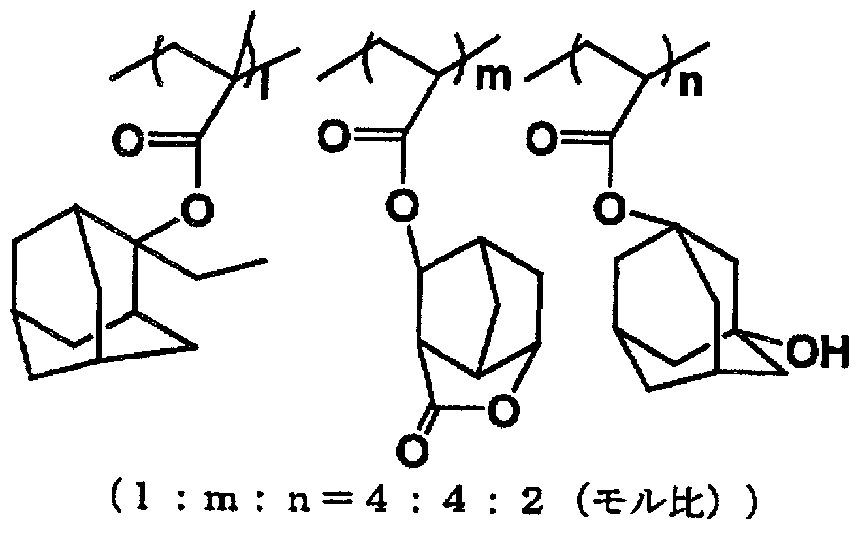
ついで、 90°C、 90秒の条件で露光後加熱 (PEB)を行った後、 2. 38質量%テトラ メチルアンモ-ゥムヒドロキシド水溶液を用いて 60秒間現像することによって、レジス ト膜にレジストパターン(寸法(直径) 160nm、高さ 300nmのホールパターン)が形成 された。
[0162] 別途、 p—メンタンに、テトライソシァネートシラン(Si (NCO) )を lOOmMとなるよう
4
溶解して、膜形成用材料を調製した。
この膜形成用材料を、前記レジストパターンの上に、スピンコート(lOOrpmで 10秒 間)で均一に塗布した後、 p—メンタンで洗浄(500rpmで 10秒間)を行い、さらに、 2 OOOrpmで 10秒間、 3000rpmで 10秒間の振り切り乾燥を行つた。
その結果、レジストパターン表面に均一な被覆層(シリコン酸ィ匕物膜 (SiO ) )が形
2 成された。この被覆層は、膜厚がおよそ lnmの超薄膜であった。
[0163] 続いて、その表面に被覆層が形成されたレジストパターンをマスクとして、 RIE (リア クティブイオンエッチング)装置 RIE— 10NR (製品名、 Samco社製)を用い、下記の エッチング条件でエッチング (酸素プラズマエッチング)を行うことにより、有機膜 (BA RC)エッチを行った。
[エッチング条件] ·ガス:酸素ガス。
'ガス流量: 30sccm (なお、「sccm」は latm (大気圧 1, 013hPa)、 23°Cにおける測 定値を示す。)。
'チャンバ内の圧力: 40Pa。
•プラズマを発生させるために印加する出力パワー(電力): 300W。
•処理時間: 20秒。
[0164] その結果、エッチング後において、レジストパターンは、エッチング前の形状がほぼ 保たれていた。さら〖こ、レジストパターンのホール部分の下の有機膜 (BARC)がほぼ
 、た。
[0165] [比較例 1]
、た。
[0165] [比較例 1]
実施例 1において、膜形成用材料の P—メンタンをクメン (沸点約 152°C)に変更し た以外は同様にして実験を行った。
その結果、エッチング後において、レジストパターンは、エッチング前の形状がほぼ 保たれていた。しかし、有機膜 (BARC)はエッチングされなかった。
[0166] [比較例 2]
実施例 1において、膜形成用材料の P—メンタンを n—ヘプタン (沸点約 98°C)に変 更した以外は同様にして実験を行った。
その結果、エッチング後において、レジストパターンは、エッチング前の形状がほぼ 保たれていた。しかし、有機膜 (BARC)はエッチングされなかった。
[0167] [比較例 3]
実施例 1において、パターンを膜形成用材料にて被覆しなカゝつた以外は同様にし て実験を行った。
その結果、エッチング後において、レジストパターンは、ほぼ無くなってしまった。
[0168] [比較例 4]
実施例 1にお ヽて、膜形成用材料の p—メンタンを下記化学式で表されるリモネン( 沸点約 176°C)に変更した以外は同様にして実験を行った。
その結果、テトライソシァネートシラン(Si (NCO) )がリモネンと反応して析出物が
4
生じ、膜形成用材料を調整することができなカゝつた。
[化 23]

[比較例 5]
実施例 1において、膜形成用材料の p—メンタンを下記化学式で表される a—ビネ ン (沸点約 156°C)に変更した以外は同様にして実験を行った。
その結果、テトライソシァネートシラン(Si (NCO) )がひ ピネンと反応して析出物
が生じ、膜形成用材料を調整することができなカゝつた。
[化 24]

[0170] このように、本発明の膜形成用材料を用いることにより、エッチング前のレジストバタ ーン形状を維持しつつ、有機膜のエッチングを行うことができた。この結果から、本発 明の膜形成用材料を用いることにより、室温レベルの低温で、高い耐ェッチング性を 有するとともに、有機膜に対して高いエッチング選択比を有する膜が形成できたこと が確認できた。
産業上の利用可能性
[0171] 本発明によれば、低温で、高い耐ェッチング性を有し、かつ有機膜に対して高いェ ツチング選択比を有する膜を形成可能な膜形成用材料、および該膜形成用材料を 用いたパターン形成方法を提供できる。従って本発明は、産業上極めて有用である
Claims
[1] 加水分解により水酸基を生成し得る金属化合物 (W)と、これを溶解して!/ヽる溶剤 (
S)とを含み、前記溶剤 (S)が、前記金属化合物 (W)と反応する官能基を有さな!/、沸 点 155°C以上の溶剤 (S1)を含有する膜形成用材料。
[2] 前記溶剤 (S1)が、下記一般式 (s— 1)で表される化合物である請求項 1に記載の 膜形成用材料。
[化 1]

[式中、 〜! ^はそれぞれ独立に水素原子、または直鎖状もしくは分岐状のアルキ ル基であって、 R21〜R23のうち少なくとも 2つはアルキル基であり、該アルキル基は、 シクロへキサン環における当該アルキル基が結合した炭素原子以外の炭素原子と結 合して環を形成していてもよい。 ]
[3] 前記溶剤 (S1)が p—メンタンである請求項 2に記載の膜形成用材料。
[4] 前記金属化合物 (W) 1S イソシァネート基および Zまたはハロゲン原子を 2個以上 有するケィ素化合物である請求項 1に記載の膜形成用材料。
[5] 基板の上に形成されたパターンをマスクとしてエッチングをするプロセスに用いられ るパターン被覆材料である請求項 1に記載の膜形成用材料。
[6] 前記パターンが、基板と有機膜とを備えた積層体の前記有機膜上に形成されたも のである請求項 5に記載の膜形成用材料。
[7] 前記パターンがレジストパターンである請求項 5に記載の膜形成用材料。
[8] 基板と有機膜とを備えた積層体の前記有機膜上に形成されたパターンを、請求項
1に記載の膜形成用材料を用いて被覆する工程と、
前記膜形成用材料を用いて被覆されたパターンをマスクとして前記有機膜のエツ チングを行う工程とを有することを特徴とするパターン形成方法。
前記エッチングが、酸素プラズマエッチング、または CFガスもしくは CHFガスを用
4 3 いたエッチングである請求項 8に記載のパターン形成方法。
Priority Applications (1)
| Application Number | Priority Date | Filing Date | Title |
|---|---|---|---|
| US11/997,300 US8101013B2 (en) | 2005-08-26 | 2006-08-24 | Film-forming material and method of forming pattern |
Applications Claiming Priority (4)
| Application Number | Priority Date | Filing Date | Title |
|---|---|---|---|
| JP2005245573 | 2005-08-26 | ||
| JP2005-245573 | 2005-08-26 | ||
| JP2005372022A JP4530980B2 (ja) | 2005-08-26 | 2005-12-26 | 膜形成用材料およびパターン形成方法 |
| JP2005-372022 | 2005-12-26 |
Publications (1)
| Publication Number | Publication Date |
|---|---|
| WO2007023908A1 true WO2007023908A1 (ja) | 2007-03-01 |
Family
ID=37771651
Family Applications (1)
| Application Number | Title | Priority Date | Filing Date |
|---|---|---|---|
| PCT/JP2006/316629 Ceased WO2007023908A1 (ja) | 2005-08-26 | 2006-08-24 | 膜形成用材料およびパターン形成方法 |
Country Status (5)
| Country | Link |
|---|---|
| US (1) | US8101013B2 (ja) |
| JP (1) | JP4530980B2 (ja) |
| KR (1) | KR100964519B1 (ja) |
| TW (1) | TWI341320B (ja) |
| WO (1) | WO2007023908A1 (ja) |
Cited By (3)
| Publication number | Priority date | Publication date | Assignee | Title |
|---|---|---|---|---|
| WO2007091569A1 (ja) * | 2006-02-10 | 2007-08-16 | Tokyo Ohka Kogyo Co., Ltd. | 膜形成用材料の製造方法 |
| JP2016530344A (ja) * | 2013-06-06 | 2016-09-29 | ハネウェル・インターナショナル・インコーポレーテッド | 液体酸化チタン組成物、それを形成するための方法、およびそれを用いて基材の、または基材を被覆する物質層をエッチングするための方法 |
| CN108267932A (zh) * | 2016-12-31 | 2018-07-10 | 罗门哈斯电子材料有限责任公司 | 图案形成方法 |
Families Citing this family (26)
| Publication number | Priority date | Publication date | Assignee | Title |
|---|---|---|---|---|
| JP4772618B2 (ja) * | 2006-07-31 | 2011-09-14 | 東京応化工業株式会社 | パターン形成方法、金属酸化物膜形成用材料およびその使用方法 |
| WO2008044326A1 (fr) * | 2006-10-12 | 2008-04-17 | Tokyo Ohka Kogyo Co., Ltd. | composition de photorésine positive et négative du type à amplification chimique pour gravure à sec à basse température, et procédé pour la formation d'un motif en photorésine l'utilisant |
| JP4871783B2 (ja) * | 2007-05-09 | 2012-02-08 | 東京応化工業株式会社 | パターン形成方法 |
| JP4871786B2 (ja) * | 2007-05-11 | 2012-02-08 | 東京応化工業株式会社 | パターン形成方法 |
| JP5023851B2 (ja) * | 2007-07-09 | 2012-09-12 | Jsr株式会社 | パターン形成方法及びそれに用いるパターンコーティング組成物 |
| KR20140117400A (ko) * | 2012-01-06 | 2014-10-07 | 히타치가세이가부시끼가이샤 | 패시베이션막이 있는 반도체 기판과 그 제조 방법, 및 태양전지 소자와 그 제조 방법 |
| JP2015052101A (ja) | 2013-08-06 | 2015-03-19 | 東京応化工業株式会社 | 膜形成用材料 |
| JP6516595B2 (ja) * | 2015-07-01 | 2019-05-22 | 東京応化工業株式会社 | 組成物及びこれを用いて得られる膜 |
| JP7008517B2 (ja) * | 2018-01-29 | 2022-01-25 | スリーエム イノベイティブ プロパティズ カンパニー | めっきマスク用硬化性組成物、マスク材及びめっきの除去方法 |
| CN113039486B (zh) | 2018-11-14 | 2024-11-12 | 朗姆研究公司 | 可用于下一代光刻法中的硬掩模制作方法 |
| US12211691B2 (en) | 2018-12-20 | 2025-01-28 | Lam Research Corporation | Dry development of resists |
| TWI837391B (zh) | 2019-06-26 | 2024-04-01 | 美商蘭姆研究公司 | 利用鹵化物化學品的光阻顯影 |
| EP3990983A4 (en) | 2019-06-28 | 2023-07-26 | Lam Research Corporation | BAKING STRATEGIES TO INCREASE THE LITHOGRAPHIC PERFORMANCE OF A METAL CONTAINING RESIST |
| SG11202108851RA (en) | 2020-01-15 | 2021-09-29 | Lam Res Corp | Underlayer for photoresist adhesion and dose reduction |
| CN115362414A (zh) | 2020-04-03 | 2022-11-18 | 朗姆研究公司 | 用于增强euv光刻性能的暴露前光致抗蚀剂固化 |
| CN115702475A (zh) | 2020-06-22 | 2023-02-14 | 朗姆研究公司 | 用于含金属光致抗蚀剂沉积的表面改性 |
| EP4078292A4 (en) | 2020-07-07 | 2023-11-22 | Lam Research Corporation | Integrated dry processes for patterning radiation photoresist patterning |
| US20230107357A1 (en) | 2020-11-13 | 2023-04-06 | Lam Research Corporation | Process tool for dry removal of photoresist |
| JP7681106B2 (ja) | 2020-12-08 | 2025-05-21 | ラム リサーチ コーポレーション | 有機蒸気によるフォトレジストの現像 |
| US12051626B2 (en) * | 2021-08-27 | 2024-07-30 | Taiwan Semiconductor Manufacturing Company, Ltd. | Fin Field-Effect transistor and method of forming the same |
| KR20250003664A (ko) * | 2022-05-04 | 2025-01-07 | 램 리써치 코포레이션 | 금속-함유 포토레지스트의 현상-후 처리 |
| KR102725782B1 (ko) | 2022-07-01 | 2024-11-05 | 램 리써치 코포레이션 | 에칭 정지 억제 (etch stop deterrence) 를 위한 금속 옥사이드 기반 포토레지스트의 순환적 현상 |
| CN115505389B (zh) * | 2022-08-22 | 2023-04-28 | 福建天甫电子材料有限公司 | 一种ito蚀刻液及其使用方法 |
| JP2024038909A (ja) * | 2022-09-08 | 2024-03-21 | 株式会社ディスコ | ウェーハの加工方法及び保護膜剤 |
| US12474640B2 (en) | 2023-03-17 | 2025-11-18 | Lam Research Corporation | Integration of dry development and etch processes for EUV patterning in a single process chamber |
| JP7852072B2 (ja) | 2023-07-27 | 2026-04-27 | ラム リサーチ コーポレーション | 金属含有フォトレジストのためのオールインワン乾式現像 |
Citations (10)
| Publication number | Priority date | Publication date | Assignee | Title |
|---|---|---|---|---|
| JPH09291256A (ja) * | 1996-04-25 | 1997-11-11 | Toagosei Co Ltd | 保存安定性の改良された塗料用組成物 |
| JPH10511707A (ja) * | 1994-10-24 | 1998-11-10 | ザ ダウ ケミカル カンパニー | 定着剤及び自己下塗性アリールシクロブテン樹脂組成物 |
| JPH11279485A (ja) * | 1998-03-30 | 1999-10-12 | Toagosei Co Ltd | 塗料用組成物 |
| JP2001055554A (ja) * | 1999-08-20 | 2001-02-27 | Jsr Corp | 膜形成用組成物および絶縁膜形成用材料 |
| JP2001342439A (ja) * | 2000-03-31 | 2001-12-14 | Jsr Corp | コーティング用組成物 |
| JP2002241695A (ja) * | 2000-12-15 | 2002-08-28 | Dow Corning Toray Silicone Co Ltd | 撥水性シリコーンコーティング剤組成物 |
| JP2003105266A (ja) * | 2001-09-28 | 2003-04-09 | Dainippon Ink & Chem Inc | 粉体塗料及び塗膜形成方法 |
| JP2004325653A (ja) * | 2003-04-23 | 2004-11-18 | Fujitsu Ltd | 微細パターン形成方法、磁気記録装置の製造方法、及び、微細パターン形成装置 |
| JP2005150222A (ja) * | 2003-11-12 | 2005-06-09 | Semiconductor Leading Edge Technologies Inc | パターン形成方法 |
| JP2005162950A (ja) * | 2003-12-04 | 2005-06-23 | Shinto Paint Co Ltd | 高耐候性の塗料用樹脂組成物 |
Family Cites Families (12)
| Publication number | Priority date | Publication date | Assignee | Title |
|---|---|---|---|---|
| JPH083074B2 (ja) | 1986-11-18 | 1996-01-17 | 東京応化工業株式会社 | シリカ系被膜形成用塗布液 |
| JP3282882B2 (ja) * | 1993-05-07 | 2002-05-20 | ナミックス株式会社 | 誘電体保護剤 |
| JP2739902B2 (ja) | 1993-09-30 | 1998-04-15 | 東京応化工業株式会社 | 酸化ケイ素系被膜形成用塗布液 |
| FR2782522B1 (fr) * | 1998-08-19 | 2003-10-03 | Atochem Elf Sa | Composition hydrofuge |
| JP3228714B2 (ja) | 1999-01-13 | 2001-11-12 | 東京応化工業株式会社 | シリカ系被膜及びその製造方法 |
| DE19941020B4 (de) * | 1999-08-28 | 2007-07-19 | Ferro Gmbh | Glanzedelmetallpräparat für den Hochtemperaturbrand und Verfahren zur Herstellung von Glanzedelmetalldekoren |
| DE19946712A1 (de) * | 1999-09-29 | 2001-04-05 | Inst Neue Mat Gemein Gmbh | Verfahren und Zusammensetzungen zum Bedrucken von Substraten |
| US6503693B1 (en) * | 1999-12-02 | 2003-01-07 | Axcelis Technologies, Inc. | UV assisted chemical modification of photoresist |
| EP1138732B1 (en) | 2000-03-31 | 2005-08-31 | JSR Corporation | Coating composition and cured product |
| JP3836359B2 (ja) | 2001-12-03 | 2006-10-25 | 東京応化工業株式会社 | ポジ型レジスト組成物及びレジストパターン形成方法 |
| US6887308B2 (en) * | 2003-01-21 | 2005-05-03 | Johnsondiversey, Inc. | Metal coating coupling composition |
| JP2006054353A (ja) * | 2004-08-13 | 2006-02-23 | Az Electronic Materials Kk | フラットバンドシフトの少ないシリカ質膜およびその製造法 |
-
2005
- 2005-12-26 JP JP2005372022A patent/JP4530980B2/ja not_active Expired - Fee Related
-
2006
- 2006-08-24 TW TW095131190A patent/TWI341320B/zh active
- 2006-08-24 US US11/997,300 patent/US8101013B2/en active Active
- 2006-08-24 KR KR1020087004627A patent/KR100964519B1/ko active Active
- 2006-08-24 WO PCT/JP2006/316629 patent/WO2007023908A1/ja not_active Ceased
Patent Citations (10)
| Publication number | Priority date | Publication date | Assignee | Title |
|---|---|---|---|---|
| JPH10511707A (ja) * | 1994-10-24 | 1998-11-10 | ザ ダウ ケミカル カンパニー | 定着剤及び自己下塗性アリールシクロブテン樹脂組成物 |
| JPH09291256A (ja) * | 1996-04-25 | 1997-11-11 | Toagosei Co Ltd | 保存安定性の改良された塗料用組成物 |
| JPH11279485A (ja) * | 1998-03-30 | 1999-10-12 | Toagosei Co Ltd | 塗料用組成物 |
| JP2001055554A (ja) * | 1999-08-20 | 2001-02-27 | Jsr Corp | 膜形成用組成物および絶縁膜形成用材料 |
| JP2001342439A (ja) * | 2000-03-31 | 2001-12-14 | Jsr Corp | コーティング用組成物 |
| JP2002241695A (ja) * | 2000-12-15 | 2002-08-28 | Dow Corning Toray Silicone Co Ltd | 撥水性シリコーンコーティング剤組成物 |
| JP2003105266A (ja) * | 2001-09-28 | 2003-04-09 | Dainippon Ink & Chem Inc | 粉体塗料及び塗膜形成方法 |
| JP2004325653A (ja) * | 2003-04-23 | 2004-11-18 | Fujitsu Ltd | 微細パターン形成方法、磁気記録装置の製造方法、及び、微細パターン形成装置 |
| JP2005150222A (ja) * | 2003-11-12 | 2005-06-09 | Semiconductor Leading Edge Technologies Inc | パターン形成方法 |
| JP2005162950A (ja) * | 2003-12-04 | 2005-06-23 | Shinto Paint Co Ltd | 高耐候性の塗料用樹脂組成物 |
Cited By (3)
| Publication number | Priority date | Publication date | Assignee | Title |
|---|---|---|---|---|
| WO2007091569A1 (ja) * | 2006-02-10 | 2007-08-16 | Tokyo Ohka Kogyo Co., Ltd. | 膜形成用材料の製造方法 |
| JP2016530344A (ja) * | 2013-06-06 | 2016-09-29 | ハネウェル・インターナショナル・インコーポレーテッド | 液体酸化チタン組成物、それを形成するための方法、およびそれを用いて基材の、または基材を被覆する物質層をエッチングするための方法 |
| CN108267932A (zh) * | 2016-12-31 | 2018-07-10 | 罗门哈斯电子材料有限责任公司 | 图案形成方法 |
Also Published As
| Publication number | Publication date |
|---|---|
| US20090134119A1 (en) | 2009-05-28 |
| KR100964519B1 (ko) | 2010-06-21 |
| TWI341320B (en) | 2011-05-01 |
| US8101013B2 (en) | 2012-01-24 |
| JP4530980B2 (ja) | 2010-08-25 |
| KR20080032242A (ko) | 2008-04-14 |
| TW200720378A (en) | 2007-06-01 |
| JP2007086711A (ja) | 2007-04-05 |
Similar Documents
| Publication | Publication Date | Title |
|---|---|---|
| JP4530980B2 (ja) | 膜形成用材料およびパターン形成方法 | |
| JP4772618B2 (ja) | パターン形成方法、金属酸化物膜形成用材料およびその使用方法 | |
| CN105492972B (zh) | 作为硬掩模和填充材料的稳定的金属化合物、其组合物以及使用方法 | |
| JP4933063B2 (ja) | パターン形成方法 | |
| TWI525163B (zh) | 用於塗覆光阻圖樣之組合物 | |
| TW201245889A (en) | Multilayer resist process pattern forming method and inorganic film forming composition for multilayer resist process | |
| JP4871786B2 (ja) | パターン形成方法 | |
| TWI374478B (en) | Electronic device manufacture | |
| JP4943428B2 (ja) | 感光性樹脂組成物及びパターン形成方法 | |
| JPWO2004111734A1 (ja) | ポジ型レジスト組成物、レジスト積層体、およびレジストパターン形成方法 | |
| JP4871783B2 (ja) | パターン形成方法 | |
| JP2007114715A (ja) | パターン形成方法 | |
| JP2007191509A (ja) | エレクトロニクス用洗浄液及びパターン形成方法 | |
| JP2007192875A (ja) | 下層膜形成用材料、積層体およびパターン形成方法 | |
| JP2009056576A (ja) | 構造体の製造方法、構造体 | |
| JP4970803B2 (ja) | 膜形成用材料の製造方法 | |
| JP2007114716A (ja) | パターン形成方法 | |
| JP4159963B2 (ja) | レジスト積層体およびパターン形成方法 | |
| KR100758870B1 (ko) | 저가속 전자선용 포지티브형 레지스트 조성물, 레지스트적층체 및 패턴 형성 방법 | |
| JP2008310026A (ja) | 熱リソグラフィーによるレジストパターン形成方法 | |
| JP2008096937A (ja) | 熱リソグラフィー用下層膜形成用材料、レジスト積層体およびレジストパターン形成方法 |
Legal Events
| Date | Code | Title | Description |
|---|---|---|---|
| 121 | Ep: the epo has been informed by wipo that ep was designated in this application | ||
| WWE | Wipo information: entry into national phase |
Ref document number: 11997300 Country of ref document: US |
|
| NENP | Non-entry into the national phase |
Ref country code: DE |
|
| 122 | Ep: pct application non-entry in european phase |
Ref document number: 06796742 Country of ref document: EP Kind code of ref document: A1 |