WO2007010919A1 - 含フッ素共重合体、アルカリ現像性樹脂組成物及びアルカリ現像性感光性樹脂組成物 - Google Patents
含フッ素共重合体、アルカリ現像性樹脂組成物及びアルカリ現像性感光性樹脂組成物 Download PDFInfo
- Publication number
- WO2007010919A1 WO2007010919A1 PCT/JP2006/314228 JP2006314228W WO2007010919A1 WO 2007010919 A1 WO2007010919 A1 WO 2007010919A1 JP 2006314228 W JP2006314228 W JP 2006314228W WO 2007010919 A1 WO2007010919 A1 WO 2007010919A1
- Authority
- WO
- WIPO (PCT)
- Prior art keywords
- fluorine
- alkali
- resin composition
- group
- developable
- Prior art date
- Legal status (The legal status is an assumption and is not a legal conclusion. Google has not performed a legal analysis and makes no representation as to the accuracy of the status listed.)
- Ceased
Links
Classifications
-
- C—CHEMISTRY; METALLURGY
- C08—ORGANIC MACROMOLECULAR COMPOUNDS; THEIR PREPARATION OR CHEMICAL WORKING-UP; COMPOSITIONS BASED THEREON
- C08F—MACROMOLECULAR COMPOUNDS OBTAINED BY REACTIONS ONLY INVOLVING CARBON-TO-CARBON UNSATURATED BONDS
- C08F299/00—Macromolecular compounds obtained by interreacting polymers involving only carbon-to-carbon unsaturated bond reactions, in the absence of non-macromolecular monomers
-
- C—CHEMISTRY; METALLURGY
- C08—ORGANIC MACROMOLECULAR COMPOUNDS; THEIR PREPARATION OR CHEMICAL WORKING-UP; COMPOSITIONS BASED THEREON
- C08F—MACROMOLECULAR COMPOUNDS OBTAINED BY REACTIONS ONLY INVOLVING CARBON-TO-CARBON UNSATURATED BONDS
- C08F293/00—Macromolecular compounds obtained by polymerisation on to a macromolecule having groups capable of inducing the formation of new polymer chains bound exclusively at one or both ends of the starting macromolecule
-
- C—CHEMISTRY; METALLURGY
- C08—ORGANIC MACROMOLECULAR COMPOUNDS; THEIR PREPARATION OR CHEMICAL WORKING-UP; COMPOSITIONS BASED THEREON
- C08F—MACROMOLECULAR COMPOUNDS OBTAINED BY REACTIONS ONLY INVOLVING CARBON-TO-CARBON UNSATURATED BONDS
- C08F214/00—Copolymers of compounds having one or more unsaturated aliphatic radicals, each having only one carbon-to-carbon double bond, and at least one being terminated by a halogen
- C08F214/18—Monomers containing fluorine
-
- C—CHEMISTRY; METALLURGY
- C08—ORGANIC MACROMOLECULAR COMPOUNDS; THEIR PREPARATION OR CHEMICAL WORKING-UP; COMPOSITIONS BASED THEREON
- C08F—MACROMOLECULAR COMPOUNDS OBTAINED BY REACTIONS ONLY INVOLVING CARBON-TO-CARBON UNSATURATED BONDS
- C08F297/00—Macromolecular compounds obtained by successively polymerising different monomer systems using a catalyst of the ionic or coordination type without deactivating the intermediate polymer
- C08F297/02—Macromolecular compounds obtained by successively polymerising different monomer systems using a catalyst of the ionic or coordination type without deactivating the intermediate polymer using a catalyst of the anionic type
-
- C—CHEMISTRY; METALLURGY
- C08—ORGANIC MACROMOLECULAR COMPOUNDS; THEIR PREPARATION OR CHEMICAL WORKING-UP; COMPOSITIONS BASED THEREON
- C08F—MACROMOLECULAR COMPOUNDS OBTAINED BY REACTIONS ONLY INVOLVING CARBON-TO-CARBON UNSATURATED BONDS
- C08F299/00—Macromolecular compounds obtained by interreacting polymers involving only carbon-to-carbon unsaturated bond reactions, in the absence of non-macromolecular monomers
- C08F299/02—Macromolecular compounds obtained by interreacting polymers involving only carbon-to-carbon unsaturated bond reactions, in the absence of non-macromolecular monomers from unsaturated polycondensates
-
- C—CHEMISTRY; METALLURGY
- C08—ORGANIC MACROMOLECULAR COMPOUNDS; THEIR PREPARATION OR CHEMICAL WORKING-UP; COMPOSITIONS BASED THEREON
- C08L—COMPOSITIONS OF MACROMOLECULAR COMPOUNDS
- C08L53/00—Compositions of block copolymers containing at least one sequence of a polymer obtained by reactions only involving carbon-to-carbon unsaturated bonds; Compositions of derivatives of such polymers
-
- C—CHEMISTRY; METALLURGY
- C08—ORGANIC MACROMOLECULAR COMPOUNDS; THEIR PREPARATION OR CHEMICAL WORKING-UP; COMPOSITIONS BASED THEREON
- C08L—COMPOSITIONS OF MACROMOLECULAR COMPOUNDS
- C08L53/00—Compositions of block copolymers containing at least one sequence of a polymer obtained by reactions only involving carbon-to-carbon unsaturated bonds; Compositions of derivatives of such polymers
- C08L53/005—Modified block copolymers
-
- C—CHEMISTRY; METALLURGY
- C09—DYES; PAINTS; POLISHES; NATURAL RESINS; ADHESIVES; COMPOSITIONS NOT OTHERWISE PROVIDED FOR; APPLICATIONS OF MATERIALS NOT OTHERWISE PROVIDED FOR
- C09J—ADHESIVES; NON-MECHANICAL ASPECTS OF ADHESIVE PROCESSES IN GENERAL; ADHESIVE PROCESSES NOT PROVIDED FOR ELSEWHERE; USE OF MATERIALS AS ADHESIVES
- C09J153/00—Adhesives based on block copolymers containing at least one sequence of a polymer obtained by reactions only involving carbon-to-carbon unsaturated bonds; Adhesives based on derivatives of such polymers
-
- C—CHEMISTRY; METALLURGY
- C09—DYES; PAINTS; POLISHES; NATURAL RESINS; ADHESIVES; COMPOSITIONS NOT OTHERWISE PROVIDED FOR; APPLICATIONS OF MATERIALS NOT OTHERWISE PROVIDED FOR
- C09J—ADHESIVES; NON-MECHANICAL ASPECTS OF ADHESIVE PROCESSES IN GENERAL; ADHESIVE PROCESSES NOT PROVIDED FOR ELSEWHERE; USE OF MATERIALS AS ADHESIVES
- C09J153/00—Adhesives based on block copolymers containing at least one sequence of a polymer obtained by reactions only involving carbon-to-carbon unsaturated bonds; Adhesives based on derivatives of such polymers
- C09J153/005—Modified block copolymers
-
- G—PHYSICS
- G03—PHOTOGRAPHY; CINEMATOGRAPHY; ANALOGOUS TECHNIQUES USING WAVES OTHER THAN OPTICAL WAVES; ELECTROGRAPHY; HOLOGRAPHY
- G03F—PHOTOMECHANICAL PRODUCTION OF TEXTURED OR PATTERNED SURFACES, e.g. FOR PRINTING, FOR PROCESSING OF SEMICONDUCTOR DEVICES; MATERIALS THEREFOR; ORIGINALS THEREFOR; APPARATUS SPECIALLY ADAPTED THEREFOR
- G03F7/00—Photomechanical, e.g. photolithographic, production of textured or patterned surfaces, e.g. printing surfaces; Materials therefor, e.g. comprising photoresists; Apparatus specially adapted therefor
- G03F7/004—Photosensitive materials
- G03F7/0046—Photosensitive materials with perfluoro compounds, e.g. for dry lithography
-
- G—PHYSICS
- G03—PHOTOGRAPHY; CINEMATOGRAPHY; ANALOGOUS TECHNIQUES USING WAVES OTHER THAN OPTICAL WAVES; ELECTROGRAPHY; HOLOGRAPHY
- G03F—PHOTOMECHANICAL PRODUCTION OF TEXTURED OR PATTERNED SURFACES, e.g. FOR PRINTING, FOR PROCESSING OF SEMICONDUCTOR DEVICES; MATERIALS THEREFOR; ORIGINALS THEREFOR; APPARATUS SPECIALLY ADAPTED THEREFOR
- G03F7/00—Photomechanical, e.g. photolithographic, production of textured or patterned surfaces, e.g. printing surfaces; Materials therefor, e.g. comprising photoresists; Apparatus specially adapted therefor
- G03F7/004—Photosensitive materials
- G03F7/027—Non-macromolecular photopolymerisable compounds having carbon-to-carbon double bonds, e.g. ethylenic compounds
- G03F7/032—Non-macromolecular photopolymerisable compounds having carbon-to-carbon double bonds, e.g. ethylenic compounds with binders
- G03F7/033—Non-macromolecular photopolymerisable compounds having carbon-to-carbon double bonds, e.g. ethylenic compounds with binders the binders being polymers obtained by reactions only involving carbon-to-carbon unsaturated bonds, e.g. vinyl polymers
-
- G—PHYSICS
- G03—PHOTOGRAPHY; CINEMATOGRAPHY; ANALOGOUS TECHNIQUES USING WAVES OTHER THAN OPTICAL WAVES; ELECTROGRAPHY; HOLOGRAPHY
- G03F—PHOTOMECHANICAL PRODUCTION OF TEXTURED OR PATTERNED SURFACES, e.g. FOR PRINTING, FOR PROCESSING OF SEMICONDUCTOR DEVICES; MATERIALS THEREFOR; ORIGINALS THEREFOR; APPARATUS SPECIALLY ADAPTED THEREFOR
- G03F7/00—Photomechanical, e.g. photolithographic, production of textured or patterned surfaces, e.g. printing surfaces; Materials therefor, e.g. comprising photoresists; Apparatus specially adapted therefor
- G03F7/004—Photosensitive materials
- G03F7/038—Macromolecular compounds which are rendered insoluble or differentially wettable
- G03F7/0388—Macromolecular compounds which are rendered insoluble or differentially wettable with ethylenic or acetylenic bands in the side chains of the photopolymer
-
- C—CHEMISTRY; METALLURGY
- C08—ORGANIC MACROMOLECULAR COMPOUNDS; THEIR PREPARATION OR CHEMICAL WORKING-UP; COMPOSITIONS BASED THEREON
- C08L—COMPOSITIONS OF MACROMOLECULAR COMPOUNDS
- C08L2666/00—Composition of polymers characterized by a further compound in the blend, being organic macromolecular compounds, natural resins, waxes or and bituminous materials, non-macromolecular organic substances, inorganic substances or characterized by their function in the composition
- C08L2666/02—Organic macromolecular compounds, natural resins, waxes or and bituminous materials
Definitions
- the present invention relates to a fluorine-containing copolymer, an alkali-developable resin composition containing the fluorine-containing copolymer and a specific compound having an ethylenically unsaturated bond, and the alkali-developable resin composition.
- the present invention relates to an alkali-developable photosensitive resin composition containing a photopolymerization initiator.
- An alkali-developable photosensitive resin composition contains an alkali-developable resin composition containing a compound having an ethylenically unsaturated bond and a photopolymerization initiator. Since this alkali-developable photosensitive resin composition can be polymerized and cured by irradiation with ultraviolet rays or electron beams, photocurable ink, photosensitive printing plate, printed wiring plate, various photoresists, Used in color filters used in color liquid crystal display devices and image sensors. Recently, along with the progress of miniaturization and high functionality of electronic devices, an alkali-developable photosensitive resin composition capable of forming a fine pattern with high accuracy is desired.
- the alkali-developable photosensitive composition has been used for color filter substrates used in color display devices such as color liquid crystal displays.
- an inkjet method has been proposed as a simple method for producing the color filter substrates. Being sung.
- Patent Document 1 discloses a color filter using a black matrix containing a fluorine-containing compound
- Patent Document 2 discloses a fluorine-containing substrate.
- a resin composition for a color filter containing a copolymer and a fluorine-containing organic compound is disclosed.
- Patent Document 1 Patent No. 3470352
- Patent Document 2 Specification of Patent No. 3644243
- the alkali-developable photosensitive resin composition using the alkali-developable resin composition has a poor ink repellency when the pixel pattern is formed using the inkjet method, and the colorant is colored and diffuses outside the intended area. There is a problem that coating properties are poor, such as display unevenness. There was also a problem of poor alkali developability.
- the problems to be solved are excellent in ink repellency and alkali developability, and have an appropriate pattern while maintaining characteristics such as sensitivity, resolution, transparency, adhesion, and alkali resistance.
- the alkali-developable resin composition and alkaline-developable photosensitive resin composition that can efficiently obtain the shape and fine pattern of the ink are the key to date.
- an object of the present invention is to provide an alkali-developable resin composition and an alkali-developable photosensitive resin composition that have solved the above problems.
- the present invention is a block copolymer (C) having both an A segment and a B segment, wherein the A segment is a fluorine-containing segment obtained from one or more types of fluorine-based monomers (A).
- the segment is a non-fluorine segment that can also obtain one or more types of non-fluorine monomers (B), and the A segment and the Z or B segment have a hydroxyl group in part or all of the hydroxyl groups of the block copolymer (C).
- the above object is achieved by providing a fluorine-containing copolymer) obtained by modifying with a basic acid anhydride (D).
- the present invention provides an epoxy adduct having a structure in which an unsaturated monobasic acid (G) is added to a polyfunctional epoxy resin (F), and a polybasic acid anhydride (D ').
- the object is achieved by providing an alkali-developable resin composition containing the reaction product (H) obtained by the esterification reaction, and the fluorine-containing copolymer (E). .
- the present invention achieves the above-mentioned object by providing an alkali-developable photosensitive resin composition comprising a photopolymerization initiator ⁇ in the alkali-developable resin composition. is there.
- FIG. 1 is an IR chart of fluorinated copolymer No. 1.
- the fluorine-containing copolymer (E) of the present invention contains one or two or more kinds of fluorine-based monomers (A) A segment that is a powerful fluorine-containing segment, one kind or two or more kinds of fluorine atoms.
- A A segment that is a powerful fluorine-containing segment, one kind or two or more kinds of fluorine atoms.
- the hydroxyl group of the block copolymer (C) having a B segment which is a non-fluorine segment that also has a non-fluorinated monomer (B) force, and further having a hydroxyl group in the A segment and Z or B segment is converted to a polybasic acid anhydride ( Denatured in D).
- the fluorine-based monomer (A) is preferably a fluorine-based monomer represented by the following general formula (I) or general formula (II).
- R 1 and R 2 are perfluoroalkyls optionally having a hydroxyl group of 1 to 30 carbon atoms.
- R ′ represents a hydrogen atom or a methyl group
- Z 1 represents a direct bond, —R ′, —NR—SO —
- H—O—force represents a selected group
- R ′ represents an alkylene group having 1 to 4 carbon atoms
- R ′ represents an alkylene group having 1 to 4 carbon atoms
- R is a hydrogen atom or a hydroxy acid having 1 to 30 carbon atoms
- the alkyl group which may have a group is represented. )
- fluoroalkyl group examples include F (CF) (CH), F (CF) (CH), F ( CF) (CH), F ( CF) (CH), H (CF) CH, (CF) CF (CF) (CH), (CF) CF (CF) (CH)
- alkyl group which may have 1 to 30 hydroxyl groups include methyl, ethyl, propyl, isopropyl, butyl, sec-butyl, tert-butyl, isobutyl, amyl, isoamyl, tertiary amyl, hexyl, cyclohexane Hexyl, cyclohexylmethyl, cyclohexylethyl, heptinole, isoheptinole, tertiary heptinole, n-octinole, isooctinole, tertiary octinole, 2-ethylhexyl, decyl, isodecyl, undecyl, lauryl, dodecyl, hexyl Xadecyl, stearyl, behexyl, glycidyl, 2-hydroxyethyl, 3-hydroxypropyl
- the fluorine-based monomer (A) includes, in addition to the fluorine-based monomer represented by the general formula (I) or the general formula (II), polyvinylidene fluoride, fluororefinbul ether.
- a copolymer include trifluorinated styrene, vinylidene fluoride copolymer, polytetrafluoroethylene, perfluoroethylenepropylene, and perfluoroalkoxy.
- the non-fluorine monomer (B) is preferably a (meth) acrylic acid monomer, more preferably a (meth) acrylic acid monomer represented by the following general formula (V) or (VI).
- R represents a hydrogen atom or a methyl group
- R 9 may have a hydroxyl group having 1 to 30 carbon atoms and a hydroxyl group having 1 to 30 carbon atoms which may have a hydroxyl group! ⁇ represents a cycloalkyl group or an aryl group that may have a hydroxyl group having 1 to 30 carbon atoms
- Z 2 is the same as Z 1 in the general formula (II).
- R 1Q and R 11 are the same as R 8 in the general formula (V), and Z 3 represents an alkylene group having 2 to 8 carbon atoms.
- the alkyl group optionally having a hydroxyl group of 1 to 30 carbon atoms represented by R 9 is the substituent exemplified by R in the general formula (II). And may have a hydroxyl group of 1 to 30 carbon atoms represented by R 9.
- Examples of the cycloalkyl group include cyclopropylene, cyclobutynole, cyclopentyl, cyclohexyl, methylcyclohexyl, cycloheptyl, Cyclooctyl, cyclohexyl, cyclodecyl, 1-hydroxycyclohexyl, 2 hydroxycyclohexyl, 3 hydroxycyclohexyl, 4 hydroxycyclohexyl, etc., and those having 1 to 30 carbon atoms represented by R 9
- Examples of aryl groups that may have a hydroxyl group include phenol, naphthyl, 2-methylphenol, 3-methylphenol, 4-methylphenol, 4-phenol, 3-isopropyl.
- the alkylene group having 2 to 8 carbon atoms represented by Z 3 includes ethylene, methylene, ethylene, propylene, butylene, methylethylene, pentylene, hexylene, Examples include heptalene and octylene.
- non-fluorine monomer (B) in addition to the (meth) acrylic acid monomer represented by the general formula (V) or (VI), diisopropyl fumarate, dicyclohexyl fumarate, fumarate Hydroxyl-containing vinyl monomers such as di-tert-butyl acid, diisoptyl fumarate, dibenzyl fumarate, 2-hydroxyethyl (meth) acrylate, 2-hydroxypropyl (meth) acrylate, and aryl alcohol , Vinyl monomers containing carboxylic acid groups such as (meth) acrylic acid, itaconic acid, fumaric acid, maleic acid, citraconic acid, benzoic acid butyl, crotonic acid, maleic acid, fumaric acid, (meth) acrylamide, N —Minol (meth) acrylamide, N, N—dimethyl (meth) acrylamide, N- (meth) atalyloylmorpholine and other amide group-containing vinyl Mono
- the block copolymer (C) according to the present invention has a hydroxyl group in the A segment and the Z or B segment.
- a hydroxyl group in the A segment and the Z or B segment.
- the non-fluorine monomer (B) has a hydroxyl group.
- One or more monomers may be used.
- the fluorine effect such as ink repellency of the fluorine-containing copolymer (E) may be inhibited. Therefore, the one introduced only in the B segment is preferable.
- the easiest method for introducing a hydroxyl group into the B segment is to use a (meth) acrylic acid ester having a hydroxyl group as an ester component in the non-fluorinated monomer (B).
- a (meth) acrylic acid ester having a hydroxyl group as an ester component in the non-fluorinated monomer (B).
- diethylene glycol and (meth) acrylic acid ester, (meth) acrylic acid glycidyl It can be introduced from the alcohol adduct of the ester.
- the block copolymer (C) can be produced, for example, by a polymer polymerization method and a polymerization method using polymer peroxide as a polymerization initiator.
- the molecular weight distribution adjusting agent and, if necessary, diphenylethylene are charged into a sufficiently dried container, and the solvent and the char-on polymerization are started in a nitrogen atmosphere.
- the agent is introduced and the temperature is raised to 120-50 ° C.
- one or more of the fluorine-based monomers (A) are dropped over 1 second to 10 minutes and held for 5 minutes to 10 hours.
- one or more of the non-fluorinated monomers (B) are added dropwise over 1 second to 10 minutes and held for 5 minutes to 24 hours.
- a compound having an active proton such as methanol is added to inactivate the cation species.
- Examples of the solvent include benzene, toluene, ethylbenzene, propylbenzene, butylbenzene, xylene, cyclopentane, cyclohexane, hexane, heptane, octane, nonane, decane, undecane, dodecane, jetyl ether, dipropyl ether, and the like.
- Examples thereof include solvents having no active proton, such as tenole, dibutinoleethenore, dipentinoleethenore, dihexinoleethenore, tetrahydrofuran and dioxane. These solvents can be used alone or in combination.
- Examples of the above-mentioned polymerization initiator include alkyl metals such as ethyllithium, propyllithium, n-butyllithium, sbutyllithium, tbutyllithium, methyl magnesium chloride, ethylmagnesium chloride, propylmagnesium chloride. , Butyl magnesium chloride, phenol magnesium chloride, 4-methylphenol
- Grignard reagents such as humubromide, 4-methylphenol magnesium bromide, alkali metals such as lithium, sodium, potassium, lithium methoxide, lithium ethoxide, lithium propoxide, lithium butoxide, sodium methoxide, sodium ethoxide, sodium propoxy And metal alcoholates such as sodium butoxide, potassium methoxide, potassium ethoxide, strong rhodium propoxide and potassium butoxide.
- the ion polymerization initiator may be used as a diphenol. It is also possible to react the ruthenium in advance and use the reaction product. In this case, the amount of diphenylethylene used is 0.5 to 3 mol, preferably 1 to 2 mol, based on 1 mol of the cation polymerization initiator! /.
- Examples of the molecular weight distribution regulator include lithium chloride, lithium bromide, lithium methoxide, lithium (2-methoxyethoxide), lithium (2-ethoxyethoxide), lithium (2-proboxetoxide), Lithium (2-butoxetoxide), lithium (2- (2-methoxyethoxy) ethoxide), sodium chloride, sodium bromide, sodium ethoxide, sodium (2-methoxyethoxide), sodium (2-ethoxyethoxide), Sodium (2-Proboxetoxide), Sodium (2-Butoxyshoxide), Sodium (2- (2-Methoxyethoxy) ethoxide), Potassium chloride, Potassium bromide, Potassium ethoxide, Potassium (2-Methoxyethoxide) ), Potassium (2-e Kishetokishido), potassium (2-pro Boki shell butoxide), potassium (2-butoxide shell butoxide), potassium (2- (2-Metokishe but
- the polymerization method using polymeric peroxide as a polymerization initiator it can be produced by using ordinary polymer polymerization method, suspension polymerization method, solution polymerization method, emulsion polymerization method using polymeric baroxide. .
- a method of forming the non-fluorine monomer (B) in the first step and the fluorine monomer (A) in the second step can be used. That is, a peroxide-containing non-fluorinated polymer in which a peroxide bond is introduced into a chain by polymerizing a non-fluorinated monomer (B) in a solvent using a polymer peroxide as a polymerization initiator.
- the fluorine monomer (A) in the second step may be used in the first step
- the non-fluorine monomer (B) in the first step may be used in the second step.
- the amount of polymeric peroxide used in the first step is usually 0.5 to 20 parts by mass with respect to 100 parts by mass of the monomer, the polymerization temperature is 60 to 130 ° C, and the polymerization time is 2 to 10 parts. It's time.
- the polymerization temperature in the second step is usually 60 to 140 ° C., and the polymerization time is 3 to 15 hours.
- the polymeric peroxide is a compound having two or more peroxide bonds in one molecule.
- the polymer peroxide one or more of various polymer peroxides described in JP-B-5-59942 can be used.
- the solvent is not particularly limited as long as it can dissolve or disperse the obtained block copolymer (C).
- C block copolymer
- water methyl alcohol, ethyl alcohol, propyl alcohol, 2-propino oleanol Reconole, 1-Butino Renoreconole, 2-Butino Renoreconole, 2-Methinore 1 Propanore, 2-Methinore 2-Propanenore, 1 Pentanolenore, 2-Pentanol, 3 Pentanol, Cyclopentanol, 2 Hexanol, 3 Hexanol, Cyclohexanol, Methylcetosolve, Ethylcetosolve, Acetone, 2-Butanone, 3-Methyl-2-butanone, 2 Pentanone, 3-Pentanone, 2-Methyl-3-pentanone, 3-Methyl-2 Pentanone, 4-Methyl-2 Pentanone, 2, 4 Dimethyl
- Examples of the polybasic acid anhydride (D) include succinic acid anhydride, maleic acid anhydride, trimellitic acid anhydride, pyromellitic acid anhydride, 2, 2, 1 3, 3, and 1benzov.
- Enone tetracarboxylic acid anhydrous 3, 3, 1, 4, 4, monobenzophenone tetracarboxylic anhydride, ethylene glycol bisanhydro trimellitate, glycerol tris anhydro trimellitate, phthalic anhydride Oxahydrophthalic anhydride, methyltetrahydrophthalic anhydride, tetrahydrophthalic anhydride, nadic anhydride, methylnadic anhydride, trialkyltetrahydrophthalic anhydride, hexahydrophthalic anhydride, 5- (2,5 dixotetrahydro Furyl) -3-methyl-3-cyclohexene-1,2-dicarboxylic anhydride, trialkyltetrahydrophthalic anhydride maleic anhydride
- a known method can be used as a method for producing the fluorine-containing copolymer (E), and is not particularly limited.
- the block copolymer (C) is dissolved in a solvent to obtain a polybasic compound. It can be obtained by reacting the acid anhydride (D) at a ratio of 0.1 to 1 mol, preferably 0.8 to 1 mol, with respect to 1 mol of the hydroxyl group in the block copolymer (C). it can.
- the polymerization temperature is 80 to 140 ° C., and the polymerization time is 2 to 10 hours.
- the solvent is not particularly limited, but ether solvents such as ethyl ether, dioxane, tetrahydrofuran, 1,2-dimethoxyethane, 1,2-diethoxyethane, dipropylene glycol dimethyl ether; methyl acetate , Ester solvents such as ethyl acetate, ethyl acetate, n-propyl acetate, isopropyl acetate, n-butyl acetate; ethylene glycol monomethinoatenole, ethylene glycol monoethylenoatenore, propylene glycol nolemonomethyl ether acetate Cellsolve solvents such as methanol; ethanol, iso- or n-propanol, iso- or n-butanol, and amyl alcohol; BTX solvents such as benzene, toluene, and xylene; hexane, heptane,
- the ratio of the fluorine-based monomer (A) and the non-fluorine-based monomer (B) is 10Z90 to 80Z20, preferably 15 to 85 to 40 to 40 by mass ratio. is there. If the amount of the fluorine-based monomer ( ⁇ ⁇ ) is less than 10% by mass, ink repellency may be lowered. If the amount is more than 60% by mass, the resulting fluorine-containing copolymer ( ⁇ ) is dissolved in a solvent. May decrease.
- the mass average molecular weight is 10,000 to 100,000, preferably 20000 to 50,000. If it is less than 10000, the production efficiency of the fluorinated copolymer ( ⁇ ) may be reduced. If it exceeds 100000, it is difficult to produce the fluorinated copolymer ( ⁇ ) because of poor solubility in the solvent. .
- the mass average molecular weight is a value in terms of polystyrene.
- the acid value is 20 mgKOHZg or more, preferably 30 mgKOHZg or more. If it is less than 20 mg KOHZg, the developability of the alkali-developable photosensitive resin composition containing the same may be deteriorated.
- the alkali-developable resin composition of the present invention comprises an unsaturated monobasic acid (G) added to the multifunctional epoxy resin (F) in addition to the fluorine-containing copolymer (E).
- a reaction product (H) obtained by esterifying a polybasic acid anhydride (D ′) with an epoxy adduct having the above structure.
- polyfunctional epoxy resin (F) is an alkylidene bisphenol polyglycidyl ether type epoxy resin represented by the following general formula (III).
- Z 4 is a direct bond, a methylene group, an alkylidene group having 1 to 4 carbon atoms, an alicyclic hydrocarbon group, 0, S, SO, SS, SO, CO, OCO or the following [6]. Or the substitution represented by [ ⁇ 7]
- the alkylidene group may be substituted with a halogen atom. as well as
- R 4 each independently represents a hydrogen atom, an alkyl group having 1 to 5 carbon atoms, or 1 to 8 carbon atoms. Represents an alkoxy group having 2 to 5 carbon atoms or a halogen atom, and the alkyl group, alkoxy group, and alkyl group may be substituted with a halogen atom, n is an integer of 0 to 10 Represents. )
- Y 1 represents a hydrogen atom, a phenyl group which can be substituted by an alkyl group having 1 to 10 carbon atoms or an alkoxy group, or a cycloalkyl group having 3 to 10 carbon atoms
- Y 2 Represents an alkyl group having 1 to 10 carbon atoms, an alkoxy group having 1 to 10 carbon atoms, a alkenyl group having 2 to 10 carbon atoms or a halogen atom, and the alkyl group, alkoxy group and alkenyl group are halogen atoms. (It may be substituted with an atom.
- P represents a number from 0 to 4.
- the alicyclic hydrocarbon group include cyclopropylidene, cyclopentylidene, cyclohexylidene, and 4-chlorocyclohexylidene.
- Examples of the alkyl group having 1 to 5 carbon atoms represented by R 3 or R 4 include methyl, ethyl, propyl, isopropyl, butyl, isobutyl, sec-butyl, tert-butyl, pentyl, isoamyl, and tert-amyl.
- R 2 Such as amyl, The R 2, R 3 or an alkoxy group having a carbon number of 1-8 represented by R 4, Mechiruokishi, Echiruokishi, Puropiruokishi, isoproterenol Piruokishi, Buchiruokishi, second Buchiruokishi, third Buchiruokishi, Isobuchiruoki shea, Amiruokishi, Isoamiruo Xy, tertiary amyloxy, hexyloxy, cyclohexyloxy, heptyloxy, isoheptyloxy, tertiary heptyloxy, n-octyloxy, isooctyloxy, tertiary octyloxy, 2-ethylhexyloxy, etc.
- the alkenyl group having 2 to 5 carbon atoms represented by R 3 or R 4 includes bininore, 1-methinoreethinenole, 2-methinoleethenore, 2propenenole, 1-methinole Examples include oral base, 3 buthl, 1-methyl-3 butur, isobutur, and 3 pentale.
- Examples of the halogen atom represented by R 1 R 2 , R 3 or R 4 include fluorine, chlorine, fluorine and iodine.
- halogen atom that may be substituted with the alkylidene group the halogen atom that may be substituted with the alkyl group, alkoxy group, and alkyl group are those exemplified as the halogen atom represented by R 3 or R 4 Is mentioned.
- the phenyl group represented by Y 1 can also be substituted: 1 to C: an alkyl group of LO and an alkyl group of 1 to 10 carbon atoms represented by Y 2 Is methyl, ethyl, propyl, isopropyl, cyclopropyl, butyl, sec-butyl, tert-butyl, isobutyl, amyl, isamyl, tert-amyl, cyclopentyl, hexyl, 2 hexyl, 3-hexyl, cyclohexyl , Bicyclohexylenoyl, 1-methylcyclohexyl, heptinole, 2heptyl, 3heptyl, isoheptyl, tertiary heptyl, n-octyl, isooctyl, tertiary octyl, 2-ethylhe
- alkenyl group of 10 vinyl, 1-methinoleethenore, 2-methinoleethenore, 2 propenore, 1-methinole 3 propenyl, 3 butenyl, 1-methyl-3-butenyl, isobutenyl, 3 pentenyl, 4 hexyl, heptul, octenyl
- halogen atom that may be substituted for the halogen atom represented by Y 2 , the alkyl group, the alkoxy group, and the alkenyl group. Examples of the child include those exemplified above.
- One of the preferred polyfunctional epoxy resins (F) is a phenol novolac epoxy resin represented by the following general formula (IV).
- R 5 represents a hydrogen atom, an alkyl group having 1 to 5 carbon atoms, an alkoxy group having 1 to 8 carbon atoms, an alkyl group having 2 to 5 carbon atoms, a halogen atom, or (4- Glycidyloxyphenyl) -2,2-dimethylmethylidene group, alkyl, alkoxy and alkenyl groups may be substituted with halogen atoms
- R 6 and R 7 are each independently a hydrogen atom Or a glycidyloxyphenyl group, and m represents an integer of 0 to 10.
- examples of the halogen atom that may substitute the alkyl group, the alkoxy group, and the alkyl group include those exemplified above.
- polyfunctional epoxy resin (F) a polyolefin-type epoxy resin having a polyfunctional epoxy group can also be used.
- epoxy compounds such as epoxy compounds represented by the above general formulas (III) and (IV) and polymethane type epoxy resins having polyfunctional epoxy groups include the following compounds No. 1 to No. 20 is mentioned.
- Examples of the unsaturated monobasic acid (G) used to obtain the reaction product (H) include acrylic acid, methacrylic acid, crotonic acid, cinnamic acid, sorbic acid, and hydroxyethyl methacrylate. Examples thereof include chlorate 'maleate, hydroxyethinoreatalylate' malate, hydroxypropinoremethacrylate 'maleate, hydroxypropinorea talelate' malate, dicyclopentagenate 'maleate. Among these, acrylic acid and methacrylic acid are preferable.
- Examples of the polybasic acid anhydride (D ′) include the compounds exemplified for the polybasic acid anhydride (D).
- the reaction product (H) may be further reacted with a polyfunctional epoxy compound (K).
- the polyfunctional epoxy compound can be used for adjusting the acid value to further improve the developability of the alkali-imageable resin composition of the present invention.
- the polyfunctional epoxy compound include glycidyl metatalylate, methyl daricidyl ether, ethyl daricidyl ether, propyl glycidyl ether, isopropyl glycidyl ether, butyl daricidyl ether, isobutyl daricidyl ether, t-butyl glycidyl ether.
- Hydrogenated Bisphenol type epoxy resin such as bisphenol type epoxy resin; ethylene glycol diglycidyl ether, propylene glycol diglycidyl ether, 1,4 butanediol diglycidyl ether, 1,6 hexanediol diglycidyl ether, 1, 8 Octanediol diglycidyl ether, 1,10-decanediol diglycidyl ether, 2,2-dimethyl-1,3 propanediol diglycidyl ether, diethylene glycol diglycidyl ether, triethylene glycol diglycidyl ether, tetraethylene glycol diglycidyl ether Noreite Nore, Hexaethyleneglyconoresiglicidinoreatenore, 1,4-cyclohexanedimethanol diglycidyl ether, 1, 1, 1-tri (glycidyloxymethyl) propan, 1, 1, 1 —Glycidyl ethers such as
- the alkali-developable resin composition of the present invention can be made into an alkali-developable photosensitive resin composition by further adding a photopolymerization initiator ⁇ .
- the alkali-developable resin composition and the alkali-developable photosensitive resin composition of the present invention usually have a solution-like composition to which a solvent capable of dissolving or dispersing each component is added, if necessary. Used as a thing.
- the solvent is not particularly limited.
- ketones such as methyl ethyl ketone, methyl amyl ketone, jetyl ketone, acetone, methyl isopropyl ketone, methyl isobutyl ketone, and cyclohexanone; ethyl ether, dioxane, tetrahydrofuran, 1, 2 — Ether solvents such as dimethoxyethane, 1,2-diethoxyethane, and dipropylene glycol dimethyl ether; ester solvents such as methyl acetate, ethyl acetate, propyl acetate, isopropyl acetate, and ⁇ -butyl acetate; ethylene glycol monomethylenoate, ethylene glycol Norre monomethyl E Chino les ether Honoré, cellosolve solvents such as propylene glycol Honoré mono-methylol ether acetate; methanol, ethanol, iso one or ⁇ -propanol, iso one
- Halogenated aliphatic hydrocarbon solvents such as trichloroethylene and methylene chloride; Halogenated aromatic hydrocarbon solvents such as black mouth benzene; Carbitol solvents, Aline, Triethylamine, Pyridine, Acetic acid, Acetonitrile, Examples thereof include carbon sulfide, tetrahydrofuran, N, N-dimethylformamide, N-methylpyrrolidone and the like. Among them, ketones or a solvate solvent are preferred. These solvents can be used as one or a mixture of two or more.
- the content of the reaction product (H) in the solution composition is preferably 30 to 90% by mass, particularly preferably 40 to 70% by mass in the solvent.
- the photopolymerization initiator ⁇ used in the alkali-developable photosensitive resin composition of the present invention conventionally known compounds can be used.
- R 12 represents R a , OR a , COR a , SR a , CONR b or CN
- R 13 represents R OR COR SR a or NR represents b
- R a and R b represents an alkyl group, Ariru group, ⁇ La alkyl group or a heterocyclic group, these May be substituted with a halogen atom and Z or a heterocyclic group
- the alkylene part of the alkyl group and the aralkyl group may be interrupted by an unsaturated bond, an ether bond, a thioether bond, or an ester bond.
- R b may be joined together to form a ring.
- Q is 0-4.
- R 12 , R 13 , R 14 , R a and R b are the same as the above compound No. 23
- Y 3 ′ is the same as Y 3
- Z 9 and Z 9 ′ are oxygen atoms.
- a sulfur atom, r and s are each independently 1
- R 12 ′ is the same as R 12 ;
- R 13 ′ is the same as R 13 ;
- R 14 ′ is the same as R ′′;
- z 1Q is the diol residue or dithiol residue Represents a group.
- the content of the photopolymerization initiator ⁇ is in the solution composition obtained by adding a solvent to the alkali-developable resin composition of the present invention.
- 0.1 to 30% by mass, particularly 0.5 to 5% by mass is preferable.
- a monomer having an unsaturated bond in the alkali-developable resin composition and alkali-developable photosensitive resin composition of the present invention, a monomer having an unsaturated bond, a chain transfer agent, a surfactant and the like can be used in combination.
- Monomers having an unsaturated bond include 2-hydroxyethyl acrylate, 2-hydroxypropyl acrylate, isobutyl acrylate, N-octyl acrylate, isooctyl acrylate, isononyl acrylate, and acrylic acid.
- chain transfer agent examples include thioglycolic acid, thiomalic acid, thiosalicylic acid, 2-mercaptopropionic acid, 3-mercaptopropionic acid, 3-mercaptobutyric acid, N- (2-mercaptopropiool) glycine, 2 Mercaptonicotinic acid, 3- [N- (2 mercaptoethyl) power ruberamoyl] propionic acid, 3- [N- (2 mercaptoethyl) amino] propionic acid, N- (3 mercaptopropiool) alanine, 2 Mercaptoethanesulfonic acid, 3-Mercaptopropanesulfonic acid, 4 Mercaptobutanesulfonic acid, Dodecyl (4-methylthio) phenyl ether, 2 Mercaptoethanol, 3 Mercapto 1,2 Propandiol, 1 Mercapto 2 Propanol, 3 Mercapto 2 Butanol, mercapto
- surfactant examples include fluorine surfactants such as perfluoroalkyl phosphates and perfluoroalkylcarboxylates, and key-on systems such as higher fatty acid alkali salts, alkyl sulfonates, and alkyl sulfates.
- fluorine surfactants such as perfluoroalkyl phosphates and perfluoroalkylcarboxylates
- key-on systems such as higher fatty acid alkali salts, alkyl sulfonates, and alkyl sulfates.
- Cationic surfactants such as quaternary ammonium salts, polyethylene glycol alkyl ethers, polyethylene glycol fatty acid esters, sorbitan fatty acid esters, fatty acid monoglycerides and other nonionic surfactants, amphoteric surfactants, silicone surfactants
- Surfactants such as agents can be used, and
- the properties of the cured product can be improved by using a thermoplastic organic polymer.
- thermoplastic organic polymer include polystyrene, polymethyl methacrylate, methyl methacrylate-ethyl acrylate copolymer, poly (meth) acrylic acid, styrene (meth) acrylic acid copolymer, (meth) Examples include methyl methacrylate methacrylate, polyvinyl butyral, cellulose ester, polyacrylamide, and saturated polyester.
- the alkali-developable resin composition and the alkali-developable photosensitive resin composition of the present invention include, if necessary, carsol, hydroquinone, pyrocatechol, tert-butylcatechol, phenothiazine and the like.
- Conventional additives such as a thermal polymerization inhibitor, a plasticizer, an adhesion promoter, a filler, an antifoaming agent, and a leveling agent can be provided.
- the alkali-developable photosensitive resin composition of the present invention is applied on a support substrate such as metal, paper, plastic, etc. by a known means such as a roll coater, a curtain coater, various printing and dipping.
- a support substrate such as metal, paper, plastic, etc.
- a known means such as a roll coater, a curtain coater, various printing and dipping.
- a supporting substrate such as a film
- it can be transferred onto another supporting substrate, and the application method is not limited.
- the alkali-developable photosensitive resin composition of the present invention is mainly mixed with the solvent and the photopolymerization initiator and used as an alkali-developable photosensitive resin composition.
- the photosensitive photosensitive resin composition can be used for various applications such as a photo-curable paint, a photo-curable adhesive, a printing plate, and a photoresist for a printed wiring board, and the application is not particularly limited.
- the light source of the active light used for curing the alkali-developable photosensitive resin composition of the present invention one that emits light having a wavelength of 300 to 450 nm can be used, for example.
- Ultra high pressure mercury, mercury vapor arc, carbon arc, xenon arc, etc. can be used.
- Modiper F 600 block copolymer (C) (fluorinated copolymer; manufactured by NOF Corporation), 1, 2, 3, 6-tetrahydrophthalic anhydride 16 which is polybasic acid anhydride (D) 16 Charge 4 g and 400 g of propylene glycol 1 monomethyl ether 2 acetate, stir at 120 ° C until the peak of acid anhydride disappears, and use fluorine-containing copolymer (E) as propylene glycol 1 monomethyl ether 2-acetate solution. A certain fluorine-containing copolymer No. 1 was obtained. Various analyzes were conducted on this.
- a fluorinated copolymer No. 3 was obtained (mass average molecular weight 35000, acid value 52. lmgKOH / g).
- the block copolymer (C) was changed to Modiper F-220 (fluorinated copolymer; manufactured by NOF Corporation) 10 Og, and the polybasic acid anhydride (D) was changed to 9.9 g succinic anhydride.
- a fluorinated copolymer No. 5 as a fluorinated copolymer (E) was obtained as a propylene glycol 1-monomethyl ether 2-acetate solution (mass average molecular weight 36000, Acid value 31.3 mg KOHZg;).
- step 1 1, 1-bis (4, 1-hydroxyphenol) 1- (1, 1-biphenyl)-1 cyclohexylmethane 57.5g and epichlorohydrin 195.8 g obtained in step 1 were charged.
- 602 g of benzyltriethyl ammonium chloride was added and stirred at 64 ° C for 18 hours. Subsequently, the temperature was lowered to 54 ° C, and 43.0 g of a 24 mass% sodium hydroxide aqueous solution was added dropwise, followed by stirring for 30 minutes.
- Polyfunctional epoxy resin (F) 1, 1 bis (4 'epoxypropyloxyphenyl) — 1 (, -biphenyl)-1 cyclohexylmethane 43g, unsaturated monobasic acid (G) Acrylic acid 33.6 g, 2,6 di-tert-butyl-p-taresole 0.04 g, tetrabutylammonium acetate 0.21 g and propylene glycol 1 monomethyl ether-2 acetate 18 g were charged and stirred at 120 ° C. for 13 hours.
- Polyfunctional epoxy resin (F) 1, 1 bis (4 'epoxypropyloxyphenyl) — 1— (, — biphenyl) — 1-cyclohexylmethane 169.5 g, unsaturated monobasic acid (G) 44.3 g of acrylic acid, 2,6 di-tert-butyl-p-taresole 0.6 g, tetrabutylammonium acetate 1.
- G unsaturated monobasic acid
- G 44.3 g of acrylic acid, 2,6 di-tert-butyl-p-taresole 0.6 g, tetrabutylammonium acetate 1.
- lg and propylene glycol 1 monomethyl ether-2-acetate 142.5 g, 120 ° Stir at C for 16 h. Cool to room temperature, and add 93.
- G unsaturated monobasic acid
- biphthalic acid dianhydride which is a polybasic acid anhydride (D ′)
- D ′ polybasic acid anhydride
- tetrabutyl ammonium bromide 0.13 g
- Polyfunctional epoxy resin (F), bisphenol fluorene type epoxy resin (epoxy equivalent 231) 184g, unsaturated monobasic acid (G), acrylic acid 58g, 2, 6 di-tert-butyl-p-taresol 0 26 g, tetraptyl ammonium acetate 0.1 l lg and propylene glycol 1 monomethyl ether 2 acetate 23 g were charged and stirred at 120 ° C. for 16 hours. Cool to room temperature, add 35 g of propylene glycol-1-monomethyl ether-2 acetate, 59 g of polyphthalic anhydride (D '), biphthalic dianhydride, and 0.24 g of tetra-n-butylammonium bromide.
- Bisphenol A type epoxy resin epoxy equivalent 190
- Step 1> 1, 1 Manufacture of bis (4, 1-hydroxyphenol) 1 (, 1-biphenyl) ethane
- the polyfunctional epoxy resin (F) obtained in Step 2 is 1, 1 bis (4 'epoxypropyloxyphenyl) 1 1 (1, -biphenyl) ethane 49.6 g, unsaturated monobasic acid ( G) Acrylic acid 14.4 g, 2,6 di tert-butyl-p-taresol 0.05 g, tetrabutylammonium acetate 0.14 g and propylene glycol 1 monomethyl ether-2-acetate 27.4 g at 120 ° C Stir for 16 hours.
- Fluorine-containing copolymer (E) Propylene of fluorine-containing copolymer No. 2 obtained in Example 2 Glycol-1-monomethyl ether-2-acetate solution 4. Alkali-developable resin composition No. 8 was obtained in the same manner as in Example 12 except that the solution was changed to 10 g.
- Fluorine-containing copolymer (E) Propylene glycol-1 -monomethyl ether-2-acetate solution of fluorine-containing copolymer No. 3 obtained in Example 3 1. Except for changing to 28 g Example 13 Similarly, alkali-developable resin composition No. 9 was obtained.
- Example 14 except that the fluorine-containing copolymer (E) was changed to a propylene glycol-1-monomethyl ether-2-acetate solution of the fluorine-containing copolymer No. 4 obtained in Example 4 and 91 g. Similarly, alkali-developable resin composition No. 10 was obtained.
- Example 16 with the exception that the fluorocopolymer (E) was changed to a propylene glycol-1-monomethyl ether-2-acetate solution 3.93 g of the fluorocopolymer No. 6 obtained in Example 6. Similarly, alkali-developable resin composition No. 12 was obtained.
- Example 15 and Example 15 except that the fluorine-containing copolymer (E) was changed to the propylene glycol-1-monomethyl ether-2-acetate solution of the fluorine-containing copolymer No. 7 obtained in Example 7 2.22 g Similarly, alkali-developable resin composition No. 13 was obtained.
- Example 18 with the exception that the fluorine-containing copolymer (E) was changed to a propylene glycol-1-monomethyl ether-2-acetate solution 3.38 g of the fluorine-containing copolymer No. 8 obtained in Example 8. Similarly, alkali-developable resin composition No. 14 was obtained.
- Fluorine-containing copolymer (E) Propylene of fluorine-containing copolymer No. 9 obtained in Example 9 Glycol - 1-monomethyl ether -. Except for changing the 2-acetate solution 3 84 g, in the same manner as in Example 12 to obtain alkali-developable ⁇ composition No. 15.
- Example 13 except that the fluorine-containing copolymer (E) was changed to a propylene glycol-1—monomethyl ether-2-acetate solution of the fluorine-containing copolymer No. 10 obtained in Example 10 1. 28 g. In the same manner as above, an alkali-developable resin composition No. 16 was obtained.
- Example 47 Production of alkali-developable photosensitive resin composition No. 19 To 7.2 g of the alkali-developable resin composition No. 1 obtained in Example 12, 4.3 g of trimethylolpropane tritalylate, 2-methyl-1- (4- (methylthio) phenol ] -2 1.5 g of morpholinopropane 1-on and 87 g of ethyl acetate sorb were added and stirred well to obtain an alkali-developable photosensitive coloring composition No. 19.
- the acrylic copolymer is composed of 20 parts by mass of methacrylic acid, 15 parts by mass of hydroxyethyl methacrylate, 10 parts by mass of methyl methacrylate and 55 parts by mass of butyl methacrylate. It was obtained by adding 0.75 parts by mass of azobisisobutylnitrile under a nitrogen atmosphere and reacting at 70 ° C. for 5 hours.
- Alkali-developable resin composition No. 18 was obtained in the same manner as in Example 12 except that the fluorine-containing copolymer was changed to 0.95 g of the compound represented by the following [Chemical Formula 33].
- Alkaline-developable resin composition No. 19 was obtained in the same manner as Example 12 except that the fluorinated copolymer was not added.
- r-glycidoxypropylmethylethoxysilane was spin-coated on a glass substrate and spin-dried well, and then the alkali-developable photosensitive resin composition was spin-coated (1300 r.p.m, 50 Seconds) and dried.
- a 5% by mass solution of polyvinyl alcohol was coated to form an oxygen barrier film.
- the film was exposed using an ultrahigh pressure mercury lamp as a light source, developed by immersion in 2.5% by weight sodium carbonate solution at 25 ° C for 30 seconds, and washed thoroughly with water.
- the test substrate was obtained by baking at 230 ° C for 1 hour. The contact angle of the obtained test substrate was measured. The results are shown in Table 1.
- the alkali-developable photosensitive resin compositions of Examples 29 to 48 had a high contact angle of 30 ° or more and excellent ink repellency. Further, the obtained coating film was excellent in adhesion to the substrate and alkali resistance.
- the alkali-developable photosensitive resin compositions of Comparative Examples 3 to 4 were inferior in ink repellency with a contact angle as low as 10 ° or less.
- Alkali-developable resin composition was prepared in the same manner as in Example 12, except that the fluorine-containing copolymer (E) was changed to the same mass of Modiper F-600 (fluorine-containing copolymer; manufactured by Nippon Oil & Fats Co., Ltd.).
- Alkaline-developable photosensitive resin composition No. 23 was obtained in the same manner as in Example 29 except that the obtained alkali-developable resin composition No. 1 was changed to the obtained alkali-developable resin composition. It was. [0156] Evaluation of alkali-developable photosensitive resin compositions No. 1 and No. 23 was carried out as follows: o
- ⁇ -Glycidoxypropylmethylethoxysilane may be spin-coated on a glass substrate, spin-dried, and then spin-coated (1300 rpm, 50 seconds) with the alkali-developable photosensitive resin composition and dried. I let you. After pre-beta treatment at 70 ° C for 20 minutes, the film was developed by being immersed in a 2.5 mass% sodium carbonate solution at 25 ° C for 30 seconds, and washed thoroughly with water. After washing with water and drying, beta was tested at 230 ° C for 1 hour to obtain a test substrate. About the obtained test board
- Al force reproducible photosensitive resin composition using the alkali-developable resin composition containing the fluorine-containing copolymer of the present invention is ink repellency, alkali developability, sensitivity, resolution, and transparency. , Excellent adhesion, and alkali resistance, and a fine pattern can be formed with high accuracy.
Landscapes
- Chemical & Material Sciences (AREA)
- Chemical Kinetics & Catalysis (AREA)
- Organic Chemistry (AREA)
- Health & Medical Sciences (AREA)
- Medicinal Chemistry (AREA)
- Polymers & Plastics (AREA)
- Physics & Mathematics (AREA)
- General Physics & Mathematics (AREA)
- Spectroscopy & Molecular Physics (AREA)
- Inorganic Chemistry (AREA)
- Macromonomer-Based Addition Polymer (AREA)
- Materials For Photolithography (AREA)
- Compositions Of Macromolecular Compounds (AREA)
- Addition Polymer Or Copolymer, Post-Treatments, Or Chemical Modifications (AREA)
- Graft Or Block Polymers (AREA)
Abstract
AセグメントとBセグメントとからなるブロック共重合体(C)であって、Aセグメントが1種類以上のフッ素系モノマー(A)から得られる含フッ素セグメントであり、Bセグメントが1種類以上の非フッ素系モノマー(B)から得られる非フッ素セグメントであり、Aセグメント及び/又はBセグメントが水酸基を有する該ブロック共重合体(C)の水酸基の一部又は全部を多塩基酸無水物(D)で変性させて得られる、含フッ素共重合体(E)を含有する、アルカリ現像性樹脂組成物及びアルカリ現像性感光性樹脂組成物。本発明の含フッ素共重合体を含有するアルカリ現像性樹脂組成物を用いたアルカリ現像性感光性樹脂組成物は、撥インク性、アルカリ現像性、感度、解像度、透明性、密着性、耐アルカリ性に優れ、微細パターンを精度良く形成できる。
Description
明 細 書
含フッ素共重合体、アルカリ現像性樹脂組成物及びアルカリ現像性感光 性樹脂組成物
技術分野
[0001] 本発明は、含フッ素共重合体、該含フッ素共重合体及びエチレン性不飽和結合を 有する特定の化合物を含有するアルカリ現像性榭脂組成物、及び該アルカリ現像性 榭脂組成物に光重合開始剤を含有させてなるアルカリ現像性感光性榭脂組成物に 関する。
背景技術
[0002] アルカリ現像性感光性榭脂組成物は、エチレン性不飽和結合を有する化合物を含 有するアルカリ現像性榭脂組成物及び光重合開始剤を含有するものである。このァ ルカリ現像性感光性榭脂組成物は、紫外線もしくは電子線を照射することによって重 合硬化させることができるので、光硬化性インキ、感光性印刷版、プリント配線版、各 種フォトレジスト、カラー液晶表示装置、イメージセンサー等に用いられるカラーフィ ルタ等に用いられている。最近、電子機器の軽薄短小化や高機能化の進展に伴い、 微細パターンを精度良く形成することができるアルカリ現像性感光性榭脂組成物が 望まれている。
[0003] 上記アルカリ現像性感光性組成物はカラー液晶ディスプレイ等のカラー表示装置 に使用されるカラーフィルタ基板に用いられている力 近年、該カラーフィルタ基板の 簡便な作製方法として、インクジェット方式が提案されて ヽる。
[0004] インクジェット方式を用いたカラーフィルタ基板の製造方法として、特許文献 1には、 含フッ素化合物を含有するブラックマトリクスを用いたカラーフィルタが開示されてお り、特許文献 2には、含フッ素共重合体及び含フッ素有機化合物を含有するカラーフ ィルタ用榭脂組成物が開示されて ヽる。
[0005] 特許文献 1:特許 3470352号明細書
特許文献 2:特許 3644243号明細書
[0006] しかし、上記含フッ素化合物、含フッ素共重合体及び含フッ素有機化合物を含有
するアルカリ現像性榭脂組成物を用いたアルカリ現像性感光性榭脂組成物は、イン クジェット法を用いて画素パターンを形成したときに、撥インク性が悪く着色剤が着色 目的領外に拡散したり、表示ムラが発生する等塗工性が悪いという問題があった。ま た、アルカリ現像性が悪い問題があった。
発明の開示
発明が解決しょうとする課題
[0007] 解決しょうとする問題点は、上述したように、撥インク性とアルカリ現像性に優れ、感 度、解像度、透明性、密着性、耐アルカリ性等の特性を保持したままで適切なパター ン形状や微細パターンを効率よく得ることのできるアルカリ現像性榭脂組成物及びァ ルカリ現像性感光性榭脂組成物がこれまでなカゝつたということである。
[0008] 従って、本発明の目的は、上記課題を解決したアルカリ現像性榭脂組成物、及び アルカリ現像性感光性榭脂組成物を提供することにある。
課題を解決するための手段
[0009] 本発明は、 Aセグメントと Bセグメントと力もなるブロック共重合体(C)であって、 Aセ グメントが 1種類以上のフッ素系モノマー (A)から得られる含フッ素セグメントであり、 Bセグメントが 1種類以上の非フッ素系モノマー(B)力も得られる非フッ素セグメントで あり、 Aセグメント及び Z又は Bセグメントが水酸基を有する該ブロック共重合体 (C) の水酸基の一部又は全部を多塩基酸無水物(D)で変性させて得られる、含フッ素共 重合体 )を提供することにより、上記目的を達成したものである。
[0010] また、本発明は、多官能エポキシ榭脂 (F)に不飽和一塩基酸 (G)を付加させた構 造を有するエポキシ付加物と、多塩基酸無水物(D' )とをエステル化反応させて得ら れた反応生成物 (H)、及び上記含フッ素共重合体 (E)を含有するアルカリ現像性榭 脂組成物を提供することにより、上記目的を達成したものである。
[ooii] 更に、本発明は、上記アルカリ現像性榭脂組成物に光重合開始剤 ωを含有させ てなるアルカリ現像性感光性榭脂組成物を提供することにより、上記目的を達成した ものである。
図面の簡単な説明
[0012] [図 1]含フッ素共重合体 No. 1の IRチャート。
[図 2]含フッ素共重合体 No. 2の IRチャート。
発明を実施するための最良の形態
[0013] 以下、本発明の含フッ素共重合体、アルカリ現像性榭脂組成物及びアルカリ現像 性感光性榭脂組成物について、好ましい実施形態に基づき詳細に説明する。
[0014] 本発明の含フッ素共重合体 (E)は、 1種類又は 2種類以上のフッ素系モノマー (A) 力 なる含フッ素セグメントである Aセグメント、 1種類又は 2種類以上のフッ素原子を 含まな 、非フッ素系モノマー(B)力もなる非フッ素セグメントである Bセグメントを有し 、更に Aセグメント及び Z又は Bセグメントに水酸基を有するブロック共重合体 (C)の 水酸基を多塩基酸無水物(D)で変性させたものである。
[0015] 上記フッ素系モノマー (A)としては、下記一般式 (I)又は一般式 (II)で表されるフッ 素系モノマーが好ましい。
[0016] [化 1]

(式中、 R1及び R2は炭素原子数 1〜30の水酸基を有してもよいパーフルォロアルキ
f f
ル基を表す。 )
[0017] [化 2]

(式中、 R'は水素原子又はメチル基を表し、 Z1は、直接結合、 -R', -NR-SO -
2
、 一 R, 5 一 NR— CO—、 -CH -CH (OH) 一 CH—又は一 CH— CH (OH)— C
2 2 2
H—O—力 選ばれる基を表し、 R',は、炭素原子数 1〜4のアルキレン基を表し、 R
2 ί
3は、上記一般式 (I)の R2と同じである。 Rは水素原子又は炭素原子数 1〜30の水酸
f
基を有してもよいアルキル基を表す。 )
[0018] 上記一般式 (I)及び (II)中、 で表される炭素原子数 1〜30の水酸基

を有してもよいフルォロアルキル基としては、 F (CF ) (CH ) 、F (CF ) (CH )、F (
CF ) (CH ) 、 H(CF ) CH、 (CF ) CF(CF ) (CH ) 、(CF ) CF(CF ) (CH )
2 10 2 2 2 8 2 3 2 2 6 2 2 3 2 2 8 2
、 F(CF ) (CF ) 、 F(CF ) (CF )、 F(CF ) (CF ) , H(CF ) CF、 (CF ) CF(
2 2 6 2 2 2 8 2 2 2 10 2 2 2 8 2 3 2
CF ) (CF ) 、 F(CF ) (CH ) 、 F(CF ) 、 F(CF ) CH(OH)CH、 F(CF ) CH
2 6 2 2 2 8 2 2 2 8 2 6 2 2 8 2
CH(OH)CH、 (CF ) CF(CF ) CH CH(OH)CH等が挙げられ、これらの中で
2 3 2 2 2 2 2
も、 F(CF) (CH) 、F(CF) が好ましい。上記一般式 (II)中、 Rで表される炭素原
2 8 2 2 2 8
子数 1〜30の水酸基を有してもよいアルキル基としては、メチル、ェチル、プロピル、 イソプロピル、ブチル、第二ブチル、第三ブチル、イソブチル、ァミル、イソァミル、第 三ァミル、へキシル、シクロへキシル、シクロへキシルメチル、シクロへキシルェチル、 へプチノレ、イソへプチノレ、第三へプチノレ、 n—ォクチノレ、イソォクチノレ、第三ォクチノレ 、 2—ェチルへキシル、デシル、イソデシル、ゥンデシル、ラウリル、ドデシル、へキサ デシル、ステアリル、ベへ-ル、グリシジル、 2 ヒドロキシェチル、 3 ヒドロキシプロ ピル、 2—ヒドロキシプロピル、等が挙げられる。また、 R' 'で表される炭素原子数 1〜 4のアルキレン基としては、メチレン、エチレン、プロピレン、ブチレン、メチルエチレン 等が挙げられる。
[0019] 上記フッ素系モノマー (A)としては、上記一般式 (I)又は一般式 (II)で表されるフッ 素系モノマーの他に、ポリフッ化ビ-リデン、フルォロォレフインビュルエーテル系共 重合体、 3フッ化工チレン フッ化ビ-リデン共重合体、ポリテトラフルォロエチレン、 パーフルォロエチレンプロピレン、パーフルォロアルコキシ等が挙げられる。
[0020] 上記非フッ素系モノマー(B)としては、(メタ)アクリル酸系モノマーが好ましく、下記 一般式 (V)又は (VI)で表される (メタ)アクリル酸系モノマーがより好ま 、。
[化 3]

(式中、 R ま水素原子又はメチル基を表し、 R9は、水酸基を有してもよい炭素原子数 1〜30のアルキル基、炭素原子数 1〜30の水酸基を有してもよ!ヽシクロアルキル基 又は炭素原子数 1〜30の水酸基を有してもよいァリール基を表し、 Z2は、上記一般 式 (II)における Z1と同じである。 )
[0021] [化 4]

(式中、 R1Q及び R11は上記一般式 (V)における R8と同じであり、 Z3は炭素原子数 2〜8 のアルキレン基を表す。)
[0022] 上記一般式 (V)中、 R9で表される炭素原子数 1〜30の水酸基を有してもよいアル キル基としては、上記一般式 (II)における Rで例示した置換基が挙げられ、 R9で表さ れる炭素原子数 1〜30の水酸基を有してもよ!ヽシクロアルキル基としては、シクロプ ロピノレ、シクロブチノレ、シクロペンチル、シクロへキシル、メチルシクロへキシル、シクロ ヘプチル、シクロォクチル、シクロノ-ル、シクロデシル、 1ーヒドロキシシクロへキシル 、 2 ヒドロキシシクロへキシル、 3 ヒドロキシシクロへキシル、 4 ヒドロキシシクロへ キシル等が挙げられ、 R9で表される炭素原子数 1〜30の水酸基を有してもよいァリー ル基としては、フエ-ル、ナフチル、 2 メチルフエ-ル、 3 メチルフエ-ル、 4ーメチ ノレフエ二ノレ、 4—ビュルフエ-ル、 3—イソプロピルフエ-ル、 4—イソプロピルフエ-ル 、 4 ブチルフエ-ル、 4 イソブチルフエ-ル、 4 第三ブチルフエ-ル、 4一へキシ ノレフエ二ノレ、 4—シクロへキシルフエ-ル、 4—ォクチルフエ-ル、 4— (2—ェチノレへ キシル)フエ-ル、 4—ステアリルフエ-ル、 2, 3 ジメチルフエ-ル、 2, 4 ジメチル フエニル、 2, 5 ジメチルフヱニル、 2, 6 ジメチルフヱニル、 3, 4 ジメチルフエ二 ル、 3, 5 ジメチルフエニル、 2, 4 ジ第三ブチルフエニル、 2, 5 ジ第三ブチルフ ェ -ル、 2, 6 ジ—第三ブチルフエニル、 2, 4 ジ第三ペンチルフエニル、 2, 5 ジ 第三アミルフエ-ル、 2, 5 ジ第三ォクチルフエ-ル、 2, 4 ジクミルフエ-ル、シク 口へキシルフエ-ル、ビフエ-ル、 2, 4, 5 トリメチルフエ-ル、ベンジル、フエネチル 、 2—フエニルプロパン 2—ィル、ジフエニルメチル、トリフエニルメチル、スチリル、 シンナミル、 2—フエ-ルプロパン— 2—ィル、ジフエ-ルメチル、 2—ヒドロキシフエ- ル、 3—ヒドロキシフエ-ル、 4ーヒドロキシフエ-ル等が挙げられる。
[0023] 上記一般式 (VI)中、 Z3で表される炭素原子数 2〜8のアルキレン基としては、ェチ レン、メチレン、エチレン、プロピレン、ブチレン、メチルエチレン、ペンチレン、へキシ レン、ヘプタレン、オタチレン等が挙げられる。
[0024] 上記非フッ素系モノマー(B)としては、上記一般式 (V)又は (VI)で表される (メタ) アクリル酸系モノマーの他に、フマル酸ジイソプロピル、フマル酸ジシクロへキシル、 フマル酸ジ tーブチル、フマル酸ジイソプチル、フマル酸ジベンジル等のフマル酸ェ ステル、(メタ)アクリル酸 2 -ヒドロキシェチル、(メタ)アクリル酸 2 -ヒドロキシプロピル 、ァリルアルコール等の水酸基含有ビニル単量体、(メタ)アクリル酸、ィタコン酸、フ マル酸、マレイン酸、シトラコン酸、安息香酸ビュル、クロトン酸、マレイン酸、フマル 酸等のカルボン酸基含有ビニル単量体、(メタ)アクリルアミド、 N—メチロール (メタ) アクリルアミド、 N, N—ジメチル (メタ)アクリルアミド、 N- (メタ)アタリロイルモルホリン 等のアミド基含有ビニル単量体、(メタ)アクリル酸トリエチレングリコ—ルエステル等の (メタ)アクリル酸のポリエチレングリコ—ル、(メタ)アクリル酸ジプロピレングリコ—ルェ ステル等のポリプロピレングリコールのエステル、スチレン、ビュルトルエン、 aーメチ ルスチレン等の芳香族ビュル単量体、ギ酸ビニル、酢酸ビニル、プロピオン酸ビュル 、ステアリン酸ビュル等のカルボン酸ビュルエステル、(メタ)アクリル酸 N, N—ジメチ ルアミノエチル、(メタ)アクリル酸 N, N—ジメチルァミノプロピルエステル等の第三級 アミノ基を有するアルコールの(メタ)アクリル酸エステル、(メタ)アクリル酸 N, N—ジ メチルァミノエステル、 2—ヒドロキシ一 3—メタクリルォキシプロピルトリメチルアンモニ ゥムクロライド、(メタ)アクリル酸 N, N—ジメチルアミノエチルの塩酸塩、(メタ)アタリ ル酸 N, N—ジメチルァミノプロピルエステルの塩酸塩等の(メタ)アクリル酸から誘導 される第四級アンモ-ゥム塩等が挙げられる。
[0025] 本発明に係るブロック共重合体 (C)は、 Aセグメント及び Z又は Bセグメントに水酸 基を有する。水酸基を Aセグメントに導入するにはフッ素系モノマー (A)に水酸基を 有するモノマーを 1種類以上使用すればよぐ水酸基を Bセグメントに導入するには、 非フッ素系モノマー(B)に水酸基を有するモノマーを 1種類以上使用すればよい。水 酸基はフッ素を有する Aセグメントに存在すると、含フッ素共重合体 (E)の撥インク性 等のフッ素の効果を阻害する場合があるので、 Bセグメントのみに導入したものが好 ましい。 Bセグメントに水酸基を導入する最も容易な方法は、非フッ素系モノマー(B) にエステル成分に水酸基を有する (メタ)アクリル酸エステルを使用する方法である。 例えば、ジエチレングリコールと (メタ)アクリル酸のエステル、(メタ)アクリル酸グリシジ
ルエステルのアルコール付加物から導入することができる。
[0026] 上記ブロック共重合体 (C)は、例えばァ-オン重合法及びポリメリックパーォキシド を重合開始剤とする重合法により製造することができる。
[0027] ァ-オン重合法にぉ 、ては、十分に乾燥させた容器に分子量分布調整剤、及び必 要に応じてジフエ-ルエチレンを仕込み、窒素雰囲気下で溶剤及びァ-オン重合開 始剤を導入し、 120〜50°Cに昇温する。続いてフッ素系モノマー (A)の一種又は 複数種を 1秒〜 10分かけて滴下し、 5分〜 10時間保持する。続いて、非フッ素系モ ノマー(B)の一種又は複数種を 1秒〜 10分かけて滴下し、 5分〜 24時間保持する。 反応終了後、メタノール等の活性プロトンを有する化合物を添加し、ァ-オン種を失 活させる。
[0028] 上記溶剤としては、例えばベンゼン、トルエン、ェチルベンゼン、プロピルベンゼン 、ブチルベンゼン、キシレン、シクロペンタン、シクロへキサン、へキサン、ヘプタン、 オクタン、ノナン、デカン、ゥンデカン、ドデカン、ジェチルエーテル、ジプロピルエー テノレ、ジブチノレエーテノレ、ジペンチノレエーテノレ、ジへキシノレエーテノレ、テトラヒドロフ ラン、ジォキサン等の活性プロトンを有さない溶剤が挙げられる。これらの溶剤は、単 独または混合して使用することができる。
[0029] 上記ァ-オン重合開始剤としては、例えばェチルリチウム、プロピルリチウム、 n— ブチルリチウム、 s ブチルリチウム、 t ブチルリチウム等のアルキル金属、メチルマ グネシゥムクロライド、ェチルマグネシウムクロライド、プロピルマグネシウムクロライド 、ブチルマグネシウムクロライド、フエ-ルマグネシウムクロライド、 4 メチルフエ-ル
ゥムブロマイド、 4 メチルフエ-ルマグネシウムブロマイド等のグリニャール試薬、リ チウム、ナトリウム、カリウム等のアルカリ金属、リチウムメトキシド、リチウムエトキシド、 リチウムプロポキシド、リチウムブトキシド、ナトリウムメトキシド、ナトリウムエトキシド、ナ トリウムプロポキシド、ナトリウムブトキシド、カリウムメトキシド、カリウムエトキシド、力リウ ムプロボキシド、カリウムブトキシド等の金属アルコラートが挙げられる。
[0030] また、ァ-オン重合開始剤としては、上記で例示したァ-オン重合開始剤にジフエ
-ルエチレンを予め反応させてその反応物を用いることもできる。この場合、ジフエ- ルエチレンの使用量はァ-オン重合開始剤 1モルに対して 0. 5〜3モル、好ましくは 1〜 2モル用いるのが好まし!/、。
[0031] 上記分子量分布調整剤として、例えばリチウムクロライド、リチウムブロマイド、リチウ ムェトキシド、リチウム(2—メトキシェトキシド)、リチウム(2—エトキシェトキシド)、リチ ゥム(2—プロボキシェトキシド)、リチウム(2—ブトキシェトキシド)、リチウム(2—(2— メトキシエトキシ)エトキシド)、ナトリウムクロライド、ナトリウムブロマイド、ナトリウムエト キシド、ナトリウム(2—メトキシェトキシド)、ナトリウム(2—エトキシェトキシド)、ナトリウ ム(2—プロボキシェトキシド)、ナトリウム(2—ブトキシェトキシド)、ナトリウム(2— (2 ーメトキシエトキシ)エトキシド)、カリウムクロライド、カリウムブロマイド、カリウムェトキ シド、カリウム(2—メトキシェトキシド)、カリウム(2—エトキシェトキシド)、カリウム(2— プロボキシェトキシド)、カリウム(2—ブトキシェトキシド)、カリウム(2—(2—メトキシェ トキシ)エトキシド)が挙げられる。これらの分子量分布調整剤は、単独若しくは複数 種を混合して使用することができる。またその使用量としては、上記ァニオン重合開 始剤 1モルに対して 0. 5〜50モル、好ましくは 1〜20モルである。
[0032] ポリメリックパーォキシドを重合開始剤とする重合法においては、ポリメリックバーオ キシドを用いて、通常の塊状重合法、懸濁重合法、溶液重合法、エマルシヨン重合 法によって製造することができる。溶液重合法の場合、例えば第一工程で非フッ素系 モノマー(B)を、第二工程でフッ素系モノマー (A)を形成する方法を用いることがで きる。すなわち、ポリメリックパーォキシドを重合開始剤として用い、非フッ素系モノマ 一 (B)を溶剤中で重合することにより、連鎖中にバーオキシド結合が導入されたパー ォキシド結合含有の非フッ素系重合体が得られる。次に、第二工程において、第一 工程で得られた溶液中にフッ素系モノマー (A)をカ卩えて重合を行うと、パーォキシド 結合含有の非フッ素系重合体中のバーオキシド結合が開裂し、ブロック共重合体 (C )が得られる。なお、上記のような二段階重合において、第二工程のフッ素系モノマ 一 (A)を第一工程に、そして第一工程の非フッ素系モノマー (B)を第二工程に用い ても良い。第一工程で用いるポリメリックパーォキシドの量は、モノマー 100質量部に 対して通常 0. 5〜20質量部であり、重合温度は、 60〜130°C、重合時間は 2〜 10
時間である。また、第二工程での重合温度は通常、 60〜140°C、重合時間は 3〜 15 時間である。
[0033] 上記ポリメリックパーォキシドとは 1分子中に 2個以上のパーォキシ結合を持つ化合 物である。ポリメリックパーォキシドとしては、特公平 5— 59942号公報に記載の各種 ポリメリックパーォキシドの一種又は二種以上を使用することができる。
[0034] 上記溶剤は、得られるブロック共重合体 (C)を溶解または分散できる溶剤であれば 特に制限はないが、例えば水、メチルアルコール、エチルアルコール、プロピルアル コーノレ、 2—プロピノレアノレコーノレ、 1ーブチノレアノレコーノレ、 2—ブチノレアノレコーノレ、 2 ーメチノレー 1 プロパノーノレ、 2—メチノレー 2—プロパノーノレ、 1 ペンタノ一ノレ、 2- ペンタノール、 3 ペンタノール、シクロペンタノール、 2 へキサノール、 3 へキサ ノール、シクロへキサノール、メチルセ口ソルブ、ェチルセ口ソルブ、アセトン、 2—ブタ ノン、 3—メチル 2 ブタノン、 2 ペンタノン、 3 ペンタノン、 2—メチル 3 ペン タノン、 3—メチルー 2 ペンタノン、 4ーメチルー 2 ペンタノン、 2, 4 ジメチルー 3 —ペンタノン、 4, 4 ジメチルー 2 ペンタノン、 2 へキサノン、 3 へキサノン、シク 口ペンタノン、シクロへキサノン、 2 へプタノン、 3 へプタノン、 4一へプタノン、 2— メチルー 3 へキサノン、 5—メチルー 2 へキサノン、 5—メチルー 3 へキサノン、 酢酸メチル、酢酸ェチル、酢酸プロピル、酢酸イソプロピル、酢酸ブチル、トリメチル 酢酸メチノレ、酢酸イソブチノレ、酢酸 s ブチノレ、酢酸ペンチノレ、酢酸イソアミノレ、プロ ピオン酸メチル、プロピオン酸ェチル、プロピオン酸プロピル、プロピオン酸ブチル、 プロピオン酸イソブチル、プロピオン酸 tーブチル、プロピオン酸イソブチル、酪酸メチ ル、酪酸ェチル、酪酸プロピル、酪酸イソプロピル、イソ酪酸メチル、イソ酪酸ェチル 、 2—メチルー酪酸メチル、力プロン酸メチル、ベンゼン、トルエン、ェチルベンゼン、 キシレン、フエノール、シクロへキサン、へキサン、ヘプタン、オクタン、ノナン、デカン 、ゥンデカン、ドデカン、ホルムアミド、ァセトアミド、ジメチルホルムアミド、ジメチルァ セトアミド、ァセトニトリル、テトラヒドロフラン、 1, 1, 2, —トリフルォロ一 1, 2, 2—トリク ロロェタン、テトラクロルジフルォロェタン、メチルクロ口ホルム、へキサフルォロイソプ ロパノール、(メタ)パラキシレンへキサフロライド、パーフルォ口へキサン、パーフルォ 口ヘプタンが挙げられる。これらの溶剤は、単独ないし混合して使用することができる
[0035] 上記多塩基酸無水物(D)としては、コハク酸無水物、マレイン酸無水物、トリメリット 酸無水物、ピロメリット酸無水物、 2, 2, 一 3, 3, 一べンゾフエノンテトラカルボン酸無 水物、 3, 3, 一 4, 4, 一べンゾフエノンテトラカルボン酸無水物、エチレングリコールビ スアンヒドロトリメリテート、グリセロールトリスアンヒドロトリメリテート、無水フタル酸、へ キサヒドロ無水フタル酸、メチルテトラヒドロ無水フタル酸、テトラヒドロ無水フタル酸、 ナジック酸無水物、メチルナジック酸無水物、トリアルキルテトラヒドロ無水フタル酸、 へキサヒドロ無水フタル酸、 5— (2, 5 ジォキソテトラヒドロフリル)ー3—メチルー 3 ーシクロへキセン— 1, 2—ジカルボン酸無水物、トリアルキルテトラヒドロ無水フタル 酸 無水マレイン酸付カ卩物、ドデセ-ル無水コハク酸、無水メチルハイミック酸等が 挙げられる。これらの中でも、コハク酸無水物、トリメリット酸無水物、テトラヒドロ無水フ タル酸が好ましい。
[0036] 上記含フッ素共重合体 (E)の製造方法としては、公知の方法を用いることができ、 特に制限はないが、例えば上記ブロック共重合体 (C)を溶媒に溶解し、多塩基酸無 水物(D)を上記ブロック共重合体(C)中の水酸基 1モルに対して 0. 1〜1モル、好ま しくは 0. 8〜1モルの割合で反応させることにより得ることができる。重合温度は、 80 〜140°C、重合時間は 2〜 10時間である。
[0037] 上記溶媒としては特に制限はな 、が、例えば、ェチルエーテル、ジォキサン、テトラ ヒドロフラン、 1, 2—ジメトキシェタン、 1, 2—ジエトキシェタン、ジプロピレングリコー ルジメチルエーテル等のエーテル系溶媒;酢酸メチル、酢酸ェチル、酢酸—n—プロ ピル、酢酸イソプロピル、酢酸 n—ブチル等のエステル系溶媒;エチレングリコールモ ノメチノレエーテノレ、エチレングリコーノレモノェチノレエーテノレ、プロピレングリコーノレモノ メチルエーテルアセテート等のセルソルブ系溶媒;メタノール、エタノール、イソ一又 は n—プロパノール、イソ一又は n—ブタノール、ァミルアルコール等のアルコール系 溶媒;ベンゼン、トルエン、キシレン等の BTX系溶媒;へキサン、ヘプタン、オクタン、 シクロへキサン等の脂肪族炭化水素系溶媒;四塩ィ匕炭素、クロ口ホルム、トリクロロェ チレン、塩化メチレン等のハロゲンィ匕脂肪族炭化水素系溶媒;クロ口ベンゼン等のハ ロゲン化芳香族炭化水素系溶媒等を用いることができ、セルソルブ系溶媒が好まし
い。
[0038] 上記含フッ素共重合体 (E)にお 、て、上記フッ素系モノマー (A)及び非フッ素系モ ノマー(B)の比は、質量比で 10Z90〜80Z20、好ましくは 15Ζ85〜60Ζ40であ る。上記フッ素系モノマー (Α)が 10質量%未満だと、撥インク性が低下する恐れがあ り、 60質量%より多い場合には、得られる含フッ素共重合体 (Ε)の溶剤への溶解性 が低下する恐れがある。
[0039] 上記含フッ素共重合体(Ε)において、質量平均分子量は、 10000〜 100000、好 ましくは 20000〜50000である。 10000未満では、含フッ素共重合体 (Ε)の製造効 率が低下する恐れがあり、 100000より大きいと、含フッ素共重合体 (Ε)の溶剤への 溶解性が悪ぐ製造することが難しい。ここで、質量平均分子量は、ポリスチレン換算 の値である。
[0040] 上記含フッ素共重合体 (Ε)にお 、て、酸価は 20mgKOHZg以上、好ましくは 30 mgKOHZg以上である。 20mgKOHZgより小さいと、これを含有したアルカリ現像 性感光性榭脂組成物の現像性が悪ィ匕する恐れがある。
[0041] 本発明のアルカリ現像性榭脂組成物は、上記含フッ素共重合体 (E)の他に、多官 能エポキシ榭脂 (F)に、不飽和一塩基酸 (G)を付加させた構造を有するエポキシ付 加物と、多塩基酸無水物 (D' )とをエステル化反応させた反応生成物 (H)を含有す る。
[0042] 上記多官能エポキシ榭脂 (F)として好ま 、ものの 1つは、下記一般式 (III)で表 されるアルキリデンビスフエノールポリグリシジルエーテル型エポキシ榭脂である。
[0043] [化 5]

(式中、 Z4は直接結合、メチレン基、炭素原子数 1〜4のアルキリデン基、脂環式炭化 水素基、 0、 S、 SO、 SS、 SO、 CO、 OCO又は下記 [ィ匕 6]又は [ィ匕 7]で表される置換
2
基を表し、該アルキリデン基はハロゲン原子で置換されていてもよぐ
 及び
及び
R4はそれぞれ独立に、水素原子、炭素原子数 1〜5のアルキル基、炭素原子数 1〜8
のアルコキシ基、炭素原子数 2〜5のァルケ-ル基又はハロゲン原子を表し、アルキ ル基、アルコキシ基及びアルケ-ル基はハロゲン原子で置換されていてもよぐ nは 0 〜 10の整数を表す。 )
[0044] [化 6]

(式中、 Y1は水素原子、炭素原子数 1〜10のアルキル基又はアルコキシ基により置 換されることもできるフエ-ル基又は炭素原子数 3〜 10のシクロアルキル基を示し、 Y 2は炭素原子数 1〜 10のアルキル基、炭素原子数 1〜10のアルコキシ基、炭素原子 数 2〜10のァルケ-ル基又はハロゲン原子を示し、アルキル基、アルコキシ基及び ァルケ-ル基はハロゲン原子で置換されていてもよぐ pは 0〜4の数を示す。)
[0045] [化 7]

[0046] 上記一般式 (III)中、 Z4で表される炭素原子数 1〜4のアルキリデン基としては、メチ レン、エチレン、プロピリデン、イソプロピリデン、ブチリデン、イソブチリデン等が挙げ られ、 Z4で表される脂環式炭化水素基としては、シクロプロピリデン、シクロペンチリデ ン、シクロへキシリデン、 4 クロロシクロへキシリデン等が挙げられる。
R3又は R4で表される炭素原子数 1〜5のアルキル基としては、メチル、ェチ ル、プロピル、イソプロピル、ブチル、イソブチル、第二ブチル、第三ブチル、ペンチ ル、イソァミル、第三アミル等が挙げられ、
 R2、 R3又は R4で表される炭素原子数 1 〜8のアルコキシ基としては、メチルォキシ、ェチルォキシ、プロピルォキシ、イソプロ ピルォキシ、ブチルォキシ、第二ブチルォキシ、第三ブチルォキシ、イソブチルォキ シ、アミルォキシ、イソアミルォキシ、第三アミルォキシ、へキシルォキシ、シクロへキ シルォキシ、ヘプチルォキシ、イソへプチルォキシ、第三へプチルォキシ、 n—ォクチ ルォキシ、イソォクチルォキシ、第三ォクチルォキシ、 2—ェチルへキシルォキシ等が
挙げられ、
R2、 R3又は R4で表される炭素原子数 1 〜8のアルコキシ基としては、メチルォキシ、ェチルォキシ、プロピルォキシ、イソプロ ピルォキシ、ブチルォキシ、第二ブチルォキシ、第三ブチルォキシ、イソブチルォキ シ、アミルォキシ、イソアミルォキシ、第三アミルォキシ、へキシルォキシ、シクロへキ シルォキシ、ヘプチルォキシ、イソへプチルォキシ、第三へプチルォキシ、 n—ォクチ ルォキシ、イソォクチルォキシ、第三ォクチルォキシ、 2—ェチルへキシルォキシ等が
挙げられ、
 R3又は R4で表される炭素原子数 2〜5のァルケ-ル基としては、ビ 二ノレ、 1ーメチノレエテニノレ、 2—メチノレエテニノレ、 2 プロぺニノレ、 1ーメチノレー 3 プ 口べ-ル、 3 ブテュル、 1ーメチルー 3 ブテュル、イソブテュル、 3 ペンテ-ル等 が挙げられる。 R1 R2、 R3又は R4で表されるハロゲン原子としては、フッ素、塩素、臭 素、ヨウ素等が挙げられる。また、上記アルキリデン基を置換してもよいハロゲン原子 、上記アルキル基、アルコキシ基及びアルケ-ル基を置換してもよいハロゲン原子は 、 R3又は R4で表されるハロゲン原子として例示したものが挙げられる。
上記〔化 6〕の Y1で表されるフエ-ル基を置換することもできる炭素原子数 1〜: LOのァ ルキル基及び Y2で表される炭素原子数 1〜10のアルキル基としてはメチル、ェチル 、プロピル、イソプロピル、シクロプロピル、ブチル、第二ブチル、第三ブチル、イソブ チル、ァミル、イソァミル、第三アミル、シクロペンチル、へキシル、 2 へキシル、 3— へキシル、シクロへキシル、ビシクロへキシノレ、 1ーメチルシクロへキシル、へプチノレ、 2 へプチル、 3 へプチル、イソへプチル、第三へプチル、 n—ォクチル、イソオタ チル、第三ォクチル、 2—ェチルへキシル、ノエル、イソノエル、デシル等が挙げられ 、丫1で表されるフエ-ル基を置換することもできる炭素原子数 1〜: L0のアルコキシ基 及び Y2で表される炭素原子数 1〜10のアルコキシ基としては、メチルォキシ、ェチル ォキシ、プロピルォキシ、イソプロピルォキシ、ブチルォキシ、第二ブチルォキシ、第 三ブチルォキシ、イソブチルォキシ、アミルォキシ、イソアミルォキシ、第三アミルォキ シ、へキシルォキシ、シクロへキシルォキシ、ヘプチルォキシ、イソへプチルォキシ、 第三へプチルォキシ、 n—ォクチルォキシ、イソォクチルォキシ、第三ォクチルォキシ 、 2—ェチルへキシルォキシ、ノ -ルォキシ、デシルォキシ等が挙げられ、 Y1で表さ れる炭素原子数 3〜 10のシクロアルキル基としては、シクロプロピル、シクロブチル、 シクロペンチノレ、 2—メチノレシクロペンチノレ、シクロへキシノレ、 4 クロロシクロへキシ ル等が挙げられ、 Y2で表される炭素原子数 2〜10のアルケニル基としては、ビニル、 1ーメチノレエテニノレ、 2—メチノレエテニノレ、 2 プロぺニノレ、 1ーメチノレー 3 プロぺニ ル、 3 ブテニル、 1ーメチルー 3 ブテニル、イソブテニル、 3 ペンテニル、 4一へ キセ -ル、ヘプテュル、ォクテニル、デセ-ル等が挙げられ、 Y2で表されるハロゲン 原子、上記アルキル基、アルコキシ基及びアルケ-ル基を置換してもよいハロゲン原
子は、上記例示したものが挙げられる。
[0048] 上記多官能エポキシ榭脂 (F)として好ま 、ものの 1つは、下記一般式 (IV)で示さ れるフエノールノボラック型エポキシ榭脂である。
[0049] [化 8]

(式中、 R5は、水素原子、炭素原子数 1〜5のアルキル基、炭素原子数 1〜8のアルコ キシ基、炭素原子数 2〜5のァルケ-ル基、ハロゲン原子又は(4ーグリシジルォキシ フエニル) - 2, 2—ジメチルメチリデン基を表し、アルキル基、アルコキシ基及びアル ケニル基はハロゲン原子で置換されていてもよぐ R6及び R7はそれぞれ独立に、水 素原子又はグリシジルォキシフエ-ル基を表し、 mは 0〜 10の整数を表す。)
[0050] 上記〔化 8〕の R5で表される炭素原子数 1〜5のアルキル基、炭素原子数 1〜8のァ ルコキシ基、炭素原子数 2〜5のァルケ-ル基及びハロゲン原子、並びに前記アル キル基、アルコキシ基及びアルケ-ル基を置換してもよいハロゲン原子としては、上 記例示したものが挙げられる。
[0051] 上記多官能エポキシ榭脂 (F)としては、多官能エポキシ基を有するポリフ -ルメタ ン型エポキシ榭脂を用いることもできる。
[0052] 上記一般式 (III)及び (IV)で表されるエポキシィ匕合物等のエポキシィ匕合物並びに多 官能エポキシ基を有するポリフエ-ルメタン型エポキシ榭脂としては、下記化合物 No . l〜No. 20が挙げられる。
[0053] [化 9]
化合物 No. 1

[0054] [化 10]

§蒙.
?J /丫JV†。IC^ ¾ ?02.
[0061] [化 17]
[0062] [化 18]
[0063] [化 19]

[0064] [化 20]

[0065] [化 21]
化合物 No. 13
[0066] [化 22]

[0067] [化 23]

[0068] [化 24]
化合物 No. 16

[0069] [化 25]
化合物 No. 17

[0070] [化 26]
化合物 No. 18

[0071] [化 27]
化合物 No.
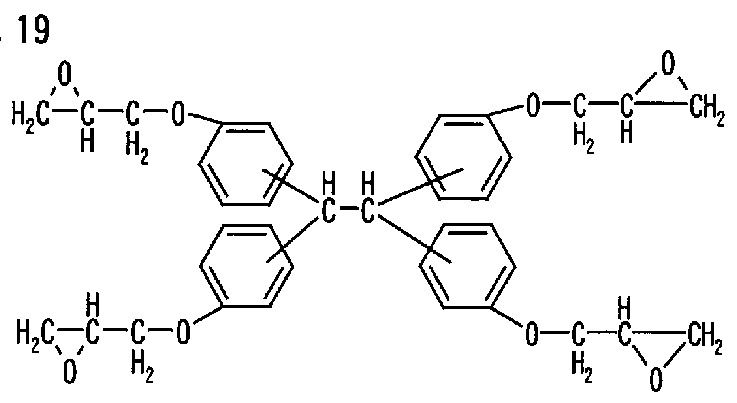
[0072] [化 28]
化合物 No. 20

[0073] 上記反応生成物 (H)を得るために使用される不飽和一塩基酸 (G)としては、例え ば、アクリル酸、メタクリル酸、クロトン酸、桂皮酸、ソルビン酸、ヒドロキシェチルメタク リレート'マレート、ヒドロキシェチノレアタリレート'マレート、ヒドロキシプロピノレメタクリレ ート 'マレート、ヒドロキシプロピノレアタリレート'マレート、ジシクロペンタジェン 'マレー ト等が挙げられる。これらの中でも、アクリル酸、メタクリル酸が好ましい。また、多塩基 酸無水物(D' )としては、前記の多塩基酸無水物(D)で例示したィ匕合物が挙げられ る。
[0074] 本発明において、上記反応生成物 (H)には、さらに多官能エポキシィ匕合物 (K)を 反応させてもよい。該多官能エポキシィ匕合物は、酸価を調整して本発明のアルカリ現 像性榭脂組成物の現像性をより向上させるために用いることができるものである。該 多官能エポキシィ匕合物としては、グリシジルメタタリレート、メチルダリシジルエーテル 、ェチルダリシジルエーテル、プロピルグリシジルエーテル、イソプロピルグリシジルェ 一テル、ブチルダリシジルエーテル、イソブチルダリシジルエーテル、 tーブチルグリ シジルエーテル、ペンチルグリシジルエーテル、へキシルグリシジルエーテル、ヘプ チルダリシジルエーテル、オタチルダリシジルエーテル、ノニルダリシジルエーテル、 デシルグリシジルエーテル、ゥンデシルグリシジルエーテル、ドデシルグリシジルエー テル、トリデシルグリシジルエーテル、テトラデシルグリシジルエーテル、ペンタデシル グリシジルエーテル、へキサデシルグリシジルエーテル、 2—ェチルへキシルグリシジ ルエーテル、ァリルグリシジルエーテル、プロパルギルダリシジルエーテル、 p—メトキ
シェチルダリシジルエーテル、フエ-ルグリシジルエーテル、 p—メトキシグリシジルェ 一テル、 p ブチルフエノールグリシジルエーテル、クレジルグリシジルエーテル、 2— メチルクレジルグリシジルエーテル、 4 ノ-ルフエ-ルグリシジルエーテル、ベンジ ルグリシジルエーテル、 p タミルフエニルダリシジルエーテル、トリチルダリシジルェ 一テル、 2, 3 エポキシプロピルメタタリレート、エポキシ化大豆油、エポキシ化アマ 二油、グリシジルブチレート、ビュルシクロへキサンモノォキシド、 1, 2 エポキシー4 ビュルシクロへキサン、スチレンォキシド、ピネンォキシド、メチルスチレンォキシド 、シクロへキセンォキシド、プロピレンォキシド、下記化合物 No. 21、 No. 22等のモ ノエポキシィ匕合物;上記多官能エポキシ榭脂 (F)、水添ビスフエノール型エポキシ榭 脂等のビスフエノール型エポキシ榭脂;エチレングリコールジグリシジルエーテル、プ ロピレングリコールジグリシジルエーテル、 1, 4 ブタンジオールジグリシジルエーテ ル、 1, 6 へキサンジオールジグリシジルエーテル、 1, 8 オクタンジオールジグリ シジルエーテル、 1, 10—デカンジオールジグリシジルエーテル、 2, 2—ジメチルー 1, 3 プロパンジオールジグリシジルエーテル、ジエチレングリコールジグリシジルェ 一テル、トリエチレングリコールジグリシジルエーテル、テトラエチレングリコールジグリ シジノレエーテノレ、へキサエチレングリコーノレジグリシジノレエーテノレ、 1, 4ーシクロへキ サンジメタノールジグリシジルエーテル、 1, 1, 1—トリ(グリシジルォキシメチル)プロ パン、 1, 1, 1—トリ(グリシジルォキシメチル)ェタン、 1, 1, 1—トリ(グリシジルォキシ メチル)メタン、 1, 1, 1, 1—テトラ(グリシジルォキシメチル)メタン等のグリシジルエー テル類; 3, 4—エポキシ 6—メチルシクロへキシルメチルー 3, 4—エポキシ 6—メ チルシクロへキサンカルボキシレート、 3, 4 エポキシシクロへキシルメチルー 3, 4 エポキシシクロへキサン力ノレボキシレート、 1 エポキシェチノレー 3, 4 エポキシ シクロへキサン等の脂環式エポキシ榭脂;フタル酸ジグリシジルエステル、テトラヒドロ フタル酸ジグリシジルエステル、ダイマー酸グリシジルエステルなどのグリシジルエス テル類;テトラグリシジルジアミノジフエ-ルメタン、トリグリシジル P -ァミノフエノール、 N, N ジグリシジルァ二リンなどのグリシジルァミン類; 1, 3 ジグリシジル一 5, 5- ジメチルヒダントイン、トリグリシジルイソシァヌレート等の複素環式エポキシ榭脂;ジシ クロペンタジェンジォキシド等のジォキシド化合物;ナフタレン型エポキシ榭脂、トリフ
ェニルメタン型エポキシ榭脂、ジシクロペンタジェン型エポキシ榭脂等が挙げられる。 上記反応生成物(H)の固形分の酸価は、 20〜120mgKOH/gの範囲であるこ とが好ましぐ上記多官能エポキシィ匕合物 (K)の使用量は、上記酸価を満たすように 選択するのが好ましい。
[化 29]
化合物 No.21
[0076] [化 30]

[0077] 本発明のアルカリ現像性榭脂組成物は、さらに光重合開始剤 ωを加えてアルカリ 現像性感光性榭脂組成物とすることができる。
[0078] 本発明のアルカリ現像性榭脂組成物及びアルカリ現像性感光性榭脂組成物は、通 常、必要に応じて、前記の各成分を溶解又は分散しえる溶媒を加えた溶液状組成物 として用いられる。該溶媒としては特に制限はないが、例えば、メチルェチルケトン、 メチルアミルケトン、ジェチルケトン、アセトン、メチルイソプロピルケトン、メチルイソブ チルケトン、シクロへキサノン等のケトン類;ェチルエーテル、ジォキサン、テトラヒドロ フラン、 1, 2—ジメトキシェタン、 1, 2—ジエトキシェタン、ジプロピレングリコールジメ チルエーテル等のエーテル系溶媒;酢酸メチル、酢酸ェチル、酢酸 プロピル、 酢酸イソプロピル、酢酸 η ブチル等のエステル系溶媒;エチレングリコールモノメチ ノレエーテノレ、エチレングリコーノレモノェチノレエーテノレ、プロピレングリコーノレモノメチ ルエーテルアセテート等のセルソルブ系溶媒;メタノール、エタノール、イソ一又は η プロパノール、イソ一又は η—ブタノール、ァミルアルコール等のアルコール系溶媒 ;ベンゼン、トルエン、キシレン等の ΒΤΧ系溶媒;へキサン、ヘプタン、オクタン、シク 口へキサン等の脂肪族炭化水素系溶媒;テレビン油、 D—リモネン、ピネン等のテル ペン系炭化水素油;ミネラルスピリット、スヮゾール # 310 (コスモ松山石油 (株))、ソ
ルべッソ # 100 (ェクソンィ匕学 (株))等のパラフィン系溶媒;四塩化炭素、クロ口ホルム
、トリクロロエチレン、塩化メチレン等のハロゲンィ匕脂肪族炭化水素系溶媒;クロ口べ ンゼン等のハロゲン化芳香族炭化水素系溶媒;カルビトール系溶媒、ァ-リン、トリエ チルァミン、ピリジン、酢酸、ァセトニトリル、二硫化炭素、テトラヒドロフラン、 N, N- ジメチルホルムアミド、 N—メチルピロリドン等が挙げられ、中でも、ケトン類あるいはセ 口ソルブ系溶媒が好ま 、。これらの溶媒は一種又は二種以上の混合溶媒として使 用することができる。
[0079] (F)成分に (G)成分を付加させた構造を有するエポキシ付加物に対し、(D' )成分 でエステル化させ、さらに必要に応じて (K)成分を反応させて得られた反応生成物( H)の含有量は、上記溶液状組成物中、溶媒の含有量は、 30〜90質量%、特に 40 〜 70質量%が好ましい。
[0080] 本発明のアルカリ現像性感光性榭脂組成物に用いる上記光重合開始剤 ωとして は、従来既知の化合物を用いることが可能であり、例えば、ベンゾフエノン、フエニル ビフエ-ルケトン、 1—ヒドロキシ一 1—ベンゾィルシクロへキサン、ベンジル、ベンジ ルジメチルケタール、 1一べンジルー 1ージメチルアミノー 1一(4, 一モルホリノべンゾ ィル)プロパン、 2 モルホリル 2—(4,ーメチルメルカプト)ベンゾィルプロパン、チ ォキサントン、 1 クロルー4 プロポキシチォキサントン、イソプロピルチオキサントン 、ジェチルチオキサントン、ェチルアントラキノン、 4一べンゾィルー 4'ーメチルジフエ ニルスルフイド、ベンゾインブチルエーテル、 2—ヒドロキシ— 2—ベンゾィルプロパン 、 2 ヒドロキシ— 2— (4,—イソプロピル)ベンゾィルプロパン、 4 ブチルベンゾィル トリクロロメタン、 4 フエノキシベンゾィルジクロロメタン、ベンゾィル蟻酸メチル、 1, 7 —ビス(9,一アタリジ-ル)ヘプタン、 9— η—ブチル 3, 6 ビス(2, 一モルホリノィ ソブチロイル)カルバゾール、 2—メチルー 1 [4 (メチルチオ)フエ-ル ] 2 モル ホリノプロパン一 1—オン、 2—メチルー 4, 6 ビス(トリクロロメチル) s トリァジン、 2 フエ-ル一 4, 6 ビス(トリクロロメチル) s トリァジン、 2 ナフチル一 4, 6— ビス(トリクロロメチル)—s トリァジン、下記化合物 No. 23、 No. 24等が挙げられる 。これらの中でも、ベンゾフエノン、 2—メチル 1— [4— (メチルチオ)フエ-ル]— 2— モルホリノプロパン 1 オンが好ましい。
[0081] [化 31]
化合物 N o . 2 3

(式中、 Y3はハロゲン原子又はアルキル基を表し、 R12は、 Ra、 ORa、 CORa、 SRa、 C ONR b又は CNを表し、 R13は、 R OR COR SRa又は NR bを表し、 R"は、 Ra 、 OR CORa、 SRa又は NRa Rbを表し、 Ra及び Rbは、アルキル基、ァリール基、ァラ ルキル基又は複素環基を表し、これらはハロゲン原子及び Z又は複素環基で置換さ れていてもよぐこれらのうちアルキル基及びァラルキル基のアルキレン部分は、不飽 和結合、エーテル結合、チォエーテル結合、エステル結合により中断されていてもよ ぐまた、 及び Rbは一緒になつて環を形成していてもよぐ qは 0〜4である。)
[0082] [化 32]

(式中、 、 R12、 R13、 R14、 Ra及び Rbは上記化合物 No. 23と同じであり、 Y3'は Y3と 同じであり、 Z9及び Z9'は酸素原子又は硫黄原子を表し、 r及び sはそれぞれ独立に 1
〜4の数を表し、 R12'は R12と同じであり、 R13'は R13と同じであり、 R14'は R"と同じであ り、 z1Qはジオール残基又はジチオール残基を表す。 )
[0083] 本発明のアルカリ現像性感光性榭脂組成物において、上記光重合開始剤 ωの含 有量は、本発明のアルカリ現像性榭脂組成物に溶媒を加えた上記溶液状組成物に 対して、 0. 1〜30質量%、特に 0. 5〜5質量%が好ましい。
[0084] 本発明のアルカリ現像性榭脂組成物及びアルカリ現像性感光性榭脂組成物には、 さらに不飽和結合を有するモノマー、連鎖移動剤、界面活性剤等を併用することが できる。
[0085] 上記不飽和結合を有するモノマーとしては、アクリル酸 2 ヒドロキシェチル、ァク リル酸 2—ヒドロキシプロピル、アクリル酸イソブチル、アクリル酸 N—ォクチル、ァ クリル酸イソオタチル、アクリル酸イソノニル、アクリル酸ステアリル 、アクリル酸メトキ シェチル、アクリル酸ジメチルアミノエチル、アクリル酸亜鉛、 1,6 へキサンジオール ジアタリレート、トリメチロールプロパントリアタリレート、メタクリル酸一 2—ヒドロキシェ チル、メタクリル酸 2—ヒドロキシプロピル、メタクリル酸ブチル、メタクリル酸ターシャ リーブチル、メタクリル酸シクロへキシル、トリメチロールプロパントリメタタリレート、ジ ペンタエリスリトールペンタアタリレート、ジペンタエリスリトールへキサアタリレート、ぺ ンタエリスリトールテトラアタリレート、ペンタエリスリトールトリアタリレート、トリシクロデ カンジメチロールジアタリレート等が挙げられる。
[0086] 上記連鎖移動剤としては、チォグリコール酸、チォリンゴ酸、チォサリチル酸、 2—メ ルカプトプロピオン酸、 3 メルカプトプロピオン酸、 3 メルカプト酪酸、 N—(2—メ ルカプトプロピオ-ル)グリシン、 2 メルカプトニコチン酸、 3—〔N—(2 メルカプト ェチル)力ルバモイル〕プロピオン酸、 3—〔N—(2 メルカプトェチル)ァミノ〕プロピ オン酸、 N— (3 メルカプトプロピオ-ル)ァラニン、 2 メルカプトエタンスルホン酸 、 3—メルカプトプロパンスルホン酸、 4 メルカプトブタンスルホン酸、ドデシル(4-メ チルチオ)フエニルエーテル、 2 メルカプトエタノール、 3 メルカプト 1, 2 プロ パンジオール、 1 メルカプト 2 プロパノール、 3 メルカプト 2 ブタノール、メ ルカプトフエノール、 2—メルカプトェチルァミン、 2—メルカプトイミダゾール、 2—メル カプト 3 ピリジノール、 2 メルカプトべンゾチアゾール、メルカプト酢酸、トリメチロ ールプロパントリス(3-メルカプトプロピオネート)、ペンタエリスリトールテトラキス(3-メ ルカプトプロピオネート)等のメルカプト化合物、該メルカプト化合物を酸化して得られ るジスルフイド化合物、ョード酢酸、ョードプロピオン酸、 2—ョードエタノール、 2—ョ 一ドエタンスルホン酸、 3—ョードプロパンスルホン酸等のョード化アルキル化合物が 挙げられる。
[0087] 上記界面活性剤としては、パーフルォロアルキルリン酸エステル、パーフルォロア ルキルカルボン酸塩等のフッ素界面活性剤、高級脂肪酸アルカリ塩、アルキルスル ホン酸塩、アルキル硫酸塩等のァ-オン系界面活性剤、高級アミンハロゲン酸塩、第
四級アンモ-ゥム塩等のカチオン系界面活性剤、ポリエチレングリコールアルキルェ 一テル、ポリエチレングリコール脂肪酸エステル、ソルビタン脂肪酸エステル、脂肪酸 モノグリセリド等の非イオン界面活性剤、両性界面活性剤、シリコーン系界面活性剤 等の界面活性剤を用いることができ、これらは組み合わせて用いてもょ 、。
[0088] 本発明のアルカリ現像性榭脂組成物及びアルカリ現像性感光性榭脂組成物には、 さらに熱可塑性有機重合体を用いることによって、硬化物の特性を改善することもで きる。該熱可塑性有機重合体としては、例えば、ポリスチレン、ポリメチルメタタリレート 、メチルメタクリレートーェチルアタリレート共重合体、ポリ(メタ)アクリル酸、スチレン (メタ)アクリル酸共重合体、(メタ)アクリル酸 メチルメタタリレート共重合体、ポリビ 二ルブチラール、セルロースエステル、ポリアクリルアミド、飽和ポリエステル等が挙げ られる。
[0089] また、本発明のアルカリ現像性榭脂組成物及びアルカリ現像性感光性榭脂組成物 には、必要に応じて、ァ-ソール、ハイドロキノン、ピロカテコール、第三ブチルカテコ ール、フヱノチアジン等の熱重合抑制剤;可塑剤;接着促進剤;充填剤;消泡剤;レべ リング剤等の慣用の添加物をカ卩えることができる。
[0090] 本発明のアルカリ現像性感光性榭脂組成物は、ロールコーター、カーテンコーター 、各種の印刷、浸漬等の公知の手段で、金属、紙、プラスチック等の支持基体上に 適用される。また、ー且フィルム等の支持基体上に施した後、他の支持基体上に転 写することもでき、その適用方法に制限はない。
[0091] 本発明のアルカリ現像性感光性榭脂組成物は、主として、前記溶媒及び前記光重 合開始剤と混合され、アルカリ現像性感光性榭脂組成物として用いられるもので、該 アルカリ現像性感光性榭脂組成物は、光硬化性塗料、光硬化性接着剤、印刷版、 印刷配線板用フォトレジスト等の各種の用途に使用することができ、その用途に特に 制限はない。
[0092] また、本発明のアルカリ現像性感光性榭脂組成物を硬化させる際に用いられる活 性光の光源としては、波長 300〜450nmの光を発光するものを用いることができ、例 えば、超高圧水銀、水銀蒸気アーク、カーボンアーク、キセノンアーク等を用いること ができる。
実施例
[0093] 以下、実施例等を挙げて本発明をさらに詳細に説明するが、本発明はこれらの実 施例に限定されるものではない。
[0094] [実施例 1]含フッ素共重合体 No. 1の製造
ブロック共重合体 (C)であるモディパー F 600 (含フッ素共重合体;日本油脂社 製) 100g、多塩基酸無水物(D)である 1, 2, 3, 6—テトラヒドロフタル酸無水物 16. 4g及びプロピレングリコール 1 モノメチルエーテル 2 アセテート 400gを仕込 み、 120°Cで酸無水物のピークが消失するまで撹拌し、プロピレングリコール 1 モノメチルエーテル 2—アセテート溶液として含フッ素共重合体 (E)である含フッ素 共重合体 No. 1を得た。これについて各種分析を行った。質量平均分子量 33000、 酸価 57. 9mgKOHZg、フッ素含有量 12. 0質量% (EDX分析)、炭素含有量 64. 1質量% (EDX分析)、酸素 24. 0質量% (EDX分析)、 IRスペクトル:図 1。
[0095] [実施例 2]含フッ素共重合体 No. 2の製造
多塩基酸無水物(D)をトリメリット酸無水物 20. 7gに変えた以外は実施例 1と同様 にして、プロピレングリコール 1 モノメチルエーテル 2—アセテート溶液として含 フッ素共重合体 (E)である含フッ素共重合体 No. 2を得た。これについて、各種分析 を行った。質量平均分子量 33000、酸価 116mgKOH/g、フッ素含有量 11. 5質 量%、炭素含有量 62. 8質量%、酸素 25. 3質量%(EDX分析)、 IRスペクトル:図 2
[0096] [実施例 3]含フッ素共重合体 No. 3の製造
多塩基酸酸無水物(D)をマレイン酸無水物 9. 9gに変えた以外は実施例 1と同様 にして、プロピレングリコール 1 モノメチルエーテル 2—アセテート溶液として含 フッ素共重合体 (E)である含フッ素共重合体 No. 3を得た (質量平均分子量 35000 、酸価 52. lmgKOH/g)。
[0097] [実施例 4]含フッ素共重合体 No. 4の製造
多塩基酸酸無水物(D)をフタル酸無水物 15. 6gに変えた以外は実施例 1と同様 にして、プロピレングリコール 1 モノメチルエーテル 2—アセテート溶液として含 フッ素共重合体 (E)である含フッ素共重合体 No. 4を得た (質量平均分子量 29000
、酸価 56. 3mgKOH/g)。
[0098] [実施例 5]含フッ素共重合体 No. 5の製造
ブロック共重合体 (C)をモディパー F— 220 (含フッ素共重合体;日本油脂社製) 10 Ogに変え、多塩基酸酸無水物(D)をコハク酸無水物 9. 9gに変えた以外は実施例 1 と同様にして、プロピレングリコール 1—モノメチルエーテル 2—アセテート溶液と して含フッ素共重合体 (E)である含フッ素共重合体 No. 5を得た (質量平均分子量 3 6000、酸価 31. 3mgKOHZg;)。
[0099] [実施例 6]含フッ素共重合体 No. 6の製造
多塩基酸酸無水物(D)をトリメリット酸無水物 19. 7gに変えた以外は実施例 5と同 様にして、プロピレングリコール 1 モノメチルエーテル 2—アセテート溶液として 含フッ素共重合体 (E)である含フッ素共重合体 No. 6を得た (質量平均分子量 3600 0、酸価 64. 5mgKOH/g)。
[0100] [実施例 7]含フッ素共重合体 No. 7の製造
多塩基酸酸無水物(D)をィタコン酸無水物 11. 4gに変えた以外は実施例 5と同様 にして、プロピレングリコール 1 モノメチルエーテル 2—アセテート溶液として含 フッ素共重合体 (E)である含フッ素共重合体 No. 7を得た (質量平均分子量 35000 、酸価 30. 4mgKOH/g)。
[0101] [実施例 8]含フッ素共重合体 No. 8の製造
多塩基酸酸無水物(D)をへキサヒドロフタル酸無水物 15. 6gに変えた以外は実施 例 5と同様にして、プロピレングリコール 1 モノメチルエーテル 2 アセテート溶 液として含フッ素共重合体 (E)である含フッ素共重合体 No. 8を得た (質量平均分子 量 37000、酸価 32. 6mgKOHZg;)。
[0102] [実施例 9]含フッ素共重合体 No. 9の製造
ブロック共重合体 (C)をディフェンサ MCF— 350SF (含フッ素共重合体;大日本ィ ンキ化学工業社製) 100gに変えた以外は実施例 5と同様にして、プロピレングリコー ルー 1—モノメチルエーテル - 2-アセテート溶液として含フッ素共重合体 (E)である 含フッ素共重合体 No. 9を得た(質量平均分子量 38000、酸価 56. 4mgKOH/g)
[0103] [実施例 10]含フッ素共重合体 No. 10の製造
多塩基酸酸無水物(D)をマレイン酸無水物 9. 9gに変えた以外は実施例 9と同様 にして、プロピレングリコール 1 モノメチルエーテル 2—アセテート溶液として含 フッ素共重合体 (E)である含フッ素共重合体 No. 10を得た (質量平均分子量 4200
0、酸価 58. 3mgKOH/g)。
[0104] [実施例 11]含フッ素共重合体 No. 11の製造
多塩基酸酸無水物(D)をフタル酸無水物 15. 6gに変えた以外は実施例 9と同様 にして、プロピレングリコール 1 モノメチルエーテル 2—アセテート溶液として含 フッ素共重合体 (E)である含フッ素共重合体 No. 11を得た (質量平均分子量 4000
0、酸価 52. 4mgKOH/g)。
[0105] [実施例 12]アルカリ現像性榭脂組成物 No. 1の製造
<ステップ 1 > 1 , 1 ビス(4,一ヒドロキシフエ-ル) 1 ( ,一ビフエ-ル) 1— シクロへキシルメタンの製造
ビフエ-ルシクロへキシルケトン 70. 5g、フエノール 200. 7g及びチォ酢酸 10. 15 gを仕込み、トリフルォロメタンスルホン酸 40. 0gを 18。Cで 20分力けて滴下した。 17 〜19°Cで 18時間反応後、水 500gをカ卩えて反応を停止させ、トルエン 500gをカロえ、 有機層を pH3〜4になるまで水洗して有機層を分離した。トルエン、水及び過剰のフ エノールを留去した。残さにトルエンを加えて析出した固体をろ別し、トルエンで分散 洗浄して淡黄色結晶 59. 2g (収率 51%)を得た。該淡黄色結晶の融点は 239. 5°C であり、該淡黄色結晶は目的物であることを確認した。
[0106] <ステップ 2 > 1 , 1 ビス(4,一エポキシプロピルォキシフエ-ル)一 1 ( ,一ビフ ェ -ル) - 1—シクロへキシルメタンの製造
ステップ 1で得られた 1, 1—ビス(4,一ヒドロキシフエ-ル) 1— (1,,一ビフエ-ル )—1 シクロへキシルメタン 57. 5g及びェピクロルヒドリン 195. 8gを仕込み、ベンジ ルトリェチルアンモ -ゥムクロリド 0. 602gをカ卩えて 64°Cで 18時間撹拌した。続いて 5 4°Cまで降温し、 24質量%水酸ィ匕ナトリウム水溶液 43. 0gを滴下し、 30分撹拌した。 ェピクロルヒドリン及び水を留去し、メチルイソブチルケトン 216gをカ卩えて水洗後、 24 質量%水酸ィ匕ナトリウム 2. 2gを滴下した。 80°Cで 2時間撹拌後、室温まで冷却し、 3
質量%モノリン酸ナトリウム水溶液で中和し、水洗を行った。溶媒を留去して、黄色固 体 57g (収率 79%)を得た。(融点 64. 2°C、エポキシ当量 282、n=0. 04)。該黄色 結晶は目的物であることを確認した。
[0107] くステップ 3 >アルカリ現像性榭脂組成物 No. 1の製造
ステップ 2で得られた多官能エポキシ榭脂(F)である 1 , 1 ビス(4 ' エポキシプロ ピルォキシフエ-ル) 1— (1 "—ビフエ-ル) 1 シクロへキシルメタン 169. 5g、 不飽和一塩基酸(G)であるアクリル酸 44. 3g、 2, 6 ジ—tert—ブチルー p クレゾ ール 0. 6g、テトラブチルアンモ -ゥムアセテート 1. lg及びプロピレングリコール 1 —モノメチルエーテル— 2 アセテート 142. 5gを仕込み、 120°Cで 16時間撹拌し た。室温まで冷却し、プロピレングリコール 1 モノメチルエーテル 2—アセテート 71. 8g、多塩基酸無水物(D' )である無水コハク酸 48. 2g及びテトラプチルアンモ -ゥムアセテート 2. 5gをカ卩えて 100°Cで 5時間撹拌した。更に、ステップ 2で得られ た多官能エポキシ化合物(K)である 1 , 1 ビス(4,一エポキシプロピルォキシフエ- ル)一 1— (1,,一ビフエニル) - 1 シクロへキシルメタン 50. 8g及びプロピレングリコ ール— 1—モノメチルエーテル— 2—アセテート 21. 8gを加えて 120。Cで 12時間、 8 0°Cで 2時間、 40°Cで 2時間撹拌後、プロピレングリコール 1 モノメチルエーテル —2 アセテート 146. 3g及び実施例 1で得られた含フッ素共重合体 (E)である含フ ッ素共重合体 No . 1のプロピレングリコール— 1—モノメチルエーテル— 2—ァセテ一 ト溶液 4. 24gを加えて、プロピレングリコール 1 モノメチルエーテル 2 ァセテ ート溶液として目的物であるアルカリ現像性榭脂組成物 No. 1を得た。
[0108] [実施例 13]アルカリ現像性榭脂組成物 No. 2の製造
多官能エポキシ榭脂(F)である 1 , 1 ビス(4 ' エポキシプロピルォキシフエ-ル) — 1 ( ,—ビフエニル) - 1 シクロへキシルメタン 43g、不飽和一塩基酸(G)であ るアクリル酸 33. 6g、 2, 6 ジ—tert—ブチルー p タレゾール 0. 04g、テトラプチ ルアンモ -ゥムアセテート 0. 21g及びプロピレングリコール 1 モノメチルエーテル —2 アセテート 18gを仕込み、 120°Cで 13時間撹拌した。室温まで冷却し、プロピ レングリコールー 1 モノメチルエーテル 2 アセテート 24g及び多塩基酸無水物( D' )である無水コハク酸 10gをカ卩えて 100°Cで 3時間撹拌した。更に多官能エポキシ
化合物(K)であるビスフエノール Ζグリシジルエーテル 8gをカ卩えて 120°Cで 4時間、 9 0°Cで 3時間、 60°Cで 2時間、 40°Cで 5時間撹拌後、プロピレングリコール 1 モノ メチルエーテル 2 アセテート 29g及び実施例 1で得られた含フッ素共重合体 (E) である含フッ素共重合体 No . 1のプロピレングリコール 1 モノメチルエーテル 2 —アセテート溶液 1. 28gを加えて、プロピレングリコール— 1—モノメチルエーテル— 2—アセテート溶液として目的物であるアルカリ現像性榭脂組成物 No. 2を得た。
[0109] [実施例 14]アルカリ現像性榭脂組成物 No. 3の製造
多官能エポキシ榭脂(F)である 1 , 1 ビス(4 ' エポキシプロピルォキシフエ-ル) — 1— ( ,—ビフエ-ル)— 1—シクロへキシルメタン 169. 5g、不飽和一塩基酸(G) であるアクリル酸 44. 3g、 2, 6 ジ—tert—ブチルー p タレゾール 0. 6g、テトラブ チルアンモ -ゥムアセテート 1. lg及びプロピレングリコール 1 モノメチルエーテ ル— 2 アセテート 142. 5gを仕込み、 120°Cで 16時間撹拌した。室温まで冷却し、 プロピレングリコール 1 モノメチルエーテル 2 アセテート 93. lg、多塩基酸無 水物(D, )であるへキサヒドロ無水フタル酸 74. lg及びテトラ n ブチルアンモ-ゥ ムアセテート 2. 5gをカ卩えて 70°Cで 4時間撹拌した。更に多官能エポキシィ匕合物 (K) であるエチレングリコールジグリシジルエーテル 31. 3g及びプロピレングリコール 1 モノメチルエーテル 2 アセテート 146. 3g及び実施例 1で得られた含フッ素共 重合体(E)である含フッ素共重合体 No. 1のプロピレングリコール 1 モノメチルェ 一テル一 2 アセテート溶液 4. 31gを加えて、プロピレングリコール一 1—モノメチル エーテノレ一 2 アセテート溶液として目的物であるアルカリ現像性榭脂組成物 No. 3 を得た。
[0110] [実施例 15]アルカリ現像性榭脂組成物 No. 4の製造
<ステップ 1 >ビスフエノール Zグリシジルエーテルの製造
ビスフエノール Z (4, 4,一シクロへキシリデンビスフエノール)の 137g及びェピクロ ルヒドリン 406. 67gを仕込み、 74。Cまで昇温した。 48%NaOHaq. 25. 52gを滴下 し、 3時間撹拌した。更に 50〜60。C、 620~630mmHg-e48%NaOHaq. 59. 56 gを滴下し、 30分撹拌した。そのまま 73°Cまで昇温し、ェピクロルヒドリンを留去した。 続いてメチルイソブチルケトン 583gをカ卩え、 48%NaOHaq. 3. 04g、イオン交換水
13. 66g、テトラプチルアンモ-ゥムブロミド 0. 16gを加えて 80°Cまで昇温し、 2時間 保持した。更にイオン交換水 233gを加えて 80°Cで 30分撹拌し、 3%モノリン酸ナトリ ゥム水溶液 lOOgで有機層を中和し、水洗を行った後、 140°Cで有機層を留去して目 的物であるシクロへキシデリン基を有する多官能エポキシ榭脂 (F)を得た。
[0111] くステップ 2>アルカリ現像性榭脂組成物 No. 4の製造
ステップ 1で得られた多官能エポキシ榭脂(F)であるビスフエノール Zグリシジルェ 一テル 94. 78g、 2, 6 ジ—tert—ブチルー p タレゾール 0. 13g、ベンジルトリエ チルアンモ -ゥムクロリド 1. 28g及びメトキシプロピルアセテート 128. l lgを仕込み、 90°Cまで昇温した。続いて不飽和一塩基酸 (G)であるアクリル酸 33. 33gを加えて 1 20°Cまで昇温し、 15時間保持した。更に多塩基酸無水物(D' )であるビフタル酸二 無水物 39. 41g、テトラブチルアンモ-ゥムブロミド 0. 13gを加えて 120°Cで 3時間 保持した。その後 80°Cまで冷却し、 10時間保持した。続いて 90°Cまで昇温し、多官 能エポキシィ匕合物 (K)であるグリシジルメタタリレート 26. 33gをカ卩えて 120°Cまで昇 温し、 10時間保持した。その後 50°Cまで冷却し、メトキシプロピルアセテート 156g及 び実施例 1で得られた含フッ素共重合体 (E)である含フッ素共重合体 No. 1のプロピ レングリコール— 1—モノメチルエーテル— 2 アセテート溶液 2. 62gを加えて目的 物であるアルカリ現像性榭脂組成物 No. 4 (光重合性不飽和化合物)のメトキシプロ ピルアセテート 35%溶液を得た。
[0112] [実施例 16]アルカリ現像性榭脂組成物 No. 5の製造
多官能エポキシ榭脂(F)であるビスフエノールフルオレン型エポキシ榭脂(エポキシ 当量 231) 184g、不飽和一塩基酸(G)であるアクリル酸 58g、 2, 6 ジ— tert—ブ チルー p タレゾール 0. 26g、テトラプチルアンモ -ゥムアセテート 0. l lg及びプロ ピレンダリコール 1 モノメチルエーテル 2 アセテート 23gを仕込み、 120°Cで 16時間撹拌した。室温まで冷却し、プロピレングリコール— 1—モノメチルエーテル — 2 アセテート 35g、多塩基酸無水物(D' )であるビフタル酸二無水物 59g及びテ トラ— n—ブチルアンモ-ゥムブロミド 0. 24gを加えて 120°Cで 4時間撹拌した。更に 多塩基酸無水物(D)であるテトラヒドロ無水フタル酸 20gをカ卩え、 120°Cで 4時間、 1 00°Cで 3時間、 80°Cで 4時間、 60°Cで 6時間、 40°Cで 11時間撹拌後、プロピレング
リコール— 1—モノメチルエーテル— 2 アセテート 90g及び実施例 1で得られた含フ ッ素共重合体(E)である含フッ素共重合体 No. 1のプロピレングリコール 1 モノメ チルエーテル— 2 アセテート溶液 4. 33gをカ卩えて目的物であるアルカリ現像性榭 脂組成物 No . 5をプロピレングリコール 1 モノメチルエーテル 2 アセテート溶 液として得た。
[0113] [実施例 17]アルカリ現像性榭脂組成物 No. 6の製造
多官能エポキシ榭脂(F)であるビスフエノール A型エポキシ榭脂(エポキシ当量 19 0) 154g、不飽和一塩基酸(G)であるアクリル酸 59g、 2, 6 ジ—tert—ブチルー p —タレゾール 0. 26g、テトラプチルアンモ -ゥムアセテート 0. l lg及びプロピレングリ コール 1 モノメチルエーテルー2 アセテート 23gを仕込み、 1
20°Cで 16時間撹拌した。室温まで冷却し、プロピレングリコール— 1—モノメチルェ 一テル— 2 アセテート 365g、多塩基酸無水物(D' )であるビフタル酸二無水物 67 g及びテトラ— n—ブチルアンモ-ゥムブロミド 0. 24gを加えて 120°Cで 4時間、 100 °Cで 3時間、 80°Cで 4時間、 60°Cで 6時間、 40°Cで 11時間撹拌後、プロピレングリコ 一ルー 1 モノメチルエーテル 2 アセテート 90g及び実施例 1で得られた含フッ 素共重合体(E)である含フッ素共重合体 No. 1のプロピレングリコール 1 モノメ チルエーテル— 2 アセテート溶液 3. 78gをカ卩えて目的物であるアルカリ現像性榭 脂組成物 No . 6をプロピレングリコール 1 モノメチルエーテル 2 アセテート溶 液として得た。
[0114] [実施例 18]アルカリ現像性榭脂組成物 No. 7の製造
くステップ 1 > 1, 1 ビス(4,一ヒドロキシフエ-ル) 1 ( ,一ビフエ-ル)ェタン の製造
フエノール 75g及び 4 ァセチルビフエ-ル 50gを 60°Cでカ卩熱溶融させ、 3 メル カプトプロピオン酸 5gをカ卩えて撹拌しながら塩ィ匕水素ガスを 24時間吹き込み、その 後 72時間反応させた。 70°Cの温水で洗浄した後、減圧下で 180°Cまで加熱して蒸 発物を留去した。残渣にキシレンを加えて冷却し、析出した結晶をろ取、減圧乾燥し て淡黄色結晶 65g (収率 68%)を得た。該淡黄色結晶の融点は 184°Cであり、該淡 黄色結晶は目的物であることを確認した。
[0115] <ステップ 2 > 1 , 1 ビス(4, 一エポキシプロピルォキシフエ-ル) 1 ( , 一ビフ ヱニル)ェタンの製造
ステップ 1で得られた 1, 1—ビス(4,一ヒドロキシフエ-ル) 1— (1,,一ビフエ-ル )ェタン 37g及びェピクロルヒドリン 149. 5gを仕込み、ベンジルトリェチルアンモ-ゥ ムクロリド 0. 45gをカ卩えて 64°Cで 18時間撹拌した。続いて 54°Cまで降温し、 24質量 %水酸ィ匕ナトリウム水溶液 32. 6gを滴下し、 30分撹拌した。ェピクロルヒドリン及び水 を留去し、メチルイソブチルケトン 140gをカ卩えて水洗後、 24質量%水酸ィ匕ナトリウム 1. 7gを滴下した。 80°Cで 2時間撹拌後、室温まで冷却し、 3質量%モノリン酸ナトリ ゥム水溶液で中和し、水洗を行った。溶媒を留去して、黄色粘性液体 38. 7g (収率 8 0%)を得た。(エポキシ当量 248、 n=0. 04)。該黄色粘性液体は目的物であること を確認した。
[0116] くステップ 3 >アルカリ現像性榭脂組成物 No. 7の製造
ステップ 2で得られた多官能エポキシ榭脂(F)である 1 , 1 ビス(4 ' エポキシプロ ピルォキシフエ-ル) 1一(1,,ービフエ-ル)ェタン 49. 6g、不飽和一塩基酸(G) であるアクリル酸 14. 4g、 2, 6 ジ tert—ブチルー p タレゾール 0. 05g、テトラ ブチルアンモ -ゥムアセテート 0. 14g及びプロピレングリコール 1 モノメチルエー テル— 2 アセテート 27. 4gを仕込み、 120°Cで 16時間撹拌した。室温まで冷却し 、プロピレングリコール 1 モノメチルエーテル 2 アセテート 41. 5g及び多塩基 酸無水物(D)であるビフエ-ルテトラカルボン酸二無水物 12. 4gを加えて 120°Cで 8 時間撹拌した。更に多塩基酸無水物(D' )であるテトラヒドロ無水フタル酸 7. 9gをカロ えて 120。Cで 4時間、 100。Cで 3時間、 80。Cで 4時間、 60。Cで 6時間、 40。Cで 11時 間撹拌後、プロピレングリコール— 1—モノメチルエーテル— 2 アセテート 34g及び 実施例 1で得られた含フッ素共重合体 (E)である含フッ素共重合体 No. 1のプロピレ ングリコール— 1—モノメチルエーテル— 2 アセテート溶液 1. 14gを加えて、プロピ レングリコールー 1 モノメチルエーテル 2—アセテート溶液として目的物のアル力 リ現像性榭脂組成物 No. 7を得た。
[0117] [実施例 19]アルカリ現像性榭脂組成物 No. 8の製造
含フッ素共重合体 (E)を実施例 2で得られた含フッ素共重合体 No. 2のプロピレン
グリコール— 1—モノメチルエーテル— 2—アセテート溶液 4. 10gに変えた以外は、 実施例 12と同様にして、アルカリ現像性榭脂組成物 No. 8を得た。
[0118] [実施例 20]アルカリ現像性榭脂組成物 No. 9の製造
含フッ素共重合体 (E)を実施例 3で得られた含フッ素共重合体 No. 3のプロピレン グリコール— 1—モノメチルエーテル— 2—アセテート溶液 1. 28gに変えた以外は、 実施例 13と同様にして、アルカリ現像性榭脂組成物 No. 9を得た。
[0119] [実施例 21]アルカリ現像性榭脂組成物 No. 10の製造
含フッ素共重合体 (E)を実施例 4で得られた含フッ素共重合体 No. 4のプロピレン グリコール— 1—モノメチルエーテル— 2—アセテート溶液 3. 91gに変えた以外は、 実施例 14と同様にして、アルカリ現像性榭脂組成物 No. 10を得た。
[0120] [実施例 22]アルカリ現像性榭脂組成物 No. 11の製造
含フッ素共重合体 (E)を実施例 5で得られた含フッ素共重合体 No. 5のプロピレン グリコール— 1—モノメチルエーテル— 2—アセテート溶液 3. 84gに変えた以外は、 実施例 12と同様にして、アルカリ現像性榭脂組成物 No. 11を得た。
[0121] [実施例 23]アルカリ現像性榭脂組成物 No. 12の製造
含フッ素共重合体 (E)を実施例 6で得られた含フッ素共重合体 No. 6のプロピレン グリコール— 1—モノメチルエーテル— 2—アセテート溶液 3. 93gに変えた以外は、 実施例 16と同様にして、アルカリ現像性榭脂組成物 No. 12を得た。
[0122] [実施例 24]アルカリ現像性榭脂組成物 No. 13の製造
含フッ素共重合体 (E)を実施例 7で得られた含フッ素共重合体 No. 7のプロピレン グリコール— 1—モノメチルエーテル— 2—アセテート溶液 2. 22gに変えた以外は、 実施例 15と同様にして、アルカリ現像性榭脂組成物 No. 13を得た。
[0123] [実施例 25]アルカリ現像性榭脂組成物 No. 14の製造
含フッ素共重合体 (E)を実施例 8で得られた含フッ素共重合体 No. 8のプロピレン グリコール— 1—モノメチルエーテル— 2—アセテート溶液 3. 38gに変えた以外は、 実施例 18と同様にして、アルカリ現像性榭脂組成物 No. 14を得た。
[0124] [実施例 26]アルカリ現像性榭脂組成物 No. 15の製造
含フッ素共重合体 (E)を実施例 9で得られた含フッ素共重合体 No. 9のプロピレン
グリコール— 1—モノメチルエーテル— 2—アセテート溶液 3. 84gに変えた以外は、 実施例 12と同様にして、アルカリ現像性榭脂組成物 No. 15を得た。
[0125] [実施例 27]アルカリ現像性榭脂組成物 No. 16の製造
含フッ素共重合体 (E)を実施例 10で得られた含フッ素共重合体 No. 10のプロピレ ングリコール— 1—モノメチルエーテル— 2—アセテート溶液 1. 28gに変えた以外は 、実施例 13と同様にして、アルカリ現像性榭脂組成物 No. 16を得た。
[0126] [実施例 28]アルカリ現像性榭脂組成物 No. 17の製造
含フッ素共重合体 (E)を実施例 11で得られた含フッ素共重合体 No. 11のプロピレ ングリコール— 1—モノメチルエーテル— 2—アセテート溶液 3. 93gに変えた以外は
、実施例 16と同様にして、アルカリ現像性榭脂組成物 No. 17を得た。
[0127] [実施例 29]アルカリ現像性感光性榭脂組成物 No. 1の製造
実施例 12で得られたアルカリ現像性榭脂組成物 No. 1の 14gに対し、トリメチロー ルプロパントリアタリレート 5. 9g、ベンゾフエノン 2. lg及びェチルセ口ソルブ 78gを加 えてよく撹拌し、アルカリ現像性感光性榭脂組成物 No. 1を得た。
[0128] [実施例 30]アルカリ現像性感光性榭脂組成物 No. 2の製造
実施例 13で得られたアルカリ現像性榭脂組成物 No. 2の 14gに対し、トリメチロー ルプロパントリアタリレート 5. 9g、ベンゾフエノン 2. lg及びェチルセ口ソルブ 78gを加 えてよく撹拌し、アルカリ現像性感光性榭脂組成物 No. 2を得た。
[0129] [実施例 31]アルカリ現像性感光性榭脂組成物 No. 3の製造
実施例 14で得られたアルカリ現像性榭脂組成物 No. 3の 14gに対し、トリメチロー ルプロパントリアタリレート 5. 9g、ベンゾフエノン 2. lg及びェチルセ口ソルブ 78gを加 えてよく撹拌し、アルカリ現像性感光性榭脂組成物 No. 3を得た。
[0130] [実施例 32]アルカリ現像性感光性榭脂組成物 No. 4の製造
実施例 15で得られたアルカリ現像性榭脂組成物 No. 4の 14gに対し、トリメチロー ルプロパントリアタリレート 5. 9g、ベンゾフエノン 2. lg及びェチルセ口ソルブ 78gを加 えてよく撹拌し、アルカリ現像性感光性榭脂組成物 No. 4を得た。
[0131] [実施例 33]アルカリ現像性感光性榭脂組成物 No. 5の製造
実施例 16で得られたアルカリ現像性榭脂組成物 No. 5の 14gに対し、トリメチロー
ルプロパントリアタリレート 5. 9g、ベンゾフエノン 2. lg及びェチルセ口ソルブ 78gを加 えてよく撹拌し、アルカリ現像性感光性榭脂組成物 No. 5を得た。
[0132] [実施例 34]アルカリ現像性感光性榭脂組成物 No. 6の製造
実施例 17で得られたアルカリ現像性榭脂組成物 No. 6の 14gに対し、トリメチロー ルプロパントリアタリレート 5. 9g、ベンゾフエノン 2. lg及びェチルセ口ソルブ 78gを加 えてよく撹拌し、アルカリ現像性感光性榭脂組成物 No. 6を得た。
[0133] [実施例 35]アルカリ現像性感光性榭脂組成物 No. 7の製造
実施例 18で得られたアルカリ現像性榭脂組成物 No. 7の 14gに対し、トリメチロー ルプロパントリアタリレート 5. 9g、ベンゾフエノン 2. lg及びェチルセ口ソルブ 78gを加 えてよく撹拌し、アルカリ現像性感光性榭脂組成物 No. 7を得た。
[0134] [実施例 36]アルカリ現像性感光性榭脂組成物 No. 8の製造
実施例 19で得られたアルカリ現像性榭脂組成物 No. 8の 14gに対し、トリメチロー ルプロパントリアタリレート 5. 9g、ベンゾフエノン 2. lg及びェチルセ口ソルブ 78gを加 えてよく撹拌し、アルカリ現像性感光性榭脂組成物 No. 8を得た。
[0135] [実施例 37]アルカリ現像性感光性榭脂組成物 No. 9の製造
実施例 20で得られたアルカリ現像性榭脂組成物 No. 9の 14gに対し、トリメチロー ルプロパントリアタリレート 5. 9g、ベンゾフエノン 2. lg及びェチルセ口ソルブ 78gを加 えてよく撹拌し、アルカリ現像性感光性榭脂組成物 No. 9を得た。
[0136] [実施例 38]アルカリ現像性感光性榭脂組成物 No. 10の製造
実施例 21で得られたアルカリ現像性榭脂組成物 No. 10の 14gに対し、トリメチロー ルプロパントリアタリレート 5. 9g、ベンゾフエノン 2. lg及びェチルセ口ソルブ 78gを加 えてよく撹拌し、アルカリ現像性感光性榭脂組成物 No. 10を得た。
[0137] [実施例 39]アルカリ現像性感光性榭脂組成物 No. 11の製造
実施例 22で得られたアルカリ現像性榭脂組成物 No. 11の 14gに対し、トリメチロー ルプロパントリアタリレート 5. 9g、ベンゾフエノン 2. lg及びェチルセ口ソルブ 78gを加 えてよく撹拌し、アルカリ現像性感光性榭脂組成物 No. 11を得た。
[0138] [実施例 40]アルカリ現像性感光性榭脂組成物 No. 12の製造
実施例 23で得られたアルカリ現像性榭脂組成物 No. 12の 14gに対し、トリメチロー
ルプロパントリアタリレート 5. 9g、ベンゾフエノン 2. lg及びェチルセ口ソルブ 78gを加 えてよく撹拌し、アルカリ現像性感光性榭脂組成物 No. 12を得た。
[0139] [実施例 41]アルカリ現像性感光性榭脂組成物 No. 13の製造
実施例 24で得られたアルカリ現像性榭脂組成物 No. 13の 14gに対し、トリメチロー ルプロパントリアタリレート 5. 9g、ベンゾフエノン 2. lg及びェチルセ口ソルブ 78gを加 えてよく撹拌し、アルカリ現像性感光性榭脂組成物 No. 13を得た。
[0140] [実施例 42]アルカリ現像性感光性榭脂組成物 No. 14の製造
実施例 25で得られたアルカリ現像性榭脂組成物 No. 14の 14gに対し、トリメチロー ルプロパントリアタリレート 5. 9g、ベンゾフエノン 2. lg及びェチルセ口ソルブ 78gを加 えてよく撹拌し、アルカリ現像性感光性榭脂組成物 No. 14を得た。
[0141] [実施例 43]アルカリ現像性感光性榭脂組成物 No. 15の製造
実施例 26で得られたアルカリ現像性榭脂組成物 No. 15の 14gに対し、トリメチロー ルプロパントリアタリレート 5. 9g、ベンゾフエノン 2. lg及びェチルセ口ソルブ 78gを加 えてよく撹拌し、アルカリ現像性感光性榭脂組成物 No. 15を得た。
[0142] [実施例 44]アルカリ現像性感光性榭脂組成物 No. 16の製造
実施例 27で得られたアルカリ現像性榭脂組成物 No. 16の 14gに対し、トリメチロー ルプロパントリアタリレート 5. 9g、ベンゾフエノン 2. lg及びェチルセ口ソルブ 78gを加 えてよく撹拌し、アルカリ現像性感光性榭脂組成物 No. 16を得た。
[0143] [実施例 45]アルカリ現像性感光性榭脂組成物 No. 17の製造
実施例 28で得られたアルカリ現像性榭脂組成物 No. 17の 14gに対し、トリメチロー ルプロパントリアタリレート 5. 9g、ベンゾフエノン 2. lg及びェチルセ口ソルブ 78gを加 えてよく撹拌し、アルカリ現像性感光性榭脂組成物 No. 17を得た
[0144] [実施例 46]アルカリ現像性感光性榭脂組成物 No. 18の製造
実施例 12で得られたアルカリ現像性榭脂組成物 No. 1の 12gに対し、ジペンタエリ スリトールへキサアタリレート 8. lg、ベンゾフエノン 1. 9g、ェチルセ口ソルブ 47g及び シクロへキサノン 3 lgをカ卩えてよく撹拌し、アルカリ現像性感光性榭脂組成物 No. 18 を得た。
[0145] [実施例 47]アルカリ現像性感光性榭脂組成物 No. 19の製造
実施例 12で得られたアルカリ現像性榭脂組成物 No. 1の 7. 2gに対し、トリメチロ ールプロパントリアタリレート 4. 3g、 2—メチル—1— [4— (メチルチオ)フエ- ル ]ー2 モルホリノプロパン 1 オン 1. 5g及びェチルセ口ソルブ 87gをカ卩えて よく撹拌し、アルカリ現像性感光性着色組成物 No. 19を得た。
[0146] [実施例 48]アルカリ現像性感光性榭脂組成物 No. 20の製造
実施例 12で得られたアルカリ現像性榭脂組成物 No. 1の 20gに対し、トリメチロー ルプロパントリアタリレート 8. 7g、アクリル系共重合体 4. 6g、 2—メチル—1— [4— (メ チルチオ)フエニル] 2 モルホリノプロパン 1 オン 1. 7g及びェチルセ口ソルブ 65gを加えてよく撹拌し、アルカリ現像性感光性着色組成物 No. 20を得た。
尚、上記アクリル系共重合体は、メタクリル酸 20質量部、ヒドロキシェチルメタクリレ ート 15質量部、メチルメタタリレート 10質量部及びブチルメタタリレート 55質量部をェ チルセ口ソルブ 300質量部に溶解し、窒素雰囲気下でァゾビスイソブチル二トリル 0. 75質量部を加えて 70°Cで 5時間反応させることにより得られたものである。
[0147] [比較例 1]アルカリ現像性榭脂組成物 No. 18の製造
含フッ素共重合体を、下記 [化 33]で示される化合物 0. 95gに変えた以外は、実施 例 12と同様にしてアルカリ現像性榭脂組成物 No. 18を得た。
[0148] [化 33]

[0149] [比較例 2]アルカリ現像性榭脂組成物 No. 19の製造
含フッ素共重合体を加えない以外は、実施例 12と同様にしてアルカリ現像性榭脂 組成物 No. 19を得た。
[0150] [比較例 3]アルカリ現像性感光性榭脂組成物 No. 21の製造
比較例 1で得られたアルカリ現像性榭脂組成物 No. 18の 14gに対し、トリメチロー ルプロパントリアタリレート 5. 9g、ベンゾフエノン 2. lg及びェチルセ口ソルブ 78gを加 えてよく撹拌し、アルカリ現像性感光性榭脂組成物 No. 21を得た。
[0151] [比較例 4]アルカリ現像性感光性榭脂組成物 No. 22の製造
比較例 2で得られたアルカリ現像性榭脂組成物 No. 19の 14gに対し、トリメチロー
ルプロパントリアタリレート 5. 9g、ベンゾフエノン 2. lg及びェチルセ口ソルブ 78gを加 えてよく撹拌し、アルカリ現像性感光性榭脂組成物 No. 22を得た。
[0152] 得られたアルカリ現像性感光性榭脂組成物 No. 1〜22の評価を以下のようにして 行った。
すなわち、ガラス基板上に rーグリシドキシプロピルメチルエトキシシランをスピンコ ートして良くスピン乾燥させた後、上記アルカリ現像性感光性榭脂組成物をスピンコ ート(1300r. p. m、 50秒間)し乾燥させた。 70°Cで 20分間プリベータを行った後、 ポリビニルアルコール 5質量%溶液をコートして酸素遮断膜とした。 70°C20分間の乾 燥後、光源として超高圧水銀ランプを用いて露光後、 2. 5質量%炭酸ナトリウム溶液 に 25°Cで 30秒間浸漬して現像し、良く水洗した。水洗乾燥後、 230°Cで 1時間べ一 クして試験用基板を得た。得られた試験用基板について、接触角の測定を行った。 結果を表 1に示す。
[0153] [表 1]
アルカリ現像性感光性樹脂組成物 接触角
No. 1 (実施例 29) 41
No. 2 (実施例 30) 420
No. 3 (実施例 3 1 ) 41
No, 4 (実施例 32) 43°
No. 5 (実施例 33) 39°
No. 6 (実施例 34) 36°
No. 7 (実施例 35) 38°
No. 8 (実施例 36 ) 39°
No. 9 (実施例 37 ) 41 °
No. 1 0 (実施例 38) 43°
No. 1 1 (実施例 39 ) 39°
No. 1 2 (実施例 40) 37 °
No. 1 3 (実施例 41) 38°
No. 14 (実施例 42) 34°
No. 1 5 (実施例 43) 37°
No. 1 6 (実施例 44) 350
No. 1 7 (実施例 45 ) 360
No. 1 8 (実施例 46) 44σ
No. 1 9 (実施例 47) 42"
No. 20 (実施例 48) 430
No. 2 1 (比較例 3 ) 10° 以下
No. 22 (比較例 4) 10° 以下
[0154] 実施例 29〜48のアルカリ現像性感光性榭脂組成物は、接触角が 30° 以上と高く 、撥インク性に優れるものであった。また、得られた塗膜は、基板との密着性及び耐ァ ルカリ性に優れるものであった。
それに対して、比較例 3〜4のアルカリ現像性感光性榭脂組成物は、接触角が 10 ° 以下と低ぐ撥インク性が劣っていた。
[0155] [比較例 5]アルカリ現像性感光性榭脂組成物 No.23の製造
含フッ素共重合体 (E)を同質量のモディパー F— 600 (含フッ素共重合体;日本油 脂社製)に変えた以外は、実施例 12と同様にしてアルカリ現像性榭脂組成物を得た アルカリ現像性榭脂組成物 No.1を得られたアルカリ現像性榭脂組成物に変えた 以外は、実施例 29と同様にしてアルカリ現像性感光性榭脂組成物 No.23を得た。
[0156] アルカリ現像性感光性榭脂組成物 No. 1及び No. 23の評価を以下のようにして行 つた o
ガラス基板上に γ—グリシドキシプロピルメチルエトキシシランをスピンコートしてよく スピン乾燥させた後、上記アルカリ現像性感光性榭脂組成物をスピンコート(1300r . p. m、 50秒間)し乾燥させた。 70°Cで 20分間プリベータを行った後、 2. 5 質量%炭酸ナトリウム溶液に 25°Cで 30秒間浸漬して現像し、よく水洗した。水洗乾 燥後、 230°Cで 1時間ベータして試験用基板を得た。得られた試験用基板について 、目視で残膜のチェックを行った。アルカリ現像性感光性榭脂組成物 No. 1を用いた 基板は、残膜が観察されな力つたが、アルカリ現像性感光性榭脂組成物 No. 23を 用いた基板は、残膜が観察された。このことは、アルカリ現像性感光性榭脂組成物 N o. 1は、アルカリ現像性が良好であり、アルカリ現像性感光性榭脂組成物 No. 23は アルカリ現像され難力つたことを示す。
産業上の利用可能性
[0157] 本発明の含フッ素共重合体を含有するアルカリ現像性榭脂組成物を用いたアル力 リ現像性感光性榭脂組成物は、撥インク性、アルカリ現像性、感度、解像度、透明性 、密着性、耐アルカリ性に優れ、微細パターンを精度良く形成できる。
Claims
[化 1]

(式中、 R1及び R2は炭素原子数 1〜30の水酸基を有してもよいパーフルォロアルキ f f
ル基を表す。 )
上記フッ素系モノマー (A)力 下記一般式 (II)で表される請求の範囲第 1項記載の 含フッ素共重合体 (E)。
[化 2]

(式中、 R'は水素原子又はメチル基を表し、 Z1は、直接結合、 -R', -NR-SO -
2
、 一 R, 5 一 NR— CO—、 -CH -CH (OH) 一 CH—又は一 CH— CH (OH)— C
2 2 2
H—O—力 選ばれる基を表し、 R',は、炭素原子数 1〜4のアルキレン基を表し、 R
2 ί
3は、上記一般式 (I)の R2と同じである。 Rは水素原子又は炭素原子数 1〜30の水酸 f
基を有してもよいアルキル基を表す。 )
[4] 上記非フッ素系モノマー(B)が、(メタ)アクリル酸系モノマーである請求の範囲第 1
〜3項の 、ずれかに記載の含フッ素共重合体 (E)。
[5] 上記フッ素系モノマー(A)と上記非フッ素系モノマー(B)の質量比が 10Z90〜80
Z20である請求の範囲第 1〜4項の 、ずれかに記載の含フッ素重合体 (E)。
[6] 質量平均分子量が 10000〜100000である請求の範囲第 1〜5項のいずれかに 記載の含フッ素共重合体 (E)。
[7] 酸価が 20mgKOH/g以上である請求の範囲第 1〜6項のいずれかに記載の含フ ッ素共重合体 (E)。
[8] 上記ブロック共重合体 (C)の水酸基を多塩基酸無水物(D)で変性させることを特 徴とする請求の範囲第 1〜7項のいずれかに記載の含フッ素共重合体 (E)の製造方 法。
[9] 多官能エポキシ榭脂 (F)に不飽和一塩基酸 (G)を付加させた構造を有するェポキ シ付加物と、多塩基酸無水物 (D' )とをエステル化反応させて得られた反応生成物( H)、及び請求の範囲第 1〜7項のいずれかに記載の含フッ素共重合体 (E)を含有 するアルカリ現像性榭脂組成物。
[10] 上記多官能エポキシ榭脂 (F)力 下記一般式 (III)で示されるアルキリデンビスフ エノールポリグリシジルエーテル型エポキシ榭脂である請求の範囲第 9項記載のアル カリ現像性榭脂組成物。
[化 3]

(式中、 Z4は直接結合、メチレン基、炭素原子数 1〜4のアルキリデン基、脂環式炭化 水素基、 0、 S、 SO、 SS、 SO、 CO、 OCO又は下記 [ィ匕 6]又は [ィ匕 7]で表される置換
2
基を表し、該アルキリデン基はハロゲン原子で置換されていてもよぐ
 及び
及び
R4はそれぞれ独立に、水素原子、炭素原子数 1〜5のアルキル基、炭素原子数 1〜8 のアルコキシ基、炭素原子数 2〜5のァルケ-ル基又はハロゲン原子を表し、アルキ ル基、アルコキシ基及びアルケ-ル基はハロゲン原子で置換されていてもよぐ nは 0 〜 10の整数を表す。 )
[化 4]

(式中、 Y1は水素原子、炭素原子数 1〜10のアルキル基又はアルコキシ基により置 換されることもできるフエ-ル基又は炭素原子数 3〜 10のシクロアルキル基を示し、 Υ 2は炭素原子数 1〜 10のアルキル基、炭素原子数 1〜10のアルコキシ基、炭素原子 数 2〜10のァルケ-ル基又はハロゲン原子を示し、アルキル基、アルコキシ基及び ァルケ-ル基はハロゲン原子で置換されていてもよぐ ρは 0〜4の数を示す。)
[化 5]

上記多官能エポキシ榭脂 (F)力 下記一般式 (IV)で示されるフ ノールノボラック 型エポキシ榭脂である請求の範囲第 9項記載のアルカリ現像性榭脂組成物。
[化 6]

(式中、 R5は、水素原子、炭素原子数 1〜5のアルキル基、炭素原子数 1〜8のアルコ キシ基、炭素原子数 2〜5のァルケ-ル基、ハロゲン原子又は(4ーグリシジルォキシ フエニル) - 2, 2—ジメチルメチリデン基を表し、アルキル基、アルコキシ基及びアル ケニル基はハロゲン原子で置換されていてもよぐ R6及び R7はそれぞれ独立に、水 素原子又はグリシジルォキシフエ-ル基を表し、 mは 0〜 10の整数を表す。) 請求の範囲第 9〜11項の 、ずれかに記載のアルカリ現像性榭脂組成物に光重合 開始剤 ωを含有させてなるアルカリ現像性感光性榭脂組成物。
Priority Applications (3)
| Application Number | Priority Date | Filing Date | Title |
|---|---|---|---|
| KR1020067024534A KR101308955B1 (ko) | 2005-07-20 | 2006-07-19 | 함불소 공중합체, 알칼리 현상성 수지 조성물 및 알칼리 현상성 감광성 수지 조성물 |
| CN2006800003889A CN1989156B (zh) | 2005-07-20 | 2006-07-19 | 含氟共聚物、碱性显影性树脂组合物以及碱性显影性感光性树脂组合物 |
| JP2006540837A JP5219374B2 (ja) | 2005-07-20 | 2006-07-19 | 含フッ素共重合体、アルカリ現像性樹脂組成物及びアルカリ現像性感光性樹脂組成物 |
Applications Claiming Priority (2)
| Application Number | Priority Date | Filing Date | Title |
|---|---|---|---|
| JP2005209867 | 2005-07-20 | ||
| JP2005-209867 | 2005-07-20 |
Publications (1)
| Publication Number | Publication Date |
|---|---|
| WO2007010919A1 true WO2007010919A1 (ja) | 2007-01-25 |
Family
ID=37668796
Family Applications (1)
| Application Number | Title | Priority Date | Filing Date |
|---|---|---|---|
| PCT/JP2006/314228 Ceased WO2007010919A1 (ja) | 2005-07-20 | 2006-07-19 | 含フッ素共重合体、アルカリ現像性樹脂組成物及びアルカリ現像性感光性樹脂組成物 |
Country Status (5)
| Country | Link |
|---|---|
| JP (1) | JP5219374B2 (ja) |
| KR (1) | KR101308955B1 (ja) |
| CN (1) | CN1989156B (ja) |
| TW (1) | TWI395761B (ja) |
| WO (1) | WO2007010919A1 (ja) |
Cited By (10)
| Publication number | Priority date | Publication date | Assignee | Title |
|---|---|---|---|---|
| JP2008266490A (ja) * | 2007-04-23 | 2008-11-06 | Tokyo Institute Of Technology | N−メタクリロイルアゼチジン系ブロック共重合体 |
| JP2009242783A (ja) * | 2008-03-10 | 2009-10-22 | Nagase Chemtex Corp | 撥液性樹脂組成物 |
| JP2010520934A (ja) * | 2007-03-09 | 2010-06-17 | ドウジン セミケム カンパニー リミテッド | 黒色導電性ペースト組成物、これを含む妨害電磁波遮蔽フィルター、及び表示装置 |
| CN101900941A (zh) * | 2010-08-12 | 2010-12-01 | 吉林大学 | 高含氟负性光刻胶及其在聚合物光波导器件中的应用 |
| KR101279613B1 (ko) * | 2008-01-02 | 2013-06-27 | 주식회사 엘지화학 | 알칼리 가용성 수지 및 이를 포함하는 감광성 수지 조성물 |
| WO2015182581A1 (ja) * | 2014-05-29 | 2015-12-03 | アーゼット・エレクトロニック・マテリアルズ(ルクセンブルグ) ソシエテ・ア・レスポンサビリテ・リミテ | 空隙形成用組成物、その組成物を用いて形成された空隙を具備した半導体装置、およびその組成物を用いた半導体装置の製造方法 |
| KR20160079319A (ko) | 2014-12-26 | 2016-07-06 | 동우 화인켐 주식회사 | 네가티브형 포토레지스트 조성물 |
| JPWO2018016648A1 (ja) * | 2016-07-21 | 2019-05-09 | 三菱瓦斯化学株式会社 | 化合物、樹脂、組成物及びパターン形成方法 |
| CN109824868A (zh) * | 2019-01-23 | 2019-05-31 | 盐城艾肯科技有限公司 | 一种具有dopo结构感光树脂的制备方法与应用 |
| JP2022184850A (ja) * | 2017-02-28 | 2022-12-13 | 三菱瓦斯化学株式会社 | 化合物又は樹脂の精製方法、及び組成物の製造方法 |
Families Citing this family (5)
| Publication number | Priority date | Publication date | Assignee | Title |
|---|---|---|---|---|
| JP5639069B2 (ja) * | 2009-10-09 | 2014-12-10 | 株式会社クレハ | 新規なフッ化ビニリデン共重合体及びその製造方法 |
| EP2363749B1 (en) * | 2010-03-05 | 2015-08-19 | Rohm and Haas Electronic Materials, L.L.C. | Methods of forming photolithographic patterns |
| KR101887243B1 (ko) * | 2011-07-13 | 2018-08-09 | 에이지씨 세이미 케미칼 가부시키가이샤 | 경화성 수지 조성물 및 그 용도 |
| WO2014013982A1 (ja) * | 2012-07-20 | 2014-01-23 | 東ソー株式会社 | フマル酸ジイソプロピル-ケイ皮酸誘導体系共重合体及びそれを用いた位相差フィルム |
| CN114395354B (zh) * | 2022-01-25 | 2023-11-03 | 苏州英田电子科技有限公司 | 一种低收缩环氧结构胶 |
Citations (7)
| Publication number | Priority date | Publication date | Assignee | Title |
|---|---|---|---|---|
| JPS58136605A (ja) * | 1982-02-05 | 1983-08-13 | Asahi Glass Co Ltd | カルボキシル基含有含フツ素重合体の製造方法 |
| JPS6354469A (ja) * | 1987-08-14 | 1988-03-08 | Asahi Glass Co Ltd | 塗料用含フッ素重合体 |
| JPH07157703A (ja) * | 1993-12-06 | 1995-06-20 | Nippon Kayaku Co Ltd | レジストインキ組成物及びその硬化物 |
| JPH08134390A (ja) * | 1994-09-13 | 1996-05-28 | Nippon Kayaku Co Ltd | フレキシブルプリント配線板用レジストインキ組成物及びその硬化物 |
| JPH10114852A (ja) * | 1996-10-11 | 1998-05-06 | Nippon Kayaku Co Ltd | 樹脂組成物、レジストインキ組成物及びその硬化物 |
| JP2001253928A (ja) * | 2000-03-10 | 2001-09-18 | Nippon Kayaku Co Ltd | 樹脂、樹脂組成物、そのフィルム及びその硬化物 |
| JP2002105152A (ja) * | 2000-09-29 | 2002-04-10 | Nof Corp | フッ素塗料用含フッ素ブロック共重合体 |
Family Cites Families (6)
| Publication number | Priority date | Publication date | Assignee | Title |
|---|---|---|---|---|
| CN1075019A (zh) * | 1992-01-30 | 1993-08-04 | 王懋实 | 静电复印彩色显影剂制造方法 |
| JP3470352B2 (ja) * | 1993-07-23 | 2003-11-25 | 東レ株式会社 | カラーフィルタ |
| DE4416415A1 (de) * | 1994-05-10 | 1995-11-16 | Hoechst Ag | Copolymere auf Basis von ethylenisch ungesättigten Dicarbonsäureanhydriden, langkettigen Olefinen und Fluorolefinen |
| JPH11119433A (ja) * | 1997-10-15 | 1999-04-30 | Nec Corp | ArF用化学増幅系ネガ型レジスト |
| JP3644243B2 (ja) * | 1998-03-31 | 2005-04-27 | Jsr株式会社 | 感放射線性樹脂組成物、カラーフィルタおよび液晶表示素子 |
| DE60308694T2 (de) * | 2002-06-27 | 2007-08-23 | Asahi Glass Co., Ltd. | Fluorocopolymer |
-
2006
- 2006-07-19 CN CN2006800003889A patent/CN1989156B/zh not_active Expired - Fee Related
- 2006-07-19 JP JP2006540837A patent/JP5219374B2/ja active Active
- 2006-07-19 TW TW095126429A patent/TWI395761B/zh not_active IP Right Cessation
- 2006-07-19 WO PCT/JP2006/314228 patent/WO2007010919A1/ja not_active Ceased
- 2006-07-19 KR KR1020067024534A patent/KR101308955B1/ko not_active Expired - Fee Related
Patent Citations (7)
| Publication number | Priority date | Publication date | Assignee | Title |
|---|---|---|---|---|
| JPS58136605A (ja) * | 1982-02-05 | 1983-08-13 | Asahi Glass Co Ltd | カルボキシル基含有含フツ素重合体の製造方法 |
| JPS6354469A (ja) * | 1987-08-14 | 1988-03-08 | Asahi Glass Co Ltd | 塗料用含フッ素重合体 |
| JPH07157703A (ja) * | 1993-12-06 | 1995-06-20 | Nippon Kayaku Co Ltd | レジストインキ組成物及びその硬化物 |
| JPH08134390A (ja) * | 1994-09-13 | 1996-05-28 | Nippon Kayaku Co Ltd | フレキシブルプリント配線板用レジストインキ組成物及びその硬化物 |
| JPH10114852A (ja) * | 1996-10-11 | 1998-05-06 | Nippon Kayaku Co Ltd | 樹脂組成物、レジストインキ組成物及びその硬化物 |
| JP2001253928A (ja) * | 2000-03-10 | 2001-09-18 | Nippon Kayaku Co Ltd | 樹脂、樹脂組成物、そのフィルム及びその硬化物 |
| JP2002105152A (ja) * | 2000-09-29 | 2002-04-10 | Nof Corp | フッ素塗料用含フッ素ブロック共重合体 |
Cited By (13)
| Publication number | Priority date | Publication date | Assignee | Title |
|---|---|---|---|---|
| JP2010520934A (ja) * | 2007-03-09 | 2010-06-17 | ドウジン セミケム カンパニー リミテッド | 黒色導電性ペースト組成物、これを含む妨害電磁波遮蔽フィルター、及び表示装置 |
| JP2008266490A (ja) * | 2007-04-23 | 2008-11-06 | Tokyo Institute Of Technology | N−メタクリロイルアゼチジン系ブロック共重合体 |
| KR101279613B1 (ko) * | 2008-01-02 | 2013-06-27 | 주식회사 엘지화학 | 알칼리 가용성 수지 및 이를 포함하는 감광성 수지 조성물 |
| JP2009242783A (ja) * | 2008-03-10 | 2009-10-22 | Nagase Chemtex Corp | 撥液性樹脂組成物 |
| CN101900941A (zh) * | 2010-08-12 | 2010-12-01 | 吉林大学 | 高含氟负性光刻胶及其在聚合物光波导器件中的应用 |
| US10435555B2 (en) | 2014-05-29 | 2019-10-08 | Az Electronic Materials (Luxembourg) S.A.R.L | Void forming composition, semiconductor device provided with voids formed using composition, and method for manufacturing semiconductor device using composition |
| WO2015182581A1 (ja) * | 2014-05-29 | 2015-12-03 | アーゼット・エレクトロニック・マテリアルズ(ルクセンブルグ) ソシエテ・ア・レスポンサビリテ・リミテ | 空隙形成用組成物、その組成物を用いて形成された空隙を具備した半導体装置、およびその組成物を用いた半導体装置の製造方法 |
| KR20160079319A (ko) | 2014-12-26 | 2016-07-06 | 동우 화인켐 주식회사 | 네가티브형 포토레지스트 조성물 |
| JPWO2018016648A1 (ja) * | 2016-07-21 | 2019-05-09 | 三菱瓦斯化学株式会社 | 化合物、樹脂、組成物及びパターン形成方法 |
| JP7069530B2 (ja) | 2016-07-21 | 2022-05-18 | 三菱瓦斯化学株式会社 | 化合物、樹脂、組成物及びパターン形成方法 |
| JP2022184850A (ja) * | 2017-02-28 | 2022-12-13 | 三菱瓦斯化学株式会社 | 化合物又は樹脂の精製方法、及び組成物の製造方法 |
| CN109824868A (zh) * | 2019-01-23 | 2019-05-31 | 盐城艾肯科技有限公司 | 一种具有dopo结构感光树脂的制备方法与应用 |
| CN109824868B (zh) * | 2019-01-23 | 2021-01-29 | 盐城艾肯科技有限公司 | 一种具有dopo结构感光树脂的制备方法与应用 |
Also Published As
| Publication number | Publication date |
|---|---|
| CN1989156A (zh) | 2007-06-27 |
| CN1989156B (zh) | 2013-03-06 |
| JPWO2007010919A1 (ja) | 2009-01-29 |
| JP5219374B2 (ja) | 2013-06-26 |
| TW200712070A (en) | 2007-04-01 |
| KR20080031606A (ko) | 2008-04-10 |
| KR101308955B1 (ko) | 2013-09-25 |
| TWI395761B (zh) | 2013-05-11 |
Similar Documents
| Publication | Publication Date | Title |
|---|---|---|
| CN105916837B (zh) | 新型芴基β-肟酯化合物、包含其的光聚合引发剂和光致抗蚀剂组合物 | |
| JP5214598B2 (ja) | 新規エポキシ化合物、アルカリ現像性樹脂組成物およびアルカリ現像性感光性樹脂組成物 | |
| CN101506252B (zh) | 硫代氨基甲酸酯化合物和光敏性树脂组合物 | |
| JP5219374B2 (ja) | 含フッ素共重合体、アルカリ現像性樹脂組成物及びアルカリ現像性感光性樹脂組成物 | |
| KR20130124215A (ko) | 신규한 옥심에스테르 플로렌 화합물, 이를 포함하는 광중합 개시제 및 포토레지스트 조성물 | |
| JP4726868B2 (ja) | アルカリ現像性感光性樹脂組成物 | |
| WO2007010918A1 (ja) | アルカリ現像型感光性着色組成物 | |
| JP5698072B2 (ja) | エポキシ化合物、及びこれを含有する重合性組成物 | |
| WO2006030631A1 (ja) | 着色アルカリ現像性感光性樹脂組成物及び該着色アルカリ現像性感光性樹脂組成物を用いたカラーフィルタ | |
| WO2006137257A1 (ja) | 着色アルカリ現像型感光性樹脂組成物、及び該着色アルカリ現像型感光性樹脂組成物を用いたカラーフィルタ | |
| JP7688727B2 (ja) | アルカリ可溶性樹脂、感光性樹脂組成物及びその硬化物 | |
| JP5034939B2 (ja) | アルカリ現像型感光性樹脂組成物、それを用いて形成した液晶分割配向制御用突起付き基板、及び液晶表示装置 | |
| JP5065123B2 (ja) | アルカリ現像性感光性樹脂組成物 | |
| WO2006030630A1 (ja) | アルカリ現像性樹脂組成物 | |
| JP2016199641A (ja) | 感光性樹脂、感光性樹脂組成物、硬化物及びカラーフィルター | |
| CN117916666A (zh) | 组合物、固化物的制造方法、固化物、滤色器及化合物 | |
| TW202313576A (zh) | 三嗪過氧化物衍生物及其製備方法、聚合性組合物、以及固化物及其製備方法 | |
| TW201529710A (zh) | 活性能量線硬化型樹脂組成物、及使用其之顯示元件用間隔物及/或彩色濾光片保護膜 | |
| JP2007183495A (ja) | アルカリ現像型感光性樹脂組成物を用いて形成した液晶分割配向制御用突起付き基板、及び液晶表示装置 | |
| JP4641861B2 (ja) | アルカリ現像性樹脂組成物 | |
| JP4667261B2 (ja) | アルカリ現像性感光性樹脂組成物 |
Legal Events
| Date | Code | Title | Description |
|---|---|---|---|
| WWE | Wipo information: entry into national phase |
Ref document number: 2006540837 Country of ref document: JP |
|
| WWE | Wipo information: entry into national phase |
Ref document number: 1020067024534 Country of ref document: KR |
|
| WWE | Wipo information: entry into national phase |
Ref document number: 200680000388.9 Country of ref document: CN |
|
| 121 | Ep: the epo has been informed by wipo that ep was designated in this application | ||
| NENP | Non-entry into the national phase |
Ref country code: DE |
|
| 122 | Ep: pct application non-entry in european phase |
Ref document number: 06781235 Country of ref document: EP Kind code of ref document: A1 |