WO2006077903A1 - 非対称中空糸ガス分離膜、及びガス分離方法 - Google Patents
非対称中空糸ガス分離膜、及びガス分離方法 Download PDFInfo
- Publication number
- WO2006077903A1 WO2006077903A1 PCT/JP2006/300686 JP2006300686W WO2006077903A1 WO 2006077903 A1 WO2006077903 A1 WO 2006077903A1 JP 2006300686 W JP2006300686 W JP 2006300686W WO 2006077903 A1 WO2006077903 A1 WO 2006077903A1
- Authority
- WO
- WIPO (PCT)
- Prior art keywords
- gas
- hollow fiber
- general formula
- separation membrane
- gas separation
- Prior art date
- Legal status (The legal status is an assumption and is not a legal conclusion. Google has not performed a legal analysis and makes no representation as to the accuracy of the status listed.)
- Ceased
Links
Classifications
-
- B—PERFORMING OPERATIONS; TRANSPORTING
- B01—PHYSICAL OR CHEMICAL PROCESSES OR APPARATUS IN GENERAL
- B01D—SEPARATION
- B01D69/00—Semi-permeable membranes for separation processes or apparatus characterised by their form, structure or properties; Manufacturing processes specially adapted therefor
- B01D69/08—Hollow fibre membranes
-
- B—PERFORMING OPERATIONS; TRANSPORTING
- B01—PHYSICAL OR CHEMICAL PROCESSES OR APPARATUS IN GENERAL
- B01D—SEPARATION
- B01D53/00—Separation of gases or vapours; Recovering vapours of volatile solvents from gases; Chemical or biological purification of waste gases, e.g. engine exhaust gases, smoke, fumes, flue gases, aerosols
- B01D53/22—Separation of gases or vapours; Recovering vapours of volatile solvents from gases; Chemical or biological purification of waste gases, e.g. engine exhaust gases, smoke, fumes, flue gases, aerosols by diffusion
- B01D53/228—Separation of gases or vapours; Recovering vapours of volatile solvents from gases; Chemical or biological purification of waste gases, e.g. engine exhaust gases, smoke, fumes, flue gases, aerosols by diffusion characterised by specific membranes
-
- B—PERFORMING OPERATIONS; TRANSPORTING
- B01—PHYSICAL OR CHEMICAL PROCESSES OR APPARATUS IN GENERAL
- B01D—SEPARATION
- B01D69/00—Semi-permeable membranes for separation processes or apparatus characterised by their form, structure or properties; Manufacturing processes specially adapted therefor
- B01D69/02—Semi-permeable membranes for separation processes or apparatus characterised by their form, structure or properties; Manufacturing processes specially adapted therefor characterised by their properties
-
- B—PERFORMING OPERATIONS; TRANSPORTING
- B01—PHYSICAL OR CHEMICAL PROCESSES OR APPARATUS IN GENERAL
- B01D—SEPARATION
- B01D71/00—Semi-permeable membranes for separation processes or apparatus characterised by the material; Manufacturing processes specially adapted therefor
- B01D71/06—Organic material
- B01D71/58—Other polymers having nitrogen in the main chain, with or without oxygen or carbon only
- B01D71/62—Polycondensates having nitrogen-containing heterocyclic rings in the main chain
- B01D71/64—Polyimides; Polyamide-imides; Polyester-imides; Polyamide acids or similar polyimide precursors
-
- C—CHEMISTRY; METALLURGY
- C08—ORGANIC MACROMOLECULAR COMPOUNDS; THEIR PREPARATION OR CHEMICAL WORKING-UP; COMPOSITIONS BASED THEREON
- C08G—MACROMOLECULAR COMPOUNDS OBTAINED OTHERWISE THAN BY REACTIONS ONLY INVOLVING UNSATURATED CARBON-TO-CARBON BONDS
- C08G73/00—Macromolecular compounds obtained by reactions forming a linkage containing nitrogen with or without oxygen or carbon in the main chain of the macromolecule, not provided for in groups C08G12/00 - C08G71/00
- C08G73/06—Polycondensates having nitrogen-containing heterocyclic rings in the main chain of the macromolecule
- C08G73/10—Polyimides; Polyester-imides; Polyamide-imides; Polyamide acids or similar polyimide precursors
- C08G73/1039—Polyimides; Polyester-imides; Polyamide-imides; Polyamide acids or similar polyimide precursors comprising halogen-containing substituents
-
- C—CHEMISTRY; METALLURGY
- C08—ORGANIC MACROMOLECULAR COMPOUNDS; THEIR PREPARATION OR CHEMICAL WORKING-UP; COMPOSITIONS BASED THEREON
- C08G—MACROMOLECULAR COMPOUNDS OBTAINED OTHERWISE THAN BY REACTIONS ONLY INVOLVING UNSATURATED CARBON-TO-CARBON BONDS
- C08G73/00—Macromolecular compounds obtained by reactions forming a linkage containing nitrogen with or without oxygen or carbon in the main chain of the macromolecule, not provided for in groups C08G12/00 - C08G71/00
- C08G73/06—Polycondensates having nitrogen-containing heterocyclic rings in the main chain of the macromolecule
- C08G73/10—Polyimides; Polyester-imides; Polyamide-imides; Polyamide acids or similar polyimide precursors
- C08G73/1042—Copolyimides derived from at least two different tetracarboxylic compounds or two different diamino compounds
-
- Y—GENERAL TAGGING OF NEW TECHNOLOGICAL DEVELOPMENTS; GENERAL TAGGING OF CROSS-SECTIONAL TECHNOLOGIES SPANNING OVER SEVERAL SECTIONS OF THE IPC; TECHNICAL SUBJECTS COVERED BY FORMER USPC CROSS-REFERENCE ART COLLECTIONS [XRACs] AND DIGESTS
- Y02—TECHNOLOGIES OR APPLICATIONS FOR MITIGATION OR ADAPTATION AGAINST CLIMATE CHANGE
- Y02P—CLIMATE CHANGE MITIGATION TECHNOLOGIES IN THE PRODUCTION OR PROCESSING OF GOODS
- Y02P20/00—Technologies relating to chemical industry
- Y02P20/10—Process efficiency
- Y02P20/129—Energy recovery, e.g. by cogeneration, H2recovery or pressure recovery turbines
Definitions
- the present invention is an asymmetric hollow fiber gas separation membrane formed of a soluble aromatic polyimide having a specific repeating unit force and having extremely excellent gas permeation performance and practical mechanical strength, and the asymmetric hollow fiber.
- the present invention relates to a gas separation method using a separation membrane.
- Patent Document 1 discloses that 4,4 ′ (hexafluoroisopropylidene) diphthalic acid and biphenyl tetracarboxylic acid are used as tetracarboxylic acid components, and diaminodiphenylene-sulfones (described later, diaminodibenzothio).
- an aromatic diamine compound having a plurality of benzene rings in combination with diamines such as diaminodiphenylene sulfones, and even when 3,5 diaminobenzoic acid or the like is used in an amount of about 10 mol% or less. It is stated that it is good. However, there was no mention of using more than 10 mol% of 3,5 diaminobenzoic acid!
- 4, 4 '-(hexafluoroisopropylidene) diphthalic acid and biphenyltetracarboxylic acid are used as tetracarboxylic acid components, and 3,7-diamino-1,8-dimethyldiphenylsulfone and 3,5- Whether a polyimide containing diamminobenzoic acid as a diamine component is suitable for forming an asymmetric hollow fiber membrane, and whether it has an improved gas permeability suitable for separation of hydrogen gas, oxygen gas, nitrogen gas, etc. It was also disclosed and suggested whether or not it had the practical mechanical strength normally required for hollow fiber membranes.
- Patent Document 1 Japanese Patent Application Laid-Open No. 3-267130
- Patent Document 2 Japanese Translation of Special Publication 2004-516131
- An object of the present invention is to provide an asymmetric hollow fiber gas separation membrane formed of a soluble aromatic polyimide having a specific repeating unit force and having improved gas permeation performance and practical mechanical strength, and the asymmetric hollow A gas separation method using a yarn separation membrane may be provided.
- the present invention provides an asymmetric hollow fiber gas separation membrane having excellent separation performance between hydrogen gas or helium gas and nitrogen gas, and separation performance between oxygen gas and nitrogen gas, and having practical mechanical strength;
- the present invention relates to an asymmetric hollow fiber gas separation membrane formed of a soluble aromatic polyimide consisting of a repeating unit represented by the following general formula (1).
- R and R ′ are a hydrogen atom or an organic group, and n is 0, 1 or 2.
- the asymmetric hollow fiber gas separation membrane has a hydrogen gas permeation rate ( ⁇ ') of 50.
- the asymmetric hollow fiber gas separation membrane has an oxygen gas permeation rate ( ⁇ ') of 3.
- N2 3.5 or more
- a tensile breaking strength as a hollow fiber membrane of 2.5 kgfZ mm 2 or more
- a breaking elongation of 15% or more.
- the present invention uses a method of selectively separating and recovering mixed gas power hydrogen gas containing hydrogen gas using the asymmetric hollow fiber gas separation membrane, and the asymmetric hollow fiber gas separation membrane.
- the present invention also relates to a method for selectively separating and recovering oxygen gas or nitrogen gas from a mixed gas containing oxygen gas and nitrogen gas.
- the present invention is an extremely thin dense layer (preferably having a thickness of 0.001-5 ⁇ m) formed of a soluble aromatic polyimide having a specific repeating unit force and mainly responsible for gas separation performance.
- Hollow fiber with an asymmetric structure consisting of a relatively thick porous layer (preferably 10 to 2000 m) that supports the layer, an inner diameter of 10 to 3000 ⁇ m, and an outer diameter of about 0 to 7000 ⁇ m film
- it is an asymmetric hollow fiber gas separation membrane having improved and extremely excellent gas permeation performance and practical mechanical strength.
- the aromatic polyimide forming the asymmetric hollow fiber gas separation membrane of the present invention is represented by the repeating unit of the general formula (1).
- tetravalent unit due to the tetracarboxylic acid component Jifue represented by one 10 to 60 mol 0/0 general formula (2) - and consists of hexa full O b propane structure to Le unit, 90 to 40 It is also a unit and a force having a bi-wall structure represented by the general formula (3) of mol%.
- Jifue - Kisa to Le Full O b Bifue propane structure is less than 10 mol% - If Le structure exceeds 90 mol 0/0, the gas permeation performance of the resulting polyimide is lowered, this to obtain a high-performance gas separation membrane It becomes difficult.
- the diphenylhexafluoropropane structure exceeds 60 mol% and the biphenyl structural strength is less than S40 mol%, the mechanical strength of the resulting polyimide is reduced, so that the hollow fiber membrane has practical mechanical strength. You will not be able to get.
- the unit having a diphenylhexafluoropropane structure represented by the general formula (2) is composed of 4, 4 ′-(hexafluoroisopropylidene) diphthalic acid, its dianhydride as a tetracarboxylic acid component. , Or its esterified product.
- the unit having the biphenyl structural force represented by the general formula (3) uses biphenyltetracarboxylic acids such as biphenyltetracarboxylic acid, its dianhydride, or its esterified product as the tetracarboxylic acid component. Can be obtained.
- biphenyltetracarboxylic acids include 3, 3 ′, 4, 4, 1-biphenyltetracarboxylic acid, 2, 3, 3 ′, 4, 1-biphenyl.
- the structural unit represented by the general formula (4) or the general formula (5) has an aromatic diamine represented by the following general formula (7) or the general formula (8) as a diamine component, respectively. Can be obtained by using
- R and R ′ are a hydrogen atom or an organic group, and n is 0, 1 or 2.
- R and R are a hydrogen atom or an organic group, and X is —CH— or —CO—.
- R and R ′ are a hydrogen atom or an organic group.
- R and R ′ are a hydrogen atom or an organic group.
- Examples of the diaminodibenzothiophenes include 3, 7 diamino
- diaminothioxanthene 10, 10 wherein X is —CH— examples include 3,6 diaminothioxanthene 10,10 dione, 2,7 diaminothioxanthene 10,10 dione, 3,6 diamino-2,7 dimethylthioxanthene 10,10 dione, 3, 6 Diamino-2,8 Getinorethioxanthene-10,10 Dione, 3,6 Diamino-2,8 Dipropylthioxanthene 10,10-dione, 3,6 Diamino-2,8 Dimethoxythoxanthene 10,10 Dione, etc. be able to.
- the diaminothioxanthene 9, 10, 10 0 trione in which X is —CO 2 includes, for example, 3, 6 diaminothioxanthene 1, 9, 10, 10 trione, 2, 7 Diaminothioxanthene 9, 10, 10
- the unit having diaminobenzoic acid structural ability represented by the general formula (6) can be obtained by using diaminobenzoic acid as diamin component.
- diaminobenzoic acid examples include 3,5-diaminobenzoic acid and 3,4-diaminobenzoic acid.
- Jiamin component of aromatic polyimide that forms the asymmetric hollow fiber gas separation membrane of the [0033] present invention 85 to 20 mole 0/0
- the diamino dibenzo Chio Fen 5, 5 Jiokishido such especially 3, 7-2 Zia minnow dimethyl
- a combination of dibenzothiophene 5,5 dioxide and 15-80 mol% of diaminobenzoic acid, particularly 3,5-diaminobenzoic acid, is particularly preferably used.
- a small amount of monomer components other than the above-mentioned tetracarboxylic acid component and diamine component are within the range in which the effects of the present invention can be maintained ( (Normally 20 mol% or less, especially 10 mol% or less) may be used.
- the aromatic polyimide forming the asymmetric hollow fiber gas separation membrane of the present invention is an organic polar solvent It can be easily obtained as an aromatic polyimide solution with a high degree of polymerization by polymerizing and imidizing in the organic polar solvent using approximately equimolar amounts of the above-mentioned tetracarboxylic acid component and diamine component. Can do. As a result, an asymmetric hollow fiber membrane can be suitably obtained by dry-wet spinning using this aromatic polyimide solution.
- the aromatic polyimide solution is prepared by adding a tetracarboxylic acid component and a diamine component in an organic polar solvent at a predetermined composition ratio, and performing a polymerization reaction at a low temperature of about room temperature to produce polyamic acid, followed by heating.
- the amount of the tetracarboxylic acid component and diamine component used in the organic polar solvent is such that the concentration of polyimide in the solvent is about 5 to 50% by weight, preferably 5 to 40% by weight.
- the aromatic polyimide solution obtained by polymerization imidization can be directly used for spinning. Further, for example, the obtained aromatic polyimide solution is put into a solvent insoluble in aromatic polyimide, precipitated and isolated, and then dissolved again in an organic polar solvent to a predetermined concentration. Prepare an aromatic polyimide solution and use it for spinning.
- the aromatic polyimide solution used for spinning preferably has a polyimide concentration of 5 to 40% by weight, more preferably 8 to 25% by weight.
- the solution viscosity (rotational viscosity) is 100 to 15 000 at 100 ° C. Poise, preferably 200-10,000 poise, especially 300-5000 poise. If the solution viscosity is less than 100 boise, a homogeneous membrane (film) may not be obtained, but it is difficult to obtain an asymmetric hollow fiber membrane with high mechanical strength. In addition, if it exceeds 15000 boise, it becomes difficult to obtain the desired shape of the asymmetric hollow fiber membrane because it becomes difficult to push out the spinning nozzle force.
- the organic polar solvent is not limited as long as the aromatic polyimide obtained can be suitably dissolved.
- phenols such as phenol, cresol and xylenol, and two hydroxyl groups may be used.
- amide solvents such as N, N-dimethylformamide, N, N-jetylformamide, N, N-dimethylacetamide, N, N-deethy
- the polyimide asymmetric gas separation membrane of the present invention can be suitably obtained by spinning by a wet and dry method (dry and wet spinning method) using the aromatic polyimide solution.
- dry and wet spinning method the solvent on the surface of the polymer solution in the form of a film is evaporated to form a thin and dense layer (separation layer).
- the coagulation liquid (compatible with the solvent of the polymer solution and the polymer is insoluble).
- phase conversion method in which micropores are formed by using the phase separation phenomenon that occurs when the solution is immersed in a solvent (phase change method), and proposed by Loeb et al.
- the dry-wet spinning method is a method of forming a hollow fiber membrane by a dry-wet method using a spinning nozzle, and is described in, for example, Patent Document 1 and Japanese Patent Application Laid-Open No. 61-133106.
- the spinning nozzle a tube 'in' orifice type nozzle or the like that only needs to extrude an aromatic polyimide solution into a hollow fiber-like body is suitable.
- the temperature range of the aromatic polyimide solution during extrusion is preferably about 20 ° C to 150 ° C, particularly 30 ° C to 120 ° C.
- spinning is performed with a force S without supplying a gas or liquid into the hollow fiber-like body extruded by the nozzle force.
- the coagulation liquid is preferably one that does not substantially dissolve the aromatic polyimide component and is compatible with the solvent of the aromatic polyimide solution.
- water, lower alcohols such as methanol, ethanol, propyl alcohol, ketones having a lower alkyl group such as acetone, ethyl ketone, methyl ethyl ketone, or the like Mixtures are preferably used.
- the aromatic polyimide solution discharged in the form of a hollow fiber from the nozzle is immersed in a primary coagulation liquid that solidifies to such an extent that the shape can be maintained, and then immersed in a secondary coagulation liquid for complete coagulation.
- a primary coagulation liquid that solidifies to such an extent that the shape can be maintained
- a secondary coagulation liquid for complete coagulation.
- Solidified hollow fiber separation membranes such as hydrocarbons
- V preferred to do at temperature ,.
- the asymmetric hollow fiber gas separation membrane of the present invention comprises an extremely thin dense layer (preferably having a thickness of 0.001 to 5 m) mainly responsible for gas separation performance and a relatively thick porous layer that supports the dense layer. (Preferably a thickness of 10 to 2000 ⁇ m), a hollow fiber membrane having an inner diameter of 10 to 3000 ⁇ m and an outer diameter of about 30 to 7000 ⁇ m. Excellent gas permeation performance and practical mechanical strength. That is, the asymmetric hollow fiber gas separation membrane of the present invention is preferably hydrogen gas permeation rate (P,) is 5 OX 10- 5 cm 3 (STP ) / cm 2. Sec '
- ratio of hydrogen gas permeation rate to nitrogen gas permeation rate ( ⁇ 'ZP') is 50 or more
- the tensile strength at break as a hollow fiber membrane is 2.5 kgfZmm 2 or more, preferably 3. Okgf / mm 2 or more, and the elongation at break is 15% or more, preferably 20% or more.
- the oxygen gas transmission rate (P,) is 3 10-111 3 (3?)
- ratio of oxygen gas permeation rate to nitrogen gas permeation rate ( ⁇ ' ZP ') is 3.5 or more, preferably 4.0 or more, and medium
- the tensile breaking strength as a hollow fiber membrane is 2.5 kgfZmm 2 or more, preferably 3. OkgfZmm 2 or more, and the elongation at break is 15% or more, preferably 20% or more.
- the asymmetric hollow fiber gas separation membrane of the present invention has a mechanical strength such that the tensile strength at break in the hollow fiber membrane is 2.5 kgf / mm 2 or more and the tensile elongation at break is 15% or more. Since it has such mechanical strength, the asymmetric hollow fiber gas separation membrane of the present invention is easy to handle without being easily broken in the process of hollow fiber membranes, and is industrially modular. I can do it. In addition, because the tensile strength at break is high, it has excellent pressure resistance as a hollow fiber membrane module, and the shell feed that supplies the gas to be separated to the outside of the hollow fiber has a difference between the shell side pressure and the hollow side pressure of up to about 200 atmospheres.
- gas separation can be suitably performed.
- gas separation can be suitably performed even when a high pressure gas having a difference between the hollow side pressure and the shell side pressure of up to about 100 atm is supplied even in the air feed for supplying the separation target gas to the inside of the hollow fiber.
- the tensile strength at break in hollow fiber membrane is 2.5 kgfZmm 2 or less, or the tensile elongation at break S15% or less, the hollow fiber membrane is easily broken in the modularization process. It becomes difficult to modularize industrially, and the pressure resistance of the hollow fiber membrane module is low, and the use and use conditions are limited, so it is not a practical gas separation membrane module.
- the asymmetric hollow fiber gas separation membrane of the present invention can be suitably used in a modular manner.
- a normal gas separation membrane module is, for example, a bundle of about 100 to 100000 hollow fiber membranes of appropriate length, and the hollow fiber bundle is in an open state in which at least one end of the hollow fiber is kept open. Then, the hollow fiber bundle and the hollow fiber membrane element such as the tube sheet are fixed at least with the mixed gas inlet and the permeated gas exhaust. It is obtained by storing and mounting in a container having an outlet and a non-permeate gas outlet so that the space leading to the inside of the hollow fiber membrane and the space leading to the outside of the hollow fiber membrane are isolated.
- a mixed gas is supplied from a mixed gas inlet to a space in contact with the inside or outside of the hollow fiber membrane, and specific components in the mixed gas are selectively selected while flowing in contact with the hollow fiber membrane.
- Gas separation is performed by allowing non-permeate gas that has permeated through the membrane and permeate gas from the permeate gas discharge port to be discharged from the non-permeate gas discharge locuser.
- the asymmetric hollow fiber gas separation membrane of the present invention supplies a mixed gas containing hydrogen at a high pressure up to about 200 atm, selectively permeates the hydrogen gas, and mixes a gas mixture containing hydrogen gas. It can be suitably used for separating and recovering hydrogen gas. Further, the asymmetric hollow fiber gas separation membrane of the present invention supplies a mixed gas containing high-pressure oxygen gas and nitrogen gas up to about 200 atmospheres, selectively permeates the oxygen gas, and mixes containing oxygen gas. It can be suitably used for selectively separating and recovering oxygen gas or nitrogen gas from a gas bottle.
- the hollow fiber gas separation membrane of the present invention is a hollow fiber membrane, the membrane area per apparatus can be widened, the gas permeation performance is high, and the gas can be separated by supplying a high-pressure mixed gas. Gas separation can be performed with extremely high efficiency.
- the effective length was 20 mm and the tensile speed was 10 mm.
- the measurement was performed at 23 ° C.
- the cross-sectional area of the hollow fiber was calculated by observing the cross-section of the hollow fiber with an optical microscope and measuring the optical microscope image force by measuring the dimensions.
- the rotational viscosity of the polyimide solution was measured at a temperature of 100 ° C using a rotational viscometer (rotor shear rate of 1.75se C —).
- 6FDA 4, 4, 1 (Hexafluoroisopropylidene) Bis (phthalic anhydride) (Note that this compound is 2, 2 Bis (3,4 Dicarboxyphenol) Hexafluoropropane Also called two waterless.)
- the prepared aromatic polyimide solution is filtered through a 400-mesh wire mesh, and this is used as a dope liquid for hollow fiber spinning nozzle (circular opening outer diameter 1000 m, circular opening slit width 200 ⁇ m, core opening)
- a spinning device having an outer diameter of 400 m
- the dope solution is discharged from a hollow fiber spinning nozzle into a hollow fiber shape, and the discharged hollow fiber-like body is passed through a nitrogen gas atmosphere, and then the primary coagulation liquid.
- the hollow fiber membrane is cut into a bobbin, washed with ethanol, ethanol is replaced with isooctane, and further heated at 100 ° C to evaporate and dry isooctane, and further heated at 305 ° C for 30 minutes. A hollow fiber membrane was obtained.
- the obtained hollow fiber membrane was an asymmetric hollow fiber membrane having an inner diameter force of 00 / ⁇ ⁇ and an outer diameter of 200 m.
- Table 2 shows the gas permeation performance, tensile strength at break, and elongation at break of this asymmetric hollow fiber membrane.
- Table 2 shows the gas permeation performance, tensile rupture strength, and elongation at break of the obtained asymmetric hollow fiber membrane.
- the preparation of the aromatic polyimide solution and the hollow fiber membrane were carried out in the same manner as in Example 1 except that the tetracarboxylic acid component was 100 mol% of s-BPDA. Was manufactured.
- Table 2 shows the gas permeation performance, tensile rupture strength, and elongation at break of the obtained asymmetric hollow fiber membrane. The gas permeation rate was low.
- Example 2 As shown in Table 1, the same composition as in Example 1 was used except that the diamine component was 95 mol% TSN and 5 mol% DABA. V ⁇ , preparation of an aromatic polyimide solution and hollow fiber membrane in the same manner as in Example 1. Was manufactured.
- Table 2 shows the gas permeation performance, tensile rupture strength, and elongation at break of the obtained asymmetric hollow fiber membrane. A tensile elongation at break of 13% is not sufficient, and the ratio of the permeation rate of hydrogen gas to nitrogen gas (P 'ZP')
- Example 1 As shown in Table 1, using a composition comprising a tetracarboxylic acid power of 1 ⁇ 2 FDA, s-BPDA, or a combination of 6FDA and s-BPDA, the diamine component also having a combined power of TSN and mDABS, and the same manner as in Example 1. An aromatic polyimide solution was prepared and a hollow fiber membrane was produced. Table 2 shows the gas permeation performance, tensile rupture strength, and elongation at break of the obtained asymmetric hollow fiber membrane.
- an asymmetric hollow fiber gas separation membrane which is formed of a soluble aromatic polyimide having a specific repeating unit force and has an improved gas permeation performance and practical mechanical strength.
- the non-target gas separation membrane of the present invention is extremely high when used in a normal gas separation membrane module.
- a specific gas can be selectively separated and recovered with high efficiency and mixed gas power.
- hydrogen gas or helium gas can be selectively separated and recovered from a gas mixture containing hydrogen gas or helium gas.
- oxygen gas or nitrogen gas can be selectively separated and recovered from a mixed gas containing oxygen gas and nitrogen gas.
Landscapes
- Chemical & Material Sciences (AREA)
- Chemical Kinetics & Catalysis (AREA)
- Health & Medical Sciences (AREA)
- Medicinal Chemistry (AREA)
- Polymers & Plastics (AREA)
- Organic Chemistry (AREA)
- Engineering & Computer Science (AREA)
- Analytical Chemistry (AREA)
- General Chemical & Material Sciences (AREA)
- Oil, Petroleum & Natural Gas (AREA)
- Separation Using Semi-Permeable Membranes (AREA)
- Macromolecular Compounds Obtained By Forming Nitrogen-Containing Linkages In General (AREA)
Abstract
テトラカルボン酸成分がジフェニルヘキサフルオロプロパン構造及びビフェニル構造からなるものであり、ジアミン成分がジアミノジベンゾチオフェン類、ジアミノジベンゾチオフェン=5,5-ジオキシド類、ジアミノチオキサンテン-10,10-ジオン類又はジアミノチオキサンテン-9,10,10-トリオン類と、ジアミノ安息香酸類とからなるものである、特定の反復単位からなる可溶性の芳香族ポリイミドで形成された非対称中空糸ガス分離膜に関する。
Description
明 細 書
非対称中空糸ガス分離膜、及びガス分離方法
技術分野
[0001] 本発明は、特定の反復単位力 なる可溶性の芳香族ポリイミドで形成され、極めて 優れたガス透過性能と実用的な機械的強度を有する非対称中空糸ガス分離膜、及 び前記非対称中空糸分離膜を用いたガス分離方法に関する。
背景技術
[0002] 特許文献 1には、 4, 4' (へキサフルォロイソプロピリデン)ジフタル酸とビフエ-ル テトラカルボン酸とをテトラカルボン酸成分とし、ジアミノジフエ-レンスルホン類 (後述 のジアミノジベンゾチォフェン = 5, 5—ジォキシド類に同じ)などをジァミン成分の主 成分としたポリイミドからなる非対称中空糸ガス分離膜が開示されている。この非対称 中空糸ガス分離膜は、実施例から判るとおり、水素ガス透過速度 (Ρ' )が 71〜88 Χ
Η2
10— 5cm3Zcm2' sec ' cmHgであり且つ水素ガス透過速度と窒素ガス透過速度との比 (Ρ' ZP' )が 36〜41であり、高いガス透過性能を有するものであった力 ガス透
Η2 Ν2
過性能においてはさらに改良の余地があった。また、ジアミノジフエ-レンスルホン類 などのジァミンと併用して、ベンゼン環を複数有する芳香族ジァミンィ匕合物を用いるこ とが好ましいこと、 3, 5 ジァミノ安息香酸などを約 10モル%以下用いてもよいことが 記載されている。し力しながら、 3, 5 ジァミノ安息香酸を 10モル%を越えて用いる ことにつ 、ては言及されて!、なかった。
[0003] 特許文献 2には、 4, 4' (へキサフルォロイソプロピリデン) ビス(無水フタル酸) をテトラカルボン酸成分とし、 3, 7 ジァミノ 2, 8 ジメチルジフヱ-ルスルホン(後 述の 3, 7 ジァミノ一 2, 8 ジメチルジベンゾチォフェン = 5, 5 ジォキシドに同じ) と親水性ジァミンとをジァミン成分とした共重合ポリイミドからなるガス分離膜が開示さ れている。このガス分離膜では、テトラカルボン酸成分として 4, 4' - (へキサフルォロ イソプロピリデン) ビス(無水フタル酸)と共に 3, 3 ' , 4, 4,ービフエ-ルテトラカルボ ン酸ニ無水物を用いてもよぐ更に親水性ジァミンとして 1, 3 ジアミノー 5 安息香 酸 (後述の 3, 5—ジァミノ安息香酸に同じ)を用いてもよいことが記載されている。し
力しながら、実施例では、ポリイミドをキャストして得られた均質膜 (フィルム)について 炭酸ガスとメタンガスの透過率を示したに過ぎなカゝつた。また親水性ジァミンとして 3, 5—ジァミノ安息香酸を用いた具体例は示されていな力つた。すなわち、 4, 4' - (へ キサフルォロイソプロピリデン)ジフタル酸とビフエニルテトラカルボン酸とをテトラカル ボン酸成分とし、 3, 7—ジァミノ一 2, 8—ジメチルジフエ-ルスルホンと 3, 5—ジアミ ノ安息香酸とをジァミン成分としたポリイミドが、非対称中空糸膜を形成するのに好適 かどうか、水素ガス、酸素ガス、窒素ガスなどの分離に好適な改良されたガス透過性 能を有するかどうか、更に中空糸膜として通常要求される実用的な機械的強度を持 つかどうか、などについては開示も示唆もな力つた。
[0004] 特許文献 1 :特開平 3— 267130号公報
特許文献 2:特表 2004— 516131号公報
発明の開示
発明が解決しょうとする課題
[0005] 本発明の目的は、特定の反復単位力 なる可溶性の芳香族ポリイミドで形成され、 改良されたガス透過性能と実用的な機械的強度を有する非対称中空糸ガス分離膜 、及び前記非対称中空糸分離膜を用いたガス分離方法を提供することある。特に水 素ガス又はヘリウムガスと窒素ガスとの分離性能、及び酸素ガスと窒素ガスとの分離 性能に優れ、実用的な機械的強度を有する非対称中空糸ガス分離膜を提供するこ と、及び前記非対称中空糸分離膜を用いて水素ガスを含む混合ガスカゝら水素ガスを 選択的に分離回収するガス分離方法や、酸素ガスと窒素ガスを含む混合ガスから酸 素ガス又は窒素ガスを選択的に分離回収するガス分離方法を提供することである。 課題を解決するための手段
[0006] 本発明は、下記一般式(1)で示される反復単位カゝらなる可溶性の芳香族ポリイミド で形成されている非対称中空糸ガス分離膜に関する。
[0007] [化 1]
一般式 ( 1 )

[0008] 〔但し、一般式(1)の Bは、
その 10〜60モル%力 下記一般式(2)で示されるジフ
ン構造に基づく 4価のユニット B1であり、
[0009] [化 2] 般式 (2 )
 その 90〜40モル%力 下記一般式(3)で示されるビフエニル構造に基づく 4価のュ ニット B2であり、
[0010] [化 3]
-般式 ( 3 )
 そして、一般式(1)の Aは、
その 85〜20モル0 /0力 下記一般式 (4)で示される 2価のユニット Al、及び Z又は、 下記一般式(5)で示される 2価のユニット A2であり、
[化 4] 一般式 (4 )

(式中、 R及び R'は水素原子又は有機基であり、 nは 0、 1又は 2である。 )
[化 5] 般式 ( 5 )
 (式中、 R及び R,は水素原子又は有機基であり、 Xは CH—又は CO である。
2
)
その 15〜80モル0 /0力 下記一般式(6)で示される 2価のユニット A3である。〕
[化 6]

[0014] また、本発明は、前記非対称中空糸ガス分離膜において、 A1が 3, 7 ジアミノー ジメチルジベンゾチォフェン =5, 5 ジォキシドからアミノ基を除いた 2価のユニット であること、又は A3が 3, 5 ジァミノ安息香酸力もアミノ基を除いた 2価のユニットで あることに関する。
[0015] また、本発明は、前記非対称中空糸ガス分離膜が、水素ガス透過速度 (Ρ' )が 50
Η2
X 10—5«113 (3丁?)/«112 ' 56 《111¾以上、水素ガス透過速度と窒素ガス透過速度 との比(P, ZP' )が 50以上、且つ中空糸膜としての引張破断強度が 2. 5kgfZm
H2 N2
m2以上で破断伸度が 15%以上であることに関する。
[0016] また、本発明は、前記非対称中空糸ガス分離膜が、酸素ガス透過速度 (Ρ' )が 3
02
X 10—5«113 (3丁?)/«112 ' 36 《111¾以上、酸素ガス透過速度と窒素ガス透過速度 との比 (Ρ' 02 ZP' )
N2 が 3. 5以上、且つ中空糸膜としての引張破断強度が 2. 5kgfZ mm2以上で破断伸度が 15%以上であることに関する。
[0017] さらに、本発明は、前記非対称中空糸ガス分離膜を用いて、水素ガスを含む混合 ガス力 水素ガスを選択的に分離回収する方法、および、前記非対称中空糸ガス分 離膜を用いて、酸素ガス及び窒素ガスを含む混合ガスカゝら酸素ガス又は窒素ガスを 選択的に分離回収する方法に関する。
発明を実施するための最良の形態
[0018] 本発明は、特定の反復単位力 なる可溶性の芳香族ポリイミドで形成され、主として ガス分離性能を担う極めて薄い緻密層(好ましくは厚さが 0. 001-5 μ m)とその緻 密層を支える比較的厚い多孔質層(好ましくは厚さが 10〜2000 m)とからなる非 対称構造を有し、内径が 10〜3000 μ mで外径力 0〜7000 μ m程度の中空糸膜
であって、改良された極めて優れたガス透過性能と実用的な機械的強度を有する非 対称中空糸ガス分離膜である。
[0019] 本発明の非対称中空糸ガス分離膜を形成する芳香族ポリイミドは、前記一般式(1) の反復単位で示されるものである。
すなわち、テトラカルボン酸成分に起因する 4価のユニットは、 10〜60モル0 /0の一 般式(2)で示されるジフエ-ルへキサフルォロプロパン構造からなるユニットと、 90〜 40モル%の一般式(3)で示されるビフヱ-ル構造からなるユニットと力もなる。ジフエ -ルへキサフルォロプロパン構造が 10モル%未満でビフエ-ル構造が 90モル0 /0を 越えると、得られるポリイミドのガス透過性能が低下して、高性能ガス分離膜を得るこ とが難しくなる。一方、ジフエニルへキサフルォロプロパン構造が 60モル%を越えビ フ ニル構造力 S40モル%未満になると、得られるポリイミドの機械的強度が低下する ので実用的な機械的強度を有する中空糸膜を得ることができなくなる。
[0020] また、ジァミン成分に起因する 2価のユニットは、 85〜20モル0 /0好ましくは 80〜40 モル0 /0の一般式 (4)及び Z又は一般式(5)で示される構造力もなるユニットと、 15〜 80モル%好ましくは 20〜60モル%の一般式 (6)で示されるジァミノ安息香酸構造か らなるユニットとで構成される。ジァミノ安息香酸構造力もなるユニットが 15モル%未 満では高分離性能のガス分離膜を得るのは容易ではなぐまた 80モル%を越えると 、ドープの粘度が高くなりすぎたり、重合物のポリイミドが溶媒に不溶となったりし、紡 糸ドープとして利用できなくなるので好ましくない。
[0021] 本発明の非対称中空糸ガス分離膜を形成する芳香族ポリイミドの前記各ユニットを 構成するモノマー成分にっ 、て以下説明する。
一般式(2)で示されるジフエ-ルへキサフルォロプロパン構造からなるユニットは、 テトラカルボン酸成分として、 4, 4' - (へキサフルォロイソプロピリデン)ジフタル酸、 その二無水物、又はそのエステルイ匕物を用いることによって得られる。
一般式(3)で示されるビフエ-ル構造力もなるユニットは、テトラカルボン酸成分とし て、ビフエ-ルテトラカルボン酸、その二無水物、又はそのエステル化物などのビフエ -ルテトラカルボン酸類を用いることによって得られる。前記ビフエニルテトラカルボン 酸類としては、 3, 3 ' , 4, 4, 一ビフエ-ルテトラカルボン酸、 2, 3, 3' , 4, 一ビフエ-
ルテトラカルボン酸、 2, 2' , 3, 3,ービフエ-ルテトラカルボン酸、それらの二無水物 、又はそれらのエステルイ匕物を好適に用いることができる力 特に 3, 3' , 4, 4'—ビ フエ-ルテトラカルボン酸、その二無水物、又はそのエステル化物が好適である。
[0022] 前記一般式 (4)又は一般式(5)で示される構造力 なるユニットは、ジァミン成分と して、それぞれ、下記一般式(7)及び一般式 (8)で示される芳香族ジァミンを用いる こと〖こよって得られる。
[0023] [化 7]
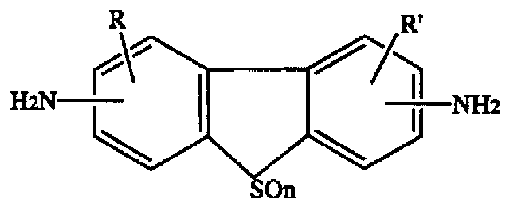
(式中、 R及び R'は水素原子又は有機基であり、 nは 0、 1又は 2である。 )
[0024] [化 8] 一般式 (8)

(式中、 R及び R,は水素原子又は有機基であり、 Xは—CH—又は— CO—である。
2
)
[0025] 前記一般式(7)で示される芳香族ジァミンとしては、一般式(7)の nが 0である下記 一般式(9)で示されるジアミノジベンゾチォフェン類、又は一般式(7)の nが 2である 下記一般式(10)で示されるジァミノジベンゾチォフェン = 5, 5—ジォキシド類を好適 に挙げることができる。
[0026] [化 9]

(式中、 R及び R'は水素原子又は有機基である。 )
[0027] [化 10]
一般式 (1 0 )

(式中、 R及び R'は水素原子又は有機基である。 )
[0028] 前記のジァミノジベンゾチォフェン類(一般式(9) )としては、例えば 3, 7 ジァミノ
- 2, 8 ジメチルジベンゾチオフ ン、 3, 7 ジアミノー 2, 6 ジメチルジベンゾチ オフヱン、 3, 7 ジァミノ一 4, 6 ジメチルジベンゾチォフェン、 2, 8 ジァミノ一 3, 7 ジメチルジベンゾチオフ ン、 3, 7 ジアミノー 2, 8 ジェチルベンゾチオフ ン 、 3, 7 ジアミノー 2, 6 ジェチルベンゾチォフェン、 3, 7 ジアミノー 4, 6 ジェチ ノレベンゾチォフェン、 3, 7 ジアミノー 2, 8 ジプロピルジベンゾチォフェン、 3, 7— ジァミノー 2, 6 ジプロピルジベンゾチォフェン、 3, 7 ジアミノー 4, 6 ジプロピル ジベンゾチォフェン、 3, 7 ジアミノー 2, 8 ジメトキシジベンゾチォフェン、 3, 7— ジァミノー 2, 6 ジメトキシジベンゾチォフェン、 3, 7 ジアミノー 4, 6 ジメトキシジ ベンゾチォフェンなどを挙げることができる。
[0029] 前記のジァミノジベンゾチォフェン = 5, 5 ジォキシド類(一般式(10) )としては、 例えば 3, 7 ジァミノ一 2, 8 ジメチルジベンゾチォフェン = 5, 5 ジォキシド、 3, 7 ジアミノー 2, 6 ジメチルジベンゾチォフェン = 5, 5 ジォキシド、 3, 7 ジアミ ノ一 4, 6 ジメチルジベンゾチォフェン = 5, 5 ジォキシド、 2, 8 ジァミノ一 3, 7 ージメチルジベンゾチォフェン = 5, 5 ジォキシド、 3, 7 ジアミノー 2, 8 ジェチ ルベンゾチォフェン = 5, 5 ジォキシド、 3, 7 ジアミノー 2, 6 ジェチルベンゾチ オフヱン = 5, 5—ジォキシド、 3, 7—ジアミノー 4, 6—ジェチルベンゾチォフェン = 5 , 5 ジォキシド、 3, 7 ジアミノー 2, 8 ジプロピルジベンゾチォフェン = 5, 5 ジ ォキシド、 3, 7 ジアミノー 2, 6 ジプロピルジベンゾチォフェン = 5, 5 ジォキシド 、 3, 7—ジアミノー 4, 6—ジプロピルジベンゾチォフェン = 5, 5—ジォキシド、 3, 7— ジァミノー 2, 8 ジメトキシジベンゾチォフェン = 5, 5 ジォキシド、 3, 7 ジアミノー 2, 6 ジメトキシジベンゾチォフェン = 5, 5 ジ才キシド、 3, 7 ジアミノー 4, 6 ジ メトキシジベンゾチォフェン = 5, 5—ジォキシドなどを挙げることができる。
[0030] 前記の一般式(8)において、 Xがー CH—であるジァミノチォキサンテン 10, 10
ージオン類としては、例えば 3, 6 ジァミノチォキサンテン 10, 10 ジオン、 2, 7 ージァミノチォキサンテン 10, 10 ジオン、 3, 6 ジアミノー 2, 7 ジメチルチオ キサンテン 10, 10 ジオン、 3, 6 ジアミノー 2, 8 ジェチノレーチォキサンテン - 10, 10 ジオン、 3, 6 ジアミノー 2, 8 ジプロピルチオキサンテン 10, 10— ジオン、 3, 6 ジアミノー 2, 8 ジメトキシチォキサンテン 10, 10 ジオン、等を 挙げることができる。
[0031] 前記の一般式(8)において、 Xがー CO であるジァミノチォキサンテン 9, 10, 1 0 トリオン類としては、例えば 3, 6 ジァミノ一チォキサンテン一 9, 10, 10 トリオ ン、 2, 7 ジアミノーチォキサンテン 9, 10, 10 トリオンなどを挙げることができる
[0032] また、前記一般式 (6)で示されるジァミノ安息香酸構造力もなるユニットは、ジァミン 成分として、ジァミノ安息香酸類を用いることによって得られる。ジァミノ安息香酸類と しては、例えば 3, 5—ジァミノ安息香酸、 3, 4—ジァミノ安息香酸などを挙げることが できる。
[0033] 本発明の非対称中空糸ガス分離膜を形成する芳香族ポリイミドのジァミン成分は、 85〜20モル0 /0の前記ジアミノジベンゾチォフェン = 5, 5 ジォキシド類とりわけ 3, 7 ージアミノージメチルジベンゾチォフェン = 5, 5 ジォキシドと、 15〜80モル%のジ ァミノ安息香酸類とりわけ 3, 5—ジァミノ安息香酸との組合せが特に好適に用いられ る。なお、 3, 7—ジアミノージメチルジベンゾチォフェン = 5, 5—ジォキシドは、メチ ル基の位置が異なる異性体の 、ずれか、又はそれら異性体の混合物を意味する。 通常は、 3, 7 ジアミノー 2, 8 ジメチルジベンゾチォフェン = 5, 5 ジォキシド、 3 , 7 ジァミノ一 2, 6 ジメチルジベンゾチォフェン = 5, 5 ジォキシド、 3, 7 ジァ ミノー 4, 6—ジメチルジベンゾチォフェン = 5, 5—ジォキシドを含む混合物が好適に 用いられる。
[0034] また、本発明の非対称中空糸ガス分離膜を形成する芳香族ポリイミドでは、前述の テトラカルボン酸成分とジァミン成分以外のモノマー成分を、本発明の効果を維持し 得る範囲内で少量 (通常は 20モル%以下特に 10モル%以下)用いても構わない。
[0035] 本発明の非対称中空糸ガス分離膜を形成する芳香族ポリイミドは、有機極性溶媒
への溶解性が優れており、前述のテトラカルボン酸成分とジァミン成分とを略等モル 用いて有機極性溶媒中で重合及びイミドィ匕することによって容易に高重合度の芳香 族ポリイミド溶液として得ることができる。その結果、この芳香族ポリイミド溶液を用いて 乾湿式紡糸法によって非対称中空糸膜を好適に得ることができる。
[0036] 前記芳香族ポリイミド溶液の調製は、有機極性溶媒中にテトラカルボン酸成分とジ ァミン成分とを所定の組成比で加え、室温程度の低温で重合反応させてポリアミド酸 を生成し次いで加熱して加熱イミドィ匕するか又はピリジンなどをカ卩えて化学イミド化す る 2段法、または、有機極性溶媒中にテトラカルボン酸成分とジァミン成分とを所定の 組成比でカ卩え、 100〜250°C好ましくは 130〜200°C程度の高温で重合イミドィ匕反 応させる 1段法によって好適に行われる。加熱によってイミドィ匕反応を行うときは脱離 する水またはアルコールを除去しながら行うことが好適である。有機極性溶媒に対す るテトラカルボン酸成分とジァミン成分の使用量は、溶媒中のポリイミドの濃度が 5〜5 0重量%程度好ましくは 5〜40重量%にするのが好適である。
重合イミドィ匕して得られた芳香族ポリイミド溶液は、そのまま直接紡糸に用いることも できる。また、例えば得られた芳香族ポリイミド溶液を芳香族ポリイミドに対し非溶解 性の溶媒中に投入して芳香族ポリイミドを析出させて単離後、改めて有機極性溶媒 に所定濃度になるように溶解させて芳香族ポリイミド溶液を調製し、それを紡糸に用 いることちでさる。
紡糸に用いる芳香族ポリイミド溶液は、ポリイミドの濃度が 5〜40重量%更には 8〜 25重量%になるようにするのが好ましぐ溶液粘度(回転粘度)は 100°Cで 100〜15 000ポィズ好ましくは 200〜10000ポィズ特に 300〜5000ポィズであること力 S好まし い。溶液粘度が 100ボイズ未満では、均質膜 (フィルム)は得られる力もしれないが、 機械的強度の大きな非対称中空糸膜を得ることは難しい。また、 15000ボイズを越え ると、紡糸ノズル力 押し出しにくくなるため目的の形状の非対称中空糸膜を得ること は難しい。
[0037] 前記有機極性溶媒としては、得られる芳香族ポリイミドを好適に溶解できるものであ れば限定されるものではないが、例えばフエノール、クレゾール、キシレノールのよう なフエノール類、 2個の水酸基をベンゼン環に直接有するカテコール類、 3—クロルフ
ェノール、 4—クロルフエノール(後述のパラクロロフエノールに同じ)、 4—ブロムフエノ ール、 2 クロル 5 ヒドロキシトルエンなどのハロゲン化フエノール類などのフエノ ール系溶媒、又は N—メチルー 2—ピロリドン、 N, N ジメチルホルムアミド、 N, N- ジェチルホルムアミド、 N, N ジメチルァセトアミド、 N, N ジェチルァセトアミドな どのアミド類力 なるアミド系溶媒、あるいはそれらの混合溶媒などを好適に挙げるこ とがでさる。
[0038] 本発明のポリイミド非対称ガス分離膜は、前記芳香族ポリイミド溶液を用いて、乾湿 式法による紡糸(乾湿式紡糸法)によって好適に得ることができる。乾湿式法は、膜 形状にしたポリマー溶液の表面の溶媒を蒸発させて薄 ヽ緻密層(分離層)を形成し、 更に、凝固液 (ポリマー溶液の溶媒とは相溶し、ポリマーは不溶な溶剤)に浸漬し、そ の際生じる相分離現象を利用して微細孔を形成して多孔質層 (支持層)を形成させ る方法 (相転換法)であり、 Loebらが提案 (例えば、米国特許 3133132号)したもの である。乾湿式紡糸法は、紡糸用ノズルを用いて乾湿式法によって中空糸膜を形成 する方法であり、例えば特許文献 1や特開昭 61— 133106号公報などに記載されて いる。
[0039] すなわち、紡糸ノズルは、芳香族ポリイミド溶液を中空糸状体に押し出すものであ ればよぐチューブ'イン'オリフィス型ノズルなどが好適である。通常、押し出す際の 芳香族ポリイミド溶液の温度範囲は約 20°C〜 150°C、特に 30°C〜 120°Cが好適で ある。また、ノズル力 押し出される中空糸状体の内部へ気体または液体を供給しな 力 Sら紡糸がおこなわれる。
凝固液は、芳香族ポリイミド成分を実質的には溶解せず且つ芳香族ポリイミド溶液 の溶媒と相溶性があるものが好適である。特に限定するものではないが、水や、メタノ ール、エタノール、プロピルアルコールなどの低級アルコール類や、アセトン、ジェチ ルケトン、メチルェチルケトンなどの低級アルキル基を有するケトン類など、あるいは、 それらの混合物が好適に用いられる。
凝固工程では、ノズルから中空糸形状に吐出された芳香族ポリイミド溶液がその形 状を保持できる程度に凝固させる一次凝固液に浸漬し、次いで完全に凝固させるた めの二次凝固液に浸漬するのが好ましい。凝固した中空糸分離膜は炭化水素など
の溶媒を用いて凝固液と溶媒置換させたあとで乾燥し、更に加熱処理するのが好適 である。加熱処理は、用いられた芳香族ポリイミドの軟ィ匕点又は二次転移点よりも低
V、温度で行うことが好まし 、。
[0040] 本発明の非対称中空糸ガス分離膜は、主としてガス分離性能を担う極めて薄い緻 密層(好ましくは厚さが 0. 001〜5 m)とその緻密層を支える比較的厚い多孔質層 (好ましくは厚さが 10〜2000 μ m)とからなる非対称構造を有し、内径が 10〜3000 μ mで外径が 30〜7000 μ m程度の中空糸膜であって、改良された極めて優れたガ ス透過性能と実用的な機械的強度を有する。すなわち、本発明の非対称中空糸ガス 分離膜は、好適には、水素ガス透過速度 (P, )が 5O X 10— 5cm3 (STP) /cm2. sec '
H2
cmHg以上、水素ガス透過速度と窒素ガス透過速度との比(Ρ' ZP' )が 50以上、
Η2 Ν2
且つ中空糸膜としての引張破断強度が 2. 5kgfZmm2以上好ましくは 3. Okgf/m m2以上で破断伸度が 15%以上好ましくは 20%以上である。また、好適には、酸素ガ ス透過速度(P, )が3 10— 1113 (3丁?)
02 7«112 ' 56(: 1111¾以上、酸素ガス透過速 度と窒素ガス透過速度との比(Ρ' ZP' )が 3. 5以上好ましくは 4. 0以上、且つ中
02 N2
空糸膜としての引張破断強度が 2. 5kgfZmm2以上好ましくは 3. OkgfZmm2以上 で破断伸度が 15%以上好ましくは 20%以上である。
[0041] 本発明の非対称中空糸ガス分離膜は、中空糸膜での引張破断強度が 2. 5kgf/ mm2以上で、且つ引張破断伸度が 15%以上の機械的な強度を有する。このような 機械的強度を有するので、本発明の非対称中空糸ガス分離膜は、中空糸膜をモジ ユールイ匕する工程で容易に破断することなぐ取扱いが容易であり、工業的にモジュ 一ルイ匕することが出来る。また、引張破断強度が高いので中空糸膜モジュールとして 優れた耐圧性を有し、中空糸の外側に分離対象ガスを供給するシェルフィードでは シェル側圧力と中空側圧力との差異が 200気圧程度までの高圧ガスを供給しても好 適にガス分離を行うことができる。また、中空糸の内側に分離対象ガスを供給する中 空フィードでも中空側圧力とシェル側圧力との差異が 100気圧程度までの高圧ガス を供給しても好適にガス分離を行うことができる。
なお、中空糸膜での引張破断強度が 2. 5kgfZmm2以下、あるいは引張破断伸度 力 S15%以下の場合には、中空糸膜をモジュールィ匕する工程で破断し易くなるのでェ
業的にモジュールィ匕することが困難になり、更に中空糸膜モジュールとしても耐圧性 が低くなり用途や使用条件が限定されるので実用的なガス分離膜モジュールではな くなる。
[0042] 本発明の非対称中空糸ガス分離膜はモジュールィ匕して好適に用いることができる。
通常のガス分離膜モジュールは、例えば、適当な長さの中空糸膜 100〜1000000 本程度を束ね、その中空糸束の両端部を、中空糸の少なくとも一方の両端が開口状 態を保持した状態になるようにして、熱硬化性榭脂などからなる管板で固着し、得ら れた中空糸束と管板などカゝらなる中空糸膜エレメントを、少なくとも混合ガス導入口と 透過ガス排出口と非透過ガス排出口とを備える容器内に、中空糸膜の内側に通じる 空間と中空糸膜の外側へ通じる空間とが隔絶するように収納し取り付けることによつ て得られる。このようなガス分離膜モジュールでは、混合ガスが混合ガス導入口から 中空糸膜の内側あるいは外側に接する空間へ供給され、中空糸膜に接して流れる 間に混合ガス中の特定成分が選択的に膜を透過し、透過ガスが透過ガス排出口か ら、膜を透過しなカゝつた非透過ガスが非透過ガス排出ロカゝらそれぞれ排出されること によって、ガス分離が行われる。
[0043] 本発明の非対称中空糸ガス分離膜は、 200気圧程度までの高圧の水素を含む混 合ガスを供給して、選択的に水素ガスを透過させて、水素ガスを含む混合ガス力ゝら水 素ガスを分離回収するために好適に用いることができる。また、本発明の非対称中空 糸ガス分離膜は、 200気圧程度までの高圧の酸素ガス及び窒素ガスを含む混合ガ スを供給して、選択的に酸素ガスを透過させて、酸素ガスを含む混合ガスカゝら酸素ガ ス又は窒素ガスを選択的に分離回収するために好適に用いることができる。本発明 の中空糸ガス分離膜は、中空糸膜であるために装置当たりの膜面積を広くできるし、 ガス透過性能が高ぐしカゝも高圧の混合ガスを供給してガスを分離できるので、極め て高効率でガス分離を行うことができる。
実施例
[0044] 以下、実施例によって本発明を更に詳しく説明する。なお、本発明は以下の実施 例に限定されるものではない。
[0045] (中空糸膜のガス透過性能の測定)
15本の非対称中空糸膜と、ステンレスパイプと、エポキシ榭脂系接着剤とを使用し て有効長が 10cmの透過性能評価用のエレメントを作成し、これをステンレス容器に 装着してペンシルモジュールとした。それに透過対象ガスを、 80°Cの温度、 IMPaG の圧力で中空糸膜の外側に供給し、透過流量を測定した。測定した透過ガス流量、 供給側圧力、透過側圧力及び有効膜面積からガスの透過速度を算出した。
[0046] (中空糸膜の引張破断強度と破断伸度の測定)
引張試験機を用いて有効長 20mm、引張速度 lOmmZ分で測定した。測定は 23 °Cでおこなった。中空糸断面積は中空糸の断面を光学顕微鏡で観察し、光学顕微 鏡像力も寸法を測定して算出した。
[0047] (溶液粘度の測定方法)
ポリイミド溶液の回転粘度は、回転粘度計 (ローターのずり速度 1. 75seC— を用い 温度 100°Cで測定した。
[0048] 以下の例で用いたィ匕合物は以下のとおりである。
s-BPDA: 3, 3' , 4, 4'ービフエ-ルテトラカルボン酸二無水物
6FDA:4, 4,一(へキサフルォロイソプロピリデン) ビス(無水フタル酸)(、なお、こ の化合物は 2, 2 ビス(3, 4 ジカルボキシフエ-ル)へキサフルォロプロパン二無 水物ともいう。 )
TSN : 3, 7 ジアミノー 2, 8 ジメチルジベンゾチォフェン = 5, 5 ジォキシドを主 成分とし、メチル基の位置が異なる異性体 3, 7 ジアミノー 2, 6 ジメチルジベンゾ チォフェン = 5, 5—ジォキシド、 3, 7—ジアミノー 4, 6—ジメチルジベンゾチォフェン = 5, 5—ジォキシドを含む混合物
DABA: 3, 5—ジァミノ安息香酸
mDABS : l, 3—ジァミノベンゼン一 4—スルホン酸
[0049] 〔実施例 1〕
撹拌機と窒素ガス導入管が取り付けられたセパラブルフラスコに、 s-BPDA 60ミ リモノレと、 6FDA 40ミリモノレと、 TSN 60ミリモノレと、 DABA 40ミリモノレとを、ポリマ 一濃度が 18重量%となるように溶媒のパラクロロフェノールと共に加え、窒素ガスをフ ラスコ内に流通させながら、撹拌下に反応温度 180°Cで 16時間重合イミド化反応を
おこない、ポリイミド濃度が 18重量%の芳香族ポリイミド溶液を調製した。この芳香族 ポリイミド溶液は、 100°Cにおける溶液粘度が 2270ボイズであった。
前記調製した芳香族ポリイミド溶液を、 400メッシュの金網でろ過し、これをドープ液 として、中空糸紡糸用ノズル(円形開口部外径 1000 m、円形開口部スリット幅 200 μ m、芯部開口部外径 400 m)を備えた紡糸装置を使用して、中空糸紡糸用ノズ ルからドープ液を中空糸状に吐出させ、吐出した中空糸状体を窒素ガス雰囲気中に 通した後で、一次凝固液 (0°C、 75重量%エタノール水溶液)に浸漬し、更に一対の 案内ロールを備えた二次凝固装置内の二次凝固液 (0°C、 75重量%エタノール水溶 液)中で案内ロール間を往復させて中空糸状態を凝固させ、引取りロールによって引 取り速度 25mZ分で引き取って、中空糸膜を得た。次いで中空糸膜をボビンに卷取 り、エタノールで洗浄した後、イソオクタンでエタノールを置換し、更に 100°Cで加熱 してイソオクタンを蒸発乾燥させ、更に 305°Cで 30分間加熱処理して、中空糸膜を 得た。
得られた中空糸膜は、内径力 00 /ζ πι、外径が 200 mの非対称中空糸膜であつ た。この非対称中空糸膜について、ガス透過性能と引張破断強度と破断伸度を測定 した結果を表 2に示す。
[0050] 〔実施例 2〜4〕
表 1に示したテトラカルボン酸成分とジァミン成分を用いて、実施例と同様にして、 芳香族ポリイミド溶液の調製と中空糸膜の製造をおこなった。
得られた非対称中空糸膜について、ガス透過性能と引張破断強度と破断伸度を測 定した結果を表 2に示す。
[0051] 〔比較例 1〕
表 1に示すとおり、テトラカルボン酸成分を s— BPDAが 100モル%としたこと以外 は実施例 4と同様な組成を用い、実施例 1と同様にして芳香族ポリイミド溶液の調製と 中空糸膜の製造をおこなった。
得られた非対称中空糸膜について、ガス透過性能と引張破断強度と破断伸度を測 定した結果を表 2に示す。ガス透過速度が低 、ものであった。
[0052] 〔比較例 2〕
表 1に示すとおり、ジァミン成分を TSN95モル%と DABA5モル%にしたこと以外 は実施例 1と同様の組成を用 Vヽ、実施例 1と同様にして芳香族ポリイミド溶液の調製と 中空糸膜の製造をおこなった。
得られた非対称中空糸膜について、ガス透過性能と引張破断強度と破断伸度を測 定した結果を表 2に示す。引張破断伸度が 13%で十分とはいえず、水素ガスと窒素 ガスの透過速度の比(P ' ZP ' )
H2 N2 、酸素ガス透過速度と窒素ガス透過速度との比(
P, ZP
02 , N2)などが低いものであった。
[0053] 〔比較例 3〜6〕
表 1に示すとおり、テトラカルボン酸力 ½FDA、 s— BPDA、又は 6FDAと s— BPDA との組合せからなる、ジァミン成分が TSNと mDABSとの組合せ力もなる組成を用い 、実施例 1と同様にして芳香族ポリイミド溶液の調製と中空糸膜の製造をおこなった。 得られた非対称中空糸膜について、ガス透過性能と引張破断強度と破断伸度を測 定した結果を表 2に示す。
比較例 3では、水素ガスと窒素ガスの透過速度比(Ρ' ZP' )、酸素ガス透過速
H2 N2
度と窒素ガス透過速度との比 (Ρ' ZP' )などが低ぐまた引張破断伸度が 8%しか
02 N2
なぐ工業的にモジュールィ匕するのが困難なものであった。
比較例 4では、重合イミドィ匕時にポリイミド重合物が析出するので紡糸ドープとして 利用できる芳香族ポリイミド溶液を得ることが出来な力つた。
比較例 5、 6では、重合イミドィ匕時にポリイミドが析出はしないものの、溶液粘度が 50 および 30ボイズ程度で重合度が上がらず、中空糸膜の紡糸は出来なかった。
[0054] [表 1]
原料 仕込み組成 ドープ
No. 酸無 l物 ジァミン 濃度 粘度 s-BPDA TSN DABA mDABS @100°C mol% mol% mol% mol wt% poise 実施例 1 60 40 60 40 18 2270 実施例 2 60 40 70 30 18 2180 実施例 3 70 30 60 40 18 2300 実施例 4 70 30 70 30 18 2030 比較例 1 100 70 30 18 2350 比較例 2 60 40 95 5 18 2240 比較例 3 100 60 40 18 1000 比較例 4 100 30 70 18 ― 比較例 5 100 70 30 18 50 比較例 6 70 ¾ 3さ0 70 30 t8 30

本発明によって、特定の反復単位力 なる可溶性の芳香族ポリイミドで形成され、 改良された極めて優れたガス透過性能と実用的な機械的強度を有する非対称中空 糸ガス分離膜を得ることができる。
本発明の非対象ガス分離膜は、通常のガス分離膜モジュールに用いて、極めて高
効率で混合ガス力も特定のガスを選択的に分離回収することができる。例えば水素 ガス又はヘリウムガスを含む混合ガスカゝら水素ガス又はヘリウムガスを選択的に分離 回収することができる。又は酸素ガスと窒素ガスを含む混合ガスカゝら酸素ガス又は窒 素ガスを選択的に分離回収することができる。
Claims
請求の範囲
下記一般式(1)で示される反復単位カゝらなる可溶性の芳香族ポリイミドで形成され て ヽる非対称中空糸ガス分離膜。
[化 11] 般式 (1 )

〔但し、一般式(1)の Bは、
その 10〜60モル%力 下記一般式(2)で示されるジフ
ン構造に基づく 4価のユニット B1であり、
[化 12] 般式 ( 2 )

[化 13] 一般式 (3 )

その 85〜20モル0 /0力 下記一般式 (4)で示される 2価のユニット Al、及び Z又は、 下記一般式(5)で示される 2価のユニット A2であり、
[化 14] 一般式 (4 )

(式中、 R及び R'は水素原子又は有機基であり、 nは 0、 1又は 2である。 )
[化 15]

(式中、 R及び R,は水素原子又は有機基であり、 Xは CH—又は CO である。
2
)
その 15〜80モル0 /0力 下記一般式(6)で示される 2価のユニット A3である。〕
[化 16]
-般式(6 )

[2] Aの 85〜20モル%が前記 A1からなり、 A1が 3, 7 ジァミノ—ジメチルジベンゾチ ォフェン = 5, 5 ジォキシドからアミノ基を除いた 2価のユニットであることを特徴とす る請求の範囲第 1項に記載の非対称中空糸ガス分離膜。
[3] A3が 3, 5 ジァミノ安息香酸力もアミノ基を除いた 2価のユニットであることを特徴 とする請求の範囲第 1項又は第 2項に記載の非対称中空糸ガス分離膜。
[4] 水素ガス透過速度(P, )が 50 X 10— 5cm3 (STP) /cm2' sec'cmHg以上、水素ガ
H2
ス透過速度と窒素ガス透過速度との比(Ρ' ZP' )
Η2 Ν2 が 50以上、且つ中空糸膜として の引張破断強度が 2. 5kgfZmm2以上で破断伸度が 15%以上であることを特徴と する請求の範囲第 1項〜第 3項のいずれかに記載の非対称中空糸ガス分離膜。
[5] 酸素ガス透過速度(P, )が3 10—5«113 (3丁?)/«112 ' 56 《111¾以上、酸素ガ
02
ス透過速度と窒素ガス透過速度との比(Ρ' ZP' )
02 N2が 3. 5以上、且つ中空糸膜とし ての引張破断強度が 2. 5kgfZmm2以上で破断伸度が 15%以上であることを特徴 とする請求の範囲第 1項〜第 3項のいずれかに記載の非対称中空糸ガス分離膜。
[6] 請求の範囲第 4項に記載の非対称中空糸ガス分離膜を用いて、水素ガスを含む混 合ガスカゝら水素ガスを選択的に分離回収する方法。
[7] 請求の範囲第 5項に記載の非対称中空糸ガス分離膜を用いて、酸素ガス及び窒 素ガスを含む混合ガスカゝら酸素ガス又は窒素ガスを選択的に分離回収する方法。
Applications Claiming Priority (2)
| Application Number | Priority Date | Filing Date | Title |
|---|---|---|---|
| JP2005015939A JP4507894B2 (ja) | 2005-01-24 | 2005-01-24 | 非対称中空糸ガス分離膜、及びガス分離方法 |
| JP2005-015939 | 2005-01-24 |
Publications (1)
| Publication Number | Publication Date |
|---|---|
| WO2006077903A1 true WO2006077903A1 (ja) | 2006-07-27 |
Family
ID=36692288
Family Applications (1)
| Application Number | Title | Priority Date | Filing Date |
|---|---|---|---|
| PCT/JP2006/300686 Ceased WO2006077903A1 (ja) | 2005-01-24 | 2006-01-19 | 非対称中空糸ガス分離膜、及びガス分離方法 |
Country Status (3)
| Country | Link |
|---|---|
| US (1) | US7771518B2 (ja) |
| JP (1) | JP4507894B2 (ja) |
| WO (1) | WO2006077903A1 (ja) |
Families Citing this family (13)
| Publication number | Priority date | Publication date | Assignee | Title |
|---|---|---|---|---|
| US7803214B2 (en) * | 2006-07-21 | 2010-09-28 | Ube Industries, Ltd. | Asymmetric hollow-fiber gas separation membrane, gas separation method and gas separation membrane module |
| JP5627198B2 (ja) * | 2009-05-27 | 2014-11-19 | 日東電工株式会社 | プロトン伝導性高分子電解質膜とそれを用いた膜−電極接合体および高分子電解質型燃料電池 |
| KR101896721B1 (ko) * | 2009-07-23 | 2018-09-07 | 에보닉 피브레 게엠베하 | 중합 용액으로 제조된 폴리이미드 막 |
| JP5348026B2 (ja) * | 2010-03-08 | 2013-11-20 | 宇部興産株式会社 | 非対称中空糸ガス分離膜を製造する方法 |
| JP5983405B2 (ja) * | 2010-03-30 | 2016-08-31 | 宇部興産株式会社 | 非対称ガス分離中空糸膜 |
| US8366804B2 (en) * | 2010-05-28 | 2013-02-05 | Uop Llc | High permeance polyimide membranes for air separation |
| US9718023B2 (en) | 2010-11-04 | 2017-08-01 | Ube Industries, Ltd. | Gas separation membrane module and gas separation method |
| WO2012077810A1 (ja) * | 2010-12-09 | 2012-06-14 | 宇部興産株式会社 | 非対称ガス分離膜およびこれを用いてメタノールを分離する方法 |
| CN103429640B (zh) * | 2011-03-25 | 2016-03-02 | 株式会社I.S.T. | 聚酰亚胺前体溶液、聚酰亚胺前体、单体型聚酰亚胺前体溶液、活性物质层形成用粘合剂、聚酰亚胺树脂、合剂浆料、电极、合剂浆料制造方法以及电极形成方法 |
| US9321015B2 (en) * | 2011-09-06 | 2016-04-26 | Sri International | Process for fabricating PBI hollow fiber asymmetric membranes for gas separation and liquid separation |
| EP2883592B1 (en) * | 2012-08-10 | 2020-09-02 | UBE Industries, Ltd. | Gas-separating membrane module |
| CN105339078B (zh) * | 2013-06-21 | 2019-04-16 | 赢创纤维有限公司 | 制备聚酰亚胺膜的方法 |
| JP6111453B2 (ja) | 2015-02-26 | 2017-04-12 | 株式会社アイ.エス.テイ | ポリイミドコーティング活物質粒子、電極材料用スラリー、負極、電池、及び、ポリイミドコーティング活物質粒子の製造方法 |
Citations (6)
| Publication number | Priority date | Publication date | Assignee | Title |
|---|---|---|---|---|
| JPH02169019A (ja) * | 1988-12-23 | 1990-06-29 | Ube Ind Ltd | ポリイミド二層中空糸膜の製法 |
| JPH03284334A (ja) * | 1990-03-31 | 1991-12-16 | Ube Ind Ltd | 低級アルコールの分離方法 |
| JPH0416213A (ja) * | 1990-05-08 | 1992-01-21 | Ube Ind Ltd | 低級アルコールの分離法 |
| JPH0568859A (ja) * | 1991-09-10 | 1993-03-23 | Ube Ind Ltd | ガス分離中空糸膜及びその製法 |
| JP2003024755A (ja) * | 2001-07-16 | 2003-01-28 | Ube Ind Ltd | 非対称中空糸ガス分離膜の製造方法 |
| JP2004267810A (ja) * | 2003-03-05 | 2004-09-30 | Ube Ind Ltd | 非対称ガス分離膜 |
Family Cites Families (14)
| Publication number | Priority date | Publication date | Assignee | Title |
|---|---|---|---|---|
| US4948400A (en) * | 1988-06-30 | 1990-08-14 | Nippon Steel Chemical Co., Ltd. | Separation membranes and process for preparing the same |
| FR2650755B1 (fr) * | 1989-08-14 | 1991-10-31 | Inst Francais Du Petrole | Membrane de separation de gaz |
| US4954144A (en) * | 1989-09-12 | 1990-09-04 | Air Products And Chemicals, Inc. | Polyimide membranes and their use for gas separation |
| JPH07121343B2 (ja) * | 1990-03-15 | 1995-12-25 | 宇部興産株式会社 | ガス分離中空糸膜及びその製法 |
| US5042992A (en) * | 1990-03-21 | 1991-08-27 | W. R. Grace & Co.-Conn. | Gas separation material |
| US5042993A (en) * | 1990-07-24 | 1991-08-27 | Air Products And Chemicals, Inc. | Gas separating membranes from polyimide polymers |
| US5076817A (en) * | 1990-11-30 | 1991-12-31 | E. I. Du Pont De Nemours And Company | Polyamide gas separation membranes and process of using same |
| JP3267130B2 (ja) | 1995-12-11 | 2002-03-18 | 富士電機株式会社 | Pwm制御自励式整流装置 |
| JPH119979A (ja) * | 1997-06-18 | 1999-01-19 | Sumitomo Chem Co Ltd | ポリイミドガス分離膜 |
| CN1216092C (zh) * | 1999-09-24 | 2005-08-24 | 液态空气-乔治克罗德方法研究监督及咨询股份有限公司 | 新的聚酰亚胺酰胺酸盐以及由此形成的聚酰亚胺膜 |
| US6383258B1 (en) | 2000-12-19 | 2002-05-07 | L'air Liquide Societe Anonyme Pour L'etude Et L'exploitation Des Procedes Georges Claude | Copolyimide gas separation membranes |
| SG108269A1 (en) * | 2001-08-15 | 2005-01-28 | Inst Materials Research & Eng | Chemical modification of polyimides |
| JP2003062422A (ja) * | 2001-08-27 | 2003-03-04 | Inst Of Physical & Chemical Res | 気体分離膜及びその製造方法 |
| US7803214B2 (en) * | 2006-07-21 | 2010-09-28 | Ube Industries, Ltd. | Asymmetric hollow-fiber gas separation membrane, gas separation method and gas separation membrane module |
-
2005
- 2005-01-24 JP JP2005015939A patent/JP4507894B2/ja not_active Expired - Lifetime
-
2006
- 2006-01-19 US US11/795,892 patent/US7771518B2/en active Active
- 2006-01-19 WO PCT/JP2006/300686 patent/WO2006077903A1/ja not_active Ceased
Patent Citations (6)
| Publication number | Priority date | Publication date | Assignee | Title |
|---|---|---|---|---|
| JPH02169019A (ja) * | 1988-12-23 | 1990-06-29 | Ube Ind Ltd | ポリイミド二層中空糸膜の製法 |
| JPH03284334A (ja) * | 1990-03-31 | 1991-12-16 | Ube Ind Ltd | 低級アルコールの分離方法 |
| JPH0416213A (ja) * | 1990-05-08 | 1992-01-21 | Ube Ind Ltd | 低級アルコールの分離法 |
| JPH0568859A (ja) * | 1991-09-10 | 1993-03-23 | Ube Ind Ltd | ガス分離中空糸膜及びその製法 |
| JP2003024755A (ja) * | 2001-07-16 | 2003-01-28 | Ube Ind Ltd | 非対称中空糸ガス分離膜の製造方法 |
| JP2004267810A (ja) * | 2003-03-05 | 2004-09-30 | Ube Ind Ltd | 非対称ガス分離膜 |
Also Published As
| Publication number | Publication date |
|---|---|
| US20080134885A1 (en) | 2008-06-12 |
| JP4507894B2 (ja) | 2010-07-21 |
| JP2006198589A (ja) | 2006-08-03 |
| US7771518B2 (en) | 2010-08-10 |
Similar Documents
| Publication | Publication Date | Title |
|---|---|---|
| JP5472114B2 (ja) | 非対称ガス分離膜、及びガス分離方法 | |
| WO2006077903A1 (ja) | 非対称中空糸ガス分離膜、及びガス分離方法 | |
| JP5348026B2 (ja) | 非対称中空糸ガス分離膜を製造する方法 | |
| JP2874741B2 (ja) | 非対称性中空糸ポリイミド気体分離膜 | |
| JP6500893B2 (ja) | 非対称ガス分離膜、及びガスを分離回収する方法 | |
| JP6142730B2 (ja) | 非対称中空糸ガス分離膜、及びガス分離方法 | |
| JP5359957B2 (ja) | ポリイミドガス分離膜、及びガス分離方法 | |
| JP5359914B2 (ja) | ポリイミドガス分離膜、及びガス分離方法 | |
| JP4857593B2 (ja) | 非対称中空糸ガス分離膜、及びガス分離方法 | |
| JP6623600B2 (ja) | 非対称ガス分離膜、及びガスを分離回収する方法 | |
| JP4978602B2 (ja) | 非対称中空糸ガス分離膜、及びガス分離方法 | |
| JP7676874B2 (ja) | 非対称中空糸ガス分離膜 | |
| JP4835020B2 (ja) | 非対称中空糸ガス分離膜、及びガス分離方法 | |
| JP5136667B2 (ja) | 非対称中空糸ガス分離膜、及びガス分離方法 | |
| JP5099242B2 (ja) | 非対称中空糸ガス分離膜、及びガス分離方法 | |
| JP5240152B2 (ja) | ポリイミドガス分離膜、及びガス分離方法 | |
| JP4857592B2 (ja) | 非対称中空糸ガス分離膜、及びガス分離方法 | |
| JP2016175000A (ja) | ポリイミドガス分離膜、及びガス分離方法 | |
| JP5348085B2 (ja) | 非対称中空糸ガス分離膜を製造する方法 | |
| JP6060715B2 (ja) | ポリイミドガス分離膜、及びガス分離方法 | |
| JP4857588B2 (ja) | 非対称中空糸ガス分離膜、及びガス分離方法 | |
| JP5136666B2 (ja) | 非対称中空糸ガス分離膜、及びガス分離方法 |
Legal Events
| Date | Code | Title | Description |
|---|---|---|---|
| 121 | Ep: the epo has been informed by wipo that ep was designated in this application | ||
| WWE | Wipo information: entry into national phase |
Ref document number: 11795892 Country of ref document: US |
|
| 122 | Ep: pct application non-entry in european phase |
Ref document number: 06711932 Country of ref document: EP Kind code of ref document: A1 |
|
| WWW | Wipo information: withdrawn in national office |
Ref document number: 6711932 Country of ref document: EP |