US9508574B2 - Process liquid supply apparatus operating method, process liquid supply apparatus and non-transitory storage medium - Google Patents
Process liquid supply apparatus operating method, process liquid supply apparatus and non-transitory storage medium Download PDFInfo
- Publication number
- US9508574B2 US9508574B2 US13/956,507 US201313956507A US9508574B2 US 9508574 B2 US9508574 B2 US 9508574B2 US 201313956507 A US201313956507 A US 201313956507A US 9508574 B2 US9508574 B2 US 9508574B2
- Authority
- US
- United States
- Prior art keywords
- filter unit
- liquid
- process liquid
- trap
- pipe
- Prior art date
- Legal status (The legal status is an assumption and is not a legal conclusion. Google has not performed a legal analysis and makes no representation as to the accuracy of the status listed.)
- Active, expires
Links
Images






Classifications
-
- H—ELECTRICITY
- H10—SEMICONDUCTOR DEVICES; ELECTRIC SOLID-STATE DEVICES NOT OTHERWISE PROVIDED FOR
- H10P—GENERIC PROCESSES OR APPARATUS FOR THE MANUFACTURE OR TREATMENT OF DEVICES COVERED BY CLASS H10
- H10P76/00—Manufacture or treatment of masks on semiconductor bodies, e.g. by lithography or photolithography
- H10P76/20—Manufacture or treatment of masks on semiconductor bodies, e.g. by lithography or photolithography of masks comprising organic materials
- H10P76/204—Manufacture or treatment of masks on semiconductor bodies, e.g. by lithography or photolithography of masks comprising organic materials of organic photoresist masks
-
- H01L21/6715—
-
- H—ELECTRICITY
- H10—SEMICONDUCTOR DEVICES; ELECTRIC SOLID-STATE DEVICES NOT OTHERWISE PROVIDED FOR
- H10P—GENERIC PROCESSES OR APPARATUS FOR THE MANUFACTURE OR TREATMENT OF DEVICES COVERED BY CLASS H10
- H10P72/00—Handling or holding of wafers, substrates or devices during manufacture or treatment thereof
- H10P72/04—Apparatus for manufacture or treatment
- H10P72/0448—Apparatus for applying a liquid, a resin, an ink or the like
-
- B—PERFORMING OPERATIONS; TRANSPORTING
- B01—PHYSICAL OR CHEMICAL PROCESSES OR APPARATUS IN GENERAL
- B01D—SEPARATION
- B01D19/00—Degasification of liquids
- B01D19/0031—Degasification of liquids by filtration
-
- B—PERFORMING OPERATIONS; TRANSPORTING
- B01—PHYSICAL OR CHEMICAL PROCESSES OR APPARATUS IN GENERAL
- B01D—SEPARATION
- B01D19/00—Degasification of liquids
- B01D19/0036—Flash degasification
-
- B—PERFORMING OPERATIONS; TRANSPORTING
- B01—PHYSICAL OR CHEMICAL PROCESSES OR APPARATUS IN GENERAL
- B01D—SEPARATION
- B01D36/00—Filter circuits or combinations of filters with other separating devices
- B01D36/001—Filters in combination with devices for the removal of gas, air purge systems
-
- H01L21/67017—
-
- H—ELECTRICITY
- H10—SEMICONDUCTOR DEVICES; ELECTRIC SOLID-STATE DEVICES NOT OTHERWISE PROVIDED FOR
- H10P—GENERIC PROCESSES OR APPARATUS FOR THE MANUFACTURE OR TREATMENT OF DEVICES COVERED BY CLASS H10
- H10P14/00—Formation of materials, e.g. in the shape of layers or pillars
-
- H—ELECTRICITY
- H10—SEMICONDUCTOR DEVICES; ELECTRIC SOLID-STATE DEVICES NOT OTHERWISE PROVIDED FOR
- H10P—GENERIC PROCESSES OR APPARATUS FOR THE MANUFACTURE OR TREATMENT OF DEVICES COVERED BY CLASS H10
- H10P72/00—Handling or holding of wafers, substrates or devices during manufacture or treatment thereof
- H10P72/04—Apparatus for manufacture or treatment
- H10P72/0402—Apparatus for fluid treatment
-
- H—ELECTRICITY
- H10—SEMICONDUCTOR DEVICES; ELECTRIC SOLID-STATE DEVICES NOT OTHERWISE PROVIDED FOR
- H10P—GENERIC PROCESSES OR APPARATUS FOR THE MANUFACTURE OR TREATMENT OF DEVICES COVERED BY CLASS H10
- H10P90/00—Preparation of wafers not covered by a single main group of this subclass, e.g. wafer reinforcement
- H10P90/12—Preparing bulk and homogeneous wafers
Definitions
- the present disclosure relates to an operation performed prior to the beginning of a process using a process liquid in a process liquid supply apparatus that ejects a process liquid from a nozzle via a filter unit.
- a liquid process is performed in a manufacture process of a semiconductor device by supplying liquid chemicals (e.g., a resist liquid, an acid or alkali cleaning liquid, a solvent, a precursor-containing liquid for forming an insulation film, etc.) from a nozzle to a substrate.
- liquid chemicals e.g., a resist liquid, an acid or alkali cleaning liquid, a solvent, a precursor-containing liquid for forming an insulation film, etc.
- Such a liquid chemical supply apparatus is configured to remove foreign substances by a filter unit disposed in a supply passage.
- Bubbles may be created in the aforementioned process due to gas dissolved in a resist or a liquid chemical. A line width of a pattern becomes finer and finer. Thus, cautious measures should be taken for fine bubbles that are not problematic in the past.
- a coating apparatus for coating the aforesaid liquid chemical performs a gas removal process of removing the gas in a filter unit in order to remove foreign substances contained in a process liquid.
- the gas removal process makes the process liquid permeate through the filter unit (hereinafter, referred to as “a filter wetting process”) when the filter unit is newly mounted or replaced.
- a filter wetting process For example, as a method of performing the filter wetting process, filtering is performed under a positive pressure (pressure higher than an atmospheric pressure) using a pressure of a N 2 gas or a pressure produced by a pump after setting the filter unit, and thereafter the number of defects on a substrate caused by the bubbles is monitored. Further, in the method of performing the filter wetting process, the gas in the filter unit is regarded as fully removed when the number of defects decreases to a predetermined level, and the filter wetting process is finished accordingly.
- the filter unit communicating with a process liquid ejecting nozzle may have a structural feature for reducing the number of bubbles in the process liquid passing through the filter unit.
- the filter unit may have repetitive prominences and depressions on a wall surface, but this may lead to complexity in manufacturing the filter unit.
- Various embodiments of the present disclosure provide a technique for accomplishing the reduction in the liquid chemical spent for removing bubbles from a filter unit as well as the shortening in an operative time when the filter unit is newly mounted in a liquid chemical supply passage or the filter unit provided in the liquid chemical supply passage is replaced.
- the process liquid supply apparatus includes a filter unit, a discharge outlet for a gas in a process liquid, and a liquid sending unit, which are provided in a flow passage located between a process liquid supply source and a nozzle in that order from an upstream side.
- the process liquid supply apparatus supplies the process liquid to target objects through the nozzle by the liquid sending unit.
- the method includes filling the filter unit with the process liquid from an upstream side of the filter unit to a downstream side of the filter unit after newly mounting or replacing the filter unit, and repeating a depressurization filtering process and a pressurization filtering process for a predetermined number of times.
- the depressurization filtering process depressurizes the process liquid in the downstream side of the filter unit and thereby allows the process liquid to permeate through the filter unit.
- the pressurization filtering process pressurizes the process liquid from the upstream side of the filter unit and thereby allowing the process liquid to permeate through the filter unit.
- a process liquid supply apparatus which includes a filter unit, a discharge outlet for a gas in a process liquid, and a liquid sending unit, which are provided in a flow passage located between a process liquid supply source and a nozzle in that order from an upstream side, and supplies the process liquid to target objects through the nozzle by the liquid sending unit.
- the process liquid supply apparatus includes a control unit configured to output a control signal for performing filling the filter unit with the process liquid from an upstream side of the filter unit to a downstream side of the filter unit after newly mounting or replacing the filter unit; and repeating a depressurization filtering process and a pressurization filtering process for a predetermined number of times.
- the depressurization filtering process depressurizes the process liquid in the downstream side of the filter unit and thereby allows the process liquid to permeate through the filter unit.
- the pressurization filtering process pressurizes the process liquid from the upstream side of the filter unit and thereby allowing the process liquid to permeate through the filter unit.
- a non-transitory storage medium storing a computer program for use in an apparatus, which performs the method of operating the process liquid supply apparatus using the process liquid supplied from the process liquid supply source.
- the computer program is configured to execute the method of operating the process liquid supply apparatus according to the first aspect of the present disclosure.
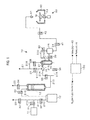
- FIG. 1 is configuration diagram showing one embodiment of a resist supply apparatus constituting a resist coating apparatus according to one embodiment of the present disclosure.
- FIG. 2A is a longitudinal sectional view showing one example of a filter unit.
- FIG. 2B is a perspective view showing one example of a filtering portion.
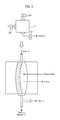
- FIG. 3 illustrates an example of a structure of a pump unit.
- FIG. 4 is a fragmentary configuration diagram showing a resist flow in the vicinity of the filter unit during pressurization filtering.
- FIG. 5 is a configuration diagram showing a resist flow in the vicinity of the filter unit in during depressurization filtering.
- FIG. 6 is a configuration diagram showing a resist flow in the vicinity of the filter unit during pressurization filtering.
- FIGS. 7A to 7D schematically show an extraction mechanism of bubble nucleuses in a supersaturated state.
- FIG. 8A to 8C schematically show a collapse mechanism of bubble nucleuses.
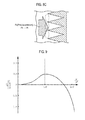
- FIG. 9 is a graph showing a relationship between a potential of a bubble nucleus and a radius of a bubble nucleus.
- FIG. 10 is a graph showing a relationship between liquid permeability and time in a capillary phenomenon.
- FIG. 11 is a graph showing results of comparative experiments for verifying the effects of the embodiments according to the present disclosure.
- FIG. 12 is a graph showing results of comparative experiments for verifying the effects of the embodiments according to the present disclosure.
- the resist coating apparatus comprises the following: a cup module 60 having a spin chuck 63 (substrate holding part) configured to horizontally hold a wafer W (i.e. a substrate); a nozzle 61 configured to supply a resist (process liquid) to a central portion of the wafer W held by the spin chuck 63 ; and a resist supply apparatus 10 (process liquid supply apparatus) configured to supply the resist to the nozzle 61 .
- a cup module 60 having a spin chuck 63 (substrate holding part) configured to horizontally hold a wafer W (i.e. a substrate); a nozzle 61 configured to supply a resist (process liquid) to a central portion of the wafer W held by the spin chuck 63 ; and a resist supply apparatus 10 (process liquid supply apparatus) configured to supply the resist to the nozzle 61 .
- the cup module 60 includes a cup body 62 that surrounds the spin chuck 63 and receives the resist dropping from the wafer W.
- a suction/exhaust passage is connected to a lower portion of the spin chuck 63 .
- the lower portion of the spin chuck 63 is provided with a drain mechanism that is configured to discharge a drain liquid.
- the cup body 62 may comprises a combination of an inner cup and an outer cup.
- the resist supply apparatus 10 may be constructed by combining a plurality of mechanisms and a piping system having a plurality of pipes.
- the resist supply apparatus 10 includes a closed bottle 12 configured to store the resist.
- Two pipes 210 and 212 are connected to a top of the bottle 12 .
- One pipe 212 is connected to a top port of a liquid end tank 13 via a valve 33 and then extends from the top port toward a bottom of the liquid end tank 13 .
- the other pipe 210 is connected to one end of a valve 32 .
- a pipe 211 is connected to the other end of the valve 32 .
- the pipe 211 is branched into two pipes 213 and 22 .
- One pipe 213 is connected to a pressurizing gas supply source (in this embodiment, a N 2 gas supply source 11 ) via the valve 31 .
- the other pipe 22 is open toward the outside via a valve 30 , thus serving as an exhaust pipe.
- the liquid end tank 13 is provided to stably supply the resist to the wafer W.
- a plurality of liquid level sensors (not shown) are mounted in the liquid end tank 13 .
- a drain pipe 23 extending from the inside of the liquid end tank 13 is connected to the top of the liquid end tank 13 .
- a valve 34 is provided in the drain pipe 23 .
- a pipe 213 that supplies the resist is connected to a bottom port of the liquid end tank 13 .
- the pipe 213 is branched into two pipes 214 and 215 .
- One pipe 214 is connected to the upstream side of a filter unit 14 via a valve 35
- the other pipe 215 is connected to a bottom port of a trap 15 via a valve 36 .
- the filter unit 14 includes a filtering portion 72 configured to filter a process liquid (in this embodiment, the resist) and a support member.
- the support member includes, for example, a container body 71 , a partition member 74 and a plate 75 .
- the filtering portion 72 may include, for example, a hollow fiber membrane.
- the resist flows through a supply port 501 into the inside of the filter unit 14 .
- the resist goes throw a first flowing chamber 51 and is then filtered at the filtering portion 72 .
- the resist goes through a second flowing chamber 52 and then flows out from an outlet port 502 .
- the filtering portion 72 and the first flowing chamber 51 are isolated by the plate 76 having flowing holes 76 a .
- the filtering portion 72 and the second flowing chamber 52 are isolated by the plate 76 having flowing holes 76 a .
- the filtering portion 72 may have, for example, a hollow cylindrical shape.
- a drain passage 78 used as a vent is provided at the upstream side of the filter unit 14 .
- a pipe 216 is connected to the downstream side of the filter unit 14 at its one end and is connected to a top wall of the trap 15 at its opposite end.
- a liquid particle counter 27 is mounted to the pipe 216 .
- the trap 15 stores the process liquid that is ejected from the filter unit 14 and contains bubbles and foreign substances. Further, the trap 16 discharges said process liquid to a drain pipe 21 used as a discharge outlet, which will be described below. Thus, the trap 15 prevents the bubbles or the foreign substances from being ejected to the wafer W.
- Pipes 217 and 218 are connected to the upstream side of the filter unit 14 and a top port of the trap 15 , respectively. Further, the pipes 217 and 218 are connected to the drain pipe 21 via respective valves 37 and 38 .
- Pipes 219 and 220 are connected to a port located at a lower side of the trap 15 and a port located at an upper side of the trap 15 , respectively.
- the pipe 219 extending from the lower side is connected to the upstream side of a pump unit 16 via a valve 39 .
- the pipe 220 extending from the upper side is connected to the upstream side of the pump unit 16 via a valve 40 .
- a pump mechanism that is configured to perform suction and pressurization done outside of a pump is used as the pump unit 16 .
- the pump unit 16 includes a diaphragm pump.
- a pipe 24 extending to the nozzle 61 is connected to the downstream side of the pump unit 16 .
- a valve 41 and an electro pneumatic air-operated valve 42 are interposed between the pump unit 16 and the nozzle 61 .
- the ejection of the resist toward the nozzle 61 may be controlled by opening and closing the electro pneumatic air-operated valve 42 .
- FIG. 1 and the upper portion of FIG. 3 show that the pump unit 16 has one flow-in port and two flow-out ports.
- the depiction on the ports of the pump unit is only illustrative.
- the pump unit 16 has one flow-out port.
- the pump unit 16 operates by the pressurization and suction done to the pump unit 16 as well as the cooperation with the valves 39 and 40 .
- the above-described resist coating apparatus is controlled by a control unit 100 .
- the control unit 100 comprises a central processing unit (CPU), a main memory and a bus.
- the control of the components of the resist coating apparatus is performed by a program including commands (steps) that controls each of the components and allows it to perform its predetermined process.
- Said program is stored in a computer storage medium such as a flexible disc, a compact disc, a hard disc, a magneto-optical (MO) disc or the like and is installed in the main memory.
- the program to be installed in the main memory also includes programs for controlling the spin chuck 63 , the nozzle 61 , the N 2 gas supply source, the bottle 12 , the filter unit 14 , etc.
- the program is read by the CPU for controlling the components.
- the resist is discharged from the resist supply apparatus 10 .
- the valve 32 is closed and then the valves 30 and 31 are opened.
- the N 2 gas is evacuated from the exhaust pipe 22 and the N 2 gas pressure from the N 2 gas supply source 11 is adjusted, for example, to 5 kPa.
- the reason for setting the N 2 gas pressure to 5 kPa is to prevent the foaming in the filter unit 14 and increase a permeation effect of the resist into fine grooves when the resist is injected to the system after the filter unit 14 is replaced with a new one (this will be described below).
- the adjustment of the N 2 gas pressure is as follows.
- the supply of the N 2 gas is ceased by closing the valve 31 , and then, the valves 33 , 35 , 38 , 39 and 41 and the electro pneumatic air-operated valve 42 are opened.
- the evacuation from the trap 15 through the drain pipe 21 and the evacuation from the nozzle 61 are performed, and the N 2 gas pressure is set to zero. Thereafter, the above-described adjustment of the N 2 gas pressure from N 2 gas supply source 11 is performed. Then, the N 2 gas is supplied, thereby performing pressurization to the system.
- the filter unit 14 is newly mounted or replaced with a new one. Thereafter, the valves 32 and 33 are opened while the valves 30 and 34 are closed and the valve 31 is opened, thereby sending the resist from the bottle 12 to the liquid end tank 13 by the N 2 gas pressure from the N 2 gas supply source 11 . The injection of the resist to the liquid end tank 13 is performed until the resist is stored in the liquid end tank 13 at a predetermined amount.
- the resist is injected from the liquid end tank 13 to the filter unit 14 .
- the injection of the resist of this case is performed by opening the valves 35 and 37 and closing the valves 36 , 38 , 39 , 40 and 41 .
- the injection of the resist of this case is performed together with monitoring bubbles by the liquid particle counter 27 and monitoring the resist discharged from the interior of the filter unit 14 to the drain pipe 21 through visual observation.
- the resist is injected to the filter unit 14 until bubbles having a visually observable size cannot be observed.
- the resist is injected from the filter unit 14 into the trap 15 .
- the injection of the resist of this case is performed by closing the valve 37 and instead opening the valve 38 in the state where the valve 35 is opened.
- the injection of the resist of this case is performed together with monitoring bubbles by means of the liquid particle counter 27 and monitoring the resist discharged from the interior of the trap 15 to the drain pipe 21 through visual observation.
- the resist is injected to the trap 15 until bubbles and foreign substances having a visually observable size cannot be observed.
- the interior of the system is adjusted to a normal pressure and all the valves are closed. Thereafter, the entire system is maintained, for example, for about 15 minutes and the filter unit 14 is immersed in the process liquid.
- the N 2 gas pressure from the N 2 gas supply source 11 is adjusted, for example, to 50 kPa and the valves 31 , 32 , 33 , 35 and 37 are opened, thereby pushing the resist to the filter unit 14 by pressure.
- the resist is sent by pressure from the bottle 12 to the filter unit 14 via the liquid end tank 13 .
- the bubbles, which are removed from the interior of the filter unit 14 to the resist in the above-described process are discharged from the drain pipe 21 together with the resist.
- Sending the resist by pressure is performed together with monitoring bubbles by the liquid particle counter 27 and monitoring the resist discharged from the interior of the filter unit 14 to the drain pipe 21 through visual observation, and is continued until bubbles having a visually observable size cannot be observed.
- the resist is sent to the trap 15 by pressure.
- the resist is sent by pressure from the bottle 12 to the trap 15 via the liquid end tank 13 and the filter unit 14 by maintaining the N 2 gas pressure, for example, to 50 kPa.
- the valves 35 and 38 are opened and the valve 37 is closed.
- Sending the resist by pressure is performed together with monitoring bubbles by means of the liquid particle counter 27 and monitoring the resist discharged from the interior of the trap 15 to the drain pipe 21 through visual observation, and is continued until bubbles and foreign substances having a visually observable size cannot be observed.
- the pressure which is applied to the filter unit 14 from the upstream side at an initial phase of sending by pressure the resist, is set to a pressure higher than an atmospheric pressure (hereinafter, referred to as “a positive pressure”) and is not set to a pressure lower than an atmospheric pressure (hereinafter, referred to as “a negative pressure”).
- a positive pressure an atmospheric pressure
- a negative pressure an atmospheric pressure
- a negative pressure filtering process is to expand bubble nucleuses remaining in the interior of the filter unit 14 . In the negative pressure filtering process, a certain amount of bubbles are removed from the filter unit 14 through the pump suction, but most of the bubbles still remain in the filter unit 14 .
- the positive pressure filtering can discharge the bubbles and foreign substances having a visually observable size from the interior of the filter unit 14 due to its pressure. Thus, the positive pressure filtering is performed at this step.
- a pressurization filtering (in this embodiment, the positive pressure filtering) is performed on the filter unit 14 . That is, the upstream side of the filter unit 14 is pressurized to be at a pressure higher than the downstream side of the filter unit 14 . Further, a pressure difference in this case is set to be greater than a pressure difference in a normal operation for supplying the resist to the wafer W.
- a detailed procedure is as follows.
- the N 2 gas pressure is maintained, for example, at 50 kPa and the valve 37 is closed with the valve 35 and the valve 38 being opened.
- the resist is sent by pressure from the liquid end tank 13 into the trap via the filter unit 14 , thereby performing filtering of the resist.
- the filtered resist is discharged, for example, from the drain pipe 21 .
- a filtering amount of the resist in the filter unit 14 is, for example, 40 mL, and a filtering time is, for example, 30 seconds.
- the resist flow in STEP A is shown in FIG. 4 .
- filtering is performed by depressurizing the downstream side of the filter unit 14 .
- the negative pressure filtering is performed on the filter unit 14 .
- STEP B includes the following two steps: a step using a suction action done by the pump unit 16 (STEP B- 1 ); and a step using a compression action done by the pump unit 16 (STEP B- 2 ). Said two steps will be described one after the other.
- STEP B- 1 will be described. As shown in FIG. 5 , the valves 37 and 38 are closed and the valve 39 is opened. Subsequently, the resist permeates into the interior of the filter unit 14 by suction to the interior of the pump unit 16 . Then, the negative pressure filtering occurs in the filter unit 14 and thus fine bubble nucleuses, which remain in the filter unit 14 , grow or expand. The expansion of bubble nucleuses caused by the negative pressure filtering will be described below as a part of a fine bubble removal mechanism. A portion of the bubbles having grown or expanded flows out to the downstream side of the filter unit 14 . In STEP B- 1 , a filtering amount of the resist in the filter unit 14 is, for example, 60 mL, and a filtering rate of the resist in the filter unit 14 is, for example, 0.5 mL/sec.
- STEP B- 2 will be described.
- the valve 31 is closed and the supply of the N 2 gas to the system is ceased.
- the valves 30 , 33 , 34 , 36 and 40 are opened and the valve 35 is closed and the interior of the pump unit 16 is pressurized.
- the resist is pressurized and is reversely sent to the upstream side along a path of the valve 40 , the trap 15 , the valve 36 and the liquid end tank 13 .
- the bubbles which have flown out due to the above-described suction action done by the pump, are moved in between the liquid end tank 13 and the trap 15 .
- the amount of the resist sent by pressure from the pump unit 16 is, for example, 0.5 mL.
- STEP C A detailed procedure of STEP C is described. Initially, the valve 30 is closed again and the valves 31 and 32 are opened. Then, the N 2 gas pressure in the system is set to, for example, 50 kPa. Thereafter, the valves 35 and 37 are opened and the valves 36 , 38 and 40 are closed, and the resist is sent by pressure from the liquid end tank 13 to the filter unit 14 . Then, the resist containing the bubbles is discharged from the interior of the filter unit 14 via the drain pipe 21 . The reason of that the resist does not pass through the trap 15 during the discharge of the resist is to prevent the bubbles from being attached to a secondary side of the filter unit 14 again by making the bubble-containing resist pass through the trap 15 .
- STEP A, STEP B and STEP C make one cycle in that order and the cycle is repeated, for example, ten times.
- STEP C does not need to be performed and the repetition of STEP A and STEP B (this will be described below) may be performed instead.
- the negative pressure filtering is performed through STEP B and the bubbles expand. Thereafter, the positive pressure filtering is performed through STEP A.
- the bubbles are subjected to an action referred to as “a collapse.”
- Such an action causes the bubbles to go through a change such as making the bubble into a set of extremely fine bubbles, dissolving the bubbles to the resist, etc.
- the aforementioned changes facilitate the flow-out of the bubbles from the interior of the filter unit 14 at STEP A and STEP C. Those changes made to the bubbles will be described below as a part of a fine bubble removal mechanism.
- STEP A and STEP B are repeated twenty times in the order of STEP A and STEP B.
- the repetition of STEP A and STEP B removes the bubbles in the entire fine portions of the filter unit 14 . Therefore, the resist is widely spread to the fine portions of the filter unit 14 .
- one cycle consisted of STEP B, STEP A and STEP C may be repeated, for example, ten times. Further, instead of repeating STEP A and STEP B twenty times as described above, STEP B and STEP A may be repeated twenty times in the order of STEP B and STEP A.
- the resist is ejected onto the wafer W at a flow rate of, for example, 0.1 mL by the pressurization of the pump and the resist is coated by a spin coating method.
- the aforesaid mechanism for removing fine bubbles from the filter unit 14 repetitively performs the depressurization filtering (i.e., the negative pressure filtering) and the pressurization filtering (i.e., the positive pressure filtering).
- the below-described mechanism removes the bubbles from fine structural portions of the filter unit 14 .
- a large amount of fine bubbles exist in the filter of the filter unit 14 immersed in the resist.
- Hardvey's nucleus model such fine bubbles are referred to as a bubble nucleus. This theory discloses the behavior of the bubble nucleus as described below.
- an air having a micro volume (a bubble nucleus C) is located in the innermost portion of a conical solid groove G and the groove is filled with liquid on the bubble nucleus. It is assumed that an air pressure of the bubble nucleus C is Pi and an equilibrium pressure of air dissolved in the liquid is Pe.
- Pi is greater than Pe (Pi>Pe)
- the surface of the bubble nucleus C is pushed toward a liquid surface S (see FIG. 7B ).
- the surface of the bubble nucleus C is pushed up to a predetermined position, most of the bubble nucleuses are discharged into the liquid in the form of bubbles B (see FIG. 7C ).
- Those bubbles B can be discharged from the filter unit 14 or the trap 15 via the drain pipe 21 (see FIG. 7D ). After the bubbles B are discharged, the bubble nucleus C may remain in the groove G, while the volume of the remaining bubble nucleus C becomes smaller than the volume of the bubble nucleus C before the bubbles B are discharged.
- a phenomenon referred to as “a collapse” is known with regard to the bubbles.
- the collapse means that a big bubble is destroyed and becomes fine bubbles. That is, when the negative pressure Pe is applied to the bubble nucleus C being in the innermost portion of the groove G as shown in FIG. 8A , the bubble nucleus C expands up to an end of the groove G since the air pressure Pi of the bubble nucleus C is greater than Pe (see FIG. 8B ). If a positive pressure Ps greater than the air pressure Pi of the bubble nucleus C is rapidly applied to the expanding bubble nucleus C, then the bubble nucleus C is destroyed (see FIG. 8C ). The destroyed bubble nucleus C becomes a large number of fine particles and spreads in a cloud shape and thus is removed from the filter unit 14 . A series of those actions is the phenomenon referred to as “collapse.”
- a phenomenon that bubbles become bigger due to the repetition of the positive pressure filtering and the negative pressure filtering may be explained as follows. That is, if liquid in which bubble nucleuses exist is supersaturated by decreasing a pressure of a dissolved gas or increasing a temperature of the liquid, then bubbles referred to as “a micro bubble” are created around the bubble nucleus. These micro bubbles have a characteristic of expanding through introducing the dissolved gas. Accordingly, the micro bubble may expand by decreasing the pressure of the liquid at a time when the micro bubbles are created. The micro bubbles that have expanded big (i.e., bubbles) can be easily removed.
- Equation 1 G is a Gibbs' free energy and R* is a radius of the vapor nucleus uniquely determined depending upon temperature and pressure.
- the size of the vapor nucleus having the radius R* is referred to as “a basic size.”
- the left-hand side of the equation 1 is proportional to a potential of the vapor nucleus.
- FIG. 9 shows a graph in which a vertical axis is scaled by the left-hand side of the equation 1 and a horizontal axis is scaled by R/R*.
- the vapor nucleus changes into a low-potential state in order to maintain an equilibrium state wherein it coexists with liquid, thereby changing its radius R.
- R/R* the basic size
- the vapor nucleus changes into the low-potential state and thus R/R* changes to zero. Since R* is a constant number, R becomes zero and thus the vapor nucleus is annihilated.
- the bubbles in the filter unit 14 takes the behavior of expansion, rupture, annihilation, etc. through the repetition of the negative pressure filtering and the positive pressure filtering.
- the embodiments of the present disclosure remove the bubbles from the interior of the filter unit 14 using such actions.
- washburn's equation The permeation of the process liquid into the filter unit will be schematically explained.
- the relationship between time and the permeation of the process liquid to the fine portions caused by the capillary phenomenon may be represented as the following equation referred to as “a Washburn's equation.”
- z is a permeation depth
- ⁇ E is a static contact angle
- ⁇ is a surface tension of the liquid
- R is a radius of a capillary tube
- ⁇ is a coefficient of viscosity of the liquid
- t is time.
- z is proportional to the square root oft.
- the graph shown in FIG. 10 shows the relationship between z and t. Referring to the graph shown in FIG. 10 , as to the permeation of the process liquid into the filter, a natural permeation depth per a unit time is large at a stage as early as possible. That is, regarding the process of making the process liquid permeate into the fine portions by virtue of a capillary phenomenon, it is better in terms of time efficiency to perform said process at an initial stage of the filter wetting process.
- the process liquid handled by the liquid processing apparatus should not be limited to the resist.
- the liquid processing apparatus according to the present disclosure may be applied to the process of other liquid chemicals described in the background section, for example, the liquid chemical for forming an insulation film.
- the liquid processing apparatus having the same configuration as the foregoing embodiments was used. Liquid chemical was introduced to the liquid processing apparatus after a filter was mounted. Immediately thereafter, the positive pressure filtering and the negative pressure filtering were repeated with respect to the liquid chemical. The correlation between the liquid-permeation-to-filter amount and the number of bubbles having a size of 100 nm or more per 1 mL of the liquid chemical when performing the filter wetting process was examined.
- the same liquid processing apparatus as the evaluation test A-1 was used.
- the correlation between the liquid-permeation-to-filter amount and the number of bubbles having a size of 100 nm or more per 1 mL of the liquid chemical when performing the filter wetting process only using the positive pressure filtering with respect to the liquid chemical was examined.
- the conditions of the respective tests such as a N 2 gas pressure, a filtering rate, etc. are as follows.
- FIG. 11 Examined results are shown in FIG. 11 .
- a solid line indicates the results of the evaluation test A- 1
- a dashed line indicates the results of the evaluation test A- 2
- a dotted line indicates the results of the comparative test A- 1
- a dot-and-dash line indicates the results of the comparative test A- 2 .
- a horizontal axis is scaled by the liquid-permeation-to-filter amount, while a vertical axis is scaled by the number of bubbles having a size of 100 nm or more per 1 mL on a logarithm basis.
- the evaluation test A- 1 and the comparative test A- 1 needed the liquid-permeation-to-filter amount of about 3500 mL until the number of bubbles reaches the stable state.
- the comparative test A- 1 showed that the number of bubbles occasionally increases sharply during the liquid permeation, whereas the evaluation test A- 1 hardly showed the increase in the number of bubbles during the liquid permeation. Accordingly, the results of the evaluation test A- 1 is superior to the results of the comparative test A- 1 .
- the evaluation test A- 2 needed the liquid-permeation-to-filter amount of about 2500 mL until the number of bubbles reaches the stable state.
- the evaluation test A 2 showed an obvious decrease in the liquid-permeation-to-filter amount when compared to other three tests. Further, a significant increase in the number of bubbles was not observed during the liquid permeation in the evaluation test A- 2 .
- the aforementioned four test results show that the process in the evaluation test A- 2 (i.e., the process wherein the filter unit is immersed and then maintained in the liquid chemical after the filter is replaced, and thereafter the positive pressure filtering and the negative pressure filtering is alternately repeated) leads to the reduction in a consumption amount of the liquid chemical in the filter wetting process.
- the comparative test B- 1 shows that the number of bubbles has a main distribution in the vicinity of about 2 per 1 mL of the liquid chemical.
- the evaluation tests B- 1 and B- 2 show that the number of bubbles has a distribution in the vicinity of about 0.5 and further show a decrease in the number of bubbles when compared to the comparative test B- 1 .
- the statistical examination on the observed number of bubbles give meaningful differences between the evaluation tests and the comparative tests (p ⁇ 0.05).
- the embodiments of the present disclosure repeats a depressurization step depressurizing the downstream side of the filter unit and a pressurization step pressurizing the upstream side of the filter unit several times, when the filter unit is newly mounted in a passage member of the process liquid apparatus or the filter unit mounted in the passage member of the process liquid apparatus is replaced with new one.
- the bubbles in the filter unit expand or are annihilated.
- the bubbles in the filter unit can be rapidly removed by the expansion action or the annihilation action. Accordingly, the operative time, which is spent from immersing the filter in the process liquid until providing the filter for actual operation regarding replacing the filter, can be shortened and the consumption of the process liquid can be reduced.
Landscapes
- Chemical & Material Sciences (AREA)
- Chemical Kinetics & Catalysis (AREA)
- Exposure Of Semiconductors, Excluding Electron Or Ion Beam Exposure (AREA)
- Cleaning Or Drying Semiconductors (AREA)
- Coating Apparatus (AREA)
- Separation Using Semi-Permeable Membranes (AREA)
Priority Applications (1)
| Application Number | Priority Date | Filing Date | Title |
|---|---|---|---|
| US15/336,856 US9576829B1 (en) | 2012-08-03 | 2016-10-28 | Process liquid supply apparatus operating method, process liquid supply apparatus and non-transitory storage medium |
Applications Claiming Priority (2)
| Application Number | Priority Date | Filing Date | Title |
|---|---|---|---|
| JP2012-173299 | 2012-08-03 | ||
| JP2012173299A JP5910401B2 (ja) | 2012-08-03 | 2012-08-03 | 処理液供給装置の運転方法、処理液供給装置及び記憶媒体 |
Related Child Applications (1)
| Application Number | Title | Priority Date | Filing Date |
|---|---|---|---|
| US15/336,856 Division US9576829B1 (en) | 2012-08-03 | 2016-10-28 | Process liquid supply apparatus operating method, process liquid supply apparatus and non-transitory storage medium |
Publications (2)
| Publication Number | Publication Date |
|---|---|
| US20140034584A1 US20140034584A1 (en) | 2014-02-06 |
| US9508574B2 true US9508574B2 (en) | 2016-11-29 |
Family
ID=50024448
Family Applications (2)
| Application Number | Title | Priority Date | Filing Date |
|---|---|---|---|
| US13/956,507 Active 2035-01-15 US9508574B2 (en) | 2012-08-03 | 2013-08-01 | Process liquid supply apparatus operating method, process liquid supply apparatus and non-transitory storage medium |
| US15/336,856 Active US9576829B1 (en) | 2012-08-03 | 2016-10-28 | Process liquid supply apparatus operating method, process liquid supply apparatus and non-transitory storage medium |
Family Applications After (1)
| Application Number | Title | Priority Date | Filing Date |
|---|---|---|---|
| US15/336,856 Active US9576829B1 (en) | 2012-08-03 | 2016-10-28 | Process liquid supply apparatus operating method, process liquid supply apparatus and non-transitory storage medium |
Country Status (5)
| Country | Link |
|---|---|
| US (2) | US9508574B2 (enExample) |
| JP (1) | JP5910401B2 (enExample) |
| KR (1) | KR101788352B1 (enExample) |
| CN (1) | CN103567110B (enExample) |
| TW (1) | TWI544971B (enExample) |
Cited By (1)
| Publication number | Priority date | Publication date | Assignee | Title |
|---|---|---|---|---|
| US20150328649A1 (en) * | 2014-05-15 | 2015-11-19 | Tokyo Electron Limited | Method and apparatus for multiple recirculation and filtration cycles per dispense in a photoresist dispense system |
Families Citing this family (27)
| Publication number | Priority date | Publication date | Assignee | Title |
|---|---|---|---|---|
| JP6010457B2 (ja) * | 2012-12-28 | 2016-10-19 | 東京エレクトロン株式会社 | 液処理装置および薬液回収方法 |
| CN104979236B (zh) * | 2014-04-11 | 2017-09-26 | 沈阳芯源微电子设备有限公司 | 一种化学液供给装置及其供给方法 |
| EP3137768B1 (en) * | 2014-04-30 | 2020-10-14 | Anthony George Hurter | Supercritical water used fuel oil purification apparatus and process |
| KR102320180B1 (ko) * | 2014-05-30 | 2021-11-03 | 세메스 주식회사 | 필터 유닛 및 그것을 갖는 약액 공급 장치 |
| JP6330624B2 (ja) * | 2014-11-04 | 2018-05-30 | 東京エレクトロン株式会社 | 処理液供給装置及び処理液供給装置の洗浄方法 |
| JP6222118B2 (ja) * | 2015-01-09 | 2017-11-01 | 東京エレクトロン株式会社 | 処理液濾過装置、薬液供給装置及び処理液濾過方法並びに記憶媒体 |
| JP6319117B2 (ja) * | 2015-01-26 | 2018-05-09 | 東京エレクトロン株式会社 | 処理液供給装置、処理液供給方法及び記憶媒体 |
| US10121685B2 (en) * | 2015-03-31 | 2018-11-06 | Tokyo Electron Limited | Treatment solution supply method, non-transitory computer-readable storage medium, and treatment solution supply apparatus |
| JP6425669B2 (ja) * | 2015-03-31 | 2018-11-21 | 東京エレクトロン株式会社 | 処理液供給方法、読み取り可能なコンピュータ記憶媒体及び処理液供給装置 |
| JP5991403B2 (ja) * | 2015-04-21 | 2016-09-14 | 東京エレクトロン株式会社 | フィルタウエッティング方法、フィルタウエッティング装置及び記憶媒体 |
| KR20170010454A (ko) | 2015-06-30 | 2017-02-01 | 세메스 주식회사 | 기포 제거 유닛 및 이를 포함하는 기판 처리 장치 |
| CN109564861B (zh) * | 2016-07-29 | 2019-12-13 | 松下知识产权经营株式会社 | 微气泡清洗装置和微气泡清洗方法 |
| JP6803701B2 (ja) * | 2016-08-23 | 2020-12-23 | 東京エレクトロン株式会社 | 基板処理装置、基板処理方法及び記録媒体 |
| JP6966260B2 (ja) | 2017-08-30 | 2021-11-10 | 株式会社Screenホールディングス | ポンプ装置、処理液供給装置および基板処理装置 |
| US11273396B2 (en) * | 2018-08-31 | 2022-03-15 | Taiwan Semiconductor Manufacturing Company, Ltd. | Liquid supply system with improved bubble venting capacity |
| KR20200126552A (ko) * | 2019-04-30 | 2020-11-09 | 삼성전자주식회사 | 다중 필터들을 가진 레지스트 필터링 시스템 및 레지스트 코팅 설비 |
| CN112999701B (zh) * | 2019-12-20 | 2023-08-11 | 台湾积体电路制造股份有限公司 | 用于从粘性流体去除气泡的设备 |
| TWI917346B (zh) * | 2020-02-05 | 2026-03-11 | 日商東京威力科創股份有限公司 | 過濾器洗淨系統及過濾器洗淨方法 |
| US20210245077A1 (en) | 2020-02-12 | 2021-08-12 | Tokyo Electron Limited | Vacuum Assisted Filtration |
| KR102548294B1 (ko) * | 2020-04-24 | 2023-06-28 | 세메스 주식회사 | 액 공급 유닛, 기판 처리 장치 및 액 처리 방법 |
| US11446585B2 (en) * | 2020-06-08 | 2022-09-20 | Hamilton Sundstrand Corporation | Grooved porous media gas trap for terrestrial and microgravity environment |
| EP4102616B1 (en) * | 2020-10-23 | 2024-11-27 | LG Energy Solution, Ltd. | Electrode insulation liquid supply device and electrode insulation liquid supply method |
| KR102798399B1 (ko) * | 2020-10-23 | 2025-04-23 | 주식회사 엘지에너지솔루션 | 전극 절연액 공급장치 및 전극 절연액 공급방법 |
| JP7510334B2 (ja) * | 2020-10-30 | 2024-07-03 | 株式会社Screenホールディングス | 基板処理装置および基板処理方法 |
| JP7628450B2 (ja) * | 2021-03-24 | 2025-02-10 | 株式会社Screenホールディングス | 基板処理装置および配管着脱パーツ洗浄方法 |
| CN118391236A (zh) * | 2024-06-28 | 2024-07-26 | 宁波润华全芯微电子设备有限公司 | 一种光刻胶恒压泵 |
| JP7797741B1 (ja) * | 2025-11-07 | 2026-01-13 | 台灣▲し▼科宏晟科技股分有限公司 | 化学液体供給システム |
Citations (5)
| Publication number | Priority date | Publication date | Assignee | Title |
|---|---|---|---|---|
| JPH04196517A (ja) | 1990-11-28 | 1992-07-16 | Tokyo Electron Ltd | 液体処理方法 |
| US6238576B1 (en) * | 1998-10-13 | 2001-05-29 | Koganei Corporation | Chemical liquid supply method and apparatus thereof |
| US6418942B1 (en) * | 2000-03-10 | 2002-07-16 | Donald Gray | Solvent and aqueous decompression processing system |
| US20070119307A1 (en) * | 2005-11-30 | 2007-05-31 | Jin-Jun Park | Apparatus for dispensing photo-resist in semiconductor device fabrication equipment |
| JP2011230367A (ja) | 2010-04-27 | 2011-11-17 | Canon Inc | 液体供給構造および該構造を用いる液体吐出ヘッド |
Family Cites Families (9)
| Publication number | Priority date | Publication date | Assignee | Title |
|---|---|---|---|---|
| JPH0237228B2 (ja) * | 1982-08-06 | 1990-08-23 | Mitsubishi Electric Corp | Goseijushinoganshinhoho |
| JP3301213B2 (ja) * | 1994-04-13 | 2002-07-15 | ミツミ電機株式会社 | 薬液交換時期判定方法 |
| JP3706294B2 (ja) * | 2000-03-27 | 2005-10-12 | 東京エレクトロン株式会社 | 処理液供給装置及び処理液供給方法 |
| JP4205318B2 (ja) * | 2001-05-23 | 2009-01-07 | 富士フイルム株式会社 | 送液流路における濾材処理方法 |
| JP3947398B2 (ja) * | 2001-12-28 | 2007-07-18 | 株式会社コガネイ | 薬液供給装置および薬液供給方法 |
| US8777189B2 (en) * | 2005-04-25 | 2014-07-15 | Entegris, Inc. | Method and apparatus for treating fluids to reduce microbubbles |
| US7967978B2 (en) * | 2006-12-11 | 2011-06-28 | International Business Machines Corporation | Method and apparatus for filter conditioning |
| JP4683008B2 (ja) * | 2007-04-04 | 2011-05-11 | 株式会社デンソー | 燃料噴射ノズルの噴孔内への皮膜形成方法 |
| JP4879253B2 (ja) * | 2008-12-04 | 2012-02-22 | 東京エレクトロン株式会社 | 処理液供給装置 |
-
2012
- 2012-08-03 JP JP2012173299A patent/JP5910401B2/ja active Active
-
2013
- 2013-07-31 TW TW102127452A patent/TWI544971B/zh active
- 2013-08-01 KR KR1020130091329A patent/KR101788352B1/ko active Active
- 2013-08-01 US US13/956,507 patent/US9508574B2/en active Active
- 2013-08-02 CN CN201310334130.4A patent/CN103567110B/zh active Active
-
2016
- 2016-10-28 US US15/336,856 patent/US9576829B1/en active Active
Patent Citations (5)
| Publication number | Priority date | Publication date | Assignee | Title |
|---|---|---|---|---|
| JPH04196517A (ja) | 1990-11-28 | 1992-07-16 | Tokyo Electron Ltd | 液体処理方法 |
| US6238576B1 (en) * | 1998-10-13 | 2001-05-29 | Koganei Corporation | Chemical liquid supply method and apparatus thereof |
| US6418942B1 (en) * | 2000-03-10 | 2002-07-16 | Donald Gray | Solvent and aqueous decompression processing system |
| US20070119307A1 (en) * | 2005-11-30 | 2007-05-31 | Jin-Jun Park | Apparatus for dispensing photo-resist in semiconductor device fabrication equipment |
| JP2011230367A (ja) | 2010-04-27 | 2011-11-17 | Canon Inc | 液体供給構造および該構造を用いる液体吐出ヘッド |
Non-Patent Citations (1)
| Title |
|---|
| A technique for rapid elimination of microbubbles for photochemical filter startup, Aiwen Wu, accessed Apr. 8, 2016. * |
Cited By (3)
| Publication number | Priority date | Publication date | Assignee | Title |
|---|---|---|---|---|
| US20150328649A1 (en) * | 2014-05-15 | 2015-11-19 | Tokyo Electron Limited | Method and apparatus for multiple recirculation and filtration cycles per dispense in a photoresist dispense system |
| US10048587B2 (en) | 2014-05-15 | 2018-08-14 | Tokyo Electron Limited | Method and apparatus for increased recirculation and filtration in a photoresist dispense system using a liquid empty reservoir |
| US12645143B2 (en) | 2014-05-15 | 2026-06-02 | Tokyo Electron Limited | Method for multiple filtration of dispensing liquid in a liquid dispense system |
Also Published As
| Publication number | Publication date |
|---|---|
| JP5910401B2 (ja) | 2016-04-27 |
| KR20140018130A (ko) | 2014-02-12 |
| US20170043287A1 (en) | 2017-02-16 |
| TW201420209A (zh) | 2014-06-01 |
| US20140034584A1 (en) | 2014-02-06 |
| CN103567110B (zh) | 2017-08-11 |
| KR101788352B1 (ko) | 2017-10-19 |
| US9576829B1 (en) | 2017-02-21 |
| JP2014033111A (ja) | 2014-02-20 |
| TWI544971B (zh) | 2016-08-11 |
| CN103567110A (zh) | 2014-02-12 |
Similar Documents
| Publication | Publication Date | Title |
|---|---|---|
| US9576829B1 (en) | Process liquid supply apparatus operating method, process liquid supply apparatus and non-transitory storage medium | |
| CN101511455B (zh) | 低压回洗 | |
| US9975073B2 (en) | Processing liquid supply method, processing liquid supply apparatus and storage medium | |
| CN108348859B (zh) | 中空纤维膜模块及其清洗方法 | |
| JP2002058968A (ja) | 濾過装置 | |
| KR102118070B1 (ko) | 액체 재료 토출 장치의 세정 장치 및 세정 방법 | |
| CN106042642A (zh) | 液体排出设备、压印设备和组件制造方法 | |
| TWI586427B (zh) | 用於調節過濾器裝配的系統和方法 | |
| JP2014094375A (ja) | フィルタアセンブリをコンディショニングするためのシステムおよび方法 | |
| KR102353296B1 (ko) | 다공질 재료에 기체주입부를 갖는 미세버블 생성장치 및 생성방법 | |
| JP2022045896A (ja) | フィルターメディアの完全性を試験するための方法 | |
| JP4646234B2 (ja) | 薬液供給装置および半導体装置の製造方法 | |
| CN101189060A (zh) | 用于处理流体以减少微泡的方法和装置 | |
| AU2013364534B2 (en) | Filter device and method of cleaning a filter element | |
| JP2009226230A (ja) | 微小気泡生成装置および微小気泡生成方法 | |
| JP2016189493A (ja) | 液処理方法、液処理装置及び記憶媒体 | |
| JP2020136509A (ja) | フィルタウェッティング方法及び処理液供給装置 | |
| US20240105469A1 (en) | Liquid supply system | |
| JP2015217370A (ja) | 脱気された液体の製造方法および製造装置 | |
| TW202231571A (zh) | 用於流體混合物施配裝置之氣動式系統 | |
| JP6692701B2 (ja) | 中空糸膜濾過装置及びその洗浄方法 | |
| JP5835929B2 (ja) | 半導体製造用薬液のマイクロバブル低減用ろ過システムとそのろ過方法 | |
| KR20220128552A (ko) | 필터링 장치 및 이를 포함하는 필터링 시스템 | |
| JP5991403B2 (ja) | フィルタウエッティング方法、フィルタウエッティング装置及び記憶媒体 | |
| CN117203153A (zh) | 具有为成分储存器加压的气体蓄能器腔室的液体混合物分配装置 |
Legal Events
| Date | Code | Title | Description |
|---|---|---|---|
| AS | Assignment |
Owner name: TOKYO ELECTRON LIMITED, JAPAN Free format text: ASSIGNMENT OF ASSIGNORS INTEREST;ASSIGNORS:MARUMOTO, HIROSHI;TAKAYANAGI, KOJI;ADACHI, KENJI;REEL/FRAME:030927/0023 Effective date: 20130724 |
|
| STCF | Information on status: patent grant |
Free format text: PATENTED CASE |
|
| MAFP | Maintenance fee payment |
Free format text: PAYMENT OF MAINTENANCE FEE, 4TH YEAR, LARGE ENTITY (ORIGINAL EVENT CODE: M1551); ENTITY STATUS OF PATENT OWNER: LARGE ENTITY Year of fee payment: 4 |
|
| MAFP | Maintenance fee payment |
Free format text: PAYMENT OF MAINTENANCE FEE, 8TH YEAR, LARGE ENTITY (ORIGINAL EVENT CODE: M1552); ENTITY STATUS OF PATENT OWNER: LARGE ENTITY Year of fee payment: 8 |