EP4535040A2 - Automatische gehende schneeräumvorrichtung - Google Patents
Automatische gehende schneeräumvorrichtung Download PDFInfo
- Publication number
- EP4535040A2 EP4535040A2 EP25156476.1A EP25156476A EP4535040A2 EP 4535040 A2 EP4535040 A2 EP 4535040A2 EP 25156476 A EP25156476 A EP 25156476A EP 4535040 A2 EP4535040 A2 EP 4535040A2
- Authority
- EP
- European Patent Office
- Prior art keywords
- snow
- module
- moving
- throwing
- blower
- Prior art date
- Legal status (The legal status is an assumption and is not a legal conclusion. Google has not performed a legal analysis and makes no representation as to the accuracy of the status listed.)
- Pending
Links
Images














Classifications
-
- E—FIXED CONSTRUCTIONS
- E01—CONSTRUCTION OF ROADS, RAILWAYS, OR BRIDGES
- E01H—STREET CLEANING; CLEANING OF PERMANENT WAYS; CLEANING BEACHES; DISPERSING OR PREVENTING FOG IN GENERAL CLEANING STREET OR RAILWAY FURNITURE OR TUNNEL WALLS
- E01H5/00—Removing snow or ice from roads or like surfaces; Grading or roughening snow or ice
- E01H5/04—Apparatus propelled by animal or engine power; Apparatus propelled by hand with driven dislodging or conveying levelling elements, conveying pneumatically for the dislodged material
- E01H5/08—Apparatus propelled by animal or engine power; Apparatus propelled by hand with driven dislodging or conveying levelling elements, conveying pneumatically for the dislodged material dislodging essentially by driven elements
- E01H5/09—Apparatus propelled by animal or engine power; Apparatus propelled by hand with driven dislodging or conveying levelling elements, conveying pneumatically for the dislodged material dislodging essentially by driven elements the elements being rotary or moving along a closed circular path, e.g. rotary cutter, digging wheels
- E01H5/098—Apparatus propelled by animal or engine power; Apparatus propelled by hand with driven dislodging or conveying levelling elements, conveying pneumatically for the dislodged material dislodging essentially by driven elements the elements being rotary or moving along a closed circular path, e.g. rotary cutter, digging wheels about horizontal or substantially horizontal axises perpendicular or substantially perpendicular to the direction of clearing
-
- E—FIXED CONSTRUCTIONS
- E01—CONSTRUCTION OF ROADS, RAILWAYS, OR BRIDGES
- E01H—STREET CLEANING; CLEANING OF PERMANENT WAYS; CLEANING BEACHES; DISPERSING OR PREVENTING FOG IN GENERAL CLEANING STREET OR RAILWAY FURNITURE OR TUNNEL WALLS
- E01H5/00—Removing snow or ice from roads or like surfaces; Grading or roughening snow or ice
- E01H5/04—Apparatus propelled by animal or engine power; Apparatus propelled by hand with driven dislodging or conveying levelling elements, conveying pneumatically for the dislodged material
-
- E—FIXED CONSTRUCTIONS
- E01—CONSTRUCTION OF ROADS, RAILWAYS, OR BRIDGES
- E01H—STREET CLEANING; CLEANING OF PERMANENT WAYS; CLEANING BEACHES; DISPERSING OR PREVENTING FOG IN GENERAL CLEANING STREET OR RAILWAY FURNITURE OR TUNNEL WALLS
- E01H1/00—Removing undesirable matter from roads or like surfaces, with or without moistening of the surface
-
- E—FIXED CONSTRUCTIONS
- E01—CONSTRUCTION OF ROADS, RAILWAYS, OR BRIDGES
- E01H—STREET CLEANING; CLEANING OF PERMANENT WAYS; CLEANING BEACHES; DISPERSING OR PREVENTING FOG IN GENERAL CLEANING STREET OR RAILWAY FURNITURE OR TUNNEL WALLS
- E01H5/00—Removing snow or ice from roads or like surfaces; Grading or roughening snow or ice
- E01H5/04—Apparatus propelled by animal or engine power; Apparatus propelled by hand with driven dislodging or conveying levelling elements, conveying pneumatically for the dislodged material
- E01H5/045—Means per se for conveying or discharging the dislodged material, e.g. rotary impellers, discharge chutes
-
- E—FIXED CONSTRUCTIONS
- E01—CONSTRUCTION OF ROADS, RAILWAYS, OR BRIDGES
- E01H—STREET CLEANING; CLEANING OF PERMANENT WAYS; CLEANING BEACHES; DISPERSING OR PREVENTING FOG IN GENERAL CLEANING STREET OR RAILWAY FURNITURE OR TUNNEL WALLS
- E01H5/00—Removing snow or ice from roads or like surfaces; Grading or roughening snow or ice
- E01H5/04—Apparatus propelled by animal or engine power; Apparatus propelled by hand with driven dislodging or conveying levelling elements, conveying pneumatically for the dislodged material
- E01H5/06—Apparatus propelled by animal or engine power; Apparatus propelled by hand with driven dislodging or conveying levelling elements, conveying pneumatically for the dislodged material dislodging essentially by non-driven elements, e.g. scraper blades, snow-plough blades, scoop blades
-
- E—FIXED CONSTRUCTIONS
- E01—CONSTRUCTION OF ROADS, RAILWAYS, OR BRIDGES
- E01H—STREET CLEANING; CLEANING OF PERMANENT WAYS; CLEANING BEACHES; DISPERSING OR PREVENTING FOG IN GENERAL CLEANING STREET OR RAILWAY FURNITURE OR TUNNEL WALLS
- E01H5/00—Removing snow or ice from roads or like surfaces; Grading or roughening snow or ice
- E01H5/04—Apparatus propelled by animal or engine power; Apparatus propelled by hand with driven dislodging or conveying levelling elements, conveying pneumatically for the dislodged material
- E01H5/06—Apparatus propelled by animal or engine power; Apparatus propelled by hand with driven dislodging or conveying levelling elements, conveying pneumatically for the dislodged material dislodging essentially by non-driven elements, e.g. scraper blades, snow-plough blades, scoop blades
- E01H5/07—Apparatus propelled by animal or engine power; Apparatus propelled by hand with driven dislodging or conveying levelling elements, conveying pneumatically for the dislodged material dislodging essentially by non-driven elements, e.g. scraper blades, snow-plough blades, scoop blades and conveying dislodged material by driven or pneumatic means
-
- E—FIXED CONSTRUCTIONS
- E01—CONSTRUCTION OF ROADS, RAILWAYS, OR BRIDGES
- E01H—STREET CLEANING; CLEANING OF PERMANENT WAYS; CLEANING BEACHES; DISPERSING OR PREVENTING FOG IN GENERAL CLEANING STREET OR RAILWAY FURNITURE OR TUNNEL WALLS
- E01H5/00—Removing snow or ice from roads or like surfaces; Grading or roughening snow or ice
- E01H5/04—Apparatus propelled by animal or engine power; Apparatus propelled by hand with driven dislodging or conveying levelling elements, conveying pneumatically for the dislodged material
- E01H5/08—Apparatus propelled by animal or engine power; Apparatus propelled by hand with driven dislodging or conveying levelling elements, conveying pneumatically for the dislodged material dislodging essentially by driven elements
-
- E—FIXED CONSTRUCTIONS
- E01—CONSTRUCTION OF ROADS, RAILWAYS, OR BRIDGES
- E01H—STREET CLEANING; CLEANING OF PERMANENT WAYS; CLEANING BEACHES; DISPERSING OR PREVENTING FOG IN GENERAL CLEANING STREET OR RAILWAY FURNITURE OR TUNNEL WALLS
- E01H5/00—Removing snow or ice from roads or like surfaces; Grading or roughening snow or ice
- E01H5/04—Apparatus propelled by animal or engine power; Apparatus propelled by hand with driven dislodging or conveying levelling elements, conveying pneumatically for the dislodged material
- E01H5/08—Apparatus propelled by animal or engine power; Apparatus propelled by hand with driven dislodging or conveying levelling elements, conveying pneumatically for the dislodged material dislodging essentially by driven elements
- E01H5/09—Apparatus propelled by animal or engine power; Apparatus propelled by hand with driven dislodging or conveying levelling elements, conveying pneumatically for the dislodged material dislodging essentially by driven elements the elements being rotary or moving along a closed circular path, e.g. rotary cutter, digging wheels
-
- G—PHYSICS
- G01—MEASURING; TESTING
- G01S—RADIO DIRECTION-FINDING; RADIO NAVIGATION; DETERMINING DISTANCE OR VELOCITY BY USE OF RADIO WAVES; LOCATING OR PRESENCE-DETECTING BY USE OF THE REFLECTION OR RERADIATION OF RADIO WAVES; ANALOGOUS ARRANGEMENTS USING OTHER WAVES
- G01S15/00—Systems using the reflection or reradiation of acoustic waves, e.g. sonar systems
- G01S15/88—Sonar systems specially adapted for specific applications
- G01S15/93—Sonar systems specially adapted for specific applications for anti-collision purposes
-
- G—PHYSICS
- G01—MEASURING; TESTING
- G01S—RADIO DIRECTION-FINDING; RADIO NAVIGATION; DETERMINING DISTANCE OR VELOCITY BY USE OF RADIO WAVES; LOCATING OR PRESENCE-DETECTING BY USE OF THE REFLECTION OR RERADIATION OF RADIO WAVES; ANALOGOUS ARRANGEMENTS USING OTHER WAVES
- G01S15/00—Systems using the reflection or reradiation of acoustic waves, e.g. sonar systems
- G01S15/88—Sonar systems specially adapted for specific applications
- G01S15/93—Sonar systems specially adapted for specific applications for anti-collision purposes
- G01S15/931—Sonar systems specially adapted for specific applications for anti-collision purposes of land vehicles
-
- G—PHYSICS
- G05—CONTROLLING; REGULATING
- G05D—SYSTEMS FOR CONTROLLING OR REGULATING NON-ELECTRIC VARIABLES
- G05D1/00—Control of position, course, altitude or attitude of land, water, air or space vehicles, e.g. using automatic pilots
- G05D1/02—Control of position or course in two dimensions
-
- G—PHYSICS
- G05—CONTROLLING; REGULATING
- G05D—SYSTEMS FOR CONTROLLING OR REGULATING NON-ELECTRIC VARIABLES
- G05D1/00—Control of position, course, altitude or attitude of land, water, air or space vehicles, e.g. using automatic pilots
- G05D1/20—Control system inputs
- G05D1/22—Command input arrangements
- G05D1/221—Remote-control arrangements
- G05D1/222—Remote-control arrangements operated by humans
- G05D1/224—Output arrangements on the remote controller, e.g. displays, haptics or speakers
- G05D1/2244—Optic
- G05D1/2245—Optic providing the operator with a purely computer-generated representation of the environment of the vehicle, e.g. virtual reality
- G05D1/2246—Optic providing the operator with a purely computer-generated representation of the environment of the vehicle, e.g. virtual reality displaying a map of the environment
-
- G—PHYSICS
- G05—CONTROLLING; REGULATING
- G05D—SYSTEMS FOR CONTROLLING OR REGULATING NON-ELECTRIC VARIABLES
- G05D1/00—Control of position, course, altitude or attitude of land, water, air or space vehicles, e.g. using automatic pilots
- G05D1/20—Control system inputs
- G05D1/24—Arrangements for determining position or orientation
- G05D1/245—Arrangements for determining position or orientation using dead reckoning
-
- G—PHYSICS
- G05—CONTROLLING; REGULATING
- G05D—SYSTEMS FOR CONTROLLING OR REGULATING NON-ELECTRIC VARIABLES
- G05D1/00—Control of position, course, altitude or attitude of land, water, air or space vehicles, e.g. using automatic pilots
- G05D1/20—Control system inputs
- G05D1/24—Arrangements for determining position or orientation
- G05D1/247—Arrangements for determining position or orientation using signals provided by artificial sources external to the vehicle, e.g. navigation beacons
-
- G—PHYSICS
- G05—CONTROLLING; REGULATING
- G05D—SYSTEMS FOR CONTROLLING OR REGULATING NON-ELECTRIC VARIABLES
- G05D1/00—Control of position, course, altitude or attitude of land, water, air or space vehicles, e.g. using automatic pilots
- G05D1/20—Control system inputs
- G05D1/24—Arrangements for determining position or orientation
- G05D1/247—Arrangements for determining position or orientation using signals provided by artificial sources external to the vehicle, e.g. navigation beacons
- G05D1/249—Arrangements for determining position or orientation using signals provided by artificial sources external to the vehicle, e.g. navigation beacons from positioning sensors located off-board the vehicle, e.g. from cameras
-
- G—PHYSICS
- G05—CONTROLLING; REGULATING
- G05D—SYSTEMS FOR CONTROLLING OR REGULATING NON-ELECTRIC VARIABLES
- G05D1/00—Control of position, course, altitude or attitude of land, water, air or space vehicles, e.g. using automatic pilots
- G05D1/40—Control within particular dimensions
- G05D1/43—Control of position or course in two dimensions [2D]
-
- G—PHYSICS
- G05—CONTROLLING; REGULATING
- G05D—SYSTEMS FOR CONTROLLING OR REGULATING NON-ELECTRIC VARIABLES
- G05D1/00—Control of position, course, altitude or attitude of land, water, air or space vehicles, e.g. using automatic pilots
- G05D1/60—Intended control result
- G05D1/617—Safety or protection, e.g. defining protection zones around obstacles or avoiding hazards
- G05D1/622—Obstacle avoidance
-
- G—PHYSICS
- G05—CONTROLLING; REGULATING
- G05D—SYSTEMS FOR CONTROLLING OR REGULATING NON-ELECTRIC VARIABLES
- G05D1/00—Control of position, course, altitude or attitude of land, water, air or space vehicles, e.g. using automatic pilots
- G05D1/60—Intended control result
- G05D1/648—Performing a task within a working area or space, e.g. cleaning
-
- G—PHYSICS
- G05—CONTROLLING; REGULATING
- G05D—SYSTEMS FOR CONTROLLING OR REGULATING NON-ELECTRIC VARIABLES
- G05D1/00—Control of position, course, altitude or attitude of land, water, air or space vehicles, e.g. using automatic pilots
- G05D1/60—Intended control result
- G05D1/648—Performing a task within a working area or space, e.g. cleaning
- G05D1/6484—Performing a task within a working area or space, e.g. cleaning by taking into account parameters or characteristics of the working area or space, e.g. size or shape
-
- G—PHYSICS
- G05—CONTROLLING; REGULATING
- G05D—SYSTEMS FOR CONTROLLING OR REGULATING NON-ELECTRIC VARIABLES
- G05D1/00—Control of position, course, altitude or attitude of land, water, air or space vehicles, e.g. using automatic pilots
- G05D1/60—Intended control result
- G05D1/69—Coordinated control of the position or course of two or more vehicles
-
- G—PHYSICS
- G05—CONTROLLING; REGULATING
- G05D—SYSTEMS FOR CONTROLLING OR REGULATING NON-ELECTRIC VARIABLES
- G05D2105/00—Specific applications of the controlled vehicles
- G05D2105/12—Specific applications of the controlled vehicles for removing ice or snow
-
- G—PHYSICS
- G05—CONTROLLING; REGULATING
- G05D—SYSTEMS FOR CONTROLLING OR REGULATING NON-ELECTRIC VARIABLES
- G05D2107/00—Specific environments of the controlled vehicles
- G05D2107/10—Outdoor regulated spaces
- G05D2107/17—Spaces with priority for humans, e.g. populated areas, pedestrian ways, parks or beaches
-
- G—PHYSICS
- G05—CONTROLLING; REGULATING
- G05D—SYSTEMS FOR CONTROLLING OR REGULATING NON-ELECTRIC VARIABLES
- G05D2109/00—Types of controlled vehicles
- G05D2109/10—Land vehicles
-
- G—PHYSICS
- G05—CONTROLLING; REGULATING
- G05D—SYSTEMS FOR CONTROLLING OR REGULATING NON-ELECTRIC VARIABLES
- G05D2111/00—Details of signals used for control of position, course, altitude or attitude of land, water, air or space vehicles
- G05D2111/10—Optical signals
- G05D2111/17—Coherent light, e.g. laser signals
-
- G—PHYSICS
- G05—CONTROLLING; REGULATING
- G05D—SYSTEMS FOR CONTROLLING OR REGULATING NON-ELECTRIC VARIABLES
- G05D2111/00—Details of signals used for control of position, course, altitude or attitude of land, water, air or space vehicles
- G05D2111/30—Radio signals
-
- G—PHYSICS
- G05—CONTROLLING; REGULATING
- G05D—SYSTEMS FOR CONTROLLING OR REGULATING NON-ELECTRIC VARIABLES
- G05D2111/00—Details of signals used for control of position, course, altitude or attitude of land, water, air or space vehicles
- G05D2111/50—Internal signals, i.e. from sensors located in the vehicle, e.g. from compasses or angular sensors
- G05D2111/54—Internal signals, i.e. from sensors located in the vehicle, e.g. from compasses or angular sensors for measuring the travel distances, e.g. by counting the revolutions of wheels
Definitions
- the present invention relates to the field of intelligent control, and in particular to an automatic moving snow removal device.
- an objective of the present invention is to provide a snow removal device having an automatic working capacity.
- the snow throwing component comprises a snow throwing cylinder for throwing out the snow collected by the snow scraping component
- the detection module comprises an obstacle detection device
- the obstacle detection device is configured to detect obstacles within a preset range in a snow output direction of the snow throwing cylinder
- the control module adjusts a position of the snow throwing cylinder according to a signal detected by the obstacle detection device to change a snow outlet direction.
- the direction detection device comprises an electronic compass or gyroscope.
- the automatic snow removal device is the snow removal device has at least three states, a moving state of regularly moving and working along the preset path, a standby state of stopping in the preset site and an energy supplement state of stopping in the preset site, the detection module comprises a snow detection device, and if the snow detection device detects snow or that a snowfall reaches a preset value, the control module controls the snow removal device to depart from the preset site and to be converted from the standby state to the working state.
- the host of the automatic moving snow removal device comprises a connecting part configured to be matched and connected with the working head mechanism, the connecting part is provided with at least two signal switches, the at least two working head mechanisms are matched and connected to the host to trigger different signal switches, and the control module recognizes a form of the working head mechanism according to different switch signals.
- the moving module comprises at least one driving wheel and a moving motor driving the driving wheel
- the control modes corresponding to the at least two working head mechanisms comprise rotary speeds and/or turning directions of respectively corresponding moving motors.
- An automatic moving snow removal device comprises:
- the snow detection module comprises a container and a light sensor and a humidity sensor disposed in the container, the light sensor feeds a detected light signal back to the control module, the humidity module feeds a detected humidity signal back to the control module, and the control module judges snow coverage according to the light signal and the humidity signal and then controls the automatic moving snow removal device to begin to work.
- a control method for the foregoing automatic moving snow removal device comprises the following steps:
- control method further comprises setting a start point position of the automatic moving snow removal device along the snow removal path to be a coordinate original point.
- An automatic moving snow removal device comprises:
- the heating thermal insulation device comprises an electric heating thermal insulation material at least partially covering a host housing of the automatic moving snow removal device.
- the electric heating thermal insulation material is electrified for heating during energy supplement of the automatic moving snow removal device, and performs thermal insulation during working of the automatic moving snow removal device.
- the heating thermal insulation device comprises an electric heating thermal insulation material at least partially covering the energy module and the control module of the automatic moving snow removal device.
- the map of the preset border is formed by continuous coordinates formed in a manner that the location navigation module moves for a circle along the border of a working area.
- the location navigation module is an ultra wide band location module
- at least two ultra wide band labels are disposed inside or outside the preset border
- the ultra wide band location module calculates relative coordinates of two positions of the automatic moving snow removal device by the at least two ultra wide band labels
- the ultra wide band location module moves for a circle along the border of the moveing area to form two continuous relative coordinates relative to the ultra wide band labels
- the two continuous relative coordinates form the map of the preset border.
- the snow removal path performs snow removal toward a direction along an extending direction vertical to the road or performs reciprocating snow removal back and forth.
- the snow removal path comprises at least one snow piling point.
- the snow removal path contains a fixed snow throwing direction.
- the map of the preset border comprises at least two different areas, and the control module can execute different control modes according to the marks of different areas.
- the at least two different areas comprise at least one snow removal area, and one or more of an intersection area, a lawn area, an island area and a narrow passage area.
- control modules defaults that the snow removal is required for the snow removal area, no snow removal is required for the island area, and the snow removal is selective for other areas.
- control module defaults that the snow removal is required for the snow removal areas, and is selective for the connecting passage area.
- An automatic moving snow removal device comprises:
- the automatic moving snow removal device further comprises a detection module, the detection module is configured to detect an energy value of the energy module and feeds information of the energy value back to the control module, and when the energy value detected by the detection module reaches or is lower than a preset value, the control module controls the automatic moving snow removal device to move to a preset site for energy supplement.
- the energy module comprises a chargeable battery and a charging connecting structure
- the working module and the charging connecting structure are respectively disposed on front and back sides of the automatic moving snow removal device
- a snow removal moving direction of the automatic snow removal device is the advancing direction
- the automatic moving snow removal device advances to the preset site along a withdrawing direction opposite to the advancing direction
- the charging connecting structure is caused to be jointed with a charging structure on the preset site.
- the energy module comprises a chargeable battery and a wireless charging receiving device
- the wireless charging receiving device is disposed on the bottom of the automatic moving snow removal device
- a wireless charging emitting device is disposed on the preset site
- the chargeable battery is charged by jointing the wireless charging receiving device and the wireless charging emitting device.
- the preset values comprise a first preset value and a second preset value, if the energy value detected by the detection module reaches or is lower than the first preset value, the control module controls the automatic moving snow removal device to move and return back along the preset snow removal path and controls the working module for snow removal, and if the energy value detected by the detection module reaches or is lower than the second preset value, the control module controls the automatic moving snow removal device to move and return back along the path where the snow removal has been finished.
- An automatic moving snow removal device comprises:
- An automatic moving snow removal device comprises:
- the working head mechanism is provided with a rolling wheel device, and when the ground supporting the rolling wheel device forms an angle with the ground supporting the host, the rolling wheel device can be guided to drive the working head mechanism to move relative to the host.
- the automatic moving snow removal device further comprises a working head mechanism height adjusting mechanism
- the working head mechanism height adjusting mechanism comprises a drive motor and a transmission mechanism connected between the drive motor and the working head mechanism, and the drive motor can drive the working head mechanism to move relative to the host by the transmission mechanism.
- control module controls the drive motor to drive the working head mechanism to ascend or descend relative to the host according to a preset control mode.
- An automatic moving snow removal device comprises:
- control module instructs the snow throwing angle adjusting mechanism to adjust the snow throwing direction according to the change of the advancing direction of the automatic moving snow removal device.
- the automatic moving snow removal device further comprises an obstacle detection device, the obstacle detection device is configured to detect people and objects within a preset range of the snow throwing direction, and the control module instructs the snow throwing angle adjusting mechanism to adjust the snow throwing direction according to a signal detected by the obstacle detection device.
- the working head mechanism comprises a snow throwing cylinder
- the snow throwing angle adjusting mechanism comprises a steering motor and a transmission mechanism connected between the steering motor and the snow throwing cylinder
- the steering motor can be controlled by the transmission mechanism to drive the snow throwing cylinder to rotate to change the snow throwing direction.
- An automatic snow removal system comprises: an automatic moving snow removal device and a remote control device controlling the automatic moving snow removal device to operate, wherein the automatic moving snow removal device comprises:
- An automatic snow removal system comprises: an automatic moving snow removal device and a remote control device controlling the automatic moving snow removal device to operate, wherein the automatic moving snow removal device comprises:
- a start point position of the automatic moving snow removal device along the snow removal path is set to be a coordinate original point
- the control module calculates a moving distance of the automatic moving snow removal device according to a moving speed and moving time of the moving module and controls the moving module to steer when the moving distance reaches the input size of the working area.
- the moving information of the automatic moving snow removal device can be input on the operation panel of the remote control device, and the control module controls the moving module according to a moving signal output by the remote control device and received by the communication module.
- control method further comprises setting a start point position of the automatic moving snow removal device along the snow removal path to be a coordinate original point.
- control method further comprises that the control module controls the moving module to cause the automatic moving snow removal device to return back to the start point position after the automatic moving snow removal device moves along the complete snow removal path.
- control modes corresponding to the multiple marks comprise one or more of the mode of removing snow and moving along a preset path, the mode of moving along the preset path, the mode of snow removal according to a preset height and the mode of no need of snow removal.
- the door is kept in an opening state by a bias pressure mechanism, and the movement that the automatic moving snow removal device enters the dock can overcome an abutting force of the bias pressure mechanism to convert the door to the closing state.
- An automatic snow removal system comprises: an automatic moving snow removal device and a dock for parking or energy supplement of the automatic moving snow removal device, wherein the automatic moving snow removal device comprises:
- An automatic snow removal system comprises:
- the heating thermal insulation device comprises an electric heating thermal insulation material disposed on the outer side wall or the outer cover or the bottom of the dock.
- the outer cover is kept in an opening state by a bias pressure mechanism, and the movement that the automatic moving snow removal device enters the dock can overcome an abutting force of the bias pressure mechanism to convert the outer cover to the closing state.
- the dock is provided with a detection device and an automatic control device configured to control the door to be opened and closed, and if the detection device detects the movement of the automatic moving snow removal device to a direction of the dock, the automatic control device controls the outer cover to be opened to for the entrance of the automatic moving snow removal device.
- a dock for parking or energy supplement of an automatic moving device comprises a base and an outer cover connected on the base, the dock also comprises a heating thermal insulation device, and the heating thermal insulation device is configured to heat and perform thermal insulation on the automatic moving device entering the dock.
- the heating thermal insulation device comprises one or more of an air heater, an electric furnace, and an electric radiator.
- a dock for parking or energy supplement of an automatic moving device comprises a base and an outer cover connected on the base, the outer cover is provided with a snow sweeping device, and the snow sweeping device can be triggered once the automatic moving snow removal device enters the dock to clean the accumulated snow on the top of the automatic moving snow removal device.
- the self-moving device is a snow blower.
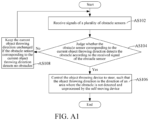
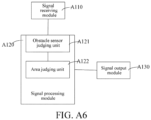
- the signal output module is configured to, when all obstacle sensors detect the obstacle, or the directions corresponding to the obstacle sensors not detecting the obstacle are all the directions of the areas that have been processed by the self-moving device, control the self-moving device to halt for preset time, and then judge whether the obstacle sensor corresponding to the current object throwing direction detects an obstacle according to the received signal of the obstacle sensor.
- the self-moving device if after the self-moving device is halted for certain time, all obstacle sensors detect the obstacle, or the directions corresponding to the obstacle sensors not detecting the obstacle are all the directions of the areas that have been processed by the self-moving device, then the self-moving device is controlled to withdraw for certain distance, and a moving path of the self-moving device is re-planned.
- the present embodiments further provide a snow throwing method, comprising the steps:
- adjusting the snow throwing direction comprises rotating a snow throwing mechanism to change the snow throwing direction.
- the snow throwing method further comprises the following steps:
- the step of obtaining a wind direction during snow throwing comprises:
- the embodiments further provide a snow throwing system, comprising:
- the wind direction obtaining module is further configured to: obtain wind power after the wind direction is changed; and judge whether the wind power exceeds a predetermined threshold.
- the wind direction obtaining module is further configured to:
- the speed when the inclusions depart from the snow throwing mechanism is 16.8 ⁇ 1m/s.
- the speed when the inclusions depart from the snow throwing mechanism is 14.2 ⁇ 1m/s.
- the present embodiments further provide an automatic moving snow removal device, and the snow and inclusions thrown by which cannot injure people or damage objects, that is, the thrown objects have save energy.
- the automatic moving snow removal device comprises a moving module, driving the snow removal device to move; a working module, comprising a working motor and a snow throwing mechanism driven by the working motor, wherein the snow throwing mechanism is driven by the working motor to collect accumulated snow and inclusions on the ground and throw out of the snow throwing mechanism; and a control module, configured to control a rotary speed of the working motor to cause an impulse when the inclusions depart from the snow throwing mechanism is not higher than 0.041Kg ⁇ m/s.
- the impulse when the inclusions depart from the snow throwing mechanism is not higher than 0.02Kg-m/s.
- the impulse when the inclusions depart from the snow throwing mechanism is 0.0178 ⁇ 0.001Kg ⁇ m/s.
- the impulse when the inclusions depart from the snow throwing mechanism is 0.0168 ⁇ 0.001Kg ⁇ m/s.
- the impulse when the inclusions depart from the snow throwing mechanism is 0.0142 ⁇ 0.001Kg ⁇ m/s.
- the impulse when the inclusions depart from the snow throwing mechanism is 0.0125 ⁇ 0.001Kg ⁇ m/s.
- the snow throwing mechanism comprises a snow scraping component rotating around a central axis
- the working motor drives the component to rotate to collect the accumulated snow and inclusions to the snow throwing mechanism, and a maximal linear speed of the snow scraping component is not higher than 41 m/s.
- a radius of said snow scraping component is not larger than 0.085m, and a rotary speed of the snow scraping component is not larger than 2000r/min.
- the rotary speed of the snow scraping component is 2000-1400r/min.
- the detection module further comprises a ground state recognizing module, the ground state recognizing module recognizes the snow removal state of the ground of the snow removal device, and the control module controls the snow throwing guiding component to change the guiding according to the signals transmitted by the obstacle sensing component and the ground state recognizing component to cause the snow throwing guiding component to be over against the direction of an area without the obstacle and without snow removal.
- control module when judging the obstacle exists in the direction over against the snow throwing guiding component again, the control module re-plans a moving path of the snow removal device.
- the environment parameters further comprise whether the obstacle exists in the direction over against the snow throwing guiding component
- the control module controls the snow throwing guiding component to change the guiding when judging that the obstacle exists in the direction over against the snow throwing guiding component according to the signal transmitted by the detection module.
- the automatic moving snow removal device is not required to be personally operated by an operator when in work, and is not required to be monitored by the operator all the time either, has automatic working capacity, saves labor, and can rapidly shovel the accumulated snow after snowing, thereby facilitating the outgoing of people.
- the working module is configured to execute specific work of the snow blower and comprises a snow throwing mechanism 140 and a working motor driving the snow throwing mechanism 140 to work, etc.
- the snow throwing mechanism 140 is a working head mechanism, and of course, the working module further comprises the part such as a snow throwing angle adjusting mechanism to optimize or adjust a snow removal effect.
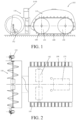
- the snow throwing component 144 comprises a snow throwing wheel 1442 and a snow throwing cylinder 1444
- the snow throwing wheel 1442 can be a centrifugal fan
- the snow collecting wheel rotates along an arrow direction as shown in the figure to collect the snow into a cavity body
- the centrifugal fan in the cavity body throws the accumulated out from the snow throwing cylinder 1444 by using a centrifugal force during high speed rotation.
- a rotary speed of the snow throwing wheel is better 1000-1500r/min, and in one embodiment, the rotary speed is 2500-3500r/min, wherein the snow scraping component 142 and the snow throwing component 144 can be driven by the same motor, or driven by different motors.
- the snow throwing cylinder 1444 rotatably sleeves an outlet pipe of the snow throwing wheel 1442, a steering motor 1449 is disposed on one side of the snow throwing cylinder 1444, a pair of gears is disposed between the steering motor 1449 and the snow throwing cylinder 1444, and the steering motor 1449 drives the snow throwing cylinder 1446 to rotate by the pair of gears.
- Two moving motors 182 are disposed and respectively drive the driving wheels 184 on the corresponding two sides, wherein the driving wheels 184 can be front or back wheels, of course, the amount of the driving wheels is not necessarily two, each wheel of the multiple driving wheels is controlled by one motor, and in this way, the moving capacity on rainy and snowy days is higher like four-wheel drive of vehicles.
- the tracks 188 are rubber tracks , and have the characteristics of large traction force, small vibration, low noise, good wet land passage capacity, no damage to the road surface, high sped, small mass and the like, and the rubber tracks can improve the driving performances of the machinery, expand the range of mechanical operation, and also have the advantages of flexible steering and high passage capacity on complex terrains and the like.
- the above working module and moving module are driven by different motors, these motors are powered by the energy module, the two driving wheels 184 of the moving module are respectively connected to one moving motor independently, and the two moving motors are controlled to rotate at the same speed in the same direction or rotate at different speeds or rotate in different directions, the snow throwing machine moves straightly or is steered.
- the two driving wheels are driven by one moving motor, while the support wheel is controlled by the other steering motor to realize steering.
- the above motors are electric motors.
- a pneumatic motor, a hydraulic motor, an engine and the like can be alternately used, and the combination with electric motors can also be used.
- the control module is configured to control the automatic moving and working of the snow throwing machine, is a core part of the snow throwing machine, and executes the functions comprising controlling the working module to start to work or be stopped, generating the moving path and controlling the moving module to move along the moving path, judging electric quantity of the energy module and timely instructing the snow throwing machine to return for charging and the like.
- the control module usually comprises a controller, a memory and other peripheral circuits.
- the controller can execute a hardware instruction, for example, executes program instructions stored in a readable memory medium (a disk or memory, etc.,) of the processor by a universal or special processor.
- the controller reads the instructions from the memory and executes these instructions to control the operation of the snow blower.
- the controller can use any usable processor, and the common processor can be, for example, a singlechip, a digital signal processor (DSP), an advanced RISC machines (ARM) processor, a programmable logic circuit (PLC), etc.
- the memory can be implemented by any common technologies, such as a computer read only memory (ROM), a random access memory (ROM), a static RAM (SRAM), a dynamic RAM (DRAM), a FLASH and a double data rate (DDR) synchronous dynamic random-access memory (SDRAM), or some other memory technologies.
- the control module is provided with algorithms for executing work according to various pieces of information and working conditions, or computer programs, and these algorithms or programs are executed to control the operation of the snow throwing machine.
- the preferable man-machine control manner in the present embodiment is that the user remotely controls the snow blower 100 to advance to a start point of the working area, and then causes the snow blower 100 to automatically move and work by certain settings.
- These settings can be the setting of specific data such as a moving direction, a moving distance and a moving manner of the snow blower 100, and can also be the setting that the snow blower sweeps the snow according to a fixed shape, for example, a rectangle, a circle or other shapes, the snow blower automatically works according to the set graphic shape, and the like.
- the detection module at least comprises a direction detection device, for example, the sensor indicating the direction, such as an electronic compass or gyroscope, in this way, the user can set an advancing direction of the snow throwing machine and cause the snow throwing machine to move on a straight line.
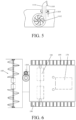
- the control module can set the start point position where the snow throwing machine begins to work as an original point to generate a border coordinate map according to the information (such as the length and width sizes) of the regular working area input by the input module, and the control module controls the snow throwing machine to regularly move and work within a border of the working area by using the direction detection device according to the border coordinate map. Specifically, as shown in Figs.
- the advancing times for snow removal can be automatically generated according to a width of the working head, for example, if the width of the working head is 0.5m and the set snow removal area is 4m wide, then the controller calculates that the advancing of at least 8 times is required.
- the user can select of the snow removal paths, and can also directly start the snow blower for working, that is, adopts the snow removal path of system default.
- the control module compares the received direction data with the selected snow removal path direction data, and controls the moving direction to adjust the moving direction when the two pieces of data are inconsistent, such that the snow throwing machine can move along the straight line.
- the above man-machine controlled semiautomatic snow removal mode is suitable for the conditions of relatively simple working areas and regular roads
- the semiautomatic path can be set to be reciprocating or moving in the same direction, the moving in the same direction is intended to pile the snow to one side, while the reciprocating is intended to pile the snow to two sides, and after the working is finished, the snow blower can be returned back to the start point or directly stops.
- the user can set the direction of a fixed start point, so as to avoid the deviated moving caused by direction deviation after the snow blower is remotely controlled by the user to return back to the start point.
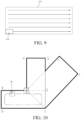
- Fig. 10 shows a relatively complex working condition
- the working area comprises three parts extending to three directions, when the snow removal area is set, the setting can be performed respectively according to the above method, that is, after the working of one area is finished, the another area is set, of course, there are more preferable solutions.
- the working area can be divided into three regular areas: OABCDO, OCEFO and ODGHO, wherein the intersection point O of the borders or the extending directions of the borders of the three areas is set as the base point, i.e., the original point, by using the snow sweeping path solution that the regular area uses the direction sensor and a regular parallel line mentioned in the above method, multiple areas can be set once, the snow blower is returned back to the original O after one area is completely swept, and sweeps another area after correction.
- the detection module further comprises an energy detection unit, the energy detection unit is configured to detect an energy value of the energy module and feeds the energy value information back to the control module, when the energy value detected by the detection module reaches or is lower than the preset value, the control module starts alarm for reminding, and there are many alarm reminding manners, for example, the snow blower sends an alarm sound per se, the controller sends an alarm signal to the remote control device, etc.
- Figs. 11 to 40 show a preferred second embodiment of the present invention, and the present embodiment still takes the snow blower capable of automatically throwing snow as an example for explanation.
- the snow blower capable of automatically throwing snow comprises a working module, a moving module, an energy module, a control module, a detection module, a location module, and the like.
- the working module, the moving module, the energy module, the control module and the detection module are same parts as the foregoing embodiment and are not repeated here.
- the difference from the foregoing embodiment is that the snow full automatic snow removal work of the snow blower is realized in a location navigation manner.
- the snow blower is not always capable of or required for working in any places, and its working area has a boundary.
- the electric quantity of the energy module of the snow blower is insufficient, it is required to be supplied with electric energy in a fixed place and required to be parked in a place when not in work, that is, a dock.
- the snow blower 100, a boundary 300 and the dock 500 form an automatic snow removal working system, wherein the boundary 300 is configured to limit the working area of the snow blower, the snow blower can move and work within or between the boundaries, and the dock 500 is configured to park the snow blower, and configured for the snow blower to return back for energy supplement when the energy is insufficient.
- the boundary is the joint name of a border and obstacles.
- the border is the periphery of the whole working area, and is usually connected end to end to close the working area, the border can be tangible or electronic, that is, the border can be a tangible border formed by a wall, a fence and handrails, or the border is a virtual border described on an electronic map or a border formed by the connecting line of N coordinate points, or a virtual border signal such as an electromagnetic signal or optical signal can be sent by a border signal generating device.
- the obstacles are the parts or areas where the moving cannot be realized within the working area, for example, indoor sofas and bedside tables or outdoor ponds and flower-stands, similarly, the obstacles can be also tangible or electronic, the tangible obstacles can be formed by the aforesaid obstacles per se, and the electronic obstacles can be formed by virtual obstacle signals sent by the border signal generating device.
- the virtual border signals and the virtual obstacle signals can be the same or different signals, and are selected according to specific needs.
- the detection module of the snow blower 100 further comprises a boundary detection unit for detecting a relative position relation between the snow blower 100 and the boundary 300, which specifically and possibly comprises one or more of the distance, the angle, and the direction inside and outside the boundary.
- a boundary detection unit for example, an infrared manner, an ultrasonic manner, a collision detection manner, a magnetic induction manner, etc.
- the disposing positions and the amount of the sensors thereof and the corresponding signal generating devices are also multiple, are related to the path planning manners, and are thus specifically explained in combination with specific embodiments and path planning manners in the following.
- the outer cover 530 can be automatically closed along with the entrance of the snow blower, the structure is simple and the cost is low.
- the outer cover 530 can also be automatically opened and closed in an electrical control manner, for example, induction automatic doors (infrared induction, microwave induction, touch induction and pedal induction), and the automatic doors controlled by various signals to be automatically started and closed.
- a heating system can be disposed in the dock 500, a heating thermal insulation material can be arranged on the outside wall, the outer cover 530 or the bottom of the dock 500, or an air heater or an electric heating device such as an electric furnace and an electric heater can be disposed in the dock 500.
- a carbon crystal floor heating material 514 is embedded into the bottom of the dock 500, and can play a role of rapidly raising the temperature of an object, and 100% of the electric energy input is effectively converted into more than 60% of conducting heat energy and more than 30% of infrared radiation energy.
- a bottom plate of the dock is provided with an electric heating wire, or electric heating plate and temperature controller, internal constant temperature is realized by the temperature controller, and the heat can be effectively preserved by the thermal insulation material on the outer cover.
- the charging manner of the snow blower 100 is wireless charging
- the dock 500 can be provided with a wireless charging emitting device 560, and correspondingly, the snow blower 100 is provided with a wireless charging receiving device 106.
- the bottom plate of the dock 500 is provided with a wireless charging emitting plate, correspondingly, the snow blower 100 is provided with a wireless charging receiving plate, the energy is transferred between the two by a magnetic field, and thus no wire connection is required, the dock 500 and the snow blower 100 can realize no exposure of conductive contacts, that is, no design of electrified contacts, the danger of electric shock is avoided, and therefore, the mechanical wearing during connection and separation and the loss caused by arcing are also avoided.
- no power transmitting elements are exposed, and corrosion by water content and oxygen and the like in air is avoided.
- the connection is much easier compared with the snow blower with the electrodes.
- the rotation of the rolling brush can be automatically controlled, for example, the dock 500 starts the rolling brush to rotate once receiving the signal that the snow blower 100 is returned back for charging, or starts the rolling brush to rotate while the outer cover detects the snow blower and is opened for entrance of the same, or starts the rolling brush to rotate under the touch that the snow blower enters the dock, etc.
- the snow sweeping brush can also be constructed into a row brush form disposed along the edge of the outer cover 530. As the snow blower 100 moves to enter the dock 500, the row brush sweeps the top cover of the snow blower 100 to clean the accumulated snow on the top cover.
- the snow sweeping brush can also be multiple rotating brushes distributed on the edge of the outer cover 530, the rotary axis approximately forms an angle with the ground, and in this way, the accumulated snow on the top cover can also be cleaned when the snow blower 100 enters the dock 500.
- the snow blower 100 can also have the function of cleaning the accumulated snow on the top per se, for example, the top cover is inclined for an angle per se, the top cover can be disposed to regularly shake or to shake once detecting the accumulated snow, and a snow scraper, a hairbrush and the like can also be disposed on the top cover.
- the coordinates of the snow blower can be obtained in real time by a satellite location manner, and the snow removal path is navigated according to the coordinates.
- the satellite location manner controls the snow blower to work relative to the man-machine control manner, the cost is slightly high, but the degree of automation is higher, and both of them have the advantages and the disadvantages.
- the snow blower 100 needs to work during snowing or when there is accumulated snow, in order to realize the snow removal work of the full automatic mode, whether it snows and the snowfall need to be detected at first.
- two conductive metal bars 103 are mounted on the top of the host of the snow blower 100, an insulating rib plate 104 is mounted between the two conductive metal bars 103, the height of the insulting rib plate 104 is higher than the heights of the two conductive metal bars 103, when the height of the accumulated snow is higher than the height of the insulating rib plate 104, according to the principle of snow conduction, the two conductive metal bars 103 are switched on, a switching on signal is transmitted to the control module, the control module then judges that there is the accumulated snow, and the snow blower is controlled to begin to work.
- the height H of the insulating rib plate 104 is the minimal snow thickness for triggering the snow blower 100 to begin to work.
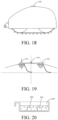
- the preferred third solution is as shown in Fig. 20 , a container 200 is provided and is provided with an optical sensor 202 and a humidity sensor 204 on the bottom, the container 200 is placed on the top of the host of the snow blower 100 or the dock 500, when the snow reaches certain thickness, and the optical sensor 202 cannot detect light while the humidity is changed, snow coverage is judged, and then the control module controls the snow blower 100 to begin to work.
- a preferred fourth solution is used for detecting the snow thickness. As shown in Fig.
- three conductive parts 105 are disposed on the lower side of the host of the snow blower 100, when the first conductive part in the lowest position detects the signal, the snow thickness is H1, and the snow is set to be thin snow; when the second conductive part in the middle detects the signal, the snow thickness is H2, and the snow is set to be moderate snow; and when the third conductive part in the uppermost position detects the signal, the snow thickness is H3, and the snow is set to be heavy snow.
- a weather communication unit receiving weather information in real time is disposed on the snow blower, the weather communication unit transmits the received weather signal to the control module, the control module judges whether it snows and the snowfall according to the received signal, and calculates the snow thickness according to the snowing duration.
- detection can be realized by sight glass, ultrasonic waves, infrared scanning sensors, etc., and the control module controls the snow blower to begin to work after certain time.
- the snow thickness can also be measured by camera image recognition, ultrasonic waves, etc., which are not repeated here.
- the working flow of the snow blower comprises boundary setting, setting of various specific scenarios, path planning, returning to the charging station, charging manner, and the like and further comprises solutions to the problems in the working flow.
- the location navigation module can be constructed as a location navigation device 130 detached from the snow blower, meanwhile, the location navigation device 130 can also be remounted to the snow blower 100, that is, the location navigation device 130 is detachably mounted on the snow blower.
- the coordinate points of the preset border line can be obtained by the location navigation device 130 only, thereby generating the border line.
- the location navigation adopted to set the working area of the snow blower is not limited to the above manner, the snow lower can also be provided with the location navigation module per se, the position coordinate data of real time location of the location navigation module are stored in the memory of the snow blower, the controller calculates the data of the map border according to the coordinate data of the border line stored in the memory, and generates map data, and then the snow blower can be subjected to path planning according to the map.
- camera scanning can also be used, the intersection is swept if no vehicles are driven in a set distance, or sound-light alarm is started to warn the passing vehicles if the snow blower moves to the municipal road.
- the lawn needs no snow removal, and the user usually accumulates the swept snow on the lawn.
- the lawn is mostly distributed between the roads, after the map is generated according to the several aforesaid manners, the user can mark some areas on the map as the lawn, in the areas marked as the lawn, the user can select whether such the areas needs the snow removal or not, if the snow removal is not needed, then the machine can directly pass by the areas or the machine not move on the lawn, and if the snow removal is needed, then the snow removal mode or snow removal height can be set to avoid the damage to the lawn.
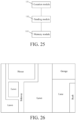
- the user can set a passage from one snow removal area to another snow removal area, in general cases, the user is suggested to set the passage on the lawn, for example, the area as shown by a virtual line in Fig. 27 is the connecting passage 360 of two snow removal areas, since whether the grass area needs the snow removal or not or the snow removal mode and the snow removal height have been set, extra setting is not required here.
- the user can further set whether the path needs the snow removal or not here.
- the snow blower can pass by one snow removal area to reach another snow removal area.
- the municipal rod can also be selected as the passage, correspondingly, the moving path from one intersection to another intersection needs to be set, for example, the snow blower moves along the border of the municipal road, and performs light-sound alarm to gain the attention of pedestrians and passing vehicles, and compared with the passage in the lawn, the municipal road as the passage is a secondary manner.
- the snow blower is provided with an alarm lamp, and pedestrians and the user can be warned and reminded in a full bright or flickering manner.
- the user can mark the alarm area or set the alarm time on the map, and the controller in the snow blower can alarm according to the setting of the user after the snow blower reaches the set area and the set time is reached or the set requirements are met at the same time.
- the controller automatically calculates the snow throwing direction according to the snow throwing area. After the snow throwing direction is set, the path of the snow blower will be optimized according to the setting of the snow throwing direction, such that the snow blower will throw the snow to the set direction or area. If the user does set the snow throwing direction, the snow can be thrown to any direction by default, and the snow removal path will be re-optimized.
- the user can form different marks on the map according to the areas, for example, a motorway, a sideway, etc., different marks have different working modes, for example, the snow throwing is performed on the paths marked as the motorway, and the snow pushing or snow sweeping is performed on the sideway, or a thick snow removal mode is performed on the motorway and a thin snow removal mode is performed on the sideway; or the user can set the snow throwing or snow pushing mode.
- the snow throwing cylinder throws the snow by rotation
- the controller of the snow blower will recognize the rotating current, a rotary speed and the like of the motor, when the current exceeds a set threshold or the rotary speed is lower than the threshold, it is indicated that the thrown snowfall is overlarge, and the snow blower will avoid the overload of a snow throwing motor by reducing the moving speed.
- the snow throwing direction will be adjusted, and if the user defines that the snow can only be thrown to a fixed direction, then the snow throwing will be stopped.
- Fig. 32 shows the first snow sweeping path
- the snow sweeping path can be vertical to an extending direction of the road, or parallel with the extending direction of the road
- the solid line shows the snow sweeping path
- the virtual line shows a repeating path or returning path
- the first path has the characteristic of snow sweeping toward one direction and is suitable for the road of which both sides are the snow lands, but the snow can only be thrown to the lawn on one side, thereby avoiding that the snow is thrown to the lawn on the other side during snow sweeping.
- the returning path has been swept, repeated sweeping is not required, and from the moving path of the snow blower, the snow blower moves for two road sections, but actually sweeps one road section, the sweeping efficiency is general and the first path is not suitable for the occasions requiring fast snow removal.
- Fig. 33 shows a second snow sweeping path
- the snow sweeping path is vertical to the extending direction of the road
- the snow is swept to two sides, that is, the snow can be swept for all the paths where the snow blower moves
- the second snow sweeping path can also be called as S path snow sweeping and is suitable for the condition that both sides of the road are lawns and the snow can be thrown to the both lawns
- the snow sweeping path is vertical to the extending direction of the road, the sweeping distance once is short, not too much snow will be accumulated in front of the snow blower, therefore, the sweeping is not required to be performed to specific snow piling points, no repeated paths exist, and the snow sweeping efficiency is higher.
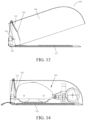
- Fig. 34 shows a third snow sweeping path, the snow sweeping path is parallel with the extending direction of the road, and is also S path snow sweeping, and such snow sweeping manner has the least turning times and the relatively high in efficiency.
- Fig. 35 shows the first snow pushing path
- the snow pushing path is approximately parallel with the extending direction of the road, since the snow pushing distance is longer, two snow piling points need to be set
- the solid line shows the snow pushing path
- the virtual line shows the repeated path or the returning path
- the first path has the characteristic that the snow blower pushes the snow to the snow piling point from the first position of one direction and is then retuned, then pushes the snow to the snow piling point from the second position of such direction, and so on till the snow on the whole width of the road is cleaned, and then the snow blower pushes the snow to the next snow piling point.
- Such manner is suitable for the situation that the snow can only be piled to fixed places.
- Fig. 36 shows the second snow pushing path
- the snow pushing path is approximately vertical to the extending direction of the road
- the snow blower pushes the snow to two sides respectively from the middle of the road
- one choice is that the snow blower pushes the snow to one side, is returned to the middle and then pushes the snow to the other side, and so on
- the other choice is that the snow blower pushes the snow to one side from the middle, is retuned to the middle, then continues to push the snow to such side till the tail end of the road, and then pushes the snow to the other side from the middle of the tail end, i.e., from the head to the end for half of the road and from the end to the head for the other half of the road.
- Such path is suitable for the situation of the wider road, and the situation that the user does not set the snow piling point and the snow can be piled to both sides of the road.
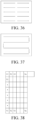
- Fig. 37 shows the third snow pushing path
- the snow pushing path is approximately vertical to the extending direction of the road
- the snow blower pushes the snow in an S shape from one side of the road, and such manner is suitable for the situation that the once maximal snow pushing amount along the width of the road is smaller than the load of a snow pushing machine, wherein the maximal snow pushing amount can be calculated according the snow thickness, the road width and the length of a snow pushing head.
- the above snow pushing paths can be automatically generated according to the map generated by the user, and the user can independently select or defaults by the controller.
- the defaulting manner of the controller is as follows: if the user does not set the snow piling point, then the first or second snow pushing manner can be adopted, the snow blower recognizes the width of the road surface, if the road surface is too wide and exceeds a set value, then the first snow pushing path is adopted, such that the snow cannot be excessively pushed to cause overlarge load, otherwise, the second snow pushing path is adopted. If the user sets the snow piling points, then the third snow pushing path is adopted.
- the number of the snow piling points is related to the length of the snow pushing path, and each snow piling point requests that the moving path cannot be too long to avoid the overlarge snow pushing load.
- the controller of the snow blower will calculate whether the snow piling points set by the user meet the requirements or prompt the user to set sufficient snow piling points.
- a dip angle of each point will be recorded simultaneously, as shown in A1, B1...N1.
- the snow blower works according to the path, it will judge whether the dip angle of the front path is overlarge or not, that is, the snow blower will judge the dip angle of the B1 point when at the point A1, the working head will be affected if the dip angle of the B1 point is overlarge, that is, if the dip angle of the B1 point is larger than a preset value, the controller will start the motor to lift the working head for certain angle in advance.
- the lifted angle is related to the B1 point, and the larger the dip angle is, the larger the lifted dip angle is. After the dip angle is restored to be normal, the controller starts the motor again to descend the working head.
- the snow blower according to the present embodiments can be automatically returned back to the dock for charging according to self conditions.
- the controller in the snow blower can calculate the energy of the battery and the working time, when the energy of the battery is lower than a preset value or the working time is larger than the preset value, the snow blower is controlled to be returned back to the dock.
- the returning path of the snow blower is divided into two manners, the first manner is as shown in Fig. 39 , the solid line path is the path that has been swept, and the virtual line is the returning path. The returning path has been in the swept path, therefore, the snow sweeping head does not work during returning, thereby saving returning energy.
- the second manner is as shown in Fig. 40 , the solid line path is the path that has been swept, the virtual line is the returning path, the returning path is contained in the snow sweeping path, i.e., the snow sweeping is performed during returning.
- the detection system of the snow blower further comprises a signal detection circuit, when the snow blower moves to the dock, the wireless charging emitting panel sends a charging signal to the wireless charging receiving panel, the signal detection circuit detects whether the intensity of the charging signal received by the wireless charging receiving panel reaches the preset value, locates the position of the wireless charging receiving panel when the intensity of the detected charging signal reaches the preset value and guides the snow blower to stop moving for wireless charging.
- Another manner adopted for setting the working area of the snow blower is UWB, to generate the border map.
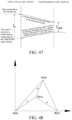
- Fig. 47 is referred and is a schematic diagram of a UWB distance measuring principle.
- the Trilaterate algorithm can be adopted for location.
- Fig. 5 is referred and is a schematic diagram of a Trilaterate algorithm location principle.
- the distances between three auxiliary location devices are measured at first, the connecting line of two of the location devices is taken as an x axis, then a mathematic model as shown in the figure can be simplified, wherein the point D (x, y) represents the UWB location device assembled on the snow blower, while A(0, 0), B(k, 0) and C(m ,n) are the coordinates of the three auxiliary location points (corresponding to the three UWB labels in the present embodiments).
- the coordinates of the three points can be measured by the distances between the points A, B and C.
- the method comprises the following steps:
- the UWB location module After moving respective UWB labels, the UWB location module sends the location signal to the respective UWB labels and starts timing, the respective UWB labels send the location feedback signal to the UWB location module respectively, and the UWB location module stops timing after receiving the location feedback signal.
- the distances with the respective labels are calculated according to the timing results, thereby locating the position of the snow blower.
- the UWB location module feeds the location position information back to the control module on the snow blower, the control module performs corresponding actions according to the location position information, thereby realizing the automatic location of the snow blower and further performing path planning.
- the automatic location of the snow blower is realized and further the path planning is performed.
- the whole automatic snow removal system comprises the snow blower and a monitoring device 600 such as a SMARTPHONE or IPAD for monitoring a working state of the snow blower
- a man-machine interaction module of the snow blower comprises a wireless communication unit, the wireless communication unit is connected to the control module and configured to receive a signal sent by the monitoring device such as the SMARTPHONE or IPAD and transmit the signal to the control module, and the control module controls a moving direction, a moving speed, the working state and the like of the snow blower 100 according to different signals.
- the monitoring device 600 such as the SMARTPHONE or IPAD is fixed by a support and is disposed in a place capable of shooting the whole working area, firstly, a vision field is adjusted, then the picture of the working area is shot, that is, the area is determined; then the user describes the working area on the picture of the working area, i.e., area extracting, to obtain a border line 320', and the extracted working area is as shown in Fig. 40 .
- the monitoring device 600 such as the SMARTPHONE or IPAD will monitor whether the snow blower is in the extracted working area in real time, that is, whether the snow blower works in the defined area, a signal is sent to the wireless communication unit if the snow blower is not in the working area, the wireless communication unit receives the signal and transmits to the control module, and the snow blower 100 is controlled by the control module to change the path.
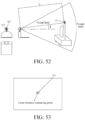
- Figs. 51 to 53 show a preferred third embodiment of the present invention, which is a solution of border setting and path planning by a three-dimensional polar coordinate solution, i.e., a manner of image tracking, laser distance measuring and angle measuring of a machine-identified object.
- the snow removal system in the present embodiment comprises a snow blower 100 and a fixed site 800.
- the fixed site has a detection module and a site wireless communication module, wherein the detection module comprises a laser distance measuring module 820, a cloud deck camera 840 and a sensor configured to measure an angle (for example, a triaxial acceleration sensor), and correspondingly, the snow blower is provided with an obvious identified object 191 and a machine wireless communication module, wherein the cloud deck camera 840 can rotate for 360 degrees horizontally and can rotate for 180 degrees up and down, and the laser distance measuring module 820 is mounted aside the camera.
- the could deck is further provided with an angle sensor (not shown), the angle sensor, the camera 840 and the laser distance measuring module 820 are relatively static.
- the site wireless communication module on the fixed site can communicate with the snow blower.
- the GNSS needs well receiving of a satellite signal to work reliably.
- the satellite signal is blocked by a building, a roof, a sunshade, leaves or a tree sometimes.
- a target receiver can be used in short distance, which is so-called differential GNSS.
- differential GNSS There are some differential technologies, for example, the typical DGPS (or GPS), RTK and wide range RTK (WARTK).
- the signal from one signal may also be stopped, for example, the case that the garden or other working areas are just around the house.
- position determining devices also have the similar problem, for example, when an optical beacon is used, the sight may be blocked in certain areas. If the snow blower cannot correctly receive the signal from the position determining system, it will face a challenge, and cannot be correctly navigated in the working area and the coverage of the working area may not achieve the expected effect.
- the snow blower may also adopt an inertia navigation system per se for navigation work, but according to the working principle of an inertia navigation system (the working principle of the inertia navigation is that based on the Newtonian mechanics laws, the accelerated speed of a carrier in an inertia reference system is measured and is integrated subject to integration to time, and it is converted into a navigation coordinate system to obtain the information such as a speed, a yaw angle and a position in the inertia navigation system).
- the inertia navigation system belongs to a calculation navigation manner, and the precision must be reduced along with time, which is not favorable for the long term work of the snow blower.
- the working area has no border line, for example, the position kept in the working area by using the location system (for example, GNSS), and the working area is defined by coordinates.
- the location system for example, GNSS
- the snow blower is provided with a position determining device, for example, a GNSS device.
- the GNSS device is a GPS device.
- the GNSS is connected to the controller, such that the controller can determine the current position of the snow blower and controls the movement of the snow blower with the GNSS device based on the current position.
- the position determining device comprises an optical (laser) position detection device, other wireless frequency position detection devices, a UWB signal station, a receiver, etc.
- the snow blower is further provided with at least one sensor, configured to provide a signal for dead reckoning.
- Such dead reckoning navigation sensor can be a speedometer, an accelerator, a gyroscope, an electromagnetic compass, a magnetometer, a compass, etc.
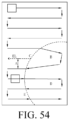
- Fig. 54 shows a working area formed by the border line or coordinates, and the snow blower works in the working area.
- the working area comprises two parts, the first part is an area covered by GNSS navigation, i.e., a GNSS navigation area; and the second part is the area not covered by the GNSS navigation, that is, other interruption areas of which the satellite signal is shielded by the building, the roof, the sunshade, the tree or other plants or the satellite signal is relatively weak.
- the snow blower 100 is configured to work by using the GNSS device.
- One of the aforesaid snow removal modes is taken as an example for explanation.
- the controller can determine that the received signal is reliable, and responds to execute the determined working mode.
- the controller executes the operation of continuously using another navigation system, or determines an alternative snow removal mode, that is, the location detection mode is not required.
- the generated operation mode B may be different from the GNSS-based operation mode, due to the error of the sensor device, the compass or speedometer is configured for dead reckoning navigation.
- the controller calibrates the dead reckoning navigation sensor when the snow blower can reliably receive the GNSS signal.
- the controller detects the derived calculation navigation error and the calculation navigation sensor derived in response to the error calibration.
- the controller determines no navigation errors based on the difference between the current position and the expected position by comparing the current position and the expected position.
- Fig. 54 takes the parallel lines as an example of the path of the snow blower in the working area, the snow blower moves in the working area under guiding of the signal received by the GNSS device, and the moving parallel lines are equal in length.
- the snow blower enters the interruption area, the controller switches to dead reckoning navigation, and the snow removal paths B generated thereby are almost parallel lines.
- the snow blower reenters the GNSS navigation area, in other words, when the reliable signal is received again, the current position and the expected position are compared.
- the C point is the position where the snow blower reenters the GNSS navigation area, and at this point, the snow blower reenters the GNSS navigation area to determine the distance ⁇ between the current position and the expected position.
- the expected position is determined according to the time that the snow blower loses the GNSS navigation, a moving average speed and snow removal work parameters (or operation mode).
- the controller causes the dead reckoning navigation sensor to calibrate.
- the controller can also determine the calibration of the dead reckoning navigation sensor based on other navigation parameters.
- the navigation parameter is not limited to the above position, and can also be a driving direction, a speed, an accelerated speed, an inclined angle, etc.
- the snow blower is returned back to the GNSS navigation area, it may determine the current speed according to the position determining device, compares the current speed with the speed calculated by the dead reckoning navigation module, determines whether the error can be neglected or not and performs corresponding adjustment.
- the sensor can be continuously calibrated by the controller. In general cases, the error cannot be neglected as long as the error can be detected. If the errors are negligible errors, then the adjustment ratio is correspondingly adjusted. The adjustment can be executed by the user or the controller/operator or a designer of the snow blower.
- the satellite signal can be a navigation location signal such as a GPS signal or Beidou navigation signal.
- the snow sweeping corresponds to a thin snow condition
- the snow pushing corresponds to a moderate or thick snow condition
- the snow throwing is suitable for the snow of various thicknesses, in one embodiment,the snow throwing is suitable for the moderate or thick snow condition.
- the rolling brush 122 rotating at the high speed carries the snow to be thrown out from the upper side of the rolling brush, and if along an opposite direction of the arrow, the snow will be thrown out from the lower side of the rolling brush 122.
- the protective cover 124 extends for a distance to the front part of the rolling brush along a tangential direction to form a protective plate 1242, which can guide the snow rotated along with the rolling brush 124 to be thrown out to the lower side.
- a snow throwing angle ⁇ of the protective plate 1242 relative to the vertical direction is between 20°-70°, which not only prevents the snow from being blocked in the protective cover 124 but also ensures the snow throwing safety without affecting the snow sweeping efficiency.
- an electric heating thermal insulation material 130 for example, a solid electric heating cake filled with heat preservation cotton (for example, asbestos, etc.), and the thermal insulation working principle is that a dual-temperature control electric heating energy storage structure is used to gradually release the heat energy.
- An automatic overheating protective device and an automatic thermal insulation indication device a small electric furnace controlled by a PTC thermosensitive resistor switch are disposed internally, the PTC is the thermister of a positive temperature coefficient, when the current passes, the thermister will emit heat (the heat of the electric furnace is also conducted thereto), when the temperature reaches a certain value, the thermister is increased severely in resistance and can be regarded as disconnection, at this point, the consumption of the electric energy is stopped, then the slow heat release is realized depending on the thermal insulation of the heat preservation cotton, and the thermal insulation time is long. In this way, the snow blower can be heated only during charging and then the host is subjected to thermal insulation by the electric heating thermal insulation material, thereby preventing the elements and parts such as a battery and the controller from working under the low temperature state.
- the electric heating thermal insulation material 130 can also be liquid, an electrode heating method is adopted, and double temperature control security of high quality temperature control and a thermal fuse is adopted.
- the temperature controller will automatically cut off the circuit when the liquid temperature reaches 65 degrees in a normal case, heating is stopped, and the temperature of the heat by contact of chemical substances therein is about 40°C.
- a liquid energy storage heating agent is used, the heating temperature rise is fast, the liquid is added once and can be used permanently, and the advantages of long service life and durable temperature preservation are realized.
- the function of a lithium battery can be used, an internal heating piece heats, and the temperature can reach about 50°C.
- the snow blower is an automatic snow throwing machine
- the snow on the ground is collected into the snow throwing mechanism by the snow scraping component and then thrown outwards.
- the snow scraping component collects the accumulated snow on the ground
- the snow and inclusions in the snow will be collected.
- the snow and the inclusions are thrown out together.
- the energy of thrown objects including the snow and the inclusions
- people or objects nearby will be damaged by crashing.
- the present embodiments provides three solutions.
- the research should be focused on the weights of the large-mass objects which are possibly included in the accumulate snow and possibly thrown out by the snow blower.
- the inclusions that are possibly included in the accumulated snow to enter the snow blower and are thrown out have the weight of about 0.001kg.
- the typical situation is the steel balls with the diameter being about 6.35mm.
- V0 is related to a working speed of the snow throwing mechanism.
- V0 is smaller than the working speed of the snow throwing mechanism.
- the initial speed V0 is same as the working speed of the snow throwing mechanism.
- the snow throwing mechanism comprises a power component and a snow throwing guiding component, the power component collects the accumulated snow and the inclusions therein on the ground into the snow throwing mechanism, which are thrown to a direction guided by the snow throwing guiding component after passing by the snow throwing guiding component.
- the snow throwing guiding component adjusts the throwing direction of the thrown objects.
- the snow throwing guiding component can be a guiding cylinder such as a snow throwing cylinder and can also be a guiding plate and various guiding components for guiding and changing the snow throwing direction. Since the stroke of the thrown objects on the snow throwing guiding component is short, the attenuation on the speed of the thrown objects can be neglected. Therefore, the initial speed V0 of the thrown objects is approximately equal to the working speed of the power component.
- the power component can comprise one level or multilevel power. In the case that the snow throwing mechanism only comprises one level power, the initial speed 0 is basically equal to the working speed of a first level power part, and under such situation, the working speed V1 of the first level power part is smaller than or equal to 41m/s.
- the initial speed V0 is basically equal to the working speed of a second level power part, at this point, the working speed V2 of the second level power part is smaller than or equal to 41m/s.
- the working speed of the first level power part is smaller.
- the power component can further comprise multilevel power, and the initial speed of the thrown objects is approximately equal to the working speed of the final level power part of the power component.
- the first level power part is usually the snow scraping component.
- the snow throwing mechanism only comprising one level power is taken as an example for explaining the structural design of the snow scraping component.
- the present embodiment provides several following possible combinations, and the present embodiments are not limited to the several following possible combinations.
- the moving path of the automatic moving snow removal device is explained in the following.
- the automatic moving snow removal device automatically moves along a planned path, and generates a moving track.
- the set of the moving tracks of the snow blower in the whole working area is defined as a moving track set, comprising multiple moving paths in parallel or forming an angle.
- the "basically parallel" means that an included angle between the two moving tracks is smaller than or equal to 10°.
- the first moving track and the second moving track are adjacent and are overlapped with each other, and an overlapping width is d to avoid that the residual snow between the two adjacent moving tracks is not cleaned completely.
- Fig. A1 is a schematic diagram of a control method for a self-moving device in an embodiment.
- the self-moving device can be provided with a turnable object throwing device and a plurality of obstacle sensors respectively corresponding to different detection positions.
- the throwing device can be a snow throwing cylinder
- the obstacle sensor can be an ultrasonic sensor.
- the method can comprise: AS102: receiving signals of the plurality of obstacle sensors.
- the self-moving device can be provided controller and a plurality of obstacle sensors, the controller can receive the signals of the plurality of obstacle sensors in real time, for example, when the obstacle sensors detect an obstacle within the detection range, the signal is sent to the controller.
- AS104 judging whether the obstacle sensor corresponding to the current object throwing direction detects an obstacle according to the received signal of the obstacle sensor.
- the plurality of obstacle sensors can be numbered, for example, as shown in Fig. A2, Fig. A2 is a schematic diagram of a self-moving device in an embodiment, the self-moving device is provided with 7 obstacle sensors, in other embodiments, the self-moving device can also be provided with 5, 8, 10 and 12 obstacle sensors, the 7 obstacle sensors are respectively located around the self-moving device, to ensure that the obstacles around the self-moving device can be detected.
- the controller can judge whether the obstacle sensor corresponding to the current object throwing direction detects the obstacle according to the received signal of the obstacle sensor.
- AS106 controlling the object throwing device to steer when the obstacle sensor corresponding to the current object throwing direction detects the obstacle, such that the object throwing direction is the direction of an area where the obstacle is not detected and which is unprocessed by the self-moving device.
- the object throwing direction of the object throwing device is required to be changed, but if the changed object throwing direction points at the area that has been processed by the self-moving device, then the work of the self-moving device will be caused to be ineffective, for example, when the self-moving device is a snow throwing machine, if the current snow throwing direction is a first direction, a second direction points at the area that has been processed by the self-moving device, when the obstacle exists in the first direction, if the object throwing direction of the object throwing device is set to be the second direction, then the snow throwing machine will be caused to throw snow to the swept area, as a result, the previous sweeping work is ineffective and re-cleaning is required.
- the snow throwing direction when the snow throwing direction is reset, firstly whether the direction corresponding to the obstacle sensor not detecting the obstacle points at the area that has been processed by the self-moving device is judged, if the direction corresponding to the obstacle sensor not detecting the obstacle does not point at the area that has been processed by the self-moving device, then the object throwing direction is set to be the direction of the corresponding obstacle sensor not pointing at the area that has been processed by the self-moving device.
- an initial object throwing direction of the object throwing device is set to be the first direction, that is, the direction where the seventh obstacle sensor points at, at this point, since the self-moving device does not begin to work yet, there is no area that has been processed by the self-moving device. Therefore, there is not need to judge whether the direction corresponding to the obstacle sensor not detecting the obstacle points at the area that has been processed by the self-moving device.
- the present embodiment may comprise receiving the signals of the plurality of obstacle sensors before the self-moving device moves, judging whether the obstacle sensor corresponding to the current object throwing direction detects an obstacle according to the received signal of the obstacle sensor, and if the obstacle sensor corresponding to the initial object throwing direction detects the obstacle, then setting the object throwing direction to be the direction corresponding to the obstacle sensor not detecting the obstacle. Therefore, in the present embodiment, it can be guaranteed that before the self-moving device moves, an object throwing direction can be preset according to the surrounding environment.
- the step of setting the object throwing direction to be the direction of an area where the obstacle is not detected and which is unprocessed by the self-moving device can comprise: judging whether the obstacle sensors except for the obstacle sensor corresponding to the current object throwing direction detect the obstacle, if the obstacle sensor not detecting the obstacle exists, judging whether a direction corresponding to the obstacle sensor not detecting the obstacle points at the area unprocessed by the self-moving device, if the direction corresponding to the obstacle sensor not detecting the obstacle points at the area that has been processed by the self-moving device, then continuing to judge till one of the obstacle sensors not detecting the obstacle is judged and the direction corresponding to such obstacle sensor points at the area unprocessed by the self-moving device, and setting the corresponding direction to be the object throwing direction.
- step AS302 of judging whether the first obstacle sensor detects the obstacle is performed, and if the first obstacle sensor detects no obstacle, then the step AS304 of judging whether the direction corresponding to the first obstacle sensor points at the area unprocessed by the self-moving device is continued.
- the step AS306 of judging whether the second obstacle sensor detects the obstacle is continued, if the second obstacle sensor detects no obstacle, then the step AS308 of judging whether the direction corresponding to the second obstacle sensor points at the area unprocessed by the self-moving device is continued, otherwise, the step of judging whether the third obstacle sensor detects the obstacle is continued, and so on till the last obstacle sensor is judged, i.e., the step AS310 of judging whether the Nth obstacle sensor detects the obstacle is judged.
- A5 is a processing flowchart after a step of controlling a self-moving device for halting for preset time in the embodiment as shown in Fig. A4.
- the step AS502 of judging whether the first obstacle sensor detects the obstacle can be continued, if the first obstacle sensor detects the obstacle, then the step AS506 of judging whether the second obstacle sensor detects the obstacle is continued, if the second obstacle sensor detects the obstacle too, then whether the third obstacle sensor detects the obstacle is judged, and so on till the last obstacle sensor is judged, that is, the step of judging whether the Nth obstacle sensor detects the obstacle is judged, wherein, N is a positive integer.
- the step AS512 of judging whether the direction corresponding to the Nth obstacle sensor points at the area unprocessed by the self-moving device is continued, if the direction corresponding to the Nth obstacle sensor points at the area unprocessed by the self-moving device, then the step of AS518 of setting the corresponding direction to be the object throwing direction is continued.
- the step AS520 of controlling the self-moving device to withdraw for certain distance, and re-planning a moving path of the self-moving device is executed.
- the object throwing direction can be set to be such direction. If the direction corresponding to the obstacle sensor not detecting the obstacle still points at the area that has been processed by the self-moving device, then the after the self-moving device is controlled to withdraw for preset distance, the moving path of the self-moving device is re-planned.
- the self-moving device is controlled to halt for preset time, either all the obstacle sensor detect the obstacle, or the direction corresponding to the obstacle sensor not detecting the obstacle still points at the area that has been processed by the self-moving device, then the self-moving device cannot work at present. Therefore, the moving path of the self-moving device is re-planned. If the direction corresponding to the obstacle sensor not detecting the obstacle points at the area unprocessed by the self-moving device, then the object throwing direction is set to be any direction of the corresponding obstacle sensor pointing at the area unprocessed by the self-moving device.
- the method can comprise the following step: if the directions corresponding to the obstacle sensors not detecting the obstacle all point at the directions of the areas that have been processed by the self-moving device, then after the self-moving device is controlled to halt for preset time, then continuing to judge whether the obstacle sensor not detecting the obstacle exists according to the received signal of the obstacle sensor.
- the self-moving device since all obstacle sensors detect the obstacle, i.e., the obstacle exists around the self-moving device, then the self-moving device cannot throw objects at this point, therefore, the self-moving device is controlled to halt for time buckets such as 2min, 3min and 4min, and then whether the obstacle sensor still judges the obstacle is judged.
- the object throwing direction is set to be such direction. If the direction corresponding to the obstacle sensor not detecting the obstacle still points at the area that has been processed by the self-moving device, then the self-moving device is controlled to withdraw for the preset distance, and the moving path of the self-moving device is re-planned.
- the object throwing direction is set to be any direction of the corresponding obstacle sensor pointing at the area unprocessed by the self-moving device.
- the self-moving device can work or not, for example, when the self-moving device is the snow throwing machine and when the snow throwing cylinder is steered, the snow throwing machine can continue to move to clean the snow on the road surface.
- the system can calculate a proper direction to control the object throwing device to steer.
- Fig. A6 is a structural schematic diagram of a control device for a self-moving device in one embodiment.
- the self-moving device is provided with a turnable object throwing device and a plurality of obstacle sensors
- the system can comprise a signal receiving module A110, a signal processing module A120 and a signal output module A130.
- An input end of the signal processing module A120 is connected to an output end of the signal receiving module A110.
- An input end of the signal output module A130 is connected to an output end of the signal processing module A120.
- the signal processing module comprises an obstacle sensor judging unit A121 and an area judging unit A122, an input end of the obstacle sensor judging unit A121 is connected to the output end of the signal receiving module A110, an input end of the area judging unit A122 is connected to an output end of the obstacle sensor judging unit A121, the obstacle sensor judging unit A121 is configured to judge whether the obstacle sensors except for the obstacle sensor corresponding to the current object throwing direction detect the obstacle; and the area judging unit A122 is configured to, if the obstacle sensor not detecting the obstacle exists, judge whether a direction corresponding to the obstacle sensor not detecting the obstacle points at the area unprocessed by the self-moving device.
- the wind direction under the current operation environment needs to be determined timely.
- the wind direction is obtained by using an existing wind speed and wind direction detector.
- the wind direction detection is a mature technology per se and is not explained excessively here. By using the detector, the wind power can be detected simultaneously.
- the wind direction is sent to a snow throwing direction control module in a wireless or wired communication manner as one basis for adjusting the snow throwing direction later.
- the detector can directly detect and obtain the wind direction, which serves as the wind direction during snow throwing, i.e., serving as one basis for adjusting the snow throwing direction later.
- the step BS110 specifically comprises: obtaining multiple wind power of multiple wind directions and the wind directions within a preset time period; selecting the wind direction of the maximal wind power; and taking the wind direction with the largest wind power as the wind direction during snow throwing.
- the wind direction with the largest wind power is the main wind direction affecting snow throwing, and therefore is also the adjusting basis for the main direction of snow throwing. By taking it as the adjusting basis, it can be ensured that no dead wind snow throwing exists during snow throwing, and the downwind snow throwing can be effectively realized.
- the thrown snow has certain initial speed, and the initial speed has certain role for keeping the snow throwing direction. Therefore, the thrown snow can be obviously affected only when the wind power is larger. While when the wind is only breeze with the unchanged wind direction or breeze with the changed wind direction, the wind still exists, but does not always affect the snow throwing. In other words, even though the snow is thrown against the wind, the snow removal effect will not be affected.
- the method further comprises the step judging whether the maximal wind power exceeds a predetermined threshold; and taking the wind direction of the maximal wind direction as the wind direction during snow throwing if yes, and selecting any wind direction as the wind direction during snow throwing or no wind direction if no.
- Step BS120 obtaining a current snow throwing direction.
- the angle difference between the wind direction and the snow throwing direction is calculated by using an angle judging submodule.
- Step BS140 adjusting the snow throwing direction to enable the angle difference between the wind direction and the snow throwing direction to be within a preset range.
- enabling the angle difference between the wind direction and the snow throwing direction to be within the predetermined range comprises adjusting the snow throwing direction to be consistent with the wind direction. At this point, no angle difference exists between the two, that is, the difference is zero.
- the manners for adjusting the snow throwing direction at least comprise: rotating the snow throwing mechanism to change the snow throwing direction. For example, the angle when the snow is thrown by rotating the snow throwing mechanism.
- the snow throwing method according to the present embodiments further comprise the following step: Step BS150, obtaining the wind power after the wind direction is changed.
- the snow throwing is performed according to the determined snow throwing direction, downwind snow throwing can be realized, the dead wind snow throwing can be avoided, and even the dead wind snow throwing occurs, it can be controlled within a controllable degree.
- the wind direction can still be changed. While after the wind direction is changed, the wind power may be changed or not, which can affects the snow throwing or not. Therefore, in this step, after being obtained, the wind power can still serve as the basis for subsequently adjusting the snow throwing direction.
- Step BS160 judging whether the wind power exceeds a predetermined threshold.
- the predetermined threshold here is the proper wind power threshold determined according to the snow throwing initial speed.
- the snow throwing direction is adjusted, such that the angle difference between the snow throwing direction and the wind direction is within the predetermined range, that is, the step BS130 is executed.
- the snow throwing direction is not adjusted, and at this point, the snow throwing effect is not affected.
- the snow throwing direction can also be adjusted according to the changed wind direction.
- the initial speed when the snow is thrown can be increased.
- the present embodiments further provide a snow throwing system B100, comprising a:
- the wind direction obtaining module B110 obtains the wind direction under the operation environment of the snow throwing machine, then the snow throwing direction detection module B120 detects the current snow throwing direction, and the angle judging module B130 is configured to calculate the angle difference between the wind direction and the snow throwing direction. Then the snow throwing direction control module B140 controls the snow throwing direction, such that the angle difference between the snow throwing direction and the wind direction is within the predetermined range. In this way, the downwind snow throwing can be realized, or even the dead wind snow throwing occurs, it can be controlled in a receivable degree.
- the manner for the snow throwing direction control module B140 to adjust the snow throwing direction is to rotate the snow throwing mechanism to change the snow throwing direction.
- the wind direction obtaining module B110 is further configured to: obtain wind power after the wind direction is changed; and judge whether the wind power exceeds a predetermined threshold.
- the snow throwing direction control module B140 adjusts the snow throwing direction, such that the angle difference between the snow throwing direction and the wind direction is in the predetermined range.
- the snow throwing direction control module B140 keeps the snow throwing direction unchanged or adjusts the snow throwing direction according to the adjusted wind direction.
- the throwing direction control module B140 is further configured to increase an initial speed when the snow is thrown, thereby ensuring that the snow throwing is not affected by the dead wind.
- the wind direction obtaining module B110 is further configured to: obtain multiple wind power of multiple wind directions and the wind directions within a preset time period; select the wind direction of the maximal wind power; and take the wind direction of the maximal wind power as the wind direction during snow throwing.
- the wind direction obtaining module B110 is further configured to: judge whether the maximal wind power exceeds a predetermined threshold; and take the wind direction of the maximal wind direction as the wind direction during snow throwing if yes, and select any wind direction as the wind direction during snow throwing or no wind direction if no.
- the predetermined threshold here is the proper wind threshold determined according to the initial snow throwing speed. If the wind power exceeds the threshold, then the wind direction corresponding to the wind power is taken as the wind direction during snow throwing, that is, as the reference for subsequent adjustment. If the wind power of the multiple wind directions are all smaller, then any wind direction can be selected as the wind direction during snow throwing. Or any wind direction is not selected, and at this point, the snow throwing direction is kept unchanged. In this way, when the wind direction is not fixed, and the wind power is unchanged or changed, the wind direction obtaining module B 1 10 can fast determine the wind direction as the adjustment reference.
Landscapes
- Engineering & Computer Science (AREA)
- Remote Sensing (AREA)
- Radar, Positioning & Navigation (AREA)
- Physics & Mathematics (AREA)
- Civil Engineering (AREA)
- Architecture (AREA)
- Structural Engineering (AREA)
- General Physics & Mathematics (AREA)
- Aviation & Aerospace Engineering (AREA)
- Automation & Control Theory (AREA)
- Computer Networks & Wireless Communication (AREA)
- Acoustics & Sound (AREA)
- Control Of Position, Course, Altitude, Or Attitude Of Moving Bodies (AREA)
- Buildings Adapted To Withstand Abnormal External Influences (AREA)
- Cleaning Of Streets, Tracks, Or Beaches (AREA)
- Manipulator (AREA)
Applications Claiming Priority (6)
| Application Number | Priority Date | Filing Date | Title |
|---|---|---|---|
| CN201610083759 | 2016-02-06 | ||
| CN201610828015 | 2016-09-18 | ||
| CN201610898386 | 2016-10-14 | ||
| EP17747028.3A EP3412833B1 (de) | 2016-02-06 | 2017-02-06 | Automatische gehende schneeräumvorrichtung |
| EP22173387.6A EP4071304B1 (de) | 2016-02-06 | 2017-02-06 | Automatische gehende schneeräumvorrichtung |
| PCT/CN2017/072996 WO2017133708A1 (zh) | 2016-02-06 | 2017-02-06 | 自动行走除雪设备 |
Related Parent Applications (4)
| Application Number | Title | Priority Date | Filing Date |
|---|---|---|---|
| EP22173387.6A Division EP4071304B1 (de) | 2016-02-06 | 2017-02-06 | Automatische gehende schneeräumvorrichtung |
| EP22173387.6A Previously-Filed-Application EP4071304B1 (de) | 2016-02-06 | 2017-02-06 | Automatische gehende schneeräumvorrichtung |
| EP22173387.6A Division-Into EP4071304B1 (de) | 2016-02-06 | 2017-02-06 | Automatische gehende schneeräumvorrichtung |
| EP17747028.3A Division EP3412833B1 (de) | 2016-02-06 | 2017-02-06 | Automatische gehende schneeräumvorrichtung |
Publications (2)
| Publication Number | Publication Date |
|---|---|
| EP4535040A2 true EP4535040A2 (de) | 2025-04-09 |
| EP4535040A3 EP4535040A3 (de) | 2025-05-14 |
Family
ID=59499422
Family Applications (3)
| Application Number | Title | Priority Date | Filing Date |
|---|---|---|---|
| EP25156476.1A Pending EP4535040A3 (de) | 2016-02-06 | 2017-02-06 | Automatische gehende schneeräumvorrichtung |
| EP17747028.3A Active EP3412833B1 (de) | 2016-02-06 | 2017-02-06 | Automatische gehende schneeräumvorrichtung |
| EP22173387.6A Active EP4071304B1 (de) | 2016-02-06 | 2017-02-06 | Automatische gehende schneeräumvorrichtung |
Family Applications After (2)
| Application Number | Title | Priority Date | Filing Date |
|---|---|---|---|
| EP17747028.3A Active EP3412833B1 (de) | 2016-02-06 | 2017-02-06 | Automatische gehende schneeräumvorrichtung |
| EP22173387.6A Active EP4071304B1 (de) | 2016-02-06 | 2017-02-06 | Automatische gehende schneeräumvorrichtung |
Country Status (4)
| Country | Link |
|---|---|
| US (4) | US10920386B2 (de) |
| EP (3) | EP4535040A3 (de) |
| CN (1) | CN107044103B (de) |
| WO (1) | WO2017133708A1 (de) |
Families Citing this family (128)
| Publication number | Priority date | Publication date | Assignee | Title |
|---|---|---|---|---|
| CN107044103B (zh) | 2016-02-06 | 2021-08-10 | 苏州宝时得电动工具有限公司 | 自动行走除雪设备 |
| BE1024254B1 (nl) * | 2016-06-03 | 2018-01-16 | The Kobi Company | Sneeuwruimer |
| US10162349B2 (en) * | 2017-04-21 | 2018-12-25 | John Clifford Loghry, Sr. | Snow blowing apparatus |
| EP3680391B1 (de) * | 2017-09-04 | 2023-11-01 | Positec Power Tools (Suzhou) Co., Ltd | Selbstfahrende vorrichtung zum automatischen beseitigen von schnee |
| CN110312834B (zh) * | 2017-09-04 | 2022-01-18 | 苏州宝时得电动工具有限公司 | 自动除雪设备及其安全抛雪方法 |
| CN109594515A (zh) * | 2017-09-11 | 2019-04-09 | 宁夏天绿健知识产权运营有限公司 | 一种加热型雾化输出式智能除雪方法 |
| CN107623166A (zh) * | 2017-10-27 | 2018-01-23 | 合肥因艾信息科技有限公司 | 一种测距调节风力的抛物面天线除雪系统 |
| CN107785644A (zh) * | 2017-10-27 | 2018-03-09 | 合肥因艾信息科技有限公司 | 一种恒温风力型抛物面天线除雪系统 |
| CN107799865A (zh) * | 2017-10-27 | 2018-03-13 | 合肥因艾信息科技有限公司 | 一种吹风型抛物面天线除雪系统 |
| CN107906749A (zh) * | 2017-10-27 | 2018-04-13 | 合肥因艾信息科技有限公司 | 一种智能喷风的抛物面天线除雪系统 |
| CN107834149A (zh) * | 2017-10-27 | 2018-03-23 | 合肥因艾信息科技有限公司 | 一种风速风向自适应的抛物面天线除雪系统 |
| CN107611557A (zh) * | 2017-10-27 | 2018-01-19 | 合肥因艾信息科技有限公司 | 一种节能型的抛物面天线除雪系统 |
| CN107623164A (zh) * | 2017-10-27 | 2018-01-23 | 合肥因艾信息科技有限公司 | 一种适应风向的抛物面天线除雪系统 |
| CN107799863A (zh) * | 2017-10-27 | 2018-03-13 | 合肥因艾信息科技有限公司 | 一种下雪报警的抛物面天线除雪系统 |
| CN107799862A (zh) * | 2017-10-27 | 2018-03-13 | 合肥因艾信息科技有限公司 | 一种水槽带电控门的抛物面天线除雪系统 |
| CN107703814A (zh) * | 2017-10-27 | 2018-02-16 | 合肥因艾信息科技有限公司 | 一种带视频监控的抛物面天线除雪系统 |
| CN109787440A (zh) * | 2017-11-15 | 2019-05-21 | 苏州宝时得电动工具有限公司 | 自动扫雪机及电机启动方法 |
| JP6491302B1 (ja) * | 2017-12-07 | 2019-03-27 | 東芝エレベータ株式会社 | エレベータのドア制御装置、およびエレベータのドア制御方法 |
| CA3085462C (en) * | 2017-12-14 | 2023-11-07 | Kevin P. TOWERS | Remote controlled hybrid snow thrower |
| CN108093812A (zh) * | 2017-12-15 | 2018-06-01 | 宁波大叶园林设备股份有限公司 | 具协同视觉信息感知多台顺次编队充电方法的智能园林机 |
| CN108055908A (zh) * | 2017-12-15 | 2018-05-22 | 宁波大叶园林设备股份有限公司 | 用视觉信息感知多台智能草坪割草机顺次编队充电的方法 |
| CN108174674A (zh) * | 2017-12-15 | 2018-06-19 | 宁波大叶园林设备股份有限公司 | 具用草坪围界导线内行走线路充电控制的智能园林工作机 |
| CN108174672A (zh) * | 2017-12-15 | 2018-06-19 | 宁波大叶园林设备股份有限公司 | 利用超声波感知多台智能草坪割草机顺次编队充电的方法 |
| CN108419502A (zh) * | 2017-12-15 | 2018-08-21 | 宁波大叶园林设备股份有限公司 | 具无线通讯遥控电路及多功能平台的农林智能园林工作机 |
| CN108093837A (zh) * | 2017-12-15 | 2018-06-01 | 宁波大叶园林设备股份有限公司 | 采用信号激光发射做系统编队充电控制的智能园林工作机 |
| CN108419511A (zh) * | 2017-12-15 | 2018-08-21 | 宁波大叶园林设备股份有限公司 | 具用无线电信号发射器做编队充电控制的智能园林工作机 |
| CN108029324A (zh) * | 2017-12-15 | 2018-05-15 | 宁波大叶园林设备股份有限公司 | 具通讯控感知前进后退电路多功能平台的智能园林工作机 |
| CN108012651A (zh) * | 2017-12-15 | 2018-05-11 | 宁波大叶园林设备股份有限公司 | 用局域网与多台智能草坪割草机做设备通讯连接充电控法 |
| CN108156929A (zh) * | 2017-12-15 | 2018-06-15 | 宁波大叶园林设备股份有限公司 | 具感知电路多功能平台在草坪长时作业的智能园林工作机 |
| CN107996121A (zh) * | 2017-12-15 | 2018-05-08 | 宁波大叶园林设备股份有限公司 | 随机时延用函数做系统仿真编队充电控制智能草坪割草机 |
| CN108156931A (zh) * | 2017-12-15 | 2018-06-15 | 宁波大叶园林设备股份有限公司 | 用光伏发电和充电桩在草坪围界内充电的智能园林工作机 |
| CN108174673A (zh) * | 2017-12-15 | 2018-06-19 | 宁波大叶园林设备股份有限公司 | 用无线通讯遥控吹吸机在园林长时作业的智能园林工作机 |
| CN109947875A (zh) * | 2017-12-18 | 2019-06-28 | 苏州宝时得电动工具有限公司 | 自动行走设备及其控制方法 |
| CN108035288B (zh) * | 2017-12-20 | 2018-10-26 | 江苏凯亚环保科技有限公司 | 一种城市污染治理装置 |
| CN108049346B (zh) * | 2017-12-20 | 2018-12-14 | 江苏宝华环保科技有限公司 | 一种城市污染治理装置 |
| CN108110846A (zh) * | 2017-12-22 | 2018-06-01 | 宁波大叶园林设备股份有限公司 | 具有摄像头实时监控一站多机顺次充电的智能园林工作机 |
| CN108521974A (zh) * | 2017-12-22 | 2018-09-14 | 宁波大叶园林设备股份有限公司 | 具智能机器人割草机互联网物联架构的智慧花园一站多机 |
| CN108547247A (zh) * | 2017-12-22 | 2018-09-18 | 宁波大叶园林设备股份有限公司 | 具半自动通讯遥控工作机长时作业的花园道路智能扫雪机 |
| CN108142085A (zh) * | 2017-12-22 | 2018-06-12 | 宁波大叶园林设备股份有限公司 | 具有直线行走用指南针辅助控制方向的智能机器人割草机 |
| CN108142071A (zh) * | 2017-12-22 | 2018-06-12 | 宁波大叶园林设备股份有限公司 | 具无线通讯遥控及农林修剪综合太阳能智慧花园一站多机 |
| CN108522024A (zh) * | 2017-12-22 | 2018-09-14 | 宁波大叶园林设备股份有限公司 | 具自动寻找遥控在园林区长时作业的智能机器园林工作机 |
| CN108522023A (zh) * | 2017-12-22 | 2018-09-14 | 宁波大叶园林设备股份有限公司 | 具有直线行走用平衡器辅导控制方向的智能机器人工作机 |
| CN108207335A (zh) * | 2017-12-22 | 2018-06-29 | 宁波大叶园林设备股份有限公司 | 具智能机器人割草机通过局域网用于智慧花园的一站多机 |
| CN108541446A (zh) * | 2017-12-22 | 2018-09-18 | 宁波大叶园林设备股份有限公司 | 具连通手机信息以及配套一站多机的遥控阻风门的发动机 |
| CN108521981A (zh) * | 2017-12-22 | 2018-09-14 | 宁波大叶园林设备股份有限公司 | 用充电行走用电磁遥控阻风门的发动机作业的园林工作机 |
| CN108235865A (zh) * | 2017-12-22 | 2018-07-03 | 宁波大叶园林设备股份有限公司 | 具无线通讯遥控及多种功能的植保园林防盗综合智能花园 |
| CN108233471A (zh) * | 2017-12-22 | 2018-06-29 | 宁波大叶园林设备股份有限公司 | 具智慧花园的远程服务器通过局域网遥控阻风门的发动机 |
| CN109958089A (zh) * | 2017-12-26 | 2019-07-02 | 苏州宝时得电动工具有限公司 | 智能扫雪机及其控制方法 |
| CN109977736A (zh) * | 2017-12-28 | 2019-07-05 | 苏州宝时得电动工具有限公司 | 扫雪设备调整方法、装置及扫雪设备 |
| CN108207274A (zh) * | 2018-01-15 | 2018-06-29 | 宁波大叶园林设备股份有限公司 | 一种具智能省电控制开机电路的园林作业割草机 |
| CN116439138B (zh) * | 2018-02-13 | 2025-11-14 | 利拉伐控股有限公司 | 粪便处理的方法和装置 |
| CN108613671A (zh) * | 2018-04-25 | 2018-10-02 | 东南大学 | 一种基于uwb定位和航迹定位的智能割草机定位装置及方法 |
| CN108845375B (zh) * | 2018-05-02 | 2021-01-01 | 耿超玮 | 一种带无线充电的自动垃圾探测器 |
| CN108589676A (zh) * | 2018-05-10 | 2018-09-28 | 苏州倍儿壮养殖装备科技有限公司 | 一种锯冰机的锯冰方法 |
| CN108612061A (zh) * | 2018-05-10 | 2018-10-02 | 青岛多德多信息技术有限公司 | 一种自走式锯冰机 |
| WO2019223747A1 (zh) * | 2018-05-23 | 2019-11-28 | 苏州宝时得电动工具有限公司 | 自动扫雪机及其工作方法 |
| CN110554693A (zh) * | 2018-05-31 | 2019-12-10 | 苏州宝时得电动工具有限公司 | 智能扫雪机及其避障方法 |
| CN110552311A (zh) * | 2018-05-31 | 2019-12-10 | 苏州宝时得电动工具有限公司 | 扫雪机的控制方法、装置以及扫雪机 |
| CN108568435B (zh) * | 2018-06-04 | 2020-10-23 | 中建路桥集团有限公司 | 一种互联网远程监管的隧道排水管内冰层清理车 |
| CN108906797B (zh) * | 2018-06-04 | 2020-07-28 | 中建路桥集团有限公司 | 一种基于互联网监管的隧道排水管碎冰暨融化装置 |
| CN108873802A (zh) * | 2018-08-02 | 2018-11-23 | 佛山职业技术学院 | 一种用于光伏组件清洁检测机器人的电路控制系统 |
| CN110857553A (zh) * | 2018-08-22 | 2020-03-03 | 南京德朔实业有限公司 | 扫雪机 |
| CN110894711B (zh) * | 2018-09-12 | 2022-03-22 | 苏州宝时得电动工具有限公司 | 扫雪机的控制方法、扫雪机和存储介质 |
| CN111077804A (zh) * | 2018-10-18 | 2020-04-28 | 苏州宝时得电动工具有限公司 | 扫雪设备调整方法、装置、扫雪设备及扫雪设备充电桩 |
| CN111321695B (zh) * | 2018-12-13 | 2021-10-15 | 苏州宝时得电动工具有限公司 | 智能扫雪机抛雪筒自动转向的控制方法及智能扫雪机 |
| CN109653140B (zh) * | 2018-12-21 | 2020-08-07 | 北京智行者科技有限公司 | 道路清洁作业中的车辆跟随方法 |
| CN111379237B (zh) * | 2018-12-27 | 2022-05-17 | 苏州宝时得电动工具有限公司 | 智能扫雪机及其方法 |
| DE102019206771A1 (de) * | 2019-05-10 | 2020-11-12 | Robert Bosch Gmbh | Bearbeitungsmaschine, insbesondere fahrbare Schneefräse |
| CN110258429B (zh) * | 2019-05-24 | 2020-10-30 | 温州大学激光与光电智能制造研究院 | 导航式智能除雪机器人 |
| US11193249B2 (en) * | 2019-05-28 | 2021-12-07 | Ari J. Ostrow | Robotic de-icer |
| CN110132270B (zh) | 2019-06-13 | 2021-08-31 | 深圳汉阳科技有限公司 | 自动扫雪装置定位方法 |
| CN110144846A (zh) * | 2019-06-27 | 2019-08-20 | 新疆大学 | 一种基于多方位快速切换的多功能扫雪机器人 |
| CN110438924B (zh) * | 2019-07-24 | 2020-12-22 | 深圳市上源卫生服务有限公司 | 一种市政道路智能清洁车 |
| DE102019211209A1 (de) * | 2019-07-29 | 2021-02-04 | Zf Friedrichshafen Ag | Verfahren und Steuereinrichtung zum automatisierten Schneeräumen |
| JP7360269B2 (ja) * | 2019-08-01 | 2023-10-12 | 株式会社Subaru | 車両の走行制御装置 |
| IT201900014871A1 (it) * | 2019-08-20 | 2021-02-20 | Giletta Spa | Metodo e sistema per il trattamento di un manto stradale mediante un veicolo industriale |
| JP7191794B2 (ja) * | 2019-09-04 | 2022-12-19 | 本田技研工業株式会社 | 自律除雪機 |
| RU2730666C1 (ru) * | 2019-09-24 | 2020-08-24 | Федеральное государственное автономное образовательное учреждение высшего образования "Новосибирский национальный исследовательский государственный университет" | Автономная мобильная робототехническая платформа для очистки снега |
| CN110806211A (zh) * | 2019-11-29 | 2020-02-18 | 炬星科技(深圳)有限公司 | 机器人自主探索建图的方法、设备及存储介质 |
| CN112647461A (zh) * | 2019-12-02 | 2021-04-13 | 丰疆智能科技股份有限公司 | 移动清扫设备 |
| CA3092826C (en) * | 2020-01-23 | 2022-01-25 | Left Hand Robotics, Inc. | Nonholonomic robot field coverage method |
| CA3167900A1 (en) * | 2020-02-19 | 2021-08-26 | Klondike Robotics Corporation | Snowbank deconstructing system |
| CN111399502A (zh) * | 2020-03-09 | 2020-07-10 | 惠州拓邦电气技术有限公司 | 移动机器人的建图方法、装置及移动机器人 |
| JP2021153508A (ja) * | 2020-03-27 | 2021-10-07 | 本田技研工業株式会社 | 制御装置及び作業機 |
| CN111395245A (zh) * | 2020-03-28 | 2020-07-10 | 新石器慧通(北京)科技有限公司 | 自动铲雪车及其铲雪方法 |
| US20210318420A1 (en) * | 2020-04-10 | 2021-10-14 | Caterpillar Paving Products Inc. | Ultrasonic sensors for work machine obstacle detection |
| US11543522B2 (en) | 2020-04-10 | 2023-01-03 | Caterpillar Paving Products Inc. | Ultrasonic sensors for work machine obstacle detection |
| RU200977U1 (ru) * | 2020-07-24 | 2020-11-20 | Федеральное государственное бюджетное образовательное учреждение высшего образования "Саратовский государственный технический университет имени Гагарина Ю.А." (СГТУ имени Гагарина Ю.А.) | Устройство для уборки снега и льда с крыш зданий |
| JP2022037974A (ja) * | 2020-08-26 | 2022-03-10 | 株式会社フジタ | 除雪装置 |
| US12540446B2 (en) | 2020-09-10 | 2026-02-03 | Globe (jiangsu) Co., Ltd. | Snow thrower |
| US10947685B1 (en) * | 2020-09-10 | 2021-03-16 | Jay Hirshberg | Object-gathering apparatus |
| US20220098811A1 (en) * | 2020-09-30 | 2022-03-31 | Michael Allen Bonney | Electric snowblower |
| CN112227290B (zh) * | 2020-10-08 | 2021-07-30 | 杨钧元 | 一种公路路面除冰雪及回收装置 |
| CN112406806B (zh) * | 2020-10-12 | 2022-07-19 | 永康市焕奕工贸有限公司 | 一种振动除雪器 |
| CN112124471B (zh) * | 2020-10-12 | 2022-06-24 | 重庆炙焱动力制造有限公司 | 一种摩托车挡泥板的自清洁装置 |
| CN112081055B (zh) * | 2020-10-27 | 2022-02-01 | 合肥工业大学 | 一种基于电磁加热与微波加热的多功能除雪车 |
| CN112081056B (zh) * | 2020-10-27 | 2022-02-01 | 合肥工业大学 | 基于电磁加热与微波加热的多功能路面除冰雪施工方法 |
| CN114467471A (zh) * | 2020-10-27 | 2022-05-13 | 南京德朔实业有限公司 | 一种自移动设备及其控制方法 |
| CN112176932A (zh) * | 2020-11-02 | 2021-01-05 | 格力博(江苏)股份有限公司 | 扫雪机 |
| CN112752462A (zh) * | 2021-02-03 | 2021-05-04 | 周林 | 一种5g基站用信号箱 |
| CN113081365B (zh) * | 2021-03-10 | 2023-10-20 | 黄河水利职业技术学院 | 一种保定装置 |
| SE544614C2 (en) * | 2021-03-22 | 2022-09-27 | Husqvarna Ab | Improved navigation for a robotic work tool in an area of insufficient signal reception |
| CN113311820B (zh) * | 2021-04-03 | 2022-11-08 | 联友智连科技有限公司 | 一种基于大数据的无人驾驶车辆自动调动系统及方法 |
| US20220325502A1 (en) * | 2021-04-09 | 2022-10-13 | Caterpilar Inc. | Methods and systems for determining machine state |
| AU2021445060B2 (en) | 2021-05-12 | 2025-10-23 | Techtronic Cordless Gp | Systems and methods for self-propelled garden machines |
| US12154033B2 (en) * | 2021-08-13 | 2024-11-26 | Electronics And Telecommunications Research Institute | Deep network learning method using autonomous vehicle and apparatus for the same |
| CN113802783B (zh) * | 2021-09-15 | 2022-12-09 | 长春理工大学 | 智能屋顶除雪机 |
| CN113737707A (zh) * | 2021-09-22 | 2021-12-03 | 南通大学 | 一种路面友好型无人电动薄冰清除车 |
| US11993284B2 (en) * | 2022-02-23 | 2024-05-28 | Robotic Research Opco, Llc | Autonomous winter service vehicle |
| CN114324453B (zh) * | 2022-03-14 | 2022-05-27 | 中国科学院西北生态环境资源研究院 | 积雪升华量测量仪 |
| CN114922011B (zh) * | 2022-04-24 | 2024-08-27 | 湖北文理学院 | 智能融雪系统及控制方法 |
| CN115111925B (zh) * | 2022-05-06 | 2024-12-17 | 内蒙古鄂尔多斯电力冶金集团股份有限公司 | 一种基于铁水包重量变化的出铁除尘风机自动控制方法及系统 |
| CN114703790A (zh) * | 2022-05-23 | 2022-07-05 | 中国重汽集团柳州运力科迪亚克机械有限责任公司 | 除雪滚刷驱动装置 |
| CN117248483A (zh) * | 2022-06-10 | 2023-12-19 | 南京泉峰科技有限公司 | 扫雪机 |
| US20240125066A1 (en) * | 2022-10-17 | 2024-04-18 | Maxwell Minakov | Autonomous snow blower with snow measuring unit |
| CN115961583A (zh) * | 2023-02-28 | 2023-04-14 | 中国计量大学 | 一种小型可磁吸并联抛雪式除雪机 |
| CN116463987A (zh) * | 2023-05-30 | 2023-07-21 | 浙江中坚科技股份有限公司 | 一种抛雪桶角度调节机构及扫雪机 |
| CN116716840A (zh) * | 2023-06-06 | 2023-09-08 | 深圳汉阳科技有限公司 | 除雪装置及除雪设备 |
| CN220284699U (zh) * | 2023-06-06 | 2024-01-02 | 深圳汉阳科技有限公司 | 除雪装置及除雪设备 |
| SE547580C2 (en) * | 2023-06-25 | 2025-10-21 | Daniel Juhlin | Autonomous robot for clearing snow from roofs |
| CN119575991B (zh) * | 2023-09-04 | 2026-03-13 | 广州极飞科技股份有限公司 | 一种无人机抛秧作业模式的控制方法、装置、电子设备及计算机可读存储介质 |
| CN117188380B (zh) * | 2023-09-11 | 2024-12-06 | 深圳汉阳科技有限公司 | 脱困铲雪方法、装置及扫雪机 |
| CN117075611B (zh) * | 2023-09-11 | 2025-08-01 | 深圳汉阳科技有限公司 | 路径规划方法、装置及扫雪机 |
| CN117644773B (zh) * | 2023-10-24 | 2024-12-03 | 深圳汉阳科技有限公司 | 速度调整方法、装置、自移动设备及计算机可读存储介质 |
| CN118655887A (zh) * | 2024-05-28 | 2024-09-17 | 深圳汉阳科技有限公司 | 地图区域的抛雪处理方法、自移动设备、设备及介质 |
| WO2025254051A1 (ja) * | 2024-06-03 | 2025-12-11 | エバーブルーテクノロジーズ株式会社 | 除雪機及びその制御装置 |
| EP4686786A3 (de) * | 2024-07-31 | 2026-03-25 | Nanjing Chervon Industry Co., Ltd. | Schneefräse |
| CN119531291A (zh) * | 2025-01-23 | 2025-02-28 | 龙合智能装备制造有限公司 | 一种抛雪机 |
Family Cites Families (23)
| Publication number | Priority date | Publication date | Assignee | Title |
|---|---|---|---|---|
| US415317A (en) * | 1889-11-19 | Territory | ||
| US1770587A (en) * | 1929-04-15 | 1930-07-15 | Charles A Carpenter | Snowplow |
| US2175542A (en) * | 1939-03-07 | 1939-10-10 | Paul Prevot | Snow removal apparatus |
| US3805421A (en) * | 1971-01-13 | 1974-04-23 | Simplicity Mfg Co Inc | Yieldable impeller for two-stage snow blower |
| US4255880A (en) * | 1979-06-25 | 1981-03-17 | Berkley And Company, Inc. | Portable rotary snow thrower |
| CA1187909A (en) * | 1983-03-04 | 1985-05-28 | Rene Vachon | Snowblower and scarifying auger assembly therefor |
| JPH041314A (ja) * | 1989-12-29 | 1992-01-06 | Masato Sakai | 除雪機 |
| GB2358843B (en) * | 2000-02-02 | 2002-01-23 | Logical Technologies Ltd | An autonomous mobile apparatus for performing work within a pre-defined area |
| CN2641120Y (zh) * | 2003-04-23 | 2004-09-15 | 中国农业大学 | 自动控制除雪机 |
| JP4433477B2 (ja) * | 2005-07-29 | 2010-03-17 | 本田技研工業株式会社 | 除雪機 |
| CN200943198Y (zh) * | 2006-08-25 | 2007-09-05 | 周振浪 | 自走式扫雪机 |
| EP2398967B1 (de) | 2009-02-18 | 2017-11-15 | 3rd Millennium Solutions, Ltd. | Multifunktionsvorrichtung zur schneeräumung |
| CN202090316U (zh) * | 2010-12-14 | 2011-12-28 | 刘雷 | 一种全自动除雪装置 |
| USD643048S1 (en) * | 2011-05-26 | 2011-08-09 | RP Innovations, LLC | Robotic snow plow |
| CN202323857U (zh) * | 2011-11-27 | 2012-07-11 | 长安大学 | 带监控系统的柔性快速除雪车 |
| US9363945B2 (en) * | 2012-10-09 | 2016-06-14 | Husqvarna Ab | Method and system for enhancing a coverage distribution of a robotic garden tool |
| US10113280B2 (en) * | 2012-12-21 | 2018-10-30 | Michael Todd Letsky | Autonomous robot apparatus and method for controlling the same |
| CN103911967A (zh) * | 2014-04-21 | 2014-07-09 | 王玉星 | 小型半自动化除雪装置 |
| CN203846440U (zh) * | 2014-04-21 | 2014-09-24 | 王玉星 | 小型半自动化除雪装置 |
| SE538776C2 (en) * | 2014-12-23 | 2016-11-15 | Husqvarna Ab | Improved operation of a robotic work tool by determining weather conditions and adapting the operation |
| JP6023239B2 (ja) | 2015-02-25 | 2016-11-09 | 本田技研工業株式会社 | 除雪機 |
| US9903079B2 (en) * | 2015-09-14 | 2018-02-27 | Briggs & Stratton Corporation | Snow thrower with electronic controls |
| CN107044103B (zh) | 2016-02-06 | 2021-08-10 | 苏州宝时得电动工具有限公司 | 自动行走除雪设备 |
-
2017
- 2017-02-06 CN CN201710065902.7A patent/CN107044103B/zh active Active
- 2017-02-06 EP EP25156476.1A patent/EP4535040A3/de active Pending
- 2017-02-06 WO PCT/CN2017/072996 patent/WO2017133708A1/zh not_active Ceased
- 2017-02-06 EP EP17747028.3A patent/EP3412833B1/de active Active
- 2017-02-06 EP EP22173387.6A patent/EP4071304B1/de active Active
-
2018
- 2018-08-03 US US16/054,239 patent/US10920386B2/en active Active
-
2020
- 2020-08-27 US US17/004,549 patent/US11352757B2/en active Active
-
2022
- 2022-05-27 US US17/827,314 patent/US11993904B2/en active Active
-
2024
- 2024-04-23 US US18/643,851 patent/US20240287749A1/en active Pending
Also Published As
| Publication number | Publication date |
|---|---|
| EP4535040A3 (de) | 2025-05-14 |
| US11352757B2 (en) | 2022-06-07 |
| US20240287749A1 (en) | 2024-08-29 |
| US20200392684A1 (en) | 2020-12-17 |
| US20220282440A1 (en) | 2022-09-08 |
| EP3412833A1 (de) | 2018-12-12 |
| CN107044103B (zh) | 2021-08-10 |
| US11993904B2 (en) | 2024-05-28 |
| US20190003137A1 (en) | 2019-01-03 |
| WO2017133708A1 (zh) | 2017-08-10 |
| EP3412833B1 (de) | 2022-05-18 |
| EP4071304B1 (de) | 2025-04-09 |
| US10920386B2 (en) | 2021-02-16 |
| CN107044103A (zh) | 2017-08-15 |
| EP3412833A4 (de) | 2019-09-11 |
| EP4071304A1 (de) | 2022-10-12 |
Similar Documents
| Publication | Publication Date | Title |
|---|---|---|
| US11993904B2 (en) | Automatic moving snow removal device | |
| EP3609311B1 (de) | Automatischer rasentrimmer und automatisches rasentrimmverfahren | |
| US20190323190A1 (en) | Snow removal equipment | |
| US12265399B2 (en) | Automatic work system and turning method therefor, and self-moving device | |
| US20260062030A1 (en) | Autonomous machine navigation and charging | |
| EP2342964A1 (de) | Adaptive Planung eines Dienstroboters | |
| EP3479667A1 (de) | Kunstrasenpflegeroboter | |
| CN107291077A (zh) | 自动工作系统,自移动设备及其控制方法 | |
| CN108275246A (zh) | 自动搜索并处理水面垃圾的无人船及无人船系统 | |
| CN206602838U (zh) | 一种多功能草坪自动修剪设备 | |
| JP6426219B2 (ja) | 草踏み機 | |
| CN117356245B (zh) | 一种智能田埂割草机器人结构及其自主导航、割草作业控制方法 | |
| CN212313502U (zh) | 一种行走式无人洗车设备 | |
| CN111547015A (zh) | 一种行走式无人洗车设备 | |
| CN110412589A (zh) | 一种树木根系立体扫描系统及方法 | |
| WO2023274339A1 (zh) | 自动工作系统 | |
| CN210626655U (zh) | 一种树木根系立体扫描系统 | |
| KR20220157596A (ko) | 노지용 스마트 제초 로봇 | |
| Satheesh et al. | Design and Development of a Solar-Driven Grass Cutting System with Lawn Coverage | |
| CN205847998U (zh) | 一种智能草坪修剪清扫履带车 |
Legal Events
| Date | Code | Title | Description |
|---|---|---|---|
| PUAI | Public reference made under article 153(3) epc to a published international application that has entered the european phase |
Free format text: ORIGINAL CODE: 0009012 |
|
| STAA | Information on the status of an ep patent application or granted ep patent |
Free format text: STATUS: REQUEST FOR EXAMINATION WAS MADE |
|
| REG | Reference to a national code |
Ref country code: DE Ref legal event code: R079 Free format text: PREVIOUS MAIN CLASS: G01S0015930000 Ipc: E01H0005080000 |
|
| 17P | Request for examination filed |
Effective date: 20250211 |
|
| AC | Divisional application: reference to earlier application |
Ref document number: 3412833 Country of ref document: EP Kind code of ref document: P Ref document number: 4071304 Country of ref document: EP Kind code of ref document: P |
|
| AK | Designated contracting states |
Kind code of ref document: A2 Designated state(s): AL AT BE BG CH CY CZ DE DK EE ES FI FR GB GR HR HU IE IS IT LI LT LU LV MC MK MT NL NO PL PT RO RS SE SI SK SM TR |
|
| PUAL | Search report despatched |
Free format text: ORIGINAL CODE: 0009013 |
|
| AK | Designated contracting states |
Kind code of ref document: A3 Designated state(s): AL AT BE BG CH CY CZ DE DK EE ES FI FR GB GR HR HU IE IS IT LI LT LU LV MC MK MT NL NO PL PT RO RS SE SI SK SM TR |
|
| RIC1 | Information provided on ipc code assigned before grant |
Ipc: G05D 111/50 20240101ALI20250407BHEP Ipc: G05D 111/30 20240101ALI20250407BHEP Ipc: G05D 111/10 20240101ALI20250407BHEP Ipc: G05D 109/10 20240101ALI20250407BHEP Ipc: G05D 107/17 20240101ALI20250407BHEP Ipc: G05D 105/00 20240101ALI20250407BHEP Ipc: G05D 1/648 20240101ALI20250407BHEP Ipc: G05D 1/622 20240101ALI20250407BHEP Ipc: G05D 1/249 20240101ALI20250407BHEP Ipc: G05D 1/247 20240101ALI20250407BHEP Ipc: G05D 1/245 20240101ALI20250407BHEP Ipc: G05D 1/224 20240101ALI20250407BHEP Ipc: G01S 15/931 20200101ALI20250407BHEP Ipc: E01H 5/09 20060101ALI20250407BHEP Ipc: E01H 5/04 20060101ALI20250407BHEP Ipc: E01H 1/00 20060101ALI20250407BHEP Ipc: G01S 15/93 20200101ALI20250407BHEP Ipc: E01H 5/08 20060101AFI20250407BHEP |
|
| STAA | Information on the status of an ep patent application or granted ep patent |
Free format text: STATUS: EXAMINATION IS IN PROGRESS |