EP3904232B1 - Wasserlösliche folie und verpackung - Google Patents
Wasserlösliche folie und verpackung Download PDFInfo
- Publication number
- EP3904232B1 EP3904232B1 EP19905828.0A EP19905828A EP3904232B1 EP 3904232 B1 EP3904232 B1 EP 3904232B1 EP 19905828 A EP19905828 A EP 19905828A EP 3904232 B1 EP3904232 B1 EP 3904232B1
- Authority
- EP
- European Patent Office
- Prior art keywords
- film
- pva
- water
- less
- pva film
- Prior art date
- Legal status (The legal status is an assumption and is not a legal conclusion. Google has not performed a legal analysis and makes no representation as to the accuracy of the status listed.)
- Active
Links
Images
Classifications
-
- C—CHEMISTRY; METALLURGY
- C08—ORGANIC MACROMOLECULAR COMPOUNDS; THEIR PREPARATION OR CHEMICAL WORKING-UP; COMPOSITIONS BASED THEREON
- C08J—WORKING-UP; GENERAL PROCESSES OF COMPOUNDING; AFTER-TREATMENT NOT COVERED BY SUBCLASSES C08B, C08C, C08F, C08G or C08H
- C08J5/00—Manufacture of articles or shaped materials containing macromolecular substances
- C08J5/18—Manufacture of films or sheets
-
- C—CHEMISTRY; METALLURGY
- C11—ANIMAL OR VEGETABLE OILS, FATS, FATTY SUBSTANCES OR WAXES; FATTY ACIDS THEREFROM; DETERGENTS; CANDLES
- C11D—DETERGENT COMPOSITIONS; USE OF SINGLE SUBSTANCES AS DETERGENTS; SOAP OR SOAP-MAKING; RESIN SOAPS; RECOVERY OF GLYCEROL
- C11D17/00—Detergent materials or soaps characterised by their shape or physical properties
- C11D17/04—Detergent materials or soaps characterised by their shape or physical properties combined with or containing other objects
- C11D17/041—Compositions releasably affixed on a substrate or incorporated into a dispensing means
- C11D17/042—Water soluble or water disintegrable containers or substrates containing cleaning compositions or additives for cleaning compositions
-
- A—HUMAN NECESSITIES
- A01—AGRICULTURE; FORESTRY; ANIMAL HUSBANDRY; HUNTING; TRAPPING; FISHING
- A01N—PRESERVATION OF BODIES OF HUMANS OR ANIMALS OR PLANTS OR PARTS THEREOF; BIOCIDES, e.g. AS DISINFECTANTS, AS PESTICIDES OR AS HERBICIDES; PEST REPELLANTS OR ATTRACTANTS; PLANT GROWTH REGULATORS
- A01N25/00—Biocides, pest repellants or attractants, or plant growth regulators, characterised by their forms, or by their non-active ingredients or by their methods of application, e.g. seed treatment or sequential application; Substances for reducing the noxious effect of the active ingredients to organisms other than pests
- A01N25/34—Shaped forms, e.g. sheets, not provided for in any other sub-group of this main group
-
- B—PERFORMING OPERATIONS; TRANSPORTING
- B65—CONVEYING; PACKING; STORING; HANDLING THIN OR FILAMENTARY MATERIAL
- B65D—CONTAINERS FOR STORAGE OR TRANSPORT OF ARTICLES OR MATERIALS, e.g. BAGS, BARRELS, BOTTLES, BOXES, CANS, CARTONS, CRATES, DRUMS, JARS, TANKS, HOPPERS, FORWARDING CONTAINERS; ACCESSORIES, CLOSURES, OR FITTINGS THEREFOR; PACKAGING ELEMENTS; PACKAGES
- B65D65/00—Wrappers or flexible covers; Packaging materials of special type or form
- B65D65/38—Packaging materials of special type or form
- B65D65/46—Applications of disintegrable, dissolvable or edible materials
-
- C—CHEMISTRY; METALLURGY
- C08—ORGANIC MACROMOLECULAR COMPOUNDS; THEIR PREPARATION OR CHEMICAL WORKING-UP; COMPOSITIONS BASED THEREON
- C08F—MACROMOLECULAR COMPOUNDS OBTAINED BY REACTIONS ONLY INVOLVING CARBON-TO-CARBON UNSATURATED BONDS
- C08F216/00—Copolymers of compounds having one or more unsaturated aliphatic radicals, each having only one carbon-to-carbon double bond, and at least one being terminated by an alcohol, ether, aldehydo, ketonic, acetal or ketal radical
- C08F216/02—Copolymers of compounds having one or more unsaturated aliphatic radicals, each having only one carbon-to-carbon double bond, and at least one being terminated by an alcohol, ether, aldehydo, ketonic, acetal or ketal radical by an alcohol radical
- C08F216/04—Acyclic compounds
- C08F216/06—Polyvinyl alcohol ; Vinyl alcohol
-
- C—CHEMISTRY; METALLURGY
- C08—ORGANIC MACROMOLECULAR COMPOUNDS; THEIR PREPARATION OR CHEMICAL WORKING-UP; COMPOSITIONS BASED THEREON
- C08K—Use of inorganic or non-macromolecular organic substances as compounding ingredients
- C08K5/00—Use of organic ingredients
- C08K5/04—Oxygen-containing compounds
- C08K5/05—Alcohols; Metal alcoholates
-
- C—CHEMISTRY; METALLURGY
- C08—ORGANIC MACROMOLECULAR COMPOUNDS; THEIR PREPARATION OR CHEMICAL WORKING-UP; COMPOSITIONS BASED THEREON
- C08K—Use of inorganic or non-macromolecular organic substances as compounding ingredients
- C08K5/00—Use of organic ingredients
- C08K5/16—Nitrogen-containing compounds
-
- C—CHEMISTRY; METALLURGY
- C08—ORGANIC MACROMOLECULAR COMPOUNDS; THEIR PREPARATION OR CHEMICAL WORKING-UP; COMPOSITIONS BASED THEREON
- C08L—COMPOSITIONS OF MACROMOLECULAR COMPOUNDS
- C08L29/00—Compositions of homopolymers or copolymers of compounds having one or more unsaturated aliphatic radicals, each having only one carbon-to-carbon double bond, and at least one being terminated by an alcohol, ether, aldehydo, ketonic, acetal or ketal radical; Compositions of hydrolysed polymers of esters of unsaturated alcohols with saturated carboxylic acids; Compositions of derivatives of such polymers
- C08L29/02—Homopolymers or copolymers of unsaturated alcohols
- C08L29/04—Polyvinyl alcohol; Partially hydrolysed homopolymers or copolymers of esters of unsaturated alcohols with saturated carboxylic acids
-
- C—CHEMISTRY; METALLURGY
- C11—ANIMAL OR VEGETABLE OILS, FATS, FATTY SUBSTANCES OR WAXES; FATTY ACIDS THEREFROM; DETERGENTS; CANDLES
- C11D—DETERGENT COMPOSITIONS; USE OF SINGLE SUBSTANCES AS DETERGENTS; SOAP OR SOAP-MAKING; RESIN SOAPS; RECOVERY OF GLYCEROL
- C11D17/00—Detergent materials or soaps characterised by their shape or physical properties
- C11D17/04—Detergent materials or soaps characterised by their shape or physical properties combined with or containing other objects
- C11D17/041—Compositions releasably affixed on a substrate or incorporated into a dispensing means
- C11D17/042—Water soluble or water disintegrable containers or substrates containing cleaning compositions or additives for cleaning compositions
- C11D17/043—Liquid or thixotropic (gel) compositions
-
- C—CHEMISTRY; METALLURGY
- C08—ORGANIC MACROMOLECULAR COMPOUNDS; THEIR PREPARATION OR CHEMICAL WORKING-UP; COMPOSITIONS BASED THEREON
- C08J—WORKING-UP; GENERAL PROCESSES OF COMPOUNDING; AFTER-TREATMENT NOT COVERED BY SUBCLASSES C08B, C08C, C08F, C08G or C08H
- C08J2329/00—Characterised by the use of homopolymers or copolymers of compounds having one or more unsaturated aliphatic radicals, each having only one carbon-to-carbon double bond, and at least one being terminated by an alcohol, ether, aldehydo, ketonic, acetal, or ketal radical; Hydrolysed polymers of esters of unsaturated alcohols with saturated carboxylic acids; Derivatives of such polymer
- C08J2329/02—Homopolymers or copolymers of unsaturated alcohols
- C08J2329/04—Polyvinyl alcohol; Partially hydrolysed homopolymers or copolymers of esters of unsaturated alcohols with saturated carboxylic acids
-
- C—CHEMISTRY; METALLURGY
- C08—ORGANIC MACROMOLECULAR COMPOUNDS; THEIR PREPARATION OR CHEMICAL WORKING-UP; COMPOSITIONS BASED THEREON
- C08L—COMPOSITIONS OF MACROMOLECULAR COMPOUNDS
- C08L2203/00—Applications
- C08L2203/16—Applications used for films
Definitions
- the present invention relates to a water-soluble film containing a water-soluble polyvinyl alcohol-based resin that is preferably used for packaging various chemicals and the like and a package using the same.
- water-soluble films have been used in a wide range of applications, including packages to encapsulate various chemicals, such as detergents and pesticides, seeds, and the like, and there is an increasing demand for them due to the convenience.
- PVA films containing polyvinyl alcohol (hereinafter, may be simply referred to as "PVA") as a main component are widely used.
- PVA polyvinyl alcohol
- a variety of techniques are proposed to improve various properties of such a water-soluble film.
- water-soluble films are proposed that have increased water solubility by adding various additives, such as plasticizers, and by using modified PVA (e.g., refer to PTL 1).
- the water-soluble film disclosed in PTL 1 reduces the degree of crystallization to increase the water solubility by adjusting the amount of the plasticizer and the like to be added and by using modified PVA.
- simple reduction in the degree of crystallization of the water-soluble film causes the PVA film to readily absorb moisture and is likely to cause sticking between the films.
- Humidity thus has to be controlled very strictly during storage of film rolls of PVA films wound on cylindrical cores and packages encapsulating chemicals, and as a result, sometimes causing reduction in handleability and an increase in storage and transportation costs.
- the present inventors have found that the above problems were probably achieved by adjusting, in a specific range, an index of the degree of crystallization of a surface layer of a water-soluble film containing a polyvinyl alcohol-based resin, and they made further investigation based on the findings to complete the present invention.
- the present invention relates to [1] through [11] below.
- a water-soluble film of the present invention (hereinafter, may be referred to as a "PVA film”) contains a polyvinyl alcohol-based resin. It is important that crystallinity indices calculated by analyzing one surface (may be referred to as a "first surface") of the PVA film by FT-IR (Fourier transform infrared spectrometer) satisfy formulae below. That is, when a crystallinity index obtained from a measurement of FT-IR analysis of one surface of the PVA film using a diamond prism is Fd1 and a crystallinity index obtained from a measurement of FT-IR analysis using a germanium prism is Fg1, Fd1 and Fg1 satisfy formulae below. Fd1 ⁇ 0.65 Fd1 / Fg1 ⁇ 1
- Fd1 of more than 0.65 causes insufficient water solubility of the PVA film.
- Fd1 is preferably 0.60 or less, more preferably 0.55 or less, even more preferably 0.5 or less, and particularly preferably 0.45 or less.
- Fd1/Fg1 of 1 or more does not allow achievement of both excellent water solubility of the PVA film and inhibition of sticking between the films.
- Fd1/Fg1 is preferably 0.98 or less, more preferably 0.96 or less, even more preferably 0.94 or less, even more preferably 0.92 or less, and particularly preferably 0.9 or less.
- the water-soluble film of the present invention contains a polyvinyl alcohol-based resin (PVA).
- PVA polyvinyl alcohol-based resin
- an absorption peak is usually observed at 1140 cm -1 .
- This peak is generally called as a crystallization band of the PVA film and is one of the peaks derived from stretching vibration of the carbon bond (C-C).
- C-C stretching vibration of the carbon bond
- This peak is understood to be observed with emphasis when the phases of vibration coincide with each other due to crystallization of polymer molecular chains in the PVA film and the like.
- a higher degree of crystallization of the PVA film causes this peak at relatively high intensity.
- the crystallinity index of the film by calculating a ratio intensity of the absorption peak intensity at 1140 cm -1 to the absorption peak intensity observed at 1425 cm -1 derived from deformation vibration of the methylene (-CH 2 -), which is the PVA main chain, considered not to be dependent on the degree of crystallization.
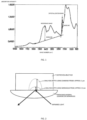
- baselines of the infrared absorption spectra at 1140 cm -1 and 1425 cm -1 are drawn as illustrated in Fig. 1 and heights from the baselines to respective peak tops at 1140 cm -1 and 1425 cm -1 are given as respective absorption peak intensity to define a value obtained by dividing the absorption peak intensity at 1140 cm -1 by the peak intensity at 1425 cm -1 as a crystallinity index.
- the crystallinity index value thus obtained is widely recognized to be proportional to the degree of crystallization of the PVA film (e.g., N.A. Peppas, Macromol. Chem., vol. 178, 595 (1977 ), JP 6-138321A ). Since the crystallinity index value slightly varies depending on the moisture absorption amount of the film, in the present invention, the film is stored in an environment at a temperature of 24.0°C and relative humidity of 45.0% RH for 24 hours and then FT-IR measurement is performed in this environment.
- the ATR technique is a kind of reflection IR analysis technique in which the film is closely contacted on an objective lens, called as an ATR prism, and the film is irradiated with infrared light at an angle from within the ATR prism to measure the spectrum of the reflected light.
- This technique has a characteristic of obtaining a sharp spectrum with less noise than by a general reflection IR analysis technique.
- the infrared light is reflected not only on the surface of the film but infrared light penetrating from the prism side slightly to the film side is also reflected to allow acquisition of information on the film surface and the surface layer.
- the penetration depth of the infrared light is defined as d, the value is represented by a formula below.
- n 1 denotes a refractive index of the prism
- n 2 denotes a refractive index of the film
- ⁇ denotes a wavelength of the infrared rays
- ⁇ denotes an angle of incidence of the infrared light.
- the prism diamond with n 1 of 2.4 and germanium with n 1 of 4.0 are used as the prism.
- the penetration depths of the infrared light into the film surface layer at an angle of incidence of 45° and a wave number of 1140 cm -1 are calculated to be, given the PVA has a refractive index of 1.5, approximately 2 ⁇ m in the case of the diamond prism and approximately 0.5 ⁇ m in the case of the germanium prism.
- the crystallinity index using the diamond prism corresponds to the degree of crystallization of a relatively deep area within the film
- the crystallinity index using the germanium prism corresponds to the degree of crystallization of a very surface layer area close to the film surface
- Fd1/Fg1 of less than 1 indicates that the degree of crystallization of the very surface layer area close to the film surface is high relative to the degree of crystallization of the relatively deep area within the film. It is thus assumed that fine control of the degrees of crystallization of the internal area and the very surface layer area of the film functions to achieve both excellent water solubility and inhibition of sticking between the films, which is one of the characteristics of the film of the present invention.
- the lower limit of Fd1 does not have to be limited, but from the perspective of mechanical strength of the film, preferably satisfies a formula (3) below. Fd1 ⁇ 0 . 25
- Fd1 of less than 0.25 sometimes causes a low degree of crystallization of an area closer to the center in the thickness direction of the water-soluble PVA film and low mechanical strength of the film. It also has a risk of causing tears and the like in a package using the film and leakage of the encapsulated chemical and the like.
- the lower limit of Fd1 is more preferably 0.3 or more, even more preferably 0.35 or more, and particularly preferably 0.4 or more. Fd1 satisfying the above range allows maintenance of preferred mechanical strength of the film.
- the lower limit of Fd1/Fg1 does not have to be limited, but from the perspective of solubility in water at low temperatures, preferably satisfies a formula (4) below.
- Fd1/Fg1 of less than 0.5 indicates that the degree of crystallization of the very surface layer area of the water-soluble PVA film is markedly high compared with the degree of crystallization of the relatively deep area within the film and has a risk of reducing the solubility in water at low temperatures.
- the lower limit of Fd1/Fg1 is more preferably 0.6 or more, even more preferably 0.7 or more, and particularly preferably 0.8 or more.
- a crystallinity index obtained from a measurement of the other surface (may be referred to as a "second surface") opposed to the one surface (may be referred to as a "first surface") of the PVA film by FT-IR analysis using a diamond prism is Fd2 and a crystallinity index obtained from a measurement of the second surface by FT-IR analysis using a germanium prism is Fg2, the Fd2 and the Fg2 preferably satisfy formulae below: Fd2 ⁇ 0 .65 Fd2 / Fg2 ⁇ 1
- Fd2 of the other surface opposed to the one surface in addition to, and not only, the one surface in the above range allows more optimal maintenance of the water solubility of the PVA film.
- Fd2 is preferably 0.60 or less, more preferably 0.55 or less, even more preferably 0.5 or less, and particularly preferably 0.45 or less.
- Fd2/Fg2 is preferably less than 1.
- Fd2/Fg2 is preferably 0.98 or less, more preferably 0.96 or less, even more preferably 0.94 or less, even more preferably 0.92 or less, and particularly preferably 0.9 or less.
- the crystallinity indices of not only the one surface of the PVA film but also the other surface, that is, both surfaces of the film in the above range allow further improvement of the excellent water solubility of the PVA film and more inhibition of the sticking between the films.
- the lower limit of Fd2 does not have to be limited, but from the perspective of mechanical strength of the film, preferably satisfies a formula (7) below. Fd2 ⁇ 0.25
- Fd2 of less than 0.25 causes an even lower degree of crystallization of an area closer to the center in the thickness direction of the other surface of the water-soluble PVA film and even lower mechanical strength of the film. It also has a risk of causing tears and the like in a package using the film and leakage of the encapsulated chemical and the like.
- the lower limit of Fd2 is more preferably 0.3 or more, even more preferably 0.35 or more, and particularly preferably 0.4 or more. Fd2 satisfying the above range allows maintenance of even more preferred mechanical strength of the film.
- the lower limit of Fd2/Fg2 does not have to be limited, but from the perspective of solubility in water at low temperatures, preferably satisfies a formula (8) below.
- Fd2/Fg2 of less than 0.5 indicates that the degree of crystallization of the very surface layer area of the other surface of the water-soluble PVA film is markedly high compared with that of the relatively deep area within the film and has a risk of further reducing the solubility in water at low temperatures.
- the lower limit of Fd2/Fg2 is more preferably 0.6 or more, even more preferably 0.7 or more, and particularly preferably 0.8 or more.
- the relationship between Fd1 and Fd2 does not have to be limited, but from the perspective of inhibiting film curling, preferably satisfies a formula (9) below.
- a difference between the crystallinity indices of the one surface and the other surface of the film is preferably not excessively large.
- a difference between the crystallinity indices of the one surface and the other surface of the film of more than 0.07 is likely to cause problems of film curling and the like during film fabrication and the like.
- the difference between the crystallinity indices of the one surface and the other surface of the film is more preferably 0.06 or less, even more preferably 0.05 or less, and particularly preferably 0.04 or less.
- the relationship between Fg1 and Fg2 does not have to be limited, but from the perspective of inhibiting film curling, preferably satisfies a formula (10) below.
- the difference between the crystallinity indices of the one surface and the other surface of the film is preferably not excessively large.
- a difference between the crystallinity indices of the one surface and the other surface of the film of more than 0.07 is likely to cause problems of film curling and the like during film fabrication and the like.
- the difference between the crystallinity indices of the one surface and the other surface of the film is more preferably 0.06 or less, even more preferably 0.05 or less, and particularly preferably 0.04 or less.
- examples of the method of controlling the crystallinity index include: a method that adjusts a kind (degree of saponification, amount of modification, mixing ratio of unmodified PVA/modified PVA, etc.) of the polyvinyl alcohol-based resin; a method that adjusts an amount of a plasticizer to be added; a method that adjusts film production conditions (surface temperature of roll support, heat treatment conditions, etc.); or a method of adjustment by combining these methods.
- the water-soluble film of the present invention contains a polyvinyl alcohol-based resin (PVA).
- PVA polyvinyl alcohol-based resin
- the PVA it is possible to use a polymer produced by saponifying a vinyl ester-based polymer obtained by polymerizing a vinyl ester-based monomer.
- vinyl ester-based monomer examples include vinyl formate, vinyl acetate, vinyl propionate, vinyl valerate, vinyl laurate, vinyl stearate, vinyl benzoate, vinyl pivalate, vinyl versatate, and the like. Among them, vinyl acetate is preferred as the vinyl ester-based monomer.
- the vinyl ester-based polymer is preferably a polymer obtained using only one or more kinds of vinyl ester-based monomer as the monomer and more preferably a polymer obtained using only one kind of vinyl ester-based monomer as the monomer. It should be noted that the vinyl ester-based polymer may be a copolymer of one or more kinds of vinyl ester-based monomer and another monomer copolymerizable therewith.
- Examples of such another monomer include: ethylene; olefins having a carbon number from 3 to 30, such as propylene, 1-butene, and isobutene; acrylic acid and salts thereof; acrylic esters, such as methyl acrylate, ethyl acrylate, n-propyl acrylate, i-propyl acrylate, n-butyl acrylate, i-butyl acrylate, t-butyl acrylate, 2-ethylhexyl acrylate, dodecyl acrylate, and octadecyl acrylate; methacrylic acid and salts thereof; methacrylic esters, such as methyl methacrylate, ethyl methacrylate, n-propyl methacrylate, i-propyl methacrylate, n-butyl methacrylate, i-butyl methacrylate, t-butyl methacrylate, 2-ethyl
- the vinyl ester-based polymer may have a structural unit derived from one or more kinds of such another monomer.
- a higher ratio of the structural unit derived from such another monomer to the vinyl ester-based polymer generally tends to cause difficulty in proceedings of crystallization of PVA. It is thus possible to adjust the crystallinity index of the PVA film by moderately copolymerizing such another monomer.
- a ratio of the structural unit derived from such another monomer to the vinyl ester-based polymer does not have to be limited, but the ratio is preferably 15 mol% or less based on the number of moles of the total structural units constituting the vinyl ester-based polymer and more preferably 5 mol% or less.
- the degree of polymerization of the PVA is preferably, but not particularly limited to, in a range below. That is, the lower limit of the degree of polymerization is preferably 200 or more from the perspective of inhibiting excessive crystallization and securing sufficient mechanical strength of the PVA film, more preferably 300 or more, and even more preferably 500 or more. Meanwhile, the upper limit of the degree of polymerization is preferably 8,000 or less from the perspective of achieving moderate proceedings of crystallization and increasing productivity of the PVA, productivity of the PVA film, and the like, more preferably 5,000 or less, and even more preferably 3,000 or less.
- the degree of polymerization means an average degree of polymerization measured in accordance with the description of JIS K 6726-1994.
- the degree of polymerization herein is obtained by a following formula (12) from the limiting viscosity [ ⁇ ] (unit: deciliter/g) measured, after resaponifying and purifying the PVA, in water at 30°C.
- Degree of Polymerization Po ⁇ ⁇ 10 4 / 8.29 1 / 0.62
- the degree of saponification of the PVA is preferably, but does not have to be limited to, from 64 to 95 mol%. Adjustment of the degree of saponification of the PVA in such a range achieves moderate proceedings of the crystallization of the PVA film and facilitates achievement of both the good water solubility and the inhibition of sticking between the films.
- the lower limit of the degree of saponification is more preferably 70 mol% or more and even more preferably 75 mol% or more.
- the upper limit of the degree of saponification is more preferably 94 mol% or less and even more preferably 93 mol% or less.
- the degree of saponification of the PVA means a ratio (mol%) indicating the number of moles of the vinyl alcohol units based on the total number of moles of the structural units (typically, vinyl ester-based monomer units) that may be converted to vinyl alcohol units by saponification and the vinyl alcohol units.
- the degree of saponification of the PVA may be measured in accordance with the description of JIS K 6726-1994.
- the PVA film may contain one kind of PVA singly or may contain two or more kinds of PVA having a degree of polymerization, a degree of saponification, a degree of modification, and the like different from each other.
- the upper limit of the PVA content in the PVA film is preferably 100 mass% or less. Meanwhile, the lower limit of the PVA content is preferably 50 mass% or more, more preferably 80 mass% or more, and even more preferably 85 mass% or more.
- PVA films containing no plasticizer are generally hard films, they are likely to cause problems of rupture and the like in film formation and fabrication. Since such a film is also poor in texture and the like, the PVA film preferably contains a plasticizer. The plasticizer thus contained allows impartation of flexibility equivalent to other plastic films to the PVA film.
- plasticizer examples include polyhydric alcohols, such as ethylene glycol, glycerin, diglycerin, propylene glycol, diethylene glycol, triethylene glycol, tetraethylene glycol, trimethylolpropane, and sorbitol, and the like.
- polyhydric alcohols such as ethylene glycol, glycerin, diglycerin, propylene glycol, diethylene glycol, triethylene glycol, tetraethylene glycol, trimethylolpropane, and sorbitol, and the like.
- the plasticizer is preferably ethylene glycol or glycerin and more preferably glycerin.
- the lower limit of the content of the plasticizer in the PVA film is preferably 1 part by mass or more based on 100 parts by mass of the PVA, more preferably 3 parts by mass or more, and even more preferably 5 parts by mass or more.
- the upper limit of the content of the plasticizer is preferably 70 parts by mass or less based on 100 parts by mass of the PVA, more preferably 50 parts by mass or less, and even more preferably 40 parts by mass or less.
- the content of the plasticizer in the above range facilitates control of the crystallinity index of the PVA film, and in addition, sufficiently enables an effect of improving the mechanical strength, such as impact strength. It is also possible to preferably prevent or suppress the problems of reducing the handleability, bleeding out on the surface, and the like due to excessive flexibility of the PVA film.
- the PVA film may contain starch and/or a water-soluble polymer other than PVA.
- the starch and/or the water-soluble polymer other than PVA thus contained allows impartation of mechanical strength to the PVA film, improvement of moisture resistance of the PVA film during handling, regulation of the rate of flexibilizing the PVA film, and the like due to water absorption during dissolution.
- starch examples include: natural starches, such as corn starch, potato starch, sweet potato starch, wheat starch, rice starch, tapioca starch, and sago starch; processed starches subjected to etherification, esterification, oxidation, and the like; and the like, and processed starches are particularly preferred.
- the content of the starch in the PVA film is preferably 15 parts by mass or less based on 100 parts by mass of the PVA and more preferably 10 parts by mass or less. By keeping the content of the starch in the above range, it is possible to prevent or inhibit worsening of the processability of the PVA film.
- water-soluble polymer other than PVA examples include dextrin, gelatin, glue, casein, shellac, gum arabic, polyacrylic acid amide, sodium polyacrylate, polyvinyl methyl ether, copolymers of methyl vinyl ether and maleic anhydride, copolymers of vinyl acetate and itaconic acid, polyvinylpyrrolidone, cellulose, acetylcellulose, acetylbutylcellulose, carboxymethylcellulose, methylcellulose, ethylcellulose, hydroxyethylcellulose, sodium alginate, and the like.
- the content of the water-soluble polymer other than PVA in the PVA film is preferably 15 parts by mass or less based on 100 parts by mass of the PVA and more preferably 10 parts by mass or less.
- the content of the water-soluble polymer other than PVA in the above range allows a sufficient increase in the water solubility of the PVA film.
- the PVA film preferably contains a surfactant.
- the surfactant thus contained allows improvement of the handleability of the PVA film and the releasability of the PVA film from the film formation apparatus during production.
- the surfactant is not particularly limited and, for example, anionic surfactants, nonionic surfactants, and the like may be used.
- anionic surfactant examples include: carboxylic acid-based surfactants, such as potassium laurate; sulfuric ester-based surfactants, such as octyl sulfate; sulfonic acid-based surfactants, such as dodecylbenzenesulfonate; and the like.
- nonionic surfactant examples include: alkyl ether-based surfactants, such as polyoxyethylene lauryl ether and polyoxyethylene oleyl ether; alkylphenyl ether-based surfactants, such as polyoxyethylene octylphenyl ether; alkyl ester-based surfactants, such as polyoxyethylene laurate; alkylamine-based surfactants, such as polyoxyethylene laurylamino ether; alkylamide-based surfactants, such as polyoxyethylene lauric acid amide; polypropylene glycol ether-based surfactants , such as polyoxyethylene polyoxypropylene ether; alkanolamide-based surfactants, such as lauric acid diethanolamide and oleic acid diethanolamide; allyl phenyl ether-based surfactants, such as polyoxyalkylene allyl phenyl ether; and the like.
- alkyl ether-based surfactants such as polyoxyethylene lauryl ether
- the surfactant is preferably nonionic surfactants, more preferably alkanolamide-based surfactants, and even more preferably dialkanolamide (e.g., diethanolamide, etc.) of aliphatic carboxylic acid (e.g., saturated or unsaturated aliphatic carboxylic acid having a carbon number from 8 to 30, etc.).
- nonionic surfactants more preferably alkanolamide-based surfactants, and even more preferably dialkanolamide (e.g., diethanolamide, etc.) of aliphatic carboxylic acid (e.g., saturated or unsaturated aliphatic carboxylic acid having a carbon number from 8 to 30, etc.).
- the lower limit of the content of the surfactant in the PVA film is preferably 0.01 part by mass or more based on 100 parts by mass of the PVA, more preferably 0.02 parts by mass or more, and even more preferably 0.05 parts by mass or more.
- the upper limit of the content of the surfactant is preferably 10 parts by mass or less based on 100 parts by mass of the PVA, more preferably 1 part by mass or less, even more preferably 0.5 parts by mass or less, and particularly preferably 0.3 parts by mass or less.
- the content of the surfactant in the above range allows better releasability of the PVA film from the film formation apparatus during production and causes less problems of sticking (hereinafter, may be referred to as "blocking") between the PVA films and the like.
- blocking may be referred to as "blocking" between the PVA films and the like.
- the PVA film may contain components, such as moisture, antioxidants, ultraviolet absorbers, lubricants, cross-linking agents, colorants, fillers, antiseptics, mildewcides, and other polymer compounds.
- the ratio of the summed mass of the PVA, the plasticizer, the starch, the water-soluble polymer other than PVA, and the surfactant to the total mass of the PVA film is preferably from 60 to 100 mass%, more preferably from 80 to 100 mass%, and even more preferably from 90 to 100 mass%.
- Complete dissolution time of the PVA film of the present invention immersed immersed in deionized water at 10°C is preferably, but not particularly limited to, in a range below. That is, the upper limit of the complete dissolution time is preferably 150 seconds or less, more preferably 90 seconds or less, even more preferably 60 seconds or less, and particularly preferably 45 seconds or less.
- the PVA film having the upper limit of the complete dissolution time in the above range completes the dissolution relatively early and thus is preferably used as a film for packaging (packaging material for) chemicals and the like.
- the lower limit of the complete dissolution time is preferably 5 seconds or more, more preferably 10 seconds or more, even more preferably 15 seconds or more, and particularly preferably 20 seconds or more.
- the PVA film having the lower limit of the complete dissolution time in the above range causes less problems, such as blocking of the PVA films with each other and reduction in the mechanical strength due to absorption of moisture in the atmosphere.
- the complete dissolution time when the PVA film is immersed in deionized water at 10°C is measured as follows.
- the thickness of the PVA film is preferably, but not particularly limited to, in a range below. That is, the upper limit of the thickness is preferably 200 ⁇ m or less, more preferably 150 ⁇ m or less, even more preferably 100 ⁇ m or less, and particularly preferably 50 ⁇ m or less. Meanwhile, the lower limit of the thickness is preferably 5 ⁇ m or more, more preferably 10 ⁇ m or more, even more preferably 15 ⁇ m or more, and particularly preferably 20 ⁇ m or more.
- the thickness in the above range is not excessively large and thus preferably allows preventing worsening of fabricability of the PVA film while it is not excessively small and thus allows securing sufficient mechanical strength of the PVA film.
- the thickness of the PVA film may be obtained as an average value of thicknesses measured at ten arbitrary spots (e.g., ten arbitrary spots on a straight line in the longitudinal direction of the PVA film).
- a method of producing the water-soluble film (PVA film) of the present invention is not particularly limited and it is possible to use, for example, an arbitrary method as below.
- Examples of such a method include: a film formation method where a solvent, additives, and the like are added to PVA and homogenized to obtain a film forming stock solution to be subjected to casting film formation, wet film formation (discharge into a poor solvent), dry/wet film formation, gel film formation (a method where the film forming stock solution is temporarily cooled to form a gel and then the solvent is extracted and removed), and combination thereof, melt extrusion film formation where the film forming stock solution thus obtained is extruded from a T die or the like using an extruder or the like, inflation molding, and the like.
- the method of producing the PVA film is preferably casting film formation or melt extrusion film formation. Use of these methods allows a homogeneous PVA film to be productively obtained.
- a film forming stock solution is prepared at first that contains PVA, a solvent, additives, such as the plasticizer, as needed. It should be noted that, in the case of the film forming stock solution containing the additives, the ratio of the additives to PVA in the film forming stock solution is substantially equal to the above-described ratio of the additives to PVA in the PVA film.
- the film forming stock solution is then casted (fed) in the form of film on a rotating support, such as a metal roll and a metal belt.
- a liquid coating of the film forming stock solution is thus formed on the support.
- the liquid coating is heated on the support to remove the solvent and thus solidified to be formed into a film. Examples of the method of heating the liquid coating include: a method that causes the support itself to be at high temperatures with a heating medium or the like; a method that blows hot air on the opposite surface to the surface in contact with the support of the liquid coating; and the like.
- the solidified long film (PVA film) is released from the support, dried as needed by a drying roll, a drying furnace, and the like, and further heat treated as needed to be wound in a roll.
- crystallization proceeds while the PVA is heated.
- the rate of crystallization in this process is influenced by the moisture content in the PVA, the temperature, and the drawing (tensile ductility in the flow direction) in addition to the ratio of the structural unit derived from such another monomer, the degree of polymerization, the degree of saponification, and the content of the plasticizer.
- the influence by the drawing is assumed to be because of the oriented crystallization by tension of the PVA molecular chain.
- Drying of a PVA film usually proceeds by volatilizing a volatile component from an open film surface not in contact with a support, a drying roll, and the like. Accordingly, concentration distribution of a volatile component, such as moisture, occurs in the film thickness direction during the course of drying, and thus crystallinity index distribution occurs in the thickness direction depending on the temperature and the drawing conditions on each occasion.
- the crystallinity index may be adjusted by the temperature of the support, the contact time with the support, the temperature and the amount of hot air, the temperatures of the drying roll and the drying furnace, and the like.
- the ratio of volatile components (concentration of the volatile components, such as the solvent removed by volatilization and evaporation during film formation and the like) in the film forming stock solution is preferably from 50 to 90 mass% and more preferably from 55 to 80 mass%.
- the ratio of volatile components in the above range allows adjustment of the viscosity of the film forming stock solution in a preferred range, thereby improving film formability of the PVA film (liquid coating) and facilitating production of the PVA film with a uniform thickness.
- the ratio of volatile components in the film forming stock solution is appropriate and thus the crystallization of the PVA on the support moderately proceeds to facilitate adjusting the crystallinity index and its distribution.
- ratio of volatile components in the film forming stock solution herein means a value obtained by the following formula.
- Ratio of Volatile Components in Film Forming Stock Solution mass % Wa ⁇ Wb / Wa ⁇ 100
- Wa denotes the mass (g) of the film forming stock solution
- Wb denotes the mass (g) of the film forming stock solution after Wa (g) of the solution is dried in an electric heat drier at 105°C for 16 hours.
- Examples of the method of adjusting the film forming stock solution include, but not particularly limited to, a method where PVA and the additives, such as a plasticizer and a surfactant, are dissolved in a dissolution tank or the like, a method where PVA in a hydrated state is melt kneaded together with the additives, such as a plasticizer and a surfactant, using a single- or twin-screw extruder, and the like.
- the film forming stock solution is generally casted in the form of film on the support, such as a metal roll and a metal belt, passing through die lips of a die, such as a T die.
- the solvent is volatilized from the surface not in contact with the support (hereinafter, may be referred to as a "free surface") of the casted stock solution in the form of film, and meanwhile, is not substantially volatilized from the surface in contact with the support (hereinafter, may be referred to as a "a touch surface”), and thus a distribution occurs in which the solvent concentration is low on the free surface side and high on the touch surface side in the film thickness direction. Accordingly, the solidification of the PVA proceeds first from the free surface. The crystallization of the PVA also proceeds in parallel with the solidification of the PVA.
- the crystallization of the PVA does not readily proceed at both too high and too low solvent concentrations, and although it depends on the primary structure of the PVA molecules, readily proceeds when the volatile component in the casted PVA film is in a range from 20 to 60 mass%. Although a higher temperature causes an increase in the rate of crystallization, a higher temperature also causes an increase in the rate of volatilization of the solvent. For efficient proceedings of the crystallization in the very surface layer area of the PVA film, it is also important to control the temperature of the atmosphere near the free surface, the vapor pressure of the solvent, and the like in addition to the temperature of the support, the contact time with the support, and the like.
- the conditions may be selected that inhibit the crystallization relatively deep within the film while allowing proceedings of the crystallization in the very surface layer area of the film.
- conditions for slow drying such as a decrease in the drying temperature
- conditions for crystallization proceedings by rapid drying at relatively high temperatures may be employed.
- the surface temperature of the support for casting of the film forming stock solution is preferably from 50°C to 110°C, more preferably from 60°C to 100°C, and even more preferably from 65°C to 95°C.
- the surface temperature in the above range causes drying of the liquid coating and crystallization in the very surface layer area of the film to proceed at a moderate rate and thus facilitates production of the PVA film of the present invention.
- hot air at a wind velocity from 1 to 10 m/second may be uniformly blown on the entire region on a non-contact surface side of the liquid coating.
- the temperature of the hot air blown on the non-contact surface side is preferably from 50°C to 150°C and more preferably from 70°C to 120°C.
- the humidity of the hot air is preferably in a range from 20% to 90% RH, more preferably in a range from 30% to 80% RH, and even more preferably in a range from 40% to 80% RH.
- the temperature and humidity of the hot air blown on the non-contact surface side in the above ranges facilitates production of the PVA film of the present invention.
- the PVA film is preferably dried (solvent removal) to a ratio of volatile components from 5 to 50 mass% on the support and then released from the support and further dried as needed.
- drying method examples include, but not particularly limited to, a method including passing through a drying furnace and a method including contacting a drying roll.
- the number of drying rolls is preferably three or more, more preferably four or more, and even more preferably from 5 to 30.
- the temperature of the drying furnace or the drying roll(s) is preferably from 40°C to 110°C.
- the upper limit of the temperature of the drying furnace or the drying roll(s) is more preferably 100°C or less, even more preferably 90°C or less, and particularly preferably 85°C or less.
- the lower limit of the temperature of the drying furnace or the drying roll(s) is more preferably 45°C or more and even more preferably 50°C or more.
- the temperature of the drying furnace or the drying roll(s) in the range between the upper limit and the lower limit facilitates production of a PVA film having the effects of the present invention.
- the temperature out of the range between the upper limit and the lower limit tends to cause an increase in Fd1 and Fd2 sometimes causes difficulty in production of the film of the present invention.
- the PVA film after drying may further be heat treated as needed.
- the heat treatment allows adjustment of the properties, such as mechanical strength and water solubility, of the PVA film.
- the temperature of the heat treatment is preferably from 60°C to 135°C.
- the upper limit of the heat treatment temperature is more preferably 130°C or less.
- the temperature of the heat treatment in the above range facilitates production of a PVA film having the effects of the present invention.
- the temperature more than the above range causes a too small difference between the crystallinity indices in the very surface layer area of the PVA film and relatively deep within the film and thus sometimes causes difficulty in production of the PVA film of the present invention.
- the PVA film thus produced is subjected to further humidity control, cutting of both edges (trimmings) of the film, and the like as needed, and then wound in a roll on a cylindrical core and moistureproof packaged to be a product.
- the ratio of volatile components in the PVA film finally obtained through the series of treatment is preferably, but not particularly limited to, from 1 to 5 mass% and more preferably from 2 to 4 mass%.
- the water-soluble film (PVA film) of the present invention has excellent balance between the water solubility and the less sticking between the films and is more preferably used in various film applications to which general water-soluble films are applied.
- Examples of such a film application include packaging films for chemicals, base films for hydraulic transfer printing, base films for embroidery, mold release films for artificial marble molding, packaging films for seeds, films for sanitary container bags, and the like.
- the water-soluble film of the present invention is preferably applied to the packaging films for chemicals to obtain even marked effects of the present invention.
- examples of the kind of chemical include pesticides, detergents (including bleaches), germicides, and the like.
- the properties of the chemicals are not particularly limited and may be acidic, neutral, or alkaline.
- the chemicals may contain boron-containing compound(s) and/or halogen-containing compound(s).
- the form of the chemicals may be in any of powder, bulk, gel, and liquid.
- the form of package is preferably, but not particularly limited to, unit packaging to package (preferably, seal package) the chemicals per unit amount.
- a package of the present invention is obtained by packaging a chemical by applying the water-soluble film of the present invention to a packaging film for chemicals.
- the package of the present invention includes a packaging material (capsule) composed of the water-soluble film of the present invention and a chemical encapsulated in the packaging material.
- the complete dissolution time (second) of the PVA film immersed in deionized water at 10°C was measured by the method described above.
- the film was stored in an environment at a temperature of 24.0°C and relative humidity of 45.0% RH for 24 hours and then measurement was performed by FT-IR set up in a room in this environment. Both surfaces of the film were subjected to the measurement under conditions below.
- the IR spectra on both surfaces of the PVA film were measured by FT-IR to calculate the crystallinity indices by the above method.
- the water-soluble film was cut into 3 cm ⁇ 20 cm and rolled about a shorter side into a cylindrical shape with an inner diameter of approximately 1 cm and then both edges were cut.
- a small roll of the water-soluble film with an inner diameter of 1 cm and a width of 1 cm was thus prepared.
- wide binder clips with a width of 15 mm (trade name Scel-bo manufactured by KOKUYO Co., Ltd.)
- the area around the central axis of the roll thus obtained was fastened to put the direction of the fastening portions of the clips coinciding with the axial direction of the roll and stored for 16 hours under the conditions of 60°C - 90% RH.
- the film roll after storage was unwound to evaluate the state of stick of the contact surfaces at the edges.
- the water-soluble PVA film was cut into 20 cm ⁇ 20 cm and the film was hung with clips in an environment at a temperature of 24.0°C and relative humidity of 45.0% RH and stored for 24 hours, and then the film was placed on a horizontal plane to evaluate curl at the film edges by the following criteria. It should be noted that the film surface to contact the horizontal plane was, if the film curls, the outer surface of the curled film.
- a film forming stock solution was prepared by adding 100 parts by mass of PVA (degree of saponification of 88 mol%, viscosity-average degree of polymerization of 1700) obtained by saponifying polyvinyl acetate, 10 parts by mass of glycerin as the plasticizer, 0.1 part by mass of lauric acid diethanolamide as the surfactant, and water. It should be noted that the ratio of volatile components in the film forming stock solution was 68 mass%.
- the film forming stock solution was then discharged in the form of film on a first drying roll (surface temperature of 80°C) from a T die to form a liquid coating on the first drying roll.
- a first drying roll surface temperature of 80°C
- hot air at 85°C was blown for drying at a rate of 5 m/second on the entire surface of the liquid coating not in contact with the first drying roll.
- a PVA film was thus obtained.
- the dried PVA film (dried to a moisture content of 32 mass%) was then released from the first drying roll and dried by alternately contacting one surface and the other surface of the PVA film with respective drying rolls, and then the film was wound on a cylindrical core in a roll. It should be noted that the rolls of second and later drying rolls had a surface temperature set at approximately 75°C. The PVA film thus obtained had a thickness of 35 ⁇ m and a width of 1200 mm.
- the PVA film thus obtained was subjected to measurement of the complete dissolution time at 10°C.
- the IR spectrum of the PVA film thus obtained was then measured by FT-IR to calculate the crystallinity indices and evaluate the water solubility, less sticking between the PVA films, and curl in the PVA film. The results are shown in Table 1.
- a PVA film was obtained in the same manner as in Example 1 except for changing the PVA used for preparation of the film forming stock solution to acrylamide-2-methylpropanesulfonic acid sodium salt (AMPS) modified PVA (degree of saponification of 88 mol%, degree of polymerization of 1700, and amount of AMPS modification of 2 mol%).
- the PVA film thus obtained was subjected to evaluation of the complete dissolution time at 10°C, the crystallinity indices, the water solubility, less sticking between the PVA films, and curl in the PVA film. The results are shown in Table 1.
- a PVA film was obtained in the same manner as in Example 1 except for changing the PVA used for preparation of the film forming stock solution to maleic acid monomethyl ester (MMM) modified PVA (degree of saponification of 90 mol%, degree of polymerization of 1700, and amount of MMM modification of 5 mol%).
- MMM maleic acid monomethyl ester
- the PVA film thus obtained was subjected to evaluation of the complete dissolution time at 10°C, the crystallinity indices, the water solubility, less sticking between the PVA films, and curl in the PVA film. The results are shown in Table 1.
- a PVA film was obtained in the same manner as in Example 3 except for heat treatment, after drying, by contacting only one surface of the PVA film with a metal roll having a surface temperature of 120°C for 30 seconds.
- the PVA film thus obtained was subjected to evaluation of the complete dissolution time at 10°C, the crystallinity indices, the water solubility, less sticking between the PVA films, and curl in the PVA film. The results are shown in Table 1.
- a PVA film was obtained in the same manner as in Example 3 except for heat treating the PVA film, after drying, at 130°C for 90 seconds by a hot stove.
- the PVA film thus obtained was subjected to evaluation of the complete dissolution time at 10°C, the crystallinity indices, the water solubility, less sticking between the PVA films, and curl in the PVA film. The results are shown in Table 1.
- a PVA film was obtained in the same manner as in Example 1 except for changing the surface temperature of the first drying roll to 115°C, the temperature of the hot air to be blown on the surface of the liquid coating not in contact with the first drying roll to 120°C, and the temperature of the second and later drying rolls to 65°C.
- the PVA film thus obtained was subjected to evaluation of the complete dissolution time at 10°C, the crystallinity indices, the water solubility, less sticking between the PVA films, and curl in the PVA film. The results are shown in Table 1.
Landscapes
- Chemical & Material Sciences (AREA)
- Engineering & Computer Science (AREA)
- Organic Chemistry (AREA)
- Chemical Kinetics & Catalysis (AREA)
- Health & Medical Sciences (AREA)
- Life Sciences & Earth Sciences (AREA)
- Medicinal Chemistry (AREA)
- Polymers & Plastics (AREA)
- Wood Science & Technology (AREA)
- Manufacturing & Machinery (AREA)
- Oil, Petroleum & Natural Gas (AREA)
- General Health & Medical Sciences (AREA)
- Materials Engineering (AREA)
- Dispersion Chemistry (AREA)
- Toxicology (AREA)
- Agronomy & Crop Science (AREA)
- Pest Control & Pesticides (AREA)
- Plant Pathology (AREA)
- Dentistry (AREA)
- Zoology (AREA)
- Environmental Sciences (AREA)
- Mechanical Engineering (AREA)
- Manufacture Of Macromolecular Shaped Articles (AREA)
- Wrappers (AREA)
Claims (11)
- Wasserlöslicher Film, umfassend ein Polyvinylalkoholharz, wobeiwenn ein unter Verwendung eines Diamantprismas berechneter Kristallinitätsindex Fd1 ist und ein unter Verwendung eines Germaniumprismas berechneter Kristallinitätsindex Fg1 ist, für FT-IR-Messung einer ersten Oberfläche des wasserlöslichen Films durch ATR-Verfahren,das Fd1 und das Fg1 den nachstehenden Formeln entsprechen:


- Wasserlöslicher Film gemäß Anspruch 1, wobei das Fd1 der nachstehenden Formel entspricht:

- Wasserlöslicher Film gemäß Anspruch 1 oder 2, wobei das Fd1 und das Fg1 der nachstehenden Formel entsprechen:

- Wasserlöslicher Film gemäß einem der Ansprüche 1 bis 3, wobeiwenn ein unter Verwendung eines Diamantprismas berechneter Kristallinitätsindex Fd2 ist und ein unter Verwendung eines Germaniumprismas berechneter Kristallinitätsindex Fg2 ist, für FT-IR-Messung einer zweiten Oberfläche gegenüber der ersten Oberfläche des wasserlöslichen Films durch das ATR-Verfahren,das Fd2 und das Fg2 den nachstehenden Formeln entsprechen:


- Wasserlöslicher Film gemäß Anspruch 4, wobei das Fd2 der nachstehenden Formel entspricht:

- Wasserlöslicher Film gemäß Anspruch 4 oder 5, wobei das Fd2 und das Fg2 der nachstehenden Formel entsprechen:

- Wasserlöslicher Film gemäß einem der Ansprüche 4 bis 6, wobei das Fd1 und das Fd2 der nachstehenden Formel entsprechen:

- Wasserlöslicher Film gemäß einem der Ansprüche 4 bis 7, wobei das Fg1 und das Fg2 der nachstehenden Formel entsprechen:

- Packung, umfassend: ein Verpackungsmaterial, bestehend aus dem wasserlöslichen Film gemäß einem der Ansprüche 1 bis 8 und eine Chemikalie, die in dem Verpackungsmaterial eingeschlossen ist.
- Packung gemäß Anspruch 9, wobei die Chemikalie ein Pestizid, ein Detergens oder ein Germizid ist.
- Packung gemäß Anspruch 9 oder 10, wobei die Chemikalie in einer flüssigen Form vorliegt.
Applications Claiming Priority (2)
| Application Number | Priority Date | Filing Date | Title |
|---|---|---|---|
| JP2018248288 | 2018-12-28 | ||
| PCT/JP2019/051489 WO2020138440A1 (ja) | 2018-12-28 | 2019-12-27 | 水溶性フィルムおよび包装体 |
Publications (3)
| Publication Number | Publication Date |
|---|---|
| EP3904232A1 EP3904232A1 (de) | 2021-11-03 |
| EP3904232A4 EP3904232A4 (de) | 2022-10-12 |
| EP3904232B1 true EP3904232B1 (de) | 2023-11-22 |
Family
ID=71129089
Family Applications (1)
| Application Number | Title | Priority Date | Filing Date |
|---|---|---|---|
| EP19905828.0A Active EP3904232B1 (de) | 2018-12-28 | 2019-12-27 | Wasserlösliche folie und verpackung |
Country Status (5)
| Country | Link |
|---|---|
| US (1) | US12275827B2 (de) |
| EP (1) | EP3904232B1 (de) |
| JP (2) | JP7336464B2 (de) |
| CN (1) | CN113226941B (de) |
| WO (1) | WO2020138440A1 (de) |
Families Citing this family (13)
| Publication number | Priority date | Publication date | Assignee | Title |
|---|---|---|---|---|
| EP3904034A4 (de) | 2018-12-28 | 2022-09-28 | Kuraray Co., Ltd. | Wasserlöslicher film, verfahren zur herstellung davon und verpackung |
| EP3904436A4 (de) | 2018-12-28 | 2022-09-21 | Kuraray Co., Ltd. | Wasserlösliche folie und verpackung |
| WO2020138440A1 (ja) | 2018-12-28 | 2020-07-02 | 株式会社クラレ | 水溶性フィルムおよび包装体 |
| CN113227224B (zh) | 2018-12-28 | 2023-09-19 | 株式会社可乐丽 | 水溶性膜以及包装体 |
| JP7162077B2 (ja) * | 2018-12-28 | 2022-10-27 | 株式会社クラレ | 水溶性フィルムおよび包装体 |
| CN113226942B (zh) | 2018-12-28 | 2023-05-02 | 株式会社可乐丽 | 水溶性膜以及包装体 |
| JP7240420B2 (ja) | 2018-12-28 | 2023-03-15 | 株式会社クラレ | 水溶性フィルム、その製造方法および包装体 |
| EP3904036A4 (de) | 2018-12-28 | 2022-09-14 | Kuraray Co., Ltd. | Wasserlöslicher film und verpackungsmaterial |
| US20230257534A1 (en) * | 2020-06-29 | 2023-08-17 | Kuraray Co., Ltd. | Water-soluble film and packaging |
| CN115996878A (zh) * | 2020-06-29 | 2023-04-21 | 株式会社可乐丽 | 水溶性薄膜及包装体 |
| JPWO2022004537A1 (de) * | 2020-06-30 | 2022-01-06 | ||
| JP7343732B2 (ja) | 2021-10-01 | 2023-09-12 | 株式会社クラレ | 水溶性フィルム、製造方法及び包装体 |
| TWI870316B (zh) * | 2024-06-20 | 2025-01-11 | 長春石油化學股份有限公司 | 聚乙烯醇膜、包含其之光學膜及其製法 |
Family Cites Families (62)
| Publication number | Priority date | Publication date | Assignee | Title |
|---|---|---|---|---|
| US4478971A (en) | 1983-07-08 | 1984-10-23 | Shakespeare Company | High temperature extruded polyvinyl alcohol monofilament and process for the preparation thereof |
| IL90586A (en) | 1988-06-15 | 1995-10-31 | May & Baker Ltd | Package releasing its contents on contact with water |
| JPH06138321A (ja) * | 1992-10-27 | 1994-05-20 | Kuraray Co Ltd | ポリビニルアルコール系重合体フィルム |
| JPH10296820A (ja) | 1997-04-28 | 1998-11-10 | Nippon Synthetic Chem Ind Co Ltd:The | 水溶性樹脂成形物の製造法 |
| JP4242509B2 (ja) | 1999-04-16 | 2009-03-25 | 帝人化成株式会社 | 流延製膜方法 |
| JP5116911B2 (ja) | 2000-05-19 | 2013-01-09 | 株式会社クラレ | 水溶性フィルムの製造法 |
| JP5122039B2 (ja) | 2000-07-07 | 2013-01-16 | 株式会社クラレ | 耐衝撃性に優れたポリビニルアルコール系水溶性フィルム |
| JP5122040B2 (ja) | 2000-07-13 | 2013-01-16 | 株式会社クラレ | ポリビニルアルコール系水溶性フィルムおよびその製造法 |
| JP3478534B2 (ja) | 2000-07-17 | 2003-12-15 | 株式会社クラレ | ポリビニルアルコールフィルムおよび偏光フィルム |
| JP2002241797A (ja) | 2001-02-20 | 2002-08-28 | Kao Corp | 洗濯用物品 |
| JP4705267B2 (ja) | 2001-05-29 | 2011-06-22 | 日本合成化学工業株式会社 | 水溶性エンボスフィルムの製造方法 |
| GB0129983D0 (en) | 2001-12-14 | 2002-02-06 | Unilever Plc | Unit dose products |
| JP4392320B2 (ja) | 2003-10-22 | 2009-12-24 | 株式会社クラレ | 水圧転写用ベースフィルム及び水圧転写方法 |
| JP4630396B2 (ja) | 2003-12-16 | 2011-02-09 | 日本合成化学工業株式会社 | 水溶性フィルム |
| JP2005194295A (ja) | 2003-12-26 | 2005-07-21 | Nippon Synthetic Chem Ind Co Ltd:The | 水溶性フィルム及びその製造方法 |
| JP4841241B2 (ja) * | 2004-12-28 | 2011-12-21 | 日本合成化学工業株式会社 | ポリビニルアルコール系フィルム、およびそれを用いた偏光膜、偏光板 |
| WO2006134657A1 (ja) | 2005-06-16 | 2006-12-21 | The Nippon Synthetic Chemical Industry Co., Ltd. | 水溶性フィルム |
| WO2009028141A1 (ja) * | 2007-08-24 | 2009-03-05 | Kuraray Co., Ltd. | ポリビニルアルコールフィルムおよびその製造法 |
| CN101835628B (zh) | 2007-12-11 | 2013-03-13 | 日本合成化学工业株式会社 | 液压转印印刷用基膜及其制造方法 |
| CN101746168B (zh) | 2008-12-02 | 2012-10-10 | 日本合成化学工业株式会社 | 液压转印印刷用基膜 |
| BR112012020708A2 (pt) | 2010-02-18 | 2016-07-26 | Policrom Screens S P A | mídia utilizada para transferir uma imagem sobre um artigo bidimensional ou tridimensional por um processo de impressão de transferência térmica e processos para fabricar tal mídia |
| KR20140130363A (ko) | 2012-03-30 | 2014-11-10 | 가부시키가이샤 구라레 | 폴리비닐알코올계 중합체 필름 및 그 제조 방법 |
| CN106226858B (zh) * | 2012-03-30 | 2018-09-04 | 株式会社可乐丽 | 聚乙烯醇系聚合物膜和偏光膜 |
| KR101571261B1 (ko) | 2012-09-26 | 2015-11-23 | 가부시키가이샤 구라레 | 폴리비닐알코올 필름 및 편광 필름 |
| WO2014050696A1 (ja) * | 2012-09-26 | 2014-04-03 | 株式会社クラレ | ポリビニルアルコール系重合体フィルムおよびその製造方法 |
| EP2974862B1 (de) | 2013-03-15 | 2020-05-27 | Toray Industries, Inc. | Laminatfilm mit polymilchsäureharz |
| WO2015020045A1 (ja) | 2013-08-09 | 2015-02-12 | 株式会社クラレ | フィルム |
| CN106029715B (zh) | 2013-12-25 | 2019-01-08 | 株式会社可乐丽 | 改性聚乙烯醇和含有其的水溶性膜 |
| US9908957B2 (en) * | 2013-12-25 | 2018-03-06 | Kuraray Co., Ltd. | Modified polyvinyl alcohol and water-soluble film containing same |
| JP6595913B2 (ja) | 2014-02-06 | 2019-10-23 | 株式会社クラレ | ポリビニルアルコールフィルム |
| JP5781676B1 (ja) | 2014-09-12 | 2015-09-24 | 株式会社アイセロ | 水溶性フィルム、包装袋、内容物放出体、及び水溶性フィルムの製造方法 |
| US10358508B2 (en) * | 2014-10-09 | 2019-07-23 | Kuraray Co., Ltd. | Modified polyvinyl alhohol, resin composition, and film |
| TWI689547B (zh) | 2014-10-13 | 2020-04-01 | 美商摩諾索公司 | 具有塑化劑摻合物的水溶性聚乙烯醇膜、相關方法及相關物品 |
| RU2687942C2 (ru) * | 2014-10-13 | 2019-05-16 | Дзе Проктер Энд Гэмбл Компани | Изделия, содержащие водорастворимую пленку на основе поливинилового спирта и смеси пластификаторов, и способы их изготовления |
| WO2016084836A1 (ja) * | 2014-11-26 | 2016-06-02 | 株式会社クラレ | ポリビニルアルコール系重合体フィルムおよびその製造方法 |
| JP6906888B2 (ja) | 2015-02-17 | 2021-07-21 | 大日本印刷株式会社 | ヒートシール性樹脂フィルムおよびその製造方法、積層体、包装材料、ならびに成形ロール |
| CN107614242A (zh) * | 2015-05-28 | 2018-01-19 | 株式会社可乐丽 | 聚乙烯醇系聚合物膜和其制造方法 |
| JP2016222834A (ja) * | 2015-06-02 | 2016-12-28 | 株式会社クラレ | ポリビニルアルコールフィルムの製造方法 |
| EP3348605A4 (de) | 2015-09-11 | 2019-05-29 | The Nippon Synthetic Chemical Industry Co., Ltd. | Wasserlöslicher film, chemikalienverpackung und verfahren zur herstellung einer wasserlöslichen folie |
| CN113845675A (zh) | 2015-09-11 | 2021-12-28 | 三菱化学株式会社 | 水溶性薄膜及药剂包装体 |
| JPWO2017043514A1 (ja) | 2015-09-11 | 2018-06-21 | 日本合成化学工業株式会社 | フィルムロール及び薬剤包装体 |
| WO2017043513A1 (ja) | 2015-09-11 | 2017-03-16 | 日本合成化学工業株式会社 | 水溶性フィルム、薬剤包装体及び水溶性フィルムの製造方法 |
| JP6992253B2 (ja) | 2015-09-11 | 2022-01-13 | 三菱ケミカル株式会社 | 水溶性フィルム及び薬剤包装体 |
| JP6729279B2 (ja) | 2015-10-19 | 2020-07-22 | 三菱ケミカル株式会社 | 水溶性フィルム及び薬剤包装体 |
| JP6888256B2 (ja) | 2015-11-12 | 2021-06-16 | 三菱ケミカル株式会社 | 水溶性フィルム及び薬剤包装体 |
| JP2017110213A (ja) | 2015-12-14 | 2017-06-22 | 日本合成化学工業株式会社 | 薬剤包装体及び薬剤包装体の製造方法 |
| JP6787064B2 (ja) | 2015-12-17 | 2020-11-18 | 三菱ケミカル株式会社 | 水溶性フィルム及び薬剤包装体 |
| JP2017114931A (ja) | 2015-12-21 | 2017-06-29 | 日本合成化学工業株式会社 | 紫外線遮蔽フィルム |
| JP6859696B2 (ja) | 2015-12-24 | 2021-04-14 | 三菱ケミカル株式会社 | 水溶性フィルム、薬剤包装体及び水溶性フィルムの製造方法 |
| JP2017119434A (ja) | 2015-12-25 | 2017-07-06 | 日本合成化学工業株式会社 | 水溶性フィルム、薬剤包装体及び水溶性フィルムの製造方法 |
| JP7093307B2 (ja) | 2016-04-13 | 2022-06-29 | モノソル リミテッド ライアビリティ カンパニー | 水溶性フィルム、水溶性フィルムを用いるパケット、ならびにそれらの作製及び使用方法 |
| JP6828276B2 (ja) | 2016-06-09 | 2021-02-10 | 大日本印刷株式会社 | ヒートシール性樹脂フィルムおよびその製造方法、積層体ならびに包装材料 |
| CA3001552A1 (en) * | 2016-06-13 | 2017-12-21 | Monosol, Llc | Water-soluble packets |
| JP6913487B2 (ja) * | 2017-03-16 | 2021-08-04 | 積水化学工業株式会社 | 塩素系薬剤包装用水溶性フィルム |
| JP7099317B2 (ja) | 2017-06-12 | 2022-07-12 | 三菱ケミカル株式会社 | 水溶性フィルム及び薬剤包装体、ならびに水溶性フィルムの製造方法 |
| WO2019044751A1 (ja) | 2017-08-30 | 2019-03-07 | 積水化学工業株式会社 | 水溶性包装用フィルム |
| JP6487978B2 (ja) | 2017-08-30 | 2019-03-20 | 積水化学工業株式会社 | 水溶性包装用フィルム |
| CN107746467B (zh) | 2017-10-31 | 2020-11-24 | 华南理工大学 | 一种使用多次涂覆成膜工艺制备聚乙烯醇薄膜的方法 |
| CA3096263A1 (en) | 2018-04-10 | 2019-10-17 | Aicello Corporation | Water-soluble film |
| CN113226942B (zh) | 2018-12-28 | 2023-05-02 | 株式会社可乐丽 | 水溶性膜以及包装体 |
| WO2020138440A1 (ja) | 2018-12-28 | 2020-07-02 | 株式会社クラレ | 水溶性フィルムおよび包装体 |
| JP7240420B2 (ja) | 2018-12-28 | 2023-03-15 | 株式会社クラレ | 水溶性フィルム、その製造方法および包装体 |
-
2019
- 2019-12-27 WO PCT/JP2019/051489 patent/WO2020138440A1/ja not_active Ceased
- 2019-12-27 CN CN201980086787.9A patent/CN113226941B/zh active Active
- 2019-12-27 EP EP19905828.0A patent/EP3904232B1/de active Active
- 2019-12-27 JP JP2020562511A patent/JP7336464B2/ja active Active
-
2021
- 2021-06-28 US US17/360,004 patent/US12275827B2/en active Active
-
2023
- 2023-06-06 JP JP2023092920A patent/JP7600309B2/ja active Active
Also Published As
| Publication number | Publication date |
|---|---|
| EP3904232A1 (de) | 2021-11-03 |
| CN113226941A (zh) | 2021-08-06 |
| US12275827B2 (en) | 2025-04-15 |
| EP3904232A4 (de) | 2022-10-12 |
| CN113226941B (zh) | 2023-10-27 |
| JPWO2020138440A1 (ja) | 2021-11-11 |
| JP7600309B2 (ja) | 2024-12-16 |
| JP2023105063A (ja) | 2023-07-28 |
| WO2020138440A1 (ja) | 2020-07-02 |
| US20210324159A1 (en) | 2021-10-21 |
| JP7336464B2 (ja) | 2023-08-31 |
Similar Documents
| Publication | Publication Date | Title |
|---|---|---|
| EP3904232B1 (de) | Wasserlösliche folie und verpackung | |
| US12286514B2 (en) | Water-soluble film and package | |
| US12371540B2 (en) | Water-soluble film and package | |
| US12344718B2 (en) | Water-soluble film, method of manufacturing same, and package | |
| EP3904034A1 (de) | Wasserlöslicher film, verfahren zur herstellung davon und verpackung | |
| WO2020138442A1 (ja) | 水溶性フィルムおよび包装体 | |
| EP3904435A1 (de) | Wasserlösliche folie und verpackung | |
| US12234333B2 (en) | Water-soluble film and package | |
| EP4174118B1 (de) | Wasserlösliche folie und verpackungskörper | |
| CN115916658B (zh) | 水溶性薄膜及包装体 |
Legal Events
| Date | Code | Title | Description |
|---|---|---|---|
| STAA | Information on the status of an ep patent application or granted ep patent |
Free format text: STATUS: THE INTERNATIONAL PUBLICATION HAS BEEN MADE |
|
| PUAI | Public reference made under article 153(3) epc to a published international application that has entered the european phase |
Free format text: ORIGINAL CODE: 0009012 |
|
| STAA | Information on the status of an ep patent application or granted ep patent |
Free format text: STATUS: REQUEST FOR EXAMINATION WAS MADE |
|
| 17P | Request for examination filed |
Effective date: 20210726 |
|
| AK | Designated contracting states |
Kind code of ref document: A1 Designated state(s): AL AT BE BG CH CY CZ DE DK EE ES FI FR GB GR HR HU IE IS IT LI LT LU LV MC MK MT NL NO PL PT RO RS SE SI SK SM TR |
|
| DAV | Request for validation of the european patent (deleted) | ||
| DAX | Request for extension of the european patent (deleted) | ||
| REG | Reference to a national code |
Ref country code: DE Ref legal event code: R079 Free format text: PREVIOUS MAIN CLASS: B65D0065460000 Ipc: C11D0017040000 Ref document number: 602019042110 Country of ref document: DE |
|
| A4 | Supplementary search report drawn up and despatched |
Effective date: 20220914 |
|
| RIC1 | Information provided on ipc code assigned before grant |
Ipc: C08J 5/18 20060101ALI20220908BHEP Ipc: B65D 65/46 20060101ALI20220908BHEP Ipc: C11D 17/04 20060101AFI20220908BHEP |
|
| GRAP | Despatch of communication of intention to grant a patent |
Free format text: ORIGINAL CODE: EPIDOSNIGR1 |
|
| STAA | Information on the status of an ep patent application or granted ep patent |
Free format text: STATUS: GRANT OF PATENT IS INTENDED |
|
| P01 | Opt-out of the competence of the unified patent court (upc) registered |
Effective date: 20230524 |
|
| INTG | Intention to grant announced |
Effective date: 20230626 |
|
| GRAS | Grant fee paid |
Free format text: ORIGINAL CODE: EPIDOSNIGR3 |
|
| GRAA | (expected) grant |
Free format text: ORIGINAL CODE: 0009210 |
|
| STAA | Information on the status of an ep patent application or granted ep patent |
Free format text: STATUS: THE PATENT HAS BEEN GRANTED |
|
| AK | Designated contracting states |
Kind code of ref document: B1 Designated state(s): AL AT BE BG CH CY CZ DE DK EE ES FI FR GB GR HR HU IE IS IT LI LT LU LV MC MK MT NL NO PL PT RO RS SE SI SK SM TR |
|
| REG | Reference to a national code |
Ref country code: GB Ref legal event code: FG4D |
|
| REG | Reference to a national code |
Ref country code: CH Ref legal event code: EP |
|
| REG | Reference to a national code |
Ref country code: DE Ref legal event code: R096 Ref document number: 602019042110 Country of ref document: DE |
|
| REG | Reference to a national code |
Ref country code: IE Ref legal event code: FG4D |
|
| REG | Reference to a national code |
Ref country code: LT Ref legal event code: MG9D |
|
| REG | Reference to a national code |
Ref country code: NL Ref legal event code: MP Effective date: 20231122 |
|
| PG25 | Lapsed in a contracting state [announced via postgrant information from national office to epo] |
Ref country code: GR Free format text: LAPSE BECAUSE OF FAILURE TO SUBMIT A TRANSLATION OF THE DESCRIPTION OR TO PAY THE FEE WITHIN THE PRESCRIBED TIME-LIMIT Effective date: 20240223 |
|
| PG25 | Lapsed in a contracting state [announced via postgrant information from national office to epo] |
Ref country code: IS Free format text: LAPSE BECAUSE OF FAILURE TO SUBMIT A TRANSLATION OF THE DESCRIPTION OR TO PAY THE FEE WITHIN THE PRESCRIBED TIME-LIMIT Effective date: 20240322 |
|
| PG25 | Lapsed in a contracting state [announced via postgrant information from national office to epo] |
Ref country code: LT Free format text: LAPSE BECAUSE OF FAILURE TO SUBMIT A TRANSLATION OF THE DESCRIPTION OR TO PAY THE FEE WITHIN THE PRESCRIBED TIME-LIMIT Effective date: 20231122 |
|
| REG | Reference to a national code |
Ref country code: AT Ref legal event code: MK05 Ref document number: 1633868 Country of ref document: AT Kind code of ref document: T Effective date: 20231122 |
|
| PG25 | Lapsed in a contracting state [announced via postgrant information from national office to epo] |
Ref country code: NL Free format text: LAPSE BECAUSE OF FAILURE TO SUBMIT A TRANSLATION OF THE DESCRIPTION OR TO PAY THE FEE WITHIN THE PRESCRIBED TIME-LIMIT Effective date: 20231122 |
|
| PG25 | Lapsed in a contracting state [announced via postgrant information from national office to epo] |
Ref country code: AT Free format text: LAPSE BECAUSE OF FAILURE TO SUBMIT A TRANSLATION OF THE DESCRIPTION OR TO PAY THE FEE WITHIN THE PRESCRIBED TIME-LIMIT Effective date: 20231122 |
|
| PG25 | Lapsed in a contracting state [announced via postgrant information from national office to epo] |
Ref country code: ES Free format text: LAPSE BECAUSE OF FAILURE TO SUBMIT A TRANSLATION OF THE DESCRIPTION OR TO PAY THE FEE WITHIN THE PRESCRIBED TIME-LIMIT Effective date: 20231122 |
|
| PG25 | Lapsed in a contracting state [announced via postgrant information from national office to epo] |
Ref country code: NL Free format text: LAPSE BECAUSE OF FAILURE TO SUBMIT A TRANSLATION OF THE DESCRIPTION OR TO PAY THE FEE WITHIN THE PRESCRIBED TIME-LIMIT Effective date: 20231122 Ref country code: LT Free format text: LAPSE BECAUSE OF FAILURE TO SUBMIT A TRANSLATION OF THE DESCRIPTION OR TO PAY THE FEE WITHIN THE PRESCRIBED TIME-LIMIT Effective date: 20231122 Ref country code: IS Free format text: LAPSE BECAUSE OF FAILURE TO SUBMIT A TRANSLATION OF THE DESCRIPTION OR TO PAY THE FEE WITHIN THE PRESCRIBED TIME-LIMIT Effective date: 20240322 Ref country code: GR Free format text: LAPSE BECAUSE OF FAILURE TO SUBMIT A TRANSLATION OF THE DESCRIPTION OR TO PAY THE FEE WITHIN THE PRESCRIBED TIME-LIMIT Effective date: 20240223 Ref country code: ES Free format text: LAPSE BECAUSE OF FAILURE TO SUBMIT A TRANSLATION OF THE DESCRIPTION OR TO PAY THE FEE WITHIN THE PRESCRIBED TIME-LIMIT Effective date: 20231122 Ref country code: BG Free format text: LAPSE BECAUSE OF FAILURE TO SUBMIT A TRANSLATION OF THE DESCRIPTION OR TO PAY THE FEE WITHIN THE PRESCRIBED TIME-LIMIT Effective date: 20240222 Ref country code: AT Free format text: LAPSE BECAUSE OF FAILURE TO SUBMIT A TRANSLATION OF THE DESCRIPTION OR TO PAY THE FEE WITHIN THE PRESCRIBED TIME-LIMIT Effective date: 20231122 Ref country code: PT Free format text: LAPSE BECAUSE OF FAILURE TO SUBMIT A TRANSLATION OF THE DESCRIPTION OR TO PAY THE FEE WITHIN THE PRESCRIBED TIME-LIMIT Effective date: 20240322 |
|
| PG25 | Lapsed in a contracting state [announced via postgrant information from national office to epo] |
Ref country code: SE Free format text: LAPSE BECAUSE OF FAILURE TO SUBMIT A TRANSLATION OF THE DESCRIPTION OR TO PAY THE FEE WITHIN THE PRESCRIBED TIME-LIMIT Effective date: 20231122 Ref country code: RS Free format text: LAPSE BECAUSE OF FAILURE TO SUBMIT A TRANSLATION OF THE DESCRIPTION OR TO PAY THE FEE WITHIN THE PRESCRIBED TIME-LIMIT Effective date: 20231122 Ref country code: PL Free format text: LAPSE BECAUSE OF FAILURE TO SUBMIT A TRANSLATION OF THE DESCRIPTION OR TO PAY THE FEE WITHIN THE PRESCRIBED TIME-LIMIT Effective date: 20231122 Ref country code: NO Free format text: LAPSE BECAUSE OF FAILURE TO SUBMIT A TRANSLATION OF THE DESCRIPTION OR TO PAY THE FEE WITHIN THE PRESCRIBED TIME-LIMIT Effective date: 20240222 Ref country code: LV Free format text: LAPSE BECAUSE OF FAILURE TO SUBMIT A TRANSLATION OF THE DESCRIPTION OR TO PAY THE FEE WITHIN THE PRESCRIBED TIME-LIMIT Effective date: 20231122 Ref country code: HR Free format text: LAPSE BECAUSE OF FAILURE TO SUBMIT A TRANSLATION OF THE DESCRIPTION OR TO PAY THE FEE WITHIN THE PRESCRIBED TIME-LIMIT Effective date: 20231122 |
|
| PG25 | Lapsed in a contracting state [announced via postgrant information from national office to epo] |
Ref country code: DK Free format text: LAPSE BECAUSE OF FAILURE TO SUBMIT A TRANSLATION OF THE DESCRIPTION OR TO PAY THE FEE WITHIN THE PRESCRIBED TIME-LIMIT Effective date: 20231122 |
|
| PG25 | Lapsed in a contracting state [announced via postgrant information from national office to epo] |
Ref country code: CZ Free format text: LAPSE BECAUSE OF FAILURE TO SUBMIT A TRANSLATION OF THE DESCRIPTION OR TO PAY THE FEE WITHIN THE PRESCRIBED TIME-LIMIT Effective date: 20231122 |
|
| PG25 | Lapsed in a contracting state [announced via postgrant information from national office to epo] |
Ref country code: SK Free format text: LAPSE BECAUSE OF FAILURE TO SUBMIT A TRANSLATION OF THE DESCRIPTION OR TO PAY THE FEE WITHIN THE PRESCRIBED TIME-LIMIT Effective date: 20231122 |
|
| PG25 | Lapsed in a contracting state [announced via postgrant information from national office to epo] |
Ref country code: SM Free format text: LAPSE BECAUSE OF FAILURE TO SUBMIT A TRANSLATION OF THE DESCRIPTION OR TO PAY THE FEE WITHIN THE PRESCRIBED TIME-LIMIT Effective date: 20231122 Ref country code: SK Free format text: LAPSE BECAUSE OF FAILURE TO SUBMIT A TRANSLATION OF THE DESCRIPTION OR TO PAY THE FEE WITHIN THE PRESCRIBED TIME-LIMIT Effective date: 20231122 Ref country code: RO Free format text: LAPSE BECAUSE OF FAILURE TO SUBMIT A TRANSLATION OF THE DESCRIPTION OR TO PAY THE FEE WITHIN THE PRESCRIBED TIME-LIMIT Effective date: 20231122 Ref country code: IT Free format text: LAPSE BECAUSE OF FAILURE TO SUBMIT A TRANSLATION OF THE DESCRIPTION OR TO PAY THE FEE WITHIN THE PRESCRIBED TIME-LIMIT Effective date: 20231122 Ref country code: EE Free format text: LAPSE BECAUSE OF FAILURE TO SUBMIT A TRANSLATION OF THE DESCRIPTION OR TO PAY THE FEE WITHIN THE PRESCRIBED TIME-LIMIT Effective date: 20231122 Ref country code: DK Free format text: LAPSE BECAUSE OF FAILURE TO SUBMIT A TRANSLATION OF THE DESCRIPTION OR TO PAY THE FEE WITHIN THE PRESCRIBED TIME-LIMIT Effective date: 20231122 Ref country code: CZ Free format text: LAPSE BECAUSE OF FAILURE TO SUBMIT A TRANSLATION OF THE DESCRIPTION OR TO PAY THE FEE WITHIN THE PRESCRIBED TIME-LIMIT Effective date: 20231122 |
|
| REG | Reference to a national code |
Ref country code: CH Ref legal event code: PL |
|
| PG25 | Lapsed in a contracting state [announced via postgrant information from national office to epo] |
Ref country code: LU Free format text: LAPSE BECAUSE OF NON-PAYMENT OF DUE FEES Effective date: 20231227 |
|
| REG | Reference to a national code |
Ref country code: DE Ref legal event code: R097 Ref document number: 602019042110 Country of ref document: DE |
|
| PG25 | Lapsed in a contracting state [announced via postgrant information from national office to epo] |
Ref country code: MC Free format text: LAPSE BECAUSE OF FAILURE TO SUBMIT A TRANSLATION OF THE DESCRIPTION OR TO PAY THE FEE WITHIN THE PRESCRIBED TIME-LIMIT Effective date: 20231122 |
|
| REG | Reference to a national code |
Ref country code: BE Ref legal event code: MM Effective date: 20231231 |
|
| PG25 | Lapsed in a contracting state [announced via postgrant information from national office to epo] |
Ref country code: MC Free format text: LAPSE BECAUSE OF FAILURE TO SUBMIT A TRANSLATION OF THE DESCRIPTION OR TO PAY THE FEE WITHIN THE PRESCRIBED TIME-LIMIT Effective date: 20231122 Ref country code: LU Free format text: LAPSE BECAUSE OF NON-PAYMENT OF DUE FEES Effective date: 20231227 |
|
| PLBE | No opposition filed within time limit |
Free format text: ORIGINAL CODE: 0009261 |
|
| STAA | Information on the status of an ep patent application or granted ep patent |
Free format text: STATUS: NO OPPOSITION FILED WITHIN TIME LIMIT |
|
| REG | Reference to a national code |
Ref country code: IE Ref legal event code: MM4A |
|
| PG25 | Lapsed in a contracting state [announced via postgrant information from national office to epo] |
Ref country code: IE Free format text: LAPSE BECAUSE OF NON-PAYMENT OF DUE FEES Effective date: 20231227 |
|
| PG25 | Lapsed in a contracting state [announced via postgrant information from national office to epo] |
Ref country code: BE Free format text: LAPSE BECAUSE OF NON-PAYMENT OF DUE FEES Effective date: 20231231 |
|
| PG25 | Lapsed in a contracting state [announced via postgrant information from national office to epo] |
Ref country code: CH Free format text: LAPSE BECAUSE OF NON-PAYMENT OF DUE FEES Effective date: 20231231 |
|
| PG25 | Lapsed in a contracting state [announced via postgrant information from national office to epo] |
Ref country code: SI Free format text: LAPSE BECAUSE OF FAILURE TO SUBMIT A TRANSLATION OF THE DESCRIPTION OR TO PAY THE FEE WITHIN THE PRESCRIBED TIME-LIMIT Effective date: 20231122 |
|
| 26N | No opposition filed |
Effective date: 20240823 |
|
| PG25 | Lapsed in a contracting state [announced via postgrant information from national office to epo] |
Ref country code: SI Free format text: LAPSE BECAUSE OF FAILURE TO SUBMIT A TRANSLATION OF THE DESCRIPTION OR TO PAY THE FEE WITHIN THE PRESCRIBED TIME-LIMIT Effective date: 20231122 Ref country code: IE Free format text: LAPSE BECAUSE OF NON-PAYMENT OF DUE FEES Effective date: 20231227 Ref country code: CH Free format text: LAPSE BECAUSE OF NON-PAYMENT OF DUE FEES Effective date: 20231231 Ref country code: BE Free format text: LAPSE BECAUSE OF NON-PAYMENT OF DUE FEES Effective date: 20231231 |
|
| PG25 | Lapsed in a contracting state [announced via postgrant information from national office to epo] |
Ref country code: FI Free format text: LAPSE BECAUSE OF FAILURE TO SUBMIT A TRANSLATION OF THE DESCRIPTION OR TO PAY THE FEE WITHIN THE PRESCRIBED TIME-LIMIT Effective date: 20231122 |
|
| PG25 | Lapsed in a contracting state [announced via postgrant information from national office to epo] |
Ref country code: CY Free format text: LAPSE BECAUSE OF FAILURE TO SUBMIT A TRANSLATION OF THE DESCRIPTION OR TO PAY THE FEE WITHIN THE PRESCRIBED TIME-LIMIT; INVALID AB INITIO Effective date: 20191227 |
|
| PG25 | Lapsed in a contracting state [announced via postgrant information from national office to epo] |
Ref country code: HU Free format text: LAPSE BECAUSE OF FAILURE TO SUBMIT A TRANSLATION OF THE DESCRIPTION OR TO PAY THE FEE WITHIN THE PRESCRIBED TIME-LIMIT; INVALID AB INITIO Effective date: 20191227 |
|
| PG25 | Lapsed in a contracting state [announced via postgrant information from national office to epo] |
Ref country code: TR Free format text: LAPSE BECAUSE OF FAILURE TO SUBMIT A TRANSLATION OF THE DESCRIPTION OR TO PAY THE FEE WITHIN THE PRESCRIBED TIME-LIMIT Effective date: 20231122 |
|
| PGFP | Annual fee paid to national office [announced via postgrant information from national office to epo] |
Ref country code: DE Payment date: 20251104 Year of fee payment: 7 |
|
| PGFP | Annual fee paid to national office [announced via postgrant information from national office to epo] |
Ref country code: GB Payment date: 20251114 Year of fee payment: 7 |
|
| PGFP | Annual fee paid to national office [announced via postgrant information from national office to epo] |
Ref country code: FR Payment date: 20251110 Year of fee payment: 7 |