EP3868795B1 - Copolymerhydrid, verfahren zur herstellung eines copolymerhydrids, zusammensetzung mit einem copolymerhydrid, zwischenschichtfolie für verbundglas, zwischenschichtverbundfolie für verbundglas, verkapselungsmaterial, optischer film, medizinischer formkörper, verfahren zur herstellung eines medizinischen formkörpers, klebstoff, anordnung und verfahren zur herstellung der anordnung - Google Patents
Copolymerhydrid, verfahren zur herstellung eines copolymerhydrids, zusammensetzung mit einem copolymerhydrid, zwischenschichtfolie für verbundglas, zwischenschichtverbundfolie für verbundglas, verkapselungsmaterial, optischer film, medizinischer formkörper, verfahren zur herstellung eines medizinischen formkörpers, klebstoff, anordnung und verfahren zur herstellung der anordnung Download PDFInfo
- Publication number
- EP3868795B1 EP3868795B1 EP19872750.5A EP19872750A EP3868795B1 EP 3868795 B1 EP3868795 B1 EP 3868795B1 EP 19872750 A EP19872750 A EP 19872750A EP 3868795 B1 EP3868795 B1 EP 3868795B1
- Authority
- EP
- European Patent Office
- Prior art keywords
- parts
- mass
- hydrogenated copolymer
- molecular weight
- peak
- Prior art date
- Legal status (The legal status is an assumption and is not a legal conclusion. Google has not performed a legal analysis and makes no representation as to the accuracy of the status listed.)
- Active
Links
Images


Classifications
-
- C—CHEMISTRY; METALLURGY
- C09—DYES; PAINTS; POLISHES; NATURAL RESINS; ADHESIVES; COMPOSITIONS NOT OTHERWISE PROVIDED FOR; APPLICATIONS OF MATERIALS NOT OTHERWISE PROVIDED FOR
- C09J—ADHESIVES; NON-MECHANICAL ASPECTS OF ADHESIVE PROCESSES IN GENERAL; ADHESIVE PROCESSES NOT PROVIDED FOR ELSEWHERE; USE OF MATERIALS AS ADHESIVES
- C09J153/00—Adhesives based on block copolymers containing at least one sequence of a polymer obtained by reactions only involving carbon-to-carbon unsaturated bonds; Adhesives based on derivatives of such polymers
- C09J153/02—Vinyl aromatic monomers and conjugated dienes
-
- C—CHEMISTRY; METALLURGY
- C08—ORGANIC MACROMOLECULAR COMPOUNDS; THEIR PREPARATION OR CHEMICAL WORKING-UP; COMPOSITIONS BASED THEREON
- C08F—MACROMOLECULAR COMPOUNDS OBTAINED BY REACTIONS ONLY INVOLVING CARBON-TO-CARBON UNSATURATED BONDS
- C08F297/00—Macromolecular compounds obtained by successively polymerising different monomer systems using a catalyst of the ionic or coordination type without deactivating the intermediate polymer
- C08F297/02—Macromolecular compounds obtained by successively polymerising different monomer systems using a catalyst of the ionic or coordination type without deactivating the intermediate polymer using a catalyst of the anionic type
- C08F297/04—Macromolecular compounds obtained by successively polymerising different monomer systems using a catalyst of the ionic or coordination type without deactivating the intermediate polymer using a catalyst of the anionic type polymerising vinyl aromatic monomers and conjugated dienes
-
- B—PERFORMING OPERATIONS; TRANSPORTING
- B29—WORKING OF PLASTICS; WORKING OF SUBSTANCES IN A PLASTIC STATE IN GENERAL
- B29C—SHAPING OR JOINING OF PLASTICS; SHAPING OF MATERIAL IN A PLASTIC STATE, NOT OTHERWISE PROVIDED FOR; AFTER-TREATMENT OF THE SHAPED PRODUCTS, e.g. REPAIRING
- B29C65/00—Joining or sealing of preformed parts, e.g. welding of plastics materials; Apparatus therefor
- B29C65/48—Joining or sealing of preformed parts, e.g. welding of plastics materials; Apparatus therefor using adhesives, i.e. using supplementary joining material; solvent bonding
- B29C65/4805—Joining or sealing of preformed parts, e.g. welding of plastics materials; Apparatus therefor using adhesives, i.e. using supplementary joining material; solvent bonding characterised by the type of adhesives
- B29C65/483—Reactive adhesives, e.g. chemically curing adhesives
- B29C65/4845—Radiation curing adhesives, e.g. UV light curing adhesives
-
- B—PERFORMING OPERATIONS; TRANSPORTING
- B29—WORKING OF PLASTICS; WORKING OF SUBSTANCES IN A PLASTIC STATE IN GENERAL
- B29C—SHAPING OR JOINING OF PLASTICS; SHAPING OF MATERIAL IN A PLASTIC STATE, NOT OTHERWISE PROVIDED FOR; AFTER-TREATMENT OF THE SHAPED PRODUCTS, e.g. REPAIRING
- B29C66/00—General aspects of processes or apparatus for joining preformed parts
- B29C66/70—General aspects of processes or apparatus for joining preformed parts characterised by the composition, physical properties or the structure of the material of the parts to be joined; Joining with non-plastics material
- B29C66/72—General aspects of processes or apparatus for joining preformed parts characterised by the composition, physical properties or the structure of the material of the parts to be joined; Joining with non-plastics material characterised by the structure of the material of the parts to be joined
- B29C66/723—General aspects of processes or apparatus for joining preformed parts characterised by the composition, physical properties or the structure of the material of the parts to be joined; Joining with non-plastics material characterised by the structure of the material of the parts to be joined being multi-layered
- B29C66/7232—General aspects of processes or apparatus for joining preformed parts characterised by the composition, physical properties or the structure of the material of the parts to be joined; Joining with non-plastics material characterised by the structure of the material of the parts to be joined being multi-layered comprising a non-plastics layer
- B29C66/72321—General aspects of processes or apparatus for joining preformed parts characterised by the composition, physical properties or the structure of the material of the parts to be joined; Joining with non-plastics material characterised by the structure of the material of the parts to be joined being multi-layered comprising a non-plastics layer consisting of metals or their alloys
-
- B—PERFORMING OPERATIONS; TRANSPORTING
- B32—LAYERED PRODUCTS
- B32B—LAYERED PRODUCTS, i.e. PRODUCTS BUILT-UP OF STRATA OF FLAT OR NON-FLAT, e.g. CELLULAR OR HONEYCOMB, FORM
- B32B17/00—Layered products essentially comprising sheet glass, or glass, slag, or like fibres
- B32B17/06—Layered products essentially comprising sheet glass, or glass, slag, or like fibres comprising glass as the main or only constituent of a layer, next to another layer of a specific material
- B32B17/10—Layered products essentially comprising sheet glass, or glass, slag, or like fibres comprising glass as the main or only constituent of a layer, next to another layer of a specific material of synthetic resin
- B32B17/10005—Layered products essentially comprising sheet glass, or glass, slag, or like fibres comprising glass as the main or only constituent of a layer, next to another layer of a specific material of synthetic resin laminated safety glass or glazing
- B32B17/1055—Layered products essentially comprising sheet glass, or glass, slag, or like fibres comprising glass as the main or only constituent of a layer, next to another layer of a specific material of synthetic resin laminated safety glass or glazing characterized by the resin layer, i.e. interlayer
-
- C—CHEMISTRY; METALLURGY
- C08—ORGANIC MACROMOLECULAR COMPOUNDS; THEIR PREPARATION OR CHEMICAL WORKING-UP; COMPOSITIONS BASED THEREON
- C08F—MACROMOLECULAR COMPOUNDS OBTAINED BY REACTIONS ONLY INVOLVING CARBON-TO-CARBON UNSATURATED BONDS
- C08F236/00—Copolymers of compounds having one or more unsaturated aliphatic radicals, at least one having two or more carbon-to-carbon double bonds
- C08F236/02—Copolymers of compounds having one or more unsaturated aliphatic radicals, at least one having two or more carbon-to-carbon double bonds the radical having only two carbon-to-carbon double bonds
- C08F236/04—Copolymers of compounds having one or more unsaturated aliphatic radicals, at least one having two or more carbon-to-carbon double bonds the radical having only two carbon-to-carbon double bonds conjugated
- C08F236/10—Copolymers of compounds having one or more unsaturated aliphatic radicals, at least one having two or more carbon-to-carbon double bonds the radical having only two carbon-to-carbon double bonds conjugated with vinyl-aromatic monomers
-
- C—CHEMISTRY; METALLURGY
- C08—ORGANIC MACROMOLECULAR COMPOUNDS; THEIR PREPARATION OR CHEMICAL WORKING-UP; COMPOSITIONS BASED THEREON
- C08F—MACROMOLECULAR COMPOUNDS OBTAINED BY REACTIONS ONLY INVOLVING CARBON-TO-CARBON UNSATURATED BONDS
- C08F293/00—Macromolecular compounds obtained by polymerisation on to a macromolecule having groups capable of inducing the formation of new polymer chains bound exclusively at one or both ends of the starting macromolecule
-
- C—CHEMISTRY; METALLURGY
- C08—ORGANIC MACROMOLECULAR COMPOUNDS; THEIR PREPARATION OR CHEMICAL WORKING-UP; COMPOSITIONS BASED THEREON
- C08F—MACROMOLECULAR COMPOUNDS OBTAINED BY REACTIONS ONLY INVOLVING CARBON-TO-CARBON UNSATURATED BONDS
- C08F4/00—Polymerisation catalysts
- C08F4/42—Metals; Metal hydrides; Metallo-organic compounds; Use thereof as catalyst precursors
- C08F4/44—Metals; Metal hydrides; Metallo-organic compounds; Use thereof as catalyst precursors selected from light metals, zinc, cadmium, mercury, copper, silver, gold, boron, gallium, indium, thallium, rare earths or actinides
- C08F4/46—Metals; Metal hydrides; Metallo-organic compounds; Use thereof as catalyst precursors selected from light metals, zinc, cadmium, mercury, copper, silver, gold, boron, gallium, indium, thallium, rare earths or actinides selected from alkali metals
- C08F4/48—Metals; Metal hydrides; Metallo-organic compounds; Use thereof as catalyst precursors selected from light metals, zinc, cadmium, mercury, copper, silver, gold, boron, gallium, indium, thallium, rare earths or actinides selected from alkali metals selected from lithium, rubidium, caesium or francium
-
- C—CHEMISTRY; METALLURGY
- C08—ORGANIC MACROMOLECULAR COMPOUNDS; THEIR PREPARATION OR CHEMICAL WORKING-UP; COMPOSITIONS BASED THEREON
- C08F—MACROMOLECULAR COMPOUNDS OBTAINED BY REACTIONS ONLY INVOLVING CARBON-TO-CARBON UNSATURATED BONDS
- C08F8/00—Chemical modification by after-treatment
- C08F8/04—Reduction, e.g. hydrogenation
-
- C—CHEMISTRY; METALLURGY
- C08—ORGANIC MACROMOLECULAR COMPOUNDS; THEIR PREPARATION OR CHEMICAL WORKING-UP; COMPOSITIONS BASED THEREON
- C08F—MACROMOLECULAR COMPOUNDS OBTAINED BY REACTIONS ONLY INVOLVING CARBON-TO-CARBON UNSATURATED BONDS
- C08F8/00—Chemical modification by after-treatment
- C08F8/42—Introducing metal atoms or metal-containing groups
-
- C—CHEMISTRY; METALLURGY
- C08—ORGANIC MACROMOLECULAR COMPOUNDS; THEIR PREPARATION OR CHEMICAL WORKING-UP; COMPOSITIONS BASED THEREON
- C08J—WORKING-UP; GENERAL PROCESSES OF COMPOUNDING; AFTER-TREATMENT NOT COVERED BY SUBCLASSES C08B, C08C, C08F, C08G or C08H
- C08J5/00—Manufacture of articles or shaped materials containing macromolecular substances
- C08J5/18—Manufacture of films or sheets
-
- C—CHEMISTRY; METALLURGY
- C08—ORGANIC MACROMOLECULAR COMPOUNDS; THEIR PREPARATION OR CHEMICAL WORKING-UP; COMPOSITIONS BASED THEREON
- C08K—Use of inorganic or non-macromolecular organic substances as compounding ingredients
- C08K5/00—Use of organic ingredients
- C08K5/0008—Organic ingredients according to more than one of the "one dot" groups of C08K5/01 - C08K5/59
- C08K5/005—Stabilisers against oxidation, heat, light, ozone
-
- C—CHEMISTRY; METALLURGY
- C08—ORGANIC MACROMOLECULAR COMPOUNDS; THEIR PREPARATION OR CHEMICAL WORKING-UP; COMPOSITIONS BASED THEREON
- C08K—Use of inorganic or non-macromolecular organic substances as compounding ingredients
- C08K5/00—Use of organic ingredients
- C08K5/04—Oxygen-containing compounds
- C08K5/13—Phenols; Phenolates
-
- C—CHEMISTRY; METALLURGY
- C08—ORGANIC MACROMOLECULAR COMPOUNDS; THEIR PREPARATION OR CHEMICAL WORKING-UP; COMPOSITIONS BASED THEREON
- C08K—Use of inorganic or non-macromolecular organic substances as compounding ingredients
- C08K5/00—Use of organic ingredients
- C08K5/04—Oxygen-containing compounds
- C08K5/14—Peroxides
-
- C—CHEMISTRY; METALLURGY
- C08—ORGANIC MACROMOLECULAR COMPOUNDS; THEIR PREPARATION OR CHEMICAL WORKING-UP; COMPOSITIONS BASED THEREON
- C08K—Use of inorganic or non-macromolecular organic substances as compounding ingredients
- C08K5/00—Use of organic ingredients
- C08K5/49—Phosphorus-containing compounds
-
- C—CHEMISTRY; METALLURGY
- C08—ORGANIC MACROMOLECULAR COMPOUNDS; THEIR PREPARATION OR CHEMICAL WORKING-UP; COMPOSITIONS BASED THEREON
- C08K—Use of inorganic or non-macromolecular organic substances as compounding ingredients
- C08K5/00—Use of organic ingredients
- C08K5/56—Organo-metallic compounds, i.e. organic compounds containing a metal-to-carbon bond
-
- C—CHEMISTRY; METALLURGY
- C08—ORGANIC MACROMOLECULAR COMPOUNDS; THEIR PREPARATION OR CHEMICAL WORKING-UP; COMPOSITIONS BASED THEREON
- C08L—COMPOSITIONS OF MACROMOLECULAR COMPOUNDS
- C08L53/00—Compositions of block copolymers containing at least one sequence of a polymer obtained by reactions only involving carbon-to-carbon unsaturated bonds; Compositions of derivatives of such polymers
- C08L53/02—Compositions of block copolymers containing at least one sequence of a polymer obtained by reactions only involving carbon-to-carbon unsaturated bonds; Compositions of derivatives of such polymers of vinyl-aromatic monomers and conjugated dienes
- C08L53/025—Compositions of block copolymers containing at least one sequence of a polymer obtained by reactions only involving carbon-to-carbon unsaturated bonds; Compositions of derivatives of such polymers of vinyl-aromatic monomers and conjugated dienes modified
-
- C—CHEMISTRY; METALLURGY
- C09—DYES; PAINTS; POLISHES; NATURAL RESINS; ADHESIVES; COMPOSITIONS NOT OTHERWISE PROVIDED FOR; APPLICATIONS OF MATERIALS NOT OTHERWISE PROVIDED FOR
- C09J—ADHESIVES; NON-MECHANICAL ASPECTS OF ADHESIVE PROCESSES IN GENERAL; ADHESIVE PROCESSES NOT PROVIDED FOR ELSEWHERE; USE OF MATERIALS AS ADHESIVES
- C09J153/00—Adhesives based on block copolymers containing at least one sequence of a polymer obtained by reactions only involving carbon-to-carbon unsaturated bonds; Adhesives based on derivatives of such polymers
- C09J153/02—Vinyl aromatic monomers and conjugated dienes
- C09J153/025—Vinyl aromatic monomers and conjugated dienes modified
-
- C—CHEMISTRY; METALLURGY
- C09—DYES; PAINTS; POLISHES; NATURAL RESINS; ADHESIVES; COMPOSITIONS NOT OTHERWISE PROVIDED FOR; APPLICATIONS OF MATERIALS NOT OTHERWISE PROVIDED FOR
- C09J—ADHESIVES; NON-MECHANICAL ASPECTS OF ADHESIVE PROCESSES IN GENERAL; ADHESIVE PROCESSES NOT PROVIDED FOR ELSEWHERE; USE OF MATERIALS AS ADHESIVES
- C09J5/00—Adhesive processes in general; Adhesive processes not provided for elsewhere, e.g. relating to primers
- C09J5/02—Adhesive processes in general; Adhesive processes not provided for elsewhere, e.g. relating to primers involving pretreatment of the surfaces to be joined
-
- B—PERFORMING OPERATIONS; TRANSPORTING
- B32—LAYERED PRODUCTS
- B32B—LAYERED PRODUCTS, i.e. PRODUCTS BUILT-UP OF STRATA OF FLAT OR NON-FLAT, e.g. CELLULAR OR HONEYCOMB, FORM
- B32B2307/00—Properties of the layers or laminate
- B32B2307/10—Properties of the layers or laminate having particular acoustical properties
- B32B2307/102—Insulating
-
- C—CHEMISTRY; METALLURGY
- C08—ORGANIC MACROMOLECULAR COMPOUNDS; THEIR PREPARATION OR CHEMICAL WORKING-UP; COMPOSITIONS BASED THEREON
- C08J—WORKING-UP; GENERAL PROCESSES OF COMPOUNDING; AFTER-TREATMENT NOT COVERED BY SUBCLASSES C08B, C08C, C08F, C08G or C08H
- C08J2353/00—Characterised by the use of block copolymers containing at least one sequence of a polymer obtained by reactions only involving carbon-to-carbon unsaturated bonds; Derivatives of such polymers
- C08J2353/02—Characterised by the use of block copolymers containing at least one sequence of a polymer obtained by reactions only involving carbon-to-carbon unsaturated bonds; Derivatives of such polymers of vinyl aromatic monomers and conjugated dienes
-
- C—CHEMISTRY; METALLURGY
- C08—ORGANIC MACROMOLECULAR COMPOUNDS; THEIR PREPARATION OR CHEMICAL WORKING-UP; COMPOSITIONS BASED THEREON
- C08L—COMPOSITIONS OF MACROMOLECULAR COMPOUNDS
- C08L2203/00—Applications
- C08L2203/02—Applications for biomedical use
-
- C—CHEMISTRY; METALLURGY
- C08—ORGANIC MACROMOLECULAR COMPOUNDS; THEIR PREPARATION OR CHEMICAL WORKING-UP; COMPOSITIONS BASED THEREON
- C08L—COMPOSITIONS OF MACROMOLECULAR COMPOUNDS
- C08L2203/00—Applications
- C08L2203/16—Applications used for films
Definitions
- the present disclosure relates to a hydrogenated copolymer and a method of producing the same, a hydrogenated copolymer-containing composition, an interlayer film for laminated glass, an interlayer film laminate for laminated glass, a sealing material, an optical film, a medical shaped article and a method of producing the same, an adhesive, and an assembly and a method of producing the same.
- Hydrogenated copolymers comprising an aromatic vinyl monomer unit and a conjugated diene monomer unit have heretofore been used for various purposes or in various applications, e.g., (i) as base polymers of adhesive compositions with excellent balance of retention, tackiness, and adhesion as well as low melt viscosity (e.g., PTL 1), and (ii) for thermoplastic elastomer compositions with excellent fluidity, compression set property, and flexibility (e.g., PTL 2).
- PTL 3 to PTL 6 disclose compositions comprising hydrogenated block copolymers.
- An object of the present disclosure is therefore to provide means for advantageously attaining the aforementioned improvements.
- the inventor conducted diligent investigation with the aim of solving the problem set forth above.
- the inventor established that, by using a hydrogenated copolymer having a predetermined hydrogenated copolymer-derived peak (first peak) exhibiting a peak top with the earliest elution time and a predetermined hydrogenated copolymer-derived peak (second peak) exhibiting a peak top with the second earliest elution time, it is possible to improve mold printability and reduce film thickness unevenness upon film forming, thereby completing the present disclosure.
- film thickness unevenness means “thickness variations in the tensile direction when forming a film by T-die extrusion” and this film thickness unevenness is required to be small.
- an object of the present disclosure is to advantageously solve the problem set forth above, and the disclosed hydrogenated copolymer is a hydrogenated copolymer obtained by hydrogenating a copolymer comprising an aromatic vinyl monomer unit and a chain conjugated diene (linear and/or branched conjugated diene) monomer unit, wherein an elution curve measured by gel permeation chromatography (GPC) of a sample containing the hydrogenated copolymer has at least two hydrogenated copolymer-derived peaks, and when, among the at least two hydrogenated copolymer-derived peaks, a hydrogenated copolymer-derived peak exhibiting a peak top with the earliest elution time is defined as a first peak and a hydrogenated copolymer-derived peak exhibiting a peak top with the second earliest elution time is defined as a second peak, the ratio of the standard polystyrene-equivalent molecular weight based on the elution time of the first peak (first
- a copolymer comprises a monomer unit
- other equivalent expressions as used herein means that "a structural unit derived from a monomer is included in a copolymer obtained using that monomer.”
- disclosed hydrogenated copolymer has the first peak molecular weight of 15,000 or more and 170,000 or less.
- the first peak molecular weight of the hydrogenated copolymer is 15,000 or more and 170,000or less, mold printability and film formability can be favorably maintained.
- the disclosed hydrogenated copolymer is obtained by hydrogenating carbon-carbon unsaturated bonds of a main chain and side chains of a block copolymer comprising at least two polymer blocks [A] comprising an aromatic vinyl monomer unit as a main component and at least one polymer block [B] comprising a chain conjugated diene monomer unit as a main component, wherein when the mass fraction of the total aromatic vinyl monomer unit in the block copolymer is defined as wA and the mass fraction of the total chain conjugated diene monomer unit in the block copolymer is defined as wB, the ratio of wA to wB (wA:wB) is 20:80 to 60:40.
- aromatic vinyl monomer unit means “structural unit derived from an aromatic vinyl monomer (aromatic vinyl compound)
- chain conjugated diene monomer unit means “structural unit derived from a chain conjugated diene monomer (chain conjugated diene compound)”
- the phrase “comprises an aromatic vinyl monomer unit as a main component” means “comprises more than 50% by mass of an aromatic vinyl monomer unit”
- the phrase “comprise a chain conjugated diene monomer unit as a main component” means “comprise more than 50% by mass of a chain conjugated diene monomer unit.”
- percent hydrogenation refers to a proportion of hydrogenated unsaturated bonds among all the unsaturated bonds included in the copolymer and can be determined by 1 H-NMR described in Examples herein.
- the block copolymer is a triblock or pentablock copolymer.
- An object of the present disclosure is to advantageously solve the above problem and the disclosed hydrogenated copolymer-containing composition comprises any of the hydrogenated copolymers described above and at least either a phosphorous antioxidant or a phenol anti-aging agent, wherein the total amount of the phosphorus antioxidant and the phenol anti-aging agent is 0.001 parts by mass or more and 1.0 part by mass or less per 100 parts by mass of the hydrogenated copolymer.
- An object of the present disclosure is to advantageously solve the problem set forth above and the disclosed hydrogenated copolymer-containing composition comprises any of the above-mentioned hydrogenated copolymers and a processing aid, wherein the amount of the processing aid is 40 parts by mass or less per 100 parts by mass of the hydrogenated copolymer.
- An object of the present disclosure is to advantageously solve the problem set forth above and the disclosed method of producing any of the hydrogenated copolymers described above comprises a copolymerization step wherein an aromatic vinyl monomer and a chain conjugated diene monomer are copolymerized using an initiator containing an organolithium compound, and a hydrogenation step wherein a copolymer obtained by the copolymerization step is hydrogenated.
- An object of the present disclosure is to advantageously solve the problem set forth above and the disclosed interlayer film for laminated glass comprises a modified product in which an alkoxysilyl group is introduced into any of the hydrogenated copolymers described above.
- the amount of the alkoxysilyl group introduced is 0.1 parts by mass or more and 10 parts by mass or less per 100 parts by mass of the hydrogenated copolymer.
- the amount of the alkoxysilyl group introduced is 0.1 parts by mass or more and 10 parts by mass or less per 100 parts by mass of the hydrogenated copolymer, it is possible to ensure that adhesion reduction after storage is prevented.
- An object of the present disclosure is to advantageously solve the problem set forth above and the disclosed interlayer film for laminated glass comprises a modified product in which an acid anhydride group is introduced into any of the hydrogenated copolymers described above.
- the amount of the acid anhydride group introduced is 0.1 parts by mass or more and 10 parts by mass or less per 100 parts by mass of the hydrogenated copolymer.
- the amount of the acid anhydride group to be introduced is 0.1 parts by mass or more and 10 parts by mass or less per 100 parts by mass of the hydrogenated copolymer, it is possible to ensure that adhesion reduction after storage is prevented.
- An object of the present disclosure is to advantageously solve the problem set forth above and the disclosed interlayer film laminate for laminated glass comprises two or more laminated interlayer films for laminated glass, wherein at least one of outermost layers is any of the above-mentioned interlayer films for laminated glass.
- the at least one of the outermost layers is any of the above-mentioned interlayer films for laminated glass, impact resistance can be improved.
- one of the outermost layers is an interlayer film for laminated glass comprising a modified product in which an alkoxysilyl group is introduced into any of the hydrogenated copolymers described above
- the other outermost layer is an interlayer film for laminated glass comprising a modified product in which an acid anhydride group is introduced into any of the hydrogenated copolymers described above.
- one of the outermost layers is an interlayer film for laminated glass comprising a modified product in which an alkoxysilyl group is introduced into the hydrogenated copolymer and the other outermost layer is an interlayer film for laminated glass comprising a modified product in which an acid anhydride group is introduced into the hydrogenated copolymer, it is possible to increase impact resistance.
- An object of the present disclosure is to advantageously solve the problem set forth above and the disclosed sealing material comprises any of the hydrogenated copolymers described above.
- An object of the present disclosure is to advantageously solve the problem set forth above and the disclosed sealing material comprises a modified product in which an alkoxysilyl group is introduced into any of the hydrogenated copolymers described above.
- the amount of the alkoxysilyl group introduced is 0.1 parts by mass or more and 10 parts by mass or less per 100 parts by mass of the hydrogenated copolymer.
- the amount of the alkoxysilyl group introduced is 0.1 parts by mass or more and 10 parts by mass or less per 100 parts by mass of the hydrogenated copolymer, it is possible to ensure that adhesion reduction after storage is prevented.
- the disclosed sealing material has a multilayer structure comprising a layer made of the hydrogenated copolymer and a layer made of a modified product in which an alkoxysilyl group is introduced into the hydrogenated copolymer.
- the sealing material has a multilayer structure comprising a layer made of a hydrogenated copolymer and a layer made of a modified product in which an alkoxysilyl group is introduced into a hydrogenated copolymer, adhesion reduction after storage can be prevented.
- An object of the present disclosure is to advantageously solve the problem set forth above and the disclosed optical film comprises any of the hydrogenated copolymers described above.
- An object of the present disclosure is to advantageously solve the problem set forth above and the disclosed medical shaped article is formed from any of the hydrogenated copolymer-containing compositions described above.
- Elution can be reduced by irradiating a medical shaped article, formed from a hydrogenated copolymer-containing composition comprising W parts by mass as calculated using Equation 1 or more and 0.50 parts by mass or less of the phenol anti-aging agent per 100 parts by mass of the hydrogenated copolymer, with high-energy radiation at an irradiation dose E.
- An object of the present disclosure is to advantageously solve the problem set forth above and the disclosed adhesive comprises a modified product in which an alkoxysilyl group is introduced into any of the hydrogenated copolymers described above.
- the disclosed adhesive further comprises an organic solvent, wherein the amount of the organic solvent is 100 parts by mass or more and 1,000 parts by mass or less per 100 parts by mass of the modified product, and the modified product is dissolved in the organic solvent.
- the disclosed adhesive further comprises an organic solvent
- the amount of the organic solvent is 100 parts by mass or more and 1,000 parts by mass or less per 100 parts by mass of the modified product, and the modified product is dissolved in the organic solvent, it is possible to increase adhesion strength after storage.
- the organic solvent has a boiling point of 90°C or higher.
- the boiling point of the organic solvent is 90°C or higher, it is possible to ensure that adhesion strength after storage can be increased.
- the disclosed adhesive further comprises a silane coupling agent, wherein the amount of the silane coupling agent is 0.1 parts by mass or more and 10 parts by mass or less per 100 parts by mass of the modified product.
- the disclosed adhesive further comprises a silane coupling agent
- the amount of the silane coupling agent is 0.1 parts by mass or more and 10 parts by mass or less per 100 parts by mass of the modified product, it is possible to ensure that adhesion strength after storage can be increased.
- the disclosed adhesive further comprises a crosslinking aid and an organic peroxide.
- adhesion strength after storage can be further increased.
- the disclosed adhesive allows a heat-resistant resin and a metal to be favorably bonded to each other.
- An object of the present disclosure is to advantageously solve the problem set forth above and the disclosed assembly comprises an adhesive sheet which comprises any of the above-mentioned adhesives and a thermoplastic resin sheet, wherein the adhesive sheet and the thermoplastic resin sheet are bonded to each other.
- An object of the present disclosure is to advantageously solve the problem set forth above and the disclosed method of producing an assembly is a method of producing the disclosed assembly and comprises (1) a step wherein a bonding surface of either the adhesive sheet or the thermoplastic resin sheet is subjected to at least one activation treatment selected from plasma irradiation, excimer ultraviolet irradiation, and corona discharge, and (2) a step wherein the adhesive sheet and the thermoplastic resin sheet are placed on top of each other with bonding surfaces thereof facing each other and are compressed under pressure.
- a hydrogenated copolymer which can increase mold printability and reduce film thickness unevenness upon film forming, a hydrogenated copolymer-containing composition comprising the hydrogenated copolymer, a method of producing the hydrogenated copolymer, an interlayer film for laminated glass comprising a modified product of the hydrogenated copolymer, an interlayer film laminate for laminated glass comprising two or more laminated layers of the interlayer film for laminated glass, a sealing material comprising the hydrogenated copolymer, a sealing material comprising a modified product of the hydrogenated copolymer, an optical film comprising the hydrogenated copolymer, a medical shaped article formed from the hydrogenated copolymer-containing composition, a method of producing the medical shaped article, an adhesive comprising a modified product of the hydrogenated copolymer, an assembly in which an adhesive sheet comprising the adhesive and a thermoplastic resin sheet are laminated, and a method of producing the assembly.
- the disclosed hydrogenated copolymer is used for preparing the disclosed hydrogenated copolymer-containing composition. Further, the disclosed hydrogenated copolymer is obtained by the disclosed method of producing a hydrogenated copolymer.
- the disclosed hydrogenated copolymer is a hydrogenated copolymer obtained by hydrogenating a copolymer comprising an aromatic vinyl monomer unit and a chain conjugated diene (linear and/or branched conjugated diene) monomer unit, wherein a sample containing the hydrogenated copolymer has at least two hydrogenated copolymer-derived peaks, and when, among the at least two hydrogenated copolymer-derived peaks, a hydrogenated copolymer-derived peak exhibiting a peak top with the earliest elution time is defined as a first peak and a hydrogenated copolymer-derived peak exhibiting a peak top with the second earliest elution time is defined as a second peak, the ratio of the standard polystyrene-equivalent molecular weight based on the elution time of the first peak (first peak molecular weight) to the standard polystyrene-equivalent molecular weight based on the elution time of the second peak (second peak mo
- an elution curve measured by gel permeation chromatography (GPC) of a sample containing the hydrogenated copolymer has a predetermined hydrogenated copolymer-derived peak exhibiting a peak top with the earliest elution time (first peak) and a predetermined hydrogenated copolymer-derived peak exhibiting a peak top with the second earliest elution time (second peak)
- the disclosed hydrogenated copolymer can increase mold printability and reduce film thickness unevenness upon film forming.
- the copolymer is a precursor of the disclosed hydrogenated copolymer.
- the structure of the copolymer is not particularly limited as long as it is a polymer comprising an aromatic vinyl unit and a chain dichotomous unit; the copolymer may be a block copolymer, a graft copolymer, a random copolymer, a tapered block copolymer or the like. From the viewpoint of low-temperature impact strength and tensile strength, the copolymer is preferably a block copolymer comprising a polymer block [A] comprising an aromatic vinyl monomer unit as a main component, and a polymer block [B] comprising a chain conjugated diene monomer unit as a main component.
- the tapered block copolymer means a block copolymer containing not only a block copolymer portion but also a random copolymer portion, or a block copolymer in which a composition ratio of a block copolymer portion varies continuously.
- the tapered block copolymer may be a block copolymer containing a random copolymer portion having A and B compositions in a bonding portion between the block copolymers A and B, or may be a block copolymer in which the A and B compositions change continuously in the bonding portion between the block copolymers A and B.
- the composition and the structure when the copolymer is a block copolymer described above will be described in detail, but the structure of the copolymer is not limited to a block copolymer nor to the structure described herein.
- the weight-average molecular weight (Mw) of the copolymer is preferably 7,000 or more, more preferably 10,000 or more, still more preferably 12,000 or more, and is preferably 190,000 or less, more preferably 150,000 or less, and still more preferably 100,000 or less.
- Mw weight-average molecular weight
- the molecular weight distribution (Mw/Mn) of the copolymer is preferably 6 or less, preferably 5 or less, and more preferably 4 or less. When the molecular weight distribution is 6 or less, mold printability and film thickness unevenness can be improved.
- the "weight-average molecular weight” and “molecular weight distribution” of a polymer can be measured by the methods described in Examples herein.
- aromatic vinyl monomers capable of forming an aromatic vinyl monomer unit include styrene and derivatives thereof, and specific examples thereof include styrene, ⁇ -methylstyrene, 2-methylstyrene, 3-methylstyrene, 4-methylstyrene, 2,4-diisopropylstyrene, 2,4-dimethylstyrene, 4-t-butylstyrene, 5-t-butyl-2-methylstyrene, 4-monochlorostyrene, dichlorostyrene, 4-monofluorostyrene, and 4-phenylstyrene.
- Chain conjugated diene monomers capable of forming a chain conjugated diene monomer unit are not particularly limited. Preferred are those having no polar group in order to reduce moisture absorption. Specific examples include 1,3-butadiene, isoprene(2-methyl-1,3-butadiene), 2,3-dimethyl-1,3-butadiene, and 1,3-pentadiene. Of these, 1,3-butadiene and isoprene are particularly preferred because of their high availability in the industry. One of these may be used individually, or two or more of these may be used in combination in an arbitrary ratio.
- the proportion of the aromatic vinyl monomer unit in the polymer block [A] is preferably 80% by mass or more, more preferably 90% by mass or more, still more preferably 95% by mass or more, and particularly preferably 100% by mass, based on the total repeating unit (100% by mass) in the polymer block [A].
- the proportion of the aromatic vinyl monomer unit in the polymer block [A] is 80% by mass or more, the microphase-separated domain derived from the polymer block [A] in the hydrogenated copolymer can be maintained, so that tensile strength and heat resistance of the aromatic monomer block can be maintained.
- the polymer block [A] may comprise monomer unit(s) other than the aromatic vinyl monomer unit, and such other monomer units may be a chain conjugated diene monomer unit.
- Monomers capable of forming such other monomer units are preferably those having no polar group in order to reduce moisture absorption, and examples thereof include chain olefins such as ethylene, propylene, 1-butene, 1-pentene, 1-hexene, 1-heptene, 1-octene, 1-nonene, 1-decene, 1-dodecene, 1-eicosene, 4-methyl-1-pentene, and 4,6-dimethyl-1-heptene; and cyclic olefins such as vinylcyclohexane.
- the monomer compositions of the polymer blocks [A] may be the same or different.
- the proportion of the chain conjugated diene monomer unit in the polymer block [B] is preferably 60% by mass or more, more preferably 80% by mass or more, still more preferably 90% by mass or more, and particularly preferably 100% by mass, based on the total repeating unit (100% by mass) in the polymer block [B],
- a glass transition temperature (Tg) derived from the polymer block [B] in the copolymer can be obtained, so that low-temperature impact strength can be maintained.
- the polymer block [B] may comprise monomer unit(s) other than the chain conjugated diene monomer unit, and such other monomer units may be an aromatic vinyl monomer unit or may be formed of the chain or cyclic olefin described above in the section titled "Polymer block [A]."
- the monomer compositions of the polymer blocks [B] may be the same or different.
- the block copolymer is a precursor of a hydrogenated block copolymer, which is one type of the disclosed hydrogenated copolymer.
- the block copolymer is a polymer comprising at least two polymer blocks [A] and at least one polymer block [B].
- the number of the polymer block [A] in the copolymer which is a block copolymer is usually 5 or less, preferably 4 or less, more preferably 3 or less, and still more preferably 2.
- the number of the polymer block [B] in the copolymer which is a block copolymer is usually 4 or less, preferably 3 or less, more preferably 2 or less, and still more preferably 1.
- the ratio of wA to wB is preferably from 20:80 to 60:40, more preferably from 25:75 to 60:40, and still more preferably from 40:60 to 60:40.
- Too high wA may reduce the impact resistance at low temperatures of a hydrogenated copolymer obtained from the copolymer.
- too low wA may reduce the rigidity of a hydrogenated copolymer obtained from the copolymer.
- the mass fraction of each monomer unit can be calculated by the numbers of parts of the aromatic vinyl monomer, the chain conjugated diene monomer and other vinyl compounds used to produce the block copolymer and by the conversion ratio of the used monomers for each block of the block copolymer at the end stage of the polymerization as measured by gas chromatography (GC).
- GC gas chromatography
- the form of the block of the copolymer which is a block copolymer may be a chain block or a radial block, but a chain block is preferable in terms of mechanical strength.
- the block copolymer has at least one structure wherein polymer blocks [A] are bonded to both ends of a polymer block [B] (i.e., A-B-A structure).
- a particularly preferred form of the copolymer which is a block copolymer is a triblock copolymer (A-B-A) in which polymer blocks [A] are bonded to both ends of a polymer block [B] or a pentablock copolymer (A-B-A-B-A) in which polymer blocks [B] are bonded to both ends of a polymer block [A] and a polymer block [A] is bonded to the other end of each block [B], with a triblock copolymer (A-B-A) being most preferred.
- a hydrogenated copolymer By hydrogenating unsaturated bonds (including, e.g., carbon-carbon unsaturated bonds of the main chain and side chains, as well as carbon-carbon unsaturated bonds of aromatic rings) in the above-described copolymer, a hydrogenated copolymer can be obtained.
- the percent hydrogenation of the hydrogenated copolymer obtained by hydrogenation is preferably 90 mol% or more, preferably 97 mol% or more, and more preferably 99 mol% or more.
- percent hydrogenation is 90 mol% or more, weather resistance can be improved.
- the weight-average molecular weight (Mw) of the hydrogenated copolymer is preferably 7,000 or more, more preferably 10,000 or more, still more preferably 12,000 or more, and is preferably 190,000 or less, more preferably 150,000 or less, and still more preferably 100,000 or less.
- Mw weight-average molecular weight
- the molecular weight distribution (Mw/Mn) of the hydrogenated copolymer is preferably 7 or less, preferably 6 or less, and more preferably 5 or less.
- Mw/Mn molecular weight distribution
- the molecular weight distribution is 7 or less, mold printability and film thickness unevenness can be improved.
- the percent hydrogenation of carbon-carbon unsaturated bonds derived from the chain conjugated diene compound and the percent hydrogenation of carbon-carbon unsaturated bonds derived from the aromatic vinyl compound of the hydrogenated copolymer can be determined, for example, by measuring 1 H-NMR of the copolymer and the hydrogenated copolymer.
- Methods, reaction form, etc. for hydrogenating unsaturated bonds of the hydrogenated copolymer are not particularly limited and hydrogenation can be carried out in accordance with methods known in the art.
- Methods of selectively hydrogenating carbon-carbon unsaturated bonds of the main chain and side chains derived from the chain conjugated diene compound of the copolymer include those described for example in JP2015-78090A .
- Methods of hydrogenating carbon-carbon unsaturated bonds of the main chain and side chains derived from the chain conjugated diene compound and carbon-carbon unsaturated bonds of the aromatic rings derived from the aromatic vinyl compound in the copolymer include those described for example in WO2011/096389 and WO2012/043708 .
- the hydrogenation catalyst or the hydrogenation catalyst and the polymerization catalyst, can be removed from the reaction solution, and then the solvent can be removed from the obtained solution to recover the hydrogenated copolymer.
- the hydrogenated block copolymer is one type of the disclosed hydrogenated copolymer.
- the hydrogenated block copolymer may be a polymer obtained by selectively hydrogenating only carbon-carbon unsaturated bonds of the main chain and side chains derived from the chain conjugated diene compound of the block copolymer, or a polymer obtained by hydrogenating carbon-carbon unsaturated bonds of the main chain and side chains derived from the chain conjugated diene compound of the block copolymer and carbon-carbon unsaturated bonds of the aromatic rings derived from the aromatic vinyl compound, or a mixture thereof.
- the percent hydrogenation of the carbon-carbon unsaturated bonds of the main chain and the side chains is usually 95% or more, preferably 97% or more, and more preferably 99% or more, and the percent hydrogenation of the carbon-carbon unsaturated bonds of the aromatic rings derived from the aromatic vinyl compound is usually 10% or less, preferably 5% or less, and more preferably 3% or less.
- hydroxing carbon-carbon unsaturated bonds of the main chain and side chains means “hydrogenating double bonds derived from the chain conjugated diene compound in the block copolymer”
- hydroxing carbon-carbon unsaturated bonds of the aromatic ring means “hydrogenating double bonds derived from the aromatic ring in the block copolymer.”
- the percent hydrogenation is 90% or more, preferably 95% or more, and more preferably 99% or more of the all carbon-carbon unsaturated bonds.
- the obtained hydrogenated copolymer and an ethylenically unsaturated silane compound may be reacted in the presence of a peroxide (silane modification) to introduce an alkoxysilyl group into the hydrogenated copolymer.
- the alkoxysilyl group to be introduced corresponds to an ethylenically unsaturated silane compound to be described later used for silane modification. From the viewpoint of (i) adhesion to a different material such as glass or metal and (ii) dispersibility of fused silica, pulverizing silica, or clay such as the so-called montmorillonite, glass fibers, carbon fibers, carbon nanotubes, cellulose nanofibers, metal particles and the like, a methoxy group and an ethoxysilyl group are preferred, and a methoxysilyl group is more preferred.
- the alkoxysilyl group may be directly bonded to the hydrogenated copolymer or may be bonded via a divalent organic group such as an alkylene or alkylene oxycarbonylalkylene group.
- Ethylenically unsaturated silane compounds used for silane modification are not particularly limited as long as they can be reacted (e.g., by graft polymerization) with the hydrogenated copolymer to introduce an alkoxysilyl group into the hydrogenated copolymer.
- Examples of such ethylenically unsaturated silane compounds include vinyltrimethoxysilane, vinyltrimethoxysilane, allyltrimethoxysilane, allyltriethoxysilane, dimethoxymethyl vinyl silane, diethoxymethylvinylsilane, p-styryltrimethoxysilane, 3-methacryloxypropylmethyldimethoxysilane, 3-methacryloxypropyltrimethoxysilane, and 3-acryloxypropyltrimethoxysilane.
- vinyltrimethoxysilane and vinyltriethoxysilane are preferred, and vinyltrimethoxysilane is more preferred.
- One of these may be used individually, or two or more of these may be used in combination in an arbitrary ratio.
- the amount of the ethylenically unsaturated silane compound to be used is usually 0.1 parts by mass or more, preferably 0.2 parts by mass or more, more preferably 0.3 parts by mass or more, and is usually 10 parts by mass or less, preferably 5 parts by mass or less, more preferably 3 parts by mass or less, per 100 parts by mass of the hydrogenated copolymer.
- Peroxides used for silane modification are preferably those having a one-minute half-life temperature of 170°C to 190°C and examples thereof include organic peroxides such as t-butylcumylperoxide, dicumylperoxide, di-t-hexylperoxide, 2,5-dimethyl-2,5-di-(t-butylperoxy)hexane, di-t-butylperoxide, and di-(2-t-butylperoxyisopropyl)benzene.
- organic peroxides such as t-butylcumylperoxide, dicumylperoxide, di-t-hexylperoxide, 2,5-dimethyl-2,5-di-(t-butylperoxy)hexane, di-t-butylperoxide, and di-(2-t-butylperoxyisopropyl)benzene.
- organic peroxides such as t-butyl
- the amount of the peroxide to be used is usually 0.05 parts by mass or more, preferably 0.1 parts by mass or more, more preferably 0.2 parts by mass or more, and is usually 2 parts by mass or less, preferably 1 part by mass or less, more preferably 0.5 parts by mass or less, per 100 parts by mass of the hydrogenated copolymer.
- the amount of the alkoxysilyl group introduced into the hydrogenated copolymer by silane modification is preferably 0.1 parts by mass or more, more preferably 0.5 parts by mass or more, still more preferably 1 part by mass or more, and is preferably 10 parts by mass or less, more preferably 5 parts by mass or less, and still more preferably 3 parts by mass or less, per 100 parts by mass of the hydrogenated copolymer.
- the weight-average molecular weight (Mw) of the hydrogenated copolymer obtained by silane modification is not largely different from that of the source hydrogenated copolymer because only a small amount of an alkoxysilyl group is introduced; it is preferably 7,000 or more, more preferably 10,000 or more, still more preferably 12,000 or more, and is preferably 190,000 or less, more preferably 150,000 or less, and still more preferably 100,000 or less.
- the weight-average molecular weight of the silane-modified product is 7,000 or more, the mechanical strength of the silane-modified product can be increased, and when it is 190,000 or less, workability of the silane-modified product can be secured.
- the molecular weight distribution of the silane-modified product is preferably 7.5 or less, preferably 6.5 or less, and more preferably 5.5 or less. When the molecular weight distribution is 7.5 or less, workability and mechanical strength of the silane-modified product obtained from the hydrogenated copolymer can be increased.
- the molecular weight distribution (Mw/Mn) of the silane-modified product tends to be larger than that of the source hydrogenated copolymer due to the concurrent crosslinking reactions and the cleavage reactions of the polymer
- the number of hydrogenated copolymer-derived peaks in the elution curve measured by gel permeation chromatography (GPC) of a sample containing the hydrogenated copolymer is not particularly limited as long as it is at least two, but is preferably 4 or less, more preferably 3 or less, and particularly preferably 2.
- the elution curve is one from which hydrogenated copolymer-derived peaks can be detected.
- the elution curve may be not only an elution curve obtained by GPC measurement of only the hydrogenated copolymer, but also an elution curve obtained from a composition containing the hydrogenated copolymer (e.g., a composition containing an anti-aging agent and the hydrogenated copolymer).
- peak means a portion protruding with respect to the baseline
- peak top means a top point where the detection sensitivity (mV) of refractive index detector (RI) is highest.
- a hydrogenated copolymer-derived peak exhibiting a peak top with the earliest elution time is defined as a first peak
- a hydrogenated copolymer-derived peak exhibiting a peak top with the second earliest elution time is defined as a second peak.
- A is the first peak
- B is the second peak
- C detected at an elution time of about 16 minutes is a peak derived from a solvent (e.g., cyclohexane) used when producing a hydrogenated copolymer
- a solvent e.g., cyclohexane
- D is the peak derived from the anti-aging agent.
- E is a plot (calibration curve) of the molecular weight of the standard polystyrene as measured by GPC, and as shown in FIG. 1 , from this calibration curve and the elution time of the hydrogenated copolymer as measured by GPC, "the standard polystyrene-equivalent molecular weight based on the elution time where the first peak shows the highest sensitivity (first peak molecular weight)” and "the standard polystyrene-equivalent molecular weight based on the elution time where the second peak shows the highest sensitivity (second peak molecular weight)" are calculated.
- the peak D derived from the anti-aging agent is not derived from the disclosed hydrogenated copolymer.
- the standard polystyrene-equivalent molecular weight based on the elution time of the first peak is not particularly limited and is preferably 15,000 or more, more preferably 16,300 or more, still more preferably 20,000 or more, still more preferably 25,000 or more, still more preferably 45,000 or more, 170,000 or less, more preferably 140,000 or less, still more preferably 96,000 or less, and still more preferably 88,400 or less.
- first peak molecular weight 15,000 or more
- the impact strength of the resin can be secured, and when it is 170,000 or less, a film can be obtained by extrusion molding.
- the standard polystyrene-equivalent molecular weight based on the elution time of the second peak is not particularly limited as long as it is 1,000 or more and is preferably 1,200 or more, more preferably 1,300 or more, still more preferably 1,500 or more, still more preferably 1,800 or more, still more preferably 9,200 or more, and preferably 153,800 or less, more preferably 100,000 or less, still more preferably 50,000 or less, and still more preferably 47,100 or less. Mold printability can be improved when the standard polystyrene-equivalent molecular weight based on the elution time of the second peak (second peak molecular weight) is 1,000 or more and is 153,800 or less.
- the ratio of the standard polystyrene-equivalent molecular weight based on the elution time of the first peak (first peak molecular weight) to the standard polystyrene-equivalent molecular weight based on the elution time of the second peak (second peak molecular weight), i.e., first peak molecular weight / second peak molecular weight, is not particularly limited as long as it is 1.50 or more.
- the ratio of first peak molecular weight to second peak molecular weight is preferably 2.0 or more, more preferably 4.0 or more, still more preferably 4.89 or more, and is preferably 200 or less, more preferably 150 or less, still more preferably 100 or less, still more preferably 73.85 or less, and still more preferably 13.58 or less.
- the ratio of the first peak molecular weight to the second peak molecular weight is 2.0 or more and is 200 or less, film thickness unevenness can be further improved.
- the ratio of the detection sensitivity (mV) of refractive index detector (RI) indicated by the peak top of the first peak (first peak top sensitivity (mV) to the detection sensitivity (mV) of refractive index detector (RI) indicated by the peak top of the second peak (second peak top sensitivity) is not particularly limited and is preferably 0.01 or more, more preferably 0.015 or more, still more preferably 0.02 or more, still more preferably 4.01 or more, still more preferably 6.88 or more, still more preferably 9.36 or more, particularly preferably 10.18 or more, and is preferably 99 or less, more preferably 70 or less, still more preferably 50 or less, and still more preferably 26.39 or less.
- the ratio of the first peak top sensitivity (mV) to the second peak top sensitivity (mV) is 0.01 or more, mold printability can be further improved, and when the ratio is 99 or less, film thickness unevenness can be further improved.
- detection sensitivity (mV) of refractive index detector (RI) means the peak top sensitivity for each peak of a GPC elution curve; for example in FIG. 1 , it corresponds to “peak top sensitivity (mV).”
- a hydrogenated copolymer which has a predetermined first peak and a predetermined second peak in an elution curve as measured by gel permeation chromatography (GPC).
- the disclosed method of producing a hydrogenated copolymer is a method of producing the disclosed hydrogenated copolymer and comprises a copolymerization step and a hydrogenation step, and optionally comprise other step(s) such as a silane modification step.
- the copolymerization step is a step of copolymerizing an aromatic vinyl monomer and a chain conjugated diene monomer using an initiator containing an organolithium compound.
- Copolymerization methods are not particularly limited as long as they are copolymerization using an initiator containing an organolithium compound.
- a copolymer can be prepared by polymerizing a monomer composition containing an aromatic vinyl monomer and a chain conjugated diene monomer by known methods.
- the organolithium compound is usually one used for anionic polymerization, and is not particularly limited.
- examples include monoorganolithium compounds such as n-butyllithium, sec-butyllithium, tert-butyllithium, n-propyllithium, iso-propyllithium, and benzyllithium; 1,4-dilithiobutane, 1,6-dilithiohexane, 1,10-dilithiodiphenylene, dilithiopolybutadiene, dilithiopolyisoprene, and multifunctional organolithium compounds such as 1,4-dilithiobutane, 1,5-dilithiopentane, 1,6-dilithiohexane, 1,10-dilithiodecane, 1,1-dilithiodiphenylene, dilithiopolybutadiene, dilithiopolyisoprene, 1,4-dilithiobenzene
- the hydrogenation step is a step of hydrogenating the copolymer obtained by the copolymerization step.
- Methods of hydrogenating unsaturated bonds in the copolymer are not particularly limited and known methods can be employed. Hydrogenation methods are preferred which may prevent polymer chain cleavage reactions while increasing the percent hydrogenation. Such hydrogenation methods are described for example in WO2011/096389 , WO2012/043708 , etc.
- the silane modification step is a step of modifying the hydrogenated copolymer, obtained by the hydrogenation step, with silane.
- Methods of modifying the hydrogenated copolymer with silane are not particularly limited.
- Introduction of an alkoxysilyl group can be accomplished for example by kneading the hydrogenated copolymer, an ethylenically unsaturated silane compound, and a peroxide in a twin-screw extruder.
- Kneading temperature is usually 180°C or above, preferably 185°C or above, more preferably 190°C or above, usually 220°C or below, preferably 210°C or below, and more preferably 200°C or below.
- Kneading time is usually 0.1 minutes or more, preferably 0.2 minutes or more, more preferably 0.3 minutes or more, and is usually 10 minutes or less, preferably 5 minutes or less, more preferably 2 minutes or less. Kneading and extrusion may be performed continuously while selecting the kneading temperature and kneading time as appropriate within the respective ranges above.
- the disclosed hydrogenated copolymer-containing composition comprises the disclosed hydrogenated copolymer described above and at least any of a phosphorus antioxidant, a phenol anti-aging agent, and a processing aid, and optionally comprise other components.
- Phosphorous antioxidants are not particularly limited and exampes include monophosphite compounds such as triphenylphosphite, diphenylisodesilicophosphite, phenyldiisodecylphosphite, tris(nonylphenyl)phosphite, tris(dinonylphenyl)phosphite, tris(2,4-di-t-butylphenyl)phosphite, and 10-(3,5-di-t-butyl-4-hydroxybenzyl)-9,10-dihydro-9-oxa-10-phosphaphenanth rene-10-oxide; diphosphite compounds such as 4,4'-butylidene-bis(3-methyl-6-t-butylphenyl-di-tridecylphosphite)4,4'-isopro pylidene-bis(phenyl-di-alkyl(C12-C15
- Phenol anti-aging agents are not particularly limited, and examples include pentaerythrityl tetrakis[3-(3,5-di-t-butyl-4-hydroxyphenyl)propionate], 2,2-thio-diethylene bis[3-(3,5-di-t-butyl-4-hydroxyphenyl)propionate, octadecyl-3 - (3,5-di-t-butyl-4-hydroxyphenyl)propionate, 3,9-bis ⁇ 2-[3-(3-t-butyl-4-hydroxy-5-methylphenyl)proonyloxy1,1-dimethylethyl ⁇ -2,4,8,10-tetraoxaspiro[5,5]undecane, and 1,3,5-trimethyl-2,4,6-tris (3,5-di-t-butyl-4-hydroxybenzyl)benzene.
- One of these may be used individually, or two or more of these may be used in combination in an
- the total amount of the phosphorus antioxidant and the phenol anti-aging agent per 100 parts by mass of the hydrogenated copolymer is not particularly limited as long as it is 0.001 parts by mass or more and 1.0 part by mass or less, and is preferably 0.003 parts by mass or more, more preferably 0.005 parts by mass or more, and is preferably 0.8 parts by mass or less, and more preferably 0.5 parts by mass or less.
- the total amount of the phosphorus antioxidant and the phenol anti-aging agent per 100 parts by mass of the hydrogenated copolymer is 0.001 parts by mass or more, oxidation can be prevented, and when the amount is 1.0 part by mass or less, bleeding to the resin surface can be prevented.
- Processing aids which can be uniformly dissolved or dispersed in the hydrogenated copolymer are preferred, with hydrocarbon polymers having a number-average molecular weight of 300 or more and 5,000 or less being more preferred.
- hydrocarbon polymers include low molecular weight forms of polyisobutylene, polybutene, poly-4-methylpentene, poly-1-octene, polyisoprene, ethylene- ⁇ -olefin copolymers, polyisoprene-butadiene copolymers, and hydrogenated products thereof.
- hydrocarbon polymers include low molecular weight forms of polyisobutylene, polybutene, poly-4-methylpentene, poly-1-octene, polyisoprene, ethylene- ⁇ -olefin copolymers, polyisoprene-butadiene copolymers, and hydrogenated products thereof.
- One of these may be used individually, or two or more of these may be used in combination in an arbitrary ratio.
- low molecular weight forms of hydrogenated polyisobutylene with a number average molecular weight of preferably 500 or more, but preferably 3,000 or less, and more preferably 2,500 or less are preferred for transparency, light resistance and excellent softening effect.
- the blending amount of hydrocarbon-based polymers having a low molecular weight is usually 40 parts by mass or less, preferably 30 parts by mass or less, more preferably 20 parts by mass or less, and still more preferably 15 parts by mass or less, per 100 parts by mass of the hydrogenated copolymer.
- the blending amount of hydrocarbon-based polymers having a low molecular weight is within the above preferable range, in cases where an interlayer film for laminated glass is used, it is possible to prevent heat resistance reduction and increases in eluate.
- Other components are not particularly limited, and examples thereof include ultraviolet absorbers, light stabilizers, polymers other than hydrogenated block copolymers, anti-blocking agents for pellets, infrared blocking/absorbing agents, metal soaps, colorants, acid anhydrides, and inorganic oxides (e.g., pulverized silica, calcined silica) depending on the application.
- ultraviolet absorbers light stabilizers
- polymers other than hydrogenated block copolymers include anti-blocking agents for pellets, infrared blocking/absorbing agents, metal soaps, colorants, acid anhydrides, and inorganic oxides (e.g., pulverized silica, calcined silica) depending on the application.
- anti-blocking agents for pellets include infrared blocking/absorbing agents, metal soaps, colorants, acid anhydrides, and inorganic oxides (e.g., pulverized silica, calcined silica) depending on the application.
- inorganic oxides
- the disclosed hydrogenated copolymers or hydrogenated copolymer-containing compositions are suitably used for interlayer films for laminated glass (laminated glass may include heat ray reflecting films, transparent conductive films, light control films, highly elastic resin layers and the like), sealing materials (e.g., solar power generation elements, OLEDs), optical films (e.g., retardation films, polarizing plate protective films), medical shaped articles (e.g., vials, syringes, infusion bags, culture container adhesives), adhesive sheets, and adhesives.
- laminated glass may include heat ray reflecting films, transparent conductive films, light control films, highly elastic resin layers and the like), sealing materials (e.g., solar power generation elements, OLEDs), optical films (e.g., retardation films, polarizing plate protective films), medical shaped articles (e.g., vials, syringes, infusion bags, culture container adhesives), adhesive sheets, and adhesives.
- the disclosed interlayer film for laminated glass is an interlayer film used for laminated glass and comprises a modified product in which an alkoxysilyl group or acid anhydride group is introduced into the disclosed hydrogenated copolymer, and optionally comprise other components such as processing aids and ultraviolet absorbers (UVA).
- UVA ultraviolet absorbers
- the laminated glass may include a heat ray reflecting film, a transparent conductive film, a light control film, a high elasticity resin layer, or the like.
- Examples of articles to be bonded using the interlayer film for laminated glass include glass, plastics such as polycarbonate resins and acrylic resins.
- laminated glass Details and preferred examples of laminated glass are as described for example in WO2013/176258 and WO2016/006610 .
- alkoxysilyl groups include tri(C1-C6 alkoxy)silyl groups such as trimethoxysilyl group and triethoxysilyl group; (C1-C20 alkyl)di(C1-C6 alkoxy)silyl groups such as methyldimethoxysilyl group, methyldiethoxysilyl group, ethyldimethoxysilyl group, ethyldiethoxysilyl group, propyldimethoxysilyl group, and propyldiethoxysilyl group; and (aryl)di(C1-C6 alkoxy)silyl groups such as phenyldimethoxysilyl group, and phenyldiethoxysilyl group.
- alkoxysilyl group may be bonded to a hydrogenated block copolymer (D) via a divalent organic group such as an alkylene group having 1 to 20 carbon atoms or an alkylene oxycarbonylalkylene group having 2 to 20 carbon atoms.
- the amount of an alkoxysilyl group introduced into the hydrogenated copolymer in the interlayer film for laminated glass is preferably 0.1 parts by mass or more, more preferably 0.2 parts by mass or more, it is more preferably 0.3 parts by mass or more, still more preferably 1.1 parts by mass or more, still more preferably 1.8 parts by mass or more, and preferably 10 parts by mass or less, more preferably 5 parts by mass or less, and still more preferably 3 parts by mass or less, per 100 parts by mass of the hydrogenated copolymer.
- Methods of introducing an alkoxysilyl group into the hydrogenated copolymer are not particularly limited. Introduction can be accomplished for example by reacting the hydrogenated copolymer with an ethylenically unsaturated silane compound in the presence of an organic peroxide (grafting reaction).
- alkoxysilyl groups are as described for example in JP2017-159590A , WO2015/105127 , WO2016/006610 , WO2012/043708 , WO2014/091941 , and JP2017-171833 .
- Methods of preparing a modified product with an introduced acid anhydride group are not particularly limited.
- an acid anhydride group can be introduced by the grafting reaction of an unsaturated carboxylic anhydride with the hydrogenated copolymer in the presence of an organic peroxide.
- Unsaturated carboxylic anhydrides used for the grafting reaction are not particularly limited as long as they introduce an acid anhydride group by the grafting reaction with the hydrogenated copolymer.
- Unsaturated carboxylic anhydrides include maleic anhydride, citraconic anhydride, itaconic anhydride, 2,3-dimethylmaleic anhydride, 5-norbornene-2,3-dicarboxylic anhydride, allylsuccinic anhydride, 2-phenylmaleic anhydride, and cis-aconitic anhydride.
- maleic anhydride, itaconic anhydride, and 5-norbornene-2,3-dicarboxylic anhydride are suitably used from the viewpoint of easy industrial availability.
- These unsaturated carboxylic anhydride product may be used individually or as a combination of two or more types.
- Organic peroxides suitably used for the grafting reaction are those having a one-minute half-life temperature of 170°C to 190°C.
- organic peroxides include t-butylcumyl peroxide, dicumyl peroxide, di-t-hexyl peroxide, 2,5-dimethyl-2,5-di(t-butylperoxy)hexane, di-t-butyl peroxide, and di(2-t-butylperoxyisopropyl)benzene.
- organic peroxides may be used alone or in combination.
- the amount of the acid anhydride group introduced into the hydrogenated copolymer is preferably 0.1 parts by mass or more, more preferably 0.2 parts by mass or more, still more preferably 0.3 parts by mass or more, particularly preferably 1.8 parts by mass or more, and preferably 10 parts by mass or less, more preferably 5 parts by mass or less, and particularly preferably 3 parts by mass or less, per 100 parts by mass of the hydrogenated copolymer.
- the amount of the acid anhydride group introduced is equal to or lower than the upper limit, it is possible to prevent increases in moisture absorption of the obtained modified product to prevent corrosion.
- the amount of the acid anhydride group introduced is equal to or higher than the lower limit, adhesion of the modified product layer to thermoplastic resin layers can be sufficiently developed.
- Introduction of an acid anhydride group can be confirmed by IR spectroscopy and the introduction amount can be calculated from the absorbance of an IR spectrum.
- the amount of the unsaturated acid anhydride used in the grafting reaction is preferably 0.1 parts by mass or more, more preferably 0.2 parts by mass or more, still more preferably 0.3 parts by mass or more, particularly preferably 1.8 parts by mass or more, and preferably 10 parts by mass or less, more preferably 5 parts by mass or less, and particularly preferably 3 parts by mass or less, per 100 parts by mass of the hydrogenated copolymer.
- the amount of the organic peroxide to be used simultaneously is preferably 0.03 parts by mass or more, more preferably 0.05 parts by mass or more, particularly preferably 0.1 parts by mass or more, and preferably 1.5 parts by mass or less, more preferably 1.0 part by mass or less, and particularly preferably 0.5 parts by mass or less, per 100 parts by mass of the hydrogenated copolymer.
- Methods of reacting the hydrogenated copolymer with an unsaturated carboxylic anhydride in the presence of a peroxide are not particularly limited.
- introduction of an acid anhydride group can be accomplished by kneading a mixture of a hydrogenated block copolymer, an unsaturated carboxylic anhydride and a peroxide in a molten state in a twin-screw kneader for a desired time.
- Processing aids used for the interlayer film for laminated glass are the same as those for the hydrogenated copolymer-containing composition. Likewise, preferred examples and addition amounts are the same as those for the hydrogenated copolymer-containing composition.
- UVA Ultraviolet absorber
- UV absorbers examples include benzotriazole and triazine UVAs, with benzotriazole UVAs being preferred in terms of light resistance.
- the amount of the ultraviolet absorber (UVA) to be added is not particularly limited, and is preferably 0.01 parts by mass or more, more preferably 0.1 parts by mass or more, particularly preferably 0.2 parts by mass or more, and preferably 5 parts by mass or less, more preferably 2 parts by mass or less, and particularly preferably 1 part by mass or less, per 100 parts by mass of the hydrogenated copolymer.
- the amount of the ultraviolet absorber (UVA) added is equal to or higher than the above lower limit, light resistance can be improved.
- the amount of the ultraviolet absorber (UVA) added is equal to or lower than the above upper limit, bleeding out of the ultraviolet absorber (UVA) can be prevented.
- the thickness of the interlayer film for laminated glass is not particularly limited, and is preferably 100 ⁇ m or more, more preferably 200 ⁇ m or more, particularly preferably 300 ⁇ m or more, and preferably 1,000 ⁇ m or less, more preferably 900 ⁇ m or less, and particularly preferably 800 ⁇ m or less.
- the thickness of the interlayer film for laminated glass is equal to or more than the above lower limit, impact resistance can be improved.
- the thickness of the interlayer film for laminated glass is equal to or less than the above upper limit, efficiency and easiness at the time of manufacturing laminated glass can be prevented from decreasing.
- the disclosed interlayer film laminate for glass is an interlayer film laminate for laminated glass which comprises two or more laminated interlayer films for laminated glass, wherein at least one of the outermost layer is the disclosed interlayer film for laminated glass.
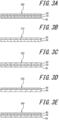
- the interlayer film laminate for laminated glass is for example an interlayer film laminate 300 for glass shown in FIG. 3A , an interlayer film laminate 310 for glass shown in FIG. 3B , an interlayer film laminate 320 for glass shown in FIG. 3C , an interlayer film laminate 330 for glass shown in FIG. 3D , or an interlayer film laminate 340 for glass shown in FIG. 3E .
- a layer formed of a hydrogenated copolymer is an HSIS layer 30, a layer formed of a modified product in which an alkoxysilyl group is introduced into a hydrogenated copolymer is an Si-HSIS layer 40, and a layer formed of a modified product in which an acid anhydride group is introduced into a hydrogenated copolymer is an acid anhydride group-modified HSIS layer 50.
- the disclosed interlayer film laminate for glass is configured such that one of the outermost layers is the Si-HSIS layer 40 and the other outermost layer is the acid anhydride group modified HSIS layer 50, like the interlayer film laminate 330 for glass shown in FIG. 3D and the interlayer film laminate 340 for glass shown in FIG. 3E .
- the thickness of the interlayer film laminate for laminated glass is not particularly limited, and is preferably 100 ⁇ m or more, more preferably 200 ⁇ m or more, particularly preferably 300 ⁇ m or more, and preferably 1,000 ⁇ m or less, more preferably 900 ⁇ m or less, and particularly preferably 800 ⁇ m or less.
- the thickness of the interlayer film laminate for laminated glass is equal to or more than the above lower limit, impact resistance can be improved.
- the thickness of the interlayer film laminate for laminated glass is equal to or less than the above upper limit, efficiency and easiness at the time of manufacturing laminated glass can be prevented from decreasing.
- the disclosed sealing material comprises the disclosed hydrogenated copolymer or a modified product in which an alkoxysilyl group is introduced into the disclosed hydrogenated copolymer, and optionally comprises other components such as processing aids and ultraviolet absorbers (UVA).
- UVA ultraviolet absorbers
- the sealing material is not particularly limited, and specific examples include sealing materials for solar power generation elements, and sealing materials for OLEDs.
- the sealing material has a multilayer structure comprising a layer made of the hydrogenated copolymer and a layer made of a modified product in which an alkoxysilyl group is introduced into the hydrogenated copolymer.
- sealing material Details and preferred examples etc. of the sealing material are as described for example in WO2012/043708 , WO2015/099079 , and WO2014/091941 .
- the modified product into which an alkoxysilyl group in the sealing material is introduced is the same as that in the interlayer film for laminated glass, and preferred examples thereof are also the same as those for the interlayer film for laminated glass.
- Processing aids used for the sealing material are the same as those for the hydrogenated copolymer-containing composition. Likewise, preferred examples and addition amounts are the same as those for the hydrogenated copolymer-containing composition.
- UVA Ultraviolet absorber
- UVAs Ultraviolet absorbers
- the thickness of the sealing material is not particularly limited, and is preferably 1 ⁇ m or more, more preferably 10 ⁇ m or more, particularly preferably 50 ⁇ m or more, and is preferably 10 mm or less, more preferably 1,000 ⁇ m or less, and particularly preferably 500 ⁇ m or less.
- the thickness of the sealing material is equal to or more than the above-mentioned lower limit, it is possible to prevent the occurrence of defects in the sealing portion.
- the thickness of the sealing material is equal to or less than the above-mentioned upper limit, it is possible to prevent reductions in efficiency when sealing.
- the disclosed optical film comprises the disclosed hydrogenated copolymer and optionally comprises other components.
- optical film examples include retardation films, and polarizing plate protective films.
- optical film Details and suitable examples of the optical film are described for example in WO2015/005292 , WO2016/060070 , and WO2015/002020 .
- the disclosed medical shaped article is formed of the disclosed hydrogenated copolymer-containing composition.
- medical shaped article examples include vials, syringes, infusion bags, and culture container adhesives.
- the disclosed method of producing a medical shaped article comprising irradiation the disclosed medical shaped article with high-energy radiation at an irradiation dose E.
- sterilization treatment by irradiating the medical shaped article with high-energy radiation with the medical shaped article being enclosed in a sealed container made of a resin film which does not allow bacteria to pass therethrough.
- the sterilized medical shaped article is then stored in the sealed container while maintaining a sterile condition until it is used.
- a medical shaped article is put in a resin bag made of polyethylene or the like, the opening is sealed by heat sealing or the like, and the sealed bag is packaged in multiple layers by a bag made of resin film or the like, and then packaged in a cardboard box or a plastic case so that the medical shaped article can be transported, and the medical shaped article is sterilized by irradiation with high-energy radiation as it is.
- the sealed container for enclosing therein the medical shaped article during sterilization by irradiation with high-energy radiation can be a single or multilayer bag or case made of resin.
- resins to be used include ethylene-vinyl alcohol copolymers, low-density polyethylene, high-density polyethylene, linear low-density polyethylene, polypropylene, ethylene-propylene copolymers, polycarbonate, polystyrene, polyvinyl chloride, polyvinylidene chloride, polyethylene terephthalate, polybutylene terephthalate, polyamide-6, polyamide-66, and polyamide-12. These resins may be used in combination of one or two or more thereof.
- Sealing methods can be used in which the medical shaped article is enclosed in a resin bag or the like and the opening is heat-sealed.
- High-energy radiation usable herein include X-rays, gamma rays, beta rays, electron beams, and neutron beams. Sterilization methods that involve irradiation with gamma rays or electron beams are particularly common and suitably used for sterilization.
- the preferred dose of high-energy radiation is usually from 20 kGy to 35 kGy. If the dose is less than 20 kGy, the sterilization effect is not sufficient. If it is larger than 35 kGy, it requires longer irradiation time and there may be an increase in eluate from the medical shaped article made of a hydrogenated block copolymer after sterilization treatment.
- sterilized medical shaped articles include liquid, powder or solid chemical containers such as injection drug containers, ampoules, infusion bags, solid drug containers, eye drops containers, infusion containers, test drug containers, and nutrition containers; sample containers such as blood sampling test tubes, blood collection tubes, and analyte containers; pipe materials such as infusion tubes, tubing, fittings, valves, and cocks; contact lens storage containers; and artificial organs and parts thereof, such as denture beds, artificial hearts, and artificial kidneys.
- liquid, powder or solid chemical containers such as injection drug containers, ampoules, infusion bags, solid drug containers, eye drops containers, infusion containers, test drug containers, and nutrition containers
- sample containers such as blood sampling test tubes, blood collection tubes, and analyte containers
- pipe materials such as infusion tubes, tubing, fittings, valves, and cocks
- contact lens storage containers such as denture beds, artificial hearts, and artificial kidneys.
- infusion bags, nutrient containers, medicine bottles, ampoules, etc. used for storing drugs, in particular
- the disclosed adhesive comprises a modified product in which an alkoxysilyl group is introduced into the disclosed hydrogenated copolymer, and optionally further comprises organic solvents, silane coupling agents, crosslinking aids, organic peroxides, processing aids, and other agents.
- the disclosed adhesive may bond a heat-resistant resin and a metal, and an adhesive sheet containing a disclosed adhesive and a thermoplastic resin sheet may be bonded.
- Modified products into which an alkoxysilyl group is introduced in the adhesive are the same as those for the interlayer film for laminated glass, and preferred examples thereof are also the same as those for the interlayer film for laminated glass.
- organic solvents examples include aromatic solvents such as toluene, xylene, and solvent naphtha; saturated carbohydrate solvents such as decalin; alicyclic hydrocarbon solvents such as cyclohexane, methylcyclohexane, and dimethylcyclohexane; ether solvents such as tetrahydrofuran; terpene solvents such as limonene; ketone solvents such as cyclohexanone; and the like.
- aromatic solvents such as toluene, xylene, and solvent naphtha
- saturated carbohydrate solvents such as decalin
- alicyclic hydrocarbon solvents such as cyclohexane, methylcyclohexane, and dimethylcyclohexane
- ether solvents such as tetrahydrofuran
- terpene solvents such as limonene
- ketone solvents such as cyclohexanone
- organic solvents may be used alone, or two or more of them may be used in combination.
- Toluene is preferred in terms of volatility of the solvent from the adhesive applied to the substrate and workability in the coating process.
- the boiling point of the organic solvent is not particularly limited and is preferably 90°C or above, more preferably 100°C or above, particularly preferably 105°C or above, and preferably 150°C or below, more preferably 140°C or below, and particularly preferably 130°C or below.
- the organic solvent can be easily removed at the time of coating film forming.
- the boiling point of the organic solvent is equal to or lower than the above upper limit, and adhesive layer can be formed homogeneously.
- the amount of the organic solvent is not particularly limited and is preferably 100 parts by mass or more, more preferably 150 parts by mass or more, still more preferably 200 parts by mass or more, particularly preferably 300 parts by mass or more, and preferably 1,000 parts by mass or less, more preferably 800 parts by mass or less, particularly preferably 600 parts by mass or less, per 100 parts by mass of the modified product.
- the amount of the organic solvent is equal to or higher than the above lower limit, coating can be performed stably.
- the amount of the organic solvent is equal to or lower than the above upper limit, it is possible to shorten the drying time of the coating film.
- Silane coupling agents are not particularly limited. Preferred are epoxysilane coupling agents and aminosilane coupling agents, with epoxysilane coupling agents being particularly preferred.
- epoxysilane coupling agents include 2-(3,4-epoxycyclohexyl)ethyltrimethoxysilane, 3-glycidoxypropyltrimethoxysilane, 3-glycidoxypropylmethyldimethoxysilane, and 3-glycidoxypropyltriethoxysilane.
- aminosilane coupling agents include N-2-(aminoethyl)-3-aminopropylmethyldimethoxysilane, N-2-(aminoethyl)-3-aminopropyltriethoxysilane, 3-aminopropyltrimethoxysilane, 3-aminopropyltriethoxysilane, 3-triethoxysilyl-N-(1,3-dimethyl-butylidene)propylamine, N-phenyl-3-aminopropyltrimethoxy silane, and N-(vinylbenzyl)-2-aminoethyl-3-aminopropyltrimethoxysilane. Of these, 3-glycidoxypropyltrimethoxysilane is preferred in terms of adhesion.
- the amount of the silane coupling agent is not particularly limited, and is preferably 0.1 parts by mass or more, more preferably 0.2 parts by mass or more, still more preferably 0.5 parts by mass or more, particularly preferably 1.0 part by mass or more, and preferably 10 parts by mass or less, more preferably 5 parts by mass or less, particularly preferably 3 parts by mass or less, per 100 parts by mass of the modified product.
- amount of the silane coupling agent is equal to or higher than the above lower limit, adhesion can be improved.
- the amount of the silane coupling agent is equal to or lower than the above upper limit, increases in viscosity with time of the adhesive can be prevented.
- crosslinking aids examples include triallyl isocyanurate, polyvalent acrylic acid esters, and polyvalent methacrylic acid esters. Each of these crosslinking aids may be used alone, or two or more of them may be used in combination. Of these, triallyl isocyanurate is preferred from the viewpoint of improving adhesion.
- the amount of the crosslinking aid is not particularly limited and is preferably 0.01 parts by mass or more, more preferably 0.1 parts by mass or more, still more preferably 1 part by mass or more, particularly preferably 2 parts by mass or more, and is preferably 5 parts by mass or less, more preferably 3 parts by mass or less, particularly preferably 2 parts by mass or less, per 100 parts by mass of the modified product.
- amount of the crosslinking aid is equal to or higher than the above lower limit, adhesion can be improved.
- the amount of the crosslinking aid is equal to or lower than the above upper limit, increases in viscosity with time of the adhesive can be prevented.
- organic peroxides examples include 1,1-di(t-butylperoxy)-3,3, 5-trimethylcyclohexane, 1,1-di(t-butylperoxy)-2-methylcyclohexane, 1,1-di(t-butylperoxy)cyclohexane, 2,5-dimethyl-2,5-di(benzoylperoxy)hexane, 2,2-di(t-butylperoxy)butane, n-butyl-4,4-di(t-butylperoxy)valerate,Examples thereof include t-butylperoxybenzoate, t-butylcumylperoxide, dicumylperoxide, 2,5-dimethyl-2,5-di(benzoylperoxy)hexane, 2,2-di(t-butylperoxy)butane, n-butyl-4,4-di(t-butylperoxy)valerate, t
- the amount of the organic peroxide is not particularly limited, and is preferably 0.01 parts by mass or more, more preferably 0.05 parts by mass or more, still more preferably 0.1 parts by mass or more, particularly preferably 0.2 parts by mass or more, and preferably 1 part by mass or less, more preferably 0.5 parts by mass or less, particularly preferably 0.3 parts by mass or less, per 100 parts by mass of the modified product.
- amount of the organic peroxide is equal to or higher than the above lower limit, adhesion can be improved.
- the amount of the organic peroxide is equal to or lower than the above upper limit, increases in viscosity with time of the adhesive can be prevented.
- Processing aids used for the adhesive are the same as those for the hydrogenated copolymer-containing composition. Likewise, preferred examples and addition amounts are the same as those for the hydrogenated copolymer-containing composition.
- heat-resistant resins include those having heat deformation resistance which is usually 180°C or higher, preferably 220°C or higher, more preferably 260°C or higher, such as polyimide resin, polyamide-imide resin, polyetherimide resin, aromatic polyamide resin, polyarylate resin, polyethersulfone resin, liquid crystal polymer, polyphenylene sulfide resin, bismaleimide resin, epoxy resin, unsaturated polyester resin.
- Heat deflection resistance can be evaluated by temperature of deflection under load as determined according to JIS K7191-1 (Plastics-Determination of temperature of deflection under load).
- metals include such metals as aluminum, gallium, indium, titanium, vanadium, chromium, molybdenum, tungsten, manganese, iron, cobalt, nickel, palladium, platinum, copper, silver, gold, and zinc; alloys such as iron alloys, copper alloys, aluminum alloys, nickel alloys, solders, wood metals, super steel alloys, white gold alloys, and the like.
- Heating temperature at the time of bonding is not particularly limited and is preferably 100°C or above, more preferably 110°C or above, particularly preferably 120°C or above, and is preferably 200°C or below, more preferably 190°C or below, particularly preferably 180°C or below.
- the heating temperature at the time of bonding is equal to or higher than the above-mentioned lower limit, adhesion can be improved.
- the heating temperature at the time of bonding is equal to or lower than the above-mentioned upper limit, warpage after bonding can be prevented.
- the disclosed assembly comprises: an adhesive sheet comprising the disclosed adhesive; and a thermoplastic resin sheet, wherein the adhesive sheet and the thermoplastic resin sheet are bonded together.
- the thickness of the adhesive sheet comprising the disclosed adhesive is not particularly limited and is preferably 5 ⁇ m or more, more preferably 10 ⁇ m or more, particularly preferably 15 ⁇ m or more, and is preferably 100 ⁇ m or less, more preferably 80 ⁇ m or less, and particularly preferably 50 ⁇ m or less.
- the thickness of the adhesive sheet is equal to or higher than the above lower limit, adhesion can be improved, and on the other hand, when the thickness of the adhesive sheet is equal to or lower than the above upper limit, the adhesive layer can be suppressed from protruding.
- thermoplastic resin sheets include polycarbonate resins, polyester resins, and (meth)acrylic ester (co)polymers for their excellent transparency and mechanical strength.
- the thickness of the assembly of the present disclosure is not particularly limited and is preferably 0.02 mm or more, more preferably 0.1 mm or more, particularly preferably 0.2 mm or more, and is preferably 10 mm or less, more preferably 2 mm or less, particularly preferably 1 mm or less.
- the thickness of the assembly is equal to or greater than the lower limit, it is possible to prevent breakage of the assembly.
- the thickness of the assembly is equal to or less than the upper limit, it is possible to prevent the workability of the assembly from decreasing.
- the disclosed method of producing an assembly is a method of producing the disclosed assembly and comprises: (1) a step wherein a bonding surface of either an adhesive sheet or a thermoplastic resin sheet is subjected to at least one activation treatment selected from plasma irradiation, excimer ultraviolet irradiation, and corona discharge and (2) a step wherein the adhesive sheet and the thermoplastic resin sheet are compressed under pressure with their bonding surfaces facing each other.
- Step (1) is a step of subjecting a bonding surface of either an adhesive sheet or a thermoplastic resin sheet to at least one activation treatment selected from plasma irradiation, excimer ultraviolet irradiation, and corona discharge.
- Plasma irradiation and/or corona discharge treatment are preferred because surface treatment can be performed uniformly.
- the activation treatment is at least one selected from plasma irradiation, excimer ultraviolet irradiation, and corona discharge.
- plasma irradiation examples include atmospheric pressure plasma irradiation in which plasma irradiation is performed under atmospheric pressure, and reduced pressure plasma irradiation in which plasma irradiation is performed under reduced pressure. From the viewpoint of uniformly performing surface treatment by a simpler method, atmospheric 1 pressure plasma irradiation is preferable.
- Atmospheric plasma irradiation is preferably carried out at an atmospheric pressure under at least one gas atmosphere selected from hydrogen, helium, nitrogen, oxygen, and argon atmosphere, and is further preferably carried out at an atmospheric pressure under a mixed gas atmosphere of nitrogen and dry air or nitrogen and oxygen.
- the flow rate of nitrogen is preferably 50 NL/min or more, and preferably 150 NL/min or less.
- the flow rate of dry air or oxygen is preferably 0.1 NL/min or more, and preferably 5 NL/min or less.
- the output of plasma irradiation is preferably 0.5 kW or more, and preferably 2 kW or less.
- the frequency of plasma irradiation is preferably a resonant frequency corresponding to the output. Specifically, the frequency is preferably 10 KHz or more and 100 KHz or less.
- the irradiation rate of plasma irradiation is preferably 1 cm/min or more and 100 cm/min or less.
- the distance between the plasma source and the adhesive sheet or thermoplastic resin sheet is preferably 1 mm or more and 10 mm or less.
- plasma treatment is preferably performed using a low-pressure gas (e.g., argon gas, oxygen gas, nitrogen gas, or mixed gas thereof,) having an absolute pressure of 0.001 kPa or more and 10 kPa or less.
- a low-pressure gas e.g., argon gas, oxygen gas, nitrogen gas, or mixed gas thereof, having an absolute pressure of 0.001 kPa or more and 10 kPa or less.
- the low-pressure gas is particularly preferably a mixed gas of nitrogen and oxygen.
- the mixing ratio of nitrogen and oxygen is preferably 10: 1 to 1:10 by volume, and the flow rate of the mixed gas is preferably 0.1 NL/min or more and 10 NL/min or less.
- the output of plasma irradiation is preferably 50 W or more, and preferably 500 W or less.
- Excimer ultraviolet irradiation is preferably performed using an excimer ultraviolet lamp while flowing a mixed gas of nitrogen and dry air or oxygen.
- the oxygen concentration of the mixed gas is usually 1% or more, preferably 3% or more, and is usually 15% or less, preferably 5% or less.
- the flow rate of the mixed gas is preferably 3 liters/min or more and 7 liters/min or less.
- the distance between the excimer ultraviolet lamp and the adhesive surface with the adhesive sheet or thermoplastic resin sheet is preferably 10 mm or less, more preferably 1 mm or more and 5 mm or less.
- the intensity of irradiation is preferably 20 mW or more and 100 mW or less, and more preferably 30 mW or more and 50 mW or less.
- Corona discharge is preferably performed in a dry air atmosphere, and the flow rate of the dry air is preferably 10 NL/min or more, and preferably 100 NL/min or less.
- the output of corona discharge is preferably 250W or more, preferably 1,000 W or less, and the discharge power is preferably 20 W ⁇ min/m 2 or more, preferably 550 W ⁇ min/m 2 or less.
- the distance between the electrode and the adhesive sheet or thermoplastic resin sheet is preferably 1 mm or more, and preferably 20 mm or less.
- Step (2) is a step wherein the adhesive sheet and the thermoplastic resin sheet are compressed under pressure with their bonding surfaces facing each other.
- Methods of compressing the adhesive sheet and the thermoplastic resin sheet under pressure with their bonding surfaces facing with each other are not particularly limited. Examples include methods wherein the adhesive sheet, the thermoplastic resin sheet, and optionally other members are placed on top of one another to form a laminate, the laminate is placed into a flexible bag (hereinafter also "bag"), and the components are bonded together by heating while degassing the air in the bag; methods wherein the stack is placed in the bag, the air inside the bag is degassed, and then the components are bonded together by heating and pressurizing in an autoclave; and so forth.
- bag flexible bag
- the pressurizing pressure is usually 0.1 MPa or more, preferably 0.2 MPa or more, more preferably 0.3 MPa or more, and usually 1.5 MPa or less, preferably 1.2 MPa or less, and more preferably 1.0 MPa or less.
- the temperature is usually 80°C or above, preferably 90°C or above, and is usually 180°C or below, preferably 160°C or below, more preferably 140°C or below.
- the pressurizing time in an autoclave is usually 10 minutes or more, preferably 15 minutes or more, more preferably 20 minutes or more, and is usually 60 minutes or less, preferably 50 minutes or less, and more preferably 40 minutes or less.
- the method of forming an assembly by heating and pressurizing in a bag is particularly useful as a method of manufacturing an assembly having a curved surface shape such as laminated glass for automobiles or the like.
- a pressing machine such as a press, a vacuum laminator, a vacuum press, or a roll laminator can also be used for press-bonding.
- the pressure at the time of pressurization is usually 0.1 MPa or more, preferably 0.5 MPa or more , and is usually 10 MPa or less, and preferably 3 MPa or less.
- the time of pressurization is usually 1 minute or more, preferably 5 minutes or more, and is usually 30 minutes or less, preferably 10 minutes or less.
- the interface between the adhesive sheet and the thermoplastic resin sheet is firmly bonded, so that even after exposure to a high temperature and high humidity environment for a long time, a strong adhesion is maintained and hence problems such as peeling are less likely to occur.
- the proportion of a structural unit in the polymer that is formed through polymerization of a monomer is normally, unless otherwise specified, the same as the ratio (charging ratio) of the given monomer among all the monomers used for the preparation of the polymer.
- a standard polystyrene-equivalent molecular weight was measured by gel permeation chromatography (GPC) using tetrahydro tetrahydrofuran as eluent at a flow rate of 0.6 cc/min at 40°C.
- GPC gel permeation chromatography
- HLC8320GPC TOSOH CORPORATION
- Percent hydrogenation (mol%) of the hydrogenated copolymer was obtained by performing 1 H-NMR spectroscopy (solvent: CDCl 3 ) to calculate the proportion of unsaturated bonds disappeared among the total unsaturated bonds present in the copolymer.
- a standard polystyrene-equivalent molecular weight was measured by gel permeation chromatography (GPC) using tetrahydro tetrahydrofuran as eluent at a flow rate of 0.6 cc/min at 40°C.
- GPC gel permeation chromatography
- HLC8320GPC TOSOH CORPORATION
- a standard polystyrene-equivalent molecular weight was measured by gel permeation chromatography (GPC) using tetrahydro tetrahydrofuran as eluent at a flow rate of 0.6 cc/min at 40°C.
- GPC gel permeation chromatography
- HLC8320GPC TOSOH CORPORATION
- a film extruded from a T die extruder was pre-heated at 170°C for 1 minute at a reduced pressure of -100kPa and pressed for 5 seconds at a pressure of 0.4MPa.
- the mold used for the evaluation is shown in FIG. 2 .
- Mold printability (%) (measured valley depth / designed mold depth) ⁇ 100
- Mold printability is preferably close to 100%. It suffices that it falls within 90% to 105%.
- the evaluation criteria are as follows.
- a cutter was used to make a 10 mm-width cut on the short side of the prepared glass laminate (substrate + resin sheet) of 50 mm ⁇ 75 mm size until the substrate float glass was completely cut.
- One end of the cut was peeled out to the extent that it can be held by a chuck in a peeling test to prepare a tensile test sample. For measurement, opposing ends with uneven thickness were not used but a central portion with uniform thickness was used.
- the obtained block copolymer 1 was a triblock copolymer of S-I-S (styrene block-isoprene block-styrene block) configuration having a weight-average molecular weight (Mw) of 11,700, a standard polystyrene-equivalent molecular weight based on the elution time of the first peak (first peak molecular weight) of 12,400, and a molecular weight distribution (Mw/Mn) of 1.02.
- the obtained block copolymer 2 was a triblock copolymer of S-I-S (styrene block-isoprene block-styrene block) configuration having a weight-average molecular weight (Mw) of 15,300, a standard polystyrene-equivalent molecular weight based on the elution time of the first peak (first peak molecular weight) of 16,100, and a molecular weight distribution (Mw/Mn) of 1.03.
- Mw weight-average molecular weight
- first peak molecular weight a standard polystyrene-equivalent molecular weight based on the elution time of the first peak (first peak molecular weight) of 16,100
- Mw/Mn molecular weight distribution
- the obtained block copolymer 3 was a triblock copolymer of S-I-S (styrene block-isoprene block-styrene block) configuration having a weight-average molecular weight (Mw) of 42,900, a standard polystyrene-equivalent molecular weight based on the elution time of the first peak (first peak molecular weight) of 44,300, and a molecular weight distribution (Mw/Mn) of 1.03.
- Mw weight-average molecular weight
- first peak molecular weight 44,300
- Mw/Mn molecular weight distribution
- the obtained block copolymer 4 was a triblock copolymer of S-I-S (styrene block-isoprene block-styrene block) configuration having a weight-average molecular weight (Mw) of 93,100, a standard polystyrene-equivalent molecular weight based on the elution time of the first peak (first peak molecular weight) of 95,100, and a molecular weight distribution (Mw/Mn) of 1.06.
- Mw weight-average molecular weight
- first peak molecular weight a standard polystyrene-equivalent molecular weight based on the elution time of the first peak (first peak molecular weight) of 95,100
- Mw/Mn molecular weight distribution
- the polymer solution prepared in Production Example 2 was transferred to a pressure-resistant reaction vessel equipped with a stirring device, and 4 parts of a silica alumina-supported nickel catalyst as a hydrogenation catalyst (T-8400RL, manufactured by Clariant Catalyst Co., Ltd., nickel content: 33%) and 100 parts of dehydrated cyclohexane were added and mixed.
- the inside of the reaction vessel was replaced with hydrogen gas at room temperature, and the temperature was raised to 180°C in a state in which the reaction was 2 MPa pressurized by a gauge pressure. Once the internal temperature of the pressure-resistant reaction vessel reached 180°C, the temperature was kept at 180°C without supplying hydrogen for 15 minutes.
- the hydrogen pressure was raised to 4.5 MPa and the hydrogenation reaction was carried out for 5 hours (percent hydrogenation: 99.8%).
- the standard polystyrene-equivalent molecular weight based on the elution time of the first peak was 16,400
- the standard polystyrene-equivalent molecular weight (second peak molecular weight) based on the elution time of the second peak was 1,200
- the molecular weight distribution (Mw/Mn) was 2.16
- the weight-average molecular weight (Mw) was 15,200.
- the first peak molecular weight/the second peak molecular weight was 13.67
- the detection sensitivity (mV) of refractive index detector (RI) indicated by the peak top of the second peak (second peak top sensitivity) was 26.39
- wA:wB 50:50.
- the obtained hydrogenated copolymer was evaluated for mold printability and film thickness unevenness upon film forming. The results are shown in Table 1.
- the polymer solution prepared in Production Example 3 was transferred to a pressure-resistant reaction vessel equipped with a stirring device, and 5 parts of a silica alumina-supported nickel catalyst as a hydrogenation catalyst (T-8400RL, manufactured by Clariant Catalyst Co., Ltd., nickel content: 33%) and 100 parts of dehydrated cyclohexane were added and mixed.
- the inside of the reaction vessel was replaced with hydrogen gas at room temperature, and the temperature was raised to 180°C in a state in which the reaction was 2 MPa pressurized by a gauge pressure. Once the internal temperature of the pressure-resistant reaction vessel reached 180°C, the temperature was kept at 180°C without supplying hydrogen for 20 minutes.
- the hydrogen pressure was raised to 4.5 MPa and the hydrogenation reaction was carried out for 6 hours (percent hydrogenation: 99.5%).
- the standard polystyrene-equivalent molecular weight based on the elution time of the first peak was 45,000
- the standard polystyrene-equivalent molecular weight (second peak molecular weight) based on the elution time of the second peak was 23,500
- the molecular weight distribution (Mw/Mn) was 1.66
- the weight-average molecular weight (Mw) was 37,800.
- the first peak molecular weight/the second peak molecular weight was 1.91
- the detection sensitivity (mV) of refractive index detector (RI) indicated by the peak top of the second peak (second peak top sensitivity) was 4.01
- wA:wB 50:50.
- the polymer solution prepared in Production Example 3 was transferred to a pressure-resistant reaction vessel equipped with a stirring device, and 4 parts of a silica alumina-supported nickel catalyst as a hydrogenation catalyst (T-8400RL, manufactured by Clariant Catalyst Co., Ltd., nickel content: 33%) and 100 parts of dehydrated cyclohexane were added and mixed.
- the inside of the reaction vessel was replaced with hydrogen gas at room temperature, and the temperature was raised to 180°C in a state in which the reaction was 2 MPa pressurized by a gauge pressure. Once the internal temperature of the pressure-resistant reaction vessel reached 180°C, the temperature was kept at 180°C without supplying hydrogen for 60 minutes.
- the hydrogen pressure was raised to 4.5 MPa and the hydrogenation reaction was carried out for 6 hours (percent hydrogenation: 99.9%).
- the standard polystyrene-equivalent molecular weight based on the elution time of the first peak was 45,000
- the standard polystyrene-equivalent molecular weight (second peak molecular weight) based on the elution time of the second peak was 9,200
- the molecular weight distribution (Mw/Mn) was 1.45
- the weight-average molecular weight (Mw) was 43,900.
- the first peak molecular weight/the second peak molecular weight was 4.89
- the detection sensitivity (mV) of refractive index detector (RI) indicated by the peak top of the second peak (second peak top sensitivity) was 10.18
- wA:wB 50:50.
- the polymer solution prepared in Production Example 3 was transferred to a pressure-resistant reaction vessel equipped with a stirring device, and 5 parts of a silica alumina-supported nickel catalyst as a hydrogenation catalyst (T-8400RL, manufactured by Clariant Catalyst Co., Ltd., nickel content: 33%) and 100 parts of dehydrated cyclohexane were added and mixed.
- the inside of the reaction vessel was replaced with hydrogen gas at room temperature, and the temperature was raised to 190°C in a state in which the reaction was 2 MPa pressurized by a gauge pressure. Once the internal temperature of the pressure-resistant reaction vessel reached 190°C, the temperature was kept at 190°C without supplying hydrogen for 70 minutes.
- the hydrogen pressure was raised to 4.5 MPa and the hydrogenation reaction was carried out for 6 hours (percent hydrogenation: 99.7%).
- the standard polystyrene-equivalent molecular weight based on the elution time of the first peak was 45,000
- the standard polystyrene-equivalent molecular weight (second peak molecular weight) based on the elution time of the second peak was 1,100
- the molecular weight distribution (Mw/Mn) was 5.55
- the weight-average molecular weight (Mw) was 24,700.
- the first peak molecular weight/the second peak molecular weight was 40.91
- the detection sensitivity (mV) of refractive index detector (RI) indicated by the peak top of the second peak (second peak top sensitivity) was 6.88
- wA:wB 50:50.
- the polymer solution prepared in Production Example 4 was transferred to a pressure-resistant reaction vessel equipped with a stirring device, and 6 parts of a silica alumina-supported nickel catalyst as a hydrogenation catalyst (T-8400RL, manufactured by Clariant Catalyst Co., Ltd., nickel content: 33%) and 100 parts of dehydrated cyclohexane were added and mixed.
- the inside of the reaction vessel was replaced with hydrogen gas at room temperature, and the temperature was raised to 200°C in a state in which the reaction was 2 MPa pressurized by a gauge pressure. Once the internal temperature of the pressure-resistant reaction vessel reached 200°C, the temperature was kept at 200°C without supplying hydrogen for 122 minutes.
- the hydrogen pressure was raised to 4.5 MPa and the hydrogenation reaction was carried out for 8 hours (percent hydrogenation: 97.2%).
- the standard polystyrene-equivalent molecular weight based on the elution time of the first peak was 96,000
- the standard polystyrene-equivalent molecular weight (second peak molecular weight) based on the elution time of the second peak was 1,300
- the molecular weight distribution (Mw/Mn) was 5.55
- the weight-average molecular weight (Mw) was 51,800.
- the first peak molecular weight/the second peak molecular weight was 73.85
- the detection sensitivity (mV) of refractive index detector (RI) indicated by the peak top of the second peak (second peak top sensitivity) was 2.33
- wA:wB 50:50.
- the standard polystyrene-equivalent molecular weight based on the elution time of the first peak was 16,300
- the standard polystyrene-equivalent molecular weight (second peak molecular weight) based on the elution time of the second peak was 1,200
- the molecular weight distribution (Mw/Mn) was 2.23
- the weight-average molecular weight (Mw) was 14,900.
- silane-modified hydrogenated copolymer was evaluated for mold printability and film thickness unevenness upon film forming.
- the glass laminate (substrate + resin sheet) prepared using the silane-modified hydrogenated copolymer was evaluated for adhesion strength to glass. The results are shown in Table 1.
- Example 2 To 100 parts of pellets of the hydrogenated copolymer obtained in Example 1 were added 2.0 parts of vinyltrimetrysilane and 0.2 parts of 2,5-dimethy-12,5-di(t-butylperoxy)hexane (PERHEXA ® 25B ("PERHEXA" is a registered trademark in Japan, other counties, or both), manufactured by NOF CORPORATION) were added. The mixture was kneaded using twin-screw extruder KZW15TW-60MG-NH(100) TECHNOVEL CORPORATION) at a resin temperature of 200°C for a kneading time of 60 seconds to 70 seconds.
- PERHEXA ® 25B 2,5-dimethy-12,5-di(t-butylperoxy)hexane
- the obtained kneaded product was extruded into a strand, air-cooled, and cut by a pelletizer to afford 97 parts of pellets of an alkoxysilane-modified product of the hydrogenated copolymer (alkoxysilane-modified product A).
- pellets of the obtained alkoxysilane-modified product were formed into film having a target film thickness of 330 ⁇ m at 170°C.
- the elongated film being conveyed was cut to 50 mm ⁇ 75 mm size (Table 2).
- the "elongated film (alkoxysilane-modified product [A], 50mm ⁇ 75mm)" as a resin sheet and "float glass with standard thickness FL3 (predetermined dimension 50mm ⁇ 75mm)" as a substrate were prepared, and the substrate and the resin sheet were bonded together to prepare a laminate (substrate + resin sheet).
- float glass In order to remove the oil film and foreign matter attached on the surface of the glass sheet, float glass previously cleaned with an ultrasonic washer and dried was used as the substrate.
- Teflon ® -glass cloth sheet (“Teflon” is a registered trademark in Japan, other countries, or both)) was placed in a vacuum laminator (PVL-1100, manufactured by Nisshinbo Mechatronics Co., Ltd.) having a hot plate heated to 150°C and then the laminate (substrate + resin sheet) was placed with the hot plate side on the substrate surface.
- a Teflon ® -glass cloth sheet was placed on the resin sheet surface of the laminate (substrate + resin sheet) placed in the vacuum laminator, and the chamber of the vacuum laminator was closed, and vacuum evacuation was started immediately.
- Example 6 Except that the hydrogenated copolymer obtained in Example 3 was used in Example 6 instead of the hydrogenated copolymer obtained in Example 1, "preparation of silane-modified hydrogenated copolymer” and “preparation of glass laminate” were performed as in Example 6, the silane-modified product (alkoxysilane-modified product B) of the obtained hydrogenated copolymer was evaluated for mold printability and film thickness unevenness upon film forming, and the glass laminate (substrate + resin sheet) produced using the silane-modified product of the obtained hydrogenated copolymer was evaluated for adhesion strength to glass. The results are shown in Table 1.
- the standard polystyrene-equivalent molecular weight based on the elution time of the first peak was 45,100
- the standard polystyrene-equivalent molecular weight (second peak molecular weight) based on the elution time of the second peak was 9,200
- the molecular weight distribution (Mw/Mn) was 1.53
- the weight-average molecular weight (Mw) was 44,100.
- the polymer solution prepared in Production Example 1 was transferred to a pressure-resistant reaction vessel equipped with a stirring device, and 4 parts of a silica alumina-supported nickel catalyst as a hydrogenation catalyst (T-8400RL, manufactured by Clariant Catalyst Co., Ltd., nickel content: 33%) and 100 parts of dehydrated cyclohexane were added and mixed.
- the inside of the reaction vessel was replaced with hydrogen gas at room temperature, and the temperature was raised to 190°C in a state in which the reaction was 2 MPa pressurized by a gauge pressure. Once the internal temperature of the pressure-resistant reaction vessel reached 190°C, the temperature was kept at 190°C without supplying hydrogen for 14 minutes.
- the hydrogen pressure was raised to 4.5 MPa and the hydrogenation reaction was carried out for 5 hours (percent hydrogenation: 99.8%).
- the standard polystyrene-equivalent molecular weight based on the elution time of the first peak was 13,000
- the standard polystyrene-equivalent molecular weight (second peak molecular weight) based on the elution time of the second peak was 900
- the molecular weight distribution (Mw/Mn) was 2.21
- the weight-average molecular weight (Mw) was 10,400.
- the polymer solution prepared in Production Example 3 was transferred to a pressure-resistant reaction vessel equipped with a stirring device, and 4 parts of a silica alumina-supported nickel catalyst as a hydrogenation catalyst (T-8400RL, manufactured by Clariant Catalyst Co., Ltd., nickel content: 33%) and 100 parts of dehydrated cyclohexane were added and mixed.
- the inside of the reaction vessel was replaced with hydrogen gas at room temperature, and the temperature was raised to 170°C in a state in which the reaction was 2 MPa pressurized by a gauge pressure. Once the internal temperature of the pressure-resistant reaction vessel reached 170°C, the temperature was kept at 170°C without supplying hydrogen for 20 minutes.
- the hydrogen pressure was raised to 4.5 MPa and the hydrogenation reaction was carried out for 7 hours (percent hydrogenation: 99.8%).
- the standard polystyrene-equivalent molecular weight based on the elution time of the first peak was 45,000
- the standard polystyrene-equivalent molecular weight (second peak molecular weight) based on the elution time of the second peak was 31,200
- the molecular weight distribution (Mw/Mn) was 1.76
- the weight-average molecular weight (Mw) was 39,500.
- the first peak molecular weight/the second peak molecular weight was 1.44
- the detection sensitivity (mV) of refractive index detector (RI) indicated by the peak top of the second peak (second peak top sensitivity) was 2.36
- wA:wB 50:50.
- Example 6 Except that the hydrogenated copolymer obtained in Comparative Example 1 was used in Example 6 instead of the hydrogenated copolymer obtained in Example 1, "preparation of silane-modified hydrogenated copolymer” and “preparation of glass laminate” were performed as in Example 6, the silane-modified product (alkoxysilane-modified product C) of the obtained hydrogenated copolymer was evaluated for mold printability and film thickness unevenness upon film forming, and the glass laminate (substrate + resin sheet) produced using the silane-modified product of the obtained hydrogenated copolymer was evaluated for adhesion strength to glass. The results are shown in Table 1.
- the standard polystyrene-equivalent molecular weight based on the elution time of the first peak was 12,900
- the standard polystyrene-equivalent molecular weight (second peak molecular weight) based on the elution time of the second peak was 900
- the molecular weight distribution (Mw/Mn) was 2.25
- the weight-average molecular weight (Mw) was 9,900.
- Irganox ® 1010 pentaerythritol tetrakis[3-(3,5-di-t-butyl-4-hydroxyphenyl)propionate]
- the hydrogenated copolymer obtained in Example 3 was extruded at a resin temperature of 190°C using a twin-screw extruder (TEM37BS, manufactured by Toshiba Machinery Co., Ltd.) equipped with a side feeder to which a liquid substance can be added, with hydrogenated polyisobutylene (HPB) (NOF Polybutene ® 10SH ("NOF Polybutene” is a registered trademark in Japan, other counties, or both), manufactured by NOF CORPORATION) as a processing aid being continuously added from the side feeder at a proportion of 15 parts to 100 parts of the hydrogenated copolymer.
- HPB hydrogenated polyisobutylene
- NOF Polybutene ® 10SH NOF Polybutene
- the obtained kneaded product was extruded into a strand, water-cooled, and cut by a pelletizer to obtain pellets of the hydrogenated copolymer-containing composition B.
- Example 3 the obtained hydrogenated copolymer-containing composition B was evaluated for mold printability and film thickness unevenness upon film forming.
- a hydrogenated copolymer composition was prepared in the same manner as in Example 9 except that the alkoxysilane-modified product B obtained in Example 7 was used instead of using the hydrogenated copolymer obtained in Example 3, and the obtained hydrogenated copolymer-containing composition C was evaluated for mold printability and film thickness unevenness upon film forming. Further, adhesion strength to glass was measured and evaluated using a glass laminate (substrate + resin sheet) prepared using the obtained hydrogenated copolymer-containing composition C.
- a block copolymer X was obtained in the same manner as in Production Example 3 except that the temperature was set to 75°C when the second dehydrated styrene was added in Production Example 3.
- the obtained block copolymer X was a triblock copolymer of S-I-S (styrene block-isoprene block-styrene block) configuration having a weight-average molecular weight (Mw) of 44,800, a standard polystyrene-equivalent molecular weight based on the elution time of the first peak (first peak molecular weight) of 85,800, and a molecular weight distribution (Mw/Mn) of 1.64.
- Mw weight-average molecular weight
- first peak molecular weight 85,800
- Mw/Mn molecular weight distribution
- the polymer solution prepared in Production Example X was transferred to a pressure-resistant reaction vessel equipped with a stirring device, and 5 parts of a silica alumina-supported nickel catalyst as a hydrogenation catalyst (T-8400RL, manufactured by Clariant Catalyst Co., Ltd., nickel content: 33%) and 100 parts of dehydrated cyclohexane were added and mixed.
- the inside of the reaction vessel was replaced with hydrogen gas at room temperature, and the temperature was raised to 180°C in a state in which the reaction was 2 MPa pressurized by a gauge pressure. Once the internal temperature of the pressure-resistant reaction vessel reached 180°C, the temperature was kept at 180°C without supplying hydrogen 20 minutes.
- Example 11 Except that the hydrogenated copolymer obtained in Example 11 was used instead of the hydrogenated copolymer obtained Example 1 and the amount of vinyltrimethoxysilane added was changed from 2.0 parts to 1.8 parts in Example 6, "preparation of silane-modified hydrogenated copolymer” and “preparation of glass laminate” were performed as in Example 6.
- Examples 1 to 10 used a hydrogenated copolymer (including a modified product thereof) having a peak derived from a hydrogenated copolymer (including a silane-modified product thereof)'s peak exhibiting a peak top with the earliest elution time (first peak) and a peak derived from a hydrogenated copolymer (including a silane-modified product thereof)'s peak exhibiting a peak top with the second earliest elution time (second peak) wherein the first peak molecular weight / second peak molecular weight is 1.50 or more and the second peak molecular weight is 1,000 or more, they can increase mold printability compared to Comparative Examples 1 to 3 which do not satisfy the above conditions and prevent film thickness unevenness upon film forming.
- hydrogenated copolymers having the predetermined first and second peaks in an elution curve as measured by gel permeation chromatography can be obtained by appropriately adjusting the weight-average molecular weight (Mw) and molecular weight distribution (Mw/Mn) of the copolymer subjected to the hydrogenation reaction, the hydrogenation temperature, hydrogenation reaction time, and hydrogen supply stop time in the hydrogenation reaction.
- Mw weight-average molecular weight
- Mw/Mn molecular weight distribution
- HPB hydrogenated polyisobutylene
- NOF Polybutene ® 10 manufactured by NOF CORPORATION
- HPB hydrogenated polyisobutylene
- NOF Polybutene ® 10 manufactured by NOF CORPORATION
- This mixture was kneaded using a twin-screw extruder (KZW15TW-60MG-NH(100), manufactured by TECHNOVEL CORPORATION) at a resin temperature of 200°C for a kneading time of 60 seconds to 70 seconds.
- the obtained kneaded product was extruded into a strand, air-cooled, and cut by a pelletizer to obtain 96 parts of pellets of a modified hydrogenated copolymer.
- This mixture was kneaded using a twin-screw extruder (KZW15TW-60MG-NH(100), manufactured by TECHNOVEL CORPORATION) at a resin temperature of 200°C for a kneading time of 60 seconds to 70 seconds.
- the obtained kneaded product was extruded into a strand, air-cooled, and cut by a pelletizer to obtain 96 parts of pellets of a modified hydrogenated copolymer.
- a polymer solution was obtained in the same manner as in Production Example 3 except that the temperature was changed to 75°C when the second dehydrated styrene was added.
- the polymer solution prepared was transferred to a pressure-resistant reaction vessel equipped with a stirring device, and 5 parts of a silica alumina-supported nickel catalyst as a hydrogenation catalyst (T-8400RL, manufactured by Clariant Catalyst Co., Ltd.) and 100 parts of dehydrated cyclohexane were added and mixed.
- the inside of the reaction vessel was replaced with hydrogen gas at room temperature, and the temperature was raised to 180°C in a state in which the reaction was 2 MPa pressurized by a gauge pressure.
- HPB hydrogenated polyisobutylene
- NOF Polybutene ® 10 manufactured by NOF CORPORATION
- Composition 7 obtained in Production Example 11 was heated at 50°C for 4 hours using a hot air dryer through which air was circulated to remove dissolved air.
- a T-die film melt extrusion molding machine (T-die width: 300 mm) with a resin melt extruder equipped with a 25 mm-diameter screw, Composition 7 was then extruded at a melting temperature of 200°C, a T die temperature of 200°C and a roll temperature of 50°C into a sheet having a thickness of 500 ⁇ m and a width of 280 mm to prepare an interlayer film sheet (500 ⁇ m) for laminated glass.
- the produced interlayer film sheet for laminated glass was sandwiched between two sheets of waterwhite glass having a thickness of 3.2 mm, a width of 200 mm and a length of 200 mm, and vacuum-degassed by a vacuum laminator at a temperature of 150°C for 5 minutes, followed by vacuum pressure bonding for 5 minutes and then at 170°C for a further 10 minutes to produce a laminated glass test piece having glass/interlayer film sheet/glass configuration.
- a laminated glass test piece for peel test was prepared by placing an interlayer film sheet on a sheet of waterwhite sheet glass having a thickness of 2 mm, a width of 75 mm, and a length of 65mm with a non-adhesive portion provided at the end portion of the interlayer film sheet.
- a vacuum laminator PVL0202S, manufactured by Nisshinbo Mechatronics, Inc.; hereinafter, this vacuum laminator is used
- vacuum degassing was performed for 5 minutes at a temperature of 170°C, followed by vacuum pressure bonding for 10 minutes.
- the produced laminated glass test piece for peel test was stored in a high-temperature and high-humidity environment (85°C, 85% humidity) for 1,000 hours.
- Adhesion strength after storage (average) and its accuracy (coefficient of variation) were evaluated by making a 10mm-wide cut on the interlayer film sheet surface to providing five peeling portions per test piece, and performing a 180° peeling test based on JIS K 6854-2 at a peeling rate of 50 mm/min from the non-adhered portion of the interlayer film sheet for each peeling portion.
- the evaluation criteria are as follows:
- the prepared laminated glass test piece was stored in a constant temperature and humidity chamber for 3 hours at -40°C and taken out from the chamber. Immediately thereafter, a steel ball weighing 2kg was dropped on the glass surface from a height of 2 m with reference to the method specified in JIS R 3212. The test piece was visually checked for cracking and impact resistance was evaluated based on the following evaluation criteria:
- the prepared interlayer film sheet for laminated glass was sandwiched between two plastic plates (polycarbonate resin plates) having a thickness of 3.2 mm, a width of 200 mm, and a length of 200 mm, and vacuum degassed at a temperature of 150°C for 5 minutes in a vacuum laminator, followed by vacuum pressure bonding for 5 minutes and then at 170°C for a further 10 minutes, whereby a laminated glass test piece having the configuration plastic/interlayer film sheet/plastic was produced.
- the two interlayer film sheets A and B prepared were laminated on top of each other and sandwiched between a sheet of waterwhite glass and a plastic plate (polycarbonate resin plate), each having a thickness of 3.2 mm, a width of 200 mm and a length of 200 mm, and vacuum-degassed by a vacuum laminator at a temperature of 150°C for 5 minutes, followed by vacuum pressure bonding for 5 minutes and then at 170°C for a further 10 minutes, whereby laminated glass having the configuration glass/interlayer film sheet A/interlayer film sheet B/plastic was produced.
- a plastic plate polycarbonate resin plate
- Example A1 using composition 7 obtained in Production Example 11, "Preparation of interlayer film sheet for laminated glass” was performed to prepare interlayer film sheet A (40 ⁇ m).
- the three interlayer film sheets A, C, and A prepared were laminated on top of one another and sandwiched between two sheets of waterwhite glass having a thickness of 3.2 mm, a width of 200mm and a length of 200 mm, and vacuum-degassed by a vacuum laminator at a temperature of 150°C for 5 minutes, followed by vacuum pressure bonding for 5 minutes and then at 170°C for a further 10 minutes, whereby laminated glass having the configuration glass/interlayer film sheet A/interlayer film sheet A/glass was prepared.
- Composition 2 obtained in Production Example 6 was kneaded using a twin-screw extruder ("TEM37B", manufactured by Toshiba Machine Co., Ltd.) at a resin temperature of 210°C for a residence time of 80 to 90 seconds, extruded into a strand, air-cooled, and cut by a pelletizer to obtain pellets of a solar cell element sealing material containing an alkoxysilylated polymer.
- TEM37B twin-screw extruder
- the obtained pellets of solar cell element sealing material were heated at 50°C for 4 hours using a hot air dryer with circulating air to remove dissolved air.
- a T-die film melt extrusion molding machine T-die width: 300 mm
- the solar cell element sealing material was then extruded at a melting temperature of 200°C, a T die temperature of 200°C and a roll temperature of 50°C into a sheet to prepare an extrusion-molded sheet (single-layer sealing material) having a thickness of 500 ⁇ m and a width of 280 mm.
- the obtained extrusion-molded sheet (single-layer sealing material) was wound on a roll for recovery.
- An extrusion molded sheet was placed on a soda lime glass substrate having a thickness of 2 mm, a width of 25 mm, and a length of 65 mm with a non-adhesion portion provided on the end of the sheet and subjected to heating/pressing treatment at 50°C for 10 minutes and then at 180°C for 10 minutes for bonding using a vacuum laminator (PVL0202S, manufactured by Nisshinbo Mechatronics Co. Ltd.) to prepare a test piece for peeling test. Similar test pieces were prepared and five test pieces were stored in a high-temperature and high-humidity environment (85°C, 85% humidity) for 1,000 hours.
- PVL0202S vacuum laminator
- Adhesion strength after storage (average) and its accuracy (coefficient of variation) were evaluated by measuring peel strength of each test piece in a 90° peeling test based on JIS K 6854-1, wherein a 10mm-wide cut is made on the center in the width direction of the sheet surface and the non-adhesion portion is pulled at a peeling rate of 50 mm/min.
- the evaluation criteria are as described below. The higher the peel strength, the better adhesion to glass.
- the obtained extrusion molded sheet (single layer sealing material) was stored in a high temperature and high humidity environment (85°C, 85% humidity) for 1,000 hours and subjected to heating/pressing treatment at 150°C for 10 minutes using a vacuum laminator (PVL0202S, manufactured by Nisshinbo Mechatronics Co., Ltd.). Transmittance was measured according to ASTM D-1003 to evaluate transmittance after storage. The evaluation criteria are as follows:
- An extrusion molded sheet (single layer sealing material) was obtained in the same manner as in Example B1 except that thickness was changed to 305 ⁇ m and Composition 2 obtained in Production Example 6 was used. Further, an extrusion molded sheet (single layer sealing material) was obtained in the same manner as in Example B1 except that thickness was changed to 50 ⁇ m and composition 7 obtained in Production Example 11 was used.
- the obtained two extruded sheets were cut to a size of 200 mm ⁇ 200 mm, placed on top of each other, sandwiched by releasable PET films (thickness: 100 ⁇ m), and using the vacuum laminator, vacuum degassed for 5 minutes at a temperature of 180°C and vacuum pressed for 10 minutes to prepare a two-layer sealing material having a thickness of 350 ⁇ m.
- Composition 1 obtained in Production Example 5 was subjected to heat treatment for 4 hours at 50°C using a hot air dryer with circulating air. Pellets after heat treatment were fed within 1 hour to an extruder equipped with a T-type die having a polymer filter and a die slip made of tungsten carbide having an average surface roughness Ra of 0.03 ⁇ m along the entire width of the die slip, extruded into a sheet on a casting drum held at 80°C at a cylinder temperature of 230°C, and cooled without stretching to prepare an elongated molten extruded film having a thickness of 150 ⁇ m was. The molten extruded film was wound onto a roll.
- an optical film (diagonally stretched film) having a width of 1,900 mm was prepared.
- opposites ends of the stretched film were trimmed while leaving a center portion that is 1,340 mm along the width of the obtained stretched film, and the trimmed stretched film was wound on a roll to prepare an optical film having a width of 1,340 mm.
- Retardation was measured at 5 cm intervals across the 1,340 mm central portion of the film at 590 nm along the width of the optical film using a retardation meter ("KOBRA ® 21-ADH" "KOBRA” is a registered trademark in Japan, other counties, or both) manufactured by Oji Scientific Instruments) and an average was recoded as a measured value. Further, a difference between the average value and the maximum or minimum value of retardation, whichever is larger, was evaluated as retardation accuracy (%).
- the evaluation criteria are as follows:
- Two prepared optical films were bonded together with their stretching axes perpendicular to each other to produce a laminate.
- the laminate was sandwiched between polarizing plates so that the stretching axis of each stretched film is 45 degrees with respect to the transmission axis of the polarizing plates.
- An illuminance meter (51001, manufactured by Yokogawa Meter & Instruments Co., Ltd.) was placed at a position 30 mm from the polarizing plate in normal direction and illuminance was measured for evaluating light leakage.
- the evaluation criteria are as described below.
- a backlight having an illuminance of 5,000 lux and a backlight having an illuminance of 10,000 lux were used.
- the produced optical film was stored in a high-temperature and high-humidity environment (85°C, 85% humidity) for 1,000 hours and light leakage was evaluated as described above to evaluate light leakage after storage.
- the evaluation criteria are as follows:
- a sheet was prepared in the same manner as in Example A1 except that thickness was changed to 200 ⁇ m and Composition 1 obtained in Production Example 5 was used.
- An infusion bag was prepared by cutting the obtained sheet into sheets of 15cm ⁇ 15cm size, laminating two of the sheets on top of each other and heat-sealing three sides of the laminate.
- test piece having a length of 60 mm and a width of 10 mm was cut from the infusion bag, and elution was evaluated by conducting an elution test in accordance with "Test Methods for Plastic Medicine Containers" of the Japanese Pharmacopoeia, 16th revision to evaluate a pH difference.
- the evaluation criteria are as follows.
- the surface of the prepared infusion bag was observed visually and an IR spectrum of the interior of the wall of the infusion bag and an IR spectrum over time of the surface of the infusion bag were measured.
- IR spectra of the infusion bag 30 days after forming bleed-out was evaluated based on the ratio of the intensities of absorption bands derived from surface and internal antioxidants (surface intensity / interior intensity). The evaluation criteria are as follows:
- Composition 2 obtained in Production Example 6 was first injection molded using an injection blow molding machine (ASB-50MB, manufactured by Nisshin ASB Machinery Co., Ltd.) at a cylinder temperature of 240°C and an injection mold temperature of 60°C to prepare a preform, which was subjected to blow molding at a heating pot temperature of the preform of 150°C under a blow pressure 0.5MPa and a blow mold temperature of 60°C to prepare a single-layer vial having a diameter of 50 mm, a height of 90 mm and a sidewall thickness of 1 mm.
- ASB-50MB manufactured by Nisshin ASB Machinery Co., Ltd.
- Example D1 Before and after gamma irradiation, a test piece having a length of 60 mm and a width of 10 mm was cut out from the side surface of the vial, and elution was evaluated in the same manner as in Example D1
- Example D1 The surface of the vial obtained by injection blow molding was evaluated for bleed-out as in Example D1.
- composition 6 obtained in Production Example 10 100 parts of composition 6 obtained in Production Example 10 was dissolved in 300 parts of toluene (boiling point: 110°C) and 1 part of 3-glycidoxypropyltrimethoxysilane (KBM-403, manufactured by Shin-Etsu Silicone Co., Ltd.) as a silane coupling agent was added to the mixture and uniformly mixed to prepare an adhesive solution.
- toluene boiling point: 110°C
- KBM-403 3-glycidoxypropyltrimethoxysilane
- the adhesive solution was applied onto one side of copper foil (thickness: 10 to 50 ⁇ m) so that the adhesive layer after solvent removal has a thickness of 15 ⁇ m while leaving a portion not coated with the adhesive solution, and the solvent was removed by evaporation in an inert oven.
- the copper foil coated with the adhesive was cut into a test piece which includes the portion not coated with the adhesive so that the coated surface has a size of 15 mm width and 150 mm length.
- the test piece and a polyimide resin film were placed on top of each other and bonded together by heating and pressuring under a predetermined condition to prepare a test piece for peel strength measurement.
- the produced test piece was stored in a high-temperature and high-humidity environment (85°C, 85% humidity) for 1,000 hours. Part the copper foil not coated with the adhesive was fixed to a tensile testing machine ("AGS-10KNX", manufactured by Shimadzu Corporation), and a T-shaped peel test was performed at a peel rate of 100 mm/min in accordance with JIS K 6854-3 to evaluate adhesion strength after storage.
- AGS-10KNX tensile testing machine
- JIS K 6854-3 JIS K 6854-3
- the adhesive solution was applied onto a releasable PET film (100 ⁇ m thick) so that the thickness of the adhesive layer was 20 to 30 ⁇ m, and the solvent was removed by evaporation in an inert oven.
- the adhesive layer was peeled from the releasable PET film.
- Numerous adhesive layers were prepared similarly and placed on top of one another and subjected to vacuum press molding at 140°C to form an adhesive sheet having a thickness of 700 to 760 ⁇ m.
- the obtained adhesive sheet was subjected to heat treatment at 150°C for 1 hour in the inert oven to remove volatile components to prepare a sample for dielectric constant evaluation.
- a test piece having a length of 80 mm and a width of 1.5 mm was fabricated from the adhesive sheet and measured and evaluated for relative dielectric constant at 5GHz by the cavity perturbation method (ASTM D2520).
- the evaluation criteria are as follows:
- composition 7 obtained in Production Example 11 100 parts of composition 7 obtained in Production Example 11 was dissolved in 300 parts of toluene (boiling point: 110°C), and 1 part of 3-methacryloxypropyltrimethoxysilane (KBM-503, manufactured by Shin-Etsu Silicone Co., Ltd.) as a silane coupling agent, 2 parts of triallyl isocyanurate (TAIC ® ("TAIC" is a registered trademark in Japan, other countries, or both), manufactured by Nihon Kasei CO., LTD.) as a crosslinking aid and 0.2 parts of 2,5-dimethyl-2,5-di(t-butylperoxy)hexane (PERHEXA ® 25B, manufactured by NOF CORPORATION) as an organic peroxide were added and uniformly mixed to prepare an adhesive.
- TAIC ® triallyl isocyanurate
- PERHEXA ® 25B 2,5-dimethyl-2,5-di(t-butyl
- Composition 6 Composition 7
- Composition 16 Composition 11 Modification Vinyltrimethoxysilane 1.8 parts Vinyltrimethoxysilane 1.8 parts Vinyltrimethoxysilane 1.8 parts Maleic anhydride 1.8 parts
- Organic solvent Toluene 300 parts Toluene 300 parts Toluene 300 parts
- Boiling point of organic solvent 110°C 110°C 110°C Silane coupling agent 3-glycidoxypropyltrimeth oxysilane 1 part 3-methacryloxypropyltrim ethoxysilane 1 part 3-methaciyloxypropyltrim ethoxysilane 1 part 3-glycidoxypropyltrimeth oxysilane 1 part
- Crosslinking aid - 2 parts 2 parts - Organic peroxide - 0.2 parts 0.2 parts - Heat-resistant resin Polyimide resin Polyimide resin Polyimide resin Polyimide resin Polyimide resin Metal layer Copper Copper Copper Copper Thickness of adhesive layer 15 ⁇ m 15 ⁇ m 15 ⁇ m
- Composition 6 obtained in Production Example 10 was extruded using a two-screw extruder equipped with a T-die with a width of 400 mm ("TEM-37B", Toshiba Machine Co., Ltd.) and a sheet take-up machine equipped with an embossed roll of a pear pattern at a cylinder temperature of 200°C, a T-die temperature of 200°C, and an embossed roll temperature of 50°C to produce sheet (F1) with a thickness of 330 ⁇ m.
- TEM-37B Toshiba Machine Co., Ltd.
- the polycarbonate resin sheet (S1c) subjected to the corona discharge treatment and a test piece having a length of 300 mm and a width of 200 mm cut out from the sheet (F1) produced as described above were placed on top of each other so that the treated surface faces the test piece with a release film sandwiched therebetween 50 mm at the longitudinal end.
- the laminate of sheet (F1) and resin sheet (S1c) was placed in a 75 ⁇ m-thick resin bag with the layer configuration: NY/adhesive layer/PP. After heat-sealing both sides of the opening of the bag with a heat sealer while leaving a 200 mm-wide area, the laminate was hermetically sealed by heat-sealing the opening while degassing the inside of the bag using a hermetically packaging machine (Panasonic, BH-951). The opening was then heat-sealed to hermetically package the laminate. The hermitically packaged laminate was then placed in an autoclave and heated at 140°C at a pressure of 0.80MPa for 30 minutes to produce assembly (F1/S1c).
- the manufactured assembly (F1/S1c) was stored in a high temperature and high humidity environment (85°C, humidity 85%) for 1,000 hours.
- Five T-shaped peel test pieces of 1 cm width were cut out from the widthwise central portion of the assembly (F1/S1c).
- the peel strength of the interface between sheet (F1) and resin sheet (S1c) was measured for each test piece and an average value and a standard deviation were calculated. Taking the average value as adhesion strength after storage, a coefficient of variation (standard deviation/average value ⁇ 100) was evaluated as adhesion accuracy after storage.
- the evaluation criteria are as follows:
- Composition 6 Composition 7 Composition 9 Composition 17 Composition 10 Modification Vinyltrimethoxysilane 1.8 parts Vinyltrimethoxysilane 1.8 parts Vinyltrimethoxysilane 1.8 parts Vinyltrimethoxysilane 1.8 parts Vinyltrimethoxysilane 1.8 parts Activation treatment Performed Performed Performed Performed Performed Heat bonding Performed Performed Performed Performed Performed Processing aid - - HPB 15 parts HPB 15 parts Evaluation items Adhesion strength after storage B A A A D Accuracy of adhesion strength after storage B B A A C
- a hydrogenated copolymer which can increase mold printability and reduce film thickness unevenness upon film forming, a hydrogenated copolymer-containing composition comprising the hydrogenated copolymer, a method of producing the hydrogenated copolymer, an interlayer film for laminated glass comprising a modified product of the hydrogenated copolymer, an interlayer film laminate for laminated glass comprising two or more laminated layers of the interlayer film for laminated glass, a sealing material comprising the hydrogenated copolymer, a sealing material comprising a modified product of the hydrogenated copolymer, an optical film comprising the hydrogenated copolymer, a medical shaped article formed from the hydrogenated copolymer-containing composition, a method of producing the medical shaped article, an adhesive comprising a modified product of the hydrogenated copolymer, an assembly in which an adhesive sheet comprising the adhesive and a thermoplastic resin sheet are laminated, and a method of producing the assembly.
Landscapes
- Chemical & Material Sciences (AREA)
- Chemical Kinetics & Catalysis (AREA)
- Organic Chemistry (AREA)
- Medicinal Chemistry (AREA)
- Polymers & Plastics (AREA)
- Health & Medical Sciences (AREA)
- Engineering & Computer Science (AREA)
- General Chemical & Material Sciences (AREA)
- Materials Engineering (AREA)
- Mechanical Engineering (AREA)
- Manufacturing & Machinery (AREA)
- Inorganic Chemistry (AREA)
- Graft Or Block Polymers (AREA)
- Compositions Of Macromolecular Compounds (AREA)
- Addition Polymer Or Copolymer, Post-Treatments, Or Chemical Modifications (AREA)
- Laminated Bodies (AREA)
- Adhesives Or Adhesive Processes (AREA)
Claims (28)
- Hydriertes Copolymer, erhalten durch Hydrieren eines Copolymers, das eine aromatische Vinylmonomereinheit und eine Monomereinheit eines kettenkonjugierten Diens umfasst, wobei
eine durch Gelpermeationschromatographie (GPC) gemessene Elutionskurve einer das hydrierte Copolymer enthaltenden Probe mindestens zwei von hydriertem Copolymer abgeleitete Peaks aufweist, und wenn unter den mindestens zwei von hydriertem Copolymer abgeleiteten Peaks ein von hydriertem Copolymer abgeleiteter Peak, der eine Peakspitze mit der frühesten Elutionszeit aufweist, als ein erster Peak definiert ist und ein von hydriertem Copolymer abgeleiteter Peak, der eine Peakspitze mit der zweitfrühesten Elutionszeit aufweist, als ein zweiter Peak definiert ist, das Verhältnis eines Standard-Polystyrol-äquivalenten Molekulargewichts, bezogen auf die Elutionszeit des ersten Peaks (erstes Peak-Molekulargewicht), zu einem Standard-Polystyrol-äquivalenten Molekulargewicht, bezogen auf die Elutionszeit des zweiten Peaks (zweites Peak-Molekulargewicht), (erstes Peak-Molekulargewicht / zweites Peak-Molekulargewicht) 1.50 oder mehr ist, das Molekulargewicht des ersten Peaks 170.000 oder weniger ist, das Molekulargewicht des zweiten Peaks 1.000 oder mehr ist,das Copolymer ein Blockcopolymer ist, das mindestens zwei Polymerblöcke [A] mit einer aromatischen Vinylmonomereinheit als Hauptkomponente und mindestens einen Polymerblock [B] mit einer kettenkonjugierten Dienmonomereinheit als Hauptkomponente umfasst, undwenn ein Massenanteil der gesamten aromatischen Vinylmonomereinheit in dem Blockcopolymer als wA definiert ist und ein Massenanteil der gesamten kettenkonjugierten Dienmonomereinheit in dem Blockcopolymer als wB definiert ist, beträgt das Verhältnis von wA zu wB (wA:wB) 40:60 bis 60:40 . - Hydriertes Copolymer nach Anspruch 1, wobei das Molekulargewicht des ersten Peaks 15.000 oder mehr beträgt.
- Hydriertes Copolymer nach Anspruch 1 oder 2, wobei 90 % oder mehr der ungesättigten Kohlenstoff-Kohlenstoff-Bindungen der aromatischen Ringe des Blockcopolymers hydriert sind.
- Hydriertes Copolymer nach einem der Ansprüche 1 bis 3, wobei das Blockcopolymer ein Triblock- oder Pentablockcopolymer ist.
- Hydriertes Copolymer enthaltende Zusammensetzung, umfassend:das hydrierte Copolymer nach einem der Ansprüche 1 bis 4; undmindestens entweder ein phosphorhaltiges Antioxidationsmittel oder ein phenolisches Anti-Aging-Mittel,wobei die Gesamtmenge des phosphorhaltigen Antioxidationsmittels und des Phenol-Antioxidationsmittels 0,001 Massenteile oder mehr und 1,0 Massenteile oder weniger pro 100 Massenteile des hydrierten Copolymers beträgt.
- Hydriertes Copolymer enthaltende Zusammensetzung, umfassend:das hydrierte Copolymer nach einem der Ansprüche 1 bis 4; undeine Verarbeitungshilfe,wobei die Menge der Verarbeitungshilfe 40 Massenteile oder weniger pro 100 Massenteile des hydrierten Copolymers beträgt.
- Verfahren zur Herstellung des hydrierten Copolymers nach einem der Ansprüche 1 bis 4, umfassend:einen Copolymerisationsschritt, bei dem ein aromatisches Vinylmonomer und ein kettenkonjugiertes Dienmonomer unter Verwendung eines Initiators, der eine Organolithiumverbindung enthält, copolymerisiert werden; undeinen Hydrierungsschritt, bei dem ein durch den Copolymerisationsschritt erhaltenes Copolymer hydriert wird.
- Zwischenschichtfolie für Verbundglas, umfassend ein modifiziertes Produkt, bei dem eine Alkoxysilylgruppe in das hydrierte Copolymer nach einem der Ansprüche 1 bis 4 eingeführt ist.
- Zwischenschichtfolie für Verbundglas nach Anspruch 8, wobei die Menge der eingeführten Alkoxysilylgruppe 0,1 Massenteile oder mehr und 10 Massenteile oder weniger pro 100 Massenteile des hydrierten Copolymers beträgt.
- Zwischenschichtfolie für Verbundglas, umfassend ein modifiziertes Produkt, bei dem eine Säureanhydridgruppe in das hydrierte Copolymer nach einem der Ansprüche 1 bis 4 eingeführt ist.
- Zwischenschichtfolie für Verbundglas nach Anspruch 10, wobei die Menge der eingeführten Säureanhydridgruppe 0,1 Massenteile oder mehr und 10 Massenteile oder weniger pro 100 Massenteile des hydrierten Copolymers beträgt.
- Zwischenschichtfolien-Laminat für Verbundglas, umfassend zwei oder mehr laminierte Zwischenschichtfolien für Verbundglas, wobei mindestens eine der äußersten Schichten die Zwischenschichtfolie für Verbundglas nach einem der Ansprüche 8 bis 11 ist.
- Zwischenschichtffolien-Laminat für Verbundglas nach Anspruch 12, wobei eine der äußersten Schichten die Zwischenschichtfolie für Verbundglas nach Anspruch 8 oder 9 ist und die andere äußerste Schicht die Zwischenschichtfolie für Verbundglas nach Anspruch 10 oder 11 ist.
- Dichtungsmaterial, welches das hydrierte Copolymer nach einem der Ansprüche 1 bis 4 enthält.
- Dichtungsmaterial, umfassend ein modifiziertes Produkt, bei dem eine Alkoxysilylgruppe in das hydrierte Copolymer nach einem der Ansprüche 1 bis 4 eingeführt ist.
- Dichtungsmaterial nach Anspruch 15, wobei die Menge der eingeführten Alkoxysilylgruppe 0,1 Massenteile oder mehr und 10 Massenteile oder weniger pro 100 Massenteile des hydrierten Copolymers beträgt.
- Dichtungsmaterial nach einem der Ansprüche 14 bis 16, wobei das Dichtungsmaterial eine mehrschichtige Struktur aufweist, die eine Schicht aus dem hydrierten Copolymer und eine Schicht aus einem modifizierten Produkt umfasst, bei dem eine Alkoxysilylgruppe in das hydrierte Copolymer eingeführt wurde.
- Optischer Film, der das hydrierte Copolymer nach einem der Ansprüche 1 bis 4 enthält.
- Medizinischer Formartikel, der aus der hydrierten Copolymer enthaltenden Zusammensetzung nach Anspruch 5 gebildet ist.
- Verfahren zur Herstellung des medizinischen Formartikels nach Anspruch 19, umfassend:Bestrahlung eines medizinischen Formartikels mit hochenergetischer Strahlung bei einer Bestrahlungsdosis E, wobei der medizinische Formartikel aus einer hydriertes Copolymer enthaltenden Zusammensetzung gebildet ist, die W Massenteile, wie unter Verwendung der nachstehenden Gleichung 1 berechnet, oder mehr und 0,50 Massenteile oder weniger des Phenol-Anti-Aging-Mittels pro 100 Massenteile des hydrierten Copolymers umfasst:
 wobei W einen Massenteil eines Phenol-Anti-Aging-Mittels pro 100 Masseteile eines hydrierten Copolymers darstellt, H eine prozentuale Hydrierung eines hydrierten Copolymers, ausgedrückt in Prozent, darstellt, H ein numerischer Wert von 99 bis 100 ist und E eine Bestrahlungsdosis hochenergetischer Strahlung in Einheiten von kGy darstellt.
 - Klebstoff, der ein modifiziertes Produkt umfasst, bei dem eine Alkoxysilylgruppe in das hydrierte Copolymer nach einem der Ansprüche 1 bis 4 eingeführt wird.
- Klebstoff nach Anspruch 21, der ferner ein organisches Lösungsmittel umfasst, wobei die Menge des organischen Lösungsmittels 100 Massenteile oder mehr und 1.000 Massenteile oder weniger pro 100 Massenteile des modifizierten Produkts beträgt und das modifizierte Produkt in dem organischen Lösungsmittel gelöst ist.
- Klebstoff nach Anspruch 22, wobei das organische Lösungsmittel einen Siedepunkt von 90°C oder höher hat.
- Klebstoff nach einem der Ansprüche 21 bis 23, der ferner ein Silan-Kupplungsmittel umfasst, wobei die Menge des Silan-Kupplungsmittels 0,1 Massenteile oder mehr und 10 Massenteile oder weniger pro 100 Massenteile des modifizierten Produkts beträgt.
- Klebstoff nach einem der Ansprüche 21 bis 24, der außerdem eine Vernetzungshilfe und ein organisches Peroxid enthält.
- Klebstoff nach einem der Ansprüche 21 bis 25, wobei der Klebstoff es ermöglicht, ein hitzebeständiges Harz und ein Metall miteinander zu verkleben.
- Baugruppe, die eine Klebefolie, die den Klebstoff nach Anspruch 21enthält, und eine thermoplastische Harzfolie umfasst,wobei die Klebefolie und die thermoplastische Harzfolie miteinander verklebt sind.
- Verfahren zur Herstellung der Baugruppe nach Anspruch 27, umfassend:(1) einen Schritt, bei dem eine Klebefläche entweder der Klebefolie oder der thermoplastischen Harzfolie mindestens einer Aktivierungsbehandlung unterzogen wird, die aus Plasmabestrahlung, Excimer-Ultraviolettbestrahlung und Koronaentladung ausgewählt wird; und(2) einen Schritt, bei dem die Klebefolie und die thermoplastische Harzfolie unter Druck komprimiert werden, wobei ihre Klebeflächen einander zugewandt sind.
Applications Claiming Priority (3)
| Application Number | Priority Date | Filing Date | Title |
|---|---|---|---|
| JP2018195913 | 2018-10-17 | ||
| JP2019080313 | 2019-04-19 | ||
| PCT/JP2019/039706 WO2020080202A1 (ja) | 2018-10-17 | 2019-10-08 | 共重合体水素化物およびその製造方法、共重合体水素化物含有組成物、合わせガラス用中間膜、合わせガラス用中間膜積層体、封止材、光学フィルム、医療用成形体およびその製造方法、接着剤、ならびに、接合体およびその製造方法 |
Publications (3)
| Publication Number | Publication Date |
|---|---|
| EP3868795A1 EP3868795A1 (de) | 2021-08-25 |
| EP3868795A4 EP3868795A4 (de) | 2022-07-06 |
| EP3868795B1 true EP3868795B1 (de) | 2024-11-20 |
Family
ID=70284573
Family Applications (1)
| Application Number | Title | Priority Date | Filing Date |
|---|---|---|---|
| EP19872750.5A Active EP3868795B1 (de) | 2018-10-17 | 2019-10-08 | Copolymerhydrid, verfahren zur herstellung eines copolymerhydrids, zusammensetzung mit einem copolymerhydrid, zwischenschichtfolie für verbundglas, zwischenschichtverbundfolie für verbundglas, verkapselungsmaterial, optischer film, medizinischer formkörper, verfahren zur herstellung eines medizinischen formkörpers, klebstoff, anordnung und verfahren zur herstellung der anordnung |
Country Status (8)
| Country | Link |
|---|---|
| US (1) | US11773193B2 (de) |
| EP (1) | EP3868795B1 (de) |
| JP (1) | JP7388363B2 (de) |
| KR (1) | KR102811618B1 (de) |
| CN (1) | CN112839967B (de) |
| PT (1) | PT3868795T (de) |
| TW (1) | TWI835889B (de) |
| WO (1) | WO2020080202A1 (de) |
Families Citing this family (4)
| Publication number | Priority date | Publication date | Assignee | Title |
|---|---|---|---|---|
| JP7591876B2 (ja) * | 2020-06-25 | 2024-11-29 | Mcppイノベーション合同会社 | 不飽和基含有環状ポリオレフィン |
| JP7584938B2 (ja) * | 2020-08-03 | 2024-11-18 | Mcppイノベーション合同会社 | 医療用成形体 |
| US20240287355A1 (en) * | 2021-06-18 | 2024-08-29 | Sekisui Chemical Co., Ltd. | Adhesive film, laminate, liquid crystal display, and laminated glass |
| CN116952705B (zh) * | 2023-09-19 | 2024-02-20 | 中铁十七局集团第五工程有限公司 | 一种结构仿生玄武岩纤维增强复合材料抗冲击检测装置 |
Family Cites Families (35)
| Publication number | Priority date | Publication date | Assignee | Title |
|---|---|---|---|---|
| JPS58220923A (ja) * | 1982-06-17 | 1983-12-22 | Toyota Motor Corp | 内燃機関の吸気制御装置 |
| US6235847B1 (en) * | 1998-08-03 | 2001-05-22 | Asahi Kasei Kabushiki Kaisha | Linear block copolymer and resin composition containing the same |
| JP2002143270A (ja) * | 2000-11-07 | 2002-05-21 | Asahi Kasei Corp | 輸液容器用栓体 |
| ATE478902T1 (de) * | 2002-04-25 | 2010-09-15 | Asahi Kasei Chemicals Corp | Blockcopolymer und zusammensetzung davon |
| JP2004043564A (ja) * | 2002-07-10 | 2004-02-12 | Denki Kagaku Kogyo Kk | ゴム変性芳香族ビニル系共重合樹脂組成物およびその製造方法 |
| JP4714020B2 (ja) | 2003-03-19 | 2011-06-29 | 電気化学工業株式会社 | 線状ブロック共重合体組成物 |
| JP4381747B2 (ja) * | 2003-08-14 | 2009-12-09 | 旭化成ケミカルズ株式会社 | ブロック共重合体及びその熱収縮性フィルム |
| JP2006111650A (ja) * | 2004-10-12 | 2006-04-27 | Tosoh Corp | 水素添加ブロック共重合体及びそれよりなる光学フィルム |
| JP2007009048A (ja) * | 2005-06-30 | 2007-01-18 | Sumitomo Chemical Co Ltd | 絶縁膜形成用組成物及び絶縁膜の製造方法 |
| JP2007254599A (ja) * | 2006-03-23 | 2007-10-04 | Yokohama Rubber Co Ltd:The | タイヤトレッド用ゴム組成物及び空気入りタイヤ |
| WO2010024382A1 (ja) | 2008-08-29 | 2010-03-04 | 株式会社クラレ | 水添ブロック共重合体およびそれを含む組成物 |
| JP5521698B2 (ja) * | 2009-03-31 | 2014-06-18 | 日本ゼオン株式会社 | 防振ゴム部材、架橋物、防振ゴム用組成物、ならびに防振ゴム用共役ジエンゴム組成物およびその製造方法 |
| CN102884097A (zh) | 2010-02-02 | 2013-01-16 | 日本瑞翁株式会社 | 用于封装太阳能电池元件的树脂组合物和太阳能电池组件 |
| EP2623526B1 (de) | 2010-09-29 | 2017-07-26 | Zeon Corporation | Hydriertes blockcopolymer mit einer alkoxysilylgruppe und verwendung dafür |
| JP5602000B2 (ja) | 2010-12-15 | 2014-10-08 | 旭化成ケミカルズ株式会社 | 粘接着剤用共重合体、その製造方法及び粘接着剤用組成物 |
| JP5861459B2 (ja) * | 2011-12-29 | 2016-02-16 | 日本ゼオン株式会社 | タイヤトレッド用共役ジエン系ゴム組成物の製造方法 |
| JP6010320B2 (ja) * | 2012-04-03 | 2016-10-19 | 日本エラストマー株式会社 | 選択部分水添された分岐状共役ジエン重合体及びこれを用いたビニル芳香族系樹脂の製造方法 |
| TWI617526B (zh) | 2012-05-25 | 2018-03-11 | Zeon Corp | 夾層玻璃及使用嵌段共聚物氫化物作爲夾層玻璃之接著劑之方法 |
| WO2014091941A1 (ja) | 2012-12-10 | 2014-06-19 | 日本ゼオン株式会社 | 有機エレクトロニクスデバイス封止用樹脂組成物、及び有機エレクトロニクスデバイス |
| EP3018506B1 (de) | 2013-07-01 | 2019-03-13 | Zeon Corporation | Herstellungsverfahren für optischen film |
| WO2015005292A1 (ja) | 2013-07-08 | 2015-01-15 | 日本ゼオン株式会社 | 延伸フィルム及びその製造方法 |
| JP2015022480A (ja) | 2013-07-18 | 2015-02-02 | 富士ゼロックス株式会社 | 画像形成装置及び画像形成プログラム |
| US9814792B2 (en) | 2013-09-06 | 2017-11-14 | Zeon Corporation | Method for producing sterilized medical formed article |
| ES2620090T3 (es) * | 2013-09-30 | 2017-06-27 | Kuraray Co., Ltd. | Composición de elastómero termoplástico y cuerpo moldeado |
| JP6287040B2 (ja) | 2013-10-16 | 2018-03-07 | 日本ゼオン株式会社 | 合わせガラス |
| CA2933261A1 (en) * | 2013-12-11 | 2015-06-18 | Kuraray Co., Ltd. | Sealant |
| CN105830533B (zh) | 2013-12-26 | 2018-06-01 | 日本瑞翁株式会社 | 密封膜、有机场致发光显示装置及有机半导体器件 |
| EP3093141B1 (de) | 2014-01-09 | 2020-06-17 | Zeon Corporation | Mehrlagiger schutzfilm und verfahren zur herstellung davon |
| WO2016006610A1 (ja) | 2014-07-09 | 2016-01-14 | 日本ゼオン株式会社 | 合わせガラス |
| EP3208290B1 (de) | 2014-10-15 | 2019-09-04 | Zeon Corporation | Blockcopolymerhydrid und daraus geformte, gestreckte folie |
| US20180170007A1 (en) * | 2015-06-29 | 2018-06-21 | Zeon Corporation | Resin composition, resin laminate and resin laminated metallic foil |
| WO2017154718A1 (ja) | 2016-03-09 | 2017-09-14 | 日本ゼオン株式会社 | 接合体、その製造方法、および変性ブロック共重合体水素化物からなるシート |
| JP2017159590A (ja) | 2016-03-10 | 2017-09-14 | 日本ゼオン株式会社 | 接合体及び複合接合体 |
| JP6610375B2 (ja) | 2016-03-25 | 2019-11-27 | 日本ゼオン株式会社 | 接着剤および複合接合体 |
| JP2018048236A (ja) | 2016-09-20 | 2018-03-29 | 日本ゼオン株式会社 | ブロッキング防止剤、成形材料、および成形体 |
-
2019
- 2019-10-08 EP EP19872750.5A patent/EP3868795B1/de active Active
- 2019-10-08 PT PT198727505T patent/PT3868795T/pt unknown
- 2019-10-08 KR KR1020217010234A patent/KR102811618B1/ko active Active
- 2019-10-08 JP JP2020553097A patent/JP7388363B2/ja active Active
- 2019-10-08 US US17/282,777 patent/US11773193B2/en active Active
- 2019-10-08 CN CN201980066930.8A patent/CN112839967B/zh active Active
- 2019-10-08 WO PCT/JP2019/039706 patent/WO2020080202A1/ja not_active Ceased
- 2019-10-16 TW TW108137257A patent/TWI835889B/zh active
Also Published As
| Publication number | Publication date |
|---|---|
| JP7388363B2 (ja) | 2023-11-29 |
| PT3868795T (pt) | 2025-01-17 |
| US11773193B2 (en) | 2023-10-03 |
| KR20210078479A (ko) | 2021-06-28 |
| JPWO2020080202A1 (ja) | 2021-09-16 |
| US20210388125A1 (en) | 2021-12-16 |
| TW202016161A (zh) | 2020-05-01 |
| EP3868795A4 (de) | 2022-07-06 |
| CN112839967A (zh) | 2021-05-25 |
| TWI835889B (zh) | 2024-03-21 |
| EP3868795A1 (de) | 2021-08-25 |
| CN112839967B (zh) | 2024-02-20 |
| KR102811618B1 (ko) | 2025-05-22 |
| WO2020080202A1 (ja) | 2020-04-23 |
Similar Documents
| Publication | Publication Date | Title |
|---|---|---|
| US11773193B2 (en) | Hydrogenated copolymer and method of producing the same, hydrogenated copolymer-containing composition, interlayer film for laminated glass, interlayer film laminate for laminated glass, sealing material, optical film, medical shaped article and method of producing the same, adhesive, and assembly and method of producing the same | |
| JP5281584B2 (ja) | プロピレン系重合体組成物 | |
| JP6295962B2 (ja) | 樹脂組成物およびそれからなる成形体 | |
| EP2308098B1 (de) | Verfahren zur herstellung einer verbundglas-/polyolefinfolienstruktur | |
| EP2067175B1 (de) | Elektronisches einrichtungsmodul mit polyolefincopolymer | |
| TW200830568A (en) | Electronic device module comprising an ethylene multi-block copolymer | |
| US20130087199A1 (en) | Electronic Device Module Comprising Long Chain Branched (LCB), Block or Interconnected Copolymers of Ethylene and Optionally Silane | |
| JP2013528950A (ja) | 均質ポリオレフィンコポリマーおよび接着性増強グラフトポリマーの膜を含む電子素子モジュール | |
| TW201817592A (zh) | 層合玻璃的中間膜用光硬化性樹脂組成物、層合玻璃的中間膜用膜材料及層合玻璃的製造方法 | |
| CN103975446A (zh) | 太阳能电池模块用密封材料片 | |
| TWI672322B (zh) | 嵌段共聚物氫化物以及由其所構成之延伸薄膜 | |
| KR20130140675A (ko) | 에틸렌-알파 올레핀 테이퍼드 블록 공중합체 및 임의로 비닐 실란을 포함하는 전자 소자 모듈 | |
| JP2018048236A (ja) | ブロッキング防止剤、成形材料、および成形体 | |
| EP3678172A1 (de) | Laminat und verfahren zur herstellung davon | |
| WO2019082385A1 (ja) | ブロッキング防止剤、成形材料、および成形体 | |
| TWI887207B (zh) | 光學堆疊薄膜及導電薄膜 | |
| JP7230426B2 (ja) | 接合体の製造方法 | |
| JP5443031B2 (ja) | 樹脂封止シート | |
| JP2020083742A (ja) | 合わせガラスの製造方法および合わせガラス | |
| JP2020105455A (ja) | 成形材料 |
Legal Events
| Date | Code | Title | Description |
|---|---|---|---|
| STAA | Information on the status of an ep patent application or granted ep patent |
Free format text: STATUS: THE INTERNATIONAL PUBLICATION HAS BEEN MADE |
|
| PUAI | Public reference made under article 153(3) epc to a published international application that has entered the european phase |
Free format text: ORIGINAL CODE: 0009012 |
|
| STAA | Information on the status of an ep patent application or granted ep patent |
Free format text: STATUS: REQUEST FOR EXAMINATION WAS MADE |
|
| 17P | Request for examination filed |
Effective date: 20210407 |
|
| AK | Designated contracting states |
Kind code of ref document: A1 Designated state(s): AL AT BE BG CH CY CZ DE DK EE ES FI FR GB GR HR HU IE IS IT LI LT LU LV MC MK MT NL NO PL PT RO RS SE SI SK SM TR |
|
| A4 | Supplementary search report drawn up and despatched |
Effective date: 20220603 |
|
| RIC1 | Information provided on ipc code assigned before grant |
Ipc: C09J 153/02 20060101ALI20220530BHEP Ipc: C08L 53/02 20060101ALI20220530BHEP Ipc: C08F 293/00 20060101ALI20220530BHEP Ipc: C08F 8/04 20060101AFI20220530BHEP |
|
| GRAP | Despatch of communication of intention to grant a patent |
Free format text: ORIGINAL CODE: EPIDOSNIGR1 |
|
| STAA | Information on the status of an ep patent application or granted ep patent |
Free format text: STATUS: GRANT OF PATENT IS INTENDED |
|
| INTG | Intention to grant announced |
Effective date: 20240719 |
|
| P01 | Opt-out of the competence of the unified patent court (upc) registered |
Free format text: CASE NUMBER: APP_49355/2024 Effective date: 20240830 |
|
| GRAS | Grant fee paid |
Free format text: ORIGINAL CODE: EPIDOSNIGR3 |
|
| GRAA | (expected) grant |
Free format text: ORIGINAL CODE: 0009210 |
|
| STAA | Information on the status of an ep patent application or granted ep patent |
Free format text: STATUS: THE PATENT HAS BEEN GRANTED |
|
| AK | Designated contracting states |
Kind code of ref document: B1 Designated state(s): AL AT BE BG CH CY CZ DE DK EE ES FI FR GB GR HR HU IE IS IT LI LT LU LV MC MK MT NL NO PL PT RO RS SE SI SK SM TR |
|
| REG | Reference to a national code |
Ref country code: GB Ref legal event code: FG4D |
|
| REG | Reference to a national code |
Ref country code: CH Ref legal event code: EP |
|
| REG | Reference to a national code |
Ref country code: DE Ref legal event code: R096 Ref document number: 602019062389 Country of ref document: DE |
|
| REG | Reference to a national code |
Ref country code: IE Ref legal event code: FG4D |
|
| REG | Reference to a national code |
Ref country code: PT Ref legal event code: SC4A Ref document number: 3868795 Country of ref document: PT Date of ref document: 20250117 Kind code of ref document: T Free format text: AVAILABILITY OF NATIONAL TRANSLATION Effective date: 20250110 |
|
| REG | Reference to a national code |
Ref country code: LT Ref legal event code: MG9D |
|
| REG | Reference to a national code |
Ref country code: NL Ref legal event code: MP Effective date: 20241120 |
|
| PG25 | Lapsed in a contracting state [announced via postgrant information from national office to epo] |
Ref country code: HR Free format text: LAPSE BECAUSE OF FAILURE TO SUBMIT A TRANSLATION OF THE DESCRIPTION OR TO PAY THE FEE WITHIN THE PRESCRIBED TIME-LIMIT Effective date: 20241120 Ref country code: IS Free format text: LAPSE BECAUSE OF FAILURE TO SUBMIT A TRANSLATION OF THE DESCRIPTION OR TO PAY THE FEE WITHIN THE PRESCRIBED TIME-LIMIT Effective date: 20250320 |
|
| PG25 | Lapsed in a contracting state [announced via postgrant information from national office to epo] |
Ref country code: NL Free format text: LAPSE BECAUSE OF FAILURE TO SUBMIT A TRANSLATION OF THE DESCRIPTION OR TO PAY THE FEE WITHIN THE PRESCRIBED TIME-LIMIT Effective date: 20241120 Ref country code: FI Free format text: LAPSE BECAUSE OF FAILURE TO SUBMIT A TRANSLATION OF THE DESCRIPTION OR TO PAY THE FEE WITHIN THE PRESCRIBED TIME-LIMIT Effective date: 20241120 |
|
| REG | Reference to a national code |
Ref country code: AT Ref legal event code: MK05 Ref document number: 1743522 Country of ref document: AT Kind code of ref document: T Effective date: 20241120 |
|
| PG25 | Lapsed in a contracting state [announced via postgrant information from national office to epo] |
Ref country code: BG Free format text: LAPSE BECAUSE OF FAILURE TO SUBMIT A TRANSLATION OF THE DESCRIPTION OR TO PAY THE FEE WITHIN THE PRESCRIBED TIME-LIMIT Effective date: 20241120 |
|
| PG25 | Lapsed in a contracting state [announced via postgrant information from national office to epo] |
Ref country code: ES Free format text: LAPSE BECAUSE OF FAILURE TO SUBMIT A TRANSLATION OF THE DESCRIPTION OR TO PAY THE FEE WITHIN THE PRESCRIBED TIME-LIMIT Effective date: 20241120 |
|
| PG25 | Lapsed in a contracting state [announced via postgrant information from national office to epo] |
Ref country code: NO Free format text: LAPSE BECAUSE OF FAILURE TO SUBMIT A TRANSLATION OF THE DESCRIPTION OR TO PAY THE FEE WITHIN THE PRESCRIBED TIME-LIMIT Effective date: 20250220 |
|
| PG25 | Lapsed in a contracting state [announced via postgrant information from national office to epo] |
Ref country code: LV Free format text: LAPSE BECAUSE OF FAILURE TO SUBMIT A TRANSLATION OF THE DESCRIPTION OR TO PAY THE FEE WITHIN THE PRESCRIBED TIME-LIMIT Effective date: 20241120 Ref country code: GR Free format text: LAPSE BECAUSE OF FAILURE TO SUBMIT A TRANSLATION OF THE DESCRIPTION OR TO PAY THE FEE WITHIN THE PRESCRIBED TIME-LIMIT Effective date: 20250221 Ref country code: AT Free format text: LAPSE BECAUSE OF FAILURE TO SUBMIT A TRANSLATION OF THE DESCRIPTION OR TO PAY THE FEE WITHIN THE PRESCRIBED TIME-LIMIT Effective date: 20241120 |
|
| PG25 | Lapsed in a contracting state [announced via postgrant information from national office to epo] |
Ref country code: PL Free format text: LAPSE BECAUSE OF FAILURE TO SUBMIT A TRANSLATION OF THE DESCRIPTION OR TO PAY THE FEE WITHIN THE PRESCRIBED TIME-LIMIT Effective date: 20241120 |
|
| PG25 | Lapsed in a contracting state [announced via postgrant information from national office to epo] |
Ref country code: RS Free format text: LAPSE BECAUSE OF FAILURE TO SUBMIT A TRANSLATION OF THE DESCRIPTION OR TO PAY THE FEE WITHIN THE PRESCRIBED TIME-LIMIT Effective date: 20250220 |
|
| PG25 | Lapsed in a contracting state [announced via postgrant information from national office to epo] |
Ref country code: SM Free format text: LAPSE BECAUSE OF FAILURE TO SUBMIT A TRANSLATION OF THE DESCRIPTION OR TO PAY THE FEE WITHIN THE PRESCRIBED TIME-LIMIT Effective date: 20241120 |
|
| PG25 | Lapsed in a contracting state [announced via postgrant information from national office to epo] |
Ref country code: DK Free format text: LAPSE BECAUSE OF FAILURE TO SUBMIT A TRANSLATION OF THE DESCRIPTION OR TO PAY THE FEE WITHIN THE PRESCRIBED TIME-LIMIT Effective date: 20241120 |
|
| PG25 | Lapsed in a contracting state [announced via postgrant information from national office to epo] |
Ref country code: EE Free format text: LAPSE BECAUSE OF FAILURE TO SUBMIT A TRANSLATION OF THE DESCRIPTION OR TO PAY THE FEE WITHIN THE PRESCRIBED TIME-LIMIT Effective date: 20241120 |
|
| PG25 | Lapsed in a contracting state [announced via postgrant information from national office to epo] |
Ref country code: RO Free format text: LAPSE BECAUSE OF FAILURE TO SUBMIT A TRANSLATION OF THE DESCRIPTION OR TO PAY THE FEE WITHIN THE PRESCRIBED TIME-LIMIT Effective date: 20241120 |
|
| PG25 | Lapsed in a contracting state [announced via postgrant information from national office to epo] |
Ref country code: SK Free format text: LAPSE BECAUSE OF FAILURE TO SUBMIT A TRANSLATION OF THE DESCRIPTION OR TO PAY THE FEE WITHIN THE PRESCRIBED TIME-LIMIT Effective date: 20241120 |
|
| PG25 | Lapsed in a contracting state [announced via postgrant information from national office to epo] |
Ref country code: CZ Free format text: LAPSE BECAUSE OF FAILURE TO SUBMIT A TRANSLATION OF THE DESCRIPTION OR TO PAY THE FEE WITHIN THE PRESCRIBED TIME-LIMIT Effective date: 20241120 |
|
| PG25 | Lapsed in a contracting state [announced via postgrant information from national office to epo] |
Ref country code: IT Free format text: LAPSE BECAUSE OF FAILURE TO SUBMIT A TRANSLATION OF THE DESCRIPTION OR TO PAY THE FEE WITHIN THE PRESCRIBED TIME-LIMIT Effective date: 20241120 |
|
| REG | Reference to a national code |
Ref country code: DE Ref legal event code: R097 Ref document number: 602019062389 Country of ref document: DE |
|
| PG25 | Lapsed in a contracting state [announced via postgrant information from national office to epo] |
Ref country code: SE Free format text: LAPSE BECAUSE OF FAILURE TO SUBMIT A TRANSLATION OF THE DESCRIPTION OR TO PAY THE FEE WITHIN THE PRESCRIBED TIME-LIMIT Effective date: 20241120 |
|
| PLBE | No opposition filed within time limit |
Free format text: ORIGINAL CODE: 0009261 |
|
| STAA | Information on the status of an ep patent application or granted ep patent |
Free format text: STATUS: NO OPPOSITION FILED WITHIN TIME LIMIT |
|
| PGFP | Annual fee paid to national office [announced via postgrant information from national office to epo] |
Ref country code: BE Payment date: 20250917 Year of fee payment: 7 |
|
| 26N | No opposition filed |
Effective date: 20250821 |
|
| PGFP | Annual fee paid to national office [announced via postgrant information from national office to epo] |
Ref country code: PT Payment date: 20251007 Year of fee payment: 7 |
|
| PGFP | Annual fee paid to national office [announced via postgrant information from national office to epo] |
Ref country code: DE Payment date: 20250902 Year of fee payment: 7 |