EP3618412B1 - Medium transport apparatus and image reading apparatus - Google Patents
Medium transport apparatus and image reading apparatus Download PDFInfo
- Publication number
- EP3618412B1 EP3618412B1 EP19194267.1A EP19194267A EP3618412B1 EP 3618412 B1 EP3618412 B1 EP 3618412B1 EP 19194267 A EP19194267 A EP 19194267A EP 3618412 B1 EP3618412 B1 EP 3618412B1
- Authority
- EP
- European Patent Office
- Prior art keywords
- main body
- apparatus main
- attitude
- state
- medium transport
- Prior art date
- Legal status (The legal status is an assumption and is not a legal conclusion. Google has not performed a legal analysis and makes no representation as to the accuracy of the status listed.)
- Active
Links
Images








Classifications
-
- H—ELECTRICITY
- H04—ELECTRIC COMMUNICATION TECHNIQUE
- H04N—PICTORIAL COMMUNICATION, e.g. TELEVISION
- H04N1/00—Scanning, transmission or reproduction of documents or the like, e.g. facsimile transmission; Details thereof
- H04N1/00519—Constructional details not otherwise provided for, e.g. housings, covers
- H04N1/00522—Reducing apparatus footprint, e.g. wall-mounted or vertically arranged apparatus
-
- H—ELECTRICITY
- H04—ELECTRIC COMMUNICATION TECHNIQUE
- H04N—PICTORIAL COMMUNICATION, e.g. TELEVISION
- H04N1/00—Scanning, transmission or reproduction of documents or the like, e.g. facsimile transmission; Details thereof
- H04N1/00567—Handling of original or reproduction media, e.g. cutting, separating, stacking
- H04N1/00649—Control or synchronising different handling operations
-
- H—ELECTRICITY
- H04—ELECTRIC COMMUNICATION TECHNIQUE
- H04N—PICTORIAL COMMUNICATION, e.g. TELEVISION
- H04N1/00—Scanning, transmission or reproduction of documents or the like, e.g. facsimile transmission; Details thereof
- H04N1/00567—Handling of original or reproduction media, e.g. cutting, separating, stacking
- H04N1/0057—Conveying sheets before or after scanning
- H04N1/00599—Using specific components
- H04N1/00602—Feed rollers
-
- B—PERFORMING OPERATIONS; TRANSPORTING
- B65—CONVEYING; PACKING; STORING; HANDLING THIN OR FILAMENTARY MATERIAL
- B65H—HANDLING THIN OR FILAMENTARY MATERIAL, e.g. SHEETS, WEBS, CABLES
- B65H1/00—Supports or magazines for piles from which articles are to be separated
- B65H1/04—Supports or magazines for piles from which articles are to be separated adapted to support articles substantially horizontally, e.g. for separation from top of pile
-
- B—PERFORMING OPERATIONS; TRANSPORTING
- B65—CONVEYING; PACKING; STORING; HANDLING THIN OR FILAMENTARY MATERIAL
- B65H—HANDLING THIN OR FILAMENTARY MATERIAL, e.g. SHEETS, WEBS, CABLES
- B65H31/00—Pile receivers
-
- H—ELECTRICITY
- H04—ELECTRIC COMMUNICATION TECHNIQUE
- H04N—PICTORIAL COMMUNICATION, e.g. TELEVISION
- H04N1/00—Scanning, transmission or reproduction of documents or the like, e.g. facsimile transmission; Details thereof
- H04N1/0035—User-machine interface; Control console
- H04N1/00405—Output means
-
- H—ELECTRICITY
- H04—ELECTRIC COMMUNICATION TECHNIQUE
- H04N—PICTORIAL COMMUNICATION, e.g. TELEVISION
- H04N1/00—Scanning, transmission or reproduction of documents or the like, e.g. facsimile transmission; Details thereof
- H04N1/00519—Constructional details not otherwise provided for, e.g. housings, covers
- H04N1/00525—Providing a more compact apparatus, e.g. sheet discharge tray in cover
- H04N1/00533—Providing a more compact apparatus, e.g. sheet discharge tray in cover using slidably mounted components, e.g. reader in drawer
-
- H—ELECTRICITY
- H04—ELECTRIC COMMUNICATION TECHNIQUE
- H04N—PICTORIAL COMMUNICATION, e.g. TELEVISION
- H04N1/00—Scanning, transmission or reproduction of documents or the like, e.g. facsimile transmission; Details thereof
- H04N1/00519—Constructional details not otherwise provided for, e.g. housings, covers
- H04N1/00525—Providing a more compact apparatus, e.g. sheet discharge tray in cover
- H04N1/00535—Providing a more compact apparatus, e.g. sheet discharge tray in cover using rotatably mounted or foldable components
-
- H—ELECTRICITY
- H04—ELECTRIC COMMUNICATION TECHNIQUE
- H04N—PICTORIAL COMMUNICATION, e.g. TELEVISION
- H04N1/00—Scanning, transmission or reproduction of documents or the like, e.g. facsimile transmission; Details thereof
- H04N1/00519—Constructional details not otherwise provided for, e.g. housings, covers
- H04N1/00557—Connection or assembly of components or elements
-
- H—ELECTRICITY
- H04—ELECTRIC COMMUNICATION TECHNIQUE
- H04N—PICTORIAL COMMUNICATION, e.g. TELEVISION
- H04N1/00—Scanning, transmission or reproduction of documents or the like, e.g. facsimile transmission; Details thereof
- H04N1/00519—Constructional details not otherwise provided for, e.g. housings, covers
- H04N1/00562—Supporting the apparatus as a whole, e.g. stands
-
- H—ELECTRICITY
- H04—ELECTRIC COMMUNICATION TECHNIQUE
- H04N—PICTORIAL COMMUNICATION, e.g. TELEVISION
- H04N1/00—Scanning, transmission or reproduction of documents or the like, e.g. facsimile transmission; Details thereof
- H04N1/00567—Handling of original or reproduction media, e.g. cutting, separating, stacking
- H04N1/0057—Conveying sheets before or after scanning
- H04N1/00591—Conveying sheets before or after scanning from the scanning position
-
- H—ELECTRICITY
- H04—ELECTRIC COMMUNICATION TECHNIQUE
- H04N—PICTORIAL COMMUNICATION, e.g. TELEVISION
- H04N1/00—Scanning, transmission or reproduction of documents or the like, e.g. facsimile transmission; Details thereof
- H04N1/00567—Handling of original or reproduction media, e.g. cutting, separating, stacking
- H04N1/0057—Conveying sheets before or after scanning
- H04N1/00599—Using specific components
-
- H—ELECTRICITY
- H04—ELECTRIC COMMUNICATION TECHNIQUE
- H04N—PICTORIAL COMMUNICATION, e.g. TELEVISION
- H04N1/00—Scanning, transmission or reproduction of documents or the like, e.g. facsimile transmission; Details thereof
- H04N1/00567—Handling of original or reproduction media, e.g. cutting, separating, stacking
- H04N1/0057—Conveying sheets before or after scanning
- H04N1/00599—Using specific components
- H04N1/00604—Transport trays
-
- H—ELECTRICITY
- H04—ELECTRIC COMMUNICATION TECHNIQUE
- H04N—PICTORIAL COMMUNICATION, e.g. TELEVISION
- H04N1/00—Scanning, transmission or reproduction of documents or the like, e.g. facsimile transmission; Details thereof
- H04N1/00567—Handling of original or reproduction media, e.g. cutting, separating, stacking
- H04N1/00631—Ejecting or stacking
-
- H—ELECTRICITY
- H04—ELECTRIC COMMUNICATION TECHNIQUE
- H04N—PICTORIAL COMMUNICATION, e.g. TELEVISION
- H04N1/00—Scanning, transmission or reproduction of documents or the like, e.g. facsimile transmission; Details thereof
- H04N1/00885—Power supply means, e.g. arrangements for the control of power supply to the apparatus or components thereof
- H04N1/00888—Control thereof
- H04N1/00891—Switching on or off, e.g. for saving power when not in use
Definitions
- the present disclosure relates to a medium transport apparatus that transports a medium, and an image reading apparatus that reads an image on a medium transported by the medium transport apparatus.
- US 2017/111535 discloses an image forming apparatus having a power-saving mode and a normal power consumption state, a detection unit configured to detect an operating state of the image forming apparatus, and a memory unit configured to store the detection unit detection result.
- control of a return operation for the image forming apparatus from the power-saving mode is executed, based on the stored detection result.
- a scanner which is an example of an image reading apparatus, may be provided with, as a medium transport apparatus, an automatic feeding apparatus (also referred to as an auto document feeder (ADF)) for a medium that is a document and may automatically feed and read a plurality of media.
- ADF auto document feeder
- such an image reading apparatus as in, for example, JP-T-2009-527143 , may be configured to be able to change an installation attitude by switching between a first state in which a sheet transport path provided in a casing forming an apparatus main body is inclined with respect to a horizontal direction, and a second state in which the sheet transport path is closer to the horizontal direction than in the first state.
- the installation attitude of such an image reading apparatus is changed in accordance with the installation environment and the use situation. For this reason, user-friendliness may differ depending on the attitude; however, this has not been taken into consideration in the existing image reading apparatus in which the installation attitude can be changed.
- a medium transport apparatus according to claim 1.
- an image reading apparatus According to a second aspect of the present invention, there is provided an image reading apparatus according to claim 13.
- a second aspect is set out in claim 2.
- a third aspect is set out in claim 3.
- the apparatus main body When the apparatus main body is set to the third attitude in which the discharge direction of the medium takes the third inclination angle that is closer to the vertical angle than is the first inclination angle or in which the discharge direction is vertical, the apparatus main body can be mounted in a space-saving manner. That is, the third attitude is an attitude suitable for storage of the medium transport apparatus when not in use.
- the controller turns off the apparatus power when the apparatus main body is switched to the third attitude, the apparatus power can be automatically turned off when the medium transport apparatus is to be stored after use.
- the apparatus main body of the medium transport apparatus When the apparatus main body of the medium transport apparatus is set to the first attitude, the user often performs operations facing toward the apparatus main body such that downstream faces toward the user and upstream faces away from the user, in the discharge direction.
- the apparatus main body when the apparatus main body is set to the second attitude, it is assumed that the user performs operations facing toward the apparatus main body such that the direction along the discharge direction becomes the left-right direction.
- a fourth aspect is set out in claim 4.
- the controller when the apparatus main body is in an attitude other than the first attitude or the third attitude, issues the alert and stops the transport operation in the apparatus main body, it is possible to avoid the possibility that the transport operation is performed in a state in which the apparatus main body is set to an attitude other than the first attitude or the third attitude.
- a fifth aspect is set out in claim 5.
- the transport operation is stopped if the switcher moves during medium transport in the apparatus main body
- the transport operation can be stopped when an operation to change the attitude of the apparatus main body is performed during medium transport in the apparatus main body.
- a sixth aspect is set out in claim 6.
- the medium transport apparatus further includes an operation restrictor that, under control of the controller, is capable of switching between a restricting state in which operation of the switcher is restricted and a permitting state in which operation of the switcher is permitted, and the controller puts the operation restrictor in the restricting state during medium transport in the apparatus main body, it is possible to suppress or prevent the attitude of the apparatus main body from changing during medium transport in the apparatus main body.
- a seventh aspect is set out in claim 7.
- the apparatus main body includes the lower unit constituting the lower portion of the apparatus main body, and the upper unit configured to, by pivoting with respect to the pivot shaft provided on the discharge unit side, switch between the closed state in which the upper unit covers the lower unit and the open state in which the lower unit is exposed, and the apparatus main body in the third attitude is configured such that the discharge unit faces downward.
- the lower unit when the lower unit is in the open state in the first attitude or the second attitude other than the third attitude, if the upper unit is closed under its own weight due to a hand hitting it or the like, the impact may damage the upper unit, the lower unit, or internal components of the apparatus main body.
- the controller puts the pivot restrictor in the pivot restricting state when the apparatus main body is in an attitude other than the third attitude, the upper unit can be prevented from opening when the apparatus main body is in an attitude other than the third attitude.
- the controller puts the pivot restrictor in the pivot restricting state when the apparatus main body is in an attitude other than the third attitude, the upper unit can be prevented from opening when the apparatus main body is in an attitude other than the third attitude.
- the medium transport apparatus further includes the main body support member that supports the apparatus main body, and the switcher is configured to switch the attitude of the apparatus main body by changing the support position of the apparatus main body supported by the main body support member, the apparatus main body can be easily switched to a predetermined attitude.
- a ninth aspect is set out in claim 9.
- the switcher since the switcher includes the fixer that fixes the main body support member and the apparatus main body, the attitude of the apparatus main body can be maintained by fixing the main body support member and the apparatus main body.
- a tenth aspect is set out in claim 10.
- the feed tray in the second state and the discharge tray in the fourth state are configured so as not to cover the same portion of the apparatus main body, in other words, the feed tray in the second state and the discharge tray in the fourth state do not overlap, it is possible to suppress an increase in the size of the apparatus when the feed tray is set to the second state and the discharge tray is set to the fourth state.
- the apparatus may include any one of an auxiliary feed tray that can switch between a first advanced state in which the auxiliary feed tray is advanced to a free end side with respect to the feed tray and a first storage state in which the auxiliary feed tray is stored in the feed tray and an auxiliary discharge tray that can switch between a second advanced state in which the auxiliary discharge tray is advanced to a free end side with respect to the discharge tray and a second storage state in which the auxiliary discharge tray is stored in the discharge tray, the medium can be more reliably supported by the feed tray or the discharge tray or both the feed tray and the discharge tray. In addition, an increase in the size of the apparatus can be suppressed.
- a twelfth aspect is set out in claim 12.
- connection portion that enables connection of the cable to the apparatus main body is disposed so as to enable insertion and removal of the cable regardless of the attitude of the apparatus main body, the cable can be easily inserted into and removed from the connection portion.
- An image reading apparatus according to a thirteenth aspect is set out in claim 13.
- the same operation and effect as any of the first aspect to the fourteenth aspect is achieved.
- a scanner 1 capable of reading at least one of a front surface and a rear surface of a medium will be exemplified.
- the scanner 1 is a so-called document scanner that reads an original such as a document.
- the X direction is the apparatus width direction
- the Y direction is the apparatus depth direction.
- the Z direction indicates the height direction.
- the +Y direction side is the apparatus front side
- the -Y direction side is the apparatus rear side.
- the left side is the +X direction
- the right side is the -X direction.
- the +Z direction is the upper side of the apparatus
- the -Z direction side is the lower side of the apparatus.
- the direction in which the medium P is fed is referred to as "downstream”, and the opposite direction is referred to as "upstream”.
- the scanner 1 illustrated in FIG. 1 includes, as illustrated in FIG. 2 , a reader 20 that reads a medium P transported on a medium transport path R from a supply unit 6, which supplies the medium P, to a discharge unit 18, which discharges the medium P.
- the scanner 1 is configured to include a medium transport apparatus 10 that feeds the medium P toward the reader 20.
- a medium transport apparatus 10 that feeds the medium P toward the reader 20.
- an apparatus obtained by omitting the reading function by the reader 20 from the scanner 1 can be regarded as the medium transport apparatus 10.
- the medium transport apparatus 10 includes an apparatus main body 2 having the medium transport path R illustrated in FIG. 2 .
- the apparatus main body 2 includes a lower unit 3 that forms a lower portion of the apparatus main body 2 and an upper unit 4 that, by pivoting with respect to a pivot shaft 4a provided on the discharge unit 18 side, is capable of switching between a closed state in which the upper unit 4 covers the lower unit 3 as illustrated by a solid line in FIG. 2 and an open state in which the lower unit 3 is exposed as illustrated by a dotted line in FIG. 2 .
- the lower unit 3 forms a lower path surface R1 of the medium transport path R
- the upper unit 4 in the closed state forms an upper path surface R2 of the medium transport path R.
- the upper unit 4 is pivoted to the front of the apparatus and is opened to expose the medium transport path R, so that maintenance of the inside of the apparatus main body 2 can be performed.
- the medium transport path R will be described after the outline of the scanner 1 is described.
- the apparatus main body 2 illustrated in FIG. 2 is configured to be capable of switching the attitude thereof with respect to the mounting surface G on which the apparatus main body 2 is mounted by a switcher 30 described later.
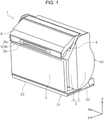
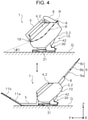
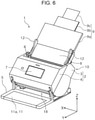
- the switcher 30 is capable of switching the apparatus main body 2 between a first attitude illustrated in FIGS. 4 and 6 , a second attitude illustrated in FIGS. 1 and 3 , and a third attitude illustrated in FIGS. 5 and 7 .
- the first attitude of the apparatus main body 2 illustrated in FIGS. 4 and 6 is an attitude in which the discharge direction of the medium from the medium transport path R takes a first inclination angle ⁇ 1 with respect to the mounting surface G.
- the second attitude of the apparatus main body 2 illustrated in FIGS. 1 and 3 is an attitude in which the discharge direction from the medium transport path R takes a second inclination angle ⁇ 2 that is closer to the vertical angle than is the first inclination angle ⁇ 1 with respect to the mounting surface G or is an attitude in which the discharge direction is vertical.
- the second inclination angle ⁇ 2 is an angle larger than the first inclination angle ⁇ 1. That is, ⁇ 2 > ⁇ 1.
- the third attitude of the apparatus main body 2 illustrated in FIGS. 5 and 7 is an attitude in which the discharge direction takes a third inclination angle ⁇ 3 that is closer to the horizontal angle than is the first inclination angle ⁇ 1 with respect to the mounting surface G, or is an attitude in which the discharge direction becomes horizontal.
- the third inclination angle ⁇ 3 is an angle smaller than the first inclination angle ⁇ 1. That is, ⁇ 1 > ⁇ 3.
- the second attitude of the apparatus main body 2 is an attitude in which the discharge direction from the medium transport path R takes a second inclination angle ⁇ 2 that is closer to the vertical angle than is the first inclination angle ⁇ 1 with respect to the mounting surface G, it becomes an attitude in which the apparatus main body 2 is made compact in the apparatus depth direction. Therefore, when the scanner 1 is stored when the apparatus is not used, the apparatus main body 2 may be set to the second attitude.
- the discharge unit 18 is generally directed downward, so that dust, dirt and the like can be prevented from entering the discharge unit 18.
- the medium P can be discharged from the discharge unit 18. Therefore, when the apparatus main body 2 is set to the first attitude or the third attitude, the medium P can be transported and scanned.
- the specific configuration of the switcher 30 for switching the attitude of the apparatus main body 2 will be described in detail after the outline of the scanner 1 and the medium transport path R have been described.
- a feed tray 8 is provided above the apparatus main body 2.
- the feed tray 8 of the present embodiment is provided so as to be pivotable with respect to a pivot shaft 8a ( FIG. 2 ) provided in the apparatus main body 2, and as illustrated in FIG. 2 , is configured to be capable of switching between a first state in which the feed tray 8 supports the medium P fed to the medium transport path R and a second state in which the feed tray 8 covers a portion of the apparatus main body 2.
- the feed tray 8 is brought into the first state illustrated in FIG. 2 when the scanner 1 is to be used and supports the medium P, and is brought into the second state illustrated in FIG. 1 when the scanner 1 is not used and functions as a cover that covers the supply unit 6 of the apparatus main body 2. In addition, by folding the feed tray 8 when the scanner 1 is not in use, the scanner 1 can be made compact.
- a discharge tray 5 is provided below the apparatus main body 2.
- the discharge tray 5 of the present embodiment is provided so as to be pivotable with respect to a pivot shaft 5a ( FIG. 2 ) provided in the apparatus main body 2, and, as illustrated in FIG. 2 , is configured to be capable of switching between a third state in which the discharge tray 5 supports the medium P discharged from the medium transport path R and, as illustrated in FIG. 1 , a fourth state in which the discharge tray 5 covers a portion of the apparatus main body 2.
- the discharge tray 5 is brought into the third state illustrated in FIG. 2 when the scanner 1 is to be used and supports the medium P discharged from the discharge unit 18, and is brought into the fourth state illustrated in FIG. 1 when the scanner 1 is not used and functions as a cover that covers the apparatus main body 2.
- the scanner 1 can be made compact.
- the feed tray 8 in the second state and the discharge tray 5 in the fourth state are configured so as not to cover the same portion of the apparatus main body 2.
- the feed tray 8 and the discharge tray 5 are closed with respect to the apparatus main body 2, an increase in the size of the feed tray 8 and the discharge tray 5 in the thickness direction can be suppressed.
- the feed tray 8 is provided with a pair of left and right edge guides 12, 12 that guide side edges of the medium P in the width direction (X-axis direction) intersecting the medium transport direction.
- the edge guides 12 are provided so as to be slidable in the X-axis direction in accordance with the size of the medium P.
- the edge guides 12, 12 are configured such that, following the movement in the X direction of the edge guide 12 on the +X side by a known rack and pinion mechanism, the edge guide 12 on the -X side moves in the opposite direction.
- the medium P is aligned at the center in the width direction, and is configured to be fed by a so-called center sheet feeding method by a feed roller 14 described later provided in a center region in the width direction.
- the feed tray 8 by way of example, as illustrated in the lower diagram of FIG. 4 and FIG. 6 , includes an auxiliary feed tray 9 that is capable of switching between a first advanced state in which the auxiliary feed tray 9 is advanced to a free end with respect to the feed tray 8 and, as illustrated in FIG. 1 , a first storage state in which the auxiliary feed tray 9 is stored in the feed tray 8.
- the auxiliary feed tray 9 is formed of a three-stage tray including a first auxiliary feed tray 9a, a second auxiliary feed tray 9b, and a third auxiliary feed tray 9c.
- the discharge tray 5 is, for example, as illustrated in the lower part of FIG. 5 , provided with an auxiliary discharge tray 11 that is capable of switching between a second advanced state in which the auxiliary discharge tray 11 is advanced to a free end side with respect to the discharge tray 5 and a second storage state in which the auxiliary discharge tray 11 is stored in the discharge tray 5.
- the auxiliary discharge tray 11 is formed of a three-stage tray including a first auxiliary discharge tray 11a, a second auxiliary discharge tray 11b, and a third auxiliary discharge tray 11c.
- a restricting portion 13 which is formed so as to be foldable with respect to the third auxiliary discharge tray 11c and which restricts the movement of the set medium P in the +Y direction is provided.
- the apparatus can be made compact by putting the auxiliary discharge tray 11 in the second storage state.
- the upper unit 4 is provided with an operation panel 7 as a "displayer" that displays content related to the apparatus operation such as the reading setting content.
- the operation panel 7 can be configured, for example, as a touch panel and enables a user to perform operations such as various settings, reading execution, and the like, in addition to display of content related to apparatus operation.
- the apparatus main body 2 is provided with a controller 19 that executes various controls in the scanner 1. The control by the controller 19 will be described in detail later.
- the medium transport path R in the medium transport apparatus 10 will be described below mainly with reference to FIG. 2 .
- the apparatus main body 2 is in the first attitude.
- the feed roller 14 In the medium transport path R where the medium P is supplied from the feed tray 8, the feed roller 14, a separation roller 15, a first transport roller pair 16, the reader 20, and a second transport roller pair 17 are arranged in order from the upstream in the medium transport direction.
- the first transport roller pair 16 is formed of a first drive roller 16a and a first driven roller 16b.
- the second transport roller pair 17 is formed of a second drive roller 17a and a second driven roller 17b.
- the feed roller 14, the first drive roller 16a, and the second drive roller 17a are provided so as to be pivotable with respect to the lower unit 3.
- the separation roller 15 provided at a position facing the feed roller 14, the first driven roller 16b, and the second driven roller 17b are provided so as to be pivotable with respect to the upper unit 4.
- the medium P set on the feed tray 8 is picked up by the feed roller 14 and sent toward the first transport roller pair 16. Specifically, the medium P is fed downstream by the feed roller 14 rotating while being in contact with the surface of the medium P that faces the feed tray 8. Therefore, when a plurality of media P are set on the feed tray 8 of the scanner 1, the media P on the lower side are sequentially fed downstream.
- the separation roller 15 which nips the medium P between the separation roller 15 and the feed roller 14 to separate the medium P, is provided.
- the first transport roller pair 16 transports the medium P fed by the feed roller 14 toward the reader 20. Similarly to the feed roller 14, the first transport roller pair 16 is also provided in the center region in the X-axis direction, which is the width direction.
- the reader 20 includes a first reading unit 20a provided on the upper unit 4 side and a second reading unit 20b provided on the lower unit 3 side.
- the first reading unit 20a and the second reading unit 20b are formed as a contact image sensor module (CISM) as an example.
- CISM contact image sensor module
- the first reading unit 20a reads the surface of the medium P that faces upward
- the second reading unit 20b reads the opposite surface of the medium P, that is, the surface of the medium P that faces downward.
- the medium P after being read by the reader 20 on at least one side, is nipped by the second transport roller pair 17 located downstream of the reader 20 and is discharged from the discharge unit 18 provided on the apparatus front side of the lower unit 3.
- the feed roller 14, the separation roller 15, the first drive roller 16a, and the second drive roller 17a are rotationally driven by a drive source (not illustrated).
- a configuration may be employed in which the rollers are driven by two or more drive sources.
- the separation roller 15, the first drive roller 16a, and the second drive roller 17a are driven by a common drive source, and the feed roller 14 is driven by another drive source.
- the apparatus main body 2 is supported by a main body support member 31 illustrated in FIG. 9 and the switcher 30 is configured to switch the attitude of the apparatus main body 2 by changing the support position of the apparatus main body 2 supported by the main body support member 31.
- the switcher 30 will be described in more detail with reference mainly to FIGS. 8 to 11 .
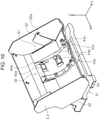
- the main body support member 31 illustrated in FIG. 9 includes a base portion 33 on which the lower unit 3 of the apparatus main body 2 is mounted, and support portions 32, 32 provided on both sides of the base portion 33 in the width direction. As illustrated in FIG. 10 , the support portions 32, 32 are inserted from slits 41 provided in the lower unit 3, and pivot shaft portions 32a, 32a are attached to the inside of the lower unit 3. The lower unit 3 pivots with respect to the pivot shaft portions 32a, 32a.
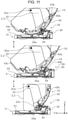
- a bottom portion 42 of the lower unit 3 is formed in an arc shape in side section as illustrated in each drawing of FIG. 11 .
- the bottom portion 42 is provided with a first recessed portion 43b, a second recessed portion 43c, and a third recessed portion 43a, as illustrated in the upper view of FIG. 11 .
- a rack 45 is provided along the arc at the bottom portion 42 of the lower unit 3 illustrated in FIG. 8 .
- a pinion 36 is provided on the base portion 33 of the main body support member 31 illustrated in FIG. 9 .
- the pinion 36 meshes with the rack 45, and rotates when the lower unit 3 pivots with respect to the pivot shaft portions 32a, 32a. Thereby, stable pivoting of the lower unit 3 can be realized.
- the main body support member 31 illustrated in FIG. 9 is provided with an engagement portion 34 engageable with the first recessed portion 43b, the second recessed portion 43c, and the third recessed portion 43a.
- the engagement portion 34 is a "fixer” that fixes the main body support member 31 and the lower unit 3 as the apparatus main body 2.
- the engagement portion 34 swings in advancing and retracting directions with respect to the base portion 33.
- a swing shaft 34a of the engagement portion 34 is provided on the +Y side.
- the engagement portion 34 is formed of a roller.
- the apparatus main body 2 When the engagement portion 34 engages with the first recessed portion 43b, the apparatus main body 2 is in the first attitude illustrated in the upper diagram of FIG. 4 , when the engagement portion 34 engages with the second recessed portion 43c, the apparatus main body 2 is in the second attitude illustrated in FIG. 3 , and when the engagement portion 34 engages with the third recessed portion 43a, the apparatus main body 2 is in the third attitude illustrated in the upper diagram of FIG. 5 .
- the attitude of the apparatus main body 2 can be maintained by fixing the main body support member 31 and the apparatus main body 2.
- the upper diagram of FIG. 11 and the lower diagram of FIG. 11 illustrate the state in which the engagement portion 34 has been advanced from the base portion 33, and the middle diagram of FIG. 11 illustrates the state in which the engagement portion 34 has been retracted.
- the engagement portion 34 is pressed in the advancing direction with respect to the base portion 33 by a pressing member (not illustrated).
- a lever member 35 as an "operation restrictor” is attached to the engagement portion 34, and by lifting the lever member 35 against the pressing force, the engagement portion 34 becomes in the retracted state illustrated in the middle diagram of FIG. 11 , and it becomes possible to pivot the lower unit 3. That is, the operation of the switcher 30 is permitted.
- the engagement portion 34 returns to the state in which it is pushed in the advancing direction toward the base portion 33, and when the engagement portion 34 engages with any of the first recessed portion 43b, the second recessed portion 43c, and the third recessed portion 43a, the operation of the switcher 30 is restricted.
- the lever member 35 is configured to be capable of switching between the restricting state and the permitting state under the control of the controller 19.
- the upper diagram of FIG. 11 illustrates a state in which the lever member 35 is in the restricting state, the engagement portion 34 is engaged with the first recessed portion 43b, and the apparatus main body 2 is fixed in the first attitude;
- the middle diagram of FIG. 11 illustrates a state in which the lever member 35 is in the permitting state and the engagement portion 34 is not engaged with the first recessed portion 43b or the second recessed portion 43c;
- the lower diagram of FIG. 11 illustrates a state in which the lever member 35 is in the restricting state, the engagement portion 34 is engaged with the second recessed portion 43c, and the apparatus main body 2 is fixed in the second attitude.
- a first detection unit 44b, a second detection unit 44c, and a third detection unit 44a are provided at positions corresponding to the first recessed portion 43b, the second recessed portion 43c, and the third recessed portion 43a inside the lower unit 3 illustrated in FIG. 10 .
- the first detection unit 44b, the second detection unit 44c, and the third detection unit 44a are configured to be capable of detecting that the engagement portion 34 is engaged with the corresponding ones of the first recessed portion 43b, the second recessed portion 43c, and the third recessed portion 43a, and so as to detect the attitude of the apparatus main body 2 on the basis of the detection results of the first detection unit 44b, the second detection unit 44c, and the third detection unit 44a.
- FIG. 10 is a perspective view of the lower unit 3 as seen from the inside of the apparatus, although portions in FIG. 10 denoted by reference signs 43b, 43c and 43a correspond to the rear sides of the first recessed portion 43b, the second recessed portion 43c and the third recessed portion 43a and are not strictly recessed portions, suppose that the portions denoted by reference signs 43b, 43c and 43a illustrate the positions corresponding to the first recessed portion 43b, the second recessed portion 43c, and the third recessed portion 43a.
- the controller 19, as illustrated in FIGS. 3 to 5 when the attitude of the apparatus main body 2 with respect to the mounting surface G is switched, is configured to perform control in accordance with the attitude after the switching.
- the attitude of the apparatus main body 2 with respect to the mounting surface G is changed in accordance with the installation environment and the use situation. Functions convenient for the user may differ depending on the attitude of the apparatus main body 2. Therefore, the controller 19 can perform an appropriate operation in accordance with the attitude of the apparatus main body 2 by performing control according to the attitude of the apparatus main body 2 after the switching. Therefore, the usability of the scanner 1 by the user is improved.
- the controller 19 can be configured to turn off the apparatus power when the apparatus main body 2 is switched to the second attitude illustrated in FIGS. 1 and 3 .
- the second attitude of the apparatus main body 2 is an attitude in which the apparatus main body 2 can be mounted on the mounting surface G in a space-saving manner, and is an attitude suitable for storage when the scanner 1 is not being used.
- the power of the apparatus can be automatically turned off by the controller 19 turning off the apparatus power when the scanner 1 is not to be used and is to be stored.
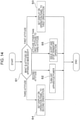
- FIG. 14 illustrates a flowchart of control by the controller 19.
- the controller 19 determines to which state the attitude of the apparatus main body 2 has been switched in step S1. Moreover, the attitude of the apparatus main body 2 can be determined on the basis of the detection results of the first detection unit 44b, the second detection unit 44c, and the third detection unit 44a illustrated in FIG. 10 , as described above.
- the apparatus main body 2 is in the first attitude when the first detection unit 44b is in the detection state, is in the second attitude when the second detection unit 44c is in the detection state, and is in the third attitude when the third detection unit 44a is in the detection state.
- the apparatus main body 2 is not in any of the first attitude, the second attitude, and the third attitude and is in the middle of switching.
- step S1 If it is determined in step S1 that the apparatus main body 2 has been switched to the second attitude, the process proceeds to step S2, and the apparatus power is turned off.
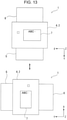
- the controller 19 sets the display on the operation panel 7 to a first orientation in which the display can be read, in plan view of the apparatus main body 2, with downstream down and upstream up in the discharge direction as illustrated in the upper diagram of FIG. 13 .
- the controller 19 sets the display on the operation panel 7 to a second orientation rotated 90° counterclockwise from the first orientation, as illustrated in the lower diagram of FIG. 13 .
- step S1 of the flowchart illustrated in FIG. 14 that the apparatus main body 2 has been switched to the first attitude, the display on the operation panel 7 is set to the first orientation in step S3.
- step S1 that the apparatus main body 2 has been switched to the third attitude
- step S4 the display on the operation panel 7 is set to the second orientation in step S4.
- the apparatus main body 2 when the apparatus main body 2 is set to the first attitude illustrated in FIGS. 4 and 6 , the user often performs operations facing toward the apparatus main body 2 such that downstream in the discharge direction faces toward the user and upstream faces away from the user.
- the apparatus main body 2 when the apparatus main body 2 is set to the third attitude illustrated in FIGS. 5 and 7 , it is assumed that the user operates the apparatus main body 2 so that the direction along the discharge direction becomes the left-right direction.
- the controller 19 setting the display on the operation panel 7 to be in the first orientation illustrated in the upper diagram of FIG. 13 when the apparatus main body 2 is in the first attitude, and setting the display on the operation panel 7 to be in the second orientation illustrated in the lower diagram of FIG. 13 when the apparatus main body 2 is in the third attitude, the display on the operation panel 7 can be oriented in such a way that the user can easily view the display in each attitude. Moreover, the display when the apparatus main body 2 is in the third attitude can also be rotated clockwise from the first orientation.
- the controller 19 issues an alert and stops the transport operation in the apparatus main body 2.
- step S5 when the attitude of the apparatus main body 2 is not any of the first attitude, the second attitude, and the third attitude, the transport operation in the apparatus main body 2 is stopped (step S5). Specifically, the controller 19 stops the transport operation when the attitude of the apparatus main body 2 is switched to none of the first attitude, the second attitude, and the third attitude during the transport operation. In addition, when the attitude of the apparatus main body 2 is not any of the first attitude, the second attitude, and the third attitude, the controller 19 may prohibit the transport operation by not accepting a transport operation request from the user.
- the controller 19 stops the drive source (not illustrated) that drives the feed roller 14, the separation roller 15, the first drive roller 16a, and the second drive roller 17a described above, and stops the transport operation in the apparatus main body 2.
- the alert can be configured to be generated, for example, by displaying a display giving notification of an error on the operation panel 7, or can be configured to activate an alert lamp or an alert sound.
- controller 19 stops the transport operation when the switcher 30 moves during medium transport in the apparatus main body 2. If the switcher 30 moves due to any cause during medium transport in the scanner 1 and the attitude of the apparatus main body 2 changes, reading of the medium P by the reader 20 may not be properly performed.
- the controller 19 stops the transport operation if the switcher 30 moves during medium transport in the apparatus main body 2, and thus the transport operation can be stopped when an operation to change the attitude of the apparatus main body 2 is performed during medium transport. Thus, it is possible to prevent reading of the medium P from being performed in an inappropriate state.
- the apparatus main body 2 is configured such that the discharge unit 18 faces downward in the second attitude.
- the upper unit 4 constituting the apparatus main body 2 can be switched between an open state with respect to the lower unit 3 as indicated by a dotted line in FIG. 2 and a closed state with respect to the lower unit 3 as indicated by a solid line in FIG. 2 .
- the apparatus main body 2 is provided with a pivot restrictor 21 illustrated in FIG. 2 .
- the pivot restrictor 21, under control of the controller 19, is configured to be capable of switching between a pivot restricting state in which pivoting of the upper unit 4 from the closed state to the open state is restricted and a pivot permitting state in which pivoting of the upper unit 4 from the closed state to the open state is permitted.
- the pivot restrictor 21 in the pivot restricting state, is configured to protrude from the upper unit 4 toward the lower unit 3 as illustrated by a solid line in FIG. 2 to lock the closed state of the upper unit 4.
- the pivot restrictor 21 in the pivot permitting state, is configured to retract to the upper unit 4 side as indicated by a two-dot chain line in FIG. 2 and release the lock of the upper unit 4 in the closed state.
- the controller 19 puts the pivot restrictor 21 into the pivot restricting state.
- the apparatus main body 2 when the apparatus main body 2 includes the lower unit 3 and the upper unit 4 that opens and closes with respect to the lower unit 3 with the pivot shaft 4a on the discharge unit 18 side as an axis, and is configured such that the discharge unit 18 faces downward when the apparatus main body 2 is in the second attitude illustrated in FIG. 3 , for example, if the lower unit is open when the apparatus main body 2 is in the first attitude ( FIG. 2 ) instead of the second attitude, the lower unit 3 closes by its own weight due to a hand hitting it or the like, and this impact may cause damage to the upper unit 4 and the lower unit 3 as the apparatus main body 2 or to components inside the apparatus main body 2. The same possibility exists in the case where the apparatus main body 2 is in the third attitude ( FIG. 5 ).
- the controller 19 can suppress the upper unit 4 from opening by putting the pivot restrictor 21 in the pivot restricting state when the apparatus main body 2 is in an attitude other than the second attitude. As a result, it is possible to reduce the possibility of the upper unit 4 being inadvertently closed and damage being applied to the apparatus main body 2 and components inside the apparatus main body 2.
- the apparatus main body 2 is provided with a connection portion 22 to which a cable 24 is coupled.
- Examples of the cable 24 coupled to the apparatus main body 2 include a cable for connection with another apparatus such as a personal computer and a power supply cable.
- the connection portion 22 is disposed so as to enable insertion and removal of the cable 24 regardless of the attitude of the apparatus main body 2.
- connection portion 22 is provided on the -Y side, which is to the rear of the lower unit 3.
- the lower unit 3 includes a rear side surface 3b at a position one step lower than a side surface 3a on the +X side.
- the connection portion 22 is provided on the rear side surface 3b.
- connection portion 22 By arranging the connection portion 22 in this manner, the cable 24 can be easily inserted into and removed from the connection portion 22 regardless of the attitude of the apparatus main body 2.
- connection portion 22 for example, can also be provided on the side surface 3a.
- a cable guide 23 is provided at a position away from the connection portion 22 in the +X direction.
- the cable 24 can be guided in the +X direction by the cable guide 23.
- the scanner 1 can be formed into a scanner 1A.
- a height H2 of the main body support member 31A is smaller than the height H1 of the main body support member 31.
- the main body support member 31A can reduce the size thereof in the height direction when, for example, the switcher 30 is not provided.
- the scanner 1A can be a model in which the attitude of the apparatus main body 2 is fixed at, for example, the second attitude. Since the main body support member 31A does not require the switcher 30 and has a small size, the main body support member 31A can be manufactured at a lower cost than the main body support member 31. Therefore, the scanner 1A the size of which in the height direction is small and which is inexpensive, can be easily manufactured.
- the apparatus main body 2 can be configured to be switched between two attitudes, namely, a storage attitude and an attitude in which the medium P can be transported, like between the first attitude and the second attitude, or between the first attitude and the third attitude.
- the feed tray 8 in the second state and the discharge tray 5 in the fourth state are configured so as not to cover the same portion of the apparatus main body 2
- the feed tray 8 in the second state and the discharge tray 5 in the fourth state may be configured to overlap to cover the same portion of the apparatus main body 2.
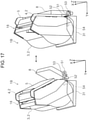
- the discharge unit 18 can be configured to face upward in the second attitude like in a scanner 1B as a modification of the first embodiment illustrated in the right diagram of FIG. 17 .
- the feed tray 8 In the first attitude of the apparatus main body 2 illustrated in the left diagram of FIG. 16 , the feed tray 8 is in a first state in which the feed tray 8 can support the medium P. In addition, in the second attitude of the apparatus main body 2 illustrated in the right diagram of FIG. 17 , the feed tray 8 is brought into a second state in which the feed tray 8 covers the upper unit 4.
- the apparatus main body 2 can be made more compact by attaching the feed tray 8 to the apparatus main body 2 via an arm portion 51.
- the arm portion 51 has an elongated hole 52 and is attached to a main body side shaft portion 54 inside the apparatus main body 2 so as to be pivotable, and a tray side shaft portion 53 of the feed tray 8 is fitted in the elongated hole 52.
- the tray side shaft portion 53 is located at an end portion of the elongated hole 52 on the +Y side close to the apparatus main body 2.
- the feed tray 8 is changed from the first state illustrated in the left diagram of FIG. 16 to the second state illustrated in the right diagram of FIG. 17 , the feed tray 8 is pulled obliquely upward toward the rear of the apparatus as illustrated in the right diagram of FIG. 16 .
- the tray side shaft portion 53 can move toward the end portion of the elongated hole 52 on the -Y side away from the apparatus main body 2.
- the arm portion 51 pivots with respect to the main body side shaft portion 54
- the feed tray 8 pivots with respect to the tray side shaft portion 53 so that the medium support surface of the feed tray 8 approaches the upper unit 4 as the apparatus main body 2.
- the apparatus main body 2 becomes in the second attitude in which the discharge unit 18 faces upward, and the feed tray 8 becomes in the second state in which the feed tray 8 covers the apparatus main body 2.
Landscapes
- Engineering & Computer Science (AREA)
- Multimedia (AREA)
- Signal Processing (AREA)
- Mechanical Engineering (AREA)
- Facsimiles In General (AREA)
- Pile Receivers (AREA)
- Sheets, Magazines, And Separation Thereof (AREA)
Applications Claiming Priority (1)
| Application Number | Priority Date | Filing Date | Title |
|---|---|---|---|
| JP2018162891A JP7089669B2 (ja) | 2018-08-31 | 2018-08-31 | 媒体搬送装置および画像読取装置 |
Publications (2)
| Publication Number | Publication Date |
|---|---|
| EP3618412A1 EP3618412A1 (en) | 2020-03-04 |
| EP3618412B1 true EP3618412B1 (en) | 2022-03-16 |
Family
ID=67809271
Family Applications (1)
| Application Number | Title | Priority Date | Filing Date |
|---|---|---|---|
| EP19194267.1A Active EP3618412B1 (en) | 2018-08-31 | 2019-08-29 | Medium transport apparatus and image reading apparatus |
Country Status (4)
| Country | Link |
|---|---|
| US (2) | US11019231B2 (enExample) |
| EP (1) | EP3618412B1 (enExample) |
| JP (1) | JP7089669B2 (enExample) |
| CN (1) | CN110875995B (enExample) |
Families Citing this family (14)
| Publication number | Priority date | Publication date | Assignee | Title |
|---|---|---|---|---|
| JP6879466B2 (ja) * | 2017-09-28 | 2021-06-02 | セイコーエプソン株式会社 | 画像読取装置 |
| JP7089669B2 (ja) * | 2018-08-31 | 2022-06-23 | セイコーエプソン株式会社 | 媒体搬送装置および画像読取装置 |
| JP7346833B2 (ja) * | 2019-01-31 | 2023-09-20 | セイコーエプソン株式会社 | 媒体排出装置および画像読取装置 |
| JP7279462B2 (ja) * | 2019-03-28 | 2023-05-23 | ブラザー工業株式会社 | 画像読取装置 |
| JP7234799B2 (ja) * | 2019-05-24 | 2023-03-08 | セイコーエプソン株式会社 | 画像読取装置、及び、その制御方法 |
| JP7251313B2 (ja) * | 2019-05-24 | 2023-04-04 | セイコーエプソン株式会社 | 画像読取装置 |
| JP7247783B2 (ja) * | 2019-06-25 | 2023-03-29 | セイコーエプソン株式会社 | 画像読取装置 |
| JP7383977B2 (ja) * | 2019-10-21 | 2023-11-21 | セイコーエプソン株式会社 | 画像読取装置 |
| JP7318481B2 (ja) * | 2019-10-24 | 2023-08-01 | セイコーエプソン株式会社 | 画像読取装置、画像読取装置の制御プログラム、及び、画像読取装置の制御方法 |
| JP7613128B2 (ja) * | 2021-01-22 | 2025-01-15 | セイコーエプソン株式会社 | 記録装置 |
| JP7700609B2 (ja) * | 2021-09-30 | 2025-07-01 | セイコーエプソン株式会社 | 画像読取装置 |
| JP7757686B2 (ja) * | 2021-09-30 | 2025-10-22 | セイコーエプソン株式会社 | 画像読取装置 |
| JP7757687B2 (ja) * | 2021-09-30 | 2025-10-22 | セイコーエプソン株式会社 | 画像読取装置 |
| JP2023127947A (ja) * | 2022-03-02 | 2023-09-14 | セイコーエプソン株式会社 | 画像読取装置 |
Family Cites Families (28)
| Publication number | Priority date | Publication date | Assignee | Title |
|---|---|---|---|---|
| JP3330822B2 (ja) * | 1996-06-26 | 2002-09-30 | 株式会社ピーエフユー | 媒体処理装置およびその制御方法 |
| GB2327666A (en) * | 1997-06-24 | 1999-02-03 | Umax Data Systems Inc | Scanner with variable document feed-in/out positions |
| CN101945198B (zh) * | 2004-09-21 | 2012-05-30 | 兄弟工业株式会社 | 图像处理设备 |
| TW200727676A (en) * | 2006-01-05 | 2007-07-16 | Avision Inc | Duplex scanning device having a rotatable scanning unit and duplex scanning method thereof |
| US20070188818A1 (en) * | 2006-02-13 | 2007-08-16 | Eastman Kodak Company | Tiltable document imaging apparatus |
| JP2008168580A (ja) | 2007-01-15 | 2008-07-24 | Seiko Epson Corp | 印刷装置、印刷装置の動作環境設定方法およびプログラム |
| JP2008197191A (ja) * | 2007-02-09 | 2008-08-28 | Kyocera Mita Corp | 画像読取装置及びこれを備えた画像形成装置 |
| JP4962264B2 (ja) * | 2007-10-22 | 2012-06-27 | ブラザー工業株式会社 | 操作装置及び画像記録装置 |
| JP2009190346A (ja) | 2008-02-18 | 2009-08-27 | Panasonic Corp | 画像形成装置 |
| JP5235568B2 (ja) * | 2008-09-11 | 2013-07-10 | 株式会社Pfu | 外装カバー付きスキャナ装置 |
| JP4858590B2 (ja) * | 2009-09-30 | 2012-01-18 | ブラザー工業株式会社 | 画像処理装置 |
| JP5256234B2 (ja) * | 2010-03-18 | 2013-08-07 | 株式会社Pfu | 角度検出装置および画像読取装置 |
| TWM417261U (en) * | 2011-06-03 | 2011-12-01 | Avision Inc | Apparatus with retractable flatbed scanner |
| JP5935481B2 (ja) | 2011-12-27 | 2016-06-15 | ブラザー工業株式会社 | 読取装置 |
| JP5889003B2 (ja) * | 2012-01-26 | 2016-03-22 | 株式会社Pfu | 画像取得装置 |
| JP2013255166A (ja) * | 2012-06-08 | 2013-12-19 | Casio Comput Co Ltd | 画像読取装置及びプログラム |
| JP2014086819A (ja) | 2012-10-22 | 2014-05-12 | Brother Ind Ltd | 画像読取装置およびシート搬送装置 |
| JP6221378B2 (ja) * | 2013-06-14 | 2017-11-01 | セイコーエプソン株式会社 | 記録装置、搬送装置、及び、被搬送媒体の搬送方法 |
| JP6927662B2 (ja) * | 2015-10-14 | 2021-09-01 | シャープ株式会社 | 画像形成装置 |
| WO2017086478A1 (ja) * | 2015-11-20 | 2017-05-26 | キヤノン電子株式会社 | シート搬送装置 |
| JP6194988B2 (ja) | 2016-07-12 | 2017-09-13 | コニカミノルタ株式会社 | 画像形成装置 |
| JP6838697B2 (ja) * | 2016-09-30 | 2021-03-03 | セイコーエプソン株式会社 | 記録装置 |
| JP6811993B2 (ja) | 2017-03-24 | 2021-01-13 | 株式会社タイヨー製作所 | 食品乾燥装置 |
| US10807390B2 (en) * | 2017-10-30 | 2020-10-20 | Transact Technologies Incorporated | Pivot mechanism for a printer and a printer with a pivoting printer housing |
| JP6946938B2 (ja) | 2017-10-31 | 2021-10-13 | セイコーエプソン株式会社 | 画像読取装置 |
| JP6946939B2 (ja) | 2017-10-31 | 2021-10-13 | セイコーエプソン株式会社 | 画像読取装置 |
| JP7027994B2 (ja) | 2018-03-20 | 2022-03-02 | セイコーエプソン株式会社 | 画像読取装置 |
| JP7089669B2 (ja) * | 2018-08-31 | 2022-06-23 | セイコーエプソン株式会社 | 媒体搬送装置および画像読取装置 |
-
2018
- 2018-08-31 JP JP2018162891A patent/JP7089669B2/ja active Active
-
2019
- 2019-08-29 US US16/555,850 patent/US11019231B2/en active Active
- 2019-08-29 EP EP19194267.1A patent/EP3618412B1/en active Active
- 2019-08-29 CN CN201910820630.6A patent/CN110875995B/zh active Active
-
2021
- 2021-04-29 US US17/243,951 patent/US11509785B2/en active Active
Also Published As
| Publication number | Publication date |
|---|---|
| CN110875995A (zh) | 2020-03-10 |
| US11019231B2 (en) | 2021-05-25 |
| US11509785B2 (en) | 2022-11-22 |
| US20210250457A1 (en) | 2021-08-12 |
| US20200076974A1 (en) | 2020-03-05 |
| CN110875995B (zh) | 2022-02-01 |
| JP7089669B2 (ja) | 2022-06-23 |
| JP2020036263A (ja) | 2020-03-05 |
| EP3618412A1 (en) | 2020-03-04 |
Similar Documents
| Publication | Publication Date | Title |
|---|---|---|
| EP3618412B1 (en) | Medium transport apparatus and image reading apparatus | |
| TWI679163B (zh) | 圖像讀取裝置及圖像讀取系統 | |
| JP2019083429A (ja) | 画像読取装置 | |
| US11343397B2 (en) | Image reading apparatus | |
| US11438474B2 (en) | Image reading apparatus with movable apparatus body | |
| US11122175B2 (en) | Printing apparatus | |
| US20080054549A1 (en) | Document feeder | |
| US9346292B2 (en) | Recording apparatus | |
| US10678179B2 (en) | Image forming apparatus | |
| JP6089883B2 (ja) | 記録装置 | |
| JP7424049B2 (ja) | 媒体給送装置、画像読取装置 | |
| US11595539B2 (en) | Image reading apparatus with rotatable main body | |
| US20210101765A1 (en) | Recording apparatus | |
| JP2017226085A (ja) | 記録装置 | |
| US11420834B2 (en) | Medium transport apparatus and image reading apparatus | |
| US20250304387A1 (en) | Medium conveyance apparatus and recording apparatus | |
| JP2020120343A (ja) | 画像読取装置 | |
| US20240174474A1 (en) | Recording device | |
| JP2012246096A (ja) | 画像記録装置 | |
| US11453229B2 (en) | Recording apparatus | |
| JP2024094220A (ja) | 載置トレイ及び記録装置 | |
| JP2020182032A (ja) | 画像読取装置、記録装置 |
Legal Events
| Date | Code | Title | Description |
|---|---|---|---|
| PUAI | Public reference made under article 153(3) epc to a published international application that has entered the european phase |
Free format text: ORIGINAL CODE: 0009012 |
|
| STAA | Information on the status of an ep patent application or granted ep patent |
Free format text: STATUS: THE APPLICATION HAS BEEN PUBLISHED |
|
| AK | Designated contracting states |
Kind code of ref document: A1 Designated state(s): AL AT BE BG CH CY CZ DE DK EE ES FI FR GB GR HR HU IE IS IT LI LT LU LV MC MK MT NL NO PL PT RO RS SE SI SK SM TR |
|
| AX | Request for extension of the european patent |
Extension state: BA ME |
|
| STAA | Information on the status of an ep patent application or granted ep patent |
Free format text: STATUS: REQUEST FOR EXAMINATION WAS MADE |
|
| 17P | Request for examination filed |
Effective date: 20200821 |
|
| RBV | Designated contracting states (corrected) |
Designated state(s): AL AT BE BG CH CY CZ DE DK EE ES FI FR GB GR HR HU IE IS IT LI LT LU LV MC MK MT NL NO PL PT RO RS SE SI SK SM TR |
|
| GRAP | Despatch of communication of intention to grant a patent |
Free format text: ORIGINAL CODE: EPIDOSNIGR1 |
|
| STAA | Information on the status of an ep patent application or granted ep patent |
Free format text: STATUS: GRANT OF PATENT IS INTENDED |
|
| INTG | Intention to grant announced |
Effective date: 20211206 |
|
| GRAS | Grant fee paid |
Free format text: ORIGINAL CODE: EPIDOSNIGR3 |
|
| GRAA | (expected) grant |
Free format text: ORIGINAL CODE: 0009210 |
|
| STAA | Information on the status of an ep patent application or granted ep patent |
Free format text: STATUS: THE PATENT HAS BEEN GRANTED |
|
| AK | Designated contracting states |
Kind code of ref document: B1 Designated state(s): AL AT BE BG CH CY CZ DE DK EE ES FI FR GB GR HR HU IE IS IT LI LT LU LV MC MK MT NL NO PL PT RO RS SE SI SK SM TR |
|
| REG | Reference to a national code |
Ref country code: GB Ref legal event code: FG4D |
|
| REG | Reference to a national code |
Ref country code: CH Ref legal event code: EP Ref country code: DE Ref legal event code: R096 Ref document number: 602019012539 Country of ref document: DE |
|
| REG | Reference to a national code |
Ref country code: IE Ref legal event code: FG4D |
|
| REG | Reference to a national code |
Ref country code: AT Ref legal event code: REF Ref document number: 1476685 Country of ref document: AT Kind code of ref document: T Effective date: 20220415 |
|
| REG | Reference to a national code |
Ref country code: LT Ref legal event code: MG9D |
|
| REG | Reference to a national code |
Ref country code: NL Ref legal event code: MP Effective date: 20220316 |
|
| PG25 | Lapsed in a contracting state [announced via postgrant information from national office to epo] |
Ref country code: SE Free format text: LAPSE BECAUSE OF FAILURE TO SUBMIT A TRANSLATION OF THE DESCRIPTION OR TO PAY THE FEE WITHIN THE PRESCRIBED TIME-LIMIT Effective date: 20220316 Ref country code: RS Free format text: LAPSE BECAUSE OF FAILURE TO SUBMIT A TRANSLATION OF THE DESCRIPTION OR TO PAY THE FEE WITHIN THE PRESCRIBED TIME-LIMIT Effective date: 20220316 Ref country code: NO Free format text: LAPSE BECAUSE OF FAILURE TO SUBMIT A TRANSLATION OF THE DESCRIPTION OR TO PAY THE FEE WITHIN THE PRESCRIBED TIME-LIMIT Effective date: 20220616 Ref country code: LT Free format text: LAPSE BECAUSE OF FAILURE TO SUBMIT A TRANSLATION OF THE DESCRIPTION OR TO PAY THE FEE WITHIN THE PRESCRIBED TIME-LIMIT Effective date: 20220316 Ref country code: HR Free format text: LAPSE BECAUSE OF FAILURE TO SUBMIT A TRANSLATION OF THE DESCRIPTION OR TO PAY THE FEE WITHIN THE PRESCRIBED TIME-LIMIT Effective date: 20220316 Ref country code: BG Free format text: LAPSE BECAUSE OF FAILURE TO SUBMIT A TRANSLATION OF THE DESCRIPTION OR TO PAY THE FEE WITHIN THE PRESCRIBED TIME-LIMIT Effective date: 20220616 |
|
| REG | Reference to a national code |
Ref country code: AT Ref legal event code: MK05 Ref document number: 1476685 Country of ref document: AT Kind code of ref document: T Effective date: 20220316 |
|
| PG25 | Lapsed in a contracting state [announced via postgrant information from national office to epo] |
Ref country code: LV Free format text: LAPSE BECAUSE OF FAILURE TO SUBMIT A TRANSLATION OF THE DESCRIPTION OR TO PAY THE FEE WITHIN THE PRESCRIBED TIME-LIMIT Effective date: 20220316 Ref country code: GR Free format text: LAPSE BECAUSE OF FAILURE TO SUBMIT A TRANSLATION OF THE DESCRIPTION OR TO PAY THE FEE WITHIN THE PRESCRIBED TIME-LIMIT Effective date: 20220617 Ref country code: FI Free format text: LAPSE BECAUSE OF FAILURE TO SUBMIT A TRANSLATION OF THE DESCRIPTION OR TO PAY THE FEE WITHIN THE PRESCRIBED TIME-LIMIT Effective date: 20220316 |
|
| PG25 | Lapsed in a contracting state [announced via postgrant information from national office to epo] |
Ref country code: NL Free format text: LAPSE BECAUSE OF FAILURE TO SUBMIT A TRANSLATION OF THE DESCRIPTION OR TO PAY THE FEE WITHIN THE PRESCRIBED TIME-LIMIT Effective date: 20220316 |
|
| PG25 | Lapsed in a contracting state [announced via postgrant information from national office to epo] |
Ref country code: SM Free format text: LAPSE BECAUSE OF FAILURE TO SUBMIT A TRANSLATION OF THE DESCRIPTION OR TO PAY THE FEE WITHIN THE PRESCRIBED TIME-LIMIT Effective date: 20220316 Ref country code: SK Free format text: LAPSE BECAUSE OF FAILURE TO SUBMIT A TRANSLATION OF THE DESCRIPTION OR TO PAY THE FEE WITHIN THE PRESCRIBED TIME-LIMIT Effective date: 20220316 Ref country code: RO Free format text: LAPSE BECAUSE OF FAILURE TO SUBMIT A TRANSLATION OF THE DESCRIPTION OR TO PAY THE FEE WITHIN THE PRESCRIBED TIME-LIMIT Effective date: 20220316 Ref country code: PT Free format text: LAPSE BECAUSE OF FAILURE TO SUBMIT A TRANSLATION OF THE DESCRIPTION OR TO PAY THE FEE WITHIN THE PRESCRIBED TIME-LIMIT Effective date: 20220718 Ref country code: ES Free format text: LAPSE BECAUSE OF FAILURE TO SUBMIT A TRANSLATION OF THE DESCRIPTION OR TO PAY THE FEE WITHIN THE PRESCRIBED TIME-LIMIT Effective date: 20220316 Ref country code: EE Free format text: LAPSE BECAUSE OF FAILURE TO SUBMIT A TRANSLATION OF THE DESCRIPTION OR TO PAY THE FEE WITHIN THE PRESCRIBED TIME-LIMIT Effective date: 20220316 Ref country code: CZ Free format text: LAPSE BECAUSE OF FAILURE TO SUBMIT A TRANSLATION OF THE DESCRIPTION OR TO PAY THE FEE WITHIN THE PRESCRIBED TIME-LIMIT Effective date: 20220316 Ref country code: AT Free format text: LAPSE BECAUSE OF FAILURE TO SUBMIT A TRANSLATION OF THE DESCRIPTION OR TO PAY THE FEE WITHIN THE PRESCRIBED TIME-LIMIT Effective date: 20220316 |
|
| PG25 | Lapsed in a contracting state [announced via postgrant information from national office to epo] |
Ref country code: PL Free format text: LAPSE BECAUSE OF FAILURE TO SUBMIT A TRANSLATION OF THE DESCRIPTION OR TO PAY THE FEE WITHIN THE PRESCRIBED TIME-LIMIT Effective date: 20220316 Ref country code: IS Free format text: LAPSE BECAUSE OF FAILURE TO SUBMIT A TRANSLATION OF THE DESCRIPTION OR TO PAY THE FEE WITHIN THE PRESCRIBED TIME-LIMIT Effective date: 20220716 Ref country code: AL Free format text: LAPSE BECAUSE OF FAILURE TO SUBMIT A TRANSLATION OF THE DESCRIPTION OR TO PAY THE FEE WITHIN THE PRESCRIBED TIME-LIMIT Effective date: 20220316 |
|
| REG | Reference to a national code |
Ref country code: DE Ref legal event code: R097 Ref document number: 602019012539 Country of ref document: DE |
|
| PLBE | No opposition filed within time limit |
Free format text: ORIGINAL CODE: 0009261 |
|
| STAA | Information on the status of an ep patent application or granted ep patent |
Free format text: STATUS: NO OPPOSITION FILED WITHIN TIME LIMIT |
|
| PG25 | Lapsed in a contracting state [announced via postgrant information from national office to epo] |
Ref country code: DK Free format text: LAPSE BECAUSE OF FAILURE TO SUBMIT A TRANSLATION OF THE DESCRIPTION OR TO PAY THE FEE WITHIN THE PRESCRIBED TIME-LIMIT Effective date: 20220316 |
|
| 26N | No opposition filed |
Effective date: 20221219 |
|
| PG25 | Lapsed in a contracting state [announced via postgrant information from national office to epo] |
Ref country code: SI Free format text: LAPSE BECAUSE OF FAILURE TO SUBMIT A TRANSLATION OF THE DESCRIPTION OR TO PAY THE FEE WITHIN THE PRESCRIBED TIME-LIMIT Effective date: 20220316 |
|
| PG25 | Lapsed in a contracting state [announced via postgrant information from national office to epo] |
Ref country code: MC Free format text: LAPSE BECAUSE OF FAILURE TO SUBMIT A TRANSLATION OF THE DESCRIPTION OR TO PAY THE FEE WITHIN THE PRESCRIBED TIME-LIMIT Effective date: 20220316 |
|
| REG | Reference to a national code |
Ref country code: CH Ref legal event code: PL |
|
| PG25 | Lapsed in a contracting state [announced via postgrant information from national office to epo] |
Ref country code: LU Free format text: LAPSE BECAUSE OF NON-PAYMENT OF DUE FEES Effective date: 20220829 Ref country code: LI Free format text: LAPSE BECAUSE OF NON-PAYMENT OF DUE FEES Effective date: 20220831 Ref country code: CH Free format text: LAPSE BECAUSE OF NON-PAYMENT OF DUE FEES Effective date: 20220831 |
|
| REG | Reference to a national code |
Ref country code: BE Ref legal event code: MM Effective date: 20220831 |
|
| PG25 | Lapsed in a contracting state [announced via postgrant information from national office to epo] |
Ref country code: IT Free format text: LAPSE BECAUSE OF FAILURE TO SUBMIT A TRANSLATION OF THE DESCRIPTION OR TO PAY THE FEE WITHIN THE PRESCRIBED TIME-LIMIT Effective date: 20220316 Ref country code: IE Free format text: LAPSE BECAUSE OF NON-PAYMENT OF DUE FEES Effective date: 20220829 |
|
| PG25 | Lapsed in a contracting state [announced via postgrant information from national office to epo] |
Ref country code: BE Free format text: LAPSE BECAUSE OF NON-PAYMENT OF DUE FEES Effective date: 20220831 |
|
| PG25 | Lapsed in a contracting state [announced via postgrant information from national office to epo] |
Ref country code: HU Free format text: LAPSE BECAUSE OF FAILURE TO SUBMIT A TRANSLATION OF THE DESCRIPTION OR TO PAY THE FEE WITHIN THE PRESCRIBED TIME-LIMIT; INVALID AB INITIO Effective date: 20190829 |
|
| PG25 | Lapsed in a contracting state [announced via postgrant information from national office to epo] |
Ref country code: CY Free format text: LAPSE BECAUSE OF FAILURE TO SUBMIT A TRANSLATION OF THE DESCRIPTION OR TO PAY THE FEE WITHIN THE PRESCRIBED TIME-LIMIT Effective date: 20220316 |
|
| PG25 | Lapsed in a contracting state [announced via postgrant information from national office to epo] |
Ref country code: MK Free format text: LAPSE BECAUSE OF FAILURE TO SUBMIT A TRANSLATION OF THE DESCRIPTION OR TO PAY THE FEE WITHIN THE PRESCRIBED TIME-LIMIT Effective date: 20220316 |
|
| PG25 | Lapsed in a contracting state [announced via postgrant information from national office to epo] |
Ref country code: TR Free format text: LAPSE BECAUSE OF FAILURE TO SUBMIT A TRANSLATION OF THE DESCRIPTION OR TO PAY THE FEE WITHIN THE PRESCRIBED TIME-LIMIT Effective date: 20220316 |
|
| PG25 | Lapsed in a contracting state [announced via postgrant information from national office to epo] |
Ref country code: MT Free format text: LAPSE BECAUSE OF FAILURE TO SUBMIT A TRANSLATION OF THE DESCRIPTION OR TO PAY THE FEE WITHIN THE PRESCRIBED TIME-LIMIT Effective date: 20220316 |
|
| PGFP | Annual fee paid to national office [announced via postgrant information from national office to epo] |
Ref country code: DE Payment date: 20250702 Year of fee payment: 7 |
|
| PGFP | Annual fee paid to national office [announced via postgrant information from national office to epo] |
Ref country code: GB Payment date: 20250703 Year of fee payment: 7 |
|
| PGFP | Annual fee paid to national office [announced via postgrant information from national office to epo] |
Ref country code: FR Payment date: 20250703 Year of fee payment: 7 |