EP3567309A1 - Luftansaugvorrichtung für ein mit einer brennkraftmaschine ausgestattetes fahrzeug - Google Patents
Luftansaugvorrichtung für ein mit einer brennkraftmaschine ausgestattetes fahrzeug Download PDFInfo
- Publication number
- EP3567309A1 EP3567309A1 EP19172090.3A EP19172090A EP3567309A1 EP 3567309 A1 EP3567309 A1 EP 3567309A1 EP 19172090 A EP19172090 A EP 19172090A EP 3567309 A1 EP3567309 A1 EP 3567309A1
- Authority
- EP
- European Patent Office
- Prior art keywords
- air
- holding device
- intake
- region
- air duct
- Prior art date
- Legal status (The legal status is an assumption and is not a legal conclusion. Google has not performed a legal analysis and makes no representation as to the accuracy of the status listed.)
- Granted
Links
Images





Classifications
-
- F—MECHANICAL ENGINEERING; LIGHTING; HEATING; WEAPONS; BLASTING
- F02—COMBUSTION ENGINES; HOT-GAS OR COMBUSTION-PRODUCT ENGINE PLANTS
- F02M—SUPPLYING COMBUSTION ENGINES IN GENERAL WITH COMBUSTIBLE MIXTURES OR CONSTITUENTS THEREOF
- F02M35/00—Combustion-air cleaners, air intakes, intake silencers, or induction systems specially adapted for, or arranged on, internal-combustion engines
- F02M35/10—Air intakes; Induction systems
- F02M35/10006—Air intakes; Induction systems characterised by the position of elements of the air intake system in direction of the air intake flow, i.e. between ambient air inlet and supply to the combustion chamber
- F02M35/10013—Means upstream of the air filter; Connection to the ambient air
-
- B—PERFORMING OPERATIONS; TRANSPORTING
- B60—VEHICLES IN GENERAL
- B60K—ARRANGEMENT OR MOUNTING OF PROPULSION UNITS OR OF TRANSMISSIONS IN VEHICLES; ARRANGEMENT OR MOUNTING OF PLURAL DIVERSE PRIME-MOVERS IN VEHICLES; AUXILIARY DRIVES FOR VEHICLES; INSTRUMENTATION OR DASHBOARDS FOR VEHICLES; ARRANGEMENTS IN CONNECTION WITH COOLING, AIR INTAKE, GAS EXHAUST OR FUEL SUPPLY OF PROPULSION UNITS IN VEHICLES
- B60K13/00—Arrangement in connection with combustion air intake or gas exhaust of propulsion units
- B60K13/02—Arrangement in connection with combustion air intake or gas exhaust of propulsion units concerning intake
-
- B—PERFORMING OPERATIONS; TRANSPORTING
- B62—LAND VEHICLES FOR TRAVELLING OTHERWISE THAN ON RAILS
- B62J—CYCLE SADDLES OR SEATS; AUXILIARY DEVICES OR ACCESSORIES SPECIALLY ADAPTED TO CYCLES AND NOT OTHERWISE PROVIDED FOR, e.g. ARTICLE CARRIERS OR CYCLE PROTECTORS
- B62J40/00—Arrangements of air cleaners specially adapted for cycles
- B62J40/10—Arrangements of air cleaners specially adapted for cycles characterised by air duct arrangements
-
- B—PERFORMING OPERATIONS; TRANSPORTING
- B62—LAND VEHICLES FOR TRAVELLING OTHERWISE THAN ON RAILS
- B62K—CYCLES; CYCLE FRAMES; CYCLE STEERING DEVICES; RIDER-OPERATED TERMINAL CONTROLS SPECIALLY ADAPTED FOR CYCLES; CYCLE AXLE SUSPENSIONS; CYCLE SIDECARS, FORECARS, OR THE LIKE
- B62K19/00—Cycle frames
- B62K19/30—Frame parts shaped to receive other cycle parts or accessories
- B62K19/32—Steering heads
-
- F—MECHANICAL ENGINEERING; LIGHTING; HEATING; WEAPONS; BLASTING
- F02—COMBUSTION ENGINES; HOT-GAS OR COMBUSTION-PRODUCT ENGINE PLANTS
- F02B—INTERNAL-COMBUSTION PISTON ENGINES; COMBUSTION ENGINES IN GENERAL
- F02B27/00—Use of kinetic or wave energy of charge in induction systems, or of combustion residues in exhaust systems, for improving quantity of charge or for increasing removal of combustion residues
- F02B27/005—Oscillating pipes with charging achieved by arrangement, dimensions or shapes of intakes pipes or chambers; Ram air pipes
-
- F—MECHANICAL ENGINEERING; LIGHTING; HEATING; WEAPONS; BLASTING
- F02—COMBUSTION ENGINES; HOT-GAS OR COMBUSTION-PRODUCT ENGINE PLANTS
- F02M—SUPPLYING COMBUSTION ENGINES IN GENERAL WITH COMBUSTIBLE MIXTURES OR CONSTITUENTS THEREOF
- F02M35/00—Combustion-air cleaners, air intakes, intake silencers, or induction systems specially adapted for, or arranged on, internal-combustion engines
- F02M35/10—Air intakes; Induction systems
- F02M35/10242—Devices or means connected to or integrated into air intakes; Air intakes combined with other engine or vehicle parts
-
- F—MECHANICAL ENGINEERING; LIGHTING; HEATING; WEAPONS; BLASTING
- F02—COMBUSTION ENGINES; HOT-GAS OR COMBUSTION-PRODUCT ENGINE PLANTS
- F02M—SUPPLYING COMBUSTION ENGINES IN GENERAL WITH COMBUSTIBLE MIXTURES OR CONSTITUENTS THEREOF
- F02M35/00—Combustion-air cleaners, air intakes, intake silencers, or induction systems specially adapted for, or arranged on, internal-combustion engines
- F02M35/16—Combustion-air cleaners, air intakes, intake silencers, or induction systems specially adapted for, or arranged on, internal-combustion engines characterised by use in vehicles
- F02M35/162—Motorcycles; All-terrain vehicles, e.g. quads, snowmobiles; Small vehicles, e.g. forklifts
-
- B—PERFORMING OPERATIONS; TRANSPORTING
- B62—LAND VEHICLES FOR TRAVELLING OTHERWISE THAN ON RAILS
- B62K—CYCLES; CYCLE FRAMES; CYCLE STEERING DEVICES; RIDER-OPERATED TERMINAL CONTROLS SPECIALLY ADAPTED FOR CYCLES; CYCLE AXLE SUSPENSIONS; CYCLE SIDECARS, FORECARS, OR THE LIKE
- B62K11/00—Motorcycles, engine-assisted cycles or motor scooters with one or two wheels
- B62K11/02—Frames
- B62K11/04—Frames characterised by the engine being between front and rear wheels
-
- B—PERFORMING OPERATIONS; TRANSPORTING
- B62—LAND VEHICLES FOR TRAVELLING OTHERWISE THAN ON RAILS
- B62M—RIDER PROPULSION OF WHEELED VEHICLES OR SLEDGES; POWERED PROPULSION OF SLEDGES OR SINGLE-TRACK CYCLES; TRANSMISSIONS SPECIALLY ADAPTED FOR SUCH VEHICLES
- B62M7/00—Motorcycles characterised by position of motor or engine
- B62M7/02—Motorcycles characterised by position of motor or engine with engine between front and rear wheels
-
- F—MECHANICAL ENGINEERING; LIGHTING; HEATING; WEAPONS; BLASTING
- F02—COMBUSTION ENGINES; HOT-GAS OR COMBUSTION-PRODUCT ENGINE PLANTS
- F02M—SUPPLYING COMBUSTION ENGINES IN GENERAL WITH COMBUSTIBLE MIXTURES OR CONSTITUENTS THEREOF
- F02M35/00—Combustion-air cleaners, air intakes, intake silencers, or induction systems specially adapted for, or arranged on, internal-combustion engines
- F02M35/02—Air cleaners
-
- F—MECHANICAL ENGINEERING; LIGHTING; HEATING; WEAPONS; BLASTING
- F02—COMBUSTION ENGINES; HOT-GAS OR COMBUSTION-PRODUCT ENGINE PLANTS
- F02M—SUPPLYING COMBUSTION ENGINES IN GENERAL WITH COMBUSTIBLE MIXTURES OR CONSTITUENTS THEREOF
- F02M35/00—Combustion-air cleaners, air intakes, intake silencers, or induction systems specially adapted for, or arranged on, internal-combustion engines
- F02M35/02—Air cleaners
- F02M35/0201—Housings; Casings; Frame constructions; Lids; Manufacturing or assembling thereof
-
- F—MECHANICAL ENGINEERING; LIGHTING; HEATING; WEAPONS; BLASTING
- F02—COMBUSTION ENGINES; HOT-GAS OR COMBUSTION-PRODUCT ENGINE PLANTS
- F02M—SUPPLYING COMBUSTION ENGINES IN GENERAL WITH COMBUSTIBLE MIXTURES OR CONSTITUENTS THEREOF
- F02M35/00—Combustion-air cleaners, air intakes, intake silencers, or induction systems specially adapted for, or arranged on, internal-combustion engines
- F02M35/02—Air cleaners
- F02M35/024—Air cleaners using filters, e.g. moistened
-
- F—MECHANICAL ENGINEERING; LIGHTING; HEATING; WEAPONS; BLASTING
- F02—COMBUSTION ENGINES; HOT-GAS OR COMBUSTION-PRODUCT ENGINE PLANTS
- F02M—SUPPLYING COMBUSTION ENGINES IN GENERAL WITH COMBUSTIBLE MIXTURES OR CONSTITUENTS THEREOF
- F02M35/00—Combustion-air cleaners, air intakes, intake silencers, or induction systems specially adapted for, or arranged on, internal-combustion engines
- F02M35/10—Air intakes; Induction systems
-
- F—MECHANICAL ENGINEERING; LIGHTING; HEATING; WEAPONS; BLASTING
- F21—LIGHTING
- F21S—NON-PORTABLE LIGHTING DEVICES; SYSTEMS THEREOF; VEHICLE LIGHTING DEVICES SPECIALLY ADAPTED FOR VEHICLE EXTERIORS
- F21S45/00—Arrangements within vehicle lighting devices specially adapted for vehicle exteriors, for purposes other than emission or distribution of light
- F21S45/40—Cooling of lighting devices
- F21S45/42—Forced cooling
- F21S45/43—Forced cooling using gas
-
- Y—GENERAL TAGGING OF NEW TECHNOLOGICAL DEVELOPMENTS; GENERAL TAGGING OF CROSS-SECTIONAL TECHNOLOGIES SPANNING OVER SEVERAL SECTIONS OF THE IPC; TECHNICAL SUBJECTS COVERED BY FORMER USPC CROSS-REFERENCE ART COLLECTIONS [XRACs] AND DIGESTS
- Y02—TECHNOLOGIES OR APPLICATIONS FOR MITIGATION OR ADAPTATION AGAINST CLIMATE CHANGE
- Y02T—CLIMATE CHANGE MITIGATION TECHNOLOGIES RELATED TO TRANSPORTATION
- Y02T10/00—Road transport of goods or passengers
- Y02T10/10—Internal combustion engine [ICE] based vehicles
- Y02T10/12—Improving ICE efficiencies
Definitions
- the present invention relates to an air intake device for a vehicle equipped with an internal combustion engine, with a purified intake air for combustion towards the engine leading device and an air filter element and a housing receiving the air filter element and at least one air guide device which is channel-shaped and for guiding intake air is provided to the housing, according to the preamble of claim 1.
- a generic air intake device has become known, as described above, in which two air guide means are provided in the form of rectangular-section channels which open into a housing in which an air filter element is provided.
- the cleaned air is then supplied to a throttle device by means of a device in the form of two air ducts and downstream of the internal combustion engine.
- Said vehicle has side trim elements arranged laterally of a main frame of the motorcycle which laterally cover the channels so that the air inlet openings are located inside the side trim elements.
- the present invention has the object, the known air intake such that adjusts an air intake with transversely to the vehicle longitudinal direction considered reduced width and thus the overall width of the vehicle can be reduced. It is also intended to provide a vehicle provided with the air intake device to be provided.
- the invention has to solve this problem with respect to the air intake device to the features specified in claim 1.
- Advantageous embodiments thereof are described in the further claims.
- the invention provides an air intake device for a vehicle equipped with an internal combustion engine, with a purified intake air for combustion leading to the internal combustion engine device and an air filter element and a housing receiving the air filter element and at least one air guide device which is channel-shaped and for guiding intake air to Housing is provided, wherein the air guide device extends in the region between a holding device and the housing and the holding device is designed to receive at least one light source and having a light source adjacent to the air duct, which is connected in an air-conducting manner with the air guide device.
- a multifunctional component is provided by the integration of the adjacent the lighting means shipsleitkanals in the holding device in the form of holding means, which is designed both for receiving at least one light source and at the same time the function of the line or leadership performs the intake air by means of the air duct to the air guide device.
- the holding device is advantageously arranged in the vehicle longitudinal direction, for example centrally or in the region of the longitudinal center plane of the vehicle, so that the air guiding device extends from the holding device in the direction of the housing of the air intake device.
- the holding device is arranged in an advantageous manner on the vehicle front, ie viewed in the vehicle longitudinal direction or direction of travel of the vehicle at a Driving forward on or near the front end portion of the vehicle, so that when driving forward of the vehicle, the intake air passes through the air duct of the holding device in the air guide device. It thus takes place by this configuration depending on the driving speed of the vehicle a dynamic pressure charging and also ensures the configuration that the air duct adjacent to the bulb is arranged, that the air flow channel flowing through the intake air stream can dissipate the heat transferred from the bulb to the holding device ,
- the holding device thus acts simultaneously as a heat sink or cooling device for the one or more bulbs.
- the one or more bulbs may advantageously be light-emitting diodes, which are arranged for example on a control board or circuit board, which also serves to accommodate the light emitting diode or the LEDs and which is arranged in or on the holding device, that the waste heat of Light-emitting diodes and arranged on the control board or circuit board control electronics is transmitted to the holding device, which is traversed or interspersed by the air duct, so that the air duct flowing through the intake air can simultaneously act as a cooling air flow.
- a control board or circuit board which also serves to accommodate the light emitting diode or the LEDs and which is arranged in or on the holding device, that the waste heat of Light-emitting diodes and arranged on the control board or circuit board control electronics is transmitted to the holding device, which is traversed or interspersed by the air duct, so that the air duct flowing through the intake air can simultaneously act as a cooling air flow.
- the air guide device extends in the region between the holding device and the housing, it is achieved that the air guide device extends from the housing of the air intake device in the frontward direction and thus conforms closely to the longitudinal center plane of the vehicle viewed in the direction of travel of the vehicle Thus, a significant reduction in the extension of the air intake in the width direction of the vehicle is achieved compared with the known air intake device.
- the air intake device which serves the air supply for the internal combustion engine, at the same time reduces the width of the vehicle and also serves as a heat sink or cooling device for the one or more bulbs of the vehicle.
- the air guide device has at least two partially substantially parallel air ducts, which are integrally formed connected to one another at one end.
- This configuration ensures that the parallel air ducts are provided starting from the housing of the air intake device on the longitudinal center plane of the vehicle tight and so the entering into the air ducts intake air flow at high flow velocity can flow towards the housing of the air intake and in this way fluid friction losses by Wandstromrungen the air flow in the air ducts can be reduced.
- the air intake device has a respective air duct, which is air-conductively connected by means of a curved suction air duct with an inlet opening of the housing and a respective end region of the air duct with an associated connection region of the intake air line in the form of a plugged connection solvable is formed connectable.
- the intake air line starting from the air duct has a partially or sections downwardly directed configuration, as in this way in the air duct of the holding device during a drive of the vehicle in the rain in the direction of the intake air line entering water can be derived via an example provided in the intake air duct drain hole before it enters the housing of the air intake device.
- the holding device is formed with the disposed between the side walls air duct passage body having the side walls connecting and including the side walls of the air duct including first and second body elements and an air inlet region and the air ducting device facing air outlet region ,
- the side walls can simultaneously serve as a heat sink for dissipating the heat emitted by the lamp (s) and their control electronics and, together with the first and second body elements connecting the side walls, form an area enclosing the air duct and leading in the direction of travel of the vehicle
- Area of the holding device forms an air inlet region and in the direction of travel of the vehicle rear portion of the holding device has an air outlet region, which faces the air guide device.
- the air duct of the holding device can, for example, also have a tapered configuration in the region between the air inlet region and the air outlet region, so that the intake air flowing through the air duct experiences a flow acceleration.
- the holding device has at least one receiving surface for the arrangement of at least one luminous means and the receiving surface is formed for dissipating heat of the luminous means.
- the receiving surface can serve, for example, for arranging the above-mentioned control circuit board or circuit board, so that the heat emitted by the light-emitting devices, for example, formed as light emitting means via the receiving surface is discharged to the side walls of the holding device, which are actively cooled at the side facing the air duct from the flowing through the air duct intake air.
- the holding device has an approximately form-fitting and surface-complementary configuration on an end region of the air duct facing the air duct device for configuring an air inlet region of the air duct device.
- the holding device may be arranged in their arrangement on, for example, a motorcycle in the region of the upper fork yokes of a front fork of the motorcycle, so that the holding device undergoes pivotal movements during steering movements of the motorcycle together with the front fork relative to the longitudinal center axis or longitudinal median plane of the motorcycle and thus an angular change of the air outlet region of the Lucasleitkanals the holding device sets relative to the air inlet region of the air guide device.
- the air duct Due to the shape and surface complementary configuration of the end portion of the air duct relative to the air inlet region of the air guiding device is achieved that the air duct largely laminar air flow through the intake air flow in the transition region between the air duct and the air inlet region of the air ducting only a few laminar flow affecting fluid disturbances and thus a high flow rate sets in the entire intake air in front of the housing of the air intake.
- the holding device has at receiving areas facing away from the air duct outer areas of the side walls receiving surfaces for the arrangement of illuminants covering.
- cover plates can be arranged on the side walls, which are arranged on both sides of the air duct and each defining a receiving space between the side walls and the cover, in which the or the bulbs can be arranged.
- the air duct passes completely through the holding device and is therefore arranged between the cover disks and the intake air flowing through the air duct cools the rear side of the respective side wall assigned to the air duct.
- sidewalls of the holding device in a side view having a triangle-like configuration and upper portions of the side walls are integrally formed with the first body member and the side walls integrally formed at a distance from lower portions of the side walls with the second body member are.
- a configuration of the air guiding channel of the holding device which is similar to an inlet funnel is formed, which ensures a high flow velocity of the intake air in the region of the air guide channel of the holding device.
- the holding means for the arrangement of at least one, at least one illuminant-bearing Receiving and the means and / or the receptacle and / or the lighting means is operatively coupled to the holding device for heat transfer to the holding device.
- the means may be, for example, one or more threaded bores, on which the receptacle carrying a luminous means in the form of, for example, a printed circuit board can be fixed.
- the means may, for example, also be a recess designed to receive an elastic component in the form of, for example, a spacer formed of an elastomer so that the printed circuit board with the light-emitting diodes arranged thereon is vibration-damped or vibration-decoupled to the holding device with the elastic spacer or spacers can be. This configuration ensures that, for example, vibrations induced by the internal combustion engine of the vehicle are not transmitted to the light-emitting diodes or are only attenuated.
- the air duct of the holding device is formed with a guide device or guide surface for guiding air flowing through the air duct in contact with a heated by the heat emitting bulb surface of at least one side wall.
- the guide device or guide surface may, for example, be an air guide surface integrated in the air guide channel which directs the intake air flowing into the air guide channel to the region of the side wall or the side walls of the holding device which is heated the most via the waste heat of the light source.
- the end region of the air guiding device has a cross-sectionally widening in the direction of the air inlet region transition region which is associated with the air duct of the holding device.
- the invention also provides a vehicle having at least one front wheel and at least one rear wheel and an internal combustion engine, which has an air intake device, as described above.
- the vehicle may, for example, be a one-lane vehicle in the form of a motorcycle or else a more than one-lane vehicle in the form of an all-terrain vehicle or ATV or quad.
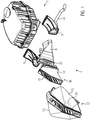
- FIG. 1 The drawing shows an exploded view of an embodiment of an air intake device 1 according to the present invention.
- the air intake device 1 is for example for arrangement on the in Fig. 13 the drawing shown motorcycle 2 is provided.
- the motorcycle 2 has an internal combustion engine 3, which is a V2 engine in the illustrated embodiment of the motorcycle.
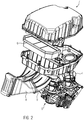
- the air intake device 1 has a cleaned intake air toward the engine leading device, which may be in general a channel-shaped body or an air guide means, and in which it is in the illustrated embodiment, in Fig. 2
- the drawing apparent funnel or air guide funnel 4 is, which may for example also constitute a part of a throttle body 5, and are provided for the cleaned via an air filter element 6 intake air toward the inlet region of the internal combustion engine 3 for the intake of the intake air and / or an intake air -C fuel mixture in the combustion chamber of the respective cylinders of the internal combustion engine 3 to lead.
- the air intake device 1 also has a housing 7 accommodating the air filter element 6, and has a channel-shaped air guide device 8 which opens into intake air lines 9 which guide the still unpurified intake air in the direction of the housing 7.
- the still unpurified intake air After the still unpurified intake air has entered the housing or air cleaner housing 7, it is passed through the air filter element 6 for purifying the intake air, and then passes through the inner space 10 of the housing 7 in the direction of the funnels 4 and is then enriched with fuel to ultimately reach the combustion chambers of the internal combustion engine 3.
- the drawing shown holding device 12 which serves both the guidance of the intake air in the direction of the air guide device 8 and the inclusion of at least one light source of the motorcycle 2 and has a generally designated by the reference numeral 46 body.
- the holding device 12 is also provided with cover plates 13, which serve the protection and the cover provided on the holding device 12 bulbs.
- the bulbs 25 are arranged in the holding device 12 shown in the drawing on both sides of the air duct 15 in the provided under the cover plates 13 interiors or areas.
- hose 14 which is arranged on the intake air line 9, serves to dissipate condensate or water, which may occur during a ride of the motorcycle 2 in the rain in the air guide device 8 and is discharged before it is in the housing 7 of Air intake device 1 can occur.
- the second intake air line 9 also has a hose for the discharge of water or condensate.
- the holding device 12 is provided with an air guide channel 15, which can be seen in more detail with reference to the further figures, into which the intake air can enter at the front region and exit at the rear region of the holding device 12 in the direction of the air inlet region of the air guiding device 8.
- FIG. 3 The drawing shows, the air guide device 8 two sections parallel running air ducts 16, which open at the rear in the drawing area in the intake air 9.
- the air ducts 16 have in the area of the intake air ducts 9 a respective end region formed complementary to the inlet region of the intake air ducts 9, so that the air ducts 16 can be detachably connected to the intake air ducts 9 in the form of a plug-in connection without the use of tools during assembly being required ,
- the intake air lines 9 are curved and open into a respective inlet opening 47 of the housing 7, wherein it due to the arrangement and formation of the air intake device 1 according to the invention via an air inlet at the front region of the air duct 15, as in Fig. 4 the drawing is shown, and the further guidance of the air via the air guide device 8 and the intake air line 9 in the direction of the air filter element 6 to a performance of the internal combustion engine 3 promoting dynamic pressure charging comes.
- FIG. 5 The drawing shows a perspective view of the multifunctional holding device 12 of the air intake device 1 according to the invention.
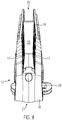
- the holding device 12 has two side walls 17 which enclose therebetween the air duct 15, which is formed by the side walls 17 and a first or upper body member 18 and a second or lower body member 19 of the body 46 and at the front or end region an air inlet region 20th and at the rear or rear region, which is associated with the air inlet region 22 of the air guide device 8, an air outlet region 21 has.
- the air duct 15 serves to guide the intake air through the holding device 12 through into the air inlet region 22 of the air guide device 8.
- the holding device 12 is formed in the illustrated embodiment of the air intake device 1 of a light metal alloy, such as an aluminum alloy, so that through the air duct 15 therethrough passing intake air during its entire passage through the air duct 15 passes through with the side walls 17 of the holding device 12 into contact and can dissipate heat from the side walls 17 in this way, which is delivered to this from the bulbs 25.
- FIG. 5 The drawing shows a receiving surface 23, which is designed for the arrangement of at least one light-emitting means 25 and has a surface 24 at which the of the one or more bulbs 25, which in Fig. 1 the drawing are shown schematically, heat transferred to the holding device 12 and here in particular to the side walls 17 are transmitted, and the heat over the the air duct 15 passing through the intake air is discharged, so that the holding device 12 on the one hand the air flow of the intake air and on the other hand, the dissipation of heat of the lamp 25, which may be formed as light-emitting diodes and also forms a receiving body for the arrangement of the lamp 25.
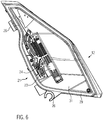
- FIG. 6 The drawing shows the holding device 12 in a representation of the right side and makes it clear that the holding device 12 has on both sides of its left center plane in each case a receiving surface 23 for illuminant 25 and a surface 24 for the discharge of the heat emitted by the bulbs 25 heat to the side walls 17 ,
- the bulbs 25 can be arranged on the surfaces 24, for example, on the light-emitting receptacles in the form of, for example, printed circuit boards not shown, and the arrangement of the circuit boards on the surfaces 24 causes the light emitted from the LEDs 25 heat through the circuit boards is discharged to the receiving surfaces 23, which is transmitted from there via heat conduction and / or convection and / or radiation to the side walls 17 and is discharged there from the air flowing through the air duct 15 intake air.
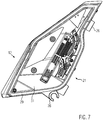
- the holding device 12 in a side view of a substantially triangular configuration and has receptacles 26, which serve the arrangement of the holding device 12 to frame members 27 of the motorcycle 2, as shown in FIG Fig. 13 the drawing is shown.
- the holding device 12 has on both side walls 17 at spaced from the air duct 15 outer region 28 formed as circumferential grooves 30 receiving surfaces 29 for the arrangement of in Fig. 1
- the bulbs 25 are protected against environmental influences in the form of, for example, rain and dirt and can emit light through the transparent cover 13 formed.
- FIG. 8 The drawing shows a view of the holding device 12 from above.
- the air duct 15 between the side walls 17 viewed from the air inlet region 20 is formed in the direction of the air outlet region 21 is tapered. This configuration ensures that the air flowing through the air duct 15 intake air undergoes a flow acceleration on its way through the air duct 15 and thus a the performance of the internal combustion engine 3 promoting configuration on the achieved improvement in the degree of filling of the combustion chambers of the internal combustion engine 3 is achieved.
- FIG. 9 The drawing shows a modified embodiment of the air intake device 1, which differs from the in Fig. 1 illustrated embodiment, characterized in that between the holding device 12 and the air guide device 8, an air guide funnel 32 is provided which has a funnel inlet region 33 which is complementary in shape and surface to the air outlet region 21 of the holding device 12 and has a widening funnel outlet region 34, the form - And surface complementary to the inlet portion 35 is formed.
- FIG. 10 the drawing shows that the air guide funnel 32 can be pivoted together with the holding device 12 in a steering movement on the motorcycle 2 around the steering head bearing tube 36 around and due to its inlet to the region 35 of the air guide device 8 form and surface complementary training without the formation of an increasing gap area between the Inlet region 35 and the Trichterauslass Society 34 can be pivoted and thus a deterioration of the flow characteristic of the intake air provided by the air intake device 1 due to a steering movement on the motorcycle can be avoided.
- the air guide hopper 32 may be formed of an elastomer, such as a rubber-like material, which conforms to the hopper inlet portion 33 of the air guide hopper 32.
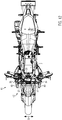
- FIG. 11 The drawing shows a view from above of a equipped with the air intake device 1 of the invention motorcycle 2.
- the known air intake device has provided with the reference numeral 37 air inlet portions in air ducts 38 which extend around the steering head bearing tube 39 around and are covered from the outside of lining components 40.
- the reduction of the drag of the motorcycle 2 with the air intake device according to the invention provides a more efficient configuration in terms of the achievable fuel consumption and also ensures that the overall appearance of the motorcycle is improved due to the widthwise slimmer configuration of the motorcycle 2.
- FIG. 13 The drawing shows a provided with the air intake device 1 according to the invention motorcycle 2 in a side view, wherein the motorcycle is a front wheel 42, a rear wheel 43, a driver's saddle 44 and the already mentioned internal combustion engine 3 has.
- FIG. 13 The drawing is apparent, occurs - symbolically represented by the arrows 45 - the intake air into the air duct 45 and is guided from there via the air guide device 8 and the intake air 9 to the housing 7 of the air intake device 1 according to the invention.
- the holding device 12 is formed with its air duct 15 both for guiding the intake air and for receiving the closer by means of Fig. 1
- the drawing apparent light source 25 is formed in the form of light emitting diodes and can dissipate heat emitted by the light emitting diodes during operation via the air duct 15 flowing through the intake air, so that a multifunctional configuration was created with the air intake device according to the invention.
Landscapes
- Engineering & Computer Science (AREA)
- Mechanical Engineering (AREA)
- Chemical & Material Sciences (AREA)
- Combustion & Propulsion (AREA)
- General Engineering & Computer Science (AREA)
- Transportation (AREA)
- Cooling, Air Intake And Gas Exhaust, And Fuel Tank Arrangements In Propulsion Units (AREA)
- Automatic Cycles, And Cycles In General (AREA)
Abstract
Description
- Die vorliegende Erfindung betrifft eine Luftansaugvorrichtung für ein mit einer Brennkraftmaschine ausgestattetes Fahrzeug, mit einer gereinigte Ansaugluft für die Verbrennung in Richtung zur Brennkraftmaschine führenden Einrichtung und einem Luftfilterelement sowie einem das Luftfilterelement aufnehmenden Gehäuse und mindestens einer Luftführungseinrichtung, welche kanalförmig ausgebildet ist und zur Führung von Ansaugluft zum Gehäuse vorgesehen ist, nach dem Oberbegriff des Anspruchs 1.
- Anhand eines auf die Anmelderin zurückgehenden Motorrads ist eine gattungsgemäße Luftansaugvorrichtung bekannt geworden, wie sie vorstehend beschrieben wurde und bei der zwei Luftführungseinrichtungen in der Form von mit einem rechteckigen Querschnitt versehenen Kanälen vorgesehen sind, die in ein Gehäuse münden, in dem ein Luftfilterelement vorgesehen ist. Die gereinigte Luft wird dann mittels einer Einrichtung in der Form von zwei Luftführungen einer Drosselklappeneinrichtung und stromabwärts dieser der Brennkraftmaschine zugeführt.
- Diese vorstehend erwähnten Kanäle erstrecken sich dabei von einer stirnseitigen Vorderseite des Gehäuses ausgehend in Fahrtrichtung des Motorrads betrachtet in Richtung nach vorne und beiderseitig von einer Längsmittelebene des Gehäuses ausgehend nach außen, sodass sich die jeweilige Lufteintrittsöffnung des Kanals in einer Ansicht auf die bekannte Konfiguration von oben außerhalb der äußeren seitlichen Umrissbegrenzungslinien des Gehäuses befinden. Diese Konfiguration ist erforderlich, da sich die Kanäle mit ihren Lufteintrittsöffnungen um eine den Hauptscheinwerfer des Motorrads aufnehmende Lampenmaske herum erstrecken müssen, da die Lampenmaske, die mit ihrer flächigen seitlichen Erstreckung den Hauptscheinwerfer aufnimmt und umgibt, andernfalls den Eintritt von Frischluft oder Ansaugluft in die Lufteintrittsöffnungen der Kanäle behindert.
- Das genannte Fahrzeug besitzt seitlich eines Hauptrahmens des Motorrads angeordnete Seitenverkleidungselemente, welche die Kanäle seitlich abdecken, sodass sich die Lufteintrittsöffnungen innerhalb der Seitenverkleidungselemente befinden.
- Obwohl sich diese Konfiguration bereits bestens bewährt hat, besitzt sie dennoch Raum für Verbesserungen dahingehend, dass in Fahrzeuglängsrichtung die Baubreite der bekannten Luftansaugvorrichtung zu verringern ist und damit die Baubreite des Fahrzeugs insgesamt verringert werden kann, womit gleichzeitig die den Fahrwiderstand des Motorrads beeinflussende Stirnfläche verringert werden kann.
- Ausgehend hiervon liegt der vorliegenden Erfindung die Aufgabe zugrunde, die bekannte Luftansaugvorrichtung derart weiterzubilden, dass sich eine Luftansaugvorrichtung mit quer zur Fahrzeuglängsrichtung betrachtet verringerter Baubreite einstellt und somit die Baubreite des Fahrzeugs insgesamt verringert werden kann. Auch soll ein mit der bereitzustellenden Luftansaugvorrichtung versehenes Fahrzeug bereitgestellt werden.
- Die Erfindung weist zur Lösung dieser Aufgabe hinsichtlich der Luftansaugvorrichtung die im Anspruch 1 angegebenen Merkmale auf. Vorteilhafte Ausgestaltungen hiervon sind in den weiteren Ansprüchen beschrieben. Darüber hinaus weist die Erfindung hinsichtlich des zu schaffenden Fahrzeugs die im Anspruch 14 angegebenen Merkmale auf.
- Die Erfindung schafft eine Luftansaugvorrichtung für ein mit einer Brennkraftmaschine ausgestattetes Fahrzeug, mit einer gereinigte Ansaugluft für die Verbrennung in Richtung zur Brennkraftmaschine führenden Einrichtung und einem Luftfilterelement sowie einem das Luftfilterelement aufnehmenden Gehäuse und mindestens einer Luftführungseinrichtung, welche kanalförmig ausgebildet ist und zur Führung von Ansaugluft zum Gehäuse vorgesehen ist, wobei sich die Luftführungseinrichtung im Bereich zwischen einer Halteeinrichtung und dem Gehäuse erstreckt und die Halteeinrichtung zur Aufnahme mindestens eines Leuchtmittels ausgebildet ist und einen zum Leuchtmittel benachbarten Luftleitkanal aufweist, der mit der Luftführungseinrichtung luftführend verbunden ist.
- Mit der erfindungsgemäßen Ausgestaltung der Luftansaugvorrichtung wird erreicht, dass durch die Integration des dem Leuchtmittel benachbarten Luftleitkanals in die Halteeinrichtung in der Form der Halteeinrichtung ein multifunktionales Bauteil bereitgestellt wird, welches sowohl zur Aufnahme mindestens eines Leuchtmittels ausgebildet ist als auch gleichzeitig die Funktion der Leitung oder Führung der Ansaugluft mittels des Luftleitkanals zur Luftführungseinrichtung ausführt.
- Die Halteeinrichtung wird in vorteilhafter Weise in Fahrzeuglängsrichtung beispielsweise mittig oder im Bereich der Längsmittelebene des Fahrzeugs angeordnet, sodass sich die Luftführungseinrichtung von der Halteeinrichtung ausgehend in Richtung zum Gehäuse der Luftansaugvorrichtung erstreckt.
- Die Halteeinrichtung wird in vorteilhafter Weise am Fahrzeug vorne angeordnet, d. h. in Fahrzeuglängsrichtung betrachtet oder Fahrtrichtung des Fahrzeugs bei einer Vorwärtsfahrt am oder in der Nähe des vorderen Endbereichs des Fahrzeugs, sodass bei einer Vorwärtsfahrt des Fahrzeugs die Ansaugluft über den Luftleitkanal der Halteeinrichtung in die Luftführungseinrichtung gelangt. Es findet also durch diese Konfiguration in Abhängigkeit von der Fahrgeschwindigkeit des Fahrzeugs eine Staudruckaufladung statt und zudem sorgt die Konfiguration, dass sich der Luftleitkanal benachbart zum Leuchtmittel angeordnet befindet, dafür, dass der den Luftleitkanal durchströmende Ansaugluftstrom die vom Leuchtmittel auf die Halteeinrichtung übertragene Wärme abführen kann. Die Halteeinrichtung wirkt also gleichzeitig als Kühlkörper oder Kühleinrichtung für das oder die Leuchtmittel.
- Bei dem oder den Leuchtmitteln kann es sich in vorteilhafter Weise um Leuchtdioden handeln, welche beispielsweise an einer Steuerplatine oder Schaltplatine angeordnet sind, die gleichzeitig der Aufnahme der Leuchtdiode oder der Leuchtdioden dient und die so in oder an der Halteeinrichtung angeordnet ist, dass die Abwärme der Leuchtdioden und der auf der Steuerplatine oder Schaltplatine angeordneten Steuerelektronik auf die Halteeinrichtung übertragen wird, welche von dem Luftleitkanal durchzogen oder durchsetzt ist, sodass die den Luftleitkanal durchströmende Ansaugluft gleichzeitig als Kühlluftstrom fungieren kann.
- Durch die Konfiguration, dass sich die Luftführungseinrichtung im Bereich zwischen der Halteeinrichtung und dem Gehäuse erstreckt, wird erreicht, dass sich die Luftführungseinrichtung vom Gehäuse der Luftansaugvorrichtung in Richtung nach vorne erstreckt und sich somit in Fahrtrichtung des Fahrzeugs betrachtet eng an der Längsmittelebene des Fahrzeugs anschmiegt und somit verglichen mit der bekannten Luftansaugvorrichtung eine deutliche Verringerung der Erstreckung der Luftansaugvorrichtung in Breitenrichtung des Fahrzeugs erreicht wird.
- Somit wird durch die erfindungsgemäße Luftansaugvorrichtung eine multifunktionale Einrichtung geschaffen, die der Luftzuführung für die Brennkraftmaschine dient, gleichzeitig die Breitenerstreckung des Fahrzeugs verringert und zudem als Kühlkörper oder Kühleinrichtung für das oder die Leuchtmittel des Fahrzeugs dient.
- Es ist nach einer Weiterbildung der Erfindung vorgesehen, dass die Luftführungseinrichtung mindestens zwei abschnittsweise weitgehend parallel verlaufende Luftführungskanäle aufweist, die an einem Endbereich einstückig miteinander verbunden ausgebildet sind.
- Diese Konfiguration sorgt dafür, dass die parallel verlaufenden Luftführungskanäle vom Gehäuse der Luftansaugvorrichtung ausgehend an der Längsmittelebene des Fahrzeugs eng anliegend vorgesehen sind und so der in die Luftführungskanäle eintretende Ansaugluftstrom mit hoher Strömungsgeschwindigkeit in Richtung zum Gehäuse der Luftansaugvorrichtung strömen kann und auf diese Weise Fluidreibungsverluste durch Wandanlagerungen des Luftstroms in den Luftführungskanälen verringert werden können.
- Es ist nach einer Weiterbildung der Erfindung vorgesehen, dass die Luftansaugvorrichtung einen jeweiligen Luftführungskanal besitzt, der mittels einer gekrümmt ausgebildeten Ansaugluftleitung mit einer Einlassöffnung des Gehäuses luftführend verbunden ist und ein jeweiliger Endbereich des Luftführungskanals mit einem zugeordneten Anschlussbereich der Ansaugluftleitung in der Form einer gesteckten Verbindung lösbar verbindbar ausgebildet ist.
- Diese Konfiguration führt dazu, dass der jeweilige Luftführungskanal vom Luftleitkanal der Halteeinrichtung ausgehend in Richtung des Gehäuses eine einem Schnorchel ähnliche Ansaugluftleitung besitzt, die zur einfachen Montage bei der Fertigung des mit der erfindungsgemäßen Luftansaugvorrichtung ausgestatteten Fahrzeugs ohne Werkzeugeinsatz mittels der Herbeiführung einer einfachen Steckverbindung zwischen der Ansaugluftleitung und dem Luftführungskanal hergestellt werden kann.
- Es hat sich als vorteilhaft erwiesen, wenn die Ansaugluftleitung vom Luftführungskanal ausgehend eine bereichsweise oder abschnittsweise nach unten gerichtete Konfiguration aufweist, da auf diese Weise in den Luftleitkanal der Halteeinrichtung bei einer Fahrt des Fahrzeugs im Regen in Richtung zur Ansaugluftleitung eintretendes Wasser über eine beispielsweise in der Ansaugluftleitung vorgesehene Ablaufbohrung abgeleitet werden kann, bevor es in das Gehäuse der Luftansaugvorrichtung eintritt.
- Es ist nach einer Weiterbildung der Erfindung vorgesehen, dass die Halteeinrichtung ein mit dem zwischen Seitenwänden angeordneten Luftleitkanal ausgebildeter Körper ist, der die Seitenwände verbindende und zusammen mit den Seitenwänden den Luftleitkanal einschließende erste und zweite Körperelemente aufweist und einen Lufteintrittsbereich sowie einen der Luftführungseinrichtung zugewandten Luftaustrittsbereich aufweist.
- Die Seitenwände können gleichzeitig als Kühlkörper für die Ableitung der von dem oder den Leuchtmitteln und deren Steuerelektronik abgegebener Wärme dienen und bilden zusammen mit den ersten und zweiten Körperelementen, welche die Seitenwände verbinden, einen den Luftleitkanal einschließenden Bereich aus, der im in Fahrtrichtung des Fahrzeugs vorderen Bereich der Halteeinrichtung einen Lufteintrittsbereich ausbildet und im in Fahrtrichtung des Fahrzeugs hinteren Bereich der Halteeinrichtung einen Luftaustrittsbereich aufweist, der der Luftführungseinrichtung zugewandt ist. Der Luftleitkanal der Halteeinrichtung kann im Bereich zwischen dem Lufteintrittsbereich und dem Luftaustrittsbereich beispielsweise auch eine sich verjüngende Konfiguration aufweisen, sodass die den Luftleitkanal durchströmende Ansaugluft eine Strömungsbeschleunigung erfährt.
- Es ist nach einer Weiterbildung der Erfindung auch vorgesehen, dass die Halteeinrichtung mindestens eine Aufnahmefläche zur Anordnung mindestens eines Leuchtmittels aufweist und die Aufnahmefläche zur Ableitung von Wärme des Leuchtmittels ausgebildet ist.
- Die Aufnahmefläche kann beispielsweise zur Anordnung der vorstehend erwähnten Steuerplatine oder Schaltplatine dienen, sodass die von den beispielsweise als Leuchtdioden ausgebildeten Leuchtmitteln abgegebene Wärme über die Aufnahmefläche an die Seitenwände der Halteeinrichtung abgegeben wird, welche an der dem Luftleitkanal zugewandten Seite von der durch den Luftleitkanal durchströmenden Ansaugluft aktiv gekühlt werden.
- Es ist nach einer Weiterbildung der Erfindung auch vorgesehen, dass die Halteeinrichtung an einem der Luftführungseinrichtung zugewandten Endbereich des Luftleitkanals eine zur Konfiguration eines Lufteintrittsbereichs der Luftführungseinrichtung weitgehend form- und flächenkomplementäre Konfiguration aufweist.
- Die Halteeinrichtung kann bei ihrer Anordnung an beispielsweise einem Motorrad im Bereich der oberen Gabelbrücken einer Vorderradgabel des Motorrads angeordnet sein, sodass die Halteeinrichtung bei Lenkbewegungen des Motorrads zusammen mit der Vorderradgabel relativ zur Längsmittelachse beziehungsweise Längsmittelebene des Motorrads Verschwenkbewegungen erfährt und sich so eine Winkelveränderung des Luftaustrittsbereichs des Luftleitkanals der Halteeinrichtung relativ zum Lufteintrittsbereich der Luftführungseinrichtung einstellt.
- Durch die form- und flächenkomplementäre Konfiguration des Endbereichs des Luftleitkanals relativ zum Lufteintrittsbereich der Luftführungseinrichtung wird erreicht, dass der den Luftleitkanal weitgehend laminar durchströmende Ansaugluftstrom im Übergangsbereich zwischen dem Luftleitkanal und dem Lufteintrittsbereich der Luftführungseinrichtung nur wenige, die laminare Strömung beeinträchtigende Fluidstörungen erfährt und sich somit eine hohe Strömungsgeschwindigkeit im gesamten Ansaugluftbereich vor dem Gehäuse der Luftansaugvorrichtung einstellt.
- Es ist nach einer Weiterbildung der Erfindung auch vorgesehen, dass die Halteeinrichtung an vom Luftführungskanal abgewandten Außenbereichen der Seitenwände Aufnahmeflächen zur Anordnung von Leuchtmittel überdeckenden Abdeckscheiben aufweist.
- Durch diese Konfiguration wird es erreicht, dass beidseits des Luftführungskanals, der die Halteeinrichtung vollständig durchsetzen kann, an den Seitenwänden Abdeckscheiben angeordnet werden können, welche so beidseits des Luftführungskanals angeordnet sind und jeweils einen Aufnahmeraum zwischen den Seitenwänden und den Abdeckscheiben begrenzen, in welchem das oder die Leuchtmittel angeordnet sein können.
- Auf diese Weise befindet sich beidseits des Luftführungskanals jeweils ein Aufnahmeraum angeordnet, in dem beispielsweise die Steuerplatine mit den daran angeordneten Leuchtdioden an der jeweiligen, vorstehend bereits erwähnten Aufnahmefläche angeordnet sind und der jeweilige Aufnahmeraum außen von der Abdeckscheiben überspannt wird. Der Luftführungskanal durchsetzt die Halteeinrichtung vollständig und befindet sich daher zwischen den Abdeckscheiben angeordnet und die durch den Luftführungskanal strömende Ansaugluft kühlt die dem Luftführungskanal jeweils zugeordnete Rückseite der jeweiligen Seitenwand. Durch die beidseits des Luftführungskanals vorgesehenen Aufnahmeräume für Leuchtmittel können eine dem jeweiligen Bedarf an Leuchtstärke der Leuchtmittel des Fahrzeugs angepasste Zahl an Leuchtmittel in der Form von beispielsweise Leuchtdioden integriert werden.
- Es ist nach einer Weiterbildung der Erfindung vorgesehen, dass Seitenwände der Halteeinrichtung in einer Seitenansicht eine einem Dreieck ähnliche Konfiguration aufweisen und obere Bereiche der Seitenwände mit dem ersten Körperelement einstückig ausgebildet sind und die Seitenwände im Abstand zu unteren Bereichen der Seitenwände mit dem zweiten Körperelement einstückig ausgebildet sind. Durch diese Konfiguration wird gleichsam ein einem Einlauftrichter ähnliche Konfiguration des Luftleitkanals der Halteeinrichtung ausgebildet, die für eine hohe Strömungsgeschwindigkeit der Ansaugluft im Bereich des Luftleitkanals der Halteeinrichtung sorgt.
- Es ist nach einer Weiterbildung der Erfindung vorgesehen, dass die Halteeinrichtung Mittel zur Anordnung von mindestens einer, mindestens ein Leuchtmittel tragender Aufnahme aufweist und das Mittel und/oder die Aufnahme und/oder das Leuchtmittel mit der Halteeinrichtung zur Wärmeübertragung auf die Halteeinrichtung funktional gekoppelt ist.
- Bei dem Mittel kann es sich beispielsweise um eine oder mehrere Gewindebohrungen handeln, an denen die ein Leuchtmittel tragende Aufnahme in der Form beispielsweise einer Leiterplatte festgelegt werden kann. Bei dem Mittel kann es sich beispielsweise auch um eine zur Aufnahme eines elastischen Bauteils in der Form beispielsweise eines aus einem Elastomer ausgebildeten Abstandhalters ausgebildeten Ausnehmung handeln, sodass mit dem oder den elastischen Abstandhaltern die Leiterplatte mit den daran angeordneten Leuchtdioden schwingungsbedämpft oder schwingungsentkoppelt an der Halteeinrichtung festgelegt werden kann. Diese Konfiguration sorgt dafür, dass beispielsweise von der Brennkraftmaschine des Fahrzeugs induzierte Schwingungen nicht oder nur gedämpft auf die Leuchtdioden übertragen werden.
- Es ist nach einer Weiterbildung der Erfindung auch vorgesehen, dass der Luftleitkanal der Halteeinrichtung mit einer Führungseinrichtung oder Führungsfläche zur Führung von den Luftleitkanal durchströmender Luft in Kontakt mit einer vom Wärme abgebenden Leuchtmittel erwärmten Fläche mindestens einer Seitenwand ausgebildet ist.
- Bei der Führungseinrichtung oder Führungsfläche kann es sich beispielsweise um eine in den Luftleitkanal integrierte Luftleitfläche handeln, welche die in den Luftleitkanal strömende Ansaugluft gezielt auf den Bereich der Seitenwand beziehungsweise der Seitenwände der Halteeinrichtung leitet, der über die Abwärme der Leuchtmittel am meisten erwärmt wird.
- Es ist nach einer Weiterbildung der Erfindung auch vorgesehen, dass der Endbereich der Luftführungseinrichtung einen sich in Richtung zum Lufteintrittsbereich querschnittlich erweiternden Übergangsbereich besitzt, welcher dem Luftleitkanal der Halteeinrichtung zugeordnet ist.
- Auf diese Weise wird erreicht, dass die aus dem Luftaustrittsbereich des Luftleitkanals der Halteeinrichtung ausströmende Ansaugluft auch bei einer Winkelveränderung der Halteeinrichtung relativ zur Luftführungseinrichtung, beispielsweise aufgrund der vorstehend bereits erwähnten Verschwenkbewegungen der Halteeinrichtung bei Lenkbewegungen am Fahrzeug, gezielt in den Lufteintrittsbereich der Luftführungseinrichtung tritt und nicht beispielsweise stumpf auf eine den Lufteintrittsbereich der Luftführungseinrichtung begrenzende Wandfläche. Diese Konfiguration sorgt dafür, dass eine hohe Geschwindigkeit der den Luftleitkanal durchsetzenden Ansaugluft auch bei Lenkbewegungen beibehalten bleibt.
- Die Erfindung schafft schließlich auch ein Fahrzeug mit mindestens einem Vorderrad sowie mindestens einem Hinterrad und einer Brennkraftmaschine, welche eine Luftansaugvorrichtung aufweist, wie sie vorstehend beschrieben wurde. Bei dem Fahrzeug kann es sich beispielsweise um eine einspuriges Fahrzeug in der Form eines Motorrads handeln, oder auch um ein mehr als einspuriges Fahrzeug in der Form eines All-Terrain Vehicles oder ATVs oder Quads.
- Die Erfindung wird im folgenden anhand der Zeichnung näher erläutert. Diese zeigt in:
-
Fig. 1 eine Ausführungsform der Luftansaugvorrichtung nach der Erfindung in einer Explosionsdarstellung; -
Fig. 2 eine weitere Explosionsdarstellung von Elementen der Luftansaugvorrichtung; -
Fig. 3 eine Ansicht von oben auf Elemente der Luftansaugvorrichtung; -
Fig. 4 eine schematische Darstellung zur Erläuterung der Führung der Ansaugluft in Richtung zum Gehäuse der Luftansaugvorrichtung; -
Fig. 5 eine perspektivische Darstellung einer Halteeinrichtung der Luftansaugvorrichtung; -
Fig. 6 eine Darstellung der Halteeinrichtung in einer rechten Seitenansicht; -
Fig. 7 eine Darstellung der Halteeinrichtung in einer linken Seitenansicht; -
Fig. 8 eine Ansicht von oben auf die Halteeinrichtung; -
Fig. 9 eine teilweise Explosionsdarstellung einer Luftansaugvorrichtung nach einer modifizierten Ausführungsform; -
Fig. 10 eine schematische Darstellung einer Ansicht von oben auf eine Luftansaugvorrichtung nach der modifizierten Ausführungsform in eine Drehwinkelstellung; -
Fig. 11 eine Ansicht von oben auf ein mit der erfindungsgemäßen Luftansaugvorrichtung ausgestattetes Motorrad; -
Fig. 12 zum Vergleich mit derFig. 11 eine Ansicht von oben auf ein mit der bekannten Luftansaugvorrichtung ausgestattetes Motorrad; und -
Fig. 13 eine Seitenansicht eines schematisch dargestellten Motorrads mit der erfindungsgemäßen Luftansaugvorrichtung. -
Fig. 1 der Zeichnung zeigt eine Explosionsdarstellung einer Ausführungsform einer Luftansaugvorrichtung 1 gemäß der vorliegenden Erfindung. - Die Luftansaugvorrichtung 1 ist beispielsweise zur Anordnung an dem in
Fig. 13 der Zeichnung dargestellten Motorrad 2 vorgesehen. Das Motorrad 2 besitzt eine Brennkraftmaschine 3, bei der es sich bei der dargestellten Ausführungsform des Motorrads um einen V2 Motor handelt. - Die Luftansaugvorrichtung 1 besitzt eine gereinigte Ansaugluft in Richtung zur Brennkraftmaschine führende Einrichtung, bei der es sich ganz allgemein um einen kanalförmigen Körper oder ein Luftführungsmittel handeln kann, und bei der es sich bei der dargestellten Ausführungsform um in
Fig. 2 der Zeichnung ersichtliche Trichter oder Luftführungstrichter 4 handelt, welche beispielsweise auch einen Teil eines Drosselklappenkörpers 5 darstellen können, und dafür vorgesehen sind, die über ein Luftfilterelement 6 gereinigte Ansaugluft in Richtung zu dem Einlassbereich der Brennkraftmaschine 3 für den Eintritt der Ansaugluft und/oder eines Ansaugluft-Kraftstoff-Gemisches in den Brennraum der jeweiligen Zylinder der Brennkraftmaschine 3 führen zu können. - Die Luftansaugvorrichtung 1 weist darüber hinaus ein das Luftfilterelement 6 aufnehmendes Gehäuse 7 auf, und besitzt eine kanalförmige ausgebildete Luftführungseinrichtung 8, welche in Ansaugluftleitungen 9 mündet, welche die noch ungereinigte Ansaugluft in Richtung zum Gehäuse 7 führen.
- Nachdem die noch ungereinigte Ansaugluft in das Gehäuse oder Luftfiltergehäuse 7 eingetreten ist, wird sie durch das Luftfilterelement 6 zur Reinigung der Ansaugluft hindurch geführt, und tritt dann über den Innenraum 10 des Gehäuses 7 in Richtung zu den Trichtern 4 weiter und wird dann mit Kraftstoff angereichert, um letztlich in die Brennräume der Brennkraftmaschine 3 zu gelangen.
- Wie es beispielsweise anhand von
Fig. 1 der Zeichnung ersichtlich ist, ist am Lufteintrittsbereich 11 der Luftführungseinrichtung 8 eine näher anhand derFiguren 5 bis 8 der Zeichnung dargestellte Halteeinrichtung 12 vorgesehen, welche sowohl der Führung der Ansaugluft in Richtung zur Luftführungseinrichtung 8 als auch der Aufnahme mindestens eines Leuchtmittels des Motorrads 2 dient und einen ganz allgemein mit dem Bezugszeichen 46 bezeichneten Körper aufweist. -
Fig. 1 der Zeichnung zeigt darüber hinaus der Erläuterung halber die Halteeinrichtung 12 auch noch mit Abdeckscheiben 13 versehen, welche dem Schutz und der Abdeckung der an der Halteeinrichtung 12 vorgesehenen Leuchtmittel dienen. - Die Leuchtmittel 25 sind bei der in der Zeichnung dargestellten Halteeinrichtung 12 zu beiden Seiten des Luftleitkanals 15 in den unter den Abdeckscheiben 13 vorgesehenen Innenräumen oder Bereichen angeordnet.
- Ein in
Fig. 1 der Zeichnung dargestellter Schlauch 14, der an der Ansaugluftleitung 9 angeordnet ist, dient der Ableitung von Kondensat oder Wasser, welches beispielsweise bei einer Fahrt des Motorrads 2 im Regen in die Luftführungseinrichtung 8 eintreten kann und abgeführt wird, bevor er ist in das Gehäuse 7 der Luftansaugvorrichtung 1 eintreten kann. Die zweite Ansaugluftleitung 9 weist ebenfalls einen Schlauch zur Ableitung von Wasser oder Kondensat auf. - Die Halteeinrichtung 12 ist mit einem näher anhand der weiteren Figuren ersichtlichen Luftleitkanal 15 versehen, in den die Ansaugluft am vorderen Bereich eintreten und am hinteren Bereich der Halteeinrichtung 12 in Richtung zum Lufteintrittsbereich der Luftführungseinrichtung 8 wieder austreten kann.
- Wie es anhand von
Fig. 3 der Zeichnung ersichtlich ist, weist die Luftführungseinrichtung 8 zwei abschnittsweise parallel verlaufende Luftführungskanäle 16 auf, welche am in der Zeichnung hinteren Bereich in die Ansaugluftleitungen 9 münden. Die Luftführungskanäle 16 besitzen dabei im Bereich der Ansaugluftleitungen 9 einen jeweiligen komplementär zum Einlassbereich der Ansaugluftleitungen 9 ausgebildeten Endbereich, sodass die Luftführungskanäle 16 mit den Ansaugluftleitungen 9 in der Form einer gesteckten Verbindung lösbar miteinander verbunden werden können, ohne dass hierzu Werkzeugeinsatz bei der Montage erforderlich ist. - Die Ansaugluftleitungen 9 sind dabei gekrümmt ausgebildet und münden in einer jeweiligen Einlassöffnung 47 des Gehäuses 7, wobei es aufgrund der Anordnung und Ausbildung der erfindungsgemäßen Luftansaugvorrichtung 1 über einen Lufteintritt am vorderen Bereich des Luftleitkanals 15, wie dies in
Fig. 4 der Zeichnung dargestellt ist, und der weiteren Führung der Luft über die Luftführungseinrichtung 8 und die Ansaugluftleitung 9 in Richtung zum Luftfilterelement 6 zu einer die Leistung der Brennkraftmaschine 3 fördernden Staudruckaufladung kommt. -
Fig. 5 der Zeichnung zeigt eine perspektivische Darstellung der multifunktionalen Halteeinrichtung 12 der erfindungsgemäßen Luftansaugvorrichtung 1. - Die Halteeinrichtung 12 weist zwei Seitenwände 17 auf, welche zwischen sich den Luftleitkanal 15 einschließen, der von den Seitenwänden 17 und einem ersten oder oberen Körperelement 18 sowie einem zweiten oder unteren Körperelement 19 des Körpers 46 ausgebildet ist und am vorderen oder stirnseitigen Bereich einen Lufteintrittsbereich 20 und am hinteren oder rückwärtigen Bereich, der dem Lufteintrittsbereich 22 der Luftführungseinrichtung 8 zugeordnet ist, einen Luftaustrittsbereich 21 aufweist.
- Der Luftleitkanal 15 dient so der Führung der Ansaugluft durch die Halteeinrichtung 12 hindurch bis in den Lufteintrittsbereich 22 der Luftführungseinrichtung 8. Die Halteeinrichtung 12 ist bei der dargestellten Ausführungsform der Luftansaugvorrichtung 1 aus einer Leichtmetalllegierung gebildet, beispielsweise einer Aluminiumlegierung, sodass die durch den Luftleitkanal 15 hindurch tretende Ansaugluft während ihres gesamten Wegs durch den Luftleitkanal 15 hindurch mit den Seitenwänden 17 der Halteeinrichtung 12 in Kontakt kommt und auf diesem Weg Wärme von den Seitenwänden 17 abführen kann, die an diese von den Leuchtmitteln 25 abgegeben wird.
-
Fig. 5 der Zeichnung zeigt eine Aufnahmefläche 23, welche zur Anordnung mindestens eines Leuchtmittels 25 ausgebildet ist und eine Fläche 24 aufweist, an der die von dem oder den Leuchtmitteln 25, welche inFig. 1 der Zeichnung schematisch dargestellt sind, abgegebene Wärme an die Halteeinrichtung 12 und hier insbesondere an die Seitenwände 17 übertragen werden, und die Wärme über die den Luftleitkanal 15 durchsetzende Ansaugluft abgeführt wird, sodass die Halteeinrichtung 12 einerseits der Luftführung der Ansaugluft dient und andererseits auch der Abführung von Wärme der Leuchtmittel 25, die als Leuchtdioden ausgebildet sein können und zudem einen Aufnahmekörper für die Anordnung der Leuchtmittel 25 ausbildet. -
Fig. 6 der Zeichnung zeigt die Halteeinrichtung 12 in einer Darstellung von der rechten Seite und macht deutlich, dass die Halteeinrichtung 12 beidseitig ihrer Linksmittelebene jeweils eine Aufnahmefläche 23 für Leuchtmittel 25 und eine Fläche 24 für die Abführung der von den Leuchtmitteln 25 abgegebenen Wärme an die Seitenwände 17 aufweist. - Die Leuchtmittel 25 können dabei an den Flächen 24 beispielsweise über die Leuchtmittel tragende Aufnahmen in der Form von beispielsweise nicht näher dargestellten Leiterplatten angeordnet sein, und die Anordnung der Leiterplatten an den Flächen 24 dazu führt, dass die von den Leuchtdioden 25 abgegebene Wärme über die Leiterplatten an die Aufnahmeflächen 23 abgegeben wird, die von dort über Wärmeleitung und/oder Konvektion und/oder Strahlung an die Seitenwände 17 übertragen wird und dort von der durch den Luftleitkanal 15 durchströmenden Ansaugluft abgeführt wird.
- Wie es beispielsweise anhand von
Fig. 7 der Zeichnung dargestellt ist, weist die Halteeinrichtung 12 in einer Seitenansicht eine weitgehend dreieckförmige Konfiguration auf und besitzt Aufnahmen 26, die der Anordnung der Halteeinrichtung 12 an Rahmenbauteilen 27 des Motorrads 2 dienen, wie dies inFig. 13 der Zeichnung dargestellt ist. - Die Halteeinrichtung 12 weist an beiden Seitenwänden 17 am vom Luftleitkanal 15 beabstandeten äußeren Bereich 28 als umlaufende Nuten 30 ausgebildete Aufnahmeflächen 29 für die Anordnung der in
Fig. 1 der Zeichnung dargestellten Abdeckscheiben 13 auf, die den jeweiligen Aufnahmeraum 31 der Halteeinrichtung 12 für die Anordnung der Leuchtmittel 25 überdecken und nach außen abschließen. - Auf diese Weise sind die Leuchtmittel 25 gegen Umwelteinflüsse in der Form von beispielsweise Regen und Schmutz geschützt und können über die transparent ausgebildeten Abdeckscheiben 13 Licht abstrahlen.
-
Fig. 8 der Zeichnung zeigt eine Ansicht auf die Halteeinrichtung 12 von oben. Wie es ohne weiteres ersichtlich ist, ist der Luftleitkanal 15 zwischen den Seitenwänden 17 vom Lufteintrittsbereich 20 aus betrachtet in Richtung zum Luftaustrittsbereich 21 sich verjüngend ausgebildet. Diese Konfiguration sorgt dafür, dass die durch den Luftleitkanal 15 strömende Ansaugluft auf ihrem Weg durch den Luftleitkanal 15 hindurch eine Strömungsbeschleunigung erfährt und somit eine die Leistung der Brennkraftmaschine 3 fördernde Konfiguration über die damit erreichte Verbesserung des Füllungsgrads der Brennräume der Brennkraftmaschine 3 erreicht wird. -
Fig. 9 der Zeichnung zeigt eine modifizierte Ausführungsform der Luftansaugvorrichtung 1, die sich von der inFig. 1 dargestellten Ausführungsform dadurch unterscheidet, dass zwischen der Halteeinrichtung 12 und der Luftführungseinrichtung 8 ein Luftführungstrichter 32 vorgesehen ist, der einen Trichtereinlaufbereich 33 aufweist, der form- und flächenkomplementär zu dem Luftaustrittsbereich 21 der Halteeinrichtung 12 ausgebildet ist und einen sich erweiternden Trichterauslaufbereich 34 besitzt, der form- und flächenkomplementär zu dem Einlassbereich 35 ausgebildet ist. -
Fig. 10 der Zeichnung zeigt, dass der Luftführungstrichter 32 zusammen mit der Halteeinrichtung 12 bei einer Lenkbewegung am Motorrad 2 um das Lenkkopflagerrohr 36 herum verschwenkt werden kann und aufgrund seiner zum Einlassbereich 35 der Luftführungseinrichtung 8 form- und flächenkomplementären Ausbildung ohne die Ausbildung eines sich vergrößernden Spaltbereichs zwischen dem Einlassbereich 35 und dem Trichterauslassbereich 34 verschwenkt werden kann und somit eine Verschlechterung der Strömungscharakteristik der durch die Luftansaugvorrichtung 1 bereitgestellten Ansaugluft aufgrund einer Lenkbewegung am Motorrad vermieden werden kann. Der Luftführungstrichter 32 kann aus einem Elastomer gebildet sein, beispielsweise einem gummiartigen Werkstoff, der sich an den Trichtereinlaufbereich 33 des Luftführungstrichters 32 anschmiegt. -
Fig. 11 der Zeichnung zeigt eine Ansicht von oben auf ein mit der erfindungsgemäßen Luftansaugvorrichtung 1 ausgestattetes Motorrad 2. - Im Vergleich hierzu zeigt
Fig. 12 der Zeichnung ein auf die Anmelderin zurückgehendes und mit der bekannten Luftansaugvorrichtung ausgestattetes bekanntes Motorrad in einer Ansicht von oben. Die bekannte Luftansaugvorrichtung weist mit dem Bezugszeichen 37 versehene Lufteinlassbereiche in Luftführungskanäle 38 auf, welche um das Lenkkopflagerohr 39 herum verlaufen und von außen von Verkleidungsbauteilen 40 abgedeckt sind. - Wird nun dieser Stirnflächenbereich 41 des bekannten Motorrads nach
Fig. 12 der Zeichnung mit dem Stirnflächenbereich 41 des Motorrads 2 mit der Luftansaugvorrichtung 1 nach der Erfindung verglichen, so wird sofort klar, dass die Stirnfläche 42 des bekannten Motorrads aufgrund der deutlich größeren Breitenerstreckung der Stirnfläche 42 des bekannten Motorrads in Richtung des Doppelpfeils B im direkten Vergleich mit der Stirnfläche 42 des Motorrads nachFig. 11 der Zeichnung wesentlich größer ist und daher auch der Luftwiderstand größer ist. - Die Verringerung des Luftwiderstands des Motorrads 2 mit der erfindungsgemäßen Luftansaugvorrichtung sorgt für eine hinsichtlich des erreichbaren Kraftstoffverbrauchs effizientere Konfiguration und sorgt außerdem dafür dass der optische Gesamteindruck des Motorrads aufgrund der in Breitenrichtung schlankeren Konfiguration des Motorrads 2 verbessert wird.
-
Fig. 13 der Zeichnung zeigt ein mit der erfindungsgemäßen Luftansaugvorrichtung 1 versehenes Motorrad 2 in einer Seitenansicht, wobei das Motorrad ein Vorderrad 42, ein Hinterrad 43, einen Fahrersattel 44 und die bereits erwähnte Brennkraftmaschine 3 aufweist. - Wie es ohne weiteres anhand von
Fig. 13 der Zeichnung ersichtlich ist, tritt - mit den Pfeilen 45 symbolisch dargestellt - die Ansaugluft in den Luftleitkanal 45 ein und wird von dort über die Luftführungseinrichtung 8 und die Ansaugluftleitungen 9 zum Gehäuse 7 der erfindungsgemäßen Luftansaugvorrichtung 1 geführt. Die Halteeinrichtung 12 ist mit ihrem Luftleitkanal 15 sowohl zur Führung der Ansaugluft ausgebildet als auch zur Aufnahme der näher anhand vonFig. 1 der Zeichnung ersichtlichen Leuchtmittel 25 in der Form von Leuchtdioden ausgebildet und kann von den Leuchtdioden im Betrieb abgegebene Wärme über die den Luftleitkanal 15 durchströmende Ansaugluft abführen, sodass mit der erfindungsgemäßen Luftansaugvorrichtung eine multifunktionale Konfiguration geschaffen wurde. - Hinsichtlich vorstehend im Einzelnen nicht näher erläuterter Merkmale der Erfindung wird in übrigen ausdrücklich auf die Patentansprüche und die Zeichnung verwiesen.
-
- 1.
- Luftansaugvorrichtung
- 2.
- Motorrad
- 3.
- Brennkraftmaschine
- 4.
- Trichter
- 5.
- Drosselklappenkörper
- 6.
- Luftfilterelement
- 7.
- Gehäuse
- 8.
- Luftführungseinrichtung
- 9.
- Ansaugluftleitung
- 10.
- Innenraum
- 11.
- Lufteintrittsbereich
- 12.
- Halteeinrichtung
- 13.
- Abdeckscheibe
- 14.
- Schlauch
- 15.
- Luftleitkanal
- 16.
- Luftführungskanäle
- 17.
- Seitenwand
- 18.
- Erstes Körperelement
- 19.
- Zweites Körperelement
- 20.
- Lufteintrittsbereich
- 21.
- Luftaustrittsbereich
- 22.
- Lufteintrittsbereich
- 23.
- Aufnahmefläche
- 24.
- Fläche
- 25.
- Leuchtmittel
- 26.
- Aufnahme
- 27.
- Rahmen
- 28.
- Bereich
- 29.
- Aufnahmefläche
- 30.
- Nut
- 31.
- Aufnahmeraum
- 32.
- Luftführungstrichter
- 33.
- Trichtereinlaufbereich
- 34.
- Trichterauslaufbereich
- 35.
- Einlassbereich
- 36.
- Lenkkopflagerohr
- 37.
- Lufteinlassbereich
- 38.
- Luftführungskanal
- 39.
- Lenkkopflagerohr
- 40.
- Verkleidungsbauteile
- 41.
- Stirnflächenbereich
- 42.
- Vorderrad
- 43.
- Hinterrad
- 44.
- Fahrersattel
- 45.
- Pfeile
- 46.
- Körper
- 47.
- Einlassöffnung
- B:
- Breitenerstreckung
Claims (14)
- Luftansaugvorrichtung (1) für ein mit einer Brennkraftmaschine (3) ausgestattetes Fahrzeug (2), mit einer gereinigte Ansaugluft für die Verbrennung in Richtung zur Brennkraftmaschine (3) führenden Einrichtung (4) und einem Luftfilterelement (6) sowie einem das Luftfilterelement (6) aufnehmenden Gehäuse (7) und mindestens einer Luftführungseinrichtung (8), welche kanalförmig ausgebildet und zur Führung von Ansaugluft zum Gehäuse (7) vorgesehen ist, dadurch gekennzeichnet, dass sich die Luftführungseinrichtung (8) im Bereich zwischen einer Halteeinrichtung (12) und dem Gehäuse (7) erstreckt und die Halteeinrichtung (12) zur Aufnahme mindestens eines Leuchtmittels (25) ausgebildet ist und einen zum Leuchtmittel (25) benachbarten Luftleitkanal (15) aufweist, der mit der Luftführungseinrichtung (8) luftführend verbunden ist.
- Luftansaugvorrichtung (1) nach Anspruch 1, dadurch gekennzeichnet, dass die Luftführungseinrichtung (8) mindestens zwei abschnittsweise weitgehend parallel verlaufende Luftführungskanäle (16) aufweist, die an einem Endbereich einstückig miteinander verbunden ausgebildet sind.
- Luftansaugvorrichtung nach Anspruch 1 oder 2, gekennzeichnet durch einen jeweiligen Luftführungskanal (16), der mittels einer gekrümmt ausgebildeten Ansaugluftleitung (9) mit einer Einlassöffnung des Gehäuses (7) luftführend verbunden ist und ein jeweiliger Endbereich des Luftführungskanals (16) mit einem zugeordneten Anschlußbereich der Ansaugluftleitung (9) in der Form einer gesteckten Verbindung lösbar verbindbar ausgebildet ist.
- Luftansaugvorrichtung (1) nach einem der vorstehenden Ansprüche, dadurch gekennzeichnet, dass die Halteeinrichtung (12) ein mit dem zwischen Seitenwänden (17) angeordneten Luftleitkanal (15) ausgebildeter Körper (46) ist, der die Seitenwände (17) verbindende und zusammen mit den Seitenwänden (17) den Luftleitkanal (15) einschließende erste (18) und zweite (19) Körperelemente aufweist und einen Lufteintrittsbereich (21) sowie einen der Luftführungseinrichtung (8) zugewandten Luftaustrittsbereich (22) aufweist.
- Luftansaugvorrichtung (1) nach einem der vorstehenden Ansprüche, dadurch gekennzeichnet, dass die Halteeinrichtung (12) mindestens eine Aufnahmefläche (23) zur Anordnung mindestens eines Leuchtmittels (25) aufweist und die Aufnahmefläche (23) zur Ableitung von Wärme des Leuchtmittels (25) ausgebildet ist.
- Luftansaugvorrichtung (1) nach einem der vorstehenden Ansprüche, dadurch gekennzeichnet, dass die Halteeinrichtung (12) an einem der Luftführungseinrichtung (8) zugewandten Endbereich des Luftleitkanals (15) eine zur Konfiguration eines Lufteintrittsbereichs (22) der Luftführungseinrichtung (8) weitgehend form- und flächenkomplementäre Konfiguration aufweist.
- Luftansaugvorrichtung (1) nach einem der vorstehenden Ansprüche, dadurch gekennzeichnet, dass die Halteeinrichtung (12) an vom Luftführungskanal (16) abgewandten Außenbereichen der Seitenwände (17) Aufnahmeflächen (29) zur Anordnung von Leuchtmittel (25) überdeckenden Abdeckscheiben (23) aufweist.
- Luftansaugvorrichtung (1) nach einem der vorstehenden Ansprüche, dadurch gekennzeichnet, dass Seitenwände (17) der Halteeinrichtung (12) in einer Seitenansicht eine einem Dreieck ähnliche Konfiguration aufweisen und obere Bereiche der Seitenwände (17) mit dem ersten Körperelement (18) einstückig ausgebildet sind und die Seitenwände (17) im Abstand zu unteren Bereichen der Seitenwände (17) mit dem zweiten Körperelement (19) einstückig ausgebildet sind.
- Luftansaugvorrichtung nach Anspruch 8, dadurch gekennzeichnet, dass der Luftleitkanal (15) zwischen den Seitenwänden (17) und den einstückig ausgebildeten Bereichen der Halteeinrichtung (12) ausgebildet ist.
- Luftansaugvorrichtung (1) nach einem der vorstehenden Ansprüche, dadurch gekennzeichnet, dass die Halteeinrichtung (12) Mittel (23, 24) zur Anordnung von mindestens einer, mindestens ein Leuchtmittel (25) tragender Aufnahme aufweist und das Mittel (23, 24) und/oder die Aufnahme und/oder das Leuchtmittel (25) mit der Halteeinrichtung (12) zur Wärmeübertragung auf die Halteeinrichtung (12) funktional gekoppelt ist.
- Luftansaugvorrichtung (1) nach einem der vorstehenden Ansprüche, dadurch gekennzeichnet, dass der Luftleitkanal (15) der Halteeinrichtung (12) zur Führung von den Luftleitkanal (15) durchströmender Luft in Kontakt mit einer vom Wärme abgebenden Leuchtmittel (25) erwärmten Fläche (24) mindestens einer Seitenwand (17) ausgebildet ist.
- Luftansaugvorrichtung (1) nach einem der vorstehenden Ansprüche, dadurch gekennzeichnet, dass die Halteeinrichtung (12) zu einer Hochachse des Fahrzeugs (2) verschwenkbar in einem Luftanströmbereich des Fahrzeugs (2) angeordnet ist.
- Luftansaugvorrichtung (1) nach einem der Ansprüche 2 bis 13, dadurch gekennzeichnet, dass der Endbereich der Luftführungseinrichtung (8) einen sich in Richtung zum Lufteintrittsbereich (22) querschnittlich erweiternden Übergangsbereich besitzt, welcher dem Luftleitkanal (15) der Halteeinrichtung (12) zugeordnet ist.
- Fahrzeug (2) mit einem mindestens einem Vorderrad (42) sowie mindestens einem Hinterrad (43) und einer Brennkraftmaschine (2), gekennzeichnet durch eine Luftansaugvorrichtung (1) nach einem der vorstehenden Ansprüche.
Applications Claiming Priority (1)
| Application Number | Priority Date | Filing Date | Title |
|---|---|---|---|
| DE102018111179.7A DE102018111179B3 (de) | 2018-05-09 | 2018-05-09 | Luftansaugvorrichtung für ein mit einer Brennkraftmaschine ausgestattetes Fahrzeug |
Publications (2)
| Publication Number | Publication Date |
|---|---|
| EP3567309A1 true EP3567309A1 (de) | 2019-11-13 |
| EP3567309B1 EP3567309B1 (de) | 2025-05-21 |
Family
ID=66178870
Family Applications (1)
| Application Number | Title | Priority Date | Filing Date |
|---|---|---|---|
| EP19172090.3A Active EP3567309B1 (de) | 2018-05-09 | 2019-05-01 | Luftansaugvorrichtung für ein mit einer brennkraftmaschine ausgestattetes fahrzeug |
Country Status (5)
| Country | Link |
|---|---|
| US (1) | US11193458B2 (de) |
| EP (1) | EP3567309B1 (de) |
| JP (1) | JP7007325B2 (de) |
| DE (1) | DE102018111179B3 (de) |
| ES (1) | ES3036703T3 (de) |
Cited By (2)
| Publication number | Priority date | Publication date | Assignee | Title |
|---|---|---|---|---|
| WO2022130397A1 (en) * | 2020-12-15 | 2022-06-23 | Tvs Motor Company Limited | A straddle type motor vehicle |
| EP4717573A1 (de) * | 2024-09-30 | 2026-04-01 | Honda Motor Co., Ltd. | Sattelfahrzeug |
Families Citing this family (1)
| Publication number | Priority date | Publication date | Assignee | Title |
|---|---|---|---|---|
| GB2613989B (en) * | 2019-05-15 | 2023-12-06 | Quantum Base Ltd | Alternative approach to the generation of a unique response to a challenge |
Citations (3)
| Publication number | Priority date | Publication date | Assignee | Title |
|---|---|---|---|---|
| JPH11208554A (ja) * | 1998-01-30 | 1999-08-03 | Yamaha Motor Co Ltd | 自動二輪車 |
| JP2011173504A (ja) * | 2010-02-24 | 2011-09-08 | Suzuki Motor Corp | 車両のヘッドライト装置 |
| DE102013211357A1 (de) * | 2012-09-28 | 2014-04-03 | Honda Motor Co., Ltd. | Vorderteil-Luftführungsaufbau für ein Motorrad |
Family Cites Families (14)
| Publication number | Priority date | Publication date | Assignee | Title |
|---|---|---|---|---|
| JPS6338151Y2 (de) * | 1981-02-21 | 1988-10-07 | ||
| JPS5870418U (ja) * | 1981-11-05 | 1983-05-13 | 本田技研工業株式会社 | 自動二輪車のエンジン冷却風導入装置 |
| JP2523681Y2 (ja) * | 1988-03-23 | 1997-01-29 | スズキ株式会社 | 自動二輪車の導風装置 |
| JP3724879B2 (ja) * | 1996-07-29 | 2005-12-07 | ヤマハ発動機株式会社 | 自動二輪車 |
| EP1382834A1 (de) | 2002-07-16 | 2004-01-21 | Ducati Motor Holding S.p.A. | Lufteintrittsystem für ein Motorrad |
| JP3723792B2 (ja) * | 2002-09-13 | 2005-12-07 | 川崎重工業株式会社 | 車両用エンジンの空気取入装置 |
| US7329033B2 (en) * | 2005-10-25 | 2008-02-12 | Visteon Global Technologies, Inc. | Convectively cooled headlamp assembly |
| US7427152B2 (en) * | 2005-12-05 | 2008-09-23 | Visteon Global Technologies, Inc. | Headlamp assembly with integrated housing and heat sink |
| JP2008123756A (ja) | 2006-11-09 | 2008-05-29 | Stanley Electric Co Ltd | 車両用灯具 |
| US8162101B2 (en) * | 2008-09-19 | 2012-04-24 | Kawasaki Jukogyo Kabushiki Kaisha | Ram intake unit having a sound absorbing structure |
| JP5551979B2 (ja) * | 2010-06-28 | 2014-07-16 | 川崎重工業株式会社 | 乗物のランプ配置構造 |
| EP3277563B1 (de) * | 2015-04-03 | 2020-09-16 | Honda Motor Co., Ltd. | Aufbau einer beleuchtungsvorrichtung mit hilfsbeleuchtung |
| JP6447383B2 (ja) | 2015-06-17 | 2019-01-09 | スズキ株式会社 | 鞍乗型車両の吸気構造 |
| JP6120914B2 (ja) * | 2015-07-15 | 2017-04-26 | 本田技研工業株式会社 | 車両のカウルステー構造 |
-
2018
- 2018-05-09 DE DE102018111179.7A patent/DE102018111179B3/de active Active
-
2019
- 2019-05-01 EP EP19172090.3A patent/EP3567309B1/de active Active
- 2019-05-01 ES ES19172090T patent/ES3036703T3/es active Active
- 2019-05-02 JP JP2019087174A patent/JP7007325B2/ja active Active
- 2019-05-08 US US16/406,744 patent/US11193458B2/en active Active
Patent Citations (3)
| Publication number | Priority date | Publication date | Assignee | Title |
|---|---|---|---|---|
| JPH11208554A (ja) * | 1998-01-30 | 1999-08-03 | Yamaha Motor Co Ltd | 自動二輪車 |
| JP2011173504A (ja) * | 2010-02-24 | 2011-09-08 | Suzuki Motor Corp | 車両のヘッドライト装置 |
| DE102013211357A1 (de) * | 2012-09-28 | 2014-04-03 | Honda Motor Co., Ltd. | Vorderteil-Luftführungsaufbau für ein Motorrad |
Cited By (2)
| Publication number | Priority date | Publication date | Assignee | Title |
|---|---|---|---|---|
| WO2022130397A1 (en) * | 2020-12-15 | 2022-06-23 | Tvs Motor Company Limited | A straddle type motor vehicle |
| EP4717573A1 (de) * | 2024-09-30 | 2026-04-01 | Honda Motor Co., Ltd. | Sattelfahrzeug |
Also Published As
| Publication number | Publication date |
|---|---|
| JP2019202758A (ja) | 2019-11-28 |
| US11193458B2 (en) | 2021-12-07 |
| ES3036703T3 (en) | 2025-09-23 |
| US20190345904A1 (en) | 2019-11-14 |
| EP3567309B1 (de) | 2025-05-21 |
| JP7007325B2 (ja) | 2022-01-24 |
| DE102018111179B3 (de) | 2019-05-09 |
Similar Documents
| Publication | Publication Date | Title |
|---|---|---|
| EP2607784B1 (de) | Scheinwerfer mit mitteln zur luftführung innerhalb des scheinwerfergehäuses | |
| DE102007013309B4 (de) | Fahrzeugleuchte | |
| DE102018111179B3 (de) | Luftansaugvorrichtung für ein mit einer Brennkraftmaschine ausgestattetes Fahrzeug | |
| DE102016012796B4 (de) | Fahrzeug mit Fahrsattel | |
| DE102017129199B4 (de) | Luftstrommanagementsystem für ein Fahrzeug | |
| DE202005004274U1 (de) | Elektromotorisch angetriebenes Radialgebläse mit IC | |
| DE102009027475B4 (de) | Luftführungsvorrichtung | |
| EP0391391B1 (de) | Kraftfahrzeug mit einem gekapselten Motorraum | |
| DE102010001525A1 (de) | Zylinderkopf-Kühlsystem für ein Motorrad | |
| DE102006061826B4 (de) | Einlasssystem eines Fahrzeugmotors | |
| DE19931731A1 (de) | Kraftfahrzeug mit Unterflur-Flächenkühler | |
| DE10337869A1 (de) | Kühlereinrichtung für ein Fahrzeug, insbesondere für eine Brennkraftmaschine eines Kraftfahrzeuges | |
| DE10348881B4 (de) | Luftschadstoffbehandlungsstruktur | |
| DE102008064519A1 (de) | Personenkraftwagen mit einer Kanalanordnung zum Zuführen von Rohluft zu einem Luftfilter | |
| EP0890810A2 (de) | Kraftfahrzeug mit Unterbodenwärmetauscher | |
| DE10247704A1 (de) | Kraftfahrzeug mit Motorvollkapselung | |
| EP2523780B1 (de) | Bohr- und/oder schlaghammer mit kühlung von gerätekomponenten | |
| DE102014211596B4 (de) | Kühlstruktur für Beleuchtungsvorrichtung für Grätschsitzfahrzeug | |
| DE102016124222A1 (de) | Fahrzeug des fahrsatteltyps | |
| DE102006044952B4 (de) | Vorrichtung zur Luftkühlung einer Radbremse an einem Kraftfahrzeug | |
| DE19734498A1 (de) | Abgasführung für ein Fahrzeug | |
| DE102019100167A1 (de) | Fahrzeugfrontstruktur | |
| DE102005001959A1 (de) | Kühlluftführung eines in einem Motorraum angeordneten Verbrennungsmotors einer Sattelzugmaschine | |
| DE102015108509B4 (de) | Luftführung im Bereich einer Abgasanlage im Heckbereich eines Kraftfahrzeugs | |
| DE102018122934A1 (de) | Strömungsleitvorrichtung und Frontend-Modul für ein Kraftfahrzeug |
Legal Events
| Date | Code | Title | Description |
|---|---|---|---|
| PUAI | Public reference made under article 153(3) epc to a published international application that has entered the european phase |
Free format text: ORIGINAL CODE: 0009012 |
|
| STAA | Information on the status of an ep patent application or granted ep patent |
Free format text: STATUS: THE APPLICATION HAS BEEN PUBLISHED |
|
| AK | Designated contracting states |
Kind code of ref document: A1 Designated state(s): AL AT BE BG CH CY CZ DE DK EE ES FI FR GB GR HR HU IE IS IT LI LT LU LV MC MK MT NL NO PL PT RO RS SE SI SK SM TR |
|
| AX | Request for extension of the european patent |
Extension state: BA ME |
|
| STAA | Information on the status of an ep patent application or granted ep patent |
Free format text: STATUS: REQUEST FOR EXAMINATION WAS MADE |
|
| 17P | Request for examination filed |
Effective date: 20200320 |
|
| RBV | Designated contracting states (corrected) |
Designated state(s): AL AT BE BG CH CY CZ DE DK EE ES FI FR GB GR HR HU IE IS IT LI LT LU LV MC MK MT NL NO PL PT RO RS SE SI SK SM TR |
|
| STAA | Information on the status of an ep patent application or granted ep patent |
Free format text: STATUS: EXAMINATION IS IN PROGRESS |
|
| 17Q | First examination report despatched |
Effective date: 20200528 |
|
| P01 | Opt-out of the competence of the unified patent court (upc) registered |
Effective date: 20230514 |
|
| GRAP | Despatch of communication of intention to grant a patent |
Free format text: ORIGINAL CODE: EPIDOSNIGR1 |
|
| STAA | Information on the status of an ep patent application or granted ep patent |
Free format text: STATUS: GRANT OF PATENT IS INTENDED |
|
| INTG | Intention to grant announced |
Effective date: 20240905 |
|
| GRAS | Grant fee paid |
Free format text: ORIGINAL CODE: EPIDOSNIGR3 |
|
| GRAA | (expected) grant |
Free format text: ORIGINAL CODE: 0009210 |
|
| STAA | Information on the status of an ep patent application or granted ep patent |
Free format text: STATUS: THE PATENT HAS BEEN GRANTED |
|
| AK | Designated contracting states |
Kind code of ref document: B1 Designated state(s): AL AT BE BG CH CY CZ DE DK EE ES FI FR GB GR HR HU IE IS IT LI LT LU LV MC MK MT NL NO PL PT RO RS SE SI SK SM TR |
|
| REG | Reference to a national code |
Ref country code: GB Ref legal event code: FG4D Free format text: NOT ENGLISH |
|
| REG | Reference to a national code |
Ref country code: CH Ref legal event code: EP |
|
| REG | Reference to a national code |
Ref country code: DE Ref legal event code: R096 Ref document number: 502019013362 Country of ref document: DE |
|
| REG | Reference to a national code |
Ref country code: IE Ref legal event code: FG4D Free format text: LANGUAGE OF EP DOCUMENT: GERMAN |
|
| REG | Reference to a national code |
Ref country code: ES Ref legal event code: FG2A Ref document number: 3036703 Country of ref document: ES Kind code of ref document: T3 Effective date: 20250923 |
|
| REG | Reference to a national code |
Ref country code: NL Ref legal event code: MP Effective date: 20250521 |
|
| PG25 | Lapsed in a contracting state [announced via postgrant information from national office to epo] |
Ref country code: PT Free format text: LAPSE BECAUSE OF FAILURE TO SUBMIT A TRANSLATION OF THE DESCRIPTION OR TO PAY THE FEE WITHIN THE PRESCRIBED TIME-LIMIT Effective date: 20250922 Ref country code: FI Free format text: LAPSE BECAUSE OF FAILURE TO SUBMIT A TRANSLATION OF THE DESCRIPTION OR TO PAY THE FEE WITHIN THE PRESCRIBED TIME-LIMIT Effective date: 20250521 |
|
| REG | Reference to a national code |
Ref country code: LT Ref legal event code: MG9D |
|
| PG25 | Lapsed in a contracting state [announced via postgrant information from national office to epo] |
Ref country code: GR Free format text: LAPSE BECAUSE OF FAILURE TO SUBMIT A TRANSLATION OF THE DESCRIPTION OR TO PAY THE FEE WITHIN THE PRESCRIBED TIME-LIMIT Effective date: 20250822 Ref country code: NO Free format text: LAPSE BECAUSE OF FAILURE TO SUBMIT A TRANSLATION OF THE DESCRIPTION OR TO PAY THE FEE WITHIN THE PRESCRIBED TIME-LIMIT Effective date: 20250821 |
|
| PG25 | Lapsed in a contracting state [announced via postgrant information from national office to epo] |
Ref country code: PL Free format text: LAPSE BECAUSE OF FAILURE TO SUBMIT A TRANSLATION OF THE DESCRIPTION OR TO PAY THE FEE WITHIN THE PRESCRIBED TIME-LIMIT Effective date: 20250521 Ref country code: NL Free format text: LAPSE BECAUSE OF FAILURE TO SUBMIT A TRANSLATION OF THE DESCRIPTION OR TO PAY THE FEE WITHIN THE PRESCRIBED TIME-LIMIT Effective date: 20250521 |
|
| PG25 | Lapsed in a contracting state [announced via postgrant information from national office to epo] |
Ref country code: BG Free format text: LAPSE BECAUSE OF FAILURE TO SUBMIT A TRANSLATION OF THE DESCRIPTION OR TO PAY THE FEE WITHIN THE PRESCRIBED TIME-LIMIT Effective date: 20250521 |
|
| PG25 | Lapsed in a contracting state [announced via postgrant information from national office to epo] |
Ref country code: HR Free format text: LAPSE BECAUSE OF FAILURE TO SUBMIT A TRANSLATION OF THE DESCRIPTION OR TO PAY THE FEE WITHIN THE PRESCRIBED TIME-LIMIT Effective date: 20250521 |
|
| PG25 | Lapsed in a contracting state [announced via postgrant information from national office to epo] |
Ref country code: RS Free format text: LAPSE BECAUSE OF FAILURE TO SUBMIT A TRANSLATION OF THE DESCRIPTION OR TO PAY THE FEE WITHIN THE PRESCRIBED TIME-LIMIT Effective date: 20250821 |
|
| PG25 | Lapsed in a contracting state [announced via postgrant information from national office to epo] |
Ref country code: IS Free format text: LAPSE BECAUSE OF FAILURE TO SUBMIT A TRANSLATION OF THE DESCRIPTION OR TO PAY THE FEE WITHIN THE PRESCRIBED TIME-LIMIT Effective date: 20250921 |
|
| PG25 | Lapsed in a contracting state [announced via postgrant information from national office to epo] |
Ref country code: LV Free format text: LAPSE BECAUSE OF FAILURE TO SUBMIT A TRANSLATION OF THE DESCRIPTION OR TO PAY THE FEE WITHIN THE PRESCRIBED TIME-LIMIT Effective date: 20250521 |
|
| PG25 | Lapsed in a contracting state [announced via postgrant information from national office to epo] |
Ref country code: DK Free format text: LAPSE BECAUSE OF FAILURE TO SUBMIT A TRANSLATION OF THE DESCRIPTION OR TO PAY THE FEE WITHIN THE PRESCRIBED TIME-LIMIT Effective date: 20250521 Ref country code: SM Free format text: LAPSE BECAUSE OF FAILURE TO SUBMIT A TRANSLATION OF THE DESCRIPTION OR TO PAY THE FEE WITHIN THE PRESCRIBED TIME-LIMIT Effective date: 20250521 |
|
| PG25 | Lapsed in a contracting state [announced via postgrant information from national office to epo] |
Ref country code: CZ Free format text: LAPSE BECAUSE OF FAILURE TO SUBMIT A TRANSLATION OF THE DESCRIPTION OR TO PAY THE FEE WITHIN THE PRESCRIBED TIME-LIMIT Effective date: 20250521 |
|
| PG25 | Lapsed in a contracting state [announced via postgrant information from national office to epo] |
Ref country code: EE Free format text: LAPSE BECAUSE OF FAILURE TO SUBMIT A TRANSLATION OF THE DESCRIPTION OR TO PAY THE FEE WITHIN THE PRESCRIBED TIME-LIMIT Effective date: 20250521 |
|
| PG25 | Lapsed in a contracting state [announced via postgrant information from national office to epo] |
Ref country code: SK Free format text: LAPSE BECAUSE OF FAILURE TO SUBMIT A TRANSLATION OF THE DESCRIPTION OR TO PAY THE FEE WITHIN THE PRESCRIBED TIME-LIMIT Effective date: 20250521 Ref country code: RO Free format text: LAPSE BECAUSE OF FAILURE TO SUBMIT A TRANSLATION OF THE DESCRIPTION OR TO PAY THE FEE WITHIN THE PRESCRIBED TIME-LIMIT Effective date: 20250521 |
|
| REG | Reference to a national code |
Ref country code: DE Ref legal event code: R097 Ref document number: 502019013362 Country of ref document: DE |
|
| PLBE | No opposition filed within time limit |
Free format text: ORIGINAL CODE: 0009261 |
|
| STAA | Information on the status of an ep patent application or granted ep patent |
Free format text: STATUS: NO OPPOSITION FILED WITHIN TIME LIMIT |
|
| REG | Reference to a national code |
Ref country code: CH Ref legal event code: L10 Free format text: ST27 STATUS EVENT CODE: U-0-0-L10-L00 (AS PROVIDED BY THE NATIONAL OFFICE) Effective date: 20260402 |
|
| 26N | No opposition filed |
Effective date: 20260224 |