EP3404744B1 - Negativelektrodenaktivmaterial und wasserfreie sekundärbatterie - Google Patents
Negativelektrodenaktivmaterial und wasserfreie sekundärbatterie Download PDFInfo
- Publication number
- EP3404744B1 EP3404744B1 EP18171171.4A EP18171171A EP3404744B1 EP 3404744 B1 EP3404744 B1 EP 3404744B1 EP 18171171 A EP18171171 A EP 18171171A EP 3404744 B1 EP3404744 B1 EP 3404744B1
- Authority
- EP
- European Patent Office
- Prior art keywords
- negative electrode
- graphite
- electrode active
- active material
- secondary battery
- Prior art date
- Legal status (The legal status is an assumption and is not a legal conclusion. Google has not performed a legal analysis and makes no representation as to the accuracy of the status listed.)
- Active
Links
Images


Classifications
-
- H—ELECTRICITY
- H01—ELECTRIC ELEMENTS
- H01M—PROCESSES OR MEANS, e.g. BATTERIES, FOR THE DIRECT CONVERSION OF CHEMICAL ENERGY INTO ELECTRICAL ENERGY
- H01M4/00—Electrodes
- H01M4/02—Electrodes composed of, or comprising, active material
- H01M4/36—Selection of substances as active materials, active masses, active liquids
- H01M4/58—Selection of substances as active materials, active masses, active liquids of inorganic compounds other than oxides or hydroxides, e.g. sulfides, selenides, tellurides, halogenides or LiCoFy; of polyanionic structures, e.g. phosphates, silicates or borates
- H01M4/583—Carbonaceous material, e.g. graphite-intercalation compounds or CFx
-
- H—ELECTRICITY
- H01—ELECTRIC ELEMENTS
- H01M—PROCESSES OR MEANS, e.g. BATTERIES, FOR THE DIRECT CONVERSION OF CHEMICAL ENERGY INTO ELECTRICAL ENERGY
- H01M4/00—Electrodes
- H01M4/02—Electrodes composed of, or comprising, active material
- H01M4/13—Electrodes for accumulators with non-aqueous electrolyte, e.g. for lithium-accumulators; Processes of manufacture thereof
- H01M4/133—Electrodes based on carbonaceous material, e.g. graphite-intercalation compounds or CFx
-
- H—ELECTRICITY
- H01—ELECTRIC ELEMENTS
- H01M—PROCESSES OR MEANS, e.g. BATTERIES, FOR THE DIRECT CONVERSION OF CHEMICAL ENERGY INTO ELECTRICAL ENERGY
- H01M4/00—Electrodes
- H01M4/02—Electrodes composed of, or comprising, active material
- H01M4/36—Selection of substances as active materials, active masses, active liquids
- H01M4/362—Composites
- H01M4/364—Composites as mixtures
-
- H—ELECTRICITY
- H01—ELECTRIC ELEMENTS
- H01M—PROCESSES OR MEANS, e.g. BATTERIES, FOR THE DIRECT CONVERSION OF CHEMICAL ENERGY INTO ELECTRICAL ENERGY
- H01M10/00—Secondary cells; Manufacture thereof
- H01M10/05—Accumulators with non-aqueous electrolyte
- H01M10/052—Li-accumulators
- H01M10/0525—Rocking-chair batteries, i.e. batteries with lithium insertion or intercalation in both electrodes; Lithium-ion batteries
-
- H—ELECTRICITY
- H01—ELECTRIC ELEMENTS
- H01M—PROCESSES OR MEANS, e.g. BATTERIES, FOR THE DIRECT CONVERSION OF CHEMICAL ENERGY INTO ELECTRICAL ENERGY
- H01M10/00—Secondary cells; Manufacture thereof
- H01M10/05—Accumulators with non-aqueous electrolyte
- H01M10/056—Accumulators with non-aqueous electrolyte characterised by the materials used as electrolytes, e.g. mixed inorganic/organic electrolytes
- H01M10/0564—Accumulators with non-aqueous electrolyte characterised by the materials used as electrolytes, e.g. mixed inorganic/organic electrolytes the electrolyte being constituted of organic materials only
- H01M10/0566—Liquid materials
- H01M10/0569—Liquid materials characterised by the solvents
-
- H—ELECTRICITY
- H01—ELECTRIC ELEMENTS
- H01M—PROCESSES OR MEANS, e.g. BATTERIES, FOR THE DIRECT CONVERSION OF CHEMICAL ENERGY INTO ELECTRICAL ENERGY
- H01M4/00—Electrodes
- H01M4/02—Electrodes composed of, or comprising, active material
- H01M4/13—Electrodes for accumulators with non-aqueous electrolyte, e.g. for lithium-accumulators; Processes of manufacture thereof
- H01M4/134—Electrodes based on metals, Si or alloys
-
- H—ELECTRICITY
- H01—ELECTRIC ELEMENTS
- H01M—PROCESSES OR MEANS, e.g. BATTERIES, FOR THE DIRECT CONVERSION OF CHEMICAL ENERGY INTO ELECTRICAL ENERGY
- H01M4/00—Electrodes
- H01M4/02—Electrodes composed of, or comprising, active material
- H01M4/36—Selection of substances as active materials, active masses, active liquids
- H01M4/38—Selection of substances as active materials, active masses, active liquids of elements or alloys
-
- H—ELECTRICITY
- H01—ELECTRIC ELEMENTS
- H01M—PROCESSES OR MEANS, e.g. BATTERIES, FOR THE DIRECT CONVERSION OF CHEMICAL ENERGY INTO ELECTRICAL ENERGY
- H01M4/00—Electrodes
- H01M4/02—Electrodes composed of, or comprising, active material
- H01M4/36—Selection of substances as active materials, active masses, active liquids
- H01M4/58—Selection of substances as active materials, active masses, active liquids of inorganic compounds other than oxides or hydroxides, e.g. sulfides, selenides, tellurides, halogenides or LiCoFy; of polyanionic structures, e.g. phosphates, silicates or borates
- H01M4/583—Carbonaceous material, e.g. graphite-intercalation compounds or CFx
- H01M4/587—Carbonaceous material, e.g. graphite-intercalation compounds or CFx for inserting or intercalating light metals
-
- H—ELECTRICITY
- H01—ELECTRIC ELEMENTS
- H01M—PROCESSES OR MEANS, e.g. BATTERIES, FOR THE DIRECT CONVERSION OF CHEMICAL ENERGY INTO ELECTRICAL ENERGY
- H01M4/00—Electrodes
- H01M4/02—Electrodes composed of, or comprising, active material
- H01M4/62—Selection of inactive substances as ingredients for active masses, e.g. binders, fillers
- H01M4/628—Inhibitors, e.g. gassing inhibitors, corrosion inhibitors
-
- H—ELECTRICITY
- H01—ELECTRIC ELEMENTS
- H01M—PROCESSES OR MEANS, e.g. BATTERIES, FOR THE DIRECT CONVERSION OF CHEMICAL ENERGY INTO ELECTRICAL ENERGY
- H01M4/00—Electrodes
- H01M4/02—Electrodes composed of, or comprising, active material
- H01M2004/026—Electrodes composed of, or comprising, active material characterised by the polarity
- H01M2004/027—Negative electrodes
-
- H—ELECTRICITY
- H01—ELECTRIC ELEMENTS
- H01M—PROCESSES OR MEANS, e.g. BATTERIES, FOR THE DIRECT CONVERSION OF CHEMICAL ENERGY INTO ELECTRICAL ENERGY
- H01M2300/00—Electrolytes
- H01M2300/0017—Non-aqueous electrolytes
- H01M2300/0025—Organic electrolyte
- H01M2300/0028—Organic electrolyte characterised by the solvent
- H01M2300/0034—Fluorinated solvents
-
- H—ELECTRICITY
- H01—ELECTRIC ELEMENTS
- H01M—PROCESSES OR MEANS, e.g. BATTERIES, FOR THE DIRECT CONVERSION OF CHEMICAL ENERGY INTO ELECTRICAL ENERGY
- H01M2300/00—Electrolytes
- H01M2300/0017—Non-aqueous electrolytes
- H01M2300/0025—Organic electrolyte
- H01M2300/0028—Organic electrolyte characterised by the solvent
- H01M2300/0037—Mixture of solvents
-
- Y—GENERAL TAGGING OF NEW TECHNOLOGICAL DEVELOPMENTS; GENERAL TAGGING OF CROSS-SECTIONAL TECHNOLOGIES SPANNING OVER SEVERAL SECTIONS OF THE IPC; TECHNICAL SUBJECTS COVERED BY FORMER USPC CROSS-REFERENCE ART COLLECTIONS [XRACs] AND DIGESTS
- Y02—TECHNOLOGIES OR APPLICATIONS FOR MITIGATION OR ADAPTATION AGAINST CLIMATE CHANGE
- Y02E—REDUCTION OF GREENHOUSE GAS [GHG] EMISSIONS, RELATED TO ENERGY GENERATION, TRANSMISSION OR DISTRIBUTION
- Y02E60/00—Enabling technologies; Technologies with a potential or indirect contribution to GHG emissions mitigation
- Y02E60/10—Energy storage using batteries
Definitions
- the present disclosure relates to a nonaqueous secondary battery and a negative electrode active material to be used for the battery.
- JP-2007/122975 A discloses a negative electrode active material for a nonaqueous secondary battery, comprising graphite containing boron in an amount of from 0.01 to 0.35 mass%.
- WO 02/089235 A1 relates to carbonaceous material for a nonaqueous electrolytic secondary battery and a battery comprising same.
- the battery comprises a negative electrode comprising graphite including boron in an amount of 0.01 to 3 wt%.
- the techniques disclosed here feature a negative electrode active material, for a nonaqueous secondary battery, including graphite containing boron.
- the graphite has an average discharge potential of 0.16 V or more and 0.2 V or less, based on Li.
- the graphite contains boron in an amount of greater than 0.03 mass% and not greater than 1 mass%.
- the graphite has an interlayer distance of 3.348 angstrom or more and 3.352 angstrom or less.
- a lithium ion secondary battery using graphite in the negative electrode can occlude a large amount of lithium in the graphite skeleton and can reversibly release the lithium and therefore can achieve a high discharge capacity density.
- graphite has a problem of readily causing a side reaction with an electrolyte solution.
- the present inventors have diligently studied and, as a result, have found that a nonaqueous secondary battery that can suppress the side reaction with an electrolyte solution and has high reliability can be achieved by using specific graphite containing boron as a negative electrode active material and arrived at the present disclosure.
- the reasons for that the nonaqueous secondary battery negative electrode active material including graphite containing boron shows high reliability are not necessarily clear, and the followings are the views of the inventors. However, the present disclosure is not limited to the following views.
- the nonaqueous secondary battery negative electrode active material includes graphite containing boron (hereinafter, also referred to as "B-containing graphite").
- B-containing graphite has an average discharge potential of 0.16 V or more and 0.2 V or less, based on Li. It was demonstrated that the use of such B-containing graphite as the negative electrode active material can provide a secondary battery having high reliability, specifically, having excellent storage durability.
- the nonaqueous secondary battery including the above-described B-containing graphite as the negative electrode active material has high reliability are not necessarily clear, but can be conceived as follows.
- a process of releasing lithium ions from a negative electrode is defined as discharge, and a process of occluding lithium ions into a negative electrode is defined as charge.
- the graphite skeleton includes boron atoms, and thereby the charge and discharge potentials of the graphite are increased.
- the reducing power of the negative electrode serving as a driving force for the side reaction with the electrolyte solution, is decreased to suppress the side reaction with the electrolyte solution, leading to an improvement in storage durability.
- the effect of suppressing the side reaction with the electrolyte solution by the increase in the discharge potential of the B-containing graphite has a threshold, and the use of B-containing graphite having an average discharge potential within a certain range as the negative electrode active material resulted in a notable improvement in storage durability.
- the present inventors have found that the storage durability is significantly improved by controlling the average discharge potential of B-containing graphite based on Li to 0.16 V or more and 0.2 V or less, and arrived at the present disclosure.
- a further significant improvement in storage durability is achieved by controlling the average discharge potential more desirably to 0.167 V or more and 0.2 V or less and further desirably to 0.17 V or more and 0.2 V or less.
- a higher upper limit of the average discharge potential is desirable from the viewpoint of suppressing the side reaction with the electrolyte solution, and it is believed there is no upper limit.
- the discharge voltage of a battery using B-containing graphite as the negative electrode active material decreases with an increase in the average discharge potential. Accordingly, from the viewpoint of the discharge voltage of a battery, the average discharge potential is desirably controlled to 0.2 V or less based on Li.
- the average discharge potential based on Li can be determined by, for example, producing a model battery (for example, half-cell) including a negative electrode including the negative electrode active material of the present disclosure and a lithium metal as a counter electrode and dividing the total quantity of the discharge electric energy by the total quantity of discharge electricity in one or multiple cycles of charge and discharge.
- a model battery for example, half-cell
- a lithium metal as a counter electrode
- the boron content of the B-containing graphite is 0.03 mass% or more and 1 mass% or less.
- a negative electrode active material having an average discharge potential of 0.16 V or more and 0.2 V or less based on Li can thus be easily provided.
- the boron content of B-containing graphite is controlled to 0.29 mass% or more and 0.5 mass% or less.
- the control of the boron content within this range can achieve an effect of significantly improving the storage durability by 10% or more, while suppressing the decrease in discharge capacity.
- B-containing graphite having a graphite interlayer distance of 3.348 angstrom or more and 3.352 angstrom or less is used as the negative electrode active material.
- the use of B-containing graphite having an interlayer distance within this range can achieve an effect of significantly improving the storage durability by 21% or more.
- the interlayer distance is a value in a completely discharged state.
- graphite has a layered structure in which hexagonal network layers composed of carbon atoms are regularly stacked, and the interlayer distance thereof is calculated as spacing d 002 of the (002) plane measured by an X-ray diffraction method.
- a negative electrode active material powder is subjected to X-ray diffraction measurement, and the angle ⁇ of a diffraction peak corresponding to the (002) plane of graphite is measured.
- the measurement may use any X-ray, and Cu-K ⁇ -ray can be used with high accuracy and simply.
- the method of synthesizing the negative electrode active material includes, for example, the following procedure.
- a boron raw material is added to and mixed with a carbon precursor material as a raw material, and the mixture is fired in an inert gas atmosphere at about 2100°C to 3000°C to promote the graphitization and solid dissolution of the boron into the carbon skeleton.
- the average discharge potential based on Li can be arbitrarily controlled by controlling the firing temperature, firing atmosphere, firing pressure, and so on.
- the firing atmosphere in the graphitization process can desirably use an inert gas, such as nitrogen or argon.
- Graphite is a generic name of carbon materials including a region having a structure in which hexagonal network layers composed of carbon atoms are regularly stacked, and examples thereof include natural graphite, artificial graphite, and graphitized mesophase carbon particles.
- the spacing (the spacing between a carbon layer and another carbon layer) d 002 of the (002) plane measured by an X-ray diffraction method is used as an index showing the degree of growth of the graphite-type crystal structure.
- high crystalline carbon having a spacing d 002 of 3.4 angstrom or less and a crystallite size of 100 angstrom or more is defined as graphite.
- B-containing graphite higher solid solubility of boron tends to shorten the distance d 002 between hexagonal network layers.
- the carbon precursor material can be soft carbon, such as petroleum coke and coal coke.
- the soft carbon may have, for example, a sheet, fiber, or particle shape.
- the soft carbon is desirably a particulate or short fibrous synthetic resin having a size of several to several tens of micrometers.
- the carbon as a raw material can be obtained by treating an organic material, such as a synthetic resin, with heat of about 800°C to 1000°C to evaporate elements other than carbon.
- Examples of the boron raw material to be desirably used include boron simple substance, boric acid, boron oxide, boron nitride, and diborides such as aluminum diboride and magnesium diboride.
- boron raw material may be added after the graphitization treatment of carbon.
- the boron raw material may be added after the graphitization treatment of carbon. That is, the negative electrode active material of the embodiment can also be obtained by adding the boron raw material to a graphitized material, firing the mixture again at about 2100°C to 3000°C, and then performing heat treatment again in an inert gas atmosphere at about 2300°C to 3000°C.
- the nonaqueous secondary battery includes a positive electrode, a negative electrode, and a nonaqueous electrolyte solution.
- the positive electrode includes a positive electrode active material that can occlude and release alkali metal ions.
- the negative electrode includes a negative electrode active material, and the negative electrode active material includes graphite containing boron and satisfying the above-described conditions of the crystallite size Lc.
- the nonaqueous electrolyte solution includes an alkali metal salt composed of an alkali metal ion and an anion in a state of being dissolved in a nonaqueous solvent.
- the nonaqueous solvent includes, for example, a chain carboxylic acid ester having one or more fluorine groups.
- the alkali metal ion may be a lithium ion.
- This structure of the nonaqueous secondary battery can achieve a battery having a high energy density and high reliability.
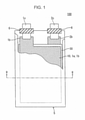
- Fig. 1 is a partially cut plan view schematically illustrating an example of the structure of a nonaqueous secondary battery.
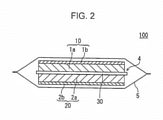
- Fig. 2 is a cross-sectional view taken along the line II-II in Fig. 1 .
- the nonaqueous secondary battery is also called a lithium ion secondary battery.
- the lithium ion secondary battery 100 is a sheet-type battery and includes an electrode plate group 4 and an outer packaging case 5 accommodating the electrode plate group 4.
- the electrode plate group 4 has a structure composed of a positive electrode 10, a separator 30, and a negative electrode 20 stacked in this order.
- the positive electrode 10 and the negative electrode 20 face each other with the separator 30 therebetween to form the electrode plate group 4.
- the electrode plate group 4 is impregnated with a nonaqueous electrolyte solution (not shown).
- the positive electrode 10 includes a positive electrode mixture layer 1a and a positive electrode collector 1b.
- the positive electrode mixture layer 1a is disposed on the positive electrode collector 1b.
- the negative electrode 20 includes a negative electrode mixture layer 2a and a negative electrode collector 2b.
- the negative electrode mixture layer 2a is disposed on the negative electrode collector 2b.
- the positive electrode collector 1b is connected to a positive electrode tab lead 1c, and the negative electrode collector 2b is connected to a negative electrode tab lead 2c.
- the positive electrode tab lead 1c and the negative electrode tab lead 2c each extend to the outside of the outer packaging case 5.
- the positive electrode tab lead 1c and the outer packaging case 5 are insulated from each other by an insulation tab film 6, and the negative electrode tab lead 2c and the outer packaging case 5 are insulated from each other by an insulation tab film 6.
- the positive electrode mixture layer 1a includes a positive electrode active material that can occlude and release alkali metal ions.
- the positive electrode mixture layer 1a may optionally include a conduction assistant, an ion conductor, and a binder.
- a conduction assistant As the positive electrode active material, the conduction assistant, the ion conductor, and the binder, known materials can be used without specific limitations.
- the positive electrode active material may be any material that occludes and releases one or more alkali metal ions, and may be, for example, an alkali metal-containing transition metal oxide, transition metal fluoride, polyanionic material, fluorinated polyanionic material, or transition metal sulfide.
- the positive electrode active material may be, for example, a lithium-containing transition metal oxide, such as Li x Me y O 2 and Li 1+x Me y O 3 (where, 0 ⁇ x ⁇ 1, 0.95 ⁇ y ⁇ 1.05, Me includes at least one selected from the group consisting of Co, Ni, Mn, Fe, Cr, Cu, Mo, Ti, and Sn); a lithium-containing polyanionic material, such as Li x Me y PO 4 and Li x Me y P 2 O 7 (where, 0 ⁇ x ⁇ 1, 0.95 ⁇ y ⁇ 1.05, Me includes at least one selected from the group consisting of Co, Ni, Mn, Fe, Cu, and Mo); or a sodium-containing transition metal oxide, such as Na x Me y O 2 (where, 0 ⁇ x ⁇ 1, 0.95 ⁇ y ⁇ 1.05, Me is at least one selected from the group consisting of Co, Ni, Mn, Fe, Cr, Cu, Mo, Ti, and Sn).
- the positive electrode collector 1b can be a sheet or film made of a metal material.
- the metal material may be, for example, aluminum, an aluminum alloy, stainless steel, nickel, or a nickel alloy.
- the sheet or film may be porous or may be non-porous. Aluminum and alloys thereof are inexpensive and can be easily formed into a thin film and are therefore desirable as materials of the positive electrode collector 1b.
- the surface of the positive electrode collector 1b may be coated with a carbon material, such as carbon, for, for example, decreasing the resistance value, giving a catalytic effect, and strengthening the bond between the positive electrode mixture layer 1a and the positive electrode collector 1b.
- the negative electrode mixture layer 2a includes, as a negative electrode active material, a graphite material containing boron of the embodiment at least on the surface.
- the negative electrode mixture layer 2a may optionally further include another negative electrode active material that can occlude and release alkali metal ions.
- the negative electrode mixture layer 2a may optionally include a conduction assistant, an ion conductor, and a binder.
- the active material, the conduction assistant, the ion conductor, and the binder known materials can be used without specific limitations.
- the negative electrode active material that can be used together with the negative electrode active material of the embodiment can be, for example, a material occluding and releasing alkali metal ions or an alkali metal.
- a material occluding and releasing alkali metal ions include alkali metal alloys, carbons, transition metal oxides, and silicon materials.
- the negative electrode material of a lithium secondary battery for example, alloys of a metal, such as Zn, Sn, and Si, and lithium; carbons, such as artificial graphite, natural graphite, and hardly graphitizable amorphous carbon; transition metal oxides, such as Li 4 Ti 5 O 12 , TiO 2 , and V 2 O 5 ; SiOx (0 ⁇ x ⁇ 2); and lithium metal can be used.
- the conduction assistant for example, carbon materials, such as carbon black, graphite, and acetylene black; and conductive polymers, such as polyaniline, polypyrrole, and polythiophene can be desirably used.
- conductive polymers such as polyaniline, polypyrrole, and polythiophene
- gel electrolytes such as polymethyl methacrylate
- solid electrolytes such as polyethylene oxide, lithium phosphate, and lithium phosphate oxynitride (LiPON) can be used.
- binder for example, polyvinylidene fluoride, vinylidene fluoride-hexafluoropropylene copolymer, vinylidene fluoride-tetrafluoroethylene copolymer, polytetrafluoroethylene, carboxymethyl cellulose, polyacrylic acid, styrene-butadiene copolymer rubber, polypropylene, polyethylene, and polyimide can be used.
- the negative electrode collector 2b can be a sheet or film made of a metal material.
- the metal material may be, for example, aluminum, an aluminum alloy, stainless steel, nickel, a nickel alloy, copper, or a copper alloy.
- the sheet or film may be porous or may be non-porous. Copper and copper alloys are stable also at the operation potential of the negative electrode and are relatively inexpensive and are therefore desirable as materials of the negative electrode collector 2b.
- As the sheet or film for example, metal foil or metal mesh is used.
- the surface of the negative electrode collector 2b may be coated with a carbon material, such as carbon, for, for example, decreasing the resistance value, giving a catalytic effect, and strengthening the bond between the negative electrode mixture layer 2a and the negative electrode collector 2b.
- the separator 30 is a porous film made of, for example, polyethylene, polypropylene, glass, cellulose, or a ceramic material.
- the pores of the separator 30 are impregnated with a nonaqueous electrolyte solution.
- the nonaqueous electrolyte solution consists of an alkali metal salt dissolved in a nonaqueous solvent.
- a nonaqueous solvent a known solvent, such as a cyclic carbonic acid ester, a chain carbonic acid ester, a cyclic carboxylic acid ester, a chain carboxylic acid ester, a chain nitrile, a cyclic ether, and a chain ether, can be used.
- the nonaqueous electrolyte solution desirably includes a cyclic carbonic acid ester and a chain carbonic acid ester.
- cyclic carbonic acid ester for example, ethylene carbonate, fluoroethylene carbonate, propylene carbonate, butylene carbonate, vinylene carbonate, vinylethylene carbonate, and derivatives thereof can be used. These esters may be used alone or in combination of two or more thereof. From the viewpoint of the ionic conductivity of the electrolyte solution, it is desirable to use at least one selected from the group consisting of ethylene carbonate, fluoroethylene carbonate, and propylene carbonate.
- chain carbonic acid ester for example, dimethyl carbonate, ethyl methyl carbonate, and diethyl carbonate can be used. These esters may be used alone or in combination of two or more thereof.
- cyclic carboxylic acid ester for example, ⁇ -butyrolactone and ⁇ -valerolactone can be used. These esters may be used alone or in combination of two or more thereof.
- chain carboxylic acid ester for example, methyl acetate, ethyl acetate, propyl acetate, methyl propionate, ethyl propionate, and propyl propionate can be used. These esters may be used alone or in combination of two or more thereof.
- chain nitrile for example, acetonitrile, propionitrile, butyronitrile, valeronitrile, isobutyronitrile, and pivalonitrile can be used. These nitriles may be used alone or in combination of two or more thereof.
- cyclic ether for example, 1,3-dioxolane, 1,4-dioxolane, tetrahydrofuran, and 2-methyltetrahydrofuran can be used. These ethers may be used alone or in combination of two or more thereof.
- chain ether for example, 1,2-dimethoxyethane, dimethyl ether, diethyl ether, dipropyl ether, ethyl methyl ether, diethylene glycol dimethyl ether, diethylene glycol diethyl ether, and diethylene glycol dibutyl ether can be used.
- ethers may be used alone or in combination of two or more thereof.
- solvents may be fluorinated solvents in which a part of hydrogen atoms are appropriately substituted with fluorine.
- lithium salts such as LiClO 4 , LiBF 4 , LiPF 6 , LiN(SO 2 F) 2 , LiN(SO 2 CF 3 ) 2 , and lithium bis(oxalate)borate (LiBOB); and sodium salts, such as NaClO 4 , NaBF 4 , NaPF 6 , NaN(SO 2 F) 2 , and NaN(SO 2 CF 3 ) 2 can be used.
- a lithium salt is desirably used. From the viewpoint of, for example, ionic conductivity, it is particularly desirable to use at least one selected from LiBF 4 , LiPF 6 , and LiN(SO 2 F) 2 .
- the molar content of the alkali metal salt in the nonaqueous electrolyte solution according to the embodiment is not particularly limited and is desirably 0.5 mol/L or more and 2.0 mol/L or less. It has been reported that a high salt concentration electrolyte solution having a molar ratio of the alkali metal salt to a solvent of 1:1 to 1:4 can also be charged and discharged as in ordinary electrolyte solutions, and the electrolyte solution may be such a high concentration electrolyte solution.
- the type (shape) of a secondary battery is not limited to a sheet type as shown in Figs. 1 and 2 and is, for example, a coin type, a button type, a laminate type, a cylinder type, a flat type, or a square type.
- the nonaqueous secondary battery of the embodiment can be applied to any shape of a nonaqueous secondary battery.
- the secondary battery of the embodiment can be used in, for example, a mobile information terminal, portable electronic equipment, a domestic power storage device, an industrial power storage device, a motorcycle, an EV, or a PHEV, but the use of the secondary battery is not limited thereto.
- a boric acid raw material (CAS No. 10043-35-3 ) was added to a petroleum coke powder having an average particle diameter of 12 ⁇ m, and the mixture was pulverized and mixed with an agate mortar.
- the amount of the boron raw material was 10 mass% based on the amount of the petroleum coke powder.
- the rate of boron to the petroleum coke powder was 1.7 mass%.
- the mixture was then fired at 2800°C in an Atchison furnace.
- the resulting carbon material was further pulverized with an agate mortar and was classified by a stainless steel standard sieve having an aperture of 40 ⁇ m.
- a nonaqueous secondary battery negative electrode active material was obtained.
- the boron content of graphite in the resulting negative electrode active material measured by inductively coupled plasma (ICP) emission spectroscopy was 0.33 mass%.
- the spacing d 002 of graphite determined by X-ray diffraction measurement was 3.353 angstrom.
- nonaqueous secondary battery negative electrode active material synthesized by the above-described method carboxymethyl cellulose (CAS No. 9000-11-7 ), and a styrene-butadiene copolymer rubber (CAS No. 9003-55-8 ) were weighed at a weight ratio of 97:2:1 and were dispersed in pure water to prepare a slurry.
- the slurry was then applied at a thickness of 10 ⁇ m onto a negative electrode collector 2b of copper foil with a coater.
- the coating film was rolled with a roller to obtain an electrode plate.
- the rolled electrode plate was then cut into the shape shown in Fig. 3A to prepare a negative electrode 20 for performance evaluation.
- the region of 60 mm ⁇ 40 mm functions as a negative electrode
- the protruding portion of 10 mm ⁇ 10 mm is a connection region with a tab lead 2c.
- the negative electrode mixture layer 2a formed on the connection region was then scraped to expose the negative electrode collector (copper foil) 2b.
- the exposed portion of the negative electrode collector (copper foil) 2b was then connected to a negative electrode tab lead 2c, and a predetermined circumferential region of the negative electrode tab lead 2c was covered with an insulation tab film 6.
- LiPF 6 ( CAS No. 21324-40-3 ) was dissolved at a concentration of 1.2 mol/L in a solvent mixture of fluoroethylene carbonate ( CAS No. 114435-02-8 ) and dimethyl carbonate ( CAS No. 616-38-6 ) at a volume ratio of 1:4 to prepare an electrolyte solution.
- the preparation of the electrolyte solution was performed in a glove box under an argon atmosphere with a dew point of -60°C or less and an oxygen value of 1 ppm or less.
- a half-cell for negative electrode evaluation including lithium metal as the counter electrode was produced using the negative electrode for performance evaluation.
- the production of the evaluation cell was performed in a glove box under an argon atmosphere with a dew point of -60°C or less and an oxygen value of 1 ppm or less.
- the negative electrode for performance evaluation equipped with a negative electrode tab lead 2c and the Li metal counter electrode equipped with a nickel tab lead 1c were disposed such that the electrodes just faced each other with a polypropylene separator 30 (thickness: 30 ⁇ m) therebetween to prepare an electrode plate group 4.
- An Al laminate film (thickness: 100 ⁇ m) cut into a square of 120 ⁇ 120 mm was folded in half, and the end on the long side of 120 mm was thermally sealed at 230°C to form a tube of 120 ⁇ 60 mm.
- the produced electrode plate group 4 was then placed in the tube from one short side of 60 mm.
- the positions of the end face of the Al laminate film and the thermal welding resin of the tab leads 1c and 2c were adjusted, followed by thermal sealing at 230°C.
- a nonaqueous electrolyte solution (0.3 cm 3 ) was then poured into the Al laminate film tube from the short side not thermally sealed, followed by being left to stand under a reduced pressure of 0.06 MPa for 15 minutes to impregnate the negative electrode mixture layer 2a with the electrolyte solution. Finally, the end face of the Al laminate film from which the electrolyte solution was poured was thermally sealed at 230°C.
- the evaluation cell produced as in above was pressurized and fixed with cramps at 0.2 MPa such that the electrode plate group 4 was sandwiched with stainless steel (thickness: 2 mm) of 80 ⁇ 80 cm through the laminate film. All evaluation was performed in a thermostatic chamber of 25°C.
- the negative electrode active material of Illustrative Example 1 had an average discharge potential of 0.167 V.
- Li(Ni,Co,Al)O 2 as a positive electrode active material, acetylene black as a conduction assistant, and polyvinylidene fluoride as a binding agent were weighed at a weight ratio of 8:1:1.
- the resulting mixture was dispersed in an NMP solvent to prepare a slurry.
- the slurry was then applied onto an Al collector 1b with a coater.
- the coating film was rolled with a roller to obtain an electrode plate.
- the electrode plate was processed by the same method as that shown in Figs. 3A to 3C showing a method for processing a negative electrode to obtain a positive electrode 10.
- This positive electrode 10 and a negative electrode for performance evaluation were combined to produce a nonaqueous secondary battery cell.
- the production of the nonaqueous secondary battery cell was performed in a glove box under an argon atmosphere of a dew point of -60°C or less and an oxygen value of 1 ppm or less.
- the negative electrode for performance evaluation equipped with a negative electrode tab lead 2c and the positive electrode 10 equipped with a nickel tab lead 1c were disposed such that the electrodes just faced each other with a polypropylene separator 30 (thickness: 30 ⁇ m) therebetween to prepare an electrode plate group 4.
- an Al laminate film (thickness: 100 ⁇ m) cut into a square of 120 ⁇ 120 mm was folded in half, and the end on the long side of 120 mm was thermally sealed at 230°C to form a tube of 120 ⁇ 60 mm.
- the produced electrode plate group 4 was then placed in the tube from one short side of 60 mm. The positions of the end face of the Al laminate film and the thermal welding resin of the tab leads 1c and 2c were adjusted, followed by thermal sealing at 230°C.
- a nonaqueous electrolyte solution (0.3 cm 3 ) was then poured into the Al laminate film tube from the short side not thermally sealed, followed by being left to stand under a reduced pressure of 0.06 MPa for 15 minutes to impregnate the negative electrode mixture layer 2a with the electrolyte solution. Finally, the end face of the Al laminate film from which the electrolyte solution was poured was thermally sealed at 230°C.
- Charge and discharge were repeated 4 cycles while restricting the current flowing during the charge and the discharge such that the current density per mass of the negative electrode active material was 20 mA.
- the charge was terminated at a battery voltage of 4.2 V, and the discharge was terminated at a battery voltage of 2.5 V.
- the battery was left to stand at open circuit for 20 minutes between charge and discharge.
- the batter after the charge of the fifth cycle was subjected to a storage durability test in a thermostatic chamber of 55°C for one month. Subsequently, the battery after the test was discharged and charged for 2 cycles, and the battery after the discharge of the third cycle was disassembled to take out the negative electrode.
- the amount of the side reaction of the negative electrode was quantitatively analyzed by ICP emission spectroscopy of the negative electrode graphite. The amount of Li per weight of graphite determined by quantitative analysis of Li by ICP emission spectroscopy was defined as the side reaction amount.
- a nonaqueous secondary battery negative electrode active material was synthesized as in Illustrative Example 1 except that the carbon material fired at 2800°C in an Atchison furnace was placed in a carbon crucible and was further subjected to heat treatment at 1900°C under an argon atmosphere.
- the carbon crucible was fired together with large amounts of boron and carbon in advance so as to be saturated with boron.
- the boron content of graphite in the resulting negative electrode active material measured by ICP emission spectroscopy was 0.36 mass%.
- the average discharge potential based on Li was 0.173 V.
- the graphite interlayer distance measured by X-ray diffraction measurement was 3.352 angstrom.
- a nonaqueous secondary battery negative electrode active material was synthesized as in Example 2 except that the temperature of re-firing under an argon atmosphere was 2300°C.
- the boron content of graphite in the negative electrode active material measured by ICP emission spectroscopy was 0.29 mass%.
- the average discharge potential based on Li was 0.180 V.
- the graphite interlayer distance measured by X-ray diffraction measurement was 3.352 angstrom.
- a nonaqueous secondary battery negative electrode active material was synthesized as in Example 2 except that the temperature of re-firing under an argon atmosphere was 2800°C.
- the boron content of graphite in the negative electrode active material measured by ICP emission spectroscopy was 0.36 mass%.
- the average discharge potential based on Li was 0.183 V.
- the graphite interlayer distance measured by X-ray diffraction measurement was 3.351 angstrom.
- a nonaqueous secondary battery negative electrode active material was synthesized as in Example 3 except that the amount of the boron raw material added at the time of firing graphite was 20 mass% based on the amount of the petroleum coke powder. The rate of boron to the petroleum coke powder was 3.4 mass%.
- the boron content of graphite in the negative electrode active material measured by ICP emission spectroscopy was 0.42 mass%.
- the average discharge potential based on Li was 0.188 V.
- the graphite interlayer distance measured by X-ray diffraction measurement was 3.352 angstrom.
- a nonaqueous secondary battery negative electrode active material was synthesized as in Example 5 except that the temperature of re-firing under an argon atmosphere was 2800°C.
- the boron content of graphite in the negative electrode active material measured by ICP emission spectroscopy was 0.39 mass%.
- the average discharge potential based on Li was 0.191 V.
- the graphite interlayer distance measured by X-ray diffraction measurement was 3.348 angstrom.
- a nonaqueous secondary battery negative electrode active material was synthesized as in Example 5 except that the re-firing under an argon atmosphere was performed under a high firing pressure of 0.2 GPa instead of the atmospheric pressure.
- the boron content of graphite in the negative electrode active material measured by ICP emission spectroscopy was 0.50 mass%.
- the average discharge potential based on Li was 0.197 V.
- the graphite interlayer distance measured by X-ray diffraction measurement was 3.349 angstrom.
- a nonaqueous secondary battery negative electrode active material was synthesized as in Illustrative Example 1 except that the boron raw material was not added at the time of firing at 2800°C in an Atchison furnace.
- the boron content of graphite in the negative electrode active material was measured by ICP emission spectroscopy, and boron was not detected.
- the average discharge potential based on Li was 0.148 V.
- the graphite interlayer distance measured by X-ray diffraction measurement was 3.356 angstrom.
- a nonaqueous secondary battery negative electrode active material was synthesized as in Example 3 except that the amount of the boron raw material added at the time of firing graphite was 1 mass% based on the amount of the petroleum coke powder. The rate of boron to the petroleum coke powder was 0.17 mass%.
- the boron content of graphite in the negative electrode active material measured by ICP emission spectroscopy was 0.03 mass%.
- the average discharge potential based on Li was 0.154 V.
- the graphite interlayer distance measured by X-ray diffraction measurement was 3.355 angstrom.
- Nonaqueous secondary batteries were produced as in Illustrative Example 1 using the negative electrode active materials of Examples 2 to 7 and Comparative Examples 1 and 2, and the side reaction amounts after the storage durability test were evaluated as in Illustrative Example 1.
- the results are shown in Table 1, where the side reaction amounts are each shown as a side reaction decreasing rate expressing a rate (percentage) of the decreased side reaction amount compared to the side reaction amount in Comparative Example 1 to the side reaction amount in Comparative Example 1.
- Fig. 4 shows the results in Table 1 as a graph showing a relationship between the average discharge potential based on Li and the side reaction decreasing rate.
- the boron contents in the negative electrode active materials (B-containing graphite) were 0.29 mass% to 0.50 mass%, and excellent storage stability was observed compared to the negative electrode active materials of Comparative Examples 1 and 2 having a boron content of 0 to 0.03 mass%.
- Table 1 demonstrates that the side reaction decreasing rate tends to increase with an increase in the boron content. However, the side reaction decreasing rate is not necessarily increased with an increase of the boron content. Even if the boron content is within an appropriate range, boron is not solid-dissolved in graphite depending on the firing atmospheric gas, temperature, pressure and so on, and there is a risk that a desired effect of suppressing a side reaction is not obtained.
- Example 7 In the negative electrode active material of Example 7, the boron content was higher than that in Example 6, and the side reaction decreasing rate was limited to 21%, which was a significant decrease in the side reaction compared to Comparative Example 1, but was an increase of the side reaction amount when compared to Example 6. This is probably caused by that the interlayer distance of the B-containing graphite in Example 7 was 3.349 angstrom, which was longer than 3.348 angstrom in Example 6, and thereby boron was not sufficiently solid-dissolved in graphite. There is a risk that the presence of boron in a solid undissolved state (for example, presence as a by-product) cancels out the side reaction-suppressing effect achieved by an increase in the average discharge potential.
- a solid undissolved state for example, presence as a by-product
- An increase in the boron content of a negative electrode active material causes a risk that a part of boron cannot be solid-dissolved in graphite and is present between hexagonal network layers without substituting for carbon constituting the graphite skeleton or is present as a by-product, such as boron carbide (B 4 C).
- the generation of the by-product may decrease the volume of the negative electrode active material and also may decrease the side reaction-suppressing effect by the elimination of boron in graphite.
- the solid solubility of boron in graphite can be increased by controlling, for example, the firing atmospheric gas, temperature, and pressure. Consequently, it is possible to achieve a side reaction decreasing rate equivalent to or higher than that in Example 6.
- boron is desirably included in graphite in a solid solution state.
- negative electrode active materials having an average discharge potential of 0.16 V or more and 0.2 V or less based on Li an effect of significantly improving the storage durability (i.e., side reaction-suppressing effect), an improvement of 10% or more, was observed.
- the boron content in such a negative electrode active material was 0.29 mass% or more and 0.5 mass% or less.
- negative electrode active materials having an average discharge potential of 0.17 V or more and 0.2 V or less based on Li an effect of significantly improving the storage durability (suppression of side reactions) by 21% or more was observed.
- the boron content in such a negative electrode active material was 0.29 mass% or more and 0.5 mass% or less.
- the nonaqueous secondary battery negative electrode active material according to the present disclosure can be used in a nonaqueous secondary battery and is particularly useful as a negative electrode material of a nonaqueous secondary battery, such as a lithium ion secondary battery.
Landscapes
- Chemical & Material Sciences (AREA)
- General Chemical & Material Sciences (AREA)
- Chemical Kinetics & Catalysis (AREA)
- Electrochemistry (AREA)
- Engineering & Computer Science (AREA)
- Inorganic Chemistry (AREA)
- Manufacturing & Machinery (AREA)
- Materials Engineering (AREA)
- Composite Materials (AREA)
- Physics & Mathematics (AREA)
- Condensed Matter Physics & Semiconductors (AREA)
- General Physics & Mathematics (AREA)
- Battery Electrode And Active Subsutance (AREA)
- Secondary Cells (AREA)
Claims (6)
- Negativelektrodenaktivmaterial für eine nichtwässrige Sekundärbatterie, umfassend Grafit, welcher Bor enthält, wobeider Grafit ein mittleres Entladungspotential von 0,16 V oder mehr und 0,2 V oder weniger, bezogen auf Li, aufweist,wobei der Grafit Bor in einer Menge von mehr als 0,03 Masse-% und nicht mehr als 1 Masse-% enthält undwobei der Grafit einen Zwischenschichtabstand von 3,348 Angström oder mehr und 3,352 Angström oder weniger aufweist.
- Negativelektrodenaktivmaterial gemäß Anspruch 1, wobei der Grafit Bor in einer Menge von 0,29 Masse-% oder mehr und 0,5 Masse-% oder weniger enthält.
- Negativelektrodenaktivmaterial gemäß Anspruch 1 oder 2, wobei der Grafit Bor in einem festen Lösungszustand enthält.
- Nichtwässrige Sekundärbatterie, umfassend:eine positive Elektrode, die ein Positivelektrodenaktivmaterial einschließt, das ein Alkalimetallion okkkludieren und freisetzen kann;eine negative Elektrode, die ein Negativelektrodenaktivmaterial gemäß einem der Ansprüche 1 bis 3 einschließt, undeine nichtwässrige Elektrolytlösung.
- Nichtwässrige Sekundärbatterie gemäß Anspruch 4, wobei es sich bei den Alkalimetallionen um ein Lithiumion handelt.
- Nichtwässrige Sekundärbatterie gemäß Anspruch 4 oder 5, wobei die nichtwässrige Elektrolytlösung ein nichtwässriges Lösungsmittel einschließt, das einen kettenförmigen Carbonsäureester mit einer oder mehreren Fluorgruppen einschließt.
Applications Claiming Priority (1)
| Application Number | Priority Date | Filing Date | Title |
|---|---|---|---|
| JP2017097705 | 2017-05-16 |
Publications (2)
| Publication Number | Publication Date |
|---|---|
| EP3404744A1 EP3404744A1 (de) | 2018-11-21 |
| EP3404744B1 true EP3404744B1 (de) | 2022-03-09 |
Family
ID=62142970
Family Applications (1)
| Application Number | Title | Priority Date | Filing Date |
|---|---|---|---|
| EP18171171.4A Active EP3404744B1 (de) | 2017-05-16 | 2018-05-08 | Negativelektrodenaktivmaterial und wasserfreie sekundärbatterie |
Country Status (4)
| Country | Link |
|---|---|
| US (1) | US20180337399A1 (de) |
| EP (1) | EP3404744B1 (de) |
| JP (1) | JP2018195560A (de) |
| CN (1) | CN108878881A (de) |
Families Citing this family (1)
| Publication number | Priority date | Publication date | Assignee | Title |
|---|---|---|---|---|
| CN120604370A (zh) * | 2023-11-23 | 2025-09-05 | 株式会社Lg新能源 | 锂二次电池 |
Family Cites Families (22)
| Publication number | Priority date | Publication date | Assignee | Title |
|---|---|---|---|---|
| CA2098248C (en) | 1993-06-11 | 1999-03-16 | Jeffrey Raymond Dahn | Electron acceptor substituted carbons for use as anodes in rechargeable lithium batteries |
| JPH0963585A (ja) | 1995-08-18 | 1997-03-07 | Petoca:Kk | リチウム系二次電池用炭素材及びその製造法 |
| JP3311611B2 (ja) * | 1996-10-11 | 2002-08-05 | 三洋電機株式会社 | リチウム二次電池 |
| JPH10255799A (ja) * | 1997-03-07 | 1998-09-25 | Petoca:Kk | 高容量非水系二次電池負極用黒鉛材及びその製造方法 |
| JP4379925B2 (ja) * | 1998-04-21 | 2009-12-09 | 住友金属工業株式会社 | リチウムイオン二次電池の負極材料に適したグラファイト粉末 |
| JP2000012032A (ja) * | 1998-06-26 | 2000-01-14 | Nippon Steel Corp | リチウム二次電池負極用高黒鉛化炭素粉末及びその製造方法 |
| KR100303539B1 (ko) * | 1998-11-25 | 2001-11-30 | 김순택 | 리튬이차전지용음극활물질및그제조방법 |
| US6485864B1 (en) * | 1999-02-26 | 2002-11-26 | Adchemco Corporation | Production process of material for lithium-ion secondary batteries, material obtained by the process, and batteries |
| US6673492B2 (en) * | 2000-05-26 | 2004-01-06 | Ube Industries, Ltd. | Electrode material for a secondary cell and its production process |
| JP2002124256A (ja) * | 2000-10-12 | 2002-04-26 | Mitsubishi Gas Chem Co Inc | 非水溶媒二次電池 |
| JP4945029B2 (ja) * | 2001-03-06 | 2012-06-06 | 新日鐵化学株式会社 | リチウム二次電池負極用材料とその製造方法およびリチウム二次電池 |
| JP2005056581A (ja) * | 2001-04-26 | 2005-03-03 | Japan Storage Battery Co Ltd | 非水電解質二次電池用炭素材料及びそれを用いた非水電解質二次電池 |
| CN1526178A (zh) * | 2001-05-15 | 2004-09-01 | Fdk株式会社 | 非水电解质二次电池及其正极材料的制造方法 |
| AU2003302282A1 (en) * | 2002-11-26 | 2004-06-18 | Showa Denko K.K. | Electrode material comprising silicon and/or tin particles and production method and use thereof |
| WO2005011028A1 (en) * | 2003-07-28 | 2005-02-03 | Showa Denko K.K. | High density electrode and battery using the electrode |
| JP2006032300A (ja) * | 2004-07-21 | 2006-02-02 | Sony Corp | 電解質および電池 |
| JP2007122975A (ja) * | 2005-10-26 | 2007-05-17 | Sanyo Electric Co Ltd | 非水電解質二次電池 |
| CN103250295B (zh) * | 2010-12-07 | 2016-09-14 | 日本电气株式会社 | 锂二次电池 |
| EP2784860A4 (de) * | 2011-11-24 | 2015-07-22 | Mitsubishi Corp | Negativelektrodenmaterial für eine sekundärbatterie mit nichtwässrigem elektrolyt und herstellungsverfahren dafür |
| CN104247138B (zh) * | 2012-04-17 | 2017-07-28 | 大金工业株式会社 | 电解液、电化学器件、锂离子二次电池以及组件 |
| US9406936B2 (en) * | 2012-10-12 | 2016-08-02 | Showa Denko K.K. | Carbon material, carbon material for battery electrode, and battery |
| JP6320876B2 (ja) * | 2013-10-29 | 2018-05-09 | パナソニック株式会社 | 非水電解質二次電池 |
-
2018
- 2018-01-12 JP JP2018003748A patent/JP2018195560A/ja active Pending
- 2018-01-29 CN CN201810082218.4A patent/CN108878881A/zh active Pending
- 2018-05-08 EP EP18171171.4A patent/EP3404744B1/de active Active
- 2018-05-08 US US15/974,490 patent/US20180337399A1/en not_active Abandoned
Non-Patent Citations (1)
| Title |
|---|
| None * |
Also Published As
| Publication number | Publication date |
|---|---|
| CN108878881A (zh) | 2018-11-23 |
| EP3404744A1 (de) | 2018-11-21 |
| JP2018195560A (ja) | 2018-12-06 |
| US20180337399A1 (en) | 2018-11-22 |
Similar Documents
| Publication | Publication Date | Title |
|---|---|---|
| US10818912B2 (en) | Battery | |
| JP6728134B2 (ja) | 非水電解質二次電池 | |
| KR20170045300A (ko) | 칼륨이온 2차 전지용 음극 또는 칼륨이온 캐패시터용 음극, 칼륨이온 2차 전지 또는 칼륨이온 캐패시터 및 칼륨이온 2차 전지 음극용 또는 칼륨이온 캐패시터 음극용 결착제 | |
| JP2004079276A (ja) | 正極活物質及びその製造方法 | |
| JP7022917B2 (ja) | 負極活物質及び電池 | |
| US20180337424A1 (en) | Negative-electrode active material for non-aqueous secondary battery and non-aqueous secondary battery | |
| JPWO2015015883A1 (ja) | リチウム二次電池及びリチウム二次電池用電解液 | |
| US20180337398A1 (en) | Negative electrode active material and nonaqueous secondary battery | |
| JP7133776B2 (ja) | 非水電解質二次電池 | |
| JP7117536B2 (ja) | 負極活物質及び電池 | |
| EP3404744B1 (de) | Negativelektrodenaktivmaterial und wasserfreie sekundärbatterie | |
| US10777805B2 (en) | Negative electrode active material containing graphite material and battery including negative electrode containing negative electrode active material | |
| US10497967B2 (en) | Negative-electrode active material for non-aqueous secondary battery and non-aqueous secondary battery | |
| JP2018195558A (ja) | 非水二次電池用負極活物質、及び、非水二次電池 | |
| WO2014021395A1 (ja) | 非水電解質二次電池用正極活物質 | |
| US10559846B2 (en) | Negative-electrode active material for non-aqueous secondary battery and non-aqueous secondary battery | |
| JP7054871B2 (ja) | 非水二次電池用負極活物質、及び、非水二次電池 | |
| CN114342120B (zh) | 非水电解质二次电池 | |
| JP2018195434A (ja) | 非水二次電池 | |
| KR20240061891A (ko) | 리튬 이차 전지 |
Legal Events
| Date | Code | Title | Description |
|---|---|---|---|
| PUAI | Public reference made under article 153(3) epc to a published international application that has entered the european phase |
Free format text: ORIGINAL CODE: 0009012 |
|
| STAA | Information on the status of an ep patent application or granted ep patent |
Free format text: STATUS: THE APPLICATION HAS BEEN PUBLISHED |
|
| AK | Designated contracting states |
Kind code of ref document: A1 Designated state(s): AL AT BE BG CH CY CZ DE DK EE ES FI FR GB GR HR HU IE IS IT LI LT LU LV MC MK MT NL NO PL PT RO RS SE SI SK SM TR |
|
| AX | Request for extension of the european patent |
Extension state: BA ME |
|
| STAA | Information on the status of an ep patent application or granted ep patent |
Free format text: STATUS: REQUEST FOR EXAMINATION WAS MADE |
|
| 17P | Request for examination filed |
Effective date: 20190410 |
|
| RBV | Designated contracting states (corrected) |
Designated state(s): AL AT BE BG CH CY CZ DE DK EE ES FI FR GB GR HR HU IE IS IT LI LT LU LV MC MK MT NL NO PL PT RO RS SE SI SK SM TR |
|
| STAA | Information on the status of an ep patent application or granted ep patent |
Free format text: STATUS: EXAMINATION IS IN PROGRESS |
|
| 17Q | First examination report despatched |
Effective date: 20190703 |
|
| REG | Reference to a national code |
Ref country code: DE Ref legal event code: R079 Ref document number: 602018031852 Country of ref document: DE Free format text: PREVIOUS MAIN CLASS: H01M0004134000 Ipc: H01M0010052500 |
|
| RIC1 | Information provided on ipc code assigned before grant |
Ipc: H01M 10/0569 20100101ALI20210917BHEP Ipc: H01M 4/587 20100101ALI20210917BHEP Ipc: H01M 4/133 20100101ALI20210917BHEP Ipc: H01M 10/0525 20100101AFI20210917BHEP |
|
| GRAP | Despatch of communication of intention to grant a patent |
Free format text: ORIGINAL CODE: EPIDOSNIGR1 |
|
| STAA | Information on the status of an ep patent application or granted ep patent |
Free format text: STATUS: GRANT OF PATENT IS INTENDED |
|
| INTG | Intention to grant announced |
Effective date: 20211108 |
|
| GRAS | Grant fee paid |
Free format text: ORIGINAL CODE: EPIDOSNIGR3 |
|
| GRAA | (expected) grant |
Free format text: ORIGINAL CODE: 0009210 |
|
| STAA | Information on the status of an ep patent application or granted ep patent |
Free format text: STATUS: THE PATENT HAS BEEN GRANTED |
|
| AK | Designated contracting states |
Kind code of ref document: B1 Designated state(s): AL AT BE BG CH CY CZ DE DK EE ES FI FR GB GR HR HU IE IS IT LI LT LU LV MC MK MT NL NO PL PT RO RS SE SI SK SM TR |
|
| REG | Reference to a national code |
Ref country code: CH Ref legal event code: EP Ref country code: AT Ref legal event code: REF Ref document number: 1474891 Country of ref document: AT Kind code of ref document: T Effective date: 20220315 |
|
| REG | Reference to a national code |
Ref country code: IE Ref legal event code: FG4D |
|
| REG | Reference to a national code |
Ref country code: DE Ref legal event code: R096 Ref document number: 602018031852 Country of ref document: DE |
|
| REG | Reference to a national code |
Ref country code: LT Ref legal event code: MG9D |
|
| REG | Reference to a national code |
Ref country code: NL Ref legal event code: MP Effective date: 20220309 |
|
| PG25 | Lapsed in a contracting state [announced via postgrant information from national office to epo] |
Ref country code: SE Free format text: LAPSE BECAUSE OF FAILURE TO SUBMIT A TRANSLATION OF THE DESCRIPTION OR TO PAY THE FEE WITHIN THE PRESCRIBED TIME-LIMIT Effective date: 20220309 Ref country code: RS Free format text: LAPSE BECAUSE OF FAILURE TO SUBMIT A TRANSLATION OF THE DESCRIPTION OR TO PAY THE FEE WITHIN THE PRESCRIBED TIME-LIMIT Effective date: 20220309 Ref country code: NO Free format text: LAPSE BECAUSE OF FAILURE TO SUBMIT A TRANSLATION OF THE DESCRIPTION OR TO PAY THE FEE WITHIN THE PRESCRIBED TIME-LIMIT Effective date: 20220609 Ref country code: LT Free format text: LAPSE BECAUSE OF FAILURE TO SUBMIT A TRANSLATION OF THE DESCRIPTION OR TO PAY THE FEE WITHIN THE PRESCRIBED TIME-LIMIT Effective date: 20220309 Ref country code: HR Free format text: LAPSE BECAUSE OF FAILURE TO SUBMIT A TRANSLATION OF THE DESCRIPTION OR TO PAY THE FEE WITHIN THE PRESCRIBED TIME-LIMIT Effective date: 20220309 Ref country code: BG Free format text: LAPSE BECAUSE OF FAILURE TO SUBMIT A TRANSLATION OF THE DESCRIPTION OR TO PAY THE FEE WITHIN THE PRESCRIBED TIME-LIMIT Effective date: 20220609 |
|
| REG | Reference to a national code |
Ref country code: AT Ref legal event code: MK05 Ref document number: 1474891 Country of ref document: AT Kind code of ref document: T Effective date: 20220309 |
|
| PG25 | Lapsed in a contracting state [announced via postgrant information from national office to epo] |
Ref country code: LV Free format text: LAPSE BECAUSE OF FAILURE TO SUBMIT A TRANSLATION OF THE DESCRIPTION OR TO PAY THE FEE WITHIN THE PRESCRIBED TIME-LIMIT Effective date: 20220309 Ref country code: GR Free format text: LAPSE BECAUSE OF FAILURE TO SUBMIT A TRANSLATION OF THE DESCRIPTION OR TO PAY THE FEE WITHIN THE PRESCRIBED TIME-LIMIT Effective date: 20220610 Ref country code: FI Free format text: LAPSE BECAUSE OF FAILURE TO SUBMIT A TRANSLATION OF THE DESCRIPTION OR TO PAY THE FEE WITHIN THE PRESCRIBED TIME-LIMIT Effective date: 20220309 |
|
| PG25 | Lapsed in a contracting state [announced via postgrant information from national office to epo] |
Ref country code: NL Free format text: LAPSE BECAUSE OF FAILURE TO SUBMIT A TRANSLATION OF THE DESCRIPTION OR TO PAY THE FEE WITHIN THE PRESCRIBED TIME-LIMIT Effective date: 20220309 |
|
| PG25 | Lapsed in a contracting state [announced via postgrant information from national office to epo] |
Ref country code: SM Free format text: LAPSE BECAUSE OF FAILURE TO SUBMIT A TRANSLATION OF THE DESCRIPTION OR TO PAY THE FEE WITHIN THE PRESCRIBED TIME-LIMIT Effective date: 20220309 Ref country code: SK Free format text: LAPSE BECAUSE OF FAILURE TO SUBMIT A TRANSLATION OF THE DESCRIPTION OR TO PAY THE FEE WITHIN THE PRESCRIBED TIME-LIMIT Effective date: 20220309 Ref country code: RO Free format text: LAPSE BECAUSE OF FAILURE TO SUBMIT A TRANSLATION OF THE DESCRIPTION OR TO PAY THE FEE WITHIN THE PRESCRIBED TIME-LIMIT Effective date: 20220309 Ref country code: PT Free format text: LAPSE BECAUSE OF FAILURE TO SUBMIT A TRANSLATION OF THE DESCRIPTION OR TO PAY THE FEE WITHIN THE PRESCRIBED TIME-LIMIT Effective date: 20220711 Ref country code: ES Free format text: LAPSE BECAUSE OF FAILURE TO SUBMIT A TRANSLATION OF THE DESCRIPTION OR TO PAY THE FEE WITHIN THE PRESCRIBED TIME-LIMIT Effective date: 20220309 Ref country code: EE Free format text: LAPSE BECAUSE OF FAILURE TO SUBMIT A TRANSLATION OF THE DESCRIPTION OR TO PAY THE FEE WITHIN THE PRESCRIBED TIME-LIMIT Effective date: 20220309 Ref country code: CZ Free format text: LAPSE BECAUSE OF FAILURE TO SUBMIT A TRANSLATION OF THE DESCRIPTION OR TO PAY THE FEE WITHIN THE PRESCRIBED TIME-LIMIT Effective date: 20220309 Ref country code: AT Free format text: LAPSE BECAUSE OF FAILURE TO SUBMIT A TRANSLATION OF THE DESCRIPTION OR TO PAY THE FEE WITHIN THE PRESCRIBED TIME-LIMIT Effective date: 20220309 |
|
| PG25 | Lapsed in a contracting state [announced via postgrant information from national office to epo] |
Ref country code: PL Free format text: LAPSE BECAUSE OF FAILURE TO SUBMIT A TRANSLATION OF THE DESCRIPTION OR TO PAY THE FEE WITHIN THE PRESCRIBED TIME-LIMIT Effective date: 20220309 Ref country code: IS Free format text: LAPSE BECAUSE OF FAILURE TO SUBMIT A TRANSLATION OF THE DESCRIPTION OR TO PAY THE FEE WITHIN THE PRESCRIBED TIME-LIMIT Effective date: 20220709 Ref country code: AL Free format text: LAPSE BECAUSE OF FAILURE TO SUBMIT A TRANSLATION OF THE DESCRIPTION OR TO PAY THE FEE WITHIN THE PRESCRIBED TIME-LIMIT Effective date: 20220309 |
|
| REG | Reference to a national code |
Ref country code: DE Ref legal event code: R097 Ref document number: 602018031852 Country of ref document: DE |
|
| REG | Reference to a national code |
Ref country code: CH Ref legal event code: PL |
|
| PLBE | No opposition filed within time limit |
Free format text: ORIGINAL CODE: 0009261 |
|
| STAA | Information on the status of an ep patent application or granted ep patent |
Free format text: STATUS: NO OPPOSITION FILED WITHIN TIME LIMIT |
|
| REG | Reference to a national code |
Ref country code: BE Ref legal event code: MM Effective date: 20220531 |
|
| PG25 | Lapsed in a contracting state [announced via postgrant information from national office to epo] |
Ref country code: MC Free format text: LAPSE BECAUSE OF FAILURE TO SUBMIT A TRANSLATION OF THE DESCRIPTION OR TO PAY THE FEE WITHIN THE PRESCRIBED TIME-LIMIT Effective date: 20220309 Ref country code: LU Free format text: LAPSE BECAUSE OF NON-PAYMENT OF DUE FEES Effective date: 20220508 Ref country code: LI Free format text: LAPSE BECAUSE OF NON-PAYMENT OF DUE FEES Effective date: 20220531 Ref country code: DK Free format text: LAPSE BECAUSE OF FAILURE TO SUBMIT A TRANSLATION OF THE DESCRIPTION OR TO PAY THE FEE WITHIN THE PRESCRIBED TIME-LIMIT Effective date: 20220309 Ref country code: CH Free format text: LAPSE BECAUSE OF NON-PAYMENT OF DUE FEES Effective date: 20220531 |
|
| 26N | No opposition filed |
Effective date: 20221212 |
|
| PG25 | Lapsed in a contracting state [announced via postgrant information from national office to epo] |
Ref country code: SI Free format text: LAPSE BECAUSE OF FAILURE TO SUBMIT A TRANSLATION OF THE DESCRIPTION OR TO PAY THE FEE WITHIN THE PRESCRIBED TIME-LIMIT Effective date: 20220309 |
|
| GBPC | Gb: european patent ceased through non-payment of renewal fee |
Effective date: 20220609 |
|
| PG25 | Lapsed in a contracting state [announced via postgrant information from national office to epo] |
Ref country code: IE Free format text: LAPSE BECAUSE OF NON-PAYMENT OF DUE FEES Effective date: 20220508 Ref country code: FR Free format text: LAPSE BECAUSE OF NON-PAYMENT OF DUE FEES Effective date: 20220509 |
|
| PG25 | Lapsed in a contracting state [announced via postgrant information from national office to epo] |
Ref country code: GB Free format text: LAPSE BECAUSE OF NON-PAYMENT OF DUE FEES Effective date: 20220609 Ref country code: BE Free format text: LAPSE BECAUSE OF NON-PAYMENT OF DUE FEES Effective date: 20220531 |
|
| PG25 | Lapsed in a contracting state [announced via postgrant information from national office to epo] |
Ref country code: IT Free format text: LAPSE BECAUSE OF FAILURE TO SUBMIT A TRANSLATION OF THE DESCRIPTION OR TO PAY THE FEE WITHIN THE PRESCRIBED TIME-LIMIT Effective date: 20220309 |
|
| P01 | Opt-out of the competence of the unified patent court (upc) registered |
Effective date: 20230808 |
|
| PG25 | Lapsed in a contracting state [announced via postgrant information from national office to epo] |
Ref country code: HU Free format text: LAPSE BECAUSE OF FAILURE TO SUBMIT A TRANSLATION OF THE DESCRIPTION OR TO PAY THE FEE WITHIN THE PRESCRIBED TIME-LIMIT; INVALID AB INITIO Effective date: 20180508 |
|
| PG25 | Lapsed in a contracting state [announced via postgrant information from national office to epo] |
Ref country code: MK Free format text: LAPSE BECAUSE OF FAILURE TO SUBMIT A TRANSLATION OF THE DESCRIPTION OR TO PAY THE FEE WITHIN THE PRESCRIBED TIME-LIMIT Effective date: 20220309 Ref country code: CY Free format text: LAPSE BECAUSE OF FAILURE TO SUBMIT A TRANSLATION OF THE DESCRIPTION OR TO PAY THE FEE WITHIN THE PRESCRIBED TIME-LIMIT Effective date: 20220309 |
|
| PG25 | Lapsed in a contracting state [announced via postgrant information from national office to epo] |
Ref country code: MT Free format text: LAPSE BECAUSE OF FAILURE TO SUBMIT A TRANSLATION OF THE DESCRIPTION OR TO PAY THE FEE WITHIN THE PRESCRIBED TIME-LIMIT Effective date: 20220309 |
|
| PGFP | Annual fee paid to national office [announced via postgrant information from national office to epo] |
Ref country code: DE Payment date: 20250521 Year of fee payment: 8 |
|
| PG25 | Lapsed in a contracting state [announced via postgrant information from national office to epo] |
Ref country code: TR Free format text: LAPSE BECAUSE OF FAILURE TO SUBMIT A TRANSLATION OF THE DESCRIPTION OR TO PAY THE FEE WITHIN THE PRESCRIBED TIME-LIMIT Effective date: 20220309 |