EP3295502B1 - Copolymers of peo and fluorinated polymers as electrolytes for lithium batteries - Google Patents
Copolymers of peo and fluorinated polymers as electrolytes for lithium batteries Download PDFInfo
- Publication number
- EP3295502B1 EP3295502B1 EP16793195.5A EP16793195A EP3295502B1 EP 3295502 B1 EP3295502 B1 EP 3295502B1 EP 16793195 A EP16793195 A EP 16793195A EP 3295502 B1 EP3295502 B1 EP 3295502B1
- Authority
- EP
- European Patent Office
- Prior art keywords
- polymer
- poly
- oxide
- segments
- ionically
- Prior art date
- Legal status (The legal status is an assumption and is not a legal conclusion. Google has not performed a legal analysis and makes no representation as to the accuracy of the status listed.)
- Active
Links
Images


Classifications
-
- H—ELECTRICITY
- H01—ELECTRIC ELEMENTS
- H01M—PROCESSES OR MEANS, e.g. BATTERIES, FOR THE DIRECT CONVERSION OF CHEMICAL ENERGY INTO ELECTRICAL ENERGY
- H01M10/00—Secondary cells; Manufacture thereof
- H01M10/05—Accumulators with non-aqueous electrolyte
- H01M10/056—Accumulators with non-aqueous electrolyte characterised by the materials used as electrolytes, e.g. mixed inorganic/organic electrolytes
- H01M10/0564—Accumulators with non-aqueous electrolyte characterised by the materials used as electrolytes, e.g. mixed inorganic/organic electrolytes the electrolyte being constituted of organic materials only
- H01M10/0565—Polymeric materials, e.g. gel-type or solid-type
-
- C—CHEMISTRY; METALLURGY
- C08—ORGANIC MACROMOLECULAR COMPOUNDS; THEIR PREPARATION OR CHEMICAL WORKING-UP; COMPOSITIONS BASED THEREON
- C08G—MACROMOLECULAR COMPOUNDS OBTAINED OTHERWISE THAN BY REACTIONS ONLY INVOLVING UNSATURATED CARBON-TO-CARBON BONDS
- C08G64/00—Macromolecular compounds obtained by reactions forming a carbonic ester link in the main chain of the macromolecule
- C08G64/18—Block or graft polymers
- C08G64/183—Block or graft polymers containing polyether sequences
-
- C—CHEMISTRY; METALLURGY
- C08—ORGANIC MACROMOLECULAR COMPOUNDS; THEIR PREPARATION OR CHEMICAL WORKING-UP; COMPOSITIONS BASED THEREON
- C08G—MACROMOLECULAR COMPOUNDS OBTAINED OTHERWISE THAN BY REACTIONS ONLY INVOLVING UNSATURATED CARBON-TO-CARBON BONDS
- C08G65/00—Macromolecular compounds obtained by reactions forming an ether link in the main chain of the macromolecule
- C08G65/002—Macromolecular compounds obtained by reactions forming an ether link in the main chain of the macromolecule from unsaturated compounds
- C08G65/005—Macromolecular compounds obtained by reactions forming an ether link in the main chain of the macromolecule from unsaturated compounds containing halogens
-
- C—CHEMISTRY; METALLURGY
- C08—ORGANIC MACROMOLECULAR COMPOUNDS; THEIR PREPARATION OR CHEMICAL WORKING-UP; COMPOSITIONS BASED THEREON
- C08G—MACROMOLECULAR COMPOUNDS OBTAINED OTHERWISE THAN BY REACTIONS ONLY INVOLVING UNSATURATED CARBON-TO-CARBON BONDS
- C08G81/00—Macromolecular compounds obtained by interreacting polymers in the absence of monomers, e.g. block polymers
-
- H—ELECTRICITY
- H01—ELECTRIC ELEMENTS
- H01M—PROCESSES OR MEANS, e.g. BATTERIES, FOR THE DIRECT CONVERSION OF CHEMICAL ENERGY INTO ELECTRICAL ENERGY
- H01M10/00—Secondary cells; Manufacture thereof
- H01M10/05—Accumulators with non-aqueous electrolyte
- H01M10/052—Li-accumulators
- H01M10/0525—Rocking-chair batteries, i.e. batteries with lithium insertion or intercalation in both electrodes; Lithium-ion batteries
-
- H—ELECTRICITY
- H01—ELECTRIC ELEMENTS
- H01M—PROCESSES OR MEANS, e.g. BATTERIES, FOR THE DIRECT CONVERSION OF CHEMICAL ENERGY INTO ELECTRICAL ENERGY
- H01M10/00—Secondary cells; Manufacture thereof
- H01M10/05—Accumulators with non-aqueous electrolyte
- H01M10/056—Accumulators with non-aqueous electrolyte characterised by the materials used as electrolytes, e.g. mixed inorganic/organic electrolytes
- H01M10/0561—Accumulators with non-aqueous electrolyte characterised by the materials used as electrolytes, e.g. mixed inorganic/organic electrolytes the electrolyte being constituted of inorganic materials only
- H01M10/0562—Solid materials
-
- H—ELECTRICITY
- H01—ELECTRIC ELEMENTS
- H01M—PROCESSES OR MEANS, e.g. BATTERIES, FOR THE DIRECT CONVERSION OF CHEMICAL ENERGY INTO ELECTRICAL ENERGY
- H01M4/00—Electrodes
- H01M4/02—Electrodes composed of, or comprising, active material
- H01M4/13—Electrodes for accumulators with non-aqueous electrolyte, e.g. for lithium-accumulators; Processes of manufacture thereof
- H01M4/137—Electrodes based on electro-active polymers
-
- H—ELECTRICITY
- H01—ELECTRIC ELEMENTS
- H01M—PROCESSES OR MEANS, e.g. BATTERIES, FOR THE DIRECT CONVERSION OF CHEMICAL ENERGY INTO ELECTRICAL ENERGY
- H01M4/00—Electrodes
- H01M4/02—Electrodes composed of, or comprising, active material
- H01M4/36—Selection of substances as active materials, active masses, active liquids
- H01M4/60—Selection of substances as active materials, active masses, active liquids of organic compounds
- H01M4/602—Polymers
- H01M4/604—Polymers containing aliphatic main chain polymers
-
- H—ELECTRICITY
- H01—ELECTRIC ELEMENTS
- H01M—PROCESSES OR MEANS, e.g. BATTERIES, FOR THE DIRECT CONVERSION OF CHEMICAL ENERGY INTO ELECTRICAL ENERGY
- H01M4/00—Electrodes
- H01M4/02—Electrodes composed of, or comprising, active material
- H01M4/62—Selection of inactive substances as ingredients for active masses, e.g. binders, fillers
- H01M4/621—Binders
- H01M4/622—Binders being polymers
- H01M4/623—Binders being polymers fluorinated polymers
-
- H—ELECTRICITY
- H01—ELECTRIC ELEMENTS
- H01M—PROCESSES OR MEANS, e.g. BATTERIES, FOR THE DIRECT CONVERSION OF CHEMICAL ENERGY INTO ELECTRICAL ENERGY
- H01M2300/00—Electrolytes
- H01M2300/0017—Non-aqueous electrolytes
- H01M2300/0065—Solid electrolytes
- H01M2300/0068—Solid electrolytes inorganic
-
- H—ELECTRICITY
- H01—ELECTRIC ELEMENTS
- H01M—PROCESSES OR MEANS, e.g. BATTERIES, FOR THE DIRECT CONVERSION OF CHEMICAL ENERGY INTO ELECTRICAL ENERGY
- H01M2300/00—Electrolytes
- H01M2300/0017—Non-aqueous electrolytes
- H01M2300/0065—Solid electrolytes
- H01M2300/0082—Organic polymers
-
- H—ELECTRICITY
- H01—ELECTRIC ELEMENTS
- H01M—PROCESSES OR MEANS, e.g. BATTERIES, FOR THE DIRECT CONVERSION OF CHEMICAL ENERGY INTO ELECTRICAL ENERGY
- H01M4/00—Electrodes
- H01M4/02—Electrodes composed of, or comprising, active material
- H01M4/13—Electrodes for accumulators with non-aqueous electrolyte, e.g. for lithium-accumulators; Processes of manufacture thereof
- H01M4/134—Electrodes based on metals, Si or alloys
-
- H—ELECTRICITY
- H01—ELECTRIC ELEMENTS
- H01M—PROCESSES OR MEANS, e.g. BATTERIES, FOR THE DIRECT CONVERSION OF CHEMICAL ENERGY INTO ELECTRICAL ENERGY
- H01M4/00—Electrodes
- H01M4/02—Electrodes composed of, or comprising, active material
- H01M4/13—Electrodes for accumulators with non-aqueous electrolyte, e.g. for lithium-accumulators; Processes of manufacture thereof
- H01M4/136—Electrodes based on inorganic compounds other than oxides or hydroxides, e.g. sulfides, selenides, tellurides, halogenides or LiCoFy
-
- H—ELECTRICITY
- H01—ELECTRIC ELEMENTS
- H01M—PROCESSES OR MEANS, e.g. BATTERIES, FOR THE DIRECT CONVERSION OF CHEMICAL ENERGY INTO ELECTRICAL ENERGY
- H01M4/00—Electrodes
- H01M4/02—Electrodes composed of, or comprising, active material
- H01M4/36—Selection of substances as active materials, active masses, active liquids
- H01M4/38—Selection of substances as active materials, active masses, active liquids of elements or alloys
- H01M4/381—Alkaline or alkaline earth metals elements
- H01M4/382—Lithium
-
- H—ELECTRICITY
- H01—ELECTRIC ELEMENTS
- H01M—PROCESSES OR MEANS, e.g. BATTERIES, FOR THE DIRECT CONVERSION OF CHEMICAL ENERGY INTO ELECTRICAL ENERGY
- H01M4/00—Electrodes
- H01M4/02—Electrodes composed of, or comprising, active material
- H01M4/36—Selection of substances as active materials, active masses, active liquids
- H01M4/58—Selection of substances as active materials, active masses, active liquids of inorganic compounds other than oxides or hydroxides, e.g. sulfides, selenides, tellurides, halogenides or LiCoFy; of polyanionic structures, e.g. phosphates, silicates or borates
-
- Y—GENERAL TAGGING OF NEW TECHNOLOGICAL DEVELOPMENTS; GENERAL TAGGING OF CROSS-SECTIONAL TECHNOLOGIES SPANNING OVER SEVERAL SECTIONS OF THE IPC; TECHNICAL SUBJECTS COVERED BY FORMER USPC CROSS-REFERENCE ART COLLECTIONS [XRACs] AND DIGESTS
- Y02—TECHNOLOGIES OR APPLICATIONS FOR MITIGATION OR ADAPTATION AGAINST CLIMATE CHANGE
- Y02E—REDUCTION OF GREENHOUSE GAS [GHG] EMISSIONS, RELATED TO ENERGY GENERATION, TRANSMISSION OR DISTRIBUTION
- Y02E60/00—Enabling technologies; Technologies with a potential or indirect contribution to GHG emissions mitigation
- Y02E60/10—Energy storage using batteries
Definitions
- This invention relates generally to copolymers that contain polyethylene oxide, and, more specifically, to electrolytes that employ such polymers.
- Poly(ethylene oxide) (PEO) is a well-known polymer electrolyte for lithium ion batteries due to its ability to dissolve lithium salts and its relatively high ionic conductivity at elevated temperatures.
- ionic conductivity of PEO at room temperature is about 10 -5 S/cm, which is below ionic conductivities (greater than 10 -3 S/cm) that are desirable for commercial applications.
- Low PEO ionic conductivity may be due to its crystalline nature at room temperature. Above about 55°C, the melting temperature (T m ) of PEO, the ionic conductivity reach values of 10 -4 S/cm or more.
- PFPE Perfluoropolyethers
- T g less than -100°C
- DCs dielectric constants
- the present invention relates to a alternating copolymer accordinging to claim 1, a battery cell according to claim 8, an electrode according to claim 11 and a block copolymer electrolyte according to claim 13.
- An alternating copolymer is disclosed in the embodiments.
- the alternating copolymer has a plurality of ionically-conductive segments; and a plurality of fluorinated polymer segments.
- the ionically-conductive segments may include carbonate.
- the ionically-conductive segments may include PEO. In one arrangement, the ionically-conductive segments include both carbonate and PEO. In another arrangement, the ionically-conductive segments include amide and PEO.
- the alternating copolymer may also include a metal salt, such as a lithium salt.
- the alternating copolymer may also include an ionic liquid.
- the PEO may have a molecular weight between 200 and 400,000 Da.
- the fluorinated polymer segments may have molecular weights between 200 and 400,000 Da.
- the fluorinated polymer segments comprises perfluoropolyethers, and the perfluoropolyether includes a segment such as difluoromethylene oxide, tetrafluoroethylene oxide, hexafluoropropylene oxide, tetrafluoroethylene oxide-co-difluoromethylene oxide, hexafluoropropylene oxide-co-difluoromethylene oxide, or a tetrafluoroethylene oxide-cohexafluoropropylene oxide-co-difluoromethylene oxide segments and combinations thereof.
- the perfluoropolyether includes a segment such as difluoromethylene oxide, tetrafluoroethylene oxide, hexafluoropropylene oxide, tetrafluoroethylene oxide-co-difluoromethylene oxide, hexafluoropropylene oxide-co-difluoromethylene oxide, or a tetrafluoroethylene oxide-cohexafluoropropylene oxide
- the alternating copolymer forms the first block of a block copolymer.
- a second polymer that has a modulus in excess of 1x10 5 Pa at 25°C forms the second block.
- the first blocks may associate to form a first domain and the second blocks may associate to form a second domain, so that together, the first domain and the second domain form an ordered nanostructure
- the second polymer has a modulus in excess of 1x10 5 Pa at 80°C.
- the block copolymer may also include a metal salt, such as a lithium salt.
- the block copolymer may also include an ionic liquid.
- the block copolymer may be either a di block copolymer or a triblock copolymer.
- the second polymer may be any of polystyrene, hydrogenated polystyrene, polymethacrylate, poly(methyl methacrylate), polyvinylpyridine, polyvinylcyclohexane, polyimide, polyamide, polypropylene, poly (2,6-dimethyl-1,4-phenylene oxide) (PXE), polyolefins, poly(t-butyl vinyl ether), poly(cyclohexyl methacrylate), poly(cyclohexyl vinyl ether), poly(t-butyl vinyl ether), polyethylene, fluorocarbons, polyvinylidene fluoride, and copolymers that contain styrene, methacrylate, and/or vinylpyridine.
- a battery cell in another embodiment, has an anode containing lithium metal, a cathode containing cathode active material and a first electrolyte, and a separator containing a second electrolyte.
- the first electrolyte includes an alternating copolymer that has a plurality of ionically-conductive PEO segments, and a plurality of fluorinated polymer segments, and a metal salt.
- the fluorinated polymers compose less than 10 mol% of the polymer.
- the second electrolyte is an alternating copolymer made of a plurality of ionically-conductive PEO segments, and a plurality of fluorinated polymer segments, and a metal salt.
- an electrode that is an anode in another embodiment is provided.
- the anode includes anode active material and an alternating copolymer electrolyte made of a plurality of ionically-conductive PEO segments, and a plurality of fluorinated polymer segments, and a metal salt.
- the fluorinated polymers that compose the fluorinated polymer segments may compose less than 10 mol% of the polymer.
- an electrode that is a cathode in another embodiment is provided.
- the cathode includes cathode active material and an alternating copolymer electrolyte made of a plurality of ionically-conductive PEO segments, and a plurality of fluorinated polymer segments, and a metal salt.
- the fluorinated polymers polymers that compose the fluorinated polymer segments may compose less than 10 mol% of the polymer.
- a block copolymer electrolyte in another embodiment, includes a first block comprising an ionically conductive alternating copolymer as described above, a second block comprising a polymer that has a modulus in excess of 1x10 5 Pa at 25°C; and a metal salt, such as a lithium salt.
- the block copolymer is either a di block copolymer or a triblock copolymer.
- the second block of the block copolymer may be any of polystyrene, hydrogenated polystyrene, polymethacrylate, poly(methyl methacrylate), polyvinylpyridine, polyvinylcyclohexane, polyimide, polyamide, polypropylene, poly (2,6-dimethyl-1,4-phenylene oxide) (PXE), polyolefins, poly(t-butyl vinyl ether), poly(cyclohexyl methacrylate), poly(cyclohexyl vinyl ether), poly(t-butyl vinyl ether), polyethylene, fluorocarbons, polyvinylidene fluoride, and copolymers that contain styrene, methacrylate, and/or vinylpyridine.
- an alternating copolymer that includes both ionically-conductive segments and fluorinated polymer segments is disclosed.
- the ionically-conductive segments may be carbonate, or PEO, or both.
- an alternating copolymer based on PFPE and PEO can be obtained by reacting a PFPE-diol (nucleophile) with an electrophilic PEG molecule as shown in Scheme 1 below. This reaction uses a base to activate the alcohols in PFPE. The molecular weight of the resulting copolymer can be tuned by controlling the stoichiometry between the PFPE nucleophile and PEO-based electrophile. The relative amounts of PFPE and PEG in the final copolymer can be controlled by varying the molecular weight of the two components.
- the PEO may have a molecular weight between 200 and 400,000 Da or any range subsumed therein.
- the fluorinated polymer segments may have molecular weights between 200 and 400,000 Da or any range subsumed therein.
- PFPE-PEO alternating copolymers may be solid, gels, or liquids depending on their molecular weights.
- PEG or PEO such as polypropylene oxide (PPO) or polyallyl glycidyl ether (PAGE).
- PPO polypropylene oxide
- PAGE polyallyl glycidyl ether
- Values for r can range from 1 to 10,000; for s from 1 to 10,000; and for t from 1 to 10,000.
- PEO with small amounts of cross-linkable monomers can be utilized to achieve a cross-linked electrolyte.
- cross-linkable monomers such as X
- cross-linkable monomers include, but are not limited to, oxiranes with pendant epoxide groups, allyl groups, acrylate groups, methacrylate groups, and combinations thereof.
- an alternating copolymer based on PFPE and PEO can be obtained by reacting a PFPE-methyl ester with PEG diamine molecule as shown in Scheme 2 below. This reaction uses amine function groups on PEG to react with methyl esters on PFPE to form amide linkages.
- the molecular weight of the resulting copolymer can be tuned by controlling the stoichiometry between the PFPE methyl ester and PEO-based diamine.
- the relative amounts of PFPE and PEG in the final copolymer can be controlled by varying the molecular weights of the two components.
- the PEO may have a molecular weight between 200 and 400,000 Da or any range subsumed therein.
- the fluorinated polymer segments may have molecular weights between 200 and 400,000 Da or any range subsumed therein.
- PFPE-PEO alternating copolymers may be solid, gels, or liquids depending on their molecular weights.
- PEG or PEO such as polypropylene oxide (PPO) or polyallyl glycidyl ether (PAGE) with diamine functional groups.
- PPO polypropylene oxide
- PAGE polyallyl glycidyl ether
- the PEG or PEO diamine can be reacted with ester-functionalized PFPE to form amide linkages between the PEG or PEO and the PFPE.
- Values for r can range from 1 to 10,000; for s from 1 to 10,000; and for t from 1 to 10,000.
- PEO or PEG with small amounts of cross-linkable monomers such as X
- cross-linkable monomers include, but are not limited to, oxiranes with pendant epoxide groups, allyl groups, acrylate groups, methacrylate groups, and combinations thereof.
- perfluoropolyethers include a segment such as a difluoromethylene oxide, tetrafluoroethylene oxide, hexafluoropropylene oxide, tetrafluoroethylene oxide-co-difluoromethylene oxide, hexafluoropropylene oxide-co-difluoromethylene oxide, or a tetrafluoroethylene oxide-cohexafluoropropylene oxide-co-difluoromethylene oxide segments and combinations thereof.
- a segment such as a difluoromethylene oxide, tetrafluoroethylene oxide, hexafluoropropylene oxide, tetrafluoroethylene oxide-co-difluoromethylene oxide, hexafluoropropylene oxide-co-difluoromethylene oxide, or a tetrafluoroethylene oxide-cohexafluoropropylene oxide-co-difluoromethylene oxide segments and combinations thereof.
- alternating copolymers based on PFPE and PEO are combined with metal salts to form ionically-conductive electrolytes.
- metal salts Some useful metal salts are listed below.
- the fluorinated polymer segments may have molecular weights between 200 and 400,000 Da or any range subsumed therein.
- PFPE-carbonate alternating copolymers may be solid, gels, or liquids depending on their molecular weights.
- alternating copolymers based on PFPE and carbonate are combined with metal salts to form ionically-conductive electrolytes.
- metal salts Some useful metal salts are listed below.
- the ratio of PFPE to conductive segments can be controlled, which in turn can be used to tune the dielectric constant of the final material.
- phosgene ClC(O)Cl
- excess base is used to scavenge HCl, which is liberated during the reaction.
- the PEO may have a molecular weight between 200 and 400,000 Da or any range subsumed therein.
- the fluorinated polymer segments may have molecular weights between 200 and 400,000 Da or any range subsumed therein.
- PFPE-carbonate-PEO alternating copolymers may be solid, gels, or liquids depending on their molecular weights.
- alternating copolymers based on PFPE, PEO, and carbonate are combined with metal salts to form ionically-conductive electrolytes.
- metal salts Some useful metal salts are listed below.
- Ionic liquids have been demonstrated as a class of plasticizers that increase ionic conductivity of polymer electrolytes such as PEO. It has been demonstrated that the ionic conductivity of PEO can be increased by the addition of ionic liquid, with the increase being proportional to the amount of ionic liquid added.
- the alternating copolymers described above when mixed with ionic liquids they have higher ionic conductivity at low temperatures as compared to the copolymers without ionic liquid, as would be expected
- a solid polymer electrolyte when combined with an appropriate salt, is chemically and thermally stable and has an ionic conductivity of at least 10- 5 Scm - 1 at operating temperature.
- the polymer electrolyte has an ionic conductivity of at least 10 - 3 Scm - 1 at operating temperature. Examples of useful operating temperatures include room temperature (25°C) and 80°C.
- salts include, but are not limited to metal salts selected from the group consisting of chlorides, bromides, sulfates, nitrates, sulfides, hydrides, nitrides, phosphides, sulfonamides, triflates, thiocynates, perchlorates, borates, or selenides of lithium, sodium, potassium, silver, barium, lead, calcium, ruthenium, tantalum, rhodium, iridium, cobalt, nickel, molybdenum, tungsten or vanadium.
- metal salts selected from the group consisting of chlorides, bromides, sulfates, nitrates, sulfides, hydrides, nitrides, phosphides, sulfonamides, triflates, thiocynates, perchlorates, borates, or selenides of lithium, sodium, potassium, silver, barium, lead, calcium,
- lithium salts examples include LiSCN, LiN(CN) 2 , LiClO 4 , LiBF 4 , LiAsF 6 , LiPF 6 , LiCF 3 SO 3 , Li(CF 3 SO 2 ) 2 N, Li(CF 3 SO 2 ) 3 C, LiN(SO 2 C 2 F 5 ) 2 , lithium alkyl fluorophosphates, lithium oxalatoborate, as well as other lithium bis(chelato)borates having five to seven membered rings, lithium bis(trifluoromethane sulfone imide) (LiTFSI), LiPF 3 (C 2 F 5 ) 3 , LiPF 3 (CF 3 ) 3 , LiB(C 2 O 4 ) 2 ,, LiDFOB,and mixtures thereof.
- LiTFSI lithium bis(trifluoromethane sulfone imide)
- electrolytes are made by combining the polymers with various kinds of salts. Examples include, but are not limited to AgSO 3 CF 3 , NaSCN, NaSO 3 CF 3 , KTFSI, NaTFSI, Ba(TFSI) 2 , Pb(TFSI) 2 , and Ca(TFSI) 2 . As described in detail above, a block copolymer electrolyte can be used in these embodiments.
- Figure 1A is a simplified illustration of an exemplary diblock polymer molecule 100 that has a first polymer block 110 and a second polymer block 120 covalently bonded together.
- both the first polymer block 110 and the second polymer block 120 are linear polymer blocks.
- either one or both polymer blocks 110, 120 has a comb (or branched) structure.
- neither polymer block is cross-linked.
- one polymer block is cross-linked.
- both polymer blocks are cross-linked.
- Multiple diblock polymer molecules 100 can arrange themselves to form a first domain 115 of a first phase made of the first polymer blocks 110 and a second domain 125 of a second phase made of the second polymer blocks 120, as shown in Figure 1B .
- Diblock polymer molecules 100 can arrange themselves to form multiple repeat domains, thereby forming a continuous nanostructured block copolymer material 140, as shown in Figure 1C .
- the sizes or widths of the domains can be adjusted by adjusting the molecular weights of each of the polymer blocks.
- the domains can be lamellar, cylindrical, spherical, or gyroidal depending on the nature of the two polymer blocks and their ratios in the block copolymer.
- the first polymer domain 115 is ionically conductive, and the second polymer domain 125 provides mechanical strength to the nanostructured block copolymer.
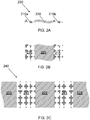
- Figure 2A is a simplified illustration of an exemplary triblock polymer molecule 200 that has a first polymer block 210a, a second polymer block 220, and a third polymer block 210b that is the same as the first polymer block 210a, all covalently bonded together.
- the first polymer block 210a, the second polymer block 220, and the third copolymer block 210b are linear polymer blocks.
- either some or all polymer blocks 210a, 220, 210b have a comb structure.
- no polymer block is cross-linked.
- one polymer block is cross-linked.
- two polymer blocks are cross-linked.
- all polymer blocks are cross-linked.
- Triblock polymer molecules 200 can arrange themselves to form a first domain 215 of a first phase made of the first polymer blocks 210a, a second domain 225 of a second phase made of the second polymer blocks 220, and a third domain 215 of a first phase made of the third polymer blocks 210b as shown in Figure 2B .
- Triblock polymer molecules 200 can arrange themselves to form multiple repeat domains 225, 215 (containing both 215a and 215b), thereby forming a continuous nanostructured block copolymer material 240, as shown in Figure 2C .
- the sizes of the domains can be adjusted by adjusting the molecular weights of each of the polymer blocks.
- the domains can be lamellar, cylindrical, spherical, gyroidal, or any of the other well-documented triblock copolymer morphologies depending on the nature of the polymer blocks and their ratios in the block copolymer.
- first and third polymer domains 215 are ionically conductive, and the second polymer domain 225 provides mechanical strength to the nanostructured block copolymer.
- the second polymer domain 225 is ionically conductive, and the first and third polymer domains 215 provide a structural framework.
- Figure 3A is a simplified illustration of another exemplary triblock polymer molecule 300 that has a first polymer block 310, a second polymer block 320, and a third polymer block 330, different from either of the other two polymer blocks, all covalently bonded together.
- the first polymer block 310, the second polymer block 320, and the third copolymer block 330 are linear polymer blocks.
- either some or all polymer blocks 310, 320, 330 have a comb (or branched) structure.
- no polymer block is cross-linked.
- one polymer block is cross-linked.
- two polymer blocks are cross-linked.
- all polymer blocks are cross-linked.
- Triblock polymer molecules 300 can arrange themselves to form a first domain 315 of a first phase made of the first polymer blocks 310a, a second domain 325 of a second phase made of the second polymer blocks 320, and a third domain 335 of a third phase made of the third polymer blocks 330 as shown in Figure 3B .
- Triblock polymer molecules 300 can arrange themselves to form multiple repeat domains, thereby forming a continuous nanostructured block copolymer material 340, as shown in Figure 3C .
- the sizes of the domains can be adjusted by adjusting the molecular weights of each of the polymer blocks.
- the domains can be lamellar, cylindrical, spherical, gyroidal, or any of the other well-documented triblock copolymer morphologies depending on the nature of the polymer blocks and their ratios in the block copolymer.
- first polymer domains 315 are ionically conductive
- the second polymer domains 325 provide mechanical strength to the nanostructured block copolymer.
- the third polymer domains 335 provides an additional functionality that may improve mechanical strength, ionic conductivity, electrical conductivity, chemical or electrochemical stability, may make the material easier to process, or may provide some other desirable property to the block copolymer.
- the individual domains can exchange roles.
- the conductive polymer (1) exhibits ionic conductivity of at least 10 -5 Scm -1 at electrochemical cell operating temperatures when combined with an appropriate salt(s), such as lithium salt(s); (2) is chemically stable against such salt(s); and (3) is thermally stable at electrochemical cell operating temperatures.
- the conductive polymer exhibits ionic conductivity of at least 10 -3 Scm -1 at electrochemical cell operating temperatures, such as at 25°C or at 80°C when combined with an appropriate salt(s).
- the structural material has a modulus in excess of 1x10 5 Pa at electrochemical cell operating temperatures.
- the structural material has a modulus in excess of 1x10 7 Pa at electrochemical cell operating temperatures. In one embodiment, the structural material has a modulus in excess of 1x10 9 Pa at electrochemical cell operating temperatures.
- the third polymer (1) is rubbery; and (2) has a glass transition temperature lower than operating and processing temperatures. It is useful if all materials are mutually immiscible.
- the block copolymer exhibits ionic conductivity of at least 10 -4 Scm -1 and has a modulus in excess of 1 x 10 7 Pa or 1x10 8 Pa at electrochemical cell operating temperatures. Examples of cell operating temperatures are 25°C and 80°C.
- the conductive phase can be made of any of the electrolytes disclosed above, such PFPE-PEO alternating copolymers, PFPE-carbonate alternating copolymers, PFPE-carbonate-PEO alternating copolymers, or variations thereof.
- block copolymer made using these conductive phases are solid.
- electrolyte salt that can be used in the block copolymer electrolytes. Any electrolyte salt that includes the ion identified as the most desirable charge carrier for the application can be used. It is especially useful to use electrolyte salts that have a large dissociation constant within the polymer electrolyte.
- Suitable examples include alkali metal salts, such as Li salts.
- Li salts include, but are not limited to, LiPF 6 , LiN(CF 3 SO 2 ) 2 , Li(CF 3 SO 2 ) 3 C, LiN(SO 2 CF 2 CF 3 ) 2 , LiB(C 2 O 4 ) 2 , B 12 F x H 12-x , B 12 F 12 , and mixtures thereof.
- Non-lithium salts such as salts of aluminum, sodium, and magnesium are examples of other salts that can be used with their corresponding metals.
- single ion conductors can be used with electrolyte salts or instead of electrolyte salts.
- Examples of single ion conductors include, but are not limited to sulfonamide salts, boron based salts, and sulfates groups.
- the structural phase can be made of polymers such as polystyrene, hydrogenated polystyrene ,polymethacrylate, poly(methyl methacrylate), polyvinylpyridine, polyvinylcyclohexane, polyimide, polyamide, polypropylene, poly (2,6-dimethyl-1,4-phenylene oxide) (PXE), polyolefins, poly(t-butyl vinyl ether), poly(cyclohexyl methacrylate), poly(cyclohexyl vinyl ether), poly(t-butyl vinyl ether), polyethylene, fluorocarbons, such as polyvinylidene fluoride, or copolymers that contain styrene, methacrylate, or vinylpyridine. It is especially useful if the structural phase is rigid and is in a glassy or crystalline state.
- Additional species can be added to nanostructured block copolymer electrolytes to enhance the ionic conductivity, to enhance the mechanical properties, or to enhance any other properties that may be desirable.
- the ionic conductivity of nanostructured block copolymer electrolyte materials can be improved by including one or more additives in the ionically conductive phase.
- An additive can improve ionic conductivity by lowering the degree of crystallinity, lowering the melting temperature, lowering the glass transition temperature, increasing chain mobility, or any combination of these.
- a high dielectric additive can aid dissociation of the salt, increasing the number of Li+ ions available for ion transport, and reducing the bulky Li+[salt] complexes.
- Additives that weaken the interaction between Li+ and PEO chains/anions, thereby making it easier for Li+ ions to diffuse, may be included in the conductive phase.
- the additives that enhance ionic conductivity can be broadly classified in the following categories: low molecular weight conductive polymers, ceramic particles, room temp ionic liquids (RTILs), high dielectric organic plasticizers, and Lewis acids.
- additives can be used in the polymer electrolytes described herein.
- additives that help with overcharge protection, provide stable SEI (solid electrolyte interphase) layers, and/or improve electrochemical stability can be used.
- SEI solid electrolyte interphase
- additives are well known to people with ordinary skill in the art.
- Additives that make the polymers easier to process, such as plasticizers, can also be used.
- neither small molecules nor plasticizers are added to the block copolymer electrolyte and the block copolymer electrolyte is a dry polymer.
- the electrolytes disclosed herein can be used in various parts of an electrochemical cell such as a battery.
- the electrolytes can be used as anolytes only in the anode or negative electrode.
- the electrolytes can be mixed with an anode active material, such as graphite, to form an anode for use with a lithium battery.
- the negative electrode active material can be any of a variety of materials depending on the type of chemistry for which the cell is designed.
- the cell is a lithium or lithium ion cell.
- the negative electrode material can be any material that can serve as a host material (i.e., can absorb and release) lithium ions. Examples of such materials include, but are not limited to graphite, lithium titanate, lithium metal, and lithium alloys such as Li-Al, Li-Si, Li-Sn, and Li-Mg. Silicon and silicon alloys are known to be useful as negative electrode materials in lithium cells.
- Examples include silicon alloys of tin (Sn), nickel (Ni), copper (Cu), iron (Fe), cobalt (Co), manganese (Mn), zinc (Zn), indium (In), silver (Ag), titanium (Ti), germanium (Ge), bismuth (Bi), antimony (Sb), and chromium (Cr) and mixtures thereof.
- graphite, metal oxides, silicon oxides or silicon carbides can also be used as negative electrode materials.
- the electrolytes can be used as catholytes only in the cathode or positive electrode.
- the electrolytes can be mixed with a cathode active material, such as listed below, to form a cathode for use with a lithium battery.
- the positive electrode active material can be any of a variety of materials depending on the type of chemistry for which the cell is designed.
- the cell is a lithium or lithium ion cell.
- the positive electrode active material can be any material that can serve as a host material for lithium ions.
- Such materials include, but are not limited to materials described by the general formula Li x A 1-y M y O 2 , wherein A comprises at least one transition metal selected from the group consisting of Mn, Co, and Ni; M comprises at least one element selected from the group consisting of B, Mg, Ca, Sr, Ba, Ti, V, Cr, Mn, Fe, Co, Ni, Cu, Al, In, Nb, Mo, W, Y, and Rh; x is described by 0.05 ⁇ x ⁇ 1.1; and y is described by 0 ⁇ y ⁇ 0.5.
- the positive electrode material is LiNi 0.5 Mn 0.5 O 2 .
- the positive electrode active material is described by the general formula: Li x Mn 2-y M y O 2 , where M is chosen from Mn, Ni, Co, and/or Cr; x is described by 0.05 ⁇ x ⁇ 1.1; and y is described by 0 ⁇ y ⁇ 2.
- the positive electrode active material is described by the general formula: Li x M y Mn 4-y O 8 , where M is chosen from Fe and/or Co; x is described by 0.05 ⁇ x ⁇ 2; and y is described by 0 ⁇ y ⁇ 4.
- the positive electrode active material is given by the general formula Li x (Fe y M 1-y )PO 4 , where M is chosen from transition metals such as Mn, Co and/or Ni; x is described by 0.9 ⁇ x ⁇ 1.1; and y is described by 0 ⁇ y ⁇ 1.
- the positive electrode active material is given by the general formula: Li(Ni 0.5-x Co 0.5-x M 2x )O 2 , where M is chosen from Al, Mg, Mn, and/or Ti; and x is described by 0 ⁇ x ⁇ 0.2.
- the positive electrode material includes LiNiVO 2 .
- the electrolytes can be used in the separator of a battery, providing a medium for ionic communication between the anode and the cathode.
- the electrolyte is liquid or a gel, it may be used with a separator membrane, such as Celgard ⁇ , as is know in the art. If the electrolyte is a solid or a high-viscosity gel, it may be used without a separator membrane.
- the electrolytes are used in all parts of the battery. In another arrangement, the electrolytes are used in the cathode and in the separator with a lithium metal or lithium alloy foil anode.
- inventive concept has been described herein in considerable detail to provide those skilled in the art with information relevant to apply the novel principles and to construct and use such specialized components as are required. However, it is to be understood that the inventive concept may be carried out by different equipment, materials and devices, and that various modifications, both as to the equipment and operating procedures, may be accomplished without departing from the scope of the inventive concept itself.
Landscapes
- Chemical & Material Sciences (AREA)
- Chemical Kinetics & Catalysis (AREA)
- Electrochemistry (AREA)
- General Chemical & Material Sciences (AREA)
- Engineering & Computer Science (AREA)
- Manufacturing & Machinery (AREA)
- Inorganic Chemistry (AREA)
- Materials Engineering (AREA)
- Condensed Matter Physics & Semiconductors (AREA)
- Physics & Mathematics (AREA)
- General Physics & Mathematics (AREA)
- Organic Chemistry (AREA)
- Health & Medical Sciences (AREA)
- Medicinal Chemistry (AREA)
- Polymers & Plastics (AREA)
- Dispersion Chemistry (AREA)
- Secondary Cells (AREA)
- Battery Electrode And Active Subsutance (AREA)
- Conductive Materials (AREA)
- Primary Cells (AREA)
- Polyethers (AREA)
- Polyesters Or Polycarbonates (AREA)
Applications Claiming Priority (2)
| Application Number | Priority Date | Filing Date | Title |
|---|---|---|---|
| US201562160375P | 2015-05-12 | 2015-05-12 | |
| PCT/US2016/030602 WO2016182797A1 (en) | 2015-05-12 | 2016-05-03 | Copolymers of peo and fluorinated polymers as electrolytes for lithium batteries |
Publications (3)
| Publication Number | Publication Date |
|---|---|
| EP3295502A1 EP3295502A1 (en) | 2018-03-21 |
| EP3295502A4 EP3295502A4 (en) | 2019-03-20 |
| EP3295502B1 true EP3295502B1 (en) | 2021-06-23 |
Family
ID=57249163
Family Applications (1)
| Application Number | Title | Priority Date | Filing Date |
|---|---|---|---|
| EP16793195.5A Active EP3295502B1 (en) | 2015-05-12 | 2016-05-03 | Copolymers of peo and fluorinated polymers as electrolytes for lithium batteries |
Country Status (6)
| Country | Link |
|---|---|
| US (2) | US10044063B2 (enExample) |
| EP (1) | EP3295502B1 (enExample) |
| JP (1) | JP6533305B2 (enExample) |
| KR (1) | KR20180005173A (enExample) |
| CN (1) | CN107534158B (enExample) |
| WO (1) | WO2016182797A1 (enExample) |
Families Citing this family (22)
| Publication number | Priority date | Publication date | Assignee | Title |
|---|---|---|---|---|
| KR102027825B1 (ko) | 2014-02-06 | 2019-10-02 | 겔리온 테크놀로지스 피티와이 리미티드 | 겔화된 이온성 액체 필름-코팅 표면 및 이의 용도 |
| EP3295502B1 (en) * | 2015-05-12 | 2021-06-23 | Seeo, Inc | Copolymers of peo and fluorinated polymers as electrolytes for lithium batteries |
| US10985373B2 (en) * | 2017-02-27 | 2021-04-20 | Global Graphene Group, Inc. | Lithium battery cathode and method of manufacturing |
| CN110277558B (zh) * | 2018-03-15 | 2022-04-08 | 上海大学 | 一种锂离子电池负极材料及其制备方法 |
| CN108598564A (zh) * | 2018-04-28 | 2018-09-28 | 南开大学 | 一种固态聚合物电解质及其制备方法和应用 |
| FR3083006B1 (fr) * | 2018-06-22 | 2026-09-04 | Inst Polytechnique Grenoble | Electrolyte polymere solide, son procede de preparation et accumulateur/cellule electrochimique en comprenant |
| EP3716377B1 (en) | 2018-07-27 | 2025-05-07 | LG Energy Solution, Ltd. | Electrode protective layer polymer and secondary battery to which same is applied |
| CN112912421A (zh) * | 2018-09-30 | 2021-06-04 | 罗伯特·博世有限公司 | 基于pxe的聚合物组合物 |
| PL3881385T3 (pl) * | 2018-11-12 | 2023-06-26 | Solvay Specialty Polymers Italy S.P.A. | Kompozycja stałego elektrolitu |
| CN113261139A (zh) * | 2018-12-17 | 2021-08-13 | 索尔维公司 | 含氟聚合物混杂复合材料 |
| JP7252479B2 (ja) | 2019-01-31 | 2023-04-05 | ダイキン工業株式会社 | 構造体、複合体、電池、及び、複合体の製造方法 |
| CN109994772B (zh) * | 2019-03-19 | 2020-11-24 | 东莞东阳光科研发有限公司 | 全固态复合型聚合物固体电解质及其制备方法 |
| CN112072169B (zh) * | 2019-06-10 | 2022-06-14 | 惠州比亚迪实业有限公司 | 全固态电解质及其组合物与电极和全固态锂离子电池 |
| US12374719B2 (en) | 2019-08-08 | 2025-07-29 | Lg Energy Solution, Ltd. | Copolymer for polymer electrolyte, and gel polymer electrolyte and lithium secondary battery which include the same |
| CN112542611A (zh) * | 2019-09-20 | 2021-03-23 | 北京石墨烯研究院 | 用于凝胶电解质的组合物、柔性电池及其制备方法 |
| CN112072175B (zh) * | 2020-09-10 | 2021-10-08 | 中国科学院过程工程研究所 | 一种聚合物电解质及其制备方法和应用 |
| WO2022085105A1 (ja) * | 2020-10-21 | 2022-04-28 | 三菱電機株式会社 | 熱交換器、及び、熱交換器の製造方法 |
| KR102902179B1 (ko) * | 2020-12-23 | 2025-12-19 | 다이킨 고교 가부시키가이샤 | 표면 처리제 |
| KR102587798B1 (ko) * | 2021-04-30 | 2023-10-12 | 이피캠텍 주식회사 | 가교 고분자 전해질 첨가용 단량체 및 이를 포함하는 리튬이온전지용 가교 고분자 전해질막 |
| KR20250040483A (ko) * | 2023-09-15 | 2025-03-24 | 주식회사 엘지에너지솔루션 | 복합 고체 전해질 및 이를 포함하는 전고체 전지 |
| EP4749741A1 (en) * | 2023-09-15 | 2026-05-27 | LG Energy Solution, Ltd. | Solid-state battery |
| CN119381542B (zh) * | 2024-10-09 | 2026-08-21 | 东风汽车集团股份有限公司 | 一种阻燃柔性固态电解质材料及其制备方法和应用 |
Family Cites Families (39)
| Publication number | Priority date | Publication date | Assignee | Title |
|---|---|---|---|---|
| JPH08222270A (ja) * | 1994-12-13 | 1996-08-30 | Japan Energy Corp | イオン伝導体 |
| US20020110739A1 (en) | 2000-05-26 | 2002-08-15 | Mcewen Alan B. | Non-flammable electrolytes |
| ITMI20010008A1 (it) | 2001-01-03 | 2002-07-03 | Ausimont Spa | Additivi per fluoropolieterei per applicazioni elettromagnetiche |
| US7045571B2 (en) | 2001-05-21 | 2006-05-16 | 3M Innovative Properties Company | Emulsion polymerization of fluorinated monomers |
| US20030049538A1 (en) | 2001-08-02 | 2003-03-13 | Wolfgang Buerger | Electrochemical energy storage device |
| US7094501B2 (en) | 2001-09-25 | 2006-08-22 | E. I. Du Pont De Nemours And Company | Graft oligomeric electrolytes |
| WO2004035656A1 (ja) * | 2002-10-18 | 2004-04-29 | Asahi Glass Company, Limited | ペルフルオロポリエーテル誘導体 |
| JP2007525802A (ja) | 2004-01-23 | 2007-09-06 | ザ ユニバーシティ オブ ノース カロライナ アット チャペル ヒル | 電気化学電池に使用するための液体材料 |
| US8158728B2 (en) | 2004-02-13 | 2012-04-17 | The University Of North Carolina At Chapel Hill | Methods and materials for fabricating microfluidic devices |
| JP4982943B2 (ja) * | 2004-10-15 | 2012-07-25 | ダイキン工業株式会社 | イオン伝導体 |
| US20060216524A1 (en) | 2005-03-23 | 2006-09-28 | 3M Innovative Properties Company | Perfluoropolyether urethane additives having (meth)acryl groups and hard coats |
| WO2007056561A2 (en) | 2005-11-09 | 2007-05-18 | Liquidia Technologies, Inc. | Medical device, materials, and methods |
| JP5250937B2 (ja) * | 2006-02-28 | 2013-07-31 | 富士通株式会社 | 潤滑剤、磁気記録媒体およびヘッドスライダ |
| US8563168B2 (en) * | 2006-04-04 | 2013-10-22 | The Regents Of The University Of California | High elastic modulus polymer electrolytes |
| CN101535351B (zh) | 2006-11-09 | 2012-03-21 | 纳幕尔杜邦公司 | 使用包含氟聚醚酸或盐和硅氧烷表面活性剂的聚合剂的氟化单体含水聚合反应 |
| JP4501963B2 (ja) | 2007-05-28 | 2010-07-14 | ソニー株式会社 | リチウムイオン二次電池用負極およびリチウムイオン二次電池 |
| JP5049680B2 (ja) | 2007-07-12 | 2012-10-17 | 株式会社東芝 | 非水電解質電池及び電池パック |
| CN101939869B (zh) * | 2008-01-16 | 2015-09-23 | 西奥公司 | 用于电池的凝胶聚合物电解质 |
| US9893337B2 (en) | 2008-02-13 | 2018-02-13 | Seeo, Inc. | Multi-phase electrolyte lithium batteries |
| WO2010054261A1 (en) | 2008-11-07 | 2010-05-14 | Seeo, Inc | Multiple electrolyte electrochemical cells |
| JP5334426B2 (ja) | 2008-02-29 | 2013-11-06 | 三洋電機株式会社 | アルカリ蓄電池用負極及びアルカリ蓄電池 |
| US8323838B2 (en) * | 2008-09-12 | 2012-12-04 | Enerize Corporation | Solid polymer electrolyte for solar cells and lithium batteries |
| WO2010083325A1 (en) | 2009-01-16 | 2010-07-22 | Seeo, Inc | Polymer electrolytes having alkylene oxide pendants with polar groups |
| US9252456B2 (en) * | 2009-02-27 | 2016-02-02 | University Of Maryland, College Park | Polymer solid electrolyte for flexible batteries |
| CN102668232B (zh) | 2009-10-27 | 2016-05-04 | 苏威氟有限公司 | 锂硫电池 |
| US8802301B2 (en) | 2009-11-06 | 2014-08-12 | GM Global Technology Operations LLC | Lithium ion battery electrolyte including a vitreous eutectic mixture |
| US9590268B2 (en) * | 2010-05-19 | 2017-03-07 | Seeo, Inc. | High temperature lithium cells with solid polymer electrolytes |
| WO2012067943A1 (en) | 2010-11-15 | 2012-05-24 | Amprius, Inc. | Electrolytes for rechargeable batteries |
| FR2979630B1 (fr) * | 2011-09-05 | 2013-10-04 | Univ Provence Aix Marseille 1 | Copolymeres a blocs dont un polyanionique base sur un monomere anion de type tfsili comme electrolyte de batterie. |
| US9450272B2 (en) * | 2012-04-14 | 2016-09-20 | Seeo, Inc. | Small domain-size multiblock copolymer electrolytes |
| CN105210227A (zh) | 2013-04-01 | 2015-12-30 | 北卡罗来纳-查佩尔山大学 | 用于碱金属离子电池的离子导电含氟聚合物碳酸酯 |
| KR102295442B1 (ko) | 2013-05-24 | 2021-08-27 | 리젠츠 오브 더 유니버시티 오브 미네소타 | 중합체 전해질 멤브레인 |
| US10586964B2 (en) | 2013-08-12 | 2020-03-10 | Solvay Sa | Solid composite fluoropolymer separator |
| KR101848577B1 (ko) * | 2014-01-10 | 2018-04-12 | 닛산 지도우샤 가부시키가이샤 | 비수전해질 이차 전지의 제조 방법 |
| KR101960581B1 (ko) * | 2014-03-27 | 2019-03-20 | 닛산 지도우샤 가부시키가이샤 | 비수전해질 이차 전지 |
| US9614229B2 (en) | 2014-09-30 | 2017-04-04 | Maxpower, Inc. | Functionalized short chain fluorinated polyether based electrolytes for safe lithium batteries and the cells having the same |
| US10122002B2 (en) * | 2015-01-21 | 2018-11-06 | GM Global Technology Operations LLC | Thin and flexible solid electrolyte for lithium-ion batteries |
| US9540312B2 (en) | 2015-02-03 | 2017-01-10 | Blue Current, Inc. | Non-flammable electrolyte composition including carbonate-terminated perfluoropolymer and phosphate-terminated or phosphonate-terminated perfluoropolymer and battery using same |
| EP3295502B1 (en) * | 2015-05-12 | 2021-06-23 | Seeo, Inc | Copolymers of peo and fluorinated polymers as electrolytes for lithium batteries |
-
2016
- 2016-05-03 EP EP16793195.5A patent/EP3295502B1/en active Active
- 2016-05-03 WO PCT/US2016/030602 patent/WO2016182797A1/en not_active Ceased
- 2016-05-03 CN CN201680025601.5A patent/CN107534158B/zh not_active Expired - Fee Related
- 2016-05-03 KR KR1020177032149A patent/KR20180005173A/ko not_active Ceased
- 2016-05-03 JP JP2017559425A patent/JP6533305B2/ja not_active Expired - Fee Related
- 2016-05-25 US US15/164,709 patent/US10044063B2/en not_active Expired - Fee Related
-
2018
- 2018-07-02 US US16/025,971 patent/US20180323470A1/en not_active Abandoned
Non-Patent Citations (1)
| Title |
|---|
| None * |
Also Published As
| Publication number | Publication date |
|---|---|
| US10044063B2 (en) | 2018-08-07 |
| US20160336620A1 (en) | 2016-11-17 |
| CN107534158B (zh) | 2020-08-18 |
| KR20180005173A (ko) | 2018-01-15 |
| EP3295502A1 (en) | 2018-03-21 |
| EP3295502A4 (en) | 2019-03-20 |
| WO2016182797A1 (en) | 2016-11-17 |
| JP2018522085A (ja) | 2018-08-09 |
| US20180323470A1 (en) | 2018-11-08 |
| JP6533305B2 (ja) | 2019-06-19 |
| CN107534158A (zh) | 2018-01-02 |
Similar Documents
| Publication | Publication Date | Title |
|---|---|---|
| US10044063B2 (en) | Copolymers of PEO and fluorinated polymers as electrolytes for lithium batteries | |
| US10158109B2 (en) | Multi-phase electrolyte lithium batteries | |
| US10658698B2 (en) | Peo-based graft copolymers with pendant fluorinated groups for use as electrolytes | |
| US10014554B2 (en) | Block copolymer electrolytes containing polymeric additives | |
| US20130066025A1 (en) | Polymer compositions based on pxe | |
| KR20160079574A (ko) | 고분자, 이를 포함하는 전해질 및 리튬이차전지 | |
| WO2010083330A1 (en) | Polymer compositions with oligomeric alkylene oxide pendants | |
| US20220093971A1 (en) | Copolymer having functional group as substituent at chain-end, method for preparing electrolyte membrane for secondary battery including the same, and electrolyte membrane for secondary battery including the same | |
| CN112126068B (zh) | 用于锂电池组电池的聚合物电解质材料 | |
| US7125631B2 (en) | Lithium salt, ionic conductor and liquid electrolyte | |
| JP4985959B2 (ja) | 有機固体電解質及びこれを用いた2次電池 | |
| WO2019158781A1 (en) | Solid polymer electrolyte | |
| KR102837484B1 (ko) | 고체 전해질 조성물 | |
| JP2005044704A (ja) | 固体電解質 | |
| Eiamlamai | Polymer electrolytes based on ionic liquids for lithium batteries | |
| EP3638682A1 (en) | A method for synthesis of lithium fluorinated borate salts | |
| Artigues et al. | Two routes for N-rich solid polymer electrolyte for all-solid-state lithium-ion batteries | |
| US20240088437A1 (en) | Linear superionic polymer electrolyte | |
| JP3685571B2 (ja) | 機能性高分子、それを用いた高分子固体電解質及び電池 | |
| EP4550451A1 (en) | Lithium metal battery and method of manufacturing the same | |
| US20250087747A1 (en) | Solid polymer electrolytes comprising ionic compounds and uses thereof | |
| San Román Gallego Casilda | From ionic monomers to ionomers for their use in Li and post-Li batteries | |
| JP4815038B2 (ja) | 高分子固体電解質用硬化物 | |
| WO2022036164A1 (en) | Solid polymer electrolytes for solid-state lithium metal batteries | |
| JP2023084696A (ja) | 非水電解液二次電池用多孔質層 |
Legal Events
| Date | Code | Title | Description |
|---|---|---|---|
| STAA | Information on the status of an ep patent application or granted ep patent |
Free format text: STATUS: THE INTERNATIONAL PUBLICATION HAS BEEN MADE |
|
| PUAI | Public reference made under article 153(3) epc to a published international application that has entered the european phase |
Free format text: ORIGINAL CODE: 0009012 |
|
| STAA | Information on the status of an ep patent application or granted ep patent |
Free format text: STATUS: REQUEST FOR EXAMINATION WAS MADE |
|
| 17P | Request for examination filed |
Effective date: 20171108 |
|
| AK | Designated contracting states |
Kind code of ref document: A1 Designated state(s): AL AT BE BG CH CY CZ DE DK EE ES FI FR GB GR HR HU IE IS IT LI LT LU LV MC MK MT NL NO PL PT RO RS SE SI SK SM TR |
|
| AX | Request for extension of the european patent |
Extension state: BA ME |
|
| DAV | Request for validation of the european patent (deleted) | ||
| DAX | Request for extension of the european patent (deleted) | ||
| A4 | Supplementary search report drawn up and despatched |
Effective date: 20190214 |
|
| RIC1 | Information provided on ipc code assigned before grant |
Ipc: H01M 10/0565 20100101ALI20190208BHEP Ipc: H01M 6/18 20060101AFI20190208BHEP Ipc: H01M 10/0525 20100101ALI20190208BHEP Ipc: H01M 4/62 20060101ALI20190208BHEP |
|
| STAA | Information on the status of an ep patent application or granted ep patent |
Free format text: STATUS: EXAMINATION IS IN PROGRESS |
|
| 17Q | First examination report despatched |
Effective date: 20200319 |
|
| GRAP | Despatch of communication of intention to grant a patent |
Free format text: ORIGINAL CODE: EPIDOSNIGR1 |
|
| STAA | Information on the status of an ep patent application or granted ep patent |
Free format text: STATUS: GRANT OF PATENT IS INTENDED |
|
| INTG | Intention to grant announced |
Effective date: 20210115 |
|
| GRAS | Grant fee paid |
Free format text: ORIGINAL CODE: EPIDOSNIGR3 |
|
| GRAA | (expected) grant |
Free format text: ORIGINAL CODE: 0009210 |
|
| STAA | Information on the status of an ep patent application or granted ep patent |
Free format text: STATUS: THE PATENT HAS BEEN GRANTED |
|
| AK | Designated contracting states |
Kind code of ref document: B1 Designated state(s): AL AT BE BG CH CY CZ DE DK EE ES FI FR GB GR HR HU IE IS IT LI LT LU LV MC MK MT NL NO PL PT RO RS SE SI SK SM TR |
|
| REG | Reference to a national code |
Ref country code: GB Ref legal event code: FG4D |
|
| REG | Reference to a national code |
Ref country code: CH Ref legal event code: EP |
|
| REG | Reference to a national code |
Ref country code: DE Ref legal event code: R096 Ref document number: 602016059707 Country of ref document: DE Ref country code: AT Ref legal event code: REF Ref document number: 1405094 Country of ref document: AT Kind code of ref document: T Effective date: 20210715 |
|
| REG | Reference to a national code |
Ref country code: IE Ref legal event code: FG4D |
|
| REG | Reference to a national code |
Ref country code: LT Ref legal event code: MG9D |
|
| PG25 | Lapsed in a contracting state [announced via postgrant information from national office to epo] |
Ref country code: FI Free format text: LAPSE BECAUSE OF FAILURE TO SUBMIT A TRANSLATION OF THE DESCRIPTION OR TO PAY THE FEE WITHIN THE PRESCRIBED TIME-LIMIT Effective date: 20210623 Ref country code: LT Free format text: LAPSE BECAUSE OF FAILURE TO SUBMIT A TRANSLATION OF THE DESCRIPTION OR TO PAY THE FEE WITHIN THE PRESCRIBED TIME-LIMIT Effective date: 20210623 Ref country code: HR Free format text: LAPSE BECAUSE OF FAILURE TO SUBMIT A TRANSLATION OF THE DESCRIPTION OR TO PAY THE FEE WITHIN THE PRESCRIBED TIME-LIMIT Effective date: 20210623 Ref country code: BG Free format text: LAPSE BECAUSE OF FAILURE TO SUBMIT A TRANSLATION OF THE DESCRIPTION OR TO PAY THE FEE WITHIN THE PRESCRIBED TIME-LIMIT Effective date: 20210923 |
|
| REG | Reference to a national code |
Ref country code: AT Ref legal event code: MK05 Ref document number: 1405094 Country of ref document: AT Kind code of ref document: T Effective date: 20210623 |
|
| PG25 | Lapsed in a contracting state [announced via postgrant information from national office to epo] |
Ref country code: GR Free format text: LAPSE BECAUSE OF FAILURE TO SUBMIT A TRANSLATION OF THE DESCRIPTION OR TO PAY THE FEE WITHIN THE PRESCRIBED TIME-LIMIT Effective date: 20210924 Ref country code: LV Free format text: LAPSE BECAUSE OF FAILURE TO SUBMIT A TRANSLATION OF THE DESCRIPTION OR TO PAY THE FEE WITHIN THE PRESCRIBED TIME-LIMIT Effective date: 20210623 Ref country code: NO Free format text: LAPSE BECAUSE OF FAILURE TO SUBMIT A TRANSLATION OF THE DESCRIPTION OR TO PAY THE FEE WITHIN THE PRESCRIBED TIME-LIMIT Effective date: 20210923 Ref country code: RS Free format text: LAPSE BECAUSE OF FAILURE TO SUBMIT A TRANSLATION OF THE DESCRIPTION OR TO PAY THE FEE WITHIN THE PRESCRIBED TIME-LIMIT Effective date: 20210623 Ref country code: SE Free format text: LAPSE BECAUSE OF FAILURE TO SUBMIT A TRANSLATION OF THE DESCRIPTION OR TO PAY THE FEE WITHIN THE PRESCRIBED TIME-LIMIT Effective date: 20210623 |
|
| REG | Reference to a national code |
Ref country code: NL Ref legal event code: MP Effective date: 20210623 |
|
| PG25 | Lapsed in a contracting state [announced via postgrant information from national office to epo] |
Ref country code: ES Free format text: LAPSE BECAUSE OF FAILURE TO SUBMIT A TRANSLATION OF THE DESCRIPTION OR TO PAY THE FEE WITHIN THE PRESCRIBED TIME-LIMIT Effective date: 20210623 Ref country code: PT Free format text: LAPSE BECAUSE OF FAILURE TO SUBMIT A TRANSLATION OF THE DESCRIPTION OR TO PAY THE FEE WITHIN THE PRESCRIBED TIME-LIMIT Effective date: 20211025 Ref country code: RO Free format text: LAPSE BECAUSE OF FAILURE TO SUBMIT A TRANSLATION OF THE DESCRIPTION OR TO PAY THE FEE WITHIN THE PRESCRIBED TIME-LIMIT Effective date: 20210623 Ref country code: NL Free format text: LAPSE BECAUSE OF FAILURE TO SUBMIT A TRANSLATION OF THE DESCRIPTION OR TO PAY THE FEE WITHIN THE PRESCRIBED TIME-LIMIT Effective date: 20210623 Ref country code: AT Free format text: LAPSE BECAUSE OF FAILURE TO SUBMIT A TRANSLATION OF THE DESCRIPTION OR TO PAY THE FEE WITHIN THE PRESCRIBED TIME-LIMIT Effective date: 20210623 Ref country code: CZ Free format text: LAPSE BECAUSE OF FAILURE TO SUBMIT A TRANSLATION OF THE DESCRIPTION OR TO PAY THE FEE WITHIN THE PRESCRIBED TIME-LIMIT Effective date: 20210623 Ref country code: EE Free format text: LAPSE BECAUSE OF FAILURE TO SUBMIT A TRANSLATION OF THE DESCRIPTION OR TO PAY THE FEE WITHIN THE PRESCRIBED TIME-LIMIT Effective date: 20210623 Ref country code: SM Free format text: LAPSE BECAUSE OF FAILURE TO SUBMIT A TRANSLATION OF THE DESCRIPTION OR TO PAY THE FEE WITHIN THE PRESCRIBED TIME-LIMIT Effective date: 20210623 Ref country code: SK Free format text: LAPSE BECAUSE OF FAILURE TO SUBMIT A TRANSLATION OF THE DESCRIPTION OR TO PAY THE FEE WITHIN THE PRESCRIBED TIME-LIMIT Effective date: 20210623 |
|
| PG25 | Lapsed in a contracting state [announced via postgrant information from national office to epo] |
Ref country code: PL Free format text: LAPSE BECAUSE OF FAILURE TO SUBMIT A TRANSLATION OF THE DESCRIPTION OR TO PAY THE FEE WITHIN THE PRESCRIBED TIME-LIMIT Effective date: 20210623 |
|
| REG | Reference to a national code |
Ref country code: DE Ref legal event code: R097 Ref document number: 602016059707 Country of ref document: DE |
|
| PG25 | Lapsed in a contracting state [announced via postgrant information from national office to epo] |
Ref country code: DK Free format text: LAPSE BECAUSE OF FAILURE TO SUBMIT A TRANSLATION OF THE DESCRIPTION OR TO PAY THE FEE WITHIN THE PRESCRIBED TIME-LIMIT Effective date: 20210623 |
|
| PLBE | No opposition filed within time limit |
Free format text: ORIGINAL CODE: 0009261 |
|
| STAA | Information on the status of an ep patent application or granted ep patent |
Free format text: STATUS: NO OPPOSITION FILED WITHIN TIME LIMIT |
|
| 26N | No opposition filed |
Effective date: 20220324 |
|
| PG25 | Lapsed in a contracting state [announced via postgrant information from national office to epo] |
Ref country code: AL Free format text: LAPSE BECAUSE OF FAILURE TO SUBMIT A TRANSLATION OF THE DESCRIPTION OR TO PAY THE FEE WITHIN THE PRESCRIBED TIME-LIMIT Effective date: 20210623 |
|
| PG25 | Lapsed in a contracting state [announced via postgrant information from national office to epo] |
Ref country code: IT Free format text: LAPSE BECAUSE OF FAILURE TO SUBMIT A TRANSLATION OF THE DESCRIPTION OR TO PAY THE FEE WITHIN THE PRESCRIBED TIME-LIMIT Effective date: 20210623 |
|
| PGFP | Annual fee paid to national office [announced via postgrant information from national office to epo] |
Ref country code: DE Payment date: 20220725 Year of fee payment: 7 |
|
| REG | Reference to a national code |
Ref country code: CH Ref legal event code: PL |
|
| REG | Reference to a national code |
Ref country code: BE Ref legal event code: MM Effective date: 20220531 |
|
| GBPC | Gb: european patent ceased through non-payment of renewal fee |
Effective date: 20220503 |
|
| PG25 | Lapsed in a contracting state [announced via postgrant information from national office to epo] |
Ref country code: MC Free format text: LAPSE BECAUSE OF FAILURE TO SUBMIT A TRANSLATION OF THE DESCRIPTION OR TO PAY THE FEE WITHIN THE PRESCRIBED TIME-LIMIT Effective date: 20210623 Ref country code: LU Free format text: LAPSE BECAUSE OF NON-PAYMENT OF DUE FEES Effective date: 20220503 Ref country code: LI Free format text: LAPSE BECAUSE OF NON-PAYMENT OF DUE FEES Effective date: 20220531 Ref country code: CH Free format text: LAPSE BECAUSE OF NON-PAYMENT OF DUE FEES Effective date: 20220531 |
|
| PG25 | Lapsed in a contracting state [announced via postgrant information from national office to epo] |
Ref country code: IE Free format text: LAPSE BECAUSE OF NON-PAYMENT OF DUE FEES Effective date: 20220503 Ref country code: FR Free format text: LAPSE BECAUSE OF NON-PAYMENT OF DUE FEES Effective date: 20220531 |
|
| PG25 | Lapsed in a contracting state [announced via postgrant information from national office to epo] |
Ref country code: GB Free format text: LAPSE BECAUSE OF NON-PAYMENT OF DUE FEES Effective date: 20220503 Ref country code: BE Free format text: LAPSE BECAUSE OF NON-PAYMENT OF DUE FEES Effective date: 20220531 |
|
| REG | Reference to a national code |
Ref country code: DE Ref legal event code: R119 Ref document number: 602016059707 Country of ref document: DE |
|
| PG25 | Lapsed in a contracting state [announced via postgrant information from national office to epo] |
Ref country code: HU Free format text: LAPSE BECAUSE OF FAILURE TO SUBMIT A TRANSLATION OF THE DESCRIPTION OR TO PAY THE FEE WITHIN THE PRESCRIBED TIME-LIMIT; INVALID AB INITIO Effective date: 20160503 |
|
| PG25 | Lapsed in a contracting state [announced via postgrant information from national office to epo] |
Ref country code: MK Free format text: LAPSE BECAUSE OF FAILURE TO SUBMIT A TRANSLATION OF THE DESCRIPTION OR TO PAY THE FEE WITHIN THE PRESCRIBED TIME-LIMIT Effective date: 20210623 Ref country code: DE Free format text: LAPSE BECAUSE OF NON-PAYMENT OF DUE FEES Effective date: 20231201 Ref country code: CY Free format text: LAPSE BECAUSE OF FAILURE TO SUBMIT A TRANSLATION OF THE DESCRIPTION OR TO PAY THE FEE WITHIN THE PRESCRIBED TIME-LIMIT Effective date: 20210623 |
|
| PG25 | Lapsed in a contracting state [announced via postgrant information from national office to epo] |
Ref country code: MT Free format text: LAPSE BECAUSE OF FAILURE TO SUBMIT A TRANSLATION OF THE DESCRIPTION OR TO PAY THE FEE WITHIN THE PRESCRIBED TIME-LIMIT Effective date: 20210623 |
|
| PG25 | Lapsed in a contracting state [announced via postgrant information from national office to epo] |
Ref country code: TR Free format text: LAPSE BECAUSE OF FAILURE TO SUBMIT A TRANSLATION OF THE DESCRIPTION OR TO PAY THE FEE WITHIN THE PRESCRIBED TIME-LIMIT Effective date: 20210623 |