EP3092218B1 - Procédé de purification d'acides aminés aromatiques - Google Patents
Procédé de purification d'acides aminés aromatiques Download PDFInfo
- Publication number
- EP3092218B1 EP3092218B1 EP14701813.9A EP14701813A EP3092218B1 EP 3092218 B1 EP3092218 B1 EP 3092218B1 EP 14701813 A EP14701813 A EP 14701813A EP 3092218 B1 EP3092218 B1 EP 3092218B1
- Authority
- EP
- European Patent Office
- Prior art keywords
- equal
- amino acid
- resin
- eluent
- concentration
- Prior art date
- Legal status (The legal status is an assumption and is not a legal conclusion. Google has not performed a legal analysis and makes no representation as to the accuracy of the status listed.)
- Active
Links
Images


Classifications
-
- C—CHEMISTRY; METALLURGY
- C07—ORGANIC CHEMISTRY
- C07D—HETEROCYCLIC COMPOUNDS
- C07D209/00—Heterocyclic compounds containing five-membered rings, condensed with other rings, with one nitrogen atom as the only ring hetero atom
- C07D209/02—Heterocyclic compounds containing five-membered rings, condensed with other rings, with one nitrogen atom as the only ring hetero atom condensed with one carbocyclic ring
- C07D209/04—Indoles; Hydrogenated indoles
- C07D209/10—Indoles; Hydrogenated indoles with substituted hydrocarbon radicals attached to carbon atoms of the hetero ring
- C07D209/18—Radicals substituted by carbon atoms having three bonds to hetero atoms with at the most one bond to halogen, e.g. ester or nitrile radicals
- C07D209/20—Radicals substituted by carbon atoms having three bonds to hetero atoms with at the most one bond to halogen, e.g. ester or nitrile radicals substituted additionally by nitrogen atoms, e.g. tryptophane
-
- B—PERFORMING OPERATIONS; TRANSPORTING
- B01—PHYSICAL OR CHEMICAL PROCESSES OR APPARATUS IN GENERAL
- B01J—CHEMICAL OR PHYSICAL PROCESSES, e.g. CATALYSIS OR COLLOID CHEMISTRY; THEIR RELEVANT APPARATUS
- B01J39/00—Cation exchange; Use of material as cation exchangers; Treatment of material for improving the cation exchange properties
- B01J39/04—Processes using organic exchangers
- B01J39/05—Processes using organic exchangers in the strongly acidic form
-
- B—PERFORMING OPERATIONS; TRANSPORTING
- B01—PHYSICAL OR CHEMICAL PROCESSES OR APPARATUS IN GENERAL
- B01J—CHEMICAL OR PHYSICAL PROCESSES, e.g. CATALYSIS OR COLLOID CHEMISTRY; THEIR RELEVANT APPARATUS
- B01J39/00—Cation exchange; Use of material as cation exchangers; Treatment of material for improving the cation exchange properties
- B01J39/08—Use of material as cation exchangers; Treatment of material for improving the cation exchange properties
- B01J39/16—Organic material
- B01J39/18—Macromolecular compounds
- B01J39/20—Macromolecular compounds obtained by reactions only involving unsaturated carbon-to-carbon bonds
-
- C—CHEMISTRY; METALLURGY
- C07—ORGANIC CHEMISTRY
- C07C—ACYCLIC OR CARBOCYCLIC COMPOUNDS
- C07C227/00—Preparation of compounds containing amino and carboxyl groups bound to the same carbon skeleton
- C07C227/38—Separation; Purification; Stabilisation; Use of additives
- C07C227/40—Separation; Purification
-
- C—CHEMISTRY; METALLURGY
- C07—ORGANIC CHEMISTRY
- C07D—HETEROCYCLIC COMPOUNDS
- C07D233/00—Heterocyclic compounds containing 1,3-diazole or hydrogenated 1,3-diazole rings, not condensed with other rings
- C07D233/54—Heterocyclic compounds containing 1,3-diazole or hydrogenated 1,3-diazole rings, not condensed with other rings having two double bonds between ring members or between ring members and non-ring members
- C07D233/64—Heterocyclic compounds containing 1,3-diazole or hydrogenated 1,3-diazole rings, not condensed with other rings having two double bonds between ring members or between ring members and non-ring members with substituted hydrocarbon radicals attached to ring carbon atoms, e.g. histidine
Definitions
- the present invention relates to a process for the purification of aromatic amino acids, that is to say amino acids comprising an aromatic ring, and in the first place tryptophan, phenylalanine, tyrosine, and histidine.
- Aromatic amino acids can be produced by fermentation, enzymation or synthetically.
- Tryptophan, phenylalanine and histidine are part of the family of essential amino acids: as such, they are used as nutritional supplements.
- the amino acid must produced by fermentation, synthetic or enzymatic way contains impurities among which residual sugars and substrates, minerals, pigments. These impurities must be removed to achieve the degree of purity required for its commercial use.
- Purification by crystallization is carried out in aqueous or solvent way. Pretreatment steps before crystallization are sometimes provided, so as to increase the purity of the crystals. This may be a purification step on activated carbon (documents CN 101245047 and CN 102146052 ); a membrane filtration step on a stainless steel filter (document CN 101376646 ); of an ultrafiltration step (document CN 101691349 ); or a combination of several successive filtrations to eliminate several families of impurities, for example a sequence of microfiltration / ultrafiltration / nanofiltration (document CN 101812009 ).
- Solvents are sometimes added during crystallization to achieve better degrees of purity, such as acetic acid (documents JP 2097801 and EP 1756055 ), or an aliphatic alcohol (document EP 0274728 ).
- acetic acid documents JP 2097801 and EP 1756055
- aliphatic alcohol document EP 0274728 .
- the use of these solvents leads to an increase in production costs, and in the costs of treatment or recycling of the mother liquors.
- a second way of purification consists in carrying out a liquid/liquid extraction of the amino acid.
- a purification of tryptophan using surfactants to form a reverse micellar phase (document CN 102382030 ), or even toluene (document EP 0299715 ).
- These techniques are never sufficient as such to achieve high levels of purity.
- Pre- and post-processing steps are necessary.
- the implementation of large volumes of solvents is economically unattractive for treating industrial volumes of amino acids on the scale of several kilotons/year/unit.
- purification is based on capture and fixation of the amino acid on an adsorbent resin (therefore neutral), then elution with ethanol (in the first two documents) or with a salt (in the third document).
- the document EN 2581654 describes the adsorption of tryptophan on a weakly crosslinked polystyrene strong cationic resin.
- the target compound is precipitated, then dissolved in an acid solution, in particular a solution of sulfuric or hydrochloric acid having a pH of 1 to 2.
- the acid solution is then brought into contact with a cation exchange resin, which is rinsed with water. water followed by elution with a base.
- This “batch” type process is the route currently in use today for industrial implementation.
- the document EN 1502814 describes the adsorption of tryptophan on a strong cationic resin or on a strong anionic resin. In these two cases, the resin selected has a low rate of crosslinking.
- the pH of the mixture containing the tryptophan is adjusted to 2 before bringing it into contact with the resin.
- the elution is carried out in two stages: first an elution with a neutral saline solution to eliminate polluting amino acids, then an elution with a basic solution to desorb tryptophan. This is a process requiring two separate eluents and large quantities of regenerating agents.
- the document US5300653 describes the batch single-column separation of at least one aromatic amino acid from other non-aromatic amino acids on a gel-like strong cationic resin initially converted to salt form with an alkali metal.
- the solution containing the amino acid preferably has a pH of 2 to 12.
- the amino acid is adsorbed during the passage of the solution on the resin, then it is desorbed with water free of acid or base or an organic solvent.
- a disadvantage of this method is that the mode of elution does not make it possible to control the ionic form of the resin. Indeed, the cationic species present in the solution to be treated are capable of being exchanged with the alkali metal, without any eluent enabling the initial ionic form to be maintained.
- the performance of separation between the amino acids can be affected by these untimely ion exchange mechanisms: consequently, the yields and purities of amino acids produced risk decreasing or varying in an uncontrolled manner over time.
- the document EP 0200944 describes a method for purifying tryptophan from rindole.
- the pH of the fluid to be purified is adjusted to 4, then after pretreatments, it is passed over a cationic resin. After rinsing with water, the tryptophan is eluted with a 10% ammonia solution.
- the document EN 2557872 describes a method for isolating tryptophan from a reaction mixture comprising a microorganism, in which, in particular, a solution of tryptophan is passed over a strongly acidic cation exchange resin without prior adjustment of its pH, washing with water is carried out and the tryptophan is then eluted with an aqueous solution of ammonia.
- the document EP 0027874 relates to a process for the purification of an aromatic acid by adsorption on a strongly acidic ion-exchange resin and elution with an aqueous ammonia solution. No adjustment of the pH of the solution to pass over the resin is indicated.
- the document US 2009/0130723 relates to a method of purifying histidine from a microbial culture in which the culture is loaded onto a column packed with particles of 350 ⁇ m or more of a support which is preferably a strong acid cation exchange resin.
- the histidine is then eluted with an eluent, which can be an aqueous solution of ammonia.
- the majority of these resin treatments are based on an implementation of the “ batch ” type, that is to say discontinuous.
- the resins are installed in a column, and the successive eluents (must containing the amino acid; rinsing waters; regenerating solutions - saline, basic, acidic or alcoholic) are successively percolated through the column.
- the document EP 1106602 describes a method for purifying a basic amino acid, in particular lysine, using a cation exchange chromatographic material, the eluent being a basic aqueous eluent, preferably an aqueous ammonia solution. Histidine is mentioned as a basic amino acid.
- the starting mixture further comprises sugars and/or salts, and wherein the amino acid-enriched feed comprises less sugars and/or salts than the starting mixture.
- the second elution step is an isocratic elution step.
- the amino acid has a basicity constant Kb and, during the first stage, the pH is less than or equal to pKb-6.
- the second elution step is carried out directly following the first contacting step, without intermediate rinsing.
- the eluent solution is a solution of a base in water, the base preferably being sodium hydroxide, potassium hydroxide, ammonia or a mixture thereof, and more particularly preferably 'ammonia.
- the concentration of the base in the eluent solution is from 0.01 to 50 g/L, preferably from 0.2 to 20 g/L, more particularly from 0.5 to 10 g/L. L, and most particularly from 1 to 5 g/L.
- the ratio of the number of moles of base in the eluent solution used in the second step to the number of moles of amino acid in the starting mixture brought into contact in the first step is less than or equal to 3, preferably less or equal to 2, preferably less than or equal to 1.5, preferably less than or equal to 1, preferably less than or equal to 0.9, preferably less than or equal to 0.8, preferably less than or equal to 0 .7, preferably less than or equal to 0.6, preferably less than or equal to 0.5, preferably less than or equal to 0.4.
- the amino acid is tryptophan or phenylalanine or tyrosine or histidine.
- the strong cationic resin is a polystyrene-divinylbenzene copolymer.
- the strong cationic resin has a degree of crosslinking of 5 to 12%, preferably of 6 to 11%, more particularly of 7 to 10%, preferably of 8 to 9%.
- the strong cationic resin is in the monovalent cationic form, preferably in the Na + or K + or NH 4 + form, and more particularly preferably in the NH 4 + form.
- the method is implemented in a multi-column chromatographic installation, the installation preferably comprising 30 columns at most, more particularly preferably 20 columns at most, or 12 columns at most, or 8 columns at most, or 6 columns at most.
- the method is implemented in a chromatographic installation with a non-static bed, and preferably in a chromatographic installation with a simulated moving bed, or with a real moving bed, or with an improved simulated moving bed, or with a sequential simulated moving bed, and preferably with a sequential simulated moving bed.
- the starting mixture is obtained at the end of the treatment of a raw mixture, the raw mixture preferably being a fermentation must, synthetic or enzymatic, and said treatment preferably comprising one or more stages chosen from centrifugation, frontal filtration, crystallization, tangential filtration, microfiltration and ultrafiltration.
- the method comprises one or more stages of concentration of the stream enriched in the amino acid, preferably chosen from concentration by evaporation and in particular by falling film evaporation, concentration by multi-effect evaporation, membrane concentration and in particular nanofiltration.
- a stream of concentrated amino acid on the one hand and a stream of eluent solution on the other hand are collected, the method comprising the recycling of this eluent solution flows to the second elution step.
- the difference between the pH of the eluent solution used in the second step and the pH of the first step is greater than or equal to 2, preferably greater than or equal to 4, more particularly greater than or equal to 6, and in particular greater than or equal to 8.
- the present invention makes it possible to overcome the drawbacks of the state of the art. It provides more particularly an improved aromatic amino acid purification process, allowing in particular a separation between the target amino acid and impurities such as salts, sugars, colors, with minimal consumption of chemical products.
- the invention is based on a chromatographic elution mode where the aromatic amino acid is separated from its initial solution by a retardation phenomenon due to its affinity with the resin.
- the invention provides for bringing the amino acid in predominantly zwitterionic form into contact with the resin (pH greater than or equal to the pKa of the amino acid), then eluting it with a solution of higher pH.
- the operating mode differs from existing methods which implement a phenomenon of capture by immobilization of the amino acid, then of desorption by a concentrated regeneration eluent.
- the separation mechanism implemented is probably a phenomenon of adsorption by hydrophobic interaction between the Pi bonds of the aromatic group and/or of the doublet of the nitrogen atom(s) present in the amino acid cycle, and the hydrophobic functions of the resin matrix: the separation therefore does not consist of a separation by ion exchange.
- the present invention can in particular be implemented with a dilute elution solution and with a lower eluent/amino acid ratio, which makes it possible to minimize the chemical consumption and the quantities of effluents.
- the invention also makes it possible to implement a purification mechanism in a controlled manner, avoiding significant variations in yield and purity of amino acids produced.
- the invention makes it possible to collect in purified form an aromatic amino acid present in a starting mixture, generally an aqueous solution (fermentation must, synthetic, or resulting from enzymation) containing impurities of various kinds: color, salts / minerals, sugars.
- the starting mixture contains sugars, for example fermentation nutrients (glucose and/or sucrose, etc.) and/or metabolites.
- the total content of sugars (and in particular the content of monosaccharides and disaccharides) in the starting mixture can thus be for example from 0.01 to 100 g/L, and preferably from 0.1 to 15 g/L.
- the starting mixture contains salts, which may be inorganic salts and/or organic salts.
- the total content of salts in the starting mixture can thus be for example from 0.01 to 80 g/L, and preferably from 0.5 to 20 g/L.
- the conductivity of the starting mixture can be for example from 1 to 200 mS/cm, preferably from 2 to 100 mS/cm, and in particular from 5 to 50 mS/cm.
- the aromatic amino acid is preferably phenylalanine, tryptophan, tyrosine, histidine, or a derivative thereof. It is also possible to seek to recover a mixture of aromatic amino acids.
- the invention provides for a chromatographic separation on a strong cationic resin.
- strong cationic resin is meant a resin having grafted acid functions which are strong acids.
- the “ strong cationic resin” means a resin comprising sulphonic acid functions.
- the cationic resin is a strong polystyrene-divinylbenzene (DVB) resin.
- the resin is in the form of particles, the mean volume diameter of which (Dv50) is preferably from 20 to 600 ⁇ m, in particular from 200 to 350 ⁇ m.
- the volume diameter distribution of the resin particles exhibits a single maximum (monodisperse distribution).
- the uniformity coefficient of this distribution may for example be less than or equal to 1.5, or less than or equal to 1.3, or less than or equal to 1.15.
- the size distribution of the resin particles can be determined by laser granulometry (standard NF 13320).
- the resin is preferably a macro-crosslinked resin (and therefore is not a gel-type resin).
- the crosslinking rate of the resin (DVB rate when the resin is the aforementioned copolymer) is 5 to 6%; or 6 to 7%; or 7 to 8%; or 8 to 9%; or 9 to 10%; or 10 to 11%; or 11 to 12%.
- the degree of crosslinking is defined as the ratio of the quantity of crosslinking agent monomers (for example DVB monomers) to the total quantity of monomers (for example DVB monomers and other monomers of the resin) which are used in the manufacture of the resin (the amounts being expressed in moles).
- the resin is in monovalent form.
- it can be in Na + , K + or preferably NH 4 + form.
- the method of the invention may comprise a preliminary step of conditioning the resin in a desired ionic form, in particular in Na + , K + or preferably NH 4 + form.
- This preliminary step can be carried out in particular by passing an appropriate saline or basic solution over the resin.
- Amino acids behave like weak acids and bases. They have an acidity constant Ka and a basicity constant Kb.
- Ka acidity constant
- Kb basicity constant
- the pKa and the pKb represent the half-dissociation pHs, that is to say the pHs at which the acid function, respectively the basic function, of the amino acids is half ionized.
- the invention provides for a step of bringing a starting mixture (or charge, or feed product) into contact with a chromatographic resin, then an elution step.
- the pH is greater than or equal to the pKa of the desired aromatic amino acid (or the pKa of the desired aromatic amino acids, if there are several), in order to ensure that the amino acid is d a meaningful way in zwitterion form.
- the pH during the first stage is greater than or equal to pKa+0.5; or greater than or equal to pKa+1; or greater than or equal to pKa+1.5; or greater than or equal to pKa+2; or greater than or equal to pKa+2.5; or greater than or equal to pKa+3.
- the pH during the first step can also be less than or equal to pKa + 3; or less than or equal to pKa + 2.5; or less than or equal to pKa + 2; or less than or equal to pKa + 1.5; or less than or equal to pKa+1; or less than or equal to pKa + 0.5.
- the pH during the first step is less than or equal to pKb-6.
- the pH during the first step is between pKa and pKb-6.
- the pH during the first stage is from 1.8 to 1.9; or 1.9 to 2.0; or 2.0 to 2.1; or from 2.1 to 2.2; or from 2.2 to 2.3; or from 2.3 to 2.4; or from 2.4 to 2.5; or from 2.5 to 2.6; or from 2.6 to 2.7; or from 2.7 to 2.8; or from 2.8 to 2.9; or 2.9 to 3.0; or 3.0 to 3.2; or from 3.2 to 3.4; or from 3.4 to 3.6; or from 3.6 to 3.8; or 3.8 to 4.0; or 4.0 to 4.5; or 4.5 to 5.0; or 5.0 to 5.5; or 5.5 to 6.0; or 6.0 to 6.5; or 6.5 to 7.0.
- the pH of the filler (starting mixture) can be adjusted before bringing it into contact with the resin by adding acid or base.
- the eluent is an aqueous solution having a pH higher than that of the first stage.
- the eluent is a basic aqueous solution, such as an NH 3 or NaOH solution in particular.
- the difference in pH between the second stage and the first stage can be from 0.5 to 1.0; or 1.0 to 1.5; or 1.5 to 2.0; or from 2.0 to 2.5; or 2.5 to 3.0; or 3.0 to 3.5; or 3.5 to 4.0; or 4.0 to 4.5; or 4.5 to 5.0; or 5.0 to 5.5; or 5.5 to 6.0; or 6.0 to 6.5; or 6.5 to 7.0; or 7.0 to 7.5; or 7.5 to 8.0; or 8.0 to 8.5; or 8.5 to 9.0; or 9.0 to 9.5; or 9.5 to 10.0; or 10.0 to 10.5; or 10.5 to 11.0; or 11.0 to 11.5; or 11.5 to 12.0.
- the pH of the eluent (second stage) can be in particular from 7.0 to 7.5; or 7.5 to 8.0; or 8.0 to 8.5; or 8.5 to 9.0; or 9.0 to 9.5; or 9.5 to 10.0; or 10.0 to 10.5; or 10.5 to 11.0; or 11.0 to 11.5; or 11.5 to 12.0; or 12.0 to 12.5; or 12.5 to 13.0; or 13.0 to 13.5; or 13.5 to 14.0.
- the eluent can be a solution of a base in water, for example NaOH or NH 3 , at a concentration of 0.001 to 0.01 g/L; or from 0.01 to 0.1 g/L; or from 0.1 to 0.5 g/L; or from 0.5 to 1 g/L; or from 1 to 2 g/L; or from 2 to 3 g/L; or from 3 to 4 g/L; or from 4 to 5 g/L; or from 5 to 6 g/L; or from 6 to 7 g/L; or from 7 to 8 g/L; or from 8 to 9 g/L; or from 9 to 10 g/L; or from 10 to 15 g/L; or from 15 to 20 g/L; or from 20 to 25 g/L; or from 25 to 50 g/L; or 50 to 100 g/L.
- a base in water for example NaOH or NH 3
- the number of moles of base used for the elution, relative to the number of moles of amino acid injected, is less than or equal to 3; or less than or equal to 2; or less than or equal to 1.5; or less than or equal to 1; or less than or equal to 0.9; or less than or equal to 0.8; or less than or equal to 0.7; or less than or equal to 0.6; or less than or equal to 0.5; or less than or equal to 0.4.
- the elution is preferably isocratic, that is to say that the composition of the eluent does not vary over time.
- the base cation used for elution is the resin cation.
- the eluent can be a solution of NaOH; if the resin is in the K + form, the eluent can be a KOH solution; and if the resin is in the NH 4 + form, the eluent can be an ammonia solution.
- the base elution maintains the ionic form of the resin, which could otherwise be modified by the mineral salts present in the loading solution. Furthermore, without wishing to be bound by a theory, the inventors hypothesize an osmotic charge effect on the resin, which also tends to release the adsorbed species.
- the desired aromatic amino acid has a stronger affinity for the resin than most other impurities.
- the impurities eg sugars and salts
- the impurities are therefore recovered in the raffinate fraction, while the amino acid is recovered in the extract.
- the total mass content of sugars (in particular of monosaccharides and disaccharides) in the extract is reduced by at least 80%, preferably by at least 90%, or by at least 95%, or at least 98%, or at least 99%, or at least 99.5%, or at least 99.9%, relative to the total mass content of sugars (in particular e, monosaccharides and disaccharides) in the starting mixture.
- the extract fluorescence enriched in the amino acid
- the extract is devoid or essentially devoid of sugars (in particular of monosaccharides and disaccharides).
- the total mass content of salts in the extract is reduced by at least 80%, preferably by at least 90%, or by at least 95%, or by at least 98%, or at least 99%, or at least 99.5%, or at least 99.9%, relative to the total mass content of salts in the starting mixture.
- the extract (flux enriched in the amino acid) is devoid or essentially devoid of salts.
- certain highly retained impurities can be desorbed by additional elution with an aqueous, saline or polar eluent.
- no intermediate rinsing is provided between the contacting step and the elution step.
- the injection of the eluent thus directly follows the injection of the starting mixture.
- the eluent (preferably an NH 3 solution) is separated from the amino acid and recovered during the steps of aforementioned post-treatment, in order to be recycled at the head of the chromatographic separation process.
- the process according to the invention can be discontinuous (“batch”), semi-continuous or continuous. Preferably, it is semi-continuous or continuous.
- the chromatographic separation according to the invention can be implemented in a chromatographic unit with a static bed or, preferably, in a chromatographic unit with a non-static bed.
- the mixture of compounds to be separated percolates in an enclosure (or column), which is generally cylindrical.
- the column contains a bed of porous material (stationary phase) permeable to fluids.
- the percolation rate of each compound in the mixture depends on the physical properties of the compound.
- the compounds most retained on the stationary phase percolate more slowly than the compounds less retained on the stationary phase. This principle makes it possible to carry out the desired separation.
- HPLC high performance liquid chromatography
- CYCLOJET TM system with steady state recycling
- the CYCLOJET TM system is as described in the document US 6,063,284 , to which express reference is made.
- This is a discontinuous single-column chromatographic separation system, in which the (i) most retained then (ii) the least retained species are collected separately at the outlet of the column, the non-separated portion of the chromatogram being recycled by the main pump, and the mixture to be separated being periodically injected by means of an injection loop located essentially in the middle of the recycled portion of the chromatogram. After several chromatographic cycles, the process reaches a periodic stationary state in which the quantity of products injected is equal to the quantity of separated products collected separately at the outlet of the column.
- a non-static bed system is a multi-column system, in which the relative positions of the stationary phase bed and the flow injection or collection points move over time.
- non-static bed chromatographic systems examples include SMB (simulated moving bed), iSMB (enhanced simulated moving bed), SSMB (sequential simulated moving bed), AMB (actual moving bed), VARICOL TM , MODICON TM , POWERFEED TM , MCSGP or GSSR (multi-column gradient chromatography).
- An SMB system comprises a plurality of individual columns containing an adsorbent, which are connected in series. A flow of eluent passes through the columns in a first direction. The injection points of the feed stream and the eluent, as well as the collection points of the separated compounds, are staggered periodically and simultaneously by means of a set of valves. The overall effect is to simulate the operation of a single column containing a moving bed of solid adsorbent, with the solid adsorbent moving in a direction countercurrent to the flow of eluent.
- an SMB system is composed of columns that contain stationary beds of solid adsorbent through which the eluent passes, but the operation is such that a continuous countercurrent moving bed is simulated.
- SMB single-zone SMB
- Other possible forms are three-zone SMB systems and two-zone SMB systems (as described in the article “Two Section Simulated Moving Bed Process” by Kwangnam Lee, in Separation Science and Technology 35(4):519-534, 2000 , to which express reference is made).
- iSMB and SSMB systems there is at least one step in which the system operates in a closed loop, with no product inflow or outflow.
- An SSMB system divides the introductions and collections of flows into sub-sequences applied periodically.
- SMB systems are: the time-varying SMB system and the POWERFEED TM system, as described in the document US 5,102,553 and in the article "PowerFeed operation of simulated moving bed units: changing flow-rates during the switching interval", by Zhang et al. in Journal of Chromatography A, 1006:87-99, 2003 , to which express reference is made; the MODICON TM system, as described in the document US 7,479,228 , to which express reference is made; and the SMB system with internal recirculation, as described in document US 8,282,831 , to which express reference is made.
- An AMB system operates similarly to an SMB system. However, instead of moving the feed stream and eluent injection points, as well as collection points, by means of a valve system, a set of adsorption units (columns) are physically displaced from supply and collection points. Again, the operation makes it possible to simulate a continuous counter-current moving bed.
- a VARICOL TM Chromatography System is as described in the documents US 6,136,198 , US 6,375,839 US 6,413,419 and US 6,712,973 , to which express reference is made.
- a VARICOL TM system comprises a plurality of individual adsorbent-containing columns that are connected in series. An eluent is passed through the columns in a first direction. Unlike the SMB system, the injection points for the mixture to be separated and for the eluent and the collection points for the separated compounds in the system are moved periodically but asynchronously, by means of a set of valves.
- VARICOL TM does not simulate the operation of a single column containing a moving bed of solid adsorbent, with the solid adsorbent moving in a direction countercurrent to the flow of eluent, and so the operating principle of VARICOL TM cannot be implemented in an equivalent AMB system.
- Each sequence (phases n°1 to 4) is repeated six times by shifting the cell inputs and outputs by incrementing the cell number, from the left to the right of the system: the charge is thus injected at the top of cell n°1 in sequence n°1, then at the top of cell n°2 in sequence n°2, etc.
- a complete production cycle is carried out after completion of the six successive sequences, when the point of injection of the load, initially at the entry of cell n°1, returns again to the entry of cell n°1.
- zones 1, 2, 3 and 4 can vary depending on the quality of separation desired. It is therefore possible to design systems of the same type with one cell, two cells, three cells, four cells and up to twelve or more cells.
- the method can also be implemented in a closed loop or open loop non-continuous multi-column installation, such as the DCC system described in the patent WO 2007/012750 .
- a multi-column installation (in particular of the SMB type or the like) contains one or more cleaning zones, making it possible to disconnect a column from the separation loop, in order to periodically desorb strongly adsorbed compounds (impurities), then to regenerate and rebalance the adsorbent with the eluent of the separation.
- the product is processed on an Applexion ® XA2014-22 resin in a volume of 30 mL per column (in this example, 30 mL represents 1BV where BV means the bed volume, or Bed Volume, of resin).
- the resin is a strong cationic resin, of the polystyrene-DVB polymer type with 8% DVB, with a monodisperse particle size of 220 ⁇ m, and an ion exchange capacity of 1.8 eq/L resin .
- the resin is converted beforehand into the Na form using a 4% sodium hydroxide solution.
- the starting mixture for the chromatography step contains 17.5 g/L of tryptophan, 3.7 g/L of residual sugars, and exhibits a conductivity of 18.5 mS/cm induced by the salts in solution.
- the figure 2 represents the evolution of the concentrations at a point of the system which sees all of the separation stages take place, from the start of the elution of the raffinate to the end of the rinsing of the extract.
- Phase A is the injection phase of the starting mixture
- phase B is the elution phase with the sodium hydroxide solution.
- the main impurities are residues of substrates, minerals, as well as solid residues of cellular metabolism.
- the pH of the must is here adjusted to 2.7 by adding H 2 SO 4 .
- the tryptophan is in a predominantly zwitterionic form.
- microfiltration permeate thus treated contains 98% of the tryptophan initially present in the must, at a concentration of 15 g/L.
- the impurities are present in it up to 25 g/L of mineral salts: its conductivity is 15.9 mS/cm. A sugar level of 3 g/L is also measured.
- This permeate is used as the feed for the SSMB system described above.
- Each column contains 475 mL of Applexion ® XA2014-22 resin.
- the resin is initially conditioned in NH 4 + form by percolation of NH 3 ammonia with a concentration of 3 N.
- the system is operated at 4.5 BV/h.
- the feed product is injected at the head of zone 3. At each production period, 7.5 BV of feed product are injected. On three columns, the tryptophan is slowed down by the phenomenon of retardation on the resin, and thus separated from the impurities which are eluted and collected, at the zone outlet, in a so-called “raffinate” fraction. The majority of impurities (salts and sugars) are eluted in this raffinate: its conductivity is 17.6 mS/cm.
- the system is set up such that 0.1% of the initial tryptophan is eluted in the raffinate fraction.
- ammonia diluted to 2 g/L (eluent) which makes it possible to desorb the tryptophan.
- 5 BV of eluent are injected.
- the tryptophan is recovered during this elution in a so-called “ extract ” fraction .
- the conductivity of the extract is less than 200 ⁇ S/cm: it is demineralised up to 98.8% relative to the feed product. We also measure an 89% reduction in residual sugars, and a 75% reduction in color.
- the eluent/feed product ratio is 0.67 (volume/volume).
- a concentration phenomenon is observed during this operation: the tryptophan is eluted at 20 g/L (against 15 g/L in the feed product). More than 99% of initial tryptophan is recovered in the extract during this step.
- the quantity of NH 3 used is 0.59 mol per L of resin, for a quantity of tryptophan injected of 1.47 mol/L of resin (i.e. 0.4 mol NH 3 per mole of tryptophan): this demonstrates that the retention mechanism is not ion exchange.
- the profile measured in the nine columns, in steady state, and during a loop step, is represented on the picture 3 .
- the profiles of tryptophan concentrations, of Brix (representative of the concentration of dry matter) and of conductivity (representative of the concentration of saline impurities) are represented there.
- the separation between the tryptophan elution zone (zone 1, columns Nos. 2, 3 and 4) and the raffinate collection zone (zone 3, columns Nos. 7, 8 and 9) is thus observed.
- the resin is converted beforehand into the NH 4 + form using NH 3 at 3%, rinsed, then balanced by passage of NH 3 at 2 g/L.
- the chromatography feed contains 32.76 g/L of phenylalanine and exhibits a conductivity of 36.8 mS/cm due to the salt concentration of the medium.
- the feed product is injected in excess onto the resin, at 4 BV/h: a phenomenon of retention of phenylalanine with respect to the salts and the sugars is observed, then an escape of the amino acid. Once the output concentration equals the input amino acid concentration, the feedstock injection is stopped.
- the elution of phenylalanine is carried out with an NH 3 concentration of 2 g/L, at 4 BV/h.
- phase 4 represents the evolution of the concentrations at a point in the system which sees all of the separation stages take place, from the start of the raffinate elution to the end of the extract rinsing.
- Phase A is the injection phase of the starting mixture
- phase B is the elution phase with the NH 3 solution.
- This example is implemented using a histidine solution at 12.98 g/L, with a conductivity of 17.48 mS/cm and containing 3.9 g/L of sugars.
- the resin is converted beforehand into the NH 4 + form using NH 3 at 3%, rinsed, then balanced by passage of NH 3 at 2 g/L.
- the feed product is injected in excess onto the resin, at 2 BV/h: a histidine retention phenomenon is observed, followed by an escape of the amino acid. Once the output concentration equals the input amino acid concentration, the feedstock injection is stopped.
- the histidine is eluted with an NH 3 concentration of 2 g/L, at 2 BV/h.
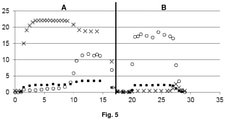
- phase A is the injection phase of the starting mixture
- phase B is the elution phase with the NH3 solution.
Landscapes
- Chemical & Material Sciences (AREA)
- Organic Chemistry (AREA)
- Chemical Kinetics & Catalysis (AREA)
- Treatment Of Liquids With Adsorbents In General (AREA)
- Preparation Of Compounds By Using Micro-Organisms (AREA)
- Organic Low-Molecular-Weight Compounds And Preparation Thereof (AREA)
- Indole Compounds (AREA)
Description
- La présente invention concerne un procédé de purification d'acides aminés aromatiques, c'est-à-dire d'acides aminés comportant un cycle aromatique, et en premier lieu le tryptophane, la phénylalanine, la tyrosine, et l'histidine.
- Les acides aminés aromatiques peuvent être produits par fermentation, par enzymation ou par voie synthétique.
- Le tryptophane, la phénylalanine et l'histidine (pour les nourrissons) font partie de la famille des acides aminés essentiels : à ce titre, ils sont utilisés en tant que compléments nutritifs.
- Le moût d'acide aminé produit par voie fermentaire, synthétique ou enzymatique contient des impuretés parmi lesquelles des sucres et substrats résiduels, des minéraux, des pigments. Ces impuretés doivent être éliminées pour atteindre le degré de pureté requis pour son utilisation commerciale.
- Diverses méthodes de purification ont été développées pour purifier les acides aminés aromatiques. Elles sont basées sur les technologies dominantes suivantes : cristallisation, extraction liquide / liquide et fixation sur résine.
- La purification par cristallisation est mise en œuvre en voie aqueuse ou solvant. Des étapes de de prétraitement avant cristallisation sont parfois prévues, de manière à augmenter la pureté des cristaux. Il peut s'agir d'une étape de purification sur charbon actif (documents
CN 101245047 etCN 102146052 ) ; d'une étape de filtration membranaire sur filtre inox (documentCN 101376646 ) ; d'une étape d'ultrafiltration (documentCN 101691349 ) ; ou d'une combinaison de plusieurs filtrations successives pour éliminer plusieurs familles d'impuretés, par exemple un enchaînement microfiltration / ultrafiltration / nanofiltration (documentCN 101812009 ). - Des solvants sont parfois ajoutés lors de la cristallisation pour atteindre de meilleurs degrés de pureté, tels que de l'acide acétique (documents
JP 2097801 EP 1756055 ), ou un alcool aliphatique (documentEP 0274728 ). L'utilisation de ces solvants entraîne une augmentation des coûts de production, et des coûts de traitement ou de recyclage des liqueurs mères. - Une deuxième voie de purification consiste à procéder à une extraction liquide / liquide de l'acide aminé. Ainsi, il a été proposé une purification du tryptophane utilisant des tensioactifs pour former une phase micellaire inverse (document
CN 102382030 ), ou encore du toluène (documentEP 0299715 ). Ces techniques ne sont jamais suffisantes en tant que telles pour atteindre de hauts degrés de pureté. Des étapes de pré- et de post-traitement sont nécessaires. De plus, la mise en œuvre de volumes importants de solvants est économiquement peu intéressante pour traiter des volumes industriels d'acides aminés à l'échelle de plusieurs kilotonnes / an / unité. - Enfin, une troisième voie propose un traitement sur résine polymérique.
- Dans les documents
CN 101812488 ,CN 101948420 etUS 2013/0079527 , la purification repose sur une capture et fixation de l'acide aminé sur une résine adsorbante (donc neutre), puis une élution à l'éthanol (dans les deux premiers documents) ou avec un sel (dans le troisième document). - Le document
FR 2581654 - Le document
FR 1502814 - L'inconvénient des traitements sur résines décrits ci-dessus est de nécessiter une consommation importante de régénérant chimique concentré (usuellement 2 à 10 % en masse) pour éluer l'acide aminé après fixation. Une quantité d'effluents équivalente à celle de régénérant est également engendrée.
- Le document
US 5300653 décrit la séparation sur colonne unique en batch d'au moins un acide aminé aromatique d'autres acides aminés non aromatiques sur une résine cationique forte de type gel initialement convertie sous forme saline avec un métal alcalin. La solution contenant l'acide aminé présente de préférence un pH de 2 à 12. L'acide aminé est adsorbé lors du passage de la solution sur la résine, puis il est désorbé avec de l'eau dépourvue d'acide ou de base ou un solvant organique. - Un inconvénient de cette méthode est que le mode d'élution ne permet pas de maîtriser la forme ionique de la résine. En effet, les espèces cationiques présentes dans la solution à traiter sont susceptibles de s'échanger avec le métal alcalin, sans qu'aucun éluant ne permette de maintenir la forme ionique initiale. Les performances de séparation entre les acides aminés peuvent être affectées par ces mécanismes d'échange d'ions intempestifs : par conséquent, les rendements et puretés en acides aminés produits risquent de diminuer ou de varier de manière incontrôlée dans le temps.
- Le document
EP 0200944 décrit un procédé de purification du tryptophane vis à vis de rindole. Le pH du fluide à purifier est ajusté à 4, puis après des prétraitements, il est passé sur une résine cationique. Après un rinçage à l'eau, le tryptophane est élué avec une solution d'ammoniaque à 10 %. - Le document
FR 2557872 - Le document
EP 0027874 concerne un procédé de purification d'un acide aromatique par adsorption sur une résine échangeuse d'ions fortement acide et élution à l'aide d'une solution aqueuse d'ammoniac. Aucun n'aiustement du pH de la solution à passer sur la résine n'est indiqué. - Le document
US 2009/0130723 concerne un procédé de purification de l'histidine d'une culture microbienne dans lequel la culture est chargée sur une colonne remplie de particules de 350 um ou plus d'un support qui est de préférence une résine échangeuse de cations acide forte. L'histidine est ensuite éluée avec un éluant, qui peut être une solution aqueuse d'ammoniac. - La majorité de ces traitements sur résine repose sur une mise en œuvre de type « batch », c'est-à-dire discontinue. Les résines sont installées en colonne, et les éluants successifs (moût contenant l'acide aminé ; eaux de rinçage ; solutions régénérantes - salines, basiques, acides ou alcooliques) sont percolés successivement à travers la colonne.
- Toutefois le document
US 2013/0079527 susmentionné décrit une séparation semi-continue sur résine adsorbante de type XAD7, dans un système de chromatographie à lit mobile simulé (SMB, pour Simulated Moving Bed) comportant trois zones de séparation. Le système est élué à l'eau ou au sel. Cette méthode présente l'inconvénient d'opérer sur une résine adsorbante, donc une résine plus coûteuse que des résines échangeuses d'ions. Les résines adsorbantes ont également tendance à s'encrasser rapidement. Leur utilisation nécessite un protocole de nettoyage à l'alcool, à la base et à l'acide pour éliminer les impuretés responsables de l'encrassement, ce qui accroît les contraintes opératoires en termes de coûts et d'équipements installés. - Le document
EP 1106602 décrit une méthode de purification d'un acide aminé basique, en particulier la lysine, à l'aide d'un matériau chromatographique échangeur de cations, l'éluant étant un éluant aqueux basique, de préférence une solution aqueuse d'ammoniac. L'histidine est mentionnée en tant qu'acide aminé basique. - Ainsi, il existe un besoin de mettre au point un procédé de purification d'acide aminé aromatique amélioré, permettant notamment une séparation entre l'acide aminé cible et des impuretés telles que les sels, les sucres, les couleurs, avec une consommation minime de produits chimiques.
- L'invention concerne en premier lieu un procédé de purification d'un acide aminé à partir d'un mélange de départ, dans lequel l'acide aminé comporte un cycle aromatique et présente une constante d'acidité Ka, le procédé comprenant :
- une première étape de mise en contact du mélange de départ avec une résine cationique forte, à un pH supérieur ou égal à pKa ;
- une deuxième étape d'élution avec une solution aqueuse d'éluant présentant un pH supérieur au pH de la première étape, permettant de collecter un flux enrichi en l'acide aminé.
- Le mélange de départ comprend en outre des sucres et/ou des sels, et dans lequel le flux enrichi en l'acide aminé comporte moins de sucres et/ou de sels que le mélange de départ.
- Selon un mode de réalisation, la deuxième étape d'élution est une étape d'élution isocratique.
- L'acide aminé présente une constante de basicité Kb et, lors de la première étape, le pH est inférieur ou égal à pKb-6.
- Selon un mode de réalisation, la deuxième étape d'élution est effectuée directement à la suite de la première étape de mise en contact, sans rinçage intermédiaire.
- La solution d'éluant est une solution d'une base dans l'eau, la base étant de préférence de la soude, de la potasse, de l'ammoniac ou un mélange de ceux-ci, et de manière plus particulièrement préférée de l'ammoniac.
- Selon un mode de réalisation, la concentration de la base dans la solution d'éluant est de 0,01 à 50 g/L, de préférence de 0,2 à 20 g/L, plus particulièrement de 0,5 à 10 g/L, et tout particulièrement de 1 à 5 g/L.
- Le rapport du nombre de moles de base dans la solution d'éluant utilisée à la deuxième étape sur le nombre de moles d'acide aminé dans le mélange de départ mis en contact à la première étape est inférieur ou égal à 3, de préférence inférieur ou égal à 2, de préférence inférieur ou égal à 1,5, de préférence inférieur ou égal à 1, de préférence inférieur ou égal à 0,9, de préférence inférieur ou égal à 0,8, de préférence inférieur ou égal à 0,7, de préférence inférieur ou égal à 0,6, de préférence inférieur ou égal à 0,5, de préférence inférieur ou égal à 0,4.
- Selon un mode de réalisation, l'acide aminé est le tryptophane ou la phénylalanine ou la tyrosine ou l'histidine.
- Selon un mode de réalisation, la résine cationique forte est un copolymère polystyrène-divinylbenzène.
- Selon un mode de réalisation, la résine cationique forte présente un taux de réticulation de 5 à 12 %, de préférence de 6 à 11 %, plus particulièrement de 7 à 10 %, de préférence de 8 à 9 %.
- Selon un mode de réalisation, la résine cationique forte est sous forme cationique monovalente, de préférence sous forme Na+ ou K+ ou NH4 +, et de manière plus particulièrement préférée sous forme NH4 +.
- Selon un mode de réalisation, le procédé est mis en œuvre dans une installation chromatographique multi-colonnes, l'installation comportant de préférence 30 colonnes au plus, de manière plus particulièrement préférée 20 colonnes au plus, ou 12 colonnes au plus, ou 8 colonnes au plus, ou 6 colonnes au plus.
- Selon un mode de réalisation, le procédé est mis en œuvre dans une installation chromatographique à lit non-statique, et de préférence dans une installation chromatographique à lit mobile simulé, ou à lit mobile réel, ou à lit mobile simulé amélioré, ou à lit mobile simulé séquentiel, et de préférence à lit mobile simulé séquentiel.
- Selon un mode de réalisation, le mélange de départ est obtenu à l'issu du traitement d'un mélange brut, le mélange brut étant de préférence un moût fermentaire, synthétique ou enzymatique, et ledit traitement comportant de préférence une ou plusieurs étapes choisies parmi une centrifugation, une filtration frontale, une cristallisation, une filtration tangentielle, une microfiltration et une ultrafiltration.
- Selon un mode de réalisation, le procédé comprend une ou plusieurs étapes de concentration du flux enrichi en l'acide aminé, de préférence choisies parmi une concentration par évaporation et notamment par évaporation à film tombant, une concentration par évaporation multi-effets, une concentration membranaire et notamment une nanofiltration.
- Selon un mode de réalisation, à l'issue de la ou des étapes de concentration, un flux d'acide aminé concentré d'une part et un flux de solution d'éluant d'autre part sont collectés, le procédé comprenant le recyclage de ce flux de solution d'éluant vers la deuxième étape d'élution.
- Selon un mode de réalisation, la différence entre le pH de la solution d'éluant utilisée à la deuxième étape et le pH de la première étape est supérieure ou égale à 2, de préférence supérieure ou égale à 4, plus particulièrement supérieure ou égale à 6, et notamment supérieure ou égale à 8.
- La présente invention permet de surmonter les inconvénients de l'état de la technique. Elle fournit plus particulièrement un procédé de purification d'acide aminé aromatique amélioré, permettant notamment une séparation entre l'acide aminé cible et des impuretés telles que les sels, les sucres, les couleurs, avec une consommation minime de produits chimiques.
- Cela est accompli grâce à l'utilisation d'une résine cationique forte (résine échangeuse d'ions), qui n'est pas utilisée en mode d'échange d'ions. L'invention repose sur un mode d'élution chromatographique où l'acide aminé aromatique est séparé de sa solution initiale par un phénomène de retardation dû à son affinité avec la résine. Ainsi, l'invention prévoit de mettre en contact l'acide aminé sous forme majoritairement zwitterionique avec la résine (pH supérieur ou égal au pKa de l'acide aminé), puis de l'éluer avec une solution de pH plus élevé.
- Le mode opératoire diffère des procédés existants qui mettent en œuvre un phénomène de capture par immobilisation de l'acide aminé, puis de désorption par un éluant de régénération concentré.
- Sans vouloir être liés par une théorie, les inventeurs estiment que le mécanisme de séparation mis en œuvre est probablement un phénomène d'adsorption par interaction hydrophobe entre les liaisons Pi du groupement aromatique et/ou du doublet du ou des atomes d'azote présents dans le cycle de l'acide aminé, et les fonctions hydrophobes de la matrice de la résine : la séparation ne consiste donc pas en une séparation par échange d'ions.
- La présente invention peut notamment être mise en œuvre avec une solution d'élution diluée et avec un ratio éluant / acide aminé plus faible, ce qui permet de minimiser les consommations chimiques et les quantités d'effluents.
- L'invention permet également de mettre en œuvre un mécanisme de purification de façon contrôlée, évitant les variations importantes de rendement et de pureté en acides aminés produits.
-
- La
figure 1 représente de manière schématique une installation permettant de mettre en œuvre le procédé selon un mode de réalisation de l'invention. - La
figure 2 illustre l'évolution de la concentration de tryptophane (en g/L, symbole O), de la conductivité (en mS/cm, symbole X) et du taux de matière sèche (en degrés Brix, symbole ■) en fonction du volume injecté (en abscisse, en BV ou « Bed Volumes », c'est-à-dire en multiples du volume de lit) dans une colonne de séparation chromatographique. Les conditions opératoires sont précisées dans l'exemple 1. - La
figure 3 illustre l'évolution de la concentration de tryptophane (en g/L, échelle de gauche, symbole O), de la conductivité (en mS/cm, échelle de gauche, symbole X) et du taux de matière sèche (en degrés Brix, échelle de droite, symbole ■) sur plusieurs colonnes chromatographiques (en abscisse, le numéro de colonne) dans un système de purification de type SSMB. Les conditions opératoires sont précisées dans l'exemple 2. - La
figure 4 illustre l'évolution de la concentration de phénylalanine (en g/L, symbole O), de la conductivité (en mS/cm, symbole X) et du taux de matière sèche (en degrés Brix, symbole ■) en fonction du volume injecté (en abscisse, en BV) dans une colonne de séparation chromatographique. Les conditions opératoires sont précisées dans l'exemple 3. - La
figure 5 illustre l'évolution de la concentration d'histidine (en g/L, symbole O), de la conductivité (en mS/cm, symbole X) et du taux de matière sèche (en degrés Brix, symbole ■) en fonction du volume injecté (en abscisse, en BV) dans une colonne de séparation chromatographique. Les conditions opératoires sont précisées dans l'exemple 4. - L'invention est maintenant décrite plus en détail et de façon non limitative dans la description qui suit.
- L'invention permet de collecter sous forme purifiée un acide aminé aromatique présent dans un mélange de départ, généralement une solution aqueuse (moût de fermentation, synthétique, ou issu d'enzymation) contenant des impuretés de diverses natures : couleur, sels / minéraux, sucres.
- Ainsi, selon un mode de réalisation, le mélange de départ contient des sucres, par exemple des nutriments de fermentation (glucose et/ou saccharose, etc.) et/ou des métabolites. La teneur totale en sucres (et en particulier la teneur en monosaccharides et disaccharides) dans le mélange de départ peut ainsi être par exemple de 0,01 à 100 g/L, et de préférence de 0,1 à 15 g/L.
- Selon un mode de réalisation, le mélange de départ contient des sels, qui peuvent être des sels minéraux et/ou des sels organiques. La teneur totale en sels dans le mélange de départ peut ainsi être par exemple de 0,01 à 80 g/L, et de préférence de 0,5 à 20 g/L.
- La conductivité du mélange de départ peut être par exemple de 1 à 200 mS/cm, de préférence de 2 à 100 mS/cm, et notamment de 5 à 50 mS/cm.
- Selon un mode de réalisation, le mélange de départ est obtenu à l'issue d'un prétraitement par clarification du bouillon de culture (ou d'enzymation). Cette opération de clarification peut être menée par diverses technologies :
- Décantation / centrifugation.
- Filtration tangentielle sur membrane organique, plane ou spiralée, avec un seuil de coupure typiquement compris entre 2000 et 300.000 Da.
- Filtration tangentielle sur membrane céramique, avec un seuil de coupure typiquement supérieur à 10.000 Da.
- Filtration sur filtre inox.
- Combinaison des opérations précédentes, l'ordre pouvant être ajusté selon les cas en fonction de la nature du mélange de départ et des objectifs du procédé.
- L'acide aminé aromatique est de préférence la phénylalanine, le tryptophane, la tyrosine, l'histidine, ou un dérivé de ceux-ci. On peut également chercher à récupérer un mélange d'acides aminés aromatiques.
- L'invention prévoit une séparation chromatographique sur une résine cationique forte. Par « résine cationique forte », on entend une résine ayant des fonctions acides greffées qui sont des acides forts.
- Selon un mode de réalisation préféré, la « résine cationique forte » signifie une résine comportant des fonctions acide sulfonique.
- Selon un mode de réalisation, la résine cationique est une résine polystyrène-divinylbenzène (DVB) forte.
- Selon un mode de réalisation, la résine est sous forme de particules, dont le diamètre volumique moyen (Dv50) est de préférence de 20 à 600 µm, notamment de 200 à 350 µm. De préférence, la distribution du diamètre volumique des particules de résine présente un seul maximum (distribution monodisperse). Le coefficient d'uniformité de cette distribution peut être par exemple inférieur ou égal à 1,5, ou inférieur ou égal à 1,3, ou inférieur ou égal à 1,15. La distribution de taille des particules de résine peut être déterminée par granulométrie laser (norme NF 13320).
- La résine est de préférence une résine macro-réticulée (et donc n'est pas une résine de type gel). Ainsi, selon des modes de réalisation, le taux de réticulation de la résine (taux de DVB lorsque la résine est le copolymère susmentionné) vaut de 5 à 6 % ; ou de 6 à 7 % ; ou de 7 à 8 % ; ou de 8 à 9 % ; ou de 9 à 10 % ; ou de 10 à 11 % ; ou de 11 à 12 %. On définit le taux de réticulation comme le rapport de la quantité de monomères agents de réticulation (par exemple monomères DVB) sur la quantité totale de monomères (par exemple monomères DVB et autres monomères de la résine) qui sont mis en œuvre dans la fabrication de la résine (les quantités étant exprimées en moles).
- Selon un mode de réalisation, la résine est sous forme monovalente. Par exemple, elle peut être sous forme Na+, K+ ou de préférence NH4 +.
- Optionnellement, le procédé de l'invention peut comprendre une étape préliminaire de conditionnement de la résine sous une forme ionique souhaitée, notamment sous forme Na+, K+ ou de préférence NH4 +. Cette étape préliminaire peut être effectuée notamment en faisant passer une solution saline ou basique appropriée sur la résine.
- Les acides aminés se comportent comme des acides et bases faibles. Ils présentent une constante d'acidité Ka et une constante de basicité Kb. On définit pKa = - log10(Ka) et pKb = - log10(Kb). Le pKa et le pKb représentent les pH de demi-dissociation, c'est-à-dire les pH auxquels la fonction acide, respectivement la fonction basique, des acides aminés est à moitié ionisée.
- On appelle zwitterion la forme de l'acide aminé dans laquelle à la fois fonction acide et la fonction amine (basique) sont ionisées.
- Les valeurs de pKa et de pKb pour les quatre acides aminés aromatiques susmentionnés sont les suivantes :
- Phénylalanine : pKa = 1,8 et pKb = 9,1.
- Tryptophane : pKa = 2,4 et pKb = 9,4.
- Tyrosine : pKa = 2,2 et pKb = 9,1.
- Histidine : pKa = 1,8 et pKb = 9,2.
- L'invention prévoit une étape de mise en contact d'un mélange de départ (ou charge, ou produit d'alimentation) avec une résine chromatographique, puis une étape d'élution.
- Dans la première étape, le pH est supérieur ou égal au pKa de l'acide aminé aromatique recherché (ou aux pKa des acides aminés aromatiques recherchés, s'il y en a plusieurs), afin d'assurer que l'acide aminé soit d'une façon significative sous forme de zwitterion.
- Selon certains modes de réalisation, le pH lors de la première étape est supérieur ou égal à pKa+0,5 ; ou supérieur ou égal à pKa+1 ; ou supérieur ou égal à pKa+1,5 ; ou supérieur ou égal à pKa+2 ; ou supérieur ou égal à pKa+2,5 ; ou supérieur ou égal à pKa+3.
- Il faut noter que le pH lors de la première étape peut également être inférieur ou égal à pKa + 3 ; ou inférieur ou égal à pKa + 2,5 ; ou inférieur ou égal à pKa + 2 ; ou inférieur ou égal à pKa + 1,5 ; ou inférieur ou égal à pKa + 1 ; ou inférieur ou égal à pKa + 0,5.
- Le pH lors de la première étape est inférieur ou égal à pKb-6.
- Le pH lors de la première étape est compris entre pKa et pKb-6.
- Selon certains modes de réalisation, le pH lors de la première étape vaut de 1,8 à 1,9 ; ou de 1,9 à 2,0 ; ou de 2,0 à 2,1 ; ou de 2,1 à 2,2 ; ou de 2,2 à 2,3 ; ou de 2,3 à 2,4 ; ou de 2,4 à 2,5 ; ou de 2,5 à 2,6 ; ou de 2,6 à 2,7 ; ou de 2,7 à 2,8 ; ou de 2,8 à 2,9 ; ou de 2,9 à 3,0 ; ou de 3,0 à 3,2 ; ou de 3,2 à 3,4 ; ou de 3,4 à 3,6 ; ou de 3,6 à 3,8 ; ou de 3,8 à 4,0 ; ou de 4,0 à 4,5 ; ou de 4,5 à 5,0 ; ou de 5,0 à 5,5 ; ou de 5,5 à 6,0 ; ou de 6,0 à 6,5 ; ou de 6,5 à 7,0.
- Le pH de la charge (mélange de départ) peut être ajusté avant la mise en contact avec la résine par ajout d'acide ou de base.
- Dans la deuxième étape, l'éluant est une solution aqueuse présentant un pH supérieur à celui de la première étape. L'éluant est une solution aqueuse basique, telle qu'une solution de NH3 ou NaOH notamment.
- La différence de pH entre la deuxième étape et la première étape (ΔpH) peut valoir de 0,5 à 1,0 ; ou de 1,0 à 1,5 ; ou de 1,5 à 2,0 ; ou de 2,0 à 2,5 ; ou de 2,5 à 3,0 ; ou de 3,0 à 3,5 ; ou de 3,5 à 4,0 ; ou de 4,0 à 4,5 ; ou de 4,5 à 5,0 ; ou de 5,0 à 5,5 ; ou de 5,5 à 6,0 ; ou de 6,0 à 6,5 ; ou de 6,5 à 7,0 ; ou de 7,0 à 7,5 ; ou de 7,5 à 8,0 ; ou de 8,0 à 8,5 ; ou de 8,5 à 9,0 ; ou de 9,0 à 9,5 ; ou de 9,5 à 10,0 ; ou de 10,0 à 10,5 ; ou de 10,5 à 11,0 ; ou de 11,0 à 11,5 ; ou de 11,5 à 12,0.
- Le pH de l'éluant (deuxième étape) peut valoir notamment de 7,0 à 7,5 ; ou de 7,5 à 8,0 ; ou de 8,0 à 8,5 ; ou de 8,5 à 9,0 ; ou de 9,0 à 9,5 ; ou de 9,5 à 10,0 ; ou de 10,0 à 10,5 ; ou de 10,5 à 11,0 ; ou de 11,0 à 11,5 ; ou de 11,5 à 12,0 ; ou de 12,0 à 12,5 ; ou de 12,5 à 13,0 ; ou de 13,0 à 13,5 ; ou de 13,5 à 14,0.
- L'éluant peut être une solution d'une base dans l'eau, par exemple NaOH ou NH3, à une concentration de 0,001 à 0,01 g/L ; ou de 0,01 à 0,1 g/L ; ou de 0,1 à 0,5 g/L ; ou de 0,5 à 1 g/L ; ou de 1 à 2 g/L ; ou de 2 à 3 g/L ; ou de 3 à 4 g/L ; ou de 4 à 5 g/L ; ou de 5 à 6 g/L ; ou de 6 à 7 g/L ; ou de 7 à 8 g/L ; ou de 8 à 9 g/L ; ou de 9 à 10 g/L ; ou de 10 à 15 g/L ; ou de 15 à 20 g/L ; ou de 20 à 25 g/L ; ou de 25 à 50 g/L ; ou de 50 à 100 g/L.
- Le nombre de moles de base utilisée pour l'élution, rapporté au nombre de moles d'acide aminé injecté, est inférieur ou égal à 3 ; ou inférieur ou égal à 2 ; ou inférieur ou égal à 1,5 ; ou inférieur ou égal à 1 ; ou inférieur ou égal à 0,9 ; ou inférieur ou égal à 0,8 ; ou inférieur ou égal à 0,7 ; ou inférieur ou égal à 0,6 ; ou inférieur ou égal à 0,5 ; ou inférieur ou égal à 0,4.
- L'élution est de préférence isocratique, c'est-à-dire que la composition de l'éluant ne varie pas dans le temps.
- Dans un mode de réalisation préféré, le cation de la base utilisée pour l'élution est le cation de la résine. Ainsi, par exemple, si la résine est sous forme Na+, l'éluant peut être une solution de NaOH ; si la résine est sous forme K+, l'éluant peut être une solution de KOH ; et si la résine est sous forme NH4 +, l'éluant peut être une solution d'ammoniac.
- L'élution par la base permet de maintenir la forme ionique de la résine, qui pourrait sinon être modifiée par les sels minéraux présents dans solution de charge. En outre, sans vouloir être tenu par une théorie, les inventeurs font l'hypothèse d'un effet de charge osmotique sur la résine, qui tend également à libérer les espèces adsorbées.
- L'acide aminé aromatique recherché présente une affinité plus forte pour la résine que la plupart des autres impuretés. On récupère donc les impuretés (par exemple sucres et sels) dans la fraction raffinat, tandis que l'acide aminé est récupéré dans l'extrait.
- Selon un mode de réalisation, la teneur massique totale en sucres (en particulier en monosaccharides et disaccharides) dans l'extrait est réduite d'au moins 80 %, de préférence d'au moins 90 %, ou d'au moins 95 %, ou d'au moins 98 %, ou d'au moins 99 %, ou d'au moins 99,5 %, ou d'au moins 99,9 %, par rapport à la teneur massique totale en sucres (en particulier e, monosaccharides et disaccharides) dans le mélange de départ. De préférence, l'extrait (flux enrichi en l'acide aminé) est dépourvu ou essentiellement dépourvu de sucres (en particulier de monosaccharides et disaccharides).
- Selon un mode de réalisation, la teneur massique totale en sels dans l'extrait est réduite d'au moins 80 %, de préférence d'au moins 90 %, ou d'au moins 95 %, ou d'au moins 98 %, ou d'au moins 99 %, ou d'au moins 99,5 %, ou d'au moins 99,9 %, par rapport à la teneur massique totale en sels dans le mélange de départ. De préférence, l'extrait (flux enrichi en l'acide aminé) est dépourvu ou essentiellement dépourvu de sels.
- Selon un mode de réalisation, certaines impuretés très retenues peuvent être désorbées par une élution complémentaire par un éluant aqueux, salin ou polaire.
- Selon un mode de réalisation, aucun rinçage intermédiaire n'est prévu entre l'étape de mise en contact et l'étape d'élution. L'injection de l'éluant suit ainsi directement l'injection du mélange de départ.
- Selon un mode de réalisation, l'acide aminé récupéré dans l'extrait issu de la séparation chromatographique subit des traitements complémentaires, tels que :
- Décoloration sur charbon.
- Déminéralisation.
- Concentration sur membrane de type osmose inverse ou nanofiltration.
- Evaporation ou évaporation multi-effets, ce qui permet d'optimiser les consommations énergétiques.
- Cristallisation.
- Combinaison des opérations précédentes, l'ordre pouvant être ajusté selon les cas en fonction de la nature du mélange de départ et les objectifs du procédé.
- Selon un mode de réalisation préféré, l'éluant (de préférence une solution de NH3) est séparé de l'acide aminé et récupéré lors des étapes de post-traitement susmentionnées, afin d'être recyclé en tête du procédé de séparation chromatographique.
- Le procédé selon l'invention peut être discontinu (« batch »), semi-continu ou continu. De préférence, il est semi-continu ou continu.
- La séparation chromatographique selon l'invention peut être mise en œuvre dans une unité chromatographique à lit statique ou, de préférence, dans une unité chromatographique à lit non-statique.
- Dans un système chromatographique à lit statique, le mélange de composés à séparer percole dans une enceinte (ou colonne), généralement cylindrique. La colonne contient un lit de matériau poreux (phase stationnaire) perméable aux fluides. La vitesse de percolation de chaque composé dans le mélange dépend des propriétés physiques du composé. Les composés les plus retenus sur la phase stationnaire percolent plus lentement que les composés les moins retenus sur la phase stationnaire. Ce principe permet d'effectuer la séparation souhaitée.
- Il est possible d'effectuer un tel traitement dans plusieurs colonnes en série ou en parallèle, mais généralement une séparation chromatographique dans un système à lit statique est mise en œuvre avec une colonne unique.
- Des exemples de tels systèmes chromatographiques à lit statique sont les systèmes HPLC (chromatographie en phase liquide à haute performance) ou CYCLOJET™ (système avec recyclage à l'état stationnaire).
- Le système CYCLOJET™ est tel que décrit dans le document
US 6,063,284 , auquel il est fait expressément référence. Il s'agit d'un système de séparation chromatographique discontinue à colonne unique, dans lequel les espèces (i) les plus retenues puis (ii) les moins retenues sont collectées séparément à la sortie de la colonne, la portion non-séparée du chromatogramme étant recyclée par la pompe principale, et le mélange à séparer étant périodiquement injecté au moyen d'une boucle d'injection située essentiellement au milieu de la portion recyclée du chromatogramme. Après plusieurs cycles chromatographiques, le procédé atteint un état stationnaire périodique dans lequel la quantité de produits injectés est égale à la quantité de produits séparés collectés séparément à la sortie de la colonne. - Une variante du système CYCLOJET™ utilisant deux colonnes est décrite dans le document
US 5,630,943 , auquel il est fait expressément référence. - Un système à lit non-statique est un système multi-colonnes, dans lequel les positions relatives du lit de phase stationnaire et des points d'injection ou de collecte des flux se déplacent au cours du temps.
- Des exemples de tels systèmes chromatographiques à lit non-statique sont les systèmes SMB (lit mobile simulé), iSMB (lit mobile simulé amélioré), SSMB (lit mobile simulé séquentiel), AMB (lit mobile réel), VARICOL™, MODICON™, POWERFEED™, MCSGP ou GSSR (chromatographie de gradient multi-colonnes).
- Un système SMB comprend une pluralité de colonnes individuelles contenant un adsorbant, qui sont connectées en série. Un flux d'éluant traverse les colonnes selon une première direction. Les points d'injection du flux d'alimentation et de l'éluant, ainsi que les points de collecte des composés séparés, sont décalés périodiquement et simultanément au moyen d'un ensemble de vannes. L'effet global est de simuler le fonctionnement d'une colonne unique contenant un lit mobile d'adsorbant solide, l'adsorbant solide se déplaçant dans une direction à contre-courant du flux d'éluant. Ainsi, un système SMB est composé de colonnes qui contiennent des lits stationnaires d'adsorbant solide à travers lesquels passe l'éluant, mais le fonctionnement est tel qu'un lit mobile continu à contre-courant est simulé.
- La forme la plus conventionnelle d'un système SMB est le système SMB à quatre zones. D'autres formes possibles sont les systèmes SMB à trois zones et les systèmes SMB à deux zones (tels que décrits dans l'article « Two Section Simulated Moving Bed Process » de Kwangnam Lee, dans Séparation Science and Technology 35(4):519-534, 2000, auquel il est fait expressément référence).
- Dans les systèmes iSMB et SSMB, il y a au moins une étape dans laquelle le système fonctionne en boucle fermée, sans entrée ou sortie de produit.
- Un système iSMB est tel que décrit dans les documents
EP 0342629 etUS 5,064,539 , auxquels il est fait expressément référence. - Un système SSMB découpe les introductions et collectes des flux en sous séquences appliquées de façons périodiques.
- D'autres variantes des systèmes SMB sont : le système SMB variant dans le temps et le système POWERFEED™, tels que décrits dans le document
US 5,102,553 et dans l'article « PowerFeed operation of simulated moving bed units: changing flow-rates during the switching interval », de Zhang et al. dans Journal of Chromatography A, 1006:87-99, 2003, auxquels il est fait expressément référence; le système MODICON™, tel que décrit dans le documentUS 7,479,228 , auquel il est fait expressément référence ; et le système SMB avec recirculation interne, tel que décrit dans le documentUS 8,282,831 , auquel il est fait expressément référence. - Un système AMB présente un fonctionnement similaire à un système SMB. Toutefois, au lieu de déplacer les points d'injection du flux d'alimentation et de l'éluant, ainsi que des points de collecte, au moyen d'un système de vannes, un ensemble d'unités d'adsorption (colonnes) sont déplacées physiquement par rapport aux points d'alimentation et de collecte. A nouveau, le fonctionnement permet de simuler un lit mobile continu à contre-courant.
- Un système de chromatographie VARICOL™ est tel que décrit dans les documents
US 6,136,198 ,US 6,375,839 US 6,413,419 etUS 6,712,973 , auxquels il est fait expressément référence. Un système VARICOL™ comprend une pluralité de colonnes individuelles contenant un adsorbant qui sont reliées en série. On fait passer un éluant dans les colonnes selon une première direction. Contrairement au système SMB, les points d'injection pour le mélange à séparer et pour l'éluant et les points de collecte des composés séparés dans le système sont déplacés périodiquement mais de manière asynchrone, au moyen d'un ensemble de vannes. L'effet global est de créer des zones de séparation de longueur variable dans le temps, allouant ainsi la phase stationnaire de manière dynamique dans les zones où elle est la plus utile, et permettant une puissance de séparation similaire avec moins d'unités de séparation chromatographique et une productivité accrue. Contrairement à un système SMB, un système VARICOL™ ne simule pas le fonctionnement d'une colonne unique contenant un lit mobile d'adsorbant solide, l'adsorbant solide se déplaçant dans une direction à contre-courant du flux d'éluant, et ainsi le principe de fonctionnement du VARICOL™ ne peut pas être mis en œuvre dans un système AMB équivalent. - Un exemple préféré de lit mobile simulé est représenté en référence à la
figure 1 , sous la forme d'un système de chromatographie de type lit mobile simulé séquentiel (SSMB) sur six cellules ou colonnes. Ce système peut être opéré selon un fonctionnement cyclique en quatre phases. - Phase n°1 (partie A de la figure) : phase de boucle, durant laquelle on maintient une circulation continue en boucle fermée sur toutes les cellules placées en série, pour déplacer le volume interstitiel d'une cellule vers la suivante, sans injection d'éluant.
- Phase n°2 (partie B de la figure) : charge / injection de charge. La charge (F) est injectée en tête de la quatrième cellule. Simultanément, on collecte un volume sensiblement identique de raffinat (R) en sortie de la cinquième cellule. Les cellules 4 et 5 constituent ici la zone 3. Les cellules 2 et 3 constituent la zone de séparation entre extrait et injection de charge. Elles constituent ici la zone 2.
- Phase n°3 (partie B de la figure) : élution de l'extrait. L'éluant (EL) et injecté sur la première cellule pour éluer l'extrait (EX), qui est collecté en volume sensiblement identique au bas de la première cellule. La cellule n°1 constitue ici la zone 1.
- Les phases n°2 et 3 sont de préférence opérées simultanément pour accroître la productivité du système.
- Phase n°4 : élution du raffinat. L'éluant (EL) est injecté en tête de la première cellule, et le raffinat (R) est collecté en volume sensiblement identique sortie de la cinquième. La cellule n°6 est ici une cellule tampon permettant d'assurer la séparation entre la queue de l'extrait et la tête du raffinat. Elle constitue la zone 4. Cette zone peut être omise dans le cas où le degré de pureté et/ou le rendement recherché est relativement limité.
- Ces phases sont opérées dans l'ordre dans un mode de réalisation préféré, de 1 à 4. Leur enchaînement constitue une séquence complète.
- Chaque séquence (phases n°1 à 4) est répétée six fois en décalant les entrées et sorties de cellules par incrémentation du numéro de cellule, de la gauche vers la droite du système : la charge est ainsi injectée en haut de cellule n°1 en séquence n°1, puis en haut de cellule n°2 en séquence n°2, etc.
- Un cycle de production complet est réalisé après achèvement des six séquences successives, quand le point d'injection de la charge, initialement en entrée de cellule n°1, revient de nouveau en entrée de cellule n°1.
- Dans ce qui précède, on a donné une description du système SSMB en référence au cas où les cellules correspondent à des colonnes. Ceci n'est pas limitatif, et l'invention s'applique aussi aux systèmes dans lesquels les cellules, ou encore compartiments, sont des parties de colonne.
- Par ailleurs, le nombre de colonnes présentes en zones 1, 2, 3 et 4 peut varier en fonction de la qualité de séparation désirée. On peut donc concevoir des systèmes du même type avec une cellule, deux cellules, trois cellules, quatre cellules et jusqu'à douze cellules ou plus.
- Le procédé peut encore être mis en œuvre dans une installation multi-colonnes non continue à boucle fermée ou à boucle ouverte, telle que le système DCC décrit dans le brevet
WO 2007/012750 . - Selon un mode de réalisation, une installation multi-colonnes (notamment du type SMB ou analogue) contient une ou plusieurs zones de nettoyage, permettant de déconnecter une colonne de la boucle de séparation, afin de désorber périodiquement des composés (impuretés) fortement adsorbés, puis de régénérer et rééquilibrer l'adsorbant avec l'éluant de la séparation.
- Les exemples suivants illustrent l'invention sans la limiter.
- Dans cet exemple, on traite un moût de fermentation de tryptophane, prétraité par ajustement à pH = 2,6, puis microfiltration et diafiltration sur membranes céramiques.
- Le produit est traité sur une résine Applexion® XA2014-22 sur un volume de 30 mL par colonne (dans cet exemple, 30 mL représente 1BV où BV signifie le volume de lit, ou Bed Volume, de résine). La résine est une résine cationique forte, de type polymérique polystyrène-DVB avec 8 % de DVB, de granulométrie monodisperse 220 µm, et de capacité d'échange ionique 1,8 eq/Lresine. La résine est préalablement convertie sous la forme Na à l'aide d'une solution de soude à 4 %.
- Le mélange de départ pour l'étape de chromatographie contient 17,5 g/L de tryptophane, 3,7 g/L de sucres résiduels, et présente une conductivité de 18,5 mS/cm induite par les sels en solution.
- Ce mélange est injecté en excès sur la résine. Lors de la phase d'injection, on observe une différence de comportement des différentes espèces sur la résine :
- Les impuretés salines ne sont pas retenues sur la résine: on estime qu'un phénomène d'exclusion d'ions entre leur charge ionique et les charges de la résine empêche leur pénétration au sein de la matrice. Une conductivité identique à celle du mélange de départ est mesurée en sortie de colonne pendant l'étape d'élution.
- Les sucres, espèces neutres, peuvent pénétrer dans la matrice de la résine, et sont légèrement ralentis, mais non retenus : ils sont co-élués avec les sels pendant la phase d'injection.
- Le tryptophane, injecté majoritairement sous forme zwitterionique à pH = 2,6 subit quant à lui un phénomène de retardation par interaction entre son groupe aromatique et ceux de la résine.
- L'élution du tryptophane ainsi retenu est obtenue avec une concentration de soude de 4 g/L, à 2 BV/h.
- La
figure 2 représente l'évolution des concentrations en un point du système qui voit se dérouler l'ensemble des étapes de séparation, du début de l'élution du raffinat à la fin de rinçage de l'extrait. La phase A est la phase d'injection du mélange de départ, la phase B est la phase d'élution avec la solution de soude. - Ce système permet d'opérer avec les performances suivantes :
- 205,6 g de tryptophane traité par litre de résine sur un cycle de production de 8 heures ;
- concentration < 100 µS / cm pendant la collecte de l'extrait de tryptophane, correspondant à 99,5 % de déminéralisation.
- Dans cet exemple, l'invention est appliquée en mode chromatographique sur un système continu et multi-colonnes à un moût de fermentation à pH = 4 contenant du tryptophane à 40 g/L. Les impuretés principales sont des résidus de substrats, des minéraux, ainsi que des résidus solides de métabolisme cellulaire.
- Le pH du moût est ici ajusté à 2,7 par ajout de H2SO4. A ce pH supérieur au pKa, le tryptophane se trouve sous une forme majoritairement zwitterionique.
- Il est ensuite clarifié par microfiltration tangentielle sur une membrane céramique. Les matières solides en suspension sont retenues par la membrane et concentrées dans une fraction dénommée rétentat. Le tryptophane, ainsi que la majorité des impuretés solubles, sont transportés, quant à eux, à travers la membrane vers une fraction appelée perméat.
- En fin de concentration, un ajout d'eau dans le compartiment rétentat permet de diluer puis de reconcentrer le rétentat : cette opération, dite de diafiltration, permet d'augmenter le rendement global en tryptophane en diminuant sa teneur résiduelle dans le compartiment rétentat.
- Le perméat de microfiltration ainsi traité contient 98 % du tryptophane initialement présent dans le moût, à une concentration de 15 g/L. Les impuretés y sont présentes à hauteur de 25 g/L de sels minéraux : sa conductivité vaut 15,9 mS/cm. On mesure également un taux de sucres de 3 g/L.
- Ce perméat est utilisé comme produit d'alimentation du système SSMB décrit ci-dessus.
- Suivant le principe du SSMB préalablement exposé, le système utilisé dans ce cas précis est constitué de 9 cellules de séparation, mises en œuvre sous forme de colonnes, et réparties comme suit :
- Zone 1 : trois colonnes = zone d'élution du tryptophane ;
- Zone 2 : deux colonnes = zone de séparation ;
- Zone 3 : trois colonnes = zone de ralentissement du tryptophane ;
- Zone 4 : une colonne = zone de boucle.
- Chaque colonne contient 475 mL de résine Applexion® XA2014-22. On définit ainsi la taille d'un volume de lit, ou Bed Volume : 1 BV = 475 mL.
- La résine est initialement conditionnée sous forme NH4 + par percolation d'ammoniaque NH3 de concentration 3 N.
- On opère le système à 4,5 BV/h.
- Le produit d'alimentation est injecté en tête de zone 3. A chaque période de production sont injectés 7,5 BV de produit d'alimentation. Sur trois colonnes, le tryptophane est ralenti par phénomène de retardation sur la résine, et ainsi séparé des impuretés qui sont éluées et collectées, en sortie de zone, dans une fraction dite « raffinat ». La majorité des impuretés (sels et sucres) sont éluées dans ce raffinat : sa conductivité vaut 17,6 mS/cm.
- Le système est réglé de telle manière que 0,1 % du tryptophane initial est élué dans la fraction raffinat.
- En tête de zone 1 est injecté de l'ammoniaque dilué à 2 g/L (éluant) qui permet de désorber le tryptophane. A chaque période de production sont injectés 5 BV d'éluant. Le tryptophane est récupéré lors de cette élution dans une fraction dite « extrait ». La conductivité de l'extrait est inférieure à 200 µS/cm : celui-ci est déminéralisé à hauteur de 98,8 % par rapport au produit d'alimentation. On mesure également une réduction de 89 % des sucres résiduels, et de 75 % de la couleur.
- Une très faible quantité d'éluant ammoniacal est utilisé : le ratio éluant / produit d'alimentation vaut 0,67 (volume / volume). Aussi, un phénomène de concentration est observé pendant cette opération : le tryptophane est élué à 20 g/L (contre 15 g/L dans le produit d'alimentation). Plus de 99 % du tryptophane initial est récupéré dans l'extrait au cours de cette étape. A chaque séquence du cycle SSMB, la quantité de NH3 utilisée est de 0,59 mol par L de résine, pour une quantité de tryptophane injectée de 1,47 mol / L de résine (soit 0,4 mole NH3 par mole de tryptophane) : ceci démontre que le mécanisme de rétention n'est pas l'échange d'ions.
- Le profil mesuré dans les neuf colonnes, en régime permanent, et pendant une étape de boucle, est représenté sur la
figure 3 . - Y sont représentés les profils de concentrations en tryptophane, de Brix (représentatif de la concentration de matière sèche) et de conductivité (représentatif de la concentration en impuretés salines). On observe ainsi la séparation entre la zone d'élution du tryptophane (zone 1, colonnes n°2, 3 et 4) et la zone de collecte du raffinat (zone 3, colonnes n°7, 8 et 9).
- Cet exemple est mis en œuvre à partir d'un moût de fermentation de phénylalanine, prétraité par ajustement à pH=2, puis microfiltration sur membranes céramiques.
- Le produit est traité sur une résine Applexion® XA2014-22, sur un volume de 30 mL par colonne = 1 BV. La résine est préalablement convertie sous la forme NH4 + à l'aide de NH3 à 3%, rincée, puis équilibrée par passage de NH3 à 2 g/L.
- Le produit d'alimentation de chromatographie contient 32,76 g/L de phénylalanine et présente une conductivité de 36,8 mS/cm due à la concentration saline du milieu.
- Le produit d'alimentation est injecté en excès sur la résine, à 4 BV/h : on observe un phénomène de rétention de phénylalanine par rapport aux sels et aux sucres, puis une fuite de l'acide aminé. Une fois la concentration en sortie égale à la concentration d'entrée en acide aminé, l'injection de produit d'alimentation est arrêtée.
- L'élution de phénylalanine est faite avec une concentration de NH3 de 2 g/L, à 4 BV/h.
- La
figure 4 représente l'évolution des concentrations en un point du système qui voit se dérouler l'ensemble des étapes de séparation, du début de l'élution raffinat à la fin de rinçage de l'extrait. La phase A est la phase d'injection du mélange de départ, la phase B est la phase d'élution avec la solution de NH3. - Ce système permet d'opérer avec les performances suivantes :
- 169 g de phénylalanine traité par litre de résine sur un cycle de production de 6,75 heures.
- concentration d'environ 600 µS/cm pendant la collecte de l'extrait de phénylalanine, correspondant à 98,5% de déminéralisation.
- Cet exemple est mis en œuvre à partir d'une solution d'histidine à 12,98 g/L, de conductivité 17,48 mS/cm et contenant 3,9 g/L de sucres. La solution est préalablement ajustée à pH = 2,7 par ajout d'H2SO4.
- Le produit est traité sur une résine Applexion® XA2014-22, sur un volume de 17 mL par colonne (= 1 BV). La résine est préalablement convertie sous la forme NH4 + à l'aide de NH3 à 3%, rincée, puis équilibrée par passage de NH3 à 2 g/L.
- Le produit d'alimentation est injecté en excès sur la résine, à 2 BV/h : on observe un phénomène de rétention de l'histidine, puis une fuite de l'acide aminé. Une fois la concentration en sortie égale à la concentration d'entrée en acide aminé, l'injection de produit d'alimentation est arrêtée.
- L'élution de l'histidine est faite avec une concentration de NH3 de 2 g/L, à 2 BV/h.
- La
figure 5 représente l'évolution des concentrations en un point du système qui voit se dérouler l'ensemble des étapes de séparation, du début de l'élution raffinat à la fin de rinçage de l'extrait. La phase A est la phase d'injection du mélange de départ, la phase B est la phase d'élution avec la solution de NH3. - Ce système permet d'opérer avec les performances suivantes :
- 120 g d'histidine traité par litre de résine sur un cycle de production de 30 heures.
- Concentration d'environ 220 µS/cm pendant la collecte de l'extrait de phénylalanine, correspondant à 98,8% de déminéralisation.
Claims (14)
- Procédé de purification d'un acide aminé à partir d'un mélange de départ comprenant en outre des sucres et/ou des sels, dans lequel l'acide aminé comporte un cycle aromatique et présente une constante d'acidité Ka et une constante de basicité Kb, le procédé comprenant :- une première étape de mise en contact du mélange de départ avec une résine cationique ayant des fonctions acides greffées qui sont des acides forts, à un pH supérieur ou égal à pKa et inférieur ou égal à pKb-6 ;- une deuxième étape d'élution avec une solution aqueuse d'éluant présentant un pH supérieur au pH de la première étape, permettant de collecter un flux enrichi en l'acide aminé comportant moins de sucres et/ou de sels que le mélange de départ, la solution d'éluant étant une solution d'une base dans l'eau ;le rapport du nombre de moles de base dans la solution d'éluant utilisée à la deuxième étape sur le nombre de moles d'acide aminé dans le mélange de départ mis en contact à la première étape étant inférieur ou égal à 3,
l'acide aminé étant séparé du mélange de départ par un phénomène de retardation dû à son affinité avec la résine. - Procédé selon la revendication 1, dans lequel la deuxième étape d'élution est une étape d'élution isocratique.
- Procédé selon la revendication 1 ou 2, dans lequel l'acide aminé est le tryptophane ou la phénylalanine ou la tyrosine ou l'histidine.
- Procédé selon l'une des revendications 1 à 3, dans lequel la deuxième étape d'élution est effectuée directement à la suite de la première étape de mise en contact, sans rinçage intermédiaire.
- Procédé selon l'une des revendications 1 à 4, dans lequel la base est de la soude, de la potasse, de l'ammoniac ou un mélange de ceux-ci, et de manière plus particulièrement préférée de l'ammoniac ; et la concentration de la base dans la solution d'éluant est de préférence de 0,01 à 50 g/L, de préférence encore de 0,2 à 20 g/L, plus particulièrement de 0,5 à 10 g/L, et tout particulièrement de 1 à 5 g/L.
- Procédé selon l'une des revendications 1 à 5, dans lequel le rapport du nombre de moles de base dans la solution d'éluant utilisée à la deuxième étape sur le nombre de moles d'acide aminé dans le mélange de départ mis en contact à la première étape est inférieur ou égal à 2, plus particulièrement inférieur ou égal à 1, et idéalement inférieur ou égal à 0,5.
- Procédé selon l'une des revendications 1 à 6, dans lequel la résine cationique est un copolymère polystyrène-divinylbenzène.
- Procédé selon l'une des revendications 1 à 7, dans lequel la résine cationique présente un taux de réticulation de 5 à 12 %, de préférence de 6 à 11 %, plus particulièrement de 7 à 10 %, de préférence de 8 à 9 %.
- Procédé selon l'une des revendications 1 à 8, dans lequel la résine cationique est sous forme cationique monovalente, de préférence sous forme Na+ ou K+ ou NH4 +, et de manière plus particulièrement préférée sous forme NH4 +.
- Procédé selon l'une des revendications 1 à 9, qui est mis en œuvre dans une installation chromatographique multi-colonnes, l'installation comportant de préférence 30 colonnes au plus, de manière plus particulièrement préférée 20 colonnes au plus, ou 12 colonnes au plus, ou 8 colonnes au plus, ou 6 colonnes au plus.
- Procédé selon l'une des revendications 1 à 10, qui est mis en œuvre dans une installation chromatographique à lit non-statique, et de préférence dans une installation chromatographique à lit mobile simulé, ou à lit mobile réel, ou à lit mobile simulé amélioré, ou à lit mobile simulé séquentiel, et de préférence à lit mobile simulé séquentiel.
- Procédé selon l'une des revendications 1 à 11, dans lequel le mélange de départ est obtenu à l'issu du traitement d'un mélange brut, le mélange brut étant de préférence un moût fermentaire, synthétique ou enzymatique, et ledit traitement comportant de préférence une ou plusieurs étapes choisies parmi une centrifugation, une filtration frontale, une cristallisation, une filtration tangentielle, une microfiltration et une ultrafiltration.
- Procédé selon l'une des revendications 1 à 12, comprenant une ou plusieurs étapes de concentration du flux enrichi en l'acide aminé, de préférence choisies parmi une concentration par évaporation et notamment par évaporation à film tombant, une concentration par évaporation multi-effets, une concentration membranaire et notamment une nanofiltration ; et de préférence dans lequel, à l'issue de la ou des étapes de concentration, un flux d'acide aminé concentré d'une part et un flux de solution d'éluant d'autre part sont collectés, le procédé comprenant le recyclage de ce flux de solution d'éluant vers la deuxième étape d'élution .
- Procédé selon l'une des revendications 1 à 13, dans lequel la différence entre le pH de la solution d'éluant utilisée à la deuxième étape et le pH de la première étape est supérieure ou égale à 2, de préférence supérieure ou égale à 4, plus particulièrement supérieure ou égale à 6, et notamment supérieure ou égale à 8.
Applications Claiming Priority (1)
| Application Number | Priority Date | Filing Date | Title |
|---|---|---|---|
| PCT/FR2014/050015 WO2015104464A1 (fr) | 2014-01-07 | 2014-01-07 | Procédé de purification d'acides aminés aromatiques |
Publications (2)
| Publication Number | Publication Date |
|---|---|
| EP3092218A1 EP3092218A1 (fr) | 2016-11-16 |
| EP3092218B1 true EP3092218B1 (fr) | 2022-03-09 |
Family
ID=50029144
Family Applications (1)
| Application Number | Title | Priority Date | Filing Date |
|---|---|---|---|
| EP14701813.9A Active EP3092218B1 (fr) | 2014-01-07 | 2014-01-07 | Procédé de purification d'acides aminés aromatiques |
Country Status (7)
| Country | Link |
|---|---|
| US (1) | US10975031B2 (fr) |
| EP (1) | EP3092218B1 (fr) |
| JP (1) | JP6303017B2 (fr) |
| KR (1) | KR102165406B1 (fr) |
| CN (2) | CN114874062B (fr) |
| BR (1) | BR112016015718B1 (fr) |
| WO (1) | WO2015104464A1 (fr) |
Families Citing this family (15)
| Publication number | Priority date | Publication date | Assignee | Title |
|---|---|---|---|---|
| JP6303017B2 (ja) | 2014-01-07 | 2018-03-28 | ノヴァセプ プロセスNovasep Process | 芳香族アミノ酸を精製する方法 |
| US20160297747A1 (en) * | 2015-04-08 | 2016-10-13 | Invista North America S.A.R.L. | Materials and methods for the selective recovery of monovalent products from aqueous solutions using continuous ion exchange |
| FR3073424B1 (fr) | 2017-11-16 | 2022-03-25 | Novasep Process | Procede regule de separation d’un melange |
| FR3073426B1 (fr) | 2017-11-16 | 2022-03-25 | Novasep Process | Procede de separation d’un melange avec mesure de purete ou rendement par un detecteur en ligne |
| FR3073425B1 (fr) | 2017-11-16 | 2019-11-22 | Novasep Process | Procede de separation d’un melange avec mesure de purete ou rendement sur une cuve intermediaire |
| FR3078634B1 (fr) | 2018-03-09 | 2020-02-28 | Novasep Process | Separation chromatographique du sulfate d’ammonium et de l’acide 2-hydroxy-2-methylpropionique |
| EP3560571B1 (fr) | 2018-04-23 | 2023-12-13 | Novasep Process Solutions | Procede de purification de fructose |
| EP3561080B1 (fr) | 2018-04-23 | 2023-08-02 | Novasep Process Solutions | Procede de fabrication de fructose a partir de glucose |
| EP3560570B1 (fr) | 2018-04-23 | 2024-01-10 | Novasep Process Solutions | Procede de purification chromatographique de charges visqueuses |
| EP3852923A1 (fr) * | 2018-09-18 | 2021-07-28 | INVISTA Textiles (U.K.) Limited | Systèmes et procédés de récupération d'amines et de leurs dérivés à partir de mélanges aqueux |
| KR102577334B1 (ko) | 2021-05-21 | 2023-09-08 | 씨제이제일제당 (주) | 암모니아의 지속 가능한 순환이 가능한 방향족 아미노산의 결정화 방법 |
| KR102907528B1 (ko) * | 2021-06-16 | 2026-01-05 | 지에스칼텍스 주식회사 | 발효액으로부터 목적한 화합물을 수득하는 방법 |
| CN114082222B (zh) * | 2021-10-25 | 2023-03-17 | 青海大学 | 狭果茶藨子游离氨基酸纯化方法 |
| CN116675646B (zh) * | 2023-01-13 | 2026-02-24 | 中山百灵生物技术股份有限公司 | 一种从l-肌肽母液回收制备l-组氨酸的方法 |
| FR3156046A1 (fr) | 2023-12-01 | 2025-06-06 | Finorga | Procédé de production d’un composé chimique atropoisomère |
Citations (1)
| Publication number | Priority date | Publication date | Assignee | Title |
|---|---|---|---|---|
| US20090130723A1 (en) * | 2006-03-15 | 2009-05-21 | Kyowa Hakko Bio Co., Ltd. | Methods for Purifying Amino Acids |
Family Cites Families (187)
| Publication number | Priority date | Publication date | Assignee | Title |
|---|---|---|---|---|
| US2985589A (en) | 1957-05-22 | 1961-05-23 | Universal Oil Prod Co | Continuous sorption process employing fixed bed of sorbent and moving inlets and outlets |
| GB1001603A (en) * | 1961-04-10 | 1965-08-18 | Fmc Corp | Separation, purification and recovery processes |
| GB1145512A (en) * | 1965-09-21 | 1969-03-19 | Kyowa Hakko Kogyo Company Ltd | Method for isolating tryptophan |
| US3761533A (en) | 1970-07-23 | 1973-09-25 | Toray Industries | Separation process of components of feed mixture utilizing solid sorbent |
| US3706812A (en) | 1970-12-07 | 1972-12-19 | Universal Oil Prod Co | Fluid-solid contacting apparatus |
| US3696107A (en) | 1971-05-27 | 1972-10-03 | Richard W Neuzil | Improved hydrocarbon separation process |
| GB1512516A (en) | 1974-07-31 | 1978-06-01 | Ici Ltd | Polyester composition |
| US4048111A (en) | 1975-06-12 | 1977-09-13 | Uop Inc. | Method for manufacturing an adsorbent useful for olefin separation |
| US4036745A (en) | 1975-09-24 | 1977-07-19 | Uop Inc. | Process for separating normal and isoparaffins |
| US4048205A (en) | 1976-08-02 | 1977-09-13 | Uop Inc. | Process for separating an ester of a monoethanoid fatty acid |
| US4049688A (en) | 1976-08-02 | 1977-09-20 | Uop Inc. | Process for separating esters of fatty acids by selective adsorption |
| US4189442A (en) | 1978-10-18 | 1980-02-19 | The Procter & Gamble Company | Separation of fatty acid esters |
| DE2943761C2 (de) * | 1979-10-30 | 1983-11-17 | Degussa Ag, 6000 Frankfurt | Verfahren zur Isolierung von Aminosäuren, die mindestens einen aromatischen oder heteroaromatischen Ring enthalten |
| US4313015A (en) | 1980-02-07 | 1982-01-26 | Uop Inc. | Separation process |
| US4353838A (en) | 1981-02-13 | 1982-10-12 | Uop Inc. | Process for separating a monoethanoid fatty acid |
| US4353839A (en) | 1981-02-25 | 1982-10-12 | Uop Inc. | Process for separating saturated fatty acids |
| US4524030A (en) | 1981-04-10 | 1985-06-18 | Uop Inc. | Process for separating fatty acids |
| US4404145A (en) | 1981-04-10 | 1983-09-13 | Uop Inc. | Process for separating fatty acids from rosin acids |
| US4511514A (en) | 1981-04-10 | 1985-04-16 | Uop Inc. | Process for separating oleic acid from linoleic acid |
| US4519952A (en) | 1981-04-10 | 1985-05-28 | Uop Inc. | Process for separating fatty acids from unsaponifiables |
| US4522761A (en) | 1981-04-10 | 1985-06-11 | Uop Inc. | Process for separating fatty acids from rosin acids |
| IN158368B (fr) | 1981-04-10 | 1986-11-01 | Uop Inc | |
| US4329280A (en) | 1981-04-10 | 1982-05-11 | Uop Inc. | Process for separating esters of fatty and rosin acids |
| US4486618A (en) | 1981-07-30 | 1984-12-04 | Uop Inc. | Process for separating C6 olefin hydrocarbons |
| JPS5861463A (ja) | 1981-10-07 | 1983-04-12 | Kureha Chem Ind Co Ltd | 液体クロマトグラフイ−用担体及び該担体を用いる脂溶性物質の分離精製方法 |
| JPS58109444A (ja) | 1981-11-19 | 1983-06-29 | Kureha Chem Ind Co Ltd | エイコサペンタエン酸又はそのエステル、ドコサヘキサエン酸又はそのエステルの分離精製法 |
| JPS5888339A (ja) | 1981-11-20 | 1983-05-26 | Kagakuhin Kensa Kyokai | エイコサペンタエン酸又はそのエステルとドコサヘキサエン酸又はそのエステルの分離精製方法 |
| US4460675A (en) | 1982-01-21 | 1984-07-17 | E. I. Du Pont De Nemours And Company | Process for preparing an overcoated photopolymer printing plate |
| JPS5928484A (ja) | 1982-08-11 | 1984-02-15 | Mitsui Toatsu Chem Inc | L−アミノ酸の単離方法 |
| US4560675A (en) | 1982-08-13 | 1985-12-24 | Uop Inc. | Adsorbent for separating fatty acids from rosin acids |
| US4495106A (en) | 1982-08-13 | 1985-01-22 | Uop Inc. | Adsorbent and process for separating fatty acids from rosin acids |
| US4521343A (en) | 1983-02-04 | 1985-06-04 | Uop Inc. | Process for separating fatty acids from rosin acids with phosphorus modified alumina molecular sieve |
| US4433195A (en) | 1983-03-02 | 1984-02-21 | Uop Inc. | Separation of trans- and cis-olefins |
| US4524029A (en) | 1983-09-22 | 1985-06-18 | Uop Inc. | Process for separating fatty acids |
| JPS60197209A (ja) | 1984-03-21 | 1985-10-05 | Soken Kagaku Kk | 液体クロマトグラフィーによる工業的分離法およびその装置 |
| US4764276A (en) | 1984-07-30 | 1988-08-16 | Advanced Separation Technologies Incorporated | Device for continuous contacting of fluids and solids |
| FR2581654B1 (fr) | 1985-01-25 | 1987-06-26 | Commissariat Energie Atomique | Procede de recuperation du tryptophane ou de l'un de ses derives et son utilisation dans un procede de synthese enzymatique du tryptophane |
| JPS61192797A (ja) | 1985-02-21 | 1986-08-27 | 日本油脂株式会社 | 高度不飽和酸の濃縮方法 |
| US4605783A (en) | 1985-03-21 | 1986-08-12 | Uop Inc. | Process for separating monoterpenes |
| JPH0761996B2 (ja) | 1986-03-18 | 1995-07-05 | 三井東圧化学株式会社 | トリプトフアンの精製方法 |
| US4769474A (en) | 1985-04-10 | 1988-09-06 | Mitsui Toatsu Chemicals, Inc. | Process for purifying tryptophane |
| NO157302C (no) | 1985-12-19 | 1988-02-24 | Norsk Hydro As | Fremgangsmaate for fremstilling av et fiskeoljekonsentrat. |
| US4797233A (en) | 1986-08-20 | 1989-01-10 | Uop Inc. | Process for separating mono-, di- and triglycerides |
| US4720579A (en) | 1986-12-18 | 1988-01-19 | Uop Inc. | Separation of citric acid from fermentation broth with a neutral polymeric adsorbent |
| US5068419A (en) | 1986-12-18 | 1991-11-26 | Uop | Separation of an organic acid from a fermentation broth with an anionic polymeric adsorbent |
| JPH0648990B2 (ja) | 1987-01-14 | 1994-06-29 | 味の素株式会社 | トリプトフアンの精製方法 |
| IT1205043B (it) | 1987-05-28 | 1989-03-10 | Innova Di Ridolfi Flora & C S | Procedimento per l'estrazione di esteri di acidi grassi poliinsaturi da olii di pesce e composizioni farmaceutiche e dietetiche contenenti detti esteri |
| DK388888A (da) | 1987-07-13 | 1989-01-14 | Mitsui Toatsu Chemicals | Fremgangsmaade til fremstilling af l-tryptophan og fremgangsmaade til fremstilling af en stabil vandig enzymoploesning |
| US4882065A (en) | 1987-12-11 | 1989-11-21 | Uop | Purification of sterols with activated carbon as adsorbent and chlorobenzene as desorbent |
| JPH0692595B2 (ja) | 1988-02-01 | 1994-11-16 | 鐘淵化学工業株式会社 | 脂肪酸とトリグリセリドの分離方法 |
| US4961881A (en) | 1988-02-17 | 1990-10-09 | Uop | Process for separating triglycerides and regenerating absorbent used in said separation process |
| JPH0746097B2 (ja) | 1988-05-17 | 1995-05-17 | 三菱化成エンジニアリング株式会社 | クロマト分離法 |
| GB8819110D0 (en) | 1988-08-11 | 1988-09-14 | Norsk Hydro As | Antihypertensive drug & method for production |
| ZA895758B (en) | 1988-09-29 | 1990-04-25 | Fishing Ind Research I | Polyunsaturated fatty acids |
| JP2949287B2 (ja) | 1988-10-04 | 1999-09-13 | バブコツク日立株式会社 | 排熱回収ボイラの補助蒸気抽気方法 |
| US4902829A (en) | 1988-11-16 | 1990-02-20 | Uop | Process for the adsorptive separation of hydroxy paraffinic dicarboxylic acids from olefinic dicarboxylic acids |
| US5102553A (en) | 1988-12-16 | 1992-04-07 | The Amalgamated Sugar Company | Time variable simulated moving bed process |
| US5068418A (en) | 1989-05-08 | 1991-11-26 | Uop | Separation of lactic acid from fermentation broth with an anionic polymeric absorbent |
| FR2651148B1 (fr) | 1989-08-28 | 1992-05-07 | Inst Francais Du Petrole | Procede continu et dispositif de separation chromatographique d'un melange d'au moins trois constituants en trois effluents purifies au moyen de deux solvants. |
| FR2651149B1 (fr) | 1989-08-28 | 1992-06-05 | Inst Francais Du Petrole | Procede continu et dispositif de separation chromatographique d'un melange d'au moins trois constituants en trois effluents purifies au moyen d'un seul solvant a deux temperatures et/ou a deux pressions differentes. |
| US5069883A (en) | 1989-10-20 | 1991-12-03 | Progress Water Technologies Corp. | Device for continuous contacting of liquids and solids |
| DK0428984T3 (da) * | 1989-11-20 | 1994-07-25 | Mitsui Toatsu Chemicals | Fremgangsmåde til fraskillelse af aminosyrer |
| US5225580A (en) | 1990-08-16 | 1993-07-06 | Uop | Process for separating fatty acids and triglycerides |
| US5179219A (en) | 1990-11-19 | 1993-01-12 | Uop | Process for separating fatty acids and triglycerides |
| JPH07106281B2 (ja) | 1991-01-16 | 1995-11-15 | 綜研化学株式会社 | 多成分混合物の分離精製方法及び装置 |
| JP3400466B2 (ja) | 1991-10-28 | 2003-04-28 | 日本水産株式会社 | 高純度エイコサペンタエン酸またはそのエステルの製造方法 |
| JP2993253B2 (ja) | 1991-12-24 | 1999-12-20 | 雪印乳業株式会社 | コレステロール含量の低い動物性油脂の製造法 |
| JP3135964B2 (ja) | 1991-12-24 | 2001-02-19 | 雪印乳業株式会社 | コレステロール含量を低減させた飲食品の製造法 |
| ES2130262T3 (es) | 1992-04-29 | 1999-07-01 | Inst Francais Du Petrole | Procedimiento y dispositivo de fraccionamiento de una mezcla en lecho movil simulado en presencia de un gas comprimido, de un fluido supercritico o de un liquido subcritico. |
| JP3025590B2 (ja) | 1992-10-14 | 2000-03-27 | エーザイ株式会社 | 粗製物の精製法 |
| JP3340182B2 (ja) | 1993-03-31 | 2002-11-05 | 雪印乳業株式会社 | ドコサヘキサエン酸含有トリグリセリドの製造法 |
| JPH08512336A (ja) | 1993-04-29 | 1996-12-24 | ノルスク・ヒドロ・アクシェセルスカープ | 脂肪酸およびその誘導体のクロマトグラフィーによる分画方法 |
| US5790181A (en) | 1993-08-25 | 1998-08-04 | Australian National University | Panoramic surveillance system |
| GB9404483D0 (en) | 1994-03-08 | 1994-04-20 | Norsk Hydro As | Refining marine oil compositions |
| JPH08218091A (ja) | 1995-02-17 | 1996-08-27 | Maruha Corp | 高純度の高度不飽和脂肪酸およびその誘導体の製造方法 |
| DK0760393T3 (da) | 1995-08-17 | 2003-09-29 | Hoffmann La Roche | Kromatografifremgangsmåde |
| FR2740451B1 (fr) | 1995-10-27 | 1998-01-16 | Seripharm | Nouveaux intermediaires pour l'hemisynthese de taxanes, leurs procedes de preparation et leur utilisation dans la synthese generale des taxanes |
| JP2815562B2 (ja) | 1995-11-13 | 1998-10-27 | 植田製油株式会社 | 高度不飽和脂肪酸含有油脂の精製方法 |
| US5630943A (en) | 1995-11-30 | 1997-05-20 | Merck Patent Gesellschaft Mit Beschrankter Haftung | Discontinuous countercurrent chromatographic process and apparatus |
| JPH09157684A (ja) | 1995-12-08 | 1997-06-17 | Chlorine Eng Corp Ltd | 高度不飽和脂肪酸エステルの精製方法 |
| US5917068A (en) | 1995-12-29 | 1999-06-29 | Eastman Chemical Company | Polyunsaturated fatty acid and fatty acid ester mixtures free of sterols and phosphorus compounds |
| DE19611094C2 (de) | 1996-03-21 | 1999-06-17 | Dresden Arzneimittel | Verfahren zur Reinigung von Cyclosporin A und/oder verwandten Cyclosporinen aus einem Cyclosporin-haltigen Rohextrakt unter Anwendung chromatographischer Verfahren mit Kieselgel als Adsorbens |
| FR2754731B1 (fr) | 1996-10-18 | 1999-07-02 | Novasep Sa | Perfectionnement aux procedes d'enrichissement d'isomeres optiques par lit mobile simule |
| GB9701705D0 (en) | 1997-01-28 | 1997-03-19 | Norsk Hydro As | Purifying polyunsatured fatty acid glycerides |
| BR9807521A (fr) | 1997-01-29 | 2000-03-21 | Amalgamated Res Inc | |
| JPH10310555A (ja) | 1997-05-12 | 1998-11-24 | Y M Shii:Kk | 多価不飽和脂肪酸エステルの分離精製方法 |
| US6063284A (en) | 1997-05-15 | 2000-05-16 | Em Industries, Inc. | Single column closed-loop recycling with periodic intra-profile injection |
| FR2764822B1 (fr) | 1997-06-19 | 1999-08-13 | Novasep | Methode pour optimiser le fonctionnement d'un systeme de separation des constituants d'un melange |
| FR2766385B1 (fr) | 1997-07-24 | 1999-09-03 | Novasep | Procede pour le controle de la pression dans un systeme de separation a lit mobile simule |
| US5840181A (en) | 1997-10-14 | 1998-11-24 | Uop Llc | Chromatographic separation of fatty acids using ultrahydrophobic silicalite |
| ES2209379T3 (es) | 1998-01-03 | 2004-06-16 | Innovata Biomed Limited | Procedimiento de relleno. |
| JP2872986B1 (ja) | 1998-01-21 | 1999-03-24 | 池田食研株式会社 | 高純度高度不飽和脂肪酸の低級アルコールエステル精製方法 |
| US6350890B1 (en) | 1998-07-22 | 2002-02-26 | Axiva Gmbh | Method for obtaining fatty acids from biomass by combined in/situ extraction, reaction and chromatography using compressed gases |
| FR2781388B1 (fr) | 1998-07-24 | 2000-08-25 | Inst Francais Du Petrole | Dispositif de regulation en continu de la composition d'un melange de composants et systeme de separation de constituants incorporant ce dispositif d'analyse |
| US6375839B1 (en) | 1998-10-29 | 2002-04-23 | Institut Francais Du Petrole | Process and device for separation with variable-length chromatographic zones |
| FR2785196B1 (fr) | 1998-10-29 | 2000-12-15 | Inst Francais Du Petrole | Procede et dispositif de separation avec des zones chromatographiques a longueur variable |
| US6413419B1 (en) | 1998-10-29 | 2002-07-02 | Institut Francais Du Petrole | Process and device for separation with variable-length chromatographic |
| DK1128881T3 (da) | 1998-10-29 | 2005-10-03 | Inst Francais Du Petrole | Fremgangsmåde til adskillelse med kromatografiske områder med variabel længde |
| GB9901809D0 (en) | 1999-01-27 | 1999-03-17 | Scarista Limited | Highly purified ethgyl epa and other epa derivatives for psychiatric and neurological disorderes |
| NO312973B1 (no) | 1999-02-17 | 2002-07-22 | Norsk Hydro As | Lipase-katalysert forestring av marine oljer |
| IT1308613B1 (it) | 1999-02-17 | 2002-01-09 | Pharmacia & Upjohn Spa | Acidi grassi essenziali nella prevenzione di eventi cardiovascolari. |
| CA2311974A1 (fr) | 1999-06-28 | 2000-12-28 | Nisshin Flour Milling Co., Ltd. | Procedes pour la separation selective et la purification des acides eicosapentanoique et docosahexanoique et de leurs esters |
| US6544413B1 (en) | 1999-11-02 | 2003-04-08 | Daicel Chemical Industries, Ltd. | Simulated moving bed device |
| JP4170542B2 (ja) | 1999-11-18 | 2008-10-22 | 日油株式会社 | 高度不飽和脂肪酸誘導体の製造方法及び高純度エイコサペンタエン酸誘導体 |
| CA2290885A1 (fr) | 1999-12-02 | 2001-06-02 | Universite De Sherbrooke | Methode pour la transformation des tissus du loup marin |
| DE69939429D1 (de) * | 1999-12-09 | 2008-10-09 | Archer Daniels Midland Co | Reinigung von Aminosäuren durch chromatographische simulierte Wanderbetttrennung |
| US6325598B1 (en) | 1999-12-23 | 2001-12-04 | Visteon Global Technologies, Inc. | Variable capacity swash plate type compressor having pressure relief valve |
| WO2001050880A2 (fr) | 2000-01-14 | 2001-07-19 | Baldur Hjaltason | Culture d'organismes predateurs riches en dehydroepiandrosterone (dha) destinee aux especes aquatiques |
| PT1250058E (pt) | 2000-01-14 | 2009-04-15 | Epax As | Composição lipídica marinha destinada a alimentar organismos aquáticos |
| EP1125914A1 (fr) | 2000-02-14 | 2001-08-22 | Nisshin Flour Milling Co., Ltd. | Procédé de séparation et de purification d'acide eicosapentaénoique ou d'un ester de celui-ci |
| KR100726204B1 (ko) | 2000-03-29 | 2007-06-11 | 아처 다니엘 미드랜드 캄파니 | 발효 브로쓰로부터 염기성 아미노산을 분리하는 방법 |
| WO2001087452A2 (fr) | 2000-05-16 | 2001-11-22 | Purdue Research Foundation | Conception d'ondes stationnaires de lits mobiles simules uniques ou tandem destinee a la resolution de melanges a composants multiples |
| ES2284653T3 (es) | 2000-05-16 | 2007-11-16 | Purdue Research Foundation | Purificacion de insulina utilizando tecnologia de lecho movil simulado. |
| AU2001274836A1 (en) | 2000-05-16 | 2001-11-26 | Purdue Research Foundation | Standing wave design of a nine-zone smb for the recovery of a solute with intermediate affinity in a ternary mixture |
| ES2246769T3 (es) | 2000-05-22 | 2006-03-01 | Pro Aparts - Investimentos E Consultoria Lda | Composicion de acidos grasos que contiene al menos 80% en peso de epa y dha o sus derivados y su uso farmaceutico. |
| FR2810897B1 (fr) | 2000-06-28 | 2002-10-11 | Novasep | Procede et dispositif de separation en lit mobile simule d'au moins un constituant dans des colonnes ayant un rapport longueur sur diametre approprie |
| AU2002220007A1 (en) | 2000-11-15 | 2002-05-27 | Purdue Research Foundation | Systems and processes for performing separations using a simulated moving bed apparatus |
| FR2823134B1 (fr) | 2001-04-10 | 2003-09-19 | Novasep | Dispositif de protection du lit chromatographique dans les colonnes chromatographiques a compression axiale dynamique |
| FI20010977L (fi) | 2001-05-09 | 2002-11-10 | Danisco Sweeteners Oy | Kromatografinen erotusmenetelmä |
| US20030216543A1 (en) | 2001-05-16 | 2003-11-20 | Wang Nien-Hwa Linda | Insulin purification using simulated moving bed technology |
| DE10151155A1 (de) | 2001-10-19 | 2003-05-08 | Nutrinova Gmbh | Native PUFA-Triglyceridmischungen mit einem hohen Gehalt an mehrfach ungesättigten Fettsäuren sowie Verfahren zu deren Herstellung und deren Verwendung |
| FR2836230B1 (fr) | 2002-02-15 | 2004-04-23 | Novasep | Protection du lit chromatographique dans les dispositifs de chromatographie a compression axiale dynamique |
| FR2836396B1 (fr) | 2002-02-22 | 2004-06-18 | Novasep | Procede et dispositif de chromatographie avec recuperation de solvant |
| SE0202188D0 (sv) | 2002-07-11 | 2002-07-11 | Pronova Biocare As | A process for decreasing environmental pollutants in an oil or a fat, a volatile fat or oil environmental pollutants decreasing working fluid, a health supplement, and an animal feed product |
| EP2295529B2 (fr) | 2002-07-11 | 2022-05-18 | Basf As | Procédé de diminution des polluants environnementaux dans une huile ou une graisse et produit d'alimentation pour poissons |
| DE10235385B4 (de) | 2002-08-02 | 2006-10-05 | MAX-PLANCK-Gesellschaft zur Förderung der Wissenschaften e.V. | Verfahren zur chromatographischen Trennung von Komponenten |
| KR100481663B1 (ko) | 2002-09-24 | 2005-04-08 | 김희찬 | 중기공성 백금을 포함하는 바이오센서 및 이를 이용한글루코스 농도 측정방법 |
| CN105586370A (zh) | 2002-10-11 | 2016-05-18 | 日本水产株式会社 | 制备具有不可皂化物含量降低的微生物油脂的方法和所述油脂 |
| FR2846252B1 (fr) | 2002-10-29 | 2005-07-01 | Novasep | Procede et dispositif de chromatographie integrant une etape de concentration |
| NO319194B1 (no) | 2002-11-14 | 2005-06-27 | Pronova Biocare As | Lipase-katalysert forestringsfremgangsmate av marine oljer |
| ITMI20032247A1 (it) | 2003-11-19 | 2005-05-20 | Tiberio Bruzzese | Interazione di derivati polari di composti insaturi con substrati inorganici |
| US6979402B1 (en) | 2003-12-19 | 2005-12-27 | Uop Llc | Miniature actual moving bed assembly |
| DE602004029090D1 (de) | 2003-12-30 | 2010-10-21 | Dsm Ip Assets Bv | Entlüftungsverfahren |
| ITFI20040063A1 (it) | 2004-03-19 | 2004-06-19 | Biosphere S P A | Processo per la purificazione di triptofano |
| MY150129A (en) | 2004-04-09 | 2013-11-29 | Archer Daniels Midland Co | Method of preparing fatty acid alkyl esters from waste or recycled fatty acid stock |
| US20060086667A1 (en) | 2004-09-13 | 2006-04-27 | Cephalon, Inc., U.S. Corporation | Methods for the separation of enantiomeric sulfinylacetamides |
| DE602005021675D1 (de) | 2004-11-04 | 2010-07-15 | Monsanto Technology Llc | Verfahren zur herstellung von ölzusammensetzungen |
| FR2889077B1 (fr) | 2005-07-26 | 2007-10-12 | Novasep Soc Par Actions Simpli | Procede et dispositif de separation chromatographique de fractions d'un melange |
| ITMI20051560A1 (it) | 2005-08-10 | 2007-02-11 | Tiberio Bruzzese | Composizione di acidi grassi n-3 con elevata concentrazione di epa e-o dha e contenente acidi grassi n-6 |
| PE20070482A1 (es) | 2005-08-26 | 2007-06-08 | Ocean Nutrition Canada Ltd | Metodo para remover y/o reducir esteroles a partir de aceites |
| US7544293B2 (en) | 2005-09-26 | 2009-06-09 | Semba Inc. | Valve and process for interrupted continuous flow chromatography |
| EP1979062B1 (fr) | 2005-12-16 | 2014-09-10 | Archer-Daniels-Midland Company | Procede de preparation d'une composition par chromatographie d'argentation |
| US7828978B2 (en) | 2006-01-11 | 2010-11-09 | Doug Geier | Simultaneous synthesis and purification of a fatty acid monoester biodiesel fuel |
| FR2897277B1 (fr) | 2006-02-10 | 2008-04-18 | Novasep Soc Par Actions Simpli | Procede et dispositif de separation. |
| CN100339357C (zh) * | 2006-02-10 | 2007-09-26 | 江苏华邦生化科技有限责任公司 | 苯丙酮酸酶法生产l-苯丙氨酸的后提取工艺 |
| FR2897238A1 (fr) | 2006-02-15 | 2007-08-17 | Novasep Soc Par Actions Simpli | Procede de purification de la thaumatine |
| FR2898064A1 (fr) | 2006-03-03 | 2007-09-07 | Novasep Soc Par Actions Simpli | Dispositif de chromatographie modulaire |
| FR2898283B1 (fr) | 2006-03-08 | 2011-07-15 | Novasep | Procede et dispositif de separation de fractions d'un melange. |
| EP2006389B1 (fr) | 2006-04-13 | 2017-05-31 | Nippon Suisan Kaisha, Ltd. | Procédé de production d'huile d'acide gras poly-insaturée concentrée |
| WO2008149177A2 (fr) | 2006-05-05 | 2008-12-11 | Natural Asa | Compositions lipidiques marines et leurs utilisations |
| WO2007144476A1 (fr) | 2006-06-16 | 2007-12-21 | Groupe Novasep | Procede de separation sequence multicolonnes |
| ES2733599T3 (es) | 2006-06-19 | 2019-12-02 | K D Pharma Bexbach Gmbh | Proceso de cromatografía mejorado para recuperar una sustancia o un grupo de sustancias de una mezcla |
| NZ573719A (en) | 2006-07-05 | 2011-08-26 | Photonz Corp Ltd | Production of ultrapure eicosapentaenoic acid and polar lipids from largely heterotrophic culture of nitzschia laevis |
| WO2008025887A1 (fr) | 2006-08-28 | 2008-03-06 | Novasep | Procede d'enrichissement d'un ou plusieurs composes d'un melange utilisant une phase mobile liquide contenant un gaz |
| FR2911793B1 (fr) | 2007-01-26 | 2010-07-30 | Novasep | Procede de separation par chromatographie |
| DE502007004854D1 (de) | 2007-04-17 | 2010-10-07 | Max Planck Gesellschaft | Verfahren und Vorrichtung zur chromatographischen Trennung von Komponenten mit teilweiser Rückführung von Gemischfraktionen |
| WO2008153472A1 (fr) | 2007-06-15 | 2008-12-18 | Ge Healthcare Bio-Sciences Ab | Procédé de chromatographie |
| AU2008269989B2 (en) | 2007-06-29 | 2014-02-27 | Dsm Ip Assets B.V. | Production and purification of esters of polyunsaturated fatty acids |
| EP2173184A4 (fr) | 2007-07-25 | 2012-02-15 | Epax As | Composition enrichie en acides gras de type oméga 3 |
| FR2919200B1 (fr) | 2007-07-27 | 2009-10-30 | Novasep | Procede de cristallisation en continu |
| KR101502191B1 (ko) | 2007-07-30 | 2015-03-12 | 닛폰 스이산 가부시키가이샤 | Epa 농축유 및 dha 농축유의 제조 방법 |
| CN101376646A (zh) | 2007-08-29 | 2009-03-04 | 天津科技大学 | 从发酵液中提取l-色氨酸的新方法 |
| CA2715328A1 (fr) | 2008-02-21 | 2009-08-27 | Dow Global Technologies Inc. | Separation d'aldehydes naturels derives du petrole ou d'hydroxymethylesters a l'aide d'une chromatographie industrielle |
| CN101245047B (zh) | 2008-03-04 | 2010-07-14 | 汕头市紫光古汉氨基酸有限公司 | 色氨酸提纯方法 |
| FR2929533B1 (fr) | 2008-04-03 | 2010-04-30 | Novasep | Procede de separation multicolonnes a gradient. |
| KR101357298B1 (ko) | 2008-06-20 | 2014-01-28 | 에이케이 앤 엠엔 바이오팜 주식회사 | 오메가-3계 고도불포화 지방산의 고순도 정제방법 |
| WO2010018422A1 (fr) | 2008-08-14 | 2010-02-18 | Novasep | Procédé d’enrichissement d’isotopes |
| US9532963B2 (en) | 2009-03-09 | 2017-01-03 | Pronova Biopharma Norge As | Compositions comprising a fatty acid oil mixture and a free fatty acid, and methods and uses thereof |
| CN101691349B (zh) | 2009-10-20 | 2011-08-24 | 山东恩贝生物工程有限公司 | 一种从发酵液中提取色氨酸的工艺 |
| CN101709048B (zh) | 2009-11-11 | 2011-10-26 | 安徽丰原发酵技术工程研究有限公司 | 一种l-色氨酸的提取方法 |
| CA2873141C (fr) | 2009-12-30 | 2018-05-29 | Adam Kelliher | Procede de separation chromatographique en lit mobile simule |
| CN101812488A (zh) | 2010-01-14 | 2010-08-25 | 天津启仁医药科技有限公司 | 一种微生物酶法拆分dl-半胱氨酸制备d-胱氨酸和l-色氨酸的方法 |
| CN101812009B (zh) | 2010-04-28 | 2011-12-14 | 河南巨龙生物工程股份有限公司 | 一种从发酵液中分离提取l-色氨酸的工艺 |
| DE102010028916A1 (de) | 2010-05-12 | 2011-11-17 | Evonik Degussa Gmbh | Verfahren zur Abtrennung von Tryptophan |
| CN101948420B (zh) | 2010-09-28 | 2012-06-13 | 中国科学院西北高原生物研究所 | 一种从白刺果汁中分离纯化色氨酸单体的方法 |
| CN102146052B (zh) | 2010-12-24 | 2013-08-21 | 山东鲁抗医药股份有限公司 | 一种制备色氨酸的方法 |
| GB201111594D0 (en) | 2011-07-06 | 2011-08-24 | Equateq Ltd | New improved process |
| GB201111591D0 (en) | 2011-07-06 | 2011-08-24 | Equateq Ltd | Further new process |
| GB201111589D0 (en) | 2011-07-06 | 2011-08-24 | Equateq Ltd | New modified process |
| GB201111595D0 (en) | 2011-07-06 | 2011-08-24 | Equateq Ltd | Improved process |
| GB201111601D0 (en) | 2011-07-06 | 2011-08-24 | Equateq Ltd | New process |
| CN102382030A (zh) | 2011-12-16 | 2012-03-21 | 北京明新高科技发展有限公司 | L-色氨酸分离纯化的一种工艺 |
| EP2801604B1 (fr) | 2013-05-07 | 2017-04-12 | Groupe Novasep | Procédé chromatographique pour la production d'acides gras polyinsaturés hautement purifiés |
| US9428711B2 (en) | 2013-05-07 | 2016-08-30 | Groupe Novasep | Chromatographic process for the production of highly purified polyunsaturated fatty acids |
| US8802880B1 (en) | 2013-05-07 | 2014-08-12 | Group Novasep | Chromatographic process for the production of highly purified polyunsaturated fatty acids |
| EP2883860B1 (fr) | 2013-12-11 | 2016-08-24 | Novasep Process | Procédé chromatographique de production d'acides gras polyinsaturés |
| JP6303017B2 (ja) | 2014-01-07 | 2018-03-28 | ノヴァセプ プロセスNovasep Process | 芳香族アミノ酸を精製する方法 |
-
2014
- 2014-01-07 JP JP2016545823A patent/JP6303017B2/ja not_active Expired - Fee Related
- 2014-01-07 EP EP14701813.9A patent/EP3092218B1/fr active Active
- 2014-01-07 BR BR112016015718-4A patent/BR112016015718B1/pt not_active IP Right Cessation
- 2014-01-07 KR KR1020167020336A patent/KR102165406B1/ko active Active
- 2014-01-07 WO PCT/FR2014/050015 patent/WO2015104464A1/fr not_active Ceased
- 2014-01-07 US US15/109,286 patent/US10975031B2/en active Active
- 2014-06-18 CN CN202210570523.4A patent/CN114874062B/zh active Active
- 2014-06-18 CN CN201410274032.0A patent/CN104761423A/zh active Pending
Patent Citations (1)
| Publication number | Priority date | Publication date | Assignee | Title |
|---|---|---|---|---|
| US20090130723A1 (en) * | 2006-03-15 | 2009-05-21 | Kyowa Hakko Bio Co., Ltd. | Methods for Purifying Amino Acids |
Also Published As
| Publication number | Publication date |
|---|---|
| CN114874062A (zh) | 2022-08-09 |
| KR20160105827A (ko) | 2016-09-07 |
| EP3092218A1 (fr) | 2016-11-16 |
| JP6303017B2 (ja) | 2018-03-28 |
| JP2017506620A (ja) | 2017-03-09 |
| BR112016015718A2 (pt) | 2017-08-08 |
| CN104761423A (zh) | 2015-07-08 |
| KR102165406B1 (ko) | 2020-10-14 |
| WO2015104464A1 (fr) | 2015-07-16 |
| US10975031B2 (en) | 2021-04-13 |
| BR112016015718B1 (pt) | 2021-12-07 |
| US20160326112A1 (en) | 2016-11-10 |
| CN114874062B (zh) | 2025-01-03 |
Similar Documents
| Publication | Publication Date | Title |
|---|---|---|
| EP3092218A1 (fr) | Procédé de purification d'acides aminés aromatiques | |
| JP2638971B2 (ja) | アミノ酸の回収方法 | |
| FR2666996A1 (fr) | Methode de purification d'un aminoacide utilisant une resine echangeuse d'ions. | |
| AU2013260020B2 (en) | Purification of succinic acid | |
| FR2573757A1 (fr) | Procede de separation de l-phenylalanine d'une solution la contenant | |
| RU2583053C2 (ru) | Способ отделения триптофана | |
| EP3560571B1 (fr) | Procede de purification de fructose | |
| WO2008096074A1 (fr) | Procède de purification d'acides organiques | |
| EP3561080B1 (fr) | Procede de fabrication de fructose a partir de glucose | |
| EP2921471A1 (fr) | Procédé d'extraction de l'acide aconitique à partir de produits issus de l'industrie de la canne à sucre | |
| EP3172183B1 (fr) | Procédé de purificaton de glycol utilisé comme agent anti-hydrate | |
| EP0781264B1 (fr) | Procede pour recuperer l'acide citrique | |
| US10974168B2 (en) | Materials and methods for the selective recovery of monovalent products from aqueous solutions using continuous ion exchange | |
| CN103145771A (zh) | 一种采用超滤与离子交换技术从发酵液中提取d-核糖的方法 | |
| WO2007128918A1 (fr) | Procede de purification d'un acide organique par chromatographie | |
| CN121652209A (zh) | 一种分离纯化amp、adp和atp的方法 | |
| WO2020178512A1 (fr) | Procédé de décoloration de sucre avec recyclage des effluents | |
| WO2022064154A1 (fr) | Procede de purification avec recyclage des effluents | |
| SK9997Y1 (sk) | Spôsob získavania D-manózy z epimerizačnej zmesi D-glukózy | |
| WO2018204069A1 (fr) | Procédés de régénération d'une résine utilisée pour décolorer un flux d'alimentation de biomasse et systèmes associés | |
| BE544884A (fr) |
Legal Events
| Date | Code | Title | Description |
|---|---|---|---|
| PUAI | Public reference made under article 153(3) epc to a published international application that has entered the european phase |
Free format text: ORIGINAL CODE: 0009012 |
|
| 17P | Request for examination filed |
Effective date: 20160808 |
|
| AK | Designated contracting states |
Kind code of ref document: A1 Designated state(s): AL AT BE BG CH CY CZ DE DK EE ES FI FR GB GR HR HU IE IS IT LI LT LU LV MC MK MT NL NO PL PT RO RS SE SI SK SM TR |
|
| AX | Request for extension of the european patent |
Extension state: BA ME |
|
| DAX | Request for extension of the european patent (deleted) | ||
| STAA | Information on the status of an ep patent application or granted ep patent |
Free format text: STATUS: EXAMINATION IS IN PROGRESS |
|
| 17Q | First examination report despatched |
Effective date: 20200407 |
|
| GRAP | Despatch of communication of intention to grant a patent |
Free format text: ORIGINAL CODE: EPIDOSNIGR1 |
|
| STAA | Information on the status of an ep patent application or granted ep patent |
Free format text: STATUS: GRANT OF PATENT IS INTENDED |
|
| RIC1 | Information provided on ipc code assigned before grant |
Ipc: B01J 39/20 20060101ALI20210309BHEP Ipc: B01J 39/05 20170101ALI20210309BHEP Ipc: C07D 209/20 20060101ALI20210309BHEP Ipc: C07C 227/40 20060101ALI20210309BHEP Ipc: C07D 233/64 20060101AFI20210309BHEP |
|
| INTG | Intention to grant announced |
Effective date: 20210413 |
|
| GRAJ | Information related to disapproval of communication of intention to grant by the applicant or resumption of examination proceedings by the epo deleted |
Free format text: ORIGINAL CODE: EPIDOSDIGR1 |
|
| STAA | Information on the status of an ep patent application or granted ep patent |
Free format text: STATUS: EXAMINATION IS IN PROGRESS |
|
| GRAP | Despatch of communication of intention to grant a patent |
Free format text: ORIGINAL CODE: EPIDOSNIGR1 |
|
| STAA | Information on the status of an ep patent application or granted ep patent |
Free format text: STATUS: GRANT OF PATENT IS INTENDED |
|
| INTC | Intention to grant announced (deleted) | ||
| INTG | Intention to grant announced |
Effective date: 20210907 |
|
| RAP1 | Party data changed (applicant data changed or rights of an application transferred) |
Owner name: NOVASEP PROCESS SOLUTIONS |
|
| GRAS | Grant fee paid |
Free format text: ORIGINAL CODE: EPIDOSNIGR3 |
|
| GRAA | (expected) grant |
Free format text: ORIGINAL CODE: 0009210 |
|
| STAA | Information on the status of an ep patent application or granted ep patent |
Free format text: STATUS: THE PATENT HAS BEEN GRANTED |
|
| AK | Designated contracting states |
Kind code of ref document: B1 Designated state(s): AL AT BE BG CH CY CZ DE DK EE ES FI FR GB GR HR HU IE IS IT LI LT LU LV MC MK MT NL NO PL PT RO RS SE SI SK SM TR |
|
| REG | Reference to a national code |
Ref country code: GB Ref legal event code: FG4D Free format text: NOT ENGLISH |
|
| REG | Reference to a national code |
Ref country code: CH Ref legal event code: EP Ref country code: AT Ref legal event code: REF Ref document number: 1474062 Country of ref document: AT Kind code of ref document: T Effective date: 20220315 |
|
| REG | Reference to a national code |
Ref country code: IE Ref legal event code: FG4D Free format text: LANGUAGE OF EP DOCUMENT: FRENCH |
|
| REG | Reference to a national code |
Ref country code: DE Ref legal event code: R096 Ref document number: 602014082769 Country of ref document: DE |
|
| REG | Reference to a national code |
Ref country code: NL Ref legal event code: FP |
|
| REG | Reference to a national code |
Ref country code: LT Ref legal event code: MG9D |
|
| PG25 | Lapsed in a contracting state [announced via postgrant information from national office to epo] |
Ref country code: SE Free format text: LAPSE BECAUSE OF FAILURE TO SUBMIT A TRANSLATION OF THE DESCRIPTION OR TO PAY THE FEE WITHIN THE PRESCRIBED TIME-LIMIT Effective date: 20220309 Ref country code: RS Free format text: LAPSE BECAUSE OF FAILURE TO SUBMIT A TRANSLATION OF THE DESCRIPTION OR TO PAY THE FEE WITHIN THE PRESCRIBED TIME-LIMIT Effective date: 20220309 Ref country code: NO Free format text: LAPSE BECAUSE OF FAILURE TO SUBMIT A TRANSLATION OF THE DESCRIPTION OR TO PAY THE FEE WITHIN THE PRESCRIBED TIME-LIMIT Effective date: 20220609 Ref country code: LT Free format text: LAPSE BECAUSE OF FAILURE TO SUBMIT A TRANSLATION OF THE DESCRIPTION OR TO PAY THE FEE WITHIN THE PRESCRIBED TIME-LIMIT Effective date: 20220309 Ref country code: HR Free format text: LAPSE BECAUSE OF FAILURE TO SUBMIT A TRANSLATION OF THE DESCRIPTION OR TO PAY THE FEE WITHIN THE PRESCRIBED TIME-LIMIT Effective date: 20220309 Ref country code: BG Free format text: LAPSE BECAUSE OF FAILURE TO SUBMIT A TRANSLATION OF THE DESCRIPTION OR TO PAY THE FEE WITHIN THE PRESCRIBED TIME-LIMIT Effective date: 20220609 |
|
| REG | Reference to a national code |
Ref country code: AT Ref legal event code: MK05 Ref document number: 1474062 Country of ref document: AT Kind code of ref document: T Effective date: 20220309 |
|
| PG25 | Lapsed in a contracting state [announced via postgrant information from national office to epo] |
Ref country code: LV Free format text: LAPSE BECAUSE OF FAILURE TO SUBMIT A TRANSLATION OF THE DESCRIPTION OR TO PAY THE FEE WITHIN THE PRESCRIBED TIME-LIMIT Effective date: 20220309 Ref country code: GR Free format text: LAPSE BECAUSE OF FAILURE TO SUBMIT A TRANSLATION OF THE DESCRIPTION OR TO PAY THE FEE WITHIN THE PRESCRIBED TIME-LIMIT Effective date: 20220610 Ref country code: FI Free format text: LAPSE BECAUSE OF FAILURE TO SUBMIT A TRANSLATION OF THE DESCRIPTION OR TO PAY THE FEE WITHIN THE PRESCRIBED TIME-LIMIT Effective date: 20220309 |
|
| PG25 | Lapsed in a contracting state [announced via postgrant information from national office to epo] |
Ref country code: SM Free format text: LAPSE BECAUSE OF FAILURE TO SUBMIT A TRANSLATION OF THE DESCRIPTION OR TO PAY THE FEE WITHIN THE PRESCRIBED TIME-LIMIT Effective date: 20220309 Ref country code: SK Free format text: LAPSE BECAUSE OF FAILURE TO SUBMIT A TRANSLATION OF THE DESCRIPTION OR TO PAY THE FEE WITHIN THE PRESCRIBED TIME-LIMIT Effective date: 20220309 Ref country code: RO Free format text: LAPSE BECAUSE OF FAILURE TO SUBMIT A TRANSLATION OF THE DESCRIPTION OR TO PAY THE FEE WITHIN THE PRESCRIBED TIME-LIMIT Effective date: 20220309 Ref country code: PT Free format text: LAPSE BECAUSE OF FAILURE TO SUBMIT A TRANSLATION OF THE DESCRIPTION OR TO PAY THE FEE WITHIN THE PRESCRIBED TIME-LIMIT Effective date: 20220711 Ref country code: ES Free format text: LAPSE BECAUSE OF FAILURE TO SUBMIT A TRANSLATION OF THE DESCRIPTION OR TO PAY THE FEE WITHIN THE PRESCRIBED TIME-LIMIT Effective date: 20220309 Ref country code: EE Free format text: LAPSE BECAUSE OF FAILURE TO SUBMIT A TRANSLATION OF THE DESCRIPTION OR TO PAY THE FEE WITHIN THE PRESCRIBED TIME-LIMIT Effective date: 20220309 Ref country code: CZ Free format text: LAPSE BECAUSE OF FAILURE TO SUBMIT A TRANSLATION OF THE DESCRIPTION OR TO PAY THE FEE WITHIN THE PRESCRIBED TIME-LIMIT Effective date: 20220309 Ref country code: AT Free format text: LAPSE BECAUSE OF FAILURE TO SUBMIT A TRANSLATION OF THE DESCRIPTION OR TO PAY THE FEE WITHIN THE PRESCRIBED TIME-LIMIT Effective date: 20220309 |
|
| PG25 | Lapsed in a contracting state [announced via postgrant information from national office to epo] |
Ref country code: PL Free format text: LAPSE BECAUSE OF FAILURE TO SUBMIT A TRANSLATION OF THE DESCRIPTION OR TO PAY THE FEE WITHIN THE PRESCRIBED TIME-LIMIT Effective date: 20220309 Ref country code: IS Free format text: LAPSE BECAUSE OF FAILURE TO SUBMIT A TRANSLATION OF THE DESCRIPTION OR TO PAY THE FEE WITHIN THE PRESCRIBED TIME-LIMIT Effective date: 20220709 Ref country code: AL Free format text: LAPSE BECAUSE OF FAILURE TO SUBMIT A TRANSLATION OF THE DESCRIPTION OR TO PAY THE FEE WITHIN THE PRESCRIBED TIME-LIMIT Effective date: 20220309 |
|
| REG | Reference to a national code |
Ref country code: DE Ref legal event code: R097 Ref document number: 602014082769 Country of ref document: DE |
|
| PLBE | No opposition filed within time limit |
Free format text: ORIGINAL CODE: 0009261 |
|
| STAA | Information on the status of an ep patent application or granted ep patent |
Free format text: STATUS: NO OPPOSITION FILED WITHIN TIME LIMIT |
|
| PG25 | Lapsed in a contracting state [announced via postgrant information from national office to epo] |
Ref country code: DK Free format text: LAPSE BECAUSE OF FAILURE TO SUBMIT A TRANSLATION OF THE DESCRIPTION OR TO PAY THE FEE WITHIN THE PRESCRIBED TIME-LIMIT Effective date: 20220309 |
|
| 26N | No opposition filed |
Effective date: 20221212 |
|
| PG25 | Lapsed in a contracting state [announced via postgrant information from national office to epo] |
Ref country code: SI Free format text: LAPSE BECAUSE OF FAILURE TO SUBMIT A TRANSLATION OF THE DESCRIPTION OR TO PAY THE FEE WITHIN THE PRESCRIBED TIME-LIMIT Effective date: 20220309 |
|
| PGFP | Annual fee paid to national office [announced via postgrant information from national office to epo] |
Ref country code: FR Payment date: 20230124 Year of fee payment: 10 |
|
| PGFP | Annual fee paid to national office [announced via postgrant information from national office to epo] |
Ref country code: GB Payment date: 20230119 Year of fee payment: 10 Ref country code: DE Payment date: 20230123 Year of fee payment: 10 Ref country code: BE Payment date: 20230119 Year of fee payment: 10 |
|
| PGFP | Annual fee paid to national office [announced via postgrant information from national office to epo] |
Ref country code: NL Payment date: 20230119 Year of fee payment: 10 |
|
| P01 | Opt-out of the competence of the unified patent court (upc) registered |
Effective date: 20230525 |
|
| PG25 | Lapsed in a contracting state [announced via postgrant information from national office to epo] |
Ref country code: IT Free format text: LAPSE BECAUSE OF FAILURE TO SUBMIT A TRANSLATION OF THE DESCRIPTION OR TO PAY THE FEE WITHIN THE PRESCRIBED TIME-LIMIT Effective date: 20220309 |
|
| REG | Reference to a national code |
Ref country code: CH Ref legal event code: PL |
|
| PG25 | Lapsed in a contracting state [announced via postgrant information from national office to epo] |
Ref country code: LU Free format text: LAPSE BECAUSE OF NON-PAYMENT OF DUE FEES Effective date: 20230107 |
|
| PG25 | Lapsed in a contracting state [announced via postgrant information from national office to epo] |
Ref country code: LI Free format text: LAPSE BECAUSE OF NON-PAYMENT OF DUE FEES Effective date: 20230131 Ref country code: CH Free format text: LAPSE BECAUSE OF NON-PAYMENT OF DUE FEES Effective date: 20230131 |
|
| PG25 | Lapsed in a contracting state [announced via postgrant information from national office to epo] |
Ref country code: IE Free format text: LAPSE BECAUSE OF NON-PAYMENT OF DUE FEES Effective date: 20230107 |
|
| PG25 | Lapsed in a contracting state [announced via postgrant information from national office to epo] |
Ref country code: MC Free format text: LAPSE BECAUSE OF FAILURE TO SUBMIT A TRANSLATION OF THE DESCRIPTION OR TO PAY THE FEE WITHIN THE PRESCRIBED TIME-LIMIT Effective date: 20220309 |
|
| PG25 | Lapsed in a contracting state [announced via postgrant information from national office to epo] |
Ref country code: MC Free format text: LAPSE BECAUSE OF FAILURE TO SUBMIT A TRANSLATION OF THE DESCRIPTION OR TO PAY THE FEE WITHIN THE PRESCRIBED TIME-LIMIT Effective date: 20220309 |
|
| REG | Reference to a national code |
Ref country code: DE Ref legal event code: R119 Ref document number: 602014082769 Country of ref document: DE |
|
| REG | Reference to a national code |
Ref country code: NL Ref legal event code: MM Effective date: 20240201 |
|
| GBPC | Gb: european patent ceased through non-payment of renewal fee |
Effective date: 20240107 |
|
| PG25 | Lapsed in a contracting state [announced via postgrant information from national office to epo] |
Ref country code: DE Free format text: LAPSE BECAUSE OF NON-PAYMENT OF DUE FEES Effective date: 20240801 |
|
| PG25 | Lapsed in a contracting state [announced via postgrant information from national office to epo] |
Ref country code: GB Free format text: LAPSE BECAUSE OF NON-PAYMENT OF DUE FEES Effective date: 20240107 |
|
| PG25 | Lapsed in a contracting state [announced via postgrant information from national office to epo] |
Ref country code: BE Free format text: LAPSE BECAUSE OF NON-PAYMENT OF DUE FEES Effective date: 20240131 |
|
| PG25 | Lapsed in a contracting state [announced via postgrant information from national office to epo] |
Ref country code: FR Free format text: LAPSE BECAUSE OF NON-PAYMENT OF DUE FEES Effective date: 20240131 |
|
| PG25 | Lapsed in a contracting state [announced via postgrant information from national office to epo] |
Ref country code: NL Free format text: LAPSE BECAUSE OF NON-PAYMENT OF DUE FEES Effective date: 20240201 |
|
| PG25 | Lapsed in a contracting state [announced via postgrant information from national office to epo] |
Ref country code: NL Free format text: LAPSE BECAUSE OF NON-PAYMENT OF DUE FEES Effective date: 20240201 Ref country code: GB Free format text: LAPSE BECAUSE OF NON-PAYMENT OF DUE FEES Effective date: 20240107 Ref country code: FR Free format text: LAPSE BECAUSE OF NON-PAYMENT OF DUE FEES Effective date: 20240131 Ref country code: DE Free format text: LAPSE BECAUSE OF NON-PAYMENT OF DUE FEES Effective date: 20240801 Ref country code: BE Free format text: LAPSE BECAUSE OF NON-PAYMENT OF DUE FEES Effective date: 20240131 |
|
| REG | Reference to a national code |
Ref country code: BE Ref legal event code: MM Effective date: 20240131 |
|
| PG25 | Lapsed in a contracting state [announced via postgrant information from national office to epo] |
Ref country code: CY Free format text: LAPSE BECAUSE OF FAILURE TO SUBMIT A TRANSLATION OF THE DESCRIPTION OR TO PAY THE FEE WITHIN THE PRESCRIBED TIME-LIMIT; INVALID AB INITIO Effective date: 20140107 |
|
| PG25 | Lapsed in a contracting state [announced via postgrant information from national office to epo] |
Ref country code: HU Free format text: LAPSE BECAUSE OF FAILURE TO SUBMIT A TRANSLATION OF THE DESCRIPTION OR TO PAY THE FEE WITHIN THE PRESCRIBED TIME-LIMIT; INVALID AB INITIO Effective date: 20140107 |
|
| PG25 | Lapsed in a contracting state [announced via postgrant information from national office to epo] |
Ref country code: TR Free format text: LAPSE BECAUSE OF FAILURE TO SUBMIT A TRANSLATION OF THE DESCRIPTION OR TO PAY THE FEE WITHIN THE PRESCRIBED TIME-LIMIT Effective date: 20220309 |