EP1106602A1 - Simulated moving bed chromatographic purification of amino acids - Google Patents
Simulated moving bed chromatographic purification of amino acids Download PDFInfo
- Publication number
- EP1106602A1 EP1106602A1 EP99309901A EP99309901A EP1106602A1 EP 1106602 A1 EP1106602 A1 EP 1106602A1 EP 99309901 A EP99309901 A EP 99309901A EP 99309901 A EP99309901 A EP 99309901A EP 1106602 A1 EP1106602 A1 EP 1106602A1
- Authority
- EP
- European Patent Office
- Prior art keywords
- solution
- port
- cation exchange
- amino acid
- strong cation
- Prior art date
- Legal status (The legal status is an assumption and is not a legal conclusion. Google has not performed a legal analysis and makes no representation as to the accuracy of the status listed.)
- Granted
Links
- 150000001413 amino acids Chemical class 0.000 title claims abstract description 59
- 238000011097 chromatography purification Methods 0.000 title 1
- 238000000034 method Methods 0.000 claims abstract description 55
- 238000012799 strong cation exchange Methods 0.000 claims abstract description 38
- 239000000463 material Substances 0.000 claims abstract description 36
- 239000000243 solution Substances 0.000 claims abstract description 36
- 238000004587 chromatography analysis Methods 0.000 claims abstract description 30
- 239000012527 feed solution Substances 0.000 claims abstract description 28
- 239000012535 impurity Substances 0.000 claims abstract description 19
- XLYOFNOQVPJJNP-UHFFFAOYSA-N water Substances O XLYOFNOQVPJJNP-UHFFFAOYSA-N 0.000 claims abstract description 15
- KDXKERNSBIXSRK-YFKPBYRVSA-N L-lysine Chemical compound NCCCC[C@H](N)C(O)=O KDXKERNSBIXSRK-YFKPBYRVSA-N 0.000 claims description 73
- 239000004472 Lysine Substances 0.000 claims description 69
- KDXKERNSBIXSRK-UHFFFAOYSA-N Lysine Natural products NCCCCC(N)C(O)=O KDXKERNSBIXSRK-UHFFFAOYSA-N 0.000 claims description 65
- QGZKDVFQNNGYKY-UHFFFAOYSA-N ammonia Natural products N QGZKDVFQNNGYKY-UHFFFAOYSA-N 0.000 claims description 41
- 238000000855 fermentation Methods 0.000 claims description 34
- 230000004151 fermentation Effects 0.000 claims description 34
- VHUUQVKOLVNVRT-UHFFFAOYSA-N Ammonium hydroxide Chemical group [NH4+].[OH-] VHUUQVKOLVNVRT-UHFFFAOYSA-N 0.000 claims description 17
- 229910021529 ammonia Inorganic materials 0.000 claims description 14
- 235000011114 ammonium hydroxide Nutrition 0.000 claims description 12
- 239000012607 strong cation exchange resin Substances 0.000 claims description 8
- 230000002378 acidificating effect Effects 0.000 claims description 7
- 239000000203 mixture Substances 0.000 claims description 6
- 125000000524 functional group Chemical group 0.000 claims description 3
- SRSXLGNVWSONIS-UHFFFAOYSA-N benzenesulfonic acid Chemical class OS(=O)(=O)C1=CC=CC=C1 SRSXLGNVWSONIS-UHFFFAOYSA-N 0.000 claims description 2
- NLXLAEXVIDQMFP-UHFFFAOYSA-N Ammonium chloride Substances [NH4+].[Cl-] NLXLAEXVIDQMFP-UHFFFAOYSA-N 0.000 claims 3
- 239000004475 Arginine Substances 0.000 claims 1
- ODKSFYDXXFIFQN-BYPYZUCNSA-P L-argininium(2+) Chemical compound NC(=[NH2+])NCCC[C@H]([NH3+])C(O)=O ODKSFYDXXFIFQN-BYPYZUCNSA-P 0.000 claims 1
- HNDVDQJCIGZPNO-YFKPBYRVSA-N L-histidine Chemical compound OC(=O)[C@@H](N)CC1=CN=CN1 HNDVDQJCIGZPNO-YFKPBYRVSA-N 0.000 claims 1
- 229940045714 alkyl sulfonate alkylating agent Drugs 0.000 claims 1
- 150000008052 alkyl sulfonates Chemical class 0.000 claims 1
- ODKSFYDXXFIFQN-UHFFFAOYSA-N arginine Natural products OC(=O)C(N)CCCNC(N)=N ODKSFYDXXFIFQN-UHFFFAOYSA-N 0.000 claims 1
- HNDVDQJCIGZPNO-UHFFFAOYSA-N histidine Natural products OC(=O)C(N)CC1=CN=CN1 HNDVDQJCIGZPNO-UHFFFAOYSA-N 0.000 claims 1
- BDHFUVZGWQCTTF-UHFFFAOYSA-M sulfonate Chemical compound [O-]S(=O)=O BDHFUVZGWQCTTF-UHFFFAOYSA-M 0.000 claims 1
- 150000003871 sulfonates Chemical class 0.000 claims 1
- 239000007864 aqueous solution Substances 0.000 abstract description 11
- 235000018977 lysine Nutrition 0.000 description 64
- 235000001014 amino acid Nutrition 0.000 description 48
- 229920001467 poly(styrenesulfonates) Polymers 0.000 description 34
- 229920005989 resin Polymers 0.000 description 29
- 239000011347 resin Substances 0.000 description 29
- 235000010633 broth Nutrition 0.000 description 28
- 239000007787 solid Substances 0.000 description 21
- 238000000926 separation method Methods 0.000 description 19
- 238000000746 purification Methods 0.000 description 18
- 229920001429 chelating resin Polymers 0.000 description 16
- 239000012458 free base Substances 0.000 description 15
- 239000000047 product Substances 0.000 description 14
- NWUYHJFMYQTDRP-UHFFFAOYSA-N 1,2-bis(ethenyl)benzene;1-ethenyl-2-ethylbenzene;styrene Chemical compound C=CC1=CC=CC=C1.CCC1=CC=CC=C1C=C.C=CC1=CC=CC=C1C=C NWUYHJFMYQTDRP-UHFFFAOYSA-N 0.000 description 13
- 238000010828 elution Methods 0.000 description 13
- 238000001179 sorption measurement Methods 0.000 description 11
- 239000012530 fluid Substances 0.000 description 9
- 239000003729 cation exchange resin Substances 0.000 description 8
- -1 lysine Chemical class 0.000 description 8
- 239000000523 sample Substances 0.000 description 8
- 238000004519 manufacturing process Methods 0.000 description 7
- QAOWNCQODCNURD-UHFFFAOYSA-N Sulfuric acid Chemical compound OS(O)(=O)=O QAOWNCQODCNURD-UHFFFAOYSA-N 0.000 description 6
- QGZKDVFQNNGYKY-UHFFFAOYSA-O ammonium group Chemical group [NH4+] QGZKDVFQNNGYKY-UHFFFAOYSA-O 0.000 description 6
- 150000003839 salts Chemical class 0.000 description 6
- 239000000126 substance Substances 0.000 description 6
- VYPSYNLAJGMNEJ-UHFFFAOYSA-N Silicium dioxide Chemical compound O=[Si]=O VYPSYNLAJGMNEJ-UHFFFAOYSA-N 0.000 description 5
- 150000001768 cations Chemical class 0.000 description 5
- 238000005516 engineering process Methods 0.000 description 5
- 239000003456 ion exchange resin Substances 0.000 description 5
- 229920003303 ion-exchange polymer Polymers 0.000 description 5
- 235000019766 L-Lysine Nutrition 0.000 description 4
- COLNVLDHVKWLRT-QMMMGPOBSA-N L-phenylalanine Chemical compound OC(=O)[C@@H](N)CC1=CC=CC=C1 COLNVLDHVKWLRT-QMMMGPOBSA-N 0.000 description 4
- URLKBWYHVLBVBO-UHFFFAOYSA-N Para-Xylene Chemical group CC1=CC=C(C)C=C1 URLKBWYHVLBVBO-UHFFFAOYSA-N 0.000 description 4
- 229920002125 Sokalan® Polymers 0.000 description 4
- 239000002253 acid Substances 0.000 description 4
- 238000005342 ion exchange Methods 0.000 description 4
- 239000007788 liquid Substances 0.000 description 4
- COLNVLDHVKWLRT-UHFFFAOYSA-N phenylalanine Natural products OC(=O)C(N)CC1=CC=CC=C1 COLNVLDHVKWLRT-UHFFFAOYSA-N 0.000 description 4
- 229920000642 polymer Polymers 0.000 description 4
- 238000011084 recovery Methods 0.000 description 4
- OKTJSMMVPCPJKN-UHFFFAOYSA-N Carbon Chemical compound [C] OKTJSMMVPCPJKN-UHFFFAOYSA-N 0.000 description 3
- VEXZGXHMUGYJMC-UHFFFAOYSA-N Hydrochloric acid Chemical class Cl VEXZGXHMUGYJMC-UHFFFAOYSA-N 0.000 description 3
- KWYUFKZDYYNOTN-UHFFFAOYSA-M Potassium hydroxide Chemical compound [OH-].[K+] KWYUFKZDYYNOTN-UHFFFAOYSA-M 0.000 description 3
- HEMHJVSKTPXQMS-UHFFFAOYSA-M Sodium hydroxide Chemical compound [OH-].[Na+] HEMHJVSKTPXQMS-UHFFFAOYSA-M 0.000 description 3
- QAOWNCQODCNURD-UHFFFAOYSA-L Sulfate Chemical compound [O-]S([O-])(=O)=O QAOWNCQODCNURD-UHFFFAOYSA-L 0.000 description 3
- 229910052799 carbon Inorganic materials 0.000 description 3
- 238000004440 column chromatography Methods 0.000 description 3
- 238000002425 crystallisation Methods 0.000 description 3
- 230000008025 crystallization Effects 0.000 description 3
- 229930195733 hydrocarbon Natural products 0.000 description 3
- 150000002430 hydrocarbons Chemical class 0.000 description 3
- 238000004811 liquid chromatography Methods 0.000 description 3
- 230000007935 neutral effect Effects 0.000 description 3
- 238000005406 washing Methods 0.000 description 3
- 239000002699 waste material Substances 0.000 description 3
- 239000004215 Carbon black (E152) Substances 0.000 description 2
- LFQSCWFLJHTTHZ-UHFFFAOYSA-N Ethanol Chemical compound CCO LFQSCWFLJHTTHZ-UHFFFAOYSA-N 0.000 description 2
- BVHLGVCQOALMSV-JEDNCBNOSA-N L-lysine hydrochloride Chemical compound Cl.NCCCC[C@H](N)C(O)=O BVHLGVCQOALMSV-JEDNCBNOSA-N 0.000 description 2
- NBIIXXVUZAFLBC-UHFFFAOYSA-N Phosphoric acid Chemical compound OP(O)(O)=O NBIIXXVUZAFLBC-UHFFFAOYSA-N 0.000 description 2
- 239000000908 ammonium hydroxide Substances 0.000 description 2
- BFNBIHQBYMNNAN-UHFFFAOYSA-N ammonium sulfate Chemical compound N.N.OS(O)(=O)=O BFNBIHQBYMNNAN-UHFFFAOYSA-N 0.000 description 2
- 229910052921 ammonium sulfate Inorganic materials 0.000 description 2
- 235000011130 ammonium sulphate Nutrition 0.000 description 2
- 235000019728 animal nutrition Nutrition 0.000 description 2
- 150000001735 carboxylic acids Chemical class 0.000 description 2
- 238000013375 chromatographic separation Methods 0.000 description 2
- 239000012539 chromatography resin Substances 0.000 description 2
- 229920001577 copolymer Polymers 0.000 description 2
- 238000012258 culturing Methods 0.000 description 2
- 238000010586 diagram Methods 0.000 description 2
- 230000000694 effects Effects 0.000 description 2
- 238000001914 filtration Methods 0.000 description 2
- 239000013542 high molecular weight contaminant Substances 0.000 description 2
- 150000002576 ketones Chemical class 0.000 description 2
- 239000012528 membrane Substances 0.000 description 2
- 235000015097 nutrients Nutrition 0.000 description 2
- 239000012466 permeate Substances 0.000 description 2
- 238000002953 preparative HPLC Methods 0.000 description 2
- 238000004064 recycling Methods 0.000 description 2
- 239000000377 silicon dioxide Substances 0.000 description 2
- 235000000346 sugar Nutrition 0.000 description 2
- 229910021653 sulphate ion Inorganic materials 0.000 description 2
- 238000000108 ultra-filtration Methods 0.000 description 2
- LSNNMFCWUKXFEE-UHFFFAOYSA-M Bisulfite Chemical compound OS([O-])=O LSNNMFCWUKXFEE-UHFFFAOYSA-M 0.000 description 1
- 0 CCC1*CCCC1 Chemical compound CCC1*CCCC1 0.000 description 1
- 229930091371 Fructose Natural products 0.000 description 1
- RFSUNEUAIZKAJO-ARQDHWQXSA-N Fructose Chemical compound OC[C@H]1O[C@](O)(CO)[C@@H](O)[C@@H]1O RFSUNEUAIZKAJO-ARQDHWQXSA-N 0.000 description 1
- 239000005715 Fructose Substances 0.000 description 1
- 230000005526 G1 to G0 transition Effects 0.000 description 1
- WQZGKKKJIJFFOK-GASJEMHNSA-N Glucose Natural products OC[C@H]1OC(O)[C@H](O)[C@@H](O)[C@@H]1O WQZGKKKJIJFFOK-GASJEMHNSA-N 0.000 description 1
- 239000004793 Polystyrene Substances 0.000 description 1
- 238000010521 absorption reaction Methods 0.000 description 1
- 150000007513 acids Chemical class 0.000 description 1
- PNEYBMLMFCGWSK-UHFFFAOYSA-N aluminium oxide Inorganic materials [O-2].[O-2].[O-2].[Al+3].[Al+3] PNEYBMLMFCGWSK-UHFFFAOYSA-N 0.000 description 1
- 229910000147 aluminium phosphate Inorganic materials 0.000 description 1
- 239000001166 ammonium sulphate Substances 0.000 description 1
- 239000003674 animal food additive Substances 0.000 description 1
- 150000007514 bases Chemical class 0.000 description 1
- 239000011324 bead Substances 0.000 description 1
- 239000001506 calcium phosphate Substances 0.000 description 1
- 229910000389 calcium phosphate Inorganic materials 0.000 description 1
- 235000011010 calcium phosphates Nutrition 0.000 description 1
- 125000003178 carboxy group Chemical group [H]OC(*)=O 0.000 description 1
- 238000005341 cation exchange Methods 0.000 description 1
- 150000001767 cationic compounds Chemical class 0.000 description 1
- 238000005119 centrifugation Methods 0.000 description 1
- 238000003889 chemical engineering Methods 0.000 description 1
- 150000001875 compounds Chemical class 0.000 description 1
- 238000010924 continuous production Methods 0.000 description 1
- 239000005289 controlled pore glass Substances 0.000 description 1
- 238000004185 countercurrent chromatography Methods 0.000 description 1
- 230000003247 decreasing effect Effects 0.000 description 1
- 238000003795 desorption Methods 0.000 description 1
- CGMRCMMOCQYHAD-UHFFFAOYSA-J dicalcium hydroxide phosphate Chemical compound [OH-].[Ca++].[Ca++].[O-]P([O-])([O-])=O CGMRCMMOCQYHAD-UHFFFAOYSA-J 0.000 description 1
- 238000010790 dilution Methods 0.000 description 1
- 239000012895 dilution Substances 0.000 description 1
- 230000008030 elimination Effects 0.000 description 1
- 238000003379 elimination reaction Methods 0.000 description 1
- 150000002148 esters Chemical class 0.000 description 1
- 239000012467 final product Substances 0.000 description 1
- 239000011521 glass Substances 0.000 description 1
- 239000008103 glucose Substances 0.000 description 1
- 239000001963 growth medium Substances 0.000 description 1
- 238000012994 industrial processing Methods 0.000 description 1
- 229910001411 inorganic cation Inorganic materials 0.000 description 1
- 238000011031 large-scale manufacturing process Methods 0.000 description 1
- 239000003446 ligand Substances 0.000 description 1
- 239000006193 liquid solution Substances 0.000 description 1
- ZLNQQNXFFQJAID-UHFFFAOYSA-L magnesium carbonate Chemical compound [Mg+2].[O-]C([O-])=O ZLNQQNXFFQJAID-UHFFFAOYSA-L 0.000 description 1
- 239000001095 magnesium carbonate Substances 0.000 description 1
- 229910000021 magnesium carbonate Inorganic materials 0.000 description 1
- 239000000391 magnesium silicate Substances 0.000 description 1
- 235000012243 magnesium silicates Nutrition 0.000 description 1
- 239000002609 medium Substances 0.000 description 1
- 229910052751 metal Inorganic materials 0.000 description 1
- 239000002184 metal Substances 0.000 description 1
- 244000005700 microbiome Species 0.000 description 1
- 150000007524 organic acids Chemical class 0.000 description 1
- 235000005985 organic acids Nutrition 0.000 description 1
- 125000000962 organic group Chemical group 0.000 description 1
- 239000011236 particulate material Substances 0.000 description 1
- 229920002223 polystyrene Polymers 0.000 description 1
- 229920002689 polyvinyl acetate Polymers 0.000 description 1
- 239000011118 polyvinyl acetate Substances 0.000 description 1
- 229920002451 polyvinyl alcohol Polymers 0.000 description 1
- 238000002360 preparation method Methods 0.000 description 1
- 125000002924 primary amino group Chemical group [H]N([H])* 0.000 description 1
- 238000012545 processing Methods 0.000 description 1
- 238000007670 refining Methods 0.000 description 1
- 239000012488 sample solution Substances 0.000 description 1
- 241000894007 species Species 0.000 description 1
- 238000004611 spectroscopical analysis Methods 0.000 description 1
- 230000003068 static effect Effects 0.000 description 1
- 150000008163 sugars Chemical class 0.000 description 1
- QORWJWZARLRLPR-UHFFFAOYSA-H tricalcium bis(phosphate) Chemical compound [Ca+2].[Ca+2].[Ca+2].[O-]P([O-])([O-])=O.[O-]P([O-])([O-])=O QORWJWZARLRLPR-UHFFFAOYSA-H 0.000 description 1
- 239000012608 weak cation exchange resin Substances 0.000 description 1
- 229910000166 zirconium phosphate Inorganic materials 0.000 description 1
- LEHFSLREWWMLPU-UHFFFAOYSA-B zirconium(4+);tetraphosphate Chemical compound [Zr+4].[Zr+4].[Zr+4].[O-]P([O-])([O-])=O.[O-]P([O-])([O-])=O.[O-]P([O-])([O-])=O.[O-]P([O-])([O-])=O LEHFSLREWWMLPU-UHFFFAOYSA-B 0.000 description 1
Images



Classifications
-
- C—CHEMISTRY; METALLURGY
- C07—ORGANIC CHEMISTRY
- C07D—HETEROCYCLIC COMPOUNDS
- C07D233/00—Heterocyclic compounds containing 1,3-diazole or hydrogenated 1,3-diazole rings, not condensed with other rings
- C07D233/54—Heterocyclic compounds containing 1,3-diazole or hydrogenated 1,3-diazole rings, not condensed with other rings having two double bonds between ring members or between ring members and non-ring members
- C07D233/64—Heterocyclic compounds containing 1,3-diazole or hydrogenated 1,3-diazole rings, not condensed with other rings having two double bonds between ring members or between ring members and non-ring members with substituted hydrocarbon radicals attached to ring carbon atoms, e.g. histidine
-
- B—PERFORMING OPERATIONS; TRANSPORTING
- B01—PHYSICAL OR CHEMICAL PROCESSES OR APPARATUS IN GENERAL
- B01D—SEPARATION
- B01D15/00—Separating processes involving the treatment of liquids with solid sorbents; Apparatus therefor
- B01D15/08—Selective adsorption, e.g. chromatography
- B01D15/10—Selective adsorption, e.g. chromatography characterised by constructional or operational features
- B01D15/18—Selective adsorption, e.g. chromatography characterised by constructional or operational features relating to flow patterns
- B01D15/1814—Recycling of the fraction to be distributed
- B01D15/1821—Simulated moving beds
- B01D15/185—Simulated moving beds characterised by the components to be separated
-
- B—PERFORMING OPERATIONS; TRANSPORTING
- B01—PHYSICAL OR CHEMICAL PROCESSES OR APPARATUS IN GENERAL
- B01J—CHEMICAL OR PHYSICAL PROCESSES, e.g. CATALYSIS OR COLLOID CHEMISTRY; THEIR RELEVANT APPARATUS
- B01J39/00—Cation exchange; Use of material as cation exchangers; Treatment of material for improving the cation exchange properties
- B01J39/26—Cation exchangers for chromatographic processes
-
- C—CHEMISTRY; METALLURGY
- C07—ORGANIC CHEMISTRY
- C07C—ACYCLIC OR CARBOCYCLIC COMPOUNDS
- C07C227/00—Preparation of compounds containing amino and carboxyl groups bound to the same carbon skeleton
- C07C227/38—Separation; Purification; Stabilisation; Use of additives
- C07C227/40—Separation; Purification
-
- B—PERFORMING OPERATIONS; TRANSPORTING
- B01—PHYSICAL OR CHEMICAL PROCESSES OR APPARATUS IN GENERAL
- B01D—SEPARATION
- B01D15/00—Separating processes involving the treatment of liquids with solid sorbents; Apparatus therefor
- B01D15/08—Selective adsorption, e.g. chromatography
- B01D15/10—Selective adsorption, e.g. chromatography characterised by constructional or operational features
- B01D15/18—Selective adsorption, e.g. chromatography characterised by constructional or operational features relating to flow patterns
- B01D15/1814—Recycling of the fraction to be distributed
- B01D15/1821—Simulated moving beds
Definitions
- This invention relates to a novel method for the purification of amino acids, including lysine, by simulated moving bed chromatography with a strong cation exchange chromatographic material.
- lysine is currently produced by fermentation for use as a feed additive at a level of 250,000 metric tons per year.
- a lysine fermentation broth Prior to purification, a lysine fermentation broth contains not only lysine but also significant quantities of impurities such as particulate materials, inorganic nutrients, sugars, organic acids, and other amino acids. Purifying this amount of lysine from fermentation broths containing these impurities requires both large amounts of chemicals and large water inputs.
- the primary process now in commercial use for the purification of lysine is ion exchange by column chromatography followed by crystallization.
- This process comprises the following steps.
- the fermentation broth which contains lysine sulfate at or near neutral pH is acidified to a pH of between one and three to ensure that the carboxyl group of the lysine molecule is protonated.
- This acidified solution is passed over a bed of strong cation exchange resin in the ammonium form displacing the ammonia to form a raffinate stream of ammonium sulfate and the other fermentation components that do not bind to the resin.
- a washing step with water is used to rinse out the resin.
- a variation of this process is to use two ion exchange steps: one with strong cation exchange resin as above followed by a second weak cation exchange resin to retain divalent metal cations.
- U.S. Patent No. 5,684,190 Ferechter, W.G., et al.; AECI Limited
- Van Walsem, H.J. and Thompson, M.C. "Simulated moving bed in the production of lysine," J. Biotechnol. 59 :127-132 (1997).
- This variation avoids the use of a final crystallization step in the commercial production of lysine.
- FIG. 1 A schematic diagram of a simulated moving bed chromatographic apparatus is shown in FIG. 1.
- the chromatographic bed is contained within a long packed column or several columns that are connected in series.
- Simulated moving bed chromatography results in the continuous separation of two components A and B without actual movement of the resin.
- SMBC simulated moving bed chromatographic
- Zone II functions for the separation of the components.
- Zone III is a refining zone, where component B absorbed partially in zone II is desorbed and returned to zone II.
- Component A adsorbed in zone II is mainly desorbed in zone IV to join the liquid stream passing through the zone, and is recovered in the extract stream.
- Zone I functions for adsorption of component B to suppress the dilution of component B in the raffinate stream.
- Zone I may, optionally, be eliminated from the system. In the absence of Zone I, fluid flow through the raffinate stream is increased due to the elimination of the zone's terminal fluid port (i.e., second desorbent port); and the concentration of component B in the raffinate stream is correspondingly decreased.
- the master valve operates like a multiport stopcock and coordinates the movement of the feed and eluant inlets and the two product outlets, thereby simulating the counter-current movement between the static packed bed and the moving fluid.
- a second type of moving port simulated moving bed chromatographic system is the semi-continuous counter-current refiner (SCCR). SCCR systems adopt a multicolumn approach wherein counter-current movement is simulated by continuously opening and closing the appropriate valves in the direction of the mobile phase. See, Ganetsos, G. and Barker, P.E., "Large-scale Chromatography in Industrial Processing," J. Chem. Tech. Biotechnol. 50 :101-108 (1991).
- ISEP subsequently ISEP/CSEP
- ISEP Advanced Separation Technologies Incorporated
- a moving bed contactor comprising multiple chromatography columns mounted on a rotary carousel.
- U.S. Patent No. 4,522,726 Boss, W.W., et al.; Progress Equities Incorporated
- U.S. Patent No. 4,764,276 Bossiter, G.J., et al.; Advanced Separation Technologies Incorporated
- ISEP continuous co-current chromatography
- continuous counter current chromatography i.e., simulated moving bed chromatography
- ADSEP Illinois Water Treatment
- U.S. Patent No. 3,565,951 Discloses a method for purifying lysine from a fermentation broth also containing neutral amino acids and inorganic cations, and recovering the lysine in the form of the monohydrochloride salt, by passing the broth at a pH of approximately 2.0 over a strongly acidic cation exchange resin of the ammonium type, eluting the lysine with ammonium hydroxide solution, and crystallizing the lysine as an acid salt from the partly evaporated and acidified eluant.
- U.S. Patent No. 4,663,048 discloses a method for separating a basic amino acid from its fermentation broth, or the liquid resulting from the intermediate treatment of the fermentation broth, containing high-molecular weight contaminants which entails permeating the broth, or liquids resulting from the intermediate treatment of the broth, through a semi-permeable membrane, until the basic amino acid is separated from the high-molecular weight contaminants, by passing through the membrane in the permeate; contacting the permeate with a strongly acidic cation exchange resin; and eluting the adsorbed basic amino acid from the cation exchange resin.
- U.S. Patent No. 4,691,054 discloses a method for separating a basic amino acid from a liquor containing the same, which entails (a) contacting the basic amino containing liquor with a strongly acidic cation exchange resin at a pH at which the basic amino acid exists in the form of a divalent cation, thereby adsorbing at least a part of the basic amino acid in the form of the divalent cation; (b) contacting said ion exchange resin with a liquor containing said basic amino acid and a neutral amino acid or an acidic amino acid at a pH at which the basic amino acid exists in the form of a monovalent cation; (c) passing an eluant through said ion exchange resin, thereby eluting the basic amino acid from the ion exchange resin; and (d) separating and recovering the basic amino acid from the eluant.
- U.S. Patent No. 4,714,767 discloses a process for separating basic amino acids from a liquor containing the same using cation exchange resin adsorption and elution steps in sequence, wherein the washing water employed in said adsorption and elution steps is obtained by recycling the latter portion of a liquor discharged from a first tower of the adsorption step into an adsorption step in a subsequent cycle, or by recycling a liquid discharged from a first tower at the elution step into an elution step in a subsequent cycle.
- U.S. Patent No. 4,835,309 discloses a method for the recovery of L-lysine using an ion exchange resin, wherein a liquid solution containing L-lysine and possibly impurities is contacted with the resin. The resin is then soaked in elutant for at least about 15 minutes. The elution of L-lysine from the resin is then continued.
- U.S. Patent No. 5,071,560 discloses the use of countercurrent simulated moving bed chromatography for the purification of phenylalanine from a fermentation broth by adsorbing the phenylalanine from the aqueous fermentation broth onto AMBERLITE XAD-7 chromatography resin and eluting with an aqueous solution of an alcohol, ketone, or ester
- U.S. Patent No. 5,133,976 disclose a method for preparing a stable composition containing 35 to 48% lysine sulphate for animal nutrition whereby a lysine-producing microorganism is cultured in a culture medium and sulfuric acid or ammonium sulphate is added during culturing to convert the lysine as it is formed into lysine sulphate. After allowing the concentration of the carbon source to fall to less than 2 g/l, culturing is stopped and the resultant cultured medium is concentrated and dried to produce the final product.
- U.S. Patent No. 5,279,744 discloses a method for purification of an amino acid which comprises contacting an amino acid solution containing impurities with an ion exchange resin to selectively adsorb the amino acid onto the resin, eluting and recovering the adsorbed amino acid whereby the resin is contacted with the amino acid solution in countercurrent continuous multiple steps during adsorption and an eluant is contacted with the adsorbed resin in countercurrent continuous multiple steps during elution.
- U.S. Patent No. 5,684,190 discloses a method for recovering an amino acid such as L-lysine from an aqueous solution containing the desired amino acid and impurities, comprising the steps of: (a) passing the solution over a primary cation exchange resin to adsorb the desired amino acid onto the resin at a pH lower than the isoelectric point of the desired amino acid, (b) eluting the desired amino acid from the resin using a suitable eluant having a pH higher than the isoelectric point of the desired amino acid to produce a feed solution, (c) passing the feed solution over a secondary cation exchange resin to adsorb one or more of the impurities and to produce a second solution leaving the resin, (d) collecting the second solution until the ratio of the concentrations of a selected impurity to the desired amino acid reaches a chosen value to produce a third solution which contains a lower level of impurities than the feed
- the present invention consists of a unique method fc recovering a basic amino acid from a feed solution comprising said basic amino acid an impurities, comprising: (a) selecting a simulated moving bed chromatograph apparatus comprising one or more chromatographic columns connected in series, said column or columns containing a strong cation exchange chromatographic material, and sequentially comprising a first desorbent port, an extract port, a feed port, a raffinate port and a second desorbent port; and (b) simultaneously, (i) contacting, through said feed port, said feed solution with said strong cation exchange chromatographic material; (ii) contacting, through said first desorbent port, a basic aqueous eluant with said strong cation exchange chromatographic material; (iii) optionally, withdrawing, through said second desorbent port, a solution comprising water; and (iv) withdrawing, through said extract port, an aqueous solution comprising said basic amino acid and a lower percentage by dry weight
- the basic aqueous eluant is an aqueous ammonium solution comprising between 0.5% and 10% ammonia by weight; more preferably, between 1% and 5% ammonia, by weight.
- the feed solution immediately prior to contacting the strong cation exchange chromatographic material, has or is adjusted to have a pH between 1 and 10; more preferably, between 2 and 7; and most preferably between 3 and 5.
- the pH of the extract solution at the extract port is at least one pH unit greater than the pH of the feed solution at the feed port; more preferably, at least two pH units; and most preferably, at least 3 pH units.
- the invention also relates to a preparation, consisting essentially of an amino acid manufactured by the method of the invention or an edible salt thereof and to a composition, for animal nutrition, comprising an amino acid manufactured by the method of the invention or an edible salt thereof.
- FIG. 1 is a schematic diagram of the process of simulated moving bed chromatography as used for the separation of two water-soluble components, A and B.
- Zone I is the zone of potential water recovery, component B conceptually moves with the resin.
- Zone II is a zone in which component B moves with the water in an aqueous fluid, and component A conceptually moves with the resin.
- Zone III is a zone in which component B moves with the water in an aqueous fluid, and component A conceptually moves with the resin.
- Zone IV is a zone in which purified component A moves with the water in an aqueous fluid.
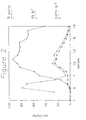
- FIG. 2 is a graph showing the elution profile for lysine adsorbed onto a strong cation exchange column from a filtered fermentation broth having a pH of 9.7 and eluted with a solution of 4% aqueous ammonia at a flow rate of 2 ml/min.
- the graph shows the values obtained from sequential 6 ml samples of eluant analyzed for purity (v) in percent of g/l lysine free base per g/l of dry solids, dry solids (ds; x) in grams of non-volatile solids per liter, and lysine concentration (o) of each sample as lysine free base in g/l.
- FIG. 3 is a graph showing the elution profile for lysine adsorbed onto a strong cation exchange column from a filtered fermentation broth having a pH of 8.0 and eluted with a solution of 4% aqueous ammonia at a flow rate of 2 ml/min.
- the graph shows the values obtained from sequential 6 ml samples of eluant analyzed for purity (v) in percent of g/l lysine free base per g/l of dry solids, dry solids (ds; x) in grams of non-volatile solids per liter, and lysine concentration (o) of each sample as lysine free base in g/l.
- FIG. 4 is a graph showing the elution profile for lysine adsorbed onto a strong cation exchange column from a filtered fermentation broth having a pH of 4.5 and eluted with a solution of 4% aqueous ammonia at a flow rate of 2 ml/min.
- the graph shows the values obtained from sequential 6 ml samples of eluant analyzed for purity (v) in percent of g/l lysine free base per g/l of dry solids, dry solids (ds; x) in grams of non-volatile solids per liter, and lysine concentration (o) of each sample as lysine free base in g/l.
- FIG. 5 is a graph showing the elution profile for lysine adsorbed onto a strong cation exchange column from a filtered fermentation broth having a pH of 4.5 and eluted with a solution of 2.61% aqueous ammonia at a flow rate of 2 ml/min.
- the graph shows the values obtained from sequential 6 ml samples of eluant analyzed for purity (v) in percent of g/l lysine free base per g/l of dry solids, dry solids (ds; x) in grams of non-volatile solids per liter, and lysine concentration (o) of each sample as lysine free base in g/l.
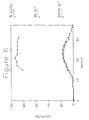
- FIG. 6 is a graph showing the elution profile for lysine adsorbed onto a strong cation exchange column from a filtered fermentation broth having a pH of 4.5 and eluted with a solution of 1.58% aqueous ammonia at a flow rate of 2 ml/min.
- the graph shows the values obtained from sequential 6 ml samples of eluant analyzed for purity (v) in percent of g/l lysine free base per g/l of dry solids, dry solids (ds; x) in grams of non-volatile solids per liter, and lysine concentration (o) of each sample as lysine free base in g/l.
- the present invention relates to a method for separating an amino acid from a solution comprising said amino acid and impurities, wherein the means for said separating is simulated moving bed chromatography with a strong cation exchange chromatographic material.
- the present invention relates to a method for recovering a basic amino acid from a feed solution comprising said basic amino acid and impurities, comprising: (a) selecting a simulated moving bed chromatographic apparatus comprising one or more chromatographic columns connected in series, said column or columns containing a strong cation exchange chromatographic material, and sequentially comprising a first desorbent port, an extract port, a feed port, a raffinate port and a second desorbent port; and (b)simultaneously, (i) contacting, through said feed port, said feed solution with said strong cation exchange chromatographic material; (ii) contacting, through said first desorbent port, a basic aqueous eluant with said strong cation exchange chromatographic material; and (iii) withdrawing, through said extract port, an extract solution comprising said basic amino acid and a lower percentage by dry weight of said impurities than in said feed solution.
- the basic aqueous eluant is an aqueous ammonium solution comprising between 0.5% and 10% ammonia by weight; more preferably, between 1% and 5% ammonia, by weight.
- the feed solution immediately prior to contacting the strong cation exchange chromatographic material, has or is adjusted to have a pH between 1 and 10; more preferably, between 2 and 7; and most preferably between 3 and 5.
- the pH of the extract solution at the extract port is at least one pH unit greater than the pH of the feed solution at the feed port; more preferably, at least two pH units; and most preferably, at least 3 pH units.
- the present invention relates to a method for recovering a basic amino acid from a feed solution containing said basic amino acid and impurities, comprising: (a) selecting a simulated moving bed chromatographic apparatus comprising one or more chromatographic columns connected in series, said column or columns containing a strong cation exchange chromatographic material, and sequentially comprising a first desorbent port, an extract port, a feed port, a raffinate port and a second desorbent port; and (b) simultaneously, (i) contacting, through said feed port, said feed solution with said strong cation exchange chromatographic material; (ii) contacting, through said first desorbent port, a basic aqueous eluant with said strong cation exchange chromatographic material; (iii) withdrawing, through said second desorbent port, a solution comprising water; and (iv) withdrawing, through said extract port, an aqueous solution comprising said basic amino acid and a lower percentage by dry weight of said impurities than
- the basic aqueous eluant is an aqueous ammonium solution comprising between 0.5% and 10% ammonia by weight; more preferably, between 1% and 5% ammonia, by weight.
- the feed solution immediately prior to contacting the strong cation exchange chromatographic material, has or is adjusted to have a pH between 1 and 10; more preferably, between 2 and 7; and most preferably between 3 and 5.
- the pH of the extract solution at the extract port is at least one pH unit greater than the pH of the feed solution at the feed port; more preferably, at least two pH units; and most preferably, at least 3 pH units.
- the method of this invention may be practiced with any simulated moving bed chromatographic apparatus, including but not limited to moving port and moving column systems.
- Preferred are semi-continuous counter-current refiners and moving column systems. More preferred are moving column systems. Most preferred is the CSEP system (Advanced Separation Technologies, Inc.).
- the strong cation exchange chromatrography material of this invention preferably comprises one or more chromatographic support materials (i.e., stationary phases).
- Suitable chromatographic support materials include, but are not limited to, alumina, magnesium silicates, silica, glass, controlled pore glass, carbon, porous graphitic carbon, zirconium phosphate, hydroxylapatite, calcium phosphate, magnesium carbonate, and polymers or resins.
- Suitable polymers or resins include, but are not limited to, hydroxyalkylmethacrolate, polyacrylamine, polymacrolate, poly(hydroxyethylmacrolate), polystyrene, styrene-divinylbenzine copolymers, poly(ethyleneglycoldimethacrolate), poly(vinylalcohol), poly(vinylacetate), and poly(vinylpyridine).
- the strong cation exchange chromatographic material of this invention preferably further comprises a plurality of ligands, selected from one or more functional groups suitable for strong ion exchange.
- functional groups include but are not limited to sulfonic acid, alkylsulfonic acid, phenylsulfonic acid, alkylphenylsulfonic acid, and salts thereof. Preferred are sulfonic acid functional groups and the salts thereof.
- AMBERLITE 200 include: AMBERLITE 200, AMBERLITE IR-118H, AMBERLITE IR-120PLUS, AMBERLITE IR-122, AMBERLITE IR-130C, AMBERLITE I6641, AMBERLITE IRP-69, DOWEX 50X1-100, DOWEX 50X2-100, DOWEX 50X2-200, DOWEX 50X2-400, DOWEX 50X4-100, DOWEX 50X4-200, DOWEX 50X4-200R, DOWEX 50X4-400, DOWEX 18880, DOWEX 50X8-100, DOWEX 50X8-200, DOWEX 50X8-400, DIAION 1-3561, DIAION 1-3565, DIAION 1-3570, DIAION 1-3573, DIAION 1-3577, DIAION 1-3581, DUOLITE D 5427, and DUOLITE D 5552, which are available from Sigma-Aldrich, St.
- AMBERLITE IR-120 Preferable are AMBERLITE IR-120, AMBERLITE IR-120B, AMBERLITE IR-200C, DOWEX C500ES, DOWEX XUS 43518, and DOWEX XUS 40406.00. Most preferable is DOWEX XUS 40406.00.
- strong cation exchange silica-based chromatographic materials include ADSORBOSPHERE SCX, BAKERBOND SCX, PARTISIL SCX, SPHERISORB S SCX, SUPELCOSIL LC-3SCX, ULTRASIL-CX, and ZORBAX 300 SCX.
- the feed solution may be clarified by any process suitable to the production of an edible product including, but not limited to, centrifugation and filtration including ultrafiltration.
- filtration Preferable is filtration, more preferable is ultrafiltration.
- the pH of the feed solution may be adjusted by the addition of any compound suitable to the production of an edible product.
- Suitable acidic compounds include, but are not limited to, hydrochloric acid, sulfuric acid and phosphoric acid. Preferable is sulfuric acid.
- Suitable basic compounds include, but are not limited to, sodium hydroxide, potassium hydroxide, ammonium hydroxide and ammonia.
- a 60 x 1.5 cm column of IR 120 resin (Rohm and Haas) was prepared and equilibrated with 4% ammonia aqueous solution.
- 2-4 illustrate that adsorption onto a strong cation exchange resin and desorption with aqueous ammonia is effective for the separation of lysine from other dissolved materials from fermentation broths having a range of different pH values from at least as low as 4.5 to at least as high as 9.7.
- a 60 x 1.5 cm column of IR 120 resin (Rohnm and Haas) was prepared and equilibrated with 4% ammonia aqueous solution.
Landscapes
- Chemical & Material Sciences (AREA)
- Organic Chemistry (AREA)
- Analytical Chemistry (AREA)
- Chemical Kinetics & Catalysis (AREA)
- Life Sciences & Earth Sciences (AREA)
- Sustainable Development (AREA)
- Organic Low-Molecular-Weight Compounds And Preparation Thereof (AREA)
- Treatment Of Liquids With Adsorbents In General (AREA)
- Preparation Of Compounds By Using Micro-Organisms (AREA)
- Pyrrole Compounds (AREA)
Abstract
Description
- This invention relates to a novel method for the purification of amino acids, including lysine, by simulated moving bed chromatography with a strong cation exchange chromatographic material.
- Efficient separation processes are crucial to the economics of large scale production of biomolecules. For example, lysine is currently produced by fermentation for use as a feed additive at a level of 250,000 metric tons per year. Prior to purification, a lysine fermentation broth contains not only lysine but also significant quantities of impurities such as particulate materials, inorganic nutrients, sugars, organic acids, and other amino acids. Purifying this amount of lysine from fermentation broths containing these impurities requires both large amounts of chemicals and large water inputs.
- The primary process now in commercial use for the purification of lysine is ion exchange by column chromatography followed by crystallization. This process comprises the following steps. The fermentation broth which contains lysine sulfate at or near neutral pH is acidified to a pH of between one and three to ensure that the carboxyl group of the lysine molecule is protonated. This acidified solution is passed over a bed of strong cation exchange resin in the ammonium form displacing the ammonia to form a raffinate stream of ammonium sulfate and the other fermentation components that do not bind to the resin. After the resin is loaded with lysine a washing step with water is used to rinse out the resin. This is followed by elution with a strong ammonia solution to regenerate the resin in the ammonia form and elute the lysine as the free base amino acid. This lysine solution then has the free ammonia stripped off, and it is acidified to form lysine•HCL which is crystallized. See, e.g., U.S. Patent No. 3,565, 951 (Ishida, M., et al.; Ajinomoto Company, Inc.); U.S. Patent No. 4,714,767 (Tanaka, K., et al.; Ajinomoto Company, Inc.); Kawakita, T., et al., "Selectivity Coefficient of Lysine for Strong Cation-Exchange Resins of the Ammonium Form," Agric. Biol. Chem. 53:2571-2577 (1989).
- A variation of this process is to use two ion exchange steps: one with strong cation exchange resin as above followed by a second weak cation exchange resin to retain divalent metal cations. See, U.S. Patent No. 5,684,190 (Fechter, W.G., et al.; AECI Limited); Van Walsem, H.J. and Thompson, M.C., "Simulated moving bed in the production of lysine," J. Biotechnol. 59:127-132 (1997). This variation avoids the use of a final crystallization step in the commercial production of lysine.
- Both of the above processes can be automated. See, e.g., Rossiter, G.J., "Continuous adsorption and chromatography in the purification of fermentation products," Preparative and Process-Scale Liquid Chromatography (Edited by G. Subramanian), Ellis Horwood, New York, pages 162-223 (1991); Rossiter, G.J. and Tolbert, C.A., "Recovery of Amino Acids and Carboxylic Acids by Continuous Exchange," presented at the Annual Meeting of the American Institute of Chemical Engineers, 17-22 November, 1991, Los Angeles, California, 20 pages; Van Walsem, H.J. and Thompson, M.C., "Simulated moving bed in the production of lysine," J. Biotechnol. 59:127-132 (1997). The practice of automated batch chromatography has also been described as "continuous co-current chromatography" (Rossiter, G.J., "Continuous adsorption and chromatography in the purification of fermentation products," Preparative and Process-Scale Liquid Chromatography (Edited by G. Subramanian), Ellis Horwood, New York, pages 162-223 (1991)).
- Both of the above processes use excessive amounts of water for washing the resin and excessive amounts of acid to convert the lysine to its divalent cation for the initial binding to the resin. All of this results in increased water and salt load to the waste streams being generated.
- An alternative process proposed for the commercial production of lysine is to dry whole or ultrafiltered fermentation broth. See, U.S. Patent No. 5,133, 976 (Rouy, N.; Rhone-Poulenc). This process has some advantages, such as simplicity and minimal production of waste streams. However, the process necessarily restricts the nutrients that can be provided to the fermentation and produces a product with lower purity than a product purified by customary, chromatographic means. Reduced product purity is undesirable for a variety of reasons, including increased transportation costs.
- As an alternative to batch chromatography, simulated moving bed chromatography has been applied in a variety of industrial applications including: the separation of normal paraffins from other hydrocarbon species (Broughton, D.B., "Molex: Case History of a Process, Chemical Engineering Progress, 64:60-65 (1968)); the separation of p-xylene from mixtures of other C8 hydrocarbons (Thornton, D.P., Jr., "Extract p-Xylene with Parex," Hydrocarbon Processing, 151-155 (November 1970)); the separation of sugar isomers (U.S. Pat. No. 5,391,299 (Masuda, T., et al.; Organo Corporation); Hashimoto, K., et al., "Models for the Separation of Glucose/Fructose mixture using a Simulated Moving-Bed Adsorber," J. Chem. Engineering Japan 16: 400-406 (1983); Rossiter, G.J., "ISEP® a Moving Bed Contactor for Chromatographic Separations," presented at the 4thWorkshop on Preparative HPLC, 28-31 March, 1993, Salzburg, Austria, 21 pages); and the separation of phenylalanine from a fermentation broth by adsorbing the phenylalanine from the aqueous fermentation broth onto AMBERLITE XAD-7 chromatography resin and eluting with an aqueous solution of an alcohol, ketone, or ester (U.S. Patent No. 5,071,560 (McCulloch, B. et al.; UOP). See, generally, Barker, P.E. and Ganetsos, G., "Chemical and Biochemical Separations using Preparative and Large Scale Batch and Continuous Chromatography," Separation and Purification Methods 17:1-65 (1988); Gattuso, M.J., "Un procédé économique pour les substances chirales," Chim. Mag. 141:39-42 (1996).
- A schematic diagram of a simulated moving bed chromatographic apparatus is shown in FIG. 1. The chromatographic bed is contained within a long packed column or several columns that are connected in series. The location of the ports for the introduction or withdrawal of the desorbent, extract (= product), feed and raffinate streams are changed at given intervals to the next bed segment in the direction of the fluid flow, resulting in a simulated counter-current contact of the fluid and the resin. Simulated moving bed chromatography results in the continuous separation of two components A and B without actual movement of the resin.
- The operation of a simulated moving bed chromatographic (SMBC) system has been described by S. Adachi ("Simulated moving-bed chromatography for continuous separation of two components and its application to bioreactors," J. Chromatography A 658:271-282 (1994)) as follows:
The SMBC system usually consists of four zones, I-IV, as shown schematically in Fig. 1, each of which has an inherent function. A sample solution including components A and B is fed at the feed point situated between zones II and III. Component A is adsorbed on the resin in zone II and carried into zones III and IV by the simulated movement of the resin. The absorption wave of less absorptive component B can migrate to the withdrawal point of the raffinate stream within a switching interval of the introduction and withdrawal points and component B can be recovered in the raffinate stream. Hence zone II functions for the separation of the components. Zone III is a refining zone, where component B absorbed partially in zone II is desorbed and returned to zone II. Component A adsorbed in zone II is mainly desorbed in zone IV to join the liquid stream passing through the zone, and is recovered in the extract stream. Zone I functions for adsorption of component B to suppress the dilution of component B in the raffinate stream.
Zone I may, optionally, be eliminated from the system. In the absence of Zone I, fluid flow through the raffinate stream is increased due to the elimination of the zone's terminal fluid port (i.e., second desorbent port); and the concentration of component B in the raffinate stream is correspondingly decreased. - Several types of simulated moving bed chromatographic processes are now in commercial use. These may be conceptually divided into moving port systems and moving column systems (Barker, P.E. and Deeble, R.E., "Sequential Chromatographic Equipment for the Separation of a Wide Range of Organic Mixtures," Chromatographia 8:67-79 (1975). An example of a moving port system is the Sorbex process (Universal Oil Products Incorporated (UOP)). The Sorbex process consists of a vertical column subdivided into a number of interlinked compartments and the fluid inlets and outlets of each compartment are controlled by a specially designed rotary master valve. The master valve operates like a multiport stopcock and coordinates the movement of the feed and eluant inlets and the two product outlets, thereby simulating the counter-current movement between the static packed bed and the moving fluid. A second type of moving port simulated moving bed chromatographic system is the semi-continuous counter-current refiner (SCCR). SCCR systems adopt a multicolumn approach wherein counter-current movement is simulated by continuously opening and closing the appropriate valves in the direction of the mobile phase. See, Ganetsos, G. and Barker, P.E., "Large-scale Chromatography in Industrial Processing," J. Chem. Tech. Biotechnol. 50:101-108 (1991).
- An example of a moving column system is the ISEP (subsequently ISEP/CSEP) system (Advanced Separation Technologies Incorporated), which is a moving bed contactor comprising multiple chromatography columns mounted on a rotary carousel. See, U.S. Patent No. 4,522,726 (Berry, W.W., et al.; Progress Equities Incorporated); U.S. Patent No. 4,764,276 (Berry, W.W., et al.; Advanced Separation Technologies Incorporated); U.S. Patent No. 5,676,826 (Rossiter, G.J., et al.; Advanced Separation Technologies Incorporated); Rossiter, G.J. and Tolbert, C.A., "Recovery of Amino Acids and Carboxylic Acids by Continuous Exchange," presented at the Annual Meeting of the American Institute of Chemical Engineers, 17-22 November, 1991, Los Angeles, California, 20 pages.; Rossiter, G., "ISEP/CSEP: A novel Contactor for Separations," presented at the Annual Meeting of the American Chemical Society, 7-11 September 1997, Los Vegas, Nevada, abstract no. 64. The ISEP system may be used for both continuous co-current chromatography (i.e., automated batch chromatography) and for continuous counter current chromatography (i.e., simulated moving bed chromatography). See, Rossiter, G.J., "Continuous adsorption and chromatography in the purification of fermentation products," Preparative and Process-Scale Liquid Chromatography (Edited by G. Subramanian), Ellis Horwood, New York, pages 162-223 (1991); Rossiter, G.J., "ISEP® a Moving Bed Contactor for Chromatographic Separations," presented at the 4thWorkshop on Preparative HPLC, 28-31 March, 1993, Salzburg, Austria, 21 pages.
- Another example of a moving column system is the ADSEP system (Illinois Water Treatment (IWT)). See, Morgart, J.R. and Graaskamp, J.M., "Continuous Process Scale Chromatography," Paper No. 230, presented at the Pittsburgh Conference on Analytical Chemistry and Applied Spectroscopy, February 22, 1988, New Orleans, Louisiana, abstract + 15 pages.
- A variety of chromatographic techniques have been proposed for the commercial purification of amino acids:
- U.S. Patent No. 3,565,951 (Ishida, M., et al.; Ajinomoto Company, Inc.) Discloses a method for purifying lysine from a fermentation broth also containing neutral amino acids and inorganic cations, and recovering the lysine in the form of the monohydrochloride salt, by passing the broth at a pH of approximately 2.0 over a strongly acidic cation exchange resin of the ammonium type, eluting the lysine with ammonium hydroxide solution, and crystallizing the lysine as an acid salt from the partly evaporated and acidified eluant.
- U.S. Patent No. 4,663,048 (Tanaka, K., et al.; Ajinomoto Company, Inc.) discloses a method for separating a basic amino acid from its fermentation broth, or the liquid resulting from the intermediate treatment of the fermentation broth, containing high-molecular weight contaminants which entails permeating the broth, or liquids resulting from the intermediate treatment of the broth, through a semi-permeable membrane, until the basic amino acid is separated from the high-molecular weight contaminants, by passing through the membrane in the permeate; contacting the permeate with a strongly acidic cation exchange resin; and eluting the adsorbed basic amino acid from the cation exchange resin.
- U.S. Patent No. 4,691,054 (Tosa, T., et al.; Ajinomoto Company, Inc.) discloses a method for separating a basic amino acid from a liquor containing the same, which entails (a) contacting the basic amino containing liquor with a strongly acidic cation exchange resin at a pH at which the basic amino acid exists in the form of a divalent cation, thereby adsorbing at least a part of the basic amino acid in the form of the divalent cation; (b) contacting said ion exchange resin with a liquor containing said basic amino acid and a neutral amino acid or an acidic amino acid at a pH at which the basic amino acid exists in the form of a monovalent cation; (c) passing an eluant through said ion exchange resin, thereby eluting the basic amino acid from the ion exchange resin; and (d) separating and recovering the basic amino acid from the eluant.
- U.S. Patent No. 4,714,767 (Tanaka, K., et al.; Ajinomoto Company, Inc.) discloses a process for separating basic amino acids from a liquor containing the same using cation exchange resin adsorption and elution steps in sequence, wherein the washing water employed in said adsorption and elution steps is obtained by recycling the latter portion of a liquor discharged from a first tower of the adsorption step into an adsorption step in a subsequent cycle, or by recycling a liquid discharged from a first tower at the elution step into an elution step in a subsequent cycle.
- U.S. Patent No. 4,835,309 (Jaffari, M.D., et al.; Eastman Kodak Company) discloses a method for the recovery of L-lysine using an ion exchange resin, wherein a liquid solution containing L-lysine and possibly impurities is contacted with the resin. The resin is then soaked in elutant for at least about 15 minutes. The elution of L-lysine from the resin is then continued.
- U.S. Patent No. 5,071,560 (McCulloch, B., et al.; UOP) discloses the use of countercurrent simulated moving bed chromatography for the purification of phenylalanine from a fermentation broth by adsorbing the phenylalanine from the aqueous fermentation broth onto AMBERLITE XAD-7 chromatography resin and eluting with an aqueous solution of an alcohol, ketone, or ester
- U.S. Patent No. 5,133,976 (Rouy, N.; Rhone-Poulenc) disclose a method for preparing a stable composition containing 35 to 48% lysine sulphate for animal nutrition whereby a lysine-producing microorganism is cultured in a culture medium and sulfuric acid or ammonium sulphate is added during culturing to convert the lysine as it is formed into lysine sulphate. After allowing the concentration of the carbon source to fall to less than 2 g/l, culturing is stopped and the resultant cultured medium is concentrated and dried to produce the final product.
- U.S. Patent No. 5,279,744 (Ito, H., et al.; Ajinomoto Company, Inc.) discloses a method for purification of an amino acid which comprises contacting an amino acid solution containing impurities with an ion exchange resin to selectively adsorb the amino acid onto the resin, eluting and recovering the adsorbed amino acid whereby the resin is contacted with the amino acid solution in countercurrent continuous multiple steps during adsorption and an eluant is contacted with the adsorbed resin in countercurrent continuous multiple steps during elution.
- U.S. Patent No. 5,684,190 (Fechter, W.L., et al.; AECILimited) discloses a method for recovering an amino acid such as L-lysine from an aqueous solution containing the desired amino acid and impurities, comprising the steps of: (a) passing the solution over a primary cation exchange resin to adsorb the desired amino acid onto the resin at a pH lower than the isoelectric point of the desired amino acid, (b) eluting the desired amino acid from the resin using a suitable eluant having a pH higher than the isoelectric point of the desired amino acid to produce a feed solution, (c) passing the feed solution over a secondary cation exchange resin to adsorb one or more of the impurities and to produce a second solution leaving the resin, (d) collecting the second solution until the ratio of the concentrations of a selected impurity to the desired amino acid reaches a chosen value to produce a third solution which contains a lower level of impurities than the feed solution and (e) recovering the desired amino acid from the third solution without the use of a crystallization step.
- There is a need for the development of a simple purification process that produces, from a fermentation broth, a purified amino acid product, such as lysine, and generates less waste chemicals and uses less water than traditional commercial methods.
- Unexpectedly a method for the purification of amino acids, including lysine, using simulated moving bed chromatography with a strong ion exchange chromatographic material has been discovered.
- In one embodiment, the present invention consists of a unique method fc recovering a basic amino acid from a feed solution comprising said basic amino acid an impurities, comprising: (a) selecting a simulated moving bed chromatograph apparatus comprising one or more chromatographic columns connected in series, said column or columns containing a strong cation exchange chromatographic material, and sequentially comprising a first desorbent port, an extract port, a feed port, a raffinate port and a second desorbent port; and (b) simultaneously, (i) contacting, through said feed port, said feed solution with said strong cation exchange chromatographic material; (ii) contacting, through said first desorbent port, a basic aqueous eluant with said strong cation exchange chromatographic material; (iii) optionally, withdrawing, through said second desorbent port, a solution comprising water; and (iv) withdrawing, through said extract port, an aqueous solution comprising said basic amino acid and a lower percentage by dry weight of said impurities than in said feed solution. Preferably the basic aqueous eluant is an aqueous ammonium solution comprising between 0.5% and 10% ammonia by weight; more preferably, between 1% and 5% ammonia, by weight. Preferably, immediately prior to contacting the strong cation exchange chromatographic material, the feed solution has or is adjusted to have a pH between 1 and 10; more preferably, between 2 and 7; and most preferably between 3 and 5. Preferably the pH of the extract solution at the extract port is at least one pH unit greater than the pH of the feed solution at the feed port; more preferably, at least two pH units; and most preferably, at least 3 pH units.
- The invention also relates to a preparation, consisting essentially of an amino acid manufactured by the method of the invention or an edible salt thereof and to a composition, for animal nutrition, comprising an amino acid manufactured by the method of the invention or an edible salt thereof.
- FIG. 1 is a schematic diagram of the process of simulated moving bed chromatography as used for the separation of two water-soluble components, A and B. Zone I is the zone of potential water recovery, component B conceptually moves with the resin. Zone II is a zone in which component B moves with the water in an aqueous fluid, and component A conceptually moves with the resin. Zone III is a zone in which component B moves with the water in an aqueous fluid, and component A conceptually moves with the resin. Zone IV is a zone in which purified component A moves with the water in an aqueous fluid.
- FIG. 2 is a graph showing the elution profile for lysine adsorbed onto a strong cation exchange column from a filtered fermentation broth having a pH of 9.7 and eluted with a solution of 4% aqueous ammonia at a flow rate of 2 ml/min. The graph shows the values obtained from sequential 6 ml samples of eluant analyzed for purity (v) in percent of g/l lysine free base per g/l of dry solids, dry solids (ds; x) in grams of non-volatile solids per liter, and lysine concentration (o) of each sample as lysine free base in g/l.
- FIG. 3 is a graph showing the elution profile for lysine adsorbed onto a strong cation exchange column from a filtered fermentation broth having a pH of 8.0 and eluted with a solution of 4% aqueous ammonia at a flow rate of 2 ml/min. The graph shows the values obtained from sequential 6 ml samples of eluant analyzed for purity (v) in percent of g/l lysine free base per g/l of dry solids, dry solids (ds; x) in grams of non-volatile solids per liter, and lysine concentration (o) of each sample as lysine free base in g/l.
- FIG. 4 is a graph showing the elution profile for lysine adsorbed onto a strong cation exchange column from a filtered fermentation broth having a pH of 4.5 and eluted with a solution of 4% aqueous ammonia at a flow rate of 2 ml/min. The graph shows the values obtained from sequential 6 ml samples of eluant analyzed for purity (v) in percent of g/l lysine free base per g/l of dry solids, dry solids (ds; x) in grams of non-volatile solids per liter, and lysine concentration (o) of each sample as lysine free base in g/l.
- FIG. 5 is a graph showing the elution profile for lysine adsorbed onto a strong cation exchange column from a filtered fermentation broth having a pH of 4.5 and eluted with a solution of 2.61% aqueous ammonia at a flow rate of 2 ml/min. The graph shows the values obtained from sequential 6 ml samples of eluant analyzed for purity (v) in percent of g/l lysine free base per g/l of dry solids, dry solids (ds; x) in grams of non-volatile solids per liter, and lysine concentration (o) of each sample as lysine free base in g/l.
- FIG. 6 is a graph showing the elution profile for lysine adsorbed onto a strong cation exchange column from a filtered fermentation broth having a pH of 4.5 and eluted with a solution of 1.58% aqueous ammonia at a flow rate of 2 ml/min. The graph shows the values obtained from sequential 6 ml samples of eluant analyzed for purity (v) in percent of g/l lysine free base per g/l of dry solids, dry solids (ds; x) in grams of non-volatile solids per liter, and lysine concentration (o) of each sample as lysine free base in g/l.
- In one embodiment, the present invention relates to a method for separating an amino acid from a solution comprising said amino acid and impurities, wherein the means for said separating is simulated moving bed chromatography with a strong cation exchange chromatographic material.
- In another embodiment, the present invention relates to a method for recovering a basic amino acid from a feed solution comprising said basic amino acid and impurities, comprising: (a) selecting a simulated moving bed chromatographic apparatus comprising one or more chromatographic columns connected in series, said column or columns containing a strong cation exchange chromatographic material, and sequentially comprising a first desorbent port, an extract port, a feed port, a raffinate port and a second desorbent port; and (b)simultaneously, (i) contacting, through said feed port, said feed solution with said strong cation exchange chromatographic material; (ii) contacting, through said first desorbent port, a basic aqueous eluant with said strong cation exchange chromatographic material; and (iii) withdrawing, through said extract port, an extract solution comprising said basic amino acid and a lower percentage by dry weight of said impurities than in said feed solution. Preferably the basic aqueous eluant is an aqueous ammonium solution comprising between 0.5% and 10% ammonia by weight; more preferably, between 1% and 5% ammonia, by weight. Preferably, immediately prior to contacting the strong cation exchange chromatographic material, the feed solution has or is adjusted to have a pH between 1 and 10; more preferably, between 2 and 7; and most preferably between 3 and 5. Preferably the pH of the extract solution at the extract port is at least one pH unit greater than the pH of the feed solution at the feed port; more preferably, at least two pH units; and most preferably, at least 3 pH units.
- In another embodiment, the present invention relates to a method for recovering a basic amino acid from a feed solution containing said basic amino acid and impurities, comprising: (a) selecting a simulated moving bed chromatographic apparatus comprising one or more chromatographic columns connected in series, said column or columns containing a strong cation exchange chromatographic material, and sequentially comprising a first desorbent port, an extract port, a feed port, a raffinate port and a second desorbent port; and (b) simultaneously, (i) contacting, through said feed port, said feed solution with said strong cation exchange chromatographic material; (ii) contacting, through said first desorbent port, a basic aqueous eluant with said strong cation exchange chromatographic material; (iii) withdrawing, through said second desorbent port, a solution comprising water; and (iv) withdrawing, through said extract port, an aqueous solution comprising said basic amino acid and a lower percentage by dry weight of said impurities than in said feed solution. Preferably the basic aqueous eluant is an aqueous ammonium solution comprising between 0.5% and 10% ammonia by weight; more preferably, between 1% and 5% ammonia, by weight. Preferably, immediately prior to contacting the strong cation exchange chromatographic material, the feed solution has or is adjusted to have a pH between 1 and 10; more preferably, between 2 and 7; and most preferably between 3 and 5. Preferably the pH of the extract solution at the extract port is at least one pH unit greater than the pH of the feed solution at the feed port; more preferably, at least two pH units; and most preferably, at least 3 pH units.
- The method of this invention may be practiced with any simulated moving bed chromatographic apparatus, including but not limited to moving port and moving column systems. Preferred are semi-continuous counter-current refiners and moving column systems. More preferred are moving column systems. Most preferred is the CSEP system (Advanced Separation Technologies, Inc.).
- The strong cation exchange chromatrography material of this invention preferably comprises one or more chromatographic support materials (i.e., stationary phases). Suitable chromatographic support materials include, but are not limited to, alumina, magnesium silicates, silica, glass, controlled pore glass, carbon, porous graphitic carbon, zirconium phosphate, hydroxylapatite, calcium phosphate, magnesium carbonate, and polymers or resins. Suitable polymers or resins include, but are not limited to, hydroxyalkylmethacrolate, polyacrylamine, polymacrolate, poly(hydroxyethylmacrolate), polystyrene, styrene-divinylbenzine copolymers, poly(ethyleneglycoldimethacrolate), poly(vinylalcohol), poly(vinylacetate), and poly(vinylpyridine). Preferable are polymers or resins. More preferable are styrene-divinylbenzine copolymers.
- The strong cation exchange chromatographic material of this invention preferably further comprises a plurality of ligands, selected from one or more functional groups suitable for strong ion exchange. These functional groups include but are not limited to sulfonic acid, alkylsulfonic acid, phenylsulfonic acid, alkylphenylsulfonic acid, and salts thereof. Preferred are sulfonic acid functional groups and the salts thereof. Specific examples of cation exchange polymers or resins that may be used
- include: AMBERLITE 200, AMBERLITE IR-118H, AMBERLITE IR-120PLUS, AMBERLITE IR-122, AMBERLITE IR-130C, AMBERLITE I6641, AMBERLITE IRP-69, DOWEX 50X1-100, DOWEX 50X2-100, DOWEX 50X2-200, DOWEX 50X2-400, DOWEX 50X4-100, DOWEX 50X4-200, DOWEX 50X4-200R, DOWEX 50X4-400, DOWEX 18880, DOWEX 50X8-100, DOWEX 50X8-200, DOWEX 50X8-400, DIAION 1-3561, DIAION 1-3565, DIAION 1-3570, DIAION 1-3573, DIAION 1-3577, DIAION 1-3581, DUOLITE D 5427, and DUOLITE D 5552, which are available from Sigma-Aldrich, St. Louis Missouri, U.S.A.; DIAION HPK25, DIAION PK208, DIAION PK228, DIAION SK1B, DIAION SK1BS, DIAION SK104, DIAION SK112, DIAION SK116, DOWEX HCR-S, DOWEX HCR-W2, DOWEX MSC-1, DOWEX 650C, DOWEX G-26, DOWEX 88, DOWEX MONOSPHERE 88, DOWEX MONOSPHERE 99K/320, DOWEX MONOSPHERE 99K/350, DOWEX MONOSPHERE 99Ca/320, DOWEX MONOSPHERE 99Ca/350, DOWEX Marathon C, DOWEX -032, DOWEX -406, DOWEX -437, DUOLITE C-280, and DUOLITE C-291, which are available from Supelco, Inc., Bellefonte, Pennsylvania, U.S.A.; AMBERLITE IR-120, AMBERLITE IR-120B, AMBERLITE IR-200C, AMBERLITE CG 6000, DIAION SK-1B, DOWEX XUS 40406.00, DOWEX XUS 43518, and DOWEX C500ES. Preferable are AMBERLITE IR-120, AMBERLITE IR-120B, AMBERLITE IR-200C, DOWEX C500ES, DOWEX XUS 43518, and DOWEX XUS 40406.00. Most preferable is DOWEX XUS 40406.00.
- Specific examples of strong cation exchange silica-based chromatographic materials include ADSORBOSPHERE SCX, BAKERBOND SCX, PARTISIL SCX, SPHERISORB S SCX, SUPELCOSIL LC-3SCX, ULTRASIL-CX, and ZORBAX 300 SCX.
- Prior to chromatography, the feed solution may be clarified by any process suitable to the production of an edible product including, but not limited to, centrifugation and filtration including ultrafiltration. Preferable is filtration, more preferable is ultrafiltration.
- Prior to chromatography, the pH of the feed solution may be adjusted by the addition of any compound suitable to the production of an edible product. Suitable acidic compounds include, but are not limited to, hydrochloric acid, sulfuric acid and phosphoric acid. Preferable is sulfuric acid. Suitable basic compounds include, but are not limited to, sodium hydroxide, potassium hydroxide, ammonium hydroxide and ammonia.
- The present invention is described in further detail in the following nonlimiting examples:
- A 60 x 1.5 cm column of IR 120 resin (Rohm and Haas) was prepared and equilibrated with 4% ammonia aqueous solution. Three 13 ml samples of ultrafiltered lysine fermentation broth, with lysine HCL equivalent of 120 g/l, at pH values of 9.7, 8.0 and 4.5, respectively, were sequentially loaded onto the column and eluted with 4% ammonia aqueous solution at a flow rate of 2 ml/min. Sequential 6 ml samples were collected and analyzed for purity (v) in percent of g/l lysine free base per g/l of dry solids, dry solids (ds; x) in grams of non-volatile solids per liter, and lysine concentration (o) of each sample as lysine free base in g/l. The results are shown in FIG. 2 (pH 9.7), FIG. 3 (pH 8.0), and FIG. 4 (pH 4.5). FIGs. 2-4 illustrate that adsorption onto a strong cation exchange resin and desorption with aqueous ammonia is effective for the separation of lysine from other dissolved materials from fermentation broths having a range of different pH values from at least as low as 4.5 to at least as high as 9.7.
- A 60 x 1.5 cm column of IR 120 resin (Rohnm and Haas) was prepared and equilibrated with 4% ammonia aqueous solution. A 13 ml sample of ultrafiltered lysine fermentation broth, with lysine HCL equivalent of 120 g/l, at pH 4.5 was loaded onto the column and eluted with 2.61% ammonia aqueous solution at a flow rate of 2 ml/min. Sequential 6 ml samples were collected and analyzed for purity (v) in percent of g/l lysine free base per g/l of dry solids, dry solids (ds; x) in grams of non-volatile solids per liter, and lysine concentration (o) of each sample as lysine free base in g/l. The procedure was repeated with an eluant of 1.58% ammonia aqueous solution at a flow rate of 2 ml/min. The results are shown in FIG. 5 (2.61% ammonia) and FIG. 6 (1.58% ammonia). FIGs. 5 and 6 illustrate that lysine can be separated effectively from other dissolved materials from a fermentation broth by adsorption onto a strong cation exchange resin and elution with aqueous ammonia having a concentration at least as low as 1.58%.
- A pilot simulated moving bed apparatus from Advanced Seperation Technologies with twenty 1.8 liter columns was filled with XUS 40406.00 cation exchange resin (Dow Chemical). This system was then employed in five separate trials for the purification of lysine from fermentation broths. During these trials only
zones 2, 3 and 4, as diagramed schematically in FIG. 1, were used. In all trials, the feed pH was 4.5; and the simulated resin flow rate was 200 ml/min. The results from these trials are shown in Table 1.Results for the Purification of Lysine from a Fermentation Broth by Simulated Moving Bed Chromatography Trial Columns Flows Properties in zone 2 in zone 3 in zone 4Feed ml/min Des. ml/min Ext. ml/min Feed [LHCl] g/l Des. [NH4] % Ext. [LHCl] g/l Ext. purity % Ext. yield % 1 5 5 5 98 255 151 125 4 79 96 98 2 4 3 6 140 170 172 120 6 95 --- 97 3 6 5 5 114 250 134 89 4 61 97 99 4 6 5 5 274 243 215 89 4 105 76 99 5 5 4 6 95 228 123 126 3.4 100 98 97 - The date in Table 1 indicates that, under the conditions of this example, simulated moving bead chromatography can be used effectively for the purification of lysine from a fermentation broth. Product yields of 96-99% and product purity of at least 96% can readily be obtained.
- All publications mentioned herein are hereby incorporated in their entirety by reference.
- In view of the foregoing description taken with the examples, those skilled in the art will be able to practice the invention in various enablements without departing from the spirit and scope of the invention as defined in the appended claims.
Claims (19)
- A method for separating an amino acid from a solution comprising said amino acid and impurities, wherein the means for said separating is simulated moving bed chromatography with a strong cation exchange chromatographic material.
- The method of claim 1, wherein said amino acid is a basic amino acid.
- The method of claim 2, wherein said basic amino acid is lysine, arginine or histidine.
- The method of claim 1, 2 or 3 wherein said solution is a feed solution.
- The method of any preceding claim, wherein said solution containing said amino acid is a fermentation broth.
- The method of claim 4, wherein said fermentation broth is a filtered fermentation broth.
- The method of any preceding claim, wherein said strong cation exchange chromatographic material is a strong cation exchange resin.
- The method of any preceding claim, wherein said strong cation exchange chromatographic material comprises a functional group selected from the group consisting of sulfonates, alkylsulfonates, phenylsulfonates, alkylphenylsulfonates and mixtures thereof.
- The method of claim 8, wherein said strong cation exchange chromatographic material comprises a sulfonate.
- The method of any preceding claim, comprising:(a) selecting a simulated moving bed chromatographic apparatus comprising one or more chromatographic columns connected in series, said column or columns containing a strong cation exchange chromatographic material, and sequentially comprising a first desorbent port, an extract port, a feed port and a raffinate port; and(b) simultaneously,(i) contacting, through said feed port, said solution with said strong cation exchange chromatographic material;(ii) contacting, through said first desorbent port, a basic aqueous eluant with said strong cation exchange chromatographic material; and(iii) withdrawing, through said extract port, an extract solution comprising said basic amino acid and a lower percentage by dry weight of said impurities than in said solution.
- The method of claim 10 wherein the simulated moving bed chromatographic apparatus further comprises a second desorbent port; a solution comprising water being withdrawn through said second desorbent port simultaneously with steps b(i)-b(iii).
- The method of claim 10 or claim 11, wherein said basic aqueous eluant is an aqueous ammonia solution.
- The method of claim 12, wherein said aqueous ammonia solution comprises between 0.5% and 10% ammonia, by weight.
- The method of claim 12 or claim 13, wherein said aqueous ammonia solution comprises between 1% and 5% ammonia, by weight.
- The method of any one of claims 10 to 14, wherein, prior to contacting at (i), the pH of said feed solution is adjusted to a pH between 1 and 10 by the addition of an acidic or a basic material.
- The method of claim 15, wherein the pH of said feed solution is adjusted to a pH between 2 and 7 by the addition of an acidic or a basic material.
- The method of claim 16, wherein the pH of said feed solution is adjusted to a pH between 3 and 5 by the addition of an acidic or a basic material.
- The method of any one of claims 10 to 17, wherein the pH of said extract solution at (b)(iii) is at least one pH unit greater than the pH of said feed solution at (b)(i).
- The method of claim 18, wherein the pH of said extract solution at (b)(iii) is at least 3 pH units greater than the pH of said feed solution at (b)(i).
Priority Applications (4)
| Application Number | Priority Date | Filing Date | Title |
|---|---|---|---|
| DE69939429T DE69939429D1 (en) | 1999-12-09 | 1999-12-09 | Purification of amino acids by chromatographic simulated moving bed separation |
| AT99309901T ATE406345T1 (en) | 1999-12-09 | 1999-12-09 | PURIFICATION OF AMINO ACIDS BY CHROMATOGRAPHIC SIMULATED WALKING BED SEPARATION |
| DK99309901T DK1106602T3 (en) | 1999-12-09 | 1999-12-09 | Chromatographically simulated moving bed purification of amino acids |
| EP99309901A EP1106602B1 (en) | 1999-12-09 | 1999-12-09 | Simulated moving bed chromatographic purification of amino acids |
Applications Claiming Priority (1)
| Application Number | Priority Date | Filing Date | Title |
|---|---|---|---|
| EP99309901A EP1106602B1 (en) | 1999-12-09 | 1999-12-09 | Simulated moving bed chromatographic purification of amino acids |
Related Child Applications (1)
| Application Number | Title | Priority Date | Filing Date |
|---|---|---|---|
| EP04024282 Division | 2004-10-12 |
Publications (2)
| Publication Number | Publication Date |
|---|---|
| EP1106602A1 true EP1106602A1 (en) | 2001-06-13 |
| EP1106602B1 EP1106602B1 (en) | 2008-08-27 |
Family
ID=8241792
Family Applications (1)
| Application Number | Title | Priority Date | Filing Date |
|---|---|---|---|
| EP99309901A Expired - Lifetime EP1106602B1 (en) | 1999-12-09 | 1999-12-09 | Simulated moving bed chromatographic purification of amino acids |
Country Status (4)
| Country | Link |
|---|---|
| EP (1) | EP1106602B1 (en) |
| AT (1) | ATE406345T1 (en) |
| DE (1) | DE69939429D1 (en) |
| DK (1) | DK1106602T3 (en) |
Cited By (23)
| Publication number | Priority date | Publication date | Assignee | Title |
|---|---|---|---|---|
| US6872314B2 (en) | 2003-08-29 | 2005-03-29 | Eastman Chemical Company | Dewatering process |
| WO2006108663A1 (en) * | 2005-04-15 | 2006-10-19 | Basf Aktiengesellschaft | Method for recovering a basic amino acid from a fermentation liquor |
| WO2006108662A1 (en) * | 2005-04-15 | 2006-10-19 | Basf Aktiengesellschaft | Method for recovering a basic amino acid from a fermentation liquor ii |
| US7667061B2 (en) | 2005-12-16 | 2010-02-23 | Archer-Daniels-Midland Company | Method of preparing a composition using argentation chromatography |
| CN102229540A (en) * | 2011-05-11 | 2011-11-02 | 汕头市紫光古汉氨基酸有限公司 | Method for producing lysine acetate for injection |
| US8372606B2 (en) | 2006-12-25 | 2013-02-12 | Ajinomoto Co., Inc. | Methods for obtaining crystals of a basic amino acid hydrochloride |
| WO2013119034A1 (en) * | 2012-02-06 | 2013-08-15 | Cj Cheiljedang Corporation | An apparatus for continuous separation of valine and a method for continuous separation of valine using the same |
| US8802880B1 (en) | 2013-05-07 | 2014-08-12 | Group Novasep | Chromatographic process for the production of highly purified polyunsaturated fatty acids |
| CN104592047A (en) * | 2014-12-24 | 2015-05-06 | 三达膜科技(厦门)有限公司 | Separation and purification method of valine |
| WO2015104464A1 (en) * | 2014-01-07 | 2015-07-16 | Novasep Process | Process for purifying aromatic amino acids |
| US9150816B2 (en) | 2013-12-11 | 2015-10-06 | Novasep Process Sas | Chromatographic method for the production of polyunsaturated fatty acids |
| US9321715B2 (en) | 2009-12-30 | 2016-04-26 | Basf Pharma (Callanish) Limited | Simulated moving bed chromatographic separation process |
| US9428711B2 (en) | 2013-05-07 | 2016-08-30 | Groupe Novasep | Chromatographic process for the production of highly purified polyunsaturated fatty acids |
| WO2016164767A1 (en) * | 2015-04-10 | 2016-10-13 | Invista North America S.A.R.L. | Process for separation of diamines and/or omega-aminoacids from a feed mixture |
| US9694302B2 (en) | 2013-01-09 | 2017-07-04 | Basf Pharma (Callanish) Limited | Multi-step separation process |
| US9695382B2 (en) | 2011-07-06 | 2017-07-04 | Basf Pharma (Callanish) Limited | SMB process for producing highly pure EPA from fish oil |
| US9771542B2 (en) | 2011-07-06 | 2017-09-26 | Basf Pharma Callanish Ltd. | Heated chromatographic separation process |
| CN109836346A (en) * | 2019-04-16 | 2019-06-04 | 同舟纵横(厦门)流体技术有限公司 | A kind of purifying technique of isoleucine fermentation liquid |
| WO2019151769A1 (en) | 2018-01-31 | 2019-08-08 | Cj Cheiljedang Corporation | Method for preparing natural l-cysteine hydrochloride hydrate crystals by continuous chromatography |
| EP3713914A4 (en) * | 2018-01-31 | 2021-01-27 | CJ Cheiljedang Corporation | PROCESS FOR PREPARING NATURAL L-CYSTEINE CRYSTALS BY CONTINUOUS CHROMATOGRAPHY |
| US10974168B2 (en) | 2015-04-08 | 2021-04-13 | Inv Nylon Chemicals Americas, Llc | Materials and methods for the selective recovery of monovalent products from aqueous solutions using continuous ion exchange |
| CN116813492A (en) * | 2023-06-29 | 2023-09-29 | 山东兆光色谱分离技术有限公司 | Method for chromatographic separation of valine |
| US12090420B2 (en) | 2018-09-18 | 2024-09-17 | Inv Nylon Chemicals Americas, Llc | Systems and methods for recovering amines and their derivatives from aqueous mixtures |
Families Citing this family (5)
| Publication number | Priority date | Publication date | Assignee | Title |
|---|---|---|---|---|
| DE102010028916A1 (en) | 2010-05-12 | 2011-11-17 | Evonik Degussa Gmbh | Process for the separation of tryptophan |
| GB201111589D0 (en) | 2011-07-06 | 2011-08-24 | Equateq Ltd | New modified process |
| GB201111591D0 (en) | 2011-07-06 | 2011-08-24 | Equateq Ltd | Further new process |
| GB201111601D0 (en) | 2011-07-06 | 2011-08-24 | Equateq Ltd | New process |
| RU2624002C2 (en) * | 2014-06-24 | 2017-06-30 | Наталия Николаевна Кисиль | Method for obtaining lysine of pharmacopoeia condition from fodder lysine |
Citations (5)
| Publication number | Priority date | Publication date | Assignee | Title |
|---|---|---|---|---|
| FR2567413A1 (en) * | 1984-07-11 | 1986-01-17 | Ajinomoto Kk | PROCESS FOR THE USE OF CATION EXCHANGE RESINS IN THE SEPARATION OF A BASIC AMINO ACID FROM ITS SOLUTION |
| EP0337440A2 (en) * | 1988-04-14 | 1989-10-18 | Genencor International, Inc. | Ion exchange recovery of L-lysine |
| FR2666996A1 (en) * | 1990-09-25 | 1992-03-27 | Ajinomoto Kk | method for the purification of an amino acid employing an ion exchange resin |
| WO1995014002A1 (en) * | 1993-11-19 | 1995-05-26 | Aeci Limited | Recovery of an amino acid |
| WO1999033784A1 (en) * | 1997-12-25 | 1999-07-08 | Organo Corporation | Process for recovering betaine |
-
1999
- 1999-12-09 DE DE69939429T patent/DE69939429D1/en not_active Expired - Lifetime
- 1999-12-09 EP EP99309901A patent/EP1106602B1/en not_active Expired - Lifetime
- 1999-12-09 AT AT99309901T patent/ATE406345T1/en not_active IP Right Cessation
- 1999-12-09 DK DK99309901T patent/DK1106602T3/en active
Patent Citations (7)
| Publication number | Priority date | Publication date | Assignee | Title |
|---|---|---|---|---|
| FR2567413A1 (en) * | 1984-07-11 | 1986-01-17 | Ajinomoto Kk | PROCESS FOR THE USE OF CATION EXCHANGE RESINS IN THE SEPARATION OF A BASIC AMINO ACID FROM ITS SOLUTION |
| US4714767A (en) * | 1984-07-11 | 1987-12-22 | Ajinomoto Co., Inc. | Process for the separation of a basic amino acid from a fermentation broth using cation exchange resins |
| EP0337440A2 (en) * | 1988-04-14 | 1989-10-18 | Genencor International, Inc. | Ion exchange recovery of L-lysine |
| FR2666996A1 (en) * | 1990-09-25 | 1992-03-27 | Ajinomoto Kk | method for the purification of an amino acid employing an ion exchange resin |
| WO1995014002A1 (en) * | 1993-11-19 | 1995-05-26 | Aeci Limited | Recovery of an amino acid |
| US5684190A (en) * | 1993-11-19 | 1997-11-04 | Aeci Limited | Recovery of amino acid |
| WO1999033784A1 (en) * | 1997-12-25 | 1999-07-08 | Organo Corporation | Process for recovering betaine |
Non-Patent Citations (2)
| Title |
|---|
| D. EUGENE REARICK ET AL.: "The behavior of amino acids in chromatographic molasses desugarization systems", PROC. SUGAR PROCESS. RES. CONF., 1996, pages 481 - 491, XP000864558 * |
| VAN WALSEM H J ET AL: "Simulated moving bed in the production of lysine", JOURNAL OF BIOTECHNOLOGY,NL,ELSEVIER SCIENCE PUBLISHERS, AMSTERDAM, vol. 59, no. 1-2, 17 December 1997 (1997-12-17), pages 127 - 132, XP004108030, ISSN: 0168-1656 * |
Cited By (47)
| Publication number | Priority date | Publication date | Assignee | Title |
|---|---|---|---|---|
| US6872314B2 (en) | 2003-08-29 | 2005-03-29 | Eastman Chemical Company | Dewatering process |
| WO2006108663A1 (en) * | 2005-04-15 | 2006-10-19 | Basf Aktiengesellschaft | Method for recovering a basic amino acid from a fermentation liquor |
| WO2006108662A1 (en) * | 2005-04-15 | 2006-10-19 | Basf Aktiengesellschaft | Method for recovering a basic amino acid from a fermentation liquor ii |
| US7807420B2 (en) | 2005-04-15 | 2010-10-05 | Paik Kwang Industrial Co., Ltd. | Method for recovering a basic amino acid from a fermentation liquor |
| US7667061B2 (en) | 2005-12-16 | 2010-02-23 | Archer-Daniels-Midland Company | Method of preparing a composition using argentation chromatography |
| US8088710B2 (en) | 2005-12-16 | 2012-01-03 | Archer Daniels Midland Company | Method of preparing a composition using argentation chromatography |
| US8372606B2 (en) | 2006-12-25 | 2013-02-12 | Ajinomoto Co., Inc. | Methods for obtaining crystals of a basic amino acid hydrochloride |
| US9790162B2 (en) | 2009-12-30 | 2017-10-17 | Basf Pharma (Callanish) Limited | Simulated moving bed chromatographic separation process |
| US9321715B2 (en) | 2009-12-30 | 2016-04-26 | Basf Pharma (Callanish) Limited | Simulated moving bed chromatographic separation process |
| CN102229540B (en) * | 2011-05-11 | 2013-08-07 | 汕头市佳禾生物科技有限公司 | Method for producing lysine acetate for injection |
| CN102229540A (en) * | 2011-05-11 | 2011-11-02 | 汕头市紫光古汉氨基酸有限公司 | Method for producing lysine acetate for injection |
| US9771542B2 (en) | 2011-07-06 | 2017-09-26 | Basf Pharma Callanish Ltd. | Heated chromatographic separation process |
| US9695382B2 (en) | 2011-07-06 | 2017-07-04 | Basf Pharma (Callanish) Limited | SMB process for producing highly pure EPA from fish oil |
| WO2013119034A1 (en) * | 2012-02-06 | 2013-08-15 | Cj Cheiljedang Corporation | An apparatus for continuous separation of valine and a method for continuous separation of valine using the same |
| CN104203903A (en) * | 2012-02-06 | 2014-12-10 | Cj第一制糖株式会社 | Continuous separation device for valine and method for continuously separating valine with it |
| CN104203903B (en) * | 2012-02-06 | 2016-09-28 | Cj第一制糖株式会社 | Continuous separation device for valine and method for continuously separating valine with it |
| US9694302B2 (en) | 2013-01-09 | 2017-07-04 | Basf Pharma (Callanish) Limited | Multi-step separation process |
| US10723973B2 (en) | 2013-01-09 | 2020-07-28 | Basf Pharma (Callanish) Limited | Multi-step separation process |
| US10214475B2 (en) | 2013-01-09 | 2019-02-26 | Basf Pharma (Callanish) Limited | Multi-step separation process |
| US10179759B2 (en) | 2013-01-09 | 2019-01-15 | Basf Pharma (Callanish) Limited | Multi-step separation process |
| US8802880B1 (en) | 2013-05-07 | 2014-08-12 | Group Novasep | Chromatographic process for the production of highly purified polyunsaturated fatty acids |
| US9428711B2 (en) | 2013-05-07 | 2016-08-30 | Groupe Novasep | Chromatographic process for the production of highly purified polyunsaturated fatty acids |
| US9150816B2 (en) | 2013-12-11 | 2015-10-06 | Novasep Process Sas | Chromatographic method for the production of polyunsaturated fatty acids |
| JP2017506620A (en) * | 2014-01-07 | 2017-03-09 | ノヴァセプ プロセスNovasep Process | Method for purifying aromatic amino acids |
| WO2015104464A1 (en) * | 2014-01-07 | 2015-07-16 | Novasep Process | Process for purifying aromatic amino acids |
| US10975031B2 (en) * | 2014-01-07 | 2021-04-13 | Novasep Process | Method for purifying aromatic amino acids |
| US20160326112A1 (en) * | 2014-01-07 | 2016-11-10 | Novasep Process | Method For Purifying Aromatic Amino Acids |
| CN114874062A (en) * | 2014-01-07 | 2022-08-09 | 诺瓦塞普工艺处理公司 | Method for purifying aromatic amino acids |
| KR20160105827A (en) * | 2014-01-07 | 2016-09-07 | 노바셉 프로세스 | Process for purifying aromatic amino acids |
| CN104592047A (en) * | 2014-12-24 | 2015-05-06 | 三达膜科技(厦门)有限公司 | Separation and purification method of valine |
| US10974168B2 (en) | 2015-04-08 | 2021-04-13 | Inv Nylon Chemicals Americas, Llc | Materials and methods for the selective recovery of monovalent products from aqueous solutions using continuous ion exchange |
| US10265642B2 (en) | 2015-04-10 | 2019-04-23 | Invista North America S.A.R.L. | Process for separation of diamines and/or omega-aminoacids from a feed fixture |
| US10343084B2 (en) * | 2015-04-10 | 2019-07-09 | Invista North America S.A.R.L. | Process for separation of diamines and/or omega-aminoacids from a feed mixture |
| WO2016164767A1 (en) * | 2015-04-10 | 2016-10-13 | Invista North America S.A.R.L. | Process for separation of diamines and/or omega-aminoacids from a feed mixture |
| WO2019151769A1 (en) | 2018-01-31 | 2019-08-08 | Cj Cheiljedang Corporation | Method for preparing natural l-cysteine hydrochloride hydrate crystals by continuous chromatography |
| US20210054424A1 (en) * | 2018-01-31 | 2021-02-25 | Cj Cheiljedang Corporation | Method for preparing natural l-cysteine crystals by continuous chromatography |
| EP3720841A4 (en) * | 2018-01-31 | 2021-01-27 | CJ Cheiljedang Corporation | PROCESS FOR PREPARING NATURAL L-CYSTEINE HYDROCHLORIDE CRYSTALS BY CONTINUOUS CHROMATOGRAPHY |
| EP3713914A4 (en) * | 2018-01-31 | 2021-01-27 | CJ Cheiljedang Corporation | PROCESS FOR PREPARING NATURAL L-CYSTEINE CRYSTALS BY CONTINUOUS CHROMATOGRAPHY |
| JP2021510519A (en) * | 2018-01-31 | 2021-04-30 | シージェイ チェイルジェダング コーポレイション | Method for Producing Natural L-Cysteine Hydrochloride Hydrate Crystal Using Continuous Chromatography Step |
| JP2021511307A (en) * | 2018-01-31 | 2021-05-06 | シージェイ チェイルジェダング コーポレイション | Method for Producing Natural L-Cysteine Crystal Using Continuous Chromatography Step |
| US11427537B2 (en) | 2018-01-31 | 2022-08-30 | Cj Cheiljedang Corporation | Method for preparing natural L-cysteine hydrochloride hydrate crystals by continuous chromatography |
| US11708591B2 (en) | 2018-01-31 | 2023-07-25 | Cj Cheiljedang Corporation | Method for preparing natural L-cysteine crystals by continuous chromatography |
| US12090420B2 (en) | 2018-09-18 | 2024-09-17 | Inv Nylon Chemicals Americas, Llc | Systems and methods for recovering amines and their derivatives from aqueous mixtures |
| CN109836346B (en) * | 2019-04-16 | 2022-03-15 | 同舟纵横(厦门)流体技术有限公司 | A kind of purification process of isoleucine fermentation broth |
| CN109836346A (en) * | 2019-04-16 | 2019-06-04 | 同舟纵横(厦门)流体技术有限公司 | A kind of purifying technique of isoleucine fermentation liquid |
| CN116813492A (en) * | 2023-06-29 | 2023-09-29 | 山东兆光色谱分离技术有限公司 | Method for chromatographic separation of valine |
| CN116813492B (en) * | 2023-06-29 | 2024-01-23 | 山东兆光色谱分离技术有限公司 | Method for chromatographic separation of valine |
Also Published As
| Publication number | Publication date |
|---|---|
| ATE406345T1 (en) | 2008-09-15 |
| EP1106602B1 (en) | 2008-08-27 |
| DK1106602T3 (en) | 2008-11-03 |
| DE69939429D1 (en) | 2008-10-09 |
Similar Documents
| Publication | Publication Date | Title |
|---|---|---|
| EP1106602B1 (en) | Simulated moving bed chromatographic purification of amino acids | |
| US9233906B2 (en) | Purification of succinic acid from the fermentation broth containing ammonium succinate | |
| US4519845A (en) | Separation of sucrose from molasses | |
| US10975031B2 (en) | Method for purifying aromatic amino acids | |
| US5482631A (en) | Separation of inositols from sugars and sugar alcohols | |
| US12420216B2 (en) | Tertiary separation of allulose from corn syrup using chromatography | |
| CA2404442C (en) | Method for separating a basic amino acid from fermentation broth | |
| Van Walsem et al. | Simulated moving bed in the production of lysine | |
| CN100509760C (en) | Method for separating and purifying glutamine from fermentation liquor by four-area simulation moving bed | |
| RU2124496C1 (en) | Method of preparing alkali metal citrate | |
| Makart et al. | Separation of amino acids by simulated moving bed under solvent constrained conditions for the integration of continuous chromatography and biotransformation | |
| US10974168B2 (en) | Materials and methods for the selective recovery of monovalent products from aqueous solutions using continuous ion exchange | |
| US20250121300A1 (en) | Purification method and uses thereof | |
| CN115925573B (en) | Purification method of D-calcium pantothenate | |
| KR800001597B1 (en) | Purification of Nucleoides | |
| CN121652209A (en) | Method for separating and purifying AMP, ADP and ATP | |
| JPS63222200A (en) | Production of avidin | |
| Pathapati et al. | Hybridizing Simulated Moving Bed and Electrodialysis: Product Purification and Eluent Regeneration | |
| ZA200208705B (en) | Method for separating a basic amino acid from fermentation broth. |
Legal Events
| Date | Code | Title | Description |
|---|---|---|---|
| PUAI | Public reference made under article 153(3) epc to a published international application that has entered the european phase |
Free format text: ORIGINAL CODE: 0009012 |
|
| AK | Designated contracting states |
Kind code of ref document: A1 Designated state(s): AT BE CH CY DE DK ES FI FR GB GR IE IT LI LU MC NL PT SE |
|
| AX | Request for extension of the european patent |
Free format text: AL;LT;LV;MK;RO;SI |
|
| 17P | Request for examination filed |
Effective date: 20011212 |
|
| AKX | Designation fees paid |
Free format text: AT BE CH CY DE DK ES FI FR GB GR IE IT LI LU MC NL PT SE |
|
| 17Q | First examination report despatched |
Effective date: 20020715 |
|
| APBN | Date of receipt of notice of appeal recorded |
Free format text: ORIGINAL CODE: EPIDOSNNOA2E |
|
| APBR | Date of receipt of statement of grounds of appeal recorded |
Free format text: ORIGINAL CODE: EPIDOSNNOA3E |
|
| APBK | Appeal reference recorded |
Free format text: ORIGINAL CODE: EPIDOSNREFNE |
|
| APAF | Appeal reference modified |
Free format text: ORIGINAL CODE: EPIDOSCREFNE |
|
| APAF | Appeal reference modified |
Free format text: ORIGINAL CODE: EPIDOSCREFNE |
|
| APBT | Appeal procedure closed |
Free format text: ORIGINAL CODE: EPIDOSNNOA9E |
|
| 17Q | First examination report despatched |
Effective date: 20020715 |
|
| GRAP | Despatch of communication of intention to grant a patent |
Free format text: ORIGINAL CODE: EPIDOSNIGR1 |
|
| GRAS | Grant fee paid |
Free format text: ORIGINAL CODE: EPIDOSNIGR3 |
|
| GRAA | (expected) grant |
Free format text: ORIGINAL CODE: 0009210 |
|
| AK | Designated contracting states |
Kind code of ref document: B1 Designated state(s): AT BE CH CY DE DK ES FI FR GB GR IE IT LI LU MC NL PT SE |
|
| REG | Reference to a national code |
Ref country code: GB Ref legal event code: FG4D |
|
| REG | Reference to a national code |
Ref country code: CH Ref legal event code: EP |
|
| REG | Reference to a national code |
Ref country code: IE Ref legal event code: FG4D |
|
| REF | Corresponds to: |
Ref document number: 69939429 Country of ref document: DE Date of ref document: 20081009 Kind code of ref document: P |
|
| REG | Reference to a national code |
Ref country code: DK Ref legal event code: T3 |
|
| PG25 | Lapsed in a contracting state [announced via postgrant information from national office to epo] |
Ref country code: NL Free format text: LAPSE BECAUSE OF FAILURE TO SUBMIT A TRANSLATION OF THE DESCRIPTION OR TO PAY THE FEE WITHIN THE PRESCRIBED TIME-LIMIT Effective date: 20080827 Ref country code: ES Free format text: LAPSE BECAUSE OF FAILURE TO SUBMIT A TRANSLATION OF THE DESCRIPTION OR TO PAY THE FEE WITHIN THE PRESCRIBED TIME-LIMIT Effective date: 20081208 |
|
| PG25 | Lapsed in a contracting state [announced via postgrant information from national office to epo] |
Ref country code: FI Free format text: LAPSE BECAUSE OF FAILURE TO SUBMIT A TRANSLATION OF THE DESCRIPTION OR TO PAY THE FEE WITHIN THE PRESCRIBED TIME-LIMIT Effective date: 20080827 Ref country code: AT Free format text: LAPSE BECAUSE OF FAILURE TO SUBMIT A TRANSLATION OF THE DESCRIPTION OR TO PAY THE FEE WITHIN THE PRESCRIBED TIME-LIMIT Effective date: 20080827 |
|
| PG25 | Lapsed in a contracting state [announced via postgrant information from national office to epo] |
Ref country code: BE Free format text: LAPSE BECAUSE OF FAILURE TO SUBMIT A TRANSLATION OF THE DESCRIPTION OR TO PAY THE FEE WITHIN THE PRESCRIBED TIME-LIMIT Effective date: 20080827 |
|
| PG25 | Lapsed in a contracting state [announced via postgrant information from national office to epo] |
Ref country code: PT Free format text: LAPSE BECAUSE OF FAILURE TO SUBMIT A TRANSLATION OF THE DESCRIPTION OR TO PAY THE FEE WITHIN THE PRESCRIBED TIME-LIMIT Effective date: 20090127 |
|
| PLBE | No opposition filed within time limit |
Free format text: ORIGINAL CODE: 0009261 |
|
| STAA | Information on the status of an ep patent application or granted ep patent |
Free format text: STATUS: NO OPPOSITION FILED WITHIN TIME LIMIT |
|
| PG25 | Lapsed in a contracting state [announced via postgrant information from national office to epo] |
Ref country code: MC Free format text: LAPSE BECAUSE OF NON-PAYMENT OF DUE FEES Effective date: 20081231 |
|
| REG | Reference to a national code |
Ref country code: CH Ref legal event code: PL |
|
| 26N | No opposition filed |
Effective date: 20090528 |
|
| GBPC | Gb: european patent ceased through non-payment of renewal fee |
Effective date: 20081209 |
|
| REG | Reference to a national code |
Ref country code: IE Ref legal event code: MM4A |
|
| PG25 | Lapsed in a contracting state [announced via postgrant information from national office to epo] |
Ref country code: LI Free format text: LAPSE BECAUSE OF NON-PAYMENT OF DUE FEES Effective date: 20081231 Ref country code: IE Free format text: LAPSE BECAUSE OF NON-PAYMENT OF DUE FEES Effective date: 20081209 Ref country code: CH Free format text: LAPSE BECAUSE OF NON-PAYMENT OF DUE FEES Effective date: 20081231 |
|
| PG25 | Lapsed in a contracting state [announced via postgrant information from national office to epo] |
Ref country code: GB Free format text: LAPSE BECAUSE OF NON-PAYMENT OF DUE FEES Effective date: 20081209 |
|
| PG25 | Lapsed in a contracting state [announced via postgrant information from national office to epo] |
Ref country code: SE Free format text: LAPSE BECAUSE OF FAILURE TO SUBMIT A TRANSLATION OF THE DESCRIPTION OR TO PAY THE FEE WITHIN THE PRESCRIBED TIME-LIMIT Effective date: 20081127 |
|
| PG25 | Lapsed in a contracting state [announced via postgrant information from national office to epo] |
Ref country code: LU Free format text: LAPSE BECAUSE OF NON-PAYMENT OF DUE FEES Effective date: 20081209 |
|
| PG25 | Lapsed in a contracting state [announced via postgrant information from national office to epo] |
Ref country code: CY Free format text: LAPSE BECAUSE OF FAILURE TO SUBMIT A TRANSLATION OF THE DESCRIPTION OR TO PAY THE FEE WITHIN THE PRESCRIBED TIME-LIMIT Effective date: 20080827 |
|
| PG25 | Lapsed in a contracting state [announced via postgrant information from national office to epo] |
Ref country code: GR Free format text: LAPSE BECAUSE OF FAILURE TO SUBMIT A TRANSLATION OF THE DESCRIPTION OR TO PAY THE FEE WITHIN THE PRESCRIBED TIME-LIMIT Effective date: 20081128 |
|
| REG | Reference to a national code |
Ref country code: FR Ref legal event code: PLFP Year of fee payment: 17 |
|
| REG | Reference to a national code |
Ref country code: FR Ref legal event code: PLFP Year of fee payment: 18 |
|
| PG25 | Lapsed in a contracting state [announced via postgrant information from national office to epo] |
Ref country code: IT Free format text: LAPSE BECAUSE OF NON-PAYMENT OF DUE FEES Effective date: 20151209 |
|
| PG25 | Lapsed in a contracting state [announced via postgrant information from national office to epo] |
Ref country code: IT Free format text: LAPSE BECAUSE OF NON-PAYMENT OF DUE FEES Effective date: 20151209 |
|
| PGRI | Patent reinstated in contracting state [announced from national office to epo] |
Ref country code: IT Effective date: 20170710 |
|
| REG | Reference to a national code |
Ref country code: FR Ref legal event code: PLFP Year of fee payment: 19 |
|
| PGFP | Annual fee paid to national office [announced via postgrant information from national office to epo] |
Ref country code: DE Payment date: 20171206 Year of fee payment: 19 Ref country code: DK Payment date: 20171212 Year of fee payment: 19 Ref country code: FR Payment date: 20171113 Year of fee payment: 19 |
|
| PGFP | Annual fee paid to national office [announced via postgrant information from national office to epo] |
Ref country code: IT Payment date: 20171221 Year of fee payment: 19 |
|
| REG | Reference to a national code |
Ref country code: DE Ref legal event code: R119 Ref document number: 69939429 Country of ref document: DE |
|
| REG | Reference to a national code |
Ref country code: DK Ref legal event code: EBP Effective date: 20181231 |
|
| PG25 | Lapsed in a contracting state [announced via postgrant information from national office to epo] |
Ref country code: FR Free format text: LAPSE BECAUSE OF NON-PAYMENT OF DUE FEES Effective date: 20181231 Ref country code: DE Free format text: LAPSE BECAUSE OF NON-PAYMENT OF DUE FEES Effective date: 20190702 Ref country code: IT Free format text: LAPSE BECAUSE OF NON-PAYMENT OF DUE FEES Effective date: 20181209 |
|
| PG25 | Lapsed in a contracting state [announced via postgrant information from national office to epo] |
Ref country code: DK Free format text: LAPSE BECAUSE OF NON-PAYMENT OF DUE FEES Effective date: 20181231 |