EP3003392B1 - Rna-guideded transcriptional regulation - Google Patents
Rna-guideded transcriptional regulation Download PDFInfo
- Publication number
- EP3003392B1 EP3003392B1 EP14807194.7A EP14807194A EP3003392B1 EP 3003392 B1 EP3003392 B1 EP 3003392B1 EP 14807194 A EP14807194 A EP 14807194A EP 3003392 B1 EP3003392 B1 EP 3003392B1
- Authority
- EP
- European Patent Office
- Prior art keywords
- nucleic acid
- dna
- domain
- protein
- cell
- Prior art date
- Legal status (The legal status is an assumption and is not a legal conclusion. Google has not performed a legal analysis and makes no representation as to the accuracy of the status listed.)
- Active
Links
Images




















Classifications
-
- C—CHEMISTRY; METALLURGY
- C12—BIOCHEMISTRY; BEER; SPIRITS; WINE; VINEGAR; MICROBIOLOGY; ENZYMOLOGY; MUTATION OR GENETIC ENGINEERING
- C12N—MICROORGANISMS OR ENZYMES; COMPOSITIONS THEREOF; PROPAGATING, PRESERVING, OR MAINTAINING MICROORGANISMS; MUTATION OR GENETIC ENGINEERING; CULTURE MEDIA
- C12N15/00—Mutation or genetic engineering; DNA or RNA concerning genetic engineering, vectors, e.g. plasmids, or their isolation, preparation or purification; Use of hosts therefor
- C12N15/09—Recombinant DNA-technology
- C12N15/63—Introduction of foreign genetic material using vectors; Vectors; Use of hosts therefor; Regulation of expression
- C12N15/79—Vectors or expression systems specially adapted for eukaryotic hosts
- C12N15/85—Vectors or expression systems specially adapted for eukaryotic hosts for animal cells
-
- C—CHEMISTRY; METALLURGY
- C12—BIOCHEMISTRY; BEER; SPIRITS; WINE; VINEGAR; MICROBIOLOGY; ENZYMOLOGY; MUTATION OR GENETIC ENGINEERING
- C12N—MICROORGANISMS OR ENZYMES; COMPOSITIONS THEREOF; PROPAGATING, PRESERVING, OR MAINTAINING MICROORGANISMS; MUTATION OR GENETIC ENGINEERING; CULTURE MEDIA
- C12N15/00—Mutation or genetic engineering; DNA or RNA concerning genetic engineering, vectors, e.g. plasmids, or their isolation, preparation or purification; Use of hosts therefor
- C12N15/09—Recombinant DNA-technology
- C12N15/11—DNA or RNA fragments; Modified forms thereof; Non-coding nucleic acids having a biological activity
- C12N15/111—General methods applicable to biologically active non-coding nucleic acids
-
- C—CHEMISTRY; METALLURGY
- C12—BIOCHEMISTRY; BEER; SPIRITS; WINE; VINEGAR; MICROBIOLOGY; ENZYMOLOGY; MUTATION OR GENETIC ENGINEERING
- C12N—MICROORGANISMS OR ENZYMES; COMPOSITIONS THEREOF; PROPAGATING, PRESERVING, OR MAINTAINING MICROORGANISMS; MUTATION OR GENETIC ENGINEERING; CULTURE MEDIA
- C12N15/00—Mutation or genetic engineering; DNA or RNA concerning genetic engineering, vectors, e.g. plasmids, or their isolation, preparation or purification; Use of hosts therefor
- C12N15/09—Recombinant DNA-technology
-
- C—CHEMISTRY; METALLURGY
- C12—BIOCHEMISTRY; BEER; SPIRITS; WINE; VINEGAR; MICROBIOLOGY; ENZYMOLOGY; MUTATION OR GENETIC ENGINEERING
- C12N—MICROORGANISMS OR ENZYMES; COMPOSITIONS THEREOF; PROPAGATING, PRESERVING, OR MAINTAINING MICROORGANISMS; MUTATION OR GENETIC ENGINEERING; CULTURE MEDIA
- C12N15/00—Mutation or genetic engineering; DNA or RNA concerning genetic engineering, vectors, e.g. plasmids, or their isolation, preparation or purification; Use of hosts therefor
- C12N15/09—Recombinant DNA-technology
- C12N15/87—Introduction of foreign genetic material using processes not otherwise provided for, e.g. co-transformation
- C12N15/90—Stable introduction of foreign DNA into chromosome
- C12N15/902—Stable introduction of foreign DNA into chromosome using homologous recombination
- C12N15/907—Stable introduction of foreign DNA into chromosome using homologous recombination in mammalian cells
-
- C—CHEMISTRY; METALLURGY
- C12—BIOCHEMISTRY; BEER; SPIRITS; WINE; VINEGAR; MICROBIOLOGY; ENZYMOLOGY; MUTATION OR GENETIC ENGINEERING
- C12N—MICROORGANISMS OR ENZYMES; COMPOSITIONS THEREOF; PROPAGATING, PRESERVING, OR MAINTAINING MICROORGANISMS; MUTATION OR GENETIC ENGINEERING; CULTURE MEDIA
- C12N15/00—Mutation or genetic engineering; DNA or RNA concerning genetic engineering, vectors, e.g. plasmids, or their isolation, preparation or purification; Use of hosts therefor
- C12N15/09—Recombinant DNA-technology
- C12N15/10—Processes for the isolation, preparation or purification of DNA or RNA
- C12N15/102—Mutagenizing nucleic acids
-
- C—CHEMISTRY; METALLURGY
- C12—BIOCHEMISTRY; BEER; SPIRITS; WINE; VINEGAR; MICROBIOLOGY; ENZYMOLOGY; MUTATION OR GENETIC ENGINEERING
- C12N—MICROORGANISMS OR ENZYMES; COMPOSITIONS THEREOF; PROPAGATING, PRESERVING, OR MAINTAINING MICROORGANISMS; MUTATION OR GENETIC ENGINEERING; CULTURE MEDIA
- C12N15/00—Mutation or genetic engineering; DNA or RNA concerning genetic engineering, vectors, e.g. plasmids, or their isolation, preparation or purification; Use of hosts therefor
- C12N15/09—Recombinant DNA-technology
- C12N15/11—DNA or RNA fragments; Modified forms thereof; Non-coding nucleic acids having a biological activity
-
- C—CHEMISTRY; METALLURGY
- C12—BIOCHEMISTRY; BEER; SPIRITS; WINE; VINEGAR; MICROBIOLOGY; ENZYMOLOGY; MUTATION OR GENETIC ENGINEERING
- C12N—MICROORGANISMS OR ENZYMES; COMPOSITIONS THEREOF; PROPAGATING, PRESERVING, OR MAINTAINING MICROORGANISMS; MUTATION OR GENETIC ENGINEERING; CULTURE MEDIA
- C12N15/00—Mutation or genetic engineering; DNA or RNA concerning genetic engineering, vectors, e.g. plasmids, or their isolation, preparation or purification; Use of hosts therefor
- C12N15/09—Recombinant DNA-technology
- C12N15/11—DNA or RNA fragments; Modified forms thereof; Non-coding nucleic acids having a biological activity
- C12N15/113—Non-coding nucleic acids modulating the expression of genes, e.g. antisense oligonucleotides; Antisense DNA or RNA; Triplex- forming oligonucleotides; Catalytic nucleic acids, e.g. ribozymes; Nucleic acids used in co-suppression or gene silencing
-
- C—CHEMISTRY; METALLURGY
- C12—BIOCHEMISTRY; BEER; SPIRITS; WINE; VINEGAR; MICROBIOLOGY; ENZYMOLOGY; MUTATION OR GENETIC ENGINEERING
- C12N—MICROORGANISMS OR ENZYMES; COMPOSITIONS THEREOF; PROPAGATING, PRESERVING, OR MAINTAINING MICROORGANISMS; MUTATION OR GENETIC ENGINEERING; CULTURE MEDIA
- C12N15/00—Mutation or genetic engineering; DNA or RNA concerning genetic engineering, vectors, e.g. plasmids, or their isolation, preparation or purification; Use of hosts therefor
- C12N15/09—Recombinant DNA-technology
- C12N15/63—Introduction of foreign genetic material using vectors; Vectors; Use of hosts therefor; Regulation of expression
- C12N15/635—Externally inducible repressor mediated regulation of gene expression, e.g. tetR inducible by tetracyline
-
- C—CHEMISTRY; METALLURGY
- C12—BIOCHEMISTRY; BEER; SPIRITS; WINE; VINEGAR; MICROBIOLOGY; ENZYMOLOGY; MUTATION OR GENETIC ENGINEERING
- C12N—MICROORGANISMS OR ENZYMES; COMPOSITIONS THEREOF; PROPAGATING, PRESERVING, OR MAINTAINING MICROORGANISMS; MUTATION OR GENETIC ENGINEERING; CULTURE MEDIA
- C12N15/00—Mutation or genetic engineering; DNA or RNA concerning genetic engineering, vectors, e.g. plasmids, or their isolation, preparation or purification; Use of hosts therefor
- C12N15/09—Recombinant DNA-technology
- C12N15/63—Introduction of foreign genetic material using vectors; Vectors; Use of hosts therefor; Regulation of expression
- C12N15/79—Vectors or expression systems specially adapted for eukaryotic hosts
- C12N15/80—Vectors or expression systems specially adapted for eukaryotic hosts for fungi
- C12N15/81—Vectors or expression systems specially adapted for eukaryotic hosts for fungi for yeasts
-
- C—CHEMISTRY; METALLURGY
- C12—BIOCHEMISTRY; BEER; SPIRITS; WINE; VINEGAR; MICROBIOLOGY; ENZYMOLOGY; MUTATION OR GENETIC ENGINEERING
- C12N—MICROORGANISMS OR ENZYMES; COMPOSITIONS THEREOF; PROPAGATING, PRESERVING, OR MAINTAINING MICROORGANISMS; MUTATION OR GENETIC ENGINEERING; CULTURE MEDIA
- C12N15/00—Mutation or genetic engineering; DNA or RNA concerning genetic engineering, vectors, e.g. plasmids, or their isolation, preparation or purification; Use of hosts therefor
- C12N15/09—Recombinant DNA-technology
- C12N15/63—Introduction of foreign genetic material using vectors; Vectors; Use of hosts therefor; Regulation of expression
- C12N15/79—Vectors or expression systems specially adapted for eukaryotic hosts
- C12N15/82—Vectors or expression systems specially adapted for eukaryotic hosts for plant cells, e.g. plant artificial chromosomes (PACs)
-
- C—CHEMISTRY; METALLURGY
- C12—BIOCHEMISTRY; BEER; SPIRITS; WINE; VINEGAR; MICROBIOLOGY; ENZYMOLOGY; MUTATION OR GENETIC ENGINEERING
- C12N—MICROORGANISMS OR ENZYMES; COMPOSITIONS THEREOF; PROPAGATING, PRESERVING, OR MAINTAINING MICROORGANISMS; MUTATION OR GENETIC ENGINEERING; CULTURE MEDIA
- C12N9/00—Enzymes; Proenzymes; Compositions thereof; Processes for preparing, activating, inhibiting, separating or purifying enzymes
- C12N9/14—Hydrolases (3)
- C12N9/16—Hydrolases (3) acting on ester bonds (3.1)
- C12N9/22—Ribonucleases [RNase]; Deoxyribonucleases [DNase]
-
- C—CHEMISTRY; METALLURGY
- C12—BIOCHEMISTRY; BEER; SPIRITS; WINE; VINEGAR; MICROBIOLOGY; ENZYMOLOGY; MUTATION OR GENETIC ENGINEERING
- C12N—MICROORGANISMS OR ENZYMES; COMPOSITIONS THEREOF; PROPAGATING, PRESERVING, OR MAINTAINING MICROORGANISMS; MUTATION OR GENETIC ENGINEERING; CULTURE MEDIA
- C12N2310/00—Structure or type of the nucleic acid
- C12N2310/10—Type of nucleic acid
- C12N2310/20—Type of nucleic acid involving clustered regularly interspaced short palindromic repeats [CRISPR]
-
- C—CHEMISTRY; METALLURGY
- C12—BIOCHEMISTRY; BEER; SPIRITS; WINE; VINEGAR; MICROBIOLOGY; ENZYMOLOGY; MUTATION OR GENETIC ENGINEERING
- C12N—MICROORGANISMS OR ENZYMES; COMPOSITIONS THEREOF; PROPAGATING, PRESERVING, OR MAINTAINING MICROORGANISMS; MUTATION OR GENETIC ENGINEERING; CULTURE MEDIA
- C12N2310/00—Structure or type of the nucleic acid
- C12N2310/30—Chemical structure
- C12N2310/35—Nature of the modification
- C12N2310/351—Conjugate
- C12N2310/3513—Protein; Peptide
-
- C—CHEMISTRY; METALLURGY
- C12—BIOCHEMISTRY; BEER; SPIRITS; WINE; VINEGAR; MICROBIOLOGY; ENZYMOLOGY; MUTATION OR GENETIC ENGINEERING
- C12Y—ENZYMES
- C12Y301/00—Hydrolases acting on ester bonds (3.1)
Definitions
- CRISPR-Cas systems rely on short guide RNAs in complex with Cas proteins to direct degradation of complementary sequences present within invading foreign nucleic acid. See Deltcheva, E. et al. CRISPR RNA maturation by trans-encoded small RNA and host factor RNase III. Nature 471, 602-607 (2011 ); Gasiunas, G., Barrangou, R., Horvath, P. & Siksnys, V. Cas9-crRNA ribonucleoprotein complex mediates specific DNA cleavage for adaptive immunity in bacteria. Proceedings of the National Academy of Sciences of the United States of America 109, E2579-2586 (2012 ); Jinek, M.
- CRISPR RNA crRNA fused to a normally trans-encoded tracrRNA (“trans-activating CRISPR RNA”) is sufficient to direct Cas9 protein to sequence-specifically cleave target DNA sequences matching the crRNA.
- trans-activating CRISPR RNA a normally trans-encoded tracrRNA fused to a normally trans-encoded tracrRNA
- Cas9 protein to sequence-specifically cleave target DNA sequences matching the crRNA.
- gRNA homologous to a target site results in Cas9 recruitment and degradation of the target DNA. See H. Deveau et al., Phage response to CRISPR-encoded resistance in Streptococcus thermophilus. Journal of Bacteriology 190, 1390 (Feb, 2008 ).
- gRNA custom guide RNA
- a fusion protein consisting of the HIV-1 Rev protein attached to the acidic transcriptional activation domain of the herpes simplex virus (HSV)-derived VP16 trans-activator can efficiently activate transcription from the HIV-1 long terminal repeat (LTR) when targeted to a Rev response element (RRE)-derived RNA target.
- LTR long terminal repeat
- RRE Rev response element
- DNA binding proteins within the scope of the present disclosure include a protein that forms a complex with the guide RNA and with the guide RNA guiding the complex to a double stranded DNA sequence wherein the complex binds to the DNA sequence.
- This aspect of the present disclosure may be referred to as co-localization of the RNA and DNA binding protein to or with the double stranded DNA.
- a DNA binding protein-guide RNA complex may be used to localize a transcriptional regulator protein or domain at target DNA so as to regulate expression of target DNA.
- a method of modulating expression of a target nucleic acid in a cell including introducing into the cell a first foreign nucleic acid encoding one or more RNAs (ribonucleic acids) complementary to DNA (deoxyribonucleic acid), wherein the DNA includes the target nucleic acid, introducing into the cell a second foreign nucleic acid encoding a nuclease-null Cas9 protein that binds to the DNA and is guided by the one or more RNAs, introducing into the cell a third foreign nucleic acid encoding a transcriptional regulator protein or domain, wherein the one or more RNAs, the nuclease-null Cas9 protein, and the transcriptional regulator protein or domain are expressed, wherein the one or more RNAs, the nuclease-null Cas9 protein and the transcriptional regulator protein or domain co-localize to the DNA and wherein the transcriptional regulator protein or domain regulates expression of the
- the foreign nucleic acid encoding an RNA guided nuclease-null DNA binding protein further encodes the transcriptional regulator protein or domain fused to the RNA guided nuclease-null DNA binding protein.
- the foreign nucleic acid encoding one or more RNAs further encodes a target of an RNA-binding domain and the foreign nucleic acid encoding the transcriptional regulator protein or domain further encodes an RNA-binding domain fused to the transcriptional regulator protein or domain.
- the cell is a eukaryotic cell.
- the cell is a yeast cell, a plant cell or an animal cell.
- the cell is a mammalian cell.
- the RNA is between about 10 to about 500 nucleotides. According to one aspect, the RNA is between about 20 to about 100 nucleotides.
- the transcriptional regulator protein or domain is a transcriptional activator. According to one aspect, the transcriptional regulator protein or domain upregulates expression of the target nucleic acid. According to one aspect, the transcriptional regulator protein or domain upregulates expression of the target nucleic acid to treat a disease or detrimental condition. According to one aspect, the target nucleic acid is associated with a disease or detrimental condition.
- the one or more RNAs is a guide RNA.
- the one or more RNAs is a tracrRNA-crRNA fusion.
- the guide RNA includes a spacer sequence and a tracer mate sequence.
- the guide RNA may also include a tracr sequence, a portion of which hybridizes to the tracr mate sequence.
- the guide RNA may also include a linker nucleic acid sequence which links the tracer mate sequence and the tracr sequence to produce the tracrRNA-crRNA fusion.
- the spacer sequence binds to target DNA, such as by hybridization.
- the guide RNA includes a truncated spacer sequence. According to one aspect, the guide RNA includes a truncated spacer sequence having a 1 base truncation at the 5' end of the spacer sequence. According to one aspect, the guide RNA includes a truncated spacer sequence having a 2 base truncation at the 5' end of the spacer sequence. According to one aspect, the guide RNA includes a truncated spacer sequence having a 3 base truncation at the 5' end of the spacer sequence. According to one aspect, the guide RNA includes a truncated spacer sequence having a 4 base truncation at the 5' end of the spacer sequence. Accordingly, the spacer sequence may have a 1 to 4 base truncation at the 5' end of the spacer sequence.
- the spacer sequence may include between about 16 to about 20 nucleotides which hybridize to the target nucleic acid sequence. According to certain embodiments, the spacer sequence may include about 20 nucleotides which hybridize to the target nucleic acid sequence.
- the linker nucleic acid sequence may include between about 4 and about 6 nucleic acids.
- the tracr sequence may include between about 60 to about 500 nucleic acids. According to certain aspects, the tracr sequence may include between about 64 to about 500 nucleic acids. According to certain aspects, the tracr sequence may include between about 65 to about 500 nucleic acids. According to certain aspects, the tracr sequence may include between about 66 to about 500 nucleic acids. According to certain aspects, the tracr sequence may include between about 67 to about 500 nucleic acids. According to certain aspects, the tracr sequence may include between about 68 to about 500 nucleic acids. According to certain aspects, the tracr sequence may include between about 69 to about 500 nucleic acids. According to certain aspects, the tracr sequence may include between about 70 to about 500 nucleic acids.
- the tracr sequence may include between about 80 to about 500 nucleic acids. According to certain aspects, the tracr sequence may include between about 90 to about 500 nucleic acids. According to certain aspects, the tracr sequence may include between about 100 to about 500 nucleic acids.
- the tracr sequence may include between about 60 to about 200 nucleic acids. According to certain aspects, the tracr sequence may include between about 64 to about 200 nucleic acids. According to certain aspects, the tracr sequence may include between about 65 to about 200 nucleic acids. According to certain aspects, the tracr sequence may include between about 66 to about 200 nucleic acids. According to certain aspects, the tracr sequence may include between about 67 to about 200 nucleic acids. According to certain aspects, the tracr sequence may include between about 68 to about 200 nucleic acids. According to certain aspects, the tracr sequence may include between about 69 to about 200 nucleic acids. According to certain aspects, the tracr sequence may include between about 70 to about 200 nucleic acids.
- the tracr sequence may include between about 80 to about 200 nucleic acids. According to certain aspects, the tracr sequence may include between about 90 to about 200 nucleic acids. According to certain aspects, the tracr sequence may include between about 100 to about 200 nucleic acids.
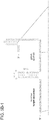
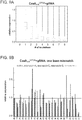
- FIG. 5B An exemplary guide RNA is depicted in Figure 5B .
- the DNA is genomic DNA, mitochondrial DNA, viral DNA, or exogenous DNA.
- a method of modulating expression of a target nucleic acid in a cell including introducing into the cell a first foreign nucleic acid encoding one or more RNAs (ribonucleic acids) complementary to DNA (deoxyribonucleic acid), wherein the DNA includes the target nucleic acid, introducing into the cell a second foreign nucleic acid encoding an RNA guided nuclease-null DNA binding protein of a Type II CRISPR System that binds to the DNA and is guided by the one or more RNAs, introducing into the cell a third foreign nucleic acid encoding a transcriptional regulator protein or domain, wherein the one or more RNAs, the RNA guided nuclease-null DNA binding protein of a Type II CRISPR System, and the transcriptional regulator protein or domain are expressed, wherein the one or more RNAs, the RNA guided nuclease-null DNA binding protein of a Type II CRISPR System and the transcriptional regulator protein or domain are expressed, where
- the foreign nucleic acid encoding an RNA guided nuclease-null DNA binding protein of a Type II CRISPR System further encodes the transcriptional regulator protein or domain fused to the RNA guided nuclease-null DNA binding protein of a Type II CRISPR System.
- the foreign nucleic acid encoding one or more RNAs further encodes a target of an RNA-binding domain and the foreign nucleic acid encoding the transcriptional regulator protein or domain further encodes an RNA-binding domain fused to the transcriptional regulator protein or domain.
- the cell is a eukaryotic cell.
- the cell is a yeast cell, a plant cell or an animal cell.
- the cell is a mammalian cell.
- the RNA is between about 10 to about 500 nucleotides. According to one aspect, the RNA is between about 20 to about 100 nucleotides.
- the transcriptional regulator protein or domain is a transcriptional activator. According to one aspect, the transcriptional regulator protein or domain upregulates expression of the target nucleic acid. According to one aspect, the transcriptional regulator protein or domain upregulates expression of the target nucleic acid to treat a disease or detrimental condition. According to one aspect, the target nucleic acid is associated with a disease or detrimental condition.
- the one or more RNAs is a guide RNA. According to one aspect, the one or more RNAs is a tracrRNA-crRNA fusion.
- the DNA is genomic DNA, mitochondrial DNA, viral DNA, or exogenous DNA.
- a method of modulating expression of a target nucleic acid in a cell including introducing into the cell a first foreign nucleic acid encoding one or more RNAs (ribonucleic acids) complementary to DNA (deoxyribonucleic acid), wherein the DNA includes the target nucleic acid, introducing into the cell a second foreign nucleic acid encoding a nuclease-null Cas9 protein that binds to the DNA and is guided by the one or more RNAs, introducing into the cell a third foreign nucleic acid encoding a transcriptional regulator protein or domain, wherein the one or more RNAs, the nuclease-null Cas9 protein, and the transcriptional regulator protein or domain are expressed, wherein the one or more RNAs, the nuclease-null Cas9 protein and the transcriptional regulator protein or domain co-localize to the DNA and wherein the transcriptional regulator protein or domain regulates expression of the target nucleic acid.
- RNAs ribon
- the foreign nucleic acid encoding a nuclease-null Cas9 protein further encodes the transcriptional regulator protein or domain fused to the nuclease-null Cas9 protein.
- the foreign nucleic acid encoding one or more RNAs further encodes a target of an RNA-binding domain and the foreign nucleic acid encoding the transcriptional regulator protein or domain further encodes an RNA-binding domain fused to the transcriptional regulator protein or domain.
- the cell is a eukaryotic cell.
- the cell is a yeast cell, a plant cell or an animal cell.
- the cell is a mammalian cell.
- the RNA is between about 10 to about 500 nucleotides. According to one aspect, the RNA is between about 20 to about 100 nucleotides.
- the transcriptional regulator protein or domain is a transcriptional activator. According to one aspect, the transcriptional regulator protein or domain upregulates expression of the target nucleic acid. According to one aspect, the transcriptional regulator protein or domain upregulates expression of the target nucleic acid to treat a disease or detrimental condition. According to one aspect, the target nucleic acid is associated with a disease or detrimental condition.
- the one or more RNAs is a guide RNA. According to one aspect, the one or more RNAs is a tracrRNA-crRNA fusion.
- the DNA is genomic DNA, mitochondrial DNA, viral DNA, or exogenous DNA.
- a cell includes a first foreign nucleic acid encoding one or more RNAs complementary to DNA, wherein the DNA includes a target nucleic acid, a second foreign nucleic acid encoding a nuclease-null Cas9 protein, and a third foreign nucleic acid encoding a transcriptional regulator protein or domain wherein the one or more RNAs, the nuclease-null Cas9 protein and the transcriptional regulator protein or domain are members of a co-localization complex for the target nucleic acid, wherein the first foreign nucleic acid encoding the one or more RNAs further encodes a tether sequence and the third foreign nucleic acid encoding the transcriptional regulator protein or domain further encodes a tether sequence binding domain fused to the transcriptional regulator protein or domain.
- the foreign nucleic acid encoding an RNA guided nuclease-null DNA binding protein further encodes the transcriptional regulator protein or domain fused to an RNA guided nuclease-null DNA binding protein.
- the foreign nucleic acid encoding one or more RNAs further encodes a target of an RNA-binding domain and the foreign nucleic acid encoding the transcriptional regulator protein or domain further encodes an RNA-binding domain fused to the transcriptional regulator protein or domain.
- the cell is a eukaryotic cell.
- the cell is a yeast cell, a plant cell or an animal cell.
- the cell is a mammalian cell.
- the RNA is between about 10 to about 500 nucleotides. According to one aspect, the RNA is between about 20 to about 100 nucleotides.
- the transcriptional regulator protein or domain is a transcriptional activator. According to one aspect, the transcriptional regulator protein or domain upregulates expression of the target nucleic acid. According to one aspect, the transcriptional regulator protein or domain upregulates expression of the target nucleic acid to treat a disease or detrimental condition. According to one aspect, the target nucleic acid is associated with a disease or detrimental condition.
- the one or more RNAs is a guide RNA. According to one aspect, the one or more RNAs is a tracrRNA-crRNA fusion.
- the DNA is genomic DNA, mitochondrial DNA, viral DNA, or exogenous DNA.
- the RNA guided nuclease-null DNA binding protein is an RNA guided nuclease-null DNA binding protein of a Type II CRISPR System. According to certain aspects, the RNA guided nuclease-null DNA binding protein is a nuclease-null Cas9 protein.
- a method of altering a DNA target nucleic acid in a cell includes introducing into the cell a first foreign nucleic acid encoding two or more RNAs with each RNA being complementary to an adjacent site in the DNA target nucleic acid, introducing into the cell a second foreign nucleic acid encoding at least one RNA guided DNA binding protein nickase and being guided by the two or more RNAs, wherein the two or more RNAs and the at least one RNA guided DNA binding protein nickase are expressed and wherein the at least one RNA guided DNA binding protein nickase co-localizes with the two or more RNAs to the DNA target nucleic acid and nicks the DNA target nucleic acid resulting in two or more adjacent nicks.
- a method of altering a DNA target nucleic acid in a cell includes introducing into the cell a first foreign nucleic acid encoding two or more RNAs with each RNA being complementary to an adjacent site in the DNA target nucleic acid, introducing into the cell a second foreign nucleic acid encoding at least one RNA guided DNA binding protein nickase and being guided by the two or more RNAs, wherein the two or more RNAs and the at least one RNA guided DNA binding protein nickase are expressed and wherein the at least one RNA guided DNA binding protein nickase co-localizes with the two or more RNAs to the DNA target nucleic acid and nicks the DNA target nucleic acid resulting in two or more adjacent nicks.
- a method of altering a DNA target nucleic acid in a cell includes introducing into the cell a first foreign nucleic acid encoding two or more RNAs with each RNA being complementary to an adjacent site in the DNA target nucleic acid, introducing into the cell a second foreign nucleic acid encoding at least one RNA guided DNA binding protein nickase of a Type II CRISPR System and being guided by the two or more RNAs, wherein the two or more RNAs and the at least one RNA guided DNA binding protein nickase of a Type II CRISPR System are expressed and wherein the at least one RNA guided DNA binding protein nickase of a Type II CRISPR System co-localizes with the two or more RNAs to the DNA target nucleic acid and nicks the DNA target nucleic acid resulting in two or more adjacent nicks.
- a method of altering a DNA target nucleic acid in a cell includes introducing into the cell a first foreign nucleic acid encoding two or more RNAs with each RNA being complementary to an adjacent site in the DNA target nucleic acid, introducing into the cell a second foreign nucleic acid encoding at least one Cas9 protein nickase having one inactive nuclease domain and being guided by the two or more RNAs, wherein the two or more RNAs and the at least one Cas9 protein nickase are expressed and wherein the at least one Cas9 protein nickase co-localizes with the two or more RNAs to the DNA target nucleic acid and nicks the DNA target nucleic acid resulting in two or more adjacent nicks.
- the two or more adjacent nicks are on the same strand of the double stranded DNA.
- the two or more adjacent nicks are on the same strand of the double stranded DNA and result in homologous recombination.
- the two or more adjacent nicks are on different strands of the double stranded DNA.
- the two or more adjacent nicks are on different strands of the double stranded DNA and create double stranded breaks.
- the two or more adjacent nicks are on different strands of the double stranded DNA and create double stranded breaks resulting in nonhomologous end joining.
- the two or more adjacent nicks are on different strands of the double stranded DNA and are offset with respect to one another. According to one aspect, the two or more adjacent nicks are on different strands of the double stranded DNA and are offset with respect to one another and create double stranded breaks. According to one aspect, the two or more adjacent nicks are on different strands of the double stranded DNA and are offset with respect to one another and create double stranded breaks resulting in nonhomologous end joining.
- the method further includes introducing into the cell a third foreign nucleic acid encoding a donor nucleic acid sequence wherein the two or more nicks results in homologous recombination of the target nucleic acid with the donor nucleic acid sequence.
- a method of altering a DNA target nucleic acid in a cell including introducing into the cell a first foreign nucleic acid encoding two or more RNAs with each RNA being complementary to an adjacent site in the DNA target nucleic acid, introducing into the cell a second foreign nucleic acid encoding at least one RNA guided DNA binding protein nickase and being guided by the two or more RNAs, and wherein the two or more RNAs and the at least one RNA guided DNA binding protein nickase are expressed and wherein the at least one RNA guided DNA binding protein nickase co-localizes with the two or more RNAs to the DNA target nucleic acid and nicks the DNA target nucleic acid resulting in two or more adjacent nicks, and wherein the two or more adjacent nicks are on different strands of the double stranded DNA and create double stranded breaks resulting in fragmentation of the target nucleic acid thereby preventing expression of the target nucleic acid
- a method of altering a DNA target nucleic acid in a cell including introducing into the cell a first foreign nucleic acid encoding two or more RNAs with each RNA being complementary to an adjacent site in the DNA target nucleic acid, introducing into the cell a second foreign nucleic acid encoding at least one RNA guided DNA binding protein nickase of a Type II CRISPR system and being guided by the two or more RNAs, and wherein the two or more RNAs and the at least one RNA guided DNA binding protein nickase of a Type II CRISPR System are expressed and wherein the at least one RNA guided DNA binding protein nickase of a Type II CRISPR System co-localizes with the two or more RNAs to the DNA target nucleic acid and nicks the DNA target nucleic acid resulting in two or more adjacent nicks, and wherein the two or more adjacent nicks are on different strands of the double stranded DNA and create double strand
- a method of altering a DNA target nucleic acid in a cell including introducing into the cell a first foreign nucleic acid encoding two or more RNAs with each RNA being complementary to an adjacent site in the DNA target nucleic acid, introducing into the cell a second foreign nucleic acid encoding at least one Cas9 protein nickase having one inactive nuclease domain and being guided by the two or more RNAs, and wherein the two or more RNAs and the at least one Cas9 protein nickase are expressed and wherein the at least one Cas9 protein nickase co-localizes with the two or more RNAs to the DNA target nucleic acid and nicks the DNA target nucleic acid resulting in two or more adjacent nicks, and wherein the two or more adjacent nicks are on different strands of the double stranded DNA and create double stranded breaks resulting in fragmentation of the target nucleic acid thereby preventing expression of the target
- a cell including a first foreign nucleic acid encoding two or more RNAs with each RNA being complementary to an adjacent site in a DNA target nucleic acid, and a second foreign nucleic acid encoding at least one RNA guided DNA binding protein nickase, and wherein the two or more RNAs and the at least one RNA guided DNA binding protein nickase are members of a co-localization complex for the DNA target nucleic acid.
- the RNA guided DNA binding protein nickase is an RNA guided DNA binding protein nickase of a Type II CRISPR System. According to one aspect, the RNA guided DNA binding protein nickase is a Cas9 protein nickase having one inactive nuclease domain.
- the cell is a eukaryotic cell.
- the cell is a yeast cell, a plant cell or an animal cell.
- the cell is a mammalian cell.
- the RNA includes between about 10 to about 500 nucleotides. According to one aspect, the RNA includes between about 20 to about 100 nucleotides.
- the target nucleic acid is associated with a disease or detrimental condition.
- the two or more RNAs are guide RNAs. According to one aspect, the two or more RNAs are tracrRNA-crRNA fusions.
- the DNA target nucleic acid_ is genomic DNA, mitochondrial DNA, viral DNA, or exogenous DNA.
- Embodiments of the present disclosure are based on the use of DNA binding proteins to co-localize transcriptional regulator proteins or domains to DNA in a manner to regulate a target nucleic acid.
- DNA binding proteins are readily known to those of skill in the art to bind to DNA for various purposes.
- DNA binding proteins may be naturally occurring.
- DNA binding proteins included within the scope of the present disclosure include those which may be guided by RNA, referred to herein as guide RNA.
- guide RNA and the RNA guided DNA binding protein form a co-localization complex at the DNA.
- the DNA binding protein may be a nuclease-null DNA binding protein.
- the nuclease-null DNA binding protein may result from the alteration or modification of a DNA binding protein having nuclease activity.
- DNA binding proteins having nuclease activity are known to those of skill in the art, and include naturally occurring DNA binding proteins having nuclease activity, such as Cas9 proteins present, for example, in Type II CRISPR systems.
- Cas9 proteins and Type II CRISPR systems are well documented in the art. See Makarova et al., Nature Reviews, Microbiology, Vol. 9, June 2011, pp. 467-477 including all supplementary information.
- Exemplary DNA binding proteins having nuclease activity function to nick or cut double stranded DNA. Such nuclease activity may result from the DNA binding protein having one or more polypeptide sequences exhibiting nuclease activity. Such exemplary DNA binding proteins may have two separate nuclease domains with each domain responsible for cutting or nicking a particular strand of the double stranded DNA.
- Exemplary polypeptide sequences having nuclease activity known to those of skill in the art include the McrA-HNH nuclease related domain and the RuvC-like nuclease domain.
- exemplary DNA binding proteins are those that in nature contain one or more of the McrA-HNH nuclease related domain and the RuvC-like nuclease domain.
- the DNA binding protein is altered or otherwise modified to inactivate the nuclease activity.
- Such alteration or modification includes altering one or more amino acids to inactivate the nuclease activity or the nuclease domain.
- Such modification includes removing the polypeptide sequence or polypeptide sequences exhibiting nuclease activity, i.e. the nuclease domain, such that the polypeptide sequence or polypeptide sequences exhibiting nuclease activity, i.e. nuclease domain, are absent from the DNA binding protein.
- a nuclease-null DNA binding protein includes polypeptide sequences modified to inactivate nuclease activity or removal of a polypeptide sequence or sequences to inactivate nuclease activity.
- the nuclease-null DNA binding protein retains the ability to bind to DNA even though the nuclease activity has been inactivated.
- the DNA binding protein includes the polypeptide sequence or sequences required for DNA binding but may lack the one or more or all of the nuclease sequences exhibiting nuclease activity.
- the DNA binding protein includes the polypeptide sequence or sequences required for DNA binding but may have one or more or all of the nuclease sequences exhibiting nuclease activity inactivated.
- a DNA binding protein having two or more nuclease domains may be modified or altered to inactivate all but one of the nuclease domains.
- a DNA binding protein nickase Such a modified or altered DNA binding protein is referred to as a DNA binding protein nickase, to the extent that the DNA binding protein cuts or nicks only one strand of double stranded DNA.
- the DNA binding protein nickase is referred to as an RNA guided DNA binding protein nickase.
- An exemplary DNA binding protein is an RNA guided DNA binding protein of a Type II CRISPR System which lacks nuclease activity.
- An exemplary DNA binding protein is a nuclease-null Cas9 protein.
- An exemplary DNA binding protein is a Cas9 protein nickase.
- Cas9 In S. pyogenes, Cas9 generates a blunt-ended double-stranded break 3bp upstream of the protospacer-adjacent motif (PAM) via a process mediated by two catalytic domains in the protein: an HNH domain that cleaves the complementary strand of the DNA and a RuvC-like domain that cleaves the non-complementary strand.
- PAM protospacer-adjacent motif
- the Cas9 protein may be referred by one of skill in the art in the literature as Csn1.
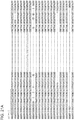
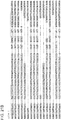
- the S . pyogenes Cas9 protein sequence that is the subject of experiments described herein is shown below. See Deltcheva et al., Nature 471, 602-607 (2011 ).
- Cas9 is altered to reduce, substantially reduce or eliminate nuclease activity.
- Cas9 nuclease activity is reduced, substantially reduced or eliminated by altering the RuvC nuclease domain or the HNH nuclease domain.
- the RuvC nuclease domain is inactivated.
- the HNH nuclease domain is inactivated.
- the RuvC nuclease domain and the HNH nuclease domain are inactivated.
- Cas9 proteins are provided where the RuvC nuclease domain and the HNH nuclease domain are inactivated.
- nuclease-null Cas9 proteins are provided insofar as the RuvC nuclease domain and the HNH nuclease domain are inactivated.
- a Cas9 nickase is provided where either the RuvC nuclease domain or the HNH nuclease domain is inactivated, thereby leaving the remaining nuclease domain active for nuclease activity. In this manner, only one strand of the double stranded DNA is cut or nicked.
- nuclease-null Cas9 proteins are provided where one or more amino acids in Cas9 are altered or otherwise removed to provide nuclease-null Cas9 proteins.
- the amino acids include D10 and H840. See Jinke et al., Science 337, 816-821 (2012 ).
- the amino acids include D839 and N863.
- one or more or all of D10, H840, D839 and H863 are substituted with an amino acid which reduces, substantially eliminates or eliminates nuclease activity.
- one or more or all of D10, H840, D839 and H863 are substituted with alanine.
- a Cas9 protein having one or more or all of D10, H840, D839 and H863 substituted with an amino acid which reduces, substantially eliminates or eliminates nuclease activity, such as alanine is referred to as a nuclease-null Cas9 or Cas9N and exhibits reduced or eliminated nuclease activity, or nuclease activity is absent or substantially absent within levels of detection.
- nuclease activity for a Cas9N may be undetectable using known assays, i.e. below the level of detection of known assays.
- the nuclease null Cas9 protein includes homologs and orthologs thereof which retain the ability of the protein to bind to the DNA and be guided by the RNA.
- the nuclease null Cas9 protein includes the sequence as set forth for naturally occurring Cas9 from S. pyogenes and having one or more or all of D10, H840, D839 and H863 substituted with alanine and protein sequences having at least 30%, 40%, 50%, 60%, 70%, 80%, 90%, 95%, 98% or 99% homology thereto and being a DNA binding protein, such as an RNA guided DNA binding protein.
- the nuclease null Cas9 protein includes the sequence as set forth for naturally occurring Cas9 from S. pyogenes excepting the protein sequence of the RuvC nuclease domain and the HNH nuclease domain and also protein sequences having at least 30%, 40%, 50%, 60%, 70%, 80%, 90%, 95%, 98% or 99% homology thereto and being a DNA binding protein, such as an RNA guided DNA binding protein.
- aspects of the present disclosure include the protein sequence responsible for DNA binding, for example, for co-localizing with guide RNA and binding to DNA and protein sequences homologous thereto, and need not include the protein sequences for the RuvC nuclease domain and the HNH nuclease domain (to the extent not needed for DNA binding), as these domains may be either inactivated or removed from the protein sequence of the naturally occurring Cas9 protein to produce a nuclease null Cas9 protein.
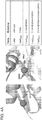
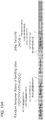
- Figure 4A depicts metal coordinating residues in known protein structures with homology to Cas9. Residues are labeled based on position in Cas9 sequence.
- Left RuvC structure
- PDB ID 4EP4 (blue) position D7, which corresponds to D10 in the Cas9 sequence, is highlighted in a Mg-ion coordinating position.
- Middle Structures of HNH endonuclease domains from PDB IDs: 3M7K (orange) and 4H9D (cyan) including a coordinated Mg-ion (gray sphere) and DNA from 3M7K (purple).
- Residues D92 and N113 in 3M7K and 4H9D positions D53 and N77, which have sequence homology to Cas9 amino acids D839 and N863, are shown as sticks.
- an engineered Cas9-gRNA system which enables RNA-guided genome regulation in human cells by tethering transcriptional activation domains to either a nuclease-null Cas9 or to guide RNAs.
- one or more transcriptional regulatory proteins or domains are joined or otherwise connected to a nuclease-deficient Cas9 or one or more guide RNA (gRNA).
- the transcriptional regulatory domains correspond to targeted loci.
- aspects of the present disclosure include methods and materials for localizing transcriptional regulatory domains to targeted loci by fusing, connecting or joining such domains to either Cas9N or to the gRNA.
- a Cas9N-fusion protein capable of transcriptional activation is provided.
- a VP64 activation domain (see Zhang et al., Nature Biotechnology 29, 149-153 (2011 )) is joined, fused, connected or otherwise tethered to the C terminus of Cas9N.
- the transcriptional regulatory domain is provided to the site of target genomic DNA by the Cas9N protein.
- a Cas9N fused to a transcriptional regulatory domain is provided within a cell along with one or more guide RNAs.
- the Cas9N with the transcriptional regulatory domain fused thereto bind at or near target genomic DNA.
- the one or more guide RNAs bind at or near target genomic DNA.
- the transcriptional regulatory domain regulates expression of the target gene.
- a Cas9N-VP64 fusion activated transcription of reporter constructs when combined with gRNAs targeting sequences near the promoter, thereby displaying RNA-guided transcriptional activation.
- a gRNA-fusion protein capable of transcriptional activation is provided.
- a VP64 activation domain is joined, fused, connected or otherwise tethered to the gRNA.
- the transcriptional regulatory domain is provided to the site of target genomic DNA by the gRNA.
- a gRNA fused to a transcriptional regulatory domain is provided within a cell along with a Cas9N protein.
- the Cas9N binds at or near target genomic DNA.
- the one or more guide RNAs with the transcriptional regulatory protein or domain fused thereto bind at or near target genomic DNA.
- the transcriptional regulatory domain regulates expression of the target gene.
- a Cas9N protein and a gRNA fused with a transcriptional regulatory domain activated transcription of reporter constructs, thereby displaying RNA-guided transcriptional activation.
- the gRNA tethers capable of transcriptional regulation were constructed by identifying which regions of the gRNA will tolerate modifications by inserting random sequences into the gRNA and assaying for Cas9 function.
- gRNAs bearing random sequence insertions at either the 5' end of the crRNA portion or the 3' end of the tracrRNA portion of a chimeric gRNA retain functionality, while insertions into the tracrRNA scaffold portion of the chimeric gRNA result in loss of function. See Figure 5A-B summarizing gRNA flexibility to random base insertions.
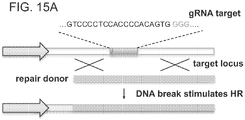
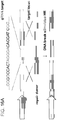
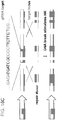
- Figure 5A is a schematic of a homologous recombination (HR) assay to determine Cas9-gRNA activity.
- gRNAs bearing random sequence insertions at either the 5' end of the crRNA portion or the 3' end of the tracrRNA portion of a chimeric gRNA retain functionality, while insertions into the tracrRNA scaffold portion of the chimeric gRNA result in loss of function.
- the points of insertion in the gRNA sequence are indicated by red nucleotides.
- the increased activity upon random base insertions at the 5' end may be due to increased half-life of the longer gRNA.
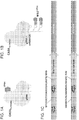
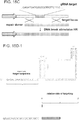
- Figure 1A is a schematic of RNA-guided transcriptional activation.
- the VP64 activation domain was directly tethered to the C terminus of Cas9N.
- Figure 1B to generate gRNA tethers capable of transcriptional activation, two copies of the MS2 bacteriophage coat-protein binding RNA stem-loop were appended to the 3' end of the gRNA. These chimeric gRNAs were expressed together with Cas9N and MS2-VP64 fusion protein.
- Figure 1C shows design of reporter constructs used to assay transcriptional activation.
- the two reporters bear distinct gRNA target sites, and share a control TALE-TF target site.
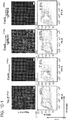
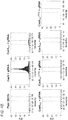
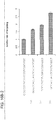
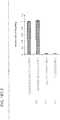
- Cas9N-VP64 fusions display RNA-guided transcriptional activation as assayed by both fluorescence-activated cell sorting (FACS) and immunofluorescence assays (IF).
- FACS fluorescence-activated cell sorting
- IF immunofluorescence assays
- the Cas9N-VP64 fusion activates reporters in a gRNA sequence specific manner.
- an endogenous gene can be any desired gene, refered to herein as a target gene.
- genes target for regulation included ZFP42 (REX1) and POU5F1 (OCT4), which are both tightly regulated genes involved in maintenance of pluripotency.
- ZFP42 REX1
- POU5F1 OCT4
- FIG. 1F 10 gRNAs targeting a ⁇ 5kb stretch of DNA upstream of the transcription start site (DNase hypersensitive sites are highlighted in green) were designed for the REX1 gene. Transcriptional activation was assayed using either a promoter-luciferase reporter construct (see Takahashi et al., Cell 131 861-872 (2007 )) or directly via qPCR of the endogenous genes.
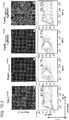
- Figure 6A-C is directed to RNA-guided OCT4 regulation using Cas9N-VP64.
- 21 gRNAs targeting a ⁇ 5kb stretch of DNA upstream of the transcription start site were designed for the OCT4 gene. The DNase hypersensitive sites are highlighted in green.
- Figure 6B shows transcriptional activation using a promoter-luciferase reporter construct.
- Figure 6C shows transcriptional activation directly via qPCR of the endogenous genes. While introduction of individual gRNAs modestly stimulated transcription, multiple gRNAs acted synergistically to stimulate robust multi-fold transcriptional activation.
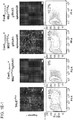
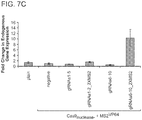
- Figure 7A-C is directed to RNA-guided REX1 regulation using Cas9N, MS2-VP64 and gRNA+2X-MS2 aptamers.
- 10 gRNAs targeting a ⁇ 5kb stretch of DNA upstream of the transcription start site were designed for the REX1 gene. The DNase hypersensitive sites are highlighted in green.
- Figure 7B shows transcriptional activation using a promoter-luciferase reporter construct.
- Figure 7C shows transcriptional activation directly via qPCR of the endogenous genes. While introduction of individual gRNAs modestly stimulated transcription, multiple gRNAs acted synergistically to stimulate robust multi-fold transcriptional activation.
- the absence of the 2X-MS2 aptamers on the gRNA does not result in transcriptional activation. See Maeder et al., Nature Methods 10, 243-245 (2013 ) and Perez-Pinera et al., Nature Methods 10, 239-242 (2013 ).
- methods are directed to the use of multiple guide RNAs with a Cas9N protein and a transcriptional regulatory protein or domain to regulate expression of a target gene.
- gRNA tethering approach in principle enables different effector domains to be recruited by distinct gRNAs so long as each gRNA uses a different RNA-protein interaction pair. See Karyer-Bibens et al., Biology of the Cell / Under the Auspices of the European Cell Biology Organization 100, 125-138 (2008 ).
- different target genes may be regulated using specific guide RNA and a generic Cas9N protein, i.e. the same or a similar Cas9N protein for different target genes.
- methods of multiplex gene regulation are provided using the same or similar Cas9N.
- Methods of the present disclosure are also directed to editing target genes using the Cas9N proteins and guide RNAs described herein to provide multiplex genetic and epigenetic engineering of human cells.
- Cas9-gRNA targeting being an issue (see Jiang et al., Nature Biotechnology 31, 233-239 (2013 ))
- methods are provided for in-depth interrogation of Cas9 affinity for a very large space of target sequence variations. Accordingly, aspects of the present disclosure provide direct high-throughput readout of Cas9 targeting in human cells, while avoiding complications introduced by dsDNA cut toxicity and mutagenic repair incurred by specificity testing with native nuclease-active Cas9.
- DNA binding proteins or systems in general for the transcriptional regulation of a target gene.
- DNA binding systems need not have any nuclease activity, as with the naturally occurring Cas9 protein. Accordingly, such DNA binding systems need not have nuclease activity inactivated.
- One exemplary DNA binding system is TALE.
- TALE-FokI dimers are used, and for genome regulation TAEL-VP64 fusions have been shown to be highly effective. According to one aspect, TALE specificity was evaluated using the methodology shown in Figure 2A .
- a construct library in which each element of the library comprises a minimal promoter driving a dTomato fluorescent protein is designed. Downstream of the transcription start site m, a 24bp (A/C/G) random transcript tag is inserted, while two TF binding sites are placed upstream of the promoter: one is a constant DNA sequence shared by all library elements, and the second is a variable feature that bears a 'biased' library of binding sites which are engineered to span a large collection of sequences that present many combinations of mutations away from the target sequence the programmable DNA targeting complex was designed to bind.
- transcription of the dTomato reporter genes is stimulated with either a control-TF engineered to bind the shared DNA site, or the target-TF that was engineered to bind the target site.
- the abundance of each expressed transcript tag is measured in each sample by conducting RNAseq on the stimulated cells, which is then mapped back to their corresponding binding sites using the association table established earlier.
- the control-TF is expected to excite all library members equally since its binding site is shared across all library elements, while the target-TF is expected to skew the distribution of the expressed members to those that are preferentially targeted by it. This assumption is used in step 5 to compute a normalized expression level for each binding site by dividing the tag counts obtained for the target-TF by those obtained for the control-TF.
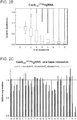
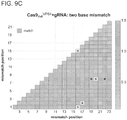
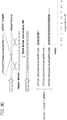
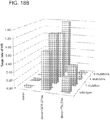
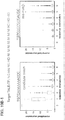
- the targeting landscape of a Cas9-gRNA complex reveals that it is on average tolerant to 1-3 mutations in its target sequences.
- the Cas9-gRNA complex is also largely insensitive to point mutations, except those localized to the PAM sequence. Notably this data reveals that the predicted PAM for the S. pyogenes Cas9 is not just NGG but also NAG.
- introduction of 2 base mismatches significantly impairs the Cas9-gRNA complex activity, however only when these are localized to the 8-10 bases nearer the 3' end of the gRNA target sequence (in the heat plot the target sequence positions are labeled from 1-23 starting from the 5' end).
- TALE domains The mutational tolerance of another widely used genome editing tool, TALE domains, was determined using the transcriptional specificity assay described herein.
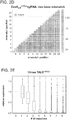
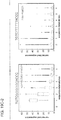
- TALE off-targeting data for an 18-mer TALE reveals that it can tolerate on average 1-2 mutations in its target sequence, and fails to activate a large majority of 3 base mismatch variants in its targets.
- the 18-mer TALE is, similar to the Cas9-gRNA complexes, largely insensitive to single base mismatched in its target.
- introduction of 2 base mismatches significantly impairs the 18-mer TALE activity. TALE activity is more sensitive to mismatches nearer the 5' end of its target sequence (in the heat plot the target sequence positions are labeled from 1-18 starting from the 5' end).
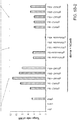
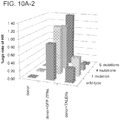
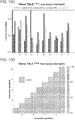
- Results were confirmed using targeted experiments in a nuclease assay which is the subject of Figure 10A-C directed to evaluating the landscape of targeting by TALEs of different sizes.
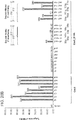
- Figure 10A using a nuclease mediated HR assay, it was confirmed that 18-mer TALEs tolerate multiple mutations in their target sequences.
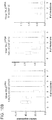
- Figure 10B using the approach described in Fig. 2 , the targeting landscape of TALEs of 3 different sizes (18-mer, 14-mer and 10-mer) was analyzed. Shorter TALEs (14-mer and 10-mer) are progressively more specific in their targeting but also reduced in activity by nearly an order of magnitude.
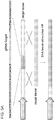
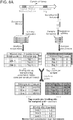
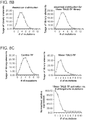
- Figure 8A-C is directed to high level specificity analysis processing flow for calculation of normalized expression levels illustrated with examples from experimental data.
- construct libraries are generated with a biased distribution of binding site sequences and random sequence 24bp tags that will be incorporated into reporter gene transcripts (top).
- the transcribed tags are highly degenerate so that they should map many-to-one to Cas9 or TALE binding sequences.
- the construct libraries are sequenced (3 rd level, left) to establish which tags co-occur with binding sites, resulting in an association table of binding sites vs. transcribed tags (4 th level, left).
- Multiple construct libraries built for different binding sites may be sequenced at once using library barcodes (indicated here by the light blue and light yellow colors; levels 1-4, left).
- a construct library is then transfected into a cell population and a set of different Cas9/gRNA or TALE transcription factors are induced in samples of the populations (2 nd level, right).
- One sample is always induced with a fixed TALE activator targeted to a fixed binding site sequence within the construct (top level, green box); this sample serves as a positive control (green sample, also indicated by a + sign).
- cDNAs generated from the reporter mRNA molecules in the induced samples are then sequenced and analyzed to obtain tag counts for each tag in a sample (3 rd and 4 th level, right).
- multiple samples, including the positive control are sequenced and analyzed together by appending sample barcodes.
- the light red color indicates one non-control sample that has been sequenced and analyzed with the positive control (green). Because only the transcribed tags and not the construct binding sites appear in each read, the binding site vs . tag association table obtained from construct library sequencing is then used to tally up total counts of tags expressed from each binding site in each sample (5 th level). The tallies for each non-positive control sample are then converted to normalized expression levels for each binding site by dividing them by the tallies obtained in the positive control sample. Examples of plots of normalized expression levels by numbers of mismatches are provided in Figures 2B and 2E , and in Figure 9A and Figure 10B .
- Figure 8B depicts example distributions of percentages of binding sites by numbers of mismatches generated within a biased construct library. Left: Theoretical distribution. Right: Distribution observed from an actual TALE construct library.
- Figure 8C depicts example distributions of percentages of tag counts aggregated to binding sites by numbers of mismatches. Left: Distribution observed from the positive control sample. Right: Distribution observed from a sample in which a non-control TALE was induced.
- binding specificity is increased according to methods described herein. Because synergy between multiple complexes is a factor in target gene activation by Cas9N-VP64, transcriptional regulation applications of Cas9N is naturally quite specific as individual off-target binding events should have minimal effect.
- off-set nicks are used in methods of genome-editing. A large majority of nicks seldom result in NHEJ events, (see Certo et al., Nature Methods 8, 671-676 (2011 )) thus minimizing the effects of off-target nicking. In contrast, inducing off-set nicks to generate double stranded breaks (DSBs) is highly effective at inducing gene disruption.
- 5' overhangs generate more significant NHEJ events as opposed to 3' overhangs.
- 3' overhangs favor HR over NHEJ events, although the total number of HR events is significantly lower than when a 5' overhang is generated. Accordingly, methods are provided for using nicks for homologous recombination and off-set nicks for generating double stranded breaks to minimize the effects of off-target Cas9-gRNA activity.
- Figure 3A-C is directed to multiplex off-set nicking and methods for reducing the off-target binding with the guide RNAs.
- the traffic light reporter was used to simultaneously assay for HR and NHEJ events upon introduction of targeted nicks or breaks. DNA cleavage events resolved through the HDR pathway restore the GFP sequence, whereas mutagenic NHEJ causes frameshifts rendering the GFP out of frame and the downstream mCherry sequence in frame.
- 14 gRNAs covering a 200bp stretch of DNA: 7 targeting the sense strand (U1-7) and 7 the antisense strand (D1-7) were designed.
- Figure 11A-B is directed to Cas9D10A nickase mediated NHEJ.
- the traffic light reporter was used to assay NHEJ events upon introduction of targeted nicks or double-stranded breaks. Briefly, upon introduction of DNA cleavage events, if the break goes through mutagenic NHEJ, the GFP is translated out of frame and the downstream mCherry sequences are rendered in frame resulting in red fluorescence. 14 gRNAs covering a 200bp stretch of DNA: 7 targeting the sense strand (U1-7) and 7 the antisense strand (D1-7) were designed.
- methods are described herein of modulating expression of a target nucleic acid in a cell that include introducing one or more, two or more or a plurality of foreign nucleic acids into the cell.
- the foreign nucleic acids introduced into the cell encode for a guide RNA or guide RNAs, a nuclease-null Cas9 protein or proteins and a transcriptional regulator protein or domain.
- a guide RNA, a nuclease-null Cas9 protein and a transcriptional regulator protein or domain are referred to as a co-localization complex as that term is understood by one of skill in the art to the extent that the guide RNA, the nuclease-null Cas9 protein and the transcriptional regulator protein or domain bind to DNA and regulate expression of a target nucleic acid.
- the foreign nucleic acids introduced into the cell encode for a guide RNA or guide RNAs and a Cas9 protein nickase.
- a guide RNA and a Cas9 protein nickase are referred to as a co-localization complex as that term is understood by one of skill in the art to the extent that the guide RNA and the Cas9 protein nickase bind to DNA and nick a target nucleic acid.
- Cells according to the present disclosure include any cell into which foreign nucleic acids can be introduced and expressed as described herein. It is to be understood that the basic concepts of the present disclosure described herein are not limited by cell type.
- Cells according to the present disclosure include eukaryotic cells, prokaryotic cells, animal cells, plant cells, fungal cells, archael cells, eubacterial cells and the like.
- Cells include eukaryotic cells such as yeast cells, plant cells, and animal cells.
- Particular cells include mammalian cells.
- cells include any in which it would be beneficial or desirable to regulate a target nucleic acid. Such cells may include those which are deficient in expression of a particular protein leading to a disease or detrimental condition. Such diseases or detrimental conditions are readily known to those of skill in the art.
- the nucleic acid responsible for expressing the particular protein may be targeted by the methods described herein and a transcriptional activator resulting in upregulation of the target nucleic acid and corresponding expression of the particular protein. In this manner, the methods described herein provide therapeutic treatment.
- Target nucleic acids include any nucleic acid sequence to which a co-localization complex as described herein can be useful to either regulate or nick.
- Target nucleic acids include genes.
- DNA such as double stranded DNA
- a co-localization complex can bind to or otherwise co-localize with the DNA at or adjacent or near the target nucleic acid and in a manner in which the co-localization complex may have a desired effect on the target nucleic acid.
- target nucleic acids can include endogenous (or naturally occurring) nucleic acids and exogenous (or foreign) nucleic acids.
- DNA includes genomic DNA, mitochondrial DNA, viral DNA or exogenous DNA.
- Foreign nucleic acids i.e. those which are not part of a cell's natural nucleic acid composition
- Methods include transfection, transduction, viral transduction, microinjection, lipofection, nucleofection, nanoparticle bombardment, transformation, conjugation and the like.
- transfection transduction, viral transduction, microinjection, lipofection, nucleofection, nanoparticle bombardment, transformation, conjugation and the like.
- Transcriptional regulator proteins or domains which are transcriptional activators include VP16 and VP64 and others readily identifiable by those skilled in the art based on the present disclosure.
- Diseases and detrimental conditions are those characterized by abnormal loss of expression of a particular protein. Such diseases or detrimental conditions can be treated by upregulation of the particular protein. Accordingly, methods of treating a disease or detrimental condition are provided where the co-localization complex as described herein associates or otherwise binds to DNA including a target nucleic acid, and the transcriptional activator of the co-localization complex upregulates expression of the target nucleic acid. For example upregulating PRDM16 and other genes promoting brown fat differentiation and increased metabolic uptake can be used to treat metabolic syndrome or obesity. Activating anti-inflammatory genes are useful in autoimmunity and cardiovascular disease. Activating tumor suppressor genes is useful in treating cancer. One of skill in the art will readily identify such diseases and detrimental conditions based on the present disclosure.
- the Cas9 mutants were generated using the Quikchange kit (Agilent technologies).
- the target gRNA expression constructs were either (1) directly ordered as individual gBlocks from IDT and cloned into the pCR-BluntII-TOPO vector (Invitrogen); or (2) custom synthesized by Genewiz; or (3) assembled using Gibson assembly of oligonucleotides into the gRNA cloning vector (plasmid #41824).
- the vectors for the HR reporter assay involving a broken GFP were constructed by fusion PCR assembly of the GFP sequence bearing the stop codon and appropriate fragment assembled into the EGIP lentivector from Addgene (plasmid #26777).
- TALENs used in this study were constructed using standard protocols. See Sanjana et al., Nature Protocols 7, 171-192 (2012 ). Cas9N and MS2 VP64 fusions were performed using standard PCR fusion protocol procedures. The promoter luciferase constructs for OCT4 and REX1 were obtained from Addgene (plasmid #17221 and plasmid #17222).
- HEK 293T cells were cultured in Dulbecco's modified Eagle's medium (DMEM, Invitrogen) high glucose supplemented with 10% fetal bovine serum (FBS, Invitrogen), penicillin/streptomycin (pen/strep, Invitrogen), and non-essential amino acids (NEAA, Invitrogen). Cells were maintained at 37°C and 5% CO 2 in a humidified incubator.
- DMEM Dulbecco's modified Eagle's medium
- FBS fetal bovine serum
- pen/streptomycin penicillin/streptomycin
- NEAA non-essential amino acids
- Transfections involving nuclease assays were as follows: 0.4 ⁇ 10 6 cells were transfected with 2 ⁇ g Cas9 plasmid, 2 ⁇ g gRNA and/or 2 ⁇ g DNA donor plasmid using Lipofectamine 2000 as per the manufacturer's protocols. Cells were harvested 3 days after transfection and either analyzed by FACS, or for direct assay of genomic cuts the genomic DNA of ⁇ 1 X 10 6 cells was extracted using DNAeasy kit (Qiagen). For these PCR was conducted to amplify the targeting region with genomic DNA derived from the cells and amplicons were deep sequenced by MiSeq Personal Sequencer (Illumina) with coverage >200,000 reads. The sequencing data was analyzed to estimate NHEJ efficiencies.
- transfections involving transcriptional activation assays 0.4 ⁇ 10 6 cells were transfected with (1) 2 ⁇ g Cas9N-VP64 plasmid, 2 ⁇ g gRNA and/or 0.25 ⁇ g of reporter construct; or (2) 2 ⁇ g Cas9N plasmid, 2 ⁇ g MS2-VP64, 2 ⁇ g gRNA-2XMS2aptamer and/or 0.25 ⁇ g of reporter construct.
- Cells were harvested 24-48hrs post transfection and assayed using FACS or immunofluorescence methods, or their total RNA was extracted and these were subsequently analyzed by RT-PCR.
- standard taqman probes from Invitrogen for OCT4 and REX1 were used, with normalization for each sample performed against GAPDH.
- 0.4 ⁇ 10 6 cells were transfected with (1) 2 ⁇ g Cas9N-VP64 plasmid, 2 ⁇ g gRNA and 0.25 ⁇ g of reporter library; or (2) 2 ⁇ g TALE-TF plasmid and 0.25 ⁇ g of reporter library; or (3) 2 ⁇ g control-TF plasmid and 0.25 ⁇ g of reporter library.
- Cells were harvested 24hrs post transfection (to avoid the stimulation of reporters being in saturation mode).
- Total RNA extraction was performed using RNAeasy-plus kit (Qiagen), and standard RT-pcr performed using Superscript-III (Invitrogen). Libraries for next-generation sequencing were generated by targeted pcr amplification of the transcript-tags.
- Figure 8A The high-level logic flow for this process is depicted in Figure 8A , and additional details are given here.
- Figures 8A (level 1) and 8B Sequencing: For Cas9 experiments, construct library ( Figure 8A , level 3, left) and reporter gene cDNA sequences ( Figure 8A , level 3, right) were obtained as 150bp overlapping paired end reads on an Illumina MiSeq, while for TALE experiments, corresponding sequences were obtained as 51bp non-overlapping paired end reads on an Illumina HiSeq.
- Construct library sequence processing Alignment: For Cas9 experiments, novoalign V2.07.17 (world wide website novocraft.com/main/index/php) was used to align paired reads to a set of 250bp reference sequences that corresponded to 234bp of the constructs flanked by the pairs of 8bp library barcodes (see Figure 8A , 3 rd level, left). In the reference sequences supplied to novoalign, the 23bp degenerate Cas9 binding site regions and the 24bp degenerate transcript tag regions (see Figure 8A , first level) were specified as Ns, while the construct library barcodes were explicitly provided.
- Validity checking Novoalign output for comprised files in which left and right reads for each read pair were individually aligned to the reference sequences. Only read pairs that were both uniquely aligned to the reference sequence were subjected to additional validity conditions, and only read pairs that passed all of these conditions were retained.
- Induced sample reporter gene cDNA sequence processing Alignment: SeqPrep (downloaded from world wide website github.com/jstjohn/SeqPrep) was first used to merge the overlapping read pairs to the 79bp common segment, after which novoalign (version above) was used to align these 79bp common segments as unpaired single reads to a set of reference sequences (see Figure 8A , 3 rd level, right) in which (as for the construct library sequencing) the 24bp degenerate transcript tag was specified as Ns while the sample barcodes were explicitly provided. Both TALE and Cas9 cDNA sequence regions corresponded to the same 63bp regions of cDNA flanked by pairs of 8bp sample barcode sequences.
- Validity checking The same conditions were applied as for construct library sequencing (see above) except that: (a) Here, due prior SeqPrep merging of read pairs, validity processing did not have to filter for unique alignments of both reads in a read pair but only for unique alignments of the merged reads. (b) Only transcript tags appeared in the cDNA sequence reads, so that validity processing only applied these tag regions of the reference sequences and not also to a separate binding site region. Assembly of table of binding sites vs. transcript tag associations: Custom perl was used to generate these tables from the validated construct library sequences ( Figure 8A , 4 th level, left).
- tags were categorized with three attributes: (i) safe vs. unsafe, where unsafe meant the tag could be found in the construct library rejected read pair file; shared vs. nonshared, where shared meant the tag was found associated with multiple binding site sequences, and 2 + vs . 1-only, where 2 + meant that the tag appeared at least twice among the validated construct library sequences and so presumed to be less likely to contain sequence errors. Combining these three criteria yielded 8 classes of tags associated with each binding site, the most secure (but least abundant) class comprising only safe, nonshared, 2 + tags; and the least secure (but most abundant) class comprising all tags regardless of safety, sharing, or number of occurrences.
- the sgRNA (aptamer-modified single guide RNA) tethering approach described herein allows different effector domains to be recruited by distinct sgRNAs so long as each sgRNA uses a different RNA-protein interaction pair, enabling multiplex gene regulation using the same Cas9N-protein.
- 10 gRNAs were designed targeting a ⁇ 1kb stretch of DNA upstream of the transcription start site. The DNase hypersensitive sites are highlighted in green. Transcriptional activation via qPCR of the endogenous genes was assayed. In both instances, while introduction of individual gRNAs modestly stimulated transcription, multiple gRNAs acted synergistically to stimulate robust multi-fold transcriptional activation.
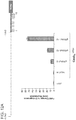
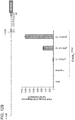
- Figure 14A-C specificity data was generated using two different sgRNA:Cas9 complexes. It was confirmed that the assay was specific for the sgRNA being evaluated, as a corresponding mutant sgRNA was unable to stimulate the reporter library.
- Figure 14A The specificity profile of two gRNAs (wild-type and mutant; sequence differences are highlighted in red) were evaluated using a reporter library designed against the wild-type gRNA target sequence.
- Figure 14B It was confirmed that this assay was specific for the gRNA being evaluated (data re-plotted from Fig. 13D ), as the corresponding mutant gRNA is unable to stimulate the reporter library.
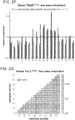
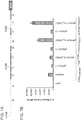
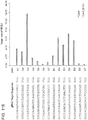
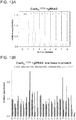
- Different sgRNAs can have different specificity profiles ( Figures 13A , 13D ), specifically, sgRNA2 tolerates up to 3 mismatches and sgRNA3 only up to 1. The greatest sensitivity to mismatches was localized to the 3' end of the spacer, albeit mismatches at other positions were also observed to affect activity.
- truncations in the 5' portion of the spacer resulted in retention of sgRNA activity.
- FIG. 19A-C shows a comparison of TALE monomer specificity versus TALE protein specificity.
- Figure 19A Using a modification of approach described in Fig. 2 , the targeting landscape of 2 14-mer TALE-TFs bearing a contiguous set of 6 NI or 6 NH repeats was analyzed. In this approach, a reduced library of reporters bearing a degenerate 6-mer sequence in the middle was created and used to assay the TALE-TF specificity.
- FIG. 19B-C In both instances, it was noted that the expected target sequence is enriched (i.e. one bearing 6 As for NI repeats, and 6 Gs for NH repeats). Each of these TALEs still tolerate 1-2 mismatches in the central 6-mer target sequence. While choice of monomers does contribute to base specificity, TALE specificity is also a function of the binding energy of the protein as a whole. According to one aspect, shorter engineered TALEs or TALEs bearing a composition of high and low affinity monomers result in higher specificity in genome engineering applications and FokI dimerization in nuclease applications allows for further reduction in off-target effects when using shorter TALEs.
- Figure 20A-B shows data related to off-set nicking.
- off-set nicks were created to generate DSBs.
- a large majority of nicks do not result in non-homologous end joining (NHEJ) mediated indels and thus when inducing off-set nicks, off-target single nick events will likely result in very low indel rates.
- NHEJ non-homologous end joining
- Inducing off-set nicks to generate DSBs is effective at inducing gene disruption at both integrated reporter loci and at the native AAVS1 genomic locus.
- Figure 20A The native AAVS1 locus with 8 gRNAs covering a 200bp stretch of DNA was targeted: 4 targeting the sense strand (sl-4) and 4 the antisense strand (as 1-4).
- sl-4 the sense strand
- as 1-4 the antisense strand
- Figure 20B Using a Sanger sequencing based assay, it was observed that while single gRNAs did not induce detectable NHEJ events, inducing off-set nicks to generate DSBs is highly effective at inducing gene disruption.
- Figure 21A-C is directed to off-set nicking and NHEJ profiles. Representative Sanger sequencing results of three different off-set nicking combinations is shown with positions of the targeting gRNAs highlighted by boxes. Furthermore, consistent with the standard model for homologous recombination (HR) mediated repair, engineering of 5' overhangs via off-set nicks generated more robust NHEJ events than 3' overhangs ( Figure 3B ). In addition to a stimulation of NHEJ, robust induction of HR was observed when the 5' overhangs were created. Generation of 3' overhangs did not result in improvement of HR rates ( Figure 3C ).
- HR homologous recombination
Landscapes
- Health & Medical Sciences (AREA)
- Life Sciences & Earth Sciences (AREA)
- Genetics & Genomics (AREA)
- Engineering & Computer Science (AREA)
- Biomedical Technology (AREA)
- Chemical & Material Sciences (AREA)
- Organic Chemistry (AREA)
- Bioinformatics & Cheminformatics (AREA)
- Zoology (AREA)
- Wood Science & Technology (AREA)
- General Engineering & Computer Science (AREA)
- Biotechnology (AREA)
- Molecular Biology (AREA)
- Biochemistry (AREA)
- General Health & Medical Sciences (AREA)
- Microbiology (AREA)
- Biophysics (AREA)
- Physics & Mathematics (AREA)
- Plant Pathology (AREA)
- Mycology (AREA)
- Medicinal Chemistry (AREA)
- Cell Biology (AREA)
- Crystallography & Structural Chemistry (AREA)
- Micro-Organisms Or Cultivation Processes Thereof (AREA)
- Pharmaceuticals Containing Other Organic And Inorganic Compounds (AREA)
- Peptides Or Proteins (AREA)
- Preparation Of Compounds By Using Micro-Organisms (AREA)
- Saccharide Compounds (AREA)
- Medicines That Contain Protein Lipid Enzymes And Other Medicines (AREA)
- Medicines Containing Material From Animals Or Micro-Organisms (AREA)
- Lubricants (AREA)
- Measuring Or Testing Involving Enzymes Or Micro-Organisms (AREA)
Priority Applications (3)
| Application Number | Priority Date | Filing Date | Title |
|---|---|---|---|
| EP19197844.4A EP3603679B1 (en) | 2013-06-04 | 2014-06-04 | Rna-guided transcriptional regulation |
| EP25171088.5A EP4596565A3 (en) | 2013-06-04 | 2014-06-04 | Rna-guided transcriptional regulation |
| EP22189419.9A EP4159243A1 (en) | 2013-06-04 | 2014-06-04 | Rna-guided transcriptional regulation |
Applications Claiming Priority (2)
| Application Number | Priority Date | Filing Date | Title |
|---|---|---|---|
| US201361830787P | 2013-06-04 | 2013-06-04 | |
| PCT/US2014/040868 WO2014197568A2 (en) | 2013-06-04 | 2014-06-04 | Rna-guideded transcriptional regulation |
Related Child Applications (4)
| Application Number | Title | Priority Date | Filing Date |
|---|---|---|---|
| EP19197844.4A Division EP3603679B1 (en) | 2013-06-04 | 2014-06-04 | Rna-guided transcriptional regulation |
| EP19197844.4A Division-Into EP3603679B1 (en) | 2013-06-04 | 2014-06-04 | Rna-guided transcriptional regulation |
| EP25171088.5A Division EP4596565A3 (en) | 2013-06-04 | 2014-06-04 | Rna-guided transcriptional regulation |
| EP22189419.9A Division EP4159243A1 (en) | 2013-06-04 | 2014-06-04 | Rna-guided transcriptional regulation |
Publications (3)
| Publication Number | Publication Date |
|---|---|
| EP3003392A2 EP3003392A2 (en) | 2016-04-13 |
| EP3003392A4 EP3003392A4 (en) | 2017-05-03 |
| EP3003392B1 true EP3003392B1 (en) | 2019-10-23 |
Family
ID=52008736
Family Applications (4)
| Application Number | Title | Priority Date | Filing Date |
|---|---|---|---|
| EP25171088.5A Pending EP4596565A3 (en) | 2013-06-04 | 2014-06-04 | Rna-guided transcriptional regulation |
| EP22189419.9A Pending EP4159243A1 (en) | 2013-06-04 | 2014-06-04 | Rna-guided transcriptional regulation |
| EP19197844.4A Active EP3603679B1 (en) | 2013-06-04 | 2014-06-04 | Rna-guided transcriptional regulation |
| EP14807194.7A Active EP3003392B1 (en) | 2013-06-04 | 2014-06-04 | Rna-guideded transcriptional regulation |
Family Applications Before (3)
| Application Number | Title | Priority Date | Filing Date |
|---|---|---|---|
| EP25171088.5A Pending EP4596565A3 (en) | 2013-06-04 | 2014-06-04 | Rna-guided transcriptional regulation |
| EP22189419.9A Pending EP4159243A1 (en) | 2013-06-04 | 2014-06-04 | Rna-guided transcriptional regulation |
| EP19197844.4A Active EP3603679B1 (en) | 2013-06-04 | 2014-06-04 | Rna-guided transcriptional regulation |
Country Status (15)
| Country | Link |
|---|---|
| US (2) | US11981917B2 (enExample) |
| EP (4) | EP4596565A3 (enExample) |
| JP (5) | JP6621738B2 (enExample) |
| KR (3) | KR102282990B1 (enExample) |
| CN (2) | CN105451778B (enExample) |
| AU (4) | AU2014274939B2 (enExample) |
| CA (2) | CA3176690A1 (enExample) |
| ES (1) | ES2930537T3 (enExample) |
| IL (3) | IL302205B2 (enExample) |
| MX (2) | MX385330B (enExample) |
| MY (3) | MY208492A (enExample) |
| RU (2) | RU2690935C2 (enExample) |
| SG (3) | SG10201710030QA (enExample) |
| WO (1) | WO2014197568A2 (enExample) |
| ZA (1) | ZA201509025B (enExample) |
Cited By (1)
| Publication number | Priority date | Publication date | Assignee | Title |
|---|---|---|---|---|
| US11519004B2 (en) | 2018-03-19 | 2022-12-06 | Regeneran Pharmaceuticals, Inc. | Transcription modulation in animals using CRISPR/Cas systems |
Families Citing this family (120)
| Publication number | Priority date | Publication date | Assignee | Title |
|---|---|---|---|---|
| EP2734621B1 (en) | 2011-07-22 | 2019-09-04 | President and Fellows of Harvard College | Evaluation and improvement of nuclease cleavage specificity |
| EP2766498B1 (en) | 2011-10-14 | 2019-06-19 | President and Fellows of Harvard College | Sequencing by structure assembly |
| ES2991004T3 (es) | 2011-12-22 | 2024-12-02 | Harvard College | Métodos para la detección de analitos |
| US9637739B2 (en) * | 2012-03-20 | 2017-05-02 | Vilnius University | RNA-directed DNA cleavage by the Cas9-crRNA complex |
| SG11201503059XA (en) * | 2012-10-23 | 2015-06-29 | Toolgen Inc | Composition for cleaving a target dna comprising a guide rna specific for the target dna and cas protein-encoding nucleic acid or cas protein, and use thereof |
| BR112015013784A2 (pt) | 2012-12-12 | 2017-07-11 | Massachusetts Inst Technology | aplicação, manipulação e otimização de sistemas, métodos e composições para manipulação de sequência e aplicações terapêuticas |
| ES2701749T3 (es) | 2012-12-12 | 2019-02-25 | Broad Inst Inc | Métodos, modelos, sistemas y aparatos para identificar secuencias diana para enzimas Cas o sistemas CRISPR-Cas para secuencias diana y transmitir resultados de los mismos |
| WO2014093701A1 (en) | 2012-12-12 | 2014-06-19 | The Broad Institute, Inc. | Functional genomics using crispr-cas systems, compositions, methods, knock out libraries and applications thereof |
| DK3553174T3 (da) * | 2012-12-17 | 2025-08-04 | Harvard College | Rna-guided modificering af humant genom |
| EP3578666A1 (en) | 2013-03-12 | 2019-12-11 | President and Fellows of Harvard College | Method of generating a three-dimensional nucleic acid containing matrix |
| US9234213B2 (en) | 2013-03-15 | 2016-01-12 | System Biosciences, Llc | Compositions and methods directed to CRISPR/Cas genomic engineering systems |
| US9828582B2 (en) | 2013-03-19 | 2017-11-28 | Duke University | Compositions and methods for the induction and tuning of gene expression |
| SG10201710030QA (en) * | 2013-06-04 | 2018-01-30 | Harvard College | Rna-guided transcriptional regulation |
| US20140356956A1 (en) | 2013-06-04 | 2014-12-04 | President And Fellows Of Harvard College | RNA-Guided Transcriptional Regulation |
| KR20230136697A (ko) * | 2013-06-05 | 2023-09-26 | 듀크 유니버시티 | Rna-가이드 유전자 편집 및 유전자 조절 |
| DK3011031T3 (da) | 2013-06-17 | 2020-12-21 | Broad Inst Inc | Fremføring og anvendelse af crispr-cas-systemerne, vektorer og sammensætninger til levermålretning og -terapi |
| KR20250012194A (ko) | 2013-06-17 | 2025-01-23 | 더 브로드 인스티튜트, 인코퍼레이티드 | 바이러스 구성성분을 사용하여 장애 및 질환을 표적화하기 위한 crispr-cas 시스템 및 조성물의 전달, 용도 및 치료 적용 |
| JP6625971B2 (ja) | 2013-06-17 | 2019-12-25 | ザ・ブロード・インスティテュート・インコーポレイテッド | 配列操作のためのタンデムガイド系、方法および組成物の送達、エンジニアリングおよび最適化 |
| EP3011030B1 (en) * | 2013-06-17 | 2023-11-08 | The Broad Institute, Inc. | Optimized crispr-cas double nickase systems, methods and compositions for sequence manipulation |
| EP3011033B1 (en) | 2013-06-17 | 2020-02-19 | The Broad Institute, Inc. | Functional genomics using crispr-cas systems, compositions methods, screens and applications thereof |
| US20150044192A1 (en) | 2013-08-09 | 2015-02-12 | President And Fellows Of Harvard College | Methods for identifying a target site of a cas9 nuclease |
| US9359599B2 (en) | 2013-08-22 | 2016-06-07 | President And Fellows Of Harvard College | Engineered transcription activator-like effector (TALE) domains and uses thereof |
| US9340800B2 (en) | 2013-09-06 | 2016-05-17 | President And Fellows Of Harvard College | Extended DNA-sensing GRNAS |
| US9526784B2 (en) | 2013-09-06 | 2016-12-27 | President And Fellows Of Harvard College | Delivery system for functional nucleases |
| US9388430B2 (en) | 2013-09-06 | 2016-07-12 | President And Fellows Of Harvard College | Cas9-recombinase fusion proteins and uses thereof |
| ES2844174T3 (es) | 2013-09-18 | 2021-07-21 | Kymab Ltd | Métodos, células y organismos |
| CA2930015A1 (en) | 2013-11-07 | 2015-05-14 | Editas Medicine, Inc. | Crispr-related methods and compositions with governing grnas |
| WO2015089473A1 (en) | 2013-12-12 | 2015-06-18 | The Broad Institute Inc. | Engineering of systems, methods and optimized guide compositions with new architectures for sequence manipulation |
| US9840699B2 (en) | 2013-12-12 | 2017-12-12 | President And Fellows Of Harvard College | Methods for nucleic acid editing |
| IL289736B2 (en) | 2013-12-12 | 2025-09-01 | Massachusetts Inst Technology | Administration, use and therapeutic applications of CRISPR–Cas gene editing systems and gene editing preparations |
| WO2015089364A1 (en) | 2013-12-12 | 2015-06-18 | The Broad Institute Inc. | Crystal structure of a crispr-cas system, and uses thereof |
| WO2015089486A2 (en) | 2013-12-12 | 2015-06-18 | The Broad Institute Inc. | Systems, methods and compositions for sequence manipulation with optimized functional crispr-cas systems |
| WO2015089351A1 (en) | 2013-12-12 | 2015-06-18 | The Broad Institute Inc. | Compositions and methods of use of crispr-cas systems in nucleotide repeat disorders |
| KR20160089530A (ko) | 2013-12-12 | 2016-07-27 | 더 브로드 인스티튜트, 인코퍼레이티드 | Hbv 및 바이러스 질병 및 질환을 위한 crisprcas 시스템 및 조성물의 전달,용도 및 치료적 적용 |
| EP3114227B1 (en) | 2014-03-05 | 2021-07-21 | Editas Medicine, Inc. | Crispr/cas-related methods and compositions for treating usher syndrome and retinitis pigmentosa |
| US11141493B2 (en) | 2014-03-10 | 2021-10-12 | Editas Medicine, Inc. | Compositions and methods for treating CEP290-associated disease |
| WO2015138510A1 (en) | 2014-03-10 | 2015-09-17 | Editas Medicine., Inc. | Crispr/cas-related methods and compositions for treating leber's congenital amaurosis 10 (lca10) |
| US11339437B2 (en) | 2014-03-10 | 2022-05-24 | Editas Medicine, Inc. | Compositions and methods for treating CEP290-associated disease |
| US10323073B2 (en) | 2014-03-20 | 2019-06-18 | UNIVERSITé LAVAL | CRISPR-based methods and products for increasing frataxin levels and uses thereof |
| WO2015148863A2 (en) | 2014-03-26 | 2015-10-01 | Editas Medicine, Inc. | Crispr/cas-related methods and compositions for treating sickle cell disease |
| EP3126495A1 (en) | 2014-04-02 | 2017-02-08 | Editas Medicine, Inc. | Crispr/cas-related methods and compositions for treating primary open angle glaucoma |
| WO2016007839A1 (en) | 2014-07-11 | 2016-01-14 | President And Fellows Of Harvard College | Methods for high-throughput labelling and detection of biological features in situ using microscopy |
| WO2016022363A2 (en) | 2014-07-30 | 2016-02-11 | President And Fellows Of Harvard College | Cas9 proteins including ligand-dependent inteins |
| EP3186376B1 (en) | 2014-08-27 | 2019-03-20 | Caribou Biosciences, Inc. | Methods for increasing cas9-mediated engineering efficiency |
| AU2015330699B2 (en) | 2014-10-10 | 2021-12-02 | Editas Medicine, Inc. | Compositions and methods for promoting homology directed repair |
| EP4464338A3 (en) | 2014-11-07 | 2025-02-12 | Editas Medicine, Inc. | Systems for improving crispr/cas-mediated genome-editing |
| CN107250148B (zh) | 2014-12-03 | 2021-04-16 | 安捷伦科技有限公司 | 具有化学修饰的指导rna |
| EP3985115A1 (en) | 2014-12-12 | 2022-04-20 | The Broad Institute, Inc. | Protected guide rnas (pgrnas) |
| WO2016094874A1 (en) | 2014-12-12 | 2016-06-16 | The Broad Institute Inc. | Escorted and functionalized guides for crispr-cas systems |
| EP3702456A1 (en) | 2014-12-24 | 2020-09-02 | The Broad Institute, Inc. | Crispr having or associated with destabilization domains |
| WO2016130600A2 (en) | 2015-02-09 | 2016-08-18 | Duke University | Compositions and methods for epigenome editing |
| WO2016164356A1 (en) | 2015-04-06 | 2016-10-13 | The Board Of Trustees Of The Leland Stanford Junior University | Chemically modified guide rnas for crispr/cas-mediated gene regulation |
| GB201506509D0 (en) | 2015-04-16 | 2015-06-03 | Univ Wageningen | Nuclease-mediated genome editing |
| US11180793B2 (en) | 2015-04-24 | 2021-11-23 | Editas Medicine, Inc. | Evaluation of Cas9 molecule/guide RNA molecule complexes |
| JP7030522B2 (ja) | 2015-05-11 | 2022-03-07 | エディタス・メディシン、インコーポレイテッド | 幹細胞における遺伝子編集のための最適化crispr/cas9システムおよび方法 |
| CA2987927C (en) | 2015-06-01 | 2024-03-19 | Temple University - Of The Commonwealth System Of Higher Education | Methods and compositions for rna-guided treatment of hiv infection |
| CN108026526B (zh) | 2015-06-09 | 2023-05-12 | 爱迪塔斯医药公司 | 用于改善移植的crispr/cas相关方法和组合物 |
| US10648020B2 (en) | 2015-06-18 | 2020-05-12 | The Broad Institute, Inc. | CRISPR enzymes and systems |
| TWI813532B (zh) | 2015-06-18 | 2023-09-01 | 美商博得學院股份有限公司 | 降低脱靶效應的crispr酶突變 |
| WO2016205759A1 (en) | 2015-06-18 | 2016-12-22 | The Broad Institute Inc. | Engineering and optimization of systems, methods, enzymes and guide scaffolds of cas9 orthologs and variants for sequence manipulation |
| US9790490B2 (en) * | 2015-06-18 | 2017-10-17 | The Broad Institute Inc. | CRISPR enzymes and systems |
| AU2016326711B2 (en) | 2015-09-24 | 2022-11-03 | Editas Medicine, Inc. | Use of exonucleases to improve CRISPR/Cas-mediated genome editing |
| IL258821B (en) | 2015-10-23 | 2022-07-01 | Harvard College | Nucleobase editors and their uses |
| CN108474022A (zh) | 2015-11-03 | 2018-08-31 | 哈佛学院董事及会员团体 | 用于包含三维核酸的基质容积成像的设备和方法 |
| AU2016362282B2 (en) | 2015-11-30 | 2023-03-16 | Duke University | Therapeutic targets for the correction of the human dystrophin gene by gene editing and methods of use |
| US12110490B2 (en) | 2015-12-18 | 2024-10-08 | The Broad Institute, Inc. | CRISPR enzymes and systems |
| US20190264186A1 (en) * | 2016-01-22 | 2019-08-29 | The Broad Institute Inc. | Crystal structure of crispr cpf1 |
| WO2017165826A1 (en) | 2016-03-25 | 2017-09-28 | Editas Medicine, Inc. | Genome editing systems comprising repair-modulating enzyme molecules and methods of their use |
| US11512311B2 (en) | 2016-03-25 | 2022-11-29 | Editas Medicine, Inc. | Systems and methods for treating alpha 1-antitrypsin (A1AT) deficiency |
| US20190127713A1 (en) | 2016-04-13 | 2019-05-02 | Duke University | Crispr/cas9-based repressors for silencing gene targets in vivo and methods of use |
| EP4047092B1 (en) | 2016-04-13 | 2025-07-30 | Editas Medicine, Inc. | Cas9 fusion molecules, gene editing systems, and methods of use thereof |
| KR102424476B1 (ko) | 2016-04-19 | 2022-07-25 | 더 브로드 인스티튜트, 인코퍼레이티드 | 신규한 crispr 효소 및 시스템 |
| US11286478B2 (en) | 2016-04-19 | 2022-03-29 | The Broad Institute, Inc. | Cpf1 complexes with reduced indel activity |
| CA3022290A1 (en) | 2016-04-25 | 2017-11-02 | President And Fellows Of Harvard College | Hybridization chain reaction methods for in situ molecular detection |
| GB2582731B8 (en) * | 2016-06-02 | 2021-10-27 | Sigma Aldrich Co Llc | Using programmable DNA binding proteins to enhance targeted genome modification |
| US10767175B2 (en) | 2016-06-08 | 2020-09-08 | Agilent Technologies, Inc. | High specificity genome editing using chemically modified guide RNAs |
| US20190330603A1 (en) * | 2016-06-17 | 2019-10-31 | Genesis Technologies Limited | Crispr-cas system, materials and methods |
| EP4275747A3 (en) | 2016-07-19 | 2024-01-24 | Duke University | Therapeutic applications of cpf1-based genome editing |
| WO2018026976A1 (en) | 2016-08-02 | 2018-02-08 | Editas Medicine, Inc. | Compositions and methods for treating cep290 associated disease |
| KR20250103795A (ko) | 2016-08-03 | 2025-07-07 | 프레지던트 앤드 펠로우즈 오브 하바드 칼리지 | 아데노신 핵염기 편집제 및 그의 용도 |
| CA3033327A1 (en) | 2016-08-09 | 2018-02-15 | President And Fellows Of Harvard College | Programmable cas9-recombinase fusion proteins and uses thereof |
| WO2018039438A1 (en) | 2016-08-24 | 2018-03-01 | President And Fellows Of Harvard College | Incorporation of unnatural amino acids into proteins using base editing |
| JP7588390B2 (ja) | 2016-10-14 | 2024-11-22 | プレジデント アンド フェローズ オブ ハーバード カレッジ | 核酸塩基エディターのaav送達 |
| WO2018119010A1 (en) | 2016-12-19 | 2018-06-28 | Editas Medicine, Inc. | Assessing nuclease cleavage |
| WO2018119359A1 (en) | 2016-12-23 | 2018-06-28 | President And Fellows Of Harvard College | Editing of ccr5 receptor gene to protect against hiv infection |
| US12110545B2 (en) | 2017-01-06 | 2024-10-08 | Editas Medicine, Inc. | Methods of assessing nuclease cleavage |
| TW201839136A (zh) | 2017-02-06 | 2018-11-01 | 瑞士商諾華公司 | 治療血色素異常症之組合物及方法 |
| CN110662556A (zh) | 2017-03-09 | 2020-01-07 | 哈佛大学的校长及成员们 | 癌症疫苗 |
| WO2018165504A1 (en) | 2017-03-09 | 2018-09-13 | President And Fellows Of Harvard College | Suppression of pain by gene editing |
| JP2020510439A (ja) | 2017-03-10 | 2020-04-09 | プレジデント アンド フェローズ オブ ハーバード カレッジ | シトシンからグアニンへの塩基編集因子 |
| EP3596217A1 (en) | 2017-03-14 | 2020-01-22 | Editas Medicine, Inc. | Systems and methods for the treatment of hemoglobinopathies |
| BR112019019655A2 (pt) | 2017-03-23 | 2020-04-22 | Harvard College | editores de nucleobase que compreendem proteínas de ligação a dna programáveis por ácido nucleico |
| KR102758434B1 (ko) * | 2017-03-30 | 2025-01-21 | 고쿠리츠 다이가쿠 호진 교토 다이가쿠 | 게놈 편집에 의한 엑손 스키핑 유도 방법 |
| CN111031790A (zh) | 2017-04-20 | 2020-04-17 | E开创生物技术股份有限公司 | 产生基因修改的动物的方法 |
| EP3615672A1 (en) | 2017-04-28 | 2020-03-04 | Editas Medicine, Inc. | Methods and systems for analyzing guide rna molecules |
| EP3622070A2 (en) | 2017-05-10 | 2020-03-18 | Editas Medicine, Inc. | Crispr/rna-guided nuclease systems and methods |
| WO2018209320A1 (en) | 2017-05-12 | 2018-11-15 | President And Fellows Of Harvard College | Aptazyme-embedded guide rnas for use with crispr-cas9 in genome editing and transcriptional activation |
| KR102746733B1 (ko) | 2017-06-09 | 2024-12-24 | 에디타스 메디신, 인코포레이티드 | 조작된 cas9 뉴클레아제 |
| CN107266583B (zh) * | 2017-06-27 | 2021-02-09 | 深圳大学 | 一种基于格氏嗜盐碱杆菌Argonaute靶向激活基因转录的方法 |
| EP3652312A1 (en) | 2017-07-14 | 2020-05-20 | Editas Medicine, Inc. | Systems and methods for targeted integration and genome editing and detection thereof using integrated priming sites |
| JP2020534795A (ja) | 2017-07-28 | 2020-12-03 | プレジデント アンド フェローズ オブ ハーバード カレッジ | ファージによって支援される連続的進化(pace)を用いて塩基編集因子を進化させるための方法および組成物 |
| US11319532B2 (en) | 2017-08-30 | 2022-05-03 | President And Fellows Of Harvard College | High efficiency base editors comprising Gam |
| KR20250107288A (ko) | 2017-10-16 | 2025-07-11 | 더 브로드 인스티튜트, 인코퍼레이티드 | 아데노신 염기 편집제의 용도 |
| WO2019118949A1 (en) | 2017-12-15 | 2019-06-20 | The Broad Institute, Inc. | Systems and methods for predicting repair outcomes in genetic engineering |
| CA3093702A1 (en) | 2018-03-14 | 2019-09-19 | Editas Medicine, Inc. | Systems and methods for the treatment of hemoglobinopathies |
| WO2019226953A1 (en) | 2018-05-23 | 2019-11-28 | The Broad Institute, Inc. | Base editors and uses thereof |
| EP3575402A1 (en) * | 2018-06-01 | 2019-12-04 | Algentech SAS | Gene targeting |
| AU2019291918B2 (en) | 2018-06-29 | 2025-06-12 | Editas Medicine, Inc. | Synthetic guide molecules, compositions and methods relating thereto |
| GB201813011D0 (en) | 2018-08-10 | 2018-09-26 | Vib Vzw | Means and methods for drought tolerance in crops |
| WO2020076976A1 (en) | 2018-10-10 | 2020-04-16 | Readcoor, Inc. | Three-dimensional spatial molecular indexing |
| WO2020092453A1 (en) | 2018-10-29 | 2020-05-07 | The Broad Institute, Inc. | Nucleobase editors comprising geocas9 and uses thereof |
| US12351837B2 (en) | 2019-01-23 | 2025-07-08 | The Broad Institute, Inc. | Supernegatively charged proteins and uses thereof |
| EP3942042A1 (en) | 2019-03-19 | 2022-01-26 | The Broad Institute, Inc. | Methods and compositions for editing nucleotide sequences |
| EP3956349A1 (en) | 2019-04-17 | 2022-02-23 | The Broad Institute, Inc. | Adenine base editors with reduced off-target effects |
| US12435330B2 (en) | 2019-10-10 | 2025-10-07 | The Broad Institute, Inc. | Methods and compositions for prime editing RNA |
| JP7525140B2 (ja) * | 2020-01-31 | 2024-07-30 | 国立大学法人京都大学 | タンパク質翻訳の制御システム |
| WO2021226558A1 (en) | 2020-05-08 | 2021-11-11 | The Broad Institute, Inc. | Methods and compositions for simultaneous editing of both strands of a target double-stranded nucleotide sequence |
| US20220049303A1 (en) | 2020-08-17 | 2022-02-17 | Readcoor, Llc | Methods and systems for spatial mapping of genetic variants |
| US11884915B2 (en) | 2021-09-10 | 2024-01-30 | Agilent Technologies, Inc. | Guide RNAs with chemical modification for prime editing |
| WO2024193739A1 (en) * | 2023-03-23 | 2024-09-26 | Ostravska Univerzita | Method for producing proteins in host cells |
Family Cites Families (161)
| Publication number | Priority date | Publication date | Assignee | Title |
|---|---|---|---|---|
| US4123610A (en) | 1977-03-09 | 1978-10-31 | The United States Government | Nucleic acid crosslinking agent and affinity inactivation of nucleic acids therewith |
| US5525464A (en) | 1987-04-01 | 1996-06-11 | Hyseq, Inc. | Method of sequencing by hybridization of oligonucleotide probes |
| US4981985A (en) | 1987-10-20 | 1991-01-01 | Trustees Of The University Of Pennsylvania | Synthesis of photolabile chelators for multivalent cations |
| US4844617A (en) | 1988-01-20 | 1989-07-04 | Tencor Instruments | Confocal measuring microscope with automatic focusing |
| US5151189A (en) | 1990-09-17 | 1992-09-29 | Gelman Sciences, Inc. | Cationic charge modified microporous membrane |
| CA2107683C (en) | 1992-02-13 | 2004-07-20 | Dale G. Swan | Immobilization of chemical species in crosslinked matrices |
| US5594235A (en) | 1993-06-17 | 1997-01-14 | Ultrapointe Corporation | Automated surface acquisition for a confocal microscope |
| US5578832A (en) | 1994-09-02 | 1996-11-26 | Affymetrix, Inc. | Method and apparatus for imaging a sample on a device |
| SE9400522D0 (sv) | 1994-02-16 | 1994-02-16 | Ulf Landegren | Method and reagent for detecting specific nucleotide sequences |
| US5750341A (en) | 1995-04-17 | 1998-05-12 | Lynx Therapeutics, Inc. | DNA sequencing by parallel oligonucleotide extensions |
| US6284284B1 (en) | 1995-06-06 | 2001-09-04 | Advanced Tissue Sciences, Inc. | Compositions and methods for production and use of an injectable naturally secreted extracellular matrix |
| US5830708A (en) | 1995-06-06 | 1998-11-03 | Advanced Tissue Sciences, Inc. | Methods for production of a naturally secreted extracellular matrix |
| CA2256700A1 (en) | 1996-06-06 | 1997-12-11 | Lynx Therapeutics, Inc. | Sequencing by ligation of encoded adaptors |
| US5948617A (en) | 1997-06-13 | 1999-09-07 | Biospeparations, Inc. | Methods of in situ hybridization |
| US6083726A (en) | 1998-02-03 | 2000-07-04 | Lucent Technologies, Inc. | Methods for polynucleotide synthesis and articles for polynucleotide hybridization |
| CA2335951C (en) | 1998-06-24 | 2013-07-30 | Mark S. Chee | Decoding of array sensors with microspheres |
| EP2177627B1 (en) | 1999-02-23 | 2012-05-02 | Caliper Life Sciences, Inc. | Manipulation of microparticles in microfluidic systems |
| JP2002542793A (ja) | 1999-04-22 | 2002-12-17 | ザ アルバート アインシュタイン カレッジ オブ メディシン オブ イエシバ ユニバーシティ | 多蛍光fishによる遺伝子発現パターンのアッセイ法 |
| US20020015952A1 (en) | 1999-07-30 | 2002-02-07 | Anderson Norman G. | Microarrays and their manufacture by slicing |
| AU8015300A (en) | 1999-10-12 | 2001-04-23 | Ohio State University, The | Reactive polymeric valve, dispensing devices and methods using same |
| WO2001037266A1 (en) | 1999-11-17 | 2001-05-25 | The Research Foundation Of State University Of New York | Three dimensional data storage device and method for reading |
| AU2001247414A1 (en) | 2000-03-14 | 2001-09-24 | Active Motif | Oligonucleotide analogues, methods of synthesis and methods of use |
| JP2003535600A (ja) | 2000-06-02 | 2003-12-02 | バイエル コーポレイション | インサイチュ分枝dnaハイブリダイゼーションを用いた高感度遺伝子検出および位置決定 |
| EP1377679B1 (en) | 2000-12-14 | 2009-10-28 | Gen-Probe Incorporated | Method and kit for enhancing the association rates of polynucleotides |
| EP2465943A3 (en) | 2001-03-16 | 2012-10-03 | Kalim Mir | Linear polymer display |
| US7473767B2 (en) | 2001-07-03 | 2009-01-06 | The Institute For Systems Biology | Methods for detection and quantification of analytes in complex mixtures |
| US20060248349A1 (en) | 2001-09-24 | 2006-11-02 | Rathjen Alicemarie G | Method for preparing and using personal and genetic profiles |
| AU2002360272A1 (en) | 2001-10-10 | 2003-04-22 | Superarray Bioscience Corporation | Detecting targets by unique identifier nucleotide tags |
| GB2382137A (en) | 2001-11-20 | 2003-05-21 | Mats Gullberg | Nucleic acid enrichment |
| US20090246879A1 (en) | 2002-12-20 | 2009-10-01 | Callida Genomics | Materials and Methods Relating to Nano-Tags and Nano-Brands |
| EP1594950A4 (en) | 2003-01-29 | 2007-07-25 | 454 Corp | PRODUCT FOR THE PREPARATION OF SIMPLE STRANDED DNA BANKS |
| AU2004214891B2 (en) | 2003-02-26 | 2010-01-07 | Complete Genomics, Inc. | Random array DNA analysis by hybridization |
| CN1791822A (zh) | 2003-05-20 | 2006-06-21 | 卢西德有限公司 | 用于对患者身体所选位置进行成像的共焦显微镜 |
| US7255994B2 (en) | 2003-06-10 | 2007-08-14 | Applera Corporation | Ligation assay |
| US7193054B2 (en) | 2003-08-26 | 2007-03-20 | University Of Rochester | Nanofabrication using actin filaments |
| WO2005049851A2 (en) | 2003-11-14 | 2005-06-02 | University Of Utah Research Foundation | Methods, articles, and compositions for identifying oligonucleotides |
| US7381529B2 (en) | 2003-12-31 | 2008-06-03 | Intel Corporation | Methods and compositions for detecting nucleic acids using scanning probe microscopy and nanocodes |
| JP2007526772A (ja) | 2004-02-27 | 2007-09-20 | プレジデント・アンド・フェロウズ・オブ・ハーバード・カレッジ | インサイチュー配列決定用ポロニー蛍光ビーズ |
| US20050191687A1 (en) | 2004-02-27 | 2005-09-01 | Tianxin Wang | Method for multiplexed analyte detection |
| WO2006076017A2 (en) | 2004-04-30 | 2006-07-20 | Applera Corporation | Methods and kits for identifying target nucleotides in mixed populations |
| US20060024711A1 (en) | 2004-07-02 | 2006-02-02 | Helicos Biosciences Corporation | Methods for nucleic acid amplification and sequence determination |
| US7253947B2 (en) | 2004-10-07 | 2007-08-07 | New York University | Portable automated confocal microscope |
| MX2007005558A (es) * | 2004-11-09 | 2008-01-31 | Santaris Pharma As | Oligonucleotidos de lna potentes para la inhibicion dela expresion de hif-1a. |
| US7393665B2 (en) | 2005-02-10 | 2008-07-01 | Population Genetics Technologies Ltd | Methods and compositions for tagging and identifying polynucleotides |
| ITRM20050068A1 (it) | 2005-02-17 | 2006-08-18 | Istituto Naz Per Le Malattie I | Metodo per la rivelazione di acidi nucleici di agenti patogeni batterici o di parassiti nelle urine. |
| US7727721B2 (en) | 2005-03-08 | 2010-06-01 | California Institute Of Technology | Hybridization chain reaction amplification for in situ imaging |
| US20060234261A1 (en) | 2005-03-08 | 2006-10-19 | Pierce Niles A | Colorimetric readout of hybridization chain reaction |
| US20070020650A1 (en) | 2005-04-01 | 2007-01-25 | Avak Kahvejian | Methods for detecting proteins |
| MX2007012486A (es) | 2005-04-08 | 2007-12-13 | Mycosol Inc | Ensayos de investigacion sobre estilbazio. |
| CA2615323A1 (en) | 2005-06-06 | 2007-12-21 | 454 Life Sciences Corporation | Paired end sequencing |
| US7842793B2 (en) | 2005-06-14 | 2010-11-30 | The California Institute Of Technology | Methods of making nucleic acid nanostructures |
| CA2611671C (en) | 2005-06-15 | 2013-10-08 | Callida Genomics, Inc. | Single molecule arrays for genetic and chemical analysis |
| CN101495650B (zh) | 2005-06-20 | 2015-02-04 | 领先细胞医疗诊断有限公司 | 检测单个细胞中的核酸和鉴定异质大细胞群中罕见细胞的方法 |
| US8486621B2 (en) | 2005-08-11 | 2013-07-16 | Cornell Research Foundation, Inc. | Nucleic acid-based matrixes |
| WO2007076129A2 (en) | 2005-12-23 | 2007-07-05 | Nanostring Technologies, Inc. | Nanoreporters and methods of manufacturing and use thereof |
| US7864996B2 (en) | 2006-02-17 | 2011-01-04 | Lucid, Inc. | System for macroscopic and confocal imaging of tissue |
| US20090220968A1 (en) | 2006-03-10 | 2009-09-03 | President And Fellows Of Harvard College | Methods and Apparatus for Near Field Irradiation |
| GB0605584D0 (en) | 2006-03-20 | 2006-04-26 | Olink Ab | Method for analyte detection using proximity probes |
| US20070231823A1 (en) | 2006-03-23 | 2007-10-04 | Mckernan Kevin J | Directed enrichment of genomic DNA for high-throughput sequencing |
| US8975216B2 (en) | 2006-03-30 | 2015-03-10 | Pacific Biosciences Of California | Articles having localized molecules disposed thereon and methods of producing same |
| EP4105644A3 (en) | 2006-03-31 | 2022-12-28 | Illumina, Inc. | Systems and devices for sequence by synthesis analysis |
| CN101495654A (zh) | 2006-04-19 | 2009-07-29 | 阿普里拉股份有限公司 | 无凝胶珠基测序的试剂、方法和文库 |
| US7964347B2 (en) | 2006-06-15 | 2011-06-21 | Krassen Dimitrov | Labels for electronic detection of individual molecules and methods for their detection |
| WO2007149696A1 (en) | 2006-06-23 | 2007-12-27 | Applera Corporation | Systems and methods for cooling in biological analysis instruments |
| US7745129B1 (en) | 2006-07-12 | 2010-06-29 | Kenneth David Schatz | Methods for sequencing of a necleic acid |
| WO2008033848A2 (en) | 2006-09-11 | 2008-03-20 | The Arizona Board Of Regents, A Body Corporate Of The State Of Arizona Acting For And On Behalf Of Arizona State University | Self-assembled combinatorial encoding nanoarrays for multiplexed biosensing |
| US20090208965A1 (en) | 2006-10-25 | 2009-08-20 | Ikonisys, Inc. | Automated method for detecting cancers and high grade hyperplasias |
| US9201063B2 (en) | 2006-11-16 | 2015-12-01 | General Electric Company | Sequential analysis of biological samples |
| WO2008069973A2 (en) | 2006-12-01 | 2008-06-12 | The Trustees Of Columbia University In The City Of New York | Four-color dna sequencing by synthesis using cleavable fluorescent nucleotide reversible terminators |
| US20080269068A1 (en) | 2007-02-06 | 2008-10-30 | President And Fellows Of Harvard College | Multiplex decoding of sequence tags in barcodes |
| RU2531343C2 (ru) | 2007-03-02 | 2014-10-20 | ДюПон Ньютришн Байосайенсиз АпС, | Способ генерирования заквасочной культуры, заквасочная культура и способ ферментации с ее использованием |
| US8145677B2 (en) | 2007-03-27 | 2012-03-27 | Faleh Jassem Al-Shameri | Automated generation of metadata for mining image and text data |
| WO2008144562A1 (en) | 2007-05-16 | 2008-11-27 | California Institute Of Technology | A versatile nucleic acid hairpin motif for programming biomolecular self-assembly pathways |
| EP2171088B1 (en) | 2007-06-19 | 2015-10-14 | Stratos Genomics Inc. | High throughput nucleic acid sequencing by expansion |
| WO2009018576A1 (en) | 2007-08-02 | 2009-02-05 | Biodesic | Compositions and methods for analyte detection and quantitation |
| WO2009046149A1 (en) | 2007-10-01 | 2009-04-09 | Applied Biosystems Inc. | Chase ligation sequencing |
| EA201000427A1 (ru) | 2007-10-04 | 2010-10-29 | Хэлсион Молекулар | Секвенирование нуклеиново-кислотных полимеров с использованием электронной микроскопии |
| US20090139311A1 (en) | 2007-10-05 | 2009-06-04 | Applied Biosystems Inc. | Biological Analysis Systems, Devices, and Methods |
| WO2009065093A2 (en) | 2007-11-17 | 2009-05-22 | University Of Medicine And Dentistry Of New Jersey | Use of stem cells for wound healing |
| CN101586150B (zh) | 2008-05-23 | 2016-09-28 | 陕西佰美基因股份有限公司 | 检测探针、通用寡核苷酸芯片及核酸检测方法及其用途 |
| WO2010011961A2 (en) | 2008-07-25 | 2010-01-28 | University Of Georgia Research Foundation, Inc. | Prokaryotic rnai-like system and methods of use |
| US20120040397A1 (en) | 2008-08-05 | 2012-02-16 | Dan Luo | Photo-Crosslinked Nucleic Acid Hydrogels |
| EP2331704B1 (en) | 2008-08-14 | 2016-11-30 | Nanostring Technologies, Inc | Stable nanoreporters |
| US9156010B2 (en) | 2008-09-23 | 2015-10-13 | Bio-Rad Laboratories, Inc. | Droplet-based assay system |
| US20100076057A1 (en) * | 2008-09-23 | 2010-03-25 | Northwestern University | TARGET DNA INTERFERENCE WITH crRNA |
| US20100087325A1 (en) | 2008-10-07 | 2010-04-08 | Illumina, Inc. | Biological sample temperature control system and method |
| US9404098B2 (en) | 2008-11-06 | 2016-08-02 | University Of Georgia Research Foundation, Inc. | Method for cleaving a target RNA using a Cas6 polypeptide |
| US8309306B2 (en) | 2008-11-12 | 2012-11-13 | Nodality, Inc. | Detection composition |
| EP3290531B1 (en) | 2008-12-19 | 2019-07-24 | President and Fellows of Harvard College | Particle-assisted nucleic acid sequencing |
| JP4528345B2 (ja) | 2009-01-28 | 2010-08-18 | シャープ株式会社 | 動画再生装置、動画再生方法、動画再生方法をコンピュータで実現するためのプログラム及びそのプログラムを記録した記録媒体 |
| FR2948475A1 (fr) | 2009-07-24 | 2011-01-28 | Bionext | Procede de caracterisation d'objets tridimensionnels |
| US8431151B2 (en) | 2009-08-06 | 2013-04-30 | Syracuse University | Antimicrobial nanostructured hydrogel web containing silver |
| EP3236264A3 (en) | 2009-10-13 | 2017-11-08 | Nanostring Technologies, Inc | Protein detection via nanoreporters |
| AU2010315303B2 (en) | 2009-11-03 | 2015-08-06 | Htg Molecular Diagnostics, Inc. | Quantitative Nuclease Protection Sequencing (qNPS) |
| US9089512B2 (en) | 2009-12-18 | 2015-07-28 | President And Fellows Of Harvard College | Active scaffolds for on-demand drug and cell delivery |
| WO2011100617A2 (en) | 2010-02-12 | 2011-08-18 | Life Technologies Corporation | Nucleic acid, biomolecule and polymer identifier codes |
| WO2011112634A2 (en) | 2010-03-08 | 2011-09-15 | California Institute Of Technology | Molecular indicia of cellular constituents and resolving the same by super-resolution technologies in single cells |
| US10087431B2 (en) | 2010-03-10 | 2018-10-02 | The Regents Of The University Of California | Methods of generating nucleic acid fragments |
| GB201004292D0 (en) | 2010-03-15 | 2010-04-28 | Olink Ab | Assay for localised detection of analytes |
| SI2556171T1 (sl) | 2010-04-05 | 2016-03-31 | Prognosys Biosciences, Inc. | Prostorsko kodirane biološke analize |
| CN103038338B (zh) | 2010-05-10 | 2017-03-08 | 加利福尼亚大学董事会 | 核糖核酸内切酶组合物及其使用方法 |
| US20130059741A1 (en) | 2010-05-13 | 2013-03-07 | Illumina, Inc. | Binding assays for markers |
| BR112013000552B8 (pt) | 2010-07-09 | 2023-01-17 | Cergentis B V | Estratégias de sequenciamento de região de interesse genômica em 3d |
| WO2012056440A1 (en) | 2010-10-28 | 2012-05-03 | Nanodoc Ltd. | COMPOSITIONS AND METHODS FOR ACTIVATING EXPRESSION BY A SPECIFIC ENDOGENOUS miRNA |
| JP5978220B2 (ja) | 2010-10-29 | 2016-08-24 | プレジデント アンド フェローズ オブ ハーバード カレッジ | 核酸ナノ構造バーコードプローブ |
| US8859201B2 (en) | 2010-11-16 | 2014-10-14 | Nabsys, Inc. | Methods for sequencing a biomolecule by detecting relative positions of hybridized probes |
| JP5881746B2 (ja) | 2011-02-15 | 2016-03-09 | ライカ バイオシステムズ ニューキャッスル リミテッド | mRNAの局在インサイチュー検出のための方法 |
| JP5687514B2 (ja) | 2011-02-17 | 2015-03-18 | 株式会社日立ハイテクノロジーズ | 核酸配列解析装置 |
| EP2500436B1 (en) | 2011-03-17 | 2016-05-25 | Institut Pasteur | Method, probe and kit for DNA in situ hybridation and use thereof |
| DE102012008759A1 (de) | 2011-05-04 | 2012-11-08 | Genovoxx Gmbh | Nukleosid-Triphosphat-Konjugate und Methoden zu deren Anwendung |
| WO2012166425A2 (en) | 2011-05-27 | 2012-12-06 | President And Fellows Of Harvard College | Methods of amplifying whole genome of a single cell |
| WO2012164565A1 (en) | 2011-06-01 | 2012-12-06 | Yeda Research And Development Co. Ltd. | Compositions and methods for downregulating prokaryotic genes |
| PL222511B1 (pl) | 2011-06-08 | 2016-08-31 | Międzynarodowy Inst Biologii Molekularnej I Komórkowej W Warszawie | Endorybonukleazy dsRNA |
| EP2766498B1 (en) | 2011-10-14 | 2019-06-19 | President and Fellows of Harvard College | Sequencing by structure assembly |
| GB201122458D0 (en) | 2011-12-30 | 2012-02-08 | Univ Wageningen | Modified cascade ribonucleoproteins and uses thereof |
| SG10201606959PA (en) | 2012-02-24 | 2016-09-29 | Hutchinson Fred Cancer Res | Compositions and methods for the treatment of hemoglobinopathies |
| GB2513024B (en) | 2012-02-27 | 2016-08-31 | Cellular Res Inc | A clonal amplification method |
| MX374399B (es) | 2012-02-29 | 2025-03-06 | Sangamo Biosciences Inc | Composiciones y sus usos para tratar y prevenir la enfermedad de huntington. |
| US9637739B2 (en) | 2012-03-20 | 2017-05-02 | Vilnius University | RNA-directed DNA cleavage by the Cas9-crRNA complex |
| WO2013141680A1 (en) | 2012-03-20 | 2013-09-26 | Vilnius University | RNA-DIRECTED DNA CLEAVAGE BY THE Cas9-crRNA COMPLEX |
| SI3401400T1 (sl) * | 2012-05-25 | 2019-10-30 | Univ California | Postopki in sestavki za RNA usmerjeno modifikacijo tarčne DNA in za RNA usmerjeno modulacijo prepisovanja |
| SG196730A1 (en) | 2012-07-16 | 2014-02-13 | Agency Science Tech & Res | Methods for reading data from a storage medium using a reader and storage devices |
| EP2878671B1 (en) | 2012-07-20 | 2020-06-03 | LSI Medience Corporation | Photocoupling method using probe containing photoresponsive nucleic acids |
| HK1207111A1 (en) | 2012-08-03 | 2016-01-22 | 加利福尼亚大学董事会 | Methods and compositions for controlling gene expression by rna processing |
| WO2014028314A1 (en) | 2012-08-15 | 2014-02-20 | Lucid, Inc. | Systems and methods for imaging tissue |
| CN102908119A (zh) | 2012-09-26 | 2013-02-06 | 温州医学院眼视光研究院 | 一种共焦扫描成像系统及其像差控制方法 |
| SG11201503059XA (en) | 2012-10-23 | 2015-06-29 | Toolgen Inc | Composition for cleaving a target dna comprising a guide rna specific for the target dna and cas protein-encoding nucleic acid or cas protein, and use thereof |
| EP3138911B1 (en) * | 2012-12-06 | 2018-12-05 | Sigma Aldrich Co. LLC | Crispr-based genome modification and regulation |
| ES2536353T3 (es) | 2012-12-12 | 2015-05-22 | The Broad Institute, Inc. | Ingeniería de sistemas, métodos y composiciones de guía optimizadas para manipulación de secuencias |
| US8697359B1 (en) | 2012-12-12 | 2014-04-15 | The Broad Institute, Inc. | CRISPR-Cas systems and methods for altering expression of gene products |
| BR112015013784A2 (pt) * | 2012-12-12 | 2017-07-11 | Massachusetts Inst Technology | aplicação, manipulação e otimização de sistemas, métodos e composições para manipulação de sequência e aplicações terapêuticas |
| US20140310830A1 (en) | 2012-12-12 | 2014-10-16 | Feng Zhang | CRISPR-Cas Nickase Systems, Methods And Compositions For Sequence Manipulation in Eukaryotes |
| CN105658796B (zh) | 2012-12-12 | 2021-10-26 | 布罗德研究所有限公司 | 用于序列操纵的crispr-cas组分系统、方法以及组合物 |
| EP2931898B1 (en) | 2012-12-12 | 2016-03-09 | The Broad Institute, Inc. | Engineering and optimization of systems, methods and compositions for sequence manipulation with functional domains |
| DK3553174T3 (da) | 2012-12-17 | 2025-08-04 | Harvard College | Rna-guided modificering af humant genom |
| EP3919505B1 (en) | 2013-01-16 | 2023-08-30 | Emory University | Uses of cas9-nucleic acid complexes |
| US9411930B2 (en) | 2013-02-01 | 2016-08-09 | The Regents Of The University Of California | Methods for genome assembly and haplotype phasing |
| EP3578666A1 (en) | 2013-03-12 | 2019-12-11 | President and Fellows of Harvard College | Method of generating a three-dimensional nucleic acid containing matrix |
| US20140315985A1 (en) * | 2013-03-14 | 2014-10-23 | Caribou Biosciences, Inc. | Compositions and methods of nucleic acid-targeting nucleic acids |
| US20140273230A1 (en) | 2013-03-15 | 2014-09-18 | Sigma-Aldrich Co., Llc | Crispr-based genome modification and regulation |
| US9330295B2 (en) | 2013-03-15 | 2016-05-03 | Brown University | Spatial sequencing/gene expression camera |
| US9234213B2 (en) | 2013-03-15 | 2016-01-12 | System Biosciences, Llc | Compositions and methods directed to CRISPR/Cas genomic engineering systems |
| US9885033B2 (en) | 2013-03-15 | 2018-02-06 | The General Hospital Corporation | Increasing specificity for RNA-guided genome editing |
| CN110669826B (zh) | 2013-04-30 | 2025-01-07 | 加州理工学院 | 通过顺序杂交编条形码的分子多重标记 |
| US10510435B2 (en) | 2013-04-30 | 2019-12-17 | California Institute Of Technology | Error correction of multiplex imaging analysis by sequential hybridization |
| ES2670531T3 (es) * | 2013-05-29 | 2018-05-30 | Cellectis S.A. | Un método para producir una escisión de ADN precisa utilizando la actividad nickasa de Cas9 |
| SG10201710030QA (en) * | 2013-06-04 | 2018-01-30 | Harvard College | Rna-guided transcriptional regulation |
| US20140356956A1 (en) | 2013-06-04 | 2014-12-04 | President And Fellows Of Harvard College | RNA-Guided Transcriptional Regulation |
| EP3011030B1 (en) | 2013-06-17 | 2023-11-08 | The Broad Institute, Inc. | Optimized crispr-cas double nickase systems, methods and compositions for sequence manipulation |
| EP3058091B1 (en) | 2013-10-18 | 2020-03-25 | The Broad Institute, Inc. | Spatial and cellular mapping of biomolecules in situ by high-throughput sequencing |
| WO2015089473A1 (en) | 2013-12-12 | 2015-06-18 | The Broad Institute Inc. | Engineering of systems, methods and optimized guide compositions with new architectures for sequence manipulation |
| GB201401885D0 (en) | 2014-02-04 | 2014-03-19 | Olink Ab | Proximity assay with detection based on hybridisation chain reaction (HCR) |
| WO2015127183A2 (en) | 2014-02-21 | 2015-08-27 | Massachusetts Institute Of Technology | Expansion microscopy |
| US20160194701A1 (en) | 2014-11-21 | 2016-07-07 | Nanostring Technologies, Inc. | Enzyme- and amplification-free sequencing |
| EP3262192B1 (en) | 2015-02-27 | 2020-09-16 | Becton, Dickinson and Company | Spatially addressable molecular barcoding |
| WO2016160844A2 (en) | 2015-03-30 | 2016-10-06 | Cellular Research, Inc. | Methods and compositions for combinatorial barcoding |
| CN108474022A (zh) | 2015-11-03 | 2018-08-31 | 哈佛学院董事及会员团体 | 用于包含三维核酸的基质容积成像的设备和方法 |
| CN108700460B (zh) | 2015-12-21 | 2020-11-03 | 威里利生命科学有限责任公司 | 成像系统和成像方法 |
| WO2017161251A1 (en) | 2016-03-17 | 2017-09-21 | President And Fellows Of Harvard College | Methods for detecting and identifying genomic nucleic acids |
| IL290679B2 (en) | 2016-07-05 | 2023-10-01 | California Inst Of Techn | Hybridization chain reaction based on a minimal initiator |
| CN117551741A (zh) | 2017-03-31 | 2024-02-13 | 乌尔蒂维尤股份有限公司 | Dna-抗原交换和扩增 |
-
2014
- 2014-06-04 SG SG10201710030QA patent/SG10201710030QA/en unknown
- 2014-06-04 EP EP25171088.5A patent/EP4596565A3/en active Pending
- 2014-06-04 KR KR1020157036892A patent/KR102282990B1/ko active Active
- 2014-06-04 CA CA3176690A patent/CA3176690A1/en active Pending
- 2014-06-04 MX MX2015016798A patent/MX385330B/es unknown
- 2014-06-04 ES ES19197844T patent/ES2930537T3/es active Active
- 2014-06-04 KR KR1020217023393A patent/KR102512979B1/ko active Active
- 2014-06-04 EP EP22189419.9A patent/EP4159243A1/en active Pending
- 2014-06-04 MY MYPI2021007087A patent/MY208492A/en unknown
- 2014-06-04 CN CN201480043971.2A patent/CN105451778B/zh active Active
- 2014-06-04 JP JP2016517954A patent/JP6621738B2/ja active Active
- 2014-06-04 CA CA2914638A patent/CA2914638A1/en active Pending
- 2014-06-04 EP EP19197844.4A patent/EP3603679B1/en active Active
- 2014-06-04 MY MYPI2019003198A patent/MY197877A/en unknown
- 2014-06-04 AU AU2014274939A patent/AU2014274939B2/en active Active
- 2014-06-04 WO PCT/US2014/040868 patent/WO2014197568A2/en not_active Ceased
- 2014-06-04 KR KR1020237009424A patent/KR102884236B1/ko active Active
- 2014-06-04 RU RU2015156198A patent/RU2690935C2/ru active
- 2014-06-04 IL IL302205A patent/IL302205B2/en unknown
- 2014-06-04 MY MYPI2015002877A patent/MY177814A/en unknown
- 2014-06-04 CN CN202110830978.0A patent/CN113846096B/zh active Active
- 2014-06-04 RU RU2019114706A patent/RU2756865C2/ru active
- 2014-06-04 EP EP14807194.7A patent/EP3003392B1/en active Active
- 2014-06-04 IL IL284773A patent/IL284773B2/en unknown
- 2014-06-04 SG SG11201509962QA patent/SG11201509962QA/en unknown
- 2014-06-04 SG SG10201913068PA patent/SG10201913068PA/en unknown
-
2015
- 2015-12-04 MX MX2021009672A patent/MX2021009672A/es unknown
- 2015-12-06 IL IL242959A patent/IL242959B/en unknown
- 2015-12-10 ZA ZA2015/09025A patent/ZA201509025B/en unknown
-
2019
- 2019-03-04 JP JP2019039027A patent/JP7036511B2/ja active Active
-
2020
- 2020-06-15 AU AU2020203977A patent/AU2020203977B2/en active Active
- 2020-12-02 JP JP2020200649A patent/JP7119055B2/ja active Active
-
2021
- 2021-08-24 AU AU2021221488A patent/AU2021221488B2/en active Active
-
2022
- 2022-08-03 JP JP2022124144A patent/JP7376650B2/ja active Active
- 2022-10-25 US US17/972,885 patent/US11981917B2/en active Active
-
2023
- 2023-10-26 JP JP2023183980A patent/JP7768951B2/ja active Active
-
2024
- 2024-01-29 US US18/425,219 patent/US20240175057A1/en active Pending
- 2024-06-28 AU AU2024204479A patent/AU2024204479A1/en active Pending
Non-Patent Citations (1)
| Title |
|---|
| None * |
Cited By (1)
| Publication number | Priority date | Publication date | Assignee | Title |
|---|---|---|---|---|
| US11519004B2 (en) | 2018-03-19 | 2022-12-06 | Regeneran Pharmaceuticals, Inc. | Transcription modulation in animals using CRISPR/Cas systems |
Also Published As
Similar Documents
| Publication | Publication Date | Title |
|---|---|---|
| US11981917B2 (en) | RNA-guided transcriptional regulation | |
| US10767194B2 (en) | RNA-guided transcriptional regulation | |
| AU2020200163B2 (en) | Orthogonal Cas9 proteins for RNA-guided gene regulation and editing | |
| NZ753950B2 (en) | Rna-guided transcriptional regulation | |
| NZ715280B2 (en) | Rna-guided transcriptional regulation | |
| NZ753951B2 (en) | Rna-guided transcriptional regulation | |
| BR112015030491B1 (pt) | Método para modular a expressão de um ácido nucleico alvo em uma célula |
Legal Events
| Date | Code | Title | Description |
|---|---|---|---|
| TPAC | Observations filed by third parties |
Free format text: ORIGINAL CODE: EPIDOSNTIPA |
|
| PUAI | Public reference made under article 153(3) epc to a published international application that has entered the european phase |
Free format text: ORIGINAL CODE: 0009012 |
|
| 17P | Request for examination filed |
Effective date: 20151217 |
|
| AK | Designated contracting states |
Kind code of ref document: A2 Designated state(s): AL AT BE BG CH CY CZ DE DK EE ES FI FR GB GR HR HU IE IS IT LI LT LU LV MC MK MT NL NO PL PT RO RS SE SI SK SM TR |
|
| AX | Request for extension of the european patent |
Extension state: BA ME |
|
| DAX | Request for extension of the european patent (deleted) | ||
| RIC1 | Information provided on ipc code assigned before grant |
Ipc: C07H 21/02 20060101ALI20161201BHEP Ipc: A61K 48/00 20060101AFI20161201BHEP Ipc: C12N 15/00 20060101ALI20161201BHEP |
|
| A4 | Supplementary search report drawn up and despatched |
Effective date: 20170330 |
|
| RIC1 | Information provided on ipc code assigned before grant |
Ipc: A61K 48/00 20060101AFI20170325BHEP Ipc: C07H 21/02 20060101ALI20170325BHEP Ipc: C12N 15/00 20060101ALI20170325BHEP |
|
| STAA | Information on the status of an ep patent application or granted ep patent |
Free format text: STATUS: EXAMINATION IS IN PROGRESS |
|
| 17Q | First examination report despatched |
Effective date: 20181116 |
|
| GRAP | Despatch of communication of intention to grant a patent |
Free format text: ORIGINAL CODE: EPIDOSNIGR1 |
|
| STAA | Information on the status of an ep patent application or granted ep patent |
Free format text: STATUS: GRANT OF PATENT IS INTENDED |
|
| INTG | Intention to grant announced |
Effective date: 20190516 |
|
| GRAS | Grant fee paid |
Free format text: ORIGINAL CODE: EPIDOSNIGR3 |
|
| GRAA | (expected) grant |
Free format text: ORIGINAL CODE: 0009210 |
|
| STAA | Information on the status of an ep patent application or granted ep patent |
Free format text: STATUS: THE PATENT HAS BEEN GRANTED |
|
| AK | Designated contracting states |
Kind code of ref document: B1 Designated state(s): AL AT BE BG CH CY CZ DE DK EE ES FI FR GB GR HR HU IE IS IT LI LT LU LV MC MK MT NL NO PL PT RO RS SE SI SK SM TR |
|
| REG | Reference to a national code |
Ref country code: GB Ref legal event code: FG4D |
|
| REG | Reference to a national code |
Ref country code: CH Ref legal event code: EP |
|
| REG | Reference to a national code |
Ref country code: IE Ref legal event code: FG4D |
|
| REG | Reference to a national code |
Ref country code: DE Ref legal event code: R096 Ref document number: 602014055657 Country of ref document: DE |
|
| REG | Reference to a national code |
Ref country code: AT Ref legal event code: REF Ref document number: 1192942 Country of ref document: AT Kind code of ref document: T Effective date: 20191115 |
|
| REG | Reference to a national code |
Ref country code: NL Ref legal event code: MP Effective date: 20191023 |
|
| REG | Reference to a national code |
Ref country code: LT Ref legal event code: MG4D |
|
| PG25 | Lapsed in a contracting state [announced via postgrant information from national office to epo] |
Ref country code: ES Free format text: LAPSE BECAUSE OF FAILURE TO SUBMIT A TRANSLATION OF THE DESCRIPTION OR TO PAY THE FEE WITHIN THE PRESCRIBED TIME-LIMIT Effective date: 20191023 Ref country code: NL Free format text: LAPSE BECAUSE OF FAILURE TO SUBMIT A TRANSLATION OF THE DESCRIPTION OR TO PAY THE FEE WITHIN THE PRESCRIBED TIME-LIMIT Effective date: 20191023 Ref country code: LT Free format text: LAPSE BECAUSE OF FAILURE TO SUBMIT A TRANSLATION OF THE DESCRIPTION OR TO PAY THE FEE WITHIN THE PRESCRIBED TIME-LIMIT Effective date: 20191023 Ref country code: PL Free format text: LAPSE BECAUSE OF FAILURE TO SUBMIT A TRANSLATION OF THE DESCRIPTION OR TO PAY THE FEE WITHIN THE PRESCRIBED TIME-LIMIT Effective date: 20191023 Ref country code: GR Free format text: LAPSE BECAUSE OF FAILURE TO SUBMIT A TRANSLATION OF THE DESCRIPTION OR TO PAY THE FEE WITHIN THE PRESCRIBED TIME-LIMIT Effective date: 20200124 Ref country code: NO Free format text: LAPSE BECAUSE OF FAILURE TO SUBMIT A TRANSLATION OF THE DESCRIPTION OR TO PAY THE FEE WITHIN THE PRESCRIBED TIME-LIMIT Effective date: 20200123 Ref country code: PT Free format text: LAPSE BECAUSE OF FAILURE TO SUBMIT A TRANSLATION OF THE DESCRIPTION OR TO PAY THE FEE WITHIN THE PRESCRIBED TIME-LIMIT Effective date: 20200224 Ref country code: LV Free format text: LAPSE BECAUSE OF FAILURE TO SUBMIT A TRANSLATION OF THE DESCRIPTION OR TO PAY THE FEE WITHIN THE PRESCRIBED TIME-LIMIT Effective date: 20191023 Ref country code: SE Free format text: LAPSE BECAUSE OF FAILURE TO SUBMIT A TRANSLATION OF THE DESCRIPTION OR TO PAY THE FEE WITHIN THE PRESCRIBED TIME-LIMIT Effective date: 20191023 Ref country code: FI Free format text: LAPSE BECAUSE OF FAILURE TO SUBMIT A TRANSLATION OF THE DESCRIPTION OR TO PAY THE FEE WITHIN THE PRESCRIBED TIME-LIMIT Effective date: 20191023 Ref country code: BG Free format text: LAPSE BECAUSE OF FAILURE TO SUBMIT A TRANSLATION OF THE DESCRIPTION OR TO PAY THE FEE WITHIN THE PRESCRIBED TIME-LIMIT Effective date: 20200123 |
|
| PG25 | Lapsed in a contracting state [announced via postgrant information from national office to epo] |
Ref country code: RS Free format text: LAPSE BECAUSE OF FAILURE TO SUBMIT A TRANSLATION OF THE DESCRIPTION OR TO PAY THE FEE WITHIN THE PRESCRIBED TIME-LIMIT Effective date: 20191023 Ref country code: IS Free format text: LAPSE BECAUSE OF FAILURE TO SUBMIT A TRANSLATION OF THE DESCRIPTION OR TO PAY THE FEE WITHIN THE PRESCRIBED TIME-LIMIT Effective date: 20200224 Ref country code: HR Free format text: LAPSE BECAUSE OF FAILURE TO SUBMIT A TRANSLATION OF THE DESCRIPTION OR TO PAY THE FEE WITHIN THE PRESCRIBED TIME-LIMIT Effective date: 20191023 |
|
| PG25 | Lapsed in a contracting state [announced via postgrant information from national office to epo] |
Ref country code: AL Free format text: LAPSE BECAUSE OF FAILURE TO SUBMIT A TRANSLATION OF THE DESCRIPTION OR TO PAY THE FEE WITHIN THE PRESCRIBED TIME-LIMIT Effective date: 20191023 |
|
| REG | Reference to a national code |
Ref country code: DE Ref legal event code: R097 Ref document number: 602014055657 Country of ref document: DE |
|
| PG2D | Information on lapse in contracting state deleted |
Ref country code: IS |
|
| PG25 | Lapsed in a contracting state [announced via postgrant information from national office to epo] |
Ref country code: EE Free format text: LAPSE BECAUSE OF FAILURE TO SUBMIT A TRANSLATION OF THE DESCRIPTION OR TO PAY THE FEE WITHIN THE PRESCRIBED TIME-LIMIT Effective date: 20191023 Ref country code: DK Free format text: LAPSE BECAUSE OF FAILURE TO SUBMIT A TRANSLATION OF THE DESCRIPTION OR TO PAY THE FEE WITHIN THE PRESCRIBED TIME-LIMIT Effective date: 20191023 Ref country code: RO Free format text: LAPSE BECAUSE OF FAILURE TO SUBMIT A TRANSLATION OF THE DESCRIPTION OR TO PAY THE FEE WITHIN THE PRESCRIBED TIME-LIMIT Effective date: 20191023 Ref country code: CZ Free format text: LAPSE BECAUSE OF FAILURE TO SUBMIT A TRANSLATION OF THE DESCRIPTION OR TO PAY THE FEE WITHIN THE PRESCRIBED TIME-LIMIT Effective date: 20191023 Ref country code: IS Free format text: LAPSE BECAUSE OF FAILURE TO SUBMIT A TRANSLATION OF THE DESCRIPTION OR TO PAY THE FEE WITHIN THE PRESCRIBED TIME-LIMIT Effective date: 20200223 |
|
| REG | Reference to a national code |
Ref country code: AT Ref legal event code: MK05 Ref document number: 1192942 Country of ref document: AT Kind code of ref document: T Effective date: 20191023 |
|
| PLBE | No opposition filed within time limit |
Free format text: ORIGINAL CODE: 0009261 |
|
| STAA | Information on the status of an ep patent application or granted ep patent |
Free format text: STATUS: NO OPPOSITION FILED WITHIN TIME LIMIT |
|
| PG25 | Lapsed in a contracting state [announced via postgrant information from national office to epo] |
Ref country code: SM Free format text: LAPSE BECAUSE OF FAILURE TO SUBMIT A TRANSLATION OF THE DESCRIPTION OR TO PAY THE FEE WITHIN THE PRESCRIBED TIME-LIMIT Effective date: 20191023 Ref country code: SK Free format text: LAPSE BECAUSE OF FAILURE TO SUBMIT A TRANSLATION OF THE DESCRIPTION OR TO PAY THE FEE WITHIN THE PRESCRIBED TIME-LIMIT Effective date: 20191023 Ref country code: IT Free format text: LAPSE BECAUSE OF FAILURE TO SUBMIT A TRANSLATION OF THE DESCRIPTION OR TO PAY THE FEE WITHIN THE PRESCRIBED TIME-LIMIT Effective date: 20191023 |
|
| 26N | No opposition filed |
Effective date: 20200724 |
|
| PG25 | Lapsed in a contracting state [announced via postgrant information from national office to epo] |
Ref country code: SI Free format text: LAPSE BECAUSE OF FAILURE TO SUBMIT A TRANSLATION OF THE DESCRIPTION OR TO PAY THE FEE WITHIN THE PRESCRIBED TIME-LIMIT Effective date: 20191023 Ref country code: AT Free format text: LAPSE BECAUSE OF FAILURE TO SUBMIT A TRANSLATION OF THE DESCRIPTION OR TO PAY THE FEE WITHIN THE PRESCRIBED TIME-LIMIT Effective date: 20191023 |
|
| PG25 | Lapsed in a contracting state [announced via postgrant information from national office to epo] |
Ref country code: MC Free format text: LAPSE BECAUSE OF FAILURE TO SUBMIT A TRANSLATION OF THE DESCRIPTION OR TO PAY THE FEE WITHIN THE PRESCRIBED TIME-LIMIT Effective date: 20191023 |
|
| REG | Reference to a national code |
Ref country code: CH Ref legal event code: PL |
|
| PG25 | Lapsed in a contracting state [announced via postgrant information from national office to epo] |
Ref country code: LU Free format text: LAPSE BECAUSE OF NON-PAYMENT OF DUE FEES Effective date: 20200604 |
|
| REG | Reference to a national code |
Ref country code: BE Ref legal event code: MM Effective date: 20200630 |
|
| PG25 | Lapsed in a contracting state [announced via postgrant information from national office to epo] |
Ref country code: IE Free format text: LAPSE BECAUSE OF NON-PAYMENT OF DUE FEES Effective date: 20200604 Ref country code: CH Free format text: LAPSE BECAUSE OF NON-PAYMENT OF DUE FEES Effective date: 20200630 Ref country code: LI Free format text: LAPSE BECAUSE OF NON-PAYMENT OF DUE FEES Effective date: 20200630 |
|
| PG25 | Lapsed in a contracting state [announced via postgrant information from national office to epo] |
Ref country code: BE Free format text: LAPSE BECAUSE OF NON-PAYMENT OF DUE FEES Effective date: 20200630 |
|
| PG25 | Lapsed in a contracting state [announced via postgrant information from national office to epo] |
Ref country code: TR Free format text: LAPSE BECAUSE OF FAILURE TO SUBMIT A TRANSLATION OF THE DESCRIPTION OR TO PAY THE FEE WITHIN THE PRESCRIBED TIME-LIMIT Effective date: 20191023 Ref country code: MT Free format text: LAPSE BECAUSE OF FAILURE TO SUBMIT A TRANSLATION OF THE DESCRIPTION OR TO PAY THE FEE WITHIN THE PRESCRIBED TIME-LIMIT Effective date: 20191023 Ref country code: CY Free format text: LAPSE BECAUSE OF FAILURE TO SUBMIT A TRANSLATION OF THE DESCRIPTION OR TO PAY THE FEE WITHIN THE PRESCRIBED TIME-LIMIT Effective date: 20191023 |
|
| REG | Reference to a national code |
Ref country code: FR Ref legal event code: PLFP Year of fee payment: 9 |
|
| PG25 | Lapsed in a contracting state [announced via postgrant information from national office to epo] |
Ref country code: MK Free format text: LAPSE BECAUSE OF FAILURE TO SUBMIT A TRANSLATION OF THE DESCRIPTION OR TO PAY THE FEE WITHIN THE PRESCRIBED TIME-LIMIT Effective date: 20191023 |
|
| P01 | Opt-out of the competence of the unified patent court (upc) registered |
Effective date: 20230509 |
|
| PGFP | Annual fee paid to national office [announced via postgrant information from national office to epo] |
Ref country code: DE Payment date: 20250627 Year of fee payment: 12 |
|
| PGFP | Annual fee paid to national office [announced via postgrant information from national office to epo] |
Ref country code: GB Payment date: 20250627 Year of fee payment: 12 |
|
| PGFP | Annual fee paid to national office [announced via postgrant information from national office to epo] |
Ref country code: FR Payment date: 20250625 Year of fee payment: 12 |