EP2695939B1 - Modifizierte glucosedehydrogenase - Google Patents
Modifizierte glucosedehydrogenase Download PDFInfo
- Publication number
- EP2695939B1 EP2695939B1 EP12765279.0A EP12765279A EP2695939B1 EP 2695939 B1 EP2695939 B1 EP 2695939B1 EP 12765279 A EP12765279 A EP 12765279A EP 2695939 B1 EP2695939 B1 EP 2695939B1
- Authority
- EP
- European Patent Office
- Prior art keywords
- amino acid
- seq
- acid sequence
- gdh
- nad
- Prior art date
- Legal status (The legal status is an assumption and is not a legal conclusion. Google has not performed a legal analysis and makes no representation as to the accuracy of the status listed.)
- Active
Links
Images





Classifications
-
- C—CHEMISTRY; METALLURGY
- C12—BIOCHEMISTRY; BEER; SPIRITS; WINE; VINEGAR; MICROBIOLOGY; ENZYMOLOGY; MUTATION OR GENETIC ENGINEERING
- C12N—MICROORGANISMS OR ENZYMES; COMPOSITIONS THEREOF; PROPAGATING, PRESERVING, OR MAINTAINING MICROORGANISMS; MUTATION OR GENETIC ENGINEERING; CULTURE MEDIA
- C12N9/00—Enzymes; Proenzymes; Compositions thereof; Processes for preparing, activating, inhibiting, separating or purifying enzymes
- C12N9/0004—Oxidoreductases (1.)
- C12N9/0006—Oxidoreductases (1.) acting on CH-OH groups as donors (1.1)
-
- C—CHEMISTRY; METALLURGY
- C12—BIOCHEMISTRY; BEER; SPIRITS; WINE; VINEGAR; MICROBIOLOGY; ENZYMOLOGY; MUTATION OR GENETIC ENGINEERING
- C12N—MICROORGANISMS OR ENZYMES; COMPOSITIONS THEREOF; PROPAGATING, PRESERVING, OR MAINTAINING MICROORGANISMS; MUTATION OR GENETIC ENGINEERING; CULTURE MEDIA
- C12N15/00—Mutation or genetic engineering; DNA or RNA concerning genetic engineering, vectors, e.g. plasmids, or their isolation, preparation or purification; Use of hosts therefor
- C12N15/09—Recombinant DNA-technology
- C12N15/11—DNA or RNA fragments; Modified forms thereof; Non-coding nucleic acids having a biological activity
- C12N15/52—Genes encoding for enzymes or proenzymes
-
- C—CHEMISTRY; METALLURGY
- C12—BIOCHEMISTRY; BEER; SPIRITS; WINE; VINEGAR; MICROBIOLOGY; ENZYMOLOGY; MUTATION OR GENETIC ENGINEERING
- C12P—FERMENTATION OR ENZYME-USING PROCESSES TO SYNTHESISE A DESIRED CHEMICAL COMPOUND OR COMPOSITION OR TO SEPARATE OPTICAL ISOMERS FROM A RACEMIC MIXTURE
- C12P21/00—Preparation of peptides or proteins
- C12P21/02—Preparation of peptides or proteins having a known sequence of two or more amino acids, e.g. glutathione
-
- C—CHEMISTRY; METALLURGY
- C12—BIOCHEMISTRY; BEER; SPIRITS; WINE; VINEGAR; MICROBIOLOGY; ENZYMOLOGY; MUTATION OR GENETIC ENGINEERING
- C12Q—MEASURING OR TESTING PROCESSES INVOLVING ENZYMES, NUCLEIC ACIDS OR MICROORGANISMS; COMPOSITIONS OR TEST PAPERS THEREFOR; PROCESSES OF PREPARING SUCH COMPOSITIONS; CONDITION-RESPONSIVE CONTROL IN MICROBIOLOGICAL OR ENZYMOLOGICAL PROCESSES
- C12Q1/00—Measuring or testing processes involving enzymes, nucleic acids or microorganisms; Compositions therefor; Processes of preparing such compositions
- C12Q1/26—Measuring or testing processes involving enzymes, nucleic acids or microorganisms; Compositions therefor; Processes of preparing such compositions involving oxidoreductase
-
- C—CHEMISTRY; METALLURGY
- C12—BIOCHEMISTRY; BEER; SPIRITS; WINE; VINEGAR; MICROBIOLOGY; ENZYMOLOGY; MUTATION OR GENETIC ENGINEERING
- C12Q—MEASURING OR TESTING PROCESSES INVOLVING ENZYMES, NUCLEIC ACIDS OR MICROORGANISMS; COMPOSITIONS OR TEST PAPERS THEREFOR; PROCESSES OF PREPARING SUCH COMPOSITIONS; CONDITION-RESPONSIVE CONTROL IN MICROBIOLOGICAL OR ENZYMOLOGICAL PROCESSES
- C12Q1/00—Measuring or testing processes involving enzymes, nucleic acids or microorganisms; Compositions therefor; Processes of preparing such compositions
- C12Q1/26—Measuring or testing processes involving enzymes, nucleic acids or microorganisms; Compositions therefor; Processes of preparing such compositions involving oxidoreductase
- C12Q1/32—Measuring or testing processes involving enzymes, nucleic acids or microorganisms; Compositions therefor; Processes of preparing such compositions involving oxidoreductase involving dehydrogenase
-
- C—CHEMISTRY; METALLURGY
- C12—BIOCHEMISTRY; BEER; SPIRITS; WINE; VINEGAR; MICROBIOLOGY; ENZYMOLOGY; MUTATION OR GENETIC ENGINEERING
- C12Q—MEASURING OR TESTING PROCESSES INVOLVING ENZYMES, NUCLEIC ACIDS OR MICROORGANISMS; COMPOSITIONS OR TEST PAPERS THEREFOR; PROCESSES OF PREPARING SUCH COMPOSITIONS; CONDITION-RESPONSIVE CONTROL IN MICROBIOLOGICAL OR ENZYMOLOGICAL PROCESSES
- C12Q1/00—Measuring or testing processes involving enzymes, nucleic acids or microorganisms; Compositions therefor; Processes of preparing such compositions
- C12Q1/54—Measuring or testing processes involving enzymes, nucleic acids or microorganisms; Compositions therefor; Processes of preparing such compositions involving glucose or galactose
-
- C—CHEMISTRY; METALLURGY
- C12—BIOCHEMISTRY; BEER; SPIRITS; WINE; VINEGAR; MICROBIOLOGY; ENZYMOLOGY; MUTATION OR GENETIC ENGINEERING
- C12Y—ENZYMES
- C12Y101/00—Oxidoreductases acting on the CH-OH group of donors (1.1)
- C12Y101/01—Oxidoreductases acting on the CH-OH group of donors (1.1) with NAD+ or NADP+ as acceptor (1.1.1)
- C12Y101/01047—Glucose 1-dehydrogenase (1.1.1.47)
Definitions
- the present invention relates to: a modified glucose dehydrogenase [NAD(P) + GDH] in which the thermal stability and/or the resistance to an organic solvent are improved by replacing specific amino acids of glucose dehydrogenase [NAD(P) + eGDH], which uses nicotinamide adenine dinucleotide or nicotinamide adenine dinucleotide phosphate as a coenzyme, with other amino acids; a gene encoding the amino acid sequence of the enzyme; a recombinant vector comprising the gene; a transformant obtained from the vector; and a method for producing the modified NAD(P) + GDH using the transformant.
- Clinical test agents using an enzyme specifically reacting to a specific substrate are used for measuring various internal molecules, and a representative example thereof is a test agent for glucose measurement.
- a test agent for glucose measurement uses the property of an enzyme for glucose determination, for example glucose dehydrogenase (GDH), to catalyze the dehydrogenation reaction of glucose, and can determine the glucose concentration in an analysis sample based on this property.
- GDH glucose dehydrogenase
- GDH NAD(P) + GDH derived from Bacillus megaterium
- thermal stability is extremely low when an inorganic salt does not exist in an excessive amount.
- Patent Document 3 it is described that the mutant of NAD(P) + GDH derived from Bacillus megaterium, in which glutamic acid at residue position 170 is replaced with lysine and glutamine at residue position 252 is replaced with leucine, maintains a relative activity of about 60% even after the treatment at 66°C for 8 hours in the absence of an inorganic salt.
- NAD(P) + GDH derived from Bacillus subtilis which is classified into genus Bacillus as Bacillus megaterium above, the enzyme has been isolated and its gene has been already identified (for example, Non-Patent Documents 3 and 4), and the enzyme can be also used for the application as a test agent for glucose measurement.
- NAD(P) + GDH derived from Bacillus subtilis above is an enzyme, which shows about 85% homology with NAD(P) + GDH derived from Bacillus megaterium (for example, Non-Patent Document 5), and has a high specific activity of 900 U/mg or more in the presence of sodium chloride with a high concentration.
- NAD(P) + GDH derived from Bacillus megaterium Its thermal stability in the absence of an inorganic salt and the like, however, was not sufficient as NAD(P) + GDH derived from Bacillus megaterium. Thus, regarding NAD(P) + GDH derived from Bacillus subtilis, an attempt to improve the thermal stability, the pH stability or the relative activity in the absence of an inorganic salt has been also made, by producing a mutant in which specific amino acids are replaced with other amino acids.
- NAD(P)H a new application of recent GDH is the reproduction of NAD(P)H.
- NAD(P) + GDH catalyzing glucose is coupled with a reaction system, which uses NAD(P)H and produces NAD(P)
- expensive NAD(P)H can be sometimes reproduced; however, the thermal stability of NAD(P) + GDH and the like have been a problem also in this case.
- Patent Document 4 describes that, in the application for the reproduction of NAD(P)H, a mutant of NAD(P) + GDH derived from Bacillus subtilis, in which at least one amino acid of isoleucine at residue position 165, proline at residue position 194 and lysine at residue position 204 is replaced with another amino acid and other amino acid(s) is also replaced, has an improved specific activity that is several times higher than that of the wild-type enzyme, and has a remaining activity of 80% or more after the heat treatment at 50°C for 20 minutes.
- Non-Patent Document 6 describes that, also in the application for the reproduction of NAD(P)H, the mutant of NAD(P) + GDH derived from Bacillus subtilis, in which proline at residue position 45 is replaced with alanine, phenylalanine at residue position 155 is replaced with tyrosine, glutamic acid at residue position 170 is replaced with arginine, valine at residue position 227 is replaced with alanine and glutamine at residue position 252 is replaced with leucine, and other mutants have thermal stability, in which almost no inactivation is observed at 65°C in the presence of 0.3 M sodium chloride, and have specific activities of 100 to 150 U/mg.
- Non-Patent Document 7 describes that, also in the application for the reproduction of NAD(P)H, the mutant of NAD(P) + GDH derived from Bacillus subtilis, in which proline at residue position 45 is replaced with alanine, asparagine at residue position 46 is replaced with glutamic acid, phenylalanine at residue position 155 is replaced with tyrosine, glutamic acid at residue position 170 is replaced with lysine, valine at residue position 227 is replaced with alanine, tryptophan at residue position 230 is replaced with phenylalanine and glutamine at residue position 252 is replaced with leucine, has thermal stability in which almost no deactivation is observed at 65°C, and that its resistance to an organic solvent such as acetone is improved in comparison with the wild-type enzyme.
- NAD(P) + GDH is a biofuel cell.
- a biofuel cell in which an oxidoreductase is immobilized as a catalyst on at least one of the negative electrode and the positive electrode, attracts the attention as a next-generation fuel cell, since it can effectively extract electrons from a fuel, which cannot be used with a normal industrial catalyst such as glucose.
- NAD(P) + GDH is used as an important enzyme to extract electrons from glucose first at the negative electrode.
- NAD(P) + GDH which had been used conventionally under relatively mild conditions such as the application as the test agent for glucose measurement, has been recently used in industrial applications in which the conditions such as the heat and the solvent are severer, and thus it is desired to provide a modified NAD(P) + GDH, which is not restricted by the presence of an inorganic salt such as sodium chloride and which can be used stably in a wide temperature range.
- the present inventors found that the mutant of NAD(P) + GDH derived from Bacillus megaterium or NAD(P) + GDH derived from Bacillus subtilis including the amino acid replacement at residue position 170 from glutamic acid to lysine and the amino acid replacement at residue position 252 from glutamine to leucine, which are known mutations shown to improve the thermal stability in the presence and absence of an inorganic salt as described in Patent Document 3, Non-Patent Document 6 and Non-Patent Document 7, is not suitable for industrial applications in which conditions such as the heat and the solvent are severer, since the remaining activity after the heat treatment at 70°C in the absence of an inorganic salt is very low, and the activity is completely lost after the heat treatment at 80°C.
- the present invention aims to provide NAD(P) + GDH, which functions stably in a wide temperature range also in the absence of an inorganic salt, and which can be used in industrial applications in which conditions such as the heat and/or the solvent are severer.
- the present invention aims to provide a modified NAD(P) + GDH, which functions stably also after the heat treatment at 70°C or higher and has the resistance to an organic solvent such as acetone, while the high specific activity of NAD(P) + GDH in the absence of an inorganic salt is maintained, so that it can be widely used in industrial applications, by a genetic engineering method and the like.
- the present invention aims to provide a gene that is necessary for the mass production of the modified NAD(P) + GDH, a recombinant vector comprising the gene, a transformant obtained from the vector, and a method for producing the modified NAD(P) + GDH using the transformant.
- the present inventors conducted extensive research to solve the above problems, and as a result found that it is possible to produce a modified NAD(P) + GDH in which the heat stability and/or the resistance to an organic solvent in the absence of sodium chloride has been improved in comparison with the conventional mutant enzymes, by replacing specific amino acids of NAD(P) + GDH derived from Bacillus subtilis with other amino acids; and the inventors accomplished the present invention.
- the modified NAD(P) + GDH of the present invention comprises an amino acid sequence including specific amino acid replacements in addition to the amino acid replacements of glutamic acid at residue position 170 and glutamine at residue position 252 of NAD(P) + GDH derived from Bacillus subtilis with other amino acids, and thus functions stably in a wide temperature range and shows remarkably high thermal stability and/or resistance to an organic solvent in comparison with conventional NAD(P) + GDH, while it maintains the high specific activity of NAD(P) + GDH in the absence of an inorganic salt.
- glycine (Gly) is G
- alanine (Ala) is A
- valine (Val) is V
- leucine (Leu) is L
- isoleucine (Ile) is I
- phenylalanine (Phe) is F
- tyrosine (Tyr) is Y
- tryptophan (Trp) is W
- serine (Ser) is S
- threonine (Thr) is T
- cysteine (Cys) is C
- methionine (Met) is M
- aspartic acid (Asp) is D
- glutamic acid (Glu) is E
- asparagine (Asn) is N
- glutamine (Gin) is Q
- lysine (Lys) is K
- arginine (Arg) is R
- histidine (His) is H
- proline (Pro) is P.
- A159C in this specification relate to the notation of amino acid replacements.
- A159C means that the amino acid A at residue position 159 from the N-terminal in a specific amino acid sequence is replaced with the amino acid C.
- Y217R+I218L in this specification mean that the amino acid replacements of Y217R and 1218L are simultaneously introduced to an amino acid sequence.
- the modified NAD(P) + GDH of the present invention is a protein having the NAD(P) + GDH activity, which includes the amino acid sequence of (a) below.
- the protein is thermally stable at 70°C or higher in the absence of an inorganic salt.
- each amino acid is preferably replaced with the following amino acids.
- the modified NAD(P) + GDH including an amino acid sequence which includes at least one amino acid replacement selected from the group consisting of the following (2) to (9) in addition to the amino acid replacements (1) of glutamic acid at residue position 170 and glutamine at residue position 252 with other amino acids, functions stably in a wide temperature range and shows remarkably high thermal stability and/or resistance to an organic solvent in comparison with conventional NAD(P) + GDH, while the high specific activity of NAD(P) + GDH is maintained in the absence of an inorganic salt.
- amino acid sequence (a) above is preferably an amino acid sequence, in which the amino acid replacements of the following (1) and at least one amino acid replacement selected from the group consisting of (2) to (9) are made in the amino acid sequence shown in the SEQ ID NO: 1 of the sequence listing.
- the mutant obtained has a very low remaining activity after the heat treatment at 70°C or higher in the absence of an inorganic salt and the activity is lost after the heat treatment at 80°C or higher. Thus, the mutant cannot function stably in a wide temperature range.
- the modified NAD(P) + GDH obtained can function stably after the heat treatment at 70°C or higher and/or have the resistance to an organic solvent such as acetone, while the high specific activity of NAD(P) + GDH is maintained in the absence of an inorganic salt.
- At least one amino acid replacement selected from the group consisting of (5), (7) and (8) above is made in the amino acid sequence shown in the SEQ ID NO: 1 in addition to the amino acid replacements of (1) E170K+Q252L.
- amino acid sequence of (a) above is an amino acid sequence, in which the following amino acid replacements are made in the amino acid sequence shown in the SEQ ID NO: 1 of the sequence listing; (1)E170K+Q252L+(5) A159C, the amino acid replacements of (1)E170K+Q252L+(5)A159C+(2)Q31G, the amino acid replacements of (1)E170K+Q252L+(5)A159C+(3)G64A, the amino acid replacements of (1)E170K+Q252L+(5)A159C+(4)K111R, the amino acid replacements of (1)E170K+Q252L+(5)A159C+(6)K179Y, the amino acid replacements of (1)E170K+Q252L+(5)A159C+(9)A246V or the amino acid replacements of (1)E170K+Q252L+(7)Y217R+(8)I218L, the amino acid replacements of (1)E170K+Q252L+(7)Y217R+(8)I218L,
- amino acid sequence of (a) above are the amino acid sequences, each of which is shown in any one of the SEQ ID NOs: 3, 5, 7, 9, 11, 13, 15, 17, 19, 21, 23, 25, 27, 29, 31, 33, 35, 37, 39 and 41 of the sequence listing.
- the modified NAD(P) + GDH of the present invention includes a protein having the NAD(P) + GDH activity, which includes the amino acid sequence of following (b).
- the protein is thermally stable at 70°C or higher in the absence of an inorganic salt.
- the number of the amino acid residues to be modified is 1 to 20, more preferably 1 to 10, still more preferably 1 to 6, particularly preferably several (1 to 2 or 3), and most preferably 1.
- the modified NAD(P) + GDH of the present invention includes a protein having the NAD(P) + GDH activity and being thermally stable at 70°C or higher in the absence of an inorganic salt, which includes an amino acid sequence showing homology to the amino acid sequence of (a) above.
- the homology is 80% or higher, more preferably 90% or higher, still more preferably 95% or higher, and particularly preferably 99% or higher.
- the "homology” represents the value of similarity obtained by b12seq program ( Tatiana A. Tatsusova, Thomas L. Madden, FEMS Microbiol. Lett., Vol.174, 247-250, 1999 ) of BLAST PACKAGE [sgi32 bit edition, Version 2.0.12;available from the National Center for Biotechnology Information [NCBI]].
- Examples of the parameter are Gap insertion Cost value:11, and Gap extension Cost value:1.
- NAD(P) + GDH is glucose dehydrogenase, which uses nicotinamide adenine dinucleotide or nicotinamide adenine dinucleotide phosphate as a coenzyme.
- NAD(P) + GDH is an enzyme, which couples with the reaction to add hydrogen to the coenzymes and catalyzes the dehydrogenation reaction of ⁇ -D-glucose (glucose), and is an enzyme classified into EC1.1.147.
- the NAD(P) + GDH activity is measured using the following reagents under the following measurement condition.
- the reagent for measuring the enzyme activity is prepared by mixing 17.5 mL of the tris-hydrochloric acid buffer, 0.5 mL of the aqueous NAD(P) + solution and 2 mL of the aqueous glucose solution above.
- the solution for measuring the enzyme activity is prepared by diluting the undiluted solution of the enzyme (also called the “undiluted enzyme solution” below) so that the following activity value becomes 5 to 15 U/mL, using 20 mM potassium phosphate buffer (pH 8.0) as the solution for diluting the enzyme [NAD(P) + GDH] to a desired concentration (also called “the enzyme dilution solution” below).
- 905 represents the fluid volume of the reagent for measuring the enzyme activity and the solution for measuring the enzyme activity
- 6.22 represents the molecular extinction coefficient (cm 2 /micromole) of NAD + under this measurement condition
- 5 represents the fluid volume of the solution for measuring the enzyme activity
- 1.0 represents the light path length (cm) of the cell used for measuring the enzyme activity.
- a specific activity value is a value in which the activity of an enzyme is expressed with the activity value per weight of the protein.
- the specific activity value of NAD(P) + GDH is measured using the following reagents under the following measurement condition.
- the undiluted enzyme solution is diluted with the enzyme dilution solution if necessary, and the activity is measured by the above method for measuring the activity.
- the activity (U/mL) of the enzyme undiluted solution is calculated by the above formula, and the protein concentration (mg/ml) of the undiluted enzyme solution is calculated.
- the specific activity (U/mg) of the modified NAD(P) + GDH of the present invention is preferably 500 U/mg-protein or more, more preferably 600 U/mg-protein or more, and still more preferably 800 U/mg-protein or more.
- the modified NAD(P) + GDH of the present invention shows the thermal stability at 70°C or higher in the absence of an inorganic salt.
- the inorganic salt sodium chloride, sodium hydrogen carbonate, sodium carbonate, sodium percarbonate, sodium phosphate, sodium sulfite, sodium sulfate, sodium thiosulfate, sodium bisulfite, sodium nitrite, sodium nitrate, sodium bromide, sodium iodide, sodium borate and the like are mentioned, and sodium chloride is preferable among them.
- the thermal stability of the modified NAD(P) + GDH in the absence of an inorganic salt is evaluated, for example based on the remaining activity ratio measured by the procedures (1) and (2) below.
- the thermal stability in the absence of an inorganic salt is measured, for example by the method described in Examples below.
- the reagent for measuring the enzyme activity for the enzyme activity measurement does not include sodium chloride, either.
- thermally stable at 70°C or higher in the absence of an inorganic salt means that the remaining activity ratio (%) after the heat treatment at 70°C or higher is 20% or more.
- the remaining activity of the modified NAD(P) + GDH of the present invention after the heat treatment at 70°C for 30 minutes is 20% or more, preferably 75% or more, and more preferably 80% or more.
- the remaining activity of the modified NAD(P) + GDH of the present invention after the heat treatment at 80°C for 30 minutes is preferably 1% or more, preferably 20% or more, and more preferably 60% or more.
- the remaining activity of the modified NAD(P) + GDH of the present invention after the heat treatment at 84°C for 30 minutes is preferably 1% or more, preferably 10% or more, and more preferably 30% or more.
- the remaining activity of the modified NAD(P) + GDH of the present invention after the heat treatment at 70°C for 30 minutes is higher than that of the protein in which the amino acid replacements of I165M+E170K+P194T+A197K+K204E+K206R+E222D+S237C are made in the amino acid sequence shown in the SEQ ID NO:79 of the sequence listing.
- the protein in which the amino acid replacements of I165M+E170K+P194T+A197K+K204E+K206R+E222D+S237C are made in the amino acid sequence shown in the SEQ ID NO: 79 of the sequence listing is the mutant described in the SEQ ID NO: 164 of the specification of US patent 7816111 .
- the modified NAD(P) + GDH of the present invention preferably has improved thermal stability in the absence of an inorganic salt and at 70°C or higher, in comparison with NAD(P) + GDH comprising the amino acid sequence shown in the SEQ ID NO: 1 (also called the "wild-type NAD(P) + GDH” below) before the amino acid replacements (also called “before the modification” below).
- the modified NAD(P) + GDH of the present invention more preferably has improved thermal stability in the absence of an inorganic salt and at 70°C or higher, in comparison with the mutant of NAD(P) + GDH including an amino acid sequence in which glutamic acid at residue position 170 and glutamine at residue position 252 in the amino acid sequence shown in the SEQ ID NO: 1 of the sequence listing are replaced with other amino acids.
- the modified NAD(P) + GDH of the present invention further preferably has improved thermal stability in the absence of an inorganic salt and at 70°C or higher, in comparison with the mutant of NAD(P) + GDH including the amino acid sequence in which the amino acid replacements of E170K+Q252L are made in the amino acid sequence shown in the SEQ ID NO: 1 of the sequence listing.
- the modified NAD(P) + GDH of the present invention is preferably a polypeptide, which has improved resistance to an organic solvent in the absence of an inorganic salt, in comparison with NAD(P) + GDH comprising the amino acid sequence shown in the SEQ ID NO: 1 (also called the "wild-type NAD(P) + GDH” below) before the amino acid replacements (also called “before the modification” below).
- modified NAD(P) + GDH of the present invention preferably has a remaining activity after the organic solvent treatment in the absence of an inorganic salt higher than that of the protein in which the amino acid replacements of
- I165M+E170K+P194T+A197K+K204E+K206R+E222D+S237C are made in the amino acid sequence shown in the SEQ ID NO: 79 of the sequence listing.
- sodium chloride sodium hydrogen carbonate, sodium carbonate, sodium percarbonate, sodium phosphate, sodium sulfite, sodium sulfate, sodium thiosulfate, sodium bisulfite, sodium nitrite, sodium nitrate, sodium bromide, sodium iodide, sodium borate and the like are mentioned, and sodium chloride is preferable among them.
- organic solvent examples include ethylene glycol, 1,2-propanediol, ethanol, methanol, acetonitrile, acetone and 1,4-dioxane, and acetone is preferable among them.
- the resistance to an organic solvent in the absence of an inorganic salt in the present invention is evaluated, for example based on the remaining activity ratio measured in the following procedures (1) to (3).
- the resistance to an organic solvent in the absence of an inorganic salt is measured, for example by the method described in Examples below.
- the reagent for measuring the enzyme activity for the enzyme activity measurement does not include an inorganic salt, either.
- the modified NAD(P) + GDH of the present invention more preferably has improved resistance to an organic solvent in the absence of an inorganic salt, in comparison with the mutant of NAD(P) + GDH including an amino acid sequence in which glutamic acid at residue position 170 and glutamine at residue position 252 in the amino acid sequence shown in the SEQ ID NO: 1 of the sequence listing are replaced with other amino acids.
- the modified NAD(P) + GDH of the present invention further preferably has improved resistance to an organic solvent in the absence of an inorganic salt, in comparison with the mutant of NAD(P) + GDH including the amino acid sequence in which the amino acid replacements of E170K+Q252L are made in the amino acid sequence shown in the SEQ ID NO: 1 of the sequence listing.
- the modified NAD(P) + GDH of the present invention may be a fused protein, which is fused with a foreign protein or peptide.
- the foreign protein or peptide means a protein or peptide that is exogenous to the modified NAD(P) + GDH of the present invention.
- proteins or peptides used for the protein purification for example, glutathione S-transferase, maltose binding protein, thioredoxin, cellulose binding domain, streptavidin binding peptide and histidine-tag.
- the position in the modified NAD(P) + GDH of the present invention to which the foreign protein or peptide is bound can be appropriately selected, so that both the modified NAD(P) + GDH of the present invention and the foreign protein or peptide have their functions or activities.
- the modified NAD(P) + GDH of the present invention is obtained by introducing amino acid replacements, which are determined using (1) the consensus method based on a multiple alignment figure and (2) the ancestor-type amino acid introduction method based on the phylogenetic method below in combination, but not the random mutagenesis using the generally used evolutionary engineering method, to the amino acid sequence of the wild-type NAD(P) + GDH shown in the SEQ ID NO: 1 of the sequence listing.
- the consensus method based on a multiple alignment figure is a site-specific mutagenesis method for a DNA sequence or an amino acid sequence (a method for site-specifically determining the position in the sequence and the type of the mutation), which originally came into use for the purpose of the functional modification of antibodies and has been also used for the purpose of improving the thermal stability of enzymes.
- the details are described in B. Steipe, et al., J. Mol. Biol. 240, 188-192, 1994 .
- a figure in which amino acid sequences obtained by the homology search of a known amino acid sequence in a known database are multiply-aligned using a known alignment program and the like, is used. All the loci in the multiple alignment figure are aligned by a computer program, so that the number of the insertions, deletions, replacements or the like become minimal.
- a specific locus is deleted from the amino acid sequence of the candidate protein and certain amino acids are placed in the amino acid sequences other than that of the candidate gene.
- M methionine
- S serine
- the consensus method can be used for the modification or the improvement of various properties of an enzyme.
- the consensus method cannot be always considered to be a method to improve the thermal stability of NAD(P) + GDH in the absence of an inorganic salt, when it is used alone.
- the present inventors found that it is possible to obtain a modified NAD(P) + GDH having improved thermal stability in the absence of an inorganic salt, using the consensus method and the ancestor-type amino acid introduction method based on the phylogenetic method shown below in combination.
- the ancestor-type amino acid introduction method based on the phylogenetic method is a method, which was developed for the purpose of speculating the enzyme function of the common ancestor, by estimating the amino acid sequence of the common ancestor of some biological species regarding a specific enzyme, and introducing a part of all of the amino acid sequence of the common ancestor to the original enzyme as mutations.
- the enzyme of the common ancestor is shown to be more thermally stable than the original enzyme, which supports the hypothesis that the common ancestor of all organisms is a hyperthermophile, and it relates to the method used for the functional modification of an industrial enzyme as the application in the present invention.
- the details are described in Hisako, I., et al., FEMS Microbiology Letters 243, 393-398, 2005 ; Keiko, W., et al., FEBS Letters, 580, 3867-3871, 2006 ; JP-A-2002-247991 publication; and JP-A-2011-139677 publication.
- the amino acid sequence of the common ancestor is estimated in the ancestor-type amino acid introduction method: in addition to the homologous amino acid sequences obtained by the homology search of the amino acid sequence of a specific candidate gene in a known database, which are also used in the consensus method above, and their multiple alignment figure; a molecular phylogenetic tree (also called a phylogenetic tree below) created based on the group of these homologous amino acid sequences, algorithm to create the phylogenetic tree and the multiple alignment figure are used as the materials.
- a molecular phylogenetic tree also called a phylogenetic tree below
- the algorithm to create a phylogenetic tree the algorithm based on the maximum parsimony principle is known for example, and a computer program to achieve it can be also used or available.
- various programs for estimating a phylogenetic tree such as TREE PUZZLE, MOLPHY and PHYLIP can be used.
- a computer program to achieve it can be also used or available.
- various programs for estimating a phylogenetic tree such as ModelTest, PHYML, PHYLIP and TreeFinder can be used.
- a phylogenetic tree can be created using them, but a phylogenetic tree that has been already published can be more easily used.
- the maximum likelihood method (Masatoshi Nei, "Molecular Evolutionary Genetics”, Baifukan Co., Ltd; and Masatoshi Nei and S. Kumar, “Molecular Evolution and Phylogenetics", Baifukan Co., Ltd) was specifically used for estimating the amino acid sequence of the ancestor-type enzyme.
- the maximum likelihood method which can be used in the present invention, is a method to estimate all ancestor-type amino acid sequences on a specific position of the tree (mainly the position corresponding to the root of the phylogenetic tree) based on the predetermined tree form of the phylogenetic tree and the amino acid replacement model, and select the sequence with the highest likelihood as the most likely ancestor-type amino acid sequence. Further, it is also possible to use the program PAML and the like, which are for estimating the ancestor-type from a phylogenetic tree and a multiple alignment of amino acid sequences based on the maximum likelihood method.
- the ancestor-type amino acid for each position of the multiply aligned amino acid residues can be determined.
- the ancestor-type amino acid residue is estimated for each residue of the multiply aligned sequences, and as a result, the ancestor-type amino acid sequence of the corresponding region can be estimated.
- amino acid residues at loci can be considered to use the amino acid residues at loci, at which such change is less likely, for modification.
- Such amino acid residues can be determined: by estimating the degree of the tree form change when the amino acid sequence information used for creating the phylogenetic tree is changed, for example, the biological species used for creating the phylogenetic tree are changed or only a part of the amino acid sequence information used for the phylogenetic tree creation is changed without changing the biological species; and by selecting the residues, which have smaller effect on the tree form.
- the enzyme analyzed can be modified by replacing at least one non-ancestor-type amino acid residue with the ancestor-type amino acid residue.
- the DNA encoding the modified NAD(P) + GDH of the present invention, the recombinant vector including the DNA, the transformant in which the vector is introduced, and the method for producing the modified NAD(P) + GDH using the transformant are explained below.
- the DNA encoding the modified NAD(P) + GDH of the present invention can be obtained by introducing mutations to the DNA of the wild-type NAD(P) + GDH before the modification, so that the above amino acid replacements are introduced.
- the DNA of the wild-type NAD(P) + GDH above or the DNA of the modified NAD(P) + GDH can be artificially synthesized by the total synthesis method of a gene.
- the DNA of the wild-type NAD(P) + GDH can be isolated by the usual method using PCR from Bacillus subtilis NBRC3134 strain for example, when it is the known DNA of the nucleic acid sequence shown in the SEQ ID NO: 2 of the sequence listing.
- the method for introducing a specific mutation to a specific position it is possible to use the DNA site-specific mutagenesis method and the like, for which a kit and the like are widely sold and which are easily available for one skilled in the art.
- Examples of the specific method for substituting a base in DNA include the use of a commercially available kit (QuickChange Lightning Site-Directed Mutagenesis kit: manufactured by Stratagene, KOD-Plus-Mutagenesis kit: manufactured by Toyobo Co., Ltd. and the like).
- the nucleic acid sequence of the DNA thus obtained can be confirmed using a DNA sequencer.
- the encoding region of NAD(P) + GDH gene in the DNA can be determined by the analysis with a soft for analyzing nucleic acid sequences, such as DNASIS (manufactured by Hitachi Software Engineering Co., Ltd.) and GENETYX (manufactured by Genetyx Corporation).
- the gene encoding the modified NAD(P) + GDH of the present invention can be then obtained by the chemical synthesis, PCR using a closed probe as a template, or hybridization using a DNA fragment including the nucleic acid sequence as a probe.
- a mutant-type of the gene encoding the modified NAD(P) + GDH of the present invention which has the same function as that before the mutation can be synthesized by a site-specific mutagenesis inducing method and the like.
- the DNA of the present invention is DNA encoding the modified NAD(P) + GDH of the present invention or the fused protein described above.
- Examples of the nucleic acid sequence of the DNA encoding the modified NAD(P) + GDH of the present invention are the sequences shown in the SEQ ID NOs: 4, 6, 8, 10, 12, 14, 16, 18, 20, 22, 24, 26, 28, 30, 32, 34, 36, 38, 40 and 42 in the sequence listing.
- DNA encoding a fused protein in which the DNA encoding the modified NAD(P) + GDH of the present invention and DNA encoding a foreign protein or peptide are ligated, is prepared; DNA, in which the DNA encoding the foreign protein or peptide is ligated to the DNA encoding the modified NAD(P) + GDH of the present invention, is prepared.
- the above DNA may be the ligated DNA itself, or a vector including the DNA and the like.
- a method for cleaving the gene encoding the modified DNAD(P) + GDH of the present invention and the DNA encoding the foreign protein or peptide, both of which have been purified, with an appropriate restriction enzyme, and ligating them, is adopted.
- it may be a method for incorporating homologous regions in a part of the DNA encoding the modified NAD(P) + GDH of the present invention and a part of the DNA encoding the foreign protein or peptide, and then ligating them by an in vitro method using PCR and the like or an in vivo method using a yeast and the like.
- the DNA encoding the modified NAD(P) + GDH of the present invention also includes DNA: which is obtained by conducting a mutagenesis treatment to the DNA or cells having the DNA, and selecting, from the DNA or the cells, DNA which hybridizes with the DNA comprising a nucleic acid sequence shown in at least one of the SEQ ID NOs: 4, 6, 8, 10, 12, 14, 16, 18, 20, 22, 24, 26, 28, 30, 32, 34, 36, 38, 40 and 42 of the sequence listing under a stringent condition; and which encodes a polypeptide having the GDH activity.
- stringent condition here means a condition in which a so-called specific hybrid is formed, a non-specific hybrid is not formed.
- a condition in which nucleic acids having a high homology, for example DNA having at least 70 to 90% homology, hybridize with each other, and nucleic acids having a lower homology do not hybridize with each other, is exemplified.
- the "under a stringent condition” means the following condition. Namely, it means a condition of incubating at 50°C to 65°C for 4 hours to overnight, in 6 ⁇ SSC (1 ⁇ SSC is 0.15 M NaCl, 0.015 M sodium citrate, pH 7.0) including 0.5% SDS, 5 ⁇ Denhartz solution (Denhartz's, 0.1% bovine serum albumin (BSA), 0.1% polyvinylpyrrolidone and 0.1% Ficoll 400) and 100 ⁇ g/ml salmon sperm DNA.
- 6 ⁇ SSC is 0.15 M NaCl, 0.015 M sodium citrate, pH 7.0
- 5 ⁇ Denhartz solution Denhartz's, 0.1% bovine serum albumin (BSA), 0.1% polyvinylpyrrolidone and 0.1% Ficoll 400
- BSA bovine serum albumin
- Ficoll 400 0.1%
- the hybridization can be conducted under the stringent condition described above.
- a nylon membrane on which a DNA library or a cDNA library encoding the modified NAD(P) + GDH of the present invention is fixed, is prepared, and the nylon membrane is blocked at 65°C in a prehybridization solution including 6 ⁇ SSC, 0.5% SDS, 5 ⁇ Denhartz solution and 100 ⁇ g/ml salmon sperm DNA. Then, each probe labeled with 32P is added, and it is incubated at 65°C overnight.
- the DNA encoding the modified NAD(P) + GDH of the present invention includes DNA, which has homology to the DNA and encodes a polypeptide having the NAD(P) + GDH activity.
- the homology is at least 80% or more, a gene having 90% homology or more is preferable, more preferably 95% or more, and still further preferably 98% or more.
- the "homology" of DNA is the value of similarity obtained by b12seq program ( Tatiana A. Tatsusova, Thomas L. Madden, FEMS Microbiol. Lett., Vol. 174, 247-250, 1999 ) of BLAST PACKAGE [sgi32 bit edition, Version 2. 0. 12; available from the National Center for Biotechnology Information(NCBI)].
- Examples of the parameter are Gap insertion Cost value: 11 and Gap extension Cost value: 1.
- the DNA encoding the modified NAD(P) + GDH of the present invention is preferably DNA, in which the codon usage frequency is optimized for the host, and more preferably DNA, in which the codon usage frequency is optimized for Escherichia coli.
- the total value of the host-optimal codon usage frequency for each codon is used.
- the optimal codon is defined as the codon having the highest frequency among the codons corresponding to the same amino acid.
- the codon usage is not particularly limited as long as it is optimized for the host, and an example for the codon usage of Escherichia coli is as follows.
- F phenylalanine (ttt), L: leucine (ctg), I: isoleucine (att), M: methionine (atg), V: valine (gtg), Y: tyrosine (tat), stop codon (taa), H: histidine (cat), Q: glutamine (cag), N: asparagine (aat), K: lysine (aaa), D: aspartic acid (gat), E: glutamic acid (gaa), S: serine (agc), P: proline (ccg), T: threonine (acc), A: alanine (gcg), C: cysteine (tgc), W: tryptophan (tgg), R: arginine (cgc), and G: glycine (ggc).
- the recombinant vector including the DNA encoding the modified NAD(P) + GDH of the present invention (called the recombinant vector of the present invention below) can be obtained by inserting the DNA encoding the modified NAD(P) + GDH of the present invention to an expression vector.
- an expression vector which is developed for the gene recombination from a phage or a plasmid being able to replicate autonomously in the host, is appropriate.
- Examples of the phage are Lambda gt10 and Lambda gt11, when Escherichia coli is the host.
- examples of the plasmid are pBR322, pUC18, pUC118, pUC19, pUC119, pTrc99A, pBluescript and Super Cos I which is a cosmid, when Escherichia coli is the host.
- RSF1010, pBBR122, pCN51 and the like which are broad-host-range vectors for Gram-negative bacteria, are mentioned.
- animal viruses such as retrovirus and vaccinia virus, insect virus vectors such as baculovirus, and the like are mentioned.
- the host is not particularly limited, as long as the recombinant vector is stable and the host can replicate autonomously and express the characters of a foreign gene, and examples thereof are bacteria belonging to genus Escherichia such as Escherichia coli, genus Bacillus such as Bacillus subtilis and genus Pseudomonas such as Pseudomonas putida, yeast, animal cells such as COS cells, insect cells such as Sf9, whole plant bodies belonging to family Brassicaceae, plant organs (for example, leaves, petals, stems, roots and seeds), plant tissues (for example, epidermis, phloems, parenchyma, xylem and bundles) and plant culture cells.
- Escherichia coli is preferable among them, and Escherichia coli DH5 ⁇ and Escherichia coli XL-1 Blue MR are more preferable.
- the method for inserting the DNA of the present invention to the vector can be conducted in accordance with the method for ligating the gene encoding the foreign protein or peptide to the gene encoding the modified NAD(P) + GDH of the present invention described above.
- the method for transfecting a bacterium with the recombinant vector of the present invention and the like is not particularly limited, as long as it is a method for introducing DNA to a bacterium. Examples thereof are a method using competent cells by the calcium ion treatment and the electroporation method.
- the method for transfecting yeast with the recombinant vector of the present invention and the like is not particularly limited, as long as it is a method for introducing DNA to yeast. Examples thereof are the electroporation method, the spheroplast method and the lithium acetate method.
- the method for transfecting an animal cell with the recombinant vector of the present invention and the like is not particularly limited, as long as it is a method for introducing DNA to an animal cell. Examples thereof are the electroporation method, the calcium phosphate method and the lipofection method.
- the method for transfecting an insect cell with the recombinant vector of the present invention and the like is not particularly limited, as long as it is a method for introducing DNA to an insect cell. Examples thereof are the calcium phosphate method, the lipofection method and the electroporation method.
- the method for transfecting a plant with the recombinant vector of the present invention and the like is not particularly limited, as long as it is a method for introducing DNA to a plant. Examples thereof are the electroporation method, the Agrobacterium method, the particle gun method and the PEG method.
- Examples of the method to check whether the recombinant vector of the present invention and the like is inserted in the host or not are PCR method, Southern hybridization method and Northern hybridization method.
- the recombinant vector is isolated and purified from the transformant.
- the isolation and purification of the recombinant vector are conducted based on the lysate obtained by the bacteriolysis, for example when the host is a bacterium.
- a bacteriolytic enzyme such as lysozyme
- protease and other enzymes and a surfactant such as sodium lauryl sulfate (SLS) are used in combination.
- SLS sodium lauryl sulfate
- a physical homogenizing method such as freeze-thawing and the French press treatment can be combined.
- the isolation and purification of the DNA from the lysate can be conducted, for example by appropriately combining the deproteinization treatment by the phenol treatment and the protease treatment, the ribonuclease treatment, the alcohol precipitation treatment and a commercially available kit.
- the cleavage of the DNA can be conducted in accordance with a normal method, for example using the restriction enzyme treatment.
- the restriction enzyme are type II restriction enzymes, which act on a specific nucleotide sequence.
- the ligation of the DNA and the expression vector can be conducted, for example using DNA ligase.
- primers specific to the DNA of the present invention are designed and PCR is conducted using the isolated and purified DNA as a template. It is confirmed that the host is transformed by: conducting agarose gel electrophoresis, polyacrylamide gel electrophoresis, capillary electrophoresis or the like regarding the amplified product obtained by PCR; dyeing with ethidium bromide, SYBR Green solution or the like; and detecting the amplified product as a band.
- the amplified product can be detected by conducting PCR using primers, which have been previously labeled with a fluorescent dye and the like. Furthermore, it is also possible to adopt a method to fix the amplified product to the solid phase of a microplate or the like, and confirm the amplified product by fluorescent, enzyme reactions and the like.
- the transformant of the present invention can be obtained by introducing a marker to the recombinant vector, and transfecting the host with the recombinant vector.
- the gene donor bacterium having the recombinant vector which includes the gene encoding the modified NAD(P) + GDH, is obtained.
- the nucleic acid sequence of the gene encoding the modified NAD(P) + GDH can be determined by a conventionally known method, for example the dideoxy method.
- the amino acid sequence of the modified NAD(P) + GDH can be supposed from the nucleic acid sequence determined by this method.
- the culture condition can be selected considering the nutritional physiological property of the host, and a liquid culture is preferably conducted. It is industrially advantageous to conduct the aeration spinner culture.
- the carbon source can be a carbon compound that can be used as a source, and examples thereof are glucose, sucrose, lactose, maltose, molasses and pyruvic acid.
- the nitrogen source can be a nitrogen compound that can be used as a source, and examples thereof include peptone, meat extract, yeast extract, casein hydrolysate and alkali extract of soybean cake.
- salts such as a phosphate, a carbonate, a sulfate, magnesium, calcium, potassium, iron, manganese and zinc, a specific amino acid, a specific vitamin and the like can be used, if necessary.
- the culture temperature can be appropriately changed in the range in which the host grows and the host produces the modified NAD(P) + GDH, and is preferably around 15 to 37°C.
- the cultivation can be completed at an appropriate moment, waiting for the time at which the yield of the modified NAD(P) + GDH reaches the highest, and the cultivation time is generally about 12 to 48 hours.
- the pH of the medium can be appropriately changed in the range in which the host grows and the host produces the modified NAD(P) + GDH, and the pH is preferably within the range of about 5.0 to 9.0.
- the water-soluble fraction of the modified NAD(P) + GDH can be obtained by: culturing the transformant, recovering the culture supernatant or the bacteria from the culture medium by a method such as centrifugation, treating the bacteria with a mechanical method such as ultrasound or French press or with a bacteriolytic enzyme such as lysozyme, and solubilizing using protease and other enzymes, and a surfactant such as sodium lauryl sulfate (SDS) in combination, if necessary.
- a mechanical method such as ultrasound or French press
- a bacteriolytic enzyme such as lysozyme
- surfactant such as sodium lauryl sulfate (SDS) in combination, if necessary.
- the modified NAD(P) + GDH expressed can be secreted into the culture medium.
- the method for purifying the enzyme from the water-soluble fraction including the modified NAD(P) + GDH obtained as described above can be conducted directly with the water-soluble fraction, and can also be conducted after the modified NAD(P) + GDH in the water-soluble fraction is concentrated.
- the concentration can be conducted, for example by the vacuum concentration, the membrane concentration, the salting-out treatment, and the fractional precipitation by a hydrophilic organic solvent (for example, methanol, ethanol and acetone).
- a hydrophilic organic solvent for example, methanol, ethanol and acetone.
- the purification of the concentrated solution can be conducted by appropriately combining methods such as gel filtration, adsorption chromatography, ion exchange chromatography and affinity chromatography.
- purified enzyme can be made into a powder, for example by freeze-drying, vacuum-drying or spray-drying and distributed commercially.
- Example 1 Determination of mutagenesis position of NAD(P) + GDH (1-1) Obtaining NAD(P) + GDH homologous amino acid sequence information
- the amino acid sequence information of NAD(P)-dependent glucose 1-dehydrogenase (Seq01, YP_192407, Gluconobacter oxydans 621H), glucose 1-dehydrogenase putavive (Seq02, YP_002426623, Acidithiobacillus ferrooxidans ATCC 23270), glucose 1-dehydrogenase (Seq03, NP_393669, Thermoplasma acidophilum DSM 1728), probable glucose 1-dehydrogenase (Seq04, ZP_01092744, Blastopirellula marina DSM 3645), glucose 1-dehydrogenase (Seq05, YP_001228184, Synechococcus sp.
- RCC307 3-oxoacyl-reductase (Seq06, ZP_00995731, Janibacter sp. HTCC2649), short-chain dehydrogenase/reductase SDR (Seq07, YP_969459, Acidovorax avenae subsp.
- short-chain dehydrogenase/reductase SDR (Seq08, YP_001046841, Methanoculleus marisnigri JR1), short-chain dehydrogenase/reductase SDR (Seq09, YP_002462956, Chloroflexus aggregans DSM 9485), 2-deoxy-D-gluconate 3-dehydrogenase (Seq10, NP_070035, Archaeoglobus fulgidus DSM 4304), predicted protein (Seq11, XP_001415472, Ostreococcus lucimarinus CCE9901), short-chain dehydrogenase/reductase SDR (Seq12, YP_001541201, Caldivirga maguilingensis IC-167), short chain dehydrogenase (Seq13, YP_001012508, Hyperthermus but
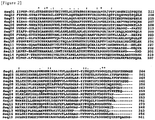
- Seq- indicates the the SEQ ID NO: of the amino acid sequence shown in Figure 1 , Figure 2 or the like described below, and the letter string between them (for example, YP_192407 and the like) indicates the accession number of each amino acid sequence registered in the database. Further, after the letter string, the species name and the strain name are indicated.
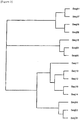
- the amino acid sequence shown in the SEQ ID NO: 49 is the estimated ancestor-type amino acid sequence at the root of the phylogenetic tree of Figure 3 .
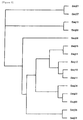
- the amino acid sequence shown in the SEQ ID NO: 50 is the estimated ancestor-type amino acid sequence at the root of the phylogenetic tree of Figure 4 .
- the amino acid sequence shown in the SEQ ID NO: 51 is the estimated ancestor-type amino acid sequence at the root of the phylogenetic tree of Figure 5 .
- the amino acid sequence shown in the SEQ ID NO: 52 is the estimated ancestor-type amino acid sequence at the root of the phylogenetic tree of Figure 6 .
- the ancestor-type amino acid sequences estimated from the four molecular phylogenetic trees were added to the multiple alignment figure shown in Figure 1 and Figure 2 .
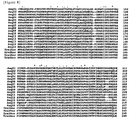
- the multiple alignment figure obtained including the estimated ancestor-type amino acid sequences and NAD(P) + GDH is divided and shown in Figure 7 to Figure 9 .
- the amino acid sequence indicated with Tre1Anc is the estimated ancestor-type amino acid sequence at the root of the phylogenetic tree of Figure 3 .
- the amino acid sequence indicated with Tre2Anc is the estimated ancestor-type amino acid sequence at the root of the phylogenetic tree of Figure 4 .
- the amino acid sequence indicated with Tre3Anc is the estimated ancestor-type amino acid sequence at the root of the phylogenetic tree of Figure 5 .
- the amino acid sequence indicated with Tre4Anc is the estimated ancestor-type amino acid sequence at the root of the phylogenetic tree of Figure 6 .
- Non-Patent Document 6 and Non-Patent Document 7 of the prior art documents the following replacements E170K and Q252L are known mutations, which were shown to improve the thermal stability of NAD(P) + GDH derived from Bacillus megaterium and NAD(P) + GDH derived from Bacillus subtilis in the presence and absence of sodium chloride.
- the replacements were used also in the present invention as well as the estimated ancestor-type amino acids.
- the mutant 21 is a mutant in which the mutations described in Patent Document 1 and Patent Document 3 are combined, which was used as Comparative Example in Examples.
- the mutations of the mutant 22 are the mutations, which are described in Non-Patent Document 7 and were shown to have an effect on the thermal stability and the resistance to an organic solvent, and the mutant was used as Reference Example because the strain of genus Bacillus used was different.
- mutant 23 are the mutations, which are described in Non-Patent Document 7 and were shown to have an effect on the thermal stability and the resistance to an organic solvent, and the mutant was used as Example because the strain of genus Bacillus used was different.
- A159C in this specification relate to the notation of amino acid replacements.
- A159C means that the amino acid A at position 159 from the N-terminal in a specific amino acid sequence is replaced with the amino acid C.
- the site-specific mutagenesis by PCR was conducted regarding the DNA sequence of the wild-type NAD(P) + GDH of the SEQ ID NO: 2.
- the oligonucleotides used for the site-specific mutagenesis by PCR were designed and synthesized as described below.
- the oligonucleotides having the nucleic acid sequences shown in the SEQ ID NO: 53 and the SEQ ID NO: 54, the SEQ ID NO: 55 and the SEQ ID NO: 56, and the SEQ ID NO: 57 and the SEQ ID NO: 58 of the sequence listing were used.
- the oligonucleotides having the nucleic acid sequences shown in the SEQ ID NO: 53 and the SEQ ID NO: 54, the SEQ ID NO: 55 and the SEQ ID NO: 56, the SEQ ID NO: 57 and the SEQ ID NO: 58, and the SEQ ID NO: 59 and the SEQ ID NO: 60 of the sequence listing were used.
- the oligonucleotides having the nucleic acid sequences shown in the SEQ ID NO: 53 and the SEQ ID NO: 54, the SEQ ID NO: 55 and the SEQ ID NO: 56, the SEQ ID NO: 57 and the SEQ ID NO: 58, and the SEQ ID NO: 61 and the SEQ ID NO: 62 of the sequence listing were used.
- the oligonucleotides having the nucleic acid sequences shown in the SEQ ID NO: 53 and the SEQ ID NO: 54, the SEQ ID NO: 55 and the SEQ ID NO: 56, the SEQ ID NO: 57 and the SEQ ID NO: 58, and the SEQ ID NO: 63 and the SEQ ID NO: 64 of the sequence listing were used.
- the oligonucleotides having the nucleic acid sequences shown in the SEQ ID NO: 53 and the SEQ ID NO: 54, the SEQ ID NO: 55 and the SEQ ID NO: 56, the SEQ ID NO: 57 and the SEQ ID NO: 58, and the SEQ ID NO: 65 and the SEQ ID NO: 66 of the sequence listing were used.
- the oligonucleotides having the nucleic acid sequences shown in the SEQ ID NO: 53 and the SEQ ID NO: 54, the SEQ ID NO: 55 and the SEQ ID NO: 56, the SEQ ID NO: 57 and the SEQ ID NO: 58, and the SEQ ID NO: 67 and the SEQ ID NO: 68 of the sequence listing were used.
- the oligonucleotides having the nucleic acid sequences shown in the SEQ ID NO: 55 and the SEQ ID NO: 56, the SEQ ID NO: 57 and the SEQ ID NO: 58, and the SEQ ID NO: 69 and the SEQ ID NO: 70 of the sequence listing were used.
- the oligonucleotides having the nucleic acid sequences shown in the SEQ ID NO: 55 and the SEQ ID NO: 56, the SEQ ID NO: 57 and the SEQ ID NO: 58, the SEQ ID NO: 59 and the SEQ ID NO: 60, and the SEQ ID NO: 69 and the SEQ ID NO: 70 of the sequence listing were used.
- the oligonucleotides having the nucleic acid sequences shown in the SEQ ID NO: 55 and the SEQ ID NO: 56, the SEQ ID NO: 57 and the SEQ ID NO: 58, the SEQ ID NO: 61 and the SEQ ID NO: 62, and the SEQ ID NO: 69 and the SEQ ID NO: 70 of the sequence listing were used.
- the oligonucleotides having the nucleic acid sequences shown in the SEQ ID NO: 55 and the SEQ ID NO: 56, the SEQ ID NO: 57 and the SEQ ID NO: 58, the SEQ ID NO: 63 and the SEQ ID NO: 64, and the SEQ ID NO: 69 and the SEQ ID NO: 70 of the sequence listing were used.
- the oligonucleotides having the nucleic acid sequences shown in the SEQ ID NO: 55 and the SEQ ID NO: 56, the SEQ ID NO: 57 and the SEQ ID NO: 58, the SEQ ID NO: 65 and the SEQ ID NO: 66, and the SEQ ID NO: 69 and the SEQ ID NO: 70 of the sequence listing were used.
- the oligonucleotides having the nucleic acid sequences shown in the SEQ ID NO: 55 and the SEQ ID NO: 56, the SEQ ID NO: 57 and the SEQ ID NO: 58, the SEQ ID NO: 67 and the SEQ ID NO: 68, and the SEQ ID NO: 69 and the SEQ ID NO: 70 of the sequence listing were used.
- the oligonucleotides having the nucleic acid sequences shown in the SEQ ID NO: 53 and the SEQ ID NO: 54, the SEQ ID NO: 55 and the SEQ ID NO: 56, the SEQ ID NO: 57 and the SEQ ID NO: 58, and the SEQ ID NO: 69 and the SEQ ID NO: 70 of the sequence listing were used.
- the oligonucleotides having the nucleic acid sequences shown in the SEQ ID NO: 53 and the SEQ ID NO: 54, the SEQ ID NO: 55 and the SEQ ID NO: 56, the SEQ ID NO: 57 and the SEQ ID NO: 58, the SEQ ID NO: 59 and the SEQ ID NO: 60, and the SEQ ID NO: 69 and the SEQ ID NO: 70 of the sequence listing were used.
- the oligonucleotides having the nucleic acid sequences shown in the SEQ ID NO: 53 and the SEQ ID NO: 54, the SEQ ID NO: 55 and the SEQ ID NO: 56, the SEQ ID NO: 57 and the SEQ ID NO: 58, the SEQ ID NO: 61 and the SEQ ID NO: 62, and the SEQ ID NO: 69 and the SEQ ID NO: 70 of the sequence listing were used.
- the oligonucleotides having the nucleic acid sequences shown in the SEQ ID NO: 53 and the SEQ ID NO: 54, the SEQ ID NO: 55 and the SEQ ID NO: 56, the SEQ ID NO: 57 and the SEQ ID NO: 58, the SEQ ID NO: 63 and the SEQ ID NO: 64, and the SEQ ID NO: 69 and the SEQ ID NO: 70 of the sequence listing were used.
- the oligonucleotides having the nucleic acid sequences shown in the SEQ ID NO: 53 and the SEQ ID NO: 54, the SEQ ID NO: 55 and the SEQ ID NO: 56, the SEQ ID NO: 57 and the SEQ ID NO: 58, the SEQ ID NO: 65 and the SEQ ID NO: 66, and the SEQ ID NO: 69 and the SEQ ID NO: 70 of the sequence listing were used.
- the oligonucleotides having the nucleic acid sequences shown in the SEQ ID NO: 53 and the SEQ ID NO: 54, the SEQ ID NO: 55 and the SEQ ID NO: 56, the SEQ ID NO: 57 and the SEQ ID NO: 58, the SEQ ID NO: 67 and the SEQ ID NO: 68, and the SEQ ID NO: 69 and the SEQ ID NO: 70 of the sequence listing were used.
- the oligonucleotides having the nucleic acid sequences shown in the SEQ ID NO: 55 and the SEQ ID NO: 56, the SEQ ID NO: 57 and the SEQ ID NO: 58, and the SEQ ID NO: 71 and the SEQ ID NO: 72 of the sequence listing were used.
- the oligonucleotides having the nucleic acid sequences shown in the SEQ ID NO: 55 and the SEQ ID NO: 56, and the SEQ ID NO: 57 and the SEQ ID NO: 58 of the sequence listing were used.
- the oligonucleotides having the nucleic acid sequences shown in the SEQ ID NO: 55 and the SEQ ID NO: 56, the SEQ ID NO: 57 and the SEQ ID NO: 58, the SEQ ID NO: 73 and the SEQ ID NO: 74, the SEQ ID NO: 75 and the SEQ ID NO: 76, and the SEQ ID NO: 77 and the SEQ ID NO: 78 of the sequence listing were used.
- the vector in which the DNA of the wild-type NAD(P) + GDH in the SEQ ID NO: 2 isolated by the usual method using PCR from Bacillus subtilis NBRC3134 strain was cloned to pET-21c, was used.
- This vector is also called pETGDH below.
- Escherichia coli DH5 ⁇ was transfected with the vector after conducting the experiment of the site-specific mutagenesis and cloned, and it was confirmed by sequencing whether the desired mutations were inserted in the DNA of NAD(P) + GDH.
- mutant vectors of the mutant 1 to mutant 23 were named pETGDH1, pETGDH2, pETGDH3, pETGDH4, pETGDH5, pETGDH6, pETGDH7, pETGDH8, pETGDH9, pETGDH10, pETGDH11, pETGDH12, pETGDH13, pETGDH14, pETGDH15, pETGDH16, pETGDH17, pETGDH18, pETGDH19, pETGDH20, pETGDH21, pETGDH22 and pETGDH23, respectively.
- the DNA sequences of NAD(P) + GDH that were cloned to pETGDH1 to pETGDH23 were as shown in the SEQ ID NO: 4, the SEQ ID NO: 6, the SEQ ID NO: 8, the SEQ ID NO: 10, the SEQ ID NO: 12, the SEQ ID NO: 14, the SEQ ID NO: 16, the SEQ ID NO: 18, the SEQ ID NO: 20, the SEQ ID NO: 22, the SEQ ID NO: 24, the SEQ ID NO: 26, the SEQ ID NO: 28, the SEQ ID NO: 30, the SEQ ID NO: 32, the SEQ ID NO: 34, the SEQ ID NO: 36, the SEQ ID NO: 38, the SEQ ID NO: 40, the SEQ ID NO: 42, the SEQ ID NO: 44, the SEQ ID NO: 46, and the SEQ ID NO: 48 of the sequence listing, respectively.
- the DNA sequence of wild-type NAD(P) + GDH which was cloned to pETGDH was as shown by SEQ ID NO:
- amino acid sequences encoded by the DNA of NAD(P) + GDH cloned to pETGDH1 to pETGDH23 were as shown in the SEQ ID NO: 3, the SEQ ID NO: 5, the SEQ ID NO: 7, the SEQ ID NO: 9, the SEQ ID NO: 11, the SEQ ID NO: 13, the SEQ ID NO: 15, the SEQ ID NO: 17, the SEQ ID NO: 19, the SEQ ID NO: 21, the SEQ ID NO: 23, the SEQ ID NO: 25, the SEQ ID NO: 27, the SEQ ID NO: 29, the SEQ ID NO: 31, the SEQ ID NO: 33, the SEQ ID NO: 35, the SEQ ID NO: 37, the SEQ ID NO: 39, the SEQ ID NO: 41, the SEQ ID NO: 43, the SEQ ID NO: 45 and the SEQ ID NO: 47 of the sequence listing, respectively.
- the mutant which includes the amino acid replacements of I165M+E170K+P194T+A197K+K204E+K206R+E222D+S237C in the amino acid sequence shown in the SEQ ID NO: 79 of the sequence listing, [the mutant described in the SEQ ID NO: 164 of US patent 7816111 specification (Patent Document 4)] was prepared as Comparative Example 1.
- the 25 kinds of transformants described above were cultured on LB agar plate medium including 100 ⁇ g/mL ampicillin and colonies were formed. A single colony was taken from each transformant, inoculated to 1 mL of LB medium including 100 ⁇ g/mL ampicillin and shake-cultured at 37°C.
- 1 mL of the precultured culture mediums were inoculated to Terrific culture mediums including 100 ⁇ g/mL ampicillin and 0.5 mM IPTG (isopropyl- ⁇ -thiogalactopyranoside) and shake-cultured at 30°C. After the completion of the culturing, the culture mediums were centrifuged (8000 rpm, 10 minutes) and Escherichia coli in which each mutant enzyme was expressed were collected. Escherichia coli collected were stored at -80°C until they were used for the following purification step.
- Escherichia coli stored at -80°C were each suspended in 20 mL of 20 mM phosphate buffer (pH 8) and grinded by ultrasonic wave. The grinded liquids were centrifuged (10000 ⁇ g, 10 minutes) and the supernatants were collected. The supernatants collected were heat treated at 60°C for 60 minutes and centrifuged (10000 ⁇ g, 20 minutes), and the supernatants were collected.
- Ammonium sulfate was added to the centrifugation supernatants obtained under ice-cooling to achieve 35% saturated ammonium sulfate, the ammonium sulfate precipitation was conducted, and the supernatants were collected by centrifugation (10000 ⁇ g, 20 minutes).
- the centrifugation supernatants after the ammonium sulfate precipitation were adsorbed on 6 mL RESOURCE PHE columns (produced by GE Healthcare), which were equilibrated in advance with 20 mM phosphate buffer including 35% saturated ammonium sulfate, and eluted with the concentration gradient of 35% to 0% saturated ammonium sulfate.
- the collected fractions having the NAD(P) + GDH activity were dialyzed with 20 mM phosphate buffer (pH 8.0), and concentrated on ultrafilter. It was confirmed with SDS-PAGE that the concentrated NAD(P) + GDH activity fractions were purified to single proteins.
- the NAD(P) + GDH mutant enzyme solutions, which were dialyzed with 20 mM phosphate buffer (pH 8) and concentrated are also called the purified enzymes below.
- the purified enzymes were diluted with the enzyme dilution solution: 20 mM phosphate buffer (pH 8), so that the protein concentrations became 30 ⁇ g/mL.
- 0.5 mL of the diluted enzyme solutions were dispensed to 1.5 mL plastic tubes.
- the plastic tubes were put into a water bath, in which the temperature was controlled to a predetermined temperature, and heat treated for 30 minutes. After the completion of the heat treatment, the plastic tubes were put into ice water for rapid cooling. The activities before and after the heat treatment were calculated from the method described above.
- the purified enzymes were diluted with the enzyme dilution solution: 20 mM phosphate buffer (pH 8), so that the protein concentrations became 500 ⁇ g/mL. 10 ⁇ L of the diluted enzyme solutions were each dispensed in 1.5 mL plastic tubes and 90 ⁇ L acetone was added thereto, and the tubes were stirred well at room temperature for 1 minute.
- the above plastic tubes were set in centrifuge evaporator CVE-3100 (manufactured by EYELA), which was set at 50°C, and all the solvent was removed by heat-drying for 30 minutes.
- the enzyme powders after the completion of drying were each suspended in 20 mM phosphate buffer (pH 8) again, and the activities before and after the acetone/heat-drying treatment were calculated by the method described above.
- the mutant 1 (A159C+E170K+Q252L), the mutant 2 (Q31G+A159C+E170K+Q252L), the mutant 3 (G64A+A159C+E170K+Q252L), the mutant 4 (K111R+A159C+E170K+Q252L), the mutant 5 (A159C+E170K+K179Y+Q252L), the mutant 6 (A159C+E170K+A246V+Q252L), the mutant 7 (E170K+Y217R+I218L+Q252L), the mutant 8 (Q31G+E170K+Y217R+I218L+Q252L), the mutant 9 (G64+AE170K+Y217R+I218L+Q252L), the mutant 10 (K111R+E170K+Y217R+I218L+Q252L), the mutant 11
- the mutant 22 (E170K+Q252L) had the activity under 20%
- the mutant 21 (E133K+E170K+Q252L) of Comparative Example had the activity of 45%
- the mutant 23 (P45A+N46E+F155Y+E170K+V227A+W230F+Q252L) had the activity of 74%.
- all the ancestor-type mutants of the mutant 1 to mutant 20 had the remaining activities of 80% or more, and the loss of the activity was not observed at all for most of them.
- the mutant 21 the mutant 22 and the mutant 23 of Comparative Examples were completely lost.
- the mutant 1, the mutant 2, the mutant 6, the mutant 7, the mutant 8, the mutant 9 and the mutant 10 showed the remaining activities of several %.
- the mutant 13, the mutant 14, the mutant 15, the mutant 16, the mutant 17, the mutant 18, the mutant 19 and the mutant 20 showed the remaining activities of 60% or more.
- the mutant 21, the mutant 22 and the mutant 23 of Comparative Examples were completely lost.
- the mutant 13, the mutant 14, the mutant 15, the mutant 16, the mutant 17, the mutant 18, the mutant 19 and the mutant 20 showed the remaining activities of 30% or more.
- the mutant obtained has a very low remaining activity after the heat treatment at 70°C or higher in the absence of an inorganic salt, and the activity is lost with the heat treatment at 80°C or higher, and thus the mutant cannot function stably in a wide temperature range.
- the modified NAD(P) + GDH obtained functions stably after the heat treatment at 70°C or higher and has the resistance to an organic solvent such as acetone, while it maintains a high specific activity of NAD(P) + GDH in the absence of an inorganic salt.
- the mutants 1 to 20 had remarkably excellent thermal stability, resistance to acetone, and specific activity, and their resistance to acetone were also excellent. From these results, it was found that, although the homologies of the nucleic acid sequences of the mutants 1 to 20 of the present invention with Comparative Example 1 and the wild-type were as high as 95% or more as shown in Table 1, the heat resistant and the resistance to an organic solvent were remarkably superior.
- NAD(P) + GDH which can be used stably in a wide temperature range, without being limited by the presence of an inorganic salt such as sodium chloride.
- a mutant enzyme which functions stably after the heat treatment at 70°C or higher and has the resistance to an organic solvent such as acetone, while the high specific activity of NAD(P) + GDH derived from Bacillus subtilis is maintained in the absence of an inorganic salt, is provided by a genetic engineering method, so that it can be widely used in industrial applications; and a gene necessary for the mass production, a recombinant vector including the gene, a transformant obtained from the vector, and a method for producing the modified NAD(P) + GDH using the transformant are provided.
Landscapes
- Chemical & Material Sciences (AREA)
- Life Sciences & Earth Sciences (AREA)
- Organic Chemistry (AREA)
- Health & Medical Sciences (AREA)
- Engineering & Computer Science (AREA)
- Zoology (AREA)
- Wood Science & Technology (AREA)
- Genetics & Genomics (AREA)
- Bioinformatics & Cheminformatics (AREA)
- General Engineering & Computer Science (AREA)
- General Health & Medical Sciences (AREA)
- Biochemistry (AREA)
- Proteomics, Peptides & Aminoacids (AREA)
- Biotechnology (AREA)
- Molecular Biology (AREA)
- Microbiology (AREA)
- Biophysics (AREA)
- Physics & Mathematics (AREA)
- Biomedical Technology (AREA)
- Analytical Chemistry (AREA)
- Immunology (AREA)
- Medicinal Chemistry (AREA)
- Emergency Medicine (AREA)
- Chemical Kinetics & Catalysis (AREA)
- General Chemical & Material Sciences (AREA)
- Plant Pathology (AREA)
- Enzymes And Modification Thereof (AREA)
- Micro-Organisms Or Cultivation Processes Thereof (AREA)
- Apparatus Associated With Microorganisms And Enzymes (AREA)
- Measuring Or Testing Involving Enzymes Or Micro-Organisms (AREA)
- Preparation Of Compounds By Using Micro-Organisms (AREA)
Claims (14)
- Protein mit einer Glukosedehydrogenase [NAD (P) +GDH]-Aktivität, welches Nicotinamidadenindinukleotid oder Nicotinamidadenindinukleotidphosphat als ein Coenzym verwendet und welches die folgende Aminosäuresequenz von (a) oder (b) umfasst:(a) Eine Aminosäuresequenz, worin Glutaminsäure an Rest-Position 170 und Glutamin an Rest-Position 252 in der Aminosäuresequenz, die in der SEQ ID NO: 1 des Sequenzprotokolls gezeigt ist, durch andere Aminosäuren ersetzt sind, und mindestens eine Aminosäure ausgewählt aus der Gruppe bestehend aus Glutamin an Rest-Position 31, Glycin an Rest-Position 64, Lysin an Rest-Position 111, Alanin an Rest-Position 159, Lysin an Rest-Position 179, Tyrosin an Rest-Position 217, Isoleucin an Position 218 und Alanin an Rest-Position 246 durch eine andere Aminosäure ersetzt ist;(b) Eine Aminosäuresequenz, worin eine oder mehrere Aminosäuren in der Aminosäuresequenz von (a) deletiert, ersetzt oder hinzugefügt sind, an anderen Rest-Positionen als obiger Rest-Position 170, Position 252, Position 31, Position 64, Position 111, Position 159, Position 179, Position 217, Position 218 und Position 246, wobei die Anzahl der zu verändernden Aminosäurereste 1 bis 20 ist und wobei die Aminosäuresequenz 80% oder höhere Homologie zu der obigen Aminosäuresequenz von (a) aufweist,wobei die verbleibende Aktivität nach einer Hitzebehandlung bei 70°C für 30 Minuten in Abwesenheit eines anorganischen Salzes höher ist als die verbleibende Aktivität des Proteins, in dem die Aminosäureersetzungen von I165M+E170K+P194T+A197K+K204E+K206R+E222D+S237C in der Aminosäuresequenz gemacht werden, die in der SEQ ID NO: 79 des Sequenzprotokolls gezeigt ist.
- Protein gemäß Anspruch 1, wobei die Aminosäuresequenz von (a) eine Aminosäuresequenz ist, in der die folgenden Aminosäureersetzungen von (1) gemacht werden und mindestens eine Aminosäureersetzung, ausgewählt aus der Gruppe bestehend aus (2) bis (9), in der Aminosäuresequenz gemacht wird, die in der SEQ ID NO: 1 des Sequenzprotokolls gezeigt ist.(1) E170K+Q252L(2) Q31G(3) G64A(4) K111R(5) A159C(6) K179Y(7) Y217R(8) I218L(9) A246V
- Protein gemäß Anspruch 1 oder 2,(i) wobei die Aminosäuresequenz von (a) die Aminosäuresequenz ist, die in irgendeiner der SEQ ID NOs: 3, 5, 7, 9, 11, 13, 15, 17, 19, 21, 23, 25, 27, 29, 31, 33, 35, 37, 39 und 41 des Sequenzprotokolls gezeigt ist,
oder(ii) ein Protein mit einer Glukosedehydrogenase [NAD (P) +GDH] -Aktivität ist und eine Aminosäuresequenz umfasst, in der eine oder mehrere Aminosäuren in der Aminosäuresequenz des in Anspruch 3-(i) beschriebenen Proteins an anderen Rest-Positionen als obiger Rest-Position 170, Position 252, Position 31, Position 64, Position 111, Position 159, Position 179, Position 217, Position 218 und Position 246 deletiert, ersetzt oder hinzugefügt sind. - Protein gemäß irgendeinem der Ansprüche 1 bis 3, wobei die verbleibende Aktivität nach einer Hitzebehandlung bei 70°C für 30 Minuten in Abwesenheit eines anorganischen Salzes 20% oder mehr ist.
- Protein gemäß irgendeinem der Ansprüche 1 bis 4, wobei die verbleibende Aktivität nach einer Hitzebehandlung bei 80°C für 30 Minuten in Abwesenheit eines anorganischen Salzes 1% oder mehr ist.
- Protein gemäß irgendeinem der Ansprüche 1 bis 5, wobei die verbleibende Aktivität nach einer Hitzebehandlung bei 84°C für 30 Minuten in Abwesenheit eines anorganischen Salzes 1% oder mehr ist.
- Protein gemäß irgendeinem der Ansprüche 1 bis 6, wobei die verbleibende Aktivität nach einer Behandlung mit organischem Lösungsmittel in Abwesenheit eines anorganischen Salzes höher ist alsa) die verbleibende Aktivität des Proteins, in dem die Aminosäureersetzungen von I165M+E170K+P194T+A197K+K204E+K206R+E222D+S237C in der Aminosäuresequenz gemacht werden, die in der SEQ ID NO: 79 des Sequenzprotokolls gezeigt ist;
oderb) die verbleibende Aktivität nach der Behandlung des Proteins, das die in der SEQ ID NO: 1 des Sequenzprotokolls gezeigte Aminosäuresequenz umfasst. - DNA, die das in irgendeinem der Ansprüche 1 bis 7 beschriebene Protein kodiert, wobei vorzugsweise die Kodonverwendungsfrequenz der Nukleinsäuresequenz der DNA für die Kodonverwendungsfrequenz von Escherichia coli optimiert ist.
- Rekombinanter Vektor, der die in Anspruch 8 beschriebene DNA umfasst.
- Nicht-menschliche Transformante, die durch Transformation mit dem in Anspruch 9 beschriebenen, rekombinanten Vektor erhalten wird, wobei vorzugsweise der Wirt Escherichia coli ist.
- Verfahren zur Herstellung eines modifizierten NAD (P) +GDH, welches das Herstellen von NAD (P) +GDH durch Kultivieren der in Anspruch 10 beschriebenen Transformante und das Gewinnen des NAD (P) +GDH umfasst.
- Test-Agens für Glukosemessung, welches das in irgendeinem der Ansprüche 1 bis 7 beschriebene Protein umfasst.
- Glukosesensor, welcher das in irgendeinem der Ansprüche 1 bis 7 beschriebene Protein umfasst.
- Verfahren zum Messen einer Glukosekonzentration, welches das in irgendeinem der Ansprüche 1 bis 7 beschriebene Protein verwendet.
Applications Claiming Priority (2)
| Application Number | Priority Date | Filing Date | Title |
|---|---|---|---|
| JP2011075449 | 2011-03-30 | ||
| PCT/JP2012/058568 WO2012133761A1 (ja) | 2011-03-30 | 2012-03-30 | 改変型グルコースデヒドロゲナーゼ |
Publications (3)
| Publication Number | Publication Date |
|---|---|
| EP2695939A1 EP2695939A1 (de) | 2014-02-12 |
| EP2695939A4 EP2695939A4 (de) | 2015-05-06 |
| EP2695939B1 true EP2695939B1 (de) | 2017-11-01 |
Family
ID=46931458
Family Applications (1)
| Application Number | Title | Priority Date | Filing Date |
|---|---|---|---|
| EP12765279.0A Active EP2695939B1 (de) | 2011-03-30 | 2012-03-30 | Modifizierte glucosedehydrogenase |
Country Status (5)
| Country | Link |
|---|---|
| US (1) | US9023608B2 (de) |
| EP (1) | EP2695939B1 (de) |
| JP (1) | JP5949757B2 (de) |
| KR (1) | KR101980065B1 (de) |
| WO (1) | WO2012133761A1 (de) |
Families Citing this family (2)
| Publication number | Priority date | Publication date | Assignee | Title |
|---|---|---|---|---|
| JP2016042032A (ja) * | 2014-08-14 | 2016-03-31 | ニプロ株式会社 | グルコースセンサ |
| CN112877305B (zh) * | 2019-11-29 | 2022-06-03 | 湖州颐辉生物科技有限公司 | 对辅酶亲和力提高的葡萄糖脱氢酶突变体 |
Family Cites Families (10)
| Publication number | Priority date | Publication date | Assignee | Title |
|---|---|---|---|---|
| JPH0286779A (ja) | 1988-09-22 | 1990-03-27 | Amano Pharmaceut Co Ltd | 改良型組換えdna、それを含む形質転換体及びそれを用いた耐熱性グルコースデヒドロゲナーゼの製造法 |
| JP3220471B2 (ja) | 1991-02-13 | 2001-10-22 | 天野エンザイム株式会社 | 組換えdna、それを含む形質転換体及びそれを用い たグルコースデヒドロゲナーゼの製造法 |
| JP2002247991A (ja) | 2000-07-04 | 2002-09-03 | Ajinomoto Co Inc | タンパク質の耐熱性を向上させる方法、該方法により耐熱性の向上したタンパク質、および該タンパク質をコードする核酸 |
| JP2003310274A (ja) | 2002-04-30 | 2003-11-05 | Amano Enzyme Inc | グルコース脱水素酵素およびそれをコードする遺伝子 |
| JP5207576B2 (ja) | 2002-07-26 | 2013-06-12 | ソニー株式会社 | 燃料電池、ポータブル電源及び電子機器 |
| BRPI0413492A (pt) * | 2003-08-11 | 2006-10-17 | Codexis Inc | polipeptìdeo, polinucleotìdeo, sequência de ácido nucleico isolado, vetor de expressão, célula hospedeira, método de preparar um polipeptìdeo de gdh, e, composição |
| WO2010041511A1 (ja) | 2008-10-06 | 2010-04-15 | ソニー株式会社 | 燃料電池および酵素電極 |
| JP5593642B2 (ja) | 2009-02-20 | 2014-09-24 | ソニー株式会社 | 燃料電池、電子機器及びバイオセンサー |
| JP2011075449A (ja) | 2009-09-30 | 2011-04-14 | Kurabo Ind Ltd | ヒドロキシルラジカル含有水供給装置 |
| JP2011139677A (ja) | 2010-01-08 | 2011-07-21 | Unitika Ltd | 改変型フラビンアデニンジヌクレオチド依存性グルコースデヒドロゲナーゼ |
-
2012
- 2012-03-30 US US14/008,927 patent/US9023608B2/en active Active
- 2012-03-30 EP EP12765279.0A patent/EP2695939B1/de active Active
- 2012-03-30 WO PCT/JP2012/058568 patent/WO2012133761A1/ja not_active Ceased
- 2012-03-30 KR KR1020137028552A patent/KR101980065B1/ko not_active Expired - Fee Related
- 2012-03-30 JP JP2013507780A patent/JP5949757B2/ja active Active
Non-Patent Citations (1)
| Title |
|---|
| None * |
Also Published As
| Publication number | Publication date |
|---|---|
| JPWO2012133761A1 (ja) | 2014-07-28 |
| EP2695939A1 (de) | 2014-02-12 |
| JP5949757B2 (ja) | 2016-07-13 |
| EP2695939A4 (de) | 2015-05-06 |
| WO2012133761A1 (ja) | 2012-10-04 |
| US20140030749A1 (en) | 2014-01-30 |
| KR20140032393A (ko) | 2014-03-14 |
| US9023608B2 (en) | 2015-05-05 |
| KR101980065B1 (ko) | 2019-05-21 |
Similar Documents
| Publication | Publication Date | Title |
|---|---|---|
| US8883434B2 (en) | Mutant enzyme and application thereof | |
| JPWO2010053161A1 (ja) | 改変型フラビンアデニンジヌクレオチド依存性グルコースデヒドロゲナーゼ | |
| JP2011139677A (ja) | 改変型フラビンアデニンジヌクレオチド依存性グルコースデヒドロゲナーゼ | |
| JP5641738B2 (ja) | 新規なグルコースデヒドロゲナーゼ | |
| US20250154542A1 (en) | Modified d-allulose-3-epimerase | |
| WO2010137489A1 (ja) | 特性の改変されたグルコースデヒドロゲナーゼ | |
| JP6843740B2 (ja) | 比活性が向上したアマドリアーゼ | |
| WO2015008637A1 (ja) | キサンチンオキシダーゼ遺伝子とそれをコードするアミノ酸配列 | |
| US9023608B2 (en) | Modified glucose dehydrogenase | |
| US7091017B2 (en) | Fructosyl amino acid oxidase | |
| JP5821843B2 (ja) | ジアホラーゼ活性を有するタンパク質 | |
| JP6398295B2 (ja) | 変異型グルコース−6−リン酸脱水素酵素 | |
| WO2013115180A1 (ja) | 新規l-アミノ酸オキシダーゼ、l-リジンの測定方法、キット及び酵素センサ | |
| JP5216889B2 (ja) | 新規l−アミノ酸オキシダーゼ、l−リジンの測定方法、キット及び酵素センサー | |
| Cassetta et al. | Crystallization, X-ray diffraction analysis and phasing of 17β-hydroxysteroid dehydrogenase from the fungus Cochliobolus lunatus | |
| JP6476542B2 (ja) | 変異型グルコース−6−リン酸脱水素酵素 | |
| JP6514849B2 (ja) | 低温における酵素活性を向上させた好熱菌由来酵素の改変体の取得方法、及び低温における酵素活性が向上しているサーマス・サーモフィラス由来3−イソプロピルリンゴ酸脱水素酵素の改変体 | |
| JP6398313B2 (ja) | 熱安定性アシルCoAオキシダーゼ及びその製造方法 | |
| Wang et al. | Enhanced catalytic properties of novel (αbγ) 2 heterohexameric Rhodobacter capsulatus xanthine dehydrogenase by separate expression of the redox domains in Escherichia coli | |
| JP6369052B2 (ja) | 熱安定性アシルCoAシンテターゼ及びその製造方法 | |
| US20230125821A1 (en) | Modified transglutaminase | |
| WO2025105408A1 (ja) | 改変型酵素 |
Legal Events
| Date | Code | Title | Description |
|---|---|---|---|
| PUAI | Public reference made under article 153(3) epc to a published international application that has entered the european phase |
Free format text: ORIGINAL CODE: 0009012 |
|
| 17P | Request for examination filed |
Effective date: 20131025 |
|
| AK | Designated contracting states |
Kind code of ref document: A1 Designated state(s): AL AT BE BG CH CY CZ DE DK EE ES FI FR GB GR HR HU IE IS IT LI LT LU LV MC MK MT NL NO PL PT RO RS SE SI SK SM TR |
|
| DAX | Request for extension of the european patent (deleted) | ||
| RIC1 | Information provided on ipc code assigned before grant |
Ipc: C12M 1/40 20060101ALI20141205BHEP Ipc: C12N 1/21 20060101ALI20141205BHEP Ipc: C12N 15/09 20060101AFI20141205BHEP Ipc: C12Q 1/54 20060101ALI20141205BHEP Ipc: C12Q 1/32 20060101ALI20141205BHEP Ipc: C12N 9/04 20060101ALI20141205BHEP Ipc: C12P 21/02 20060101ALI20141205BHEP Ipc: C12M 1/34 20060101ALI20141205BHEP |
|
| RIC1 | Information provided on ipc code assigned before grant |
Ipc: C12M 1/40 20060101ALI20150325BHEP Ipc: C12N 1/21 20060101ALI20150325BHEP Ipc: C12Q 1/54 20060101ALI20150325BHEP Ipc: C12M 1/34 20060101ALI20150325BHEP Ipc: C12Q 1/32 20060101ALI20150325BHEP Ipc: C12N 15/09 20060101AFI20150325BHEP Ipc: C12P 21/02 20060101ALI20150325BHEP Ipc: C12N 9/04 20060101ALI20150325BHEP |
|
| RA4 | Supplementary search report drawn up and despatched (corrected) |
Effective date: 20150402 |
|
| RAP1 | Party data changed (applicant data changed or rights of an application transferred) |
Owner name: NIPRO CORPORATION |
|
| 17Q | First examination report despatched |
Effective date: 20170104 |
|
| GRAP | Despatch of communication of intention to grant a patent |
Free format text: ORIGINAL CODE: EPIDOSNIGR1 |
|
| INTG | Intention to grant announced |
Effective date: 20170609 |
|
| GRAS | Grant fee paid |
Free format text: ORIGINAL CODE: EPIDOSNIGR3 |
|
| GRAA | (expected) grant |
Free format text: ORIGINAL CODE: 0009210 |
|
| AK | Designated contracting states |
Kind code of ref document: B1 Designated state(s): AL AT BE BG CH CY CZ DE DK EE ES FI FR GB GR HR HU IE IS IT LI LT LU LV MC MK MT NL NO PL PT RO RS SE SI SK SM TR |
|
| REG | Reference to a national code |
Ref country code: GB Ref legal event code: FG4D |
|
| REG | Reference to a national code |
Ref country code: CH Ref legal event code: EP Ref country code: AT Ref legal event code: REF Ref document number: 942055 Country of ref document: AT Kind code of ref document: T Effective date: 20171115 |
|
| REG | Reference to a national code |
Ref country code: IE Ref legal event code: FG4D |
|
| REG | Reference to a national code |
Ref country code: SE Ref legal event code: TRGR |
|
| REG | Reference to a national code |
Ref country code: DE Ref legal event code: R096 Ref document number: 602012039242 Country of ref document: DE |
|
| REG | Reference to a national code |
Ref country code: NL Ref legal event code: MP Effective date: 20171101 |
|
| REG | Reference to a national code |
Ref country code: LT Ref legal event code: MG4D |
|
| REG | Reference to a national code |
Ref country code: AT Ref legal event code: MK05 Ref document number: 942055 Country of ref document: AT Kind code of ref document: T Effective date: 20171101 |
|
| PG25 | Lapsed in a contracting state [announced via postgrant information from national office to epo] |
Ref country code: LT Free format text: LAPSE BECAUSE OF FAILURE TO SUBMIT A TRANSLATION OF THE DESCRIPTION OR TO PAY THE FEE WITHIN THE PRESCRIBED TIME-LIMIT Effective date: 20171101 Ref country code: ES Free format text: LAPSE BECAUSE OF FAILURE TO SUBMIT A TRANSLATION OF THE DESCRIPTION OR TO PAY THE FEE WITHIN THE PRESCRIBED TIME-LIMIT Effective date: 20171101 Ref country code: NL Free format text: LAPSE BECAUSE OF FAILURE TO SUBMIT A TRANSLATION OF THE DESCRIPTION OR TO PAY THE FEE WITHIN THE PRESCRIBED TIME-LIMIT Effective date: 20171101 Ref country code: NO Free format text: LAPSE BECAUSE OF FAILURE TO SUBMIT A TRANSLATION OF THE DESCRIPTION OR TO PAY THE FEE WITHIN THE PRESCRIBED TIME-LIMIT Effective date: 20180201 Ref country code: FI Free format text: LAPSE BECAUSE OF FAILURE TO SUBMIT A TRANSLATION OF THE DESCRIPTION OR TO PAY THE FEE WITHIN THE PRESCRIBED TIME-LIMIT Effective date: 20171101 |
|
| PG25 | Lapsed in a contracting state [announced via postgrant information from national office to epo] |
Ref country code: IS Free format text: LAPSE BECAUSE OF FAILURE TO SUBMIT A TRANSLATION OF THE DESCRIPTION OR TO PAY THE FEE WITHIN THE PRESCRIBED TIME-LIMIT Effective date: 20180301 Ref country code: BG Free format text: LAPSE BECAUSE OF FAILURE TO SUBMIT A TRANSLATION OF THE DESCRIPTION OR TO PAY THE FEE WITHIN THE PRESCRIBED TIME-LIMIT Effective date: 20180201 Ref country code: GR Free format text: LAPSE BECAUSE OF FAILURE TO SUBMIT A TRANSLATION OF THE DESCRIPTION OR TO PAY THE FEE WITHIN THE PRESCRIBED TIME-LIMIT Effective date: 20180202 Ref country code: LV Free format text: LAPSE BECAUSE OF FAILURE TO SUBMIT A TRANSLATION OF THE DESCRIPTION OR TO PAY THE FEE WITHIN THE PRESCRIBED TIME-LIMIT Effective date: 20171101 Ref country code: AT Free format text: LAPSE BECAUSE OF FAILURE TO SUBMIT A TRANSLATION OF THE DESCRIPTION OR TO PAY THE FEE WITHIN THE PRESCRIBED TIME-LIMIT Effective date: 20171101 Ref country code: RS Free format text: LAPSE BECAUSE OF FAILURE TO SUBMIT A TRANSLATION OF THE DESCRIPTION OR TO PAY THE FEE WITHIN THE PRESCRIBED TIME-LIMIT Effective date: 20171101 Ref country code: HR Free format text: LAPSE BECAUSE OF FAILURE TO SUBMIT A TRANSLATION OF THE DESCRIPTION OR TO PAY THE FEE WITHIN THE PRESCRIBED TIME-LIMIT Effective date: 20171101 |
|
| PG25 | Lapsed in a contracting state [announced via postgrant information from national office to epo] |
Ref country code: SK Free format text: LAPSE BECAUSE OF FAILURE TO SUBMIT A TRANSLATION OF THE DESCRIPTION OR TO PAY THE FEE WITHIN THE PRESCRIBED TIME-LIMIT Effective date: 20171101 Ref country code: EE Free format text: LAPSE BECAUSE OF FAILURE TO SUBMIT A TRANSLATION OF THE DESCRIPTION OR TO PAY THE FEE WITHIN THE PRESCRIBED TIME-LIMIT Effective date: 20171101 Ref country code: DK Free format text: LAPSE BECAUSE OF FAILURE TO SUBMIT A TRANSLATION OF THE DESCRIPTION OR TO PAY THE FEE WITHIN THE PRESCRIBED TIME-LIMIT Effective date: 20171101 Ref country code: CY Free format text: LAPSE BECAUSE OF FAILURE TO SUBMIT A TRANSLATION OF THE DESCRIPTION OR TO PAY THE FEE WITHIN THE PRESCRIBED TIME-LIMIT Effective date: 20171101 Ref country code: CZ Free format text: LAPSE BECAUSE OF FAILURE TO SUBMIT A TRANSLATION OF THE DESCRIPTION OR TO PAY THE FEE WITHIN THE PRESCRIBED TIME-LIMIT Effective date: 20171101 |
|
| REG | Reference to a national code |
Ref country code: DE Ref legal event code: R097 Ref document number: 602012039242 Country of ref document: DE |
|
| PG25 | Lapsed in a contracting state [announced via postgrant information from national office to epo] |
Ref country code: PL Free format text: LAPSE BECAUSE OF FAILURE TO SUBMIT A TRANSLATION OF THE DESCRIPTION OR TO PAY THE FEE WITHIN THE PRESCRIBED TIME-LIMIT Effective date: 20171101 Ref country code: SM Free format text: LAPSE BECAUSE OF FAILURE TO SUBMIT A TRANSLATION OF THE DESCRIPTION OR TO PAY THE FEE WITHIN THE PRESCRIBED TIME-LIMIT Effective date: 20171101 Ref country code: IT Free format text: LAPSE BECAUSE OF FAILURE TO SUBMIT A TRANSLATION OF THE DESCRIPTION OR TO PAY THE FEE WITHIN THE PRESCRIBED TIME-LIMIT Effective date: 20171101 Ref country code: RO Free format text: LAPSE BECAUSE OF FAILURE TO SUBMIT A TRANSLATION OF THE DESCRIPTION OR TO PAY THE FEE WITHIN THE PRESCRIBED TIME-LIMIT Effective date: 20171101 |
|
| PLBE | No opposition filed within time limit |
Free format text: ORIGINAL CODE: 0009261 |
|
| STAA | Information on the status of an ep patent application or granted ep patent |
Free format text: STATUS: NO OPPOSITION FILED WITHIN TIME LIMIT |
|
| 26N | No opposition filed |
Effective date: 20180802 |
|
| REG | Reference to a national code |
Ref country code: CH Ref legal event code: PL |
|
| GBPC | Gb: european patent ceased through non-payment of renewal fee |
Effective date: 20180330 |
|
| PG25 | Lapsed in a contracting state [announced via postgrant information from national office to epo] |
Ref country code: SI Free format text: LAPSE BECAUSE OF FAILURE TO SUBMIT A TRANSLATION OF THE DESCRIPTION OR TO PAY THE FEE WITHIN THE PRESCRIBED TIME-LIMIT Effective date: 20171101 Ref country code: MC Free format text: LAPSE BECAUSE OF FAILURE TO SUBMIT A TRANSLATION OF THE DESCRIPTION OR TO PAY THE FEE WITHIN THE PRESCRIBED TIME-LIMIT Effective date: 20171101 |
|
| REG | Reference to a national code |
Ref country code: BE Ref legal event code: MM Effective date: 20180331 |
|
| REG | Reference to a national code |
Ref country code: IE Ref legal event code: MM4A |
|
| PG25 | Lapsed in a contracting state [announced via postgrant information from national office to epo] |
Ref country code: LU Free format text: LAPSE BECAUSE OF NON-PAYMENT OF DUE FEES Effective date: 20180330 |
|
| PG25 | Lapsed in a contracting state [announced via postgrant information from national office to epo] |
Ref country code: IE Free format text: LAPSE BECAUSE OF NON-PAYMENT OF DUE FEES Effective date: 20180330 |
|
| PG25 | Lapsed in a contracting state [announced via postgrant information from national office to epo] |
Ref country code: BE Free format text: LAPSE BECAUSE OF NON-PAYMENT OF DUE FEES Effective date: 20180331 Ref country code: LI Free format text: LAPSE BECAUSE OF NON-PAYMENT OF DUE FEES Effective date: 20180331 Ref country code: GB Free format text: LAPSE BECAUSE OF NON-PAYMENT OF DUE FEES Effective date: 20180330 Ref country code: CH Free format text: LAPSE BECAUSE OF NON-PAYMENT OF DUE FEES Effective date: 20180331 |
|
| PG25 | Lapsed in a contracting state [announced via postgrant information from national office to epo] |
Ref country code: FR Free format text: LAPSE BECAUSE OF NON-PAYMENT OF DUE FEES Effective date: 20180331 |
|
| PG25 | Lapsed in a contracting state [announced via postgrant information from national office to epo] |
Ref country code: MT Free format text: LAPSE BECAUSE OF NON-PAYMENT OF DUE FEES Effective date: 20180330 |
|
| PG25 | Lapsed in a contracting state [announced via postgrant information from national office to epo] |
Ref country code: TR Free format text: LAPSE BECAUSE OF FAILURE TO SUBMIT A TRANSLATION OF THE DESCRIPTION OR TO PAY THE FEE WITHIN THE PRESCRIBED TIME-LIMIT Effective date: 20171101 |
|
| PG25 | Lapsed in a contracting state [announced via postgrant information from national office to epo] |
Ref country code: PT Free format text: LAPSE BECAUSE OF FAILURE TO SUBMIT A TRANSLATION OF THE DESCRIPTION OR TO PAY THE FEE WITHIN THE PRESCRIBED TIME-LIMIT Effective date: 20171101 Ref country code: HU Free format text: LAPSE BECAUSE OF FAILURE TO SUBMIT A TRANSLATION OF THE DESCRIPTION OR TO PAY THE FEE WITHIN THE PRESCRIBED TIME-LIMIT; INVALID AB INITIO Effective date: 20120330 |
|
| PG25 | Lapsed in a contracting state [announced via postgrant information from national office to epo] |
Ref country code: MK Free format text: LAPSE BECAUSE OF NON-PAYMENT OF DUE FEES Effective date: 20171101 |
|
| PG25 | Lapsed in a contracting state [announced via postgrant information from national office to epo] |
Ref country code: AL Free format text: LAPSE BECAUSE OF FAILURE TO SUBMIT A TRANSLATION OF THE DESCRIPTION OR TO PAY THE FEE WITHIN THE PRESCRIBED TIME-LIMIT Effective date: 20171101 |
|
| PGFP | Annual fee paid to national office [announced via postgrant information from national office to epo] |
Ref country code: SE Payment date: 20260211 Year of fee payment: 15 |
|
| PGFP | Annual fee paid to national office [announced via postgrant information from national office to epo] |
Ref country code: DE Payment date: 20260204 Year of fee payment: 15 |