EP2587571A1 - Positivelektroden-zusammensetzung für eine sekundärbatterie mit nichtwässrigem elektrolyt sowie herstellungsverfahren für einen positivelektrodenschlamm mit dieser positivelektroden-zusammensetzung - Google Patents
Positivelektroden-zusammensetzung für eine sekundärbatterie mit nichtwässrigem elektrolyt sowie herstellungsverfahren für einen positivelektrodenschlamm mit dieser positivelektroden-zusammensetzung Download PDFInfo
- Publication number
- EP2587571A1 EP2587571A1 EP11798042.5A EP11798042A EP2587571A1 EP 2587571 A1 EP2587571 A1 EP 2587571A1 EP 11798042 A EP11798042 A EP 11798042A EP 2587571 A1 EP2587571 A1 EP 2587571A1
- Authority
- EP
- European Patent Office
- Prior art keywords
- positive electrode
- electrode composition
- active material
- electrode active
- positive
- Prior art date
- Legal status (The legal status is an assumption and is not a legal conclusion. Google has not performed a legal analysis and makes no representation as to the accuracy of the status listed.)
- Granted
Links
Images

Classifications
-
- H—ELECTRICITY
- H01—ELECTRIC ELEMENTS
- H01M—PROCESSES OR MEANS, e.g. BATTERIES, FOR THE DIRECT CONVERSION OF CHEMICAL ENERGY INTO ELECTRICAL ENERGY
- H01M4/00—Electrodes
- H01M4/02—Electrodes composed of, or comprising, active material
- H01M4/36—Selection of substances as active materials, active masses, active liquids
- H01M4/48—Selection of substances as active materials, active masses, active liquids of inorganic oxides or hydroxides
- H01M4/52—Selection of substances as active materials, active masses, active liquids of inorganic oxides or hydroxides of nickel, cobalt or iron
- H01M4/525—Selection of substances as active materials, active masses, active liquids of inorganic oxides or hydroxides of nickel, cobalt or iron of mixed oxides or hydroxides containing iron, cobalt or nickel for inserting or intercalating light metals, e.g. LiNiO2, LiCoO2 or LiCoOxFy
-
- H—ELECTRICITY
- H01—ELECTRIC ELEMENTS
- H01M—PROCESSES OR MEANS, e.g. BATTERIES, FOR THE DIRECT CONVERSION OF CHEMICAL ENERGY INTO ELECTRICAL ENERGY
- H01M10/00—Secondary cells; Manufacture thereof
- H01M10/05—Accumulators with non-aqueous electrolyte
- H01M10/052—Li-accumulators
- H01M10/0525—Rocking-chair batteries, i.e. batteries with lithium insertion or intercalation in both electrodes; Lithium-ion batteries
-
- H—ELECTRICITY
- H01—ELECTRIC ELEMENTS
- H01M—PROCESSES OR MEANS, e.g. BATTERIES, FOR THE DIRECT CONVERSION OF CHEMICAL ENERGY INTO ELECTRICAL ENERGY
- H01M4/00—Electrodes
- H01M4/02—Electrodes composed of, or comprising, active material
- H01M4/13—Electrodes for accumulators with non-aqueous electrolyte, e.g. for lithium-accumulators; Processes of manufacture thereof
- H01M4/131—Electrodes based on mixed oxides or hydroxides, or on mixtures of oxides or hydroxides, e.g. LiCoOx
-
- H—ELECTRICITY
- H01—ELECTRIC ELEMENTS
- H01M—PROCESSES OR MEANS, e.g. BATTERIES, FOR THE DIRECT CONVERSION OF CHEMICAL ENERGY INTO ELECTRICAL ENERGY
- H01M4/00—Electrodes
- H01M4/02—Electrodes composed of, or comprising, active material
- H01M4/13—Electrodes for accumulators with non-aqueous electrolyte, e.g. for lithium-accumulators; Processes of manufacture thereof
- H01M4/139—Processes of manufacture
- H01M4/1391—Processes of manufacture of electrodes based on mixed oxides or hydroxides, or on mixtures of oxides or hydroxides, e.g. LiCoOx
-
- H—ELECTRICITY
- H01—ELECTRIC ELEMENTS
- H01M—PROCESSES OR MEANS, e.g. BATTERIES, FOR THE DIRECT CONVERSION OF CHEMICAL ENERGY INTO ELECTRICAL ENERGY
- H01M4/00—Electrodes
- H01M4/02—Electrodes composed of, or comprising, active material
- H01M4/36—Selection of substances as active materials, active masses, active liquids
- H01M4/38—Selection of substances as active materials, active masses, active liquids of elements or alloys
- H01M4/46—Alloys based on magnesium or aluminium
- H01M4/463—Aluminium based
-
- H—ELECTRICITY
- H01—ELECTRIC ELEMENTS
- H01M—PROCESSES OR MEANS, e.g. BATTERIES, FOR THE DIRECT CONVERSION OF CHEMICAL ENERGY INTO ELECTRICAL ENERGY
- H01M4/00—Electrodes
- H01M4/02—Electrodes composed of, or comprising, active material
- H01M4/36—Selection of substances as active materials, active masses, active liquids
- H01M4/38—Selection of substances as active materials, active masses, active liquids of elements or alloys
- H01M4/46—Alloys based on magnesium or aluminium
- H01M4/466—Magnesium based
-
- H—ELECTRICITY
- H01—ELECTRIC ELEMENTS
- H01M—PROCESSES OR MEANS, e.g. BATTERIES, FOR THE DIRECT CONVERSION OF CHEMICAL ENERGY INTO ELECTRICAL ENERGY
- H01M4/00—Electrodes
- H01M4/02—Electrodes composed of, or comprising, active material
- H01M4/36—Selection of substances as active materials, active masses, active liquids
- H01M4/48—Selection of substances as active materials, active masses, active liquids of inorganic oxides or hydroxides
- H01M4/50—Selection of substances as active materials, active masses, active liquids of inorganic oxides or hydroxides of manganese
- H01M4/505—Selection of substances as active materials, active masses, active liquids of inorganic oxides or hydroxides of manganese of mixed oxides or hydroxides containing manganese for inserting or intercalating light metals, e.g. LiMn2O4 or LiMn2OxFy
-
- H—ELECTRICITY
- H01—ELECTRIC ELEMENTS
- H01M—PROCESSES OR MEANS, e.g. BATTERIES, FOR THE DIRECT CONVERSION OF CHEMICAL ENERGY INTO ELECTRICAL ENERGY
- H01M4/00—Electrodes
- H01M4/02—Electrodes composed of, or comprising, active material
- H01M4/62—Selection of inactive substances as ingredients for active masses, e.g. binders, fillers
-
- Y—GENERAL TAGGING OF NEW TECHNOLOGICAL DEVELOPMENTS; GENERAL TAGGING OF CROSS-SECTIONAL TECHNOLOGIES SPANNING OVER SEVERAL SECTIONS OF THE IPC; TECHNICAL SUBJECTS COVERED BY FORMER USPC CROSS-REFERENCE ART COLLECTIONS [XRACs] AND DIGESTS
- Y02—TECHNOLOGIES OR APPLICATIONS FOR MITIGATION OR ADAPTATION AGAINST CLIMATE CHANGE
- Y02E—REDUCTION OF GREENHOUSE GAS [GHG] EMISSIONS, RELATED TO ENERGY GENERATION, TRANSMISSION OR DISTRIBUTION
- Y02E60/00—Enabling technologies; Technologies with a potential or indirect contribution to GHG emissions mitigation
- Y02E60/10—Energy storage using batteries
Definitions
- the present invention relates to a positive electrode composition for a nonaqueous electrolyte secondary battery such as a lithium ion secondary battery.
- the present invention relates to a positive electrode composition that can improve output power characteristics of a lithium ion secondary battery, and also can improve viscosity stability of a positive electrode slurry.
- the present invention also relates to a method for producing a positive electrode slurry having improved viscosity stability.
- a nonaqueous electrolyte secondary battery such as a lithium ion secondary battery has recently been used as a power supply therefore. Furthermore, in order to cope with a recent environmental problem, the nonaqueous electrolyte secondary battery has also attracted special interest as a power battery of an electric vehicle or the like.
- LiCoO 2 lithium cobalt oxide
- Cobalt as a raw material of LiCoO 2 is a scarce resource and is also unevenly distributed, which leads to high costs, and which may cause anxiety about supply of a raw material.
- LiNiO 2 lithium nickel oxide
- LiNiO 2 can realize a 4 V-class secondary battery having a discharge capacity of about 200 mA/g.
- LiNi 0.33 Co 0.33 Mn 0.33 O 2 is more advantageous than LiCoO 2 in the respect of costs.
- LiNi 0.5 Co 0.2 Mn 0.3 O 2 in which costs are reduced by decreasing the proportion of Co and a discharge capacity are improved by increasing the proportion of Ni.
- deterioration of output power characteristics is not commonly avoided when the proportion of Co decreases.
- a technology in which a disorder Ni atom arrangement in a crystal structure is reduced by making Li more excessive than a stoichiometric ratio, thereby compensating output power characteristics.
- a positive electrode of a nonaqueous electrolyte secondary battery is formed by mixing a positive electrode active material with a binder such as polyvinylidene fluoride (PVDF) or N-methyl-2-pyrrolidone (NMP) to obtain a positive electrode slurry, and applying the positive electrode slurry to a current collector such as an aluminum foil.
- a binder such as polyvinylidene fluoride (PVDF) or N-methyl-2-pyrrolidone (NMP)
- PVDF polyvinylidene fluoride
- NMP N-methyl-2-pyrrolidone
- An object of the present invention is to provide a positive electrode composition that has improved output power characteristics and low costs, and is also easily handled upon production of a positive electrode and exhibits an improved yield.
- the present inventors have intensively studied, and thus the present invention has been completed.
- the present inventors have found that gelation of a positive electrode slurry can be suppressed by mixing a positive electrode active material composed of a lithium transition metal complex oxide having a specific composition with particles composed of an acidic oxide (hereinafter may also be referred to as additive particles) to obtain a positive electrode composition. It has also been found that output power characteristics are improved.
- the gelation is suppressed by producing the positive electrode slurry by obtaining the positive electrode composition in advance and then dispersing and dissolving in a dispersion medium, together with a binder, and thus output power characteristics are improved in a nonaqueous electrolyte secondary battery after coating.
- the positive electrode composition of the present invention comprises a positive electrode active material composed of a lithium transition metal complex oxide represented by the general formula Li 1+x Ni y CO z M 1-y-z-w L w O 2 (wherein 0 ⁇ x ⁇ 0.50, 0.30 ⁇ y ⁇ 1.0, 0 ⁇ z ⁇ 0.5, 0 ⁇ w ⁇ 0.1, 0.30 ⁇ y + z + w ⁇ 1, M represents at least one kind selected from Mn and Al, and L represents at least one kind of an element selected from the group consisting of Zr, Ti, Mg and W), and additive particles composed of acidic oxide particles.
- a lithium transition metal complex oxide represented by the general formula Li 1+x Ni y CO z M 1-y-z-w L w O 2 (wherein 0 ⁇ x ⁇ 0.50, 0.30 ⁇ y ⁇ 1.0, 0 ⁇ z ⁇ 0.5, 0 ⁇ w ⁇ 0.1, 0.30 ⁇ y +
- the acidic oxide particles are composed of at least one kind selected from the group consisting of tungsten oxide, molybdenum oxide, vanadium pentoxide, tin dioxide and boron oxide.
- the content of the acidic oxide particles is 5.0 mol% or less expressed in terms of a ratio of a metallic element and/or a semi-metallic element in the acidic oxide particles to the positive electrode active material.
- the method for producing a positive electrode slurry of the present invention comprises a step of mixing a positive electrode active material composed of a lithium transition metal complex oxide represented by the general formula: Li 1+x Ni y Co z M 1-y-z-w L w O 2 (0 ⁇ x ⁇ 0.50, 0.30 ⁇ y ⁇ 1.0, 0 ⁇ z ⁇ 0.5, 0 ⁇ w ⁇ 0.1, 0.30 ⁇ y + z + w ⁇ 1, M represents at least one kind selected from Mn and Al, and L represents at least one kind of an element selected from the group consisting of Zr, Ti, Mg and W) with additive particles composed of acidic oxide particles to obtain a positive electrode composition; and a step of mixing the positive electrode composition, a binder and a dispersion medium to obtain a positive electrode slurry.
- a positive electrode active material composed of a lithium transition metal complex oxide represented by the general formula: Li 1+x Ni y Co z M 1-y-z-w L w
- the positive electrode composition of the present invention has the aforementioned features, the positive electrode slurry does not undergo gelation upon production of a positive electrode, and thus operability is improved and a yield increases.
- Use of the positive electrode active material of the present invention in the positive electrode enables the production of an aqueous electrolyte secondary battery having improved output power characteristics at low cost.
- the method for producing a positive electrode slurry of the present invention has the aforementioned features, gelation upon production is suppressed and a production yield increases. Also, output power characteristics of the nonaqueous electrolyte secondary battery produced by coating the positive electrode slurry are improved.
- lithium is eluted from a positive electrode active material in a positive electrode slurry upon the production of a positive electrode, and lithium reacts with moisture contained in a binder to form lithium hydroxide.
- the thus formed lithium hydroxide preferentially reacts with an acidic oxide, thereby suppressing a reaction between the thus formed lithium hydroxide and a binder.
- the acidic oxide fulfills a role as a conductive agent in a positive electrode, whether the acidic oxide reacts with lithium hydroxide or not, and decreases resistance of the entire positive electrode and thus it contributes to an improvement in output power characteristics of the battery.
- the positive electrode composition of the present invention will be described in detail by way of embodiments and Examples. However, the present invention is not limited to these embodiments and Examples.
- the positive electrode composition of the present invention incudes a positive electrode active material composed of a lithium transition metal complex oxide containing essentially lithium and nickel, and additive particles composed of acidic oxide particles.
- the composition of the positive electrode active material is represented by the general formula: Li 1+x Ni y Co z M 1-y - z-w L w O 2 (0 ⁇ x ⁇ 0.50, 0.30 ⁇ y ⁇ 1.0, 0 ⁇ z ⁇ 0.5, 0 ⁇ w ⁇ 0.1, 0.30 ⁇ y + z + w ⁇ 1,
- M represents at least one kind selected from Mn and Al
- L represents at least one kind of an element selected from the group consisting of Zr, Ti, Mg and W).
- x is preferably as large as possible from the viewpoint of output power characteristics.
- x is more than 0.5
- y is less than 0.3
- y is preferably 0.3 or more
- z is preferably 0.5 or less for the purpose of cost reduction.
- the additive amount of a metallic element L increase, the capacity decreases and thus w is preferably 0.001 or more and 0.1 or less. Based on these facts, more preferable ranges are comprehensively as follows: 0 ⁇ x ⁇ 0.2, 0.3 ⁇ y ⁇ 0.8, 0 ⁇ z ⁇ 0.35, and 0.001 ⁇ w ⁇ 0.1.
- L is preferably Zr from the viewpoint of storage characteristics. At least one kind of an element of Ti or Mg is preferred from the viewpoint of cycle characteristics. At least one kind of an element of Zr or W is particularly preferred since output power characteristics are remarkably improved by a combination with an acidic oxide that constitutes the present invention.
- the acidic oxide refers to an oxide that reacts with a base (alkali) to form a salt.
- an amphoteric oxide is also included in the acidic oxide from the viewpoint of reacting with a base.
- the metallic element and/or semi-metallic element that form(s) the acidic oxide include tungsten, molybdenum, vanadium, tin, boron, manganese, tellurium, aluminum, zinc, magnesium and the like. From the viewpoint of reactivity with lithium hydroxide, electrical conduction property before and after the reaction of a substance and the like, tungsten, molybdenum, vanadium, tin and boron are preferred. Among these elements, tungsten and molybdenum are particularly preferred.
- the method for producing a positive electrode composition of the present invention will be described below.
- the positive electrode composition can be obtained by well mixing the positive electrode active material with additive particles.
- a mechanochemically coating layer may also be formed by stirring at a high speed. However, it is sufficient when mixed as long as drastic uneven distribution does not arise.
- the mixed amount of acidic oxide particles there is no particular limitation on the mixed amount of acidic oxide particles.
- the mixed amount when the mixed amount is too small, the gelation suppression effect of the positive electrode slurry and output power characteristics are insufficient.
- the mixed amount when the mixed amount is too large, the proportion of the positive electrode active material in the positive electrode only decreases, and thus the mixed amount is appropriately adjusted depending on the purposes.
- the content of acidic oxide particles in the positive electrode composition is preferably 5.0 mol% or less expressed in terms of a ratio of the metallic element and/or semi-metallic element in the acidic oxide particles to the positive electrode active material since various characteristics are well balanced.
- the content is more preferably 0.01 mol% or more and 1.0 mol% or less (refer to Fig. 3 ).
- the median diameter of acidic oxide particles in the positive electrode composition is preferably as small as possible. However, when the median diameter is too small, acidic oxide particles tend to aggregate, and therefore the median diameter is appropriately adjusted.
- the median diameter is preferably from 0.1 ⁇ m to 2 ⁇ m, and more preferably from 0.5 ⁇ m to 1.5 ⁇ m. It is preferred that the median diameter of the positive electrode active material in the positive electrode composition is relatively larger than that of the acidic oxide particles. Taking balance with other characteristics into consideration, furthermore, the median diameter is preferably from 4 ⁇ m to 8 ⁇ m.
- the positive electrode active material can be appropriately produced by a known technique.
- the positive electrode active material can be obtained by mixing raw material powders each containing constituent elements capable of being decomposed at a high temperature into an oxide using a mixer, and calcining the obtained mixture at 700°C to 1,100°C.
- the positive electrode slurry of the present invention is produced by mixing the positive electrode composition produced by the aforementioned method with a binder and a dispersion medium.
- the positive electrode slurry may be produced by dispersing and dissolving the positive electrode active material, the additive particles and a binder in a dispersion medium so that the positive electrode active material meets the binder in the presence of the additive particles.
- the binder for example, polyvinylidene fluoride (PVDF), polytetrafluoroethylene (PTFE) and the like.
- the binder is preferably mixed in the proportion of 2% by weight or more and 10% by weight or less.
- NMP N-methyl-2-pyrrolidone
- a conductive agent such as acetylene black may be mixed.
- the conductive agent is preferably mixed in the proportion of 2% by weight or more and 10% by weight or less.
- aqueous nickel sulfate solution In a reaction vessel, pure water is prepared with stirring, and an aqueous nickel sulfate solution, an aqueous cobalt sulfate solution and an aqueous manganese sulfate solution are added dropwise at a flow rate ratio Ni:Co:Mn of 5:2:3 in terms of a molar ratio.
- a liquid temperature is adjusted to 65°C and a given amount of an aqueous sodium hydroxide solution is added dropwise to obtain a nickel-cobalt-manganese coprecipitated hydroxide.
- the obtained coprecipitated hydroxide is washed with water, filtered, separated and then mixed with lithium carbonate and zirconium oxide (IV) so that Li:(Ni + Co + Mn):Zr becomes 1.10:1:0.005 to obtain a mixed raw material.
- the obtained mixed raw material is calcined under the atmosphere at 850°C for 2.5 hours and then calcined at 900°C for 4.5 hours to obtain a sintered body.
- the obtained sintered body is ground and subjected to dry sieving to obtain a positive electrode active material represented by the composition formula: Li 1.10 Ni 0.5 Co 0.2 Mn 0.3 Zr 0.005 O 2 .
- the obtained positive electrode active material has a median diameter of 6.0 ⁇ m.
- the obtained positive electrode active material is mixed with tungsten oxide (VI) having a median diameter of 1.0 ⁇ m as additive particles using a high-speed shear-type mixer so that (Ni + Co + Mn + Zr):W becomes 1:0.001 to obtain a positive electrode composition.
- VI tungsten oxide
- Example 1 Only the positive electrode active material in Example 1 is regarded as Comparative Example.
- tungsten oxide (VI) particles having a particle size of about 1 ⁇ m are almost uniformly distributed in the positive electrode composition. Also, with respect to other Examples, almost the same results are obtained.
- the residual amount of LiOH in the positive electrode composition is measured by the following method.
- a positive electrode composition (or a positive electrode active material for comparison) is placed in a styrol bottle with a cap and 50 ml of pure water is added and then the bottle is capped, followed by shaking with stirring for 1 hour. After completion of the stirring, the supernatant is filtered with a 5C-type filter paper. An initial filtrate (several ml) is discarded and 20 ml of the subsequent filtrate is collected in a test tube. The collected filtrate is transferred to a 200 ml conical beaker and diluted with 50 ml of pure water. To the dilution, a 1% phenolphthalein solution is added and 0.025 N sulfuric acid is added dropwise until the solution becomes transparent. Based on the amount of 0.025 N sulfuric acid used in titration, the residual amount of LiOH in the positive electrode composition is calculated.
- a positive electrode composition (30 g), 1.57 g of PVDF and 12.48 g of NMP are placed in a 150 ml polyethylene container and kneaded at a normal temperature (about 25°C) for 5 minutes. After kneading, the viscosity of the obtained slurry is immediately measured by an E-type viscometer. Using a corn plate-type blade as a blade, the measurement is carried out by a rotor at a rotary speed of 5 rpm. Thus, a measured value of an initial viscosity is obtained.
- the slurry in the polyethylene container is left in a constant temperature bath at 60°C. After 24 hours, 48 hours and 72 hours, the viscosity is measured again by the E-type viscometer. Before the measurement, the slurry is kneaded at a normal temperature for 2 minutes.
- a positive electrode slurry is prepared by dispersing 85 parts by weight of a positive electrode composition, 10 parts by weight of acetylene black and 5.0 parts by weight of PVDF in NMP.
- the obtained positive electrode slurry is coated on an aluminum foil, dried, compression-formed by a roll press and then cut into a given size to obtain a positive electrode.
- a negative electrode slurry is prepared by dispersing 90 parts by weight of lithium titanate, 3 parts by weight of acetylene black, 2.0 parts by weight of a vapor phase growing carbon fiber (VGCF, registered trademark) and 5.0 parts by weight of PVDF in NMP.
- the obtained negative electrode slurry is coated on an aluminum foil, dried, compression-formed by a roll press and then cut into a given size to obtain a negative electrode.
- Ethylene carbonate (EC) is mixed with methylethyl carbonate (MEC) at a volume ratio of 3:7 to obtain a solvent.
- Lithium hexafluorophosphate (LiPF 6 ) is dissolved in the obtained mixed solvent so that the concentration becomes 1 mol/l to obtain a nonaqueous electrolyte.
- a lead electrode was respectively attached to current collectors of the aforementioned positive and negative electrodes, followed by vacuum drying at 120°C. Then, a separator made of porous polyethylene is provided between the positive electrode and the negative electrode, and they are placed in a bag-shaped laminate pack. After that, moisture adsorbed to each member is removed by vacuum drying at 60°C. After vacuum drying, the aforementioned nonaqueous electrolyte is injected into the laminate pack, followed by sealing to obtain a laminate-type nonaqueous electrolyte secondary battery for evaluation.
- the obtained battery is aged with a micro current thereby allowing the electrolyte to permeate sufficiently into the positive and negative electrodes. Then, a high current is applied and a micro current is applied again. Charge-discharge is carried out ten times in total. A batter capacity on the 10th charge is regarded as (1) and then battery is charged to 40% of (1).
- a constant temperature bath set at 25°C the aforementioned battery charged to 40% is disposed, and a current of 0.04 A, 0.08 A, 0.12 A, 0.16 A and 0.20 A is alternately applied in a charge direction and a discharge direction.
- a voltage in case of applying the current in the discharge direction is used.
- the abscissa denotes a current value applied, whereas, the ordinate denotes an attained voltage, and a gradient of a straight line connecting intersection points is regarded as a 25°C DC-IR value.
- the battery After the measurement of 25°C DC-IR, the battery was discharged and then charged to 40% of (1). After charging, the battery is put in a constant temperature bath set at - 25°C and is left for 6 hours, and then a current of 0.02 A, 0.04 A and 0.06 A is applied in a discharge direction.
- the abscissa denotes a current value applied, whereas, the ordinate denotes an attained voltage, and a gradient of a straight line connecting intersection points is regarded as a -25°C DC-IR value.
- a lithium component eluted from a positive electrode active material and a change in viscosity of a positive electrode slurry are shown in Table 1, and a discharge capacity of a battery, a 25°C DC-IR value and a - 25°C DC-IR value are shown in Table 2.
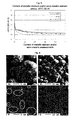
- a state of a time-dependent change in viscosity of a positive electrode slurry is shown in Fig. 1 .
- Example 2 Positive electrode active material Additive particles Additive amount*/(mol%) DC-IR/ ⁇ At 25°c At -25°C
- Example 1 Li 1.10 Ni 0.5 Co 0.2 Mn 0.3 Zr 0.005 O 2 WO 3 0.1 1.46 11.9
- Example 2 Li 1.10 Ni 0.5 Co 0.2 Mn 0.3 Zr 0.005 O 2 WO 3 0.2 1.39 11.8
- Example 3 Li 1.10 Ni 0.5 Co 0.2 Mn 0.3 Zr 0.005 O 2 WO 3 0.3 1.37 11.7
- Example 4 Li 1.10 Ni 0.5 Co 0.2 Mn 0.3 Zr 0.005 O 2 WO 3 0.5 1.31 11.4
- Example 5 Li 1.10 Ni 0.5 Co 0.2 Mn 0.3 Zr 0.005 O 2 WO 3 1.0 1.42 11.3
- Example 6 Li 1.10 Ni 0.5 Co 0.2 Mn 0.3 Zr 0.005 O 2 MoO 3 0.1 1.46 11.2
- Example 7 Li 1.10 Ni 0.5 Co 0.2 Mn 0.3 Zr 0.005 O
- the content of lithium hydroxide, that can cause gelation of a positive electrode slurry decreases in positive electrode compositions containing additive particles added therein of Examples 1 to 11 when compared with a positive electrode composition containing no additive particles added therein of Comparative Example 1.
- an increase in viscosity is suppressed in positive electrode slurries prepared using a positive electrode composition of Examples 1 to 11 when compared with a positive electrode slurry prepared using a positive electrode composition of Comparative Example 1.
- output power characteristics at -25°C are improved in nonaqueous electrolyte secondary batteries produced using a positive electrode composition of Examples 1 to 11 when compared with a nonaqueous electrolyte secondary battery produced using a positive electrode composition of Comparative Example 1.
- a significant difference is not observed in output power characteristics at 25°C even in any of Examples 1 to 11 and Comparative Example 1. This reveals that the effects of additive particles are remarkable in a low temperature region.
- the positive electrode composition for a nonaqueous electrolyte secondary battery of the present invention can be employed in a nonaqueous electrolyte secondary battery.
- the nonaqueous electrolyte secondary battery using the positive electrode composition of the present invention has an inexpensive price and improved output power characteristics, and also exhibits satisfactory yield and satisfactory operability, and thus the nonaqueous electrolyte secondary battery can be particularly suited for use not only in mobile devices such as a mobile phone, a note PC and a digital camera, but also in a high-output power supply for large-size applications such as a battery for an electric vehicle.
Landscapes
- Chemical & Material Sciences (AREA)
- Chemical Kinetics & Catalysis (AREA)
- Electrochemistry (AREA)
- General Chemical & Material Sciences (AREA)
- Inorganic Chemistry (AREA)
- Engineering & Computer Science (AREA)
- Materials Engineering (AREA)
- Manufacturing & Machinery (AREA)
- Battery Electrode And Active Subsutance (AREA)
Priority Applications (1)
| Application Number | Priority Date | Filing Date | Title |
|---|---|---|---|
| PL11798042T PL2587571T3 (pl) | 2010-06-22 | 2011-06-16 | Kompozycja elektrody dodatniej do akumulatora z niewodnym elektrolitem i sposób wytwarzania zawiesiny na elektrodę dodatnią z użyciem wspomnianej kompozycji elektrody dodatniej |
Applications Claiming Priority (3)
| Application Number | Priority Date | Filing Date | Title |
|---|---|---|---|
| JP2010141828 | 2010-06-22 | ||
| JP2011109958A JP5382061B2 (ja) | 2010-06-22 | 2011-05-17 | 非水電解液二次電池用正極組成物及び該正極組成物を用いた正極スラリー |
| PCT/JP2011/063806 WO2011162157A1 (ja) | 2010-06-22 | 2011-06-16 | 非水電解液二次電池用正極組成物及び該正極組成部物を用いた正極スラリーの製造方法 |
Publications (3)
| Publication Number | Publication Date |
|---|---|
| EP2587571A1 true EP2587571A1 (de) | 2013-05-01 |
| EP2587571A4 EP2587571A4 (de) | 2015-11-25 |
| EP2587571B1 EP2587571B1 (de) | 2018-12-19 |
Family
ID=45351657
Family Applications (1)
| Application Number | Title | Priority Date | Filing Date |
|---|---|---|---|
| EP11798042.5A Active EP2587571B1 (de) | 2010-06-22 | 2011-06-16 | Positivelektroden-zusammensetzung für eine sekundärbatterie mit nichtwässrigem elektrolyt sowie herstellungsverfahren für einen positivelektrodenschlamm mit dieser positivelektroden-zusammensetzung |
Country Status (9)
| Country | Link |
|---|---|
| US (1) | US9716272B2 (de) |
| EP (1) | EP2587571B1 (de) |
| JP (1) | JP5382061B2 (de) |
| KR (1) | KR101888204B1 (de) |
| CN (1) | CN102947983B (de) |
| BR (1) | BR112012032891B1 (de) |
| HU (1) | HUE043031T2 (de) |
| PL (1) | PL2587571T3 (de) |
| WO (1) | WO2011162157A1 (de) |
Families Citing this family (44)
| Publication number | Priority date | Publication date | Assignee | Title |
|---|---|---|---|---|
| JP2012238581A (ja) * | 2011-04-28 | 2012-12-06 | Nichia Chem Ind Ltd | 非水電解液二次電池用正極活物質 |
| JP6072688B2 (ja) * | 2011-07-28 | 2017-02-01 | 三洋電機株式会社 | 非水電解質二次電池及び非水電解質二次電池の製造方法 |
| WO2013018607A1 (ja) * | 2011-07-29 | 2013-02-07 | 三洋電機株式会社 | 非水電解質二次電池 |
| KR20130081055A (ko) | 2012-01-06 | 2013-07-16 | 삼성에스디아이 주식회사 | 리튬 전지용 양극 소재, 이로부터 얻어지는 양극 및 상기 양극을 채용한 리튬 전지 |
| JP6286855B2 (ja) * | 2012-04-18 | 2018-03-07 | 日亜化学工業株式会社 | 非水電解液二次電池用正極組成物 |
| US10256461B2 (en) * | 2012-09-25 | 2019-04-09 | Sanyo Electric Co., Ltd. | Nonaqueous electrolyte secondary battery and positive electrode active material for nonaqueous electrolyte secondary batteries |
| US10224538B2 (en) * | 2013-01-16 | 2019-03-05 | Samsung Sdi Co., Ltd. | Positive electrode for rechargeable lithium battery and rechargeable lithium battery including the same |
| CN105122514B (zh) * | 2013-03-26 | 2017-12-19 | 三洋电机株式会社 | 非水电解质二次电池用正极活性物质及使用其的非水电解质二次电池 |
| US9991514B2 (en) * | 2013-08-29 | 2018-06-05 | Lg Chem, Ltd. | Method of manufacturing lithium nickel complex oxide, lithium nickel complex oxide manufactured thereby, and cathode active material including the same |
| CN104584284B (zh) | 2013-08-29 | 2017-11-24 | 株式会社Lg 化学 | 锂过渡金属复合粒子及其制备方法、以及包含它的正极活性物质 |
| KR20150037085A (ko) | 2013-09-30 | 2015-04-08 | 주식회사 엘지화학 | 리튬 이차전지용 양극 활물질 및 이를 포함하는 리튬 이차전지 |
| KR101666384B1 (ko) * | 2013-09-30 | 2016-10-14 | 주식회사 엘지화학 | 고전압 리튬 이차전지용 양극 활물질 및 이를 포함하는 리튬 이차전지 |
| JP6575048B2 (ja) * | 2013-10-17 | 2019-09-18 | 日亜化学工業株式会社 | 非水電解液二次電池用正極組成物、非水電解液二次電池、及び非水電解液二次電池用正極組成物の製造方法。 |
| JP6852747B2 (ja) * | 2013-10-17 | 2021-03-31 | 日亜化学工業株式会社 | 非水電解液二次電池用正極組成物、非水電解液二次電池、及び非水電解液二次電池用正極組成物の製造方法。 |
| JP6495824B2 (ja) * | 2013-10-28 | 2019-04-03 | 住友化学株式会社 | リチウム含有複合酸化物の製造方法、リチウムイオン二次電池用正極およびリチウムイオン二次電池 |
| JP6743920B2 (ja) * | 2013-12-13 | 2020-08-19 | 日亜化学工業株式会社 | 非水電解液二次電池用正極活物質及びその製造方法 |
| JP6524651B2 (ja) * | 2013-12-13 | 2019-06-05 | 日亜化学工業株式会社 | 非水電解液二次電池用正極活物質及びその製造方法 |
| WO2015141194A1 (ja) * | 2014-03-20 | 2015-09-24 | 三洋電機株式会社 | 非水電解質二次電池用正極及び非水電解質二次電池 |
| JP6312489B2 (ja) * | 2014-03-27 | 2018-04-18 | オートモーティブエナジーサプライ株式会社 | 非水電解質電池及びその製造方法 |
| KR102394063B1 (ko) * | 2014-06-26 | 2022-05-06 | 도다 고교 가부시끼가이샤 | 비수 전해질 2차 전지용 정극 활물질 입자 분말, 그의 제조 방법, 및 비수 전해질 2차 전지 |
| JP6493409B2 (ja) * | 2014-09-26 | 2019-04-03 | 三洋電機株式会社 | 非水電解質二次電池 |
| CN105789609A (zh) * | 2014-12-15 | 2016-07-20 | 上海兆维科技发展有限公司 | 一种正极材料及其制备方法和用途 |
| CN107251303A (zh) * | 2015-02-27 | 2017-10-13 | 三洋电机株式会社 | 非水电解质二次电池 |
| JP7013871B2 (ja) * | 2015-10-28 | 2022-02-01 | 住友金属鉱山株式会社 | 非水系電解質二次電池用正極活物質とその製造方法、非水系電解質二次電池用正極合材ペーストおよび非水系電解質二次電池 |
| US11121368B2 (en) | 2015-11-27 | 2021-09-14 | Sumitomo Metal Mining Co., Ltd. | Positive electrode material for nonaqueous electrolyte secondary battery and method for producing the same, and positive electrode composite material paste, and nonaqueous electrolyte secondary battery |
| CN108352525B (zh) | 2015-12-11 | 2021-03-30 | 松下知识产权经营株式会社 | 非水电解质二次电池用正极活性物质和非水电解质二次电池 |
| JP7037873B2 (ja) * | 2016-02-03 | 2022-03-17 | Jx金属株式会社 | リチウムイオン電池用正極活物質、リチウムイオン電池用正極及びリチウムイオン電池 |
| CN108604708A (zh) * | 2016-02-29 | 2018-09-28 | 松下知识产权经营株式会社 | 非水电解质二次电池 |
| JP7135269B2 (ja) | 2016-03-24 | 2022-09-13 | 住友金属鉱山株式会社 | 非水系電解質二次電池用正極活物質とその製造方法、非水系電解質二次電池用正極合材ペーストおよび非水系電解質二次電池 |
| KR101892612B1 (ko) * | 2016-03-25 | 2018-08-28 | 주식회사 에코프로비엠 | 리튬이차전지 양극활물질의 제조 방법 및 이에 의하여 제조된 리튬이차전지 양극활물질 |
| WO2017199891A1 (ja) | 2016-05-16 | 2017-11-23 | 住友金属鉱山株式会社 | 非水系電解質二次電池用正極活物質とその製造方法、非水系電解質二次電池用正極合材ペーストおよび非水系電解質二次電池 |
| US10978711B2 (en) | 2016-08-29 | 2021-04-13 | Sumitomo Metal Mining Co., Ltd. | Positive electrode active material for nonaqueous electrolyte secondary battery, method for producing the same, positive electrode mixture paste for nonaqueous electrolyte secondary battery, and nonaqueous electrolyte secondary battery |
| JP6637873B2 (ja) * | 2016-11-02 | 2020-01-29 | Jx金属株式会社 | リチウムイオン二次電池用正極活物質、リチウムイオン二次電池用正極、及びリチウムイオン二次電池 |
| JP6819245B2 (ja) * | 2016-11-30 | 2021-01-27 | 三洋電機株式会社 | 非水電解質二次電池用正極板の製造方法及び非水電解質二次電池の製造方法、並びに非水電解質二次電池 |
| JP6343753B2 (ja) * | 2016-12-07 | 2018-06-20 | 住友化学株式会社 | リチウム二次電池用正極活物質、リチウム二次電池用正極及びリチウム二次電池 |
| KR102657433B1 (ko) | 2017-05-31 | 2024-04-16 | 스미토모 긴조쿠 고잔 가부시키가이샤 | 비수계 전해질 이차 전지용 정극 활물질과 그의 제조 방법, 비수계 전해질 이차 전지용 정극 합재 페이스트 및 비수계 전해질 이차 전지 |
| CN111279528B (zh) | 2017-08-25 | 2023-07-07 | 住友金属矿山株式会社 | 非水系电解质二次电池用正极活性物质及其制法、正极复合材糊料及非水系电解质二次电池 |
| JP7008828B2 (ja) | 2017-12-26 | 2022-01-25 | ポスコ | リチウム二次電池用正極活物質、その製造方法、およびこれを含むリチウム二次電池 |
| KR102010929B1 (ko) | 2017-12-26 | 2019-08-16 | 주식회사 포스코 | 리튬 이차 전지용 양극 활물질, 이의 제조 방법, 및 이를 포함하는 리튬 이차 전지 |
| JP7110611B2 (ja) | 2018-02-06 | 2022-08-02 | 住友金属鉱山株式会社 | 非水系電解質二次電池用正極活物質とその製造方法、非水系電解質二次電池用正極活物質の評価方法、および非水系電解質二次電池 |
| JP7439748B2 (ja) | 2018-03-20 | 2024-02-28 | 住友金属鉱山株式会社 | 非水系電解質二次電池用正極活物質とその製造方法 |
| US12159996B2 (en) | 2020-03-25 | 2024-12-03 | Samsung Sdi Co., Ltd. | Positive electrode active material, positive electrode including the same, and lithium secondary battery employing the positive electrode |
| US20230219827A1 (en) * | 2020-05-06 | 2023-07-13 | Basf Se | Electrode active materials and processes to make them |
| EP4310954A4 (de) * | 2022-03-24 | 2025-03-26 | JX Metals Corporation | Positivelektrodenaktivmaterial für lithium-ionen-batterie, positive elektrode für lithium-ionen-batterie, lithium-ionen-batterie, positivelektrodenaktivmaterial für festkörper-lithium-ionen-batterie, positive elektrode für all-solid-state-lithium-ionen-batterie, positive elektrode für eine lithium-ionen-batterie mit positiver elektrode, verfahren zur herstellung eines positivelektroden-aktivmaterials für eine lithium-ionen-batterie und verfahren zur herstellung eines positivelektroden-aktivmaterials für eine lithium-ionen-batterie |
Citations (3)
| Publication number | Priority date | Publication date | Assignee | Title |
|---|---|---|---|---|
| US20060046143A1 (en) | 2004-08-30 | 2006-03-02 | Shin-Kobe Electric Machinery Co., Ltd. | Positive electrode active material, non-aqueous electrolyte secondary battery and method for manufacturing positive electrode active material |
| US20060083988A1 (en) | 2004-04-07 | 2006-04-20 | Matsushita Electric Industrial Co., Ltd. | Non-aqueous electrolyte secondary battery |
| US20080090150A1 (en) | 2005-03-23 | 2008-04-17 | Kensuke Nakura | Lithium Ion Secondary Battery And Manufacturing Method Therefor |
Family Cites Families (19)
| Publication number | Priority date | Publication date | Assignee | Title |
|---|---|---|---|---|
| JP4114247B2 (ja) | 1998-09-30 | 2008-07-09 | 松下電器産業株式会社 | 非水電解液二次電池 |
| KR100326457B1 (ko) | 1999-03-10 | 2002-02-28 | 김순택 | 리튬 이차 전지용 양극 활물질 및 그 제조 방법 |
| DE19922522A1 (de) * | 1999-05-15 | 2000-11-16 | Merck Patent Gmbh | Beschichtete Lithium-Mischoxid-Partikel und deren Verwendung |
| US6730435B1 (en) | 1999-10-26 | 2004-05-04 | Sumitomo Chemical Company, Limited | Active material for non-aqueous secondary battery, and non-aqueous secondary battery using the same |
| JP2002075367A (ja) | 2000-09-04 | 2002-03-15 | Mitsui Chemicals Inc | リチウム電池用正極活物質、その製法およびそれを用いた二次電池 |
| KR100709205B1 (ko) * | 2001-04-02 | 2007-04-18 | 삼성에스디아이 주식회사 | 리튬 이차 전지용 양극 활물질 조성물 |
| US8658125B2 (en) * | 2001-10-25 | 2014-02-25 | Panasonic Corporation | Positive electrode active material and non-aqueous electrolyte secondary battery containing the same |
| JP2003142101A (ja) * | 2001-10-31 | 2003-05-16 | Nec Corp | 二次電池用正極およびそれを用いた二次電池 |
| JP2005251716A (ja) * | 2004-02-05 | 2005-09-15 | Nichia Chem Ind Ltd | 非水電解質二次電池用正極活物質、非水電解質二次電池用正極合剤および非水電解質二次電池 |
| JP5082204B2 (ja) * | 2005-05-27 | 2012-11-28 | ソニー株式会社 | リチウム二次電池用正極活物質の製造方法およびリチウム二次電池 |
| US20070141470A1 (en) | 2005-12-16 | 2007-06-21 | Kensuke Nakura | Lithium ion secondary battery |
| JP2007188878A (ja) | 2005-12-16 | 2007-07-26 | Matsushita Electric Ind Co Ltd | リチウムイオン二次電池 |
| KR101201170B1 (ko) * | 2006-03-21 | 2012-11-13 | 삼성에스디아이 주식회사 | 리튬 이차 전지용 양극과 이를 포함하는 리튬 이차전지 및리튬 이차전지의 제조방법 |
| KR101264332B1 (ko) * | 2006-09-20 | 2013-05-14 | 삼성에스디아이 주식회사 | 캐소드 활물질 및 이를 채용한 리튬 전지 |
| JP2009032647A (ja) * | 2007-06-25 | 2009-02-12 | Mitsubishi Chemicals Corp | リチウム二次電池用正極活物質材料、及びそれを用いたリチウム二次電池用正極並びにリチウム二次電池 |
| JP5428251B2 (ja) * | 2007-09-04 | 2014-02-26 | 三菱化学株式会社 | リチウム遷移金属系化合物粉体、それを用いたリチウム二次電池用正極及びリチウム二次電池 |
| JP2011060605A (ja) * | 2009-09-10 | 2011-03-24 | Toyota Motor Corp | リチウムイオン二次電池、車両、電池搭載機器及び正電極板 |
| JPWO2011078263A1 (ja) * | 2009-12-24 | 2013-05-09 | 日本ゼオン株式会社 | 二次電池用電極及び二次電池 |
| JP2011146158A (ja) * | 2010-01-12 | 2011-07-28 | Toyota Motor Corp | リチウム二次電池 |
-
2011
- 2011-05-17 JP JP2011109958A patent/JP5382061B2/ja active Active
- 2011-06-16 BR BR112012032891A patent/BR112012032891B1/pt active IP Right Grant
- 2011-06-16 HU HUE11798042A patent/HUE043031T2/hu unknown
- 2011-06-16 PL PL11798042T patent/PL2587571T3/pl unknown
- 2011-06-16 EP EP11798042.5A patent/EP2587571B1/de active Active
- 2011-06-16 CN CN201180031285.XA patent/CN102947983B/zh active Active
- 2011-06-16 WO PCT/JP2011/063806 patent/WO2011162157A1/ja not_active Ceased
- 2011-06-16 KR KR1020127025328A patent/KR101888204B1/ko active Active
- 2011-06-20 US US13/164,359 patent/US9716272B2/en active Active
Patent Citations (3)
| Publication number | Priority date | Publication date | Assignee | Title |
|---|---|---|---|---|
| US20060083988A1 (en) | 2004-04-07 | 2006-04-20 | Matsushita Electric Industrial Co., Ltd. | Non-aqueous electrolyte secondary battery |
| US20060046143A1 (en) | 2004-08-30 | 2006-03-02 | Shin-Kobe Electric Machinery Co., Ltd. | Positive electrode active material, non-aqueous electrolyte secondary battery and method for manufacturing positive electrode active material |
| US20080090150A1 (en) | 2005-03-23 | 2008-04-17 | Kensuke Nakura | Lithium Ion Secondary Battery And Manufacturing Method Therefor |
Non-Patent Citations (1)
| Title |
|---|
| See also references of WO2011162157A1 |
Also Published As
| Publication number | Publication date |
|---|---|
| JP2012028313A (ja) | 2012-02-09 |
| HUE043031T2 (hu) | 2019-07-29 |
| JP5382061B2 (ja) | 2014-01-08 |
| PL2587571T3 (pl) | 2019-04-30 |
| CN102947983A (zh) | 2013-02-27 |
| EP2587571A4 (de) | 2015-11-25 |
| WO2011162157A1 (ja) | 2011-12-29 |
| US20110315918A1 (en) | 2011-12-29 |
| US9716272B2 (en) | 2017-07-25 |
| CN102947983B (zh) | 2016-03-23 |
| BR112012032891A2 (pt) | 2016-11-29 |
| KR20130086279A (ko) | 2013-08-01 |
| KR101888204B1 (ko) | 2018-08-13 |
| EP2587571B1 (de) | 2018-12-19 |
| BR112012032891B1 (pt) | 2020-01-14 |
Similar Documents
| Publication | Publication Date | Title |
|---|---|---|
| EP2587571B1 (de) | Positivelektroden-zusammensetzung für eine sekundärbatterie mit nichtwässrigem elektrolyt sowie herstellungsverfahren für einen positivelektrodenschlamm mit dieser positivelektroden-zusammensetzung | |
| US10454097B2 (en) | Positive electrode composition for nonaqueous electrolyte secondary battery | |
| JP6744880B2 (ja) | リチウムイオン電池用正極活物質、リチウムイオン電池用正極活物質の製造方法、リチウムイオン電池用正極及びリチウムイオン電池 | |
| CN103988349B (zh) | 非水系电解质二次电池用正极材料及其制造方法、及使用了该正极材料的非水系电解质二次电池 | |
| JP5842596B2 (ja) | 非水電解液二次電池用正極組成物及び非水電解液二次電池用正極スラリーの製造方法 | |
| JP6575048B2 (ja) | 非水電解液二次電池用正極組成物、非水電解液二次電池、及び非水電解液二次電池用正極組成物の製造方法。 | |
| KR101319376B1 (ko) | 리튬 이차 전지용 양극 활물질, 및 이를 포함하는 양극 및 리튬 이차 전지 | |
| US20130330615A1 (en) | Lithium-ion secondary battery and method for manufacturing the same | |
| US10516159B2 (en) | Positive electrode active material for nonaqueous secondary battery | |
| US11967713B2 (en) | Positive electrode active material for non-aqueous electrolyte secondary battery comprising tungsten coating film, and non-aqueous electrolyte secondary battery | |
| JP7262419B2 (ja) | 非水系電解質二次電池用正極活物質、および非水系電解質二次電池 | |
| CN115280553A (zh) | 全固体型锂离子二次电池用正极活性物质及其制造方法、以及全固体型锂离子二次电池 | |
| JP6852747B2 (ja) | 非水電解液二次電池用正極組成物、非水電解液二次電池、及び非水電解液二次電池用正極組成物の製造方法。 | |
| KR100910264B1 (ko) | 리튬 이차 전지용 양극 활물질 및 이를 포함하는 리튬 이차전지 | |
| JP6624631B2 (ja) | リチウム遷移金属複合酸化物及びその製造方法 | |
| US12170368B2 (en) | Method of manufacturing positive electrode active material for lithium ion secondary battery | |
| CN109983601A (zh) | 非水电解质二次电池用正极及非水电解质二次电池 | |
| US20220102696A1 (en) | Method of manufacturing positive electrode active material for lithium ion secondary battery, positive electrode active material for lithium ion secondary battery, and lithium ion secondary battery | |
| JP2016184497A (ja) | 非水系リチウム二次電池 | |
| KR20230032830A (ko) | 정극 활물질, 고온 동작형 리튬 이온 폴리머 이차 전지, 고온 동작형 리튬 이온 무기 전고체 이차 전지 | |
| KR20250094466A (ko) | 리튬 이차전지용 양극 활물질 및 이의 제조방법 |
Legal Events
| Date | Code | Title | Description |
|---|---|---|---|
| PUAI | Public reference made under article 153(3) epc to a published international application that has entered the european phase |
Free format text: ORIGINAL CODE: 0009012 |
|
| 17P | Request for examination filed |
Effective date: 20121128 |
|
| AK | Designated contracting states |
Kind code of ref document: A1 Designated state(s): AL AT BE BG CH CY CZ DE DK EE ES FI FR GB GR HR HU IE IS IT LI LT LU LV MC MK MT NL NO PL PT RO RS SE SI SK SM TR |
|
| DAX | Request for extension of the european patent (deleted) | ||
| TPAC | Observations filed by third parties |
Free format text: ORIGINAL CODE: EPIDOSNTIPA |
|
| RA4 | Supplementary search report drawn up and despatched (corrected) |
Effective date: 20151027 |
|
| RIC1 | Information provided on ipc code assigned before grant |
Ipc: H01M 4/505 20100101ALI20151021BHEP Ipc: H01M 4/525 20100101AFI20151021BHEP Ipc: H01M 4/62 20060101ALI20151021BHEP Ipc: H01M 4/131 20100101ALI20151021BHEP |
|
| STAA | Information on the status of an ep patent application or granted ep patent |
Free format text: STATUS: EXAMINATION IS IN PROGRESS |
|
| 17Q | First examination report despatched |
Effective date: 20171023 |
|
| REG | Reference to a national code |
Ref country code: DE Ref legal event code: R079 Ref document number: 602011054984 Country of ref document: DE Free format text: PREVIOUS MAIN CLASS: H01M0004525000 Ipc: H01M0004505000 |
|
| GRAP | Despatch of communication of intention to grant a patent |
Free format text: ORIGINAL CODE: EPIDOSNIGR1 |
|
| STAA | Information on the status of an ep patent application or granted ep patent |
Free format text: STATUS: GRANT OF PATENT IS INTENDED |
|
| RIC1 | Information provided on ipc code assigned before grant |
Ipc: H01M 4/505 20100101AFI20180530BHEP Ipc: H01M 4/525 20100101ALI20180530BHEP |
|
| INTG | Intention to grant announced |
Effective date: 20180629 |
|
| GRAS | Grant fee paid |
Free format text: ORIGINAL CODE: EPIDOSNIGR3 |
|
| GRAA | (expected) grant |
Free format text: ORIGINAL CODE: 0009210 |
|
| STAA | Information on the status of an ep patent application or granted ep patent |
Free format text: STATUS: THE PATENT HAS BEEN GRANTED |
|
| AK | Designated contracting states |
Kind code of ref document: B1 Designated state(s): AL AT BE BG CH CY CZ DE DK EE ES FI FR GB GR HR HU IE IS IT LI LT LU LV MC MK MT NL NO PL PT RO RS SE SI SK SM TR |
|
| REG | Reference to a national code |
Ref country code: GB Ref legal event code: FG4D |
|
| REG | Reference to a national code |
Ref country code: CH Ref legal event code: EP |
|
| REG | Reference to a national code |
Ref country code: IE Ref legal event code: FG4D |
|
| REG | Reference to a national code |
Ref country code: DE Ref legal event code: R096 Ref document number: 602011054984 Country of ref document: DE |
|
| REG | Reference to a national code |
Ref country code: AT Ref legal event code: REF Ref document number: 1079635 Country of ref document: AT Kind code of ref document: T Effective date: 20190115 |
|
| REG | Reference to a national code |
Ref country code: NL Ref legal event code: MP Effective date: 20181219 |
|
| PG25 | Lapsed in a contracting state [announced via postgrant information from national office to epo] |
Ref country code: FI Free format text: LAPSE BECAUSE OF FAILURE TO SUBMIT A TRANSLATION OF THE DESCRIPTION OR TO PAY THE FEE WITHIN THE PRESCRIBED TIME-LIMIT Effective date: 20181219 Ref country code: BG Free format text: LAPSE BECAUSE OF FAILURE TO SUBMIT A TRANSLATION OF THE DESCRIPTION OR TO PAY THE FEE WITHIN THE PRESCRIBED TIME-LIMIT Effective date: 20190319 Ref country code: NO Free format text: LAPSE BECAUSE OF FAILURE TO SUBMIT A TRANSLATION OF THE DESCRIPTION OR TO PAY THE FEE WITHIN THE PRESCRIBED TIME-LIMIT Effective date: 20190319 Ref country code: HR Free format text: LAPSE BECAUSE OF FAILURE TO SUBMIT A TRANSLATION OF THE DESCRIPTION OR TO PAY THE FEE WITHIN THE PRESCRIBED TIME-LIMIT Effective date: 20181219 Ref country code: LT Free format text: LAPSE BECAUSE OF FAILURE TO SUBMIT A TRANSLATION OF THE DESCRIPTION OR TO PAY THE FEE WITHIN THE PRESCRIBED TIME-LIMIT Effective date: 20181219 Ref country code: LV Free format text: LAPSE BECAUSE OF FAILURE TO SUBMIT A TRANSLATION OF THE DESCRIPTION OR TO PAY THE FEE WITHIN THE PRESCRIBED TIME-LIMIT Effective date: 20181219 |
|
| REG | Reference to a national code |
Ref country code: LT Ref legal event code: MG4D |
|
| REG | Reference to a national code |
Ref country code: AT Ref legal event code: MK05 Ref document number: 1079635 Country of ref document: AT Kind code of ref document: T Effective date: 20181219 |
|
| PG25 | Lapsed in a contracting state [announced via postgrant information from national office to epo] |
Ref country code: GR Free format text: LAPSE BECAUSE OF FAILURE TO SUBMIT A TRANSLATION OF THE DESCRIPTION OR TO PAY THE FEE WITHIN THE PRESCRIBED TIME-LIMIT Effective date: 20190320 Ref country code: AL Free format text: LAPSE BECAUSE OF FAILURE TO SUBMIT A TRANSLATION OF THE DESCRIPTION OR TO PAY THE FEE WITHIN THE PRESCRIBED TIME-LIMIT Effective date: 20181219 Ref country code: RS Free format text: LAPSE BECAUSE OF FAILURE TO SUBMIT A TRANSLATION OF THE DESCRIPTION OR TO PAY THE FEE WITHIN THE PRESCRIBED TIME-LIMIT Effective date: 20181219 Ref country code: SE Free format text: LAPSE BECAUSE OF FAILURE TO SUBMIT A TRANSLATION OF THE DESCRIPTION OR TO PAY THE FEE WITHIN THE PRESCRIBED TIME-LIMIT Effective date: 20181219 |
|
| PG25 | Lapsed in a contracting state [announced via postgrant information from national office to epo] |
Ref country code: NL Free format text: LAPSE BECAUSE OF FAILURE TO SUBMIT A TRANSLATION OF THE DESCRIPTION OR TO PAY THE FEE WITHIN THE PRESCRIBED TIME-LIMIT Effective date: 20181219 |
|
| REG | Reference to a national code |
Ref country code: HU Ref legal event code: AG4A Ref document number: E043031 Country of ref document: HU |
|
| PG25 | Lapsed in a contracting state [announced via postgrant information from national office to epo] |
Ref country code: PT Free format text: LAPSE BECAUSE OF FAILURE TO SUBMIT A TRANSLATION OF THE DESCRIPTION OR TO PAY THE FEE WITHIN THE PRESCRIBED TIME-LIMIT Effective date: 20190419 Ref country code: ES Free format text: LAPSE BECAUSE OF FAILURE TO SUBMIT A TRANSLATION OF THE DESCRIPTION OR TO PAY THE FEE WITHIN THE PRESCRIBED TIME-LIMIT Effective date: 20181219 |
|
| PG25 | Lapsed in a contracting state [announced via postgrant information from national office to epo] |
Ref country code: RO Free format text: LAPSE BECAUSE OF FAILURE TO SUBMIT A TRANSLATION OF THE DESCRIPTION OR TO PAY THE FEE WITHIN THE PRESCRIBED TIME-LIMIT Effective date: 20181219 Ref country code: IS Free format text: LAPSE BECAUSE OF FAILURE TO SUBMIT A TRANSLATION OF THE DESCRIPTION OR TO PAY THE FEE WITHIN THE PRESCRIBED TIME-LIMIT Effective date: 20190419 Ref country code: SK Free format text: LAPSE BECAUSE OF FAILURE TO SUBMIT A TRANSLATION OF THE DESCRIPTION OR TO PAY THE FEE WITHIN THE PRESCRIBED TIME-LIMIT Effective date: 20181219 Ref country code: EE Free format text: LAPSE BECAUSE OF FAILURE TO SUBMIT A TRANSLATION OF THE DESCRIPTION OR TO PAY THE FEE WITHIN THE PRESCRIBED TIME-LIMIT Effective date: 20181219 Ref country code: SM Free format text: LAPSE BECAUSE OF FAILURE TO SUBMIT A TRANSLATION OF THE DESCRIPTION OR TO PAY THE FEE WITHIN THE PRESCRIBED TIME-LIMIT Effective date: 20181219 |
|
| REG | Reference to a national code |
Ref country code: DE Ref legal event code: R097 Ref document number: 602011054984 Country of ref document: DE |
|
| PLBE | No opposition filed within time limit |
Free format text: ORIGINAL CODE: 0009261 |
|
| STAA | Information on the status of an ep patent application or granted ep patent |
Free format text: STATUS: NO OPPOSITION FILED WITHIN TIME LIMIT |
|
| PG25 | Lapsed in a contracting state [announced via postgrant information from national office to epo] |
Ref country code: DK Free format text: LAPSE BECAUSE OF FAILURE TO SUBMIT A TRANSLATION OF THE DESCRIPTION OR TO PAY THE FEE WITHIN THE PRESCRIBED TIME-LIMIT Effective date: 20181219 Ref country code: AT Free format text: LAPSE BECAUSE OF FAILURE TO SUBMIT A TRANSLATION OF THE DESCRIPTION OR TO PAY THE FEE WITHIN THE PRESCRIBED TIME-LIMIT Effective date: 20181219 |
|
| 26N | No opposition filed |
Effective date: 20190920 |
|
| PG25 | Lapsed in a contracting state [announced via postgrant information from national office to epo] |
Ref country code: MC Free format text: LAPSE BECAUSE OF FAILURE TO SUBMIT A TRANSLATION OF THE DESCRIPTION OR TO PAY THE FEE WITHIN THE PRESCRIBED TIME-LIMIT Effective date: 20181219 |
|
| REG | Reference to a national code |
Ref country code: CH Ref legal event code: PL |
|
| PG25 | Lapsed in a contracting state [announced via postgrant information from national office to epo] |
Ref country code: SI Free format text: LAPSE BECAUSE OF FAILURE TO SUBMIT A TRANSLATION OF THE DESCRIPTION OR TO PAY THE FEE WITHIN THE PRESCRIBED TIME-LIMIT Effective date: 20181219 |
|
| PG25 | Lapsed in a contracting state [announced via postgrant information from national office to epo] |
Ref country code: TR Free format text: LAPSE BECAUSE OF FAILURE TO SUBMIT A TRANSLATION OF THE DESCRIPTION OR TO PAY THE FEE WITHIN THE PRESCRIBED TIME-LIMIT Effective date: 20181219 |
|
| PG25 | Lapsed in a contracting state [announced via postgrant information from national office to epo] |
Ref country code: IE Free format text: LAPSE BECAUSE OF NON-PAYMENT OF DUE FEES Effective date: 20190616 |
|
| PG25 | Lapsed in a contracting state [announced via postgrant information from national office to epo] |
Ref country code: CH Free format text: LAPSE BECAUSE OF NON-PAYMENT OF DUE FEES Effective date: 20190630 Ref country code: LI Free format text: LAPSE BECAUSE OF NON-PAYMENT OF DUE FEES Effective date: 20190630 Ref country code: LU Free format text: LAPSE BECAUSE OF NON-PAYMENT OF DUE FEES Effective date: 20190616 |
|
| PG25 | Lapsed in a contracting state [announced via postgrant information from national office to epo] |
Ref country code: CY Free format text: LAPSE BECAUSE OF FAILURE TO SUBMIT A TRANSLATION OF THE DESCRIPTION OR TO PAY THE FEE WITHIN THE PRESCRIBED TIME-LIMIT Effective date: 20181219 |
|
| PG25 | Lapsed in a contracting state [announced via postgrant information from national office to epo] |
Ref country code: MT Free format text: LAPSE BECAUSE OF FAILURE TO SUBMIT A TRANSLATION OF THE DESCRIPTION OR TO PAY THE FEE WITHIN THE PRESCRIBED TIME-LIMIT Effective date: 20181219 |
|
| PG25 | Lapsed in a contracting state [announced via postgrant information from national office to epo] |
Ref country code: MK Free format text: LAPSE BECAUSE OF FAILURE TO SUBMIT A TRANSLATION OF THE DESCRIPTION OR TO PAY THE FEE WITHIN THE PRESCRIBED TIME-LIMIT Effective date: 20181219 |
|
| P01 | Opt-out of the competence of the unified patent court (upc) registered |
Effective date: 20230522 |
|
| PGFP | Annual fee paid to national office [announced via postgrant information from national office to epo] |
Ref country code: DE Payment date: 20250429 Year of fee payment: 15 Ref country code: PL Payment date: 20250429 Year of fee payment: 15 |
|
| PGFP | Annual fee paid to national office [announced via postgrant information from national office to epo] |
Ref country code: GB Payment date: 20250501 Year of fee payment: 15 |
|
| PGFP | Annual fee paid to national office [announced via postgrant information from national office to epo] |
Ref country code: BE Payment date: 20250516 Year of fee payment: 15 Ref country code: IT Payment date: 20250522 Year of fee payment: 15 |
|
| PGFP | Annual fee paid to national office [announced via postgrant information from national office to epo] |
Ref country code: HU Payment date: 20250529 Year of fee payment: 15 Ref country code: FR Payment date: 20250508 Year of fee payment: 15 |
|
| PGFP | Annual fee paid to national office [announced via postgrant information from national office to epo] |
Ref country code: CZ Payment date: 20250530 Year of fee payment: 15 |