EP2390948A2 - Aktives elektrodenmaterial für anionenarme lithiumübergangsmetallphosphatverbindung, herstellungsverfahren dafür und elektrochemische vorrichtung damit - Google Patents
Aktives elektrodenmaterial für anionenarme lithiumübergangsmetallphosphatverbindung, herstellungsverfahren dafür und elektrochemische vorrichtung damit Download PDFInfo
- Publication number
- EP2390948A2 EP2390948A2 EP10733657A EP10733657A EP2390948A2 EP 2390948 A2 EP2390948 A2 EP 2390948A2 EP 10733657 A EP10733657 A EP 10733657A EP 10733657 A EP10733657 A EP 10733657A EP 2390948 A2 EP2390948 A2 EP 2390948A2
- Authority
- EP
- European Patent Office
- Prior art keywords
- anion
- lithium transition
- metal phosphate
- lithium
- mol
- Prior art date
- Legal status (The legal status is an assumption and is not a legal conclusion. Google has not performed a legal analysis and makes no representation as to the accuracy of the status listed.)
- Withdrawn
Links
- 229910052744 lithium Inorganic materials 0.000 title claims abstract description 197
- WHXSMMKQMYFTQS-UHFFFAOYSA-N Lithium Chemical compound [Li] WHXSMMKQMYFTQS-UHFFFAOYSA-N 0.000 title claims abstract description 192
- 150000001450 anions Chemical class 0.000 title claims abstract description 174
- 230000002950 deficient Effects 0.000 title claims abstract description 136
- 229910000319 transition metal phosphate Inorganic materials 0.000 title claims abstract description 115
- 150000001875 compounds Chemical class 0.000 title claims abstract description 112
- 238000000034 method Methods 0.000 title claims abstract description 41
- 239000007772 electrode material Substances 0.000 title abstract description 14
- XLYOFNOQVPJJNP-UHFFFAOYSA-N water Substances O XLYOFNOQVPJJNP-UHFFFAOYSA-N 0.000 claims abstract description 151
- 229910019142 PO4 Inorganic materials 0.000 claims abstract description 117
- 239000002243 precursor Substances 0.000 claims abstract description 45
- 238000001354 calcination Methods 0.000 claims abstract description 21
- 239000000126 substance Substances 0.000 claims abstract description 20
- 238000006243 chemical reaction Methods 0.000 claims abstract description 18
- 238000002156 mixing Methods 0.000 claims abstract description 15
- 229910052751 metal Inorganic materials 0.000 claims description 65
- 239000002184 metal Substances 0.000 claims description 64
- 229910052748 manganese Inorganic materials 0.000 claims description 36
- 239000013078 crystal Substances 0.000 claims description 35
- CZMRCDWAGMRECN-UGDNZRGBSA-N Sucrose Chemical compound O[C@H]1[C@H](O)[C@@H](CO)O[C@@]1(CO)O[C@@H]1[C@H](O)[C@@H](O)[C@H](O)[C@@H](CO)O1 CZMRCDWAGMRECN-UGDNZRGBSA-N 0.000 claims description 28
- 229930006000 Sucrose Natural products 0.000 claims description 28
- 229910052759 nickel Inorganic materials 0.000 claims description 28
- 239000005720 sucrose Substances 0.000 claims description 28
- 239000010450 olivine Substances 0.000 claims description 26
- 229910052609 olivine Inorganic materials 0.000 claims description 26
- -1 phosphate compound Chemical class 0.000 claims description 19
- 239000003795 chemical substances by application Substances 0.000 claims description 16
- MUBZPKHOEPUJKR-UHFFFAOYSA-N Oxalic acid Chemical compound OC(=O)C(O)=O MUBZPKHOEPUJKR-UHFFFAOYSA-N 0.000 claims description 15
- 239000010452 phosphate Substances 0.000 claims description 14
- OKTJSMMVPCPJKN-UHFFFAOYSA-N Carbon Chemical compound [C] OKTJSMMVPCPJKN-UHFFFAOYSA-N 0.000 claims description 10
- 229910052804 chromium Inorganic materials 0.000 claims description 9
- 229910052802 copper Inorganic materials 0.000 claims description 9
- 238000001035 drying Methods 0.000 claims description 9
- 229910052750 molybdenum Inorganic materials 0.000 claims description 9
- 229910052758 niobium Inorganic materials 0.000 claims description 9
- 229910052719 titanium Inorganic materials 0.000 claims description 9
- 229910052720 vanadium Inorganic materials 0.000 claims description 9
- 229910052725 zinc Inorganic materials 0.000 claims description 9
- 229910052726 zirconium Inorganic materials 0.000 claims description 9
- CIWBSHSKHKDKBQ-JLAZNSOCSA-N Ascorbic acid Chemical compound OC[C@H](O)[C@H]1OC(=O)C(O)=C1O CIWBSHSKHKDKBQ-JLAZNSOCSA-N 0.000 claims description 8
- 230000000737 periodic effect Effects 0.000 claims description 8
- 229910052782 aluminium Inorganic materials 0.000 claims description 7
- 229910052799 carbon Inorganic materials 0.000 claims description 7
- 239000004372 Polyvinyl alcohol Substances 0.000 claims description 6
- 239000007833 carbon precursor Substances 0.000 claims description 6
- 239000003638 chemical reducing agent Substances 0.000 claims description 6
- 239000003792 electrolyte Substances 0.000 claims description 6
- 229920002451 polyvinyl alcohol Polymers 0.000 claims description 6
- NLKNQRATVPKPDG-UHFFFAOYSA-M potassium iodide Chemical compound [K+].[I-] NLKNQRATVPKPDG-UHFFFAOYSA-M 0.000 claims description 6
- 239000011164 primary particle Substances 0.000 claims description 6
- 229910052706 scandium Inorganic materials 0.000 claims description 6
- 229910052727 yttrium Inorganic materials 0.000 claims description 6
- 229910052784 alkaline earth metal Inorganic materials 0.000 claims description 5
- 229910052796 boron Inorganic materials 0.000 claims description 5
- 229910052795 boron group element Inorganic materials 0.000 claims description 5
- 238000005469 granulation Methods 0.000 claims description 5
- 230000003179 granulation Effects 0.000 claims description 5
- 229910052749 magnesium Inorganic materials 0.000 claims description 5
- 235000006408 oxalic acid Nutrition 0.000 claims description 5
- 235000019422 polyvinyl alcohol Nutrition 0.000 claims description 5
- 239000005715 Fructose Substances 0.000 claims description 4
- 229930091371 Fructose Natural products 0.000 claims description 4
- RFSUNEUAIZKAJO-ARQDHWQXSA-N Fructose Chemical compound OC[C@H]1O[C@](O)(CO)[C@@H](O)[C@@H]1O RFSUNEUAIZKAJO-ARQDHWQXSA-N 0.000 claims description 4
- OAKJQQAXSVQMHS-UHFFFAOYSA-N Hydrazine Chemical compound NN OAKJQQAXSVQMHS-UHFFFAOYSA-N 0.000 claims description 4
- 239000002202 Polyethylene glycol Substances 0.000 claims description 4
- 235000010323 ascorbic acid Nutrition 0.000 claims description 4
- 239000011668 ascorbic acid Substances 0.000 claims description 4
- 229960005070 ascorbic acid Drugs 0.000 claims description 4
- 229920001223 polyethylene glycol Polymers 0.000 claims description 4
- LPXPTNMVRIOKMN-UHFFFAOYSA-M sodium nitrite Chemical compound [Na+].[O-]N=O LPXPTNMVRIOKMN-UHFFFAOYSA-M 0.000 claims description 4
- GEHJYWRUCIMESM-UHFFFAOYSA-L sodium sulfite Chemical compound [Na+].[Na+].[O-]S([O-])=O GEHJYWRUCIMESM-UHFFFAOYSA-L 0.000 claims description 4
- 229910052733 gallium Inorganic materials 0.000 claims description 3
- 239000010439 graphite Substances 0.000 claims description 3
- 229910002804 graphite Inorganic materials 0.000 claims description 3
- 239000001257 hydrogen Substances 0.000 claims description 3
- 229910052739 hydrogen Inorganic materials 0.000 claims description 3
- 239000004215 Carbon black (E152) Substances 0.000 claims description 2
- 229920002472 Starch Polymers 0.000 claims description 2
- 239000001913 cellulose Substances 0.000 claims description 2
- 229920002678 cellulose Polymers 0.000 claims description 2
- 235000010980 cellulose Nutrition 0.000 claims description 2
- 229930195733 hydrocarbon Natural products 0.000 claims description 2
- 150000002430 hydrocarbons Chemical class 0.000 claims description 2
- 125000004435 hydrogen atom Chemical class [H]* 0.000 claims description 2
- 235000007715 potassium iodide Nutrition 0.000 claims description 2
- 235000010288 sodium nitrite Nutrition 0.000 claims description 2
- 235000010265 sodium sulphite Nutrition 0.000 claims description 2
- 235000019698 starch Nutrition 0.000 claims description 2
- 239000008107 starch Substances 0.000 claims description 2
- 239000011203 carbon fibre reinforced carbon Substances 0.000 claims 1
- 239000001488 sodium phosphate Substances 0.000 claims 1
- 229910000162 sodium phosphate Inorganic materials 0.000 claims 1
- 235000011008 sodium phosphates Nutrition 0.000 claims 1
- RYFMWSXOAZQYPI-UHFFFAOYSA-K trisodium phosphate Chemical compound [Na+].[Na+].[Na+].[O-]P([O-])([O-])=O RYFMWSXOAZQYPI-UHFFFAOYSA-K 0.000 claims 1
- 229910009403 Li1-xM Inorganic materials 0.000 abstract description 5
- 239000000243 solution Substances 0.000 description 109
- XEEYBQQBJWHFJM-UHFFFAOYSA-N iron Substances [Fe] XEEYBQQBJWHFJM-UHFFFAOYSA-N 0.000 description 108
- 239000011572 manganese Substances 0.000 description 87
- WMFOQBRAJBCJND-UHFFFAOYSA-M Lithium hydroxide Chemical compound [Li+].[OH-] WMFOQBRAJBCJND-UHFFFAOYSA-M 0.000 description 80
- PXHVJJICTQNCMI-UHFFFAOYSA-N nickel Substances [Ni] PXHVJJICTQNCMI-UHFFFAOYSA-N 0.000 description 75
- 230000000052 comparative effect Effects 0.000 description 52
- NBIIXXVUZAFLBC-UHFFFAOYSA-N Phosphoric acid Chemical compound OP(O)(O)=O NBIIXXVUZAFLBC-UHFFFAOYSA-N 0.000 description 50
- 239000000047 product Substances 0.000 description 47
- QGZKDVFQNNGYKY-UHFFFAOYSA-N Ammonia Chemical compound N QGZKDVFQNNGYKY-UHFFFAOYSA-N 0.000 description 44
- 238000002360 preparation method Methods 0.000 description 42
- 230000003647 oxidation Effects 0.000 description 41
- 238000007254 oxidation reaction Methods 0.000 description 41
- 238000009792 diffusion process Methods 0.000 description 40
- 238000003991 Rietveld refinement Methods 0.000 description 36
- 238000002441 X-ray diffraction Methods 0.000 description 36
- 239000000203 mixture Substances 0.000 description 36
- 238000012545 processing Methods 0.000 description 34
- 229910052742 iron Inorganic materials 0.000 description 32
- KRKNYBCHXYNGOX-UHFFFAOYSA-N citric acid Chemical compound OC(=O)CC(O)(C(O)=O)CC(O)=O KRKNYBCHXYNGOX-UHFFFAOYSA-N 0.000 description 30
- 238000009616 inductively coupled plasma Methods 0.000 description 30
- 150000001768 cations Chemical class 0.000 description 29
- 239000012467 final product Substances 0.000 description 27
- 229910000147 aluminium phosphate Inorganic materials 0.000 description 25
- 229910001416 lithium ion Inorganic materials 0.000 description 25
- HBBGRARXTFLTSG-UHFFFAOYSA-N Lithium ion Chemical compound [Li+] HBBGRARXTFLTSG-UHFFFAOYSA-N 0.000 description 24
- 229910021529 ammonia Inorganic materials 0.000 description 22
- 239000012153 distilled water Substances 0.000 description 20
- 150000002500 ions Chemical class 0.000 description 18
- BAUYGSIQEAFULO-UHFFFAOYSA-L iron(2+) sulfate (anhydrous) Chemical compound [Fe+2].[O-]S([O-])(=O)=O BAUYGSIQEAFULO-UHFFFAOYSA-L 0.000 description 18
- 229910000359 iron(II) sulfate Inorganic materials 0.000 description 18
- 239000011790 ferrous sulphate Substances 0.000 description 17
- 235000003891 ferrous sulphate Nutrition 0.000 description 17
- 238000004458 analytical method Methods 0.000 description 16
- 239000012535 impurity Substances 0.000 description 16
- XGZVUEUWXADBQD-UHFFFAOYSA-L lithium carbonate Chemical compound [Li+].[Li+].[O-]C([O-])=O XGZVUEUWXADBQD-UHFFFAOYSA-L 0.000 description 16
- DVATZODUVBMYHN-UHFFFAOYSA-K lithium;iron(2+);manganese(2+);phosphate Chemical class [Li+].[Mn+2].[Fe+2].[O-]P([O-])([O-])=O DVATZODUVBMYHN-UHFFFAOYSA-K 0.000 description 15
- 229910052808 lithium carbonate Inorganic materials 0.000 description 14
- SQQMAOCOWKFBNP-UHFFFAOYSA-L manganese(II) sulfate Chemical compound [Mn+2].[O-]S([O-])(=O)=O SQQMAOCOWKFBNP-UHFFFAOYSA-L 0.000 description 14
- 235000021317 phosphate Nutrition 0.000 description 14
- 230000007423 decrease Effects 0.000 description 13
- 229940099596 manganese sulfate Drugs 0.000 description 13
- 239000011702 manganese sulphate Substances 0.000 description 13
- 235000007079 manganese sulphate Nutrition 0.000 description 13
- 239000002245 particle Substances 0.000 description 13
- 229910052723 transition metal Inorganic materials 0.000 description 13
- LFVGISIMTYGQHF-UHFFFAOYSA-N ammonium dihydrogen phosphate Chemical compound [NH4+].OP(O)([O-])=O LFVGISIMTYGQHF-UHFFFAOYSA-N 0.000 description 11
- 239000006182 cathode active material Substances 0.000 description 11
- UFMZWBIQTDUYBN-UHFFFAOYSA-N cobalt dinitrate Chemical compound [Co+2].[O-][N+]([O-])=O.[O-][N+]([O-])=O UFMZWBIQTDUYBN-UHFFFAOYSA-N 0.000 description 11
- 230000007547 defect Effects 0.000 description 11
- 239000008187 granular material Substances 0.000 description 11
- KBJMLQFLOWQJNF-UHFFFAOYSA-N nickel(ii) nitrate Chemical compound [Ni+2].[O-][N+]([O-])=O.[O-][N+]([O-])=O KBJMLQFLOWQJNF-UHFFFAOYSA-N 0.000 description 11
- 229910000387 ammonium dihydrogen phosphate Inorganic materials 0.000 description 10
- 229910001981 cobalt nitrate Inorganic materials 0.000 description 10
- 229940062993 ferrous oxalate Drugs 0.000 description 10
- OWZIYWAUNZMLRT-UHFFFAOYSA-L iron(2+);oxalate Chemical compound [Fe+2].[O-]C(=O)C([O-])=O OWZIYWAUNZMLRT-UHFFFAOYSA-L 0.000 description 10
- 235000019837 monoammonium phosphate Nutrition 0.000 description 10
- 239000006012 monoammonium phosphate Substances 0.000 description 10
- 150000003624 transition metals Chemical class 0.000 description 10
- 230000000694 effects Effects 0.000 description 9
- 238000010438 heat treatment Methods 0.000 description 9
- TYIQHQFQWOZFMP-UHFFFAOYSA-E lithium cobalt(2+) iron(2+) manganese(2+) nickel(2+) triphosphate Chemical class P(=O)([O-])([O-])[O-].[Fe+2].[Ni+2].[Co+2].[Mn+2].[Li+].P(=O)([O-])([O-])[O-].P(=O)([O-])([O-])[O-] TYIQHQFQWOZFMP-UHFFFAOYSA-E 0.000 description 9
- 239000000463 material Substances 0.000 description 9
- XKRFYHLGVUSROY-UHFFFAOYSA-N Argon Chemical compound [Ar] XKRFYHLGVUSROY-UHFFFAOYSA-N 0.000 description 8
- 230000008859 change Effects 0.000 description 8
- 239000011777 magnesium Substances 0.000 description 8
- 229910001463 metal phosphate Inorganic materials 0.000 description 8
- 229910015873 LixMyPO4 Inorganic materials 0.000 description 7
- XKSGHSJZPRUMJX-UHFFFAOYSA-K P(=O)([O-])([O-])[O-].[Fe+2].[Co+2].[Li+] Chemical compound P(=O)([O-])([O-])[O-].[Fe+2].[Co+2].[Li+] XKSGHSJZPRUMJX-UHFFFAOYSA-K 0.000 description 7
- DLFKOMIAYYOZFC-UHFFFAOYSA-K P(=O)([O-])([O-])[O-].[Fe+2].[Ni+2].[Li+] Chemical compound P(=O)([O-])([O-])[O-].[Fe+2].[Ni+2].[Li+] DLFKOMIAYYOZFC-UHFFFAOYSA-K 0.000 description 7
- ILXAVRFGLBYNEJ-UHFFFAOYSA-K lithium;manganese(2+);phosphate Chemical compound [Li+].[Mn+2].[O-]P([O-])([O-])=O ILXAVRFGLBYNEJ-UHFFFAOYSA-K 0.000 description 7
- 238000005245 sintering Methods 0.000 description 7
- CSNNHWWHGAXBCP-UHFFFAOYSA-L Magnesium sulfate Chemical compound [Mg+2].[O-][S+2]([O-])([O-])[O-] CSNNHWWHGAXBCP-UHFFFAOYSA-L 0.000 description 6
- PWHULOQIROXLJO-UHFFFAOYSA-N Manganese Chemical compound [Mn] PWHULOQIROXLJO-UHFFFAOYSA-N 0.000 description 6
- MQRWBMAEBQOWAF-UHFFFAOYSA-N acetic acid;nickel Chemical compound [Ni].CC(O)=O.CC(O)=O MQRWBMAEBQOWAF-UHFFFAOYSA-N 0.000 description 6
- 239000011230 binding agent Substances 0.000 description 6
- 239000003990 capacitor Substances 0.000 description 6
- 229940011182 cobalt acetate Drugs 0.000 description 6
- QAHREYKOYSIQPH-UHFFFAOYSA-L cobalt(II) acetate Chemical compound [Co+2].CC([O-])=O.CC([O-])=O QAHREYKOYSIQPH-UHFFFAOYSA-L 0.000 description 6
- MNNHAPBLZZVQHP-UHFFFAOYSA-N diammonium hydrogen phosphate Chemical compound [NH4+].[NH4+].OP([O-])([O-])=O MNNHAPBLZZVQHP-UHFFFAOYSA-N 0.000 description 6
- 229940078494 nickel acetate Drugs 0.000 description 6
- 239000002253 acid Substances 0.000 description 5
- 239000011248 coating agent Substances 0.000 description 5
- 229910000388 diammonium phosphate Inorganic materials 0.000 description 5
- 150000002642 lithium compounds Chemical class 0.000 description 5
- GELKBWJHTRAYNV-UHFFFAOYSA-K lithium iron phosphate Chemical compound [Li+].[Fe+2].[O-]P([O-])([O-])=O GELKBWJHTRAYNV-UHFFFAOYSA-K 0.000 description 5
- 229910052698 phosphorus Inorganic materials 0.000 description 5
- 238000004626 scanning electron microscopy Methods 0.000 description 5
- 239000010936 titanium Substances 0.000 description 5
- 239000005696 Diammonium phosphate Substances 0.000 description 4
- OAICVXFJPJFONN-UHFFFAOYSA-N Phosphorus Chemical compound [P] OAICVXFJPJFONN-UHFFFAOYSA-N 0.000 description 4
- 229910052786 argon Inorganic materials 0.000 description 4
- 230000015572 biosynthetic process Effects 0.000 description 4
- 229910017052 cobalt Inorganic materials 0.000 description 4
- 239000010941 cobalt Substances 0.000 description 4
- GUTLYIVDDKVIGB-UHFFFAOYSA-N cobalt atom Chemical compound [Co] GUTLYIVDDKVIGB-UHFFFAOYSA-N 0.000 description 4
- 239000012141 concentrate Substances 0.000 description 4
- 239000000470 constituent Substances 0.000 description 4
- 235000019838 diammonium phosphate Nutrition 0.000 description 4
- 239000011267 electrode slurry Substances 0.000 description 4
- 238000001879 gelation Methods 0.000 description 4
- PQXKHYXIUOZZFA-UHFFFAOYSA-M lithium fluoride Chemical compound [Li+].[F-] PQXKHYXIUOZZFA-UHFFFAOYSA-M 0.000 description 4
- IIPYXGDZVMZOAP-UHFFFAOYSA-N lithium nitrate Chemical compound [Li+].[O-][N+]([O-])=O IIPYXGDZVMZOAP-UHFFFAOYSA-N 0.000 description 4
- RGVLTEMOWXGQOS-UHFFFAOYSA-L manganese(2+);oxalate Chemical compound [Mn+2].[O-]C(=O)C([O-])=O RGVLTEMOWXGQOS-UHFFFAOYSA-L 0.000 description 4
- 239000011574 phosphorus Substances 0.000 description 4
- 229940068984 polyvinyl alcohol Drugs 0.000 description 4
- 239000011369 resultant mixture Substances 0.000 description 4
- 230000002194 synthesizing effect Effects 0.000 description 4
- QTBSBXVTEAMEQO-UHFFFAOYSA-N Acetic acid Chemical compound CC(O)=O QTBSBXVTEAMEQO-UHFFFAOYSA-N 0.000 description 3
- VHUUQVKOLVNVRT-UHFFFAOYSA-N Ammonium hydroxide Chemical compound [NH4+].[OH-] VHUUQVKOLVNVRT-UHFFFAOYSA-N 0.000 description 3
- JOKHBBPSSUZLQY-UHFFFAOYSA-K P(=O)([O-])([O-])[O-].[Ni+2].[Co+2].[Mn+2].[Li+] Chemical compound P(=O)([O-])([O-])[O-].[Ni+2].[Co+2].[Mn+2].[Li+] JOKHBBPSSUZLQY-UHFFFAOYSA-K 0.000 description 3
- 239000011149 active material Substances 0.000 description 3
- 239000003513 alkali Substances 0.000 description 3
- 235000011114 ammonium hydroxide Nutrition 0.000 description 3
- 238000000576 coating method Methods 0.000 description 3
- 238000007796 conventional method Methods 0.000 description 3
- 238000005516 engineering process Methods 0.000 description 3
- SBWRUMICILYTAT-UHFFFAOYSA-K lithium;cobalt(2+);phosphate Chemical compound [Li+].[Co+2].[O-]P([O-])([O-])=O SBWRUMICILYTAT-UHFFFAOYSA-K 0.000 description 3
- LRVBJNJRKRPPCI-UHFFFAOYSA-K lithium;nickel(2+);phosphate Chemical compound [Li+].[Ni+2].[O-]P([O-])([O-])=O LRVBJNJRKRPPCI-UHFFFAOYSA-K 0.000 description 3
- 229910052943 magnesium sulfate Inorganic materials 0.000 description 3
- 238000004519 manufacturing process Methods 0.000 description 3
- 238000005259 measurement Methods 0.000 description 3
- 229910044991 metal oxide Inorganic materials 0.000 description 3
- 150000004706 metal oxides Chemical class 0.000 description 3
- 239000011259 mixed solution Substances 0.000 description 3
- 239000007800 oxidant agent Substances 0.000 description 3
- NBIIXXVUZAFLBC-UHFFFAOYSA-K phosphate Chemical compound [O-]P([O-])([O-])=O NBIIXXVUZAFLBC-UHFFFAOYSA-K 0.000 description 3
- 150000003839 salts Chemical group 0.000 description 3
- 238000003980 solgel method Methods 0.000 description 3
- 238000001694 spray drying Methods 0.000 description 3
- 239000007858 starting material Substances 0.000 description 3
- 239000011882 ultra-fine particle Substances 0.000 description 3
- 239000004254 Ammonium phosphate Substances 0.000 description 2
- IJGRMHOSHXDMSA-UHFFFAOYSA-N Atomic nitrogen Chemical compound N#N IJGRMHOSHXDMSA-UHFFFAOYSA-N 0.000 description 2
- XTEGARKTQYYJKE-UHFFFAOYSA-M Chlorate Chemical compound [O-]Cl(=O)=O XTEGARKTQYYJKE-UHFFFAOYSA-M 0.000 description 2
- KMTRUDSVKNLOMY-UHFFFAOYSA-N Ethylene carbonate Chemical compound O=C1OCCO1 KMTRUDSVKNLOMY-UHFFFAOYSA-N 0.000 description 2
- VEXZGXHMUGYJMC-UHFFFAOYSA-N Hydrochloric acid Chemical compound Cl VEXZGXHMUGYJMC-UHFFFAOYSA-N 0.000 description 2
- MHAJPDPJQMAIIY-UHFFFAOYSA-N Hydrogen peroxide Chemical compound OO MHAJPDPJQMAIIY-UHFFFAOYSA-N 0.000 description 2
- 229910032387 LiCoO2 Inorganic materials 0.000 description 2
- 229910001305 LiMPO4 Inorganic materials 0.000 description 2
- 229910001290 LiPF6 Inorganic materials 0.000 description 2
- 229910003210 Ni0.75Fe0.25 Inorganic materials 0.000 description 2
- QAOWNCQODCNURD-UHFFFAOYSA-N Sulfuric acid Chemical compound OS(O)(=O)=O QAOWNCQODCNURD-UHFFFAOYSA-N 0.000 description 2
- MCMNRKCIXSYSNV-UHFFFAOYSA-N Zirconium dioxide Chemical compound O=[Zr]=O MCMNRKCIXSYSNV-UHFFFAOYSA-N 0.000 description 2
- 150000001242 acetic acid derivatives Chemical class 0.000 description 2
- 150000007513 acids Chemical class 0.000 description 2
- 150000008044 alkali metal hydroxides Chemical class 0.000 description 2
- 239000000908 ammonium hydroxide Substances 0.000 description 2
- 229910000148 ammonium phosphate Inorganic materials 0.000 description 2
- 235000019289 ammonium phosphates Nutrition 0.000 description 2
- 239000006227 byproduct Substances 0.000 description 2
- 239000002134 carbon nanofiber Substances 0.000 description 2
- 229910010293 ceramic material Inorganic materials 0.000 description 2
- 230000003247 decreasing effect Effects 0.000 description 2
- 238000007599 discharging Methods 0.000 description 2
- 238000009826 distribution Methods 0.000 description 2
- 239000002019 doping agent Substances 0.000 description 2
- JBTWLSYIZRCDFO-UHFFFAOYSA-N ethyl methyl carbonate Chemical compound CCOC(=O)OC JBTWLSYIZRCDFO-UHFFFAOYSA-N 0.000 description 2
- 150000004679 hydroxides Chemical class 0.000 description 2
- WQYVRQLZKVEZGA-UHFFFAOYSA-N hypochlorite Chemical compound Cl[O-] WQYVRQLZKVEZGA-UHFFFAOYSA-N 0.000 description 2
- 238000011835 investigation Methods 0.000 description 2
- 150000008040 ionic compounds Chemical class 0.000 description 2
- XIXADJRWDQXREU-UHFFFAOYSA-M lithium acetate Chemical compound [Li+].CC([O-])=O XIXADJRWDQXREU-UHFFFAOYSA-M 0.000 description 2
- 239000000395 magnesium oxide Substances 0.000 description 2
- CPLXHLVBOLITMK-UHFFFAOYSA-N magnesium oxide Inorganic materials [Mg]=O CPLXHLVBOLITMK-UHFFFAOYSA-N 0.000 description 2
- 235000019341 magnesium sulphate Nutrition 0.000 description 2
- AXZKOIWUVFPNLO-UHFFFAOYSA-N magnesium;oxygen(2-) Chemical compound [O-2].[Mg+2] AXZKOIWUVFPNLO-UHFFFAOYSA-N 0.000 description 2
- 229940071125 manganese acetate Drugs 0.000 description 2
- NUJOXMJBOLGQSY-UHFFFAOYSA-N manganese dioxide Chemical compound O=[Mn]=O NUJOXMJBOLGQSY-UHFFFAOYSA-N 0.000 description 2
- UOGMEBQRZBEZQT-UHFFFAOYSA-L manganese(2+);diacetate Chemical compound [Mn+2].CC([O-])=O.CC([O-])=O UOGMEBQRZBEZQT-UHFFFAOYSA-L 0.000 description 2
- 230000007246 mechanism Effects 0.000 description 2
- 150000002823 nitrates Chemical class 0.000 description 2
- TWNQGVIAIRXVLR-UHFFFAOYSA-N oxo(oxoalumanyloxy)alumane Chemical compound O=[Al]O[Al]=O TWNQGVIAIRXVLR-UHFFFAOYSA-N 0.000 description 2
- 150000003013 phosphoric acid derivatives Chemical class 0.000 description 2
- 229920000447 polyanionic polymer Polymers 0.000 description 2
- 229920000642 polymer Polymers 0.000 description 2
- 229910052700 potassium Inorganic materials 0.000 description 2
- 230000008569 process Effects 0.000 description 2
- 238000005086 pumping Methods 0.000 description 2
- 239000000376 reactant Substances 0.000 description 2
- 239000002002 slurry Substances 0.000 description 2
- 229910052708 sodium Inorganic materials 0.000 description 2
- 239000011734 sodium Substances 0.000 description 2
- 150000003467 sulfuric acid derivatives Chemical class 0.000 description 2
- 150000005622 tetraalkylammonium hydroxides Chemical class 0.000 description 2
- 238000004448 titration Methods 0.000 description 2
- 229910021642 ultra pure water Inorganic materials 0.000 description 2
- 239000012498 ultrapure water Substances 0.000 description 2
- WKBOTKDWSSQWDR-UHFFFAOYSA-N Bromine atom Chemical compound [Br] WKBOTKDWSSQWDR-UHFFFAOYSA-N 0.000 description 1
- 239000006245 Carbon black Super-P Substances 0.000 description 1
- ZAMOUSCENKQFHK-UHFFFAOYSA-N Chlorine atom Chemical compound [Cl] ZAMOUSCENKQFHK-UHFFFAOYSA-N 0.000 description 1
- 229910000904 FeC2O4 Inorganic materials 0.000 description 1
- DGAQECJNVWCQMB-PUAWFVPOSA-M Ilexoside XXIX Chemical compound C[C@@H]1CC[C@@]2(CC[C@@]3(C(=CC[C@H]4[C@]3(CC[C@@H]5[C@@]4(CC[C@@H](C5(C)C)OS(=O)(=O)[O-])C)C)[C@@H]2[C@]1(C)O)C)C(=O)O[C@H]6[C@@H]([C@H]([C@@H]([C@H](O6)CO)O)O)O.[Na+] DGAQECJNVWCQMB-PUAWFVPOSA-M 0.000 description 1
- 229910011279 LiCoPO4 Inorganic materials 0.000 description 1
- 229910052493 LiFePO4 Inorganic materials 0.000 description 1
- 229910013084 LiNiPO4 Inorganic materials 0.000 description 1
- 229910002097 Lithium manganese(III,IV) oxide Inorganic materials 0.000 description 1
- 229910002651 NO3 Inorganic materials 0.000 description 1
- GRYLNZFGIOXLOG-UHFFFAOYSA-N Nitric acid Chemical compound O[N+]([O-])=O GRYLNZFGIOXLOG-UHFFFAOYSA-N 0.000 description 1
- CBENFWSGALASAD-UHFFFAOYSA-N Ozone Chemical compound [O-][O+]=O CBENFWSGALASAD-UHFFFAOYSA-N 0.000 description 1
- 239000002033 PVDF binder Substances 0.000 description 1
- ZLMJMSJWJFRBEC-UHFFFAOYSA-N Potassium Chemical compound [K] ZLMJMSJWJFRBEC-UHFFFAOYSA-N 0.000 description 1
- GWEVSGVZZGPLCZ-UHFFFAOYSA-N Titan oxide Chemical compound O=[Ti]=O GWEVSGVZZGPLCZ-UHFFFAOYSA-N 0.000 description 1
- 241000364021 Tulsa Species 0.000 description 1
- CNEJZXSYEGWZEV-UHFFFAOYSA-N [Co].[Mn].[Ni].[Fe] Chemical compound [Co].[Mn].[Ni].[Fe] CNEJZXSYEGWZEV-UHFFFAOYSA-N 0.000 description 1
- 239000000654 additive Substances 0.000 description 1
- 229910052783 alkali metal Inorganic materials 0.000 description 1
- 150000001340 alkali metals Chemical class 0.000 description 1
- 229910001860 alkaline earth metal hydroxide Inorganic materials 0.000 description 1
- 150000004703 alkoxides Chemical class 0.000 description 1
- 239000004411 aluminium Substances 0.000 description 1
- XAGFODPZIPBFFR-UHFFFAOYSA-N aluminium Chemical compound [Al] XAGFODPZIPBFFR-UHFFFAOYSA-N 0.000 description 1
- JLDSOYXADOWAKB-UHFFFAOYSA-N aluminium nitrate Chemical compound [Al+3].[O-][N+]([O-])=O.[O-][N+]([O-])=O.[O-][N+]([O-])=O JLDSOYXADOWAKB-UHFFFAOYSA-N 0.000 description 1
- BDUVKRQZXGREDK-UHFFFAOYSA-K aluminum lithium iron(2+) manganese(2+) phosphate Chemical compound P(=O)([O-])([O-])[O-].[Fe+2].[Mn+2].[Al+3].[Li+] BDUVKRQZXGREDK-UHFFFAOYSA-K 0.000 description 1
- 150000003868 ammonium compounds Chemical class 0.000 description 1
- 239000006183 anode active material Substances 0.000 description 1
- 238000013459 approach Methods 0.000 description 1
- QVGXLLKOCUKJST-UHFFFAOYSA-N atomic oxygen Chemical compound [O] QVGXLLKOCUKJST-UHFFFAOYSA-N 0.000 description 1
- 238000000498 ball milling Methods 0.000 description 1
- 229910052810 boron oxide Inorganic materials 0.000 description 1
- GDTBXPJZTBHREO-UHFFFAOYSA-N bromine Substances BrBr GDTBXPJZTBHREO-UHFFFAOYSA-N 0.000 description 1
- 229910052794 bromium Inorganic materials 0.000 description 1
- OJIJEKBXJYRIBZ-UHFFFAOYSA-N cadmium nickel Chemical compound [Ni].[Cd] OJIJEKBXJYRIBZ-UHFFFAOYSA-N 0.000 description 1
- 229910052791 calcium Inorganic materials 0.000 description 1
- 150000004649 carbonic acid derivatives Chemical class 0.000 description 1
- 239000007795 chemical reaction product Substances 0.000 description 1
- 239000000460 chlorine Substances 0.000 description 1
- 229910052801 chlorine Inorganic materials 0.000 description 1
- 238000001816 cooling Methods 0.000 description 1
- RKTYLMNFRDHKIL-UHFFFAOYSA-N copper;5,10,15,20-tetraphenylporphyrin-22,24-diide Chemical group [Cu+2].C1=CC(C(=C2C=CC([N-]2)=C(C=2C=CC=CC=2)C=2C=CC(N=2)=C(C=2C=CC=CC=2)C2=CC=C3[N-]2)C=2C=CC=CC=2)=NC1=C3C1=CC=CC=C1 RKTYLMNFRDHKIL-UHFFFAOYSA-N 0.000 description 1
- 230000007797 corrosion Effects 0.000 description 1
- 238000005260 corrosion Methods 0.000 description 1
- 238000000354 decomposition reaction Methods 0.000 description 1
- 230000007812 deficiency Effects 0.000 description 1
- 238000009831 deintercalation Methods 0.000 description 1
- 230000006866 deterioration Effects 0.000 description 1
- 230000002542 deteriorative effect Effects 0.000 description 1
- JKWMSGQKBLHBQQ-UHFFFAOYSA-N diboron trioxide Chemical compound O=BOB=O JKWMSGQKBLHBQQ-UHFFFAOYSA-N 0.000 description 1
- QHGJSLXSVXVKHZ-UHFFFAOYSA-N dilithium;dioxido(dioxo)manganese Chemical compound [Li+].[Li+].[O-][Mn]([O-])(=O)=O QHGJSLXSVXVKHZ-UHFFFAOYSA-N 0.000 description 1
- XPPKVPWEQAFLFU-UHFFFAOYSA-N diphosphoric acid Chemical compound OP(O)(=O)OP(O)(O)=O XPPKVPWEQAFLFU-UHFFFAOYSA-N 0.000 description 1
- 230000005611 electricity Effects 0.000 description 1
- 239000011263 electroactive material Substances 0.000 description 1
- 238000003487 electrochemical reaction Methods 0.000 description 1
- 238000011156 evaluation Methods 0.000 description 1
- 239000010419 fine particle Substances 0.000 description 1
- 239000011361 granulated particle Substances 0.000 description 1
- 150000004820 halides Chemical class 0.000 description 1
- 238000001027 hydrothermal synthesis Methods 0.000 description 1
- 229910001386 lithium phosphate Inorganic materials 0.000 description 1
- INHCSSUBVCNVSK-UHFFFAOYSA-L lithium sulfate Inorganic materials [Li+].[Li+].[O-]S([O-])(=O)=O INHCSSUBVCNVSK-UHFFFAOYSA-L 0.000 description 1
- JVLRGEATDIWSHH-UHFFFAOYSA-K lithium;magnesium;iron(2+);phosphate Chemical compound [Li+].[Mg+2].[Fe+2].[O-]P([O-])([O-])=O JVLRGEATDIWSHH-UHFFFAOYSA-K 0.000 description 1
- HDCVHVAWSPSEET-UHFFFAOYSA-K lithium;magnesium;manganese(2+);phosphate Chemical compound [Li+].[Mg+2].[Mn+2].[O-]P([O-])([O-])=O HDCVHVAWSPSEET-UHFFFAOYSA-K 0.000 description 1
- 229910001437 manganese ion Inorganic materials 0.000 description 1
- AMWRITDGCCNYAT-UHFFFAOYSA-L manganese oxide Inorganic materials [Mn].O[Mn]=O.O[Mn]=O AMWRITDGCCNYAT-UHFFFAOYSA-L 0.000 description 1
- 229910000357 manganese(II) sulfate Inorganic materials 0.000 description 1
- GEYXPJBPASPPLI-UHFFFAOYSA-N manganese(III) oxide Inorganic materials O=[Mn]O[Mn]=O GEYXPJBPASPPLI-UHFFFAOYSA-N 0.000 description 1
- 229910052987 metal hydride Inorganic materials 0.000 description 1
- 150000002739 metals Chemical class 0.000 description 1
- VNWKTOKETHGBQD-UHFFFAOYSA-N methane Chemical compound C VNWKTOKETHGBQD-UHFFFAOYSA-N 0.000 description 1
- 229910017604 nitric acid Inorganic materials 0.000 description 1
- 229910052757 nitrogen Inorganic materials 0.000 description 1
- 150000003891 oxalate salts Chemical class 0.000 description 1
- 230000001590 oxidative effect Effects 0.000 description 1
- 239000001301 oxygen Substances 0.000 description 1
- 229910052760 oxygen Inorganic materials 0.000 description 1
- RVTZCBVAJQQJTK-UHFFFAOYSA-N oxygen(2-);zirconium(4+) Chemical compound [O-2].[O-2].[Zr+4] RVTZCBVAJQQJTK-UHFFFAOYSA-N 0.000 description 1
- 125000002467 phosphate group Chemical group [H]OP(=O)(O[H])O[*] 0.000 description 1
- 230000010287 polarization Effects 0.000 description 1
- 229920000137 polyphosphoric acid Polymers 0.000 description 1
- 229920002981 polyvinylidene fluoride Polymers 0.000 description 1
- 239000011591 potassium Substances 0.000 description 1
- 229940005657 pyrophosphoric acid Drugs 0.000 description 1
- 238000007086 side reaction Methods 0.000 description 1
- 239000007784 solid electrolyte Substances 0.000 description 1
- 238000003746 solid phase reaction Methods 0.000 description 1
- 238000010671 solid-state reaction Methods 0.000 description 1
- 239000002904 solvent Substances 0.000 description 1
- 238000004611 spectroscopical analysis Methods 0.000 description 1
- 229910052596 spinel Inorganic materials 0.000 description 1
- 239000011029 spinel Substances 0.000 description 1
- 239000007921 spray Substances 0.000 description 1
- 238000003860 storage Methods 0.000 description 1
- RBTVSNLYYIMMKS-UHFFFAOYSA-N tert-butyl 3-aminoazetidine-1-carboxylate;hydrochloride Chemical compound Cl.CC(C)(C)OC(=O)N1CC(N)C1 RBTVSNLYYIMMKS-UHFFFAOYSA-N 0.000 description 1
- OGIDPMRJRNCKJF-UHFFFAOYSA-N titanium oxide Inorganic materials [Ti]=O OGIDPMRJRNCKJF-UHFFFAOYSA-N 0.000 description 1
- 230000007704 transition Effects 0.000 description 1
- TWQULNDIKKJZPH-UHFFFAOYSA-K trilithium;phosphate Chemical compound [Li+].[Li+].[Li+].[O-]P([O-])([O-])=O TWQULNDIKKJZPH-UHFFFAOYSA-K 0.000 description 1
- NCPXQVVMIXIKTN-UHFFFAOYSA-N trisodium;phosphite Chemical compound [Na+].[Na+].[Na+].[O-]P([O-])[O-] NCPXQVVMIXIKTN-UHFFFAOYSA-N 0.000 description 1
- 238000005406 washing Methods 0.000 description 1
- 239000002699 waste material Substances 0.000 description 1
- 239000002351 wastewater Substances 0.000 description 1
- 229910001928 zirconium oxide Inorganic materials 0.000 description 1
Images





Classifications
-
- H—ELECTRICITY
- H01—ELECTRIC ELEMENTS
- H01M—PROCESSES OR MEANS, e.g. BATTERIES, FOR THE DIRECT CONVERSION OF CHEMICAL ENERGY INTO ELECTRICAL ENERGY
- H01M4/00—Electrodes
- H01M4/02—Electrodes composed of, or comprising, active material
- H01M4/36—Selection of substances as active materials, active masses, active liquids
- H01M4/58—Selection of substances as active materials, active masses, active liquids of inorganic compounds other than oxides or hydroxides, e.g. sulfides, selenides, tellurides, halogenides or LiCoFy; of polyanionic structures, e.g. phosphates, silicates or borates
- H01M4/5825—Oxygenated metallic salts or polyanionic structures, e.g. borates, phosphates, silicates, olivines
-
- H—ELECTRICITY
- H01—ELECTRIC ELEMENTS
- H01M—PROCESSES OR MEANS, e.g. BATTERIES, FOR THE DIRECT CONVERSION OF CHEMICAL ENERGY INTO ELECTRICAL ENERGY
- H01M4/00—Electrodes
- H01M4/02—Electrodes composed of, or comprising, active material
- H01M4/36—Selection of substances as active materials, active masses, active liquids
- H01M4/58—Selection of substances as active materials, active masses, active liquids of inorganic compounds other than oxides or hydroxides, e.g. sulfides, selenides, tellurides, halogenides or LiCoFy; of polyanionic structures, e.g. phosphates, silicates or borates
-
- C—CHEMISTRY; METALLURGY
- C01—INORGANIC CHEMISTRY
- C01B—NON-METALLIC ELEMENTS; COMPOUNDS THEREOF; METALLOIDS OR COMPOUNDS THEREOF NOT COVERED BY SUBCLASS C01C
- C01B25/00—Phosphorus; Compounds thereof
- C01B25/16—Oxyacids of phosphorus; Salts thereof
- C01B25/26—Phosphates
- C01B25/45—Phosphates containing plural metal, or metal and ammonium
-
- C—CHEMISTRY; METALLURGY
- C04—CEMENTS; CONCRETE; ARTIFICIAL STONE; CERAMICS; REFRACTORIES
- C04B—LIME, MAGNESIA; SLAG; CEMENTS; COMPOSITIONS THEREOF, e.g. MORTARS, CONCRETE OR LIKE BUILDING MATERIALS; ARTIFICIAL STONE; CERAMICS; REFRACTORIES; TREATMENT OF NATURAL STONE
- C04B35/00—Shaped ceramic products characterised by their composition; Ceramics compositions; Processing powders of inorganic compounds preparatory to the manufacturing of ceramic products
- C04B35/01—Shaped ceramic products characterised by their composition; Ceramics compositions; Processing powders of inorganic compounds preparatory to the manufacturing of ceramic products based on oxide ceramics
- C04B35/447—Shaped ceramic products characterised by their composition; Ceramics compositions; Processing powders of inorganic compounds preparatory to the manufacturing of ceramic products based on oxide ceramics based on phosphates, e.g. hydroxyapatite
-
- C—CHEMISTRY; METALLURGY
- C04—CEMENTS; CONCRETE; ARTIFICIAL STONE; CERAMICS; REFRACTORIES
- C04B—LIME, MAGNESIA; SLAG; CEMENTS; COMPOSITIONS THEREOF, e.g. MORTARS, CONCRETE OR LIKE BUILDING MATERIALS; ARTIFICIAL STONE; CERAMICS; REFRACTORIES; TREATMENT OF NATURAL STONE
- C04B35/00—Shaped ceramic products characterised by their composition; Ceramics compositions; Processing powders of inorganic compounds preparatory to the manufacturing of ceramic products
- C04B35/622—Forming processes; Processing powders of inorganic compounds preparatory to the manufacturing of ceramic products
- C04B35/626—Preparing or treating the powders individually or as batches ; preparing or treating macroscopic reinforcing agents for ceramic products, e.g. fibres; mechanical aspects section B
- C04B35/62605—Treating the starting powders individually or as mixtures
- C04B35/62695—Granulation or pelletising
-
- H—ELECTRICITY
- H01—ELECTRIC ELEMENTS
- H01M—PROCESSES OR MEANS, e.g. BATTERIES, FOR THE DIRECT CONVERSION OF CHEMICAL ENERGY INTO ELECTRICAL ENERGY
- H01M10/00—Secondary cells; Manufacture thereof
- H01M10/05—Accumulators with non-aqueous electrolyte
-
- H—ELECTRICITY
- H01—ELECTRIC ELEMENTS
- H01M—PROCESSES OR MEANS, e.g. BATTERIES, FOR THE DIRECT CONVERSION OF CHEMICAL ENERGY INTO ELECTRICAL ENERGY
- H01M10/00—Secondary cells; Manufacture thereof
- H01M10/05—Accumulators with non-aqueous electrolyte
- H01M10/052—Li-accumulators
-
- H—ELECTRICITY
- H01—ELECTRIC ELEMENTS
- H01M—PROCESSES OR MEANS, e.g. BATTERIES, FOR THE DIRECT CONVERSION OF CHEMICAL ENERGY INTO ELECTRICAL ENERGY
- H01M4/00—Electrodes
- H01M4/02—Electrodes composed of, or comprising, active material
- H01M4/04—Processes of manufacture in general
-
- H—ELECTRICITY
- H01—ELECTRIC ELEMENTS
- H01M—PROCESSES OR MEANS, e.g. BATTERIES, FOR THE DIRECT CONVERSION OF CHEMICAL ENERGY INTO ELECTRICAL ENERGY
- H01M8/00—Fuel cells; Manufacture thereof
- H01M8/10—Fuel cells with solid electrolytes
-
- C—CHEMISTRY; METALLURGY
- C04—CEMENTS; CONCRETE; ARTIFICIAL STONE; CERAMICS; REFRACTORIES
- C04B—LIME, MAGNESIA; SLAG; CEMENTS; COMPOSITIONS THEREOF, e.g. MORTARS, CONCRETE OR LIKE BUILDING MATERIALS; ARTIFICIAL STONE; CERAMICS; REFRACTORIES; TREATMENT OF NATURAL STONE
- C04B2235/00—Aspects relating to ceramic starting mixtures or sintered ceramic products
- C04B2235/02—Composition of constituents of the starting material or of secondary phases of the final product
- C04B2235/30—Constituents and secondary phases not being of a fibrous nature
- C04B2235/32—Metal oxides, mixed metal oxides, or oxide-forming salts thereof, e.g. carbonates, nitrates, (oxy)hydroxides, chlorides
- C04B2235/3201—Alkali metal oxides or oxide-forming salts thereof
- C04B2235/3203—Lithium oxide or oxide-forming salts thereof
-
- C—CHEMISTRY; METALLURGY
- C04—CEMENTS; CONCRETE; ARTIFICIAL STONE; CERAMICS; REFRACTORIES
- C04B—LIME, MAGNESIA; SLAG; CEMENTS; COMPOSITIONS THEREOF, e.g. MORTARS, CONCRETE OR LIKE BUILDING MATERIALS; ARTIFICIAL STONE; CERAMICS; REFRACTORIES; TREATMENT OF NATURAL STONE
- C04B2235/00—Aspects relating to ceramic starting mixtures or sintered ceramic products
- C04B2235/02—Composition of constituents of the starting material or of secondary phases of the final product
- C04B2235/30—Constituents and secondary phases not being of a fibrous nature
- C04B2235/32—Metal oxides, mixed metal oxides, or oxide-forming salts thereof, e.g. carbonates, nitrates, (oxy)hydroxides, chlorides
- C04B2235/327—Iron group oxides, their mixed metal oxides, or oxide-forming salts thereof
- C04B2235/3272—Iron oxides or oxide forming salts thereof, e.g. hematite, magnetite
-
- C—CHEMISTRY; METALLURGY
- C04—CEMENTS; CONCRETE; ARTIFICIAL STONE; CERAMICS; REFRACTORIES
- C04B—LIME, MAGNESIA; SLAG; CEMENTS; COMPOSITIONS THEREOF, e.g. MORTARS, CONCRETE OR LIKE BUILDING MATERIALS; ARTIFICIAL STONE; CERAMICS; REFRACTORIES; TREATMENT OF NATURAL STONE
- C04B2235/00—Aspects relating to ceramic starting mixtures or sintered ceramic products
- C04B2235/70—Aspects relating to sintered or melt-casted ceramic products
- C04B2235/74—Physical characteristics
- C04B2235/79—Non-stoichiometric products, e.g. perovskites (ABO3) with an A/B-ratio other than 1
-
- H—ELECTRICITY
- H01—ELECTRIC ELEMENTS
- H01M—PROCESSES OR MEANS, e.g. BATTERIES, FOR THE DIRECT CONVERSION OF CHEMICAL ENERGY INTO ELECTRICAL ENERGY
- H01M4/00—Electrodes
- H01M4/02—Electrodes composed of, or comprising, active material
- H01M4/13—Electrodes for accumulators with non-aqueous electrolyte, e.g. for lithium-accumulators; Processes of manufacture thereof
- H01M4/136—Electrodes based on inorganic compounds other than oxides or hydroxides, e.g. sulfides, selenides, tellurides, halogenides or LiCoFy
-
- Y—GENERAL TAGGING OF NEW TECHNOLOGICAL DEVELOPMENTS; GENERAL TAGGING OF CROSS-SECTIONAL TECHNOLOGIES SPANNING OVER SEVERAL SECTIONS OF THE IPC; TECHNICAL SUBJECTS COVERED BY FORMER USPC CROSS-REFERENCE ART COLLECTIONS [XRACs] AND DIGESTS
- Y02—TECHNOLOGIES OR APPLICATIONS FOR MITIGATION OR ADAPTATION AGAINST CLIMATE CHANGE
- Y02E—REDUCTION OF GREENHOUSE GAS [GHG] EMISSIONS, RELATED TO ENERGY GENERATION, TRANSMISSION OR DISTRIBUTION
- Y02E60/00—Enabling technologies; Technologies with a potential or indirect contribution to GHG emissions mitigation
- Y02E60/10—Energy storage using batteries
-
- Y—GENERAL TAGGING OF NEW TECHNOLOGICAL DEVELOPMENTS; GENERAL TAGGING OF CROSS-SECTIONAL TECHNOLOGIES SPANNING OVER SEVERAL SECTIONS OF THE IPC; TECHNICAL SUBJECTS COVERED BY FORMER USPC CROSS-REFERENCE ART COLLECTIONS [XRACs] AND DIGESTS
- Y02—TECHNOLOGIES OR APPLICATIONS FOR MITIGATION OR ADAPTATION AGAINST CLIMATE CHANGE
- Y02E—REDUCTION OF GREENHOUSE GAS [GHG] EMISSIONS, RELATED TO ENERGY GENERATION, TRANSMISSION OR DISTRIBUTION
- Y02E60/00—Enabling technologies; Technologies with a potential or indirect contribution to GHG emissions mitigation
- Y02E60/30—Hydrogen technology
- Y02E60/50—Fuel cells
Definitions
- This invention relates to an anion-deficient lithium transition-metal phosphate as an electrode-active material, method for preparing the same, and electrochemical device using the same.
- Lithium secondary batteries have advantages of light weight and high capacity as compared with other secondary batteries such as nickel-cadmium batteries (Ni//Cd) and nickel-metal hydride batteries (Ni//MH). Accordingly, lithium secondary batteries are used as power sources of electronic instruments and appliances such as mobile phones, laptop computers, game devices, and wireless cleaners. Recently, their application field has been broadening to high-capacity batteries for electric bicycles, electric scooters, service robots, electric cars, and electricity storage devices for power plants.
- Lithium secondary batteries have generally been made by employing lithium cobaltate (LiCoO 2 as a cathode-active material, carbon as an anode-active material, and lithium hexafluorophosphate (LiPF 6 ) as an electrolyte.
- LiCoO 2 lithium cobaltate
- carbon carbon as an anode-active material
- LiPF 6 lithium hexafluorophosphate
- cobalt as the main component of lithium cobaltate (LiCoO 2 suffers from unstable supply and demand, and its cost is high. Thus, it is economically unfeasible to apply cobalt to large-size lithium secondary batteries which require a large amount of cobalt.
- lithium manganate (LiMn 2 O 4 ) of spinel structure where cobalt is substituted by other transition metals of low cost
- lithium transition metal polyanion compounds represented by lithium iron phosphate (LiFePO 4 ) of olivine structure are also undergoing commercialization.
- Lithium transition-metal phosphates of olivine structure have a stable crystal structure, are highly stable to chemical reactions, and have advantages of high capacity, long life, and low cost. Nevertheless, their commercialization has not progressed easily due to low electron conductivity, low ion conductivity, and by-products formed from side reactions. Especially, the composition and crystal structure of lithium transition-metal phosphate are prone to change depending on its preparation method. Thus, it is difficult to prepare a desired composition and crystal structure, or to prepare fine particles having a uniform composition and crystal structure, or to prevent the generation of a compound containing impurities having an undesired oxidation state. These problems of the conventional technology deteriorate the characteristics of the material and batteries, resulting in low productivity, low reliability, and low cost-effectiveness and have been posing an obstacle to the commercialization of lithium transition-metal phosphates.
- lithium manganese phosphate LiMnPO 4
- impurities such as Mn 3 O 4 , Mn 2 O 3 , MnO 2 MnP, and Mn 3 (PO 4 ) 4 are additionally generated.
- Most of the manganese in the impurities has an oxidation state exceeding 2, because manganese electrostructurally tends to have an oxidation state of +3 or greater, and manganese can be easily oxidized in the course of production and application.
- a lithium manganese phosphate containing manganese ions of a +3 oxidation state or greater does not have a perfect olivine structure but contains impurities.
- a lithium manganese phosphate containing manganese of an oxidation state of +3 or greater is inferior to a lithium manganese phosphate containing only manganese of a +2 oxidation state in characteristics as a battery material. Therefore, efforts have been made to prevent the formation of manganese of an oxidation state of +3 or greater.
- the present invention provides anion-deficient lithium transition-metal phosphates in order to overcome the problems of conventional technology.
- Korean Patent Application No. 2009-0005540 discloses anion-deficient lithium iron phosphate represented by Lh 1-x Fe(PO 4 ) 1-y and its preparation method.
- the compound of the present invention is different from that of said Korean patent application in that the former essentially contains at least one element selected from the group consisting of the Group 2 and Group 13 elements of the periodic table, Sc, Ti, V, Cr, Mn, Co, Ni, Cu, Zn, Y, Zr, Nb, and Mo.
- lithium transition-metal phosphates are referred to in published literature, they are different from the compound of the present invention in that they are not anion-deficient compounds but cation-excessive or cation-deficient compounds.
- EP-A-1,094,532 describes a method for preparing a compound of the formula Li x MyPO 4 , in which x is greater than 0 and less than or equal to 2, y is greater than or equal to 0.8 and less than or equal to 1.2, and M includes at least one metal having 3d orbitals.
- EP-A-1,094,533 and Korean Patent Application Laying-open No. 2001-0025117 describe a compound represented by the formula Li x M y PO 4 , in which x is greater than 0 and less than or equal to 2, and y is greater than or equal to 0.8 and less than or equal to 1.2, with M containing a 3d transition state, and the grains of Li x M y PO 4 are no greater in size than 10 micrometers.
- U.S. Patent Application Publication No. 2006/0263286A1 and Japanese Patent Application Laying-open No. 2006-131485 disclose a preparation method of olivine Li 1+x Fe 1+y PO 4 , wherein -0.2 ⁇ x ⁇ 0.2 and -0.2 ⁇ y ⁇ 0.2.
- U.S. Patent Application Publication No. 2007/0207080A1 discloses a method for preparing a Li x M y PO 4 compound having an olivine structure.
- the method includes: preparing a solution containing transition metal M ions, Li + ions and PO 4 3- ions; drying the solution to form particles of a starting material; and forming the particles of the starting material into particles of the Li x M y PO 4 compound with an olivine structure, in which 0.8 ⁇ x ⁇ 1.2 and 0.8 ⁇ y ⁇ 1.2, and coating the particles of the Li x M y PO 4 compound with a carbon layer thereon.
- PCT Publication No. WO 2003/077335 and Korean Patent Application Laying-open No. 2004-0094762 disclose an electrode-active material having the formula A a+x M b P 1-x Si x O 4 , wherein A is selected from the group consisting of Li, Na, K, and mixtures thereof, and 0 ⁇ a ⁇ 1.0 and 0 ⁇ x ⁇ 1; M comprises one or more metals, comprising at least one metal which is capable of undergoing oxidation to a higher valence state, where 0 ⁇ b ⁇ 2; and wherein M, a, b, and x are selected so as to maintain electroneutrality of said compound.
- the lithium compounds referred to in the above literature are cation-deficient or cation-excessive compounds where the molar ratio of the anion PO 4 3- is fixed at 1 and the molar ratio of the cation M varies as in Li x M y PO 4 , and thus they are different from the anion-deficient non-stoichiometric lithium transition-metal phosphates of the present invention and cannot fundamentally solve the problems of the conventional technology.
- a ceramic material such as lithium transition-metal phosphate is an ionic compound which comprises a cation (M y+ ) and an anion (X y- ), and non-stoichiometric ionic compounds may have four types of point defects, as follows:
- the first type is a cation-excessive non-stoichiometric compound represented by M 1+z X.
- the molar ratio of the anion (X y- ) is 1, which means that all the lattice points of the anion are filled.
- the molar ratio 1+z of the cation M y+ means that all cation lattice points are filled and, in addition, the excessive z mol of the cation M y+ is positioned at interstitial sites between lattice points. This type of point defect is called an interstitial cation defect.
- the second type is a cation-deficient non-stoichiometric compound represented by M 1-z X.
- the molar ratio of the anion (X y- ) is 1, which means that all the lattice points of the anion are filled.
- the molar ratio 1-z of the cation M y+ means that all cation lattice points are not filled but, instead, z mol of the cation lattice points remain as vacancies.
- This type of point defect is a cation vacancy defect.
- the third type is an anion-deficient non-stoichiometric compound represented by MX 1-z .
- the molar ratio of the cation (M y+ ) is 1, which means that all the lattice points of the cation are filled.
- the molar ratio 1-z of the anion X y- means that all anion lattice points are not filled but, instead, z mol of the anion lattice points remain as vacancies.
- This type of point defect is an anion vacancy defect.
- the fourth type is an anion-excessive non-stoichiometric compound represented by MX 1+z .
- the molar ratio of the cation (M y+ ) is 1, which means that all the lattice points of the cation are filled.
- the molar ratio 1+z of the anion X y- means that all anion lattice points are filled and, in addition, the excessive z mol of the anions are positioned at interstitial sites between lattice points.
- This type of point defect is an interstitial anion defect.
- the object of the present invention is to provide an anion-deficient lithium transition-metal phosphate, which shows high ion conductivity, contains a decreased amount of impurities which are not electrochemically active, and has improved characteristics as an electro-active material.
- the present invention is also to provide a method for preparing an anion-deficient lithium transition-metal phosphate, and electrochemical device using the same.
- the present invention is based on the surprising and unexpected discovery that the electrochemical utility and performance of a lithium transition-metal phosphate can be strikingly improved by controlling the amount and distribution of anion vacancies.
- a compound of the present invention is an anion-deficient lithium iron phosphate represented by the following chemical formula 1: Li 1 - x ⁇ M ⁇ PO 4 1 - y wherein 0 ⁇ x ⁇ 0.15, 0 ⁇ y ⁇ 0.05, and M is represented by the following formula 2 M A a ⁇ M B b ⁇ M T t ⁇ Fe 1 - a + b + t wherein M A is at least one element selected from the group consisting of the Group 2 elements of the periodic table, M B is at least one element selected from the group consisting of Group 13 elements of the periodic table, M T is at least one element selected from the group consisting of Sc, Ti, V, Cr, Mn, Co, Ni, Cu, Zn, Y, Zr, Nb, and Mo, and wherein 0 ⁇ a ⁇ 1, 0 ⁇ b ⁇ 0.575, 0 ⁇ t ⁇ 1, 0 ⁇ (a+b) ⁇ 1, and 0 ⁇ (a+b+t) ⁇ 1.
- the invention provides a method for preparing an anion-deficient lithium transition-metal phosphate comprising: preparing a precursor of lithium transition-metal phosphate; mixing said precursor with water under reaction conditions of 200 ⁇ 700°C and 180 ⁇ 550bar to produce an anion-deficient lithium transition-metal phosphate; and calcining, or granulating and calcining the resultant compound.
- lithium transition-metal phosphates produced by conventional methods have fundamental drawbacks of low electron conductivity, i.e., low lithium ion diffusion rates. Further, because the oxidation states of transition metals are hard to control in the course of preparation and application, impurities which are not electrochemically active are easily formed. In the lithium transition-metal phosphates of the present invention, such drawbacks are fundamentally resolved by anion vacancies generated due to the shortage of anions.
- the diffusion routes of lithium ions are enlarged and the repulsive force between lithium ions in the vicinity of vacancies and transition metal cations promotes lithium ion diffusion during the deintercalation of lithium ions, resulting in increasing the lithium diffusion rate and ion conductivity.
- the concentration gradient of lithium ions from the surface to the center of a particle becomes relatively gentle, the resistance caused by concentration polarization is decreased, and output characteristics are increased, leading to improved properties of the electrode material.
- the oxidation number of metal cations decreases. Accordingly, the anion vacancies in the crystal improve the properties of electrode-active material by suppressing the generation of impurities of low electrochemical activity caused by oxidation of transition metals.
- an anion-deficient non-stoichiometric lithium transition-metal phosphate of the present invention as compared with conventional lithium transition-metal phosphates, has high ion conductivity and chemical stability, provides improved output, high capacity, and long life for electrochemical devices such as secondary batteries.
- a method of the present invention as compared with conventional methods, provides an easy way to produce an anion-deficient non-stoichiometric lithium transition-metal phosphate, and realizes high productivity, high reliability, and high cost-effectiveness.
- a compound of the present invention represented by Li 1-x M(PO 4 ) 1-y (0 ⁇ x ⁇ 0.15, 0 ⁇ y ⁇ 0.05) is anion-deficient lithium transition-metal phosphate, wherein the molar ratio of the cation M is 1 and the molar ratio of the anion PO 4 is less than 1.
- the present compound is compositionally and structurally distinct from the conventional lithium transition-metal phosphates.
- the molar ratio of the lithium ions means the ratio of the lithium ions which are constituents of the anion-deficient lithium transition-metal phosphate.
- an excessive amount of a lithium precursor is introduced as a reactant.
- the molar ratio of lithium in a synthesized lithium iron phosphate may be greater than that in the above chemical formula.
- lithium introduced for the above purposes does not exist in the anion-deficient lithium transition-metal phosphate of the present invention but is present as an impurity having electrochemical activity.
- a representative example of such lithium ions is those existing in the form of a surface defect on a crystal.
- y corresponds to the amount of anion vacancies.
- the average oxidation number of M should decrease or the amount of lithium ions of a +1 oxidation state should decrease.
- the amount of Li should decrease by three times the amount of decrease of PO 4 in order to maintain electroneutrality.
- the formation of vacancies of the anion PO 4 and vacancies of the cation Li in the amount of three times the PO 4 vacancies is called a Schottky defect, which is a typical mechanism of forming vacancies.
- x may be -1 ⁇ x ⁇ 1.
- a preferred range of x is 0 ⁇ x ⁇ 0.15.
- the value of y which indicates the amount of anion vacancies, is 0 ⁇ y ⁇ 0.05. If y ⁇ 0, the compound is not anion-deficient, and if y>0.05, the structure of the compound is unstable and electrochemical activity deteriorates.
- the value of y is 0.01 ⁇ y ⁇ 0.05, more preferably 0.02 ⁇ y ⁇ 0.05, and most preferably 0.03 ⁇ y ⁇ 0.05.
- M A has a +2 oxidation state
- M B has a +3 oxidation state
- Fe generally has an oxidation state of +2 or +3
- M T may have various oxidation states of +1 to +7. Accordingly, according to the amounts of M A , M B , M T , and Fe, the oxidation numbers of M T and Fe change so that electroneutrality is maintained.
- the average oxidation number of cations having different oxidation numbers is denoted as v, when 0 ⁇ x ⁇ 0.15 and 0 ⁇ y ⁇ 0.05, the average oxidation number v is 1.85 ⁇ v ⁇ 2.15. If 0.01 ⁇ y ⁇ 0.05, then 1.85 ⁇ v ⁇ 2.12. Further, if 0.02 ⁇ y ⁇ 0.05, then 1.85 ⁇ v ⁇ 2.09, and if 0.03 ⁇ y ⁇ 0.05, then 1.85 ⁇ v ⁇ 2.06.
- v T the average oxidation number of M T
- v F the average oxidation number of Fe
- v is expressed by the following equation 1, and the range of v, which is limited by the requirement for electroneutrality, limits the amounts of M A , M B , M T , and Fe and the oxidation numbers of M T and Fe.
- v 2 ⁇ a + 3 ⁇ b + v T ⁇ t + v F 1 - a + b + t
- M A is at least one selected from Mg and Ca, more preferably, it is Mg. Since M A has a +2 oxidation state, the compound can have a stable structure when 0 ⁇ a ⁇ 1. However, if a is 1, the compound is of no use as electrode-active material because it has no electrochemical activity, and thus the range of a is limited to 0 ⁇ a ⁇ 1. Also, the range of a is preferably 0 ⁇ a ⁇ 0.30, and more preferably 0 ⁇ a ⁇ 0.15.
- the Group 13 elements which constitute M B lower the average oxidation number of the transition metal M T , prevent oxidation, improve electrochemical activity, and suppress the generation of impurities.
- M B is at least one selected from B, Al, and Ga, and more preferably it is Al. Since M B has a +3 oxidation state, it cannot be doped beyond a certain degree.
- the greatest amount of M B can be dissolved when the average oxidation number of M T is +1, and in this case, when 0 ⁇ x ⁇ 0.15 and 0 ⁇ y ⁇ 0.05, the upper limit of b, which denotes the amount of M B , is 0.575.
- the range of b is preferably 0 ⁇ b ⁇ 0.20 and more preferably 0 ⁇ b ⁇ 0.10.
- M T is at least one element selected from Sc, Ti, V, Cr, Mn, Co, Ni, Cu, Zn, Y, Zr, Nb and Mo, which are the elements of periods 4 and 5 of the periodic table excluding Fe. Transition metals have various oxidation numbers ranging from +1 to +7 and various electrochemical activities. Depending on which transition metals are employed, most of the fundamental properties of an electrode-active material (theoretical capacity and potential) are greatly affected. Accordingly, M T can be constituted in accordance with a required battery system.
- M T is at least one element selected from Ti, V, Cr, Mn, Co, Ni, Cu, Zn, Zr, Nb, and Mo, and more preferably it is at least one element selected from Mn, Co, and Ni.
- An anion-deficient lithium transition-metal phosphate of the present invention necessarily contains at least one element selected from the group consisting of Groups 2 and 13 elements, Sc, Ti, V, Cr, Mn, Co, Ni, Cu, Zn, Y, Zr, Nb and Mo.
- An anion-deficient lithium transition-metal phosphate of chemical formula 1 is preferably crystalline.
- compounds may have various crystal structures, but olivine structure is preferred.
- An anion-deficient lithium transition-metal phosphate of the present invention can be used as an electrode-active material for secondary batteries, memory devices, and capacitors including hybrid capacitors (P-EDLC), and other electrochemical devices, preferably as a cathode-active material for secondary batteries.
- P-EDLC hybrid capacitors
- An electrode can be made in conventional ways well-known in the art.
- an electrode can be made by mixing an anion-deficient lithium transition-metal phosphate as a cathode-active material with a binder to prepare an electrode slurry, and coating the obtained electrode slurry on a current collector.
- a conducting agent can optionally be used.
- the present invention provides an electrochemical device comprising (a) a cathode containing an anion-deficient lithium transition-metal phosphate, (b) an anode, (c) a separator, and (d) an electrolyte.
- An electrochemical device of the present invention can be made, for example, according to any conventional method known in the art, by interposing a porous separator between a cathode and an anode and adding an electrolyte.
- an anode, an electrolyte, and a separator which are used together with a cathode of the present invention, and those conventionally used in electrochemical devices can be adopted.
- the electrochemical devices provided by the present invention include all devices wherein an electrochemical reaction occurs, for example, various secondary batteries, memory devices, and capacitors including hybrid capacitors (P-EDDC).
- P-EDDC hybrid capacitors
- the secondary batteries include lithium secondary batteries such as lithium metal secondary batteries, lithium ion secondary batteries, lithium ion polymer secondary batteries, and lithium metal polymer secondary batteries.
- An anion-deficient lithium transition-metal phosphate of the present invention shows high ion conductivity and good physical and chemical stability, and thereby it provides high capacity, high power, long life, and improved output characteristics for batteries adopting it, and enables the fabrication of a more homogeneous electrode plate, reducing the formation of defective batteries.
- An anion-deficient lithium transition-metal phosphate of the present invention may be synthesized based on a hydrothermal synthesis method that uses supercritical or subcritical water, by controlling reaction variables, such as the mixing ratios of reactants, reaction temperature, and reaction pressure.
- a method of the present invention requires only a few seconds at a high temperature and a high pressure for synthesizing an anion-deficient lithium transition-metal phosphate. Also, the present method does not require a separate process for mixing a lithium source at a calcination step and does not require heat treatment time for lithium ion diffusion, because the lithium transition-metal phosphate already contains lithium ions before the calcination step. Accordingly, time needed for synthesizing a final electrode-active material can be shortened.
- a method of the present invention enables the easy preparation of anion-deficient lithium transition-metal phosphates.
- an anion-deficient lithium transition-metal phosphate of the present invention can be prepared according to a method comprising the following steps:
- any compound can be used as long as it is a salt containing the metal M of chemical formula 1 and can be ionized.
- Preferred ones are water-soluble compounds.
- Non-limiting examples of the metal M's precursors include nitrates, sulfates, acetates, carbonates, oxalates, halides, oxides, hydroxides, alkoxides, and combinations thereof which contain the metal M. Particularly, nitrates, sulfates, and acetates are preferred.
- any ionizable compound containing the phosphate group can be used.
- Preferred are water-soluble compounds.
- Non-limiting examples of the phosphate compounds include phosphoric acid, ammonium phosphate, hydrogen ammonium phosphate, lithium phosphate, phosphate containing at least one constituent of the metal M, and combinations thereof. Particularly, phosphoric acid is preferred.
- Any alkalinizing agent can be used as long as it makes a reaction solution alkaline.
- the alkalinizing agents are alkali metal hydroxides, alkaline earth metal hydroxides, ammonium hydroxide, ammonium compounds, TRAH (tetra-alkyl ammonium hydroxide) and mixtures thereof. Particularly, alkali metal hydroxides and ammonium hydroxide are preferred.
- any compound can be used as long as it is a water-soluble salt containing lithium and is ionizable.
- Non-limiting examples thereof include lithium hydroxide, lithium nitrate, lithium sulfate, lithium acetate, and mixtures thereof.
- lithium hydroxide is preferred because it serves as a source of lithium and increases alkalinity.
- the molar ratio of Li to M is preferably 1.0 to 20, and more preferably 1.0 to 10. If the value of Li/M is too low, only a small amount of lithium participates in the reaction to form an anion-deficient lithium transition-metal phosphate, and the precursors of the metal M which do not participate in the reaction with lithium will form, for example, impurities like oxides, and thus reduces the purity of the desired product. Meanwhile, if said value is too high, the lithium excessively added should be recovered from a discharged solution or wasted, thereby lowering economic efficiency.
- the alkali equivalent ratio of a mixture containing a precursor of the metal M, phosphate compound, alkalinizing agent and lithium precursor is preferably 1 to 10, but is not limited thereto.
- the alkali equivalent ratio is defined as the ratio between the number of equivalents of hydroxyl ions and the number of equivalents of acid groups (NO 3 SO 4 etc.) in the mixture. If the alkali equivalent ratio is too low, impurities will be present in the product, and if it is too high, alkaline content in wastewater will be excessively high.
- metal M's precursor, phosphate compound, alkalinizing agent, and lithium precursor there is no special limitation to the method and order of mixing.
- they can be mixed with water all at once, or they can be separately introduced into water, or the metal M's precursor, phosphate compound, alkalinizing agent, and lithium precursor can be mixed first and then the mixture can be introduced into water.
- Reaction temperature and pressure should be suitable so that the anion-deficient lithium transition-metal phosphate of a desired composition can be produced.
- a supercritical or subcritical condition used herein is a condition where temperature ranges from 200 to 700 °C and pressure from 180 to 550 bar. Preferably, said condition should be maintained continuously.
- a continuous reactor type is preferred.
- a reaction temperature below 200°C makes it difficult to obtain a single-phase high-crystallinity anion-deficient lithium transition-metal phosphate, and a temperature above 700°C increases the cost of an apparatus for synthesizing the compound.
- hydroxides of alkali metals such as lithium, sodium, and potassium have high solubility in water at ambient temperature and atmospheric pressure, the solubility markedly decreases if the density of water decreases due to high temperature and high pressure.
- LiOH in order to significantly decrease its solubility, it is necessary to maintain the pressure between 180 and 550bar and the temperature between 200 and 700°C simultaneously.
- pH during the reaction is preferably greater than 4.0 and equal to or less than 12.0. If the pH is 4.0 or less, the produced anion-deficient lithium transition-metal phosphate, undesirably, dissolves at the low pH. Meanwhile, a pH above 12.0 causes by-products, corrosion of apparatus, and waste of alkalinizing agents, and necessitates separate steps for washing out an excessive amount of alkalinizing agents and for treating a discharged solution, thereby resulting in low economic efficiency.
- Mixing is preferably carried out in a continuous mixer such as a tube-type mixer.
- a continuous mixer such as a tube-type mixer.
- anion-deficient lithium transition-metal phosphate is uniformly formed.
- reaction product is subject to cooling, concentrating and drying.
- a concentrate Before a concentrate is subject to drying, it may be washed with clean water to remove impurity salts and ionic impurities which can remain in the concentrate.
- the average size of the primary particles prepared at step (b) is 0.01 ⁇ 5 ⁇ m, preferably 0,01 ⁇ 1 ⁇ m and more preferably 0.01 to 0.5 ⁇ m.
- An anion-deficient lithium transition-metal phosphate produced at step (b) has low crystallinity and the average size of the primary particles is so small that they are not suitable for use as a cathode-active material for secondary batteries. Accordingly, step (c) improves the crystallinity and controls the size to be suitable for use as a cathode-active material.
- Preferred size of the cathode-active material for secondary batteries is 1 to 100 ⁇ m.
- Granulation can be conducted simultaneously with drying using various methods known in the art, such as spray drying, fluidized-bed drying, vibration drying. Particularly, spray drying is preferred because it increases the tap density of granules by making the granules spherical.
- Calcination increases the crystallinity of an anion-deficient lithium transition-metal phosphate and improves adhesion between crystal particles. Calcination is preferably carried out right after said step (b). Granulation and subsequent calcination are carried out preferably in a continuous manner, because in this case, primary particles, which constitute granules, grow with crystallographic stability. If calcination is not performed, crystals will not be stabilized, and the unstable surface collapses, which causes a serious deterioration in the initial charge and discharge capacities of batteries. Also, without calcination, an electrode-active material will undesirably have a large specific surface area, low tap density, and, as a result, low capacity per volume.
- Calcining temperature and time are not limited to specific ranges, but are preferably 300 to 1,200°C and 1 to 48 hours, respectively. If the temperature is too low or the time is too short, sintering among primary particles may not occur sufficiently, which results in primary particles having low crystallinity and a large specific surface area, and showing a low tap density in an electrode. A compound of low crystallinity changes to a different material during charge and discharge, thereby deteriorating battery performances, such as charge and discharge capacities, power output, and life. Meanwhile, if the temperature is too high or the time is too long, excessive sintering occurs, which brings about disadvantages such as phase decomposition, and processing cost increases.
- additives selected from the group consisting of binders, sintering aids, doping agents, coating agents, reducing agents, oxidizing agents, carbon precursors, metal oxides, and lithium compounds.
- a binder can be used to make granules spherical and improve particle size distribution.
- Non-limiting examples of the binders include water, ammonia water, PVA (poly vinyl alcohol), and mixtures thereof.
- a sintering aid can be used during the calcination of granules at a high temperature to lower the sintering temperature or to increase sintering density.
- the sintering aids include metal oxides, such as boron oxide, magnesium oxide and aluminum oxide, and precursors thereof; and lithium compounds, such as lithium fluoride, lithium hydroxide and lithium carbonate, and precursors thereof.
- a doping agent and a coating agent are used to improve the durability of an anion-deficient lithium transition-metal phosphate.
- Non-limiting examples thereof include metal oxides, such as magnesium oxide, aluminum oxide, titanium oxide, zirconium oxide, and precursors thereof.
- a reducing agent or an oxidizing agent can be used to control a certain step to a reducing or oxidizing atmosphere.
- a suitable reducing agent can be used to increase electron conductivity and to suppress transition-metal oxidation or for other purposes.
- the reducing agents include hydrazine, sodium phosphite, sodium sulfite, sodium nitrite, potassium iodide, sucrose, fructose, oxalic acid, ascorbic acid, hydrogen, carbon, hydrocarbon, and mixtures thereof.
- Non-limiting examples of the oxidizing agents include oxygen, chlorine, bromine, hydrogen peroxide, permanganic acid, permanganate, hypochlorite, chlorate, ozone, and their mixtures.
- An acid is used to promote a reaction.
- the acids include phosphoric acid, pyrophosphoric acid, polyphosphoric acid, nitric acid, sulfuric acid, hydrochloric acid, acetic acid, oxalic acid, compounds of these acids, and mixtures thereof.
- Carbon precursors can be used for coating the surface of an anion-deficient lithium transition-metal phosphate to improve electron conductivity.
- Non-limiting examples of the carbon precursors include graphite, sucrose, fructose, oxalic acid, ascorbic acid, starch, cellulose, polyvinyl alcohol (PVA), and polyethylene glycol (PEG) and mixtures thereof.
- a lithium compound can be added in a calcination step to increase lithium content in an anion-deficient lithium transition-metal phosphate.
- Non-limiting examples of the lithium compound include lithium fluoride, lithium hydroxide, lithium carbonate, lithium nitrate, lithium acetate, and mixtures thereof.
- composition of an anion-deficient lithium transition-metal phosphate is affected by various factors, such as the mixing ratios of a metal precursor, a phosphate compound, an alkalinizing agent, a lithium precursor and water; the pH of the mixture; and reaction temperature and pressure, etc. By controlling these factors, the composition of a compound can be controlled. Although there can be an optimal combination of said factors for obtaining a compound of a specific composition, the number of combinations for synthesizing compounds of the same composition is not limited to one. A person of skill in the art would know specific combinations of the above factors for obtaining a certain composition without undue experimentation.
- Example 1 Preparation of an anion-deficient compound wherein the metal M is a combination of Mn and Fe
- a first water solution was prepared by dissolving 0.25 mol of manganese sulfate (MnSO 4 and 0.75 mol of ferrous sulfate (FeSO 4 as precursors of the metal M, 1 mol of phosphoric acid as a phosphate compound, and 27.8g of sucrose as a reducing agent in 1.6 L of water.
- a second water solution was prepared by dissolving 1.5 mol of ammonia as an alkalinizing agent and 2 mol of lithium hydroxide as a lithium precursor in 1.2 L of water.
- the pH of the mixture in the mixer was 8.5.
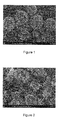
- FIG. 1 is a SEM photograph of granulated particles at a magnification of 1,000 times and shows that the particle size is 5 ⁇ 30 ⁇ m.
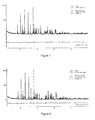
- Figure 2 is a SEM photograph which was taken of part of a granule at a magnification of 50,000 times and shows nanometer-size ultrafine particles which constitute the granule.
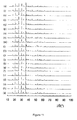
- Figure 3 shows the result of Rietveld refinement performed on X-ray diffraction patterns of the synthesized compound.
- the occupancy ratios of the ions in a unit cell were computed by modeling the result of Rietveld refinement, and it was found that the compound was Li 0.89 (Mn 0.25 Fe 0 . 75 )(PO 4 ) 0.96 .
- Li may be added in an excessive amount when preparing a lithium transtion-metal phosphate. Such excessively added Li was excluded from the amount of lithium in calculating the above molar ratio of Li. The molar ratio counted only the Li which constituted the anion-deficient lithium transtion-metal phosphate of the present invention. The molar ratio of Li was calculated in the same way in the other Examples given below.)
- Example 2 Preparation of an anion-deficient compound wherein the metal M is a combination of Mn and Fe
- a first water solution was prepared by dissolving 0.50 mol of manganese sulfate, 0.50 mol of ferrous sulfate, 1 mol of phosphoric acid, and 27.8g of sucrose in 1.6 L of water.
- a second water solution was prepared by dissolving 1.5 mol of ammonia and 2 mol of lithium hydroxide in 1.2 L of water.
- the final product was assayed with an inductively coupled plasma (ICP) spectrometer and the compound was found to be Li 0.90 (Mn 0.50 Fe 0.50 )(PO 4 ) 0.96 .
- ICP inductively coupled plasma
- Example 3 Preparation of an anion-deficient compound wherein the metal M is a combination of Mn and Fe
- a first water solution was prepared by dissolving 0.75 mol of manganese sulfate, 0.25 mol of ferrous sulfate, 1 mol of phosphoric acid, and 27.8g of sucrose in 1.6 L of water.
- a second water solution was prepared by dissolving 1.5 mol of ammonia and 2 mol of lithium hydroxide in 1.2 L of water.
- the final product was assayed with an inductively coupled plasma (ICP) spectrometer, and the compound was found to be Li 0.90 (Mn 0.75 Fe 0.25 )(PO 4 ) 0.97 .
- ICP inductively coupled plasma
- a first water solution was prepared by dissolving 1 mol of manganese sulfate, 1 mol of phosphoric acid, and 27.8g of sucrose in 1.6 L of water.
- a second water solution was prepared by dissolving 1.5 mol of ammonia and 2 mol of lithium hydroxide in 1.2 L of water.
- Example 5 Preparation of an anion-deficient compound wherein the metal M is a combination of Co and Fe
- a first water solution was prepared by dissolving 0.25 mol of cobalt nitrate (Co(NO 3 ) 2 ), 0.75 mol of ferrous sulfate, 1 mol of phosphoric acid, and 27.8g of sucrose in 1.6 L of water.
- a second water solution was prepared by dissolving 1.5 mol of ammonia and 2 mol of lithium hydroxide in 1.2 L of water.
- Example 6 Preparation of an anion-deficient compound wherein the metal M is a combination of Co and Fe
- a first water solution was prepared by dissolving 0.50 mol of cobalt nitrate, 0.50 mol of ferrous sulfate, 1 mol of phosphoric acid, and 27.8g of sucrose in 1.6 L of water.
- a second water solution was prepared by dissolving 1.5 mol of ammonia and 2 mol of lithium hydroxide in 1.2 L of water.
- the final product was assayed with an inductively coupled plasma (ICP) spectrometer, and the compound was found to be Li 0.91 (Co 0.50 Fe 0.50 )(PO 4 ) 0.97 .
- ICP inductively coupled plasma
- Example 7 Preparation of an anion-deficient compound wherein the metal M is a combination of Co and Fe
- a first water solution was prepared by dissolving 0.75 mol of cobalt nitrate, 0.25 mol of ferrous sulfate, 1 mol of phosphoric acid, and 27.8g of sucrose in 1.6 L of water.
- a second water solution was prepared by dissolving 1.5 mol of ammonia and 2 mol of lithium hydroxide in 1.2 L of water.
- the final product was assayed with an inductively coupled plasma (ICP) spectrometer, and the compound was found to be Li 0.90 (Co 0.75 Fe 0.25 )(PO 4 ) 0.97 .
- ICP inductively coupled plasma
- Example 8 Preparation of an anion-deficient compound wherein the metal M is Co
- a first water solution was prepared by dissolving 1 mol of cobalt nitrate, 1 mol of phosphoric acid, and 27.8g of sucrose in 1.6 L of water.
- a second water solution was prepared by dissolving 1.5 mol of ammonia and 2 mol of lithium hydroxide in 1.2 L of water.
- Example 9 Preparation of an anion-deficient compound wherein the metal M is a combination of Ni and Fe
- a first water solution was prepared by dissolving 0.25 mol of nickel nitrate (Ni(NO 3 ) 2 ), 0.75 mol of ferrous sulfate, 1 mol of phosphoric acid, and 27.8g of sucrose in 1.6 L of water.
- a second water solution was prepared by dissolving 1.5 mol of ammonia and 2 mol of lithium hydroxide in 1.2 L of water.
- Example 10 Preparation of an anion-deficient compound wherein the metal M is a combination of Ni and Fe
- a first water solution was prepared by dissolving 0.50 mol of nickel nitrate, 0.50 mol of ferrous sulfate, 1 mol of phosphoric acid, and 27.8g of sucrose in 1.6 L of water.
- a second water solution was prepared by dissolving 1.5 mol of ammonia and 2 mol of lithium hydroxide in 1.2 L of water.
- the final product was assayed with an inductively coupled plasma (ICP) spectrometer, and the compound was found to be Li 0.92 (Ni 0.50 Fe 0.50 )(PO 4 ) 0.97 .
- ICP inductively coupled plasma
- Example 11 Preparation of an anion-deficient compound wherein the metal M is a combination of Ni and Fe
- a first water solution was prepared by dissolving 0.75 mol of nickel nitrate, 0.25 mol of ferrous sulfate, 1 mol of phosphoric acid, and 27.8g of sucrose in 1.6 L of water.
- a second water solution was prepared by dissolving 1.5 mol of ammonia and 2 mol of lithium hydroxide in 1.2 L of water.
- the final product was assayed with an inductively coupled plasma (ICP) spectrometer, and the compound was found to be Li 0.92 (Ni 0.75 Fe 0.25 )(PO 4 ) 0.98 .
- ICP inductively coupled plasma
- a first water solution was prepared by dissolving 1 mol of nickel nitrate, 1 mol of phosphoric acid, and 27.8g of sucrose in 1.6 L of water.
- a second water solution was prepared by dissolving 1.5 mol of ammonia and 2 mol of lithium hydroxide in 1.2 L of water.
- Example 13 Preparation of an anion-deficient compound wherein the metal M is a combination of Mn, Co, and Ni
- a first water solution was prepared by dissolving 1/3 (one third) mol of manganese sulfate, 1/3 mol of cobalt nitrate, 1/3 mol of nickel nitrate, 1 mol of phosphoric acid, and 27.8g of sucrose in 1.6 L of water.
- a second water solution was prepared by dissolving 1.5 mol of ammonia and 2 mol of lithium hydroxide in 1.2 L of water.
- Example 14 Preparation of an anion-deficient compound wherein the metal M is a combination of Mn, Co, Ni, and Fe
- a first water solution was prepared by dissolving 0.25 mol of manganese sulfate, 0.25 mol of cobalt nitrate, 0.25 mol of nickel nitrate, 0.25 mol of ferrous sulfate, 1 mol of phosphoric acid, and 27.8g of sucrose in 1.6 L of water.
- a second water solution was prepared by dissolving 1.5 mol of ammonia and 2 mol of lithium hydroxide in 1.2 L of water.
- Example 15 Preparation of an anion-deficient compound wherein the metal M is a combination of Mg and Fe
- a first water solution was prepared by dissolving 0.07 mol of magnesium sulfate (MgSO 4 ), 0.93 mol of ferrous sulfate, 1 mol of phosphoric acid, and 27.8g of sucrose in 1.6 L of water.
- a second water solution was prepared by dissolving 1.5 mol of ammonia and 2 mol of lithium hydroxide in 1.2 L of water.
- the final product was assayed with an inductively coupled plasma (ICP) spectrometer, and the compound was found to be Li 0.88 (Mg 0.07 Fe 0.93 )(PO 4 ) 0.96 .
- ICP inductively coupled plasma
- Example 16 Preparation of an anion-deficient compound wherein the metal M is a combination of Mg and Mn
- a first water solution was prepared by dissolving 0.10 mol of magnesium sulfate, 0.90 mol of manganese sulfate, 1 mol of phosphoric acid, and 27.8g of sucrose in 1.6 L of water.
- a second water solution was prepared by dissolving 1.5 mol of ammonia and 2 mol of lithium hydroxide in 1.2 L of water.
- the final product was assayed with an inductively coupled plasma (ICP) spectrometer, and the compound was found to be Li 0.92 (Mg 0.10 Mn 0.90 )(PO 4 ) 0.97 .
- ICP inductively coupled plasma
- Example 17 Preparation of an anion-deficient compound wherein the metal M is a combination of Al, Mn, and Fe
- a first water solution was prepared by dissolving 0.03 mol of aluminum nitrate (Al(NO 3 ) 3 ), 0.78 mol of manganese sulfate, 0.19 mol of ferrous sulfate, 1 mol of phosphoric acid, and 27.8g of sucrose in 1.6 L of water.
- a second water solution was prepared by dissolving 1.5 mol of ammonia and 2 mol of lithium hydroxide in 1.2 L of water.
- the final product was assayed with an inductively coupled plasma (ICP) spectrometer, and the compound was found to be Li 0.85 (Al 0.33 Mn 0.78 Fe 0.19 )(PO4) 0.98 .
- ICP inductively coupled plasma
- Example 18 Preparation of an anion-deficient compound wherein the metal M is a combination of Mn, Co, Ni, and Fe
- a first water solution was prepared by dissolving 0.25 mol of manganese sulfate, 0.25 mol of cobalt nitrate, 0.25 mol of nickel nitrate, 0.25 mol of ferrous sulfate, 1.1 mol of phosphoric acid, and 27.8g of sucrose in 1.6 L of water.
- a second water solution was prepared by dissolving 1.5 mol of ammonia and 2 mol of lithium hydroxide in 1.2 L of water.
- the final product was assayed with an inductively coupled plasma (ICP) spectrometer, and the compound was found to be Li 0.94 (Mn 0.25 Co 0.25 Ni 0.25 Fe 0.25 )(PO 4 ) 0.98 .
- ICP inductively coupled plasma
- Example 19 Preparation of an anion-deficient compound wherein the metal M is a combination of Mn, Co, Ni, and Fe
- a first water solution was prepared by dissolving 0.25 mol of manganese sulfate, 0.25 mol of cobalt nitrate, 0.25 mol of nickel nitrate, 0.25 mol of ferrous sulfate, 1.2 mol of phosphoric acid, and 27.8g of sucrose in 1.6 L of water.
- a second water solution was prepared by dissolving 1.5 mol of ammonia and 2 mol of lithium hydroxide in 1.2 L of water.
- the pH of the mixture in the mixer was 6.6.
- the final product was assayed with an inductively coupled plasma (ICP) spectrometer, and the compound was found to be Li 0.97 (Mn 0.25 Co 0.25 Ni 0.25 Fe 0.25 )(PO 4 ) 0.99 .
- ICP inductively coupled plasma
- Example 20 Preparation of an anion-deficient compound wherein the metal M is a combination of Mn, Co, Ni, and Fe
- a first water solution was prepared by dissolving 0.25 mol of manganese sulfate, 0.25 mol of cobalt nitrate, 0.25 mol of nickel nitrate, 0.25 mol of ferrous sulfate, 1 mol of phosphoric acid, and 27.8g of sucrose in 1.6 L of water.
- a second water solution was prepared by dissolving 2.0 mol of ammonia and 2 mol of lithium hydroxide in 1.2 L of water.
- the final product was assayed with an inductively coupled plasma (ICP) spectrometer, and the compound was found to be Li 0.89 (Mn 0.25 Co 0.25 Ni 0.25 Fe 0.25 )(PO 4 ) 0.96 .
- ICP inductively coupled plasma
- Example 21 Preparation of an anion-deficient compound wherein the metal M is a combination of Mn, Co, Ni, and Fe
- a first water solution was prepared by dissolving 0.25 mol of manganese sulfate, 0.25 mol of cobalt nitrate, 0.25 mol of nickel nitrate, 0.25 mol of ferrous sulfate, 1 mol of phosphoric acid, and 27.8g of sucrose in 1.6 L of water.
- a second water solution was prepared by dissolving 2.5 mol of ammonia and 2 mol of lithium hydroxide in 1.2 L of water.
- the pH of the mixture in the mixer was 9.5.
- the final product was assayed with an inductively coupled plasma (ICP) spectrometer, and the compound was found to be Li 0.86 (Mn 0.25 Co 0.25 Ni 0.25 Fe 0.25 )(PO 4 ) 0.95 .
- ICP inductively coupled plasma
- Comparative Example 1 Preparation of a stoichiometric compound wherein the metal M is a combination of Mn and Fe
- Comparative Example 2 Preparation of a stoichiometric compound wherein the metal M is a combination of Mn and Fe
- a stoichiometric lithium manganese iron phosphate was prepared by processing the above materials in the same way under the same conditions as in steps (a), (b), and (c) of Comparative Example 1.
- a stoichiometric lithium manganese iron phosphate was prepared by processing the above materials in the same way under the same conditions as in steps (a), (b), and (c) of Comparative Example 1.
- a stoichiometric lithium manganese phosphate was prepared by processing the above materials in the same way under the same conditions as in steps (a), (b), and (c) of Comparative Example 1.
- a first water solution was prepared by dissolving 0.25 mol of cobalt acetate (Co(CH 3 CO 2 ) 2 ) and 0.75 mol of ferrous oxalate as metal precursors, 1 mol of monoammonium phosphate (NH 4 H 2 PO 4 ) as a phosphate compound, and 0.525 mol of lithium carbonate (Li 2 CO 3 ) as a lithium precursor in distilled water.
- a second water solution was prepared by dissolving 1 mol of citric acid as both a gelation agent and a carbon precursor in distilled water.
- a stoichiometric lithium cobalt iron phosphate was prepared according to a conventional sol-gel method by processing the above two solutions in the order of the following steps (a), (b), and (c).
- a first water solution was prepared by dissolving 0.50 mol of cobalt acetate, 0.50 mol of ferrous oxalate, 1 mol of monoammonium phosphate, and 0.525 mol of lithium carbonate in distilled water.
- a second water solution was prepared by dissolving 1 mol of citric acid in distilled water.
- a stoichiometric lithium cobalt iron phosphate was prepared by processing the above two solutions in the same way under the same conditions as in steps (a), (b), and (c) of Comparative Example 5.
- a first water solution was prepared by dissolving 0.75 mol of cobalt acetate, 0.25 mol of ferrous oxalate, 1 mol of monoammonium phosphate, and 0.525 mol of lithium carbonate in distilled water.
- a second water solution was prepared by dissolving 1 mol of citric acid in distilled water.
- a stoichiometric lithium cobalt iron phosphate was prepared by processing the above two solutions in the same way under the same conditions as in steps (a), (b), and (c) of Comparative Example 5.
- a first water solution was prepared by dissolving 1 mol of cobalt acetate, 1 mol of monoammonium phosphate, and 0.525 mol of lithium carbonate in distilled water.
- a second water solution was prepared by dissolving 1 mol of citric acid in distilled water.
- a stoichiometric lithium cobalt phosphate was prepared by processing the above two solutions in the same way under the same conditions as in steps (a), (b), and (c) of Comparative Example 5.
- a first water solution was prepared by dissolving 0.25 mol nickel acetate (Ni(CH 3 CO 2 ) 2 ), 0.75 mol of ferrous oxalate, 1 mol of monoammonium phosphate, and 0.525 mol of lithium carbonate in distilled water.
- a second water solution was prepared by dissolving 1 mol of citric acid in distilled water.
- a stoichiometric lithium nickel iron phosphate was prepared by processing the above two solutions in the same way under the same conditions as in steps (a), (b), and (c) of Comparative Example 5.
- Comparative Example 10 Preparation of a stoichiometric compound wherein the metal M is a combination of Ni and Fe
- a first water solution was prepared by dissolving 0.50 mol nickel acetate, 0.50 mol of ferrous oxalate, 1 mol of monoammonium phosphate, and 0.525 mol of lithium carbonate in distilled water.
- a second water solution was prepared by dissolving 1 mol of citric acid in distilled water.
- a stoichiometric lithium nickel iron phosphate was prepared by processing the above two solutions in the same way under the same conditions as in steps (a), (b), and (c) of Comparative Example 5.
- a first water solution was prepared by dissolving 0.75 mol nickel acetate, 0.25 mol of ferrous oxalate, 1 mol of monoammonium phosphate, and 0.525 mol of lithium carbonate in distilled water.
- a second water solution was prepared by dissolving 1 mol of citric acid in distilled water.
- a stoichiometric lithium nickel iron phosphate was prepared by processing the above two solutions in the same way under the same conditions as in steps (a), (b), and (c) of Comparative Example 5.
- a first water solution was prepared by dissolving 1 mol of nickel acetate, 1 mol of monoammonium phosphate, and 0.525 mol of lithium carbonate in distilled water.
- a second water solution was prepared by dissolving 1 mol of citric acid in distilled water.
- a stoichiometric lithium nickel phosphate was prepared by processing the above two solutions in the same way under the same conditions as in steps (a), (b), and (c) of Comparative Example 5.
- Comparative Example 13 Preparation of a stoichiometric compound wherein the metal M is a combination of Mn, Co, and Ni
- a first water solution was prepared by dissolving 0.3 mol of manganese acetate, 0.3 mol of cobalt acetate, 0.3 mol of nickel acetate, 0.9 mol of monoammonium phosphate, and 0.473 mol of lithium carbonate in distilled water.
- a second water solution was prepared by dissolving 0.9 mol of citric acid in distilled water.
- a stoichiometric lithium manganese cobalt nickel phosphate was prepared according to a conventional sol-gel method by processing the above two solutions in the order of the following steps (a), (b), and (c).
- Comparative Example 14 Preparation of a stoichiometric compound wherein the metal M is a combination of Mn, Co, Ni and Fe
- a first water solution was prepared by dissolving 0.25 mol of manganese acetate, 0.25 mol of cobalt acetate, 0.25 mol of nickel acetate, 0.25 mol of ferrous oxalate, 1 mol of monoammonium phosphate, and 1 mol of lithium carbonate in distilled water.
- a second water solution was prepared by dissolving 0.9 mol of citric acid in distilled water.
- a stoichiometric lithium manganese cobalt nickel iron phosphate was prepared according to a conventional sol-gel method by processing the above two solutions in the order of the following steps (a), (b), and (c).
- Comparative Example 15 Preparation of an anion-deficient compound wherein the metal M is a combination of Mn, Co, Ni, and Fe
- a first water solution was prepared by dissolving 0.25 mol of manganese sulfate, 0.25 mol of cobalt nitrate, 0.25 mol of nickel nitrate, 0.25 mol of ferrous sulfate, 1 mol of phosphoric acid, and 27.8g of sucrose in 1.6 L of water.
- a second water solution was prepared by dissolving 3 mol of ammonia and 2 mol of lithium hydroxide in 1.2 L of water.
- Figures 3, 4 , 5, 6 , 7, 8 , 9, and 10 show the results of Rietveld refinement performed on X-ray diffraction patterns of the compounds synthesized in Examples 1, 4, 5, 8, 9, 12, 13 and 14, respectively.
- Tables 1, 2, 3, 4, 5, 6, 7, and 8 show the positions of elements in a unit cell identified by carrying out Rietveld refinement and also show the occupancy ratios of Li, Mn, Co, Ni, Fe and P ascertained by modeling crystal structures based on the result of the Rietveld refinement.
- the occupancy ratios of the respective elements indicated in Tables 1, 2, 3, 4, 5, 6, 7, and 8 show that the molar ratio of the metal M, i.e., the sum of the molar ratios of the metal elements excluding Li, is 1 while the molar ratio of phosphorus (P) ranges from 0.9625 to 0.9775, which is less than 1.
- the results of ICP analysis in Examples 2, 3, 6, 7, and 10 to 21 show that the molar ratio of the metal M is 1 whereas the molar ratio of phosphorus (P) ranges from 0.95 to 0.99, which is less than 1.
- the lithium transition-metal phosphates prepared in the working examples of the present invention are anion-deficient compounds.
- the results of inductively coupled plasma spectroscopy show that the compounds of Comparative Examples 1 to 14 are stoichiometric compounds, which contain M and P at a molar ratio of 1:1.
- the anion-deficient lithium transition-metal phosphates of the present invention represented by Li 1-x M(PO 4 ) 1-y , exhibit superior lithium diffusion coefficients over the stoichiometric lithium transition-metal phosphate LiMPO 4 .
- a battery employing a compound of the present invention achieves a lower electrode resistance.
- each of Figures 12, 13 , 14, 15 , and 16 is a Nyquist plot indicating a measured impedance on a complex plane as a function of frequency, wherein Z' and Z" are respectively the real component and the imaginary component of the impedance Z which is a complex number.
- Electrode resistance can be calculated based on a measured impedance. A Nyquist plot indicates what types of resistance are involved. From the shapes of the plots in Figures 12 to 16 , it is understood that the electrode resistance is comprised of solid electrolyte interface resistance (SEI resistance) and charge transport resistance (CT resistance).
- SEI resistance solid electrolyte interface resistance
- CT resistance charge transport resistance
- the electrode resistance of Li 0.89 (Mn 0.25 Fe 0.75 )(PO 4 ) 0.96 is 294 ⁇ , which is 2.27 times smaller than that of stoichiometric Li(Mn 0.25 Fe 0.75 )PO 4 having 669 ⁇ .
- the electrode resistance of Li 0.91 (Co 0.25 Fe 0.75 )(PO 4 ) 0.97 is 322 ⁇ , which is 2.12 times smaller than that of stoichiometric Li(Co 0.25 Fe 0.75 )PO 4 having 683 ⁇ .
- the electrode resistance of Li 0.91 (Ni 0.26 Fe 0.74 )(PO 4 ) 0.97 is 329 ⁇ , which is 2.17 times smaller than that of stoichiometric Li(Ni 0.25 Fe 0.75 )PO 4 having 713 ⁇ .
- the electrode resistance of Li 0.89 (Mn 0.33 Co 0.33 Ni 0.33 )(PO 4 ) 0.96 is 313Q, which is 2.29 times smaller than that of stoichiometric Li(Mn 0.33 Co 0.33 Ni 0.33 )PO 4 having 717 ⁇ .
- the electrode resistance of Li 0.90 (Mn 0.25 Co 0.25 Ni 0.25 Fe 0.25 )(PO 4 ) 0.97 is 315 ⁇ , which is 2.16 times smaller than that of stoichiometric Li(Mn 0.25 Co 0.25 Ni 0.25 Fe 0.25 )PO 4 having 679 ⁇ .
- the electrode resistance decreases by 2.1 to 2.3 times regardless of the molar ratios of the elements constituting the metal M. Such decrease is due to anion vacancies, which are generated as a result of anion deficiency and facilitate lithium ion diffusion, thereby reducing the electrode resistance.
- the fact that electrode resistance has no correlation with the composition of the metal M means that anion vacancies affect lithium ion diffusion regardless of the composition.
- lithium ion diffusion coefficients were measured on Li 0.89 (Mn 0.25 Fe 0.75 )(PO 4 ) 0.96 of Example 1 and Li(Mn 0.25 Fe 0.75 )PO 4 of Comparative Example 1, Li 0.91 (Co 0.25 Fe 0.75 )(PO 4 ) 0.97 of Example 5 and Li(Co 0.25 Fe 0.75 )PO 4 of Comparative Example 5, Li 0.91 (Ni 0.26 Fe 0.74 )(PO 4 ) 0.97 of Example 9 and Li(Ni 0.25 Fe 0.75 )PO 4 of Comparative Example 9, Li 0.89 (Mn 0.33 Co 0.33 Ni 0.33 )(PO 4 ) 0.96 of Example 13 and Li(Mn 0.33 Co 0.33 Ni 0.33 )PO 4 of Comparative Example 13, and Li 0.90 (Mn 0.25 Co 0.25 Ni 0.25 Fe 0.25 )(PO 4 ) 0.97 of Example 14 and Li(Mn 0.25 Co 0.25 Ni 0.25 Fe 0.25 )PO 4 of Comparative Example 14.
- Figures 17 , 18 , 19 , 20, and 21 are the measurement results, and show the dependency of lithium ion diffusion coefficient on lithium concentration.
- Figures 17 to 21 as the charging of a battery proceeds, the number of lithium ions in an active material decreases and the lithium diffusion coefficient gradually increases. During discharge, an opposite phenomenon occurs inside the active material, i.e. the number of lithium ions gradually increases in the active material and the lithium diffusion coefficient decreases.
- the lithium diffusion coefficient of Li 0.89 (Mn 0.25 Fe 0.75 )(PO 4 ) 0.96 is 2.784 ⁇ 10 -10 ⁇ 7.014 ⁇ 10 -9 cm 2 /s depending on charge/discharge conditions, and that of Li(Mn 0.25 Fe 0.75 )PO 4 is 3.187 ⁇ 10 -11 ⁇ 6.387 ⁇ 10 -10 cm 2 /s. From this, it is understood that Li 0.89 (Mn 0.25 Fe 0.75 )(PO 4 ) 0.96 is about 4.62 ⁇ 10.98 times better than stoichiometric Li(Mn 0.25 Fe 0.75 )PO 4 in lithium diffusion coefficient.
- the lithium diffusion coefficient of Li 0.91 (Co 0.25 Fe 0.75 )(PO 4 ) 0.97 is 2.832 ⁇ 10 -10 ⁇ 6.497 ⁇ 10 -9 cm 2 /s depending on charge/discharge conditions, and that of Li(Co 0.25 Fe 0.75 )PO 4 is 3.122 ⁇ 10 -11 ⁇ 6.257 ⁇ 10 -10 cm 2 /s. From this, it is understood that Li 0.91 (Co 0.25 Fe 0.75 )(PO 4 ) 0.97 is about 5.29 ⁇ 10.38 times better than stoichiometric Li(Co 0.25 Fe 0.75 )PO 4 in lithium diffusion coefficient.
- the lithium diffusion coefficient of Li 0.91 (Ni 0.26 Fe 0.74 )(PO 4 ) 0.97 is 2.491 ⁇ 10 -10 ⁇ 5.877 ⁇ 0 -9 cm 2 /s depending on charge/discharge conditions, and that of Li(Ni 0.25 Fe 0.75 )PO 4 is 2.989 ⁇ 10 -11 ⁇ 5.990 ⁇ 10 -10 cm 2 /s. From this, it is understood that Li 0.91 (Ni 0.26 Fe 0.74 )(PO 4 ) 0.97 is about 4.59 ⁇ 9.81 times better than stoichiometric Li(Ni 0.25 Fe 0.75 )PO 4 in lithium diffusion coefficient.
- the lithium diffusion coefficient of Li 0.89 (Mn 0.33 Co 0.33 Ni 0.33 )(PO 4 ) 0.96 is 1.008 ⁇ 10 -9 ⁇ 9.635 ⁇ 10 -9 cm 2 /s depending on charge/discharge conditions, and that of Li(Mn 0.33 Co 0.33 Ni 0.33 )PO 4 is 3.675 ⁇ 10 -11 ⁇ 5.962 ⁇ 10 -10 cm 2 /s. From this, it is understood that Li 0.89 (Mn 0.33 Co 0.33 Ni 0.33 )(PO 4 ) 0.98 is about 12.02 ⁇ 27.43 times better than stoichiometric Li(Mn 0.33 Co 0.33 Ni 0.33 )PO 4 in lithium diffusion coefficient.
- the lithium diffusion coefficient of Li 0.90 (Mn 0.25 Co 0.25 Ni 0.25 Fe 0.25 )(PO 4 ) 0.97 is 4.140 ⁇ 10 -10 ⁇ 8.415 ⁇ 10 -9 cm 2 /s depending on charge/discharge conditions, and that of Li(Mn 0.25 Co 0.25 Ni 0.25 Fe 0.25 )PO 4 is 2.998 ⁇ 10 -11 ⁇ 6.962 ⁇ 10 -10 cm 2 /s. From this, it is understood that Li 0.90 (Mn 0.25 Co 0.25 Ni 0.25 Fe 0.25 )(PO 4 ) 0.97 is about 8.39 ⁇ 13.81 times better than stoichiometric Li(Mn 0.33 Co 0.33 Ni 0.33 )PO 4 in lithium diffusion coefficient.
- lithium diffusion coefficients confirms that if a lithium transition-metal phosphate runs short of anions, lithium diffusion coefficient increases by up to about 27 times, and that anion vacancies facilitates lithium diffusion.
- Table 9 shows lithium ion diffusion coefficients measured with the GITT method on the anion-deficient lithium transition-metal phosphates synthesized in Examples 15, 16, and 17, where all of the measurements were conducted at a 40% state of charge (SOC).
- Lithium ion diffusion coefficients of the lithium transition-metal phosphates synthesized in Examples 15, 16, and 17 Compound Lithium lon Diffusion Coefficient (cm 2 /s)
- Example 15 Li 0.88 (Mg 0.07 Fe 0.93 )(PO 4 ) 0.96 2.315 ⁇ 10 -9
- Example 16 Li 0.92 (Mg 0.10 Mn 0.90 )(PO 4 ) 0.97 2.697 ⁇ 10 -9
- Example 17 Li 0.85 (Al 0.03 Mn 0.78 Fe 0.19 )(PO 4 ) 0.98 2.214 ⁇ 10 -9
- Figure 22 shows the relationship between the molar ratio of phosphorus to the metal M (P/M) and lithium diffusion coefficient.
- lithium diffusion coefficient was measured with the GITT method on the lithium (manganese cobalt nickel iron) phosphates synthesized in Examples 14, 18, 19, 20 and 21 and Comparative Examples 14 and 15, at 40% SOC.
- lithium ion diffusion coefficient can be improved by controlling the molar ratio P/M to be less than 1. When 0.95 ⁇ P/M ⁇ 0.99, the lithium diffusion coefficient is better than when P/M is 1. A more preferable lithium diffusion coefficient is achieved if 0.96 ⁇ P/M ⁇ 0.98.
- the lithium diffusion coefficient greatly changes, which is because anions generated in an excessive amount lead to partial collapse of the crystal structure. Since the collapse of the crystal structure deteriorates electrochemical activity, generating an excessive amount of anion vacancies is not desirable.
- An electrode slurry which contained an anion-deficient lithium transition-metal phosphate, a conducting agent, and a binder at a weight ratio of 90:5:5 was prepared.
- the conducting agent was a mixture of super-P ® (conductive carbon black produced by TIMCAL Graphite & Carbon, Inc., Switzerland) and vapor-grown carbon fiber (VGCF), wherein the two compounds were contained at the weight ratio of 1:1, and the binder was KF1100 ® (polyvinylidene fluoride produced by Kureha Chemical Ind. Co., Ltd., Japan).
- the electrode slurry was applied onto a thin aluminium sheet at an application speed of 0.3 m/min and was dried at 90°C in the front room and 120°C in the rear room of an applicator to fabricate a cathode.
- An electrolyte was synthesized by dissolving 1 mol of LiPF 6 in a solvent which was a mixture of ethylene carbonate (EC) and ethyl methyl carbonate (EMC) at a volume ratio of 1:2.
- EC ethylene carbonate
- EMC ethyl methyl carbonate
- a lithium secondary battery of a coin cell type was fabricated. Charge and discharge were conducted at the constant 0.1C rate by using a Maccor series 4000 (Maccor Inc., Tulsa, Oklahoma, U.S.A.).
- Figures 23, 24 , and 25 are the charge/discharge graphs of lithium secondary batteries adopting the anion-deficient lithium manganese iron phosphates synthesized in Examples 1, 2, and 3 as cathode-active materials.
- the cutoff potential of discharge was set at 3.0 volt
- the anion-deficient lithium manganese iron phosphates of the present invention showed a discharge capacity of 136 to 149mAh/g, which is higher than those of conventional lithium manganese iron phosphates. Further, the gap between the charge potential and the discharge potential was narrow in the compounds of the present invention.
- Figure 26 compares the charge/discharge graphs of lithium secondary batteries which adopt the lithium manganese iron phosphates synthesized in Example 2 and Comparative Example 2 as cathode-active materials.
- the discharge capacity of the anion-deficient lithium manganese iron phosphate of Example 2 is about 138mAh/g, which is greater than 129mAh/g achieved by the stoichiometric lithium manganese iron phosphate of Comparative Example 2.
- An anion-deficient lithium transition-metal phosphate of the present invention can be used as an electrode-active material for secondary batteries, memory devices, and capacitors including hybrid capacitors (P-EDLC), and other electrochemical devices, preferably as a cathode-active material for secondary batteries.
- P-EDLC hybrid capacitors
Landscapes
- Chemical & Material Sciences (AREA)
- Engineering & Computer Science (AREA)
- Manufacturing & Machinery (AREA)
- Ceramic Engineering (AREA)
- Chemical Kinetics & Catalysis (AREA)
- Electrochemistry (AREA)
- General Chemical & Material Sciences (AREA)
- Organic Chemistry (AREA)
- Inorganic Chemistry (AREA)
- Structural Engineering (AREA)
- Materials Engineering (AREA)
- Crystallography & Structural Chemistry (AREA)
- Sustainable Energy (AREA)
- Sustainable Development (AREA)
- Life Sciences & Earth Sciences (AREA)
- Battery Electrode And Active Subsutance (AREA)
- Secondary Cells (AREA)
Applications Claiming Priority (2)
| Application Number | Priority Date | Filing Date | Title |
|---|---|---|---|
| KR1020090005540A KR100939647B1 (ko) | 2009-01-22 | 2009-01-22 | 전극 활물질인 음이온 부족형 비화학양론 리튬 전이금속 다중산 화합물, 그 제조 방법 및 그를 이용한 전기화학 소자 |
| PCT/KR2010/000401 WO2010085104A2 (ko) | 2009-01-22 | 2010-01-21 | 전극 활물질인 음이온 부족형 리튬 전이금속 인산화합물, 그 제조방법, 및 그를 이용한 전기화학 소자 |
Publications (1)
| Publication Number | Publication Date |
|---|---|
| EP2390948A2 true EP2390948A2 (de) | 2011-11-30 |
Family
ID=42082875
Family Applications (2)
| Application Number | Title | Priority Date | Filing Date |
|---|---|---|---|
| EP10151284A Withdrawn EP2211404A1 (de) | 2009-01-22 | 2010-01-21 | Ektrodenaktive aniondefizientes nicht-stoichiometrisches Lithium-Eisenphophat und ein Herstellungsverfahren dafür |
| EP10733657A Withdrawn EP2390948A2 (de) | 2009-01-22 | 2010-01-21 | Aktives elektrodenmaterial für anionenarme lithiumübergangsmetallphosphatverbindung, herstellungsverfahren dafür und elektrochemische vorrichtung damit |
Family Applications Before (1)
| Application Number | Title | Priority Date | Filing Date |
|---|---|---|---|
| EP10151284A Withdrawn EP2211404A1 (de) | 2009-01-22 | 2010-01-21 | Ektrodenaktive aniondefizientes nicht-stoichiometrisches Lithium-Eisenphophat und ein Herstellungsverfahren dafür |
Country Status (8)
| Country | Link |
|---|---|
| US (2) | US7858233B2 (de) |
| EP (2) | EP2211404A1 (de) |
| JP (2) | JP4625536B2 (de) |
| KR (1) | KR100939647B1 (de) |
| CN (2) | CN102292855B (de) |
| CA (1) | CA2750328C (de) |
| TW (2) | TW201036235A (de) |
| WO (1) | WO2010085104A2 (de) |
Cited By (1)
| Publication number | Priority date | Publication date | Assignee | Title |
|---|---|---|---|---|
| WO2015023168A1 (ru) * | 2013-11-06 | 2015-02-19 | Частное Учреждение "Назарбаев Университет Рисеч Энд Инновэйшн Систэм" | Водный литий-ионный аккумулятор |
Families Citing this family (54)
| Publication number | Priority date | Publication date | Assignee | Title |
|---|---|---|---|---|
| TWI466370B (zh) | 2008-01-17 | 2014-12-21 | A123 Systems Inc | 鋰離子電池的混合式金屬橄欖石電極材料 |
| EP2277828B1 (de) * | 2008-03-31 | 2018-08-08 | Toda Kogyo Corp. | Verfahren zur herstellung von lithiumeisenphosphatpulver, lithiumeisenphosphatpulver mit olivinstruktur, kathodenblech unter verwendung des lithiumeisenphosphatpulvers und sekundärbatterie mit nichtwässrigem lösungsmittel |
| US9178215B2 (en) | 2009-08-25 | 2015-11-03 | A123 Systems Llc | Mixed metal olivine electrode materials for lithium ion batteries having improved specific capacity and energy density |
| US9660267B2 (en) | 2009-09-18 | 2017-05-23 | A123 Systems, LLC | High power electrode materials |
| TWI496737B (zh) * | 2009-09-18 | 2015-08-21 | A123 Systems Llc | 磷酸鐵及其製備方法 |
| CN102893432B (zh) | 2010-04-21 | 2016-01-13 | 株式会社Lg化学 | 碳包覆的具有橄榄石晶体结构的锂铁磷酸盐和使用所述锂铁磷酸盐的锂二次电池 |
| CA2810132C (en) | 2010-09-03 | 2015-03-17 | Showa Denko K.K. | Method for producing lithium metal phosphate |
| TW201221468A (en) * | 2010-11-18 | 2012-06-01 | Green Energy Electrode Inc | Preparation method for lithium iron phosphate cathode material |
| CN102637854B (zh) * | 2011-02-15 | 2014-06-25 | 北京宏福源科技有限公司 | 一种锂离子电池多阴离子正极材料的制备方法 |
| JP2012204150A (ja) * | 2011-03-25 | 2012-10-22 | Sumitomo Osaka Cement Co Ltd | 電極活物質の製造方法と電極活物質及び電極並びに電池 |
| KR101210756B1 (ko) * | 2011-05-02 | 2012-12-10 | 삼성코닝정밀소재 주식회사 | 리튬이온 이차전지용 양극 활물질의 제조방법, 이에 의해 제조된 양극 활물질 및 이것을 포함하는 리튬이온 이차전지 |
| FR2978137A1 (fr) * | 2011-07-21 | 2013-01-25 | Saint Gobain Ct Recherches | Produit fondu a base de lithium |
| JP5709136B2 (ja) * | 2011-09-05 | 2015-04-30 | 太平洋セメント株式会社 | リン酸鉄リチウムの製造法、及びリン酸鉄リチウム系正極活物質の製造法 |
| CN102502560A (zh) * | 2011-09-27 | 2012-06-20 | 中国电子科技集团公司第十八研究所 | 一种磷酸铁锂前驱体元素控制方法 |
| CN102420322B (zh) * | 2011-11-21 | 2013-11-20 | 湖南杉杉户田新材料有限公司 | 一种锂二次电池用多元复合正极材料及其制备方法 |
| KR101345259B1 (ko) * | 2011-12-20 | 2013-12-27 | 한화케미칼 주식회사 | 이중관식 열교환기를 사용한 전극 활물질의 제조 |
| EP2796407B1 (de) * | 2011-12-21 | 2016-12-21 | Advanced Lithium Electrochemistry Co., Ltd. | Anodenmaterial ohne sauerstoff und herstellungsverfahren dafür |
| JP5838934B2 (ja) * | 2012-08-30 | 2016-01-06 | 株式会社デンソー | 非水電解質二次電池用正極活物質の製造方法 |
| JP5988095B2 (ja) * | 2012-09-28 | 2016-09-07 | 住友金属鉱山株式会社 | リチウム二次電池用正極活物質の前駆体とその製造方法、および該前駆体を用いたリチウム二次電池用正極活物質とその製造方法、並びに該正極活物質を用いたリチウム二次電池 |
| US9876247B2 (en) | 2012-11-15 | 2018-01-23 | Corning Incorporated | Solid ceramic electrolytes |
| KR101586556B1 (ko) | 2013-01-10 | 2016-01-20 | 주식회사 엘지화학 | 탄소 코팅 리튬 인산철 나노분말 제조방법 |
| KR101561377B1 (ko) | 2013-01-10 | 2015-10-20 | 주식회사 엘지화학 | 리튬 인산철 나노분말 제조방법 |
| KR101561373B1 (ko) | 2013-01-10 | 2015-10-19 | 주식회사 엘지화학 | 리튬 인산철 나노분말 제조방법 |
| FR3000956B1 (fr) * | 2013-01-17 | 2017-12-08 | Commissariat Energie Atomique | Procede de synthese d'un compose lim1-x-y-znyqzfexpo4 et son utilisation comme materiau d'electrode pour accumulateur au lithium |
| EP2965371B1 (de) * | 2013-03-08 | 2019-05-08 | Umicore | Olivinzusammensetzung mit verbessertem zellverhalten |
| CN103247800A (zh) * | 2013-04-25 | 2013-08-14 | 西安理工大学 | 锂离子电池正极硅酸亚铁锂材料的制备方法 |
| US10076737B2 (en) | 2013-05-06 | 2018-09-18 | Liang-Yuh Chen | Method for preparing a material of a battery cell |
| EP2997611B1 (de) | 2013-05-15 | 2026-04-22 | QuantumScape Battery, Inc. | Festkörperkatholyt oder -elektrolyt für eine batterie |
| CN105764846B (zh) * | 2013-11-26 | 2019-01-15 | Sk新技术株式会社 | 锂复合磷酸盐类化合物及其制备方法 |
| JP6378422B2 (ja) | 2014-08-13 | 2018-08-22 | ユミコア | 改善された電池性能を有するオリビン組成物 |
| CN104183844B (zh) * | 2014-08-21 | 2016-05-18 | 浙江大学 | 锂离子电池正极材料磷酸锰锂纳米颗粒的水热合成法 |
| WO2016210371A1 (en) | 2015-06-24 | 2016-12-29 | Quantumscape Corporation | Composite electrolytes |
| JP6128181B2 (ja) * | 2015-09-30 | 2017-05-17 | 住友大阪セメント株式会社 | リチウムイオン二次電池用電極材料、リチウムイオン二次電池用電極材料の製造方法、リチウムイオン二次電池用電極およびリチウムイオン二次電池 |
| KR102765039B1 (ko) | 2015-12-04 | 2025-02-11 | 퀀텀스케이프 배터리, 인코포레이티드 | 리튬, 인, 황 및 요오드를 포함하는 전해질 및 음극액 조성물, 전기화학적 장치를 위한 전해질 막, 및 이들 전해질 및 음극액을 제조하는 어닐링 방법(annealing method). |
| JP6064309B2 (ja) * | 2016-02-18 | 2017-01-25 | 住友金属鉱山株式会社 | リチウム二次電池用正極活物質の前駆体とその製造方法、および該前駆体を用いたリチウム二次電池用正極活物質とその製造方法、並びに該正極活物質を用いたリチウム二次電池 |
| US11342630B2 (en) | 2016-08-29 | 2022-05-24 | Quantumscape Battery, Inc. | Catholytes for solid state rechargeable batteries, battery architectures suitable for use with these catholytes, and methods of making and using the same |
| TWI821195B (zh) * | 2017-07-19 | 2023-11-11 | 加拿大商納諾萬麥帝瑞爾公司 | 合成橄欖石型磷酸鋰金屬陰極材料的方法 |
| JP7280722B2 (ja) * | 2019-03-15 | 2023-05-24 | 積水化学工業株式会社 | 非水電解質二次電池用正極及びリチウムイオン二次電池 |
| CN109920997B (zh) * | 2019-03-20 | 2022-11-15 | 南通百川新材料有限公司 | 一种用于全固态电池的磷酸钴锂材料及其制作方法 |
| US12199326B2 (en) * | 2019-05-10 | 2025-01-14 | The Regents Of The University Of California | Fabrication processes for metal-supported proton conducting solid oxide electrochemical devices |
| CN113891851A (zh) * | 2019-05-27 | 2022-01-04 | 公益财团法人相模中央化学研究所 | 钠过渡金属聚阴离子及其制造方法 |
| US11121354B2 (en) | 2019-06-28 | 2021-09-14 | eJoule, Inc. | System with power jet modules and method thereof |
| TWI785881B (zh) | 2019-06-28 | 2022-12-01 | 美商壹久公司 | 具有輔助氣體流的處理系統與方法及所製成用於電池的材料 |
| US11376559B2 (en) | 2019-06-28 | 2022-07-05 | eJoule, Inc. | Processing system and method for producing a particulate material |
| US11673112B2 (en) | 2020-06-28 | 2023-06-13 | eJoule, Inc. | System and process with assisted gas flow inside a reaction chamber |
| WO2022097400A1 (ja) * | 2020-11-06 | 2022-05-12 | 株式会社Gsユアサ | 蓄電素子用正極活物質、蓄電素子用正極、蓄電素子及び蓄電装置 |
| CN112993227A (zh) * | 2021-02-23 | 2021-06-18 | 雅安锂盛新能企业管理中心(有限合伙) | 长循环寿命磷酸铁锂复合材料、正极材料及其制备方法 |
| CN115557482A (zh) * | 2021-07-01 | 2023-01-03 | 惠州比亚迪电池有限公司 | 一种磷酸铁锂正极材料的制备方法及锂离子电池 |
| JP7806353B2 (ja) * | 2021-07-27 | 2026-01-27 | 中央化工機株式会社 | 振動処理装置及び当該装置による処理方法 |
| JPWO2023127951A1 (de) * | 2021-12-28 | 2023-07-06 | ||
| US20230387404A1 (en) * | 2022-05-25 | 2023-11-30 | Rivian Ip Holdings, Llc | Olivine-based cathode materials with improved conductivity |
| CN115072694A (zh) * | 2022-06-28 | 2022-09-20 | 衢州华友钴新材料有限公司 | 磷酸铁锂正极材料及其制备方法以及锂离子电池 |
| CN116779778B (zh) * | 2023-08-11 | 2024-02-09 | 深圳海辰储能控制技术有限公司 | 正极极片及其制备方法、储能装置和用电装置 |
| CN119153825B (zh) * | 2024-11-18 | 2025-03-21 | 中创新航科技集团股份有限公司 | 二次电池和用电装置 |
Family Cites Families (15)
| Publication number | Priority date | Publication date | Assignee | Title |
|---|---|---|---|---|
| JP4749551B2 (ja) | 1999-04-06 | 2011-08-17 | ソニー株式会社 | 正極活物質及び非水電解質二次電池 |
| WO2000060679A1 (fr) | 1999-04-06 | 2000-10-12 | Sony Corporation | Procede de production de matiere active de plaque positive et procede de fabrication de cellules a electrolyte secondaires non aqueuses |
| US6815122B2 (en) | 2002-03-06 | 2004-11-09 | Valence Technology, Inc. | Alkali transition metal phosphates and related electrode active materials |
| CN100448071C (zh) * | 2003-03-18 | 2008-12-31 | 黄穗阳 | 锂电池正极材料及其制备方法 |
| JP2005158673A (ja) * | 2003-10-31 | 2005-06-16 | Toyota Motor Corp | 電極活物質およびその製造方法ならびに非水電解質二次電池 |
| TWI279020B (en) * | 2004-11-03 | 2007-04-11 | Tatung Co Ltd | Preparation of olivine LiFePO4 cathode materials for lithium batteries via a solution method |
| CN100377392C (zh) * | 2004-12-21 | 2008-03-26 | 中国科学院物理研究所 | 用于二次锂电池的含氧空位的磷酸铁锂正极材料及其用途 |
| DE102005012640B4 (de) * | 2005-03-18 | 2015-02-05 | Süd-Chemie Ip Gmbh & Co. Kg | Kreisprozess zur nasschemischen Herstellung von Lithiummetallphosphaten |
| US7939201B2 (en) * | 2005-08-08 | 2011-05-10 | A123 Systems, Inc. | Nanoscale ion storage materials including co-existing phases or solid solutions |
| US7524529B2 (en) | 2005-09-09 | 2009-04-28 | Aquire Energy Co., Ltd. | Method for making a lithium mixed metal compound having an olivine structure |
| US7494744B2 (en) * | 2006-03-08 | 2009-02-24 | Changs-Ascending Enterprise Co. | Cathode material for Li-ion battery applications |
| CN101212048A (zh) * | 2006-12-30 | 2008-07-02 | 比亚迪股份有限公司 | 一种锂离子二次电池的正极材料及含有该正极材料的电池 |
| KR20090005540A (ko) | 2007-07-09 | 2009-01-14 | 엘지디스플레이 주식회사 | 액정표시장치 |
| US8052897B2 (en) * | 2008-02-29 | 2011-11-08 | Byd Company Limited | Composite compound with mixed crystalline structure |
| CN102187502B (zh) * | 2008-10-22 | 2014-07-09 | 株式会社Lg化学 | 具有改善的电极效率和能量密度的正极活性材料 |
-
2009
- 2009-01-22 KR KR1020090005540A patent/KR100939647B1/ko active Active
- 2009-12-18 JP JP2009287137A patent/JP4625536B2/ja active Active
-
2010
- 2010-01-12 US US12/685,749 patent/US7858233B2/en active Active
- 2010-01-21 TW TW099101605A patent/TW201036235A/zh unknown
- 2010-01-21 CA CA2750328A patent/CA2750328C/en not_active Expired - Fee Related
- 2010-01-21 EP EP10151284A patent/EP2211404A1/de not_active Withdrawn
- 2010-01-21 EP EP10733657A patent/EP2390948A2/de not_active Withdrawn
- 2010-01-21 TW TW099101606A patent/TWI383533B/zh not_active IP Right Cessation
- 2010-01-21 WO PCT/KR2010/000401 patent/WO2010085104A2/ko not_active Ceased
- 2010-01-21 US US13/146,000 patent/US20120021288A1/en not_active Abandoned
- 2010-01-21 JP JP2011547778A patent/JP5318969B2/ja active Active
- 2010-01-21 CN CN201080005207.8A patent/CN102292855B/zh active Active
- 2010-01-22 CN CN2010101065861A patent/CN101789507B/zh active Active
Non-Patent Citations (1)
| Title |
|---|
| See references of WO2010085104A2 * |
Cited By (3)
| Publication number | Priority date | Publication date | Assignee | Title |
|---|---|---|---|---|
| WO2015023168A1 (ru) * | 2013-11-06 | 2015-02-19 | Частное Учреждение "Назарбаев Университет Рисеч Энд Инновэйшн Систэм" | Водный литий-ионный аккумулятор |
| US20150207180A1 (en) * | 2013-11-06 | 2015-07-23 | Nazarbayev University Research and Innovation System | Aqueous lithium-ion battery |
| US10347947B2 (en) | 2013-11-06 | 2019-07-09 | Nazarbayev University Research and Innovation System | Aqueous lithium-ion battery |
Also Published As
| Publication number | Publication date |
|---|---|
| JP4625536B2 (ja) | 2011-02-02 |
| HK1144616A1 (en) | 2011-02-25 |
| JP5318969B2 (ja) | 2013-10-16 |
| US20100183924A1 (en) | 2010-07-22 |
| JP2010170997A (ja) | 2010-08-05 |
| CN101789507B (zh) | 2013-08-14 |
| CA2750328A1 (en) | 2010-07-29 |
| CA2750328C (en) | 2014-03-18 |
| JP2012516016A (ja) | 2012-07-12 |
| TW201032377A (en) | 2010-09-01 |
| TW201036235A (en) | 2010-10-01 |
| WO2010085104A2 (ko) | 2010-07-29 |
| US7858233B2 (en) | 2010-12-28 |
| WO2010085104A3 (ko) | 2010-12-02 |
| TWI383533B (zh) | 2013-01-21 |
| EP2211404A1 (de) | 2010-07-28 |
| US20120021288A1 (en) | 2012-01-26 |
| WO2010085104A9 (ko) | 2010-10-14 |
| KR100939647B1 (ko) | 2010-02-03 |
| CN102292855B (zh) | 2014-01-22 |
| CN101789507A (zh) | 2010-07-28 |
| CN102292855A (zh) | 2011-12-21 |
Similar Documents
| Publication | Publication Date | Title |
|---|---|---|
| EP2390948A2 (de) | Aktives elektrodenmaterial für anionenarme lithiumübergangsmetallphosphatverbindung, herstellungsverfahren dafür und elektrochemische vorrichtung damit | |
| CN101946346B (zh) | 用于锂离子蓄电池的混合的金属橄榄石电极材料 | |
| CN100340018C (zh) | 充电电池用锂过渡金属磷酸盐粉末 | |
| JP5268134B2 (ja) | 正極活物質の製造方法およびそれを用いた非水電解質電池 | |
| KR101264459B1 (ko) | 결정성 나노메트릭 LiFePO₄ | |
| JP5463561B2 (ja) | オリビン構造を有する化合物及びその製造方法、並びにオリビン構造を有する化合物を使用する正極活物質及び非水電解質電池 | |
| CN101610977B (zh) | 合成电活性晶态纳米LiMnPO4粉末 | |
| EP2360117A2 (de) | Lithiumeisenphosphat mit olivinstruktur und herstellungsverfahren dafür | |
| JPWO2000060679A1 (ja) | 正極活物質の製造方法及び非水電解質二次電池の製造方法 | |
| KR20200042868A (ko) | 리튬이차전지용 니켈계 활물질 전구체, 그 제조방법, 이로부터 형성된 리튬이차전지용 니켈계 활물질 및 이를 포함하는 양극을 함유한 리튬이차전지 | |
| US20160380269A1 (en) | High power electrode materials | |
| AU2018204689B2 (en) | High power electrode materials | |
| KR20160083567A (ko) | 리튬이온 이차전지용 양극 활물질, 그의 제조방법 및 이것을 포함하는 리튬이온 이차전지 | |
| US20170170479A1 (en) | Cathode materials containing olivine structured nanocomposites | |
| KR102299253B1 (ko) | 양극 활물질, 이의 제조 방법, 및 이를 포함하는 리튬 이차 전지 | |
| EP2630685B1 (de) | Verfahren zur herstellung einer hochspannungsnanokompositkathode (4,9v) für lithiumionenbatterien | |
| KR100805910B1 (ko) | 리튬 전지용 올리빈형 양극 활물질, 이의 제조 방법, 및이를 포함하는 리튬 전지 | |
| KR20100086413A (ko) | 전극 활물질인 음이온 부족형 비화학양론 리튬 전이금속 다중산 화합물, 그 제조 방법 및 그를 이용한 전기화학 소자 | |
| KR101070174B1 (ko) | 전극 활물질인 음이온 부족형 리튬 전이금속 인산화합물, 그 제조방법, 및 그를 이용한 전기화학 소자 | |
| KR101801334B1 (ko) | 양극 활물질용 전구체의 제조방법, 그로부터 얻어진 올리빈형 양극 활물질, 및 이를 포함하는 리튬 이차전지 | |
| HK1164551A (en) | Electrode active material for anion-deficient lithium transition metal phosphate compound, method of preparing same, and electrochemical device using same | |
| LI et al. | preparing the same | |
| TW201307197A (zh) | 用於製備奈米粒子鋰過渡金屬磷酸鹽之方法 | |
| JP2023047468A (ja) | リチウムイオン二次電池用正極活物質複合体粒子 | |
| HK1144616B (en) | Electrode active material for anion-deficient lithium transition metal phosphate compound, method of preparing same, and electrochemical device using same |
Legal Events
| Date | Code | Title | Description |
|---|---|---|---|
| PUAI | Public reference made under article 153(3) epc to a published international application that has entered the european phase |
Free format text: ORIGINAL CODE: 0009012 |
|
| 17P | Request for examination filed |
Effective date: 20110819 |
|
| AK | Designated contracting states |
Kind code of ref document: A2 Designated state(s): AT BE BG CH CY CZ DE DK EE ES FI FR GB GR HR HU IE IS IT LI LT LU LV MC MK MT NL NO PL PT RO SE SI SK SM TR |
|
| DAX | Request for extension of the european patent (deleted) | ||
| REG | Reference to a national code |
Ref country code: HK Ref legal event code: DE Ref document number: 1164551 Country of ref document: HK |
|
| STAA | Information on the status of an ep patent application or granted ep patent |
Free format text: STATUS: THE APPLICATION IS DEEMED TO BE WITHDRAWN |
|
| 18D | Application deemed to be withdrawn |
Effective date: 20160802 |
|
| REG | Reference to a national code |
Ref country code: HK Ref legal event code: WD Ref document number: 1164551 Country of ref document: HK |