EP2096673B1 - Method of manufacturing display device - Google Patents
Method of manufacturing display device Download PDFInfo
- Publication number
- EP2096673B1 EP2096673B1 EP09153984.1A EP09153984A EP2096673B1 EP 2096673 B1 EP2096673 B1 EP 2096673B1 EP 09153984 A EP09153984 A EP 09153984A EP 2096673 B1 EP2096673 B1 EP 2096673B1
- Authority
- EP
- European Patent Office
- Prior art keywords
- thin film
- film transistor
- semiconductor layer
- type thin
- layer
- Prior art date
- Legal status (The legal status is an assumption and is not a legal conclusion. Google has not performed a legal analysis and makes no representation as to the accuracy of the status listed.)
- Active
Links
Images



Classifications
-
- H—ELECTRICITY
- H10—SEMICONDUCTOR DEVICES; ELECTRIC SOLID-STATE DEVICES NOT OTHERWISE PROVIDED FOR
- H10D—INORGANIC ELECTRIC SEMICONDUCTOR DEVICES
- H10D86/00—Integrated devices formed in or on insulating or conducting substrates, e.g. formed in silicon-on-insulator [SOI] substrates or on stainless steel or glass substrates
- H10D86/40—Integrated devices formed in or on insulating or conducting substrates, e.g. formed in silicon-on-insulator [SOI] substrates or on stainless steel or glass substrates characterised by multiple TFTs
- H10D86/421—Integrated devices formed in or on insulating or conducting substrates, e.g. formed in silicon-on-insulator [SOI] substrates or on stainless steel or glass substrates characterised by multiple TFTs having a particular composition, shape or crystalline structure of the active layer
- H10D86/423—Integrated devices formed in or on insulating or conducting substrates, e.g. formed in silicon-on-insulator [SOI] substrates or on stainless steel or glass substrates characterised by multiple TFTs having a particular composition, shape or crystalline structure of the active layer comprising semiconductor materials not belonging to the Group IV, e.g. InGaZnO
-
- H—ELECTRICITY
- H10—SEMICONDUCTOR DEVICES; ELECTRIC SOLID-STATE DEVICES NOT OTHERWISE PROVIDED FOR
- H10D—INORGANIC ELECTRIC SEMICONDUCTOR DEVICES
- H10D86/00—Integrated devices formed in or on insulating or conducting substrates, e.g. formed in silicon-on-insulator [SOI] substrates or on stainless steel or glass substrates
-
- H—ELECTRICITY
- H10—SEMICONDUCTOR DEVICES; ELECTRIC SOLID-STATE DEVICES NOT OTHERWISE PROVIDED FOR
- H10D—INORGANIC ELECTRIC SEMICONDUCTOR DEVICES
- H10D86/00—Integrated devices formed in or on insulating or conducting substrates, e.g. formed in silicon-on-insulator [SOI] substrates or on stainless steel or glass substrates
- H10D86/40—Integrated devices formed in or on insulating or conducting substrates, e.g. formed in silicon-on-insulator [SOI] substrates or on stainless steel or glass substrates characterised by multiple TFTs
-
- H—ELECTRICITY
- H10—SEMICONDUCTOR DEVICES; ELECTRIC SOLID-STATE DEVICES NOT OTHERWISE PROVIDED FOR
- H10D—INORGANIC ELECTRIC SEMICONDUCTOR DEVICES
- H10D30/00—Field-effect transistors [FET]
- H10D30/01—Manufacture or treatment
- H10D30/021—Manufacture or treatment of FETs having insulated gates [IGFET]
- H10D30/031—Manufacture or treatment of FETs having insulated gates [IGFET] of thin-film transistors [TFT]
- H10D30/0312—Manufacture or treatment of FETs having insulated gates [IGFET] of thin-film transistors [TFT] characterised by the gate electrodes
- H10D30/0316—Manufacture or treatment of FETs having insulated gates [IGFET] of thin-film transistors [TFT] characterised by the gate electrodes of lateral bottom-gate TFTs comprising only a single gate
-
- H—ELECTRICITY
- H10—SEMICONDUCTOR DEVICES; ELECTRIC SOLID-STATE DEVICES NOT OTHERWISE PROVIDED FOR
- H10D—INORGANIC ELECTRIC SEMICONDUCTOR DEVICES
- H10D30/00—Field-effect transistors [FET]
- H10D30/01—Manufacture or treatment
- H10D30/021—Manufacture or treatment of FETs having insulated gates [IGFET]
- H10D30/031—Manufacture or treatment of FETs having insulated gates [IGFET] of thin-film transistors [TFT]
- H10D30/0321—Manufacture or treatment of FETs having insulated gates [IGFET] of thin-film transistors [TFT] comprising silicon, e.g. amorphous silicon or polysilicon
-
- H—ELECTRICITY
- H10—SEMICONDUCTOR DEVICES; ELECTRIC SOLID-STATE DEVICES NOT OTHERWISE PROVIDED FOR
- H10D—INORGANIC ELECTRIC SEMICONDUCTOR DEVICES
- H10D30/00—Field-effect transistors [FET]
- H10D30/60—Insulated-gate field-effect transistors [IGFET]
- H10D30/67—Thin-film transistors [TFT]
- H10D30/6729—Thin-film transistors [TFT] characterised by the electrodes
- H10D30/6737—Thin-film transistors [TFT] characterised by the electrodes characterised by the electrode materials
-
- H—ELECTRICITY
- H10—SEMICONDUCTOR DEVICES; ELECTRIC SOLID-STATE DEVICES NOT OTHERWISE PROVIDED FOR
- H10D—INORGANIC ELECTRIC SEMICONDUCTOR DEVICES
- H10D30/00—Field-effect transistors [FET]
- H10D30/60—Insulated-gate field-effect transistors [IGFET]
- H10D30/67—Thin-film transistors [TFT]
- H10D30/674—Thin-film transistors [TFT] characterised by the active materials
- H10D30/6741—Group IV materials, e.g. germanium or silicon carbide
- H10D30/6743—Silicon
-
- H—ELECTRICITY
- H10—SEMICONDUCTOR DEVICES; ELECTRIC SOLID-STATE DEVICES NOT OTHERWISE PROVIDED FOR
- H10D—INORGANIC ELECTRIC SEMICONDUCTOR DEVICES
- H10D84/00—Integrated devices formed in or on semiconductor substrates that comprise only semiconducting layers, e.g. on Si wafers or on GaAs-on-Si wafers
- H10D84/80—Integrated devices formed in or on semiconductor substrates that comprise only semiconducting layers, e.g. on Si wafers or on GaAs-on-Si wafers characterised by the integration of at least one component covered by groups H10D12/00 or H10D30/00, e.g. integration of IGFETs
- H10D84/82—Integrated devices formed in or on semiconductor substrates that comprise only semiconducting layers, e.g. on Si wafers or on GaAs-on-Si wafers characterised by the integration of at least one component covered by groups H10D12/00 or H10D30/00, e.g. integration of IGFETs of only field-effect components
- H10D84/83—Integrated devices formed in or on semiconductor substrates that comprise only semiconducting layers, e.g. on Si wafers or on GaAs-on-Si wafers characterised by the integration of at least one component covered by groups H10D12/00 or H10D30/00, e.g. integration of IGFETs of only field-effect components of only insulated-gate FETs [IGFET]
- H10D84/85—Complementary IGFETs, e.g. CMOS
-
- H—ELECTRICITY
- H10—SEMICONDUCTOR DEVICES; ELECTRIC SOLID-STATE DEVICES NOT OTHERWISE PROVIDED FOR
- H10D—INORGANIC ELECTRIC SEMICONDUCTOR DEVICES
- H10D86/00—Integrated devices formed in or on insulating or conducting substrates, e.g. formed in silicon-on-insulator [SOI] substrates or on stainless steel or glass substrates
- H10D86/01—Manufacture or treatment
- H10D86/021—Manufacture or treatment of multiple TFTs
- H10D86/0231—Manufacture or treatment of multiple TFTs using masks, e.g. half-tone masks
-
- H—ELECTRICITY
- H10—SEMICONDUCTOR DEVICES; ELECTRIC SOLID-STATE DEVICES NOT OTHERWISE PROVIDED FOR
- H10D—INORGANIC ELECTRIC SEMICONDUCTOR DEVICES
- H10D86/00—Integrated devices formed in or on insulating or conducting substrates, e.g. formed in silicon-on-insulator [SOI] substrates or on stainless steel or glass substrates
- H10D86/40—Integrated devices formed in or on insulating or conducting substrates, e.g. formed in silicon-on-insulator [SOI] substrates or on stainless steel or glass substrates characterised by multiple TFTs
- H10D86/441—Interconnections, e.g. scanning lines
-
- H—ELECTRICITY
- H10—SEMICONDUCTOR DEVICES; ELECTRIC SOLID-STATE DEVICES NOT OTHERWISE PROVIDED FOR
- H10D—INORGANIC ELECTRIC SEMICONDUCTOR DEVICES
- H10D86/00—Integrated devices formed in or on insulating or conducting substrates, e.g. formed in silicon-on-insulator [SOI] substrates or on stainless steel or glass substrates
- H10D86/40—Integrated devices formed in or on insulating or conducting substrates, e.g. formed in silicon-on-insulator [SOI] substrates or on stainless steel or glass substrates characterised by multiple TFTs
- H10D86/471—Integrated devices formed in or on insulating or conducting substrates, e.g. formed in silicon-on-insulator [SOI] substrates or on stainless steel or glass substrates characterised by multiple TFTs having different architectures, e.g. having both top-gate and bottom-gate TFTs
-
- H—ELECTRICITY
- H10—SEMICONDUCTOR DEVICES; ELECTRIC SOLID-STATE DEVICES NOT OTHERWISE PROVIDED FOR
- H10D—INORGANIC ELECTRIC SEMICONDUCTOR DEVICES
- H10D86/00—Integrated devices formed in or on insulating or conducting substrates, e.g. formed in silicon-on-insulator [SOI] substrates or on stainless steel or glass substrates
- H10D86/40—Integrated devices formed in or on insulating or conducting substrates, e.g. formed in silicon-on-insulator [SOI] substrates or on stainless steel or glass substrates characterised by multiple TFTs
- H10D86/60—Integrated devices formed in or on insulating or conducting substrates, e.g. formed in silicon-on-insulator [SOI] substrates or on stainless steel or glass substrates characterised by multiple TFTs wherein the TFTs are in active matrices
Definitions
- the present invention relates to a method for manufacturing a display device.
- a plurality of pixels are arranged in matrix.
- gate signal lines are provided so as to be common to the respective pixels arranged in a row direction, and the gate signal lines are selected in an order in which the gate signal lines are provided in a column direction, whereby scanning signals are supplied thereto.
- a video signal is supplied via a drain signal line common to the respective pixels arranged in the column direction.
- each pixel includes a thin film transistor provided for feeding the video signal supplied via the drain signal line to a pixel electrode provided on the pixel through the supply of the scanning signal.
- a drive circuit for supplying the gate signal line with the scanning signal and supplying the drain signal line with the video signal is provided on the same substrate on which the pixels are formed.
- the drive circuit is formed of a circuit including a plurality of thin film transistors.
- the thin film transistor included in the drive circuit there is known a thin film transistor including an n-type thin film transistor and a p-type thin film transistor, in which semiconductor layers of the n-type thin film transistor and the p-type thin film transistor are made of a polycrystalline silicon - low temperature poly-Si - obtained by crystallizing an amorphous silicon.
- the thin film transistor in which the semiconductor layer is made of the above-mentioned polycrystalline silicon has high field effect mobility, and can drive the drive circuit at high speed.
- JP 05-63196 A discloses the thin film transistor as described above.
- the n-type thin film transistor and the p-type thin film transistor are each formed of the semiconductor layer made of a polycrystalline silicon
- the formation of the amorphous silicon in which n-type impurities are doped and the formation of the amorphous silicon in which p-type impurities are doped need to be performed in different mask processes, which leads to an increase in the number of manufacturing steps.
- a thin film transistor is produced in a high resistivity semiconductor layer by forming the source electrode of a dopant material (eg Al) and diffusing from this electrode to controllably dope the semiconductor layer. Diffusion may also occur from the drain electrode or this electrode may be applied after the diffusion step.
- the semiconductor material may be a II-VI compound, (eg CdSe or CdS) or amorphous Si and the electrodes may be of In protected by a layer of Au.
- EP 0 217 406 A2 discloses a thin-film transistor comprising a source electrode and a drain electrode formed in a spaced-apart relation to each other on a substrate, a semiconductor layer formed over the source and drain electrodes, a gate insulating film formed on the semiconductor layer and a gate electrode on the gate insulating film.
- First and second ohmic contact layers are formed in the entirety of the surface regions of the semiconductor layer which are in contact with the source and drain electrodes.
- the first and second ohmic contact layers are formed continuously over the opposed side surfaces of said source and drain electrodes substantially perpendicular to the plane of said substrate and the surface of said source and drain electrodes on the side of said gate insulating film and substantially parallel to the plane of said substrate.
- US 6 620 719 B1 discloses a method for forming ohmic contacts for semiconductor devices, which includes forming a layer containing metal which includes dopants integrally formed therein.
- the layer containing metal is patterned to form components for a semiconductor device, and a semiconductor layer is deposited for contacting the layer containing metal.
- the semiconductor device is annealed to outdiffuse dopants from the layer containing metal into the semiconductor layer to form ohmic contacts there between.
- This object of the present invention is accomplished by a manufacturing method according to claim 1.
- FIG. 8A is a schematic structural view illustrating a display device.
- a liquid crystal display device is taken as an example.
- a substrate SUB1 and a substrate SUB2 are provided to face each other through liquid crystal sandwiched there between, and a liquid crystal display area AR is formed on a surface of the substrate SUB2 on a side opposite to a side of the substrate SUB2 on which the liquid crystal is held.
- a plurality of pixels arranged in matrix are formed on the side of the substrate SUB1 and the substrate SUB2 on which the liquid crystal is sandwiched there between.
- FIG. 8B is a magnified view illustrating an area circled by dotted frame B in the FIG. 8A .
- those pixels arranged in matrix are each formed within an area surrounded by each of drain signal lines DL which are extended in a y direction and provided side by side in a x direction of FIG. 8A and each of gate signal lines GL which are extended in the x direction and provided side by side in the y direction of FIG. 8A .
- Each pixel includes a thin film transistor TFT - referred to as TFT (nP) to distinguish from other thin film transistor TFT described later - which is turned on by a scanning signal (voltage) sent from the gate signal line GL, a pixel electrode PX to which a video signal (voltage) sent from the drain signal line DL is supplied via the turned-on thin film transistor TFT (nP), and a counter electrode CT which generates an electric field between the pixel electrode PX and itself.
- TFT thin film transistor
- the counter electrode CT is connected to a counter voltage signal line CL which is arranged in parallel with the gate signal line GL, and a signal (voltage) which becomes a reference with respect to the video signal is supplied thereto via the counter voltage signal line CL.
- a drive circuit DRC for sequentially supplying the gate signal lines GL with the scanning signals and supplying the drain signal lines DL with video signals at timing at which the scanning signal is supplied.
- the drive circuit DRC includes the n-type thin film transistor TFT (nD) and a p-type thin film transistor TFT (pD).
- an RGB switching circuit CSC for switching and connecting the drain signal lines DL, which manage each of the three primary colours in a unit pixel of colour display, for each colour.
- the RGB switching circuit CSC includes the thin film transistor TFT (nD) and the thin film transistor TFT (pD) which correspond to those of the drive circuit DRC.
- the RGB switching circuit CSC has the substantially same structure as that of the drive circuit DRC, in which the thin film transistor TFT (nD) and the thin film transistor TFT (pD) thereof are formed in parallel with the formation of the thin film transistor TFT (nD) and the thin film transistor TFT (pD) of the drive circuit DRC.
- the n-type thin film transistor and the p-type thin film transistor of the RGB switching circuit CSC are also denoted by reference symbols TFT (nD) and TFT (pD), respectively.
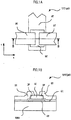
- FIG. 1A is a plan view illustrating an example of the p-type thin film transistor TFT (pD).
- FIG. 1B is a cross-sectional view taken along a line B-B of FIG. 1A .
- a gate electrode GT is formed on a surface of the substrate SUB1.
- the gate electrode GT is formed on the surface of the substrate SUB1 so as to be extended in the y direction of FIG. 1A , as illustrated in FIG. 1A .
- an insulating film GI is formed on the surface of the substrate SUB1 so as to cover the gate electrode GT.
- the insulating film GI functions as a gate insulating film of the p-type thin film transistor TFT (pD) in a formation region of the p-type thin film transistor TFT (pD).
- a semiconductor layer SC made of a polycrystalline silicon - p-Si - is formed in an island-like pattern so as to overlap the gate electrode GT.
- the semiconductor layer SC forms an i-type semiconductor layer in which impurities are not doped.
- a pair of electrodes DT and ST which are formed on a top surface of the semiconductor layer SC to face each other with a clearance being formed above the gate electrode GT.
- the electrodes DT and ST are formed to face each other while being spaced apart from each other.
- the electrodes DT and ST are formed on the insulating film GI and the electrodes DT and ST are extended in the x direction of FIG. 1A .
- An area of the semiconductor layer SC which is the clearance between the electrodes DT and ST, forms a channel region, and a distance between the electrodes DT and ST corresponds to a channel length of the p-type thin film transistor TFT (pD).
- Electrodes DT and ST are made of, for example, aluminium (Al).
- the electrodes DT and ST may be made of only aluminium, and may be made of aluminium as a main material and other metal.
- annealing is performed at, for example, about 400°C after the formation of the electrodes DT and ST, aluminium is diffused into the semiconductor layer SC, and a p(+)-type diffusion layer DF is formed at an interface between the electrode DT and the semiconductor layer SC and an interface between the electrode ST and the semiconductor layer SC.
- the p-type thin film transistor TFT (pD) as described above forms a bottom-gate-type metal insulator semiconductor (MIS) transistor.
- MIS metal insulator semiconductor
- one of the electrodes DT and ST functions as a drain electrode, and the other thereof functions as a source electrode.
- an electrode located on the left side of FIG. 1A and 1B and an electrode located on the right side thereof are referred to as the drain electrode DT and the source electrode ST, respectively.
- the p-type thin film transistor TFT (pD) structured as described above, there is no particular need to form a contact layer between the drain electrode DT and the semiconductor layer SC, and between the source electrode ST and the semiconductor layer SC. Accordingly, the p-type thin film transistor TFT (pD) may be formed with a simple process.
- the drain electrode DT and the source electrode ST of the p-type thin film transistor TFT are used as a main material for the drain electrode DT and the source electrode ST of the p-type thin film transistor TFT (pD), but other material such as gallium (Ga), indium (In), or thallium (TI) may be used as the main material therefore.
- the p(+)-type diffusion layer DF may be formed at each of the interface between the drain electrode DT and the semiconductor layer SC, and the interface between the source electrode ST and the semiconductor layer SC.
- FIG. 2 is a cross-sectional view illustrating a structure of a complementary thin film transistor in which, along with the p-type thin film transistor TFT (pD), an n-type thin film transistor TFT (nD) is formed on the substrate of the display device according to this embodiment.
- pD p-type thin film transistor
- nD n-type thin film transistor
- the p-type thin film transistor TFT (pD) illustrated in FIG. 2 has the structure similar to that of the p-type thin film transistor TFT (pD) illustrated in FIG. 1A .
- pD p-type thin film transistor TFT
- nD n-type thin film transistor TFT
- a gate electrode GT' is formed on the top surface of the substrate SUB1.
- the gate electrode GT' is formed in the same layer and is made of the same material as the gate electrode GT of the p-type thin film transistor TFT (pD).
- the insulating film GI is formed on the surface of the substrate SUB1 so as to cover the gate electrode GT'.
- the insulating film GI is formed so as to be extended from the p-type thin film transistor TFT (pD), and is formed as an extended portion of the insulating film GI of the formation region of the p-type thin film transistor TFT (pD).
- a semiconductor layer SC' made of, for example, a polycrystalline silicon - p-Si - is formed in an island-like pattern so as to overlap the gate electrode GT'.
- the semiconductor layer SC' is formed in the same layer and is made of the same material as the semiconductor layer SC of the p-type thin film transistor TFT (pD).
- a contact layer DO in which p(+)-type impurities are doped is formed on a surface of the semiconductor layer SC', that is, on a surface extending from a top surface to a side-wall surface of the semiconductor layer SC', and is further extended to a surface of the insulating film GI, on which the semiconductor layer SC' is not formed.
- the contact layer DO is not formed in a part exposed from a drain electrode DT' and a source electrode ST', which are described later.
- the semiconductor layer SC' formed under the contact layer DO is exposed from a drain electrode DT' and a source electrode ST'.
- drain electrode DT' and the source electrode ST' are formed above the top surface of the semiconductor layer SC' via the contact layer DO.
- two of the contact layer DO is formed at each of an interface between the drain electrode DT' and the semiconductor layer SC' and an interface between the source electrode ST' and the semiconductor layer SC'.
- the drain electrode DT' and the source electrode ST' are formed in the same layer and are made of the same material as the drain electrode DT and the source electrode ST of the p-type thin film transistor TFT (pD).
- a width of the gate electrode GT is larger than a width of the semiconductor layer SC and is formed beyond a formation region of the semiconductor layer SC. This is for increasing an on-current.
- FIGS. 3A and 3B are graphs illustrating Vg-Id characteristics (characteristics of gate voltage and drain current) of the n-type thin film transistor TFT (nD) and the p-type thin film transistor TFT (pD), respectively.
- a horizontal axis and a vertical axis thereof represent a gate voltage Vg (V) and a drain current Id (A), respectively.
- FIGS. 3A and 3B show a relationship between the gate voltage and the drain current in the case where the drain voltage Vd is 5 V.
- the p-type thin film transistor TFT has sufficiently large current difference between when being turned on and when being turned off and can function as a switching element.
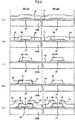
- FIGS. 4(a) to 4(e) is a series of process drawings illustrating an example of a manufacturing method for the n-type thin film transistor TFT (nD) and the p-type thin film transistor TFT (pD) illustrated in FIG. 2 .
- the manufacturing method is described process by process.
- FIGS. 4(a) to 4(e) correspond to the description of FIG. 2 , and manufacturing processes for the n-type thin film transistor TFT (nD) are illustrated on a left side of FIGS. 4(a) to 4(e) , and manufacturing processes for the p-type thin film transistor TFT (pD) are illustrated on a right side thereof.
- the gate electrode GT' and the gate electrode GT are formed on the surface of the substrate SUB1 made of glass, and further, the insulating film GI is formed so as to cover both the gate electrode GT' and the gate electrode GT.
- Both the gate electrode GT' and the gate electrode GT are formed by forming a film (having a film thickness of 50 to 150 nm) made of refractory metal such as molybdenum (Mo) or an alloy thereof by employing sputtering, patterning the formed film by employing a photolithography technology, and then selectively etching the patterned film.
- a film having a film thickness of 50 to 150 nm
- refractory metal such as molybdenum (Mo) or an alloy thereof
- the insulating film GI is formed of SiO, SiN, or a laminated film thereof so as to have a film thickness of 100 to 300 nm.
- a semiconductor layer AS made of an amorphous silicon is formed to have a film thickness of 50 to 300 nm by employing, for example, chemical vapour deposition (CVD).
- CVD chemical vapour deposition
- the semiconductor layer AS is selectively irradiated with pulses or continuous-wave lasers to be crystallized in the formation region of the n-type thin film transistor TFT (nD) and the formation region of the p-type thin film transistor TFT (pD), whereby a semiconductor layer PS made of a polycrystalline silicon is formed. It should be noted that crystallization may be performed over the entire surface of the semiconductor layer AS.
- the semiconductor layer AS is patterned by employing the photolithography technology, and then is selectively etched, with the result that the semiconductor layer PS made of a polycrystalline silicon is left in each of the formation region of the n-type thin film transistor TFT (nD) and the formation region of the p-type thin film transistor TFT (pD).
- the semiconductor layer PS provided in the formation region of the n-type thin film transistor TFT (nD) and the semiconductor layer PS provided in the formation region of the p-type thin film transistor TFT (pD) correspond to the semiconductor layer SC' and the semiconductor layer SC illustrated in FIG. 2 , respectively.
- a semiconductor layer (n(+)-type semiconductor layer) in which phosphorus (P) or the like is doped is formed to have a thickness of 10 to 50 nm by employing CVD.
- the n(+)-type semiconductor layer is patterned by employing the photolithography technology and then is etched to be left on the top surface of the semiconductor layer SC' of the n-type thin film transistor TFT (nD).
- the left n(+)-type semiconductor layer is referred to as the contact layer DO. It should be noted that etching of the n(+)-type semiconductor layer for forming the contact layer DO is also performed in a part which becomes a channel region of the n-type thin film transistor TFT (nD).
- a film made of aluminium (Al) is formed over the entire surface of the substrate SUB1 to have a film thickness of 300 to 500 nm by employing sputtering.
- a film made of refractory metal such as titanium (Ti) or molybdenum (Mo) is formed to have a film thickness of 30 to 100 nm.
- the refractory metal film thus formed is referred to as a so-called barrier metal layer, and is formed to reduce a contact resistance. It should be noted that the barrier metal layer does not have to be formed on the lower surface side of an electrode.
- the Al layer is patterned by employing the photolithography technology and is selectively etched, whereby the drain electrode DT' and the source electrode ST' are formed in the formation region of the n-type thin film transistor TFT (nD), and the drain electrode DT and the source electrode ST are formed in the formation region of the p-type thin film transistor TFT (pD).
- n-type thin film transistor TFT (nD) and the p-type thin film transistor TFT (pD) are covered with the SiN film or the like by employing CVD to form a protective film (not shown) over the entire surface of the substrate SUB1.
- annealing is performed for one to three hours at a temperature of 350 to 450°C in H 2 or N 2 atmosphere.
- aluminium (Al) contained in the drain electrode DT and the source electrode ST of the p-type thin film transistor TFT (pD) is diffused (in the case where the barrier metal layer is provided, is diffused through the barrier metal layer) into the semiconductor layer SC.
- the p(+)-type diffusion layer DF is formed at each of an interface between the drain electrode DT and the semiconductor layer SC and an interface between the source electrode ST and the semiconductor layer SC. It should be noted that the annealing may be performed prior to the formation of the protective film.
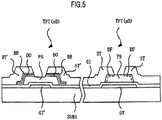
- FIG. 5 is a structural view illustrating a display device, which corresponds to FIG. 2 of the first embodiment of the present invention.
- the same components as those of FIG. 2 are denoted by the same reference symbols and have the same materials and functions as those of FIG. 2 .
- FIG. 5 is different from FIG. 2 in that a diffusion barrier layer BR is formed at an interface between the drain electrode DT' and the contact layer DO in the n-type thin film transistor TFT (nD), and that the diffusion barrier layer BR is formed at an interface between the source electrode ST' and the contact layer DO.
- the diffusion barrier layer BR is a layer for preventing aluminium (Al) forming the drain electrode DT' and the source electrode ST' from diffusing into the contact layer DO during annealing.
- the diffusion barrier layer BR is made of, for example, Mo, Ti, or an alloy thereof, and is formed to have a film thickness to an extent that aluminium (Al) may be prevented from diffusing into the contact layer DO.
- an impurity concentration of the contact layer DO hardly changes and is easily set to a predetermined value.
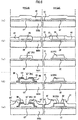
- FIGS. 6(a) to 6(e) is a series of process drawings illustrating an example of a manufacturing method for the n-type thin film transistor TFT (nD) and the p-type thin film transistor TFT (pD) illustrated in FIG. 5 , in which descriptions thereof are given correspondingly to FIGS. 4(a) to 4(e) of the first embodiment of the present invention.
- FIGS. 6(a) to 6(e) the same components as those of FIGS. 4(a) to 4(e) are denoted by the same reference symbols and have the same materials and functions as those of FIGS. 4(a) to 4(e) .
- FIGS. 6(a) to 6(e) are different from FIGS. 4(a) to 4(e) in a process illustrated in FIG. 6(d) .
- a semiconductor layer (n(+)-type semiconductor layer) in which phosphorus (P) or the like is doped and a metal layer made of molybdenum (Mo), titanium (Ti), or an alloy thereof are sequentially formed over the entire surface of the substrate SUB1 by employing CVD.
- the laminated body in which the n(+)-type semiconductor layer and the metal layer are sequentially formed is patterned collectively by employing the photolithography technology and then is etched. Through the etching thus performed, the n(+)-type semiconductor layer and the metal layer are left on the top surface of the semiconductor layer SC' of the n-type thin film transistor TFT (nD).
- the left n(+)-type semiconductor layer is used as the contact layer DO, and the left metal layer is used as the diffusion barrier layer BR.
- the laminated body formed of the n(+)-type semiconductor layer and the metal layer is also etched in a portion serving as the channel region of the n-type thin film transistor TFT (nD).
- the diffusion barrier layer BR may be formed without increasing the number of processes compared with the manufacturing method illustrated in FIGS. 4(a) to 4(e) .
- FIGS. 7(a) to 7(f) is a series of process drawings illustrating a manufacturing method for a display device not according to the present invention.
- a semiconductor layer of an n-type thin film transistor TFT (nP) used for pixel selection is made of an amorphous silicon.
- the process drawings of FIGS. 7(a) to 7(f) illustrate a case where the n-type thin film transistor TFT (nD) and the p-type thin film transistor TFT (pD) for a drive circuit are formed together with the n-type thin film transistor TFT (nP).
- FIGS. 7(a) to 7(f) the n-type thin film transistor TFT (nD), the p-type thin film transistor TFT (pD), and the n-type thin film transistor TFT (nP) are illustrated in the left, middle, and the right thereof, respectively.
- nD the n-type thin film transistor TFT
- pD the p-type thin film transistor TFT
- nP the n-type thin film transistor TFT
- the gate electrode GT', the gate electrode GT, and a gate electrode GT" are formed on the surface of the substrate SUB1 made of glass, and the insulating film GI is formed so as to cover the gate electrode GT', the gate electrode GT, and the gate electrode GT".
- the gate electrode GT', the gate electrode GT, and the gate electrode GT” are each formed by forming a film (having a film thickness of 50 to 150 nm) made of refractory metal such as molybdenum (Mo) or its alloy by employing sputtering, patterning the formed film by employing the photolithography technology, and selectively etching the patterned film.
- a film having a film thickness of 50 to 150 nm
- refractory metal such as molybdenum (Mo) or its alloy
- the insulating film GI is made of SiO or SiN, or is formed of a laminated film thereof.
- the insulating film GI has a film thickness of 100 to 300 nm.
- the semiconductor layer AS made of an amorphous silicon is formed over the entire top surface of the insulating film GI by employing CVD to have a film thickness of 50 to 300 nm.
- the semiconductor layer AS After performing dehydrogenation treatment on the semiconductor layer AS, the semiconductor layer AS is selectively irradiated with pulses or continuous-wave lasers, and the semiconductor layer AS located in the formation region of the n-type thin film transistor TFT (nD) and the formation region of the p-type thin film transistor TFT (pD) is crystallized, to thereby form the semiconductor layer PS made of a polycrystalline silicon. It should be noted that the semiconductor layer AS may be crystallized over the entire surface thereof.
- the semiconductor layer AS is patterned by employing the photolithography technology, and is further selectively etched, with the result that the semiconductor layer PS made of a polycrystalline silicon is left in each of the formation region of the n-type thin film transistor TFT (nD) and the formation region of the p-type thin film transistor TFT (pD).
- a semiconductor layer AS' made of an amorphous silicon is formed on the surface of the substrate SUB1 by employing, for example, CVD, to have a film thickness of 50 to 250 nm, is patterned by the photolithography technology, and is etched. As a result, the semiconductor layer AS' is left in the respective formation regions of the n-type thin film transistor TFT (nD), the p-type thin film transistor TFT (pD), and the n-type thin film transistor TFT (nP).
- the semiconductor layer AS' is formed so as to be laminated on the semiconductor layer PS in the n-type thin film transistor TFT (nD) and the p-type thin film transistor TFT (pD).
- the semiconductor layer AS' is formed directly on the insulating film GI in the n-type thin film transistor TFT (nP).
- the semiconductor layer is formed as the laminated body in which the semiconductor layer PS made of a polycrystalline silicon and the semiconductor layer AS' made of an amorphous silicon are sequentially laminated.
- the semiconductor layer (n(+)-type semiconductor layer) in which phosphorus (P) or the like is doped by employing CVD is formed over the entire surface of the substrate SUB1 to have a thickness of 10 to 50 nm.
- the n(+)-type semiconductor layer is patterned by employing the photolithography technology and is further etched, and accordingly, is left on a top surface of the semiconductor layer AS' of the n-type thin film transistor TFT (nD) and a top surface of the semiconductor layer AS' of the n-type thin film transistor TFT (nP).
- the n(+)-type semiconductor layer thus left is used as the contact layer DO of the n-type thin film transistor TFT (nD) and the contact layer DO of the n-type thin film transistor TFT (nP).
- the n(+)-type semiconductor layer is also etched in portions which become a channel region of the n-type thin film transistor TFT (nD) and a channel region of the n-type thin film transistor TFT (nP).
- a film made of aluminium (Al) is formed over the entire surface of the substrate SUB1 by employing sputtering to have a film thickness of 300 to 500 nm.
- a film made of refractory metal such as titanium (Ti) or molybdenum (Mo) is formed to have a film thickness of 30 to 100 nm.
- the refractory metal film is referred to as a so-called barrier metal layer, and is formed to reduce a contact resistance.
- the Al layer is patterned by employing the photolithography technology and is selectively etched, with the result that the drain electrode DT' and the source electrode ST' are formed in the formation region of the n-type thin film transistor TFT (nD), the drain electrode DT and the source electrode ST are formed in the formation region of the p-type thin film transistor TFT (pD), and the drain electrode DT" and the source electrode ST" are formed in the formation region of the n-type thin film transistor TFT (nP).
- a protective film made of an SiN film or the like is formed over the entire surface of the substrate SUB1 by employing CVD so as to cover the n-type thin film transistor TFT (nD), the p-type thin film transistor TFT (pD), and the n-type thin film transistor TFT (nP).
- annealing is performed for one to three hours at a temperature of 350 to 450°C in H 2 or N 2 atmosphere.
- aluminium (Al) contained in the drain electrode DT and the source electrode ST of the p-type thin film transistor TFT (pD) is diffused (is diffused through the barrier metal layer) into the semiconductor layer SC (corresponding to the semiconductor layer AS' and the semiconductor layer PS of FIG. 7(f) ).
- a p(+)-type diffusion layer DF is formed at an interface between the drain electrode DT and the semiconductor layer SC and an interface between the source electrode ST and the semiconductor layer SC.
- the annealing may be performed prior to the formation of the protective film.
Landscapes
- Thin Film Transistor (AREA)
- Liquid Crystal (AREA)
- Devices For Indicating Variable Information By Combining Individual Elements (AREA)
Applications Claiming Priority (1)
| Application Number | Priority Date | Filing Date | Title |
|---|---|---|---|
| JP2008049885A JP5363009B2 (ja) | 2008-02-29 | 2008-02-29 | 表示装置およびその製造方法 |
Publications (3)
| Publication Number | Publication Date |
|---|---|
| EP2096673A2 EP2096673A2 (en) | 2009-09-02 |
| EP2096673A3 EP2096673A3 (en) | 2011-04-20 |
| EP2096673B1 true EP2096673B1 (en) | 2021-06-02 |
Family
ID=40719637
Family Applications (1)
| Application Number | Title | Priority Date | Filing Date |
|---|---|---|---|
| EP09153984.1A Active EP2096673B1 (en) | 2008-02-29 | 2009-02-27 | Method of manufacturing display device |
Country Status (6)
| Country | Link |
|---|---|
| US (1) | US8058654B2 (enExample) |
| EP (1) | EP2096673B1 (enExample) |
| JP (1) | JP5363009B2 (enExample) |
| KR (1) | KR101043115B1 (enExample) |
| CN (1) | CN101521210B (enExample) |
| TW (1) | TWI401805B (enExample) |
Families Citing this family (7)
| Publication number | Priority date | Publication date | Assignee | Title |
|---|---|---|---|---|
| JP5111167B2 (ja) * | 2008-03-06 | 2012-12-26 | 株式会社ジャパンディスプレイイースト | 液晶表示装置 |
| FR2944140B1 (fr) * | 2009-04-02 | 2011-09-16 | Commissariat Energie Atomique | Dispositif de detection d'image electronique |
| KR20110081694A (ko) * | 2010-01-08 | 2011-07-14 | 삼성모바일디스플레이주식회사 | 박막 트랜지스터의 제조 방법 및 표시 장치의 제조 방법 |
| JP5708910B2 (ja) | 2010-03-30 | 2015-04-30 | ソニー株式会社 | 薄膜トランジスタおよびその製造方法、並びに表示装置 |
| TWI666776B (zh) * | 2014-06-20 | 2019-07-21 | 日商半導體能源研究所股份有限公司 | 半導體裝置以及包括該半導體裝置的顯示裝置 |
| JP6544166B2 (ja) * | 2015-09-14 | 2019-07-17 | 信越化学工業株式会社 | SiC複合基板の製造方法 |
| CN105470310A (zh) * | 2016-01-21 | 2016-04-06 | 京东方科技集团股份有限公司 | 一种薄膜晶体管及其制作方法、阵列基板和显示装置 |
Citations (2)
| Publication number | Priority date | Publication date | Assignee | Title |
|---|---|---|---|---|
| US6204519B1 (en) * | 1996-03-10 | 2001-03-20 | Semicondutor Energy Laboratory Co., Ltd. | Thin film semiconductor device |
| US20060138403A1 (en) * | 2004-12-29 | 2006-06-29 | Gang Yu | Organic electronic devices including pixels |
Family Cites Families (20)
| Publication number | Priority date | Publication date | Assignee | Title |
|---|---|---|---|---|
| GB2044994B (en) | 1979-03-22 | 1983-06-15 | Philips Electronic Associated | Thin film transistors |
| JPH0693509B2 (ja) | 1983-08-26 | 1994-11-16 | シャープ株式会社 | 薄膜トランジスタ |
| ATE77177T1 (de) | 1985-10-04 | 1992-06-15 | Hosiden Corp | Duennfilmtransistor und verfahren zu seiner herstellung. |
| JPH0563196A (ja) * | 1991-09-04 | 1993-03-12 | Hitachi Ltd | 薄膜半導体装置及びその製造方法並び液晶表示装置 |
| JPH06188265A (ja) | 1992-12-22 | 1994-07-08 | Matsushita Electric Ind Co Ltd | 半導体装置およびその製造方法 |
| JPH08204032A (ja) * | 1995-01-20 | 1996-08-09 | Mitsubishi Electric Corp | 半導体装置及びその製造方法 |
| JP2757850B2 (ja) | 1996-04-18 | 1998-05-25 | 日本電気株式会社 | 薄膜トランジスタおよびその製造方法 |
| JP4019461B2 (ja) * | 1996-09-06 | 2007-12-12 | セイコーエプソン株式会社 | カラー表示装置とその製造方法およびカラー液晶装置 |
| US6620719B1 (en) * | 2000-03-31 | 2003-09-16 | International Business Machines Corporation | Method of forming ohmic contacts using a self doping layer for thin-film transistors |
| JP2002202527A (ja) * | 2000-12-28 | 2002-07-19 | Nec Corp | アクティブマトリクス型液晶表示装置 |
| JP2004079735A (ja) | 2002-08-15 | 2004-03-11 | Nec Corp | 薄膜トランジスタの製造方法 |
| TW554539B (en) * | 2002-09-09 | 2003-09-21 | Chunghwa Picture Tubes Ltd | Thin film transistor source/drain structure and manufacturing method thereof |
| KR100904266B1 (ko) | 2002-12-31 | 2009-06-25 | 엘지디스플레이 주식회사 | 박막 트랜지스터 어레이 기판의 제조 방법 |
| JP4316896B2 (ja) * | 2003-01-09 | 2009-08-19 | 株式会社 日立ディスプレイズ | 表示装置とその製造方法 |
| KR100584715B1 (ko) * | 2004-04-06 | 2006-05-29 | 엘지.필립스 엘시디 주식회사 | 구동회로 일체형 액정표시장치용 어레이 기판의 제조 방법 |
| JP5036173B2 (ja) * | 2004-11-26 | 2012-09-26 | 株式会社半導体エネルギー研究所 | 半導体装置の作製方法 |
| US7521710B2 (en) * | 2006-02-16 | 2009-04-21 | Idemitsu Kosan Co., Ltd. | Organic thin film transistor |
| US7646015B2 (en) * | 2006-10-31 | 2010-01-12 | Semiconductor Energy Laboratory Co., Ltd. | Manufacturing method of semiconductor device and semiconductor device |
| JP5303119B2 (ja) * | 2007-06-05 | 2013-10-02 | 株式会社ジャパンディスプレイ | 半導体装置 |
| JP2008311545A (ja) * | 2007-06-18 | 2008-12-25 | Hitachi Displays Ltd | 表示装置 |
-
2008
- 2008-02-29 JP JP2008049885A patent/JP5363009B2/ja active Active
-
2009
- 2009-02-12 CN CN2009100057992A patent/CN101521210B/zh active Active
- 2009-02-19 TW TW098105315A patent/TWI401805B/zh active
- 2009-02-26 US US12/379,662 patent/US8058654B2/en active Active
- 2009-02-26 KR KR1020090016353A patent/KR101043115B1/ko active Active
- 2009-02-27 EP EP09153984.1A patent/EP2096673B1/en active Active
Patent Citations (2)
| Publication number | Priority date | Publication date | Assignee | Title |
|---|---|---|---|---|
| US6204519B1 (en) * | 1996-03-10 | 2001-03-20 | Semicondutor Energy Laboratory Co., Ltd. | Thin film semiconductor device |
| US20060138403A1 (en) * | 2004-12-29 | 2006-06-29 | Gang Yu | Organic electronic devices including pixels |
Also Published As
| Publication number | Publication date |
|---|---|
| CN101521210A (zh) | 2009-09-02 |
| TWI401805B (zh) | 2013-07-11 |
| US8058654B2 (en) | 2011-11-15 |
| KR20090093849A (ko) | 2009-09-02 |
| JP2009206437A (ja) | 2009-09-10 |
| CN101521210B (zh) | 2012-05-23 |
| JP5363009B2 (ja) | 2013-12-11 |
| TW201001711A (en) | 2010-01-01 |
| KR101043115B1 (ko) | 2011-06-20 |
| EP2096673A2 (en) | 2009-09-02 |
| US20090218575A1 (en) | 2009-09-03 |
| EP2096673A3 (en) | 2011-04-20 |
Similar Documents
| Publication | Publication Date | Title |
|---|---|---|
| US6713825B2 (en) | Poly-crystalline thin film transistor and fabrication method thereof | |
| US8058654B2 (en) | Display device and manufacturing method thereof | |
| US20190243194A1 (en) | Active matrix substrate and method for manufacturing same | |
| US20190296050A1 (en) | Active matrix substrate and method for manufacturing same | |
| JP5442228B2 (ja) | 表示装置及び表示装置の製造方法 | |
| KR20070072207A (ko) | 폴리실리콘 박막트랜지스터를 이용한 액정표시장치 및 그제조 방법 | |
| US6549252B1 (en) | Reflective liquid crystal display device having a TFT as a switching element and method for fabricating the same | |
| KR20100030995A (ko) | 박막 트랜지스터 및 그 제조 방법 | |
| KR100873702B1 (ko) | 평판 디스플레이용 박막 트랜지스터 및 그 제조방법 | |
| KR101483629B1 (ko) | 박막 트랜지스터 및 그 제조방법 | |
| KR20070072208A (ko) | 폴리실리콘 박막트랜지스터를 이용한 액정표시장치 및 그제조 방법 | |
| US8754418B2 (en) | Semiconductor device, and method for producing same | |
| KR101107683B1 (ko) | 폴리실리콘 박막트랜지스터 어레이 기판의 제조방법 | |
| JPH11284191A (ja) | 縦型薄膜トランジスタおよびその製造方法 | |
| JP2010205850A (ja) | 表示装置 | |
| KR101035921B1 (ko) | 폴리실리콘 박막트랜지스터 어레이 기판의 제조방법 | |
| JP4127462B2 (ja) | 半導体装置の作製方法 | |
| KR100488063B1 (ko) | 박막 트랜지스터 및 그 제조방법 | |
| KR101041265B1 (ko) | 다결정 실리콘 박막 트랜지스터 및 그 제조방법 | |
| KR101087992B1 (ko) | 피모스 다결정 실리콘 박막트랜지스터 제조방법 | |
| KR950005483B1 (ko) | 박막트랜지스터 및 그의 제조방법 | |
| KR100713879B1 (ko) | 박막 트랜지스터의 액정 표시 소자의 제조방법 | |
| KR101021777B1 (ko) | 다결정 실리콘 박막 트랜지스터 및 그 제조방법 | |
| JPH11284192A (ja) | 縦型薄膜トランジスタおよびその製造方法 | |
| KR101036726B1 (ko) | 금속유도결정화를 이용한 액정표시소자 제조방법 |
Legal Events
| Date | Code | Title | Description |
|---|---|---|---|
| PUAI | Public reference made under article 153(3) epc to a published international application that has entered the european phase |
Free format text: ORIGINAL CODE: 0009012 |
|
| 17P | Request for examination filed |
Effective date: 20090320 |
|
| AK | Designated contracting states |
Kind code of ref document: A2 Designated state(s): AT BE BG CH CY CZ DE DK EE ES FI FR GB GR HR HU IE IS IT LI LT LU LV MC MK MT NL NO PL PT RO SE SI SK TR |
|
| AX | Request for extension of the european patent |
Extension state: AL BA RS |
|
| RIC1 | Information provided on ipc code assigned before grant |
Ipc: H01L 21/77 20060101ALI20101122BHEP Ipc: H01L 27/12 20060101ALI20101122BHEP Ipc: H01L 29/45 20060101ALI20101122BHEP Ipc: H01L 21/336 20060101AFI20101122BHEP |
|
| PUAL | Search report despatched |
Free format text: ORIGINAL CODE: 0009013 |
|
| AK | Designated contracting states |
Kind code of ref document: A3 Designated state(s): AT BE BG CH CY CZ DE DK EE ES FI FR GB GR HR HU IE IS IT LI LT LU LV MC MK MT NL NO PL PT RO SE SI SK TR |
|
| AX | Request for extension of the european patent |
Extension state: AL BA RS |
|
| AKX | Designation fees paid |
Designated state(s): AT BE BG CH CY CZ DE DK EE ES FI FR GB GR HR HU IE IS IT LI LT LU LV MC MK MT NL NO PL PT RO SE SI SK TR |
|
| RAP1 | Party data changed (applicant data changed or rights of an application transferred) |
Owner name: PANASONIC LIQUID CRYSTAL DISPLAY CO., LTD. |
|
| RAP1 | Party data changed (applicant data changed or rights of an application transferred) |
Owner name: PANASONIC LIQUID CRYSTAL DISPLAY CO., LTD. Owner name: HITACHI DISPLAYS, LTD. |
|
| 17Q | First examination report despatched |
Effective date: 20140226 |
|
| RAP1 | Party data changed (applicant data changed or rights of an application transferred) |
Owner name: JAPAN DISPLAY INC. Owner name: PANASONIC LIQUID CRYSTAL DISPLAY CO., LTD. |
|
| STAA | Information on the status of an ep patent application or granted ep patent |
Free format text: STATUS: EXAMINATION IS IN PROGRESS |
|
| GRAP | Despatch of communication of intention to grant a patent |
Free format text: ORIGINAL CODE: EPIDOSNIGR1 |
|
| STAA | Information on the status of an ep patent application or granted ep patent |
Free format text: STATUS: GRANT OF PATENT IS INTENDED |
|
| RIC1 | Information provided on ipc code assigned before grant |
Ipc: H01L 29/45 20060101ALI20201211BHEP Ipc: H01L 27/12 20060101AFI20201211BHEP |
|
| INTG | Intention to grant announced |
Effective date: 20210119 |
|
| GRAS | Grant fee paid |
Free format text: ORIGINAL CODE: EPIDOSNIGR3 |
|
| GRAA | (expected) grant |
Free format text: ORIGINAL CODE: 0009210 |
|
| STAA | Information on the status of an ep patent application or granted ep patent |
Free format text: STATUS: THE PATENT HAS BEEN GRANTED |
|
| REG | Reference to a national code |
Ref country code: CH Ref legal event code: EP |
|
| AK | Designated contracting states |
Kind code of ref document: B1 Designated state(s): AT BE BG CH CY CZ DE DK EE ES FI FR GB GR HR HU IE IS IT LI LT LU LV MC MK MT NL NO PL PT RO SE SI SK TR |
|
| REG | Reference to a national code |
Ref country code: GB Ref legal event code: FG4D |
|
| REG | Reference to a national code |
Ref country code: AT Ref legal event code: REF Ref document number: 1399241 Country of ref document: AT Kind code of ref document: T Effective date: 20210615 |
|
| REG | Reference to a national code |
Ref country code: IE Ref legal event code: FG4D |
|
| REG | Reference to a national code |
Ref country code: DE Ref legal event code: R096 Ref document number: 602009063754 Country of ref document: DE |
|
| REG | Reference to a national code |
Ref country code: LT Ref legal event code: MG9D |
|
| PG25 | Lapsed in a contracting state [announced via postgrant information from national office to epo] |
Ref country code: LT Free format text: LAPSE BECAUSE OF FAILURE TO SUBMIT A TRANSLATION OF THE DESCRIPTION OR TO PAY THE FEE WITHIN THE PRESCRIBED TIME-LIMIT Effective date: 20210602 Ref country code: FI Free format text: LAPSE BECAUSE OF FAILURE TO SUBMIT A TRANSLATION OF THE DESCRIPTION OR TO PAY THE FEE WITHIN THE PRESCRIBED TIME-LIMIT Effective date: 20210602 Ref country code: BG Free format text: LAPSE BECAUSE OF FAILURE TO SUBMIT A TRANSLATION OF THE DESCRIPTION OR TO PAY THE FEE WITHIN THE PRESCRIBED TIME-LIMIT Effective date: 20210902 Ref country code: HR Free format text: LAPSE BECAUSE OF FAILURE TO SUBMIT A TRANSLATION OF THE DESCRIPTION OR TO PAY THE FEE WITHIN THE PRESCRIBED TIME-LIMIT Effective date: 20210602 |
|
| REG | Reference to a national code |
Ref country code: NL Ref legal event code: MP Effective date: 20210602 |
|
| REG | Reference to a national code |
Ref country code: AT Ref legal event code: MK05 Ref document number: 1399241 Country of ref document: AT Kind code of ref document: T Effective date: 20210602 |
|
| PG25 | Lapsed in a contracting state [announced via postgrant information from national office to epo] |
Ref country code: PL Free format text: LAPSE BECAUSE OF FAILURE TO SUBMIT A TRANSLATION OF THE DESCRIPTION OR TO PAY THE FEE WITHIN THE PRESCRIBED TIME-LIMIT Effective date: 20210602 Ref country code: NO Free format text: LAPSE BECAUSE OF FAILURE TO SUBMIT A TRANSLATION OF THE DESCRIPTION OR TO PAY THE FEE WITHIN THE PRESCRIBED TIME-LIMIT Effective date: 20210902 Ref country code: SE Free format text: LAPSE BECAUSE OF FAILURE TO SUBMIT A TRANSLATION OF THE DESCRIPTION OR TO PAY THE FEE WITHIN THE PRESCRIBED TIME-LIMIT Effective date: 20210602 Ref country code: GR Free format text: LAPSE BECAUSE OF FAILURE TO SUBMIT A TRANSLATION OF THE DESCRIPTION OR TO PAY THE FEE WITHIN THE PRESCRIBED TIME-LIMIT Effective date: 20210903 Ref country code: LV Free format text: LAPSE BECAUSE OF FAILURE TO SUBMIT A TRANSLATION OF THE DESCRIPTION OR TO PAY THE FEE WITHIN THE PRESCRIBED TIME-LIMIT Effective date: 20210602 |
|
| PG25 | Lapsed in a contracting state [announced via postgrant information from national office to epo] |
Ref country code: ES Free format text: LAPSE BECAUSE OF FAILURE TO SUBMIT A TRANSLATION OF THE DESCRIPTION OR TO PAY THE FEE WITHIN THE PRESCRIBED TIME-LIMIT Effective date: 20210602 Ref country code: NL Free format text: LAPSE BECAUSE OF FAILURE TO SUBMIT A TRANSLATION OF THE DESCRIPTION OR TO PAY THE FEE WITHIN THE PRESCRIBED TIME-LIMIT Effective date: 20210602 Ref country code: PT Free format text: LAPSE BECAUSE OF FAILURE TO SUBMIT A TRANSLATION OF THE DESCRIPTION OR TO PAY THE FEE WITHIN THE PRESCRIBED TIME-LIMIT Effective date: 20211004 Ref country code: RO Free format text: LAPSE BECAUSE OF FAILURE TO SUBMIT A TRANSLATION OF THE DESCRIPTION OR TO PAY THE FEE WITHIN THE PRESCRIBED TIME-LIMIT Effective date: 20210602 Ref country code: AT Free format text: LAPSE BECAUSE OF FAILURE TO SUBMIT A TRANSLATION OF THE DESCRIPTION OR TO PAY THE FEE WITHIN THE PRESCRIBED TIME-LIMIT Effective date: 20210602 Ref country code: SK Free format text: LAPSE BECAUSE OF FAILURE TO SUBMIT A TRANSLATION OF THE DESCRIPTION OR TO PAY THE FEE WITHIN THE PRESCRIBED TIME-LIMIT Effective date: 20210602 Ref country code: CZ Free format text: LAPSE BECAUSE OF FAILURE TO SUBMIT A TRANSLATION OF THE DESCRIPTION OR TO PAY THE FEE WITHIN THE PRESCRIBED TIME-LIMIT Effective date: 20210602 Ref country code: EE Free format text: LAPSE BECAUSE OF FAILURE TO SUBMIT A TRANSLATION OF THE DESCRIPTION OR TO PAY THE FEE WITHIN THE PRESCRIBED TIME-LIMIT Effective date: 20210602 |
|
| REG | Reference to a national code |
Ref country code: DE Ref legal event code: R097 Ref document number: 602009063754 Country of ref document: DE |
|
| PLBE | No opposition filed within time limit |
Free format text: ORIGINAL CODE: 0009261 |
|
| STAA | Information on the status of an ep patent application or granted ep patent |
Free format text: STATUS: NO OPPOSITION FILED WITHIN TIME LIMIT |
|
| PG25 | Lapsed in a contracting state [announced via postgrant information from national office to epo] |
Ref country code: DK Free format text: LAPSE BECAUSE OF FAILURE TO SUBMIT A TRANSLATION OF THE DESCRIPTION OR TO PAY THE FEE WITHIN THE PRESCRIBED TIME-LIMIT Effective date: 20210602 |
|
| 26N | No opposition filed |
Effective date: 20220303 |
|
| PG25 | Lapsed in a contracting state [announced via postgrant information from national office to epo] |
Ref country code: IT Free format text: LAPSE BECAUSE OF FAILURE TO SUBMIT A TRANSLATION OF THE DESCRIPTION OR TO PAY THE FEE WITHIN THE PRESCRIBED TIME-LIMIT Effective date: 20210602 |
|
| PG25 | Lapsed in a contracting state [announced via postgrant information from national office to epo] |
Ref country code: MC Free format text: LAPSE BECAUSE OF FAILURE TO SUBMIT A TRANSLATION OF THE DESCRIPTION OR TO PAY THE FEE WITHIN THE PRESCRIBED TIME-LIMIT Effective date: 20210602 |
|
| REG | Reference to a national code |
Ref country code: CH Ref legal event code: PL |
|
| REG | Reference to a national code |
Ref country code: BE Ref legal event code: MM Effective date: 20220228 |
|
| GBPC | Gb: european patent ceased through non-payment of renewal fee |
Effective date: 20220227 |
|
| PG25 | Lapsed in a contracting state [announced via postgrant information from national office to epo] |
Ref country code: LU Free format text: LAPSE BECAUSE OF NON-PAYMENT OF DUE FEES Effective date: 20220227 |
|
| PG25 | Lapsed in a contracting state [announced via postgrant information from national office to epo] |
Ref country code: FR Free format text: LAPSE BECAUSE OF NON-PAYMENT OF DUE FEES Effective date: 20220228 |
|
| PG25 | Lapsed in a contracting state [announced via postgrant information from national office to epo] |
Ref country code: LI Free format text: LAPSE BECAUSE OF NON-PAYMENT OF DUE FEES Effective date: 20220228 Ref country code: IE Free format text: LAPSE BECAUSE OF NON-PAYMENT OF DUE FEES Effective date: 20220227 Ref country code: GB Free format text: LAPSE BECAUSE OF NON-PAYMENT OF DUE FEES Effective date: 20220227 Ref country code: CH Free format text: LAPSE BECAUSE OF NON-PAYMENT OF DUE FEES Effective date: 20220228 |
|
| PG25 | Lapsed in a contracting state [announced via postgrant information from national office to epo] |
Ref country code: BE Free format text: LAPSE BECAUSE OF NON-PAYMENT OF DUE FEES Effective date: 20220228 |
|
| REG | Reference to a national code |
Ref country code: DE Ref legal event code: R081 Ref document number: 602009063754 Country of ref document: DE Owner name: PANASONIC INTELLECTUAL PROPERTY CORPORATION OF, US Free format text: FORMER OWNERS: JAPAN DISPLAY INC., TOKYO, JP; PANASONIC LIQUID CRYSTAL DISPLAY CO., LTD., HIMEJI-SHI, HYOGO, JP Ref country code: DE Ref legal event code: R081 Ref document number: 602009063754 Country of ref document: DE Owner name: JAPAN DISPLAY INC., JP Free format text: FORMER OWNERS: JAPAN DISPLAY INC., TOKYO, JP; PANASONIC LIQUID CRYSTAL DISPLAY CO., LTD., HIMEJI-SHI, HYOGO, JP Ref country code: DE Ref legal event code: R081 Ref document number: 602009063754 Country of ref document: DE Owner name: MAGNOLIA PURPLE CORP., JP Free format text: FORMER OWNERS: JAPAN DISPLAY INC., TOKYO, JP; PANASONIC LIQUID CRYSTAL DISPLAY CO., LTD., HIMEJI-SHI, HYOGO, JP |
|
| PG25 | Lapsed in a contracting state [announced via postgrant information from national office to epo] |
Ref country code: HU Free format text: LAPSE BECAUSE OF FAILURE TO SUBMIT A TRANSLATION OF THE DESCRIPTION OR TO PAY THE FEE WITHIN THE PRESCRIBED TIME-LIMIT; INVALID AB INITIO Effective date: 20090227 |
|
| PG25 | Lapsed in a contracting state [announced via postgrant information from national office to epo] |
Ref country code: MK Free format text: LAPSE BECAUSE OF FAILURE TO SUBMIT A TRANSLATION OF THE DESCRIPTION OR TO PAY THE FEE WITHIN THE PRESCRIBED TIME-LIMIT Effective date: 20210602 Ref country code: CY Free format text: LAPSE BECAUSE OF FAILURE TO SUBMIT A TRANSLATION OF THE DESCRIPTION OR TO PAY THE FEE WITHIN THE PRESCRIBED TIME-LIMIT Effective date: 20210602 |
|
| PG25 | Lapsed in a contracting state [announced via postgrant information from national office to epo] |
Ref country code: TR Free format text: LAPSE BECAUSE OF FAILURE TO SUBMIT A TRANSLATION OF THE DESCRIPTION OR TO PAY THE FEE WITHIN THE PRESCRIBED TIME-LIMIT Effective date: 20210602 |
|
| PG25 | Lapsed in a contracting state [announced via postgrant information from national office to epo] |
Ref country code: MT Free format text: LAPSE BECAUSE OF FAILURE TO SUBMIT A TRANSLATION OF THE DESCRIPTION OR TO PAY THE FEE WITHIN THE PRESCRIBED TIME-LIMIT Effective date: 20210602 |
|
| REG | Reference to a national code |
Ref country code: DE Ref legal event code: R079 Ref document number: 602009063754 Country of ref document: DE Free format text: PREVIOUS MAIN CLASS: H01L0027120000 Ipc: H10D0086000000 |
|
| REG | Reference to a national code |
Ref country code: DE Ref legal event code: R081 Ref document number: 602009063754 Country of ref document: DE Owner name: MAGNOLIA PURPLE CORP., JP Free format text: FORMER OWNERS: JAPAN DISPLAY INC., TOKYO, JP; PANASONIC INTELLECTUAL PROPERTY CORPORATION OF AMERICA, TORRANCE, CA, US Ref country code: DE Ref legal event code: R081 Ref document number: 602009063754 Country of ref document: DE Owner name: PANASONIC INTELLECTUAL PROPERTY CORPORATION OF, US Free format text: FORMER OWNERS: JAPAN DISPLAY INC., TOKYO, JP; PANASONIC INTELLECTUAL PROPERTY CORPORATION OF AMERICA, TORRANCE, CA, US |
|
| PGFP | Annual fee paid to national office [announced via postgrant information from national office to epo] |
Ref country code: DE Payment date: 20260102 Year of fee payment: 18 |