EP1802561B1 - Verfahren zur herstellung optisch aktiver carbonylverbindungen - Google Patents
Verfahren zur herstellung optisch aktiver carbonylverbindungen Download PDFInfo
- Publication number
- EP1802561B1 EP1802561B1 EP05805158A EP05805158A EP1802561B1 EP 1802561 B1 EP1802561 B1 EP 1802561B1 EP 05805158 A EP05805158 A EP 05805158A EP 05805158 A EP05805158 A EP 05805158A EP 1802561 B1 EP1802561 B1 EP 1802561B1
- Authority
- EP
- European Patent Office
- Prior art keywords
- optically active
- process according
- phenyl
- carbon monoxide
- aryl
- Prior art date
- Legal status (The legal status is an assumption and is not a legal conclusion. Google has not performed a legal analysis and makes no representation as to the accuracy of the status listed.)
- Expired - Lifetime
Links
- 0 *c1ccc(CCCC2)c2c1-c1c(CCCC2)c2ccc1* Chemical compound *c1ccc(CCCC2)c2c1-c1c(CCCC2)c2ccc1* 0.000 description 5
- HQYNKMFMUGOJEZ-UHFFFAOYSA-N O=C1CC(COCc2ccccc2)CCC1 Chemical compound O=C1CC(COCc2ccccc2)CCC1 HQYNKMFMUGOJEZ-UHFFFAOYSA-N 0.000 description 1
- ZUDJASYMJNCZKF-UHFFFAOYSA-N OCC(CC1)CC1=O Chemical compound OCC(CC1)CC1=O ZUDJASYMJNCZKF-UHFFFAOYSA-N 0.000 description 1
- JWFAAVYVUOVXIC-UHFFFAOYSA-N OCCC(CC1)CC1=O Chemical compound OCCC(CC1)CC1=O JWFAAVYVUOVXIC-UHFFFAOYSA-N 0.000 description 1
Classifications
-
- B—PERFORMING OPERATIONS; TRANSPORTING
- B01—PHYSICAL OR CHEMICAL PROCESSES OR APPARATUS IN GENERAL
- B01J—CHEMICAL OR PHYSICAL PROCESSES, e.g. CATALYSIS OR COLLOID CHEMISTRY; THEIR RELEVANT APPARATUS
- B01J31/00—Catalysts comprising hydrides, coordination complexes or organic compounds
- B01J31/16—Catalysts comprising hydrides, coordination complexes or organic compounds containing coordination complexes
- B01J31/20—Carbonyls
-
- B—PERFORMING OPERATIONS; TRANSPORTING
- B01—PHYSICAL OR CHEMICAL PROCESSES OR APPARATUS IN GENERAL
- B01J—CHEMICAL OR PHYSICAL PROCESSES, e.g. CATALYSIS OR COLLOID CHEMISTRY; THEIR RELEVANT APPARATUS
- B01J31/00—Catalysts comprising hydrides, coordination complexes or organic compounds
- B01J31/16—Catalysts comprising hydrides, coordination complexes or organic compounds containing coordination complexes
- B01J31/18—Catalysts comprising hydrides, coordination complexes or organic compounds containing coordination complexes containing nitrogen, phosphorus, arsenic or antimony as complexing atoms, e.g. in pyridine ligands, or in resonance therewith, e.g. in isocyanide ligands C=N-R or as complexed central atoms
- B01J31/1845—Catalysts comprising hydrides, coordination complexes or organic compounds containing coordination complexes containing nitrogen, phosphorus, arsenic or antimony as complexing atoms, e.g. in pyridine ligands, or in resonance therewith, e.g. in isocyanide ligands C=N-R or as complexed central atoms the ligands containing phosphorus
-
- B—PERFORMING OPERATIONS; TRANSPORTING
- B01—PHYSICAL OR CHEMICAL PROCESSES OR APPARATUS IN GENERAL
- B01J—CHEMICAL OR PHYSICAL PROCESSES, e.g. CATALYSIS OR COLLOID CHEMISTRY; THEIR RELEVANT APPARATUS
- B01J31/00—Catalysts comprising hydrides, coordination complexes or organic compounds
- B01J31/16—Catalysts comprising hydrides, coordination complexes or organic compounds containing coordination complexes
- B01J31/18—Catalysts comprising hydrides, coordination complexes or organic compounds containing coordination complexes containing nitrogen, phosphorus, arsenic or antimony as complexing atoms, e.g. in pyridine ligands, or in resonance therewith, e.g. in isocyanide ligands C=N-R or as complexed central atoms
- B01J31/189—Catalysts comprising hydrides, coordination complexes or organic compounds containing coordination complexes containing nitrogen, phosphorus, arsenic or antimony as complexing atoms, e.g. in pyridine ligands, or in resonance therewith, e.g. in isocyanide ligands C=N-R or as complexed central atoms containing both nitrogen and phosphorus as complexing atoms, including e.g. phosphino moieties, in one at least bidentate or bridging ligand
-
- B—PERFORMING OPERATIONS; TRANSPORTING
- B01—PHYSICAL OR CHEMICAL PROCESSES OR APPARATUS IN GENERAL
- B01J—CHEMICAL OR PHYSICAL PROCESSES, e.g. CATALYSIS OR COLLOID CHEMISTRY; THEIR RELEVANT APPARATUS
- B01J31/00—Catalysts comprising hydrides, coordination complexes or organic compounds
- B01J31/16—Catalysts comprising hydrides, coordination complexes or organic compounds containing coordination complexes
- B01J31/22—Organic complexes
- B01J31/2204—Organic complexes the ligands containing oxygen or sulfur as complexing atoms
- B01J31/2208—Oxygen, e.g. acetylacetonates
- B01J31/2221—At least one oxygen and one phosphorous atom present as complexing atoms in an at least bidentate or bridging ligand
-
- B—PERFORMING OPERATIONS; TRANSPORTING
- B01—PHYSICAL OR CHEMICAL PROCESSES OR APPARATUS IN GENERAL
- B01J—CHEMICAL OR PHYSICAL PROCESSES, e.g. CATALYSIS OR COLLOID CHEMISTRY; THEIR RELEVANT APPARATUS
- B01J31/00—Catalysts comprising hydrides, coordination complexes or organic compounds
- B01J31/16—Catalysts comprising hydrides, coordination complexes or organic compounds containing coordination complexes
- B01J31/24—Phosphines, i.e. phosphorus bonded to only carbon atoms, or to both carbon and hydrogen atoms, including e.g. sp2-hybridised phosphorus compounds such as phosphabenzene, phosphole or anionic phospholide ligands
- B01J31/2404—Cyclic ligands, including e.g. non-condensed polycyclic ligands, the phosphine-P atom being a ring member or a substituent on the ring
- B01J31/2409—Cyclic ligands, including e.g. non-condensed polycyclic ligands, the phosphine-P atom being a ring member or a substituent on the ring with more than one complexing phosphine-P atom
-
- B—PERFORMING OPERATIONS; TRANSPORTING
- B01—PHYSICAL OR CHEMICAL PROCESSES OR APPARATUS IN GENERAL
- B01J—CHEMICAL OR PHYSICAL PROCESSES, e.g. CATALYSIS OR COLLOID CHEMISTRY; THEIR RELEVANT APPARATUS
- B01J31/00—Catalysts comprising hydrides, coordination complexes or organic compounds
- B01J31/16—Catalysts comprising hydrides, coordination complexes or organic compounds containing coordination complexes
- B01J31/24—Phosphines, i.e. phosphorus bonded to only carbon atoms, or to both carbon and hydrogen atoms, including e.g. sp2-hybridised phosphorus compounds such as phosphabenzene, phosphole or anionic phospholide ligands
- B01J31/2495—Ligands comprising a phosphine-P atom and one or more further complexing phosphorus atoms covered by groups B01J31/1845 - B01J31/1885, e.g. phosphine/phosphinate or phospholyl/phosphonate ligands
-
- C—CHEMISTRY; METALLURGY
- C07—ORGANIC CHEMISTRY
- C07B—GENERAL METHODS OF ORGANIC CHEMISTRY; APPARATUS THEREFOR
- C07B53/00—Asymmetric syntheses
-
- C—CHEMISTRY; METALLURGY
- C07—ORGANIC CHEMISTRY
- C07C—ACYCLIC OR CARBOCYCLIC COMPOUNDS
- C07C29/00—Preparation of compounds having hydroxy or O-metal groups bound to a carbon atom not belonging to a six-membered aromatic ring
- C07C29/17—Preparation of compounds having hydroxy or O-metal groups bound to a carbon atom not belonging to a six-membered aromatic ring by hydrogenation of carbon-to-carbon double or triple bonds
- C07C29/172—Preparation of compounds having hydroxy or O-metal groups bound to a carbon atom not belonging to a six-membered aromatic ring by hydrogenation of carbon-to-carbon double or triple bonds with the obtention of a fully saturated alcohol
-
- C—CHEMISTRY; METALLURGY
- C07—ORGANIC CHEMISTRY
- C07C—ACYCLIC OR CARBOCYCLIC COMPOUNDS
- C07C29/00—Preparation of compounds having hydroxy or O-metal groups bound to a carbon atom not belonging to a six-membered aromatic ring
- C07C29/56—Preparation of compounds having hydroxy or O-metal groups bound to a carbon atom not belonging to a six-membered aromatic ring by isomerisation
-
- C—CHEMISTRY; METALLURGY
- C07—ORGANIC CHEMISTRY
- C07C—ACYCLIC OR CARBOCYCLIC COMPOUNDS
- C07C45/00—Preparation of compounds having >C = O groups bound only to carbon or hydrogen atoms; Preparation of chelates of such compounds
- C07C45/61—Preparation of compounds having >C = O groups bound only to carbon or hydrogen atoms; Preparation of chelates of such compounds by reactions not involving the formation of >C = O groups
- C07C45/62—Preparation of compounds having >C = O groups bound only to carbon or hydrogen atoms; Preparation of chelates of such compounds by reactions not involving the formation of >C = O groups by hydrogenation of carbon-to-carbon double or triple bonds
-
- B—PERFORMING OPERATIONS; TRANSPORTING
- B01—PHYSICAL OR CHEMICAL PROCESSES OR APPARATUS IN GENERAL
- B01J—CHEMICAL OR PHYSICAL PROCESSES, e.g. CATALYSIS OR COLLOID CHEMISTRY; THEIR RELEVANT APPARATUS
- B01J2231/00—Catalytic reactions performed with catalysts classified in B01J31/00
- B01J2231/60—Reduction reactions, e.g. hydrogenation
- B01J2231/64—Reductions in general of organic substrates, e.g. hydride reductions or hydrogenations
- B01J2231/641—Hydrogenation of organic substrates, i.e. H2 or H-transfer hydrogenations, e.g. Fischer-Tropsch processes
- B01J2231/643—Hydrogenation of organic substrates, i.e. H2 or H-transfer hydrogenations, e.g. Fischer-Tropsch processes of R2C=O or R2C=NR (R= C, H)
-
- B—PERFORMING OPERATIONS; TRANSPORTING
- B01—PHYSICAL OR CHEMICAL PROCESSES OR APPARATUS IN GENERAL
- B01J—CHEMICAL OR PHYSICAL PROCESSES, e.g. CATALYSIS OR COLLOID CHEMISTRY; THEIR RELEVANT APPARATUS
- B01J2531/00—Additional information regarding catalytic systems classified in B01J31/00
- B01J2531/02—Compositional aspects of complexes used, e.g. polynuclearity
- B01J2531/0202—Polynuclearity
- B01J2531/0205—Bi- or polynuclear complexes, i.e. comprising two or more metal coordination centres, without metal-metal bonds, e.g. Cp(Lx)Zr-imidazole-Zr(Lx)Cp
-
- B—PERFORMING OPERATIONS; TRANSPORTING
- B01—PHYSICAL OR CHEMICAL PROCESSES OR APPARATUS IN GENERAL
- B01J—CHEMICAL OR PHYSICAL PROCESSES, e.g. CATALYSIS OR COLLOID CHEMISTRY; THEIR RELEVANT APPARATUS
- B01J2531/00—Additional information regarding catalytic systems classified in B01J31/00
- B01J2531/02—Compositional aspects of complexes used, e.g. polynuclearity
- B01J2531/0238—Complexes comprising multidentate ligands, i.e. more than 2 ionic or coordinative bonds from the central metal to the ligand, the latter having at least two donor atoms, e.g. N, O, S, P
- B01J2531/0241—Rigid ligands, e.g. extended sp2-carbon frameworks or geminal di- or trisubstitution
- B01J2531/0255—Ligands comprising the N2S2 or N2P2 donor atom set, e.g. diiminodithiolates or diiminodiphosphines with complete pi-conjugation between all donor centres
-
- B—PERFORMING OPERATIONS; TRANSPORTING
- B01—PHYSICAL OR CHEMICAL PROCESSES OR APPARATUS IN GENERAL
- B01J—CHEMICAL OR PHYSICAL PROCESSES, e.g. CATALYSIS OR COLLOID CHEMISTRY; THEIR RELEVANT APPARATUS
- B01J2531/00—Additional information regarding catalytic systems classified in B01J31/00
- B01J2531/02—Compositional aspects of complexes used, e.g. polynuclearity
- B01J2531/0261—Complexes comprising ligands with non-tetrahedral chirality
- B01J2531/0263—Planar chiral ligands, e.g. derived from donor-substituted paracyclophanes and metallocenes or from substituted arenes
-
- B—PERFORMING OPERATIONS; TRANSPORTING
- B01—PHYSICAL OR CHEMICAL PROCESSES OR APPARATUS IN GENERAL
- B01J—CHEMICAL OR PHYSICAL PROCESSES, e.g. CATALYSIS OR COLLOID CHEMISTRY; THEIR RELEVANT APPARATUS
- B01J2531/00—Additional information regarding catalytic systems classified in B01J31/00
- B01J2531/02—Compositional aspects of complexes used, e.g. polynuclearity
- B01J2531/0261—Complexes comprising ligands with non-tetrahedral chirality
- B01J2531/0266—Axially chiral or atropisomeric ligands, e.g. bulky biaryls such as donor-substituted binaphthalenes, e.g. "BINAP" or "BINOL"
-
- B—PERFORMING OPERATIONS; TRANSPORTING
- B01—PHYSICAL OR CHEMICAL PROCESSES OR APPARATUS IN GENERAL
- B01J—CHEMICAL OR PHYSICAL PROCESSES, e.g. CATALYSIS OR COLLOID CHEMISTRY; THEIR RELEVANT APPARATUS
- B01J2531/00—Additional information regarding catalytic systems classified in B01J31/00
- B01J2531/02—Compositional aspects of complexes used, e.g. polynuclearity
- B01J2531/0269—Complexes comprising ligands derived from the natural chiral pool or otherwise having a characteristic structure or geometry
- B01J2531/0272—Complexes comprising ligands derived from the natural chiral pool or otherwise having a characteristic structure or geometry derived from carbohydrates, including e.g. tartrates or DIOP
-
- B—PERFORMING OPERATIONS; TRANSPORTING
- B01—PHYSICAL OR CHEMICAL PROCESSES OR APPARATUS IN GENERAL
- B01J—CHEMICAL OR PHYSICAL PROCESSES, e.g. CATALYSIS OR COLLOID CHEMISTRY; THEIR RELEVANT APPARATUS
- B01J2531/00—Additional information regarding catalytic systems classified in B01J31/00
- B01J2531/80—Complexes comprising metals of Group VIII as the central metal
- B01J2531/82—Metals of the platinum group
- B01J2531/822—Rhodium
-
- B—PERFORMING OPERATIONS; TRANSPORTING
- B01—PHYSICAL OR CHEMICAL PROCESSES OR APPARATUS IN GENERAL
- B01J—CHEMICAL OR PHYSICAL PROCESSES, e.g. CATALYSIS OR COLLOID CHEMISTRY; THEIR RELEVANT APPARATUS
- B01J2531/00—Additional information regarding catalytic systems classified in B01J31/00
- B01J2531/80—Complexes comprising metals of Group VIII as the central metal
- B01J2531/82—Metals of the platinum group
- B01J2531/827—Iridium
-
- C—CHEMISTRY; METALLURGY
- C07—ORGANIC CHEMISTRY
- C07B—GENERAL METHODS OF ORGANIC CHEMISTRY; APPARATUS THEREFOR
- C07B2200/00—Indexing scheme relating to specific properties of organic compounds
- C07B2200/07—Optical isomers
-
- C—CHEMISTRY; METALLURGY
- C07—ORGANIC CHEMISTRY
- C07C—ACYCLIC OR CARBOCYCLIC COMPOUNDS
- C07C2601/00—Systems containing only non-condensed rings
- C07C2601/12—Systems containing only non-condensed rings with a six-membered ring
- C07C2601/14—The ring being saturated
Definitions
- the present invention relates to a process for the preparation of optically active carbonyl compounds by asymmetric hydrogenation of ⁇ , ⁇ -unsaturated carbonyl compounds in the presence of soluble in the reaction mixture, optically active transition metal catalysts having at least one carbon monoxide ligand.
- the present invention relates to a process for preparing optically active aldehydes or ketones, in particular citronellal by asymmetric hydrogenation of the corresponding optically active ⁇ , ⁇ -unsaturated aldehydes or ketones.
- the EP-A 0 000 315 relates to a process for the preparation of optically active citronellal by hydrogenation of geranial or neral in the presence of a catalyst complex of rhodium and a chiral phosphine dissolved in the reaction system.
- a problem in the implementation by means of soluble catalysts catalyzed (homogeneous catalytic) reactions is the often insufficient stability of the catalyst complexes used or the resulting catalytically active metal or transition metal complex compound.
- homogeneous catalytic reactions with complex transition metal catalysts can only be used on an industrial scale in an economical manner in special cases.
- the JP-A 52078812 describes a process for the hydrogenation of ⁇ , ⁇ -unsaturated aldehydes such as crotonaldehyde, cinnamaldehyde or ⁇ -methylcinnamaldehyde on homogeneous Rh catalysts under hydroformylation conditions in the presence of a triarylphosphine, a tertiary amine in stoichiometric amount and carbon monoxide.
- the object has been surprisingly achieved by providing a process for the preparation of optically active carbonyl compounds by asymmetric hydrogenation of ⁇ , ⁇ -unsaturated carbonyl compounds in the presence of soluble in the reaction mixture, optically active transition metal catalysts having at least one carbon monoxide ligand, which is characterized in that the catalyst is pretreated with a gas mixture containing carbon monoxide and hydrogen and / or the asymmetric hydrogenation is carried out in the presence of additionally supplied carbon monoxide in the presence of the reaction mixture.
- the process of the present invention is useful for preparing optically active carbonyl compounds such as aldehydes, ketones, esters, lactones or lactams by asymmetric, i. enantioselective hydrogenation of the corresponding carbonyl compounds which have an ethylenic double bond in the ⁇ , ⁇ -position to the carbonyl group.
- asymmetric hydrogenation is to be understood as meaning a hydrogenation in which the two enantiomeric forms of the hydrogenation product are not obtained in equal parts.
- the process according to the invention is characterized in that the employed, soluble in the reaction mixture, i.
- homogeneous catalyst is pretreated either before the asymmetric hydrogenation with a gas mixture containing carbon monoxide and hydrogen (ie performs a so-called preforming) or the asymmetric hydrogenation in the presence of the reaction mixture additionally supplied carbon monoxide or performs a preforming and then the asymmetric hydrogenation in the presence of the Reaction additionally carried out carbon monoxide.
- transition metal catalysts which are to be used according to the invention and which are soluble in the reaction mixture have at least one CO ligand at least in a catalytic cycle or in a preform upstream of the actual catalytic cycle, it being immaterial whether these have at least one CO ligand exhibiting catalyst form represents the actual catalytically active catalyst form.
- the catalyst form containing at least one CO ligand is additionally stabilized by carbon monoxide additionally supplied by the reaction mixture. It is particularly surprising that the known as catalyst poison carbon monoxide can also be used to support the implementation to be carried out according to the invention.
- halogen is to be understood as meaning fluorine, chlorine, bromine or iodine, preferably fluorine, chlorine or bromine.
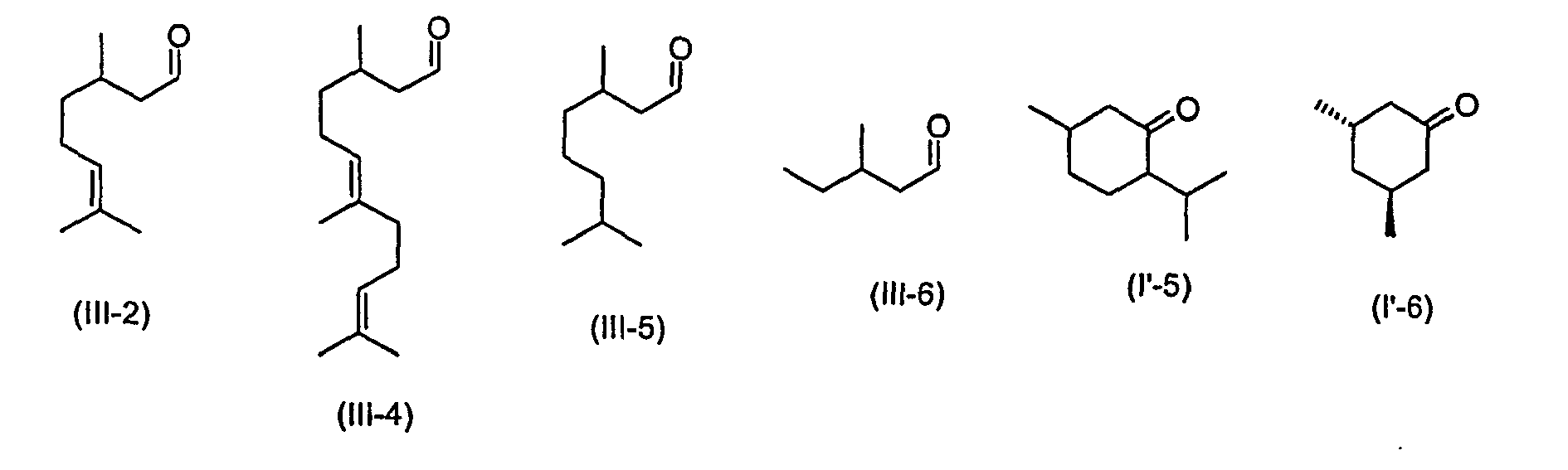
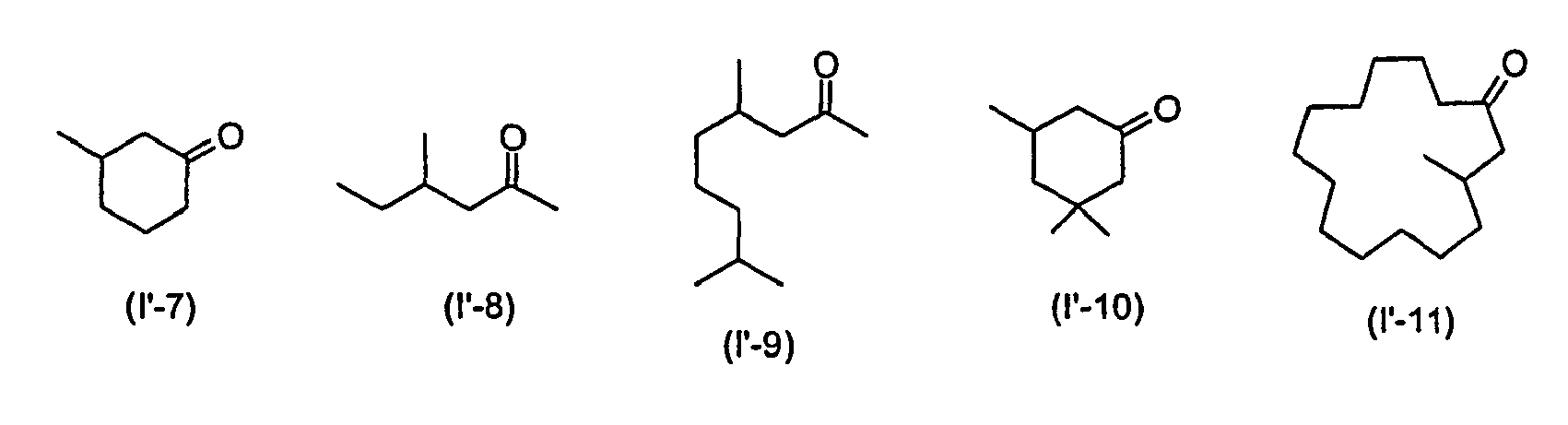
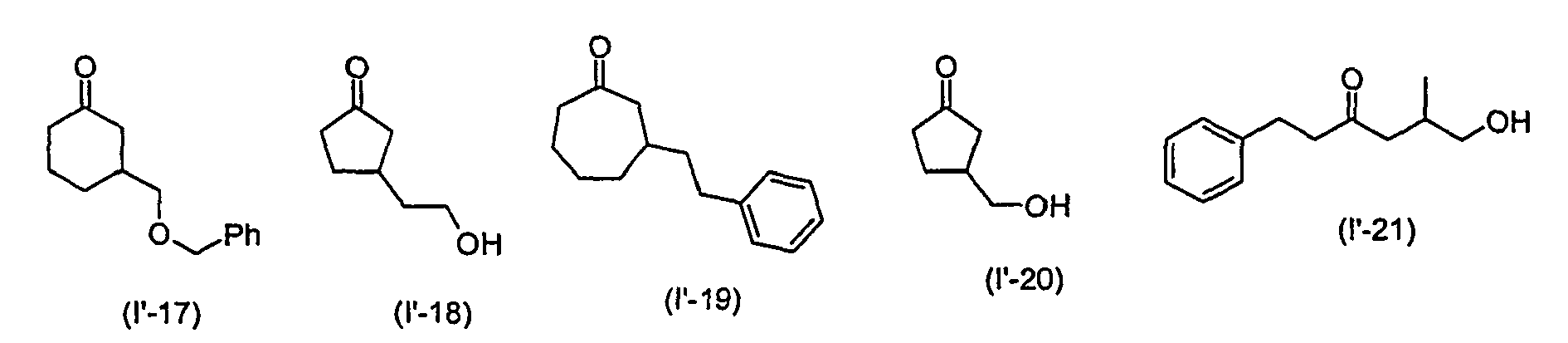
- the process according to the invention is suitable, for example, for preparing the following compounds of the formulas (I-1) to (I-25) which have been mentioned by way of example in optically active form:
- aldehydes or ketones of the formulas (I ') or (III) which can be prepared according to the invention in optically active form, the following compounds may be mentioned:
- the aldehydes of the formula (III) are according to the invention by asymmetric, i. enantioselective hydrogenation of the corresponding ⁇ , ⁇ -unsaturated aldehydes of the formula (IV) or (V) accessible.
- the compounds of the formulas (IV) and (V) represent E / Z double bond isomers to one another.
- the optically active aldehydes of the formula (III) are accessible starting from both double bond isomers of the formulas (IV) and (V).
- the enantiomeric form of the catalyst i.
- (+) - or (-) - enantiomer of the catalyst or the (+) - or (-) - enantiomers of the chiral ligand used obtained in accordance with the invention from the E or Z double bond isomers used preferably one of the enantiomers of the optically active aldehyde.
- mixtures of the two double bond isomers can also be reacted in accordance with the invention. This gives mixtures of the two enantiomers of the desired target compound.
- the process according to the invention is particularly preferably suitable for the preparation of optically active citronellal of the formula (VI) by asymmetric hydrogenation of neral of the formula (VII) or geranial of the formula (VIII)
- mixtures of geranial and neral in accordance with the invention, wherein, as described above, mixtures of D- or L-citronellal are present which are optically active if the two enantiomers are not present in equal parts therein.
- the preparation according to the invention is particularly preferably D-citronellal by asymmetric hydrogenation of neral or geranial.
- the preparation process according to the invention is carried out in the presence of an optically active transition metal catalyst which has at least one carbon monoxide ligand and is soluble in the reaction mixture.
- Such catalysts are obtainable, for example, by reaction of at least one suitable transition metal compound soluble in the reaction mixture with an optically active ligand which has at least one phosphorus and / or arsenic atom.
- Preferred transition metal compounds are those of the metals of VIII.
- Subgroup of the Periodic Table of the Elements in particular Ru, Rh, Pd, Ir and Pt.
- Subgroup of the periodic table according to the invention are Rh and Ir.
- Suitable compounds of said transition metals are, in particular, those which are soluble in the chosen reaction medium, for example salts or complex compounds with suitable ligands such as carbonyl, acetylacetonate, hydroxy, cyclooctadiene, norbornadiene, cyclooctene, methoxy, acetyl or other aliphatic or aromatic carboxylates.
- suitable ligands such as carbonyl, acetylacetonate, hydroxy, cyclooctadiene, norbornadiene, cyclooctene, methoxy, acetyl or other aliphatic or aromatic carboxylates.
- Transition metal compounds which are preferred in the process according to the invention are Rh (I) and Rh (III) and Rh (0) compounds, Ir (I), Ir (III), Ir (IV) and Ir (O) compounds , Ru (II), Ru (III), Ru (IV), and Ru (0) compounds, Pd (II), Pd (IV) and Pd (O) compounds, and Pt (II) -, Pt (IV) and Pt (0) compounds.
- Leave aside Transition-metal compounds which have no CO ligand can also be used in the context of the process according to the invention as starting compound for the preparation of the catalysts to be used according to the invention. These are converted into the desired catalysts under the conditions of the preforming or the hydrogenation conditions according to the invention optionally to be carried out with the addition of carbon monoxide.
- transition metal compounds which can be used according to the invention are: RhCl 3 , Rh (OAc) 3 , [Rh (cod) Cl] 2 , Rh (CO) 2 acac, [Rh (cod) OH] 2 , [Rh (cod) OMe] 2 , Rh 4 (CO) 12 , Rh 6 (CO) 16 and Ir 4 (CO) 12 , [Ir (cod) Cl] 2 , where "acac” is an acetylacetonate and “cod” is a cyclooctadiene ligand stands.
- the transition metal compounds mentioned are used according to the invention usually in an amount of from about 0.01 to about 1 mol%, preferably from about 0.05 to about 0.5 mol%, in particular from about 0.02 to about 0.2 mol%. % (based on the transition metal atoms contained) in relation to the amount of substrate to be hydrogenated.
- the ratio of the amount of transition metal compound used as precursor of the homogeneous catalyst according to the invention to the amount of substrate to be hydrogenated is advantageously chosen such that a catalyst concentration in the range from about 100 ppm to 10000 ppm, in particular in the range of about 200 ppm up to 5000 ppm is maintained.
- the said transition metal compounds are contacted according to the invention with another compound which is optically active, preferably substantially enantiomerically pure (i.e., has an enantiomeric excess of at least about 99%) and at least one phosphorus and / or arsenic atom, preferably at least one phosphorus atom.
- This compound referred to as the chiral ligand, forms in the reaction mixture or in the preforming mixture with the transition metal compound used the transition metal catalyst to be used according to the invention.
- Suitable chiral ligands in the context of the present invention are those compounds as described, for example, in: I. Ojima (ed.), Catalytic Asymmetric Synthesis, Wiley-VCh, 2nd edition, 2000 or in EN Jacobsen, A. Pfaltz, H. Yamamoto (ed.), Comprehensive Asymmetric Catalysis, 2000, Springer or in W. Tang, X. Zhang, Chem. Rev. 2003, 103, 3029-3069 are described.
- Ph is phenyl
- Cy is cyclohexyl
- xyl is xylyl
- Tol is p-tolyl
- Bn is benzyl
- Particularly preferred ligands according to the invention are those of the structural formulas (1) to (13) and (37), (38), (41), (43), (49), (50), (51), (52), (65 ), (66), (67), (68), (69), (71), (72), (73), (74), (75), (83), (84), (85), (86), (87).
- Particularly preferred ligands within the scope of the process according to the invention are those of the general formula (IX), in particular the compounds of the formula (1) referred to hereinafter as "chiraphos".
- the selected chiral ligands can be used according to the invention in each case in the form of its two enantiomers.
- chiral ligands having two phosphorus atoms these are used advantageously in an amount of about 1 to about 10 mol, preferably about 1 to about 4 mol per mol of transition metal compound employed.
- the actual precatalysts containing at least one carbon monoxide ligand can be obtained by combining and optionally preforming with a mixture of hydrogen and carbon monoxide.
- the process according to the invention is to be carried out in such a way that the soluble in the reaction mixture, i. homogeneous catalyst, if desired in the presence of the asymmetric substrate to be hydrogenated, either pretreated prior to asymmetric hydrogenation with a gas mixture containing carbon monoxide and hydrogen (ie performs a so-called preformation of the catalyst) or the asymmetric hydrogenation in the presence of additionally supplied carbon monoxide in the presence of the reaction mixture or performs a preforming and then performs the asymmetric hydrogenation in the presence of the reaction mixture additionally supplied carbon monoxide.
- a gas mixture containing carbon monoxide and hydrogen ie performs a so-called preformation of the catalyst
- the process of the present invention is carried out by pretreating (i.e., preforming) the catalyst with a gas mixture containing carbon monoxide and hydrogen and conducting the asymmetric hydrogenation in the presence of additional carbon monoxide supplied to the reaction mixture.
- a particularly preferred gas mixture for preforming is so-called synthesis gas, which usually consists of about 35 to 55% by volume of carbon monoxide in addition to hydrogen and traces of other gases.
- the preforming of the catalyst according to the invention is usually carried out at temperatures of about 25 ° C to about 100 ° C, preferably at about 40 ° C to about 80 ° C. If the preformation is carried out in the presence of the substrate to be asymmetrically hydrogenated, the temperature is advantageously chosen so that no isomerization of the double bond to be hydrogenated occurs to any extent.
- the preforming is usually completed after about 1 hour to about 24 hours, often after about 1 to about 12 hours.
- the asymmetric hydrogenation of the selected substrate is carried out according to the invention.
- the chosen substrate can usually be successfully orally charged with or without the addition of additional carbon monoxide.
- the asymmetric hydrogenation according to the invention is additionally carried out in the presence of carbon monoxide supplied to the reaction system. It is particularly advantageous to carry out preforming as described and to add additional carbon monoxide to the reaction mixture during the asymmetric hydrogenation.
- carbon monoxide can be added to the hydrogen used for asymmetric hydrogenation or metered directly into the reaction solution in gaseous form.
- Another possibility is, for example, to add to the reaction mixture compounds that easily release carbon monoxide, such as formates or oxalyl compounds.
- the proportion of carbon monoxide in the hydrogen used is usually about 100 to about 10,000 ppm, preferably about 500 to about 5000 ppm, and more preferably about 600 to about 3000 ppm.
- the asymmetric hydrogenation according to the invention is advantageously carried out at a pressure of about 1 to about 300 bar, preferably from about 10 to about 100 bar, in particular at about 50 to about 100 bar and a temperature of usually about 0 ° C to about 100 ° C, preferably about 0 ° C to about 30 ° C, especially at about 10 ° C to about 30 ° C before.
- Suitable solvents are, for example, those mentioned for carrying out the preforming according to the invention.
- the asymmetric hydrogenation is carried out in the same solvent as the optionally previously performed preforming.
- the process according to the invention can be carried out with good success with and without the addition of tertiary amines.
- the process according to the invention is carried out in the absence, i. without addition of additional tertiary amines or in the presence of only catalytic amounts of additional tertiary amines.
- Suitable reaction vessels for carrying out the asymmetric hydrogenation according to the invention are in principle all those which permit reactions under the conditions mentioned, in particular pressure and temperature, and are suitable for hydrogenation reactions, such as autoclaves, tubular reactors, bubble columns, etc.
- the reaction is advantageously interrupted when the target compound is present in the desired yield and the desired optical activity, ie with the desired enantiomeric excess (ee) in the reaction mixture, as the skilled person can ascertain by routine investigations, for example by means of chromatographic methods.
- the hydrogenation is completed after about 1 to about 150 hours, often after about 2 to about 24 hours.
- optically active carbonyl compounds in particular optically active aldehydes in high yields and enantiomeric excesses.
- the desired asymmetrically hydrogenated compounds are obtained in an enantiomeric excess of at least 80% ee, often with an enantiomeric excess of from about 85 to about 99% ee.
- the maximum achievable enantiomeric excess may depend on the purity of the substrate used, in particular with regard to the isomeric purity of the double bond to be hydrogenated.
- suitable starting substances in particular those having an isomer ratio of at least about 90:10, preferably at least about 95: 5 with respect to the E / Z double bond isomers.
- the inventive method is characterized by the fact that the homogeneous catalysts used are stabilized by the additionally introduced into the reaction system carbon monoxide, whereby on the one hand the service life of the catalysts is significantly increased and on the other the reusability of the homogeneous catalysts is made possible.
- the resulting reaction product can be prepared by methods known to those skilled in the art, e.g. by distillation, remove from the reaction mixture and use the remaining catalyst, optionally after repeated preforming, in the context of further reactions.
- the process according to the invention can be operated both batchwise or semicontinuously as well as continuously and is particularly suitable for reactions on an industrial scale.
- neral or geranial which contains up to about 5 mol%, preferably up to about 2 mol%, of the particular double bond isomer is converted into optically active citronellal.
- the catalyst used is preferably a soluble in the reaction mixture connection of the rhodium, in particular, Rh (OAc) 3, [Rh (cod) Cl] 2, Rh (CO) 2 acac, [Rh (cod) OH] 2, [Rh ( cod) OMe] 2 , Rh 4 (CO) 12 or Rh 6 (CO) 16 and as chiral ligands (R, R) chiraphos and (S, S) chiraphos ((2R, 3R) - (+) - 2,3-bis (diphenylphosphino) butane or (2S, 3S) - (-) - 2,3-bis (diphenylphosphino) butane) in a molar ratio of from
- neral containing up to about 5 mol%, preferably up to about 2 mol%, of geranial in the presence of Rh (OAc) 3 , [Rh (cod) Cl] 2 , Rh (CO) 2 acac, [Rh (cod) OH] 2 , [Rh (cod) OMe] 2 , Rh 4 (CO) 12 or Rh 6 (CO) 16 and (R, R) -chiraphos to D-citronellal ,
- the catalyst is preferably preformed under the abovementioned conditions and then leads to the asymmetric Hydrogenation in the presence of hydrogen containing about 600 to about 3000 ppm of carbon monoxide.
- a further aspect of the present invention relates to a process for the preparation of optically active menthol using optically active citronellal prepared by the process according to the invention.
- the preparation of optically active menthol starting from optically active citronellal is known.
- a key step here is the cyclization of optically active citronellal to optically active isopulegol such as in the EP-A 1 225 163 described.
- optically active citronellal prepared according to the invention can be cyclized, as shown schematically below for the preparation of L-menthol of the formula (XIII), in the presence of a suitable acid, in particular a Lewis acid, to give the L-isopulegol of the formula (XII) and then Hydrogenate L-menthol.
- a further aspect of the present invention accordingly relates to the use of optically active citronellal prepared by the process according to the invention for the preparation of optically active menthol.
- the invention relates to the use of D-citronellal prepared by the process according to the invention for the preparation of optically active L-menthol.
- Example 1 Asymmetric hydrogenation of cis-citral in the presence of carbon monoxide
- reaction pressure was adjusted by pressing hydrogen to 80 bar. To reduce the CO partial pressure, the pressure was reduced once more to 8 bar three times and after 3 h and re-pressurized to 80 bar by means of hydrogen. After 18 h, gas chromatography showed a conversion of 99.9% and a yield of D-citronellal of 99.8% with an optical purity of 90% ee.
- Example 2 Asymmetric hydrogenation of neral in the presence of carbon monoxide
- reaction pressure was adjusted to 80 bar by squeezing hydrogen gas containing 1000 ppm of carbon monoxide. After 144 h, gas chromatography showed a conversion of 84.3% and a yield of 80.9% of D-citronellal with an optical purity of 64% ee.
- the reaction pressure was adjusted by pressing hydrogen to 80 bar. To reduce the CO partial pressure, the pressure was lowered 5 times to 8 bar and re-pressed with hydrogen to 80 bar.
- the gas chromatographically determined content of CO in the gas space was 510 ppm. After every 20 h and 40 h, a further 13.20 g or 19.80 g of neral are added. After 66 h, gas chromatography showed a conversion of 75.8% and a yield of 72.8% D-citronellal with an optical purity of 87% ee.
- the total turn-over-number based on the yield of D-citronellal was 1030.
- Example 4 Asymmetric hydrogenation of cis-citral to distill off the product and reuse the catalyst
- the total turn-over-number based on the yield of D-citronellal was 2312.
- Example 5 Asymmetric hydrogenation of Neral under preformation, removal of the product and reuse of the catalyst
- the total turn-over number relative to the total yield of D-citronellal was 4975.
Landscapes
- Chemical & Material Sciences (AREA)
- Organic Chemistry (AREA)
- Chemical Kinetics & Catalysis (AREA)
- Inorganic Chemistry (AREA)
- Engineering & Computer Science (AREA)
- Materials Engineering (AREA)
- Organic Low-Molecular-Weight Compounds And Preparation Thereof (AREA)
- Low-Molecular Organic Synthesis Reactions Using Catalysts (AREA)
Description
- Die vorliegende Erfindung betrifft ein Verfahren zur Herstellung optisch aktiver Carbonylverbindungen durch asymmetrische Hydrierung α,β-ungesättigter Carbonylverbindungen in Gegenwart von im Reaktionsgemisch löslicher, optisch aktiver Übergangsmetall-Katalysatoren, die mindestens einen Kohlenmonoxid-Liganden aufweisen. Speziell betrifft die vorliegende Erfindung ein Verfahren zur Herstellung optisch aktiver Aldehyde oder Ketone, insbesondere Citronellal durch asymmetrische Hydrierung der entsprechenden optisch aktiven α,β-ungesättigten Aldehyde oder Ketone.
- Viele optisch aktive Aldehyde und Ketone stellen wertvolle Zwischenstoffe zur Synthese höher veredelter chiraler Wert- und Wirkstoffe dar und sind ihrerseits oft begehrte Riech- und Aromastoffe.
- Die
EP-A 0 000 315 betrifft ein Verfahren zur Herstellung von optisch aktivem Citronellal durch Hydrierung von Geranial oder Neral in Gegenwart eines im Reaktionssystem gelösten Katalysatorkomplexes aus Rhodium und einem chiralen Phosphin. - T.-P. Dang et al. beschreiben in J. Mol. Cat. 1982, 16, 51 - 59 die homogenkatalytische Hydrierung α,β-ungesättigter Aldhyde sowie die Anwendung des Verfahrens zur Herstellung von optisch aktivem Citronellal. Als Katalysatoren dienten dabei Komplexverbindungen aus einem Rhodiumcarbonyl und einem chiralen Diphosphin.
- Auch Chapuis et al. erwähnen in Hev. Chim. Acta 2001, 84, 230 -242, Fußnote 4, die asymmetrische Hydrierung von Geranial bzw. Neral zu optisch aktivem Citronellal in Gegenwart eines Katalysators aus Rh4(CO)12 und (R,R)-Chiraphos (2R, 3R)-2,3-bis(diphenylphosphino)butan.
- Ein Problem bei der Durchführung mittels löslicher Katalysatoren katalysierter (homogenkatalytischer) Reaktionen besteht in der oft unzureichenden Stabilität der eingesetzten Katalysatorkomplexe bzw. der sich daraus bildenden katalytisch aktiven Metall- bzw. Übergangsmetall-Komplexverbindung. Vor dem Hintergrund des oft hohen Preises derartiger Katalysatoren bzw. Katalysatorvorstufen sind homogenkatalytische Reaktionen mit komplexen Übergangsmetallkatalysatoren nur in speziellen Fällen in wirtschaftlicher Weise im technischen Maßstab anwendbar.
- Die
JP-A 52078812 - Die Aufgabe wurde überraschend gelöst durch Bereitstellung eines Verfahrens zur Herstellung optisch aktiver Carbonylverbindungen durch asymmetrische Hydrierung α,β-ungesättigter Carbonylverbindungen in Gegenwart von im Reaktionsgemisch löslichen, optisch aktiven Übergangsmetall-Katalysatoren, die mindestens einen Kohlenmonoxid-Liganden aufweisen, das dadurch gekennzeichnet ist, dass man den Katalysator mit einem Kohlenmonoxid und Wasserstoff enthaltenden Gasgemisch vorbehandelt und/oder die asymmetrische Hydrierung in Gegenwart von dem Reaktionsgemisch zusätzlich zugeführtem Kohlenmonoxid durchführt.
- Das erfindungsgemäße Verfahren eignet sich zur Herstellung optisch aktiver Carbonylverbindungen wie Aldehyden, Ketonen, Estern, Lactonen oder Lactamen durch asymmetrische, d.h. enantioselektive Hydrierung der entsprechenden Carbonylverbindungen, die in α,β-Position zur Carbonylgruppe eine ethylenische Doppelbindung aufweisen. Erfindungsgemäß hydriert man die zur Carbonylgruppe α,β-ständige ethylenische Doppelbindung in Gegenwart eines im Reaktionsgemisch löslichen, optisch aktiven Übergangsmetallkatalysators, der mindestens einen Kohlenmonoxid- bzw. CO-Liganden aufweist, zu einer Kohlenstoff-Kohlenstoff-Einfachbindung, wobei das dadurch in β-Position neu geschaffene tetraedrische Kohlenstoffatom asymmetrisch substituiert ist und in nicht-racemischer Form erhalten wird. Unter dem Begriff asymmetrische Hydrierung ist demgemäss im Rahmen der vorliegenden Erfindung eine Hydrierung zu verstehen, bei der die beiden enantiomeren Formen des Hydrierproduktes nicht zu gleichen Teilen erhalten werden. Das erfindungsgemäße Verfahren ist dadurch gekennzeichnet, dass man den eingesetzten, im Reaktionsgemisch löslichen, d.h. homogenen Katalysator entweder vor der asymmetrischen Hydrierung mit einem Gasgemisch vorbehandelt, das Kohlenmonoxid und Wasserstoff enthält (d.h. eine sogenannte Präformierung durchführt) oder die asymmetrische Hydrierung in Gegenwart von dem Reaktionsgemisch zusätzlich zugeführtem Kohlenmonoxid durchführt oder eine Präformierung durchführt und anschließend die asymmetrische Hydrierung in Gegenwart von dem Reaktionsgemisch zusätzlich zugeführtem Kohlenmonoxid durchführt.
- Die erfindungsgemäß einzusetzenden, im Reaktionsgemisch löslichen Übergangsmetall-Katalysatoren weisen zumindest in einer im Katalysezyklus durchlaufenen Form oder in einer dem eigentlichen Katalysezyklus vorgeschalteten Vorform mindestens einen CO-Liganden auf, wobei es unerheblich ist, ob diese mindestens einen CO-Liganden aufweisende Katalysatorform die tatsächliche katalytisch aktive Katalysatorform darstellt. Im Rahmen des erfindungsgemäßen Verfahrens stabilisiert man die mindestens einen CO-Liganden aufweisende Katalysatorform durch dem Reaktionsgemisch zusätzlich zugeführtem Kohlenmonoxid in vorteilhafter Weise. Dabei ist insbesondere überraschend, dass das als Katalysatorgift bekannte Kohlenmonoxid auch zur Unterstützung der erfindungsgemäß durchzuführenden Umsetzung eingesetzt werden kann.
- Das erfindungsgemäße Verfahren eignet sich in besonderem Maße zur Herstellung optisch aktiver Carbonylverbindungen der Formel (I)

- R1, R2
- jeweils für einen unverzweigten, verzweigten oder cyclischen Alkylrest mit 1 bis 25 Kohlenstoffatomen, der gegebenenfalls eine oder mehrere, in der Re- gel 1 bis etwa 5, ethylenische Doppelbindungen und/oder einen oder mehre- re, in der Regel 1 bis etwa 5, gleiche oder verschiedene Substituenten aus- gewählt aus der Gruppe der Substituenten OR4, NR5R6, Halogen, C6-C10-Aryl und C3-C9-Hetaryl tragen kann und der gemeinsam mit R3 einen 5 bis 25- gliedrigen Ring bilden kann, steht, mit der Maßgabe, dass R1 und R2 ver- schieden sind,
- R3
- für Wasserstoff oder einen unverzweigten, verzweigten oder cyclischen Al- kylrest mit 1 bis 25 Kohlenstoffatomen, der gegebenenfalls eine oder mehre- re, in der Regel 1 bis etwa 5, ethylenische Doppelbindungen und/oder einen oder mehrere, in der Regel 1 bis etwa 5, gleiche oder verschiedene Substi- tuenten ausgewählt aus der Gruppe der Substituenten OR4, NR5R6, Halogen, C6-C10-Aryl und C3-C9-Hetaryl tragen kann, oder für steht OR7 oder NR8R9 steht
- R4, R5, R6
- jeweils unabhängig voneinander Wasserstoff, C1-C6-Alkyl, C6-C10- Aryl, C7-C12-Aralkyl oder C7-C12-Alkylaryl bedeuten und
- R5 und R6
- gemeinsam auch eine Alkylenkette mit 2 bis 5 Kohlenstoffatomen, die durch N oder O unterbrochen sein kann, bedeuten können und
- R7, R8
- für einen unverzweigten, verzweigten oder cyclischen Alkylrest mit 1 bis 25 Kohlenstoffatomen, der gegebenenfalls eine oder mehrere, in der Regel 1 bis etwa 5, ethylenische Doppelbindungen und/oder ei- nen oder mehrere, in der Regel 1 bis etwa 5, gleiche oder verschie- dene Substituenten ausgewählt aus der Gruppe der Substituenten OR4, NR5R6, Halogen, C6-C10-Aryl und C3-C9-Hetaryl tragen kann, steht und gemeinsam mit R1 oder R2 einen 5 bis 25-gliedrigen Ring bilden können und
- R9
- für Wasserstoff C1-C6-Alkyl, C6-C10-Aryl, C7-C12-Aralkyl oder C7-C12- Alkylaryl steht und
- *
- ein asymmetrisches Kohlenstoffatom bezeichnet,
- Beispielhaft seien für die genannten Substituenten bzw. Reste folgende Bedeutungen im Rahmen der vorliegenden Erfindung angegeben:
- C1-C6-Alkyl steht beispielsweise für Methyl, Ethyl, Propyl, 1-Methylethyl, Butyl, 1-Methyl-propyl, 2-Methylpropyl, 1,1-Dimethylethyl, Pentyl, 1-Methylbutyl, 2-Methylbutyl, 3-Methylbutyl, 2,2-Di-methylpropyl, 1-Ethylpropyl, Hexyl, 1,1-Dimethylpropyl, 1,2-Dimethylpropyl, 1-Methylpentyl, 2-Methylpentyl, 3-Methylpentyl, 4-Methylpentyl, 1,1-Dimethylbutyl, 1,2-Dimethylbutyl, 1,3-Dimethylbutyl, 2,2-Dimethylbutyl, 2,3-Dimethylbutyl, 3,3-Dimethylbutyl, 1-Ethylbutyl, 2-Ethylbutyl, 1,1,2-Trimethylpropyl, 1,2,2-Trimethylpropyl, 1-Ethyl-1-methylpropyl oder 1-Ethyl-2-methylpropyl.
- C6-C10-Aryl bedeutet beispielsweise Phenyl oder Naphtyl.
- C1-C12-Aralkyl bedeutet beispielsweise Phenylmethyl, 1-Phenylethyl 2-Phenylethyl, 1-Phenylpropyl, 2-Phenylpropyl oder 3-Phenylpropyl.
- C3-C9-Hetaryl steht beispielsweise für 2-Furyl, 3-Furyl, 2-Pyrroyl, 3-Pyrroyl, 2-Thienyl, 3-Thienyl, 2-Pyridyl, 3-Pyridyl, 4-Pyridyl, 2-Indolyl, 3-Indolyl, 4-Indolyl, 5-Indolyl, 6-Indolyl, 7-Indolyl.
- C7-C12-Alkylaryl steht beispielsweise für 1-Methylphenyl, 2-Methylphenyl, 3-Methylphenyl, 1-Ethylphenyl, 2-Ethylphenyl, 3-Ethylphenyl, 1-Propylphenyl, 2-Propylphenyl, 3-Propylphenyl, 1-iso-Propylphenyl, 2-iso-Propylphenyl, 3-iso-Propylphenyl, 1-Butylphenyl, 2-Butylphenyl, 3-Butylphenyl, 1-iso-Butylphenyl, 2-iso-Butylphenyl, 3-iso-Butylphenyl, 1-sec-Butylphenyl, 2-sec-Butylphenyl, 3-sec-Butylphenyl, 1-tert-Butylphenyl, 2-tert-Butylphenyl, 3-tert-Butylphenyl, 1-(1-pentenyl)phenyl, 2-(1-pentenyl)phenyl, 3-(1-pentenyl)phenyl, 1-(2-pentenyl)phenyl, 2-(2-pentenyl)phenyl, 3-(2-pentenyl)phenyl, 1-(3-pentenyl)phenyl, 2-(3-pentenyl)phenyl, 3-(3-pentenyl)phenyl, 1-(1-(2-methylbutyl))phenyl, 2-(1-(2-methylbutyl))phenyl, 3-(1-(2-methylbutyl))phenyl, 1-(2-(2-methylbutyl))phenyl, 2-(2-(2-methylbutyl))phenyl, 3-(2-(2-methylbutyl))phenyl, 1-(3-(2-methylbutyl))phenyl, 2-(3-(2-methylbutyl))phenyl, 3-(3-(2-methylbutyl))phenyl, 1-(4-(2-methylbutyl))phenyl, 2-(4-(2-methylbutyl))phenyl, 3-(4-(2-methylbutyl))phenyl, 1-(1-(2,2-Dimethylpropyl))phenyl, 2-(1-(2,2-Dimethylpropyl))phenyl, 3-(1-(2,2-Dimethylpropyl))phenyl, 1-(1-hexenyl)phenyl, 2-(1-hexenyl)phenyl, 3-(1-hexenyl)phenyl, 1-(2-hexenyl)phenyl, 2-(2-hexenyl)phenyl, 3-(2-hexenyl)phenyl, 1-(3-hexenyl)phenyl, 2-(3-hexenyl)phenyl, 3-(3-hexenyl)phenyl, 1-(1-(2-Methylpentenyl))phenyl, 2-(1-(2-Methylpentenyl))phenyl, 3-(1-(2-Methylpentenyl))phenyl, 1-(2-(2-Methylpentenyl))phenyl, 2-(2-(2-Methylpentenyl))phenyl, 3-(2-(2-Methylpentenyl))phenyl, 1-(3-(2-Methylpentenyl))phenyl, 2-(3-(2-Methylpentenyl))phenyl, 3-(3-(2-Methylpentenyl))phenyl, 1-(4-(2-Methylpentenyl))phenyl, 2-(4-(2-Methylpentenyl))phenyl, 3-(4-(2-Methylpentenyl))phenyl, 1-(5-(2-Methylpentenyl))phenyl, 2-(5-(2-Methylpentenyl))phenyl, 3-(5-(2-Methylpentenyl))phenyl, 1-(1-(2,2-Dimethylbutenyl))phenyl, 2-(1-(2,2-Dimethylbutenyl))phenyl, 3-(1-(2,2-Dimethylbutenyl))phenyl, 1-(3-(2,2-Dimethylbutenyl))phenyl, 2-(3-(2,2-Dimethylbutenyl))phenyl, 3-(3-(2,2-Dimethylbutenyl))phenyl, 1-(4-(2,2-Dimethylbutenyl))phenyl, 2-(4-(2,2-Dimethylbutenyl))phenyl, 3-(4-(2,2-Dimethylbutenyl))phenyl.
- Unter Halogen ist im Rahmen der vorliegenden Erfindung Fluor, Chlor, Brom oder lod, bevorzugt Fluor, Chlor oder Brom zu verstehen.
- Das erfindungsgemäße Verfahren eignet sich demgemäss beispielsweise zur Herstellung der folgenden, beispielhaft genannten Verbindungen der Formeln (I-1) bis (I-25) in optisch aktiver Form:


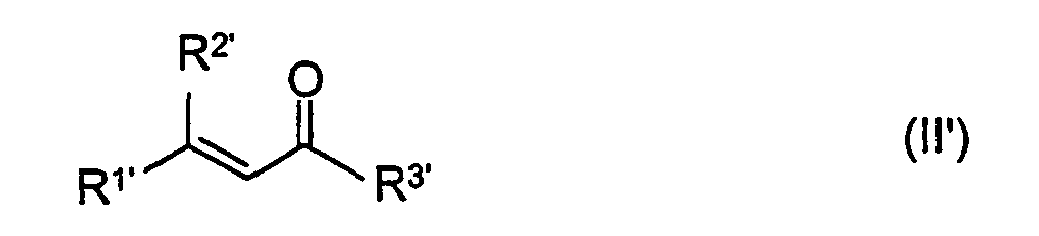
- Insbesondere eignet sich das erfindungsgemäße Verfahren zur Herstellung optisch aktiver Aldehyde oder Ketone durch asymmetrische Hydrierung α,β-ungesättigter Aldehyde oder Ketone. Demgemäss eignet es sich insbesondere zur Herstellung optisch aktiver Verbindungen der Formel (I')

- R1', R2'
- die gleichen Bedeutungen haben können wie vorstehend R1 und R2 und
- R3'
- für Wasserstoff oder einen unverzweigten, verzweigten oder cyclischen Alkylrest mit 1 bis 25 Kohlenstoffatomen, der gegebenenfalls eine oder mehrere, in der Regel 1 bis etwa 5, ethylenische Doppelbindungen und/oder einen oder mehrere, in der Regel 1 bis etwa 5, gleiche oder ver- schiedene Substituenten ausgewählt aus der Gruppe der Substituenten OR4, NR5R6, Halogen, C6-C10-Aryl und C3-C9-Hetaryl tragen kann, steht,
- Bevorzugt eignet sich das erfindungsgemäße Verfahren zur Herstellung optisch aktiver Aldehyde der Formel (III), die in β-Position zur Carbonylgruppe eine Methylgruppe aufweisen

- R10
- für einen unverzweigten oder verzweigten Alkylrest mit 2 bis 25 Kohlenstoff- atomen, der gegebenenfalls 1 bis 5 ethylenische Doppelbindungen aufweisen kann, steht und
- *
- ein asymmetrisches Kohlenstoffatom bezeichnet,
- Als Beispiele für erfindungsgemäß in optisch aktiver Form herstellbare Aldehyde oder Ketone der Formeln (I') bzw. (III) seien die folgenden Verbindungen genannt:


- Die Aldehyde der Formel (III) sind erfindungsgemäß durch asymmetrische, d.h. enantioselektive Hydrierung der entsprechenden α,β-ungesättigten Aldehyde der Formeln (IV) oder (V) zugänglich. Die Verbindungen der Formeln (IV) und (V) stellen E/Z-Doppelbindungsisomere zueinander dar. Prinzipiell sind die optisch aktiven Aldehyde der Formel (III) ausgehend von beiden Doppelbindungsisomeren der Formeln (IV) und (V) zugänglich. Je nach Wahl der enantiomeren Form des Katalysators , d.h. je nach Wahl des (+)- bzw. (-)-Enantiomeren des Katalysators bzw. des (+)- bzw. (-)-Enantiomeren des eingesetzten chiralen Liganden, erhält man in erfindungsgemäßer Weise aus dem eingesetzten E- oder Z-Doppelbindungsisomeren bevorzugt eines der Enantiomere des optisch aktiven Aldehyds. Gleiches gilt für die vorstehend genannten Substrat bzw. Produktklassen. Prinzipiell lassen sich auch Gemische der beiden Doppelbindungsisomere in erfindungsgemäßer Weise umsetzen. Man erhält auf diese Weise Gemische der beiden Enantiomere der gewünschten Zielverbindung.
- Besonders bevorzugt eignet sich das erfindungsgemäße Verfahren zur Herstellung von optisch aktivem Citronellal der Formel (VI)


- Auch Gemische von Geranial und Neral lassen sich in erfindungsgemäßer Weise umsetzen, wobei man, wie vorstehend beschrieben Gemische von D- bzw. L-Citronellal enthält, die optisch aktiv sind, falls die beiden Enantiomere nicht zu gleichen Teilen darin vorliegen.
- Im Rahmen des erfindungsgemäßen Verfahrens insbesondere bevorzugt ist die erfindungsgemäße Herstellung D-Citronellal durch asymmetrische Hydrierung von Neral bzw. Geranial.
- Das erfindungsgemäße Herstellverfahren wird in Gegenwart eines im Reaktionsgemisch löslichen, optisch aktiven Übergangsmetall-Katalysators, der mindestens einen Kohlenmonoxid-Liganden aufweist, durchgeführt.
- Derartige Katalysatoren sind beispielsweise erhältlich durch Reaktion mindestens einer geeigneten, im Reaktionsgemisch löslichen Übergangsmetall-Verbindung mit einem optisch aktiven Liganden, der mindestens ein Phosphor- und/oder Arsenatom aufweist.
- Bevorzugte Übergangsmetall-Verbindungen sind solche der Metalle der VIII. Nebengruppe des Periodensystems der Elemente, insbesondere Ru, Rh, Pd, Ir und Pt. Erfindungsgemäß besonders bevorzugte Übergangsmetalle der VIII. Nebengruppe des Periodensystems sind Rh und Ir.
- Geeignete Verbindungen der genannten Übergangsmetalle sind insbesondere solche, die im gewählten Reaktionsmedium löslich sind, wie beispielsweise Salze oder Komplexverbindungen mit geeigneten Liganden wie z.B. Carbonyl, Acetylacetonat, Hydroxy, Cyclooctadien, Norbornadien, Cycloocten, Methoxy, Acetyl oder sonstige aliphatische oder aromatische Carboxylate. Im Rahmen des erfindungsgemäßen Verfahrens bevorzugte Übergangsmetallverbindungen sind Rh(I)- und Rh(III)- sowie Rh(0)-Verbindungen, Ir(I)-, Ir(III), Ir(IV)- sowie Ir(O)-Verbindungen, Ru(II), Ru(III), Ru(IV)-sowie Ru(0)-verbindungen, Pd(II)-, Pd(IV)- sowie Pd(O)-Verbindungen und Pt(II)-, Pt(IV)-sowie Pt(0)-Verbindungen. Bevorzugt sind solche Übergangsmetall-Verbindungen, die bereits mindestens einen CO-Liganden aufweisen. Daneben lassen sich auch Übergangsmetall-Verbindungen, die keinen CO-Liganden aufweisen, im Rahmen des erfindungsgemäßen Verfahrens als Ausgangsverbindung zur Herstellung der erfindungsgemäß einzusetzenden Katalysatoren verwenden. Diese werden unter den Bedingungen der erfindungsgemäß wahlweise durchzuführenden Präformierung bzw. der erfindungsgemäßen Hydrierbedingungen unter Zusatz von Kohlenmonoxid in die gewünschten Katalysatoren überführt.
- Beispiele für erfindungsgemäß einsetzbare Übergangsmetall-Verbindungen sind: RhCl3, Rh(OAc)3, [Rh(cod)Cl]2, Rh(CO)2acac, [Rh(cod)OH]2, [Rh(cod)OMe]2, Rh4(CO)12, Rh6(CO)16 bzw. Ir4(CO)12, [Ir(cod)Cl]2, wobei "acac" für einen Acetylacetonat- und "cod" für einen Cyclooctadien-Liganden steht.
- Die genannten und weitere geeignete Übergangsmetallverbindungen und -komplexe sind bekannt und in der Literatur hinreichend beschrieben oder können vom Fachmann analog zu den bereits bekannten Verbindungen hergestellt werden.
- Die genannten Übergangsmetallverbindungen setzt man erfindungsgemäß üblicherweise in einer Menge von etwa 0,01 bis etwa 1 mol-%, bevorzugt von etwa 0,05 bis etwa 0,5 mol-%, insbesondere von etwa 0,02 bis etwa 0,2 mol-% (bezogen auf die enthaltenen Übergangsmetallatome) im Verhältnis zur Menge an zu hydrierendem Substrat ein.
- Bei unter kontinuierlichen Bedingungen durchgeführten Umsetzungen wählt man das Verhältnis von eingesetzter Menge an Übergangsmetallverbindung als Vorläufer des erfindungsgemäßen homogenen Katalysators zur Menge an zu hydrierendem Substrat vorteilhaft so, dass eine Katalysatorkonzentration im Bereich von etwa 100 ppm bis 10000 ppm, insbesondere im Bereich von etwa 200 ppm bis 5000 ppm eingehalten wird.
- Die genannten Übergangsmetallverbindungen werden erfindungsgemäß mit einer weiteren Verbindung in Kontakt gebracht, die optisch aktiv, bevorzugt im wesentlichen enantiomerenrein ist (d.h. einen Enantiomerenüberschuss von mindestens etwa 99% aufweist) und mindestens ein Phosphor und/oder Arsenatom, bevorzugt mindestens ein Phosphoratom aufweist. Diese als chiraler Ligand zu bezeichnende Verbindung bildet im Reaktionsgemisch bzw. im Präformierungsgemisch mit der eingesetzten Übergangsmetall-Verbindung den erfindungsgemäß einzusetzenden Übergangsmetall-Katalysator.
- Insbesondere bevorzugt sind solche chiralen Liganden die zwei Phosphoratome aufweisen und mit dem eingesetzten Übergangsmetall Chelatkomplexe bilden.
- Als chirale Liganden eignen sich im Rahmen der vorliegenden Erfindung solche Verbindungen, wie sie beispielsweise in: I. Ojima (Hrsg.), Catalytic Asymmetric Synthesis, Wiley-VCh, 2. Auflage, 2000 oder in E. N. Jacobsen, A. Pfaltz, H. Yamamoto (Hrsg.), Comprehensive Asymmetric Catalysis, 2000, Springer oder in W. Tang, X. Zhang, Chem. Rev. 2003, 103, 3029-3069 beschrieben sind.
- Beispielhaft seien die folgenden Verbindungen als erfindungsgemäß bevorzugt einsetzbare chirale Liganden angeführt:


- Weiterhin seien als erfindungsgemäß einsetzbare chirale Liganden beispielhaft die folgenden Verbindungen angeführt:


- Dabei ist unter "Ph" Phenyl, "Cy" Cyclohexyl, "Xyl" Xylyl, "Tol" p-Tolyl und "Bn" Benzyl zu verstehen.
- Erfindungsgemäß besonders bevorzugte Liganden sind die der Strukturformeln (1) bis (13) sowie (37), (38), (41), (43), (49), (50), (51), (52), (65), (66), (67), (68), (69), (71), (72), (73), (74), (75), (83), (84), (85), (86), (87).
- Insbesondere bevorzugte Liganden sind solche der allgemeinen Formeln (IX) bis (XI)

- R11, R12:
- jeweils unabhängig voneinander für einen unverzweigten, verzweig- ten oder cyclischen Alkylrest mit 1 bis 20 Kohlenstoffatomen, der gegebenenfalls eine oder mehrere, in der Regel 1 bis etwa 4, ethy- lenische Doppelbindungen und/oder einen oder mehrere, in der Re- gel 1 bis etwa 4, gleiche oder verschiedene Substituenten ausge- wählt aus der Gruppe der Substituenten OR19, NR20R21, Halogen, C6-C10-Aryl und C3-C9-Hetaryl tragen kann und R11 und R12 gemein- sam einen 4 bis 20-gliedrigen Ring bilden können, der eines oder mehrere, in der Regel 1 oder 2 O-Atome beinhalten kann, stehen und
- R13, R14:
- jeweils unabhängig voneinander Wasserstoff oder geradkettiges oder verzweigtes C1- bis C4-Alkyl bedeuten und
- R15, R16, R17, R18:
- jeweils für C6- bis C10-Aryl, das gegebenenfalls einen oder mehrere, in der Regel 1 bis 8, bevorzugt 1 bis 4 Substituenten ausgewählt aus der Gruppe der Substtuenten C1- bis C4-Alkyl, C6- bis C10-Aryl, C1- bis C4-Alkoxy und Amino tragen kann, stehen und
- R19, R20, R21:
- jeweils unabhängig voneinander Wasserstoff, C1-C4-Alkyl, C6-C10- Aryl, C7-C12-Aralkyl oder C7-C12-Alkylaryl bedeuten, wobei
- R20, R21:
- gemeinsam auch eine Alkylenkette mit 2 bis 5 Kohlenstoffatomen, die durch N oder O unterbrochen sein kann, bedeuten können.
- Im Rahmen des erfindungsgemäßen Verfahrens insbesondere bevorzugte Liganden sind solche der allgemeinen Formel (IX), insbesondere die im folgenden als "Chiraphos" bezeichnete Verbindungen der Formel (1).
- Die gewählten chiralen Liganden können erfindungsgemäß jeweils in Form ihrer beiden Enantiomeren eingesetzt werden.
- Bei Einsatz von chiralen Liganden mit zwei Phosphoratomen setzt man diese vorteilhaft in einer Menge von etwa 1 bis etwa 10 mol, bevorzugt etwa 1 bis etwa 4 mol pro mol an eingesetzter Übergangsmetall-Verbindung ein.
- Aus der gewählten Übergangsmetall-Verbindung und dem gewählten chiralen Liganden können die eigentlichen, mindestens einen Kohlenmonoxid-Liganden enthaltenden Präkatalysatoren durch Zusammenbringen und ggf. Präformierung mit einer Mischung aus Wasserstoff und Kohlenmonoxid erhalten werden.
- Das erfindungsgemäße Verfahren ist so durchzuführen, dass man den im Reaktionsgemisch löslichen, d.h. homogenen Katalysator, gewünschtenfalls in Anwesenheit des asymmetrisch zu hydrierenden Substrats, entweder vor der asymmetrischen Hydrierung mit einem Gasgemisch vorbehandelt, das Kohlenmonoxid und Wasserstoff enthält (d.h. eine sogenannte Präformierung des Katalysators durchführt) oder die asymmetrische Hydrierung in Gegenwart von dem Reaktionsgemisch zusätzlich zugeführtem Kohlenmonoxid durchführt oder eine Präformierung durchführt und anschließend die asymmetrische Hydrierung in Gegenwart von dem Reaktionsgemisch zusätzlich zugeführtem Kohlenmonoxid durchführt.
- Bevorzugt führt man das erfindungsgemäße Verfahren so durch, dass man den Katalysator mit einem Kohlenmonoxid und Wasserstoff enthaltendem Gasgemisch vorbehandelt (d.h. präformiert) und die asymmetrische Hydrierung in Gegenwart von dem Reaktionsgemisch zusätzlich zugeführtem Kohlenmonoxid durchführt.
- Führt man eine Präformierung durch, löst man üblicherweise die gewählte Übergangsmetall-Verbindung und den gewählten chiralen Liganden und gewünschtenfalls das asymmetrisch zu hydrierende Substrat in einem geeigneten, unter den reaktionsbedingungen inerten Lösungsmittel bzw. Lösungsmedium wie beispielsweise Ether, Tetrahydrofuran, Toluol, Chlorbenzol, Octadecanol, Biphenylether, Texanol, Marlotherm, Oxoöl 9N (Hydroformylierungsprodukte aus isomeren Octenen, BASF Aktiengesellschaft) und dergleichen mehr. Als Lösungsmedium können auch das umzusetzende Substrat, das Produkt oder bei der Umsetzung eventuell anfallende hochsiedende Nebenprodukte dienen. Der resultierenden Lösung wird, vorteilhafterweise in einem geeigneten Druckreaktor bzw. Autoklaven, bei einem Druck von üblicherweise etwa 5 bis etwa 350 bar, bevorzugt von etwa 20 bis etwa 200 bar und besonders bevorzugt von etwa 50 bis etwa 100 bar ein Gasgemisch aufgepresst, das Wasserstoff und Kohlenmonoxid enthält. Bevorzugt setzt man zur Präformierung ein Gasgemisch ein, das etwa
- 30 bis 99 Vol.-% Wasserstoff,
- 1 bis 70 Vol.-% Kohlenmonoxid und
- 0 bis 5 Vol.-% weiterer Gase enthält,
- Besonders bevorzugt setzt man zur Präformierung ein Gasgemisch ein, das etwa
- 40 bis 80 Vol.-% Wasserstoff,
- 20 bis 60 Vol.-% Kohlenmonoxid und
- 0 bis 5 Vol.-% weiterer Gase enthält,
- Ein zur Präformierung insbesondere bevorzugtes Gasgemisch ist sogenanntes Synthesegas, das üblicherweise zu etwa 35 bis 55 Vol-% aus Kohlenmonoxid neben Wasserstoff und Spuren weiterer Gase besteht.
- Die erfindungsgemäße Präformierung des Katalysators wird üblicherweise bei Temperaturen von etwa 25°C bis etwa 100°C, bevorzugt bei etwa 40°C bis etwa 80°C durchgeführt. Führt man die Präformierung in Gegenwart des asymmetrisch zu hydrierenden Substrats durch, wählt man die Temperatur mit Vorteil so, dass es nicht in störendem Ausmaß zu einer Isomerisierung der zu hydrierenden Doppelbindung kommt. Die Präformierung ist üblicherweise nach etwa 1 h bis etwa 24 h, oft nach etwa 1 bis etwa 12 h abgeschlossen.
- Im Anschluss an die optional durchzuführende Präformierung führt man erfindungsgemäß die asymmetrische Hydrierung des gewählten Substrats durch. Nach vorangegangener Präformierung lässt sich das gewählte Substrat in der Regel mit gutem Erfolg mit oder ohne Zuführung von zusätzlichem Kohlenmonoxid durchführen. Wurde auf eine vorangegangene Präformierung verzichtet, ist die erfindungsgemäße asymmetrische Hydrierung in Gegenwart von dem Reaktionssystem zusätzlich zugeführtem Kohlenmonoxid durchzuführen. Besonders vorteilhaft führt man eine Präformierung wie beschrieben durch und setzt dem Reaktionsgemisch während der asymmetrischen Hydrierung zusätzliches Kohlenmonoxid zu.
- Die Zugabe von zusätzlichem Kohlenmonoxid kann auf verschiedene Weise vorgenommen werden: So kann das Kohlenmonoxid beispielsweise dem zur asymmetrischen Hydrierung eingesetzten Wasserstoff beigemischt werden oder auch direkt gasförmig in die Reaktionslösung eindosiert werden. Eine weitere Möglichkeit besteht beispielsweise darin, dem Reaktionsgemisch Verbindungen zuzusetzen, die leicht Kohlenmonoxid freisetzen, wie beispielsweise Formiate oder Oxalyl-Verbindungen.
- Bevorzugt setzt man dem zur asymmetrischen Hydrierung eingesetzten Wasserstoff Kohlenmonoxid zu. Der Anteil an Kohlenmonoxid im eingesetzten Wasserstoff beträgt üblicherweise etwa 100 bis etwa 10000 ppm, bevorzugt etwa 500 bis etwa 5000 ppm und besonders bevorzugt etwa 600 bis etwa 3000 ppm.
- Die erfindungsgemäße asymmetrische Hydrierung nimmt man vorteilhaft bei einem Druck von etwa 1 bis etwa 300 bar, bevorzugt von etwa 10 bis etwa 100 bar, insbesondere bei etwa 50 bis etwa 100 bar und einer Temperatur von in der Regel etwa 0°C bis etwa 100°C, bevorzugt etwa 0°C bis etwa 30°C, insbesondere bei etwa 10°C bis etwa 30°C vor.
- Die Wahl des zur Durchführung der erfindungsgemäßen asymmetrischen Hydrierung einzusetzenden Lösemittels ist nicht kritisch. Geeignete Lösemittel sind beispielsweise jene zur Durchführung der erfindungsgemäßen Präformierung genannten. Mit besonderem Vorteil führt man die asymmetrische Hydrierung im gleichen Lösemittel durch wie die gegebenenfalls zuvor durchgeführte Präformierung.
- Das erfindungsgemäße Verfahren kann mit gutem Erfolg mit und ohne Zugabe von tertiären Aminen durchgeführt werden. Bevorzugt führt man das erfindungsgemäße Verfahren in Abwesenheit, d.h. ohne Zugabe von zusätzlichen tertiären Aminen oder in Anwesenheit nur katalytischer Mengen von zusätzlichen tertiären Aminen durch.
- Als Reaktionsgefäße zur Durchführung der erfindungsgemäßen asymmetrischen Hydrierung sind prinzipiell all jene geeignet, die Umsetzungen unter den genannten Bedingungen, insbesondere Druck und Temperatur, erlauben und für Hydrierreaktionen geeignet sind wie Beispielsweise Autoklaven, Rohrreaktoren, Blasensäulen, etc.
- Mit Vorteil bricht man die Reaktion ab, wenn die Zielverbindung in der gewünschten Ausbeute und der gewünschte optischen Aktivität, d.h. mit dem gewünschten Enantiomerenüberschuss (ee) im Reaktionsgemisch vorliegt, wie es der Fachmann durch Routineuntersuchungen beispielsweise mittels chromatographischer Methoden feststellen kann. Üblicherweise ist die Hydrierung nach etwa 1 bis etwa 150 h, oft nach etwa 2 bis etwa 24 h abgeschlossen.
- Durch das erfindungsgemäße Verfahren gelingt es, optisch aktive Carbonylverbindungen, insbesondere optisch aktive Aldehyde in hohen Ausbeuten und Enantiomerenüberschüssen bereitzustellen. Üblicherweise erhält man die gewünschten asymmetrisch hydrierten Verbindungen in einem Enantiomerenüberschuss von mindestens 80 % ee, oft mit einem Enantiomerenüberschuss von etwa 85 bis etwa 99 % ee. Dabei ist zu beachten, dass der maximal erzielbare Enantiomerenüberschuss von der Reinheit des eingesetzten Substrats, insbesondere im Hinblick auf die Isomerenreinheit der zu hydrierenden Doppelbindung, abhängen kann.
- Demzufolge eignen sich als Ausgangssubstanzen insbesondere solche, die ein Isomerenverhältnis von mindestens etwa 90:10, bevorzugt mindestens etwa 95:5 bezüglich der E/Z-Doppelbindungsisomere aufweisen.
- Das erfindungsgemäße Verfahren zeichnet sich dadurch aus, dass die eingesetzten homogenen Katalysatoren durch das zusätzlich ins Reaktionssystem eingebrachte Kohlenmonoxid stabilisiert werden, wodurch zum einen die Standzeit der Katalysatoren deutlich erhöht wird und zum anderen die Wiederverwendbarkeit der homogenen Katalysatoren ermöglicht wird.
- So lässt sich beispielsweise das erhaltene Reaktionsprodukt durch dem Fachmann an sich bekannte Verfahren, wie z.B. durch Destillation, aus dem Reaktionsgemisch entfernen und der zurückbleibende Katalysator, gegebenenfalls nach abermaliger Präformierung, im Rahmen weiterer Umsetzungen nutzen.
- Das erfindungsgemäße Verfahren kann demgemäss sowohl diskontinuierlich bzw. semikontinuierlich als auch kontinuierlich betrieben werden und eignet sich insbesondere für Umsetzungen in technischem Maßstab.
- Im Rahmen einer besonders bevorzugten Ausführungsform des erfindungsgemäßen Verfahrens setzt man Neral oder Geranial, das bis zu etwa 5 mol-%, bevorzugt bis zu etwa 2 mol-% des jeweiligen Doppelbindungsisomeren enthält, zu optisch aktivem Citronellal um. Zur Bildung des Katalysators setzt man bevorzugt eine im Reaktionsgemisch lösliche Verbindung des Rhodium, insbesondere Rh(OAc)3, [Rh(cod)Cl]2, Rh(CO)2acac, [Rh(cod)OH]2, [Rh(cod)OMe]2, Rh4(CO)12 oder Rh6(CO)16 und als chiralen Liganden (R,R)-Chiraphos bzw. (S,S)-Chiraphos ((2R, 3R)-(+)-2,3-bis(Diphenylphosphino)butan bzw. (2S, 3S)-(-)-2,3-bis(Diphenylphosphino)butan) im molaren Verhältnis von etwa 1:1 bis etwa 1:4 ein. In einer insbesondere bevorzugten Ausführungsform des erfindungsgemäßen Verfahren setzt man Neral, das bis zu etwa 5 mol-%, bevorzugt bis zu etwa 2 mol-% Geranial enthält in Gegenwart von Rh(OAc)3, [Rh(cod)Cl]2, Rh(CO)2acac, [Rh(cod)OH]2, [Rh(cod)OMe]2, Rh4(CO)12 oder Rh6(CO)16 und (R,R)-Chiraphos zum D-Citronellal um. Bevorzugt präformiert man den Katalysator unter den vorstehend genannten Bedingungen und führt anschließend die asymmetrische Hydrierung in Gegenwart von Wasserstoff durch, der etwa 600 bis etwa 3000 ppm Kohlenmonoxid enthält. Im Rahmen der bevorzugten Ausführungsform verzichtet man vorteilhaft auf den Zusatz von Lösemitteln und führt die genannten Umsetzungen im umzusetzenden Substrat bzw. dem Produkt und gegebenenfalls in hochsiedenden Nebenprodukten als Lösemedium durch. Insbesondere bevorzugt ist die kontinuierliche Reaktionsführung unter Wiederverwendung bzw. Rückführung des erfindungsgemäß stabilisierten homogenen Katalysators.
- Ein weiterer Aspekt der vorliegenden Erfindung betrifft ein Verfahren zur Herstellung von optisch aktivem Menthol unter Verwendung von nach dem erfindungsgemäßen Verfahren hergestelltem optisch aktivem Citronellal. Die Herstellung von optisch aktivem Menthol ausgehend von optisch aktivem Citronellal ist bekannt. Ein Schlüsselschritt ist hierbei die Cyclisierung von optisch aktivem Citronellal zu optisch aktivem Isopulegol wie beispielsweise in der
EP-A 1 225 163 beschrieben. - Das erfindungsgemäß hergestellte optisch aktive Citronellal lässt sich, wie nachstehend schematisch für die Herstellung von L-Menthol der Formel (XIII) dargestellt, in Gegenwart einer geeigneten Säure, insbesondere einer Lewis-Säure zum L-Isopulegol der Formel (XII) cyclisieren und anschließend zum L-Menthol hydrieren.

- Ein weiterer Aspekt der vorliegenden Erfindung betrifft demgemäss die Verwendung von nach dem erfindungsgemäßen Verfahren hergestelltem optisch aktivem Citronellal zur Herstellung von optisch aktivem Menthol. Insbesondere betrifft die Erfindung die Verwendung von nach dem erfindungsgemäßen Verfahren hergestelltem D-Citronellal zur Herstellung von optisch aktivem L-Menthol.
- Die folgenden Beispiele dienen der Verdeutlichung der Erfindung, ohne sie in irgend einer Weise zu beeinträchtigen:
- 17,9 mg Rh(CO)2acac und 38,5 mg (R,R)-Chiraphos wurden unter Schutzgasatmosphäre in 20 g Toluol gelöst und in einen 100 ml Autoklaven überführt, der zuvor 3 mal mit einem Gemisch aus Kohlenmonoxid und Wasserstoff (1:1, Vol./Vol.) gespült wurde. Es wurde bei einem Druck von 8 bar CO/H21:1 und 60°C für 3 h gerührt und anschließend auf Raumtemperatur abgekühlt. Mittels einer Druckschleuse wurden dann 10,94 g Neral (Verhältnis der Doppelbindungsisomere Neral/Geranial = 99,1:0,9; Verhältnis Substrat/Katalysator = 1000) mit 15 bar H2 zugepresst. Der Reaktionsdruck wurde durch Zupressen von Wasserstoff auf 80 bar eingestellt. Zur Reduktion des CO-Partialdrucks wurde der Druck drei mal und nach 3 h ein weiteres mal auf 8 bar erniedrigt und mittels Wasserstoff auf 80 bar nachgepresst. Nach 18 h wurde gaschromatographisch ein Umsatz von 99,9% und eine Ausbeute an D-Citronellal von 99,8% mit einer optischen Reinheit von 90% ee bestimmt.
- 17,0 mg Rh(CO)2acac und 43,8 mg (R,R)-Chiraphos wurden in 0,8 ml THF gelöst und in einem Autoklaven bei 80 bar Synthesegas (H2/CO = 1:1, Vol./Vol.) und 60°C für 8 h gerührt. Anschließend wurden 39,00 g Neral (Verhältnis der Doppelbindungsisomere Neral/Geranial = 95,2:4,8; Verhältnis Substrat/Katalysator = 4000) gelöst und zusammen mit der Katalysatorlösung in einen 100 ml Autoklaven gegeben, der zuvor 3 mal mit CO/H2 1:1 (Vol./Vol.) gespült wurde. Der Reaktionsdruck wurde durch Zupressen von Wasserstoffgas, das 1000 ppm Kohlenmonoxid enthielt auf 80 bar eingestellt. Nach 144 h wurde gaschromatographisch ein Umsatz von 84,3% und eine Ausbeute von 80,9% an D-Citronellal mit einer optischen Reinheit von 64% ee bestimmt.
- 23,7 mg Rh(CO)2acac und 55,7 mg (R,R)-Chiraphos wurden unter Schutzgasatmosphäre in 24 g THF gelöst und in einen 100 ml Autoklaven gegeben, der zuvor 3 mal mit CO/H2 1:1 (Vol./Vol.) gespült wurde. Es wurde bei einem Druck von 80 bar CO/H2 1:1 und 60°C 3 h gerührt. Anschließend wurde auf Raumtemperatur abgekühlt und auf einen Druck von 8 bar CO/H2 1:1 entspannt. Mittels einer Druckschleuse wurden 13,2 g) Neral (Verhältnis der Doppelbindungsisomere Neral/Geranial = 99,4:0,6) mit 15 bar H2 zugepresst. Der Reaktionsdruck wurde durch Zupressen von Wasserstoff auf 80 bar eingestellt. Zur Reduktion des CO-Partialdrucks wurde der Druck 5 mal auf 8 bar erniedrigt und mit Wasserstoff auf 80 bar nachgepresst. Der gaschromatographisch bestimmte Gehalt an CO im Gasraum betrug 510 ppm. Nach jeweils 20 h und 40 h werden weitere 13,20 g bzw. 19,80 g Neral zugegeben. Nach 66 h wurde gaschromatographisch ein Umsatz von 75,8% und eine Ausbeute von 72,8% D-Citronellal mit einer optischen Reinheit von 87% ee bestimmt.
- Die Gesamt-turn-over-number bezogen auf die Ausbeute an D-Citronellal betrug 1030.
- 8,4 mg Rh(CO)2acac und 21,6 mg (R,R)-Chiraphos wurden in 0,8 ml THF gelöst und in einem Autoklaven bei 80 bar Synthesegas (H2/CO = 1:1, Vol./Vol.) und 60°C für 8 h gerührt. Danach wurden 9 g Neral (Verhältnis der Doppelbindungsisomere Neral/Geranial = 95,2:4,8) in den Autoklaven gefüllt. Der Reaktionsdruck wurde durch Zupressen von Wasserstoffgas, das 1000 ppm Kohlenmonoxid enthielt, auf 80 bar eingestellt. Nach 24 h war ein Umsatz von 99% erreicht, der ee des erhaltenen D-Citronellals betrug 83%.
- Nach Abdestillieren des Produktes werden weitere 8,5g Neral (Verhältnis der Doppelbindungsisomere Neral/Geranial = 95,2:4,8) zugegeben und 48 h bei 80 bar Wasserstoffgas, das 1000 ppm Kohlenmonoxid enthielt, hydriert. Der Umsatz betrugt 36%, der ee des erhaltenen D-Citronellals betrug 54%.
- Nach abermaligem Abdestillieren des Produktes werden weitere 6,8 g Neral (Verhältnis der Doppelbindungsisomere Neral/Geranial = 95,2:4,8) zugegeben und 72 h bei 80 bar Wasserstoffgas, das 1000 ppm Kohlenmonoxid enthielt, hydriert. Der Umsatz betrug 13%, der ee des erhaltene D-Citronellals betrug 30%.
- Die Gesamt-turn-over-number bezogen auf die Ausbeute an D-Citronellal betrug 2312.
- 30 mg Rh(CO)2acac und 75 mg (R,R)-Chiraphos wurden in 3 ml THF gelöst und in einem Autoklaven bei 60°C in Gegenwart von 80 bar Synthesegas (H2/CO = 1:1, Vol./Vol) für 20 h gerührt. Anschließend wurden 37 g Neral (Verhältnis der Doppelbindungsisomere Neral/Geranial = 96,6:3,4) zugegeben und die Lösung in einen 100 ml Autoklaven gegeben, der zuvor 3 mal mit CO/H2 1:1 (Vol./Vol.) gespült wurde. Der Reaktionsdruck wurde durch Zupressen von Wasserstoffgas, das 1000 ppm Kohlenmonoxid enthält, auf 80 bar eingestellt. Nach 24 h war ein Umsatz von >99% erreicht; der ee des erhaltene D-Citronellals betrug 87%.
- Nach Abdestillieren des Produktes wurde der Destillationsrückstand mit THF verdünnt und in einem Autoklaven bei 60°C in Gegenwart von Synthesegas (H2/CO = 1:1) bei einem Druck von 80 bar für 20 h gerührt. Danach wurden weitere 32 g Neral (Verhältnis der Doppelbindungsisomere Neral/Geranial = 96,6:3,4) zugegeben und 24 h bei einem Druck von 80 bar Wasserstoffgas, das 1000 ppm Kohlenmonoxid enthielt, hydriert. Der Umsatz betrug >99%, der ee des erhaltenen D-Citronellals betrug 87%.
- Nach abermaligem Abdestillieren des Produktes wurde der Destillationsrückstand mit THF verdünnt und in einem Autoklaven bei 60°C in Gegenwart von 80 bar Synthesegas (H2/CO = 1:1) für 20 h gerührt. Danach wurden weitere 32,96 g Neral (Verhältnis der Doppelbindungsisomere Neral/Geranial = 96,6:3,4) zugegeben und 24 h bei einem Druck von 80 bar Wasserstoffgas, das 1000 ppm Kohlenmonoxid enthielt, hydriert. Der Umsatz betrugt 90%, die optische Reinheit des erhaltenen D-Citronellals betrug 88% ee.
- Das Experiment wurde nochmals wiederholt unter Zugabe von 33 g Neral (Verhältnis der Doppelbindungsisomere Neral/Geranial = 96,6:3,4). Man erhielt bei einem Umsatz von 17% D-Citronellal mit einer optischen Reinheit von 89% ee.
- Die Gesamt-turn-over-number bezogen auf die Gesamtausbeute an D-Citronellal betrug 4975.
- In einer kontinuierlich betriebenen Laboranlage wurde eine Lösung von 2,13 g Rh(CO)2acac und 6,00 g (R,R)-Chiraphos in 70 g THF und 60 g Oxoöl 9N (BASF Aktitengesellschaft), die zuvor 20 h bei 60°C und einem Druck von 80 bar CO/H2 1:1 (Vol./Vol.) gerührt worden war und 170 g Neral (Verhältnis der Doppelbindungsisomere Neral/Geranial ca. 95:5) eingefüllt, woraufhin die Gasmischung im Präformierreaktor der Anlage auf 10000 ppm Kohlenmonoxid in Wasserstoff (80 bar), die Temperatur auf 60°C eingestellt wurde. Im Hydrierreaktor wurde eine Gasmischung von 1000 ppm Kohlenmonoxid in Wasserstoff (80 bar) und eine Temperatur von 25°C eingestellt.
- Der Zulauf von frischem Edukt wurde auf 6 g/h eingestellt. Eine produkthaltige Fraktion wurde im Vakuum kontinuierlich so abdestilliert, dass der Anlageninhalt nahezu konstant blieb. Es wurden innerhalb von 19 Tagen 6,01 mol (927,7 g) D-Citronellal erhalten. Die Gesamt-turn-over-number bezogen auf die Ausbeute an D-Citronellal betrug 10914.
- 0,3049 g Rh(CO)2acac und 0,7767 g (R,R)-Chiraphos wurden unter Schutzgasatmosphäre in 15 g Tetrahydrofuran gelöst und in einen 100 ml Autoklaven überführt, der zuvor 3 mal mit einem Gemisch aus Kohlenmonoxid und Wasserstoff (1:1, Vol./Vol.) gespült wurde. Es wurde bei einem Druck von 8 bar CO/H2 1:1 und 60°C für 24 h gerührt und anschließend auf Raumtemperatur abgekühlt. Aus der resultierenden Stamm-Lösung wurde unter Schutzgasatmosphäre 2,48 g entnommen und in 35 ml Tetrahydrofuran gelöst. Mittels einer Spritze wurden 2,0 g 3-Methylcyclopent-2-enon zugegeben und bei 50°C und 60 bar Wasserstoffgas, enthaltend 2000 ppm Kohlenmonoxid für 21 h gerührt. Der Umsatz zu 3-Methylcyclopentanon betrug 99 % der Enantiomerenüberschuss betrug 87 %.
- 12,3 mg Rh4(CO)12 und 31,5 mg (S,S)-Chiraphos wurden unter Schutzgasatmosphäre in 15 g Toluol gelöst und in einen 100 ml Autoklaven überführt, der zuvor 3 mal mit H2 gespült wurde. Es wurde bei 1,5 bar H2 für 1,5 h gerührt, auf Normaldruck entspannt und 1 g Neral (Verhältnis der Doppelbindungsisomere Neral/Geranial = 98,7:1,3; Verhältnis Substrat/Katalysator = 100) gelöst in 15 g Toluol mittels einer Spritze zugegeben. Der Reaktionsdruck wurde durch Aufpressen von Wasserstoff auf 90 bar eingestellt. Gaschromatographische Reaktionskontrolle zeigte nach 15 h vollständigen Umsatz und eine gaschromatographisch bestimmte Ausbeute von 98% L-Citronellal mit einer optischen Reinheit von 96% ee.

durch asymmetrische Hydrierung α,β-ungesättigter Aldehyde oder Ketone der Formel (II')


Claims (20)
- Verfahren zur Herstellung optisch aktiver Carbonylverbindungen durch asymmetrische Hydrierung α,β-ungesättigter Carbonylverbindungen in Gegenwart von im Reaktionsgemisch löslichen, optisch aktiven Übergangsmetall-Katalysatoren, die mindestens einen Kohlenmonoxid-Liganden aufweisen, dadurch gekennzeichnet, dass man den Katalysator mit einem Kohlenmonoxid und Wasserstoff enthaltenden Gasgemisch vorbehandelt und/oder die asymmetrische Hydrierung in Gegenwart von dem Reaktionsgemisch zusätzlich zugeführtem Kohlenmonoxid durchführt.
- Verfahren nach Anspruch 1 zur Herstellung optisch aktiver Carbonylverbindungen der Formel (I)
 R1, R2 jeweils für einen unverzweigten, verzweigten oder cyclischen Alkyl- rest mit 1 bis 25 Kohlenstoffatomen, der gegebenenfalls eine oder mehrere ethylenische Doppelbindungen und/oder einen oder meh- rere gleiche oder verschiedene Substituenten ausgewählt aus der Gruppe der Substituenten OR4, NR5R6, Halogen, C6-C10-Aryl und C3-C9-Hetaryl tragen kann und der gemeinsam mit R3 einen 5 bis 25-gliedrigen Ring bilden kann, steht, mit der Maßgabe, dass R1 und R2 verschieden sindR3 für Wasserstoff oder einen unverzweigten, verzweigten oder cycli- schen Alkylrest mit 1 bis 25 Kohlenstoffatomen, der gegebenenfalls eine oder mehrere ethylenische Doppelbindungen und/oder eine oder mehrere gleiche oder verschiedene Substituenten ausgewählt aus der Gruppe der Substituenten OR4, NR5R6, Halogen, C6-C10- Aryl und C3-C9-Hetaryl tragen kann, oder für steht OR7oder NR8R9 steht wobeiR4, R5, R6 jeweils unabhängig voneinander Wasserstoff C1-C6-Alkyl, C6-C10- Aryl, C7-C12-Aralkyl oder C7-C12-Alkylaryl bedeuten undR5 und R6 gemeinsam auch eine Alkylenkette mit 2 bis 5 Kohlenstoffatomen, die durch N oder O unterbrochen sein kann, bedeuten können undR7, R8 für einen unverzweigten, verzweigten oder cyclischen Alkylrest mit 1 bis 25 Kohlenstoffatomen, der gegebenenfalls eine oder mehrere ethylenische Doppelbindungen und eine oder mehrere gleiche oder verschiedene Substituenten ausgewählt aus der Gruppe der Sub- stituenten OR4, NR5R6, Halogen, C6-C10-Aryl und C3-C9-Hetaryl tra- gen kann, steht und gemeinsam mit R1 oder R2 einen 5 bis 25- gliedrigen Ring bilden können undR9 für Wasserstoff, C1-C6-Alkyl, C6-C10-Aryl , C7-C12-Aralkyl oder C7- C12-Alkylaryl steht und* ein asymmetrisches Kohlenstoffatom bezeichnet,durch asymmetrische Hydrierung α,β-ungesättigter Aldehyde oder Ketone der Formel (II)
- Verfahren nach Anspruch 1 oder 2 zur Herstellung optisch aktiver Aldehyde oder Ketone durch asymmetrische Hydrierung α,β-ungesättigter Aldehyde oder Ketone.
- Verfahren nach Anspruch 3 zur Herstellung optisch aktiver Aldehyde der Formel (III)
 R10 für einen unverzweigten oder verzweigten Alkylrest mit 2 bis 25 Koh- lenstoffatomen, der gegebenenfalls 1 bis 5 ethylenische Doppelbindun- gen aufweisen kann, steht und* ein asymmetrisches Kohlenstoffatom bezeichnet,durch asymmetrische Hydrierung α,β-ungesättigter Aldehyde der Formel (IV) oder (V)

- Verfahren nach Anspruch 4 zur Herstellung von optisch aktivem Citronellal der Formel (V1)


- Verfahren nach Anspruch 5 zur Herstellung von D-Citronellal durch asymmetrische Hydrierung von Neral.
- Verfahren nach einem der Ansprüche 1 bis 6, dadurch gekennzeichnet, dass man einen Übergangsmetall-Katalysator einsetzt, der erhältlich ist durch Reaktion mindestens einer im Reaktionsgemisch löslichen Übergangsmetall-Verbindung mit einem optisch aktiven Liganden der mindestens ein Phosphor- und/oder Arsenatom aufweist.
- Verfahren nach Anspruch 7, dadurch gekennzeichnet, dass man als optisch aktiven Liganden eine Verbindung der allgemeinen Formeln (IX), (X) oder (XI)
 R11, R12: jeweils unabhängig voneinander für einen unverzweigten, verzweigten oder cyclischen Alkylrest mit 1 bis 20 Kohlen- stoffatomen, der gegebenenfalls eine oder mehrere, in der Regel 1 bis etwa 4, ethylenische Doppelbindungen und/oderR13, R14: einen oder mehrere, in der Regel 1 bis etwa 4, gleiche oder verschiedene Substituenten ausgewählt aus der Gruppe der Substituenten OR19, NR20R21, Halogen, C6-C10Aryl und C3- C9-Hetaryl tragen kann und R11 und R12 gemeinsam einen 4 bis 20-gliedrigen Ring bilden können, der eines oder mehre- re, in der Regel 1 oder 2 O-Atome beinhalten kann, stehen und jeweils unabhängig voneinander Wasserstoff oder geradket- tiges oder verzweigtes C1- bis C4-Alkyl bedeuten undR15, R16, R17, R18: jeweils für C6- bis C10-Aryl, das gegebenenfalls einen oder mehrere, in der Regel 1 bis 8, bevorzugt 1 bis 4 Substituen- ten ausgewählt aus der Gruppe der Substtuenten C1- bis C4- Alkyl, C6- bis C10-Aryl, C1- bis C4-Alkoxy und Amino tragen kann, stehen undR19, R20, R21: jeweils unabhängig voneinander Wasserstoff, C1-C4-Alkyl, C6-C10-Aryl, C7-C12-Aralkyl oder C7-C12-Alkylaryl bedeuten, wobeiR20, R21: gemeinsam auch eine Alkylenkette mit 2 bis 5 Kohlenstoff- atomen, die durch N oder O unterbrochen sein kann, bedeu- ten können
- Verfahren nach Anspruch 7 oder 8, dadurch gekennzeichnet, dass die Übergangsmetallverbindung eine Verbindung eines Metalls der VII. Nebengruppe des Periodensystems der Elemente ist.
- Verfahren nach Anspruch 7 bis 9, dadurch gekennzeichnet, dass man eine Verbindung der Metalle Rhodium oder Iridium einsetzt.
- Verfahren nach Anspruch 7 bis 10, dadurch gekennzeichnet, dass man einen optisch aktiven Liganden einsetzt, der zwei Phosphoratome enthält.
- Verfahren nach Anspruch 7 bis 11, dadurch gekennzeichnet, dass man den Katalysator mit einem Kohlenmonoxid und Wasserstoff enthaltendem Gasgemisch vorbehandelt und die asymmetrische Hydrierung in Gegenwart von dem Reaktionsgemisch zusätzlich zugeführtem Kohlenmonoxid durchführt.
- Verfahren nach einem der Ansprüche 1 bis 12, dadurch gekennzeichnet, dass man den Katalysator mit einem Gasgemisch vorbehandelt, das30 bis 99 Vol.-% Wasserstoff,1 bis 70 Vol.-% Kohlenmonoxid und0 bis 5 Vol.-% weiterer Gase enthält,wobei sich die Angaben in Vol.-% zu 100 Vol.-% addieren müssen.
- Verfahren nach einem der Ansprüche 1 bis 13, dadurch gekennzeichnet, dass man zur asymmetrischen Hydrierung Wasserstoff einsetzt, der 100 bis 10.000 ppm Kohlenmonoxid enthält.
- Verfahren nach einem der Ansprüche 1 bis 14, dadurch gekennzeichnet, dass man die asymmetrische Hydrierung bei einem Druck von 10 bis 100 bar durchführt.
- Verfahren nach einem der Ansprüche 1 bis 15, dadurch gekennzeichnet, dass man es kontinuierlich durchführt.
- Verfahren zur Herstellung von optisch aktivem Menthol unter Verwendung von nach einem der Ansprüche 1 bis 16 hergestelltem optisch aktivem Citronellal.
- Verfahren nach Anspruch 17, dadurch gekennzeichnet, dass man nach einem der Ansprüche 1 bis 15 hergestelltes optisch aktives Citronellal in Gegenwart einer Lewis-Säure zu L-Isopulegol cyclisiert und anschließend hydriert.
- Verwendung von nach einem der Ansprüche 1 bis 16 hergestelltem optisch aktivem Citronellal zur Herstellung von optisch aktivem Menthol.
- Verfahren zur Herstellung von optisch aktivem Menthol umfassend die Schrittea. Herstellung von optisch aktivem Citronellal gemäß einen der Ansprüche 1 bis 16,b) Cyclisierung des in Schritt a) erhaltenen optisch aktiven Citonellals zu optisch aktivem Isopulegol
undc) Hydrierung des in Schritt b) erhaltenen optisch aktiven Isopulegols zu optisch aktivem Menthol.
Applications Claiming Priority (2)
| Application Number | Priority Date | Filing Date | Title |
|---|---|---|---|
| DE102004049631A DE102004049631A1 (de) | 2004-10-11 | 2004-10-11 | Verfahren zur Herstellung optisch aktiver Carbonylverbindungen |
| PCT/EP2005/010847 WO2006040096A1 (de) | 2004-10-11 | 2005-10-08 | Verfahren zur herstellung optisch aktiver carbonylverbindungen |
Publications (2)
| Publication Number | Publication Date |
|---|---|
| EP1802561A1 EP1802561A1 (de) | 2007-07-04 |
| EP1802561B1 true EP1802561B1 (de) | 2011-01-12 |
Family
ID=35613864
Family Applications (1)
| Application Number | Title | Priority Date | Filing Date |
|---|---|---|---|
| EP05805158A Expired - Lifetime EP1802561B1 (de) | 2004-10-11 | 2005-10-08 | Verfahren zur herstellung optisch aktiver carbonylverbindungen |
Country Status (8)
| Country | Link |
|---|---|
| US (1) | US7534921B2 (de) |
| EP (1) | EP1802561B1 (de) |
| JP (1) | JP5128282B2 (de) |
| CN (1) | CN101039894B (de) |
| AT (1) | ATE495143T1 (de) |
| DE (2) | DE102004049631A1 (de) |
| ES (1) | ES2359837T3 (de) |
| WO (1) | WO2006040096A1 (de) |
Families Citing this family (33)
| Publication number | Priority date | Publication date | Assignee | Title |
|---|---|---|---|---|
| ES2371653T3 (es) * | 2004-12-22 | 2012-01-05 | Dsm Ip Assets B.V. | Hidrogenación asimétrica de alquenos usando complejos de iridio quirales. |
| JP5479320B2 (ja) * | 2007-04-25 | 2014-04-23 | ビーエーエスエフ ソシエタス・ヨーロピア | 光学活性カルボニル化合物の調製方法 |
| AU2008271625A1 (en) * | 2007-07-03 | 2009-01-08 | Sanofi-Aventis | A process for the palladium-catalyzed coupling of terminal alkynes with aryl tosylates |
| WO2009013192A1 (de) * | 2007-07-23 | 2009-01-29 | Basf Se | Verfahren zur herstellung von menthol durch hydrierung von isopulegol |
| US8318985B2 (en) * | 2007-11-30 | 2012-11-27 | Basf Se | Method for producing optically active, racemic menthol |
| WO2010061909A1 (ja) | 2008-11-27 | 2010-06-03 | 高砂香料工業株式会社 | 不斉水素化触媒 |
| EP2438989B1 (de) * | 2009-06-03 | 2016-04-13 | Takasago International Corporation | Verwendung eines asymmetrischen hydrierungskatalysators |
| WO2011108672A2 (ja) | 2010-03-04 | 2011-09-09 | 高砂香料工業株式会社 | 均一系不斉水素化触媒 |
| JP5560464B2 (ja) | 2010-11-29 | 2014-07-30 | 高砂香料工業株式会社 | 不斉水素化触媒 |
| US9000192B2 (en) | 2010-11-29 | 2015-04-07 | Takasago International Corporation | Catalyst for asymmetric hydrogenation and method for manufacturing optically active carbonyl compound using the same |
| JP5780933B2 (ja) * | 2010-12-01 | 2015-09-16 | 高砂香料工業株式会社 | 光学活性メントールの製造方法 |
| CN103086858B (zh) * | 2012-12-30 | 2015-03-04 | 浙江工业大学 | 一种3-甲基环戊酮的合成方法 |
| EP3489213B1 (de) | 2014-12-19 | 2021-04-28 | Basf Se | Zusammensetzung zur verwendung in einem verfahren zur herstellung optisch aktiver carbonylverbindungen |
| CN105218335B (zh) * | 2015-10-20 | 2017-06-16 | 万华化学集团股份有限公司 | 一种由柠檬醛不对称催化氢化制备手性香茅醛的方法 |
| CN105330515B (zh) * | 2015-10-20 | 2017-07-21 | 万华化学集团股份有限公司 | 一种光学纯香茅醇的制备方法 |
| CN109071578B (zh) | 2016-05-06 | 2022-01-14 | 巴斯夫欧洲公司 | P-手性膦配体及其用于不对称合成的用途 |
| ES2934908T3 (es) | 2018-09-05 | 2023-02-27 | Basf Se | Reactor para llevar a cabo una reacción bifásica de gas/líquido de alta presión con un medio espumante |
| ES2932872T3 (es) * | 2018-09-05 | 2023-01-27 | Basf Se | Proceso continuo para preparar un compuesto carbonílico ópticamente activo por hidrogenación asimétrica |
| BR112021002682B1 (pt) | 2018-09-05 | 2024-01-02 | Basf Se | Processos para realizar uma reação bifásica gás/líquido continua a alta pressão, para produzir mentol opticamente ativo, e, para adaptar o volume de reação |
| ES2933963T3 (es) | 2018-09-05 | 2023-02-15 | Basf Se | Reactor para llevar a cabo una reacción entre dos fluidos inmiscibles de diferentes densidades |
| CN110872217A (zh) * | 2019-12-09 | 2020-03-10 | 万华化学集团股份有限公司 | 一种光学活性的香茅醛的制备方法 |
| CN111056932A (zh) * | 2019-12-09 | 2020-04-24 | 万华化学集团股份有限公司 | 一种制备光学活性香茅醛的方法 |
| WO2021114021A1 (zh) | 2019-12-09 | 2021-06-17 | 万华化学集团股份有限公司 | 一种光学活性的香茅醛的制备方法 |
| CN111004102B (zh) * | 2019-12-23 | 2022-11-04 | 万华化学集团股份有限公司 | 一种制备光学活性香茅醛的方法及用于该方法的催化剂 |
| CN111056933B (zh) * | 2019-12-24 | 2022-11-08 | 万华化学集团股份有限公司 | 一种制备光学活性香茅醛的方法及用于该方法的催化剂体系 |
| CN111792986B (zh) * | 2020-07-22 | 2022-09-20 | 万华化学集团股份有限公司 | 一种制备r-香茅醛的方法 |
| CN112110805B (zh) * | 2020-10-26 | 2022-07-12 | 万华化学集团股份有限公司 | 一种制备r-香茅醛的方法 |
| EP4294783B1 (de) * | 2021-04-19 | 2025-10-15 | Firmenich SA | Hydrierung von dienalen oder dienonen mit rhodiumkomplexen in kohlenstoffmonoxidfreier atmosphäre |
| CN114014745B (zh) * | 2021-12-07 | 2024-06-25 | 万华化学集团营养科技有限公司 | 一种低色号l-薄荷醇的及其制备方法 |
| US20250074854A1 (en) | 2022-01-13 | 2025-03-06 | Basf Se | Process for the selective catalytic hydrogenation of dienones |
| CN116041391A (zh) * | 2022-12-02 | 2023-05-02 | 江苏宏邦化工科技有限公司 | 一种手性双膦配体铑配合物及其制备方法和应用 |
| WO2025011972A1 (en) | 2023-07-07 | 2025-01-16 | Basf Se | Photoisomerization of geranial and neral |
| WO2025191084A1 (en) | 2024-03-15 | 2025-09-18 | Basf Se | Rhodium-carbonyl compounds for use as selective hydrogenation catalysts |
Family Cites Families (9)
| Publication number | Priority date | Publication date | Assignee | Title |
|---|---|---|---|---|
| JPS5278812A (en) | 1975-12-26 | 1977-07-02 | Nikki Chem Co Ltd | Selective production method of saturated aldehyde |
| FR2396735A1 (fr) | 1977-07-04 | 1979-02-02 | Rhone Poulenc Ind | Procede de preparation de citronellal optiquement actif |
| JPS5791743A (en) * | 1980-11-26 | 1982-06-08 | Agency Of Ind Science & Technol | Catalyst for reducing alpha, beta-unsaturated aldehyde |
| JPS5995234A (ja) * | 1982-11-24 | 1984-06-01 | Mitsubishi Chem Ind Ltd | ヒドロホルミル化方法 |
| JP3032110B2 (ja) * | 1994-03-17 | 2000-04-10 | 高砂香料工業株式会社 | 光学活性なジアミノヘキサノン誘導体の製造方法 |
| JP3528244B2 (ja) * | 1994-06-30 | 2004-05-17 | 三菱化学株式会社 | ロジウム系錯体触媒の製造方法及びその触媒を用いたヒドロホルミル化方法 |
| EP1053974A1 (de) | 1999-05-17 | 2000-11-22 | Quest International B.V. | Reaktionen mittels Lewissäuren |
| DE19962907A1 (de) * | 1999-12-23 | 2001-07-05 | Basf Ag | Verfahren zur Herstellung von C¶10¶-C¶30¶-Alkenen durch partielle Hydrierung von Alkinen an Festbett-Palladium-Trägerkatalysatoren |
| JP4676617B2 (ja) | 2001-01-18 | 2011-04-27 | 高砂香料工業株式会社 | イソプレゴールの製造方法 |
-
2004
- 2004-10-11 DE DE102004049631A patent/DE102004049631A1/de not_active Withdrawn
-
2005
- 2005-10-08 CN CN2005800346545A patent/CN101039894B/zh not_active Expired - Lifetime
- 2005-10-08 JP JP2007535110A patent/JP5128282B2/ja not_active Expired - Lifetime
- 2005-10-08 US US11/577,068 patent/US7534921B2/en not_active Expired - Lifetime
- 2005-10-08 EP EP05805158A patent/EP1802561B1/de not_active Expired - Lifetime
- 2005-10-08 WO PCT/EP2005/010847 patent/WO2006040096A1/de not_active Ceased
- 2005-10-08 ES ES05805158T patent/ES2359837T3/es not_active Expired - Lifetime
- 2005-10-08 DE DE502005010853T patent/DE502005010853D1/de not_active Expired - Lifetime
- 2005-10-08 AT AT05805158T patent/ATE495143T1/de active
Also Published As
| Publication number | Publication date |
|---|---|
| CN101039894B (zh) | 2011-03-30 |
| EP1802561A1 (de) | 2007-07-04 |
| US7534921B2 (en) | 2009-05-19 |
| JP5128282B2 (ja) | 2013-01-23 |
| CN101039894A (zh) | 2007-09-19 |
| ATE495143T1 (de) | 2011-01-15 |
| WO2006040096A1 (de) | 2006-04-20 |
| JP2008515843A (ja) | 2008-05-15 |
| US20080269528A1 (en) | 2008-10-30 |
| DE502005010853D1 (de) | 2011-02-24 |
| ES2359837T3 (es) | 2011-05-27 |
| DE102004049631A1 (de) | 2006-04-20 |
Similar Documents
| Publication | Publication Date | Title |
|---|---|---|
| EP2139835B1 (de) | Verfahren zur herstellung optisch aktiver carbonylverbindungen | |
| DE102004049631A1 (de) | Verfahren zur Herstellung optisch aktiver Carbonylverbindungen | |
| EP3489213B1 (de) | Zusammensetzung zur verwendung in einem verfahren zur herstellung optisch aktiver carbonylverbindungen | |
| EP1819654B1 (de) | Verfahren zur herstellung von menthol | |
| EP4103571B1 (de) | Niederdruckhydroformylierung von diisobuten | |
| DE2943098C2 (de) | ||
| CH623556A5 (de) | ||
| DE3874627T2 (de) | Herstellungsverfahren eines optisch aktiven alkohols. | |
| EP0780157B1 (de) | Rutheniumkomplexe mit einem chiralen, zweizähnigen Phosphinoxazolin-Liganden zur enantioselektiven Transferhydrierung von prochiralen Ketonen | |
| DE60111461T2 (de) | Verfahren zur Herstellung eines optisch aktiven Alkohols | |
| EP1526122A2 (de) | Verfahren zur Reduktion von Binaphtylderivaten | |
| EP0218970B1 (de) | Chirale Rhodium-diphosphinkomplexe für asymmetrische Hydrierungen | |
| EP1604966B1 (de) | Verfahren zur Herstellung von Tricyclo-[5.2.1.0 2,6]-decandimethylol | |
| DE3008671A1 (de) | Verfahren zur katalytischen umwandlung von carbonylverbindungen bzw. hydroxylverbindungen | |
| DE10027154A1 (de) | Verfahren zur Herstellung optisch aktiver Trimethylmilchsäure und ihrer Ester | |
| DE69321304T2 (de) | Verfahren zur Herstellung von optisch aktivem 4-Methyl-2-oxetanon | |
| DE69931966T2 (de) | Herstellung von optisch aktiven alphahydroxyacetalen | |
| EP1819647B1 (de) | Verfahren zur hydrierung von , -ungesättigten carbonylverbindungen | |
| EP0931046B1 (de) | VERFAHREN ZUR HERSTELLUNG VON n-BUTYLALKYLETHERN | |
| DE2908358A1 (de) | Optisch aktive tertiaere phosphinoxide und tertiaere phosphine, verfahren zu deren herstellung und verwendung der optisch aktiven tertiaeren phosphine fuer asymmetrische synthesen | |
| EP1595885A2 (de) | Chirale Diphosphorverbindungen und deren Übergangsmetallkomplexe | |
| WO2014012908A1 (de) | Übergangsmetallcarbenkomplex- katalysiertes verfahren zur herstellung von carbonsäureestern aus alkoholen unter dehydrierung | |
| DE10041571A1 (de) | Verfahren der katalytischen Spaltung von Lactonen | |
| EP3847151B1 (de) | Kontinuierliche herstellung einer optisch aktiven carbonylverbindung durch asymmetrische hydrierung | |
| DE10124390A1 (de) | Verfahren zur Herstellung von 2-Ethylheptanol aus 2-Ethyliden-6-hepten-5-olid |
Legal Events
| Date | Code | Title | Description |
|---|---|---|---|
| PUAI | Public reference made under article 153(3) epc to a published international application that has entered the european phase |
Free format text: ORIGINAL CODE: 0009012 |
|
| 17P | Request for examination filed |
Effective date: 20070511 |
|
| AK | Designated contracting states |
Kind code of ref document: A1 Designated state(s): AT BE BG CH CY CZ DE DK EE ES FI FR GB GR HU IE IS IT LI LT LU LV MC NL PL PT RO SE SI SK TR |
|
| DAX | Request for extension of the european patent (deleted) | ||
| RAP1 | Party data changed (applicant data changed or rights of an application transferred) |
Owner name: BASF SE |
|
| GRAP | Despatch of communication of intention to grant a patent |
Free format text: ORIGINAL CODE: EPIDOSNIGR1 |
|
| GRAS | Grant fee paid |
Free format text: ORIGINAL CODE: EPIDOSNIGR3 |
|
| GRAA | (expected) grant |
Free format text: ORIGINAL CODE: 0009210 |
|
| AK | Designated contracting states |
Kind code of ref document: B1 Designated state(s): AT BE BG CH CY CZ DE DK EE ES FI FR GB GR HU IE IS IT LI LT LU LV MC NL PL PT RO SE SI SK TR |
|
| REG | Reference to a national code |
Ref country code: GB Ref legal event code: FG4D Free format text: NOT ENGLISH |
|
| REG | Reference to a national code |
Ref country code: CH Ref legal event code: EP |
|
| REG | Reference to a national code |
Ref country code: IE Ref legal event code: FG4D Free format text: LANGUAGE OF EP DOCUMENT: GERMAN |
|
| REF | Corresponds to: |
Ref document number: 502005010853 Country of ref document: DE Date of ref document: 20110224 Kind code of ref document: P |
|
| REG | Reference to a national code |
Ref country code: DE Ref legal event code: R096 Ref document number: 502005010853 Country of ref document: DE Effective date: 20110224 |
|
| REG | Reference to a national code |
Ref country code: NL Ref legal event code: T3 |
|
| REG | Reference to a national code |
Ref country code: ES Ref legal event code: FG2A Ref document number: 2359837 Country of ref document: ES Kind code of ref document: T3 Effective date: 20110527 |
|
| LTIE | Lt: invalidation of european patent or patent extension |
Effective date: 20110112 |
|
| PG25 | Lapsed in a contracting state [announced via postgrant information from national office to epo] |
Ref country code: LV Free format text: LAPSE BECAUSE OF FAILURE TO SUBMIT A TRANSLATION OF THE DESCRIPTION OR TO PAY THE FEE WITHIN THE PRESCRIBED TIME-LIMIT Effective date: 20110112 Ref country code: PT Free format text: LAPSE BECAUSE OF FAILURE TO SUBMIT A TRANSLATION OF THE DESCRIPTION OR TO PAY THE FEE WITHIN THE PRESCRIBED TIME-LIMIT Effective date: 20110512 Ref country code: LT Free format text: LAPSE BECAUSE OF FAILURE TO SUBMIT A TRANSLATION OF THE DESCRIPTION OR TO PAY THE FEE WITHIN THE PRESCRIBED TIME-LIMIT Effective date: 20110112 Ref country code: GR Free format text: LAPSE BECAUSE OF FAILURE TO SUBMIT A TRANSLATION OF THE DESCRIPTION OR TO PAY THE FEE WITHIN THE PRESCRIBED TIME-LIMIT Effective date: 20110413 Ref country code: SE Free format text: LAPSE BECAUSE OF FAILURE TO SUBMIT A TRANSLATION OF THE DESCRIPTION OR TO PAY THE FEE WITHIN THE PRESCRIBED TIME-LIMIT Effective date: 20110112 Ref country code: IS Free format text: LAPSE BECAUSE OF FAILURE TO SUBMIT A TRANSLATION OF THE DESCRIPTION OR TO PAY THE FEE WITHIN THE PRESCRIBED TIME-LIMIT Effective date: 20110512 |
|
| REG | Reference to a national code |
Ref country code: IE Ref legal event code: FD4D |
|
| PG25 | Lapsed in a contracting state [announced via postgrant information from national office to epo] |
Ref country code: SI Free format text: LAPSE BECAUSE OF FAILURE TO SUBMIT A TRANSLATION OF THE DESCRIPTION OR TO PAY THE FEE WITHIN THE PRESCRIBED TIME-LIMIT Effective date: 20110112 Ref country code: BG Free format text: LAPSE BECAUSE OF FAILURE TO SUBMIT A TRANSLATION OF THE DESCRIPTION OR TO PAY THE FEE WITHIN THE PRESCRIBED TIME-LIMIT Effective date: 20110412 Ref country code: FI Free format text: LAPSE BECAUSE OF FAILURE TO SUBMIT A TRANSLATION OF THE DESCRIPTION OR TO PAY THE FEE WITHIN THE PRESCRIBED TIME-LIMIT Effective date: 20110112 Ref country code: CY Free format text: LAPSE BECAUSE OF FAILURE TO SUBMIT A TRANSLATION OF THE DESCRIPTION OR TO PAY THE FEE WITHIN THE PRESCRIBED TIME-LIMIT Effective date: 20110112 Ref country code: PL Free format text: LAPSE BECAUSE OF FAILURE TO SUBMIT A TRANSLATION OF THE DESCRIPTION OR TO PAY THE FEE WITHIN THE PRESCRIBED TIME-LIMIT Effective date: 20110112 |
|
| PG25 | Lapsed in a contracting state [announced via postgrant information from national office to epo] |
Ref country code: IE Free format text: LAPSE BECAUSE OF FAILURE TO SUBMIT A TRANSLATION OF THE DESCRIPTION OR TO PAY THE FEE WITHIN THE PRESCRIBED TIME-LIMIT Effective date: 20110112 Ref country code: EE Free format text: LAPSE BECAUSE OF FAILURE TO SUBMIT A TRANSLATION OF THE DESCRIPTION OR TO PAY THE FEE WITHIN THE PRESCRIBED TIME-LIMIT Effective date: 20110112 Ref country code: DK Free format text: LAPSE BECAUSE OF FAILURE TO SUBMIT A TRANSLATION OF THE DESCRIPTION OR TO PAY THE FEE WITHIN THE PRESCRIBED TIME-LIMIT Effective date: 20110112 |
|
| PLBE | No opposition filed within time limit |
Free format text: ORIGINAL CODE: 0009261 |
|
| STAA | Information on the status of an ep patent application or granted ep patent |
Free format text: STATUS: NO OPPOSITION FILED WITHIN TIME LIMIT |
|
| PG25 | Lapsed in a contracting state [announced via postgrant information from national office to epo] |
Ref country code: RO Free format text: LAPSE BECAUSE OF FAILURE TO SUBMIT A TRANSLATION OF THE DESCRIPTION OR TO PAY THE FEE WITHIN THE PRESCRIBED TIME-LIMIT Effective date: 20110112 Ref country code: CZ Free format text: LAPSE BECAUSE OF FAILURE TO SUBMIT A TRANSLATION OF THE DESCRIPTION OR TO PAY THE FEE WITHIN THE PRESCRIBED TIME-LIMIT Effective date: 20110112 Ref country code: SK Free format text: LAPSE BECAUSE OF FAILURE TO SUBMIT A TRANSLATION OF THE DESCRIPTION OR TO PAY THE FEE WITHIN THE PRESCRIBED TIME-LIMIT Effective date: 20110112 |
|
| 26N | No opposition filed |
Effective date: 20111013 |
|
| PG25 | Lapsed in a contracting state [announced via postgrant information from national office to epo] |
Ref country code: IT Free format text: LAPSE BECAUSE OF FAILURE TO SUBMIT A TRANSLATION OF THE DESCRIPTION OR TO PAY THE FEE WITHIN THE PRESCRIBED TIME-LIMIT Effective date: 20110112 |
|
| REG | Reference to a national code |
Ref country code: DE Ref legal event code: R097 Ref document number: 502005010853 Country of ref document: DE Effective date: 20111013 |
|
| BERE | Be: lapsed |
Owner name: BASF SE Effective date: 20111031 |
|
| PG25 | Lapsed in a contracting state [announced via postgrant information from national office to epo] |
Ref country code: MC Free format text: LAPSE BECAUSE OF NON-PAYMENT OF DUE FEES Effective date: 20111031 |
|
| PG25 | Lapsed in a contracting state [announced via postgrant information from national office to epo] |
Ref country code: BE Free format text: LAPSE BECAUSE OF NON-PAYMENT OF DUE FEES Effective date: 20111031 |
|
| REG | Reference to a national code |
Ref country code: AT Ref legal event code: MM01 Ref document number: 495143 Country of ref document: AT Kind code of ref document: T Effective date: 20111008 |
|
| PG25 | Lapsed in a contracting state [announced via postgrant information from national office to epo] |
Ref country code: AT Free format text: LAPSE BECAUSE OF NON-PAYMENT OF DUE FEES Effective date: 20111008 |
|
| PG25 | Lapsed in a contracting state [announced via postgrant information from national office to epo] |
Ref country code: LU Free format text: LAPSE BECAUSE OF NON-PAYMENT OF DUE FEES Effective date: 20111008 |
|
| PG25 | Lapsed in a contracting state [announced via postgrant information from national office to epo] |
Ref country code: TR Free format text: LAPSE BECAUSE OF FAILURE TO SUBMIT A TRANSLATION OF THE DESCRIPTION OR TO PAY THE FEE WITHIN THE PRESCRIBED TIME-LIMIT Effective date: 20110112 |
|
| PG25 | Lapsed in a contracting state [announced via postgrant information from national office to epo] |
Ref country code: HU Free format text: LAPSE BECAUSE OF FAILURE TO SUBMIT A TRANSLATION OF THE DESCRIPTION OR TO PAY THE FEE WITHIN THE PRESCRIBED TIME-LIMIT Effective date: 20110112 |
|
| REG | Reference to a national code |
Ref country code: FR Ref legal event code: PLFP Year of fee payment: 11 |
|
| REG | Reference to a national code |
Ref country code: FR Ref legal event code: PLFP Year of fee payment: 12 |
|
| REG | Reference to a national code |
Ref country code: FR Ref legal event code: PLFP Year of fee payment: 13 |
|
| REG | Reference to a national code |
Ref country code: FR Ref legal event code: PLFP Year of fee payment: 14 |
|
| P01 | Opt-out of the competence of the unified patent court (upc) registered |
Effective date: 20230404 |
|
| PGFP | Annual fee paid to national office [announced via postgrant information from national office to epo] |
Ref country code: NL Payment date: 20241023 Year of fee payment: 20 |
|
| PGFP | Annual fee paid to national office [announced via postgrant information from national office to epo] |
Ref country code: DE Payment date: 20241029 Year of fee payment: 20 |
|
| PGFP | Annual fee paid to national office [announced via postgrant information from national office to epo] |
Ref country code: GB Payment date: 20241022 Year of fee payment: 20 |
|
| PGFP | Annual fee paid to national office [announced via postgrant information from national office to epo] |
Ref country code: FR Payment date: 20241025 Year of fee payment: 20 |
|
| PGFP | Annual fee paid to national office [announced via postgrant information from national office to epo] |
Ref country code: ES Payment date: 20241118 Year of fee payment: 20 |
|
| PGFP | Annual fee paid to national office [announced via postgrant information from national office to epo] |
Ref country code: CH Payment date: 20241101 Year of fee payment: 20 |
|
| REG | Reference to a national code |
Ref country code: NL Ref legal event code: MK Effective date: 20251007 Ref country code: DE Ref legal event code: R071 Ref document number: 502005010853 Country of ref document: DE Ref country code: CH Ref legal event code: H14 Free format text: ST27 STATUS EVENT CODE: U-0-0-H10-H14 (AS PROVIDED BY THE NATIONAL OFFICE) Effective date: 20251008 |
|
| REG | Reference to a national code |
Ref country code: ES Ref legal event code: FD2A Effective date: 20251024 |
|
| REG | Reference to a national code |
Ref country code: GB Ref legal event code: PE20 Expiry date: 20251007 |
|
| PG25 | Lapsed in a contracting state [announced via postgrant information from national office to epo] |
Ref country code: ES Free format text: LAPSE BECAUSE OF EXPIRATION OF PROTECTION Effective date: 20251009 |