EP1763334B1 - Keratin-bindende polypeptide - Google Patents
Keratin-bindende polypeptide Download PDFInfo
- Publication number
- EP1763334B1 EP1763334B1 EP05744792A EP05744792A EP1763334B1 EP 1763334 B1 EP1763334 B1 EP 1763334B1 EP 05744792 A EP05744792 A EP 05744792A EP 05744792 A EP05744792 A EP 05744792A EP 1763334 B1 EP1763334 B1 EP 1763334B1
- Authority
- EP
- European Patent Office
- Prior art keywords
- keratin
- binding
- polypeptide sequence
- effector molecule
- acid
- Prior art date
- Legal status (The legal status is an assumption and is not a legal conclusion. Google has not performed a legal analysis and makes no representation as to the accuracy of the status listed.)
- Expired - Lifetime
Links
Images


Classifications
-
- C—CHEMISTRY; METALLURGY
- C07—ORGANIC CHEMISTRY
- C07K—PEPTIDES
- C07K14/00—Peptides having more than 20 amino acids; Gastrins; Somatostatins; Melanotropins; Derivatives thereof
- C07K14/435—Peptides having more than 20 amino acids; Gastrins; Somatostatins; Melanotropins; Derivatives thereof from animals; from humans
- C07K14/46—Peptides having more than 20 amino acids; Gastrins; Somatostatins; Melanotropins; Derivatives thereof from animals; from humans from vertebrates
- C07K14/47—Peptides having more than 20 amino acids; Gastrins; Somatostatins; Melanotropins; Derivatives thereof from animals; from humans from vertebrates from mammals
-
- A—HUMAN NECESSITIES
- A61—MEDICAL OR VETERINARY SCIENCE; HYGIENE
- A61K—PREPARATIONS FOR MEDICAL, DENTAL OR TOILETRY PURPOSES
- A61K8/00—Cosmetics or similar toiletry preparations
- A61K8/18—Cosmetics or similar toiletry preparations characterised by the composition
- A61K8/30—Cosmetics or similar toiletry preparations characterised by the composition containing organic compounds
- A61K8/64—Proteins; Peptides; Derivatives or degradation products thereof
-
- A—HUMAN NECESSITIES
- A61—MEDICAL OR VETERINARY SCIENCE; HYGIENE
- A61P—SPECIFIC THERAPEUTIC ACTIVITY OF CHEMICAL COMPOUNDS OR MEDICINAL PREPARATIONS
- A61P17/00—Drugs for dermatological disorders
-
- A—HUMAN NECESSITIES
- A61—MEDICAL OR VETERINARY SCIENCE; HYGIENE
- A61P—SPECIFIC THERAPEUTIC ACTIVITY OF CHEMICAL COMPOUNDS OR MEDICINAL PREPARATIONS
- A61P17/00—Drugs for dermatological disorders
- A61P17/16—Emollients or protectives, e.g. against radiation
-
- A—HUMAN NECESSITIES
- A61—MEDICAL OR VETERINARY SCIENCE; HYGIENE
- A61P—SPECIFIC THERAPEUTIC ACTIVITY OF CHEMICAL COMPOUNDS OR MEDICINAL PREPARATIONS
- A61P17/00—Drugs for dermatological disorders
- A61P17/18—Antioxidants, e.g. antiradicals
-
- A—HUMAN NECESSITIES
- A61—MEDICAL OR VETERINARY SCIENCE; HYGIENE
- A61Q—SPECIFIC USE OF COSMETICS OR SIMILAR TOILETRY PREPARATIONS
- A61Q19/00—Preparations for care of the skin
-
- A—HUMAN NECESSITIES
- A61—MEDICAL OR VETERINARY SCIENCE; HYGIENE
- A61Q—SPECIFIC USE OF COSMETICS OR SIMILAR TOILETRY PREPARATIONS
- A61Q3/00—Manicure or pedicure preparations
-
- A—HUMAN NECESSITIES
- A61—MEDICAL OR VETERINARY SCIENCE; HYGIENE
- A61Q—SPECIFIC USE OF COSMETICS OR SIMILAR TOILETRY PREPARATIONS
- A61Q1/00—Make-up preparations; Body powders; Preparations for removing make-up
- A61Q1/02—Preparations containing skin colorants, e.g. pigments
-
- A—HUMAN NECESSITIES
- A61—MEDICAL OR VETERINARY SCIENCE; HYGIENE
- A61Q—SPECIFIC USE OF COSMETICS OR SIMILAR TOILETRY PREPARATIONS
- A61Q17/00—Barrier preparations; Preparations brought into direct contact with the skin for affording protection against external influences, e.g. sunlight, X-rays or other harmful rays, corrosive materials, bacteria or insect stings
- A61Q17/04—Topical preparations for affording protection against sunlight or other radiation; Topical sun tanning preparations
-
- A—HUMAN NECESSITIES
- A61—MEDICAL OR VETERINARY SCIENCE; HYGIENE
- A61Q—SPECIFIC USE OF COSMETICS OR SIMILAR TOILETRY PREPARATIONS
- A61Q19/00—Preparations for care of the skin
- A61Q19/002—Aftershave preparations
-
- A—HUMAN NECESSITIES
- A61—MEDICAL OR VETERINARY SCIENCE; HYGIENE
- A61Q—SPECIFIC USE OF COSMETICS OR SIMILAR TOILETRY PREPARATIONS
- A61Q19/00—Preparations for care of the skin
- A61Q19/004—Aftersun preparations
-
- A—HUMAN NECESSITIES
- A61—MEDICAL OR VETERINARY SCIENCE; HYGIENE
- A61Q—SPECIFIC USE OF COSMETICS OR SIMILAR TOILETRY PREPARATIONS
- A61Q19/00—Preparations for care of the skin
- A61Q19/04—Preparations for care of the skin for chemically tanning the skin
-
- A—HUMAN NECESSITIES
- A61—MEDICAL OR VETERINARY SCIENCE; HYGIENE
- A61Q—SPECIFIC USE OF COSMETICS OR SIMILAR TOILETRY PREPARATIONS
- A61Q19/00—Preparations for care of the skin
- A61Q19/10—Washing or bathing preparations
-
- A—HUMAN NECESSITIES
- A61—MEDICAL OR VETERINARY SCIENCE; HYGIENE
- A61Q—SPECIFIC USE OF COSMETICS OR SIMILAR TOILETRY PREPARATIONS
- A61Q5/00—Preparations for care of the hair
- A61Q5/02—Preparations for cleaning the hair
-
- A—HUMAN NECESSITIES
- A61—MEDICAL OR VETERINARY SCIENCE; HYGIENE
- A61Q—SPECIFIC USE OF COSMETICS OR SIMILAR TOILETRY PREPARATIONS
- A61Q5/00—Preparations for care of the hair
- A61Q5/06—Preparations for styling the hair, e.g. by temporary shaping or colouring
-
- A—HUMAN NECESSITIES
- A61—MEDICAL OR VETERINARY SCIENCE; HYGIENE
- A61Q—SPECIFIC USE OF COSMETICS OR SIMILAR TOILETRY PREPARATIONS
- A61Q5/00—Preparations for care of the hair
- A61Q5/12—Preparations containing hair conditioners
Definitions
- Vertebrate cells contain filaments of which a group is composed of keratins. These keratins, which also occur in hair, skin and nails, bind specific proteins such as desmoplakin by means of a special sequence motif, a so-called keratin-binding domain ( Fontao L, Favre B, Riou S, Geerts D, Jaunin F, Saurat JH, Green KJ, Sonnenberg A, Borradori L, Interaction of the bullous pemphigoid antigen 1 (BP230) and desmoplakin with intermediate filaments is mediated by distinct sequences within their COOH terminus., mole Biol Cell. 2003 May; 4 (5): 1978-92.
- the object of the present invention was to provide novel polypeptides which have a high affinity for keratin or keratin-containing substances such as skin or hair.
- Such polypeptides are suitable for the cosmetic and pharmaceutical treatment of keratin-containing structures, in particular hair and skin.
- the polypeptide sequence (i) has a binding affinity to a keratin.
- the binding of the polypeptide sequence (i) to a keratin can be tested under the conditions described in Examples 8, 9 and 10.
- Particularly well-suited keratin-binding polypeptides are those sequences contained in the human desmoplakin or derived therefrom by alteration of the human desmoplakin polypeptide sequences, such as amino acid insertions, substitutions or deletions thereof.
- polypeptide sequence of the human desmoplakin is shown in SEQ ID NO: 1.
- a suitable keratin-binding domain domain B is the polypeptide sequence SEQ ID NO: 1 position 2193 to 2481 and their functional equivalents.
- Another keratin-binding domain domain C is the polypeptide sequence SEQ ID NO: 1 position 2606 to 2871 and their functional equivalents.
- the keratin-binding domains are in illustration 1 shown.
- Preferred polypeptide sequences (i) comprise the above-described fragments of an amino acid sequence according to SEQ ID NO: 1.
- “Functional equivalents” or analogs of the specifically disclosed polypeptides (i) are, in the context of the present invention, different polypeptides, which furthermore have the desired biological activity, such as e.g. Keratin binding, own.
- “functional equivalents” are polypeptide sequences which exhibit at least 10% binding according to one of the binding tests described in Example 9 or 10, preferably at least 50%, more preferably 75%, most preferably 90% of the binding, which is a polypeptide with domain B or domain C of SEQ ID NO: 1 in the binding assays according to example 9 or 10.
- SEQ ID NO: 1 the naturally occurring serine at position 2849 can be exchanged, for example, for glycine, in order to circumvent phosphorylation at this position ( Fontaine L, Favre B, Riou S, Geerts D, Jaunin F, Saurat JH, Green KJ, Sonnenberg A, Borradori L., Interaction of the bullous pemphigoid antigen 1 (BP230) and desmoplakin with intermediate filaments is mediated by distinct sequences within their COOH terminus., Mol Biol Cell. 2003 May; 14 (5): 1978-92. Epub 2003 Jan 26 ).
- “functional equivalents” are in particular also understood to mean muteins which, in at least one sequence position of the abovementioned amino acid sequences, have a different amino acid than the one specifically mentioned but nevertheless possess one of the abovementioned biological activities.
- “Functional equivalents” thus include the muteins obtainable by one or more amino acid additions, substitutions, deletions, and / or inversions, wherein said changes may occur in any sequence position as long as they result in a mutein having the property profile of the invention.
- Precursors are natural or synthetic precursors of the polypeptides with or without desired biological activity.
- salts means both salts of carboxyl groups and acid addition salts of amino groups of the protein molecules according to the invention.
- Salts of carboxyl groups can be prepared in a manner known per se and include inorganic salts such as sodium, calcium, ammonium, iron and zinc salts, as well as salts with organic bases such as amines such as triethanolamine, arginine, lysine , Piperidine and the like.
- Acid addition salts such as, for example, salts with mineral acids, such as hydrochloric acid or sulfuric acid, and salts with organic acids, such as acetic acid and oxalic acid, are likewise provided by the invention.
- “Functional derivatives” of polypeptides of the invention may be attached to functional amino acid side groups or to their N- or C-terminal end by known means Techniques are also produced. Such derivatives include, for example, esters or thioesters of carboxylic acid groups, amides of carboxylic acid groups, obtainable by reaction with ammonia or with a primary or secondary amine; N-acyl derivatives of free amino groups prepared by reaction with acylating agents; N-alkyl derivatives of free amino groups prepared by reaction with alkylating agents; S-acyl derivatives of free mercapto groups prepared by reaction with acylating agents; Thioethers by reaction of free mercapto groups with alkylating agents; Disulfides by reaction of free mercapto groups eg with thiols; O-acyl derivatives of free hydroxy groups prepared by reaction with acylating agents; or ethers by reaction of free hydroxyl groups with alkylating agents.
- “functional equivalents” also encompass polypeptides that are accessible from other organisms, as well as naturally occurring variants. For example, it is possible to determine regions of homologous sequence regions by sequence comparison and to determine equivalent enzymes on the basis of the specific requirements of the invention.
- “Functional equivalents” also include fragments, preferably single domains or sequence motifs, of the polypeptides of the invention which are e.g. have the desired biological function.
- “Functional equivalents” are also fusion proteins having one of the above-mentioned polypeptide sequences or functional equivalents derived therefrom and at least one further functionally distinct heterologous sequence in functional N- or C-terminal linkage (ie, without mutual substantial functional impairment of the fusion protein moieties) ,
- Nonlimiting examples of such heterologous sequences are e.g. Signal peptide or enzymes.
- homologs to the specifically disclosed proteins include at least 50%, preferably at least 75%, in particular at least 85%, such as 90%, 95% or 99%, homology to one of the specifically disclosed amino acid sequences, calculated according to the algorithm by Pearson and Lipman, Proc. Natl. Acad. Sci. (USA) 85 (8), 1988, 2444-2448 , Percent homology of a homologous polypeptide of the invention means, in particular, percent identity of the amino acid residues relative to the total length of one of the amino acid sequences specifically described herein.
- WO0055320 For example, a polypeptide (SEQ ID NO: 604) associated with pancreatic cancer is known. This polypeptide sequence has high sequence identity (63.7% -98.9%) to the sequence regions of SEQ ID NO: 1 with positions 2193-2481 and 2606-2871. It will be in WO0055320 however, no concrete cosmetic compositions are disclosed executable.
- “functional equivalents” include proteins of the type indicated above in deglycosylated or glycosylated form as well as modified forms obtainable by altering the glycosylation pattern.
- “functional equivalents” include proteins of the type indicated above in dephosphorylated or phosphorylated form as well as modified forms obtainable by altering the phosphorylation pattern.
- Homologs of the polypeptides (i) of the invention may be generated by mutagenesis, e.g. by point mutation or shortening of the protein.
- Homologs of the polypeptides of the invention can be identified by screening combinatorial libraries of mutants such as truncation mutants.
- a library of protein variants can be generated by combinatorial mutagenesis at the nucleic acid level, such as by enzymatic ligation of a mixture of synthetic oligonucleotides.
- methods that can be used to prepare libraries of potential homologs from a degenerate oligonucleotide sequence. The chemical synthesis of a degenerate gene sequence can be performed in a DNA synthesizer, and the synthetic gene can then be ligated into a suitable expression vector.
- degenerate gene set allows for the provision of all sequences in a mixture that encode the desired set of potential protein sequences.
- Methods for the synthesis of degenerate oligonucleotides are known in the art (eg Narang, SA (1983) Tetrahedron 39: 3 ; Itakura et al. (1984) Annu. Rev. Biochem. 53: 323 ; Itakura et al., (1984) Science 198: 1056 ; Ike et al. (1983) Nucleic Acids Res. 11: 477 ).
- Recursive ensemble mutagenesis (REM), a technique that increases the frequency of functional mutants in the banks, can be used in combination with screening tests to identify homologues ( Arkin and Yourvan (1992) PNAS 89: 7811-7815 ; Delgrave et al. (1993) Protein Engineering 6 (3): 327-331 ).
- polypeptide sequences (i) which have a highly specific affinity for the desired organism Preference is given to using polypeptide sequences (i) which have a highly specific affinity for the desired organism. Consequently, polypeptide sequences (i) which have a particularly high affinity for the human skin keratin are preferably used for applications in dermal cosmetics. For applications in hair cosmetics, preference is given to those polypeptide sequences which have a particularly high affinity for human hair keratin.
- polypeptide sequences (i) which have a particularly high affinity for the corresponding keratin, for example, dog keratin or cat keratin.
- polypeptide sequence (i) may also be used in the effector molecule of the present invention, for example, a sequence (i) having a high binding affinity to human skin keratin in conjunction with a sequence (i) having a high affinity to human hair keratin has. It is also possible to connect several copies of the same polypeptide sequence (i) in series, in order, for example, to achieve a higher binding.
- Suitable keratin-binding polypeptide sequences are known.
- desmoplakins and plectins contain keratin-binding domains ( Fontaine L, Favre B, Riou S, Geerts D, Jaunin F, Saurat JH, Green KJ, Sonnenberg A, Borradori L., Interaction of the bullous pemphigoid antigen 1 (BP230) and desmoplakin with intermediate filaments is mediated by distinct sequences within their COOH terminus., Mol Biol Cell.
- polypeptide sequences (i) having a good binding to human keratin are sequence regions which have high homology or sequence identity in an alignment and can be regarded as consensus sequences of the keratinindine domains.
- SEQ ID NO: 1 the naturally occurring serine at position 2849 can be exchanged, for example, with glycine in order to avoid phosphorylation at this position and thus to ensure binding of the domain C to the corresponding keratin ( Fontaine L, Favre B, Riou S, Geerts D, Jaunin F, Saurat JH, Green KJ, Sonnenberg A, Borradori L., Interaction of the bullous pemphigoid antigen 1 (BP230) and desmoplakin with intermediate filaments is mediated by distinct sequences within their COOH terminus., Mol Biol Cell. 2003 May; 14 (5): 1978-92. Epub 2003 Jan 26 ).
- polypeptide sequences (i) have a particularly good binding to a keratin from a non-human organism, as suitable sequence motifs, those from the keratin-binding protein, e.g. Desmoplakin or plectin, the corresponding organism selected.
- Fig. 2 shows an alignment of keratin-binding molecules.
- the keratin-binding polypeptides (i) of the invention may also be readily separated from keratin, if desired.
- rinsing with keratin may be used, whereby the keratin-binding polypeptides (i) are displaced from their existing bond to the keratin and are saturated with the keratin from the rinse.
- rinsing with a high proportion of detergent (eg SDS) for washing off is possible.
- the keratin-binding polypeptides (i) according to the invention have a wide field of application in human cosmetics, in particular skin, nail and hair care, animal care, leather care and leather processing.
- the keratin-binding polypeptides (i) according to the invention are preferably used for skin cosmetics. They allow a high concentration and long duration of action of skin-care or skin-protecting effector substances.
- Suitable auxiliaries and additives for the production of hair cosmetic, nail cosmetic or skin cosmetic preparations are familiar to the expert and can Handbooks of cosmetics, such as Schrader, bases and formulations of cosmetics, Weghig Verlag, Heidelberg, 1989, ISBN 3-7785-1491-1 , are taken.
- the cosmetic agents according to the invention may be skin-cosmetic, nail-cosmetic, hair-cosmetic, dermatological, hygienic or pharmaceutical agents.
- the agents according to the invention are preferably in the form of a gel, foam, spray, ointment, cream, emulsion, suspension, lotion, milk or paste. If desired, liposomes or microspheres can also be used.
- the cosmetically or pharmaceutically active agents according to the invention may additionally contain cosmetically and / or dermatologically active agents as well as excipients.
- the cosmetic compositions according to the invention preferably comprise at least one keratin-binding polypeptide sequence (i) as defined above, and at least one different constituent selected from cosmetically active ingredients, emulsifiers, surfactants, preservatives, perfume oils, thickeners, hair polymers, hair and skin conditioners , Graft polymers, water-soluble or dispersible silicone-containing polymers, light stabilizers, bleaches, gelling agents, conditioners, colorants, tinting agents, tanning agents, dyes, pigments, bodying agents, moisturizers, fats, collagen, protein hydrolysates, lipids, antioxidants, defoamers, antistatic agents, emollients and plasticizers.
- the keratin-binding polypeptide active ingredients may also be present in encapsulated form in the cosmetic preparations.
- the antioxidants are selected from the group consisting of amino acids (eg, glycine, histidine, tyrosine, tryptophan) and their derivatives, imidazoles (eg, urocanic acid) and their derivatives, peptides such as D, L-camosine, D-camosine, L-camosine and their derivatives (eg, anserine), carotenoids, carotenes (eg, ⁇ -carotene, lycopene) and their derivatives, chlorogenic acid and its derivatives, lipoic acid and its derivatives (eg, dihydrolipoic acid), aurothioglucose, propylthiouracil, and other thiols (eg, thiorodoxin, glutathione, cysteine , Cystine, cystamine and their glycosyl, N-acetyl, methyl, ethyl, propyl, amyl, butyl, and lauryl, palmio
- Typical thickeners in such formulations are crosslinked polyacrylic acids and their derivatives, polysaccharides and their derivatives, such as xanthan gum, agar-agar, alginates or tyloses, cellulose derivatives, e.g. Carboxymethylcellulose or hydroxycarboxymethylcellulose, fatty alcohols, monoglycerides and fatty acids, polyvinyl alcohol and polyvinylpyrrolidone.
- Nonionic thickeners are preferably used.
- Suitable cosmetically and / or dermatologically active agents are, for example, coloring agents, skin and hair pigmenting agents, tinting agents, tanning agents, bleaching agents, keratin-hardening substances, antimicrobial agents, light filter agents, repellent agents, hyperemic substances, keratolytic and keratoplastic substances, antidandruff agents, antiphlogistics, keratinizing substances, antioxidant or radical scavengers active ingredients, skin moisturizing or moisturizing substances, moisturizing agents, anti-erythematous or anti-allergic active agents, branched fatty acids such as 18-methyl eicosanoic acid, and mixtures thereof.
- Artificial skin tanning agents which are suitable for tanning the skin without natural or artificial irradiation with UV rays are e.g. Dihydroxyacetone, alloxan and walnut shale extract.
- Suitable keratin-hardening substances are, as a rule, active ingredients as are also used in antiperspirants, such as, for example, antiperspirants. Potassium aluminum sulfate, aluminum hydroxychloride, aluminum lactate, etc.
- Antimicrobial agents are used to destroy microorganisms or to inhibit their growth and thus serve both as a preservative and as a deodorizing substance, which reduces the formation or intensity of body odor.
- These include e.g. conventional preservatives known to those skilled in the art, such as p-hydroxybenzoic acid esters, imidazolidinyl urea, formaldehyde, sorbic acid, benzoic acid, salicylic acid, etc.
- deodorizing substances are e.g. Zinc ricinoleate, triclosan, undecylenic acid alkylolamides, triethyl citrate, chlorhexidine, etc.
- E 200 sorbic acid E 227 calcium bisulfite E 201 sodium sorbate E 228 potassium hydrogen sulfite) E 202 potassium sorbate E 230 Biphenyl (diphenyl) E 203 calcium sorbate E 231 orthophenylphenol E 210 benzoic acid E 232 sodium orthophenylphenolate E 211 sodium benzoate E 233 thiabendazole E 212 potassium benzoate E 235 natamycin E 213 calcium benzoate E 236 formic acid E 214 p-hydroxybenzoic acid ethyl ester E 237 sodium E 215 p-hydroxybenzoic acid ethyl ester sodium salt E 238 calcium E 216 p-hydroxybenzoic acid n-propyl ester E 239 hexamethylenetetramine E 217 p-hydroxybenzoic acid n-propyl ester sodium salt E 249 potassium
- preservatives or preservatives which are common in cosmetics according to the invention are dibromodicyanobutane (2-bromo-2-bromomethylglutarodinitrile), 3-iodo-2-propynyl butylcarbamate, 2-bromo-2-nitropropane-1,3-diol, imidazolidinyl urea, 5-chloro 2-methyl-4-isothiazolin-3-one, 2-chloroacetamide, benzalkonium chloride, benzyl alcohol suitable. + Formaldehyde releaser.
- phenylhydroxyalkyl ethers especially the compound known as phenoxyethanol, are useful as preservatives because of their bactericidal and fungicidal effects on a number of microorganisms.
- germ-inhibiting agents are also suitable for incorporation into the preparations according to the invention.
- Advantageous substances are, for example, 2,4,4'-trichloro-2'-hydroxydiphenyl ether (Irgasan), 1,6-di- (4-chlorophenylbiguanido) hexane (chlorhexidine), 3,4,4'-trichlorocarbanilide, quaternary ammonium compounds , Clove oil, mint oil, thyme oil, triethyl citrate, farnesol (3,7,11-trimethyl-2,6,10-dodecatrien-1-ol) and those disclosed in the patent publications DE-37 40186 . DE-39 38 140 . DE-42 04 321 .
- Suitable light filter active substances are substances which absorb UV rays in the UV-B and / or UV-A range.
- Suitable UV filters are e.g. 2,4,6-triaryl-1,3,5-triazines in which the aryl groups can each bear at least one substituent, which is preferably selected from hydroxy, alkoxy, especially methoxy, alkoxycarbonyl, especially methoxycarbonyl and ethoxycarbonyl, and mixtures thereof.
- substituent which is preferably selected from hydroxy, alkoxy, especially methoxy, alkoxycarbonyl, especially methoxycarbonyl and ethoxycarbonyl, and mixtures thereof.
- p-aminobenzoic acid esters cinnamic acid esters, benzophenones, camphor derivatives and UV-radiation-stopping pigments, such as titanium dioxide, talc and zinc oxide.
- Suitable UV filter substances are any UV-A and UV-B filter substances.
- No. material CAS-No. ( Acid) 1
- 4-aminobenzoic acid 150-13-0 2 3- (4'-trimethylammonium) -benzylidenboman-2-one methyl sulfate 52793-97-2 3
- the cosmetic and dermatological preparations according to the invention may advantageously also contain UV-blocking inorganic pigments based on metal oxides and / or other sparingly soluble or insoluble metal compounds selected from the group of the oxides of zinc (ZnO), titanium (TiO 2 ), iron ( eg Fe 2 O 3 ), zirconium (ZrO 2 ), silicon (SiO 2 ), manganese (eg MnO), aluminum (Al 2 O 3 ), cerium (eg Ce 2 O 3 ), mixed oxides of the corresponding metals and mixtures thereof Contain oxides.
- the inorganic pigments can be present in coated form, ie they are treated on the surface.
- This surface treatment can be, for example, that the pigments in a conventional manner, as in DE-A-33 14 742 described, are provided with a thin hydrophobic layer.
- Suitable repellent agents are compounds capable of preventing or repelling certain animals, particularly insects, from humans. This includes e.g. 2-ethyl-1,3-hexanediol, N, N-diethyl-m-toluamide, etc.
- Suitable hyperemic substances which stimulate the perfusion of the skin are e.g. essential oils such as mountain pine extract, lavender extract, rosemary extract, juniper berry extract, horse chestnut extract, birch leaf extract, hay flower extract, ethyl acetate, camphor, menthol, peppermint oil, rosemary extract, eucalyptus oil, etc.
- Suitable keratolytic and keratoplastic substances are e.g.
- Salicylic acid calcium thioglycolate, thioglycolic acid and its salts, sulfur, etc.
- Suitable anti-dandruff agents are e.g. Sulfur, sulfur polyethylene glycol sorbitan monooleate, sulfur ricinol polyethoxylate, zinc pyrithione, aluminum pyrithione, etc.
- Suitable antiphlogistic agents which counteract skin irritation are e.g. Allantoin, bisabolol, dragosantol, chamomile extract, panthenol, etc.
- the cosmetic compositions according to the invention may contain as cosmetic and / or pharmaceutical active ingredient (as well as optionally as adjuvant) at least one cosmetically or pharmaceutically acceptable polymer which differs from the polymers which form the polyelectrolyte complex used according to the invention.
- cosmetically or pharmaceutically acceptable polymer which differs from the polymers which form the polyelectrolyte complex used according to the invention.
- These include, in general, cationic, amphoteric and neutral polymers.
- Suitable polymers are, for example, cationic polymers with the designation Polyquaternium according to INCl, for example copolymers of vinylpyrrolidone / N-vinylimidazolium salts (Luviquat FC, Luviquat HM, Luviquat MS, Luviquat & commat, Care), copolymers N-vinylpyrrolidone / dimethylaminoethyl methacrylate, quaternized with diethyl sulfate (Luviquat PQ 11), copolymers of N-vinylcaprolactam / N-vinylpyrrolidone / N-vinylimidazolium salts (Luviquat E Hold), cationic cellulose derivatives (Polyquaternium-4 and -10), acrylamidocopolymers (Polyquaternium-7 ) and chitosan.
- Polyquaternium cationic polymers with the designation Polyquaternium according to INCl,
- Suitable cationic (quaternized) polymers are also merquat (dimethyl diallyl ammonium chloride based polymer), gafquat (quaternary polymers formed by reaction of polyvinyl pyrrolidone with quaternary ammonium compounds), polymer JR (hydroxyethyl cellulose with cationic groups), and plant based cationic polymers, e.g. Guarpolymers, such as the Jaguar brands of Rhodia.
- polystyrene resins are also neutral polymers, such as polyvinylpyrrolidones, copolymers of N-vinylpyrrolidone and vinyl acetate and / or vinyl propionate, polysiloxanes, polyvinylcaprolactam and other copolymers with N-vinylpyrrolidone, polyethyleneimines and their salts, polyvinylamines and their salts, cellulose derivatives, polyaspartic acid salts and derivatives.
- neutral polymers such as polyvinylpyrrolidones, copolymers of N-vinylpyrrolidone and vinyl acetate and / or vinyl propionate, polysiloxanes, polyvinylcaprolactam and other copolymers with N-vinylpyrrolidone, polyethyleneimines and their salts, polyvinylamines and their salts, cellulose derivatives, polyaspartic acid salts and derivatives.
- Luviflex 0 Swing partially sap
- Suitable polymers are also nonionic, water-soluble or water-dispersible polymers or oligomers, such as polyvinylcaprolactam, for example Luviskol 0 Plus (BASF), or polyvinylpyrrolidone and their copolymers, in particular with vinyl esters, such as vinyl acetate, for example Luviskol 0 VA 37 (BASF), polyamides, for example based on itaconic acid and aliphatic diamines, as described for example in the DE-A-43 33 238 are described.
- polyvinylcaprolactam for example Luviskol 0 Plus (BASF)
- polyvinylpyrrolidone and their copolymers in particular with vinyl esters, such as vinyl acetate, for example Luviskol 0 VA 37 (BASF)
- polyamides for example based on itaconic acid and aliphatic diamines, as described for example in the DE-A-43 33 238 are described.
- Suitable polymers are also amphoteric or zwitterionic polymers, such as those available under the names Amphomer (National Starch) available Octylacrylamid / methyl methacrylate / tert-Butylaminoethylmethacrylat-hydroxypropyl methacrylate copolymers and zwitterionic polymers, as described for example in the German patent applications DE3929973 . DE 21 50 557 . DE28 17 369 and DE 3708 451 are disclosed. Acrylamidopropyl trimethylammonium chloride / acrylic acid or. Methacrylic acid copolymers and their alkali metal and ammonium salts are preferred zwitterionic polymers.
- zwitterionic polymers are methacroylethylbetaine / methacrylate copolymers, which are commercially available under the name Amersette (AMERCHOL), and copolymers of hydroxyethyl methacrylate, methyl methacrylate, N, N-dimethylaminoethyl methacrylate and acrylic acid (Jordapon (D)).
- Suitable polymers are also nonionic, siloxane-containing, water-soluble or -dispersible polymers, e.g. Polyether siloxanes, such as Tegopren 0 (Goldschmidt) or Besi & commat (Wacker).
- Polyether siloxanes such as Tegopren 0 (Goldschmidt) or Besi & commat (Wacker).
- the formulation base of pharmaceutical agents according to the invention preferably contains pharmaceutically acceptable excipients.
- Pharmaceutically acceptable are the im Area of pharmacy, food technology and related areas of known excipients, in particular those listed in relevant pharmacopoeias (eg DAB Ph. Eur. BP NF) and other excipients whose properties do not preclude a physiological application.
- Suitable auxiliaries may be: lubricants, wetting agents, emulsifying and suspending agents, preserving agents, antioxidants, anti-irritants, chelating agents, emulsion stabilizers, film formers, gelling agents, odor masking agents, resins, hydrocolloids, solvents, solubilizers, neutralizing agents, permeation enhancers, pigments, quaternary ammonium compounds, refatting agents. and superfatting agents, ointment, cream or oil bases, silicone derivatives, stabilizers, sterilants, blowing agents, drying agents, opacifiers, thickeners, waxes, plasticizers, white oil.
- a related embodiment is based on expert knowledge, such as in Fiedler, HP Lexicon of Excipients for Pharmacy, Cosmetics and Adjacent Areas, 4th ed., Aulendorf: ECV Editio-Kantor-Verlag, 1996 , are shown.
- the active ingredients may be mixed or diluted with a suitable excipient (excipient).
- Excipients may be solid, semi-solid or liquid materials which may serve as a vehicle, carrier or medium for the active ingredient. If desired, the admixing of further auxiliaries takes place in the manner known to the person skilled in the art.
- the polymers and dispersions are suitable as auxiliaries in pharmacy, preferably as or in coating agent (s) or binder (s) for solid dosage forms. They can also be used in creams and as tablet coatings and tablet binders.
- the agents according to the invention are a skin cleanser.
- Preferred skin cleansing agents are soaps of liquid to gelatinous consistency, such as transparent soaps, luxury soaps, deep soaps, cream soaps, baby soaps, skin soaps, abrasive soaps and syndets, pasty soaps, greases and washes, exfoliating soaps, moisturizing wipes, liquid washing, showering and bathing preparations such as washing lotions.
- shower baths and gels, bubble baths, oil baths and scrub preparations shaving foams, lotions and creams.
- the agents according to the invention are cosmetic agents for the care and protection of the skin and hair, nail care preparations or preparations for decorative cosmetics.
- Suitable skin cosmetic agents include face lotions, face masks, deodorants and other cosmetic lotions.
- Means for use in the decorative Cosmetics include, for example, masking pens, theatrical paints, mascara and eye shadows, lipsticks, kohl pencils, eyeliners, rouges, powders and eyebrow pencils.
- polypeptide sequences (i) can be used in nasal strips for pore cleansing, anti-acne agents, repellents, shaving agents, after- and pre-shave care products, after-sun care products, hair-removing agents, hair dyeing, personal care products, foot care products and baby care.
- the skin care agents according to the invention are in particular W / O or O / W skin creams, day and night creams, eye creams, face creams, anti-wrinkle creams, sunscreen creams, moisturizing creams, bleaching creams, self-tanning creams, vitamin creams, skin lotions, skin lotions and moisturizing lotions.
- Skin cosmetic and dermatological compositions based on the polyelectrolyte complexes described above show advantageous effects.
- the polymers can contribute to moisturizing and conditioning the skin and to improving the feel on the skin.
- the polymers may also act as thickeners in the formulations. By adding the polymers of the invention can be achieved in certain formulations, a significant improvement in skin compatibility.
- Skin cosmetic and dermatological agents preferably contain at least one polypeptide sequence (i) in a proportion of about 0.001 to 30 wt .-%, preferably 0.01 to 20 wt .-%, most preferably 0.1 to 12 wt .-%, based on the total weight of the agent.
- Particularly light stabilizers based on the polypeptide sequences (i) have the property to increase the residence time of the UV-absorbing ingredients in comparison to conventional auxiliaries such as polyvinylpyrrolidone.
- compositions according to the invention may be in a form suitable for skin care, such as e.g. as a cream, foam, gel, pen, mousse, milk, spray (pump spray or propellant spray) or lotion can be applied.
- skin care such as e.g. as a cream, foam, gel, pen, mousse, milk, spray (pump spray or propellant spray) or lotion can be applied.
- the skin-cosmetic preparations may contain further active ingredients and auxiliaries customary in skin cosmetics, as described above. These preferably include emulsifiers, preservatives, perfume oils, cosmetic active ingredients such as phytantriol, vitamins A, E and C, retinol, bisabolol, panthenol, light stabilizers, bleaching agents, colorants, tinting agents, tanning agents, collagen, protein hydrolysates, stabilizers, pH regulators, dyes , Salts, thickeners, gelling agents, bodying agents, silicones, humectants, moisturizers and other common additives.
- active ingredients and auxiliaries customary in skin cosmetics as described above. These preferably include emulsifiers, preservatives, perfume oils, cosmetic active ingredients such as phytantriol, vitamins A, E and C, retinol, bisabolol, panthenol, light stabilizers, bleaching agents, colorants, tinting agents, tanning agents, collagen, protein hydrolysates
- Preferred oil and fat components of the skin cosmetic and dermatological agents are the aforementioned mineral and synthetic oils, e.g. Paraffins, silicone oils and aliphatic hydrocarbons having more than 8 carbon atoms, animal and vegetable oils, e.g. Sunflower oil, coconut oil, avocado oil, olive oil, lanolin, or waxes, fatty acids, fatty acid esters, e.g. Triglycerides of C6-C30 fatty acids, wax esters, e.g. Jojoba oil, fatty alcohols, vaseline, hydrogenated lanolin and acetylated lanolin, and mixtures thereof.
- mineral and synthetic oils e.g. Paraffins, silicone oils and aliphatic hydrocarbons having more than 8 carbon atoms, animal and vegetable oils, e.g. Sunflower oil, coconut oil, avocado oil, olive oil, lanolin, or waxes, fatty acids, fatty acid esters, e.g. Triglycerides of C6-C30 fatty acids, wax
- polypeptide sequences (i) according to the invention can also be mixed with conventional polymers if special properties are to be set.
- the skin cosmetic and dermatological preparations may additionally contain conditioning substances based on silicone compounds.
- Suitable silicone compounds are, for example, polyalkylsiloxanes, polyarylsiloxanes, polyarylalkylsiloxanes, polyethersiloxanes or silicone resins.
- the preparation of the cosmetic or dermatological preparations is carried out by customary methods known to the person skilled in the art.
- the cosmetic and dermatological compositions are preferably in the form of emulsions, in particular as water-in-oil (W / O) or oil-in-water (O / W) emulsions.
- formulations for example, gels, oils, oil gels, multiple emulsions, for example in the form of W / O / W or O / W / O emulsions, anhydrous ointments, etc.
- emulsifier-free formulations such as hydrodispersions, hydrogels or a Pickering emulsion are advantageous embodiments.
- Emulsions are prepared by known methods.
- the emulsions generally contain conventional constituents, such as fatty alcohols, fatty acid esters and especially fatty acid triglycerides, fatty acids, lanolin and derivatives thereof, natural or synthetic oils or waxes and emulsifiers in the presence of water.
- conventional constituents such as fatty alcohols, fatty acid esters and especially fatty acid triglycerides, fatty acids, lanolin and derivatives thereof, natural or synthetic oils or waxes and emulsifiers in the presence of water.
- a suitable emulsion as W / O emulsion generally contains an aqueous phase which is emulsified by means of a suitable emulsifier system in an oil or fat phase.
- a polyelectrolyte complex can be used.
- Preferred fat components which may be included in the fat phase of the emulsions are: hydrocarbon oils such as paraffin oil, purcellin oil, perhydrosqualene and solutions of microcrystalline waxes in these oils; animal or vegetable oils, such as sweet almond oil, avocado oil, Calophylumöl, lanolin and derivatives thereof, castor oil, sesame oil, olive oil, jojoba oil, karite oil, Hoplostethus oil, mineral oils whose distillation begins under atmospheric pressure at about 250 ° C and their distillation endpoint at 410 ° C, such as Vaseline oil, esters of saturated or unsaturated fatty acids such as alkyl myristates, e.g.
- hydrocarbon oils such as paraffin oil, purcellin oil, perhydrosqualene and solutions of microcrystalline waxes in these oils
- animal or vegetable oils such as sweet almond oil, avocado oil, Calophylumöl, lanolin and derivatives thereof, castor oil, sesame oil, olive oil, jojoba oil
- the fat phase may also contain other oil-soluble silicone oils such as dimethylpolysiloxane, methylphenylpolysiloxane and the silicone glycol copolymer, fatty acids and fatty alcohols.
- oil-soluble silicone oils such as dimethylpolysiloxane, methylphenylpolysiloxane and the silicone glycol copolymer, fatty acids and fatty alcohols.
- waxes may also be used, e.g. Carnauba wax, candililla wax, beeswax, microcrystalline wax, ozokerite wax and Ca, Mg and Al oleates, myristates, linoleates and stearates.
- an emulsion of the invention may be present as O / W emulsion.
- Such an emulsion usually contains an oil phase, emulsifiers that stabilize the oil phase in the water phase, and an aqueous phase that is usually thickened.
- Suitable emulsifiers are preferably O / W emulsifiers, such as polyglycerol esters, sorbitan esters or partially esterified glycerides.
- the agents according to the invention are a shower gel, a shampoo formulation or a bathing preparation.
- Such formulations contain at least one polypeptide sequence (i) and usually anionic surfactants as base surfactants and amphoteric and / or nonionic surfactants as cofensides.
- suitable active ingredients and / or adjuvants are generally selected from lipids, perfume oils, dyes, organic acids, preservatives and antioxidants and thickeners / gelling agents, skin conditioners and moisturizers.
- formulations preferably contain from 2 to 50% by weight, preferably from 5 to 40% by weight, particularly preferably from 8 to 30% by weight of surfactants, based on the total weight of the formulation.
- Suitable anionic surfactants include, for example, alkyl sulfates, alkyl ether sulfates, alkyl sulfonates, alkylaryl sulfonates, alkyl succinates, alkyl sulfosuccinates, N-alkoyl sarcosinates, acyl taurates, acyl isothionates, alkyl phosphates, alkyl ether phosphates, alkyl ether carboxylates, alpha olefin sulfonates, especially the alkali and alkaline earth metal salts, e.g. Sodium, potassium, magnesium, calcium, as well as ammonium and triethanolamine salts.
- the alkyl ether sulfates, alkyl ether phosphates and alkyl ether carboxylates can have between 1 to 10 ethylene oxide or propylene oxide units, preferably 1 to 3 ethylene oxide units in the molecule.
- Suitable amphoteric surfactants are e.g. Alkylbetaines, alkylamidopropylbetaines, alkylsulfobetaines, alkylglycinates, alkylcarboxyglycinates, alkylamphoacetates or propionates, alkylamphodiacetates or dipropionates.
- cocodimethylsulfopropyl betaine cocodimethylsulfopropyl betaine, lauryl betaine, cocamidopropyl betaine or sodium cocamphopropionate can be used.
- Suitable nonionic surfactants are, for example, the reaction products of aliphatic alcohols or alkylphenols having 6 to 20 C atoms in the alkyl chain, which may be linear or branched, with ethylene oxide and / or propylene oxide.
- the amount of alkylene oxide is about 6 to 60 moles per mole of alcohol.
- alkylamine oxides, mono- or dialkylalkanolamides, fatty acid esters of polyethylene glycols, ethoxylated fatty acid amides, alkylpolyglycosides or sorbitan ether esters are also suitable.
- washing, showering and bathing preparations may contain conventional cationic surfactants, such as, for example, quaternary ammonium compounds, for example cetyltrimethylammonium chloride.
- conventional cationic surfactants such as, for example, quaternary ammonium compounds, for example cetyltrimethylammonium chloride.
- shower gel / shampoo formulations may contain thickeners, e.g. Common salt, PEG-55, propylene glycol oleate, PEG-120 methyl glucose dioleate and others, as well as preservatives, other active ingredients and auxiliaries and water.
- thickeners e.g. Common salt, PEG-55, propylene glycol oleate, PEG-120 methyl glucose dioleate and others, as well as preservatives, other active ingredients and auxiliaries and water.
- the agents according to the invention are a hair treatment agent.
- Hair treatment agents according to the invention preferably contain at least one polypeptide sequence (i) in an amount in the range from about 0.01 to 30% by weight, preferably 0.5 to 20% by weight, based on the total weight of the composition.
- the hair treatment compositions of the present invention are in the form of a mousse, hair mousse, hair gel, shampoo, hair spray, hair mousse, top fluid, perming, hair dyeing and bleaching or hot oil treatments.
- the hair cosmetic preparations can be applied as (aerosol) spray, (aerosol) foam, gel, gel spray, cream, lotion or wax.
- Hairsprays include both aerosol sprays and pump sprays without propellant gas.
- Hair foams include both aerosol foams and pump foams without propellant gas.
- Hair sprays and hair foams preferably comprise predominantly or exclusively water-soluble or water-dispersible components.
- the compounds used in the hair sprays and hair foams according to the invention are water-dispersible, they can be used in the form of aqueous microdispersions with particle diameters of usually from 1 to 350 nm, preferably from 1 to 250 nm.
- the solids contents of these preparations are usually in a range of about 0.5 to 20 wt .-%.
- these microdispersions do not require emulsifiers or surfactants for their stabilization.
- the hair cosmetic formulations according to the invention comprise a) from 0.01 to 30% by weight of at least one polypeptide sequence (i) b) from 20 to 99.95% by weight of water and / or alcohol, c) from 0 to 50% by weight. % of at least one propellant, d) 0 to 5% by weight of at least one emulsifier, e) 0 to 3% by weight of at least one thickener, and up to 25% by weight of further constituents.
- alcohol By alcohol are meant all alcohols customary in cosmetics, e.g. Ethanol, isopropanol, n-propanol.
- Further constituents are understood to mean the additives customary in cosmetics, for example propellants, defoamers, surface-active compounds, ie surfactants, emulsifiers, foaming agents and solubilizers.
- the surface-active compounds used can be anionic, cationic, amphoteric or neutral.
- Other common ingredients may also be eg preservatives, perfume oils, Opacifiers, active ingredients, UV filters, care ingredients such as panthenol, collagen, vitamins, protein hydrolysates, alpha and beta hydroxycarboxylic acids, stabilizers, pH regulators, dyes, viscosity regulators, gelling agents, salts, humectants, moisturizers, complexing agents and other conventional additives ,
- this includes all known in cosmetics styling and conditioner polymers, which can be used in combination with the polypeptide sequences of the invention (i), if very special properties are to be set.
- Suitable conventional hair cosmetic polymers include, for example, the abovementioned cationic, anionic, neutral, nonionic and amphoteric polymers, to which reference is hereby made.
- the preparations may additionally contain conditioning substances based on silicone compounds.
- Suitable silicone compounds are, for example, polyalkylsiloxanes, polyarylsiloxanes, polyarylalkylsiloxanes, polyethersiloxanes, silicone resins or dimethicone copolyols (CTFA) and amino-functional silicone compounds such as amodimethicones (CTFA).
- the polymers according to the invention are suitable in particular as setting agents in hairstyling preparations, in particular hairsprays (aerosol sprays and pump sprays without propellant gas) and hair foams (aerosol foams and pump foams without propellant gas).
- spray preparations contain a) from 0.01 to 30% by weight of at least one polypeptide sequence (i), b) from 20 to 99.9% by weight of water and / or alcohol, c) from 0 to 70% by weight. % of at least one blowing agent, d) 0 to 20% by weight of further constituents.
- Blowing agents are the blowing agents commonly used for hairsprays or aerosol foams. Preference is given to mixtures of propane / butane, pentane, dimethyl ether, 1,1-difluoroethane (HFC-152a), carbon dioxide, nitrogen or compressed air.
- a preferred formulation for aerosol hair foams according to the invention comprises a) from 0.01 to 30% by weight of at least one polypeptide sequence (i), b) from 55 to 99.8% by weight of water and / or alcohol, c) from 5 to 20% by weight. % of a blowing agent, d) 0.1 to 5% by weight of an emulsifier, e) 0 to 10% by weight of further constituents.
- emulsifiers all emulsifiers commonly used in hair foams can be used. Suitable emulsifiers may be nonionic, cationic or anionic or amphoteric.
- nonionic emulsifiers are Laurethe, e.g. Laureth-4; Cetethe, e.g. Cetheth-1, polyethylene glycol cetyl ether, ceteareth, e.g. Cetheareth-25, polyglycol fatty acid glycerides, hydroxylated lecithin, lactyl esters of fatty acids, alkylpolyglycosides.
- cationic emulsifiers are cetyldimethyl-2-hydroxyethylammonium dihydrogenphosphate, cetyltrimonium chloride, cetyltrimmonium bromide, cocotrimonium methylsulfate, quaternium-1 to x (INCl).
- Anionic emulsifiers may, for example, be selected from the group of alkyl sulfates, alkyl ether sulfates, alkyl sulfonates, alkylaryl sulfonates, alkyl succinates, alkyl sulfosuccinates, N-alkoyl sarcosinates, acyl taurates, acyl isethionates, alkyl phosphates, alkyl ether phosphates, alkyl ether carboxylates, alpha olefin sulfonates, especially the alkali and alkaline earth metal salts, e.g.
- alkyl ether sulfates, alkyl ether phosphates and alkyl ether carboxylates can have between 1 to 10 ethylene oxide or propylene oxide units, preferably 1 to 3 ethylene oxide units in the molecule.
- a preparation suitable for styling gels according to the invention may be composed, for example, of the following: a) 0.01 to 30% by weight of at least one polypeptide sequence (i), b) 80 to 99.85% by weight of water and / or alcohol, c) 0 to 3 wt .-%, preferably 0.05 to 2 wt .-%, of a gelling agent, d) 0 to 20 wt .-% further constituents.
- polypeptide sequences (i) used according to the invention are already “self-thickening", so that in many cases the use of gelling agents can be dispensed with in the preparation of gels. Their use, however, may be advantageous to adjust for specific rheological or other performance properties of the gels.
- gel formers all gel formers customary in cosmetics can be used. These include lightly crosslinked polyacrylic acid, for example carbomer (INCl), cellulose derivatives, e.g. Hydroxypropyl cellulose, hydroxyethyl cellulose, cationic modified celluloses, polysaccharides, e.g.
- Xanthan gum caprylic / capric triglyceride, sodium acrylate copolymers, polyquaternium-32 (and) paraffin liquidum (INCl), sodium acrylate copolymers (and) paraffin liquidum (and) PPG-1 trideceth-6, acrylamidopropyltrimonium chloride / acrylamide copolymers, steareth- 10-Allyl ether, acrylate copolymers, Polyquaternium-37 (and) Paraffin Liquidum (and) PPG-1 Trideceth-6, Polyquaternium 37 (and) Propylene glycol dicaprate dicaprylate (and) PPG-1 Trideceth-6, Polyquaternium-7, Polyquaternium-44.
- polypeptide sequences (i) according to the invention can be used as conditioners in cosmetic preparations.
- a preparation containing the polypeptide sequences (i) according to the invention can preferably be used in shampoo formulations as a setting and / or conditioning agent.
- Preferred shampoo formulations comprise a) 0.01 to 30% by weight of at least one polypeptide sequence (i), b) 25 to 94.95% by weight of water, c) 5 to 50% by weight of surfactants, c) 0 to 5 Wt .-% of another conditioning agent, d) 0 to 10 wt .-% further cosmetic ingredients.
- Suitable anionic surfactants include, for example, alkyl sulfates, alkyl ether sulfates, alkyl sulfonates, alkylaryl sulfonates, alkyl succinates, alkyl sulfosuccinates, N-alkoyl sarcosinates, acyl taurates, acyl isothionates, alkyl phosphates, alkyl ether phosphates, alkyl ether carboxylates, alpha olefin sulfonates, especially the alkali and alkaline earth metal salts, e.g. Sodium, potassium, magnesium, calcium, as well as ammonium and triethanolamine salts.
- the alkyl ether sulfates, alkyl ether phosphates and alkyl ether carboxylates can have between 1 to 10 ethylene oxide or propylene oxide units, preferably 1 to 3 ethylene oxide units in the molecule.
- sodium lauryl sulfate, ammonium lauryl sulfate, sodium lauryl ether sulfate, ammonium lauryl ether sulfate, sodium lauroyl sarcosinate, sodium oleyl succinate, ammonium lauryl sulfosuccinate, sodium dodecyl benzene sulfonate, triethanolamine dodecyl benzene sulfonate are suitable.
- Suitable amphoteric surfactants are, for example, alkylbetaines, alkylamidopropylbetaines, alkylsulfobetaines, alkylglycinates, alkylcarboxyglycinates, alkylamphoacetates or - propionates, alkylamphodiacetates or -dipropionates.
- cocodimethylsulfopropyl betaine cocodimethylsulfopropyl betaine, lauryl betaine, cocamidopropyl betaine or sodium cocamphopropionate can be used.
- Suitable nonionic surfactants are, for example, the reaction products of aliphatic alcohols or alkylphenols having 6 to 20 C atoms in the alkyl chain, which may be linear or branched, with ethylene oxide and / or propylene oxide.
- the amount of alkylene oxide is about 6 to 60 moles per mole of alcohol.
- alkylamine oxides, mono- or dialkylalkanolamides, fatty acid esters of polyethylene glycols, alkyl polyglycosides or sorbitan ether esters are also suitable.
- the shampoo formulations may contain conventional cationic surfactants, such as quaternary ammonium compounds, for example, cetyltrimethylammonium chloride.
- conventional cationic surfactants such as quaternary ammonium compounds, for example, cetyltrimethylammonium chloride.
- customary conditioning agents can be used in combination with the polypeptide sequences (i) to achieve certain effects.
- cationic polymers with the name Polyquaternium according to INCl, in particular copolymers of vinylpyrrolidone / N-vinylimidazolium salts (Luviquat FC, Luviquat & commat, HM, Luviquat MS, Luviquat Care), copolymers of N-vinylpyrrolidone / dimethylaminoethyl methacrylate, quaternized with diethyl sulfate (Luviquat D PQ 11), copolymers of N-vinylcaprolactam / N-vinylpyrrolidone / N-vinylimidazolium salts (Luviquat D Hold), cationic cellulose derivatives (Polyquaternium-4 and -10), acrylamide copolymers (Polyquaternium-7).
- protein hydrolysates can be used, as well as conditioning substances based on silicone compounds, for example polyalkylsiloxanes, polyarylsiloxanes, polyarylalkylsiloxanes, polyethersiloxanes or silicone resins.
- silicone compounds for example polyalkylsiloxanes, polyarylsiloxanes, polyarylalkylsiloxanes, polyethersiloxanes or silicone resins.
- suitable silicone compounds are dimethicone copolyols (CTFA) and amino-functional silicone compounds such as amodimethicones (CTFA).
- CTFA dimethicone copolyols
- amino-functional silicone compounds such as amodimethicones
- cationic guar derivatives such as guar hydroxypropyltrimonium chloride (INCl) can be used.
- polypeptide sequences (i) which have a highly specific affinity for the desired organism Preference is given to using polypeptide sequences (i) which have a highly specific affinity for the desired organism. Consequently, polypeptide sequences (i) which have a particularly high affinity for the human skin keratin are preferably used for applications in dermal cosmetics. For applications in hair cosmetics, preference is given to those polypeptide sequences which have a particularly high affinity for human hair keratin.
- polypeptide sequences (i) which have a particularly high affinity for the corresponding keratin, for example, dog keratin or cat keratin.
- polypeptide sequence (i) in the effector molecule according to the invention, for example a sequence (i) which has a high binding affinity to human skin keratin in conjunction with a sequence (i); which has a high affinity for human hair keratin. It is also possible to connect several copies of the same polypeptide sequence (i) in series, in order, for example, to achieve a higher binding.
- Suitable keratin-binding polypeptide sequences are known.
- desmoplakins and plectins contain keratin-binding domains.
- polypeptide sequences (i) having a good binding to human keratin are sequence regions which have high homology or sequence identity in an alignment and can be regarded as consensus sequences of the keratinindine domains.
- polypeptide sequences (i) have a particularly good binding to a keratin from a non-human organism, as suitable sequence motifs, those from the keratin-binding protein, e.g. Desmoplakin or plectin, the corresponding organism selected.
- Fig. 2 shows an alignment of keratin-binding molecules.
- effector molecules (ii) are understood in the following molecules having a certain predictable effect. These may be either proteinaceous molecules such as enzymes or non-proteinogenic molecules such as dyes, sunscreens, vitamins, provitamins, antioxidants and fatty acids, conditioners or metal ion-containing compounds.
- effector molecules oxidases, peroxidases, proteases, glucanases, mutanase, tyrosinases, laccases, metal-binding enzymes, lactoperoxidase, lysozyme, amyloglycosidase, glucose oxidase, superoxide dismutase, photolyase, T4 endonuclease, catalase, thioredoxin, thioredoxin reductase.
- effector molecules antimicrobial peptides, silk proteins, hydrophobins, collagen, carotenoid-binding proteins, heavy-metal-binding proteins, odorant-binding proteins.
- Hydrolysates of proteins from plant and animal sources for example hydrolyzates of proteins of marine origin or silk hydrolysates, are also very suitable as proteinaceous effector molecules (ii).
- non-proteinaceous effector molecules (ii) are dyes, for example food dyes, semi-permanent dyes, reactive or oxidation dyes, prefers.
- oxidation dyes it is preferable to link a component as effector molecule (ii) with the keratin-binding polypeptide sequence (i) and then to couple it oxidatively with the second dye component at the site of action, ie after binding to the hair.
- oxidation dyes it is also preferable to carry out the coupling of the color components before the linkage with the polypeptide sequence (i).
- the reactive dyes may furthermore preferably be linked as a component as effector molecule (ii) to the keratin-binding polypeptide sequence (i) and subsequently bound to the hair.
- those dyes which are used as effector molecule (ii) with the keratin-binding polypeptide sequence (i) linked by binding to nail or skin in the decorative cosmetics are all customary hair dyestuffs for the molecules according to the invention. Suitable dyes are those skilled in manuals of cosmetics, for example Schrader, bases and formulations of the cosmetics, Weghig publishing house, Heidelberg, 1989, ISBN 3-7785-1491-1 known.
- CIN Color Index Numbers
- CIN Color Index Numbers
- suitable food dyes may be suitable as hair dyes.
- the above dyes may also be used as effector molecules (ii) on a skin or nail binding polypeptide sequence (i) for skin or nail colouration e.g. in tattoos.
- effector molecule (ii) according to the invention which are linked to the keratin-binding polypeptide sequence (i) are also - if desired - again easily separated from the keratin in the dermis, hair or nail.
- rinsing with keratin can be used for this, whereby effector molecule (ii) which are linked to the keratin-binding polypeptide sequence (i) are displaced from their existing binding to the keratin and are saturated with the keratin from the rinse.
- rinsing with a high proportion of detergent (eg SDS) for washing off is possible.
- Further preferred effector molecules (ii) are fatty acids, in particular saturated fatty acids which carry an alkyl branch, particularly preferably branched eicosanoic acids, such as 18-methyl-eicosanoic acid.
- carotinoids are to be understood as meaning the following compounds and their esterified or glycosylated derivatives: ⁇ -carotene, lycopene, lutein, astaxanthin, zeaxanthin, cryptoxanthin, citranaxanthin, canthaxanthin, bixin, ⁇ -apo-4-carotenal, ⁇ -apo-8-carotenal , ⁇ -apo-8-carotenoic acid ester, neurospores, echinenone, adonirubin, violaxanthin, torulen, torularhodin, alone or as a mixture.
- Preferred carotenoids are ⁇ -carotene, lycopene, lutein, astaxanthin, zeaxanthin, citranaxanthin and canthaxanthin.
- effector molecules (ii) are vitamins, especially vitamin A and their esters.
- Retinoids in the context of the present invention are vitamin A alcohol (retinol) and its derivatives such as vitamin A aldehyde (retinal), vitamin A acid (retinoic acid) and vitamin A esters (eg retinyl acetate, retinyl propionate and retinyl palmitate).
- retinoic acid encompasses both all-trans retinoic acid and 13-cis retinoic acid.
- the terms retinol and retinal preferably include the all-trans compounds.
- the preferred retinoid used for the suspensions of the invention all-trans-retinol, hereinafter referred to as retinol.
- Further preferred effector molecules (ii) are vitamins, provitamins and vitamin precursors from groups A, C, E and F, in particular 3,4-didehydroretinol, ⁇ -carotene (provitamin of vitamin A), ascorbic acid (vitamin C) and the palmitic acid esters, Glucosides or phosphates of ascorbic acid, tocopherols, especially ⁇ -tocopherol and its esters, eg the acetate, nicotinate, phosphate and succinate; vitamin F, which is understood as meaning essential fatty acids, especially linoleic acid, linolenic acid and arachidonic acid.
- vitamins, provitamins and vitamin precursors from groups A, C, E and F in particular 3,4-didehydroretinol, ⁇ -carotene (provitamin of vitamin A), ascorbic acid (vitamin C) and the palmitic acid esters, Glucosides or phosphates of ascorbic acid, to
- Vitamin B 2 trivial name riboflavin, chemical name 7,8-dimethyl-10- (1-D-ribityl) benzo [g] pteridine-2,4 (3H, 10H) -dione.
- riboflavin z As in whey, other riboflavin derivatives can be isolated from bacteria and yeasts.
- a stereoisomer of riboflavin which is likewise suitable according to the invention is the lyxoflavin which can be isolated from fishmeal or liver and carries a D-arabityl residue instead of the D-ribityl.
- Vitamin B 3 Vitamin B 3 .
- the compounds nicotinic acid and nicotinamide (niacinamide) are often performed.
- the nicotinic acid amide is preferred.
- Vitamin B 5 pantothenic acid and panthenol.
- Panthenol is preferably used.
- Derivatives of panthenol which can be used according to the invention are, in particular, the esters and ethers of panthenol and also cationically derivatized panthenols.
- Particularly preferred derivatives are the commercially available substances dihydro-3-hydroxy-4,4-dimethyl-2 (3H) -furanone with the trivial name pantolactone (Merck), 4 hydroxymethyl- ⁇ -butyrolactone (Merck), 3,3-dimethyl-2 hydroxy- ⁇ -butyrolactone (Aldrich) and 2,5-dihydro-5-methoxy-2-furanone (Merck), expressly including all stereoisomers.
- these compounds impart moisturizing and skin-soothing properties to the keratin-binding effector molecules according to the invention.
- Vitamin B 6 which is understood hereunder no uniform substance, but the known under the common names pyridoxine, pyridoxamine and pyridoxal derivatives of 5 hydroxymethyl-2-methylpyridin-3-ols.
- Vitamin B 7 also known as vitamin H or "skin vitamin”.
- Biotin is (3aS, 4S, 6aR) -2-oxohexahydrothienol [3,4-d] imidazole-4-valeric acid.
- Panthenol, pantolactone, nicotinamide and biotin are very particularly preferred according to the invention.
- suitable derivatives salts, esters, sugars, nucleotides, nucleosides, peptides and lipids.
- Preferred lipophilic, oil-soluble antioxidants from this group are tocopherol and its derivatives, gallic acid esters, flavonoids and carotenoids, and butylhydroxytoluollanisole.
- water-soluble antioxidants are amino acids, eg. As tyrosine and cysteine and their derivatives and tanning agents, especially those of plant origin are preferred.
- Triterpenes in particular triterpenic acids such as ursolic acid, rosmarinic acid, betulinic acid, boswellic acid and bryonic acid.
- Another preferred effector molecule (ii) is lipoic acid and suitable derivatives (salts, esters, sugars, nucleotides, nucleosides, peptides and lipids).
- Further preferred effector molecules (ii) are UV light protection filters.
- organic substances capable of absorbing ultraviolet rays and absorbing the absorbed energy in the form of longer wavelength radiation, e.g. Heat, give it up again.
- the organic substances may be oil-soluble or water-soluble.
- oil-soluble UV-B filters e.g. the following substances are used:
- 4-aminobenzoic acid derivatives preferably 2-ethylhexyl 4- (dimethylamino) benzoate, 2-octyl 4- (dimethylamino) benzoate and 4- (dimethylamino) benzoic acid ester;
- Esters of cinnamic acid preferably 4-methoxycinnamic acid 2-ethylhexyl ester, 4-propyl methoxycinnamate, isoamyl 4-methoxycinnamate, 4-isopentyl methoxycinnamate, 2-cyano-3-phenylcinnamic acid 2-ethylhexyl ester (octocrylene);
- Esters of salicylic acid preferably 2-ethylhexyl salicylate, 4-isopropylbenzyl salicylate, homomenthyl salicylate;
- benzophenone preferably 2-hydroxy-4-methoxybenzophenone, 2-hydroxy-4-methoxy-4'-methylbenzophenone, 2,2'-dihydroxy-4-methoxybenzophenone;
- Esters of benzalmalonic acid preferably di-2-ethylhexyl 4-methoxybenzmalonate
- Suitable water-soluble substances are:
- Sulfonic acid derivatives of benzophenones preferably 2-hydroxy-4-methoxybenzo-phenone-5-sulfonic acid and its salts;
- Sulfonic acid derivatives of the 3-benzylidene camphor e.g. 4- (2-oxo-3-bomylidenemethyl) benzenesulfonic acid and 2-methyl-5- (2-oxo-3-bomylidene) -sulfonic acid and its salts.
- esters of cinnamic acid preferably 4-methoxycinnamic acid 2-ethylhexyl ester, 4-Methoxycinntklareisopentylester, 2-cyano-3-phenyl-cinnamic acid 2-ethylhexylester (Octocrylene).
- UV-A and UV-B filters can also be used in mixtures.
- Suitable UV filter substances are mentioned in the following table.
- No. material CAS-No. ( Acid) 1
- 4-aminobenzoic acid 150-13-0 2 3- (4'-trimethylammonium) -benzylidenbornan-2-one methyl sulfate 52793-97-2 3 3,3,5-trimethyl-cyclohexyl-salicylate (homosalatum) 118-56-9
- 2-hydroxy-4-methoxybenzophenone (oxybenzone) 131-57-7 5 2-phenylbenzimidazole-5-sulfonic acid and its potassium, Na trium- u.
- secondary light stabilizers of the antioxidant type which interrupt the photochemical reaction chain which is triggered when UV radiation penetrates into the skin.
- Typical examples are superoxide dismutase, catalase, tocopherols (vitamin E) and ascorbic acid (vitamin C).
- anti-irritants which have an anti-inflammatory effect on UV-damaged skin.
- anti-irritants which have an anti-inflammatory effect on UV-damaged skin.
- Such substances are, for example, bisabolol, phytol and phytantriol.
- the effector molecules (ii) are linked to a polypeptide sequence (i) which has a binding affinity to a keratin.
- the compound between (i) and (ii) may be both a covalent bond and based on ionic or van der Waals interactions.
- amino acids having suitable functions e.g., cysteines, lysines, aspartates, glutamates
- amino acids having suitable functions may also be added to the sequence, or amino acids of the polypeptide sequence (i) may be substituted by such amino acid functions.
- the linkage of the effector molecules (ii) to the polypeptide sequence (i) may be either directly, i. as a covalent linkage of two in (i) and (ii) already existing chemical functions take place, for example, an amino function of (i) is linked to a carboxylate function of (ii) to the acid amide.
- the linkage can also be via a so-called linker, i. an at least bifunctional molecule that undergoes a function with (i) a bond and is linked to one or more other functions with (ii).
- effector molecule (ii) also consists of a polypeptide sequence
- linkage of (i) and (ii) can take place as a so-called fusion protein, i. a continuous polypeptide sequence consisting of the two partial sequences (i) and (ii).
- spacer elements between (i) and (ii), for example polypeptide sequences which have a potential cleavage site for a protease, lipase, esterase, phosphatase, hydrolase or oligopeptide and polypeptide sequences which permit easy purification of the fusion protein, For example, so-called His-tags, ie Oligohistidinreste.
- the spacer elements may be composed of alkyl chains, ethylene glycol and polyethylene glycols.
- linker and / or spacer elements which have a potential cleavage site for a protease, lipase, esterase, phosphatase, hydrolase, ie are enzymatically cleavable.
- enzymatically cleavable linkers which can be used in the molecules according to the invention are, for example, in WO 98/01406 called.
- linkers and spacers which are thermally dissociable, photocleavable.
- linkers and spacers which are thermally dissociable, photocleavable.
- Corresponding chemical structures are known to the person skilled in the art and are integrated between the moieties (i) and (ii).
- the linkage in the case of a non-proteinaceous effector molecule with the polypeptide sequence (i) is preferably carried out by functionalizable residues (side groups, C- or N-terminus) on the polypeptide (i) which form a covalent bond with a chemical function of the effector molecule.
- Preferred here is the linkage via an amino, thiol or hydroxyl function of the polypeptide (i), which can enter into a corresponding amide, thioester or ester bond, for example with a carboxyl function of the effector molecule (ii), if appropriate after activation.
- Another preferred linkage of the polypeptide sequence (i) with an effector molecule (ii) is the use of a tailor-made linker.
- a linker has two or more so-called anchor groups with which it can link the polypeptide sequence (i) and one or more effector molecules (ii).
- an anchor group for (i) may be a thiol function by which the linker may form a disulfide bond with a cysteine residue of the polypeptide (i).
- An anchor group for (ii) may, for example, be a carboxyl function by means of which the linker with a hydroxyl function of the effector molecule (ii) can undergo ester bonding.
- a direct coupling between active / effect substance and the keratin binding domain can be e.g. by means of carbodiimides, glutaric dialdehyde, the abovementioned or other crosslinkers known to the person skilled in the art.
- the keratin-binding effector molecules according to the invention can also - if desired - be easily separated again from the keratin.
- a rinse with keratin can be used, whereby the keratin-binding effector molecules are displaced from their existing bond to the keratin and are saturated with the keratin from the rinsing solution.
- a reversible adhesion of a variety of effector molecules to keratin is possible.
- rinse with a high level of detergent e.g., SDS
- novel keratin-binding effector molecules have a wide field of application in human cosmetics, in particular skin and hair care, animal care, leather care and leather processing.
- the keratin-binding effector molecules according to the invention are preferably used for dermal, nail and hair cosmetics. They allow a high concentration and long duration of action of skin, nail and hair care or skin, nail and hair protecting effector.
- Suitable auxiliaries and additives for the production of hair cosmetic or skin cosmetic preparations are familiar to the expert and can be found in manuals of cosmetics, for example Schrader, bases and formulations of the cosmetics, Weghig publishing house, Heidelberg, 1989, ISBN 3-7785-1491-1 be removed.
- this hair cosmetic or skin cosmetic preparation is for the care or protection of the skin or hair and is in the form of an emulsion, a dispersion, a suspension, an aqueous surfactant preparation, a milk, a lotion, a cream, a balm, an ointment , a gel, a granulate, a powder, a stick preparation, such as a lipstick, a foam, an aerosol or a spray.
- Suitable emulsions are oil-in-water emulsions and water-in-oil emulsions or microemulsions.
- the hair cosmetic or skin cosmetic preparation is used for application on the skin (topically) or hair.
- Topical preparations are to be understood as meaning those preparations which are suitable for administering the active substances in fine distribution and preferably in a resorbable by the skin form on the skin.
- aqueous and aqueous-alcoholic solutions, sprays, foams, foam aerosols, ointments, aqueous gels, emulsions of the O / W or W / O type, microemulsions or cosmetic stick preparations are suitable.
- the agent contains a carrier.
- a carrier is water, a gas, a water-based liquid, an oil, a gel, an emulsion or microemulsion, a dispersion or a mixture thereof.
- the mentioned carriers show good skin tolerance.
- Particularly advantageous for topical preparations are aqueous gels, emulsions or microemulsions.
- Nonionic surfactants, zwitterionic surfactants, ampholytic surfactants or anionic emulsifiers can be used as emulsifiers.
- the emulsifiers may be present in the composition according to the invention in amounts of 0.1 to 10, preferably 1 to 5 wt .-%, based on the composition.
- zwitterionic surfactants can be used as emulsifiers.
- Zwitterionic surfactants are surface-active compounds which carry at least one quaternary ammonium group and at least one carboxylate or sulfonate group in the molecule.
- Particularly suitable zwitterionic surfactants are the so-called betaines, such as N-alkyl-N, N-dimethylammonium glycinates, for example cocoalkyldimethylammonium glycinate, N-acylamino-propyl-N, N-dimethylammonium glycinates, for example cocoacylaminopropyldimethylammonium glycinate, and 2-alkyl-3-ylcinates.
- Carboxylmethyl-3-hydroxyethylimidazoline having in each case 8 to 18 carbon atoms in the alkyl or acyl group and Kokosacylaminoethylhydroxyethyl carboxymethylglycinat.
- Particularly preferred is the known under the CTFA name Cocamidopropyl Betaine fatty acid amide derivative.
- ampholytic surfactants are understood as meaning those surface-active compounds which contain, in addition to a C 8,18- alkyl or acyl group in the molecule, at least one free amino group and at least one -COOH or -SO 3 H group and are capable of forming internal salts.
- ampholytic surfactants are N-alkylglycines, N-alkylpropionic acids, N-alkylamino-butanoic acids, N-alkyliminodipropionic acids, N-hydroxyethyl-N-alkylamido-propylglycines, N-alkyltaurines, N-alkylsarcosines, 2-alkylaminopropionic acids and alkylaminoacetic acids each having about 8 to 18 C atoms in the alkyl group.
- ampholytic surfactants are N-cocoalkylaminopropionate, cocoacylaminoethylaminopropionate and C 12/18 acylsarcosine.
- quaternary emulsifiers are also suitable, those of the esterquat type, preferably methyl-quaternized difatty acid triethanolamine ester salts, being particularly preferred.
- alkyl ether sulfates, monoglyceride sulfates, fatty acid sulfates, sulfosuccinates and / or ether carboxylic acids can be used as anionic emulsifiers.
- Guerbet alcohols based on fatty alcohols containing 6 to 18, preferably 8 to 10, carbon atoms, esters of linear C 6 -C 22 fatty acids with linear C 6 -C 22 fatty acids, esters of branched C 6 -C 13 carboxylic acids are also included as oil bodies linear C 6 -C 22 -fatty alcohols, esters of linear C 6 -C 22 -fatty acids with branched alcohols, especially 2-ethylhexanol, esters of linear and / or branched fatty acids with polyhydric alcohols (such as propylene glycol, dimerdiol or trimer triol) and / or Guerbet alcohols, triglycerides based on C 6 -C 10 fatty acids, liquid mono- / di-, triglyceride mixtures based on C 6 -C 18 fatty acids, esters of C 6 -C 22 fatty alcohols and / or Guerbet alcohols with aromatic carboxylic acids, in particular be
- Silicones for example dimethylpolysiloxanes, methylphenylpolysiloxanes, cyclic silicones and amino-, fatty-, alcohol-, polyether-, epoxy-, fluoro-, alkyl- and / or glycoside-modified silicone compounds, which are liquid both at room temperature and also can be used as the oil body may be resinous.
- the oil bodies may be present in the compositions according to the invention in amounts of from 1 to 90, preferably from 5 to 80, and in particular from 10 to 50,% by weight, based on the composition.
- the duration of action on the skin can be significantly prolonged.
- the coupling takes place as described above, formulation and application are carried out by methods known to the person skilled in the art.
- Particularly suitable for deodorants are suitable effector molecules (ii): perfume oils, cyclodextrins, ion exchangers, zinc ricinoleate, germ-inhibiting / bacteriostatic compounds (eg DCMX, Irgasan DP 300, TCC).
- Suitable antiperspirants are: tannins, and zinc / aluminum salts.
- Example 1 Expression vectors and production strains
- KBD keratin-binding domains
- promoters e.g., IPTG-inducible, rhamnose inducible, arabinose inducible, methanol inducible, constitutive promoters, etc.
- constructs were tested in which the KBDs were expressed as fusion proteins (e.g., as a fusion with thioredoxin, or eGFP, or YaaD [B.subtilis, SWISS-PROT: P37527, PDX1], etc.).
- KBD-B Keratin-binding domain B
- KBD-C Keratin-binding domain C
- the vector map of the IPTG-inducible vector pQE30-KBD-B ( Figure 3 ), the methanol-inducible vectors pLib15 ( Figure 4 ) and pLib16 ( Figure 5 ) and the inducible vector pLib19 ( Figure 6 ).
- KBD-C can also be used.
- KBD expression in B. megaterium was analogous to: Barg, H., Malten, M. & Jahn, D. (2005). Protein and vitamin production in Bacillus megaterium. In Methods in Biotechnology-Micobial Products and Biotransformations (Barredo, J.-L., ed .) proceeded.
- Fungal production strains were Pichia pastoris (see example 3, eg GS115 and KM71 [both Invitrogen] and others) and Aspergillus nidulans (see example 4, eg RMS011 [ Stringer, MA, Dean, RA, Sewall, TC, Timberlake, WE (1991) Rodletless, a new Aspergillus developmental mutant induced by direct gene activation. Genes Dev 5: 1161-1171 ] and SRF200 [ Karos, M., Fischer, R. (1999) Molecular characterization of HymA, to evolutionarily highly conserved and highly expressed protein of Aspergillus nidulans. Mol Genetics 260: 510-521 ], and others) are used. However, other fungal production hosts, such as Aspergillus niger (KBD expression analogous to EP 0635574A1 and or WO 98/46772 ) can be used for KBD expression.
- Aspergillus niger KD expression analogous to EP 06
- Example 2 KBD expression in E. coli strains with IPTG inducible promoters, e.g. through the expression plasmid pQE30-KBD-B
- various production hosts were used, e.g. various E. coli strains (e.g., XL10-Gold [Stratagene], BL21-CodonPlus [Stratagene], and others), Bacillus megaterium, Bacillus subtilis, and the like.
- E. coli strains e.g., XL10-Gold [Stratagene], BL21-CodonPlus [Stratagene], and others
- Bacillus megaterium Bacillus subtilis
- pQE30-KBD-B Bacillus subtilis
- the KBD-B expressed by the vector pQE30-KBD-B in E. coli additionally contained the amino acids MRGSHHHHHHSACEL at the N-terminus and the amino acids GVDLQPSLIS at the C-terminus.
- Example 3 Intracellular and secretory expression of KBD by Pichia pastoris strains using methanol-inducible promoters, e.g. through the expression plasmids pLib 15 and pLib 16 (shake flasks)
- Pichia pastoris strains were used, e.g. GS115 and KM71 (Pichia Expression Kit, Version M; Invitrogen Life Technologies).
- Example 4 Expression of KBD by Aspergillus nidulans strains using the inducible alcA promoter, e.g. by the expression plasmid pLib 19 (shake flask)
- the purification of the KBD could be purified by the attached His-tag over a Ni column chromatographisch.
- the material was packed in a column (e.g., diameter 2.6 cm, height 5 cm) and equilibrated with Buffer A + 4% Buffer B (equivalent to 20 mM Imidazole).
- the protein extract (see, e.g., cell digestion and inclusion body purification) was applied to the column at pH 7.5 via a Superloop ( ⁇ KTA system) (flow about 5 ml / min).
- Insoluble-expressed keratin-binding domain (e.g., from inclusion bodies) can be renatured and activated as follows:
- Example 10a Coupling of a Dye to the KBD-B
- the coupling of KBD-B with coupled Alexa Fluor 532 to skin / hair can be determined by an activity test (see Examples 9 and 10).
- the KBD-B-Alexa Fluor 532 coupling bound to skin or hair analogously to Example 9 or 10 is very readily susceptible to hair in a fluorescence microscope (detection at absorption: 532 nm / emission: 590 nm or even with the naked eye on bleached hair prove.
- Example 11 Use of the KBD in a Day Care Emulsion - Type O / W
- the formulation is produced without inert gas.
- the filling must be in oxygen-impermeable packaging, e.g. Aluminum tubes take place.
- Example 12 Use of the KBD in a Protective Day Cream - Type O / W
- Preparation Heat phases A and B separately from each other to approx. 80 ° C. Stir phase B into phase A and homogenize. Incorporate phase C into the combined phases A and B and homogenize. Cool with stirring to about 40 ° C. Add phase D, adjust the pH to about 6.5 with phase E and homogenize. Cool to room temperature while stirring.
- Example 13 Use of the KBD in a facial cleansing lotion type O / W
- perfume oil D 3.0 Polyquaternium-44 0.5 Cocotrimonium methosulfates 0.5 Ceteareth-25 2.0 Panthenol, Propylene Glycol 4.0 Propylene glycol 0.1 Disodium EDTA 1.0 aqueous solution with about 5% keratin binding domain drug 60.7 Aqua the.
- perfume oil D 3.0 Polyquaternium-44 0.5 Cocotrimonium methosulfates 0.5 Ceteareth-25 2.0 Panthenol, Propylene Glycol 4.0 Propylene glycol 0.1 Disodium EDTA 5.0 aqueous solution with about 5% keratin binding domain drug 56.7 Aqua the.
- Example 14 Use of the KBD in a Daily Care Body Spray
- Example 15 Use of the KBD in a skin care gel
- Preparation Mix the components of phase A. Stir phase B into phase A while homogenizing. Neutralize with Phase C and homogenize again.
- Example 18 Use of the KBD in a sunscreen lotion
- Preparation Heat the components of phases A and B separately from each other to approx. 80 ° C. Stir phase B into phase A and homogenize. Heat phase C to approx. 80 ° C and stir into the combined phases A and B while homogenizing. Cool with stirring to about 40 ° C, add phase D and homogenize again.
- Example 19 Use of the KBD in a Sunscreen Lotion - Type O / W
- D 1.0 aqueous solution with about 5% keratin binding domain drug 0.5 Phenoxyethanol, methylparaben, butylparaben, ethylparaben, propylparaben, isopropylparaben 1.0 Tocopheryl acetate 0.2 bisabolol WS 5%: % Ingredient (INCl) A 2.0 Ceteareth-6, stearyl alcohol 2.0 Ceteareth-25 3.0 Tribehenin 2.0 Cetearyl Alcohol 2.0 Cetearyl ethylhexanoate 5.0 Ethylhexyl methoxycinnamate 1.0 Ethylhexyl triazone 1.0 VP / eicosene copolymer 7.0 Isopropyl myristate B 5.0 Zinc oxides, triethoxycaprylylsilanes C 0.2 Xanthan gum 0.5 Hydroxyethyl Acrylates / Sodium Acryloyl Dimethyl Taurate Copolymer, S
- Example 20 Use of the KBD in a sunscreen lotion - Type O / W
- D 1.0 aqueous solution with about 5% keratin binding domain drug 1.0 Tocopheryl acetate 0.2 bisabolol q.s. perfume oil q.s. preservative WS 5%: % Ingredient (INCl) A 3.5 Ceteareth-6, stearyl alcohol 1.5 Ceteareth-25 7.5 Ethylhexyl methoxycinnamate 2.0 Diethylamino hydroxybenzoyl hexyl benzoate 2.0 Cyclopentasiloxanes, cyclohexasiloxanes 0.5 Bees Wax 3.0 Cetearyl Alcohol 10.0 Caprylic / Capric Triglycerides B 5.0 Titanium Dioxide, Silica, Methicone, Alumina C 3.0 glycerin 0.2 Disodium EDTA 0.3 Xanthan gum 1.0 Decyl glucosides 2.0 Panthenol, Propylene Glycol 52.3 Aqua the. D 5.0 aqueous solution with about 5% ker
- Example 21 Use of the KBD in a foot balm
- preservative C 1.0 bisabolol 1.0 Tocopheryl acetate D 1.0 aqueous solution with about 5% keratin binding domain drug 5.0 Witch Hazel Extract WS 5%: % Ingredient (INCl) A 2.0 Ceteareth-6, stearyl alcohol 2.0 Ceteareth-25 5.0 Cetearyl ethylhexanoate 4.0 Cetyl Alcohol 4.0 Glyceryl stearate 5.0 Mineral oil 0.2 menthol 0.5 Camphor B 65.3 Aqua the. q.s. preservative C 1.0 bisabolol 1.0 Tocopheryl acetate D 5.0 aqueous solution with about 5% keratin binding domain drug 5.0 Witch Hazel Extract
- Preparation Heat the components of phases A and B separately from each other to approx. 80 ° C. Stir phase B into phase A while homogenizing. Cool with stirring to about 40 ° C, add the phases C and D and briefly nachhomogen gives. Cool to room temperature while stirring.
- Example 22 Use of KBD in a W / O Emulsion with Bisabolol
- Preparation Mix the components of phase A. Add the components of phase B one by one and dissolve. Fill with phase C.
- Preparation Mix the components of phase A. Add the components of phase B one by one and dissolve. Fill with phase C.
- Preparation Mix the components of phase A. Clear the components of phase B, then stir phase B into phase A. Adjust the pH to 6-7, fill with phase C.
- Preparation Mix the components of phase A. Add the components of phase B one by one and dissolve. Dissolve phase C in the mixture of A and B, then adjust the pH to 6-7. Fill with phase D.
- Preparation Mix the components of phase A. Add the components of phase B one by one and dissolve. Dissolve phase C in the mixture of A and B, then adjust the pH to 6-7. Fill with phase D.
- phase A Solubilize phase A. Weigh phase B into phase A and solve it clearly. Adjust the pH to 6-7, fill with phase C.
- phase A Solubilize phase A. Weigh phase B into phase A and solve it clearly. Adjust the pH to 6-7, fill with phase C.
- phase A Solubilize phase A. Weigh phase B into phase A and solve it clearly. Adjust the pH to 6-7, fill with phase C.
- Preparation Mix the components of phase A. Add the components of phase B one by one and dissolve. Fill with phase C.
- Citric Acid WS 5% % Ingredient (INCI) A 30.0 Sodium Laureth Sulfate 6.0 Sodium cocoamphoacetate 6.0 Cocamidopropyl betaines 3.0 Sodium Laureth Sulfate, Glycol Distearate, Cocamide MEA, Laureth-10 5.0 aqueous solution with about 5% keratin binding domain drug 7.7 Polyquaternium-44 2.0 amodimethicone q.s. perfume oil q.s. preservative 1.0 Sodium Chloride 39.3 Aqua the. B q.s. Citric Acid
- Preparation Mix and dissolve the components of phase A. Adjust the pH to 6-7 with citric acid.
- Preparation Mix and dissolve the components of phase A. Adjust the pH to 6-7 with citric acid.
- Preparation Mix and dissolve the components of phase A. Adjust the pH to 6-7 with citric acid.
- phase A Weigh in the components of phase A and dissolve. Adjust the pH to 6-7. Add phase B and warm to approx. 50 ° C. Cool to room temperature while stirring.
- Citric Acid WS 5% % Ingredient A 2.0 Ceteareth-25 2.0 Ceteareth-6, stearyl alcohol 3.0 Cetearyl ethylhexanoate 1.0 Dimethicone 4.0 Cetearyl Alcohol 3.0 Glyceryl Stearate SE 5.0 Mineral oil 4.0 Simmondsia chinensis (Jojoba) Seed Oil 3.0 Mineral Oil, Lanolin Alcohol B 5.0 Propylene glycol 5.0 aqueous solution with about 5% keratin binding domain drug 1.0 panthenol 0.5 Magnesium Aluminum Silicate q.s. preservative 61.5 Aqua the. C q.s. perfume oil D q.s. Citric Acid
- Preparation Heat phases A and B separately to approx. 80 ° C. Briefly homogenize phase B, then stir in phase B in phase A and homogenize again. Cool to about 40 ° C., add phase C and homogenize again. Adjust the pH to 6-7 with citric acid.
- perfume oil 1.0 aqueous solution with about 5% keratin binding domain drug WS 5% %
- Ingredient (INCI) A 6.0 PEG-7 Hydrogenated Castor Oil 10.0 Cetearyl ethylhexanoate 5.0 Isopropyl myristate 7.0 Mineral oil 0.5 Shea Butter (Butyrospermum Parkii) 0.5 Aluminum stearate 0.5 Magnesium Stearate 0.2 bisabolol 0.7 Quaternium-18 hectorites B 5.0 Dipropylene glycol 0.7 Magnesium sulphates q.s. preservative 58.9 Aqua the. C q.s. perfume oil 5.0 aqueous solution with about 5% keratin binding domain drug
- Example 40 Liquid Make-up - Type O / W
- the active ingredient used was an approximately 5% strength by weight aqueous solution of a keratin binding domain or of a keratin-binding effector molecule.
- Clear shampoo Ingredients (INCI) 1 2 3 4 5 Texapon N70 13,00 15.00 10.50 12.50 10.00 Dehyaufn PK 45 7.50 7.00 5.00 5.50 10.00 Cetiol HE 2.00 2.50 3.50 5.00 2.30 Fragrance 0.10 0.10 0.10 0.10 0.10 0.10 Aqueous solution with keratin binding domain drug 1.0 5.0 0.1 0.5 10.0 D-panthenol USP 1.00 1.50 1.80 1.70 1.40 preservative agent e 0.10 0.10 0.10 0.10 0.10 Citric acid 0.10 0.10 0.10 0.10 0.10 Luviquat Ultra Care 1.50 1.00 1.50 1.20 1.10 Sodium Chloride 1.50 1.40 1.40 1.30 1.50 Aqua the.
- ad 100 100 pH adjusted to 6.5-7.5 pH adjusted to 5.0-6.0 Emulsion 1 70 Emulsion 2 35 Gas (Sticksaufff) 30 Gas (helium) 65 Conditioner Shampoo with Pearlescent 1 2 3 Polyquaternium-10 0.50 0.50 0.40 Sodiumlaurethsulfat 9.00 8.50 8.90 cocoamidopropyl 2.50 2.60 3.00 Benzophenone-4 1.50 0.50 1.00 Aqueous solution with keratin binding domain drug 1.0 5.0 0.5 Pearlescent Aqueous solution with keratin binding domain drug 2.00 2.50 Disodium EDTA 0.10 0.15 0.05 Preservatives, perfume, thickener qs qs qs Aqua the.
- ad 100 ad 100 ad 100 Adjust pH 6.0 Clear conditioner shampoo with volume effect 1 2 3 sodium laureth sulfate 10.00 10.50 11.00 Ethylhexyl methoxycinnamate 2.00 1.50 2.30 Aqueous solution with keratin binding domain drug 10.0 0.1 0.5 cocoamidopropyl 2.50 2.60 2.20 Disodium EDTA 0.01 0.10 0.01 Preservatives, perfume, thickener qs qs qs Aqua the.
- ad 100 ad 100 ad 100 Adjust pH 6.0 Gel Cream 1 2 3 4 Acrylate / C10-30 alkyl acrylate crosspolymer 0.40 0.35 0.40 0.35 PolyacrylicSäure 0.20 0.22 0.20 0.22 Xanthan gum 0.10 0.13 0.10 0.13 cetearyl 3.00 2.50 3.00 2.50 C12-15 alkyl benzoate 4.00 4.50 4.00 4.50 Caprylic / Capric triglyceride 3.00 3.50 3.00 3.50 Uvinul A Plus TM 2.00 1.50 0.75 1.00 UVASorb K2A 3.00 Ethylhexyl methoxycinnamate 3.00 1.00 Bis-ethylhexyloxyphenol methoxyphenyl triazine 1.50 2.00 Butyl methoxydibenzoylmethane 2.00 Disodium phenyl dibenzimidazole tetrasulfonate 2.50 0.50 2.00 Ethyhexyl triazone 4.00 3.00 4
Landscapes
- Health & Medical Sciences (AREA)
- Life Sciences & Earth Sciences (AREA)
- General Health & Medical Sciences (AREA)
- Chemical & Material Sciences (AREA)
- Veterinary Medicine (AREA)
- Public Health (AREA)
- Animal Behavior & Ethology (AREA)
- Organic Chemistry (AREA)
- Medicinal Chemistry (AREA)
- Dermatology (AREA)
- Toxicology (AREA)
- Pharmacology & Pharmacy (AREA)
- General Chemical & Material Sciences (AREA)
- Chemical Kinetics & Catalysis (AREA)
- Bioinformatics & Cheminformatics (AREA)
- Engineering & Computer Science (AREA)
- Biochemistry (AREA)
- Nuclear Medicine, Radiotherapy & Molecular Imaging (AREA)
- Zoology (AREA)
- Epidemiology (AREA)
- Gastroenterology & Hepatology (AREA)
- Birds (AREA)
- Biophysics (AREA)
- Genetics & Genomics (AREA)
- Molecular Biology (AREA)
- Proteomics, Peptides & Aminoacids (AREA)
- Cosmetics (AREA)
- Peptides Or Proteins (AREA)
- Medicines That Contain Protein Lipid Enzymes And Other Medicines (AREA)
Description
- Vertebratenzellen enthalten Filamente, von denen eine Gruppe aus Keratinen aufgebaut ist. An diese Keratine, die auch in Haaren, Haut und Nägeln vorkommen, binden spezifische Proteine wie beispielsweise Desmoplakin mittels eines speziellen Sequenzmotifs, einer sogenannten Keratin-bindenden Domäne (Fontao L, Favre B, Riou S, Geerts D, Jaunin F, Saurat JH, Green KJ, Sonnenberg A, Borradori L, Interaction of the bullous pemphigoid antigen 1 (BP230) and desmoplakin with intermediate filaments is mediated by distinct sequences within their COOH terminus., Mol Biol Cell. 2003 May; 4(5):1978-92. Epub 2003 Jan 26; Hopkinson SB, Jones JC., The N terminus of the transmembrane protein BP180 interacts with the N-terminal domain of BP230, thereby mediating keratin cytoskeleton anchorage to the cell surface at the site of the hemidesmosome, Mol Biol Cell. 2000 Jan;11(1):277-86).
- Aufgabe der vorliegenden Erfindung war es, neue Polypeptide bereitzustellen, die eine hohe Affinität zu Keratin bzw. keratinhaltigen Stoffen wie Haut oder Haare besitzen. Solche Polypeptide eignen sich für die kosmetische und pharmazeutische Behandlung von keratinhaltigen Strukturen, insbesondere von Haaren und Haut.
- Gegenstand der Erfindung sind kosmetische Zusammensetzungen zur Behandlung von keratinhaltigen Materialien, enthaltend mindestens eine Keratin-bindende Polypeptidsequenz (i) in einem kosmetisch verträglichen Medium, wobei die keratin-bindende polypeptidsequenz (i) dadurch gekennzeichnet ist, dass sie mindestens eine der folgenden Polypeptidsequenzen umfasst,
- (a) die Polypeptidsequenz SEQ ID NO:1 Position 2193 bis 2481
- (b) die Polypeptidsequenz SEQ ID NO:1 Position 2606 bis 2871
- (c) eine Polypeptidsequenz, die gegenüber (a) in bis zu 60 % der Aminosäuren verändert ist,
- (d) eine Polypeptidsequenz, die gegenüber (b) in bis zu 50 % der Aminosäuren verändert ist;
- Die Polypeptidsequenz (i) besitzt eine Bindungsaffinität zu einem Keratin. Die Bindung der Polypeptidsequenz (i) zu einem Keratin kann unter den in Beispiel 8, 9 und 10 beschriebenen Bedingungen getestet werden.
- Besonders gut geeignete Keratin-bindende Polypeptide sind solche Sequenzen, die im humanen Desmoplakin enthalten sind oder durch Veränderung der humanen Desmoplakinpolypeptidsequenzen wie Aminosäure-Insertionen, -Substitutionen oder-Deletionen daraus abgeleitet sind.
- Die Polypeptidsequenz des humanen Desmoplakins ist in SEQ ID NO: 1 dargestellt. Eine geeignete Keratin-bindende Domäne (Domäne B) ist die Polypeptidsequenz SEQ ID NO: 1 Position 2193 bis 2481 sowie deren funktionelle Äquivalente. Eine weitere Keratin-bindende Domäne (Domäne C) ist die Polypeptidsequenz SEQ ID NO: 1 Position 2606 bis 2871 sowie deren funktionelle Äquivalente.
- Die Keratin-bindende Domänen sind in
Abbildung 1 dargestellt. - Bevorzugte Polypeptidsequenzen (i) umfassen die ober beschriebenen Fragmente einer Aminosäuresequenz gemäß SEQ ID NO: 1.
- Erfindungsgemäß mit umfasst sind ebenfalls "funktionale Äquivalente" der konkret offenbarten Polypeptidsequenzen (i) wie oben in Punkt (c) und (d) definiert und die Verwendung dieser in den erfindungsgemäßen Verfahren.
- "Funktionale Äquivalente" oder Analoga der konkret offenbarten Polypeptide (i) sind im Rahmen der vorliegenden Erfindung davon verschiedene Polypeptide, welche weiterhin die gewünschte biologische Aktivität, wie z.B. Keratinbindung, besitzen. So versteht man beispielsweise unter "funktionalen Äquivalenten" Polypeptidsequenzen die gemäß einem der in Beispiel 9 oder 10 beschriebenen Bindungstests eine mindestens 10 %ige Bindung zeigen, bevorzugt mindestens 50 %, besonders bevorzugt 75 %, ganz besonders bevorzugt 90 % der Bindung, die ein Polypeptid mit der Domäne B oder der Domäne C von SEQ ID NO: 1 in den Bindungstests gemäß Beispiel 9 oder 10 zeigt.
- Beispiele für geeignete Aminosäuresubstitutionen sind folgender Tabelle zu entnehmen:
Ursprünglicher Rest Beispiele der Substitution Ala Ser Arg Lys Asn Gln; His Asp Glu Cys Ser Gln Asn Glu Asp Gly Pro His Asn; Gln Ile Leu; Val Leu Ile; Val Lys Arg; Gln; Glu Met Leu; Ile Phe Met; Leu; Tyr Ser Thr Thr Ser Trp Tyr Tyr Trp; Phe Val Ile; Leu - Bekannt ist, dass in SEQ ID NO: 1 das an Position 2849 natürlich vorliegende Serin z.B. gegen Glycin ausgetauscht werden kann, um eine Phosphorylierung an dieser Position zu umgehen (Fontao L, Favre B, Riou S, Geerts D, Jaunin F, Saurat JH, Green KJ, Sonnenberg A, Borradori L., Interaction of the bullous pemphigoid antigen 1 (BP230) and desmoplakin with intermediate filaments is mediated by distinct sequences within their COOH terminus., Mol Biol Cell. 2003 May;14(5):1978-92. Epub 2003 Jan 26).
- Unter "funktionalen Äquivalenten" versteht man erfindungsgemäß insbesondere auch Muteine, welche in wenigstens einer Sequenzposition der oben genannten Aminosäuresequenzen eine andere als die konkret genannte Aminosäure aufweisen aber trotzdem eine der oben genannten biologischen Aktivitäten besitzen. "Funktionale Äquivalente" umfassen somit die durch eine oder mehrere Aminosäure-Additionen, -Substitutionen, -Deletionen und/oder -Inversionen erhältlichen Muteine, wobei die genannten Veränderungen in jeglicher Sequenzposition auftreten können, solange sie zu einem Mutein mit dem erfindungsgemäßen Eigenschaftsprofil führen.
- "Funktionale Äquivalente" im obigen Sinne sind auch "Präkursoren" der beschriebenen Polypeptide sowie "funktionale Derivate" und "Salze" der Polypeptide.
- "Präkursoren" sind dabei natürliche oder synthetische Vorstufen der Polypeptide mit oder ohne gewünschte biologische Aktivität.
- Unter dem Ausdruck "Salze" versteht man sowohl Salze von Carboxylgruppen als auch Säureadditionssalze von Aminogruppen der erfindungsgemäßen Proteinmoleküle. Salze von Carboxylgruppen können in an sich bekannter Weise hergestellt werden und umfassen anorganische Salze, wie zum Beispiel Natrium-, Calcium-, Ammonium-, Eisen- und Zinksalze, sowie Salze mit organischen Basen, wie zum Beispiel Aminen, wie Triethanolamin, Arginin, Lysin, Piperidin und dergleichen. Säureadditionssalze, wie zum Beispiel Salze mit Mineralsäuren, wie Salzsäure oder Schwefelsäure und Salze mit organischen Säuren, wie Essigsäure und Oxalsäure sind ebenfalls Gegenstand der Erfindung.
- "Funktionale Derivate" erfindungsgemäßer Polypeptide können an funktionellen Aminosäure-Seitengruppen oder an deren N- oder C-terminalen Ende mit Hilfe bekannter Techniken ebenfalls hergestellt werden. Derartige Derivate umfassen beispielsweise Ester oder Thioester von Carbonsäuregruppen, Amide von Carbonsäuregruppen, erhältlich durch Umsetzung mit Ammoniak oder mit einem primären oder sekundären Amin; N-Acylderivate freier Aminogruppen, hergestellt durch Umsetzung mit Acylierungsmitteln; N-Alkylderivate freier Aminogruppen, hergestellt durch Umsetzung mit Alkylierungsmitteln; S-Acylderivate freier Mercaptogruppen, hergestellt durch Umsetzung mit Acylierungsmitteln; Thioether durch Umsetzung freier Mercaptogruppen mit Alkylierungsmitteln; Disulfide durch Umsetzung freier Mercaptogruppen z.B. mit Thiolen; O-Acylderivate freier Hydroxygruppen, hergestellt durch Umsetzung mit Acylierungsmitteln; oder Ether durch Umsetzung freier Hydroxylgruppen mit Alkylierungsmitteln.
- "Funktionale Äquivalente" umfassen natürlich auch Polypeptide, welche aus anderen Organismen zugänglich sind, sowie natürlich vorkommende Varianten. Beispielsweise lassen sich durch Sequenzvergleich Bereiche homologer Sequenzregionen festlegen und in Anlehnung an die konkreten Vorgaben der Erfindung äquivalente Enzyme ermitteln.
- "Funktionale Äquivalente" umfassen ebenfalls Fragmente, vorzugsweise einzelne Domänen oder Sequenzmotive, der erfindungsgemäßen Polypeptide, welche z.B. die gewünschte biologische Funktion aufweisen.
- "Funktionale Äquivalente" sind außerdem Fusionsproteine, welche eine der oben genannten Polypeptidsequenzen oder davon abgeleitete funktionale Äquivalente und wenigstens eine weitere, davon funktionell verschiedene, heterologe Sequenz in funktioneller N- oder C-terminaler Verknüpfung (d.h. ohne gegenseitigen wesentliche funktionelle Beeinträchtigung der Fusionsproteinteile) aufweisen. Nichtlimitierende Beispiele für derartige heterologe Sequenzen sind z.B. Signal peptide oder Enzyme.
- Erfindungsgemäß mit umfasste "funktionale Äquivalente" sind Homologe zu den konkret offenbarten Proteinen. Diese besitzen wenigstens 50 %, vorzugsweise wenigstens 75 %, insbesondere wenigstens 85 %, wie z.B. 90 %, 95 % oder 99 %, Homologie zu einer der konkret offenbarten Aminosäuresequenzen, berechnet nach dem Algorithmus von Pearson und Lipman, Proc. Natl. Acad. Sci. (USA) 85 (8), 1988, 2444-2448. Eine prozentuale Homologie eines erfindungsgemäßen homologen Polypeptids bedeutet insbesondere prozentuale Identität der Aminosäurereste bezogen auf die Gesamtlänge einer der hierin konkret beschriebenen Aminosäuresequenzen.
- Aus
WO0055320 WO0055320 - Im Falle einer möglichen Proteinglykosylierung umfassen erfindungsgemäße "funktionale Äquivalente" Proteine des oben bezeichneten Typs in deglykosylierter bzw. glykosylierter Form sowie durch Veränderung des Glykosylierungsmusters erhältliche abgewandelte Formen.
- Im Falle einer möglichen Proteinphosphorylierung umfassen erfindungsgemäße "funktionale Äquivalente" Proteine des oben bezeichneten Typs in dephosphorylierter bzw. phosphorylierter Form sowie durch Veränderung des Phosphorylierungsmusters erhältliche abgewandelte Formen.
- Homologe der erfindungsgemäßen Polypeptide (i) können durch Mutagenese erzeugt werden, z.B. durch Punktmutation oder Verkürzung des Proteins.
- Homologe des erfindungsgemäßen Polypeptide können durch Screening kombinatorischer Banken von Mutanten, wie z.B. Verkürzungsmutanten, identifiziert werden. Beispielsweise kann eine Bank von Protein-Varianten durch kombinatorische Mutagenese auf Nukleinsäureebene erzeugt werden, wie z.B. durch enzymatisches Ligieren eines Gemisches synthetischer Oligonukleotide. Es gibt eine Vielzahl von Verfahren, die zur Herstellung von Banken potentieller Homologer aus einer degenerierten Oligonukleotidsequenz verwendet werden können. Die chemische Synthese einer degenerierten Gensequenz kann in einem DNA-Syntheseautomaten durchgeführt werden, und das synthetische Gen kann dann in einen geeigneten Expressionsvektor ligiert werden. Die Verwendung eines degenerierten Gensatzes ermöglicht die Bereitstellung sämtlicher Sequenzen in einem Gemisch, die den gewünschten Satz an potentiellen Proteinsequenzen kodieren. Verfahren zur Synthese degenerierter Oligonukleotide sind dem Fachmann bekannt (z.B. Narang, S.A. (1983) Tetrahedron 39:3; Itakura et al. (1984) Annu. Rev. Biochem. 53:323; Itakura et al., (1984) Science 198:1056; Ike et al. (1983) Nucleic Acids Res. 11:477).
- Im Stand der Technik sind mehrere Techniken zum Screening von Genprodukten kombinatorischer Banken, die durch Punktmutationen oder Verkürzung hergestellt worden sind, und zum Screening von cDNA-Banken auf Genprodukte mit einer ausgewählten Eigenschaft bekannt. Diese Techniken lassen sich an das schnelle Screening der Genbanken anpassen, die durch kombinatorische Mutagenese erfindungsgemäßer Homologer erzeugt worden sind. Die am häufigsten verwendeten Techniken zum Screening großer Genbanken, die einer Analyse mit hohem Durchsatz unterliegen, umfassen das Klonieren der Genbank in replizierbare Expressionsvektoren, Transformieren der geeigneten Zellen mit der resultierenden Vektorenbank und Exprimieren der kombinatorischen Gene unter Bedingungen, unter denen der Nachweis der gewünschten Aktivität die Isolation des Vektors, der das Gen kodiert, dessen Produkt nachgewiesen wurde, erleichtert. Recursive-Ensemble-Mutagenese (REM), eine Technik, die die Häufigkeit funktioneller Mutanten in den Banken vergrößert, kann in Kombination mit den Screeningtests verwendet werden, um Homologe zu identifizieren (Arkin und Yourvan (1992) PNAS 89:7811-7815; Delgrave et al. (1993) Protein Engineering 6(3):327-331).
- Erfindungsgemäß sind solche Polypeptidsequenzen (i) umfasst, die mindestens eine der folgenden Polypeptidsequenzen umfassen,
- a) die Polypeptidsequenz SEQ ID NO: 1 Position 2193 bis 2481 (Domäne B)
- b) die Polypeptidsequenz SEQ ID NO: 1 Position 2606 bis 2871 (Domäne C)
- c) eine Polypeptidsequenz, die gegenüber (a) in bis zu 60 % der Aminosäuren verändert ist,
- d) eine Polypeptidsequenz, die gegenüber (b) in bis zu 50 % der Aminosäuren verändert ist,
- Bevorzugt werden Polypeptidsequenzen (i) verwendet, die für den gewünschten Organismus eine hochspezifische Affinität besitzen. Für Anwendungen in der Hautkosmetik werden demzufolge Polypeptidsequenzen (i) bevorzugt eingesetzt, die zu dem humanen Hautkeratin eine besonders hohe Affinität haben. Für Anwendungen in der Haarkosmetik werden solche Polypeptidsequenzen bevorzugt, die zu humanem Haarkeratin eine besonders hohe Affinität haben.
- Für Anwendungen auf dem Haustiergebiet werden, neben den beschriebenen Polypeptidsequenzen (SEQ ID NO: 1), entsprechend solche Polypeptidsequenzen (i) bevorzugt, die zu dem entsprechenden Keratin, beispielsweise Hundekeratin oder Katzenkeratin eine besonders hohe Affinität besitzen.
- Es können aber auch mehr als eine Polypeptidsequenz (i) in dem erfindungsgemäßen Effektormolekül verwendet werden, beispielsweise eine Sequenz (i), die eine hohe Bindungsaffinität zu humanem Hautkeratin besitzt, in Verbindung mit einer Sequenz (i), die eine hohe Affinität zu humanem Haarkeratin besitzt. Es können auch mehrere Kopien der gleichen Polypeptidsequenz (i) hintereinander geschaltet werden, um beispielsweise eine höhere Bindung zu erzielen.
- Geeignete Keratin-bindende Polypeptidsequenzen (i) sind bekannt. Beispielsweise enthalten Desmoplakine und Plectine Keratin-bindende Domänen (Fontao L, Favre B, Riou S, Geerts D, Jaunin F, Saurat JH, Green KJ, Sonnenberg A, Borradori L., Interaction of the bullous pemphigoid antigen 1 (BP230) and desmoplakin with intermediate filaments is mediated by distinct sequences within their COOH terminus., Mol Biol Cell. 2003 May;14(5):1978-92. Epub 2003 Jan 26; Hopkinson SB, Jones JC., The N terminus of the transmembrane protein BP180 interacts with the N-terminal domain of BP230, thereby mediating keratin cytoskeleton anchorage to the cell surface at the site of the hemidesmosome, Mol Biol Cell. 2000 Jan;11(1):277-86).
- Durch Alignments solcher bekannter Proteinsequenzen, beispielsweise mit einem Computerprogramm wie Vector NTI 8 (Version vom 25. September 2002) der Firma InforMax Inc. können solche Bereiche kartiert und identifiziert werden.
- Weitere geeignete Polypeptidsequenzen (i) mit einer guten Bindung zu humanem Keratin sind Sequenzbereiche, die in einem Alignment hohe Homologie bzw. Sequenzidentität aufweisen und als Konsensussequenzen der Keratindindedomänen aufgefasst werden können.
- Besonders bevorzugt sind unter diesen Sequenzbereichen die folgenden:
- Domäne B (KBD-B): Polypeptidsequenz SEQ ID NO: 1 Position 2193 bis 2448
- Domäne B (KBD-B): Polypeptidsequenz SEQ ID NO: 1 Position 2209 bis 2448
- Domäne C (KBD-C): Polypeptidsequenz SEQ ID NO: 1 Position 2606 bis 2871
- Domäne C (KBD-C): Polypeptidsequenz SEQ ID NO: 1 Position 2616 bis 2871
- Domäne C (KBD-C): Polypeptidsequenz SEQ ID NO: 1 Position 2616 bis 2811
- Domäne C (KBD-C): Polypeptidsequenz SEQ ID NO: 1 Position 2606 bis 2871
- Bekannt ist, dass in SEQ ID NO: 1 das an Position 2849 natürlich vorliegende Serin z.B. gegen Glycin ausgetauscht werden kann, um eine Phosphorylierung an dieser Position zu umgehen und damit eine Bindung der Domäne C an das entsprechende Keratin zu gewährleisten (Fontao L, Favre B, Riou S, Geerts D, Jaunin F, Saurat JH, Green KJ, Sonnenberg A, Borradori L., Interaction of the bullous pemphigoid antigen 1 (BP230) and desmoplakin with intermediate filaments is mediated by distinct sequences within their COOH terminus., Mol Biol Cell. 2003 May;14(5):1978-92. Epub 2003 Jan 26).
- Wenn es gewünscht wird, dass die Polypeptidsequenzen (i) zu einem Keratin aus einem nicht-humanen Organismus eine besonders gute Bindung aufweisen, werden als geeignete Sequenzmotive bevorzugt solche aus dem Keratin-bindenden Protein, z.B. Desmoplakin oder Plectin, des entsprechenden Organismus ausgewählt.
-
Abb. 2 zeigt ein Alignment von Keratin-bindenden Molekülen. - Die erfindungsgemäßen Keratin-bindenden Polypeptide (i) können auch - falls gewünscht - wieder leicht vom Keratin getrennt werden. Hierzu kann beispielsweise eine Spülung mit Keratin eingesetzt werden, wodurch die Keratin-bindenden Polypeptide (i) aus ihrer bestehenden Bindung zum Keratin verdrängt werden und mit dem Keratin aus der Spülung abgesättigt werden. Alternativ ist auch eine Spülung mit einem hohen Anteil an Detergenz (z.B. SDS) zum Abwaschen möglich.
- Die erfindungsgemäßen Keratin-bindenden Polypeptide (i) besitzen ein weites Anwendungsgebiet in der Humankosmetik, insbesondere der Haut-, Nagel- und Haarpflege, der Tierpflege, der Lederpflege und Lederbearbeitung.
- Bevorzugt werden die erfindungsgemäßen Keratin-bindenden Polypeptide (i) für die Hautkosmetik angewendet. Sie erlauben eine hohe Konzentration und lange Wirkdauer von hautpflegenden oder hautschützenden Effektorstoffen.
- Geeignete Hilfs- und Zusatzstoffe für die Herstellung von haarkosmetischen, nagelkosmetischen oder hautkosmetischen Zubereitungen sind dem Fachmann geläufig und können aus Handbüchern der Kosmetik, beispielsweise Schrader, Grundlagen und Rezepturen der Kosmetika, Hüthig Verlag, Heidelberg, 1989, ISBN 3-7785-1491-1, entnommen werden.
- Bei den erfindungsgemäßen kosmetischen Mitteln kann es sich um hautkosmetische, nagelkossmetische, haarkosmetische, dermatologische, hygienische oder pharmazeutische Mittel handeln.
- Vorzugsweise liegen die erfindungsgemäßen Mittel in Form eines Gels, Schaums, Sprays, einer Salbe, Creme, Emulsion, Suspension, Lotion, Milch oder Paste vor. Gewünschtenfalls können auch Liposomen oder Mikrosphären eingesetzt werden.
- Die erfindungsgemäßen kosmetisch oder pharmazeutisch aktiven Mittel können zusätzlich kosmetisch und/oder dermatologisch aktive Wirkstoffe sowie Hilfsstoffe enthalten.
- Vorzugsweise enthalten die erfindungsgemäßen kosmetischen Mittel wenigstens eine wie vorstehend definierte Keratin-bindende Polypeptidsequenz (i), und wenigstens einen davon verschiedenen Bestandteil, der ausgewählt ist unter kosmetisch aktiven Wirkstoffen, Emulgatoren, Tensiden, Konservierungsmitteln, Parfümölen, Verdickern, Haarpolymeren, Haar-und Hautconditionern, Pfropfpolymeren, wasserlöslichen oder dispergierbaren silikonhaltigen Polymeren, Lichtschutzmitteln, Bleichmitteln, Gelbildnern, Pflegemitteln, Färbemitteln, Tönungsmitteln, Bräunungsmitteln, Farbstoffen, Pigmenten, Konsistenzgebern, Feuchthaltemitteln, Rückfettern, Collagen, Eiweißhydrolysaten, Lipiden, Antioxidantien, Entschäumern, Antistatika, Emollienzien und Weichmachern. Die Keratin-bindenden Polypeptidwirkstoffe können auch in verkapselter Form in den kosmetischen Zubereitungen enthalten sein.
- Vorteilhafterweise werden die Antioxidantien gewählt aus der Gruppe, bestehend aus Aminosäuren (z.B. Glycin, Histidin, Tyrosin, Tryptophan) und deren Derivate, Imidazole (z.B. Urocaninsäure) und deren Derivate, Peptide wie D,L-Camosin, D-Camosin, L-Camosin und deren Derivate (z.B. Anserin), Carotinoide, Carotine (z.B. β-Carotin, Lycopin) und deren Derivate, Chlorogensäure und deren Derivate, Liponsäure und deren Derivate (z.B. Dihydroliponsäure), Aurothioglucose, Propylthiouracil und andere Thiole (z.B. Thiorodoxin, Glutathion, Cystein, Cystin, Cystamin und deren Glycosyl-, N-Acetyl-, Methyl-, Ethyl-, Propyl-, Amyl-, Butyl-, und Lauryl-, Palmitoyl-, Oleyl-, γ-Linoleyl-, Cholesteryl- und Glycerylester) sowie deren Salze, Dilaurylthiodipropionat, Distearylthiodipropionat, Thiodipropionsäure und deren Derivate (Ester, Ether, Peptide, Lipide, Nukleotide, Nukleoside und Salze) sowie Sulfoximinverbindungen (z.B. Buthioninsulfoximine, Homocysteinsulfoximine, Buthioninsulfone, Penta-, Hexa-, Heptathioninsulfoximin) in sehr geringen verträglichen Dosierungen (z.B. pmol bis µmol/kg), ferner (Metall)-Chelatoren (z.B. α-Hydroxyfettsäuren, Palmitinsäure, Phytinsäure, Lactoferrin), α-Hydroxysäuren (z.B. Citronensäure, Milchsäure, Apfelsäure), Huminsäure, Gallensäure, Gallenextrakte, Bilirubin, Biliverdin, EDTA und deren Derivate, ungesättigte Fettsäuren und deren Derivate (z.B. γ-Linolensäure, Linolsäure, Ölsäure), Folsäure und deren Derivate, Ubichinon und Ubichinol und deren Derivate, Vitamin C und deren Derivate (z.B. Natriumascorbat, Ascorbylpalmitat, Mg-Ascorbylphosphat, Ascorbylacetat), Tocopherol und Derivate (z.B. Vitamin-E-Acetat, Tocotrienol), Vitamin A und Derivate (Vitamin-A-Palmitat) sowie Koniferylbenzoat des Benzoeharzes, Rutinsäure und deren Derivate, α-Glycosylrutin, Ferulasäure, Furfurylidenglucitol, Carnosin, Butylhydroxytoluol, Butylhydroxyanisol, Nordihydroguajakharzsäure, Nordihydroguajaretsäure, Trihydroxybutyrophenon, Harnsäure und deren Derivate, Mannose und deren Derivate, Zink und dessen Derivate (z.B. ZnO, ZnSO4), Selen und dessen Derivate (z.B. Selenmethionin), Stilbene und deren Derivate (z.B. Stilbenoxid, Trans-Stilbenoxid).
- Übliche Verdickungsmittel in derartigen Formulierungen sind vernetzte Polyacrylsäuren und deren Derivate, Polysaccharide und deren Derivate, wie Xanthangum, Agar-Agar, Alginate oder Tylosen, Cellulosederivate, z.B. Carboxymethylcellulose oder Hydroxycarboxymethylcellulose, Fettalkohole, Monoglyceride und Fettsäuren, Polyvinylalkohol und Polyvinylpyrrolidon. Bevorzugt werden nichtionische Verdicker eingesetzt.
- Geeignete kosmetisch und/oder dermatologisch aktive Wirkstoffe sind z.B. färbende Wirkstoffe, Haut-und Haarpigmentierungsmittel, Tönungsmittel, Bräunungsmittel, Bleichmittel, Keratin-härtende Stoffe, antimikrobielle Wirkstoffe, Lichtfilterwirkstoffe, Repellentwirkstoffe, hyperemisierend wirkende Stoffe, keratolytisch und keratoplastisch wirkende Stoffe, Antischuppenwirkstoffe, Antiphlogistika, keratinisierend wirkende Stoffe, antioxidativ bzw. als Radikalfänger aktive Wirkstoffe, hautbefeuchtende oder -feuchthaltende Stoffe, rückfettende Wirkstoffe, antierythimatös oder antiallergisch aktive Wirkstoffe, verzweigte Fettsäuren wie 18-Methyleicosansäure, und Mischungen davon.
- Künstlich hautbräunende Wirkstoffe, die geeignet sind, die Haut ohne natürliche oder künstliche Bestrahlung mit UV-Strahlen zu bräunen, sind z.B. Dihydroxyaceton, Alloxan und Walnussschaienextrakt. Geeignete Keratin-härtende Stoffe sind in der Regel Wirkstoffe, wie sie auch in Antitranspirantien eingesetzt werden, wie z.B. Kaliumaluminiumsulfat, Aluminiumhydroxychlorid, Aluminiumlactat, etc.
- Antimikrobielle Wirkstoffe werden eingesetzt, um Mikroorganismen zu zerstören bzw. ihr Wachstum zu hemmen und dienen somit sowohl als Konservierungsmittel als auch als desodorierend wirkender Stoff, welcher die Entstehung oder die Intensität von Körpergeruch vermindert. Dazu zählen z.B. übliche, dem Fachmann bekannte Konservierungsmittel, wie p-Hydroxybenzoesäureester, Imidazolidinyl-Hamstoff, Formaldehyd, Sorbinsäure, Benzoesäure, Salicylsäure, etc. Derartige desodorierend wirkende Stoffe sind z.B. Zinkricinoleat, Triclosan, Undecylensäurealkylolamide, Citronensäuretriethylester, Chlorhexidin etc.
- Als geeignete Konservierungsmittel, die mit ihrer E-Nummer nachfolgend aufgeführt sind, sind erfindungsgemäß vorteilhaft zu verwenden.
E 200 Sorbinsäure E 227 Calciumhydrogensulfit E 201 Natriumsorbat E 228 Kaliumhydrogensulfit) E 202 Kaliumsorbat E 230 Biphenyl (Diphenyl) E 203 Calciumsorbat E 231 Orthophenylphenol E 210 Benzoesäure E 232 Natriumorthophenylphenolat E 211 Natriumbenzoat E 233 Thiabendazol E 212 Kaliumbenzoat E 235 Natamycin E 213 Calciumbenzoat E 236 Ameisensäure E 214 p-Hydroxybenzoesäureethylester E 237 Natriumformiat E 215 p-Hydroxybenzoesäureethylester-Na-Salz E 238 Calciumformiat E 216 p-Hydroxybenzoesäure-n-propylester E 239 Hexamethylentetramin E 217 p-Hydroxybenzoesäure-n-propylester-Na-Salz E 249 Kaliumnitrit E 218 p-Hydroxybenzoesäuremethylester E 250 Natriumnitrit E 219 p-Hydroxybenzoesäuremethylester-Na-Salz E 251 Natriumnitrat E 220 Schwefeldioxid E 252 Kaliumnitrat E 221 Natriumsulfit E 280 Propionsäure E 222 Natriumyhdrogensulfit E 281 Natriumpropionat E 223 Natriumdisulfit E 282 Calciumpropionat E 224 Kaliumdisulfit E 283 Kaliumpropionat E 226 Calciumsulfit E 290 Kohlendioxid - Ferner sind erfindungsgemäß in der Kosmetik gebräuchliche Konservierungsmittel oder Konservierungshilfsstoffe Dibromdicyanobutan (2-Brom-2-brommethylglutarodinitril), 3-lod-2-propinylbutylcarbamat, 2-Brom-2-nitro-propan-1,3-diol, Imidazolidinylharnstoff, 5-Chlor-2-methyl-4-isothiazolin-3-on, 2-Chloracetamid, Benzalkoniumchlorid, Benzylalkohol geeignet. + Formaldehydabspalter.
- Ferner sind Phenylhydroxyalkylether, insbesondere die unter der Bezeichnung Phenoxyethanol bekannte Verbindung aufgrund ihrer bakteriziden und fungiziden Wirkungen auf eine Anzahl von Mikroorganismen als Konservierungsmittel geeignet.
- Auch andere keimhemmende Mittel sind ebenfalls geeignet, in die erfindungsgemäßen Zubereitungen eingearbeitet zu werden. Vorteilhafte Substanzen sind zum Beispiel 2,4,4'-Trichlor-2'-hydroxydiphenylether (Irgasan), 1,6-Di-(4-chlorphenylbiguanido)-hexan (Chlorhexidin), 3,4,4'-Trichlorcarbanilid, quaternäre Ammoniumverbindungen, Nelkenöl, Minzöl, Thymianöl, Triethylcitrat, Farnesol (3,7,11-Trimethyl-2,6,10-dodecatriën-1-ol) sowie die in den Patentoffenlegungsschriften
DE-37 40186 ,DE-39 38 140 ,DE-42 04 321 ,DE-42 29 707 ,DE-43 09 372 ,DE-44 11 664 ,DE-195 41 967 ,DE-1 95 43 695 ,DE-195 43 696 ,DE-195 47 160 ,DE-196 02 108 ,DE-196 02 110 ,DE-196 02 111 ,DE-196 31 003 ,DE-196 31 004 undDE-196 34 019 und den PatentschriftenDE-42 29 737 ,DE-42 37 081 ,DE-43 24 219 ,DE-44 29 467 ,DE-44 23 410 undDE-195 16 705 beschriebenen Wirkstoffe bzw. Wirkstoffkombinationen. Auch Natriumhydrogencarbonat ist vorteilhaft zu verwenden. Ebenso können auch ntimikrobielle Polypeptide eingesetzt werden. - Geeignete Lichtfilterwirkstoffe sind Stoffe, die UV-Strahlen im UV-B- und/oder UV-A-Bereich absorbieren. Geeignete UV-Filter sind z.B. 2,4,6-Triaryl-1,3,5- triazine, bei denen die Arylgruppen jeweils wenigstens einen Substituenten tragen können, der vorzugsweise ausgewählt ist unter Hydroxy, Alkoxy, speziell Methoxy, Alkoxycarbonyl, speziell Methoxycarbonyl und Ethoxycarbonyl und Mischungen davon. Geeignet sind weiterhin p-Aminobenzoesäureester, Zimtsäureester, Benzophenone, Campherderivate sowie UV-Strahlen abhaltende Pigmente, wie Titandioxid, Talkum und Zinkoxid.
- Als UV-Filtersubstanzen kommen beliebige UV-A- und UV-B-Filtersubstanzen in Betracht. Beispielsweise sind zu nennen:
Nr. Stoff CAS-Nr. (=Säure) 1 4-Aminobenzoesäure 150-13-0 2 3-(4'-Trimethylammonium)-benzylidenboman-2-on-methylsulfat 52793-97-2 3 3,3,5-Trimethyl-cyclohexyl-salicylat (Homosalatum) 118-56-9 4 2-Hydroxy-4-methoxy-benzophenon (Oxybenzonum) 131-57-7 5 2-Phenylbenzimidazol-5-sulfonsäure und ihre Kalium-, Natrium- u. Triethanolaminsalze 27503-81-7 6 3,3'-(1,4-Phenylendimethin)-bis(7,7-dimethyl-2-oxobicyclo[2.2.1]heptan-1-methansulfonsäure) und ihre Salze 90457-82-2 7 4-Bis(polyethoxy)amino-benzoesäurepolyethoxy-ethylester 113010-52-9 8 4-Dimethylamino-benzoesäure-2-ethylhexylester 21245-02-3 9 Salicylsäure-2-ethylhexylester 118-60-5 10 4-Methoxy-zimtsäure-2-isoamylester 71617-10-2 11 4-Methoxy-zimtsäure-2-ethylhexylester 5466-77-3 12 2-Hydroxy-4-methoxy-benzophenon-5-sulfonsäure-(Sulisobenzonum) und das Natriumsalz 4065-45-6 13 3-(4'-Sulfobenzyliden)-bornan-2-on und Salze 58030-58-6 14 3-Benzylidenbornan-2-on 16087-24-8 15 1-(4'-Isopropylphenyl)-3-phenylpropan-1,3-dion 63260-25-9 16 4-Isopropylbenzylsalicylat 94134-93-7 17 3-Imidazol-4-yl-acrylsäure und ihr Ethylester 104-98-3 18 2-Cyano-3,3-diphenylacrylsäureethylester 5232-99-5 19 2-Cyano-3,3-diphenylacrylsäure-2'-ethylhexylester 6197-30-4 20 Menthyl-o-aminobenzoat oder: 5-Methyl-2-(1-methylethyl)-2-aminobenzoat 134-09-8 21 Glyceryl p-aminobenzoat oder: 4-Aminobenzoesäure-1-glyceryl-ester 136-44-7 22 2,2'-Dihydroxy-4-methoxybenzophenon (Dioxybenzone) 131-53-3 23 2-Hydroxy-4-methoxy-4-methylbenzophenon (Mexenon) 1641-17-4 24 Triethanolamin Salicylat 2174-16-5 25 Dimethoxyphenylglyoxalsäure oder: 3,4-dimethoxy-phenyl-glyoxal-saures Natrium 4732-70-1 26 3-(4'Sulfobenzyliden)-bornan-2-on und seine Salze 56039-58-8 27 4-tert.-Butyl-4'-methoxy-dibenzoylmethan 70356-09-1 28 2,2',4,4'-Tetrahydroxybenzophenon 131-55-5 29 2,2'-Methylen-bis-[6-(2H-benzotriazol-2-yl)-4-(1,1,3,3,-tetramethylbutyl)phenol] 103597-45-1 30 2,2'-(1,4-Phenylen)-bis-1H-benzimidazol-4,6-disulfonsäure, Na-Salz 180898-37-7 31 2,4-bis-[4-(2-Ethylhexyloxy)-2-hydroxy]phenyl-6-(4-methoxyphenyl)-(1,3,5)-triazin 187393-00-6 32 3-(4-Methylbenzyliden)-campher 36861-47-9 33 4-Bis(polyethoxy)paraaminobenzoesäurepolyethoxyethylester 113010-52-9 34 2,4-Dihydroxybenzophenon 131-56-6 35 2,2'-Dihydroxy-4,4'-dimethoxybenzophenon-5,5'-dinatriumsulfonat 3121-60-6 36 Benzoesäure, 2-[4-(diethylamino)-2-hydroxybenzoyl]-, hexylester 302776-68-7 37 2-(2H-Benzotriazol-2-yl)-4-methyl-6-[2-methyl-3-[1,3,3,3-tetramethyl-1-[(trimethylsilyl)oxy]disiloxanyl]propyl]phenol 155633-54-8 38 1,1-[(2,2'-Dimethylpropoxy)carbonyl]-4,4-diphenyl-1,3-butadien 363602-15-7 - Die erfindungsgemäßen kosmetischen und dermatologischen Zubereitungen können vorteilhafterweise außerdem UV-Strahlen abhaltende anorganische Pigmente auf Basis von Metalloxiden und/oder anderen in Wasser schwerlöslichen oder unlöslichen Metallverbindungen, ausgewählt aus der Gruppe der Oxide des Zinks (ZnO), Titan (TiO2), Eisens (z.B. Fe2O3), Zirkoniums (ZrO2), Siliciums (SiO2), Mangans (z.B. MnO), Aluminiums (Al2O3), Cers (z.B. Ce2O3), Mischoxiden der entsprechenden Metalle sowie Abmischungen aus solchen Oxiden enthalten.
- Die anorganischen Pigmente können dabei in gecoateter Form vorliegen, d.h. dass sie oberflächlich behandelt sind. Diese Oberflächenbehandlung kann beispielsweise darin bestehen, dass die Pigmente nach an sich bekannter Weise, wie in
DE-A-33 14 742 beschrieben, mit einer dünnen hydrophoben Schicht versehen sind. - Geeignete Repellentwirkstoffe sind Verbindungen, die in der Lage sind, bestimmte Tiere, insbesondere Insekten, vom Menschen abzuhalten oder zu vertreiben. Dazu gehört z.B. 2-Ethyl-1, 3-hexandiol, N, N-Diethyl-m-toluamid etc. Geeignete hyperemisierend wirkende Stoffe, welche die Durchblutung der Haut anregen, sind z.B. ätherische Öle, wie Latschenkieferextrakt, Lavendelextrakt, Rosmarinextrakt, Wacholderbeerextrakt, Rosskastanienextrakt, Birkenblätterextrakt, Heublumenextrakt, Ethylacetat, Campher, Menthol, Pfefferminzöl, Rosmarinextrakt, Eukalyptusöl, etc. Geeignete keratolytisch und keratoplastisch wirkende Stoffe sind z.B. Salicylsäure, Kalziumthioglykolat, Thioglykolsäure und ihre Salze, Schwefel, etc. Geeignete Antischuppen-Wirkstoffe sind z.B. Schwefel, Schwefelpolyethylenglykolsorbitanmonooleat, Schwefelricinolpolyethoxylat, Zinkpyrithion, Aluminiumpyrithion, etc. Geeignete Antiphlogistika, die Hautreizungen entgegenwirken, sind z.B. Allantoin, Bisabolol, Dragosantol, Kamillenextrakt, Panthenol, etc.
- Die erfindungsgemäßen kosmetischen Mittel können als kosmetischen und/oder pharmazeutischen Wirkstoff (wie auch gegebenenfalls als Hilfsstoff) wenigstens ein kosmetisch oder pharmazeutisch akzeptables Polymer enthalten, das sich von den Polymeren unterscheidet, die den erfindungsgemäß eingesetzten Polyelektrolytkomplex bilden. Dazu zählen ganz allgemein kationische, amphotere und neutrale Polymere.
- Geeignete Polymere sind z.B. kationische Polymere mit der Bezeichnung Polyquaternium nach INCl, z.B. Copolymere aus Vinylpyrrolidon/N-Vinylimidazoliumsalzen (Luviquat FC, Luviquat HM, Luviquat MS, Luviquat&commat, Care), Copolymere aus N-Vinylpyrrolidon/Dimethylaminoethylmethacrylat, quatemisiert mit Diethylsulfat (Luviquat PQ 11), Copolymere aus N-Vinylcaprolactam/N-Vinylpyrrolidon/N-Vinylimidazoliumsalzen (Luviquat E Hold), kationische Cellulosederivate (Polyquaternium-4 und -10), Acrylamidocopolymere (Polyquaternium-7) und Chitosan.
- Geeignete kationische (quaternisierte) Polymere sind auch Merquat (Polymer auf Basis von Dimethyldiallylammoniumchlorid), Gafquat (quaternäre Polymere, die durch Reaktion von Polyvinylpyrrolidon mit quaternären Ammoniumverbindungen entstehen), Polymer JR (Hydroxyethylcellulose mit kationischen Gruppen) und kationische Polymere auf pflanzlicher Basis, z.B. Guarpolymere, wie die Jaguar-Marken der Firma Rhodia.
- Weitere geeignete Polymere sind auch neutrale Polymere, wie Polyvinylpyrrolidone, Copolymere aus N-Vinylpyrrolidon und Vinylacetat und/oder Vinylpropionat, Polysiloxane, Polyvinylcaprolactam und andere Copolymere mit N-Vinylpyrrolidon, Polyethylenimine und deren Salze, Polyvinylamine und deren Salze, Cellulosederivate, Polyasparaginsäuresalze und Derivate. Dazu zählt beispielsweise Luviflex 0 Swing (teilverseiftes Copolymerisat von Polyvinylacetat und Polyethylenglykol, Firma BASF).
- Geeignete Polymere sind auch nichtionische, wasserlösliche bzw. wasserdispergierbare Polymere oder Oligomere, wie Polyvinylcaprolactam, z.B. Luviskol 0 Plus (BASF), oder Polyvinylpyrrolidon und deren Copolymere, insbesondere mit Vinylestern, wie Vinylacetat, z.B. Luviskol 0 VA 37 (BASF), Polyamide, z.B. auf Basis von Itaconsäure und aliphatischen Diaminen, wie sie z.B. in der
DE-A-43 33 238 beschrieben sind. - Geeignete Polymere sind auch amphotere oder zwitterionische Polymere, wie die unter den Bezeichnungen Amphomer (National Starch) erhältlichen Octylacrylamid / Methylmethacrylat / tert.-Butylaminoethylmethacrylat-Hydroxypropylmethacrylat-Copolymere sowie zwitterionische Polymere, wie sie beispielsweise in den deutschen Patentanmeldungen
DE39 29 973 ,DE 21 50 557 ,DE28 17 369 undDE 3708 451 offenbart sind. Acrylamidopropyltrimethylammoniumchlorid/Acrylsäure-bzw. -Methacrylsäure-Copolymerisate und deren Alkali-und Ammoniumsalze sind bevorzugte zwitterionische Polymere. Weiterhin geeignete zwitterionische Polymere sind Methacroylethylbetain/Methacrylat-Copolymere, die unter der Bezeichnung Amersette (AMERCHOL) im Handel erhältlich sind, und Copolymere aus Hydroxyethylmethacrylat, Methylmethacrylat, N, N-Dimethylaminoethylmethacrylat und Acrylsäure (Jordapon (D)). - Geeignete Polymere sind auch nichtionische, siloxanhaltige, wasserlösliche oder - dispergierbare Polymere, z.B. Polyethersiloxane, wie Tegopren 0 (Firma Goldschmidt) oder Besi&commat (Firma Wacker).
- Die Formulierungsgrundlage erfindungsgemäßer pharmazeutischer Mittel enthält bevorzugt pharmazeutisch akzeptable Hilfsstoffe. Pharmazeutisch akzeptabel sind die im Bereich der Pharmazie, der Lebensmitteltechnologie und angrenzenden Gebieten bekanntermassen verwendbaren Hilfsstoffe, insbesondere die in einschlägigen Arzneibüchern (z.B. DAB Ph. Eur. BP NF) gelisteten sowie andere Hilfsstoffe, deren Eigenschaften einer physiologischen Anwendung nicht entgegenstehen.
- Geeignete Hilfsstoffe können sein: Gleitmittel, Netzmittel, emulgierende und suspendierende Mittel, konservierende Mittel, Antioxidantien, Antireizstoffe, Chelatbildner, Emulsionsstabilisatoren, Filmbildner, Gelbildner, Geruchsmaskierungsmittel, Harze, Hydrokolloide, Lösemittel, Lösungsvermittler, Neutralisierungsmittel, Permeationsbeschleuniger, Pigmente, quaternäre Ammoniumverbindungen, Rückfettungs- und Überfettungsmittel, Salben-, Creme- oder Öl-Grundstoffe, Siliconderivate, Stabilisatoren, Sterilantien, Treibmittel, Trocknungsmittel, Trübungsmittel, Verdickungsmittel, Wachse, Weichmacher, Weissöl. Eine diesbezügliche Ausgestaltung beruht auf fachmännischem Wissen, wie sie beispielsweise in Fiedler, H. P. Lexikon der Hilfsstoffe für Pharmazie, Kosmetik und angrenzende Gebiete, 4. Aufl., Aulendorf: ECV-Editio-Kantor-Verlag, 1996, dargestellt sind.
- Zur Herstellung der erfindungsgemäßen dermatologischen Mittel können die Wirkstoffe mit einem geeigneten Hilfsstoff (Exzipient) vermischt oder verdünnt werden. Exzipienten können feste, halb feste oder flüssige Materialien sein, die als Vehikel, Träger oder Medium für den Wirkstoff dienen können. Die Zumischung weiterer Hilfsstoffe erfolgt gewünschtenfalls in der dem Fachmann bekannten Weise. Weiterhin sind die Polymere und Dispersionen geeignet als Hilfsmittel in der Pharmazie, bevorzugt als oder in Beschichtungsmittel(n) oder Bindemittel(n) für feste Arzneiformen. Sie können auch in Cremes und als Tablettenüberzugsmittel und Tablettenbindemittel verwendet werden.
- Nach einer bevorzugten Ausführungsform handelt es sich bei den erfindungsgemäßen Mitteln um ein Hautreinigungsmittel.
- Bevorzugte Hautreinigungsmittel sind Seifen von flüssiger bis gelförmiger Konsistenz, wie Transparentseifen, Luxusseifen, Deoseifen, Cremeseifen, Babyseifen, Hautschutzseifen, Abrasiveseifen und Syndets, pasteuse Seifen, Schmierseifen und Waschpasten, Peelingseifen, Feuchtigkeitstücher, flüssige Wasch-, Dusch- und Badepräparate, wie Waschlotionen, Duschbäder und -gele, Schaumbäder, Ölbäder und Scrub-Präparate, Rasierschäume, -lotionen und -cremes.
- Nach einer weiteren bevorzugten Ausführungsform handelt es sich bei den erfindungsgemäßen Mitteln um kosmetische Mittel zur Pflege und zum Schutz der Haut und Haar, Nagelpflegemittel oder Zubereitungen für die dekorative Kosmetik.
- Geeignete hautkosmetische Mittel sind z.B. Gesichtswässer, Gesichtsmasken, Deodorantien und andere kosmetische Lotionen. Mittel für die Verwendung in der dekorativen Kosmetik umfassen beispielsweise Abdeckstifte, Theaterfarben, Mascara und Lidschatten, Lippenstifte, Kajalstifte, Eyeliner, Rouges, Puder und Augenbrauenstifte.
- Ausserdem können die Polypeptidsequenzen (i) verwendet werden in Nose-Strips zur Porenreinigung, in Antiaknemitteln, Repellents, Rasiermitteln, After- und Pre Shave Pflegemittel, After Sun Pflegemittel, Haarentfernungsmitteln, Haarfärbenitteln, Intimpflegemitteln, Fusspflegemitteln sowie in der Babypflege.
- Bei den erfindungsgemäßen Hautpflegemitteln handelt es sich insbesondere um W/O- oder O/W-Hautcremes, Tag- und Nachtcremes, Augencremes, Gesichtscremes, Antifaltencremes, Sonnenschutzcremes, Feuchthaltecremes, Bleichcremes, Selbstbräunungscremes, Vitamincremes, Hautlotionen, Pflegelotionen und Feuchthaltelotionen.
- Hautkosmetische und dermatologische Mittel auf Basis der zuvor beschriebenen Polyelektrolytkomplexe zeigen vorteilhafte Wirkungen. Die Polymere können unter anderem zur Feuchthaltung und Konditionierung der Haut und zur Verbesserung des Hautgefühls beitragen. Die Polymere können auch als Verdicker in den Formulierungen wirken. Durch Zusatz der erfindungsgemäßen Polymere kann in bestimmten Formulierungen eine erhebliche Verbesserung der Hautverträglichkeit erreicht werden.
- Hautkosmetische und dermatologische Mittel enthalten vorzugsweise wenigstens eine Polypeptidsequenz (i) in einem Anteil von etwa 0,001 bis 30 Gew.-%, vorzugsweise 0,01 bis 20 Gew.-%, ganz besonders bevorzugt 0,1 bis 12 Gew.-%, bezogen auf das Gesamtgewicht des Mittels.
- Besonders Lichtschutzmittel auf Basis der Polypeptidsequenzen (i) besitzen die Eigenschaft, die Verweilzeit der UV-absorbierenden Inhaltsstoffe im Vergleich zu gängigen Hilfsmitteln wie Polyvinylpyrrolidon zu erhöhen.
- Je nach Anwendungsgebiet können die erfindungsgemäßen Mittel in einer zur Hautpflege geeigneten Form, wie z.B. als Creme, Schaum, Gel, Stift, Mousse, Milch, Spray (Pumpspray oder treibmittelhaltiger Spray) oder Lotion appliziert werden.
- Die hautkosmetischen Zubereitungen können neben den Polypeptidsequenzen (i) und geeigneten Trägern noch weitere in der Hautkosmetik übliche Wirkstoffe und Hilfsstoffe, wie zuvor beschrieben, enthalten. Dazu zählen vorzugsweise Emulgatoren, Konservierungsmittel, Parfümöle, kosmetische Wirkstoffe wie Phytantriol, Vitamin A, E und C, Retinol, Bisabolol, Panthenol, Lichtschutzmittel, Bleichmittel, Färbemittel, Tönungsmittel, Bräunungsmittel, Collagen, Eiweisshydrolysate, Stabilisatoren, pH-Wert-Regulatoren, Farbstoffe, Salze, Verdicker, Gelbildner, Konsistenzgeber, Silicone, Feuchthaltemittel, Rückfetter und weitere übliche Additive.
- Bevorzugte Öl- und Fettkomponenten der hautkosmetischen und dermatologischen Mittel sind die zuvor genannten mineralischen und synthetischen Öle, wie z.B. Paraffine, Siliconöle und aliphatische Kohlenwasserstoffe mit mehr als 8 Kohlenstoffatomen, tierische und pflanzliche Öle, wie z.B. Sonnenblumenöl, Kokosöl, Avocadoöl, Olivenöl, Lanolin, oder Wachse, Fettsäuren, Fettsäureester, wie z.B. Triglyceride von C6-C30-Fettsäuren, Wachsester, wie z.B. Jojobaöl, Fettalkohole, Vaseline, hydriertes Lanolin und acetyliertes Lanolin sowie Mischungen davon.
- Man kann die erfindungsgemäßen Polypeptidsequenzen (i) auch mit herkömmlichen Polymeren abmischen, falls spezielle Eigenschaften eingestellt werden sollen.
- Zur Einstellung bestimmter Eigenschaften wie z.B. Verbesserung des Anfassgefühls, des Spreitverhaltens, der Wasserresistenz und/oder der Bindung von Wirk- und Hilfsstoffen, wie Pigmenten, können die hautkosmetischen und dermatologischen Zubereitungen zusätzlich auch konditionierende Substanzen auf Basis von Siliconverbindungen enthalten.
- Geeignete Siliconverbindungen sind beispielsweise Polyalkylsiloxane, Polyarylsiloxane, Polyarylalkylsiloxane, Polyethersiloxane oder Siliconharze.
- Die Herstellung der kosmetischen oder dermatologischen Zubereitungen erfolgt nach üblichen, dem Fachmann bekannten Verfahren.
- Bevorzugt liegen die kosmetischen und dermatologischen Mittel in Form von Emulsionen insbesondere als Wasser-in-Öl (W/O)- oder Öl-in-Wasser (O/W)-Emulsionen vor.
- Es ist aber auch möglich, andere Formulierungsarten zu wählen, beispielsweise, Gele, Öle, Öleogele, multiple Emulsionen, beispielsweise in Form von W/O/W- oder O/W/O-Emulsionen, wasserfreie Salben bzw. Salbengrundlagen, usw. Auch emulgatorfreie Formulierungen wie Hydrodispersionen, Hydrogele oder eine Pickering-Emulsion sind vorteilhafte Ausführungsformen.
- Die Herstellung von Emulsionen erfolgt nach bekannten Methoden. Die Emulsionen enthalten neben wenigstens einer Polypeptidsequenz (i) in der Regel übliche Bestandteile, wie Fettalkohole, Fettsäureester und insbesondere Fettsäuretriglyceride, Fettsäuren, Lanolin und Derivate davon, natürliche oder synthetische Öle oder Wachse und Emulgatoren in Anwesenheit von Wasser. Die Auswahl der Emulsionstyp-spezifischen Zusätze und die Herstellung geeigneter Emulsionen ist beispielsweise beschrieben in Schrader, Grundlagen und Rezepturen der Kosmetika, Hüthig Buch Verlag, Heidelberg, 2. Auflage, 1989, dritter Teil, worauf hiermit ausdrücklich Bezug genommen wird.
- Eine geeignete Emulsion als W/O-Emulsion, z.B. für eine Hautcreme etc., enthält im Allgemeinen eine wässrige Phase, die mittels eines geeigneten Emulgatorsystems in einer Öl- oder Fettphase emulgiert ist. Zur Bereitstellung der wässrigen Phase kann ein Polyelektrolytkomplex eingesetzt werden.
- Bevorzugte Fettkomponenten, welche in der Fettphase der Emulsionen enthalten sein können, sind: Kohlenwasserstofföle, wie Paraffinöl, Purcellinöl, Perhydrosqualen und Lösungen mikrokristalliner Wachse in diesen Ölen; tierische oder pflanzliche Öle, wie Süssmandelöl, Avocadoöl, Calophylumöl, Lanolin und Derivate davon, Ricinusöl, Sesamöl, Olivenöl, Jojobaöl, Karite-Öl, Hoplostethus-Öl, mineralische Öle, deren Destillationsbeginn unter Atmosphärendruck bei ca. 250°C und deren Destillationsendpunkt bei 410°C liegt, wie z.B. Vaselinöl, Ester gesättigter oder ungesättigter Fettsäuren, wie Alkylmyristate, z.B. i-Propyl-, Butyl- oder Cetylmyristat, Hexadecylstearat, Ethyl- oder i-Propylpalmitat, Octan- oder Decansäuretriglyceride und Cetylricinoleat.
- Die Fettphase kann auch in anderen Ölen lösliche Siliconöle, wie Dimethylpolysiloxan, Methylphenylpolysiloxan und das Siliconglykol-Copolymer, Fettsäuren und Fettalkohole enthalten.
- Neben den Polypeptidsequenzen (i) können auch Wachse verwendet werden, wie z.B. Carnaubawachs, Candilillawachs, Bienenwachs, mikrokristallines Wachs, Ozokeritwachs und Ca-, Mg- und Al-Oleate, -Myristate, -Linoleate und -Stearate.
- Weiterhin kann eine erfindungsgemäße Emulsion als O/W-Emulsion vorliegen. Eine derartige Emulsion enthält üblicherweise eine Ölphase, Emulgatoren, die die Ölphase in der Wasserphase stabilisieren, und eine wässrige Phase, die üblicherweise verdickt vorliegt. Als Emulgatoren kommen vorzugsweise O/W-Emulgatoren, wie Polyglycerinester, Sorbitanester oder teilveresterte Glyceride, in Betracht.
- Nach einer weiteren bevorzugten Ausführungsform handelt es sich bei den erfindungsgemäßen Mitteln um ein Duschgel, eine Shampoo-Formulierung oder ein Badepräparat.
- Solche Formulierungen enthalten wenigstens einen Polypeptidsequenz (i) sowie üblicherweise anionische Tenside als Basistenside und amphotere und/oder nichtionische Tenside als Cofenside. Weitere geeignete Wirkstoffe und/oder Hilfsstoffe sind im allgemeinen ausgewählt unter Lipiden, Parfümölen, Farbstoffen, organischen Säuren, Konservierungsstoffen und Antioxidantien sowie Verdickern/Gelbildnern, Hautkonditioniermitteln und Feuchthaltemitteln.
- Diese Formulierungen enthalten vorzugsweise 2 bis 50 Gew.-%, bevorzugt 5 bis 40 Gew.-%, besonders bevorzugt 8 bis 30 Gew.-% Tenside, bezogen auf das Gesamtgewicht der Formulierung.
- In den Wasch-, Dusch- und Badepräparaten können alle in Körperreinigungsmitteln üblicherweise eingesetzten anionische, neutrale, amphotere oder kationische Tenside verwendet werden.
- Geeignete anionische Tenside sind beispielsweise Alkylsulfate, Alkylethersulfate, Alkylsulfonate, Alkylarylsulfonate, Alkylsuccinate, Alkylsulfosuccinate, N-Alkoylsarkosinate, Acyltaurate, Acylisothionate, Alkylphosphate, Alkyletherphosphate, Alkylethercarboxylate, Alpha-Olefinsulfonate, insbesondere die Alkali- und Erdalkalimetallsalze, z.B. Natrium, Kalium, Magnesium, Calcium, sowie Ammonium- und Triethanolamin-Salze. Die Alkylethersulfate, Alkyletherphosphate und Alkylethercarboxylate können zwischen 1 bis 10 Ethylenoxid- oder Propylenoxideinheiten, bevorzugt 1 bis 3 Ethylenoxideinheiten im Molekül aufweisen.
- Dazu zählen z.B. Natriumlaurylsulfat, Ammoniumtaurytsulfat, Natriumlaurylethersulfat, Ammoniumlaurylethersulfat, Natriumlaurylsarkosinat, Natriumoleylsuccinat, Ammoniumlaurylsulfosuccinat, Natriumdodecylbenzolsulfonat, Triethanolamindodecylbenzolsulfonat.
- Geeignete amphotere Tenside sind z.B. Alkylbetaine, Alkylamidopropylbetaine, Alkylsulfobetaine, Alkylglycinate, Alkylcarboxyglycinate, Alkylamphoacetate oder - propionate, Alkylamphodiacetate oder -dipropionate.
- Beispielsweise können Cocodimethylsulfopropylbetain, Laurylbetain, Cocamidopropylbetain oder Natriumcocamphopropionat eingesetzt werden.
- Als nichtionische Tenside sind beispielsweise geeignet die Umsetzungsprodukte von aliphatischen Alkoholen oder Alkylphenolen mit 6 bis 20 C-Atomen in der Alkylkette, die linear oder verzweigt sein kann, mit Ethylenoxid und/oder Propylenoxid. Die Menge Alkylenoxid beträgt ca. 6 bis 60 Mole auf ein Mol Alkohol. Ferner sind Alkylaminoxide, Mono-oder Dialkylalkanolamide, Fettsäureester von Polyethylenglykolen, ethoxylierte Fettsäureamide, Alkylpolyglycoside oder Sorbitanetherester geeignet.
- Ausserdem können die Wasch-, Dusch- und Badepräparate übliche kationische Tenside enthalten, wie z.B. quaternäre Ammoniumverbindungen, beispielsweise Cetyltrimethylammoniumchlorid.
- Weiterhin können die Duschgel-/Shampoo-Formulierungen Verdicker, wie z.B. Kochsalz, PEG-55, Propylenglykol-Oleat, PEG-120-Methylglucosedioleat und andere, sowie Konservierungsmittel, weitere Wirk- und Hilfsstoffe und Wasser enthalten.
- Nach einer weiteren bevorzugten Ausführungsform handelt es sich bei den erfindungsgemäßen Mitteln um ein Haarbehandlungsmittel.
- Erfindungsgemäße Haarbehandlungsmittel enthalten vorzugsweise wenigstens eine Polypeptidsequenz (i) in einer Menge im Bereich von etwa 0,01 bis 30 Gew.-%, bevorzugt 0,5 bis 20 Gew.-%, bezogen auf das Gesamtgewicht des Mittels.
- Vorzugsweise liegen die erfindungsgemäßen Haarbehandlungsmittel in Form eines Schaumfestigers, Haarmousses, Haargels, Shampoos, Haarsprays, Haarschaums, Spitzenfluids, Egalisierungsmittels für Dauerwellen, Haarfärbe- und -bleichmittels oder "Hot-Oil-Treatments" vor. Je nach Anwendungsgebiet können die haarkosmetischen Zubereitungen als (Aerosol-) Spray, (Aerosol-) Schaum, Gel, Gelspray, Creme, Lotion oder Wachs appliziert werden. Haarsprays umfassen dabei sowohl Aerosolsprays als auch Pumpsprays ohne Treibgas. Haarschäume umfassen sowohl Aerosolschäume wie auch Pumpschäume ohne Treibgas. Haarsprays und Haarschäume umfassen vorzugsweise überwiegend oder ausschliesslich wasserlösliche oder wasserdispergierbare Komponenten. Sind die in den erfindungsgemäßen Haarsprays und Haarschäumen eingesetzten Verbindungen wasserdispergierbar, können sie in Form von wässrigen Mikrodispersionen mit Teilchendurchmessern von üblicherweise 1 bis 350 nm, bevorzugt 1 bis 250 nm, zur Anwendung gebracht werden. Die Feststoffgehalte dieser Präparate liegen dabei üblicherweise in einem Bereich von etwa 0,5 bis 20 Gew.-%. Diese Mikrodispersionen benötigen in der Regel keine Emulgatoren oder Tenside zu ihrer Stabilisierung.
- Die erfindungsgemäßen haarkosmetischen Formulierungen enthalten in einer bevorzugten Ausführungsform a) 0,01 bis 30 Gew.-% wenigstens einer Polypeptidsequenz (i) b) 20 bis 99,95 Gew.-% Wasser und/oder Alkohol, c) 0 bis 50 Gew.-% wenigstens eines Treibgases, d) 0 bis 5 Gew.-% wenigstens eines Emulgators, e) 0 bis 3 Gew.-% wenigstens eines Verdickers, sowie bis zu 25 Gew.-% weitere Bestandteile.
- Unter Alkohol sind alle in der Kosmetik üblichen Alkohole zu verstehen, z.B. Ethanol, Isopropanol, n-Propanol.
- Unter weiteren Bestandteilen sind die in der Kosmetik üblichen Zusätze zu verstehen, beispielsweise Treibmittel, Entschäumer, grenzflächenaktive Verbindungen, d.h. Tenside, Emulgatoren, Schaumbildner und Solubilisatoren. Die eingesetzten grenzflächenaktiven Verbindungen können anionisch, kationisch, amphoter oder neutral sein. Weitere übliche Bestandteile können ferner sein z.B. Konservierungsmittel, Parfümöle, Trübungsmittel, Wirkstoffe, UV-Filter, Pflegestoffe wie Panthenol, Collagen, Vitamine, Eiweisshydrolysate, Alpha- und Beta-Hydroxycarbonsäuren, Stabilisatoren, pH-Wert-Regulatoren, Farbstoffe, Viskositätsregulierer, Gelbildner, Salze, Feuchthaltemittel, Rückfetter, Komplexbildner und weitere übliche Additive.
- Weiterhin zählen hierzu alle in der Kosmetik bekannten Styling- und Conditioner-Polymere, die in Kombination mit den erfindungsgemäßen Polypeptidsequenzen (i) eingesetzt werden können, falls ganz spezielle Eigenschaften eingestellt werden sollen.
- Als herkömmliche Haarkosmetik-Polymere eignen sich beispielsweise die zuvor genannten kationischen, anionischen, neutralen, nichtionischen und amphoteren Polymere, auf die hier Bezug genommen wird.
- Zur Einstellung bestimmter Eigenschaften können die Zubereitungen zusätzlich auch konditionierende Substanzen auf Basis von Silikonverbindungen enthalten. Geeignete Silikonverbindungen sind beispielsweise Polyalkylsiloxane, Polyarylsiloxane, Polyarylalkylsiloxane, Polyethersiloxane, Silikonharze oder Dimethicon Copolyole (CTFA) und aminofunktionelle Silikonverbindungen wie Amodimethicone (CTFA).
- Die erfindungsgemäßen Polymerisate eignen sich insbesondere als Festigungsmittel in Haarstyling-Zubereitungen, insbesondere Haarsprays (Aerosolsprays und Pumpsprays ohne Treibgas) und Haarschäume (Aerosolschäume und Pumpschäume ohne Treibgas).
- In einer bevorzugten Ausführungsform enthalten Spray-Zubereitungen a) 0,01 bis 30 Gew.-% wenigstens einer Polypeptidsequenz (i), b) 20 bis 99,9 Gew.-% Wasser und/oder Alkohol, c) 0 bis 70 Gew.-% wenigstens eines Treibmittel, d) 0 bis 20 Gew.-% weitere Bestandteile.
- Treibmittel sind die für Haarsprays oder Aerosolschäume üblich verwendeten Treibmittel. Bevorzugt sind Gemische aus Propan/Butan, Pentan, Dimethylether, 1,1-Difluorethan (HFC-152 a), Kohlendioxid, Stickstoff oder Druckluft.
- Eine erfindungsgemäß bevorzugte Formulierung für Aerosolhaarschäume enthält a) 0,01 bis 30 Gew.-% wenigstens einer Polypeptidsequenz (i), b) 55 bis 99,8 Gew.-% Wasser und/oder Alkohol, c) 5 bis 20 Gew.-% eines Treibmittel, d) 0,1 bis 5 Gew.-% eines Emulgators, e) 0 bis 10 Gew.-% weitere Bestandteile.
- Als Emulgatoren können alle in Haarschäumen üblicherweise eingesetzten Emulgatoren verwendet werden. Geeignete Emulgatoren können nichtionisch, kationisch bzw. anionisch oder amphoter sein.
- Beispiele für nichtionische Emulgatoren (INCl-Nomenklatur) sind Laurethe, z.B. Laureth-4 ; Cetethe, z.B. Cetheth-1, Polyethylenglycolcetylether, Cetearethe, z.B. Cetheareth-25, Polyglycolfettsäureglyceride, hydroxyliertes Lecithin, Lactylester von Fettsäuren, Alkylpolyglycoside.
- Beispiele für kationische Emulgatoren sind Cetyldimethyl-2-hydroxyethylammonium-dihydrogenphosphat, Cetyltrimoniumchlorid, Cetyltrimmoniumbromid, Cocotrimoniummethylsulfat, Quatemium-1 bis x (INCl).
- Anionische Emulgatoren können beispielsweise ausgewählt werden aus der Gruppe der Alkylsulfate, Alkylethersulfate, Alkylsulfonate, Alkylarylsulfonate, Alkylsuccinate, Alkylsulfosuccinate, N-Alkoylsarkosinate, Acyltaurate, Acylisethionate, Alkylphosphate, Alkyletherphosphate, Alkylethercarboxylate, Alpha-Olefinsulfonate, insbesondere die Alkali- und Erdalkalimetallsalze, z.B. Natrium, Kalium, Magnesium, Calcium, sowie Ammonium- und Triethanolamin-Salze. Die Alkylethersulfate, Alkyletherphosphate und Alkylethercarboxylate können zwischen 1 bis 10 Ethylenoxid oder Propylenoxid-Einheiten, bevorzugt 1 bis 3 Ethylenoxid-Einheiten im Molekül aufweisen.
- Eine erfindungsgemäß für Styling-Gele geeignete Zubereitung kann beispielsweise wie folgt zusammengesetzt sein: a) 0,01 bis 30 Gew.-% wenigstens eines Polypeptidsequenz (i), b) 80 bis 99,85 Gew.-% Wasser und/oder Alkohol, c) 0 bis 3 Gew.-%, bevorzugt 0,05 bis 2 Gew.-%, eines Gelbildners, d) 0 bis 20 Gew.-% weitere Bestandteile.
- Im allgemeinen wirken die erfindungsgemäß eingesetzten Polypeptidsequenzen (i) bereits "selbstverdickend", so dass in vielen Fällen bei der Herstellung von Gelen auf den Einsatz von Gelbildnern verzichtet werden kann. Ihr Einsatz kann jedoch von Vorteil sein, um spezielle rheologische oder andere anwendungstechnische Eigenschaften der Gele einzustellen. Als Gelbildner können alle in der Kosmetik üblichen Gelbildner eingesetzt werden. Hierzu zählen leicht vernetzte Polyacrylsäure, beispielsweise Carbomer (INCl), Cellulosederivate, z.B. Hydroxypropylcellulose, Hydroxyethylcellulose, kationisch modifizierte Cellulosen, Polysaccharide, z.B. Xanthangummi, Capryl/Caprin-Triglycerid, Natriumacrylat-Copolymere, Polyquatemium-32 (und) Paraffinum Liquidum (INCl), Natriumacrylat-Copolymere (und) Paraffinum Liquidum (und) PPG-1 Trideceth-6, Acrylamidopropyltrimoniumchlorid / Acrylamid-Copolymere, Steareth-10-Allylether, Acrylat-Copolymere, Polyquaternium-37 (und) Paraffinum Liquidum (und) PPG-1 Trideceth-6, Polyquatemium 37 (und) Propylenglycoldicapratdicaprylat (und) PPG-1 Trideceth-6, Polyquaternium-7, Polyquatemium-44.
- Die erfindungsgemäßen Polypeptidsequenzen (i) können in kosmetischen Zubereitungen als Konditioniermittel eingesetzt werden.
- Eine die erfindungsgemäßen Polypeptidsequenzen (i) enthaltende Zubereitung kann bevorzugt in Shampooformulierungen als Festigungs- und/oder Konditioniermittel eingesetzt werden. Bevorzugte Shampooformulierungen enthalten a) 0,01 bis 30 Gew.-% wenigstens einer Polypeptidsequenz (i), b) 25 bis 94,95 Gew.-% Wasser, c) 5 bis 50 Gew.-% Tenside, c) 0 bis 5 Gew.-% eines weiteren Konditioniermittels, d) 0 bis 10 Gew.-% weitere kosmetische Bestandteile.
- In den Shampooformulierungen können alle in Shampoos üblicherweise eingesetzte anionische, neutrale, amphotere oder kationische Tenside verwendet werden.
- Geeignete anionische Tenside sind beispielsweise Alkylsulfate, Alkylethersulfate, Alkylsulfonate, Alkylarylsulfonate, Alkylsuccinate, Alkylsulfosuccinate, N-Alkoylsarkosinate, Acyltaurate, Acylisothionate, Alkylphosphate, Alkyletherphosphate, Alkylethercarboxylate, Alpha-Olefinsulfonate, insbesondere die Alkali- und Erdalkalimetallsalze, z.B. Natrium, Kalium, Magnesium, Calcium, sowie Ammonium- und Triethanolamin-Salze. Die Alkylethersulfate, Alkyletherphosphate und Alkylethercarboxylate können zwischen 1 bis 10 Ethylenoxid- oder Propylenoxid-Einheiten, bevorzugt 1 bis 3 Ethylenoxid-Einheiten im Molekül aufweisen.
- Geeignet sind zum Beispiel Natriumlaurylsulfat, Ammoniumlaurysulfat, Natriumlaurylethersulfat, Ammoniumlaurylethersulfat, Natriumlauroylsarkosinat, Natriumoleylsuccinat, Ammoniumlaurylsulfosuccinat, Natriumdodecylbenzolsulfonat, Triethanolamindodecylbenzolsulfonat.
- Geeignete amphotere Tenside sind zum Beispiel Alkylbetaine, Alkylamidopropylbetaine, Alkylsulfobetaine, Alkylglycinate, Alkylcarboxyglycinate, Alkylamphoacetate oder - propionate, Alkylamphodiacetate oder -dipropionate.
- Beispielsweise können Cocodimethylsulfopropylbetain, Laurylbetain, Cocamidopropylbetain oder Natriumcocamphopropionat eingesetzt werden.
- Als nichtionische Tenside sind beispielsweise geeignet die Umsetzungsprodukte von aliphatischen Alkoholen oder Alkylphenolen mit 6 bis 20 C-Atomen in der Alkylkette, die linear oder verzweigt sein kann, mit Ethylenoxid und/oder Propylenoxid. Die Menge Alkylenoxid beträgt ca. 6 bis 60 Mole auf ein Mol Alkohol. Ferner sind Alkylaminoxide, Mono- oder Dialkylalkanolamide, Fettsäureester von Polyethylenglykolen, Alkylpolyglykoside oder Sorbitanetherester geeignet.
- Ausserdem können die Shampooformulierungen übliche kationische Tenside enthalten, wie z.B. quaternäre Ammoniumverbindungen, beispielsweise Cetyltrimethylammoniumchlorid.
- In den Shampooformulierungen können zur Erzielung bestimmter Effekte übliche Konditioniermittel in Kombination mit den Polypeptidsequenzen (i) eingesetzt werden.
- Hierzu zählen beispielsweise die zuvor genannten kationischen Polymere mit der Bezeichnung Polyquaternium nach INCl, insbesondere Copolymere aus Vinylpyrrolidon/ N-Vinylimidazoliumsalzen (Luviquat FC, Luviquat&commat, HM, Luviquat MS, Luviquat Care), Copolymere aus N-VinylpyrrolidonlDimethylaminoethylmethacrylat, quatemisiert mit Diethylsulfat (Luviquat D PQ 11), Copolymere aus N-Vinylcaprolactam/N-Vinylpyrrolidon/N-Vinylimidazoliumsalzen (Luviquat D Hold), kationische Cellulosederivate (Polyquaternium-4 und -10), Acrylamidcopolymere (Polyquaternium-7). Ferner können Eiweißhydrolysate verwendet werden, sowie konditionierende Substanzen auf Basis von Silikonverbindungen, beispielsweise Polyalkylsiloxane, Polyarylsiloxane, Polyarylalkylsiloxane, Polyethersiloxane oder Silikonharze. Weitere geeignete Silikonverbindungen sind Dimethicon Copolyole (CTFA) und aminofunktionelle Silikonverbindungen wie Amodimethicone (CTFA). Ferner können kationische Guarderivate wie Guarhydroxypropyltrimoniumchlorid (INCl) verwendet werden.
- Ein weiterer Gegenstand der Erfindung sind Keratin-bindende Effektormoleküle bestehend aus
- (i) mindestens einer Polypeptidsequenz (i), die eine Bindungsaffinität zu einem Keratin besitzt,
- (ii) einem Effektormolekül, das natürlicherweise nicht mit der Polypeptidsequenz (i) verknüpft ist.
- Eine besonders vorteilhafte Ausgestaltung sind Keratin-bindende Effektormoleküle wobei die Polypeptidsequenz (i) mindestens eine der folgenden Polypeptidsequenzen umfasst,
- i. die Polypeptidsequenz (Domäne B )
- ii. die Polypeptidsequenz (Domäne C)
- iii. eine Polypeptidsequenz, die gegenüber (a) in bis zu 70% der Aminosäuren verändert ist,
- iv. eine Polypeptidsequenz, die gegenüber (b) in bis zu 70% der Aminosäuren verändert ist,
- Bevorzugt werden Polypeptidsequenzen (i) verwendet, die für den gewünschten Organismus eine hochspezifische Affinität besitzen. Für Anwendungen in der Hautkosmetik werden demzufolge Polypeptidsequenzen (i) bevorzugt eingesetzt, die zu dem humanen Hautkeratin eine besonders hohe Affinität haben. Für Anwendungen in der Haarkosmetik werden solche Polypeptidsequenzen bevorzugt, die zu humanem Haarkeratin eine besonders hohe Affinität haben.
- Für Anwendungen auf dem Haustiergebiet werden entsprechend solche Polypeptidsequenzen (i) bevorzugt, die zu dem entsprechenden Keratin, beispielsweise Hundekeratin oder Katzenkeratin eine besonders hohe Affinität besitzen.
- Es können aber auch mehr als eine Polypeptidsequenz (i) in dem erfindungsgemässen Effektormolekül verwendet werden, beispielsweise eine Sequenz (i),die eine hohe Bindungsaffinität zu humanem Hautkeratin besitzt, in Verbindung mit einer Sequenz (i); die eine hohe Affinität zu humanem Haarkeratin besitzt. Es können auch mehrere Kopien der gleichen Polypeptidsequenz (i) hintereinander geschaltet werden, um beispielsweise eine höhere Bindung zu erzielen.
- Geeignete Keratin-bindende Polypeptidsequenzen (i) sind bekannt. Beispielsweise enthalten Desmoplakine und Plectine Keratin-bindende Domänen. (Fontao L, Favre B, Riou S, Geerts D, Jaunin F, Saurat JH, Green KJ, Sonnenberg A, Borradori L., Interaction of the bullous pemphigoid antigen 1 (BP230) and desmoplakin with intermediate filaments is mediated by distinct sequences within their COOH terminus., Mol Biol Cell. 2003 May;14(5):1978-92. Epub 2003 Jan 26; Hopkinson SB, Jones JC., The N terminus of the transmembrane protein BP180 interacts with the N-terminal domain of BP230, thereby mediating keratin cytoskeleton anchorage to the cell surface at the site of the hemidesmosome, Mol Biol Cell. 2000 Jan;11(1):277-86).
- Durch Alignments solcher bekannter Proteinsequenzen, beispielsweise mit einem Computerprogramm wie Vector NTI 8 (Version vom 25. September 2002) der Firma InforMax Inc. können solche Bereiche kartiert und identifiziert werden.
- Weitere geeignete Polypeptidsequenzen (i) mit einer guten Bindung zu humanem Keratin sind Sequenzbereiche, die in einem Alignment hohe Homologie bzw. Sequenzidentität aufweisen und als Konsensussequenzen der Keratindindedomänen aufgefasst werden können.
- Besonders bevorzugt sind unter diesen Sequenzbereichen die folgenden:
- Domäne B (KBD-B): Polypeptidsequenz SEQ ID NO: 1 Position 2193 bis 2448
- Domäne B (KBD-B): Polypeptidsequenz SEQ ID NO: 1 Position 2209 bis 2448
- Domäne C (KBD-C): Polypeptidsequenz SEQ ID NO: 1 Position 2606 bis 2871
- Domäne C (KBD-C): Polypeptidsequenz SEQ ID NO: 1 Position 2616 bis 2871
- Domäne C (KBD-C): Polypeptidsequenz SEQ ID NO: 1 Position 2616 bis 2811
- Domäne C (KBD-C): Polypeptidsequenz SEQ ID NO: 1 Position 2606 bis 2871
- Wenn es gewünscht wird, dass die Polypeptidsequenzen (i) zu einem Keratin aus einem nicht-humanen Organismus eine besonders gute Bindung aufweisen, werden als geeignete Sequenzmotive bevorzugt solche aus dem Keratin-bindenden Protein, z.B. Desmoplakin oder Plectin, des entsprechenden Organismus ausgewählt.
-
Abb. 2 zeigt ein Alignment von Keratin-bindenden Molekülen. - Als Effektormoleküle (ii) werden im folgenden Moleküle verstanden, die eine bestimmte, vorhersehbare Wirkung aufweisen. Dies können entweder proteinartige Moleküle sein, wie Enzyme oder auch nicht-proteinogene Moleküle wie Farbstoffe, Lichtschutz-mittel, Vitamine, Provitamine, Antioxidantien und Fettsäuren, Conditioner oder Metallionen- enthaltende Verbindungen.
- Unter den proteinartigen Effektormolekülen sind Enzyme und Antikörper bevorzugt. Unter den Enzymen sind folgende als Effektormoleküle (ii) bevorzugt: Oxidasen, Peroxidasen, Proteasen, Glucanasen, Mutanase, Tyrosinasen, Laccasen, metallbindende Enzyme, Lactoperoxidase, Lysozym, Amyloglycosidase, Glucoseoxidase, Superoxid-dismutase, Photolyase, T4 Endonuklease, Katalase, Thioredoxin, Thioredoxin-Reduktase.
Bei den proteinartigen aber nicht enzymatisch wirkenden Effektormolekülen sind folgende als Effektormoleküle (ii) bevorzugt: Antimikrobielle Peptide, Seidenproteine, Hydrophobine, Kollagen, Carotenoid bindende Proteine, Schwermetalle bindende Proteine, Odorantien bindende Proteine. - Gut geeignet als proteinartige Effektormoleküle (ii) sind auch Hydrolysate von Proteinen aus pflanzlichen und tierischen Quellen, beispielsweise Hydrolysate von Proteinen marinen Ursprungs oder Seidenhydrolysate.
- Unter den nicht-proteinartigen Effektormolekülen (ii) sind Farbstoffe, beispielsweise Lebensmittelfarbstoffe, semipermanente Farbstoffe, Reaktiv- oder Oxidationsfarbstoffe, bevorzugt. Bei den Oxidationsfarbstoffen ist es bevorzugt, eine Komponente als Effektormolekül (ii) mit der Keratin-bindenden Polypeptidsequenz (i) zu verknüpfen und anschliessend am Wirkort, d.h. nach Bindung am Haar, oxidativ mit der zweiten Farbstoffkomponente zu kuppeln. Bevorzugt ist es bei Oxidationsfarbstoffen ferner, die Kupplung der Farbkomponenten vor der Verknüpfung mit der Polypeptidsequenz (i) auszuführen.
- Die Reaktivfarbstoffe können weiterhin bevorzugt als eine Komponente als Effektormolekül (ii) mit der Keratin-bindenden Polypeptidsequenz (i) verknüpft sein und anschließend an das Haar gebunden werden. Weiterhin können solche Farbstoffe die als Effektormolekül (ii) mit der Keratin-bindenden Polypeptidsequenz (i) verknüpft durch Bindung an Nagel oder Haut in der dekorativen Kosmetik eingesetzt werden.
Als Farbstoffe sind alle gängigen Haarfarbstoffe für die erfindungsgemässen Moleküle geeignet. Geeignete Farbstoffe sind dem Fachmann aus Handbüchern der Kosmetik beispielsweise Schrader, Grundlagen und Rezepturen der Kosmetika, Hüthig Verlag, Heidelberg, 1989, ISBN 3-7785-1491-1 bekannt. - Besonders vorteilhafte Farbstoffe sind die in der folgenden Liste genannten. Die Colour Index Nummern (CIN) sind dem Rowe Colour Index, 3. Auflage, Society of Dyers and Colourists, Bradford, England, 1971 entnommen.
Chemische oder sonstige Bezeichnung CIN Farbe Pigment Green 10006 grün Acid Green 1 10020 grün 2,4-Dinitrohydroxynaphthalin-7-sulfosäure 10316 gelb Pigment Yellow 1 11680 gelb Pigment Yellow 3 11710 gelb Pigment Orange 1 11725 orange 2,4-Dihydroxyazobenzol 11920 orange Solvent Red 3 12010 rot 1-(2'-Chlor-4'-nitro-1'-phenylazo)-2-hydroxynaphthalin 12085 rot Pigment Red 3 12120 rot Ceresrot; Sudanrot; Fettrot G 12150 rot Pigment Red 112 12370 rot Pigment Red 7 12420 rot Pigment Brown 1 12480 braun 4-(2'-Methoxy-5'-sulfosäurediethylamid-1'-phenylazo)-3-hydroxy-5"-chloro-2",4"-dimethoxy-2-naphthoesäureanilid 12490 rot Disperse Yellow 16 12700 gelb 1-(4-Sulfo-1-phenylazo)-4-amino-benzol-5-sulfosäure 13015 gelb 2,4-Dihydroxy-azobenzol-4'-sulfosäure 14270 orange 2-(2,4-Dimethylphenylazo-5-sulfosäure)-1-hydroxynaphthalin-4-sulfosäure 14700 rot 2-(4-Sulfo-1-naphthylazo)-1-naphthol-4-sulfosäure 14720 rot 2-(6-Sulfo-2,4-xylylazo)-1-naphthol-5-sulfosäure 14815 rot 1-(4'-Sulfophenylazo)-2-hydroxynaphthalin 15510 orange 1-(2-Sulfosäure-4-chlor-5-carbonsäure-1-phenylazo)-2-hydroxynaphthalin 15525 rot 1-(3-Methyl-phenylazo-4-sulfosäure)-2-hydroxynaphthalin 15580 rot 1-(4',(8')-Sulfosäurenaphthylazo)-2-hydroxynaphthalin 15620 rot 2-Hydroxy-1,2'-azonaphthalin-1'-sulfosäure 15630 rot 3-Hydroxy-4-phenylazo-2-naphthylcarbonsäure 15800 rot 1-(2-Sulfo-4-methyl-1-phenylazo)-2-naphthylcarbonsäure 15850 rot 1-(2-Sulfo-4-methyl-5-chlor-1-phenylazo)-2-hydroxy-naphthalin-3-carbonsäure 15865 rot 1-(2-Sulfo-1-naphthylazo)-2-hydroxynaphthalin-3-carbonsäure 15880 rot 1-(3-Sulfo-1-phenylazo)-2-naphthol-6-sulfosäure 15980 orange 1-(4-Sulfo-1-phenylazo)-2-naphthol-6-sulfosäure 15985 gelb Allura Red 16035 rot 1-(4-Sulfo-1-naphthylazo)-2-naphthol-3,6-disulfosäure 16185 rot Acid Orange 10 16230 orange 1-(4-Sulfo-1-naphthylazo)-2-naphthol-6,8-disulfosäure 16255 rot 1-(4-Sulfo-1-naphthylazo)-2-naphthol-3,6,8-trisulfosäure 16290 rot 8-Amino-2-phenylazo-1-naphthol-3,6-disulfosäure 17200 rot Acid Red 1 18050 rot Acid Red 155 18130 rot Acid Yellow 121 18690 gelb Acid Red 180 18736 rot Acid Yellow 11 18820 gelb Acid Yellow 17 18965 gelb 4-(4-Sulfo-1-phenylazo)-1-(4-sulfophenyl)-5-hydroxy-pyrazolon-3-carbonsäure 19140 gelb Pigment Yellow 16 20040 gelb 2,6-(4'-Sulfo-2",4"-dimethyl)-bis-phenylazo)-1,3-dihydroxybenzol 20170 orange Acid Black 1 20470 schwarz Pigment Yellow 13 21100 gelb Pigment Yellow 83 21108 gelb Solvent Yellow 21230 gelb Acid Red 163 24790 rot Acid Red 73 27290 rot 2-[4'-(4"-Sulfo-1"-phenylazo)-7'-suffo-1'-naphthylazo]-1-hydroxy-7-aminonaphthalin-3,6-disulfosäure 27755 schwarz 4'-[(4"-Sulfo-1"-phenylazo)-7'-sulfo-1'-naphthylazo]-1-hydroxy-8-acetyl-amino-naphthalin-3,5-disulfosäure 28440 schwarz Direct Orange 34, 39, 44, 46, 60 40215 orange Food Yellow 40800 orange trans-β-Apo-8'-Carotinaldehyd (C30) 40820 orange trans-Apo-8'-Carotinsäure(C30)-ethylester 40825 orange Canthaxanthin 40850 orange Acid Blue 1 42045 blau 2,4-Disulfo-5-hydroxy-4'-4"-bis-(diethylamino)-triphenyl-carbinol 42051 blau 4-[(-4-N-Ethyl-p-sulfobenzylamino)-phenyl-(4-hydroxy-2-sulfophenyl)-(methylen)-1-(N-ethylN-p-sulfobenzyl)-2,5-cyclohexadienimin] 42053 grün Acid Blue 7 42080 blau (N-Ethyl-p-sulfobenzyl-amino)-phenyl-(2-sulfophenyl)-methylen-(N-ethyl-N-p-sulfo-benzyl)-□2,5-cyclohexadienimin 42090 blau Acid Green 9 42100 grün Diethyl-di-sulfobenzyl-di-4-amino-2-chlor-di-2-methyl-fuchsonimmonium 42170 grün Basic Violet 14 42510 violett Basic Violet 2 42520 violett 2'-Methyl-4'-(N-ethyl-N-m-sulfobenzyl)-amino-4"-(N-diethyl)-amino-2-methyl-N-ethylN-m-sulfobenzyl-fuchsonimmonium 42735 blau 4'-(N-Dimethyl)-amino-4"-(N-phenyl)-amino-naphtho-N-dimethyl-fuchsonimmonium 44045 blau 2-Hydroxy-3,6-disulfo-4,4'-bis-dimethylaminonaphthofuchsonimmonium 44090 grün Acid Red 52 45100 rot 3-(2'-Methylphenylamino)-6-(2'-methyl-4'-sulfophenylamino)-9-(2"-carboxyphenyl)-xantheniumsalz 45190 violett Acid Red 50 45220 rot Phenyl-2-oxyfluoron-2-carbonsäure 45350 gelb 4,5-Dibromfluorescein 45370 orange 2,4,5,7-Tetrabromfluorescein 45380 rot Solvent Dye 45396 orange Acid Red 98 45405 rot 3',4',5',6'-Tetrachlor-2,4,5,7-tetrabrom-fluorescein 45410 rot 4,5-Diiodfluorescein 45425 rot 2,4,5,7-Tetraiodfluorescein 45430 rot Chinophthalon 47000 gelb Chinophthalon-disulfosäure 47005 gelb Acid Violet 50 50325 violett Acid Black 2 50420 schwarz Pigment Violet 23 51319 violett 1,2-Dioxyanthrachinon, Calcium-Aluminiumkomplex 58000 rot 3-Oxypyren-5,8,10-sulfosäure 59040 grün 1-Hydroxy-4-N-phenyl-aminoanthrachinon 60724 violett 1-Hydroxy-4-(4'-methylphenylamino)-anthrachinon 60725 violett Acid Violet 23 60730 violett 1,4-Di(4'-methyl-phenylamino)-anthrachinon 61565 grün 1,4-Bis-(o-sulfo-p-toluidino)-anthrachinon 61570 grün Acid Blue 80 61585 blau Acid Blue 62 62045 blau N,N'-Dihydro-1,2,1',2'-anthrachinonazin 69800 blau Vat Blue 6; Pigment Blue 64 69825 blau Vat Orange 7 71105 orange Indigo 73000 blau Indigo-disulfosäure 73015 blau 4,4'-Dimethyl-6,6'-dichlorthioindigo 73360 rot 5,5'-Dichlor-7,7'-dimethylthioindigo 73385 violett Quinacridone Violet 19 73900 violett Pigment Red 122 73915 rot Pigment Blue 16 74100 blau Phthalocyanine 74160 blau Direct Blue 86 74180 blau Chlorierte Phthalocyanine 74260 grün Natural Yellow 6,19; Natural Red 1 75100 gelb Bixin, Nor-Bixin 75120 orange Lycopin 75125 gelb trans-alpha-, beta- bzw. gamma-Carotin 75130 orange Keto- und/oder Hydroxylderivate des Carotins 75135 gelb Guanin oder Perlglanzmittel 75170 weiß 1,7-Bis-(4-hydroxy-3-methoxyphenyl)1,6-heptadien-3,5-dion 75300 gelb Komplexsalz (Na, Al, Ca) der Karminsäure 75470 rot Chlorophyll a und b; Kupferverbindungen der Chlorophylle und Chlorophylline 75810 grün Aluminium 77000 weiß Tonerdehydrat 77002 weiß Wasserhaltige Aluminiumsilikate 77004 weiß Ultramarin 77007 blau Pigment Red 101 und 102 77015 rot Bariumsulfat 77120 weiß Bismutoxychlorid und seine Gemische mit Glimmer 77163 weiß Calciumcarbonat 77220 weiß Calciumsulfat 77231 weiß Kohlenstoff 77266 schwarz Pigment Black 9 77267 schwarz Carbo medicinalis vegetabilis 77268 schwarz Chromoxid 77288 grün Chromoxid, wasserhaltig 77289 grün Pigment Blue 28, Pigment Green 14 77346 grün Pigment Metal 2 77400 braun Gold 77480 braun Eisenoxide und -hydoxide 77489 orange Eisenoxid 77491 rot Eisenoxidhydrat 77492 gelb Eisenoxid 77499 schwarz Mischungen aus Eisen(II)- und Eisen(III)-hexacyanoferrat 77510 blau Pigment White 18 77713 weiß Manganammoniumdiphosphat 77742 violett Manganphosphat; Mn3(PO4)2 □ 7 H20 77745 rot Silber 77820 weiß Titandioxid und seine Gemische mit Glimmer 77891 weiß Zinkoxid 77947 weiß 6,7-Dimethyl-9-(1'-D-ribityl)-isoalloxazin, Lactoflavin gelb Zuckerkulör braun Capsanthin, Capsorubin orange Betanin rot Benzopyryliumsalze, Anthocyane rot Aluminium-, Zink-, Magnesium- und Calcium-stearat weiß Bromthymolblau blau Bromkresolgrün grün Acid Red 195 -ot - Gut geeignet können auch Lebensmittelfarbstoffe als Haarfarbstoffe geeignet sein.
- Die oben genannten Farbstoffe können auch als Effektormoleküle(ii) an einer haut- oder nagelbindenden Polypeptidsequenz (i) für die Haut- oder Nagel-Colourierung z.B. in Tattoos, eingesetzt werden.
- Die erfindungsgemäßen Effektormolekül (ii) welche mit der Keratin-bindenden Polypeptidsequenz (i) verknüpft sind auch - falls gewünscht - wieder leicht vom Keratin in Haut-, Haar oder Nagel getrennt werden. Hierzu kann beispielsweise eine Spülung mit Keratin eingesetzt werden, wodurch Effektormolekül (ii) welche mit der Keratin-bindenden Polypeptidsequenz (i) verknüpft sind aus ihrer bestehenden Bindung zum Keratin verdrängt werden und mit dem Keratin aus der Spülung abgesättigt werden. Alternativ ist auch eine Spülung mit einem hohen Anteil an Detergenz (z.B. SDS) zum Abwaschen möglich.
Weitere bevorzugte Effektormoleküle (ii) sind Fettsäuren, insbesondere gesättigte Fettsäuren, die eine Alkylverzweigung tragen, besonders bevorzugt verzweigte Eicosansäuren, wie 18-Methyl-Eicosansäure. - Weitere bevorzugte Effektormoleküle (ii) sind Carotinoide. Unter Carotinoide sind erfindungsgemäß folgende Verbindungen sowie deren veresterte oder glykosylierte Derivate zu verstehen: β-Carotin, Lycopin, Lutein, Astaxanthin, Zeaxanthin, Cryptoxanthin, Citranaxanthin, Canthaxanthin, Bixin, β-Apo-4-carotinal, β-Apo-8-carotinal, β-Apo-8-carotinsäureester, Neurosporen, Echinenon, Adonirubin, Violaxanthin, Torulen, Torularhodin, einzeln oder als Mischung. Bevorzugt verwendete Carotinoide sind β-Carotin, Lycopin, Lutein, Astaxanthin, Zeaxanthin, Citranaxanthin und Canthaxanthin.
- Weitere bevorzugte Effektormoleküle (ii) sind Vitamine, insbesondere Vitamin A und deren Ester.
- Unter Retinoide sind im Rahmen der vorliegenden Erfindung Vitamin A Alkohol (Retinol) und seine Derivate wie Vitamin A Aldehyd (Retinal), Vitamin A Säure (Retinsäure) und Vitamin A Ester (z.B. Retinylacetat, Retinylpropionat und Retinylpalmitat) gemeint. Der Begriff Retinsäure umfasst dabei sowohl all-trans Retinsäure als auch 13-cis Retinsäure. Die Begriffe Retinol und Retinal umfassen bevorzugt die all-trans Verbindungen. Als bevorzugtes Retinoid verwendet man für die erfindungsgemäßen Suspensionen all-trans-Retinol, im folgenden als Retinol bezeichnet.
- Weitere bevorzugte Effektormoleküle (ii) sind Vitamine, Provitamine und Vitaminvorstufen aus den Gruppen A, C, E und F, insbesondere 3,4-Didehydroretinol, β-Carotin (Provitamin des Vitamin A), Ascorbinsäure (Vitamin C), sowie die Palmitinsäureester, Glucoside oder Phosphate der Ascorbinsäure, Tocopherole, insbesondere α-Tocopherol sowie seine Ester, z.B. das Acetat, das Nicotinat, das Phosphat und das Succinat; weiterhin Vitamin F, worunter essentielle Fettsäuren, besonders Linolsäure, Linolensäure und Arachidonsäure, verstanden werden.
- Zu den erfindungsgemäß bevorzugt einzusetzenden Vitaminen, Provitaminen oder Vitaminvorstufen der Vitamin B-Gruppe oder deren Derivaten sowie den Derivaten von 2-Furanon gehören unter anderem:
- Vitamin B1 , Trivialname Thiamin, chemische Bezeichnung 3-[(4'-Amino-2'-methyl-5'-pyrimidinyl) methyl]-5-(2-hydroxyethyl)-4-methylthiazoliumchlorid.
- Vitamin B2, Trivialname Riboflavin, chemische Bezeichung 7,8-Dimethyl-10-(1-D-ribityl)-benzo[g]pteridin-2,4(3H,10H)-dion. In freier Form kommt Riboflavin z. B. in Molke vor, andere Riboflavin-Derivate lassen sich aus Bakterien und Hefen isolieren. Ein erfindungsgemäß ebenfalls geeignetes Stereoisomeres des Riboflavin ist das aus Fischmehl oder Leber isolierbare Lyxoflavin, das statt des D-Ribityl einen D-Arabityl-Rest trägt.
- Vitamin B3. Unter dieser Bezeichnung werden häufig die Verbindungen Nicotinsäure und Nicotinsäureamid (Niacinamid) geführt. Erfindungsgemäß bevorzugt ist das Nicotinsäureamid.
- Vitamin B5 (Pantothensäure und Panthenol). Bevorzugt wird Panthenol eingesetzt. Erfindungsgemäß einsetzbare Derivate des Panthenols sind insbesondere die Ester und Ether des Panthenols sowie kationisch derivatisierte Panthenole. In einer weiteren bevorzugten Ausführungsform der Erfindung können zusätzlich zu Pantothensäure oder Panthenol auch Derivate des 2-Furanon eingesetzt werden. Besonders bevorzugte Derivate sind die auch im Handel erhältlichen Substanzen Dihydro-3 hydroxy-4,4-dimethyl-2(3H)-furanon mit dem Trivialnamen Pantolacton (Merck), 4 Hydroxymethyl-γbutyrolacton (Merck), 3,3-Dimethyl-2-hydroxy-γ-butyrolacton (Aldrich) und 2,5- Dihydro-5-methoxy-2-furanon (Merck), wobei ausdrücklich alle Stereoisomeren eingeschlossen sind.
- Vorteilhafterweise verleihen diese Verbindungen den erfindungsgemässen Keratin-bindenden Effektormolekülen feuchtigkeitsspendende sowie hautberuhigende Eigenschaften.
- Vitamin B6, wobei man hierunter keine einheitliche Substanz, sondern die unter den Trivialnamen Pyridoxin, Pyridoxamin und Pyridoxal bekannten Derivate des 5 Hydroxymethyl-2-methylpyridin-3-ols versteht.
- Vitamin B7 (Biotin), auch als Vitamin H oder "Hautvitamin" bezeichnet. Bei Biotin handelt es sich um (3aS,4S, 6aR)-2-Oxohexahydrothienol[3,4-d]imidazol-4-valeriansäure.
- Panthenol, Pantolacton, Nicotinsäureamid sowie Biotin sind erfindungsgemäß ganz besonders bevorzugt.
- Erfindungsgemäß können geeignete Derivate (Salze, Ester, Zucker, Nukleotide, Nukleoside, Peptide und Lipide). Als lipophile, öllösliche Antioxidantien aus dieser Gruppe sind Tocopherol und dessen Derivate, Gallussäureester, Flavonoide und Carotinoide sowie Butylhydroxytoluollanisol bevorzugt. Als wasserlösliche Antioxidantien sind Aminosäuren, z. B. Tyrosin und Cystein und deren Derivate sowie Gerbstoffe, insbesondere solche pflanzlichen Ursprungs bevorzugt.
- Triterpene, insbesondere Triterpensäuren wie Ursolsäure, Rosmarinsäure, Betulinsäure, Boswelliasäure und Bryonolsäure.
- Ein weiteres bevorzugtes Effektormolekül (ii) ist Liponsäure und geeignete Derivate (Salze, Ester, Zucker, Nukleotide, Nukleoside, Peptide und Lipide).
- Weitere bevorzugte Effektormoleküle (ii) sind UV-Lichtschutzfilter. Darunter sind organische Substanzen zu verstehen, die in der Lage sind, ultraviolette Strahlen zu absorbieren und die aufgenommene Energie in Form längerwelliger Strahlung, z.B. Wärme, wieder abzugeben. Die organischen Substanzen können öllöslich oder wasserlöslich sein.
- Als öllösliche UV-B-Filter können z.B. folgende Substanzen verwendet werden:
- 3-Benzylidencampher und dessen Derivate, z.B. 3-(4-Methylbenzyliden)campher;
- 4-Aminobenzoesäurederivate, vorzugsweise 4-(Dimethylamino)benzoesäure-2-ethylhexylester, 4-( Dimethylamino)benzoesäure-2-octylester und 4-(Dimethylamino)-benzoesäureamylester;
- Ester der Zimtsäure, vorzugsweise 4-Methoxyzimtsäure-2-ethylhexylester, 4 Methoxyzimtsäurepropylester, 4-Methoxyzimtsäureisoamylester, 4 Methoxyzimtsäureisopentylester, 2-Cyano-3-phenyl-zimtsäure-2-ethylhexylester (Octocrylene);
- Ester der Salicylsäure, vorzugsweise Salicylsäure-2-ethylhexylester, Salicylsäure-4 isopropylbenzylester, Salicylsäurehomomenthylester;
- Derivate des Benzophenons, vorzugsweise 2-Hydroxy-4-methoxybenzophenon, 2-Hydroxy-4-methoxy-4'-methylbenzophenon, 2,2'-Dihydroxy-4-methoxybenzophenon;
- Ester der Benzalmalonsäure, vorzugsweise 4-Methoxybenzmalonsäuredi-2-ethylhexylester;
- Triazinderivate, wie z.B. 2,4,6-Trianilino-(p-carbo-2'-ethyl-1'-hexyloxy)-1,3,5-triazin (Octyltriazone) und Dioctyl Butamido Triazon (Uvasorb® HEB):
- Propan-1,3-dione, wie z.B. 1 -(4-tert. Butylphenyl)-3-(4'-methoxyphenyl)propan-1,3-dion.
- Als wasserlösliche Substanzen kommen in Frage:
- 2-Phenylbenzimidazol-5-sulfonsäure und deren Alkali-, Erdalkali-, Ammonium-, Alkylammonium-, Alkanolammonium- und Glucammoniumsalze;
- Sulfonsäurederivate von Benzophenonen , vorzugsweise 2-Hydroxy-4-methoxybenzo-phenon-5-sulfonsäure und ihre Salze;
- Sulfonsäurederivate des 3-Benzylidencamphers, wie z.B. 4-(2-Oxo-3-bornylidenmethyl)benzolsulfonsäure und 2-Methyl-5-(2-oxo-3-bornyliden)sulfonsäure und deren Salze.
- Besonders bevorzugt ist die Verwendung von Estern der Zimtsäure, vorzugsweise 4-Methoxyzimtsäure-2-ethylhexylester, 4-Methoxyzimtsäureisopentylester, 2-Cyano-3-phenyl-zimtsäure-2-ethylhexylester (Octocrylene).
- Des weiteren ist die Verwendung von Derivaten des Benzophenons, insbesondere 2-Hydroxy-4-methoxybenzophenon, 2-Hydroxy-4-methoxy-4'-methylbenzophenon, 2,2'-Dihydroxy-4-methoxybenzophenon sowie der Einsatz von Propan-1,3-dionen, wie z.B. 1-(4-tert. Butylphenyl)-3-(4-'methoxyphenyl)propan-1,3-dion bevorzugt.
- Als typische UV-A-Filter kommen in Frage:
- Derivate des Benzoylmethans, wie beispielsweise 1-(4'-tert.Butylphenyl)-3-(4'-methoxyphenyl)propan-1,3-dion, 4-tert.-Butyl-4'-methoxydibenzoylmethan oder 1-Phenyl-3-(4'-isopropylphenyl)-propan-1,3-dion;
- Amino-hydroxy-substituierte Derivate von Benzophenonen wie z.B. N,N-Diethylamino-hydroxybenzoyl-n-hexylbenzoat.
- Die UV-A und UV-B-Filter können selbstverständlich auch in Mischungen eingesetzt werden.
- Geeignete UV-Filtersubstanzen sind in der folgenden Tabelle genannt.
Nr. Stoff CAS-Nr. (=Säure) 1 4-Aminobenzoesäure 150-13-0 2 3-(4'-Trimethylammonium)-benzylidenbornan-2-on-methylsulfat 52793-97-2 3 3,3,5-Trimethyl-cyclohexyl-salicylat (Homosalatum) 118-56-9 4 2-Hydroxy-4-methoxy-benzophenon (Oxybenzonum) 131-57-7 5 2-Phenylbenzimidazol-5-sulfonsäure und ihre Kalium-, Na-trium- u. Triethanolaminsalze 27503-81-7 6 3,3'-(1,4-Phenylendimethin)-bis(7,7-dimethyl-2-oxobicyclo[2.2.1]heptan-1-methansulfonsäure) und ihre Salze 90457-82-2 7 4-Bis(polyethoxy)amino-benzoesäurepolyethoxy-ethylester 113010-52-9 8 4-Dimethylamino-benzoesäure-2-ethylhexylester 21245-02-3 9 Salicylsäure-2-ethylhexylester 118-60-5 10 4-Methoxy-zimtsäure-2-isoamylester 71617-10-2 11 4-Methoxy-zimtsäure-2-ethylhexylester 5466-77-3 12 2-Hydroxy-4-methoxy-benzophenon-5-sulfonsäure-(Sulisobenzonum) und das Natriumsalz 4065-45-6 13 3-(4'-Sulfobenzyliden)-bornan-2-on und Salze 58030-58-6 14 3-Benzylidenbornan-2-on 16087-24-8 15 1-(4'-Isopropylphenyl)-3-phenylpropan-1,3-dion 63260-25-9 16 4-Isopropylbenzylsalicylat 94134-93-7 17 3-Imidazol-4-yl-acrylsäure und ihr Ethylester 104-98-3 18 2-Cyano-3,3-diphenylacrylsäureethylester 5232-99-5 19 2-Cyano-3,3-diphenylacrylsäure-2'-ethylhexylester 6197-30-4 20 Menthyl-o-aminobenzoat oder: 5-Methyl-2-(1-methylethyl)-2-aminobenzoat 134-09-8 21 Glyceryl p-aminobenzoat oder: 4-Aminobenzoesäure-1-glyceryl-ester 136-44-7 22 2,2'-Dihydroxy-4-methoxybenzophenon (Dioxybenzone) 131-53-3 23 2-Hydroxy-4-methoxy-4-methylbenzophenon (Mexenon) 1641-17-4 24 Triethanolamin Salicylat 2174-16-5 25 Dimethoxyphenylglyoxalsäure oder: 3,4-dimethoxy-phenyl-glyoxal-saures Natrium 4732-70-1 26 3-(4'Sulfobenzyliden)-bornan-2-on und seine Salze 56039-58-8 27 4-tert.-Butyl-4'-methoxy-dibenzoylmethan 70356-09-1 28 2,2',4,4'-Tetrahydroxybenzophenon 131-55-5 29 2,2'-Methylen-bis-[6-(2H-benzotriazol-2-yl)-4-(1,1,3,3,-tetramethylbutyl)phenol] 103597-45-1 30 2,2'-(1,4-Phenylen)-bis-1H-benzimidazol-4,6-disulfonsäure, Na-Salz 180898-37-7 31 2,4-bis-[4-(2-Ethylhexyloxy)-2-hydroxy]phenyl-6-(4-methoxyphenyl)-(1,3,5)-triazin 187393-00-6 32 3-(4-Methylbenzyliden)-campher 36861-47-9 33 4-Bis(polyethoxy)paraaminobenzoesäurepolyethoxyethylester 113010-52-9 34 2,4-Dihydroxybenzophenon 131-56-6 35 2,2'-Dihydroxy-4,4'-dimethoxybenzophenon-5,5'-dinatriumsulfonat 3121-60-6 36 Benzoesäure, 2-[4-(diethylamino)-2-hydroxybenzoyl]-, hexylester 302776-68-7 37 2-(2H-Benzotriazol-2-yl)-4-methyl-6-[2-methyl-3-[1,3,3,3-tetramethyl-1-[(trimethylsilyl)oxy]disiloxanyl]propyl]phenol 155633-54-8 38 1,1-[(2,2'-Dimethylpropoxy)carbonyl]-4,4-diphenyl-1,3-butadien 363602-15-7 - Neben den beiden vorgenannten Gruppen primärer Lichtschutzstoffe können auch sekundäre Lichtschutzmittel vom Typ der Antioxidantien eingesetzt werden, die die photochemische Reaktionskette unterbrechen, welche ausgelöst wird, wenn UV-Strahlung in die Haut eindringt. Typische Beispiele hierfür sind Superoxid-Dismutase, Katalase, Tocopherole (Vitamin E) und Ascorbinsäure (Vitamin C).
- Eine weitere Gruppe sind Anti-irritantien, die eine entzündungshemmende Wirkung auf durch UV-Licht geschädigte Haut besitzten. Solche Stoffe sind beispielsweise Bisabolol, Phytol und Phytantriol.
- Die Effektormoleküle (ii) sind mit einer Polypeptidsequenz (i), die eine Bindungsaffinität zu einem Keratin besitzt, verbunden. Die Verbindung zwischen (i) und (ii) kann sowohl eine kovalente Bindung sein als auch auf ionischen oder van-der Waals Wechselwirkungen beruhen.
- Bevorzugt ist eine kovalente Verknüpfung. Diese kann beispielsweise über die Seitenketten der Polypeptidsequenz (i) erfolgen, insbesondere über Aminofunktionen oder Hydroxyfunktionen oder Carboxylatfunktionen oder Thiolfunktionen. Bevorzugt ist eine Verknüfung über die Aminofunktionen von einem oder mehreren Lysinresten, einer oder mehrere Thiolgruppen von Cysteinresten oder über die N-terminale oder C-terminale Funktion des Polypeptids (i). Außer den in der Polypeptidsequenz (i) vorkommenden Aminosäurefunktionen können auch Aminosäuren mit geeigneten Funktionen (z.B. Cysteine, Lysine, Aspartate, Glutamate) an die Sequenz angefügt werden, oder Aminosäuren der Polypeptidsequenz (i) durch solche Aminosäurefunktionen substituiert werden.
- Die Verknüpfung der Effektormoleküle (ii) mit der Polypeptidsequenz (i) kann entweder direkt, d.h. als kovalente Verknüpfung zweier in (i) und (ii) bereits vorhandener chemischer Funktionen erfolgen, beispielsweise eine Aminofunktion von (i) wird mit einer Carboxylatfunktion von (ii) zum Säureamid verknüpft. Die Verknüpfung kann aber auch über einen sogenannten Linker, d.h. einem mindestens bifunktionellen Molekül erfolgen, der mit einer Funktion mit (i) eine Bindung eingeht und mit einer oder mehreren anderen Funktionen mit (ii) verknüpft wird.
- Falls das Effektormolekül (ii) ebenfalls aus einer Polypeptidsequenz besteht, kann die Verknüpfung von (i) und (ii) als ein sogenanntes Fusionsprotein erfolgen, d.h. eine durchgängige Polypeptidsequenz, die aus den beiden Teilsequenzen (i) und (ii) besteht.
- Es können zwischen (i) und (ii) auch noch sogenannte Spacerelemente eingebaut werden, beispielsweise Polypeptidsequenzen, die eine potentielle Spaltstelle für eine Protease, Lipase, Esterase, Phosphatase, Hydrolase besitzen oder Oligo- und Polypeptidsequenzen, die eine leichte Aufreinigung des Fusionsproteins gestatten, beispielsweise sogenannte His-tags, d.h. Oligohistidinreste.
- Weiterhin können die Spacerelemete aus , Alkylketten, Ethylenglykol und Polyethylenglykolen zusammengesetzt sein.
- Besonders bevorzugt sind Linker- und/oder Spacerelemente, die eine potentielle Spaltstelle für eine Protease, Lipase, Esterase, Phosphatase, Hydrolase besitzen, d.h. enzymatisch spaltbar sind.
Beispiele für enzymatisch spaltbare Linker, die bei den erfindungsgemässen Molekülen eingesetzt werden können, sind beispielsweise inWO 98/01406 - Besonders bevorzugt sind Linker und Spacer die thermospaltbar, photospaltbar sind. Entsprechende chemische Strukturen sind dem Fachmann bekannt und werden zwischen die Molekülteile (i) und (ii) integriert.
- Die Verknüpfung im Falle eines nicht-proteinartigen Effektormoleküls mit der Polypeptidsequenz (i) erfolgt bevorzugt durch funktionalisierbare Reste (Seitengruppen, C- oder N-Terminus) am Polypeptid (i), die mit einer chemischen Funktion des Effektormoleküls eine kovalente Verbindung eingehen.
- Bevorzugt ist hier die Bindungsknüpfung über eine Amino-, Thiol- oder Hydroxyfunktion des Polypeptids (i), die beispielsweise mit einer Carboxylfunktion des Effektormoleküls (ii), ggf. nach Aktivierung, eine entsprechende Amid-, Thioester oder Esterbindung eingehen können.
- Eine weitere bevorzugte Verknüpfung der Polypeptidsequenz (i) mit einem Effektormolekül (ii) ist die Verwendung eines massgeschneiderten Linkers. Ein solcher Linker hat zwei oder mehr sogenannte Ankergruppen mit denen er die Polypeptidsequenz (i) und ein oder mehrere Effektormoleküle (ii) verknüpfen kann. Beispielsweise kann eine Ankergruppe für (i) eine Thiolfunktion sein, mittels derer der Linker mit einem Cysteinrest des Polypeptids (i) eine Disulfidbindung eingehen kann. Eine Ankergruppe für (ii) kann beispielsweise eine Carboxylfunktion sein, mittels derer der Linker mit einer Hydroxylfunktion des Effektormoleküls (ii) eine Esterbindung eingehen kann.
- Die Verwendung solcher massgeschneiderter Linker erlaubt die genaue Anpassung der Verknüpfung an das gewünschte Effektormolekül. Ausserdem ist es dadurch möglich, mehrere Effektormoleküle mit einer Polypeptidsequenz (i) definiert zu verknüpfen.
- Der verwendete Linker richtet sich nach der zu koppelnden Funktionalität. Geeignet sind z.B. Moleküle, die zu Polypeptiden (i) koppeln mittels Sulfhydryl-reaktiven Gruppen, z.B. Maleimide, Pydridyldisulfide, α -Haloacetyle, Vinylsulfone, Sulfatoalkylsulfone (bevorzugt Sulfatoethylsulfone) und zu Effektormolekülen (ii) mittels
- Sulfhydryl-reaktiven Gruppen (z.B. Maleimide, Pydridyldisulfide, α -Haloacetyle, Vinylsulfone, Sulfatoalkylsulfone (bevorzugt Sulfatoethylsulfone)
- Amin-reaktive Gruppen (z.B. Succinimidylester, Carbodiimde, Hydroxymethyl-Phosphin, Imidoester, PFP-Ester etc.)
- Zucker bzw. oxidierte Zucker-reaktive Gruppen (z.B. Hydrazide etc.)
- Carboxy-reaktive Gruppen (z.B. Carbodiimide etc.)
- Hydroxyl-reaktive Gruppen (z.B. Isocyanate etc.)
- Thymin-reaktive Gruppen (z.B. Psoralen etc.)
- unselektive Gruppen (z.B. Arylazide etc.)
- photoaktivierbare Gruppen (z.B. Perfluorphenylazid etc.)
- Metallkomplexierenden Gruppen (z.B. EDTA, Hexahis, Ferritin) Antikörper und -fragmente (z.B. single-chain antibodies, F(ab)-Fragmente von Antikörpern, katalytische Antikörper).
- Alternativ kann eine direkte Kopplung zwischen Wirk-/Effektstoff und der Keratin-Bindedomäne z.B. mittels Carbodiimide, Glutardialdehyd, den oben genannten oder anderen, dem Fachmann bekannten Crosslinkem durchgeführt werden.
- Die erfindungsgemässen Keratin-bindenden Effektormoleküle können auch - falls gewünscht - wieder leicht vom Keratin getrennt werden. Hierzu kann beispielsweise eine Spülung mit Keratin eingesetzt werden, wodurch die Keratin-bindenden Effektormoleküle aus ihrer bestehenden Bindung zum Keratin verdrängt werden und mit dem Keratin aus der Spülunglösung abgesättigt werden. Damit ist eine reversible Anhaftung von einer Vielzahl von Effektormolekülen an Keratin möglich. Alternativ ist auch eine Spülung mit einem hohen Anteil an Detergenz (z.B. SDS) zum Abwaschen möglich.
- Die erfindungsgemässen Keratin-bindenden Effektormoleküle besitzen ein weites Anwendungsgebiet in der Humankosmetik, insbesondere der Haut- und Haarpflege, der Tierpflege, der Lederpflege und Lederbearbeitung.
- Bevorzugt werden die erfindungsgemässen Keratin-bindenden Effektormoleküle für die Haut-, Nagel und Haarkosmetik angewendet. Sie erlauben eine hohe Konzentration und lange Wirkdauer von haut-, nagel- und haarpflegenden oder haut-, nagel-, und haarschützenden Effektorstoffen.
- Geeignete Hilfs- und Zusatzstoffe für die Herstellung von haarkosmetischen oder hautkosmetischen Zubereitungen sind dem Fachmann geläufig und können aus Handbüchern der Kosmetik, beispielsweise Schrader, Grundlagen und Rezepturen der Kosmetika, Hüthig Verlag, Heidelberg, 1989, ISBN 3-7785-1491-1 entnommen werden.
- Nach einer weiteren Ausführungsform dient diese haarkosmetische oder hautkosmetische Zubereitung der Pflege oder dem Schutz der Haut oder Haars und liegt in Form einer Emulsion, einer Dispersion, einer Suspension, einer wässrigen Tensidzubereitung, einer Milch, einer Lotion, einer Creme, eines Balsams, einer Salbe, eines Gels, eines Granulats, eines Puders, eines Stiftpräparates, wie z.B. eines Lippenstifts, eines Schaums, eines Aerosols oder eines Sprays vor. Solche Formulierungen sind gut geeignet für topische Zubereitungen. Als Emulsionen kommen Öl-in-Wasser-Emulsionen und Wasser-in-Öl-Emulsionen oder Mikroemulsionen in Frage.
- Im Regelfall wird die haarkosmetische oder hautkosmetische Zubereitung zur Applikation auf der Haut (topisch) oder Haar verwendet. Unter topischen Zubereitungen sind dabei solche Zubereitungen zu verstehen, die dazu geeignet sind, die Wirkstoffe in feiner Verteilung und bevorzugt in einer durch die Haut resorbierbaren Form auf die Haut aufzubringen. Hierfür eignen sich z.B. wässrige und wässrig-alkoholische Lösungen, Sprays, Schäume, Schaumaerosole, Salben, wässrige Gele, Emulsionen vom O/W- oder W/O-Typ, Mikroemulsionen oder kosmetische Stiftpräparate.
- Nach einer bevorzugten Ausführungsform des erfindungsgemäßen kosmetischen Mittels enthält das Mittel einen Träger. Bevorzugt als Träger ist Wasser, ein Gas, eine Wasser-basierte Flüssigkeit, ein Öl, ein Gel, eine Emulsion oder Mikroemulsion, eine Dispersion oder eine Mischung davon. Die genannten Träger zeigen eine gute Hautverträglichkeit. Besonders vorteilhaft für topische Zubereitungen sind wässrige Gele, Emulsionen oder Mikroemulsionen.
- Als Emulgatoren können nichtionogene Tenside, zwitterionische Tenside, ampholytische Tenside oder anionische Emulgatoren verwendet werden. Die Emulgatoren können in der erfindungsgemäßen Zusammensetzung in Mengen von 0,1 bis 10, vorzugsweise 1 bis 5 Gew.-%, bezogen auf die Zusammensetzung, enthalten sein.
- Als nichtionogenes Tensid kann beispielsweise ein Tensid aus mindestens einer der folgenden Gruppen verwendet werden:
- Anlagerungsprodukte von 2 bis 30 Mol Ethylenoxid und/oder 0 bis 5 Mol Propylenoxid an lineare Fettalkohole mit 8 bis 22 C-Atomen, an Fettsäuren mit 12 bis 22 C-Atomen und an Alkylphenole mit 8 bis 15 C-Atomen in der Alkylgruppe;
- C12/18-Fettsäuremono- und -diester von Anlagerungsprodukten von 1 bis 30 Mol Ethylenoxid an Glycerin;
- Glycerinmono- und -diester und Sorbitanmono- und -diester von gesättigten und ungesättigten Fettsäuren mit 6 bis 22 Kohlenstoffatomen und deren Ethylenoxidanlagerungsprodukte;
- Alkylmono- und -oligoglycoside mit 8 bis 22 Kohlenstoffatomen im Alkylrest und deren ethoxylierte Analoga;
- Anlagerungsprodukte von 15 bis 60 Mol Ethylenoxid an Ricinusöl und/oder gehärtetes Ricinusöl;
- Polyol- und insbesondere Polyglycerinester, wie z.B. Polyglycerinpolyricinoleat, Polygl ycerinpoly-12-hydroxystearat oder Polyglycerindimerat. Ebenfalls geeignet sind Gemische von Verbindungen aus mehreren dieser Substanzklassen;
- Anlagerungsprodukte von 2 bis 15 Mol Ethylenoxid an Ricinusöl und/oder gehärtetes Ricinusöl;
- Partialester auf Basis linearer, verzweigter, ungesättigter bzw. gesättigter C6/22-Fettsäuren, Ricinolsäure sowie 12-Hydroxystearinsäure und Glycerin, Polyglycerin, Pentaerythrit, Dipenta-erythrit, Zuckeralkohole (z. B. Sorbit), Alkylglucoside (z.B. Methylglucosid, Butylglucosid, Lauryl-glucosid) sowie Polyglucoside (z.B. Cellulose);
- Mono-, Di- und Trialkylphosphate sowie Mono-, Di- und/oder Tri-PEG-alkylphosphate und deren Salze;
- Wollwachsalkohole;
- Polysiloxan-Polyalkyl-Polyether-Copolymere bzw. entsprechende Derivate;
- Mischester aus Pentaerythrit, Fettsäuren, Citronensäure und Fettalkohol gemäß
DE PS 1165574 - Polyalkylenglycole;
- Betaine.
- Weiterhin können als Emulgatoren zwitterionische Tenside verwendet werden. Als zwitterionische Tenside werden solche oberflächenaktiven Verbindungen bezeichnet, die im Molekül mindestens eine quartäre Ammoniumgruppe und mindestens eine Carboxylat- oder eine Sulfonatgruppe tragen. Besonders geeignete zwitterionische Tenside sind die sogenannten Betaine wie die N-Alkyl-N,N-dimethylammoniumglycinate, beispielsweise das Kokosalkyldimethyl-ammoniumglycinat, N-Acylamino-propyl-N,N dimethylammoniumglycinate, beispielsweise das Kokosacylaminopropyldimethylammonium-glycinat, und 2-Alkyl-3-carboxylmethyl-3-hydroxyethylimidazoline mit jeweils 8 bis 18 C-Atomen in der Alkyl- oder Acylgruppe sowie das Kokosacylaminoethylhydroxyethyl-carboxymethylglycinat. Besonders bevorzugt ist das unter der CTFA Bezeichnung Cocamidopropyl Betaine bekannte Fettsäureamid-Derivat.
- Ebenfalls geeignete Emulgatoren sind ampholytische Tenside. Unter ampholytischen Tensiden werden solche oberflächenaktive Verbindungen verstanden, die außer einer C8,18-Alkyl- oder -Acylgruppe im Molekül mindestens eine freie Aminogruppe und mindestens eine -COOH- oder -S03H-Gruppe enthalten und zur Ausbildung innerer Salze befähigt sind. Beispiele für geeignete ampholytische Tenside sind N-Alkylglycine, N-Alkylpropionsäuren , N-Alkylamino-buttersäuren, N Alkyliminodipropionsäuren, N-Hydroxyethyl-N-alkylamido-propylglycine, N-Alkyltaurine, N Alkylsarcosine, 2-Alkylaminopropionsäuren und Alkylaminoessigsäuren mit jeweils etwa 8 bis 18 C-Atomen in der Alkylgruppe.
- Besonders bevorzugte ampholytische Tenside sind das N-Kokosalkyl-aminopropionat, Kokosacylaminoethylaminopropionat und das C12/18-Acylsarcosin. Neben den ampholytischen kommen auch quartäre Emulgatoren in Betracht, wobei solche vom Typ der Esterquats, vorzugsweise methyl-quaternierte Difettsäuretriethanolaminester-Salze, besonders bevorzugt sind. Des weiteren können als anionische Emulgatoren Alkylethersulfate, Monoglyceridsulfate, Fettsäuresulfate, Sulfosuccinate und/oder Ethercarbonsäuren eingesetzt werden.
- Als Ölkörper kommen Guerbetalkohole auf Basis von Fettalkoholen mit 6 bis 18, vorzugsweise 8 bis 10 Kohlenstoffatomen, Ester von linearen C6-C22-Fettsäuren mit linearen C6-C22-Fettaikohoien, Ester von verzweigten C6-C13-Carbonsäuren mit linearen C6-C22-Fettalkoholen, Ester von linearen C6-C22-Fettsäuren mit verzweigten Alkoholen, insbesondere 2-Ethylhexanol, Ester von linearen und/oder verzweigten Fettsäuren mit mehrwertigen Alkoholen (wie z.B. Propylenglycol, Dimerdiol oder Trimertriol) und/oder Guerbetalkoholen, Triglyceride auf Basis C6-C10-Fettsäuren, flüssige Mono-/Di-, Triglyceridmischungen auf Basis von C6-C18-Fettsäuren, Ester von C6-C22-Fettalkoholen und/oder Guerbetalkoholen mit aromatischen Carbonsäuren, insbesondere Benzoesäure, Ester von C2-C12-Dicarbonsäuren mit linearen oder verzweigten Alkoholen mit 1 bis 22 Kohlenstoffatomen oder Polyolen mit 2 bis 10 Kohlenstoffatomen und 2 bis 6 Hydroxylgruppen, pflanzliche Öle, verzweigte primäre Alkohole, substituierte Cyclohexane, lineare C6-C22-Fettalkoholcarbonate, Guerbetcarbonate, Ester der Benzoesäure mit linearen und/oder verzweigten C6-C22-Alkoholen (z.B. Finsolv® TN), Dialkylether, Ringöffnungsprodukte von epoxidierten Fettsäureestern mit Polyolen, Siliconöle und/oder aliphatische bzw. naphthenische Kohlenwasserstoffe in Betracht. Als Ölkörper können ferner auch Silicoriverbindungen eingesetzt werden, beispielsweise Dimethylpolysiloxane, Methylphenylpolysiloxane, cyclische Silicone sowie amino-, fettsäure-, alkohol-, polyether-, epoxy-, fluor-, alkyl- und/oder glykosidmodifizierte Siliconverbindungen, die bei Raumtemperatur sowohl flüssig als auch harzförmig vorliegen können. Die Ölkörper können in den erfindungsgemäßen Mitteln in Mengen von 1 bis 90, vorzugsweise 5 bis 80, und insbesondere 10 bis 50 Gew.-%, bezogen auf die Zusammensetzung enthalten sein.
- Durch Kopplung von entsprechenden Verbindungen an ein Keratin-bindendes Polypeptid (i) kann die Wirkdauer auf der Haut signifikant verlängert werden. Die Kopplung erfolgt wie oben beschrieben, Formulierung und Applikation erfolgt nach dem Fachmann bekannten Methoden. Insbesondere für Deodorantien sind geeignete Effektormoleküle (ii) : Parfumöle, Cyclodextrine, Ionenaustauscher, Zink-Ricinoleat, keimhemmende/bakteriostatische Verbindungen (z.B. DCMX, Irgasan DP 300, TCC ).
- Für Antitranspirantien geeignet sind: Tannine, und Zink-/Aluminiumsalze.
- Ein weiteres Anwendungsgebiet für die erfindungsgemässen Substanzen ist der therapeutische oder prophylaktische Einsatz bei bestimmten Erkrankungen der Haut und der Schleimhäute. Besonders im Mund-, Rachen- und Nasenraum ist es von Vorteil, Wirkstoffe zur Therapie/Prophylaxe über eine Keratin-Bindedomäne verstärkt und länger andauernd zu binden. Anwendungsgebiete hierfür sind insbesondere:
- virale Erkrankungen (z.B. Herpes, Coxsackie, Varicella zoster, Cytomegalovirus etc)
- bakterielle Erkrankungen (z.B. TB, Syphilis etc.)
- pilzliche Erkrankungen (z.B. Candida, Cryptococcus, Histoplasmosis, Aspergillus, Mucormycosis etc.)
- Tumorerkrankungen (z.B. Melanome, Adenome etc.)
- Autoimmunerkrankungen (z.B. PEMPHIGUS VULGARIS, BULLOUS PEMPHIGOID, SYSTEMIC LUPUS ERYTHEMATOSIS etc.)
- Sonnenbrand
- parasitärer Befall (z.B. Zecken, Milben, Flöhe etc.)
- Insektenkontakt (z.B. blutsaugende Insekten wie Anopheles etc.)
Die zur Therapie oder Prophylaxe geeigneten Substanzen (z.B. Corticoide, immunsupprimierende Verbindungen, Antibiotika, Antimykotika, anti-virale Verbindungen, Insektenrepellent etc.) können über die oben beschriebenen Linker (je nach zu koppelnder Funktionalität ein zu optimierender Linker) an die Keratin-bindenden Polypeptide (i) gekoppelt werden. - Es wurden verschiedene Expressionsvektoren für die Expression der Keratin-bindenden Domänen (KBD) getestet. Dabei kamen verschiedene Promotoren (z.B. IPTG-induzierbar, Rhamnose-induzierbar, Arabindose-induzierbar, Methanolinduzierbar, konstitutive Promotoren, u.a.) zum Einsatz. Ebenso wurden Konstrukte getestet, bei denen die KBD als Fusionsproteine exprimiert wurden (z.B. als Fusion mit Thioredoxin, oder eGFP, oder YaaD [B. subtilis, SWISS-PROT: P37527, PDX1], u.a.). Dabei wurden sowohl die beschriebene KBD-B (Keratin-bindende Domäne B), als auch KBD-C (Keratin-bindende Domäne C), sowie die Kombination aus beiden Domänen KBD-BC mit den verschiedenen Expressionssystemen exprimiert. Die erwähnten Vektor-Konstrukte sind nicht limitierend für die Beanspruchung.
- Stellvertretend als Beispiel ist die Vektorkarte des IPTG-induzierbaren Vektors pQE30-KBD-B (
Abbildung 3 ), der Methanol-induzierbaren Vektoren pLib15 (Abbildung 4 ) und pLib16 (Abbildung 5 ) sowie des induzierbaren Vektors pLib19 (Abbildung 6 ) angegeben. Analog zu den beschriebenen Vektorkonstruktionen und Expressionen kann auch für KBD-C vorgegangen werden. - Für die Expression der KBD wurden verschiedene Produktionswirte genutzt, wie z.B. E. coli-Stämme (siehe Bsp. 2; z.B. XL10-Gold [Firma Stratagene], BL21-CodonPlus [Firma Stratagene], und andere). Es wurden aber auch andere bakterielle Produktionswirte, wie z.B. Bacillus megaterium oder Bacillus subtilis genutzt. Bei der KBD-Expression in B. megaterium wurde analog zu: Barg, H., Malten, M. & Jahn, D. (2005). Protein and vitamin production in Bacillus megaterium. In Methods in Biotechnology-Micobial Products and Biotransformations (Barredo, J.-L., ed.) vorgegangen. Als pilzliche Produktionsstämme kamen Pichia pastoris (siehe Bsp. 3; z.B. GS115 und KM71 [beide Firma Invitrogen]; und andere) und Aspergillus nidulans (siehe Bsp. 4; z.B. RMS011 [Stringer, MA, Dean, RA, Sewall, TC, Timberlake, WE (1991) Rodletless, a new Aspergillus developmental mutant induced by direct gene activation. Genes Dev 5:1161-1171] und SRF200 [Karos, M, Fischer, R (1999) Molecular characterization of HymA, an evolutionarily highly conserved and highly expressed protein of Aspergillus nidulans. Mol Genet Genomics 260:510-521], und andere) zum Einsatz. Es könnten aber auch andere pilzliche Produktionswirte, wie z.B. Aspergillus niger (KBD-Expression analog zu
EP 0635574A1 und/oderWO 98/46772 - Für die Expression wurden verschiedene Produktionswirte eingesetzt, wie z.B. verschiedene E. coli-Stämme (z.B. XL10-Gold [Firma Stratagene], BL21-CodonPlus [Firma Stratagene], und andere), Bacillus megaterium, Bacillus subtilis u.a. Hier wird - stellvertretend als Beispiel - die Klonierung und Expression von KBD-B durch E. coli, transformiert mit pQE30-KBD-B beschrieben:
-
- Lambda-MaxiDNA (DNA-Lambda Maxi Kit, Firma Qiagen) wurde aus einer cDNA-Bank von humanen Keratinozyten hergestellt (Firma BD Bioscience, Clontech, Human Keratinocyte cDNA, foreskin, primary culture in log phase, Vektor: λgt11).
- Die PCR wurde unter Verwendung der folgenden Oligonukleotide durchgeführt:
- Bag 43 (5'- GGTCAGTTACGTGCAGCTGAAGG -3') und
- Bag 44 (5' GCTGAGGCTGCCGGATCG -3')
- Das entstandene etwa 1102 bp große PCR-Produkt wurde aus einem Agarosegel ausgeschnitten und aufgereinigt.
- Anschließend wurde mit dem gereinigten PCR-Produkt als Templat eine 2. PCR durchgeführt:
- Verwendete Oligonukleotide:
- Bag 53: (5'- CGCGCCTCGAGCCACATACTGGTCTGC -3') und
- Bag 51 (5'- GCTTAGCTGAGGCTGCCGGATCG -3')
- Verwendete Oligonukleotide:
- Das entstandene etwa 1073 bp große PCR-Produkt wurde aus einem Agarosegel ausgeschnitten, aufgereinigt und in folgenden Vektor kloniert: pCR2.1-TOPO (Firma Invitrogen).
- Der entstehende Vektor pCR2.1-TOPO+KBD-B (5027 bp) wurde anschließend transformiert, amplifiziert in E. coli, dann mit Xhol und EcoRI geschnitten und das entstandene KBD-B-Fragment in pBAD/HisA (Firma Invitrogen; ebenfalls geschnitten mit Xhol und EcoRI) kloniert.
- Der neu entstandene Vektor pBAD/HisA+KBD-B (5171 bp) wurde erneut geschnitten mit Sacl und Stul und das entstandene KBD-B-Fragment in pQE30 (Firma Qiagen; geschnitten mit Sacl und Smal) kloniert. Der daraus entstandene Expressionsvektor pQE30-KBD-B (4321 bp; siehe auch
Abbildung 3 ) wurde für die folgenden KBD-B-Expressionen verwendet. - Die durch den Vektor pQE30-KBD-B in E. coli expremierte KBD-B beinhaltete neben der Polypeptidsequenz SEQ ID NO: 1 Position 2193-2481 zusätzlich am N-Terminus die Aminosäuren MRGSHHHHHHGSACEL sowie am C-Terminus die Aminosäuren GVDLQPSLIS.
-
- Vorkulturen wurden von Platte oder Glycerinkultur mit pQE30-KBD-B transformierten E. coli Stämmen (z.B. XL10-Gold [Firma Stratagene]) angeimpft. Je nach Größe der Hauptkultur wurde in einem Röhrchen oder einem kleinen Kolben mit LB-Medium angeimpft (ca. 1:100).
- Antibiotika wurden je nach verwendetem Stamm eingesetzt (für pQE30-KBD-B Ampicillin 100 µg/ml).
- Es wurde bei 250 rpm und 37°C inkubiert.
- Die Hauptkultur wurde ca. 1:100 mit Vorkultur angeimpft, Hauptkultur: LB-Medium oder geeignetes Minimalmedium mit den jeweiligen Antibiotika. Inkubation bei 250 rpm und 37°C.
- Die Induktion erfolgte mit 1 mM IPTG ab einer OD(600nm) von 0,5.
- Die Zellen wurden nach 4 h Induktion abzentrifugiert.
- In Fermentern wurde analog vorgegangen, jedoch konnte bei sehr viel höheren OD-Einheiten induziert werden und damit die Zell- und Protein-Ausbeute erheblich gesteigert werden.
- Für die KBD-Expression wurden verschiedene Pichia pastoris-Stämme eingesetzt, wie z.B. GS115 und KM71 (Pichia Expression Kit, Version M; Invitrogen Life Technologies).
- Hier wird - stellvertretend als Beispiel - die Expression von KBD-B durch P. pastoris, transformiert mit pLib15 (intrazelluläre Expression, Vektor siehe
Abbildung 4 ) oder pLib16 (sekretorische Expression, Vektor sieheAbbildung 5 ) beschrieben. - Zur Konstruktion von pLib15 wurde ein etwa 930 bp großes, KBD-B-kodierendes DNA-Fragment mittels PCR unter Verwendung der Oligonukleotide Lib148 (5'-GCTAAGGAATTCACCATGCATCACCATCACCATCACGAGCCACA-TACTGGTCTGCT-3') und Lib149
- (5'-GCTGGAGAATTCTCAGCTAATTAAGCTTGGCTGCA-3') sowie des Vektors pQE30-KBD-B (Beispiel 2,
Abb. 3 ) als Template amplifiziert. Dabei wurden EcoRI-Restriktionsschnittstellen an beiden Enden der PCR-Produkte eingebracht. - Zur Konstruktion von pLib16 wurde ein etwa 930 bp großes, KBD-B-kodierendes DNA-Fragment mittels PCR unter Verwendung der Oligonukleotide Lib149 (5'-GCTGGAGAATTCTCAGCTAATTAAGCTTGGCTGCA-3') und Lib150 (5'-GCTAAGGAATTCCATCACCATCACCATCACGAGCCACATACTGGTCTGCT-3') sowie des Vektors pQE30-KBD-B (Beispiel 2,
Abbildung 3 ) als Template amplifiziert. Dabei wurden EcoRI-Restriktionsschnittstellen an beiden Enden der PCR-Produkte eingebracht. - Das PCR-Produkt, welches mit den Oligonukleotiden Lib148/Lib149 amplifiziert wurde, wurde mit EcoRI verdaut und in den EcoRI-geschnittenen Vektor pPIC3.5 (Pichia Expression Kit, Version M, Firma Invitrogen) ligiert. Die korrekte KBD-B Amplifizierung wurde durch Sequenzierung des aus der Ligation resultierenden Vektors pLib15 (
Abbildung 4 ) überprüft. - Das PCR-Produkt, welches mit den Oligonukleotiden Lib149/Lib150 amplifiziert wurde, wurde mit EcoRI verdaut und in den EcoRI-geschnittenen Vektor pPIC9 (Pichia Expression Kit, Version M, Firma Invitrogen) ligiert. Die korrekte KBD-B Amplifizierung wurde durch Sequenzierung des aus der Ligation resultierenden Vektors pLib16 (
Abbildung 5 ) überprüft. - Elektrokompetente Zellen und Spheroplasten der P. pastoris-Stämme wurden mit den zirkulären und Stul-linearisierten Vektoren pLib15 bzw. pLib16 transformiert.
- Die Analyse der Transformanten erfolgte mittels PCR und Southern Blot unter Verwendung chromosomaler DNA.
- Zur Vorkultur wurden KBD-B-expremierende P. pastoris-Transformanten von Platte oder Glycerinkultur angeimpft. Je nach Größe der Hauptkultur wurde ein Röhrchen oder ein kleiner Kolben mit MGY-, BMG- oder BMGY-Medium (Pichia-Expression-Kit, Version M, Firma Invitrogen) angeimpft (ca. 1:100).
- Die Kultur wurde bei 250-300 rpm und 30°C bis zur OD600=2-6 inkubiert.
- Die Zellen wurden mit 1500-3000 × g für 5 min bei Raumtemperatur geerntet.
- Zur Hauptkultur wurde das geerntete Zellpellet auf eine OD600=1 in Methanolenthaltendem mM-, BMM- oder BMMY-Medium (Pichia-Expression-Kit, Version M, Firma Invitrogen) aufgenommen, um die Expression zu induzieren.
- Die Inkubation der Hauptkultur erfolgte bei 250-300 rpm und 30°C für 1-96 h.
- Die Aufrechterhaltung der Induktion erfolgte alle 24 h durch Zugabe von 100 % Methanol bei einer Methanol-Endkonzentration von 0,5 %.
- Bei intrazellulärer Expression erfolgte die Ernte und der Aufschluss der Zellen nach Ende der Hauptkultur mittels eines Menton-Gaulin.
- Bei sekretorischer Expression wurde der Kulturüberstand gesammelt und die KBD-B direkt daraus gereinigt.
- Die intrazellulär in P. pastoris expremierte KBD-B (pLib15) beinhaltete neben der Polypeptidsequenz SEQ ID NO: 1 Position 2193-2481 zusätzlich am N-Terminus die Aminosäuren MHHHHHH sowie am C-Terminus die Aminosäuren GVDLQPLIS.
- Die sekretorisch in P. pastoris expremierte KBD-B (pLib16) beinhaltete vor der Prozessierung neben der Polypeptidsequenz SEQ ID NO: 1 Position 2193-2481 zusätzlich am N-Terminus die Aminosäuren MRFPSIFTAVLFAASSALAAPVNTT-TEDETAQIPAEAVIGYSDLEGDFDVAVLPFSNSTNNGLLFINTTIASIAAKEEGVS-LEKREAEAYVEFHHHHHH sowie am C-Terminus die Aminosäuren GVDLQPLIS. Die mittels P. pastoris sekretierte und prozessierte KBD-B (pLib16) beinhaltete neben der Polypeptidsequenz SEQ ID NO: 1 Position 2193-2481 zusätzlich am N-Terminus die Aminosäuren YVEFHHHHHH sowie am C-Terminus die Aminosäuren GVDLQPLIS.
- Für die Expression wurden A. nidulans-Wildtypstämme eingesetzt, wie z.B. RMS011 oder SRF200. Hier wird - stellvertretend als Beispiel - die Expression von KBD-B durch A. nidulans, transformiert mit pLib19 (
Abbildung 6 ) beschrieben. - Zur Konstruktion von pLib19 wurde ein etwa 900 bp großes, KBD-B-kodierendes DNA-Fragment mittels PCR unter Verwendung der Oligonukleotide Lib151 (5'-CACCATGCATCACCATCACCATCACGAGCCACATACTGGTCTGCT-3') und Lib152 (5'- GCTAATTAAGCTTGGCTGCA-3') sowie des Vektors pQE30-KBD-B (Beispiel 2,
Abbildung 3 ) als Template amplifiziert. Das PCR-Produkt wurde in den Vektor pENTR/D (pENTR™ Directional TOPO® Cloning Kit, Version E, Firma Invitrogen) ligiert. Die korrekte KBD-B Amplifizierung wurde durch Sequenzierung überprüft. - Die Rekombination des KBD-B kodierenden DNA-Fragmentes erfolgte in den Vektor pMT-OvE (Toews MW, Warmbold J, Konzack S, Rischitor P, Veith D, Vienken K, Vinuesa C, Wei H, Fischer R; Establishment of mRFP1 as a fluorescent marker in Aspergillus nidulans and construction of expression vectors for high-throughput protein tagging using recombination in vitro (GATEWAY). (2004) Curr Genet 45: 383-389) unter Verwendung des "Gateway® LR clonase™ enzyme mix" (Firma Invitrogen). Dabei entstand der Vektor pLib19 (
Abbildung 6 ). - Protoplasten der A. nidulans Wildtyp-Stämme wurden mit dem zirkulären Vektor pLib19 transformiert. Die Analyse der Transformanten erfolgte mittels PCR und Southern Blot unter Verwendung chromosomaler DNA.
- Zur Vorkultur von KBD-B-expremierenden A. nidulans-Transformanten wurden 100 ml Minimalmedium (0,6 % NaNO3; 0,152 % KH2PO4; 0,052 % KCl [pH 6,5]; 0,8 % Glukose; 0,05 % MgSO4; 1 ml Spurenelementelösung [1 g/l FeSO4 × 7 H2O; 8,8 g/l ZnSO4 × 7 H2O; 0,4 g/l CuSO4 × 5 H2O; 0,15 g/l MnSO4 × 4 H2O; 0,1 g/l Na2B4O7 × 10 H2O; 0,05 g/l (NH4)6Mo7O24 × 4 H2O], + stammspezifische Supplemente) oder 100 ml Komplettmedium (2 % Malzextrakt; 0,1 % Pepton; 2 % Glukose; + stammspezifische Supplemente) in 500 ml Kolben mit 106-107 Sporen angeimpft und für 16-24 h bei 200-250 rpm und 37°C inkubiert.
- Nach der Vorkultur wurde das Pilzmyzel durch Filtration geerntet, mit destilliertem Wasser gewaschen und in Kolben mit 100-500 ml frischem Minimalmedium überführt. In diesem Hauptkulturmedium wurde 0,1 % Fructose statt Glukose als C-Quelle verwendet. Zur Induktion der KBD-Expression wurde dem Medium zusätzlich Ethanol (1 % Endkonzentration) oder Glycerol (50 mM) oder Natriumacetat (50 mM) oder Ethylamin oder Threonin zugegeben. Die erwähnten Zusätze zur Expressionsinduktion sind nicht limitierend für die Beanspruchung. Die Hauptkultur wurde für weitere 5-48 h bei 200-250 rpm und 37°C inkubiert.
- Nach Kulturende wurde das Pilzmyzel mit 1500-3000 × g für 5 min bei Raumtemperatur geerntet und mittels eines Menton-Gaulin aufgeschlossen.
- Die in A. nidulans expremierte KBD-B (pLib19) beinhaltete neben der Polypeptidsequenz SEQ ID NO: 1 Position 2193-2481 zusätzlich am N-Terminus die Aminosäuren MHHHHHH sowie am C-Terminus die Aminosäuren KGGRAD-PAFLYKVVMIRLLTKPERKLLEGGPGTQLLFPLVRVNCALGVIMVI-AVSCVKLLSAHNSTQHTSRKHKV.
- Löslich exprimierte KBD konnte nach Reinigung direkt verwendet werden. Unlöslich exprimierte KBD (z.B. in Inclusion Bodies) wurde folgendermaßen gereinigt:
- Der Fermenter wurde zentrifugiert, das Pellet in 20 mM Phosphatpuffer pH = 7,4 suspendiert und mittels eines Menton-Gaulin aufgeschlossen.
- Der Aufschluss wurde erneut zentrifugiert (15000g), das Pellet hiervon mit 20 mM Phosphat, 500 mM NaCl und 8 M Harnstoff versetzt und so gerührt. (Lösen der Inclusion-Bodies)
- Der pH-Wert des Überstandes wurde auf 7,5 eingestellt
- Danach wurde nochmals zentrifugiert und der Überstandes auf eine Ni-Chelat Sepharose Säule aufgetragen.
- Die Reinigung der KBD konnte durch das angehängte His-Tag über eine Ni-Säule chromatographisch gereinigt werden.
- Das Material wurde in eine Säule gepackt (z.B. Durchmesser 2,6 cm, Höhe 5 cm) und mit Puffer A + 4 % Puffer B (entspricht 20mM Imidazol) äquilibriert.
- Der Proteinextrakt (siehe z.B. Zell-Aufschluss und Inclusion-Body-Reinigung) wurde mit pH 7,5 über einen Superloop (ÄKTA-System) auf die Säule auftragen (Flow ca. 5 ml/Min).
- Nach dem Auftrag wurde mit Puffer A + 20mM Imidazol gewaschen.
Elution erfolgte mit Puffer B (500mM Imidazol in Puffer A).
Das Eluat wurde mittels eines Fraktionssammlers fraktioniert aufgefangen. - Puffer A:
- 20 mM Natriumdihydrogenphosphat
- 500 mM NaCl
- 8M Harnstoff
- pH = 7,40
- Puffer B:
- 20mM Natriumdihydrogenphosphat
- 500mM NaCl
- 8M Harnstoff
- 500mM Imidazol
- pH = 7,40
- Unlöslich exprimierte Keratin-Binde-Domäne (z.B. aus Inclusion Bodies) kann folgendermaßen renaturiert und damit aktiviert werden:
- Zu 6,5 ml KBD-B-Inclusion-Bodies in 8M Harnstoff (Ni-Chelat-Eluat, HiTrap) wurden 6,5 ml Cellytic IB (Firma Sigma, Bestellnr. C5236) und 5 mM DTT gegeben. Danach wurde die zu renaturierende Lösung in einen Dialyseschlauch gefüllt (Firma Spectrum: Spectra Por MWCO:12-14kD).
- Ca. 12 Stunden gegen 1 L 6M Harnstofflsg. bei 4°C unter vorsichtigem Rühren dialysieren.
- Es wurden 500 ml 25 mM Tris/HCl pH = 7,50 zugegeben und so für 9 Stunden bei 4°C dialysiert. Anschließend Zugabe von weiteren 250 ml des Trispuffers (s.o) und weitere 12 Stunden dialysiert.
- Anschließend wurden erneut 500 ml 25 mM Tris/HCl pH = 7,50 zugegeben und so für 9 Stunden bei 4°C dialysiert. Anschließend Zugabe von weiteren 250 ml des Trispuffers (s.o.) und weitere 12 Stunden dialysiert.
- Anschließend wurden erneut 500 ml 25 mM Tris/HCl pH = 7,50 zugegeben und so für 9 Stunden bei 4°C dialysiert. Dann wurde der Dialyseschlauch mit dem Dialysat in 2L: 25 mM Tris + 150 mM NaCl pH= 7,50 gegeben. So wurde erneut bei 4°C für 12 Stunden dialysiert.
- Anschließend wurde der Inhalt des Dialyseschlauches entnommen.
- 20 ml KBD-B-Inclusion-Bodies in 8 M Harnstoff (Ni-Chelat-Eluat, HiTrap) wurden mit 10 ml Cellytic IB (Firma Sigma, Bestellnr. C5236) und 5 mM DTT versetzt. Danach wurde die Lösung in eine Dialysekammer: Slide-A-Lyzer Dialyses Cassette Firma PIERCE, MWCO: 10 kD. Bestellnr.: 66830, eingefüllt.
- Anschließend wurde für ca. 1 Stunde gegen 1 L 6M Harnstofflsg. bei 4°C dialysiert.
- Danach wurden über einen Zeitraum von 48 h kontinuierlich 2 I des folgenden Puffers mittels einer Schlauchpumpe zudosiert: 25 mM Tris/HCl pH = 7,5.
- Anschließend wurde der Dialyseschlauch mit dem Dialysat in 2 L des Endpuffers gegeben:
25 mM Tris + 150 mM NaCl pH= 7,50 und für ca. 12 Stunden bei 4°C dialysiert. - Anschließend wurde der Inhalt des Dialyseschlauches entnommen.
- Es wurde ein visueller qualitative Test entwickelt, um zu überprüfen, ob KBD an Haut bindet.
- Blockierungslsg: DIG Wash+Bufferset 1585762 Boehringer MA (10xLsg) in TBS verdünnt
- TBS: 20mM Tris; 150mM NaCl pH 7,5
- TTBS: TBS + 0,05% Tween20
- Der erste Schritt ist der Transfer der äußeren Keratinschicht von der Haut auf einen stabilen Träger. Dazu wurde ein Klarsichtklebestreifen fest auf enthaarte menschliche Haut aufgebracht und wieder entfernt. Der Test kann direkt auf dem Klarsichtklebestreifen durchgeführt werden oder die anhaftende Keratinschicht durch erneutes Aufkleben auf einen Glasobjektträger überführt werden. Der Nachweis von Bindung wurde wie folgt vorgenommen:
- zur Inkubation mit den verschiedenen Reagentien, Transfer in ein Falcongefäß
- ggf. Zugabe von Ethanol zur Entfettung, Entfernung von Ethanol und Trocknung der Objektträger
- 1 h bei Raumtemperatur inkubiert mit Blocking Puffer
- 2x 5 min gewaschen mit TTBS
- 1x 5 min gewaschen mit TBS
- Inkubation mit der zu testenden KBD (gekoppelt an tag - z.B. His6, HA etc.) bzw. Kontrollprotein in TBS / 0,05% Tween 20 während 2-4 h bei Raumtemperatur
- Entfernung des Überstands
- 3x Waschen mit TBS
- 1 h bei Raumtemperatur Inkubation mit Monoclonal Anti-polyHistidin (oder spezifischen KBD Rabbit) Antikörper, verdünnt 1:2000 in TBS + 0,01% Blocking
- 2x 5min gewaschen mit TTBS
- 1x 5 min gewaschen mit TBS
- 1 h bei Raumtemperatur Inkubation mit Anti-Mouse IgG Alkalische-Phosphatase-Conjugate, verdünnt 1:5000 in TBS + 0,01 % Blocking
- 2x 5 min gewaschen mit TTBS
- 1x 5 min gewaschen mit TBS
- Zugabe von Phosphatasesubstrat (NBT-BCIP; Boehringer MA 1Tablette/40 ml Wasser 2,5 min; Stopp: mit Wasser)
- Optische Detektion des Farbniederschlages mit bloßem Auge oder im Mikroskop. Ein blauer Farbniederschlag zeigt an, dass KBD an die Haut gebunden hat.
- Es wurde ein quantitativer Test entwickelt, mit dem sich die Haar/Haut-Bindungsstärke der KBD mit unspezifischen Proteinen vergleichen lässt.
- Aus einem aufgetauten trockenem Stück Haut ohne Haare (human oder Schwein), wurde mit einem 5 mm Korkbohrer ein Stück herausgebohrt (bzw. bei einem Oberflächentest ein Stück Haut in ein Falcondeckel eingepasst). Die Hautprobe wurde dann auf eine Dicke von 2-3 mm gebracht um evt. vorhandenes Gewebe zu entfernen. Die Hautprobe wurde anschließend in ein Eppendorfgefäß (Protein-Lowbind) überführt, um den Bindungsnachweis durchzuführen (siehe auch
Abbildung 7 ): - 2 x Waschen mit PBS / 0,05 % Tween 20
- Zugabe von 1 ml 1 % BSA in PBS und Inkubation während 1 h bei Raumtemperatur, leichte Schwenkbewegungen (900 rpm).
- Entfernung des Überstands
- Zugabe von 100 µg KBD in PBS+0,05 % Tween 20; Inkubation 2 h bei Raumtemperatur und leichten Schwenkbewegungen (900 rpm).
- Entfernung des Überstands
- 3x Waschen mit PBS / 0,05 % Tween 20
- Inkubation mit 1 ml monoklonalen Maus anti-tag-(His6 bzw. HA oder spezifischen KBD)-Antikörper mit Peroxidase Conjugate (1:2000 in PBS / 0,05 % Tween 20) [Monoclonal AntipolyHistidin Peroxidase Conjugate, produced in mouse, lyophilized powder, Firma Sigma] während 2-4 h bei Raumtemperatur, leichte Schwenkbewegung (900 rpm)
- 3x Waschen mit PBS / 0,05 % Tween 20
- Zugabe von Peroxidasesubstrat (1 ml / Eppendorfgefäß; Zusammensetzung s.u.)
- Reaktion bis zur Blaufärbung laufen lassen (ca. 1:30 Minuten).
- Mit 100 µl 2 M H2SO4 die Reaktion abstoppen.
- Die Absorption wurde bei 405 nm gemessen
- Peroxidasesubstrat (kurz vorher ansetzten):
- 0,1 ml TMB-Lösung (42 mM TMB in DMSO)
- + 10 ml Substratpuffer (0,1 M Natriumacetat pH 4,9)
- + 14,7 µl H2O2 3%ig
- Um die Bindungsstärke der KBD an Haar auch im Vergleich zu anderen Proteinen nachweisen zu können, wurde ein quantitativer Assay entwickelt (siehe auch
Abbildung 7 ). Bei diesem Test wurde zunächst Haar mit KBD inkubiert und überschüssige KBD abgewaschen. Anschließend wurde eine Antikörper-Peroxidase-Konjugat über das His-Tag der KBD gekoppelt. Nicht gebundene Antikörper-Peroxidase-Konjugat wurde erneut abgewaschen. Das gebundene Antikörper-Peroxidase-Konjugat [Monoclonal AntipolyHistidin Peroxidase Conjugate, produced in mouse, lyophilized powder, Firma Sigma] kann ein farbloses Substrat (TMB) in ein farbiges Produkt umsetzen, das photometrisch bei 405 nm vermessen wurde. Die Stärke der Absorption zeigt die Menge an gebundenem KBD bzw. Vergleichsprotein an. Als Vergleichsprotein wurde z.B. Y-aaD aus B. subtilis gewählt, das ebenfalls - wie es für diesen Test nötig ist - ein His-Tag zur Detektion aufwies. Anstatt des His-Tag können auch andere, spezifische Antikörper konjugiert mit Peroxidase verwendet werden. - 5 mg Haare (human) werden in 5 mm lange Stücke geschnitten und in Eppendorfgefäße (Protein-Lowbind) überführt, um den Bindungsnachweis durchzuführen:
- Zugabe von 1 ml Ethanol zur Entfettung
- Zentrifugation, Entfernung von Ethanol und Waschung der Haare mit H2O
- Zugabe von 1 ml 1% BSA in PBS und Inkubation während 1 h bei Raumtemperatur, leichte Schwenkbewegungen.
- Zentrifugation, Entfernung des Überstands
- Zugabe der zu testenden Keratinbindedomäne (gekoppelt an tag -z.B. His6, HA etc.) bzw. Kontrollprotein in 1 ml PBS / 0,05 % Tween 20; Inkubation für 16 h bei 4°C (oder mindestens 2 h bei Raumtemperatur) bei leichten Schwenkbewegungen.
- Zentrifugation, Entfernung des Überstands
- 3x Waschen mit PBS / 0,05 % Tween 20
- Inkubation mit 1 ml monoklonalen Maus anti-tag-(His6 bzw. HA)-Antikörper mit Peroxidase-Konjugat (1:2000 in PBS / 0,05 % Tween 20) [Monoclonal AntipolyHistidin Peroxidase Conjugate, produced in mouse, lyophilized powder, Firma Sigma] während 2-4 h bei Raumtemperatur, leichte Schwenkbewegung 3 x Waschen mit PBS / 0,05 % Tween 20
- Zugabe von Peroxidasesubstrat (1 ml / Eppendorfgefäß)
- Reaktion bis zur Blaufärbung laufen lassen (ca. 2 Minuten).
- Mit 100 µl 2 M H2SO4 die Reaktion abstoppen.
- Die Absorption wird bei 405 nm gemessen
- Peroxidasesubstrat (kurz vorher ansetzten):
- 0,1 ml TMB-Lösung (42 mM TMB in DMSO)
- + 10 ml Substratpuffer (0,1 M Natriumacetat pH 4,9)
- + 14,7 µl H2O2 3%ig
- BSA = Bovine serum albumin
- PBS = Phosphat gepufferte Salzlösung
- Tween 20 = Polyoxyethylene sorbitan monolaureate, n ca. 20
- TMB = 3,5,3,'5' Tetramethylbenzidin
- Ein beispielhaft für KBD-B durchgeführter Bindungs-Test an Haar zeigte eine deutliche Überlegenheit der Bindung von KBD-B an Haar gegenüber einer wesentlichen schlechteren Bindung des Vergleichsproteins YaaD:
Tabelle 1.: 1 Puffer A405 nm = 0,000 2 Vergleichsprotein YaaD A405 nm = 0,088 3 KBD-B denaturiert A405 nm= 0,254 4 KBD-B renaturiert A405 nm = 1,591 Quantitativer KBD Aktivitäts-Test Haar: 1) Puffer; 2) Vergleichsprotein Y-aaD; 3) KBD-B denaturiert; 4) KBD-B renaturiert. Die Tabelle zeigt die gemessenen Absorptionswerte bei 405 nm. - Um einen Fluoreszenz-Farbstoff (Alexa Fluor 532, Firma Molecular Probes / Invitrogen) an das Protein KBD-B zu koppeln, wurde der Farbstoff über einen Maleinsäurediimid-Linker an eine Cystein-Thiolgruppe nach folgendem Protokoll gekoppelt. Die Reaktion ist in
Abbildung 8 dargestellt. - 1 mg Alexa Fluor 532 wurde in 150 µl PBS-Puffer pH 7.0 gelöst; anschließend wurde kurz zentrifugiert, um evt. nicht gelöste Bestandteile abzutrennen
- Zu 100 µg KBD-B (1 mg/ml) wurden 10 µl gelöster Farbstoff gegeben
- Der Ansatz wurde mit Alufolie abgedeckt 1 Stunde bei 24° C auf dem Schüttler bei 450 rpm inkubiert
- Es wurden 10µl 1 M DTT dazugegeben, um die Maleinsäurediimid-Funktion von nicht umgesetzten Alexa Fluor 532 zu inaktivieren
- Anschließend wurde 30 Minunten bei 24° C (mit Alufolie abgedeckt) bei 450 rpm inkubiert
- Die Kopplung der KBD-B mit gekoppeltem Alexa Fluor 532 an Haut / Haar kann durch einen Aktivitätstest (siehe Beispiel 9 und 10) bestimmt werden. Die analog Beispiel 9 bzw. 10 an Haut oder Haar gebundene KBD-B-Alexa Fluor 532-Kopplung lässt sich sehr gut an Haar im Fluoreszenzmikroskop (Detektion bei Absorption: 532 nm / Emission: 590 nm bzw. auch mit bloßem Auge an blondiertem Haar nachweisen.
-
WS 1%: % Inhaltsstoff (INCl) A 1,7 Ceteareth-6, Stearyl Alcohol 0,7 Ceteareth-25 2,0 Diethylamino Hydroxybenzoyl Hexyl Benzoate 2,0 PEG-14 Dimethicone 3,6 Cetearyl Alcohol 6,0 Ethylhexyl Methoxycinnamate 2,0 Dibutyl Adipate B 5,0 Glycerin 0,2 Disodium EDTA 1,0 Panthenol q.s. Konservierungsmittel 67,8 Aqua dem. C 4,0 Caprylic/Capric Triglyceride, Sodium Acrylates Copolymer D 0,2 Sodium Ascorbyl Phosphate 1,0 Tocopheryl Acetate 0,2 Bisabolol 1,0 Caprylic/Capric Triglyceride, Sodium Ascorbate, Tocopherol, Retinol 1,0 wässrige Lösung mit ca. 5% Keratin-Bindedomäne-Wirkstoff E q.s. Sodium Hydroxide WS 5%: % Inhaltsstoff (INCl) A 1,7 Ceteareth-6, Stearyl Alcohol 0,7 Ceteareth-25 2,0 Diethylamino Hydroxybenzoyl Hexyl Benzoate 2,0 PEG-14 Dimethicone 3,6 Cetearyl Alcohol 6,0 Ethylhexyl Methoxycinnamate 2,0 Dibutyl Adipate B 5,0 Glycerin 0,2 Disodium EDTA 1,0 Panthenol q.s. Konservierungsmittel 63,8 Aqua dem. C 4,0 Caprylic/Capric Triglyceride, Sodium Acrylates Copolymer D 0,2 Sodium Ascorbyl Phosphate 1,0 Tocopheryl Acetate 0,2 Bisabolol 1,0 Caprylic/Capric Triglyceride, Sodium Ascorbate, Tocopherol, Retinol 5,0 wässrige Lösung mit ca. 5% Keratin-Bindedomäne-Wrkstoff E q.s. Sodium Hydroxide - Herstellung: Die Phasen A und B getrennt voneinander auf ca. 80°C erwärmen. Phase B in Phase A einrühren und homogenisieren. Phase C in die kombinierten Phasen A und B einrühren und nochmals homogenisieren. Unter Rühren auf ca. 40°C abkühlen, Phase D zugeben, den pH-Wert mit Phase E auf etwa 6.5 einstellen, homogenisieren und unter Rühren auf Raumtemperatur abkühlen.
- Hinweis: Die Formulierung wird ohne Schutzgas hergestellt. Die Abfüllung muß in sauerstoffundurchlässige Verpackungen, z.B. Aluminiumtuben erfolgen.
-
WS 1 %: % Inhaltsstoff (INCl) A 1,7 Ceteareth-6, Stearyl Alcohol 0,7 Ceteareth-25 2,0 Diethylamino Hydroxybenzoyl Hexyl Benzoate 2,0 PEG-14 Dimethicone 3,6 Cetearyl Alcohol 6,0 Ethylhexyl Methoxycinnamate 2,0 Dibutyl Adipate B 5,0 Glycerin 0,2 Disodium EDTA 1,0 Panthenol q.s. Konservierungsmittel 68,6 Aqua dem. C 4,0 Caprylic/Capric Triglyceride, Sodium Acrylates Copolymer D 1,0 Sodium Ascorbyl Phosphate 1,0 Tocopheryl Acetate 0,2 Bisabolol 1,0 wässrige Lösung mit ca. 5% Keratin-Bindedomäne-Wirkstoff E q.s. Sodium Hydroxide WS 5%: % Inhaltsstoff (INCl) A 1,7 Ceteareth-6, Stearyl Alcohol 0,7 Ceteareth-25 2,0 Diethylamino Hydroxybenzoyl Hexyl Benzoate 2,0 PEG-14 Dimethicone 3,6 Cetearyl Alcohol 6,0 Ethylhexyl Methoxycinnamate 2,0 Dibutyl Adipate B 5,0 Glycerin 0,2 Disodium EDTA 1,0 Panthenol q.s. Konservierungsmittel 64,6 Aqua dem. C 4,0 Caprylic/Capric Triglyceride, Sodium Acrylates Copolymer D 1,0 Sodium Ascorbyl Phosphate 1,0 Tocopheryl Acetate 0,2 Bisabolol 5,0 wässrige Lösung mit ca. 5% Keratin-Bindedomäne-Wirkstoff E q.s. Sodium Hydroxide - Herstellung: Die Phasen A und B getrennt voneinander auf ca. 80°C erwärmen. Phase B in Phase A einrühren und homogenisieren. Phase C in die kombinierten Phasen A und B einarbeiten und homogenisieren. Unter Rühren auf ca. 40°C abkühlen. Phase D hinzugeben, den pH-Wert mit Phase E auf ca. 6.5 einstellen und homogenisieren. Unter Rühren auf Raumtemperatur abkühlen.
-
WS 1%: % Inhaltsstoff (INCl) A 10,0 Cetearyl Ethylhexanoate 10,0 Caprylic/Capric Triglyceride 1,5 Cyclopentasiloxane, Cyclohexasilosane 2,0 PEG-40 Hydrogenated Castor Oil B 3,5 Caprylic/Capric Triglyceride, Sodium Acrylates Copolymer C 1,0 Tocopheryl Acetate 0,2 Bisabolol q.s. Konservierungsmittel q.s. Parfümöl D 3,0 Polyquaternium-44 0,5 Cocotrimonium Methosulfate 0,5 Ceteareth-25 2,0 Panthenol, Propylene Glycol 4,0 Propylene Glycol 0,1 Disodium EDTA 1,0 wässrige Lösung mit ca. 5% Keratin-Bindedomäne-Wirkstoff 60,7 Aqua dem. WS 5%: % Inhaltsstoff (INCl) A 10,0 Cetearyl Ethylhexanoate 10,0 Caprylic/Capric Triglyceride 1,5 Cyclopentasiloxane, Cyclohexasilosane 2,0 PEG-40 Hydrogenated Castor Oil B 3,5 Caprylic/Capric Triglyceride, Sodium Acrylates Copolymer C 1,0 Tocopheryl Acetate 0,2 Bisabolol q.s. Konservierungsmittel q.s. Parfümöl D 3,0 Polyquaternium-44 0,5 Cocotrimonium Methosulfate 0,5 Ceteareth-25 2,0 Panthenol, Propylene Glycol 4,0 Propylene Glycol 0,1 Disodium EDTA 5,0 wässrige Lösung mit ca. 5 % Keratin-Bindedomäne-Wirkstoff 56,7 Aqua dem. - Herstellung: Phase A lösen. Phase B in Phase A einrühren, Phase C in die kombinierten Phasen A und B einarbeiten. Phase D lösen, in die kombinierten Phasen A, B und C einrühren und homogenisieren. 15min nachrühren.
-
WS 1 %: % Inhaltsstoff (INCl) A 3,0 Ethylhexyl Methoxycinnamate 2,0 Diethylamino Hydroxybenzoyl Hexyl Benzoate 1,0 Polyquaternium-44 3,0 Propylene Glycol 2,0 Panthenol, Propylene Glycol 1,0 Cyclopentasiloxane, Cyclohexasiloxane 10,0 Octyldodecanol 0,5 PVP 10,0 Caprylic/Capric Triglyceride 3,0 C12-15 Alkyl Benzoate 3,0 Glycerin 1,0 Tocopheryl Acetate 0,3 Bisabolol 1,0 wässrige Lösung mit ca. 5% Keratin-Bindedomäne-Wirkstoff 59,2 Alcohol WS 5%: % Inhaltsstoff (INCl) A 3,0 Ethylhexyl Methoxycinnamate 2,0 Diethylamino Hydroxybenzoyl Hexyl Benzoate 1,0 Polyquaternium-44 3,0 Propylene Glycol 2,0 Panthenol, Propylene Glycol 1,0 Cyclopentasiloxane, Cyclohexasiloxane 10,0 Octyldodecanol 0,5 PVP 10,0 Caprylic/Capric Triglyceride 3,0 C12-15 Alkyl Benzoate 3,0 Glycerin 1,0 Tocopheryl Acetate 0,3 Bisabolol 5,0 wässrige Lösung mit ca. 5% Keratin-Bindedomäne-Wirkstoff 55,2 Alcohol - Herstellung: Die Komponenten der Phase A einwiegen und klar lösen.
-
WS 1%: % Inhaltsstoff (INCl) A 3,6 PEG-40 Hydrogenated Castor Oil 15,0 Alcohol 0,1 Bisabolol 0,5 Tocopheryl Acetate q.s. Parfümöl B 3,0 Panthenol 0,6 Carbomer 1,0 wässrige Lösung mit ca. 5% Keratin-Bindedomäne-Wirkstoff 75,4 Aqua dem, C 0,8 Triethanolamine WS 5%: % Inhaltsstoff (INCI) A 3,6 PEG-40 Hydrogenated Castor Oil 15,0 Alcohol 0,1 Bisabolol 0,5 Tocopheryl Acetate q.s. Parfümöl B 3,0 Panthenol 0,6 Carbomer 5,0 wässrige Lösung mit ca. 5% Keratin-Bindedomäne-Wirkstoff 71,4 Aqua dem, C 0,8 Triethanolamine - Herstellung: Die Phase A klar lösen. Phase B quellen lassen und mit Phase C neutralisieren. Phase A in die homogenisierte Phase B einrühren und homogenisieren.
-
WS 1%: % Inhaltsstoff (INCl) A 10,0 Cetearyl Ethylhexanoate 5,0 Tocopheryl Acetate 1,0 Bisabolol 0,1 Parfümöl 0,3 Acrylates/C10-30 Alkyl Acrylate Crosspolymer B 15,0 Alcohol 1,0 Panthenol 3,0 Glycerin 1,0 wässrige Lösung mit ca. 5% Keratin-Bindedomäne-Wirkstoff 0,1 Triethanolamine 63,5 Aqua dem. WS 5%: % Inhaltsstoff (INCI) A 10,0 Cetearyl Ethylhexanoate 5,0 Tocopheryl Acetate 1,0 Bisabolol 0,1 Parfümöl 0,3 Acrylates/C10-30 Alkyl Acrylate Crosspolymer B 15,0 Alcohol 1,0 Panthenol 3,0 Glycerin 5,0 wässrige Lösung mit ca. 5% Keratin-Bindedomäne-Wirkstoff 0,1 Triethanolamine 59,5 Aqua dem. -
WS 1%: % Inhaltsstoff (INCl) A 0,4 Acrylates/C10-30 Alkyl Acrylate Crosspolymer 15,0 Cetearyl Ethylhexanoate 0,2 Bisabolol 1,0 Tocopheryl Acetate q.s. Parfümöl B 1,0 Panthenol 15,0 Alcohol 3,0 Glycerin 1,0 wässrige Lösung mit ca. 5% Keratin-Bindedomäne-Wirkstoff 63,2 Aqua dem, C 0,2 Triethanolamine WS 5%: % Inhaltsstoff (INCI) A 0,4 Acrylates/C10-30 Alkyl Acrylate Crosspolymer 15,0 Cetearyl Ethylhexanoate 0,2 Bisabolol 1,0 Tocopheryl Acetate q.s. Parfümöl B 1,0 Panthenol 15,0 Alcohol 3,0 Glycerin 5,0 wässrige Lösung mit ca. 5% Keratin-Bindedomäne-Wirkstoff 59,2 Aqua dem, C 0,2 Triethanolamine - Herstellung: Die Komponenten der Phase A mischen. Phase B unter Homogenisieren in Phase A einrühren. Mit Phase C neutralisieren und erneut homogenisieren.
-
WS 1%: % Inhaltsstoff (INCI) A 4,5 Ethylhexyl Methoxycinnamate 2,0 Diethylamino Hydroxybenzoyl Hexyl Benzoate 3,0 Octocrylene 2,5 Di-C12-13 Alkyl Malate 0,5 Tocopheryl Acetate 4,0 Polyglyceryl-3 Methyl Glucose Distearate B 3,5 Cetearyl Isononanoate 1,0 VP/Eicosene Copolymer 5,0 Isohexadecane 2,5 Di-C12-13 Alkyl Malate 3,0 Titanium Dioxide, Trimethoxycaprylylsilane C 5,0 Glycerin 1,0 Sodium Cetearyl Sulfate 0,5 Xanthan Gum 59,7 Aqua dem. D 1,0 wässrige Lösung mit ca. 5% Keratin-Bindedomäne-Wirkstoff 1,0 Phenoxyethanol, Methylparaben, Ethylparaben, Butylparaben, Propyl- paraben, Isobutylparaben 0,3 Bisabolol WS 5%: % Inhaltsstoff (INCl) A 4,5 Ethylhexyl Methoxycinnamate 2,0 Diethylamino Hydroxybenzoyl Hexyl Benzoate 3,0 Octocrylene 2,5 Di-C12-13 Alkyl Malate 0,5 Tocopheryl Acetate 4,0 Polyglyceryl-3 Methyl Glucose Distearate B 3,5 Cetearyl Isononanoate 1,0 VP/Eicosene Copolymer 5,0 Isohexadecane 2,5 Di-C12-13 Alkyl Malate 3,0 Titanium Dioxide, Trimethoxycaprylylsilane C 5,0 Glycerin 1,0 Sodium Cetearyl Sulfate 0,5 Xanthan Gum 55,7 Aqua dem. D 5,0 wässrige Lösung mit ca. 5% Keratin-Bindedomäne-Wirkstoff 1,0 Phenoxyethanol, Methylparaben, Ethylparaben, Butylparaben, Propylparaben, Isobutylparaben 0,3 Bisabolol - Herstellung: Die Komponenten der Phasen A und B getrennt voneinander auf ca. 80°C erwärmen. Phase B in Phase A einrühren und homogenisieren. Phase C auf ca. 80°C erwärmen und unter Homogenisieren in die kombinierten Phasen A und B einrühren. Unter Rühren auf ca. 40°C abkühlen, Phase D zugeben und nochmals homogenisieren.
-
WS 1%: % Inhaltsstoff (INCl) A 2,0 Ceteareth-6, Stearyl Alcohol 2,0 Ceteareth-25 3,0 Tribehenin 2,0 Cetearyl Alcohol 2,0 Cetearyl Ethylhexanoate 5,0 Ethylhexyl Methoxycinnamate 1,0 Ethylhexyl Triazone 1,0 VP/Eicosene Copolymer 7,0 Isopropyl Myristate B 5,0 Zinc Oxide, Triethoxycaprylylsilane C 0,2 Xanthan Gum 0,5 Hydroxyethyl Acrylate/Sodium Acryloyldimethyl Taurate Copolymer, Squalane, Polysorbate 60 0,2 Disodium EDTA 5,0 Propylene Glycol 0,5 Panthenol 60,9 Aqua dem. D 1,0 wässrige Lösung mit ca. 5% Keratin-Bindedomäne-Wirkstoff 0,5 Phenoxyethanol, Methylparaben, Butylparaben, Ethylparaben, Propylparaben, Isopropylparaben 1,0 Tocopheryl Acetate 0,2 Bisabolol WS 5%: % Inhaltsstoff (INCl) A 2,0 Ceteareth-6, Stearyl Alcohol 2,0 Ceteareth-25 3,0 Tribehenin 2,0 Cetearyl Alcohol 2,0 Cetearyl Ethylhexanoate 5,0 Ethylhexyl Methoxycinnamate 1,0 Ethylhexyl Triazone 1,0 VP/Eicosene Copolymer 7,0 Isopropyl Myristate B 5,0 Zinc Oxide, Triethoxycaprylylsilane C 0,2 Xanthan Gum 0,5 Hydroxyethyl Acrylate/Sodium Acryloyldimethyl Taurate Copolymer, Squalane, Polysorbate 60 0,2 Disodium EDTA 5,0 Propylene Glycol 0,5 Panthenol 56,9 Aqua dem. D 5,0 wässrige Lösung mit ca. 5% Keratin-Bindedomäne-Wirkstoff 0,5 Phenoxyethanol, Methylparaben, Butylparaben, Ethylparaben, Propylpa- raben, Isopropylparaben 1,0 Tocopheryl Acetate 0,2 Bisabolol - Herstellung: Phase A auf ca. 80°C erwärmen, Phase B einrühren und 3min homogenisieren. Phase C ebenfalls auf 80°C erwärmen und unter Homogenisieren in die kombinierten Phasen A und B einrühren. Abkühlen auf ca. 40°C, Phase D einrühren und nochmals homogenisieren.
-
WS 1 %: % Inhaltsstoff (INCl) A 3,5 Ceteareth-6, Stearyl Alcohol 1,5 Ceteareth-25 7,5 Ethylhexyl Methoxycinnamate 2,0 Diethylamino Hydroxybenzoyl Hexyl Benzoate 2,0 Cyclopentasiloxane, Cyclohexasiloxane 0,5 Bees Wax 3,0 Cetearyl Alcohol 10,0 Caprylic/Capric Triglyceride B 5,0 Titanium Dioxide, Silica, Methicone, Alumina C 3,0 Glycerin 0,2 Disodium EDTA 0,3 Xanthan Gum 1,0 Decyl Glucoside 2,0 Panthenol, Propylene Glycol 56,3 Aqua dem. D 1,0 wässrige Lösung mit ca. 5% Keratin-Bindedomäne-Wirkstoff 1,0 Tocopheryl Acetate 0,2 Bisabolol q.s. Parfümöl q.s. Konservierungsmittel WS 5%: % Inhaltsstoff (INCl) A 3,5 Ceteareth-6, Stearyl Alcohol 1,5 Ceteareth-25 7,5 Ethylhexyl Methoxycinnamate 2,0 Diethylamino Hydroxybenzoyl Hexyl Benzoate 2,0 Cyclopentasiloxane, Cyclohexasiloxane 0,5 Bees Wax 3,0 Cetearyl Alcohol 10,0 Caprylic/Capric Triglyceride B 5,0 Titanium Dioxide, Silica, Methicone, Alumina C 3,0 Glycerin 0,2 Disodium EDTA 0,3 Xanthan Gum 1,0 Decyl Glucoside 2,0 Panthenol, Propylene Glycol 52,3 Aqua dem. D 5,0 wässrige Lösung mit ca. 5% Keratin-Bindedomäne-Wirkstoff 1,0 Tocopheryl Acetate 0,2 Bisabolol q.s. Parfümöl q.s. Konservierungsmittel - Herstellung: Phase A auf ca. 80°C erwärmen, Phase B einrühren und 3min homogenisieren. Phase C ebenfalls auf 80°C erwärmen und unter Homogenisieren in die kombinierten Phasen A und B einrühren. Abkühlen auf ca. 40°C, Phase D einrühren und nochmals homogenisieren.
-
WS 1 %: % Inhaltsstoff (INCl) A 2,0 Ceteareth-6, Stearyl Alcohol 2,0 Ceteareth-25 5,0 Cetearyl Ethylhexanoate 4,0 Cetyl Alcohol 4,0 Glyceryl Stearate 5,0 Mineral Oil 0,2 Menthol 0,5 Camphor B 69,3 Aqua dem. q.s. Konservierungsmittel C 1,0 Bisabolol 1,0 Tocopheryl Acetate D 1,0 wässrige Lösung mit ca. 5% Keratin-Bindedomäne-Wirkstoff 5,0 Witch Hazel Extract WS 5%: % Inhaltsstoff (INCl) A 2,0 Ceteareth-6, Stearyl Alcohol 2,0 Ceteareth-25 5,0 Cetearyl Ethylhexanoate 4,0 Cetyl Alcohol 4,0 Glyceryl Stearate 5,0 Mineral Oil 0,2 Menthol 0,5 Camphor B 65,3 Aqua dem. q.s. Konservierungsmittel C 1,0 Bisabolol 1,0 Tocopheryl Acetate D 5,0 wässrige Lösung mit ca. 5% Keratin-Bindedomäne-Wirkstoff 5,0 Witch Hazel Extract - Herstellung: Die Komponenten der Phasen A und B getrennt voneinander auf ca. 80°C erwärmen. Phase B in Phase A unter Homogenisieren einrühren. Unter Rühren abkühlen auf ca. 40°C, die Phasen C und D hinzugeben und kurz nachhomogenisieren. Unter Rühren auf Raumtemperatur abkühlen.
-
WS 1 %: % Inhaltsstoff (INCI) A 6,0 PEG-7 Hydrogenated Castor Oil 8,0 Cetearyl Ethylhexanoate 5,0 Isopropyl Myristate 15,0 Mineral Oil 0,3 Magnesium Stearate 0,3 Aluminum Stearate 2,0 PEG-45/Dodecyl Glycol Copolymer B 5,0 Glycerin 0,7 Magnesium Sulfate 55,6 Aqua dem. C 1,0 wässrige Lösung mit ca. 5% Keratin-Bindedomäne-Wirkstoff 0,5 Tocopheryl Acetate 0,6 Bisabolol WS 5%: % Inhaltsstoff (INCI) A 6,0 PEG-7 Hydrogenated Castor Oil 8,0 Cetearyl Ethylhexanoate 5,0 Isopropyl Myristate 15,0 Mineral Oil 0,3 Magnesium Stearate 0,3 Aluminum Stearate 2,0 PEG-45/Dodecyl Glycol Copolymer B 5,0 Glycerin 0,7 Magnesium Sulfate 51,6 Aqua dem. C 5,0 wässrige Lösung mit ca. 5% Keratin-Bindedomäne-Wirkstoff 0,5 Tocopheryl Acetate - Herstellung: Die Phasen A und B getrennt voneinander auf ca. 85°C erwärmen. Phase B in Phase A einrühren und homogenisieren. Unter Rühren auf ca. 40°C abkühlen, Phase C hinzugeben und nochmals kurz homogenisieren. Unter Rühren auf Raumtemperatur abkühlen.
Zusammenstellung Rezepturen für Patent Keratin-Bindedomäne - Haircare -
WS 1% % Inhaltsstoff (INCl) A 10,0 PVP/VA Copolymer 0,2 Hydroxyethyl Cetyldimonium Phosphate 0,2 Ceteareth-25 0,5 Dimethicone Copolyol q.s. Parfümöl 10,0 Alcohol 1,0 wässrige Lösung mit ca. 5% Keratin-Bindedomäne-Wirkstoff 68,1 Aqua dem. 10,0 Propane/Butane WS 5% % Inhaltsstoff (INCl) A 10,0 PVP/VA Copolymer 0,2 Hydroxyethyl Cetyldimonium Phosphate 0,2 Ceteareth-25 0,5 Dimethicone Copolyol q.s. Parfümöl 10,0 Alcohol 5,0 wässrige Lösung mit ca. 5% Keratin-Bindedomäne-Wirkstoff 64,1 Aqua dem. 10,0 Propane/Butane -
WS1% % Inhaltsstoff (INCl) A 1,0 Polyquaternium-4 0,5 Hydroxyethyl Cetyldimonium Phosphate 1,0 wässrige Lösung mit ca. 5% Keratin-Bindedomäne-Wirkstoff q.s. Parfümöl q.s. Konservierungsmittel 91,5 Aqua dem. 6,0 Propane/Butane WS 5% % Inhaltsstoff (INCl) A 1,0 Polyquatemium-4 0,5 Hydroxyethyl Cetyldimonium Phosphate 5,0 wässrige Lösung mit ca. 5% Keratin-Bindedomäne-Wirkstoff q.s. Parfümöl q.s. Konservierungsmittel 87,5 Aqua dem. 6,0 Propane/Butane -
WS1% % Inhaltsstoff (INCl) A 1,0 Polyquaternium-11 0,5 Hydroxyethyl Cetyldimonium Phosphate 1,0 wässrige Lösung mit ca. 5% Keratin-Bindedomäne-Wirkstoff q.s. Parfümöl q.s. Konservierungsmittel 91,5 Aqua dem. 6,0 Propane/Butane WS 5% % Inhaltsstoff (INCl) A 1,0 Polyquaternium-11 0,5 Hydroxyethyl Cetyldimonium Phosphate 5,0 wässrige Lösung mit ca. 5% Keratin-Bindedomäne-Wirkstoff q.s. Parfümöl q.s. Konservierungsmittel 87,5 Aqua dem. 6,0 Propane/Butane - Herstellung: Die Komponenten der Phase A zusammenwiegen, rühren bis alles klar gelöst ist und abfüllen.
-
WS 1 % % Inhaltsstoff (INCl) A 0,5 Laureth-4 q.s. Parfümöl B 77,3 Aqua dem. 10,0 Polyquatemium-28 1,0 wässrige Lösung mit ca. 5% Keratin-Bindedomäne-Wirkstoff 0,5 Dimethicone Copolyol 0,2 Ceteareth-25 0,2 Panthenol 0,1 PEG-25 PABA 0,2 Hydroxyethylcellulose C 10,0 HFC 152 A WS 5% % Inhaltsstoff (INCl) A 0,5 Laureth-4 q.s. Parfümöl B 73,3 Aqua dem. 10,0 Polyquatemium-28 5,0 wässrige Lösung mit ca. 5% Keratin-Bindedomäne-Wirkstoff 0,5 Dimethicone Copolyol 0,2 Ceteareth-25 0,2 Panthenol 0,1 PEG-25 PABA 0,2 Hydroxyethylcellulose C 10,0 HFC 152 A - Herstellung: Die Komponenten der Phase A mischen. Die Komponenten der Phase B eine nach der anderen zugeben und lösen. Mit Phase C abfüllen.
-
WS 1 % % Inhaltsstoff (INCl) A 2,0 Cocotrimonium Methosulfate q.s. Parfümöl B 78,5 Aqua dem. 6,7 Acrylates Copolymer 0,6 AMP 1,0 wässrige Lösung mit ca. 5% Keratin-Bindedomäne-Wirkstoff 0,5 Dimethicone Copolyol 0,2 Ceteareth-25 0,2 Panthenol 0,1 PEG-25 PABA 0,2 Hydroxyethylcellulose C 10,0 HFC 152 A WS 5% % Inhaltsstoff (INCl) A 2,0 Cocotrimonium Methosulfate q.s. Parfümöl B 74,5 Aqua dem. 6,7 Acrylates Copolymer 0,6 AMP 5,0 wässrige Lösung mit ca. 5% Keratin-Bindedomäne-Wirkstoff 0,5 Dimethicone Copolyol 0,2 Ceteareth-25 0,2 Panthenol 0,1 PEG-25 PABA 0,2 Hydroxyethylcellulose C 10,0 HFC 152 A - Herstellung: Die Komponenten der Phase A mischen. Die Komponenten der Phase B eine nach der anderen zugeben und lösen. Mit Phase C abfüllen.
-
WS 1 % % Inhaltsstoff (INCl) A 2,0 Cocotrimonium Methosulfate q.s. Parfümöl B 7,70 Polyquaternium-44 1,0 wässrige Lösung mit ca. 5% Keratin-Bindedomäne-Wirkstoff q.s. Konservierungsmittel 79,3 Aqua dem. C 10,0 Propane/Butane WS 5% % Inhaltsstoff (INCl) A 2,0 Cocotrimonium Methosulfate q.s. Parfümöl B 7,70 Polyquaternium-44 5,0 wässrige Lösung mit ca. 5% Keratin-Bindedomäne-Wirkstoff q.s. Konservierungsmittel 75,3 Aqua dem. C 10,0 Propane/Butane - Herstellung: Die Komponenten der Phase A mischen. Die Komponenten der Phase B klar lösen, dann Phase B in Phase A einrühren. Den pH-Wert auf 6-7 einstellen, mit Phase C abfüllen.
-
WS 1 % % Inhaltsstoff (INCl) A 2,00 Cocotrimonium Methosulfate q.s. Parfümöl B 72,32 Aqua dem. 2,00 VP/Acrylates/Lauryl Methacrylate Copolymer 0,53 AMP 1,00 wässrige Lösung mit ca. 5% Keratin-Bindedomäne-Wirkstoff 0,20 Ceteareth-25 0,50 Panthenol 0,05 Benzophenone-4 0,20 Amodimethicone, Cetrimonium Chloride, Trideceth-12 15,00 Alcohol C 0,20 Hydroxyethylcellulose D 6,00 Propane/Butane WS 5% % Inhaltsstoff (INCl) A 2,00 Cocotrimonium Methosulfate q.s. Parfümöl B 68,32 Aqua dem. 2,00 VP/Acrylates/Lauryl Methacrylate Copolymer 0,53 AMP 5,00 wässrige Lösung mit ca. 5% Keratin-Bindedomäne-Wirkstoff 0,20 Ceteareth-25 0,50 Panthenol 0,05 Benzophenone-4 0,20 Amodimethicone, Cetrimonium Chloride, Trideceth-12 15,00 Alcohol C 0,20 Hydroxyethylcellulose D 6,00 Propane/Butane - Herstellung: Die Komponenten der Phase A mischen. Die Komponenten der Phase B eine nach der anderen zugeben und lösen. Phase C in der Mischung aus A und B lösen, dann den pH-Wert auf 6-7 einstellen. Mit Phase D abfüllen
-
WS 1 % % Inhaltsstoff (INCI) A 2,00 Cetrimonium Chloride q.s. Parfümöl B 67,85 Aqua dem. 7,00 Polyquatemium-46 1,00 wässrige Lösung mit ca. 5% Keratin-Bindedomäne-Wirkstoff 0,20 Ceteareth-25 0,50 Panthenol 0,05 Benzophenone-4 0,20 Amodimethicone, Cetrimonium Chloride, Trideceth-12 15,00 Alcohol C 0,20 Hydroxyethylcellulose D 6,00 Propane/Butane WS 5% % Inhaltsstoff (INCl) A 2,00 Cetrimonium Chloride q.s. Parfümöl B 63,85 Aqua dem. 7,00 Polyquatemium-46 5,00 wässrige Lösung mit ca. 5% Keratin-Bindedomäne-Wirkstoff 0,20 Ceteareth-25 0,50 Panthenol 0,05 Benzophenone-4 0,20 Amodimethicone, Cetrimonium Chloride, Trideceth-12 15,00 Alcohol C 0,20 Hydroxyethylcellulose D 6,00 Propane/Butane - Herstellung: Die Komponenten der Phase A mischen. Die Komponenten der Phase B eine nach der anderen zugeben und lösen. Phase C in der Mischung aus A und B lösen, dann den pH-Wert auf 6-7 einstellen. Mit Phase D abfüllen.
-
WS 1 % % Inhaltsstoff (INCl) A q.s. PEG-40 Hydrogenated Castor Oil q.s. Parfümöl 85,5 Aqua dem. B 7,0 Sodium Polystyrene Sulfonate 1,0 wässrige Lösung mit ca. 5% Keratin-Bindedomäne-Wirkstoff 0,5 Cetrimonium Bromide q.s. Konservierungsmittel C 6,0 Propane/Butane -
WS 5% % Inhaltsstoff (INCl) A q.s. PEG-40 Hydrogenated Castor Oil q.s. Parfümöl 81,5 Aqua dem. B 7,0 Sodium Polystyrene Sulfonate 5,0 wässrige Lösung mit ca. 5% Keratin-Bindedomäne-Wirkstoff 0,5 Cetrimonium Bromide q.s. Konservierungsmittel C 6,0 Propane/Butane - Herstellung: Phase A solubilisieren. Phase B in Phase A einwiegen und klar lösen. Den pH-Wert auf 6-7 einstellen, mit Phase C abfüllen.
-
WS 1% % Inhaltsstoff (INCl) A q.s. PEG-40 Hydrogenated Castor Oil q.s. Parfümöl 92,0 Aqua dem. B 0,5 Polyquaternium-10 1,0 wässrige Lösung mit ca. 5% Keratin-Bindedomäne-Wirkstoff 0,5 Cetrimonium Bromide q.s. Konservierungsmittel C 6,0 Propane/Butane WS 5% % Inhaltsstoff (INCl) A q.s. PEG-40 Hydrogenated Castor Oil q.s. Parfümöl 88,0 Aqua dem. B 0,5 Polyquaternium-10 5,0 wässrige Lösung mit ca. 5% Keratin-Bindedomäne-Wirkstoff 0,5 Cetrimonium Bromide q.s. Konservierungsmittel C 6,0 Propane/Butane - Herstellung: Phase A solubilisieren. Phase B in Phase A einwiegen und klar lösen. Den pH-Wert auf 6-7 einstellen, mit Phase C abfüllen.
-
WS 1 % % Inhaltsstoff (INCl) A q.s. PEG-40 Hydrogenated Castor Oil q.s. Parfümöl 82,5 Aqua dem. B 10,0 Polyquaternium-16 1,0 wässrige Lösung mit ca. 5% Keratin-Bindedomäne-Wirkstoff 0,5 Hydroxyethyl Cetyldimonium Phosphate q.s. Konservierungsmittel C 6,0 Propane/Butane WS 5% % Inhaltsstoff (INCI) A q.s. PEG-40 Hydrogenated Castor Oil q.s. Parfümöl 78,5 Aqua dem. B 10,0 Polyquaternium-16 5,0 wässrige Lösung mit ca. 5% Keratin-Bindedomäne-Wirkstoff 0,5 Hydroxyethyl Cetyldimonium Phosphate q.s. Konservierungsmittel C 6,0 Propane/Butane - Herstellung: Phase A solubilisieren. Phase B in Phase A einwiegen und klar lösen. Den pH-Wert auf 6-7 einstellen, mit Phase C abfüllen.
-
WS1% % Inhaltsstoff (INCl) A 2,0 Cocotrimonium Methosulfate q.s. Parfümöl B 84,0 Aqua dem. 2,0 Chitosan 1,0 wässrige Lösung mit ca. 5% Keratin-Bindedomäne-Wirkstoff 0,5 Dimethicone Copolyol 0,2 Ceteareth-25 0,2 Panthenol 0,1 PEG-25 PABA C 10,0 HFC 152 A WS 5% % Inhaltsstoff (INCl) A 2,0 Cocotrimonium Methosulfate q.s. Parfümöl B 80,0 Aqua dem. 2,0 Chitosan 5,0 wässrige Lösung mit ca. 5% Keratin-Bindedomäne-Wirkstoff 0,5 Dimethicone Copolyol 0,2 Ceteareth-25 0,2 Panthenol 0,1 PEG-25 PABA C 10,0 HFC 152 A - Herstellung: Die Komponenten der Phase A mischen. Die Komponenten der Phase B eine nach der anderen zugeben und lösen. Mit Phase C abfüllen.
-
WS 1 % % Inhaltsstoff (INCl) A 30,0 Sodium Laureth Sulfate 6,0 Sodium Cocoamphoacetate 6,0 Cocamidopropyl Betaine 3,0 Sodium Laureth Sulfate, Glycol Distearate, Cocamide MEA, Laureth-10 1,0 wässrige Lösung mit ca. 5% Keratin-Bindedomäne-Wirkstoff 7,7 Polyquaternium-44 2,0 Amodimethicone q.s. Parfümöl q.s. Konservierungsmittel 1,0 Sodium Chloride 43,3 Aqua dem. B q.s. Citric Acid WS 5% % Inhaltsstoff (INCI) A 30,0 Sodium Laureth Sulfate 6,0 Sodium Cocoamphoacetate 6,0 Cocamidopropyl Betaine 3,0 Sodium Laureth Sulfate, Glycol Distearate, Cocamide MEA, Laureth-10 5,0 wässrige Lösung mit ca. 5% Keratin-Bindedomäne-Wirkstoff 7,7 Polyquaternium-44 2,0 Amodimethicone q.s. Parfümöl q.s. Konservierungsmittel 1,0 Sodium Chloride 39,3 Aqua dem. B q.s. Citric Acid - Herstellung: Die Komponenten der Phase A mischen und lösen. Den pH-Wert mit Citronensäure auf 6-7 einstellen.
-
WS 1 % % Inhaltsstoff (INCI) A 40,0 Sodium Laureth Sulfate 5,0 Decyl Glucoside 5,0 Cocamidopropyl Betaine 1,0 wässrige Lösung mit ca. 5% Keratin-Bindedomäne-Wirkstoff 1,0 Panthenol q.s. Parfümöl q.s. Konservierungsmittel 2,0 Sodium Chloride 46,0 Aqua dem. B q.s. Citric Acid WS 5% % Inhaltsstoff (INCI) A 40,0 Sodium Laureth Sulfate 5,0 Decyl Glucoside 5,0 Cocamidopropyl Betaine 5,0 wässrige Lösung mit ca. 5% Keratin-Bindedomäne-Wirkstoff 1,0 Panthenol q.s. Parfümöl q.s. Konservierungsmittel 2,0 Sodium Chloride 42,0 Aqua dem. B q.s. Citric Acid - Herstellung: Die Komponenten der Phase A mischen und lösen. Den pH-Wert mit Citronensäure auf 6-7 einstellen.
-
WS1% % Inhaltsstoff (INCl) A 40,0 Sodium Laureth Sulfate 5,0 Sodium C12-15 Pareth-15 Sulfonate 5,0 Decyl Glucoside q.s. Parfümöl 0,1 Phytantriol 44,6 Aqua dem. 1,0 wässrige Lösung mit ca. 5% Keratin-Bindedomäne-Wirkstoff 0,3 Polyquaternium-10 1,0 Panthenol q.s. Konservierungsmittel 1,0 Laureth-3 2,0 Sodium Chloride WS 5% % Inhaltsstoff (INCI) A 40,0 Sodium Laureth Sulfate 5,0 Sodium C12-15 Pareth-15 Sulfonate 5,0 Decyl Glucoside q.s. Parfümöl 0,1 Phytantriol 40,6 Aqua dem. 5,0 wässrige Lösung mit ca. 5% Keratin-Bindedomäne-Wirkstoff 0,3 Polyquaternium-10 1,0 Panthenol q.s. Konservierungsmittel 1,0 Laureth-3 2,0 Sodium Chloride - Herstellung: Die Komponenten der Phase A mischen und lösen. Den pH-Wert mit Citronensäure auf 6-7 einstellen.
-
WS1% % Inhaltsstoff (INCl) A 15,00 Cocamidopropyl Betaine 10,00 Disodium Cocoamphodiacetate 5,00 Polysorbate 20 5,00 Decyl Glucoside q.s. Parfümöl q.s. Konservierungsmittel 1,00 wässrige Lösung mit ca. 5% Keratin-Bindedomäne-Wirkstoff 0,15 Guar Hydroxypropyltrimonium Chloride 2,00 Laureth-3 58,00 Aqua dem. q.s. Citric Acid B 3,00 PEG-150 Distearate WS 5% % Inhaltsstoff (INCl) A 15,00 Cocamidopropyl Betaine 10,00 Disodium Cocoamphodiacetate 5,00 Polysorbate 20 5,00 Decyl Glucoside q.s. Parfümöl q.s. Konservierungsmittel 5,00 wässrige Lösung mit ca. 5% Keratin-Bindedomäne-Wirkstoff 0,15 Guar Hydroxypropyltrimonium Chloride 2,00 Laureth-3 54,00 Aqua dem. q.s. Citric Acid B 3,00 PEG-150 Distearate - Herstellung: Die Komponenten der Phase A einwiegen und lösen. Den pH-Wert auf 6-7 einstellen. Phase B zugeben und auf ca. 50°C erwärmen. Unter Rühren auf Raumtemperatur abkühlen.
-
WS1% % Inhaltsstoff (INCl) A 2,0 Ceteareth-25 2,0 Ceteareth-6, Stearyl Alcohol 3,0 Cetearyl Ethylhexanoate 1,0 Dimethicone 4,0 Cetearyl Alcohol 3,0 Glyceryl Stearate SE 5,0 Mineral Oil 4,0 Simmondsia Chinensis (Jojoba) Seed Oil 3,0 Mineral Oil, Lanolin Alcohol B 5,0 Propylene Glycol 1,0 wässrige Lösung mit ca. 5% Keratin-Bindedomäne-Wirkstoff 1,0 Panthenol 0,5 Magnesium Aluminum Silicate q.s Konservierungsmittel 65,5 Aqua dem. C q.s. Parfümöl D q.s. Citric Acid WS 5% % Inhaltsstoff (INCl) A 2,0 Ceteareth-25 2,0 Ceteareth-6, Stearyl Alcohol 3,0 Cetearyl Ethylhexanoate 1,0 Dimethicone 4,0 Cetearyl Alcohol 3,0 Glyceryl Stearate SE 5,0 Mineral Oil 4,0 Simmondsia Chinensis (Jojoba) Seed Oil 3,0 Mineral Oil, Lanolin Alcohol B 5,0 Propylene Glycol 5,0 wässrige Lösung mit ca. 5% Keratin-Bindedomäne-Wirkstoff 1,0 Panthenol 0,5 Magnesium Aluminum Silicate q.s Konservierungsmittel 61,5 Aqua dem. C q.s. Parfümöl D q.s. Citric Acid - Herstellung: Die Phasen A und B getrennt auf ca. 80°C erwärmen. Phase B kurz vorhomogenisieren, dann Phase B in Phase A einrühren und erneut homogenisieren.Abkühlen auf ca. 40°C, Phase C zugeben und nochmals gut homogenisieren. Den pH-Wert mit Citronensäure auf 6-7 einstellen.
-
WS1% % Inhaltsstoff (INCI) A 6,0 PEG-7 Hydrogenated Castor Oil 10,0 Cetearyl Ethylhexanoate 5,0 Isopropyl Myristate 7,0 Mineral Oil 0,5 Shea Butter (Butyrospermum Parkii) 0,5 Aluminum Stearate 0,5 Magnesium Stearate 0,2 Bisabolol 0,7 Quaternium-18-Hectorite B 5,0 Dipropylene Glycol 0,7 Magnesium Sulfate q.s. Konservierungsmittel 62,9 Aqua dem. C q.s. Parfümöl 1,0 wässrige Lösung mit ca. 5% Keratin-Bindedomäne-Wirkstoff WS 5% % Inhaltsstoff (INCI) A 6,0 PEG-7 Hydrogenated Castor Oil 10,0 Cetearyl Ethylhexanoate 5,0 Isopropyl Myristate 7,0 Mineral Oil 0,5 Shea Butter (Butyrospermum Parkii) 0,5 Aluminum Stearate 0,5 Magnesium Stearate 0,2 Bisabolol 0,7 Quaternium-18-Hectorite B 5,0 Dipropylene Glycol 0,7 Magnesium Sulfate q.s. Konservierungsmittel 58,9 Aqua dem. C q.s. Parfümöl 5,0 wässrige Lösung mit ca. 5% Keratin-Bindedomäne-Wirkstoff - Herstellung: Die Phasen A und B getrennt auf ca. 80°C erwärmen. Phase B in Phase A einrühren und homogenisieren. Unter Rühren auf ca. 40°C abkühlen, Phase C zugeben und nochmals homogenisieren. Unter Rühren auf Raumtemperatur abkühlen lassen.
-
WS 1 % % Inhaltsstoff (INCI) A 2,0 Ceteareth-6, Stearyl Alcohol 2,0 Ceteareth-25 6,0 Glyceryl Stearate 1,0 Cetyl Alcohol 8,0 Mineral Oil 7,0 Cetearyl Ethylhexanoate 0,2 Dimethicone B 3,0 Propylene Glycol 1,0 Panthenol q.s. Konservierungsmittel 61,9 Aqua dem. C 0,1 Bisabolol 1,0 wässrige Lösung mit ca. 5% Keratin-Bindedomäne-Wirkstoff q.s. Parfümöl D 5,7 C. I. 77 891, Titanium Dioxide 1,1 Iron Oxides WS 5% % Inhaltsstoff (INCI) A 2,0 Ceteareth-6, Stearyl Alcohol 2,0 Ceteareth-25 6,0 Glyceryl Stearate 1,0 Cetyl Alcohol 8,0 Mineral Oil 7,0 Cetearyl Ethylhexanoate 0,2 Dimethicone B 3,0 Propylene Glycol 1,0 Panthenol q.s. Konservierungsmittel 57,9 Aqua dem. C 0,1 Bisabolol 5,0 wässrige Lösung mit ca. 5% Keratin-Bindedomäne-Wirkstoff q.s. Parfümöl D 5,7 C. I. 77 891, Titanium Dioxide 1,1 Iron Oxides - Herstellung: Die Phasen A und B getrennt auf ca. 80°C erwärmen. Phase B in Phase A einrühren und homogenisieren. Unter Rühren auf ca. 40°C abkühlen, Phasen C und D zugeben und nochmals gründlich homogenisieren. Unter Rühren auf Raumtemperatur abkühlen lassen.
- In den folgenden beispielhaften Rezepturen wurde als Wirkstoff eine ca. 5 Gew.-% ige wäßrige Lösung einer Keratin-Bindedomäne, bzw. eines Keratin-bindenden Effektormoleküls eingesetzt. Die folgenden Angaben sind Gewichtsteile.
Klares Shampoo Inhaltsstoffe (INCI) 1 2 3 4 5 Texapon N 70 13,00 15,00 10,50 12,50 10,00 Dehyaufn PK 45 7,50 7,00 5,00 5,50 10,00 Cetiol HE 2,00 2,50 3,50 5,00 2,30 Fragrance 0,10 0,10 0,10 0,10 0,10 Wässrige Lösung mit Keratin Binde-Domäne-Wirkstoff 1,0 5,0 0,1 0,5 10,0 D-Panthenol USP 1,00 1,50 1,80 1,70 1,40 Konservierungsmittele 0,10 0,10 0,10 0,10 0,10 Citric Säure 0,10 0,10 0,10 0,10 0,10 Luviquat Ultra Care 1,50 1,00 1,50 1,20 1,10 Sodium Chloride 1,50 1,40 1,40 1,30 1,50 Aqua dem. ad 100 ad 100 ad 100 ad 100 ad 100 Shampoo Inhaltsstoffe (INCI) 1 2 3 4 5 Texapon NSO 35,00 40,00 30,00 45,00 27,00 Plantacare 2000 5,00 5,50 4,90 3,50 7,00 Tego Betain L7 10,00 5,00 12,50 7,50 15,00 Fragrance 0,10 0,10 0,10 0,10 0,10 Wässrige Lösung mit Keratin Binde-Domäne-Wirkstoff 1,0 5,0 0,1 0,5 10,0 D-Panthenol USP 0,50 1,00 0,80 1,50 0,50 Konservierungsmittele 0,10 0,10 0,10 0,10 0,10 Citric Säure 0,10 0,10 0,10 0,10 0,10 Rewopal LA 3 0,50 2,00 0,50 0,50 2,00 Sodium Chloride 1,50 1,50 1,50 1,50 1,50 Aqua dem. ad 100 ad 100 ad 100 ad 100 ad 100 Klares Conditioner Shampoo Inhaltsstoffe (INCI) 1 2 3 4 5 Amphotensid GB 2009 10,00 15,00 20,00 12,00 17,00 Plantacare 2000 5,00 6,00 7,00 8,00 4,00 Tego Betain L7 15,00 12,00 10,00 18,00 20,00 Luviquat FC 550 0,30 0,20 0,20 0,20 0,30 Fragrance 0,10 0,10 0,10 0,10 0,10 Wässrige Lösung mit Keratin Binde-Domäne-Wirkstoff 20,0 5,0 1,0 0,5 10,0 Cremophor PS 20 5,00 1,00 1,00 7,00 5,00 Konservierungsmittele 0,10 0,10 0,10 0,10 0,10 Rewopal LA 3 2,00 1,00 0,50 2,00 2,00 Citric Säure 0,20 0,20 0,20 0,20 0,20 Stepan PEG 600 DS 3,00 2,00 2,00 3,00 2,50 Aqua dem. ad 100 ad 100 ad 100 ad 100 ad 100 Schaum O/W-Emulsionen Emulsion 1 Emulsion 2 Gew. -% Vol-% Gew. -% Vol-% StearicSäure 5,00 1,00 Cetylalkohol 5,50 Cetylstearylalkohol 2,00 PEG-40 Stearat 8,50 PEG-20 Stearat 1,00 Caprylsäure/Caprinsäuretriglyceride 4,00 2,00 C12-15 Alkylbenzoat 10,00 15,00 Cyclomethicon 4,00 Dimethicon 0,50 Wässrige Lösung mit Keratin Binde-Domäne-Wirkstoff 5,0 10,0 Octylisostearat 5,00 Myristyl Myristat 2,00 Ceresin 1,50 Glycerin 3,00 Filter Hydroxypropyldistärkephosphat 1,00 3,50 BHT 0,02 Disodium EDTA 0,50 0,10 Parfüm, Konservierungsmittel q.s. q.s. Colorant q.s. q.s. Kaliumhydroxid q.s. q.s. Aqua dem. ad 100 ad 100 pH einstellend auf 6,5-7,5 pH einstellend auf 5,0-6,0 Emulsion 1 70 Emulsion 2 35 Gas (Sticksaufff) 30 Gas (Helium) 65 Conditioner Shampoo mit Pearlescent 1 2 3 Polyquarternium-10 0,50 0,50 0,40 Sodiumlaurethsulfat 9,00 8,50 8,90 Cocoamidopropylbetain 2,50 2,60 3,00 Benzophenon-4 1,50 0,50 1,00 Wässrige Lösung mit Keratin Binde-Domäne-Wirkstoff 1,0 5,0 0,5 Pearlescent Wässrige Lösung mit Keratin Binde-Domäne-Wirkstoff 2,00 2,50 Disodium EDTA 0,10 0,15 0,05 Konservierungsmittele, Parfüm, thickener q.s. q.s. q.s. Aqua dem. ad 100 ad 100 ad 100 pH einstellen 6,0 Klares Conditioner Shampoo 1 2 3 Polyquarternium-10 0,50 0,50 0,50 Sodiumlaurethsulfat 9,00 8,50 9,50 Wässrige Lösung mit Keratin Binde-Domäne-Wirkstoff 5,0 0,1 3,0 Benzophenon-3 1,00 1,50 0,50 ImidosuccinicSäure, Na 0,20 0,20 0,80 Konservierungsmittele, Parfüm, thickener q.s. q.s. q.s. Aqua dem. ad 100 ad 100 ad 100 pH einstellen 6,0 Klares Conditioner Shampoo mit Volumenn Effekt 1 2 3 Natriumlaurethsulfat 10,00 10,50 11,00 Ethylhexyl Methoxycinnamat 2,00 1,50 2,30 Wässrige Lösung mit Keratin Binde-Domäne-Wirkstoff 10,0 0,1 0,5 Cocoamidopropylbetain 2,50 2,60 2,20 Disodium EDTA 0,01 0,10 0,01 Konservierungsmittele, Parfüm, thickener q.s. q.s. q.s. Aqua dem. ad 100 ad 100 ad 100 pH einstellen 6,0 Gelcreme 1 2 3 4 Acrylat/C10-30 Alkylacrylat Crosspolymer 0,40 0,35 0,40 0,35 PolyacrylicSäure 0,20 0,22 0,20 0,22 Xanthan Gummi 0,10 0,13 0,10 0,13 Cetearylalkohol 3,00 2,50 3,00 2,50 C12-15 Alkylbenzoat 4,00 4,50 4,00 4,50 Caprylic/Capric Triglycerid 3,00 3,50 3,00 3,50 Uvinul A Plus™ 2,00 1,50 0,75 1,00 UVASorb K2A 3,00 Ethylhexyl Methoxycinnamat 3,00 1,00 Bis-Ethylhexyloxyphenol methoxyphenyl Triazin 1,50 2,00 Butyl Methoxydibenzoylmethan 2,00 Disodium Phenyl Dibenzimidazol Tetrasulfonat 2,50 0,50 2,00 Ethyhexyl Triazon 4,00 3,00 4,00 Octocrylen 4,00 Diethylhexyl Butamido Triazon 1,00 2,00 Phenylbenzimidazol Sulfonsäure 0,50 3,00 Methylen Bis-Benzotriazolyl Tetramethylbutylp-henol 2,00 0,50 1,50 Ethylhexysalicylat 3,00 Drometrizol Trisiloxan 0,50 Terephthaliden Dicamphor Sulfonsäure 1,50 1,00 Diethylhexyl-2,6-naphthalat 3,50 4,00 7,00 9,00 Titaniumdioxide- microfine 1,00 3,00 Zincoxide- microfine 0,25 Wässrige Lösung mit Keratin Binde-Domäne-Wirkstoff 0,1 0,5 1,0 0,02 Cyclisches Dimethylpolysiloxan 5,00 5,50 5,00 5,50 Dimethicon Polydimethylsiloxan 1,00 0,60 1,00 0,60 Glycerin 1,00 1,20 1,00 1,20 Natriumhydroxid q.s. q.s. q.s. q.s. Konservierungsmittele 0,30 0,23 0,30 0,23 Parfüm 0,20 0,20 Aqua dem. ad 100 ad 100 ad 100 ad 100 pH einstellen auf 6,0 OW Sunscreenformulation 1 2 3 4 5 6 7 Glycerinmonostearat SE 0,50 1,00 3,00 1,50 Glycerl Stearat Citrat 2,00 1,00 2,00 4,00 StearicSäure 3,00 2,00 PEG-40 Stearat 0,50 2,00 Cetyl Phosphat 1,00 Cetearyl Sulfat 0,75 Stearyl Alkohol 3,00 2,00 0,60 Cetyl Alkohol 2,50 1,10 1,50 0,60 2,00 Wässrige Lösung mit Keratin Binde-Domäne-Wirkstoff 10,0 0,5 3,0 5,0 0,1 0,02 7,5 Uvinul A Plus™ 2,00 1,50 0,75 1,00 2,10 4,50 5,00 UVASorb K2A Ethylhexyl Methoxycinnamat 5,00 6,00 8,00 Bis-Ethylhexyloxyphenol methoxyphenyl Triazin 1,50 2,00 2,50 2,50 Butyl Methoxydibenzoylmethan 2,00 2,00 1,50 Dinatrium Phenyl Dibenzimidazol Tetrasulfonat 2,50 0,50 2,00 0,30 Ethyhexyl Triazon 4,00 3,00 4,00 2,00 Octocrylen 4,00 7,50 Diethylhexyl Butamido Triazon 1,00 2,00 1,00 1,00 Phenylbenzimidazol Sulfonsäure 0,50 3,00 Methylen Bis-Benzotriazolyl Tetramethylbutylphenol 2,00 0,50 1,50 2,50 Ethylhexysalicylat 3,00 5,00 Drometrizol Trisiloxan 0,50 1,00 Terephthaliden Dicamphor Sulfon Säu-re 1,50 1,00 1,00 0,50 Diethylhexyl-2,6-naphthalat 3,50 7,00 6,00 9,00 Titandioxid- microfine 1,00 3,00 3,50 1,50 Zinkoxid- microfine 0,25 2,00 C12-15 Alkyl Benzoat 0,25 4,00 7,00 Dicapryl Ether 3,50 2,00 Butylenglycol Dicaprylat/Dicaprat 5,00 6,00 Cocoglyceride 6,00 2,00 Dimethicon 0,50 1,00 2,00 Cyclomethicon 2,00 0,50 0,50 Shea Butter 2,00 PVP Hexadecen Copolymer 0,20 0,50 1,00 Glycerin 3,00 7,50 7,50 5,00 2,50 Xanthan Gummi 0,15 0,05 0,30 Sodium Carbomer 0,20 0,15 0,25 Vitamin E Acetat 0,60 0,23 0,70 1,00 Fucogel 1000 3,00 10,00 Glycin Soja 0,50 1,50 1,00 Ethylhexyloxyglycin 0,30 DMDM Hydanaufin 0,60 0,40 0,20 Glyacil-L 0,18 0,20 Methylparaben 0,15 0,25 0,50 Phenoxyethanol 1,00 0,40 0,40 0,50 0,40 Trinatrium EDTA 0,02 0,05 IminosuccinicSäure 0,25 1,00 Ethanol 2,00 1,50 3,00 1,20 5,00 Parfüm 0,10 0,25 0,30 0,40 0,20 Aqua dem. ad 100 ad 100 ad 100 ad 100 ad 100 ad100 ad 100 Hydrodispersion 1 2 3 4 5 Ceteaereth-20 1,00 0,50 Cetyl Alkohol 1,00 Sodium Carbomer 0,20 0,30 Acrylat/C10-30 Alkyl Acrylat Crosspolymer 0,50 0,40 0,10 0,50 Xanthan Gummi 0,30 0,15 Wässrige Lösung mit Keratin Binde-Domäne-Wirkstoff 5,0 0,5 3,0 0,1 10,0 Uvinul A Plus™ 2,00 1,50 0,75 1,00 2,10 UVASorb K2A 3,50 Ethylhexyl Methoxycinnamat 5,00 Bis-Ethylhexyloxyphenol methoxyphenyl Triazin 1,50 2,00 2,50 Butyl Methoxydibenzoylmethan 2,00 2,00 Dinatrium Phenyl Dibenzimidazol Tetrasul-fonat 2,50 0,50 2,00 Ethyhexyl Triazon 4,00 3,00 4,00 Octocrylen 4,00 Diethylhexyl Butamido Triazon 1,00 2,00 1,00 Phenylbenzimidazol Sulfonsäure 0,50 3,00 Methylen Bis-Benzotriazolyl Tetramethylbutylphenol 2,00 0,50 1,50 2,50 Ethylhexysalicylat 3,00 Drometrizol Trisiloxan 0,50 Terephthaliden Dicamphor Sulfonsäure 1,50 1,00 1,00 Diethylhexyl-2,6-naphthalat 7,00 9,00 Titaniumdioxide- microfine 1,00 3,00 3,50 Zincoxide- microfine 0,25 C12-15 Alkyl Benzoat 2,00 2,50 Dicapryl Ether 4,00 Butylenglycol Dicaprylat/Dicaprat 4,00 2,00 6,00 Dicapryl Carbonat 2,00 6,00 Dimethicon 0,50 1,00 Phenyltrimethicon 2,00 0,50 Shea Butter 2,00 5,00 PVP Hexadecen Copolymer 0,50 0,50 1,00 Tricontanyl PVP 0,50 1,00 Ethylhexylglycerin 1,00 0,80 Glycerin 3,00 7,50 7,50 8,50 Gylcin Soja 1,50 1,00 Vitamin E Acetat 0,50 0,25 1,00 Alpha-Glucosilrutin 0,60 0,25 Fucogel 1000 2,50 0,50 2,00 DMDM Hydanaufin 0,60 0,45 0,25 Glyacil-S 0,20 Methylparaben 0,50 0,25 0,15 Phenoxyethanol 0,50 0,40 1,00 Trinatrium EDTA 0,01 0,05 0,10 Ethanol 3,00 2,00 1,50 7,00 Parfüm 0,20 0,05 0,40 Aqua dem. ad 100 ad 100 ad 100 ad 100 ad 100 WO Sunscreen Emulsion 1 2 3 4 5 Cetyldimethicon Copolyol 2,50 4,00 Polyglyceryl-2-dipolyhydroxystearat 5,00 4,50 PEG-30-dipolyhydroxystearat 5,00 Wässrige Lösung mit Keratin Binde-Domäne-Wirkstoff 5,0 1,0 10,0 0,5 0,1 Uvinul A Plus™ 2,00 1,50 0,75 1,00 2,10 UVASorb K2A 2,00 Ethylhexyl Methoxycinnamat 5,00 Bis-Ethylhexyloxyphenol methoxyphenyl Triazin 1,50 2,00 2,50 Butyl Methoxydibenzoylmethan 2,00 2,00 Dinatrium Phenyl Dibenzimidazol Tetrasulfonat 2,50 0,50 2,00 Ethyhexyl Triazon 4,00 3,00 4,00 Octocrylen 4,00 Diethylhexyl Butamido Triazon 1,00 2,00 1,00 Phenylbenzimidazol Sulfonsäure 0,50 3,00 Methylen Bis-Benzotriazolyl Tetramethylbutylphenol 2,00 0,50 1,50 2,50 Ethylhexysalicylat 3,00 Drometrizol Trisiloxan 0,50 Terephthaliden Dicamphor Sulfonsäure 1,50 1,00 1,00 Diethylhexyl-2,6-naphthalat 7,00 4,00 Titaniumdioxide- microfine 1,00 3,00 3,50 Zincoxide- microfine 0,25 MineralÖl 12,00 10,00 8,00 C12-15 Alkyl Benzoat 9,00 Dicaprylyl Ether 10,00 7,00 Butylenglycol Dicaprylat/Dicaprat 2,00 8,00 4,00 Dicaprylyl Carbonat 5,00 6,00 Dimethicon 4,00 1,00 5,00 Cyclomethicon 2,00 25,00 2,00 Shea Butter 3,00 Vaseline 4,50 PVP Hexadecen Copolymer 0,50 0,50 1,00 Ethylhexylglycerin 0,30 1,00 0,50 Glycerin 3,00 7,50 7,50 8,50 Glycin Soja 1,00 1,50 1,00 MgSO4 1,00 0,50 0,50 MgCl2 1,00 0,70 Vitamin E Acetat 0,50 0,25 1,00 Ascorbyl Palmitat 0,50 2,00 Fucogel 1000 3,50 1,00 DMDM Hydanaufin 0,60 0,40 0,20 Methylparaben 0,50 0,25 0,15 Phenoxyethanol 0,50 0,40 1,00 Trisodium EDTA 0,12 0,05 0,30 Ethanol 3,00 1,50 5,00 Parfüm 0,20 0,40 0,35 Aqua dem. ad 100 ad 100 ad 100 ad 100 ad 100 Sticks 1 2 3 4 Caprylic/Capric Triglycerid 12,00 10,00 6,00 Octyldodecanol 7,00 14,00 8,00 3,00 Butylene Glycol Dicaprylat/Dicaprat 12,00 Pentaerythrityl Tetraisostearat 10,00 6,00 8,00 7,00 Polyglyceryl-3 Diisostearat 2,50 Bis-Diglyceryl Polyacyladipate-2 9,00 8,00 10,00 8,00 Cetearyl Alcohol 8,00 11,00 9,00 7,00 Myristyl Myristate 3,50 3,00 4,00 3,00 Beeswax 5,00 5,00 6,00 6,00 Cera Camauba 1,50 2,00 2,00 1,50 Cera Alba 0,50 0,50 0,50 0,40 C16-40 Alkyl Stearat 1,50 1,50 1,50 Wässrige Lösung mit Keratin Binde-Domäne-Wirkstoff 0,5 3,0 1,0 5,0 Uvinul A Plus™ 2,00 1,50 0,75 9,00 UVASorb K2A 2,00 4,00 Ethylhexyl Methoxycinnamat 3,00 Bis-Ethylhexyloxyphenol methoxyphenyl Triazin 1,50 2,00 Butyl Methoxydibenzoylmethan 2,00 Dinatrium Phenyl Dibenzimidazol Tetrasulfonat 2,50 0,50 2,00 Ethyhexyl Triazon 4,00 3,00 4,00 Octocrylen 4,00 Diethylhexyl Butamido Triazon 1,00 2,00 Phenylbenzimidazol Sulfonsäure 0,50 3,00 Methylen Bis-Benzotriazolyl Tetramethylbutylphenol 2,00 0,50 1,50 Ethylhexysalicylat 3,00 Drometrizol Trisiloxan 0,50 Terephthaliden Dicamphor Sulfonsäure 1,50 1,00 Diethylhexyl-2,6-naphthalat 7,00 Titaniumdioxide- microfine 1,00 3,00 Zincoxide- microfine 0,25 Vitamin E Acetat 0,50 1,00 Ascorbyl Palmitat 0,05 0,05 Buxux Chinensis 2,00 1,00 1,00 Parfüm, BHT 0,10 0,25 0,35 Ricinus Communis ad 100 ad 100 ad 100 ad 100 PIT-Emulsion 1 2 3 4 5 6 7 8 Glycerinmonostearat SE 0,50 2,00 3,00 5,00 0,50 4,00 Glyceryl Isostearat 3,50 4,00 2,00 Isoceteth-20 0,50 2,00 Ceteareth-12 5,00 1,00 3,50 5,00 Ceteareth-20 5,00 1,00 3,50 PEG-100 Stearat 2,80 2,30 3,30 Cetyl Alkohol 5,20 1,20 1,00 1,30 0,50 0,30 Cetyl Palmitat 2,50 1,20 1,50 0,50 1,50 Cetyl Dimethicon Copolyol 0,50 1,00 Polyglyceryl-2 0,75 0,30 Wässrige Lösung mit Keratin Binde-Domäne-Wirkstoff 0,1 5,0 0,01 0,5 3,0 0,25 10,0 3,0 Uvinul A Plus™ 2,00 1,50 0,75 1,00 2,10 4,50 5,00 2,10 UVASorb K2A 4,00 1,50 Ethylhexyl Methoxycinnamat 5,00 6,00 8,00 5,00 Bis-Ethylhexyloxyphenol methoxyphenyl Triazin 1,50 2,00 2,50 2,50 2,50 Butyl Methoxydibenzoylmethan 2,00 2,00 1,50 2,00 Dinatrium Phenyl Dibenzimidazol Tetrasulfonat 2,50 0,50 2,00 0,30 Ethyhexyl Triazon 4,00 3,00 4,00 2,00 Octocrylen 4,00 7,50 Diethylhexyl Butamido Triazon 1,00 2,00 1,00 1,00 1,00 Phenylbenzimidazol Sulfonsäure 0,50 3,00 Methylen Bis-Benzotriazolyl Tetramethylbutylphenol 2,00 0,50 1,50 2,50 2,50 Ethylhexysalicylat 3,00 5,00 Drometrizol Trisiloxan 0,50 1,00 Terephthaliden Dicamphor Sulfonsäure 1,50 1,00 1,00 0,50 1,00 Diethylhexyl-2,6-naphthalat 7,00 10,0 0 7,50 8,00 Titandioxid- microfine 1,00 3,00 3,50 1,50 3,50 Zinkoxid- microfine 0,25 2,00 C12-15 Alkyl Benzoat 3,50 6,35 0,10 Cocoglyceride 3,00 3,00 1,00 Dicapryl Ether 4,50 Dicaprylyl Carbonat 4,30 3,00 7,00 Dibutyl Adipate 0,50 0,30 Phenyltrimethicone 2,00 3,50 2,00 Cyclomethicon 3,00 Ethyl Galakaufmannan 0,50 2,00 Hydrierte Coco-Glyceride 3,00 4,00 Abil Wax 2440 1,50 2,00 PVP Hexadecen Copolymer 1,00 1,20 Glycerin 4,00 6,00 5,00 8,00 10,0 0 Vitamin E Acetat 0,20 0,30 0,40 0,30 Shea Butter 2,00 3,60 2,00 lodopropyl Butylcarbamat 0,12 0,20 Fucogel 1000 0,10 DMDM Hydanaufin 0,10 0,12 0,13 Methylparaben 0,50 0,30 0,35 Phenoxyethanol 0,50 0,40 1,00 Ocaufxyglycerin 0,30 1,00 0,35 Ethanol 2,00 2,00 5,00 Trinatrium EDTA 0,40 0,15 0,20 Parfüm 0,20 0,20 0,24 0,16 0,10 0,10 Aqua dem. ad 100 ad 100 ad 100 ad 100 ad 100 ad 100 ad 100 ad 100 Gelcreme 1 2 3 4 Acrylat/C10-30 Alkylacrylat Crosspolymer 0,40 0,35 0,40 0,35 PolyacrylicSäure 0,20 0,22 0,20 0,22 Luvigel EM 1,50 2,50 2,80 3,50 Xanthan Gummi 0,10 0,13 0,10 0,13 Cetearylalkohol 3,00 2,50 3,00 2,50 C12-15 Alkylbenzoat 4,00 4,50 4,00 4,50 Caprylic/Capric Triglycerid 3,00 3,50 3,00 3,50 Titandioxid- microfine 1,00 1,50 Zincoxide- microfine 2,00 0,25 Wässrige Lösung mit Keratin Binde-Domäne-Wirkstoff 0,5 10,0 3,0 5,0 Dihydroxyaceaufn 3,00 5,00 Cyclisches Dimethylpolysiloxan 5,00 5,50 5,00 5,50 Dimethicon Polydimethylsiloxan 1,00 0,60 1,00 0,60 Glycerin 1,00 1,20 1,00 1,20 Natriumhydoxid q.s. q.s. q.s. q.s. Konservierungsmitteles 0,30 0,23 0,30 0,23 Parfüm 0,20 0,20 Aqua dem. ad 100 ad 100 ad 100 ad 100 pH einstellen auf 6,0 OW Formulations Selbstbräuner 1 2 3 4 5 6 7 Glycerinmonostearat SE 0,50 1,00 3,00 1,50 Glycerl Stearat Citrat 2,00 1,00 2,00 4,00 StearicSäure 3,00 2,00 PEG-40 Stearat 0,50 2,00 Cetyl Phosphat 1,00 Cetearyl Sulfat 0,75 Stearyl Alkohol 3,00 2,00 0,60 Cetyl Alkohol 2,50 1,10 1,50 0,60 2,00 Wässrige Lösung mit Keratin Binde-Domäne-Wirkstoff 0,1 0,5 0,025 5,0 3,0 10,0 1,0 Dihydroxyaceaufn 3,00 5,00 4 Titandioxid- microfine 1,00 1,50 1,50 Zinkoxid- microfine 0,25 2,00 C12-15 Alkyl Benzoat 0,25 4,00 7,00 Dicapryl Ether 3,50 2,00 Butylenglycol Dicaprylat/Dicaprat 5,00 6,00 Cocoglyceride 6,00 2,00 Dimethicon 0,50 1,00 2,00 Cyclomethicon 2,00 0,50 0,50 Shea Butter 2,00 PVP Hexadecen Copolymer 0,20 0,50 1,00 Glycerin 3,00 7,50 7,50 5,00 2,50 Xanthan Gummi 0,15 0,05 0,30 Sodium Carbomer 0,20 0,15 0,25 Vitamin E Acetat 0,60 0,23 0,70 1,00 Fucogel 1000 3,00 10,00 Glycin Soja 0,50 1,50 1,00 Ethylhexyloxyglycin 0,30 DMDM Hydanaufin 0,60 0,40 0,20 Glyacil-L 0,18 0,20 Methylparaben 0,15 0,25 0,50 Phenoxyethanol 1,00 0,40 0,40 0,50 0,40 Trinatrium EDTA 0,02 0,05 Iminobernsteinsäure 0,25 1,00 Ethanol 2,00 1,50 3,00 1,20 5,00 Parfüm 0,10 0,25 0,30 0,40 0,20 Aqua dem. ad 100 ad 100 ad 100 ad 100 ad 100 ad100 ad 100 OW Make Up 1 2 3 4 5 6 7 Glycerinmonostearat SE 0,50 1,00 3,00 1,50 Glycerl Stearat Citrat 2,00 1,00 2,00 4,00 StearicSäure 3,00 2,00 PEG-40 Stearat 0,50 2,00 Cetyl Phosphat 1,00 Cetearyl Sulfat 0,75 Stearyl Alkohol 3,00 2,00 0,60 Cetyl Alkohol 2,50 1,10 1,50 0,60 2,00 Wässrige Lösung mit Keratin Binde-Domäne-Wirkstoff 3,0 5,0 2,0 0,5 1,0 5,0 10,0 Titaniumoxide 10,00 12,00 9,00 8,50 11,00 9,50 10,00 Ironoxide 2,00 4,00 3,00 5,00 3,40 6,00 4,40 Zincoxide 4,00 2,00 3,00 C12-15 Alkyl Benzoat 0,25 4,00 7,00 Dicapryl Ether 3,50 2,00 Butylenglycol Dicaprylat/Dicaprat 5,00 6,00 Cocoglyceride 6,00 2,00 Dimethicon 0,50 1,00 2,00 Cyclomethicon 2,00 0,50 0,50 Shea Butter 2,00 PVP Hexadecen Copolymer 0,20 0,50 1,00 Glycerin 3,00 7,50 7,50 5,00 2,50 Xanthan Gummi 0,15 0,05 0,30 Sodium Carbomer 0,20 0,15 0,25 Vitamin E Acetat 0,60 0,23 0,70 1,00 Glycin Soja 0,50 1,50 1,00 Ethylhexyloxyglycin 0,30 DMDM Hydanaufin 0,60 0,40 0,20 Glyacil-L 0,18 0,20 Methylparaben 0,15 0,25 0,50 Phenoxyethanol 1,00 0,40 0,40 0,50 0,40 Trinatrium EDTA 0,02 0,05 IminosuccinicSäure 0,25 1,00 Ethanol 2,00 1,50 3,00 1,20 5,00 Parfüm 0,10 0,25 0,30 0,40 0,20 Aqua dem. ad 100 ad 100 ad 100 ad 100 ad 100 ad100 ad 100 Hydrodispersion Selbstbräuner 1 2 3 4 5 Ceteaereth-20 1,00 0,50 Cetyl Alkohol 1,00 Luvigel EM 2,00 2,50 2,00 Acrylat/C10-30 Alkyl Acrylat Crosspolymer 0,50 0,40 0,10 0,50 Xanthan Gummi 0,30 0,15 Wässrige Lösung mit Keratin Binde-Domäne-Wirkstoff 3,0 1,0 0,5 0,1 5,0 Dihydroxyaceaufn 3,00 5,00 Uvinul A Plus™ 2,00 1,50 0,75 1,00 2,10 Titandioxid- microfine 1,00 1,00 1,00 Zinkoxid- microfine 1,90 0,25 C12-15 Alkyl Benzoat 2,00 2,50 Dicapryl Ether 4,00 Butylenglycol Dicaprylat/Dicaprat 4,00 2,00 6,00 Dicapryl Carbonat 2,00 6,00 Dimethicon 0,50 1,00 Phenyltrimethicon 2,00 0,50 Shea Butter 2,00 5,00 PVP Hexadecen Copolymer 0,50 0,50 1,00 Tricontanyl PVP 0,50 1,00 Ethylhexylglycerin 1,00 0,80 Glycerin 3,00 7,50 7,50 8,50 Gylcin Soja 1,50 1,00 Vitamin E Acetat 0,50 0,25 1,00 Alpha-Glucosilrutin 0,60 0,25 DMDM Hydanaufin 0,60 0,45 0,25 Glyacil-S 0,20 Methylparaben 0,50 0,25 0,15 Phenoxyethanol 0,50 0,40 1,00 Trinatrium EDTA 0,01 0,05 0,10 Ethanol 3,00 2,00 1,50 7,00 Parfüm 0,20 0,05 0,40 Wasser ad 100 ad 100 ad 100 ad 100 ad 100 Hydrodispersion After sun 1 2 3 4 5 Ceteaereth-20 1,00 0,50 Cetyl Alkohol 1,00 Luvigel EM 2,00 2,50 2,00 Acrylat/C10-30 Alkyl Acrylat Crosspolymer 0,50 0,30 0,40 0,10 0,50 Xanthan Gummi 0,30 0,15 Wässrige Lösung mit Keratin Binde-Domäne-Wirkstoff 0,1 5,0 0,5 3,0 1,0 C12-15 Alkyl Benzoat 2,00 2,50 Dicapryl Ether 4,00 Butylenglycol Dicaprylat/Dicaprat 4,00 2,00 6,00 Dicapryl Carbonat 2,00 6,00 Dimethicon 0,50 1,00 Phenyltrimethicon 2,00 0,50 Tricontanyl PVP 0,50 1,00 Ethylhexylglycerin 1,00 0,80 Glycerin 3,00 7,50 7,50 8,50 Gylcin Soja 1,50 1,00 Vitamin E Acetat 0,50 0,25 1,00 Alpha-Glucosilrutin 0,60 0,25 Trinatrium EDTA 0,01 0,05 0,10 Ethanol 15,00 10,00 8,00 12,00 9,00 Parfüm 0,20 0,05 0,40 Aqua dem. ad 100 ad 100 ad 100 ad 100 ad 100 WO-Emulsions 1 2 3 4 5 Cetyldimethicon Copolyol 2,50 4,00 Polyglyceryl-2-dipolyhydroxystearat 5,00 4,50 PEG-30-dipolyhydroxystearat 5,00 Wässrige Lösung mit Keratin Binde-Domäne-Wirkstoff 5,0 10,0 0,1 0,5 1,0 Uvinul A Plus™ 2,00 1,50 0,75 1,00 2,10 Titaniumdioxide- microfine 1,00 3,00 3,50 Zincoxide- microfine 0,90 0,25 Mineralöl 12,00 10,00 8,00 C12-15 Alkyl Benzoat 9,00 Dicaprylyl Ether 10,00 7,00 Butylenglycol Dicaprylat/Dicaprat 2,00 8,00 4,00 Dicaprylyl Carbonat 5,00 6,00 Dimethicon 4,00 1,00 5,00 Cyclomethicon 2,00 25,00 2,00 Shea Butter 3,00 Vaseline 4,50 PVP Hexadecen Copolymer 0,50 0,50 1,00 Ethylhexylglycerin 0,30 1,00 0,50 Glycerin 3,00 7,50 7,50 8,50 Glycin Soja 1,00 1,50 1,00 MgSO4 1,00 0,50 0,50 MgCl2 1,00 0,70 Vitamin E Acetat 0,50 0,25 1,00 Ascorbyl Palmitat 0,50 2,00 Fucogel 1000 3,50 7,00 DMDM Hydanaufin 0,60 0,40 0,20 Methylparaben 0,50 0,25 0,15 Phenoxyethanol 0,50 0,40 1,00 Trinatrium EDTA 0,12 0,05 0,30 Ethanol 3,00 1,50 5,00 Parfüm 0,20 0,40 0,35 Aqua dem. ad 100 ad 100 ad 100 ad 100 ad 100 Solid stabilized Emulsions (Pickering Emulsions) 1 2 3 4 5 MineralÖl 16,00 16,00 Octyldodecanol 9,00 9,00 5,00 Caprylic/Capric Triglycerid 9,00 9,00 6,00 C12-15 Alkyl Benzoat 5,00 8,00 Butylen Glycol Dicaprylat/Dicaprat 8,00 Dicaprylyl Ether 9,00 4,00 Dicaprylyl Carbonat 9,00 Hydroxyoctacosanyl Hydroxystearat 2,00 2,00 2,20 2,50 1,50 Disteardimonium Hecaufrit 1,00 0,75 0,50 0,25 Cera Microcristallina + Paraffinum Liquidum 0,35 5,00 Hydroxypropyl Methylcellulose 0,10 0,05 Dimethicon 3,00 Wässrige Lösung mit Keratin Binde-Domäne-Wirkstoff 1,0 0,5 0,1 3,0 5,0 Titaniumdioxide + Alumina + Simethicon + Aqua 3,00 Titaniumdioxide + Trimethoxycaprylylsilan 2,00 4,00 2,00 4,00 Silica Dimethyl Silylat 2,50 6,00 2,50 Bornitrid 1,00 Stärke/-Natriummetaphosphat-Polymer 2,00 Tapioca Stärke 0,50 Sodium Chlorid 5,00 7,00 8,50 3,00 4,50 Glycerin 1,00 Trinatrium EDTA 1,00 1,00 1,00 1,00 1,00 Vitamin E Acetat 5,00 10,00 3,00 6,00 10,00 Ascorbyl Palmitat 1,00 1,00 1,00 Methylparaben 0,60 0,20 Propylparaben 0,20 Phenoxyethanol 0,20 Hexamidin Diisethionat 0,40 0,50 0,40 Diazolidinyl Harnsaufff 0,08 Ethanol 0,23 0,20 Parfüm 5,00 3,00 4,00 Aqua dem. 0,20 0,30 0,10 ad 100 ad 100 ad 100 ad 100 ad 100 Sticks 1 2 3 4 Caprylic/Capric Triglycerid 12,00 10,00 6,00 Octyldodecanol 7,00 14,00 8,00 3,00 Butylene Glycol Dicaprylat/Dicaprat 12,00 Pentaerythrityl Tetraisostearat 10,00 6,00 8,00 7,00 Polyglyceryl-3 Diisostearat 2,50 Bis-Diglyceryl Polyacyladipate-2 9,00 8,00 10,00 8,00 Cetearyl Alcohol 8,00 11,00 9,00 7,00 Myristyl Myristate 3,50 3,00 4,00 3,00 Beeswax 5,00 5,00 6,00 6,00 Cera Camauba 1,50 2,00 2,00 1,50 Cera Alba 0,50 0,50 0,50 0,40 C16-40 Alkyl Stearat 1,50 1,50 1,50 Wässrige Lösung mit Keratin Binde-Domäne-Wirkstoff 10,0 1,0 3,0 0,1 Uvinul A Plus™ 2,00 1,50 0,75 9,00 Titaniumdioxide- microfine 1,00 3,00 Zincoxide- microfine 1,00 0,25 Vitamin E Acetat 0,50 1,00 Ascorbyl Palmitat 0,05 0,05 Buxux Chinensis 2,00 1,00 1,00 Parfüm, BHT 0,10 0,25 0,35 Ricinus Communis ad 100 ad 100 ad 100 ad 100 PIT-Emulsionen Selbstbräuner 1 2 3 4 5 6 7 8 Glycerinmonostearat SE 0,50 2,00 3,00 5,00 0,50 4,00 Glyceryl Isostearat 3,50 4,00 2,00 Isoceteth-20 0,50 2,00 Ceteareth-12 5,00 1,00 3,50 5,00 Ceteareth-20 5,00 1,00 3,50 PEG-100 Stearat 2,80 2,30 3,30 Cetyl Alkohol 5,20 1,20 1,00 1,30 0,50 0,30 Cetyl Palmitat 2,50 1,20 1,50 0,50 1,50 Cetyl Dimethicon Copolyol 0,50 1,00 Polyglyceryl-2 0,75 0,30 Wässrige Lösung mit Keratin Binde-Domäne-Wirkstoff 0,1 0,5 0,01 5,0 0,5 3,0 0,02 5 10,0 Dihydroxyaceaufn 3,00 5,00 4,00 Uvinul A Plus™ 2,00 1,50 0,75 1,00 2,10 4,50 5,00 2,10 Titandioxide- microfine 1,00 1,50 3,50 1,50 1,00 Zinkoxide- microfine 1,00 0,25 2,00 1,50 C12-15 Alkyl Benzoat 3,50 6,35 0,10 Cocoglyceride 3,00 3,00 1,00 Dicapryl Ether 4,50 Dicaprylyl Carbonat 4,30 3,00 7,00 Dibutyl Adipate 0,50 0,30 Phenyltrimethicone 2,00 3,50 2,00 Cyclomethicon 3,00 Ethyl Galakaufmannan 0,50 2,00 Hydrogenated Coco-Glyceride 3,00 4,00 Abil Wax 2440 1,50 2,00 PVP Hexadecen Copolymer 1,00 1,20 Glycerin 4,00 6,00 5,00 8,00 10,0 0 Vitamin E Acetat 0,20 0,30 0,40 0,30 Shea Butter 2,00 3,60 2,00 lodopropyl Butylcarbamat 0,12 0,20 DMDM Hydanaufin 0,10 0,12 0,13 Methylparaben 0,50 0,30 0,35 Phenoxyethanol 0,50 0,40 1,00 Ocaufxyglycerin 0,30 1,00 0,35 Ethanol 2,00 2,00 5,00 Trinatrium EDTA 0,40 0,15 0,20 Parfüm 0,20 0,20 0,24 0,16 0,10 0,10 Aqua dem. ad 100 ad 100 ad 100 ad 100 ad 100 ad 100 ad 100 ad 100 Ölgel 1 2 3 4 Caprylic/Capric Triglycerid 12,00 10,00 6,00 Octyldodecanol 7,00 14,00 8,00 3,00 Butylene Glycol Dicaprylat/Dicaprat 12,00 Pentaerythrityl Tetraisostearat 10,00 6,00 8,00 7,00 Polyglyceryl-3 Diisostearat 2,50 Bis-Diglyceryl Polyacyladipate-2 9,00 8,00 10,00 8,00 Myristyl Myristate 3,50 3,00 4,00 3,00 Benaufne -34 5,00 5,00 6,00 6,00 Propylencarbonat 15,00 20,00 18,00 19,50 Wässrige Lösung mit Keratin Binde-Domäne-Wirkstoff 1,0 0,5 3,0 5,0 Vitamin E Acetat 0,50 1,00 Ascorbyl Palmitat 0,05 0,05 Buxux Chinensis 2,00 1,00 1,00 Parfüm, BHT 0,10 0,25 0,35 Ricinus Communis ad 100 ad 100 ad 100 ad 100 -
- <110> BASF Aktiengesellschaft
- <120> Die vorliegende Erfindung betrifft die Verwendung von Keratin-bindende Polypeptiden und ihre Herstellung
- <130> AE20040313
- <140> PF556.18
- <141> 2005 05 23
- <160> 1
- <170> PatentIn version 3.1
- <210> 1
- <211> 2871
- <212> PRT
- <213> Homo sapiens
- <400> 1

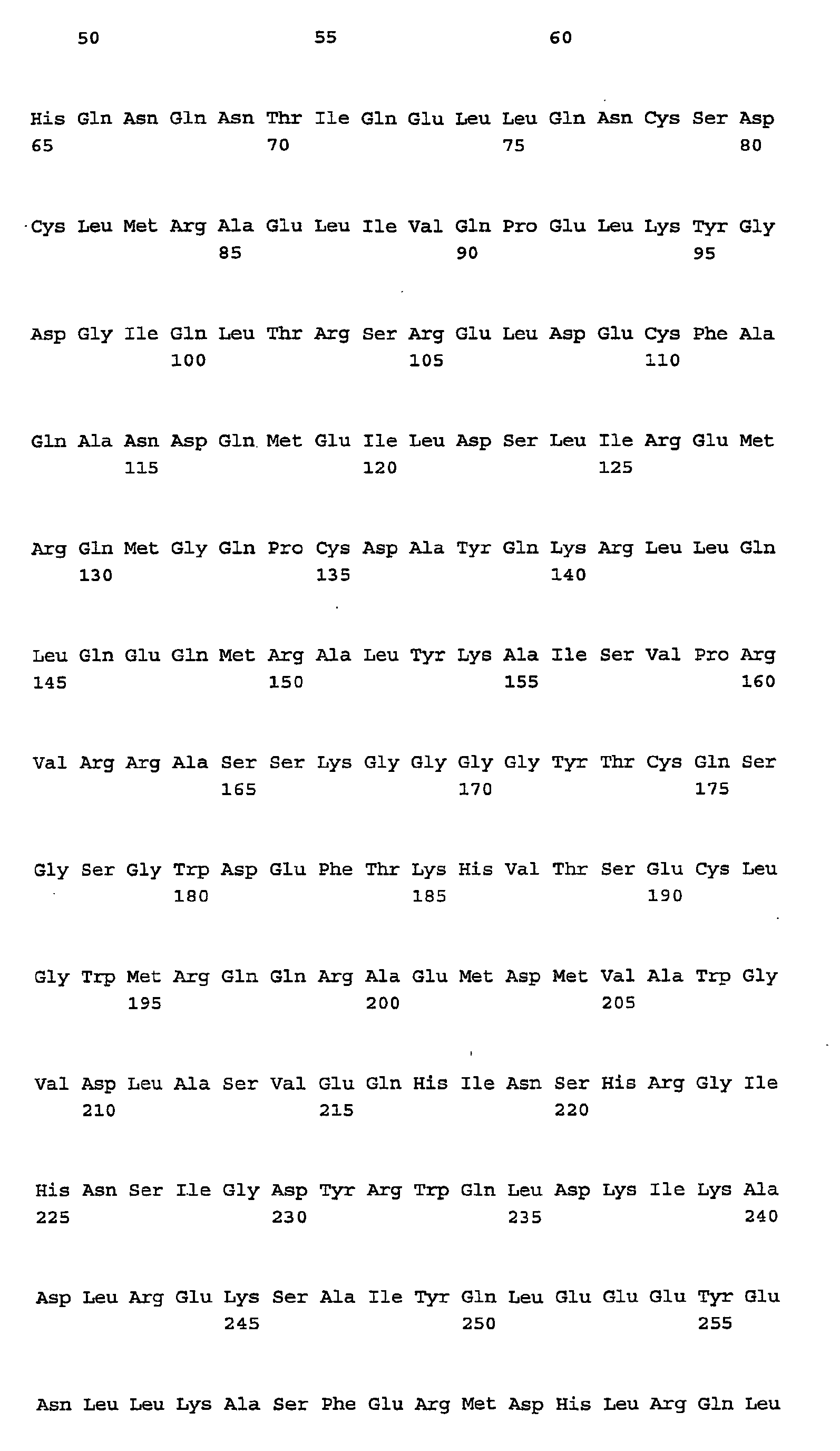


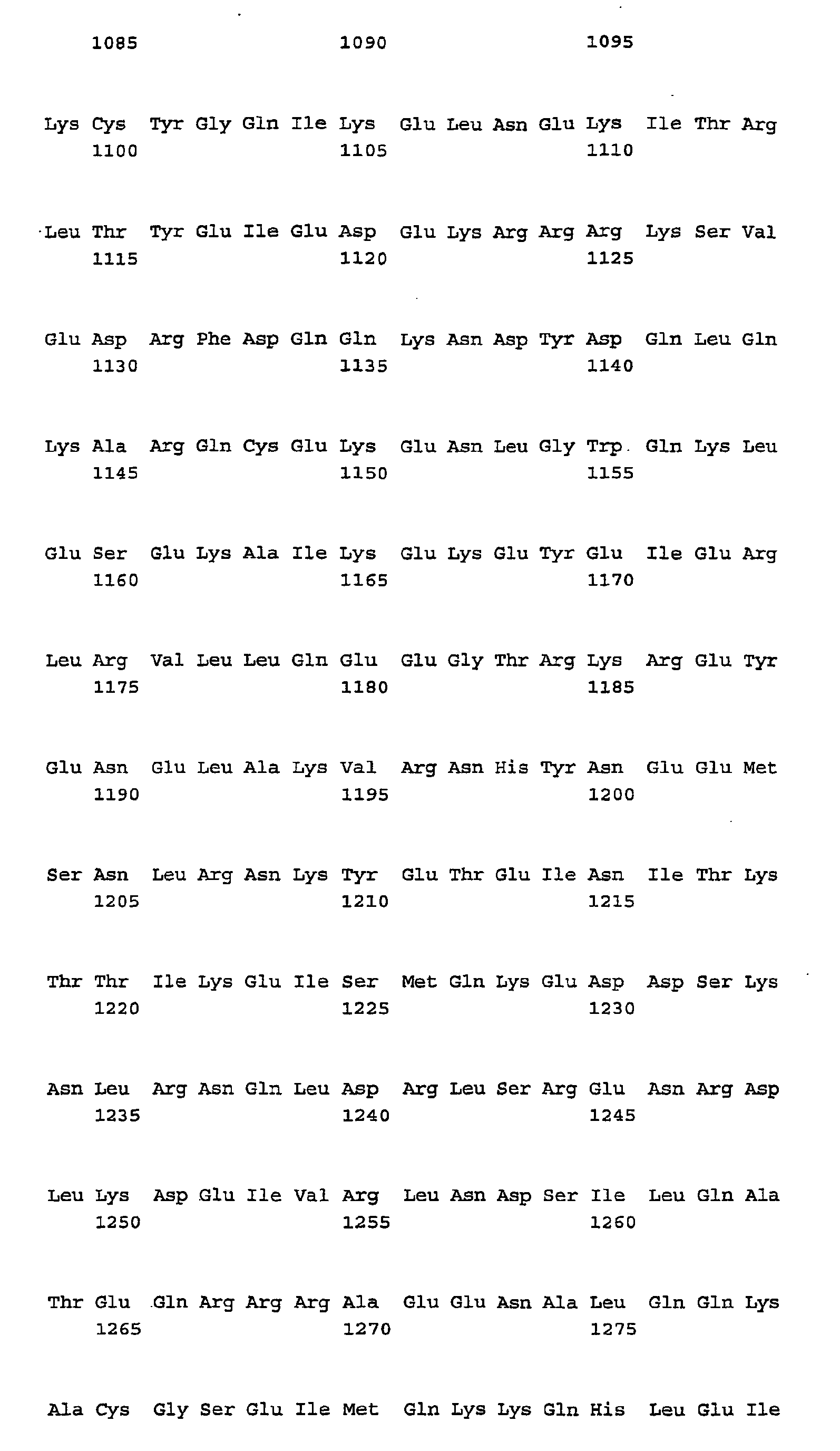


Claims (31)
- Kosmetische Zusammensetzung enthaltend in einem kosmetisch verträglichen Medium mindestens eine Keratin-bindende Polypeptidsequenz (i), dadurch gekennzeichnet, dass die Polypeptidsequenz (i) mindestens eine der folgenden Polypeptidsequenzen umfasst,(a) die Polypeptidsequenz SEQ ID NO:1 Position 2193 bis 2481(b) die Polypeptidsequenz SEQ ID NO:1 Position 2606 bis 2871(c) eine Polypeptidsequenz, die gegenüber (a) in bis zu 60 % der Aminosäuren verändert ist,(d) eine Polypeptidsequenz, die gegenüber (b) in bis zu 50 % der Aminosäuren verändert ist,mit der Maßgabe, dass die Keratin-Bindung der Polypeptidsequenz (c) oder (d) mindestens 10 % des Wertes beträgt, den die Polypeptidsequenz (a) oder (b) aufweist, gemessen in dem Test gemäß Beispiel 9 oder 10.
- Kosmetische Zusammensetzung gemäß Anspruch 1, dadurch gekennzeichnet, dass sie die Polypeptidsequenz (i) in einer Menge von 0,01 bis 30 Gew.-% enthält.
- Kosmetische Zusammensetzung gemäß Anspruch 1, dadurch gekennzeichnet, dass sie neben der Polypeptidsequenz (i) mindestens einen kosmetischen Wirkstoff enthält.
- Kosmetische Zusammensetzung gemäß Anspruch 3, dadurch gekennzeichnet, dass der kosmetische Wirkstoff ausgewählt wird aus der Gruppe der natürlichen oder synthetischen Polymere, Pigmente, Feuchthaltemittel, Öle, Wachse, Enzyme, Mineralien, Vitamine, Sonnenschutzmittel, Farbstoffe, Duftstoffe, Antioxidantien und Konservierungsmittel.
- Verwendung von kosmetischen Zusammensetzungen gemäß einem der Ansprüche 1 bis 4 zur Behandlung von keratinhaltigen Materialien.
- Verwendung von kosmetischen Zusammensetzungen gemäß einem der Ansprüche 1 bis 4 zur Behandlung von Haut, Haaren, Nägel.
- Verwendung von kosmetischen Zusammensetzungen gemäß einem der Ansprüche 1 - 6 zur Verbesserung der Kämmbarkeit von Haaren.
- Verwendung von kosmetischen Zusammensetzungen gemäß einem der Ansprüche 1 - 6 zur Verbesserung der Festigung von Haaren.
- Verwendung von kosmetischen Zusammensetzungen gemäß einem der Ansprüche 1 - 6 zur konditionierenden Wirkung auf der Haut.
- Verwendung von kosmetischen Zusammensetzungen gemäß einem der Ansprüche 1 - 6 zur Herstellung von Zusammensetzungen für die Haut-, Nagel- und Haarkosmetik.
- Kosmetische Zusammensetzung enthaltend Keratin-bindende Effektormoleküle bestehend aus(i) mindestens einer Polypeptidsequenz (i), die eine Bindungsaffinität zu einem Keratin besitzt und mindestens eine der folgenden Polypeptidsequenzen umfasst,(a) die Polypeptidsequenz SEQ ID NO:1 Postition 2269 bis 2508(b) die Polypeptidsequenz SEQ ID NO:1 Position 2606 bis 2871(c) eine Polypeptidsequenz, die gegenüber (a) in bis zu 70% der Aminosäuren verändert ist,(d) eine Polypeptidsequenz, die gegenüber (b) in bis zu 70 % der Aminosäuren verändert ist,
mit der Maßgabe, dass die Keratin-Bindung der Polypeptidsequenz (c) oder (d) mindestens 10 % des Wertes beträgt, den die Polypeptidsequenz (a) oder (b) aufweist, gemessen in dem Test gemäß Beispiel 9 oder 10 und,(ii) einem Effektormolekül (ii), das natürlicherweise nicht mit der Polypeptidsequenz (i) verknüpft ist. - Keratin-bindende Effektormoleküle nach Anspruch 11 wobei die Polypeptidsequenz (i) Bindungsaffinität zu menschlichem Haar-, Nagel- oder Hautkeratin besitzt.
- Kosmetische Zusammensetzung enthaltend Keratin-bindende Effektormoleküle gemäß Anspruch 11, wobei das Effektormolekül (ii) eine Polypeptidsequenz umfasst.
- Kosmetische Zusammensetzung enthaltend Keratin-bindende Effektormoleküle gemäß Anspruch 11, wobei das Effektormolekül (ii) eine enzymatische Aktivität besitzt.
- Keratin-bindende Effektormoleküle gemäß Anspruch 11, wobei das Effektormolekül (ii) ein Farbstoff oder eine Farbstoffkomponente ist.
- Keratin-bindende Effektormoleküle gemäß Anspruch 11, wobei das Effektormolekül (ii) ein UV-Filter ist.
- Keratin-bindende Effektormoleküle gemäß Anspruch 11, wobei das Effektormolekül (ii) Antioxidant ist.
- Keratin-bindende Effektormoleküle gemäß Anspruch 11, wobei das Effektormolekül (ii) ein Carotinoid ist.
- Keratin-bindende Effektormoleküle gemäß Anspruch 11, wobei das Effektormolekül (ii) ein Fungizid, Insektizid oder Biozid ist.
- Keratin-bindende Effektormoleküle gemäß Anspruch 11, wobei das Effektormolekül (ii) ein Vitamin oder Provitamin ist.
- Verwendung von Keratin-bindenden Effektormolekülen gemäß Anspruch 11 zur Behandlung von Haut, Haaren, Nägel sowie in der Tier- und Lederpflege.
- Verwendung von Keratin-bindenden Effektormolekülen gemäß Anspruch 11 zur Herstellung von Zusammensetzungen für die Haut-, Nagel und Haarkosmetik.
- Keratin-bindende Effektormoleküle gemäß Ansprüchen 11 bis 12, bei denen das Effektormolekül (ii) durch kovalente Bindungen mit der Polypeptidsequenz (i) verbunden ist.
- Keratin-bindende Effektormoleküle nach Ansprüchen 11 bis 12 oder 23, bei denen das Effektormolekül (ii) unter Ausnutzung zweier in (i) und (ii) bereits vorhandener chemischer Funktionen an funktionelle Gruppen der Seitenkette, den C- oder den N-Terminus des Polypeptids (i) kovalent gebunden ist.
- Keratin-bindende Effektormoleküle nach Ansprüchen 11 bis 12 oder 23, bei denen ein oder mehrere Effektormoleküle (ii) über einen mindestens bifunktionellen Linker an funktionelle Gruppen der Seitenkette, den C- oder den N-Terminus des Polypeptids (i) kovalent gebunden ist.
- Keratin-bindende Effektormoleküle nach Anspruch 25, wobei der bifunktionelle Linker eine Sulfhydryl reaktive Gruppe umfasst.
- Keratin-bindende Effektormoteküle nach Anspruch 26, wobei der bifunktionelle Linker Maleimid ist.
- Keratin-bindende Effektormoleküle nach Ansprüchen 11 bis 12, 23 bis 27, bei denen zwischen Effektormolekül (ii) und Polypeptid (i) Spacerelemente eingebaut sind.
- Keratin-bindende Effektormoleküle nach Ansprüchen 25 bis 28, die zwischen Effektormolekül (ii) und Polypeptid (i) eine potentielle Spaltstelle für eine Protease, Lipase, Esterase, Phosphatase oder Hydrolase besitzen.
- Keratin-bindende Effektormoleküle nach Ansprüchen 25 bis 29, die zwischen Effektormolekül (ii) und Polypeptid (i) eine weitere Polypeptidsequenz aufweisen, die die leichte Aufreinigung des Fusionsproteins gestattet.
- Verfahren zur Herstellung eines Keratin-bindenden Effektormoleküls gemäß Anspruch 11 umfassend die Kopplung mindestens eines kosmetischen Wirkstoffes über einen Linker an mindestens eine Aminosäure des Keratin-bindenden Polypeptids (i).
Applications Claiming Priority (3)
| Application Number | Priority Date | Filing Date | Title |
|---|---|---|---|
| DE200410025805 DE102004025805A1 (de) | 2004-05-24 | 2004-05-24 | Keratin-bindende Effektormoleküle |
| DE200510011988 DE102005011988A1 (de) | 2005-03-14 | 2005-03-14 | Die vorliegende Erfindung betrifft die Verwendung von Keratin-bindenden Polypeptiden und ihre Herstellung |
| PCT/EP2005/005599 WO2005115306A2 (de) | 2004-05-24 | 2005-05-24 | Keratin-bindende polypeptide |
Publications (2)
| Publication Number | Publication Date |
|---|---|
| EP1763334A2 EP1763334A2 (de) | 2007-03-21 |
| EP1763334B1 true EP1763334B1 (de) | 2008-12-17 |
Family
ID=35134164
Family Applications (1)
| Application Number | Title | Priority Date | Filing Date |
|---|---|---|---|
| EP05744792A Expired - Lifetime EP1763334B1 (de) | 2004-05-24 | 2005-05-24 | Keratin-bindende polypeptide |
Country Status (13)
| Country | Link |
|---|---|
| US (1) | US20080075684A1 (de) |
| EP (1) | EP1763334B1 (de) |
| JP (1) | JP2008500301A (de) |
| AT (1) | ATE417595T1 (de) |
| AU (1) | AU2005247092B2 (de) |
| BR (1) | BRPI0511421A (de) |
| CA (1) | CA2563999A1 (de) |
| DE (1) | DE502005006284D1 (de) |
| ES (1) | ES2317237T3 (de) |
| MX (1) | MXPA06013458A (de) |
| NZ (1) | NZ551366A (de) |
| RU (1) | RU2411029C2 (de) |
| WO (1) | WO2005115306A2 (de) |
Families Citing this family (40)
| Publication number | Priority date | Publication date | Assignee | Title |
|---|---|---|---|---|
| US7807141B2 (en) | 2003-09-08 | 2010-10-05 | E.I. Du Pont De Nemours And Company | Peptide-based oral care surface reagents for personal care |
| US7285264B2 (en) * | 2003-09-08 | 2007-10-23 | E.I. Du Pont De Nemours And Company | Peptide-based body surface coloring reagents |
| US7220405B2 (en) | 2003-09-08 | 2007-05-22 | E. I. Du Pont De Nemours And Company | Peptide-based conditioners and colorants for hair, skin, and nails |
| US7585495B2 (en) | 2003-09-08 | 2009-09-08 | E. I. Du Pont De Nemours And Company | Method for identifying shampoo-resistant hair-binding peptides and hair benefit agents therefrom |
| HRP20130459T1 (en) * | 2004-01-22 | 2013-06-30 | University Of Miami | Topical co-enzyme q10 formulations and methods of use |
| EP1848733B1 (de) | 2005-02-07 | 2017-06-21 | Basf Se | Neue hydrophobinfusionsproteine, deren herstellung und verwendung |
| MX2007012021A (es) | 2005-03-31 | 2008-03-14 | Basf Ag | El uso de polipeptidos como promotores de adhesion. |
| ATE449829T1 (de) | 2005-04-01 | 2009-12-15 | Basf Se | Bohrspülung enthaltend hydrophobin |
| EA014384B1 (ru) | 2005-04-01 | 2010-10-29 | Басф Акциенгезелльшафт | Промывочный буровой раствор, содержащий гидрофобин |
| DE102005027139A1 (de) | 2005-06-10 | 2006-12-28 | Basf Ag | Neue Cystein-verarmte Hydrophobinfusionsproteine, deren Herstellung und Verwendung |
| DE102005029704A1 (de) * | 2005-06-24 | 2007-01-11 | Basf Ag | Verwendung von Hydrophobin-Polypeptiden sowie Konjugaten aus Hydrophobin-Polypeptiden mit Wirk-oder Effektstoffen und ihre Herstellung sowie deren Einsatz in der Kosmetik |
| DE102005048720A1 (de) | 2005-10-12 | 2007-04-19 | Basf Ag | Verwendung von Proteinen als Antischaum-Komponente in Kraftstoffen |
| WO2007147445A2 (de) * | 2005-11-24 | 2007-12-27 | Basf Se | Keratinbindende effektormoleküle und verfahren zu deren herstellung |
| WO2007060116A2 (de) * | 2005-11-24 | 2007-05-31 | Basf Se | Keratinbindende effektormoleküle und verfahren zu deren herstellung durch kopplung keratinbindender polypeptide mit carboxylgruppen oder sulfonsäuregruppen tragenden effektormolekülen |
| WO2007060117A2 (de) * | 2005-11-24 | 2007-05-31 | Basf Se | Chimäre keratinbindende effektorproteine |
| US20090098074A1 (en) * | 2005-12-01 | 2009-04-16 | Basf Se | Keratin-Binding Effector Molecules Containing Reactive Dyes |
| ES2374320T3 (es) | 2006-08-15 | 2012-02-15 | Basf Se | Procedimiento para la producción de preparaciones de hidrofobina secas de flujo libre. |
| US20080280810A1 (en) * | 2006-10-30 | 2008-11-13 | O'brien John P | Peptides having affinity for body surfaces |
| US20080175798A1 (en) * | 2006-12-11 | 2008-07-24 | Beck William A | Peptide-based hair protectants |
| US8454945B2 (en) | 2007-03-22 | 2013-06-04 | Berg Pharma Llc | Topical formulations having enhanced bioavailability |
| DE102007058845A1 (de) * | 2007-12-05 | 2009-06-10 | Henkel Ag & Co. Kgaa | Haarreinigungsmittel mit Tensid-/Verdickerkombination |
| JP6058263B2 (ja) | 2008-04-11 | 2017-01-11 | バーグ リミテッド ライアビリティ カンパニー | 癌細胞においてアポトーシスを誘導する方法および使用 |
| FR2932087B1 (fr) * | 2008-06-10 | 2012-10-12 | Oreal | Utilisation cosmetique de proteines de type desmoplakine pour le traitement de la secheresse cutanee |
| US8697654B2 (en) * | 2008-12-18 | 2014-04-15 | E I Du Pont De Nemours And Company | Peptide linkers for effective multivalent peptide binding |
| US8287845B2 (en) * | 2008-12-18 | 2012-10-16 | E I Du Pont De Nemours And Company | Hair-binding peptides |
| US20100158822A1 (en) * | 2008-12-18 | 2010-06-24 | E .I. Du Pont De Nemours And Company | Peptides that bind to silica-coated particles |
| US20100158846A1 (en) * | 2008-12-18 | 2010-06-24 | E. I. Du Pont De Nemours And Company | Hair-binding peptides |
| CN102481269B (zh) | 2009-05-11 | 2015-10-07 | 博格有限责任公司 | 包含辅酶q10的药物组合物及其制备方法 |
| BR112012022916B1 (pt) | 2010-03-12 | 2021-11-09 | Berg Llc | Formulações intravenosas de coenzima q10 (coq10), bem como método de preparação e uso da mesma |
| JP6092844B2 (ja) | 2011-04-04 | 2017-03-08 | バーグ エルエルシー | 中枢神経系腫瘍の治療方法 |
| US20140239525A1 (en) | 2011-06-17 | 2014-08-28 | Board Of Regents, University Of Texas System | Inhalable pharmaceutical compositions |
| US9745543B2 (en) | 2012-09-10 | 2017-08-29 | Ecolab Usa Inc. | Stable liquid manual dishwashing compositions containing enzymes |
| US9622951B2 (en) | 2012-10-29 | 2017-04-18 | The Procter & Gamble Company | Personal care compositions |
| BR112015025424A2 (pt) | 2013-04-08 | 2017-07-18 | Berg Llc | tratamento de câncer usando terapias de combinação de coenzima q10 |
| DE102013213170A1 (de) | 2013-07-04 | 2015-01-08 | Beiersdorf Ag | Octocrylenfreies, geruchsstabiles Sonnenschutzmittel |
| US9672952B2 (en) | 2013-08-14 | 2017-06-06 | Industrial Technology Research Institute | Polymer and conductive composition |
| MX381399B (es) | 2013-09-04 | 2025-03-12 | Berg Llc | Formulaciones de coenzima q10 y métodos de uso. |
| WO2017087576A1 (en) | 2015-11-16 | 2017-05-26 | Berg Llc | Methods of treatment of temozolomide-resistant glioma using coenzyme q10 |
| EP3773461A4 (de) * | 2018-04-13 | 2022-02-09 | Massachusetts Institute of Technology | Konzipierte behandlungen zur haarreparatur und zur langanhaltenden farbbewahrung |
| WO2021245018A1 (en) | 2020-06-02 | 2021-12-09 | Unilever Ip Holdings B.V. | A high spf skin cleansing composition |
Family Cites Families (11)
| Publication number | Priority date | Publication date | Assignee | Title |
|---|---|---|---|---|
| EP0293837B1 (de) * | 1987-06-01 | 1992-01-15 | Keikichi Sugiyama | Zusammensetzung zur Anwendung auf Haare und Kopfhaut |
| JP2748174B2 (ja) * | 1990-01-29 | 1998-05-06 | 株式会社成和化成 | 化粧品基剤 |
| DE69313891T2 (de) * | 1992-02-20 | 1998-05-07 | Sumitomo Electric Industries | Verfahren für die Verbindung von supraleitenden Drähte aus Oxyd-Hochtemperatur-Supraleiter |
| GB9217444D0 (en) * | 1992-08-17 | 1992-09-30 | Unilever Plc | Compounds compositions and methods for producing pigmentation in hair or skin |
| DE69310339T2 (de) * | 1993-02-19 | 1997-08-21 | Philippe Djian | Präparate, die Corneozyt Proteine enthalten |
| JP3446980B2 (ja) * | 1994-12-08 | 2003-09-16 | 株式会社成和化成 | 毛髪化粧料 |
| DE19626762A1 (de) * | 1996-07-03 | 1998-01-08 | Basf Ag | Enzymatisch spaltbare Linker für Festphasensynthesen |
| JP2000281539A (ja) * | 1999-01-29 | 2000-10-10 | Seiwa Kasei:Kk | 化粧品基材 |
| AU3395900A (en) * | 1999-03-12 | 2000-10-04 | Human Genome Sciences, Inc. | Human lung cancer associated gene sequences and polypeptides |
| WO2003042387A1 (fr) * | 2001-11-13 | 2003-05-22 | Keio University | Nouvelles proteines associees a la keratine des poils |
| AU2003298786A1 (en) * | 2002-11-26 | 2004-06-18 | Protein Design Labs, Inc. | Methods of detecting soft tissue sarcoma, compositions and methods of screening for soft tissue sarcoma modulators |
-
2005
- 2005-05-24 JP JP2007513787A patent/JP2008500301A/ja active Pending
- 2005-05-24 BR BRPI0511421-7A patent/BRPI0511421A/pt not_active IP Right Cessation
- 2005-05-24 AU AU2005247092A patent/AU2005247092B2/en not_active Ceased
- 2005-05-24 WO PCT/EP2005/005599 patent/WO2005115306A2/de not_active Ceased
- 2005-05-24 CA CA002563999A patent/CA2563999A1/en not_active Abandoned
- 2005-05-24 MX MXPA06013458A patent/MXPA06013458A/es active IP Right Grant
- 2005-05-24 NZ NZ551366A patent/NZ551366A/en unknown
- 2005-05-24 DE DE502005006284T patent/DE502005006284D1/de not_active Expired - Lifetime
- 2005-05-24 EP EP05744792A patent/EP1763334B1/de not_active Expired - Lifetime
- 2005-05-24 RU RU2006145670/15A patent/RU2411029C2/ru not_active IP Right Cessation
- 2005-05-24 ES ES05744792T patent/ES2317237T3/es not_active Expired - Lifetime
- 2005-05-24 AT AT05744792T patent/ATE417595T1/de not_active IP Right Cessation
- 2005-05-24 US US11/597,815 patent/US20080075684A1/en not_active Abandoned
Also Published As
| Publication number | Publication date |
|---|---|
| AU2005247092B2 (en) | 2010-01-07 |
| BRPI0511421A (pt) | 2008-01-29 |
| RU2411029C9 (ru) | 2011-10-20 |
| ES2317237T3 (es) | 2009-04-16 |
| WO2005115306A3 (de) | 2006-03-16 |
| JP2008500301A (ja) | 2008-01-10 |
| WO2005115306A2 (de) | 2005-12-08 |
| EP1763334A2 (de) | 2007-03-21 |
| AU2005247092A1 (en) | 2005-12-08 |
| RU2006145670A (ru) | 2008-06-27 |
| US20080075684A1 (en) | 2008-03-27 |
| NZ551366A (en) | 2009-01-31 |
| MXPA06013458A (es) | 2007-03-01 |
| DE502005006284D1 (de) | 2009-01-29 |
| CA2563999A1 (en) | 2005-12-08 |
| ATE417595T1 (de) | 2009-01-15 |
| RU2411029C2 (ru) | 2011-10-20 |
Similar Documents
| Publication | Publication Date | Title |
|---|---|---|
| AU2005247092B2 (en) | Keratin-binding polypeptides | |
| US20100015070A1 (en) | Use of natural, recombinant and synthetic resilins in cosmetics | |
| US20100278882A1 (en) | Use of protein microbeads in cosmetics | |
| CN101203207B (zh) | 疏水蛋白-多肽和具有活性剂和效果剂的来自疏水蛋白-多肽的缀合物的应用及其制备及其在化妆品工业中的应用 | |
| US20090156485A1 (en) | Method for coupling keratin-binding polypeptides with effector molecules which support carboxylic groups or sulfonic acid groups | |
| CA2708554A1 (en) | Anti-dandruff compositions containing peptides | |
| CN1960699B (zh) | 角蛋白结合多肽 | |
| US20090098076A1 (en) | Method For the Production of a Keratin-Binding Effector Molecule | |
| WO2006097432A2 (de) | Keratin-biktdende desmoplakinpolypeptidsequenzen | |
| CN101365493A (zh) | 结合角蛋白的效应分子以及产生其的方法 | |
| CN101610792A (zh) | 结合角蛋白的效应分子以及通过将结合角蛋白的多肽与携带羧基或磺酸基的效应分子偶联而制备其的方法 |
Legal Events
| Date | Code | Title | Description |
|---|---|---|---|
| PUAI | Public reference made under article 153(3) epc to a published international application that has entered the european phase |
Free format text: ORIGINAL CODE: 0009012 |
|
| 17P | Request for examination filed |
Effective date: 20061227 |
|
| AK | Designated contracting states |
Kind code of ref document: A2 Designated state(s): AT BE BG CH CY CZ DE DK EE ES FI FR GB GR HU IE IS IT LI LT LU MC NL PL PT RO SE SI SK TR |
|
| AX | Request for extension of the european patent |
Extension state: AL BA HR LV MK YU |
|
| 17Q | First examination report despatched |
Effective date: 20070625 |
|
| RAP1 | Party data changed (applicant data changed or rights of an application transferred) |
Owner name: BASF SE |
|
| GRAP | Despatch of communication of intention to grant a patent |
Free format text: ORIGINAL CODE: EPIDOSNIGR1 |
|
| GRAS | Grant fee paid |
Free format text: ORIGINAL CODE: EPIDOSNIGR3 |
|
| GRAA | (expected) grant |
Free format text: ORIGINAL CODE: 0009210 |
|
| AK | Designated contracting states |
Kind code of ref document: B1 Designated state(s): AT BE BG CH CY CZ DE DK EE ES FI FR GB GR HU IE IS IT LI LT LU MC NL PL PT RO SE SI SK TR |
|
| AX | Request for extension of the european patent |
Extension state: AL BA HR LV MK YU |
|
| REG | Reference to a national code |
Ref country code: GB Ref legal event code: FG4D Free format text: NOT ENGLISH |
|
| REG | Reference to a national code |
Ref country code: CH Ref legal event code: EP |
|
| REG | Reference to a national code |
Ref country code: IE Ref legal event code: FG4D Free format text: LANGUAGE OF EP DOCUMENT: GERMAN |
|
| REF | Corresponds to: |
Ref document number: 502005006284 Country of ref document: DE Date of ref document: 20090129 Kind code of ref document: P |
|
| REG | Reference to a national code |
Ref country code: GR Ref legal event code: EP Ref document number: 20090400465 Country of ref document: GR |
|
| REG | Reference to a national code |
Ref country code: ES Ref legal event code: FG2A Ref document number: 2317237 Country of ref document: ES Kind code of ref document: T3 |
|
| PG25 | Lapsed in a contracting state [announced via postgrant information from national office to epo] |
Ref country code: LT Free format text: LAPSE BECAUSE OF FAILURE TO SUBMIT A TRANSLATION OF THE DESCRIPTION OR TO PAY THE FEE WITHIN THE PRESCRIBED TIME-LIMIT Effective date: 20081217 |
|
| PG25 | Lapsed in a contracting state [announced via postgrant information from national office to epo] |
Ref country code: PL Free format text: LAPSE BECAUSE OF FAILURE TO SUBMIT A TRANSLATION OF THE DESCRIPTION OR TO PAY THE FEE WITHIN THE PRESCRIBED TIME-LIMIT Effective date: 20081217 Ref country code: FI Free format text: LAPSE BECAUSE OF FAILURE TO SUBMIT A TRANSLATION OF THE DESCRIPTION OR TO PAY THE FEE WITHIN THE PRESCRIBED TIME-LIMIT Effective date: 20081217 Ref country code: SI Free format text: LAPSE BECAUSE OF FAILURE TO SUBMIT A TRANSLATION OF THE DESCRIPTION OR TO PAY THE FEE WITHIN THE PRESCRIBED TIME-LIMIT Effective date: 20081217 Ref country code: NL Free format text: LAPSE BECAUSE OF FAILURE TO SUBMIT A TRANSLATION OF THE DESCRIPTION OR TO PAY THE FEE WITHIN THE PRESCRIBED TIME-LIMIT Effective date: 20081217 |
|
| NLV1 | Nl: lapsed or annulled due to failure to fulfill the requirements of art. 29p and 29m of the patents act | ||
| REG | Reference to a national code |
Ref country code: IE Ref legal event code: FD4D |
|
| PG25 | Lapsed in a contracting state [announced via postgrant information from national office to epo] |
Ref country code: RO Free format text: LAPSE BECAUSE OF FAILURE TO SUBMIT A TRANSLATION OF THE DESCRIPTION OR TO PAY THE FEE WITHIN THE PRESCRIBED TIME-LIMIT Effective date: 20081217 Ref country code: IE Free format text: LAPSE BECAUSE OF FAILURE TO SUBMIT A TRANSLATION OF THE DESCRIPTION OR TO PAY THE FEE WITHIN THE PRESCRIBED TIME-LIMIT Effective date: 20081217 Ref country code: BG Free format text: LAPSE BECAUSE OF FAILURE TO SUBMIT A TRANSLATION OF THE DESCRIPTION OR TO PAY THE FEE WITHIN THE PRESCRIBED TIME-LIMIT Effective date: 20090317 Ref country code: EE Free format text: LAPSE BECAUSE OF FAILURE TO SUBMIT A TRANSLATION OF THE DESCRIPTION OR TO PAY THE FEE WITHIN THE PRESCRIBED TIME-LIMIT Effective date: 20081217 |
|
| PG25 | Lapsed in a contracting state [announced via postgrant information from national office to epo] |
Ref country code: SE Free format text: LAPSE BECAUSE OF FAILURE TO SUBMIT A TRANSLATION OF THE DESCRIPTION OR TO PAY THE FEE WITHIN THE PRESCRIBED TIME-LIMIT Effective date: 20090317 Ref country code: IS Free format text: LAPSE BECAUSE OF FAILURE TO SUBMIT A TRANSLATION OF THE DESCRIPTION OR TO PAY THE FEE WITHIN THE PRESCRIBED TIME-LIMIT Effective date: 20090417 Ref country code: PT Free format text: LAPSE BECAUSE OF FAILURE TO SUBMIT A TRANSLATION OF THE DESCRIPTION OR TO PAY THE FEE WITHIN THE PRESCRIBED TIME-LIMIT Effective date: 20090518 Ref country code: CZ Free format text: LAPSE BECAUSE OF FAILURE TO SUBMIT A TRANSLATION OF THE DESCRIPTION OR TO PAY THE FEE WITHIN THE PRESCRIBED TIME-LIMIT Effective date: 20081217 |
|
| PG25 | Lapsed in a contracting state [announced via postgrant information from national office to epo] |
Ref country code: SK Free format text: LAPSE BECAUSE OF FAILURE TO SUBMIT A TRANSLATION OF THE DESCRIPTION OR TO PAY THE FEE WITHIN THE PRESCRIBED TIME-LIMIT Effective date: 20081217 |
|
| PLBE | No opposition filed within time limit |
Free format text: ORIGINAL CODE: 0009261 |
|
| STAA | Information on the status of an ep patent application or granted ep patent |
Free format text: STATUS: NO OPPOSITION FILED WITHIN TIME LIMIT |
|
| PG25 | Lapsed in a contracting state [announced via postgrant information from national office to epo] |
Ref country code: DK Free format text: LAPSE BECAUSE OF FAILURE TO SUBMIT A TRANSLATION OF THE DESCRIPTION OR TO PAY THE FEE WITHIN THE PRESCRIBED TIME-LIMIT Effective date: 20081217 |
|
| 26N | No opposition filed |
Effective date: 20090918 |
|
| BERE | Be: lapsed |
Owner name: BASF SE Effective date: 20090531 |
|
| PG25 | Lapsed in a contracting state [announced via postgrant information from national office to epo] |
Ref country code: MC Free format text: LAPSE BECAUSE OF NON-PAYMENT OF DUE FEES Effective date: 20090531 |
|
| REG | Reference to a national code |
Ref country code: CH Ref legal event code: PL |
|
| PG25 | Lapsed in a contracting state [announced via postgrant information from national office to epo] |
Ref country code: CH Free format text: LAPSE BECAUSE OF NON-PAYMENT OF DUE FEES Effective date: 20090531 Ref country code: LI Free format text: LAPSE BECAUSE OF NON-PAYMENT OF DUE FEES Effective date: 20090531 |
|
| PG25 | Lapsed in a contracting state [announced via postgrant information from national office to epo] |
Ref country code: BE Free format text: LAPSE BECAUSE OF NON-PAYMENT OF DUE FEES Effective date: 20090531 |
|
| PG25 | Lapsed in a contracting state [announced via postgrant information from national office to epo] |
Ref country code: AT Free format text: LAPSE BECAUSE OF NON-PAYMENT OF DUE FEES Effective date: 20090524 |
|
| PG25 | Lapsed in a contracting state [announced via postgrant information from national office to epo] |
Ref country code: LU Free format text: LAPSE BECAUSE OF NON-PAYMENT OF DUE FEES Effective date: 20090524 |
|
| PG25 | Lapsed in a contracting state [announced via postgrant information from national office to epo] |
Ref country code: HU Free format text: LAPSE BECAUSE OF FAILURE TO SUBMIT A TRANSLATION OF THE DESCRIPTION OR TO PAY THE FEE WITHIN THE PRESCRIBED TIME-LIMIT Effective date: 20090618 |
|
| PGFP | Annual fee paid to national office [announced via postgrant information from national office to epo] |
Ref country code: FR Payment date: 20110706 Year of fee payment: 7 Ref country code: ES Payment date: 20110627 Year of fee payment: 7 Ref country code: TR Payment date: 20110503 Year of fee payment: 7 Ref country code: GR Payment date: 20110527 Year of fee payment: 7 |
|
| PGFP | Annual fee paid to national office [announced via postgrant information from national office to epo] |
Ref country code: GB Payment date: 20110531 Year of fee payment: 7 |
|
| PG25 | Lapsed in a contracting state [announced via postgrant information from national office to epo] |
Ref country code: CY Free format text: LAPSE BECAUSE OF FAILURE TO SUBMIT A TRANSLATION OF THE DESCRIPTION OR TO PAY THE FEE WITHIN THE PRESCRIBED TIME-LIMIT Effective date: 20081217 |
|
| PGFP | Annual fee paid to national office [announced via postgrant information from national office to epo] |
Ref country code: IT Payment date: 20110528 Year of fee payment: 7 |
|
| PGFP | Annual fee paid to national office [announced via postgrant information from national office to epo] |
Ref country code: DE Payment date: 20110728 Year of fee payment: 7 |
|
| GBPC | Gb: european patent ceased through non-payment of renewal fee |
Effective date: 20120524 |
|
| REG | Reference to a national code |
Ref country code: GR Ref legal event code: ML Ref document number: 20090400465 Country of ref document: GR Effective date: 20121204 |
|
| PG25 | Lapsed in a contracting state [announced via postgrant information from national office to epo] |
Ref country code: GR Free format text: LAPSE BECAUSE OF NON-PAYMENT OF DUE FEES Effective date: 20121204 Ref country code: IT Free format text: LAPSE BECAUSE OF NON-PAYMENT OF DUE FEES Effective date: 20120524 |
|
| REG | Reference to a national code |
Ref country code: FR Ref legal event code: ST Effective date: 20130131 |
|
| REG | Reference to a national code |
Ref country code: DE Ref legal event code: R119 Ref document number: 502005006284 Country of ref document: DE Effective date: 20121201 |
|
| PG25 | Lapsed in a contracting state [announced via postgrant information from national office to epo] |
Ref country code: GB Free format text: LAPSE BECAUSE OF NON-PAYMENT OF DUE FEES Effective date: 20120524 Ref country code: FR Free format text: LAPSE BECAUSE OF NON-PAYMENT OF DUE FEES Effective date: 20120531 |
|
| PG25 | Lapsed in a contracting state [announced via postgrant information from national office to epo] |
Ref country code: DE Free format text: LAPSE BECAUSE OF NON-PAYMENT OF DUE FEES Effective date: 20121201 |
|
| REG | Reference to a national code |
Ref country code: ES Ref legal event code: FD2A Effective date: 20130820 |
|
| PG25 | Lapsed in a contracting state [announced via postgrant information from national office to epo] |
Ref country code: ES Free format text: LAPSE BECAUSE OF NON-PAYMENT OF DUE FEES Effective date: 20120525 |
|
| PG25 | Lapsed in a contracting state [announced via postgrant information from national office to epo] |
Ref country code: TR Free format text: LAPSE BECAUSE OF NON-PAYMENT OF DUE FEES Effective date: 20120524 |