EP1696934B1 - Florfenicol prodrug having improved water solubility - Google Patents
Florfenicol prodrug having improved water solubility Download PDFInfo
- Publication number
- EP1696934B1 EP1696934B1 EP04814736.7A EP04814736A EP1696934B1 EP 1696934 B1 EP1696934 B1 EP 1696934B1 EP 04814736 A EP04814736 A EP 04814736A EP 1696934 B1 EP1696934 B1 EP 1696934B1
- Authority
- EP
- European Patent Office
- Prior art keywords
- florfenicol
- prodrug
- phosphate ester
- pharmaceutical composition
- pharmaceutically
- Prior art date
- Legal status (The legal status is an assumption and is not a legal conclusion. Google has not performed a legal analysis and makes no representation as to the accuracy of the status listed.)
- Expired - Lifetime
Links
- IFPJFPROEPHIMI-UHFFFAOYSA-N OCCCNCCO Chemical compound OCCCNCCO IFPJFPROEPHIMI-UHFFFAOYSA-N 0.000 description 1
- ZBCBWPMODOFKDW-UHFFFAOYSA-N OCCNCCO Chemical compound OCCNCCO ZBCBWPMODOFKDW-UHFFFAOYSA-N 0.000 description 1
- ZBCBWPMODOFKDW-UHFFFAOYSA-O OCC[NH2+]CCO Chemical compound OCC[NH2+]CCO ZBCBWPMODOFKDW-UHFFFAOYSA-O 0.000 description 1
Images


Classifications
-
- C—CHEMISTRY; METALLURGY
- C07—ORGANIC CHEMISTRY
- C07F—ACYCLIC, CARBOCYCLIC OR HETEROCYCLIC COMPOUNDS CONTAINING ELEMENTS OTHER THAN CARBON, HYDROGEN, HALOGEN, OXYGEN, NITROGEN, SULFUR, SELENIUM OR TELLURIUM
- C07F9/00—Compounds containing elements of Groups 5 or 15 of the Periodic Table
- C07F9/02—Phosphorus compounds
- C07F9/06—Phosphorus compounds without P—C bonds
- C07F9/08—Esters of oxyacids of phosphorus
- C07F9/09—Esters of phosphoric acids
-
- C—CHEMISTRY; METALLURGY
- C07—ORGANIC CHEMISTRY
- C07F—ACYCLIC, CARBOCYCLIC OR HETEROCYCLIC COMPOUNDS CONTAINING ELEMENTS OTHER THAN CARBON, HYDROGEN, HALOGEN, OXYGEN, NITROGEN, SULFUR, SELENIUM OR TELLURIUM
- C07F9/00—Compounds containing elements of Groups 5 or 15 of the Periodic Table
- C07F9/02—Phosphorus compounds
- C07F9/547—Heterocyclic compounds, e.g. containing phosphorus as a ring hetero atom
-
- A—HUMAN NECESSITIES
- A61—MEDICAL OR VETERINARY SCIENCE; HYGIENE
- A61K—PREPARATIONS FOR MEDICAL, DENTAL OR TOILETRY PURPOSES
- A61K31/00—Medicinal preparations containing organic active ingredients
- A61K31/66—Phosphorus compounds
- A61K31/661—Phosphorus acids or esters thereof not having P—C bonds, e.g. fosfosal, dichlorvos, malathion or mevinphos
-
- A—HUMAN NECESSITIES
- A61—MEDICAL OR VETERINARY SCIENCE; HYGIENE
- A61P—SPECIFIC THERAPEUTIC ACTIVITY OF CHEMICAL COMPOUNDS OR MEDICINAL PREPARATIONS
- A61P31/00—Antiinfectives, i.e. antibiotics, antiseptics, chemotherapeutics
-
- A—HUMAN NECESSITIES
- A61—MEDICAL OR VETERINARY SCIENCE; HYGIENE
- A61P—SPECIFIC THERAPEUTIC ACTIVITY OF CHEMICAL COMPOUNDS OR MEDICINAL PREPARATIONS
- A61P31/00—Antiinfectives, i.e. antibiotics, antiseptics, chemotherapeutics
- A61P31/04—Antibacterial agents
-
- A—HUMAN NECESSITIES
- A61—MEDICAL OR VETERINARY SCIENCE; HYGIENE
- A61P—SPECIFIC THERAPEUTIC ACTIVITY OF CHEMICAL COMPOUNDS OR MEDICINAL PREPARATIONS
- A61P43/00—Drugs for specific purposes, not provided for in groups A61P1/00-A61P41/00
-
- C—CHEMISTRY; METALLURGY
- C07—ORGANIC CHEMISTRY
- C07F—ACYCLIC, CARBOCYCLIC OR HETEROCYCLIC COMPOUNDS CONTAINING ELEMENTS OTHER THAN CARBON, HYDROGEN, HALOGEN, OXYGEN, NITROGEN, SULFUR, SELENIUM OR TELLURIUM
- C07F9/00—Compounds containing elements of Groups 5 or 15 of the Periodic Table
- C07F9/02—Phosphorus compounds
- C07F9/06—Phosphorus compounds without P—C bonds
- C07F9/08—Esters of oxyacids of phosphorus
- C07F9/09—Esters of phosphoric acids
- C07F9/094—Esters of phosphoric acids with arylalkanols
Definitions
- the present invention is directed to phosphate esters of florfenicol, including a florfenicol prodrug having superior water solubility, and phosphate esters of florfenicol analogs.
- Florfenicol is a structural analog of thiamphenicol, which in turn is a derivative of chloramphenicol [see, e.g., U.S. 4,235,892 , U.S. 5,352,832 ].
- Florfenicol is a broad spectrum antibiotic with activity against many gram-negative and gram-positive bacteria, including utility in the prevention and treatment of bacterial infections due to susceptible pathogens in birds, reptiles, fish, shellfish and mammals.
- One of florfenicol's primary uses is in the treatment of pneumonia and associated respiratory infections in cattle (often referred to generically as Bovine Respiratory Disease or BRD) caused by Mannhemia haemolytica, Pasturella multocida and/or Haemophilus somnus, also known as Histophilus somni.
- pododermatitis in cattle caused by Fusobacterium necrophorum and Bacterioides melaninogenicus
- swine respiratory disease caused by Pasteurella multocida, Actinobacillus pleuropneumoniae, Streptococcus suis, Salmonella cholerasuis and/or Mycoplasma spp.
- furunculosis in salmon caused by Aeromonas salmonicida.
- chloramphenicol-resistant strains of organisms such as K. pneumoniae, E. cloacae, S. typhus and E. coli, are susceptible to florfenicol.
- Florfenicol is most often administered to subjects which can benefit from its advantages either orally or parenterally, the latter being primarity intramuscular or the EP application n° 0 014 437 discloses some derivatives of chloramphenicol in which the 3-hydroxy group of the propanediol moiety of the chloramphenicol has been replaced with fluorine.
- the PCT/IB03/03140 patent application deals with florfenicol derivatives which retain the activity of florfenicol without being substrates for the Flo (antibiotic efflux pomp) produced by resistant bacteria having flo gene intravenous. Due to its very low water solubility (approximately one mg/mL), organic solvents must be added to achieve the desired product concentration in a commercial formulation.
- NUFLOR ® veterinary-labeled florfenicol formulation in the United States and Canada
- the organic solvents N-methylpyrrolidinone, propylene glycol and/or polyethylene glycol are used to afford florfenicol solubility of 300 mg/mL.
- these solvents often cause significant localized irritation. Therefore, there is a need for a more water-soluble form of florfenicol.
- the present invention therefore, provides a water-soluble form of florfenicol that has substantially greater aqueous solubility than florfenicol itself.
- a water-soluble form of florfenicol of the present invention is also a prodrug that rapidly and efficiently converts to florfenicol in vivo.
- One aspect of the present invention therefore provides a florfenicol phosphate ester (e.g., a florfenicol prodrug) having the chemical structure:
- the present invention further provides salts of this florfenicol phosphate ester.
- Such salts may be useful in the stable storage of the florfenicol phosphate esters.
- the florfenicol phosphate ester salts comprise pharmaceutically-acceptable counterions.
- the acids and pharmaceutically-acceptable florfenicol phosphate ester salts of the present invention may be depicted as: wherein M 1 + and M 2 + are independently selected to be either H + or a pharmaceutically-acceptable mono-cation, or alternatively, M 1 + and M 2 + can be taken together as a pharmaceutically-acceptable di-cation.
- M 1 + and M 2 + are independently selected to be H + , Na + , NH 4 + , or K + .
- M 1 + and M 2 + are respectively, H + and Na + .
- M 1 + and M 2 + are both Na + .
- M 1 + and M 2 + taken together are Ca +2 .
- M 1 + and M 2 + taken together are Mg +2 .
- M 1 + and M 2 + are independently selected to be either H + or a protonated amine.
- M 1 + and M 2 + are respectively, H + and a protonated amine comprising the chemical formula NR 1 R 2 R 3 H + .
- M 1 + and M 2 + are both a protonated amine comprising the chemical formula NR 1 R 2 R 3 H + .
- R 1 , R 2 , and R 3 are independently selected to be either H, methyl, ethyl, propyl, isopropyl, - CH 2 CH 2 OH and -CH 2 C(CH 2 OH) 3 .
- R 1 is as provided above, but R 2 and R 3 are linked to form a five or six membered ring.
- the ring is pirolidine, piperidine or morpholine.
- amine cations of the present invention include, but are not limited to:
- bis-protonated diamines of the present invention include:
- M 1 + and M 2 + comprise respectively, H + and a mono-cationic form of a dibasic aminoacid.
- the mono-cationic form of the dibasic aminoacid comprises one of the following two chemical formulas:
- M 1 + and M 2 + taken together comprise a di-cationic form of a dibasic aminoacid.
- the di-cationic form of the dibasic aminoacid comprises one of the two following chemical formulas:
- M 1 + and M 2 + are independently selected to be either H + , meglumine, benzocaine, or procaine.
- either M 1 + and M 2 + are H + , while the other is either meglumine, benzocaine or procaine.
- the present invention provides a formulation that comprises Formula I as a mixture of two or more salts.
- M 1 + or M 2 + is H +
- the other is a specific counterion
- both M 1 + and M 2 + are that specific counterion.
- M 1 + and M 2 + of the first salt are identical counterions, but not H +
- M 1 + and M 2 + of the second salt are also identical counterions, but are neither H + , nor the specific counterion of the first salt.
- the formulation comprises Formula I as a mixture of two or more salts, and all of the counterions of the different salts are selected independently.
- the counterions in these formulations are disclosed herein.
- the present invention further provides phosphate esters of florfenicol analogs (including phosphate esters of chloramphenicol and thiamphenicol) that also can be useful as antibiotics and/or prodrugs of antibiotics.
- the present invention further provides salts of these phosphate esters of the florfenicol analogs, preferably salts comprising the counterions provided herein.
- One appropriate family of florfenicol analogs has recently been synthesized and characterized [ U.S. 20040082553 , WO03/077828 ].
- phosphate esters of these florfenicol analogs and salts thereof can be prepared and then employed as antibiotics and/or prodrugs of antibiotics through the teachings provided herein, in view of the teachings of U.S. 20040082553 and WO03/077828 .
- All of the forms of the florfenicol phosphate ester of the present invention may be prepared in pharmaceutical compositions comprising one or more pharmaceutically-acceptable carriers (e.g., solvents), and/or one or more pharmaceutically-acceptable excipients.
- the present invention also provides all of the forms of the florfenicol phosphate ester of the present invention in an isolated and/or purified form.
- the present invention provides a pharmaceutical composition
- a pharmaceutical composition comprising a florfenicol prodrug of the present invention in a pharmaceutically acceptable carrier.
- the pharmaceutical composition comprises a mixture of two or more salts of the florfenicol prodrug.
- the pharmaceutically acceptable carrier comprises an organic solvent.
- the organic solvent is an aprotic solvent.
- the pharmaceutically acceptable carrier is a mixture of an aqueous solution and an organic solvent.
- the pharmaceutically acceptable carrier is an aqueous solution.
- the pH of the aqueous solution is between pH 3.5 and pH 6.5.
- the pH of the aqueous solution is between pH 4.0 and pH 6.0.
- the pH of the aqueous solution is between pH 4.5 and pH 5.5.
- the pH of the solution is between pH 4.2 and pH 4.8.
- a pharmaceutical composition of the present invention comprises a mixture of a salt form of the florfenicol phosphate ester with an acid form of the florfenicol phosphate ester.
- the molar ratio of the base e.g., a free amine
- the molar ratio is in the range of 0.6-1.4.
- the molar ratio is in the range of 0.8 -1.2.
- the molar ratio is in the range of 0.9 - 1.1.
- the florfenicol phosphate ester e.g., florfenicol prodrug, and/or salts thereof, according to the present invention may be used to treat or prevent a bacterial infection (e.g., those listed above) by administering to a subject in need thereof, a therapeutically- or prophylactically-effective amount of a pharmaceutical composition comprising the florfenicol prodrug or salt thereof.
- a pharmaceutical composition of the present invention is administered orally.
- a pharmaceutical composition of the present invention is in an aqueous solution.
- the pharmaceutical composition is placed into a liquid to be ingested by the subject, e.g., into its drinking water.
- the pharmaceutical composition is administered parenterally.
- Parenteral administration may involve intramuscular or intravenous injection.
- Parenteral administration may also involve subcutaneous injection.
- florfenicol phosphate ester e.g., florfenicol prodrug
- a florfenicol produg is prepared by reacting florfenicol with di- tert -butylphosphoramidite in the presence of tetrazole, in a first suitable solvent, yielding a first intermediate.
- an oxidant is added in a second suitable solvent to the first intermediate, yielding a second intermediate.
- the second intermediate is dissolved in a third suitable solvent.
- the second intermediate is then reacted with trifluoroacetic acid to yield a florfenicol phosphate in its acid form.
- the acid form of florfenicol phosphate can subsequently be isolated.
- one or more of the first, second, and/or third suitable solvent(s) is(are) an aprotic solvent(s).
- the isolated acid form of florfenicol phosphate ester then can be added to (or combined with) an aqueous solution of a base that comprises a pharmaceutically-acceptable cation or di-cation.
- a salt form of the florfenicol prodrug can then be isolated, yielding an isolated florfenicol prodrug with a pharmaceutically-acceptable cation or dication.
- the first suitable solvent comprises tetrahydrofuran.
- the oxidant used is m-chloroperbenzoic acid.
- the second suitable solvent is dichloromethane.
- isolating the second intermediate comprises flash column chromatography.
- the third suitable solvent comprises dichloromethane.
- the pharmaceutically-acceptable cation is Na + .
- the pharmaceutically-acceptable cation is a protonated amine.
- the pharmaceutically-acceptable dication is a bis-protonated diamine.
- the present invention provides an esterified form of florfenicol.
- esterified forms are extremely soluble in water and can be used to treat and/or prevent bacterial infections.
- the esterified form of florfenicol is efficiently converted to free florfenicol.
- a "pharmaceutical composition” refers to a formulation of a phosphate ester of florfenicol, including salts thereof, of the present invention (e.g., a florfenicol prodrug) or a formulation of a phosphate ester of florfenicol analog, including salts thereof, of the present invention, with a pharmaceutically acceptable exipient, and/or carrier.
- the carrier is a solvent (e.g., water).
- excipient refers to an inert substance added to a pharmacological composition to further facilitate administration of an active ingredient.
- excipients include calcium carbonate, calcium phosphate, various sugars and types of starch, cellulose derivatives, gelatin, vegetable oils and polyethylene glycols.
- terapéuticaally-effective amount refers to that amount of a prodrug of the present invention that will hydrolyze sufficiently rapidly and in sufficient amounts to provide florfenicol (or florfenicol analog) in a concentration at which it can relieve to some extent one or more of the symptoms of a bacterial infection in a subject.
- a therapeutically-effective amount refers to that amount of a florfenicol phosphate ester of the present invention that, when administered to a subject, delivers florfenicol to a subject in a sufficient plasma concentration to: (1) reduce, and preferably eliminate, the population of bacterial cells in a subject's body; (2) inhibit ( i.e., slow, or preferably stop) proliferation of the bacterial cells; (3) inhibit ( i.e., slow, preferably stop) spread of the bacterial infection; and/or (4) relieve (preferably eliminate) one or more symptoms associated with the infection.
- prodrug of florfenicol, or florfenicol analog, of the present invention refers to the amount of a prodrug of florfenicol, or florfenicol analog, of the present invention, that provides, upon hydrolysis, a sufficient plasma concentration of florfenicol, or the corresponding florfenicol analog, to: (1) maintain a reduced level of a population of bacterial cells achieved by a previously-administered therapeutically-effective amount of the prodrug or some other appropriate drug; (2) maintain the level of inhibition of the proliferation of bacterial cells achieved by administration of a therapeutically-effective amount of a drug; (3) maintain the degree of inhibition of the spread of the infection achieved by a therapeutically-effective amount of a drug; and/or (4) maintain the level of relief of one or more symptoms, or if symptoms were eliminated, maintain the non-existence of symptoms associated with a bacterial infection achieved by administration of a therapeutically-effective amount of a prodrug ( e:g.,
- a prophylactically-effective amount also refers to that amount of a composition comprising a florfenicol prodrug of the present invention, that will deliver florfenicol, or the florfenicol analog, in a sufficient plasma concentration to prohibit bacteria from accumulating in a susceptible organism in sufficient quantity to cause an infection.
- aprotic solvent refers to an organic solvent that does not include one or more hydrogen atoms bonded to an oxygen, nitrogen or sulfur atom, which hydrogen is capable of dissociation or participation in hydrogen bonding.
- a "suitable" solvent refers to a solvent in which the reactants can dissolve and which does not adversely participate in the reaction, either by itself reacting with one or more components of the reaction mixture, or by interfering with the reaction of the components with one another.
- selecting a suitable solvent is well within the ability of those skilled in the art and can be accomplished without undue experimentation.
- subject refers to an animal species capable of being infected by a pathogenic bacterium, and in a particular embodiment includes humans. Appropriate animal subjects also include those in the wild, livestock (e.g., raised for meat, milk, butter, eggs, fur, leather, feathers and/or wool), beasts of burden, research animals, companion animals, as well as those raised for/in zoos, wild habitats and/or circuses.
- livestock e.g., raised for meat, milk, butter, eggs, fur, leather, feathers and/or wool
- beasts of burden e.g., raised for meat, milk, butter, eggs, fur, leather, feathers and/or wool
- research animals e.g., companion animals, as well as those raised for/in zoos, wild habitats and/or circuses.
- a “subject” of the invention is a "food producing” animal.
- the term “food-producing” animal shall be understood to include all animals bred for consumption, or for consumables (e.g., dairy cows, egg-laying hens and the like) by humans and/or other animals.
- a non-limiting list of such animals include avians (chickens, turkeys, geese, duck, ostriches, etc.), bovines ( e.g., cattle, dairy cows, buffalo), ovines ( e.g., goats or sheep), porcines ( e.g., hogs or pigs), equines ( e.g., horses) etc., as well as aquatic animals including shellfish and fish such as trout or salmon, and other species raised or harvested for human consumption.
- fish shall be understood to include without limitation, the Teleosti grouping of fish, i.e., teleosts. Both the Salmoniformes order (which includes the Salmonidae family) and the Perciformes order (which includes the Centrarchidae family) are contained within the Teleosti grouping.
- Examples of potential fish recipients include the Salmonidae family, the Serranidae family, the Sparidae family, the Cichlidae family, the Centrarchidae family, the three-Line Grunt ( Parapristipoma trilineatum ), and the Blue-Eyed Plecostomus (Plecostomus spp).
- the subject is a companion animal.
- the term "companion" animal shall be understood to include housecats (feline), dogs (canine), rabbit species, horses (equine), rodents (e.g., guinea pigs, squirrels, rats, mice, gerbils, and hamsters), primates ( e.g., monkeys) and avians, such as pigeons, doves, parrots, parakeets, macaws, canaries, and the like.
- florfenicol phosphate esters including marsupials (such as kangaroos), reptiles (such as farmed turtles), game birds, swans, ratites and other economically important domestic animals.
- florfenicol is sparingly soluble in water, i.e., to approximately 1 mg/mL.
- concentrations of 300 mg/mL or more are often desired.
- organic solvents in which florfenicol is readily soluble are used in formulations.
- many of these solvents cause irritation that is sometimes quite severe when such florfenicol-containing compositions are administered to a subject by injection, a preferred mode of administration.
- the present invention supplies a solution to this problem by providing a florfenicol prodrug that has improved water solubility, and moreover, can be used in an effective and efficient in vivo delivery of florfenicol. Achieving this end, however, proved not to be a trivial matter.
- florfenicol prodrugs such as, for example, a glutarate ester of florfenicol
- a glutarate ester of florfenicol are quite water soluble, i.e., over several hundred milligrams per milliliter.
- Many of these prodrugs do not readily deliver florfenicol in serum and therefore would not be expected to do so in vivo.
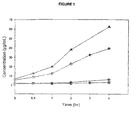
- Fig. 1 shows that only approximately 6% of a glutarate ester of florfenicol hydrolyzes back to florfenicol in bovine serum and only about 3% does so in rat serum after 4 hours of contact.
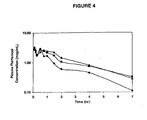
- the florfenicol phosphate ester of the present invention was found to not only have excellent solubility in water, i.e., over 600 mg/mL, but also to convert to florfenicol efficiently and in substantial amounts. This is also shown in Fig. 1 , where it can be seen that over four hours in rat serum and bovine serum, the sodium salt of florfenicol phosphate is converted to the extent of approximately 40% and 60%, respectively. These levels of conversion in vitro would be considered by those skilled in the art as good indicators of therapeutically-effective conversion in vivo. As predicted, substantial concentrations of florfenicol were detected in the plasma after the intravenous administration of a florfenicol phosphate ester of the present invention in cattle, dogs, and pigs (see Figures 2-4 ).
- florfenicol phosphate ester of the present invention e.g., florfenicol prodrug, and/or salts thereof (or phosphate esters of the florfenicol analogs and/or salts thereof), can be administered to a subject by any conventional means, including orally, or by injection.
- the florfenicol prodrug in an aqueous ready-to-use solution, when injections are to be administered.
- the molar ratio of the base e.g., a free amine
- the acid form of the florfenicol phosphate ester is maintained in the range of 0.6-1.4 in their aqueous solutions. It is more preferred to maintain this molar ratio in the 0.8 -1.2 range in the aqueous solution. It is even more preferred to maintain this molar ratio in the 0.9 - 1.1 range in the aqueous solution.
- the pH of the solution should be maintained at approximately pH 4.5.
- the acid compound 2 (9.97 g, 22.8 mmol) was added in small portions to an aqueous solution of aqueous sodium bicarbonate (3.82 g, 45.5 mmol in 45 mL water). The resulting solution was run through an HP-20 resin column with water as the eluent. Fractions containing product were pooled and lyophilized to give 8.81 g of compound 3 as a white solid.
- Florfenicol phosphate may be dissolved in a 0.1 M phosphate (KH 2 PO 4 ) buffered medium of rat or bovine serum at 37 °C. Then, 100 ⁇ L of the florfenicol phosphate-containing medium may be removed after at 0, 0.5, 1, 2, 3 and 4 hours, mixed with 100 ⁇ L acetonitrile (CH 3 CN) and analyzed by column chromatography (Zorbax C8 column 4.6 x 15 cm, eluent: 0.1 % H 3 PO 4 /CH 3 CN) to determine the percent conversion of the prodrug to florfenicol.
- KH 2 PO 4 0.1 M phosphate
- acetonitrile CH 3 CN
- Florfenicol glutarate may be dissolved in a 0.1 M phosphate (KH 2 PO 4 ) buffered medium of rat or bovine serum at 37 °C. Then, 100 ⁇ L of the florfenicol glutarate-containing medium may be removed after at 0, 0.5, 1, 2, 3 and 4 hours, mixed with 100 ⁇ L acetonitrile (CH 3 CN) and analyzed by column chromatography (Zorbax C8 column 4.6 x 15 cm, eluent: 0.1 % H 3 PO 4 /CH 3 CN) to determine the percent conversion of the prodrug to florfenicol.
- KH 2 PO 4 0.1 M phosphate
- Example 6 Measurement of aqueous solubility of the phosphate ester prodrug of florfenicol
- Example 7 Stability of the phosphate prodrug in aqueous solutions.
- the phosphate ester of florfenicol undergoes slow degradation resulting in the release of free florfenicol as well as the formation of cyclic phosphate diester.
- the formation of the cyclic diester occurs through the phosphate anion displacement of fluorine and requires participation of the phosphate di-anion, which is much more nucleophilic than the corresponding mono-anion. Therefore, the rate of formation of the cyclic diester is largely dependent on the pH of the solution or more generally, on the degree of the phosphate ionization.
- prodrug phosphate acid containing 300 mg/mL of active florfenicol was heated at 40°C for 30 days under nitrogen.
- Initial HPLC purity of the prodrug acid was 98.3% with no noticeable amounts of cyclic phosphate B and free florfenicol C.
- the florfenicol phosphate prodrug is less stable below pH 4 or at neutral or higher pH ranges.
- increased ionic strength reduces the aqueous stability of florfenicol phosphate prodrug in solution.
- Example 8 Conversion of florfenicol phosphate to florfenicol in cattle
- Florfenicol phosphate was dissolved in water to a concentration of approximately 600 mg/mL. The solution was then injected intravenously into three calves weighing 69 to 121 kg to provide a dose of approximately 10 mg/kg of calf body weight. Plasma samples were collected after drug administration and analyzed for concentrations of florfenicol by HPLC-MS/MS. Plasma florfenicol concentrations increased rapidly following treatment ( Figure 2 ). These data demonstrate that the prodrug is rapidly cleaved to florfenicol in cattle.
- Florfenicol phosphate was dissolved in water to a concentration of approximately 200 mg/mL. The solution was then injected intravenously into three dogs weighing 9 to 15 kg to provide a dose of approximately 11 mg/kg of body weight. Plasma samples were collected after drug administration and analyzed for concentrations of florfenicol by HPLC-MS/MS. Plasma florfenicol concentrations increased rapidly following treatment ( Figure 3 ). These data demonstrate that the prodrug is rapidly cleaved to florfenicol in dogs.
- Florfenicol phosphate was dissolved in water to a concentration of approximately 300 mg/mL. The solution was then injected intravenously into three pigs weighing 10 to 15 kg to provide a dose of approximately 6.7 mg/kg of body weight. Plasma samples were collected after drug administration and analyzed for concentrations of florfenicol. Plasma florfenicol concentrations increased rapidly following treatment ( Figure 4 ). These data demonstrate that the prodrug is rapidly cleaved to florfenicol in pigs.
Landscapes
- Chemical & Material Sciences (AREA)
- Health & Medical Sciences (AREA)
- Organic Chemistry (AREA)
- General Health & Medical Sciences (AREA)
- Life Sciences & Earth Sciences (AREA)
- Molecular Biology (AREA)
- Biochemistry (AREA)
- Veterinary Medicine (AREA)
- Medicinal Chemistry (AREA)
- Public Health (AREA)
- Pharmacology & Pharmacy (AREA)
- Animal Behavior & Ethology (AREA)
- General Chemical & Material Sciences (AREA)
- Nuclear Medicine, Radiotherapy & Molecular Imaging (AREA)
- Chemical Kinetics & Catalysis (AREA)
- Communicable Diseases (AREA)
- Oncology (AREA)
- Engineering & Computer Science (AREA)
- Bioinformatics & Cheminformatics (AREA)
- Epidemiology (AREA)
- Pharmaceuticals Containing Other Organic And Inorganic Compounds (AREA)
- Acyclic And Carbocyclic Compounds In Medicinal Compositions (AREA)
- Organic Low-Molecular-Weight Compounds And Preparation Thereof (AREA)
Applications Claiming Priority (2)
| Application Number | Priority Date | Filing Date | Title |
|---|---|---|---|
| US53222703P | 2003-12-23 | 2003-12-23 | |
| PCT/US2004/042591 WO2005063257A1 (en) | 2003-12-23 | 2004-12-20 | Florfenicol prodrug having improved water solubility |
Publications (2)
| Publication Number | Publication Date |
|---|---|
| EP1696934A1 EP1696934A1 (en) | 2006-09-06 |
| EP1696934B1 true EP1696934B1 (en) | 2013-05-29 |
Family
ID=34738768
Family Applications (1)
| Application Number | Title | Priority Date | Filing Date |
|---|---|---|---|
| EP04814736.7A Expired - Lifetime EP1696934B1 (en) | 2003-12-23 | 2004-12-20 | Florfenicol prodrug having improved water solubility |
Country Status (18)
| Country | Link |
|---|---|
| US (2) | US7153842B2 (enExample) |
| EP (1) | EP1696934B1 (enExample) |
| JP (2) | JP4719160B2 (enExample) |
| KR (1) | KR20060111605A (enExample) |
| CN (1) | CN100579532C (enExample) |
| AR (1) | AR046970A1 (enExample) |
| BR (1) | BRPI0418133A2 (enExample) |
| CA (1) | CA2550660C (enExample) |
| EC (1) | ECSP066670A (enExample) |
| IL (2) | IL176342A (enExample) |
| MX (1) | MXPA06007215A (enExample) |
| NO (1) | NO20063244L (enExample) |
| NZ (1) | NZ547592A (enExample) |
| PE (1) | PE20050822A1 (enExample) |
| RU (1) | RU2006126519A (enExample) |
| TW (1) | TWI262181B (enExample) |
| WO (1) | WO2005063257A1 (enExample) |
| ZA (1) | ZA200605165B (enExample) |
Families Citing this family (29)
| Publication number | Priority date | Publication date | Assignee | Title |
|---|---|---|---|---|
| PE20050386A1 (es) * | 2003-05-29 | 2005-06-23 | Schering Plough Ltd | Composiciones farmaceuticas de florfenicol |
| US7439268B2 (en) | 2003-07-18 | 2008-10-21 | Idexx Laboratories | Compositions containing prodrugs of florfenicol and methods of use |
| CA2550660C (en) * | 2003-12-23 | 2011-03-15 | Schering-Plough Ltd. | Florfenicol prodrug having improved water solubility |
| WO2005066119A2 (en) * | 2003-12-31 | 2005-07-21 | Schering-Plough Ltd. | Antibacterial 1-(4-mono-and di-halomethylsulphonylphenyl)-2-acylamino-3-fluoropropanols and preparation thereof |
| NZ553777A (en) | 2004-09-23 | 2010-11-26 | Schering Plough Ltd | Control of parasites in animals by the use of novel trifluoromethanesulfonanilide oxime ether derivatives |
| MX2007006072A (es) | 2004-11-19 | 2007-07-11 | Schering Plough Ltd | Control de parasitos en animales mediante el uso de derivados del parasiticida 2-fenil-3-(1h-pirrol-2-il)acrilonitrilo. |
| EP1890547A2 (en) * | 2005-06-09 | 2008-02-27 | Schering-Plough Ltd. | Control of parasites in animals by n-[(phenyloxy)phenyl]-1,1,1-trifluoromethanesulfonamide and n-[(phenylsulfanyl)phenyl]-1,1,1-trifluoromethanesulfonamide derivatives |
| US8119667B2 (en) * | 2005-12-29 | 2012-02-21 | Schering-Plough Animal Health Corporation | Carbonates of fenicol antibiotics |
| EP2091909A1 (en) * | 2006-12-13 | 2009-08-26 | Schering-Plough Ltd. | Water-soluble prodrugs of florfenicol and its analogs |
| CN101600422A (zh) * | 2006-12-13 | 2009-12-09 | 先灵-普劳有限公司 | 在亲脂性溶媒系统中的水溶性苯丙醇前药 |
| MX2009006467A (es) * | 2006-12-13 | 2009-08-21 | Schering Plough Ltd | Profarmacos solubles en agua de cloranfenicol, tiamfenicol y analogos de los mismos. |
| TWI430995B (zh) | 2007-06-26 | 2014-03-21 | Du Pont | 萘異唑啉無脊椎有害動物控制劑 |
| MX368680B (es) | 2007-06-27 | 2019-10-11 | Du Pont | Administración subcutánea de un derivado de isoxazol-benzamida para usarse en un método para proteger un mamífero de una pulga. |
| US20090170954A1 (en) * | 2007-12-14 | 2009-07-02 | Schering-Plough Ltd. | Process for Recovering Florfenicol and Florfenicol Analogs |
| CA2732017A1 (en) * | 2008-07-30 | 2010-02-04 | Intervet International B.V. | Process for preparing oxazoline-protected aminodiol compounds useful as intermediates to florfenicol |
| UA110924C2 (uk) | 2009-08-05 | 2016-03-10 | Е. І. Дю Пон Де Немур Енд Компані | Мезоіонні пестициди |
| EP2461684A2 (en) | 2009-08-05 | 2012-06-13 | E. I. du Pont de Nemours and Company | Mesoionic pesticides |
| BR112012002524A2 (pt) | 2009-08-05 | 2019-09-24 | Du Pont | "composto de fórmula, composição, composição para proteger um animal de uma praga parasítica de invertebrados, métodos para controlar uma praga invertebrada e semente tratada" |
| WO2012087630A1 (en) | 2010-12-20 | 2012-06-28 | E.I. Du Pont De Nemours And Company | Pyridine and pyrimidine compounds for controlling invertebrate |
| MX2013012820A (es) | 2011-05-02 | 2014-02-10 | Zoetis Llc | Cefalosporinas novedosas utiles como agentes antibacteriales. |
| JP2014520151A (ja) | 2011-06-20 | 2014-08-21 | イー・アイ・デュポン・ドウ・ヌムール・アンド・カンパニー | 蠕虫感染を処置するためのヘテロ環式化合物 |
| RU2014126367A (ru) | 2011-11-28 | 2016-01-27 | Е.И.Дюпон Де Немур Энд Компани | Производные n-(4-хинолинметил)сульфонамидов и их применение в качестве антигельминтных средств |
| WO2013158422A1 (en) | 2012-04-17 | 2013-10-24 | E. I. Du Pont De Nemours And Company | Heterocyclic compounds for controlling invertebrate pests |
| WO2014099837A1 (en) | 2012-12-18 | 2014-06-26 | E. I. Du Pont De Nemours And Company | Sulfonamide anthelmintics |
| CN103242363B (zh) * | 2013-04-18 | 2015-10-28 | 湖北龙翔药业有限公司 | 氟苯尼考磷酸二酯及盐及其制备方法 |
| CN103923118A (zh) * | 2014-04-08 | 2014-07-16 | 张家港威胜生物医药有限公司 | 一种水溶性氟苯尼考衍生物的合成方法 |
| CN105111234B (zh) * | 2015-09-23 | 2017-05-17 | 河北远征禾木药业有限公司 | 一种氟苯尼考磷酸酯的合成方法 |
| CN110078729A (zh) * | 2019-06-11 | 2019-08-02 | 石家庄学院 | 一种水溶性氟苯尼考前药及其制备方法 |
| CN115286544A (zh) * | 2022-10-08 | 2022-11-04 | 世华合创生物技术开发(山东)有限公司 | 一种氟苯尼考衍生物、制备方法及其在抗细菌感染的应用 |
Family Cites Families (11)
| Publication number | Priority date | Publication date | Assignee | Title |
|---|---|---|---|---|
| US2776992A (en) | 1956-03-14 | 1957-01-08 | Du Pont | Trifluoromethylsulfonylphenyldichloracetamidopropandiol |
| US4235892A (en) | 1979-02-05 | 1980-11-25 | Schering Corporation, Patent Dept. | 1-Aryl-2-acylamido-3-fluoro-1-propanols, methods for their use as antibacterial agents and compositions useful therefor |
| FR2562543B1 (fr) * | 1984-04-10 | 1987-09-25 | Elf Aquitaine | Nouveaux phosphonites cycliques, leur preparation et applications |
| US5352832A (en) | 1992-12-18 | 1994-10-04 | Schering Corporation | Asymmetric process for preparing florfenicol, thiamphenicol chloramphenicol and oxazoline intermediates |
| US6864240B1 (en) | 1999-06-15 | 2005-03-08 | Elan Pharmaceuticals, Inc. | Dipeptide inhibitors of β-secretase |
| US6670344B2 (en) | 2000-09-14 | 2003-12-30 | Bristol-Myers Squibb Company | Combretastatin A-4 phosphate prodrug mono- and di-organic amine salts, mono- and di- amino acid salts, and mono- and di-amino acid ester salts |
| WO2002102766A2 (en) | 2001-06-15 | 2002-12-27 | Arizona Board Of Regents | Combretastatin a-3 prodrug |
| JP2005538937A (ja) | 2002-03-08 | 2005-12-22 | シェーリング−プラウ, リミテッド | 新規なフロルフェニコール型抗生物質 |
| US7439268B2 (en) | 2003-07-18 | 2008-10-21 | Idexx Laboratories | Compositions containing prodrugs of florfenicol and methods of use |
| CA2550660C (en) | 2003-12-23 | 2011-03-15 | Schering-Plough Ltd. | Florfenicol prodrug having improved water solubility |
| WO2005066119A2 (en) | 2003-12-31 | 2005-07-21 | Schering-Plough Ltd. | Antibacterial 1-(4-mono-and di-halomethylsulphonylphenyl)-2-acylamino-3-fluoropropanols and preparation thereof |
-
2004
- 2004-12-20 CA CA2550660A patent/CA2550660C/en not_active Expired - Fee Related
- 2004-12-20 MX MXPA06007215A patent/MXPA06007215A/es active IP Right Grant
- 2004-12-20 US US11/016,794 patent/US7153842B2/en not_active Expired - Lifetime
- 2004-12-20 BR BRPI0418133-6A patent/BRPI0418133A2/pt not_active IP Right Cessation
- 2004-12-20 RU RU2006126519/04A patent/RU2006126519A/ru not_active Application Discontinuation
- 2004-12-20 JP JP2006547183A patent/JP4719160B2/ja not_active Expired - Fee Related
- 2004-12-20 KR KR1020067012460A patent/KR20060111605A/ko not_active Withdrawn
- 2004-12-20 WO PCT/US2004/042591 patent/WO2005063257A1/en not_active Ceased
- 2004-12-20 TW TW093139689A patent/TWI262181B/zh not_active IP Right Cessation
- 2004-12-20 EP EP04814736.7A patent/EP1696934B1/en not_active Expired - Lifetime
- 2004-12-20 CN CN200480038867A patent/CN100579532C/zh not_active Expired - Lifetime
- 2004-12-20 NZ NZ547592A patent/NZ547592A/xx not_active IP Right Cessation
- 2004-12-20 AR ARP040104805A patent/AR046970A1/es not_active Application Discontinuation
-
2005
- 2005-01-03 PE PE2005000020A patent/PE20050822A1/es not_active Application Discontinuation
-
2006
- 2006-06-15 IL IL176342A patent/IL176342A/en not_active IP Right Cessation
- 2006-06-22 ZA ZA200605165A patent/ZA200605165B/xx unknown
- 2006-06-22 EC EC2006006670A patent/ECSP066670A/es unknown
- 2006-07-12 NO NO20063244A patent/NO20063244L/no not_active Application Discontinuation
- 2006-08-29 US US11/511,810 patent/US7572777B2/en not_active Expired - Lifetime
-
2009
- 2009-07-23 IL IL200041A patent/IL200041A0/en unknown
-
2011
- 2011-02-23 JP JP2011037689A patent/JP2011148804A/ja not_active Withdrawn
Also Published As
| Publication number | Publication date |
|---|---|
| AU2004308913A1 (en) | 2005-07-14 |
| CA2550660C (en) | 2011-03-15 |
| US7153842B2 (en) | 2006-12-26 |
| MXPA06007215A (es) | 2006-08-18 |
| IL176342A (en) | 2011-08-31 |
| EP1696934A1 (en) | 2006-09-06 |
| IL176342A0 (en) | 2006-10-05 |
| US20050182031A1 (en) | 2005-08-18 |
| KR20060111605A (ko) | 2006-10-27 |
| CA2550660A1 (en) | 2005-07-14 |
| PE20050822A1 (es) | 2005-10-01 |
| BRPI0418133A2 (pt) | 2009-03-24 |
| ECSP066670A (es) | 2006-10-25 |
| TW200533640A (en) | 2005-10-16 |
| NZ547592A (en) | 2009-07-31 |
| RU2006126519A (ru) | 2008-01-27 |
| IL200041A0 (en) | 2010-04-15 |
| US7572777B2 (en) | 2009-08-11 |
| JP4719160B2 (ja) | 2011-07-06 |
| JP2011148804A (ja) | 2011-08-04 |
| NO20063244L (no) | 2006-09-20 |
| JP2007516286A (ja) | 2007-06-21 |
| US20070021387A1 (en) | 2007-01-25 |
| AR046970A1 (es) | 2006-01-04 |
| ZA200605165B (en) | 2007-12-27 |
| CN100579532C (zh) | 2010-01-13 |
| CN1897954A (zh) | 2007-01-17 |
| WO2005063257A1 (en) | 2005-07-14 |
| TWI262181B (en) | 2006-09-21 |
Similar Documents
| Publication | Publication Date | Title |
|---|---|---|
| EP1696934B1 (en) | Florfenicol prodrug having improved water solubility | |
| US7713950B2 (en) | Antibacterial 1-(4-mono-and di-halomethylsulphonylphenyl)-2-acylamino-3-fluoroproponals and preparation thereof | |
| CN1035945C (zh) | 5-烷基喹诺酮羧酸衍生物的制备方法 | |
| CA2232668C (en) | Novel derivatives of cyclodepsipeptide pf1022 substance | |
| EP1966129B1 (en) | Carbonates of fenicol antibiotics | |
| JP3920939B2 (ja) | 新規な結晶性セフェム酸付加塩およびその調製方法 | |
| CN101600686A (zh) | 氯霉素、甲砜霉素及其类似物的水溶性前药 | |
| CS212260B2 (cs) | Způsob výroby cefalosporinů | |
| AU2004308913B2 (en) | Florfenicol prodrug having improved water solubility | |
| WO2019245590A1 (en) | Chemical compounds | |
| PT87564B (pt) | Processo para a preparacao de vinilcefalosporinas substituidas uteis como medicamentos | |
| EP0209000B1 (de) | Embonate von Chinoloncarbonsäuren und ihren Derivaten | |
| HU196741B (en) | Process for producing fodder additive increasing the efficiency of animal husbandry, as well as aryl ethanole amines usable as active ingredient | |
| US4684649A (en) | Quinoxaline derivatives useful for treatment and prophylaxis of swine dysentery and as animal growth promotants | |
| WO2008076261A2 (en) | Water-soluble phenicol prodrugs in a lipophilic vehicle system | |
| JPS6348877B2 (enExample) | ||
| CS215073B2 (en) | Method of making the derivatives of the 5-phenylselenobenzimidazole | |
| HK1124309B (en) | Carbonates of fenicol antibiotics |
Legal Events
| Date | Code | Title | Description |
|---|---|---|---|
| PUAI | Public reference made under article 153(3) epc to a published international application that has entered the european phase |
Free format text: ORIGINAL CODE: 0009012 |
|
| 17P | Request for examination filed |
Effective date: 20060619 |
|
| AK | Designated contracting states |
Kind code of ref document: A1 Designated state(s): AT BE BG CH CY CZ DE DK EE ES FI FR GB GR HU IE IS IT LI LT LU MC NL PL PT RO SE SI SK TR |
|
| AX | Request for extension of the european patent |
Extension state: AL BA HR LV MK YU |
|
| RIN1 | Information on inventor provided before grant (corrected) |
Inventor name: HECKER, SCOTT, J. Inventor name: GLINKA,TOMASZ,W. Inventor name: PANSARE, SUNIL, V. |
|
| REG | Reference to a national code |
Ref country code: HK Ref legal event code: DE Ref document number: 1093010 Country of ref document: HK |
|
| RIN1 | Information on inventor provided before grant (corrected) |
Inventor name: HECKER, SCOTT, J. Inventor name: GLINKA,TOMASZ,W. Inventor name: PANSARE, SUNIL, V. |
|
| 17Q | First examination report despatched |
Effective date: 20070704 |
|
| GRAP | Despatch of communication of intention to grant a patent |
Free format text: ORIGINAL CODE: EPIDOSNIGR1 |
|
| GRAS | Grant fee paid |
Free format text: ORIGINAL CODE: EPIDOSNIGR3 |
|
| GRAA | (expected) grant |
Free format text: ORIGINAL CODE: 0009210 |
|
| AK | Designated contracting states |
Kind code of ref document: B1 Designated state(s): AT BE BG CH CY CZ DE DK EE ES FI FR GB GR HU IE IS IT LI LT LU MC NL PL PT RO SE SI SK TR |
|
| AX | Request for extension of the european patent |
Extension state: AL BA HR LV MK YU |
|
| REG | Reference to a national code |
Ref country code: GB Ref legal event code: FG4D |
|
| REG | Reference to a national code |
Ref country code: CH Ref legal event code: EP |
|
| REG | Reference to a national code |
Ref country code: AT Ref legal event code: REF Ref document number: 613924 Country of ref document: AT Kind code of ref document: T Effective date: 20130615 |
|
| REG | Reference to a national code |
Ref country code: IE Ref legal event code: FG4D |
|
| REG | Reference to a national code |
Ref country code: HK Ref legal event code: WD Ref document number: 1093010 Country of ref document: HK |
|
| REG | Reference to a national code |
Ref country code: DE Ref legal event code: R096 Ref document number: 602004042312 Country of ref document: DE Effective date: 20130725 |
|
| REG | Reference to a national code |
Ref country code: AT Ref legal event code: MK05 Ref document number: 613924 Country of ref document: AT Kind code of ref document: T Effective date: 20130529 |
|
| REG | Reference to a national code |
Ref country code: LT Ref legal event code: MG4D |
|
| PG25 | Lapsed in a contracting state [announced via postgrant information from national office to epo] |
Ref country code: ES Free format text: LAPSE BECAUSE OF FAILURE TO SUBMIT A TRANSLATION OF THE DESCRIPTION OR TO PAY THE FEE WITHIN THE PRESCRIBED TIME-LIMIT Effective date: 20130909 Ref country code: FI Free format text: LAPSE BECAUSE OF FAILURE TO SUBMIT A TRANSLATION OF THE DESCRIPTION OR TO PAY THE FEE WITHIN THE PRESCRIBED TIME-LIMIT Effective date: 20130529 Ref country code: SE Free format text: LAPSE BECAUSE OF FAILURE TO SUBMIT A TRANSLATION OF THE DESCRIPTION OR TO PAY THE FEE WITHIN THE PRESCRIBED TIME-LIMIT Effective date: 20130529 Ref country code: LT Free format text: LAPSE BECAUSE OF FAILURE TO SUBMIT A TRANSLATION OF THE DESCRIPTION OR TO PAY THE FEE WITHIN THE PRESCRIBED TIME-LIMIT Effective date: 20130529 Ref country code: SI Free format text: LAPSE BECAUSE OF FAILURE TO SUBMIT A TRANSLATION OF THE DESCRIPTION OR TO PAY THE FEE WITHIN THE PRESCRIBED TIME-LIMIT Effective date: 20130529 Ref country code: GR Free format text: LAPSE BECAUSE OF FAILURE TO SUBMIT A TRANSLATION OF THE DESCRIPTION OR TO PAY THE FEE WITHIN THE PRESCRIBED TIME-LIMIT Effective date: 20130830 Ref country code: PT Free format text: LAPSE BECAUSE OF FAILURE TO SUBMIT A TRANSLATION OF THE DESCRIPTION OR TO PAY THE FEE WITHIN THE PRESCRIBED TIME-LIMIT Effective date: 20130930 Ref country code: IS Free format text: LAPSE BECAUSE OF FAILURE TO SUBMIT A TRANSLATION OF THE DESCRIPTION OR TO PAY THE FEE WITHIN THE PRESCRIBED TIME-LIMIT Effective date: 20130929 Ref country code: AT Free format text: LAPSE BECAUSE OF FAILURE TO SUBMIT A TRANSLATION OF THE DESCRIPTION OR TO PAY THE FEE WITHIN THE PRESCRIBED TIME-LIMIT Effective date: 20130529 |
|
| REG | Reference to a national code |
Ref country code: NL Ref legal event code: VDEP Effective date: 20130529 |
|
| PG25 | Lapsed in a contracting state [announced via postgrant information from national office to epo] |
Ref country code: PL Free format text: LAPSE BECAUSE OF FAILURE TO SUBMIT A TRANSLATION OF THE DESCRIPTION OR TO PAY THE FEE WITHIN THE PRESCRIBED TIME-LIMIT Effective date: 20130529 Ref country code: BG Free format text: LAPSE BECAUSE OF FAILURE TO SUBMIT A TRANSLATION OF THE DESCRIPTION OR TO PAY THE FEE WITHIN THE PRESCRIBED TIME-LIMIT Effective date: 20130829 |
|
| PG25 | Lapsed in a contracting state [announced via postgrant information from national office to epo] |
Ref country code: CZ Free format text: LAPSE BECAUSE OF FAILURE TO SUBMIT A TRANSLATION OF THE DESCRIPTION OR TO PAY THE FEE WITHIN THE PRESCRIBED TIME-LIMIT Effective date: 20130529 Ref country code: SK Free format text: LAPSE BECAUSE OF FAILURE TO SUBMIT A TRANSLATION OF THE DESCRIPTION OR TO PAY THE FEE WITHIN THE PRESCRIBED TIME-LIMIT Effective date: 20130529 Ref country code: EE Free format text: LAPSE BECAUSE OF FAILURE TO SUBMIT A TRANSLATION OF THE DESCRIPTION OR TO PAY THE FEE WITHIN THE PRESCRIBED TIME-LIMIT Effective date: 20130529 Ref country code: DK Free format text: LAPSE BECAUSE OF FAILURE TO SUBMIT A TRANSLATION OF THE DESCRIPTION OR TO PAY THE FEE WITHIN THE PRESCRIBED TIME-LIMIT Effective date: 20130529 Ref country code: BE Free format text: LAPSE BECAUSE OF FAILURE TO SUBMIT A TRANSLATION OF THE DESCRIPTION OR TO PAY THE FEE WITHIN THE PRESCRIBED TIME-LIMIT Effective date: 20130529 |
|
| PG25 | Lapsed in a contracting state [announced via postgrant information from national office to epo] |
Ref country code: IT Free format text: LAPSE BECAUSE OF FAILURE TO SUBMIT A TRANSLATION OF THE DESCRIPTION OR TO PAY THE FEE WITHIN THE PRESCRIBED TIME-LIMIT Effective date: 20130529 Ref country code: RO Free format text: LAPSE BECAUSE OF FAILURE TO SUBMIT A TRANSLATION OF THE DESCRIPTION OR TO PAY THE FEE WITHIN THE PRESCRIBED TIME-LIMIT Effective date: 20130529 Ref country code: NL Free format text: LAPSE BECAUSE OF FAILURE TO SUBMIT A TRANSLATION OF THE DESCRIPTION OR TO PAY THE FEE WITHIN THE PRESCRIBED TIME-LIMIT Effective date: 20130529 |
|
| PLBE | No opposition filed within time limit |
Free format text: ORIGINAL CODE: 0009261 |
|
| STAA | Information on the status of an ep patent application or granted ep patent |
Free format text: STATUS: NO OPPOSITION FILED WITHIN TIME LIMIT |
|
| 26N | No opposition filed |
Effective date: 20140303 |
|
| REG | Reference to a national code |
Ref country code: DE Ref legal event code: R097 Ref document number: 602004042312 Country of ref document: DE Effective date: 20140303 |
|
| REG | Reference to a national code |
Ref country code: DE Ref legal event code: R119 Ref document number: 602004042312 Country of ref document: DE |
|
| REG | Reference to a national code |
Ref country code: CH Ref legal event code: PL |
|
| GBPC | Gb: european patent ceased through non-payment of renewal fee |
Effective date: 20131220 |
|
| PG25 | Lapsed in a contracting state [announced via postgrant information from national office to epo] |
Ref country code: MC Free format text: LAPSE BECAUSE OF FAILURE TO SUBMIT A TRANSLATION OF THE DESCRIPTION OR TO PAY THE FEE WITHIN THE PRESCRIBED TIME-LIMIT Effective date: 20130529 Ref country code: LU Free format text: LAPSE BECAUSE OF FAILURE TO SUBMIT A TRANSLATION OF THE DESCRIPTION OR TO PAY THE FEE WITHIN THE PRESCRIBED TIME-LIMIT Effective date: 20131220 |
|
| REG | Reference to a national code |
Ref country code: IE Ref legal event code: MM4A |
|
| REG | Reference to a national code |
Ref country code: DE Ref legal event code: R119 Ref document number: 602004042312 Country of ref document: DE Effective date: 20140701 |
|
| REG | Reference to a national code |
Ref country code: FR Ref legal event code: ST Effective date: 20140829 |
|
| PG25 | Lapsed in a contracting state [announced via postgrant information from national office to epo] |
Ref country code: IE Free format text: LAPSE BECAUSE OF NON-PAYMENT OF DUE FEES Effective date: 20131220 Ref country code: LI Free format text: LAPSE BECAUSE OF NON-PAYMENT OF DUE FEES Effective date: 20131231 Ref country code: CH Free format text: LAPSE BECAUSE OF NON-PAYMENT OF DUE FEES Effective date: 20131231 Ref country code: DE Free format text: LAPSE BECAUSE OF NON-PAYMENT OF DUE FEES Effective date: 20140701 |
|
| PG25 | Lapsed in a contracting state [announced via postgrant information from national office to epo] |
Ref country code: GB Free format text: LAPSE BECAUSE OF NON-PAYMENT OF DUE FEES Effective date: 20131220 Ref country code: FR Free format text: LAPSE BECAUSE OF NON-PAYMENT OF DUE FEES Effective date: 20131231 |
|
| PG25 | Lapsed in a contracting state [announced via postgrant information from national office to epo] |
Ref country code: TR Free format text: LAPSE BECAUSE OF FAILURE TO SUBMIT A TRANSLATION OF THE DESCRIPTION OR TO PAY THE FEE WITHIN THE PRESCRIBED TIME-LIMIT Effective date: 20130529 Ref country code: CY Free format text: LAPSE BECAUSE OF FAILURE TO SUBMIT A TRANSLATION OF THE DESCRIPTION OR TO PAY THE FEE WITHIN THE PRESCRIBED TIME-LIMIT Effective date: 20130529 |
|
| PG25 | Lapsed in a contracting state [announced via postgrant information from national office to epo] |
Ref country code: HU Free format text: LAPSE BECAUSE OF FAILURE TO SUBMIT A TRANSLATION OF THE DESCRIPTION OR TO PAY THE FEE WITHIN THE PRESCRIBED TIME-LIMIT; INVALID AB INITIO Effective date: 20041220 |