EP1661487B2 - Zahnbürste und Verfahren zur Herstellung einer solchen Zahnbürste - Google Patents
Zahnbürste und Verfahren zur Herstellung einer solchen Zahnbürste Download PDFInfo
- Publication number
- EP1661487B2 EP1661487B2 EP06002599.6A EP06002599A EP1661487B2 EP 1661487 B2 EP1661487 B2 EP 1661487B2 EP 06002599 A EP06002599 A EP 06002599A EP 1661487 B2 EP1661487 B2 EP 1661487B2
- Authority
- EP
- European Patent Office
- Prior art keywords
- carrier plate
- head part
- toothbrush
- flexible
- flexible structure
- Prior art date
- Legal status (The legal status is an assumption and is not a legal conclusion. Google has not performed a legal analysis and makes no representation as to the accuracy of the status listed.)
- Expired - Lifetime
Links
Images




Classifications
-
- A—HUMAN NECESSITIES
- A46—BRUSHWARE
- A46B—BRUSHES
- A46B9/00—Arrangements of the bristles in the brush body
- A46B9/06—Arrangement of mixed bristles or tufts of bristles, e.g. wire, fibre, rubber
-
- A—HUMAN NECESSITIES
- A46—BRUSHWARE
- A46B—BRUSHES
- A46B15/00—Other brushes; Brushes with additional arrangements
-
- A—HUMAN NECESSITIES
- A46—BRUSHWARE
- A46B—BRUSHES
- A46B15/00—Other brushes; Brushes with additional arrangements
- A46B15/0002—Arrangements for enhancing monitoring or controlling the brushing process
-
- A—HUMAN NECESSITIES
- A46—BRUSHWARE
- A46B—BRUSHES
- A46B15/00—Other brushes; Brushes with additional arrangements
- A46B15/0002—Arrangements for enhancing monitoring or controlling the brushing process
- A46B15/0016—Arrangements for enhancing monitoring or controlling the brushing process with enhancing means
- A46B15/0032—Arrangements for enhancing monitoring or controlling the brushing process with enhancing means with protrusion for polishing teeth
-
- A—HUMAN NECESSITIES
- A46—BRUSHWARE
- A46B—BRUSHES
- A46B3/00—Brushes characterised by the way in which the bristles are fixed or joined in or on the brush body or carrier
- A46B3/06—Brushes characterised by the way in which the bristles are fixed or joined in or on the brush body or carrier by welding together bristles made of metal wires or plastic materials
-
- A—HUMAN NECESSITIES
- A46—BRUSHWARE
- A46B—BRUSHES
- A46B7/00—Bristle carriers arranged in the brush body
- A46B7/04—Bristle carriers arranged in the brush body interchangeably removable bristle carriers
-
- A—HUMAN NECESSITIES
- A46—BRUSHWARE
- A46B—BRUSHES
- A46B7/00—Bristle carriers arranged in the brush body
- A46B7/06—Bristle carriers arranged in the brush body movably during use, i.e. the normal brushing action causing movement
- A46B7/10—Bristle carriers arranged in the brush body movably during use, i.e. the normal brushing action causing movement as a rotating cylinder
-
- A—HUMAN NECESSITIES
- A46—BRUSHWARE
- A46D—MANUFACTURE OF BRUSHES
- A46D1/00—Bristles; Selection of materials for bristles
-
- A—HUMAN NECESSITIES
- A46—BRUSHWARE
- A46D—MANUFACTURE OF BRUSHES
- A46D1/00—Bristles; Selection of materials for bristles
- A46D1/02—Bristles details
- A46D1/0207—Bristles characterised by the choice of material, e.g. metal
-
- A—HUMAN NECESSITIES
- A46—BRUSHWARE
- A46D—MANUFACTURE OF BRUSHES
- A46D1/00—Bristles; Selection of materials for bristles
- A46D1/02—Bristles details
- A46D1/0238—Bristles with non-round cross-section
-
- A—HUMAN NECESSITIES
- A46—BRUSHWARE
- A46D—MANUFACTURE OF BRUSHES
- A46D3/00—Preparing, i.e. Manufacturing brush bodies
- A46D3/005—Preparing, i.e. Manufacturing brush bodies by moulding or casting a body around bristles or tufts of bristles
-
- A—HUMAN NECESSITIES
- A61—MEDICAL OR VETERINARY SCIENCE; HYGIENE
- A61C—DENTISTRY; APPARATUS OR METHODS FOR ORAL OR DENTAL HYGIENE
- A61C17/00—Devices for cleaning, polishing, rinsing or drying teeth, teeth cavities or prostheses; Saliva removers; Dental appliances for receiving spittle
- A61C17/16—Power-driven cleaning or polishing devices
- A61C17/22—Power-driven cleaning or polishing devices with brushes, cushions, cups, or the like
- A61C17/32—Power-driven cleaning or polishing devices with brushes, cushions, cups, or the like reciprocating or oscillating
- A61C17/34—Power-driven cleaning or polishing devices with brushes, cushions, cups, or the like reciprocating or oscillating driven by electric motor
- A61C17/3409—Power-driven cleaning or polishing devices with brushes, cushions, cups, or the like reciprocating or oscillating driven by electric motor characterized by the movement of the brush body
- A61C17/3436—Rotation around the axis perpendicular to the plane defined by the bristle holder
-
- A—HUMAN NECESSITIES
- A61—MEDICAL OR VETERINARY SCIENCE; HYGIENE
- A61C—DENTISTRY; APPARATUS OR METHODS FOR ORAL OR DENTAL HYGIENE
- A61C17/00—Devices for cleaning, polishing, rinsing or drying teeth, teeth cavities or prostheses; Saliva removers; Dental appliances for receiving spittle
- A61C17/16—Power-driven cleaning or polishing devices
- A61C17/22—Power-driven cleaning or polishing devices with brushes, cushions, cups, or the like
- A61C17/32—Power-driven cleaning or polishing devices with brushes, cushions, cups, or the like reciprocating or oscillating
- A61C17/34—Power-driven cleaning or polishing devices with brushes, cushions, cups, or the like reciprocating or oscillating driven by electric motor
- A61C17/349—Power-driven cleaning or polishing devices with brushes, cushions, cups, or the like reciprocating or oscillating driven by electric motor with multiple brush bodies
-
- H—ELECTRICITY
- H04—ELECTRIC COMMUNICATION TECHNIQUE
- H04L—TRANSMISSION OF DIGITAL INFORMATION, e.g. TELEGRAPHIC COMMUNICATION
- H04L45/00—Routing or path finding of packets in data switching networks
-
- H—ELECTRICITY
- H04—ELECTRIC COMMUNICATION TECHNIQUE
- H04L—TRANSMISSION OF DIGITAL INFORMATION, e.g. TELEGRAPHIC COMMUNICATION
- H04L45/00—Routing or path finding of packets in data switching networks
- H04L45/22—Alternate routing
-
- H—ELECTRICITY
- H04—ELECTRIC COMMUNICATION TECHNIQUE
- H04L—TRANSMISSION OF DIGITAL INFORMATION, e.g. TELEGRAPHIC COMMUNICATION
- H04L45/00—Routing or path finding of packets in data switching networks
- H04L45/28—Routing or path finding of packets in data switching networks using route fault recovery
-
- H—ELECTRICITY
- H04—ELECTRIC COMMUNICATION TECHNIQUE
- H04L—TRANSMISSION OF DIGITAL INFORMATION, e.g. TELEGRAPHIC COMMUNICATION
- H04L45/00—Routing or path finding of packets in data switching networks
- H04L45/58—Association of routers
- H04L45/586—Association of routers of virtual routers
-
- H—ELECTRICITY
- H04—ELECTRIC COMMUNICATION TECHNIQUE
- H04L—TRANSMISSION OF DIGITAL INFORMATION, e.g. TELEGRAPHIC COMMUNICATION
- H04L63/00—Network architectures or network communication protocols for network security
- H04L63/02—Network architectures or network communication protocols for network security for separating internal from external traffic, e.g. firewalls
- H04L63/0209—Architectural arrangements, e.g. perimeter networks or demilitarized zones
-
- A—HUMAN NECESSITIES
- A46—BRUSHWARE
- A46B—BRUSHES
- A46B2200/00—Brushes characterized by their functions, uses or applications
- A46B2200/10—For human or animal care
- A46B2200/1026—Gum massaging brush, i.e. specifically designed for massaging the gums
-
- A—HUMAN NECESSITIES
- A46—BRUSHWARE
- A46B—BRUSHES
- A46B2200/00—Brushes characterized by their functions, uses or applications
- A46B2200/10—For human or animal care
- A46B2200/1066—Toothbrush for cleaning the teeth or dentures
-
- A—HUMAN NECESSITIES
- A46—BRUSHWARE
- A46B—BRUSHES
- A46B9/00—Arrangements of the bristles in the brush body
- A46B9/02—Position or arrangement of bristles in relation to surface of the brush body, e.g. inclined, in rows, in groups
- A46B9/04—Arranged like in or for toothbrushes
-
- B—PERFORMING OPERATIONS; TRANSPORTING
- B29—WORKING OF PLASTICS; WORKING OF SUBSTANCES IN A PLASTIC STATE IN GENERAL
- B29L—INDEXING SCHEME ASSOCIATED WITH SUBCLASS B29C, RELATING TO PARTICULAR ARTICLES
- B29L2031/00—Other particular articles
- B29L2031/42—Brushes
- B29L2031/425—Toothbrush
Definitions
- the invention relates to a toothbrush according to the preamble of claim 1 and a method for its production with the features of claim 20.
- Toothbrushes with a conventional bristle field consisting of bundles of bristle filaments, for example made of polyamide (PA) or polyester (PBT), and an additional flexible structure are, for example, from the WO 00/64307 and the WO 01/21036 famous.
- the conventional bristles are used for the usual cleaning of the teeth, while the flexible structure can fulfill different functions, e.g. the WO 00/64307 discloses a toothbrush with rod-shaped, flexible cleaning elements which have approximately the same length as conventional bristle bundles and are arranged peripherally on the head part of the toothbrush.
- the WO 01/21036 are elastic cleaning elements are flat, eg designed wavy, and arranged within the conventional bristle field.
- the object of the invention is to provide a toothbrush with conventional bristles and a soft, elastic structure that can be manufactured in a simple manner. Furthermore, a corresponding manufacturing process is to be specified.
- a toothbrush of the type mentioned at least one flexible structure, for example a cleaning element, is arranged on a carrier element which consists of a hard material.
- This carrier element is connected to the head part by ultrasonic welding.
- the carrier element and/or the flexible structure has recesses through which the bristle filaments are passed and are melted on for attachment to the carrier element with their rear ends facing the head part in the application.
- This AFT (Anchor Free Tufting) technology has the advantage that largely any bristle arrangement, in particular flat bristle structures, can be realized.
- the carrier element is connected to the head part in particular by means of ultrasonic welding, for example as in FIG DE 200 06 311 U described.
- Such a toothbrush has advantages in production, since the additional part, i.e. the carrier element provided with the flexible structure, can be manufactured separately and connected to the head part in a simple manner.
- connection of the carrier element to the head part is made by ultrasonic welding.
- the carrier element consists of the same material as the head part, since in this case only one hard component has to be kept ready for the production of the brush and one does not have to pay attention to mutual material compatibility. This has particular advantages in ultrasonic welding.
- the arrangement of the flexible structure on a carrier element made of a hard material has the following advantages:
- the additional part can be manufactured separately from the rest of the toothbrush body, consisting of handle and head part, and prepared for end use.
- the support element is connected to the head part, with the hard support element preferably being shaped to match it.
- the additional part is due to the hard carrier element simple way to handle and can be gripped much easier than an accessory made entirely of a soft elastic material.
- the additional part is small in relation to the rest of the toothbrush. Therefore, the required tools are small and inexpensive.
- the basic toothbrush body and the bristles can also be produced with a standard tool if later equipped with different additional parts. In order to produce toothbrushes with different additional parts, only the additional part or the corresponding tool has to be exchanged for it, which can be done in a simple and inexpensive manner.
- a further advantage of the separate production of the additional part and the base body is that any shape of flexible cleaning elements can be realized, e.g. also those that cross the conventional bristles, touch them or displace them when the additional part is inserted. Due to the separate production, demoulding of the flexible structure is unproblematic. In the injection molding process, geometries can be produced which would only be demouldable with great effort if the cleaning element were attached directly to the bristle-covered head part.
- the flexible structure was made of the same material as any flexible components on the handle part for manufacturing reasons.
- the invention results in greater freedom for the material of the structure, so that, for example, a different degree of hardness can be used.
- a non-detachable connection of the additional part to the head part prevents the additional part from becoming detached during use and eliminates the risk of choking.
- the conventional bristles are attached, for example, directly to the head part, to a bristle plate acting as a further carrier element, or also to the carrier element for the flexible cleaning elements, with all variants having advantages.
- the flexible structure and the conventional bristles can be prepared independently for later use before the head part and additional part are assembled, so that mutual damage or soiling is prevented.
- Attaching both conventional bristles and the flexible structure to the carrier element has the advantage that any spatial arrangement of the two components is possible.
- Such a prepared carrier element can be connected to different toothbrush base bodies for final production, so that a large number of different toothbrushes can be realized with a few base bodies.
- the conventional bristles can be prepared for use before or after the flexible structure is attached. If both components are provided on the carrier element, the flexible structure, including any cleaning elements, is preferably formed first and the carrier element then covered with bristles, which, for example can be passed through recesses in the soft or hard component.
- the additional part i.e. the carrier element with one or more flexible cleaning elements, is preferably produced using the two-component or multi-component injection molding process.
- a non-detachable connection is preferably established between the components.
- the flexible structure is preferably also arranged on the side of the carrier element, e.g. injection-moulded, whereby in the assembled state it terminates laterally with the outer contour of the head part or extends beyond it. It is used, for example, to seal unwelded areas, to massage the palate, e.g. using pointed, slightly protruding elastic elements, or as protection against impact when cleaning.
- the flexible cleaning element preferably consists of an elastomer, in particular a thermoplastic, for example natural or synthetic rubber.
- the material used for the toothbrush base body is preferably used for the carrier element, in particular polypropylene, styrene-acrylonitrile, polyester, acrylonitrile-butadiene-styrene (ABS) or Isoplast® .
- the Shore A hardness of the soft component is preferably less than 90 and is particularly preferably less than 50.
- the welding surface between the carrier element and the head part is preferably at least partially kept free from the soft elastic component.
- the injection point of the soft component is preferably selected on the bristle-bearing side of the carrier element, so that no material bridges from the soft component reduce the size of the welding surface.
- their position is preferably selected to the side of the longitudinal axis of the toothbrush.
- the soft-elastic structure can also be used for additional sealing of non-welded areas.
- the space between the carrier element and the head part is advantageously sealed against the ingress of water. This means that germs cannot collect in this area and the brush is more hygienic.
- the Shore A hardness of the soft component is preferably less than 50.
- toothbrushes shown have a body with a head part 1 and a handle part 2, which is only partially shown.
- the headboard 1 is further direct ( Figures 1 - 5 ) or indirectly ( 6 ) provided with bundles 3 of conventional bristle filaments. Material and arrangement of the bristle bundles 3 can be different. In the following, only the special features of the individual examples will be discussed. Corresponding elements are denoted by the same reference symbols.
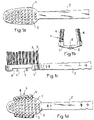
- FIG. 1a,c shows a toothbrush whose head part 1 has already been provided with bristle bundles 3 .
- the additional part 4 shown has a U-shaped support element 5 made of a hard material, in particular the same plastic that was used to produce the head part 1 or the entire base body.
- the carrier element 5 With the carrier element 5 are flexible cleaning elements 6, here in the form of straight rods, firmly connected.
- the cleaning elements 6 are inclined slightly towards one another from the vertical and enclose an angle of 5 to 30° with the vertical. In this way, the elastic cleaning elements 6 touch the conventional bristle bundles 3 ( Fig. 1d ) and can even cross them (not shown).
- Such a position can only be realized with conventional production methods using complex displacement techniques.
- the carrier element 5 is adapted in shape to an in 1c visible recess 9 in the area of the head part 1 facing away from the bristle bundles 3. In this area there are also pins 7 which can be inserted through a hole 8 in the carrier element 5 . The pins 7 are deformed cold or hot and are thus permanently fixed in the hole 8 .
- a top view of the finished toothbrush shows Fig. 1d .
- the lower part of the hole 8 or of the entire head part 1 can be covered by a protective layer 22 made of soft plastic for aesthetic or hygienic reasons (cf. Fig. 2d ).
- a protective layer 22 made of soft plastic for aesthetic or hygienic reasons (cf. Fig. 2d ).
- the boundary areas between the carrier element 5 and the head part 1 are preferably covered by soft plastic.
- the material used for this is, for example, the soft material that is also used for the grip area of the toothbrush.
- the protective layer is preferably already sprayed on during the production of the handle part using the multi-component injection molding process. However, the plastic layer can also be molded directly onto the carrier element.
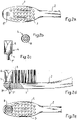
- FIG. 2a-e Another example of a toothbrush, the additional part 4 of which is connected to the head part 1 by a rivet connection, is shown in Fig. 2a-e shown.
- the additional part here consists of a plate-shaped carrier element 5, with which flat, flexible cleaning elements 6 are connected in the form of a rosette.
- the carrier element 5 has a pin 7', with which the additional part 4 can be inserted through a correspondingly prepared hole 8' in the front end of the head part and fixed by deforming the pin 7'.
- the flexible cleaning elements 6 are located in the area of the tip of the head part 1 .
- a protective layer 22 covers the area of the hole 8'.
- Fig. 3a-e shows an example of an embodiment of a toothbrush according to the invention, which results in a toothbrush according to 2 resembles.
- the additional part 4 with a plate-shaped carrier element 5 and rosette-like flexible cleaning elements 6 is connected to the head part 1 by means of a welded connection.
- the front area of the head part has a plate-like recess into which the carrier element 5 is permanently inserted by means of ultrasonic welding thanks to a correspondingly structured underside 5a.
- a side view of the finished toothbrush is shown 3d
- the top view of the combined bristle array of conventional bristle bundles 3 and flexible cleaning elements 6 shows Figure 3e .
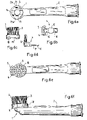
- the additional part 4 of the in Fig. 4a-e toothbrush shown is by means of a snap connection in the middle of the Headboard 1 attached.
- the additional part 4 comprises a rectangular carrier element 5, at the corners of which wing-like flexible cleaning elements 6 are arranged.
- the head part 1 has a central hole 8", which is used to push through a resiliently designed extension 11 on the carrier element 5.
- Additional part 4 and head part 1 are connected to one another by a snap connection, which due to the enlarged cross section at the lower end 11a of the extension 11 cannot be easily detached Figures 4a and 4e shown.
- the additional part 4 is manufactured separately and then inserted into the head part 1 with the prepared bristle area.
- structures of the soft-elastic cleaning elements 6 that reach through the conventional field of bristles can also be realized, such as the wing-like elements arranged in a corner Fig. 4b-e or the fanned out pin-shaped cleaning elements pointing in different spatial directions 8 .
- the underside of the head part 1 is covered by a layer 22 of flexible material.
- Fig. 5a-e show another example of a snap connection between the additional part 4 and the head part 1 of a toothbrush.
- the head part 1 has within the field of bristles from conventional bristle bundles 3 a prepared area 13 for receiving the Additional part 4.
- This area 13 consists of a depression, at whose edge a groove 12 runs perpendicular to the orientation of the handle 2, which gives the head part 1 and the grooves 12' running on its lateral edge a certain elasticity or spring effect.
- the prepared area 13 is slightly smaller than the base area of the support element 5 so that it can be inserted into the area 13 in a fitting and clamping manner.
- the additional part has both rod-shaped and flat cleaning elements arranged transversely to the orientation of the handle 2 .
- Fig. 6a-f shows another example of a toothbrush, here a toothbrush attachment for an electric tooth cleaning device.
- the conventional bundles of bristles 3 are fastened to a separate bristle plate 18 which, in the installed state, is connected to the head part 1 of the toothbrush adapted thereto or to a disk 23 which is rotatably or pivotably fastened thereto.
- the soft-elastic cleaning elements 6 rod-shaped here, are fastened to a carrier element 5 that is slightly curved when viewed from above and has a flat extension 16 that is oriented essentially perpendicular to the alignment of the cleaning elements 6 . With this extension 16, the additional part 4 can be inserted into a correspondingly shaped groove 14 in the disk 231.
- the attachment 4 and the head part 1 are connected to one another in a suitable manner and in a clamping manner.
- the Bristle plate 18 has a groove 19 at its lower end, with which the bristle plate 18 can be attached to the disc 23 or its lateral extensions 23 .
- the additional part 4 is moved by the disk 23 in the example shown.
- the additional part 4 can be attached directly to the head part 1 and does not rotate with it.
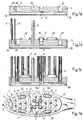
- Figure 7a-e show an example for the production of an embodiment of a toothbrush according to the invention using the AFT technology.
- the Figures 7a-c show sectional views of the carrier element 5 in various stages of the process, specifically before being fitted with flexible cleaning elements 6 and conventional bristle bundles 3 ( Figure 7a ), after applying the soft elastic material ( Figure 7b ) and after applying the bristles ( Figure 7c ).
- the outer shape of the carrier element 5 is adapted to the dimensions of a prepared area 13 in the form of a flat recess in the head part 1 of the toothbrush.
- the carrier element 5 has prepared areas 20 into which the flexible cleaning elements 6 are attached, in particular molded on.
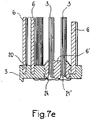
- the carrier element 5 has recesses 24 which are completely or partially filled with flexible material 6', see also the detailed drawing Figure 7e . Furthermore, there are holes 21 in the carrier element 5, through which the bundles of bristles 3 are inserted and fixed at the rear by melting their rear ends 3a.
- the elastic material areas 6' have further holes 21', which also serve to receive bristle bundles 3, which are fastened in the same way.
- the material areas 6 ' can be one or pick up several bundles of bristles 3.
- the bundles of bristles 3 anchored in the elastic material 6' are therefore anchored or suspended particularly elastically. Additional bundles of bristles 3 are attached directly to the carrier element 5 .
- the carrier element 5 fitted with bundles of bristles and the flexible structure 6, 6' is then inserted into the prepared area 13.
- the edge 30 of the carrier element 5 facing the bottom of the recess 13 in the application is pointed, as in the example 10 and 11 .
- This tapering edge 30 serves as an energy concentrator and material reservoir for material to be liquefied during ultrasonic welding for connection to the head part 1 .
- the AFT technology does not require anchors or clamps to attach the bristle filaments, which are instead welded directly to the carrier plate.
- the width of a bundle of bristles is therefore not determined by the anchor, so that finer structures, in particular flat bristle arrangements, can also be implemented.
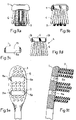
- Fig. 8a-e shows a variant of the toothbrush 4 .
- the bristle field of conventional bristle bundles 3 corresponds 4 .
- the additional part 4 has a plurality of star-shaped diverging pin-shaped cleaning elements 6, which reach through the conventional bristle bundles 3 ( Fig. 8d,e ).
- the fastening mechanism corresponds figure 4 .
- a layer 22 of flexible material covers the underside of the head and handle parts 1.2.
- Fig. 9a-f show a further embodiment for a toothbrush according to the invention.
- the head part 1 has a prepared area 13 for the carrier element 5 of the additional part 4, which is larger than the carrier element 5 itself.
- the area 13 is, for example, a hole that runs completely through the head part 1, see sectional drawings Fig. 9b,d,e .
- the area 13 has two lateral grooves 13a, the shape of which is adapted to the shape of two lateral extensions 5b of the carrier element 5. This is inserted into the head part 1 and locked there. Due to the play of the carrier element 5 within the area 13, which allows lateral displacement and/or a pivoting movement about the axis defined by the extensions 5b, there is a special elasticity or springy effect of the additional part 4.
- the rear side of the head part 1 can in turn be covered with a layer of soft material.
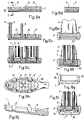
- Fig. 10a-j shows another example of an embodiment of a toothbrush according to the invention produced by means of AFT.
- the Figures 10a-c correspond to the Figures 7a-c 12 and 12 each show the carrier plate 5 in different stages of the process.
- Fig. 10d-f show the same carrier plate 5 in section along the in Figure 10a indicated line II.
- the centrally located flexible element 6 is flat or sail-like and in supervision ( Fig. 10h ) wavy.
- the flexible structure includes laterally formed areas 6", which in the assembled state ( Fig. 10h ) border the toothbrush head 1 laterally and end almost flush with the outer contour of the head part. They serve, for example, as impact protection and/or for additional massage of the palate.
- the areas 6" also have holes 21' for accommodating bundles of bristles 3, which are thus suspended elastically and are particularly flexible when cleaning.
- the carrier element 5 provided with conventional bristles 3 and the flexible structure 6 , 6 ′, 6 ′′ is inserted into a recess 13 in the brush head 1 .
- the brush head 1 is in Fig. 10g +j without carrier element 5 as well as in Fig. 10h +i shown with inserted carrier element 5 in different views.
- the brush head 1 or the recess 13 has lateral openings 25 which are adapted to the lateral flexible areas 6 ′′ previously molded onto the carrier element 5 .
- the carrier element 5 is connected to the brush head 1 by means of ultrasonic welding.
- the welding surface 26 is indicated by dashed lines.
- the carrier element has a welding edge 26 ′ on its lower edge which rests on the base of the recess 13 during assembly, the contact surface defining the welding surface 26 .
- the welding edge 26' melts under the influence of ultrasound, so that the two parts 5 and 1 are connected to one another.
- the welding surface 26 is kept as free as possible, as is the case with a toothbrush, for example 7 , or only minimally interrupted, as with the toothbrush 10 .
- the goal in both cases is the complete sealing of the cavity 28 between the carrier element 5 and the head part 1 in order to prevent the ingress of water and germs.
- the injection point of the flexible material is preferably selected on the front side of the carrier element 5 carrying the bristles, so that no unnecessary material bridges reduce the size of the welding surface 26 . If further soft elastic elements are present on the head part 1, in particular on its rear side, their position is selected in such a way that they do not reduce the size of the welding area 26.
- the corresponding injection point lie completely within the area defined by the welding surface 26 on the back of the head part 1 (not shown).
- at least 25% of the entire contact surface between the head part 1 and the carrier element 5 is welded, particularly preferably along the circumference of the head (line 26).
- the flexible areas 6" interrupt the welding surface 26, so that unwelded areas 27 arise there.
- These are advantageously arranged on the side of the head part 1, while the front and rear areas of the carrier element 5 in the longitudinal direction are firmly welded to the head part 1 a secure hold of the support element 5 is guaranteed because the cleaning movement and corresponding leverage forces the front and rear area exposed to the greatest stress.
- the unwelded points 27 are sealed by the flexible areas 6" in the manner of a sealing lip, so that little or no water can penetrate into the cavity 28.
- material with a Shore A hardness of 50 or less is preferably selected.
- Unwelded areas between the head part and the carrier element can also be used in a targeted manner in order to achieve a certain flexibility between the two hard components.
- FIG. 11 shows a further example of an embodiment of a toothbrush according to the invention, produced using the AFT process, with two sail-like, flexible cleaning elements 6 in different views.
- the carrier element 5 is completely surrounded on its periphery with flexible material 6 ', which in the assembled state (top view Figure 11a ) completely encloses the head part 1 on its outer circumference at the top and serves as impact protection.
- the soft material serves as a holder for lateral bundles of bristles 3, which are passed through the soft elastic material 6".
- How out 11c shows that the hard components of carrier element 5 and head part 1 touch along a surface 26 below the soft component in area 6' and can be welded here by means of ultrasound.
- the welding surface 26 is interrupted by the lateral areas 6", although, as described above, a sufficient holding effect is achieved.
- the cavity 28 below the support element 5 is through the flexible areas 6" and the welded points along the surface 26 are sealed.
Landscapes
- Engineering & Computer Science (AREA)
- Signal Processing (AREA)
- Computer Networks & Wireless Communication (AREA)
- Health & Medical Sciences (AREA)
- Animal Behavior & Ethology (AREA)
- General Health & Medical Sciences (AREA)
- Public Health (AREA)
- Veterinary Medicine (AREA)
- Life Sciences & Earth Sciences (AREA)
- Epidemiology (AREA)
- Dentistry (AREA)
- Computer Hardware Design (AREA)
- Computer Security & Cryptography (AREA)
- Computing Systems (AREA)
- General Engineering & Computer Science (AREA)
- Manufacturing & Machinery (AREA)
- Brushes (AREA)
Description
- Die Erfindung betrifft eine Zahnbürste gemäss dem Oberbegriff von Anspruch 1 und ein Verfahren zu deren Herstellung mit den Merkmalen von Anspruch 20.
- Zahnbürsten mit einem konventionellen Borstenfeld bestehend aus Bündeln von Borstenfilamenten, z.B. aus Polyamid (PA) oder Polyester (PBT), und einer zusätzlichen weichelastischen Struktur sind zum Beispiel aus der
WO 00/64307 WO 01/21036 WO 00/64307 WO 01/21036 WO 00/64307 - Der Erfindung liegt die Aufgabe zugrunde, eine Zahnbürste mit konventionellen Borsten und einer weichelastischen Struktur zur Verfügung zu stellen, die auf einfache Weise herstellbar ist. Des weiteren soll ein entsprechendes Herstellungsverfahren angegeben werden.
- Die Aufgabe wird gelöst durch eine Zahnbürste mit den Merkmalen von Anspruch 1 sowie durch ein Verfahren zur Herstellung einer solchen Zahnbürste mit den Merkmalen von Anspruch 20. Vorteilhafte Weiterbildungen ergeben sich aus den abhängigen Ansprüchen, der Beschreibung und den Zeichnungen.
- Erfindungsgemäss ist bei einer Zahnbürste der eingangs genannten Art wenigstens eine weichelastische Struktur, z.B ein Reinigungselement, an einem Trägerelement angeordnet, das aus einem Hartmaterial besteht. Dieses Trägerelement ist mit dem Kopfteil durch Ultraschallschweissen verbunden. Das Trägerelement und/oder die weichelastische Struktur weist Aussparungen auf, durch die die Borstenfilamente hindurchgeführt und zur Befestigung am Trägerelement mit ihren im Anwendungsfall dem Kopfteil zugewandten rückwärtigen Enden angeschmolzen sind. Diese AFT (Anchor Free Tufting) Technologie hat den Vorteil, dass sich weitgehend beliebige Borstenanordnungen, insbesondere auch flächige Borstengebilde, realisieren lassen. Das Trägerelement wird insbesondere mittels Ultraschallschweissen mit dem Kopfteil verbunden, z.B. wie in der
DE 200 06 311 U beschrieben. - Eine solche Zahnbürste hat Vorteile bei der Herstellung, da das Zusatzteil, d.h. das mit der weichelastischen Struktur versehene Trägerelement, separat hergestellt und auf einfache Weise mit dem Kopfteil verbunden werden kann.
- Die Verbindung des Trägerelements mit dem Kopfteil wird durch Ultraschallschweissen hergestellt. Herstellungstechnisch bevorzugt ist, dass das Trägerelement aus demselben Material wie das Kopfteil besteht, da in diesem Fall nur eine Hartkomponente zur Herstellung der Bürste bereitgehalten und nicht auf gegenseitige Materialverträglichkeit geachtet werden muss. Dies hat insbesondere beim Ultraschallschweissen Vorteile.
- Die Anordnung der weichelastischen Struktur an einem aus einem Hartmaterial bestehenden Trägerelement hat folgende Vorteile: Das Zusatzteil kann separat vom übrigen Zahnbürstenkörper, bestehend aus Handgriff und Kopfteil, gefertigt und für den Endgebrauch vorbereitet werden. In einem einfachen weiteren Schritt erfolgt die Verbindung des Trägerelements mit dem Kopfteil, wobei das harte Trägerelement vorzugsweise daran angepasst geformt ist. Das Zusatzteil ist aufgrund des harten Trägerelements auf einfache Weise zu handhaben und kann deutlich leichter gegriffen werden als ein vollständig aus einem weichelastischen Material hergestelltes Zusatzteil.
- Das Zusatzteil ist im Verhältnis zur übrigen Zahnbürste klein. Daher sind auch die benötigten Werkzeuge klein und kostengünstig. Der Zahnbürstengrundkörper und die Beborstung kann auch bei späterer Ausstattung mit unterschiedlichen Zusatzteilen mit einem Standardwerkzeug hergestellt werden. Um Zahnbürsten mit unterschiedlichen Zusatzteilen herzustellen, muss lediglich das Zusatzteil bzw. das entsprechende Werkzeug dafür ausgetauscht werden, was auf einfache und kostengünstige Weise geschehen kann.
- Ein weiterer Vorteil der separaten Herstellung von Zusatzteil und Grundkörper ist, dass beliebige Formen von weichelastischen Reinigungselementen realisiert werden können, z.B. auch solche, die die konventionellen Borsten kreuzen, berühren oder beim Einsetzen des Zusatzteils verdrängen. Durch die separate Herstellung ist die Entformung der weichelastischen Struktur unproblematisch. Es sind Geometrien im Spritzgiessverfahren herstellbar, die nur unter grossem Aufwand entformbar wären, wenn das Reinigungslement direkt auf dem beborsteten Kopfteil angebracht würde.
- Bisher wurde die weichelastische Struktur aus herstellungstechnischen Gründen aus demselben Material wie etwaige weichelastische Komponenten am Griffteil hergestellt. Durch die Erfindung ergibt sich für das Material der Struktur eine grössere Freiheit, so dass beispielsweise ein anderer Härtegrad verwendet werden kann.
- Durch eine unlösbare Verbindung des Zusatzteils mit dem Kopfteil wird verhindert, dass sich das Zusatzteil während des Gebrauchs ablöst, und die Verschluckungsgefahr ausgeschlossen.
- Die konventionellen Borsten sind beispielsweise direkt am Kopfteil, an einer als weiteres Trägerelement wirkenden Borstenplatte oder auch am Trägerelement für die weichelastischen Reinigungselemente befestigt, wobei alle Varianten Vorteile aufweisen. Bei der Befestigung der Borsten am Kopfteil bzw. an der Borstenplatte können die weichelastische Struktur und die konventionellen Borsten vor dem Zusammensetzen von Kopfteil und Zusatzteil unabhängig voneinander für den späteren Gebrauch vorbereitet werden, so dass ein gegenseitiges Beschädigen oder Verschmutzen verhindert wird.
- Das Anbringen von sowohl konventionellen Borsten als auch der weichelastischen Struktur am Trägerelement hat den Vorteil, dass eine beliebige räumliche Anordnung der beiden Komponenten möglich ist. Ein solches vorbereitetes Trägerelement kann zur Endfertigung mit verschiedenen Zahnbürstengrundkörpern verbunden werden, so dass mit wenigen Grundkörpern eine grosse Anzahl verschiedener Zahnbürsten realisierbar ist.
- Die konventionellen Borsten können in beiden Fällen vor oder nach dem Anbringen der weichelastischen Struktur für den Gebrauch vorbereitet werden. Sind beide Komponenten am Trägerelement vorgesehen, wird bevorzugt zuerst die weichelastische Struktur, einschliesslich etwaiger Reinigungselemente, angeformt und das Trägerelement anschliessend mit Borsten besetzt, welche beispielsweise durch Aussparungen in der weichen oder harten Komponente hindurchgeführt sein können.
- Die Herstellung des Zusatzteils, d.h. des Trägerelements mit einem oder mehreren weichelastischen Reinigungselementen, erfolgt bevorzugt im Zwei- oder Mehrkomponentenspritzgiessverfahren. Dabei wird vorzugsweise eine unlösbare Verbindung zwischen den Komponenten hergestellt.
- Die weichelastische Struktur ist bevorzugt auch seitlich am Trägerelement angeordnet, z.B. angespritzt, wobei sie im montierten Zustand seitlich mit der Aussenkontur des Kopfteils abschliesst oder über diese hinausgeht. Sie dient z.B. zum Abdichten ungeschweisster Stellen, zum Massieren des Gaumens, z.B. durch angespitzte leicht abstehende elastische Elemente, oder als Aufprallschutz beim Putzen.
- Vorzugsweise besteht das weichelastische Reinigungselement aus einem insbesondere thermoplastischen Elastomer, z.B. aus natürlichem oder synthetischem Gummi. Für das Trägerelement wird bevorzugt das für den Zahnbürstengrundkörper eingesetzte Material verwendet, insbesondere Polypropylen, Styrol-Acryl-Nitril, Polyester, Acryl-Nitril-Butadienstyrol (ABS) oder Isoplast®. Die Shore A Härte der weichen Komponente ist vorzugsweise geringer als 90 und liegt besonders bevorzugt unter 50.
- Da sich gummielastisches Material, insbesondere ein thermoplastisches Elastomer, aufgrund der starken Dämpfung der Ultraschallschwingungen nur bedingt Ultraschall verschweissen lässt, wird die Schweissfläche zwischen Trägerelement und Kopfteil bevorzugt zumindest teilweise von der weichelastischen Komponente freigehalten. Vorzugsweise wird dazu der Anspritzpunkt der Weichkomponente an der borstentragenden Seite des Trägerelements gewählt, damit keine Materialbrücken aus der Weichkomponente die Schweissfläche verkleinern. Für den Fall, dass dennoch im Bereich der Schweissfläche weichelastische Elemente angeordnet werden sollen, wird deren Lage vorzugsweise seitlich von der Längsachse der Zahnbürste gewählt. Damit entstehen unverschweisste Stellen ebenfalls seitlich am Trägerelement, während der in Längsrichtung vordere und hintere Bereich zwischen Trägerelement und Kopfteil verschweisst werden kann. Somit ist ein guter Halt des Trägerelements gewährleistet, da durch die Putzbewegung und die entsprechenden Hebelkräfte vor allem der vordere bzw. hintere Bereich und weniger die Seitenbereiche belastet werden. Eine nur punktuelle Verschweissung mit ungeschweissten Stellen kann auch gezielt eingesetzt werden, damit Bürstenkopf und Trägerelement gegeneinander beweglich sind und so eine gewisse Flexibilität des gesamten Bürstenkopfes erreicht wird.
- Die weichelastische Struktur kann nach Art einer Dichtlippe auch zum zusätzlichen Abdichten ungeschweisster Stellen dienen. Dadurch wird vorteilhaft der Raum zwischen dem Trägerelement und dem Kopfteil gegen das Eindringen von Wasser abgedichtet. Somit können sich in diesem Bereich keine Keime ansammeln, und die Bürste ist hygienischer. Um eine angemessene Dichtfunktion zu erreichen, ist die Shore A Härte der Weichkomponente vorzugsweise geringer als 50.
- Beispiele für Zahnbürsten sind in den Zeichnungen dargestellt und nachfolgend beschrieben. Es zeigen rein schematisch:
- Fig. 1a-d
- Ansichten einer Zahnbürste in verschiedenen Montagestadien, wobei das Zusatzteil durch Nieten am Kopfteil befestigt wird;
- Fig. 2a-e
- Ansichten einer weiteren Zahnbürste, deren Zusatzteil durch Nieten befestigt wird;
- Fig. 3a-e
- Ansichten einer Ausführungsform einer erfindungsgemässen Zahnbürste, deren Zusatzteil durch Schweissen befestigt wird;
- Fig. 4a-e
- Ansichten einer Zahnbürste, deren Zusatzteil mittels einer Schnappverbindung befestigt wird;
- Fig. 5a-e
- Ansichten einer weiteren Zahnbürste, deren Zusatzteil durch eine Schnappverbindung befestigt wird;
- Fig. 6a-f
- Ansichten einer Zahnbürste, bei der das Zusatzteil in klemmender Weise befestigt wird;
- Fig. 7a-e
- die Herstellung einer Ausführungsform einer erfindungsgemässen Zahnbürste im AFT Verfahren;
- Fig. 8a-e
- Ansichten einer weiteren Zahnbürste, deren Zusatzteil durch eine Schnappverbindung befestigt wird;
- Fig. 9a-f
- Ansichten einer weiteren Ausführungsform einer erfindungsgemässen Zahnbürste, deren Zusatzteil mit Spiel am Kopfteil befestigt ist;
- Fig. 10a-j
- die Herstellung einer weiteren Ausführungsform einer erfindungsgemässen Zahnbürste im AFT Verfahren;
- Fig. 11a-c
- Ansichten einer Ausführungsform einer erfindungsgemässen Zahnbürste mit einer seitlichen Umrandung aus weichelastischem Material.
- Alle dargestellten Zahnbürsten haben einen Grundkörper mit einem Kopfteil 1 und einem Griffteil 2, der nur teilweise dargestellt ist. Ein Zusatzteil 4 mit mehreren weichelastischen Reinigungselementen 6 unterschiedlicher Form, die mit einem Trägerelement ebenfalls unterschiedlicher Form verbunden sind, ist bei der fertigen Zahnbürste mit dem Kopfteil 1 verbunden. Das Kopfteil 1 ist des weiteren direkt (
Fig. 1 - 5 ) bzw. indirekt (Fig. 6 ) mit Bündeln 3 aus konventionellen Borstenfilamenten versehen. Material und Anordnung der Borstenbündel 3 kann unterschiedlich sein. Im Folgenden wird nur auf die Besonderheiten der einzelnen Beispiele eingegangen. Dabei sind einander entsprechende Elemente mit gleichen Bezugszeichen bezeichnet. -
Fig. 1a,c zeigt eine Zahnbürste, deren Kopfteil 1 bereits mit Borstenbündeln 3 versehen wurde. Das inFig. 1b dargestellte Zusatzteil 4 hat ein im Schnitt U-förmiges Trägerelement 5 aus einem Hartmaterial, insbesondere demselben Kunststoff, der zur Herstellung des Kopfteils 1 bzw. des gesamten Grundkörpers verwendet wurde. Mit dem Trägerelement 5 sind weichelastische Reinigungselemente 6, hier in Form von geraden Stäben, fest verbunden. Die Reinigungselemente 6 sind leicht aus der Vertikalen aufeinander zu geneigt und schliessen mit der Vertikalen einen Winkel von 5 bis 30° ein. Auf diese Weise berühren die elastischen Reinigungselemente 6 die konventionellen Borstenbündel 3 (Fig. 1d ) und können diese sogar kreuzen (nicht dargestellt). Eine derartige Stellung ist mit konventionellen Herstellungsverfahren nur mit aufwendigen Verdrängungstechniken realisierbar. - Das Trägerelement 5 ist in seiner Form an eine in
Fig. 1c sichtbare Aussparung 9 im den Borstenbündeln 3 abgewandten Bereich des Kopfteils 1 angepasst. In diesem Bereich befinden sich des weiteren Stifte 7, die durch ein Loch 8 im Trägerelement 5 hindurchgesteckt werden können. Die Stifte 7 werden kalt oder warm verformt und so im Loch 8 dauerhaft fixiert. Eine Aufsicht auf die fertiggestellte Zahnbürste zeigtFig. 1d . - Der untere Bereich des Lochs 8 oder des gesamten Kopfteils 1 kann aus ästhetischen oder hygienischen Gründen durch eine Schutzschicht 22 aus weichem Kunststoff abgedeckt werden (vgl.
Fig. 2d ). Ebenso werden die Grenzbereiche zwischen dem Trägerelement 5 und dem Kopfteil 1 vorzugsweise durch weichen Kunststoff abgedeckt. Als Material hierfür wird beispielsweise das Weichmaterial verwendet, das auch für den Griffbereich der Zahnbürste verwendet wird. Vorzugsweise wird die Schutzschicht bereits während der Herstellung des Griffteils im Mehrkomponentenspritzgiessverfahren angespritzt. Die Kunststoffschicht kann jedoch auch direkt an das Trägerelement angeformt sein. - Ein weiteres Beispiel für eine Zahnbürste, deren Zusatzteil 4 durch eine Nietverbindung mit dem Kopfteil 1 verbunden wird, ist in
Fig. 2a-e dargestellt. Das Zusatzteil besteht hier aus einem tellerförmigen Trägerelement 5, mit dem flächige weichelastische Reinigungselemente 6 rosettenförmig verbunden sind. Das Trägerelement 5 weist einen Stift 7' auf, mit dem das Zusatzteil 4 durch ein entsprechend vorbereitetes Loch 8' im vorderen Ende des Kopfteils durchgesteckt und durch Verformen des Stiftes 7' fixiert werden kann. Die weichelastischen Reinigungselemente 6 befinden sich im Bereich der Spitze des Kopfteils 1. In Richtung des Griffteils 2 schliesst sich das Borstenfeld mit einzelnen Borstenbündeln 3 an. Eine Schutzschicht 22 deckt den Bereich des Lochs 8' ab. -
Fig. 3a-e zeigt ein Beispiel für eine Ausführungsform einer erfindungsgemässen Zahnbürste, die im Ergebnis einer Zahnbürste gemässFig. 2 ähnelt. Das Zusatzteil 4 mit einem tellerförmigen Trägerelement 5 und rosettenartigen weichelastischen Reinigungselementen 6 wird vorliegend mittels einer Schweissverbindung mit dem Kopfteil 1 verbunden. Dazu weist der vordere Bereich des Kopfteils eine tellerartige Aussparung auf, in die das Trägerelement 5 dank einer entsprechend strukturierten Unterseite 5a mittels Ultraschallschweissen dauerhaft eingefügt wird. Eine Seitenansicht der fertigen Zahnbürste zeigtFig. 3d , die Aufsicht auf das kombinierte Borstenfeld aus konventionellen Borstenbündeln 3 und weichelastischen Reinigungselementen 6 zeigtFig. 3e . - Das Zusatzteil 4 der in
Fig. 4a-e dargestellten Zahnbürste ist mittels einer Schnappverbindung in der Mitte des Kopfteils 1 befestigt. Das Zusatzteil 4 umfasst ein rechteckiges Trägerelement 5, an dessen Ecken flügelartige weichelastische Reinigungselemente 6 angeordnet sind. Auf dem Trägerelement 5 befinden sich des weiteren zwei stabförmige Reinigungselemente 6 (Fig. 4b,c ). Wie inFig. 4a dargestellt, weist das Kopfteil 1 ein mittiges Loch 8" auf, das zum Durchstecken eines federnd gestalteten Fortsatzes 11 am Trägerelement 5 dient. Zusatzteil 4 und Kopfteil 1 werden durch eine Schnappverbindung miteinander verbunden, die aufgrund des am unteren Ende 11a des Fortsatzes 11 vergrösserten Querschnitts nicht ohne weiteres lösbar ist. Das Borstenfeld der konventionellen Borstenbündel 3 ist derart konfiguriert, dass die flügelartigen Reinigungselemente 6 zwischen den konventionellen Borstenbündeln 3 Platz finden, wie inFig. 4a und 4e dargestellt. Das Zusatzteil 4 wird separat gefertigt und anschliessend in das Kopfteil 1 mit dem vorbereiteten Borstenfeld eingesetzt. Dadurch können auch durch das konventionelle Borstenfeld durchgreifende Strukturen der weichelastischen Reinigungselemente 6 realisiert werden, wie die über Eck angeordneten flügelartigen Elemente ausFig. 4b-e oder die in verschiedene Raumrichtungen weisenden, aufgefächerten stiftförmigen Reinigungselemente ausFig. 8 . Die Unterseite des Kopfteils 1 ist aus hygienischen oder ästhetischen Gründen durch eine Schicht 22 aus weichelastischem Material abgedeckt. -
Fig. 5a-e zeigen ein weiteres Beispiel für eine Schnappverbindung zwischen dem Zusatzteil 4 und dem Kopfteil 1 einer Zahnbürste. Das Kopfteil 1 weist innerhalb des Borstenfelds aus konventionellen Borstenbündeln 3 einen vorbereiteten Bereich 13 für die Aufnahme des Zusatzteils 4. Dieser Bereich 13 besteht aus einer Vertiefung, an deren Rand senkrecht zur Ausrichtung des Handgriffs 2 jeweils eine Nut 12 verläuft, die dem Kopfteil 1 wie auch die an seinem seitlichen Rand verlaufenden Nuten 12' eine gewisse Elastizität bzw. federnde Wirkung gibt. Der vorbereitete Bereich 13 ist geringfügig kleiner als die Grundfläche des Trägerelements 5, so dass dieses passend und in klemmender Weise in den Bereich 13 eingesetzt werden kann. Wie aus der Aufsicht inFig. 5e erkennbar, hat das Zusatzteil sowohl stabförmige als auch flächige, quer zur Ausrichtung des Handgriffs 2 angeordnete Reinigungselemente. -
Fig. 6a-f zeigt ein weiteres Beispiel für eine Zahnbürste, hier eine Aufsteckzahnbürste für eine elektrisches Zahnreinigungsgerät. Die konventionellen Borstenbündel 3 sind an einer separaten Borstenplatte 18 befestigt, die im montierten Zustand mit dem daran angepassten Kopfteil 1 der Zahnbürste bzw. einer darauf dreh- oder schwenkbar befestigten Scheibe 23 verbunden ist. Die weichelastischen Reinigungselemente 6, hier stabförmig, sind an einem in der Aufsicht leicht gebogenen Trägerelement 5 befestigt, das einen flächigen Fortsatz 16 aufweist, der im wesentlichen senkrecht zur Ausrichtung der Reinigungselemente 6 orientiert ist. Mit diesem Fortsatz 16 lässt sich das Zusatzteil 4 in eine entsprechend geformte Nut 14 in der Scheibe 23 1 einführen. In der Mitte des Kopfteils 1 und der Nut 14 ist eine runde Aussparung 15 angeordnet, in die eine entsprechendes Gegenelement 17 am Fortsatz 16 des Zusatzteils 4 eingreift. Damit werden Zusatzteil 4 und Kopfteil 1 passend und in klemmender Weise miteinander verbunden. Die Borstenplatte 18 hat an ihrem unteren Ende eine Nut 19 mit der die Borstenplatte 18 an der Scheibe 23 bzw. deren seitlichen Fortsätzen 23 befestigt werden kann. Das Zusatzteil 4 wird im dargestellten Beispiel durch die Scheibe 23 mitbewegt. Als Alternative kann das Zusatzteil 4 direkt am Kopfteil 1 befestigt werden und rotiert nicht mit. -
Figur 7a-e zeigen ein Beispiel für die Herstellung einer Ausführungsform einer erfindungsgemässen Zahnbürste mittels der AFT Technologie. DieFiguren 7a-c zeigen Schnittansichten des Trägerelements 5 in verschiedenen Verfahrensstadien, und zwar vor dem Bestücken mit weichelastischen Reinigungselementen 6 und konventionellen Borstenbündeln 3 (Fig. 7a ), nach dem Aufbringen des weichelastischen Materials (Fig. 7b ) und nach dem Aufbringen der Borsten (Fig. 7c ). Das Trägerelement 5 ist in seiner äusseren Form an die Abmessungen eines vorbereiteten Bereichs 13 in Form einer flachen Aussparung im Kopfteil 1 der Zahnbürste angepasst. Das Trägerelement 5 weist vorbereitete Bereiche 20 auf, in die die weichelastischen Reinigungselemente 6 angebracht, insbesondere angespritzt, werden. Des weiteren hat das Trägerelement 5 Aussparungen 24, die ganz oder teilweise mit weichelastischem Material 6' gefüllt werden, vgl. auch die DetailzeichnungFig. 7e . Des weiteren sind Löcher 21 im Trägerelement 5 vorhanden, durch die Borstenbündel 3 durchgesteckt und an der Rückseite durch Anschmelzen ihrer rückwärtigen Enden 3a befestigt werden. Die elastischen Materialbereiche 6' haben weitere Löcher 21', die ebenfalls zur Aufnahme von Borstenbündeln 3 dienen, welche auf die gleiche Art befestigt werden. Die Materialbereiche 6' können ein oder mehrere Borstenbündel 3 aufnehmen. Die im elastischen Material 6' verankerten Borstenbündel 3 sind daher besonders elastisch verankert bzw. aufgehängt. Weitere Borstenbündel 3 werden direkt auf dem Trägerelement 5 befestigt. Das mit Borstenbündeln und der weichelastischen Struktur 6, 6' bestückte Trägerelement 5 wird anschliessend in den vorbereiteten Bereich 13 eingesetzt. - Die im Anwendungsfall dem Boden der Ausnehmung 13 zugewandte Kante 30 des Trägerelements 5 ist spitz gestaltet, ebenso im Beispiel aus
Fig. 10 und11 . Diese spitz zulaufende Kante 30 dient beim Ultraschallschweissen zum Verbinden mit dem Kopfteil 1 als Energiekonzentrator sowie Materialreservoir für zu verflüssigendes Material. - Die AFT Technologie kommt ohne Anker oder Klammern zum Befestigen der Borstenfilamente aus, die stattdessen direkt an der Trägerplatte angeschweisst werden. Damit wird die Breite eines Borstenbündels nicht durch den Anker bestimmt, so dass sich auch feinere Strukturen, insbesondere auch flächige Borstenanordnungen, realisieren lassen.
- Technisch ist es auch möglich, beim AFT-Verfahren die Borstenfilamente vor dem Anbringen an die Trägerplatte für den Gebrauch vorzubereiten. Realisiert wird derzeit jedoch die Variante, bei der die Borsten erst nach dem Anbringen an die Trägerplatte bearbeitet werden.
-
Fig. 8a-e zeigt eine Variante zur Zahnbürste ausFig. 4 . Das Borstenfeld aus konventionellen Borstenbündeln 3 entsprichtFig. 4 . Das Zusatzteil 4 hat eine Mehrzahl von sternförmig auseinandergehenden stiftförmigen Reinigungselementen 6, die durch die konventionellen Borstenbündel 3 durchgreifen (Fig. 8d, e ). Der Befestigungsmechanismus entsprichtFigur 4 . Eine Schicht 22 aus weichelastischem Material deckt die Unterseite des Kopf- und Griffteils 1,2 ab. -
Fig. 9a-f zeigen eine weitere Ausführungsform für eine erfindungsgemässe Zahnbürste. Das Kopfteil 1 weist einen vorbereiteten Bereich 13 für das Trägerelement 5 des Zusatzteils 4 auf, die grösser als das Trägerelement 5 selbst ist. Der Bereich 13 ist beispielsweise ein vollständig durch das Kopfteil 1 durchgehendes Loch, vgl. SchnittzeichnungenFig. 9b,d,e . Der Bereich 13 hat zwei seitliche Nuten 13a, deren Form an die Form zweier seitlicher Fortsätze 5b des Trägerelements 5 angepasst ist. Dieses wird in das Kopfteil 1 eingesetzt und verrastet dort. Aufgrund des Spiels des Trägerelements 5 innerhalb des Bereichs 13, das ein seitliches Verschieben und/oder eine Schwenkbewegung um die durch die Fortsätze 5b definierte Achse ermöglicht, ergibt sich eine besondere Elastizität bzw. federnde Wirkung des Zusatzteils 4. Die Rückseite des Kopfteils 1 kann wiederum mit einer Schicht aus Weichmaterial abgedeckt sein. -
Fig. 10a-j zeigt ein weiteres Beispiel für eine mittels AFT hergestellte Ausführungsform einer erfindungsgemässen Zahnbürste. DieFiguren 10a-c entsprechen denFiguren 7a-c und zeigen jeweils die Trägerplatte 5 in verschiedenen Verfahrensstadien.Fig. 10d-f zeigen die dieselbe Trägerplatte 5 im Schnitt entlang der inFig. 10a angedeuteten Linie I-I. Das mittig angeordnete weichelastische Element 6 ist flächig bzw. segelartig und in der Aufsicht (Fig. 10h ) wellenförmig. Wie inFig. 10e +f dargestellt, umfasst die weichelastische Struktur seitlich angeformte Bereiche 6", die im montierten Zustand (Fig. 10h ) den Zahnbürstenkopf 1 seitlich begrenzen und mit der Aussenkontur des Kopfteils nahezu bündig abschliessen. Sie dienen beispielsweise als Aufprallschutz und/oder zur zusätzlichen Massage des Gaumens. Die Bereiche 6" weisen ebenfalls Löcher 21' auf zur Aufnahme von Borstenbündeln 3, die dadurch elastisch aufgehängt und beim Putzen besonders nachgiebig sind. - Das mit konventionellen Borsten 3 und der weichelastischen Struktur 6, 6', 6'' versehene Trägerelement 5 wird in eine Ausnehmung 13 im Bürstenkopf 1 eingesetzt. Der Bürstenkopf 1 ist in
Fig. 10g +j ohne Trägerelement 5 sowie inFig. 10h +i mit eingesetztem Trägerelement 5 in verschiedenen Ansichten dargestellt. An seinem seitlichen Rand weist der Bürstenkopf 1 bzw. die Ausnehmung 13 seitliche Öffnungen 25 auf, die an die zuvor an das Trägerelement 5 angespritzten seitlichen weichelastischen Bereiche 6'' angepasst sind. - Das Trägerelement 5 wird mittels Ultraschallschweissen mit dem Bürstenkopf 1 verbunden. Die Schweissfläche 26 ist gestrichelt angedeutet. Um die Verschweissung zu realisieren, weist das Trägerelement an seinem unteren Rand einen Schweissrand 26' auf, der bei der Montage auf dem Grund der Aussparung 13 aufliegt, wobei die Berührungsfläche die Schweissfläche 26 definiert. Der Schweissrand 26' schmilzt unter Ultraschalleinfluss, so dass die beiden Teile 5 und 1 miteinander verbunden werden.
- Da sich gummielastisches Material nur bedingt Ultraschall schweissen lässt, wird die Schweissfläche 26 möglichst frei davon gehalten, wie z.B. bei der Zahnbürste aus
Fig. 7 , oder nur minimal unterbrochen, wie bei der Zahnbürste ausFig. 10 . Ziel ist in beiden Fällen die vollständige Abdichtung des Hohlraums 28 zwischen Trägerelement 5 und Kopfteil 1, um Eindringen von Wasser und Keimen zu verhindern. Bevorzugt wird dazu der Anspritzpunkt des weichelastischen Materials an der borstentragenden Vorderseite des Trägerelements 5 gewählt, damit keine unnötigen Materialbrücken die Schweissfläche 26 verkleinern. Falls weitere weichelastische Elemente am Kopfteil 1, insbesondere an dessen Rückseite, vorhanden sind, wird deren Lage so gewählt, dass sie die Schweissfläche 26 nicht verkleinern. Beispielsweise liegen sie und der entsprechende Anspritzpunkt vollständig innerhalb des durch die Schweissfläche 26 definierten Bereichs an der Rückseite des Kopfteils 1 (nicht dargestellt). Bevorzugt wird die gesamte Berührungsfläche zwischen Kopfteil 1 und Trägerelement 5 zu mindestens 25% verschweisst, besonders bevorzugt entlang des Kopfumfanges (Linie 26). - Im Beispiel aus
Fig. 10 unterbrechen die weichelastischen Bereiche 6" die Schweissfläche 26, so dass dort ungeschweissten Stellen 27 entstehen. Diese sind vorteilhaft an der Seite des Kopfteils 1 angeordnet, während die in Längsrichtung vorderen und hinteren Bereiche des Trägerelements 5 mit dem Kopfteil 1 fest verschweisst sind. Dadurch wird ein sicherer Halt des Trägerelements 5 gewährleistet, da durch die Putzbewegung und entsprechende Hebelkräfte der vordere und hintere Bereich der grössten Belastung ausgesetzt ist. - Die ungeschweissten Stellen 27 werden vorliegend durch die weichelastischen Bereiche 6" nach Art einer Dichtlippe abgedichtet, so dass kein oder nur wenig Wasser in den Hohlraum 28 eindringen kann. Für eine gute Dichtfunktion wird vorzugsweise Material mit einer Shore A Härte von 50 oder weniger gewählt. Ungeschweisste Stellen zwischen Kopfteil und Trägerelement können auch gezielt eingesetzt werden, um eine gewisse Flexibilität zwischen den beiden Hartkomponenten zu erreichen.
-
Fig. 11 zeigt ein weiteres Beispiel für eine im AFT-Verfahren hergestellte Ausführungsform einer erfindungsgemässen Zahnbürste mit zwei segelartigen weichelastischen Reinigungselementen 6 in verschiedenen Ansichten. Das Trägerelement 5 ist an seiner Peripherie vollständig mit weichelastischem Material 6' umgeben, das im montierten Zustand (AufsichtdarstellungFig 11a ) das Kopfteil 1 an seinem äusseren Umfang an der Oberseite vollständig umschliesst und als Aufprallschutz dient. In Bereichen 6" dient das Weichmaterial als Halterung für seitliche Borstenbündel 3, die durch das weichelastische Material 6" hindurchgeführt sind. - Wie aus
Fig. 11c hervorgeht, berühren sich die Hartkomponenten von Trägerelement 5 und Kopfteil 1 entlang einer Fläche 26 unterhalb der Weichkomponente im Bereich 6' und können hier mittels Ultraschall verschweisst werden. Die Schweissfläche 26 ist durch die seitlichen Bereiche 6" unterbrochen, wobei jedoch, wie oben beschrieben, eine ausreichende Haltewirkung erzielt wird. Der Hohlraum 28 unterhalb des Trägerelements 5 wird durch die weichelastischen Bereiche 6" und die entlang der Fläche 26 verschweissten Stellen abgedichtet. - Die oben mit Bezug auf
Fig. 10 und11 beschriebene Art der Verschweissung und Abdichtung der Komponenten kann mit Vorteil auch bei anderen Zahnbürsten eingesetzt werden.
Claims (30)
- Zahnbürste aufweisend einen Handgriff (2) und einen Kopfteil (1) mit einer aus einem Hartmaterial bestehenden Trägerplatte (5) und einer weichelastischen Struktur (6, 6', 6"), wobei die Trägerplatte (5) mit ihrer Rückseite dem Kopfteil (1) zugewandt in einen vorbereiteten Bereich (13) in Form einer flachen Aussparung im Kopfteil (1) eingesetzt ist, wobei die Trägerplatte (5) in ihrer äusseren Form an die Abmessungen des vorbereiteten Bereichs (13) angepasst ist und wobei die Trägerplatte (5) mit dem Kopfteil (1) durch Ultraschallschweissen unlösbar verbunden ist und wobei die Trägerplatte (5) Aussparungen (21) aufweist, durch welche Borstenfilamente (3) hindurchgeführt sind, dadurch gekennzeichnet, dass die mit der weichelastischen Struktur (6, 6', 6") versehene Trägerplatte (5) ein separates Zusatzteil (4) bildet, die weichelastische Struktur (6, 6', 6") wenigstens ein weichelastisches Reinigungselement umfasst und die durch Aussparungen (21, 21') der Trägerplatte (5) und/oder der weichelastischen Struktur (6") hindurchgeführten Borstenfilamente (3) zur Befestigung an der Trägerplatte (5) mit ihren im Anwendungsfall dem Kopfteil (1) zugewandten rückwärtigen Enden (3a) angeschmolzen sind.
- Zahnbürste nach Anspruch 1, dadurch gekennzeichnet, dass die weichelastische Struktur (6, 6', 6") und die Trägerplatte (5) durch ein Zwei- oder Mehrkomponentenspritzgiessverfahren hergestellt sind, wobei vorzugsweise eine unlösbare Verbindung zwischen der weichelastischen Struktur (6, 6', 6") und der Trägerplatte (5) besteht.
- Zahnbürste nach Anspruch 1 oder 2, dadurch gekennzeichnet, dass das Material der Trägerplatte (5) Polypropylen (PP), Styrol-Acryl-Nitril (SAN), Acryl-Nitril-Butadienstyrol (ABS), Isoplast® oder Polyester (PET) ist.
- Zahnbürste nach einem der vorangegangenen Ansprüche, dadurch gekennzeichnet, dass die weichelastische Struktur (6, 6', 6") aus natürlichem oder synthetischem Gummi, vorzugsweise aus einem thermoplastischen Elastomer, besteht, das bevorzugt eine Shore A Härte von weniger als 90, besonders bevorzugt von weniger als 50 hat.
- Zahnbürste nach einem der vorangegangenen Ansprüche, dadurch gekennzeichnet, dass Verbindungsstellen zwischen dem Kopfteil (1) und der Trägerplatte (5) durch weichelastisches Material (6") abgedeckt sind, vorzugsweise in gegen das Eindringen von Wasser abdichtender Weise.
- Zahnbürste nach einem der vorangegangenen Ansprüche, dadurch gekennzeichnet, dass die weichelastische Struktur (6, 6', 6") seitlich an der Trägerplatte (5) angeordnete Bereiche (6") umfasst, die im montierten Zustand seitlich mit der Aussenkontur des Kopfteils (1) abschliessen.
- Zahnbürste nach Anspruch 6, dadurch gekennzeichnet, dass die seitlich an der Trägerplatte (5) angeordneten Bereiche (6") unverschweisste Stellen (27) zwischen dem Kopfteil (1) und der Trägerplatte (5) gegen Eindringen von Wasser abdichten.
- Zahnbürste nach Anspruch 7, dadurch gekennzeichnet, dass die ungeschweissten Stellen (27) eine gewisse Flexibilität und Beweglichkeit zwischen dem Kopfteil (1) und der Trägerplatte (5) ermöglichen.
- Zahnbürste nach Anspruch 7 oder 8, dadurch gekennzeichnet, dass die ungeschweißten Stellen (27) an der Seite des Kopfteils (1) angeordnet sind und dass die in Längsrichtung vorderen und hinteren Bereiche der Trägerplatte (5) mit dem Kopfteil (1) fest verschweißt sind.
- Zahnbürste nach einem der Ansprüche 6 bis 9, dadurch gekennzeichnet, dass das Kopfteil (1) bzw. der vorbereitete Bereich (13) seitliche Öffnungen (25) aufweist, deren Form an die an der Trägerplatte (5) angeordneten seitlichen weichelastischen Bereiche (6") angepasst ist.
- Zahnbürste nach einem der vorangegangenen Ansprüche, dadurch gekennzeichnet, dass die Trägerplatte (5) an seiner Rückseite eine als Schweissrand (26') wirkende, im Anwendungsfall dem Kopfteil (1) zugewandte, als Materialreservoir und/oder Energiekonzentrator wirkende, vorzugsweise spitze Kante (30) aufweist, wobei die Berührungsfläche eine Schweissfläche (26) definiert.
- Zahnbürste nach Anspruch 11, dadurch gekennzeichnet, dass die Schweissfläche (26) vom weichelastischen Material freigehalten ist.
- Zahnbürste nach einem der Ansprüche 11 oder 12, dadurch gekennzeichnet, dass sich auf der Rückseite des Kopfteils (1) weitere weicheleastische Elemente befinden, die sich vollständig innerhalb eines durch die Schweissfläche (26) definierten Bereiches befinden.
- Zahnbürste nach einem der Ansprüche 11 bis 13, dadurch gekennzeichnet, dass die Schweissfläche (26) durch seitliche Bereiche aus Weichmaterial unterbrochen ist.
- Zahnbürste nach einem der vorangegangenen Ansprüche, dadurch gekennzeichnet, dass die weichelastische Struktur auf der Trägerplatte (5) angeordnete flächige Elemente (6) umfasst.
- Zahnbürste nach einem der vorangegangenen Ansprüche, dadurch gekennzeichnet, dass die Trägerplatte (5) zur Aufnahme der weichelastischen Struktur (6, 6', 6") vorbereitete Bereiche (20) und/oder Aussparungen (24) aufweist.
- Zahnbürste nach einem der vorangegangenen Ansprüche, dadurch gekennzeichnet, dass eine Mehrzahl von borstenaufnehmenden Aussparungen (21, 21') in einem gemeinsamen Bereich der weichelastischen Struktur (6, 6', 6") angeordnet ist.
- Zahnbürste nach einem der vorangegangenen Ansprüche, dadurch gekennzeichnet, dass die konventionellen Borstenfilamente (3) vor dem Befestigen der Trägerplatte (5) am Kopfteil (1) und/oder vor dem Befestigen auf der Trägerplatte (5) geschnitten und/oder abgerundet und/oder auf andere Weise für den späteren Gebrauch vorbereitbar sind.
- Zahnbürste nach einem der vorangegangenen Ansprüche, dadurch gekennzeichnet, dass sich zwischen de Trägerplatte (5) und dem Kopfteil (1) ein Hohlraum (28) befindet.
- Verfahren zur Herstellung einer Zahnbürste nach einem der vorangegangenen Ansprüche, wobei bei einer separaten Herstellung der mit der weichelastischen Struktur (6, 6', 6") versehenen Trägerplatte (5) wenigstens eine weichelastische Struktur (6, 6', 6") an der aus einem Hartmaterial bestehenden Trägerplatte (5) befestigt wird, wobei die Borstenfilamente (3) durch Aussparungen in der Trägerplatte (5) und/oder in der weichelastischen Struktur (6, 6', 6") hindurchgeführt werden und zur Befestigung an der Trägerplatte (5) bzw. an der weichelastischen Struktur (6, 6', 6") mit ihren im Anwendungsfall dem Kopfteil (1) zugewandten rückwärtigen Enden (3a) angeschmolzen werden, und wobei in einem weiteren Schritt die Trägerplatte (5) in einen vorbereiteten Bereich (13) in Form einer flachen Aussparung im Kopfteil (1) eingesetzt wird, wobei die Trägerplatte (5) in ihrer äusseren Form an die Abmessungen des vorbereiteten Bereichs (13) angepasst ist und wobei die Trägerplatte (5) mit dem Kopfteil (1) der Zahnbürste durch Ultraschallschweissen unlösbar verbunden wird.
- Verfahren nach Anspruch 20, dadurch gekennzeichnet, dass die Borstenfilamente (3) vor dem Befestigen der Trägerplatte (5) am Kopfteil (1) und/oder vor dem Befestigen auf der Trägerplatte (5) geschnitten und/oder abgerundet und/oder auf andere Weise gebrauchsfertig gemacht werden.
- Verfahren nach einem der Ansprüche 20 bis 21, dadurch gekennzeichnet, dass die weichelastische Struktur (6, 6', 6") und die Trägerplatte (5) im Zweikomponentenspritzgiessverfahren hergestellt und anschliessend mit dem Kopfteil (1) verbunden werden, wobei vorzugsweise eine unlösbare Verbindung zwischen der weichelastischen Struktur (6, 6', 6") und der Trägerplatte (5), bevor die Trägerplatte (5) mit Borstenfilamenten (3) besetzt wird, hergestellt wird.
- Verfahren nach Anspruch 22, dadurch gekennzeichnet, dass der Anspritzpunkt für das weichelastische Material an der borstentragenden Vorderseite der Trägerplatte (5) gewählt wird.
- Verfahren nach einem der Ansprüche 20 bis 23, dadurch gekennzeichnet, dass eine Berührungsfläche zwischen dem Kopfteil (1) und der Trägerplatte (5) zu wenigstens 25% verschweisst wird, bevorzugt entlang des gesamten Kopfumfanges.
- Verfahren nach einem der Ansprüche 20 bis 23, dadurch gekennzeichnet, dass ungeschweißte Stellen (27) an der Seite des Kopfteils (1) angeordnet werden und nur die in Längsrichtung vorderen und hinteren Bereiche der Trägerplatte mit dem Kopfteil (1) verschweisst werden.
- Verfahren nach einem der Ansprüche 20 bis 25, dadurch gekennzeichnet, dass ungeschweisste Stellen (27) zwischen dem Kopfteil (1) und der Trägerplatte (5) durch weichelastisches Material (6") abgedeckt werden, vorzugsweise in gegen das Eindringen von Wasser abdichtender Weise.
- Verfahren nach einem der Ansprüche 20 bis 25, dadurch gekennzeichnet, dass auf der Rückseite des Kopfteils (1) weitere weicheleastische Elemente ausgeformt werden, die sich vollständig innerhalb eines durch eine Schweissfläche (26) definierten Bereiches befinden.
- Verfahren nach einem der Ansprüche 20 bis 27, dadurch gekennzeichnet, dass die Schweissfläche (26) durch seitliche Bereiche aus Weichmaterial unterbrochen ist.
- Verfahren nach einem der Ansprüche 20 bis 28, dadurch gekennzeichnet, dass zwischen dem Kopfteil (1) und der Trägerplatte (5) ungeschweisste Stellen ausgebildet werden, die eine gewisse Flexibilität zwischen den beiden Hartkomponenten des Kopfteils (1) und der Trägerplatte (5) gewährleisten.
- Verfahren nach einem der Ansprüche 20 bis 29, dadurch gekennzeichnet, dass zwischen der Trägerplatte (5) und dem Kopfteil (1) ein Hohlraum (28) ausgebildet wird.
Priority Applications (5)
| Application Number | Priority Date | Filing Date | Title |
|---|---|---|---|
| EP10011706.8A EP2335520B1 (de) | 2001-12-28 | 2002-12-20 | Zahnbürste und Verfahren zur Herstellung einer solchen Zahnbürste |
| EP10011550A EP2335519B1 (de) | 2001-12-28 | 2002-12-20 | Zahnbürste und Verfahren zur Herstellung einer solchen Zahnbürste |
| EP09000395A EP2060201B1 (de) | 2001-12-28 | 2002-12-20 | Zahnbürste und Verfahren zur Herstellung einer solchen Zahnbürste |
| EP14003428.1A EP2842456B1 (de) | 2001-12-28 | 2002-12-20 | Trägerelement für eine Zahnbürste und Verfahren zur Herstellung eines solchen Trägerelements |
| EP10011399A EP2338377B1 (de) | 2001-12-28 | 2002-12-20 | Zahnbürste und Verfahren zur Herstellung einer solchen Zahnbürste |
Applications Claiming Priority (3)
| Application Number | Priority Date | Filing Date | Title |
|---|---|---|---|
| DE10164336A DE10164336A1 (de) | 2001-12-28 | 2001-12-28 | Zahnbürste und Verfahren zur Herstellung einer solchen Zahnbürste |
| PCT/CH2002/000717 WO2003055351A1 (de) | 2001-12-28 | 2002-12-20 | Zahnbürste und verfahren zur herstellung einer solchen zahnbürste |
| EP02782626A EP1458261B1 (de) | 2001-12-28 | 2002-12-20 | Zahnbürste und verfahren zur herstellung einer solchen zahnbürste |
Related Parent Applications (1)
| Application Number | Title | Priority Date | Filing Date |
|---|---|---|---|
| EP02782626A Division EP1458261B1 (de) | 2001-12-28 | 2002-12-20 | Zahnbürste und verfahren zur herstellung einer solchen zahnbürste |
Related Child Applications (10)
| Application Number | Title | Priority Date | Filing Date |
|---|---|---|---|
| EP10011399A Division EP2338377B1 (de) | 2001-12-28 | 2002-12-20 | Zahnbürste und Verfahren zur Herstellung einer solchen Zahnbürste |
| EP10011399A Division-Into EP2338377B1 (de) | 2001-12-28 | 2002-12-20 | Zahnbürste und Verfahren zur Herstellung einer solchen Zahnbürste |
| EP10011550A Division-Into EP2335519B1 (de) | 2001-12-28 | 2002-12-20 | Zahnbürste und Verfahren zur Herstellung einer solchen Zahnbürste |
| EP10011550A Division EP2335519B1 (de) | 2001-12-28 | 2002-12-20 | Zahnbürste und Verfahren zur Herstellung einer solchen Zahnbürste |
| EP14003428.1A Division EP2842456B1 (de) | 2001-12-28 | 2002-12-20 | Trägerelement für eine Zahnbürste und Verfahren zur Herstellung eines solchen Trägerelements |
| EP14003428.1A Division-Into EP2842456B1 (de) | 2001-12-28 | 2002-12-20 | Trägerelement für eine Zahnbürste und Verfahren zur Herstellung eines solchen Trägerelements |
| EP09000395A Division-Into EP2060201B1 (de) | 2001-12-28 | 2002-12-20 | Zahnbürste und Verfahren zur Herstellung einer solchen Zahnbürste |
| EP09000395A Division EP2060201B1 (de) | 2001-12-28 | 2002-12-20 | Zahnbürste und Verfahren zur Herstellung einer solchen Zahnbürste |
| EP10011706.8A Division EP2335520B1 (de) | 2001-12-28 | 2002-12-20 | Zahnbürste und Verfahren zur Herstellung einer solchen Zahnbürste |
| EP10011706.8A Division-Into EP2335520B1 (de) | 2001-12-28 | 2002-12-20 | Zahnbürste und Verfahren zur Herstellung einer solchen Zahnbürste |
Publications (3)
| Publication Number | Publication Date |
|---|---|
| EP1661487A1 EP1661487A1 (de) | 2006-05-31 |
| EP1661487B1 EP1661487B1 (de) | 2009-02-11 |
| EP1661487B2 true EP1661487B2 (de) | 2022-03-30 |
Family
ID=7711076
Family Applications (7)
| Application Number | Title | Priority Date | Filing Date |
|---|---|---|---|
| EP09000395A Expired - Lifetime EP2060201B1 (de) | 2001-12-28 | 2002-12-20 | Zahnbürste und Verfahren zur Herstellung einer solchen Zahnbürste |
| EP10011550A Expired - Lifetime EP2335519B1 (de) | 2001-12-28 | 2002-12-20 | Zahnbürste und Verfahren zur Herstellung einer solchen Zahnbürste |
| EP06002599.6A Expired - Lifetime EP1661487B2 (de) | 2001-12-28 | 2002-12-20 | Zahnbürste und Verfahren zur Herstellung einer solchen Zahnbürste |
| EP14003428.1A Expired - Lifetime EP2842456B1 (de) | 2001-12-28 | 2002-12-20 | Trägerelement für eine Zahnbürste und Verfahren zur Herstellung eines solchen Trägerelements |
| EP10011399A Expired - Lifetime EP2338377B1 (de) | 2001-12-28 | 2002-12-20 | Zahnbürste und Verfahren zur Herstellung einer solchen Zahnbürste |
| EP10011706.8A Expired - Lifetime EP2335520B1 (de) | 2001-12-28 | 2002-12-20 | Zahnbürste und Verfahren zur Herstellung einer solchen Zahnbürste |
| EP02782626A Expired - Lifetime EP1458261B1 (de) | 2001-12-28 | 2002-12-20 | Zahnbürste und verfahren zur herstellung einer solchen zahnbürste |
Family Applications Before (2)
| Application Number | Title | Priority Date | Filing Date |
|---|---|---|---|
| EP09000395A Expired - Lifetime EP2060201B1 (de) | 2001-12-28 | 2002-12-20 | Zahnbürste und Verfahren zur Herstellung einer solchen Zahnbürste |
| EP10011550A Expired - Lifetime EP2335519B1 (de) | 2001-12-28 | 2002-12-20 | Zahnbürste und Verfahren zur Herstellung einer solchen Zahnbürste |
Family Applications After (4)
| Application Number | Title | Priority Date | Filing Date |
|---|---|---|---|
| EP14003428.1A Expired - Lifetime EP2842456B1 (de) | 2001-12-28 | 2002-12-20 | Trägerelement für eine Zahnbürste und Verfahren zur Herstellung eines solchen Trägerelements |
| EP10011399A Expired - Lifetime EP2338377B1 (de) | 2001-12-28 | 2002-12-20 | Zahnbürste und Verfahren zur Herstellung einer solchen Zahnbürste |
| EP10011706.8A Expired - Lifetime EP2335520B1 (de) | 2001-12-28 | 2002-12-20 | Zahnbürste und Verfahren zur Herstellung einer solchen Zahnbürste |
| EP02782626A Expired - Lifetime EP1458261B1 (de) | 2001-12-28 | 2002-12-20 | Zahnbürste und verfahren zur herstellung einer solchen zahnbürste |
Country Status (18)
| Country | Link |
|---|---|
| US (10) | USRE47468E1 (de) |
| EP (7) | EP2060201B1 (de) |
| JP (1) | JP4335686B2 (de) |
| KR (3) | KR100971550B1 (de) |
| CN (4) | CN101081123B (de) |
| AT (2) | ATE422312T1 (de) |
| AU (2) | AU2007202870B2 (de) |
| BR (2) | BR0215354A (de) |
| CA (4) | CA2468340C (de) |
| CO (1) | CO5590870A2 (de) |
| DE (3) | DE10164336A1 (de) |
| ES (5) | ES2392328T3 (de) |
| MX (1) | MXPA04006236A (de) |
| NO (1) | NO331360B1 (de) |
| NZ (1) | NZ533711A (de) |
| RU (2) | RU2332146C2 (de) |
| WO (1) | WO2003055351A1 (de) |
| ZA (1) | ZA200403827B (de) |
Families Citing this family (166)
| Publication number | Priority date | Publication date | Assignee | Title |
|---|---|---|---|---|
| US6553604B1 (en) | 2000-03-16 | 2003-04-29 | Gillette Canada Company | Toothbrush |
| DE10164336A1 (de) | 2001-12-28 | 2003-07-17 | Trisa Holding Ag Triengen | Zahnbürste und Verfahren zur Herstellung einer solchen Zahnbürste |
| US20030196283A1 (en) * | 2002-04-23 | 2003-10-23 | Eyal Eliav | Powered toothbrush |
| US6931688B2 (en) * | 2002-08-09 | 2005-08-23 | Colgate-Palmolive Company | Toothbrush |
| US7757326B2 (en) * | 2003-10-30 | 2010-07-20 | Cologate-Palmolive Company | Toothbrush with enhanced cleaning effects |
| US8876221B2 (en) | 2002-08-09 | 2014-11-04 | Colgate-Palmolive Company | Oral care implement |
| US8151397B2 (en) | 2002-08-09 | 2012-04-10 | Colgate-Palmolive Company | Oral care implement having flexibly supported cleaning elements extending in opposite directions |
| US20060026784A1 (en) | 2002-08-09 | 2006-02-09 | Colgate-Palmolive Company | Oral care implement |
| US7841041B2 (en) | 2002-08-09 | 2010-11-30 | Colgate-Palmolive Company | Oral care implement |
| US8990996B2 (en) | 2002-08-09 | 2015-03-31 | Colgate-Palmolive Company | Toothbrush |
| US7614111B2 (en) | 2002-08-09 | 2009-11-10 | Colgate-Palmolive Company | Oral care implement |
| US8806695B2 (en) | 2002-08-09 | 2014-08-19 | Colgate-Palmolive Company | Oral care implement having flexibly supported cleaning elements extending in opposite directions |
| ES2390199T3 (es) † | 2002-09-20 | 2012-11-07 | Colgate-Palmolive Company | Cepillo de dientes con zona de agarre |
| US7137163B2 (en) * | 2002-09-27 | 2006-11-21 | Colgate-Palmolive Company | Power toothbrush and power source |
| DE10259723A1 (de) | 2002-12-19 | 2004-07-01 | Trisa Holding Ag | Zahnbürste und Verfahren zu deren Herstellung |
| USD612611S1 (en) | 2003-02-11 | 2010-03-30 | The Gillette Company | Head of a toothbrush |
| US7934284B2 (en) * | 2003-02-11 | 2011-05-03 | Braun Gmbh | Toothbrushes |
| US20040177462A1 (en) | 2003-03-14 | 2004-09-16 | The Gillette Company | Toothbrush head |
| US20060272112A9 (en) * | 2003-03-14 | 2006-12-07 | The Gillette Company | Toothbrush |
| US7941886B2 (en) | 2003-09-19 | 2011-05-17 | Braun Gmbh | Toothbrushes |
| DE10353541B4 (de) * | 2003-11-14 | 2017-11-30 | Zahoransky Ag | Verfahren und Vorrichtung zur Herstellung von Bürsten mit Borstenbündeln und Noppen |
| EP3117738A1 (de) | 2004-04-10 | 2017-01-18 | Trisa Holding AG | Zahnbürste und verfahren zur herstellung einer zahnbürste |
| DE102004026461A1 (de) * | 2004-05-29 | 2005-12-15 | Braun Gmbh | Bürstenkopf für elektrische und/oder manuelle Zahnbürsten |
| US20060034784A1 (en) * | 2004-08-12 | 2006-02-16 | The Procter & Gamble Company | Oral compositions and systems |
| KR100597687B1 (ko) * | 2004-09-21 | 2006-07-10 | 주식회사 엘지생활건강 | 칫솔 |
| US20060064833A1 (en) * | 2004-09-29 | 2006-03-30 | Scott Jacobs | Mouth brush |
| BRPI0517855A (pt) * | 2004-11-17 | 2008-10-21 | Colgate Palmolive Co | implemento para cuidado oral |
| EP1661485A3 (de) * | 2004-11-19 | 2012-07-11 | FIRMA G.B. BOUCHERIE, naamloze vennootschap | Zahnbürste |
| DE102005024082A1 (de) | 2005-05-25 | 2006-11-30 | M + C Schiffer Gmbh | Bürste und Verfahren zu deren Herstellung |
| DE102005027981A1 (de) * | 2005-06-16 | 2006-12-28 | Braun Gmbh | Zahnbrüstenkopf sowie Verfahren zu seiner Herstellung |
| PY0626124A (es) * | 2005-09-09 | 2011-04-01 | Colgate Palmolive Co | Cepillo dental |
| US8281448B2 (en) | 2005-10-24 | 2012-10-09 | Colgate-Palmolive Company | Oral care implement having one or more moving sections |
| CA2629040C (en) | 2005-11-14 | 2013-01-08 | Bruce M. Russell | Light-emitting oral care implement |
| US8056176B2 (en) * | 2007-01-25 | 2011-11-15 | The Procter & Gamble Company | Toothbrushes |
| DE102007018766A1 (de) | 2007-04-20 | 2008-10-23 | Braun Gmbh | Zahnbürste |
| USD565843S1 (en) * | 2007-09-04 | 2008-04-08 | Melrose International Limited | Head of a toothbrush |
| USD579666S1 (en) * | 2007-10-16 | 2008-11-04 | Plasticos Y Tecnologia, S.A. De C.V. | Toothbrush |
| USD579207S1 (en) * | 2007-10-16 | 2008-10-28 | Plasticos Y Tecnologia, S.A. De C.V. | Toothbrush |
| DE102008019111A1 (de) * | 2008-04-16 | 2009-10-22 | Firma G.B. Boucherie N.V. | Pinsel |
| USD645252S1 (en) | 2008-08-15 | 2011-09-20 | Mcneil-Ppc, Inc. | Toothbrush |
| US8776302B2 (en) | 2008-08-29 | 2014-07-15 | Colgate-Palmolive Company | Oral care implement |
| USD655916S1 (en) | 2008-08-29 | 2012-03-20 | Colgate-Palmolive Company | Toothbrush |
| USD642803S1 (en) | 2008-08-29 | 2011-08-09 | Colgate-Palmolive Company | Toothbrush |
| USD632084S1 (en) | 2008-08-29 | 2011-02-08 | Colgate-Palmolive Company | Toothbrush |
| USD642802S1 (en) | 2008-08-29 | 2011-08-09 | Colgate-Palmolive Company | Toothbrush |
| US8434190B2 (en) * | 2008-09-01 | 2013-05-07 | Braun Gmbh | Toothbrush and method of manufacturing it |
| USD658885S1 (en) | 2008-09-30 | 2012-05-08 | Mcneil-Ppc, Inc. | Toothbrush handle |
| CN101444363A (zh) * | 2008-12-09 | 2009-06-03 | 于海宽 | 一种刷头及其制造装置 |
| USD651407S1 (en) | 2009-01-23 | 2012-01-03 | Colgate-Palmolive Company | Toothbrush |
| TWI398228B (zh) * | 2009-01-23 | 2013-06-11 | Tsung Hung Lee | Multi-piece bristles combined replacement toothbrush |
| EP2229841B1 (de) * | 2009-03-18 | 2015-03-11 | Braun GmbH | Zahnbürste |
| USD658884S1 (en) | 2009-05-27 | 2012-05-08 | Mcneil-Ppc, Inc. | Toothbrush |
| US20110030160A1 (en) * | 2009-08-06 | 2011-02-10 | Mcneil-Ppc, Inc. | Bristle configuration |
| US20110047736A1 (en) * | 2009-08-26 | 2011-03-03 | Colgate Palmolive | Oral Care Implement Having Diverging Cleaning Elements |
| US20110219558A1 (en) | 2009-12-10 | 2011-09-15 | The Procter & Gamble Company | Toothbrush |
| DE102009057483A1 (de) | 2009-12-10 | 2011-06-16 | Braun Gmbh | Zahnbürste |
| USD631257S1 (en) | 2009-12-15 | 2011-01-25 | Colgate-Palmolive Company | Toothbrush |
| USD655918S1 (en) | 2009-12-15 | 2012-03-20 | Colgate-Palmolive Company | Toothbrush |
| DK2335644T3 (da) * | 2009-12-15 | 2014-01-06 | Braun Gmbh | Oral rensedel |
| USD671325S1 (en) | 2009-12-15 | 2012-11-27 | Colgate-Palmolive Company | Toothbrush |
| USD655917S1 (en) | 2009-12-15 | 2012-03-20 | Colgate-Palmolive Company | Toothbrush |
| USD642804S1 (en) | 2009-12-15 | 2011-08-09 | Colgate-Palmolive Company | Toothbrush |
| USD632484S1 (en) | 2009-12-18 | 2011-02-15 | Eduardo Jimenez | Toothbrush handle with tissue cleaner |
| USD654270S1 (en) | 2009-12-18 | 2012-02-21 | Colgate-Palmolive Company | Toothbrush handle |
| USD675830S1 (en) | 2009-12-18 | 2013-02-12 | Colgate-Palmolive Company | Toothbrush |
| USD654695S1 (en) | 2009-12-18 | 2012-02-28 | Colgate-Palmolive Company | Toothbrush |
| USD654696S1 (en) | 2009-12-18 | 2012-02-28 | Colgate-Palmolive Company | Toothbrush handle with tissue cleaner |
| EP2347673B1 (de) | 2010-01-26 | 2015-08-05 | Trisa Holding AG | Verfahren zum Herstellen einer Zahnbürste und Zahnbürste |
| EP2528470B1 (de) | 2010-01-29 | 2017-08-02 | Colgate-Palmolive Company | Mundpflegevorrichtung |
| USD657569S1 (en) | 2010-02-26 | 2012-04-17 | Colgate-Palmolive Company | Head portion of an oral care implement |
| USD657568S1 (en) | 2010-02-26 | 2012-04-17 | Colgate-Palmolive Company | Oral care implement |
| FR2957243B1 (fr) * | 2010-03-12 | 2012-04-13 | Conception Des Applic Des Tech Electroniques Soc Pour | Instrument vibratoire a outil interchangeable |
| USD671746S1 (en) * | 2010-05-05 | 2012-12-04 | Colgate-Palmolive Company | Head portion of a toothbrush |
| US20110289709A1 (en) * | 2010-06-01 | 2011-12-01 | Vesta Marie Attaway | U-shape disposable toothbrush head |
| US8572794B2 (en) | 2010-08-27 | 2013-11-05 | Dilcia Yamileth Pate | Oral-care brushing implement |
| CA2810609A1 (en) * | 2010-09-30 | 2012-04-05 | Colgate-Palmolive Company | Oral care implement having a flexible elastomeric tooth scrubbing element |
| CH704700A1 (de) | 2011-03-18 | 2012-09-28 | Curaden Internat Ag | Bürstenkopf. |
| US8943634B2 (en) | 2011-05-02 | 2015-02-03 | Water Pik, Inc. | Mechanically-driven, sonic toothbrush system |
| US20120304407A1 (en) * | 2011-06-02 | 2012-12-06 | Hoipo Yu | Brush Head and Producing Device Thereof |
| CN103607927B (zh) * | 2011-06-15 | 2015-12-23 | 吉列公司 | 头部设有两个柔性翼部的口腔护理器械 |
| BR112014001099A2 (pt) | 2011-07-23 | 2017-02-14 | Braun Gmbh | implemento de limpeza bucal tendo um grampo de plástico compreendendo uma cavidade |
| KR101388967B1 (ko) * | 2011-09-23 | 2014-05-14 | 이팔형 | 칫솔 |
| DE202011106118U1 (de) * | 2011-09-26 | 2011-11-25 | Gb Boucherie Nv | Bürste, insbesondere Zahnbürste, mit weichelastischem Element |
| KR20140107423A (ko) | 2011-12-21 | 2014-09-04 | 콜게이트-파아므올리브캄파니 | 조직 클리너 및 구강관리기구 |
| MX2014015837A (es) * | 2012-06-20 | 2015-03-19 | Colgate Palmolive Co | Implemento para el cuidado oral y metodo de formacion del mismo. |
| USD724324S1 (en) * | 2012-06-20 | 2015-03-17 | Braun Gmbh | Toothbrush head with tongue cleaner |
| JP2015532850A (ja) * | 2012-09-21 | 2015-11-16 | ネオビ シーオー., エルティーディーNeob Co., Ltd | 歯ブラシ |
| KR102521242B1 (ko) | 2013-03-15 | 2023-04-17 | 워터 피크 인코포레이티드 | 기계 구동식 음파 칫솔 및 워터 플로서 |
| US9468511B2 (en) | 2013-03-15 | 2016-10-18 | Water Pik, Inc. | Electronic toothbrush with vibration dampening |
| FR3003735B1 (fr) * | 2013-03-27 | 2015-05-01 | Oreal | Applicateur de produit cosmetique avec organe de massage |
| USD749855S1 (en) | 2013-11-05 | 2016-02-23 | Colgate-Palmolive Company | Oral care implement |
| USD751295S1 (en) | 2013-11-05 | 2016-03-15 | Colgate-Palmolive Company | Oral care implement |
| USD764804S1 (en) | 2013-11-05 | 2016-08-30 | Colgate-Palmolive Company | Oral care implement |
| MX372877B (es) | 2013-11-05 | 2020-07-08 | Colgate Palmolive Co | Implemento para el cuidado bucal. |
| MX373913B (es) | 2013-11-05 | 2020-07-09 | Colgate Palmolive Co | Implemento para el cuidado bucal. |
| AU2013404990B2 (en) | 2013-11-05 | 2016-11-17 | Colgate-Palmolive Company | Oral care implement |
| USD764805S1 (en) | 2013-12-16 | 2016-08-30 | Colgate-Palmolive Company | Toothbrush |
| USD765986S1 (en) | 2013-12-16 | 2016-09-13 | Colgate-Palmolive Company | Toothbrush |
| USD765983S1 (en) | 2013-12-16 | 2016-09-13 | Colgate-Palmolive Company | Toothbrush |
| USD753922S1 (en) | 2013-12-16 | 2016-04-19 | Colgate-Palmolive Company | Toothbrush |
| USD760499S1 (en) | 2013-12-16 | 2016-07-05 | Colgate-Palmolive Company | Toothbrush |
| USD765984S1 (en) | 2013-12-16 | 2016-09-13 | Colgate-Palmolive Company | Toothbrush |
| USD765985S1 (en) | 2013-12-16 | 2016-09-13 | Colgate-Palmolive Company | Toothbrush |
| USD764175S1 (en) | 2013-12-16 | 2016-08-23 | Colgate-Palmolive Company | Toothbrush |
| USD769626S1 (en) | 2013-12-19 | 2016-10-25 | Colgate-Palmolive Company | Refill head for electric toothbrush |
| USD766581S1 (en) | 2013-12-19 | 2016-09-20 | Colgate-Palmolive Company | Electric toothbrush handle |
| USD776435S1 (en) | 2013-12-19 | 2017-01-17 | Colgate-Palmolive Company | Head portion of a toothbrush |
| EP3122206B1 (de) * | 2014-03-25 | 2020-05-27 | Koninklijke Philips N.V. | Bürstenkopfanordnung und verfahren zur herstellung |
| USD781056S1 (en) * | 2014-10-31 | 2017-03-14 | Paul A. Scheier | Toothbrush |
| US10869541B2 (en) * | 2014-11-11 | 2020-12-22 | ZeroBrush, Inc. | Systems, devices, and methods for customized dental care |
| US12336874B2 (en) * | 2014-11-11 | 2025-06-24 | ZeroBrush, Inc. | Methods of designing and fabricating customized dental care for particular users |
| US12053339B2 (en) * | 2014-11-11 | 2024-08-06 | ZeroBrush Inc. | Methods of designing and fabricating customized dental care for particular users |
| US10888201B2 (en) | 2014-11-11 | 2021-01-12 | ZeroBrush, Inc. | Systems, devices, and methods for providing customized oral care agents |
| US12337544B2 (en) | 2014-11-11 | 2025-06-24 | ZeroBrush, Inc. | Methods of designing and fabricating customized dental care for particular users |
| US11058523B2 (en) * | 2014-11-11 | 2021-07-13 | ZeroBrush, Inc. | Methods of designing and fabricating customized dental care for particular users |
| WO2016105369A1 (en) | 2014-12-23 | 2016-06-30 | Colgate-Palmolive Company | Oral care implement |
| CA2967289C (en) | 2014-12-23 | 2022-04-12 | Colgate-Palmolive Company | Oral care implement |
| EP3223652B1 (de) | 2014-12-23 | 2021-07-21 | Colgate-Palmolive Company | Mundpflegevorrichtung mit mehrkomponentigem griff |
| CA2970674C (en) | 2014-12-23 | 2022-05-10 | Colgate-Palmolive Company | Oral care implement having multi-component handle |
| EP3223657B1 (de) | 2014-12-23 | 2022-12-07 | Colgate-Palmolive Company | Mundpflegevorrichtung |
| EP3622853B1 (de) | 2014-12-23 | 2021-08-04 | Colgate-Palmolive Company | Mundpflegevorrichtung |
| BR112017012630A2 (pt) | 2014-12-23 | 2018-04-24 | Colgate-Palmolive Company | instrumento para higiene bucal tendo cabo com múltiplos componentes |
| AU2014414810B2 (en) | 2014-12-23 | 2018-04-05 | Colgate-Palmolive Company | Oral care implement |
| USD780457S1 (en) | 2014-12-23 | 2017-03-07 | Colgate-Palmolive Company | Oral care implement |
| US11291293B2 (en) | 2014-12-23 | 2022-04-05 | Colgate-Palmolive Company | Oral care implement |
| MX383438B (es) | 2014-12-23 | 2025-03-14 | Colgate Palmolive Co | Implemento para el cuidado bucal. |
| CA2970708C (en) | 2014-12-23 | 2022-05-24 | Colgate-Palmolive Company | Oral care implement |
| USD770184S1 (en) * | 2015-04-23 | 2016-11-01 | Curaden Ag | Toothbrush |
| JP6802809B2 (ja) * | 2015-05-14 | 2020-12-23 | コーニンクレッカ フィリップス エヌ ヴェKoninklijke Philips N.V. | ブラシヘッド構成 |
| CN205568226U (zh) | 2015-07-08 | 2016-09-14 | 洁碧有限公司 | 刷牙装置 |
| USD794333S1 (en) | 2015-11-25 | 2017-08-15 | Colgate-Palmolive Company | Electric toothbrush brush head |
| USD790860S1 (en) | 2015-11-25 | 2017-07-04 | Colgate-Palmolive Company | Electric toothbrush brush head |
| US10136723B2 (en) * | 2015-12-14 | 2018-11-27 | Colgate-Palmolive Company | Oral care implement |
| WO2017182355A1 (de) | 2016-04-20 | 2017-10-26 | Trisa Holding Ag | Bürstenprodukt und verfahren zur herstellung |
| US10561480B2 (en) | 2016-05-09 | 2020-02-18 | Water Pik, Inc. | Load sensing for oral devices |
| EP3262974B1 (de) | 2016-06-27 | 2024-06-12 | The Procter & Gamble Company | Verfahren zur herstellung von zahnbürstenköpfen mit einem zweikomponentenreinigungselement |
| EP3262975B1 (de) | 2016-06-28 | 2019-02-20 | The Procter and Gamble Company | Verfahren zur herstellung einer bürste |
| DE102016011477B4 (de) * | 2016-09-22 | 2022-03-31 | M + C Schiffer Gmbh | Bürstenkopf für eine elektrisch angetriebene Zahnbürste und Verfahren zu deren Herstellung |
| USD846285S1 (en) * | 2016-11-21 | 2019-04-23 | Colgate-Palmolive Company | Oral care implement |
| USD844997S1 (en) | 2016-12-15 | 2019-04-09 | Water Pik, Inc. | Toothbrush handle |
| USD845636S1 (en) | 2016-12-15 | 2019-04-16 | Water Pik, Inc. | Toothbrush handle |
| AU2017378474B2 (en) | 2016-12-15 | 2022-06-02 | Water Pik, Inc. | Brushing device with illumination features |
| CA182563S (en) | 2017-03-22 | 2018-08-23 | Gillette Co Llc | Toothbrush |
| CN107836814B (zh) * | 2017-12-04 | 2024-05-14 | 倍加洁集团股份有限公司 | 一种密集植毛护理型牙刷 |
| US10709533B2 (en) | 2017-12-12 | 2020-07-14 | Colgate-Palmolive Company | Oral care implement and handle and refill head thereof |
| US10631964B2 (en) | 2017-12-12 | 2020-04-28 | Colgate-Palmolive Company | Oral care implement |
| USD846883S1 (en) | 2017-12-12 | 2019-04-30 | Colgate-Palmolive Company | Handle of an oral care implement |
| USD882269S1 (en) * | 2018-03-19 | 2020-04-28 | Roman Senko | Toothbrush |
| CN108552727A (zh) * | 2018-04-04 | 2018-09-21 | 常州市峰创羽技机电有限公司 | 自清洁牙刷 |
| USD869852S1 (en) * | 2018-06-04 | 2019-12-17 | Mihran Papazian | Toothbrush head |
| US12114768B2 (en) | 2018-10-22 | 2024-10-15 | Zahoransky Ag | Apparatus and method for forming bristle bundles, brush manufacturing machine, use of an apparatus for forming bristle bundles, brush, computer program and computer-readable medium |
| USD903215S1 (en) * | 2018-11-20 | 2020-11-24 | Rubbermaid Commercial Products Llc | Broom |
| USD891784S1 (en) | 2018-12-18 | 2020-08-04 | Colgate-Palmolive Company | Electric toothbrush handle |
| US10646028B1 (en) | 2019-03-12 | 2020-05-12 | Nathan Quang Huynh | Brush assemblies |
| EP3753449A1 (de) | 2019-06-21 | 2020-12-23 | The Procter & Gamble Company | Lochperforationsplatte zur herstellung eines zahnbürstenkopfes und teil davon |
| EP3753448B1 (de) | 2019-06-21 | 2025-12-10 | The Procter & Gamble Company | Verfahren zur herstellung eines zahnbürstenkopfs |
| EP3753446B1 (de) | 2019-06-21 | 2025-10-22 | The Procter & Gamble Company | Reinigungselementträger und zahnbürstenkopf damit |
| EP3753447B1 (de) | 2019-06-21 | 2025-12-10 | The Procter & Gamble Company | Verfahren zur herstellung eines zahnbürstenkopfes oder eines teils davon |
| CN110353401A (zh) * | 2019-08-05 | 2019-10-22 | 慈溪赛嘉电子有限公司 | 刷头及刷头制作方法 |
| WO2021039688A1 (ja) * | 2019-08-26 | 2021-03-04 | 萩原 豊 | 髪染め補助具、髪染め用手袋 |
| USD891116S1 (en) * | 2019-11-07 | 2020-07-28 | Yue Feng | Toothbrush head |
| USD960582S1 (en) | 2020-12-10 | 2022-08-16 | Colgate-Palmolive Company | Oral care refill head |
| ES3014734T3 (en) | 2021-09-27 | 2025-04-24 | Braun Gmbh | Head for a personal care device and method of making thereof |
| USD981722S1 (en) * | 2022-11-21 | 2023-03-28 | Guangdong Yingxin Technology Co., Ltd. | Toothbrush head |
| USD1079278S1 (en) | 2023-08-21 | 2025-06-17 | Colgate-Palmolive Company | Oral care implement |
| USD1138205S1 (en) | 2024-09-06 | 2026-08-04 | Colgate-Palmolive Company | Personal care implement |
Citations (11)
| Publication number | Priority date | Publication date | Assignee | Title |
|---|---|---|---|---|
| US2042239A (en) † | 1934-01-18 | 1936-05-26 | Andrew J Planding | Tooth brush |
| EP0405204B1 (de) † | 1989-06-24 | 1994-09-07 | Frisetta GmbH | Verfahren und Vorrichtung zum Herstellen von Borstenfeldern oder Borstenbündeln |
| WO1996015696A1 (en) † | 1994-11-19 | 1996-05-30 | Smithkline Beecham Plc | Bristle arrangement for a toothbrush |
| WO1996020654A1 (en) † | 1994-12-30 | 1996-07-11 | Shipp Anthony D | Prophy toothbrush |
| EP0783850A2 (de) † | 1996-01-11 | 1997-07-16 | Fritz Rueb | Zahnbürste mit einem auswechselbaren Borstenfeld |
| WO1998018364A1 (en) † | 1996-10-30 | 1998-05-07 | The Procter & Gamble Company | Toothbrush with combination of bristles, soft cleansing pad, and/or polishing fingers |
| EP0972464A1 (de) † | 1998-07-14 | 2000-01-19 | Firma G.B. BOUCHERIE, naamloze vennootschap | Verfahren zum Herstellen von Bürsten sowie Bürstenherstellungsmaschine zur Durchführung dieses Verfahrens |
| WO2000076369A2 (en) † | 1999-06-14 | 2000-12-21 | The Procter & Gamble Company | A toothbrush |
| WO2001021036A1 (en) † | 1999-09-17 | 2001-03-29 | Unilever N.V. | Toothbrush |
| DE20006311U1 (de) † | 2000-04-06 | 2001-08-09 | G.B. Boucherie N.V., Izegem | Vorrichtung zum Befestigen von mit Borstenbüscheln versehenen Plättchen an Bürstenkörpern |
| US20010029639A1 (en) † | 1998-10-13 | 2001-10-18 | Armin Seifert | Toothbrush |
Family Cites Families (205)
| Publication number | Priority date | Publication date | Assignee | Title |
|---|---|---|---|---|
| DE558852C (de) | 1932-09-12 | Alfred Friedel | Zahnbuerste mit umstellbarem Buerstenkopf und Borstenkoerper | |
| US2164219A (en) | 1939-06-27 | mcgerry | ||
| US1022920A (en) | 1911-10-12 | 1912-04-09 | Rufus L Anderson | Brush. |
| US1125532A (en) * | 1913-02-03 | 1915-01-19 | Earl Himmel | Tooth-brush. |
| US1142698A (en) | 1914-04-09 | 1915-06-08 | Edwin W Grove | Combination-brush. |
| US1191556A (en) | 1915-08-31 | 1916-07-18 | Philip W Blake | Tooth-brush. |
| US1268544A (en) | 1918-04-12 | 1918-06-04 | Lorwin N Cates | Tooth-brush. |
| US1465919A (en) * | 1921-04-30 | 1923-08-21 | Matthew P Benson | Manufacture of brushes |
| US1537726A (en) | 1922-03-18 | 1925-05-12 | Alma Maximilian | Buffing and draw gear for railway vehicles |
| US1612035A (en) | 1923-04-18 | 1926-12-28 | Lorenzo Victorino | Changeable price sign |
| US1588785A (en) | 1924-06-30 | 1926-06-15 | Robert H Van Sant | Toothbrush |
| US1598224A (en) | 1925-05-23 | 1926-08-31 | Robert H Van Sant | Toothbrush |
| US1720017A (en) * | 1928-04-25 | 1929-07-09 | Grady R Touchstone | Dental cleaning brush |
| US1796893A (en) | 1929-04-22 | 1931-03-17 | Charles A Mcveigh | Toothbrush |
| US1908510A (en) | 1931-05-06 | 1933-05-09 | Lyko Medicine Company | Toothbrush |
| CH169312A (de) | 1932-04-22 | 1934-05-31 | Binggeli Otto | Zahnbürste. |
| US1993763A (en) | 1933-11-03 | 1935-03-12 | Touchstone & Sparkman Inc | Dental cleaning brush |
| GB438091A (en) | 1933-11-24 | 1935-11-11 | Charles Munch | Improvements in tooth brushes with an arrangement for massaging the gums |
| US2128082A (en) * | 1934-09-22 | 1938-08-23 | Durand Albert Jules Mar Joseph | Frame for agricultural machines and mowing machines comprising this frame |
| US2129082A (en) * | 1935-09-13 | 1938-09-06 | Ralph W Byrer | Gum massaging appliance |
| US2139245A (en) * | 1937-01-25 | 1938-12-06 | Floyd H Ogden | Tooth brush attachment |
| US2172624A (en) | 1937-08-25 | 1939-09-12 | Gabriel Romani Y Robert | Tooth brush |
| US2266195A (en) | 1938-12-13 | 1941-12-16 | Hallock Robert Lay | Toothbrush |
| US2263802A (en) | 1939-05-18 | 1941-11-25 | Grusin Arthur | Toothbrush |
| US2279355A (en) | 1940-03-28 | 1942-04-14 | Harry L Wilensky | Tooth cleaning and gum massaging brush |
| US2298156A (en) | 1940-12-13 | 1942-10-06 | Du Pont | Manufacture of brushes |
| US2488873A (en) | 1945-01-12 | 1949-11-22 | Prophylactic Brush Co | Toothbrush and method of making |
| US2476201A (en) * | 1945-08-01 | 1949-07-12 | Ligoure Alice Eugenia | Sponge rubber insert for toothbrush heads |
| US2604649A (en) | 1946-12-17 | 1952-07-29 | Harry W Stephenson | Brush and handle assembly |
| US2486847A (en) | 1948-12-18 | 1949-11-01 | William G Hokett | Liquid applicator brush |
| US2637870A (en) | 1949-01-11 | 1953-05-12 | Max H Cohen | Toothbrush construction |
| US2614556A (en) | 1951-11-29 | 1952-10-21 | Staunt Martin | Gum massager |
| US2706825A (en) | 1954-04-02 | 1955-04-26 | Amoron R Blakeman | Toothbrush |
| US2935755A (en) | 1955-10-14 | 1960-05-10 | Leira Alberto Ramon | Tooth-brushes and the like |
| US2882544A (en) | 1957-10-23 | 1959-04-21 | Puzant H Hadidian | Tooth brush |
| US3043459A (en) * | 1959-08-17 | 1962-07-10 | Lone Star Boat Company | Boat trailer having frame tilting means |
| GB989953A (en) | 1960-09-13 | 1965-04-22 | Bernard Cyzer | Improvements in or relating to toothbrushes |
| US3103027A (en) * | 1960-11-30 | 1963-09-10 | Marjorie A Birch | Combined tooth brush and gum massager |
| US3082457A (en) | 1961-05-26 | 1963-03-26 | Florio R Lucibello | Self-adapting tufts for brushes |
| US3110918A (en) | 1961-06-02 | 1963-11-19 | Jr Charles G Tate | Adjustable toothbrush |
| DE1210409B (de) | 1961-09-19 | 1966-02-10 | Herbert Schmidt | Buerste mit maschinell in Umlauf setzbarem endlosem Band als Besteckungstraeger |
| DE1883020U (de) | 1962-12-08 | 1963-11-21 | Herbert Dr Med Makowsky | Zahnbuerste mit am vorderen griffteil drehbar angebrachtem gekruemmtem borstentraeger. |
| US3230562A (en) | 1963-07-19 | 1966-01-25 | Marjorie A Birch | Tooth brush and gum massager |
| US3188673A (en) | 1964-03-04 | 1965-06-15 | Prophylactic Brush Co | Toothbrush |
| US3177509A (en) | 1964-03-05 | 1965-04-13 | Cyzer Bernard | Toothbrush |
| US3229318A (en) | 1964-05-15 | 1966-01-18 | Sunbeam Corp | Toothbrush |
| DE1273482B (de) | 1964-05-15 | 1968-07-25 | Sunbeam Corp | Zahnbuerste |
| US3316576A (en) | 1965-08-19 | 1967-05-02 | Scovill Manufacturing Co | Electric toothbrush |
| US3398421A (en) | 1967-03-28 | 1968-08-27 | Rashbaum Abraham | Toothbrush having pivotal bristle carrying members |
| US3553759A (en) | 1968-09-24 | 1971-01-12 | Charles M Kramer | Toothbrush |
| DE7533143U (de) | 1975-10-17 | 1976-02-26 | Mohn, Hans Joachim, 6451 Bruchkoebel | Ahnbuerste |
| DE2550265C3 (de) | 1975-11-08 | 1978-09-28 | Vladislaus 7800 Freiburg Serediuk | Haarbürste |
| GB1537526A (en) | 1976-03-11 | 1978-12-29 | Sanderson L | Toothbrushes |
| FR2424003A1 (fr) | 1978-04-24 | 1979-11-23 | Oreal | Brosse utilisable pour le brossage des cheveux ou pour le massage du revetement cutane |
| US4291431A (en) | 1978-07-14 | 1981-09-29 | Tucel Industries, Inc. | Tufted angular brush consturction |
| SE421331B (sv) | 1979-06-27 | 1981-12-14 | Walter Droeser | Borstvals vid sopmaskiner |
| US4240452A (en) | 1979-09-13 | 1980-12-23 | Jean San Bau | Elastic base toothbrush |
| CH645005A5 (fr) | 1981-12-30 | 1984-09-14 | Sylvain Nahum | Brosse a dents. |
| US4429434A (en) | 1982-01-27 | 1984-02-07 | Sung Shan Peng | Toothbrush |
| DE8215266U1 (de) | 1982-05-26 | 1982-09-23 | Wiethölter, Horst, 4800 Bielefeld | Zahnbuerste |
| US4543679A (en) | 1982-10-08 | 1985-10-01 | Oral Ease Inc. | Toothbrush assembly combining a handle with a replaceable brush assembly and a replaceable oral hygiene device |
| USD282319S (en) * | 1983-02-03 | 1986-01-28 | Ronald Herzfeld | Brush assembly |
| IL71065A (en) | 1984-02-27 | 1989-09-28 | Marta N Berl | Toothbrush |
| FR2562775B1 (fr) * | 1984-04-13 | 1989-12-22 | Taravel Bernard | Brosse a poils retractables elastiquement, notamment pour le brossage de surfaces de relief complexe telles que les dents |
| US4512855A (en) | 1984-07-23 | 1985-04-23 | E. I. Du Pont De Nemours And Company | Deposition of metals as interlayers within organic polymeric films |
| CH663717A5 (de) | 1984-10-25 | 1988-01-15 | Curaden Ag | Vorrichtung zum reinigen der zahnzwischenraeume. |
| DE3503223A1 (de) | 1985-01-31 | 1986-08-07 | Coronet - Werke Heinrich Schlerf Gmbh, 6948 Wald-Michelbach | Verfahren zur herstellung von buerstenwaren, wie buersten, pinsel, besen o.dgl. |
| US4654922A (en) | 1985-05-28 | 1987-04-07 | Chen Horng Y | Brush with universal joints |
| JPS6290291A (ja) | 1985-05-31 | 1987-04-24 | Mitsui Toatsu Chem Inc | 光記録媒体 |
| DE3529953A1 (de) | 1985-08-22 | 1987-03-05 | Lischka Helga | Vorrichtung zur mundhygiene |
| US4776054A (en) | 1987-03-04 | 1988-10-11 | Samuel Rauch | Toothbrush |
| US4783874A (en) | 1987-04-03 | 1988-11-15 | Robert Perches & Associates, Inc. | Adjustable head brush |
| DE3724640A1 (de) | 1987-07-25 | 1989-02-02 | Nitzsche International Gmbh | Zahnbuerste |
| DE3744630A1 (de) | 1987-12-31 | 1989-07-13 | Paetzold Christoph | Zahnbuerste |
| DE3820372C2 (de) | 1988-06-15 | 1997-07-24 | Coronet Werke Gmbh | Verfahren und Vorrichtung zur Herstellung von Borstenwaren |
| US4972542A (en) | 1989-02-13 | 1990-11-27 | Moshos Panagiotis N | Toothbrush apparatus |
| JPH04505563A (ja) | 1989-02-20 | 1992-10-01 | ソーラー ワイド インダストリアル リミテッド | 歯科用補助器具 |
| DE3928919A1 (de) | 1989-08-31 | 1991-03-07 | Helmut Essich | Vorrichtung zum massieren von koerperpartien |
| SU1755799A1 (ru) * | 1990-02-15 | 1992-08-23 | М.А.Барахман, Г.Ю.Глибицкий, А.И.Довбенко и Е.В.Утехин | Насадка к зубной щетке дл массажа десен |
| SU1752336A1 (ru) | 1990-05-15 | 1992-08-07 | И.С.Иванов | "Зубна щетка "Валентина" |
| CA2048790A1 (en) | 1990-08-13 | 1992-02-14 | Takayuki Kaneda | Toothbrush |
| DE4027108A1 (de) | 1990-08-28 | 1992-03-05 | Schlerf Coronet Werke | Verfahren zum verbinden von borstenbuendeln mit einem borstentraeger aus kunststoff und vorrichtung hierfuer |
| US5305489A (en) | 1990-08-28 | 1994-04-26 | Lage Gregg L | Ergonomic topographic toothbrush |
| DE4027288C2 (de) | 1990-08-29 | 2001-08-09 | Coronet Werke Gmbh | Vorrichtung zur Erzeugung von Borstenbündeln und Verfahren zur Herstellung von Borstenwaren mittels der Vorrichtung |
| DE4029610C2 (de) | 1990-09-19 | 2002-06-13 | Zahoransky Anton Gmbh & Co | Verfahren zum Verbinden von Borstenbündeln mit einem Bürstenkörper oder dergleichen sowie Bürstenherstellungsmaschine |
| IL96413A0 (en) | 1990-11-20 | 1991-08-16 | Ohad Paz | Brush including spring-mounted bristle holders |
| US5371915A (en) | 1991-01-28 | 1994-12-13 | Key; John R. | Angular headed toothbrush |
| GB9106511D0 (en) | 1991-03-27 | 1991-05-15 | Lingner & Fischer Gmbh | Novel article |
| US5398366A (en) | 1991-03-29 | 1995-03-21 | Bradley; Terry | Rocker toothbrush |
| US5269038A (en) | 1991-03-29 | 1993-12-14 | Bradley Terry G | Rocker toothbrush |
| US5186627A (en) | 1991-05-01 | 1993-02-16 | Noah Amit | Hand-actuated rotatable toothbrush |
| US5120225A (en) | 1991-05-01 | 1992-06-09 | Noah Amit | Method and apparatus for brushing teeth with cyclically rotating brush strokes |
| GB2255901B (en) | 1991-05-21 | 1995-07-19 | Appealing Appliances Co Ltd | Electric toothbrush holder |
| US5159736A (en) | 1991-06-17 | 1992-11-03 | Andor Brush Company | Brush construction |
| JPH0640846B2 (ja) | 1991-09-19 | 1994-06-01 | 和興 安藤 | 歯ブラシ |
| US6178582B1 (en) | 1992-03-25 | 2001-01-30 | Smithkline Beecham Consumer Healthcare Gmbh | Toothbrush comprising a resilient flex region |
| EP0567672B1 (de) | 1992-04-28 | 1995-09-06 | G.B. Boucherie, N.V. | Verfahren zum Herstellen von Zahnbürsten |
| GB9211338D0 (en) | 1992-05-28 | 1992-07-15 | Ausworld Consultants Limited | Toothbrush |
| US5228166A (en) | 1992-06-30 | 1993-07-20 | Gomez Jesus C | Removable pivotable head toothbrush |
| US5355546A (en) | 1992-12-11 | 1994-10-18 | Scheier Paul A | Toothbrush with resilient flexible bristle support |
| US5325560A (en) | 1993-01-08 | 1994-07-05 | Pavone Bernadino J | Orthodontic toothbrush |
| DE4302870A1 (de) * | 1993-02-02 | 1994-08-04 | Zahoransky Anton Fa | Verfahren zum Herstellen von Bürsten und Bürstenherstellungsmaschine |
| DE4311186A1 (de) * | 1993-04-06 | 1994-10-13 | Schiffer Fa M & C | Verfahren und Vorrichtung zur Herstellung von Bürstenwaren |
| JP3260480B2 (ja) | 1993-05-20 | 2002-02-25 | ライオン株式会社 | 歯ブラシ |
| DE4317453A1 (de) | 1993-05-26 | 1994-12-01 | Schiffer Fa M & C | Verfahren zum Konfigurieren von Borstenbündeln |
| US5357644A (en) | 1993-08-02 | 1994-10-25 | Theriault Bertrand R | Adjustable toothbrush |
| DE4330171C2 (de) | 1993-09-07 | 2003-03-27 | Zahoransky Anton Gmbh & Co | Verfahren zum Herstellen von Bürsten sowie Bürstenherstellungsmaschine zur Durchführung des Verfahrens |
| DE9400231U1 (de) | 1994-01-08 | 1994-03-24 | Wenig, Ernst, Dr.-Ing., 78337 Öhningen | Zahnbürste mit verstellbarem Kopf |
| GB2287901B (en) | 1994-03-29 | 1998-05-06 | Boucherie Nv G B | A brush making machine |
| JP3050485B2 (ja) | 1994-04-15 | 2000-06-12 | 大平工業株式会社 | 歯ブラシ |
| IL109622A (en) * | 1994-05-11 | 1998-06-15 | Amir Ganei Yehudayehuda And Ad | Toothbrushes |
| CA2190831A1 (en) | 1994-05-20 | 1995-11-30 | Andreas Maurer | Paintbrush and brush manufacturing process |
| US6219874B1 (en) | 1994-07-13 | 2001-04-24 | The Procter & Gamble Co. | Resiliently flexible bristle bearing head toothbrush |
| DE4434617A1 (de) | 1994-09-28 | 1996-04-04 | Fuchs Gmbh | Zahnbürste |
| ATE207321T1 (de) | 1994-12-01 | 2001-11-15 | Procter & Gamble | Zahnbürste mit verlängerten borsten |
| DE4444926A1 (de) | 1994-12-16 | 1996-06-27 | Coronet Werke Gmbh | Bürste für die Zahn- und Körperpflege |
| IL112207A (en) | 1994-12-30 | 1999-03-12 | Eureka Technologies Innovation | Toothbrush aid |
| US5524312A (en) | 1995-03-06 | 1996-06-11 | Tan; Kuo-Ching | Electric toothbrush |
| US5628082A (en) | 1995-03-22 | 1997-05-13 | Colgate-Palmolive Company | Toothbrush with improved efficacy |
| US5535474A (en) | 1995-03-23 | 1996-07-16 | Salazar; Alfred | Brush for cleaning and polishing teeth while stimulating gums |
| GB9508209D0 (en) * | 1995-04-22 | 1995-06-07 | Philips Electronics Uk Ltd | Data slicer |
| DE19538569A1 (de) * | 1995-10-17 | 1997-04-24 | Coronet Werke Gmbh | Borstenware mit verstellbarer Borstenhärte |
| US5987688A (en) * | 1995-11-09 | 1999-11-23 | Gillette Canada Inc. | Gum-massaging oral brush |
| DE19542393A1 (de) | 1995-11-14 | 1997-05-15 | Zahoransky Anton Gmbh & Co | Verfahren zum Herstellen von Bürsten sowie Bürstenherstellungsmaschine |
| JP3528378B2 (ja) | 1995-12-01 | 2004-05-17 | サンスター株式会社 | 歯ブラシ |
| GB9524580D0 (en) | 1995-12-01 | 1996-01-31 | Unilever Plc | A toothbrush with flexibly mounted bristles |
| US6996870B2 (en) | 1995-12-29 | 2006-02-14 | Colgate-Palmolive Company | Contouring toothbrush head |
| TW384214B (en) | 1995-12-29 | 2000-03-11 | Colgate Palmolive Co | Contouring toothbrush head |
| DE19604533A1 (de) | 1996-02-08 | 1997-08-14 | Vorwerk Co Interholding | Verfahren zur unmittelbaren Verbindung eines Borstenbündels aus thermoplastischen Kunststoffasern mit einem Borstenträger |
| US5930860A (en) | 1996-03-27 | 1999-08-03 | Shipp; Anthony D. | Prophy bristle toothbrush |
| TW414035U (en) | 1996-05-14 | 2000-12-01 | Kao Corp | Toothbrush |
| DE19624962A1 (de) | 1996-06-22 | 1998-01-02 | Coronet Werke Gmbh | Zahnbürste mit auswechselbarem Bürstenteil |
| DE59603890D1 (de) * | 1996-06-27 | 2000-01-13 | Schiffer Fa M & C | Bürste und verfahren zu deren herstellung |
| BR9710249A (pt) | 1996-07-08 | 1999-08-10 | Trisa Buerstenfabrik Ag | Escova de dentes e cabeça de escova para a escova de dentes |
| GB9616323D0 (en) | 1996-08-02 | 1996-09-11 | Procter & Gamble | A toothbrush |
| US5875510A (en) | 1996-09-27 | 1999-03-02 | Chesebrough-Pond's Usa Co., Division Of Conopco, Inc. | Replaceable head toothbrush |
| US5864915A (en) | 1996-10-09 | 1999-02-02 | Ra; Dojin | Toothbrush |
| GB9703274D0 (en) | 1997-02-17 | 1997-04-09 | Unilever Plc | A toothbrush with flexibly mounted bristles |
| US5799354A (en) | 1997-02-27 | 1998-09-01 | Amir; Ehud | Toothbrush |
| AU6203498A (en) | 1997-03-27 | 1998-10-22 | Trisa Holding Ag | Toothbrush tip |
| US5839148A (en) | 1997-04-17 | 1998-11-24 | The Procter & Gamble Company | Toothbrush with both stationary and moving tufts |
| US6886207B1 (en) | 1999-06-14 | 2005-05-03 | The Procter & Gamble Company | Toothbrush |
| US5946758A (en) | 1997-06-24 | 1999-09-07 | Colgate-Palmolive Company | Toothbrush having contouring multi-component head with peel-resistant joint and limited flexibility |
| CH692098A5 (de) | 1997-12-30 | 2002-02-15 | Trisa Buerstenfabrik Ag | Drehbeweglich antreibbarer Bürstenkopf für eine motorisch betriebene Zahnbürste, insbesondere eine Elektrozahnbürste. |
| FR2773962B1 (fr) | 1998-01-26 | 2000-03-03 | Synthelabo | Brosse a dents comportant des tiges de massage des gencives |
| USD399349S (en) * | 1998-02-17 | 1998-10-13 | Barth Steven T | Tooth brush to cleanse mouth as well as teeth |
| DE19817704C2 (de) | 1998-04-03 | 2000-04-27 | Felicitas Meyer | Zahnbürste mit schwenkbeweglichen Borstenbüscheln |
| DE19818553C1 (de) | 1998-04-24 | 1999-08-05 | Rueb F A Holding Gmbh | Verfahren zur Herstellung einer Zahnbürste aus Kunststoff |
| JP2000000118A (ja) | 1998-06-15 | 2000-01-07 | Lion Corp | 歯ブラシ |
| DE19832436B4 (de) | 1998-07-18 | 2008-09-04 | Anton Zahoransky Gmbh & Co. | Verfahren zum Herstellen von Bürsten |
| US6389634B1 (en) * | 1998-11-24 | 2002-05-21 | Gillette Canada Company | Oral devices |
| US6088870A (en) | 1999-02-10 | 2000-07-18 | Colgate-Palmolive Company | Toothbrush head with flexibly mounted bristles |
| GB9905195D0 (en) * | 1999-03-05 | 1999-04-28 | Unilever Plc | Toothbrush |
| GB9907996D0 (en) | 1999-04-09 | 1999-06-02 | Smithkline Beecham Gmbh | Toothbrush |
| EP1171014A1 (de) | 1999-04-22 | 2002-01-16 | Kao Corporation | Zahnbürste |
| GB9912923D0 (en) * | 1999-06-03 | 1999-08-04 | Unilever Plc | Electric brush |
| JP2000342334A (ja) | 1999-06-07 | 2000-12-12 | Lion Corp | 歯ブラシ |
| DE29916953U1 (de) | 1999-09-25 | 2000-04-20 | Pietz, Hartfried, 37441 Bad Sachsa | Hybrid-Zahnbürste mit einem Borstenfeld aus Borstenbüscheln und in Kunststoff-Spritzgußtechnik gespritzten Borsten |
| US20020004964A1 (en) | 1999-12-15 | 2002-01-17 | Luchino Thomas Patrick | Toothbrush with individually embedded bristles |
| EP1110479B1 (de) | 1999-12-22 | 2003-07-30 | G.B. Boucherie, N.V. | Verfahren zum Befestigen von Borstenbüscheln für Bürsten an Trägern aus thermoplastischem Kunststoff |
| US6523907B1 (en) | 2000-02-01 | 2003-02-25 | Moll Industries, Inc. | Apparatus and method for producing brushware by injection molding |
| JP2001218623A (ja) | 2000-02-09 | 2001-08-14 | Lion Corp | 歯ブラシ |
| US6553604B1 (en) * | 2000-03-16 | 2003-04-29 | Gillette Canada Company | Toothbrush |
| EP1136016A1 (de) | 2000-03-21 | 2001-09-26 | G.B. Boucherie, N.V. | Verfahren und Vorrichtung zum Verschmelzen von Faserenden |
| US6826797B1 (en) | 2000-05-18 | 2004-12-07 | Gillette Canada Company | Oral devices |
| US6564416B1 (en) | 2000-05-22 | 2003-05-20 | Gillette Canada Company | Toothbrush |
| DE10028530A1 (de) | 2000-06-08 | 2001-12-13 | Robert Kipper | Mundraumhygienegerät, insbesondere Zahnbürste |
| FR2809938B1 (fr) | 2000-06-09 | 2002-09-06 | Oreal | Dispositif d'application d'un produit sur les fibres keratiniques, notamment sur les cils ou les sourcils |
| JP2002010832A (ja) | 2000-06-28 | 2002-01-15 | Lion Corp | 歯ブラシ |
| DE10033256A1 (de) | 2000-07-10 | 2002-01-24 | Coronet Werke Gmbh | Verfahren und Vorrichtung zur Herstellung von Borstenwaren sowie Borstenware |
| US6477729B1 (en) | 2000-07-18 | 2002-11-12 | Tsafrir Ben-Ari | Toothbrush with longitudinal to lateral motion conversion |
| US6993804B1 (en) | 2000-08-08 | 2006-02-07 | The Gillette Company | Oral care devices |
| JP4132744B2 (ja) | 2000-08-23 | 2008-08-13 | 花王株式会社 | ブラシの製造方法及び装置 |
| KR100403967B1 (ko) | 2000-12-13 | 2003-11-01 | 주식회사 엘지생활건강 | 리필형 칫솔 |
| KR100421454B1 (ko) | 2001-02-23 | 2004-03-09 | 씨제이 주식회사 | 탄력성이 우수한 고도 테이퍼링 칫솔모가 식모된 칫솔 및그 제조방법 |
| US6546586B2 (en) | 2001-05-02 | 2003-04-15 | Spencer Y. Cho | Toothbrush with flossing functionality |
| JP4544781B2 (ja) | 2001-05-24 | 2010-09-15 | 花王株式会社 | 歯ブラシ |
| US6704965B2 (en) | 2001-10-22 | 2004-03-16 | Hasan Al Ale | Toothbrush with removable brushing members |
| ATE513491T1 (de) | 2001-11-20 | 2011-07-15 | Glaxosmithkline Consumer Healt | Zahnbürste |
| DE10164336A1 (de) | 2001-12-28 | 2003-07-17 | Trisa Holding Ag Triengen | Zahnbürste und Verfahren zur Herstellung einer solchen Zahnbürste |
| US7418759B2 (en) | 2002-04-15 | 2008-09-02 | Trisa Holding Ag | Toothbrush and process for producing the same |
| USD477465S1 (en) | 2002-04-23 | 2003-07-22 | The Gillette Company | Portion of a toothbrush |
| US7364380B2 (en) | 2003-09-26 | 2008-04-29 | The Hartz Mountain Corporation | Grooming/cleaning apparatus |
| US7841041B2 (en) | 2002-08-09 | 2010-11-30 | Colgate-Palmolive Company | Oral care implement |
| US7503092B2 (en) | 2002-09-20 | 2009-03-17 | Colgate Palmolive Company | Toothbrush |
| AU2003275836A1 (en) | 2002-10-24 | 2004-05-13 | Guang Rong Liu | Toothbrush bristle configuration and method of using same |
| KR100456100B1 (ko) | 2002-10-31 | 2004-11-16 | 권영준 | 연성 모와 경성 모를 동시에 구비한 칫솔 |
| WO2004049860A1 (en) | 2002-12-03 | 2004-06-17 | Young-Jun Kwon | Toothbrush having needle-shaped bristle tapered at one end and manufacturing method thereof |
| DE10259723A1 (de) | 2002-12-19 | 2004-07-01 | Trisa Holding Ag | Zahnbürste und Verfahren zu deren Herstellung |
| BE1015374A3 (de) | 2003-02-21 | 2005-02-01 | Boucherie Nv G B | |
| EP3305245B1 (de) | 2003-04-22 | 2023-02-15 | Trisa Holding AG | Bürstenkopf für eine elektrozahnbürste |
| AU2003252861A1 (en) | 2003-10-07 | 2005-04-21 | Gillette Canada Inc. | Cleaning Device |
| BE1015733A3 (nl) | 2003-11-28 | 2005-07-05 | Boucherie Nv G B | Inrichting voor het vervaardigen van borstels en werkwijze daarbij toegepast. |
| EP1661485A3 (de) | 2004-11-19 | 2012-07-11 | FIRMA G.B. BOUCHERIE, naamloze vennootschap | Zahnbürste |
| DE202004018612U1 (de) | 2004-11-19 | 2005-03-31 | Boucherie Nv G B | Zahnbürste |
| JP2006167027A (ja) | 2004-12-14 | 2006-06-29 | Lion Corp | 歯ブラシ製造方法 |
| CN101299943B (zh) | 2005-08-08 | 2012-12-05 | 加巴国际股份有限公司 | 适用于牙刷的刷头 |
| JP5261184B2 (ja) | 2005-10-14 | 2013-08-14 | ヨン ジュン クォン | 歯ブラシの製造方法及びこの方法によって製造された歯ブラシ |
| DE102006026712A1 (de) | 2006-06-08 | 2007-12-13 | M + C Schiffer Gmbh | Zahnbürste und Verfahren zu deren Herstellung |
| BE1017255A6 (nl) | 2006-08-28 | 2008-05-06 | Boucherie Nv G B | Werkwijze voor het vervaardigen van borstels. |
| MX2009013951A (es) | 2007-06-28 | 2010-03-10 | Glaxosmithkline Consumer Healt | Cepillo dental con cerdas punteadas largas y cerdas no punteadas cortas. |
| JP2008194497A (ja) | 2008-05-09 | 2008-08-28 | Kao Corp | 用毛の植毛構造 |
| GB0822855D0 (en) | 2008-12-15 | 2009-01-21 | Glaxosmithkline Consumer Health | Novel device |
| AR074602A1 (es) | 2008-12-15 | 2011-01-26 | Glaxosmithkline Consumer Healt | Una cabeza de cepillo de dientes |
| US20110138560A1 (en) | 2009-12-10 | 2011-06-16 | Martin Vitt | Toothbrush |
-
2001
- 2001-12-28 DE DE10164336A patent/DE10164336A1/de not_active Withdrawn
-
2002
- 2002-12-20 KR KR1020047010042A patent/KR100971550B1/ko not_active Expired - Fee Related
- 2002-12-20 CN CN200710127335.XA patent/CN101081123B/zh not_active Expired - Lifetime
- 2002-12-20 US US14/460,888 patent/USRE47468E1/en not_active Expired - Lifetime
- 2002-12-20 CA CA2468340A patent/CA2468340C/en not_active Expired - Lifetime
- 2002-12-20 BR BR0215354-8A patent/BR0215354A/pt not_active Application Discontinuation
- 2002-12-20 AT AT06002599T patent/ATE422312T1/de not_active IP Right Cessation
- 2002-12-20 ES ES10011550T patent/ES2392328T3/es not_active Expired - Lifetime
- 2002-12-20 CN CN200810005688.7A patent/CN101254047B/zh not_active Expired - Lifetime
- 2002-12-20 US US13/317,652 patent/USRE44346E1/en not_active Expired - Lifetime
- 2002-12-20 US US13/815,924 patent/USRE45141E1/en not_active Expired - Lifetime
- 2002-12-20 MX MXPA04006236A patent/MXPA04006236A/es active IP Right Grant
- 2002-12-20 ES ES10011399T patent/ES2391538T3/es not_active Expired - Lifetime
- 2002-12-20 AT AT02782626T patent/ATE334610T1/de not_active IP Right Cessation
- 2002-12-20 WO PCT/CH2002/000717 patent/WO2003055351A1/de not_active Ceased
- 2002-12-20 EP EP09000395A patent/EP2060201B1/de not_active Expired - Lifetime
- 2002-12-20 EP EP10011550A patent/EP2335519B1/de not_active Expired - Lifetime
- 2002-12-20 NZ NZ533711A patent/NZ533711A/en not_active IP Right Cessation
- 2002-12-20 KR KR1020107024162A patent/KR101022855B1/ko not_active Expired - Fee Related
- 2002-12-20 ES ES09000395T patent/ES2404050T3/es not_active Expired - Lifetime
- 2002-12-20 EP EP06002599.6A patent/EP1661487B2/de not_active Expired - Lifetime
- 2002-12-20 JP JP2003555931A patent/JP4335686B2/ja not_active Expired - Fee Related
- 2002-12-20 US US10/362,590 patent/US7174596B2/en not_active Ceased
- 2002-12-20 CA CA2724120A patent/CA2724120C/en not_active Expired - Lifetime
- 2002-12-20 ES ES06002599T patent/ES2321124T5/es not_active Expired - Lifetime
- 2002-12-20 CA CA2724100A patent/CA2724100C/en not_active Expired - Lifetime
- 2002-12-20 BR BRPI0216032A patent/BRPI0216032B1/pt not_active IP Right Cessation
- 2002-12-20 EP EP14003428.1A patent/EP2842456B1/de not_active Expired - Lifetime
- 2002-12-20 RU RU2004123212/12A patent/RU2332146C2/ru active
- 2002-12-20 EP EP10011399A patent/EP2338377B1/de not_active Expired - Lifetime
- 2002-12-20 CN CNB028261429A patent/CN100377678C/zh not_active Expired - Lifetime
- 2002-12-20 DE DE50207751T patent/DE50207751D1/de not_active Expired - Lifetime
- 2002-12-20 CN CN200810005687.2A patent/CN101228993B/zh not_active Expired - Fee Related
- 2002-12-20 KR KR1020077029368A patent/KR101004783B1/ko not_active Expired - Lifetime
- 2002-12-20 ES ES02782626T patent/ES2269779T3/es not_active Expired - Lifetime
- 2002-12-20 EP EP10011706.8A patent/EP2335520B1/de not_active Expired - Lifetime
- 2002-12-20 EP EP02782626A patent/EP1458261B1/de not_active Expired - Lifetime
- 2002-12-20 US US12/379,186 patent/USRE42985E1/en not_active Expired - Lifetime
- 2002-12-20 DE DE50213279T patent/DE50213279D1/de not_active Expired - Lifetime
- 2002-12-20 CA CA2724109A patent/CA2724109C/en not_active Expired - Lifetime
-
2004
- 2004-05-18 ZA ZA2004/03827A patent/ZA200403827B/en unknown
- 2004-06-09 CO CO04054174A patent/CO5590870A2/es active IP Right Grant
- 2004-07-27 NO NO20043193A patent/NO331360B1/no not_active IP Right Cessation
-
2006
- 2006-02-27 US US11/362,069 patent/US7354112B2/en not_active Expired - Lifetime
-
2007
- 2007-06-20 AU AU2007202870A patent/AU2007202870B2/en not_active Ceased
- 2007-10-09 RU RU2007137560/12A patent/RU2427302C2/ru active
- 2007-11-30 US US11/987,504 patent/US7445295B2/en not_active Expired - Lifetime
- 2007-11-30 US US11/987,506 patent/US7458647B2/en not_active Expired - Lifetime
-
2008
- 2008-02-11 US US12/068,730 patent/US7520571B2/en not_active Expired - Lifetime
-
2009
- 2009-03-11 US US12/382,220 patent/US7988238B2/en not_active Expired - Fee Related
-
2010
- 2010-06-04 AU AU2010202358A patent/AU2010202358B2/en not_active Ceased
Patent Citations (11)
| Publication number | Priority date | Publication date | Assignee | Title |
|---|---|---|---|---|
| US2042239A (en) † | 1934-01-18 | 1936-05-26 | Andrew J Planding | Tooth brush |
| EP0405204B1 (de) † | 1989-06-24 | 1994-09-07 | Frisetta GmbH | Verfahren und Vorrichtung zum Herstellen von Borstenfeldern oder Borstenbündeln |
| WO1996015696A1 (en) † | 1994-11-19 | 1996-05-30 | Smithkline Beecham Plc | Bristle arrangement for a toothbrush |
| WO1996020654A1 (en) † | 1994-12-30 | 1996-07-11 | Shipp Anthony D | Prophy toothbrush |
| EP0783850A2 (de) † | 1996-01-11 | 1997-07-16 | Fritz Rueb | Zahnbürste mit einem auswechselbaren Borstenfeld |
| WO1998018364A1 (en) † | 1996-10-30 | 1998-05-07 | The Procter & Gamble Company | Toothbrush with combination of bristles, soft cleansing pad, and/or polishing fingers |
| EP0972464A1 (de) † | 1998-07-14 | 2000-01-19 | Firma G.B. BOUCHERIE, naamloze vennootschap | Verfahren zum Herstellen von Bürsten sowie Bürstenherstellungsmaschine zur Durchführung dieses Verfahrens |
| US20010029639A1 (en) † | 1998-10-13 | 2001-10-18 | Armin Seifert | Toothbrush |
| WO2000076369A2 (en) † | 1999-06-14 | 2000-12-21 | The Procter & Gamble Company | A toothbrush |
| WO2001021036A1 (en) † | 1999-09-17 | 2001-03-29 | Unilever N.V. | Toothbrush |
| DE20006311U1 (de) † | 2000-04-06 | 2001-08-09 | G.B. Boucherie N.V., Izegem | Vorrichtung zum Befestigen von mit Borstenbüscheln versehenen Plättchen an Bürstenkörpern |
Non-Patent Citations (1)
| Title |
|---|
| mündliche Offenbarung während der Brush Expo Messe vom 9-11 April 2000 † |
Also Published As
Similar Documents
| Publication | Publication Date | Title |
|---|---|---|
| EP1661487B1 (de) | Zahnbürste und Verfahren zur Herstellung einer solchen Zahnbürste | |
| EP2298126B1 (de) | Zahnbürste und verfahren zu deren herstellung | |
| EP0165546B1 (de) | Zahnbürste | |
| DE69629062T2 (de) | Zahnbürste | |
| EP1199957B1 (de) | Bürste, insbesondere zahnbürste | |
| EP1142505B1 (de) | Verfahren zur Herstellung von Bürsten | |
| EP2682022B1 (de) | Haushaltsbürste oder Körperpflegebürste mit gespritzten Borsten | |
| EP2114196A1 (de) | Zahnbürste | |
| DE10143673B4 (de) | Verfahren zum Beborsten eines Bürstenträgers einer Zahnbürste mit aus einzelnen Borsten zusammengesetzten Büscheln | |
| EP2632293B1 (de) | Bürste und verfahren zur herstellung einer bürste | |
| EP1494561B1 (de) | Zahnbürste und verfahren zu deren herstellung | |
| EP1486137B1 (de) | Bürste, insbesondere Zahnbürste und Verfahren zu deren Herstellung | |
| DE10221786A1 (de) | Bürste und Verfahren zu deren Herstellung |
Legal Events
| Date | Code | Title | Description |
|---|---|---|---|
| PUAI | Public reference made under article 153(3) epc to a published international application that has entered the european phase |
Free format text: ORIGINAL CODE: 0009012 |
|
| AC | Divisional application: reference to earlier application |
Ref document number: 1458261 Country of ref document: EP Kind code of ref document: P |
|
| AK | Designated contracting states |
Kind code of ref document: A1 Designated state(s): AT BE BG CH CY CZ DE DK EE ES FI FR GB GR IE IT LI LU MC NL PT SE SI SK TR |
|
| AX | Request for extension of the european patent |
Extension state: AL LT LV MK RO |
|
| 17P | Request for examination filed |
Effective date: 20060929 |
|
| 17Q | First examination report despatched |
Effective date: 20061121 |
|
| AKX | Designation fees paid |
Designated state(s): AT BE BG CH CY CZ DE DK EE ES FI FR GB GR IE IT LI LU MC NL PT SE SI SK TR |
|
| TPAC | Observations filed by third parties |
Free format text: ORIGINAL CODE: EPIDOSNTIPA |
|
| GRAP | Despatch of communication of intention to grant a patent |
Free format text: ORIGINAL CODE: EPIDOSNIGR1 |
|
| GRAS | Grant fee paid |
Free format text: ORIGINAL CODE: EPIDOSNIGR3 |
|
| GRAA | (expected) grant |
Free format text: ORIGINAL CODE: 0009210 |
|
| AC | Divisional application: reference to earlier application |
Ref document number: 1458261 Country of ref document: EP Kind code of ref document: P |
|
| AK | Designated contracting states |
Kind code of ref document: B1 Designated state(s): AT BE BG CH CY CZ DE DK EE ES FI FR GB GR IE IT LI LU MC NL PT SE SI SK TR |
|
| REG | Reference to a national code |
Ref country code: GB Ref legal event code: FG4D Free format text: NOT ENGLISH |
|
| REG | Reference to a national code |
Ref country code: CH Ref legal event code: NV Representative=s name: PATENTANWAELTE SCHAAD, BALASS, MENZL & PARTNER AG Ref country code: CH Ref legal event code: EP |
|
| REG | Reference to a national code |
Ref country code: IE Ref legal event code: FG4D Free format text: LANGUAGE OF EP DOCUMENT: GERMAN |
|
| REF | Corresponds to: |
Ref document number: 50213279 Country of ref document: DE Date of ref document: 20090326 Kind code of ref document: P |
|
| REG | Reference to a national code |
Ref country code: SE Ref legal event code: TRGR |
|
| REG | Reference to a national code |
Ref country code: ES Ref legal event code: FG2A Ref document number: 2321124 Country of ref document: ES Kind code of ref document: T3 |
|
| PG25 | Lapsed in a contracting state [announced via postgrant information from national office to epo] |
Ref country code: SI Free format text: LAPSE BECAUSE OF FAILURE TO SUBMIT A TRANSLATION OF THE DESCRIPTION OR TO PAY THE FEE WITHIN THE PRESCRIBED TIME-LIMIT Effective date: 20090211 Ref country code: FI Free format text: LAPSE BECAUSE OF FAILURE TO SUBMIT A TRANSLATION OF THE DESCRIPTION OR TO PAY THE FEE WITHIN THE PRESCRIBED TIME-LIMIT Effective date: 20090211 |
|
| PG25 | Lapsed in a contracting state [announced via postgrant information from national office to epo] |
Ref country code: CZ Free format text: LAPSE BECAUSE OF FAILURE TO SUBMIT A TRANSLATION OF THE DESCRIPTION OR TO PAY THE FEE WITHIN THE PRESCRIBED TIME-LIMIT Effective date: 20090211 Ref country code: DK Free format text: LAPSE BECAUSE OF FAILURE TO SUBMIT A TRANSLATION OF THE DESCRIPTION OR TO PAY THE FEE WITHIN THE PRESCRIBED TIME-LIMIT Effective date: 20090211 Ref country code: EE Free format text: LAPSE BECAUSE OF FAILURE TO SUBMIT A TRANSLATION OF THE DESCRIPTION OR TO PAY THE FEE WITHIN THE PRESCRIBED TIME-LIMIT Effective date: 20090211 Ref country code: PT Free format text: LAPSE BECAUSE OF FAILURE TO SUBMIT A TRANSLATION OF THE DESCRIPTION OR TO PAY THE FEE WITHIN THE PRESCRIBED TIME-LIMIT Effective date: 20090713 |
|
| PLBI | Opposition filed |
Free format text: ORIGINAL CODE: 0009260 |
|
| PG25 | Lapsed in a contracting state [announced via postgrant information from national office to epo] |
Ref country code: SK Free format text: LAPSE BECAUSE OF FAILURE TO SUBMIT A TRANSLATION OF THE DESCRIPTION OR TO PAY THE FEE WITHIN THE PRESCRIBED TIME-LIMIT Effective date: 20090211 |
|
| PLAX | Notice of opposition and request to file observation + time limit sent |
Free format text: ORIGINAL CODE: EPIDOSNOBS2 |
|
| 26 | Opposition filed |
Opponent name: G.B.BOUCHERIE N.V. Effective date: 20091111 |
|
| PG25 | Lapsed in a contracting state [announced via postgrant information from national office to epo] |
Ref country code: BG Free format text: LAPSE BECAUSE OF FAILURE TO SUBMIT A TRANSLATION OF THE DESCRIPTION OR TO PAY THE FEE WITHIN THE PRESCRIBED TIME-LIMIT Effective date: 20090511 |
|
| NLR1 | Nl: opposition has been filed with the epo |
Opponent name: G.B.BOUCHERIE N.V. |
|
| PLAF | Information modified related to communication of a notice of opposition and request to file observations + time limit |
Free format text: ORIGINAL CODE: EPIDOSCOBS2 |
|
| PLBB | Reply of patent proprietor to notice(s) of opposition received |
Free format text: ORIGINAL CODE: EPIDOSNOBS3 |
|
| PG25 | Lapsed in a contracting state [announced via postgrant information from national office to epo] |
Ref country code: MC Free format text: LAPSE BECAUSE OF NON-PAYMENT OF DUE FEES Effective date: 20100701 |
|
| PG25 | Lapsed in a contracting state [announced via postgrant information from national office to epo] |
Ref country code: GR Free format text: LAPSE BECAUSE OF FAILURE TO SUBMIT A TRANSLATION OF THE DESCRIPTION OR TO PAY THE FEE WITHIN THE PRESCRIBED TIME-LIMIT Effective date: 20090512 |
|
| PG25 | Lapsed in a contracting state [announced via postgrant information from national office to epo] |
Ref country code: LU Free format text: LAPSE BECAUSE OF NON-PAYMENT OF DUE FEES Effective date: 20091220 |
|
| PG25 | Lapsed in a contracting state [announced via postgrant information from national office to epo] |
Ref country code: AT Free format text: LAPSE BECAUSE OF NON-PAYMENT OF DUE FEES Effective date: 20091220 |
|
| PG25 | Lapsed in a contracting state [announced via postgrant information from national office to epo] |
Ref country code: CY Free format text: LAPSE BECAUSE OF FAILURE TO SUBMIT A TRANSLATION OF THE DESCRIPTION OR TO PAY THE FEE WITHIN THE PRESCRIBED TIME-LIMIT Effective date: 20090211 |
|
| RDAF | Communication despatched that patent is revoked |
Free format text: ORIGINAL CODE: EPIDOSNREV1 |
|
| APBM | Appeal reference recorded |
Free format text: ORIGINAL CODE: EPIDOSNREFNO |
|
| APBP | Date of receipt of notice of appeal recorded |
Free format text: ORIGINAL CODE: EPIDOSNNOA2O |
|
| APAH | Appeal reference modified |
Free format text: ORIGINAL CODE: EPIDOSCREFNO |
|
| APBQ | Date of receipt of statement of grounds of appeal recorded |
Free format text: ORIGINAL CODE: EPIDOSNNOA3O |
|
| PLAB | Opposition data, opponent's data or that of the opponent's representative modified |
Free format text: ORIGINAL CODE: 0009299OPPO |
|
| R26 | Opposition filed (corrected) |
Opponent name: G.B.BOUCHERIE N.V. Effective date: 20091111 |
|
| REG | Reference to a national code |
Ref country code: FR Ref legal event code: PLFP Year of fee payment: 14 |
|
| PLBP | Opposition withdrawn |
Free format text: ORIGINAL CODE: 0009264 |
|
| REG | Reference to a national code |
Ref country code: FR Ref legal event code: PLFP Year of fee payment: 15 |
|
| PGFP | Annual fee paid to national office [announced via postgrant information from national office to epo] |
Ref country code: SE Payment date: 20161221 Year of fee payment: 15 |
|
| PGFP | Annual fee paid to national office [announced via postgrant information from national office to epo] |
Ref country code: TR Payment date: 20161125 Year of fee payment: 15 |
|
| REG | Reference to a national code |
Ref country code: FR Ref legal event code: PLFP Year of fee payment: 16 |
|
| APBY | Invitation to file observations in appeal sent |
Free format text: ORIGINAL CODE: EPIDOSNOBA2O |
|
| APCA | Receipt of observations in appeal recorded |
Free format text: ORIGINAL CODE: EPIDOSNOBA4O |
|
| APBU | Appeal procedure closed |
Free format text: ORIGINAL CODE: EPIDOSNNOA9O |
|
| PG25 | Lapsed in a contracting state [announced via postgrant information from national office to epo] |
Ref country code: SE Free format text: LAPSE BECAUSE OF NON-PAYMENT OF DUE FEES Effective date: 20171221 |
|
| PLAY | Examination report in opposition despatched + time limit |
Free format text: ORIGINAL CODE: EPIDOSNORE2 |
|
| PLBC | Reply to examination report in opposition received |
Free format text: ORIGINAL CODE: EPIDOSNORE3 |
|
| PGFP | Annual fee paid to national office [announced via postgrant information from national office to epo] |
Ref country code: FR Payment date: 20211224 Year of fee payment: 20 Ref country code: IE Payment date: 20211222 Year of fee payment: 20 Ref country code: GB Payment date: 20211222 Year of fee payment: 20 Ref country code: DE Payment date: 20211210 Year of fee payment: 20 |
|
| PUAH | Patent maintained in amended form |
Free format text: ORIGINAL CODE: 0009272 |
|
| STAA | Information on the status of an ep patent application or granted ep patent |
Free format text: STATUS: PATENT MAINTAINED AS AMENDED |
|
| PGFP | Annual fee paid to national office [announced via postgrant information from national office to epo] |
Ref country code: NL Payment date: 20211221 Year of fee payment: 20 Ref country code: CH Payment date: 20211215 Year of fee payment: 20 Ref country code: BE Payment date: 20211221 Year of fee payment: 20 |
|
| 27A | Patent maintained in amended form |
Effective date: 20220330 |
|
| AK | Designated contracting states |
Kind code of ref document: B2 Designated state(s): AT BE BG CH CY CZ DE DK EE ES FI FR GB GR IE IT LI LU MC NL PT SE SI SK TR |
|
| REG | Reference to a national code |
Ref country code: DE Ref legal event code: R102 Ref document number: 50213279 Country of ref document: DE |
|
| REG | Reference to a national code |
Ref country code: NL Ref legal event code: FP |
|
| PGFP | Annual fee paid to national office [announced via postgrant information from national office to epo] |
Ref country code: IT Payment date: 20211224 Year of fee payment: 20 Ref country code: ES Payment date: 20220218 Year of fee payment: 20 |
|
| REG | Reference to a national code |
Ref country code: ES Ref legal event code: DC2A Ref document number: 2321124 Country of ref document: ES Kind code of ref document: T5 Effective date: 20220606 |
|
| PG25 | Lapsed in a contracting state [announced via postgrant information from national office to epo] |
Ref country code: TR Free format text: LAPSE BECAUSE OF NON-PAYMENT OF DUE FEES Effective date: 20171220 |
|
| REG | Reference to a national code |
Ref country code: DE Ref legal event code: R071 Ref document number: 50213279 Country of ref document: DE |
|
| REG | Reference to a national code |
Ref country code: NL Ref legal event code: MK Effective date: 20221219 |
|
| REG | Reference to a national code |
Ref country code: CH Ref legal event code: PL |
|
| REG | Reference to a national code |
Ref country code: GB Ref legal event code: PE20 Expiry date: 20221219 |
|
| REG | Reference to a national code |
Ref country code: BE Ref legal event code: MK Effective date: 20221220 |
|
| PG25 | Lapsed in a contracting state [announced via postgrant information from national office to epo] |
Ref country code: GB Free format text: LAPSE BECAUSE OF EXPIRATION OF PROTECTION Effective date: 20221219 |
|
| REG | Reference to a national code |
Ref country code: IE Ref legal event code: MK9A |
|
| REG | Reference to a national code |
Ref country code: ES Ref legal event code: FD2A Effective date: 20230426 |
|
| PG25 | Lapsed in a contracting state [announced via postgrant information from national office to epo] |
Ref country code: IE Free format text: LAPSE BECAUSE OF EXPIRATION OF PROTECTION Effective date: 20221220 |
|
| PG25 | Lapsed in a contracting state [announced via postgrant information from national office to epo] |
Ref country code: ES Free format text: LAPSE BECAUSE OF EXPIRATION OF PROTECTION Effective date: 20221221 |