EP1571700A1 - Optical device and projection exposure apparatus using such optical device - Google Patents
Optical device and projection exposure apparatus using such optical device Download PDFInfo
- Publication number
- EP1571700A1 EP1571700A1 EP03778771A EP03778771A EP1571700A1 EP 1571700 A1 EP1571700 A1 EP 1571700A1 EP 03778771 A EP03778771 A EP 03778771A EP 03778771 A EP03778771 A EP 03778771A EP 1571700 A1 EP1571700 A1 EP 1571700A1
- Authority
- EP
- European Patent Office
- Prior art keywords
- liquid
- optical element
- wafer
- exposure
- exposure apparatus
- Prior art date
- Legal status (The legal status is an assumption and is not a legal conclusion. Google has not performed a legal analysis and makes no representation as to the accuracy of the status listed.)
- Withdrawn
Links
Images


Classifications
-
- G—PHYSICS
- G03—PHOTOGRAPHY; CINEMATOGRAPHY; ANALOGOUS TECHNIQUES USING WAVES OTHER THAN OPTICAL WAVES; ELECTROGRAPHY; HOLOGRAPHY
- G03F—PHOTOMECHANICAL PRODUCTION OF TEXTURED OR PATTERNED SURFACES, e.g. FOR PRINTING, FOR PROCESSING OF SEMICONDUCTOR DEVICES; MATERIALS THEREFOR; ORIGINALS THEREFOR; APPARATUS SPECIALLY ADAPTED THEREFOR
- G03F7/00—Photomechanical, e.g. photolithographic, production of textured or patterned surfaces, e.g. printing surfaces; Materials therefor, e.g. comprising photoresists; Apparatus specially adapted therefor
- G03F7/70—Microphotolithographic exposure; Apparatus therefor
- G03F7/70216—Mask projection systems
- G03F7/70341—Details of immersion lithography aspects, e.g. exposure media or control of immersion liquid supply
-
- G—PHYSICS
- G02—OPTICS
- G02B—OPTICAL ELEMENTS, SYSTEMS OR APPARATUS
- G02B21/00—Microscopes
- G02B21/33—Immersion oils, or microscope systems or objectives for use with immersion fluids
-
- G—PHYSICS
- G03—PHOTOGRAPHY; CINEMATOGRAPHY; ANALOGOUS TECHNIQUES USING WAVES OTHER THAN OPTICAL WAVES; ELECTROGRAPHY; HOLOGRAPHY
- G03F—PHOTOMECHANICAL PRODUCTION OF TEXTURED OR PATTERNED SURFACES, e.g. FOR PRINTING, FOR PROCESSING OF SEMICONDUCTOR DEVICES; MATERIALS THEREFOR; ORIGINALS THEREFOR; APPARATUS SPECIALLY ADAPTED THEREFOR
- G03F7/00—Photomechanical, e.g. photolithographic, production of textured or patterned surfaces, e.g. printing surfaces; Materials therefor, e.g. comprising photoresists; Apparatus specially adapted therefor
- G03F7/20—Exposure; Apparatus therefor
- G03F7/2041—Exposure; Apparatus therefor in the presence of a fluid, e.g. immersion; using fluid cooling means
-
- G—PHYSICS
- G03—PHOTOGRAPHY; CINEMATOGRAPHY; ANALOGOUS TECHNIQUES USING WAVES OTHER THAN OPTICAL WAVES; ELECTROGRAPHY; HOLOGRAPHY
- G03F—PHOTOMECHANICAL PRODUCTION OF TEXTURED OR PATTERNED SURFACES, e.g. FOR PRINTING, FOR PROCESSING OF SEMICONDUCTOR DEVICES; MATERIALS THEREFOR; ORIGINALS THEREFOR; APPARATUS SPECIALLY ADAPTED THEREFOR
- G03F7/00—Photomechanical, e.g. photolithographic, production of textured or patterned surfaces, e.g. printing surfaces; Materials therefor, e.g. comprising photoresists; Apparatus specially adapted therefor
- G03F7/70—Microphotolithographic exposure; Apparatus therefor
- G03F7/70216—Mask projection systems
- G03F7/70316—Details of optical elements, e.g. of Bragg reflectors, extreme ultraviolet [EUV] multilayer or bilayer mirrors or diffractive optical elements
-
- G—PHYSICS
- G03—PHOTOGRAPHY; CINEMATOGRAPHY; ANALOGOUS TECHNIQUES USING WAVES OTHER THAN OPTICAL WAVES; ELECTROGRAPHY; HOLOGRAPHY
- G03F—PHOTOMECHANICAL PRODUCTION OF TEXTURED OR PATTERNED SURFACES, e.g. FOR PRINTING, FOR PROCESSING OF SEMICONDUCTOR DEVICES; MATERIALS THEREFOR; ORIGINALS THEREFOR; APPARATUS SPECIALLY ADAPTED THEREFOR
- G03F7/00—Photomechanical, e.g. photolithographic, production of textured or patterned surfaces, e.g. printing surfaces; Materials therefor, e.g. comprising photoresists; Apparatus specially adapted therefor
- G03F7/70—Microphotolithographic exposure; Apparatus therefor
- G03F7/708—Construction of apparatus, e.g. environment aspects, hygiene aspects or materials
- G03F7/70858—Environment aspects, e.g. pressure of beam-path gas, temperature
- G03F7/70866—Environment aspects, e.g. pressure of beam-path gas, temperature of mask or workpiece
- G03F7/70875—Temperature, e.g. temperature control of masks or workpieces via control of stage temperature
-
- G—PHYSICS
- G03—PHOTOGRAPHY; CINEMATOGRAPHY; ANALOGOUS TECHNIQUES USING WAVES OTHER THAN OPTICAL WAVES; ELECTROGRAPHY; HOLOGRAPHY
- G03F—PHOTOMECHANICAL PRODUCTION OF TEXTURED OR PATTERNED SURFACES, e.g. FOR PRINTING, FOR PROCESSING OF SEMICONDUCTOR DEVICES; MATERIALS THEREFOR; ORIGINALS THEREFOR; APPARATUS SPECIALLY ADAPTED THEREFOR
- G03F7/00—Photomechanical, e.g. photolithographic, production of textured or patterned surfaces, e.g. printing surfaces; Materials therefor, e.g. comprising photoresists; Apparatus specially adapted therefor
- G03F7/70—Microphotolithographic exposure; Apparatus therefor
- G03F7/708—Construction of apparatus, e.g. environment aspects, hygiene aspects or materials
- G03F7/7095—Materials, e.g. materials for housing, stage or other support having particular properties, e.g. weight, strength, conductivity, thermal expansion coefficient
- G03F7/70958—Optical materials or coatings, e.g. with particular transmittance, reflectance or anti-reflection properties
-
- G—PHYSICS
- G03—PHOTOGRAPHY; CINEMATOGRAPHY; ANALOGOUS TECHNIQUES USING WAVES OTHER THAN OPTICAL WAVES; ELECTROGRAPHY; HOLOGRAPHY
- G03F—PHOTOMECHANICAL PRODUCTION OF TEXTURED OR PATTERNED SURFACES, e.g. FOR PRINTING, FOR PROCESSING OF SEMICONDUCTOR DEVICES; MATERIALS THEREFOR; ORIGINALS THEREFOR; APPARATUS SPECIALLY ADAPTED THEREFOR
- G03F7/00—Photomechanical, e.g. photolithographic, production of textured or patterned surfaces, e.g. printing surfaces; Materials therefor, e.g. comprising photoresists; Apparatus specially adapted therefor
- G03F7/70—Microphotolithographic exposure; Apparatus therefor
- G03F7/708—Construction of apparatus, e.g. environment aspects, hygiene aspects or materials
- G03F7/70983—Optical system protection, e.g. pellicles or removable covers for protection of mask
Definitions
- the present invention relates to a projection exposure apparatus which is usable to transfer a mask pattern onto a photosensitive substrate in the lithography step for producing devices including, for example, semiconductor elements, image pickup elements (CCD or the like), liquid crystal display elements, and thin film magnetic heads.
- the present invention relates to a projection exposure apparatus based on the use of the liquid immersion method.
- the present invention also relates to an optical element which is usable for the projection exposure apparatus.
- the projection exposure apparatus is used to transfer a pattern image of a reticle as a mask via a projection optical system onto each of shot areas on a wafer (or a glass plate or the like) coated with a resist as a photosensitive substrate.
- the reduction projection type exposure apparatus based on the step-and-repeat system has been used as the projection exposure apparatus in many cases.
- the attention is also attracted to the projection exposure apparatus based on the step-and-scan system in which the exposure is performed by synchronously scanning the reticle and the wafer.
- the resolution of the projection optical system carried on the projection exposure apparatus As for the resolution of the projection optical system carried on the projection exposure apparatus, as the exposure wavelength to be used is shorter, the resolution becomes higher. Further, as the numerical aperture of the projection optical system is larger, the resolution becomes higher. Therefore, the exposure wavelength, which is used for the projection exposure apparatus, is shortened year by year, and the numerical aperture of the projection optical system is increased as well, as the integrated circuit becomes fine and minute.
- the exposure wavelength, which is dominantly used at present, is 248 nm based on the KrF excimer laser. However, the exposure wavelength of 193 nm based on the ArF excimer laser, which is shorter than the above, is also practically used.
- the depth of focus (DOF) is also important in the same manner as the resolution.
- the resolution R and the depth of focus ⁇ are represented by the following expressions respectively.
- ⁇ represents the exposure wavelength
- NA represents the numerical aperture of the projection optical system
- k1 and k2 represent the process coefficients.
- the depth of focus is narrowed as the wavelength of the exposure light beam is shortened and the numerical aperture of the projection optical system is increased.
- studies have been also made to further shorten the exposure wavelength.
- the depth of focus may be too narrowed and the margin may become insufficient during the exposure operation.
- the liquid immersion method has been proposed as a method for substantially shortening the exposure wavelength and deepening the depth of focus.
- the space between the lower surface of the projection optical system and the surface of the wafer is filled with a liquid such as water or an organic solvent.
- the resolution is improved and the depth of focus is magnified about n times by utilizing the fact that the wavelength of the exposure light beam in the liquid is 1/n time that in the air (n represents the refractive index of the liquid, which is usually about 1.2 to 1.6).
- the liquid immersion method to the projection exposure apparatus based on the step-and-repeat system as it is, the liquid leaks out from the space between the projection optical system and the wafer when the wafer is subjected to the stepping movement to the next shot area after the exposure is completed for one shot area. Therefore, inconveniences arise such that the liquid must be supplied again, and it is difficult to recover the leaked liquid as well. If it is intended to apply the liquid immersion method to the projection exposure apparatus based on the step-and-scan system, it is necessary that the space between the projection optical system and the wafer is filled with the liquid during the period in which the wafer is moved as well, because the exposure is performed while moving the wafer. The projection optical system and the liquid make contact with each other.
- the end portion of the projection optical system which is in contact with the liquid, may be corroded by the liquid.
- the objective lens is installed to the end of the projection optical system. If the objective lens is corroded, it is feared that any desired optical performance cannot be obtained.
- an optical element usable for a projection optical system which exposes a substrate by projecting a predetermined pattern onto the substrate comprising:
- the corrosion resistant film is formed on the surface of the base of the optical element of the present invention. Therefore, even when the liquid immersion exposure is performed, it is possible to avoid, for example, the corrosion, the erosion, and the dissolution which would be otherwise cause by the contact between the optical element and the liquid. Therefore, the desired performance of the projection optical system can be maintained over a long term even when the full field exposure such as those in the step-and-repeat manner or the scanning type exposure such as those in the step-and-scan manner, in which the optical element installed to the end of the projection optical system is exposed to the liquid repeatedly or continuously, is performed in the liquid immersion state.
- an exposure apparatus which exposes a substrate by projecting an image of a predetermined pattern onto the substrate through a liquid, the exposure apparatus comprising:
- the corrosion resistant film is formed on the surface of the base of the optical element installed to the tip of the projection optical system of the exposure apparatus of the present invention. Therefore, even when the liquid immersion exposure is performed, it is possible to avoid, for example, the corrosion, the erosion, and the dissolution which would be otherwise cause by the contact between the optical element and the liquid. Therefore, the desired optical characteristics of the exposure apparatus can be maintained over a long term even when the full field exposure such as those based on the step-and-repeat system or the scanning type exposure such as those based on the step-and-scan system, in which the optical element installed to the end of the projection optical system is exposed to the liquid repeatedly or continuously, is performed in the liquid immersion state. Accordingly, it is possible to realize the exposure in a state in which the wide depth of focus is maintained.
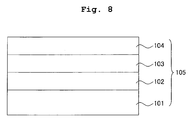
- Fig. 8 shows a cross-sectional structure of an optical element 105 of the present invention.
- the optical element 105 includes an SiO 2 layer 102, an Al 2 O 3 layer 103, and an SiO 2 layer 104 which are stacked in this order on a fluorite (CaF 2 ) base 101. These layers or the an SiO 2 layer disposed on the outermost surface functions as the corrosion resistant film (erosion resistant film).
- the fluorite base 101 is formed to be lens-shaped, and it has a thickness of 20 mm.
- a known sputtering method was used for each of the layers so that the dense film was successfully formed.
- the film formation method is not limited to the sputtering method. It is also allowable to use, for example, the ion beam assist method, the ion plating method, and the heating vapor deposition method provided that the dense film can be formed.
- the corrosion resistant films as described above may be provided on the both sides of the base 101 respectively. Alternatively, the corrosion resistant film as described above may be provided at only the portion of the base 101 to be irradiated with the light beam.
- optical element A a fluorite base stacked with neither the SiO 2 layer nor the Al 2 O 3 layer, i.e., an optical element composed of only the fluorite base
- optical element B an optical element composed of only the fluorite base
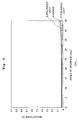
- Fig. 9 shows a graph illustrating the reflectance characteristic of the optical element B with respect to the angle of incidence.
- the average reflectance of the S-polarized light and the P-polarized light in relation to the optical element B was not more than about 0.04 % in all regions ranging to the maximum angle of incidence of 40 degrees in which the optical element was to be used.
- Fig. 10 shows a graph illustrating the reflectance characteristic of the optical element A with respect to the angle of incidence. As shown in Fig. 10, the average reflectance of the S-polarized light and the P-polarized light was not more than about 0.04 % in all regions ranging to the maximum angle of incidence of 40 degrees in which the optical element was to be used.
- the optical element A exhibits the low values of the average reflectance of the S-polarized light and the P-polarized light in all regions of the angle of incidence assumed for the use as the optical element, in the same manner as the optical element B composed of only fluorite. It is appreciated that the optical element A can be carried at the end portion of the projection optical system of the projection exposure apparatus in place of the optical element B.
- an acceleration test was carried out for the corrosion resistance by immersing the optical element A and the optical element B in pure water at 70 °C for 3 hours respectively.
- the surface roughnesses of the optical elements were measured by using an AFM (atomic force microscope) and a contact type roughness meter. It is assumed that the immersion in pure water at 70 °C for 3 hours corresponds to the immersion in pure water at room temperature for about 10 days.
- the surface roughness of the surface of the optical element is 3,000 angstrom RMS as described above, the scattering of light is caused to a large extent. Therefore, the transmittance of the optical element is lowered, and any deviation arises from the designed optical path. Therefore, it is impossible to exhibit any intended desired optical performance.
- the surface roughness of the optical element A according to the present invention before being immersed in pure water was 11 angstrom RMS.
- the surface roughness of the optical element after being immersed in pure water was 14 angstrom RMS. Therefore, it is appreciated that the surface roughness of the optical element is scarcely changed before and after being immersed in pure water. Therefore, the optical element A can maintain the desired optical performance after being immersed in pure water, i.e., even when the liquid immersion exposure is performed, probably for the following reason. That is, it is considered that the oxide coating film, which is formed on the surface of the fluorite base, prevents the fluorite base from corrosion, because the oxide coating film has the corrosion resistance against pure water.
- the three-layered multilayer film composed of the oxides is formed on the fluorite base.
- a single layer film of, for example, SiO 2 (optical film thickness: 0.55 ⁇ ) or Al 2 O 3 is formed.
- the film thickness of the multilayer film or the single layer film having the corrosion resistance is not specifically limited. However, it is desirable that the film thickness is 50 angstroms to 2,000 angstroms in view of the fact that the covering performance of the film on the surface of the fluorite base is secured, and the angular reflection-preventive performance is secured.
- the SiO 2 layer and the Al 2 O 3 layer are formed on the fluorite base.
- a layer or layers of fluoride or fluorides such as YF 3 , MgF 2 , and LaF 3 may be formed singly or in combination.
- the projection exposure apparatus of this embodiment is a projection exposure apparatus based on the step-and-repeat system for performing the full field exposure for the shot area on the substrate.
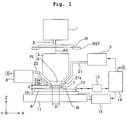
- Fig. 1 shows a schematic arrangement of the projection exposure apparatus of this embodiment.
- the exposure light beam IL which is composed of an ultraviolet pulse light beam having a wavelength of 193 nm, is radiated from an illumination optical system 1 including, for example, an ArF excimer laser light source as an exposure light source, an optical integrator (homogenizer), a field diaphragm, and a condenser lens.
- the exposure light beam IL illuminates a pattern provided on a reticle R.
- the pattern of the reticle R is subjected to the reduction projection onto an exposure area on a wafer W coated with a photoresist at a predetermined projection magnification ⁇ ( ⁇ is, for example, 1/4 or 1/5) via a projection optical system PL which is telecentric on the both sides (or on one side of the wafer W).
- ⁇ is, for example, 1/4 or 1/5
- Those usable as the exposure light beam IL also include, for example, the KrF excimer laser beam (wavelength: 248 nm), the F 2 laser beam (wavelength: 157 nm), and the i-ray (wavelength: 365 nm) of the mercury lamp.
- the Z axis extends in the direction parallel to the optical axis AX of the projection optical system PL
- the Y axis extends in the direction perpendicular to the sheet surface of Fig. 1 in the plane perpendicular to the Z axis
- the X axis extends in parallel to the sheet surface of Fig. 1.
- the reticle R is held on a reticle stage RST.
- a mechanism which finely moves the reticle R in the X direction, the Y direction, and the rotational direction, is incorporated in the reticle stage RST.
- the two-dimensional position and the angle of rotation of the reticle stage RST are measured in real-time by a laser interferometer (not shown).
- a main control system 14 positions the reticle R on the basis of the value measured by the laser interferometer.
- the wafer W is fixed on a Z stage 9 which controls the focus position (position in the Z direction) and the angle of inclination of the wafer W by the aid of a wafer holder (not shown).
- the Z stage 9 is fixed on an XY stage 10 which is movable along the XY plane that is substantially parallel to the image plane of the projection optical system PL.
- the XY stage 10 is placed on a base 11.
- the Z stage 9 controls the focus position (position in the Z direction) and the angle of inclination of the wafer W to adjust and match the surface of the wafer W with respect to the image plane of the projection optical system PL in the auto-focus manner and the auto-leveling manner.
- the XY stage 10 positions the wafer W in the X direction and the Y direction.
- the two-dimensional position and the angle of rotation of the Z stage 9 (wafer W) are measured in real-time as a position of a movement mirror 12 by a laser interferometer 13.
- the control information is fed from the main control system 14 to a wafer stage-driving system 15 on the basis of the measured result.
- the wafer stage-driving system 15 controls the operation of the Z stage 9 and the XY stage 10 on the basis of the control information.
- the operation in which each of the shot areas on the wafer W is successively subjected to the stepping movement to the exposure position to perform the exposure with the pattern image of the reticle R, is repeated in the step-and-repeat manner.
- the liquid immersion method is applied to the projection exposure apparatus of this embodiment in order that that the resolution is improved by substantially shortening the exposure wavelength, and the depth of focus is substantially widened. Therefore, the space between the surface of the wafer W and the tip surface (lower surface) of the projection optical system PL is filled with a predetermined liquid 7 at least during the period in which the pattern image of the reticle R is transferred onto the wafer W.
- the projection optical system PL has a plurality of optical elements which include the optical element 4 as produced in the embodiment described above, and a barrel 3 which accommodates the optical elements.
- the optical element 4 is installed so that the optical element 4 is exposed at the end (lower end) of the barrel on the side of the wafer (see Figs. 4 and 5).
- the barrel 3 which is composed of metal, is prevented from the corrosion or the like.
- pure water is used as the liquid 7. Pure water is advantageous in that pure water is available in a large amount with ease, for example, in the semiconductor production factory, and pure water exerts no harmful influence, for example, on the optical lens and the photoresist on the wafer. Further, pure water exerts no harmful influence on the environment, and the content of impurity is extremely low. Therefore, it is also expected to obtain the function to wash the surface of the wafer.
- the refractive index n of pure water (water) with respect to the exposure light beam having a wavelength of about 200 nm is approximately in an extent of 1.44 to 1.47.
- the wavelength of the ArF excimer laser beam of 193 nm is shortened on the wafer W by 1/n, i.e., to about 131 to 134 nm, and a high resolution is obtained.
- the depth of focus is magnified about n times, i.e., about 1.44 to 1.47 times as compared with the value obtained in the air. Therefore, when it is enough to secure an approximately equivalent depth of focus as compared with the case of the use in the air, it is possible to further increase the numerical aperture of the projection optical system PL. Also in this viewpoint, the resolution is improved.
- the liquid 7 is supplied in a temperature-controlled state onto the wafer W by the aid of predetermined discharge nozzles or the like by a liquid supply unit 5 including, for example, a tank for accommodating the liquid, a pressurizing pump, and a temperature control unit.
- the liquid 7, which has been supplied onto the wafer W, is recovered by the aid of predetermined inflow nozzles or the like by a liquid recovery unit 6 including, for example, a tank for accommodating the liquid, and a suction pump.
- the temperature of the liquid 7 is set, for example, to be approximately equivalent to the temperature of a chamber in which the projection exposure apparatus of this embodiment is accommodated.
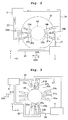
- the projection exposure apparatus of this embodiment is arranged with a discharge nozzle 21a having a thin tip section and two inflow nozzles 23a, 23b having wide tip sections so that the end portion of the optical element 4 of the projection optical system PL is interposed in the X direction (see Fig. 2).
- the discharge nozzle 21a is connected to the liquid supply unit 5 via a supply tube 21, and the inflow nozzles 23a, 23b are connected to the liquid recovery unit 6 via a recovery tube 23.
- Another set of discharge and recovery nozzles are arranged at positions obtained by rotating the positions of the set of the discharge nozzle 21a and the inflow nozzles 23a, 23b by substantially 180° about the center of the end portion of the optical element 4, and two sets of discharge and recovery nozzles are also arranged so that the end portion of the optical element 4 is interposed in the Y direction (see Figs. 2 and 3).
- Fig. 2 shows a positional relationship in relation to the end portion 4A of the optical element 4 of the projection optical system PL shown in Fig. 1, the wafer W, and the two sets of the discharge nozzles and the inflow nozzles to interpose the end portion 4A in the X direction.
- the discharge nozzle 21a is arranged on the side in the +X direction with respect to the end portion 4A
- the inflow nozzles 23a, 23b are arranged on the side in the -X direction.
- the inflow nozzles 23a, 23b are arranged in a sector-shaped open form with respect to the axis which passes through the center of the end portion 4A and which is parallel to the X axis.
- Another set of the discharge nozzle 22a and the inflow nozzles 24a, 24b are arranged at the positions obtained by rotating the positions of the set of the discharge nozzle 21a and the inflow nozzles 23a, 23b by substantially 180° about the center of the end portion 4A.
- the discharge nozzle 22a is connected to the liquid supply unit 5 via a supply tube 22, and the inflow nozzles 24a, 24b are connected to the liquid recovery unit 6 via a recovery tube 24.
- Fig. 3 shows a positional relationship in relation to the end portion 4A of the optical element 4 of the projection optical system PL shown in Fig. 1 and the two sets of the discharge nozzles and the inflow nozzles to interpose the end portion 4A in the Y direction.
- the discharge nozzle 27a is arranged on the side in the +Y direction with respect to the end portion 4A, and the inflow nozzles 29a, 29b are arranged on the side in the -Y direction.
- the discharge nozzle 27a is connected to the liquid supply unit 5 via a supply tube 27, and the inflow nozzles 29a, 29b are connected to the liquid recovery unit 6 via a recovery tube 29.
- Another set of the discharge nozzle 28a and the inflow nozzles 30a, 30b are arranged at the positions obtained by rotating the positions of the set of the discharge nozzle 27a and the inflow nozzles 29a, 29b by substantially 180° about the center of the end portion 4A.
- the discharge nozzle 28a is connected to the liquid supply unit 5 via a supply tube 28, and the inflow nozzles 30a, 30b are connected to the liquid recovery unit 6 via a recovery tube 30.
- the liquid supply unit 5 supplies the temperature-controlled liquid to the space between the wafer W and the end portion 4A of the optical element 4 via at least one of the supply tubes 21, 22, 27, 28.
- the liquid recovery unit 6 recovers the liquid supplied onto the wafer W via at least one of the recovery tubes 23, 24, 29, 30.
- the liquid supply unit 5 supplies the liquid 7 to the space between the wafer W and the end portion 4A of the optical element 4 via the supply tube 21 and the discharge nozzle 21a.
- the liquid recovery unit 6 recovers the liquid 7 from the surface of the wafer W via the recovery nozzle 23 and the inflow nozzles 23a, 23b. In this situation, the liquid 7 flows in the direction of the arrow 25B (-X direction) on the wafer W.
- the space between the wafer W and the optical element 4 is filled with the liquid 7 in a stable state.
- the liquid supply unit 5 supplies the liquid 7 to the space between the wafer W and the end portion 4A of the optical element 4 by using the supply tube 22 and the discharge nozzle 22a, and the liquid recovery unit 6 recovers the liquid 7 by using the recovery tube 24 and the inflow nozzles 24a, 24b.
- the liquid 7 flows in the direction of the arrow 26B (+X direction) on the wafer W.
- the space between the wafer W and the optical element 4 is filled with the liquid 7 in a stable state.
- the projection exposure apparatus of this embodiment is provided with the two sets of the discharge nozzles and the inflow nozzles which are inverted to one another in the X direction. Therefore, even when the wafer W is moved in any one of the +X direction and the -X direction, the space between the wafer W and the optical element 4 can be filled with the liquid 7 in the stable state.
- the liquid 7 flows on the wafer W. Therefore, even when any foreign matter is adhered onto the wafer W, the foreign matter can be washed out with the liquid 7.
- the liquid 7 is adjusted to have a predetermined temperature by the liquid supply unit 5. Therefore, the surface of the wafer W is temperature-adjusted, and it is possible to avoid the decrease in the overlay accuracy or the like which would be otherwise caused by the thermal expansion of the wafer brought about by the heat generated during the exposure. Therefore, even when a certain period of time is required from the alignment to the exposure as in the EGA (enhanced global alignment) system, it is possible to avoid the decrease in the overlay accuracy which would be otherwise caused by the thermal expansion of the wafer possibly brought about during such a period.
- the liquid 7 flows in the same direction as the direction in which the wafer W is moved. Therefore, the liquid, which has absorbed the foreign matter and the heat, can be recovered without allowing the liquid to stay on the exposure area disposed just under the end portion 4A of the optical element 4.
- the liquid 7 is supplied and recovered in the Y direction. That is, when the wafer is subjected to the stepping movement in the direction of the arrow 31A (-Y direction) indicated by the solid line in Fig. 3, then the liquid supply unit 5 supplies the liquid via the supply tube 27 and the discharge nozzle 27a, and the liquid recovery unit 6 recovers the liquid by using the recovery tube 29 and the inflow nozzles 29a, 29b. Accordingly, the liquid flows in the direction of the arrow 31B (-Y direction) on the exposure area disposed just under the end portion 4A of the optical element 4.
- the liquid is supplied and recovered by using the supply tube 28, the discharge nozzle 28a, the recovery tube 30, and the inflow nozzles 30a, 30b. Accordingly, the liquid flows in the direction of the arrow 33B (+Y direction) on the exposure area disposed just under the end portion 4A. Therefore, even when the wafer W is moved in any one of the +Y direction and the -Y direction, the space between the wafer W and the end portion 4A of the optical element 4 can be filled with the liquid 7 in a stable state, in the same manner as in the case in which the wafer W is moved in the X direction.
- nozzles for supplying and recovering the liquid 7 in the X direction and/or the Y direction there is no limitation to the provision of the nozzles for supplying and recovering the liquid 7 in the X direction and/or the Y direction. It is also allowable to provide nozzles for supplying and recovering the liquid 7, for example, in oblique directions.
- FIG. 4 shows a situation in which the liquid is supplied to and recovered from the space between the wafer W and the optical element 4 of the projection optical system PL.
- the wafer W is moved in the direction of the arrow 25A (-X direction).
- D represents the diameter (m) of the end portion of the optical element 4
- v represents the movement velocity (m/s) of the XY stage
- d represents the working distance (distance between the lowermost surface of the optical element 4 and the surface of the wafer W) (m) of the projection optical system PL.
- the velocity v, at which the XY stage 10 is subjected to the stepping movement, is set by the main control system 14.
- D and d are previously inputted into (stored in) the main control system 14. Therefore, when the supply amount Vi of the liquid 7 and the recovery amount Vo thereof are adjusted on the basis of the expression (3), a state is given, in which the space between the wafer W and the optical element 4 shown in Fig. 4 is always filled with the liquid 7.
- the working distance d of the projection optical system PL is made as narrow as possible in order that the liquid 7 stably exists between the projection optical system PL and the wafer W.
- the working distance d is set to be, for example, about 2 mm.
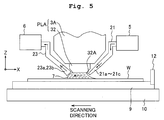
- Fig. 5 shows a front view illustrating, for example, a lower portion of a projection optical system PLA of the projection exposure apparatus of this embodiment, a liquid supply unit 5, and a liquid recovery unit 6.
- an optical element 32 which is disposed at a lowermost end of a barrel 3A of the projection optical system PLA, has an end portion 32A which is formed so that the end portion has a rectangular shape which is long in the Y direction (non-scanning direction) and which has a necessary portion for the scanning exposure.
- the optical element 32 is such an optical element that a corrosion resistant film, which is equivalent to that of the optical element produced in the first embodiment, is provided on a fluorite base.
- a part of a pattern image of the reticle is projected onto a rectangular exposure area disposed just under the end portion 32A.
- the reticle (not shown) is moved at a velocity V in the -X direction (or in the +X direction) with respect to the projection optical system PLA, in synchronization with which the wafer W is moved at a velocity ⁇ •V ( ⁇ represents the projection magnification) in the +X direction (or in the -X direction) by the aid of the XY stage 10.
- the next shot area is moved to the scanning start position in accordance with the stepping of the wafer W.
- the exposure is successively performed for respective shot areas in the step-and-scan manner.
- the liquid immersion method is also applied in this embodiment, and thus the space between the optical element 32 and the surface of the wafer W is filled with the liquid 7 during the scanning exposure.
- the liquid 7 is supplied and recovered by using the liquid supply unit 5 and the liquid recovery unit 6 respectively in the same manner as in the second embodiment.
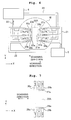
- Fig. 6 shows a positional relationship between the end portion 32A of the optical element 32 of the projection optical system PLA and the discharge nozzles and the inflow nozzles for supplying and recovering the liquid 7 in the X direction.
- the end portion 32A of the optical element 32 has a rectangular shape which is long in the Y direction.
- the three discharge nozzles 21a to 21c are arranged on the side in the +X direction, and the two inflow nozzles 23a, 23b are arranged on the side in the -X direction so that the end portion 32A of the optical element 32 of the projection optical system PLA is interposed in the X direction.
- the discharge nozzles 21a to 21c are connected to the liquid supply unit 5 via a supply tube 21, and the inflow nozzles 23a, 23b are connected to the liquid recovery unit 6 via a recovery tube 23.
- the discharge nozzles 22a to 22c and the recovery nozzles 24a, 24b are arranged at positions obtained by rotating the positions of the discharge nozzles 21a to 21c and the recovery nozzles 23a, 23b by substantially 180° about the center of the end portion 32A.
- the discharge nozzles 21a to 21c and the inflow nozzles 24a, 24b are arranged alternately in the Y direction, and the discharge nozzles 22a to 22c and the inflow nozzles 23a, 23b are arranged alternately in the Y direction.
- the discharge nozzles 22a to 22c are connected to the liquid supply unit 5 via a supply tube 22, and the inflow nozzles 24a, 24b are connected to the liquid recovery unit 6 via a recovery tube 24.
- the liquid 7 is supplied and recovered by the liquid supply unit 5 and the liquid recovery unit 6 by using the supply tube 21, the discharge nozzles 21a to 21c, the recovery tube 23, and the inflow nozzles 23a, 23b.
- the liquid 7 is allowed to flow in the -X direction so that the space between the optical element 32 and the wafer W is filled therewith.
- the liquid 7 is supplied and recovered by using the supply tube 22, the discharge nozzles 22a to 22c, the recovery tube 24, and the inflow nozzles 24a, 24b.
- the liquid 7 is allowed to flow in the +X direction so that the space between the optical element 32 and the wafer W is filled therewith.
- the direction, in which the liquid 7 is allowed to flow is switched depending on the scanning direction, the space between the wafer W and the end portion 32A of the optical element 32 can be filled with the liquid 7, even when the wafer W is subjected to the scanning exposure in any one of the +X direction and the -X direction. Accordingly, the exposure can be performed at a high resolution and a wide depth of focus.
- DSY represents the length (m) of the end portion 32A of the optical element 32 in the X direction. Accordingly, the space between the optical element 32 and the wafer W can be filled with the liquid 7 in a stable state even during the scanning exposure.
- the number and the shapes of the nozzles are not specifically limited.
- the liquid 7 may be supplied and recovered by using two pairs of nozzles for the long side of the end portion 32A.
- the discharge nozzles and the inflow nozzles may be arranged while being aligned vertically in order that the liquid can be supplied and recovered in any one of the +X direction and the -X direction.
- the liquid 7 is supplied and recovered in the Y direction in the same manner as in the second embodiment.
- Fig. 7 shows a positional relationship between the end portion 32A of the optical element 32 of the projection optical system PLA and the discharge nozzles and the inflow nozzles for the Y direction.
- the liquid 7 is supplied and recovered by using the discharge nozzle 27a and the inflow nozzles 29a, 29b arranged in the Y direction.
- the liquid 7 is supplied and recovered by using the discharge nozzle 28a and the inflow nozzles 30a, 30b arranged in the Y direction.
- DSX represents the length (m) of the end portion 32A of the optical element 32 in the Y direction.
- the space between the optical element 32 and the wafer W can be continuously filled with the liquid 7 by adjusting the supply amount of the liquid 7 depending on the movement velocity v of the wafer W when the stepping movement is performed in the Y direction as well, in the same manner as in the second embodiment.
- the liquid is allowed to flow in the direction corresponding to the direction of the movement. Accordingly, the space between the wafer W and the end portion of the projection optical system PL can be continuously filled with the liquid 7.
- the liquid which is usable as the liquid 7 in the embodiments described above, is not specifically limited to pure water. It is possible to use liquids (for example, cedar oil) which have the transmittance with respect to the exposure light beam, which have the refractive index as high as possible, and which are stable against the photoresist coated to the surface of the wafer and the projection optical system.
- liquids for example, cedar oil
- the base of the optical element of the present invention is lens-shaped. However, there is no limitation thereto. It is also allowable to use those each of which is formed as a film on a fluorite plate-shaped base as a cover glass to be disposed between the liquid and the conventional fluorite lens.
- the end portion of the projection optical system is not corroded by the liquid. Therefore, the operation of the apparatus is not stopped in order to exchange the corroded optical element. Accordingly, it is possible to efficiently produce final products having fine patterns. Further, the optical characteristics of the optical element of the present invention are stable, because the optical element is not corroded. When the projection exposure apparatus, which carries the optical element of the present invention, is used, it is possible to produce final products having stable qualities.
Landscapes
- Physics & Mathematics (AREA)
- General Physics & Mathematics (AREA)
- Health & Medical Sciences (AREA)
- Engineering & Computer Science (AREA)
- Environmental & Geological Engineering (AREA)
- Epidemiology (AREA)
- Public Health (AREA)
- Atmospheric Sciences (AREA)
- Life Sciences & Earth Sciences (AREA)
- Toxicology (AREA)
- Chemical & Material Sciences (AREA)
- Oil, Petroleum & Natural Gas (AREA)
- Analytical Chemistry (AREA)
- Optics & Photonics (AREA)
- Exposure And Positioning Against Photoresist Photosensitive Materials (AREA)
- Exposure Of Semiconductors, Excluding Electron Or Ion Beam Exposure (AREA)
Abstract
A liquid immersion exposure apparatus includes a
projection optical system (PL) which projects an image of a
pattern onto a substrate (W) and a unit (5) which supplies
a liquid (7) between an optical element (4) at the end of
the projection optical system (PL) and the substrate (W).
A corrosion-resistant film composed of an oxide is formed
on the surface of the optical element (4) to prevent
corrosion by the liquid (7). Consequently, a desired
performance of the projection optical system can be secured
for a long time even where a full field exposure in the
step-and-repeat manner or a scanning exposure in the step-and-scan
manner is performed in a liquid-immersion state.
Description
The present invention relates to a projection exposure
apparatus which is usable to transfer a mask pattern onto a
photosensitive substrate in the lithography step for
producing devices including, for example, semiconductor
elements, image pickup elements (CCD or the like), liquid
crystal display elements, and thin film magnetic heads. In
particular, the present invention relates to a projection
exposure apparatus based on the use of the liquid immersion
method. The present invention also relates to an optical
element which is usable for the projection exposure
apparatus.
In the production of the semiconductor element or the
like, the projection exposure apparatus is used to transfer
a pattern image of a reticle as a mask via a projection
optical system onto each of shot areas on a wafer (or a
glass plate or the like) coated with a resist as a
photosensitive substrate. Conventionally, the reduction
projection type exposure apparatus based on the step-and-repeat
system (stepper) has been used as the projection
exposure apparatus in many cases. However, recently, the
attention is also attracted to the projection exposure
apparatus based on the step-and-scan system in which the
exposure is performed by synchronously scanning the reticle
and the wafer.
As for the resolution of the projection optical system
carried on the projection exposure apparatus, as the
exposure wavelength to be used is shorter, the resolution
becomes higher. Further, as the numerical aperture of the
projection optical system is larger, the resolution becomes
higher. Therefore, the exposure wavelength, which is used
for the projection exposure apparatus, is shortened year by
year, and the numerical aperture of the projection optical
system is increased as well, as the integrated circuit
becomes fine and minute. The exposure wavelength, which is
dominantly used at present, is 248 nm based on the KrF
excimer laser. However, the exposure wavelength of 193 nm
based on the ArF excimer laser, which is shorter than the
above, is also practically used.
When the exposure is performed, the depth of focus
(DOF) is also important in the same manner as the
resolution. The resolution R and the depth of focus δ are
represented by the following expressions respectively.
R = k1•λ/NA
δ = ±k2•λ/NA2
In the expressions, λ represents the exposure
wavelength, NA represents the numerical aperture of the
projection optical system, and k1 and k2 represent the
process coefficients. According to the expressions (1) and
(2), the following fact is appreciated. That is, when the
exposure wavelength λ is shortened and the numerical
aperture NA is increased in order to enhance the resolution
R, then the depth of focus δ is narrowed. Conventionally,
in the projection exposure apparatus, the surface of the
wafer is adjusted and matched with the image plane of the
projection optical system in the auto-focus manner. For
this purpose, it is desirable that the depth of focus δ is
wide to some extent. Accordingly, those having been
suggested as the method for substantially widening the
depth of focus include, for example, the phase shift
reticle method, the modified illumination method, and the
multilayer resist method.
As described above, in the conventional projection
exposure apparatus, the depth of focus is narrowed as the
wavelength of the exposure light beam is shortened and the
numerical aperture of the projection optical system is
increased. In order to respond to the advance of higher
integration of the semiconductor integrated circuit,
studies have been also made to further shorten the exposure
wavelength. However, if such a situation is continued as
it is, it is feared that the depth of focus may be too
narrowed and the margin may become insufficient during the
exposure operation.
In view of the above, the liquid immersion method has
been proposed as a method for substantially shortening the
exposure wavelength and deepening the depth of focus. In
this method, the space between the lower surface of the
projection optical system and the surface of the wafer is
filled with a liquid such as water or an organic solvent.
The resolution is improved and the depth of focus is
magnified about n times by utilizing the fact that the
wavelength of the exposure light beam in the liquid is 1/n
time that in the air (n represents the refractive index of
the liquid, which is usually about 1.2 to 1.6).
If it is intended to apply the liquid immersion method
to the projection exposure apparatus based on the step-and-repeat
system as it is, the liquid leaks out from the space
between the projection optical system and the wafer when
the wafer is subjected to the stepping movement to the next
shot area after the exposure is completed for one shot
area. Therefore, inconveniences arise such that the liquid
must be supplied again, and it is difficult to recover the
leaked liquid as well. If it is intended to apply the
liquid immersion method to the projection exposure
apparatus based on the step-and-scan system, it is
necessary that the space between the projection optical
system and the wafer is filled with the liquid during the
period in which the wafer is moved as well, because the
exposure is performed while moving the wafer. The
projection optical system and the liquid make contact with
each other. Therefore, there is such a possibility that
the end portion of the projection optical system, which is
in contact with the liquid, may be corroded by the liquid.
The objective lens is installed to the end of the
projection optical system. If the objective lens is
corroded, it is feared that any desired optical performance
cannot be obtained.
Taking the foregoing viewpoints into consideration, an
object of the present invention is to provide an optical
element which is preferably usable for a projection
exposure system of an exposure apparatus for performing the
liquid immersion exposure. Another object of the present
invention is to provide a projection exposure apparatus for
the liquid immersion exposure which carries such an optical
element.
According to a first aspect of the present invention,
there is provided an optical element usable for a
projection optical system which exposes a substrate by
projecting a predetermined pattern onto the substrate, the
optical element comprising:
The corrosion resistant film is formed on the surface
of the base of the optical element of the present
invention. Therefore, even when the liquid immersion
exposure is performed, it is possible to avoid, for
example, the corrosion, the erosion, and the dissolution
which would be otherwise cause by the contact between the
optical element and the liquid. Therefore, the desired
performance of the projection optical system can be
maintained over a long term even when the full field
exposure such as those in the step-and-repeat manner or the
scanning type exposure such as those in the step-and-scan
manner, in which the optical element installed to the end
of the projection optical system is exposed to the liquid
repeatedly or continuously, is performed in the liquid
immersion state.
According to a second aspect of the present invention,
there is provided an exposure apparatus which exposes a
substrate by projecting an image of a predetermined pattern
onto the substrate through a liquid, the exposure apparatus
comprising:
The corrosion resistant film is formed on the surface
of the base of the optical element installed to the tip of
the projection optical system of the exposure apparatus of
the present invention. Therefore, even when the liquid
immersion exposure is performed, it is possible to avoid,
for example, the corrosion, the erosion, and the
dissolution which would be otherwise cause by the contact
between the optical element and the liquid. Therefore, the
desired optical characteristics of the exposure apparatus
can be maintained over a long term even when the full field
exposure such as those based on the step-and-repeat system
or the scanning type exposure such as those based on the
step-and-scan system, in which the optical element
installed to the end of the projection optical system is
exposed to the liquid repeatedly or continuously, is
performed in the liquid immersion state. Accordingly, it
is possible to realize the exposure in a state in which the
wide depth of focus is maintained.
An explanation will be made below with reference to
the drawings about embodiments of the optical element of
the present invention and the projection exposure apparatus
based on the use of the optical element. However, the
present invention is not limited thereto.
At first, the optical element of the present invention
will be explained with reference to Figs. 8 to 10. Fig. 8
shows a cross-sectional structure of an optical element 105
of the present invention. The optical element 105 includes
an SiO2 layer 102, an Al2O3 layer 103, and an SiO2 layer 104
which are stacked in this order on a fluorite (CaF2) base
101. These layers or the an SiO2 layer disposed on the
outermost surface functions as the corrosion resistant film
(erosion resistant film). The fluorite base 101 is formed
to be lens-shaped, and it has a thickness of 20 mm. The
SiO2 layer 102, the Al2O3 layer 103, and the SiO2 layer 104
are formed so that the optical thicknesses are 0.37λ,
0.05λ, and 0.37λ with respect to the designed main
wavelength λ (for example, λ = 193 nm) respectively. A known sputtering method was used for each of the layers so that the dense film was successfully formed. The film formation method is not limited to the sputtering method. It is also allowable to use, for example, the ion beam assist method, the ion plating method, and the heating vapor deposition method provided that the dense film can be formed. The corrosion resistant films as described above may be provided on the both sides of the base 101 respectively. Alternatively, the corrosion resistant film as described above may be provided at only the portion of the base 101 to be irradiated with the light beam.
wavelength λ (for example, λ = 193 nm) respectively. A known sputtering method was used for each of the layers so that the dense film was successfully formed. The film formation method is not limited to the sputtering method. It is also allowable to use, for example, the ion beam assist method, the ion plating method, and the heating vapor deposition method provided that the dense film can be formed. The corrosion resistant films as described above may be provided on the both sides of the base 101 respectively. Alternatively, the corrosion resistant film as described above may be provided at only the portion of the base 101 to be irradiated with the light beam.
The reflectance characteristics were investigated in
relation to the angle of incidence of the light beam into
the optical element 105 obtained as described above. In
order to make comparison with the optical element 105
(hereinafter referred to as "optical element A"), a
fluorite base stacked with neither the SiO2 layer nor the
Al2O3 layer, i.e., an optical element composed of only the
fluorite base (hereinafter referred to as "optical element
B") was prepared. The ArF excimer laser beam having a
wavelength of 193 nm, which was used as the exposure light
beam for the exposure apparatus, was radiated onto the
optical element A and the optical element B respectively
while changing the angle of incidence to measure the
reflectances. Obtained results are shown in Figs. 9 and
10. The reflected light beams were measured for the S-polarized
light and the P-polarized light which were
orthogonal to one another.
Fig. 9 shows a graph illustrating the reflectance
characteristic of the optical element B with respect to the
angle of incidence. As shown in Fig. 9, the average
reflectance of the S-polarized light and the P-polarized
light in relation to the optical element B was not more
than about 0.04 % in all regions ranging to the maximum
angle of incidence of 40 degrees in which the optical
element was to be used.
Fig. 10 shows a graph illustrating the reflectance
characteristic of the optical element A with respect to the
angle of incidence. As shown in Fig. 10, the average
reflectance of the S-polarized light and the P-polarized
light was not more than about 0.04 % in all regions ranging
to the maximum angle of incidence of 40 degrees in which
the optical element was to be used.
That is, the optical element A exhibits the low values
of the average reflectance of the S-polarized light and the
P-polarized light in all regions of the angle of incidence
assumed for the use as the optical element, in the same
manner as the optical element B composed of only fluorite.
It is appreciated that the optical element A can be carried
at the end portion of the projection optical system of the
projection exposure apparatus in place of the optical
element B.
Next, an acceleration test was carried out for the
corrosion resistance by immersing the optical element A and
the optical element B in pure water at 70 °C for 3 hours
respectively. The surface roughnesses of the optical
elements were measured by using an AFM (atomic force
microscope) and a contact type roughness meter. It is
assumed that the immersion in pure water at 70 °C for 3
hours corresponds to the immersion in pure water at room
temperature for about 10 days.
The surface roughness, which was obtained before
immersing the optical element B composed of only fluorite
in pure water, was 3 angstrom RMS. The surface roughness,
which was obtained after immersing the optical element B in
pure water, was about 3,000 angstrom RMS. Therefore, it is
understood that the optical element B was corroded to have
the about 1,000 times surface roughness. When the surface
roughness of the surface of the optical element is 3,000
angstrom RMS as described above, the scattering of light is
caused to a large extent. Therefore, the transmittance of
the optical element is lowered, and any deviation arises
from the designed optical path. Therefore, it is
impossible to exhibit any intended desired optical
performance.
On the other hand, the surface roughness of the
optical element A according to the present invention before
being immersed in pure water was 11 angstrom RMS. The
surface roughness of the optical element after being
immersed in pure water was 14 angstrom RMS. Therefore, it
is appreciated that the surface roughness of the optical
element is scarcely changed before and after being immersed
in pure water. Therefore, the optical element A can
maintain the desired optical performance after being
immersed in pure water, i.e., even when the liquid
immersion exposure is performed, probably for the following
reason. That is, it is considered that the oxide coating
film, which is formed on the surface of the fluorite base,
prevents the fluorite base from corrosion, because the
oxide coating film has the corrosion resistance against
pure water.
In the optical element A of this embodiment, the
three-layered multilayer film composed of the oxides is
formed on the fluorite base. However, it has been revealed
that the same or equivalent effect is obtained even when a
single layer film of, for example, SiO2 (optical film
thickness: 0.55λ) or Al2O3 is formed. The film thickness of
the multilayer film or the single layer film having the
corrosion resistance is not specifically limited. However,
it is desirable that the film thickness is 50 angstroms to
2,000 angstroms in view of the fact that the covering
performance of the film on the surface of the fluorite base
is secured, and the angular reflection-preventive
performance is secured.
In this embodiment, the SiO2 layer and the Al2O3 layer
are formed on the fluorite base. However, in place of
these layers or together with these layers, a layer or
layers of fluoride or fluorides such as YF3, MgF2, and LaF3
may be formed singly or in combination.
Next, an explanation will be made with reference to
Figs. 1 to 4 about a second embodiment illustrative of a
projection exposure apparatus to which the optical element
of the embodiment described above is applied. The
projection exposure apparatus of this embodiment is a
projection exposure apparatus based on the step-and-repeat
system for performing the full field exposure for the shot
area on the substrate.
Fig. 1 shows a schematic arrangement of the projection
exposure apparatus of this embodiment. With reference to
Fig. 1, the exposure light beam IL, which is composed of an
ultraviolet pulse light beam having a wavelength of 193 nm,
is radiated from an illumination optical system 1
including, for example, an ArF excimer laser light source
as an exposure light source, an optical integrator
(homogenizer), a field diaphragm, and a condenser lens.
The exposure light beam IL illuminates a pattern provided on a reticle R. The pattern of the reticle R is subjected to the reduction projection onto an exposure area on a wafer W coated with a photoresist at a predetermined projection magnification β (β is, for example, 1/4 or 1/5) via a projection optical system PL which is telecentric on the both sides (or on one side of the wafer W). Those usable as the exposure light beam IL also include, for example, the KrF excimer laser beam (wavelength: 248 nm), the F2 laser beam (wavelength: 157 nm), and the i-ray (wavelength: 365 nm) of the mercury lamp.
The exposure light beam IL illuminates a pattern provided on a reticle R. The pattern of the reticle R is subjected to the reduction projection onto an exposure area on a wafer W coated with a photoresist at a predetermined projection magnification β (β is, for example, 1/4 or 1/5) via a projection optical system PL which is telecentric on the both sides (or on one side of the wafer W). Those usable as the exposure light beam IL also include, for example, the KrF excimer laser beam (wavelength: 248 nm), the F2 laser beam (wavelength: 157 nm), and the i-ray (wavelength: 365 nm) of the mercury lamp.
In the following description, it is assumed that the Z
axis extends in the direction parallel to the optical axis
AX of the projection optical system PL, the Y axis extends
in the direction perpendicular to the sheet surface of Fig.
1 in the plane perpendicular to the Z axis, and the X axis
extends in parallel to the sheet surface of Fig. 1.
The reticle R is held on a reticle stage RST. A
mechanism, which finely moves the reticle R in the X
direction, the Y direction, and the rotational direction,
is incorporated in the reticle stage RST. The two-dimensional
position and the angle of rotation of the
reticle stage RST are measured in real-time by a laser
interferometer (not shown). A main control system 14
positions the reticle R on the basis of the value measured
by the laser interferometer.
On the other hand, the wafer W is fixed on a Z stage 9
which controls the focus position (position in the Z
direction) and the angle of inclination of the wafer W by
the aid of a wafer holder (not shown). The Z stage 9 is
fixed on an XY stage 10 which is movable along the XY plane
that is substantially parallel to the image plane of the
projection optical system PL. The XY stage 10 is placed on
a base 11. The Z stage 9 controls the focus position
(position in the Z direction) and the angle of inclination
of the wafer W to adjust and match the surface of the wafer
W with respect to the image plane of the projection optical
system PL in the auto-focus manner and the auto-leveling
manner. The XY stage 10 positions the wafer W in the X
direction and the Y direction. The two-dimensional
position and the angle of rotation of the Z stage 9 (wafer
W) are measured in real-time as a position of a movement
mirror 12 by a laser interferometer 13. The control
information is fed from the main control system 14 to a
wafer stage-driving system 15 on the basis of the measured
result. The wafer stage-driving system 15 controls the
operation of the Z stage 9 and the XY stage 10 on the basis
of the control information. During the exposure, the
operation, in which each of the shot areas on the wafer W
is successively subjected to the stepping movement to the
exposure position to perform the exposure with the pattern
image of the reticle R, is repeated in the step-and-repeat
manner.
The liquid immersion method is applied to the
projection exposure apparatus of this embodiment in order
that that the resolution is improved by substantially
shortening the exposure wavelength, and the depth of focus
is substantially widened. Therefore, the space between the
surface of the wafer W and the tip surface (lower surface)
of the projection optical system PL is filled with a
predetermined liquid 7 at least during the period in which
the pattern image of the reticle R is transferred onto the
wafer W. The projection optical system PL has a plurality
of optical elements which include the optical element 4 as
produced in the embodiment described above, and a barrel 3
which accommodates the optical elements. The optical
element 4 is installed so that the optical element 4 is
exposed at the end (lower end) of the barrel on the side of
the wafer (see Figs. 4 and 5). When the optical element 4
is installed as described above, only the optical element 4
makes contact with the liquid 7. Accordingly, the barrel
3, which is composed of metal, is prevented from the
corrosion or the like. In this embodiment, pure water is
used as the liquid 7. Pure water is advantageous in that
pure water is available in a large amount with ease, for
example, in the semiconductor production factory, and pure
water exerts no harmful influence, for example, on the
optical lens and the photoresist on the wafer. Further,
pure water exerts no harmful influence on the environment,
and the content of impurity is extremely low. Therefore,
it is also expected to obtain the function to wash the
surface of the wafer.
It is approved that the refractive index n of pure
water (water) with respect to the exposure light beam
having a wavelength of about 200 nm is approximately in an
extent of 1.44 to 1.47. The wavelength of the ArF excimer
laser beam of 193 nm is shortened on the wafer W by 1/n,
i.e., to about 131 to 134 nm, and a high resolution is
obtained. Further, the depth of focus is magnified about n
times, i.e., about 1.44 to 1.47 times as compared with the
value obtained in the air. Therefore, when it is enough to
secure an approximately equivalent depth of focus as
compared with the case of the use in the air, it is
possible to further increase the numerical aperture of the
projection optical system PL. Also in this viewpoint, the
resolution is improved.
The liquid 7 is supplied in a temperature-controlled
state onto the wafer W by the aid of predetermined
discharge nozzles or the like by a liquid supply unit 5
including, for example, a tank for accommodating the
liquid, a pressurizing pump, and a temperature control
unit. The liquid 7, which has been supplied onto the wafer
W, is recovered by the aid of predetermined inflow nozzles
or the like by a liquid recovery unit 6 including, for
example, a tank for accommodating the liquid, and a suction
pump. The temperature of the liquid 7 is set, for example,
to be approximately equivalent to the temperature of a
chamber in which the projection exposure apparatus of this
embodiment is accommodated. The projection exposure
apparatus of this embodiment is arranged with a discharge
nozzle 21a having a thin tip section and two inflow nozzles
23a, 23b having wide tip sections so that the end portion
of the optical element 4 of the projection optical system
PL is interposed in the X direction (see Fig. 2). The
discharge nozzle 21a is connected to the liquid supply unit
5 via a supply tube 21, and the inflow nozzles 23a, 23b are
connected to the liquid recovery unit 6 via a recovery tube
23. Further, another set of discharge and recovery nozzles
are arranged at positions obtained by rotating the
positions of the set of the discharge nozzle 21a and the
inflow nozzles 23a, 23b by substantially 180° about the
center of the end portion of the optical element 4, and two
sets of discharge and recovery nozzles are also arranged so
that the end portion of the optical element 4 is interposed
in the Y direction (see Figs. 2 and 3).
Fig. 2 shows a positional relationship in relation to
the end portion 4A of the optical element 4 of the
projection optical system PL shown in Fig. 1, the wafer W,
and the two sets of the discharge nozzles and the inflow
nozzles to interpose the end portion 4A in the X direction.
With reference to Fig. 2, the discharge nozzle 21a is
arranged on the side in the +X direction with respect to
the end portion 4A, and the inflow nozzles 23a, 23b are
arranged on the side in the -X direction. The inflow
nozzles 23a, 23b are arranged in a sector-shaped open form
with respect to the axis which passes through the center of
the end portion 4A and which is parallel to the X axis.
Another set of the discharge nozzle 22a and the inflow
nozzles 24a, 24b are arranged at the positions obtained by
rotating the positions of the set of the discharge nozzle
21a and the inflow nozzles 23a, 23b by substantially 180°
about the center of the end portion 4A. The discharge
nozzle 22a is connected to the liquid supply unit 5 via a
supply tube 22, and the inflow nozzles 24a, 24b are
connected to the liquid recovery unit 6 via a recovery tube
24.
Fig. 3 shows a positional relationship in relation to
the end portion 4A of the optical element 4 of the
projection optical system PL shown in Fig. 1 and the two
sets of the discharge nozzles and the inflow nozzles to
interpose the end portion 4A in the Y direction. With
reference to Fig. 3, the discharge nozzle 27a is arranged
on the side in the +Y direction with respect to the end
portion 4A, and the inflow nozzles 29a, 29b are arranged on
the side in the -Y direction. The discharge nozzle 27a is
connected to the liquid supply unit 5 via a supply tube 27,
and the inflow nozzles 29a, 29b are connected to the liquid
recovery unit 6 via a recovery tube 29. Another set of the
discharge nozzle 28a and the inflow nozzles 30a, 30b are
arranged at the positions obtained by rotating the
positions of the set of the discharge nozzle 27a and the
inflow nozzles 29a, 29b by substantially 180° about the
center of the end portion 4A. The discharge nozzle 28a is
connected to the liquid supply unit 5 via a supply tube 28,
and the inflow nozzles 30a, 30b are connected to the liquid
recovery unit 6 via a recovery tube 30. The liquid supply
unit 5 supplies the temperature-controlled liquid to the
space between the wafer W and the end portion 4A of the
optical element 4 via at least one of the supply tubes 21,
22, 27, 28. The liquid recovery unit 6 recovers the liquid
supplied onto the wafer W via at least one of the recovery
tubes 23, 24, 29, 30.
Next, an explanation will be made about a supply
method and a recovery method for the liquid 7.
With reference to Fig. 2, when the wafer W is
subjected to the stepping movement in the direction of the
arrow 25A indicated by the solid line (-X direction), the
liquid supply unit 5 supplies the liquid 7 to the space
between the wafer W and the end portion 4A of the optical
element 4 via the supply tube 21 and the discharge nozzle
21a. The liquid recovery unit 6 recovers the liquid 7 from
the surface of the wafer W via the recovery nozzle 23 and
the inflow nozzles 23a, 23b. In this situation, the liquid
7 flows in the direction of the arrow 25B (-X direction) on
the wafer W. The space between the wafer W and the optical
element 4 is filled with the liquid 7 in a stable state.
On the other hand, when the wafer W is subjected to
the stepping movement in the direction of the arrow 26A
indicated by the two-dot chain line (+X direction), then
the liquid supply unit 5 supplies the liquid 7 to the space
between the wafer W and the end portion 4A of the optical
element 4 by using the supply tube 22 and the discharge
nozzle 22a, and the liquid recovery unit 6 recovers the
liquid 7 by using the recovery tube 24 and the inflow
nozzles 24a, 24b. In this situation, the liquid 7 flows in
the direction of the arrow 26B (+X direction) on the wafer
W. The space between the wafer W and the optical element 4
is filled with the liquid 7 in a stable state. As
described above, the projection exposure apparatus of this
embodiment is provided with the two sets of the discharge
nozzles and the inflow nozzles which are inverted to one
another in the X direction. Therefore, even when the wafer
W is moved in any one of the +X direction and the -X
direction, the space between the wafer W and the optical
element 4 can be filled with the liquid 7 in the stable
state.
In the exposure apparatus of this embodiment, the
liquid 7 flows on the wafer W. Therefore, even when any
foreign matter is adhered onto the wafer W, the foreign
matter can be washed out with the liquid 7. The liquid 7
is adjusted to have a predetermined temperature by the
liquid supply unit 5. Therefore, the surface of the wafer
W is temperature-adjusted, and it is possible to avoid the
decrease in the overlay accuracy or the like which would be
otherwise caused by the thermal expansion of the wafer
brought about by the heat generated during the exposure.
Therefore, even when a certain period of time is required
from the alignment to the exposure as in the EGA (enhanced
global alignment) system, it is possible to avoid the
decrease in the overlay accuracy which would be otherwise
caused by the thermal expansion of the wafer possibly
brought about during such a period. In the projection
exposure apparatus of this embodiment, the liquid 7 flows
in the same direction as the direction in which the wafer W
is moved. Therefore, the liquid, which has absorbed the
foreign matter and the heat, can be recovered without
allowing the liquid to stay on the exposure area disposed
just under the end portion 4A of the optical element 4.
When the wafer W is subjected to the stepping movement
in the Y direction, the liquid 7 is supplied and recovered
in the Y direction. That is, when the wafer is subjected
to the stepping movement in the direction of the arrow 31A
(-Y direction) indicated by the solid line in Fig. 3, then
the liquid supply unit 5 supplies the liquid via the supply
tube 27 and the discharge nozzle 27a, and the liquid
recovery unit 6 recovers the liquid by using the recovery
tube 29 and the inflow nozzles 29a, 29b. Accordingly, the
liquid flows in the direction of the arrow 31B (-Y
direction) on the exposure area disposed just under the end
portion 4A of the optical element 4. When the wafer is
subjected to the stepping movement in the direction of the
arrow 33A (+Y direction) indicated by the two-dot chain
line, the liquid is supplied and recovered by using the
supply tube 28, the discharge nozzle 28a, the recovery tube
30, and the inflow nozzles 30a, 30b. Accordingly, the
liquid flows in the direction of the arrow 33B (+Y
direction) on the exposure area disposed just under the end
portion 4A. Therefore, even when the wafer W is moved in
any one of the +Y direction and the -Y direction, the space
between the wafer W and the end portion 4A of the optical
element 4 can be filled with the liquid 7 in a stable
state, in the same manner as in the case in which the wafer
W is moved in the X direction.
There is no limitation to the provision of the nozzles
for supplying and recovering the liquid 7 in the X
direction and/or the Y direction. It is also allowable to
provide nozzles for supplying and recovering the liquid 7,
for example, in oblique directions.
Next, an explanation will be made about a method for
controlling the supply amount and the recovery amount of
the liquid 7. Fig. 4 shows a situation in which the liquid
is supplied to and recovered from the space between the
wafer W and the optical element 4 of the projection optical
system PL. With reference to Fig. 4, the wafer W is moved
in the direction of the arrow 25A (-X direction). The
liquid 7, which is supplied by the discharge nozzle 21a,
flows in the direction of the arrow 25B (-X direction), and
the liquid 7 is recovered by the inflow nozzles 23a, 23b.
In order to maintain a constant amount of the liquid 7
existing between the optical element 4 and the wafer W even
during the movement of the wafer W, the supply amount Vi
(m3/s) of the liquid 7 is equal to the recovery amount Vo
(m3/s) thereof in this embodiment. Further, the supply
amount Vi and the recovery amount Vo of the liquid 7 are
adjusted to be proportional to the movement velocity v of
the XY stage (wafer W). That is, the main control system
14 determines the supply amount Vi and the recovery amount
Vo of the liquid 7 in accordance with the following
expression.
Vi = Vo = D•v•d
In this expression, as shown in Fig. 1, D represents
the diameter (m) of the end portion of the optical element
4, v represents the movement velocity (m/s) of the XY
stage, and d represents the working distance (distance
between the lowermost surface of the optical element 4 and
the surface of the wafer W) (m) of the projection optical
system PL. The velocity v, at which the XY stage 10 is
subjected to the stepping movement, is set by the main
control system 14. D and d are previously inputted into
(stored in) the main control system 14. Therefore, when
the supply amount Vi of the liquid 7 and the recovery
amount Vo thereof are adjusted on the basis of the
expression (3), a state is given, in which the space
between the wafer W and the optical element 4 shown in Fig.
4 is always filled with the liquid 7.
It is desirable that the working distance d of the
projection optical system PL is made as narrow as possible
in order that the liquid 7 stably exists between the
projection optical system PL and the wafer W. However, if
the working distance d is too small, it is feared that the
surface of the wafer W may make contact with the optical
element 4. Therefore, it is necessary to provide a margin
to some extent. Accordingly, the working distance d is set
to be, for example, about 2 mm.
Next, a third embodiment of the present invention will
be explained with reference to Figs. 5 to 7. In this
embodiment, the optical element of the embodiment described
above is applied to a projection exposure apparatus based
on the step-and-scan system.
Fig. 5 shows a front view illustrating, for example, a
lower portion of a projection optical system PLA of the
projection exposure apparatus of this embodiment, a liquid
supply unit 5, and a liquid recovery unit 6. The same or
equivalent constitutive components as those shown in Fig. 4
are designated by the same reference numerals. With
reference to Fig. 5, an optical element 32, which is
disposed at a lowermost end of a barrel 3A of the
projection optical system PLA, has an end portion 32A which
is formed so that the end portion has a rectangular shape
which is long in the Y direction (non-scanning direction)
and which has a necessary portion for the scanning
exposure. The optical element 32 is such an optical
element that a corrosion resistant film, which is
equivalent to that of the optical element produced in the
first embodiment, is provided on a fluorite base. During
the scanning exposure, a part of a pattern image of the
reticle is projected onto a rectangular exposure area
disposed just under the end portion 32A. The reticle (not
shown) is moved at a velocity V in the -X direction (or in
the +X direction) with respect to the projection optical
system PLA, in synchronization with which the wafer W is
moved at a velocity β•V (β represents the projection
magnification) in the +X direction (or in the -X direction)
by the aid of the XY stage 10. After the exposure is
completed for one shot area, the next shot area is moved to
the scanning start position in accordance with the stepping
of the wafer W. In the following procedure, the exposure
is successively performed for respective shot areas in the
step-and-scan manner.
The liquid immersion method is also applied in this
embodiment, and thus the space between the optical element
32 and the surface of the wafer W is filled with the liquid
7 during the scanning exposure. The liquid 7 is supplied
and recovered by using the liquid supply unit 5 and the
liquid recovery unit 6 respectively in the same manner as
in the second embodiment.
Fig. 6 shows a positional relationship between the end
portion 32A of the optical element 32 of the projection
optical system PLA and the discharge nozzles and the inflow
nozzles for supplying and recovering the liquid 7 in the X
direction. With reference to Fig. 6, the end portion 32A
of the optical element 32 has a rectangular shape which is
long in the Y direction. The three discharge nozzles 21a
to 21c are arranged on the side in the +X direction, and
the two inflow nozzles 23a, 23b are arranged on the side in
the -X direction so that the end portion 32A of the optical
element 32 of the projection optical system PLA is
interposed in the X direction.
The discharge nozzles 21a to 21c are connected to the
liquid supply unit 5 via a supply tube 21, and the inflow
nozzles 23a, 23b are connected to the liquid recovery unit
6 via a recovery tube 23. The discharge nozzles 22a to 22c
and the recovery nozzles 24a, 24b are arranged at positions
obtained by rotating the positions of the discharge nozzles
21a to 21c and the recovery nozzles 23a, 23b by
substantially 180° about the center of the end portion 32A.
The discharge nozzles 21a to 21c and the inflow nozzles
24a, 24b are arranged alternately in the Y direction, and
the discharge nozzles 22a to 22c and the inflow nozzles
23a, 23b are arranged alternately in the Y direction. The
discharge nozzles 22a to 22c are connected to the liquid
supply unit 5 via a supply tube 22, and the inflow nozzles
24a, 24b are connected to the liquid recovery unit 6 via a
recovery tube 24.
When the wafer W is moved in the scanning direction (-X
direction) indicated by the solid line arrow to perform
the scanning exposure, the liquid 7 is supplied and
recovered by the liquid supply unit 5 and the liquid
recovery unit 6 by using the supply tube 21, the discharge
nozzles 21a to 21c, the recovery tube 23, and the inflow
nozzles 23a, 23b. The liquid 7 is allowed to flow in the
-X direction so that the space between the optical element
32 and the wafer W is filled therewith. When the wafer W
is moved in the direction (+X direction) indicated by the
two-dot chain line arrow to perform the scanning exposure,
the liquid 7 is supplied and recovered by using the supply
tube 22, the discharge nozzles 22a to 22c, the recovery
tube 24, and the inflow nozzles 24a, 24b. The liquid 7 is
allowed to flow in the +X direction so that the space
between the optical element 32 and the wafer W is filled
therewith. When the direction, in which the liquid 7 is
allowed to flow, is switched depending on the scanning
direction, the space between the wafer W and the end
portion 32A of the optical element 32 can be filled with
the liquid 7, even when the wafer W is subjected to the
scanning exposure in any one of the +X direction and the -X
direction. Accordingly, the exposure can be performed at a
high resolution and a wide depth of focus.
The supply amount Vi (m3/s) of the liquid 7 and the
recovery amount Vo (m3/s) thereof are determined in
accordance with the following expression.
Vi = Vo = DSY•v•d
In this expression, DSY represents the length (m) of
the end portion 32A of the optical element 32 in the X
direction. Accordingly, the space between the optical
element 32 and the wafer W can be filled with the liquid 7
in a stable state even during the scanning exposure.
The number and the shapes of the nozzles are not
specifically limited. For example, the liquid 7 may be
supplied and recovered by using two pairs of nozzles for
the long side of the end portion 32A. In this case, the
discharge nozzles and the inflow nozzles may be arranged
while being aligned vertically in order that the liquid can
be supplied and recovered in any one of the +X direction
and the -X direction.
When the wafer W is subjected to the stepping movement
in the Y direction, the liquid 7 is supplied and recovered
in the Y direction in the same manner as in the second
embodiment.
Fig. 7 shows a positional relationship between the end
portion 32A of the optical element 32 of the projection
optical system PLA and the discharge nozzles and the inflow
nozzles for the Y direction. With reference to Fig. 7,
when the wafer is subjected to the stepping movement in the
non-scanning direction (-Y direction) perpendicular to the
scanning direction, the liquid 7 is supplied and recovered
by using the discharge nozzle 27a and the inflow nozzles
29a, 29b arranged in the Y direction. When the wafer is
subjected to the stepping movement in the +Y direction, the
liquid 7 is supplied and recovered by using the discharge
nozzle 28a and the inflow nozzles 30a, 30b arranged in the
Y direction. The supply amount Vi (m3/s) of the liquid 7
and the recovery amount Vo (m3/s) thereof are determined in
accordance with the following expression.
Vi = Vo = DSX•v•d
In this expression, DSX represents the length (m) of
the end portion 32A of the optical element 32 in the Y
direction. The space between the optical element 32 and
the wafer W can be continuously filled with the liquid 7 by
adjusting the supply amount of the liquid 7 depending on
the movement velocity v of the wafer W when the stepping
movement is performed in the Y direction as well, in the
same manner as in the second embodiment.
As described above, when the wafer W is moved, the
liquid is allowed to flow in the direction corresponding to
the direction of the movement. Accordingly, the space
between the wafer W and the end portion of the projection
optical system PL can be continuously filled with the
liquid 7.
The liquid, which is usable as the liquid 7 in the
embodiments described above, is not specifically limited to
pure water. It is possible to use liquids (for example,
cedar oil) which have the transmittance with respect to the
exposure light beam, which have the refractive index as
high as possible, and which are stable against the
photoresist coated to the surface of the wafer and the
projection optical system.
It is a matter of course that the present invention is
not limited to the embodiments described above, which may
be embodied in other various forms without deviating from
the gist or essential characteristics of the present
invention.
The base of the optical element of the present
invention is lens-shaped. However, there is no limitation
thereto. It is also allowable to use those each of which
is formed as a film on a fluorite plate-shaped base as a
cover glass to be disposed between the liquid and the
conventional fluorite lens.
According to the projection exposure apparatus of the
present invention, the end portion of the projection
optical system is not corroded by the liquid. Therefore,
the operation of the apparatus is not stopped in order to
exchange the corroded optical element. Accordingly, it is
possible to efficiently produce final products having fine
patterns. Further, the optical characteristics of the
optical element of the present invention are stable,
because the optical element is not corroded. When the
projection exposure apparatus, which carries the optical
element of the present invention, is used, it is possible
to produce final products having stable qualities.
Claims (13)
- An optical element usable for a projection optical system which exposes a substrate by projecting a predetermined pattern onto the substrate, the optical element comprising:a base of the optical element which is installed to an end of the projection optical system on a side of the substrate and through which the exposure is performed in a state that a liquid is maintained between the optical element and the substrate; anda corrosion resistant film which is formed on at least a part of a surface of the base of the optical element to avoid corrosion by the liquid.
- The optical element according to claim 1, wherein the corrosion resistant film is an oxide film.
- The optical element according to claim 2, wherein the oxide film is at least one of a silicon oxide film and an aluminum oxide film.
- The optical element according to claim 1, wherein the base of the optical element is fluorite.
- The optical element according to claim 1, wherein a light beam, which is used for the exposure, is an ArF laser beam.
- The optical element according to claim 1, wherein the liquid is pure water.
- An exposure apparatus which exposes a substrate by projecting an image of a predetermined pattern onto the substrate through a liquid, the exposure apparatus comprising:a projection optical system which projects the image of the pattern onto the substrate;an optical element which is installed to an end of the projection optical system on a side of the substrate; andan apparatus which supplies the liquid to a space between the optical element and the substrate, wherein:the optical element includes a base, and a corrosion resistant film which is formed on at least a part of a surface of the base in order to avoid corrosion of the base.
- The exposure apparatus according to claim 7, wherein the corrosion resistant film is an oxide film.
- The exposure apparatus according to claim 8, wherein the corrosion resistant film is a multilayer oxide film.
- The exposure apparatus according to claim 8, wherein the oxide film is at least one of a silicon oxide film and an aluminum oxide film.
- The exposure apparatus according to claim 7, wherein the base of the optical element is fluorite.
- The exposure apparatus according to claim 11, wherein a light beam, which is used for the exposure, is an ArF laser beam.
- The exposure apparatus according to claim 7, wherein the liquid is pure water.
Applications Claiming Priority (3)
| Application Number | Priority Date | Filing Date | Title |
|---|---|---|---|
| JP2002357641 | 2002-12-10 | ||
| JP2002357641 | 2002-12-10 | ||
| PCT/JP2003/015780 WO2004053959A1 (en) | 2002-12-10 | 2003-12-10 | Optical device and projection exposure apparatus using such optical device |
Publications (2)
| Publication Number | Publication Date |
|---|---|
| EP1571700A1 true EP1571700A1 (en) | 2005-09-07 |
| EP1571700A4 EP1571700A4 (en) | 2007-09-12 |
Family
ID=32500864
Family Applications (1)
| Application Number | Title | Priority Date | Filing Date |
|---|---|---|---|
| EP03778771A Withdrawn EP1571700A4 (en) | 2002-12-10 | 2003-12-10 | OPTICAL DEVICE AND APPARATUS FOR PROJECTING AMBIENCE USING SUCH AN OPTICAL DEVICE |
Country Status (8)
| Country | Link |
|---|---|
| US (5) | US7876418B2 (en) |
| EP (1) | EP1571700A4 (en) |
| JP (1) | JP4179283B2 (en) |
| KR (1) | KR20050085026A (en) |
| CN (1) | CN1717776A (en) |
| AU (1) | AU2003289007A1 (en) |
| TW (1) | TW200421444A (en) |
| WO (1) | WO2004053959A1 (en) |
Cited By (7)
| Publication number | Priority date | Publication date | Assignee | Title |
|---|---|---|---|---|
| WO2005020298A1 (en) | 2003-08-26 | 2005-03-03 | Nikon Corporation | Optical element and exposure device |
| GB2431670A (en) * | 2005-10-25 | 2007-05-02 | Zeiss Carl Smt Ag | Protective coating with windows for protection of optical element that is soluble in immersion liquid. |
| WO2007039374A3 (en) * | 2005-09-30 | 2007-07-05 | Ibm | Immersion optical lithography system having protective optical coating |
| US7876418B2 (en) | 2002-12-10 | 2011-01-25 | Nikon Corporation | Optical element and projection exposure apparatus based on use of the optical element |
| EP2261740A3 (en) * | 2003-08-29 | 2011-04-27 | ASML Netherlands BV | Lithographic apparatus and device manufacturing method. |
| US8149381B2 (en) | 2003-08-26 | 2012-04-03 | Nikon Corporation | Optical element and exposure apparatus |
| EP1510871B1 (en) * | 2003-08-29 | 2012-04-04 | ASML Netherlands B.V. | Lithographic apparatus and device manufacturing method |
Families Citing this family (172)
| Publication number | Priority date | Publication date | Assignee | Title |
|---|---|---|---|---|
| DE60335595D1 (en) | 2002-11-12 | 2011-02-17 | Asml Netherlands Bv | Immersion lithographic apparatus and method of making a device |
| SG135052A1 (en) | 2002-11-12 | 2007-09-28 | Asml Netherlands Bv | Lithographic apparatus and device manufacturing method |
| CN101470360B (en) | 2002-11-12 | 2013-07-24 | Asml荷兰有限公司 | Immersion lithographic apparatus and device manufacturing method |
| US9482966B2 (en) | 2002-11-12 | 2016-11-01 | Asml Netherlands B.V. | Lithographic apparatus and device manufacturing method |
| US7110081B2 (en) | 2002-11-12 | 2006-09-19 | Asml Netherlands B.V. | Lithographic apparatus and device manufacturing method |
| CN100568101C (en) | 2002-11-12 | 2009-12-09 | Asml荷兰有限公司 | Photolithography apparatus and device manufacturing method |
| US7372541B2 (en) | 2002-11-12 | 2008-05-13 | Asml Netherlands B.V. | Lithographic apparatus and device manufacturing method |
| US10503084B2 (en) | 2002-11-12 | 2019-12-10 | Asml Netherlands B.V. | Lithographic apparatus and device manufacturing method |
| SG121822A1 (en) | 2002-11-12 | 2006-05-26 | Asml Netherlands Bv | Lithographic apparatus and device manufacturing method |
| SG131766A1 (en) | 2002-11-18 | 2007-05-28 | Asml Netherlands Bv | Lithographic apparatus and device manufacturing method |
| SG121829A1 (en) | 2002-11-29 | 2006-05-26 | Asml Netherlands Bv | Lithographic apparatus and device manufacturing method |
| US7242455B2 (en) | 2002-12-10 | 2007-07-10 | Nikon Corporation | Exposure apparatus and method for producing device |
| AU2003289271A1 (en) * | 2002-12-10 | 2004-06-30 | Nikon Corporation | Exposure apparatus, exposure method and method for manufacturing device |
| KR101921572B1 (en) | 2003-02-26 | 2018-11-26 | 가부시키가이샤 니콘 | Exposure apparatus and method, and method of producing apparatus |
| EP3226073A3 (en) | 2003-04-09 | 2017-10-11 | Nikon Corporation | Exposure method and apparatus, and method for fabricating device |
| WO2004092830A2 (en) | 2003-04-11 | 2004-10-28 | Nikon Corporation | Liquid jet and recovery system for immersion lithography |
| TWI295414B (en) | 2003-05-13 | 2008-04-01 | Asml Netherlands Bv | Lithographic apparatus and device manufacturing method |
| DE10324477A1 (en) | 2003-05-30 | 2004-12-30 | Carl Zeiss Smt Ag | Microlithographic projection exposure system |
| TWI442694B (en) | 2003-05-30 | 2014-06-21 | Asml荷蘭公司 | Microlithography device and component manufacturing method |
| US7213963B2 (en) | 2003-06-09 | 2007-05-08 | Asml Netherlands B.V. | Lithographic apparatus and device manufacturing method |
| US7317504B2 (en) | 2004-04-08 | 2008-01-08 | Asml Netherlands B.V. | Lithographic apparatus and device manufacturing method |
| EP2261742A3 (en) | 2003-06-11 | 2011-05-25 | ASML Netherlands BV | Lithographic apparatus and device manufacturing method. |
| US6867844B2 (en) | 2003-06-19 | 2005-03-15 | Asml Holding N.V. | Immersion photolithography system and method using microchannel nozzles |
| DE60308161T2 (en) | 2003-06-27 | 2007-08-09 | Asml Netherlands B.V. | Lithographic apparatus and method for making an article |
| EP1498778A1 (en) | 2003-06-27 | 2005-01-19 | ASML Netherlands B.V. | Lithographic apparatus and device manufacturing method |
| US6809794B1 (en) | 2003-06-27 | 2004-10-26 | Asml Holding N.V. | Immersion photolithography system and method using inverted wafer-projection optics interface |
| EP1975721A1 (en) | 2003-06-30 | 2008-10-01 | ASML Netherlands B.V. | Lithographic apparatus and device manufacturing method |
| EP1494074A1 (en) | 2003-06-30 | 2005-01-05 | ASML Netherlands B.V. | Lithographic apparatus and device manufacturing method |
| KR101296501B1 (en) | 2003-07-09 | 2013-08-13 | 가부시키가이샤 니콘 | Exposure apparatus and method for manufacturing device |
| US7738074B2 (en) | 2003-07-16 | 2010-06-15 | Asml Netherlands B.V. | Lithographic apparatus and device manufacturing method |
| EP1500982A1 (en) | 2003-07-24 | 2005-01-26 | ASML Netherlands B.V. | Lithographic apparatus and device manufacturing method |
| US7326522B2 (en) | 2004-02-11 | 2008-02-05 | Asml Netherlands B.V. | Device manufacturing method and a substrate |
| US7175968B2 (en) | 2003-07-28 | 2007-02-13 | Asml Netherlands B.V. | Lithographic apparatus, device manufacturing method and a substrate |
| EP1503244A1 (en) | 2003-07-28 | 2005-02-02 | ASML Netherlands B.V. | Lithographic projection apparatus and device manufacturing method |
| US7779781B2 (en) | 2003-07-31 | 2010-08-24 | Asml Netherlands B.V. | Lithographic apparatus and device manufacturing method |
| TWI263859B (en) | 2003-08-29 | 2006-10-11 | Asml Netherlands Bv | Lithographic apparatus and device manufacturing method |
| TWI245163B (en) | 2003-08-29 | 2005-12-11 | Asml Netherlands Bv | Lithographic apparatus and device manufacturing method |
| DE60302897T2 (en) | 2003-09-29 | 2006-08-03 | Asml Netherlands B.V. | Lithographic apparatus and method of making a device |
| EP1519230A1 (en) | 2003-09-29 | 2005-03-30 | ASML Netherlands B.V. | Lithographic apparatus and device manufacturing method |
| US7158211B2 (en) | 2003-09-29 | 2007-01-02 | Asml Netherlands B.V. | Lithographic apparatus and device manufacturing method |
| TWI598934B (en) * | 2003-10-09 | 2017-09-11 | 尼康股份有限公司 | Exposure apparatus, exposure method, and device manufacturing method |
| EP1524558A1 (en) | 2003-10-15 | 2005-04-20 | ASML Netherlands B.V. | Lithographic apparatus and device manufacturing method |
| EP1524557A1 (en) | 2003-10-15 | 2005-04-20 | ASML Netherlands B.V. | Lithographic apparatus and device manufacturing method |
| US7352433B2 (en) | 2003-10-28 | 2008-04-01 | Asml Netherlands B.V. | Lithographic apparatus and device manufacturing method |
| TWI569308B (en) | 2003-10-28 | 2017-02-01 | 尼康股份有限公司 | Illumination optical device, exposure device, exposure method, and component manufacturing method |
| US7411653B2 (en) | 2003-10-28 | 2008-08-12 | Asml Netherlands B.V. | Lithographic apparatus |
| JP4295712B2 (en) | 2003-11-14 | 2009-07-15 | エーエスエムエル ネザーランズ ビー.ブイ. | Lithographic apparatus and apparatus manufacturing method |
| TWI512335B (en) | 2003-11-20 | 2015-12-11 | 尼康股份有限公司 | Beam conversion element, optical illumination device, exposure device, and exposure method |
| US8854602B2 (en) * | 2003-11-24 | 2014-10-07 | Asml Netherlands B.V. | Holding device for an optical element in an objective |
| US7545481B2 (en) | 2003-11-24 | 2009-06-09 | Asml Netherlands B.V. | Lithographic apparatus and device manufacturing method |
| US7460206B2 (en) | 2003-12-19 | 2008-12-02 | Carl Zeiss Smt Ag | Projection objective for immersion lithography |
| US7589818B2 (en) | 2003-12-23 | 2009-09-15 | Asml Netherlands B.V. | Lithographic apparatus, alignment apparatus, device manufacturing method, and a method of converting an apparatus |
| US7394521B2 (en) | 2003-12-23 | 2008-07-01 | Asml Netherlands B.V. | Lithographic apparatus and device manufacturing method |
| TWI614795B (en) | 2004-02-06 | 2018-02-11 | Nikon Corporation | Optical illumination device, exposure device, exposure method, and component manufacturing method |
| US7050146B2 (en) | 2004-02-09 | 2006-05-23 | Asml Netherlands B.V. | Lithographic apparatus and device manufacturing method |
| TWI395069B (en) * | 2004-02-18 | 2013-05-01 | 尼康股份有限公司 | Projection optical system, exposure device and exposure method |
| US7034917B2 (en) | 2004-04-01 | 2006-04-25 | Asml Netherlands B.V. | Lithographic apparatus, device manufacturing method and device manufactured thereby |
| US7227619B2 (en) | 2004-04-01 | 2007-06-05 | Asml Netherlands B.V. | Lithographic apparatus and device manufacturing method |
| US7295283B2 (en) | 2004-04-02 | 2007-11-13 | Asml Netherlands B.V. | Lithographic apparatus and device manufacturing method |
| US7898642B2 (en) | 2004-04-14 | 2011-03-01 | Asml Netherlands B.V. | Lithographic apparatus and device manufacturing method |
| US7379159B2 (en) | 2004-05-03 | 2008-05-27 | Asml Netherlands B.V. | Lithographic apparatus and device manufacturing method |
| US7616383B2 (en) | 2004-05-18 | 2009-11-10 | Asml Netherlands B.V. | Lithographic apparatus and device manufacturing method |
| US7486381B2 (en) | 2004-05-21 | 2009-02-03 | Asml Netherlands B.V. | Lithographic apparatus and device manufacturing method |
| US7481867B2 (en) | 2004-06-16 | 2009-01-27 | Edwards Limited | Vacuum system for immersion photolithography |
| US7463330B2 (en) | 2004-07-07 | 2008-12-09 | Asml Netherlands B.V. | Lithographic apparatus and device manufacturing method |
| US7914972B2 (en) * | 2004-07-21 | 2011-03-29 | Nikon Corporation | Exposure method and device manufacturing method |
| US7161663B2 (en) | 2004-07-22 | 2007-01-09 | Asml Netherlands B.V. | Lithographic apparatus |
| JP4534651B2 (en) * | 2004-08-03 | 2010-09-01 | 株式会社ニコン | Exposure apparatus, device manufacturing method, and liquid recovery method |
| US7304715B2 (en) | 2004-08-13 | 2007-12-04 | Asml Netherlands B.V. | Lithographic apparatus and device manufacturing method |
| US7701550B2 (en) | 2004-08-19 | 2010-04-20 | Asml Netherlands B.V. | Lithographic apparatus and device manufacturing method |
| US7133114B2 (en) | 2004-09-20 | 2006-11-07 | Asml Netherlands B.V. | Lithographic apparatus and device manufacturing method |
| US7522261B2 (en) | 2004-09-24 | 2009-04-21 | Asml Netherlands B.V. | Lithographic apparatus and device manufacturing method |
| US7355674B2 (en) | 2004-09-28 | 2008-04-08 | Asml Netherlands B.V. | Lithographic apparatus, device manufacturing method and computer program product |
| US7894040B2 (en) | 2004-10-05 | 2011-02-22 | Asml Netherlands B.V. | Lithographic apparatus and device manufacturing method |
| US7209213B2 (en) | 2004-10-07 | 2007-04-24 | Asml Netherlands B.V. | Lithographic apparatus and device manufacturing method |
| US7119876B2 (en) | 2004-10-18 | 2006-10-10 | Asml Netherlands B.V. | Lithographic apparatus and device manufacturing method |
| US7379155B2 (en) | 2004-10-18 | 2008-05-27 | Asml Netherlands B.V. | Lithographic apparatus and device manufacturing method |
| JP2006135111A (en) * | 2004-11-05 | 2006-05-25 | Canon Inc | Wavefront aberration measuring apparatus, exposure apparatus, and device manufacturing method |
| JP5154008B2 (en) | 2004-11-10 | 2013-02-27 | 株式会社Sokudo | Substrate processing apparatus and substrate processing method |
| JP5008280B2 (en) * | 2004-11-10 | 2012-08-22 | 株式会社Sokudo | Substrate processing apparatus and substrate processing method |
| US7414699B2 (en) | 2004-11-12 | 2008-08-19 | Asml Netherlands B.V. | Lithographic apparatus and device manufacturing method |
| US7583357B2 (en) | 2004-11-12 | 2009-09-01 | Asml Netherlands B.V. | Lithographic apparatus and device manufacturing method |
| US7251013B2 (en) | 2004-11-12 | 2007-07-31 | Asml Netherlands B.V. | Lithographic apparatus and device manufacturing method |
| US7423720B2 (en) | 2004-11-12 | 2008-09-09 | Asml Netherlands B.V. | Lithographic apparatus and device manufacturing method |
| US7411657B2 (en) | 2004-11-17 | 2008-08-12 | Asml Netherlands B.V. | Lithographic apparatus and device manufacturing method |
| US7362412B2 (en) * | 2004-11-18 | 2008-04-22 | International Business Machines Corporation | Method and apparatus for cleaning a semiconductor substrate in an immersion lithography system |
| US20070285634A1 (en) | 2004-11-19 | 2007-12-13 | Nikon Corporation | Maintenance Method, Exposure Method, Exposure Apparatus, And Method For Producing Device |
| US7145630B2 (en) | 2004-11-23 | 2006-12-05 | Asml Netherlands B.V. | Lithographic apparatus and device manufacturing method |
| US7161654B2 (en) | 2004-12-02 | 2007-01-09 | Asml Netherlands B.V. | Lithographic apparatus and device manufacturing method |
| US7446850B2 (en) | 2004-12-03 | 2008-11-04 | Asml Netherlands B.V. | Lithographic apparatus and device manufacturing method |
| JP4794232B2 (en) * | 2004-12-06 | 2011-10-19 | 株式会社Sokudo | Substrate processing equipment |
| JP4926433B2 (en) * | 2004-12-06 | 2012-05-09 | 株式会社Sokudo | Substrate processing apparatus and substrate processing method |
| JP5154007B2 (en) | 2004-12-06 | 2013-02-27 | 株式会社Sokudo | Substrate processing equipment |
| US7196770B2 (en) | 2004-12-07 | 2007-03-27 | Asml Netherlands B.V. | Prewetting of substrate before immersion exposure |
| US7248334B2 (en) | 2004-12-07 | 2007-07-24 | Asml Netherlands B.V. | Sensor shield |
| US7397533B2 (en) | 2004-12-07 | 2008-07-08 | Asml Netherlands B.V. | Lithographic apparatus and device manufacturing method |
| US7365827B2 (en) | 2004-12-08 | 2008-04-29 | Asml Netherlands B.V. | Lithographic apparatus and device manufacturing method |
| US7352440B2 (en) | 2004-12-10 | 2008-04-01 | Asml Netherlands B.V. | Substrate placement in immersion lithography |
| US7403261B2 (en) | 2004-12-15 | 2008-07-22 | Asml Netherlands B.V. | Lithographic apparatus and device manufacturing method |
| US7880860B2 (en) | 2004-12-20 | 2011-02-01 | Asml Netherlands B.V. | Lithographic apparatus and device manufacturing method |
| US7528931B2 (en) | 2004-12-20 | 2009-05-05 | Asml Netherlands B.V. | Lithographic apparatus and device manufacturing method |
| JP2006179759A (en) * | 2004-12-24 | 2006-07-06 | Nikon Corp | Optical element and projection exposure apparatus |
| JP2006178327A (en) * | 2004-12-24 | 2006-07-06 | Nikon Corp | Optical element, method for manufacturing the same, and projection exposure apparatus |
| US7405805B2 (en) | 2004-12-28 | 2008-07-29 | Asml Netherlands B.V. | Lithographic apparatus and device manufacturing method |
| US7491661B2 (en) | 2004-12-28 | 2009-02-17 | Asml Netherlands B.V. | Device manufacturing method, top coat material and substrate |
| US20060147821A1 (en) | 2004-12-30 | 2006-07-06 | Asml Netherlands B.V. | Lithographic apparatus and device manufacturing method |
| SG124351A1 (en) | 2005-01-14 | 2006-08-30 | Asml Netherlands Bv | Lithographic apparatus and device manufacturing method |
| DE602006012746D1 (en) | 2005-01-14 | 2010-04-22 | Asml Netherlands Bv | Lithographic apparatus and manufacturing method |
| US8692973B2 (en) | 2005-01-31 | 2014-04-08 | Nikon Corporation | Exposure apparatus and method for producing device |
| EP3079164A1 (en) | 2005-01-31 | 2016-10-12 | Nikon Corporation | Exposure apparatus and method for producing device |
| JP2006216733A (en) * | 2005-02-03 | 2006-08-17 | Canon Inc | Exposure apparatus, optical element manufacturing method, and device manufacturing method |
| EP1849040A2 (en) | 2005-02-10 | 2007-10-31 | ASML Netherlands B.V. | Immersion liquid, exposure apparatus, and exposure process |
| US7224431B2 (en) | 2005-02-22 | 2007-05-29 | Asml Netherlands B.V. | Lithographic apparatus and device manufacturing method |
| US8018573B2 (en) | 2005-02-22 | 2011-09-13 | Asml Netherlands B.V. | Lithographic apparatus and device manufacturing method |
| US7378025B2 (en) | 2005-02-22 | 2008-05-27 | Asml Netherlands B.V. | Fluid filtration method, fluid filtered thereby, lithographic apparatus and device manufacturing method |
| US7428038B2 (en) | 2005-02-28 | 2008-09-23 | Asml Netherlands B.V. | Lithographic apparatus, device manufacturing method and apparatus for de-gassing a liquid |
| US7324185B2 (en) | 2005-03-04 | 2008-01-29 | Asml Netherlands B.V. | Lithographic apparatus and device manufacturing method |
| US7684010B2 (en) | 2005-03-09 | 2010-03-23 | Asml Netherlands B.V. | Lithographic apparatus, device manufacturing method, seal structure, method of removing an object and a method of sealing |
| US7330238B2 (en) | 2005-03-28 | 2008-02-12 | Asml Netherlands, B.V. | Lithographic apparatus, immersion projection apparatus and device manufacturing method |
| US7411654B2 (en) | 2005-04-05 | 2008-08-12 | Asml Netherlands B.V. | Lithographic apparatus and device manufacturing method |
| US7291850B2 (en) | 2005-04-08 | 2007-11-06 | Asml Netherlands B.V. | Lithographic apparatus and device manufacturing method |
| US20060232753A1 (en) | 2005-04-19 | 2006-10-19 | Asml Holding N.V. | Liquid immersion lithography system with tilted liquid flow |
| US8248577B2 (en) | 2005-05-03 | 2012-08-21 | Asml Netherlands B.V. | Lithographic apparatus and device manufacturing method |
| US7433016B2 (en) | 2005-05-03 | 2008-10-07 | Asml Netherlands B.V. | Lithographic apparatus and device manufacturing method |
| US7317507B2 (en) | 2005-05-03 | 2008-01-08 | Asml Netherlands B.V. | Lithographic apparatus and device manufacturing method |
| KR101504765B1 (en) | 2005-05-12 | 2015-03-30 | 가부시키가이샤 니콘 | Projection optical system, exposure apparatus and exposure method |
| US7652746B2 (en) | 2005-06-21 | 2010-01-26 | Asml Netherlands B.V. | Lithographic apparatus and device manufacturing method |
| US7751027B2 (en) | 2005-06-21 | 2010-07-06 | Asml Netherlands B.V. | Lithographic apparatus and device manufacturing method |
| US7468779B2 (en) | 2005-06-28 | 2008-12-23 | Asml Netherlands B.V. | Lithographic apparatus and device manufacturing method |
| US7834974B2 (en) | 2005-06-28 | 2010-11-16 | Asml Netherlands B.V. | Lithographic apparatus and device manufacturing method |
| US7474379B2 (en) | 2005-06-28 | 2009-01-06 | Asml Netherlands B.V. | Lithographic apparatus and device manufacturing method |
| US7535644B2 (en) | 2005-08-12 | 2009-05-19 | Asml Netherlands B.V. | Lens element, lithographic apparatus, device manufacturing method, and device manufactured thereby |
| US8054445B2 (en) | 2005-08-16 | 2011-11-08 | Asml Netherlands B.V. | Lithographic apparatus and device manufacturing method |
| JP4761907B2 (en) | 2005-09-28 | 2011-08-31 | 株式会社Sokudo | Substrate processing equipment |
| US7411658B2 (en) | 2005-10-06 | 2008-08-12 | Asml Netherlands B.V. | Lithographic apparatus and device manufacturing method |
| JP4735186B2 (en) * | 2005-10-21 | 2011-07-27 | 株式会社ニコン | Immersion microscope equipment |
| US7864292B2 (en) | 2005-11-16 | 2011-01-04 | Asml Netherlands B.V. | Lithographic apparatus and device manufacturing method |
| US7656501B2 (en) | 2005-11-16 | 2010-02-02 | Asml Netherlands B.V. | Lithographic apparatus |
| US7804577B2 (en) | 2005-11-16 | 2010-09-28 | Asml Netherlands B.V. | Lithographic apparatus |
| US7633073B2 (en) | 2005-11-23 | 2009-12-15 | Asml Netherlands B.V. | Lithographic apparatus and device manufacturing method |
| US7773195B2 (en) | 2005-11-29 | 2010-08-10 | Asml Holding N.V. | System and method to increase surface tension and contact angle in immersion lithography |
| US7420194B2 (en) | 2005-12-27 | 2008-09-02 | Asml Netherlands B.V. | Lithographic apparatus and substrate edge seal |
| US7839483B2 (en) | 2005-12-28 | 2010-11-23 | Asml Netherlands B.V. | Lithographic apparatus, device manufacturing method and a control system |
| US7649611B2 (en) | 2005-12-30 | 2010-01-19 | Asml Netherlands B.V. | Lithographic apparatus and device manufacturing method |
| US8045134B2 (en) | 2006-03-13 | 2011-10-25 | Asml Netherlands B.V. | Lithographic apparatus, control system and device manufacturing method |
| US9477158B2 (en) | 2006-04-14 | 2016-10-25 | Asml Netherlands B.V. | Lithographic apparatus and device manufacturing method |
| US7969548B2 (en) | 2006-05-22 | 2011-06-28 | Asml Netherlands B.V. | Lithographic apparatus and lithographic apparatus cleaning method |
| JP2007335476A (en) * | 2006-06-12 | 2007-12-27 | Canon Inc | Exposure apparatus and device manufacturing method |
| CN102540766A (en) * | 2006-09-12 | 2012-07-04 | 卡尔蔡司Smt有限责任公司 | Optical device for immersion lithography and projection exposure apparatus comprising such a device |
| US20080100909A1 (en) * | 2006-10-30 | 2008-05-01 | Nikon Corporation | Optical element, liquid immersion exposure apparatus, liquid immersion exposure method, and method for producing microdevice |
| US8045135B2 (en) | 2006-11-22 | 2011-10-25 | Asml Netherlands B.V. | Lithographic apparatus with a fluid combining unit and related device manufacturing method |
| US8634053B2 (en) | 2006-12-07 | 2014-01-21 | Asml Netherlands B.V. | Lithographic apparatus and device manufacturing method |
| US9632425B2 (en) | 2006-12-07 | 2017-04-25 | Asml Holding N.V. | Lithographic apparatus, a dryer and a method of removing liquid from a surface |
| US7791709B2 (en) | 2006-12-08 | 2010-09-07 | Asml Netherlands B.V. | Substrate support and lithographic process |
| US8817226B2 (en) | 2007-02-15 | 2014-08-26 | Asml Holding N.V. | Systems and methods for insitu lens cleaning using ozone in immersion lithography |
| US8654305B2 (en) | 2007-02-15 | 2014-02-18 | Asml Holding N.V. | Systems and methods for insitu lens cleaning in immersion lithography |
| US7866330B2 (en) | 2007-05-04 | 2011-01-11 | Asml Netherlands B.V. | Cleaning device, a lithographic apparatus and a lithographic apparatus cleaning method |
| US7841352B2 (en) | 2007-05-04 | 2010-11-30 | Asml Netherlands B.V. | Cleaning device, a lithographic apparatus and a lithographic apparatus cleaning method |
| US8947629B2 (en) | 2007-05-04 | 2015-02-03 | Asml Netherlands B.V. | Cleaning device, a lithographic apparatus and a lithographic apparatus cleaning method |
| US8451427B2 (en) | 2007-09-14 | 2013-05-28 | Nikon Corporation | Illumination optical system, exposure apparatus, optical element and manufacturing method thereof, and device manufacturing method |
| JP5267029B2 (en) | 2007-10-12 | 2013-08-21 | 株式会社ニコン | Illumination optical apparatus, exposure apparatus, and device manufacturing method |
| CN101681123B (en) | 2007-10-16 | 2013-06-12 | 株式会社尼康 | Illumination optical system, exposure apparatus, and device manufacturing method |
| SG10201602750RA (en) | 2007-10-16 | 2016-05-30 | Nikon Corp | Illumination Optical System, Exposure Apparatus, And Device Manufacturing Method |
| US8379187B2 (en) | 2007-10-24 | 2013-02-19 | Nikon Corporation | Optical unit, illumination optical apparatus, exposure apparatus, and device manufacturing method |
| US9116346B2 (en) | 2007-11-06 | 2015-08-25 | Nikon Corporation | Illumination apparatus, illumination method, exposure apparatus, and device manufacturing method |
| KR101695034B1 (en) | 2008-05-28 | 2017-01-10 | 가부시키가이샤 니콘 | Inspection device for spatial light modulator, illuminating optical system, exposure device, inspecting method, method for adjusting illuminating optical system, illuminating method, exposure method, and device manufacturing method |
| EP2177934B1 (en) * | 2008-10-17 | 2011-09-07 | Carl Zeiss SMT GmbH | High transmission, high aperture catadioptric projection objective and projection exposure apparatus |
| NL2005207A (en) | 2009-09-28 | 2011-03-29 | Asml Netherlands Bv | Heat pipe, lithographic apparatus and device manufacturing method. |
| EP2381310B1 (en) | 2010-04-22 | 2015-05-06 | ASML Netherlands BV | Fluid handling structure and lithographic apparatus |
| DE102015200927A1 (en) * | 2015-01-21 | 2016-07-21 | Carl Zeiss Microscopy Gmbh | Apparatus and method for forming an immersion film |
| JP6948868B2 (en) * | 2017-07-24 | 2021-10-13 | 株式会社荏原製作所 | Polishing equipment and polishing method |
| DE102020111715A1 (en) * | 2020-04-29 | 2021-11-04 | Carl Zeiss Microscopy Gmbh | IMMERSION LENS AND PROCEDURE FOR IMMERSION MICROSCOPY |
Family Cites Families (82)
| Publication number | Priority date | Publication date | Assignee | Title |
|---|---|---|---|---|
| GB1292717A (en) * | 1970-02-04 | 1972-10-11 | Rank Organisation Ltd | Improvements relating to anti-reflection coatings |
| DE3028044C1 (en) * | 1980-07-24 | 1981-10-08 | Vdo Adolf Schindling Ag, 6000 Frankfurt | Solderable layer system |
| US4346164A (en) * | 1980-10-06 | 1982-08-24 | Werner Tabarelli | Photolithographic method for the manufacture of integrated circuits |
| JPS57153433A (en) * | 1981-03-18 | 1982-09-22 | Hitachi Ltd | Manufacturing device for semiconductor |
| JPS58202448A (en) | 1982-05-21 | 1983-11-25 | Hitachi Ltd | exposure equipment |
| JPS5919912A (en) | 1982-07-26 | 1984-02-01 | Hitachi Ltd | Immersion distance holding device |
| NL8301824A (en) * | 1983-05-24 | 1984-12-17 | Philips Nv | OPTICAL ELEMENT COMPRISING A TRANSPARENT SUBSTRATE AND ANTI-REFLECTIVE CLOTHING FOR THE WAVE LENGTH AREA IN THE NEAR INFRARED. |
| DD221563A1 (en) | 1983-09-14 | 1985-04-24 | Mikroelektronik Zt Forsch Tech | IMMERSIONS OBJECTIVE FOR THE STEP-BY-STEP PROJECTION IMAGING OF A MASK STRUCTURE |
| DD224448A1 (en) | 1984-03-01 | 1985-07-03 | Zeiss Jena Veb Carl | DEVICE FOR PHOTOLITHOGRAPHIC STRUCTURAL TRANSMISSION |
| DE3537626A1 (en) | 1984-10-26 | 1986-04-30 | Merck Patent Gmbh, 6100 Darmstadt | Coating solutions |
| JPS6265326A (en) | 1985-09-18 | 1987-03-24 | Hitachi Ltd | Exposure device |
| JPS62121417A (en) | 1985-11-22 | 1987-06-02 | Hitachi Ltd | Immersion objective lens device |
| JPS63157419A (en) | 1986-12-22 | 1988-06-30 | Toshiba Corp | Fine pattern transfer apparatus |
| JP2506924B2 (en) * | 1988-04-20 | 1996-06-12 | 日本パーカライジング株式会社 | Aluminum heat exchanger |
| US5067781A (en) * | 1989-11-21 | 1991-11-26 | Raytheon Company | Optical elements and method of manufacture |
| JPH04305917A (en) | 1991-04-02 | 1992-10-28 | Nikon Corp | Adhesion type exposure device |
| JPH04305915A (en) | 1991-04-02 | 1992-10-28 | Nikon Corp | Adhesion type exposure device |
| JPH0562877A (en) | 1991-09-02 | 1993-03-12 | Yasuko Shinohara | Optical system for lsi manufacturing contraction projection aligner by light |
| US5139879A (en) * | 1991-09-20 | 1992-08-18 | Allied-Signal Inc. | Fluoropolymer blend anti-reflection coatings and coated articles |
| US5494743A (en) * | 1992-08-20 | 1996-02-27 | Southwall Technologies Inc. | Antireflection coatings |
| JPH06124873A (en) | 1992-10-09 | 1994-05-06 | Canon Inc | Immersion projection exposure system |
| US5648860A (en) * | 1992-10-09 | 1997-07-15 | Ag Technology Co., Ltd. | Projection type color liquid crystal optical apparatus |
| JP2753930B2 (en) * | 1992-11-27 | 1998-05-20 | キヤノン株式会社 | Immersion type projection exposure equipment |
| US5882773A (en) * | 1993-10-13 | 1999-03-16 | The Regents Of The University Of California | Optical coatings of variable refractive index and high laser-resistance from physical-vapor-deposited perfluorinated amorphous polymer |
| JPH07220990A (en) | 1994-01-28 | 1995-08-18 | Hitachi Ltd | Pattern forming method and exposure apparatus thereof |
| JPH08316124A (en) * | 1995-05-19 | 1996-11-29 | Hitachi Ltd | Projection exposure method and exposure apparatus |
| JPH08316125A (en) | 1995-05-19 | 1996-11-29 | Hitachi Ltd | Projection exposure method and exposure apparatus |
| US5661092A (en) * | 1995-09-01 | 1997-08-26 | The University Of Connecticut | Ultra thin silicon oxide and metal oxide films and a method for the preparation thereof |
| JP3963974B2 (en) * | 1995-12-20 | 2007-08-22 | 株式会社半導体エネルギー研究所 | Liquid crystal electro-optical device |
| US5825043A (en) * | 1996-10-07 | 1998-10-20 | Nikon Precision Inc. | Focusing and tilting adjustment system for lithography aligner, manufacturing apparatus or inspection apparatus |
| JP4029183B2 (en) | 1996-11-28 | 2008-01-09 | 株式会社ニコン | Projection exposure apparatus and projection exposure method |
| JP4029182B2 (en) | 1996-11-28 | 2008-01-09 | 株式会社ニコン | Exposure method |
| KR100512450B1 (en) | 1996-12-24 | 2006-01-27 | 에이에스엠엘 네델란즈 비.브이. | Two-dimensionally stabilized positioning device with two object holders and lithographic device with such positioning device |
| JP3747566B2 (en) | 1997-04-23 | 2006-02-22 | 株式会社ニコン | Immersion exposure equipment |
| US5993898A (en) * | 1997-05-19 | 1999-11-30 | Nikon Corporation | Fabrication method and structure for multilayer optical anti-reflection coating, and optical component and optical system using multilayer optical anti-reflection coating |
| JP3817836B2 (en) | 1997-06-10 | 2006-09-06 | 株式会社ニコン | EXPOSURE APPARATUS, ITS MANUFACTURING METHOD, EXPOSURE METHOD, AND DEVICE MANUFACTURING METHOD |
| JP3445120B2 (en) * | 1997-09-30 | 2003-09-08 | キヤノン株式会社 | Exposure apparatus and device manufacturing method |
| JPH11176727A (en) | 1997-12-11 | 1999-07-02 | Nikon Corp | Projection exposure equipment |
| WO1999035644A1 (en) * | 1998-01-12 | 1999-07-15 | Hitachi Maxell, Ltd. | Method and apparatus for magnetooptic reproduction |
| JPH11264903A (en) * | 1998-03-17 | 1999-09-28 | Canon Inc | Antireflection film and method of manufacturing the same |
| AU2747999A (en) * | 1998-03-26 | 1999-10-18 | Nikon Corporation | Projection exposure method and system |
| US6084846A (en) * | 1998-06-03 | 2000-07-04 | Seagate Technology, Inc. | Liquid immersion lens for optical data storage |
| EP0962789B1 (en) * | 1998-06-05 | 2008-02-06 | FUJIFILM Corporation | Anti-reflection film and display device having the same |
| JP2000058436A (en) * | 1998-08-11 | 2000-02-25 | Nikon Corp | Projection exposure apparatus and exposure method |
| JP2000131503A (en) | 1998-10-22 | 2000-05-12 | Nikon Corp | Optical components |
| JP3720609B2 (en) * | 1999-01-11 | 2005-11-30 | キヤノン株式会社 | Antireflection film and optical system provided with the same |
| DE19929403A1 (en) * | 1999-06-26 | 2000-12-28 | Zeiss Carl Fa | Objective, in particular objective for a semiconductor lithography projection exposure system and manufacturing method |
| JP4504479B2 (en) * | 1999-09-21 | 2010-07-14 | オリンパス株式会社 | Immersion objective lens for microscope |
| EP1152263A4 (en) | 1999-09-30 | 2003-08-20 | Nikon Corp | OPTICAL DEVICE WITH THIN MULTI-LAYER SYSTEM AND THEIR USE FOR ALIGNMENT |
| US20020005990A1 (en) * | 2000-07-11 | 2002-01-17 | Nikon Corporation | Optical element formed with optical thin film and exposure apparatus |
| JP2002244035A (en) * | 2000-12-11 | 2002-08-28 | Nikon Corp | Projection optical system and exposure apparatus having the projection optical system |
| KR100866818B1 (en) * | 2000-12-11 | 2008-11-04 | 가부시키가이샤 니콘 | Projection optical system and exposure apparatus comprising the same |
| CN1491427A (en) | 2001-02-06 | 2004-04-21 | ������������ʽ���� | Exposure apparatus, exposure method, and device manufacturing method |
| JP2002323652A (en) * | 2001-02-23 | 2002-11-08 | Nikon Corp | Projection optical system, projection exposure apparatus including the projection optical system, and projection exposure method |
| JP4096565B2 (en) * | 2002-01-28 | 2008-06-04 | 富士ゼロックス株式会社 | Microlens array manufacturing method, electrolytic solution and manufacturing apparatus used therefor |
| US7129009B2 (en) * | 2002-05-14 | 2006-10-31 | E. I. Du Pont De Nemours And Company | Polymer-liquid compositions useful in ultraviolet and vacuum ultraviolet uses |
| WO2004019128A2 (en) * | 2002-08-23 | 2004-03-04 | Nikon Corporation | Projection optical system and method for photolithography and exposure apparatus and method using same |
| US6788477B2 (en) * | 2002-10-22 | 2004-09-07 | Taiwan Semiconductor Manufacturing Co., Ltd. | Apparatus for method for immersion lithography |
| CN101470360B (en) * | 2002-11-12 | 2013-07-24 | Asml荷兰有限公司 | Immersion lithographic apparatus and device manufacturing method |
| AU2003297669A1 (en) * | 2002-12-06 | 2004-06-30 | Newport Corporation | High resolution objective lens assembly |
| EP1571701A4 (en) | 2002-12-10 | 2008-04-09 | Nikon Corp | EXPOSURE APPARATUS AND METHOD FOR MANUFACTURING THE DEVICE |
| AU2003289271A1 (en) * | 2002-12-10 | 2004-06-30 | Nikon Corporation | Exposure apparatus, exposure method and method for manufacturing device |
| WO2004053951A1 (en) | 2002-12-10 | 2004-06-24 | Nikon Corporation | Exposure method, exposure apparatus and method for manufacturing device |
| US6992750B2 (en) * | 2002-12-10 | 2006-01-31 | Canon Kabushiki Kaisha | Exposure apparatus and method |
| JP4595320B2 (en) | 2002-12-10 | 2010-12-08 | 株式会社ニコン | Exposure apparatus and device manufacturing method |
| WO2004053959A1 (en) * | 2002-12-10 | 2004-06-24 | Nikon Corporation | Optical device and projection exposure apparatus using such optical device |
| JP4604452B2 (en) | 2003-02-26 | 2011-01-05 | 株式会社ニコン | Exposure apparatus, exposure method, and device manufacturing method |
| DE10324477A1 (en) | 2003-05-30 | 2004-12-30 | Carl Zeiss Smt Ag | Microlithographic projection exposure system |
| US6867844B2 (en) * | 2003-06-19 | 2005-03-15 | Asml Holding N.V. | Immersion photolithography system and method using microchannel nozzles |
| KR101211451B1 (en) | 2003-07-09 | 2012-12-12 | 가부시키가이샤 니콘 | Exposure apparatus and method for manufacturing device |
| US7932020B2 (en) * | 2003-07-10 | 2011-04-26 | Takumi Technology Corporation | Contact or proximity printing using a magnified mask image |
| US7393469B2 (en) * | 2003-07-31 | 2008-07-01 | Ramazan Benrashid | High performance sol-gel spin-on glass materials |
| US7700267B2 (en) * | 2003-08-11 | 2010-04-20 | Taiwan Semiconductor Manufacturing Company, Ltd. | Immersion fluid for immersion lithography, and method of performing immersion lithography |
| US8149381B2 (en) * | 2003-08-26 | 2012-04-03 | Nikon Corporation | Optical element and exposure apparatus |
| JP4474652B2 (en) * | 2003-08-26 | 2010-06-09 | 株式会社ニコン | Optical element and exposure apparatus |
| US6954256B2 (en) * | 2003-08-29 | 2005-10-11 | Asml Netherlands B.V. | Gradient immersion lithography |
| US6961186B2 (en) * | 2003-09-26 | 2005-11-01 | Takumi Technology Corp. | Contact printing using a magnified mask image |
| US7924397B2 (en) * | 2003-11-06 | 2011-04-12 | Taiwan Semiconductor Manufacturing Company, Ltd. | Anti-corrosion layer on objective lens for liquid immersion lithography applications |
| US7460206B2 (en) * | 2003-12-19 | 2008-12-02 | Carl Zeiss Smt Ag | Projection objective for immersion lithography |
| JP4510494B2 (en) * | 2004-03-29 | 2010-07-21 | キヤノン株式会社 | Exposure equipment |
| US7710653B2 (en) * | 2005-01-28 | 2010-05-04 | Nikon Corporation | Projection optical system, exposure system, and exposure method |
| US7812926B2 (en) * | 2005-08-31 | 2010-10-12 | Nikon Corporation | Optical element, exposure apparatus based on the use of the same, exposure method, and method for producing microdevice |
-
2003
- 2003-12-10 WO PCT/JP2003/015780 patent/WO2004053959A1/en not_active Ceased
- 2003-12-10 CN CNA2003801043983A patent/CN1717776A/en active Pending
- 2003-12-10 EP EP03778771A patent/EP1571700A4/en not_active Withdrawn
- 2003-12-10 AU AU2003289007A patent/AU2003289007A1/en not_active Abandoned
- 2003-12-10 JP JP2004558455A patent/JP4179283B2/en not_active Expired - Fee Related
- 2003-12-10 TW TW092134807A patent/TW200421444A/en unknown
- 2003-12-10 KR KR1020057008871A patent/KR20050085026A/en not_active Withdrawn
-
2005
- 2005-06-08 US US11/147,284 patent/US7876418B2/en not_active Expired - Fee Related
-
2006
- 2006-05-03 US US11/416,110 patent/US20060209285A1/en not_active Abandoned
- 2006-10-12 US US11/546,298 patent/US20070030468A1/en not_active Abandoned
-
2010
- 2010-12-15 US US12/926,890 patent/US8767173B2/en not_active Expired - Fee Related
-
2014
- 2014-06-30 US US14/318,958 patent/US20140313495A1/en not_active Abandoned
Cited By (18)
| Publication number | Priority date | Publication date | Assignee | Title |
|---|---|---|---|---|
| US7876418B2 (en) | 2002-12-10 | 2011-01-25 | Nikon Corporation | Optical element and projection exposure apparatus based on use of the optical element |
| US8767173B2 (en) | 2002-12-10 | 2014-07-01 | Nikon Corporation | Optical element and projection exposure apparatus based on use of the optical element |
| US8149381B2 (en) | 2003-08-26 | 2012-04-03 | Nikon Corporation | Optical element and exposure apparatus |
| WO2005020298A1 (en) | 2003-08-26 | 2005-03-03 | Nikon Corporation | Optical element and exposure device |
| US10175584B2 (en) | 2003-08-26 | 2019-01-08 | Nikon Corporation | Optical element and exposure apparatus |
| US9046796B2 (en) | 2003-08-26 | 2015-06-02 | Nikon Corporation | Optical element and exposure apparatus |
| US7697111B2 (en) | 2003-08-26 | 2010-04-13 | Nikon Corporation | Optical element and exposure apparatus |
| US8189170B2 (en) | 2003-08-26 | 2012-05-29 | Nikon Corporation | Optical element and exposure apparatus |
| EP1670038A4 (en) * | 2003-08-26 | 2008-07-23 | Nikon Corp | OPTICAL ELEMENT AND EXPOSURE APPARATUS |
| US7993008B2 (en) | 2003-08-26 | 2011-08-09 | Nikon Corporation | Optical element and exposure apparatus |
| EP2261740A3 (en) * | 2003-08-29 | 2011-04-27 | ASML Netherlands BV | Lithographic apparatus and device manufacturing method. |
| EP1510871B1 (en) * | 2003-08-29 | 2012-04-04 | ASML Netherlands B.V. | Lithographic apparatus and device manufacturing method |
| US8009268B2 (en) | 2005-09-30 | 2011-08-30 | International Business Machines Corporation | Immersion optical lithography system having protective optical coating |
| WO2007039374A3 (en) * | 2005-09-30 | 2007-07-05 | Ibm | Immersion optical lithography system having protective optical coating |
| CN101278238B (en) * | 2005-09-30 | 2010-06-16 | 国际商业机器公司 | Immersion Lithography System with Protective Optical Coating |
| US7646469B2 (en) | 2005-09-30 | 2010-01-12 | International Business Machines Corporation | Immersion optical lithography system having protective optical coating |
| US7495743B2 (en) | 2005-09-30 | 2009-02-24 | International Business Machines Corporation | Immersion optical lithography system having protective optical coating |
| GB2431670A (en) * | 2005-10-25 | 2007-05-02 | Zeiss Carl Smt Ag | Protective coating with windows for protection of optical element that is soluble in immersion liquid. |
Also Published As
| Publication number | Publication date |
|---|---|
| US20060209285A1 (en) | 2006-09-21 |
| KR20050085026A (en) | 2005-08-29 |
| WO2004053959A1 (en) | 2004-06-24 |
| JPWO2004053959A1 (en) | 2006-04-13 |
| JP4179283B2 (en) | 2008-11-12 |
| AU2003289007A1 (en) | 2004-06-30 |
| US20140313495A1 (en) | 2014-10-23 |
| EP1571700A4 (en) | 2007-09-12 |
| US20070030468A1 (en) | 2007-02-08 |
| CN1717776A (en) | 2006-01-04 |
| US7876418B2 (en) | 2011-01-25 |
| US20050225738A1 (en) | 2005-10-13 |
| US8767173B2 (en) | 2014-07-01 |
| TW200421444A (en) | 2004-10-16 |
| US20110128514A1 (en) | 2011-06-02 |
Similar Documents
| Publication | Publication Date | Title |
|---|---|---|
| US7876418B2 (en) | Optical element and projection exposure apparatus based on use of the optical element | |
| JP4362867B2 (en) | Exposure apparatus and device manufacturing method | |
| US20050243296A1 (en) | Position detecting method and apparatus, exposure apparatus and device manufacturing method | |
| JPWO2007000984A1 (en) | Exposure method, exposure apparatus, and device manufacturing method | |
| JP5099530B2 (en) | Focus calibration method and exposure apparatus | |
| WO1999049504A1 (en) | Projection exposure method and system | |
| JP2004301825A (en) | Surface position detecting device, exposure method, and device manufacturing method | |
| US20060274294A1 (en) | Exposure apparatus, exposure method, and method for producing device | |
| KR100697298B1 (en) | Alignment methods and apparatus, lithographic apparatus, device manufacturing methods, and alignment tools | |
| US7251018B2 (en) | Substrate table, method of measuring a position of a substrate and a lithographic apparatus | |
| JP4168880B2 (en) | Immersion solution | |
| JP2006100363A (en) | Exposure apparatus, exposure method, and device manufacturing method. | |
| US20050254026A1 (en) | Exposure apparatus and method | |
| KR100935001B1 (en) | Lithographic Device Manufacturing Methods, Lithographic Cells, and Computer Program Products | |
| US20050237502A1 (en) | Exposure apparatus | |
| JP2004165642A (en) | Lithographic apparatus and method of manufacturing device | |
| JPWO2005106930A1 (en) | Exposure method, exposure apparatus, and device manufacturing method | |
| JP2006179759A (en) | Optical element and projection exposure apparatus | |
| JP2007005571A (en) | Exposure apparatus and device manufacturing method | |
| EP1906253A1 (en) | Projection objective of a microlithographic projection exposure apparatus | |
| HK1143213A (en) | Exposure method, exposure device, and device manufacturing method |
Legal Events
| Date | Code | Title | Description |
|---|---|---|---|
| PUAI | Public reference made under article 153(3) epc to a published international application that has entered the european phase |
Free format text: ORIGINAL CODE: 0009012 |
|
| 17P | Request for examination filed |
Effective date: 20050616 |
|
| AK | Designated contracting states |
Kind code of ref document: A1 Designated state(s): AT BE BG CH CY CZ DE DK EE ES FI FR GB GR HU IE IT LI LU MC NL PT RO SE SI SK TR |
|
| AX | Request for extension of the european patent |
Extension state: AL LT LV MK |
|
| DAX | Request for extension of the european patent (deleted) | ||
| A4 | Supplementary search report drawn up and despatched |
Effective date: 20070813 |
|
| 17Q | First examination report despatched |
Effective date: 20080123 |
|
| STAA | Information on the status of an ep patent application or granted ep patent |
Free format text: STATUS: THE APPLICATION IS DEEMED TO BE WITHDRAWN |
|
| 18D | Application deemed to be withdrawn |
Effective date: 20080805 |