EP1570971A1 - Verfahren und vorrichtung zur herstellung von thermoplastischer kunstharzfolie oder thermoplastischem kunstharzfilm - Google Patents
Verfahren und vorrichtung zur herstellung von thermoplastischer kunstharzfolie oder thermoplastischem kunstharzfilm Download PDFInfo
- Publication number
- EP1570971A1 EP1570971A1 EP03777170A EP03777170A EP1570971A1 EP 1570971 A1 EP1570971 A1 EP 1570971A1 EP 03777170 A EP03777170 A EP 03777170A EP 03777170 A EP03777170 A EP 03777170A EP 1570971 A1 EP1570971 A1 EP 1570971A1
- Authority
- EP
- European Patent Office
- Prior art keywords
- casting
- roller
- synthetic resin
- film
- sheet
- Prior art date
- Legal status (The legal status is an assumption and is not a legal conclusion. Google has not performed a legal analysis and makes no representation as to the accuracy of the status listed.)
- Withdrawn
Links
Images


Classifications
-
- B—PERFORMING OPERATIONS; TRANSPORTING
- B29—WORKING OF PLASTICS; WORKING OF SUBSTANCES IN A PLASTIC STATE IN GENERAL
- B29C—SHAPING OR JOINING OF PLASTICS; SHAPING OF MATERIAL IN A PLASTIC STATE, NOT OTHERWISE PROVIDED FOR; AFTER-TREATMENT OF THE SHAPED PRODUCTS, e.g. REPAIRING
- B29C55/00—Shaping by stretching, e.g. drawing through a die; Apparatus therefor
- B29C55/02—Shaping by stretching, e.g. drawing through a die; Apparatus therefor of plates or sheets
- B29C55/18—Shaping by stretching, e.g. drawing through a die; Apparatus therefor of plates or sheets by squeezing between surfaces, e.g. rollers
-
- B—PERFORMING OPERATIONS; TRANSPORTING
- B29—WORKING OF PLASTICS; WORKING OF SUBSTANCES IN A PLASTIC STATE IN GENERAL
- B29C—SHAPING OR JOINING OF PLASTICS; SHAPING OF MATERIAL IN A PLASTIC STATE, NOT OTHERWISE PROVIDED FOR; AFTER-TREATMENT OF THE SHAPED PRODUCTS, e.g. REPAIRING
- B29C43/00—Compression moulding, i.e. applying external pressure to flow the moulding material; Apparatus therefor
- B29C43/22—Compression moulding, i.e. applying external pressure to flow the moulding material; Apparatus therefor of articles of indefinite length
- B29C43/222—Compression moulding, i.e. applying external pressure to flow the moulding material; Apparatus therefor of articles of indefinite length characterised by the shape of the surface
-
- B—PERFORMING OPERATIONS; TRANSPORTING
- B29—WORKING OF PLASTICS; WORKING OF SUBSTANCES IN A PLASTIC STATE IN GENERAL
- B29C—SHAPING OR JOINING OF PLASTICS; SHAPING OF MATERIAL IN A PLASTIC STATE, NOT OTHERWISE PROVIDED FOR; AFTER-TREATMENT OF THE SHAPED PRODUCTS, e.g. REPAIRING
- B29C48/00—Extrusion moulding, i.e. expressing the moulding material through a die or nozzle which imparts the desired form; Apparatus therefor
- B29C48/03—Extrusion moulding, i.e. expressing the moulding material through a die or nozzle which imparts the desired form; Apparatus therefor characterised by the shape of the extruded material at extrusion
- B29C48/07—Flat, e.g. panels
- B29C48/08—Flat, e.g. panels flexible, e.g. films
-
- B—PERFORMING OPERATIONS; TRANSPORTING
- B29—WORKING OF PLASTICS; WORKING OF SUBSTANCES IN A PLASTIC STATE IN GENERAL
- B29C—SHAPING OR JOINING OF PLASTICS; SHAPING OF MATERIAL IN A PLASTIC STATE, NOT OTHERWISE PROVIDED FOR; AFTER-TREATMENT OF THE SHAPED PRODUCTS, e.g. REPAIRING
- B29C48/00—Extrusion moulding, i.e. expressing the moulding material through a die or nozzle which imparts the desired form; Apparatus therefor
- B29C48/25—Component parts, details or accessories; Auxiliary operations
- B29C48/88—Thermal treatment of the stream of extruded material, e.g. cooling
- B29C48/91—Heating, e.g. for cross linking
-
- B—PERFORMING OPERATIONS; TRANSPORTING
- B29—WORKING OF PLASTICS; WORKING OF SUBSTANCES IN A PLASTIC STATE IN GENERAL
- B29C—SHAPING OR JOINING OF PLASTICS; SHAPING OF MATERIAL IN A PLASTIC STATE, NOT OTHERWISE PROVIDED FOR; AFTER-TREATMENT OF THE SHAPED PRODUCTS, e.g. REPAIRING
- B29C48/00—Extrusion moulding, i.e. expressing the moulding material through a die or nozzle which imparts the desired form; Apparatus therefor
- B29C48/25—Component parts, details or accessories; Auxiliary operations
- B29C48/88—Thermal treatment of the stream of extruded material, e.g. cooling
- B29C48/911—Cooling
- B29C48/9135—Cooling of flat articles, e.g. using specially adapted supporting means
- B29C48/914—Cooling drums
-
- B—PERFORMING OPERATIONS; TRANSPORTING
- B29—WORKING OF PLASTICS; WORKING OF SUBSTANCES IN A PLASTIC STATE IN GENERAL
- B29C—SHAPING OR JOINING OF PLASTICS; SHAPING OF MATERIAL IN A PLASTIC STATE, NOT OTHERWISE PROVIDED FOR; AFTER-TREATMENT OF THE SHAPED PRODUCTS, e.g. REPAIRING
- B29C48/00—Extrusion moulding, i.e. expressing the moulding material through a die or nozzle which imparts the desired form; Apparatus therefor
- B29C48/25—Component parts, details or accessories; Auxiliary operations
- B29C48/88—Thermal treatment of the stream of extruded material, e.g. cooling
- B29C48/911—Cooling
- B29C48/9135—Cooling of flat articles, e.g. using specially adapted supporting means
- B29C48/9145—Endless cooling belts
-
- B—PERFORMING OPERATIONS; TRANSPORTING
- B29—WORKING OF PLASTICS; WORKING OF SUBSTANCES IN A PLASTIC STATE IN GENERAL
- B29C—SHAPING OR JOINING OF PLASTICS; SHAPING OF MATERIAL IN A PLASTIC STATE, NOT OTHERWISE PROVIDED FOR; AFTER-TREATMENT OF THE SHAPED PRODUCTS, e.g. REPAIRING
- B29C48/00—Extrusion moulding, i.e. expressing the moulding material through a die or nozzle which imparts the desired form; Apparatus therefor
- B29C48/25—Component parts, details or accessories; Auxiliary operations
- B29C48/88—Thermal treatment of the stream of extruded material, e.g. cooling
- B29C48/919—Thermal treatment of the stream of extruded material, e.g. cooling using a bath, e.g. extruding into an open bath to coagulate or cool the material
-
- B—PERFORMING OPERATIONS; TRANSPORTING
- B29—WORKING OF PLASTICS; WORKING OF SUBSTANCES IN A PLASTIC STATE IN GENERAL
- B29C—SHAPING OR JOINING OF PLASTICS; SHAPING OF MATERIAL IN A PLASTIC STATE, NOT OTHERWISE PROVIDED FOR; AFTER-TREATMENT OF THE SHAPED PRODUCTS, e.g. REPAIRING
- B29C48/00—Extrusion moulding, i.e. expressing the moulding material through a die or nozzle which imparts the desired form; Apparatus therefor
- B29C48/25—Component parts, details or accessories; Auxiliary operations
- B29C48/92—Measuring, controlling or regulating
-
- B—PERFORMING OPERATIONS; TRANSPORTING
- B29—WORKING OF PLASTICS; WORKING OF SUBSTANCES IN A PLASTIC STATE IN GENERAL
- B29C—SHAPING OR JOINING OF PLASTICS; SHAPING OF MATERIAL IN A PLASTIC STATE, NOT OTHERWISE PROVIDED FOR; AFTER-TREATMENT OF THE SHAPED PRODUCTS, e.g. REPAIRING
- B29C2948/00—Indexing scheme relating to extrusion moulding
- B29C2948/92—Measuring, controlling or regulating
- B29C2948/92504—Controlled parameter
- B29C2948/92609—Dimensions
- B29C2948/92647—Thickness
-
- B—PERFORMING OPERATIONS; TRANSPORTING
- B29—WORKING OF PLASTICS; WORKING OF SUBSTANCES IN A PLASTIC STATE IN GENERAL
- B29C—SHAPING OR JOINING OF PLASTICS; SHAPING OF MATERIAL IN A PLASTIC STATE, NOT OTHERWISE PROVIDED FOR; AFTER-TREATMENT OF THE SHAPED PRODUCTS, e.g. REPAIRING
- B29C2948/00—Indexing scheme relating to extrusion moulding
- B29C2948/92—Measuring, controlling or regulating
- B29C2948/92504—Controlled parameter
- B29C2948/92704—Temperature
-
- B—PERFORMING OPERATIONS; TRANSPORTING
- B29—WORKING OF PLASTICS; WORKING OF SUBSTANCES IN A PLASTIC STATE IN GENERAL
- B29C—SHAPING OR JOINING OF PLASTICS; SHAPING OF MATERIAL IN A PLASTIC STATE, NOT OTHERWISE PROVIDED FOR; AFTER-TREATMENT OF THE SHAPED PRODUCTS, e.g. REPAIRING
- B29C2948/00—Indexing scheme relating to extrusion moulding
- B29C2948/92—Measuring, controlling or regulating
- B29C2948/92819—Location or phase of control
- B29C2948/92923—Calibration, after-treatment or cooling zone
-
- B—PERFORMING OPERATIONS; TRANSPORTING
- B29—WORKING OF PLASTICS; WORKING OF SUBSTANCES IN A PLASTIC STATE IN GENERAL
- B29C—SHAPING OR JOINING OF PLASTICS; SHAPING OF MATERIAL IN A PLASTIC STATE, NOT OTHERWISE PROVIDED FOR; AFTER-TREATMENT OF THE SHAPED PRODUCTS, e.g. REPAIRING
- B29C59/00—Surface shaping of articles, e.g. embossing; Apparatus therefor
- B29C59/02—Surface shaping of articles, e.g. embossing; Apparatus therefor by mechanical means, e.g. pressing
- B29C59/04—Surface shaping of articles, e.g. embossing; Apparatus therefor by mechanical means, e.g. pressing using rollers or endless belts
-
- B—PERFORMING OPERATIONS; TRANSPORTING
- B29—WORKING OF PLASTICS; WORKING OF SUBSTANCES IN A PLASTIC STATE IN GENERAL
- B29K—INDEXING SCHEME ASSOCIATED WITH SUBCLASSES B29B, B29C OR B29D, RELATING TO MOULDING MATERIALS OR TO MATERIALS FOR MOULDS, REINFORCEMENTS, FILLERS OR PREFORMED PARTS, e.g. INSERTS
- B29K2023/00—Use of polyalkenes or derivatives thereof as moulding material
- B29K2023/10—Polymers of propylene
- B29K2023/12—PP, i.e. polypropylene
-
- B—PERFORMING OPERATIONS; TRANSPORTING
- B29—WORKING OF PLASTICS; WORKING OF SUBSTANCES IN A PLASTIC STATE IN GENERAL
- B29K—INDEXING SCHEME ASSOCIATED WITH SUBCLASSES B29B, B29C OR B29D, RELATING TO MOULDING MATERIALS OR TO MATERIALS FOR MOULDS, REINFORCEMENTS, FILLERS OR PREFORMED PARTS, e.g. INSERTS
- B29K2995/00—Properties of moulding materials, reinforcements, fillers, preformed parts or moulds
- B29K2995/0037—Other properties
- B29K2995/0072—Roughness, e.g. anti-slip
- B29K2995/0073—Roughness, e.g. anti-slip smooth
-
- B—PERFORMING OPERATIONS; TRANSPORTING
- B29—WORKING OF PLASTICS; WORKING OF SUBSTANCES IN A PLASTIC STATE IN GENERAL
- B29L—INDEXING SCHEME ASSOCIATED WITH SUBCLASS B29C, RELATING TO PARTICULAR ARTICLES
- B29L2007/00—Flat articles, e.g. films or sheets
- B29L2007/002—Panels; Plates; Sheets
Definitions
- the present invention relates to a method for producing a thermoplastic synthetic resin sheet or film, by which a thin sheet of a thermoplastic synthetic resin is continuously formed and the surface thereof is made smooth and mirror finished, and an apparatus therefor.
- JP-A-6-170919 As examples of such apparatus, for example, one disclosed in JP-A-6-170919 has been known.
- This publication describes a method for producing a thermoplastic synthetic resin sheet or film, wherein at the downstream side of an extrusion nozzle of a T-die, a cast drum and a first metal roll located at the upstream side of the cast drum, are provided as a set for receiving a thermoplastic synthetic resin extruded from this nozzle into the gap thereof; the peripheral surface of the first metal roll is coated with rubber or an elastomer having an elasticity; at the downstream side of the closest point of the cast drum and the first metal roll, a second metal roll facing the peripheral surface of the cast drum is provided; between these two metal rolls and a third metal roll, a metal endless belt is entrained with a constant tension; with the coated metal roll, the metal endless belt is pressed against the cast drum; in a section between the first and second metal rolls, the metal endless belt runs along the peripheral surface of the cast drum; and, between these two
- this publication describes an apparatus for producing a thermoplastic synthetic resin sheet or film, wherein at the downstream side of an extrusion nozzle of a T-die, a cast drum and a first metal roll located at the upstream side of the cast drum, are provided as a set for receiving a thermoplastic synthetic resin material extruded from this nozzle into the gap thereof; the first metal roll is provided so that it moves close to or away from the cast drum; at the downstream side of the closest point of the cast drum and the first metal roll, a second metal roll facing the peripheral surface of the cast drum is provided; between these two metal rolls and a third metal roll, a metal endless belt is entrained with a constant tension; in a section between the first and second metal rolls, the metal endless belt has a flexibility so that it runs along the peripheral surface of the cast drum; and the surface of the first metal roll for nipping and pressing the metal endless belt against the cast drum, is coated with a heat-resistant rubber or an elastomer having an elasticity.
- JP-A-7-40370 describes an apparatus for producing a synthetic resin sheet, in which a synthetic resin material continuously supplied and fed from a die is cool-pressed with a casting mechanism having a casting roller to cast a synthetic resin sheet in a predetermined thickness.
- the casting mechanism of this production apparatus comprises a casting roller rotatably supported on a casting base block; a casting belt means for casting a molten synthetic resin material supplied from the die into a predetermined thickness which circulates in contact with the outer peripheral surface of the casting roller and moves in cooperation with the casting roller; and a pressing allowance-adjusting means for adjusting the pressing force of the surface of the casting belt means against the outer peripheral surface of the casting roller; wherein the casting belt means is constituted by a casting belt entrained around and between a pair of belt rollers supported by a slide frame while adjusting the distances in the upward, downward, frontward and rearward directions, and the casting belt is located so that it faces the outer peripheral surface of the casting roller along the outline of the outer peripheral surface of the casting roller, whereby a
- the metal endless belt is formed by jointing metallic extended thin plates by welding into an endless belt-like form, it is required to process the belt smoothly so that unevenness at the joint will not influence the sheet.
- JP-A-7-40370 does not invite such a trouble, and does not cause inclusion of air at the time of casting, and makes it possible to produce a sheet-like product or the like, of which the surface is uniform to some extent and has a highly mirror-finished property and which has a smooth or appropriately patterned surface.
- the casting belt is not necessarily located to an appropriate position to face the casting roller, and in addition, it is not easy to accurately and finely adjust the pressing force of respective belt rollers independent of the positional adjustment of the belt rollers.
- the synthetic resin material is, by its nature, classified into a synthetic resin material such as acryl which tends to firmly adhere to the casting drum or the casting roller, and a synthetic resin material such as polypropylene which is relatively easily peeled off.
- a synthetic resin material such as acryl which tends to firmly adhere to the casting drum or the casting roller
- a synthetic resin material such as polypropylene which is relatively easily peeled off.
- the length for nipping and pressing the molten synthetic resin material with the casting belt and the casting roller is substantially constant, and thus, although it depends on the resin material, the time for nipping and pressing is so long that the sheet or film is hardly peeled off from the roller, whereby workability will not be improved, or the time for contacting the roller becomes short, by which adequate gloss can not be obtained.
- an object of the present invention is to provide a method for producing a thermoplastic synthetic resin sheet or film, and an apparatus for it, by which the production apparatus can be made small in size and easy in handling, and a sheet or film excellent in gloss and smoothness can be obtained.
- Another object of the present invention is to provide a method for producing a thermoplastic synthetic resin sheet or film, and an apparatus therefor,in which even if the type of the synthetic resin material is changed, the sheet or film can be easily peeled off from the casting drum or the casting roller, and at the same time, adequate gloss can be obtained.
- the present invention provides a method for producing a thermoplastic synthetic resin sheet or film by cold-rolling a synthetic resin material continuously supplied and fed from a die to produce a thermoplastic synthetic resin sheet or film of a predetermined thickness, which comprises:
- the distance for nipping and pressing the sheet, or film is adjustable along the outer peripheral surface of the casting roller in the circumferential direction. Accordingly, even if the type of the film or sheet is changed, the nipping and pressing distance can be adjusted depending upon the type, whereby it is possible to prevent the thermoplastic synthetic resin sheet or film from being firmly adhered and hardly peeled.
- thermoplastic synthetic resin sheet or film In a case of, for example, acryl, where the peeling resistance from the outer peripheral surface of the casting roller and the surface of the casting roller are large, it is possible to adjust the distance for nipping and pressing the sheet or film to be short by use of the casting roller and the casting sleeve, prevent the thermoplastic synthetic resin sheet or film from being firmly adhered to and hardly peeled from the outer peripheral surface of the casting roller and the surface of the casting roller, and draw the cast glossy thermoplastic synthetic resin sheet or film from the outer peripheral surface of the casting roller.
- the distance for nipping and pressing the sheet or film by use of the casting roller and the casting sleeve can be increased so as to secure a sufficient time for imparting the gloss and improve the productivity, whereby the thermoplastic synthetic resin sheet or film will not be firmly adhered to the outer peripheral surface of the casting roller and the surface of the casting sleeve, and the cast glossy thermoplastic synthetic resin sheet or film can be drawn from the outer peripheral surface of the casting roller.
- the adjustment of the distance for nipping and pressing the sheet or film with the casting sleeve is carried out by rotating the second support roller facing the casting roller at the downstream side, around the first support roller facing the casting roller near the die in such a direction that the second support roller moves close to or away from the casting roller. Accordingly, by rotating the second support roller around the first support roller, the distance for nipping and pressing the sheet or film can be easily adjusted during the processing.
- the thermoplastic synthetic resin sheet or film continuously cast by the nipping and pressing between the casting roller and the casting sleeve is immediately introduced into a cooling tank to cool it, and after completely cooling and solidifying it, a cooling liquid adhered on the surface of the sheet is removed, and then the sheet or film is subjected to a reheating treatment within a range of from -40°C to +15°C of a heat deformation temperature of the sheet or film to a degree such that a thermal strain of the sheet or film can be corrected.
- the thermoplastic synthetic resin sheet or film is cooled at once, whereby its transparency can be improved and a product having no distortion can be obtained.
- the pressing force of the surface of the casting sleeve against the outer peripheral surface of the casting roller is adjusted by moving the third support roller which is not facing the casting roller among the support rollers.
- the outer peripheral surface of the first support roller facing the outer peripheral surface of the casting roller near the die is covered by an elastic layer. Accordingly, fluctuation of the thickness of the synthetic resin material can appropriately be absorbed by deformation of the elastic layer.
- the present invention also provides an apparatus for producing a glossy thermoplastic synthetic resin sheet or film of a predetermined thickness from a synthetic resin material continuously supplied and fed from a die by use of a casting mechanism provided with a metallic casting roller, characterized in that the casting mechanism comprises: a casting roller rotatably supported by a frame; a metallic flexible casting sleeve which circulates in contact with in an arcuate form along a part of the outer peripheral surface of the casting roller, and nips and presses the sheet or film in cooperation with the casting roller; and at least three support rollers which support the casting sleeve so as to make circulation movement of the casting sleeve possible, wherein the casting sleeve is seamless and its outer peripheral surface is mirror finished; among the support rollers, a first support roller faces the casting roller near the die, a second support roller faces the casting roller at the downstream side, and the second support roller is provided rotatably around the first support roller relative to the casting roller, a third support roller is located away from the casting roller, the second support
- the second support roller is provided at the free end side of a support lever pivotally mounted around the same axis as the first support roller so that the support roller is moved by rotating the support lever by an adjusting means.
- the second support roller can easily be moved.
- the adjustment can further easily be made.
- the first, second and third support rollers are located at apexes of a triangle, and the third support roller is located on the frame so that the support roller is movable away from the outer peripheral surface of the casting roller so as to adjust the tension of the casting sleeve, whereby the pressing force can easily be adjusted, the apparatus can be made totally small in size as compared with conventional apparatuses, and the casting sleeve can easily be replaced with new one.
- the first support roller facing the outer peripheral surface of the casting roller near the die is covered on its outer peripheral surface with an elastic layer of rubber, an elastomer or the like having thermal resistance and elasticity, whereby the fluctuation of the thickness of the thermoplastic synthetic resin sheet or film supplied from the die can be absorbed.
- the third support roller is provided on the frame in parallel or nonparallel to the first and second support rollers in such a manner that the distance between the axes of the rollers are changeable, whereby by moving the third support roller to the inside of the casting sleeve to loosen the tension of the casting sleeve, the casting sleeve abraded in use can be detached from these support rollers and replaced with new one, and in addition, when the casting sleeve is eccentrically arranged and the thickness of the thermoplastic synthetic resin sheet or film becomes irregular, one end of the third support roller is slanted in such a direction that the eccentric arrangement can be corrected, whereby the eccentric arrangement of the casting sleeve can easily be corrected.
- the diameter of the casting roller is from 1 to 3 times the diameter of the first support roller, and the diameter of the first support roller is from 1 to 1.5 times the diameter of the second support roller and the diameter of the third support roller, whereby these support rollers can be located near the outer peripheral surface of the casting roller, a thermoplastic synthetic resin sheet or film can be produced by a predetermined pressing force without enlarging the size of the casting sleeve, and the apparatus can be made totally small and operated with low costs.
- the casting sleeve is made of nickel and formed by a seamless process, and has a thickness of 0.2 to 0.5 mm and a diameter of 400 to 1,000 mm, whereby the above-mentioned effects can further significantly obtained.
- the diameters of the support rollers are from 600 to 1,000 times the thickness of the casting sleeve, whereby excessive deformation by bending will not be caused, and the useful life time of the casting sleeve will be lengthened. If this value is less than 600 times, the useful life time will become extremely short, and if this value exceeds 1,000 times, the apparatus will become large in size, such being not advisable.
- a cooling tank for immersing the thermoplastic synthetic resin sheet or film
- a draining means for draining water on the surface of the sheet or film
- a sheet-correcting and -heating device for a reheating treatment within a range of from -40°C to +15°C of a heat deformation temperature of the sheet or film to a degree such that a thermal strain of the sheet or film can be corrected, whereby, the film or sheet can be cooled further rapidly, the transparency can further be improved, and products having no distortion can be produced.
- the sheet or film can be supplied directly to a secondary processing apparatus from the casting roller.
- the cooling tank is provided on the frame in an elevationally adjustable fashion
- the sheet-correcting and -heating device is provided on another frame which is connectable to the frame
- the frames are movable on an installation face, whereby it becomes easy to provide the die with the casting apparatus, the cooling tank and the sheet-correcting and -heating device, and further, when the cooling tank is not necessary, it can be retracted from the passage of the film or sheet. Further, by retracting the cooling tank, it will not interfere the preparation before the start of operation and the workability will be high.
- polypropylene as one type of the thermoplastic synthetic resin to be used in the present invention, a crystalline propylene monopolymer, or a crystalline copolymer obtained by copolymerizing propylene with a comonomer other than propylene, such as ethylene or butene, and a mixture thereof may be used.
- a comonomer other than propylene such as ethylene or butene
- an antioxidant for use, as the case requires.
- lubricant for use, as the case requires.
- an antistatic agent such as talc or calcium carbonate, organic fillers such as wood flour or synthetic fibers, other thermoplastic synthetic resin such as polyethylene or ethylene propylene rubber, rubber and the like, may appropriately be added for use, as the case requires.
- a slipping additive such as a slipping additive, an antiblocking agent, an ultraviolet absorber, a nucleating agent, a transparency-improving agent, an organic peroxide, a pigment, inorganic fillers such as talc or calcium carbonate, organic fillers such as wood flour or synthetic fibers, other thermoplastic synthetic resin such as polyethylene or ethylene propylene rubber, rubber and the like, may appropriately be added for use, as the case requires.
- thermoplastic synthetic resin polyethylene, polystyrene, ABS, polyethylene, terephthalate, polybutylene terephthalate, polyamide, polycarbonate, vinyl chloride and the like may be used.
- thermoplastic synthetic resin polyethylene, polystyrene, ABS, polyethylene, terephthalate, polybutylene terephthalate, polyamide, polycarbonate, vinyl chloride and the like.
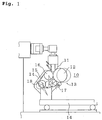
- an apparatus 10 of the present invention is constituted as described below so that a synthetic resin material continuously supplied and fed from an extrusion casting die 11 i.e. a molten synthetic resin material FO heated to its heat deformation temperature, is subjected to cool-pressing with a casting mechanism 13 provided with a casting roller 12 to produce a glossy thermoplastic synthetic resin sheet or film F of a predetermined thickness.
- a synthetic resin material continuously supplied and fed from an extrusion casting die 11 i.e. a molten synthetic resin material FO heated to its heat deformation temperature
- a casting mechanism 13 provided with a casting roller 12 to produce a glossy thermoplastic synthetic resin sheet or film F of a predetermined thickness.
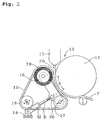
- the casting mechanism 13 comprises a casting roller 12 rotatably and horizontally supported by a frame 14; a flexible tubular metallic seamless casting sleeve 15 of which the outer surface is mirror finished, which rotates in contact with in an arcuate form a part of the outer peripheral surface of the casting roller 12 and nips and presses the synthetic resin material FO continuously supplied from the extrusion casting die 11 together with the casting roller 12; and a first support roller 16 and a second support roller 17 which face the outer peripheral surface of the casting roller 12 and are capable of adjusting the pressing force between the casting roller 12 and the surface of the casting sleeve 15.
- the casting roller 12 is also provided on the frame 14 so that it is movable close to or away from the support rollers 16, 17 (see Fig.3).
- the casting sleeve 15 one manufactured by Dimuco Co. was used, and as is defined in Claim 1 of JP-A-2001-330081, this is produced by subjecting a metallic cylindrical simple tube for which thermoplastic processing is applicable to a thin-wall treatment to reduce the thickness to a predetermined level, and then cutting the thin-walled cylindrical simple tube to a desired width to form a ring-like product.
- the casting sleeve 15 has a structure wherein three metallic support rollers 16, 17, 18 each having a horizontal axial line, including a third support roller 18 located away from the casting roller 12, are located at apexes of a triangle and the casting sleeve 15 is entrained around the respective rollers in a triangle form, and the casting sleeve 15 faces the outer peripheral surface of the casting roller 12 in an arcuate form at a portion along the outline of the outer peripheral surface of the casting roller 12.
- the support rollers may be constituted by 4 or more rollers.
- the frame 14 is designed to have wheels and be movable on an installation face (including rails), and be fixed at the position at which centering of the casting mechanism 13 and the die 11 is made.
- the tension of the casting sleeve 15 can be adjusted by adjusting the distances among the support rollers 16, 17, 18.
- the first support roller 16 near the die 11 is on its outer peripheral surface covered with an elastic layer 19 made of rubber or elastomer having heat resistance and elasticity; provided on the frame 14 so that it faces the outer peripheral surface of the casting roller 12 and is rotatable around the horizontal axial line thereof; and as indicated in Fig.3, bearings 20a, 20b are provided so that these are finely adjustable to move close to or away from the casting roller 12.
- the distance for nipping and pressing the sheet or film is designed to be adjustable in a circumferential direction along the outer peripheral surface of the casting roller 12.
- the second support roller 17 located at a distance in the downstream side from the first support roller 16 is provided in a direction to move close to or away from the outer peripheral surface of the casting roller 12 around the first support roller 16.
- the second support roller 17 is provided so that it will be movable in a direction to move close to or away from the outer peripheral surface of the casting roller 12, via an adjusting means, for example, a feed screw mechanism including an electric motor M, usually a ball screw mechanism B, wherein a bearing of the second support roller 17 is supported at the free end side of a support lever 26, of which the basal portion is pivotally mounted around the same axis as the axis of the first support roller 16, so that the support lever 26 is rotated around the horizontal axial line of the pivotally mounted basal portion.
- a feed screw mechanism including an electric motor M, usually a ball screw mechanism B
- a pneumatic or hydraulic cylinder actuator in addition to the electric motor M and the feed screw B, a pneumatic or hydraulic cylinder actuator, a rotation mechanism of the support lever 26 by use of a degree of insertion of cotter, and the like, may be used. Otherwise, even by a manual operation, no substantial change is brought about in the present invention.
- the third support roller 18 is provided on the frame 14 so that its position is changeable, for correction of the eccentric arrangement and deformation of the casting sleeve 15.
- the third support roller 18 is arranged in parallel or nonparallel to the other support rollers 16, 17 while keeping its axial line horizontally, and the distances between axes from these rollers can be changed or fixed.
- its mechanism is not particularly restricted, for example, the bearings at both sides of the third support roller 18 are all together supported by a support block 21 pivotally mounted on the frame 14 so that it can be widely moved close to or away from the other support rollers, and finely adjustable in parallel or nonparallel to the other support rollers 16, 17 for each side of the support block 21 corresponding to the left or right bearing 22.
- the third support roller 18 takes a part of a tension roller for adjusting the tension of the casting sleeve.
- the diameter of the casting roller 12 is about 1 to 3 times the diameter of the first support roller 16, and in the example indicated in the figure, it is about 1.6 times.
- the diameter of the first support roller 16 is 1 to 1.5 times the diameter of the second support roller 17 and the diameter of the third support roller 18, and in the example indicated in the figure, it is about 1.25 times.
- the present invention is not particularly restricted to this diameter ratio.
- the casting sleeve 15 is made of nickel and formed by a seamless process, and has a thickness of about 0.2 to 0.5 mm and a diameter of about 400 to 1,000 mm, and in the example, the thickness is about 0.3 mm and the diameter is about 500 mm.
- the one having the diameters of the support rollers 16, 17 and 18 of 250, 200 and 200 mm, respectively, is sufficient for practical use, and when the thickness is 0.3 mm, the casting sleeve 15 is deformed adequately and undergoes elastic deformation without overloading the peripheral surfaces of the support rollers 16, 17 and 18, and can adequately endure the repeated bending stress.
- the material for the casting sleeve instead of the one made of nickel, other nickel alloy, stainless steel, titanium alloy or the like may be used. Further, the thicknesses of the casting sleeve 15 and the film or sheet under processing in Fig.2 are illustrated exaggeratingly for convenience in explanation.
- a temperature-adjusting mechanism for heating or cooling the synthetic resin material FO is provided at an appropriate position, by which the temperature of the casting roller 12 and the circulated casting sleeve 15 is adjusted, whereby the temperature control of the synthetic resin material FO becomes possible.
- the temperature adjustment of the casting sleeve 15 may be made by providing a temperature-adjusting mechanism for heating or cooling in the support rollers 16, 17, 18. Further, in the casting sleeve 15, an apparatus for blowing a temperature-controlled air may be additionally provided.
- the frame 14 is moved on the installation face, centering of the casting mechanism 13 and the resin-ejecting port of the die 11 is conducted, and at the centering position, the frame 14 is fixed to the installation face with an appropriate fixing means.
- the outer peripheral surface of the casting roller 12 and the casting sleeve 15 entrained in a triangle form around the support rollers 16, 17, 18, are brought into contact to each other at a section between the first support roller 16 and the second support roller 17, the first support roller 16 and the second support roller 17 are moved close to the casting roller 12, the positions thereof are finely adjusted depending upon the thickness, material and the like of the film or sheet, and the third support roller 18 is moved away from the first and second support rollers 16, 17 to impart a desired tension to the casting sleeve 15.
- thermoplastic synthetic resin sheet or film F is continuously cast.
- the pressing force can be adjusted, and even if an irregular thickness portion or a partly irregular thickness portion exists within this section, the synthetic resin material FO extruded from the extrusion casting die 11 is fed into the gap between the casting roller 12 and the casting sleeve 15 by the deformation of the elastic layer 19, whereby the material is pressed into a uniform thickness.
- the second support roller 17 is moved away from the outer peripheral surface of the casting roller 12 by rotating the support lever 26 by use of the adjusting means, by which the nipping and pressing distance of the thermoplastic synthetic resin sheet or film by the outer peripheral surface of the casting roller 12 and the surface of the casting sleeve 15 i.e.
- the distance S where the sheet or film under processing is in closely contact with the casting roller 12 and the casting sleeve 15 is adjusted to be short, whereby it is possible to prevent the thermoplastic synthetic resin sheet or film from being firmly adhered to and hardly peeled from the outer peripheral surface of the casting roller 12 and the surface of the casting sleeve 15, and draw the cast thermoplastic synthetic resin sheet or film from the outer peripheral surface of the casting roller 12.
- the second support roller 17 is moved close to the outer peripheral surface of the casting roller 12, by which the nipping and pressing distance S of the thermoplastic synthetic resin sheet or film by the outer peripheral surface of the casting roller 12 and the surface of the casting sleeve 15 is adjusted to be long, whereby sufficient time for imparting gloss is ensured and the productivity is improved.
- the thickness of the sheet or film F is changed, if the width is kept the same, it is advisable to change the extrusion amount per unit time, and therefore, the distance at a part of nipping and pressing by the casting roller 12 and the casting sleeve 15 is changed, and correspondingly, the positions of the first and second support rollers 16 and 17 against the casting roller 12 are finely adjusted for change of the extrusion amount per unit time.
- these support rollers 16, 17 are moved close to the casting roller 12 to narrow the gap between the casting roller 12 and the casting sleeve 15, and when a thick sheet or film F is cast, the extrusion amount per unit time from the die 11 is increased, and the first and second support rollers 16 and 17 are moved away from the casting roller 12 correspondingly.
- the support roller 16 Since the support roller 16 has an elastic layer 19 on its surface, it will receive a resistance from the synthetic resin material FO under processing during the casting, and this elastic layer 19 undergoes elastic deformation, and a gap for absorbing the fluctuation of the thickness of the synthetic resin material is formed between the casting roller 12 and the casting sleeve 15. When no load is applied before processing, it is advisable to prevent the casting roller 12 from contacting the casting sleeve 15 to prevent formation of scars or the casting roller 12.
- the movement of the support rollers 16, 17 and 18 and the bearings 20, 22 is preferably made by fine adjustment with an electric motor of which the feed screws 23, 24 are connected to them via a reduction gear mechanism.
- the adjustment may be made by a pneumatic or hydraulic cylinder actuator, a degree of insertion of cotter, and the like, and the gap between the casting sleeve 15 and the casting roller 12 can likewise be adjusted.
- the feed screws 23, 24 and cotter may be actuated by the above actuating means. In addition, even by a manual operation no substantial change is brought about in the present invention.
- the tendency that the casting sleeve 15 shifts towards the low resistance side is unavoidably caused by slight temperature difference between left and right sides of the synthetic resin material FO layer to be supplied, slight difference in the degree of parallelization of support rollers 16, 17, 18, the difference in the resistance to plastic deformation and the like. Accordingly, in usual, correction is made by, for example, bringing the side edge of the casting sleeve 15 into contact with a guide, but by such a method, the casting sleeve is damaged.
- the position of the casting sleeve 15 can be easily returned correctly to the center of the support rollers 16, 17 and 18.
- the third support roller 18 may be returned to the angle at which the casting sleeve 15 will maintain the center position of the three support rollers 16, 17 and 18.
- the casting sleeve 15 can always be kept at the correct position by detecting the position of the side edge of the casting sleeve 15 with a line regulator, and corresponding to this detected value, changing the axial direction of the third support roller 18.
- a block guide 25 of the third support roller 18 is provided so that it may be moved or adjusted to upper and lower directions (see white arrow) with the left and right sides being adjustable independently, and may be fixed, in Fig.2.
- the distance where the left and right bearings 20a, 20b of the first and second support rollers 16 and 17 are close to the casting roller 12 may be finely adjusted for correction.
- the third support roller 18 is moved largely to the inside of the casting sleeve 15 to loosen the tension of the casting sleeve 15, and the casting roller 12 is moved away from the support rollers 16, 17, and then the support rollers 16, 17 and 18 are cantilevered, and the casting sleeve 15 is detached from the support rollers 16, 17, 18 and replaced with new one.
- This example is used as a post treatment of the production apparatus indicated in the above example; and as indicated in Fig.4, a cooling tank 30 for immersing a thermoplastic resin sheet or film F is provided close to the downstream side of the second support roller 17 facing the casting roller 12; and at the downstream side of the cooling tank 30, a draining blower 36 as a draining means for draining water on the cooled sheet or film F.
- a sheet-correcting and -heating device 37 having a plurality of heating rollers 39 for a reheating treatment within a range of from -40°C to +15°C of a heat deformation temperature of the sheet or film F to a degree such that a thermal strain of the sheet or film F can be corrected.
- the cooling tank 30 is provided on the frame 14 so that the cooling tank is movable upward and downward
- the sheet-correcting and -heating device 37 is provided on another frame 27 which is connectable to the frame 14, and the frames 14, 27 are movable on an installation face and fixed at a predetermined position.
- a plurality of guide rollers 31, 32, 33 are provided, and the film or sheet F is entrained around the rollers in a zigzag fashion and sequentially cooled.
- guide rollers 38 are provided to form a passage through which the film or sheet F usually does not pass, and by permitting the sheet or film F to pass through the guide rollers 38, the sheet or film can be sequentially reheated for annealing treatment without cooling in water.
- the transparency of the film or sheet F can further be improved.
- the film or sheet F is permitted to pass through the guide rollers 38 and supplied to the sheet-correcting and -heating device 37 without passing it through the cooling tank 30, for reheating treatment of the film or sheet F.
- one other than a crystalline thermoplastic synthetic resin film or sheet may sometimes be supplied directly to a secondary processing apparatus (not shown in the figure) without passing it through the cooling tank 30 and the sheet-correcting and -heating device 37.
- the present invention it is possible to obtain an apparatus being small in size and easy to handle, and cast a thermoplastic synthetic resin sheet or film stably and continuously. Further, even if the type of the synthetic resin material is changed, the sheet or film can be efficiently produced by preliminarily adjusting the nipping and pressing distance i.e. the distance where the sheet or film under processing is in closely contact with the casting roller and the casting sleeve, depending upon the degree of the peeling resistance to the casting roller or casting sleeve. Accordingly, it is possible to obtain a sheet or film excellent in gloss and smoothness from various types of synthetic resin materials.
Landscapes
- Engineering & Computer Science (AREA)
- Mechanical Engineering (AREA)
- Physics & Mathematics (AREA)
- Thermal Sciences (AREA)
- Extrusion Moulding Of Plastics Or The Like (AREA)
- Casting Or Compression Moulding Of Plastics Or The Like (AREA)
Applications Claiming Priority (3)
| Application Number | Priority Date | Filing Date | Title |
|---|---|---|---|
| JP2002361032A JP4441803B2 (ja) | 2002-12-12 | 2002-12-12 | 熱可塑性合成樹脂製シート又はフイルムの製造方法およびその装置 |
| JP2002361032 | 2002-12-12 | ||
| PCT/JP2003/015320 WO2004052620A1 (ja) | 2002-12-12 | 2003-12-01 | 熱可塑性合成樹脂製シート又はフイルムの製造方法及びその装置 |
Publications (2)
| Publication Number | Publication Date |
|---|---|
| EP1570971A1 true EP1570971A1 (de) | 2005-09-07 |
| EP1570971A4 EP1570971A4 (de) | 2008-10-15 |
Family
ID=32501024
Family Applications (1)
| Application Number | Title | Priority Date | Filing Date |
|---|---|---|---|
| EP03777170A Withdrawn EP1570971A4 (de) | 2002-12-12 | 2003-12-01 | Verfahren und vorrichtung zur herstellung von thermoplastischer kunstharzfolie oder thermoplastischem kunstharzfilm |
Country Status (6)
| Country | Link |
|---|---|
| US (1) | US7427372B2 (de) |
| EP (1) | EP1570971A4 (de) |
| JP (1) | JP4441803B2 (de) |
| KR (2) | KR20080031061A (de) |
| CN (2) | CN101239496A (de) |
| WO (1) | WO2004052620A1 (de) |
Cited By (1)
| Publication number | Priority date | Publication date | Assignee | Title |
|---|---|---|---|---|
| CN101913222A (zh) * | 2010-08-28 | 2010-12-15 | 乌海市盛远塑胶有限责任公司 | 不消光高光压延膜的生产工艺 |
Families Citing this family (26)
| Publication number | Priority date | Publication date | Assignee | Title |
|---|---|---|---|---|
| JP4870522B2 (ja) * | 2005-11-22 | 2012-02-08 | 富士フイルム株式会社 | 熱可塑性樹脂フィルムの製造方法 |
| JP2007168425A (ja) * | 2005-11-22 | 2007-07-05 | Fujifilm Corp | 熱可塑性樹脂フィルムの製造方法 |
| US20070216050A1 (en) * | 2006-03-17 | 2007-09-20 | Kim Sang M | Optical member fabricating apparatus and method and forming mold used for the same |
| TWI387526B (zh) * | 2006-06-06 | 2013-03-01 | Fujifilm Corp | 熱可塑性樹脂薄膜及其製法、以及偏光板、光學補償薄膜、抗反射薄膜與液晶顯示裝置 |
| US8287266B2 (en) | 2006-06-16 | 2012-10-16 | GKN Aerospace Services Structures, Corp. | Device for performing consolidation and method of use thereof |
| US8221109B2 (en) | 2006-12-05 | 2012-07-17 | Gold Tip, Llc | Material layering device |
| JP5390078B2 (ja) | 2007-07-06 | 2014-01-15 | 出光ユニテック株式会社 | ポリプロピレン成形品、シート状ポリプロピレン成形品およびポリプロピレン熱成形品の製造方法 |
| JP5401029B2 (ja) * | 2007-11-27 | 2014-01-29 | 住友化学株式会社 | 押出樹脂板およびその製造方法、並びに表面塗工板 |
| KR100933929B1 (ko) | 2009-08-26 | 2009-12-28 | 한화엘앤씨 주식회사 | 물탱크 제조용 열가소성 성형재 및 이를 이용한 물탱크용 패널의 제조방법 |
| US8770956B2 (en) * | 2009-12-30 | 2014-07-08 | The Procter & Gamble Company | System for producing high internal phase emulsion foam |
| CN102161222B (zh) * | 2011-01-05 | 2013-11-06 | 鑫永铨股份有限公司 | 硅胶的连续押出、压延方法 |
| CN103434112A (zh) * | 2013-08-09 | 2013-12-11 | 江苏金钱豹科技有限公司 | 橡胶件挤出装置 |
| CN103660249A (zh) * | 2013-11-28 | 2014-03-26 | 南宁市日建塑料包装有限责任公司 | 一种塑料片材机的片材厚度调整装置 |
| CN104002421A (zh) * | 2014-06-19 | 2014-08-27 | 东莞市雄林新材料科技股份有限公司 | 一种流延冷却装置 |
| CN107283696B (zh) * | 2017-07-21 | 2019-11-12 | 江苏中大包装材料有限公司 | 一种挤压式塑料薄膜无水冷却装置 |
| JP6597983B2 (ja) * | 2017-10-23 | 2019-10-30 | パナソニックIpマネジメント株式会社 | ロールプレス装置 |
| FR3076758B1 (fr) * | 2018-01-12 | 2021-03-05 | F D S | Procede de fabrication en continu d'une nappe gaufree et installation afferente |
| JP6897636B2 (ja) * | 2018-06-18 | 2021-07-07 | カシオ計算機株式会社 | 樹脂シートの製造方法 |
| EP3922479B1 (de) * | 2019-03-26 | 2023-07-19 | Kuroda, Takeshi | Verfahren und vorrichtung zur herstellung eines streifenförmigen, dreidimensionalen schmuckstücks aus thermoplastischem kunstharz |
| CN111167140A (zh) * | 2020-01-09 | 2020-05-19 | 许华清 | 一种薄膜浓缩用大型加工设备 |
| CN111267329B (zh) * | 2020-02-19 | 2021-10-29 | 浙江永裕家居股份有限公司 | 一种pvc自由发泡板生产设备 |
| FR3117919B1 (fr) * | 2020-12-23 | 2022-12-02 | Michelin & Cie | Procédé de fermeture en deux temps d’une installation d’extrusion a rouleau permettant un ajustement précis de l’entrefer de génération d’un profilé |
| CN114131821A (zh) * | 2021-11-17 | 2022-03-04 | 常州贝弗勒机械有限公司 | 热压片材冷却定型装置 |
| CN114714600B (zh) * | 2022-04-02 | 2022-11-01 | 浙江海利得复合新材料有限公司 | 一种基于tpu行程与冷却温度调节的tpu薄膜冷却成型装置 |
| CN117621423B (zh) * | 2023-11-07 | 2024-05-14 | 东莞市首誉电子材料有限公司 | 一种屏幕光学膜片的制备控制方法、装置、设备及介质 |
| CN119058000B (zh) * | 2024-11-04 | 2025-08-05 | 协氢(上海)新能源科技有限公司 | 一种氢燃料电池膜制备装置及制备方法 |
Family Cites Families (15)
| Publication number | Priority date | Publication date | Assignee | Title |
|---|---|---|---|---|
| US3241182A (en) * | 1963-04-23 | 1966-03-22 | Kessler Milton | Apparatus for the production of heavily embossed, thick plastic mats |
| DE2308696C3 (de) * | 1973-02-22 | 1979-04-05 | Hermann Berstorff Maschinenbau Gmbh, 3000 Hannover | Einrichtung zur kontinuierlichen Herstellung von Spanplatten, Faserplatten u.dgl |
| US4064929A (en) * | 1973-06-26 | 1977-12-27 | Secim | Apparatus for varying the mold length of endless belt molds using interchangeable belts |
| US5346385A (en) * | 1992-10-29 | 1994-09-13 | Valence Technology, Inc. | Chilled roller apparatus for achieving desired surface roughness characteristics of an electrode material on a web |
| JPH06170919A (ja) * | 1992-12-10 | 1994-06-21 | Aipetsuku:Kk | 熱可塑性樹脂シート又はフイルムの製造方法及びその装置 |
| US5707478A (en) * | 1993-02-25 | 1998-01-13 | Idemitsu Petrochemical Co., Ltd. | Method for producing thermoplastic resin sheet or film |
| JP3337261B2 (ja) * | 1993-03-04 | 2002-10-21 | 出光石油化学株式会社 | ポリプロピレン樹脂シート又はフィルムの製造方法 |
| JP3554570B2 (ja) * | 1993-12-28 | 2004-08-18 | 株式会社アイペック | 結晶性熱可塑性樹脂シート又はフイルムの製造方法 |
| US6306327B1 (en) * | 1995-11-14 | 2001-10-23 | Idemitsu Petrochemical Co., Ltd. | Producing method of a thermoplastic resin sheet and producing apparatus therefor |
| DE19605951C2 (de) * | 1996-02-17 | 1998-07-02 | Adolf Dipl Ing Seide | Glättwerk für die Herstellung von beidseitig geglätteten Platten und Folien aus thermoplastischem Kunststoff |
| JPH09239812A (ja) | 1996-03-08 | 1997-09-16 | Sekisui Chem Co Ltd | 光学フィルムの製造方法及び光学フィルム |
| CA2218970A1 (en) | 1996-10-22 | 1998-04-22 | Kenichi Fujiwara | Soft transparent polyolefin resin sheet and method for producing the same |
| CA2285926A1 (en) * | 1997-04-04 | 1998-10-15 | Atsushi Fujii | Multilayer thermoplastic resin sheet manufacturing method, and multilayer thermoplastic resin sheet |
| WO1999012722A1 (en) * | 1997-09-11 | 1999-03-18 | Eastman Kodak Company | Apparatus for forming a lenticular sheet and associated methods |
| JP4126802B2 (ja) | 1999-03-30 | 2008-07-30 | Jsr株式会社 | 熱可塑性樹脂シートの製造方法 |
-
2002
- 2002-12-12 JP JP2002361032A patent/JP4441803B2/ja not_active Expired - Lifetime
-
2003
- 2003-12-01 US US10/514,007 patent/US7427372B2/en not_active Expired - Fee Related
- 2003-12-01 WO PCT/JP2003/015320 patent/WO2004052620A1/ja not_active Ceased
- 2003-12-01 KR KR1020087007122A patent/KR20080031061A/ko not_active Abandoned
- 2003-12-01 KR KR1020047017770A patent/KR100847301B1/ko not_active Expired - Fee Related
- 2003-12-01 EP EP03777170A patent/EP1570971A4/de not_active Withdrawn
- 2003-12-01 CN CNA2008100810696A patent/CN101239496A/zh active Pending
- 2003-12-01 CN CNB2003801005271A patent/CN100379546C/zh not_active Expired - Fee Related
Cited By (1)
| Publication number | Priority date | Publication date | Assignee | Title |
|---|---|---|---|---|
| CN101913222A (zh) * | 2010-08-28 | 2010-12-15 | 乌海市盛远塑胶有限责任公司 | 不消光高光压延膜的生产工艺 |
Also Published As
| Publication number | Publication date |
|---|---|
| EP1570971A4 (de) | 2008-10-15 |
| WO2004052620A1 (ja) | 2004-06-24 |
| CN100379546C (zh) | 2008-04-09 |
| KR100847301B1 (ko) | 2008-07-18 |
| CN101239496A (zh) | 2008-08-13 |
| CN1692011A (zh) | 2005-11-02 |
| KR20050083569A (ko) | 2005-08-26 |
| US20050173828A1 (en) | 2005-08-11 |
| JP2004188868A (ja) | 2004-07-08 |
| JP4441803B2 (ja) | 2010-03-31 |
| US7427372B2 (en) | 2008-09-23 |
| KR20080031061A (ko) | 2008-04-07 |
Similar Documents
| Publication | Publication Date | Title |
|---|---|---|
| US7427372B2 (en) | Method and apparatus for producing thermoplastic synthetic resin sheet or film | |
| US9333699B2 (en) | Device and method for longitudinally stretching a film web | |
| CN103459126B (zh) | 微细结构转印膜的制造方法及制造装置 | |
| TW200822977A (en) | Coating method and coating device | |
| US20160151950A1 (en) | Apparatus for Producing Films Stretched In-Line | |
| CN113211772A (zh) | 用于对薄膜幅材进行单轴长度改变的装置和方法 | |
| KR20190013294A (ko) | 벨트프레스식 플라스틱시트 제조방법 및 제조장치 | |
| EP1491320B1 (de) | Verfahren zur herstellung von kunstharzfolie, kunstharzfolie und vorrichtung zur herstellung der folie | |
| JP4840817B2 (ja) | フィルムウェブを長手方向に引き抜く方法及び装置 | |
| JP2006056214A (ja) | 樹脂シートの製造方法 | |
| JP2008284875A (ja) | 熱可塑性合成樹脂製シート又はフイルムの製造方法およびその装置 | |
| WO2009116423A1 (ja) | 偏肉樹脂シートの製造方法 | |
| US20080088052A1 (en) | Method Of Producing A Resin Sheet | |
| JPWO2009123044A1 (ja) | 偏肉樹脂シートの製造方法 | |
| JP2008296592A (ja) | 熱可塑性合成樹脂製シート又はフイルムの製造方法およびその装置 | |
| JP2008246867A (ja) | 偏肉樹脂シートの製造方法及び装置 | |
| CN209920351U (zh) | 一种橡胶地板硫化机 | |
| KR20190113343A (ko) | 열가소성 수지 시트/필름의 제조 장치 | |
| CN102712767B (zh) | 使用辊装置制造聚烯烃片材的方法 | |
| KR20120046832A (ko) | 오버레이 스트립 부착장치 | |
| US20070240584A1 (en) | Method for operating a calendar machine for plastic melts | |
| JP3322323B2 (ja) | 熱可塑性樹脂シート又はフイルムの製造装置 | |
| CN115122622A (zh) | 一种纵向拉伸设备 | |
| JP2006056219A (ja) | 樹脂シートの製造方法 | |
| JP2006056216A (ja) | 樹脂シートの製造方法 |
Legal Events
| Date | Code | Title | Description |
|---|---|---|---|
| PUAI | Public reference made under article 153(3) epc to a published international application that has entered the european phase |
Free format text: ORIGINAL CODE: 0009012 |
|
| 17P | Request for examination filed |
Effective date: 20050121 |
|
| AK | Designated contracting states |
Kind code of ref document: A1 Designated state(s): AT BE BG CH CY CZ DE DK EE ES FI FR GB GR HU IE IT LI LU MC NL PT RO SE SI SK TR |
|
| RBV | Designated contracting states (corrected) |
Designated state(s): DE FR GB IT |
|
| A4 | Supplementary search report drawn up and despatched |
Effective date: 20080915 |
|
| STAA | Information on the status of an ep patent application or granted ep patent |
Free format text: STATUS: THE APPLICATION HAS BEEN WITHDRAWN |
|
| 18W | Application withdrawn |
Effective date: 20081120 |