EP1525913A2 - Abgasnachbehandlungsverfahren - Google Patents
Abgasnachbehandlungsverfahren Download PDFInfo
- Publication number
- EP1525913A2 EP1525913A2 EP04024961A EP04024961A EP1525913A2 EP 1525913 A2 EP1525913 A2 EP 1525913A2 EP 04024961 A EP04024961 A EP 04024961A EP 04024961 A EP04024961 A EP 04024961A EP 1525913 A2 EP1525913 A2 EP 1525913A2
- Authority
- EP
- European Patent Office
- Prior art keywords
- catalyst
- mercury
- exhaust gas
- oxide
- denitration
- Prior art date
- Legal status (The legal status is an assumption and is not a legal conclusion. Google has not performed a legal analysis and makes no representation as to the accuracy of the status listed.)
- Withdrawn
Links
Images




Classifications
-
- B—PERFORMING OPERATIONS; TRANSPORTING
- B01—PHYSICAL OR CHEMICAL PROCESSES OR APPARATUS IN GENERAL
- B01D—SEPARATION
- B01D53/00—Separation of gases or vapours; Recovering vapours of volatile solvents from gases; Chemical or biological purification of waste gases, e.g. engine exhaust gases, smoke, fumes, flue gases, aerosols
- B01D53/34—Chemical or biological purification of waste gases
- B01D53/74—General processes for purification of waste gases; Apparatus or devices specially adapted therefor
- B01D53/86—Catalytic processes
- B01D53/8665—Removing heavy metals or compounds thereof, e.g. mercury
-
- B—PERFORMING OPERATIONS; TRANSPORTING
- B01—PHYSICAL OR CHEMICAL PROCESSES OR APPARATUS IN GENERAL
- B01D—SEPARATION
- B01D53/00—Separation of gases or vapours; Recovering vapours of volatile solvents from gases; Chemical or biological purification of waste gases, e.g. engine exhaust gases, smoke, fumes, flue gases, aerosols
- B01D53/34—Chemical or biological purification of waste gases
-
- B—PERFORMING OPERATIONS; TRANSPORTING
- B01—PHYSICAL OR CHEMICAL PROCESSES OR APPARATUS IN GENERAL
- B01D—SEPARATION
- B01D53/00—Separation of gases or vapours; Recovering vapours of volatile solvents from gases; Chemical or biological purification of waste gases, e.g. engine exhaust gases, smoke, fumes, flue gases, aerosols
- B01D53/34—Chemical or biological purification of waste gases
- B01D53/46—Removing components of defined structure
- B01D53/54—Nitrogen compounds
- B01D53/56—Nitrogen oxides
-
- B—PERFORMING OPERATIONS; TRANSPORTING
- B01—PHYSICAL OR CHEMICAL PROCESSES OR APPARATUS IN GENERAL
- B01D—SEPARATION
- B01D53/00—Separation of gases or vapours; Recovering vapours of volatile solvents from gases; Chemical or biological purification of waste gases, e.g. engine exhaust gases, smoke, fumes, flue gases, aerosols
- B01D53/34—Chemical or biological purification of waste gases
- B01D53/46—Removing components of defined structure
- B01D53/64—Heavy metals or compounds thereof, e.g. mercury
-
- B—PERFORMING OPERATIONS; TRANSPORTING
- B01—PHYSICAL OR CHEMICAL PROCESSES OR APPARATUS IN GENERAL
- B01D—SEPARATION
- B01D53/00—Separation of gases or vapours; Recovering vapours of volatile solvents from gases; Chemical or biological purification of waste gases, e.g. engine exhaust gases, smoke, fumes, flue gases, aerosols
- B01D53/34—Chemical or biological purification of waste gases
- B01D53/74—General processes for purification of waste gases; Apparatus or devices specially adapted therefor
- B01D53/86—Catalytic processes
- B01D53/8621—Removing nitrogen compounds
- B01D53/8625—Nitrogen oxides
- B01D53/8628—Processes characterised by a specific catalyst
-
- B—PERFORMING OPERATIONS; TRANSPORTING
- B01—PHYSICAL OR CHEMICAL PROCESSES OR APPARATUS IN GENERAL
- B01D—SEPARATION
- B01D2255/00—Catalysts
- B01D2255/20—Metals or compounds thereof
- B01D2255/207—Transition metals
- B01D2255/20707—Titanium
-
- B—PERFORMING OPERATIONS; TRANSPORTING
- B01—PHYSICAL OR CHEMICAL PROCESSES OR APPARATUS IN GENERAL
- B01D—SEPARATION
- B01D2255/00—Catalysts
- B01D2255/20—Metals or compounds thereof
- B01D2255/207—Transition metals
- B01D2255/20723—Vanadium
-
- B—PERFORMING OPERATIONS; TRANSPORTING
- B01—PHYSICAL OR CHEMICAL PROCESSES OR APPARATUS IN GENERAL
- B01D—SEPARATION
- B01D2255/00—Catalysts
- B01D2255/90—Physical characteristics of catalysts
- B01D2255/92—Dimensions
- B01D2255/9205—Porosity
-
- B—PERFORMING OPERATIONS; TRANSPORTING
- B01—PHYSICAL OR CHEMICAL PROCESSES OR APPARATUS IN GENERAL
- B01D—SEPARATION
- B01D2257/00—Components to be removed
- B01D2257/40—Nitrogen compounds
- B01D2257/402—Dinitrogen oxide
-
- B—PERFORMING OPERATIONS; TRANSPORTING
- B01—PHYSICAL OR CHEMICAL PROCESSES OR APPARATUS IN GENERAL
- B01D—SEPARATION
- B01D2257/00—Components to be removed
- B01D2257/60—Heavy metals or heavy metal compounds
- B01D2257/602—Mercury or mercury compounds
-
- B—PERFORMING OPERATIONS; TRANSPORTING
- B01—PHYSICAL OR CHEMICAL PROCESSES OR APPARATUS IN GENERAL
- B01D—SEPARATION
- B01D53/00—Separation of gases or vapours; Recovering vapours of volatile solvents from gases; Chemical or biological purification of waste gases, e.g. engine exhaust gases, smoke, fumes, flue gases, aerosols
- B01D53/34—Chemical or biological purification of waste gases
- B01D53/74—General processes for purification of waste gases; Apparatus or devices specially adapted therefor
- B01D53/77—Liquid phase processes
-
- Y—GENERAL TAGGING OF NEW TECHNOLOGICAL DEVELOPMENTS; GENERAL TAGGING OF CROSS-SECTIONAL TECHNOLOGIES SPANNING OVER SEVERAL SECTIONS OF THE IPC; TECHNICAL SUBJECTS COVERED BY FORMER USPC CROSS-REFERENCE ART COLLECTIONS [XRACs] AND DIGESTS
- Y02—TECHNOLOGIES OR APPLICATIONS FOR MITIGATION OR ADAPTATION AGAINST CLIMATE CHANGE
- Y02C—CAPTURE, STORAGE, SEQUESTRATION OR DISPOSAL OF GREENHOUSE GASES [GHG]
- Y02C20/00—Capture or disposal of greenhouse gases
- Y02C20/10—Capture or disposal of greenhouse gases of nitrous oxide (N2O)
-
- Y—GENERAL TAGGING OF NEW TECHNOLOGICAL DEVELOPMENTS; GENERAL TAGGING OF CROSS-SECTIONAL TECHNOLOGIES SPANNING OVER SEVERAL SECTIONS OF THE IPC; TECHNICAL SUBJECTS COVERED BY FORMER USPC CROSS-REFERENCE ART COLLECTIONS [XRACs] AND DIGESTS
- Y02—TECHNOLOGIES OR APPLICATIONS FOR MITIGATION OR ADAPTATION AGAINST CLIMATE CHANGE
- Y02P—CLIMATE CHANGE MITIGATION TECHNOLOGIES IN THE PRODUCTION OR PROCESSING OF GOODS
- Y02P10/00—Technologies related to metal processing
- Y02P10/10—Reduction of greenhouse gas [GHG] emissions
- Y02P10/146—Perfluorocarbons [PFC]; Hydrofluorocarbons [HFC]; Sulfur hexafluoride [SF6]
Definitions
- the present invention relates to a method for treating an exhaust gas, which can effectively treat an exhaust gas also containing metal mercury together with a nitrogen oxide.
- mercury which is a harmful substance likewise a nitrogen oxide (NOx) is contained as metal mercury (Hg 0 ) or mercury halide such as mercury chloride (HgCl 2 ) in an exhaust gas in some cases.
- mercury Since when mercury is present as mercury halide, it is easily absorbed into water, it is relatively easy to capture and remove mercury. However, since when mercury is present as metal mercury, it is hardly absorbed in water, it is difficult to remove mercury.
- an active carbon adsorption method for example, a method of blowing an active carbon powder into an exhaust gas, and recovering mercury with a bag filter has been put into practice.
- sodium hypochlorite absorption method for example, a method of directly adding sodium hypochlorite to cooling water in a cooling tower in an exhaust gas treating system, an absorbing solution of a desulfurization absorption tower, supply water of a wet electrostatic precipitator or circulating water has been put into practice.
- both of the active carbon adsorption method and the sodium hypochlorite absorption method are put into practice only in treatment of a small amount of an exhaust gas such as a trash incineration exhaust gas and, thus, it is difficult to apply them to treatment of a large volume of a gas such as an electric power station.
- an object of the present invention is to provide a new method for treating an exhaust gas, which can effectively treat an exhaust gas containing a nitrogen oxide and metal mercury over a long term, and can be also applied to treatment of a large volume of an exhaust gas.
- the solution to the above problems is desired to be a solving measure which copes also with the problem of the catalyst deterioration due to the mercury accumulation. From such a standpoint, the present inventors further studied and, as a result, found out three new solving measures which can solve the aforementioned problems at a stroke.
- the present inventors thought that, if a catalyst in a reaction of changing the aforementioned metal mercury into mercury halide can be improved, allowing the catalyst to have high denitration activity, then there are the following advantages: the progress of the catalyst deterioration becomes slow, and further it becomes possible to treat the metal mercury and nitrogen oxide effectively with a small amount of catalyst, so the exhaust gas treatment system can be simplified, and the treatment cost can be reduced.
- the catalyst in a reaction of converting into mercury halide and, as a result, found that a specified catalyst can effectively function in halogenating metal mercury and, at the same time, has high denitration activity.
- the present inventors found out that, after treatment of a nitrogen oxide has first been made with a denitration catalyst, an equilibrium reaction of the aforementioned (1) equation is shifted in the presence of a halogen compound using a mercury halogenating catalyst towards right, to convert metal mercury into mercury halide which is easily captured and removed, when, in order to avoid reduction in performance of a denitration catalyst due to accumulation of mercury which is feared in the case where an exhaust gas containing not only a nitrogen oxide but also metal mercury is first subjected to nitrogen oxide treatment, it is enough to use a denitration catalyst having a specified total pore volume and, in order to efficiently perform treatment of a nitrogen oxide and halogenation of metal mercury, it is enough to set a temperature of each catalyst in a specified range.
- the present inventors thought that, as to the treatment of the nitrogen oxide, it is suitable to carry it out using a denitration catalyst, and found that it is enough to avoid the reduction in performance of a denitration catalyst due to accumulation of mercury by first converting metal mercury into mercury halide to remove the mercury halide before performing the above nitrogen oxide treatment.
- the present invention has been completed based on these findings.
- a first method for treating an exhaust gas comprises performing a reaction of changing metal mercury into mercury halide in the presence of a halogen compound and treatment of a nitrogen oxide, using a Ti-V-containing catalyst, upon treatment of an exhaust gas containing a nitrogen oxide and metal mercury.
- a second method for treating an exhaust gas comprises treating a nitrogen oxide using a denitration catalyst, and thereafter converting metal mercury into mercury halide in the presence of a halogen compound using a mercury halogenating catalyst, upon treatment of an exhaust gas containing a nitrogen oxide and metal mercury, wherein a catalyst having a total pore volume of 0.20 to 0.80 cm 3 /g as measured by a mercury pressing method is used as the denitration catalyst, a catalyst temperature of the denitration catalyst is a temperature higher than 300°C, and a catalyst temperature of the mercury halogenating catalyst is 300°C or lower.
- a third method according to the present invention for treating an exhaust gas comprises converting metal mercury into mercury halide in the presence of a halogen compound using a mercury halogenating catalyst, removing the mercury halide from an exhaust gas by capturing with an absorbing solution, and thereafter treating a nitrogen oxide using a denitration catalyst, upon treatment of an exhaust gas containing a nitrogen oxide and metal mercury.
- an exhaust gas containing a nitrogen oxide and metal mercury can be effectively treated over a long term. Moreover, since the method according to the present invention for treating an exhaust gas does not need to use active carbon or sodium hypochlorite in order to remove mercury, this can be also applied to treatment of a large volume of an exhaust gas.
- a first method according to the present invention for treating an exhaust gas is a method for treating an exhaust gas containing a nitrogen oxide and metal mercury, in which a reaction of changing metal mercury into mercury halide in the presence of a halogen compound and treatment of a nitrogen oxide are performed using a Ti-V-containing catalyst.
- treatment of a nitrogen oxide reduces a nitrogen oxide in an exhaust gas by contacting an exhaust gas with a Ti-V-containing catalyst in the presence of a reducing agent such as ammonia and urea.
- the denitration can be performed by passing an exhaust gas through an apparatus provided with a Ti-V-containing catalyst.
- a reaction of changing metal mercury into mercury halide in the presence of a halogen compound (hereinafter, referred to as "mercury halogenating reaction" in some cases in the item of the first method for treating an exhaust gas) is to convert metal mercury in an exhaust gas into mercury halide which is easily captured or removed, by contacting the exhaust gas with a Ti-V-containing catalyst in the presence of a halogen compound.
- the mercury halogenating reaction can be performed by passing an exhaust gas through an apparatus provided with a Ti-V-containing catalyst.
- the mercury halogenating reaction shifts an equilibrium reaction represented by the (1) equation towards right when the halogen compound is HCl. More particularly, examples of the halogen compound include HCl, and HBr. In the mercury halogenating reaction, metal mercury is converted into mercury chloride when the halogen compound is HCl, or converted into mercury bromide when the halogen compound is HBr.
- an amount of the halogen compound is not smaller than a stoichiometric amount, that is, 2 moles or more relative to 1 mole of metal mercury in an exhaust gas.
- a gaseous halogen compound is present in an exhaust gas in many cases and, when an exhaust gas to be subjected to treatment contains a gaseous halogen compound at an amount in the aforementioned range, the gaseous halogen compound may be utilized in a mercury halogenating reaction.
- an exhaust gas to be subjected to treatment does not contain a gaseous halogen compound, or when the exhaust gas contains the gaseous halogen compound but its amount is smaller than the aforementioned range, it is enough that a halogen compound is supplied to an apparatus in a form of a gas or a liquid, upon a mercury halogenating reaction.
- the Ti-V-containing catalyst means a catalyst containing titanium (Ti) and vanadium (V) as an essential component.
- Ti titanium
- V vanadium
- a content of titanium (Ti) occupied in the Ti-V-containing catalyst is not particularly limited, but is preferably 15 to 99.9% by weight, more preferably 30 to 99% by weight as expressed by a weight ratio in terms of oxide relative to a total weight of the Ti-V-containing catalyst.
- a content is less than 15% by weight, sufficient effect is not obtained in some cases due to reduction in a specific surface area.
- the content exceeds 99.9% by weight, there is a possibility that sufficient catalyst activity is not obtained.
- a content of vanadium (V) occupied in the Ti-V-containing catalyst is not particularly limited, but is preferably 0.1 to 25% by weight, more preferably 1 to 20% by weight as expressed by a weight ratio in terms of oxide relative to a total weight of the Ti-V-containing catalyst.
- the content is smaller than 0.1% by weight, there is a possibility that sufficient catalyst activity is not obtained.
- the content exceeds 25% by weight, there is a possibility that aggregation of catalyst components occurs, and sufficient performance is not obtained and, at the same time, the cost of a catalyst itself is increased, leading to increase in the exhaust gas treatment cost.
- the Ti-V-containing catalyst contains, in addition to titanium (Ti) and vanadium (V), one or more transition metals selected from the group consisting of silicon (Si), zirconium (Zr), aluminum (Al), tungsten (W) and molybdenum (Mo). These transition metals may be contained as independent metal oxide, and it is more preferable that they are contained by formation of a composite oxide with titanium. That is, it is more preferable that the Ti-V-containing catalyst contains a binary or ternary composite oxide of one or two kinds selected from the group consisting of silicon, zirconium, aluminum, tungsten and molybdenum, as well as titanium.
- a binary composite oxide such as Ti-Si, Ti-Zr, Ti-Al, Ti-W, and Ti-Mo
- a ternary composite oxide such as Ti-Si-Mo, Ti-Si-W, Ti-Si-Zr, Ti-Si-Al, Ti-Zr-Al, Ti-Zr-Mo, Ti-Zr-W, Ti-Al-Mo, and Ti-W-Mo are preferable in that a stable structure can be maintained, and high resistance to mercury can be exerted.
- a binary or ternary composite oxide of silicon (Si) and/or a transition metal containing molybdenum (Mo) as an essential component, and titanium (Ti), such as a binary composite oxide such as Ti-Si, and Ti-Mo, and a ternary composite oxide such as Ti-Si-Mo, Ti-Zr-Mo, Ti-Al-Mo, Ti-Si-W, and Ti-Mo-W is more preferable because denitration activity is higher.
- a binary or ternary composite oxide of a transition metal containing molybdenum (Mo) as an essential component, and titanium (Ti), such as a binary composite oxide such as Ti-Mo, and a ternary composite oxide such as Ti-Si-Mo, Ti-Zr-Mo, Ti-Al-Mo, and Ti-Mo-W is particularly preferable.
- a composite oxide refers to an oxide not showing a clear inherent peak assignable to a substance other than TiO 2 , and not showing an inherent peak assignable to anatase-type titanium oxide regarding TiO 2 , or showing a diffraction peak which is broader than a diffraction peak of anatase-type titanium oxide if showing the peak, in a X-ray diffraction pattern.
- a composition of each element in the binary or ternary composite oxide is not particularly limited, but for example, a content of a transition metal (one or more kinds selected from the group consisting of silicon (Si), zirconium (Zr), aluminum (Al), tungsten (W) and molybdenum (Mo)) other than titanium (Ti) is preferably 0.5 to 30% by weight, more preferably 1 to 30% by weight, further preferably 1 to 25% by weight as expressed in a weight ratio in terms of oxide of each element.
- a transition metal one or more kinds selected from the group consisting of silicon (Si), zirconium (Zr), aluminum (Al), tungsten (W) and molybdenum (Mo)
- a process for preparing the binary or ternary composite oxide is not particularly limited, but the previously known methods such as a precipitation method (coprecipitation), a sedimentation method and a kneading method can be adopted.
- a binary composite oxide of titanium (Ti) and molybdenum (Mo) can be obtained by dispersing a molybdenum compound such as ammonium paramolybdate and molybdic acid in an aqueous ammonia solution to obtain an aqueous solution (A), gradually adding an aqueous titanium compound solution dropwise to this aqueous solution (A) under stirring, filtering, washing and further drying the resulting slurry, and calcining this at an elevated temperature of 300 to 600°C.
- a ternary composite oxide of titanium (Ti), molybdenum (Mo) and a transition metal (any of Si, Zr, Al and W) can be obtained by further adding an aqueous transition metal (any of Si, Zr, Al and W) salt solution to the aforementioned aqueous solution (A), gradually adding an aqueous titanium compound solution dropwise to the resulting aqueous solution under stirring, filtering, washing and further drying the resulting slurry, and calcining this at an elevated temperature of 300 to 600°C.
- a process for preparing the Ti-V-containing catalyst is not particularly limited, but examples include a method of selecting any (one kind or two or more kinds) of the binary or ternary composite oxide containing titanium and the transition metal (one or more kinds selected from the group consisting of silicon (Si), zirconium (Zr), aluminum (Al), tungsten (W) and molybdenum (Mo)), a titanium oxide, and a mixture of a titanium oxide and the transition metal (one or more kinds selected from the group consisting of silicon (Si), zirconium (Zr), aluminum (Al), tungsten (W) and molybdenum (Mo)) oxide as a titanium-containing component, adding an aqueous solution containing a vanadium source together with an organic or inorganic molding aid generally used upon this kind of molding to a powder of the titanium-containing component, heating this while stirring or kneading to evaporate water to obtain an extrudable paste, molding this into a honeycomb with an extruding molding machine
- the titanium-containing component may be formed into a shape such as a cylindrical pellet and a lattice-like honeycomb in advance, calcining this, and impregnating this with an aqueous solution containing a vanadium source.
- the catalyst may be prepared by a method of directly kneading a powder of the titanium-containing component with a vanadium oxide powder.
- a source for supplying each element used upon preparation of the Ti-V-containing catalyst is not particularly limited.
- a titanium (Ti) source either of an inorganic compound and an organic compound may be used.
- an inorganic titanium compound such as titanium tetrachloride and titanium sulfate, or an organic titanium compound such as titanium oxalate and tetraisopropyl titanate can be used.
- a vanadium (V) source in addition to a vanadium oxide, any source can be used, whether an inorganic or organic compound, as far as it can produce a vanadium oxide by calcining.
- a molybdenum (Mo) source may be either of an inorganic compound and an organic compound.
- oxide, hydroxide, ammonium salt and halide containing molybdenum can be appropriately used.
- Specific examples include ammonium paramolybdate and molybdic acid.
- a silicon (Si) source can be appropriately used by selecting from an inorganic silicon compound such as colloidal silica, water glass, fine particulate silicon, silicon tetrachloride and silica gel, and an organic silicon compound such as tetraethyl silicate.
- a zirconium (Zr) source can be appropriately used by selecting from an inorganic zirconium compound such as zirconium chloride and zirconium sulfate, and an organic zirconium compound such as zirconium oxalate.
- An aluminum (Al) source can be appropriately used by selecting from an inorganic aluminum compound such as aluminum nitrate and aluminum sulfate, and an organic aluminum compound such as aluminum acetate.
- a tungsten (W) source can be appropriately used by selecting from tungsten oxide, ammonium paratungstate, ammonium metatungstate, and tungstic acid.
- a shape of the Ti-V-containing catalyst is not particularly limited, but the catalyst can be used by molding into a desired shape such as a honeycomb, a plate, a net, a circler cylinder, and a cylinder.
- a BET specific surface area of the Ti-V-containing catalyst is not particularly limited, but is preferably 20 to 300 m 2 /g, more preferably 30 to 250 m 2 /g.
- a total pore volume of the Ti-V-containing catalyst is not particularly limited, but a total pore volume as measured by a mercury pressing method is preferably 0.20 to 0.80 cm 3 /g, more preferably 0.25 to 0.75 cm 3 /g, further preferably 0.30 to 0.60 cm 3 /g.
- a total pore volume as measured by a mercury pressing method is preferably 0.20 to 0.80 cm 3 /g, more preferably 0.25 to 0.75 cm 3 /g, further preferably 0.30 to 0.60 cm 3 /g.
- the denitration and the mercury halogenating reaction may be performed at one-stage using one catalyst apparatus provided with the Ti-V-containing catalyst. Alternatively, they may be used at two or more-stage using two or more catalyst apparatuses each provided with the Ti-V-containing catalyst. In addition, when the denitration and the mercury halogenating reaction are performed at a two or more-stage by two or more catalyst apparatuses, the Ti-V-containing catalyst used in each apparatus may be the same or different.
- a catalyst temperature in a catalyst apparatus provided with the Ti-V-containing catalyst is preferably 150 to 550°C, more preferably 150 to 450°C, further preferably 150 to 300°C.
- a space velocity of an exhaust gas in a catalyst apparatus provided with the Ti-V-containing catalyst is not particularly limited, but is preferably 100 to 100,000 Hr -1 , more preferably 200 to 50,000 Hr -1 .
- the space velocity is smaller than 100 Hr -1 , an apparatus becomes too large, being ineffective.
- the space velocity exceeds 100,000 Hr -1 there is a tendency that efficacies of denitration and a mercury halogenating reaction are reduced.
- the treating conditions such as a catalyst temperature and a space velocity in a catalyst apparatus may be set at conditions different from respective apparatuses, or may be set at the same conditions as those of respective apparatuses.
- the first method according to the present invention for treating an exhaust gas it is preferable to remove mercury halide produced by the mercury halogenating reaction from an exhaust gas by capturing in an absorbing solution.
- Mercury halide is easily dissolved in an absorbing solution and, by dissolving mercury halide in an absorbing solution, it can be removed from an exhaust gas.
- the absorbing solution for example, water, or an aqueous alkali solution (specifically, an aqueous calcium carbonate solution, an aqueous sodium hydroxide solution, an aqueous sodium carbonate solution etc.) may be used.
- an exhaust gas containing a nitrogen oxide and metal mercury are first subjected to treatment of a nitrogen oxide using a denitration catalyst (hereinafter, referred to as "denitration treatment” in some cases in item of the second method for treating an exhaust gas) and, thereafter, subjected to treatment of converting metal mercury into mercury halide in the presence of a halogen compound using a mercury halogenating catalyst (hereinafter, referred to as "mercury halogenating treatment” in some cases in item of the method for treating an exhaust gas).
- denitration treatment a denitration catalyst
- mercury halogenating catalyst hereinafter, referred to as "mercury halogenating treatment” in some cases in item of the method for treating an exhaust gas.
- a nitrogen oxide in an exhaust gas is treated using a denitration catalyst. More particularly, in the denitration treatment, a denitration catalyst is contacted with an exhaust gas in the presence of a reducing agent such as ammonia and urea, and a nitrogen oxide in an exhaust gas is reduced to make harmless.
- the denitration treatment may be performed in a denitration apparatus which is provided in a normal exhaust gas system for denitration.
- the denitration catalyst is not particularly limited, but the previously known denitration catalysts may be used.
- a catalyst containing vanadium (V) and/or titanium (Ti) is preferable.
- a particularly preferable aspect of the catalyst containing vanadium (V) and/or titanium (Ti) will be explained in detail below.
- the denitration catalyst also contains one or more transition metals selected from the group consisting of silicon (Si), zirconium (Zr), aluminum (Al), tungsten (W) and molybdenum (Mo), in addition to vanadium (V) and/or titanium (Ti).
- transition metals may be contained as an independent metal oxide, but it is preferable that they are contained by formation of a composite oxide with titanium. That is, it is more preferable that the denitration catalyst contains a binary or ternary composite oxide of one kind or two kinds selected from the group consisting of silicon, zirconium, aluminum, tungsten and molybdenum, as well as titanium.
- a binary composite oxide such as Ti-Si, Ti-Zr, Ti-Al, Ti-W, and Ti-Mo
- a ternary composite oxide such as Ti-Si-Mo, Ti-Si-W, Ti-Si-Zr, Ti-Si-Al, Ti-Zr, Al, Ti-Zr-Mo, Ti-ZrW, Ti-Al-Mo, and Ti-W-Mo are preferable in that a stable structure can be maintained, and high resistance to mercury can be exerted.
- a binary or ternary composite oxide of a transition metal containing silicon (Si) as an essential component and titanium (Ti) such as a binary composite oxide such as Ti-Si, and a ternary composite oxide such as Ti-Si-Mo, Ti-Si-W, Ti-Si-Zr, and Ti-Si-Al is more preferable since denitration activity is higher.
- a composite oxide refers to an oxide not showing a clear inherent peak assignable to a substance other than TiO 2 and, regarding TiO 2 , not showing an inherent peak assignable to anatase-type titanium oxide, or showing a broader diffraction peak than a diffraction peak of anatase-type titanium oxide if showing the peak, in a X-ray diffraction pattern.
- a composition of each element in the titanium composite oxide is not particularly limited, but contents of elements (Si, Zr, Al, W, Mo etc.) other than titanium (Ti) occupied in a titanium composite oxide are preferably 0.5 to 30% by weight, more preferably 1 to 30% by weight, further preferably 1 to 25% by weight, respectively, as expressed by a weight ratio in terms of oxide of respective elements.
- a method for preparing the titanium composite oxide is not particularly limited, but the previously known methods such as a precipitation method (coprecipitation method), a segmentation method and a kneading method can be adopted.
- a titanium composite oxide can be obtained by dispersing a silicon compound such as colloidal silica in an aqueous ammonia solution to obtain an aqueous solution (A), gradually adding an aqueous titanium compound solution dropwise to this aqueous solution (A) under stirring, filtering, washing and further drying the resulting slurry, and calcining this at an elevated temperature of 300 to 600°C.
- a titanium composite oxide can be obtained by further adding an aqueous solution of a salt of Mo, Zr, Al or W to the aqueous solution (A), gradually adding an aqueous titanium compound solution dropwise to the resulting aqueous solution under stirring, filtering, washing and further drying the resulting slurry, and calcining this at an elevated temperature of 300 to 600°C.
- a source for supplying each element used upon preparation of the titanium composite compound is not particularly limited.
- a titanium (Ti) source, a silicon (Si) source, a zirconium (Zr) source, an aluminum (Al) source, a tungsten (W) source, and a molybdenum (Mo) source include the same sources as those described as a source for supplying each element used upon preparation of a Ti-V-containing catalyst in item of the first method for treating an exhaust gas.
- the denitration catalyst is preferably a catalyst in which vanadium (V) as an active species is added to the titanium composite oxide.
- the denitration catalyst is preferable a catalyst in which at least one kind of tungsten (W) and molybdenum (Mo) (hereinafter, abbreviated as "W•Mo") together with vanadium (V) is added as an active species in that denitration activity is higher.
- the denitration catalyst is a catalyst in which the active species (V, W, Mo) is added to the titanium composite oxide (when V is added to the titanium composite oxide, or when V and W•Mo are added to the Ti-Si binary composite oxide)
- a content of V or V and W•Mo is not particularly limited, but is preferably 0.1 to 25% by weight, more preferably 1 to 20% by weight relative to a total weight of a denitration catalyst, as expressed by a weight ratio in terms of oxide of each element (V, W, Mo).
- a method of adding V or V and W•Mo to the titanium composite oxide is not particularly limited, but there is exemplified a method of adding an aqueous solution of an active species (one or more kinds of vanadium source, tungsten source and molybdenum source) to be added together with an organic or inorganic molding aid which is generally used upon molding of this species, to a powder of the titanium composite oxide, heating while stirring and kneading, to evaporate water into an extrudable paste, molding this into a honeycomb with an extrusion molding machine, and drying and calcining this at an elevated temperature (preferably 200 to 600°C) in an air.
- an elevated temperature preferably 200 to 600°C
- a method of molding a powder of the titanium composite oxide into a shape such as a spherical or cylindrical pellet, or a lattice-like honeycomb in advance, calcining this, and impregnating this with an aqueous solution containing an active species source (one or more kinds of vanadium source, tungsten source and molybdenum source) to be added can be also adopted.
- preparation may be performed by a method of directly kneading a powder of the titanium composite oxide with a powder of oxide of an active species to be added (one or more kinds of vanadium oxide, tungsten oxide, and molybdenum oxide).
- each source for supplying V, W or Mo is not particularly limited. Examples include those described as a source for supplying each element used upon preparation of a Ti-V-containing catalyst in item of the first method for treating an exhaust gas.
- a shape of the denitration catalyst is the same as that of the Ti-V-containing catalyst described in item of the first method for treating an exhaust gas.
- a total pore volume as measured by a mercury pressing method is 0.20 to 0.80 cm 3 /g.
- a total pore volume of the denitration catalyst as measured by a mercury pressing method is preferably 0.25 to 0.75 cm 3 /g, more preferably 0.30 to 0.60 cm 3 /g.
- a BET specific surface area of the denitration catalyst is the same as a BET specific surface area of a Ti-V-containing catalyst described in item of the aforementioned first method for treating an exhaust gas.
- a treatment temperature in the denitration temperature that is, a catalyst temperature of the denitration catalyst is a temperature higher than 300°C, that is, a temperature exceeding 300°C. Thereby, high denitration efficacy can be obtained.
- a catalyst temperature of the denitration catalyst is preferably 310 to 550°C, more preferably 310 to 500°C, further preferably 330 to 500°C.
- a space velocity of an exhaust gas in the denitration treatment is not particularly limited, but is preferably 100 to 100000 Hr -1 , more preferably 200 to 50,000 Hr -1 .
- the mercury halogenating treatment is specifically treatment of performing a reaction for changing metal mercury in an exhaust gas into mercury halide in the presence of a halogen compound (hereinafter, referred to as "mercury halogenating reaction" in some cases in item of the second method for treating an exhaust gas).
- a halogen compound include HCl and HBr.
- metal mercury is converted into mercury chloride when the halogen compound is HCl, or is converted into mercury bromide when the halogen compound is HBr.
- a reaction for converting into mercury chloride specifically shifts an equilibrium reaction shown by the aforementioned (1) equation towards right.
- Mercury halogenating treatment is performed by passing an exhaust gas through a mercury halogenating apparatus provided with a mercury halogenating catalyst.
- an amount of the halogen compound is not smaller than a stoichiometric amount, that is, 2 moles or more relative to I mole of metal mercury in an exhaust gas.
- a gaseous halogen compound is present in an exhaust gas in many cases.
- mercury halogenating treatment can be performed by passing an exhaust gas through a mercury halogenating apparatus provided with a mercury halogenating catalyst.
- mercury halogenating treatment may be performed by passing an exhaust gas through a mercury halogenating apparatus provided with a mercury halogenating catalyst in the state where a halogen compound is supplied to the apparatus in a gas or liquid manner.
- the mercury halogenating catalyst include a catalyst in which an active species containing at least one kind of Pt, Ru, Rh, Pd, Ir, V, W, Mo, Ni, Co, Fe, Cr, Cu and Mn is added to one or more kinds selected from the group consisting of TiO 2 , SiO 2 , ZrO 2 , Al 2 O 3 , WO 3 , MoO 3 , titanium composite oxide and zeolite (hereinafter, referred to as "metal oxides A").
- an active species containing at least one kind of Pt, Ru, Rh, Pd, Ir, V, W, Mo, Ni, Co, Fe, Cr, Cu and Mn is added to one or more kinds selected from the group consisting of TiO 2 , SiO 2 , ZrO 2 , Al 2 O 3 , WO 3 , MoO 3 , titanium composite oxide and zeolite (hereinafter, referred to as "metal oxides A").
- the mercury halogenating catalyst is a catalyst in which a titanium composite oxide is used as the metal oxides A in that a stable structure can be maintained, and high resistance to mercury can be exerted.
- a titanium composite oxide a binary or ternary composite oxide of one kind or two kinds selected from the group consisting of silicon, zirconium, aluminum, tungsten and molybdenum, and titanium is preferable.
- Specifically examples include a binary composite oxide such as Ti-Si, Ti-Zr, Ti-Al, Ti-W, and Ti-Mo; a ternary composite oxide such as Ti-Si-Mo, Ti-Si-W, Ti-Si-Zr, Ti-Si-Al, Ti-Zr-Al, Ti-Zr-Mo, Ti-Zr-W, Ti-Al-Mo, and Ti-W-Mo.
- a binary composite oxide such as Ti-Si, Ti-Zr, Ti-Al, Ti-W, and Ti-Mo
- a ternary composite oxide such as Ti-Si-Mo, Ti-Si-W, Ti-Si-Zr, Ti-Si-Al, Ti-Zr-Al, Ti-Zr-Mo, Ti-Zr-W, Ti-Al-Mo, and Ti-W-Mo.
- a binary or ternary composite oxide of a transition metal containing molybdenum (Mo) as an essential component and titanium (Ti) such as a binary composite oxide such as Ti-Mo, and a ternary composite oxide such as Ti-Si-Mo, Ti-Zr-Mo, Ti-Al-Mo, and Ti-W-Mo is more preferable since mercury halogenating activity is higher.
- a composite oxide refers to an oxide not showing a clear inherent peak assignable to a substance other than TiO 2 and, regarding TiO 2 , not showing an inherent peak assignable to anatase-type titanium oxide, or showing a broader diffraction peak than a diffraction peak of anatase-type titanium oxide if shows the peak, in a X-ray diffraction pattern.
- a composition of each element in the titanium composite oxide is not particularly limited.
- contents of elements (Si, Zr, Al, W, Mo etc.) other than titanium (Ti) occupied in a titanium composite oxide are preferably 0.5 to 30% by weight, more preferably 1 to 30% by weight, further preferably 1 to 25% by weight, respectively, as expressed by a weight ratio in terms of oxide of each element.
- a method for preparing the titanium composite oxide is not particularly limited, but the previously known methods such as a precipitation method (coprecipitation method), a sedimentation method and a kneading method can be adopted.
- the titanium composite oxide can be obtained by dispersing a molybdenum compound such as ammonium paramolybdate and molybdic acid in an aqueous ammonia solution to obtain an aqueous solution (B), gradually adding an aqueous titanium compound solution dropwise to this aqueous solution (B) under stirring, filtering, washing and further drying the resulting slurry, and calcining this at an elevated temperature of 300 to 600°C.
- a molybdenum compound such as ammonium paramolybdate and molybdic acid
- the titanium composite oxide can be obtained by adding an aqueous solution of a salt of Si, Zr, Al or W to the aqueous solution (B), gradually adding an aqueous titanium compound solution dropwise to the resulting aqueous solution under stirring, filtering, washing and further drying the resulting slurry, and calcining this at an elevated temperature of 300 to 600°C.
- a source for supplying each element used upon preparation of the titanium composite oxide is not particularly limited.
- a titanium (Ti) source, a silicon (Si) source, a zirconium (Zr) source, an aluminum (Al) source, a tungsten (W) source and a molybdenum (Mo) source include the same sources as those described as a source for supplying each element used upon preparation of a Ti-V-containing catalyst in item of the first method for treating an exhaust gas.
- the mercury halogenating catalyst is a catalyst in which, among the aforementioned active species, vanadium (V) is added, in that resistance to mercury is high.
- a content of the vanadium (V) in the mercury halogenating catalyst is not particularly limited, but is preferably 0.1 to 25% by weight, more preferably 1 to 20% by weight relative to a total amount of a mercury halogenating catalyst as expressed by a weight ratio in terms of an oxide.
- a method of adding vanadium (V) is not particularly limited. Examples include a method of adding an aqueous solution containing a vanadium source together with an organic or inorganic molding aid which is generally used upon this kind of molding to a powder of the metal oxides A, heating the materials to evaporate water while mixing and kneading, into an extrudable paste, molding this into a honeycomb with an extrusion molding machine, and drying and calcining this at an elevated temperature (preferably 200 to 600°C) in an air.
- an elevated temperature preferably 200 to 600°C
- a method of molding a powder of the metal oxides A into a shape such as a cylindrical pellet, and a lattice-like honeycomb in advance, calcining this, and impregnating this with an aqueous solution containing a vanadium source can be also adopted.
- preparation may be performed by a method of directly kneading a powder of the metal oxides A with a metal of vanadium oxide.
- a vanadium source is not particularly limited, but examples include the same sources as those described as a source for supplying each element used upon preparation of a Ti-V-containing catalyst in the first method for treating an exhaust gas.
- a shape of the mercury halogenating catalyst is the same as that of a Ti-V-containing catalyst described in item of the first method for treating an exhaust gas.
- a total pore volume of the mercury halogenating catalyst is not particularly limited, but a total pore volume as measured by a mercury pressing method is preferably 0.20 to 0.80 cm 3 /g, more preferably 0.25 to 0.80 cm 3 /g, further preferably 0.25 to 0.70 cm 3 /g.
- a total pore volume of a mercury halogenating catalyst as measured by a mercury pressing method is smaller than 0.20 cm 3 /g, diffusion of a gas into the interior of a catalyst becomes insufficient, a reaction of converting metal mercury into mercury halide can not effectively proceed and, as a result, effect of removing mercury is reduced.
- a total pore volume of a mercury halogenating catalyst exceeds 0.80 cm 3 /g, a mechanical strength of a catalyst is reduced, a shape is easily collapsed by slight impact, and use as a catalyst becomes impossible.
- a BET specific surface area of the mercury halogenating catalyst is not particularly limited, but is preferably 20 to 400 m 2 /g, more preferably 30 to 350 m 2 /g.
- a treating temperature in the mercury halogenating treatment that is, a catalyst temperature of the mercury halogenating catalyst is 300°C or lower. Thereby, a mercury halogenating reaction can effectively proceed.
- a catalyst temperature of the mercury halogenating catalyst is preferably 60 to 300°C, more preferably 100 to 300°C, further preferably 100 to 280°C.
- a space velocity of an exhaust gas in the mercury halogenating treatment is not particularly limited, but is preferably 100 to 90,000 Hr -1 , more preferably 200 to 50,000 Hr -1 .
- a treating apparatus becomes too large, being inefficient.
- the velocity exceeds 90,000 Hr -1 , effect of a reaction for converting into mercury halide is reduced.
- mercury halide produced by the mercury halogenating treatment is removed by capturing in an absorbing solution.
- Mercury halide is easily dissolved in an absorbing solution, and can be removed from an exhaust gas by dissolving in an absorbing solution.
- the absorbing solution the same absorbing solution as that described in item of the first method for treating an exhaust gas may be used.
- an exhaust gas containing a nitrogen oxide and metal mercury is first subjected to treatment of converting metal mercury into mercury halide using a mercury halogenating catalyst (hereinafter, referred to as "mercury halogenating treatment” in some cases in item of the third method for treating an exhaust gas), then, subjected to treatment of removing the mercury halide by capturing in an absorbing solution (hereinafter, referred to as “mercury removing treatment” in some cases in item of the third method for treating an exhaust gas) and thereafter, treatment of a nitrogen oxide using a denitration catalyst (hereinafter, referred to as "denitration treatment” in some cases in item of the third method for treating an exhaust gas).
- a mercury halogenating catalyst hereinafter, referred to as "mercury halogenating treatment” in some cases in item of the third method for treating an exhaust gas
- mercury halogenating treatment is treatment of performing a reaction for changing metal mercury in an exhaust gas into mercury halide in the presence of a halogen compound (hereinafter, referred to as "mercury halogenating reaction" in some cases in term of the third method for treating an exhaust gas), and its treating temperature is not limited, as in the case of the mercury halogenating treatment described in term of the second method for treating an exhaust gas. That is, details of the mercury halogenating reaction, a halogen compound and an amount thereof, a mercury halogenating catalyst, and a space velocity of an exhaust gas are as described above.
- a treatment temperature in the mercury halogenating treatment is preferably 60 to 450°C, more preferably 100 to 350°C, further preferably 100 to 300°C.
- mercury halide produced by the mercury halogenating treatment is removed by capturing it in an absorbing solution. More particularly, utilizing the fact that mercury halide is easily dissolved in an absorbing solution, mercury halide is removed from an exhaust gas by dissolving in an absorbing solution.
- the same solution as that described in item of the first method for treating an exhaust gas may be used.
- a nitrogen oxide in an exhaust gas is treated using a denitration catalyst.
- a nitrogen oxide in an exhaust gas is reduced to make harmless by contacting a denitration catalyst with an exhaust gas in the presence of a reducing agent such as ammonia and urea.
- a reducing agent such as ammonia and urea.
- the denitration treatment may be performed in a denitration apparatus provided in a conventional exhaust gas system for denitration.
- the denitration catalyst is not particularly limited, but the previously known denitration catalysts can be used.
- a catalyst containing vanadium (V) and/or titanium (Ti) is preferable as described in item of the second method for treating an exhaust gas.
- the denitration catalyst used in the third method for treating an exhaust gas there is not especially such as limitation on the total pore volume or the usage temperature like in the second method for treating an exhaust gas,
- particularly preferred modes of the aforementioned catalyst containing vanadium (V) and/or titanium (Ti) including the above total pore volume and usage temperature) (namely, such as shape and BET specific surface area of the denitration catalyst) (namely, such as shape and BET specific surface area of the denitration catalyst)
- V vanadium
- Ti titanium
- a total pore volume of the denitration catalyst is not particularly limited, but a total pore volume as measured by a mercury pressing method is preferably 0.20 to 0.80 cm 3 /g, more preferably 0.25 to 0.75 cm 3 /g, further preferably 0.30 to 0.60 cm 3 /g.
- a BET specific surface area of the denitration catalyst is favorably the same as a BET specific surface area of the denitration catalyst described in terms of the second method for treating an exhaust gas.
- a treating temperature in the denitration treatment is preferably 150 to 550°C, more preferably 150 to 500°C, further preferably 150 to 400°C.
- a space velocity of an exhaust gas in the denitration treatment is favorably the same as a space velocity of an exhaust gas in the denitration treatment described in the second method for treating an exhaust gas:
- a Ti-Si-Mo composite oxide was prepared as follows: To a mixed solution of 6.7 kg of a silica sol ("SNOWTEX-30" manufactured by Nissan Chemical Industries, Ltd., containing 30 wt% in terms of SiO 2 ), 103 kg of industrial aqueous ammonia (containing 25 wt% NH 3 ), and 58 liter of water was added 2.25 kg of molybdic acid, and the mixture was stirred well to prepare a uniform solution.
- a silica sol SNOWTEX-30 manufactured by Nissan Chemical Industries, Ltd., containing 30 wt% in terms of SiO 2
- 103 kg of industrial aqueous ammonia containing 25 wt% NH 3
- 58 liter of water was added 2.25 kg of molybdic acid, and the mixture was stirred well to prepare a uniform solution.
- vanadium was added to the Ti-Si-Mo composite oxide as follows: 1.29 kg of ammonium metavanadate, 1.67 kg of oxalic acid and 0.4 kg of monoethanolamine were mixed and dissolved in 8 liter of water, to prepare a uniform vanadium-containing solution. 19 kg of the Ti-Si-Mo composite oxide as described above was placed into a kneader, a total amount of the vanadium-containing solution together with a molding aid containing an organic binder (starch 1.5 kg) was added, and the mixture was stirred well.
- the materials were mixed well with a blender while adding an appropriate amount of water, sufficiently kneaded with a continuous kneader, and extrusion-molded into a honeycomb.
- the resulting molded product was dried at 60°C, and calcined at 450°C for 5 hours to obtain a Ti-V-containing catalyst (1).
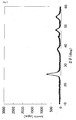
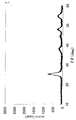
- FIG. 1 A X-ray diffraction pattern of the Ti-V-containing catalyst (1) is shown in Fig. 1. Since in Fig. 1, a clear inherent peak assignable to a substance other than TiO 2 was not recognized, and a broad peak assignable to anatase-type titanium oxide was recognized, it was confirmed that the Ti-V-containing catalyst (1) is a composite oxide. As a reference, a X-ray diffraction pattern of TiO 2 is shown in Fig. 5 (the Fig. 5 is referenced also in the following Production Examples).
- a Ti-Mo composite oxide was prepared as follows: 1.6 kg of molybdic acid was added to a mixed solution of 120 kg of industrial aqueous ammonia (containing 25 wt% NH 3 ) and 140 liter of water, and the mixture was stirred well to completely dissolve molybdic acid, to prepare a uniform solution. To this solution was gradually added dropwise 266 liter of a solution of titanyl sulfate in sulfuric acid (manufactured by Tayca Corporation: 70 g/liter as TiO 2 , 287 g/liter as H 2 SO 4 ,), to produce precipitates, and an appropriate amount of aqueous ammonia was added to adjust a pH to 4.
- vanadium was added to the Ti-Mo composite oxide as follows: 1.29 kg of ammonium metavanadate, 1.67 kg of oxalic acid and 0.4 kg of monoethanolamine were mixed and dissolved in 8 liter of water, to prepare a uniform vanadium-containing solution. 19 kg of the Ti-Mo composite oxide powder as obtained above was placed into a kneader, and a total amount of the vanadium-containing solution together with a molding aid containing an organic binder (starch 1.5 kg) was added, followed by sufficient stirring. Further, the materials were mixed well with a blender while adding an appropriate amount of water, sufficiently kneaded with a continuous kneader, and extrusion-molded into a honeycomb. The resulting molded product wad dried at 60°C, and calcined at 450°C for 5 hours to obtain a Ti-V-containing catalyst (2).
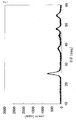
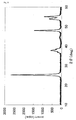
- FIG. 2 A X-ray diffraction pattern of the Ti-V-containing catalyst (2) is shown in Fig. 2. Since in Fig. 2, a clear inherent peak assignable to a substance other than TiO 2 was not recognized, and a broad peak assignable to anatase-type titanium oxide was recognized, it was confirmed that the Ti-V-containing catalyst (2) is a composite oxide.
- a Ti-Si-composite oxide was prepared as follows: 10 kg of a silica sol ("SNOWTEX-30" manufactured by Nissan Chemical Industries, Ltd.; containing 30 wt% in terms of SiO 2 ), 104 kg of industrial aqueous ammonia (containing 25 wt% NH 3 ) and 73 liter of water were mixed, to prepare a uniform solution. To this solution was gradually added 243 liter of a solution of titanyl sulfate in sulfuric acid (manufactured by Tayca Corporation: containing 70 g/liter as TiO 2 , 287 g/liter as H 2 SO 4 ) dropwise while stirring.
- vanadium and tungsten were added to the Ti-Si composite oxide as follows: 1.29 kg of ammonium metavanadate, 1.12 kg of ammonium paratungstate, 1.67 kg of oxalic acid and 0.85 kg of monoethanolamine were mixed and dissolved in 8 liter of water, to prepare a uniform vanadium and tungsten-containing solution. 18 kg of the Ti-Si composite oxide powder as obtained above was placed into a kneader, a total amount of the vanadium and tungsten-containing solution together with a molding aid containing an organic binder (starch 1.5 kg) was added, and the mixture was stirred well.
- the materials were mixed well with a blender while adding an appropriate amount of water, sufficiently kneaded with a continuous kneader and extrusion-molded into a honeycomb.
- the resulting molding product was dried at 60°C, and calcined at 450°C for 5 hours to obtain a Ti-V-containing catalyst (3).
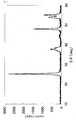
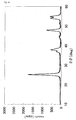
- FIG. 3 A X-ray diffraction pattern of the Ti-V-containing catalyst (3) is shown in Fig. 3. Since in Fig. 3, a clear inherent peak assignable to a substance other than TiO 2 was not recognized, and a broad peak assignable to anatase-type titanium oxide was recognized, it was confirmed that the Ti-V-containing catalyst (3) is a composite oxide.
- Vanadium was added to the Ti-Si composite oxide obtained as in Production Example 1-3 as follows: 1.29 kg of ammonium metavanadate, 1.67 kg of oxalic acid, and 0.4 kg of monoethanolamine were mixed and dissolved in 8 liter of water, to prepare a uniform vanadium-containing solution. 19 kg of the Ti-Si composite oxide powder obtained as in Production Example 3 was placed into a kneader, and a total amount of the vanadium-containing solution together with a molding aid containing an organic binder (starch 1.5 kg) was added, followed by sufficient stirring.
- the materials were mixed well with a blender while adding an appropriate amount of water, sufficiently kneaded with a continuous kneader, and extrusion-molded into a honeycomb.
- the resulting molded product was dried at 60°C, and calcined at 500°C for 5 hours to obtain a Ti-V-containing catalyst (4).
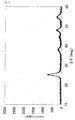
- FIG. 4 A X-ray diffraction pattern of the Ti-V-containing catalyst (4) is shown in Fig. 4. Since in Fig. 4, a clear inherent peak assignable to a substance other than TiO 2 was not recognized, and a broad peak assignable to anatase-type titanium oxide was recognized, it was confirmed that the Ti-V-containing catalyst (4) is a composite oxide.
- a mimic exhaust gas placed into an exhaust gas container 1 was introduced into a catalyst apparatus 2 provided with a Ti-V-containing catalyst (1), and treatment was performed in the apparatus under the aforementioned treating condition.
- a catalyst temperature of the catalyst apparatus 2 was controlled by a temperature controlling apparatus 3.
- a mimic exhaust gas which had passed through the catalyst apparatus 2 was introduced in an absorbing solution (3% aqueous calcium carbonate solution) 5 in an absorbing bottle 4, and recovered in a recovering bottle 6.
- Denitration rate (%) ⁇ (NOx concentration of gas a) - (NOx concentration of gas b) ⁇ ⁇ (NOx concentration of gas a) ⁇ 100
- Mercury removal rate (%) ⁇ (Hg concentration of gas a) - (Hg concentration of gas b) ⁇ ⁇ (Hg concentration of gas a) ⁇ 100
- Example 1-1 According to the same manner as that of Example 1-1 except that each catalyst shown in Table 1 was used in place of the Ti-V-containing catalyst (1), the same mimic exhaust gas as that of Example 1-1 was treated. And, a denitration rate and a mercury removal rate were obtained as in Example 1-1. Results are shown in Table 1.
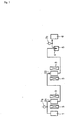
- a mimic exhaust gas placed into an exhaust gas container 1 was introduced into a first stage catalyst apparatus 21 provided with a Ti-V-containing catalyst (1), and treatment was performed in the apparatus under the first stage treating condition.
- a mimic exhaust gas was introduced into a second stage catalyst apparatus 22 provided with a Ti-V-containing catalyst (1) from the first stage catalyst apparatus 21, and treatment was performed in the apparatus under the second stage treating condition.
- each catalyst temperature of the catalyst apparatus 21 and the catalyst apparatus 22 was controlled by a temperature controlling apparatus 3.
- a mimic exhaust gas which had passed through the second stage catalyst apparatus 22 was introduced into an absorbing solution (3% aqueous calcium carbonate solution) 5 in an absorbing bottle 4, and recovered in a recovering a bottle 6.
- Example 1-5 According to the same manner as that of Example 1-5 except that treating condition at the first stage catalyst apparatus 21 was a space velocity of 10000 Hr -1 and a catalyst temperature of 150°C, and treating condition at the second stage catalyst apparatus 22 was a space velocity of 25000 Hr -1 and a catalyst temperature of 240°C, the same mimic exhaust gas as that of Example 1-5 was treated. And, a denitration rate and a mercury removal rate were obtained as in Example 1-5. Results are shown in Table 1.
- Example 1-1 Ti-V-containing catalyst (1) 1 stage 99.4 99.3 91.0 90.3
- Example 1-2 Ti-V-containing catalyst (2) 1 stage 99.2 98.4 90.1 86.0
- Example 1-3 Ti-V-containing catalyst (3) 1 stage 98.1 96.6 86.5 81.8
- Example 1-4 Ti-V-containing catalyst (4) 1 stage 97.6 95.0 82.1 74.7
- Example 1-5 Ti-V-containing catalyst (1) 2 stages 98.3 96.8 89.0 84.7
- Example 1-6 Ti-V-containing catalyst (1) 2 stages 98.2 95.9 88.0 81.7 Comparative Example 1-1 Catalyst (C1) 1 stage 81.8 69.6 65.0 52.0
- the Ti-V-containing catalyst (3) obtained in Production Example 1-3 was used as a denitration catalyst (1))
- FIG. 8 A X-ray diffraction pattern of a denitration catalyst (2) is shown in Fig. 8. Since in Fig. 8, a clear inherent peak assignable to a substance other that TiO 2 was not recognized, and a broad peak assignable to anatase-type titanium oxide was recognized, it was confirmed that the denitration catalyst (2) is a composite oxide.
- Vanadium and tungsten were added to a commercially available titanium oxide powder as follows: 1.29 kg of ammonium metavanadate, 1.12 kg of ammonium paratungstate, 1.67 kg of oxalic acid, and 0.85 kg of monoethanolamine were mixed and dissolved in 8 liter of water, to prepare a uniform vanadium and tungsten-containing solution. 18 kg of a commercially available titanium oxide powder ("DT-51", manufactured by Millennium Inorganic Chemicals Limited) was placed into a kneader, and a total amount of the vanadium and tungsten-containing solution together with a molding aid containing an organic binder (starch 1.5 kg) was added, followed by sufficient starring.
- DT-51 manufactured by Millennium Inorganic Chemicals Limited
- the materials were mixed well with a blender while adding an appropriate amount of water, sufficiently kneaded with a continuous kneader and extrusion-moldered into a honeycomb.
- the resulting molded product was dried at 60°C, and calcined at 450°C for 5 hours to obtain a denitration catalyst (3).
- FIG. 9 A X-ray diffraction pattern of the denitration catalyst (3) is shown in Fig. 9. Since in Fig. 9, a clear inherent peak assignable to a substance other than TiO 2 was not recognized, and a sharp peak assignable to anatase-type titanium oxide was recognized, it was confirmed that the denitration catalyst (3) includes a titanium simple oxide as a main component.
- a Ti-W composite oxide was prepared as follows: 20 kg of an aqueous ammonium metatungstate (manufactured by Nippon Inorganic Colour & Chemical Co., Ltd.: containing 50 wt% as WO 3 ) solution was added to a mixed solution of 255 kg of industrial aqueous ammonia (containing 25 wt% NH 3 ) and 140 liter of water, and the mixture was stirred well to prepare a uniform solution.
- vanadium was added to the Ti-W composite oxide as follows: 1.29 kg of ammonium metavanadate, 1.67 kg of oxalic acid, and 0.4 kg of monoethanolamine were mixed and dissolved in 8 liter of water, to prepare a uniform vanadium-containing solution. 19 kg of the Ti-W composite oxide powder as obtained above was placed into a kneader, and a total amount of the vanadium-containing solution together with a molding aid containing an organic binder (starch 1.5 kg) was added, followed by sufficient starring. Further, the materials were mixed well with a blender while adding an appropriate amount of water, sufficiently kneaded with a continuous kneader, and extrusion-molded into a honeycomb. The resulting molding product was dried at 60°C, and calcined at 450°C for 5 hours to obtain a mercury halogenating catalyst (1).
- FIG. 10 A X-ray diffraction pattern of the mercury halogenating catalyst (1) is shown in Fig. 10. Since in Fig. 10, a clear inherent peak assignable to a substance other than TiO 2 was not recognized, and a broad peak assignable to anatase-type titanium oxide was recognized, it was confirmed that the mercury halogenating catalyst (1) is a composite oxide.
- a Ti-Si-Mo composite oxide was prepared as follows: 3.4 kg of molybdic acid was added to a mixed solution of 3.3 kg of a silica sol ("SNOWTEX-30" manufactured by Nissan Chemical Industries, Ltd.; containing 30 wt% in terms of SiO 2 ), 103 kg of industrial aqueous ammonia (containing 25 wt% NH 3 ) and 58 liter of water, and the mixture was stirred well to prepare a uniform solution.
- vanadium was added to the Ti-Si-Mo composite oxide as follows: 1.29 kg of ammonium metavanadate, 1.67 kg of oxalic acid and 0.4 kg of monoethanolamine were mixed and dissolved in 8 liter of water, to prepare a uniform vanadium-containing solution. 19 kg of the Ti-Si-Mo composite oxide powder as obtained above was placed into a kneader, and a total amount of the vanadium-containing solution together with a molding aid containing an organic binder (starch 1.5 kg) was added, followed by sufficient stirring. Further, the materials were mixed well with a blender while adding an appropriate amount of water, kneaded sufficiently with a continuous kneader, and extrusion-molded into a honeycomb. The resulting molded product was dried at 60°C, and calcined at 450°C for 5 hours to obtain a mercury halogenating catalyst (2).
- FIG. 11 A X-ray diffraction pattern of the mercury halogenating catalyst (2) is shown in Fig. 11. Since in Fig. 11, a clear inherent peak assignable to a substance other than TiO 2 was not recognized, and a broad peak assignable to anatase-type titanium oxide was recognized, it was confirmed that the mercury halogenating catalyst (2) is a composite oxide.
- a Ti-Si composite oxide was prepared as follows: 6.7 kg of a silica sol ("SNOWTEX-30" manufactured by Nissan Chemical Industries, Ltd.; containing 30 wt% in terms of SiO 2 ), 110 kg of industrial aqueous ammonia (containing 25 wt% NH 3 ) and 70 liter of water were mixed to prepare a uniform solution. To this solution was gradually added 257 liter of a solution of titanyl sulfate in sulfuric acid (manufactured by Tayca Corporation: containing 70 g/liter as TiO 2 , 287 g/liter. as H 2 SO 4 ) dropwise while stirring.
- vanadium was added to the Ti-Si composite oxide as follows: 1.29 kg of ammonium metavanadate, 1.67 kg of oxalic acid and 0.4 kg of monoethanolamine were mixed and dissolved in 8 liter of water, to prepare a uniform vanadium-containing solution. 19 kg of the Ti-Si composite oxide powder as obtained above was placed into a kneader, and a total_ amount of the vanadium-containing solution together with a molding aid containing an organic binder (starch 1.5 kg) was added, followed by sufficient stirring. Further, the materials were mixed well with a blender while adding an appropriate amount of water, kneaded sufficiently with a continuous kneader and extrusion - molded into a honeycomb. The resulting molding product was dried at 60°C, and calcined at 500°C for 5 hours to obtain a mercury halogenating catalyst (3).
- FIG. 12 A X-ray diffraction pattern of the mercury halogenating catalyst (3) is shown in Fig. 12. Since in Fig. 12, a clear inherent peak assignable to a substance other than TiO 2 was not recognized, and a broad peak assignable to anatase - type titanium oxide was recognized, it was confirmed that the mercury halogenating catalyst (3) is a composite oxide.
- a mimic exhaust gas having the following gas composition was treated using a mercury halogenating catalyst and a denitration catalyst shown in Table 2 at a catalyst temperature shown in Table 2, respectively.
- a space velocity in a mercury halogenating apparatus was 3000 Hr -1 and a space velocity in a denitration apparatus was 19000 Hr -1 .
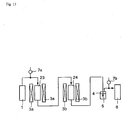
- a mimic exhaust gas placed in an exhaust gas container 1 was introduced into a denitration apparatus 23, and a nitrogen oxide was treated in the apparatus.
- a temperature of a denitration catalyst in the denitration apparatus 23 was controlled by a temperature controlling apparatus 3a.
- a mimic exhaust gas was introduced into a mercury halogenating apparatus 24 provided with a mercury halogenating catalyst from the denitration apparatus 23, and metal mercury was converted into mercury halide in the apparatus.
- a temperature of a mercury halogenating catalyst in a mercury halogenating apparatus 24 was controlled by a temperature controlling apparatus 3b.
- a mimic exhaust gas which had passed through the mercury halogenating apparatus 24 was introduced into an absorbing solution (3% aqueous calcium carbonate solution) 5 of an absorbing bottle 4, and mercury halide in a mimic exhaust gas was absorbed in an absorbing solution. Thereafter, a mimic exhaust gas was introduced into a recovering bottle 6 from the absorbing bottle 4, and recovered.
- Denitration rate (%) ⁇ (NOx concentration of gas a) - (NOx concentration of gas b) ⁇ ⁇ (NOx concentration of gas a) ⁇ 100
- Mercury removal rate (%) ⁇ (Hg concentration of gas a) - (Hg concentration of gas b) ⁇ ⁇ (Hg concentration of gas a) ⁇ 100
- Example 2-1 to 2-2 In the same exhaust gas treating system as that of Examples 2 -1 to 2-2, the same mimic exhaust gas as that of Example 2-1 to 2-2 was treated using a mercury halogenating catalyst and a denitration catalyst shown in Table 2 at a catalyst temperature shown in Table 2, respectively. Upon treatment, a space velocity in a mercury halogenating apparatus and a space velocity in the denitration apparatus were the same as those of Examples 2-1 to 2-2. And, a denitration rate and a mercury removal rate were obtained as in Examples 2-1 to 2-2. Results are shown in Table 2.
- Denitration catalyst [total pore volume (cm 3 /g)]/catalyst temperature (°C) Mercury halogenating catalyst/catalyst temperature (°C) Denitration rate (%) Mercury removal rate (%) 10 hours 500 hours 10 hours 500 hours
- a mimic exhaust gas having the following gas composition was treated using a mercury halogenating catalyst and a denitration catalyst shown in Table 3 at a catalyst temperature shown in Table 3, respectively.
- a space velocity in a mercury halogenating apparatus was 3000 Hr -1
- a space velocity in a denitration apparatus was 13000 Hr -1 .
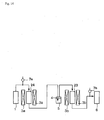
- a mimic exhaust gas placed in an exhaust gas container 1 was introduced into a mercury halogenating apparatus 24 provided with a mercury halogenating catalyst, and metal mercury was converted into mercury halide in the apparatus.
- a temperature of a mercury halogenating catalyst in the mercury halogenating apparatus 24 was controlled by a temperature controlling apparatus 3a.
- a mimic exhaust gas which had passed through the mercury halogenating apparatus 24 was introduced into an absorbing solution (3% aqueous calcium carbonate solution) 5 in an absorbing bottle 4, and mercury halide in a mimic exhaust gas was absorbed in an absorbing solution.
- a mimic exhaust gas was introduced into a denitration apparatus 23 from the absorbing bottle 4, and a nitrogen oxide was treated in the apparatus.
- a temperature of denitration catalyst in the denitration apparatus 23 was controlled by a temperature controlling apparatus 3b.
- a mimic exhaust gas was introduced into a recovering bottle 6 from the denitration apparatus 23, and recovered.
- Denitration rate (%) ⁇ (NOx concentration of gas a) - (NOx concentration of gas b) ⁇ ⁇ (NOx concentration of gas a) ⁇ 100
- Mercury removal rate (%) ⁇ (Hg concentration of gas a) - (Hg concentration of gas b) ⁇ ⁇ (Hg concentration of gas a) ⁇ 100 Mercury halogenating catalyst/catalyst temperature Denitration catalyst/catalyst temperature Denitration rate (%) Mercury removal rate (%) 10 hours 1000 hours 10 hours 1000 hours
- Example 3-1 Mercury halogenating catalyst (1)/190 °C Denitration catalyst (1)/250 °C 91.8 89.5 92.5 91.9
- Example 3-2 Mercury halogenating catalyst (2)/190 °C Denitration catalyst (2)/250 °C 94.3 94.2 94.3 94.1
- Example 3-3 Mercury halogenating catalyst (3)/150°C Denitration catalyst (3)/250 °C 93.2 92.0 92.0 90.7
- a mimic exhaust gas placed in an exhaust gas container 1 was introduced into a denitration apparatus 23, and a nitrogen oxide was treated in the apparatus.
- a temperature of a denitration catalyst in a denitration apparatus 23 was controlled by a temperature controlling apparatus 3a.
- a mimic exhaust gas was introduced into a mercury halogenating apparatus 24 provided with a mercury halogenating catalyst from the denitration apparatus 23, and metal mercury was converted into mercury halide in the apparatus.
- a temperature of a mercury halogenating catalyst in the mercury halogenating apparatus 24 was controlled by a temperature controlling apparatus 3b.
- a mimic exhaust gas which had passed through the mercury halogenating apparatus 24 was introduced into an absorbing solution (3% aqueous calcium carbonate solution) 5 in an absorbing bottle 4, and mercury halide in a mimic exhaust gas was absorbed in an absorbing solution. Thereafter, a mimic exhaust gas was introduced into a recovering bottle 6 from an absorbing bottle 4, and recovered.
- Denitration catalyst/catalyst temperature Mercury halogenating catalyst/catalyst temperature Denitration rate (%) Mercury removal rate (%) 10 hours 1000 hours 10 hours 1000 hours Comparative Example 3-1 Denitration catalyst (1)/250 °C Mercury halogenating catalyst (1)/190 °C 91.6 74.4 91.7 74.5 Comparative Example 3-2 Denitration catalyst (2)/250°C Mercury halogenating catalyst (2)/190°C 94.2 80.8 92.4 77.6 Comparative Example 3-3 Denitration catalyst (3)/250°C Mercury halogenating catalyst (3)/150°C 93.0 73.6 91.5 70.9 Comparative Example 3 -4 Denitration catalyst (1)/250°C Mercury halogenating catalyst (3)/150°C 92.6 64.7 89.5 59.4
- the method according to the present invention for treating an exhaust gas can be applied to treatment of various exhaust gases discharged from, for example, a boiler, an incinerator, a gas turbine, a diesel engine and various industrial processes.
Landscapes
- Engineering & Computer Science (AREA)
- Chemical & Material Sciences (AREA)
- Environmental & Geological Engineering (AREA)
- Health & Medical Sciences (AREA)
- Biomedical Technology (AREA)
- Analytical Chemistry (AREA)
- General Chemical & Material Sciences (AREA)
- Oil, Petroleum & Natural Gas (AREA)
- Chemical Kinetics & Catalysis (AREA)
- Exhaust Gas Treatment By Means Of Catalyst (AREA)
- Catalysts (AREA)
- Treating Waste Gases (AREA)
Applications Claiming Priority (6)
| Application Number | Priority Date | Filing Date | Title |
|---|---|---|---|
| JP2003362596A JP4113090B2 (ja) | 2003-10-22 | 2003-10-22 | 排ガス処理方法 |
| JP2003362597A JP4098697B2 (ja) | 2003-10-22 | 2003-10-22 | 排ガス処理方法 |
| JP2003362598A JP4098698B2 (ja) | 2003-10-22 | 2003-10-22 | 排ガス処理方法 |
| JP2003362596 | 2003-10-22 | ||
| JP2003362597 | 2003-10-22 | ||
| JP2003362598 | 2003-10-22 |
Publications (2)
| Publication Number | Publication Date |
|---|---|
| EP1525913A2 true EP1525913A2 (de) | 2005-04-27 |
| EP1525913A3 EP1525913A3 (de) | 2005-06-22 |
Family
ID=34396853
Family Applications (1)
| Application Number | Title | Priority Date | Filing Date |
|---|---|---|---|
| EP04024961A Withdrawn EP1525913A3 (de) | 2003-10-22 | 2004-10-20 | Abgasnachbehandlungsverfahren |
Country Status (5)
| Country | Link |
|---|---|
| US (1) | US7264784B2 (de) |
| EP (1) | EP1525913A3 (de) |
| KR (1) | KR100782387B1 (de) |
| CN (1) | CN100375646C (de) |
| TW (1) | TWI306410B (de) |
Cited By (4)
| Publication number | Priority date | Publication date | Assignee | Title |
|---|---|---|---|---|
| WO2006096374A2 (en) | 2005-03-03 | 2006-09-14 | Conocophillips Company | Mercury removal sorbent |
| EP2075060A4 (de) * | 2006-09-22 | 2010-05-19 | Babcock Hitachi Kk | Katalysator zur oxidation von metallischem quecksilber |
| CN104209116A (zh) * | 2014-09-01 | 2014-12-17 | 东南大学 | 一种钒系中高温scr催化剂及其制备方法 |
| CN104941669A (zh) * | 2015-06-26 | 2015-09-30 | 福建紫荆环境工程技术有限公司 | 一种协同脱除NOx和氧化脱除重金属单质汞的SCR催化剂及制备方法 |
Families Citing this family (30)
| Publication number | Priority date | Publication date | Assignee | Title |
|---|---|---|---|---|
| KR101207958B1 (ko) * | 2005-01-06 | 2012-12-04 | 가부시키가이샤 닛폰 쇼쿠바이 | 시멘트 킬른 연소 배기 가스 처리 장치 및 처리 방법 |
| US20060198777A1 (en) * | 2005-03-03 | 2006-09-07 | Cross Joseph B | Mercury removal sorbent |
| US20060198774A1 (en) * | 2005-03-03 | 2006-09-07 | Cross Joseph B | Mercury Removal sorbent |
| JP4920993B2 (ja) * | 2005-04-26 | 2012-04-18 | 三菱重工メカトロシステムズ株式会社 | 排ガス処理装置および排ガス処理方法 |
| KR100655596B1 (ko) * | 2005-12-26 | 2006-12-11 | 재단법인 포항산업과학연구원 | 펄스코로나 방전과 TiO2 나노입자를 이용한 배가스수은 제거방법 |
| KR100655597B1 (ko) * | 2005-12-26 | 2006-12-11 | 재단법인 포항산업과학연구원 | 저온 플라즈마와 TiO2를 이용한 배가스 수은 제거방법 |
| KR100765405B1 (ko) * | 2006-07-24 | 2007-10-12 | 한국전력공사 | 배연탈질 촉매를 이용한 배기가스중의 질소산화물 제거 및원소수은의 산화방법 |
| US20080087866A1 (en) * | 2006-10-13 | 2008-04-17 | H.C. Stark Inc. | Titanium oxide-based sputtering target for transparent conductive film, method for producing such film and composition for use therein |
| US20090104097A1 (en) * | 2007-10-17 | 2009-04-23 | E. I. Du Pont De Nemours And Company | Mercury removal from a gas stream |
| KR20100105860A (ko) | 2007-12-28 | 2010-09-30 | 칼레라 코포레이션 | Co2 분리 방법 |
| US20100239467A1 (en) | 2008-06-17 | 2010-09-23 | Brent Constantz | Methods and systems for utilizing waste sources of metal oxides |
| CN201138790Y (zh) * | 2008-01-03 | 2008-10-22 | 中山大洋电机股份有限公司 | 一种单相交流电机的电子启动电路 |
| JP5319934B2 (ja) * | 2008-02-28 | 2013-10-16 | 三菱重工業株式会社 | 排ガス処理方法及び装置 |
| US20110116999A1 (en) * | 2008-03-25 | 2011-05-19 | Yasuyoshi Kato | Exhaust gas purification catalyst on which influence of iron compound has been suppressed |
| JP5373079B2 (ja) | 2008-07-16 | 2013-12-18 | カレラ コーポレイション | 電気化学システム中でのco2の利用 |
| KR100953535B1 (ko) * | 2008-07-17 | 2010-04-21 | 재단법인 포항산업과학연구원 | 염소계 화합물을 이용한 배가스 내 수은 제거 방법 |
| AU2009287462B2 (en) | 2008-09-30 | 2011-10-06 | Arelac, Inc. | CO2-sequestering formed building materials |
| US7815880B2 (en) * | 2008-09-30 | 2010-10-19 | Calera Corporation | Reduced-carbon footprint concrete compositions |
| US8869477B2 (en) | 2008-09-30 | 2014-10-28 | Calera Corporation | Formed building materials |
| US9133581B2 (en) | 2008-10-31 | 2015-09-15 | Calera Corporation | Non-cementitious compositions comprising vaterite and methods thereof |
| EP2245215A4 (de) | 2009-02-10 | 2011-04-27 | Calera Corp | Niedrigspannungs-alkaliproduktion mithilfe von wasserstoff und elektrokatalytischen elektroden |
| AU2010201374B8 (en) * | 2009-03-02 | 2010-11-25 | Arelac, Inc. | Gas stream multi-pollutants control systems and methods |
| JP5357974B2 (ja) * | 2009-10-01 | 2013-12-04 | 三菱重工業株式会社 | 水銀酸化触媒及びその製造方法 |
| US9242211B2 (en) | 2011-05-30 | 2016-01-26 | The Babcock & Wilcox Company | Catalysts possessing an improved resistance to poisoning |
| CN103537273B (zh) * | 2013-09-30 | 2015-07-29 | 华中科技大学 | 一种协同脱汞的脱硝催化剂及其制备方法 |
| CN105263617B (zh) * | 2013-12-11 | 2017-06-06 | 浙江大学 | 用于硝汞协同控制的催化剂及制备方法 |
| JP6235705B2 (ja) | 2014-05-21 | 2017-11-22 | 千代田化工建設株式会社 | ゼロ価水銀を含有するガスの処理方法及び水銀分離システム |
| CN105251351A (zh) * | 2015-11-14 | 2016-01-20 | 无锡清杨机械制造有限公司 | 一种汽车除异味方法 |
| CN106640291A (zh) * | 2016-12-08 | 2017-05-10 | 青岛双瑞海洋环境工程股份有限公司 | 船舶废气脱硝系统 |
| KR102476863B1 (ko) * | 2021-11-09 | 2022-12-14 | 대영씨엔이(주) | 탈질촉매 및 이를 이용한 화력발전용 배기가스 처리 시스템 |
Family Cites Families (16)
| Publication number | Priority date | Publication date | Assignee | Title |
|---|---|---|---|---|
| DK158376C (da) * | 1986-07-16 | 1990-10-08 | Niro Atomizer As | Fremgangsmaade til nedbringelse af indholdet af kviksoelvdamp og/eller dampe af skadelige organiske forbindelser og/eller nitrogenoxider i roeggas fra forbraendingsanlaeg |
| JPS63100918A (ja) | 1986-10-16 | 1988-05-06 | Zensuke Inoue | 排ガス中の水銀および窒素酸化物の同時除去方法 |
| JPH0817939B2 (ja) * | 1986-11-19 | 1996-02-28 | 三菱化学株式会社 | 排煙脱硝触媒 |
| JPH04300628A (ja) | 1991-03-29 | 1992-10-23 | Kubota Corp | ごみ焼却排ガスの乾式処理方法 |
| JPH0531323A (ja) | 1991-08-02 | 1993-02-09 | Nkk Corp | 排ガス処理方法 |
| DE4415719A1 (de) | 1994-05-04 | 1995-11-09 | Metallgesellschaft Ag | Verfahren zur Abgasreinigung |
| DE19546612A1 (de) * | 1995-12-13 | 1997-06-19 | Basf Ag | Verfahren zur Reduktion von NOx aus Abgasen |
| JP3935547B2 (ja) | 1997-02-19 | 2007-06-27 | 三菱重工業株式会社 | 排ガス処理方法及び排ガス処理装置 |
| JP3648125B2 (ja) * | 1999-06-25 | 2005-05-18 | 株式会社日本触媒 | 有機ハロゲン化合物の除去用触媒および有機ハロゲン化合物の除去方法 |
| JP2001198434A (ja) * | 2000-01-18 | 2001-07-24 | Mitsubishi Heavy Ind Ltd | 排ガス中の水銀処理方法および排ガスの処理システム |
| US7118720B1 (en) * | 2001-04-27 | 2006-10-10 | The United States Of America As Represented By The United States Department Of Energy | Method for combined removal of mercury and nitrogen oxides from off-gas streams |
| JP4831801B2 (ja) * | 2001-08-09 | 2011-12-07 | 三菱重工業株式会社 | 排ガスの水銀除去方法及び装置 |
| US6960329B2 (en) * | 2002-03-12 | 2005-11-01 | Foster Wheeler Energy Corporation | Method and apparatus for removing mercury species from hot flue gas |
| US7628967B2 (en) * | 2002-10-01 | 2009-12-08 | Airborne Industrial Minerals, Inc. | Removal of Hg, NOx, and SOx with using oxidants and staged gas/liquid contact |
| JP4175465B2 (ja) | 2003-02-07 | 2008-11-05 | 三菱重工業株式会社 | 排ガス中の水銀除去方法およびそのシステム |
| US7514052B2 (en) * | 2004-01-06 | 2009-04-07 | General Electric Company | Method for removal of mercury emissions from coal combustion |
-
2004
- 2004-10-12 TW TW093130901A patent/TWI306410B/zh not_active IP Right Cessation
- 2004-10-12 US US10/963,969 patent/US7264784B2/en not_active Expired - Lifetime
- 2004-10-20 EP EP04024961A patent/EP1525913A3/de not_active Withdrawn
- 2004-10-20 KR KR1020040083827A patent/KR100782387B1/ko not_active Expired - Lifetime
- 2004-10-22 CN CNB2004100870152A patent/CN100375646C/zh not_active Expired - Lifetime
Cited By (8)
| Publication number | Priority date | Publication date | Assignee | Title |
|---|---|---|---|---|
| WO2006096374A2 (en) | 2005-03-03 | 2006-09-14 | Conocophillips Company | Mercury removal sorbent |
| EP1861191A4 (de) * | 2005-03-03 | 2008-12-31 | Conocophillips Co | Sorptionsmittel für die quecksilberentfernung |
| AU2006220978B2 (en) * | 2005-03-03 | 2010-07-08 | Phillips 66 Company | Mercury removal sorbent |
| AU2006220978B8 (en) * | 2005-03-03 | 2010-10-28 | Phillips 66 Company | Mercury removal sorbent |
| EP2075060A4 (de) * | 2006-09-22 | 2010-05-19 | Babcock Hitachi Kk | Katalysator zur oxidation von metallischem quecksilber |
| US7842644B2 (en) | 2006-09-22 | 2010-11-30 | Babcock-Hitachi Kabushiki Kaisha | Catalyst for oxidation of metal mercury |
| CN104209116A (zh) * | 2014-09-01 | 2014-12-17 | 东南大学 | 一种钒系中高温scr催化剂及其制备方法 |
| CN104941669A (zh) * | 2015-06-26 | 2015-09-30 | 福建紫荆环境工程技术有限公司 | 一种协同脱除NOx和氧化脱除重金属单质汞的SCR催化剂及制备方法 |
Also Published As
| Publication number | Publication date |
|---|---|
| CN1623633A (zh) | 2005-06-08 |
| KR100782387B1 (ko) | 2007-12-07 |
| CN100375646C (zh) | 2008-03-19 |
| US20050112044A1 (en) | 2005-05-26 |
| KR20050039582A (ko) | 2005-04-29 |
| EP1525913A3 (de) | 2005-06-22 |
| US7264784B2 (en) | 2007-09-04 |
| TWI306410B (en) | 2009-02-21 |
| TW200528181A (en) | 2005-09-01 |
Similar Documents
| Publication | Publication Date | Title |
|---|---|---|
| US7264784B2 (en) | Method for treating exhaust gas | |
| JP4113090B2 (ja) | 排ガス処理方法 | |
| EP1063002B1 (de) | Verfahren zur Entfernung von Organohalogenverbindungen | |
| EP0547226A1 (de) | Verfahren zur zersetzung einer organischer halogenkomponente durch oxydation | |
| US20030170159A1 (en) | Method and apparatus for removing mercury from waste gas | |
| US8173098B2 (en) | Titanium oxide, catalyst for treating exhaust gas and method for purifying exhaust gas | |
| JP4098703B2 (ja) | 窒素酸化物除去用触媒および窒素酸化物除去方法 | |
| EP1138379B1 (de) | Titan, Molybdän und Vanadium enthaltender Abgasreinigungskatalysator, Verfahren zu seiner Herstellung, und dessen Verwendung | |
| JP3474514B2 (ja) | 低温脱硝触媒及び低温脱硝方法 | |
| JP2005125213A (ja) | 排ガス処理方法 | |
| JPH07289897A (ja) | アンモニア分解用触媒およびその触媒を用いるアンモニアの分解方法 | |
| JP2001286734A (ja) | 塩素化有機化合物の分解方法および燃焼排ガスの処理方法 | |
| JP4098697B2 (ja) | 排ガス処理方法 | |
| JP2001038206A (ja) | 排ガス処理用触媒、排ガス処理方法及び処理装置 | |
| JP3860734B2 (ja) | 排ガス処理用触媒、および排ガス処理方法 | |
| JP3739659B2 (ja) | 排ガス処理用触媒、排ガスの処理方法、および排ガス処理用触媒の製造方法 | |
| JP2006320803A (ja) | 排ガス処理触媒および排ガス処理方法 | |
| JP3924418B2 (ja) | 排ガス処理用触媒および排ガス処理方法 | |
| JP2004081995A (ja) | 脱硝触媒および当該触媒を用いた脱硝方法 | |
| JP4283092B2 (ja) | 排ガス処理用触媒および排ガス処理方法 | |
| JP4002437B2 (ja) | 排ガス処理用触媒、および排ガス処理方法 | |
| JP3893020B2 (ja) | 有機ハロゲン化合物の除去用触媒およびこれを用いた排ガスの処理方法 | |
| JP3868246B2 (ja) | 排ガス処理用触媒、および排ガス処理方法 | |
| KR100894493B1 (ko) | 배기가스 처리용 촉매 및 배기가스의 처리방법 | |
| JP2002102696A (ja) | 脱硝触媒およびこれを用いた排ガスの処理方法 |
Legal Events
| Date | Code | Title | Description |
|---|---|---|---|
| PUAI | Public reference made under article 153(3) epc to a published international application that has entered the european phase |
Free format text: ORIGINAL CODE: 0009012 |
|
| AK | Designated contracting states |
Kind code of ref document: A2 Designated state(s): AT BE BG CH CY CZ DE DK EE ES FI FR GB GR HU IE IT LI LU MC NL PL PT RO SE SI SK TR |
|
| AX | Request for extension of the european patent |
Extension state: AL HR LT LV MK |
|
| PUAL | Search report despatched |
Free format text: ORIGINAL CODE: 0009013 |
|
| AK | Designated contracting states |
Kind code of ref document: A3 Designated state(s): AT BE BG CH CY CZ DE DK EE ES FI FR GB GR HU IE IT LI LU MC NL PL PT RO SE SI SK TR |
|
| AX | Request for extension of the european patent |
Extension state: AL HR LT LV MK |
|
| 17P | Request for examination filed |
Effective date: 20050907 |
|
| AKX | Designation fees paid |
Designated state(s): AT BE BG CH CY CZ DE DK EE ES FI FR GB GR HU IE IT LI LU MC NL PL PT RO SE SI SK TR |
|
| 17Q | First examination report despatched |
Effective date: 20081105 |
|
| GRAP | Despatch of communication of intention to grant a patent |
Free format text: ORIGINAL CODE: EPIDOSNIGR1 |
|
| STAA | Information on the status of an ep patent application or granted ep patent |
Free format text: STATUS: THE APPLICATION IS DEEMED TO BE WITHDRAWN |
|
| 18D | Application deemed to be withdrawn |
Effective date: 20100605 |