EP1514841A2 - Kohlendioxydabsorbierende Zusammensetzungen, und Anlage und Verfahren zum Transport von lebenden Fischprodukten - Google Patents
Kohlendioxydabsorbierende Zusammensetzungen, und Anlage und Verfahren zum Transport von lebenden Fischprodukten Download PDFInfo
- Publication number
- EP1514841A2 EP1514841A2 EP04077860A EP04077860A EP1514841A2 EP 1514841 A2 EP1514841 A2 EP 1514841A2 EP 04077860 A EP04077860 A EP 04077860A EP 04077860 A EP04077860 A EP 04077860A EP 1514841 A2 EP1514841 A2 EP 1514841A2
- Authority
- EP
- European Patent Office
- Prior art keywords
- carbon dioxide
- dioxide absorbing
- absorbing materials
- materials
- oxygen generating
- Prior art date
- Legal status (The legal status is an assumption and is not a legal conclusion. Google has not performed a legal analysis and makes no representation as to the accuracy of the status listed.)
- Withdrawn
Links
- CURLTUGMZLYLDI-UHFFFAOYSA-N Carbon dioxide Chemical compound O=C=O CURLTUGMZLYLDI-UHFFFAOYSA-N 0.000 title claims abstract description 322
- 239000001569 carbon dioxide Substances 0.000 title claims abstract description 161
- 229910002092 carbon dioxide Inorganic materials 0.000 title claims abstract description 161
- 239000011358 absorbing material Substances 0.000 title claims abstract description 120
- 238000000034 method Methods 0.000 title claims abstract description 75
- 239000001301 oxygen Substances 0.000 claims abstract description 211
- 229910052760 oxygen Inorganic materials 0.000 claims abstract description 211
- QVGXLLKOCUKJST-UHFFFAOYSA-N atomic oxygen Chemical compound [O] QVGXLLKOCUKJST-UHFFFAOYSA-N 0.000 claims abstract description 206
- 239000000463 material Substances 0.000 claims abstract description 166
- XLYOFNOQVPJJNP-UHFFFAOYSA-N water Substances O XLYOFNOQVPJJNP-UHFFFAOYSA-N 0.000 claims abstract description 81
- 229910001868 water Inorganic materials 0.000 claims abstract description 81
- 239000007789 gas Substances 0.000 claims abstract description 46
- 150000002978 peroxides Chemical class 0.000 claims abstract description 46
- 230000035699 permeability Effects 0.000 claims abstract description 28
- 239000007787 solid Substances 0.000 claims abstract description 19
- 239000003054 catalyst Substances 0.000 claims abstract description 17
- 238000004806 packaging method and process Methods 0.000 claims abstract description 17
- 229910001860 alkaline earth metal hydroxide Inorganic materials 0.000 claims abstract description 16
- 238000000354 decomposition reaction Methods 0.000 claims abstract description 16
- 229910000287 alkaline earth metal oxide Inorganic materials 0.000 claims abstract description 13
- 238000010227 cup method (microbiological evaluation) Methods 0.000 claims abstract description 12
- 239000000047 product Substances 0.000 claims description 66
- 239000004745 nonwoven fabric Substances 0.000 claims description 44
- OKTJSMMVPCPJKN-UHFFFAOYSA-N Carbon Chemical compound [C] OKTJSMMVPCPJKN-UHFFFAOYSA-N 0.000 claims description 42
- 229910052799 carbon Inorganic materials 0.000 claims description 42
- 229920003023 plastic Polymers 0.000 claims description 26
- 239000004033 plastic Substances 0.000 claims description 26
- 239000005022 packaging material Substances 0.000 claims description 25
- GEMCGUOJDLYZJY-UHFFFAOYSA-N carbonic acid;hydrogen peroxide;sodium Chemical compound [Na].OO.OC(O)=O GEMCGUOJDLYZJY-UHFFFAOYSA-N 0.000 claims description 19
- 239000002274 desiccant Substances 0.000 claims description 15
- VYPSYNLAJGMNEJ-UHFFFAOYSA-N Silicium dioxide Chemical compound O=[Si]=O VYPSYNLAJGMNEJ-UHFFFAOYSA-N 0.000 claims description 14
- 239000007788 liquid Substances 0.000 claims description 14
- NUJOXMJBOLGQSY-UHFFFAOYSA-N manganese dioxide Chemical compound O=[Mn]=O NUJOXMJBOLGQSY-UHFFFAOYSA-N 0.000 claims description 12
- 239000000741 silica gel Substances 0.000 claims description 12
- 229910002027 silica gel Inorganic materials 0.000 claims description 12
- AXCZMVOFGPJBDE-UHFFFAOYSA-L calcium dihydroxide Chemical compound [OH-].[OH-].[Ca+2] AXCZMVOFGPJBDE-UHFFFAOYSA-L 0.000 claims description 10
- 239000000920 calcium hydroxide Substances 0.000 claims description 10
- 229910001861 calcium hydroxide Inorganic materials 0.000 claims description 10
- 230000002209 hydrophobic effect Effects 0.000 claims description 10
- 239000012466 permeate Substances 0.000 claims description 8
- 102000016938 Catalase Human genes 0.000 claims description 7
- 108010053835 Catalase Proteins 0.000 claims description 7
- PNEYBMLMFCGWSK-UHFFFAOYSA-N aluminium oxide Inorganic materials [O-2].[O-2].[O-2].[Al+3].[Al+3] PNEYBMLMFCGWSK-UHFFFAOYSA-N 0.000 claims description 7
- VTHJTEIRLNZDEV-UHFFFAOYSA-L magnesium dihydroxide Chemical compound [OH-].[OH-].[Mg+2] VTHJTEIRLNZDEV-UHFFFAOYSA-L 0.000 claims description 7
- 239000000347 magnesium hydroxide Substances 0.000 claims description 7
- 229910001862 magnesium hydroxide Inorganic materials 0.000 claims description 7
- XSVSPKKXQGNHMD-UHFFFAOYSA-N 5-bromo-3-methyl-1,2-thiazole Chemical compound CC=1C=C(Br)SN=1 XSVSPKKXQGNHMD-UHFFFAOYSA-N 0.000 claims description 6
- 239000012418 sodium perborate tetrahydrate Substances 0.000 claims description 5
- IBDSNZLUHYKHQP-UHFFFAOYSA-N sodium;3-oxidodioxaborirane;tetrahydrate Chemical compound O.O.O.O.[Na+].[O-]B1OO1 IBDSNZLUHYKHQP-UHFFFAOYSA-N 0.000 claims description 5
- BRPQOXSCLDDYGP-UHFFFAOYSA-N calcium oxide Chemical compound [O-2].[Ca+2] BRPQOXSCLDDYGP-UHFFFAOYSA-N 0.000 claims description 4
- 239000000292 calcium oxide Substances 0.000 claims description 4
- ODINCKMPIJJUCX-UHFFFAOYSA-N calcium oxide Inorganic materials [Ca]=O ODINCKMPIJJUCX-UHFFFAOYSA-N 0.000 claims description 4
- 239000000395 magnesium oxide Substances 0.000 claims description 4
- CPLXHLVBOLITMK-UHFFFAOYSA-N magnesium oxide Inorganic materials [Mg]=O CPLXHLVBOLITMK-UHFFFAOYSA-N 0.000 claims description 4
- AXZKOIWUVFPNLO-UHFFFAOYSA-N magnesium;oxygen(2-) Chemical compound [O-2].[Mg+2] AXZKOIWUVFPNLO-UHFFFAOYSA-N 0.000 claims description 4
- 229910021536 Zeolite Inorganic materials 0.000 claims description 3
- HNPSIPDUKPIQMN-UHFFFAOYSA-N dioxosilane;oxo(oxoalumanyloxy)alumane Chemical compound O=[Si]=O.O=[Al]O[Al]=O HNPSIPDUKPIQMN-UHFFFAOYSA-N 0.000 claims description 3
- 239000010457 zeolite Substances 0.000 claims description 3
- -1 oxide Chemical compound 0.000 description 76
- 230000032258 transport Effects 0.000 description 70
- 239000004698 Polyethylene Substances 0.000 description 57
- 229920000573 polyethylene Polymers 0.000 description 56
- 241000252229 Carassius auratus Species 0.000 description 46
- 241000251468 Actinopterygii Species 0.000 description 25
- 239000002245 particle Substances 0.000 description 24
- 238000002360 preparation method Methods 0.000 description 24
- 230000001186 cumulative effect Effects 0.000 description 23
- 230000000052 comparative effect Effects 0.000 description 21
- 238000007789 sealing Methods 0.000 description 20
- 238000010030 laminating Methods 0.000 description 16
- 230000034994 death Effects 0.000 description 15
- 231100000517 death Toxicity 0.000 description 15
- 238000004321 preservation Methods 0.000 description 15
- MHAJPDPJQMAIIY-UHFFFAOYSA-N Hydrogen peroxide Chemical group OO MHAJPDPJQMAIIY-UHFFFAOYSA-N 0.000 description 12
- 238000011049 filling Methods 0.000 description 11
- 238000005259 measurement Methods 0.000 description 11
- 239000004775 Tyvek Substances 0.000 description 9
- 229920000690 Tyvek Polymers 0.000 description 9
- 238000010521 absorption reaction Methods 0.000 description 9
- 230000006866 deterioration Effects 0.000 description 9
- VTIIJXUACCWYHX-UHFFFAOYSA-L disodium;carboxylatooxy carbonate Chemical compound [Na+].[Na+].[O-]C(=O)OOC([O-])=O VTIIJXUACCWYHX-UHFFFAOYSA-L 0.000 description 9
- 239000002985 plastic film Substances 0.000 description 9
- 239000005020 polyethylene terephthalate Substances 0.000 description 9
- 229920000139 polyethylene terephthalate Polymers 0.000 description 9
- 239000012779 reinforcing material Substances 0.000 description 9
- 239000011148 porous material Substances 0.000 description 8
- 239000004743 Polypropylene Substances 0.000 description 7
- 229920001155 polypropylene Polymers 0.000 description 7
- 229920013683 Celanese Polymers 0.000 description 6
- 239000005038 ethylene vinyl acetate Substances 0.000 description 6
- 229920001200 poly(ethylene-vinyl acetate) Polymers 0.000 description 6
- 238000007667 floating Methods 0.000 description 5
- 238000004519 manufacturing process Methods 0.000 description 5
- 150000002926 oxygen Chemical class 0.000 description 5
- 229920006255 plastic film Polymers 0.000 description 5
- 235000013311 vegetables Nutrition 0.000 description 5
- 241000252073 Anguilliformes Species 0.000 description 4
- 229910052782 aluminium Inorganic materials 0.000 description 4
- XAGFODPZIPBFFR-UHFFFAOYSA-N aluminium Chemical compound [Al] XAGFODPZIPBFFR-UHFFFAOYSA-N 0.000 description 4
- 235000013399 edible fruits Nutrition 0.000 description 4
- 239000000835 fiber Substances 0.000 description 4
- 239000011521 glass Substances 0.000 description 4
- 238000010298 pulverizing process Methods 0.000 description 4
- 238000007873 sieving Methods 0.000 description 4
- 239000000126 substance Substances 0.000 description 4
- 239000007864 aqueous solution Substances 0.000 description 3
- 239000003795 chemical substances by application Substances 0.000 description 3
- 239000000203 mixture Substances 0.000 description 3
- 150000003839 salts Chemical class 0.000 description 3
- 239000002982 water resistant material Substances 0.000 description 3
- VZCYOOQTPOCHFL-OWOJBTEDSA-N Fumaric acid Chemical compound OC(=O)\C=C\C(O)=O VZCYOOQTPOCHFL-OWOJBTEDSA-N 0.000 description 2
- 206010021143 Hypoxia Diseases 0.000 description 2
- 229920001328 Polyvinylidene chloride Polymers 0.000 description 2
- CDBYLPFSWZWCQE-UHFFFAOYSA-L Sodium Carbonate Chemical compound [Na+].[Na+].[O-]C([O-])=O CDBYLPFSWZWCQE-UHFFFAOYSA-L 0.000 description 2
- 239000000853 adhesive Substances 0.000 description 2
- 230000001070 adhesive effect Effects 0.000 description 2
- 239000002390 adhesive tape Substances 0.000 description 2
- 238000009954 braiding Methods 0.000 description 2
- 238000009826 distribution Methods 0.000 description 2
- 238000010894 electron beam technology Methods 0.000 description 2
- 238000001704 evaporation Methods 0.000 description 2
- 230000008020 evaporation Effects 0.000 description 2
- 230000007954 hypoxia Effects 0.000 description 2
- 229920006284 nylon film Polymers 0.000 description 2
- 239000000123 paper Substances 0.000 description 2
- 229920006267 polyester film Polymers 0.000 description 2
- 229920000098 polyolefin Polymers 0.000 description 2
- 239000005033 polyvinylidene chloride Substances 0.000 description 2
- 239000002994 raw material Substances 0.000 description 2
- GCLGEJMYGQKIIW-UHFFFAOYSA-H sodium hexametaphosphate Chemical compound [Na]OP1(=O)OP(=O)(O[Na])OP(=O)(O[Na])OP(=O)(O[Na])OP(=O)(O[Na])OP(=O)(O[Na])O1 GCLGEJMYGQKIIW-UHFFFAOYSA-H 0.000 description 2
- 239000000243 solution Substances 0.000 description 2
- 230000004083 survival effect Effects 0.000 description 2
- 238000009834 vaporization Methods 0.000 description 2
- 230000008016 vaporization Effects 0.000 description 2
- QTBSBXVTEAMEQO-UHFFFAOYSA-M Acetate Chemical compound CC([O-])=O QTBSBXVTEAMEQO-UHFFFAOYSA-M 0.000 description 1
- 239000004343 Calcium peroxide Substances 0.000 description 1
- 241001609213 Carassius carassius Species 0.000 description 1
- BVKZGUZCCUSVTD-UHFFFAOYSA-L Carbonate Chemical compound [O-]C([O-])=O BVKZGUZCCUSVTD-UHFFFAOYSA-L 0.000 description 1
- VEXZGXHMUGYJMC-UHFFFAOYSA-M Chloride anion Chemical compound [Cl-] VEXZGXHMUGYJMC-UHFFFAOYSA-M 0.000 description 1
- 241000252185 Cobitidae Species 0.000 description 1
- 235000013162 Cocos nucifera Nutrition 0.000 description 1
- 244000060011 Cocos nucifera Species 0.000 description 1
- 241000252233 Cyprinus carpio Species 0.000 description 1
- 241000238557 Decapoda Species 0.000 description 1
- 241000196324 Embryophyta Species 0.000 description 1
- 102000004190 Enzymes Human genes 0.000 description 1
- 108090000790 Enzymes Proteins 0.000 description 1
- 239000004677 Nylon Substances 0.000 description 1
- 229910019142 PO4 Inorganic materials 0.000 description 1
- 229920006361 Polyflon Polymers 0.000 description 1
- 239000004372 Polyvinyl alcohol Substances 0.000 description 1
- QAOWNCQODCNURD-UHFFFAOYSA-L Sulfate Chemical compound [O-]S([O-])(=O)=O QAOWNCQODCNURD-UHFFFAOYSA-L 0.000 description 1
- ZJRXSAYFZMGQFP-UHFFFAOYSA-N barium peroxide Chemical compound [Ba+2].[O-][O-] ZJRXSAYFZMGQFP-UHFFFAOYSA-N 0.000 description 1
- LHJQIRIGXXHNLA-UHFFFAOYSA-N calcium peroxide Chemical compound [Ca+2].[O-][O-] LHJQIRIGXXHNLA-UHFFFAOYSA-N 0.000 description 1
- 235000019402 calcium peroxide Nutrition 0.000 description 1
- 230000008859 change Effects 0.000 description 1
- 239000003245 coal Substances 0.000 description 1
- 239000011248 coating agent Substances 0.000 description 1
- 238000000576 coating method Methods 0.000 description 1
- 238000010622 cold drawing Methods 0.000 description 1
- 230000001268 conjugating effect Effects 0.000 description 1
- 238000010828 elution Methods 0.000 description 1
- 238000005516 engineering process Methods 0.000 description 1
- 239000010408 film Substances 0.000 description 1
- 239000011888 foil Substances 0.000 description 1
- 239000001530 fumaric acid Substances 0.000 description 1
- 239000010903 husk Substances 0.000 description 1
- XLYOFNOQVPJJNP-UHFFFAOYSA-M hydroxide Chemical compound [OH-] XLYOFNOQVPJJNP-UHFFFAOYSA-M 0.000 description 1
- 239000005457 ice water Substances 0.000 description 1
- 229910052500 inorganic mineral Inorganic materials 0.000 description 1
- 229920000554 ionomer Polymers 0.000 description 1
- 229910052751 metal Inorganic materials 0.000 description 1
- 239000002184 metal Substances 0.000 description 1
- 150000002739 metals Chemical class 0.000 description 1
- 239000011707 mineral Substances 0.000 description 1
- 229920001778 nylon Polymers 0.000 description 1
- 150000007524 organic acids Chemical class 0.000 description 1
- 235000005985 organic acids Nutrition 0.000 description 1
- 150000001451 organic peroxides Chemical class 0.000 description 1
- 239000010452 phosphate Substances 0.000 description 1
- NBIIXXVUZAFLBC-UHFFFAOYSA-K phosphate Chemical compound [O-]P([O-])([O-])=O NBIIXXVUZAFLBC-UHFFFAOYSA-K 0.000 description 1
- 229920000728 polyester Polymers 0.000 description 1
- 229920002451 polyvinyl alcohol Polymers 0.000 description 1
- 235000019422 polyvinyl alcohol Nutrition 0.000 description 1
- USHAGKDGDHPEEY-UHFFFAOYSA-L potassium persulfate Chemical compound [K+].[K+].[O-]S(=O)(=O)OOS([O-])(=O)=O USHAGKDGDHPEEY-UHFFFAOYSA-L 0.000 description 1
- HDMGAZBPFLDBCX-UHFFFAOYSA-M potassium;sulfooxy sulfate Chemical compound [K+].OS(=O)(=O)OOS([O-])(=O)=O HDMGAZBPFLDBCX-UHFFFAOYSA-M 0.000 description 1
- 239000000843 powder Substances 0.000 description 1
- 239000003755 preservative agent Substances 0.000 description 1
- 230000002335 preservative effect Effects 0.000 description 1
- 238000003825 pressing Methods 0.000 description 1
- 230000002787 reinforcement Effects 0.000 description 1
- 229920005989 resin Polymers 0.000 description 1
- 239000011347 resin Substances 0.000 description 1
- 235000015170 shellfish Nutrition 0.000 description 1
- 239000000377 silicon dioxide Substances 0.000 description 1
- 229910000029 sodium carbonate Inorganic materials 0.000 description 1
- 229920002994 synthetic fiber Polymers 0.000 description 1
- 239000012209 synthetic fiber Substances 0.000 description 1
- 229920003002 synthetic resin Polymers 0.000 description 1
- 239000000057 synthetic resin Substances 0.000 description 1
- VZCYOOQTPOCHFL-UHFFFAOYSA-N trans-butenedioic acid Natural products OC(=O)C=CC(O)=O VZCYOOQTPOCHFL-UHFFFAOYSA-N 0.000 description 1
- 239000002023 wood Substances 0.000 description 1
- 239000002759 woven fabric Substances 0.000 description 1
Images
Classifications
-
- B—PERFORMING OPERATIONS; TRANSPORTING
- B01—PHYSICAL OR CHEMICAL PROCESSES OR APPARATUS IN GENERAL
- B01J—CHEMICAL OR PHYSICAL PROCESSES, e.g. CATALYSIS OR COLLOID CHEMISTRY; THEIR RELEVANT APPARATUS
- B01J20/00—Solid sorbent compositions or filter aid compositions; Sorbents for chromatography; Processes for preparing, regenerating or reactivating thereof
- B01J20/28—Solid sorbent compositions or filter aid compositions; Sorbents for chromatography; Processes for preparing, regenerating or reactivating thereof characterised by their form or physical properties
- B01J20/28014—Solid sorbent compositions or filter aid compositions; Sorbents for chromatography; Processes for preparing, regenerating or reactivating thereof characterised by their form or physical properties characterised by their form
- B01J20/2805—Sorbents inside a permeable or porous casing, e.g. inside a container, bag or membrane
-
- C—CHEMISTRY; METALLURGY
- C01—INORGANIC CHEMISTRY
- C01B—NON-METALLIC ELEMENTS; COMPOUNDS THEREOF; METALLOIDS OR COMPOUNDS THEREOF NOT COVERED BY SUBCLASS C01C
- C01B13/00—Oxygen; Ozone; Oxides or hydroxides in general
- C01B13/02—Preparation of oxygen
- C01B13/0203—Preparation of oxygen from inorganic compounds
- C01B13/0211—Peroxy compounds
-
- A—HUMAN NECESSITIES
- A01—AGRICULTURE; FORESTRY; ANIMAL HUSBANDRY; HUNTING; TRAPPING; FISHING
- A01K—ANIMAL HUSBANDRY; AVICULTURE; APICULTURE; PISCICULTURE; FISHING; REARING OR BREEDING ANIMALS, NOT OTHERWISE PROVIDED FOR; NEW BREEDS OF ANIMALS
- A01K63/00—Receptacles for live fish, e.g. aquaria; Terraria
- A01K63/02—Receptacles specially adapted for transporting live fish
-
- A—HUMAN NECESSITIES
- A01—AGRICULTURE; FORESTRY; ANIMAL HUSBANDRY; HUNTING; TRAPPING; FISHING
- A01K—ANIMAL HUSBANDRY; AVICULTURE; APICULTURE; PISCICULTURE; FISHING; REARING OR BREEDING ANIMALS, NOT OTHERWISE PROVIDED FOR; NEW BREEDS OF ANIMALS
- A01K63/00—Receptacles for live fish, e.g. aquaria; Terraria
- A01K63/04—Arrangements for treating water specially adapted to receptacles for live fish
-
- A—HUMAN NECESSITIES
- A01—AGRICULTURE; FORESTRY; ANIMAL HUSBANDRY; HUNTING; TRAPPING; FISHING
- A01K—ANIMAL HUSBANDRY; AVICULTURE; APICULTURE; PISCICULTURE; FISHING; REARING OR BREEDING ANIMALS, NOT OTHERWISE PROVIDED FOR; NEW BREEDS OF ANIMALS
- A01K63/00—Receptacles for live fish, e.g. aquaria; Terraria
- A01K63/04—Arrangements for treating water specially adapted to receptacles for live fish
- A01K63/042—Introducing gases into the water, e.g. aerators, air pumps
-
- B—PERFORMING OPERATIONS; TRANSPORTING
- B01—PHYSICAL OR CHEMICAL PROCESSES OR APPARATUS IN GENERAL
- B01J—CHEMICAL OR PHYSICAL PROCESSES, e.g. CATALYSIS OR COLLOID CHEMISTRY; THEIR RELEVANT APPARATUS
- B01J20/00—Solid sorbent compositions or filter aid compositions; Sorbents for chromatography; Processes for preparing, regenerating or reactivating thereof
- B01J20/02—Solid sorbent compositions or filter aid compositions; Sorbents for chromatography; Processes for preparing, regenerating or reactivating thereof comprising inorganic material
- B01J20/04—Solid sorbent compositions or filter aid compositions; Sorbents for chromatography; Processes for preparing, regenerating or reactivating thereof comprising inorganic material comprising compounds of alkali metals, alkaline earth metals or magnesium
- B01J20/041—Oxides or hydroxides
-
- B—PERFORMING OPERATIONS; TRANSPORTING
- B01—PHYSICAL OR CHEMICAL PROCESSES OR APPARATUS IN GENERAL
- B01J—CHEMICAL OR PHYSICAL PROCESSES, e.g. CATALYSIS OR COLLOID CHEMISTRY; THEIR RELEVANT APPARATUS
- B01J20/00—Solid sorbent compositions or filter aid compositions; Sorbents for chromatography; Processes for preparing, regenerating or reactivating thereof
- B01J20/02—Solid sorbent compositions or filter aid compositions; Sorbents for chromatography; Processes for preparing, regenerating or reactivating thereof comprising inorganic material
- B01J20/06—Solid sorbent compositions or filter aid compositions; Sorbents for chromatography; Processes for preparing, regenerating or reactivating thereof comprising inorganic material comprising oxides or hydroxides of metals not provided for in group B01J20/04
- B01J20/08—Solid sorbent compositions or filter aid compositions; Sorbents for chromatography; Processes for preparing, regenerating or reactivating thereof comprising inorganic material comprising oxides or hydroxides of metals not provided for in group B01J20/04 comprising aluminium oxide or hydroxide; comprising bauxite
-
- B—PERFORMING OPERATIONS; TRANSPORTING
- B01—PHYSICAL OR CHEMICAL PROCESSES OR APPARATUS IN GENERAL
- B01J—CHEMICAL OR PHYSICAL PROCESSES, e.g. CATALYSIS OR COLLOID CHEMISTRY; THEIR RELEVANT APPARATUS
- B01J20/00—Solid sorbent compositions or filter aid compositions; Sorbents for chromatography; Processes for preparing, regenerating or reactivating thereof
- B01J20/02—Solid sorbent compositions or filter aid compositions; Sorbents for chromatography; Processes for preparing, regenerating or reactivating thereof comprising inorganic material
- B01J20/10—Solid sorbent compositions or filter aid compositions; Sorbents for chromatography; Processes for preparing, regenerating or reactivating thereof comprising inorganic material comprising silica or silicate
- B01J20/103—Solid sorbent compositions or filter aid compositions; Sorbents for chromatography; Processes for preparing, regenerating or reactivating thereof comprising inorganic material comprising silica or silicate comprising silica
-
- B—PERFORMING OPERATIONS; TRANSPORTING
- B01—PHYSICAL OR CHEMICAL PROCESSES OR APPARATUS IN GENERAL
- B01J—CHEMICAL OR PHYSICAL PROCESSES, e.g. CATALYSIS OR COLLOID CHEMISTRY; THEIR RELEVANT APPARATUS
- B01J20/00—Solid sorbent compositions or filter aid compositions; Sorbents for chromatography; Processes for preparing, regenerating or reactivating thereof
- B01J20/02—Solid sorbent compositions or filter aid compositions; Sorbents for chromatography; Processes for preparing, regenerating or reactivating thereof comprising inorganic material
- B01J20/10—Solid sorbent compositions or filter aid compositions; Sorbents for chromatography; Processes for preparing, regenerating or reactivating thereof comprising inorganic material comprising silica or silicate
- B01J20/16—Alumino-silicates
- B01J20/18—Synthetic zeolitic molecular sieves
-
- C—CHEMISTRY; METALLURGY
- C01—INORGANIC CHEMISTRY
- C01B—NON-METALLIC ELEMENTS; COMPOUNDS THEREOF; METALLOIDS OR COMPOUNDS THEREOF NOT COVERED BY SUBCLASS C01C
- C01B13/00—Oxygen; Ozone; Oxides or hydroxides in general
- C01B13/02—Preparation of oxygen
- C01B13/0222—Preparation of oxygen from organic compounds
- C01B13/0225—Peroxy compounds
-
- Y—GENERAL TAGGING OF NEW TECHNOLOGICAL DEVELOPMENTS; GENERAL TAGGING OF CROSS-SECTIONAL TECHNOLOGIES SPANNING OVER SEVERAL SECTIONS OF THE IPC; TECHNICAL SUBJECTS COVERED BY FORMER USPC CROSS-REFERENCE ART COLLECTIONS [XRACs] AND DIGESTS
- Y02—TECHNOLOGIES OR APPLICATIONS FOR MITIGATION OR ADAPTATION AGAINST CLIMATE CHANGE
- Y02C—CAPTURE, STORAGE, SEQUESTRATION OR DISPOSAL OF GREENHOUSE GASES [GHG]
- Y02C20/00—Capture or disposal of greenhouse gases
- Y02C20/40—Capture or disposal of greenhouse gases of CO2
Definitions
- the present invention relates to an oxygen generating materials, carbon dioxide absorbing materials, and transport system and transport method of live fishery products for preventing vitality deterioration and death of live fishery products.
- Methods of transporting live fishery products while keeping the likes of edible natural fish, cultivated fish, shellfish or aquarium fish alive can be divided broadly into transport without using water (which will be referred to as “waterless -transport” ), transport using tank (which will be referred to as “tank transport”), and transport using plastic film bag (which will be referred to as "plastic transport”).
- waterless -transport transport without using water
- tank transport transport using tank
- plastic film bag which will be referred to as "plastic transport”
- Waterless transport is a method wherein fish are transported without using water while being exposed to air, and is used for carp, crucian carp, loaches, prawns and the like. Since it is easy for the fish to fall into a condition of hypoxia, waterless transport can only be used for transports of short periods of time.
- Tank transport is a transport method wherein oxygen is supplied from the oxygen cylinder to the water tank installed on a truck while letting the fish swim therein, and is used for transports in large amounts and relatively long distances.
- This method requires costly specialized equipment, there is a problem in that the usage thereof is limited since transportation expenses become costly.
- Japanese Patent Laid- Open Publication No. Hei 4(1992)-26808 proposes a transport method wherein fish, water and oxygen are placed in a receptacle equipped with an air pump and carbon dioxide absorbing tank on the outside while circulating air therein.
- this method also requires costly specialized equipment, there is a problem in that the usage thereof is limited since transportation expenses become costly.
- Plastic transport is a transport method wherein water and live fishery products are placed in a plastic film bag, sealed hermetically while leaving headspace, and further placed in a corrugated cardboard box or the like, and is used for small-scale and short-time transports.
- Plastic transport is an easy and low-costing method, and is widely used for transporting various kinds of cultivated fish, natural fish and aquarium fish.
- water temperature during transportation, concentration of dissolved oxygen and water quality cannot be controlled, thereby leaving a problem in that, even within a 24-hour transport, vitality deterioration and death of fish during transport are likely to occur.
- oxygen generating materials to be used for the transport or the like of live fishery products a type wherein an aqueous solution of peroxide and a decomposition agent thereof are packaged with a multi-layered package (Patent Laid-Open Publication No. Hei 1(1989)-103902), a type wherein peroxide and the like are covered with a water-permeable sheet including a layer of active carbon (Patent Laid-Open Publication No. Hei 5(1993)-306104), and a type wherein a composition of hydrogen peroxide adduct and the like and a solidifying agent are packaged (Patent Laid-Open Publication Hei 7(1995)-289114) and so on have been proposed.
- a type which fulfills all such conditions as no elution of composition components into the water upon usage, easy operation, steady generation of oxygen for a long period of time, low manufacturing cost, and outstanding preservation stability has not been provided heretofore.
- the present invention aims at solving the aforementioned conventional problems and an aim thereof is to provide a low costing oxygen generating materials and carbon dioxide absorbing materials without requiring special equipment or machinery and having a simple structure with the operation being easy, wherein the oxygen absorbing materials are capable of generating oxygen for a long period of time in a safe and steady manner.
- Another aim of the present invention is to provide a transport system and transport method of live fishery products utilizing such oxygen generating materials and carbon dioxide absorbing materials.
- the inventors have reached the present invention by discovering that the oxygen generation speed could be controlled by adjusting the amount of moisture to come in contact with a specific oxygen generating materials.
- the inventors have reached the present invention by discovering that the oxygen generation speed and preservation stability could be controlled by adjusting the particle diameter of active carbon in an oxygen generating materials, which is formed by packaging peroxide and active carbon with a water-resistant moisture-permeable material.
- a carbon dioxide absorbing materials which is formed by packaging alkaline earth metal hydroxide and/or oxide with a plastic gas-permeable material having a Gurley method gas permeability (JIS P8117) of 0.1 ⁇ 3000 sec. /100 ml of gas and being impervious to water at normal pressure, efficiently absorbs carbon dioxide and effectively controls the increase of the carbon dioxide concentration.
- a plastic gas-permeable material having a Gurley method gas permeability (JIS P8117) of 0.1 ⁇ 3000 sec. /100 ml of gas and being impervious to water at normal pressure
- the inventors have reached the present invention by discovering that using an oxygen generating materials and carbon dioxide absorbing materials jointly together within a transport bag prevents vitality deterioration and death of live fishery products and extends the transport time thereof.
- the present invention provides an oxygen generating materials which is prepared by packaging solid peroxide and peroxide decomposition catalyst with a moisture-permeable material having a cup method moisture permeability (40°C, 90% RH) of more than 20 g/m 2 /24 hr and being impervious to water at normal pressure.
- a moisture-permeable material having a cup method moisture permeability (40°C, 90% RH) of more than 20 g/m 2 /24 hr and being impervious to water at normal pressure.
- Peroxide decomposition catalyst may be composed of at least one type selected among manganese dioxide, active carbon, and catalase.
- active carbon having a average particle size of 25 ⁇ 5000 ⁇ m may be used.
- Moisture permeating material may be composed of a multi-micropores film made from a plastic sheet.
- moisture permeating material may be composed of a non-woven fabric made from a plastic sheet possessing micropores.
- Solid peroxide may be composed of at least one type selected among sodium carbonate hydrogen peroxide adduct, sodium perborate mono-hydrate, and sodium perborate tetra-hydrate.
- the weight ratio of solid peroxide and peroxide decomposition catalyst may be 100:0.01 ⁇ 100:100.
- the present invention comprises alkaline earth metal hydroxide and/or oxide and a gas-permeable material having a Gurley method gas permeability (JIS P8117) of 0.1 ⁇ 3000 sec. /100 ml of gas and being impervious to water at normal pressure, and provides a carbon dioxide absorbing materials which is prepared by packaging alkaline earth metal hydroxide and/or oxide with a plastic gas-permeable material.
- a Gurley method gas permeability JIS P8117
- Alkaline earth metal hydroxide and/or oxide may be selected among calcium hydroxide, magnesium hydroxide, calcium oxide, and magnesium oxide.
- Gas permeable material may be a plastic microporous film.
- gas-permeable material may be a plastic non-woven fabric.
- the present invention provides an oxygen generating materials/carbon dioxide absorbing materials package that is prepared by packaging an oxygen generating materials and carbon dioxide absorbing materials with a packaging material which permeates water at normal pressure.
- This packaging material which permeates water at normal pressure may be composed of hydrophobic non-woven fabric.
- a desiccant to the oxygen generating materials and carbon dioxide absorbing materials.
- the type of desiccant to be placed within the oxygen generating materials package, upon considering the performance and convenience in handling the same, it is preferable to use at least one type selected among silica gel, activated alumina, and zeolite. Although it may differ according to the type and water content percentage of solid peroxide and catalyst, type of desiccant, moisture permeability and preservation condition of the packaging material, the most preferable weight ratio of solid peroxide and the desiccant is within the range of, generally speaking, 100: 0.1 ⁇ 100: 100.
- the same desiccants used in the oxygen generating materials package may be utilized.
- the moisture concentration within the package is preserved low, and the stability of alkaline earth metal hydroxide upon preservation is increased.
- this oxygen generating materials/carbon dioxide absorbing materials package with the added desiccant be preserved within an outer bag made from non moisture-permeable material having a cup method moisture permeability (40°C, 90% RH) of less than 20 g/m 2 /24 hr.
- non moisture-permeable material it is possible to use the likes of aluminum foil, aluminum evaporation film, silica evaporation film, polyvinylalcohol film, non-permeable nylon film, and polyvinylidene chloride coated film.
- a hermetically sealed bag is preferable in that seepage of moisture from the outside may be restrained and thereby displaying significant advantages of the desiccant within the oxygen generating materials.
- a pinhole be provided on the outer bag. In such case, in order to absorb the small amounts of moisture seeping through such pinhole from the outside, a desiccant may further coexist within the outer bag.
- the present invention provides a transport system of live fishery products wherein an oxygen generating materials and carbon dioxide absorbing materials are sealed inside a transport bag.
- the oxygen generating materials may be prepared by packaging solid peroxide and peroxide decomposition catalyst with a moisture-permeable material having a cup method moisture permeability (40°C, 90% RH) of more than 20 g/m 2 /24 hr and being impervious to water at normal pressure.
- a moisture-permeable material having a cup method moisture permeability (40°C, 90% RH) of more than 20 g/m 2 /24 hr and being impervious to water at normal pressure.
- the carbon dioxide absorbing materials may be prepared by packaging alkaline earth metal hydroxide and/or oxide with a plastic gas-permeable material having a Gurley method gas permeability of 0.1 ⁇ 3000 sec./100 ml of gas and being impervious to water at normal pressure.
- solid peroxide may be composed of at least one type selected among sodium carbonate hydrogen peroxide adduct, sodium perborate mono-hydrate, and sodium perborate tetra-hydrate.
- peroxide decomposition catalyst may be composed of at least one type selected among manganese dioxide, active carbon, and catalase.
- alkaline earth metal hydroxide and/or oxide may be selected among calcium hydroxide, magnesium hydroxide, calcium oxide, and magnesium oxide.
- the present invention provides a transport system of live fishery products wherein an oxygen generating materials according to the present invention is sealed inside a transport bag.
- the present invention provides a transport system of live fishery products wherein a carbon dioxide absorbing materials according to the present invention is sealed inside a transport bag.
- the present invention provides a transport system of live fishery products wherein an oxygen generating materials are sealed inside a transport bag containing live fishery products and liquid for such live fishery products to be kept alive.
- the present invention provides a transport system of live fishery products wherein a carbon dioxide absorbing materials are sealed inside a transport bag containing live fishery products and liquid for such live fishery products to be kept alive.
- the present invention provides a transport system of live fishery products wherein an oxygen generating materials and carbon dioxide absorbing materials are sealed inside a transport bag containing live fishery products and liquid for such live fishery products to be kept alive.
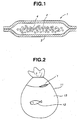
- An oxygen generating materials 1 pertaining to Embodiment 1 comprises, as shown in Fig. 1, a structure wherein solid peroxide 2 and peroxide decomposition catalyst 4 are packaged with a moisture-permeable material 3.
- This moisture-permeable material 3 is characterized in that the cup method moisture permeability at 40°C, 90% RH is more than 20 g/m 2 /24 hr, and that it is impervious to water at normal pressure.
- the transport system of live fishery products pertaining to Embodiment 1 comprises, as shown in Fig. 2, a structure wherein this oxygen generating materials 1 is sealed inside a plastic film bag 11, which is a transport bag containing live fishery products 12 and water 13.
- inorganic peroxide such as sodium carbonate hydrogen peroxide adduct with sodium carbonate and hydrogen peroxide added thereto at a molar ratio of 2:3, sodium perborate mono-hydrate, sodium perborate tetra-hydrate, calcium peroxide, barium peroxide, potassium persulfate, potassium hydrogen persulf ate, or organic peroxide may otherwise be used.
- sodium carbonate hydrogen peroxide adduct, sodium perborate mono-hydrate, and sodium perborate tetra-hydrate are preferable choices.
- any one of the above may be used individually or in a combination of two or more types.
- sodium carbonate hydrogen peroxide adduct on the market, there exists a variety of grades in which stability and the like are altered by adding or coating various types of salt, etc., and every one of them may be used. Furthermore, as the oxygen generation amount or oxygen generation speed will differ according to the grade used, the proper grade thereof may be used pursuant to the intended duration of oxygen generation or the like.
- peroxide decomposition catalyst the following may be employed: hydroxide, oxide, chloride, sulfate, acetate, carbonate, phosphate, double salt and oxyacid salt of various metals; multi-microporous absorbing materials such as alumina, active carbon, zeolite and silica gel; enzymes such as catalase; and organic acids such as fumaric acid.
- hydroxide, oxide, chloride, sulfate, acetate, carbonate, phosphate, double salt and oxyacid salt of various metals multi-microporous absorbing materials such as alumina, active carbon, zeolite and silica gel
- enzymes such as catalase
- organic acids such as fumaric acid.
- any one of the above may be used individually or in a combination of two or more types.
- active carbon of the present invention there is no particular limitation regarding the type of active carbon of the present invention.
- vegetable active carbon using coconut husk or wood as the raw material, and mineral active carbon using coal or pitch as the raw material.
- catalyst active carbon which particularly improved the efficiency in decomposing hydrogen peroxide (product name: CENTAUR; manufactured by Calgon Far East Co., Ltd.).
- any one of the above may be used individually or in a combination of two or more types.
- the average particle size shall mean, upon obtaining the particle size distribution according to the method of JIS K1474 and preparing a particle size cumulative chart, the size of the sieve perforation when the sieve passing percentage of such chart is 50%.
- the average particle size of active carbon used in the present invention is 25 ⁇ 5000 ⁇ m, and preferably 45 ⁇ 1000 ⁇ m.
- goods on the market limiting the particle diameter may be used, and granular active carbon sold on the market may also be used after being pulverized and sieved.
- the oxygen generation speed becomes optimum and a desired duration of oxygen generation becomes easier to obtain. Furthermore, it becomes easier to evenly mix solid peroxide and active carbon.
- the most preferable range of the particle diameter will differ according to the likes of stability of solid peroxide, peroxide decomposition performance of active carbon, moisture permeability of the packaging material, weight ratio of solid peroxide and active carbon, and intended oxygen generation speed.
- the oxygen generation materials of the present invention if the particle diameter of active carbon is considerably small, there is a tendency of the oxygen generation speed being fast initially, but becoming slower with the lapse of time. On the other hand, if the particle diameter of active carbon is considerably large, there is a tendency of the oxygen generation speed being slow initially, but becoming faster with the lapse of time. Furthermore, by selecting an intermediate particle diameter of the two, the oxygen generation speed may be kept, for the most part, steady from the beginning to the end.
- the weight ratio of solid peroxide and peroxide decomposition catalyst will differ according to the combination of solid peroxide, peroxide decomposition catalyst and the packaging materials thereof, a preferable range is 100: 0.01 ⁇ 100:100.
- the larger the ratio of catalyst the faster the oxygen generation speed and, upon exceeding a certain ratio, the oxygen generation speed does not change.
- the packaging material for oxygen generating materials of the present invention is a moisture-permeable material having a cup method moisture permeability (40°C, 90% RH) of more than 20 g/m 2 /24 hr, preferably 20 ⁇ 100000 g/m 2 /24 hr, and being impervious to water at normal pressure.
- the cup method moisture permeability (40°C, 90% RH) is the moisture permeability measured by JIS Z0208.
- non gas-permeable film may be used together as a part of such packaging material.
- the ratio of moisture-permeable material area of the entire packaging area becomes large, the amount of moisture permeating into the packaging material is increased, thereby increasing the oxygen generation speed. Furthermore, the usage of moisture-permeable material with high permeability will also increase the oxygen generation speed. Therefore, it is desirable that the ratio of moisture-permeable material and the type of moisture-permeable material be selected so as to obtain an appropriate oxygen generation speed.
- a plastic multi-layered drawn film obtained by dry laminating polyethylene film and polyethylene terephthalate, and non moisture-permeable water-resistant material such as forming receptacles may be used.
- moisture-permeable material there are the likes of a multi-microporous film made from a plastic sheet possessing micropores, and a non-woven fabric made from a plastic sheet possessing micropores.
- multi-microporous films which may be used as moisture-permeable material of the present invention
- the following methods may be employed: cold drawing synthetic resin films such as polyethylene, polypropylene, and polyethylene fluoride resin; drawing films containing foreign matter; extracting foreign matter from films containing such foreign matter; drawing films after extracting foreign matter from films containing such foreign matter; or performing electron beam irradiation on films.
- a multi-microporous film sold on the market which is preferably used in the present invention, for example, there is Juraguard (U.S.A.; manufactured by Celanese Corp.), FP-2 (manufactured by Asahi Chemical Industry Co., Ltd.), NOP (manufactured by Nippon Petrochemical Co., Ltd.), Nitto Flon NTF (manufactured by Nitto Denko Corp.), NF Sheet (manufactured by Tokuyama Corp.), Cellpore NW11 (manufactured by Sekisui Chemical Co., Ltd.), Polyflon Paper (manufactured by Daikin Industries, Ltd.) and so on.
- the maximum micropore diameter of the opening of the non-woven fabric which may be used as the moisture-permeable material of the present invention, is less than 2 ⁇ m.
- various types of plastic fiber such as polyethylene, polypropylene, polyethylene fluoride, polyester, or nylon, that are conjugated by heat, pressure or adhesives may be used as such non-woven fabric.
- plastic fiber such as polyethylene, polypropylene, polyethylene fluoride, polyester, or nylon
- non-woven fabric sold on the market which is preferably used in the present invention for example, there is Tyvek (U.S.A.; manufactured by Dupont Inc.), Aiel, Spanbond (manufactured by Asahi Chemical Industry Co., Ltd.), Axtar (manufactured by Toray Industries, Inc.) and so on.
- Tyvek U.S.A.; manufactured by Dupont Inc.
- Aiel manufactured by Asahi Chemical Industry Co., Ltd.
- Axtar manufactured by Toray Industries, Inc.
- plastic multi-microporous films and non-woven fabrics may be laminated with other materials in order to improve heat sealability and reinforce the strength thereof.
- laminating material for improving heat sealability it is preferable to use a perforated film made from plastic ("porous sheet") possessing a softening point that is lower than the softening point of the multi-microporous film or non-woven fabric.
- plastic such materials as polyethylene, polypropylene, ethylene vinyl acetate copolymer (EVA), and polyethylene ionomer may be used.
- this porous sheet Upon using a porous sheet, it is possible to heat fuse the porous sheet to the multi-microporous film or non-woven fabric in advance, or the laminating material and micro-porous film or non-woven fabric may be prepared separately and the periphery thereof may be heat sealed. Furthermore, preferably, this porous sheet is arranged such that it would be on the inner side of the package.
- reinforcing material that is formed by braiding strips of synthetic fibers made from polyethylene.
- reinforcing material formed by braiding strips smaller than 10 mm in width into a checkered pattern and heat fusing the vertical strips and horizontal strips is used.
- Nisseki Warif manufactured by Nippon Petrochemical Co., Ltd.
- the reinforcing material be heat fused between the porous sheet and multi-porous film or non-woven fabric, and preferable that it is placed in the order of, from the outer side of the package, multi-microporous film or non-woven fabric, reinforcing material, and porous sheet.
- the shape or manufacturing method of the oxygen generating materials of the present invention there is no particular limitation in the shape or manufacturing method of the oxygen generating materials of the present invention.
- packaging material which packages both the oxygen generating materials and carbon dioxide absorbing materials and permeates liquid water at normal pressure
- any material which is impervious to solid components of the oxygen generating materials and carbon dioxide absorbing materials but permeates water, oxygen and carbon dioxide may be used, such as woven fabric, non-woven fabric, paper and the like.
- heat sealable material it is preferable to use heat sealable material.
- the preferable molar ratio of the theoretical oxygen generation amount and the theoretical carbon dioxide absorption amount of the oxygen generating materials/carbon dioxide absorbing materials package of the present invention is, generally speaking, within the range of 3:1 ⁇ 1:3.
- the absorption performance of the carbon dioxide absorbing materials are, generally speaking, stronger with carbon dioxide in the air compared to dissolved carbon dioxide in the water. Therefore, regarding the oxygen generating materials/carbon dioxide absorbing materials package of the present invention, it is preferable to adjust the weight ratio of the oxygen generating materials and carbon dioxide absorbing materials or the number of packages, or to include a "float" made by packaging air as with a hermetically sealed material, such that the package will float.
- the oxygen generating materials of the present invention generates oxygen by coming in contact with water or moisture. Although liquid water will not seep into the package even if such package comes in contact with liquid water, oxygen is generated by moisture, which is in an equilibrium state with liquid water, permeating through moisture-permeable material and contacting the oxygen generating agent.
- a hermetically sealed system or a system close to a hermetically sealed system as the generated gaseous oxygen will dissolve easier in the water.
- a method of placing live fishery products, water, oxygen generating materials of the present invention and, if necessary, gaseous oxygen in a polyethylene bag or the like and fastening the mouth of such bag with a rubber band may be employed. By employing such method, oxygen will be generated continuously for a period of 3 to 5 days within such system, and live fishery products may be kept alive.
- the oxygen generating materials of the present invention be preserved by hermetically sealing the same with a non moisture-permeable water-resistant material or by coexisting with a desiccant such as silica gel.
- a desiccant such as silica gel.
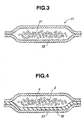
- a carbon dioxide absorbing materials 20 pertaining to Embodiment 2 comprises, as shown in Fig. 3, a structure wherein alkaline earth metal hydroxide 21 is packaged with a gas-permeable material 22.
- This gas-permeable material 22 is characterized in that the Gurley method gas permeability prescribed in JIS P8117 is 0.1 ⁇ 3000 sec./100 ml of gas, and that it is impervious to water but permeates gas at normal pressure.
- the transport system of live fishery products pertaining to Embodiment 2 comprises a similar structure as Embodiment 1, wherein this carbon dioxide absorbing materials 20 is sealed inside a plastic film bag which is a transport bag containing live fishery products and water.
- Carbon dioxide absorbing materials have heretofore been used for the likes of preserving freshness of vegetables and fruits. As vegetables and fruits gradually generate carbon dioxide which causes the loss of freshness, it was desired for conventional carbon dioxide absorbing materials to absorb large amounts of carbon dioxide. However, it was not necessarily demanded that the absorption speed itself to be fast, and the speed of carbon dioxide absorption of carbon dioxide absorbing materials out on the market are generally not that fast. However, upon comparison with vegetables and fruits, as the amount of carbon dioxide generated per hour in the headspace during the transport of live fishery products is extremely large, it is not possible to promptly absorb the carbon dioxide generated in the headspace with conventional carbon dioxide absorbing materials. A carbon dioxide absorbing materials outstanding in carbon dioxide absorption speed is necessary for the transport of live fishery products.
- the carbon dioxide absorbing materials are sealed inside a bag when filling the same with live fishery products, it is preferable that the carbon dioxide absorbing materials preserves its performance while floating on the water surface without sinking into the water even when it is sealed inside the bag containing live fishery products and water.
- the carbon dioxide absorbing materials of the present invention is adequate for the transport of such live fishery products, and displays an outstanding performance of carbon dioxide absorption even when it is used inside a bag containing fish and water. Furthermore, according to a plastic transport of live fishery products wherein this carbon dioxide absorbing materials are sealed inside a transport bag, it is possible to prevent vitality deterioration and death of live fishery products and extend the transport time thereof.
- calcium hydroxide or magnesium hydroxide is used as alkaline earth metal hydroxide. It is preferable that calcium hydroxide or magnesium hydroxide be used in powder or granular form to secure the speed of carbon dioxide absorption.
- gas-permeable material for carbon dioxide absorbing materials using a microporous film or non-woven fabric having a Gurley method gas permeability (JIS P8117) of 0.1 ⁇ 3000 sec./100 ml of gas, preferably 1 ⁇ 1000 sec./100 ml of gas, and being impervious to water at normal pressure is used as the plastic gas-permeable material.
- a microporous film is a polyolefine film possessing micropores of 0.01 ⁇ 50 ⁇ m in size, and is manufactured by such methods as drawing films containing foreign matters or performing electron beam irradiation to films. Furthermore, a non-woven fabric is made of long fibers which have been conjugated by performing cross distribution to a bundle of polyolefine fibers and heat pressing thereafter. Microporous films and non-woven fabrics may be used as is or by being laminated with other films to provide reinforcement or sealability.
- plastic gas-permeable material for example, there is “NF Sheet” (manufactured by Tokuyama), “FP-2” (manufactured by Mitsubishi Chemical Corp.), “NOP” (manufactured by Nippon Petrochemical Co., Ltd. ) , “Cellpore NWO1” (manufactured by Sekisui Chemical Co., Ltd.), “Tyvek” (manufactured by Dupont Inc.), “Eleves” (manufactured by Unitika, Ltd.), and “Luxer” (manufactured by Asahi Chemical Industry Co., Ltd.) and so on.
- NF Sheet manufactured by Tokuyama
- FP-2 manufactured by Mitsubishi Chemical Corp.
- NOP manufactured by Nippon Petrochemical Co., Ltd.
- Cellpore NWO1 manufactured by Sekisui Chemical Co., Ltd.
- Tyvek manufactured by Dupont Inc.
- Eleves manufactured by Unitika, Ltd.
- “Luxer” manufactured by As
- alkaline earth metal hydroxide and/or oxide is packaged with a plastic gas-permeable material having a Gurley method gas permeability (JIS P8117) of 0.1 ⁇ 3000 sec./100 ml of gas and being impervious to water at normal pressure, and a non gas-permeable film may be used together as a part of such packaging material.
- a plastic gas-permeable material having a Gurley method gas permeability (JIS P8117) of 0.1 ⁇ 3000 sec./100 ml of gas and being impervious to water at normal pressure
- a non gas-permeable film may be used together as a part of such packaging material.
- the carbon dioxide absorbing materials be fixed to the headspace of the transport bag with adhesive materials or adhesive tapes upon usage. Furthermore, if the carbon dioxide absorbing materials uses a plastic gas-permeable material for the entire packaging material thereof, having a Gurley method gas permeability (JIS P8117) of 0.1 ⁇ 3000 sec./100 ml of gas and being impervious to water at normal pressure, it may be sealed inside the transport bag as is and be used while it is floated on the water surface.
- a plastic gas-permeable material having a Gurley method gas permeability (JIS P8117) of 0.1 ⁇ 3000 sec./100 ml of gas and being impervious to water at normal pressure
- the transport system of live fishery products pertaining to Embodiment 3 comprises a structure wherein the oxygen generating materials 1 obtained in Embodiment 1 and the carbon dioxide absorbing materials 20 obtained in Embodiment 2 are, in a similar manner as Embodiment 1, sealed inside the plastic film bag which is a transport bag containing live fishery products and water.
- An oxygen generating materials was obtained by filling 40 g of sodium carbonate hydrogen peroxide adduct (SPC-G; manufactured by Mitsubishi Gas Chemical Co., Inc.) and 0.4 g of powdered active carbon (Kuraraycoal PW; manufactured by Kararay Chemical Co., Ltd.) between two sheets of polyethylene non-woven fabric with a thickness of 160 ⁇ m (Tyvek; U.S.A.; manufactured by Dupont Inc.), and heat sealing the four sides such that the measurements become 120 mm in length ⁇ 85 mm in width, with a sealed width of 10 mm.
- SPC-G sodium carbonate hydrogen peroxide adduct
- Karl PW powdered active carbon
- One obtained oxygen generating materials was floated on water (1 liter) within a hermetically sealed glass receptacle (entire content value: approx. 2 liters) connected to a wet gas meter.
- the cumulative oxygen generation amount from the time of preparation was 1.5 liters after 24 hours, 3.1 liters after 72 hours and 3.5 liters after 120 hours.
- Example 2 Similar procedures were taken as Example 1, except that one sheet of polyethylene non-woven fabric with a thickness of 160 ⁇ m and one sheet of laminated film made by dry laminating holeless polyethylene film and polyethylene terephthalate film were used instead of two sheets of polyethylene non-woven fabric with a thickness of 160 ⁇ m.
- the cumulative oxygen generation amount from the time of preparation was 1.1 liters after 24 hours, 2.4 liters after 72 hours and 3.5 liters after 120 hours.
- Example 2 Similar procedures were taken as Example 1, except that two sheets of packaging material made by heat fusing three layers, namely polypropylene microporous film with a thickness of 50 ⁇ m (Juraguard; U.S.A.; manufactured by Celanese Corp.), polyethylene reinforcing material (Nisseki Warif; manufactured by Nippon Petrochemical Co., Ltd.), and polyethylene film possessing small pores having a 0.3 mm diameter in 7 mm intervals in each direction of left, right, up and down, were used instead of two sheets of polyethylene non-woven fabric with a thickness of 160 ⁇ m.
- heat sealing was performed such that the porous sheet layer would be on the inner side of the package.
- the cumulative oxygen generation amount from the time of preparation was 0.7 liters after 24 hours, 2.0 liters after 72 hours and 3.2 liters after 120 hours.
- Example 2 Similar procedures were taken as Example 1, except that one sheet of laminated packaging material made by laminating an EVA film with a thickness of 40 ⁇ m and possessing small pores having a 0.2 mm diameter in 1 mm intervals in each direction of left, right, up and down, and a multi-microporous film with a thickness of 150 ⁇ m (Cellpore; manufactured by Sekisui Chemical Co., Ltd.) and one sheet of polyethylene non-woven fabric with a thickness of 160 ⁇ m were used instead of two sheets of polyethylene non-woven fabric with a thickness of 160 ⁇ m shown in Fig. 4. However, heat sealing was performed such that the EVA layer would be on the inner side of the package.
- one sheet of laminated packaging material made by laminating an EVA film with a thickness of 40 ⁇ m and possessing small pores having a 0.2 mm diameter in 1 mm intervals in each direction of left, right, up and down, and a multi-microporous film with a thickness of 150 ⁇ m (Cell
- the cumulative oxygen generation amount from the time of preparation was 1.2 liters after 24 hours, 2.7 liters after 72 hours and 3.5 liters after 120 hours.
- Example 2 Similar procedures were taken as Example 1, except that 40 g of sodium carbonate hydrogen peroxide adduct (SPC-D; manufactured by Mitsubishi Gas Chemical Co., Inc.) was used instead of 40 g of sodium carbonate hydrogen peroxide adduct (SPC-G; manufactured by Mitsubishi Gas Chemical Co., Inc.).
- SPC-D sodium carbonate hydrogen peroxide adduct
- SPC-G sodium carbonate hydrogen peroxide adduct
- the cumulative oxygen generation amount from the time of preparation was 0.6 liters after 24 hours, 1.4 liters after 72 hours and 2.2 liters after 120 hours.
- Example 2 Similar procedures were taken as Example 1, except that 40 g of sodium perborate mono-hydrate (15% Perbon; manufactured by Mitsubishi Gas Chemical Co., Inc.) was used instead of 40 g of sodium carbonate hydrogen peroxide adduct (SPC-G; manufactured by Mitsubishi Gas Chemical Co., Inc.).
- SPC-G sodium carbonate hydrogen peroxide adduct
- the cumulative oxygen generation amount from the time of preparation was 0.4 liters after 24 hours, 1.5 liters after 72 hours and 2.3 liters after 120 hours.
- Example 2 Similar procedures were taken as Example 1, except that 2.0 g of manganese dioxide (rematerials manufactured by Aldrich) was used instead of 0.4 g of powdered active carbon.
- the cumulative oxygen generation amount from the time of preparation was 1.4 liters after 24 hours, 2.9 liters after 72 hours and 3.4 liters after 120 hours.
- Example 2 Similar procedures were taken as Example 1, except that 0.2 g of catalase solution (Asc Super 25; manufactured by Mitsubishi Gas Chemical Co., Inc.) was used instead of 0.4 g of powdered active carbon.
- Catalase solution Asc Super 25; manufactured by Mitsubishi Gas Chemical Co., Inc.
- the cumulative oxygen generation amount from the time of preparation was 1.0 liters after 24 hours, 2.1 liters after 72 hours and 2.8 liters after 120 hours. Moreover, hydrogen peroxide was not detected in the water.
- Example 2 Similar procedures were taken as Example 1, except that two sheets of laminated film made by dry laminating holeless polyethylene film and polyethylene terephthalate film were used instead of two sheets of polyethylene non-woven fabric with a thickness of 160 ⁇ m.
- Example 2 Similar procedures were taken as Example 1, except that 40 g of 10% hydrogen peroxide aqueous solution was used instead of 40 g of sodium carbonate hydrogen peroxide adduct.
- Example 1 Similar procedures were taken as Example 1, except that powdered active carbon was not used.
- the cumulative oxygen generation amount from the time of preparation was 0.0 liters after 24 hours, 0.1 liters after 72 hours and 0.3 liters after 120 hours.
- Example 9 Similar procedures were taken as Example 9, except that the oxygen generating materials was not used. All of the goldfish had died at the time 48 hours had lapsed.
- An oxygen generating materials was obtained by filling 40 g of sodium carbonate hydrogen peroxide adduct (SPC-G; manufactured by Mitsubishi Gas Chemical Co., Inc.) and 0.4 g of powdered active carbon having a average particle size of 150 ⁇ 300 ⁇ m (obtained by pulverizing and sieving Kuraraycoal PW; manufactured by Kuraray Chemical Co., Ltd.) between two sheets of polyethylene non-woven fabric with a thickness of 160 ⁇ m (Tyvek; U.S.A.; manufactured by Dupont Inc.), and heat sealing the four sides such that the measurements become 120 mm in length ⁇ 85 mm in width, with a sealed width of 10 mm.
- SPC-G sodium carbonate hydrogen peroxide adduct
- powdered active carbon having a average particle size of 150 ⁇ 300 ⁇ m obtained by pulverizing and sieving Kuraraycoal PW; manufactured by Kuraray Chemical Co., Ltd.
- Tyvek U.S.A.
- One obtained oxygen generating materials was floated on water (1 liter) within a hermetically sealed glass receptacle (entire content value: approx. 2 liters) connected to a wet gas meter.
- the cumulative oxygen generation amount from the time of preparation was 0.6 liters after 24 hours, 3.0 liters after 72 hours and 3.5 liters after 120 hours.
- Example 10 Similar procedures were taken as Example 10, except that active carbon having a average particle size of 75 ⁇ 150 ⁇ m was used instead of active carbon having a average particle size of 150 ⁇ 300 ⁇ m.
- the cumulative oxygen generation amount from the time of preparation was 0.9 liters after 24 hours, 3.2 liters after 72 hours and 3.5 liters after 120 hours.
- Example 10 Similar procedures were taken as Example 10, except that active carbon having a average particle size of 45 ⁇ 75 ⁇ m was used instead of active carbon having a average particle size of 150 ⁇ 300 ⁇ m.
- the cumulative oxygen generation amount from the time of preparation was 1.7 liters after 24 hours, 3.4 liters after 72 hours and 3.5 liters after 120 hours.
- catalyst active carbon having a average particle size of 300 ⁇ 600 ⁇ m obtained by pulverizing and sieving granular CENTAUR; manufactured by Calgon Far East Co., Ltd.
- active carbon having a average particle size of 150 ⁇ 300 ⁇ m obtained by pulverizing and sieving Kuraraycoal PW; manufactured by Kuraray Chemical Co., Ltd.
- the cumulative oxygen generation amount from the time of preparation was 0.3 liters after 24 hours, 2.8 liters after 72 hours and 3.5 liters after 120 hours.
- Example 2 Similar procedures were taken as Example 1, except that one sheet of polyethylene non-woven fabric with a thickness of 160 ⁇ m and one sheet of laminated film made by dry laminating holeless polyethylene film and polyethylene terephthalate film were used instead of two sheets of polyethylene non-woven fabric with a thickness of 160 ⁇ m.
- the cumulative oxygen generation amount from the time of preparation was 0.6 liters after 24 hours, 2.6 liters after 72 hours and 3.5 liters after 120 hours.
- Example 10 Similar procedures were taken as Example 10, except that one sheet of packaging material made by heat fusing three layers, namely polypropylene multi-microporous film with a thickness of 50 ⁇ m (Juraguard; U.S.A.; manufactured by Celanese Corp.), polyethylene reinforcing material (Nisseki Warif; manufactured by Nippon Petrochemical Co., Ltd.), and polyethylene film possessing small pores having a 0.3 mm diameter in 7 mm intervals in each direction of left, right, up and down, and one sheet of laminated packaging material made by laminating an EVA film with a thickness of 40 ⁇ m and possessing small pores having a 0.2 mm diameter in 1 mm intervals in each direction of left, right, up and down, and a multi-microporous film with a thickness of 150 ⁇ m (Cell-pore; manufactured by Sekisui Chemical Co., Ltd.) were used instead of two sheets of polyethylene non-woven fabric with a thickness of 160 ⁇ m.
- heat sealing was performed such
- Example 2 Similar procedures were taken as Example 1, except that 40 g of sodium carbonate hydrogen peroxide adduct (SPC-D; manufactured by Mitsubishi Gas Chemical Co., Inc.) and 0.8 g of active carbon with a particle diameter of 45 ⁇ 75 ⁇ m were used instead of 40 g of sodium carbonate hydrogen peroxide adduct (SPC-G; manufactured by Mitsubishi Gas Chemical Co., Inc.) and 0.4 g of active carbon with a average particle size of 150 ⁇ 300 ⁇ m.
- the cumulative oxygen generation amount from the time of preparation was 0.9 liters after 24 hours, 2.1 liters after 72 hours and 3.3 liters after 120 hours.
- Example 10 Similar procedures were taken as Example 10, except that powdered active carbon was not used.
- the cumulative oxygen generation amount from the time of preparation was 0.0 liters after 24 hours, 0.1 liters after 72 hours and 0.3 liters after 120 hours.
- Example 10 Similar procedures were taken as Example 10, except that active carbon with a average particle size of more than 5000 ⁇ m was used instead of active carbon with a average particle size of 150 ⁇ 300 ⁇ m.
- the gaseous oxygen generation amount was 0.1 liters even after 120 hours had lapsed from the time of preparation.
- Example 10 Similar procedures were taken as Example 10, except that two sheets of laminated film made by dry laminating holeless polyethylene film and polyethylene terephthalate film were used instead of two sheets of polyethylene non-woven fabric with a thickness of 160 ⁇ m. No gaseous oxygen was generated even after 120 hours had lapsed from the time of preparation.
- Example 10 Similar procedures were taken as Example 10, except that 40 g of 10% hydrogen peroxide aqueous solution was used instead of 40 g of sodium carbonate hydrogen peroxide adduct. Two point five liters of gaseous oxygen was generated in 30 min. from the time of preparation, but no gaseous oxygen was generated thereafter.
- Example 17 Similar procedures were taken as Example 17, except that the oxygen generating materials was not used. All of the goldfish had died at the time 48 hours had lapsed.
- a carbon dioxide absorbing materials was prepared by manufacturing a small bag of 8 cm ⁇ 10 cm wherein one side is Tyvek (manufactured by Dupont Inc.; a non-woven fabric having a Gurley method gas permeability (JIS P8117) of 30 sec./100 ml of gas and being impervious to water at normal pressure) and the other side is a non gas-permeable film made from polyethylene terephthalate, polyethylene and ethylene vinyl acetate copolymer, and sealing 11 g of powdered calcium hydroxide inside this small bag. Approximately 10 kg of live eel (30 eels; provision of feed was ceased) and approx.
- Example 18 A similar test as Example 18 was performed except that the carbon dioxide absorbing materials was not used. The results thereof are shown in Table 1.
- Preservation Time Example 18 Comparative Example 10 24 Hours Carbon Dioxide Concentration (%) 0.9 5.8 Number of Deaths (of Eels) 0 0 42 Hours Carbon Dioxide Concentration (%) 8.8 16.6 Number of Deaths (of Eels) 0 23
- Example 19 A similar test as Example 19 was performed except that the carbon dioxide absorbing materials was not used. The results thereof are shown in Table 2.
- Preservation Time Example 19 Comparative Example 11 24 Hours Carbon Dioxide Concentration (%) 1.3 7.2 Number of Deaths (of Goldfish) 0 0 Condition of Living Goldfish ⁇ ⁇ 48 Hours Carbon Dioxide Concentration (%) 2.7 13.1 Number of Deaths (of Goldfish) 0 0 Condition of Living Goldfish ⁇ ⁇ 72 Hours Carbon Dioxide Concentration (%) 6.9 20.4 Number of Deaths (of Goldfish) 0 12 Condition of Living Goldfish ⁇ ⁇ Note: Regarding the condition of living goldfish: ⁇ means that the goldfish are active and moving its mouths near the water surface; and ⁇ means that the movements of the goldfish are dull and its mouths are not moving near the water surface.
- An oxygen generating materials was obtained by filling 40 g of sodium carbonate hydrogen peroxide adduct (SPC-G; manufactured by Mitsubishi Gas Chemical Co., Inc.) and 0.4 g of powdered active carbon (Kuraraycoal PW; manufactured by Kuraray Chemical Co., Ltd.) between two sheets of packaging material made by heat fusing three layers, namely polypropylene multi-microporous film with a thickness of 50 ⁇ m (Juraguard; U.S.A.; manufactured by Celanese Corp.), polyethylene reinforcing material (Nisseki Warif; manufactured by Nippon Petrochemical Co., Ltd.), and polyethylene film possessing small pores having a 0.3 mm diameter in 7 mm intervals in each direction of left, right, up and down, and heat sealing the four sides such that the measurements become 120 mm in length ⁇ 85 mm in width, with a sealed width of 10 mm.
- heat sealing was performed such that the porous sheet layer would be on the inner side of the package.
- a carbon dioxide absorbing materials was obtained by filling 30 g of granular calcium hydroxide between one sheet of polyethylene non-woven fabric with a thickness of 160 ⁇ m (Tyvek; U.S.A.; manufactured by Dupont Inc.) and one sheet of laminated film made by dry laminating holeless polyethylene film and polyethylene terephthalate film, and heat sealing the four sides such that the measurements become 120 mm in length ⁇ 85 mm in width, with a sealed width of 10 mm.
- An oxygen generating materials package was obtained by filling 40 g of sodium carbonate hydrogen peroxide adduct (SPC-G; manufactured by Mitsubishi Gas Chemical Co., Inc.) and 0.4 g of powdered active carbon (Kuraraycoal PW; manufactured by Kuraray Chemical Co., Ltd.) between two sheets of packaging material made by heat fusing three layers, namely polypropylene multi-microporous film with a thickness of 50 ⁇ m (Juraguard; U.S.A.; manufactured by Celanese Corp.), polyethylene reinforcing material (Nisseki Warif; manufactured by Nippon Petrochemical Co., Ltd.), and polyethylene film possessing small pores having a 0.3 mm diameter in 7 mm intervals in each direction of left, right, up and down, and heat sealing the four sides such that the measurements become 120 mm in length ⁇ 85 mm in width, with a sealed width of 10 mm.
- heat sealing was performed such that the porous sheet layer would be on the inner side of the package.
- a carbon dioxide absorbing materials package was obtained by filling 40 g of granular calcium hydroxide between one sheet of polyethylene non-woven fabric with a thickness of 160 ⁇ m (Tyvek; U.S.A.; manufactured by Dupont Inc.) and one sheet of laminated film made by dry laminating holeless polyethylene film and polyethylene terephthalate film, and heat sealing the four sides such that the measurements become 120 mm in length ⁇ 85 mm in width, with a sealed width of 10 mm.
- an oxygen generating materials/carbon dioxide absorbing materials package was obtained by placing four oxygen generating materials packages and two carbon dioxide absorbing materials packages between two sheets of hydrophobic non-woven fabric, which is hydrophobic material, with a thickness of 90 ⁇ m (Melfit I; -manufactured by unisel, Ltd.), and heat sealing the four sides such that the measurements become 200 mm in length ⁇ 150 mm in width, with a sealed width of 10 mm.
- Example 21 Similar procedures were taken as Example 21, except that a hydrophilic non-woven fabric with a thickness of 90 ⁇ m (Melfit-II; manufactured by Unisel, Ltd.) was used instead of a hydrophobic non-woven fabric as the hydrophobic material.
- the oxygen concentration in the headspace was 84% and the carbon dioxide concentration was 15%, and all of the goldfish were alive.
- the oxygen concentration in the headspace was 77% and the carbon dioxide concentration was 18%, and approx. 90% of the goldfish were alive.
- the oxygen generating materials/carbon dioxide absorbing materials package was floating while roughly half of such package was submerged in water.
- Example 21 Similar procedures were taken as Example 21, except that 300 goldfish (total weight: approx. 2 kg) were used instead of 150 goldfish. At the time 48 hours had lapsed, the oxygen concentration in the headspace was 84% and the carbon dioxide concentration was 13%. At the time 72 hours had lapsed, the oxygen concentration in the headspace was 82% and the carbon dioxide concentration was 17%, and all of the goldfish were alive. Furthermore, the oxygen generating materials/carbon dioxide absorbing materials package was floating while roughly half of such package was submerged in water.
- One Hundred and Fifty goldfish (total weight: approx. 1 kg), 10 liters of water, and four oxygen generating materials packages and two carbon dioxide absorbing materials packages prepared with the method of Example 21 were put into a polyethylene bag, approx. 20 liters of gaseous oxygen was blown therein, the mouth of the bag was fastened with a rubber band, and was left alone at a temperature of 25°C.
- the oxygen concentration in the headspace was 80% and the carbon dioxide concentration was 18%, and all of the goldfish were alive.
- the oxygen concentration in the headspace was 73% and the carbon dioxide concentration was 22%, and approx. 70% of the goldfish had died.
- the oxygen generating materials package and carbon dioxide absorbing materials package were floating while roughly 30% and 90% of such packages were submerged in water, respectively.
- An oxygen generating materials package was obtained by filling 40 g of sodium carbonate hydrogen peroxide adduct ( SPC-G; manufactured by Mitsubishi Gas Chemical Co., Inc.), 2.0 g of manganese dioxide (rematerials manufactured by Aldrich) and 2.0 g of activated alumina between two sheets of packaging material made by heat fusing three layers, namely polypropylene multi-microporous film with a thickness of 50 ⁇ m (Juraguard; U.S.A.; manufactured by Celanese Corp.), polyethylene reinforcing material (Nisseki Warif; manufactured by Nippon Petrochemical Co., Ltd.), and polyethylene film possessing small pores having a 0.3 mm diameter in 7 mm intervals in each direction of left, right, up and down, and heat sealing the four sides such that the measurements become 120 mm in length ⁇ 85 mm in width, with a sealed width of 10 mm.
- heat sealing was performed such that the porous sheet layer would be on the inner side of the package.
- a carbon dioxide absorbing materials package was obtained by filling 40 g of granular calcium hydroxide between one sheet of polyethylene non-woven fabric with a thickness of 160 ⁇ m (Tyvek; U.S.A.; manufactured by Dupont Inc.) and one sheet of laminated film made by dry laminating holeless polyethylene film and polyethylene terephthalate film, and heat sealing the four sides such that the measurements become 120 mm in length ⁇ 85 mm in width, with a sealed width of 10 mm.
- an oxygen generating materials/carbon dioxide absorbing materials package was obtained by placing four oxygen generating materials packages and two carbon dioxide absorbing materials packages prepared above between two sheets of hydrophobic non-woven fabric, which is hydrophobic material, with a thickness of 90 ⁇ m (Melfit I; manufactured by Unisel, Ltd.), and heat sealing the four sides such that the measurements become 200 min in length ⁇ 150 mm in width, with a sealed width of 10 mm.
- One oxygen generating materials/carbon dioxide absorbing materials package after such preservation was floated on water (1 liter) within a hermetically sealed glass receptacle (entire content volume: approx. 2 liters) connected to a wet gas meter.
- the cumulative oxygen generation amount from the time of preparation was 1.3 liters after 24 hours, 2.8 liters after 72 hours and 3.4 liters after 120 hours.
- Example 24 Similar procedures were taken as Example 24, except that activated alumina was not filled inside the oxygen generating materials package or carbon dioxide absorbing materials package. Thereafter, an oxygen generating materials/carbon dioxide absorbing materials package was prepared and placed inside a hermetically sealed outer bag. This outer bag containing the oxygen generating materials/carbon dioxide absorbing materials package was preserved for two (2) weeks at 30°c within a thermo-hygrostat with a relative humidity of 80%, and the outer bag inflated and burst in two (2) weeks.
- An oxygen generating materials package was obtained by filling 40 g of sodium carbonate hydrogen peroxide adduct (SPC-G; manufactured by Mitsubishi Gas Chemical Co. , Inc.), 0.4 g of active carbon having a particle diameter of 150 ⁇ 300 ⁇ m (obtained by pulverizing and sieving a granular active carbon Kuraraycoal PW; manufactured by Kuraray Chemical Co., Ltd.), and 4.0 g of silica gel between two sheets of polyethylene non-woven fabric with a thickness of 160 ⁇ m (Tyvek; U.S.A.; manufactured by Dupont Inc.), and heat sealing the four sides such that the measurements become 120 mm in length ⁇ 85 mm in width, with a sealed width of 10 mm. Furthermore, a carbon dioxide absorbing materials was obtained with a similar method as Example 24, except that 4.0 g of silica gel was used instead of 2.0 g of active alumina.
- An oxygen generating materials/carbon dioxide absorbing materials package was obtained by packaging four oxygen generating materials packages and two carbon dioxide absorbing materials packages prepared above with a hydrophobic non-woven fabric in a similar manner as Example 24. Two obtained oxygen generating materials/carbon dioxide absorbing materials packages were interposed between two sheets of laminated film (cup method moisture permeability of 4 g/m 2 /24 hr) made by laminating polyvinylidene chloride coated drawn nylon film and polyethylene film, and the four sides thereof were heat sealed.
- a pinhole having a diameter of 0.2 mm was provided at one point on an outer bag containing this oxygen generating materials/carbon dioxide absorbing materials package, and such outer bag was preserved for two (2) months at 30°C within a thermo-hygrostat with a relative humidity of 80%, and the percentage of available oxygen remaining in the peroxide was 95%.
- One oxygen generating materials/carbon dioxide absorbing materials package after such preservation was floated on water (1 liter) within a hermetically sealed glass receptacle (entire content volume: approx. 2 liters) connected to a wet gas meter.
- the cumulative oxygen generation amount from the time of preparation was 0.5 liters after 24 hours, 2.9 liters after 72 hours and 3.5 liters after 120 hours.
- Example 25 Similar procedures were taken as Example 25, except that silica gel was not filled inside the oxygen generating materials package or carbon dioxide absorbing materials package.
- the outer bag containing the oxygen generating materials/carbon dioxide absorbing materials package was preserved for two (2) months at 30°C within a thermo-hygrostat with a relative humidity of 80%, and the percentage of available oxygen remaining in the peroxide was 74%.
- the cumulative oxygen generation amount was 0.4 liters after 24 hours, 1.5 liters after 72 hours and 2.4 liters after 120 hours.
- Example 25 Similar procedures were taken as Example 25, except that 0.2 g of catalase solution (ASC Super 25; manufactured by Mitsubishi Gas Chemical Co., Inc.) and 1.0 g of bone-dry permutite were used instead of 0.4 g of active carbon and 4.0 g of silica gel. Furthermore, a carbon dioxide absorbing materials was obtained with a similar method as Example 25, except that 1.0 g of bone-dry permutite was used instead of 2 g of activated alumina.
- ASC Super 25 manufactured by Mitsubishi Gas Chemical Co., Inc.
- the percentage of available oxygen remaining in the peroxide after preservation was 92%. Furthermore, the cumulative oxygen generation amount was 0.9 liters after 24 hours, 2.0 liters after 72 hours and 2.8 liters after 120 hours.
- Example 27 Similar procedures were taken as Example 26, except that permutite was not filled inside the oxygen generating materials package or carbon dioxide absorbing materials package.
- the outer bag containing the oxygen generating materials/carbon dioxide absorbing materials package was preserved for two (2) months at 30°C within a thermo-hygrostat with a relative humidity of 80%, and the percentage of available oxygen remaining in the peroxide was 59%. Furthermore, the cumulative oxygen generation amount was 0.6 liters after 24 hours, 1.2 liters after 72 hours and 1.5 liters after 120 hours. (Example 27)
- An oxygen generating materials/carbon dioxide absorbing materials package was obtained with a similar method as Example 25, except that silica gel was not filled inside the carbon dioxide absorbing materials package.
- Two obtained oxygen generating materials/carbon dioxide absorbing materials packages and 40 g of silica gel were interposed between two sheets of laminated film (cup method moisture permeability of 1 g/m 2 /24 hr) made by laminating aluminum vaporization polyester film and polyethylene film, and the four sides thereof were heat sealed.
- a pinhole having a diameter of 0.2 mm was provided at one point on an outer bag containing this oxygen generating materials/carbon dioxide absorbing materials package, and such outer bag was preserved for two (2) months at 30°C within a thermo-hygrostat with a relative humidity of 80%, and the percentage of available oxygen remaining in the peroxide was 93%.
- An oxygen generating materials/carbon dioxide absorbing materials package was obtained with a similar method as Example 27, except that silica gel was not filled inside the oxygen generating materials package.
- Two obtained oxygen generating materials/carbon dioxide absorbing materials packages and 56 g of silica gel were placed inside an outer bag possessing a pinhole, and such outer bag was preserved for two (2) months at 30°C within a thermo-hygrostat with a relative humidity of 80%, and the percentage of available oxygen remaining in the peroxide was 64%.
- the survival rate of live fishery products during plastic transport or preservation thereof may be increased.
- the present invention may also be preferably employed upon emergencies such as the condition of hypoxia or the generation of harmful gases, or as a freshness preservation materials for plants and the like.
- vitality deterioration of live fishery products may be prevented and the survival rate thereof during transport may be increased, in a simple manner, without making any drastic changes in the conventional plastic transport method. Furthermore, plastic transport of live fishery products to distant places, which was impossible heretofore, is made possible as the transport time is extended as a result thereof.
Landscapes
- Chemical & Material Sciences (AREA)
- Life Sciences & Earth Sciences (AREA)
- Organic Chemistry (AREA)
- Environmental Sciences (AREA)
- Inorganic Chemistry (AREA)
- Chemical Kinetics & Catalysis (AREA)
- Analytical Chemistry (AREA)
- Biodiversity & Conservation Biology (AREA)
- Animal Husbandry (AREA)
- Marine Sciences & Fisheries (AREA)
- Farming Of Fish And Shellfish (AREA)
- Packages (AREA)
- Oxygen, Ozone, And Oxides In General (AREA)
Applications Claiming Priority (7)
| Application Number | Priority Date | Filing Date | Title |
|---|---|---|---|
| JP26160797A JPH11100201A (ja) | 1997-09-26 | 1997-09-26 | 酸素発生剤包装体及び活魚の輸送方法 |
| JP26160797 | 1997-09-26 | ||
| JP33873297 | 1997-12-09 | ||
| JP33873297A JPH11169016A (ja) | 1997-12-09 | 1997-12-09 | 酸素発生剤包装体及び活魚の輸送方法 |
| JP1694698A JPH11206266A (ja) | 1998-01-29 | 1998-01-29 | 活魚の輸送方法 |
| JP1694698 | 1998-01-29 | ||
| EP98307741A EP0905086B1 (de) | 1997-09-26 | 1998-09-24 | Sauerstoffgenerierende Zusammensetzungen und Anlage und Verfahren zum Tranport von lebenden Fischprodukten |
Related Parent Applications (2)
| Application Number | Title | Priority Date | Filing Date |
|---|---|---|---|
| EP98307741A Division EP0905086B1 (de) | 1997-09-26 | 1998-09-24 | Sauerstoffgenerierende Zusammensetzungen und Anlage und Verfahren zum Tranport von lebenden Fischprodukten |
| EP98307741.3 Division | 1998-09-24 |
Publications (2)
| Publication Number | Publication Date |
|---|---|
| EP1514841A2 true EP1514841A2 (de) | 2005-03-16 |
| EP1514841A3 EP1514841A3 (de) | 2011-09-07 |
Family
ID=27281629
Family Applications (2)
| Application Number | Title | Priority Date | Filing Date |
|---|---|---|---|
| EP04077860A Withdrawn EP1514841A3 (de) | 1997-09-26 | 1998-09-24 | Kohlendioxydabsorbierende Zusammensetzungen, und Anlage und Verfahren zum Transport von lebenden Fischprodukten |
| EP98307741A Expired - Lifetime EP0905086B1 (de) | 1997-09-26 | 1998-09-24 | Sauerstoffgenerierende Zusammensetzungen und Anlage und Verfahren zum Tranport von lebenden Fischprodukten |
Family Applications After (1)
| Application Number | Title | Priority Date | Filing Date |
|---|---|---|---|
| EP98307741A Expired - Lifetime EP0905086B1 (de) | 1997-09-26 | 1998-09-24 | Sauerstoffgenerierende Zusammensetzungen und Anlage und Verfahren zum Tranport von lebenden Fischprodukten |
Country Status (6)
| Country | Link |
|---|---|
| US (2) | US6306352B1 (de) |
| EP (2) | EP1514841A3 (de) |
| KR (3) | KR19990030148A (de) |
| CN (2) | CN1199560C (de) |
| DE (1) | DE69837586T2 (de) |
| TW (1) | TW403720B (de) |
Cited By (6)
| Publication number | Priority date | Publication date | Assignee | Title |
|---|---|---|---|---|
| CN105214598A (zh) * | 2015-10-22 | 2016-01-06 | 北京林业大学 | 一种高性能co2吸附材料及其制备方法 |
| CN105214597A (zh) * | 2015-09-21 | 2016-01-06 | 广东电网有限责任公司电力科学研究院 | 中温二氧化碳吸收剂及其成型方法 |
| CN106106320A (zh) * | 2016-08-01 | 2016-11-16 | 江苏大学 | 一种用于鲟鱼低温保活运输装置的氧气缓释器 |
| CN108067180A (zh) * | 2018-01-11 | 2018-05-25 | 重庆大学 | 一种钇镁-钙基co2吸附剂及其制备方法 |
| CN112478421A (zh) * | 2020-12-05 | 2021-03-12 | 任杰 | 一种分层自疏松型袋装干燥剂 |
| CN115180882A (zh) * | 2022-05-30 | 2022-10-14 | 湖北工业大学 | 一种内源碳化轻质板的制备方法 |
Families Citing this family (45)
| Publication number | Priority date | Publication date | Assignee | Title |
|---|---|---|---|---|
| TW403720B (en) * | 1997-09-26 | 2000-09-01 | Mitsubishi Gas Chemical Co | Oxygen generating agent, carbon dioxide gas absorbent, the transport system and the transport method of living fish |
| US7273567B1 (en) * | 1999-11-24 | 2007-09-25 | Microactive Corp. | Energy-activated compositions for controlled sustained release of a gas |
| IL146440A0 (en) * | 1999-05-18 | 2002-07-25 | Southwest Res Inst Bernard Tec | Energy-activated compositions for controlled sustained release of gas |
| US20030099837A1 (en) * | 1999-12-22 | 2003-05-29 | Dirk Mockel | Thermoplastic multi-layered film with a layer of vinylcyclohexane-based polymer |
| NL1017129C2 (nl) * | 2001-01-16 | 2002-07-17 | Rp Zeewolde B V | Samenstelling voor het verhogen van het zuurstofgehalte in water. |
| WO2003054508A2 (en) * | 2001-10-23 | 2003-07-03 | Anteon Corporation | Integrated oxygen generation and carbon dioxide absorption method, apparatus and systems |
| DE10324563A1 (de) * | 2003-05-30 | 2004-12-30 | Söchting, Klaus, Dr. | Verfahren zur Versorgung eines biologisch genutzten wäßrigen Systems mit Sauerstoff, und eine Vorrichtung und ein Set zur Durchführung dieses Verfahrens |
| KR20050077896A (ko) * | 2004-01-29 | 2005-08-04 | 박재학 | 산소발생방법 |
| CA2489738C (en) * | 2004-12-10 | 2007-06-26 | Atlantic Aqua Farms Inc. | Modified atmosphere packaging for seafood |
| CN1317065C (zh) * | 2005-01-21 | 2007-05-23 | 清华大学 | 高活性钙基co2吸收剂及其制备方法 |
| US20060219184A1 (en) * | 2005-04-01 | 2006-10-05 | Wilson Charles L | Compartmentalized Plastic Bags That Deliver Stress-Reducing Chemicals to Fish During Transport or Treatment |
| JP2008021629A (ja) * | 2006-07-11 | 2008-01-31 | Samsung Sdi Co Ltd | 有機電界発光表示装置 |
| US20080081364A1 (en) * | 2006-10-03 | 2008-04-03 | Greenfield Richard M | Preservation system for stratabound microorganisms |
| US20090107409A1 (en) * | 2007-10-30 | 2009-04-30 | Charles Qian Yu | Container for transport and acclimation of fish and their acclimation to new environments |
| KR101251891B1 (ko) * | 2008-01-21 | 2013-04-08 | 김현식 | 위생대 |
| FR2930725B1 (fr) * | 2008-04-30 | 2010-08-13 | Oreal | Compositions a base de complexes polymere-peroxyde d'hydrogene et leurs utilisations |
| US20100255162A1 (en) * | 2009-04-06 | 2010-10-07 | Cryovac, Inc. | Packaging with on-demand oxygen generation |
| US20110243483A1 (en) * | 2010-03-31 | 2011-10-06 | Multisorb Technologies, Inc. | Oxygen and carbon dioxide absorption in a single use container |
| US20120015081A1 (en) * | 2010-03-31 | 2012-01-19 | Multisorb Technologies, Inc. | Oxygen and carbon dioxide absorption in a single use container |
| GB201108336D0 (en) * | 2011-05-18 | 2011-06-29 | Emco Packaging Systems Ltd | Packaging inclusion for controlling or modifying the atmosphere in packaging |
| CN102923927B (zh) * | 2011-11-08 | 2014-10-01 | 福州光宇环保科技有限公司 | 一种污染水体底泥复氧型修复剂及其制备方法和应用 |
| US20150156994A1 (en) * | 2012-05-31 | 2015-06-11 | Mitsubishi Gas Chemical Company, Inc. | Oxygen-generating and carbon dioxide-absorbing agent composition and oxygen-generating and carbon dioxide-absorbing agent packaging body and method for transporting live fish and shellfish |
| JP6028182B2 (ja) * | 2012-07-06 | 2016-11-16 | 株式会社光未来 | 水素ガスの密封袋、及び水素ガスの溶解方法 |
| US9365425B2 (en) | 2012-08-31 | 2016-06-14 | Water Star, Inc. | High pressure dissolved oxygen generation |
| JP5897133B2 (ja) * | 2014-02-17 | 2016-03-30 | マリンバイオテクノロジー株式会社 | 魚介類の麻酔方法および装置 |
| US10021867B2 (en) | 2014-06-02 | 2018-07-17 | Judy L. Tipton | Fish transfer bag |
| CN104003495B (zh) * | 2014-06-16 | 2015-07-08 | 唐山亨通科技有限公司 | 一种油脂类污水处理的方法及化学药剂 |
| CN104255593A (zh) * | 2014-09-05 | 2015-01-07 | 李松霖 | 一种鲜活鱼的运输方法 |
| CN105617554B (zh) * | 2016-01-23 | 2019-04-12 | 汕头大学医学院第一附属医院 | 一种能够释放水份及氧气的颗粒式防窒息急救口罩 |
| CN105617555B (zh) * | 2016-01-23 | 2018-11-02 | 汕头大学医学院第一附属医院 | 一种能够释放水份及氧气的管道式防窒息急救口罩 |
| CN107117582A (zh) * | 2016-02-24 | 2017-09-01 | 曹荣华 | 一种可局部快速产生氧气的组合物 |
| CN106305577A (zh) * | 2016-08-23 | 2017-01-11 | 山东商业职业技术学院 | 一种用于水产品无水保活的智能储存箱 |
| CN106719264B (zh) * | 2016-09-09 | 2020-04-14 | 日照市海洋与渔业研究所 | 短蛸苗种增殖放流的活体运输方法 |
| CN106628549B (zh) * | 2017-03-15 | 2018-08-21 | 黑龙江八一农垦大学 | 多功能二氧化碳吸收袋及其应用 |
| CN107646785B (zh) * | 2017-11-12 | 2022-11-25 | 华北理工大学 | 一种鱼类供氧装置 |
| CN108607483B (zh) * | 2018-04-28 | 2020-12-22 | 汉广中药科技(天津)有限公司 | 一种具有氧气缓释功能的中药材养护剂及其制备方法和使用方法 |
| CN109007018A (zh) * | 2018-09-11 | 2018-12-18 | 李继云 | 一种保鲜剂及其制备方法和应用 |
| AU2020104019B4 (en) * | 2018-11-23 | 2021-05-27 | Southern Cross Marine Culture R&D Pty Ltd | Method of packaging shellfish |
| CN110562590B (zh) * | 2019-09-22 | 2021-06-04 | 扬州科信包装印刷有限公司 | 一种新型的活性包装材料 |
| CA3174395A1 (en) | 2020-04-03 | 2021-10-07 | Larry D. SUTTON | Enteric aerobization therapy |
| CN112219784B (zh) * | 2020-10-20 | 2022-03-15 | 杭州空气盒子包装有限公司 | 一种气柱保护的充氧鲜活水产品运输袋及其使用方法 |
| CN118284405A (zh) | 2021-09-29 | 2024-07-02 | 卢普奥克西治疗公司 | 肠有氧疗法 |
| TWI789157B (zh) * | 2021-12-10 | 2023-01-01 | 財團法人工業技術研究院 | 氣體產生裝置 |
| WO2023131960A1 (en) * | 2022-01-10 | 2023-07-13 | Aquamaof Aquaculture Technologies Ltd. | Novel methods of aquaculture |
| CN115214999B (zh) * | 2022-09-21 | 2022-12-16 | 山东鑫义食品科技股份有限公司 | 一种多项调节型海产品储存罐 |
Family Cites Families (48)
| Publication number | Priority date | Publication date | Assignee | Title |
|---|---|---|---|---|
| US3565041A (en) * | 1968-08-20 | 1971-02-23 | Aleck G Brooks | Method of carrying and storing live fish |
| US3593711A (en) * | 1969-02-28 | 1971-07-20 | Mine Safety Appliances Co | Dual canister chemical-type life support system |
| US3604416A (en) * | 1969-04-28 | 1971-09-14 | Universal Oil Prod Co | Emergency oxygen system |
| US3728988A (en) * | 1971-01-22 | 1973-04-24 | Mattel Inc | Marine life storage habitat medium and shipping method |
| US3714307A (en) * | 1971-02-24 | 1973-01-30 | Kanegafuchi Spinning Co Ltd | Aqueous coagulation of salt containing polyurethane to form porous sheet |
| US3920803A (en) * | 1972-10-20 | 1975-11-18 | Foote Mineral Co | Oxygen-generating granules |
| US4423080A (en) * | 1975-03-10 | 1983-12-27 | Bedrosian And Associates | Controlled atmosphere produce package |
| JPS52142897A (en) * | 1976-05-24 | 1977-11-29 | Midori Anzen Kogyo | Respiring bag for emergency respirator |
| DE2633344C2 (de) * | 1976-07-24 | 1982-09-23 | Drägerwerk AG, 2400 Lübeck | Sauerstoffatemschutzgerät mit sauerstoffabgebender Chemikal-Patrone |
| US4164218A (en) * | 1977-12-09 | 1979-08-14 | Midori Anzen Company, Ltd. | Personal escape breathing apparatus |
| US4409978A (en) * | 1980-06-16 | 1983-10-18 | Portable Air Supply Systems, Corp. | Portable, self-contained breathing apparatus |
| JPS5951244B2 (ja) * | 1981-11-10 | 1984-12-13 | 凸版印刷株式会社 | 鮮魚類の保存方法 |
| US4498190A (en) * | 1983-10-05 | 1985-02-05 | Garlick Iii Fred W | Aquatic animal containing devices |
| JPS61197406A (ja) * | 1985-02-22 | 1986-09-01 | Toppan Printing Co Ltd | 酸素発生体 |
| NZ212177A (en) * | 1985-05-23 | 1988-10-28 | Nz Government | Method and apparatus for transporting live fish |
| JPS62278104A (ja) * | 1986-05-28 | 1987-12-03 | Daiichi Sangyo Kk | 酸素発生方法およびその発生器 |
| JPS63156001A (ja) * | 1986-08-07 | 1988-06-29 | Meiwa Kouyu Kk | 酸素発生部材 |
| JPS63182203A (ja) * | 1987-01-23 | 1988-07-27 | Toichi Kitamura | 酸素発生固形剤 |
| CA1301533C (en) * | 1987-03-31 | 1992-05-26 | William Duncan Powrie | Preservation of cut and segmented fresh fruit pieces |
| JPS63285102A (ja) * | 1987-05-15 | 1988-11-22 | Daiwa Kasei Kogyo Kk | 酸素発生方法および発生装置 |
| JP2562327B2 (ja) * | 1987-08-21 | 1996-12-11 | 俊夫 西村 | ドライタイプ用の酸素発生器 |
| JPH01103902A (ja) | 1987-10-15 | 1989-04-21 | Daiwa Kasei Kogyo Kk | 酸素供給用包装体 |
| US4963327A (en) * | 1988-03-23 | 1990-10-16 | Z-Gard, Inc. | Oxygen generating module |
| JPH02203726A (ja) * | 1988-12-14 | 1990-08-13 | Morishita Gijutsu Kenkyusho:Kk | 活魚の輸送方法 |
| US4926795A (en) * | 1989-02-14 | 1990-05-22 | Hom, Inc. | Method of reinstating acceptable flavor to off-flavor catfish by treatment with peroxide additives |
| US4962728A (en) * | 1989-03-27 | 1990-10-16 | Monsanto Company | Use of potassium kurrol's salt to preserve live fish |
| CA2014500C (en) * | 1989-04-17 | 1996-09-24 | Yoshitsugu Sakata | Acidic gas absorbent and process for production thereof |
| US5050535A (en) * | 1989-08-07 | 1991-09-24 | Mckellar Kelly | Bag for containing live fish |
| DE59005958D1 (de) * | 1989-08-19 | 1994-07-07 | Henkel Kgaa | Verfahren zur granulierung von perboratmonohydrat. |
| US5029578A (en) * | 1989-09-15 | 1991-07-09 | United States Of America As Represented By The Secretary Of The Navy | Oxygen breathing apparatus simulator |
| JPH03108428A (ja) * | 1989-09-22 | 1991-05-08 | Onoda Autoclaved Light Weight Concrete Co Ltd | 魚類に発生する寄生虫の駆除方法 |
| JP2931340B2 (ja) * | 1989-11-14 | 1999-08-09 | 株式会社クラレ | 二酸化炭素吸収剤 |
| JPH03183427A (ja) * | 1989-12-13 | 1991-08-09 | Yoshiaki Nagaura | 活魚を輸送する方法 |
| JPH0426808A (ja) | 1990-05-22 | 1992-01-30 | Sumitomo Electric Ind Ltd | 光コネクタ切替接続装置 |
| JPH0429840A (ja) * | 1990-05-25 | 1992-01-31 | Asahi Chem Ind Co Ltd | 通気性包材及びその包体 |
| GB2245809B (en) * | 1990-06-25 | 1994-03-16 | Csir | Method for transportation of live fish |
| US5159895A (en) * | 1990-07-09 | 1992-11-03 | Helling Robert W | Packaged article assembly |
| JPH0475546A (ja) * | 1990-07-14 | 1992-03-10 | Kuraray Chem Corp | 活魚及び鑑賞魚の水槽浄化剤 |
| JPH04267828A (ja) * | 1991-02-25 | 1992-09-24 | Ushio Inc | 魚類運搬方法 |
| US5186165A (en) * | 1991-06-05 | 1993-02-16 | Brookdale International Systems Inc. | Filtering canister with deployable hood and mouthpiece |
| JPH05306104A (ja) * | 1992-04-30 | 1993-11-19 | Mitsubishi Rayon Co Ltd | 酸素発生材 |
| US5492741A (en) * | 1992-06-19 | 1996-02-20 | Fuji Photo Film Co., Ltd. | Packaging material for photographic photosensitive materials and light-shielding bag formed thereof |
| US5463983A (en) * | 1992-10-06 | 1995-11-07 | Nagaura; Yoshiaki | Method and apparatus for transporting live fish |
| RU2075319C1 (ru) * | 1993-07-01 | 1997-03-20 | Тамбовский научно-исследовательский химический институт | Регенеративный продукт для изолирующих дыхательных аппаратов |
| JPH07289114A (ja) | 1994-04-21 | 1995-11-07 | Mitsubishi Rayon Co Ltd | 酸素発生材 |
| ES2191211T3 (es) * | 1996-12-13 | 2003-09-01 | Chemoxal Sa | Uso de acido peracetico en piscicultura. |
| TW403720B (en) * | 1997-09-26 | 2000-09-01 | Mitsubishi Gas Chemical Co | Oxygen generating agent, carbon dioxide gas absorbent, the transport system and the transport method of living fish |
| JP2000262181A (ja) * | 1999-03-18 | 2000-09-26 | Kamihata Yogyo Kk | 生物輸送セット |
-
1998
- 1998-09-04 TW TW087114723A patent/TW403720B/zh not_active IP Right Cessation
- 1998-09-24 EP EP04077860A patent/EP1514841A3/de not_active Withdrawn
- 1998-09-24 DE DE69837586T patent/DE69837586T2/de not_active Expired - Lifetime
- 1998-09-24 EP EP98307741A patent/EP0905086B1/de not_active Expired - Lifetime
- 1998-09-24 CN CNB981195601A patent/CN1199560C/zh not_active Expired - Fee Related
- 1998-09-24 CN CN2005100091285A patent/CN1659957A/zh active Pending
- 1998-09-25 US US09/160,328 patent/US6306352B1/en not_active Expired - Lifetime
- 1998-09-25 KR KR1019980039903A patent/KR19990030148A/ko not_active Ceased
-
2001
- 2001-08-07 US US09/922,714 patent/US6612259B2/en not_active Expired - Fee Related
-
2005
- 2005-08-29 KR KR1020050079402A patent/KR20050098779A/ko not_active Ceased
- 2005-08-29 KR KR1020050079401A patent/KR20050091682A/ko not_active Ceased
Cited By (8)
| Publication number | Priority date | Publication date | Assignee | Title |
|---|---|---|---|---|
| CN105214597A (zh) * | 2015-09-21 | 2016-01-06 | 广东电网有限责任公司电力科学研究院 | 中温二氧化碳吸收剂及其成型方法 |
| CN105214598A (zh) * | 2015-10-22 | 2016-01-06 | 北京林业大学 | 一种高性能co2吸附材料及其制备方法 |
| CN106106320A (zh) * | 2016-08-01 | 2016-11-16 | 江苏大学 | 一种用于鲟鱼低温保活运输装置的氧气缓释器 |
| CN106106320B (zh) * | 2016-08-01 | 2019-03-05 | 江苏大学 | 一种用于鲟鱼低温保活运输装置的氧气缓释器 |
| CN108067180A (zh) * | 2018-01-11 | 2018-05-25 | 重庆大学 | 一种钇镁-钙基co2吸附剂及其制备方法 |
| CN112478421A (zh) * | 2020-12-05 | 2021-03-12 | 任杰 | 一种分层自疏松型袋装干燥剂 |
| CN115180882A (zh) * | 2022-05-30 | 2022-10-14 | 湖北工业大学 | 一种内源碳化轻质板的制备方法 |
| CN115180882B (zh) * | 2022-05-30 | 2023-06-16 | 湖北工业大学 | 一种内源碳化轻质板的制备方法 |
Also Published As
| Publication number | Publication date |
|---|---|
| US6306352B1 (en) | 2001-10-23 |
| US6612259B2 (en) | 2003-09-02 |
| EP1514841A3 (de) | 2011-09-07 |
| CN1659957A (zh) | 2005-08-31 |
| EP0905086A3 (de) | 2003-12-03 |
| US20020001548A1 (en) | 2002-01-03 |
| DE69837586D1 (de) | 2007-05-31 |
| CN1199560C (zh) | 2005-05-04 |
| KR19990030148A (ko) | 1999-04-26 |
| KR20050098779A (ko) | 2005-10-12 |
| CN1212829A (zh) | 1999-04-07 |
| DE69837586T2 (de) | 2007-12-27 |
| KR20050091682A (ko) | 2005-09-15 |
| TW403720B (en) | 2000-09-01 |
| EP0905086A2 (de) | 1999-03-31 |
| EP0905086B1 (de) | 2007-04-18 |
Similar Documents
| Publication | Publication Date | Title |
|---|---|---|
| EP0905086B1 (de) | Sauerstoffgenerierende Zusammensetzungen und Anlage und Verfahren zum Tranport von lebenden Fischprodukten | |
| KR880001005B1 (ko) | 탈 산소제 포장기 | |
| US5207943A (en) | Oxygen absorber for low moisture products | |
| JP6185911B2 (ja) | 酸素発生・炭酸ガス吸収剤包装体、及び活魚介類の輸送方法 | |
| CA2332843A1 (en) | Carbon dioxide atmosphere modifiers for packaging | |
| EP0356161A2 (de) | Film zum Frischhalten von Gemüsen und Früchten | |
| KR102020183B1 (ko) | 신선도 유지 기능이 부여된 밀키트 | |
| JP2549924B2 (ja) | 青果物の鮮度保持フィルム | |
| JP3246538B2 (ja) | 蓋用パッキング | |
| JPH11100201A (ja) | 酸素発生剤包装体及び活魚の輸送方法 | |
| JPH11169016A (ja) | 酸素発生剤包装体及び活魚の輸送方法 | |
| JP3246537B2 (ja) | 蓋用パッキング | |
| JPH11206266A (ja) | 活魚の輸送方法 | |
| JP2818953B2 (ja) | 機能性段ボール材及びこれを用いて形成された機能性段ボール箱 | |
| JP4085218B2 (ja) | 脱酸素剤組成物及び保存方法 | |
| JP2000041527A (ja) | 酸素発生剤・炭酸ガス吸収剤包装体及び活魚介類の輸送方法 | |
| JP2000032869A (ja) | 酸素発生剤・炭酸ガス吸収剤包装体及び活魚の輸送方法 | |
| JPH11208713A (ja) | 酸素発生・炭酸ガス吸収剤包装体及び活魚の輸送方法 | |
| JPH0365135A (ja) | 鮮度保持用シート材 | |
| JPS6049741A (ja) | 生きのこの包装保存方法 | |
| JPH05338675A (ja) | 野菜類の鮮度保持剤及び保存方法 | |
| JPH10286457A (ja) | 炭酸ガス吸収剤及び活魚の輸送方法 | |
| JP2024159554A (ja) | 青果物の鮮度保持方法、及び青果物包装体 | |
| WO2023022220A1 (ja) | 青果物包装体及び青果物の鮮度保持方法 | |
| JP3117557B2 (ja) | ほうれん草入り包装体 |
Legal Events
| Date | Code | Title | Description |
|---|---|---|---|
| PUAI | Public reference made under article 153(3) epc to a published international application that has entered the european phase |
Free format text: ORIGINAL CODE: 0009012 |
|
| 17P | Request for examination filed |
Effective date: 20041018 |
|
| AC | Divisional application: reference to earlier application |
Ref document number: 0905086 Country of ref document: EP Kind code of ref document: P |
|
| AK | Designated contracting states |
Kind code of ref document: A2 Designated state(s): DE FR GB |
|
| PUAL | Search report despatched |
Free format text: ORIGINAL CODE: 0009013 |
|
| AK | Designated contracting states |
Kind code of ref document: A3 Designated state(s): DE FR GB |
|
| RIC1 | Information provided on ipc code assigned before grant |
Ipc: C01B 13/02 20060101AFI20110729BHEP Ipc: B01J 20/28 20060101ALI20110729BHEP Ipc: A01K 63/02 20060101ALI20110729BHEP Ipc: B01J 20/04 20060101ALI20110729BHEP Ipc: A01K 63/04 20060101ALI20110729BHEP |
|
| AKX | Designation fees paid |
Designated state(s): DE FR GB |
|
| STAA | Information on the status of an ep patent application or granted ep patent |
Free format text: STATUS: THE APPLICATION HAS BEEN WITHDRAWN |
|
| 18W | Application withdrawn |
Effective date: 20150630 |