EP1390417B1 - Process for polymerizing propylene and ethylene in solution - Google Patents
Process for polymerizing propylene and ethylene in solution Download PDFInfo
- Publication number
- EP1390417B1 EP1390417B1 EP02721670A EP02721670A EP1390417B1 EP 1390417 B1 EP1390417 B1 EP 1390417B1 EP 02721670 A EP02721670 A EP 02721670A EP 02721670 A EP02721670 A EP 02721670A EP 1390417 B1 EP1390417 B1 EP 1390417B1
- Authority
- EP
- European Patent Office
- Prior art keywords
- propylene
- polymerization
- ethylene
- process according
- tetrakis
- Prior art date
- Legal status (The legal status is an assumption and is not a legal conclusion. Google has not performed a legal analysis and makes no representation as to the accuracy of the status listed.)
- Expired - Lifetime
Links
- 125000004805 propylene group Chemical group [H]C([H])([H])C([H])([*:1])C([H])([H])[*:2] 0.000 title claims description 108
- QQONPFPTGQHPMA-UHFFFAOYSA-N propylene Natural products CC=C QQONPFPTGQHPMA-UHFFFAOYSA-N 0.000 title claims description 83
- VGGSQFUCUMXWEO-UHFFFAOYSA-N Ethene Chemical compound C=C VGGSQFUCUMXWEO-UHFFFAOYSA-N 0.000 title claims description 73
- 239000005977 Ethylene Substances 0.000 title claims description 73
- 238000000034 method Methods 0.000 title claims description 54
- 230000008569 process Effects 0.000 title claims description 33
- 230000000379 polymerizing effect Effects 0.000 title claims description 4
- 229920001577 copolymer Polymers 0.000 claims abstract description 128
- 238000006116 polymerization reaction Methods 0.000 claims description 106
- -1 polypropylene Polymers 0.000 claims description 75
- NFHFRUOZVGFOOS-UHFFFAOYSA-N palladium;triphenylphosphane Chemical compound [Pd].C1=CC=CC=C1P(C=1C=CC=CC=1)C1=CC=CC=C1.C1=CC=CC=C1P(C=1C=CC=CC=1)C1=CC=CC=C1.C1=CC=CC=C1P(C=1C=CC=CC=1)C1=CC=CC=C1.C1=CC=CC=C1P(C=1C=CC=CC=1)C1=CC=CC=C1 NFHFRUOZVGFOOS-UHFFFAOYSA-N 0.000 claims description 63
- 239000003446 ligand Substances 0.000 claims description 37
- 150000001450 anions Chemical class 0.000 claims description 35
- 239000003054 catalyst Substances 0.000 claims description 34
- 229910052799 carbon Inorganic materials 0.000 claims description 23
- 238000002844 melting Methods 0.000 claims description 23
- 230000008018 melting Effects 0.000 claims description 23
- 229920001155 polypropylene Polymers 0.000 claims description 20
- 239000004743 Polypropylene Substances 0.000 claims description 18
- BTBUEUYNUDRHOZ-UHFFFAOYSA-N Borate Chemical compound [O-]B([O-])[O-] BTBUEUYNUDRHOZ-UHFFFAOYSA-N 0.000 claims description 16
- 125000003118 aryl group Chemical group 0.000 claims description 16
- YBYIRNPNPLQARY-UHFFFAOYSA-N 1H-indene Natural products C1=CC=C2CC=CC2=C1 YBYIRNPNPLQARY-UHFFFAOYSA-N 0.000 claims description 12
- 125000000058 cyclopentadienyl group Chemical group C1(=CC=CC1)* 0.000 claims description 12
- 230000004927 fusion Effects 0.000 claims description 12
- 125000002496 methyl group Chemical group [H]C([H])([H])* 0.000 claims description 11
- 238000006243 chemical reaction Methods 0.000 claims description 9
- 125000004432 carbon atom Chemical group C* 0.000 claims description 8
- ZSWFCLXCOIISFI-UHFFFAOYSA-N endo-cyclopentadiene Natural products C1C=CC=C1 ZSWFCLXCOIISFI-UHFFFAOYSA-N 0.000 claims description 8
- 150000003623 transition metal compounds Chemical class 0.000 claims description 8
- 125000004429 atom Chemical group 0.000 claims description 7
- 125000000129 anionic group Chemical group 0.000 claims description 6
- 229910052795 boron group element Inorganic materials 0.000 claims description 6
- 125000002091 cationic group Chemical group 0.000 claims description 6
- 125000002524 organometallic group Chemical group 0.000 claims description 5
- 239000002685 polymerization catalyst Substances 0.000 claims description 5
- 125000005575 polycyclic aromatic hydrocarbon group Chemical group 0.000 claims description 4
- 230000003213 activating effect Effects 0.000 claims description 3
- 150000002363 hafnium compounds Chemical class 0.000 claims description 3
- 125000001997 phenyl group Chemical group [H]C1=C([H])C([H])=C(*)C([H])=C1[H] 0.000 claims description 3
- PAYRUJLWNCNPSJ-UHFFFAOYSA-O phenylazanium Chemical compound [NH3+]C1=CC=CC=C1 PAYRUJLWNCNPSJ-UHFFFAOYSA-O 0.000 claims description 3
- XUIMIQQOPSSXEZ-UHFFFAOYSA-N Silicon Chemical group [Si] XUIMIQQOPSSXEZ-UHFFFAOYSA-N 0.000 claims description 2
- 125000005517 carbenium group Chemical group 0.000 claims description 2
- 125000003454 indenyl group Chemical group C1(C=CC2=CC=CC=C12)* 0.000 claims description 2
- 229910052710 silicon Inorganic materials 0.000 claims description 2
- 230000000707 stereoselective effect Effects 0.000 claims description 2
- QGZKDVFQNNGYKY-UHFFFAOYSA-O Ammonium Chemical compound [NH4+] QGZKDVFQNNGYKY-UHFFFAOYSA-O 0.000 claims 1
- 238000010924 continuous production Methods 0.000 claims 1
- 150000001993 dienes Chemical class 0.000 abstract description 19
- 239000012968 metallocene catalyst Substances 0.000 abstract description 13
- 238000009827 uniform distribution Methods 0.000 abstract description 2
- 229920000642 polymer Polymers 0.000 description 109
- VLKZOEOYAKHREP-UHFFFAOYSA-N n-Hexane Chemical compound CCCCCC VLKZOEOYAKHREP-UHFFFAOYSA-N 0.000 description 87
- 239000000203 mixture Substances 0.000 description 54
- 239000000523 sample Substances 0.000 description 44
- 239000000178 monomer Substances 0.000 description 34
- 238000003780 insertion Methods 0.000 description 33
- UHOVQNZJYSORNB-UHFFFAOYSA-N Benzene Chemical compound C1=CC=CC=C1 UHOVQNZJYSORNB-UHFFFAOYSA-N 0.000 description 30
- 238000009826 distribution Methods 0.000 description 25
- 239000000047 product Substances 0.000 description 24
- 230000037431 insertion Effects 0.000 description 22
- OKTJSMMVPCPJKN-UHFFFAOYSA-N Carbon Chemical compound [C] OKTJSMMVPCPJKN-UHFFFAOYSA-N 0.000 description 20
- 229910052796 boron Inorganic materials 0.000 description 20
- 239000002904 solvent Substances 0.000 description 20
- 239000012190 activator Substances 0.000 description 19
- ZOXJGFHDIHLPTG-UHFFFAOYSA-N Boron Chemical compound [B] ZOXJGFHDIHLPTG-UHFFFAOYSA-N 0.000 description 18
- 238000001644 13C nuclear magnetic resonance spectroscopy Methods 0.000 description 15
- 150000001768 cations Chemical class 0.000 description 14
- 230000000052 comparative effect Effects 0.000 description 13
- 150000001875 compounds Chemical class 0.000 description 13
- YXFVVABEGXRONW-UHFFFAOYSA-N Toluene Chemical compound CC1=CC=CC=C1 YXFVVABEGXRONW-UHFFFAOYSA-N 0.000 description 12
- IMNFDUFMRHMDMM-UHFFFAOYSA-N N-Heptane Chemical compound CCCCCCC IMNFDUFMRHMDMM-UHFFFAOYSA-N 0.000 description 11
- 238000005194 fractionation Methods 0.000 description 11
- 230000009257 reactivity Effects 0.000 description 11
- 239000012954 diazonium Substances 0.000 description 10
- IJGRMHOSHXDMSA-UHFFFAOYSA-O diazynium Chemical compound [NH+]#N IJGRMHOSHXDMSA-UHFFFAOYSA-O 0.000 description 10
- 239000000243 solution Substances 0.000 description 10
- 238000000113 differential scanning calorimetry Methods 0.000 description 9
- 238000005259 measurement Methods 0.000 description 9
- 238000004458 analytical method Methods 0.000 description 8
- 229910052751 metal Inorganic materials 0.000 description 8
- 239000002243 precursor Substances 0.000 description 8
- 239000004711 α-olefin Substances 0.000 description 8
- 238000005481 NMR spectroscopy Methods 0.000 description 7
- 239000007788 liquid Substances 0.000 description 7
- 229920002521 macromolecule Polymers 0.000 description 7
- 239000002184 metal Substances 0.000 description 7
- RTZKZFJDLAIYFH-UHFFFAOYSA-N Diethyl ether Chemical compound CCOCC RTZKZFJDLAIYFH-UHFFFAOYSA-N 0.000 description 6
- 125000000217 alkyl group Chemical group 0.000 description 6
- 229910052739 hydrogen Inorganic materials 0.000 description 6
- 239000001257 hydrogen Substances 0.000 description 6
- 239000002516 radical scavenger Substances 0.000 description 6
- UFHFLCQGNIYNRP-UHFFFAOYSA-N Hydrogen Chemical compound [H][H] UFHFLCQGNIYNRP-UHFFFAOYSA-N 0.000 description 5
- OFBQJSOFQDEBGM-UHFFFAOYSA-N Pentane Chemical compound CCCCC OFBQJSOFQDEBGM-UHFFFAOYSA-N 0.000 description 5
- 239000012683 anionic precursor Substances 0.000 description 5
- 238000009835 boiling Methods 0.000 description 5
- 229920001971 elastomer Polymers 0.000 description 5
- 238000010528 free radical solution polymerization reaction Methods 0.000 description 5
- 238000005227 gel permeation chromatography Methods 0.000 description 5
- 150000004678 hydrides Chemical group 0.000 description 5
- 125000001434 methanylylidene group Chemical group [H]C#[*] 0.000 description 5
- 239000002002 slurry Substances 0.000 description 5
- IMFACGCPASFAPR-UHFFFAOYSA-O tributylazanium Chemical compound CCCC[NH+](CCCC)CCCC IMFACGCPASFAPR-UHFFFAOYSA-O 0.000 description 5
- OLFPYUPGPBITMH-UHFFFAOYSA-N tritylium Chemical compound C1=CC=CC=C1[C+](C=1C=CC=CC=1)C1=CC=CC=C1 OLFPYUPGPBITMH-UHFFFAOYSA-N 0.000 description 5
- 238000005160 1H NMR spectroscopy Methods 0.000 description 4
- 150000001336 alkenes Chemical group 0.000 description 4
- 230000000694 effects Effects 0.000 description 4
- 238000004519 manufacturing process Methods 0.000 description 4
- 230000007935 neutral effect Effects 0.000 description 4
- 229920000098 polyolefin Polymers 0.000 description 4
- 229920005629 polypropylene homopolymer Polymers 0.000 description 4
- 229920005653 propylene-ethylene copolymer Polymers 0.000 description 4
- 238000012360 testing method Methods 0.000 description 4
- 229910052723 transition metal Inorganic materials 0.000 description 4
- LWNGJAHMBMVCJR-UHFFFAOYSA-N (2,3,4,5,6-pentafluorophenoxy)boronic acid Chemical compound OB(O)OC1=C(F)C(F)=C(F)C(F)=C1F LWNGJAHMBMVCJR-UHFFFAOYSA-N 0.000 description 3
- 150000004645 aluminates Chemical class 0.000 description 3
- 238000000429 assembly Methods 0.000 description 3
- 230000000712 assembly Effects 0.000 description 3
- 239000006227 byproduct Substances 0.000 description 3
- 239000013256 coordination polymer Substances 0.000 description 3
- 238000007334 copolymerization reaction Methods 0.000 description 3
- 238000004090 dissolution Methods 0.000 description 3
- 239000000806 elastomer Substances 0.000 description 3
- HQQADJVZYDDRJT-UHFFFAOYSA-N ethene;prop-1-ene Chemical group C=C.CC=C HQQADJVZYDDRJT-UHFFFAOYSA-N 0.000 description 3
- 150000008040 ionic compounds Chemical class 0.000 description 3
- 239000000463 material Substances 0.000 description 3
- 229910052752 metalloid Inorganic materials 0.000 description 3
- 229910052757 nitrogen Inorganic materials 0.000 description 3
- 125000001181 organosilyl group Chemical group [SiH3]* 0.000 description 3
- 239000007787 solid Substances 0.000 description 3
- 238000001228 spectrum Methods 0.000 description 3
- 125000001424 substituent group Chemical group 0.000 description 3
- 150000003624 transition metals Chemical class 0.000 description 3
- YFTHZRPMJXBUME-UHFFFAOYSA-N tripropylamine Chemical compound CCCN(CCC)CCC YFTHZRPMJXBUME-UHFFFAOYSA-N 0.000 description 3
- VXNZUUAINFGPBY-UHFFFAOYSA-N 1-Butene Chemical compound CCC=C VXNZUUAINFGPBY-UHFFFAOYSA-N 0.000 description 2
- LIKMAJRDDDTEIG-UHFFFAOYSA-N 1-hexene Chemical compound CCCCC=C LIKMAJRDDDTEIG-UHFFFAOYSA-N 0.000 description 2
- KWKAKUADMBZCLK-UHFFFAOYSA-N 1-octene Chemical compound CCCCCCC=C KWKAKUADMBZCLK-UHFFFAOYSA-N 0.000 description 2
- WSSSPWUEQFSQQG-UHFFFAOYSA-N 4-methyl-1-pentene Chemical compound CC(C)CC=C WSSSPWUEQFSQQG-UHFFFAOYSA-N 0.000 description 2
- 239000007848 Bronsted acid Substances 0.000 description 2
- OKTJSMMVPCPJKN-OUBTZVSYSA-N Carbon-13 Chemical compound [13C] OKTJSMMVPCPJKN-OUBTZVSYSA-N 0.000 description 2
- YNQLUTRBYVCPMQ-UHFFFAOYSA-N Ethylbenzene Chemical compound CCC1=CC=CC=C1 YNQLUTRBYVCPMQ-UHFFFAOYSA-N 0.000 description 2
- 241001441571 Hiodontidae Species 0.000 description 2
- 239000002841 Lewis acid Substances 0.000 description 2
- 239000002879 Lewis base Substances 0.000 description 2
- CTQNGGLPUBDAKN-UHFFFAOYSA-N O-Xylene Chemical compound CC1=CC=CC=C1C CTQNGGLPUBDAKN-UHFFFAOYSA-N 0.000 description 2
- 239000004698 Polyethylene Substances 0.000 description 2
- 239000004793 Polystyrene Substances 0.000 description 2
- VYPSYNLAJGMNEJ-UHFFFAOYSA-N Silicium dioxide Chemical compound O=[Si]=O VYPSYNLAJGMNEJ-UHFFFAOYSA-N 0.000 description 2
- 239000007983 Tris buffer Substances 0.000 description 2
- 230000004913 activation Effects 0.000 description 2
- 229910052782 aluminium Inorganic materials 0.000 description 2
- 150000003863 ammonium salts Chemical class 0.000 description 2
- 230000008901 benefit Effects 0.000 description 2
- 230000015572 biosynthetic process Effects 0.000 description 2
- 238000004364 calculation method Methods 0.000 description 2
- 238000001460 carbon-13 nuclear magnetic resonance spectrum Methods 0.000 description 2
- 125000004122 cyclic group Chemical group 0.000 description 2
- 230000001419 dependent effect Effects 0.000 description 2
- 229910003460 diamond Inorganic materials 0.000 description 2
- 239000010432 diamond Substances 0.000 description 2
- JLTDJTHDQAWBAV-UHFFFAOYSA-O dimethyl(phenyl)azanium Chemical compound C[NH+](C)C1=CC=CC=C1 JLTDJTHDQAWBAV-UHFFFAOYSA-O 0.000 description 2
- ZUOUZKKEUPVFJK-UHFFFAOYSA-N diphenyl Chemical compound C1=CC=CC=C1C1=CC=CC=C1 ZUOUZKKEUPVFJK-UHFFFAOYSA-N 0.000 description 2
- 239000012156 elution solvent Substances 0.000 description 2
- 238000002474 experimental method Methods 0.000 description 2
- 239000007789 gas Substances 0.000 description 2
- 229910052735 hafnium Inorganic materials 0.000 description 2
- 229910052736 halogen Inorganic materials 0.000 description 2
- 230000026030 halogenation Effects 0.000 description 2
- 238000005658 halogenation reaction Methods 0.000 description 2
- 150000002367 halogens Chemical class 0.000 description 2
- 229920001519 homopolymer Polymers 0.000 description 2
- 125000001183 hydrocarbyl group Chemical group 0.000 description 2
- 238000010348 incorporation Methods 0.000 description 2
- 150000007517 lewis acids Chemical class 0.000 description 2
- 150000007527 lewis bases Chemical class 0.000 description 2
- 238000012417 linear regression Methods 0.000 description 2
- 230000014759 maintenance of location Effects 0.000 description 2
- 150000002736 metal compounds Chemical class 0.000 description 2
- 150000002738 metalloids Chemical class 0.000 description 2
- 230000003647 oxidation Effects 0.000 description 2
- 238000007254 oxidation reaction Methods 0.000 description 2
- 150000004714 phosphonium salts Chemical class 0.000 description 2
- 229910052698 phosphorus Inorganic materials 0.000 description 2
- BASFCYQUMIYNBI-UHFFFAOYSA-N platinum Chemical compound [Pt] BASFCYQUMIYNBI-UHFFFAOYSA-N 0.000 description 2
- 229920000573 polyethylene Polymers 0.000 description 2
- 229920002223 polystyrene Polymers 0.000 description 2
- 238000002360 preparation method Methods 0.000 description 2
- 238000011084 recovery Methods 0.000 description 2
- 239000005060 rubber Substances 0.000 description 2
- 150000003839 salts Chemical class 0.000 description 2
- 238000001542 size-exclusion chromatography Methods 0.000 description 2
- 230000006641 stabilisation Effects 0.000 description 2
- 238000011105 stabilization Methods 0.000 description 2
- 229920001169 thermoplastic Polymers 0.000 description 2
- IMFACGCPASFAPR-UHFFFAOYSA-N tributylamine Chemical compound CCCCN(CCCC)CCCC IMFACGCPASFAPR-UHFFFAOYSA-N 0.000 description 2
- MCULRUJILOGHCJ-UHFFFAOYSA-N triisobutylaluminium Chemical compound CC(C)C[Al](CC(C)C)CC(C)C MCULRUJILOGHCJ-UHFFFAOYSA-N 0.000 description 2
- GETQZCLCWQTVFV-UHFFFAOYSA-N trimethylamine Chemical compound CN(C)C GETQZCLCWQTVFV-UHFFFAOYSA-N 0.000 description 2
- XLYOFNOQVPJJNP-UHFFFAOYSA-N water Substances O XLYOFNOQVPJJNP-UHFFFAOYSA-N 0.000 description 2
- 239000008096 xylene Substances 0.000 description 2
- WEUURWXJNWJJCC-UHFFFAOYSA-N (2,3,4,5,6,7,8,9,10-nonafluoroanthracen-1-yl)oxyboronic acid Chemical compound FC1=C(F)C(F)=C2C(F)=C3C(OB(O)O)=C(F)C(F)=C(F)C3=C(F)C2=C1F WEUURWXJNWJJCC-UHFFFAOYSA-N 0.000 description 1
- RELMFMZEBKVZJC-UHFFFAOYSA-N 1,2,3-trichlorobenzene Chemical compound ClC1=CC=CC(Cl)=C1Cl RELMFMZEBKVZJC-UHFFFAOYSA-N 0.000 description 1
- PXGOKWXKJXAPGV-UHFFFAOYSA-N Fluorine Chemical compound FF PXGOKWXKJXAPGV-UHFFFAOYSA-N 0.000 description 1
- 238000005033 Fourier transform infrared spectroscopy Methods 0.000 description 1
- 238000004566 IR spectroscopy Methods 0.000 description 1
- OAICVXFJPJFONN-UHFFFAOYSA-N Phosphorus Chemical compound [P] OAICVXFJPJFONN-UHFFFAOYSA-N 0.000 description 1
- 229910052775 Thulium Inorganic materials 0.000 description 1
- 238000010521 absorption reaction Methods 0.000 description 1
- 230000002378 acidificating effect Effects 0.000 description 1
- 238000012644 addition polymerization Methods 0.000 description 1
- 150000001335 aliphatic alkanes Chemical class 0.000 description 1
- 238000005804 alkylation reaction Methods 0.000 description 1
- XAGFODPZIPBFFR-UHFFFAOYSA-N aluminium Chemical compound [Al] XAGFODPZIPBFFR-UHFFFAOYSA-N 0.000 description 1
- PNEYBMLMFCGWSK-UHFFFAOYSA-N aluminium oxide Inorganic materials [O-2].[O-2].[O-2].[Al+3].[Al+3] PNEYBMLMFCGWSK-UHFFFAOYSA-N 0.000 description 1
- 239000003963 antioxidant agent Substances 0.000 description 1
- 230000003078 antioxidant effect Effects 0.000 description 1
- 150000004945 aromatic hydrocarbons Chemical class 0.000 description 1
- 229920001585 atactic polymer Polymers 0.000 description 1
- 238000010923 batch production Methods 0.000 description 1
- 239000011324 bead Substances 0.000 description 1
- 125000001797 benzyl group Chemical group [H]C1=C([H])C([H])=C(C([H])=C1[H])C([H])([H])* 0.000 description 1
- 235000010290 biphenyl Nutrition 0.000 description 1
- 239000004305 biphenyl Substances 0.000 description 1
- 150000001639 boron compounds Chemical class 0.000 description 1
- 239000001273 butane Substances 0.000 description 1
- 125000000484 butyl group Chemical group [H]C([*])([H])C([H])([H])C([H])([H])C([H])([H])[H] 0.000 description 1
- 230000015556 catabolic process Effects 0.000 description 1
- 238000010382 chemical cross-linking Methods 0.000 description 1
- 239000003426 co-catalyst Substances 0.000 description 1
- 238000004891 communication Methods 0.000 description 1
- 230000006835 compression Effects 0.000 description 1
- 238000007906 compression Methods 0.000 description 1
- 230000008602 contraction Effects 0.000 description 1
- 239000013068 control sample Substances 0.000 description 1
- 150000004696 coordination complex Chemical class 0.000 description 1
- 238000012718 coordination polymerization Methods 0.000 description 1
- 238000012937 correction Methods 0.000 description 1
- 238000005388 cross polarization Methods 0.000 description 1
- 150000001924 cycloalkanes Chemical class 0.000 description 1
- 125000000113 cyclohexyl group Chemical group [H]C1([H])C([H])([H])C([H])([H])C([H])(*)C([H])([H])C1([H])[H] 0.000 description 1
- BOXSCYUXSBYGRD-UHFFFAOYSA-N cyclopenta-1,3-diene;iron(3+) Chemical compound [Fe+3].C=1C=C[CH-]C=1.C=1C=C[CH-]C=1 BOXSCYUXSBYGRD-UHFFFAOYSA-N 0.000 description 1
- 230000003247 decreasing effect Effects 0.000 description 1
- 238000006731 degradation reaction Methods 0.000 description 1
- 230000000994 depressogenic effect Effects 0.000 description 1
- 230000001627 detrimental effect Effects 0.000 description 1
- XBPCUCUWBYBCDP-UHFFFAOYSA-O dicyclohexylazanium Chemical compound C1CCCCC1[NH2+]C1CCCCC1 XBPCUCUWBYBCDP-UHFFFAOYSA-O 0.000 description 1
- 229960004132 diethyl ether Drugs 0.000 description 1
- GGSUCNLOZRCGPQ-UHFFFAOYSA-O diethyl(phenyl)azanium Chemical compound CC[NH+](CC)C1=CC=CC=C1 GGSUCNLOZRCGPQ-UHFFFAOYSA-O 0.000 description 1
- UAOMVDZJSHZZME-UHFFFAOYSA-N diisopropylamine Chemical compound CC(C)NC(C)C UAOMVDZJSHZZME-UHFFFAOYSA-N 0.000 description 1
- 239000003085 diluting agent Substances 0.000 description 1
- 239000006185 dispersion Substances 0.000 description 1
- 238000006073 displacement reaction Methods 0.000 description 1
- 238000005516 engineering process Methods 0.000 description 1
- 125000001495 ethyl group Chemical group [H]C([H])([H])C([H])([H])* 0.000 description 1
- 229920001038 ethylene copolymer Polymers 0.000 description 1
- 229920005674 ethylene-propylene random copolymer Polymers 0.000 description 1
- 125000002534 ethynyl group Chemical group [H]C#C* 0.000 description 1
- 238000011156 evaluation Methods 0.000 description 1
- 230000002349 favourable effect Effects 0.000 description 1
- 238000003682 fluorination reaction Methods 0.000 description 1
- 229910052731 fluorine Inorganic materials 0.000 description 1
- 239000011737 fluorine Substances 0.000 description 1
- 239000012634 fragment Substances 0.000 description 1
- 125000000524 functional group Chemical group 0.000 description 1
- 238000012685 gas phase polymerization Methods 0.000 description 1
- 239000011521 glass Substances 0.000 description 1
- PCHJSUWPFVWCPO-UHFFFAOYSA-N gold Chemical compound [Au] PCHJSUWPFVWCPO-UHFFFAOYSA-N 0.000 description 1
- 239000010931 gold Substances 0.000 description 1
- 229910052737 gold Inorganic materials 0.000 description 1
- VBJZVLUMGGDVMO-UHFFFAOYSA-N hafnium atom Chemical compound [Hf] VBJZVLUMGGDVMO-UHFFFAOYSA-N 0.000 description 1
- GVOLZAKHRKGRRM-UHFFFAOYSA-N hafnium(4+) Chemical compound [Hf+4] GVOLZAKHRKGRRM-UHFFFAOYSA-N 0.000 description 1
- 125000005843 halogen group Chemical group 0.000 description 1
- 125000002192 heptalenyl group Chemical group 0.000 description 1
- 125000005842 heteroatom Chemical group 0.000 description 1
- 125000004051 hexyl group Chemical group [H]C([H])([H])C([H])([H])C([H])([H])C([H])([H])C([H])([H])C([H])([H])* 0.000 description 1
- 125000004435 hydrogen atom Chemical group [H]* 0.000 description 1
- 238000000338 in vitro Methods 0.000 description 1
- 238000011065 in-situ storage Methods 0.000 description 1
- 229910052809 inorganic oxide Inorganic materials 0.000 description 1
- 230000010354 integration Effects 0.000 description 1
- 230000003993 interaction Effects 0.000 description 1
- 125000001449 isopropyl group Chemical group [H]C([H])([H])C([H])(*)C([H])([H])[H] 0.000 description 1
- 230000005415 magnetization Effects 0.000 description 1
- 150000002739 metals Chemical class 0.000 description 1
- 125000001570 methylene group Chemical group [H]C([H])([*:1])[*:2] 0.000 description 1
- TVMXDCGIABBOFY-UHFFFAOYSA-N n-Octanol Natural products CCCCCCCC TVMXDCGIABBOFY-UHFFFAOYSA-N 0.000 description 1
- IJDNQMDRQITEOD-UHFFFAOYSA-N n-butane Chemical compound CCCC IJDNQMDRQITEOD-UHFFFAOYSA-N 0.000 description 1
- 125000004108 n-butyl group Chemical group [H]C([H])([H])C([H])([H])C([H])([H])C([H])([H])* 0.000 description 1
- 238000006386 neutralization reaction Methods 0.000 description 1
- 125000001400 nonyl group Chemical group [H]C([*])([H])C([H])([H])C([H])([H])C([H])([H])C([H])([H])C([H])([H])C([H])([H])C([H])([H])C([H])([H])[H] 0.000 description 1
- 238000001208 nuclear magnetic resonance pulse sequence Methods 0.000 description 1
- SSDSCDGVMJFTEQ-UHFFFAOYSA-N octadecyl 3-(3,5-ditert-butyl-4-hydroxyphenyl)propanoate Chemical compound CCCCCCCCCCCCCCCCCCOC(=O)CCC1=CC(C(C)(C)C)=C(O)C(C(C)(C)C)=C1 SSDSCDGVMJFTEQ-UHFFFAOYSA-N 0.000 description 1
- 125000002347 octyl group Chemical group [H]C([*])([H])C([H])([H])C([H])([H])C([H])([H])C([H])([H])C([H])([H])C([H])([H])C([H])([H])[H] 0.000 description 1
- JRZJOMJEPLMPRA-UHFFFAOYSA-N olefin Natural products CCCCCCCC=C JRZJOMJEPLMPRA-UHFFFAOYSA-N 0.000 description 1
- 150000002894 organic compounds Chemical class 0.000 description 1
- 230000001590 oxidative effect Effects 0.000 description 1
- XLYOFNOQVPJJNP-UHFFFAOYSA-O oxonium Chemical compound [OH3+] XLYOFNOQVPJJNP-UHFFFAOYSA-O 0.000 description 1
- 239000011236 particulate material Substances 0.000 description 1
- 125000005062 perfluorophenyl group Chemical group FC1=C(C(=C(C(=C1F)F)F)F)* 0.000 description 1
- 230000000737 periodic effect Effects 0.000 description 1
- 239000011574 phosphorus Substances 0.000 description 1
- 229910052697 platinum Inorganic materials 0.000 description 1
- 229920002959 polymer blend Polymers 0.000 description 1
- 125000001436 propyl group Chemical group [H]C([*])([H])C([H])([H])C([H])([H])[H] 0.000 description 1
- 238000000425 proton nuclear magnetic resonance spectrum Methods 0.000 description 1
- 229930195734 saturated hydrocarbon Natural products 0.000 description 1
- 238000004626 scanning electron microscopy Methods 0.000 description 1
- 230000002000 scavenging effect Effects 0.000 description 1
- ARPGFPCBSYWEMT-UHFFFAOYSA-N silanylium borate Chemical compound [SiH3+].[SiH3+].[SiH3+].[O-]B([O-])[O-] ARPGFPCBSYWEMT-UHFFFAOYSA-N 0.000 description 1
- 239000010703 silicon Substances 0.000 description 1
- 239000000377 silicon dioxide Substances 0.000 description 1
- 125000003808 silyl group Chemical group [H][Si]([H])([H])[*] 0.000 description 1
- 230000003595 spectral effect Effects 0.000 description 1
- 238000004611 spectroscopical analysis Methods 0.000 description 1
- 230000000087 stabilizing effect Effects 0.000 description 1
- 239000000725 suspension Substances 0.000 description 1
- 229920001576 syndiotactic polymer Polymers 0.000 description 1
- 238000003786 synthesis reaction Methods 0.000 description 1
- 230000002194 synthesizing effect Effects 0.000 description 1
- 238000004154 testing of material Methods 0.000 description 1
- 238000002076 thermal analysis method Methods 0.000 description 1
- 238000012546 transfer Methods 0.000 description 1
- ZMANZCXQSJIPKH-UHFFFAOYSA-O triethylammonium ion Chemical compound CC[NH+](CC)CC ZMANZCXQSJIPKH-UHFFFAOYSA-O 0.000 description 1
- 125000000025 triisopropylsilyl group Chemical group C(C)(C)[Si](C(C)C)(C(C)C)* 0.000 description 1
- 125000000026 trimethylsilyl group Chemical group [H]C([H])([H])[Si]([*])(C([H])([H])[H])C([H])([H])[H] 0.000 description 1
- RIOQSEWOXXDEQQ-UHFFFAOYSA-O triphenylphosphanium Chemical compound C1=CC=CC=C1[PH+](C=1C=CC=CC=1)C1=CC=CC=C1 RIOQSEWOXXDEQQ-UHFFFAOYSA-O 0.000 description 1
- LENZDBCJOHFCAS-UHFFFAOYSA-N tris Chemical compound OCC(N)(CO)CO LENZDBCJOHFCAS-UHFFFAOYSA-N 0.000 description 1
- GIIXTFIYICRGMZ-UHFFFAOYSA-N tris(2,3-dimethylphenyl)phosphane Chemical compound CC1=CC=CC(P(C=2C(=C(C)C=CC=2)C)C=2C(=C(C)C=CC=2)C)=C1C GIIXTFIYICRGMZ-UHFFFAOYSA-N 0.000 description 1
- COIOYMYWGDAQPM-UHFFFAOYSA-N tris(2-methylphenyl)phosphane Chemical compound CC1=CC=CC=C1P(C=1C(=CC=CC=1)C)C1=CC=CC=C1C COIOYMYWGDAQPM-UHFFFAOYSA-N 0.000 description 1
- OBAJXDYVZBHCGT-UHFFFAOYSA-N tris(pentafluorophenyl)borane Chemical compound FC1=C(F)C(F)=C(F)C(F)=C1B(C=1C(=C(F)C(F)=C(F)C=1F)F)C1=C(F)C(F)=C(F)C(F)=C1F OBAJXDYVZBHCGT-UHFFFAOYSA-N 0.000 description 1
- 238000004073 vulcanization Methods 0.000 description 1
- 239000003643 water by type Substances 0.000 description 1
- 229910052726 zirconium Inorganic materials 0.000 description 1
Images

Classifications
-
- C—CHEMISTRY; METALLURGY
- C08—ORGANIC MACROMOLECULAR COMPOUNDS; THEIR PREPARATION OR CHEMICAL WORKING-UP; COMPOSITIONS BASED THEREON
- C08F—MACROMOLECULAR COMPOUNDS OBTAINED BY REACTIONS ONLY INVOLVING CARBON-TO-CARBON UNSATURATED BONDS
- C08F210/00—Copolymers of unsaturated aliphatic hydrocarbons having only one carbon-to-carbon double bond
- C08F210/16—Copolymers of ethene with alpha-alkenes, e.g. EP rubbers
-
- C—CHEMISTRY; METALLURGY
- C08—ORGANIC MACROMOLECULAR COMPOUNDS; THEIR PREPARATION OR CHEMICAL WORKING-UP; COMPOSITIONS BASED THEREON
- C08F—MACROMOLECULAR COMPOUNDS OBTAINED BY REACTIONS ONLY INVOLVING CARBON-TO-CARBON UNSATURATED BONDS
- C08F210/00—Copolymers of unsaturated aliphatic hydrocarbons having only one carbon-to-carbon double bond
- C08F210/04—Monomers containing three or four carbon atoms
- C08F210/06—Propene
-
- C—CHEMISTRY; METALLURGY
- C08—ORGANIC MACROMOLECULAR COMPOUNDS; THEIR PREPARATION OR CHEMICAL WORKING-UP; COMPOSITIONS BASED THEREON
- C08F—MACROMOLECULAR COMPOUNDS OBTAINED BY REACTIONS ONLY INVOLVING CARBON-TO-CARBON UNSATURATED BONDS
- C08F4/00—Polymerisation catalysts
- C08F4/42—Metals; Metal hydrides; Metallo-organic compounds; Use thereof as catalyst precursors
- C08F4/44—Metals; Metal hydrides; Metallo-organic compounds; Use thereof as catalyst precursors selected from light metals, zinc, cadmium, mercury, copper, silver, gold, boron, gallium, indium, thallium, rare earths or actinides
- C08F4/60—Metals; Metal hydrides; Metallo-organic compounds; Use thereof as catalyst precursors selected from light metals, zinc, cadmium, mercury, copper, silver, gold, boron, gallium, indium, thallium, rare earths or actinides together with refractory metals, iron group metals, platinum group metals, manganese, rhenium technetium or compounds thereof
- C08F4/62—Refractory metals or compounds thereof
- C08F4/64—Titanium, zirconium, hafnium or compounds thereof
- C08F4/659—Component covered by group C08F4/64 containing a transition metal-carbon bond
- C08F4/65908—Component covered by group C08F4/64 containing a transition metal-carbon bond in combination with an ionising compound other than alumoxane, e.g. (C6F5)4B-X+
-
- C—CHEMISTRY; METALLURGY
- C08—ORGANIC MACROMOLECULAR COMPOUNDS; THEIR PREPARATION OR CHEMICAL WORKING-UP; COMPOSITIONS BASED THEREON
- C08F—MACROMOLECULAR COMPOUNDS OBTAINED BY REACTIONS ONLY INVOLVING CARBON-TO-CARBON UNSATURATED BONDS
- C08F4/00—Polymerisation catalysts
- C08F4/42—Metals; Metal hydrides; Metallo-organic compounds; Use thereof as catalyst precursors
- C08F4/44—Metals; Metal hydrides; Metallo-organic compounds; Use thereof as catalyst precursors selected from light metals, zinc, cadmium, mercury, copper, silver, gold, boron, gallium, indium, thallium, rare earths or actinides
- C08F4/60—Metals; Metal hydrides; Metallo-organic compounds; Use thereof as catalyst precursors selected from light metals, zinc, cadmium, mercury, copper, silver, gold, boron, gallium, indium, thallium, rare earths or actinides together with refractory metals, iron group metals, platinum group metals, manganese, rhenium technetium or compounds thereof
- C08F4/62—Refractory metals or compounds thereof
- C08F4/64—Titanium, zirconium, hafnium or compounds thereof
- C08F4/659—Component covered by group C08F4/64 containing a transition metal-carbon bond
- C08F4/65912—Component covered by group C08F4/64 containing a transition metal-carbon bond in combination with an organoaluminium compound
-
- Y—GENERAL TAGGING OF NEW TECHNOLOGICAL DEVELOPMENTS; GENERAL TAGGING OF CROSS-SECTIONAL TECHNOLOGIES SPANNING OVER SEVERAL SECTIONS OF THE IPC; TECHNICAL SUBJECTS COVERED BY FORMER USPC CROSS-REFERENCE ART COLLECTIONS [XRACs] AND DIGESTS
- Y10—TECHNICAL SUBJECTS COVERED BY FORMER USPC
- Y10S—TECHNICAL SUBJECTS COVERED BY FORMER USPC CROSS-REFERENCE ART COLLECTIONS [XRACs] AND DIGESTS
- Y10S526/00—Synthetic resins or natural rubbers -- part of the class 520 series
- Y10S526/941—Synthetic resins or natural rubbers -- part of the class 520 series having the transition metal bonded directly to carbon
-
- Y—GENERAL TAGGING OF NEW TECHNOLOGICAL DEVELOPMENTS; GENERAL TAGGING OF CROSS-SECTIONAL TECHNOLOGIES SPANNING OVER SEVERAL SECTIONS OF THE IPC; TECHNICAL SUBJECTS COVERED BY FORMER USPC CROSS-REFERENCE ART COLLECTIONS [XRACs] AND DIGESTS
- Y10—TECHNICAL SUBJECTS COVERED BY FORMER USPC
- Y10S—TECHNICAL SUBJECTS COVERED BY FORMER USPC CROSS-REFERENCE ART COLLECTIONS [XRACs] AND DIGESTS
- Y10S526/00—Synthetic resins or natural rubbers -- part of the class 520 series
- Y10S526/943—Polymerization with metallocene catalysts
Definitions
- the present invention relates to processes for polymerizing copolymers of ethylene and propylene, in the substantial absence of dienes. More specifically, the copolymers are made in a process that employs a single reactor, in steady state.
- Ethylene propylene copolymers made with metallocene catalysts are known. Many such copolymers are intermolecularly heterogeneous in terms of tacticity, composition (weight percent comonomers) or both. Further, such polymers may also, or in the alternative, be compositionally heterogeneous within a polymer chain. Such characteristics may be, but are not always, the result of multiple reactor schemes or sequential addition of polymer.
- U.S. Patent No. 5,747,621 suggests fractionable reactor blend polypropylenes, directly obtainable from the polymerization reaction of propylene having 30 to 90 % by weight of a boiling n-heptane fraction, soluble in xylene at 135°C.
- Table 2 of this document the only fractionation disclosed, each of the solvents appears to be at its boiling point. Further, reference to this table shows that the diethyl-ether fraction has no melting point (amorphous).
- propylene polymers with similar characteristics as those disclosed in the above discussed U.S. Patent No. 5,747,621 are made and fractionated.
- the polymers are made with bis(aryl indenyl) or bisindenyl metallocene catalysts. In these journal articles, these polymers are fractionated in boiling ether and heptane, leaving a portion of the polymer insoluble in either.
- the polypropylenes are stated to be compositionally heterogeneous in terms of tacticity and molecular weight.
- U.S. Patent No. 5,391,629 suggests block and tapered copolymers of ethylene with an ⁇ -olefin.
- the copolymers are made by a process of sequentially contacting ethylene with an ⁇ -olefin monomer in the presence of an activated cyclopentadienyl catalyst system.
- EP 0 374 695 suggests ethylene-propylene copolymers and a process for preparing them.
- the copolymers have a reactivity ratio product, r 1 r 2 , between 0.5 and 1.5 and an isotactic index greater than 0 percent.
- the copolymers are produced in the presence of a homogeneous chiral catalyst and an alumoxane cocatalyst.
- the invention provides a process comprising:
- the ethylene-propylene copolymers when produced in the presence of a metallocene catalyst and an activator, in a single steady state reactor, have a surprising and unexpected balance of flexural modulus, tensile strength and elasticity. Moreover, these and other properties of the copolymers show surprising differences relative to conventional polymer blends, such as blends of isotactic polypropylene and ethylene-propylene copolymers.
- the copolymer includes from a lower limit of 5% or 6% or 8% or 10% by weight to an upper limit of 20% or 25% by weight ethylene-derived units, and from a lower limit of 75% or 80% by weight to an upper limit of 95% or 94% or 92% or 90% by weight propylene-derived units, the percentages by weight based on the total weight of propylene- and ethylene-derived units.
- the copolymer is substantially free of diene-derived units.
- features of the copolymers include some or all of the following characteristics, where ranges from any recited upper limit to any recited lower limit are contemplated:
- the copolymer be made in the presence of a bridged metallocene catalyst, in a single steady-state reactor.
- the present invention is directed to a process for producing an ethylene-propylene copolymer having some or all of the above-recited characteristics, by reacting ethylene and propylene in a steady-state reactor under reactive conditions and in the presence of a bridged metallocene catalyst.
- the invention comprises a solution polymerization process for making the above described semicrystalline ethylene propylene copolymers by using particular catalyst and activator combination that lead to similar molecular weights and crystallinity from polymerization at a higher temperature or alternatively higher molecular weight and/or crystallinity when compared to polymerization processes conducted at a lower temperature using previous catalyst and activator combinations.
- This embodiment involves the use of bulky, non-coordinating activators in conjunction with single sited metallocene catalysts capable of making the polymers described above.
- this embodiment can additionally operate using a higher concentration of the monomers present in the polymerization reactor during polymerization.
- thermoplastic polymer compositions composed of a majority of propylene with a minor amount of ethylene.
- These polymer compositions include a linear, single homogeneous macromolecular copolymer structure. These polymers have limited crystallinity due to adjacent isotactic propylene units and have a melting point as described below. They are generally devoid of any substantial intermolecular heterogeneity in tacticity and comonomer composition, and are substantially free of diene. They are also devoid of any substantial heterogeneity in intramolecular composition distribution. In addition, these thermoplastic polymer compositions are unexpectedly soft and elastic.
- the copolymer includes from a lower limit of 5% or 6% or 8% or 10% by weight ethylene-derived units to an upper limit of 20% or 25% by weight ethylene-derived units.
- These embodiments also will include propylene-derived units present in the copolymer in the range of from a lower limit of 75% or 80% by weight to an upper limit of 95% or 94% or 92% or 90% by weight. These percentages by weight are based on the total weight of the propylene and ethylene-derived units; i.e., based on the sum of weight percent propylene-derived units and weight percent ethylene-derived units being 100%.
- these copolymers are mildly crystalline as measured by differential scanning calorimetry (DSC), and are exceptionally soft, while still retaining substantial tensile strength and elasticity.
- Elasticity as defined in detail hereinbelow, is a dimensional recovery from elongation for these copolymers.
- ethylene compositions lower than the above limits for the copolymer such polymers are generally crystalline, similar to crystalline isotactic polypropylene, and while having excellent tensile strength, they do not have the favorable softness and elasticity.
- the copolymer is substantially amorphous.
- the copolymers be substantially free of diene-derived units.
- Dienes are nonconjugated diolefins which may be incorporated in polymers to facilitate chemical crosslinking reactions.
- Substantially free of diene is defined to be less than 1 % diene, or less than 0.5 % diene, or less than 0.1 % diene, or less than 0.05 % diene, or equal to 0 %. All of these percentages are by weight in the copolymer.
- the presence or absence of diene can be conventionally determined by infrared techniques well known to those skilled in the art.
- Sources of diene include diene monomer added to the polymerization of ethylene and propylene, or use of diene in catalysts. No matter the source of such dienes, the above outlined limits on their inclusion in the copolymer are contemplated. Conjugated diene-containing metallocene catalysts have been suggested for the formation of copolymers of olefins. However, polymers made from such catalysts will incorporate the diene from the catalyst, consistent with the incorporation of other monomers in the polymerization.
- MWD Molecular weight distribution
- Mz, Mw and Mn can be measured using gel permeation chromatography (GPC), also known as size exclusion chromatography (SEC).
- GPC gel permeation chromatography
- SEC size exclusion chromatography
- This technique utilizes an instrument containing columns packed with porous beads, an elution solvent, and detector in order to separate polymer molecules of different sizes.
- the GPC instrument used is a Waters chromatograph equipped with ultrastyro gel columns operated at 145 °C.
- the elution solvent used is trichlorobenzene.
- the columns are calibrated using sixteen polystyrene standards of precisely known molecular weights. A correlation of polystyrene retention volume obtained from the standards, to the retention volume of the polymer tested yields the polymer molecular weight.
- M is the number average molecular weight Mn.
- M is the weight average molecular weight Mw.
- M is the Z-average molecular weight Mz.
- the desired MWD function (e.g., Mw/Mn or Mz/Mw) is the ratio of the corresponding M values. Measurement of M and MWD is well known in the art and is discussed in more detail in, for example, Slade, P. E.
- a copolymer is included having a weight average molecular weight (Mw) of from 15,000 - 5,000,000, or from 20,000 to 1,000,000 and a molecular weight distribution Mw/Mn (sometimes referred to as a "polydispersity index" (PDI)) ranging from a lower limit of 1.5 or 1.8 to an upper limit of 40 or 20 or 10 or 5 or 3.
- Mw weight average molecular weight
- PDI polydispersity index
- the copolymers of the invention have a weight average molecular weight that can be calculated by application of the following formula: Mw > 6.10 * P * e 3370 / T Wherein:
- the copolymer has a single melting point.
- the copolymer can be a random copolymer of ethylene and propylene having a melting point (Tm) by Differential Scanning Calorimetry (DSC) ranging from an upper limit of less than 110 °C, less than 90 °C, less than 80 °C, or less than 70 °C; to a lower limit of greater than 25 °C, or greater than 35 °C, or greater than 40°C or greater than 45°C.
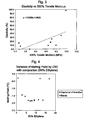
- Figure 4 shows the melting point of propylene-ethylene copolymers of the invention as a function of ethylene weight percent, i.e., weight percent of ethylene-derived units (triangle symbols).
- Figure 4 show the melting point of blends of isotactic polypropylene and the inventive copolymers also as a function of weight percent ethylene.
- Figure 4 clearly shows that copolymers of the present invention have a lower melting point than propylene-ethylene copolymer/isotactic polypropylene blends having the same weight percent ethylene.
- Embodiments of our invention include copolymers having a heat of fusion, as determined by DSC, ranging from a lower limit of greater than 1.0 J/g, or greater than 1.5 J/g, or greater than 4.0 J/g, or greater than 6.0 J/g, or greater than 7.0 J/g, to an upper limit of less than 125 J/g, or less than 100 J/g, or less than 75 J/g, or less than 60 J/g, or less than 50 J/g, or less than 40 J/g, or less than 30 J/g.
- the copolymers of embodiments of our invention have generally isotactic crystallizable propylene sequences, and the above heats of fusion are believed to be due to the melting of these crystalline segments.
- the copolymers of the invention have a heat of fusion that can be calculated by application of the following formula: H f > 311 * E - 18.5 2 / T Wherein:
- the tacticity index is determined by 13 C nuclear magnetic resonance (NMR).
- the tacticity index m/r is calculated as defined in H.N. Cheng, Macromolecules, 17, 1950 (1984 ).
- the designation "m” or “r” describes the stereochemistry of pairs of contiguous propylene groups, "m” referring to meso and "r” to racemic.
- An m/r ratio of 1.0 generally describes a syndiotactic polymer, and an m/r ratio of 2.0 an atactic material.
- An isotactic material theoretically may have a ratio approaching infinity, and many by-product atactic polymers have sufficient isotactic content to result in ratios of greater than 50.
- Copolymers of embodiments of our invention can have a tacticity index m/r ranging from a lower limit of 4 or 6 to an upper limit of 8 or 10 or 12.
- triad tacticity An ancillary procedure for the description of the tacticity of the propylene units of embodiments of the current invention is the use of triad tacticity.
- the triad tacticity of a polymer is the relative tacticity of a sequence of three adjacent propylene units, a chain consisting of head to tail bonds, expressed as a binary combination of m and r sequences. It is usually expressed for copolymers of the present invention as the ratio of the number of units of the specified tacticity to all of the propylene triads in the copolymer.
- mm Fraction PPP mm PPP mm + PPP mr + PPP rr
- PPP(mm), PPP(mr) and PPP(rr) denote peak areas derived from the methyl groups of the second units in the following three propylene unit chains consisting of head-to-tail bonds:
- the 13 C NMR spectrum of the propylene copolymer is measured as described in U.S. Patent No. 5,504,172 .
- the spectrum relating to the methyl carbon region (19-23 parts per million (ppm)) can be divided into a first region (21.2-21.9 ppm), a second region (20.3-21.0 ppm) and a third region (19.5-20.3 ppm). Each peak in the spectrum was assigned with reference to an article in the journal Polymer, Volume 30 (1989), page 1350 .
- the methyl group of the second unit in the three propylene unit chain represented by PPP (mm) resonates.
- the methyl group of the second unit in the three propylene unit chain represented by PPP (mr) resonates, and the methyl group (PPE-methyl group) of a propylene unit whose adjacent units are a propylene unit and an ethylene unit resonates (in the vicinity of 20.7 ppm).
- the methyl group of the second unit in the three propylene unit chain represented by PPP (rr) resonates, and the methyl group (EPE-methyl group) of a propylene unit whose adjacent units are ethylene units resonates (in the vicinity of 19.8 ppm).
- the calculation of the triad tacticity is outlined in the techniques shown in U.S. Patent No. 5,504,172 .
- Subtraction of the peak areas for the error in propylene insertions (both 2,1 and 1,3) from peak areas from the total peak areas of the second region and the third region, the peak areas based on the 3 propylene units-chains (PPP(mr) and PPP(rr)) consisting of head-to-tail bonds can be obtained.
- the peak areas of PPP(mm), PPP(mr) and PPP(rr) can be evaluated, and hence the triad tacticity of the propylene unit chain consisting of head-to-tail bonds can be determined.
- the propylene copolymers of embodiments of our invention have a triad tacticity of three propylene units, as measured by 13 C NMR, of greater than 75 %, or greater than 80 %, or greater than 82 %, or greater than 85 %, or greater than 90%.
- the insertion of propylene can occur to a small extent by either 2,1 (tail to tail) or 1,3 insertions (end to end). Examples of 2,1 insertion are shown in structures 1 and 2 below. where n ⁇ 2.
- a peak of the carbon A and a peak of the carbon A' appear in the second region.
- a peak of the carbon B and a peak of the carbon B' appear in the third region, as described above.
- peaks which are not based on the 3 propylene unit chain consisting of head-to-tail bonds are peaks based on the PPE-methyl group, the EPE-methyl group, the carbon A, the carbon A', the carbon B, and the carbon B'.
- the peak area based on the PPE-methyl group can be evaluated by the peak area of the PPE-methine group (resonance in the vicinity of 30.8 ppm), and the peak area based on the EPE-methyl group can be evaluated by the peak area of the EPE-methine group (resonance in the vicinity of 33.1 ppm).
- the peak area based on the carbon A can be evaluated by twice as much as the peak area of the methine carbon (resonance in the vicinity of 33.9 ppm) to which the methyl group of the carbon B is directly bonded; and the peak area based on the carbon A' can be evaluated by the peak area of the adjacent methine carbon (resonance in the vicinity of 33.6 ppm) of the methyl group of the carbon B'.
- the peak area based on the carbon B can be evaluated by the peak area of the adjacent methine carbon (resonance in the vicinity of 33.9 ppm); and the peak area based on the carbon B' can be also evaluated by the adjacent methine carbon (resonance in the vicinity of 33.6 ppm).
- the peak areas based on the three propylene unit chains (PPP(mr) and PPP(rr)) consisting of head-to-tail bonds can be obtained.
- the peak areas of PPP(mm), PPP(mr) and PPP(rr) can be evaluated, and the triad tacticity of the propylene unit chain consisting of head-to-tail bonds can be determined.
- the measurement of the 1,3 insertion requires the measurement of the ⁇ peak.
- Two structures can contribute to the ⁇ peak: (1) a 1,3 insertion of a propylene monomer; and (2) from a 2,1-insertion of a propylene monomer followed by two ethylene monomers.
- This peak is described as the 1.3 insertion peak and we use the procedure described in U.S. Patent No. 5,504,172 , which describes this ⁇ peak and understand it to represent a sequence of four methylene units.
- the proportion (%) of the amount of these errors was determined by dividing the area of the ⁇ peak (resonance in the vicinity of 27.4 ppm) by the sum of all the methyl group peaks and 1 ⁇ 2 of the area of the ⁇ peak, and then multiplying the resulting value by 100.
- an ⁇ -olefin of three or more carbon atoms is polymerized using an olefin polymerization catalyst, a number of inversely inserted monomer units are present in the molecules of the resultant olefin polymer.
- 2,1-insertion or 1,3-insertion takes place in addition to the usual 1,2-insertion, such that inversely inserted units such as a 2,1-insertion or a 1,3-insertion are formed in the olefin polymer molecule (see, Macromolecular Chemistry Rapid Communication, Volume 8, page 305 (1987), by K. Soga, T. Shiono, S. Takemura and W. Kaminski ).
- the proportion of inversely inserted propylene units of embodiments of our invention is greater than 0.5 %, or greater than 0.6 %.
- the proportion of inversely inserted propylene units of embodiments of our invention is greater than 0.05 %, or greater than 0.06 %, or greater than 0.07 %, or greater than 0.08 %, or greater than 0.085 percent.
- Homogeneous distribution is defined as a statistically insignificant intermolecular difference of both in the composition of the copolymer and in the tacticity of the polymerized propylene.
- a copolymer For a copolymer to have a homogeneous distribution it must meet the requirement of two independent tests: (i) intermolecular distribution of tacticity; and (ii) intermolecular distribution of composition, which are described below. These tests are a measure of the statistically insignificant intermolecular differences of tacticity of the polymerized propylene and the composition of the copolymer, respectively.
- the copolymer of embodiments of our invention has a statistically insignificant intermolecular difference of tacticity of polymerized propylene between different chains (intermolecularly.). This is determined by thermal fractionation by controlled dissolution generally in a single solvent, at a series of slowly elevated temperatures.
- a typical solvent is a saturated hydrocarbon such as hexane or heptane.
- These controlled dissolution procedures are commonly used to separate similar polymers of different crystallinity due to differences in isotactic propylene sequences, as shown in the article in Macromolecules, Vol. 26, p2064 (1993 ).
- this fractionation procedure will separate the molecules according to tacticity of the incorporated propylene. This procedure is described below.
- At least 75% by weight, or at least 80% by weight, or at least 85% by weight, or at least 90% by weight, or at least 95% by weight, or at least 97% by weight, or at least 99% by weight of the copolymer is soluble in a single temperature fraction, or in two adjacent temperature fractions, with the balance of the copolymer in immediately preceding or succeeding temperature fractions.
- These percentages are fractions, for instance in hexane, beginning at 23°C and the subsequent fractions are in approximately 8°C increments above 23°C. Meeting such a fractionation requirement means that a polymer has statistically insignificant intermolecular differences of tacticity of the polymerized propylene.
- the copolymer of embodiments of our invention has statistically insignificant intermolecular differences of composition, which is the ratio of propylene to ethylene between different chains (intermolecular).
- This compositional analysis is by infrared spectroscopy of the fractions of the polymer obtained by the controlled thermal dissolution procedure described above.
- each of these fractions has a composition (wt. % ethylene content) with a difference of less than 1.5 wt. % (absolute) or less than 1.0 wt. % (absolute), or less than 0.8 wt. % (absolute) of the average wt. % ethylene content of the whole copolymer.
- Meeting such a fractionation requirement means that a polymer has statistically insignificant intermolecular differences of composition, which is the ratio of propylene to ethylene.
- Uniformity is defined to be a statistically insignificant intramolecular difference of both the composition of the copolymer and in the tacticity of the polymerized propylene.
- a copolymer For a copolymer to be uniform it must meet the requirement of two independent tests: (i) intramolecular distribution of tacticity; and (ii) intramolecular distribution of composition, which are described below. These tests are a measure of the statistically insignificant intramolecular differences of tacticity of the polymerized propylene and the composition of the copolymer, respectively.
- the copolymer of embodiments of our invention has statistically insignificant intramolecular differences of composition, which is the ratio of propylene to ethylene along the segments of the same chain (intramolecular).
- This compositional analysis is inferred from the process used for the synthesis of these copolymers as well as the results of the sequence distribution analysis of the copolymer, for molecular weights in the range of from 15,000-5,000,000 or 20,000-1,000,000.
- the polymerization process is a single stage, steady state, polymerization conducted in a well-mixed continuous feed polymerization reactor.
- the polymerization can be conducted in solution, although other polymerization procedures such as gas phase or slurry polymerization, which fulfil the requirements of single stage polymerization and continuous feed reactors, are contemplated.
- the process can be described as a continuous, non-batch process that, in its steady state operation, is exemplified by removal of amounts of polymer made per unit time, being substantially equal to the amount of polymer withdrawn from the reaction vessel per unit time.
- substantially equal we intend that these amounts, polymer made per unit time, and polymer withdrawn per unit time, are in ratios of one to other, of from 0.9:1; or 0.95:1; or 0.97:1; or 1:1.
- the polymerization is accomplished in substantially single step or stage or in a single reactor, contrasted to multistage or multiple reactors (two or more). These conditions exist for substantially all of the time the copolymer is produced.
- One method to describe the molecular features of an ethylene-propylene copolymer is monomer sequence distribution.
- the monomer sequence distribution can be determined using spectroscopic analysis. Carbon 13 nuclear magnetic resonance spectroscopy ( 13 C NMR) can be used for this purpose, and can be used to establish diad and triad distribution via the integration of spectral peaks. (If 13 C NMR is not used for this analysis, substantially lower r 1 r 2 products are normally obtained.)
- 13 C NMR Carbon 13 nuclear magnetic resonance spectroscopy
- the reactivity ratio product is described more fully in Textbook of Polymer Chemistry, F.W. Billmeyer, Jr., Interscience Publishers, New York, p.221 et seq. (1957 ).
- a reactivity ratio product r 1 r 2 of 0 can define an "alternating" copolymer, and a reactivity ratio product of 1 is said to define a "statistically random” copolymer.
- a copolymer having a reactivity ratio product r 1 r 2 of between 0.6 and 1.5 is generally said to be random (in strict theoretical terms, generally only a copolymer having a reactivity ratio product r 1 r 2 greater than 1.5 contains relatively long homopolymer sequences and is said to be "blocky").
- the copolymer of our invention will have a reactivity ratio product r 1 r 2 of less than 1.5, or less than 1.3, or less than 1.0, or less than 0.8.
- the substantially uniform distribution of comonomer within polymer chains of embodiments of our invention generally precludes the possibility of significant amounts of propylene units or sequences within the polymer chain for the molecular weights (weight average) disclosed herein.
- the copolymer of embodiments of our invention has statistically insignificant intramolecular differences of tacticity, which is due to isotactic orientation of the propylene units along the segments of the same chain (intramolecular).
- This compositional analysis is inferred from the detailed analysis of the differential scanning calorimetry, electron microscopy and relaxation measurement (T 1 ⁇ ).
- T 1 ⁇ differential scanning calorimetry, electron microscopy and relaxation measurement
- T 1 ⁇ differential scanning calorimetry, electron microscopy and relaxation measurement
- the melting point of these polymers depends on the crystallinity, since the more blocky polymers should have a higher melting point as well as depressed solubility in room temperature solvents.
- the R 2 for polypropylene (control) and a copolymer of the current invention are 0.9945 and 0.9967, respectively. Therefore, the T 1 ⁇ relaxation for both polypropylene homopolymer and a copolymer of the current invention can be well fitted by a single-exponential. From the fit, the T 1 ⁇ of polypropylene and a copolymer of the present invention, are calculated as 25 milliseconds (ms) and 8.7 ms, respectively. The large difference in the T 1 ⁇ is reflective of their difference in morphology.
- the hypothetical polypropylene-like regions would have T 1 ⁇ relaxation similar to that in polypropylene homopolymer.
- the polymers of the current invention do not contain long continuous isotactic propylene units.
- the T 1 ⁇ , relaxation time can be less than 18 ms, or less than 16 ms, or less than 14 ms, or less than 12 ms, or less than 10 ms.
- the experiments are performed on a Bruker DSX-500 Nuclear Magnetic Resonance (NMR) spectrometer, with a 1 H frequency of 500.13 MHz and 13 C frequency of 125.75 MHz.
- CP spin lock and cross polarization
- the magnetization is transferred to 13 C by CP and then the signal is detected.
- the crystalline methine signal at 26.7 ppm is recorded and normalized and its natural logarithm (Ln) is plotted against spin lock time in Figure 1 .
- Example 4 Measurements were made on a polypropylene homopolymer sample, and on a polymer of the present invention, labeled "Sample 4" and described in the Examples below. Table 1 presents the data. Table 1 Time (ms) Ln(I) (sample 4) Ln(I) (PP) 0.02 0 0 0.5 -0.11394 -0.02496 1 -0.18772 -0.04733 2 -0.32424 -0.09871 5 -0.71649 -0.24692 10 -1.27022 -0.44715 20 -2.34181 -0.79526
- a typical isotactic polymerization process consists of a polymerization in the presence of a catalyst including a bis(cyclopentadienyl) metal compound and either (1) a non-coordinating compatible anion activator, or (2) an alumoxane activator.
- this process comprises the steps of contacting ethylene and propylene with a catalyst in a suitable polymerization diluent, the catalyst including, in one embodiment, a chiral metallocene compound, e.g ., a bis(cyclopentadienyl) metal compound as described in U.S. Patent No. 5,198,401 , and an activator.
- U.S. Patent No. 5,391,629 also describes catalysts useful to produce the copolymers of our invention.
- the catalyst system described below useful for making the copolymers of embodiments of our invention is a metallocene with a non-coordinating anion (NCA) activator, and optionally a scavenging compound.
- Polymerization is conducted in a solution, slurry or gas phase. The polymerization can be performed in a single reactor process.
- a slurry or solution polymerization process can utilize sub- or superatmospheric pressures and temperatures in the range of from -25 °C to 110 °C.
- a suspension of solid, particulate polymer is formed in a liquid polymerization medium to which ethylene, propylene, hydrogen and catalyst are added.
- the liquid medium serves as a solvent for the polymer.
- the liquid employed as the polymerization medium can be an alkane or a cycloalkane, such as butane, pentane, hexane, or cylclohexane, or an aromatic hydrocarbon, such as toluene, ethylbenzene or xylene.
- liquid monomer can also be used.
- the medium employed should be liquid under the conditions of the polymerization and relatively inert. Hexane or toluene can be employed for solution polymerization. Gas phase polymerization processes are described in U.S. Patent Nos. 4,543,399 , 4,588,790 , 5,028,670 , for example.
- the catalyst can be supported on any suitable particulate material or porous carrier, such as polymeric supports or inorganic oxides, such as, for example silica, alumina or both.
- suitable particulate material or porous carrier such as polymeric supports or inorganic oxides, such as, for example silica, alumina or both.
- Propylene and ethylene are the monomers that can be used to make the copolymers of embodiments of our invention, but optionally, ethylene can be replaced or added to in such polymers with a C4 to C20 ⁇ -olefin, such as, for example, 1-butene, 4-methyl-1-pentene, 1-hexene or 1-octene.
- a C4 to C20 ⁇ -olefin such as, for example, 1-butene, 4-methyl-1-pentene, 1-hexene or 1-octene.
- metalocene and “metallocene catalyst precursor” are terms known in the art to mean compounds possessing a Group 4, 5, or 6 transition metal M, with a cyclopentadienyl (Cp) ligand or ligands which may be substituted, at least one non-cyclopentadienyl-derived ligand X, and zero or one heteroatom-containing ligand Y, the ligands being coordinated to M and corresponding in number to the valence thereof.
- Cp cyclopentadienyl
- the metallocene catalyst precursors generally require activation with a suitable co-catalyst (sometimes referred to as an activator) in order to yield an active metallocene catalyst, i.e., an organometallic complex with a vacant coordination site that can coordinate, insert, and polymerize olefins.
- a suitable co-catalyst sometimes referred to as an activator
- Preferred metallocenes are cyclopentadienyl complexes which have two
- Cp ring systems as ligands.
- the Cp ligands preferably form a bent sandwich complex with the metal, and are preferably locked into a rigid configuration through a bridging group.
- These cyclopentadienyl complexes have the general formula: (Cp 1 R 1 m )R 3 n (CP 2 R 2 p )MX q wherein Cp 1 and Cp 2 are preferably the same; R 1 and R 2 are each, independently, a halogen or a hydrocarbyl, halocarbyl, hydrocarbyl-substituted organometalloid or halocarbyl-substituted organometalloid group containing up to 20 carbon atoms; m is preferably 1 to 5; p is preferably 1 to 5; preferably two R 1 and/or R 2 substituents on adjacent carbon atoms of the cyclopentadienyl ring associated therewith can be joined together to form a ring containing from 4 to 20 carbon
- non-coordinating anion means an anion which either does not coordinate to the transition metal cation or which is only weakly coordinated to the cation, thereby remaining sufficiently labile to be displaced by a neutral Lewis base.
- “Compatible” non-coordinating anions are those which are not degraded to neutrality when the initially formed complex decomposes. Further, the anion will not transfer an anionic substituent or fragment to the cation so as to cause it to form a neutral four coordinate metallocene compound and a neutral by-product from the anion.
- Non-coordinating anions useful in accordance with this invention are those which are compatible, stabilize the metallocene cation in the sense of balancing its ionic charge, yet retain sufficient lability to permit displacement by an ethylenically or acetylenically unsaturated monomer during polymerization. Additionally, the anions useful in this invention may be large or bulky in the sense of sufficient molecular size to largely inhibit or prevent neutralization of the metallocene cation by Lewis bases other than the polymerizable monomers that may be present in the polymerization process. Typically the anion will have a molecular size of greater than or equal to 4 angstroms.
- ionizing ionic compounds not containing an active proton but capable of producing both the active metallocene cation and a non-coordinating anion. See, EP-A-0 426 637 , EP-A- 0 573 403 and U.S. Patent No. 5,387,568 .
- Reactive cations other than Bronsted acids capable of ionizing the metallocene compounds include ferrocenium, triphenylcarbonium, and triethylsilylium cations. Any metal or metalloid capable of forming a coordination complex which is resistant to degradation by water (or other Bronsted or Lewis acids) may be used or contained in the anion of the second activator compound. Suitable metals include, but are not limited to, aluminum, gold and platinum. Suitable metalloids include, but are not limited to, boron, phosphorus and silicon.
- An additional method of making the ionic catalysts uses ionizing anionic pre-cursors which are initially neutral Lewis acids but form the cation and anion upon ionizing reaction with the metallocene compounds.
- ionizing anionic pre-cursors which are initially neutral Lewis acids but form the cation and anion upon ionizing reaction with the metallocene compounds.
- tris(pentafluorophenyl) boron acts to abstract an alkyl, hydride or silyl ligand to yield a metallocene cation and stabilizing non-coordinating anion; see EP-A-0 427 697 and EP-A-0 520 732 .
- Ionic catalysts for addition polymerization can also be prepared by oxidation of the metal centers of transition metal compounds by anionic precursors containing metallic oxidizing groups along with the anion groups; see EP-A-0 495 375 .
- Suitable activators capable of ionic cationization of the metallocene compounds of the invention, and consequent stabilization with a resulting non-coordinating anion include:
- Suitable anionic precursors include those comprising a stable carbonium ion, and a compatible non-coordinating anion. These include:
- a catalyst system of ⁇ -(CH 3 ) 2 Si(indenyl) 2 Hf(CH 3 ) 2 with a cocatalyst of N,N-dimethylanilinium tetrakis(pentafluorophenyl)borate, can be used.
- the activating cocatalyst, precursor ionic compounds comprise anionic Group 13 element complexes having four halogenated aromatic ligands typically bulkier than substituted tetraphenyl boron compounds of the exemplified in the identified prior art.
- aromatic ligands consist of polycyclic aromatic hydrocarbons and aromatic ring assemblies in which two or more rings (or fused ring systems) are joined directly to one another or together. These ligands, which may be the same or different, are covalently bonded directly to the metal/metalloid center.
- the aryl groups of said halogenated tetraaryl Group 13 element anionic complex comprise at least one fused polycyclic aromatic hydrocarbon or pendant aromatic ring.
- Indenyl, napthyl, anthracyl, heptalenyl and biphenyl ligands are exemplary.
- the number of fused aromatic rings is unimportant so long as the ring junctions and especially the atom chosen as the point of connection to the Group 13 element center permit an essentially tetrahedral structure.
- suitable ligands include those illustrated below, the open bond being to the Group 13 atom. See also the polycyclic compound examples in the literature for additional ligand selection, e.g., Nomenclature of Organic Compounds, Chs. 4-5 (ACS, 1974 ). I
- ligand connection point is particularly important. Substituents or ring junctions ortho to the ligand connection point present such steric bulk that adoption of an essentially tetrahedral geometry is largely precluded. Examples of undesirable connection points are depicted below. II
- Suitable mixed-ligand Group 13 complexes can include fused rings or ring assemblies with ortho -substituents, or ring junctions, so long as those ligands do not exceed two in number.
- Group 13 anions with one or two hindered fused ring aromatics with three or two unhindered ligands, where hindered aromatics are those having ortho substituents or ring junctions (illustration II) and unhindered are those without (illustration I) will typically be suitable.
- Tris(perfluorophenyl) (perfluoroanthracyl) borate is an illustrative complex.
- the anthracyl ligand is a hindered fused ring having ortho -substituents but its use with three unhweard phenyl ligands allows the complex to adopt a tetrahedral structure.
- halogenation is highly preferred so as to allow for increased charge dispersion that contributes along with steric bulk as independent features decreasing the likelihood of ligand abstraction by the strongly Lewis acidic metallocene cation formed in the catalyst activation. Additionally, halogenation inhibits reaction of the hafnium cation with any remaining carbon-hydrogen bonds of the aromatic rings, and perhalogenation precludes such potential undesirable reactions. Thus it is preferred that at least one third of hydrogen atoms on carbon atoms of the aryl ligands can be replaced by halogen atoms, and more preferred that the aryl ligands be perhalogenated. Fluorine is the most preferred halogen.
- Means of preparing ionic catalyst systems comprising catalytically active cations of the hafnium compounds and suitable noncoordinating anions are conventionally known, see for example U.S. patent 5,198,401 , WO 92/00333 , and WO 97/22639 .
- the methods comprise obtaining from commercial sources or synthesizing the selected transition metal compounds comprising an abstractable ligand, e.g., hydride, alkyl or silyl group, and contacting them with a noncoordinating anion source or precursor compound in a suitable solvent.
- the anion precursor compound abstracts a univalent hydride, alkyl or silyl ligand that completes the valency reqirements of the preferred hafnium metallocene compounds.
- the abstraction leaves the hafnocenes in a cationic state which is counterbalanced by the stable, compatible and bulky, noncoordinating anions according to the invention.
- the noncoordinating anions are preferably introduced into the catalyst preparation step as ionic compounds having an essentially cationic complex which abstracts a non-cyclopentadienyl, labile ligand of the transition metal compounds which upon abstraction of the non-cyclopentadienyl ligand, leave as a by-product the noncoordinating anion portion.
- Hafnium compounds having labile hydride, alkyl, or silyl ligands on the metal center are highly preferred for the ionic catalyst systems of this invention since known in situ alkylation processes may result in competing reactions and interactions that tend to interfere with the overall polymerization efficiency under high temperature conditions in accordance with the preferred process embodiments of the invention.
- Suitable cations for precursor compounds capable of providing the noncoordinating anions of the invention cocatalysts include those known in the art. Such include the nitrogen-containing cations such as those in U.S. patent 5,198,401 , the carbenium, oxonium or sulfonium cations of US patent 5,387,568 , metal cations, e.g., Ag + , the silylium cations of WO 96/08519 , and the hydrated salts of Group 1 or 2 metal cations of WO 97/22635 .
- nitrogen-containing cations such as those in U.S. patent 5,198,401 , the carbenium, oxonium or sulfonium cations of US patent 5,387,568 , metal cations, e.g., Ag + , the silylium cations of WO 96/08519 , and the hydrated salts of Group 1 or 2 metal cations of WO
- Examples of preferred precursor salts of the noncoordinating anions capable of ionic cationization of the metallocene compounds of the invention, and consequent stabilization with a resulting noncoordinating anion include trialkyl-substituted ammonium salts such as triethylammonium tetrakis(perfluoronapthyl) or tetrakis(perfluoro-4-biphenyl)boron, tripropylammonium tetrakis(perfluoronapthyl) or tetrakis(perfluoro-4-biphenyl)boron, tri(n-butyl)ammonium tetrakis(perfluoronapthyl) or tetrakis(perfluoro-4-biphenyl)boron, trimethylammonium tetrakis(perfluoronapthyl) or tetrakis(perfluoro-4-biphenyl)boron, trimethylammonium
- suitable anionic precursors include those comprising a stable carbenium ion, and a compatible non-coordinating anion. These include tropillium tetrakis(perfluoronapthyl) or tetrakis(perfluoro-4-biphenyl) borate, triphenylmethylium tetrakis(perfluoronapthyl) or tetrakis(perfluoro-4-biphenyl) borate, benzene (diazonium) tetrakis(perfluoronapthyl) or tetrakis(perfluoro-4-biphenyl) borate, tropillium tetrakis(perfluoronapthyl) or tetrakis(perfluoro-4-biphenyl)borate, triphenylmethylium tetrakis(perfluoronapthyl) or tetrakis(perfluoro-4-biphenyl)borate
- the NCA portion comprises an acetylene group and is sometimes referred to as an "acetyl-aryl" moiety.
- a distinguishing feature of invention NCAs is the presence of an acetylenic functional group bound to a Group-13 atom.
- the Group-13 atom also connects to at least one fluorinated ring moiety: monofluorinated up through perfluorinated.
- the Group-13 atom has two other ligands that may also be ring moieties similar to or different from the first ring moiety and may be monofluorinated to perfluorinated.
- the goal of fluorination is to reduce the number of abstractable hydrogen.
- a ligand is referred to as substantially fluorinated when enough hydrogen has been fluorine-replaced so that the amount of remaining abstractable hydrogen is small enough that it does not interfere with commercial polymerization.
- NCA An exemplary invention NCA is shown below.
- Tr stands for triel, which, for this disclosure, encompasses B and Al.
- this NCA is called tris(2',3,3',4,4',5,5',6,6'-nonafluorobiphen-2-yl)(2-perfluorophenylethyn-2-yl)borate.
- the cationic portion of activators according to this embodiment preferably has the form R 3 PnH, wherein R represents an alkyl or aryl moiety; Pn represents a pnictide; N, P, or As; and H is hydrogen.
- R represents an alkyl or aryl moiety
- Pn represents a pnictide
- N P, or As
- H is hydrogen.
- Suitable R are shown below. This list does not limit the scope of the invention; any R that allows the cationic portion to function as described is within the scope of this invention.
- R includes, but is not limited to, methyl, phenyl, ethyl, propyl, butyl, hexyl, octyl, nonyl, 3-ethylnonyl, isopropyl, n-butyl, cyclohexyl, benzyl, trimethylsilyl, triethylsilyl, tri-n-propylsilyl, tri-isopropylsilyl, methylethylhexylsilyl, diethylnonlysilyl, triethylsilylpropyl, 2,2-dimethyloctyl, triethylsilylethyl, tri-n-propylsilylhexyl, triisopropylsilyloctyl, and methyldiethylsilyloctyl.
- the copolymers of the current invention have an elongation of greater than 1000%, or greater than 1200%, or greater than 1500%.
- the copolymers of the current invention have a tensile strength greater than 300 psi (2.1 MPa), or greater than 500 psi (3.5 MPa) or greater than 1000 psi (6.9 MPa).
- Tensile and elongation properties are determined at 20 in/min (51 cm/min) according to the procedure described in ASTM D790. The data is reported in engineering units with no correction to the stress for the lateral contraction in the specimen due to tensile elongation.
- the tensile and elongation properties of embodiments of our invention are evaluated using dumbbell-shaped samples. The samples are compression molded at 180°C to 200°C for 15 minutes at a force of 15 tons (133 kN) into a plaque of dimensions of 6 in x 6 in (15 cm x 15 cm). The cooled plaques are removed and the specimens are removed with a die.
- the elasticity evaluation of the samples is conducted on an Instron 4465, made by Instron Corporation of 100 Royall Street, Canton, MA.
- the digital data is collected in a file collected by the Series IX Material Testing System available from Instron Corporation and analyzed using Excel 5, a spreadsheet program available from Microsoft Corporation of Redmond, WA.
- Embodiments of our invention are elastic after tensile deformation.
- the elasticity represented by the fractional increase in the length of the sample, represented as percent of the length of the sample, is measured according to the general procedure ASTM D790.
- ASTM D790 The elasticity is measured according to the general procedure ASTM D790.
- the copolymer sample is stretched, and the polymer attempts to recover its original dimensions when the stretching force is removed. This recovery is not complete, and the final length of the relaxed sample is slightly longer than that of the original sample.
- Elasticity is represented by the fractional increase in the length of the sample, expressed as a percent of the length of the original un-stretched sample.
- the protocol for measuring the elasticity of the sample consists of prestretching the deformable zone of the dumbbell, made according to the procedure described above for the measurement of elongation and tensile strength, which is the narrow portion of the specimen, to 200% of its original length to prestretch the sample. This is conducted at a deformation rate of 10 inches (25 cm) per minute.
- the sample is relaxed at the same rate to form an analytical specimen which is a prestretched specimen of the original sample. This slightly oriented, or prestretched, sample is allowed to relax for 48 hours, at room temperature, prior to the determination of elasticity.
- the length of the deformation zone in the sample is measured to be d 1 .
- Embodiments of the invention have elasticity, as measured by the procedure described above, of less than 30%, or less than 20%, or less than 10%, or less than 8% or less than 5%.
- the copolymer of embodiments of our invention should have a measurable tensile strength at 500% elongation (also known as 500% tensile modulus), of greater than 0.5 MPa, or greater than 0.75 MPa, or greater than 1.0 MPa, or greater than 2.0 MPa; and second, the copolymer should have the above-described elasticity.
- elasticity is plotted versus 500% tensile modulus in MPa for copolymers of the invention.
- the plotted data correspond to Samples 5-14 in Table 6 of the Examples herein.
- the elasticity as a function of 500% tensile modulus in MPa is defined by: Elasticity % ⁇ 0.935 ⁇ M + 12 ; Elasticity % ⁇ 0.935 ⁇ M + 6 ; Elasticity % ⁇ 0.935 ⁇ M .
- Softness of the copolymers of embodiments of the invention may be measured by flexural modulus.
- Flexural modulus is measured in accordance with ASTM D790, using a Type IV dogbone at crosshead speed of 0.05 in/min (1.3 mm/min). The values of the flexural modulus over the range of composition of the copolymer vary with the tensile strength of the sample as measured by the 500% tensile modulus. Flexural modulus of this family of copolymers is thus represented by two criteria: (a) extensibility to 500% elongation with a measurable modulus (500% tensile modulus); and (b) flexural modulus.
- flexural modulus in MPa is plotted versus 500% tensile modulus in MPa for copolymers of the invention.
- the plotted data correspond to Samples 15-19 in Table 7 of the Examples herein.
- the flexural modulus in MPa as a function of 500% tensile modulus in MPa is defined by: Flexural Modulus ⁇ 4.2 ⁇ e 0.27 ⁇ M + 50 ; Flexural Modulus ⁇ 4.2 ⁇ e 0.27 ⁇ M + 30 ; Flexural Modulus ⁇ 4.2 ⁇ e 0.27 ⁇ M + 10 ; Flexural Modulus ⁇ 4.2 ⁇ e 0.27 ⁇ M + 2.
- Mn and Mw molecular weight distribution
- Mw molecular weight distribution
- DSC Differential Scanning Calorimetry
- the thermal output is recorded as the area under the melting peak of the sample, which is typically peaked at about 30°C to about 175°C and occurs between the temperatures of about 0°C and about 200°C, and is measured in joules as a measure of the heat of fusion.
- the melting point is recorded as the temperature of the greatest heat absorption within the range of melting of the sample.
- Intermolecular composition distribution of the copolymer is measured as described below. Nominally 30 grams of the copolymer is cut into small cubes with about 1/8" (3 mm) sides. This is introduced into a thick-walled glass bottle with a screw cap closure, along with 50 mg of Irganox1076, an antioxidant commercially available from Ciba-Geigy Corporation. Then, 425 mL of hexane (a principal mixture of normal and iso isomers) is added to the bottle and the sealed bottle is maintained at 23°C for 24 hours. At the end of this period, the solution is decanted and the residue is treated with additional hexane for an additional 24 hours.
- hexane a principal mixture of normal and iso isomers
- the two hexane solutions are combined and evaporated to yield a residue of the polymer soluble at 23°C.
- To the residue is added sufficient hexane to bring the volume to 425 mL and the bottle is maintained at 31°C for 24 hours in a covered circulating water bath.
- the soluble polymer is decanted and an additional amount of hexane is added for another 24 hours at 31°C prior to decanting.
- fractions of the copolymers soluble at 40°C, 48°C, 55°C and 62°C are obtained at temperature increases of approximately 8°C between stages.
- Continuous polymerization of the polymer is conducted in a 9 liter Continuous Flow Stirred Tank Reactor using hexane as the solvent.
- the liquid full reactor has a residence time of 9 minutes and the pressure is maintained at 700 kPa.
- a mixed feed of hexane, ethylene and propylene is pre-chilled to approximately -30°C to remove the heat of polymerization, before entering the reactor.
- Solutions of catalyst/activator in toluene and the scavenger in hexane are separately and continuously admitted into the reactor to initiate the polymerization.
- the reactor temperature is maintained between 35 and 50°C, depending on the target molecular weight.
- the feed temperature is varied, depending on the polymerization rate to maintain a constant reactor temperature.
- the polymerization rate is varied from about 0.5 kg/hr to about 4 kg/hr. Hexane at 30 kg/hr is mixed with ethylene at 717 g/hr and propylene at 5.14 kg/hr and fed to the reactor.
- the polymerization catalyst, dimethylsilyl bridged bis-indenyl hafnium dimethyl activated 1.1 molar ratio with N',N'-dimethyl anilinium-tetrakis (pentafluorophenyl)borate is introduced at the rate of at 0.0135 g/hr.
- a dilute solution of triisobutyl aluminum is introduced into the reactor as a scavenger of catalyst terminators; a rate of approximately 111 mol of scavenger per mole of catalyst is adequate for this polymerization
- a representative sample of the polymer produced in this polymerization is collected, and then steam-distilled to isolate the polymer.
- the polymerization rate is measured as 3.7 kg/hr.
- the polymer produced in this polymerization has an ethylene content of 14%, ML (1+4) 125°C (Mooney Viscosity) of 13.1 and has isotactic propylene sequences.
- Variations in the composition of the polymer are obtained principally by changing the ratio of ethylene to propylene.
- Molecular weight of the polymer is varied by either changing the reactor temperature or by changing the ratio of total monomer feed rate to the polymerization rate.
- Table 4 describes the composition of the fractions of the copolymer obtained in Table 3. Only fractions which have more than 4% of the total mass of the polymer have been analyzed for composition. Table 4: Composition of fractions of the copolymer component obtained in Table 3 Sample # Composition (wt % C2) for fraction soluble at T 23°C 31°C 40°C 1 10.8 11.3 - 2 17.9 - 3 - 9.9 10.2 4 14.5 -
- Continuous Polymerization of the polymer was conducted in a 1 liter internal volume Continuous Flow Stirred Tank Reactor using hexane as the solvent.
- the liquid full reactor had a variable residence time of approximately 9 to 15 minutes (as described in the table below) and the pressure was maintained at 700 kpa.
- a mixed feed of Hexane, ethylene and propylene was pre-chilled to approximately -30°C to remove the heat of polymerization, before entering the reactor.
- the pre-chilling temperature was adjusted to maintain indicated solution polymerization temperature.
- the solution of catalyst/activator in Toluene and the scavenger in hexane were separately and continuously admitted into the reactor to initiate the polymerization.
- the reactor temperature was maintained between 50 and 95°C and the polymerization rate could be varied from 0.1 kg/hr to 0.5 kg/hr as shown in Tables 8 through 13, below.
- a dilute solution of triisobutyl aluminum was introduced into the reactor as a scavenger of catalyst terminators. A rate of approximately 1.11 mole of scavenger per mole of catalyst was adequate for this polymerization. After five residence times of steady polymerization, a representative sample of the polymer produced in this polymerization was collected. The solution of the polymer was withdrawn from the top, and then steam distilled to isolate the polymer. The polymerization rate was measured as shown in the tables below. The polymer produced in this polymerization was analyzed for ethylene content by FT-IR, molecular weight averages by GPC. Crystallinity was measured by DSC and the amount of mm triads of propylene residues in the polymer chain was determined by 13 C NMR. As we have mentioned above the crystallinity and mm triads determination are redundant determinations since the crystallinity of the polymers are dependent only on the isotactic propylene residues.
- the data in the tables below shows the effect of the changes in the polymerization conditions (temperature, NCA and residual monomer concentration) on propylene / ethylene copolymers made at two distinct compositions.
- the first composition contains approximately 7 wt% ethylene and the second contains approximately 14 wt% ethylene.
- the data will show that the benefits of the invention are available across the composition range for these propylene-ethylene polymers. All examples ending in -C are comparative.
- This example illustrates the difference in the polymerization of A1 and A2 with the polymerization being conducted at a range of increasing temperatures between 50°C and 95°C.
- the same polymerization monomer, solvent and catalyst feed are used to make polymers of essentially identical composition.
- the rise in the polymerization temperature lowers the crystallinity and molecular weight of the polymer, however the replacement of A1 by A2 raises both the crystallinity as well as the molecular-weight.
- This example illustrates the difference in the polymerization of A1 and A2 with the polymerization being conducted at a temperature of 95°C.
- the composition of the polymer is held essentially constant but the residual level of monomer is progressively raised.
- the rise in the residual monomer concentration raises the crystallinity of the propylene residues in the polymer.
- This example illustrates the difference in the polymerization of A1 and A2 with the polymerization being conducted at a temperature of 95°C.
- the composition of the polymer is held essentially constant but the residual level of monomer is progressively raised.
- the rise in the residual monomer concentration raises the crystallinity of the propylene residues in the polymer.
- the examples differ from the data in examples immediately earlier in that a propylene-ethylene copolymer having a higher ethylene content was made. These data in conjunction indicate that the effect of the replacement of A1 by A2 is not limited by the ethylene content of the polymer.
- This example illustrates the difference in the polymerization of A1 and A2 with the polymerization being conducted at a range of increasing temperatures between 50°C and 95°C.
- the same polymerization monomer, solvent and catalyst feed are used to make polymers of essentially identical composition.
- the rise in the polymerization temperature lowers the crystallinity and molecular weight of the polymer, however the replacement of A1 by A2 raises both the crystallinity as well as the molecular weight.
- the examples differ from the data in examples 1-8 earlier in that a propylene-ethylene copolymer having a higher ethylene content was made. These data in conjunction indicate that the effect of the replacement of A1 by A2 is not limited by the ethylene content of the polymer.
- Comparative examples 77-C to 80-C show the comparison of the Mooney viscosity (Mooney viscosity measured as ML (1+4) at 127°C in Mooney units according to ASTM D-1646) of the polymer made with A1 for comparison to the data in examples 55 through 68. Since the Mooney viscosity of the copolymers is strongly dependent on the steady sate monomer concentrations the data is plotted as a function of the monomer concentration and the polymerization temperature. The data demonstrates that the copolymers made with A1 have a lower Mooney viscosity than those made with A2 at similar or higher polymerization temperature. This is shown in Figure 6 .
Landscapes
- Chemical & Material Sciences (AREA)
- Health & Medical Sciences (AREA)
- Chemical Kinetics & Catalysis (AREA)
- Medicinal Chemistry (AREA)
- Polymers & Plastics (AREA)
- Organic Chemistry (AREA)
- Addition Polymer Or Copolymer, Post-Treatments, Or Chemical Modifications (AREA)
- Transition And Organic Metals Composition Catalysts For Addition Polymerization (AREA)
- Organic Low-Molecular-Weight Compounds And Preparation Thereof (AREA)
Applications Claiming Priority (7)
| Application Number | Priority Date | Filing Date | Title |
|---|---|---|---|
| US834256 | 2001-04-12 | ||
| US09/834,256 US6525157B2 (en) | 1997-08-12 | 2001-04-12 | Propylene ethylene polymers |
| US33665501P | 2001-12-05 | 2001-12-05 | |
| US336655P | 2001-12-05 | ||
| US34218601P | 2001-12-19 | 2001-12-19 | |
| US342186P | 2001-12-19 | ||
| PCT/US2002/010515 WO2002083754A1 (en) | 2001-04-12 | 2002-04-02 | Propylene ethylene polymers and production process |
Publications (2)
| Publication Number | Publication Date |
|---|---|
| EP1390417A1 EP1390417A1 (en) | 2004-02-25 |
| EP1390417B1 true EP1390417B1 (en) | 2010-10-20 |
Family
ID=27407140
Family Applications (1)
| Application Number | Title | Priority Date | Filing Date |
|---|---|---|---|
| EP02721670A Expired - Lifetime EP1390417B1 (en) | 2001-04-12 | 2002-04-02 | Process for polymerizing propylene and ethylene in solution |
Country Status (6)
| Country | Link |
|---|---|
| US (2) | US8026323B2 (enExample) |
| EP (1) | EP1390417B1 (enExample) |
| JP (2) | JP5156167B2 (enExample) |
| AT (1) | ATE485319T1 (enExample) |
| DE (1) | DE60238049D1 (enExample) |
| WO (1) | WO2002083754A1 (enExample) |
Families Citing this family (48)
| Publication number | Priority date | Publication date | Assignee | Title |
|---|---|---|---|---|
| EP1098934A1 (en) * | 1998-07-01 | 2001-05-16 | Exxon Chemical Patents Inc. | Elastic blends comprising crystalline polymer and crystallizable polymers of propylene |
| EP1565502B1 (en) * | 2002-11-28 | 2012-04-18 | Basell Poliolefine Italia S.r.l. | Butene-1 copolymers and process for their preparation |
| JP5525680B2 (ja) * | 2003-11-14 | 2014-06-18 | エクソンモービル・ケミカル・パテンツ・インク | プロピレン−ベース・エラストマー、その製品およびその製造方法 |
| US8071681B2 (en) | 2004-08-13 | 2011-12-06 | Exxonmobil Chemical Patents Inc. | Polymeric compositions including their uses and methods of production |
| US8709560B2 (en) | 2004-12-16 | 2014-04-29 | Exxonmobil Chemical Patents Inc. | Polymeric compositions including their uses and methods of production |
| JP4782800B2 (ja) | 2004-12-17 | 2011-09-28 | エクソンモービル・ケミカル・パテンツ・インク | 均一ポリマー・ブレンドおよび該ブレンドからの製品 |
| CN101111558B (zh) | 2005-01-31 | 2012-06-06 | 埃克森美孚化学专利公司 | 聚合物共混物和粒料及其生产方法 |
| WO2006083505A1 (en) | 2005-01-31 | 2006-08-10 | Exxonmobil Chemical Patents Inc. | Polymeric compositions including their uses and methods of production |
| US8927108B2 (en) | 2006-01-10 | 2015-01-06 | Exxonmobil Chemical Patents Inc. | Films incorporating polymeric material combinations, articles made therefrom, and methods of making such films and articles |
| US8476326B2 (en) * | 2006-09-22 | 2013-07-02 | Dow Global Technologies Llc | Fibrillated polyolefin foam |
| US9187631B2 (en) * | 2007-10-22 | 2015-11-17 | Trinseo Europe Gmbh | Polymeric compositions and processes for molding articles |
| EP2220158B1 (en) * | 2007-12-05 | 2012-03-21 | Dow Global Technologies LLC | Polypropylene melt-blown sealant films for retort packaging |
| US9938400B2 (en) | 2008-04-23 | 2018-04-10 | Exxonmobil Chemical Patents Inc. | Propylene copolymers in soft thermoplastic blends |
| WO2012064469A1 (en) * | 2010-11-09 | 2012-05-18 | Exxonmobil Chemical Patents Inc. | Bicomponent fibers and methods for making them |
| EP3004241B1 (en) | 2013-06-04 | 2021-08-11 | ExxonMobil Chemical Patents Inc. | Polymer compositions and nonwoven compositions prepared therefrom |
| WO2014204778A1 (en) | 2013-06-18 | 2014-12-24 | Exxonmobil Chemical Patents Inc. | Fibers and nonwoven materials prepared therefrom |
| US11549201B2 (en) | 2013-06-18 | 2023-01-10 | Exxonmobil Chemicals Patents Inc. | Fibers and nonwoven materials prepared therefrom |
| US9469753B2 (en) | 2013-07-22 | 2016-10-18 | Exxonmobil Chemical Patents Inc. | Propylene copolymers in elastomeric compositions |
| CN105492206B (zh) | 2013-09-30 | 2017-10-17 | 埃克森美孚化学专利公司 | 聚合物组合物和由其制得的制品 |
| KR101579616B1 (ko) * | 2014-06-10 | 2015-12-22 | 주식회사 엘지화학 | 프로필렌계 엘라스토머 |
| WO2015191195A1 (en) | 2014-06-10 | 2015-12-17 | Exxonmobil Chemical Patents Inc. | Propylene-based polymers having improved stability and methods for producing the same |
| KR101580591B1 (ko) * | 2014-06-10 | 2015-12-28 | 주식회사 엘지화학 | 프로필렌계 엘라스토머 |
| WO2015190831A1 (ko) * | 2014-06-10 | 2015-12-17 | 주식회사 엘지화학 | 프로필렌계 엘라스토머 |
| WO2016014230A1 (en) | 2014-07-25 | 2016-01-28 | Exxonmobil Chemical Patents Inc. | Footwear compositions comprising propylene-based elastomers |
| SG11201701351TA (en) * | 2014-08-21 | 2017-03-30 | Dow Global Technologies Llc | Hot melt adhesive composition including a crystalline block composite |
| WO2016036466A2 (en) | 2014-09-05 | 2016-03-10 | Exxomobil Chemical Patents Inc. | Polymer compositions and nonwoven materials prepared therefrom |
| WO2016137556A1 (en) | 2015-02-26 | 2016-09-01 | Exxonmobil Chemical Patents Inc. | Process for forming thermoplastic vulcanizates and thermoplastic vulcanizates made therefrom |
| WO2016137559A1 (en) | 2015-02-26 | 2016-09-01 | Exxonmobil Chemical Patents Inc. | Compositions comprising propylene-based elastomers and polyalphaolefins |
| EP3277752B1 (en) | 2015-03-27 | 2024-09-18 | ExxonMobil Chemical Patents Inc. | Propylene-based polymer compositions for grip applications |
| CN107709447B (zh) | 2015-05-22 | 2020-09-08 | 埃克森美孚化学专利公司 | 包含基于丙烯的弹性体的热塑性硫化橡胶材料及其制造方法 |
| WO2016195832A1 (en) | 2015-05-29 | 2016-12-08 | Exxonmobil Chemical Patents Inc. | Thermoplastic vulcanizates comprising broad molecular weight distribution polypropylene |
| EP3286262B1 (en) | 2015-06-19 | 2023-04-05 | ExxonMobil Chemical Patents Inc. | Thermoplastic elastomer compositions comprising ultrahigh molecular weight polyethylene and methods for making the same |
| US9926443B2 (en) | 2015-11-09 | 2018-03-27 | Exxonmobil Chemical Patents Inc. | Propylene-based elastomers for roofing compositions and methods for preparing the same |
| CN108463504B (zh) | 2015-11-09 | 2021-03-23 | 埃克森美孚化学专利公司 | 用于屋顶组合物的基于丙烯的弹性体和制备其的方法 |
| WO2018034759A1 (en) | 2016-08-15 | 2018-02-22 | Exxonmobil Chemical Patents Inc. | Propylene-olefin copolymers and methods for making the same |
| WO2018034760A1 (en) | 2016-08-15 | 2018-02-22 | Exxonmobil Chemical Patents Inc. | Propylene-alpha olefin copolymers and methods for making the same |
| WO2018057124A1 (en) | 2016-09-23 | 2018-03-29 | Exxonmobil Chemical Patents Inc. | Shrinkable thermoplastic vulcanizate and method and article |
| US11370850B2 (en) * | 2018-05-12 | 2022-06-28 | Pretium Innovation, Llc | Polymerization compositions and methods for making and using same |
| EP3880875B1 (en) | 2018-11-16 | 2025-04-30 | ExxonMobil Chemical Patents Inc. | Polyalphaolefin modified polymer blends for fibres and nonwovens |
| WO2021195070A1 (en) | 2020-03-26 | 2021-09-30 | Exxonmobil Chemical Patents Inc. | Processes for making 3-d objects from blends of polypropylene and semi-amorphous polymers |
| WO2021231362A1 (en) | 2020-05-12 | 2021-11-18 | Exxonmobil Chemical Patents Inc. | Thermoplastic elastomer compositions for use in pharmaceutical articles |
| EP4248004A1 (en) | 2020-11-19 | 2023-09-27 | ExxonMobil Chemical Patents Inc. | Nonwoven fabrics with improved haptics and mechanical properties |
| WO2024163354A1 (en) | 2023-02-02 | 2024-08-08 | ExxonMobil Technology and Engineering Company | Compositions and methods relating to impact copolymer compatibilizers |
| CN120813639A (zh) | 2023-03-03 | 2025-10-17 | 埃克森美孚技术与工程公司 | 发泡的基于丙烯的弹性体组合物,其制备方法和由其制成的产品 |
| US20260226264A1 (en) | 2023-03-06 | 2026-08-06 | ExxonMobil Technology and Engineering Company | Propylene-Based Elastomer Compositions for Waterproof Applications Underground |
| WO2025135051A1 (ja) | 2023-12-18 | 2025-06-26 | 三井化学株式会社 | プロピレン・α-オレフィン共重合体、樹脂組成物、成形体および蓄電デバイス |
| WO2026075862A1 (en) | 2024-10-02 | 2026-04-09 | ExxonMobil Technology and Engineering Company | High melt strength propylene based elastomers compositions for elastic blown or cast films |
| CN119735728A (zh) * | 2025-01-07 | 2025-04-01 | 浙江大学 | 一种高熔点丙乙烯烃聚合物弹性体及其制备方法 |
Family Cites Families (313)
| Publication number | Priority date | Publication date | Assignee | Title |
|---|---|---|---|---|
| BE534424A (enExample) | 1953-12-24 | |||
| US4076698A (en) * | 1956-03-01 | 1978-02-28 | E. I. Du Pont De Nemours And Company | Hydrocarbon interpolymer compositions |
| BE599410A (enExample) | 1960-01-23 | |||
| FR1310024A (enExample) | 1960-10-17 | 1963-03-04 | ||
| US3156242A (en) | 1962-03-29 | 1964-11-10 | Johnson & Johnson | Flexible absorbent sheet |
| BE637093A (enExample) * | 1962-09-10 | |||
| US3485706A (en) | 1968-01-18 | 1969-12-23 | Du Pont | Textile-like patterned nonwoven fabrics and their production |
| US3520861A (en) | 1968-12-26 | 1970-07-21 | Dow Chemical Co | Copolymers of ethylene |
| NL7001827A (enExample) | 1970-02-10 | 1971-08-12 | ||
| US3758656A (en) | 1970-03-25 | 1973-09-11 | Du Pont | Ainst excessive cold flow during shipment or storage process for preparing an elastomer which is structurally supported ag |
| US3812077A (en) * | 1971-12-27 | 1974-05-21 | Gen Electric | Fiber reinforced composite materials |
| US3989867A (en) | 1973-02-16 | 1976-11-02 | The Procter & Gamble Company | Absorptive devices having porous backsheet |
| US3888949A (en) | 1973-06-21 | 1975-06-10 | Du Pont | Blends of propylene-alpha-olefin copolymers and polypropylene |
| US3882197A (en) * | 1973-06-21 | 1975-05-06 | Du Pont | Alpha-olefin copolymer blends |
| US3881489A (en) * | 1973-08-20 | 1975-05-06 | Procter & Gamble | Breathable, liquid inpervious backsheet for absorptive devices |
| DE2417093B2 (de) | 1974-04-08 | 1979-09-27 | Hoechst Ag, 6000 Frankfurt | Verfahren zur Herstellung von Polypropylen-Formmassen |
| DE2726963C3 (de) | 1977-06-15 | 1980-04-30 | Hermann Berstorff Maschinenbau Gmbh, 3000 Hannover | Vorrichtung zum Abziehen eines Zylinderteiles von einem Schneckenextruder |
| US4211852A (en) | 1977-09-26 | 1980-07-08 | Mitsui Petrochemical Industries Ltd. | Thermoplastic olefin resin composition and laminated film or sheet thereof |
| US4425393A (en) * | 1979-04-26 | 1984-01-10 | Brunswick Corporation | Low modulus, small diameter fibers and products made therefrom |
| US4330646A (en) * | 1979-08-13 | 1982-05-18 | Asahi Kasei Kogyo Kabushiki Kaisha | Polymerization of an α-olefin |
| DE3165167D1 (en) | 1980-04-03 | 1984-09-06 | Ici Plc | Method and apparatus for the treatment of wastewater |
| US4322027A (en) * | 1980-10-02 | 1982-03-30 | Crown Zellerbach Corporation | Filament draw nozzle |
| US4381781A (en) * | 1981-01-05 | 1983-05-03 | Kimberly-Clark Corporation | Flexible waist diaper |
| US4411821A (en) | 1981-02-23 | 1983-10-25 | E. I. Du Pont De Nemours And Company | 1-Olefin polymerization catalyst |
| US4413110A (en) | 1981-04-30 | 1983-11-01 | Allied Corporation | High tenacity, high modulus polyethylene and polypropylene fibers and intermediates therefore |
| US4491652A (en) * | 1981-05-13 | 1985-01-01 | Uniroyal, Inc. | Sequentially prepared thermoplastic elastomer and method of preparing same |
| DE3127133A1 (de) | 1981-07-09 | 1983-01-27 | Hoechst Ag, 6000 Frankfurt | Verfahren zur herstellung von polyolefinen und deren copolymerisaten |
| US4543399A (en) | 1982-03-24 | 1985-09-24 | Union Carbide Corporation | Fluidized bed reaction systems |
| US4588790A (en) * | 1982-03-24 | 1986-05-13 | Union Carbide Corporation | Method for fluidized bed polymerization |
| US4430563A (en) * | 1982-04-30 | 1984-02-07 | Minnesota Mining And Manufacturing Company | Data processing form |
| DE3240383A1 (de) | 1982-11-02 | 1984-05-03 | Hoechst Ag, 6230 Frankfurt | Verfahren zur herstellung von oligomeren aluminoxanen |
| US5085654A (en) * | 1982-11-15 | 1992-02-04 | The Procter & Gamble Company | Disposable garment with breathable leg cuffs |
| DE3461811D1 (en) * | 1983-01-25 | 1987-02-05 | Mitsui Petrochemical Ind | Film-forming propylene copolymer, film thereof and process for production of the film |
| US4461872A (en) | 1983-02-22 | 1984-07-24 | E. I. Du Pont De Nemours And Company | Blends of a propylene/α-olefin copolymer with isotactic prolypropylene |
| EP0128046B1 (en) | 1983-06-06 | 1987-10-21 | Exxon Research And Engineering Company | Process and catalyst for producing reactor blend polyolefins |
| US5324800A (en) | 1983-06-06 | 1994-06-28 | Exxon Chemical Patents Inc. | Process and catalyst for polyolefin density and molecular weight control |
| US4599392A (en) | 1983-06-13 | 1986-07-08 | The Dow Chemical Company | Interpolymers of ethylene and unsaturated carboxylic acids |
| US4540753A (en) | 1983-06-15 | 1985-09-10 | Exxon Research & Engineering Co. | Narrow MWD alpha-olefin copolymers |
| DK168016B1 (da) | 1983-12-26 | 1994-01-17 | Kyowa Hakko Kogyo Kk | Derivat af humant interferon-gamma-polypeptid |
| US4909975A (en) * | 1984-02-17 | 1990-03-20 | The Dow Chemical Company | Fine denier fibers of olefin polymers |
| US4578414A (en) * | 1984-02-17 | 1986-03-25 | The Dow Chemical Company | Wettable olefin polymer fibers |
| US4830907A (en) * | 1984-11-16 | 1989-05-16 | The Dow Chemical Company | Fine denier fibers of olefin polymers |
| JPS6197242A (ja) | 1984-10-15 | 1986-05-15 | エクソン リサーチ アンド エンヂニアリング コムパニー | グリコールモノエステルの改良製造法 |
| US4612300A (en) | 1985-06-06 | 1986-09-16 | The Dow Chemical Company | Novel catalyst for producing relatively narrow molecular weight distribution olefin polymers |
| US4808561A (en) * | 1985-06-21 | 1989-02-28 | Exxon Chemical Patents Inc. | Supported polymerization catalyst |
| US4897455A (en) * | 1985-06-21 | 1990-01-30 | Exxon Chemical Patents Inc. | Polymerization process |
| US4663220A (en) * | 1985-07-30 | 1987-05-05 | Kimberly-Clark Corporation | Polyolefin-containing extrudable compositions and methods for their formation into elastomeric products including microfibers |
| US4668566A (en) * | 1985-10-07 | 1987-05-26 | Kimberly-Clark Corporation | Multilayer nonwoven fabric made with poly-propylene and polyethylene |
| JPH06104701B2 (ja) * | 1985-11-20 | 1994-12-21 | 三井石油化学工業株式会社 | プロピレン系ランダム共重合体およびそれからなる熱可塑性樹脂用耐衝撃性改善剤 |
| AU602873B2 (en) | 1985-11-29 | 1990-11-01 | American National Can Company | Films using blends of polypropylene and polyisobutylene |
| US4752597A (en) | 1985-12-12 | 1988-06-21 | Exxon Chemical Patents Inc. | New polymerization catalyst |
| US4644045A (en) * | 1986-03-14 | 1987-02-17 | Crown Zellerbach Corporation | Method of making spunbonded webs from linear low density polyethylene |
| US5068141A (en) | 1986-05-31 | 1991-11-26 | Unitika Ltd. | Polyolefin-type nonwoven fabric and method of producing the same |
| US4859757A (en) | 1986-06-30 | 1989-08-22 | Rexene Products Company | Novel propylene polymers |
| IL85097A (en) | 1987-01-30 | 1992-02-16 | Exxon Chemical Patents Inc | Catalysts based on derivatives of a bis(cyclopentadienyl)group ivb metal compound,their preparation and their use in polymerization processes |
| US5096867A (en) * | 1990-06-04 | 1992-03-17 | Exxon Chemical Patents Inc. | Monocyclopentadienyl transition metal olefin polymerization catalysts |
| US5391629A (en) * | 1987-01-30 | 1995-02-21 | Exxon Chemical Patents Inc. | Block copolymers from ionic catalysts |
| US5198401A (en) * | 1987-01-30 | 1993-03-30 | Exxon Chemical Patents Inc. | Ionic metallocene catalyst compositions |
| US5153157A (en) | 1987-01-30 | 1992-10-06 | Exxon Chemical Patents Inc. | Catalyst system of enhanced productivity |
| US4826774A (en) | 1987-01-30 | 1989-05-02 | Minnesota Mining And Manufacturing Company | Vapocheromic double-complex salts |
| US5408017A (en) * | 1987-01-30 | 1995-04-18 | Exxon Chemical Patents Inc. | High temperature polymerization process using ionic catalysts to produce polyolefins |
| US5384299A (en) * | 1987-01-30 | 1995-01-24 | Exxon Chemical Patents Inc. | Ionic metallocene catalyst compositions |
| PL276385A1 (en) | 1987-01-30 | 1989-07-24 | Exxon Chemical Patents Inc | Method for polymerization of olefines,diolefins and acetylene unsaturated compounds |
| US4874880A (en) | 1987-03-10 | 1989-10-17 | Chisso Corporation | Bis(di-, tri- or tetra-substituted-cyclopentadienyl)-zirconium dihalides |
| US4988781A (en) * | 1989-02-27 | 1991-01-29 | The Dow Chemical Company | Process for producing homogeneous modified copolymers of ethylene/alpha-olefin carboxylic acids or esters |
| US5093415A (en) * | 1987-05-19 | 1992-03-03 | Union Carbide Chemicals & Plastics Technology Corporation | Process for producing stereoregular polymers having a narrow molecular weight distribution |
| DE3726067A1 (de) | 1987-08-06 | 1989-02-16 | Hoechst Ag | Verfahren zur herstellung von 1-olefinpolymeren |
| US5015749A (en) * | 1987-08-31 | 1991-05-14 | The Dow Chemical Company | Preparation of polyhydrocarbyl-aluminoxanes |
| US4842922A (en) | 1987-10-27 | 1989-06-27 | The Dow Chemical Company | Polyethylene fibers and spunbonded fabric or web |
| US5112686A (en) | 1987-10-27 | 1992-05-12 | The Dow Chemical Company | Linear ethylene polymer staple fibers |
| IT1221653B (it) | 1987-11-27 | 1990-07-12 | Ausimonti Spa | Copolimeri cristallini del propilene |
| US4940464A (en) | 1987-12-16 | 1990-07-10 | Kimberly-Clark Corporation | Disposable incontinence garment or training pant |
| US4937301A (en) | 1987-12-17 | 1990-06-26 | Exxon Chemical Patents Inc. | Method for preparing a supported metallocene-alumoxane catalyst for gas phase polymerization |
| US4912075A (en) * | 1987-12-17 | 1990-03-27 | Exxon Chemical Patents Inc. | Method for preparing a supported metallocene-alumoxane catalyst for gas phase polymerization |
| US4937217A (en) | 1987-12-17 | 1990-06-26 | Exxon Chemical Patents Inc. | Method for utilizing triethylaluminum to prepare an alumoxane support for an active metallocene catalyst |
| US4939016A (en) | 1988-03-18 | 1990-07-03 | Kimberly-Clark Corporation | Hydraulically entangled nonwoven elastomeric web and method of forming the same |
| US4879170A (en) | 1988-03-18 | 1989-11-07 | Kimberly-Clark Corporation | Nonwoven fibrous hydraulically entangled elastic coform material and method of formation thereof |
| US5120867A (en) | 1988-03-21 | 1992-06-09 | Welborn Jr Howard C | Silicon-bridged transition metal compounds |
| US5017714A (en) | 1988-03-21 | 1991-05-21 | Exxon Chemical Patents Inc. | Silicon-bridged transition metal compounds |
| US5147949A (en) | 1988-03-29 | 1992-09-15 | Exxon Chemical Patents Inc. | Polymerization process using a silica gel supported metallocene-alumoxane catalyst |
| US5086025A (en) * | 1988-03-29 | 1992-02-04 | Exxon Chemical Patents Inc. | Method for preparing a silica gel supported metallocene-alumoxane catalyst |
| US5008228A (en) * | 1988-03-29 | 1991-04-16 | Exxon Chemical Patents Inc. | Method for preparing a silica gel supported metallocene-alumoxane catalyst |
| US4871705A (en) | 1988-06-16 | 1989-10-03 | Exxon Chemical Patents Inc. | Process for production of a high molecular weight ethylene a-olefin elastomer with a metallocene alumoxane catalyst |
| US5229478A (en) | 1988-06-16 | 1993-07-20 | Exxon Chemical Patents Inc. | Process for production of high molecular weight EPDM elastomers using a metallocene-alumoxane catalyst system |
| FR2634212B1 (fr) | 1988-07-15 | 1991-04-19 | Bp Chimie Sa | Appareillage et procede de polymerisation d'olefines en phase gazeuse dans un reacteur a lit fluidise |
| US5700896A (en) * | 1988-07-30 | 1997-12-23 | Hoechst Aktiengesellschaft | Polymer having long isotactic sequences and randomly-distributed ethylene content obtained by polymerizing propylene in presence of specific catalysts |
| BR8907604A (pt) | 1988-08-08 | 1991-07-30 | Battelle Memorial Institute | Composicao ambientalmente biodegradavel,processo para produzir a mesma e processo para tornar uma composicao de polimero termoplastico ambientalmente biodegradavel |
| JP2762492B2 (ja) | 1988-11-16 | 1998-06-04 | 住友化学工業株式会社 | ポリプロピレン延伸フィルム |
| US4960878A (en) | 1988-12-02 | 1990-10-02 | Texas Alkyls, Inc. | Synthesis of methylaluminoxanes |
| US5041584A (en) | 1988-12-02 | 1991-08-20 | Texas Alkyls, Inc. | Modified methylaluminoxane |
| KR900009719A (ko) | 1988-12-16 | 1990-07-05 | 엠. 데이비드 레오나이드 | 신규 에틸렌-프로필렌 공중합체 |
| US5218071A (en) | 1988-12-26 | 1993-06-08 | Mitsui Petrochemical Industries, Ltd. | Ethylene random copolymers |
| DE68928696T2 (de) | 1988-12-26 | 1998-12-03 | Mitsui Chemicals, Inc., Tokio/Tokyo | Olefin-kopolymer und verfahren zur herstellung |
| DE3904468A1 (de) | 1989-02-15 | 1990-08-16 | Hoechst Ag | Polypropylenwachs und verfahren zu seiner herstellung |
| ES2148147T3 (es) * | 1989-02-27 | 2000-10-16 | Dow Chemical Co | Procedimiento para producir copolimeros modificados homogeneos de etileno/acidos carboxilicos de alfa-olefinas o sus esteres. |
| US5037416A (en) | 1989-03-09 | 1991-08-06 | The Procter & Gamble Company | Disposable absorbent article having elastically extensible topsheet |
| JP2682130B2 (ja) * | 1989-04-25 | 1997-11-26 | 三井石油化学工業株式会社 | 柔軟な長繊維不織布 |
| NZ235032A (en) * | 1989-08-31 | 1993-04-28 | Dow Chemical Co | Constrained geometry complexes of titanium, zirconium or hafnium comprising a substituted cyclopentadiene ligand; use as olefin polymerisation catalyst component |
| US5057475A (en) | 1989-09-13 | 1991-10-15 | Exxon Chemical Patents Inc. | Mono-Cp heteroatom containing group IVB transition metal complexes with MAO: supported catalyst for olefin polymerization |
| US5064802A (en) | 1989-09-14 | 1991-11-12 | The Dow Chemical Company | Metal complex compounds |
| DE69026907T2 (de) | 1989-10-10 | 1996-10-10 | Fina Technology | Metallocenkatalysator mit Lewissäure und Alkylaluminium |
| US5763549A (en) | 1989-10-10 | 1998-06-09 | Fina Technology, Inc. | Cationic metallocene catalysts based on organoaluminum anions |
| US5387568A (en) * | 1989-10-30 | 1995-02-07 | Fina Technology, Inc. | Preparation of metallocene catalysts for polymerization of olefins |
| CA2027123C (en) | 1989-10-30 | 2001-09-04 | Michael J. Elder | Metallocene catalysts for polymerization of olefins |
| US6001933A (en) | 1989-11-28 | 1999-12-14 | Idemitsupetrochemical Co., Ltd. | Flexible polypropylene resins, propylene based elastomer compositions and process for production of olefin polymers |
| US6156846A (en) | 1989-11-28 | 2000-12-05 | Idemitsu Petrochemical Co., Ltd. | Flexible polypropylene resins, propylene bases elastomer compositions and process for production of olefin polymers |
| DE3942363A1 (de) | 1989-12-21 | 1991-06-27 | Hoechst Ag | Verfahren zur herstellung einer polypropylen-formmasse |
| US5280074A (en) * | 1989-12-21 | 1994-01-18 | Hoechst Ag | Process for the preparation of a polypropylene molding composition |
| FR2656314B1 (fr) * | 1989-12-22 | 1992-04-17 | Bp Chemicals Snc | Catalyseur a base de zirconium supporte sur du chlorure de magnesium, procede de preparation et utilisation du catalyseur dans la polymerisation des olefines. |
| US5032562A (en) | 1989-12-27 | 1991-07-16 | Mobil Oil Corporation | Catalyst composition and process for polymerizing polymers having multimodal molecular weight distribution |
| DE4005947A1 (de) | 1990-02-26 | 1991-08-29 | Basf Ag | Loesliche katalysatorsysteme zur polymerisation von c(pfeil abwaerts)2(pfeil abwaerts)- bis c(pfeil abwaerts)1(pfeil abwaerts)(pfeil abwaerts)0(pfeil abwaerts)-alk-1-enen |
| US5044438A (en) | 1990-03-16 | 1991-09-03 | Young Joe A | Wellhead bowl protector and retrieving tool |
| US5618895A (en) * | 1990-04-06 | 1997-04-08 | Basf Aktiengesellschaft | Process for preparing copolymers of propylene with other 1-alkenes |
| US5041585A (en) | 1990-06-08 | 1991-08-20 | Texas Alkyls, Inc. | Preparation of aluminoxanes |
| US5041583A (en) | 1990-06-28 | 1991-08-20 | Ethyl Corporation | Preparation of aluminoxanes |
| US5272236A (en) | 1991-10-15 | 1993-12-21 | The Dow Chemical Company | Elastic substantially linear olefin polymers |
| JP2545006B2 (ja) | 1990-07-03 | 1996-10-16 | ザ ダウ ケミカル カンパニー | 付加重合触媒 |
| DE4030379A1 (de) | 1990-09-26 | 1992-04-02 | Basf Ag | Polymerwachse des propylens mit hoher haerte und kristallinitaet |
| TW221700B (enExample) | 1990-11-01 | 1994-03-11 | Himont Inc | |
| US5243001A (en) | 1990-11-12 | 1993-09-07 | Hoechst Aktiengesellschaft | Process for the preparation of a high molecular weight olefin polymer |
| US5134209A (en) | 1990-12-26 | 1992-07-28 | Shell Oil Company | Process of producing ethylene-propylene rubbery copolymer |
| US5189192A (en) | 1991-01-16 | 1993-02-23 | The Dow Chemical Company | Process for preparing addition polymerization catalysts via metal center oxidation |
| US5204037A (en) | 1991-01-25 | 1993-04-20 | Idemitsu Petrochemical Co., Ltd. | Process for production of polypropylene sheets or films |
| EP0499216B1 (en) | 1991-02-15 | 1998-01-07 | MITSUI TOATSU CHEMICALS, Inc. | Transparent impact-resistant molded articles |
| MX9200724A (es) | 1991-02-22 | 1993-05-01 | Exxon Chemical Patents Inc | Mezcla termosellable de polietileno o plastomero de muy baja densidad con polimeros a base de polipropileno y pelicula termosellable asi como articulos hechos con aquellas. |
| JP3275211B2 (ja) | 1991-05-20 | 2002-04-15 | ザ ダウ ケミカル カンパニー | 付加重合触媒の製造方法 |
| CA2067451A1 (en) | 1991-05-24 | 1993-10-29 | Gregory B. Kharas | Polylactide blends |
| DE4120009A1 (de) * | 1991-06-18 | 1992-12-24 | Basf Ag | Loesliche katalysatorsysteme zur herstellung von polyalk-1-enen mit hohen molmassen |
| US5721185A (en) | 1991-06-24 | 1998-02-24 | The Dow Chemical Company | Homogeneous olefin polymerization catalyst by abstraction with lewis acids |
| US5710224A (en) * | 1991-07-23 | 1998-01-20 | Phillips Petroleum Company | Method for producing polymer of ethylene |
| TW300901B (enExample) * | 1991-08-26 | 1997-03-21 | Hoechst Ag | |
| US5278272A (en) * | 1991-10-15 | 1994-01-11 | The Dow Chemical Company | Elastic substantialy linear olefin polymers |
| US6448355B1 (en) | 1991-10-15 | 2002-09-10 | The Dow Chemical Company | Elastic fibers, fabrics and articles fabricated therefrom |
| DE59210001D1 (de) * | 1991-10-15 | 2005-02-17 | Basell Polyolefine Gmbh | Verfahren zur Herstellung eines Olefinpolymers unter Verwendung von Metallocenen mit speziell substituierten Indenylliganden |
| US5525695A (en) | 1991-10-15 | 1996-06-11 | The Dow Chemical Company | Elastic linear interpolymers |
| EP0538749B1 (en) | 1991-10-21 | 1995-01-11 | Mitsubishi Petrochemical Co., Ltd. | Propylene copolymer composition |
| BE1006840A5 (fr) * | 1992-05-04 | 1995-01-03 | Solvay | Systeme catalytique pour la polymerisation d'olefines; procede pour cette polymerisation et polymeres ainsi obtenus. |
| US5331071A (en) | 1991-11-12 | 1994-07-19 | Nippon Oil Co., Ltd. | Catalyst components for polymerization of olefins |
| JP3273944B2 (ja) | 1991-11-25 | 2002-04-15 | エクソンモービル・ケミカル・パテンツ・インク | ポリアニオン性遷移金属触媒組成物 |
| US6153703A (en) | 1991-12-20 | 2000-11-28 | Exxon Research And Engineering Company | Semicrystalline polymer blend compositions with enhanced interspherulitic and interlamellar strength |
| CA2083664A1 (en) | 1991-12-20 | 1993-06-21 | Arnold Lustiger | Semicrystalline polymer blend compositions with enhanced interspherulitic and interlamellar strength |
| US5436304A (en) | 1992-03-19 | 1995-07-25 | Exxon Chemical Patents Inc. | Process for polymerizing monomers in fluidized beds |
| US5352749A (en) | 1992-03-19 | 1994-10-04 | Exxon Chemical Patents, Inc. | Process for polymerizing monomers in fluidized beds |
| US5374696A (en) | 1992-03-26 | 1994-12-20 | The Dow Chemical Company | Addition polymerization process using stabilized reduced metal catalysts |
| US5296433A (en) * | 1992-04-14 | 1994-03-22 | Minnesota Mining And Manufacturing Company | Tris(pentafluorophenyl)borane complexes and catalysts derived therefrom |
| JP2888639B2 (ja) | 1992-04-20 | 1999-05-10 | エクソン・ケミカル・パテンツ・インク | エチレン/分枝鎖オレフィンのコポリマー |
| US5350723A (en) | 1992-05-15 | 1994-09-27 | The Dow Chemical Company | Process for preparation of monocyclopentadienyl metal complex compounds and method of use |
| US5238892A (en) | 1992-06-15 | 1993-08-24 | Exxon Chemical Patents Inc. | Supported catalyst for 1-olefin(s) (co)polymerization |
| WO1993025590A1 (en) | 1992-06-15 | 1993-12-23 | Exxon Chemical Patents Inc. | High temperature polymerization process using ionic catalysts to produce polyolefins |
| WO1994000500A1 (en) | 1992-06-26 | 1994-01-06 | Exxon Chemical Patents Inc. | Solution phase polymerization process utilizing metallocene catalyst with production of olefin polymers |
| ES2137266T3 (es) * | 1992-07-01 | 1999-12-16 | Exxon Chemical Patents Inc | Catalizadores de polimerizacion de olefinas a base de metales de transicion. |
| DE59308494D1 (de) | 1992-08-03 | 1998-06-10 | Targor Gmbh | Verfahren zur Herstellung eines Olefinpolymers unter Verwendung von Metallocenen mit speziell substituierten Indenylliganden |
| DE69334188T2 (de) | 1992-08-05 | 2008-10-23 | Exxonmobil Chemical Patents Inc., Baytown | Verfahren zur Herstellung von einem geträgertem Aktivatorkomponenten |
| JPH0657057A (ja) | 1992-08-11 | 1994-03-01 | Sumitomo Chem Co Ltd | ポリプロピレン組成物及びそのフィルム |
| US5382400A (en) * | 1992-08-21 | 1995-01-17 | Kimberly-Clark Corporation | Nonwoven multicomponent polymeric fabric and method for making same |
| US5336552A (en) | 1992-08-26 | 1994-08-09 | Kimberly-Clark Corporation | Nonwoven fabric made with multicomponent polymeric strands including a blend of polyolefin and ethylene alkyl acrylate copolymer |
| US5637665A (en) * | 1992-09-08 | 1997-06-10 | Rexene Corporation | High tensile strength amorphous 1-butene/propylene and ethlene/propylene copolymers |
| US5317036A (en) | 1992-10-16 | 1994-05-31 | Union Carbide Chemicals & Plastics Technology Corporation | Gas phase polymerization reactions utilizing soluble unsupported catalysts |
| US5322728A (en) | 1992-11-24 | 1994-06-21 | Exxon Chemical Patents, Inc. | Fibers of polyolefin polymers |
| US5608019A (en) | 1992-12-28 | 1997-03-04 | Mobil Oil Corporation | Temperature control of MW in olefin polymerization using supported metallocene catalyst |
| US5332706A (en) | 1992-12-28 | 1994-07-26 | Mobil Oil Corporation | Process and a catalyst for preventing reactor fouling |
| IT1256260B (it) | 1992-12-30 | 1995-11-29 | Montecatini Tecnologie Srl | Polipropilene atattico |
| WO1994016009A1 (fr) | 1993-01-11 | 1994-07-21 | Mitsui Petrochemical Industries, Ltd. | Composition polymere de propylene |
| RU2113443C1 (ru) | 1993-01-29 | 1998-06-20 | Дзе Дау Кемикал Компани | Способ получения композиции сополимеров этилена и альфа-олефинов, композиция сополимеров этилена и альфа-олефинов |
| US6448341B1 (en) | 1993-01-29 | 2002-09-10 | The Dow Chemical Company | Ethylene interpolymer blend compositions |
| DE4308591A1 (de) | 1993-03-18 | 1994-09-22 | Basf Ag | Gepfropfte Propylencopolymerisate |
| EP0617063B1 (de) | 1993-03-18 | 1999-09-08 | BASF Aktiengesellschaft | Mit radikalisch zerfallenden Initiatoren gepfropfte Propylencopolymerisate |
| EP1623999A1 (en) * | 1993-04-26 | 2006-02-08 | ExxonMobil Chemical Patents Inc. | Process for polymerizing monomers in fluidized beds |
| US5462999A (en) | 1993-04-26 | 1995-10-31 | Exxon Chemical Patents Inc. | Process for polymerizing monomers in fluidized beds |
| US5883188A (en) * | 1993-04-28 | 1999-03-16 | The Dow Chemical Company | Paintable olefinic interpolymer compositions |
| FR2705252B1 (fr) | 1993-05-19 | 1995-07-21 | Bp Chemicals Snc | Procédé d'introduction d'un solide dans un réacteur et appareillage. |
| ZA943399B (en) | 1993-05-20 | 1995-11-17 | Bp Chem Int Ltd | Polymerisation process |
| DE4317655A1 (de) | 1993-05-27 | 1994-12-01 | Basf Ag | Mehrphasige Blockcopolymerisate des Propylens |
| DE69431222T2 (de) * | 1993-06-07 | 2003-04-17 | Mitsui Chemicals, Inc. | Übergangsmetallverbindung, und diese enthaltender Polymerisationkatalysator |
| DE69427999T3 (de) | 1993-06-07 | 2012-09-27 | Mitsui Chemicals, Inc. | Übergangsmetallverbindung, diese enthaltende Olefinpolymerisationskatalysator, Verfahren zur Olefinpolymerisation damit und Homo- und Copolymere des Propylens |
| JP2736938B2 (ja) | 1993-06-24 | 1998-04-08 | ザ ダウ ケミカル カンパニー | チタン(▲ii▼)またはジルコニウム(▲ii▼)錯体およびそれからなる付加重合触媒 |
| US5455305A (en) | 1993-07-12 | 1995-10-03 | Montell North America Inc. | Propylene polymer yarn and articles made therefrom |
| US6005049A (en) | 1993-07-19 | 1999-12-21 | Union Carbide Chemicals & Plastics Technology Corporation | Process for the production of polypropylene |
| US6284857B1 (en) | 1993-07-22 | 2001-09-04 | Mitsui Chemical, Inc. | Propylene polymer, propylene block copolymer, process for preparing said polymer and said block copolymer, and propylene polymer composition |
| CA2128920C (en) | 1993-07-28 | 1999-06-01 | Akihiko Yamamoto | Propylene polymer compositions |
| US5472775A (en) | 1993-08-17 | 1995-12-05 | The Dow Chemical Company | Elastic materials and articles therefrom |
| IT1271406B (it) | 1993-09-13 | 1997-05-28 | Spherilene Srl | Procedimento per la preparazione di polimeri dell'etilene e prodotti ottenuti |
| US5576259A (en) | 1993-10-14 | 1996-11-19 | Tosoh Corporation | Process for producing α-olefin polymer |
| US5521251A (en) | 1993-10-20 | 1996-05-28 | Sumitomo Chemical Co., Ltd. | Propylene random copolymer composition |
| JPH09504825A (ja) | 1993-11-08 | 1997-05-13 | モービル・オイル・コーポレーション | オレフィン重合及び共重合用触媒 |
| EP0659773B2 (en) | 1993-12-21 | 2001-12-05 | Univation Technologies LLC | Production of polyolefins containing long chain branches by a gas phase process |
| US5504223A (en) | 1994-01-25 | 1996-04-02 | The Dow Chemical Company | Synthesis of cyclopentadienyl metal coordination complexes from metal hydrocarbyloxides |
| US5594080A (en) * | 1994-03-24 | 1997-01-14 | Leland Stanford, Jr. University | Thermoplastic elastomeric olefin polymers, method of production and catalysts therefor |
| DK1134238T3 (da) | 1994-04-07 | 2005-11-28 | Innovene Europ Ltd | Copolymerer |
| DE4416876A1 (de) * | 1994-05-13 | 1995-11-16 | Basf Ag | Verfahren zur Herstellung von verbrückten Halbsandwichkomplexen |
| FR2719847B1 (fr) | 1994-05-16 | 1996-08-09 | Bp Chemicals Snc | Procédé de polymérisation d'oléfine en phase gazeuse. |
| IT1270256B (it) | 1994-06-20 | 1997-04-29 | Himont Inc | Composizioni poliolefiniche per fogli e film saldabili con radiofrequenze |
| EP0766703B1 (en) | 1994-06-24 | 2001-09-19 | ExxonMobil Chemical Patents Inc. | MONOCYCLOPENTADIENYL METAL COMPOUNDS FOR ETHYLENE-$g(a)-OLEFIN COPOLYMER PRODUCTION CATALYSTS |
| EP0696616A3 (en) * | 1994-07-11 | 1999-01-13 | Tonen Chemical Corporation | Polypropylene resin composition |
| US5461123A (en) | 1994-07-14 | 1995-10-24 | Union Carbide Chemicals & Plastics Technology Corporation | Gas phase fluidized bed polyolefin polymerization process using sound waves |
| DE4431644A1 (de) | 1994-08-01 | 1996-03-07 | Danubia Petrochem Deutschland | Katalysatorsystem und Verfahren zur Polymerisation von Olefinen |
| US5453471B1 (en) | 1994-08-02 | 1999-02-09 | Carbide Chemicals & Plastics T | Gas phase polymerization process |
| US5616664A (en) * | 1994-08-02 | 1997-04-01 | The Dow Chemical Company | Polymerization process with biscyclopentadienyl diene complex containing catalysts |
| US5548042A (en) | 1994-08-19 | 1996-08-20 | Union Carbide Chemical & Plastics Technology Corporation | Process for the production of polypropylene |
| US5763534A (en) | 1994-08-25 | 1998-06-09 | Solvay Engineered Polymers | Thermoplastic polypropylene blends with mixtures of ethylene/butene and ethylene/octene copolymer elastomers |
| US5625087A (en) * | 1994-09-12 | 1997-04-29 | The Dow Chemical Company | Silylium cationic polymerization activators for metallocene complexes |
| US5529965A (en) | 1994-10-28 | 1996-06-25 | Exxon Chemical Patents Inc. | Polymerization catalyst systems, their production and use |
| CA2164461C (en) | 1994-12-06 | 2000-08-08 | Tatsuya Tanizaki | Polypropylene composition and uses thereof |
| CN1147822A (zh) | 1994-12-20 | 1997-04-16 | 蒙特尔技术有限公司 | 反应器掺混聚丙烯,其制备方法和金属茂配位体的制备方法 |
| JP3497029B2 (ja) | 1994-12-28 | 2004-02-16 | 三井化学株式会社 | 気相重合装置用ガス分散板 |
| US5645542A (en) | 1994-12-29 | 1997-07-08 | Kimberly-Clark Worldwide, Inc. | Elastomeric absorbent structure |
| JP3847783B2 (ja) | 1995-01-24 | 2006-11-22 | イー・アイ・デュポン・ドゥ・ヌムール・アンド・カンパニー | オレフィンの重合方法 |
| US5539056A (en) | 1995-01-31 | 1996-07-23 | Exxon Chemical Patents Inc. | Thermoplastic elastomers |
| US5516848A (en) | 1995-01-31 | 1996-05-14 | Exxon Chemical Patents Inc. | Process to produce thermoplastic elastomers |
| WO1996024627A1 (en) | 1995-02-07 | 1996-08-15 | Mitsui Petrochemical Industries, Ltd. | Process for preparing olefin polymer |
| FR2730999B1 (fr) | 1995-02-24 | 1997-04-18 | Bp Chemicals Snc | Appareillage et procede de polymerisation d'olefine en phase gazeuse |
| FR2731000B1 (fr) | 1995-02-24 | 1997-04-18 | Bp Chemicals Snc | Procede de polymerisation d'olefine en phase gazeuse |
| IT1275857B1 (it) | 1995-03-03 | 1997-10-24 | Spherilene Srl | Copolimeri atattici del propilene con l'etilene |
| US5616661A (en) | 1995-03-31 | 1997-04-01 | Union Carbide Chemicals & Plastics Technology Corporation | Process for controlling particle growth during production of sticky polymers |
| US5637660A (en) | 1995-04-17 | 1997-06-10 | Lyondell Petrochemical Company | Polymerization of α-olefins with transition metal catalysts based on bidentate ligands containing pyridine or quinoline moiety |
| EP0751160B1 (en) | 1995-06-26 | 1998-12-09 | Japan Polyolefins Co., Ltd. | Propylene block copolymer, process for preparation thereof and propylene resin composition comprising same |
| US5731253A (en) * | 1995-07-27 | 1998-03-24 | Albemarle Corporation | Hydrocarbylsilloxy - aluminoxane compositions |
| US5869575A (en) * | 1995-08-02 | 1999-02-09 | The Dow Chemical Company | Ethylene interpolymerizations |
| US5962714A (en) | 1995-10-02 | 1999-10-05 | Mccullough; Laughlin Gerard | Monocyclopentadienyl transition metal catalyst and olefin polymerization process |
| AT405286B (de) | 1995-10-16 | 1999-06-25 | Danubia Petrochem Polymere | Polypropylene mit reduzierter weissbruchneigung |
| US5728855A (en) * | 1995-10-19 | 1998-03-17 | Akzo Nobel Nv | Modified polyalkylaluminoxane composition formed using reagent containing carbon-oxygen double bond |
| US5767208A (en) | 1995-10-20 | 1998-06-16 | Exxon Chemical Patents Inc. | High temperature olefin polymerization process |
| CN1158309C (zh) | 1995-12-18 | 2004-07-21 | 尤利维森技术公司 | 利用无载体催化剂的流化床反应系统的改进 |
| WO1997022639A1 (en) | 1995-12-19 | 1997-06-26 | Exxon Chemical Patents Inc. | High temperature solution polymerization process |
| EP1063244A3 (en) | 1995-12-19 | 2003-11-26 | ExxonMobil Chemical Patents Inc. | High temperature olefin polymerization process |
| WO1997027228A1 (en) | 1996-01-26 | 1997-07-31 | The Dow Chemical Company | Improved olefin addition polymerization catalyst composition |
| US6087446A (en) | 1996-03-20 | 2000-07-11 | Hercules Incorporated | Masterbatch formulations for polyolefin applications |
| ATE194629T1 (de) | 1996-03-27 | 2000-07-15 | Dow Chemical Co | Hochlösliches aktivierungsmittel für olefinpolymerisationskatalysator |
| EP0889910B1 (en) * | 1996-03-27 | 2003-03-19 | Dow Global Technologies Inc. | Solution polymerization process with dispersed catalyst activator |
| US5977251A (en) | 1996-04-01 | 1999-11-02 | The Dow Chemical Company | Non-adiabatic olefin solution polymerization |
| TW370537B (en) | 1996-05-03 | 1999-09-21 | Dsm Nv | Process for the preparation of an ethylene/α-olefin copolymer |
| US6403708B2 (en) | 1996-05-27 | 2002-06-11 | Mitsui Chemicals Inc | Crystalline polypropylenes, process for preparing thereof, polypropylene compositions, and thermoformed products |
| US5912302A (en) | 1996-06-11 | 1999-06-15 | Gadkari; Avinash Chandrakant | Elastomeric compositions and a process to produce elastomeric compositions |
| US5929147A (en) | 1996-06-18 | 1999-07-27 | Montell North America Inc. | Embrittlement-resistant polyolefin composition and flexible articles therefrom |
| BR9710518A (pt) * | 1996-07-22 | 1999-08-17 | Dow Chemical Co | Complexo de metal composi-Æo de catalisador e processo de polimeriza-Æo |
| WO1998004600A1 (en) | 1996-07-31 | 1998-02-05 | Japan Polyolefins Co., Ltd. | Highly crystalline polypropylene |
| CZ42399A3 (cs) | 1996-08-08 | 1999-07-14 | The Dow Chemical Company | Kovové komplexy obsahující 3-heteroatom-substituovaný cyklopentadienyl, katalytický systém obsahující tento kovový komplex, způsob polymerace, cyklopentadienylový ligand a použití tohoto ligandu |
| US6576306B2 (en) | 1996-09-04 | 2003-06-10 | Exxonmobil Chemical Patents Inc. | Propylene polymers for films |
| US6015868A (en) * | 1996-10-03 | 2000-01-18 | The Dow Chemical Company | Substituted indenyl containing metal complexes and olefin polymerization process |
| US5910224A (en) | 1996-10-11 | 1999-06-08 | Kimberly-Clark Worldwide, Inc. | Method for forming an elastic necked-bonded material |
| CA2222076C (en) | 1996-11-26 | 2007-08-07 | Mitsui Chemicals, Incorporated | Polypropylene resin compositions |
| TW442528B (en) * | 1996-12-02 | 2001-06-23 | Chisso Corp | Polypropylene composition |
| DE69738304T2 (de) | 1996-12-09 | 2008-09-18 | Mitsubishi Chemical Corp. | Katalysator zur Alpha-Olefinpolymerisation |
| US6245856B1 (en) | 1996-12-17 | 2001-06-12 | Exxon Chemical Patents, Inc. | Thermoplastic olefin compositions |
| US5965756A (en) | 1996-12-19 | 1999-10-12 | The Dow Chemical Company | Fused ring substituted indenyl metal complexes and polymerization process |
| US5703197A (en) | 1997-02-13 | 1997-12-30 | Molecular Optoelectronics Corporation | Indane polycarbonates |
| US5994482A (en) | 1997-03-04 | 1999-11-30 | Exxon Chemical Patents, Inc. | Polypropylene copolymer alloys and process for making |
| DE19757563A1 (de) * | 1997-03-07 | 1999-07-08 | Targor Gmbh | Geträgertes Katalysatorsystem, Verfahren zur Herstellung und seine Verwendung zur Polymerisation von Olefinen |
| CA2200373C (en) | 1997-03-19 | 2005-11-15 | Rupert Edward Von Haken Spence | Heteroligand |
| US5922822A (en) | 1997-04-09 | 1999-07-13 | Eastman Kodak Company | (2-(sulfonamidomethylene)-2-cyanoacetamido)phenyl acrylate polymers |
| CA2204803C (en) | 1997-05-08 | 2005-11-15 | Nova Chemicals Ltd. | Process to prepare bridged phosphole-cyclopentadienyl compounds |
| TW400341B (en) | 1997-05-22 | 2000-08-01 | Chisso Corp | Propyene polymer blends, processes of producing the same, and polypropylene resin compositions |
| DE69820399T2 (de) | 1997-05-30 | 2004-10-07 | Mitsui Chemicals Inc | Polypropylenharz-Zusammensetzung und spritzgegossener Gegenstand |
| FI104824B (fi) * | 1997-06-24 | 2000-04-14 | Borealis As | Menetelmä propeenin terpolymeerien aikaansaamiseksi |
| ES2209159T3 (es) * | 1997-06-24 | 2004-06-16 | Borealis Technology Oy | Procedimiento para la preparacion de copolimero de propileno heterofasico. |
| US6103657A (en) | 1997-07-02 | 2000-08-15 | Union Carbide Chemicals & Plastics Technology Corporation | Catalyst for the production of olefin polymers |
| US6268447B1 (en) | 1998-12-18 | 2001-07-31 | Univation Technologies, L.L.C. | Olefin polymerization catalyst |
| CA2210131C (en) | 1997-07-09 | 2005-08-02 | Douglas W. Stephan | Supported phosphinimine-cp catalysts |
| DE19729833A1 (de) | 1997-07-11 | 1999-01-14 | Clariant Gmbh | Polypropylenwachs |
| JP2001512126A (ja) * | 1997-08-01 | 2001-08-21 | ノースウェスタン ユニバーシティ | パーフロロナフチル置換ホウ素含有触媒活性剤 |
| US7026404B2 (en) | 1997-08-12 | 2006-04-11 | Exxonmobil Chemical Patents Inc. | Articles made from blends made from propylene ethylene polymers |
| JP3852283B2 (ja) | 1997-08-12 | 2006-11-29 | チッソ株式会社 | オレフィン(共)重合体ならびにその応用 |
| US6525157B2 (en) * | 1997-08-12 | 2003-02-25 | Exxonmobile Chemical Patents Inc. | Propylene ethylene polymers |
| US6921794B2 (en) | 1997-08-12 | 2005-07-26 | Exxonmobil Chemical Patents Inc. | Blends made from propylene ethylene polymers |
| US7232871B2 (en) | 1997-08-12 | 2007-06-19 | Exxonmobil Chemical Patents Inc. | Propylene ethylene polymers and production process |
| US6635715B1 (en) | 1997-08-12 | 2003-10-21 | Sudhin Datta | Thermoplastic polymer blends of isotactic polypropylene and alpha-olefin/propylene copolymers |
| TW482770B (en) | 1997-08-15 | 2002-04-11 | Chisso Corp | Propylene/ethylene random copolymer, molding material, and molded article |
| US6153702A (en) | 1997-09-12 | 2000-11-28 | Eastman Chemical Company | Polymers, and novel compositions and films therefrom |
| US6150297A (en) | 1997-09-15 | 2000-11-21 | The Dow Chemical Company | Cyclopentaphenanthrenyl metal complexes and polymerization process |
| CA2215444C (en) | 1997-09-15 | 2005-08-02 | Stephen John Brown | Catalyst having a ketimide ligand |
| WO1999014270A1 (en) | 1997-09-18 | 1999-03-25 | Chisso Corporation | Polypropylene composition |
| US6323389B1 (en) | 1997-10-03 | 2001-11-27 | Kimberly-Clark Worldwide, Inc. | High performance elastic composite materials made from high molecular weight thermoplastic triblock elastomers |
| WO1999020663A2 (en) * | 1997-10-17 | 1999-04-29 | Exxon Chemical Patents Inc. | High impact, flexural moduli polymeric materials formed using sequential donors |
| US6197886B1 (en) * | 1997-10-24 | 2001-03-06 | Union Carbide Chemicals & Plastics Technology Corporation | Compositions containing impact copolymers made from a blend of a homopolymer phase and a rubber phase having a high ethylene content |
| US6117962A (en) | 1997-12-10 | 2000-09-12 | Exxon Chemical Patents Inc. | Vinyl-containing stereospecific polypropylene macromers |
| US6518378B2 (en) | 1998-01-09 | 2003-02-11 | The Board Of Trustees Of The Leland Stanford Junior University | High-melting polyolefin copolymer elastomers, catalysts and methods of synthesis |
| AU2111599A (en) * | 1998-01-09 | 1999-07-26 | Board Of Trustees Of The Leland Stanford Junior University | High-melting polyolefin copolymer elastomers, catalysts and methods of synthesis |
| DE69924712T2 (de) * | 1998-03-04 | 2006-03-09 | Exxonmobil Chemical Patents Inc., Baytown | Nicht koordinierende anionen für die polymerisation von olefinen |
| WO1999045062A1 (en) * | 1998-03-04 | 1999-09-10 | Exxon Chemical Patents Inc. | Product and method for making polyolefin polymer dispersions |
| US6034240A (en) * | 1998-03-09 | 2000-03-07 | Symyx Technologies, Inc. | Substituted aminomethylphosphines, coordination complexes of aminomethylphosphines and their synthesis |
| ZA991934B (en) * | 1998-03-11 | 2000-09-10 | Dow Chemical Co | Fibers made from alpha-olefin/vinyl or vinylidene aromatic and/or hindered cycloaliphatic or aliphatic vinyl or vinylidene interpolymers. |
| DE19812229A1 (de) | 1998-03-20 | 1999-09-23 | Basf Ag | Polymere des Propens |
| US6211300B1 (en) | 1998-04-10 | 2001-04-03 | Chisso Corporation | Propylene-ethylene block copolymer compositions and processes for production thereof |
| AR016248A1 (es) * | 1998-05-01 | 2001-06-20 | Dow Global Technologies Inc | Metodo para fabricar capas o laminas fibrosas por soplado en fusion, las laminas o capas de material asi obtenidas |
| EP1098934A1 (en) | 1998-07-01 | 2001-05-16 | Exxon Chemical Patents Inc. | Elastic blends comprising crystalline polymer and crystallizable polymers of propylene |
| DE69927234T2 (de) | 1998-07-02 | 2006-06-29 | Basell Polyolefine Gmbh | Verfahren zur herstellung von amorphen alpha-olefinpolymeren, diese enthaltende zusammensetzungen und verfahren zur herstellung von verbrückten liganden |
| EP1091984A1 (en) * | 1998-07-02 | 2001-04-18 | Exxon Chemical Patents Inc. | Propylene olefin copolymers |
| US6225243B1 (en) | 1998-08-03 | 2001-05-01 | Bba Nonwovens Simpsonville, Inc. | Elastic nonwoven fabric prepared from bi-component filaments |
| US6037417A (en) * | 1998-08-18 | 2000-03-14 | Montell Technology Company Bv | Polypropylene composition useful for making solid state oriented film |
| US6268063B1 (en) | 1998-08-25 | 2001-07-31 | Tokuyama Corporation | Propylene resin composition, process for the preparation thereof, and use thereof |
| DE19949235A1 (de) | 1998-10-16 | 2000-05-11 | Chisso Corp | Propylen/Ethylen/alpha-Olefin-Terpolymere und Verfahren zu ihrer Herstellung |
| US6300433B1 (en) | 1998-10-23 | 2001-10-09 | Exxonmobil Chemical Patents Inc. | Olefin copolymerization process with bridged hafnocenes |
| JP5255740B2 (ja) * | 1998-10-23 | 2013-08-07 | エクソンモービル・ケミカル・パテンツ・インク | 架橋されたハフノセンを用いるオレフィン共重合法 |
| US6303719B1 (en) | 1998-12-18 | 2001-10-16 | Univation Technologies | Olefin polymerization catalyst system |
| KR100565151B1 (ko) | 1999-02-04 | 2006-03-30 | 미쓰이 가가쿠 가부시키가이샤 | 폴리프로필렌 블록 공중합체 수지 및 제조 방법 |
| JP3832129B2 (ja) | 1999-02-05 | 2006-10-11 | 株式会社プライムポリマー | ポリプロピレン樹脂組成物および射出成形品 |
| SE9901053L (sv) | 1999-03-23 | 2000-02-28 | Lind Finance & Dev Ab | Anordning vid verktygsspindel |
| JP2000281844A (ja) | 1999-03-31 | 2000-10-10 | Mitsui Chemicals Inc | オレフィン系樹脂組成物およびその成形体 |
| JP2000313777A (ja) | 1999-04-28 | 2000-11-14 | Idemitsu Petrochem Co Ltd | プロピレン系共重合体及び該共重合体を成形してなる成形体 |
| ATE288508T1 (de) * | 1999-05-13 | 2005-02-15 | Exxonmobil Chem Patents Inc | Elastische fasern und daraus hergestellte artikel,die kristalline und kristallisierbare propylenpolymere enthalten |
| US6500563B1 (en) | 1999-05-13 | 2002-12-31 | Exxonmobil Chemical Patents Inc. | Elastic films including crystalline polymer and crystallizable polymers of propylene |
| US6340730B1 (en) * | 1999-12-06 | 2002-01-22 | Univation Technologies, Llc | Multiple catalyst system |
| US6825295B2 (en) * | 1999-12-10 | 2004-11-30 | Dow Global Technologies Inc. | Alkaryl-substituted group 4 metal complexes, catalysts and olefin polymerization process |
| US20020165329A1 (en) | 1999-12-10 | 2002-11-07 | Jerzy Klosin | Alkylphenyl-substituted group 4 metal complexes, catalysts and olefin polymerization process |
| CA2393793C (en) * | 1999-12-10 | 2009-09-29 | Jerzy Klosin | Substituted group 4 metal complexes, catalysts and olefin polymerization process |
| US6627723B2 (en) * | 1999-12-22 | 2003-09-30 | Exxonmobil Chemical Patents Inc. | Adhesive alpha-olefin inter-polymers |
| US6492465B1 (en) * | 2000-02-08 | 2002-12-10 | Exxonmobil Chemical Patents, Inc. | Propylene impact copolymers |
| US20020049288A1 (en) | 2000-04-04 | 2002-04-25 | Christopher Goh | Ether-amine based polymerization catalysts, compositions and processes using same |
| US6372847B1 (en) * | 2000-05-10 | 2002-04-16 | Exxon Mobil Chemical Patents, Inc. | Polyolefin compositions having improved low temperature toughness |
| AU2001275462A1 (en) | 2000-06-30 | 2002-01-14 | Dow Global Technology Inc. | Polycyclic, fused ring compounds, metal complexes and polymerization process |
| US6806327B2 (en) | 2000-06-30 | 2004-10-19 | Dow Global Technologies Inc. | Substituted polycyclic, fused ring compounds, metal complexes and polymerization process |
| US6673869B2 (en) * | 2000-07-27 | 2004-01-06 | Basell Poliolefine Italia S.P.A. | Transparent elastomeric thermoplastic polyolefin compositions |
| US6727361B2 (en) | 2000-11-07 | 2004-04-27 | Symyx Technologies, Inc. | Phosphino substituted pyridine amine ligands |
-
2002
- 2002-04-02 JP JP2002582103A patent/JP5156167B2/ja not_active Expired - Lifetime
- 2002-04-02 AT AT02721670T patent/ATE485319T1/de not_active IP Right Cessation
- 2002-04-02 WO PCT/US2002/010515 patent/WO2002083754A1/en not_active Ceased
- 2002-04-02 DE DE60238049T patent/DE60238049D1/de not_active Expired - Lifetime
- 2002-04-02 EP EP02721670A patent/EP1390417B1/en not_active Expired - Lifetime
-
2007
- 2007-04-19 US US11/788,258 patent/US8026323B2/en not_active Expired - Lifetime
-
2011
- 2011-08-26 US US13/219,090 patent/US8501892B2/en not_active Expired - Fee Related
-
2012
- 2012-10-29 JP JP2012237938A patent/JP2013049863A/ja active Pending
Also Published As
| Publication number | Publication date |
|---|---|
| JP5156167B2 (ja) | 2013-03-06 |
| JP2004528447A (ja) | 2004-09-16 |
| JP2013049863A (ja) | 2013-03-14 |
| US20070244276A1 (en) | 2007-10-18 |
| DE60238049D1 (de) | 2010-12-02 |
| US8501892B2 (en) | 2013-08-06 |
| US20110313117A1 (en) | 2011-12-22 |
| WO2002083754A1 (en) | 2002-10-24 |
| ATE485319T1 (de) | 2010-11-15 |
| EP1390417A1 (en) | 2004-02-25 |
| US8026323B2 (en) | 2011-09-27 |
Similar Documents
| Publication | Publication Date | Title |
|---|---|---|
| US7232871B2 (en) | Propylene ethylene polymers and production process | |
| US8026323B2 (en) | Propylene ethylene polymers and production process | |
| US6525157B2 (en) | Propylene ethylene polymers | |
| US6921794B2 (en) | Blends made from propylene ethylene polymers | |
| WO2002083753A1 (en) | Propylene ethylene copolymers | |
| JP5144860B2 (ja) | プロピレン−オレフィンコポリマー | |
| KR100554775B1 (ko) | 가교결합된 하프노센 화합물을 사용하는 올레핀공중합체의 중합방법 | |
| EP0548274B1 (en) | Ionic catalyst for the production of poly-alpha-olefins of controlled tacticity | |
| AU719343B2 (en) | Copolymers of ethylene and geminally disubstituted olefins | |
| EP1056792B1 (en) | Ethylene copolymerization process | |
| US7026404B2 (en) | Articles made from blends made from propylene ethylene polymers | |
| KR100531533B1 (ko) | 가교결합된 비스(아릴아미도) 4족 촉매 화합물로부터 제조된올레핀 공중합체 | |
| KR20010075644A (ko) | 브릿지된 하프노센에 의한 올레핀 공중합 방법 | |
| EP1401897B1 (en) | Alpha-olefin based branched polymer |
Legal Events
| Date | Code | Title | Description |
|---|---|---|---|
| PUAI | Public reference made under article 153(3) epc to a published international application that has entered the european phase |
Free format text: ORIGINAL CODE: 0009012 |
|
| 17P | Request for examination filed |
Effective date: 20031105 |
|
| AK | Designated contracting states |
Kind code of ref document: A1 Designated state(s): AT BE CH CY DE DK ES FI FR GB GR IE IT LI LU MC NL PT SE TR |
|
| AX | Request for extension of the european patent |
Extension state: AL LT LV MK RO SI |
|
| RIN1 | Information on inventor provided before grant (corrected) |
Inventor name: HARRINGTON, BRUCE, A. Inventor name: HU, WEIGUO Inventor name: RODRIGUEZ, GEORGE Inventor name: RAVISHANKAR, P. S. Inventor name: DATTA, SUDHIN |
|
| 17Q | First examination report despatched |
Effective date: 20050408 |
|
| RTI1 | Title (correction) |
Free format text: PROCESS FOR POLYMERIZING PROPYLENE AND ETHYLENE IN SOLUTION |
|
| GRAP | Despatch of communication of intention to grant a patent |
Free format text: ORIGINAL CODE: EPIDOSNIGR1 |
|
| GRAS | Grant fee paid |
Free format text: ORIGINAL CODE: EPIDOSNIGR3 |
|
| GRAA | (expected) grant |
Free format text: ORIGINAL CODE: 0009210 |
|
| AK | Designated contracting states |
Kind code of ref document: B1 Designated state(s): AT BE CH CY DE DK ES FI FR GB GR IE IT LI LU MC NL PT SE TR |
|
| REG | Reference to a national code |
Ref country code: GB Ref legal event code: FG4D |
|
| REG | Reference to a national code |
Ref country code: CH Ref legal event code: EP |
|
| REG | Reference to a national code |
Ref country code: IE Ref legal event code: FG4D |
|
| REF | Corresponds to: |
Ref document number: 60238049 Country of ref document: DE Date of ref document: 20101202 Kind code of ref document: P |
|
| REG | Reference to a national code |
Ref country code: NL Ref legal event code: T3 |
|
| PG25 | Lapsed in a contracting state [announced via postgrant information from national office to epo] |
Ref country code: PT Free format text: LAPSE BECAUSE OF FAILURE TO SUBMIT A TRANSLATION OF THE DESCRIPTION OR TO PAY THE FEE WITHIN THE PRESCRIBED TIME-LIMIT Effective date: 20110221 Ref country code: AT Free format text: LAPSE BECAUSE OF FAILURE TO SUBMIT A TRANSLATION OF THE DESCRIPTION OR TO PAY THE FEE WITHIN THE PRESCRIBED TIME-LIMIT Effective date: 20101020 Ref country code: FI Free format text: LAPSE BECAUSE OF FAILURE TO SUBMIT A TRANSLATION OF THE DESCRIPTION OR TO PAY THE FEE WITHIN THE PRESCRIBED TIME-LIMIT Effective date: 20101020 Ref country code: SE Free format text: LAPSE BECAUSE OF FAILURE TO SUBMIT A TRANSLATION OF THE DESCRIPTION OR TO PAY THE FEE WITHIN THE PRESCRIBED TIME-LIMIT Effective date: 20101020 |
|
| PG25 | Lapsed in a contracting state [announced via postgrant information from national office to epo] |
Ref country code: GR Free format text: LAPSE BECAUSE OF FAILURE TO SUBMIT A TRANSLATION OF THE DESCRIPTION OR TO PAY THE FEE WITHIN THE PRESCRIBED TIME-LIMIT Effective date: 20110121 Ref country code: BE Free format text: LAPSE BECAUSE OF FAILURE TO SUBMIT A TRANSLATION OF THE DESCRIPTION OR TO PAY THE FEE WITHIN THE PRESCRIBED TIME-LIMIT Effective date: 20101020 |
|
| PG25 | Lapsed in a contracting state [announced via postgrant information from national office to epo] |
Ref country code: ES Free format text: LAPSE BECAUSE OF FAILURE TO SUBMIT A TRANSLATION OF THE DESCRIPTION OR TO PAY THE FEE WITHIN THE PRESCRIBED TIME-LIMIT Effective date: 20110131 |
|
| PLBE | No opposition filed within time limit |
Free format text: ORIGINAL CODE: 0009261 |
|
| STAA | Information on the status of an ep patent application or granted ep patent |
Free format text: STATUS: NO OPPOSITION FILED WITHIN TIME LIMIT |
|
| PG25 | Lapsed in a contracting state [announced via postgrant information from national office to epo] |
Ref country code: DK Free format text: LAPSE BECAUSE OF FAILURE TO SUBMIT A TRANSLATION OF THE DESCRIPTION OR TO PAY THE FEE WITHIN THE PRESCRIBED TIME-LIMIT Effective date: 20101020 |
|
| 26N | No opposition filed |
Effective date: 20110721 |
|
| REG | Reference to a national code |
Ref country code: DE Ref legal event code: R097 Ref document number: 60238049 Country of ref document: DE Effective date: 20110721 |
|
| PG25 | Lapsed in a contracting state [announced via postgrant information from national office to epo] |
Ref country code: MC Free format text: LAPSE BECAUSE OF NON-PAYMENT OF DUE FEES Effective date: 20110430 |
|
| REG | Reference to a national code |
Ref country code: CH Ref legal event code: PL |
|
| GBPC | Gb: european patent ceased through non-payment of renewal fee |
Effective date: 20110402 |
|
| PG25 | Lapsed in a contracting state [announced via postgrant information from national office to epo] |
Ref country code: IT Free format text: LAPSE BECAUSE OF FAILURE TO SUBMIT A TRANSLATION OF THE DESCRIPTION OR TO PAY THE FEE WITHIN THE PRESCRIBED TIME-LIMIT Effective date: 20101020 |
|
| PG25 | Lapsed in a contracting state [announced via postgrant information from national office to epo] |
Ref country code: CH Free format text: LAPSE BECAUSE OF NON-PAYMENT OF DUE FEES Effective date: 20110430 Ref country code: LI Free format text: LAPSE BECAUSE OF NON-PAYMENT OF DUE FEES Effective date: 20110430 |
|
| REG | Reference to a national code |
Ref country code: IE Ref legal event code: MM4A |
|
| PG25 | Lapsed in a contracting state [announced via postgrant information from national office to epo] |
Ref country code: GB Free format text: LAPSE BECAUSE OF NON-PAYMENT OF DUE FEES Effective date: 20110402 |
|
| PG25 | Lapsed in a contracting state [announced via postgrant information from national office to epo] |
Ref country code: IE Free format text: LAPSE BECAUSE OF NON-PAYMENT OF DUE FEES Effective date: 20110402 |
|
| PG25 | Lapsed in a contracting state [announced via postgrant information from national office to epo] |
Ref country code: LU Free format text: LAPSE BECAUSE OF NON-PAYMENT OF DUE FEES Effective date: 20110402 Ref country code: CY Free format text: LAPSE BECAUSE OF FAILURE TO SUBMIT A TRANSLATION OF THE DESCRIPTION OR TO PAY THE FEE WITHIN THE PRESCRIBED TIME-LIMIT Effective date: 20101020 |
|
| PG25 | Lapsed in a contracting state [announced via postgrant information from national office to epo] |
Ref country code: TR Free format text: LAPSE BECAUSE OF FAILURE TO SUBMIT A TRANSLATION OF THE DESCRIPTION OR TO PAY THE FEE WITHIN THE PRESCRIBED TIME-LIMIT Effective date: 20101020 |
|
| PGFP | Annual fee paid to national office [announced via postgrant information from national office to epo] |
Ref country code: FR Payment date: 20130918 Year of fee payment: 12 |
|
| REG | Reference to a national code |
Ref country code: FR Ref legal event code: ST Effective date: 20141231 |
|
| PG25 | Lapsed in a contracting state [announced via postgrant information from national office to epo] |
Ref country code: FR Free format text: LAPSE BECAUSE OF NON-PAYMENT OF DUE FEES Effective date: 20140430 |
|
| PGFP | Annual fee paid to national office [announced via postgrant information from national office to epo] |
Ref country code: NL Payment date: 20210322 Year of fee payment: 20 |
|
| PGFP | Annual fee paid to national office [announced via postgrant information from national office to epo] |
Ref country code: DE Payment date: 20210318 Year of fee payment: 20 |
|
| REG | Reference to a national code |
Ref country code: DE Ref legal event code: R071 Ref document number: 60238049 Country of ref document: DE |
|
| REG | Reference to a national code |
Ref country code: NL Ref legal event code: MK Effective date: 20220401 |