EP1372807B1 - Ionische flüssigkeiten als selektive zusatzstoffe für die trennung engsiedender oder azeotroper gemische - Google Patents
Ionische flüssigkeiten als selektive zusatzstoffe für die trennung engsiedender oder azeotroper gemische Download PDFInfo
- Publication number
- EP1372807B1 EP1372807B1 EP02732483A EP02732483A EP1372807B1 EP 1372807 B1 EP1372807 B1 EP 1372807B1 EP 02732483 A EP02732483 A EP 02732483A EP 02732483 A EP02732483 A EP 02732483A EP 1372807 B1 EP1372807 B1 EP 1372807B1
- Authority
- EP
- European Patent Office
- Prior art keywords
- entrainer
- methyl
- ethyl
- separation
- separated
- Prior art date
- Legal status (The legal status is an assumption and is not a legal conclusion. Google has not performed a legal analysis and makes no representation as to the accuracy of the status listed.)
- Expired - Lifetime
Links
Images
Classifications
-
- B—PERFORMING OPERATIONS; TRANSPORTING
- B01—PHYSICAL OR CHEMICAL PROCESSES OR APPARATUS IN GENERAL
- B01D—SEPARATION
- B01D3/00—Distillation or related exchange processes in which liquids are contacted with gaseous media, e.g. stripping
- B01D3/34—Distillation or related exchange processes in which liquids are contacted with gaseous media, e.g. stripping with one or more auxiliary substances
- B01D3/40—Extractive distillation
-
- B—PERFORMING OPERATIONS; TRANSPORTING
- B01—PHYSICAL OR CHEMICAL PROCESSES OR APPARATUS IN GENERAL
- B01D—SEPARATION
- B01D3/00—Distillation or related exchange processes in which liquids are contacted with gaseous media, e.g. stripping
- B01D3/34—Distillation or related exchange processes in which liquids are contacted with gaseous media, e.g. stripping with one or more auxiliary substances
- B01D3/36—Azeotropic distillation
Definitions
- the invention relates to a method for separation using dense or azeotropic mixtures ionic liquids as selective additives in the Rectification according to claim 1.
- the separation effort for a binary liquid mixture consisting of components i and j in the rectification is reflected in the so-called separation factor ⁇ ij , the ratio of the distribution coefficients of components i and j.
- the separation factor when using the separation factor, it should be noted that it may be larger or smaller than 1, depending on whether the distribution coefficient of the low boiler is in the numerator or in the denominator. Normally, the low boilers are applied in the meter so that the separation factor is greater than one.
- a suitable additive influences by selective interactions with one or more of the mixture components the separation factor, so that the separation of the narrowing or azeotropically boiling mixture components becomes.
- the extractive rectification are those by the effect the head and bottoms components of the entrainer contain the target components the column.
- a measure of the intensity of the interactions of the entrainer with one or more of the mixture components provides the so-called selectivity.
- the selectivity is defined as the ratio of limit activity coefficient of component i to Boundary activity coefficient of component j, where the components i and j are infinitely diluted in the entrainer [Schult, C. J. et. al .; Infinite-dilution activity coefficients for several solutes in hexadecane and in n-methyl-2-pyrrolidone (NMP): experimental measurements and UNIFAC predictions; Fluid Phase Equilibria 179 (2001) p.117-129).
- NMP n-methyl-2-pyrrolidone
- the relevant for the Entrainer selectivity Activity coefficients at infinite dilution can be determined by several methods, preferably under Use of gas-liquid chromatography (GLC or GLPC) [Schult, C.J. et.
- the Entrainer is advantageous essentially in the liquid phase within the column. Increased Amounts would possibly increase the column diameter lead, but always cause an increase the pressure loss of the vapor phase in the column and thus also a greater exergy loss. An increase in the amount of entrainer therefore leads to increased investment and operating costs.
- WO-A-0198239 published on 27.12.2001 describes the separation of Olefins of non-olefins with ionic liquids.
- the invention relates to a method in which a novel class of substances, the ionic liquids, for Separation of dense or azeotropic liquid mixtures used is, as these ionic liquids surprisingly superior to conventional additives.
- the superiority can be read directly on selectivity and separation factor.
- the separation factor at the azeotropic point is more different from one than when using a conventional additive in the same Amounts.
- ionic liquids such as they by Wasserscheid and Keim in Angewandte Chemie 2000, 112, 3926-3945 are defined.
- the substance group of ionic liquids represents a novel solvent.
- ionic Liquids around at relatively low temperatures melting Salts of non-molecular, ionic character. They are already at relatively low temperatures less than 200 ° C, preferably smaller 150 ° C, more preferably less than 100 ° C liquid and relatively low viscosity. They have very good solubilities for a large number of organic, inorganic and polymeric substances.
- Ionic liquids are included in comparison to ionic salts much lower temperatures (usually below 200 ° C,) liquid and often have a melting point below from 0 ° C, in individual cases to -96 ° C, which is important for the industrial Implementation of extractive rectification is.
- ionic liquids are usually not flammable, non-corrosive and not very viscous and stand out a non-measurable vapor pressure.
- Such Compounds that have at least one positive and at least have a negative charge, but overall charge neutral are, and have a melting point below 200 ° C, preferably below 100, more preferably below 50 ° C.
- the ionic liquids can also have several positive or negative Have charges, for example 1 to 5, preferably 1 to 4, more preferably 1 to 3, most preferably 1 to 2, but in particular a positive and negative charge.
- the charges can be located at different localized or delocalized Areas within a molecule, so betaine-like, or distributed on a separate anion and cation be.
- Preferred are those ionic liquids which consist of at least a cation and at least one anion are constructed. Cation and anion can, as stated above, one or more times, preferably just be loaded.
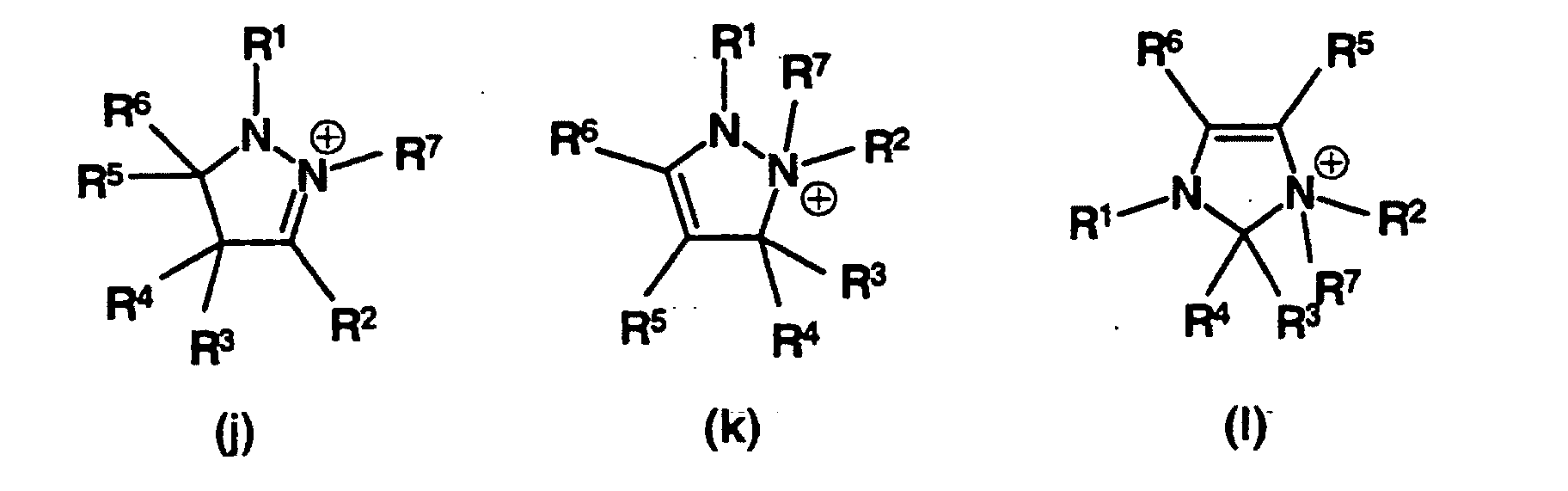
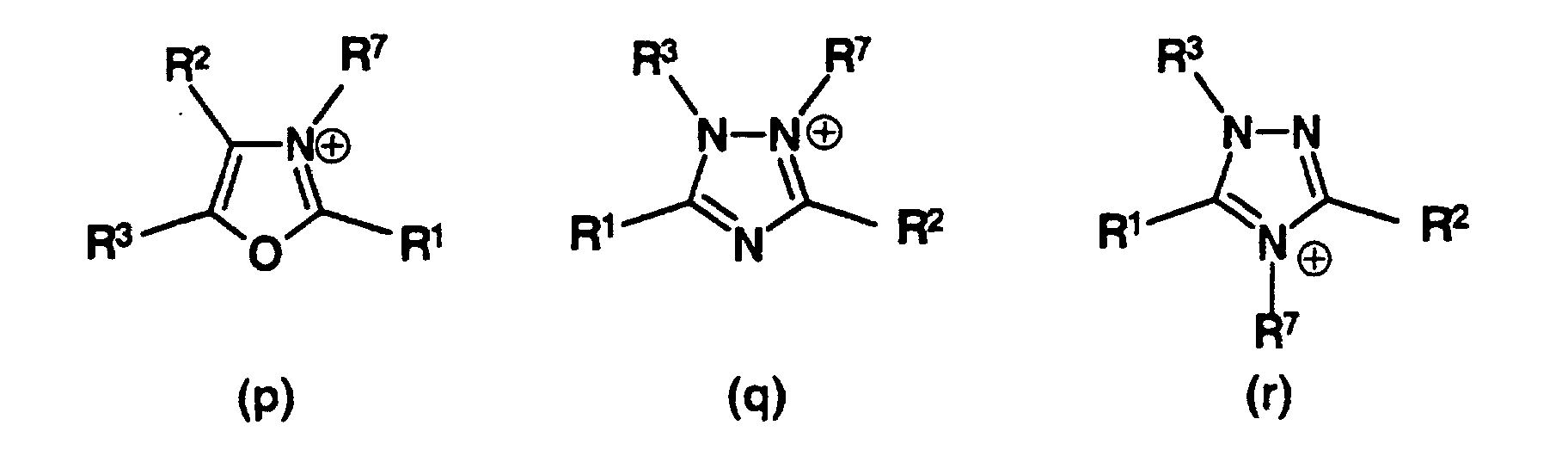
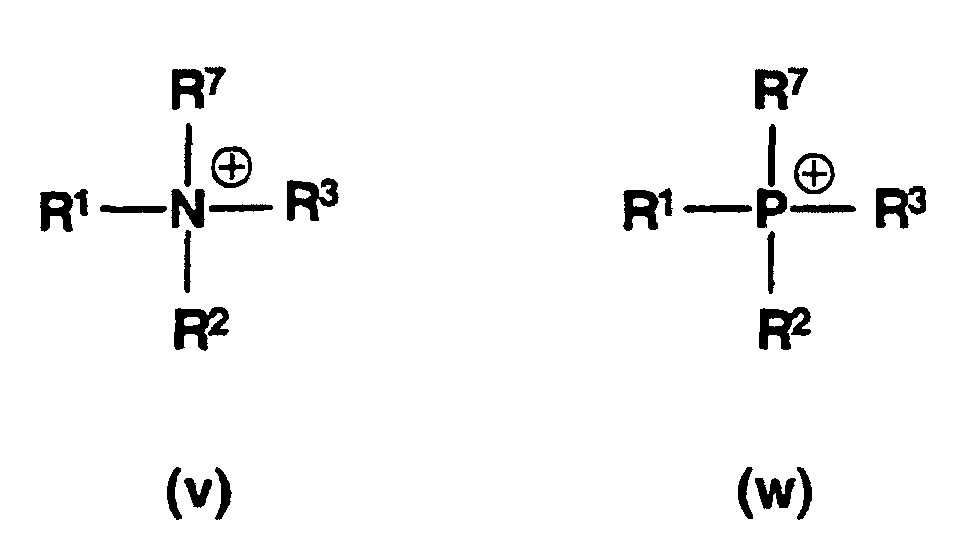
- Preferred as cation are ammonium or phosphonium ions, or such cations containing at least one five- to six-membered Heterocycle containing at least one phosphorus or nitrogen atom and optionally an oxygen or sulfur atom particularly preferably those compounds which are at least contain a five- to six-membered heterocycle, the one, two or three nitrogen atoms and one sulfur or one oxygen atom has, with very particular preference those with or two nitrogen atoms.
- Particularly preferred ionic liquids are those which include Have molecular weight below 1000 g / mol, very particularly preferred below 350 g / mol.
- radicals may together be 1,3-propylene, 1,4-butylene, 2-oxa-1,3-propylene, 1-oxa-1,3-propylene, 2-oxa-1, 3-propylene, 1-oxa-1,3-propenylene, 1-aza-1,3-propenylene, 1-C 1 -C 4 -alkyl-1-aza-1,3-propenylene, 1,4-butadiene 1,3-dienylene, 1-aza-1,4-buta-1,3-dienylene or 2-aza-1,4-buta-1,3-dienylene.
- the number of oxygen and / or sulfur atoms and / or imino groups is not limited. As a rule, it is no longer as 5 in the remainder, preferably not more than 4 and more especially preferably not more than 3.
- Substituted and unsubstituted imino groups may be, for example, imino, methylimino, iso- propylimino, n-butylimino or tert-butylimino.
- C 1 -C 18 -alkyloxy may be, for example, acetyl, propionyl, n-butyloyl, sec-butyloyl, tert-butyloyl, 2-ethylhexylcarbonyl, decanoyl, dodecanoyl, chloroacetyl, trichloroacetyl or trifluoroacetyl.
- C 1 -C 18 -alkyloxycarbonyl may be, for example, methyloxycarbonyl, ethyloxycarbonyl, propyloxycarbonyl, isopropyloxycarbonyl, n-butyloxycarbonyl, sec-butyloxycarbonyl, tert-butyloxycarbonyl, hexyloxycarbonyl, 2-ethylhexyloxycarbonyl or benzyloxycarbonyl.
- C 5 -C 12 -cycloalkylcarbonyl may be, for example, cyclopentylcarbonyl, cyclohexylcarbonyl or cyclododecylcarbonyl.
- C 6 -C 12 -aryloyl may be, for example, benzoyl, toluyl, xyloyl, ⁇ -naphthoyl, ⁇ -naphthoyl, chlorobenzoyl, dichlorobenzoyl, trichlorobenzoyl or trimethylbenzoyl.
- R 1 , R 2 , R 3 , R 4 , R 5 and R 6 are independently hydrogen, methyl, ethyl, n-butyl, 2-hydroxyethyl, 2-cyanoethyl, 2- (methoxycarbonyl) -ethyl, 2- ( Ethoxycarbonyl) -ethyl, 2- (n-butoxycarbonyl) -ethyl, dimethylamino, diethylamino and chloro.
- R 7 is methyl, ethyl, n-butyl, 2-hydroxyethyl, 2-cyanoethyl, 2- (methoxycarbonyl) ethyl, 2- (ethoxycarbonyl) ethyl, 2- (n-butoxycarbonyl) ethyl, acetyl, propionyl, t-butyryl, methoxycarbonyl, ethoxycarbonyl or n-butoxycarbonyl.
- Particularly preferred pyridinium ions (Ia) are those in which one of the radicals R 1 to R 5 is methyl, ethyl or chlorine, R 7 is acetyl, methyl, ethyl or n-butyl and all others are hydrogen, or R 3 is dimethylamino, R 7 Acetyl, methyl, ethyl or n-butyl and all others are hydrogen or R 7 is acetyl, methyl, ethyl or n-butyl and all others are hydrogen or R 2 is carboxy or carboxamide, R 7 is acetyl, methyl, ethyl or n-butyl and all others are hydrogen or R 1 and R 2 or R 2 and R 3 is 1,4-buta-1,3-dienylene, R 7 is acetyl, methyl, ethyl or n-butyl and all others are hydrogen.
- Particularly preferred pyridazinium ions (Ib) are those in which one of the radicals R 1 to R 4 is methyl or ethyl, R 7 is acetyl, methyl, ethyl or n-butyl and all other hydrogen or R 7 is acetyl, methyl, ethyl or n-butyl , and all others are hydrogen.
- Particularly preferred pyrimidinium ions are those in which R 2 to R 4 are hydrogen or methyl, R 7 is acetyl, methyl, ethyl or n-butyl and R 1 is hydrogen, methyl or ethyl, or R 2 and R 4 are methyl, R 3 is hydrogen and R 1 is hydrogen, methyl or ethyl and R 7 is acetyl, methyl, ethyl or n-butyl.
- ammonium phosphonium, pyridinium and Imidazoliumionen preferred.
- Preferred anions are halides, F - , Cl - , Br - , I - , acetate CH 3 COO - , trifluoroacetate CF 3 COO - , triflate CF 3 SO 3 - , sulfate SO 4 2- , hydrogen sulfate HSO 4 - , methylsulfate CH 3 OSO 3 - , ethylsulfate C 2 H 5 OSO 3 - , sulfite SO 3 2- , hydrogen sulfite HSO 3 - , aluminum chlorides AlCl 4 - , Al 2 Cl 7 - , Al 3 Cl 10 - , aluminum tribromide AlBr 4 -, nitrite NO 2 - , nitrate NO 3 -, copper chloride CuCl 2 - , phosphate PO 4 3- , hydrogen phosphate HPO 4 2- , dihydrogen phosphate H 2 PO 4 - , carbonate CO 3 2-
- tetrafluoroborate BF 4 - hexafluorophosphate PF 6 -, bis (trifluoromethylsulfonyl) imide (CF 3 SO 2) 2 N -, tosylate p-CH 3 C 6 H 4 SO 3 -.
- the salts have an E T (30) value of> 20, preferably> 30, more preferably of> 40 have.
- the E T (30) value is a measure of polarity and is reviewed by C. Reichardt of Reichardt, Christian Solvent Effects in Organic Chemistry Weinheim: VCH, 1979.-XI, (Monographs in Modern Chemistry; 3), ISBN 3- 527-25793-4 page 241.
- the change of the separation factor by the Entrainer can after several Methods are determined, preferably after the head-space analysis, as published by Hachenberg and Schmidt inmaschinestechnik, 8 (1974), 12 at pages 343-347.
- the effect of the entrainer on the mixture to be separated (the Feed) is generally worked on an entriner-free basis means that the concentration of the entrainer in the liquid Mixture noted but in the percentage concentration the target components is not taken into account.
- Suitable ionic liquids are those in one Total concentration in the liquid of 5 to 90 mol%, preferably 10 to 70 mol%, to a change in the separation factor of Target components differ from one another. These Change can be detected in the described head-space analysis become.
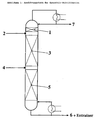
- FIG. 1 An embodiment of the extractive rectification in a process is illustrated by the Fig. 1.
- "2" is the inflow of the Entrainers in a countercurrent rectification column.
- a small but notable Has volatility with respect to the top product (stream 7) have to separate the top product and Entrainer the separating elements "1" are used.
- the separating elements "3" and "5" effect the desired separation between top product and bottoms product Under the influence of the entrainers, current "4" is the inflow to separating components (feed), stream “6” is bottoms product and the Entrainers.
- Separators can, for example, soils, ordered or not ordered packing.
- the process according to the invention has the advantage that -as mentioned Vapor pressure of the pure ionic liquid and thus also approximate their partial pressure in the mixture with the overhead product are equal to zero.
- the Separators "1" omitted.
- the ionic fluid is preferably in the reinforcement part close to Top of the column, more preferably in the top 3 stages, most preferably in the uppermost stage below the condenser added.
- ionic fluids as entrainer in the extractive rectification is especially suitable for the following applications suitable.
- Azeotropes amines / water, THF / water, formic acid / water, Alcohols / water, acetone / methanol, acetates / water, Acrylates / water or high-boiling mixtures: acetic acid / water, C4 hydrocarbons, C3 hydrocarbons, alkanes / alkenes.
- the butene-butane system is, according to the literature [Gmehling, J and Onken, U and Arlt, W, Vapor-Liquid Equilibrium Data Collection, Dechema Data Series, Vol. I Part 6a p. 17] narrow.
- the separation factor measured by gas-liquid chromatography (GLC) at infinite dilution of butane and butene in the ionic liquid octyl-methyl-imidazolium tetrafluoroborate (OMIM-BF 4 ) at 70 ° C., is 0.74.
- the additive thus has stronger interactions with the butene than with the butane.
- the shown strong influence of the ionic liquid OMIM-BF 4 on the phase equilibrium of the binary system butene-butane demonstrates the suitability of OMIM - BF 4 as entrainer for the separation of alkanes and alkenes.
- the separation factor measured by gas-liquid chromatography with infinite dilution of cyclohexanol and cyclohexanone in the ionic liquids ethyl-methyl-imidazolium tetrafluoroborate (EMIM-BF 4 ) and ethyl-methyl-imidazolium hexafluorophosphate (EMIM-PF 6 ) is for EMIM-BF 4 1.66 at 142 ° C and for EMIM-PF 6 1.61 at 140.8 ° C.
- Both ionic liquids cause an increase of the separation factor in the separation system cyclohexanol - cyclohexanone and are therefore suitable as Entrainer.
- EMIM-BF 4 separation factors for EMIM-BF 4 of 2.51 at 70 ° C, OMIM-BF 4 of 3.15 at 70 ° C, MMIM-CH 3 SO 4 of 1.3 at 70.5 ° C, EMIM- (CF 3 SO 2 ) 2 N of 0.5 at 84.6 ° C and EMIM-PF 6 of 0.67 at 70 ° C. It can be seen that not only individual ionic liquids are suitable as Entrainer. Rather, many representatives of the novel substance class of ionic liquids are suitable for use as entrainer.
- Table 2 shows the influence of the entrainer 1-ethyl-3-methyl-imidazolium tetrafluoroborate on the binary system tetrahydrofuran (THF) -water at 70 ° C and a molar liquid concentration of the entrainer of 50 mol%. Separation factor ⁇ of the homoazeotropic system tetrahydrofuran (THF) -water at 70 ° C with and without ionic liquid 1-ethyl-3-methyl-imidazolium tetrafluoroborat.
- Table 2a shows the effect of the entrainer 1-ethyl-3-methylimidazolium tetrafluorotosylate on the binary system tetrahydrofuran (THF) -water at a pressure of 1 bar and a molar concentration of the entrainer of 50 mol%.
- Table 3 shows the influence of the entrainer 1-ethyl-3-methyl-imidazolium tetrafluoroborate on the binary system propanol-water at 85 ° C. and a molar liquid concentration of the entrainer of 50 mol%. Separation factor ⁇ of the homoazeotropic system propanol-water at 85 ° C with and without ionic liquid 1-ethyl-3-methylimidazolium tetrafluoroborate.
- Table 4 shows the effect of the entrainer 1-ethyl-3-methyl-imidazolium tetrafluoroborate on the binary system isopropanol-water at 90 ° C. and a molar liquid concentration of the entrainer of 50 mol%. Separation factor ⁇ of the homoazeotropic system isopropanol-water at 90 ° C with and without ionic liquid 1-ethyl-3-methyl-imidazolium tetrafluoroborate.
- Table 5 shows for the system ethanol-water the effect of the two entrainers 1-ethyl-3-methyl-imidazolium tetrafluoroborate and ethanediol on the vapor-liquid phase equilibrium at 70 ° C. for the entrainment concentration of 50 mol%.
- Table 5 shows that for the same entrainer concentration the influence on the vapor-liquid phase equilibrium and thus the efficiency in the case of the ionic liquid in particular is significantly larger in the azeotropic region.
Landscapes
- Chemical & Material Sciences (AREA)
- Chemical Kinetics & Catalysis (AREA)
- Organic Low-Molecular-Weight Compounds And Preparation Thereof (AREA)
- Production Of Liquid Hydrocarbon Mixture For Refining Petroleum (AREA)
- Extraction Or Liquid Replacement (AREA)
- Vaporization, Distillation, Condensation, Sublimation, And Cold Traps (AREA)
- Furan Compounds (AREA)
Description




worin
| Trennfaktor α des binären, homoazeotropen Systems Ethanol-Wasser bei 70°C und unterschiedlichen Mengen der ionischen Flüssigkeit 1-Ethyl-3-methyl-imidazolium tetrafluoroborat | |||||
| xEthanol [Mol %] | xWasser [Mol %] | αEthanol, Wasser binäres System ohne erfindungsgemäßen Entrainer | αEthanol, Wasser ternäres System mit 10 Mol% an erfindungsgemäßem Entrainer | αEthanol, Wasser ternäres System mit 50 Mol% an erfindungsgemäßem Entrainer | αEthanol, Wasser ternäres System mit 70 Mol% an erfindungsgemäßem Entrainer |
| 0,10 | 0,90 | 7,12 | 4,64 | 5,74 | 6,23 |
| 0,20 | 0,80 | 4,45 | 3,90 | 5,49 | 6,11 |
| 0,30 | 0,70 | 2,99 | 3,25 | 5,17 | 6,00 |
| 0,40 | 0,60 | 2,37 | 2,70 | 4,77 | 5,86 |
| 0,50 | 0,50 | 1,88 | 2,41 | 4,57 | 5,72 |
| 0,60 | 0,40 | 1,58 | 2,12 | 4,38 | 5,58 |
| 0,70 | 0,30 | 1,34 | 1,85 | 4,20 | 5,25 |
| 0,80 | 0,20 | 1,17 | 1,68 | 4,02 | 4,95 |
| 0,90 | 0,10 | 1,06 | 1,48 | 3,99 | 4,90 |
| 0,95 | 0,05 | 1,00 | 1,32 | 3,56 | 4,87 |
| Trennfaktor α des homoazeotropen Systems Tetrahydrofuran(THF)-Wasser bei 70°C mit und ohne ionische Flüssigkeit 1-Ethyl-3-methyl-imidazolium tetrafluoroborat. | |||
| xTHF [Mol %] | xWasser [Mol %] | αTHF, Wasser binäres System ohne erfindungsgemäßen Entrainer | αTHF, Wasser ternäres System mit 50 Mol% an erfindungsgemäßem Entrainer |
| 0,10 | 0,90 | 25,54 | 18,09 |
| 0,20 | 0,80 | 12,38 | 16,73 |
| 0,30 | 0,70 | 7,97 | 15,37 |
| 0,40 | 0,60 | 5,59 | 14,01 |
| 0,50 | 0,50 | 3,87 | 12,65 |
| 0,60 | 0,40 | 2,56 | 11,29 |
| 0,70 | 0,30 | 1,64 | 9,93 |
| 0,80 | 0,20 | 1,10 | 8,57 |
| 0,90 | 0,10 | 0,79 | 7,21 |
| Trennfaktor α des Systems Tetrahydrofuran(THF)-Wasser bei 1 bar mit ionischer Flüssigkeit 1-Ethyl-3-methyl-imidazolium tetrafluorotosilat. Messergebnisse sind hier nicht mit Head-Space-Chromatographie, sondern mit einer Gleichgewichtsapparatur vermessen worden. Auch hier ist eine deutliche Erhöhung des Trennfaktors gegenüber dem binären System (siehe Tabelle 2) und damit die Eignung des ionischen Fluids als Entrainer zu erkennen. | ||
| xTHF [Mol %] | xWasser [Mol %] | αTHF, Wasser ternäres System mit 50 Mol% an erfindungsgemäBem Entrainer |
| 0,2459 | 0,7541 | 23,3 |
| 0,3843 | 0,6157 | 24,7 |
| 0,5355 | 0,4645 | 23,8 |
| 0,6307 | 0,3693 | 22,8 |
| Trennfaktor α des homoazeotropen Systems Propanol-Wasser bei 85°C mit und ohne ionischen Flüssigkeit 1-Ethyl-3-methylimidazolium tetrafluoroborat. | |||
| xPropanol [Mol %] | xWasser [Mol %] | αPropanol, Wasser binäres System ohne erfindungsgemäßen Entrainer | αPropanol, Wasser ternäres System mit 50 Mol% an erfindungsgemäßem Entrainer |
| 0,4 | 0,6 | 1,10 | 3,12 |
| 0,6 | 0,4 | 0,68 | 2,46 |
| Trennfaktor α des homoazeotropen Systems Isopropanol-Wasser bei 90°C mit und ohne ionische Flüssigkeit 1-Ethyl-3-methyl-imidazolium tetrafluoroborat. | |||
| xIsopropanol [Mol %] | xWasser [Mol %] | αIsopropanol, Wasser binäres System ohne erfindungsgemäßen Entrainer | αIsopropanol, Wasser ternäres System mit 50 Mol% an erfindungsgemäßem Entrainer |
| 0,4 | 0,6 | 2.09 | 5,73 |
| 0,6 | 0,4 | 1,29 | 4,64 |
| Gegenüberstellung der Trennfaktoren α im System Ethanol-Wasser bei 70°C für den konventionellen Entrainer Ethandiol und den erfindungsgemäßen Entrainer 1-Ethyl-3-methyl-imidazolium tetrafluoroborat | ||||
| xEthanol [Mol %] | xWasser [Mol %] | αEthanol, Wasser binäres System ohne erfindungsgemäßen Entrainer | αEthanol, Wasser ternäres System mit 50 Mol% an Ethandiol | αEthanol, Wasser ternäres System mit 50 Mol% an erfindungsgemäßem Entrainer |
| 0,10 | 0,90 | 7,12 | 4,96 | 5,74 |
| 0,20 | 0,80 | 4,45 | 4,37 | 5,49 |
| 0,30 | 0,70 | 2,99 | 3,77 | 5,17 |
| 0,40 | 0,60 | 2,37 | 3,45 | 4,77 |
| 0,50 | 0,50 | 1,88 | 3,14 | 4,57 |
| 0,60 | 0,40 | 1,58 | 2,82 | 4,38 |
| 0,70 | 0,30 | 1,34 | 2,63 | 4,20 |
| 0,80 | 0,20 | 1,17 | 2,44 | 4,02 |
| 0,90 | 0,10 | 1,06 | 1,83 | 3,99 |
| 0,95 | 0,05 | 1,00 | 1,32 | 3,56 |
Claims (27)
- Verfahren zur Trennung von Flüssigkeiten oder kondensierbaren Gasen im kondensierten Zustand, dadurch gekennzeichnet, daßein Entrainer benutzt wird, der eine ionische Flüssigkeit ist und eine Veränderung des Trennfaktors der zu trennenden Komponenten abweichend von eins bewirkt,die ionische Flüssigkeit in einer Gesamtkonzentration von 5 bis 90 Mol%, bevorzugt 10 bis 70 Mol% in der flüssigen Phase vorliegt.
- Verfahren nach Anspruch 1, dadurch gekennzeichnet, daß die Trennung durch Extraktiv-Rektifikation in einer Kolonne durchgeführt wird, und daßdie unter den Bedingungen des Anspruchs 1 leichtsiedende Komponente oder Komponenten am Kopf der Kolonne erhalten werden, während alle anderen Komponenten als Sumpfprodukt zusammen mit dem Entrainer am Sumpf der Kolonne anfallen,das Flüssiggemisch am Sumpf der Kolonne (Sumpfprodukt und Entrainer) so aufgearbeitet wird, daß der Entrainer wiedergewonnen werden kann und die Komponenten des Sumpfproduktes als weitere Fraktion anfallen,die Kolonne im Gegenstrom betrieben wird,oberhalb des Feeds der zu trennenden Komponenten der Entrainer in die Kolonne zugeführt wird.
- Verfahren nach Anspruch 2, dadurch gekennzeichnet, daß die Abtrennung des Sumpfproduktes vom Entrainer durch Eindampfung in Verdampfern oder in Rektifikationskolonnen erfolgt.
- Verfahren nach Anspruch 2, dadurch gekennzeichnet, daß die Aufarbeitung des Gemischs aus Sumpfprodukt und Entrainer durch Ausfällen des Bestandteiles erfolgt, der den höheren Gefrierpunkt hat.
- Verfahren nach Anspruch 2, dadurch gekennzeichnet, daß die Abtrennung des Sumpfproduktes vom Entrainer durch Trocknung erfolgt.
- Verfahren nach Anspruch 2, dadurch gekennzeichnet, daß die Abtrennung des Sumpfproduktes vom Entrainer durch Extraktion erfolgt.
- Verfahren nach Anspruch 2, dadurch gekennzeichnet, daß keine Trennelemente oberhalb des Zulaufes des Entrainers in die Extraktiv-Rektifikation benötigt werden.
- Verfahren nach Anspruch 1, dadurch gekennzeichnet, daß der Feed ein Wasser-enthaltendes System ist, das neben Wasserenthält und eine Abtrennung des Wassers von den übrigen Stoffen erreicht wird.Alkohole mit einer Kohlenstoffzahl zwischen 1 und 12, bevorzugt zwischen 1 und 8, besonders bevorzugt zwischen 1 und 5 ,organische Säuren, vorzugsweise Alkansäuren,Ketone,Furane
- Verfahren nach Anspruch 1, dadurch gekennzeichnet, daß der Feed Alkane und Alkene mit einer Kohlenstoffzahl zwischen 3 und 12, bevorzugt zwischen 4 und 10 enthält und eine Trennung zwischen Alkanen und Alkenen erreicht wird.
- Verfahren nach Anspruch 1, dadurch gekennzeichnet, daß der Feed aromatische und aliphatische Kohlenwasserstoffe enthält und eine Trennung zwischen Aromaten und Aliphaten erreicht wird.
- Verfahren nach Anspruch 1, dadurch gekennzeichnet, daß der Feed Ketone und alicyclische Verbindungen enthält und die Ketone von den alicyclischen Komponenten getrennt werden.
- Verfahren nach Anspruch 1, dadurch gekennzeichnet, daß der Feed Amide und Säuren, bevorzugt Carbonsäuren, enthält und die Amide von den Säuren getrennt werden.
- Verfahren nach Anspruch 1, dadurch gekennzeichnet, daß der Feed Alkohole und Alkane enthält und die Alkane von den Alkoholen getrennt werden.
- Verfahren nach Anspruch 1, dadurch gekennzeichnet, daß der Feed Alkohole und Aromaten enthält und die Alkohole von den Aromaten getrennt werden.
- Verfahren nach Anspruch 1, dadurch gekennzeichnet, daß der Feed Ketone und Alkohole enthält und die Ketone von den Alkoholen getrennt werden.
- Verfahren nach Anspruch 1, dadurch gekennzeichnet, daß der Feed Acetate und Ketone enthält und die Acetate von den Ketonen getrennt werden.
- Verfahren nach Anspruch 1, dadurch gekennzeichnet, daß der Feed Ether und Alkane enthält und die Ether von den Alkanen getrennt werden.
- Verfahren nach Anspruch 1, dadurch gekennzeichnet, daß der Feed Ether und Alkene enthält und die Ether von den Alkenen getrennt werden.
- Verfahren nach Anspruch 1, dadurch gekennzeichnet, daß der Feed Sulfide und Ketone enthält und die Sulfide von den Ketonen getrennt werden.
- Verfahren nach Anspruch 1, dadurch gekennzeichnet, daß der Feed Halogenkohlenwasserstoffe und Ketone enthält und die Halogenkohlenwasserstoffe von den Ketonen getrennt werden.
- Verfahren nach Anspruch 15, dadurch gekennzeichnet, daß der Feed cyclische Ketone und / oder cyclische Alkohole enthält und das diese voneinander getrennt werden.
- Verfahren nach Anspruch 1, dadurch gekennzeichnet, daß das Anion der als Entrainer verwendeten ionischen Flüssigkeit ein Metall-Halogenid ist.
- Verfahren nach Anspruch 1, dadurch gekennzeichnet, daß die als Entrainer verwendete ionische Flüssigkeit ein Anion wie das Nitrat-Anion oder das Tetrachloroaluminat-Anion oder das Tetrafluoroborat-Anion oder das Heptachlorodialuminat-Anion oder das Hexafluorophosphast-Anion oder das Methylsulfat-Anion oder reine Halogenid-Anionen hat.
- Verfahren nach Anspruch 1, dadurch gekennzeichnet, daß die als Entrainer verwendete ionische Flüssigkeit ein Kation wie das Imidazolium-Kation oder das Pyridinium-Kation oder das Ammonium-Kation oder das Phosphonium-Kation hat.
- Verfahren nach Anspruch 1, dadurch gekennzeichnet, daß Mischungen von ionischen Flüssigkeiten als Entrainer benutzt werden.
- Verfahren nach Anspruch 2, dadurch gekennzeichnet, daß die Abtrennung des Sumpfproduktes vom Entrainer durch Strippung mit einem Inertgas erfolgt.
- Anwendung des Verfahrens nach Anspruch 1 bis 26 zur Trennung von Flüssigkeiten oder Gasen im kondensierten Zustand.
Applications Claiming Priority (5)
| Application Number | Priority Date | Filing Date | Title |
|---|---|---|---|
| DE10114734 | 2001-03-20 | ||
| DE10114734 | 2001-03-20 | ||
| DE2001136614 DE10136614A1 (de) | 2001-07-17 | 2001-07-17 | Ionische Flüssigkeiten als selektive Zusatzstoffe für die Trennung engsiedender oder azeotroper Gemische |
| DE10136614 | 2001-07-17 | ||
| PCT/EP2002/002824 WO2002074718A2 (de) | 2001-03-20 | 2002-03-14 | Ionische flüssigkeiten als selektive zusatzstoffe für die trennung engsiedender oder azeotroper gemische |
Publications (2)
| Publication Number | Publication Date |
|---|---|
| EP1372807A2 EP1372807A2 (de) | 2004-01-02 |
| EP1372807B1 true EP1372807B1 (de) | 2004-10-13 |
Family
ID=26008899
Family Applications (1)
| Application Number | Title | Priority Date | Filing Date |
|---|---|---|---|
| EP02732483A Expired - Lifetime EP1372807B1 (de) | 2001-03-20 | 2002-03-14 | Ionische flüssigkeiten als selektive zusatzstoffe für die trennung engsiedender oder azeotroper gemische |
Country Status (15)
| Country | Link |
|---|---|
| US (1) | US7435318B2 (de) |
| EP (1) | EP1372807B1 (de) |
| JP (1) | JP4884643B2 (de) |
| KR (1) | KR100846957B1 (de) |
| CN (1) | CN1274382C (de) |
| AT (1) | ATE279248T1 (de) |
| AU (1) | AU2002304855A1 (de) |
| BR (1) | BR0208176B1 (de) |
| CA (1) | CA2440528C (de) |
| DE (1) | DE50201299D1 (de) |
| ES (1) | ES2231699T3 (de) |
| MX (1) | MXPA03007633A (de) |
| MY (1) | MY129197A (de) |
| TW (1) | TWI248828B (de) |
| WO (1) | WO2002074718A2 (de) |
Cited By (2)
| Publication number | Priority date | Publication date | Assignee | Title |
|---|---|---|---|---|
| DE102007002536A1 (de) | 2007-01-17 | 2008-07-24 | Wacker Chemie Ag | Chlorsilandestillation in Gegenwart ionischer Flüssigkeit |
| DE102010063082A1 (de) * | 2009-12-24 | 2011-06-30 | Wacker Chemie AG, 81737 | Verfahren zur Herstellung von Funktionalisierten Silanen in Ionischer Flüssigkeit |
Families Citing this family (123)
| Publication number | Priority date | Publication date | Assignee | Title |
|---|---|---|---|---|
| US20040077519A1 (en) * | 2002-06-28 | 2004-04-22 | The Procter & Gamble Co. | Ionic liquid based products and method of using the same |
| DE10313207A1 (de) | 2003-03-25 | 2004-10-07 | Basf Ag | Reinigung oder Aufarbeitung von Ionischen Flüssigkeiten mit adsorptiven Trennverfahren |
| DE10314203B4 (de) * | 2003-03-28 | 2005-10-06 | Stockhausen Gmbh | Verfahren zur Abtrennung von (Meth)Acrylsäure aus einer (Meth)Acrylsäure-haltigen Zusammensetzung |
| DE10316418A1 (de) * | 2003-04-10 | 2004-10-21 | Basf Ag | Verwendung einer ionischen Flüssigkeit |
| DE10336556A1 (de) * | 2003-08-05 | 2005-03-10 | Basf Ag | Destillatives Verfahren zur Trennung von engsiedenden oder azeotropen Gemischen unter Verwendung von ionischen Flüssigkeiten |
| DE10336555A1 (de) * | 2003-08-05 | 2005-02-24 | Basf Ag | Recycling von lonischen Flüssigkeiten bei der Extraktiv-Destillation |
| CN100418602C (zh) * | 2003-12-01 | 2008-09-17 | 中国科学院生态环境研究中心 | 一次性固相微萃取离子液体涂层的制备 |
| DE102004003958A1 (de) | 2004-01-26 | 2005-08-11 | Basf Ag | Herstellungsmethode für ionische Flüssigkeiten |
| FR2866346B1 (fr) * | 2004-02-13 | 2006-04-14 | Inst Francais Du Petrole | Procede d'extraction d'un anti-hydrates contenu dans des hydrocarbures condenses |
| FR2866345B1 (fr) * | 2004-02-13 | 2006-04-14 | Inst Francais Du Petrole | Procede de traitement d'un gaz naturel avec extraction du solvant contenu dans le gaz naturel purifie |
| DE102004024967A1 (de) * | 2004-05-21 | 2005-12-08 | Basf Ag | Neue Absorptionsmedien für Absorptionswärmepumpen, Absorptionskältemaschinen und Wärmetransformatoren |
| EP1652814A1 (de) * | 2004-10-27 | 2006-05-03 | Solvay Fluor GmbH | Verfahren zur Gastrennung |
| US20060090271A1 (en) * | 2004-11-01 | 2006-05-04 | Price Kenneth N | Processes for modifying textiles using ionic liquids |
| US7939485B2 (en) * | 2004-11-01 | 2011-05-10 | The Procter & Gamble Company | Benefit agent delivery system comprising ionic liquid |
| US7776810B2 (en) * | 2004-11-01 | 2010-08-17 | The Procter & Gamble Company | Compositions containing ionic liquid actives |
| US20060094621A1 (en) * | 2004-11-01 | 2006-05-04 | Jordan Glenn T Iv | Process for improving processability of a concentrate and compositions made by the same |
| US7737102B2 (en) | 2004-11-01 | 2010-06-15 | The Procter & Gamble Company | Ionic liquids derived from functionalized anionic surfactants |
| US20060090777A1 (en) * | 2004-11-01 | 2006-05-04 | Hecht Stacie E | Multiphase cleaning compositions having ionic liquid phase |
| US20060094616A1 (en) * | 2004-11-01 | 2006-05-04 | Hecht Stacie E | Ionic liquids derived from surfactants |
| DE102004053662A1 (de) * | 2004-11-03 | 2006-05-04 | Basf Ag | Verfahren zur Herstellung von Polyisocyanaten |
| DE102004056672A1 (de) * | 2004-11-24 | 2006-06-01 | Basf Ag | Verfahren zur chemischen Umsetzung und Auftrennung eines Gemisches in einer Kolonne |
| US8715521B2 (en) * | 2005-02-04 | 2014-05-06 | E I Du Pont De Nemours And Company | Absorption cycle utilizing ionic liquid as working fluid |
| US7786065B2 (en) * | 2005-02-18 | 2010-08-31 | The Procter & Gamble Company | Ionic liquids derived from peracid anions |
| DE102005013030A1 (de) * | 2005-03-22 | 2006-09-28 | Bayer Technology Services Gmbh | Verfahren zur destillativen Reinigung schwerflüchtiger Fluide |
| DE102005028451B4 (de) | 2005-06-17 | 2017-02-16 | Evonik Degussa Gmbh | Verfahren zum Transport von Wärme |
| AR058054A1 (es) * | 2005-09-22 | 2008-01-23 | Du Pont | Utilizacion de liquidos ionicos para la separacion de hidrofluorocarburos |
| US8506839B2 (en) * | 2005-12-14 | 2013-08-13 | E I Du Pont De Nemours And Company | Absorption cycle utilizing ionic liquids and water as working fluids |
| TW200808656A (en) * | 2006-04-27 | 2008-02-16 | Solvay Fluor Gmbh | Reversible water-free process for the separation of acid-containing gas mixtures |
| US8771626B2 (en) * | 2006-05-31 | 2014-07-08 | E I Du Pont De Nemours And Company | Process for purifying perfluorinated products |
| CN101454420B (zh) * | 2006-05-31 | 2012-07-11 | 纳幕尔杜邦公司 | 利用离子液体作为压缩机润滑剂的蒸汽压缩 |
| EP2051788A1 (de) * | 2006-08-18 | 2009-04-29 | Invista Technologies S.à.r.l. | Extraktionsverfahren mittels ionenflüssigkeit |
| WO2008057574A1 (en) * | 2006-11-08 | 2008-05-15 | E. I. Du Pont De Nemours And Company | Process for the separation of tetrafluoroethylene from carbon dioxide using ionic liquids |
| CN101020625B (zh) * | 2007-03-12 | 2010-05-19 | 中国科学院过程工程研究所 | 一种用离子液体吸收甲基丙烯醛的方法 |
| CN101265152B (zh) * | 2007-03-16 | 2013-06-05 | 中国石油大学(北京) | 一种离子液体作为萃取精馏分离苯和环己烷的溶剂的应用 |
| JP5343068B2 (ja) * | 2007-04-03 | 2013-11-13 | イー・アイ・デュポン・ドウ・ヌムール・アンド・カンパニー | ポリオールおよびイオン液体の混合物を用いる熱伝達システム |
| US8075777B2 (en) | 2007-05-16 | 2011-12-13 | E. I. Du Pont De Nemours And Company | Process for the separation of diastereomers |
| US7964760B2 (en) * | 2007-05-25 | 2011-06-21 | E.I. Du Pont De Nemours And Company | Process for the separation of fluorocarbons using ionic liquids |
| EP2088389B1 (de) * | 2008-02-05 | 2017-05-10 | Evonik Degussa GmbH | Absorptionskältemaschine |
| EP2087930A1 (de) | 2008-02-05 | 2009-08-12 | Evonik Degussa GmbH | Verfahren zur Absorption eines flüchtigen Stoffes in einem flüssigen Absorptionsmittel |
| CN101970108B (zh) | 2008-02-11 | 2013-07-10 | 巴斯夫欧洲公司 | 聚酰胺的制备 |
| EA017313B1 (ru) * | 2008-04-24 | 2012-11-30 | Институт Нефтехимических Процессов Им. Академика Ю. Мамедалиева, Нан Азербайджана | Способ селективной очистки алкил-трет-алкиловых эфиров ионной жидкостью |
| JP5591797B2 (ja) * | 2008-05-26 | 2014-09-17 | メルク パテント ゲゼルシャフト ミット ベシュレンクテル ハフツング | 水溶液からアルコールを抽出するための溶媒としてのテトラシアノボレートアニオンを含むイオン液体の使用 |
| DE102009049696A1 (de) | 2008-10-16 | 2010-04-22 | Basf Se | Verbindung mit einer Salzgruppe und einer p-Halbleitergruppe und deren Verwendung in Solarzellen |
| CN101417913B (zh) * | 2008-11-19 | 2013-01-16 | 烟台大学 | 一种用多元混合溶剂分离丁烷与丁烯的方法 |
| US8350056B2 (en) * | 2008-12-04 | 2013-01-08 | E I Du Pont De Nemours And Company | Functionalized N-substituted pyrrolidonium ionic liquids |
| US8119818B2 (en) * | 2008-12-04 | 2012-02-21 | E. I. Du Pont De Nemours And Company | Functionalized N-substituted pyrrolidonium ionic liquids |
| JP2012511018A (ja) | 2008-12-04 | 2012-05-17 | イー・アイ・デュポン・ドウ・ヌムール・アンド・カンパニー | 伸長リンカーを有するn−置換ピロリドニウムイオン液体 |
| US8138354B2 (en) * | 2008-12-04 | 2012-03-20 | E. I. Du Pont De Nemours And Company | N-substituted pyrrolidonium ionic liquids |
| US20100140166A1 (en) * | 2008-12-04 | 2010-06-10 | E.I. Du Pont De Nemours And Company | Process for fermentive preparation of alcohols and recovery of product |
| US20100143999A1 (en) * | 2008-12-04 | 2010-06-10 | E.I. Du Pont De Nemours And Company | Process for fermentive preparation of alcohols and recovery of product |
| US20100143992A1 (en) * | 2008-12-04 | 2010-06-10 | E. I Du Pont De Nemours And Company | Process for Fermentive Preparation of Alcohols and Recovery of Product |
| US20100144000A1 (en) * | 2008-12-04 | 2010-06-10 | E. I. Du Pont De Nemours And Company | Process for fermentive preparation fo alcohols and recovery of product |
| US20100143994A1 (en) * | 2008-12-04 | 2010-06-10 | E. I. Du Pont De Memours And Company | Process for fermentive preparation of alcohols and recovery of product |
| US20100143993A1 (en) * | 2008-12-04 | 2010-06-10 | E.I. Du Pont De Nemours And Company | Process for fermentive preparationfor alcolhols and recovery of product |
| US20100143995A1 (en) * | 2008-12-04 | 2010-06-10 | E. I. Du Pont De Nemours And Company | Process for Fermentive Preparation of Alcohols and Recovery of Product |
| CN102307647A (zh) | 2008-12-04 | 2012-01-04 | 纳幕尔杜邦公司 | 二氧化碳移除和可用于其中的离子液体化合物 |
| US20100139154A1 (en) * | 2008-12-04 | 2010-06-10 | E.I. Du Pont De Nemours And Company | Process for fermentive preparation of alcohols and recovery of product |
| DE102009000543A1 (de) | 2009-02-02 | 2010-08-12 | Evonik Degussa Gmbh | Verfahren, Absorptionsmedien und Vorrichtung zur Absorption von CO2 aus Gasmischungen |
| US20100261945A1 (en) * | 2009-04-08 | 2010-10-14 | Samsung Engineering Co., Ltd. | Method of separating aromatic compound from mixture containing aromatic compound and aliphatic compound |
| EP2243530A1 (de) | 2009-04-21 | 2010-10-27 | LANXESS Deutschland GmbH | Verfahren zur Trennung aromatischer Verbindungen |
| US8790542B2 (en) * | 2009-09-30 | 2014-07-29 | Sandia Corporation | Compositions and methods useful for ionic liquid treatment of biomass |
| DE102009047564A1 (de) | 2009-12-07 | 2011-06-09 | Evonik Degussa Gmbh | Arbeitsmedium für eine Absorptionskältemaschine |
| US8946442B2 (en) | 2009-12-21 | 2015-02-03 | E I Du Pont De Nemours And Company | Foamed ionic compounds |
| US9067953B2 (en) * | 2010-03-12 | 2015-06-30 | E I Du Pont De Nemours And Company | Systems for carbon dioxide and sulfur dioxide removal |
| US20110223085A1 (en) * | 2010-03-12 | 2011-09-15 | E. I. Du Pont De Nemours And Company | Carbon dioxide capture with ionic liquid electrospray |
| US9017455B2 (en) | 2010-06-03 | 2015-04-28 | E I Du Pont De Nemours And Company | Sulfur compounds for carbon dioxide and sulfur dioxide removal |
| KR101330074B1 (ko) * | 2010-10-04 | 2013-11-18 | 코오롱인더스트리 주식회사 | 이온성 액체, 이의 제조 방법 및 이를 이용하여 아세틸렌계 화합물을 제거하는 방법 |
| DE102011077377A1 (de) | 2010-11-12 | 2012-05-16 | Evonik Degussa Gmbh | Verfahren zur Absorption von sauren Gasen aus Gasmischungen |
| CN102190557B (zh) * | 2011-03-25 | 2014-01-01 | 吉林大学 | 用于丙酮甲醇共沸物分离的复合萃取剂及其使用方法 |
| WO2012130803A1 (de) | 2011-03-31 | 2012-10-04 | Bayer Technology Services Gmbh | Verfahren zur abtrennung von halogenen aus stoffgemischen |
| CN102850170B (zh) * | 2011-06-29 | 2015-12-16 | 中国石油化工股份有限公司 | 一种基于离子液体的碳五分离用混合溶剂 |
| US8906135B1 (en) * | 2011-09-01 | 2014-12-09 | U.S. Department Of Energy | Method of purifying a gas stream using 1,2,3-triazolium ionic liquids |
| PH12014500533A1 (en) | 2011-11-14 | 2014-04-21 | Evonik Degussa Gmbh | Method and device for the separation of acidic gases from a gas mixture |
| DE102011121012A1 (de) | 2011-12-13 | 2013-06-13 | Linde Aktiengesellschaft | Verfahren zur Kohlenwasserstoffabtrennung |
| WO2013098056A1 (en) | 2011-12-28 | 2013-07-04 | Lanxess Deutschland Gmbh | Purification of optionally hydrogenated nitrile rubber |
| JP5888993B2 (ja) * | 2012-01-12 | 2016-03-22 | ランクセス・ドイチュランド・ゲーエムベーハー | メントール化合物異性体の分離 |
| DE102012200907A1 (de) | 2012-01-23 | 2013-07-25 | Evonik Industries Ag | Verfahren und Absorptionsmedium zur Absorption von CO2 aus einer Gasmischung |
| DE102012207509A1 (de) | 2012-05-07 | 2013-11-07 | Evonik Degussa Gmbh | Verfahren zur Absorption von CO2 aus einer Gasmischung |
| US9574982B2 (en) * | 2012-10-25 | 2017-02-21 | Carrier Corporation | Method of measuring concentrations of gas mixtures |
| CN103073388B (zh) * | 2013-01-28 | 2015-07-08 | 北京化工大学 | 一种离子液体萃取精馏分离乙醇和水的方法 |
| CN103193577B (zh) * | 2013-03-25 | 2014-12-10 | 烟台大学 | 一种用三元混合溶剂萃取精馏分离丁烷与丁烯的方法 |
| CN103274568B (zh) * | 2013-05-30 | 2014-08-20 | 湖南百利工程科技股份有限公司 | 一种采用萃取法处理环己酮氨肟化装置中含酮废水的方法 |
| CN103274931A (zh) * | 2013-06-05 | 2013-09-04 | 中国石油大学(华东) | 一种用于分离羧酸混合物萃取精馏的溶剂 |
| CN103467246A (zh) * | 2013-08-20 | 2013-12-25 | 天津科林泰克科技有限公司 | 一种分离异丙醇-水混合物的方法 |
| CN103449969A (zh) * | 2013-09-05 | 2013-12-18 | 天津科林泰克科技有限公司 | 一种分离甲醇-乙醇-异丙醇-水混合物的方法及生产装置 |
| CN103613485B (zh) * | 2013-12-09 | 2016-02-17 | 北京化工大学 | 乙二醇加离子液体萃取精馏分离醇水溶液的方法 |
| CN104761422A (zh) * | 2014-01-07 | 2015-07-08 | 中国科学院兰州化学物理研究所 | 一种用于两组分共沸物或近沸点混合物的分离方法 |
| CN104945327B (zh) * | 2014-03-26 | 2019-02-01 | 中国石油化工股份有限公司 | 一种抽提分离柴油馏分中芳烃和烷烃的溶剂及方法 |
| CN104945328B (zh) * | 2014-03-26 | 2018-02-23 | 中国石油化工股份有限公司 | 抽提分离柴油馏分中芳烃和烷烃的复合溶剂及应用方法 |
| CN106715407A (zh) | 2014-09-25 | 2017-05-24 | 宝洁公司 | 离子液体 |
| CN107072913A (zh) | 2014-09-25 | 2017-08-18 | 宝洁公司 | 包含离子液体的芳香剂组合物 |
| MA41688A (fr) * | 2014-10-16 | 2017-08-22 | Honeywell Int Inc | Procédé de séparation de fluorure d'hydrogène de mélanges fluorure d'hydrogène/hydrocarbures halogénés au moyen de liquides ioniques |
| CN104478712B (zh) * | 2014-11-21 | 2016-03-16 | 沈阳化工大学 | 一种两步萃取精馏分离乙酸甲酯-甲醇的方法 |
| WO2016100769A1 (en) | 2014-12-19 | 2016-06-23 | Eastman Chemical Company | Quaternary phosphinates with co-solvents for extracting c1 to c4 carboxylic acids from aqueous streams |
| CN107108785B (zh) * | 2014-12-22 | 2019-09-03 | Sabic环球技术有限责任公司 | 由烃的再循环回收烃 |
| CN104628522A (zh) * | 2015-01-12 | 2015-05-20 | 济南大学 | 乙醇—甲苯共沸混合物间歇萃取精馏工艺 |
| DE102015212749A1 (de) | 2015-07-08 | 2017-01-12 | Evonik Degussa Gmbh | Verfahren zur Entfeuchtung von feuchten Gasgemischen |
| US9611209B1 (en) | 2015-12-18 | 2017-04-04 | Eastman Chemical Company | Quaternary arylcarboxylate compositions for extracting C1 to C4 carboxylic acids from aqueous streams |
| CA3010106C (en) | 2016-02-23 | 2022-10-11 | Vanderbilt Chemicals, Llc | Imidazolium sulfur-containing binuclear molybdate salts as lubricant additives |
| US10168080B2 (en) * | 2016-05-26 | 2019-01-01 | Yazaki Corporation | Eutectic mixtures of ionic liquids in absorption chillers |
| WO2017205828A1 (en) | 2016-05-26 | 2017-11-30 | Yazaki Corporation | Guanidinium-based ionic liquids in absorption chillers |
| EP3257843A1 (de) | 2016-06-14 | 2017-12-20 | Evonik Degussa GmbH | Verfahren zur herstellung von hochreinem imidazoliumsalz |
| DE102016210481B3 (de) | 2016-06-14 | 2017-06-08 | Evonik Degussa Gmbh | Verfahren zum Reinigen einer ionischen Flüssigkeit |
| DE102016210484A1 (de) | 2016-06-14 | 2017-12-14 | Evonik Degussa Gmbh | Verfahren zur Entfeuchtung von feuchten Gasgemischen |
| EP3257568B1 (de) | 2016-06-14 | 2019-09-18 | Evonik Degussa GmbH | Verfahren zur entfeuchtung von feuchten gasgemischen mit ionischen flüssigkeiten |
| DE102016210483A1 (de) | 2016-06-14 | 2017-12-14 | Evonik Degussa Gmbh | Verfahren und Absorptionsmittel zur Entfeuchtung von feuchten Gasgemischen |
| DE102016210478A1 (de) | 2016-06-14 | 2017-12-14 | Evonik Degussa Gmbh | Verfahren zur Entfeuchtung von feuchten Gasgemischen |
| JP6956783B2 (ja) | 2016-09-14 | 2021-11-02 | ビーエイエスエフ・ソシエタス・エウロパエアBasf Se | ポリベンザゾールポリマー(p)の製造方法 |
| WO2018069237A1 (de) | 2016-10-12 | 2018-04-19 | Basf Se | Betain (b) und verfahren zu dessen herstellung |
| CN108003915B (zh) * | 2016-10-28 | 2020-05-19 | 中国石油化工股份有限公司 | 一种抽提分离柴油馏分中芳烃和烷烃的复合溶剂和方法 |
| CN108018067B (zh) * | 2016-10-28 | 2020-05-19 | 中国石油化工股份有限公司 | 一种抽提分离柴油馏分中芳烃和烷烃的复合溶剂和方法 |
| KR102611842B1 (ko) * | 2017-08-28 | 2023-12-07 | 차이나 페트로리움 앤드 케미컬 코포레이션 | 메탄올로부터 디메틸 카보네이트를 분리하는 방법 |
| CN108440493B (zh) * | 2018-03-29 | 2022-04-12 | 中国石油大学(北京) | 一种萃取精馏分离三聚甲醛的方法 |
| CN108689812B (zh) * | 2018-06-04 | 2020-10-27 | 北京化工大学 | 一种离子液体萃取精馏同时脱除甲醇和水的方法 |
| CN108569952B (zh) * | 2018-06-04 | 2020-09-22 | 北京化工大学 | 一种离子液体萃取精馏分离甲醇-甲缩醛的方法 |
| CN110028388B (zh) * | 2019-05-23 | 2023-01-17 | 山东科技大学 | 一种用亲水性离子液体萃取精馏分离四氟丙醇和水共沸物的方法 |
| US11987553B2 (en) * | 2020-09-11 | 2024-05-21 | Honeywell International Inc. | Methods for removal of sulfur dioxide (SO2) from trifluoroacetyl chloride (TFAC) |
| CN113713427A (zh) * | 2021-07-28 | 2021-11-30 | 常州大学 | 一种从烷烃中将芳烃抽提分离的方法 |
| CN114920624A (zh) * | 2022-05-27 | 2022-08-19 | 辽宁石油化工大学 | 一种环己醇和丁基环己基醚的分离纯化方法及系统 |
| CN114805025A (zh) * | 2022-05-27 | 2022-07-29 | 辽宁石油化工大学 | 一种环己醇和丁基环己基醚的分离纯化方法 |
| CN117563265A (zh) * | 2023-12-15 | 2024-02-20 | 江苏九天高科技股份有限公司 | 一种从含乙醇废液中回收二氧六环的方法及装置 |
| CN118480371B (zh) * | 2024-07-15 | 2024-10-22 | 山东春帆环境科技有限责任公司 | 一种复杂溶剂体系的多级精馏分离工艺 |
| CN121041720B (zh) * | 2025-11-04 | 2026-03-03 | 石家庄辰泰环境科技有限公司 | 一种nmp萃取精馏甲基吡啶和水的设备 |
Family Cites Families (6)
| Publication number | Priority date | Publication date | Assignee | Title |
|---|---|---|---|---|
| GB1011886A (en) | 1961-11-09 | 1965-12-01 | Automotive Prod Co Ltd | Improvements in and relating to disc brakes |
| NL292410A (de) | 1962-05-07 | |||
| US6339182B1 (en) * | 2000-06-20 | 2002-01-15 | Chevron U.S.A. Inc. | Separation of olefins from paraffins using ionic liquid solutions |
| WO2003040264A1 (en) * | 2001-11-06 | 2003-05-15 | Extractica, Llc | Method for extraction of organosulfur compounds from hydrocarbons using ionic liquids |
| DE10206808A1 (de) * | 2002-02-19 | 2003-08-28 | Oxeno Olefinchemie Gmbh | Verfahren zur Trennung von Stoffen durch Extraktion oder Wäsche mit ionischen Flüssigkeiten |
| DE10336556A1 (de) * | 2003-08-05 | 2005-03-10 | Basf Ag | Destillatives Verfahren zur Trennung von engsiedenden oder azeotropen Gemischen unter Verwendung von ionischen Flüssigkeiten |
-
2002
- 2002-03-14 BR BRPI0208176-8A patent/BR0208176B1/pt not_active IP Right Cessation
- 2002-03-14 AT AT02732483T patent/ATE279248T1/de not_active IP Right Cessation
- 2002-03-14 AU AU2002304855A patent/AU2002304855A1/en not_active Abandoned
- 2002-03-14 DE DE2002501299 patent/DE50201299D1/de not_active Expired - Lifetime
- 2002-03-14 WO PCT/EP2002/002824 patent/WO2002074718A2/de not_active Ceased
- 2002-03-14 KR KR1020037012216A patent/KR100846957B1/ko not_active Expired - Fee Related
- 2002-03-14 CN CNB02806951XA patent/CN1274382C/zh not_active Expired - Fee Related
- 2002-03-14 EP EP02732483A patent/EP1372807B1/de not_active Expired - Lifetime
- 2002-03-14 US US10/471,546 patent/US7435318B2/en not_active Expired - Fee Related
- 2002-03-14 CA CA002440528A patent/CA2440528C/en not_active Expired - Fee Related
- 2002-03-14 ES ES02732483T patent/ES2231699T3/es not_active Expired - Lifetime
- 2002-03-14 JP JP2002573729A patent/JP4884643B2/ja not_active Expired - Fee Related
- 2002-03-14 MX MXPA03007633A patent/MXPA03007633A/es active IP Right Grant
- 2002-03-19 MY MYPI20020969A patent/MY129197A/en unknown
- 2002-03-20 TW TW091105321A patent/TWI248828B/zh not_active IP Right Cessation
Cited By (2)
| Publication number | Priority date | Publication date | Assignee | Title |
|---|---|---|---|---|
| DE102007002536A1 (de) | 2007-01-17 | 2008-07-24 | Wacker Chemie Ag | Chlorsilandestillation in Gegenwart ionischer Flüssigkeit |
| DE102010063082A1 (de) * | 2009-12-24 | 2011-06-30 | Wacker Chemie AG, 81737 | Verfahren zur Herstellung von Funktionalisierten Silanen in Ionischer Flüssigkeit |
Also Published As
| Publication number | Publication date |
|---|---|
| BR0208176A (pt) | 2004-03-23 |
| US20040133058A1 (en) | 2004-07-08 |
| US7435318B2 (en) | 2008-10-14 |
| ATE279248T1 (de) | 2004-10-15 |
| ES2231699T3 (es) | 2005-05-16 |
| TWI248828B (en) | 2006-02-11 |
| CN1274382C (zh) | 2006-09-13 |
| WO2002074718A2 (de) | 2002-09-26 |
| MXPA03007633A (es) | 2003-12-04 |
| AU2002304855A1 (en) | 2002-10-03 |
| KR100846957B1 (ko) | 2008-07-17 |
| JP2004525924A (ja) | 2004-08-26 |
| CA2440528A1 (en) | 2002-09-26 |
| CA2440528C (en) | 2010-02-02 |
| KR20030094287A (ko) | 2003-12-11 |
| CN1524006A (zh) | 2004-08-25 |
| WO2002074718A3 (de) | 2002-11-28 |
| MY129197A (en) | 2007-03-30 |
| DE50201299D1 (de) | 2004-11-18 |
| JP4884643B2 (ja) | 2012-02-29 |
| EP1372807A2 (de) | 2004-01-02 |
| BR0208176B1 (pt) | 2011-09-20 |
Similar Documents
| Publication | Publication Date | Title |
|---|---|---|
| US7435318B2 (en) | Ionic liquids as selective additives for separation of close-boiling or azeotropic mixtures | |
| EP1654046B1 (de) | Destillatives verfahren zur trennung von engsiedenden oder azeotropen gemischen unter verwendung von ionischen flüssigkeiten | |
| EP1866045B1 (de) | Verfahren zur destillativen reinigung von ionischen flüssigkeiten und/oder polymeren | |
| EP1654047B1 (de) | Recycling von ionischen flüssigkeiten bei der extraktiv-destillation | |
| US7410586B2 (en) | Purification or work-up on ionic liquids by means of adsorptive separation processes | |
| ES2284050T3 (es) | Procedimiento para la obtencion de halogenoalcanos a partir de alcoholes. | |
| DE10136614A1 (de) | Ionische Flüssigkeiten als selektive Zusatzstoffe für die Trennung engsiedender oder azeotroper Gemische | |
| EP1817090B1 (de) | Verfahren zur chemischen umsetzung und auftrennung eines gemisches in einer kolonne | |
| DE10315412A1 (de) | Verfahren zur Herstellung von 2,2,6,6-Tetramethylpiperidin-4-on |
Legal Events
| Date | Code | Title | Description |
|---|---|---|---|
| PUAI | Public reference made under article 153(3) epc to a published international application that has entered the european phase |
Free format text: ORIGINAL CODE: 0009012 |
|
| 17P | Request for examination filed |
Effective date: 20031020 |
|
| AK | Designated contracting states |
Kind code of ref document: A2 Designated state(s): AT BE CH CY DE DK ES FI FR GB GR IE IT LI LU MC NL PT SE TR |
|
| AX | Request for extension of the european patent |
Extension state: AL LT LV MK RO SI |
|
| GRAP | Despatch of communication of intention to grant a patent |
Free format text: ORIGINAL CODE: EPIDOSNIGR1 |
|
| GRAS | Grant fee paid |
Free format text: ORIGINAL CODE: EPIDOSNIGR3 |
|
| GRAA | (expected) grant |
Free format text: ORIGINAL CODE: 0009210 |
|
| AK | Designated contracting states |
Kind code of ref document: B1 Designated state(s): AT BE CH CY DE DK ES FI FR GB GR IE IT LI LU MC NL PT SE TR |
|
| PG25 | Lapsed in a contracting state [announced via postgrant information from national office to epo] |
Ref country code: TR Free format text: LAPSE BECAUSE OF FAILURE TO SUBMIT A TRANSLATION OF THE DESCRIPTION OR TO PAY THE FEE WITHIN THE PRESCRIBED TIME-LIMIT Effective date: 20041013 Ref country code: IE Free format text: LAPSE BECAUSE OF FAILURE TO SUBMIT A TRANSLATION OF THE DESCRIPTION OR TO PAY THE FEE WITHIN THE PRESCRIBED TIME-LIMIT Effective date: 20041013 |
|
| REG | Reference to a national code |
Ref country code: GB Ref legal event code: FG4D Free format text: NOT ENGLISH |
|
| REG | Reference to a national code |
Ref country code: CH Ref legal event code: EP |
|
| REG | Reference to a national code |
Ref country code: IE Ref legal event code: FG4D Free format text: GERMAN |
|
| REF | Corresponds to: |
Ref document number: 50201299 Country of ref document: DE Date of ref document: 20041118 Kind code of ref document: P |
|
| GBT | Gb: translation of ep patent filed (gb section 77(6)(a)/1977) | ||
| PG25 | Lapsed in a contracting state [announced via postgrant information from national office to epo] |
Ref country code: SE Free format text: LAPSE BECAUSE OF FAILURE TO SUBMIT A TRANSLATION OF THE DESCRIPTION OR TO PAY THE FEE WITHIN THE PRESCRIBED TIME-LIMIT Effective date: 20050113 Ref country code: GR Free format text: LAPSE BECAUSE OF FAILURE TO SUBMIT A TRANSLATION OF THE DESCRIPTION OR TO PAY THE FEE WITHIN THE PRESCRIBED TIME-LIMIT Effective date: 20050113 Ref country code: DK Free format text: LAPSE BECAUSE OF FAILURE TO SUBMIT A TRANSLATION OF THE DESCRIPTION OR TO PAY THE FEE WITHIN THE PRESCRIBED TIME-LIMIT Effective date: 20050113 |
|
| PG25 | Lapsed in a contracting state [announced via postgrant information from national office to epo] |
Ref country code: LU Free format text: LAPSE BECAUSE OF NON-PAYMENT OF DUE FEES Effective date: 20050314 Ref country code: CY Free format text: LAPSE BECAUSE OF FAILURE TO SUBMIT A TRANSLATION OF THE DESCRIPTION OR TO PAY THE FEE WITHIN THE PRESCRIBED TIME-LIMIT Effective date: 20050314 Ref country code: AT Free format text: LAPSE BECAUSE OF NON-PAYMENT OF DUE FEES Effective date: 20050314 |
|
| LTIE | Lt: invalidation of european patent or patent extension |
Effective date: 20041013 |
|
| PG25 | Lapsed in a contracting state [announced via postgrant information from national office to epo] |
Ref country code: MC Free format text: LAPSE BECAUSE OF NON-PAYMENT OF DUE FEES Effective date: 20050331 |
|
| REG | Reference to a national code |
Ref country code: ES Ref legal event code: FG2A Ref document number: 2231699 Country of ref document: ES Kind code of ref document: T3 |
|
| REG | Reference to a national code |
Ref country code: IE Ref legal event code: FD4D |
|
| PLBI | Opposition filed |
Free format text: ORIGINAL CODE: 0009260 |
|
| PLAX | Notice of opposition and request to file observation + time limit sent |
Free format text: ORIGINAL CODE: EPIDOSNOBS2 |
|
| 26 | Opposition filed |
Opponent name: LANXESS DEUTSCHLAND GMBH Effective date: 20050713 |
|
| ET | Fr: translation filed | ||
| NLR1 | Nl: opposition has been filed with the epo |
Opponent name: LANXESS DEUTSCHLAND GMBH |
|
| PLAF | Information modified related to communication of a notice of opposition and request to file observations + time limit |
Free format text: ORIGINAL CODE: EPIDOSCOBS2 |
|
| PLBB | Reply of patent proprietor to notice(s) of opposition received |
Free format text: ORIGINAL CODE: EPIDOSNOBS3 |
|
| PG25 | Lapsed in a contracting state [announced via postgrant information from national office to epo] |
Ref country code: PT Free format text: LAPSE BECAUSE OF NON-PAYMENT OF DUE FEES Effective date: 20050313 |
|
| RAP2 | Party data changed (patent owner data changed or rights of a patent transferred) |
Owner name: BASF SE |
|
| NLT2 | Nl: modifications (of names), taken from the european patent patent bulletin |
Owner name: BASF SE Effective date: 20080305 |
|
| PLCK | Communication despatched that opposition was rejected |
Free format text: ORIGINAL CODE: EPIDOSNREJ1 |
|
| APBM | Appeal reference recorded |
Free format text: ORIGINAL CODE: EPIDOSNREFNO |
|
| APBP | Date of receipt of notice of appeal recorded |
Free format text: ORIGINAL CODE: EPIDOSNNOA2O |
|
| APAH | Appeal reference modified |
Free format text: ORIGINAL CODE: EPIDOSCREFNO |
|
| APBQ | Date of receipt of statement of grounds of appeal recorded |
Free format text: ORIGINAL CODE: EPIDOSNNOA3O |
|
| PLAB | Opposition data, opponent's data or that of the opponent's representative modified |
Free format text: ORIGINAL CODE: 0009299OPPO |
|
| APBU | Appeal procedure closed |
Free format text: ORIGINAL CODE: EPIDOSNNOA9O |
|
| PLBN | Opposition rejected |
Free format text: ORIGINAL CODE: 0009273 |
|
| STAA | Information on the status of an ep patent application or granted ep patent |
Free format text: STATUS: OPPOSITION REJECTED |
|
| R26 | Opposition filed (corrected) |
Opponent name: LANXESS DEUTSCHLAND GMBH Effective date: 20050713 |
|
| 27O | Opposition rejected |
Effective date: 20110222 |
|
| REG | Reference to a national code |
Ref country code: DE Ref legal event code: R100 Ref document number: 50201299 Country of ref document: DE Effective date: 20110222 |
|
| REG | Reference to a national code |
Ref country code: FR Ref legal event code: PLFP Year of fee payment: 14 |
|
| REG | Reference to a national code |
Ref country code: FR Ref legal event code: PLFP Year of fee payment: 15 |
|
| PG25 | Lapsed in a contracting state [announced via postgrant information from national office to epo] |
Ref country code: IT Free format text: LAPSE BECAUSE OF NON-PAYMENT OF DUE FEES Effective date: 20160314 |
|
| REG | Reference to a national code |
Ref country code: FR Ref legal event code: PLFP Year of fee payment: 16 |
|
| PG25 | Lapsed in a contracting state [announced via postgrant information from national office to epo] |
Ref country code: IT Free format text: LAPSE BECAUSE OF NON-PAYMENT OF DUE FEES Effective date: 20160314 |
|
| PGRI | Patent reinstated in contracting state [announced from national office to epo] |
Ref country code: IT Effective date: 20170710 |
|
| REG | Reference to a national code |
Ref country code: FR Ref legal event code: PLFP Year of fee payment: 17 |
|
| PGFP | Annual fee paid to national office [announced via postgrant information from national office to epo] |
Ref country code: CH Payment date: 20180323 Year of fee payment: 17 Ref country code: GB Payment date: 20180329 Year of fee payment: 17 |
|
| PGFP | Annual fee paid to national office [announced via postgrant information from national office to epo] |
Ref country code: DE Payment date: 20180530 Year of fee payment: 17 |
|
| PGFP | Annual fee paid to national office [announced via postgrant information from national office to epo] |
Ref country code: FI Payment date: 20190320 Year of fee payment: 18 Ref country code: IT Payment date: 20190321 Year of fee payment: 18 |
|
| PGFP | Annual fee paid to national office [announced via postgrant information from national office to epo] |
Ref country code: NL Payment date: 20190325 Year of fee payment: 18 |
|
| PGFP | Annual fee paid to national office [announced via postgrant information from national office to epo] |
Ref country code: ES Payment date: 20190425 Year of fee payment: 18 |
|
| PGFP | Annual fee paid to national office [announced via postgrant information from national office to epo] |
Ref country code: FR Payment date: 20190401 Year of fee payment: 18 Ref country code: BE Payment date: 20190328 Year of fee payment: 18 |
|
| REG | Reference to a national code |
Ref country code: DE Ref legal event code: R119 Ref document number: 50201299 Country of ref document: DE |
|
| REG | Reference to a national code |
Ref country code: CH Ref legal event code: PL |
|
| GBPC | Gb: european patent ceased through non-payment of renewal fee |
Effective date: 20190314 |
|
| PG25 | Lapsed in a contracting state [announced via postgrant information from national office to epo] |
Ref country code: GB Free format text: LAPSE BECAUSE OF NON-PAYMENT OF DUE FEES Effective date: 20190314 Ref country code: CH Free format text: LAPSE BECAUSE OF NON-PAYMENT OF DUE FEES Effective date: 20190331 Ref country code: LI Free format text: LAPSE BECAUSE OF NON-PAYMENT OF DUE FEES Effective date: 20190331 Ref country code: DE Free format text: LAPSE BECAUSE OF NON-PAYMENT OF DUE FEES Effective date: 20191001 |
|
| REG | Reference to a national code |
Ref country code: FI Ref legal event code: MAE |
|
| PG25 | Lapsed in a contracting state [announced via postgrant information from national office to epo] |
Ref country code: FI Free format text: LAPSE BECAUSE OF NON-PAYMENT OF DUE FEES Effective date: 20200314 |
|
| REG | Reference to a national code |
Ref country code: NL Ref legal event code: MM Effective date: 20200401 |
|
| REG | Reference to a national code |
Ref country code: BE Ref legal event code: MM Effective date: 20200331 |
|
| PG25 | Lapsed in a contracting state [announced via postgrant information from national office to epo] |
Ref country code: NL Free format text: LAPSE BECAUSE OF NON-PAYMENT OF DUE FEES Effective date: 20200401 |
|
| PG25 | Lapsed in a contracting state [announced via postgrant information from national office to epo] |
Ref country code: FR Free format text: LAPSE BECAUSE OF NON-PAYMENT OF DUE FEES Effective date: 20200331 |
|
| PG25 | Lapsed in a contracting state [announced via postgrant information from national office to epo] |
Ref country code: BE Free format text: LAPSE BECAUSE OF NON-PAYMENT OF DUE FEES Effective date: 20200331 |
|
| REG | Reference to a national code |
Ref country code: ES Ref legal event code: FD2A Effective date: 20210729 |
|
| PG25 | Lapsed in a contracting state [announced via postgrant information from national office to epo] |
Ref country code: ES Free format text: LAPSE BECAUSE OF NON-PAYMENT OF DUE FEES Effective date: 20200315 |
|
| PG25 | Lapsed in a contracting state [announced via postgrant information from national office to epo] |
Ref country code: IT Free format text: LAPSE BECAUSE OF NON-PAYMENT OF DUE FEES Effective date: 20210331 |
|
| PG25 | Lapsed in a contracting state [announced via postgrant information from national office to epo] |
Ref country code: IT Free format text: LAPSE BECAUSE OF NON-PAYMENT OF DUE FEES Effective date: 20200314 |