EP1275673B1 - Epoxidharzzusammensetzung, daraus hergestellter gehärteter Gegenstand, neues Epoxidharz, neue Phenolverbindung, und Verfahren zu deren Herstellung - Google Patents
Epoxidharzzusammensetzung, daraus hergestellter gehärteter Gegenstand, neues Epoxidharz, neue Phenolverbindung, und Verfahren zu deren Herstellung Download PDFInfo
- Publication number
- EP1275673B1 EP1275673B1 EP02014977A EP02014977A EP1275673B1 EP 1275673 B1 EP1275673 B1 EP 1275673B1 EP 02014977 A EP02014977 A EP 02014977A EP 02014977 A EP02014977 A EP 02014977A EP 1275673 B1 EP1275673 B1 EP 1275673B1
- Authority
- EP
- European Patent Office
- Prior art keywords
- epoxy resin
- group
- methylene group
- substituted
- aromatic
- Prior art date
- Legal status (The legal status is an assumption and is not a legal conclusion. Google has not performed a legal analysis and makes no representation as to the accuracy of the status listed.)
- Expired - Lifetime
Links
- 0 Cc1cccc(C2c(c(C)c(C)c(*)c3*)c3Oc3c(C)c(*)c(C)c(C)c23)c1Cl Chemical compound Cc1cccc(C2c(c(C)c(C)c(*)c3*)c3Oc3c(C)c(*)c(C)c(C)c23)c1Cl 0.000 description 4
Images


Classifications
-
- C—CHEMISTRY; METALLURGY
- C07—ORGANIC CHEMISTRY
- C07D—HETEROCYCLIC COMPOUNDS
- C07D407/00—Heterocyclic compounds containing two or more hetero rings, at least one ring having oxygen atoms as the only ring hetero atoms, not provided for by group C07D405/00
- C07D407/14—Heterocyclic compounds containing two or more hetero rings, at least one ring having oxygen atoms as the only ring hetero atoms, not provided for by group C07D405/00 containing three or more hetero rings
-
- C—CHEMISTRY; METALLURGY
- C07—ORGANIC CHEMISTRY
- C07D—HETEROCYCLIC COMPOUNDS
- C07D311/00—Heterocyclic compounds containing six-membered rings having one oxygen atom as the only hetero atom, condensed with other rings
- C07D311/02—Heterocyclic compounds containing six-membered rings having one oxygen atom as the only hetero atom, condensed with other rings ortho- or peri-condensed with carbocyclic rings or ring systems
- C07D311/78—Ring systems having three or more relevant rings
-
- C—CHEMISTRY; METALLURGY
- C07—ORGANIC CHEMISTRY
- C07D—HETEROCYCLIC COMPOUNDS
- C07D311/00—Heterocyclic compounds containing six-membered rings having one oxygen atom as the only hetero atom, condensed with other rings
- C07D311/02—Heterocyclic compounds containing six-membered rings having one oxygen atom as the only hetero atom, condensed with other rings ortho- or peri-condensed with carbocyclic rings or ring systems
- C07D311/78—Ring systems having three or more relevant rings
- C07D311/80—Dibenzopyrans; Hydrogenated dibenzopyrans
- C07D311/82—Xanthenes
-
- C—CHEMISTRY; METALLURGY
- C08—ORGANIC MACROMOLECULAR COMPOUNDS; THEIR PREPARATION OR CHEMICAL WORKING-UP; COMPOSITIONS BASED THEREON
- C08G—MACROMOLECULAR COMPOUNDS OBTAINED OTHERWISE THAN BY REACTIONS ONLY INVOLVING UNSATURATED CARBON-TO-CARBON BONDS
- C08G59/00—Polycondensates containing more than one epoxy group per molecule; Macromolecules obtained by polymerising compounds containing more than one epoxy group per molecule using curing agents or catalysts which react with the epoxy groups
- C08G59/02—Polycondensates containing more than one epoxy group per molecule
- C08G59/04—Polycondensates containing more than one epoxy group per molecule of polyhydroxy compounds with epihalohydrins or precursors thereof
- C08G59/06—Polycondensates containing more than one epoxy group per molecule of polyhydroxy compounds with epihalohydrins or precursors thereof of polyhydric phenols
- C08G59/063—Polycondensates containing more than one epoxy group per molecule of polyhydroxy compounds with epihalohydrins or precursors thereof of polyhydric phenols with epihalohydrins
-
- C—CHEMISTRY; METALLURGY
- C08—ORGANIC MACROMOLECULAR COMPOUNDS; THEIR PREPARATION OR CHEMICAL WORKING-UP; COMPOSITIONS BASED THEREON
- C08G—MACROMOLECULAR COMPOUNDS OBTAINED OTHERWISE THAN BY REACTIONS ONLY INVOLVING UNSATURATED CARBON-TO-CARBON BONDS
- C08G59/00—Polycondensates containing more than one epoxy group per molecule; Macromolecules obtained by polymerising compounds containing more than one epoxy group per molecule using curing agents or catalysts which react with the epoxy groups
- C08G59/18—Macromolecules obtained by polymerising compounds containing more than one epoxy group per molecule using curing agents or catalysts which react with the epoxy groups ; e.g. general methods of curing
- C08G59/20—Macromolecules obtained by polymerising compounds containing more than one epoxy group per molecule using curing agents or catalysts which react with the epoxy groups ; e.g. general methods of curing characterised by the epoxy compounds used
- C08G59/22—Di-epoxy compounds
- C08G59/24—Di-epoxy compounds carbocyclic
- C08G59/245—Di-epoxy compounds carbocyclic aromatic
Definitions
- the present invention relates to an epoxy resin composition, a cured article thereof, a novel epoxy resin used in the same, a polyhydric phenol compound suited for use as an intermediate thereof, and a process for preparing the same.
- Thermosetting resin compositions comprising an epoxy resin and a curing agent have widely been used as electric or electronic materials such as semiconductor encapsulating materials and varnishes for circuit boards.
- the cured article has a lot of secondary hydroxyl groups derived from epoxy groups, thereby impairing properties required of the semiconductor encapsulating material and varnish for circuit boards, for example, moisture resistance and low constant.
- Japanese Patent Application, First publication No. Hei 8-27250 and Japanese Patent Application, First publication No. Hei 9-48839 disclose techniques of using a dicyclopentadiene type epoxy resin as an epoxy resin for semiconductor encapsulating materials having excellent heat resistance of the cured article without impairing required properties such as moisture resistance and low constant.
- the dicyclopentadiene type epoxy resin disclosed in Japanese Patent Application, First Publication No. Hei 8-27250 or Japanese Patent Application, First Publication No. Hei 9-48839 has excellent performances as a semiconductor encapsulating material, for example, excellent heat resistance, water resistance and dielectric properties of the cured article, the use of an additive-based flame retardant such as halogen-based flame retardant or phosphorus-based flame retardant cannot be avoided when used because the dicyclopentadiene type epoxy resin is easy to burn.
- the halogen-based flame retardant is a factor capable of generating dioxin, while the phosphorus-based flame retardant has a problem of lowering the hydrolytic resistance, in addition to its toxicity. Therefore, an epoxy resin composition has been desired wherein the flame resistance is imparted to the epoxy resin itself without impairing the required properties described above.
- An object to be achieved by the present invention is to exert the heat resistance, the moisture resistance, the dielectric performances and the flame-resistant effect required of electric or electronic materials such as semiconductor encapsulating materials and varnishes for circuit boards in the epoxy resin composition.
- Another object to be achieved by the present invention is to provide a novel epoxy resin having excellent heat resistance, moisture resistance, dielectric performances and flame-resistant effects.
- Still another object to be achieved by the present invention is to provide a phenol compound suited for use as an intermediate of the novel epoxy resin.
- the present inventors have intensively researched and have found that the flame resistance is markedly improved, in addition to the heat resistance, the moisture resistance and the dielectric properties, by introducing, as a structure constituting a repeating unit of an epoxy resin structure, an aromatic polycyclic structure, in which two aromatic hydrocarbons are bonded through carbon atoms or oxygen atoms in two adjacent substitution positions on an aromatic ring in the aromatic hydrocarbon, into the epoxy resin structure.
- an aromatic polycyclic structure in which two aromatic hydrocarbons are bonded through carbon atoms or oxygen atoms in two adjacent substitution positions on an aromatic ring in the aromatic hydrocarbon
- the present invention relates to an epoxy resin composition
- an epoxy resin composition comprising an epoxy resin and a curing agent, wherein the epoxy resin has an aromatic polycyclic structure in which two aromatic hydrocarbons are bonded through carbon atoms or oxygen atoms in two adjacent substitution positions on an aromatic ring in the aromatic hydrocarbon, and also has glycidyloxy groups as a substituent on the aromatic polycyclic structure.
- X represents oxygen atom, a methylene group, a methylene group substituted with an alkyl group having 1 to 4 carbon atoms, a methylene group substituted with a phenyl group, a methylene group substituted with a naphthyl group, a methylene group substituted with a biphenyl group, a methylene group substituted with a 9-fluorenyl group, or a methylene group in which an alkyl group is further aromatic nucleus-substituted on the phenyl group, the naphthyl group or the biphenyl group, n and m represent an integer of 0 to 3, and p represents an average repeated unit number of 0 to 10.
- Still another aspect of the invention relates to a novel epoxy resin represented by the general formula (2): in the general formula (2), X represents oxygen atom, a methylene group, a methylene group substituted with an alkyl group having 1 to 4 carbon atoms, a methylene group substituted with a phenyl group, a methylene group substituted with a naphthyl group, a methylene group substituted with a biphenyl group, a methylene group substituted with a 9-fluorenyl group, or a methylene group in which an alkyl group is further aromatic nucleus-substituted on the phenyl group, the naphthyl group or the biphenyl group, n and m represents an integer of 0 to 5, and p represents an average repeated unit number of 0 to 10.
- a still further aspect of the invention relates to a novel phenol compound represented by the general formula (4): in the general formula (4), X represents oxygen atom, a methylene group, a methylene group substituted with an alkyl group, a methylene group substituted with a phenyl group, a methylene group substituted with a naphthyl group, a methylene group substituted with a biphenyl group, a methylene group substituted with a 9-fluorenyl group, or a methylene group in which an alkyl group is further aromatic nucleus-substituted on the phenyl group, the naphthyl group or the biphenyl group, and n and m represent an integer of 0 to 5.
- Another aspect of the invention relates to a process for preparing a polyhydric hydroxy compound, which comprises reacting a compound having two hydroxyl groups on the benzene ring, one of the hydroxyl groups having a hydrogen atom at the ortho-position and a substituent at all of the other substitution positions, with a carbonyl group-containing compound in the presence of an acid catalyst.
- a further invention relates to a cured article obtained by thermally curing the epoxy composition.
- the epoxy resin used in the epoxy resin composition of the present invention has an aromatic polycyclic structure in which two aromatic hydrocarbons are bonded through carbon atoms or oxygen atoms in two adjacent substitution positions on an aromatic ring in the aromatic hydrocarbon, and also has glycidyloxy groups as a substituent on the aromatic polycyclic structure.
- the aromatic content is increased while reducing the epoxy group concentration in the epoxy resin by introducing such a rigid and symmetric structure into the epoxy resin structure, not only are the moisture resistance and the dielectric properties are excellent, but also excellent flame-resistant effects can be exerted. Because of the stiffness of the structure, the heat resistance is also markedly improved.
- aromatic polycyclic structure portion examples include the following structures.
- Each line segment drawn from the aromatic ring in the following structural formulas denotes a covalent bond with the other structure portion.
- compounds having methyl groups on the aromatic nucleus for example, compounds having structures 14 to 24, or compounds wherein an aromatic hydrocarbon is naphthalene, for examples, compounds having structures of 5 to 8 are particularly preferred because the flame-resistant effect is markedly improved.
- the epoxy resin in the epoxy resin composition of the present invention has the above aromatic polycyclic structure portion as the repeating unit, the epoxy resin may partially contain an aromatic structure having the other structure. Alternatively, an epoxy resin having the other aromatic ring may be used in combination. Since the effect of the present invention is sufficiently exerted, the epoxy resin component preferably contains at least a given amount of the aromatic polycyclic structure portion. Specifically, in the former case, the number of carbon atoms constituting the aromatic polycyclic structure portion accounts for 20% or more of the number of aromatic carbon atoms in the epoxy resin. In the latter case, the number of carbon atoms constituting the aromatic polycyclic structure portion accounts for 20% of the number of aromatic carbon atoms in the entire epoxy resin component in the epoxy resin composition.
- the epoxy resin has such a feature that it is superior in moisture resistance and dielectric properties while having comparatively high epoxy equivalent. Therefore, an epoxy resin having an epoxy equivalent within a range from 240 to 330 g/eq. is preferred in view of a good balance between the moisture resistance, the dielectric properties and the flame resistance.
- novel epoxy resin represented by the structural formula 1 or the novel epoxy resin represented by the structural formula 2 is suited for use as the epoxy resin.
- the novel epoxy resin of the present invention is represented by the general formula (1).
- an epoxy resin having methyl groups in the aromatic polycyclic structure namely, an epoxy resin having a structure of the general formula (1) wherein n and m represent 1 to 3 is particularly preferred.
- Specific examples of the repeating unit constituting such an epoxy resin include the following.
- compounds having three methyl groups in the benzene ring constituting the aromatic polycyclic structure portion are preferred because they are easy to industrially manufacture and are markedly superior in effect of improving the heat resistance and the flame resistance.
- Compounds having structures E2 and E3 are preferred because they are markedly superior in heat resistance, while compounds having structures E1, E2, E3 and E4 are preferred because they are satisfactory in fluidity and compounds having structures E7 and E8 are preferred because they are markedly superior in flame resistance, dielectric properties and moisture resistance.
- the novel epoxy resin having a naphthalene skeleton of the present invention is represented by the general formula (2).
- repeating unit constituting the epoxy resin examples include the following.
- the epoxy resin since the epoxy resin has a high epoxy group equivalent, the flame-resistant effect of the cured article is enhanced.
- the epoxy group equivalent is high, the heat resistance is usually lowered with a reduction in crosslink density.
- the epoxy equivalent is preferably within a range from 240 to 330 g/eq. because such a feature becomes more remarkable.
- the value of p which denotes the average value of the repeating number in the general formulas (1) and (2), is within a range from 0 to 10, but can be arbitrarily adjusted depending on the desired properties.
- the average value p is preferably within a range from 0 to 1.
- the average value p is preferably within a range from 1 to 5.
- the flame-resistant effect of the novel epoxy resin of the present invention is markedly improved by introducing methyl groups onto the aromatic nucleus.
- a remarkable point is that the flame-resistant effect of the cured article is markedly improved regardless of the numerous alkyl groups that are easy to burn.
- the novel epoxy resin of the present invention can be prepared by preparing a phenol compound represented by the general formula (3): wherein X represents an oxygen atom, a methylene group, a methylene group substituted with an alkyl group, a methylene group substituted with a phenyl group, a methylene group substituted with a naphthyl group, a methylene group substituted with a biphenyl group, a methylene group substituted with a 9-fluorenyl group, or a methylene group in which an alkyl group is further aromatic nucleus-substituted on the phenyl group, the naphthyl group or the biphenyl group, and n and m represent an integer of 0 to 3 or a novel phenol compound of the present invention as an intermediate thereof and subjecting the resulting novel phenol compound to glycidyl etherification.
- X represents an oxygen atom, a methylene group, a methylene group substituted
- the phenol compound used according to the present invention is represented by the general formula (3).
- phenol compound used according to the present invention include those having the following structures.
- a novel phenol compound of the present invention is represented by the general formula (4).
- novel phenol compound examples include those having the following structures.
- the phenol compound represented by the general formula (3) or (4) is very useful as an intermediate of the novel epoxy resin of the present invention, but can be used in various purposes because of its rigid and symmetric structure, and thus the heat resistance and the flame resistance can be improved.
- the novel phenol compound can be used as raw materials of epoxy resin curing agents and vinyl ester resins, raw materials of photosensitive materials such as photoresists for semiconductors, and raw materials polycarbonate resins, polyester resins and polyarylate resins.
- the phenol compound represented by the general formula (3) or (4) can be prepared by reacting dihydroxybenzene having hydrogen atoms at the position adjacent to hydroxyl groups or dihydroxynaphthalene having hydrogen atoms at the position adjacent to hydroxyl groups with a carbonyl group-containing compound in the presence of an acid catalyst.
- a phenol compound having the other structure is produced as a by-product, the desired compound may be isolated by a purification means such as recrystallization.
- dihydroxybenzene having hydrogen atoms at the position adjacent to hydroxyl groups examples include hydroquinone, monomethylhydroquinone, trimethylhydroquinone, trimethylresorcin, and trimethylcatechol
- dihydroxynaphthalene having hydrogen atoms at the position adjacent to hydroxyl groups examples include 1,6-dihydroxynaphthalene, 2,7-dihydroxynaphthalene, and 1,6-dihydroxy-7-methylnaphthalene.
- the compound having two hydroxyl groups on the benzene ring, one of the hydroxyl groups having hydrogen atom at the ortho-position and a substituent at all of other substitution positions, is used as the dihydroxybenzene.
- the phenol compound represented by the general formula (3) can be prepared in high purity.
- the compound having two hydroxyl groups on the benzene ring one of the hydroxyl groups having a hydrogen atom at the ortho-position and a substituent at all of other substitution positions, include trimethylhydroquinone, trimethylresorcin, and trimethylcatechol.
- trimethylhydroquinone, tri-t-butylhydroquinone, tribromohydroquinone and trichlorohydroquinone can be used.
- aldehyde compounds such as formaldehyde, acetaldehyde, benzaldehyde, 4-methylbenzaldehyde, 3,4-dimethylbenzaldehyde, biphenylaldehyde, and naphthylaldehyde
- ketone compounds such as benzophenone, fluorenone, and indanone.
- benzaldehyde, 4-methylbenzaldehyde, 3,4-dimethylbenzaldehyde, biphenylaldehyde and naphthylaldehyde are preferred to remarkably enhance the flame resistance of the epoxy resin intermediate.
- An acid catalyst is used as a reaction catalyst.
- strong acids such as hydrochloric acid, sulfuric acid, paratoluenesulfonic acid, and methanesulfonic acid are used as the catalyst.
- the reaction between the dihydroxybenzene having hydrogen atoms at the position adjacent to hydroxyl groups or dihydroxynaphthalene having hydrogen atoms at the position adjacent to hydroxyl groups and the carbonyl group-containing compound is completed through the first stage of bonding dihydroxytrimethylbenzenes with each other through methylene by means of the condensation reaction between dihydroxytrimethylbenzene or dihydroxynaphthalene and the carbonyl group-containing compound, and the second stage of forming a 6-membered ring ether skeleton by means of the dehydration condensation between hydroxyl groups.
- the reactions of the first and second stage proceed as shown in the following schemes (1) and (2) in the reaction between trimethylhydroquinone and formaldehyde.
- reaction conditions may be such that the two-stage successive reaction proceeds to form the desired skeleton. Specifically, 1 mol of dihydroxybenzene or dihydroxynaphthalene is reacted with 0.1 to 3.0 mol of the carbonyl group-containing compound and the reaction temperature is particularly preferably within a range from 50 to 200°C because the yield of the desired product and the purity in the reaction product are enhanced.
- reaction conditions enhance the yield of the desired product and the purity in the reaction product, it is particularly preferred that 1 mol of dihydroxybenzene or dihydroxynaphthalene be reacted with 0.4 to 0.7 mol of the carbonyl group-containing compound and that the reaction temperature be particularly preferably within a range from 100 to 150°C.
- the reaction is preferably conducted by dissolving raw materials in a proper organic solvent such as toluene, benzene, ethylene glycol, or a mixed solvent thereof. Since the reaction of the second stage is a dehydration reaction, the reaction is preferably conducted while removing water formed during the reaction.
- a proper organic solvent such as toluene, benzene, ethylene glycol, or a mixed solvent thereof. Since the reaction of the second stage is a dehydration reaction, the reaction is preferably conducted while removing water formed during the reaction.
- the novel epoxy resin of the present invention can be obtained by adding an alkali metal hydroxide such as sodium hydroxide or potassium hydroxide to a mixture of the novel phenol compound thus obtained of the present invention dissolved in epihalohydrins such as epichlorohydrin, epibromohydrin, or â-methylepichlorohydrin, and reacting them or reacting while adding the alkali metal hydroxide at 20 to 120°C for 1 to 10 hours.
- an alkali metal hydroxide such as sodium hydroxide or potassium hydroxide
- epihalohydrins such as epichlorohydrin, epibromohydrin, or â-methylepichlorohydrin
- the amount of epihalohydrins is usually within a range from 0.3 to 20 equivalent based on 1 equivalent of hydroxyl groups in the phenol resin of the raw material.
- the amount of epihalohydrins is smaller than 2.5 equivalent, a high-molecular weight compound having secondary hydroxyl groups formed by the addition reaction between epoxy groups and unreacted hydroxyl groups is obtained.
- the amount is larger 2.5 equivalent, the content of a low-molecular weight compound increases.
- the alkali metal hydroxide is used in the form of an aqueous solution.
- the epoxy resin of the present invention can also be prepared by adding, as a catalyst, a quaternary ammonium salt such as tetramethylammonium chloride, tetramethylammonium chloride, or tetramethylbenzylammonium chloride to the mixture of the novel phenol compound dissolved in epihalohydrins, reacting at 50 to 150°C for 1 to 5 hours, adding a solid or an aqueous solution of an alkali metal hydroxide to a halohydrin etherified compound of the resulting phenol resin, reacting again at 20 to 120°C for 1 to 10 hours, thereby to cause dehydrohalogenation (ring closure).
- a quaternary ammonium salt such as tetramethylammonium chloride, tetramethylammonium chloride, or tetramethylbenzylammonium chloride
- the reaction is preferably conducted by adding alcohols such as methanol, ethanol, isopropyl alcohol, and butanol; ketones such as acetone and methyl ethyl ketone; ethers such as dioxane; and aprotic polar solvents such as dimethylsulfone and dimethyl sulfoxide so as to allow the reaction to smoothly proceed.
- alcohols such as methanol, ethanol, isopropyl alcohol, and butanol
- ketones such as acetone and methyl ethyl ketone
- ethers such as dioxane
- aprotic polar solvents such as dimethylsulfone and dimethyl sulfoxide
- reaction product After the completion of the epoxidation reaction, the reaction product is washed with water or not, and then epihalohydrins and other solvents added are removed with heating to 110 to 250°C under reduced pressure of 10 mmHg or less to obtain a crude epoxy resin.
- the crude epoxy resin is dissolved again in the solvent such as toluene or methyl isobutyl ketone and, after adding an aqueous solution of an alkali metal hydroxide such as sodium hydroxide or potassium hydroxide, and the mixture is reacted, thereby to ensure the ring closure.
- the amount of the alkali metal hydroxide is usually within a range from 0.5 to 10 mol, and preferably from 1.2 to 5.0 mol, based on 1 mol of hydrolyzable chlorine remained in the crude epoxy resin.
- the reaction temperature is preferably within a range from 50 to 120°C, while the reaction time is preferably within a range from 0.5 to 3 hours.
- phase transfer catalysts such as quaternary ammonium salt and crown ether may be added.
- the amount is preferably within a range from 0.1 to 3.0 parts by weight based on 100 parts by weight of the crude epoxy resin.
- the salt formed is removed by filtration or washing with water and the solvent such as toluene or methyl isobutyl ketone is distilled off with heating under reduced pressure to obtain a novel epoxy resin of the present invention.
- the epoxy resin composition of the present invention comprises the epoxy resin having an aromatic polycyclic structure, preferably the novel epoxy resin, and a curing agent, the other epoxy resin may be used in combination in the present invention.
- Examples of the epoxy resin which can be used in combination, include bisphenol A type epoxy resin, bisphenol F type epoxy resin, biphenyl type epoxy resin, tetramethylbiphenyl type epoxy resin, phenol novolak type epoxy resin, cresol novolak type epoxy resin, triphenylmethane type epoxy resin, triphenylethane type epoxy resin, dicyclopentadiene-phenol addition reaction type epoxy resin, phenol aralkyl type epoxy resin, naphthol novolak type epoxy resin, naphthol aralkyl type epoxy resin, naphthol-phenol cocondensation type epoxy resin, naphthol-cresol cocondensation type epoxy resin, aromatic hydrocarbonformaldehyde resin-modified phenol resin type epoxy resin, biphenyl- modified novolak type epoxy resin, tetrabromobisphenol A type epoxy resin, and brominated phenol novolak type epoxy resin.
- epoxy resins bisphenol A type epoxy resin, bisphenol F type epoxy resin, biphenyl type epoxy resin, tetramethylbiphenyl type epoxy resin and dicyclopentadiene-phenol addition reaction type epoxy resin are particularly preferred in view of the fluidity.
- the amount of these epoxy resins, which can be used in combination, is preferably 20% by weight or less based on the entire epoxy resin component in the composition.
- curing agents for epoxy resin can be used as the curing agent in the epoxy resin composition of the present invention and examples thereof include curing agents for epoxy resin, such as amine-based compound, acid anhydride-based compound, amide-based compound, and phenol-based compound.
- polyhydric phenol compounds such as diaminodiphenylmethane, diethylenetriamine, triethylenetetramine, diaminodiphenolsulfone, isophoronediamine, dicyandiamide, polyamide resin synthesized from a dimer of linolenic acid and ethylenediamine, phthalic anhydride, trimellitic anhydride, pyromellitic anhydride, maleic anhydride, tetrahydrophthalic anhydride, methyltetrahydrophthalic anhydride, methylnadic anhydride, hexahydrophthalic anhydride, methylhexahydrophthalic anhydride, phenol novolak resin, cresol novolak resin, aromatic hydrocarbonformaldehyde resin-modified phenol resin, dicyclopentadiene phenol addition type resin, phenolaralkyl resin, cresol aralkyl resin, naphthol aralkyl resin, biphenol-modified
- phenol novolak resin, naphthol novolak resin and phenoltrimethylolmethane resin are particularly preferred in view of excellent heat resistance.
- phenolaralkyl resin, cresol aralkyl resin, naphthol aralkyl resin and biphenol-modified phenol aralkyl resin are particularly preferred.
- phenolaralkyl resin, cresol aralkyl resin, naphthol aralkyl resin, biphenol-modified phenolaralkyl resin and aminotriazine-modified phenol resin are particularly preferred.
- phenolaralkyl resin examples include those represented by the following general formula (5) or (6).
- R 1 each independently represents hydrogen atom, a methyl group or an ethyl group
- R 2 represents hydrogen atom or a methyl group
- n is an average value and represents within a range from 0 to 10.
- the amount of the active hydrogen group in the curing agent is preferably within a range from 0.7 to 1.5 equivalent based on 1 equivalent of the epoxy group of the epoxy resin because sufficient curing reaction occurs and curing physical properties becomes satisfactory.
- Curing accelerators can be appropriately used. Any of conventionally known curing accelerators can be used and examples thereof include phosphorus-based compound, tertiary amine, imidazole, organic acid metal salt, Lewis acid, and amine complex salt.
- a phosphorus-based compound such as triphenylphosphine and a tertiary amine such as 1,8-diazabicyclo-[5,4,0]-undecene (DBU) are preferably used in semiconductor encapsulating materials because of excellent curability, heat resistance, electric properties, and moisture resistance reliability.
- inorganic fillers are preferably added to the epoxy resin composition of the present invention. Particularly, these inorganic fillers are essential components in semiconductor encapsulating materials. Specific examples of the inorganic filler include fumed silica, crystalline silica, alumina, silicon nitride, and aluminum nitride.
- fumed silica is preferably used.
- ground or spherical fumed silica can be used, spherical fumed silica is preferably used in order to increase fumed silica and suppress an increase in melt viscosity of a molding material.
- spherical fumed silica is preferably controlled so that the particle size distribution of spherical silica is broader.
- additives such as silane coupling agents, releasants and pigment can be added.
- the epoxy resin composition of the present invention since the epoxy resin itself as a main component has excellent flame resistance, the use of flame resistance imparting agents such as halogen compound is not required. In this case, the resulting flame-resistant composition substantially contains no halogen compound.
- the flame resistance imparting agent may be used optionally to further improve the flame-resistant effect.
- a halogen compound, a phosphorus atom-containing compound, a nitrogen atom-containing compound and an inorganic flame-resistant compound are listed. Specific examples thereof include halogen compound such as tetrabromobisphenol A type epoxy resin, phosphorus atom-containing compound such as red phosphorus or phosphate ester compound, nitrogen atom-containing compound such as melamine, and inorganic flame-resistant compound such as aluminum hydroxide, magnesium hydroxide, zinc borate or calcium borate.
- the epoxy resin composition of the present invention can be obtained by uniformly mixing the respective components described above.
- the epoxy resin composition of the present invention can be applied to various purposes to which the flame resistance and the heat resistance are required, but is useful as electric or electronic materials, particularly semiconductor encapsulating materials and varnishes for circuit boards, as described above.
- the semiconductor encapsulating material can be prepared by sufficiently mixing an epoxy resin, a curing agent, an inorganic filler and, if necessary, other components using an extruder, a kneader or a roll until a uniform mixture can be obtained.
- Silica is preferably used as the filler.
- the amount of the inorganic filler is usually an amount which allows a filling factor to be set within a range from 30 to 95% by weight.
- the filling factor is preferably 70% by weight or more.
- the filling factor is particularly preferably 80% by weight or more.
- the varnish for circuit board material can be prepared by dissolving the epoxy resin composition of the present invention in a solvent such as toluene, xylene, acetone, methyl ethyl ketone or methyl isobutyl ketone.
- the amount of the solvent is usually within a range from 10 to 70% by weight, preferably from 15 to 65% by weight, and particularly preferably from 15 to 65% by weight, based on the varnish for circuit board material.
- Specific examples of the circuit board material include printed wiring boards, printed circuit boards, flexible printed wiring boards, and build-up wiring boards.
- the cured article of the present invention can be obtained by thermally curing the epoxy resin composition.
- the cured article can be used as molded articles, laminates, cast articles, adhesives, coating films and films.
- the cured article of the semiconductor encapsulating material is a cast article or a molded article, and the cured article used for these purposes can be obtained by molding the composition using a casting, transfer or injection molding machine and heating to a temperature within a range from 80 to 200°C for 2 to 10 hours.
- the cured article of the varnish for circuit board is a laminate and this cured article can be obtained by impregnating a base material such as glass fiber, carbon fiber, polyester fiber, polyamide fiber, alumina fiber or paper with the varnish for circuit boards, drying the impregnated base material with heating to form a prepreg, and hot-pressing the prepreg.
- a base material such as glass fiber, carbon fiber, polyester fiber, polyamide fiber, alumina fiber or paper
- Example 2 In the same manner as in Example 2, except that the polyhydric phenol compound obtained in Example 1 was replaced by 187 g of the polyhydric phenol compound (hydroxyl group equivalent: 1.0 g/eq.) obtained in Example 3, 220 g of the desired epoxy resin (B) represented by the following structural formula was obtained. The epoxy equivalent of the resulting epoxy resin was 262 g/eq.
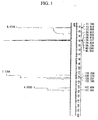
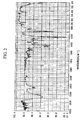
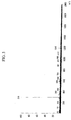
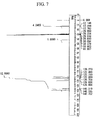
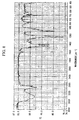
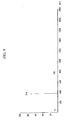
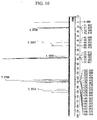
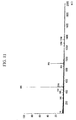
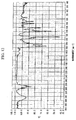
- the structure was identified from a NMR spectrum ( 13 C) of Fig. 4, an IR spectrum (KBr) of Fig. 5 and a mass spectrum of Fig. 6. It was confirmed from the GPC chart that the repeating unit number p of the following structural formula is 0.1.
- Example 2 In the same manner as in Example 2, except that the polyhydric phenol compound obtained in Example 1 was replaced by 225 g of the polyhydric phenol compound (hydroxyl group equivalent: 1.0 g/eq.) obtained in Example 5, 247g of the desired epoxy resin (C) represented by the following structural formula was obtained. It was confirmed that the resulting epoxy resin is represented by the following structural formula because the epoxy equivalent of the resulting epoxy resin is 303 g/eq. and M + of the mass spectrum is 562. It was confirmed from GPC that the repeating unit number p of the following structural formula is 0.1.
- Example 7 In the same manner as in Example 2, except that the polyhydric phenol compound obtained in Example 1 was replaced by 157 g of the polyhydric phenol compound (hydroxyl group equivalent: 1.0 g/eq.) obtained in Example 7, 190g of the desired epoxy resin (D) represented by the following structural formula was obtained. It was confirmed that the resulting epoxy resin is represented by the following structural formula because the epoxy equivalent of the resulting epoxy resin is 230 g/eq. and M + of the mass spectrum is 426. It was confirmed from GPC that the repeating unit number p of the following structural formula is 0.1.
- Example 2 In the same manner as in Example 2, except that the polyhydric phenol compound obtained in Example 1 was replaced by 194 g of the polyhydric phenol compound (hydroxyl group equivalent: 1.0 g/eq.) obtained in Example 9, 225 g of the desired epoxy resin (E) represented by the following structural formula was obtained. It was confirmed that the resulting epoxy resin is represented by the following structural formula because the epoxy equivalent of the resulting epoxy resin is 273 g/eq. and M + of the mass spectrum is 500. It was confirmed from GPC that the repeating unit number p of the following structural formula is 0.1.
- Example 2 In the same manner as in Example 2, except that the polyhydric phenol compound obtained in Example 1 was replaced by 201 g of the polyhydric phenol compound (hydroxyl group equivalent: 1.0 g/eq.) obtained in Example 11, 230 g of the desired epoxy resin (F) represented by the following structural formula was obtained. It was confirmed that the resulting epoxy resin is represented by the following structural formula because the epoxy equivalent of the resulting epoxy resin is 277 g/eq. and M + of the mass spectrum is 514. It was confirmed from GPC that the repeating unit number p of the following structural formula is 0.1.
- Example 13 In the same manner as in Example 1, except that the polyhydric phenol compound obtained in Example 1 was replaced by 201 g of the polyhydric phenol compound (hydroxyl group equivalent: 1.0 g/eq.) obtained in Example 13, 229 g of the desired epoxy resin (G) represented by the following structural formula was obtained. It was confirmed that the resulting epoxy resin is represented by the following structural formula because the epoxy equivalent of the resulting epoxy resin is 276 g/eq. and M + of the mass spectrum is 514. It was confirmed from GPC that the repeating unit number p of the following structural formula is 0.1.
- the present invention it is made possible to exert an excellent flame-resistant effect while having properties required for semiconductor encapsulating materials and varnishes for circuit boards, for example, heat resistance, moisture resistance and dielectric performances in the epoxy resin composition. Furthermore, it is made possible to provide a novel epoxy resin having these performances suited for use as the epoxy resin composition, and a phenol compound suited for use as an intermediate of the novel epoxy resin.
- the use of the epoxy resin composition for a ball grid array type semiconductor chip makes it possible to prevent warp, which has hitherto been considered to be a problem, and to obtain a package having excellent solder cracking resistance when it is mounted.
- the use of the epoxy resin composition for a printed circuit board makes it possible to obtain a multi-layer board having high glass transition temperature and excellent dimensional stability. Since excellent flame resistance can be imparted to the cured article without containing a halogen compound, the epoxy resin is markedly useful as epoxy resin materials in the field of electronic materials, for example, semiconductor encapsulating materials and printed circuit boards.
Landscapes
- Chemical & Material Sciences (AREA)
- Organic Chemistry (AREA)
- Health & Medical Sciences (AREA)
- Chemical Kinetics & Catalysis (AREA)
- Medicinal Chemistry (AREA)
- Polymers & Plastics (AREA)
- Epoxy Resins (AREA)
- Pyrane Compounds (AREA)
- Compositions Of Macromolecular Compounds (AREA)
Claims (12)
- Epoxyharzzusammensetzung, umfassend ein Epoxyharz und ein Härtungsmittel, wobei das Epoxyharz eine aromatische polycyclische Struktur hat, bei der zwei aromatische Kohlenwasserstoffe bzw. zwei aromatische Kohlenwasserstoffreste durch Kohlenstoffatome oder Sauerstoffatome in zwei angrenzenden Substitutionspositionen auf einem aromatischen Ring in dem aromatischen Kohlenwasserstoff bzw. dem aromatischen Kohlenwasserstoffrest miteinander verbunden sind, und das auch Glycidyloxygruppen als einen Substituenten auf der aromatischen polycyclischen Struktur besitzt.
- Zusammensetzung nach Anspruch 1, wobei das Epoxyharz eine Methylgruppe in der aromatischen polycyclischen Struktur, die in der Struktur des Epoxyharzes vorliegt, hat.
- Zusammensetzung nach Anspruch 1, wobei der aromatische Kohlenwasserstoff Naphthalin ist.
- Zusammensetzung nach Anspruch 1, wobei das Epoxyharz ein Epoxyäquivalent von 240 bis 330 g/Äq. hat.
- Zusammensetzung nach Anspruch 1, wobei die Anzahl der Kohlenstoffatome, die den aromatischen polycyclischen Strukturteil bilden, 20% oder mehr der Anzahl der aromatischen Kohlenstoffatome in dem Epoxyharz beträgt.
- Zusammensetzung nach Anspruch 1, weiterhin enthaltend 65 bis 95 Gew.-% eines anorganischen Füllstoffs, zusätzlich zu dem Epoxyharz und dem Härtungsmittel.
- Neues Epoxyharz, angegeben durch die allgemeine Formel (1) :

- Neues Epoxyharz, angegeben durch die allgemeine Formel (2):

- Neue Phenolverbindung, angegeben durch die allgemeine Formel (4):

- Verfahren zur Herstellung einer mehrwertigen Hydroxyverbindung, umfassend die Umsetzung einer Verbindung, die zwei Hydroxylgruppen auf dem Benzolring, wobei eine der Hydroxylgruppen ein Wasserstoffatom in der ortho-Position hat und einen Substituenten an allen anderen Substitutionspositionen besitzt, mit einer Carbonylgruppe-enthaltenden Verbindung in Gegenwart eines sauren Katalysators.
- Verfahren nach Anspruch 10, wobei 1 mol der Verbindung, die zwei Hydroxylgruppen auf dem Benzolring, wobei eine der Hydroxylgruppen ein Wasserstoffatom in der ortho-Position hat und einen Substituenten an allen anderen Substitutionspositionen besitzt, mit 0,1 bis 3,0 mol der Carbonylgruppe-enthaltenden Verbindung bei einer Temperatur von 50 bis 200°C umgesetzt wird.
- Gehärteter Gegenstand, erhalten durch thermische Härtung der Zusammensetzung nach einem der Ansprüche 1 bis 6.
Applications Claiming Priority (4)
| Application Number | Priority Date | Filing Date | Title |
|---|---|---|---|
| JP2001212069 | 2001-07-12 | ||
| JP2001212069 | 2001-07-12 | ||
| JP2001326305 | 2001-10-24 | ||
| JP2001326305 | 2001-10-24 |
Publications (3)
| Publication Number | Publication Date |
|---|---|
| EP1275673A2 EP1275673A2 (de) | 2003-01-15 |
| EP1275673A3 EP1275673A3 (de) | 2003-05-02 |
| EP1275673B1 true EP1275673B1 (de) | 2006-08-23 |
Family
ID=26618600
Family Applications (1)
| Application Number | Title | Priority Date | Filing Date |
|---|---|---|---|
| EP02014977A Expired - Lifetime EP1275673B1 (de) | 2001-07-12 | 2002-07-09 | Epoxidharzzusammensetzung, daraus hergestellter gehärteter Gegenstand, neues Epoxidharz, neue Phenolverbindung, und Verfahren zu deren Herstellung |
Country Status (4)
| Country | Link |
|---|---|
| US (1) | US6784228B2 (de) |
| EP (1) | EP1275673B1 (de) |
| JP (1) | JP5262389B2 (de) |
| DE (1) | DE60214093T2 (de) |
Families Citing this family (31)
| Publication number | Priority date | Publication date | Assignee | Title |
|---|---|---|---|---|
| EP1785441B1 (de) * | 2004-09-01 | 2011-06-08 | DIC Corporation | Epoxidharzzusammensetzung, härtungsprodukte davon, material zur verkapselung von halbleitern, neues phenolharz, neues epoxidharz, verfahren zur herstellung von neuem phenolharz und verfahren zur herstellung von neuem epoxidharz |
| JP4941804B2 (ja) * | 2005-03-02 | 2012-05-30 | Dic株式会社 | エポキシ樹脂組成物、その硬化物、半導体封止材料、新規フェノール樹脂、および新規エポキシ樹脂 |
| CN103012702A (zh) * | 2006-01-25 | 2013-04-03 | 日立化成工业株式会社 | 酚醛树脂及树脂组合物 |
| KR100987973B1 (ko) * | 2006-08-09 | 2010-10-18 | 디아이씨 가부시끼가이샤 | 금속 나노 입자 분산체와 그 제조 방법 |
| KR101066132B1 (ko) * | 2006-09-20 | 2011-09-20 | 디아이씨 가부시끼가이샤 | 직쇄상 (메타)아크릴로일기 함유 화합물, 성형 (메타)아크릴로일기 함유 화합물, 및 그들의 제조 방법 |
| EP2270112B1 (de) | 2008-04-25 | 2014-08-13 | LG Chem, Ltd. | Epoxidbasierte zusammensetzung, haftfolie, schneiden einer chiphaltigen folie und halbleiterbauelement |
| KR101095136B1 (ko) * | 2009-04-23 | 2011-12-16 | 삼성전기주식회사 | 인쇄회로기판용 수지 조성물 및 이를 이용한 인쇄회로기판 |
| KR101095225B1 (ko) * | 2009-04-23 | 2011-12-20 | 삼성전기주식회사 | 인쇄회로기판용 수지 조성물 및 이를 이용한 인쇄회로기판 |
| SG176923A1 (en) * | 2009-06-22 | 2012-01-30 | Dow Global Technologies Llc | Hardener composition for epoxy resins |
| KR102032749B1 (ko) | 2010-04-16 | 2019-10-16 | 에스더블유아이엠씨 엘엘씨 | 패키징 용품을 위한 코팅 조성물 및 코팅 방법 |
| WO2012161758A2 (en) | 2011-02-07 | 2012-11-29 | Valspar Sourcing, Inc. | Coating compositions for containers and other articles and methods of coating |
| TWI572596B (zh) * | 2011-08-12 | 2017-03-01 | 三菱瓦斯化學股份有限公司 | 微影用下層膜形成材料、微影用下層膜及圖型形成方法 |
| KR20140079359A (ko) | 2011-08-12 | 2014-06-26 | 미쯔비시 가스 케미칼 컴파니, 인코포레이티드 | 레지스트 조성물, 레지스트 패턴 형성방법, 이에 이용되는 폴리페놀 화합물 및 이로부터 유도될 수 있는 알코올 화합물 |
| KR20140148372A (ko) * | 2012-03-30 | 2014-12-31 | 가부시끼가이샤 도꾸야마 | 경화성 수지 조성물 및 그 제조 방법, 고열전도성 수지 조성물 및 고열전도성 적층 기판 |
| AU2013300118B2 (en) | 2012-08-09 | 2017-07-13 | Swimc Llc | Container coating system |
| RU2618704C2 (ru) | 2012-08-09 | 2017-05-11 | Вэлспар Сорсинг, Инк. | Композиции для контейнеров и других изделий и способы их применения |
| JP6388126B2 (ja) | 2013-02-08 | 2018-09-12 | 三菱瓦斯化学株式会社 | 化合物、リソグラフィー用下層膜形成材料、リソグラフィー用下層膜及びパターン形成方法 |
| US9828355B2 (en) | 2013-02-08 | 2017-11-28 | Mitsubishi Gas Chemical Company, Inc. | Compound, material for forming underlayer film for lithography, underlayer film for lithography and pattern forming method |
| US10377734B2 (en) | 2013-02-08 | 2019-08-13 | Mitsubishi Gas Chemical Company, Inc. | Resist composition, method for forming resist pattern, polyphenol derivative for use in the composition |
| WO2014208131A1 (ja) * | 2013-06-26 | 2014-12-31 | Dic株式会社 | エポキシ化合物、エポキシ樹脂、硬化性組成物、その硬化物、半導体封止材料、及びプリント配線基板 |
| EP3131965B1 (de) | 2014-04-14 | 2024-06-12 | Swimc Llc | Verfahren zur herstellung von zusammensetzungen für behälter und andere gegenstände sowie verfahren zur verwendung davon |
| KR102268342B1 (ko) * | 2014-06-30 | 2021-06-23 | 디아이씨 가부시끼가이샤 | 에폭시 수지, 경화성 수지 조성물, 경화물, 반도체 봉지 재료, 반도체 장치, 프리프레그, 회로 기판, 빌드업 필름, 빌드업 기판, 섬유 강화 복합 재료, 및 섬유 강화 성형품 |
| CN106471035B (zh) * | 2014-07-02 | 2019-04-16 | Dic株式会社 | 电子材料用环氧树脂组合物、其固化物及电子构件 |
| JP7026439B2 (ja) | 2014-12-25 | 2022-02-28 | 三菱瓦斯化学株式会社 | 化合物、樹脂、リソグラフィー用下層膜形成材料、リソグラフィー用下層膜、パターン形成方法及び精製方法 |
| US11480877B2 (en) | 2015-03-31 | 2022-10-25 | Mitsubishi Gas Chemical Company, Inc. | Resist composition, method for forming resist pattern, and polyphenol compound used therein |
| JP6845991B2 (ja) | 2015-03-31 | 2021-03-24 | 三菱瓦斯化学株式会社 | 化合物、レジスト組成物及びそれを用いるレジストパターン形成方法 |
| EP3346335A4 (de) | 2015-08-31 | 2019-06-26 | Mitsubishi Gas Chemical Company, Inc. | Material zur bildung von unterschichtfilmen zur lithographie, zusammensetzung zur bildung von unterschichtfilmen zur lithographie, unterschichtfilme zur lithographie und verfahren zur herstellung davon, musterbildungsverfahren, harz und reinigungsverfahren |
| EP3346334B1 (de) | 2015-08-31 | 2020-08-12 | Mitsubishi Gas Chemical Company, Inc. | Verwendung einer zusammensetzung zur formung eines fotoresist- unterschichtfilms für lithografie, fotoresist-unterschichtfilm für lithographie und dessen produktionsverfahren und verfahren zur formung einer resiststruktur |
| CN108137478B (zh) | 2015-09-10 | 2021-09-28 | 三菱瓦斯化学株式会社 | 化合物、其组合物、纯化方法以及抗蚀图案形成方法、非晶膜的制造方法 |
| TWI614275B (zh) | 2015-11-03 | 2018-02-11 | Valspar Sourcing Inc | 用於製備聚合物的液體環氧樹脂組合物 |
| US10886119B2 (en) * | 2018-08-17 | 2021-01-05 | Rohm And Haas Electronic Materials Llc | Aromatic underlayer |
Family Cites Families (14)
| Publication number | Priority date | Publication date | Assignee | Title |
|---|---|---|---|---|
| JPS5550244A (en) * | 1978-10-05 | 1980-04-11 | Fuji Photo Film Co Ltd | Color photographic material |
| JPH01283280A (ja) * | 1988-05-06 | 1989-11-14 | Asahi Denka Kogyo Kk | 新規エポキシ化合物及びその製造方法 |
| JPH02189326A (ja) * | 1989-01-18 | 1990-07-25 | Mitsubishi Petrochem Co Ltd | 電子部品封止用エポキシ樹脂組成物 |
| JPH02258830A (ja) * | 1989-03-31 | 1990-10-19 | Yuka Shell Epoxy Kk | 半導体封止用エポキシ樹脂組成物 |
| JPH0337221A (ja) * | 1989-07-04 | 1991-02-18 | Yuka Shell Epoxy Kk | 半導体封止用エポキシ樹脂組成物 |
| JP3137202B2 (ja) * | 1990-10-30 | 2001-02-19 | 大日本インキ化学工業株式会社 | エポキシ樹脂、その製造方法及びエポキシ樹脂組成物 |
| JPH04337316A (ja) * | 1991-05-15 | 1992-11-25 | Mitsui Toatsu Chem Inc | エポキシ樹脂組成物 |
| JPH06135871A (ja) * | 1992-10-26 | 1994-05-17 | Hitachi Chem Co Ltd | ビス(ヒドロキシナフチル)メタン化合物の製造方法 |
| US5780571A (en) * | 1993-03-22 | 1998-07-14 | Nippon Kayaku Kabushiki Kaisha | Naphthalene ring-containing resins, resin compositions and cured products thereof |
| JP3588836B2 (ja) * | 1994-12-26 | 2004-11-17 | 日立化成工業株式会社 | 熱硬化性樹脂組成物 |
| JPH11140277A (ja) | 1997-11-10 | 1999-05-25 | Sumitomo Bakelite Co Ltd | エポキシ樹脂組成物及びこれを用いた半導体装置 |
| JP2000038517A (ja) * | 1998-05-21 | 2000-02-08 | Yoshitomi Fine Chemical Kk | キサンテン―2,7―ジオ―ル化合物を含有する有機高分子材料 |
| JP2000336248A (ja) * | 1999-05-27 | 2000-12-05 | Dainippon Ink & Chem Inc | エポキシ樹脂組成物および電気積層板 |
| JP2001042525A (ja) * | 1999-07-30 | 2001-02-16 | Dainippon Ink & Chem Inc | アルカリ現像型感光性樹脂組成物 |
-
2002
- 2002-07-09 DE DE60214093T patent/DE60214093T2/de not_active Expired - Lifetime
- 2002-07-09 US US10/190,491 patent/US6784228B2/en not_active Expired - Fee Related
- 2002-07-09 EP EP02014977A patent/EP1275673B1/de not_active Expired - Lifetime
-
2008
- 2008-07-18 JP JP2008187177A patent/JP5262389B2/ja not_active Expired - Fee Related
Also Published As
| Publication number | Publication date |
|---|---|
| US6784228B2 (en) | 2004-08-31 |
| EP1275673A2 (de) | 2003-01-15 |
| EP1275673A3 (de) | 2003-05-02 |
| JP5262389B2 (ja) | 2013-08-14 |
| US20030092852A1 (en) | 2003-05-15 |
| DE60214093T2 (de) | 2007-10-04 |
| JP2008274297A (ja) | 2008-11-13 |
| DE60214093D1 (de) | 2006-10-05 |
Similar Documents
| Publication | Publication Date | Title |
|---|---|---|
| US6784228B2 (en) | Epoxy resin composition, cured article thereof, novel epoxy resin, novel phenol compound, and process for preparing the same | |
| JP4247658B2 (ja) | 新規エポキシ樹脂、エポキシ樹脂組成物及びその硬化物 | |
| JP4285491B2 (ja) | エポキシ樹脂組成物、その硬化物、新規エポキシ樹脂、新規フェノール樹脂、及び半導体封止材料 | |
| EP1785441B1 (de) | Epoxidharzzusammensetzung, härtungsprodukte davon, material zur verkapselung von halbleitern, neues phenolharz, neues epoxidharz, verfahren zur herstellung von neuem phenolharz und verfahren zur herstellung von neuem epoxidharz | |
| EP1411101B1 (de) | Epoxidharzzusammensetzung und Verfahren zur Herstellung von Epoxidharzen | |
| JP5245199B2 (ja) | エポキシ樹脂組成物、その硬化物、新規エポキシ樹脂、その製造方法、及び新規フェノール樹脂 | |
| KR101143131B1 (ko) | 에폭시 화합물, 이것의 제조 방법, 및 이것의 용도 | |
| JP4259536B2 (ja) | フェノール樹脂の製造方法、およびエポキシ樹脂の製造方法 | |
| KR101408535B1 (ko) | 변성 액상 에폭시 수지, 및 그것을 이용한 에폭시 수지 조성물 및 그 경화물 | |
| JP4224765B2 (ja) | エポキシ樹脂組成物およびその成形硬化物 | |
| CN1309783C (zh) | 环氧树脂组合物,其固化制品,新型环氧树脂,新型酚化合物,及其制备方法 | |
| EP0477724A2 (de) | Epoxydharz, Epoxydharzzusammensetzung und damit hergestellte gehärtete Gegenstände | |
| JP5679248B1 (ja) | エポキシ化合物、エポキシ樹脂、硬化性組成物、その硬化物、半導体封止材料、及びプリント配線基板 | |
| JP3944765B2 (ja) | エポキシ樹脂、エポキシ樹脂組成物及びその硬化物 | |
| JP4158137B2 (ja) | エポキシ樹脂組成物及びその硬化物。 | |
| JP3636409B2 (ja) | フェノール類樹脂、エポキシ樹脂、エポキシ樹脂組成物及びその硬化物 | |
| JP4581397B2 (ja) | エポキシ樹脂組成物とその硬化物 | |
| JPH093162A (ja) | エポキシ樹脂混合物、エポキシ樹脂組成物およびその硬化物 | |
| JP3377241B2 (ja) | エポキシ樹脂の製法、エポキシ樹脂組成物およびその硬化物 | |
| JP4186153B2 (ja) | エポキシ樹脂組成物、その成形硬化物、半導体封止材料および電子回路基板用樹脂組成物 | |
| JP2004231790A (ja) | エポキシ樹脂組成物及びその硬化物 | |
| JP3886060B2 (ja) | エポキシ樹脂、エポキシ樹脂組成物及びその硬化物 | |
| JP2003034712A (ja) | エポキシ樹脂、エポキシ樹脂組成物、芳香族ポリオール化合物及びその硬化物。 | |
| JP2002105169A (ja) | エポキシ樹脂組成物及びその硬化物 | |
| JP2003002956A (ja) | フェノール樹脂、エポキシ樹脂、エポキシ樹脂組成物及びその硬化物。 |
Legal Events
| Date | Code | Title | Description |
|---|---|---|---|
| PUAI | Public reference made under article 153(3) epc to a published international application that has entered the european phase |
Free format text: ORIGINAL CODE: 0009012 |
|
| AK | Designated contracting states |
Kind code of ref document: A2 Designated state(s): AT BE BG CH CY CZ DE DK EE ES FI FR GB GR IE IT LI LU MC NL PT SE SK TR |
|
| AX | Request for extension of the european patent |
Free format text: AL;LT;LV;MK;RO;SI |
|
| PUAL | Search report despatched |
Free format text: ORIGINAL CODE: 0009013 |
|
| AK | Designated contracting states |
Designated state(s): AT BE BG CH CY CZ DE DK EE ES FI FR GB GR IE IT LI LU MC NL PT SE SK TR |
|
| AX | Request for extension of the european patent |
Extension state: AL LT LV MK RO SI |
|
| RIC1 | Information provided on ipc code assigned before grant |
Ipc: 7H 01L 23/29 B Ipc: 7C 08G 64/06 B Ipc: 7C 08G 59/62 A |
|
| 17P | Request for examination filed |
Effective date: 20031008 |
|
| AKX | Designation fees paid |
Designated state(s): DE FR GB |
|
| 17Q | First examination report despatched |
Effective date: 20040719 |
|
| GRAP | Despatch of communication of intention to grant a patent |
Free format text: ORIGINAL CODE: EPIDOSNIGR1 |
|
| GRAS | Grant fee paid |
Free format text: ORIGINAL CODE: EPIDOSNIGR3 |
|
| GRAA | (expected) grant |
Free format text: ORIGINAL CODE: 0009210 |
|
| AK | Designated contracting states |
Kind code of ref document: B1 Designated state(s): DE FR GB |
|
| REG | Reference to a national code |
Ref country code: GB Ref legal event code: FG4D |
|
| REF | Corresponds to: |
Ref document number: 60214093 Country of ref document: DE Date of ref document: 20061005 Kind code of ref document: P |
|
| ET | Fr: translation filed | ||
| PLBE | No opposition filed within time limit |
Free format text: ORIGINAL CODE: 0009261 |
|
| STAA | Information on the status of an ep patent application or granted ep patent |
Free format text: STATUS: NO OPPOSITION FILED WITHIN TIME LIMIT |
|
| 26N | No opposition filed |
Effective date: 20070524 |
|
| PGFP | Annual fee paid to national office [announced via postgrant information from national office to epo] |
Ref country code: DE Payment date: 20140702 Year of fee payment: 13 |
|
| PGFP | Annual fee paid to national office [announced via postgrant information from national office to epo] |
Ref country code: GB Payment date: 20140709 Year of fee payment: 13 Ref country code: FR Payment date: 20140708 Year of fee payment: 13 |
|
| REG | Reference to a national code |
Ref country code: DE Ref legal event code: R119 Ref document number: 60214093 Country of ref document: DE |
|
| GBPC | Gb: european patent ceased through non-payment of renewal fee |
Effective date: 20150709 |
|
| PG25 | Lapsed in a contracting state [announced via postgrant information from national office to epo] |
Ref country code: DE Free format text: LAPSE BECAUSE OF NON-PAYMENT OF DUE FEES Effective date: 20160202 Ref country code: GB Free format text: LAPSE BECAUSE OF NON-PAYMENT OF DUE FEES Effective date: 20150709 |
|
| REG | Reference to a national code |
Ref country code: FR Ref legal event code: ST Effective date: 20160331 |
|
| PG25 | Lapsed in a contracting state [announced via postgrant information from national office to epo] |
Ref country code: FR Free format text: LAPSE BECAUSE OF NON-PAYMENT OF DUE FEES Effective date: 20150731 |