EP1260880A2 - Arbeitseinheit, elektrophotographisches Gerät und Bilderzeugungsverfahren - Google Patents
Arbeitseinheit, elektrophotographisches Gerät und Bilderzeugungsverfahren Download PDFInfo
- Publication number
- EP1260880A2 EP1260880A2 EP02011378A EP02011378A EP1260880A2 EP 1260880 A2 EP1260880 A2 EP 1260880A2 EP 02011378 A EP02011378 A EP 02011378A EP 02011378 A EP02011378 A EP 02011378A EP 1260880 A2 EP1260880 A2 EP 1260880A2
- Authority
- EP
- European Patent Office
- Prior art keywords
- intermediate transfer
- transfer belt
- photosensitive member
- electrophotographic photosensitive
- electrophotographic
- Prior art date
- Legal status (The legal status is an assumption and is not a legal conclusion. Google has not performed a legal analysis and makes no representation as to the accuracy of the status listed.)
- Withdrawn
Links
Images

Classifications
-
- G—PHYSICS
- G03—PHOTOGRAPHY; CINEMATOGRAPHY; ANALOGOUS TECHNIQUES USING WAVES OTHER THAN OPTICAL WAVES; ELECTROGRAPHY; HOLOGRAPHY
- G03G—ELECTROGRAPHY; ELECTROPHOTOGRAPHY; MAGNETOGRAPHY
- G03G15/00—Apparatus for electrographic processes using a charge pattern
-
- G—PHYSICS
- G03—PHOTOGRAPHY; CINEMATOGRAPHY; ANALOGOUS TECHNIQUES USING WAVES OTHER THAN OPTICAL WAVES; ELECTROGRAPHY; HOLOGRAPHY
- G03G—ELECTROGRAPHY; ELECTROPHOTOGRAPHY; MAGNETOGRAPHY
- G03G21/00—Arrangements not provided for by groups G03G13/00 - G03G19/00, e.g. cleaning, elimination of residual charge
- G03G21/16—Mechanical means for facilitating the maintenance of the apparatus, e.g. modular arrangements
- G03G21/18—Mechanical means for facilitating the maintenance of the apparatus, e.g. modular arrangements using a processing cartridge, whereby the process cartridge comprises at least two image processing means in a single unit
- G03G21/1803—Arrangements or disposition of the complete process cartridge or parts thereof
- G03G21/1817—Arrangements or disposition of the complete process cartridge or parts thereof having a submodular arrangement
-
- G—PHYSICS
- G03—PHOTOGRAPHY; CINEMATOGRAPHY; ANALOGOUS TECHNIQUES USING WAVES OTHER THAN OPTICAL WAVES; ELECTROGRAPHY; HOLOGRAPHY
- G03G—ELECTROGRAPHY; ELECTROPHOTOGRAPHY; MAGNETOGRAPHY
- G03G15/00—Apparatus for electrographic processes using a charge pattern
- G03G15/14—Apparatus for electrographic processes using a charge pattern for transferring a pattern to a second base
- G03G15/16—Apparatus for electrographic processes using a charge pattern for transferring a pattern to a second base of a toner pattern, e.g. a powder pattern, e.g. magnetic transfer
-
- Y—GENERAL TAGGING OF NEW TECHNOLOGICAL DEVELOPMENTS; GENERAL TAGGING OF CROSS-SECTIONAL TECHNOLOGIES SPANNING OVER SEVERAL SECTIONS OF THE IPC; TECHNICAL SUBJECTS COVERED BY FORMER USPC CROSS-REFERENCE ART COLLECTIONS [XRACs] AND DIGESTS
- Y10—TECHNICAL SUBJECTS COVERED BY FORMER USPC
- Y10T—TECHNICAL SUBJECTS COVERED BY FORMER US CLASSIFICATION
- Y10T428/00—Stock material or miscellaneous articles
- Y10T428/24—Structurally defined web or sheet [e.g., overall dimension, etc.]
- Y10T428/24355—Continuous and nonuniform or irregular surface on layer or component [e.g., roofing, etc.]
Definitions
- This invention relates to a process cartridge, an electrophotographic apparatus and an image-forming method.
- Image-forming apparatus making use of an intermediate transfer belt are effective as full-color or multi-color image-forming electrophotographic apparatus in which a plurality of component-color toner images corresponding to full-color image information or multi-color image information are sequentially transferred to and superimposed on a transfer medium to output an image-formed material on which a full-color image or multi-color image has synthetically been reproduced.
- the full-color electrophotographic apparatus having an intermediate transfer belt have such an advantage that a great variety of second image-bearing members (transfer mediums) can be selected without regard to their width and length, including thin paper (40 g/m 2 paper) and even thick paper (200 g/m 2 paper) such as envelopes, post cards and labels.
- the intermediate transfer belt makes any processing or control (e.g., the transfer medium is held with a gripper, attracted, and made to have a curvature) unnecessary for the transfer medium.
- the intermediate transfer member made in the shape of a belt enables effective utilization of space to make the apparatus main body compact and achieve cost reduction, because placement freedom in the image-forming apparatus can be greater than a case in which a rigid cylinder such as an intermediate transfer drum is used.
- the intermediate transfer belt has a shorter lifetime than the electrophotographic-apparatus main body, and hence, under the existing conditions, it is indispensable to replace the belt in the middle of the use of apparatus. At the same time, it is necessary to install a waste-toner container in which the toner having remained on the intermediate transfer belt is to be collected, and to dispose of the toner thus collected.
- Japanese Patent Application Laid-Open No. 8-137181 discloses a technique in which the intermediate transfer belt and the electrophotographic photosensitive member are made into units independent of each other and are so placed as to be attached to or detached from the main body with ease.
- One of such problems is a lowering of belt strength which is caused by a tension applied to the intermediate transfer belt.
- the intermediate transfer belt in order for the intermediate transfer belt to be surely driven without slipping, a tension must be applied thereto, where the process cartridge in which the intermediate transfer belt and the electrophotographic photosensitive member are integrally supported stands stationary as the tension is kept applied for a long time until it is actually put into use.
- the intermediate transfer belt may cause a creep to increase in peripheral length.
- the peripheral length having increased is absorbed to a certain extent by a tension roller having a stroke.
- the belt has already come to have a lower modulus of elasticity than an initial preset value, and may cause serious color misregistration when used actually, resulting in a lowering of image quality level.
- An intermediate transfer belt having a small elongation may also have such a great problem that it is cracked because of such tension and vibration at the time of distribution in the market.
- the phenomenon of creep is known to be more accelerated in a high-temperature environment, and the process cartridge in which the intermediate transfer belt and the electrophotographic photosensitive member are integrally supported must be designed also taking account of such a high-temperature environment the process cartridge may have during its distribution.
- An object of the present invention is to provide a process cartridge which is easy of maintenance, enables miniaturization and cost reduction of apparatus, and affords good images even when having transported or left over a long period of time; an electrophotographic apparatus having such a process cartridge; an image-forming method making use of the electrophotographic apparatus; and an intermediate transfer belt for the process cartridge.
- the present inventors have made extensive studies on the achievement of simple maintenance, miniaturization and cost reduction of process cartridges and improvement in image quality. As a result, they have discovered that the intended object can be achieved by employing a process cartridge in which the intermediate transfer belt and the electrophotographic photosensitive member are integrally supported, further in combination with some measures.
- the present invention is a process cartridge which is detachably mountable to the main body of an electrophotographic apparatus; the process cartridge integrally comprising:
- the present invention is also an electrophotographic apparatus comprising:
- the present invention is still also an image-forming method comprising the steps of:
- the process cartridge of the present invention is a process cartridge in which an intermediate transfer belt and an electrophotographic photosensitive member are integrally supported (herein also "intermediate transfer belt/electrophotographic photosensitive member integral cartridge").
- a cleaning mechanism for the intermediate transfer belt employs the so-called cleaning-at-primary-transfer method (also called “bias cleaning method”), in which the transfer residual toner is charged to a reverse polarity and is returned from the intermediate transfer belt to the electrophotographic photosensitive member simultaneously with primary transfer.
- it is a method in which electric charges with a polarity reverse to that at the time of primary transfer are imparted to the toner having remained on the intermediate transfer belt at the time of secondary transfer, by applying a voltage to a charge-providing member disposed separably on the intermediate transfer belt, and the toner is returned to the electrophotographic photosensitive member by the aid of a primary-transfer electric field at the subsequent primary-transfer zone.
- the toner having been returned from the surface of the intermediate transfer belt to the electrophotographic photosensitive member is removed by a cleaning means for the electrophotographic photosensitive member, such as a cleaning blade.
- This method is greatly effective to make the cartridge compact and low-cost, compared with a method in which cleaning blades or the like are provided for both the electrophotographic photosensitive member and the intermediate transfer belt and a feed mechanism for waste toner and a container therefor are installed.
- the process cartridge is designed for strength, considering that a tension is applied to the intermediate transfer belt for a long time and also the environment may change to cause the phenomenon of creep. Hence, even an intermediate transfer belt cartridge which has been manufactured for a long time can form good images without causing any problems.
- the intermediate transfer belt has a modulus of elasticity of 500 MPa to 4,000 MPa at elongation from 0.5% to 0.6% in the peripheral direction. As long as it has a modulus of elasticity of 500 MPa or more, color misregistration may be reduced when images are formed. On the other hand, if it has a modulus of elasticity of more than 4,000 MPa, the intermediate transfer belt may have so high a rigidity as to hinder its smooth rotation.
- the intermediate transfer belt also has a breaking extension of from 5% to 850% in the peripheral direction. If it has a breaking extension of less than 5%, it may be brittle as a belt to cause a break upon a little elongation. Hence, in the case of the process cartridge expected to be stored for a long term as a tension is kept applied until it is put to use, there may occur such a problem that the intermediate transfer belt has a short lifetime. On the other hand, if it has a breaking extension of more than 850%, the intermediate transfer belt may elongate so greatly that it may undergo expansion and contraction at the time of its rotation to cause color misregistration.
- the intermediate transfer belt its surface roughness must also be taken into account. It may have a surface roughness Ra of 1 ⁇ m or less. If it has a surface roughness Ra of more than 1 ⁇ m, the transfer performance may be affected to cause coarse halftone images or a lowering of fine-line reproducibility. Also, the electric charges imparted to the secondary-transfer residual toner may become non-uniform, or intermediate transfer belt faulty cleaning may occur in which the secondary-transfer residual toners are not sufficiently returned to the electrophotographic photosensitive member to cause such a trouble that previously printed images remain on subsequently printed images at the time of continuous printing.
- the electrophotographic photosensitive member may preferably be a small-diameter, drum-shaped electrophotographic photosensitive member (photosensitive drum) formed of a rigid body having a diameter of 60 mm or less, which may require a simple drive mechanism and can be made compact with ease.
- the intermediate transfer belt may be one which is placed over and around two rollers consisting of, e.g., a drive roller and a tension roller. This is more preferable because the number of component parts can be cut down and the cartridge can be made more compact.
- the tension roller which applies tension to the intermediate transfer belt, must slide by at least 1 mm with respect to the direction of elongation of the intermediate transfer belt, in order to deal with any elongation of the intermediate transfer belt.
- the intermediate transfer belt may preferably be fitted over and around the two rollers at a force of 5 N or more.
- the intermediate transfer belt As to the intermediate transfer belt, its resistivity must also be regulated.
- the intermediate transfer belt may have a volume resistivity of from 1 ⁇ 10 6 ⁇ cm to 8 ⁇ 10 13 ⁇ cm, within the range of which good images are obtainable. If it has a volume resistivity lower than 1 ⁇ 10 6 ⁇ cm, no sufficient transfer electric field may be provided, tending to cause blank areas in images or coarse images. If on the other hand it has a volume resistivity higher than 8 ⁇ 10 13 ⁇ cm, the transfer voltage must also be made higher, requiring a power source to be in a large size or resulting in a higher cost.
- the intermediate transfer belt may also have a wall thickness in the range of from 40 ⁇ m to 300 ⁇ m. If it has a thickness smaller than 40 ⁇ m, it may lack in forming stability, tends to cause uneven thickness and may have insufficient durability and strength, where the belt may break or crack. If on the other hand it has a thickness larger than 300 ⁇ m, materials must be used in a large quantity, resulting in a high cost. Moreover, the intermediate transfer belt may have a large difference in peripheral speed between the inner surface and the outer surface of the belt at its part where it is put over the shaft of a printer or the like, tending to cause problems of, e.g., spots around line images due to the expansion and contraction of the outer surface. The belt may have a low flex durability or have so high a rigidity as to make the drive torque greater, requiring the main body to be in a large size or resulting in a higher cost. Such a problem also tends to occur.
- the intermediate transfer belt and the electrophotographic photosensitive member are integrally supported to make up a cartridge, and it is sufficient for them to be combined when used by users. Taking into account readiness of handling in the course of manufacture and readiness of disassembly after recovery, it is preferred that they are so designed as to be divided into some smaller units, e.g., an intermediate transfer belt unit and an elecrophotographic photosensitive member unit.
- any resins used as a raw material for the intermediate transfer belt and various additives thereto may be selected so that the breaking extension and the modulus of elasticity at elongation from 0.5% to 06% may be regulated within the ranges of numerical values specified in the present invention.
- a filler such as inorganic particles may be mixed, whereby a reinforcing effect can be obtained and the modulus of elasticity can be enhanced.
- the material and amount of the filler and a resin(s) may be so selected as to regulate the modulus of elasticity within the range specified in the present invention.
- the filler may have a fibrous or plate-like shape, where a high reinforcing effect can be obtained even if the belt has elongated.
- the intermediate transfer belt may also be produced by blending two or more kinds of resins having different breaking extensions and being not compatible with each other. Such a method is also effective. Where the intermediate transfer belt is produced using such materials, the respective resins are finely separated and present in the belt in a laminar or fibrous form. With the intermediate transfer belt thus produced, its strength is, at the initial stage, undertaken by the resin having a small breaking extension. However, when creep is brought about over time and the resin having a small breaking extension exceeds its yield point, the resin having a large breaking extension instead undertakes the strength. Thus, the modulus of elasticity can be prevented from abruptly lowering.
- a method is available in which regulation is effected in such a way that, when extrusion is carried out, resin materials are selected for melt properties and temperature conditions and cooling conditions at the time of extrusion are adjusted so that more smooth surface can be attained when an extruded product, melt-extruded into a film, is solidified from a molten state.
- Other available methods include a method in which a product extruded into a belt is heated applying a smooth form (for shaping) so as to have the same surface state as the form, and a method in which the surface of a belt is polished.
- the process for producing the intermediate transfer belt may preferably be a production process which can produce a seamless belt and has a high production efficiency to enable cost saving.
- a method is available in which an extrusion material is continuously melt extruded from a circular die and thereafter the product thus extruded is cut in a necessary length to produce a belt.
- an intermediate transfer belt production process (called blown-film extrusion, or inflation) is preferred which has the steps of:
- the tubular film having been formed through the tubular-film forming step may also preferably have a wall thickness which is 1/3 or less, and more preferably 1/5 or less, with respect to the slit width of the circular die. This value represents the stretched state of the material. If the tubular film has a wall thickness which is larger than 1/3 with respect to the slit width of the circular die, the material may insufficiently stretch and may cause troubles such as low strength, uneven resistance and uneven thickness.
- the tubular film having been formed through the tubular-film forming step may also preferably have a diameter (outer diameter of the tubular film) which is from 50% to 400%, and more preferably from 101% to 300%, with respect to the diameter of the circular die (outer diameter of the slit of the circular die). If it is more than 400%, the film has been stretched in excess in the peripheral direction, and if it is less than 50%, the film has been stretched almost in the flow direction (extrusion direction), resulting in low extrusion stability or making it difficult to ensure the thickness and strength necessary for obtaining the effect of the present invention.
- a diameter (outer diameter of the tubular film) which is from 50% to 400%, and more preferably from 101% to 300%, with respect to the diameter of the circular die (outer diameter of the slit of the circular die). If it is more than 400%, the film has been stretched in excess in the peripheral direction, and if it is less than 50%, the film has been stretched almost in the flow direction (extrusion direction), resulting
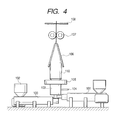
- FIG. 3 shows an example of an appratus for producing the intermediate transfer belt used in the process cartridge of the present invention.
- This production apparatus consists chiefly of an extruder 100, an extruder die 103, and a gas blowing unit having a gas inlet passage 104.
- an extrusion resin, a conducting agent and additives are premixed under the desired formulation and thereafter kneaded and dispersed to prepare an extrusion material, which is then put into a hopper 102 installed in the extruder 100.
- the extruder 100 has a preset temperature, extruder screw construction and so forth which have been so selected that the extrusion material may have a melt viscosity necessary for the extrusion into a belt in the subsequent step and the materials can be dispersed uniformly one another.
- the extrusion material is melt-kneaded in the extruder 100 into a melt, which then enters a circular die 103.
- the circular die 103 is provided with a gas inlet passage 104. Through the gas inlet passage 104, a gas is blown into the circular die 103, whereupon the melt having passed through the circular die 103 in a tubular form inflates while scaling up in the diametrical direction.
- the gas to be blown here may be air, and besides, may be selected from nitrogen, carbon dioxide and argon.
- the extruded product having thus inflated is drawn upward while being cooled by an outside-cooling ring 105, and formed into a tubular film 110.
- a method is employed in which the tubular film 110 is pressed forcibly from the right and the left by means of stabilizing plates 106 to fold it into a sheet, and then drawn off at a constant speed while being so sandwiched with pinch rollers 107 that the air in the interior does not escape. Then, the film 110 thus drawn off is cut with a cutter 108 to obtain a tubular film with the desired size.
- this tubular film is worked using a form (for shaping) in order to regulate its surface smoothness and size and to remove any folds made in the film at the time of draw-off.
- a method is usable which makes use of a pair of cylindrical forms which are made of materials which are different from each other in coefficient of thermal expansion and diameter.
- a small-diameter cylindrical form (inner form) is so made as to have a coefficient of thermal expansion larger than the coefficient of thermal expansion of a large-diameter cylindrical form (inner form).
- a tubular film obtained by extrusion is placed over this inner form. Thereafter, the inner form with film is inserted into the outer form so that the tubular film is held between the inner form and the outer form.
- a gap between the inner form and the outer form may be determined by calculation on the bases of heating temperature, difference in coefficient of thermal expansion between the inner form and the outer form, and pressure required.
- the form set having in this order the inner form, the tubular film and the outer form is heated to the vicinity of the softening point temperature of resin.
- the inner form having a larger coefficient of thermal expansion, expands more than the outer form and a uniform pressure is applied to the whole tubular film (resin film).
- the surface of the resin film having reached the vicinity of its softening point is pressed against the inner surface of the outer form having been worked smoothly, so that the smoothness of the surface of the resin film is improved. Thereafter, these are cooled and the film is removed from the forms, thus smooth surface characteristics can be attained.
- this tubular film is optionally fitted with a reinforcing member, a guide member and a position detection member, and is precisely cut to produce the intermediate transfer belt.
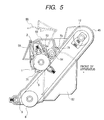
- an extruder 101 is additionally provided as shown in Fig. 4. Simultaneously with the kneaded melt held in the extruder 100, a kneaded melt in the extruder 101 is sent to a double-layer circular die 103, and the two layers are scale-up inflated simultaneously, thus a double-layer belt can be obtained.
- the extruder may of course be provided in the number corresponding to the number of layers.
- the above intermediate transfer belt production process makes it possible to extrude not only intermediate transfer belts of single-layer construction but also those of multi-layer construction in a good dimensional precision through a series of steps and in a short time. That the etrusion can be made in a short time means that mass production and low-cost production can be made.
- the resin which is a chief material among extrusion materials used in the intermediate transfer belt for the process cartridge of the present invention may be any of those which can satisfy the intermediate transfer belt characteristics according to the present invention, without any particular limitation. It is preferable to use at least one of, e.g., olefin resins such as polyethylene and polypropylene, polystyrene resins, acrylic resins, polyester resins, polycarbonate, sulfur-containing resins such as polysulfone, polyether sulfone and polyphenylene sulfide, fluorine-containing resins such as polyvinylidene fluoride and a polyethylene-tetrafluoroethylene copolymer, polyurethane resins, silicone resins, ketone resins, polyvinylidene chloride, thermoplastic polyimide resins, polyamide resins, modified polyphenylene oxide resins, and various modified resins or copolymers of any of these.
- olefin resins such as polyethylene and polypropylene
- the additives which may be mixed in order to regulate the electrical resistance value of the intermediate transfer belt for the process cartridge of the present invention.
- a conductive filler for regulating the resistance it includes carbon black and various conductive metal oxides.
- a non-filler type resistance regulator it includes low-molecular weight ion conducting materials such as various metal salts and glycols, antistatic resins containing an ether linkage or a hydroxyl group in the molecule, and organic polymeric compounds showing electroconductivity.
- the dispersion state of the components of the intermediate transfer belt such as the various additives and the resin. If agglomeration of particles or extreme separation of some components occurs, it is difficult to obtain the effect of the present invention. It is important to select materials and dispersion means.
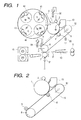
- FIG. 1 An example of an electrophotographic apparatus making use of the intermediate transfer belt/electrophotographic photosensitive member integral cartridge of the present invention is shown in Fig. 1.
- the apparatus shown in Fig. 1 is a color electrophotographic apparatus such as a color copying machine or a color laser beam printer.
- Reference numeral 1 denotes a rotating-drum type electrophotographic photosensitive member (photosensitive drum) serving as a first image-bearing member, which is rotatively driven at a prescribed peripheral speed (process speed) in the clockwise direction shown by an arrow.
- the electrophotographic photosensitive member 1 is, in the course of its rotation, uniformly electrostatically charged to prescribed polarity and potential by means of a primary-charging means (charging roller) 2.
- Reference numeral 32 denotes a power source of the primary-charging means 2.
- a voltage formed by superimposing an AC voltage on a DC voltage is applied. Alternatively, only an AC voltage may be applied.
- the electrophotographic photosensitive member is exposed to light 3 by a exposure means (not shown; e.g., a color-original image color-separating/image-forming optical system, or a scanning exposure system comprising a laser scanner that outputs laser beams modulated in accordance with time-sequential electrical digital pixel signals of image information).
- a exposure means e.g., a color-original image color-separating/image-forming optical system, or a scanning exposure system comprising a laser scanner that outputs laser beams modulated in accordance with time-sequential electrical digital pixel signals of image information.
- a first color component image e.g., a yellow color component image
- first developing means yellow color developing assembly 41
- second to fourth developing means magenta color developing assembly 42, cyan color developing assembly 43 and black color developing assembly 44
- An intermediate transfer belt 5 is rotatively driven in the clockwise direction at the same peripheral speed as that of the electrophotographic photosensitive member 1.
- a primary-transfer bias applied to the intermediate transfer belt 5 through a roller-shaped primary-transfer means (primary-transfer roller) 6.
- the electrophotographic photosensitive member 1 surface from which the first-color yellow toner image has been transferred is cleaned by a cleaning means 13.
- the second-color magenta toner image, the third-color cyan toner image and the fourth-color black toner image are sequentially similarly transferred and superimposed onto the intermediate transfer belt 5.
- the intended synthesized color toner image is formed.
- Reference numeral 7 denotes a secondary-transfer means (secondary-transfer roller), which is provided in such a way that it is axially supported in parallel to a drive roller 8 and stands separable from the bottom surface of the intermediate transfer belt 5.
- secondary-transfer roller secondary-transfer roller
- the primary-transfer bias for sequentially superimposition-transferring the first- to fourth-color toner images from the electrophotographic photosensitive member 1 to the intermediate transfer belt 5 is applied from a bias source 30 in a polarity (+) reverse to that of each toner.
- the voltage thus applied is, e.g., in the range of from +100 V to +2 kV.
- the secondary-transfer means 7 may also be set separable from the intermediate transfer belt 5.
- the synthesized color toner images transferred onto the intermediate transfer belt 5 are transferred to a second image-bearing member, transfer medium P, in the following way:
- the secondary-transfer means 7 is brought into contact with the intermediate transfer belt 5 and simultaneously the transfer medium P is fed at a prescribed timing from a paper feed roller 11 through a transfer medium guide 10 until it reaches a contact zone formed between the intermediate transfer belt 5 and the secondary-transfer means 7, where a secondary-transfer bias is applied to the secondary-transfer means 7 from a bias power source 31.
- the synthesized color toner images are secondarily transferred from the intermediate transfer belt 5 onto the second image-bearing member, transfer medium P.
- the transfer medium P to which the toner images have been transferred is guided into a fixing means 15 and heat-fixed.
- a charge-providing means 9 placed in a touchable and separable state is brought into contact with the intermediate transfer belt 5, and a bias with a polarity reverse to that of the electrophotographic photosensitive member 1 is applied, whereupon electric charges with a polarity reverse to that at the time of primary transfer are imparted to toners not transferred to the transfer medium P and remaining on the intermediate transfer belt 5 (i.e., transfer residual toners).
- Reference numeral 33 denotes a bias power source.
- a voltage formed by superimposing an AC voltage on a DC voltage is applied.
- the transfer residual toners charged to a polarity reverse to that at the time of primary transfer are electrostatically transferred to the electrophotographic photosensitive member 1 at the zone coming into contact with the electrophotographic photosensitive member 1 and the vicinity thereof.
- the intermediate transfer belt 5 is cleaned. This step can be carried out simultaneously with the primary transfer, and hence does not cause any lowering of throughput.
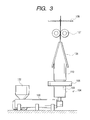
- the process cartridge of the present invention is, as shown in Fig. 2, so constructed that at least an electrophotographic photosensitive member 1, an intermediate transfer belt 5, a primary-transfer means 6 and a charge-providing means 9 are integrally supported so that it is detachably mountable to the main body of the electrophotographic apparatus.
- the process cartridge may also be so constructed that at least one means among means the electrophotographic apparatus has, such as an electrophotographic-photosensitive-member cleaning means, a primary-charging means and a waste-toner container, can further be incorporated in the intermediate transfer belt/electrophotographic photosensitive member integral cartridge, or that the electrophotographic apparatus can be provided with such means as the electrophotographic-photosensitive-member cleaning means, the primary-charging means and the waste-toner container when such a process cartridge is mounted on the electrophotographic apparatus.
- at least one means among means the electrophotographic apparatus has, such as an electrophotographic-photosensitive-member cleaning means, a primary-charging means and a waste-toner container can further be incorporated in the intermediate transfer belt/electrophotographic photosensitive member integral cartridge, or that the electrophotographic apparatus can be provided with such means as the electrophotographic-photosensitive-member cleaning means, the primary-charging means and the waste-toner container when such a process cartridge is mounted on the electrophotographic apparatus.
- the cleaning mechanism for the intermediate transfer belt in the present invention is, as described previously, necessary for the transfer residual toners to be charged to a polarity reverse to that at the time of primary transfer and thereby returned to the electrophotographic photosensitive member at the primary-transfer zone.
- a charge-providing means (intermediate-transfer-belt cleaning roller) 9 comprised of a medium-resistance elastic body is provided for the cleaning mechanism.
- the cleaning of the electrophotographic photosensitive member may preferably be blade cleaning making use of an elastic blade.
- a waste-toner container (not shown) is also integrally provided so that the transfer residual toners on both the intermediate transfer belt and the electrophotographic photosensitive member may simultaneously be discarded when the cartridge A is replaced. Thus, it contributes to an improvement in maintenance performance.
- the intermediate transfer belt is also placed over and around two rollers, a drive roller 8 and a tension roller 12, so that the number of component parts can be made small and the cartridge can be made compact.
- the roller 8 is a drive roller and at the same time an opposing roller of the charge-providing means (intermediate-transfer-belt cleaning roller).
- the tension roller 12 which rotates following the intermediate transfer belt, has a sliding mechanism, and is brought into pressure contact with the inside of the belt in the direction of an arrow by the action of a compression spring to impart a tension to the intermediate transfer belt. It may be slidable in a slide width of from 1 mm to 5 mm, and may apply a spring pressure of from 5 N to 200 N in total.
- the electrophotographic photosensitive member 1 and the drive roller 8 may also have a coupling (not shown) so that the rotational drive force may be transmitted from the main body.
- a measuring sample is prepared in a size of 20 mm wide and 100 mm long, which is cut from the intermediate transfer belt in the peripheral direction. Its thickness is measured and thereafter the sample is set on a tensile tester (TENSILON RTC-1250A, manufactured by Orientec Co.). The thickness is measured as an average at five spots.
- a tensile test is made at a measurement distance of 50 mm and a tensile speed of 5 mm/min, and elongation and stress are recoded in a recorder, where stress at elongation of 0.5% and 0.6% each is read. Modulus in tension is calculated according to the following equation.
- Modulus of elasticity (MPa) (f2 - f1)/(20 ⁇ t) ⁇ 1,000.
- f1 represents stress at 0.5% elongation (N); f2, stress at 0.6% elongation (N); and t, thickness (mm) of the sample.
- Breaking extension (%) L/50 ⁇ 100.
- an ultra-high resistance meter R8340A (manufactured by Advantest Co.) is used as a resistance meter, and Sample Box TR42 for ultra-high resistance measurement (manufactured by Advantest Co.) as a sample box.
- the main electrode is 25 mm in diameter
- the guard-ring electrode is 41 mm in inner diameter and 49 mm in outer diameter.
- a sample is prepared in the following way.
- the intermediate transfer belt is cut in a circular form of 56 mm in diameter by means of a punching machine or a sharp knife.
- the circular cut piece obtained is fitted, on its one side, with an electrode over the whole surface by forming a Pt-Pd deposited film and, on the other side, fitted with a main electrode of 25 mm in diameter and a guard electrode of 38 mm in inner diameter and 50 mm in outer diameter by forming Pt-Pd deposited films.
- the Pt-Pd deposited films are formed by carrying out vacuum deposition for 2 minutes using Mild Sputter E1030 (manufactured by Hitachi Ltd.). The one on which the vacuum deposition has been completed is used as a measuring sample.
- Measurement is conducted in a measurement atmosphere of 23°C/55%RH.
- the measuring sample is previously left standing in the like atmosphere for 12 hours or longer.
- Measurement is made under a mode of discharge for 10 seconds, charge for 30 seconds and measurement for 30 seconds and at an applied voltage of 1,000 V.
- Thickness unevenness of the intermediate transfer belt of the present invention is measured with a dial gauge measurable by 1 ⁇ m as minimum value, over the whole periphery of the belt at points 50 mm apart from both ends and, in respect of the middle, at four points at equal intervals in the peripheral direction. Measurements at 12 points in total for each intermediate transfer belt are averaged.
- Fig. 5 schematically illustrates the construction of a process cartridge comprising an electrophotographic photosensitive member unit having an electrophotographic photosensitive member and an intermediate transfer belt unit having an intermediate transfer belt which are joined together.
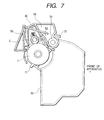
- Figs. 6 and 7 schematically illustrate the construction of the intermediate transfer belt unit and the electrophotographic photosensitive member unit, respectively.
- Frame construction of the process cartridge is roughly divided into two parts: an electrophotographic photosensitive member frame 59 constructed integrally with a waste-toner container 52, shown in Figs. 5 and 7, and an intermediate transfer belt frame 45 shown in Figs. 5 and 6.
- the former comprises an electrophotographic photosensitive member unit constituted of an electrophotographic photosensitive member 1, a charging roller 2, a cleaning blade 53, a screw 54 and a drum shutter 55 as chief component parts.
- the latter comprises an intermediate transfer belt unit 51 having i) an intermediate transfer belt 5 which is put over and around a drive roller 8 and a follower roller (tension roller) 12, ii) a primary-transfer roller 58 provided on the inside of the intermediate transfer belt at its part facing the electrophotographic photosensitive member 1 and iii) a charge-providing means (intermediate-transfer-belt cleaning roller) 9 provided at the drive roller 8.
- the registration holes 72 and the lock hole 74 provided in the intermediate transfer belt frame 45 are made a little larger by a certain extent than the projections 71 and hook 73 provided on the electrophotographic photosensitive member frame 59, and the electrophotographic photosensitive member unit 50 and the intermediate transfer belt unit 51 are so constructed that relative positional movement to a certain extent is allowable between them.
- the registration holes 72 are each provided with a taper 72a so that the unit can be attached or detached with ease.
- the hook 73 of the electrophotographic photosensitive member unit 50 may be pushed to be unhooked from the lock hole 74 of the intermediate transfer belt unit 51, and the electrophotographic photosensitive member unit 50 may be turned around.
- the process cartridge can be divided into the electrophotographic photosensitive member unit and the intermediate transfer belt unit as shown in Figs. 6 and 7.
- the projections 71 of the electrophotographic photosensitive member unit 50 can be inserted into the registration holes 72 of the intermediate transfer belt unit 51, and the electrophotographic photosensitive member unit 50 can be turned around in the direction opposite to that at the time of detachment to push the hook 73 into the lock hole 74, thereby joining the two units.
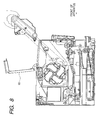
- Fig. 8 illustrates how the process cartridge of the present invention is attached to or detached from the electrophotographic apparatus.
- Only a top cover 60 of the electrophotographic apparatus main body can be opened to attach or detach the process cartridge simply as in conventional black-and-white laser beam printers. Thus, maintenance operation such as the handling of paper jamming and replacement of the process cartridge can be performed with ease.
- PVDF polyvinylidene fluoride resin
- Polyether-containing antistatic resin 14 parts
- the antistatic resin was so selected as to have a larger elongation than the PVDF and not to be completely compatible with the PVDF.
- These materials were melt-kneaded at 210°C by means of a twin-screw extruder to be mixed with each other, and the mixture obtained was extruded in the shape of a strand of about 2 mm in diameter, followed by cutting into pellets. This is used as an extrusion material.
- the extruder die 103 was set as a single-layer circular die, and one having a die slit outer diameter of 100 mm was used.
- the slit of the circular die was 0.8 mm in width.
- the above extrusion material having been sufficiently dried by heating, was put into the hopper 102 of this extrusion apparatus, and heated and melted.
- the molten product was extruded at 210°C from the circular die 103.
- the outside-cooling ring 105 was provided around the circular die 103, and air was blown from the circumference to the film extruded in a tubular form to effect cooling.
- Air is also blown to the interior of the extruded tubular film through the gas inlet passage 104 to cause the film to inflate while scaling up to a diameter of 140 mm. Thereafter, the film was continuously drawn off at a constant speed by means of the draw-off unit. Here, the air was stopped being fed at the time the diameter became the desired value.
- the tubular film was cut with the cutter 108.
- the film was cut in a length of 310 mm after its thickness became stable to form six tubular films.
- the tubular film were placed over the inner form, having a higher coefficient of thermal expansion, and this inner form with the film was inserted into the outer form having been worked to have a smooth inner surface, followed by heating at 170°C for 20 minutes.
- a sample for measuring the modulus of elasticity was one by one cut from each intermediate transfer belt, and the modulus of elasticity was measured by the measuring method described previously, where the values obtained from the five belts were averaged.
- the modulus of elasticity at elongation from 0.5% to 0.6% of this intermediate transfer belt was found to be 815 MPa.
- the spring pressure of the tension roller was 20 N in total for the right and the left in an extent of slide of 2.5 mm.
- the electrophotographic photosensitive member a photosensitive drum comprising an aluminum cylinder of 47 mm in diameter and a photosensitive layer formed thereon was used.
- this process cartridge was left standing in a high-temperature environment of 40°C for 14 days. Thereafter, this cartridge was allowed to stand still in an environment of 23°C and 55%RH for 12 hours, and then set in the electrophotographic apparatus constructed as shown in Fig. 1, to test full-color image reproduction on 80 g/m 2 paper in the same environment.
- the exposure means used here was a digital exposure means by which electrostatic latent images were formed on the surface of the electrophotographic photosensitive member by a digital (laser) system with a resolution of 600 dpi.
- the modulus of elasticity at elongation from 0.5% to 0.6% of this intermediate transfer belt was found to be 585 MPa; the breaking extension, 680%; the surface roughness Ra, 0.04 ⁇ m; the thickness, 100 ⁇ m; and the volume resistivity, 8.3 ⁇ 10 9 ⁇ cm.
- the modulus of elasticity at elongation from 0.5% to 0.6% of this intermediate transfer belt was found to be 2,300 MPa; the breaking extension, 56%; the surface roughness Ra, 0.08 ⁇ m; the thickness, 100 ⁇ m; and the volume resistivity, 2.2 ⁇ 10 9 ⁇ cm.
- the modulus of elasticity at elongation from 0.5% to 0.6% of this intermediate transfer belt was found to be 2,500 MPa; the breaking extension, 38%; the surface roughness Ra, 0.5 ⁇ m; the thickness, 108 ⁇ m; and the volume resistivity, 2.5 ⁇ 10 8 ⁇ cm.
- the modulus of elasticity at elongation from 0.5% to 0.6% of this intermediate transfer belt was found to be 450 MPa; the breaking extension, 880%; the surface roughness Ra, 0.04 ⁇ m; the thickness, 99 ⁇ m; and the volume resistivity, 3.1 ⁇ 10 9 ⁇ cm.
- the modulus of elasticity at elongation from 0.5% to 0.6% of this intermediate transfer belt was found to be 1,500 MPa; the breaking extension, 2.5%; the surface roughness Ra, 1.1 ⁇ m; the thickness, 108 ⁇ m; and the volume resistivity, 1.2 ⁇ 10 8 ⁇ cm.
- the present invention has made it possible to provide the process cartridge which is easy of maintenance, can realize miniaturization and cost reduction of apparatus, and affords good images even when they are transported or left over a long period of time; the intermediate transfer belt for the process cartridge; and the electrophotographic apparatus having such a process cartridge.
- a process cartridge integrally supporting an electrophotographic photosensitive member, an intermediate transfer belt, a primary-transfer means for transferring a toner image primarily from the electrophotographic photosensitive member to the intermediate transfer belt and a charge-providing means for providing the toner on the intermediate transfer belt with electric charges having a polarity reverse to the polarity the toner has at the time of the primary transfer and returning the toner on the intermediate transfer belt to the electrophotographic photosensitive member at the contact zone to clean the intermediate transfer belt.
- the intermediate transfer belt has a modulus of elasticity of from 500 MPa to 4,000 MPa at elongation from 0.5% to 0.6% in the peripheral direction, a breaking extension of from 5% to 850% in the peripheral direction and a surface roughness Ra of 1 ⁇ m or less. Also disclosed are an electrophotographic apparatus having this process cartridge, and an image-forming method making use of the electrophotographic apparatus.
Landscapes
- Physics & Mathematics (AREA)
- General Physics & Mathematics (AREA)
- Engineering & Computer Science (AREA)
- Computer Vision & Pattern Recognition (AREA)
- Electrostatic Charge, Transfer And Separation In Electrography (AREA)
Applications Claiming Priority (2)
| Application Number | Priority Date | Filing Date | Title |
|---|---|---|---|
| JP2001155881 | 2001-05-24 | ||
| JP2001155881 | 2001-05-24 |
Publications (2)
| Publication Number | Publication Date |
|---|---|
| EP1260880A2 true EP1260880A2 (de) | 2002-11-27 |
| EP1260880A3 EP1260880A3 (de) | 2004-12-29 |
Family
ID=18999985
Family Applications (1)
| Application Number | Title | Priority Date | Filing Date |
|---|---|---|---|
| EP02011378A Withdrawn EP1260880A3 (de) | 2001-05-24 | 2002-05-23 | Arbeitseinheit, elektrophotographisches Gerät und Bilderzeugungsverfahren |
Country Status (4)
| Country | Link |
|---|---|
| US (1) | US6615015B2 (de) |
| EP (1) | EP1260880A3 (de) |
| KR (1) | KR100417152B1 (de) |
| CN (1) | CN1190712C (de) |
Cited By (1)
| Publication number | Priority date | Publication date | Assignee | Title |
|---|---|---|---|---|
| EP1262842A3 (de) * | 2001-05-28 | 2004-12-29 | Canon Kabushiki Kaisha | Arbeitseinheit, elektrophotographisches Gerät und Verfahren zur Bilderzeugung |
Families Citing this family (14)
| Publication number | Priority date | Publication date | Assignee | Title |
|---|---|---|---|---|
| JP3927781B2 (ja) * | 2001-08-31 | 2007-06-13 | キヤノン株式会社 | プロセスカートリッジ及び中間転写ベルト |
| US6806012B2 (en) * | 2001-09-19 | 2004-10-19 | Konica Corporation | Electrostatic image developing |
| US6865361B2 (en) * | 2001-11-12 | 2005-03-08 | Seiko Epson Corporation | Transfer belt unit and image forming apparatus using the same |
| US6879801B2 (en) * | 2002-02-28 | 2005-04-12 | Canon Kabushiki Kaisha | Image forming apparatus |
| JP4292753B2 (ja) * | 2002-06-10 | 2009-07-08 | 富士ゼロックス株式会社 | 画像形成装置 |
| JP2004117597A (ja) * | 2002-09-24 | 2004-04-15 | Canon Inc | 画像形成装置 |
| US6928256B2 (en) * | 2002-09-30 | 2005-08-09 | Canon Kabushiki Kaisha | Electrophotographic endless belt, process cartridge, and electrophotographic apparatus |
| US7384722B2 (en) * | 2003-06-23 | 2008-06-10 | Ricoh Company Limited | Method for preparing functional particulate organic material, toner using the functional particulate organic material, and image forming method and apparatus using the toner |
| KR100555734B1 (ko) * | 2004-02-17 | 2006-03-03 | 삼성전자주식회사 | 화상형성장치 |
| JP4644531B2 (ja) * | 2004-09-17 | 2011-03-02 | 株式会社リコー | 画像形成装置 |
| JP4829638B2 (ja) * | 2006-02-23 | 2011-12-07 | キヤノン株式会社 | 画像形成装置 |
| JP5264213B2 (ja) * | 2008-02-28 | 2013-08-14 | キヤノン株式会社 | 画像形成装置 |
| JP5424795B2 (ja) * | 2008-10-27 | 2014-02-26 | キヤノン株式会社 | 帯電部材及びその製造方法、プロセスカートリッジ及び電子写真装置 |
| JP5585870B2 (ja) * | 2010-08-20 | 2014-09-10 | 株式会社リコー | 画像形成装置 |
Family Cites Families (28)
| Publication number | Priority date | Publication date | Assignee | Title |
|---|---|---|---|---|
| JPS61279871A (ja) | 1985-06-06 | 1986-12-10 | Canon Inc | 画像形成装置 |
| DE3786656T2 (de) | 1987-01-19 | 1994-01-27 | Canon Kk | Farbtoner und ihn enthaltende Zweikomponentenentwickler. |
| US5164275A (en) | 1987-01-19 | 1992-11-17 | Canon Kabushiki Kaisha | Method of forming a multicolor image with color toner and two-component developer containing same |
| US5149610A (en) | 1987-01-19 | 1992-09-22 | Canon Kabushiki Kaisha | Color toner and two-component developer containing same |
| JPH04102866A (ja) * | 1990-08-22 | 1992-04-03 | Minolta Camera Co Ltd | 画像形成装置 |
| US5331373A (en) | 1992-03-13 | 1994-07-19 | Canon Kabushiki Kaisha | Image forming apparatus, process cartridge mountable within it and method for attaching photosensitive drum to process cartridge |
| JP3352155B2 (ja) | 1992-06-30 | 2002-12-03 | キヤノン株式会社 | プロセスカートリッジ及び画像形成装置 |
| JP3286661B2 (ja) * | 1992-09-11 | 2002-05-27 | 三菱化学株式会社 | 半導電性樹脂組成物及びそれからなる中間転写シームレスベルト |
| JPH06110261A (ja) | 1992-09-25 | 1994-04-22 | Ricoh Co Ltd | カラー画像形成装置 |
| US5966566A (en) | 1993-03-24 | 1999-10-12 | Canon Kabushiki Kaisha | Recycle method for process cartridge and image forming apparatus |
| US5752131A (en) | 1993-06-25 | 1998-05-12 | Canon Kabushiki Kaisha | Developing apparatus with a removable sealing film and process cartridge and image forming apparatus including such a developing apparatus |
| JPH07140874A (ja) | 1993-06-25 | 1995-06-02 | Canon Inc | 像担持体の取付部材及び像担持体の取付方法及びプロセスカートリッジ及び画像形成装置 |
| JPH07302034A (ja) | 1994-03-08 | 1995-11-14 | Canon Inc | トナーカートリッジ及びプロセスカートリッジ及び電子写真画像形成装置 |
| JPH07319362A (ja) | 1994-05-19 | 1995-12-08 | Canon Inc | プロセスカートリッジの再生産方法及びプロセスカートリッジ |
| JPH08137181A (ja) | 1994-11-11 | 1996-05-31 | Minolta Co Ltd | 画像形成装置 |
| JPH08211755A (ja) * | 1994-11-15 | 1996-08-20 | Ricoh Co Ltd | 画像形成装置 |
| JP3490581B2 (ja) | 1996-12-16 | 2004-01-26 | 株式会社リコー | プロセスユニット及び画像形成装置 |
| JPH1130944A (ja) | 1997-07-10 | 1999-02-02 | Ricoh Co Ltd | プロセスカートリッジユニット及びその着脱構造 |
| JP3608646B2 (ja) * | 1997-07-18 | 2005-01-12 | 株式会社リコー | 画像形成装置及びその装置に用いられる中間転写ユニット |
| JP3854690B2 (ja) * | 1997-08-04 | 2006-12-06 | キヤノン株式会社 | 画像形成装置 |
| JPH11167290A (ja) * | 1997-12-05 | 1999-06-22 | Fuji Xerox Co Ltd | 画像形成装置 |
| JP4451506B2 (ja) * | 1998-11-11 | 2010-04-14 | 大倉工業株式会社 | 半導電性シームレスベルト |
| JP3685641B2 (ja) * | 1999-03-16 | 2005-08-24 | 三菱化学株式会社 | シームレスベルト及び半導電性部材 |
| JP4126149B2 (ja) * | 1999-09-28 | 2008-07-30 | 株式会社リコー | 中間転写ベルトの製造方法及び中間転写ベルト並びに該中間転写ベルトを用いた画像形成装置 |
| JP2001282011A (ja) * | 1999-12-28 | 2001-10-12 | Yuka Denshi Kk | エンドレスベルト、画像形成装置用ベルト及び画像形成装置 |
| US6493528B2 (en) * | 2000-03-03 | 2002-12-10 | Canon Kabushiki Kaisha | Image forming unit and image forming apparatus |
| US6916521B2 (en) * | 2000-12-13 | 2005-07-12 | Fuji Photo Film Co., Ltd. | Cleaning medium for magnetic recording apparatus |
| US6775494B2 (en) * | 2001-02-28 | 2004-08-10 | Canon Kabushiki Kaisha | Process cartridge, image forming apparatus and intermediate transfer belt |
-
2002
- 2002-05-21 US US10/151,104 patent/US6615015B2/en not_active Expired - Lifetime
- 2002-05-23 KR KR10-2002-0028593A patent/KR100417152B1/ko not_active Expired - Fee Related
- 2002-05-23 EP EP02011378A patent/EP1260880A3/de not_active Withdrawn
- 2002-05-24 CN CNB021206546A patent/CN1190712C/zh not_active Expired - Fee Related
Cited By (1)
| Publication number | Priority date | Publication date | Assignee | Title |
|---|---|---|---|---|
| EP1262842A3 (de) * | 2001-05-28 | 2004-12-29 | Canon Kabushiki Kaisha | Arbeitseinheit, elektrophotographisches Gerät und Verfahren zur Bilderzeugung |
Also Published As
| Publication number | Publication date |
|---|---|
| US6615015B2 (en) | 2003-09-02 |
| CN1388418A (zh) | 2003-01-01 |
| KR100417152B1 (ko) | 2004-02-05 |
| KR20020090312A (ko) | 2002-12-02 |
| CN1190712C (zh) | 2005-02-23 |
| US20030072585A1 (en) | 2003-04-17 |
| EP1260880A3 (de) | 2004-12-29 |
Similar Documents
| Publication | Publication Date | Title |
|---|---|---|
| US6615015B2 (en) | Process cartridge, electrophotographic apparatus and image-forming method | |
| US6725002B2 (en) | Process cartridge, electrophotographic apparatus and image forming method | |
| US6775494B2 (en) | Process cartridge, image forming apparatus and intermediate transfer belt | |
| US6853824B2 (en) | Electrophotographic endless belt comprising meandering-preventive member, and process cartridge and electrophotographic apparatus having such an endless belt | |
| US6600893B2 (en) | Transfer member, process for producing transfer member, and image forming apparatus having transfer member | |
| US6718148B2 (en) | Process cartridge, electrophotographic apparatus and image-forming method | |
| US6852400B2 (en) | Endless belt electrophotography, process for producing the endless belt, and image forming apparatus having the endless belt | |
| EP1288742A2 (de) | Arbeitseinheit und elektrophotographisches Gerät | |
| JP3935395B2 (ja) | プロセスカートリッジ、電子写真装置、画像形成装置、および、中間転写ベルト | |
| JP3913137B2 (ja) | 中間転写ベルト、中間転写ベルト−電子写真感光体一体型カートリッジ及び電子写真装置 | |
| JP2003149956A (ja) | プロセスカートリッジ、電子写真装置、画像形成方法および中間転写ベルト | |
| JP2003287964A (ja) | 中間転写ベルト、中間転写ベルト−電子写真感光体ドラム一体カートリッジ、画像形成装置及び画像形成方法 | |
| JP2002328543A (ja) | プロセスカートリッジ、画像形成装置及び中間転写ベルト | |
| JP2002251081A (ja) | 潜像担持体−中間転写回転体一体型カートリッジ及び画像形成装置及び画像形成方法 | |
| EP1288741A2 (de) | Arbeitseinheit, elektrophotographisches Gerät und Bilderzeugungsverfahren | |
| JP2003050532A (ja) | プロセスカートリッジ、電子写真装置、画像形成方法および中間転写ベルト | |
| JP4332259B2 (ja) | 転写部材の製造方法 | |
| JP2004045972A (ja) | プロセスカートリッジ、電子写真装置、画像形成方法及び中間転写ベルト | |
| JP2003043742A (ja) | トナー及び電子写真装置 | |
| JP2004037487A (ja) | 電子写真用ベルト、電子写真感光体−中間転写ベルト一体型カートリッジおよび画像形成装置 | |
| JP2003316236A (ja) | 中間転写ベルト、中間転写ベルト−感光体一体カートリッジ及び電子写真装置 | |
| HK1061440A (en) | Electrophotographic endless belt, process cartridge, and electrophotographic apparatus | |
| JP2003084576A (ja) | 中間転写ベルト、中間転写ベルト−潜像担持体一体カートリッジ、プロセスカートリッジ及び画像形成方法 | |
| JP2003316168A (ja) | 中間転写ベルト、転写搬送ベルト、画像形成装置及びカートリッジ | |
| JP2004070256A (ja) | 中間転写ベルトの製造方法、中間転写ベルト−電子写真感光体一体型カートリッジ及び画像形成装置 |
Legal Events
| Date | Code | Title | Description |
|---|---|---|---|
| PUAI | Public reference made under article 153(3) epc to a published international application that has entered the european phase |
Free format text: ORIGINAL CODE: 0009012 |
|
| AK | Designated contracting states |
Kind code of ref document: A2 Designated state(s): AT BE CH CY DE DK ES FI FR GB GR IE IT LI LU MC NL PT SE TR |
|
| AX | Request for extension of the european patent |
Free format text: AL;LT;LV;MK;RO;SI |
|
| PUAL | Search report despatched |
Free format text: ORIGINAL CODE: 0009013 |
|
| AK | Designated contracting states |
Kind code of ref document: A3 Designated state(s): AT BE CH CY DE DK ES FI FR GB GR IE IT LI LU MC NL PT SE TR |
|
| AX | Request for extension of the european patent |
Extension state: AL LT LV MK RO SI |
|
| 17P | Request for examination filed |
Effective date: 20050511 |
|
| AKX | Designation fees paid |
Designated state(s): DE FR GB IT |
|
| 17Q | First examination report despatched |
Effective date: 20060623 |
|
| STAA | Information on the status of an ep patent application or granted ep patent |
Free format text: STATUS: THE APPLICATION HAS BEEN WITHDRAWN |
|
| 18W | Application withdrawn |
Effective date: 20061024 |