EP1225243B2 - Verfahren zur Herstellung eines Bleches oder eines Rohres aus Niob entaltenden Zirkonium-Legierung für Kernbrennstoff mit hohem Abbrand - Google Patents
Verfahren zur Herstellung eines Bleches oder eines Rohres aus Niob entaltenden Zirkonium-Legierung für Kernbrennstoff mit hohem Abbrand Download PDFInfo
- Publication number
- EP1225243B2 EP1225243B2 EP01201703.4A EP01201703A EP1225243B2 EP 1225243 B2 EP1225243 B2 EP 1225243B2 EP 01201703 A EP01201703 A EP 01201703A EP 1225243 B2 EP1225243 B2 EP 1225243B2
- Authority
- EP
- European Patent Office
- Prior art keywords
- ppm
- zirconium alloy
- containing zirconium
- annealing
- niobium
- Prior art date
- Legal status (The legal status is an assumption and is not a legal conclusion. Google has not performed a legal analysis and makes no representation as to the accuracy of the status listed.)
- Expired - Lifetime
Links
Images




Classifications
-
- C—CHEMISTRY; METALLURGY
- C22—METALLURGY; FERROUS OR NON-FERROUS ALLOYS; TREATMENT OF ALLOYS OR NON-FERROUS METALS
- C22C—ALLOYS
- C22C16/00—Alloys based on zirconium
-
- C—CHEMISTRY; METALLURGY
- C22—METALLURGY; FERROUS OR NON-FERROUS ALLOYS; TREATMENT OF ALLOYS OR NON-FERROUS METALS
- C22F—CHANGING THE PHYSICAL STRUCTURE OF NON-FERROUS METALS AND NON-FERROUS ALLOYS
- C22F1/00—Changing the physical structure of non-ferrous metals or alloys by heat treatment or by hot or cold working
- C22F1/16—Changing the physical structure of non-ferrous metals or alloys by heat treatment or by hot or cold working of other metals or alloys based thereon
- C22F1/18—High-melting or refractory metals or alloys based thereon
-
- C—CHEMISTRY; METALLURGY
- C22—METALLURGY; FERROUS OR NON-FERROUS ALLOYS; TREATMENT OF ALLOYS OR NON-FERROUS METALS
- C22F—CHANGING THE PHYSICAL STRUCTURE OF NON-FERROUS METALS AND NON-FERROUS ALLOYS
- C22F1/00—Changing the physical structure of non-ferrous metals or alloys by heat treatment or by hot or cold working
- C22F1/16—Changing the physical structure of non-ferrous metals or alloys by heat treatment or by hot or cold working of other metals or alloys based thereon
- C22F1/18—High-melting or refractory metals or alloys based thereon
- C22F1/186—High-melting or refractory metals or alloys based thereon of zirconium or alloys based thereon
-
- G—PHYSICS
- G21—NUCLEAR PHYSICS; NUCLEAR ENGINEERING
- G21C—NUCLEAR REACTORS
- G21C3/00—Reactor fuel elements and their assemblies; Selection of substances for use as reactor fuel elements
- G21C3/02—Fuel elements
- G21C3/04—Constructional details
- G21C3/06—Casings; Jackets
- G21C3/07—Casings; Jackets characterised by their material, e.g. alloys
-
- Y—GENERAL TAGGING OF NEW TECHNOLOGICAL DEVELOPMENTS; GENERAL TAGGING OF CROSS-SECTIONAL TECHNOLOGIES SPANNING OVER SEVERAL SECTIONS OF THE IPC; TECHNICAL SUBJECTS COVERED BY FORMER USPC CROSS-REFERENCE ART COLLECTIONS [XRACs] AND DIGESTS
- Y02—TECHNOLOGIES OR APPLICATIONS FOR MITIGATION OR ADAPTATION AGAINST CLIMATE CHANGE
- Y02E—REDUCTION OF GREENHOUSE GAS [GHG] EMISSIONS, RELATED TO ENERGY GENERATION, TRANSMISSION OR DISTRIBUTION
- Y02E30/00—Energy generation of nuclear origin
- Y02E30/30—Nuclear fission reactors
Definitions
- the present invention relates to a method for manufacturing a tube or a sheet of niobium-containing zirconium alloy as indicated in the preamble of claim 1.
- Said document relates to niobium containing zirconium alloys having 0,05-0,3 wt % of niobium and use of a hot rolling temperature of 700°C and a final annealing treatment at 480°C.
- the present invention aims to provide alloys of the kind described and having excellent corrosion resistance and mechanical properties which are improved over alloys according to above reference and is thereto characterized as given in the characterizing part of claim 1.
- the present invention pertains to a method for manufacturing a tube and a sheet of niobium-containing zirconium alloys for high burn-up nuclear fuel, comprising melting a metal mixture comprising of zirconium and alloying elements to obtain an ingot, forging the ingot at ⁇ phase range, ⁇ -quenching the forged ingot in water after a solution heat-treatment at 1015-1075 °C, hot-working the quenched ingot at 600-650 °C, cold-working the hot-worked ingot in three to five times with intermediate vacuum annealing, and final vacuum annealing the cold-worked ingot at 440-600 °C.
- zirconium alloys have been widely used in nuclear reactor applications, including nuclear fuel cladding, nuclear fuel assembly components, and reactor core components.
- Zircaloy-2 (Sn: 1.20-1.70 %, Fe: 0.07-0.20 %, Cr: 0.05-1.15 %, Ni: 0.03-0.08 %, O: 900-1500 ppm, Zr: the balance) and Zircaloy-4 (Sn: 1.20-1.70 %, Fe: 0.18-0.24 %, Cr: 0.07-1.13 %, O: 900-1500 ppm, Ni: ⁇ 0.007 %, Zr: the balance), which include Sn, Fe, Cr and Ni, have been widely used. (Herein, % means % by weight).
- zirconium alloys An important factor affecting corrosion and mechanical properties in zirconium alloys is the chemical composition of the alloy and also its amount. However, corrosion and mechanical properties of zirconium alloys having the same composition are greatly changed depending on annealing conditions and working degree.
- Nb-containing zirconium alloys depend on the manufacturing processes, so that the optimal manufacturing processes should be established.
- U.S. Pat. No. 5,648,995 refers to a method for manufacturing cladding tubes made out of zirconium alloys containing Nb: 0.8-1.3 wt%, Fe: 50-250 ppm, O: 1600 ppm or less, C: 200 ppm or less, Si: 120 ppm or less.
- an ingot of Nb-containing zirconium alloy is heated to between 1000 °C and 1200 °C, ⁇ -quenched in water, heated to the range of 600 °C to 800 °C and then extruded.
- cold rolling is conducted in four to five passes with intermediate heat treatments in the range 565 °C to 605 °C for 2-4 hours and a final heat treatment is performed at 580 °C, thereby manufacturing cladding tubes of nuclear fuels.
- Fe in the alloy composition is limited to an amount of 250 ppm or less, and O is limited to the range of 1000-1600 ppm.
- U.S. Pat. No. 5,940,464 discloses a method of manufacturing alloys comprising Nb: 0.8-1.8 wt%, Sn: 0.2-0.6 wt%, Fe: 0.02-0.4 wt%, C: 30-180 ppm, Si: 10-120 ppm, O: 600-1800 ppm and Zr the balance.
- the bars of alloys are heated at 1000-1200 °C and then quenched.
- the melted bar is drawn into a blank after heating to a temperature in the range of 600 °C to 800 °C, followed by annealing the drawn blank at a temperature in the range 590 °C to 650 °C.
- the annealed blank is cold-worked in at least four passes into a tube, with intermediate heat treatments at temperatures in the range 560 °C to 620 °C.
- a final heat treatment step for recrystallization at a temperature in the range 560 °C to 620 °C, and a final heat treatment step for stress relief at 470-500 °C, are carried out.
- U.S. Pat. No. 5,838,753 refers to a process for fabricating a nuclear fuel cladding tube, comprising ⁇ quenching a zirconium alloy billet comprising of Nb 0.5-3.25 % and Sn 0.3-1.8 % by heating to a temperature in ⁇ range above 950 °C and rapidly quenching the billet below a transformation temperature from ⁇ + ⁇ to ⁇ to form a martens tic structure, extruding the billet at below 600 °C, forming a hollow, annealing the said hollow by heating at a temperature up to 590 °C, pilgering the said annealed hollow, and finally annealing at a temperature up to 590 °C to form the said cladding tube for nuclear fuel.
- This patent also comprises of the alloy having a microstructure of second phase precipitates of ⁇ -niobium distributed uniformly, intragranularly and intergranularly forming radiation resistant second phase precipitates in the alloy matrix so as to increase the resistance to aqueous corrosion, compared to that of Zircaloy, when irradiated to high fluency.
- the ⁇ -quenching step is conducted below 250 °C at a cooling rate greater than about 300 K/sec, and the second phase precipitates in the alloy have an average diameter of 80 nm.
- the second phase precipitates have an average diameter of 60 nm.
- EP 0 198 570 B1 relates to a process for fabricating a thin-wall tube (less than 1 mm in thickness) from 1.0-2.5 wt% of Nb-added zirconium alloy selectively containing Cu, Fe, Mo, Ni, W, V, and Cr as well as homogeneously and finely dispersed particles formed by ⁇ -treating a niobium-containing zirconium alloy billet; extruding the said ⁇ -treated billet at a temperature less than 650 °C to form a tube shell; further deforming the said tube shell by cold working the same in a multiple of cold working stages; annealing the said tube shell, between the stages of the cold working, at a temperature below 650 °C; and finally annealing the resultant tube at a temperature below 600 °C, so as to control a microstructure of the material having the niobium-containing particles of a size below about 80 nm homogeneously dispersed therein.
- the 1-2.5 wt% Nb-added alloys are extruded, annealed at 500-600 °C, preferably 524 °C for 7.5 hours, and then finally annealed at 500 °C, preferably 427 °C for 4 hours.
- the tube shell after extrusion is ⁇ -annealed at 850-1050 °C and then quenched.
- U.S. Pat. No. 5,230,758 discloses that zirconium alloy comprising Nb: 0.5-2.0 wt%, Sn: 0.7-1.5 wt%, Fe: 0.07-0.14 wt%, Cr: 0.025-0.08 wt%, Cr-Ni 321 ppm or less, 0.03-0.14 wt% of at least one of Cr and Ni, at least 0.12 wt% total of Fe, Cr and Ni, C: 220 ppm or less, is subjected to a post extrusion annealing and a series of fabrication step. Intermediate annealing temperature is 645-704 °C and the alloy is subjected to ⁇ -quenching two steps prior to a final sizing.
- the present invention provides a method for manufacturing the tube and sheet of niobium-containing zirconium alloy for high burn-up nuclear fuel, in the first step is preparing ingot containing Nb element (step 1); in the second step of forging the ingot at ⁇ phase range (step 2); in the third step of ⁇ quenching the forged ingot in water after performing a solution heat-treatment at 1015-1075 ⁇ (step 3); in the forth step of hot-working the quenched ingot at 600-650 ⁇ (step 4); in the fifth step of cold-working the hot-worked billet in three to five passes, which has intermediate annealing in vacuum (step 5) between the passes, and; in the sixth step of final annealing in vacuum at 440-600 ⁇ (step 6).
- a method for manufacturing a zirconium alloy of the present invention is explained.
- alloy elements such as Sn, Fe, Cr, Cu or Mn, O, Si in addition to Nb, are mixed and then melted, thus ingots of zirconium alloys is prepared.
- the ingot is forged at ⁇ phase range of 1000-1200 °C to break its dendrite structure.
- a third step of ⁇ -quenching (3) solution heat-treatment of the ingot is performed at ⁇ regime of 1015-1075 °C so that alloy composition may become homogeneous and then is quenched to yield a martensite structure and Widmanstatten structure. This step is carried out for homogenizing the composition and controlling particle sizes in the alloy matrix.
- the ⁇ -quenched ingot is worked into intermediate products of a hollow billet and hot worked to prepare an extruded shell, which is suitable for cold working.
- the heat treatment temperature is preferably 600-650 °C, more preferably 630 °C.
- a fifth step of cold working (5) and intermediate vacuum annealing (6) the extruded shell prepared in the fourth step is cold-worked to prepare TREX (Tube Reduced Extrusion), which is then heat-treated in the intermediate vacuum annealing step.
- TREX Tube Reduced Extrusion
- Such TREX is further cold worked 2-4 times (7).
- the heat-treatment time and temperature are adjusted so as to attain the condition under which precipitates are limited to a size of 80 nm or smaller.
- the intermediate annealing for forming recrystalline structure between the cold-working steps is carried out at 550-650 °C for 2-3 hours under vacuum.
- the hot working is conducted at 600-650 °C and the intermediate vacuum annealing between the cold working steps at 550-640 °C to form a recrystalline structure, for preferably 2-15 hours, and more preferably 2-8 hours. It is preferred that 0.5 wt% or lower of Nb-added alloy is at 570-620 °C for 2-3 hours, and 0.8-1.8 wt% of Nb- added alloy intermediately vacuum-annealed at 570-620 °C for 2-8 hours. As can be seen in this drawing, the microstructures observed after intermediate vacuum annealing are all in recrystallized states and the precipitates are homogeneously dispersed therein.
- microstructure of zirconium alloy comprising Nb 0.4 wt%, Sn 0.8 wt%, Fe 0.35 wt%, Cr 0.15 wt%, Mn 0.1 wt%, Si 120 ppm, O 1400 ppm and Zr the balance is observed with an electron microscope according to the accumulated annealing parameter.
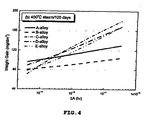
- the size of the precipitates becomes large depending on the increase of the annealing parameter.
- the annealing parameter is limited to the value of 1 ⁇ 10 -18 hr or lower, hydrogen absorption fraction in the alloy matrix is approximately 10 % or less. This value is very low, compared with 25 % of the commercial Zircaloy-4.
- controlling the annealing parameter to less than 1 x 10- 18 hr results in obtaining the precipitates with 80 nm in diameter, thereby improving corrosion resistance of the alloys used in the present invention.
- zirconium alloy comprises A, B, C, D, and E compositions (Nb 0.4 wt%, Sn 0.8 wt%, Fe 0.35 wt%, Cr 0.15 wt%, Mn 0.1 wt%, Si 120 ppm, O 1400 ppm and Zr the balance (A), Nb 0.2 wt%, Sn 1.1 wt%, Fe 0.35 wt%, Cr 0.15 wt%, Cu 0.1 wt%, Si 120 ppm, O 1400 ppm and Zr the balance (B), Nb 1.5 wt%, Sn 0.4 wt%, Fe 0.2 wt%, Cr 0.1 wt%, Si 120 ppm, O 1400 ppm and Zr the balance (C), Nb 1.0 wt%, Sn 1.0 wt%, Fe 0.3 wt%, Cr 0.1 wt%, Cu 0.1 wt%, Si 120 ppm, O 1400 ppm and Zr
- the said TREX is treated at 440-600 °C for 2-4 hours in the final vacuum annealing step so as to yield stress relieved structure, partial recrystallization structure and full recrystallization structure.
- 0.5 wt% or less of Nb-added alloy is annealed at 470-540 °C, and 0.8-1.8 wt% of Nb-added alloy at 470-580 °C.
- zirconium alloy is composed of each of Nb 0.4 wt%, Sn 0.8 wt%, Fe 0.35 wt%, Cr 0.15 wt%, Mn 0.1 wt%, Si 120 ppm, O 1400 ppm and Zr the balance (A); Nb 0.2 wt%, Sn 1.1 wt%, Fe 0.35 wt%, Cr 0.15 wt%, Cu 0.1 wt%, Si 120 ppm, O 1400 ppm and Zr the balance (B); Nb 1.5 wt%, Sn 0.4 wt%, Fe 0.2 wt%, Cr 0.1 wt%, Si 120 ppm, O 1400 ppm and Zr the balance (C); Nb 1.0 wt%, Sn
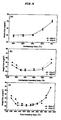
- Fig. 6 shows tensile strength according to the final vacuum annealing temperature. Tensile strength is slowly reduced depending on the increase of the annealing temperature, then drastically reduced at 540 °C. It is believed that the recrystallization begins at 540 °C and thus the disappearance of dislocation occurs and the grains are grown, thereby the tensile strength is drastically reducing. Therefore, it is preferred that the final vacuum annealing is carried out at 470-580 °C from a view of tensile strength.
- Fig. 7 shows creep rate involved in the final vacuum annealing temperature. Creep rate increases depending on the increase of the annealing temperature. It is preferred that 0.5 wt% or less of Nb-added alloy is annealed at 470-540 °C and 0.8-1.8 wt% of Nb-added alloy at 470-580 °C.
- the Nb-containing zirconium alloy in this present invention is preferably composed of Nb 0.05-1.8 wt%, Sn 0.2-1.4 wt%, Fe 0.05-0.5 wt%, Cr 0.05-0.30 wt%, Mn or Cu 0.05-0.4 wt%, Si 80-120 ppm, O 600-1400 ppm and Zr the balance.
- the zirconium alloy comprises Nb 0.05-1.8 wt%, Sn 0.2-1.4 wt%, Fe 0.05-0.5 wt%, one element of Cr, Mn and Cu 0.05-0.30 wt%, Si 80-120 ppm, O 600-1400 ppm and Zr the balance.
- the zirconium alloy comprises Nb 0.05-1.8 wt%, Fe or Cu 0.05-0.3 wt%, Si 80-120 ppm, O 600-1400 ppm and Zr the balance.
- niobium-containing zirconium alloy comprises
- Niobium-containing zirconium alloy comprising Nb 0.4 wt% (deviation 0.3-0.6 wt%), Sn 0.8 wt% (deviation 0.7-1.0 wt%), Fe 0.35 wt% (deviation 0.2-0.5 wt%), Cr 0.15 wt% (deviation 0.05-0.25 wt%), Mn 0.1 wt% (deviation 0.05-0.2 wt%), Si 120 ppm (deviation 80-120 ppm), O 1400 ppm (deviation 600-1400 ppm) and Zr the balance, was melted and thus, the ingot was formed (first step), and forging it was performed (second step) in a range of ⁇ phase of 1200 °C in order that the dendrite structures in ingot were broken.
- Such TREX was cold-worked 2-4 times and intermediate vacuum annealing (fifth step) interposed between cold working was conducted at 570-610 °C for 2 hours each.
- Final vacuum annealing (sixth step) was performed at 470 °C for 2.5 hours, thereby preparing a tube and a sheet of niobium-containing zirconium alloy.
- Example 2 By the same manner as described in Example 1, prepared were a tube and a sheet of niobium-containing zirconium alloy comprising Nb 0.4 wt% (deviation 0.3-0.6 wt%), Sn 0.8 wt% (deviation 0.7-1.0 wt%), Fe 0.35 wt% (deviation 0.2-0.5 wt%), Cr 0.15 wt% (deviation 0.05-0.25 wt%), Cu 0.1 wt% (deviation 0.05-0.2 wt%), Si 120 ppm (deviation 80-120 ppm), O 1400 ppm (deviation 600-1400 ppm) and Zr the balance.
- Nb 0.4 wt% deviceiation 0.3-0.6 wt%)
- Sn 0.8 wt% deviceiation 0.7-1.0 wt%)
- Fe 0.35 wt% deviceiation 0.2-0.5 wt%)
- Cr 0.15 wt% deviceiation 0.05-0
- Example 2 By the same manner as described in Example 1, prepared were a tube and a sheet of niobium-containing zirconium alloy comprising Nb 0.2 wt% (deviation 0.15-0.25 wt%), Sn 1.1 wt% (deviation 0.9-1.40 wt%), Fe 0.35 wt% (deviation 0.2-0.4 wt%), Cr 0.15 wt% (deviation 0.10-0.25 wt%), Cu 0.1 wt% (deviation 0.05-0.12 wt%), Si 120 ppm (deviation 80-120 ppm), O 1400 ppm (deviation 600-1400 ppm) and Zr the balance.
- Example 2 By the same manner as described in Example 1, prepared were a tube and a sheet of niobium-containing zirconium alloy comprising Nb 0.2 wt% (deviation 0.05-0.3 wt%), Sn 0.5 wt% (deviation 0.3-0.7 wt%), Fe 0.30 wt% (deviation 0.2-0.4 wt%), Cr 0.1 wt% (deviation 0.05-0.20 wt%), Si 120 ppm (deviation 80-120 ppm), O 1400 ppm (deviation 600-1400 ppm) and Zr the balance.
- Example 2 By the same manner as described in Example 1, prepared were a tube and a sheet of niobium-containing zirconium alloy comprising Nb 0.2 wt% (deviation 0.05-0.3 wt%), Sn 0.5 wt% (deviation 0.3-0.7 wt%), Fe 0.3 wt% (deviation 0.2-0.4 wt%), Cu 0.1 wt% (deviation 0.05-0.2 wt%), Si 120 ppm (deviation 80-120 ppm), O 1400 ppm (deviation 600-1400 ppm) and Zr the balance.
- Niobium-containing zirconium alloy comprising, Nb 1.5 wt% (deviation 1.3-1.8 wt%), Sn 0.4 wt% (deviation 0.2-0.5 wt%), Fe 0.2 wt% (deviation 0.1-0.3 wt%), Cr 0.1 wt% (deviation 0.05-0.3 wt%), Si 120 ppm (deviation 80-120 ppm), O 1400 ppm (deviation 600-1400 ppm) and Zr the balance, was melted and thus, the ingot was formed (first step), and forging it was performed (second step) in a range of ⁇ phase of 1200 °C in order that the dendrite structures in ingot were broken.
- Such TREX was cold-worked 2-4 times and intermediate vacuum annealing (fifth step) interposed between the cold-working steps was conducted at 570-610 °C for 3 hours each.
- Final vacuum annealing (sixth step) was performed at 520 °C for 2.5 hours, thereby preparing a tube and a sheet of niobium-containing zirconium alloy.
- Example 6 By the same manner as described in Example 6, a tube and a sheet of niobium-containing zirconium alloy comprising Nb 1.5 wt% (deviation 1.3-1.8 wt%), Sn 0.4 wt% (deviation 0.2-0.5 wt%), Fe 0.2 wt% (deviation 0.1-0.3 wt%), Mn 0.1 wt% (deviation 0.05-0.3 wt%), Si 120 ppm (deviation 80-120 ppm), O 1400 ppm (deviation 600-1400 ppm) and Zr the balance, were prepared.
- Example 6 By the same manner as described in Example 6, a tube and a sheet of niobium-containing zirconium alloy comprising Nb 1.5 wt% (deviation 1.3-1.8 wt%), Sn 0.4 wt% (deviation 0.2-0.5 wt%), Fe 0.2 wt% (deviation 0.1-0.3 wt%), Cu 0.1 wt% (deviation 0.05-0.3 wt%), Si 120 ppm (deviation 80-120 ppm), O 1400 ppm (deviation 600-1400 ppm) and Zr the balance, were prepared.
- a tube and a sheet of niobium-containing zirconium alloy comprising Nb 1.0 wt% (deviation 0.8-1.2 wt%), Sn 1.0 wt% (deviation 0.8-1.2 wt%), Fe 0.3 wt% (deviation 0.2-0.4 wt%), Cr 0.10 wt% (deviation 0.10-0.25 wt%), Mn 0.10 wt% (deviation 0.05-0.30 wt%), Si 120 ppm (deviation 80-120 ppm), O 1400 ppm (deviation 600-1400 ppm) and Zr the balance, were prepared.
- a tube and a sheet of niobium-containing zirconium alloy comprising Nb 1.0 wt% (deviation 0.8-1.2 wt%), Sn 1.0 wt% (deviation 0.8-1.2 wt%), Fe 0.3 wt% (deviation 0.2-0.4 wt%), Cr 0.10 wt% (deviation 0.10-0.25 wt%), Cu 0.10 wt% (deviation 0.05-0.30 wt%), Si 120 ppm (deviation 80-120 ppm), O 1400 ppm (deviation 600-1400 ppm) and Zr the balance, were prepared.
- Example 6 By the same manner as described in Example 6, a tube and a sheet of niobium-containing zirconium alloy comprising Nb 1.0 wt% (deviation 0.8-1.2 wt%), Fe 0.15 wt% (deviation 0.05-0.30 wt%), Si 120 ppm (deviation 80-120 ppm), O 1400 ppm (deviation 600-1400 ppm) and Zr the balance, were prepared.
- Example 6 By the same manner as described in Example 6, a tube and a sheet of niobium-containing zirconium alloy comprising Nb 1.0 wt% (deviation 0.8-1.2 wt%), Cu 0.15 wt% (deviation 0.05-0.30 wt%), Si 120 ppm (deviation 80-120 ppm), O 1400 ppm (deviation 600-1400 ppm) and Zr the balance, were prepared.
- the Alloy-2 (less than 5% Nb-containing alloy) should be final annealed in the range of 470°C to 540°C, and the Alloy-6 (more than 5% Nb-containing alloy) in the range of 470°C to 580°C.
- zirconium alloys of the present invention have superior corrosion properties to those of the commercial Zircaloy-4 in the said three conditions of corrosion test, and, in particular, corrosion resistance is excellent in 70 ppm aqueous LiOH solution.
- Example 1 (400 °C) yielding strength tensile strength yielding strength tensile strength tube sheet tube sheet tube sheet Tube sheet Tube sheet
- Example 2 555 574 779 765 340 348 408 392
- Example 3 550 594 780 789 340 350 401 398
- Example 4 530 533 700 703 335 340 378 390
- Example 5 528 534 698 705 338 348 380 399
- Example 6 572 626 817 824 356 358 418 412
- Example 7 570 630 809 819 352 360 415 413
- Example 9 570 619 820 821 348 351 407
- Example 10 572 615 822 824 350 357 412 413
- Example 11 520 522 731 740 298 306 358 542
- Example 12 505 523 723 743 296 289 348 336 Zircaloy-4 50
- Nb-added zirconium alloy of the present invention has lower creep rate than that of the commercial Zircaloy-4, thus having excellent creep resistance.
- zirconium alloy of the present invention controlled to the annealing parameter of 7 ⁇ 10 -19 hr, is excellent in creep properties.
- Nb-added zirconium alloys selectively comprising Sn, Fe, Cr, Cu, and Mn, prepared by the method of the present invention, can have excellent corrosion resistance and mechanical properties by controlling the annealing conditions (relatively low annealing temperature).
- Such Nb-containing zirconium alloy composition can be stably maintained in the operation conditions of high burn-up/extended cycle, thereby being useful as nuclear fuel cladding tubes, grids and reactor structures in the core components of light water reactors and heavy water reactors.
Landscapes
- Chemical & Material Sciences (AREA)
- Engineering & Computer Science (AREA)
- Metallurgy (AREA)
- Physics & Mathematics (AREA)
- Organic Chemistry (AREA)
- Materials Engineering (AREA)
- Mechanical Engineering (AREA)
- Crystallography & Structural Chemistry (AREA)
- Thermal Sciences (AREA)
- Plasma & Fusion (AREA)
- General Engineering & Computer Science (AREA)
- High Energy & Nuclear Physics (AREA)
- Heat Treatment Of Steel (AREA)
- Heat Treatment Of Sheet Steel (AREA)
Claims (5)
- Verfahren zur Herstellung eines Rohrs oder eines Blechs aus einer Niob enthaltenden Zirconiumlegierung für hochabgebrannten Nuklearbrennstoff, das aus folgenden Schritten besteht:Schmelzen eines Metallgemischs, das aus Zirconium und Legierungselementen besteht, wodurch ein Rohblock erhalten wird (1. Schritt);Schmieden des Rohblockes im Bereich der β-Phase (2. Schritt);β-Abschrecken des geschmiedeten Rohblocks nach der Durchführung einer Lösungs-Wärme-Behandlung bei 1015 bis 1075° (3. Schritt);Warmformen des abgeschreckten Rohlings (4. Schritt);3- bis 5-maliges Kaltumformen des warmgeformten Rohblocks mit Zwischen-Vakuumglühen (5. Schritt);abschließendes Vakuumglühen des kaltumgeformten Rohlings (6. Schritt);dadurch gekennzeichnet, dassdie Niob enthaltende Zirconiumlegierung ausgewählt ist ausa) einer Niob enthaltenden Zirconiumlegierung, umfassend 0,3 bis 0,6 Gew.-% Nb, 0,7 bis 1,0 Gew.-% Sn, 0,2 bis 0,5 Gew.-% Fe, 0,05 bis 0,25 Gew.-% Cr, 0,05 bis 0,4 Gew.-% eines der Elemente Mn und Cu, 80 bis 120 ppm Si, 600 bis 1400 ppm 0 und als Rest Zr;b) einer Niob enthaltenden Zirconiumlegierung, umfassend 0,15 bis 0,25 Gew.-% Nb, 0,9 bis 1,40 Gew.-% Sn, 0,2 bis 0,4 Gew.-% Fe, 0,10 bis 0,25 Gew.-% Cr, 0,05 bis 0,12 Gew.-% Cu, 80 bis 120 ppm Si, 600 bis 1400 ppm 0 und als Rest Zr;c) einer Niob enthaltenden Zirconiumlegierung, umfassend 0,05 bis 0,3 Gew.-% Nb, 0,3 bis 0,7 Gew.-% Sn, 0,2 bis 0,4 Gew.-% Fe, 0,05 bis 0,2 Gew.-% eines der Elemente Cr und Cu, 80 bis 120 ppm Si, 600 bis 1400 ppm 0 und als Rest Zr;d) einer Niob enthaltenden Zirconiumlegierung, umfassend 1,3 bis 1,8 Gew.-% Nb, 0,2 bis 0,5 Gew.-% Sn, 0,1 bis 0,3 Gew.-% Fe, 0,05 bis 0,3 Gew.-% eines der Elemente Cr, Mn und Cu, 80 bis 120 ppm Si, 600 bis 1400 ppm 0 und als Rest Zr;e) einer Niob enthaltenden Zirconiumlegierung, umfassend 0,8 bis 1,2 Gew.-% Nb, 0,8 bis 1,2 Gew.-% Sn, 0,2 bis 0,4 Gew.-% Fe, 0,10 bis 0,25 Gew.-% Cr, 0,05 bis 0,3 Gew.-% eines der Elemente Mn und Cu, 80 bis 120 ppm Si, 600 bis 1400 ppm 0 und als Rest Zr; oderf) einer Niob enthaltenden Zirconiumlegierung, umfassend 0,8 bis 1,2 Gew.-% Nb, 0,05 bis 0,3 Gew.-% Fe oder Cu, 80 bis 120 ppm Si, 600 bis 1400 ppm 0 und als Rest Zr;der vierte Schritt bei 600 bis 650°C durchgeführt wird, der sechste Schritt bei 440 bis 600°C 2 bis 4 Stunden durchgeführt wird,wobei die Abkühlungsrate beim β-Abschrecken und die Temperaturen des Zwischen-Vakuumglühens und des abschließenden Vakuumglühens im Bereich der α-Phase nach dem β-Abschrecken geändert werden, so dass die Bedingung erreicht wird, bei der Fällungen in der Matrix der Legierung auf einen mittleren Durchmesser von 80 nm oder kleiner begrenzt sind, und der akkumulierte Glühparameter (ΣA), der mit der folgenden Gleichung 1 (ΣA) angegeben wird, auf 1,0 × 10⁻¹⁸ h oder weniger begrenzt ist:
 worin
worin
ti die Glühzeit (h) des i. Glühschritts nach dem β-Abschrecken ist, Ti die Temperatur des Temperns (K) des i. Temperschritts nach dem β-Abschrecken ist, R die Gaskonstante ist, Q die Aktivierungsenergie ist und Q/R etwa 40 000 K ist. - Verfahren nach Anspruch 1, wobei die Nb enthaltende Zirconiumlegierung aus den Legierungen a) - c) ausgewählt und beim Zwischen-Vakuumglühen zwischen den Schritten des Kaltumformens 2 bis 3 Stunden bei 570 bis 620°C behandelt wird.
- Verfahren nach Anspruch 1 oder 2, wobei die Nb enthaltende Zirconiumlegierung aus den Legierungen a) - c) ausgewählt und im Schritt des abschließenden Vakuumglühens bei 470 bis 540°C 2 bis 4 Stunden behandelt wird.
- Verfahren nach Anspruch 1, wobei die Nb enthaltende Zirconiumlegierung aus den Legierungen d) - f) ausgewählt und beim Zwischen-Vakuumglühen zwischen den Schritten des Kaltumformens 2 bis 8 Stunden bei 570 bis 620°C behandelt wird.
- Verfahren nach einem der Ansprüche 1 oder 4, wobei die Nb enthaltende Zirconiumlegierung aus den Legierungen d) - f) ausgewählt und im Schritt des abschließenden Vakuumglühens 2 bis 4 Stunden bei 470 bis 580°C behandelt wird.
Priority Applications (1)
| Application Number | Priority Date | Filing Date | Title |
|---|---|---|---|
| DE60106856.4T DE60106856T3 (de) | 2001-01-19 | 2001-05-09 | Verfahren zur Herstellung eines Bleches oder eines Rohres aus Niob entaltenden Zirkonium-Legierung für Kernbrennstoff mit hohem Abbrand |
Applications Claiming Priority (2)
| Application Number | Priority Date | Filing Date | Title |
|---|---|---|---|
| KR2001003273 | 2001-01-19 | ||
| KR10-2001-0003273A KR100382997B1 (ko) | 2001-01-19 | 2001-01-19 | 고연소도 핵연료 용 니오븀 함유 지르코늄 합금 관재 및판재의 제조방법 |
Publications (3)
| Publication Number | Publication Date |
|---|---|
| EP1225243A1 EP1225243A1 (de) | 2002-07-24 |
| EP1225243B1 EP1225243B1 (de) | 2004-11-03 |
| EP1225243B2 true EP1225243B2 (de) | 2013-09-04 |
Family
ID=19704875
Family Applications (1)
| Application Number | Title | Priority Date | Filing Date |
|---|---|---|---|
| EP01201703.4A Expired - Lifetime EP1225243B2 (de) | 2001-01-19 | 2001-05-09 | Verfahren zur Herstellung eines Bleches oder eines Rohres aus Niob entaltenden Zirkonium-Legierung für Kernbrennstoff mit hohem Abbrand |
Country Status (6)
| Country | Link |
|---|---|
| US (1) | US6514360B2 (de) |
| EP (1) | EP1225243B2 (de) |
| JP (1) | JP3602467B2 (de) |
| KR (1) | KR100382997B1 (de) |
| CN (1) | CN1131329C (de) |
| DE (1) | DE60106856T3 (de) |
Cited By (1)
| Publication number | Priority date | Publication date | Assignee | Title |
|---|---|---|---|---|
| KR101630403B1 (ko) | 2016-01-27 | 2016-06-14 | 한전원자력연료 주식회사 | 다단 열간압연을 적용한 핵연료용 지르코늄 부품의 제조방법 |
Families Citing this family (61)
| Publication number | Priority date | Publication date | Assignee | Title |
|---|---|---|---|---|
| JP3983493B2 (ja) * | 2001-04-06 | 2007-09-26 | 株式会社グローバル・ニュークリア・フュエル・ジャパン | ジルコニウム基合金の製造法 |
| KR100441562B1 (ko) * | 2001-05-07 | 2004-07-23 | 한국수력원자력 주식회사 | 우수한 내식성과 기계적 특성을 갖는 지르코늄 합금핵연료 피복관 및 그 제조 방법 |
| KR100461017B1 (ko) * | 2001-11-02 | 2004-12-09 | 한국수력원자력 주식회사 | 우수한 내식성을 갖는 니오븀 함유 지르코늄 합금핵연료피복관의 제조방법 |
| SE525808C2 (sv) | 2002-10-30 | 2005-05-03 | Westinghouse Atom Ab | Förfarande, användning och anordning avseende kapslingrör för kärnbränsle samt en bränslepatron för en nukleär tryckvattenreaktor |
| US7194980B2 (en) * | 2003-07-09 | 2007-03-27 | John Stuart Greeson | Automated carrier-based pest control system |
| US10221475B2 (en) | 2004-03-23 | 2019-03-05 | Westinghouse Electric Company Llc | Zirconium alloys with improved corrosion/creep resistance |
| US9284629B2 (en) | 2004-03-23 | 2016-03-15 | Westinghouse Electric Company Llc | Zirconium alloys with improved corrosion/creep resistance due to final heat treatments |
| KR20060123781A (ko) * | 2004-03-23 | 2006-12-04 | 웨스팅하우스 일렉트릭 컴패니 엘엘씨 | 개선된 부식저항력을 지닌 지르코늄합금 및 그에 관련된제조방법 |
| EP1771591B1 (de) * | 2004-07-06 | 2016-12-07 | Westinghouse Electric Sweden AB | Brennstoffkasten in einem siedewasser-kernreaktor |
| SE528120C2 (sv) | 2004-07-06 | 2006-09-05 | Westinghouse Electric Sweden | Förfarande för framställning av plåt för användning i en kokarvattenkärnreaktor, plåt samt förfarande för framställning av bränslebox, samt bränslebox |
| US8043448B2 (en) * | 2004-09-08 | 2011-10-25 | Global Nuclear Fuel-Americas, Llc | Non-heat treated zirconium alloy fuel cladding and a method of manufacturing the same |
| US9139895B2 (en) * | 2004-09-08 | 2015-09-22 | Global Nuclear Fuel—Americas, LLC | Zirconium alloy fuel cladding for operation in aggressive water chemistry |
| KR100733701B1 (ko) * | 2005-02-07 | 2007-06-28 | 한국원자력연구원 | 크립저항성이 우수한 지르코늄 합금 조성물 |
| CN103650659B (zh) * | 2005-12-27 | 2010-03-10 | 西北有色金属研究院 | 一种核反应堆用锆基合金板材的制备方法 |
| RU2310010C2 (ru) * | 2006-01-10 | 2007-11-10 | Открытое акционерное общество "Чепецкий механический завод" (ОАО ЧМЗ) | Способ получения плоского профиля из цирконий-ниобиевых сплавов |
| RU2310009C2 (ru) * | 2006-01-10 | 2007-11-10 | Открытое акционерное общество "Чепецкий механический завод" (ОАО ЧМЗ) | Способ изготовления плоского профиля из циркониевых сплавов |
| SE530673C2 (sv) * | 2006-08-24 | 2008-08-05 | Westinghouse Electric Sweden | Vattenreaktorbränslekapslingsrör |
| FR2909388B1 (fr) | 2006-12-01 | 2009-01-16 | Areva Np Sas | Alliage de zirconium resistant a la corrosion en ombres portees pour composant d'assemblage de combustible pour reacteur a eau bouillante,composant realise en cet alliage, assemblage de combustible et son utilisation. |
| KR100831578B1 (ko) * | 2006-12-05 | 2008-05-21 | 한국원자력연구원 | 원자력용 우수한 내식성을 갖는 지르코늄 합금 조성물 및이의 제조방법 |
| SE530783C2 (sv) * | 2007-01-16 | 2008-09-09 | Westinghouse Electric Sweden | Spridargaller för positinering av bränslestavar |
| KR101062785B1 (ko) * | 2009-05-29 | 2011-09-07 | 한국수력원자력 주식회사 | 고강도 및 우수한 내식성을 확보한 핵연료 안내관 및 계측관용 지르코늄 합금의 제조방법 |
| CN101954439A (zh) * | 2010-08-17 | 2011-01-26 | 吉林省昊宇石化电力设备制造有限公司 | Ap1000核电主管道锻件锻造方法 |
| KR101265261B1 (ko) | 2011-03-09 | 2013-05-16 | 한국수력원자력 주식회사 | 우수한 내식성 및 고강도를 가지는 지르코늄합금의 제조방법 |
| CN102220521B (zh) * | 2011-06-02 | 2013-01-16 | 苏州热工研究院有限公司 | 一种核反应堆用锆合金 |
| CN102220520B (zh) * | 2011-06-02 | 2013-01-16 | 苏州热工研究院有限公司 | 一种核反应堆燃料包壳用锆合金 |
| CN102220517B (zh) * | 2011-06-02 | 2013-02-13 | 苏州热工研究院有限公司 | 一种核反应堆燃料组件用锆合金材料 |
| CN102220518B (zh) * | 2011-06-02 | 2013-01-16 | 苏州热工研究院有限公司 | 一种核反应堆包壳材料用低锡锆合金 |
| CN102825207B (zh) * | 2011-06-13 | 2015-12-02 | 鞍钢重型机械有限责任公司 | 一种不锈钢核电主管道锻造工艺 |
| CN102212719B (zh) * | 2011-06-14 | 2013-01-16 | 苏州热工研究院有限公司 | 一种核反应堆用低锡锆合金材料 |
| CN102212718B (zh) * | 2011-06-14 | 2013-01-16 | 苏州热工研究院有限公司 | 一种核反应堆燃料组件用低锡锆合金材料 |
| ES2886336T3 (es) * | 2011-06-16 | 2021-12-17 | Westinghouse Electric Co Llc | Procedimiento de fabricación de un tubo de revestimiento a base de circonio con resistencia a la fluencia mejorada debido a tratamiento térmico final |
| CN102251150A (zh) * | 2011-06-30 | 2011-11-23 | 苏州热工研究院有限公司 | 一种核反应堆用锆合金 |
| CN102251148B (zh) * | 2011-06-30 | 2013-07-10 | 苏州热工研究院有限公司 | 核反应堆用锆合金 |
| CN102268572A (zh) * | 2011-06-30 | 2011-12-07 | 苏州热工研究院有限公司 | 一种核反应堆包壳材料用低锡锆基合金 |
| CN102230110B (zh) * | 2011-07-07 | 2013-03-06 | 上海大学 | 核反应堆燃料包壳用锆合金 |
| KR20130098618A (ko) | 2012-02-28 | 2013-09-05 | 한국원자력연구원 | 사고조건 하의 원자로 내에서 우수한 내산화성을 나타내는 핵연료 피복관용 지르코늄 합금 조성물, 이를 이용하여 제조한 지르코늄 합금 핵연료 피복관 및 이의 제조방법 |
| KR101378066B1 (ko) * | 2012-02-28 | 2014-03-28 | 한국수력원자력 주식회사 | 합금원소의 첨가량을 낮추어 부식저항성을 향상시킨 핵연료 피복관용 지르코늄 합금 조성물 및 이를 이용한 지르코늄 합금 핵연료 피복관의 제조방법 |
| KR20130098621A (ko) | 2012-02-28 | 2013-09-05 | 한국원자력연구원 | 가혹한 원자로 가동조건에서 내산화성이 우수한 핵연료피복관용 지르코늄 합금 조성물 및 이를 이용한 지르코늄 합금 핵연료 피복관의 제조방법 |
| CN102586709B (zh) * | 2012-04-05 | 2013-10-02 | 重庆大学 | 一种锆合金的热处理方法 |
| CN102921761B (zh) * | 2012-11-08 | 2014-06-04 | 西安诺博尔稀贵金属材料有限公司 | 一种电光源用铌锆合金丝的制备方法 |
| CN103898361B (zh) * | 2012-12-27 | 2017-02-22 | 中国核动力研究设计院 | 一种核动力堆芯用锆合金 |
| CN103898362B (zh) * | 2012-12-27 | 2016-08-10 | 中国核动力研究设计院 | 一种水冷核反应堆用锆基合金 |
| CN103898366B (zh) * | 2012-12-27 | 2016-08-10 | 中国核动力研究设计院 | 一种用于核动力反应堆燃料组件的锆基合金 |
| CN103341724B (zh) * | 2013-05-30 | 2015-03-25 | 中国钢研科技集团有限公司 | 采用离心铸造空心锭生产核电站主管道锻件的工艺 |
| CN104001844A (zh) * | 2014-05-28 | 2014-08-27 | 中国钢研科技集团有限公司 | 采用离心铸造空心锭生产环形件和筒形件的锻造工艺 |
| CN104174798B (zh) * | 2014-07-24 | 2016-01-20 | 二重集团(德阳)重型装备股份有限公司 | 核电主管道管坯短流程锻造方法 |
| KR101604103B1 (ko) * | 2015-04-14 | 2016-03-25 | 한전원자력연료 주식회사 | 우수한 부식저항성을 갖는 핵연료 피복관용 지르코늄 합금 및 그 제조방법 |
| WO2016167398A1 (ko) * | 2015-04-14 | 2016-10-20 | 한전원자력연료 주식회사 | 핵연료용 지르코늄 합금 조성물 및 이의 제조방법 |
| CN105296803B (zh) * | 2015-12-07 | 2017-10-03 | 西部新锆核材料科技有限公司 | 一种核反应堆燃料包壳用锆铌合金及其制备方法 |
| CN107833640A (zh) * | 2017-10-25 | 2018-03-23 | 中广核研究院有限公司 | 燃料组件导向管、燃料组件导向管用管材及其制造方法 |
| FR3098224B1 (fr) * | 2019-07-05 | 2021-10-01 | Framatome Sa | Composant tubulaire de réacteur nucléaire à eau pressurisée et procédé de fabrication de ce composant |
| US20220316041A1 (en) * | 2019-12-26 | 2022-10-06 | Joint-Stock Company "Tvel" | Manufacturing Method for Tubular Products made of Zirconium-Based Alloy |
| EP4082685A4 (de) * | 2019-12-26 | 2024-01-17 | Joint-Stock Company "TVEL" | Verfahren zur herstellung von rohrförmigen produkten aus einer zirkoniumlegierung |
| CN112662973B (zh) * | 2020-12-14 | 2021-11-16 | 西部新锆核材料科技有限公司 | 一种核反应堆燃料通道锆合金压力管的制造方法 |
| CN113201666A (zh) * | 2021-04-08 | 2021-08-03 | 中广核研究院有限公司 | 用于燃料组件的锆合金及其制作方法、燃料组件的包壳管 |
| CN113560824A (zh) * | 2021-07-28 | 2021-10-29 | 西北有色金属研究院 | 一种铌合金长薄壁管的制备方法 |
| CN115961175A (zh) * | 2022-11-25 | 2023-04-14 | 岭澳核电有限公司 | 一种燃料组件用低锡高铌锆合金及其制备方法、燃料组件的包壳管 |
| CN116423167A (zh) * | 2023-05-31 | 2023-07-14 | 西北有色金属研究院 | 一种提高低密度铌合金棒材塑性的方法 |
| CN116815016B (zh) * | 2023-06-20 | 2026-01-20 | 上海交通大学 | 一种高Sn低Nb锆合金及其制备方法和应用 |
| CN120350329B (zh) * | 2025-06-24 | 2025-09-09 | 国核宝钛锆业股份公司 | 一种核电用锆合金带材及其制备方法和应用 |
| CN121023302A (zh) * | 2025-09-22 | 2025-11-28 | 国核宝钛锆业股份公司 | 一种重水堆排管用高强度耐腐蚀的Zr-Sn合金板材及其制备方法 |
Citations (12)
| Publication number | Priority date | Publication date | Assignee | Title |
|---|---|---|---|---|
| US4649023A (en) † | 1985-01-22 | 1987-03-10 | Westinghouse Electric Corp. | Process for fabricating a zirconium-niobium alloy and articles resulting therefrom |
| JPS6333535A (ja) † | 1986-07-25 | 1988-02-13 | Kobe Steel Ltd | 原子炉用ジルコニウム合金 |
| EP0198570B1 (de) † | 1985-01-22 | 1990-08-29 | Westinghouse Electric Corporation | Verfahren zur Herstellung dünnwandiger Röhren aus einer Zirkonium-Niob-Legierung |
| US4963323A (en) † | 1986-07-29 | 1990-10-16 | Mitsubishi Kinzoku Kabushiki Kaisha | Highly corrosion-resistant zirconium alloy for use as nuclear reactor fuel cladding material |
| US4992240A (en) † | 1988-06-06 | 1991-02-12 | Mitsubishi Jukogyo Kabushiki Kaisha | Alloys based on zirconium having proportional amount of tin, iron, chromium and oxygen |
| US5366690A (en) † | 1993-06-18 | 1994-11-22 | Combustion Engineering, Inc. | Zirconium alloy with tin, nitrogen, and niobium additions |
| JPH0867954A (ja) † | 1994-08-25 | 1996-03-12 | Sumitomo Metal Ind Ltd | 高耐食性ジルコニウム合金の製造方法 |
| US5648995A (en) † | 1994-12-29 | 1997-07-15 | Framatome | Method of manufacturing a tube for a nuclear fuel assembly, and tubes obtained thereby |
| US5838753A (en) † | 1997-08-01 | 1998-11-17 | Siemens Power Corporation | Method of manufacturing zirconium niobium tin alloys for nuclear fuel rods and structural parts for high burnup |
| US5844959A (en) † | 1997-08-01 | 1998-12-01 | Siemens Power Corporation | Zirconium niobium tin alloys for nuclear fuel rods and structural parts for high burnup |
| US5985211A (en) † | 1998-02-04 | 1999-11-16 | Korea Atomic Energy Research Institute | Composition of zirconium alloy having low corrosion rate and high strength |
| US6125161A (en) † | 1997-10-13 | 2000-09-26 | Mitsubishi Materials Corporation | Method for making Zr alloy nuclear reactor fuel cladding having excellent corrosion resistance and creep properties |
Family Cites Families (15)
| Publication number | Priority date | Publication date | Assignee | Title |
|---|---|---|---|---|
| DE3663372D1 (en) * | 1985-03-12 | 1989-06-22 | Santrade Ltd | Method of manufacturing tubes of zirconium alloys with improved corrosion resistance for thermal nuclear reactors |
| JPH01119650A (ja) * | 1987-11-04 | 1989-05-11 | Hitachi Ltd | 原子炉燃料集合体用チヤンネルボツクスの製造方法 |
| US5194101A (en) * | 1990-03-16 | 1993-03-16 | Westinghouse Electric Corp. | Zircaloy-4 processing for uniform and nodular corrosion resistance |
| FR2672057B1 (fr) * | 1991-01-30 | 1994-08-12 | Cezus Co Europ Zirconium | Procede de fabrication de toles ou tubes en zircaloy 2 ou en zircaloy 4. |
| FR2683828B1 (fr) * | 1991-11-18 | 1994-08-26 | Cezus Cie Europ Zirconium | Procede de fabrication de toles a structure homogene en zircaloy 2 ou en zircaloy 4. |
| FR2693476B1 (fr) * | 1992-07-09 | 1994-09-02 | Cezus Co Europ Zirconium | Produit extérieurement en alliage de Zr, son procédé de fabrication et son utilisation. |
| US5618356A (en) * | 1993-04-23 | 1997-04-08 | General Electric Company | Method of fabricating zircaloy tubing having high resistance to crack propagation |
| SE502865C2 (sv) * | 1993-06-23 | 1996-02-05 | Asea Atom Ab | Värmebehandling av kapsling och ledrör vid kärnbränsleelement för tryckvattenreaktorer |
| SE513488C2 (sv) * | 1994-06-22 | 2000-09-18 | Sandvik Ab | Sätt att tillverka rör av zirkoniumbaslegering för kärnreaktorer och användning av sättet vid tillverkning av sådana rör |
| FR2737335B1 (fr) * | 1995-07-27 | 1997-10-10 | Framatome Sa | Tube pour assemblage de combustible nucleaire et procede de fabrication d'un tel tube |
| JPH09111379A (ja) * | 1995-10-12 | 1997-04-28 | Sumitomo Metal Ind Ltd | 高耐食性ジルコニウム合金 |
| JPH09257988A (ja) * | 1996-01-19 | 1997-10-03 | Nuclear Fuel Ind Ltd | 耐食性、特に耐一様腐食性と耐水素吸収性に優れたジルコニウム合金系原子炉炉心内構造材の製造方法 |
| JP3726367B2 (ja) | 1996-08-09 | 2005-12-14 | 三菱マテリアル株式会社 | 軽水炉用燃料棒およびその製造方法 |
| KR100261665B1 (ko) * | 1998-02-04 | 2000-07-15 | 장인순 | 우수한 부식저항성과 고강도를 갖는 지르코늄 합금조성물 |
| JP3483804B2 (ja) * | 1999-06-28 | 2004-01-06 | 原子燃料工業株式会社 | 耐食性ジルコニウム基合金管の製造方法 |
-
2001
- 2001-01-19 KR KR10-2001-0003273A patent/KR100382997B1/ko not_active Expired - Lifetime
- 2001-04-27 JP JP2001131877A patent/JP3602467B2/ja not_active Expired - Lifetime
- 2001-05-09 DE DE60106856.4T patent/DE60106856T3/de not_active Expired - Lifetime
- 2001-05-09 EP EP01201703.4A patent/EP1225243B2/de not_active Expired - Lifetime
- 2001-05-10 US US09/852,953 patent/US6514360B2/en not_active Expired - Lifetime
- 2001-05-31 CN CN01115930A patent/CN1131329C/zh not_active Expired - Lifetime
Patent Citations (12)
| Publication number | Priority date | Publication date | Assignee | Title |
|---|---|---|---|---|
| US4649023A (en) † | 1985-01-22 | 1987-03-10 | Westinghouse Electric Corp. | Process for fabricating a zirconium-niobium alloy and articles resulting therefrom |
| EP0198570B1 (de) † | 1985-01-22 | 1990-08-29 | Westinghouse Electric Corporation | Verfahren zur Herstellung dünnwandiger Röhren aus einer Zirkonium-Niob-Legierung |
| JPS6333535A (ja) † | 1986-07-25 | 1988-02-13 | Kobe Steel Ltd | 原子炉用ジルコニウム合金 |
| US4963323A (en) † | 1986-07-29 | 1990-10-16 | Mitsubishi Kinzoku Kabushiki Kaisha | Highly corrosion-resistant zirconium alloy for use as nuclear reactor fuel cladding material |
| US4992240A (en) † | 1988-06-06 | 1991-02-12 | Mitsubishi Jukogyo Kabushiki Kaisha | Alloys based on zirconium having proportional amount of tin, iron, chromium and oxygen |
| US5366690A (en) † | 1993-06-18 | 1994-11-22 | Combustion Engineering, Inc. | Zirconium alloy with tin, nitrogen, and niobium additions |
| JPH0867954A (ja) † | 1994-08-25 | 1996-03-12 | Sumitomo Metal Ind Ltd | 高耐食性ジルコニウム合金の製造方法 |
| US5648995A (en) † | 1994-12-29 | 1997-07-15 | Framatome | Method of manufacturing a tube for a nuclear fuel assembly, and tubes obtained thereby |
| US5838753A (en) † | 1997-08-01 | 1998-11-17 | Siemens Power Corporation | Method of manufacturing zirconium niobium tin alloys for nuclear fuel rods and structural parts for high burnup |
| US5844959A (en) † | 1997-08-01 | 1998-12-01 | Siemens Power Corporation | Zirconium niobium tin alloys for nuclear fuel rods and structural parts for high burnup |
| US6125161A (en) † | 1997-10-13 | 2000-09-26 | Mitsubishi Materials Corporation | Method for making Zr alloy nuclear reactor fuel cladding having excellent corrosion resistance and creep properties |
| US5985211A (en) † | 1998-02-04 | 1999-11-16 | Korea Atomic Energy Research Institute | Composition of zirconium alloy having low corrosion rate and high strength |
Non-Patent Citations (22)
Cited By (1)
| Publication number | Priority date | Publication date | Assignee | Title |
|---|---|---|---|---|
| KR101630403B1 (ko) | 2016-01-27 | 2016-06-14 | 한전원자력연료 주식회사 | 다단 열간압연을 적용한 핵연료용 지르코늄 부품의 제조방법 |
Also Published As
| Publication number | Publication date |
|---|---|
| DE60106856D1 (de) | 2004-12-09 |
| DE60106856T3 (de) | 2014-01-30 |
| JP2002243881A (ja) | 2002-08-28 |
| EP1225243B1 (de) | 2004-11-03 |
| CN1366089A (zh) | 2002-08-28 |
| US6514360B2 (en) | 2003-02-04 |
| CN1131329C (zh) | 2003-12-17 |
| KR20020062052A (ko) | 2002-07-25 |
| DE60106856T2 (de) | 2006-02-09 |
| US20020136347A1 (en) | 2002-09-26 |
| KR100382997B1 (ko) | 2003-05-09 |
| JP3602467B2 (ja) | 2004-12-15 |
| EP1225243A1 (de) | 2002-07-24 |
Similar Documents
| Publication | Publication Date | Title |
|---|---|---|
| EP1225243B1 (de) | Verfahren zur Herstellung eines Bleches oder eines Rohres aus Niob entaltenden Zirkonium-Legierung für Kernbrennstoff mit hohem Abbrand | |
| EP1256634B1 (de) | Zirkoniumlegierung mit verbesserter Korrosionbeständigkeit und verbesserten mechanischen Eigenschaften und Anfertigungsverfahren eines Hüllrohres aus der Zirkoniumlegierung für einen Kernreaktorbrennstab | |
| KR100461017B1 (ko) | 우수한 내식성을 갖는 니오븀 함유 지르코늄 합금핵연료피복관의 제조방법 | |
| EP0475159B1 (de) | Zirlo-Werkstoffzusammensetzung und Herstellungsverfahren | |
| KR100364093B1 (ko) | 핵연료어셈블리용 튜브제조방법 및 이에 의해 얻어진 튜브 | |
| EP0488027B1 (de) | Teil aus Zirkonlegierung mit niedrigem Bestrahlungswachstum, dessen Herstellungsverfahren, Brennelementkanalkasten und Aufbau sowie deren Verwendung | |
| US20100128834A1 (en) | Zirconium alloys with improved corrosion resistance and method for fabricating zirconium alloys with improved corrosion resistance | |
| EP0198570B1 (de) | Verfahren zur Herstellung dünnwandiger Röhren aus einer Zirkonium-Niob-Legierung | |
| US20100108204A1 (en) | Zirconium alloy composition for nuclear fuel cladding tube forming protective oxide film, zirconium alloy nuclear fuel cladding tube manufactured using the composition, and method of manufacturing the zirconium alloy nuclear fuel cladding tube | |
| JPH11133174A (ja) | 耐蝕性の原子炉構成部材、核燃料棒被覆管、水性環境に使用するためのジルコニウム合金、および原子炉燃料集成体用構造部材 | |
| KR100353125B1 (ko) | 원자로용지르콘계합금제튜브의제조방법및그용도 | |
| JPH11148990A (ja) | 核燃料棒を被覆する管の製造法、核燃料被覆管、ジルコニウム合金の製造法および構造部材の製造法 | |
| EP0706706B1 (de) | Brennstabbündel für druckwasserreaktor mit zwei endstufen thermisch behandelten führungsrohren | |
| US10221475B2 (en) | Zirconium alloys with improved corrosion/creep resistance | |
| US9725791B2 (en) | Zirconium alloys with improved corrosion/creep resistance due to final heat treatments | |
| EP0745258B1 (de) | Kernreaktorbrennstabbündel für druckwasserreaktor und verfahren zu seiner herstellung | |
| JPH07173587A (ja) | ジルコニウム合金溶接部材の製造方法 | |
| JPH0422982B2 (de) |
Legal Events
| Date | Code | Title | Description |
|---|---|---|---|
| PUAI | Public reference made under article 153(3) epc to a published international application that has entered the european phase |
Free format text: ORIGINAL CODE: 0009012 |
|
| 17P | Request for examination filed |
Effective date: 20010530 |
|
| AK | Designated contracting states |
Kind code of ref document: A1 Designated state(s): AT BE CH CY DE DK ES FI FR GB GR IE IT LI LU MC NL PT SE TR |
|
| AX | Request for extension of the european patent |
Free format text: AL;LT;LV;MK;RO;SI |
|
| AKX | Designation fees paid |
Designated state(s): DE FR SE |
|
| 17Q | First examination report despatched |
Effective date: 20030523 |
|
| GRAP | Despatch of communication of intention to grant a patent |
Free format text: ORIGINAL CODE: EPIDOSNIGR1 |
|
| GRAS | Grant fee paid |
Free format text: ORIGINAL CODE: EPIDOSNIGR3 |
|
| GRAA | (expected) grant |
Free format text: ORIGINAL CODE: 0009210 |
|
| AK | Designated contracting states |
Kind code of ref document: B1 Designated state(s): DE FR SE |
|
| REF | Corresponds to: |
Ref document number: 60106856 Country of ref document: DE Date of ref document: 20041209 Kind code of ref document: P |
|
| REG | Reference to a national code |
Ref country code: IE Ref legal event code: FG4D |
|
| REG | Reference to a national code |
Ref country code: SE Ref legal event code: TRGR |
|
| ET | Fr: translation filed | ||
| PLBI | Opposition filed |
Free format text: ORIGINAL CODE: 0009260 |
|
| PLAX | Notice of opposition and request to file observation + time limit sent |
Free format text: ORIGINAL CODE: EPIDOSNOBS2 |
|
| 26 | Opposition filed |
Opponent name: FRAMATOME ANP Effective date: 20050801 |
|
| PLBB | Reply of patent proprietor to notice(s) of opposition received |
Free format text: ORIGINAL CODE: EPIDOSNOBS3 |
|
| PLAY | Examination report in opposition despatched + time limit |
Free format text: ORIGINAL CODE: EPIDOSNORE2 |
|
| PLAB | Opposition data, opponent's data or that of the opponent's representative modified |
Free format text: ORIGINAL CODE: 0009299OPPO |
|
| PLBC | Reply to examination report in opposition received |
Free format text: ORIGINAL CODE: EPIDOSNORE3 |
|
| APBM | Appeal reference recorded |
Free format text: ORIGINAL CODE: EPIDOSNREFNO |
|
| APBP | Date of receipt of notice of appeal recorded |
Free format text: ORIGINAL CODE: EPIDOSNNOA2O |
|
| APAH | Appeal reference modified |
Free format text: ORIGINAL CODE: EPIDOSCREFNO |
|
| APBQ | Date of receipt of statement of grounds of appeal recorded |
Free format text: ORIGINAL CODE: EPIDOSNNOA3O |
|
| REG | Reference to a national code |
Ref country code: DE Ref legal event code: R082 Ref document number: 60106856 Country of ref document: DE Representative=s name: GRUENECKER, KINKELDEY, STOCKMAIR & SCHWANHAEUS, DE |
|
| REG | Reference to a national code |
Ref country code: DE Ref legal event code: R081 Ref document number: 60106856 Country of ref document: DE Owner name: KOREA ATOMIC ENERGY RESEARCH INSTITUTE, KR Free format text: FORMER OWNER: KOREA ATOMIC ENERGY RESEARCH IN, KOREA ELECTRIC POWER CORP., , KR Effective date: 20120111 Ref country code: DE Ref legal event code: R082 Ref document number: 60106856 Country of ref document: DE Representative=s name: GRUENECKER, KINKELDEY, STOCKMAIR & SCHWANHAEUS, DE Effective date: 20120111 Ref country code: DE Ref legal event code: R081 Ref document number: 60106856 Country of ref document: DE Owner name: KOREA HYDRO & NUCLEAR POWER CO., LTD., KR Free format text: FORMER OWNER: KOREA ATOMIC ENERGY RESEARCH IN, KOREA ELECTRIC POWER CORP., , KR Effective date: 20120111 Ref country code: DE Ref legal event code: R081 Ref document number: 60106856 Country of ref document: DE Owner name: KOREA HYDRO & NOCLEAR POWER CO., LTD., KR Free format text: FORMER OWNER: KOREA ATOMIC ENERGY RESEARCH IN, KOREA ELECTRIC POWER CORP., , KR Effective date: 20120111 Ref country code: DE Ref legal event code: R081 Ref document number: 60106856 Country of ref document: DE Owner name: KOREA HYDRO & NUCLEAR POWER CO., LTD., GYEONGJ, KR Free format text: FORMER OWNER: KOREA ATOMIC ENERGY RESEARCH IN, KOREA ELECTRIC POWER CORP., , KR Effective date: 20120111 Ref country code: DE Ref legal event code: R081 Ref document number: 60106856 Country of ref document: DE Owner name: KEPCO NUCLEAR FUEL CO., LTD., KR Free format text: FORMER OWNER: KOREA ATOMIC ENERGY RESEARCH IN, KOREA ELECTRIC POWER CORP., , KR Effective date: 20120111 Ref country code: DE Ref legal event code: R082 Ref document number: 60106856 Country of ref document: DE Representative=s name: GRUENECKER PATENT- UND RECHTSANWAELTE PARTG MB, DE Effective date: 20120111 Ref country code: DE Ref legal event code: R081 Ref document number: 60106856 Country of ref document: DE Owner name: KEPCO NUCLEAR FUEL CO., LTD., KR Free format text: FORMER OWNERS: KOREA ATOMIC ENERGY RESEARCH INSTITUTE, TAEJON, KR; KOREA ELECTRIC POWER CORP., SEOUL/SOUL, KR Effective date: 20120111 Ref country code: DE Ref legal event code: R081 Ref document number: 60106856 Country of ref document: DE Owner name: KOREA HYDRO & NUCLEAR POWER CO., LTD., GYEONGJ, KR Free format text: FORMER OWNERS: KOREA ATOMIC ENERGY RESEARCH INSTITUTE, TAEJON, KR; KOREA ELECTRIC POWER CORP., SEOUL/SOUL, KR Effective date: 20120111 |
|
| REG | Reference to a national code |
Ref country code: FR Ref legal event code: TQ Owner name: KOREA ATOMIC ENERGY RESEARCH INST Effective date: 20120411 Ref country code: FR Ref legal event code: TQ Owner name: KOREA HYDRO & NUCLEAR POWER CO. LTD., KR Effective date: 20120411 |
|
| APBU | Appeal procedure closed |
Free format text: ORIGINAL CODE: EPIDOSNNOA9O |
|
| PUAH | Patent maintained in amended form |
Free format text: ORIGINAL CODE: 0009272 |
|
| STAA | Information on the status of an ep patent application or granted ep patent |
Free format text: STATUS: PATENT MAINTAINED AS AMENDED |
|
| 27A | Patent maintained in amended form |
Effective date: 20130904 |
|
| AK | Designated contracting states |
Kind code of ref document: B2 Designated state(s): DE FR SE |
|
| REG | Reference to a national code |
Ref country code: DE Ref legal event code: R102 Ref document number: 60106856 Country of ref document: DE |
|
| REG | Reference to a national code |
Ref country code: DE Ref legal event code: R082 Ref document number: 60106856 Country of ref document: DE Representative=s name: GRUENECKER, KINKELDEY, STOCKMAIR & SCHWANHAEUS, DE |
|
| REG | Reference to a national code |
Ref country code: SE Ref legal event code: RPEO |
|
| REG | Reference to a national code |
Ref country code: DE Ref legal event code: R102 Ref document number: 60106856 Country of ref document: DE Effective date: 20130904 |
|
| REG | Reference to a national code |
Ref country code: DE Ref legal event code: R081 Ref document number: 60106856 Country of ref document: DE Owner name: KOREA ATOMIC ENERGY RESEARCH INSTITUTE, KR Free format text: FORMER OWNER: KOREA ATOMIC ENERGY RESEARCH IN, KOREA HYDRO & NUCLEAR POWER CO., , KR Effective date: 20131017 Ref country code: DE Ref legal event code: R082 Ref document number: 60106856 Country of ref document: DE Representative=s name: GRUENECKER, KINKELDEY, STOCKMAIR & SCHWANHAEUS, DE Effective date: 20131017 Ref country code: DE Ref legal event code: R081 Ref document number: 60106856 Country of ref document: DE Owner name: KOREA HYDRO & NUCLEAR POWER CO., LTD., KR Free format text: FORMER OWNER: KOREA ATOMIC ENERGY RESEARCH IN, KOREA HYDRO & NUCLEAR POWER CO., , KR Effective date: 20131017 Ref country code: DE Ref legal event code: R081 Ref document number: 60106856 Country of ref document: DE Owner name: KOREA HYDRO & NUCLEAR POWER CO., LTD., GYEONGJ, KR Free format text: FORMER OWNER: KOREA ATOMIC ENERGY RESEARCH IN, KOREA HYDRO & NUCLEAR POWER CO., , KR Effective date: 20131017 Ref country code: DE Ref legal event code: R081 Ref document number: 60106856 Country of ref document: DE Owner name: KEPCO NUCLEAR FUEL CO., LTD., KR Free format text: FORMER OWNER: KOREA ATOMIC ENERGY RESEARCH IN, KOREA HYDRO & NUCLEAR POWER CO., , KR Effective date: 20131017 Ref country code: DE Ref legal event code: R082 Ref document number: 60106856 Country of ref document: DE Representative=s name: GRUENECKER PATENT- UND RECHTSANWAELTE PARTG MB, DE Effective date: 20131017 Ref country code: DE Ref legal event code: R081 Ref document number: 60106856 Country of ref document: DE Owner name: KOREA HYDRO & NUCLEAR POWER CO., LTD., GYEONGJ, KR Free format text: FORMER OWNERS: KOREA ATOMIC ENERGY RESEARCH INSTITUTE, DAEJEON, KR; KOREA HYDRO & NUCLEAR POWER CO., LTD., SEOUL/SOUL, KR Effective date: 20131017 Ref country code: DE Ref legal event code: R081 Ref document number: 60106856 Country of ref document: DE Owner name: KEPCO NUCLEAR FUEL CO., LTD., KR Free format text: FORMER OWNERS: KOREA ATOMIC ENERGY RESEARCH INSTITUTE, DAEJEON, KR; KOREA HYDRO & NUCLEAR POWER CO., LTD., SEOUL/SOUL, KR Effective date: 20131017 |
|
| REG | Reference to a national code |
Ref country code: DE Ref legal event code: R082 Ref document number: 60106856 Country of ref document: DE Representative=s name: GRUENECKER, KINKELDEY, STOCKMAIR & SCHWANHAEUS, DE |
|
| REG | Reference to a national code |
Ref country code: DE Ref legal event code: R081 Ref document number: 60106856 Country of ref document: DE Owner name: KEPCO NUCLEAR FUEL CO., LTD., KR Free format text: FORMER OWNER: KOREA ATOMIC ENERGY RESEARCH IN, KOREA HYDRO & NUCLEAR POWER CO., , KR Effective date: 20140825 Ref country code: DE Ref legal event code: R081 Ref document number: 60106856 Country of ref document: DE Owner name: KOREA HYDRO & NUCLEAR POWER CO., LTD., GYEONGJ, KR Free format text: FORMER OWNER: KOREA ATOMIC ENERGY RESEARCH IN, KOREA HYDRO & NUCLEAR POWER CO., , KR Effective date: 20140825 Ref country code: DE Ref legal event code: R082 Ref document number: 60106856 Country of ref document: DE Representative=s name: GRUENECKER, KINKELDEY, STOCKMAIR & SCHWANHAEUS, DE Effective date: 20140825 Ref country code: DE Ref legal event code: R082 Ref document number: 60106856 Country of ref document: DE Representative=s name: GRUENECKER PATENT- UND RECHTSANWAELTE PARTG MB, DE Effective date: 20140825 Ref country code: DE Ref legal event code: R081 Ref document number: 60106856 Country of ref document: DE Owner name: KEPCO NUCLEAR FUEL CO., LTD., KR Free format text: FORMER OWNERS: KOREA ATOMIC ENERGY RESEARCH INSTITUTE, DAEJEON, KR; KOREA HYDRO & NUCLEAR POWER CO., LTD., SEOUL/SOUL, KR Effective date: 20140825 Ref country code: DE Ref legal event code: R081 Ref document number: 60106856 Country of ref document: DE Owner name: KOREA HYDRO & NUCLEAR POWER CO., LTD., GYEONGJ, KR Free format text: FORMER OWNERS: KOREA ATOMIC ENERGY RESEARCH INSTITUTE, DAEJEON, KR; KOREA HYDRO & NUCLEAR POWER CO., LTD., SEOUL/SOUL, KR Effective date: 20140825 |
|
| REG | Reference to a national code |
Ref country code: FR Ref legal event code: TQ Owner name: KEPCO NUCLEAR FUEL CO., LTD., KR Effective date: 20140924 Ref country code: FR Ref legal event code: TQ Owner name: KOREA ELECTRIC POWER CORPORATION, KR Effective date: 20140924 |
|
| REG | Reference to a national code |
Ref country code: FR Ref legal event code: PLFP Year of fee payment: 16 |
|
| REG | Reference to a national code |
Ref country code: FR Ref legal event code: PLFP Year of fee payment: 17 |
|
| REG | Reference to a national code |
Ref country code: FR Ref legal event code: PLFP Year of fee payment: 18 |
|
| PGFP | Annual fee paid to national office [announced via postgrant information from national office to epo] |
Ref country code: FR Payment date: 20200530 Year of fee payment: 20 Ref country code: DE Payment date: 20200527 Year of fee payment: 20 |
|
| PGFP | Annual fee paid to national office [announced via postgrant information from national office to epo] |
Ref country code: SE Payment date: 20200518 Year of fee payment: 20 |
|
| REG | Reference to a national code |
Ref country code: DE Ref legal event code: R071 Ref document number: 60106856 Country of ref document: DE |
|
| REG | Reference to a national code |
Ref country code: SE Ref legal event code: EUG |