EP1004496A2 - Lenkrad ,Montageanordnung und Wabenstruktur dafür - Google Patents
Lenkrad ,Montageanordnung und Wabenstruktur dafür Download PDFInfo
- Publication number
- EP1004496A2 EP1004496A2 EP00105873A EP00105873A EP1004496A2 EP 1004496 A2 EP1004496 A2 EP 1004496A2 EP 00105873 A EP00105873 A EP 00105873A EP 00105873 A EP00105873 A EP 00105873A EP 1004496 A2 EP1004496 A2 EP 1004496A2
- Authority
- EP
- European Patent Office
- Prior art keywords
- boss
- steering wheel
- core bars
- spoke core
- serration
- Prior art date
- Legal status (The legal status is an assumption and is not a legal conclusion. Google has not performed a legal analysis and makes no representation as to the accuracy of the status listed.)
- Granted
Links
- 229910052782 aluminium Inorganic materials 0.000 claims description 48
- XAGFODPZIPBFFR-UHFFFAOYSA-N aluminium Chemical compound [Al] XAGFODPZIPBFFR-UHFFFAOYSA-N 0.000 claims description 48
- 238000003466 welding Methods 0.000 claims description 10
- 230000002093 peripheral effect Effects 0.000 description 12
- 238000005516 engineering process Methods 0.000 description 11
- 230000035882 stress Effects 0.000 description 9
- 238000005266 casting Methods 0.000 description 8
- 238000004512 die casting Methods 0.000 description 7
- 230000000694 effects Effects 0.000 description 7
- 229910000831 Steel Inorganic materials 0.000 description 5
- 238000000034 method Methods 0.000 description 5
- 239000010959 steel Substances 0.000 description 5
- 238000010276 construction Methods 0.000 description 4
- 239000012528 membrane Substances 0.000 description 4
- 230000006355 external stress Effects 0.000 description 3
- 238000003754 machining Methods 0.000 description 3
- 230000000452 restraining effect Effects 0.000 description 3
- 230000003245 working effect Effects 0.000 description 3
- XEEYBQQBJWHFJM-UHFFFAOYSA-N Iron Chemical compound [Fe] XEEYBQQBJWHFJM-UHFFFAOYSA-N 0.000 description 2
- 229920005830 Polyurethane Foam Polymers 0.000 description 2
- 238000010273 cold forging Methods 0.000 description 2
- 238000005242 forging Methods 0.000 description 2
- 239000011496 polyurethane foam Substances 0.000 description 2
- 229910000838 Al alloy Inorganic materials 0.000 description 1
- 230000002411 adverse Effects 0.000 description 1
- 238000005452 bending Methods 0.000 description 1
- 238000001816 cooling Methods 0.000 description 1
- 230000000881 depressing effect Effects 0.000 description 1
- 230000009365 direct transmission Effects 0.000 description 1
- 238000005553 drilling Methods 0.000 description 1
- 238000003780 insertion Methods 0.000 description 1
- 230000037431 insertion Effects 0.000 description 1
- 229910052742 iron Inorganic materials 0.000 description 1
- 238000005304 joining Methods 0.000 description 1
- 239000000463 material Substances 0.000 description 1
- 229910052751 metal Inorganic materials 0.000 description 1
- 239000002184 metal Substances 0.000 description 1
- 238000000465 moulding Methods 0.000 description 1
- 229920003023 plastic Polymers 0.000 description 1
- 239000004033 plastic Substances 0.000 description 1
- 230000035939 shock Effects 0.000 description 1
- 229920003002 synthetic resin Polymers 0.000 description 1
- 239000000057 synthetic resin Substances 0.000 description 1
Images




Classifications
-
- B—PERFORMING OPERATIONS; TRANSPORTING
- B60—VEHICLES IN GENERAL
- B60R—VEHICLES, VEHICLE FITTINGS, OR VEHICLE PARTS, NOT OTHERWISE PROVIDED FOR
- B60R21/00—Arrangements or fittings on vehicles for protecting or preventing injuries to occupants or pedestrians in case of accidents or other traffic risks
- B60R21/02—Occupant safety arrangements or fittings, e.g. crash pads
- B60R21/16—Inflatable occupant restraints or confinements designed to inflate upon impact or impending impact, e.g. air bags
- B60R21/20—Arrangements for storing inflatable members in their non-use or deflated condition; Arrangement or mounting of air bag modules or components
- B60R21/203—Arrangements for storing inflatable members in their non-use or deflated condition; Arrangement or mounting of air bag modules or components in steering wheels or steering columns
-
- B—PERFORMING OPERATIONS; TRANSPORTING
- B62—LAND VEHICLES FOR TRAVELLING OTHERWISE THAN ON RAILS
- B62D—MOTOR VEHICLES; TRAILERS
- B62D1/00—Steering controls, i.e. means for initiating a change of direction of the vehicle
- B62D1/02—Steering controls, i.e. means for initiating a change of direction of the vehicle vehicle-mounted
- B62D1/04—Hand wheels
-
- B—PERFORMING OPERATIONS; TRANSPORTING
- B62—LAND VEHICLES FOR TRAVELLING OTHERWISE THAN ON RAILS
- B62D—MOTOR VEHICLES; TRAILERS
- B62D1/00—Steering controls, i.e. means for initiating a change of direction of the vehicle
- B62D1/02—Steering controls, i.e. means for initiating a change of direction of the vehicle vehicle-mounted
- B62D1/04—Hand wheels
- B62D1/10—Hubs; Connecting hubs to steering columns, e.g. adjustable
-
- F—MECHANICAL ENGINEERING; LIGHTING; HEATING; WEAPONS; BLASTING
- F16—ENGINEERING ELEMENTS AND UNITS; GENERAL MEASURES FOR PRODUCING AND MAINTAINING EFFECTIVE FUNCTIONING OF MACHINES OR INSTALLATIONS; THERMAL INSULATION IN GENERAL
- F16B—DEVICES FOR FASTENING OR SECURING CONSTRUCTIONAL ELEMENTS OR MACHINE PARTS TOGETHER, e.g. NAILS, BOLTS, CIRCLIPS, CLAMPS, CLIPS OR WEDGES; JOINTS OR JOINTING
- F16B2200/00—Constructional details of connections not covered for in other groups of this subclass
- F16B2200/40—Clamping arrangements where clamping parts are received in recesses of elements to be connected
- F16B2200/403—Threaded clamping parts
-
- Y—GENERAL TAGGING OF NEW TECHNOLOGICAL DEVELOPMENTS; GENERAL TAGGING OF CROSS-SECTIONAL TECHNOLOGIES SPANNING OVER SEVERAL SECTIONS OF THE IPC; TECHNICAL SUBJECTS COVERED BY FORMER USPC CROSS-REFERENCE ART COLLECTIONS [XRACs] AND DIGESTS
- Y10—TECHNICAL SUBJECTS COVERED BY FORMER USPC
- Y10T—TECHNICAL SUBJECTS COVERED BY FORMER US CLASSIFICATION
- Y10T403/00—Joints and connections
- Y10T403/70—Interfitted members
- Y10T403/7026—Longitudinally splined or fluted rod
- Y10T403/7033—Longitudinally splined or fluted rod including a lock or retainer
-
- Y—GENERAL TAGGING OF NEW TECHNOLOGICAL DEVELOPMENTS; GENERAL TAGGING OF CROSS-SECTIONAL TECHNOLOGIES SPANNING OVER SEVERAL SECTIONS OF THE IPC; TECHNICAL SUBJECTS COVERED BY FORMER USPC CROSS-REFERENCE ART COLLECTIONS [XRACs] AND DIGESTS
- Y10—TECHNICAL SUBJECTS COVERED BY FORMER USPC
- Y10T—TECHNICAL SUBJECTS COVERED BY FORMER US CLASSIFICATION
- Y10T74/00—Machine element or mechanism
- Y10T74/20—Control lever and linkage systems
- Y10T74/20576—Elements
- Y10T74/20732—Handles
- Y10T74/20834—Hand wheels
Definitions
- This invention relates to a steering wheel, a mounting structure thereof and a boss structure thereof.
- a steering wheel comprises an annular ring, a pad disposed in the center of the ring and spokes extending from the ring to the pad.
- a ring core bar is embedded in the ring, while spoke core bars are embedded in the spokes.
- the ring and spoke core bars are covered with a sheath made of polyurethane foam, for example.
- a distal end of the spoke core bars are connected to a boss plate (boss) below the pad.
- the boss has a through hole with a serration on an inner periphery thereof so that it is fitted on an end of a steering shaft formed with the same serration and mounted thereon by tightening a nut.
- the spoke core bars and hence the boss integrated with a steering wheel main body are mounted on the steering shaft by tightening the nut, and thereafter an air bag device and the like are attached and the pad is fitted to cover them.
- the yoke type boss includes a cylindrical portion having a serration corresponding to the serration of the steering shaft formed on an inner periphery thereof and a yoke portion formed integrally with the cylindrical portion.
- the yoke portion is of generally C-shape in plan and is formed with through holes substantially at both ends thereof. At least one of the through holes is formed with an internal thread.
- the steering shaft is formed with a constricted portion in the position corresponding to the through holes.
- spoke core bars and the like are made of die-cast aluminum so as to make the steering wheel lighter as a whole.
- boss formed in a generally cylindrical shape
- a preformed boss is set in a mold for die casting as an insert and, in this condition, molten aluminum is poured into the mold.
- the core bars can be formed in such a manner that the periphery (extreme edge) of the boss is connected to spoke core bars, that is, the extreme edge of the boss is embedded in aluminum to form core bars.
- the above die casting technology could not be applied as it was. This is because the yoke portion of the boss is generally C-shaped in plan, so that molten aluminum goes around through the opening of the yoke portion at the time of die casting.
- Japanese Patent Unexamined Publication No. 60-60065 discloses a technology in which spoke core bars are connected to each other by means of a connecting portion with a through hole in which the boss is to be fitted. Fixing of the boss is performed by caulking a peripheral edge of the through hole of the connecting portion. According to this technology, the boss can be fixed to the connecting portion after connecting the spoke core bars to each other, and therefore degree of freedom in shape of the boss itself can be further increased.
- An object of the present invention is to provide a steering wheel mounting structure which is capable, in a steering wheel of the type that a sheath covering ring and spoke core bars is formed integrally with a pad, of improving the working property when assembling as well as of ensuring the stability of mounting condition.
- Another object of the invention is to provide a steering wheel of the type that a sheath covering ring and spoke core bars are formed integrally with a pad and a yoke type boss is adopted, which is capable of reducing weight by the use of spoke core bars made of die-cast aluminum while making direct connection between the boss and die-cast aluminum.
- Still another object of the invention is to provide a steering wheel and a boss structure thereof which is capable, in a steering wheel of the type that at least spoke core bars are made of die-cast aluminum so as to reduce weight, of increasing the degree of freedom in shape of the boss as well as of ensuring the stability of mounting condition.
- a steering wheel mounting structure for fixing a steering wheel on a steering shaft, the steering wheel comprising a boss adapted to be fitted on the steering shaft with a serration made up of a plurality of teeth and a constricted portion formed on an outer periphery thereof.
- the boss includes a cylindrical portion with a serration corresponding to the serration of the steering shaft on an inner periphery thereof and a yoke portion integral with the cylindrical portion and having through holes substantially at both ends thereof. At least one of the through holes is formed with an internal thread.
- a steering wheel body which includes a ring core bar, spoke core bars, sheaths covering the core bars, and a pad formed integrally with the sheaths and located in a substantially central upper portion of a ring. Part of the spoke core bars are connected to the boss. A bolt with an external thread formed at least approximately on an end thereof is screwed into the through holes to fix the steering wheel on the steering shaft.
- the steering wheel mounting structure comprises a cylindrical collar provided around the bolt and is adapted to be fitted in the constricted portion of the steering shaft.
- a steering wheel comprising a boss adapted to be fitted on a steering shaft having a serration made up of a plurality of teeth formed on an outer periphery thereof.
- the boss includes a cylindrical portion with a serration corresponding to the serration of the steering shaft on an inner periphery thereof and a yoke portion integral with the cylindrical portion and having through holes substantially at both ends thereof, at least one of the through holes being formed with an internal thread.
- the steering wheel includes a steering wheel body having a ring core bar, spoke core bars, sheaths covering the core bars, and a pad formed integrally with the sheaths and located in a substantially central upper portion of a ring. Part of the spoke core bars are connected to the boss.
- a bolt with an external thread formed at least approximately on an end thereof is screwed into the through holes so as to fix the boss, to which the steering wheel body is connected, on the steering shaft.
- At least the spoke core bars are made of die-cast aluminum.
- the boss comprises a boss body including the cylindrical portion and the yoke portion and a boss plate fixed by welding to the boss body and having a larger area than the yoke portion, and the extreme edge of the boss plate is embedded in the spoke core bars.
- a steering wheel comprising a boss adapted to be fitted on a steering shaft having a serration made up of a plurality of teeth formed on an outer periphery thereof, the boss including a cylindrical portion with a serration corresponding to the serration of the steering shaft on an inner periphery thereof and a yoke portion provided integral with the cylindrical portion and having through holes substantially at both ends thereof. At least one of the through holes is formed with an internal thread.
- a steering wheel body is provided and includes a ring core bar, spoke core bars, sheaths covering the core bars, and a pad formed integrally with the sheaths and located in a substantially central upper portion of a ring.
- the boss comprises a boss body including the cylindrical portion and the yoke portion and a flange formed integrally with the boss body and having a larger area than the yoke portion, and the flange is embedded in the spoke core bars.
- a steering wheel boss structure comprising a boss adapted to be fitted and fixed on a steering shaft and having at least a generally cylindrical shape; a plurality of spoke core bars made of die-cast aluminum and extending from an annular ring core bar toward approximately the center; and a connecting portion formed integrally with the spoke core bars so as to connect the spoke core bars to each other while being connected to the boss.
- the connecting portion is formed with a tapered through hole therein, the boss is press-fitted in the through hole, and at least a tapered distal end of the boss is increased in diameter so that the boss is fixed to the connecting portion.
- vertical direction of steering wheel does not necessarily mean the vertical direction of the steering wheel in a state of being mounted on a vehicle, but means the axial direction of the steering shaft.
- the boss connected with the steering wheel body is fitted on the steering shaft having the serration made up of plural teeth and the constricted portion formed on the outer periphery thereof in such a manner that the serration formed on the inner periphery of the cylindrical portion of the boss meshes with the serration of the steering shaft.
- the bolt is screwed into the through holes of the yoke portion. This screwing causes the serrations to further mesh with each other and the yoke portion to be tightened, so that the steering wheel is restrained from moving in the direction of rotation with respect to the steering shaft. Further, basically, the steering wheel is restrained from moving in the vertical direction due to insertion of the bolt into the constricted portion of the steering shaft.
- the steering wheel can be fixed on the steering shaft. As described above, due to adoption of the yoke type boss, the steering wheel can be mounted relatively easily on the steering shaft even in cases where the pad is formed integrally with the sheath.
- the cylindrical collar is provided on the outer periphery of the bolt and is fitted in the constricted portion of the steering shaft. Therefore, even if the external stress is applied to the steering wheel to give rise to strain stress between the steering wheel and the steering shaft, the stress is first transmitted to the collar. This avoids a disadvantage attributed to direct transmission of strain stress to the bolt.
- the boss is formed by welding and fixing the boss plate having a larger area than the yoke portion to the boss body including the cylindrical portion and the yoke portion.
- the boss plate serves as a seal in the die to restrain molten aluminum from going around to the inside of the boss through the opening of the yoke portion. Therefore, the extreme edge of the boss plate is embedded in the die-cast aluminum spoke core bars obtained by casting, thereby making it possible to obtain the integrated boss and core bars without fail.
- the boss having at least a generally cylindrical shape is fixedly fitted on the steering shaft.
- a plurality of spoke core bars extending from the annular ring core bar toward approximately the center thereof are connected to one another by means of the connecting portion formed integrally with the spoke core bars.
- the connecting portion is connected to the boss as well.
- the spoke core bars and the connecting portion are made of die-cast aluminum, which contributes to making the whole steering wheel lightweight.
- the spoke core bars and the connecting portion are first formed into a predetermined shape by die casting.
- the connecting portion is formed with the tapered through hole.
- the boss formed separately is press-fitted in the through hole.
- at least the tapered distal end of the boss is increased in diameter. This causes the boss to be fixed to the connecting portion.
- the boss structure of this invention can be materialized. Further, the boss can be firmly fixed to the connecting portion due to frictional force between the boss and the inner peripheral surface of the through hole and an increase in diameter of the tapered distal end of the boss.
- the present invention exhibits an excellent effect that, in a steering wheel of the type that a sheath covering ring and spoke core bars is formed integrally with a pad, the working property during assembly can be improved and the stability of mounting condition can be ensured.
- the present invention also exhibits an outstanding effect that, in a steering wheel of the type that a sheath covering ring and spoke core bars is formed integrally with a pad and a yoke type boss, it can be made lightweight by the spoke core bars made of die-cast aluminum and direct connection between the boss and die-cast aluminum can be ensured.
- the present invention exhibits an excellent effect that, in a steering wheel of the type that at least the spoke core bars are made of die-cast aluminum so as to make the steering wheel lightweight and a boss structure thereof, the degree of freedom in shape of the boss can be increased and the stability of mounting condition can be ensured.
- Fig. 3 is a rear view of a steering wheel W of this embodiment
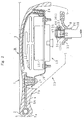
- Fig. 2 is a sectional view taken along the line II-II of Fig. 3.
- a steering wheel body 1 of the steering wheel W comprises an annular ring 2, a pad 3 disposed in the center of the ring 2, and three spokes 4 extending from the ring 2 to the pad 3.
- This embodiment can also be materialized in a steering wheel having two or not less than four spoke core bars.
- the ring 2 is constituted by a ring core bar 5 made of steel pipe, for example, and a sheath 7a covering it, while the spokes 4 are constituted by spoke core bars 6A, 6B, 6C made of lightweight die-cast metal such as aluminum alloy and a sheath 7b covering them.
- the sheaths 7a, 7b and the pad 3 are integrally made of soft synthetic resin (such as polyurethane foam).
- the steering wheel body 1 is assembled and fixed to a boss 8. This assembling structure will be described below in detail.
- a concave housing portion 11 enclosed by the sheath 7b.
- a membrane switch (not shown) and an air bag device generally indicated at 13.
- the membrane switch has upper and lower thin plates constituting a part of a horn switch circuit (not shown) so that depressing of the pad 3 brings the thin plates into contact with each other to sound a horn.
- the air bag device 13 comprises an air bag 14 stored in a folded state, an inflator 15 for filling the air bag 14 with gas for expansion, and a bag holder 16 on which the air bag 14 and the inflator 15 are held and fixed.
- the bag holder 16 is fixed to the spoke core bar 6A or the like with screws 17 as shown in Fig. 2, for example.
- the present invention can also be materialized in a steering wheel of the type that has a shock absorbing member instead of the air bag device 13.
- the boss 8 is integral with the steering wheel body 1. Namely, the boss 8 is connected to the right and left spoke core bars 6B, 6C through connecting portions 21; however, the boss 8 is located below the ring core bar 5 and the spoke core bars 6B, 6C.
- the spoke core bars 6B, 6C are connected to the remaining spoke core bar 6A (adjacent to a driver) by means of sub-connecting portions 22. Due to this structure, the spoke core bars 6A - 6C, the ring core bar 5 and the boss 8 are firmly connected to one another, and a relatively large opening 23 is defined by the boss 8, the connecting portions 21 and the auxiliary connecting portions 22 on the driver side of the boss 8. Further, the spoke core bars 6B, 6C are connected to each other by means of a support bar 24 (see Fig. 2) so as to secure stability when the air bag 14 is inflated.
- the connecting portions 21, the auxiliary connecting portions 22 and the support bar 24 are made of die-cast aluminum like the spoke core bars 6A - 6C.
- a plastic lower cover (not shown) is provided to enclose the underside of the steering wheel body 1.
- a steering shaft 30 is formed at a distal end portion thereof with a serration 31 having a predetermined number of (approx. thirty, in general) teeth 31a, and an annular groove 32 constituting a constricted portion is formed in a vertically middle portion of the serration 31.
- the steering shaft 30 may be formed with the annular groove 32 partially along the circumference instead of being formed along the entire circumference.
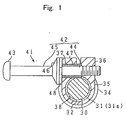
- the boss 8 comprises a tabular boss plate 33, a steel cylindrical portion 34 fixed by welding to the inner periphery of a through hole formed in the center of the plate 33, and a yoke portion 35 formed in an upper portion of the cylindrical portion 34 so as to be generally C-shaped in plan.
- the extreme edge of the boss plate 33 is partially embedded in the spoke core bars 6A - 6C. Owing to this embedding, the boss 8 and the spoke core bars 6A - 6C are connected to each other.
- the C-shaped yoke portion 35 is formed approximately at both ends thereof with through holes 36, 37 having different inside diameters, respectively.
- the through hole 36 of smaller diameter is formed with an internal thread.
- the cylindrical portion 34 is formed at an inner peripheral surface thereof with a serration 38 corresponding to the serration 31 of the steering shaft 30.
- the cylindrical portion 34 is fitted on the end of the steering shaft 30 in such a manner that the serrations 31, 38 mesh with each other.
- a bolt 41 is inserted into the through holes 36, 37 and screwed particularly in the through hole 36 of smaller diameter.
- the bolt 41 includes a shaft 42 and a head 43, the shaft 42 being formed on one end portion thereof with an external thread.
- the shaft 42 is constituted by a general shaft portion 44 located on the external thread side and an extended shaft portion 45, and an enlarged diameter portion 46 is integrally formed between the general shaft portion 44 and the extended shaft portion 45.
- the extended shaft portion 45 and the enlarged diameter portion 46 may be dispensed with.
- a washer 48 is interposed between the collar 47 and the enlarged diameter portion 46. Therefore, the collar 47 is kept immovably fixed between the enlarged diameter portion 46 (washer 48) and the external thread. Alternatively, the washer 48 may be dispensed with.
- the cylindrical portion 34 is fitted in the through hole of the boss plate 33 and welding is performed to couple the two, thereby to constitute the boss 8.
- the ring core bar 5 is formed separately.
- the thus-obtained boss 8 and ring core bar 5 are set in a die (not shown).
- a cavity for forming the spoke core bars 6A - 6C and the like (including the connecting portions 21, the sub-connecting portions 22 and the support bar 24) is defined to be isolated from the yoke portion 35 due to the presence of the boss plate 33.
- molten aluminum is poured into the cavity to fill it up.
- die-cast aluminum is molded in such a manner that the extreme edge of the boss plate 33 is embedded therein, with the result that the spoke core bars 6A - 6C and the like are obtained.
- the membrane switch and the air bag device 13 are inserted through the opening 23 defined by the boss 8, the connecting portions 21 and the sub-connecting portions 22, and the bag holder 16 of the air bag device 13 is fixed to the spoke core bar 6A and the like by means of screws 17 (see Figs. 2 and 5).
- the opening 23 is relatively large, the air bag device 13 can be easily mounted in the steering wheel main body 1.
- the boss 8 integrated with the steering wheel body 1 is fitted on the distal end of the steering shaft 30 in such a manner that the serration 31 of the steering shaft 30 and the serration 38 formed in the cylindrical portion 34 of the boss 8 mesh with each other.
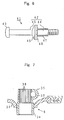
- the bolt 41 integrated with the collar 47 is inserted into the through holes 37, 36 of the yoke portion 35, as shown in Fig. 8.
- the collar 47 is so designed as to be inserted only through the through hole 37 of larger diameter but it may be made longer so as to be partially inserted into the other through hole 36. In this case, however, it is necessary to provide a projection or the like to ensure a sufficient thread tolerance.
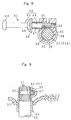
- the external thread of the bolt 41 is screwed in the through hole 36 formed with the internal thread. This screwing causes the serrations 31, 38 to further mesh with each other (or come into surface contact with each other) and the yoke portion 35 to be tightened as shown in Figs.
- the boss 8 and hence the steering wheel W are restrained from moving in the direction of rotation with respect to the steering shaft 30.
- the collar 47 on the outer periphery of the bolt 41 is inserted into (fitted in) the annular groove 32 of the steering shaft 30, so that the boss 8 and hence the steering wheel W are restrained from moving vertically. Owing to these restraints, the steering wheel W can be fixed on the steering shaft 30.
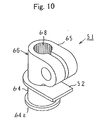
- a boss 51 of this embodiment comprises, as shown in Fig. 10, a boss body 66 composed of a cylindrical portion 64 and a yoke portion 65, and a flange 52 formed integrally with the cylindrical portion 64.
- the flange 52 is formed in a non-circular shape.
- the boss 51 may be made by any method but it can be generally made by one of the methods including cold forging, hot forging, press working and machining or by a suitable combination of these methods. For instance, softened steel is roughly shaped with a die and then subjected to drilling, threading, slitting and the like, thereby making a boss.
- the serration 68 may be formed after molding die-cast aluminum to be described below. This makes it possible to prevent the serration 68 from being adversely affected by heat transfer at the time of casting.
- the cylindrical portion 64 is formed integrally with a flange portion 64a at the lowermost end thereof as well.
- the flange portion 64a may be dispensed with.
- the shapes of the flange 52 and the flange portion 64a are not limited to those of this embodiment.
- a die-cast aluminum connecting portion 53 is disposed around the cylindrical portion 64 in a position between the flange 52 and the flange portion 64a, and the connecting portion 53 is connected to the spoke core bars 6A - 6C.
- the connecting portion 53 is made of die-cast aluminum in the same manner as the spoke core bars 6A - 6C so as to be integral therewith.
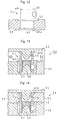
- a die 54 consists of a first split die 55 and a second split die 56.
- the second split die 56 is formed with a concave portion 57 for housing the yoke portion 65 and a positioning projection 58.
- the first split die 55 is formed integrally with a positioning pin 59 which faces the positioning projection 58.
- the yoke portion 65 of the boss 51 is set in the concave portion 57 so as to be fitted on the positioning projection 58, and the cylindrical portion 64 is so set as to be fitted on the positioning pin 59, and thereafter, both split dies 55, 57 are fastened to each other.
- the ring core bar 5 in the die 54 it is a matter of course to set the ring core bar 5 in the die 54 as well, although this is not shown.
- Due to fastening of die a cavity 60 for forming the connecting portion 53 and the spoke core bars 6A - 6C is provided between the first and second split dies 55 and 56.
- the cavity 60 is isolated from the yoke portion 65 (concave portion 57) due to presence of the flange 52 and the like.
- molten aluminum is poured into the cavity 60 to fill it up as shown in Fig. 14.
- the molten aluminum is prevented from flowing to the yoke portion 65 (concave portion 57) within the die 54. Therefore, as described above, the die-cast aluminum is molded around the cylindrical portion 64 with the flange 52 and the flange portion 64a embedded therein, with the result that the connecting portion 53, the spoke core bars 6A - 6C and the like are obtained.
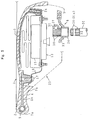
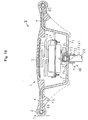
- Fig. 16 is a sectional view of a steering wheel W according to this embodiment
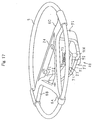
- Fig. 17 is a perspective view showing core bar portions.
- the same components or members as those of the first embodiment are designated by the same reference numerals, and an explanation thereof is omitted. The following description lays special emphasis on differences from the first embodiment.
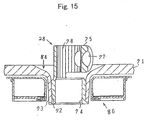
- a boss 28 is connected to spoke core bars 6A - 6C so as to be integral with a steering wheel body 1. Namely, as shown in Figs. 15, 17, the boss 28 is connected to the right and left spoke core bars 6B and 6C through a connecting portion 71. In other words, the right and left spoke core bars 6B, 6C are connected to each other by means of the connecting portion 71 which is in turn connected to the boss 28.
- the boss 28 is made of steel, while the connecting portion 71, sub-connecting portions 22 and a support bar 24 are each made of die-cast aluminum similarly to the spoke core bars 6B, 6C.
- a through hole 72 is formed in substantially the central portion of the connecting portion 71.
- the through hole 72 is formed integrally with a cylinder portion 73 projecting downwardly.
- the through hole 72 of this embodiment therefore, has a predetermined depth.
- a concave portion 84 is formed around the peripheral edge of the through hole 72.
- a guide groove 71A for guiding a bolt 91 toward the through hole 72.
- a relay spiral cable 86 disposed around the cylinder portion 73.
- the through hole 72 is so tapered as to be reduced in diameter towards its lower end.
- a cylindrical portion 74 of the boss 28 Into the through hole 72 formed by the cylinder portion 73 is press-fitted a cylindrical portion 74 of the boss 28.
- the cylindrical portion 74 is also tapered at the beginning so as to be reduced in diameter towards its lower end (see Fig. 19), and the outer peripheral surface thereof corresponds to the inner peripheral surface of the through hole 72. Further, the cylindrical portion 74 is formed in a portion of the outer peripheral surface thereof with a partially flattened detent 74a.
- the through hole 72 is also formed with a detent (not shown) in a portion of the inner peripheral surface thereof corresponding to the detent 74a.
- a ring core bar 5 is formed.
- This ring core bar 5 is then set in a die (not shown).
- a cavity for forming the spoke core bars 6A - 6C and the like (including the connecting portion 71, sub-connecting portion 22 and the support bar 24) is defined in the die.
- the boss is never set in the die of this embodiment as an insert. Therefore, degree of freedom in shape of the cavity (hence the connecting portion 71, the spoke core bars 6A - 6C and the like) can be increased.
- molten aluminum is poured into the cavity to fill it up. Thereafter, by virtue of the aluminum cooling and solidifying, the connecting portion 71 with the through hole 72 and the spoke core bars 6A - 6C can be obtained.
- the boss 28 is formed separately by means of cold forging, hot forging, machining, press working or the like. Subsequently, the thus-obtained boss 28 is press-fitted in the through hole 72 in such a manner that the detent 74a meets the detent on the inner peripheral surface of the through hole 72. That is to say, the detent 74a also serves as a kind of positioning means. Then, as shown in Fig. 15, the press-fitted boss 28 is increased in diameter such that the tapered end portion of the cylindrical portion 74 extending beyond the distal end of the cylinder portion 73 is subjected to caulking.
- a membrane switch and an air bag device 13 are mounted in the steering wheel body 1 in the same manner as in the first embodiment. Thereafter, the boss 28 is fitted on the distal end of the steering shaft 30 in the same manner as in the first embodiment.
- the spoke core bars were formed by die casting with the boss set in the die as an insert, it will do in this embodiment to fix the boss 28 after forming the spoke core bars 6A - 6C and the like. Therefore, even if the boss 28 is of the type that has an opening (yoke type) like this embodiment, the boss structure can be materialized without fail. Further, the boss 28 can be firmly fixed to the connecting portion 71 due to frictional force between the boss 28 and the inner peripheral surface of the through hole 72 and an increase in diameter of the distal end of the cylindrical portion 74. In consequence, adoption of the spoke core bars 6A - 6C made of die-cast aluminum makes it possible to reduce the weight and increase the degree of freedom in shape of the boss 28. Further, it is possible to ensure the stability of mounting condition.
- the guide groove 71A for guiding the bolt 91 is formed in the upper surface of the connecting portion 71. It is therefore possible to perform the screwing operation without difficulty even if the yoke portion 75 is positioned as low as possible, thereby making it possible to easily secure the boss 28.
- the boss 28 (cylindrical portion 74) is formed in a portion thereof with the detent 74a and the through hole 72 is formed in the inner peripheral surface thereof with the detent. This contributes to restraining the rotation of the boss 28 relative to the connecting portion 71. It is therefore possible to secure the boss 28 to the connecting portion 71 more firmly.
- a steering wheel body 1 comprises sheaths 7a, 7b which covers a ring core bar 5 and spoke core bars 6A - 6C, and a pad 3 formed integrally with the sheaths.
- a boss 8, 51, 28 is integral with the spoke core bars.
- a steering shaft 30 is formed at a distal end thereof with a serration 31 and an annular groove 32.
- the boss 8, 51, 28 includes a boss plate 33, a cylindrical portion 34, 74 with a serration 38, 68, 78, and a yoke portion 35 with through holes 36, 37, 66, 67, 76, 77.
- the cylindrical portion 34, 64, 74 is fitted on the end of the steering shaft 30 such that the serrations 31, 38, 68, 78 mesh with each other, and a bolt 41, 81, 91 is inserted and screwed into the through holes 36, 37, 66, 67, 76, 77.
- a collar 47 fitted on the bolt 41, 81, 91 is fitted in the annular groove 32. Strain stress is never transmitted directly to the bolt 41, 81, 91.
- the boss 8, 51, 28 comprises a boss body 66 composed of the cylindrical portion 34, 64, 74 and the yoke portion 35, 65, 75, and the boss plate 33 fixed by welding to the boss body.
- the boss plate 33, 53 serves as a seal in a die so that molten aluminum is prevented from going around to the inside of the cylindrical portion 34, 64, 74 through an opening of the yoke portion 35, 65, 75, and therefore the extreme edge of the boss plate 33, 53 can be embedded in the spoke core bars 6A - 6C.
- a connecting portion 71 for connecting the spoke core bars 6B, 6C to each other is made of aluminum by casting together with the core bars.
- the connecting portion 71 is formed with a tapered through hole 72.
- the cylindrical portion 74 of the boss 28 formed separately is press-fitted in the through hole 72 and the distal end portion of the cylindrical portion 74 is subjected to caulking to be increased in diameter, so that the boss 28 is firmly fixed to the connecting portion 71. Even if the boss 28 is of the shape with an opening, the boss structure can be materialized without fail.
- a steering wheel comprising a boss 51 adapted to be fitted on a steering shaft 30 having a serration 31 composed of a plurality of teeth 31a formed on an outer periphery thereof.
- Said boss 51 includes a cylindrical portion 64 with a serration 68 corresponding to said serration 31 on an inner periphery thereof, and a yoke portion 65 provided integral with said cylindrical portion 64 having through holes 36, 37 formed substantially at both ends thereof, wherein at least one 36 of said through holes 36, 37 being formed with an internal thread.
- a steering wheel body 1 including a ring core bar 5, spoke core bars 6A, 6B, 6C, sheaths 7a, 7b covering said core bars 5, 6A, 6B, 6C, and a pad 3 formed integrally with said sheaths 7a, 7b and located in a substantially central upper portion of a ring 2, part of said spoke core bars 6A, 6B, 6C being connected to said boss 51.
- Said boss 51 comprises a boss body 66 composed of said cylindrical portion 64 and said yoke portion 65, and a boss plate 53 fixed by welding to said boss body 66 and having a larger area than said yoke portion 65, and the extreme edge of said boss plate 53 is embedded in said spoke core bars 6A, 6B, 6C.
- said boss 51 comprises said boss body 66 including said cylindrical portion 64 and said yoke portion 65, and a flange 64a, 52 formed integrally with said boss body 66 and having a larger area than said yoke portion 65, and said flange 64, 52 is embedded in said spoke core bars 6A, 6B, 6C.
- a steering wheel boss structure comprising a boss 28 adapted to be fixedly fitted on a steering shaft 30 and having at least a generally cylindrical shape, wherein a plurality of spoke core bars 6A, 6B, 6C made of die-cast aluminum and extending from an annular ring core bar 5 toward approximately the center thereof, and a connecting portion 71 formed integrally with said spoke core bars 6B, 6C so as to connect said spoke core bars 6B, 6C to one another while being connected to said boss (28).
- Said connecting portion 71 is formed therein with a tapered through hole 72, wherein said boss 28 is press-fitted in said through hole 72, and at least a tapered distal end of said boss 28 is increased in diameter so that said boss 28 is fixed to said connecting portion.
Landscapes
- Engineering & Computer Science (AREA)
- Mechanical Engineering (AREA)
- Chemical & Material Sciences (AREA)
- Combustion & Propulsion (AREA)
- Transportation (AREA)
- Steering Controls (AREA)
Applications Claiming Priority (7)
| Application Number | Priority Date | Filing Date | Title |
|---|---|---|---|
| JP03824196A JP3209076B2 (ja) | 1996-02-26 | 1996-02-26 | ステアリングホイールの取付構造 |
| JP3824196 | 1996-02-26 | ||
| JP5580596 | 1996-03-13 | ||
| JP5580496 | 1996-03-13 | ||
| JP8055804A JP3070471B2 (ja) | 1996-03-13 | 1996-03-13 | ステアリングホイール |
| JP5580596A JPH09240491A (ja) | 1996-03-13 | 1996-03-13 | ステアリングホイール及びそのボス構造 |
| EP97100137A EP0791520B1 (de) | 1996-02-26 | 1997-01-07 | Lenkrad,Montageanordnung und Nabenstruktur dafür |
Related Parent Applications (2)
| Application Number | Title | Priority Date | Filing Date |
|---|---|---|---|
| EP97100137A Division EP0791520B1 (de) | 1996-02-26 | 1997-01-07 | Lenkrad,Montageanordnung und Nabenstruktur dafür |
| EP97100137.5 Division | 1997-01-07 |
Publications (3)
| Publication Number | Publication Date |
|---|---|
| EP1004496A2 true EP1004496A2 (de) | 2000-05-31 |
| EP1004496A3 EP1004496A3 (de) | 2000-06-28 |
| EP1004496B1 EP1004496B1 (de) | 2006-09-27 |
Family
ID=27289752
Family Applications (2)
| Application Number | Title | Priority Date | Filing Date |
|---|---|---|---|
| EP97100137A Expired - Lifetime EP0791520B1 (de) | 1996-02-26 | 1997-01-07 | Lenkrad,Montageanordnung und Nabenstruktur dafür |
| EP00105873A Expired - Lifetime EP1004496B1 (de) | 1996-02-26 | 1997-01-07 | Lenkrad, Montageanordnung und Nabenstruktur dafür |
Family Applications Before (1)
| Application Number | Title | Priority Date | Filing Date |
|---|---|---|---|
| EP97100137A Expired - Lifetime EP0791520B1 (de) | 1996-02-26 | 1997-01-07 | Lenkrad,Montageanordnung und Nabenstruktur dafür |
Country Status (4)
| Country | Link |
|---|---|
| US (3) | US5855145A (de) |
| EP (2) | EP0791520B1 (de) |
| AU (1) | AU683813B2 (de) |
| DE (2) | DE69711968T2 (de) |
Cited By (2)
| Publication number | Priority date | Publication date | Assignee | Title |
|---|---|---|---|---|
| EP1228940A3 (de) * | 2001-02-01 | 2003-12-03 | TRW Automotive Safety Systems GmbH & Co. KG | Fahrzeuglenkrad |
| EP1813503A1 (de) * | 2006-01-31 | 2007-08-01 | Toyoda Gosei Co., Ltd. | Lenkradverkleidung |
Families Citing this family (18)
| Publication number | Priority date | Publication date | Assignee | Title |
|---|---|---|---|---|
| DE19616234C2 (de) * | 1996-04-15 | 1998-07-16 | Petri Ag | Vorrichtung für die Befestigung einer Nabe auf einer Welle, insbesondere einer Lenkradnabe auf einer Lenksäule |
| US6367351B2 (en) | 1998-01-13 | 2002-04-09 | Toyoda Gosei Co., Ltd. | Steering wheel |
| DE19844471B4 (de) * | 1997-09-29 | 2005-09-01 | Toyoda Gosei Co., Ltd., Nishikasugai | Lenkrad |
| US6276865B1 (en) * | 1998-10-30 | 2001-08-21 | The Torrington Company | Steering column shaft clamp |
| FR2796892B1 (fr) * | 1999-07-28 | 2001-10-19 | Sc2N Sa | Systeme de fixation d'une platine de commande sur une colonne de direction de mise en oeuvre aisee |
| US6568702B1 (en) * | 2000-02-04 | 2003-05-27 | Breed Automotive Technology, Inc. | No housing driver's air bag module |
| US6314833B1 (en) | 2000-05-31 | 2001-11-13 | Trw Inc. | Apparatus for attaching a vehicle steering wheel to a vehicle steering shaft |
| US6318756B1 (en) * | 2000-09-14 | 2001-11-20 | Trw Inc. | Apparatus for attaching a steering wheel to a steering shaft |
| JP3431012B2 (ja) * | 2000-10-10 | 2003-07-28 | 豊田合成株式会社 | ステアリングホイール |
| USD480668S1 (en) | 2002-09-12 | 2003-10-14 | Bell Automotive Products, Inc. | Steering wheel cover packaging insert |
| US6925714B2 (en) * | 2002-12-19 | 2005-08-09 | Delphi Technologies, Inc. | Upper steering shaft-assembly |
| US20060230873A1 (en) * | 2005-04-15 | 2006-10-19 | Takata-Petri Inc. | Steering wheel and method of manufacturing |
| USD566146S1 (en) * | 2007-03-22 | 2008-04-08 | Elesa S.P.A. | Handwheel |
| US7891902B2 (en) * | 2007-06-19 | 2011-02-22 | Robotzone, Llc | Hobby servo shaft adapter |
| JP4992982B2 (ja) * | 2009-04-07 | 2012-08-08 | トヨタ自動車株式会社 | シャフト結合構造 |
| JP5964650B2 (ja) * | 2012-05-14 | 2016-08-03 | 日本プラスト株式会社 | フィニッシャーを取り付けたステアリングホイール |
| FR3006400B1 (fr) * | 2013-05-29 | 2015-06-19 | Zf Systemes De Direction Nacam Sas | Assemblage securise de deux pieces par vissage |
| US11011957B2 (en) | 2016-11-15 | 2021-05-18 | Robotzone, Llc | Servo shaft couplers |
Citations (2)
| Publication number | Priority date | Publication date | Assignee | Title |
|---|---|---|---|---|
| JPS6060065U (ja) | 1983-09-30 | 1985-04-26 | 富士通株式会社 | 磁気デイスク装置 |
| JPH02133955U (de) | 1989-04-13 | 1990-11-07 |
Family Cites Families (40)
| Publication number | Priority date | Publication date | Assignee | Title |
|---|---|---|---|---|
| GB655837A (en) * | 1948-12-02 | 1951-08-01 | Bluemel Brothers Ltd | Improvements in or relating to steering wheels for motor road vehicles |
| FR997670A (fr) * | 1949-09-23 | 1952-01-09 | Dispositif pour caler les volants de direction à deux bras | |
| DE1094610B (de) * | 1956-03-08 | 1960-12-08 | Petri Lenkradwerk | Abnehmbares Lenkrad fuer Kraftfahrzeuge |
| DE1015704B (de) * | 1956-03-08 | 1957-09-12 | Petri Lenkradwerk | Abnehmbares Lenkrad fuer Kraftfahrzeuge |
| GB2058694A (en) * | 1979-09-17 | 1981-04-15 | Faul T L | Steering Wheel |
| GB2102092B (en) * | 1981-06-17 | 1985-04-03 | Rawcliffe Laurence Carl | Locking means |
| GB2101092A (en) * | 1981-06-24 | 1983-01-12 | Ashton Containers | A stackable box or tray |
| JPS606005A (ja) * | 1983-06-24 | 1985-01-12 | Toshiba Corp | タ−ビンの過速トリツプ装置 |
| JPS6060065A (ja) * | 1983-09-12 | 1985-04-06 | Toyoda Gosei Co Ltd | ステアリングホイ−ル |
| FR2557992B1 (fr) * | 1984-01-06 | 1986-11-07 | Eckendorff Jean Pierre | Dispositif pour regler la position angulaire d'un organe cale en rotation avec un arbre, notamment volant de vehicule automobile associe a une colonne de direction. |
| US4685848A (en) * | 1985-02-12 | 1987-08-11 | Langer Alfred C | Gear headed fastener and drive tool structure |
| JPS62149552A (ja) * | 1985-08-29 | 1987-07-03 | Toyoda Gosei Co Ltd | ステアリングホイ−ルの振動抑制装置 |
| CA1271112A (en) * | 1986-01-14 | 1990-07-03 | Nihon Plast Co., Ltd. | Steering wheel |
| JPS63134368A (ja) * | 1986-11-22 | 1988-06-06 | Toyoda Gosei Co Ltd | ステアリングホイ−ル取付構造 |
| DE3700968A1 (de) * | 1987-01-15 | 1988-08-04 | Bosch Gmbh Robert | Spanneinrichtung zum axialen festspannen eines werkzeuges, insbesondere einer scheibe |
| FR2614951B1 (fr) * | 1987-05-05 | 1989-08-25 | Laurencot Jean | Dispositif d'assemblage par vissage a axe inaccessible |
| IT1210743B (it) * | 1987-05-19 | 1989-09-20 | Fiat Auto Spa | Dispositivo per il corretto posizionamento dell albero inferiore comando sterzo al pignone scatola sterzo ed all albero superiore |
| JPH0545588Y2 (de) * | 1988-08-08 | 1993-11-22 | ||
| JPH02133955A (ja) * | 1988-11-15 | 1990-05-23 | Mitsubishi Electric Corp | 半導体集積回路装置 |
| US5267486A (en) * | 1989-11-30 | 1993-12-07 | Toyoda Gosei Co., Ltd. | Steering wheel with pad |
| US5144861A (en) * | 1990-03-19 | 1992-09-08 | Nihon Plast Co., Ltd. | Steering wheel construction |
| JP2559893B2 (ja) * | 1990-08-09 | 1996-12-04 | 日本プラスト株式会社 | ステアリングホイール |
| IT1240545B (it) * | 1990-09-11 | 1993-12-17 | Gallino Componenti Plastici S.P.A. | Dispositivo di accoppiamento fra il mozzo di un volante di un autoveicolo ed il relativo piantone |
| FR2675106B1 (fr) * | 1991-04-10 | 1993-08-13 | Ecia Equip Composants Ind Auto | Dispositif de serrage de securite d'un organe male dans un etrier d'un organe femelle, utilisable notamment pour relier deux portions d'une colonne de direction de vehicule automobile. |
| JP2733150B2 (ja) * | 1991-06-26 | 1998-03-30 | 株式会社河合楽器製作所 | ピアノの自動演奏方法及び装置 |
| USD347820S (en) | 1992-05-14 | 1994-06-14 | Mike Plymale | Vehicle steering wheel with air bag |
| JPH06285607A (ja) * | 1993-04-07 | 1994-10-11 | Toyoda Gosei Co Ltd | ステアリングホイール芯金の製造方法 |
| GB2282574B (en) * | 1993-10-05 | 1997-01-15 | Autoliv Dev | A steering wheel |
| US5510747A (en) * | 1993-11-30 | 1996-04-23 | Siliconix Incorporated | Gate drive technique for a bidirectional blocking lateral MOSFET |
| FR2715906B1 (fr) * | 1994-02-04 | 1996-04-26 | Ecia Equip Composants Ind Auto | Dispositif de fixation d'un organe sur un arbre de direction notamment de véhicule automobile. |
| DE4419078A1 (de) * | 1994-05-31 | 1995-12-07 | Trw Repa Gmbh | Befestigungsvorrichtung für ein Fahrzeuglenkrad |
| US5588337A (en) * | 1994-11-17 | 1996-12-31 | General Motors Corporation | Motor vehicle steering column |
| US5536106A (en) * | 1995-02-09 | 1996-07-16 | General Motors Corporation | Connection between a shaft and a hub |
| JPH09123919A (ja) * | 1995-08-31 | 1997-05-13 | Toyoda Gosei Co Ltd | ステアリングホイールの取付構造 |
| JP3633050B2 (ja) * | 1995-08-31 | 2005-03-30 | 豊田合成株式会社 | ステアリングホイールの取付構造 |
| US5692770A (en) * | 1995-09-15 | 1997-12-02 | Breed Automotive Technology, Inc. | Modular steering wheel and airbag combination |
| DE29516623U1 (de) * | 1995-10-20 | 1996-01-25 | Trw Occupant Restraint Systems Gmbh, 73551 Alfdorf | Befestigung eines Fahrzeuglenkrades an einer Lenkwelle |
| JPH09132149A (ja) * | 1995-11-10 | 1997-05-20 | Toyoda Gosei Co Ltd | ステアリングホイールの取付構造 |
| US5617763A (en) * | 1995-11-24 | 1997-04-08 | General Motors Corporation | Steering wheel for motor vehicle |
| JP3204099B2 (ja) * | 1996-07-01 | 2001-09-04 | 豊田合成株式会社 | ステアリングホイール |
-
1996
- 1996-12-30 AU AU76521/96A patent/AU683813B2/en not_active Ceased
-
1997
- 1997-01-07 EP EP97100137A patent/EP0791520B1/de not_active Expired - Lifetime
- 1997-01-07 EP EP00105873A patent/EP1004496B1/de not_active Expired - Lifetime
- 1997-01-07 DE DE69711968T patent/DE69711968T2/de not_active Expired - Fee Related
- 1997-01-07 DE DE69736749T patent/DE69736749T2/de not_active Expired - Fee Related
- 1997-02-05 US US08/795,793 patent/US5855145A/en not_active Expired - Lifetime
-
1998
- 1998-10-20 US US09/175,463 patent/US5950499A/en not_active Expired - Lifetime
-
1999
- 1999-06-28 US US09/340,049 patent/US6079291A/en not_active Expired - Fee Related
Patent Citations (2)
| Publication number | Priority date | Publication date | Assignee | Title |
|---|---|---|---|---|
| JPS6060065U (ja) | 1983-09-30 | 1985-04-26 | 富士通株式会社 | 磁気デイスク装置 |
| JPH02133955U (de) | 1989-04-13 | 1990-11-07 |
Cited By (3)
| Publication number | Priority date | Publication date | Assignee | Title |
|---|---|---|---|---|
| EP1228940A3 (de) * | 2001-02-01 | 2003-12-03 | TRW Automotive Safety Systems GmbH & Co. KG | Fahrzeuglenkrad |
| EP1813503A1 (de) * | 2006-01-31 | 2007-08-01 | Toyoda Gosei Co., Ltd. | Lenkradverkleidung |
| US8661936B2 (en) | 2006-01-31 | 2014-03-04 | Toyoda Gosei Co. Ltd. | Trim plate for steering wheel |
Also Published As
| Publication number | Publication date |
|---|---|
| EP0791520A1 (de) | 1997-08-27 |
| EP0791520B1 (de) | 2002-04-17 |
| DE69711968D1 (de) | 2002-05-23 |
| US6079291A (en) | 2000-06-27 |
| EP1004496A3 (de) | 2000-06-28 |
| AU683813B2 (en) | 1997-11-20 |
| US5855145A (en) | 1999-01-05 |
| US5950499A (en) | 1999-09-14 |
| DE69736749T2 (de) | 2007-08-16 |
| DE69736749D1 (de) | 2006-11-09 |
| EP1004496B1 (de) | 2006-09-27 |
| DE69711968T2 (de) | 2002-08-29 |
| AU7652196A (en) | 1997-09-04 |
Similar Documents
| Publication | Publication Date | Title |
|---|---|---|
| EP1004496B1 (de) | Lenkrad, Montageanordnung und Nabenstruktur dafür | |
| US5868041A (en) | Reduced vibration shock absorbing deformable steering wheel | |
| US6595083B2 (en) | Steering wheel | |
| US4920821A (en) | Steering wheel for vehicle | |
| US5720494A (en) | Steering wheel with air bag device | |
| US6095552A (en) | Steering wheel with an integral pad portion | |
| EP1134144A1 (de) | Lenkradskelett | |
| US5476022A (en) | Steering wheel core with improved spoke | |
| US6126193A (en) | Steering wheel | |
| JP3209076B2 (ja) | ステアリングホイールの取付構造 | |
| JP3070471B2 (ja) | ステアリングホイール | |
| EP1195313B1 (de) | Schwenkbare Lenkeinrichtung | |
| JPH09240491A (ja) | ステアリングホイール及びそのボス構造 | |
| JP3275843B2 (ja) | ステアリングホイール | |
| JP3114928B2 (ja) | 芯 金 | |
| JP3327163B2 (ja) | ステアリングホイール | |
| JPH11198818A (ja) | ステアリングホイール | |
| JPS6213233B2 (de) | ||
| JP3235469B2 (ja) | ステアリングホイール | |
| JP2000108976A (ja) | 防振バーハンドル | |
| JPH09286340A (ja) | ステアリングホイール | |
| JPH08230684A (ja) | ステアリングホイール | |
| JPH08207782A (ja) | 自動車のステアリングホイール構造 | |
| JPH10119792A (ja) | ステアリングホイール及びその組付方法 | |
| JPH09221040A (ja) | ステアリングホイール |
Legal Events
| Date | Code | Title | Description |
|---|---|---|---|
| PUAI | Public reference made under article 153(3) epc to a published international application that has entered the european phase |
Free format text: ORIGINAL CODE: 0009012 |
|
| PUAL | Search report despatched |
Free format text: ORIGINAL CODE: 0009013 |
|
| AC | Divisional application: reference to earlier application |
Ref document number: 791520 Country of ref document: EP |
|
| AK | Designated contracting states |
Kind code of ref document: A2 Designated state(s): DE FR GB |
|
| RIC1 | Information provided on ipc code assigned before grant |
Free format text: 7B 62D 1/04 A, 7B 62D 1/10 B |
|
| AK | Designated contracting states |
Kind code of ref document: A3 Designated state(s): DE FR GB |
|
| 17P | Request for examination filed |
Effective date: 20000508 |
|
| RIC1 | Information provided on ipc code assigned before grant |
Free format text: 7B 62D 1/04 A |
|
| RIN1 | Information on inventor provided before grant (corrected) |
Inventor name: MIZUNO, TAKANORI Inventor name: SAKANE, KATSUNOBU Inventor name: YAMAMOTO, HITOSHI Inventor name: NAGATA, ATSUSHI Inventor name: TAKAMORI, TETSUVA Inventor name: HOSOI, AKIO |
|
| AKX | Designation fees paid |
Free format text: DE FR GB |
|
| GRAP | Despatch of communication of intention to grant a patent |
Free format text: ORIGINAL CODE: EPIDOSNIGR1 |
|
| RIN1 | Information on inventor provided before grant (corrected) |
Inventor name: YAMAMOTO, HITOSHI Inventor name: SAKANE, KATSUNOBU Inventor name: MIZUNO, TAKANORI Inventor name: TAKAMORI, TETSUYA Inventor name: NAGATA, ATSUSHI Inventor name: HOSOI, AKIO |
|
| GRAS | Grant fee paid |
Free format text: ORIGINAL CODE: EPIDOSNIGR3 |
|
| GRAA | (expected) grant |
Free format text: ORIGINAL CODE: 0009210 |
|
| AC | Divisional application: reference to earlier application |
Ref document number: 0791520 Country of ref document: EP Kind code of ref document: P |
|
| AK | Designated contracting states |
Kind code of ref document: B1 Designated state(s): DE FR GB |
|
| REG | Reference to a national code |
Ref country code: GB Ref legal event code: FG4D |
|
| REF | Corresponds to: |
Ref document number: 69736749 Country of ref document: DE Date of ref document: 20061109 Kind code of ref document: P |
|
| ET | Fr: translation filed | ||
| PLBE | No opposition filed within time limit |
Free format text: ORIGINAL CODE: 0009261 |
|
| STAA | Information on the status of an ep patent application or granted ep patent |
Free format text: STATUS: NO OPPOSITION FILED WITHIN TIME LIMIT |
|
| 26N | No opposition filed |
Effective date: 20070628 |
|
| PGFP | Annual fee paid to national office [announced via postgrant information from national office to epo] |
Ref country code: DE Payment date: 20080104 Year of fee payment: 12 Ref country code: GB Payment date: 20080102 Year of fee payment: 12 |
|
| PGFP | Annual fee paid to national office [announced via postgrant information from national office to epo] |
Ref country code: FR Payment date: 20080108 Year of fee payment: 12 |
|
| GBPC | Gb: european patent ceased through non-payment of renewal fee |
Effective date: 20090107 |
|
| PG25 | Lapsed in a contracting state [announced via postgrant information from national office to epo] |
Ref country code: DE Free format text: LAPSE BECAUSE OF NON-PAYMENT OF DUE FEES Effective date: 20090801 |
|
| REG | Reference to a national code |
Ref country code: FR Ref legal event code: ST Effective date: 20091030 |
|
| PG25 | Lapsed in a contracting state [announced via postgrant information from national office to epo] |
Ref country code: GB Free format text: LAPSE BECAUSE OF NON-PAYMENT OF DUE FEES Effective date: 20090107 |
|
| PG25 | Lapsed in a contracting state [announced via postgrant information from national office to epo] |
Ref country code: FR Free format text: LAPSE BECAUSE OF NON-PAYMENT OF DUE FEES Effective date: 20090202 |