EP0991940B1 - Verwendung monolithischer sorbentien für präparative chromatographische trennverfahren - Google Patents
Verwendung monolithischer sorbentien für präparative chromatographische trennverfahren Download PDFInfo
- Publication number
- EP0991940B1 EP0991940B1 EP98933607A EP98933607A EP0991940B1 EP 0991940 B1 EP0991940 B1 EP 0991940B1 EP 98933607 A EP98933607 A EP 98933607A EP 98933607 A EP98933607 A EP 98933607A EP 0991940 B1 EP0991940 B1 EP 0991940B1
- Authority
- EP
- European Patent Office
- Prior art keywords
- separation
- cellulose
- monolithic
- sorbent
- carried out
- Prior art date
- Legal status (The legal status is an assumption and is not a legal conclusion. Google has not performed a legal analysis and makes no representation as to the accuracy of the status listed.)
- Expired - Lifetime
Links
Images
Classifications
-
- B—PERFORMING OPERATIONS; TRANSPORTING
- B01—PHYSICAL OR CHEMICAL PROCESSES OR APPARATUS IN GENERAL
- B01J—CHEMICAL OR PHYSICAL PROCESSES, e.g. CATALYSIS OR COLLOID CHEMISTRY; THEIR RELEVANT APPARATUS
- B01J20/00—Solid sorbent compositions or filter aid compositions; Sorbents for chromatography; Processes for preparing, regenerating or reactivating thereof
- B01J20/281—Sorbents specially adapted for preparative, analytical or investigative chromatography
- B01J20/282—Porous sorbents
- B01J20/283—Porous sorbents based on silica
-
- B—PERFORMING OPERATIONS; TRANSPORTING
- B01—PHYSICAL OR CHEMICAL PROCESSES OR APPARATUS IN GENERAL
- B01D—SEPARATION
- B01D15/00—Separating processes involving the treatment of liquids with solid sorbents; Apparatus therefor
- B01D15/08—Selective adsorption, e.g. chromatography
- B01D15/10—Selective adsorption, e.g. chromatography characterised by constructional or operational features
- B01D15/18—Selective adsorption, e.g. chromatography characterised by constructional or operational features relating to flow patterns
- B01D15/1814—Recycling of the fraction to be distributed
- B01D15/1821—Simulated moving beds
-
- B—PERFORMING OPERATIONS; TRANSPORTING
- B01—PHYSICAL OR CHEMICAL PROCESSES OR APPARATUS IN GENERAL
- B01J—CHEMICAL OR PHYSICAL PROCESSES, e.g. CATALYSIS OR COLLOID CHEMISTRY; THEIR RELEVANT APPARATUS
- B01J20/00—Solid sorbent compositions or filter aid compositions; Sorbents for chromatography; Processes for preparing, regenerating or reactivating thereof
- B01J20/02—Solid sorbent compositions or filter aid compositions; Sorbents for chromatography; Processes for preparing, regenerating or reactivating thereof comprising inorganic material
- B01J20/10—Solid sorbent compositions or filter aid compositions; Sorbents for chromatography; Processes for preparing, regenerating or reactivating thereof comprising inorganic material comprising silica or silicate
- B01J20/103—Solid sorbent compositions or filter aid compositions; Sorbents for chromatography; Processes for preparing, regenerating or reactivating thereof comprising inorganic material comprising silica or silicate comprising silica
-
- B—PERFORMING OPERATIONS; TRANSPORTING
- B01—PHYSICAL OR CHEMICAL PROCESSES OR APPARATUS IN GENERAL
- B01J—CHEMICAL OR PHYSICAL PROCESSES, e.g. CATALYSIS OR COLLOID CHEMISTRY; THEIR RELEVANT APPARATUS
- B01J20/00—Solid sorbent compositions or filter aid compositions; Sorbents for chromatography; Processes for preparing, regenerating or reactivating thereof
- B01J20/22—Solid sorbent compositions or filter aid compositions; Sorbents for chromatography; Processes for preparing, regenerating or reactivating thereof comprising organic material
- B01J20/26—Synthetic macromolecular compounds
- B01J20/261—Synthetic macromolecular compounds obtained by reactions only involving carbon to carbon unsaturated bonds
-
- B—PERFORMING OPERATIONS; TRANSPORTING
- B01—PHYSICAL OR CHEMICAL PROCESSES OR APPARATUS IN GENERAL
- B01J—CHEMICAL OR PHYSICAL PROCESSES, e.g. CATALYSIS OR COLLOID CHEMISTRY; THEIR RELEVANT APPARATUS
- B01J20/00—Solid sorbent compositions or filter aid compositions; Sorbents for chromatography; Processes for preparing, regenerating or reactivating thereof
- B01J20/22—Solid sorbent compositions or filter aid compositions; Sorbents for chromatography; Processes for preparing, regenerating or reactivating thereof comprising organic material
- B01J20/26—Synthetic macromolecular compounds
- B01J20/262—Synthetic macromolecular compounds obtained otherwise than by reactions only involving carbon to carbon unsaturated bonds, e.g. obtained by polycondensation
-
- B—PERFORMING OPERATIONS; TRANSPORTING
- B01—PHYSICAL OR CHEMICAL PROCESSES OR APPARATUS IN GENERAL
- B01J—CHEMICAL OR PHYSICAL PROCESSES, e.g. CATALYSIS OR COLLOID CHEMISTRY; THEIR RELEVANT APPARATUS
- B01J20/00—Solid sorbent compositions or filter aid compositions; Sorbents for chromatography; Processes for preparing, regenerating or reactivating thereof
- B01J20/22—Solid sorbent compositions or filter aid compositions; Sorbents for chromatography; Processes for preparing, regenerating or reactivating thereof comprising organic material
- B01J20/26—Synthetic macromolecular compounds
- B01J20/264—Synthetic macromolecular compounds derived from different types of monomers, e.g. linear or branched copolymers, block copolymers, graft copolymers
-
- B—PERFORMING OPERATIONS; TRANSPORTING
- B01—PHYSICAL OR CHEMICAL PROCESSES OR APPARATUS IN GENERAL
- B01J—CHEMICAL OR PHYSICAL PROCESSES, e.g. CATALYSIS OR COLLOID CHEMISTRY; THEIR RELEVANT APPARATUS
- B01J20/00—Solid sorbent compositions or filter aid compositions; Sorbents for chromatography; Processes for preparing, regenerating or reactivating thereof
- B01J20/28—Solid sorbent compositions or filter aid compositions; Sorbents for chromatography; Processes for preparing, regenerating or reactivating thereof characterised by their form or physical properties
- B01J20/28014—Solid sorbent compositions or filter aid compositions; Sorbents for chromatography; Processes for preparing, regenerating or reactivating thereof characterised by their form or physical properties characterised by their form
- B01J20/28016—Particle form
-
- B—PERFORMING OPERATIONS; TRANSPORTING
- B01—PHYSICAL OR CHEMICAL PROCESSES OR APPARATUS IN GENERAL
- B01J—CHEMICAL OR PHYSICAL PROCESSES, e.g. CATALYSIS OR COLLOID CHEMISTRY; THEIR RELEVANT APPARATUS
- B01J20/00—Solid sorbent compositions or filter aid compositions; Sorbents for chromatography; Processes for preparing, regenerating or reactivating thereof
- B01J20/28—Solid sorbent compositions or filter aid compositions; Sorbents for chromatography; Processes for preparing, regenerating or reactivating thereof characterised by their form or physical properties
- B01J20/28014—Solid sorbent compositions or filter aid compositions; Sorbents for chromatography; Processes for preparing, regenerating or reactivating thereof characterised by their form or physical properties characterised by their form
- B01J20/28042—Shaped bodies; Monolithic structures
-
- B—PERFORMING OPERATIONS; TRANSPORTING
- B01—PHYSICAL OR CHEMICAL PROCESSES OR APPARATUS IN GENERAL
- B01J—CHEMICAL OR PHYSICAL PROCESSES, e.g. CATALYSIS OR COLLOID CHEMISTRY; THEIR RELEVANT APPARATUS
- B01J20/00—Solid sorbent compositions or filter aid compositions; Sorbents for chromatography; Processes for preparing, regenerating or reactivating thereof
- B01J20/28—Solid sorbent compositions or filter aid compositions; Sorbents for chromatography; Processes for preparing, regenerating or reactivating thereof characterised by their form or physical properties
- B01J20/28054—Solid sorbent compositions or filter aid compositions; Sorbents for chromatography; Processes for preparing, regenerating or reactivating thereof characterised by their form or physical properties characterised by their surface properties or porosity
- B01J20/28078—Pore diameter
- B01J20/28083—Pore diameter being in the range 2-50 nm, i.e. mesopores
-
- B—PERFORMING OPERATIONS; TRANSPORTING
- B01—PHYSICAL OR CHEMICAL PROCESSES OR APPARATUS IN GENERAL
- B01J—CHEMICAL OR PHYSICAL PROCESSES, e.g. CATALYSIS OR COLLOID CHEMISTRY; THEIR RELEVANT APPARATUS
- B01J20/00—Solid sorbent compositions or filter aid compositions; Sorbents for chromatography; Processes for preparing, regenerating or reactivating thereof
- B01J20/28—Solid sorbent compositions or filter aid compositions; Sorbents for chromatography; Processes for preparing, regenerating or reactivating thereof characterised by their form or physical properties
- B01J20/28054—Solid sorbent compositions or filter aid compositions; Sorbents for chromatography; Processes for preparing, regenerating or reactivating thereof characterised by their form or physical properties characterised by their surface properties or porosity
- B01J20/28078—Pore diameter
- B01J20/28085—Pore diameter being more than 50 nm, i.e. macropores
-
- B—PERFORMING OPERATIONS; TRANSPORTING
- B01—PHYSICAL OR CHEMICAL PROCESSES OR APPARATUS IN GENERAL
- B01J—CHEMICAL OR PHYSICAL PROCESSES, e.g. CATALYSIS OR COLLOID CHEMISTRY; THEIR RELEVANT APPARATUS
- B01J20/00—Solid sorbent compositions or filter aid compositions; Sorbents for chromatography; Processes for preparing, regenerating or reactivating thereof
- B01J20/28—Solid sorbent compositions or filter aid compositions; Sorbents for chromatography; Processes for preparing, regenerating or reactivating thereof characterised by their form or physical properties
- B01J20/28054—Solid sorbent compositions or filter aid compositions; Sorbents for chromatography; Processes for preparing, regenerating or reactivating thereof characterised by their form or physical properties characterised by their surface properties or porosity
- B01J20/28088—Pore-size distribution
- B01J20/28092—Bimodal, polymodal, different types of pores or different pore size distributions in different parts of the sorbent
-
- B—PERFORMING OPERATIONS; TRANSPORTING
- B01—PHYSICAL OR CHEMICAL PROCESSES OR APPARATUS IN GENERAL
- B01J—CHEMICAL OR PHYSICAL PROCESSES, e.g. CATALYSIS OR COLLOID CHEMISTRY; THEIR RELEVANT APPARATUS
- B01J20/00—Solid sorbent compositions or filter aid compositions; Sorbents for chromatography; Processes for preparing, regenerating or reactivating thereof
- B01J20/281—Sorbents specially adapted for preparative, analytical or investigative chromatography
- B01J20/286—Phases chemically bonded to a substrate, e.g. to silica or to polymers
-
- B—PERFORMING OPERATIONS; TRANSPORTING
- B01—PHYSICAL OR CHEMICAL PROCESSES OR APPARATUS IN GENERAL
- B01J—CHEMICAL OR PHYSICAL PROCESSES, e.g. CATALYSIS OR COLLOID CHEMISTRY; THEIR RELEVANT APPARATUS
- B01J20/00—Solid sorbent compositions or filter aid compositions; Sorbents for chromatography; Processes for preparing, regenerating or reactivating thereof
- B01J20/281—Sorbents specially adapted for preparative, analytical or investigative chromatography
- B01J20/29—Chiral phases
-
- B—PERFORMING OPERATIONS; TRANSPORTING
- B01—PHYSICAL OR CHEMICAL PROCESSES OR APPARATUS IN GENERAL
- B01J—CHEMICAL OR PHYSICAL PROCESSES, e.g. CATALYSIS OR COLLOID CHEMISTRY; THEIR RELEVANT APPARATUS
- B01J20/00—Solid sorbent compositions or filter aid compositions; Sorbents for chromatography; Processes for preparing, regenerating or reactivating thereof
- B01J20/30—Processes for preparing, regenerating, or reactivating
- B01J20/3078—Thermal treatment, e.g. calcining or pyrolizing
-
- B—PERFORMING OPERATIONS; TRANSPORTING
- B01—PHYSICAL OR CHEMICAL PROCESSES OR APPARATUS IN GENERAL
- B01J—CHEMICAL OR PHYSICAL PROCESSES, e.g. CATALYSIS OR COLLOID CHEMISTRY; THEIR RELEVANT APPARATUS
- B01J20/00—Solid sorbent compositions or filter aid compositions; Sorbents for chromatography; Processes for preparing, regenerating or reactivating thereof
- B01J20/30—Processes for preparing, regenerating, or reactivating
- B01J20/3092—Packing of a container, e.g. packing a cartridge or column
-
- B—PERFORMING OPERATIONS; TRANSPORTING
- B01—PHYSICAL OR CHEMICAL PROCESSES OR APPARATUS IN GENERAL
- B01J—CHEMICAL OR PHYSICAL PROCESSES, e.g. CATALYSIS OR COLLOID CHEMISTRY; THEIR RELEVANT APPARATUS
- B01J20/00—Solid sorbent compositions or filter aid compositions; Sorbents for chromatography; Processes for preparing, regenerating or reactivating thereof
- B01J20/30—Processes for preparing, regenerating, or reactivating
- B01J20/32—Impregnating or coating ; Solid sorbent compositions obtained from processes involving impregnating or coating
- B01J20/3202—Impregnating or coating ; Solid sorbent compositions obtained from processes involving impregnating or coating characterised by the carrier, support or substrate used for impregnation or coating
- B01J20/3204—Inorganic carriers, supports or substrates
-
- B—PERFORMING OPERATIONS; TRANSPORTING
- B01—PHYSICAL OR CHEMICAL PROCESSES OR APPARATUS IN GENERAL
- B01J—CHEMICAL OR PHYSICAL PROCESSES, e.g. CATALYSIS OR COLLOID CHEMISTRY; THEIR RELEVANT APPARATUS
- B01J20/00—Solid sorbent compositions or filter aid compositions; Sorbents for chromatography; Processes for preparing, regenerating or reactivating thereof
- B01J20/30—Processes for preparing, regenerating, or reactivating
- B01J20/32—Impregnating or coating ; Solid sorbent compositions obtained from processes involving impregnating or coating
- B01J20/3214—Impregnating or coating ; Solid sorbent compositions obtained from processes involving impregnating or coating characterised by the method for obtaining this coating or impregnating
- B01J20/3217—Resulting in a chemical bond between the coating or impregnating layer and the carrier, support or substrate, e.g. a covalent bond
-
- B—PERFORMING OPERATIONS; TRANSPORTING
- B01—PHYSICAL OR CHEMICAL PROCESSES OR APPARATUS IN GENERAL
- B01J—CHEMICAL OR PHYSICAL PROCESSES, e.g. CATALYSIS OR COLLOID CHEMISTRY; THEIR RELEVANT APPARATUS
- B01J20/00—Solid sorbent compositions or filter aid compositions; Sorbents for chromatography; Processes for preparing, regenerating or reactivating thereof
- B01J20/30—Processes for preparing, regenerating, or reactivating
- B01J20/32—Impregnating or coating ; Solid sorbent compositions obtained from processes involving impregnating or coating
- B01J20/3214—Impregnating or coating ; Solid sorbent compositions obtained from processes involving impregnating or coating characterised by the method for obtaining this coating or impregnating
- B01J20/3217—Resulting in a chemical bond between the coating or impregnating layer and the carrier, support or substrate, e.g. a covalent bond
- B01J20/3219—Resulting in a chemical bond between the coating or impregnating layer and the carrier, support or substrate, e.g. a covalent bond involving a particular spacer or linking group, e.g. for attaching an active group
-
- B—PERFORMING OPERATIONS; TRANSPORTING
- B01—PHYSICAL OR CHEMICAL PROCESSES OR APPARATUS IN GENERAL
- B01J—CHEMICAL OR PHYSICAL PROCESSES, e.g. CATALYSIS OR COLLOID CHEMISTRY; THEIR RELEVANT APPARATUS
- B01J20/00—Solid sorbent compositions or filter aid compositions; Sorbents for chromatography; Processes for preparing, regenerating or reactivating thereof
- B01J20/30—Processes for preparing, regenerating, or reactivating
- B01J20/32—Impregnating or coating ; Solid sorbent compositions obtained from processes involving impregnating or coating
- B01J20/3214—Impregnating or coating ; Solid sorbent compositions obtained from processes involving impregnating or coating characterised by the method for obtaining this coating or impregnating
- B01J20/3225—Impregnating or coating ; Solid sorbent compositions obtained from processes involving impregnating or coating characterised by the method for obtaining this coating or impregnating involving a post-treatment of the coated or impregnated product
- B01J20/3227—Impregnating or coating ; Solid sorbent compositions obtained from processes involving impregnating or coating characterised by the method for obtaining this coating or impregnating involving a post-treatment of the coated or impregnated product by end-capping, i.e. with or after the introduction of functional or ligand groups
-
- B—PERFORMING OPERATIONS; TRANSPORTING
- B01—PHYSICAL OR CHEMICAL PROCESSES OR APPARATUS IN GENERAL
- B01J—CHEMICAL OR PHYSICAL PROCESSES, e.g. CATALYSIS OR COLLOID CHEMISTRY; THEIR RELEVANT APPARATUS
- B01J20/00—Solid sorbent compositions or filter aid compositions; Sorbents for chromatography; Processes for preparing, regenerating or reactivating thereof
- B01J20/30—Processes for preparing, regenerating, or reactivating
- B01J20/32—Impregnating or coating ; Solid sorbent compositions obtained from processes involving impregnating or coating
- B01J20/3231—Impregnating or coating ; Solid sorbent compositions obtained from processes involving impregnating or coating characterised by the coating or impregnating layer
- B01J20/3242—Layers with a functional group, e.g. an affinity material, a ligand, a reactant or a complexing group
- B01J20/3244—Non-macromolecular compounds
- B01J20/3246—Non-macromolecular compounds having a well defined chemical structure
-
- B—PERFORMING OPERATIONS; TRANSPORTING
- B01—PHYSICAL OR CHEMICAL PROCESSES OR APPARATUS IN GENERAL
- B01J—CHEMICAL OR PHYSICAL PROCESSES, e.g. CATALYSIS OR COLLOID CHEMISTRY; THEIR RELEVANT APPARATUS
- B01J20/00—Solid sorbent compositions or filter aid compositions; Sorbents for chromatography; Processes for preparing, regenerating or reactivating thereof
- B01J20/30—Processes for preparing, regenerating, or reactivating
- B01J20/32—Impregnating or coating ; Solid sorbent compositions obtained from processes involving impregnating or coating
- B01J20/3231—Impregnating or coating ; Solid sorbent compositions obtained from processes involving impregnating or coating characterised by the coating or impregnating layer
- B01J20/3242—Layers with a functional group, e.g. an affinity material, a ligand, a reactant or a complexing group
- B01J20/3244—Non-macromolecular compounds
- B01J20/3246—Non-macromolecular compounds having a well defined chemical structure
- B01J20/3248—Non-macromolecular compounds having a well defined chemical structure the functional group or the linking, spacer or anchoring group as a whole comprising at least one type of heteroatom selected from a nitrogen, oxygen or sulfur, these atoms not being part of the carrier as such
- B01J20/3251—Non-macromolecular compounds having a well defined chemical structure the functional group or the linking, spacer or anchoring group as a whole comprising at least one type of heteroatom selected from a nitrogen, oxygen or sulfur, these atoms not being part of the carrier as such comprising at least two different types of heteroatoms selected from nitrogen, oxygen or sulphur
-
- B—PERFORMING OPERATIONS; TRANSPORTING
- B01—PHYSICAL OR CHEMICAL PROCESSES OR APPARATUS IN GENERAL
- B01J—CHEMICAL OR PHYSICAL PROCESSES, e.g. CATALYSIS OR COLLOID CHEMISTRY; THEIR RELEVANT APPARATUS
- B01J20/00—Solid sorbent compositions or filter aid compositions; Sorbents for chromatography; Processes for preparing, regenerating or reactivating thereof
- B01J20/30—Processes for preparing, regenerating, or reactivating
- B01J20/32—Impregnating or coating ; Solid sorbent compositions obtained from processes involving impregnating or coating
- B01J20/3231—Impregnating or coating ; Solid sorbent compositions obtained from processes involving impregnating or coating characterised by the coating or impregnating layer
- B01J20/3242—Layers with a functional group, e.g. an affinity material, a ligand, a reactant or a complexing group
- B01J20/3244—Non-macromolecular compounds
- B01J20/3246—Non-macromolecular compounds having a well defined chemical structure
- B01J20/3248—Non-macromolecular compounds having a well defined chemical structure the functional group or the linking, spacer or anchoring group as a whole comprising at least one type of heteroatom selected from a nitrogen, oxygen or sulfur, these atoms not being part of the carrier as such
- B01J20/3253—Non-macromolecular compounds having a well defined chemical structure the functional group or the linking, spacer or anchoring group as a whole comprising at least one type of heteroatom selected from a nitrogen, oxygen or sulfur, these atoms not being part of the carrier as such comprising a cyclic structure not containing any of the heteroatoms nitrogen, oxygen or sulfur, e.g. aromatic structures
-
- B—PERFORMING OPERATIONS; TRANSPORTING
- B01—PHYSICAL OR CHEMICAL PROCESSES OR APPARATUS IN GENERAL
- B01J—CHEMICAL OR PHYSICAL PROCESSES, e.g. CATALYSIS OR COLLOID CHEMISTRY; THEIR RELEVANT APPARATUS
- B01J20/00—Solid sorbent compositions or filter aid compositions; Sorbents for chromatography; Processes for preparing, regenerating or reactivating thereof
- B01J20/30—Processes for preparing, regenerating, or reactivating
- B01J20/32—Impregnating or coating ; Solid sorbent compositions obtained from processes involving impregnating or coating
- B01J20/3231—Impregnating or coating ; Solid sorbent compositions obtained from processes involving impregnating or coating characterised by the coating or impregnating layer
- B01J20/3242—Layers with a functional group, e.g. an affinity material, a ligand, a reactant or a complexing group
- B01J20/3244—Non-macromolecular compounds
- B01J20/3246—Non-macromolecular compounds having a well defined chemical structure
- B01J20/3248—Non-macromolecular compounds having a well defined chemical structure the functional group or the linking, spacer or anchoring group as a whole comprising at least one type of heteroatom selected from a nitrogen, oxygen or sulfur, these atoms not being part of the carrier as such
- B01J20/3255—Non-macromolecular compounds having a well defined chemical structure the functional group or the linking, spacer or anchoring group as a whole comprising at least one type of heteroatom selected from a nitrogen, oxygen or sulfur, these atoms not being part of the carrier as such comprising a cyclic structure containing at least one of the heteroatoms nitrogen, oxygen or sulfur, e.g. heterocyclic or heteroaromatic structures
-
- B—PERFORMING OPERATIONS; TRANSPORTING
- B01—PHYSICAL OR CHEMICAL PROCESSES OR APPARATUS IN GENERAL
- B01J—CHEMICAL OR PHYSICAL PROCESSES, e.g. CATALYSIS OR COLLOID CHEMISTRY; THEIR RELEVANT APPARATUS
- B01J20/00—Solid sorbent compositions or filter aid compositions; Sorbents for chromatography; Processes for preparing, regenerating or reactivating thereof
- B01J20/30—Processes for preparing, regenerating, or reactivating
- B01J20/32—Impregnating or coating ; Solid sorbent compositions obtained from processes involving impregnating or coating
- B01J20/3231—Impregnating or coating ; Solid sorbent compositions obtained from processes involving impregnating or coating characterised by the coating or impregnating layer
- B01J20/3242—Layers with a functional group, e.g. an affinity material, a ligand, a reactant or a complexing group
- B01J20/3244—Non-macromolecular compounds
- B01J20/3246—Non-macromolecular compounds having a well defined chemical structure
- B01J20/3257—Non-macromolecular compounds having a well defined chemical structure the functional group or the linking, spacer or anchoring group as a whole comprising at least one of the heteroatoms nitrogen, oxygen or sulfur together with at least one silicon atom, these atoms not being part of the carrier as such
-
- B—PERFORMING OPERATIONS; TRANSPORTING
- B01—PHYSICAL OR CHEMICAL PROCESSES OR APPARATUS IN GENERAL
- B01J—CHEMICAL OR PHYSICAL PROCESSES, e.g. CATALYSIS OR COLLOID CHEMISTRY; THEIR RELEVANT APPARATUS
- B01J20/00—Solid sorbent compositions or filter aid compositions; Sorbents for chromatography; Processes for preparing, regenerating or reactivating thereof
- B01J20/30—Processes for preparing, regenerating, or reactivating
- B01J20/32—Impregnating or coating ; Solid sorbent compositions obtained from processes involving impregnating or coating
- B01J20/3231—Impregnating or coating ; Solid sorbent compositions obtained from processes involving impregnating or coating characterised by the coating or impregnating layer
- B01J20/3242—Layers with a functional group, e.g. an affinity material, a ligand, a reactant or a complexing group
- B01J20/3244—Non-macromolecular compounds
- B01J20/3246—Non-macromolecular compounds having a well defined chemical structure
- B01J20/3257—Non-macromolecular compounds having a well defined chemical structure the functional group or the linking, spacer or anchoring group as a whole comprising at least one of the heteroatoms nitrogen, oxygen or sulfur together with at least one silicon atom, these atoms not being part of the carrier as such
- B01J20/3261—Non-macromolecular compounds having a well defined chemical structure the functional group or the linking, spacer or anchoring group as a whole comprising at least one of the heteroatoms nitrogen, oxygen or sulfur together with at least one silicon atom, these atoms not being part of the carrier as such comprising a cyclic structure not containing any of the heteroatoms nitrogen, oxygen or sulfur, e.g. aromatic structures
-
- B—PERFORMING OPERATIONS; TRANSPORTING
- B01—PHYSICAL OR CHEMICAL PROCESSES OR APPARATUS IN GENERAL
- B01J—CHEMICAL OR PHYSICAL PROCESSES, e.g. CATALYSIS OR COLLOID CHEMISTRY; THEIR RELEVANT APPARATUS
- B01J20/00—Solid sorbent compositions or filter aid compositions; Sorbents for chromatography; Processes for preparing, regenerating or reactivating thereof
- B01J20/30—Processes for preparing, regenerating, or reactivating
- B01J20/32—Impregnating or coating ; Solid sorbent compositions obtained from processes involving impregnating or coating
- B01J20/3231—Impregnating or coating ; Solid sorbent compositions obtained from processes involving impregnating or coating characterised by the coating or impregnating layer
- B01J20/3242—Layers with a functional group, e.g. an affinity material, a ligand, a reactant or a complexing group
- B01J20/3244—Non-macromolecular compounds
- B01J20/3246—Non-macromolecular compounds having a well defined chemical structure
- B01J20/3257—Non-macromolecular compounds having a well defined chemical structure the functional group or the linking, spacer or anchoring group as a whole comprising at least one of the heteroatoms nitrogen, oxygen or sulfur together with at least one silicon atom, these atoms not being part of the carrier as such
- B01J20/3263—Non-macromolecular compounds having a well defined chemical structure the functional group or the linking, spacer or anchoring group as a whole comprising at least one of the heteroatoms nitrogen, oxygen or sulfur together with at least one silicon atom, these atoms not being part of the carrier as such comprising a cyclic structure containing at least one of the heteroatoms nitrogen, oxygen or sulfur, e.g. an heterocyclic or heteroaromatic structure
-
- B—PERFORMING OPERATIONS; TRANSPORTING
- B01—PHYSICAL OR CHEMICAL PROCESSES OR APPARATUS IN GENERAL
- B01J—CHEMICAL OR PHYSICAL PROCESSES, e.g. CATALYSIS OR COLLOID CHEMISTRY; THEIR RELEVANT APPARATUS
- B01J20/00—Solid sorbent compositions or filter aid compositions; Sorbents for chromatography; Processes for preparing, regenerating or reactivating thereof
- B01J20/30—Processes for preparing, regenerating, or reactivating
- B01J20/32—Impregnating or coating ; Solid sorbent compositions obtained from processes involving impregnating or coating
- B01J20/3231—Impregnating or coating ; Solid sorbent compositions obtained from processes involving impregnating or coating characterised by the coating or impregnating layer
- B01J20/3242—Layers with a functional group, e.g. an affinity material, a ligand, a reactant or a complexing group
- B01J20/3268—Macromolecular compounds
- B01J20/327—Polymers obtained by reactions involving only carbon to carbon unsaturated bonds
-
- B—PERFORMING OPERATIONS; TRANSPORTING
- B01—PHYSICAL OR CHEMICAL PROCESSES OR APPARATUS IN GENERAL
- B01J—CHEMICAL OR PHYSICAL PROCESSES, e.g. CATALYSIS OR COLLOID CHEMISTRY; THEIR RELEVANT APPARATUS
- B01J20/00—Solid sorbent compositions or filter aid compositions; Sorbents for chromatography; Processes for preparing, regenerating or reactivating thereof
- B01J20/30—Processes for preparing, regenerating, or reactivating
- B01J20/32—Impregnating or coating ; Solid sorbent compositions obtained from processes involving impregnating or coating
- B01J20/3231—Impregnating or coating ; Solid sorbent compositions obtained from processes involving impregnating or coating characterised by the coating or impregnating layer
- B01J20/3242—Layers with a functional group, e.g. an affinity material, a ligand, a reactant or a complexing group
- B01J20/3268—Macromolecular compounds
- B01J20/3272—Polymers obtained by reactions otherwise than involving only carbon to carbon unsaturated bonds
-
- B—PERFORMING OPERATIONS; TRANSPORTING
- B01—PHYSICAL OR CHEMICAL PROCESSES OR APPARATUS IN GENERAL
- B01J—CHEMICAL OR PHYSICAL PROCESSES, e.g. CATALYSIS OR COLLOID CHEMISTRY; THEIR RELEVANT APPARATUS
- B01J20/00—Solid sorbent compositions or filter aid compositions; Sorbents for chromatography; Processes for preparing, regenerating or reactivating thereof
- B01J20/30—Processes for preparing, regenerating, or reactivating
- B01J20/32—Impregnating or coating ; Solid sorbent compositions obtained from processes involving impregnating or coating
- B01J20/3231—Impregnating or coating ; Solid sorbent compositions obtained from processes involving impregnating or coating characterised by the coating or impregnating layer
- B01J20/3242—Layers with a functional group, e.g. an affinity material, a ligand, a reactant or a complexing group
- B01J20/3268—Macromolecular compounds
- B01J20/3272—Polymers obtained by reactions otherwise than involving only carbon to carbon unsaturated bonds
- B01J20/3274—Proteins, nucleic acids, polysaccharides, antibodies or antigens
-
- B—PERFORMING OPERATIONS; TRANSPORTING
- B01—PHYSICAL OR CHEMICAL PROCESSES OR APPARATUS IN GENERAL
- B01J—CHEMICAL OR PHYSICAL PROCESSES, e.g. CATALYSIS OR COLLOID CHEMISTRY; THEIR RELEVANT APPARATUS
- B01J2220/00—Aspects relating to sorbent materials
- B01J2220/50—Aspects relating to the use of sorbent or filter aid materials
- B01J2220/52—Sorbents specially adapted for preparative chromatography
-
- B—PERFORMING OPERATIONS; TRANSPORTING
- B01—PHYSICAL OR CHEMICAL PROCESSES OR APPARATUS IN GENERAL
- B01J—CHEMICAL OR PHYSICAL PROCESSES, e.g. CATALYSIS OR COLLOID CHEMISTRY; THEIR RELEVANT APPARATUS
- B01J2220/00—Aspects relating to sorbent materials
- B01J2220/50—Aspects relating to the use of sorbent or filter aid materials
- B01J2220/54—Sorbents specially adapted for analytical or investigative chromatography
-
- B—PERFORMING OPERATIONS; TRANSPORTING
- B01—PHYSICAL OR CHEMICAL PROCESSES OR APPARATUS IN GENERAL
- B01J—CHEMICAL OR PHYSICAL PROCESSES, e.g. CATALYSIS OR COLLOID CHEMISTRY; THEIR RELEVANT APPARATUS
- B01J2220/00—Aspects relating to sorbent materials
- B01J2220/50—Aspects relating to the use of sorbent or filter aid materials
- B01J2220/56—Use in the form of a bed
-
- B—PERFORMING OPERATIONS; TRANSPORTING
- B01—PHYSICAL OR CHEMICAL PROCESSES OR APPARATUS IN GENERAL
- B01J—CHEMICAL OR PHYSICAL PROCESSES, e.g. CATALYSIS OR COLLOID CHEMISTRY; THEIR RELEVANT APPARATUS
- B01J2220/00—Aspects relating to sorbent materials
- B01J2220/50—Aspects relating to the use of sorbent or filter aid materials
- B01J2220/58—Use in a single column
-
- B—PERFORMING OPERATIONS; TRANSPORTING
- B01—PHYSICAL OR CHEMICAL PROCESSES OR APPARATUS IN GENERAL
- B01J—CHEMICAL OR PHYSICAL PROCESSES, e.g. CATALYSIS OR COLLOID CHEMISTRY; THEIR RELEVANT APPARATUS
- B01J2220/00—Aspects relating to sorbent materials
- B01J2220/80—Aspects related to sorbents specially adapted for preparative, analytical or investigative chromatography
- B01J2220/82—Shaped bodies, e.g. monoliths, plugs, tubes, continuous beds
-
- G—PHYSICS
- G01—MEASURING; TESTING
- G01N—INVESTIGATING OR ANALYSING MATERIALS BY DETERMINING THEIR CHEMICAL OR PHYSICAL PROPERTIES
- G01N30/00—Investigating or analysing materials by separation into components using adsorption, absorption or similar phenomena or using ion-exchange, e.g. chromatography or field flow fractionation
- G01N30/02—Column chromatography
- G01N30/26—Conditioning of the fluid carrier; Flow patterns
- G01N30/28—Control of physical parameters of the fluid carrier
- G01N30/32—Control of physical parameters of the fluid carrier of pressure or speed
- G01N2030/324—Control of physical parameters of the fluid carrier of pressure or speed speed, flow rate
-
- G—PHYSICS
- G01—MEASURING; TESTING
- G01N—INVESTIGATING OR ANALYSING MATERIALS BY DETERMINING THEIR CHEMICAL OR PHYSICAL PROPERTIES
- G01N30/00—Investigating or analysing materials by separation into components using adsorption, absorption or similar phenomena or using ion-exchange, e.g. chromatography or field flow fractionation
- G01N30/02—Column chromatography
- G01N30/50—Conditioning of the sorbent material or stationary liquid
- G01N30/52—Physical parameters
- G01N2030/524—Physical parameters structural properties
- G01N2030/528—Monolithic sorbent material
Definitions
- the invention relates to the use of monolithic sorbents, in particular those which contain separation effectors, for preparative chromatographic separation processes, and to processes for the preparative chromatographic separation of at least two substances using monolithic sorbents.
- the aim of preparative chromatographic separation methods is the isolation of the purified substance.
- analytical chromatographic separation methods are designed for high selectivity with narrow band widths. Analytical methods do not serve to isolate the substance, at most additional analysis methods (for example mass spectrometry, UV / VIS spectrometry) follow the separation method.
- mass spectrometry for example mass spectrometry, UV / VIS spectrometry
- productivity is essential for preparative chromatographic separation processes.
- the separation efficiency of a chromatographic column is characterized by the soil height (or the number of plates per meter).
- the relationships with flow and diffusion processes are described by the van Deemter equation. Increasing the diameter of the sorbent particles, the number of plates is reduced and the column length must be increased in order not to reduce the separation efficiency. If the diameter of the sorbent particles is increased, the number of plates becomes more dependent on the flow rate. Thus, in many cases, the achievable chromatographic separation efficiency highly dependent on the selected flow rate (steep H (u) curve).
- the column packings used in this case do not allow optimal flow rates, since the operating pressure is very high for particulate carriers. Also, the mechanical stability of the particulate sorbent beds is not very good. Furthermore, for SMB chromatography, it is necessary to provide a number of chromatographic columns (typically up to 24) with as similar properties as possible. This is at particulate Sorbent beds can be realized only with great effort in packing the columns and in the selection of the packed columns.
- the object of the invention is to provide chromatographic preparative separation processes, in particular for the SMB process, which have high flow rates at moderate operating pressure.
- monolithic sorbents can be used for high flow rate separation processes; thus, a higher throughput per unit time, i. improved productivity can be achieved.
- productivity achievable by monolithic sorbent separation processes according to the invention is typically an order of magnitude higher than in separation processes using particulate sorbents.
- the invention relates to processes for the preparative chromatographic separation of at least two substances according to the SMB process, wherein the stationary phase is a monolithic sorbent based on shaped bodies of SiO 2 whose macropores have diameters between 2 and 20 ⁇ m, and whose mesopores have a diameter between 2 and 100 nm (each median values) is used.
- Monolithic sorbents are known in principle from the literature; These include, in particular, porous ceramic shaped bodies, as they are in WO 94/19 687 and in EP 0 710 219 are disclosed. Particular preference is given to monolithic sorbents based on porous shaped bodies which have interconnected macropores and mesopores in the walls of the macropores, the diameter of the macropores having a median value greater than 0.1 ⁇ m, and the diameter of the mesopores having a median value of 2 and 100 nm. However, only porous ceramic moldings with a diameter of about 5 mm or less accessible in a reproducible manner according to the manufacturing process disclosed in the cited documents.
- larger moldings (diameter about 1 cm or larger) with further macropores are to be used with preference.
- Such improved porous moldings are particularly accessible by methods as described in the patent application PCT / EP97 / 06 980 are disclosed. These methods allow the reproducible production of larger moldings with other macropores.
- monolithic sorbents are based on porous shaped articles whose macropores have diameters between 2 and 20 ⁇ m, in particular between 5 and 20 ⁇ m (in each case median values), and whose mesopores have diameters between 2 and 100 nm (median values).
- monolithic sorbents based on porous shaped articles whose macropores have diameters between 10 and 20 ⁇ m (median values in each case) and whose mesopores have diameters between 2 and 100 nm (median values).
- Monolithic sorbents used according to the invention consist of inorganic materials as used for particulate sorbents. In many cases (eg SiO 2 ), these sorbents can be readily used for chromatographic separations. More often, however, the base supports are derivatized to improve release properties; In doing so, additional groupings are introduced, which are grouped under the name of separation effectors.
- Chiral separation materials for the separation of enantiomers are well known in the art. These are only particulate separation materials.
- the known chiral separation materials consist of either the chiral compound itself (for example cellulose triacetate) or else a chiral separation effector is coated on a support or chemically bound to a support (e.g., chemically bound amino acid derivatives).
- chiral separation effectors that interact with a stationary phase in the eluent (dynamic loading with, for example, cyclodextrins).
- the enantiomerically pure chiral separation effectors can be adsorbed to a suitable base support, optionally after derivatization. It is also possible to bind the enantiomerically pure chiral separation effectors, if appropriate after introduction of suitable functional groups, to the base support. For this purpose, bifunctional reagents can also be used. Reactions suitable for these process variants are known to the person skilled in the art and are described in standard manuals.
- the abovementioned monolithic sorbents may be contained in material separation apparatuses which are substantially like chromatographic columns.
- the known separation methods can be used: batch processes, continuous processes, such as the simulated moving bed (SMB) process, or other countercurrent processes, such as those in US 5,630,943 be revealed.
- SMB simulated moving bed
- a room temperature is understood to mean a temperature between 15 and 30 ° C.
- Production Example A1 Preparation of a monolithic sorbent modified with a C 18 -reversed phase
- a porous shaped body (83 * 7.2 mm, 2 ⁇ m pore width) consisting of SiO 2 produced according to PCT / EP97 / 06 980 is reacted according to standard method with Methyloctacecyldichlorsilan as a silane derivative and then subjected to an endcapping reaction; while the reaction solutions are pumped through the molding.
- RP-18 modified monolithic release material An RP-18 modified monolithic release material is obtained.
- RP-18-modified monolithic separation materials the dimensions 93 x 25 mm, whose macropores have 2 and 6 microns diameter (medians), obtained.
- a porous shaped body (83 * 7.2 mm, 2 ⁇ m pore width), produced according to PCT / EP97 / 06 980 , is reacted by standard methods by pumping from a solution of aminopropyltrimethoxysilane in toluene to an amino-modified sorbent.
- the amino-derivatized porous shaped article prepared according to Example A2 is further reacted by reacting a solution of (R) - (-) - N- (2,4-dinitrobenzoyl) phenylglycine and N-ethoxycarbonyl-2-ethoxy-1,2-dihydroquinoline (EEDQ) is pumped through in toluene. It will get a chiral sorbent.
- Production Example A4 Preparation of a monolithic sorbent modified with N-acryloyl-L-phenylalanine ethyl ester as monomer units
- a porous shaped body (83 * 7.2 mm, 2 ⁇ m pore size), produced according to EP 0 710 219 , Is reacted by pumping through a) a solution of 3-glycidyloxypropyltrimethoxysilane in toluene and b) a solution of N-acryloyl-L-phenylalaninethylester in toluene with the addition of azoisobutyronitrile (AIBN) to a chirally modified sorbent.
- AIBN azoisobutyronitrile
- a modified monolithic shaped body is obtained, on which there are covalently bound L-phenylalanine ethyl ester groups as separation effectors.
- a porous molded body, manufactured according to PCT / EP97 / 06 980 , is analogous to the description of Example 2 EP 0 445 604 reacted with a reaction solution of ⁇ -cyclodextrin, p-nitrophenyl chloroformate and 3- (2-aminoethyl) aminopropyltrimethoxysilane to give a chiral sorbent with chemically bound ⁇ -cyclodextrin.
- the reaction solution is pumped through the shaped body.
- a modified monolithic shaped body is obtained, to which ⁇ -cyclodextrin is chemically bound.
- Porous monolithic shaped bodies of SiO 2 (83 * 7.2 mm) with different diameter of the macropores (2 and 6 ⁇ m) were after PCT / EP97 / 06 980 produced.
- a solution of toluene, 2- and 3-nitroacetanilide is applied and separated in heptane / dioxane 80:20 as eluent (flow rate: 8 ml / min, UV detection).
- Example of Use B2 Separation of dimethyl phthalate and dibutyl phthalate on a monolithic sorbent modified with a C 18 -reverse phase
- a solution of dimethyl phthalate and dibutyl phthalate is applied to a column with a monolithic sorbent prepared according to Example A1 and separated into methanol / water 90:10 as eluent (flow rate 4 ml / min, UV detection).
- the substances are eluted separately.
- a solution of xylose, fructose, glucose and sucrose are applied to the aminopropyltrimethoxysilane modified sorbent prepared according to Example A2 and separated with acetonitrile / water 80:20 as flux (flow rate 4 ml / min; RI detection).
- the saccharides are eluted separately.
- Example of Use B4 Separation on a monolithic sorbent modified with (R) - (-) - N- (2,4-dinitrobenzoyl) phenylglycine (Pirkle-type modified chiral sorbent)
- Example B5 Separation on a monolithic sorbent modified with N-acryloyl-L-phenylalanine ethyl ester as monomer units
- Example of Use B6 Separation of racemic cromakalim on a chiral sorbent containing chemically bonded ⁇ -cyclodextrin
- a modified monolithic shaped article (83 ⁇ 7.2 mm) prepared according to Example A5 is used as sorbent and racemic cromakalim is separated under the following conditions: Sample: Cromakalim (0.2 mg / ml in ethanol) Injection volume: 5 ⁇ l eluent: Methanol / water (20/80; v / v) Temperature: room temperature River: 1.0 ml / min detection: 254 nm
- the elution diagram is in Figure 4 shown.
- Example of Use B7 Separation of racemic chlorothalidone with dynamic ⁇ -cyclodextrin occupancy
- a modified monolithic shaped body (RP-18, 83 ⁇ 7.2 mm) prepared according to Example A1 is used as sorbent and racemic chlorothalidone is separated under the following conditions: Sample: Chlorthalidone (0.44 mg / ml) Injection volume: 5 ⁇ l eluent: Methanol / aqueous 25 mM sodium phosphate solution (pH 2) with 10 mM ⁇ -cyclodextrin (20/80; v / v) Temperature: room temperature River: 1.0 ml / min detection: 254 nm
- the enantiomers are eluted separately.
- Example of Use B8 Separation of racemic prominal with dynamic ⁇ -cyclodextrin occupancy
- a modified monolithic shaped body (RP-18, 83 ⁇ 7.2 mm) prepared according to Example A1 is used as sorbent and racemic prominal is separated under the following conditions: Sample: Prominal (0.55 mg / ml) Injection volume: 5 ⁇ l eluent: Methanol / aqueous 25 mM sodium phosphate solution (pH 2) with 10 mM ⁇ -cyclodextrin (20/80; v / v) Temperature: room temperature River: 1.0 ml / min detection: 254 nm
- the enantiomers are eluted separately.
- Example of Use B9 Separation of toluene, 2-nitroacetanilide and 3-nitroacetanilide at different flow rates
- sorbent monolithic sorbent (SiO 2 ; 93 * 25 mm) (made after PCT / EP97 / 06 980 ) mobile phase: n-heptane / dioxane (90/10; v / v)
- Sample volume 40 ⁇ l detection: UV 254 nm Flow rate: 40, 130, 200 ml / min Figure5a Fig.5b Fig. 5c Flow rate [ml / min] 40 130 200 Number of plates [N] 2-nitroacetanilide 503 524 495 Number of plates [N] 3-nitroacetanilide 465 465 445 Pressure [bar] 9 35 55
- sorbent monolithic sorbent (C 18 RP derivatized SiO 2 ; 93 * 25 mm; PCT / EP97 / 06 980 , modified according to Example A2)
- mobile phase Methano1A / Vasser (80/20; v / v)
- Sample volume 50, 100-300, 600 ⁇ l detection: UV 300 nm
- Flow rate 40 ml / min
- a mixture of K-group vitamins containing vitamins K 1 , K 2 , K 3 and K 4 is dissolved in acetonitrile-water (95: 5; v: v). 10 ⁇ l of this solution are applied to a monolithic column (silica gel, modification RP-18, 83 ⁇ 7.2 mm). Subsequently, a flow gradient is applied: minutes Flow rate (ml / min) 0.0 to 1.5 3.0 1.5-3.0 3.0 to 9.5 3.0-8.0 9.5
- the elution diagram is in Figure 7 a) shown (detection UV at 280 nm).
- Comparative Example C1 Comparison of the separation on a particulate sorbent with the separation on a monolithic sorbent
- the productivity of a LiChrospher® Si 100 15 ⁇ m sorbent is measured using a monolithic sorbent PCT / EP97 / 06 980 compared.
- the monolithic sorbent has mesopores with a pore width of 10 nm.
- the particle size of the LiChrospher® Si100 is 15 ⁇ m.
- the monolithic sorbent has a skeleton size of 1.5-2 ⁇ m and macropores of 6 ⁇ m.
- the velocity is then 5.7 times greater on the particulate sorbent.
- the productivity (g / day) is then increased fourfold for the same column diameter. Since the required column length is shorter, the relative productivity (g / day / L stationary phase) is increased by a factor of 10.5.
Landscapes
- Chemical & Material Sciences (AREA)
- Analytical Chemistry (AREA)
- Chemical Kinetics & Catalysis (AREA)
- Organic Chemistry (AREA)
- Life Sciences & Earth Sciences (AREA)
- Inorganic Chemistry (AREA)
- Engineering & Computer Science (AREA)
- Nanotechnology (AREA)
- Health & Medical Sciences (AREA)
- Biochemistry (AREA)
- General Health & Medical Sciences (AREA)
- Molecular Biology (AREA)
- Physics & Mathematics (AREA)
- Thermal Sciences (AREA)
- Sustainable Development (AREA)
- Treatment Of Liquids With Adsorbents In General (AREA)
- Solid-Sorbent Or Filter-Aiding Compositions (AREA)
Description
- Die Erfindung betrifft die Verwendung von monolithischen Sorbentien, insbesondere solche, die Separationseffektoren enthalten, für präparative chromatographische Trennverfahren, sowie Verfahren zur präparativen chromatographischen Trennung mindestens zweier Substanzen unter Verwendung monolithischer Sorbentien.
- Das Ziel bei präparativen chromatographischen Trennverfahren ist die Isolierung der aufgereinigten Substanz. Im Gegensatz dazu sind analytische chromatographische Trennverfahren auf hohe Selektivität bei geringer Bandenbreite ausgerichtet. Analytische Verfahren dienen nicht zur Isolierung der Substanz, allenfalls schließen sich zusätzliche Analysenverfahren (z.B. Massenspektrometrie, UV/VIS-Spektrometrie) dem Trennverfahren an. Für präparative chromatographische Trennverfahren ist der optimale Kompromiß zwischen chromatographischer Auflösung und Produktivität wesentlich.
- Für die Wirtschaftlichkeit von präparativen Stofftrennungen sind die Erzielung hoher Flußraten, kurzer Elutionszeiten und die Einhaltung moderater Betriebsdrücke wesentliche Faktoren. Die Trennleistung einer chromatographischen Säule wird durch die Bodenhöhe (bzw. die Bodenzahl pro Meter) gekennzeichnet. Die Zusammenhänge mit Strömungs- und Diffusionsvorgängen wird durch die van Deemter Gleichung beschrieben. Vergrößert man den Durchmesser der Sorbenspartikel, so verringert sich die Bodenzahl und es muß die Säulenlänge vergrößert werden, um die Trennleistung nicht zu verringern. Wird der Durchmesser der Sorbenspartikel vergrößert, so wird die Bodenzahl in stärkerem Maße abhängig von der Flußrate. Somit ist in vielen Fällen die erreichbare chromatographische Trennleistung im hohen Maße abhängig von der gewählten Flußrate (steile H(u)-Kurve). Die genannten Zusammenhänge sind dem Fachmann grundsätzlich bekannt und in Handbüchern wie z.B. "Handbuch der HPLC" (K.K. Unger, ed.; GIT-Verlag, Darmstadt, DE) beschrieben. Im Gegensatz dazu wurde festgestellt, daß bei der erfindungsgemäßen Verwendung von monolithischen Sorbentien der Porendurchmesser der Makroporen variiert werden kann, ohne daß die Dimension der zwischen den Makroporen befindlichen skeletonphase variiert werden muß. Dadurch kann der Druckabfall durch Wahl eines Sorbens mit größeren Makroporen verringert werden, während die erhöhte Flußrate die Trennleistung kaum beeinflußt.
- Bei präparativen Stofftrennungen haben Gegenstromverfahren an Bedeutung gewonnen. Da es technisch nur sehr schwer möglich ist, eine tatsächliche Bewegung einer stationären Phase zu realisieren, wird die Bewegung der stationären Phase simuliert. Dazu wird das gesamte Säulenbett in zyklisch hintereinandergeschaltete Einzelsäulen unterteilt. Die Gesamtzahl der Säulen ist typischerweise ein Vielfaches von vier, da ein solches System vier chromatographische Zonen besitzt. Nach einer definierten Zeit werden die Leitungen umgeschaltet, wodurch eine Bewegung des Säulenbettes in der entgegengesetzten Richtung simuliert wird. Nähere Erläuterungen zur Wirkungsweise der SMB-Chromatographie finden sich beispielsweise in
WO 97/47 617 - Aufgabe der Erfindung ist es, chromatographische präparative Trennverfahren, insbesondere für die SMB-Verfahren bereitzustellen, die bei moderatem Betriebsdruck hohe Flußraten aufweisen.
- Es wurde gefunden, daß monolithische Sorbentien für Trennverfahren mit hohen Flußraten eingesetzt werden können; somit kann ein höherer Durchsatz pro Zeiteinheit, d.h. eine verbesserte Produktivität erzielt werden. Die nach erfindungsgemäßen Trennverfahren unter Verwendung von monolithischen Sorbentien erreichbare Produktivität ist typischerweise um eine Größenordnung höher als bei Trennverfahren unter Verwendung von partikulären Sorbentien.
- Gegenstand der Erfindung sind Verfahren zur präparativen chromatographischen Trennung mindestens zweier Substanzen nach dem SMB-Verfahren, wobei als stationäre Phase ein monolithisches Sorbens auf der Grundlage von Formkörpern aus SiO2, deren Makroporen Durchmesser zwischen 2 und 20 µm aufweisen, und deren Mesoporen Durchmesser zwischen 2 und 100 nm aufweisen (jeweils Medianwerte), verwendet wird.
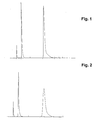
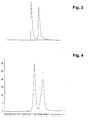
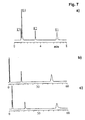
- Die Abbildungen 1 und 2 zeigen Trennungen von Toluol, 2- und 3-Nitroacetanilid an zwei unmodifizierten monolithischen Sorbentien mit unterschiedlicher Porenweite der Makroporen, hergestellt nach
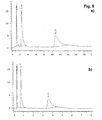
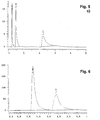
PCT/EP97/06 980 ; experimentelle Einzelheiten: siehe Beispiel B1.Abbildung 3 zeigt die Trennung der Enantiomeren von 2,2,2-Trifluor-1-anthrylethanol auf dem nach Beispiel A3 hergestellten chiralen monolithischen Sorbens (Pirkle-type) ; experimentelle Einzelheiten: siehe Beispiel B4.Abbildung 4 zeigt die Trennung von racemischenm Cromakalim an einem Sorbens, das β-Cyclodextrin chemisch gebunden enthält (Herstellung siehe Beispiel A5; experimentelle Einzelheiten siehe Beispiel B6).Abbildung 5 zeigt eine präparative Trennung eines Testgemisches aus Tolulol, 2-Nitroacetanilid und 3-Nitroacetanilid bei unterschiedlichen Fließgeschwindigkeiten der mobilen Phase (Abb. 5a : 40 ml/min;Abb. 5b : 130 ml/min;Abb. 5c : 200 ml/min). Experimentelle Einzelheiten sind in Beispiel B9 beschrieben.Abbildung 6 zeigt die Trennung von Dimethylphthalat/Dibutylphthalat an einer C18-RP-Phase. Experimentelle Einzelheiten sind in Beispiel B10 beschrieben. In derAbbildung 7 sind Elutionsdiagramme von Trennungen verschiedener Vitamine der Vitamin K Gruppe dargestellt: - a) erfindungsgemäße Trennung (isokratisch, Flußgradienten-Chromatographie unter Verwendung eines monolithischen Sorbens);
- b) isokratisch unter Verwendung eines monolithischen Sorbens;
- c) isokratisch unter Verwendung eines partikulären Sorbens.
- Monolithische Sorbentien sind grundsätzlich aus der Literatur bekannt; dazu gehören vor allem poröse keramische Formkörper, wie sie in
WO 94/19 687 EP 0 710 219 offenbart sind. Besonders bevorzugt sind monolithische Sorbentien auf der Grundlage von porösen Formkörpern, die untereinander verbundene Makroporen sowie Mesoporen in den Wänden der Makroporen aufweisen, wobei der Durchmesser der Makroporen einen Medianwert größer als 0,1 µm aufweist, und wobei der Durchmesser der Mesoporen einen Medianwert von 2 und 100 nm aufweist. Allerdings sind nach den in den genannten Druckschriften offenbarten Herstellungsverfahren in reproduzierbarer Weise nur poröse keramische Formkörper mit einem Durchmesser von ca. 5 mm oder darunter zugänglich. Eine ähnliche Einschränkung gilt für den Bereich der Makroporen, der nach den in den genannten Druckschriften offenbarten Herstellungsverfahren in reproduzierbarer Weise nur mit Makroporen bis ca. 1 µm Durchmesser zugänglich sind. Für präparative Anwendungen sind größere Formkörper (Durchmesser ca. 1 cm oder größer) mit weiteren Makroporen bevorzugt zu verwenden. Derartige verbesserte poröse Formkörper sind insbesondere nach Verfahren zugänglich, wie sie in der PatentanmeldungPCT/EP97/06 980 offenbart sind. Diese Verfahren erlauben die reproduzierbare Herstellung von größeren Formkörpern mit weiteren Makroporen. Insbesondere sind monolithische Sorbentien auf der Grundlage von porösen Formkörpern, deren Makroporen Durchmesser zwischen 2 und 20 µm, insbesondere zwischen 5 und 20 µm, aufweisen (jeweils Medianwerte), und deren Mesoporen Durchmesser zwischen 2 und 100 nm (Medianwerte) aufweisen. Besonders bevorzugt sind erfindungsgemäß monolithische Sorbentien auf der Grundlage von porösen Formkörpern, deren Makroporen Durchmesser zwischen 10 und 20 µm aufweisen (jeweils Medianwerte), und deren Mesoporen Durchmesser zwischen 2 und 100 nm (Medianwerte) aufweisen.. - Erfindungsgemäß verwendete monolithische Sorbentien bestehen aus anorganischen Materialien, wie sie für partikuläre Sorbentien im Gebrauch sind. In vielen Fällen (z.B. SiO2) können diese Sorbentien ohne weiteres für chromatographische Trennungen verwendet werden. Häufiger jedoch werden die Basisträger derivatisiert, um die Trenneigenschaften zu verbessern; dabei werden zusätzliche Gruppierungen eingeführt, die unter der Bezeichnung Separationseffektoren zusammengefaßt werden.
- Separationseffektoren und Verfahren zu ihrer Einführung in den Basisträger sind dem Fachmann grundsätzlich bekannt. Beispiele für Reaktionen, mit denen Separationseffektoren eingeführt werden können, sind:
- a) Die Derivatisierung mit Silanderivaten der Formel I
SiXnR1 (3-n)R2 I
worin- X
- eine reaktive Gruppe, wie z. B. Methoxy, Ethoxy oder Halogen,
- R1
- C1 - C5 -Alkyl,
- n
- 1, 2 oder 3
R2 eine der im folgenden angegebene Bedeutungen besitzt:- a1) unsubstituiertes oder substituiertes Alkyl oder Aryl, wie z.B. n-Octadecyl, n-Octyl, Benzyl- oder Cyanopropyl;
- a2) anionische oder saure Reste, wie z.B. Carboxypropyl;
- a3) kationische oder basische Reste, wie z.B. Aminopropyl, Diethylaminopropyl oder Triethylammoniumpropyl;
- a4) hydrophile Reste, wie z.B. (2,3-Dihydroxypropyl)-oxypropyl;
- a5) bindungsfähige aktivierte Reste, wie z.B. (2,3-Epoxypropyl)-oxypropyl.
- b) Die Adsorption oder chemische Bindung von Polymeren wie Polybutadien, Siloxanen, Polymeren auf der Grundlage von Styrol/ Divinylbenzol, von (Meth)acrylsäurederivaten oder von anderen Vinylverbindungen, sowie von Peptiden, Proteinen, Polysacchariden und Polysaccharidderivaten an dem Basisträger;
- c) Die chemische Bindung von unter b) genannten Polymeren über die unter a) genannten Derivate; dazu gehören Pfropfpolymerisate von Poly(meth)acrylsäurederivaten auf diolmodifiziertem Kieselgel nach
EP-B-0 337 144 . - d) Die Adsorption oder chemische Bindung von chiralen Phasen, wie z.B. von Aminosäurederivaten, Peptiden oder Proteinen, oder von Cyclodextrinen, Polysacchariden oder Polysaccharidderivaten.
- Weitere gebräuchliche Derivatisierungsmöglichkeiten und Derivatisierungsverfahren sind dem Fachmann bekannt und in gängigen Handbüchern wie Unger, K.K. (ed) Porous Silica, Elsevier Scientific Publishing Company (1979) oder Unger, K.K. Packings and Stationary Phases in Chromatographic Techniques, Marcel Dekker (1990) beschrieben.
- Weitere Beispiele für verschiedene Separationseffektoren und für Verfahren, die Separationseffektoren in monolithische Sorbentien einzuführen, sind in den folgenden Druckschriften genannt:
- a) Aus
DE 38 11 042 sind unter anderem Monomere bekannt, die zur Herstellung von Ionenaustauschern geeignet sind; dazu gehören beispielsweise Acrylsäure, N-(Sulfoethyl)-acrylamid, 2-Acrylamido-2-methylpropansulfonsäure, N,N-Dimethylaminoethyl-acrylamid, N,N-Diethylaminoethyl-acrylamid, sowie Trimethylammoniumethyl-acrylamid.
Andere in dieser Druckschrift genannte Monomere erlauben die Bindung von Affinitätsliganden oder von Enzymen, oder eignen sich für reversed phase Chromatographie: dazu gehören beispielsweise Acrylsäure, Acrylamid, Allylamin oder Acrylnitril. - b) Aus
DE 43 10 964 sind Monomere bekannt, die einen Oxiranring, einen Azlactonring oder eine Gruppierung enthalten, die in einen Azlactonring umgesetzt werden kann. Polymere, die derartige Monomere enthalten, sind besonders gut für die Bindung von Affinitätsliganden oder von Enzymen geeignet. Affinitätsliganden sind beispielhaft inDE 43 10 964 offenbart.
Weiterhin können die Epoxidgruppen in derartigen Polymeren in vorteilhafter Weise weiter umgesetzt werden, wodurch Ionenaustauscher, thiophile Sorbentien oder Sorbentien für die Metallchelat- oder die hydrophobe Chromatographie bereitgestellt werden. Dabei werden beispielsweise Phosphorsäure, Ammoniak, Diethylamin, Trimethylamin, schweflige Säure oder auch Komplexbildner wie Iminodiessigsäure an den Oxiranring addiert.
Die Herstellung von thiophilen Sorbentien und von Sorbentien für die Metallchelatchromatographie ist inDE 43 10 964 offenbart.
InDE 43 33 674 und inDE 43 33 821 sind derartige Umsetzungen, mit derer Hilfe Ionenaustauscher bereitgestellt werden können, offenbart.
InDE 43 23 913 werden Sorbentien für die hydrophobe Interaktionschromatographie beschrieben. - Chirale Trennmaterialien für die Trennung von Enantiomeren sind in großer Anzahl im Stand der Technik bekannt. Es handelt sich ausschließlich um partikuläre Trennmaterialien. Die bekannten chiralen Trennmaterialien bestehen entweder aus der chiralen Verbindung selbst (zum Beispiel Cellulosetriacetat) oder aber ein chiraler Separationseffektor ist auf einen Träger aufgezogen oder chemisch an einen Träger gebunden (z.B. chemisch gebundene Aminosäurederivate). Außerdem ist es möglich, chirale Separationseffektoren, die mit einer stationären Phase in Wechselwirkung treten, im Elutionsmittel zuzusetzen (dynamische Belegung mit z.B. Cyclodextrinen).
- Chirale Separationseffektoren sind in großer Zahl bekannt; die wichtigsten Gruppen bekannter chiraler Separationseffektoren sind:
- a) Aminosäuren und ihre Derivate, z.B. L-Phenylalanin, oder D-Phenylalanin, Ester oder Amide von Aminosäuren oder acylierte Aminosäuren oder Oligopeptide;
- b) natürliche und synthetische Polymere mit einer Asymmetrie oder Dissymmetrie in der Hauptkette; dazu gehören Proteine (z. B. saures α1-Glycoprotein, Rinderserumalbumin, Cellulase; siehe J. Chrom. 264, Seiten 63 -68 (1983), J. Chrom. 269, Seiten 71 - 80 (1983),
WO 91/12 221 EP 0 147 804 ,EP 0 155 637 ,EP 0 718 625 ); - c) Cyclodextrine und seine Derivate (z.B. J. High Resol.Chrom. & Chromat. Comm. 3, Seiten 147 - 148 (1984);
EP 0 407 412 ;EP 0 445 604 ); - d) Polymere mit Asymmetriezentren in der Seitenkette (z.B.
EP 0 249 078 ;EP 0 282 770 ;EP 0 448 823 ). - e) Polymere, die Hohlräume aufweisen, wobei die Hohlräume ein Abdruck des Analyten darstellen (imprinted polymers;
WO 93/09 075 - Die enantiomerenrein vorliegenden chiralen Separationseffektoren können an einen geeigneten Basisträger, gegebenenfalls nach Derivatisierung adsorbiert werden. Es ist auch möglich, die enantiomerenrein vorliegenden chiralen Separationseffektoren, gebenenfalls nach Einführung geeigneter funktioneller Gruppen, an den Basisträger zu binden. Für diesen Zweck können auch bifunktionelle Reagenzien verwendet werden. Für diese Verfahrensvarianten geeignete Umsetzungen sind dem Fachmann bekannt und sind in gängigen Handbüchern beschrieben.
- In den Beispielen sind erfindungsgemäß geeignete Formkörper mit chiralen Separationseffektoren genannt.
- Weitere Einzelheiten der Herstellung der verschiedenen Sorbentien und deren Verwendung können den oben genannten Druckschriften entnommen werden; die diesbezügliche Offenbarung dieser Druckschriften ist durch Bezugnahme in die vorliegende Anmeldung eingeführt.
- Die oben genannten monolithischen Sorbentien können in Vorrichtungen zur Stofftrennung enthalten sein, die sich im wesentlichen wie chromatographische Säulen handhaben lassen. Dabei können die bekannten Trennverfahren angewandt werden: batch-Verfahren, kontinuierliche Verfahren, wie z.B. das simulated moving bed (SMB) Verfahren, oder andere Gegenstromverfahren, wie sie beispielsweise in
US 5,630,943 offenbart werden. - Es wurde gefunden, daß bei Verwendung dieser bevorzugten Sorbentien die Flußgeschwindigkeit über einen weiten Bereich variiert werden kann, ohne daß die Trenneigenschaften dabei verschlechtert werden. Unter Ausnutzung dieser Eigenschaft ist es möglich, die Flußgeschwindigkeit an das Elutionsprofil anzupassen, ohne daß die Trennleistung verringert wird. Dadurch kann der Zeitbedarf der Trennung stark reduziert werden. Insbesondere für präparative Trennungen ergeben sich somit große Vorteile. Für die Anwendung des SMB-Verfahrens ist auch der geringe Druckabfall bei hoher Flußgeschwindigkeit relevant, da bei diesem Verfahren eine Anzahl Säulen hintereinander geschaltet werden. Durch Variation der Flußgeschwindigkeit (Flußgradient) ist es außerdem möglich, das Auflösungsvermögen dem Trennproblem anzupassen (siehe Beispiel B11).
- Auch ohne weitere Ausführungen wird davon ausgegangen, daß ein Fachmann die obige Beschreibung im weitesten Umfang nutzen kann. Die bevorzugten Ausführungsformen und Beispiele sind deswegen lediglich als beschreibende, keineswegs als in irgendeiner Weise limitierende Offenbarung aufzufassen.
- Die folgende Beispiele soll die Erfindung verdeutlichen; sie bedeuten keine Einschränkung des Erfindungsgedankens.
- Im folgenden wird unter Raumtemperatur eine Temperatur zwischen 15 und 30°C verstanden.
- Ein poröser Formkörper (83 * 7,2 mm; 2 µm Porenweite) bestehend aus SiO2 hergestellt nach
PCT/EP97/06 980 wird nach Standardverfahren mit Methyloctacecyldichlorsilan als Silanderivat umgesetzt und anschließend einer endcapping Reaktion unterworfen; dabei werden die Reaktionslösungen durch den Formkörper gepumpt. - Es wird ein RP-18 modifiziertes monolithisches Trennmaterial erhalten. In analoger Weise werden RP-18-modifizierte monolithische Trennmaterialien der Abmessungen 93 x 25 mm, deren Makroporen 2 beziehungsweise 6 µm Durchmesser (Medianwerte) aufweisen, erhalten.
- Ein poröser Formkörper (83 * 7,2 mm, 2 µm Porenweite), hergestellt nach
PCT/ EP97/06 980 , wird nach Standardverfahren durch Hindurchpumpen von einer Lösung von Aminopropyltrimethoxysilan in Toluol zu einem mit Aminogruppen modifizierten Sorbens umgesetzt. - Der nach Beispiel A2 hergestellte mit Aminogruppen derivatisierte poröse Formkörper wird weiter umgesetzt, indem eine Lösung von (R)-(-)-N-(2,4-Dinitrobenzoyl)phenylglycin und N-Ethoxycarbonyl-2-ethoxy-1,2-dihydrochinolin (EEDQ) in Toluol durchgepumpt wird. Es wird ein chirales Sorbens erhalten.
- Ein poröser Formkörper (83 * 7,2 mm; 2 µm Porenweite), hergestellt nach
EP 0 710 219 , wird durch Hindurchpumpen von a) einer Lösung von 3-Glycidyloxypropyltrimethoxysilan in Toluol und b) einer Lösung von N-Acryloyl-L-phenylalaninethylester in Toluol unter Zusatz von Azoisobutyronitril (AIBN) zu einem chiral modifizierten Sorbens umgesetzt. - Es wird ein modifizierter monolithischer Formkörper erhalten, an dem als Separationseffektoren kovalent gebundene L-Phenylalaninethylester-Gruppen vorliegen.
- Ein poröser Formkörper, hergestellt nach
PCT/EP97/06 980 , wird analog zu der Beschreibung von Beispiel 2 ausEP 0 445 604 mit einer Reaktionslösung aus β-Cyclodextrin, Chlorameisensäure-p-nitrophenylester und 3-(2-Aminoethyl)aminopropyltrimethoxysilan zu einem chiralen Sorbens mit chemisch gebundenem β-Cyclodextrin umgesetzt. Dazu wird die Reaktionslösung durch den Formkörper gepumpt. - Es wird ein modifizierter monolithischer Formkörper erhalten, an dem β-Cyclodextrin chemisch gebunden vorliegt.
- Poröse monolithische Formkörper aus SiO2 (83 * 7,2 mm) mit unterschiedlichen Durchmesser der Makroporen (2 und 6 µm) wurden nach
PCT/EP97/06 980 hergestellt. Eine Lösung von Toluol, 2- und 3-Nitroacetanilid wird aufgetragen und in Heptan/Dioxan 80 : 20 als Laufmittel getrennt (Flußrate: 8 ml/min; UV-Detektion). - Die Elutionsdiagramme sind in den Abbildungen 1 (2 µm Porenweite) und 2 (6 µm Porenweite) dargestellt.
- Eine Lösung von Dimethylphthalat und Dibutylphthalat wird auf eine Säule mit einem monolithischen Sorbens hergestellt nach Beispiel A1 aufgetragen und in Methanol/Wasser 90 : 10 als Laufmittel getrennt (Flußrate 4 ml/min; UV-Detektion).
- Die Substanzen werden getrennt eluiert.
- Eine Lösung von Xylose, Fructose, Glucose und Saccharose werden auf dem auf dem mit Aminopropyltrimethoxysilan modifizierten Sorbens hergestellt nach Beispiel A2 aufgetragen und mit Acetonitril/Wasser 80:20 als Flußmittel aufgetrennt (Flußrate 4 ml/min; RI-Detektion).
- Die Saccharide werden getrennt eluiert.
- Die Enantiomeren von 2,2,2-Trifluor-1-anthrylethanol werden auf dem nach Beispiel A3 hergestellten chiralen Pirkle-type Sorbens in Heptan/i-Propanol 99,5 : 0,5 getrennt (Flußrate: 8 ml/min; UV-Detektion).
- Das Elutionsdiagramm ist in
Abbildung 3 dargestellt. - Die Enantiomeren von Chlorthalidon werden auf dem nach Beispiel A4 hergestellten chiralen Sorbens getrennt (Bedingungen: Heptan/Dioxan 50 : 50; 4 ml/min; UV-Detektion).
- Ein entsprechend Beispiel A5 hergestellter modifizierter monolithischer Formkörper (83 x 7,2 mm) wird als Sorbens verwandt und racemisches Cromakalim unter folgenden Bedingungen aufgetrennt:
Probe: Cromakalim (0,2 mg/ml in Ethanol)
Injektionsvolumen: 5 µlEluent: Methanol/Wasser (20/80; v/v) Temperatur: Raumtemperatur Fluß: 1,0 ml/min Detektion: 254 nm - Das Elutionsdiagramm ist in
Abbildung 4 dargestellt. - Ein entsprechend Beispiel A1 hergestellter modifizierter monolithischer Formkörper (RP-18; 83 x 7,2 mm) wird als Sorbens verwandt und racemisches Chlorthalidon unter folgenden Bedingungen aufgetrennt:
Probe: Chlorthalidon (0,44 mg/ml) lnjektionsvolumen: 5 µl Eluent: Methanol/wäßrige 25 mM Natriumphosphatlösung (pH 2)
mit 10 mM ß-Cyclodextrin (20/80; v/v)Temperatur: Raumtemperatur Fluß: 1,0 ml/min Detektion: 254 nm - Die Enantiomeren werden getrennt eluiert.
- Ein entsprechend Beispiel A1 hergestellter modifizierter monolithischer Formkörper (RP-18; 83 x 7,2 mm) wird als Sorbens verwandt und racemisches Prominal unter folgenden Bedingungen aufgetrennt:
Probe: Prominal (0,55 mg/ml) Injektionsvolumen: 5 µl Eluent: Methanol/wäßrige 25 mM Natriumphosphatlösung (pH 2)
mit 10 mM ß-Cyclodextrin (20/80; v/v)Temperatur: Raumtemperatur Fluß: 1,0ml/min Detektion: 254 nm - Die Enantiomeren werden getrennt eluiert.
- Eine Probe enthaltend Toluol, 2-Nitroacetanilid und 3-Nitroacetanilid wird bei unterschiedlichen Fließgeschwindigkeiten der mobilen Phase getrennt:
-
Sorbens: monolithisches Sorbens (SiO2; 93 * 25 mm) (hergestellt nach PCT/ EP97/06 980 )mobile Phase: n-Heptan/Dioxan (90/10; v/v) Probenvolumen: 40 µl Detektion: UV 254 nm Flußrate: 40, 130, 200 ml/min Abb.5a Abb.5b Abb. 5c Flußrate [ml/min] 40 130 200 Bodenzahl [N] 2-Nitroacetanilid 503 524 495 Bodenzahl [N] 3-Nitroacetanilid 465 465 445 Druck [bar] 9 35 55 - Die Ergebnisse sind in den Abbildungen 5a - 5 c) zusammengefaßt. Die übliche Fließgeschwindigkeit einer Säule der Dimension 25 mm Durchmesser, die mit partikulären Teilchen gepackt ist, beträgt 40 ml/min. Die nichtpartikulären Träger lassen somit eine wesentlich höhere Betriebsgeschwindigkeit zu, was zu deutlich verbesserter Ökonomie der Trennaufgaben führt.
- Dimethylphthalat und Dibutylphthalat werden in verschiedenen Mengen aufgetragen und getrennt (siehe
Fig. 6 ): -
Sorbens: monolithisches Sorbens (C18-RP-derivatisiertes SiO2; 93 * 25 mm; hergestellt nach PCT/ EP97/06 980 , entsprechend Beispiel A2 modifiziert)mobile Phase: Methano1A/Vasser (80/20; v/v) Probenvolumen: 50, 100 300, 600 µl Detektion: UV 300 nm Flußrate: 40 ml/min - Für die Komponenten A (Dimethylphthalat) und B (Dibutylphthalat) wurden folgende modifizierten Langmuir-Isothermen gefunden:


- Aus den ermittelten Isothermen wurden nach dem in R.M.Nicoud, F.Charton, J.Chromatogr. 702 (1995) 97 beschriebenen Verfahren mit Hilfe der Simulationssoftware HELP die Trennbedingungen für die SMB-Trennung bestimmt:
Säulendimension [mm] 93 * 25 Anzahl Säulen 8 Flußrate Feed [ml/min] 1,9 Feedkonzentration [g/l] 320 +320 Flußrate Recycling [ml/min] 44,1 Flußrate Raffinat [ml/min] 2,9 Flußrate Extrakt [ml/min] 21,8 Zyklussschaltzeit [min] 2,24 Konzentration Raffinat [g/l] 209,7 Konzentration Extrakt [g/l] 27,89 Reinheiten Raffinat/Extrakt > 99,9 - Eine Mischung von Vitaminen der K-Gruppe, die die Vitamine K1, K2, K3 und K4 enthält, wird in Acetonitril-Wasser (95:5; v:v) gelöst. 10 µl dieser Lösung werden auf eine monolithische Säule (Kieselgel, Modifikation RP-18; 83 x 7,2 mm) aufgetragen. Anschließend wird ein Flußgradient angewandt:
Minuten Flußrate (ml/min) 0,0-1,5 3,0 1,5-3,0 3,0-9,5 3,0-8,0 9,5 - Das Elutionsdiagramm ist in
Abbildung 7 a) dargestellt (Detektion UV bei 280 nm). - Zum Vergleich ist in
Abbildung 7 b) ein Elutionsdiagramm bei konstanter Flußrate (1 ml/min) dargestellt (Sorbens wie oben). InAbbildung 7 c) ist als weiterer Vergleich das Elutionsdiagramm unter Verwendung eines partikulären Sorbens (LiChrospher RP 18; 1 ml/min) dargestellt. - Die Produktivität eines LiChrospher® Si 100 15 µm Sorbens wird mit der eines monolithischen Sorbens hergestellt nach
PCT/EP97/06 980 verglichen. Das monolithische Sorbens weist genau wie das handelsübliche partikuläre Sorbens LiChrospher® Mesoporen mit 10 nm Porenweite auf. Die Partikelgröße des LiChrospher® Si100 beträgt 15 µm. Das monolithische Sorbens weist eine Skeleton size von 1,5-2 µm und Makroporen von 6 µm auf. - Für das partikuläre Sorbens wurden folgende Kenndaten gefunden:


- Für das monolithische Sorbens wurden folgende Kenndaten gefunden:


- Die beste Produktivität ist erreicht, wenn man gerade bei der gewünschten Bodenzahl bei maximalem Druckabfall arbeitet. Die optimale Fließmittelgeschwindigkeit und Säulenlänge sind dann :
partikuläres Sorbens
(LiChrospher® Si 100 15µm)monolithisches Sorbens
(6µm Porendurchmesser)Fließmittelgeschwindigkeit (cm/min) 23,1 132,4 Säulenlänge (cm) 98,0 53,3 - Die Geschwindigkeit ist dann auf dem partikulären Sorbens 5,7mal größer. Die Produktivität (g/Tag) ist dann für denselben Säulendurchmesser vierfach erhöht. Da die erforderliche Säulenlänge kürzer ist, ist die relative Produktivität (g/Tag/L stationäre Phase) um den Faktor 10,5 erhöht.
Claims (6)
- Verfahren zur präparativen chromatographischen Trennung mindestens zweier Substanzen, dadurch gekennzeichnet, dass die Stofftrennunga) unter Verwendung monolithischer Sorbentien auf der Grundlage von Formkörpern aus SiO2 erfolgt, deren Makroporen Durchmesser zwischen 2 und 20 µm aufweisen, und deren Mesoporen Durchmesser zwischen 2 und 100 nm aufweisen (jeweils Medianwerte), und welche durch Separationseffektoren in Form von chiralen Phasen derivatisiert sind,
undb) kontinuierlich durch "simulated moving bed" Chromatographie erfolgt. - Verfahren nach Anspruch 1, weiterhin dadurch gekennzeichnet, dass die Stofftrennung unter Verwendung monolithischer Sorbentien, welche durch Adsorption oder chemische Bindung von chiralen Phasen ausgewählt aus der Gruppe Aminosäurederivate, Peptide oder Proteine, Cyclodextrine und Polysaccharide oder Polysaccharidderivate derivatisiert sind, durchgeführt wird.
- Verfahren nach den Ansprüchen 1 und 2, weiterhin dadurch gekennzeichnet, dass die Stofftrennung unter Verwendung monolithischer Sorbentien, welche durch Cyclodextrine und seine Derivate derivatisiert sind, durchgeführt wird.
- Verfahren nach Anspruch 1, weiterhin dadurch gekennzeichnet, dass die Stofftrennung unter Verwendung monolithischer Sorbentien, welche durch natürliche oder synthetische Polymere mit einer Asymmetrie oder Dissymmetrie in der Hauptkette derivatisiert sind, durchgeführt wird.
- Verfahren nach Anspruch 4 dadurch gekennzeichnet, dass die Stofftrennung unter Verwendung monolithischer Sorbentien, welche durch Cellulose und Cellulosederivate aus der Gruppe Cellulosetriacetat, Cellulosetribenzoat, Cellulosetribenzylether, Cellulose-tris-phenylcarbamat, Cellulose-tris-3-chlorbenzoat, Amylose-tris-(3,5-dimethylphenylcarbamat), Cellulose-tris-(3,5-dimethylbenzoat), Cellulose-tris-(3,5-dimethylphenylcarbamat) derivatisiert sind, durchgeführt wird.
- Verfahren nach einem oder mehreren der Ansprüche 3 bis 5, dadurch gekennzeichnet, dass es zur Trennung von Enantiomeren durchgeführt wird.
Applications Claiming Priority (9)
| Application Number | Priority Date | Filing Date | Title |
|---|---|---|---|
| DE19725639A DE19725639A1 (de) | 1997-06-18 | 1997-06-18 | Gradientenelutionsverfahren |
| DE19725639 | 1997-06-18 | ||
| DE1997126152 DE19726152A1 (de) | 1997-06-20 | 1997-06-20 | Verwendung von monolithischen Sorbentien für die Enantiomerentrennung |
| DE19726151A DE19726151B4 (de) | 1997-06-20 | 1997-06-20 | Verwendung monolithischer Sorbentien für "Simulated Moving Bed" Trennverfahren |
| DE19726151 | 1997-06-20 | ||
| DE19726152 | 1997-06-20 | ||
| DE19801575 | 1998-01-19 | ||
| DE1998101575 DE19801575A1 (de) | 1998-01-19 | 1998-01-19 | Verwendung monolithischer Sorbentien für präparative chromatographische Trennverfahren |
| PCT/EP1998/003546 WO1998058253A1 (de) | 1997-06-18 | 1998-06-12 | Verwendung monolithischer sorbentien für präparative chromatographische trennverfahren |
Publications (2)
| Publication Number | Publication Date |
|---|---|
| EP0991940A1 EP0991940A1 (de) | 2000-04-12 |
| EP0991940B1 true EP0991940B1 (de) | 2010-08-25 |
Family
ID=27438625
Family Applications (1)
| Application Number | Title | Priority Date | Filing Date |
|---|---|---|---|
| EP98933607A Expired - Lifetime EP0991940B1 (de) | 1997-06-18 | 1998-06-12 | Verwendung monolithischer sorbentien für präparative chromatographische trennverfahren |
Country Status (6)
| Country | Link |
|---|---|
| US (1) | US6398962B1 (de) |
| EP (1) | EP0991940B1 (de) |
| JP (1) | JP2002505006A (de) |
| AT (1) | ATE478732T1 (de) |
| DE (1) | DE59814468D1 (de) |
| WO (1) | WO1998058253A1 (de) |
Families Citing this family (38)
| Publication number | Priority date | Publication date | Assignee | Title |
|---|---|---|---|---|
| US6686035B2 (en) | 1999-02-05 | 2004-02-03 | Waters Investments Limited | Porous inorganic/organic hybrid particles for chromatographic separations and process for their preparation |
| ATE324976T1 (de) * | 1999-11-24 | 2006-06-15 | Pierce Chemical Co | Granuliertes chromatographiematerial |
| EP1126275A3 (de) * | 2000-02-18 | 2002-12-18 | The Board Of Trustees Of The Leland Stanford Junior University | Kapillarsäule aus geschmolzenem Siliziumdioxid mit Photopolymerbestandteilen |
| US6875348B2 (en) * | 2000-02-18 | 2005-04-05 | The Board Of Trustees Of The Leland Stanford Junior University | Separation column having a photopolymerized sol-gel component and associated methods |
| US6866785B2 (en) * | 2001-08-13 | 2005-03-15 | The Board Of Trustees Of The Leland Stanford Junior University | Photopolymerized sol-gel column and associated methods |
| US6528167B2 (en) * | 2001-01-31 | 2003-03-04 | Waters Investments Limited | Porous hybrid particles with organic groups removed from the surface |
| US7250214B2 (en) | 2001-08-09 | 2007-07-31 | Waters Investments Limited | Porous inorganic/organic hybrid monolith materials for chromatographic separations and process for their preparation |
| JP4916064B2 (ja) * | 2001-08-23 | 2012-04-11 | 株式会社トクヤマ | 光学異性体の分離方法 |
| US6764755B2 (en) * | 2001-12-17 | 2004-07-20 | Advanced Technology Materials, Inc. | Channelized sorbent media, and methods of making same |
| DE10235385B4 (de) * | 2002-08-02 | 2006-10-05 | MAX-PLANCK-Gesellschaft zur Förderung der Wissenschaften e.V. | Verfahren zur chromatographischen Trennung von Komponenten |
| WO2004041398A2 (en) | 2002-10-30 | 2004-05-21 | Waters Investments Limited | Porous inorganic/organic hybrid materials and preparation thereof |
| WO2004039495A1 (de) * | 2002-10-31 | 2004-05-13 | Merck Patent Gmbh | Mit organischen polymeren beschichtete anorganische monolithische formkörper |
| US20040200776A1 (en) * | 2003-01-17 | 2004-10-14 | Ivanov Alexander R. | Narrow I.D. monolithic capillary columns for high efficiency separation and high sensitivity analysis of biomolecules |
| JP2005017268A (ja) * | 2003-05-30 | 2005-01-20 | Daicel Chem Ind Ltd | 光学異性体用分離剤、その製造方法、及び光学異性体用分離カラム |
| KR100988321B1 (ko) * | 2003-07-26 | 2010-10-18 | 포항공과대학교 산학협력단 | 쿠커비투릴을 포함하는 고분자, 이를 이용한 정지상 및 컬럼 |
| US20050127002A1 (en) * | 2003-12-12 | 2005-06-16 | Zare Richard N. | Immobilized-enzyme microreactor devices for characterization of biomolecular analytes and associated methods |
| JP4315337B2 (ja) * | 2004-01-16 | 2009-08-19 | オルガノ株式会社 | 光学分割能を有する非粒子状有機多孔質体及びその製造方法 |
| JP4558382B2 (ja) * | 2004-06-04 | 2010-10-06 | ジーエルサイエンス株式会社 | アフィニティクロマトグラフィ用デバイス及びその製法 |
| JP5308665B2 (ja) | 2004-07-30 | 2013-10-09 | ウオーターズ・テクノロジーズ・コーポレイシヨン | クロマトグラフィー分離用の秩序領域を有する多孔質無機/有機のハイブリッド材料およびこれらの調製方法 |
| US10773186B2 (en) | 2004-07-30 | 2020-09-15 | Waters Technologies Corporation | Porous inorganic/organic hybrid materials with ordered domains for chromatographic separations and processes for their preparation |
| JP2006150214A (ja) * | 2004-11-29 | 2006-06-15 | Daicel Chem Ind Ltd | 光学異性体用分離剤及び光学異性体用分離カラム |
| US7439272B2 (en) * | 2004-12-20 | 2008-10-21 | Varian, Inc. | Ultraporous sol gel monoliths |
| US20100230339A1 (en) * | 2005-12-19 | 2010-09-16 | Evolved Nanomaterial Sciences, Inc. | Particulate chiral separation material |
| RU2295539C1 (ru) * | 2006-03-28 | 2007-03-20 | ГОУ ВПО "Московский государственный университет пищевых производств" Минобразования РФ | Способ получения иммобилизованного бета-циклодекстрина |
| US20070284308A1 (en) * | 2006-06-12 | 2007-12-13 | Zare Richard N | Immobilized-enzyme microreactor devices for characterization of biomolecular analytes and associated methods |
| US8017015B2 (en) | 2006-10-20 | 2011-09-13 | Quest Diagnostics Investments Incorporated | Monolithic column chromatography |
| JP2010515804A (ja) | 2007-01-12 | 2010-05-13 | ウオーターズ・テクノロジーズ・コーポレイシヨン | クロマトグラフ分離用多孔質炭素−ヘテロ原子−ケイ素ハイブリッド無機/有機材料およびその調製のための方法 |
| US7651762B2 (en) * | 2007-03-13 | 2010-01-26 | Varian, Inc. | Methods and devices using a shrinkable support for porous monolithic materials |
| US11439977B2 (en) | 2009-06-01 | 2022-09-13 | Waters Technologies Corporation | Hybrid material for chromatographic separations comprising a superficially porous core and a surrounding material |
| WO2010141426A1 (en) | 2009-06-01 | 2010-12-09 | Waters Technologies Corporation | Hybrid material for chromatographic separations |
| WO2012018598A1 (en) | 2010-07-26 | 2012-02-09 | Waters Technologies Corporation | Superficially porous materials comprising a substantially nonporous core having narrow particle size distribution; process for the preparation thereof; and use thereof for chromatographic separations |
| US8574340B2 (en) | 2011-02-27 | 2013-11-05 | Board Of Trustees Of The University Of Alabama | Methods for preparing and using metal and/or metal oxide porous materials |
| CN102565211B (zh) * | 2011-11-30 | 2014-01-29 | 安徽皖仪科技股份有限公司 | 一种水半饱和正相色谱检测四种增塑剂的方法 |
| EP2909130B1 (de) | 2012-10-16 | 2022-01-26 | Martin Bakker | Katalyse durch in einem hierarchisch porösen kohlenstoffmaterial dispergierte metallnanopartikel |
| PT3395423T (pt) | 2013-03-14 | 2023-11-14 | Amgen Inc | Remoção de ligandos escapados de cromatografia de afinidade |
| US10195587B2 (en) | 2016-03-04 | 2019-02-05 | The Board Of Trustees Of The University Of Alabama | Synthesis of hierarchically porous monoliths by a co-gelation method |
| EP3426389A1 (de) | 2016-03-06 | 2019-01-16 | Waters Technologies Corporation | Hybridmaterial für chromatografische trennungen mit oberflächlich porösem kern und einem umgebenden material |
| CN114053988B (zh) * | 2021-09-29 | 2023-04-28 | 山东农业大学 | 一种MXene复合气凝胶材料的制备方法及其应用 |
Citations (1)
| Publication number | Priority date | Publication date | Assignee | Title |
|---|---|---|---|---|
| US4533398A (en) * | 1981-10-02 | 1985-08-06 | Uop Inc. | Extraction of sucrose |
Family Cites Families (5)
| Publication number | Priority date | Publication date | Assignee | Title |
|---|---|---|---|---|
| US4333770A (en) * | 1980-09-08 | 1982-06-08 | Uop Inc. | Extraction of sucrose from molasses |
| WO1995003256A1 (en) * | 1993-07-19 | 1995-02-02 | Merck Patent Gmbh | Inorganic porous material and process for making same |
| US5399535A (en) * | 1993-08-17 | 1995-03-21 | Rohm And Haas Company | Reticulated ceramic products |
| JPH0829404A (ja) * | 1994-07-12 | 1996-02-02 | Daicel Chem Ind Ltd | 光学異性体の擬似移動層式クロマト分離法 |
| JPH09329590A (ja) * | 1996-06-12 | 1997-12-22 | M R C:Kk | 液体クロマトグラフ |
-
1998
- 1998-06-12 JP JP50369899A patent/JP2002505006A/ja not_active Withdrawn
- 1998-06-12 EP EP98933607A patent/EP0991940B1/de not_active Expired - Lifetime
- 1998-06-12 DE DE59814468T patent/DE59814468D1/de not_active Expired - Lifetime
- 1998-06-12 US US09/445,585 patent/US6398962B1/en not_active Expired - Lifetime
- 1998-06-12 WO PCT/EP1998/003546 patent/WO1998058253A1/de not_active Ceased
- 1998-06-12 AT AT98933607T patent/ATE478732T1/de active
Patent Citations (1)
| Publication number | Priority date | Publication date | Assignee | Title |
|---|---|---|---|---|
| US4533398A (en) * | 1981-10-02 | 1985-08-06 | Uop Inc. | Extraction of sucrose |
Also Published As
| Publication number | Publication date |
|---|---|
| WO1998058253A1 (de) | 1998-12-23 |
| US6398962B1 (en) | 2002-06-04 |
| ATE478732T1 (de) | 2010-09-15 |
| EP0991940A1 (de) | 2000-04-12 |
| JP2002505006A (ja) | 2002-02-12 |
| DE59814468D1 (de) | 2010-10-07 |
Similar Documents
| Publication | Publication Date | Title |
|---|---|---|
| EP0991940B1 (de) | Verwendung monolithischer sorbentien für präparative chromatographische trennverfahren | |
| DE60012318T2 (de) | pH ABHÄNGIGE IONTAUSCHERMATRIX UND ANWENDUNGSVERFAHREN IN DER ISOLIERUNG VON NUKLEINSÄUREN | |
| DE69830999T2 (de) | Verfahren zur adsorption/trennung | |
| EP0445604B1 (de) | Trennmaterialien für die Chromatographie | |
| DE60029794T2 (de) | Verwendung von mit polymer beschichtetem sorptionsmittelkomposit zur trennung, reinigung, entsalzung und konzentrierung von biopolymeren | |
| EP0154246B1 (de) | Phasenträger für die Verteilungschromatographie von Makromolekülen, Verfahren zu ihrer Herstellung und ihre Verwendung | |
| DE3872458T2 (de) | Zwei-zonen packungsmaterial fuer fluessige chromatographie und verfahren zu dessen herstellung und verwendung. | |
| DE10050343A1 (de) | Poröse Silika-Mikrosphäre als Reinigungsmittel | |
| EP3347125B1 (de) | Adsorptionsmedium, verfahren zu dessen herstellung, sowie verwendung desselben zur aufreinigung von biomolekülen | |
| DE2638764B2 (de) | Verwendung eines Austauscherharzes zum Auftrennen von Proteinen | |
| DE3882797T2 (de) | Schwach affinitives Adsorbens für Affinitätschromatographie. | |
| DE3609021A1 (de) | Chromatographisches trennmedium fuer die schnelle analyse von kleinen proben | |
| DE112016000366T5 (de) | Chromatographisches Material mit verbesserter pH-Stabilität, Verfahren zu dessen Herstellung und dessen Verwendungen | |
| EP0921847B1 (de) | Verwendung nicht-partikulärer sorbentien für "simulated moving bed" trennverfahren | |
| DE2323422C2 (de) | Verfahren zur Isolierung von biologisch aktiven Verbindungen durch Affinitätschromatographie | |
| DE69520586T2 (de) | Verfahren und vorrichtung zur schnellen trennung und/oder umwandlung von substraten | |
| DE19801575A1 (de) | Verwendung monolithischer Sorbentien für präparative chromatographische Trennverfahren | |
| WO2001046686A9 (de) | Chromatographiematerial und verfahren unter verwendung desselben | |
| CH706332B1 (de) | Dotierte Materialien für die Umkehrphasen-Chromatographie. | |
| EP0912242A1 (de) | Chirale nicht-partikuläre sorbentien | |
| DE2605789A1 (de) | Chromatografisches trennverfahren | |
| DE19726151B4 (de) | Verwendung monolithischer Sorbentien für "Simulated Moving Bed" Trennverfahren | |
| DE102007020009A1 (de) | Chromatographische stationäre Phase | |
| EP0789620B1 (de) | Trennmaterialien und verfahren zu ihrer herstellung | |
| DE60305075T2 (de) | Isolierung von antisense-oligonukleotiden |
Legal Events
| Date | Code | Title | Description |
|---|---|---|---|
| PUAI | Public reference made under article 153(3) epc to a published international application that has entered the european phase |
Free format text: ORIGINAL CODE: 0009012 |
|
| 17P | Request for examination filed |
Effective date: 19991120 |
|
| AK | Designated contracting states |
Kind code of ref document: A1 Designated state(s): AT BE CH DE DK ES FR GB IT LI NL SE |
|
| 17Q | First examination report despatched |
Effective date: 20070925 |
|
| GRAP | Despatch of communication of intention to grant a patent |
Free format text: ORIGINAL CODE: EPIDOSNIGR1 |
|
| RIC1 | Information provided on ipc code assigned before grant |
Ipc: B01D 15/02 20060101ALI20100212BHEP Ipc: B01D 15/08 20060101ALI20100212BHEP Ipc: B01J 20/281 20060101AFI20100212BHEP |
|
| GRAS | Grant fee paid |
Free format text: ORIGINAL CODE: EPIDOSNIGR3 |
|
| GRAA | (expected) grant |
Free format text: ORIGINAL CODE: 0009210 |
|
| AK | Designated contracting states |
Kind code of ref document: B1 Designated state(s): AT BE CH DE DK ES FR GB IT LI NL SE |
|
| REG | Reference to a national code |
Ref country code: GB Ref legal event code: FG4D Free format text: NOT ENGLISH |
|
| REG | Reference to a national code |
Ref country code: CH Ref legal event code: EP |
|
| REF | Corresponds to: |
Ref document number: 59814468 Country of ref document: DE Date of ref document: 20101007 Kind code of ref document: P |
|
| REG | Reference to a national code |
Ref country code: NL Ref legal event code: T3 |
|
| PG25 | Lapsed in a contracting state [announced via postgrant information from national office to epo] |
Ref country code: SE Free format text: LAPSE BECAUSE OF FAILURE TO SUBMIT A TRANSLATION OF THE DESCRIPTION OR TO PAY THE FEE WITHIN THE PRESCRIBED TIME-LIMIT Effective date: 20100825 |
|
| PG25 | Lapsed in a contracting state [announced via postgrant information from national office to epo] |
Ref country code: DK Free format text: LAPSE BECAUSE OF FAILURE TO SUBMIT A TRANSLATION OF THE DESCRIPTION OR TO PAY THE FEE WITHIN THE PRESCRIBED TIME-LIMIT Effective date: 20100825 |
|
| PG25 | Lapsed in a contracting state [announced via postgrant information from national office to epo] |
Ref country code: IT Free format text: LAPSE BECAUSE OF FAILURE TO SUBMIT A TRANSLATION OF THE DESCRIPTION OR TO PAY THE FEE WITHIN THE PRESCRIBED TIME-LIMIT Effective date: 20100825 |
|
| PG25 | Lapsed in a contracting state [announced via postgrant information from national office to epo] |
Ref country code: ES Free format text: LAPSE BECAUSE OF FAILURE TO SUBMIT A TRANSLATION OF THE DESCRIPTION OR TO PAY THE FEE WITHIN THE PRESCRIBED TIME-LIMIT Effective date: 20101206 |
|
| PLBE | No opposition filed within time limit |
Free format text: ORIGINAL CODE: 0009261 |
|
| STAA | Information on the status of an ep patent application or granted ep patent |
Free format text: STATUS: NO OPPOSITION FILED WITHIN TIME LIMIT |
|
| 26N | No opposition filed |
Effective date: 20110526 |
|
| REG | Reference to a national code |
Ref country code: DE Ref legal event code: R097 Ref document number: 59814468 Country of ref document: DE Effective date: 20110526 |
|
| REG | Reference to a national code |
Ref country code: AT Ref legal event code: MM01 Ref document number: 478732 Country of ref document: AT Kind code of ref document: T Effective date: 20110612 |
|
| PG25 | Lapsed in a contracting state [announced via postgrant information from national office to epo] |
Ref country code: AT Free format text: LAPSE BECAUSE OF NON-PAYMENT OF DUE FEES Effective date: 20110612 |
|
| PGFP | Annual fee paid to national office [announced via postgrant information from national office to epo] |
Ref country code: GB Payment date: 20130612 Year of fee payment: 16 Ref country code: CH Payment date: 20130612 Year of fee payment: 16 Ref country code: DE Payment date: 20130605 Year of fee payment: 16 |
|
| PGFP | Annual fee paid to national office [announced via postgrant information from national office to epo] |
Ref country code: FR Payment date: 20130624 Year of fee payment: 16 Ref country code: NL Payment date: 20130615 Year of fee payment: 16 |
|
| PGFP | Annual fee paid to national office [announced via postgrant information from national office to epo] |
Ref country code: BE Payment date: 20130614 Year of fee payment: 16 |
|
| REG | Reference to a national code |
Ref country code: DE Ref legal event code: R119 Ref document number: 59814468 Country of ref document: DE |
|
| REG | Reference to a national code |
Ref country code: NL Ref legal event code: V1 Effective date: 20150101 |
|
| REG | Reference to a national code |
Ref country code: CH Ref legal event code: PL |
|
| GBPC | Gb: european patent ceased through non-payment of renewal fee |
Effective date: 20140612 |
|
| REG | Reference to a national code |
Ref country code: DE Ref legal event code: R119 Ref document number: 59814468 Country of ref document: DE Effective date: 20150101 |
|
| REG | Reference to a national code |
Ref country code: FR Ref legal event code: ST Effective date: 20150227 |
|
| PG25 | Lapsed in a contracting state [announced via postgrant information from national office to epo] |
Ref country code: NL Free format text: LAPSE BECAUSE OF NON-PAYMENT OF DUE FEES Effective date: 20150101 |
|
| PG25 | Lapsed in a contracting state [announced via postgrant information from national office to epo] |
Ref country code: LI Free format text: LAPSE BECAUSE OF NON-PAYMENT OF DUE FEES Effective date: 20140630 Ref country code: CH Free format text: LAPSE BECAUSE OF NON-PAYMENT OF DUE FEES Effective date: 20140630 Ref country code: DE Free format text: LAPSE BECAUSE OF NON-PAYMENT OF DUE FEES Effective date: 20150101 |
|
| PG25 | Lapsed in a contracting state [announced via postgrant information from national office to epo] |
Ref country code: FR Free format text: LAPSE BECAUSE OF NON-PAYMENT OF DUE FEES Effective date: 20140630 Ref country code: GB Free format text: LAPSE BECAUSE OF NON-PAYMENT OF DUE FEES Effective date: 20140612 |
|
| PG25 | Lapsed in a contracting state [announced via postgrant information from national office to epo] |
Ref country code: BE Free format text: LAPSE BECAUSE OF NON-PAYMENT OF DUE FEES Effective date: 20140630 |