EP0774007B1 - Herstellung von oligosacchariden in transgenen pflanzen - Google Patents
Herstellung von oligosacchariden in transgenen pflanzen Download PDFInfo
- Publication number
- EP0774007B1 EP0774007B1 EP95923598A EP95923598A EP0774007B1 EP 0774007 B1 EP0774007 B1 EP 0774007B1 EP 95923598 A EP95923598 A EP 95923598A EP 95923598 A EP95923598 A EP 95923598A EP 0774007 B1 EP0774007 B1 EP 0774007B1
- Authority
- EP
- European Patent Office
- Prior art keywords
- oligosaccharides
- sft
- sucrose
- enzyme
- gene
- Prior art date
- Legal status (The legal status is an assumption and is not a legal conclusion. Google has not performed a legal analysis and makes no representation as to the accuracy of the status listed.)
- Expired - Lifetime
Links
- 150000002482 oligosaccharides Chemical class 0.000 title claims abstract description 60
- 229920001542 oligosaccharide Polymers 0.000 title claims abstract description 57
- 230000009261 transgenic effect Effects 0.000 title claims abstract description 28
- 238000004519 manufacturing process Methods 0.000 title claims abstract description 15
- 229930006000 Sucrose Natural products 0.000 claims abstract description 36
- CZMRCDWAGMRECN-UGDNZRGBSA-N Sucrose Chemical compound O[C@H]1[C@H](O)[C@@H](CO)O[C@@]1(CO)O[C@@H]1[C@H](O)[C@@H](O)[C@H](O)[C@@H](CO)O1 CZMRCDWAGMRECN-UGDNZRGBSA-N 0.000 claims abstract description 36
- 239000005720 sucrose Substances 0.000 claims abstract description 35
- 108090000623 proteins and genes Proteins 0.000 claims abstract description 33
- 230000014509 gene expression Effects 0.000 claims abstract description 32
- 230000000694 effects Effects 0.000 claims abstract description 29
- 102000004190 Enzymes Human genes 0.000 claims abstract description 23
- 108090000790 Enzymes Proteins 0.000 claims abstract description 23
- 238000000034 method Methods 0.000 claims abstract description 19
- 230000005026 transcription initiation Effects 0.000 claims abstract description 5
- 230000005030 transcription termination Effects 0.000 claims abstract description 4
- 238000012258 culturing Methods 0.000 claims abstract description 3
- 230000001172 regenerating effect Effects 0.000 claims abstract description 3
- 230000001131 transforming effect Effects 0.000 claims abstract description 3
- 239000000203 mixture Substances 0.000 claims description 18
- 125000003275 alpha amino acid group Chemical group 0.000 claims description 14
- 108010022290 sucrose - fructan 6-fructosyltransferase Proteins 0.000 claims description 10
- 230000008685 targeting Effects 0.000 claims description 9
- 239000003623 enhancer Substances 0.000 claims description 5
- 235000013311 vegetables Nutrition 0.000 claims description 4
- 108010076504 Protein Sorting Signals Proteins 0.000 claims description 3
- 230000008929 regeneration Effects 0.000 claims 2
- 238000011069 regeneration method Methods 0.000 claims 2
- 241000196324 Embryophyta Species 0.000 description 50
- 229960004793 sucrose Drugs 0.000 description 33
- 108010051210 beta-Fructofuranosidase Proteins 0.000 description 28
- 235000011073 invertase Nutrition 0.000 description 28
- 239000000872 buffer Substances 0.000 description 23
- 239000002299 complementary DNA Substances 0.000 description 22
- 229940088598 enzyme Drugs 0.000 description 16
- 240000005979 Hordeum vulgare Species 0.000 description 15
- 235000007340 Hordeum vulgare Nutrition 0.000 description 14
- 108010042889 Inulosucrase Proteins 0.000 description 14
- 210000004027 cell Anatomy 0.000 description 14
- VAWYEUIPHLMNNF-UHFFFAOYSA-N kestotriose Natural products OC1C(O)C(CO)OC1(CO)OCC1(OC2C(C(O)C(O)C(CO)O2)O)C(O)C(O)C(CO)O1 VAWYEUIPHLMNNF-UHFFFAOYSA-N 0.000 description 14
- 210000001938 protoplast Anatomy 0.000 description 14
- HEMHJVSKTPXQMS-UHFFFAOYSA-M Sodium hydroxide Chemical compound [OH-].[Na+] HEMHJVSKTPXQMS-UHFFFAOYSA-M 0.000 description 12
- KRKNYBCHXYNGOX-UHFFFAOYSA-N citric acid Chemical compound OC(=O)CC(O)(C(O)=O)CC(O)=O KRKNYBCHXYNGOX-UHFFFAOYSA-N 0.000 description 12
- 102000004169 proteins and genes Human genes 0.000 description 12
- ODEHMIGXGLNAKK-OESPXIITSA-N 6-kestotriose Chemical compound O[C@H]1[C@H](O)[C@@H](CO)O[C@@]1(CO)OC[C@@H]1[C@@H](O)[C@H](O)[C@](CO)(O[C@@H]2[C@@H]([C@@H](O)[C@H](O)[C@@H](CO)O2)O)O1 ODEHMIGXGLNAKK-OESPXIITSA-N 0.000 description 11
- 239000000047 product Substances 0.000 description 11
- 235000000346 sugar Nutrition 0.000 description 11
- 108010036940 Levansucrase Proteins 0.000 description 10
- 102000001708 Protein Isoforms Human genes 0.000 description 10
- 108010029485 Protein Isoforms Proteins 0.000 description 10
- FAPWRFPIFSIZLT-UHFFFAOYSA-M Sodium chloride Chemical compound [Na+].[Cl-] FAPWRFPIFSIZLT-UHFFFAOYSA-M 0.000 description 10
- 108090000765 processed proteins & peptides Proteins 0.000 description 10
- 229930091371 Fructose Natural products 0.000 description 9
- 239000005715 Fructose Substances 0.000 description 9
- RFSUNEUAIZKAJO-ARQDHWQXSA-N Fructose Chemical compound OC[C@H]1O[C@](O)(CO)[C@@H](O)[C@@H]1O RFSUNEUAIZKAJO-ARQDHWQXSA-N 0.000 description 9
- WQZGKKKJIJFFOK-GASJEMHNSA-N Glucose Natural products OC[C@H]1OC(O)[C@H](O)[C@@H](O)[C@@H]1O WQZGKKKJIJFFOK-GASJEMHNSA-N 0.000 description 9
- 239000008103 glucose Substances 0.000 description 9
- 238000000746 purification Methods 0.000 description 9
- IJGRMHOSHXDMSA-UHFFFAOYSA-N Atomic nitrogen Chemical compound N#N IJGRMHOSHXDMSA-UHFFFAOYSA-N 0.000 description 8
- 238000004458 analytical method Methods 0.000 description 8
- 238000005571 anion exchange chromatography Methods 0.000 description 8
- 229910000397 disodium phosphate Inorganic materials 0.000 description 8
- 239000000284 extract Substances 0.000 description 8
- 239000001573 invertase Substances 0.000 description 8
- 238000001228 spectrum Methods 0.000 description 8
- 150000008163 sugars Chemical class 0.000 description 8
- 230000002255 enzymatic effect Effects 0.000 description 7
- QUMRLXXCRQWODL-UHFFFAOYSA-N 1-methylpiperazin-1-ium;chloride Chemical compound [Cl-].C[NH+]1CCNCC1 QUMRLXXCRQWODL-UHFFFAOYSA-N 0.000 description 6
- 229920002670 Fructan Polymers 0.000 description 6
- 238000000502 dialysis Methods 0.000 description 6
- 239000000499 gel Substances 0.000 description 6
- 239000004615 ingredient Substances 0.000 description 6
- 108010005131 levanase Proteins 0.000 description 6
- 239000002773 nucleotide Substances 0.000 description 6
- 125000003729 nucleotide group Chemical group 0.000 description 6
- 102000004196 processed proteins & peptides Human genes 0.000 description 6
- 239000003765 sweetening agent Substances 0.000 description 6
- XLYOFNOQVPJJNP-UHFFFAOYSA-N water Substances O XLYOFNOQVPJJNP-UHFFFAOYSA-N 0.000 description 6
- MMYFQTWHKPSUDE-DLQNOBSRSA-N 1,6-kestotetraose Chemical compound O[C@H]1[C@H](O)[C@@H](CO)O[C@@]1(CO)OC[C@@H]1[C@@H](O)[C@H](O)[C@](CO[C@@]2(CO)[C@H]([C@H](O)[C@@H](CO)O2)O)(O[C@@H]2[C@@H]([C@@H](O)[C@H](O)[C@@H](CO)O2)O)O1 MMYFQTWHKPSUDE-DLQNOBSRSA-N 0.000 description 5
- HFIIUALQAXYYMZ-UHFFFAOYSA-N 6-Kestose Natural products OCC1OC(OC2(CO)OC(COCC3(O)OC(CO)C(O)C3O)C(O)C2O)C(O)C(O)C1O HFIIUALQAXYYMZ-UHFFFAOYSA-N 0.000 description 5
- MMYFQTWHKPSUDE-UHFFFAOYSA-N bifurcose Natural products OC1C(O)C(CO)OC1(CO)OCC1C(O)C(O)C(COC2(CO)C(C(O)C(CO)O2)O)(OC2C(C(O)C(O)C(CO)O2)O)O1 MMYFQTWHKPSUDE-UHFFFAOYSA-N 0.000 description 5
- 238000011161 development Methods 0.000 description 5
- 239000012634 fragment Substances 0.000 description 5
- 235000015243 ice cream Nutrition 0.000 description 5
- 238000011534 incubation Methods 0.000 description 5
- 210000000056 organ Anatomy 0.000 description 5
- 239000011780 sodium chloride Substances 0.000 description 5
- ZFTFOHBYVDOAMH-XNOIKFDKSA-N (2r,3s,4s,5r)-5-[[(2r,3s,4s,5r)-5-[[(2r,3s,4s,5r)-3,4-dihydroxy-2,5-bis(hydroxymethyl)oxolan-2-yl]oxymethyl]-3,4-dihydroxy-2-(hydroxymethyl)oxolan-2-yl]oxymethyl]-2-(hydroxymethyl)oxolane-2,3,4-triol Chemical class O[C@H]1[C@H](O)[C@@H](CO)O[C@@]1(CO)OC[C@@H]1[C@@H](O)[C@H](O)[C@](CO)(OC[C@@H]2[C@H]([C@H](O)[C@@](O)(CO)O2)O)O1 ZFTFOHBYVDOAMH-XNOIKFDKSA-N 0.000 description 4
- HNSDLXPSAYFUHK-UHFFFAOYSA-N 1,4-bis(2-ethylhexyl) sulfosuccinate Chemical compound CCCCC(CC)COC(=O)CC(S(O)(=O)=O)C(=O)OCC(CC)CCCC HNSDLXPSAYFUHK-UHFFFAOYSA-N 0.000 description 4
- QTBSBXVTEAMEQO-UHFFFAOYSA-N Acetic acid Chemical compound CC(O)=O QTBSBXVTEAMEQO-UHFFFAOYSA-N 0.000 description 4
- CURLTUGMZLYLDI-UHFFFAOYSA-N Carbon dioxide Chemical compound O=C=O CURLTUGMZLYLDI-UHFFFAOYSA-N 0.000 description 4
- PXIPVTKHYLBLMZ-UHFFFAOYSA-N Sodium azide Chemical compound [Na+].[N-]=[N+]=[N-] PXIPVTKHYLBLMZ-UHFFFAOYSA-N 0.000 description 4
- 239000000605 aspartame Substances 0.000 description 4
- 230000001580 bacterial effect Effects 0.000 description 4
- 230000015572 biosynthetic process Effects 0.000 description 4
- 150000001720 carbohydrates Chemical class 0.000 description 4
- 235000014633 carbohydrates Nutrition 0.000 description 4
- 238000004587 chromatography analysis Methods 0.000 description 4
- 238000001514 detection method Methods 0.000 description 4
- BNIILDVGGAEEIG-UHFFFAOYSA-L disodium hydrogen phosphate Chemical compound [Na+].[Na+].OP([O-])([O-])=O BNIILDVGGAEEIG-UHFFFAOYSA-L 0.000 description 4
- 235000013305 food Nutrition 0.000 description 4
- 239000007788 liquid Substances 0.000 description 4
- 150000002772 monosaccharides Chemical class 0.000 description 4
- 229910052757 nitrogen Inorganic materials 0.000 description 4
- YBYRMVIVWMBXKQ-UHFFFAOYSA-N phenylmethanesulfonyl fluoride Chemical compound FS(=O)(=O)CC1=CC=CC=C1 YBYRMVIVWMBXKQ-UHFFFAOYSA-N 0.000 description 4
- 239000000843 powder Substances 0.000 description 4
- 239000013615 primer Substances 0.000 description 4
- 239000000523 sample Substances 0.000 description 4
- 238000012216 screening Methods 0.000 description 4
- 238000000926 separation method Methods 0.000 description 4
- 238000002415 sodium dodecyl sulfate polyacrylamide gel electrophoresis Methods 0.000 description 4
- 235000021092 sugar substitutes Nutrition 0.000 description 4
- 239000006188 syrup Substances 0.000 description 4
- 235000020357 syrup Nutrition 0.000 description 4
- HDTRYLNUVZCQOY-UHFFFAOYSA-N α-D-glucopyranosyl-α-D-glucopyranoside Natural products OC1C(O)C(O)C(CO)OC1OC1C(O)C(O)C(O)C(CO)O1 HDTRYLNUVZCQOY-UHFFFAOYSA-N 0.000 description 3
- 108091032973 (ribonucleotides)n+m Proteins 0.000 description 3
- 108010011485 Aspartame Proteins 0.000 description 3
- 241000335053 Beta vulgaris Species 0.000 description 3
- 241000186000 Bifidobacterium Species 0.000 description 3
- 244000000626 Daucus carota Species 0.000 description 3
- 235000002767 Daucus carota Nutrition 0.000 description 3
- KCXVZYZYPLLWCC-UHFFFAOYSA-N EDTA Chemical compound OC(=O)CN(CC(O)=O)CCN(CC(O)=O)CC(O)=O KCXVZYZYPLLWCC-UHFFFAOYSA-N 0.000 description 3
- 244000068988 Glycine max Species 0.000 description 3
- 235000010469 Glycine max Nutrition 0.000 description 3
- 244000017020 Ipomoea batatas Species 0.000 description 3
- 235000002678 Ipomoea batatas Nutrition 0.000 description 3
- 241000208133 Nicotiana plumbaginifolia Species 0.000 description 3
- 229920002684 Sepharose Polymers 0.000 description 3
- 244000061456 Solanum tuberosum Species 0.000 description 3
- 235000002595 Solanum tuberosum Nutrition 0.000 description 3
- HDTRYLNUVZCQOY-WSWWMNSNSA-N Trehalose Natural products O[C@@H]1[C@@H](O)[C@@H](O)[C@@H](CO)O[C@@H]1O[C@@H]1[C@H](O)[C@@H](O)[C@@H](O)[C@@H](CO)O1 HDTRYLNUVZCQOY-WSWWMNSNSA-N 0.000 description 3
- 238000009825 accumulation Methods 0.000 description 3
- 238000001042 affinity chromatography Methods 0.000 description 3
- HDTRYLNUVZCQOY-LIZSDCNHSA-N alpha,alpha-trehalose Chemical compound O[C@@H]1[C@@H](O)[C@H](O)[C@@H](CO)O[C@@H]1O[C@@H]1[C@H](O)[C@@H](O)[C@H](O)[C@@H](CO)O1 HDTRYLNUVZCQOY-LIZSDCNHSA-N 0.000 description 3
- BFNBIHQBYMNNAN-UHFFFAOYSA-N ammonium sulfate Chemical compound N.N.OS(O)(=O)=O BFNBIHQBYMNNAN-UHFFFAOYSA-N 0.000 description 3
- 229910052921 ammonium sulfate Inorganic materials 0.000 description 3
- 239000001166 ammonium sulphate Substances 0.000 description 3
- 235000011130 ammonium sulphate Nutrition 0.000 description 3
- IAOZJIPTCAWIRG-QWRGUYRKSA-N aspartame Chemical compound OC(=O)C[C@H](N)C(=O)N[C@H](C(=O)OC)CC1=CC=CC=C1 IAOZJIPTCAWIRG-QWRGUYRKSA-N 0.000 description 3
- 229960003438 aspartame Drugs 0.000 description 3
- 235000010357 aspartame Nutrition 0.000 description 3
- 230000008901 benefit Effects 0.000 description 3
- WQZGKKKJIJFFOK-VFUOTHLCSA-N beta-D-glucose Chemical compound OC[C@H]1O[C@@H](O)[C@H](O)[C@@H](O)[C@@H]1O WQZGKKKJIJFFOK-VFUOTHLCSA-N 0.000 description 3
- 230000003197 catalytic effect Effects 0.000 description 3
- 230000001413 cellular effect Effects 0.000 description 3
- 238000005119 centrifugation Methods 0.000 description 3
- 229940079919 digestives enzyme preparation Drugs 0.000 description 3
- 238000010828 elution Methods 0.000 description 3
- 238000001952 enzyme assay Methods 0.000 description 3
- 238000010438 heat treatment Methods 0.000 description 3
- 238000004191 hydrophobic interaction chromatography Methods 0.000 description 3
- 238000000338 in vitro Methods 0.000 description 3
- JYJIGFIDKWBXDU-MNNPPOADSA-N inulin Chemical group O[C@H]1[C@H](O)[C@@H](CO)O[C@@]1(CO)OC[C@]1(OC[C@]2(OC[C@]3(OC[C@]4(OC[C@]5(OC[C@]6(OC[C@]7(OC[C@]8(OC[C@]9(OC[C@]%10(OC[C@]%11(OC[C@]%12(OC[C@]%13(OC[C@]%14(OC[C@]%15(OC[C@]%16(OC[C@]%17(OC[C@]%18(OC[C@]%19(OC[C@]%20(OC[C@]%21(OC[C@]%22(OC[C@]%23(OC[C@]%24(OC[C@]%25(OC[C@]%26(OC[C@]%27(OC[C@]%28(OC[C@]%29(OC[C@]%30(OC[C@]%31(OC[C@]%32(OC[C@]%33(OC[C@]%34(OC[C@]%35(OC[C@]%36(O[C@@H]%37[C@@H]([C@@H](O)[C@H](O)[C@@H](CO)O%37)O)[C@H]([C@H](O)[C@@H](CO)O%36)O)[C@H]([C@H](O)[C@@H](CO)O%35)O)[C@H]([C@H](O)[C@@H](CO)O%34)O)[C@H]([C@H](O)[C@@H](CO)O%33)O)[C@H]([C@H](O)[C@@H](CO)O%32)O)[C@H]([C@H](O)[C@@H](CO)O%31)O)[C@H]([C@H](O)[C@@H](CO)O%30)O)[C@H]([C@H](O)[C@@H](CO)O%29)O)[C@H]([C@H](O)[C@@H](CO)O%28)O)[C@H]([C@H](O)[C@@H](CO)O%27)O)[C@H]([C@H](O)[C@@H](CO)O%26)O)[C@H]([C@H](O)[C@@H](CO)O%25)O)[C@H]([C@H](O)[C@@H](CO)O%24)O)[C@H]([C@H](O)[C@@H](CO)O%23)O)[C@H]([C@H](O)[C@@H](CO)O%22)O)[C@H]([C@H](O)[C@@H](CO)O%21)O)[C@H]([C@H](O)[C@@H](CO)O%20)O)[C@H]([C@H](O)[C@@H](CO)O%19)O)[C@H]([C@H](O)[C@@H](CO)O%18)O)[C@H]([C@H](O)[C@@H](CO)O%17)O)[C@H]([C@H](O)[C@@H](CO)O%16)O)[C@H]([C@H](O)[C@@H](CO)O%15)O)[C@H]([C@H](O)[C@@H](CO)O%14)O)[C@H]([C@H](O)[C@@H](CO)O%13)O)[C@H]([C@H](O)[C@@H](CO)O%12)O)[C@H]([C@H](O)[C@@H](CO)O%11)O)[C@H]([C@H](O)[C@@H](CO)O%10)O)[C@H]([C@H](O)[C@@H](CO)O9)O)[C@H]([C@H](O)[C@@H](CO)O8)O)[C@H]([C@H](O)[C@@H](CO)O7)O)[C@H]([C@H](O)[C@@H](CO)O6)O)[C@H]([C@H](O)[C@@H](CO)O5)O)[C@H]([C@H](O)[C@@H](CO)O4)O)[C@H]([C@H](O)[C@@H](CO)O3)O)[C@H]([C@H](O)[C@@H](CO)O2)O)[C@@H](O)[C@H](O)[C@@H](CO)O1 JYJIGFIDKWBXDU-MNNPPOADSA-N 0.000 description 3
- 239000012528 membrane Substances 0.000 description 3
- 235000014214 soft drink Nutrition 0.000 description 3
- 239000000758 substrate Substances 0.000 description 3
- 239000006228 supernatant Substances 0.000 description 3
- 230000009466 transformation Effects 0.000 description 3
- 244000063299 Bacillus subtilis Species 0.000 description 2
- 235000014469 Bacillus subtilis Nutrition 0.000 description 2
- 241000701489 Cauliflower mosaic virus Species 0.000 description 2
- HEDRZPFGACZZDS-UHFFFAOYSA-N Chloroform Chemical compound ClC(Cl)Cl HEDRZPFGACZZDS-UHFFFAOYSA-N 0.000 description 2
- 244000298479 Cichorium intybus Species 0.000 description 2
- 235000007542 Cichorium intybus Nutrition 0.000 description 2
- DHMQDGOQFOQNFH-UHFFFAOYSA-N Glycine Chemical compound NCC(O)=O DHMQDGOQFOQNFH-UHFFFAOYSA-N 0.000 description 2
- 235000007688 Lycopersicon esculentum Nutrition 0.000 description 2
- 240000003183 Manihot esculenta Species 0.000 description 2
- 241001465754 Metazoa Species 0.000 description 2
- 125000001429 N-terminal alpha-amino-acid group Chemical group 0.000 description 2
- 108091028043 Nucleic acid sequence Proteins 0.000 description 2
- 108700026244 Open Reading Frames Proteins 0.000 description 2
- 240000007594 Oryza sativa Species 0.000 description 2
- 235000007164 Oryza sativa Nutrition 0.000 description 2
- 244000046052 Phaseolus vulgaris Species 0.000 description 2
- 235000010627 Phaseolus vulgaris Nutrition 0.000 description 2
- 240000004713 Pisum sativum Species 0.000 description 2
- 235000010582 Pisum sativum Nutrition 0.000 description 2
- 241000209504 Poaceae Species 0.000 description 2
- 108091034057 RNA (poly(A)) Proteins 0.000 description 2
- 240000000111 Saccharum officinarum Species 0.000 description 2
- 235000007201 Saccharum officinarum Nutrition 0.000 description 2
- 240000003768 Solanum lycopersicum Species 0.000 description 2
- 229920002472 Starch Polymers 0.000 description 2
- 241000194019 Streptococcus mutans Species 0.000 description 2
- 239000012505 Superdex™ Substances 0.000 description 2
- 244000299461 Theobroma cacao Species 0.000 description 2
- 244000098338 Triticum aestivum Species 0.000 description 2
- 102000004142 Trypsin Human genes 0.000 description 2
- 108090000631 Trypsin Proteins 0.000 description 2
- 240000004922 Vigna radiata Species 0.000 description 2
- 235000010721 Vigna radiata var radiata Nutrition 0.000 description 2
- 235000011469 Vigna radiata var sublobata Nutrition 0.000 description 2
- 240000008042 Zea mays Species 0.000 description 2
- 239000002253 acid Substances 0.000 description 2
- PXXJHWLDUBFPOL-UHFFFAOYSA-N benzamidine Chemical compound NC(=N)C1=CC=CC=C1 PXXJHWLDUBFPOL-UHFFFAOYSA-N 0.000 description 2
- 230000001847 bifidogenic effect Effects 0.000 description 2
- 235000014121 butter Nutrition 0.000 description 2
- 239000001569 carbon dioxide Substances 0.000 description 2
- 229910002092 carbon dioxide Inorganic materials 0.000 description 2
- 210000002421 cell wall Anatomy 0.000 description 2
- 238000006243 chemical reaction Methods 0.000 description 2
- 239000007795 chemical reaction product Substances 0.000 description 2
- 238000010367 cloning Methods 0.000 description 2
- 210000000805 cytoplasm Anatomy 0.000 description 2
- 208000002925 dental caries Diseases 0.000 description 2
- 238000013461 design Methods 0.000 description 2
- 230000029087 digestion Effects 0.000 description 2
- 230000007071 enzymatic hydrolysis Effects 0.000 description 2
- 238000006047 enzymatic hydrolysis reaction Methods 0.000 description 2
- 239000011536 extraction buffer Substances 0.000 description 2
- 235000019197 fats Nutrition 0.000 description 2
- 239000000796 flavoring agent Substances 0.000 description 2
- 235000003599 food sweetener Nutrition 0.000 description 2
- BJHIKXHVCXFQLS-UYFOZJQFSA-N fructose group Chemical group OCC(=O)[C@@H](O)[C@H](O)[C@H](O)CO BJHIKXHVCXFQLS-UYFOZJQFSA-N 0.000 description 2
- 230000036541 health Effects 0.000 description 2
- 238000001155 isoelectric focusing Methods 0.000 description 2
- 238000002372 labelling Methods 0.000 description 2
- KWGKDLIKAYFUFQ-UHFFFAOYSA-M lithium chloride Chemical compound [Li+].[Cl-] KWGKDLIKAYFUFQ-UHFFFAOYSA-M 0.000 description 2
- 239000002609 medium Substances 0.000 description 2
- 108020004999 messenger RNA Proteins 0.000 description 2
- 230000004060 metabolic process Effects 0.000 description 2
- 235000013336 milk Nutrition 0.000 description 2
- 239000008267 milk Substances 0.000 description 2
- 210000004080 milk Anatomy 0.000 description 2
- 108010058731 nopaline synthase Proteins 0.000 description 2
- 229920002401 polyacrylamide Polymers 0.000 description 2
- 229920001184 polypeptide Polymers 0.000 description 2
- 229920002981 polyvinylidene fluoride Polymers 0.000 description 2
- 238000003757 reverse transcription PCR Methods 0.000 description 2
- 210000000813 small intestine Anatomy 0.000 description 2
- 239000000243 solution Substances 0.000 description 2
- 239000008107 starch Substances 0.000 description 2
- 235000019698 starch Nutrition 0.000 description 2
- 210000002784 stomach Anatomy 0.000 description 2
- 238000003860 storage Methods 0.000 description 2
- 238000003786 synthesis reaction Methods 0.000 description 2
- 238000010257 thawing Methods 0.000 description 2
- 230000035897 transcription Effects 0.000 description 2
- 238000013518 transcription Methods 0.000 description 2
- 238000012546 transfer Methods 0.000 description 2
- 238000013519 translation Methods 0.000 description 2
- 239000012588 trypsin Substances 0.000 description 2
- 238000000539 two dimensional gel electrophoresis Methods 0.000 description 2
- 210000003934 vacuole Anatomy 0.000 description 2
- PVOAHINGSUIXLS-UHFFFAOYSA-N 1-Methylpiperazine Chemical compound CN1CCNCC1 PVOAHINGSUIXLS-UHFFFAOYSA-N 0.000 description 1
- 241000589155 Agrobacterium tumefaciens Species 0.000 description 1
- 241000724328 Alfalfa mosaic virus Species 0.000 description 1
- 208000002109 Argyria Diseases 0.000 description 1
- 241000228245 Aspergillus niger Species 0.000 description 1
- 244000075850 Avena orientalis Species 0.000 description 1
- 235000007319 Avena orientalis Nutrition 0.000 description 1
- 241000193830 Bacillus <bacterium> Species 0.000 description 1
- 241000894006 Bacteria Species 0.000 description 1
- 235000016068 Berberis vulgaris Nutrition 0.000 description 1
- 101710100603 Beta-fructofuranosidase, insoluble isoenzyme 1 Proteins 0.000 description 1
- 241000283690 Bos taurus Species 0.000 description 1
- 240000002791 Brassica napus Species 0.000 description 1
- 235000011293 Brassica napus Nutrition 0.000 description 1
- 239000008001 CAPS buffer Substances 0.000 description 1
- 102000003846 Carbonic anhydrases Human genes 0.000 description 1
- 108090000209 Carbonic anhydrases Proteins 0.000 description 1
- 102000005572 Cathepsin A Human genes 0.000 description 1
- 108010059081 Cathepsin A Proteins 0.000 description 1
- 108091026890 Coding region Proteins 0.000 description 1
- 108020004705 Codon Proteins 0.000 description 1
- 108020001019 DNA Primers Proteins 0.000 description 1
- 239000003155 DNA primer Substances 0.000 description 1
- 244000052909 Dioscorea esculenta Species 0.000 description 1
- 235000006536 Dioscorea esculenta Nutrition 0.000 description 1
- 241000588724 Escherichia coli Species 0.000 description 1
- 101100467520 Escherichia coli rafD gene Proteins 0.000 description 1
- 241000234642 Festuca Species 0.000 description 1
- 108700007698 Genetic Terminator Regions Proteins 0.000 description 1
- 102000003886 Glycoproteins Human genes 0.000 description 1
- 108090000288 Glycoproteins Proteins 0.000 description 1
- 241000282412 Homo Species 0.000 description 1
- 102100034343 Integrase Human genes 0.000 description 1
- 101710195786 Invertase 1 Proteins 0.000 description 1
- 102000008192 Lactoglobulins Human genes 0.000 description 1
- 108010060630 Lactoglobulins Proteins 0.000 description 1
- 241000209082 Lolium Species 0.000 description 1
- 235000004456 Manihot esculenta Nutrition 0.000 description 1
- 235000016735 Manihot esculenta subsp esculenta Nutrition 0.000 description 1
- 244000061176 Nicotiana tabacum Species 0.000 description 1
- 235000002637 Nicotiana tabacum Nutrition 0.000 description 1
- 239000002033 PVDF binder Substances 0.000 description 1
- 241000194105 Paenibacillus polymyxa Species 0.000 description 1
- 101710096342 Pathogenesis-related protein Proteins 0.000 description 1
- 108010053210 Phycocyanin Proteins 0.000 description 1
- 241000209048 Poa Species 0.000 description 1
- 108091036407 Polyadenylation Proteins 0.000 description 1
- 239000002202 Polyethylene glycol Substances 0.000 description 1
- 238000002123 RNA extraction Methods 0.000 description 1
- 108010092799 RNA-directed DNA polymerase Proteins 0.000 description 1
- 101150010882 S gene Proteins 0.000 description 1
- 240000004808 Saccharomyces cerevisiae Species 0.000 description 1
- 101100084449 Saccharomyces cerevisiae (strain ATCC 204508 / S288c) PRP4 gene Proteins 0.000 description 1
- 241001123650 Schwanniomyces occidentalis Species 0.000 description 1
- 108010039811 Starch synthase Proteins 0.000 description 1
- 240000002033 Tacca leontopetaloides Species 0.000 description 1
- 235000005764 Theobroma cacao ssp. cacao Nutrition 0.000 description 1
- 235000005767 Theobroma cacao ssp. sphaerocarpum Nutrition 0.000 description 1
- 108090000992 Transferases Proteins 0.000 description 1
- 239000007984 Tris EDTA buffer Substances 0.000 description 1
- 239000007983 Tris buffer Substances 0.000 description 1
- 235000021307 Triticum Nutrition 0.000 description 1
- 235000007244 Zea mays Nutrition 0.000 description 1
- 235000016383 Zea mays subsp huehuetenangensis Nutrition 0.000 description 1
- 235000002017 Zea mays subsp mays Nutrition 0.000 description 1
- 241000588902 Zymomonas mobilis Species 0.000 description 1
- QPMSXSBEVQLBIL-CZRHPSIPSA-N ac1mix0p Chemical compound C1=CC=C2N(C[C@H](C)CN(C)C)C3=CC(OC)=CC=C3SC2=C1.O([C@H]1[C@]2(OC)C=CC34C[C@@H]2[C@](C)(O)CCC)C2=C5[C@]41CCN(C)[C@@H]3CC5=CC=C2O QPMSXSBEVQLBIL-CZRHPSIPSA-N 0.000 description 1
- 238000003916 acid precipitation Methods 0.000 description 1
- 150000007513 acids Chemical class 0.000 description 1
- 125000000539 amino acid group Chemical group 0.000 description 1
- 150000001413 amino acids Chemical class 0.000 description 1
- 238000005349 anion exchange Methods 0.000 description 1
- 239000008122 artificial sweetener Substances 0.000 description 1
- 235000021311 artificial sweeteners Nutrition 0.000 description 1
- 235000008452 baby food Nutrition 0.000 description 1
- 244000052616 bacterial pathogen Species 0.000 description 1
- 230000003851 biochemical process Effects 0.000 description 1
- 230000033228 biological regulation Effects 0.000 description 1
- 235000015895 biscuits Nutrition 0.000 description 1
- 238000010804 cDNA synthesis Methods 0.000 description 1
- 238000010805 cDNA synthesis kit Methods 0.000 description 1
- 235000001046 cacaotero Nutrition 0.000 description 1
- 235000012970 cakes Nutrition 0.000 description 1
- 230000015556 catabolic process Effects 0.000 description 1
- ZYWFEOZQIUMEGL-UHFFFAOYSA-N chloroform;3-methylbutan-1-ol;phenol Chemical compound ClC(Cl)Cl.CC(C)CCO.OC1=CC=CC=C1 ZYWFEOZQIUMEGL-UHFFFAOYSA-N 0.000 description 1
- 235000019219 chocolate Nutrition 0.000 description 1
- 239000003086 colorant Substances 0.000 description 1
- 235000008504 concentrate Nutrition 0.000 description 1
- 239000012141 concentrate Substances 0.000 description 1
- 235000009508 confectionery Nutrition 0.000 description 1
- 238000012790 confirmation Methods 0.000 description 1
- 239000000356 contaminant Substances 0.000 description 1
- 238000011109 contamination Methods 0.000 description 1
- 238000009402 cross-breeding Methods 0.000 description 1
- 239000000287 crude extract Substances 0.000 description 1
- 210000000172 cytosol Anatomy 0.000 description 1
- 235000013365 dairy product Nutrition 0.000 description 1
- 238000007405 data analysis Methods 0.000 description 1
- 238000006731 degradation reaction Methods 0.000 description 1
- 238000004925 denaturation Methods 0.000 description 1
- 230000036425 denaturation Effects 0.000 description 1
- 235000011850 desserts Nutrition 0.000 description 1
- 239000005546 dideoxynucleotide Substances 0.000 description 1
- 235000014113 dietary fatty acids Nutrition 0.000 description 1
- 235000013681 dietary sucrose Nutrition 0.000 description 1
- 102000038379 digestive enzymes Human genes 0.000 description 1
- 108091007734 digestive enzymes Proteins 0.000 description 1
- 210000002249 digestive system Anatomy 0.000 description 1
- 238000010790 dilution Methods 0.000 description 1
- 239000012895 dilution Substances 0.000 description 1
- 238000004141 dimensional analysis Methods 0.000 description 1
- 238000009826 distribution Methods 0.000 description 1
- MJJALKDDGIKVBE-UHFFFAOYSA-N ebastine Chemical compound C1=CC(C(C)(C)C)=CC=C1C(=O)CCCN1CCC(OC(C=2C=CC=CC=2)C=2C=CC=CC=2)CC1 MJJALKDDGIKVBE-UHFFFAOYSA-N 0.000 description 1
- 229960001971 ebastine Drugs 0.000 description 1
- 235000013399 edible fruits Nutrition 0.000 description 1
- 238000005516 engineering process Methods 0.000 description 1
- 238000012869 ethanol precipitation Methods 0.000 description 1
- 238000002474 experimental method Methods 0.000 description 1
- 210000001723 extracellular space Anatomy 0.000 description 1
- 238000000605 extraction Methods 0.000 description 1
- 229930195729 fatty acid Natural products 0.000 description 1
- 239000000194 fatty acid Substances 0.000 description 1
- 150000004665 fatty acids Chemical class 0.000 description 1
- 239000012520 frozen sample Substances 0.000 description 1
- 235000015203 fruit juice Nutrition 0.000 description 1
- 230000002538 fungal effect Effects 0.000 description 1
- 239000007789 gas Substances 0.000 description 1
- 238000001502 gel electrophoresis Methods 0.000 description 1
- 238000001641 gel filtration chromatography Methods 0.000 description 1
- 238000002523 gelfiltration Methods 0.000 description 1
- 230000002068 genetic effect Effects 0.000 description 1
- 125000002791 glucosyl group Chemical group C1([C@H](O)[C@@H](O)[C@H](O)[C@H](O1)CO)* 0.000 description 1
- 230000001279 glycosylating effect Effects 0.000 description 1
- 239000011544 gradient gel Substances 0.000 description 1
- 238000000227 grinding Methods 0.000 description 1
- 230000012010 growth Effects 0.000 description 1
- 235000019534 high fructose corn syrup Nutrition 0.000 description 1
- 238000004128 high performance liquid chromatography Methods 0.000 description 1
- 238000000265 homogenisation Methods 0.000 description 1
- 238000009396 hybridization Methods 0.000 description 1
- 230000010354 integration Effects 0.000 description 1
- 230000000968 intestinal effect Effects 0.000 description 1
- 108010090785 inulinase Proteins 0.000 description 1
- SBUJHOSQTJFQJX-NOAMYHISSA-N kanamycin Chemical compound O[C@@H]1[C@@H](O)[C@H](O)[C@@H](CN)O[C@@H]1O[C@H]1[C@H](O)[C@@H](O[C@@H]2[C@@H]([C@@H](N)[C@H](O)[C@@H](CO)O2)O)[C@H](N)C[C@@H]1N SBUJHOSQTJFQJX-NOAMYHISSA-N 0.000 description 1
- 210000002429 large intestine Anatomy 0.000 description 1
- 235000020121 low-fat milk Nutrition 0.000 description 1
- 230000014759 maintenance of location Effects 0.000 description 1
- 235000009973 maize Nutrition 0.000 description 1
- 239000000463 material Substances 0.000 description 1
- 230000000813 microbial effect Effects 0.000 description 1
- 244000005700 microbiome Species 0.000 description 1
- 238000010369 molecular cloning Methods 0.000 description 1
- 239000006870 ms-medium Substances 0.000 description 1
- 230000007935 neutral effect Effects 0.000 description 1
- 235000015097 nutrients Nutrition 0.000 description 1
- 235000016709 nutrition Nutrition 0.000 description 1
- -1 oligofructose Chemical class 0.000 description 1
- 238000004806 packaging method and process Methods 0.000 description 1
- 239000002245 particle Substances 0.000 description 1
- 239000008188 pellet Substances 0.000 description 1
- 230000037039 plant physiology Effects 0.000 description 1
- 238000004161 plant tissue culture Methods 0.000 description 1
- 239000013612 plasmid Substances 0.000 description 1
- 229920003023 plastic Polymers 0.000 description 1
- 239000004033 plastic Substances 0.000 description 1
- 210000002706 plastid Anatomy 0.000 description 1
- 230000001402 polyadenylating effect Effects 0.000 description 1
- 229920001223 polyethylene glycol Polymers 0.000 description 1
- 229940093429 polyethylene glycol 6000 Drugs 0.000 description 1
- 238000006116 polymerization reaction Methods 0.000 description 1
- 230000001376 precipitating effect Effects 0.000 description 1
- 238000002360 preparation method Methods 0.000 description 1
- 238000012545 processing Methods 0.000 description 1
- 238000001742 protein purification Methods 0.000 description 1
- 230000001105 regulatory effect Effects 0.000 description 1
- 238000010839 reverse transcription Methods 0.000 description 1
- 238000004007 reversed phase HPLC Methods 0.000 description 1
- 235000009566 rice Nutrition 0.000 description 1
- 239000012723 sample buffer Substances 0.000 description 1
- 238000012163 sequencing technique Methods 0.000 description 1
- 238000001542 size-exclusion chromatography Methods 0.000 description 1
- 230000000638 stimulation Effects 0.000 description 1
- 238000003756 stirring Methods 0.000 description 1
- 235000019605 sweet taste sensations Nutrition 0.000 description 1
- 238000012360 testing method Methods 0.000 description 1
- 210000001519 tissue Anatomy 0.000 description 1
- 238000006276 transfer reaction Methods 0.000 description 1
- 238000000844 transformation Methods 0.000 description 1
- 238000011426 transformation method Methods 0.000 description 1
- 230000014621 translational initiation Effects 0.000 description 1
- LENZDBCJOHFCAS-UHFFFAOYSA-N tris Chemical compound OCC(N)(CO)CO LENZDBCJOHFCAS-UHFFFAOYSA-N 0.000 description 1
Images




Classifications
-
- C—CHEMISTRY; METALLURGY
- C12—BIOCHEMISTRY; BEER; SPIRITS; WINE; VINEGAR; MICROBIOLOGY; ENZYMOLOGY; MUTATION OR GENETIC ENGINEERING
- C12N—MICROORGANISMS OR ENZYMES; COMPOSITIONS THEREOF; PROPAGATING, PRESERVING, OR MAINTAINING MICROORGANISMS; MUTATION OR GENETIC ENGINEERING; CULTURE MEDIA
- C12N9/00—Enzymes; Proenzymes; Compositions thereof; Processes for preparing, activating, inhibiting, separating or purifying enzymes
- C12N9/10—Transferases (2.)
- C12N9/1048—Glycosyltransferases (2.4)
- C12N9/1051—Hexosyltransferases (2.4.1)
- C12N9/1055—Levansucrase (2.4.1.10)
-
- C—CHEMISTRY; METALLURGY
- C12—BIOCHEMISTRY; BEER; SPIRITS; WINE; VINEGAR; MICROBIOLOGY; ENZYMOLOGY; MUTATION OR GENETIC ENGINEERING
- C12N—MICROORGANISMS OR ENZYMES; COMPOSITIONS THEREOF; PROPAGATING, PRESERVING, OR MAINTAINING MICROORGANISMS; MUTATION OR GENETIC ENGINEERING; CULTURE MEDIA
- C12N15/00—Mutation or genetic engineering; DNA or RNA concerning genetic engineering, vectors, e.g. plasmids, or their isolation, preparation or purification; Use of hosts therefor
- C12N15/09—Recombinant DNA-technology
- C12N15/63—Introduction of foreign genetic material using vectors; Vectors; Use of hosts therefor; Regulation of expression
- C12N15/79—Vectors or expression systems specially adapted for eukaryotic hosts
- C12N15/82—Vectors or expression systems specially adapted for eukaryotic hosts for plant cells, e.g. plant artificial chromosomes (PACs)
- C12N15/8241—Phenotypically and genetically modified plants via recombinant DNA technology
- C12N15/8242—Phenotypically and genetically modified plants via recombinant DNA technology with non-agronomic quality (output) traits, e.g. for industrial processing; Value added, non-agronomic traits
- C12N15/8243—Phenotypically and genetically modified plants via recombinant DNA technology with non-agronomic quality (output) traits, e.g. for industrial processing; Value added, non-agronomic traits involving biosynthetic or metabolic pathways, i.e. metabolic engineering, e.g. nicotine, caffeine
- C12N15/8245—Phenotypically and genetically modified plants via recombinant DNA technology with non-agronomic quality (output) traits, e.g. for industrial processing; Value added, non-agronomic traits involving biosynthetic or metabolic pathways, i.e. metabolic engineering, e.g. nicotine, caffeine involving modified carbohydrate or sugar alcohol metabolism, e.g. starch biosynthesis
-
- C—CHEMISTRY; METALLURGY
- C12—BIOCHEMISTRY; BEER; SPIRITS; WINE; VINEGAR; MICROBIOLOGY; ENZYMOLOGY; MUTATION OR GENETIC ENGINEERING
- C12N—MICROORGANISMS OR ENZYMES; COMPOSITIONS THEREOF; PROPAGATING, PRESERVING, OR MAINTAINING MICROORGANISMS; MUTATION OR GENETIC ENGINEERING; CULTURE MEDIA
- C12N9/00—Enzymes; Proenzymes; Compositions thereof; Processes for preparing, activating, inhibiting, separating or purifying enzymes
- C12N9/10—Transferases (2.)
- C12N9/1048—Glycosyltransferases (2.4)
- C12N9/1051—Hexosyltransferases (2.4.1)
Definitions
- the present invention relates to a method for producing oligosaccharides, to the oligosaccharides produced in this manner, to transgenic plants and plant cells capable of producing oligosaccharides and to the applications of the oligosaccharides obtained in this manner.
- Aspartame is a known example thereof. Aspartame, however, has poor organoleptic properties.
- Oligo-saccharides are molecules which consist of two or more monosaccharides such as fructose and/or glucose.
- the monosaccharides in the said oligosaccharides are linked to each other either by ⁇ -(2-1)- or by ⁇ -(2-6) bonds.
- the number of monosaccharides in an oligosaccharide is indicated by means of the DP-value ("Degree of Polymerisation").
- a DP-value of 3 means that the oligosaccharide is built up from three monosaccharides.
- Oligofructoses are oligosaccharides consisting entirely of fructose units.
- oligosaccharide When an oligosaccharide also comprises one or more glucose units these will be linked by means of an ⁇ (1-2) bond to a fructose unit.
- the composition of oligosaccharides is also designated with the formula G m F n , wherein G represents glucose and F fructose and wherein m equals 0 or 1 and n is a whole number larger than or equal to 0.
- Particularly suitable oligosaccharides are those wherein m equals 1 and n is 2 to 8, preferably 2 or 3.
- Oligosaccharides can hardly be hydrolysed, if at all, in the human stomach and small intestine. It is known of oligofructose that the digestive enzymes of the human have no effect on the ⁇ (2-1) and ⁇ (2-6) bond in the molecule. They therefore pass through the stomach and the small intestine without being degraded and absorbed into the body. The oligosaccharides do not however leave the body but are metabolised by the microbial flora of the large intestine. Released herein in addition to gas are volatile fatty acids which in turn again serve as energy source for the intestinal flora.
- oligosaccharides have a lower energy value for humans than free sugars such as glucose, fructose and sucrose, which are absorbed into the body. Oligosaccharides do however have sufficient sweetening power to serve as sugar substitute.
- oligosaccharides particularly oligofructose
- Bifidobacteria protect against the development of pathogenic bacteria and thereby have a positive influence on health.
- oligosaccharides are nutritional fibres.
- Oligosaccharides can be made by partial enzymatic hydrolysis of longer vegetable inulin chains. A method herefor is described for instance in the European patent application 440.074 .
- Oligosaccharides can likewise be enzymatically synthesized.
- the known production routes have a number of drawbacks however. Firstly, both the known production methods are relatively expensive. In addition to the desired oligosaccharides with a chain length of 2 to about 7 in the produced mixture there also occur a comparatively large number of free sugars and oligosaccharides with a higher chain length. The drawback to many free sugars is that they result in an increase in the energy value of the mixture. Free sugars have for instance an energy content of 17 kilojoule per gram while pure GF 2 and GF 3 have an energy content of 4 to 6 kilojoule per gram. In addition, free sugars cause dental decay (caries).
- oligosaccharides with too high a chain length have too little sweetening capacity, which causes the average sweetening capacity of the mixture to fall.
- oligosaccharides In contrast to some other sweeteners such as for example Aspartame, oligosaccharides have good organoleptic properties.
- WO 94/14970 discloses a method for obtaining transgenic plants shaving a modified fructan pattern by transformation with bacterial fructosyltransferase genes.
- WO 91/13076 discloses an in vitro method for the enzymatic production of oligosaccharide mixtures.
- the invention provides a method for producing a mixture oligosaccharides having a chain lenght of individual molecules which lies substantially between 2 and 8, comprising the steps of:
- the invention therefore provides a method with which by means of transgenic plants or plant cells a mixture of oligosaccharides can be produced which have more desirable properties compared with the oligosaccharides prepared by known industrial processes.
- the particular advantage of the method according to the invention is that the chain length distribution is narrower, whereby no or few free sugars occur in the end product.
- the consequence hereof is a lower cariogenicity and the desired lower energy value.
- the advantage hereof is that the oligosaccharides produced according to the invention have a higher specific sweetening capacity. It is the case that the sweetening capacity depends on the "average chain length". The higher the average chain length of a mixture, the lower the sweetening capacity.
- the advantage of a high specific sweetening capacity is that extra sweeteners hardly have to added in processing of the product.
- solubility A similar consideration applies in respect of solubility. It is also the case here that when the average chain length increases the solubility deceases.
- the mixtures according to the invention therefore have a higher solubility than the mixtures obtained by means of enzymatic synthesis or enzymatic hydrolysis. In addition, production costs are considerably reduced.
- the gene is the sucrose-fructan-6-fructosyltransferase (6-SFT) from barley ( Hordeum vulgare L.).
- 6-SFT sucrose-fructan-6-fructosyltransferase
- transcription-initiation signals such as promotors, enhancers and the like can be added to the gene to obtain the desired expression construct.
- promotors can be specific to a special cell type or can be active in a wide diversity of cell types.
- the time and site of expression can be determined by use of for instance development-specific promotors.
- a generally used promotor for gene expression in plants is the 35S Cauliflower Mosaic Virus Promotor (CaMV promotor) which is active in many cell types in the plant depending on the stage of development of the plant.
- CaMV promotor 35S Cauliflower Mosaic Virus Promotor
- the preferred promotor can be a tissue-specific or constitutive promotor, strong or weak, depending on target plant and purpose.
- suitable promotors are the "sink"-specific patatine promotor and the granule-bound starch synthase promotor of the potato, or the sporamine promotor of the sweet potato.
- the promotor can be modified and contain an enhancer duplication.
- the translation of the mRNAs can be improved by adding a translational enhancer, such as the Alfalfa Mosaic Virus RNA4 translation enhancer signal, which must be present in the transcribed 5' non-translated region.
- a translational enhancer such as the Alfalfa Mosaic Virus RNA4 translation enhancer signal
- a terminator sequence can be added to the constructs.
- An example of such a sequence is the nopaline synthase gene termination sequence.
- Sucrose the substrate for the fructosyltransferases, is a carbohydrate present at many different locations. It is synthesized in the cytoplasm and significant quantities can also be found in cytosol, vacuole and the extracellular space (the apoplast) or other possible locations.
- targeting sequences which are specific to cellular compartments can be present in the expression construct close to the coding part of the fructosyltransferase genes which are expressed in the transgenic plants. Specific amino acid regions for the targeting to the different cellular locations have already been identified and analysed. These DNA-sequences can be linked to the fructosyltransferase genes such that the enzymatic activity is directed to a desired compartment of the cell or the plant.
- the expression construct therefore also comprises a targeting sequence for directing the fructosyltransferase activity to one or more specific plant cell compartments.
- targeting sequences are the signal sequence and vacuolar targeting sequence of the carboxypeptidase Y (cpy ) gene, that of patatine from the potato or that of sporamine from the sweet potato, or the signal sequence and apoplastic targeting sequence of the pathogenesis-related protein S-gene ( pr-s ). These are examples however, and the skilled person will himself be capable of selecting other targeting sequences.
- the expression construct can inisme be modified such that targeting takes place to any random cell compartment, such as the vacuole, plastides, cell wall, cytoplasm etc.
- the plant it is often advantageous for the plant to control not only the location but also the time of expression of the introduced genes. It is for instance normally desired to limit the expression of the newly introduced enzymatic activities to specific parts of the plant, for instance harvestable organs such as tubers, fruits or seeds. It is moreover often desired to initiate expression in these organs at a particular stage of development. This is certainly the case when the expression of the introduced genes interferes with normal development of such organs.
- the oligosaccharides can be used as substitute for sugar, glucose syrup and isoglucose in "light" versions of different food products.
- food products are confectionery, biscuits, cakes, dairy products, baby food, ice cream and other desserts, chocolate and the like.
- the stimulation of Bifidobacteria is also important for the health of animals.
- the oligosaccharides can therefore also be applied in for instance animal feed.
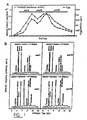
- Figure 1 shows the separation of 2 isoforms of the sucrose-fructan 6-fructosyltransferase (6-SFT) from barley after the second anion exchange chromatography step on a Resource Q column in a purification procedure.
- Figure 1A shows the protein elution profile (A280) and the fructosyltransferase activity of the fractions obtained after chromatography after incubation with 0.2M sucrose in 25 mM methylpiperazine (HCl) buffer (pH 5.75).
- De chromatograms ( Fig. 1B ) were obtained by pulsed amperometric detection after anion exchange HPLC separation on a CarboPack-PA100 column. The reaction products were obtained after incubation of pool I and pool III with sucrose alone, or sucrose and isokestose. The carbohydrates were identified by their retention times and trehalose was used as internal standard.
- Open circles in fig. 1A represent fructosyltransferase activity, which is indicated as the sum of formed kestose, bifurcose, isokestine and kestine.
- fig. 1B p corresponds with a non-identified product resulting from isokestose contaminants, and c with a contamination of the isokestose substrate.
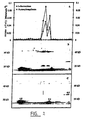
- Figure 2A shows a graph of the enzymatic activity of a pool of fractions of 6-SFT (referred to as pool II; see figure 1 ) after isoelectric focussing under non-denaturing conditions. Closed triangles indicate beta-fructosidase activity measured as released fructose, while open circles indicate the fructosyltransferase activity measured as formed kestose.
- Figure 2B is an SDS-PAGE gel after two-dimensional analysis of pool II after the second anion exchange chromatography. The two 6-SFT isoforms are shown herein. Both isoforms are found to consist of two subunits of respectively 23 kDa and 49 kDa.
- Figure 2C is the two-dimensional gel electrophoresis of the IEF-markers phycocyanin (pI 4.6), beta-lactoglobulin (pI 5.1) and bovine carbonic anhydrase (pI 6.0).
- Figure 3 is a schematic view of the strategy used to obtain the cDNA clone which codes for 6-SFT from barley.
- Figure 4 shows the cDNA-sequence and the amino acid sequence of 6-SFT from barley derived therefrom.
- FIG. 5 is an overview of the derived amino acid sequence of 6-SFT from barley, different invertases (beta-fructosidases), levanases and levansucrases.
- H.v. 6-SFT sucrose-fructan 6-fructosyltransferase from barley.
- Figure 6 is a dendrogram of 6-SFT from barley with different invertases (beta-fructosidases), levanases and levansucrases, based on derived amino acid sequences.
- the dendrogram was generated with the sequences described in figure 5 making use of the Pileup program of the GCG sequence analysis software package.
- Figure 7 shows the functional expression of barley 6-SFT in Nicotiana plumbaginifolia protoplasts. Error bars indicate the average standard deviation.
- the 6-SFT cDNA was expressed for 27 hours in protoplasts. Samples were taken a number of times and the fructosyltransferase activity was determined in protoplast extracts by incubation with sucrose ( Fig. 7A ) or sucrose and isokestose ( Fig. 7B ). Open circles show the enzyme activity of extracts of protoplasts which were transformed with the 6-SFT gene construct. Open squares show the activity of extracts of protoplasts transformed with the vector without the 6-SFT cDNA.
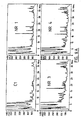
- Figure 7A shows the spectra of extracts obtained from transgenic tobacco plants, which were obtained with a Dionex DX-300 system with PA-100 column and Pulsed Amperometric Detection and elution with an NaOH/NaAc gradient to 100% NaOH.
- the number of the transgenic line is indicated per spectrum, namely 1, 3, 4, 5, 7, 9, 10, 11.
- C1 is the control line.
- Figure 8B shows the spectra of a control (C1), transformant no.4 (#4) and transformant no.4 wherein 100 ng 6-kestose was added to the extract (#4 + 6K).
- the designation "6K" in the spectrum indicates the 6-kestose peak.
- Sucrose-fructan 6-fructosyltransferase is a key enzyme for the biosynthesis of branched fructans (also called graminans) which are typical for grasses.
- the enzyme forms kestose from sucrose and bifurcose from sucrose and isokestose.
- barley Hordeum vulgare L.
- An enzyme preparation was prepared by grinding induced primary leaves (700 g fresh weight) to a fine powder in liquid nitrogen and subsequently suspending them in extraction buffer (25 mM methylpiperazine, adjusted to pH 5.75 with HCl, with 1 mM DTT, 1mM benzamidine, 1mM EDTA, 0.1 mM PMSF and 0.5% PVP). 2 ml per g fresh weight hereof was used. After defrosting, the extract was kept at 4°C and adjusted to pH 4.75 by adding 0.1 M HCl in drops while stirring. Three hours later the extract was centrifuged for 30 minutes at 17,000 g.
- extraction buffer 25 mM methylpiperazine, adjusted to pH 5.75 with HCl, with 1 mM DTT, 1mM benzamidine, 1mM EDTA, 0.1 mM PMSF and 0.5% PVP.
- the resulting supernatant was dialysed overnight at 4°C against dialysis buffer (10 mM methylpiperazine (HCl) buffer (pH 5.75), with 1 mM DTT, 1 mM benzamidine, 1 mM EDTA and 0.1 mM PMSF).
- dialysis buffer 10 mM methylpiperazine (HCl) buffer (pH 5.75), with 1 mM DTT, 1 mM benzamidine, 1 mM EDTA and 0.1 mM PMSF).
- the enzyme solution was purified by means of affinity chromatography on Blue Sepharose.
- the enzyme solution was filtered through a 0.45 micrometer Millipore filter and loaded at a flow speed of 2 ml per minute on a column (26x120mm) of Blue Sepharose-6-fast flow (Pharmacia, Uppsala, Sweden), which had previously been equilibrated with the above described dialysis buffer.
- the column was washed with three bed volumes of the dialysis buffer.
- Bound proteins were eluated at a flow speed of 3 ml per minute (5 ml fractions), first with 0.2 M NaCl in 10 mM methylpiperazine (HCl) buffer (pH 5.75) for 30 minutes, followed by a linear gradient of 0.2 M to 0.5 M NaCl in the same buffer within 90 minutes.
- HCl methylpiperazine
- the 6-SFT fraction was filtered and loaded at a flow speed of 3 ml per minute on a 6 ml resource Q column (Pharmacia), which had been equilibrated earlier with dialysis buffer. After the column was washed with 10 mM methylpiperazine (HCl) buffer (pH 5.75), the bound protein was eluated with a linear gradient of 0 to 0.15 M NaCl in the same buffer within 8 minutes at a flow speed of 15 ml per minute. Fractions of 1 ml were collected. The fractions which contained 6-SFT were pooled and supplemented with ammonium sulphate to a final concentration of 2 M.
- HCl methylpiperazine
- the 6-SFT pool was subsequently subjected to hydrophobic interaction chromatography.
- the pool was loaded at a flow speed of 0.5 ml per minute onto an alkylsuperose-column HR5/5 (Pharmacia) which had been equilibrated earlier with 50 mM citric acid-Na 2 HPO 4 buffer (pH 5.0) with 2 M ammonium sulphate.
- the bound proteins were eluated within 60 minutes at a flow speed of 0.5 ml per minute with a linear gradient of 2 to 0 M ammonium sulphate in 50 mM citric acid-Na 2 HPO 4 buffer (pH 5.0). Fractions of 0.5 ml were collected and the fractions which contained 6-SFT activity were pooled.
- the pooled fraction were subjected to gel filtration chromatography and prior thereto first concentrated to a total volume of 190 microlitres in microconcentrator centrifuge tubes (Centricon-30, Amicon-Grace, Beverly, CT). The concentrate was placed on a Superdex 75 HR 10/30 gel filtration column (Pharmacia), which was equilibrated with 100 mM citric acid-Na 2 HPO 4 buffer (pH 5.75) with 0.2 M NaCl, and eluated with the same buffer at a flow speed of 0.4 ml per minute.
- the enzymatic activity of the fractions was determined after the different purifying steps. For this purpose portions of 50-100 ⁇ l of the enzyme preparations were desalted by guiding them over Biogel P-10 columns (8x300 mm) by centrifugation at 350 g for 5 minutes (Simmen et al., supra ). Desalted enzyme preparations were incubated with 0.2 M sucrose in 50 mM citric acid-Na 2 HPO 4 buffer (pH 5.75) to identify fractions containing 6-SFT activity during the purification.
- the final enzyme preparations (pool I and III) were incubated with 0.1 M sucrose alone or in combination with 0.1 M isokestose in 25 mM methylpiperazine (HCl) buffer (pH 5.75). Unless otherwise indicated, the enzyme activity assays were performed for ' three hours at 27°C. The reaction was stopped by heating the samples for 3 minutes at 95°C. The samples were centrifuged for 5 minutes at 13,000 g, supplemented with trehalose (internal standard) to a final concentration of 0.1 ⁇ g/ ⁇ l, and stored at -20°C until the analysis.
- HCl methylpiperazine
- Neutral carbohydrates were analysed by means of anion exchange chromatography on a CarboPac PA-100 column (Dionex, Sunnyvale, USA) with a Dionex DX-300 gradient chromatography system coupled to pulsed amperometric detection (Simmen et. al., surpra ).
- enzyme activities freeing glucose from sucrose were detected in the fractions collected during the enzyme purification, this using the glucose test kit (GOD-Perid method, Boehringer GmbH, Mannheim, Germany) in accordance with the instructions of the manufacturer.
- 6-SFT isoforms with indistinguishable catalytic properties were isolated by the purification (table I).
- affinity chromatography on the HighTrap blue column and by hydrophobic interaction chromatography on the alkylsuperose column the invertase (beta-fructosidase) activity was almost completely separated from the 6-SFT.
- 6-SFT has no invertase activity.
- the mol ratio between beta-fructosidase and fructosyltransferase activity fell by a factor 6 after affinity chromatography and was then further reduced to a final ratio of approximately three after hydrophobic interaction chromatography (table I).
- the remaining beta-fructosidase activity could not be separated from 6-SFT and therefore appears to be one of its catalytic properties.
- 6-SFT its capacity to transfer fructose to either sucrose or to isokestose is a characterizing property of 6-SFT.
- Both 6-SFT isoforms which were obtained after the second anion exchange column have the same catalytic properties as shown by HPLC-analysis of the products formed after incubation with sucrose alone or with sucrose and isokestose ( fig. 1B ).
- sucrose as the only substrate, mainly kestose is formed but sucrose is likewise hydrolysed to glucose and fructose.
- sucrose and isokestose mainly bifurcose is formed and much less sucrose is hydrolysed. This indicates that isokestose is the preferred acceptor compared with sucrose and that the beta-fructosidase activity is a component of the 6-SFT.
- 6-SFT pool II For two-dimensional electrophoresis of 6-SFT pool II was subjected to isoelectric focussing within a pH range of 4-8 under non-denaturing conditions making use of a Mini-Protean II 2D-cell (Biorad) in accordance with the protocol of the manufacturer.
- the 1 mm tubular gels were subsequently either cultured for 30 minutes in 5x sample buffer and loaded onto a 7.5-12% SDS polyacrylamide gel for a separation in the second dimension ( Laemmli, Nature 227, 680-685, (1970 )), or washed three times for ten minutes in 0.5 M citric acid Na 2 HPO 4 buffer (pH 5.75) and cut into pieces of 2.5 mm for an enzyme activity assay.
- the 2.5 mm gel pieces were incubated in 0.4 M citric acid Na 2 HPO 4 buffer (pH 5.75) with 0.2 M sucrose and 0.02% NaN 3 for 12 hours at 27°C.
- Proteins separated on SDS-polyacrylamide gels were made visible by means of a silver staining (Blum, 1987).
- the two isoforms were clearly separated and both had a fructosyltransferase and likewise a beta-fructosidase activity. Their pI differed only slightly and was close to pH 5.0. After denaturation both 6-SFT isoforms provided on SDS-PAGE two subunits of respectively 49 and 23 kDa. This data and the almost complete identicity of the fragment patterns obtained by tryptic digestion (data not shown) indicate that the two isoforms display very many similarities in respect of structure and sequence.
- the negatively loaded 6-SFT (containing both isoforms) had a approximately 67 kDa as determined by size-exclusion chromatography (data not shown).
- N-terminal amino acid sequence determination 100 ⁇ g protein of 6-SFT pool I and pool III was loaded onto a gradient gel (7.5-12%) and separated by SDS-PAGE (Laemmli, supra ). The proteins were transferred to a polyvinylidene difluoride membrane (Immobilon PVDF transfer membrane, Millipore Corp., Bedford, MA) making use of the CAPS buffer system ( Matsudeira, J. Biol. Chem 262, 10035-10038 (1987 )). The protein bands were made visible on the membrane with 0.2% Ponceau S in 1% acetic acid, cut out and digested with trypsin.
- Tryptic peptides were separated by reverse phase HPLC and N-terminal sequence determination of tryptic peptides was performed by automated Edman degradation.
- the peptide sequence of the N-terminus of the 49 kDa subunit was determined and both, the large and the small, subunits were digested with trypsin in order to obtain internal peptide sequences.
- trypsin For both subunits two amino acid sequences of tryptic peptides were determined and used to design DNA primers ( fig. 3 ).
- a 397 bp fragment was generated by reverse transcription polymerase chain reaction (RT-PCR).
- RT-PCR reverse transcription polymerase chain reaction
- single-string cDNA was synthesized by reverse transcription of Poly(A + ) -RNA making use of a synthetic oligo-d(T) primer (23mer) and M-MuL V reverse transcriptase.
- PCR was performed according to the Perkin-Elmer protocol between the two synthetic, degenerated primers:
- the fragment of 397 bp generated as according to the method under 5. was used as a probe in an RNA gel blot analysis of primary leaves, in which the accumulation of fructans was induced by continuous exposure to light for different times. There was found to be no hybridisation signal in the case of untreated leaves while a hybridising band of approximately 1800 bp accumulated rapidly in a manner which corresponded with the increase in 6-SFT activity in the leaves (data not shown). This result points to the presence of a messenger RNA of about 1800 bp in length.
- the PCR product was also used to screen a cDNA expression library of primary leaves. A search was made here for a cDNA of full length.
- RNA extraction buffer 0.1 M Tris (HCl), pH 9, with 10mM EDTA, 0.1 M NaCl and 25 mM DTT.
- the still frozen sample was further ground until a cream-like consistency was reached and the sample was then extracted with phenol-chloroform-isoamylalcohol (25:24:1;v:v:v) ( Brandt and Ingversen, Carlsberg Res. Commum. 43, 451-469, 1978 ).
- the method was modified somewhat by omitting a second homogenisation step and by precipitating the RNA overnight with 2M LiCl at 4°C after the last chloroform extraction. After a final ethanol precipitation poly (A) + -RNA was isolated by poly(U)-Sepharose chromatography (Brandt and Ingversen, supra ) and used for cDNA synthesis (ZAP-cDNA synthesis Kit, Stratagene, LaJolla, Ca, USA).
- the cDNA was ligated in a uni-ZAP-XR vector, digested with EcoRI and XhoI and packed in phage particles (Gigapack III.Packaging Kit, Stratagene, La Jolla, Ca, USA) (7.5 x10 7 plaque-forming units per 5 ⁇ g poly(A) + -RNA).
- the primary library was screened with the ⁇ - 32 P-labelled 397 bp long fragment of 6-SFT (see above) at 60°C in accordance with the Stratagene protocol. Positive clones were screened once again and Bluescript phagemides were finally cleaved from the resulting positive phages using the Exassist/SOLR-system (Strategene, La Jolla, Ca, USA). DNA sequence determination of both strings was performed by the dideoxynucleotide sequence determining method making use of the sequencing PRO kit (Toyobo, Osaka, Japan). Unless indicated otherwise, standard protocols were used (Sambrook et al., Cold Spring Harbor Laboratory Press, Cold Spring Harbor (1989)). Sequence data-analysis was carried out using the GCG sequence analyses software package, version 7.2 (1992).
- a schematic view of the complete nucleotide sequence of the fully sequenced cDNA is shown in fig. 4 . It comprises one long open reading frame which begins at nucleotide 46 and ends at nucleotide 1923 for two stop codons.
- the open reading frame codes for a polypeptide chain of 626 amino acids including a leader sequence of 67 residues in length.
- the mature 6-SFT starts at nucleotide 246 and therefore has at least 559 amino acid residues with a calculated molecular weight of 61.3 kDa and a calculated pI of 5.37. All 5 of the partial amino acid sequences obtained from the purified protein are present in the amino acid sequence derived from the cDNA ( fig. 4 ).
- the cDNA likewise contains 45 bp of a 5' non-translated and 171 bp of a 3' non-translated sequence with a poly(A) tail.
- a possible translation initiation signal (ATG) of the 6-SFT cDNA is localised at the nucleotide positions 46 to 48 and a possible polyadenylating sequence is present at the nucleotide positions 1973 to 1979.
- the mature 6-SFT displays alpha-methyl-mannoside-reversible binding on ConA-Sepharose, which indicates that it is a glycoprotein (data not shown).
- the derived amino acid sequence contains 6 possible glycosylating positions (Asn-X-Ser/Thr).
- All peptide sequences obtained from the purified protein are situated without any mismatch in the derived amino acid sequence.
- the two peptide sequences obtained from the 23 kDa subunit of the purified SFT are localised close to the 3'-terminus of the cDNA, while the sequences obtained from the 49 kDa subunit are localised in the vicinity of the 5'-terminus.
- the derived amino acid sequence was compared with the sequence of different vegetable, fungal and bacterial invertases, and with bacterial levanases and levansucrases ( fig. 5 and fig. 6 ).
- the cDNA described herein has the highest homology with soluble acid invertases of the green soya bean (mungbean) (Arai et al., supra ), carrot (Unger et al., supra ), and tomato (Elliott et al., supra ), and equally clear homologies with invertases, levanases and levansucrases from other kingdoms, that is, with a number of beta-fructosidases.
- the comparison of the amino acid sequence indicates at least five well conserved domains. Domains I and IV are less conserved between invertases and levansucrases than domains II, III and V. With these enzymes domain III in particular is very conserved.
- the most limited homology is that with bacterial levansucrases, that is, with a class of enzymes which catalyse a similar 6-fructosyl transfer reaction as 6-SFT (see the dendrogram in fig. 6 ).
- the 6-SFT cDNA clone was sub-cloned, in a derivative of the pUC119 plasmide vector ( Samsbrook et al., Molecular Cloning, A Laboratory Manual, Cold Spring Harbor Laboratory Press, Cold Spring HArbor, 1989 ) under the regulation of the expression signals of the cauliflower mosaic virus 35S transcript (see Neuhaus et al., Proc. Natl. Acad. Sci. USA 88, 10362-10366 (1991 )).
- Protoplasts of Nicotiana plumbaginifolia were isolated and transformed largely as described by Goodall et al. (Meth. Enzymol. 181, 148-161 (1990 )).
- 10 ⁇ g of the plasmide containing the 6-SFT cDNA was dispersed in a volume of 10 ⁇ l TE buffer in sterile 15 ml plastic tubes. Control transformations were carried out with 10 ⁇ g of the same plasmide without insert.
- 1 x 10 6 protoplasts were added up to a volume of 0.5 ml and mixed carefully with an equal volume 20% (w/v) polyethylene glycol 6000. After 2-5 minutes 6.5 ml K3 medium was added and the protoplasts incubated for two hours at 27°C.
- the 6-SFT cDNA was cloned between a plant-specific 35S promotor and a termination signal originating from the nopaline synthase gene.
- This chimeric gene construct (35S-6SFT-NOS) was subsequently inserted into a derivative of the binary plant vector pBIN19 ( Bevan, Nucl. Acids. Res. 12, 8711-8721 ). This resulted in the plasmide pVDH280.
- This plasmide was conjugated in Agrobacterium tumefaciens LBA4404 ( Hoekema et al., Nature 303, 179-180 (1983 )) in a three-point crossbreeding making use of the helper plasmide pRK-2013 ( Lam, Plasmid 13, 200-204 (1985 )).
- the construct was introduced into Nicotinia tabacum var. Samsun NN using the leaf disc transformation method ( Horsch et al., Science 227, 1229-1232 (1985 )).
- the regenerated plants were selected for kanamycine resistance, cultured on MS medium ( Murashige and Skoog, Physiol. Plant. 15, 473-497 (1962 )) and analysed.
- Leaf material of in vitro non-transgenic control plants as well as of the in vitro transgenic plants 1, 3, 4, 5, 7, 9, 10 and 11 was cut off and ground in an eppendorf tube. After centrifugation (2 minutes at 16,000 rpm) 200 ⁇ l was analysed by means of a Dionex DX-300 system with PA-100 column and Pulsed Amperometric Detection and elution with an NaOH/NaAc gradient to 100% NaOH. The spectra obtained are shown in figure 8 .
- oligosaccharides were never found in wildtype plants (C1) or in plants which were transformed with non-related constructs ( fig. 8A ).
- the screening of the transformants showed with use of these methods oligosaccharide-accumulating plants with a DP which, based on the inulin series, is estimated to lie between 3 and 5 and between 8 and 9.
- the expression levels varied between individual plants transformed with the same construct. This is a normal phenomenon in transformation experiments in plants. The variation of the expression levels depends substantially on the integration position in the genome (position effect).
- Fig. 8B indicates that in the case of transformant no. 4 oligo-saccharides with a 2-6 type bond are formed, since a higher peak is visible compared to the spectrum without 6-kestose. The peak therefore probably corresponds with 6-kestose.
- the resulting transgenic plants accumulated significant levels of oligosaccharides in for instance their leaves and storage organs. It is of course not essential that the plants are transformed in the manner indicated. Other methods within the reach of the skilled person can also be used.
- Examples of other plant species which can be modified comprise, but are not limited to, maize (Zea mays L.), wheat ( triticum aestivum L.), barley ( Hordeum vulgare L.), rice ( Oryza sativa L.), soya bean (Glycin max L.), pea ( Pisum sativum L.), bean ( Phaseolus vulgaris L.), chicory ( Cichorium intybus L.), sugar cane ( Saccharum officinarum L.), sweet potato ( Dioscorea esculenta L.), cassava ( Manihot esculenta L.) and grasses (for instance Lolium spp., Poa spp. and Festuca spp.).
- Plants with natural or induced modified carbohydrate separation patterns can be preferred target plants for the introduction of oligosaccharide-synthesizing genes.
- Such plants comprise, but are not limited to, natural mutants in starch and sucrose metabolism, and plants in which the starch and sucrose metabolism are modified by means of molecular and genetic techniques, as for instance described in Sonnewald and Willmitzer, Plant Physiology 99, 1267-1270, (1992 ).
- oligosaccharides produced using the method according to the invention can be used as sugar substitutes in different products. Three examples hereof are given below.
- Ice cream is prepared from the following ingredients: 635 parts water 90 parts butter fat 100 parts low-fat milk powder 170 parts oligosaccharides according to the invention 5 parts Cremodan SE30 TM (Grindsted) 0.3 parts Aspartame TM flavourings as required.
- the milk powder is dissolved in the water. The whole is heated to 40-45°C. The remaining dry ingredients are mixed and dissolved in the warm milk. The melted butter is then added. This whole is then pasteurised for 10 minutes at 72°C. The mixture is thereafter homogenised in a two-stage homogenizer at 150/35 bar. The thus obtained ice mix is cooled rapidly to 5°C and the whole is subsequently left to mature for a minimum of 4 hours at 5°C. Finally, the ice mix is aerated and frozen to an overrun of 100%.
- a muesli bar was prepared from the following ingredients: 28 parts oligosaccharides according to the invention 68 parts muesli mix 4 parts cacao A syrup was produced from the oligosaccharides by heating, which syrup was mixed with the other ingredients. The bars were formed from the thus obtained mixture in a cylindrical press. Due to the omission of natural sugar the bar is much lower-calory than the conventional bars.
- a soft drink was prepared from the following ingredients: 90 parts water or fruit juice 8-10 parts oligosaccharides according to the invention artificial sweeteners flavourings and coloring agents nutrient acid carbon dioxide All ingredients were dissolved in a part of the water. The remaining water was then added as carbon dioxide-containing water. The energy value of the soft drink is much less because no additional natural sugars are added.
Landscapes
- Health & Medical Sciences (AREA)
- Life Sciences & Earth Sciences (AREA)
- Genetics & Genomics (AREA)
- Chemical & Material Sciences (AREA)
- Engineering & Computer Science (AREA)
- Organic Chemistry (AREA)
- Zoology (AREA)
- Bioinformatics & Cheminformatics (AREA)
- Wood Science & Technology (AREA)
- Biotechnology (AREA)
- Molecular Biology (AREA)
- Biomedical Technology (AREA)
- General Engineering & Computer Science (AREA)
- General Health & Medical Sciences (AREA)
- Biochemistry (AREA)
- Microbiology (AREA)
- Medicinal Chemistry (AREA)
- Nutrition Science (AREA)
- Plant Pathology (AREA)
- Biophysics (AREA)
- Physics & Mathematics (AREA)
- Cell Biology (AREA)
- Micro-Organisms Or Cultivation Processes Thereof (AREA)
- Breeding Of Plants And Reproduction By Means Of Culturing (AREA)
- Enzymes And Modification Thereof (AREA)
- Seasonings (AREA)
- Saccharide Compounds (AREA)
- Coloring Foods And Improving Nutritive Qualities (AREA)
- Agricultural Chemicals And Associated Chemicals (AREA)
- Fodder In General (AREA)
- Preparation Of Compounds By Using Micro-Organisms (AREA)
Claims (7)
- Verfahren zur Herstellung einer Mischung von Oligosacchariden, die eine Kettenlänge von individuellen Molekülen haben, die im Wesentlichen zwischen 2 und 8 liegt, wobei das Verfahren die folgenden Schritte umfasst:a) Selektieren eines Gens pflanzlichen Ursprungs, das für ein Enzym kodiert, das in der Lage ist, Saccharose in ein Oligosaccharid zu konvertieren;b) Anbinden des Gens an geeignete Initiations- und Terminationssignale der Transkription, um ein Expressionskonstrukt zur Verfügung zu stellen;c) Transformieren einer geeigneten Pflanzenzelle mit dem Expressionskonstrukt;d) Regenerieren einer transgenen Pflanze aus der transformierten Pflanzenzelle;e) Kultivieren der transgenen Pflanze unter Bedingungen, die die Expression und Aktivität des Enzyms ermöglichen; undf) Isolieren von Oligosacchariden aus der transgenen Pflanze, wobei das Gen der Schritte a) und b) für Saccharose-Fructan-6-Fructosyltransferase (6-SFT) kodiert, die die Aminosäuresequenz aus Figur 4 hat.
- Verfahren wie in Anspruch 1 beansprucht, worin das Expressionskonstrukt weiterhin mindestens eine Targeting-Signalsequenz umfasst.
- Verfahren wie in jedem der vorhergegangenen Ansprüche beansprucht, worin das Expressionskonstrukt weiterhin mindestens einen Enhancer umfasst.
- DNS-Konstrukt zur Expression eines Enzyms, das in der Lage ist, Saccharose in einer Pflanze oder einer Pflanzenzelle in ein Oligosaccharid zu konvertieren, umfassend ein für das Enzym kodierendes Gen, das im Leseraster an pflanzenspezifische Initiations- und Terminations-Signale der Transkription gekoppelt ist, wobei das Gen für die Saccharose-Fructan-6-Fructosyltransferase (6-SFT) kodiert, die die Aminosäuresequenz von Figur 4 hat.
- Transgene Pflanzenzelle umfassend das DNS-Konstrukt, wie es in Anspruch 4 beansprucht ist.
- Transgene Pflanze umfassend das DNS-Konstrukt nach Anspruch 4 erhältlich durch Regeneration aus einer transgenen Pflanzenzelle, wie sie in Anspruch 5 beansprucht ist.
- Transgenes Pflanzengewebe umfassend das DNS-Konstrukt aus Anspruch 4, das aus einer Pflanze wie in Anspruch 6 beansprucht stammt, oder, das durch Regeneration aus einer transgenen Pflanzenzelle wie in Anspruch 5 beansprucht erhältlich ist.
Applications Claiming Priority (5)
| Application Number | Priority Date | Filing Date | Title |
|---|---|---|---|
| NL9401140 | 1994-07-08 | ||
| NL9401140A NL9401140A (nl) | 1994-07-08 | 1994-07-08 | Produktie van oligosacchariden in transgene planten. |
| NL1000064 | 1995-04-05 | ||
| NL1000064A NL1000064C1 (nl) | 1994-07-08 | 1995-04-05 | Produktie van oligosacchariden in transgene planten. |
| PCT/NL1995/000241 WO1996001904A1 (en) | 1994-07-08 | 1995-07-07 | Production of oligosaccharides in transgenic plants |
Related Child Applications (1)
| Application Number | Title | Priority Date | Filing Date |
|---|---|---|---|
| EP10176661.6 Division-Into | 2010-09-14 |
Publications (2)
| Publication Number | Publication Date |
|---|---|
| EP0774007A1 EP0774007A1 (de) | 1997-05-21 |
| EP0774007B1 true EP0774007B1 (de) | 2011-10-05 |
Family
ID=26642025
Family Applications (1)
| Application Number | Title | Priority Date | Filing Date |
|---|---|---|---|
| EP95923598A Expired - Lifetime EP0774007B1 (de) | 1994-07-08 | 1995-07-07 | Herstellung von oligosacchariden in transgenen pflanzen |
Country Status (12)
| Country | Link |
|---|---|
| US (2) | US6147280A (de) |
| EP (1) | EP0774007B1 (de) |
| JP (2) | JP4509220B2 (de) |
| AT (1) | ATE527367T1 (de) |
| AU (1) | AU701190B2 (de) |
| CA (1) | CA2194579C (de) |
| DK (1) | DK0774007T3 (de) |
| ES (1) | ES2372154T3 (de) |
| NL (1) | NL1000064C1 (de) |
| NZ (1) | NZ288753A (de) |
| PT (1) | PT774007E (de) |
| WO (1) | WO1996001904A1 (de) |
Families Citing this family (203)
| Publication number | Priority date | Publication date | Assignee | Title |
|---|---|---|---|---|
| PT795018E (pt) * | 1995-01-06 | 2007-12-21 | Plant Res Int Bv | Sequências de adn codificando enzimas de síntese de polímeros de hidratos de carbono e método para a produção de plantas transgénicas |
| US6087559A (en) * | 1995-06-07 | 2000-07-11 | Pioneer Hi-Bred International, Inc. | Plant cells and plants transformed with Streptococcus mutans genes encoding wild-type or mutant glucosyltransferase B enzymes |
| US6284479B1 (en) | 1995-06-07 | 2001-09-04 | Pioneer Hi-Bred International, Inc. | Substitutes for modified starch and latexes in paper manufacture |
| US6127602A (en) * | 1995-06-07 | 2000-10-03 | Pioneer Hi-Bred International, Inc. | Plant cells and plants transformed with streptococcus mutans genes encoding wild-type or mutant glucosyltransferase D enzymes |
| NL1002275C2 (nl) * | 1996-02-07 | 1997-08-08 | Have D J Van Der Bv | Modificatie van polysacchariden. |
| US6833491B2 (en) | 1996-02-07 | 2004-12-21 | D. J. Van Der Have B.V. | Modification of polysaccharides |
| DE19617687C2 (de) * | 1996-05-03 | 2000-11-16 | Suedzucker Ag | Verfahren zur Herstellung transgener, Inulin erzeugender Pflanzen |
| DE19708774A1 (de) * | 1997-03-04 | 1998-09-17 | Max Planck Gesellschaft | Nucleinsäuremoleküle codierend Enzyme die Fructosylpolymeraseaktivität besitzen |
| US6365800B1 (en) | 1998-03-12 | 2002-04-02 | E. I. Du Pont Nemours & Company | Transgenic crops accumulating fructose polymers and methods for their production |
| EP0952222A1 (de) | 1998-04-17 | 1999-10-27 | Centrum Voor Plantenveredelings- En Reproduktieonderzoek (Cpro-Dlo) | Transgene Pflanzen mit einem modifizierten Inulin produzierendem Profil |
| JP2000350583A (ja) * | 1999-03-25 | 2000-12-19 | Hokkaido National Agricultural Experiment Station | 低温発現型フルクタン代謝酵素遺伝子 |
| US6791015B2 (en) | 2000-10-30 | 2004-09-14 | E. I. Du Pont De Nemours And Company | Fructan biosynthetic enzymes |
| DE10061150A1 (de) * | 2000-12-08 | 2002-06-13 | Icon Genetics Ag | Verfahren und Vektoren zur Erzeugung von transgenen Pflanzen |
| DE10106163B4 (de) * | 2000-12-21 | 2007-03-29 | Südzucker AG Mannheim/Ochsenfurt | Verfahren zur Herstellung von Kohlenhydraten |
| MXPA03005645A (es) * | 2000-12-21 | 2004-04-21 | Suedzucker Ag | Procedimiento para la preparacion de carbohidratos. |
| WO2003000854A2 (en) | 2001-06-25 | 2003-01-03 | Ses Europe N.V./S.A. | Double fructan beets |
| US20040003432A1 (en) * | 2002-05-06 | 2004-01-01 | Pharmacia Corporation | Production of hexosamines and uses thereof |
| EP1600509B1 (de) * | 2003-03-03 | 2011-11-02 | Meiji Seika Kaisha Ltd. | Transgene pflanze mit darin angereichertem fructooligosaccharid und verfahren zur konstruktion davon |
| BRPI0412582A (pt) * | 2003-07-31 | 2006-09-19 | Toyo Boseki | plantas produtoras de ácido hialurÈnico |
| AR052059A1 (es) | 2004-12-21 | 2007-02-28 | Bayer Cropscience Gmbh | Plantas de cana azucarera con contenido incrementado de carbohidratos de almacenamiento |
| CL2007003743A1 (es) | 2006-12-22 | 2008-07-11 | Bayer Cropscience Ag | Composicion que comprende fenamidona y un compuesto insecticida; y metodo para controlar de forma curativa o preventiva hongos fitopatogenos de cultivos e insectos. |
| CL2007003744A1 (es) | 2006-12-22 | 2008-07-11 | Bayer Cropscience Ag | Composicion que comprende un derivado 2-piridilmetilbenzamida y un compuesto insecticida; y metodo para controlar de forma curativa o preventiva hongos fitopatogenos de cultivos e insectos. |
| IL181431A0 (en) * | 2007-02-19 | 2007-07-04 | Micha Shemer | Fruit juice and puree with a lowered amount of available sugars |
| US8080688B2 (en) | 2007-03-12 | 2011-12-20 | Bayer Cropscience Ag | 3, 4-disubstituted phenoxyphenylamidines and use thereof as fungicides |
| EP1969930A1 (de) | 2007-03-12 | 2008-09-17 | Bayer CropScience AG | Phenoxyphenylamidine und deren Verwendung als Fungizide |
| WO2008110279A1 (de) | 2007-03-12 | 2008-09-18 | Bayer Cropscience Ag | Dihalogenphenoxyphenylamidine und deren verwendung als fungizide |
| WO2008110280A2 (de) | 2007-03-12 | 2008-09-18 | Bayer Cropscience Ag | Phenoxy-substitutierte phenylamidin-derivativen und deren verwendung als fungiziden |
| EP1969934A1 (de) | 2007-03-12 | 2008-09-17 | Bayer CropScience AG | 4-Cycloalkyl-oder 4-arylsubstituierte Phenoxyphenylamidine und deren Verwendung als Fungizide |
| EP1969929A1 (de) | 2007-03-12 | 2008-09-17 | Bayer CropScience AG | Substituierte Phenylamidine und deren Verwendung als Fungizide |
| WO2008128639A1 (de) | 2007-04-19 | 2008-10-30 | Bayer Cropscience Aktiengesellschaft | Thiadiazolyloxyphenylamidine und deren verwendung als fungizide |
| TW200911740A (en) | 2007-06-01 | 2009-03-16 | Solvay | Process for manufacturing a chlorohydrin |
| DE102007045920B4 (de) | 2007-09-26 | 2018-07-05 | Bayer Intellectual Property Gmbh | Synergistische Wirkstoffkombinationen |
| DE102007045922A1 (de) | 2007-09-26 | 2009-04-02 | Bayer Cropscience Ag | Wirkstoffkombinationen mit insektiziden und akariziden Eigenschaften |
| DE102007045919B4 (de) | 2007-09-26 | 2018-07-05 | Bayer Intellectual Property Gmbh | Wirkstoffkombinationen mit insektiziden und akariziden Eigenschaften |
| DE102007045956A1 (de) | 2007-09-26 | 2009-04-09 | Bayer Cropscience Ag | Wirkstoffkombination mit insektiziden und akariziden Eigenschaften |
| DE102007045953B4 (de) | 2007-09-26 | 2018-07-05 | Bayer Intellectual Property Gmbh | Wirkstoffkombinationen mit insektiziden und akariziden Eigenschaften |
| EP2090168A1 (de) | 2008-02-12 | 2009-08-19 | Bayer CropScience AG | Methode zur Verbesserung des Pflanzenwachstums |
| EP2072506A1 (de) | 2007-12-21 | 2009-06-24 | Bayer CropScience AG | Thiazolyloxyphenylamidine oder Thiadiazolyloxyphenylamidine und deren Verwendung als Fungizide |
| EP2168434A1 (de) | 2008-08-02 | 2010-03-31 | Bayer CropScience AG | Verwendung von Azolen zur Steigerung der Resistenz von Pflanzen oder Pflanzenteilen gegenüber abiotischem Stress |
| EP2321262A1 (de) | 2008-08-14 | 2011-05-18 | Bayer CropScience AG | Insektizide 4-phenyl-1h-pyrazole |
| DE102008041695A1 (de) | 2008-08-29 | 2010-03-04 | Bayer Cropscience Ag | Methoden zur Verbesserung des Pflanzenwachstums |
| NZ603035A (en) * | 2008-09-15 | 2014-01-31 | Agriculture Victoria Serv Pty | Modification of fructan biosynthesis, increasing plant biomass, and enhancing productivity of biochemical pathways in a plant (2) |
| EP2201838A1 (de) | 2008-12-05 | 2010-06-30 | Bayer CropScience AG | Wirkstoff-Nützlings-Kombinationen mit insektiziden und akariziden Eigenschaften |
| EP2198709A1 (de) | 2008-12-19 | 2010-06-23 | Bayer CropScience AG | Verfahren zur Bekämpfung resistenter tierischer Schädlinge |
| EP2204094A1 (de) | 2008-12-29 | 2010-07-07 | Bayer CropScience AG | Verfahren zur verbesserten Verwendung des Herstellungspotentials von transgenen Pflanzen |
| AU2009335333B2 (en) | 2008-12-29 | 2015-04-09 | Bayer Intellectual Property Gmbh | Method for improved use of the production potential of genetically modified plants |
| EP2223602A1 (de) | 2009-02-23 | 2010-09-01 | Bayer CropScience AG | Verfahren zur verbesserten Nutzung des Produktionspotentials genetisch modifizierter Pflanzen |
| EP2039770A2 (de) | 2009-01-06 | 2009-03-25 | Bayer CropScience AG | Verfahren zur verbesserten Nutzung des Produktionspotentials transgener Pflanzen |
| EP2039771A2 (de) | 2009-01-06 | 2009-03-25 | Bayer CropScience AG | Verfahren zur verbesserten Nutzung des Produktionspotentials transgener Pflanzen |
| EP2039772A2 (de) | 2009-01-06 | 2009-03-25 | Bayer CropScience AG | Verfahren zur verbesserten Nutzung des Produktionspotentials transgener Pflanzen |
| WO2010081689A2 (en) | 2009-01-19 | 2010-07-22 | Bayer Cropscience Ag | Cyclic diones and their use as insecticides, acaricides and/or fungicides |
| EP2227951A1 (de) | 2009-01-23 | 2010-09-15 | Bayer CropScience AG | Verwendung von Enaminocarbonylverbindungen zur Bekämpfung von durch Insekten übertragenen Viren |
| JP5592398B2 (ja) | 2009-01-28 | 2014-09-17 | バイエル・クロップサイエンス・アーゲー | 殺菌剤n−シクロアルキル−n−二環式メチレン−カルボキサミド誘導体 |
| AR075126A1 (es) | 2009-01-29 | 2011-03-09 | Bayer Cropscience Ag | Metodo para el mejor uso del potencial de produccion de plantas transgenicas |
| CN102317259B (zh) | 2009-02-17 | 2015-12-02 | 拜尔农科股份公司 | 杀真菌n-(苯基环烷基)羧酰胺,n-(苄基环烷基)羧酰胺和硫代羧酰胺衍生物 |
| EP2218717A1 (de) | 2009-02-17 | 2010-08-18 | Bayer CropScience AG | Fungizide N-((HET)Arylethyl)Thiocarboxamid-Derivative |
| TW201031331A (en) | 2009-02-19 | 2010-09-01 | Bayer Cropscience Ag | Pesticide composition comprising a tetrazolyloxime derivative and a fungicide or an insecticide active substance |
| EP2410850A2 (de) | 2009-03-25 | 2012-02-01 | Bayer Cropscience AG | Synergistische wirkstoffkombinationen |
| US8828906B2 (en) | 2009-03-25 | 2014-09-09 | Bayer Cropscience Ag | Active compound combinations having insecticidal and acaricidal properties |
| EP2232995A1 (de) | 2009-03-25 | 2010-09-29 | Bayer CropScience AG | Verfahren zur verbesserten Nutzung des Produktionspotentials transgener Pflanzen |
| MX2011009372A (es) | 2009-03-25 | 2011-09-27 | Bayer Cropscience Ag | Combinaciones de principios activos con propiedades insecticidas y acaricidas. |
| BRPI0924436B1 (pt) | 2009-03-25 | 2017-06-06 | Bayer Cropscience Ag | combinações de substâncias ativas com propriedades inseticidas e acaricidas e seu uso, bem como método para o controle de pragas e animais |
| EP2410849A1 (de) | 2009-03-25 | 2012-02-01 | Bayer CropScience AG | Wirkstoffkombinationen mit insektiziden und akariziden eigenschaften |
| EP2239331A1 (de) | 2009-04-07 | 2010-10-13 | Bayer CropScience AG | Verfahren zur verbesserten Verwendung des Herstellungspotentials von transgenen Pflanzen |
| US8835657B2 (en) | 2009-05-06 | 2014-09-16 | Bayer Cropscience Ag | Cyclopentanedione compounds and their use as insecticides, acaricides and/or fungicides |
| AR076839A1 (es) | 2009-05-15 | 2011-07-13 | Bayer Cropscience Ag | Derivados fungicidas de pirazol carboxamidas |
| EP2251331A1 (de) | 2009-05-15 | 2010-11-17 | Bayer CropScience AG | Fungizide Pyrazolcarboxamid-Derivate |
| EP2255626A1 (de) | 2009-05-27 | 2010-12-01 | Bayer CropScience AG | Verwendung von Succinat Dehydrogenase Inhibitoren zur Steigerung der Resistenz von Pflanzen oder Pflanzenteilen gegenüber abiotischem Stress |
| CN105165832B (zh) | 2009-06-02 | 2019-08-13 | 拜耳知识产权有限责任公司 | 琥珀酸脱氢酶抑制剂在控制核盘菌属真菌中的应用 |
| AU2010272872B2 (en) | 2009-07-16 | 2014-08-28 | Bayer Intellectual Property Gmbh | Synergistic active substance combinations containing phenyl triazoles |
| WO2011015524A2 (en) | 2009-08-03 | 2011-02-10 | Bayer Cropscience Ag | Fungicide heterocycles derivatives |
| EP2292094A1 (de) | 2009-09-02 | 2011-03-09 | Bayer CropScience AG | Wirkstoffkombinationen |
| EP2343280A1 (de) | 2009-12-10 | 2011-07-13 | Bayer CropScience AG | Fungizid-Chinolinderivate |
| US9000012B2 (en) | 2009-12-28 | 2015-04-07 | Bayer Cropscience Ag | Fungicide hydroximoyl-heterocycles derivatives |
| MX2012007540A (es) | 2009-12-28 | 2012-07-23 | Bayer Cropscience Ag | Derivados de hidroximoil-tetrazol fungicidas. |
| US8796463B2 (en) | 2009-12-28 | 2014-08-05 | Bayer Cropscience Ag | Fungicide hydroximoyl-tetrazole derivatives |
| NZ601341A (en) | 2010-01-22 | 2014-02-28 | Bayer Ip Gmbh | Acaricide and/or insecticide active substance combinations |
| WO2011107504A1 (de) | 2010-03-04 | 2011-09-09 | Bayer Cropscience Ag | Fluoralkyl- substituierte 2 -amidobenzimidazole und deren verwendung zur steigerung der stresstoleranz in pflanzen |
| BR112012025714A2 (pt) | 2010-04-06 | 2015-09-08 | Bayer Ip Gmbh | uso de ácido 4-fenilbutírico e/ou sais do mesmo para aumentar a tolerância a estresse de plantas |
| WO2011124553A2 (de) | 2010-04-09 | 2011-10-13 | Bayer Cropscience Ag | Verwendung von derivaten der (1-cyancyclopropyl)phenylphosphinsäure, deren ester und/oder deren salze zur steigerung der toleranz in pflanzen gegenüber abiotischem stress |
| WO2011134911A2 (en) | 2010-04-28 | 2011-11-03 | Bayer Cropscience Ag | Fungicide hydroximoyl-tetrazole derivatives |
| CN102971309A (zh) | 2010-04-28 | 2013-03-13 | 拜尔农科股份公司 | 杀真菌剂肟基-杂环衍生物 |
| EP2563784A1 (de) | 2010-04-28 | 2013-03-06 | Bayer CropScience AG | Fungizide hydroximoyl-heterozyklusderivate |
| MX2012013897A (es) | 2010-06-03 | 2012-12-17 | Bayer Cropscience Ag | N[(het)ariletil)]pirazol (tio)carboxamidas y sus analogos heterosustituidos. |
| UA110703C2 (uk) | 2010-06-03 | 2016-02-10 | Байєр Кропсайнс Аг | Фунгіцидні похідні n-[(тризаміщений силіл)метил]-карбоксаміду |
| CA2796194A1 (en) | 2010-06-03 | 2011-12-08 | Bayer Cropscience Ag | N-[(het)arylalkyl)] pyrazole (thio)carboxamides and their heterosubstituted analogues |
| AU2011264074B2 (en) | 2010-06-09 | 2015-01-22 | Bayer Cropscience Nv | Methods and means to modify a plant genome at a nucleotide sequence commonly used in plant genome engineering |
| RU2639512C2 (ru) | 2010-06-09 | 2017-12-21 | Байер Кропсайенс Нв | Способы и средство модификации растительного генома в нуклеотидной последовательности, широко используемой в геномной инженерии растений |
| KR20130041225A (ko) | 2010-07-20 | 2013-04-24 | 바이엘 크롭사이언스 아게 | 항진균제로서의 벤조시클로알켄 |
| AU2011298423B2 (en) | 2010-09-03 | 2015-11-05 | Bayer Intellectual Property Gmbh | Substituted fused pyrimidinones and dihydropyrimidinones |
| BR112013006611B1 (pt) | 2010-09-22 | 2021-01-19 | Bayer Intellectual Property Gmbh | método para o controle do nematoide de cisto de soja (heterodera glycines) infestando uma planta de soja resistente a nematoide compreendendo a aplicação de n- {2- [3-cloro-5- (trifluorometil)-2-piridinil]etil}-2-(trifluorometil) benzamida (fluorpiram |
| EP2460406A1 (de) | 2010-12-01 | 2012-06-06 | Bayer CropScience AG | Verwendung von Fluopyram zum Steuern von Nematoden in nematodresistentem Pflanzen |
| US9408391B2 (en) | 2010-10-07 | 2016-08-09 | Bayer Intellectual Property Gmbh | Fungicide composition comprising a tetrazolyloxime derivative and a thiazolylpiperidine derivative |
| UA107865C2 (ru) | 2010-10-21 | 2015-02-25 | Байєр Інтелекчуал Проперті Гмбх | Гетероциклические карбоксамиды |
| MX2013004286A (es) | 2010-10-21 | 2013-06-05 | Bayer Ip Gmbh | 1(heterociclico carbonil) piperidinas. |
| BR112013010683B1 (pt) | 2010-11-02 | 2018-06-26 | Bayer Intellectual Property Gmbh | Composto, composição fungicida e método para controlar fungos fitopatogênicos de safras |
| WO2012065944A1 (en) | 2010-11-15 | 2012-05-24 | Bayer Cropscience Ag | N-aryl pyrazole(thio)carboxamides |
| US20130231303A1 (en) | 2010-11-15 | 2013-09-05 | Bayer Intellectual Property Gmbh | 5-halogenopyrazole(thio)carboxamides |
| CN107266368A (zh) | 2010-11-15 | 2017-10-20 | 拜耳知识产权有限责任公司 | 5‑卤代吡唑甲酰胺 |
| CN103281900A (zh) | 2010-12-01 | 2013-09-04 | 拜耳知识产权有限责任公司 | 氟吡菌酰胺用于防治作物中的线虫以及提高产量的用途 |
| EP2460407A1 (de) | 2010-12-01 | 2012-06-06 | Bayer CropScience AG | Wirkstoffkombinationen umfassend Pyridylethylbenzamide und weitere Wirkstoffe |
| EP2474542A1 (de) | 2010-12-29 | 2012-07-11 | Bayer CropScience AG | Fungizide Hydroximoyl-Tetrazol-Derivate |
| JP2014502611A (ja) | 2010-12-29 | 2014-02-03 | バイエル・インテレクチユアル・プロパテイー・ゲー・エム・ベー・ハー | 殺菌剤ヒドロキシモイル−テトラゾール誘導体 |
| EP2471363A1 (de) | 2010-12-30 | 2012-07-04 | Bayer CropScience AG | Verwendung von Aryl-, Heteroaryl- und Benzylsulfonamidocarbonsäuren, -carbonsäureestern, -carbonsäureamiden und -carbonitrilen oder deren Salze zur Steigerung der Stresstoleranz in Pflanzen |
| EP2494867A1 (de) | 2011-03-01 | 2012-09-05 | Bayer CropScience AG | Halogen-substituierte Verbindungen in Kombination mit Fungiziden |
| EP2683239A1 (de) | 2011-03-10 | 2014-01-15 | Bayer Intellectual Property GmbH | Verwendung von lipochito-oligosaccharid-verbindungen zur sicherung der saatgutsicherheit von behandeltem saatgut |
| JP2014509599A (ja) | 2011-03-14 | 2014-04-21 | バイエル・インテレクチユアル・プロパテイー・ゲー・エム・ベー・ハー | 殺菌剤ヒドロキシモイル−テトラゾール誘導体 |
| EP2694494A1 (de) | 2011-04-08 | 2014-02-12 | Bayer Intellectual Property GmbH | Hydroximoyl-tetrazol-derivate als fungizide |
| AR090010A1 (es) | 2011-04-15 | 2014-10-15 | Bayer Cropscience Ag | 5-(ciclohex-2-en-1-il)-penta-2,4-dienos y 5-(ciclohex-2-en-1-il)-pent-2-en-4-inos sustituidos como principios activos contra el estres abiotico de las plantas, usos y metodos de tratamiento |
| AR085568A1 (es) | 2011-04-15 | 2013-10-09 | Bayer Cropscience Ag | 5-(biciclo[4.1.0]hept-3-en-2-il)-penta-2,4-dienos y 5-(biciclo[4.1.0]hept-3-en-2-il)-pent-2-en-4-inos sustituidos como principios activos contra el estres abiotico de las plantas |
| EP2511255A1 (de) | 2011-04-15 | 2012-10-17 | Bayer CropScience AG | Substituierte Prop-2-in-1-ol- und Prop-2-en-1-ol-Derivate |
| AR085585A1 (es) | 2011-04-15 | 2013-10-09 | Bayer Cropscience Ag | Vinil- y alquinilciclohexanoles sustituidos como principios activos contra estres abiotico de plantas |
| HRP20160061T1 (hr) | 2011-04-22 | 2016-02-12 | Bayer Intellectual Property Gmbh | Kombinacije aktivnih spojeva koje sadrže derivat karboksamida i fungicidni spoj |
| CN103597082B (zh) | 2011-06-06 | 2017-09-15 | 拜尔作物科学公司 | 用于在预选位点修饰植物基因组的方法和手段 |
| EP2729007A1 (de) | 2011-07-04 | 2014-05-14 | Bayer Intellectual Property GmbH | Verwendung substituierter isochinolinone, isochinolindione, isochinolintrione und dihydroisochinolinone oder jeweils deren salze als wirkstoffe gegen abiotischen pflanzenstress |
| AU2012293636B2 (en) | 2011-08-10 | 2015-12-03 | Bayer Intellectual Property Gmbh | Active compound combinations comprising specific tetramic acid derivatives |
| CN107287234A (zh) | 2011-08-22 | 2017-10-24 | 拜尔作物科学公司 | 修饰植物基因组的方法和手段 |
| EP2748161A1 (de) | 2011-08-22 | 2014-07-02 | Bayer Intellectual Property GmbH | Hydroximoyl-tetrazol-derivate als fungizide |
| EP2561759A1 (de) | 2011-08-26 | 2013-02-27 | Bayer Cropscience AG | Fluoralkyl-substituierte 2-amidobenzimidazole und ihre Wirkung auf das Pflanzenwachstum |
| CN103781353B (zh) | 2011-09-09 | 2016-10-19 | 拜耳知识产权有限责任公司 | 用于改良植物产量的酰基高丝氨酸内酯衍生物 |
| MX347562B (es) | 2011-09-12 | 2017-05-03 | Bayer Ip Gmbh | Derivados fungicidas de 3-fenil[(heterociclilmetoxi)imino]metil}-1 ,2,4-oxadiazol-5(4h)-ona sustituidos en 4. |
| IN2014CN01860A (de) | 2011-09-16 | 2015-05-29 | Bayer Ip Gmbh | |
| CA2848622A1 (en) | 2011-09-16 | 2013-03-21 | Bayer Intellectual Property Gmbh | Use of 5-phenyl- or 5-benzyl-2-isoxazoline-3-carboxylates for improving plant yield |
| US10301257B2 (en) | 2011-09-16 | 2019-05-28 | Bayer Intellectual Property Gmbh | Use of acylsulfonamides for improving plant yield |
| BR112014006940A2 (pt) | 2011-09-23 | 2017-04-04 | Bayer Ip Gmbh | uso de derivados de ácido 1-fenilpirazol-3-carboxílico 4-substituído como agentes contra estresse abiótico em plantas |
| US20150082495A1 (en) | 2011-10-04 | 2015-03-19 | Bayer Intellectual Property Gmbh | RNAi FOR THE CONTROL OF FUNGI AND OOMYCETES BY INHIBITING SACCHAROPINE DEHYDROGENASE GENE |
| WO2013050324A1 (de) | 2011-10-06 | 2013-04-11 | Bayer Intellectual Property Gmbh | Abiotischen pflanzenstress-reduzierende kombination enthaltend 4- phenylbuttersäure (4-pba) oder eines ihrer salze (komponente (a)) und eine oder mehrere ausgewählte weitere agronomisch wirksame verbindungen (komponente(n) (b) |
| MX2014005976A (es) | 2011-11-21 | 2014-08-27 | Bayer Ip Gmbh | Derivados de n-[(silil trisustituido)metil]-carboxamida fungicidas. |
| CA2857438A1 (en) | 2011-11-30 | 2013-06-06 | Bayer Intellectual Property Gmbh | Fungicidal n-bicycloalkyl and n-tricycloalkyl (thio)carboxamide derivatives |
| CA2859467C (en) | 2011-12-19 | 2019-10-01 | Bayer Cropscience Ag | Use of anthranilic acid diamide derivatives for pest control in transgenic crops |
| MX343818B (es) | 2011-12-29 | 2016-11-24 | Bayer Ip Gmbh | Derivados de 3-[(1,3-tiazol-4-ilmetoxiimino)(fenil)metil]-2-sustit uido-1,2,4-oxadiazol-5(2h)-ona fungicidas. |
| MX343871B (es) | 2011-12-29 | 2016-11-25 | Bayer Ip Gmbh | Derivados de 3-[(piridin-2-ilmetoxiimino)(fenil)metil]-2-sustituid o-1,2,4-oxadiazol-5(2h)-ona fungicidas. |
| PT2816897T (pt) | 2012-02-22 | 2018-04-02 | Bayer Cropscience Ag | Utilização de fluopiram para controlar doenças da madeira em uvas |
| PE20190342A1 (es) | 2012-02-27 | 2019-03-07 | Bayer Ip Gmbh | Combinaciones de compuestos activos |
| WO2013139949A1 (en) | 2012-03-23 | 2013-09-26 | Bayer Intellectual Property Gmbh | Compositions comprising a strigolactame compound for enhanced plant growth and yield |
| WO2013153143A1 (en) | 2012-04-12 | 2013-10-17 | Bayer Cropscience Ag | N-acyl- 2 - (cyclo) alkylpyrrolidines and piperidines useful as fungicides |
| EP2838363A1 (de) | 2012-04-20 | 2015-02-25 | Bayer Cropscience AG | N-cycloalkyl-n-[(trisubstituiertes silylphenyl)methylen]-(thio)carboxamidderivate |
| CN104428294B (zh) | 2012-04-20 | 2017-07-14 | 拜尔农科股份公司 | N‑环烷基‑n‑[(杂环基苯基)亚甲基]‑(硫代)羧酰胺衍生物 |
| US11518997B2 (en) | 2012-04-23 | 2022-12-06 | BASF Agricultural Solutions Seed US LLC | Targeted genome engineering in plants |
| EP2662363A1 (de) | 2012-05-09 | 2013-11-13 | Bayer CropScience AG | 5-Halogenpyrazol-Biphenyl-Carboxamide |
| EP2662364A1 (de) | 2012-05-09 | 2013-11-13 | Bayer CropScience AG | Pyrazol-Tetrahydronaphthyl-Carboxamide |
| US9375005B2 (en) | 2012-05-09 | 2016-06-28 | Bayer Cropscience Ag | 5-halogenopyrazole indanyl carboxamides |
| EP2847170B1 (de) | 2012-05-09 | 2017-11-08 | Bayer CropScience AG | Pyrazol-indanyl-carboxamide |
| EP2662362A1 (de) | 2012-05-09 | 2013-11-13 | Bayer CropScience AG | Pyrazol-Indanyl-Carboxamide |
| EP2662361A1 (de) | 2012-05-09 | 2013-11-13 | Bayer CropScience AG | Pyrazol-Indanyl-Carboxamide |
| EP2662360A1 (de) | 2012-05-09 | 2013-11-13 | Bayer CropScience AG | 5-Halogenpyrazol-Indanyl-Carboxamide |
| EP2662370A1 (de) | 2012-05-09 | 2013-11-13 | Bayer CropScience AG | 5-Halogenpyrazol-Benzofuranyl-Carboxamide |
| AR091104A1 (es) | 2012-05-22 | 2015-01-14 | Bayer Cropscience Ag | Combinaciones de compuestos activos que comprenden un derivado lipo-quitooligosacarido y un compuesto nematicida, insecticida o fungicida |
| WO2014009322A1 (en) | 2012-07-11 | 2014-01-16 | Bayer Cropscience Ag | Use of fungicidal combinations for increasing the tolerance of a plant towards abiotic stress |
| AU2013311826A1 (en) | 2012-09-05 | 2015-03-26 | Bayer Cropscience Ag | Use of substituted 2-amidobenzimidazoles, 2-amidobenzoxazoles and 2-amidobenzothiazoles or salts thereof as active substances against abiotic plant stress |
| CU24158B1 (es) * | 2012-09-18 | 2016-03-30 | Ct De Ingeniería Genética Y Biotecnología | Método de obtención de 1-kestosa |
| EP2908639A1 (de) | 2012-10-19 | 2015-08-26 | Bayer Cropscience AG | Wirkstoffverbindungskombinationen mit carboxamidderivaten |
| CA2888556C (en) | 2012-10-19 | 2020-07-07 | Bayer Cropscience Ag | Method of plant growth promotion using carboxamide derivatives |
| PT2908641T (pt) | 2012-10-19 | 2018-04-16 | Bayer Cropscience Ag | Método para o tratamento de plantas contra fungos resistentes a fungicidas utilizando derivados de carboxamida ou tiocarboxamida |
| CN104735985B (zh) | 2012-10-19 | 2018-10-16 | 拜尔农科股份公司 | 使用羧酰胺或硫代羧酰胺衍生物增强植物中对非生物胁迫的耐受性的方法 |
| EP2735231A1 (de) | 2012-11-23 | 2014-05-28 | Bayer CropScience AG | Wirkstoffkombinationen |
| WO2014079957A1 (de) | 2012-11-23 | 2014-05-30 | Bayer Cropscience Ag | Selektive inhibition der ethylensignaltransduktion |
| US9775351B2 (en) | 2012-11-30 | 2017-10-03 | Bayer Cropscience Ag | Ternary fungicidal and pesticidal mixtures |
| MX382421B (es) | 2012-11-30 | 2025-03-13 | Bayer Cropscience Ag | Mezclas fungicidas ternarias. |
| CA3105365A1 (en) | 2012-11-30 | 2014-06-05 | Bayer Cropscience Ag | Binary fungicidal mixtures |
| MX2015006328A (es) | 2012-11-30 | 2015-09-07 | Bayer Cropscience Ag | Mezcla fungicida o pesticida binaria. |
| CA2892701A1 (en) | 2012-11-30 | 2014-06-05 | Bayer Cropscience Ag | Binary pesticidal and fungicidal mixtures |
| CN105072903A (zh) | 2012-12-05 | 2015-11-18 | 拜耳作物科学股份公司 | 取代的1-(芳基乙炔基)-环己醇、1-(杂芳基乙炔基)-环己醇、1-(杂环基乙炔基)-环己醇和1-(环烯基乙炔基)-环己醇用作抵抗非生物植物胁迫的活性剂的用途 |
| EP2740356A1 (de) | 2012-12-05 | 2014-06-11 | Bayer CropScience AG | Substituierte (2Z)-5(1-Hydroxycyclohexyl)pent-2-en-4-insäure-Derivate |
| EP2740720A1 (de) | 2012-12-05 | 2014-06-11 | Bayer CropScience AG | Substituierte bicyclische- und tricyclische Pent-2-en-4-insäure -Derivate und ihre Verwendung zur Steigerung der Stresstoleranz in Pflanzen |
| WO2014090765A1 (en) | 2012-12-12 | 2014-06-19 | Bayer Cropscience Ag | Use of 1-[2-fluoro-4-methyl-5-(2,2,2-trifluoroethylsulfinyl)phenyl]-5-amino-3-trifluoromethyl)-1 h-1,2,4 tfia zole for controlling nematodes in nematode-resistant crops |
| AR093996A1 (es) | 2012-12-18 | 2015-07-01 | Bayer Cropscience Ag | Combinaciones bactericidas y fungicidas binarias |
| CN104995174A (zh) | 2012-12-19 | 2015-10-21 | 拜耳作物科学股份公司 | 二氟甲基-烟酰-四氢萘基胺 |
| WO2014135608A1 (en) | 2013-03-07 | 2014-09-12 | Bayer Cropscience Ag | Fungicidal 3-{phenyl[(heterocyclylmethoxy)imino]methyl}-heterocycle derivatives |
| WO2014161821A1 (en) | 2013-04-02 | 2014-10-09 | Bayer Cropscience Nv | Targeted genome engineering in eukaryotes |
| EP2984080B1 (de) | 2013-04-12 | 2017-08-30 | Bayer CropScience Aktiengesellschaft | Neuartige triazolderivate |
| WO2014167009A1 (en) | 2013-04-12 | 2014-10-16 | Bayer Cropscience Ag | Novel triazole derivatives |
| MX358633B (es) | 2013-04-19 | 2018-08-28 | Bayer Cropscience Ag | Metodo de uso mejorado del potencial de produccion de plantas transgenicas. |
| US9554573B2 (en) | 2013-04-19 | 2017-01-31 | Bayer Cropscience Aktiengesellschaft | Binary insecticidal or pesticidal mixture |
| TW201507722A (zh) | 2013-04-30 | 2015-03-01 | Bayer Cropscience Ag | 做為殺線蟲劑及殺體內寄生蟲劑的n-(2-鹵素-2-苯乙基)-羧醯胺類 |
| WO2014177514A1 (en) | 2013-04-30 | 2014-11-06 | Bayer Cropscience Ag | Nematicidal n-substituted phenethylcarboxamides |
| BR112015031235A2 (pt) | 2013-06-26 | 2017-07-25 | Bayer Cropscience Ag | derivados de n-cicloalquil-n-[(biciclil-fenil)metileno]-(tio)carboxamida |
| MX2016000141A (es) | 2013-07-09 | 2016-03-01 | Bayer Cropscience Ag | El uso de piridonacarboxamidas seleccionadas o sales de las mismas como sustancias activas contra el estres abiotico de las plantas. |
| JP6507165B2 (ja) | 2013-12-05 | 2019-04-24 | バイエル・クロップサイエンス・アクチェンゲゼルシャフト | N−シクロアルキル−n−{[2−(1−置換シクロアルキル)フェニル]メチレン}−(チオ)カルボキサミド誘導体 |
| US10071967B2 (en) | 2013-12-05 | 2018-09-11 | Bayer Cropscience Aktiengesellschaft | N-cycloalkyl-N-{[2-(1-substitutedcycloalkyl)phenyl]methylene}-(thio)carboxamide derivatives |
| AR101214A1 (es) | 2014-07-22 | 2016-11-30 | Bayer Cropscience Ag | Ciano-cicloalquilpenta-2,4-dienos, ciano-cicloalquilpent-2-en-4-inas, ciano-heterociclilpenta-2,4-dienos y ciano-heterociclilpent-2-en-4-inas sustituidos como principios activos contra el estrés abiótico de plantas |
| AR103024A1 (es) | 2014-12-18 | 2017-04-12 | Bayer Cropscience Ag | Piridoncarboxamidas seleccionadas o sus sales como sustancias activas contra estrés abiótico de las plantas |
| WO2016166077A1 (en) | 2015-04-13 | 2016-10-20 | Bayer Cropscience Aktiengesellschaft | N-cycloalkyl-n-(biheterocyclyethylene)-(thio)carboxamide derivatives |
| WO2016205749A1 (en) | 2015-06-18 | 2016-12-22 | The Broad Institute Inc. | Novel crispr enzymes and systems |
| WO2017079818A1 (en) | 2015-11-12 | 2017-05-18 | Ctc - Centro De Tecnologia Canavieira S.A | Polypeptides having hydrolytic activity on 1-kestose in the presence of sucrose but lacking sucrase (invertase) activity, polynucleotides encoding same and methods of producting and using same in industrial sucrose production from 1-kestose |
| CN109688816A (zh) | 2016-07-29 | 2019-04-26 | 拜耳作物科学股份公司 | 活性化合物结合物和保护植物的繁殖材料的方法 |
| EP3515907A1 (de) | 2016-09-22 | 2019-07-31 | Bayer CropScience Aktiengesellschaft | Neuartige triazolderivate |
| WO2018054829A1 (en) | 2016-09-22 | 2018-03-29 | Bayer Cropscience Aktiengesellschaft | Novel triazole derivatives and their use as fungicides |
| US20190225974A1 (en) | 2016-09-23 | 2019-07-25 | BASF Agricultural Solutions Seed US LLC | Targeted genome optimization in plants |
| WO2018064208A1 (en) | 2016-09-28 | 2018-04-05 | The Broad Institute, Inc. | Systematic screening and mapping of regulatory elements in non-coding genomic regions, methods, compositions, and applications thereof |
| BR112019008455A2 (pt) | 2016-10-26 | 2019-07-09 | Bayer Cropscience Ag | uso de piraziflumida para o controle de sclerotinia spp. em aplicações de tratamento de semente |
| WO2018104392A1 (en) | 2016-12-08 | 2018-06-14 | Bayer Cropscience Aktiengesellschaft | Use of insecticides for controlling wireworms |
| EP3332645A1 (de) | 2016-12-12 | 2018-06-13 | Bayer Cropscience AG | Verwendung substituierter pyrimidindione oder jeweils deren salze als wirkstoffe gegen abiotischen pflanzenstress |
| WO2018108627A1 (de) | 2016-12-12 | 2018-06-21 | Bayer Cropscience Aktiengesellschaft | Verwendung substituierter indolinylmethylsulfonamide oder deren salze zur steigerung der stresstoleranz in pflanzen |
| US11591601B2 (en) | 2017-05-05 | 2023-02-28 | The Broad Institute, Inc. | Methods for identification and modification of lncRNA associated with target genotypes and phenotypes |
| WO2018213726A1 (en) | 2017-05-18 | 2018-11-22 | The Broad Institute, Inc. | Systems, methods, and compositions for targeted nucleic acid editing |
| WO2019025153A1 (de) | 2017-07-31 | 2019-02-07 | Bayer Cropscience Aktiengesellschaft | Verwendung von substituierten n-sulfonyl-n'-aryldiaminoalkanen und n-sulfonyl-n'-heteroaryldiaminoalkanen oder deren salzen zur steigerung der stresstoleranz in pflanzen |
| KR20200066616A (ko) | 2017-09-21 | 2020-06-10 | 더 브로드 인스티튜트, 인코퍼레이티드 | 표적화된 핵산 편집을 위한 시스템, 방법 및 조성물 |
| US20230193242A1 (en) | 2017-12-22 | 2023-06-22 | The Broad Institute, Inc. | Cas12b systems, methods, and compositions for targeted dna base editing |
| US10968257B2 (en) | 2018-04-03 | 2021-04-06 | The Broad Institute, Inc. | Target recognition motifs and uses thereof |
| EP3802521A1 (de) | 2018-06-04 | 2021-04-14 | Bayer Aktiengesellschaft | Herbizid wirksame bizyklische benzoylpyrazole |
| CN113544266A (zh) | 2018-12-17 | 2021-10-22 | 博德研究所 | Crispr相关转座酶系统和其使用方法 |
| TW202112444A (zh) * | 2019-07-31 | 2021-04-01 | 法商艾迪索法國股份有限公司 | 基於鉬酸鉍之催化劑 |
Citations (6)
| Publication number | Priority date | Publication date | Assignee | Title |
|---|---|---|---|---|
| EP0133547A2 (de) * | 1983-08-05 | 1985-02-27 | Meiji Seika Kabushiki Kaisha | Futter für Haustiere und Verfahren zu deren Züchtung |
| WO1989012386A1 (en) * | 1988-06-21 | 1989-12-28 | Calgene, Inc. | Methods and compositions for altering physical characteristics of fruit and fruit products |
| WO1993007159A1 (en) * | 1991-09-30 | 1993-04-15 | The University Of Montana | Preparation of trisaccharides (kestoses) and polymers by pyrolysis of amorphous sucrose |
| WO1994004692A1 (en) * | 1992-08-12 | 1994-03-03 | Institut Für Genbiologische Forschung Berlin Gmbh | Dna sequences which lead to the formation of polyfructans (levans), plasmids containing these sequences as well as a process for preparing transgenic plants |
| WO1995013389A1 (en) * | 1993-11-09 | 1995-05-18 | E.I. Du Pont De Nemours And Company | Transgenic fructan accumulating crops and methods for their production |
| WO1996021023A1 (en) * | 1995-01-06 | 1996-07-11 | Centrum Voor Plantenveredelings- En Reproduktieonderzoek (Cpro - Dlo) | Dna sequences encoding carbohydrate polymer synthesizing enzymes and method for producing transgenic plants |
Family Cites Families (13)
| Publication number | Priority date | Publication date | Assignee | Title |
|---|---|---|---|---|
| GB2072679B (en) * | 1980-03-31 | 1983-11-09 | Meiji Seika Kaisha | Sweetener |
| JPS56154967A (en) | 1980-03-31 | 1981-11-30 | Meiji Seika Kaisha Ltd | Sweetening agent and its preparation |
| JPS5953834B2 (ja) * | 1982-05-19 | 1984-12-27 | 明治製菓株式会社 | ビフイズス菌増殖促進物質 |
| US4801540A (en) * | 1986-10-17 | 1989-01-31 | Calgene, Inc. | PG gene and its use in plants |
| US4927811A (en) * | 1988-11-15 | 1990-05-22 | Coors Biotech, Inc. | Method and composition for improved animal husbandry |
| JPH02163093A (ja) | 1988-12-14 | 1990-06-22 | Hokuren Federation Of Agricult Coop:The | スコプラリオプシス属微生物およびそれを用いるケストースの製造法 |
| BE1003826A3 (fr) * | 1990-02-23 | 1992-06-23 | Raffinerie Tirlemontoise Sa | Fructo-oligosaccharides ramifies, procede pour leur obtention et utilisation des produits les contenant. |
| JPH0670075B2 (ja) * | 1990-08-28 | 1994-09-07 | ホクレン農業協同組合連合会 | 1―ケストース結晶およびその製造方法 |
| AU2420592A (en) | 1991-07-24 | 1993-02-23 | E.I. Du Pont De Nemours And Company | Nucleotide sequences of galactinol synthase from zucchini and soybean |
| PL178789B1 (pl) * | 1992-12-28 | 2000-06-30 | Stichting Scheikundig Onderzoe | Sposób otrzymywania roślin transgenicznych, konstrukt DNA do tworzenia roślin transgenicznych, komórka rośliny transgenicznej oraz sposób otrzymywania fruktanów |
| US5641759A (en) * | 1993-05-26 | 1997-06-24 | Purdue Research Foundation | Animal husbandry methods and compositions therefor |
| DE4330960C2 (de) * | 1993-09-09 | 2002-06-20 | Aventis Cropscience Gmbh | Kombination von DNA-Sequenzen, die in Pflanzenzellen und Pflanzen die Bildung hochgradig amylosehaltiger Stärke ermöglichen, Verfahren zur Herstellung dieser Pflanzen und die daraus erhaltbare modifizierte Stärke |
| DE4420223C1 (de) | 1994-06-06 | 1995-05-04 | Inst Genbiologische Forschung | Verfahren zur Kombination der intrazellulären Polyhydroxyalkanoat-Synthese in Mikroorganismen mit einer extrazellulären Polysaccharid-Synthese |
-
1995
- 1995-04-05 NL NL1000064A patent/NL1000064C1/xx not_active IP Right Cessation
- 1995-07-07 ES ES95923598T patent/ES2372154T3/es not_active Expired - Lifetime
- 1995-07-07 CA CA2194579A patent/CA2194579C/en not_active Expired - Lifetime
- 1995-07-07 AT AT95923598T patent/ATE527367T1/de active
- 1995-07-07 AU AU28091/95A patent/AU701190B2/en not_active Expired
- 1995-07-07 JP JP50423496A patent/JP4509220B2/ja not_active Expired - Lifetime
- 1995-07-07 NZ NZ288753A patent/NZ288753A/en not_active IP Right Cessation
- 1995-07-07 WO PCT/NL1995/000241 patent/WO1996001904A1/en not_active Ceased
- 1995-07-07 DK DK95923598.7T patent/DK0774007T3/da active
- 1995-07-07 PT PT95923598T patent/PT774007E/pt unknown
- 1995-07-07 EP EP95923598A patent/EP0774007B1/de not_active Expired - Lifetime
-
1998
- 1998-02-05 US US09/019,385 patent/US6147280A/en not_active Expired - Lifetime
-
2003
- 2003-10-21 US US10/691,346 patent/US7314973B2/en not_active Expired - Fee Related
-
2006
- 2006-09-20 JP JP2006254517A patent/JP2007006898A/ja active Pending
Patent Citations (6)
| Publication number | Priority date | Publication date | Assignee | Title |
|---|---|---|---|---|
| EP0133547A2 (de) * | 1983-08-05 | 1985-02-27 | Meiji Seika Kabushiki Kaisha | Futter für Haustiere und Verfahren zu deren Züchtung |
| WO1989012386A1 (en) * | 1988-06-21 | 1989-12-28 | Calgene, Inc. | Methods and compositions for altering physical characteristics of fruit and fruit products |
| WO1993007159A1 (en) * | 1991-09-30 | 1993-04-15 | The University Of Montana | Preparation of trisaccharides (kestoses) and polymers by pyrolysis of amorphous sucrose |
| WO1994004692A1 (en) * | 1992-08-12 | 1994-03-03 | Institut Für Genbiologische Forschung Berlin Gmbh | Dna sequences which lead to the formation of polyfructans (levans), plasmids containing these sequences as well as a process for preparing transgenic plants |
| WO1995013389A1 (en) * | 1993-11-09 | 1995-05-18 | E.I. Du Pont De Nemours And Company | Transgenic fructan accumulating crops and methods for their production |
| WO1996021023A1 (en) * | 1995-01-06 | 1996-07-11 | Centrum Voor Plantenveredelings- En Reproduktieonderzoek (Cpro - Dlo) | Dna sequences encoding carbohydrate polymer synthesizing enzymes and method for producing transgenic plants |
Non-Patent Citations (4)
| Title |
|---|
| ANGENENT, G.C., ETAL., INULIN AND INULIN CONTAINING CROPS, 1993, pages 173 - 184, XP000567837 * |
| OKU T, OBESITY: DIETARY FACTORS AND CONTROL, 1991, pages 169 - 180, XP008066937 * |
| ROBERFOROID, M, CRITICAL REVIEWS IN FOOD SCIENCE AND NUTRITION, vol. 33, no. 2, 1993, pages 103 - 148, XP008023788 * |
| TOKUNAGA, T., ET AL., J. NUTR. SCI. VITAMINOL., vol. 32, 1986, pages 111 - 121, XP008066936 * |
Also Published As
| Publication number | Publication date |
|---|---|
| NZ288753A (en) | 2000-02-28 |
| EP0774007A1 (de) | 1997-05-21 |
| ES2372154T3 (es) | 2012-01-16 |
| JP2007006898A (ja) | 2007-01-18 |
| US7314973B2 (en) | 2008-01-01 |
| US6147280A (en) | 2000-11-14 |
| WO1996001904A1 (en) | 1996-01-25 |
| JPH10504711A (ja) | 1998-05-12 |
| AU701190B2 (en) | 1999-01-21 |
| NL1000064C1 (nl) | 1996-01-08 |
| PT774007E (pt) | 2011-12-07 |
| US20040154052A1 (en) | 2004-08-05 |
| DK0774007T3 (da) | 2012-01-09 |
| ATE527367T1 (de) | 2011-10-15 |
| CA2194579A1 (en) | 1996-01-25 |
| JP4509220B2 (ja) | 2010-07-21 |
| CA2194579C (en) | 2011-05-10 |
| AU2809195A (en) | 1996-02-09 |
Similar Documents
| Publication | Publication Date | Title |
|---|---|---|
| EP0774007B1 (de) | Herstellung von oligosacchariden in transgenen pflanzen | |
| US5986173A (en) | Method for obtaining transgenic plants showing a modified fructan pattern | |
| US6515203B1 (en) | Nucleic acid molecules encoding enzymes having fructosyl polymerase activity | |
| Zrenner et al. | Soluble acid invertase determines the hexose-to-sucrose ratio in cold-stored potato tubers | |
| JP3840259B2 (ja) | 炭水化物ポリマー合成酵素をコードするdna配列及びトランスジェニック植物を製造するための方法 | |
| AU699391B2 (en) | Transgenic plants producing trehalose | |
| CZ20001680A3 (cs) | Molekuly nukleové kyseliny kódující enzymy, které mají fruktosyltransferázovou aktivitu, a způsoby přípravy inulinu s dlouhým řetězcem | |
| US7906707B2 (en) | Nucleic acid molecules encoding enzymes having fructosyltransferase activity, and their use | |
| HUT75075A (en) | Transgenic fructan accumulating crops and methods for their production | |
| US5859343A (en) | Recombinant sweet protein mabinlin | |
| AU727509B2 (en) | Method for increasing the trehalose content in organisms by means of their transformation with the cDNA of trehalose- 6-phosphate synthase/phosphatase from selaginella lepidophylla | |
| CA2166063C (en) | Production of trehalose in plants | |
| JP2000515755A (ja) | インベルターゼ阻害剤 | |
| JPH05507626A (ja) | トランスジェニック植物におけるシクロデキストリンの生産 | |
| EP1002867A1 (de) | Spezifische genetische Veränderung der Aktivität von Trehalose-6-phosphatsynthase und Expression in einer homologen und heterologen Umgebung | |
| US20090031458A1 (en) | Thaumatin From Transgenic Barley | |
| US20040064852A1 (en) | Double fructan beets | |
| RU2152997C2 (ru) | Днк-конструкция (варианты), способ получения трансгенных растений и фруктаны | |
| NL9401140A (nl) | Produktie van oligosacchariden in transgene planten. | |
| BRPI9917852B1 (pt) | Molécula de ácido nucléico codificadora de frutosiltransferase, vetor, célula hospedeira, produto alimentício, oligonucleotídeo, processo para produzir planta, preparar célula hospedeira, preparar frutosiltransferase, preparar polifrutose, ou preparar agentes tensoativos, e emprego de célula hospedeira, frutosiltransferase ou polifrutose |
Legal Events
| Date | Code | Title | Description |
|---|---|---|---|
| PUAI | Public reference made under article 153(3) epc to a published international application that has entered the european phase |
Free format text: ORIGINAL CODE: 0009012 |
|
| 17P | Request for examination filed |
Effective date: 19961231 |
|
| AK | Designated contracting states |
Kind code of ref document: A1 Designated state(s): AT BE CH DE DK ES FR GB GR IE IT LI NL PT SE |
|
| 17Q | First examination report despatched |
Effective date: 20031208 |
|
| 17Q | First examination report despatched |
Effective date: 20031208 |
|
| GRAP | Despatch of communication of intention to grant a patent |
Free format text: ORIGINAL CODE: EPIDOSNIGR1 |
|
| RIC1 | Information provided on ipc code assigned before grant |
Ipc: A01H 5/00 20060101ALI20100921BHEP Ipc: C07H 3/04 20060101ALI20100921BHEP Ipc: C07H 3/06 20060101ALI20100921BHEP Ipc: C12N 5/10 20060101ALI20100921BHEP Ipc: C12N 5/04 20060101ALI20100921BHEP Ipc: C12N 15/54 20060101ALI20100921BHEP Ipc: C12N 15/82 20060101AFI20100921BHEP |
|
| GRAC | Information related to communication of intention to grant a patent modified |
Free format text: ORIGINAL CODE: EPIDOSCIGR1 |
|
| GRAS | Grant fee paid |
Free format text: ORIGINAL CODE: EPIDOSNIGR3 |
|
| GRAA | (expected) grant |
Free format text: ORIGINAL CODE: 0009210 |
|
| AK | Designated contracting states |
Kind code of ref document: B1 Designated state(s): AT BE CH DE DK ES FR GB GR IE IT LI NL PT SE |
|
| REG | Reference to a national code |
Ref country code: GB Ref legal event code: FG4D |
|
| REG | Reference to a national code |
Ref country code: CH Ref legal event code: NV Representative=s name: ARNOLD & SIEDSMA AG Ref country code: CH Ref legal event code: EP |
|
| REG | Reference to a national code |
Ref country code: IE Ref legal event code: FG4D |
|
| REG | Reference to a national code |
Ref country code: SE Ref legal event code: TRGR |
|
| REG | Reference to a national code |
Ref country code: DE Ref legal event code: R096 Ref document number: 69536201 Country of ref document: DE Effective date: 20111201 |
|
| REG | Reference to a national code |
Ref country code: PT Ref legal event code: SC4A Free format text: AVAILABILITY OF NATIONAL TRANSLATION Effective date: 20111117 |
|
| REG | Reference to a national code |
Ref country code: DK Ref legal event code: T3 |
|
| REG | Reference to a national code |
Ref country code: ES Ref legal event code: FG2A Ref document number: 2372154 Country of ref document: ES Kind code of ref document: T3 Effective date: 20120116 |
|
| REG | Reference to a national code |
Ref country code: NL Ref legal event code: T3 |
|
| GRAF | Information related to payment of grant fee modified |
Free format text: ORIGINAL CODE: EPIDOSCIGR3 |
|
| REG | Reference to a national code |
Ref country code: GR Ref legal event code: EP Ref document number: 20110402782 Country of ref document: GR Effective date: 20120117 |
|
| PLBE | No opposition filed within time limit |
Free format text: ORIGINAL CODE: 0009261 |
|
| STAA | Information on the status of an ep patent application or granted ep patent |
Free format text: STATUS: NO OPPOSITION FILED WITHIN TIME LIMIT |
|
| 26N | No opposition filed |
Effective date: 20120706 |
|
| REG | Reference to a national code |
Ref country code: DE Ref legal event code: R097 Ref document number: 69536201 Country of ref document: DE Effective date: 20120706 |
|
| PGFP | Annual fee paid to national office [announced via postgrant information from national office to epo] |
Ref country code: PT Payment date: 20140625 Year of fee payment: 20 |
|
| PGFP | Annual fee paid to national office [announced via postgrant information from national office to epo] |
Ref country code: NL Payment date: 20140731 Year of fee payment: 20 Ref country code: GR Payment date: 20140725 Year of fee payment: 20 Ref country code: DK Payment date: 20140731 Year of fee payment: 20 Ref country code: IE Payment date: 20140728 Year of fee payment: 20 Ref country code: CH Payment date: 20140728 Year of fee payment: 20 Ref country code: DE Payment date: 20140731 Year of fee payment: 20 |
|
| PGFP | Annual fee paid to national office [announced via postgrant information from national office to epo] |
Ref country code: AT Payment date: 20140729 Year of fee payment: 20 Ref country code: FR Payment date: 20140731 Year of fee payment: 20 Ref country code: ES Payment date: 20140725 Year of fee payment: 20 Ref country code: SE Payment date: 20140725 Year of fee payment: 20 Ref country code: GB Payment date: 20140728 Year of fee payment: 20 |
|
| PGFP | Annual fee paid to national office [announced via postgrant information from national office to epo] |
Ref country code: IT Payment date: 20140730 Year of fee payment: 20 |
|
| PGFP | Annual fee paid to national office [announced via postgrant information from national office to epo] |
Ref country code: BE Payment date: 20140728 Year of fee payment: 20 |
|
| REG | Reference to a national code |
Ref country code: DE Ref legal event code: R071 Ref document number: 69536201 Country of ref document: DE |
|
| REG | Reference to a national code |
Ref country code: DK Ref legal event code: EUP Effective date: 20150707 |
|
| REG | Reference to a national code |
Ref country code: PT Ref legal event code: MM4A Free format text: MAXIMUM VALIDITY LIMIT REACHED Effective date: 20150707 |
|
| REG | Reference to a national code |
Ref country code: NL Ref legal event code: V4 Effective date: 20150707 Ref country code: CH Ref legal event code: PL |
|
| REG | Reference to a national code |
Ref country code: GB Ref legal event code: PE20 Expiry date: 20150706 |
|
| REG | Reference to a national code |
Ref country code: AT Ref legal event code: MK07 Ref document number: 527367 Country of ref document: AT Kind code of ref document: T Effective date: 20150707 |
|
| REG | Reference to a national code |
Ref country code: IE Ref legal event code: MK9A |
|
| REG | Reference to a national code |
Ref country code: SE Ref legal event code: EUG |
|
| REG | Reference to a national code |
Ref country code: GR Ref legal event code: MA Ref document number: 20110402782 Country of ref document: GR Effective date: 20150708 |
|
| REG | Reference to a national code |
Ref country code: ES Ref legal event code: FD2A Effective date: 20151026 |
|
| PG25 | Lapsed in a contracting state [announced via postgrant information from national office to epo] |
Ref country code: PT Free format text: LAPSE BECAUSE OF EXPIRATION OF PROTECTION Effective date: 20150714 Ref country code: GB Free format text: LAPSE BECAUSE OF EXPIRATION OF PROTECTION Effective date: 20150706 Ref country code: IE Free format text: LAPSE BECAUSE OF EXPIRATION OF PROTECTION Effective date: 20150707 |
|
| PG25 | Lapsed in a contracting state [announced via postgrant information from national office to epo] |
Ref country code: ES Free format text: LAPSE BECAUSE OF EXPIRATION OF PROTECTION Effective date: 20150708 |