EP0728958B1 - Kupplungseinrichtung - Google Patents
Kupplungseinrichtung Download PDFInfo
- Publication number
- EP0728958B1 EP0728958B1 EP96102487A EP96102487A EP0728958B1 EP 0728958 B1 EP0728958 B1 EP 0728958B1 EP 96102487 A EP96102487 A EP 96102487A EP 96102487 A EP96102487 A EP 96102487A EP 0728958 B1 EP0728958 B1 EP 0728958B1
- Authority
- EP
- European Patent Office
- Prior art keywords
- cam
- roller
- clutch
- clutch device
- elements
- Prior art date
- Legal status (The legal status is an assumption and is not a legal conclusion. Google has not performed a legal analysis and makes no representation as to the accuracy of the status listed.)
- Expired - Lifetime
Links
- 230000007246 mechanism Effects 0.000 claims description 18
- 230000005540 biological transmission Effects 0.000 description 7
- 230000009471 action Effects 0.000 description 2
- 238000005452 bending Methods 0.000 description 2
- 238000013459 approach Methods 0.000 description 1
- 230000008901 benefit Effects 0.000 description 1
- 239000000969 carrier Substances 0.000 description 1
- 230000008859 change Effects 0.000 description 1
- 230000009194 climbing Effects 0.000 description 1
- 238000006073 displacement reaction Methods 0.000 description 1
- 230000008030 elimination Effects 0.000 description 1
- 238000003379 elimination reaction Methods 0.000 description 1
- 230000000977 initiatory effect Effects 0.000 description 1
- 238000003754 machining Methods 0.000 description 1
- 238000004519 manufacturing process Methods 0.000 description 1
- 230000009467 reduction Effects 0.000 description 1
- 230000000717 retained effect Effects 0.000 description 1
Images



Classifications
-
- F—MECHANICAL ENGINEERING; LIGHTING; HEATING; WEAPONS; BLASTING
- F16—ENGINEERING ELEMENTS AND UNITS; GENERAL MEASURES FOR PRODUCING AND MAINTAINING EFFECTIVE FUNCTIONING OF MACHINES OR INSTALLATIONS; THERMAL INSULATION IN GENERAL
- F16D—COUPLINGS FOR TRANSMITTING ROTATION; CLUTCHES; BRAKES
- F16D13/00—Friction clutches
-
- F—MECHANICAL ENGINEERING; LIGHTING; HEATING; WEAPONS; BLASTING
- F16—ENGINEERING ELEMENTS AND UNITS; GENERAL MEASURES FOR PRODUCING AND MAINTAINING EFFECTIVE FUNCTIONING OF MACHINES OR INSTALLATIONS; THERMAL INSULATION IN GENERAL
- F16D—COUPLINGS FOR TRANSMITTING ROTATION; CLUTCHES; BRAKES
- F16D25/00—Fluid-actuated clutches
- F16D25/02—Fluid-actuated clutches with means for actuating or keeping engaged by a force derived at least partially from one of the shafts to be connected
Definitions
- the present invention relates to a clutch device according to the preamble of the patent claim 1.
- a cam mechanism is provided between two members rotating relatively to each other so that a force generated due to the relative rotation of the members and acting in the circumferential direction is converted to a thrust acting in the axial direction which is used as a clutch-engagement force.
- a cam roller is arranged between a pair of cam members, each having a cam surface opposing to each other, and generates an axial thrust by the enlargement of a distance between the cam surfaces caused by the climbing of the cam roller on the cam surfaces due to the relative rotation of the cam members.
- the clutch disk is pushed by this thrust.
- the respective cam surface is formed to have a slope suitable therefor, and one end of the cam surface is formed to be a limiter surface for limiting the displacement of the cam roller.
- a further state of the art according to reference US-A-2 057 742, which discloses the preamble of claim 1 is directed to a clutch structure especially to a clutch device having a pair of members disposed at a distance on a common axis and said members are relatively rotatable to each other on said common axis.
- a cam mechanism is arranged which comprises a pair of cam elements, each having a cam surface and a cam roller disposed between said cam surfaces.
- a limiter means is arranged for limiting said relative rotational movement of the cam elements when the relative rotation occurs between the members in the direction reverse to that in which the axial thrust is generated between said pair of members.
- Fig. 1 schematically illustrates an overall structure of an automatic transmission for the purpose of explaining where an embodiment of the present invention is used in the automatic transmission.
- AT generally represents an automatic transmission which basically comprises three sets of planetary gear units and plural frictional engagement devices for engaging and disengaging ring gears, sun gears, carriers composing the planetary gear units to and from each other, the details thereof being as follows:
- CG 1 and CG 2 represent a counter drive gear and a counter driven gear, respectively, which transmit the engine torque to a post-stage mechanism but have no relation to speed changing.
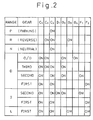
- the table shown in Fig. 2 shows a combination of the engagement and disengagement of frictional engagement elements to attain desired speeds at each range and gear speed.
- Fig. 3 illustrates a side sectional view of an automatic transmission to which a first embodiment of the present invention is built-in, wherein reference numeral 1 represents a piston; 2 represents a cam roller; and 3 represents a pressure plate.
- reference numeral 1 represents a piston
- 2 represents a cam roller
- 3 represents a pressure plate.
- cam grooves 1c and 3c are formed opposing to each other at several locations in the circumferential direction, so that a cam roller 2 is accommodated in the respective pair of opposed cam grooves.
- the cam roller 2 is rotatably retained by a roller cage 4.
- a clutch casing 100 consists of outer and inner halves welded to each other at part A to form an integral body, and coupled to the O/D planetary sun gear S 3 while being rotatable relative to a housing 200.
- the piston 1 is spline-coupled to the clutch casing 100 at part B and is movable to the right and left in the figure in an annular cylinder formed in the interior of the clutch casing 100.
- a hydraulic pressure is supplied into space C between a back surface 1b of the piston 1 and the clutch casing 100 via an oil path 101.
- Clutch disks 5 of the clutch C 3 which are spline-coupled to the O/D planetary carrier K 3 are selectively engaged frictionally with separator plates 6 of the clutch C 3 which are spline-coupled to the clutch casing 100 with the piston 1 through the pressure plate 3.
- a spring 7 is fixedly secured, at the right end thereof, to the clutch casing 100 to always bias the piston 1 to the left in the figure.
- Clutch disks 8 of the brake B 4 which are spline-coupled to the clutch casing 100 are selectively engaged frictionally with separator plates 9 of the brake B 4 which are spline-coupled to the housing 200 with a piston 10 of the brake B 4 .
- Figs. 4A to 4C are cross-sectional views of a cam section as seen parallel to the rotation axis.
- reference numerals 1, 2, 3, 4 and 5 represent the piston, cam roller, pressure plate, roller cage and clutch disk of the clutch C 3 shown in Fig. 3, respectively.
- cam groove 1c and a recess 1d which serves as the limiter according to the present invention are provided.
- a cam groove 3c and a projection 3d projected into the recess 1d of the piston 1 through an opening 4a formed in the roller cage 4 are provided.
- Fig. 4A illustrates a disengaging state wherein the pressure plate 3 and the C 3 clutch disk 5 are apart from each other.
- the C 3 clutch disk 5 splined-coupled to the O/D planetary carrier K 3 moves to the right in the figure, while the piston 1 and the pressure plate 3 are stationary.
- the C 3 clutch disk 5 is coupled to the O/D planetary carrier K 3 and the piston 1 is to the O/D planetary sun gear S 3 , the O/D planetary sun gear S 3 is integral with the O/D planetary carrier K 3 to be rotatable together according to this engagement.
- Fig. 4B illustrates, the piston 1 and the C 3 clutch disk 5 engaged to each other as described.
- the opening 4a of the roller cage 4 is formed to be sufficiently large, no interference occurs between the projection 3d of the pressure plate 3 and the roller cage 4 when the phase is switched from the state shown in Fig. 4A to that shown in Fig. 4B.
- Fig. 4B shows the driving state wherein the engine positively drives the wheels in all of the forward gear speeds except for the fourth gear speed.
- the second and first one-way clutches F 2 , F 1 are idling, respectively, to nullify the engine brake.
- the fourth brake B 4 is actuated to interrupt the rotation of the O/D planetary sun gear S 3 . Since the O/D planetary carrier K 3 is coupled to the O/D planetary ring gear R 3 , the rotational speed of the O/D planetary carrier K 3 temporarily becomes slower.
- the pressure plate 3 engaged with the C 3 clutch disk 5 escapes from the roller 2 in the lefthand direction in the figure, while maintaining the inner surface 1a of the piston 1 apart from the inner surface 3a of the pressure plate 3. Also the piston 1 escapes from the roller 2 in the righthand direction.
- a wall surface 1e of the recess 1d of the piston 1 approaches a wall surface 3e of the projection 3d of the pressure plate 3.
- the recess 1d of the piston 1 and the projection 3d of the pressure plate 3 are designed to abut each other before an edge 1f of the inner surface 1a of the piston 1 and an edge 3f of the cam groove 3c come into contact with the roller 2, respectively. Therefore, as shown in Fig. 4C, the roller 2 is prevented from riding on the edge 1f of the inner surface 1a of the piston 1 and the edge 3f of the cam groove 3c of the pressure plate 3 whereby the wall surface 1e of the recess 1d of the piston 1 and the wall surface 3e of the projection 3d of the pressure plate 3 abut onto each other to inhibit the further relative movement between the piston 1 and the pressure plate 3.
- a location defines a point of action on which a force is applied for limiting the relative movement between the piston 1 and the pressure plate 3.
- the shift from the fourth gear speed to the third gear speed corresponds to the change from the state shown in Fig. 4A to that shown in Fig. 4B. This is done by releasing the fourth brake B 4 and simultaneously therewith initiating the supply of hydraulic pressure to the back surface 1b of the piston 1.
- the generation of undesirable thrust can be reliably avoided when the switching operation is carried out from a state wherein the relative rotation is caused by the operation of the cam mechanism and that wherein the relative rotation is caused without the intervention of the cam mechanism.
- the second embodiment shown in Figs. 5A to 5C is substantially identical to the first embodiment except that a recess 3g is provided in the pressure plate 3 and a projection 1g is provided in the piston 1. A description of the operation is not given because it is the same as the first embodiment.
- the third embodiment shown in Figs. 6A to 6C is substantially identical to the first embodiment except that recesses 1h, 3h are provided in the piston 1 and the pressure plate 3, respectively, and a projection li, 3i are also provided in the piston 1 and the pressure plate 3. A description of the operation is not given because it is the same as the first embodiment.
- the third embodiment has an advantage in that, since the depth of the respective recess can be smaller, the thickness of the recess-carrying member can be reduced.
- Figs. 7A to 7E show the fourth embodiment wherein Fig. 7D illustrates the relationship between the roller 2 and the piston 1 as seen from the pressure plate 3, and Fig. 7E illustrates the relationship between the roller 2 and the piston 1 as seen from the piston 1.
- the roller 2 is not uniform in diameter in the widthwise direction but is divided into a central larger diameter section 2a and a smaller diameter section 2b at each end.
- a narrow cam surface 1a' wherein recesses 1k and projections 1m are provided in the side portions of the piston 1
- a narrow cam surface 3a' wherein recesses 3k and projections 3m are provided in the side portions of the pressure plate 3, whereby the larger diameter section 2a can be solely in contact with the cam surface.
- the projections 1m, 3m are designed to be higher than the center of the roller 2 so that the smaller diameter sections 2b of the roller 2 abut onto the projection 1m on the piston 1 and the projection 3m on the pressure plate 3 to inhibit the piston 1 and the pressure plate 3 from moving to the left and right in the figure and to prevent the roller 2 from riding on the cam.
- a recess 1m similar to that of the first embodiment is provided at a location further to the left from the cam surface la of the piston 1 and a projection 1p similar to that of the second embodiment is provided at a location further to the right from the cam surface 1a of the piston 1.
- a recess 3n similar to that of the first embodiment is provided at a location further to the right from the cam surface 3a of the pressure plate 3 and a projection 3p similar to that of the second embodiment is provided at a location further to the left from the cam surface 3a of the pressure plate 3.
- the piston 1 and the pressure plate 3 solely have recesses 1r, 3r, respectively, and a pair of fingers 4c are provided on the roller cage 4 by bending upright parts thereof.
- this embodiment is advantageous, compared to the fifth embodiment, in that the manufacturing cost is reduced.
- the piston 1 and the pressure plate 3 have recesses 1t, 3t, respectively, contiguous to the cam surfaces, while the roller cage 4 has a pair of fingers 4d formed by bending the roller cage upright at locations adjacent to the roller 2.
- this embodiment can be easily manufactured. Also, since elements are more collectively located in the vicinity of the roller 2 in comparison with the sixth embodiment, it is possible to dispose the device in a narrower space.
- the piston 1 and the pressure plate 3 have recesses 1v, 3v, respectively, at locations further to the right from the roller.
- the roller cage 4 has a pair of fingers 4e provided at a single location while being projected toward the piston 1 and the pressure plate 3, respectively, which are capable of abutting to the inner side walls 1w, 3w of the recesses 1v, 3v, respectively, when the relative rotation occurs in the direction wherein the cam mechanism is inoperative.
- this embodiment is advantageous in that the machining of the roller cage 4 becomes easier, in comparison with the seventh embodiment.
Landscapes
- Engineering & Computer Science (AREA)
- General Engineering & Computer Science (AREA)
- Mechanical Engineering (AREA)
- Hydraulic Clutches, Magnetic Clutches, Fluid Clutches, And Fluid Joints (AREA)
- Mechanical Operated Clutches (AREA)
- Transmission Devices (AREA)
Claims (11)
- Kupplungsvorrichtung mit:dadurch gekennzeichnet, dasseinem Paar Kupplungselementen (100, 5), die mit einem Abstand auf einer gemeinsamen Achse angeordnet sind und relativ zueinander auf der gemeinsamen Achse drehbar sind;einem Nockenmechanismus, der zwischen dem Paar Kupplungselementen (100, 5) angeordnet ist, wobei der Nockenmechanismus ein Paar Nockenelemente (1, 3), welche relativ zueinander drehbar sind und jeweils eine Nockenfläche (1c, 3c) haben, wobei die Nockenflächen (1c, 3c) axial einander gegenüberliegend sind und in eine Richtung einer Drehung der Nockenelemente (1, 3) durch einen Rand (1f, 3f) begrenzt sind, wobei die Ränder (1f, 3f) als Fortsetzung der Nockenflächen (1c, 3c) ausgebildet sind, und eine Nockenrolle (2) mit einer Rollfläche (2a) aufweist, welche in Kontakt mit den gegenüberliegenden Nockenflächen steht;einer Drückeinrichtung zum selektiven Drücken des Nockenmechanismus als ein Ganzes auf eine axial gegenüberliegende Fläche von einem der sich relativ drehenden Kupplungselemente, um eine Umfangskraft auf eine axiale Druckkraft über den Nockenmechanismus umzuwandeln, so dass die sich relativ drehenden Kupplungselemente einstückig miteinander durch die Druckkraft im Eingriff stehen; undeiner Begrenzungseinrichtung für ein Begrenzen einer relativen Drehbewegung der Nockenelemente, wenn die relative Drehung zwischen den Kupplungselementen in der Richtung auftritt, die umgekehrt zu der ist, in welche die axiale Druckkraft zwischen dem Paar Kupplungselementen erzeugt wird,wobei die Begrenzungseinrichtung zwischen den Nockenelementen (1, 3) so angeordnet ist, dass die Begrenzungseinrichtung eine verriegelnde Verbindung zwischen den Nockenelementen (1, 3) in der Richtung der Drehung während eines Vorbeiführens der Rollfläche (2a) der Nockenrolle (3) vorsieht,
die Begrenzungseinrichtung in der Drehrichtung hinsichtlich der Ränder (1f, 3f) der Nockenelemente (1, 3) so positioniert ist, dass die verriegelnde Verbindung zwischen den Nockenelementen (1, 3) vorgesehen ist, bevor die Ränder (1f, 3f) der Nockenelemente (1, 3) in Kontakt mit der Nockenrolle gelangen, um zu verhindern, dass die Nockenrolle an den Rändern läuft. - Kupplungsvorrichtung gemäß Anspruch 1,
dadurch gekennzeichnet, dass
die Begrenzungseinrichtung einen Vorsprung (3d, 1g), der axial von einer der gegenüberliegenden Flächen der Nockenelemente vorsteht, und einen Einschnitt (1d, 3g) aufweist, der an der anderen der gegenüberliegenden Flächen der Nockenelemente vorgesehen ist. - Kupplungsvorrichtung gemäß Anspruch 2,
dadurch gekennzeichnet, dass
der Vorsprung (1g) an der Nockenfläche des Nockenelements (1) näher an der Drückeinrichtung vorgesehen ist und der Einschnitt (3g) an der Nockenfläche des anderen Nockenelements (3g) vorgesehen ist. - Kupplungsvorrichtung gemäß Anspruch 2,
dadurch gekennzeichnet, dass
der Einschnitt (1d) an dem Nockenelement (1) näher an der Drückeinrichtung vorgesehen ist und der Vorsprung (3d) an der Nockenfläche des anderen Nockenelements (3) vorgesehen ist. - Kupplungsvorrichtung gemäß Anspruch 1,
dadurch gekennzeichnet, dass
die Begrenzungseinrichtung ein Rollenanschlag (1m, 3m) für ein Begrenzen der relativen Drehbewegung des Paares Nockenelemente durch Beschränken der Bewegung der Nockenrolle (2) ist. - Kupplungsvorrichtung gemäß Anspruch 5,
dadurch gekennzeichnet, dass
der Rollenanschlag von einer Bauart ist, die an einem Paar Endwellen (2b) der Nockenrolle (2) wirkt. - Kupplungsvorrichtung gemäß Anspruch 1,
dadurch gekennzeichnet, dass
die Nockenrolle (2) ist drehbar durch einen Rollenkäfig (4) gehalten wird, der zwischen den Nockenelementen angeordnet ist, und die Begrenzungseinrichtung ein Rollenkäfiganschlag (4b, 4c, 4d, 4e) zum Begrenzen der relativen Drehbewegung des Paares Nockenelemente durch Beschränken einer Bewegung des Rollenkäfigs (4) ist. - Kupplungsvorrichtung gemäß Anspruch 7,
dadurch gekennzeichnet, dass
der Anschlag des Rollenkäfigs (4) Öffnungen aufweist, die in dem Rollenkäfig (4) ausgebildet sind, und Vorsprünge (1p, 3p), die an den Nockenelementen ausgebildet sind. - Kupplungsvorrichtung gemäß Anspruch 7,
dadurch gekennzeichnet, das
der Anschlag des Rollenkäfigs Vorsprünge (4c, 4d, 4e) aufweist, die in dem Rollenkäfig (4) ausgebildet sind, und Vertiefungen (1r, 1t, 3t), die an den Nockenelementen ausgebildet sind. - Kupplungsvorrichtung gemäß Anspruch 9,
dadurch gekennzeichnet, dass
die Einschnitte an dem Nockenelement benachbart zu der Nockenfläche sind und die Vorsprünge an dem Rollenkäfig (4) in der Nähe der Rolle (2) angeordnet sind. - Kupplungsvorrichtung gemäß Anspruch 9,
dadurch gekennzeichnet, dass
die Vorsprünge an dem Rollenkäfig (4) in Richtung der Nockenfläche des Nockenelements näher zu der Drückeinrichtung und der Nockenfläche des anderen Nockenelements von derselben Umfangsposition vorstehen.
Applications Claiming Priority (3)
| Application Number | Priority Date | Filing Date | Title |
|---|---|---|---|
| JP32540/95 | 1995-02-21 | ||
| JP3254095 | 1995-02-21 | ||
| JP07032540A JP3104561B2 (ja) | 1995-02-21 | 1995-02-21 | クラッチ装置 |
Publications (2)
| Publication Number | Publication Date |
|---|---|
| EP0728958A1 EP0728958A1 (de) | 1996-08-28 |
| EP0728958B1 true EP0728958B1 (de) | 2000-11-15 |
Family
ID=12361777
Family Applications (1)
| Application Number | Title | Priority Date | Filing Date |
|---|---|---|---|
| EP96102487A Expired - Lifetime EP0728958B1 (de) | 1995-02-21 | 1996-02-19 | Kupplungseinrichtung |
Country Status (5)
| Country | Link |
|---|---|
| US (1) | US5701983A (de) |
| EP (1) | EP0728958B1 (de) |
| JP (1) | JP3104561B2 (de) |
| KR (1) | KR0182816B1 (de) |
| DE (1) | DE69610936T2 (de) |
Families Citing this family (7)
| Publication number | Priority date | Publication date | Assignee | Title |
|---|---|---|---|---|
| FR2776220B1 (fr) * | 1998-03-19 | 2000-05-05 | Maire Charles Ets | Visseuse pneumatique |
| US6068572A (en) * | 1999-03-31 | 2000-05-30 | Daimlerchrysler Corporation | Method for reacting thrust loading in an automatic transmission |
| JP3726685B2 (ja) * | 2001-01-15 | 2005-12-14 | 日産自動車株式会社 | クラッチ装置 |
| KR100461434B1 (ko) * | 2002-11-11 | 2004-12-10 | 현대자동차주식회사 | 자동변속기의 피스톤 장치 |
| DE102010048829A1 (de) | 2009-10-29 | 2011-05-05 | Schaeffler Technologies Gmbh & Co. Kg | Nasskupplung |
| DE102013008071A1 (de) | 2013-05-10 | 2014-11-13 | Borgwarner Inc. | Kupplungsvorrichtung mit arretierbarer Betätigungseinrichtung |
| JP2017155857A (ja) * | 2016-03-02 | 2017-09-07 | Ntn株式会社 | 逆入力遮断装置 |
Family Cites Families (26)
| Publication number | Priority date | Publication date | Assignee | Title |
|---|---|---|---|---|
| US1974390A (en) * | 1932-07-08 | 1934-09-18 | Clarence M Eason | Servo clutch |
| US2057742A (en) * | 1935-01-16 | 1936-10-20 | Robert C Russell | Clutch structure |
| US2887200A (en) * | 1950-02-11 | 1959-05-19 | Curtiss Wright Corp | Servo-operated clutches |
| US2827994A (en) * | 1954-10-18 | 1958-03-25 | Curtiss Wright Corp | Follow-up clutches |
| US3000479A (en) * | 1958-06-23 | 1961-09-19 | Roper Hydraulics Inc | Electromagnetic clutch |
| US3199374A (en) * | 1961-04-12 | 1965-08-10 | Gen Motors Corp | Drive sustaining device |
| US3360087A (en) * | 1966-06-06 | 1967-12-26 | Twin Disc Inc | Hydraulically actuated friction clutch having torque control means |
| US3404585A (en) * | 1966-06-13 | 1968-10-08 | Eaton Yale & Towne | Drive mechanism |
| DE1915651A1 (de) * | 1969-03-27 | 1970-10-08 | Klaue Hermann | Vollbelag-Scheibenbremse ohne Reibungsselbstverstaerkung |
| FI54390C (fi) * | 1970-02-16 | 1978-11-10 | Hurth Masch Zahnrad Carl | Omkopplingsbar friktionskoppling speciellt foer kugghjulsvaexlar |
| US3733920A (en) * | 1971-08-16 | 1973-05-22 | Gen Motors Corp | Transmission and hydraulic source |
| US3717229A (en) * | 1971-08-16 | 1973-02-20 | Gen Motors Corp | Fluid clutch with one way torque limiting engager |
| US3688882A (en) * | 1971-08-16 | 1972-09-05 | Gen Motors Corp | Fluid operated clutch with one way engager |
| NL184534C (nl) * | 1978-01-31 | 1989-08-16 | Lely Nv C Van Der | Koppelbegrenzer. |
| JP2581965B2 (ja) * | 1988-08-30 | 1997-02-19 | 株式会社エフ・シー・シー | 動力伝達装置 |
| JPH0269134A (ja) * | 1988-09-02 | 1990-03-08 | Seiwa Kasei Kk | 数の子褐変防止剤 |
| JP2536144B2 (ja) * | 1989-04-07 | 1996-09-18 | トヨタ自動車株式会社 | 動力伝達機構 |
| JP2540947B2 (ja) * | 1989-07-17 | 1996-10-09 | トヨタ自動車株式会社 | 動力伝達装置 |
| US5031746A (en) * | 1990-03-30 | 1991-07-16 | Erkki Koivunen | Multi-mode clutch for change-speed transmissions |
| DE4031616C2 (de) * | 1990-10-05 | 1999-11-25 | Perrot Bremse Gmbh Deutsche | Automatische Nachstelleinrichtung für eine mechanisch betätigte Gleitsattel-Scheibenbremse |
| GB2251465A (en) * | 1990-10-31 | 1992-07-08 | Massey Ferguson Mfg | A mechanical clutch |
| DE4038731C2 (de) * | 1990-12-05 | 1994-07-14 | Man Nutzfahrzeuge Ag | Kupplungseinrichtung zum Verbinden zweier mit unterschiedlicher Drehzahl rotierender Wellen |
| US5106348A (en) * | 1991-05-08 | 1992-04-21 | Koivunen Erkki A | Bi-directional multi-mode clutch for change-speed transmission unit for automatic change speed transmissions |
| CA2116411C (en) * | 1993-02-26 | 1997-08-26 | Jun Aoki | Connecting system |
| JP3104519B2 (ja) * | 1994-03-18 | 2000-10-30 | トヨタ自動車株式会社 | クラッチ装置 |
| JP3104524B2 (ja) * | 1994-04-07 | 2000-10-30 | トヨタ自動車株式会社 | 自動変速機のクラッチ装置 |
-
1995
- 1995-02-21 JP JP07032540A patent/JP3104561B2/ja not_active Expired - Fee Related
-
1996
- 1996-02-12 US US08/600,027 patent/US5701983A/en not_active Expired - Fee Related
- 1996-02-19 DE DE69610936T patent/DE69610936T2/de not_active Expired - Fee Related
- 1996-02-19 EP EP96102487A patent/EP0728958B1/de not_active Expired - Lifetime
- 1996-02-21 KR KR1019960004017A patent/KR0182816B1/ko not_active Expired - Fee Related
Also Published As
| Publication number | Publication date |
|---|---|
| JP3104561B2 (ja) | 2000-10-30 |
| DE69610936D1 (de) | 2000-12-21 |
| JPH08226457A (ja) | 1996-09-03 |
| KR0182816B1 (ko) | 1999-04-01 |
| US5701983A (en) | 1997-12-30 |
| KR960031832A (ko) | 1996-09-17 |
| DE69610936T2 (de) | 2001-03-29 |
| EP0728958A1 (de) | 1996-08-28 |
Similar Documents
| Publication | Publication Date | Title |
|---|---|---|
| US6315096B1 (en) | Friction engaging device | |
| JP5208628B2 (ja) | クラッチ装置 | |
| JP2010048277A (ja) | 摩擦係合装置 | |
| JP2008502859A (ja) | 自動変速機用の平面結合装置アッセンブリ | |
| JPH0712221A (ja) | 自動変速機の締結力調整装置 | |
| JPWO2021117867A1 (ja) | 動力伝達経路切換装置および2段変速機 | |
| JP2001059530A (ja) | ワンウェイクラッチ | |
| JP3104524B2 (ja) | 自動変速機のクラッチ装置 | |
| US5701983A (en) | Clutch device | |
| JP2003013996A (ja) | 摩擦係合装置 | |
| JP3328311B2 (ja) | 多板クラッチ | |
| JP2581965B2 (ja) | 動力伝達装置 | |
| JP2002048198A (ja) | 変速機 | |
| US7690491B2 (en) | Twin-clutch device | |
| JPH0989005A (ja) | クラッチドラムの構造およびその製造方法 | |
| JP4286353B2 (ja) | 摩擦係合装置 | |
| US6000293A (en) | Multi-clutched transmission | |
| JPH0636345Y2 (ja) | 多板摩擦クラッチ | |
| KR100412898B1 (ko) | 동기치합식 수동변속기의 변속단 기어 구조 | |
| JP3701774B2 (ja) | 無段変速機 | |
| JP2890460B2 (ja) | 自動変速機用歯車変速装置 | |
| EP0387707B1 (de) | Antriebsübertragung | |
| JPS6212115Y2 (de) | ||
| CN121520316A (zh) | 离合器、传动系统及车辆 | |
| CN121408448A (zh) | 车辆及传动系统 |
Legal Events
| Date | Code | Title | Description |
|---|---|---|---|
| PUAI | Public reference made under article 153(3) epc to a published international application that has entered the european phase |
Free format text: ORIGINAL CODE: 0009012 |
|
| 17P | Request for examination filed |
Effective date: 19960219 |
|
| AK | Designated contracting states |
Kind code of ref document: A1 Designated state(s): DE FR GB |
|
| 17Q | First examination report despatched |
Effective date: 19961230 |
|
| GRAG | Despatch of communication of intention to grant |
Free format text: ORIGINAL CODE: EPIDOS AGRA |
|
| 17Q | First examination report despatched |
Effective date: 19961230 |
|
| GRAG | Despatch of communication of intention to grant |
Free format text: ORIGINAL CODE: EPIDOS AGRA |
|
| GRAH | Despatch of communication of intention to grant a patent |
Free format text: ORIGINAL CODE: EPIDOS IGRA |
|
| GRAH | Despatch of communication of intention to grant a patent |
Free format text: ORIGINAL CODE: EPIDOS IGRA |
|
| GRAA | (expected) grant |
Free format text: ORIGINAL CODE: 0009210 |
|
| AK | Designated contracting states |
Kind code of ref document: B1 Designated state(s): DE FR GB |
|
| ET | Fr: translation filed | ||
| REF | Corresponds to: |
Ref document number: 69610936 Country of ref document: DE Date of ref document: 20001221 |
|
| PLBE | No opposition filed within time limit |
Free format text: ORIGINAL CODE: 0009261 |
|
| STAA | Information on the status of an ep patent application or granted ep patent |
Free format text: STATUS: NO OPPOSITION FILED WITHIN TIME LIMIT |
|
| 26N | No opposition filed | ||
| REG | Reference to a national code |
Ref country code: GB Ref legal event code: IF02 |
|
| REG | Reference to a national code |
Ref country code: GB Ref legal event code: 746 Effective date: 20041018 |
|
| REG | Reference to a national code |
Ref country code: FR Ref legal event code: D6 |
|
| PGFP | Annual fee paid to national office [announced via postgrant information from national office to epo] |
Ref country code: GB Payment date: 20060215 Year of fee payment: 11 |
|
| PGFP | Annual fee paid to national office [announced via postgrant information from national office to epo] |
Ref country code: DE Payment date: 20060216 Year of fee payment: 11 |
|
| PGFP | Annual fee paid to national office [announced via postgrant information from national office to epo] |
Ref country code: FR Payment date: 20060220 Year of fee payment: 11 |
|
| GBPC | Gb: european patent ceased through non-payment of renewal fee |
Effective date: 20070219 |
|
| REG | Reference to a national code |
Ref country code: FR Ref legal event code: ST Effective date: 20071030 |
|
| PG25 | Lapsed in a contracting state [announced via postgrant information from national office to epo] |
Ref country code: DE Free format text: LAPSE BECAUSE OF NON-PAYMENT OF DUE FEES Effective date: 20070901 |
|
| PG25 | Lapsed in a contracting state [announced via postgrant information from national office to epo] |
Ref country code: GB Free format text: LAPSE BECAUSE OF NON-PAYMENT OF DUE FEES Effective date: 20070219 Ref country code: FR Free format text: LAPSE BECAUSE OF NON-PAYMENT OF DUE FEES Effective date: 20070228 |