EP0701774B1 - Canne à pêche à parcours de fil intérieur - Google Patents
Canne à pêche à parcours de fil intérieur Download PDFInfo
- Publication number
- EP0701774B1 EP0701774B1 EP95113996A EP95113996A EP0701774B1 EP 0701774 B1 EP0701774 B1 EP 0701774B1 EP 95113996 A EP95113996 A EP 95113996A EP 95113996 A EP95113996 A EP 95113996A EP 0701774 B1 EP0701774 B1 EP 0701774B1
- Authority
- EP
- European Patent Office
- Prior art keywords
- top portion
- reinforcing fibers
- rod top
- rod
- intra
- Prior art date
- Legal status (The legal status is an assumption and is not a legal conclusion. Google has not performed a legal analysis and makes no representation as to the accuracy of the status listed.)
- Expired - Lifetime
Links
- 239000012783 reinforcing fiber Substances 0.000 claims description 123
- 239000000057 synthetic resin Substances 0.000 claims description 37
- 229920003002 synthetic resin Polymers 0.000 claims description 37
- 239000011159 matrix material Substances 0.000 claims description 11
- 239000000463 material Substances 0.000 claims description 9
- 229920005989 resin Polymers 0.000 claims description 9
- 239000011347 resin Substances 0.000 claims description 9
- 238000009954 braiding Methods 0.000 claims description 3
- 230000001747 exhibiting effect Effects 0.000 claims 2
- 230000007423 decrease Effects 0.000 claims 1
- 230000003247 decreasing effect Effects 0.000 claims 1
- 239000000835 fiber Substances 0.000 description 34
- 238000003780 insertion Methods 0.000 description 15
- 230000037431 insertion Effects 0.000 description 15
- 229920000049 Carbon (fiber) Polymers 0.000 description 11
- 239000004917 carbon fiber Substances 0.000 description 11
- 230000002093 peripheral effect Effects 0.000 description 9
- 239000000919 ceramic Substances 0.000 description 8
- 239000004744 fabric Substances 0.000 description 8
- 239000002184 metal Substances 0.000 description 8
- 230000003014 reinforcing effect Effects 0.000 description 7
- 239000003365 glass fiber Substances 0.000 description 4
- 239000004033 plastic Substances 0.000 description 4
- 229920003023 plastic Polymers 0.000 description 4
- 238000004519 manufacturing process Methods 0.000 description 3
- VNWKTOKETHGBQD-UHFFFAOYSA-N methane Chemical compound C VNWKTOKETHGBQD-UHFFFAOYSA-N 0.000 description 3
- 238000005266 casting Methods 0.000 description 2
- 229920001971 elastomer Polymers 0.000 description 2
- 238000000034 method Methods 0.000 description 2
- 241000251468 Actinopterygii Species 0.000 description 1
- 241000531908 Aramides Species 0.000 description 1
- PXGOKWXKJXAPGV-UHFFFAOYSA-N Fluorine Chemical compound FF PXGOKWXKJXAPGV-UHFFFAOYSA-N 0.000 description 1
- 239000004697 Polyetherimide Substances 0.000 description 1
- 229910000831 Steel Inorganic materials 0.000 description 1
- PNEYBMLMFCGWSK-UHFFFAOYSA-N aluminium oxide Inorganic materials [O-2].[O-2].[O-2].[Al+3].[Al+3] PNEYBMLMFCGWSK-UHFFFAOYSA-N 0.000 description 1
- 238000013459 approach Methods 0.000 description 1
- 239000004760 aramid Substances 0.000 description 1
- 229920006231 aramid fiber Polymers 0.000 description 1
- 229920003235 aromatic polyamide Polymers 0.000 description 1
- 239000000806 elastomer Substances 0.000 description 1
- 229910052731 fluorine Inorganic materials 0.000 description 1
- 239000011737 fluorine Substances 0.000 description 1
- 239000012784 inorganic fiber Substances 0.000 description 1
- 230000002452 interceptive effect Effects 0.000 description 1
- 238000002844 melting Methods 0.000 description 1
- 230000008018 melting Effects 0.000 description 1
- 229920001778 nylon Polymers 0.000 description 1
- 239000002245 particle Substances 0.000 description 1
- 229920000728 polyester Polymers 0.000 description 1
- 229920001601 polyetherimide Polymers 0.000 description 1
- 229920001296 polysiloxane Polymers 0.000 description 1
- 230000002787 reinforcement Effects 0.000 description 1
- 239000012260 resinous material Substances 0.000 description 1
- 239000010959 steel Substances 0.000 description 1
- 238000009941 weaving Methods 0.000 description 1
- 238000003466 welding Methods 0.000 description 1
- 238000004804 winding Methods 0.000 description 1
Images

Classifications
-
- B—PERFORMING OPERATIONS; TRANSPORTING
- B29—WORKING OF PLASTICS; WORKING OF SUBSTANCES IN A PLASTIC STATE IN GENERAL
- B29C—SHAPING OR JOINING OF PLASTICS; SHAPING OF MATERIAL IN A PLASTIC STATE, NOT OTHERWISE PROVIDED FOR; AFTER-TREATMENT OF THE SHAPED PRODUCTS, e.g. REPAIRING
- B29C70/00—Shaping composites, i.e. plastics material comprising reinforcements, fillers or preformed parts, e.g. inserts
- B29C70/04—Shaping composites, i.e. plastics material comprising reinforcements, fillers or preformed parts, e.g. inserts comprising reinforcements only, e.g. self-reinforcing plastics
- B29C70/06—Fibrous reinforcements only
- B29C70/10—Fibrous reinforcements only characterised by the structure of fibrous reinforcements, e.g. hollow fibres
- B29C70/16—Fibrous reinforcements only characterised by the structure of fibrous reinforcements, e.g. hollow fibres using fibres of substantial or continuous length
- B29C70/20—Fibrous reinforcements only characterised by the structure of fibrous reinforcements, e.g. hollow fibres using fibres of substantial or continuous length oriented in a single direction, e.g. roofing or other parallel fibres
- B29C70/205—Fibrous reinforcements only characterised by the structure of fibrous reinforcements, e.g. hollow fibres using fibres of substantial or continuous length oriented in a single direction, e.g. roofing or other parallel fibres the structure being shaped to form a three-dimensional configuration
-
- A—HUMAN NECESSITIES
- A01—AGRICULTURE; FORESTRY; ANIMAL HUSBANDRY; HUNTING; TRAPPING; FISHING
- A01K—ANIMAL HUSBANDRY; AVICULTURE; APICULTURE; PISCICULTURE; FISHING; REARING OR BREEDING ANIMALS, NOT OTHERWISE PROVIDED FOR; NEW BREEDS OF ANIMALS
- A01K87/00—Fishing rods
- A01K87/002—Fishing rods with the line passing through the hollow rod
Definitions
- the present invention relates to an intra-line fishing rod having a rod top portion.
- Every fishing rod has its own flexible nature which can be set according to its fishing targets, for example, a fishing rod for small-size fish is formed such that it has a delicate flexibility.
- an intra-line fishing rod is provided as defined in claim 1.
- the inside diameter of the rod top portion is formed substantially straight or in a gentle taper, the inside diameter of the front portion of the rod top portion can be set large and thus there can be provided a hollow portion through which a fishline can pass freely, thereby being able to provide a fishline insertable structure which can reduce the resistance of the fishline.
- the flexural rigidity of the front portion of the rod top portion is high and is thus difficult to flex.
- the ratio of the reinforcing fibers extending substantially in the peripheral direction of the rod top portion is set for 50% or more while the ratio of the reinforcing fibers extending in the longitudinal direction is set smaller; and, on the other hand, in the rear portion of the rod top portion, the ratio of the reinforcing fibers extending substantially in the peripheral direction is set small while the ratio of the longitudinally extending reinforcing fibers is set large. Since the characteristic of flexure depends on the longitudinally extending reinforcing fibers, the smaller the ratio of the longitudinally extending reinforcing fibers is, the lower the rigidity is; that is, there can be provided a fishing rod which is easy to flex.
- the term "gentle taper” is used to express a taper in the range of 3/1000 to 6/1000.
- an intra-line fishing rod including a matrix formed of synthetic resin, reinforced with reinforcing fibers, and including a main body layer of a rod top portion having reinforcing fibers extending substantially in the axial direction of the rod top portion, in which the amount of the reinforcing fibers extending substantially in the axial direction in the front portion of the rod top portion is set smaller while the amount of the reinforcing fibers in the rear portion of the rod top portion is set greater, the ratio of the synthetic resin in the front portion of the rod top portion is set greater while the ratio of the synthetic resin in the rear portion of the rod top portion is set smaller, and the inside diameter of the rod top portion is formed in a substantially straight shape or in a gently tapered shape.
- the inside diameter of the rod top portion is formed substantially straight or in a gentle taper, the inside diameter of the front portion of the rod top portion can be set large and thus there can be provided a hollow portion through which a fishline can pass freely, thereby being able to provide a fishline insertable structure which can reduce the insertion resistance of the fishline.
- the flexural rigidity of the front portion of the rod top portion is high and is thus difficult to flex.
- the reinforcing fibers extending substantially in the axial direction thereof are small in quantity, whereas the reinforcing fibers extending substantially in the axial direction are large in quantity.
- a larger ratio of synthetic resin is used in the front portion of the rod top portion while a smaller ratio of synthetic resin is used in the rear portion of the rod top portion to thereby keep the strength of the rod tube. Since the flexural property depends on the reinforcing fibers extending substantially in the axial direction, according to the present structure, there can be provided a fishing rod which is easier to flex in the front portion of the rod top portion, and the flexural property of the present top rod portion can be made as delicate as a tapered rod top portion.
- an intra-line fishing rod including a rod top portion, the rod top portion being structured such that synthetic resin is used as a matrix, reinforcing fibers are disposed such that they extend in an inclined direction with the angles of inclination in the range of 5 degrees to 25 degrees with respect to the axial direction of the rod top portion, the reinforcing fibers crossing each other from both right and left directions substantially symmetrically with respect to the axial direction, and the crossing reinforcing fibers occupy almost all of the reinforcing fibers that are used in the rod top portion.
- the crossing reinforcing fibers are disposed substantially symmetrically, the rod top portion can be prevented from being twisted.
- the axially extending components of the obliquely extending reinforcing fibers contribute to the axial direction, the flexural rigidity in flexing can be controlled down to a low level to thereby be able to provide a large inside diameter accordingly.
- the reinforcing fibers extend obliquely, they also have a component which contributes to the peripheral direction, thereby being able to prevent the rod top portion against crushing rupture.
- the peripheral direction contributing components of the reinforcing fibers cooperate with the axial direction contributing components thereof can prevent the rod top portion from being plastically deformed when it is flexed greatly.
- an intra-line fishing rod including a rod top portion, the rod top portion being structured such that synthetic resin is used as a matrix, reinforcing fibers are disposed such that they extend in an inclined direction with the angles of inclination of 5 degrees or greater with respect to the axial direction of the rod top portion and also such that they cross each other from both right and left directions substantially symmetrically with respect to said axial direction, and a smaller amount of reinforcing fibers than the amount of the crossing reinforcing fibers are disposed so as to extend substantially in the axial direction, or reinforcing fibers having a lower elastic modulus than the crossing reinforcing fibers are disposed so as to extend substantially in said axial direction.
- the symmetric arrangement of the reinforcing fibers disposed crossingly from both directions prevents the rod top portion from being twisted. Since a smaller quantity of reinforcing fibers or reinforcing fibers having a low elastic modulus are used in the axial direction, the flexural rigidity of the top rod portion in flexing can be controlled down to a low level, which makes it possible to increase the inside diameter of the rod top portion accordingly.
- the existence of the reinforcing fibers crossing obliquely provides a component which contributes to the peripheral direction of the rod top portion, thereby being able to protect the rod top portion against crushing rupture. This cooperates with the existence of the axially extending reinforcing fibers to prevent the rod top portion from being deformed plastically when it is flexed greatly.
- an intra-line fishing rod including a rod top portion, the rod top portion being structured such that synthetic resin is used as a matrix, and reinforcing fibers are disposed so as to extend substantially in the axial direction of the rod top portion in such a manner that those of the reinforcing fibers having a large rupture elongation are disposed on the outer side of said rod top portion while those of the reinforcing fibers having a small rupture elongation are disposed on the inner side thereof.
- a reinforcing fiber having a large breakage elongation is highly elastic while a reinforcing fiber having a small breakage elongation is low in elasticity.
- reinforcing fibers having a large breakage elongation are disposed on the outer side of the rod top portion while reinforcing fibers having a small breakage elongation are disposed on the inner side thereof, the rod top portion is easy to flex (the inside diameter of the rod top portion can be increased) but is difficult to be plastically deformed.
- an intra-line fishing rod including a rod top portion, the rod top portion structured such that, there is provided a spirally shaped member through which a fishline can be inserted, and a cylindrical member is provided so as to cover the outer side of the spirally shaped member, the cylindrical member being formed of material having a lower elastic modulus than the spirally shaped member.
- the term "spirally shaped member” used here includes a member which is produced by connecting a plurality of ring members with a longitudinally extending member.
- the spirally shaped member is very small in flexural rigidity and the cylindrical member covering the spirally shaped member is also formed of a material having a low elastic modulus, the rod top portion can be enhanced in flexibility and thus the inside diameter of the rod top portion can be increased accordingly. Also, the presence of the spirally shaped member provides a high strength against crushing rupture.
- an intra-line fishing rod using synthetic resin as a matrix and reinforced with reinforcing fibers in which a rod top portion of the fishing rod is formed substantially in a straight shape with the inside diameter thereof having an inclination of 3/1000 or less, reinforcing fibers respectively having different moduli of elasticity are sequentially disposed in the rod top portion in such a manner that the reinforcing fibers extend substantially in the axial direction of the rod top portion, and the elastic moduli increase sequentially in a geometric series manner from the front portion of the rod top portion toward the rear portion thereof.
- the inside diameter of the rod top portion is formed substantially straight, the inside diameter of the front portion of the rod top portion can be set large and thus there can be provided a hollow portion through which a fishline can pass freely, thereby being able to provide a fishline insertable structure which can reduce the resistance of the fishline.
- the flexural rigidity of the front portion of the rod top portion is high and is thus difficult to flex.
- the reinforcing fibers in such a manner that the elastic moduli of the substantially axially extending reinforcing fibers, which contribute to the flexural rigidity, increase sequentially in a geometric series manner from the front portion to the rear portion (that is, the front portion is easy to flex), even if the front portion of the rod top portion is relatively large in diameter, similarly when the front portion of the rod top portion is tapered, the front portion of the rod top portion can be flexed easily and delicately.
- sequence used in this specification relates to reinforcing fibers which are used as main reinforcing fibers except for reinforcing fibers such as auxiliary prepregs used for partial reinforcement in the guide fixation and the like.
- an intra-line fishing rod in which a layer of reinforcing fibers extending substantially in the circumferential direction of the rod top portion is provided as an inner layer, an outer layer or an intermediate layer of the reinforcing fibers extending substantially in the axial direction of the rod top portion.
- the connecting portions thereof are weak, but, if there is provided a layer of reinforcing fibers extending substantially in the peripheral direction of the rod top portion, then the connecting portions can be reinforced without interfering the delicate flexure thereof and can be prevented against crushing rupture.
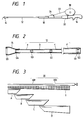
- Fig. 1 shows an embodiment of an intra-line fishing rod according to the invention.
- a base rod 10 is fixed to the front portion of a casting handle 16, and a top rod 12 is jointed to the base rod 10 in a swing-out (telescopic) joint manner or in an ordinary joint manner.
- the top rod 12 includes a top guide 14 at the leading end thereof, the casting handle 16 includes a mounting device 20 for mounting a reel 18, and the base rod 10 includes a fishline introduction guide 24.
- a fishline 22 is introduced from the reel 18 into the interior of the fishing rod through the fishline introduction guide 24.
- Fig. 2 is an enlarged longitudinal section view of the top rod 12, showing a state thereof in which the structure of the invention is applied.
- the present invention is not limited to a joint-type fishing rod of this kind but a single rod can also be employed in the invention. That is, the term "rod top portion" used in the invention does not always coincide with a rod tube generally referred to as a top rod, but it means the substantial rod top portion of a fishing rod. Therefore, the rod top portion can include No. 1, No. 2 and No. 3 rods from the front-most portion of a fishing rod, or can include only the front portion of No. 1 rod.
- the top rod 12, which is manufactured according to a method shown in Fig. 3, is composed of four areas, that is, a front portion a, a middle front portion b, a middle portion c, and a base portion d.
- a metal core 30 includes a substantially straight portion (corresponding to a rod top portion) 30F which is situated in the front half section of the metal core 30 and is tapered very gently, and a portion 30R which is situated in the rear half section and is tapered slightly greatly. It is preferable that the front portion 30F has a taper of 3/1000 or less which can be regarded as substantially straight. If the front portion 30F is formed in this manner, then the inside diameter of the rod top portion of a molded rod tube can be formed substantially straight. This makes it possible to increase the inside diameter of the front portion of the rod top portion, so that there can be provided a hollow portion through which a fishline can be passed freely.
- a reinforcing prepreg I which is formed in a tape shape or in a sheet shape, is wound around the metal core 30.
- the reinforcing prepreg I may be mainly formed of fibers extending substantially in the circumferential direction of the rod top portion, or may be formed by combining ceramics fibers extending substantially in the axial direction of the rod top portion with a scrim sheet. In the latter case, the ceramics fibers not only can reduce the resistance of the fishline passing through the molded rod tube but also can prevent the inner surface of the rod tube against wear.
- the reinforcing layer or prepreg I is not shown in Fig. 2.
- a front portion prepreg A is wound around the reinforcing prepreg I
- a middle front portion prepreg B with two end portions thereof formed inclined is wound around the prepreg A
- a middle portion prepreg C with the two end portions thereof formed inclined is wound around the prepreg B
- a tapered base prepreg D with the front end portion thereof formed inclined is wound around the prepreg C.
- the rod top portion 12 can be formed according to a conventionally known method. Referring here to a relation between the lengths of these prepregs, as shown in Fig. 3, A ⁇ B ⁇ C ⁇ D.
- the rod top portion 12 is formed by winding the prepregs in the above-mentioned sequence, then the prepregs situated in the rear portion are higher in elasticity than the prepregs in the front portion. Not only due to this, but also since the rear portion is wound on the outer side of the front portion, preferably, it is easy to make a difference in rigidity between the front and rear portions, and the front portion is easy to flex, thereby making it possible to increase the inside diameter of the front portion.
- the reinforcing prepreg I may be wound last to thereby reinforce the rod tube from the outer side thereof, or the prepregs A, B, C and D may be wound in the reversed order.
- the prepreg A Around the front portion 30F corresponding to the rod top portion, there are wound the prepreg A, prepreg B and the front half section of the prepreg C.
- the reinforcing prepreg I may be interposed between adjacent prepregs, for instance, between the prepreg B and the prepreg C.
- the reinforcing fibers that are used in the respective prepregs A, B, C and D are different in the elastic modulus from one another, and the fibers are selected in such a manner that the respective elastic moduli thereof become higher sequentially in a geometric series manner frog the front portion a toward the base portion d.
- the elastic moduli of the prepregs A, B, C and D are selected to be 5000 kg/mm 2 , 10000 kg/mm 2 , 20000 kg/mm 2 , and 40000 kg/mm 2 in this order.
- the elastic moduli (kg/mm 2 ) of fibers such as a carbon fiber, an alumina fiber, an aramide fiber, Techmiron (a brand name), a glass fiber, a steel fiber, a polyester fiber, and a nylon fiber, generally, they can be shown in the following order: that is, 70000 - 15000 (5000 - 90000), 25000 (10000 - 46000), 13400 (6900 - 16300), 9000 - 10000 (6000 - 10000), 7400 (6400 - 8730), 19400, 1100, and 500.
- the elastic moduli of the fibers vary in a wide range (the elastic moduli shown in the parentheses point out the wider ranges thereof, respectively). By selecting these elastic moduli, almost desired values can be obtained.
- the prepregs can be formed of only the carbon fiber.
- the above-mentioned structure including different elastic moduli can also be combined with other embodiments to be described later.
- the term "geometric series manner" used in the invention does not mean that the elastic moduli must be set in the geometric series in a strict sense, but means that a considerable difference is allowed.
- the carbon fibers those which have an elastic modulus of 7000 or less and thus are low in elasticity are flexible to a considerable extent, and, because the breakage elongation thereof is as much as 2%, they are difficult to break. Therefore, such carbon fibers can be conveniently used as a rod top portion or the front portion of a rod top portion. Especially, if they are used as reinforcing fibers extending in the axial direction, then the flexural rigidity of the rod top portion can be reduced. In actual use, there is used a prepreg which contains 50% or more by volume of such low elastic carbon fibers.
- the low elastic carbon fibers can also be used as reinforcing fibers in the following embodiments to be described later.
- the thus formed top rod 12 including even its front portion, has an inside diameter of such a given size to allow a fishline to be freely inserted therethrough, and the more forwardly it is situated in the rod top portion, the more easily the area can be flexed.
- a ⁇ b ⁇ c ⁇ d Referring to a relation between the lengths of the front portion a, middle front portion b, middle portion c and base portion d, it is preferable that a ⁇ b ⁇ c ⁇ d. This is because the tip action of the rod top portion is easy to play.
- a relation in thickness between them is preferably a ⁇ b ⁇ c ⁇ d. This is because a greater flexural force is applied as it approaches the base portion.
- a guide ring G1 formed of ceramics and held by a hold member SG is provided in the rear end of the top rod 12.
- the inside diameter of the top rod 12 can be set rather large, which makes it easy to provide a guide ring of ceramics.
- guide rings G2 and G3 respectively formed of ceramics, which not only reinforce the connecting boundary portions but also reduce the insertion resistance of the fishline.
- Fig. 4 shows a top rod 12' which is another embodiment of the top rod 12 shown in Fig. 2.
- area portions a', b', c' and d' provide a connection structure of a reversed ordinary joint type which is obtained by adhesion or by welding or melting.
- the reversed order joint type means a joint structure wherein the rearwardly located rod pipe is inserted into the inside of the forwardly located rod pipe.
- the respective area portions may be jointed either removably or fixedly in an ordinary manner or in a swing-out manner, or the ordinary joint structure may be fixed by adhesion. Further, they may be threadedly connected together so that they can be freely connected and removed.
- connection structure according to the present embodiment is preferable because a large interior can be provided.
- guide rings G2', G3' and the like similarly to the embodiment shown in Fig. 2, there are provided guide rings G2', G3' and the like.
- the guide rings can be provided when the respective area portions a', b', c' and d' are connected together, that is, the guide rings can be provided easily.
- the front portion a' may be a pipe which is formed of synthetic resin.
- the length of each area portion, the number of the area portions to be combined, the degree of taper of each area portion or the like can be selected freely according to the purpose of the fishing rod.
- the other characteristics of the present connection structure are similar to the embodiment shown in Fig. 2.
- the invention is not limited to this but, for example, the prepreg may be formed of a single kind of fibers. That is, there can be provided an intra-line fishing rod using synthetic resin as a matrix and reinforced not only with reinforcing fibers extending substantially in the axial direction of the fishing rod within the range of angles of ⁇ 30° with respect to the axial direction thereof but also with reinforcing fibers extending substantially in the peripheral direction of the fishing rod within the range of angles of ⁇ 45° with respect to the circumferential direction thereof, in which the inside diameter of a rod top portion thereof is formed in a substantially straight shape having an inclination of 3/1000 or less or in a gently tapered shape having an inclination of the order of 6/1000, and also in which the ratio of the reinforcing fibers extending substantially in the peripheral direction is set for 50% or more in the front portion of the rod top portion while the ratio thereof is set for 20% or less in the
- the present fishing rod with an inserted fishline provides a similar flexure property to a fishing rod with an inserted fishline which has a tapered delicate rod top portion. Also, since the inside diameter of the rod top portion is formed substantially straight, the inside diameter of the front portion of the rod top portion can be formed large and thus there can be provided a hollow portion through which a fishline can freely pass, whereby there can be provided a fishline insertion structure in which the insertion resistance of the fishline is reduced.
- the rod top portion if, as the reinforcing fibers extending in the peripheral direction, there are used reinforcing fibers which are higher in elasticity than the reinforcing fibers extending in the axial direction, then the resultant flexural rigidity of the rod top portion is low, the flexure of the rod top portion is delicate while the rod top portion is highly strong against crushing, the rod top portion can be made thin in thickness and large in diameter, and the rod top portion can be reduced in weight.
- Fig. 5 shows another embodiment of a top rod including a rod top portion according to the invention, which is an example of the structure recited in claim 4.
- the combination of the main body layer 12H and resin layer 12I makes the rod top portion in which the amount of the reinforcing fibers extending substantially in said axial direction in the front portion of the rod top portion is set smaller while the amount of said reinforcing fibers in the rear portion of the rod top portion is set greater, the ratio of the synthetic resin relative to the reinforcing fibers in the front portion of the rod top portion is set greater while the ratio of the synthetic resin relative to the reinforcing fibers in the rear portion of the rod top portion is set smaller.
- a fishline insertion structure in which the inside diameter of the front portion of the rod top portion can be formed large and there can be obtained a hollow portion through which the fishline can pass freely, thereby being able to reduce the insertion resistance of the fishline.
- the flexural property of the rod top portion becomes higher toward the front portion of the rod top portion, the rod top portion can provide a similar delicate flexural property to the tapered rod top portion, and the crushing strength as a tube of the thin portion of the main body layer 12H is reinforced with the resin layer 12I.
- the synthetic resin of the resin layer 12I preferably, there may be used resin which allows the fishline to slide smoothly thereon, such as silicone, fluorine or the like.
- a reinforcing layer which consists mainly of reinforcing fibers extending substantially in the circumferential direction of the main body layer 12H.
- a rod top portion main body layer 12H' uses synthetic resin as a matrix and is reinforced with reinforcing fibers extending at least substantially in the axial direction thereof.
- the rear portion of the rod top portion main body layer 12H' has a tubular shape, whereas the main body layer 12H' includes an inclined cut portion 12C which, as shown in Fig. 6, is cut more deeply toward the front portion thereof.
- a cylindrical member 12I' consisting mainly of synthetic resin is fixed integrally to the inner periphery of the rod top portion main body layer 12H' by adhesion or the like in such a manner that it can cover the cut portion 12C.
- the inner surface of the cylindrical member and the inner surface of the rear portion of the top rod portion main body layer are formed in such a manner that there is no level difference between them.
- the rod top portion main body layer including the rear portion to the front portion thereof, is formed in a substantially straight shape having an inclination of 3/1000 or less or in a gently tapered shape having an inclination up to the order of 6/1000. Therefore, there can be provided a fishline insertion structure which includes a hollow portion allowing the fishline to be inserted freely therethrough and also which can reduce the insertion resistance of the fishline.
- the main body layer of the present rod top portion becomes smaller in quantity toward the front portion thereof, the present rod top portion can flex well and can provide a similar delicate flexural property to the tapered rod top portion.
- the cylindrical member 12I' consists mainly of synthetic resin, it may be reinforced with short fibers such as "Whisker” (a brand name) or with particles, or it may include an inner surface which is improved in the fishline slidability. Further, it may be a cylindrical body which is formed of restitutive rubber or elastomer resin, or synthetic resin tape may be wound several times around the cylindrical member 12I'.
- Whisker a brand name
- synthetic resin tape may be wound several times around the cylindrical member 12I'.
- the synthetic resin as a matrix is used with a ratio of 40% or less by volume.
- their relative ratios may be changed gradually.
- the fibers extending substantially in the axial direction become smaller in quantity toward the front portion of the rod top portion and, for this reason, even when the rod top portion uses a single kind of reinforcing fibers and synthetic resin, the rod top portion can provide a flexural property almost similar to the embodiments shown in Figs. 5 and 6.
- Fig. 7 shows a partially enlarged view of a rod top portion, in which reinforcing fibers S1 and S2 respectively inclined by an angle of ⁇ with respect to the axial direction J of the rod top portion are arranged substantially symmetrically so that they cross each other.
- the angle ⁇ is 15° and, in particular, the angle ⁇ may be set in the range of 5° to 25°.
- reinforcing fibers extending in the axial direction or reinforcing fibers extending in the circumferential direction they may be arranged in small quantity. It is preferable to use low elastic reinforcing fibers having an elastic modulus of 20000 kg/mm 2 or less.
- the flexural rigidity thereof can be reduced, the inside diameter thereof can be made large, and the insertion resistance of the fishline can be reduced while keeping the delicate flexural tone thereof.
- the reinforcing fibers are arranged obliquely, they have some components which contribute to the circumferential direction, thereby being able to prevent the rod top portion against crushing rupture. Further, they have some components to contribute to the longitudinal direction, thereby being able to prevent the rod top portion against plastic deformation.
- a rod top portion according to an embodiment of the invention as claimed in claim 4 is structured such that not only the reinforcing fibers S1 and S2 crossing each other and shown in Fig. 7 are arranged but also reinforcing fibers such as carbon fibers or the like are arranged in the axial direction J.
- the angle ⁇ is 5° or greater, preferably, the angle ⁇ may be set 15° or greater. This is because the rod top portion can be made easy to flex, in order to prevent the plastic deformation of the rod top portion.
- the axially extending fibers are used in smaller quantity than the crossing fibers, or reinforcing fibers having a lower elastic modulus are used as the axially extending fibers, thereby making delicate the flexure of the rod top portion.
- the elastic modulus of the axially extending fibers should be 24000 kg/mm 2 at most, so that the flexural rigidity of the rod top portion can be reduced.
- the rod top portion is strong against crushing or twisting.
- the flexural rigidity of the rod top portion is low, the inside diameter of the rod top portion can be made large, and the insertion resistance of the fishline can be reduced.
- the rod top portion must have a low flexural rigidity and must be strong against crushing. This can be attained by a laminated structure in which the reinforcing fibers arranged in the axial direction are combined with woven cloth. In this structure, the existence of the peripherally extending fibers of the woven cloth increases the crushing strength. And, since all of the reinforcing fibers do not contribute to the flexural rigidity, the flexural rigidity obtained is small for the quantity of the reinforcing fibers used and thus the inside diameter of the rod top portion can be formed large. On the other hand, the rod top portion can be formed thick for the flexural rigidity, so that, even if the rod top portion flexes greatly, it is difficult to be crushed or broken.
- the woven cloth may have a low fiber ratio in which a ratio of synthetic resin is 50% or more and the arranging fibers may have a high fiber ratio in which a ratio of synthetic resin is 45% or less.
- the rod top portion can be formed large to thereby enhance the crushing strength thereof without increasing the flexural rigidity thereof (that is, not only the rod top portion can provide a delicate flexural property but also the inside diameter of the rod top portion can be increased).
- glass fibers are used for the woven cloth to thereby reduce the elastic modulus of the rod top portion
- carbon fibers having an elastic modulus of 24000 kg/mm 2 or less
- their respective synthetic resin ratios are set for 35% or more and the ratio of the synthetic resin in the woven cloth is set greater than the ratio of the synthetic resin in the arranging fibers.
- the thickness of the laminated layer of the woven cloth is set for 0.06 mm, while the thickness of the laminated layer of the arranging fibers is set for 0.03 mm.
- reinforcing fibers arranged crossingly at the angle ⁇ , which has been described with reference to Fig. 7, of 25° (the angle in the range of 15° - 45°), that is, such reinforcing fibers may be used in combination with woven cloth including fibers which extend in the axial direction of the rod top portion).
- reinforcing fibers having a low elongation are disposed in the inside thereof and reinforcing fibers having a high elongation (a low elasticity). Due to this, not only the rod top portion can be formed such that it is easy to flex and the inside diameter thereof can be formed large, but also, when it is flexed greatly, the rod top portion can be prevented from being deformed plastically.
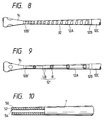
- the rod top portion includes a spirally shaped member 32 formed of fiber reinforced resin, fiber reinforced metal, metal, ceramics, synthetic resin or the like to thereby reduce the insertion resistance of the fishline, that is, the fishline can be inserted through the spirally shaped member 32.
- a cylindrical member 12A which is formed of material lower in elasticity than the spirally shaped member 32. That is, the cylindrical member 12A is structured not only in order not to impede the flexure of the spirally shaped member 32 but also in order to prevent the fishline from being twined around the outside of the spirally shaped member 32. Due to this, the inside diameter of the rod top portion can be formed large while keeping the delicate flexural property thereof, and the fishline insertion resistance can be reduced. Further, the cylindrical member 12A is difficult to be crushed because of the existence of the spirally shaped member 32.
- the cylindrical member 12A is connected to a rear rod tube 12C through a connecting portion 12B which holds the rear end of the spirally shaped member 32, while the front portion of the cylindrical member 12A is connected to a top guide 14 through a connecting portion 12B' holding the front end of the spirally shaped member 32.
- a spirally shaped member 32' is composed of a plurality of guide rings R formed of ceramics or the like, and a longitudinal member LB formed of a wire or the like for connecting together the guide rings R. And, the remaining portions of the spirally shaped member 32' are similar to the embodiment shown in Fig. 8.
- Fig. 10 shows a rod top portion T.
- the rod top portion T made up of three layers, i.e. an outer layer 50, an inner layer 54 and an intermediate layer 52 radially interposed between the outer and inner layers 50, 54.
- Each of the inner and outer layers 50 and 54 is formed by a braided bag which is obtained by braiding or weaving a plurality of fibrous threads or tapes as warp and weft into a hollow configuration.
- the braided bag in the hollow configuration may be preliminary obtained and then wrapped around the metal core, or otherwise the fibrous threads or tapes may be braided around the metal core to cover the metal core.
- Each fibrous threads or tapes is made up of several thousands inorganic or organic fibers such as aramid fibers, polyether imide fibers, glass fibers, low-elastic module carbon fibers or the like bundled by resinous material.
- twelve fibrous threads are braided tightly with six threads as warp and the reminder six as weft so that each of fibrous threads is arranged obliquely with respect to the longitudinal direction of the rod top portion T.
- the fibrous threads may be braided loosely. Because of this oblique arrangement and braiding of the fibrous threads, the rod top portion T can bear against the breakage even though it is bent greatly.
- the intermediate layer 52 is made of material containing a relatively large quantity of synthetic resin (preferably, not smaller than 50% by weight) and longitudinally extended organic or inorganic fibers such as glass fibers, low-elastic module carbon fibers or the like.
- the circumferentially extended fibers may be included in the material for the intermediate layer 52. The purpose of the provision of this intermediate layer 52 having the longitudinally extended fibers is to prevent the plastic deformation of the rod top portion T when it is bent greatly.
- the radial thickness of the outer, intermediate and inner layer is set at a ratio of 1:3:1, but may be varied according to the object of the fishing rod. Further, one of the outer and inner layers 50 and 52 may be omitted as long as the desired anti-breakage and anti-plastic deformation properties are obtained. Moreover, a prepreg layer containing circumferentially extended reinforcing fibers may be provided on an inside or outside of the intermediate layer 52, an inside of the inner layer 54 or an outside of the outer layer 50.
- a fishing rod having a delicate flexible characteristic can be structured as an intra-line fishing rod which not only can keep its delicate flexible characteristic but also can reduce a fishline insertion resistance.
Landscapes
- Life Sciences & Earth Sciences (AREA)
- Environmental Sciences (AREA)
- Engineering & Computer Science (AREA)
- Marine Sciences & Fisheries (AREA)
- Animal Husbandry (AREA)
- Biodiversity & Conservation Biology (AREA)
- Textile Engineering (AREA)
- Chemical & Material Sciences (AREA)
- Composite Materials (AREA)
- Mechanical Engineering (AREA)
- Fishing Rods (AREA)
Claims (19)
- Une canne à pêche à parcours intérieur de fil comprenant une partie supérieure de canne utilisant de la résine synthétique à titre de matrice et renforcée non seulement par des fibres de renforcement s'étendant dans une direction comprise dans une plage d'angles de ±30° par rapport à la direction axiale de ladite partie supérieure de canne, mais également par des fibres de renforcement s'étendant dans une direction comprise dans une plage d'angles de ±45° par rapport à la direction circonférentielle de ladite partie supérieure de canne, dans laquelle le diamètre intérieur de ladite partie supérieure de canne est réalisé sous une forme sensiblement droite ou sous une forme légèrement effilée, et le rapport desdites fibres de renforcement s'étendant dans ladite direction sensiblement circonférentielle, en comparaison avec lesdites fibres de renforcement dans ladite direction axiale dans la partie avant de ladite partie supérieure de canne est de 50 % ou plus en volume, tandis que le rapport desdites fibres de renforcement s'étendant dans ladite direction sensiblement circonférentielle dans la partie arrière de ladite partie supérieure de canne est inférieur à celui sélectionné pour la partie avant de ladite partie supérieure de canne.
- Une canne à pêche à parcours intérieur de fil selon la revendication 1, dans laquelle une couche de corps principale d'une partie supérieure de canne ayant des fibres de renforcement s'étendant sensiblement dans la direction axiale de la partie supérieure de canne, dans laquelle la quantité desdites fibres de renforcement s'étendant sensiblement dans ladite direction axiale dans la partie avant de ladite partie supérieure de canne est plus faible, tandis que la quantité desdites fibres de renforcement dans la partie arrière de ladite partie supérieure de canne est plus élevée, le rapport de ladite résine synthétique par rapport auxdites fibres de renforcement dans ladite partie avant de ladite partie supérieure de canne est plus élevé, tandis que le rapport de ladite résine synthétique par rapport auxdites fibres de renforcement dans ladite partie arrière de ladite partie supérieure de canne est plus faible, et le diamètre intérieur de ladite partie supérieure de canne est réalisé sous une forme sensiblement droite ou sous une forme légèrement effilée.
- Une canne à pêche à parcours intérieur de fil selon la revendication 1 ou 2, dans laquelle les fibres de renforcement sont disposées de manière à s'étendre dans une direction inclinée, avec les angles d'inclinaison compris dans la plage allant de 5 degrés à 25 degrés par rapport à la direction axiale de ladite partie supérieure de canne, lesdites fibres de renforcement se croisant à la fois dans les directions droite et gauche sensiblement symétriquement par rapport à ladite direction axiale, et lesdites fibres de renforcement se croisant occupent pratiquement toutes les fibres de renforcement qui sont utilisées dans ladite partie supérieure de canne.
- Une canne à pêche à parcours intérieur de fil selon l'une des revendications 1 à 3, dans laquelle lesdites fibres de renforcement sont disposées de manière à s'étendre dans une direction inclinée, avec les angles d'inclinaison de 5 degrés ou plus par rapport à la direction axiale de ladite partie supérieure de canne et également de manière à se croiser à la fois depuis les directions droite et gauche, sensiblement symétriquement par rapport à ladite direction axiale, et une plus faible quantité de fibres de renforcement que la quantité desdites fibres de renforcement se croisant est disposée de manière à s'étendre sensiblement dans ladite direction axiale, ou des fibres de renforcement ayant un module d'élasticité inférieur par rapport auxdites fibres de renforcement se croisant sont disposées de manière à s'étendre sensiblement dans ladite direction axiale.
- Une canne à pêche à parcours intérieur de fil selon l'une des revendications 1 à 4, dans laquelle ladite partie supérieure de canne est conçue de manière que de la résine synthétique soit utilisée à titre de matrice, et les fibres de renforcement sont disposées de manière à s'étendre sensiblement dans la direction axiale de ladite partie supérieure de canne, de manière que celles parmi ladite fibre de renforcement qui ont un grand étirement à la rupture soient disposées sur le côté extérieur de ladite partie supérieure de canne, tandis que celles parmi lesdites fibres de renforcement qui ont un faible étirement à la rupture sont disposées sur son côté intérieur.
- Une canne à pêche à parcours intérieur de fil selon l'une des revendications 1 à 5, dans laquelle ladite partie supérieure de canne est conçue de manière qu'il soit fourni un organe de forme spirale à travers lequel peut être inséré un fil de pêche, et un organe cylindrique est prévu de manière à recouvrir le côté extérieur dudit organe de forme spirale, ledit organe cylindrique étant constitué d'un matériau ayant un module d'élasticité inférieur à celui dudit organe de forme spirale.
- Une canne à pêche à parcours intérieur de fil selon l'une des revendications 1 à 6 précédentes, dans laquelle ladite partie supérieure de canne est constituée d'une pluralité de préimprégnés enroulés chacun constitué de fibres de renforcement imprégnées avec de la résine synthétique, dans laquelle lesdits préimprégnés enroulés sont agencés de manière à se décaler les uns par rapport aux autres dans une direction axiale de ladite partie supérieure de canne, et lesdits préimprégnés enroulés présentent des modules d'élasticité respectifs qui augmentent à la façon d'une progression géométrique depuis le préimprégné agencé à l'avant vers le préimprégné agencé à l'arrière.
- Une canne à pêche à parcours intérieur de fil selon l'une des revendications 1 à 5, dans laquelle ladite canne à pêche présente une partie supérieure de canne creuse, constituée de résine synthétique et de fibres de renforcement, ladite partie supérieure de canne ayant une couche de corps principale dont l'épaisseur radiale augmente séquentiellement depuis sa partie avant vers sa partie arrière, et une couche de résine au moins partiellement laminée sur une surface intérieure de ladite couche de corps principale et ayant une épaisseur radiale qui diminue séquentiellement depuis sa partie avant vers sa partie arrière.
- Une canne à pêche à parcours intérieur de fil selon l'une des revendications 1 à 8, dans laquelle ladite canne à pêche présente une partie supérieure de canne creuse, formée en résine synthétique et en fibres de renforcement, ladite partie supérieure de canne ayant une couche de corps principale réalisée sous une forme tubulaire, dont une partie avant est coupée obliquement, et un organe cylindrique supporté sur la partie avant coupée obliquement de ladite couche de corps principale.
- Une canne à pêche à parcours intérieur de fil selon l'une des revendications 1 à 9, dans laquelle une couche de fibres de renforcement s'étendant sensiblement dans la direction longitudinale de ladite partie supérieure de canne est agencée sous la forme d'une couche intérieure, extérieure ou intermédiaire desdites fibres de renforcement s'étendant dans ladite direction sensiblement axiale et variant séquentiellement concernant les modules d'élasticité.
- Une canne à pêche à parcours intérieur de fil selon la revendication 7, comprenant en outre :une couche de fibres de renforcement s'étendant sensiblement dans la direction axiale de ladite partie supérieure de canne, prévue radialement à l'intérieur ou à l'extérieur d'au moins l'un desdits préimprégnés enroulés.
- Une canne à pêche à parcours intérieur de fil selon la revendication 7, comprenant en outre :une feuille préimprégnée continue prévue radialement à l'intérieur ou à l'extérieur desdits préimprégnés enroulés et posée sur tous lesdits préimprégnés enroulés, ladite feuille préimprégnée contenant des fibres de renforcement s'étendant dans la direction longitudinale de ladite partie supérieure de canne.
- Une canne à pêche à parcours intérieur de fil selon l'une des revendications 1 à 12 précédentes, dans laquelle ladite canne à pêche présente une partie supérieure de canne creuse formée en résine synthétique et en fibres de renforcement, ladite partie supérieure de canne comprenant :une couche de corps principale constituée d'un matériau ayant un premier module d'élasticité; etun organe cylindrique creux fixé à ladite couche de corps principale et constitué d'un matériau ayant un deuxième module d'élasticité inférieur audit premier module d'élasticité.
- Une canne à pêche à parcours intérieur de fil selon la revendication 13, dans laquelle ladite couche de corps principale est réalisée sous une forme tubulaire et l'intérieur de ladite couche de corps principale est mis en communication avec l'intérieur dudit organe cylindrique creux, pour permettre à un fil de pêche de passer à la fois à travers ladite couche de corps principale et ledit organe cylindrique.
- Une canne à pêche à parcours intérieur de fil selon la revendication 13, dans laquelle ladite couche de corps principale présente une partie coupée obliquement ayant une rigidité graduellement réduite vers sa pointe, et ledit organe cylindrique est supporté par ladite partie coupée obliquement.
- Une canne à pêche à parcours intérieur de fil selon l'une des revendications 1 à 15 précédentes, dans laquelle ladite partie supérieure de canne comprend :un tube de canne placé à l'avant, formé par un premier préimprégné ayant un premier module d'élasticité;un tube de canne placé à l'arrière, formé par un deuxième préimprégné ayant un deuxième module d'élasticité qui est supérieur audit premier module d'élasticité, ledit tube de canne placé à l'arrière étant couplé audit tube de canne placé à l'avant, de manière que ledit tube de canne placé à l'arrière soit inséré à l'intérieur dudit tube de canne placé à l'avant; etune bague de guidage disposée sur une extrémité axiale dudit tube de canne placé à l'arrière et à l'intérieur dudit tube de canne placé à l'avant.
- Une canne à pêche à parcours intérieur de fil selon l'une des revendications 1 à 16 précédentes, dans laquelle ladite partie supérieure de canne comprend :une première couche contenant une résine synthétique et des fibres de renforcement s'étendant dans une direction longitudinale de ladite partie supérieure de canne; etune deuxième couche prévue au moins à l'intérieur ou à l'extérieur de ladite première couche, ladite deuxième couche étant constituée d'un sachet tressé qui est obtenu par tressage d'une pluralité d'organes en forme de fil fibreux, sous la forme de chaíne et de trame, de manière que chacun desdits organes fibreux soit agencé obliquement par rapport à ladite direction longitudinale.
- Une canne à pêche à parcours de fil intérieur selon l'une des revendications 1 à 17 précédentes, dans laquelle une partie supérieure de canne de ladite canne à pêche est réalisée sous une forme sensiblement droite, son diamètre intérieur ayant une inclinaison de 3/1000, des fibres de renforcement ayant des modules d'élasticité différents sont utilisées séquentiellement dans ladite partie supérieure de canne, de manière que lesdites fibres de renforcement s'étendent sensiblement dans la direction axiale de ladite partie supérieure de canne, et lesdits modules d'élasticité desdites fibres de renforcement augmentent en valeur séquentiellement depuis la partie avant de ladite partie supérieure de canne vers sa partie arrière, à la façon d'une progression géométrique.
- Une canne à pêche à parcours de fil intérieur selon l'une des revendications 1 à 18 précédentes, dans laquelle une couche de fibres de renforcement s'étendant sensiblement dans la direction circonférentielle de ladite partie supérieure de canne est agencée sous la forme d'une couche intérieure extérieure ou intermédiaire desdites fibres de renforcement s'étendant dans ladite direction sensiblement axiale.
Priority Applications (2)
| Application Number | Priority Date | Filing Date | Title |
|---|---|---|---|
| EP98119340A EP0890306A3 (fr) | 1994-09-06 | 1995-09-06 | Canne à pêche à parcours de fil intérieur |
| EP98119322A EP0887015A3 (fr) | 1994-09-06 | 1995-09-06 | Canne à pêche à parcours de fil intérieur |
Applications Claiming Priority (4)
| Application Number | Priority Date | Filing Date | Title |
|---|---|---|---|
| JP238527/94 | 1994-09-06 | ||
| JP23852794 | 1994-09-06 | ||
| JP113772/95 | 1995-04-14 | ||
| JP7113772A JP3027318B2 (ja) | 1994-09-06 | 1995-04-14 | 中通し釣竿 |
Related Child Applications (2)
| Application Number | Title | Priority Date | Filing Date |
|---|---|---|---|
| EP98119340A Division EP0890306A3 (fr) | 1994-09-06 | 1995-09-06 | Canne à pêche à parcours de fil intérieur |
| EP98119322A Division EP0887015A3 (fr) | 1994-09-06 | 1995-09-06 | Canne à pêche à parcours de fil intérieur |
Publications (2)
| Publication Number | Publication Date |
|---|---|
| EP0701774A1 EP0701774A1 (fr) | 1996-03-20 |
| EP0701774B1 true EP0701774B1 (fr) | 1999-04-28 |
Family
ID=26452699
Family Applications (3)
| Application Number | Title | Priority Date | Filing Date |
|---|---|---|---|
| EP98119340A Withdrawn EP0890306A3 (fr) | 1994-09-06 | 1995-09-06 | Canne à pêche à parcours de fil intérieur |
| EP95113996A Expired - Lifetime EP0701774B1 (fr) | 1994-09-06 | 1995-09-06 | Canne à pêche à parcours de fil intérieur |
| EP98119322A Withdrawn EP0887015A3 (fr) | 1994-09-06 | 1995-09-06 | Canne à pêche à parcours de fil intérieur |
Family Applications Before (1)
| Application Number | Title | Priority Date | Filing Date |
|---|---|---|---|
| EP98119340A Withdrawn EP0890306A3 (fr) | 1994-09-06 | 1995-09-06 | Canne à pêche à parcours de fil intérieur |
Family Applications After (1)
| Application Number | Title | Priority Date | Filing Date |
|---|---|---|---|
| EP98119322A Withdrawn EP0887015A3 (fr) | 1994-09-06 | 1995-09-06 | Canne à pêche à parcours de fil intérieur |
Country Status (4)
| Country | Link |
|---|---|
| US (2) | US5926992A (fr) |
| EP (3) | EP0890306A3 (fr) |
| JP (1) | JP3027318B2 (fr) |
| DE (1) | DE69509328T2 (fr) |
Families Citing this family (11)
| Publication number | Priority date | Publication date | Assignee | Title |
|---|---|---|---|---|
| TW351918U (en) * | 1994-02-25 | 1999-02-01 | Shimano Kk | Hollow fishing rod and its insert |
| EP0826481A3 (fr) * | 1996-08-27 | 1999-06-02 | Daiwa Seiko Inc. | Article tubulaire |
| US20040200123A1 (en) * | 2003-02-27 | 2004-10-14 | Kenneth Whiting | Two piece bonded fishing rod blank and fishing rod |
| DE102005052079B4 (de) * | 2005-10-28 | 2009-11-19 | Cwb Innovations Gmbh | Angelrute und entsprechendes Spitzenteil |
| GB0613424D0 (en) * | 2006-07-06 | 2006-08-16 | Underwood Christopher J | Fishing rod |
| US8001716B1 (en) * | 2008-08-12 | 2011-08-23 | The Orvis Company, Inc. | Lightweight fishing rod and a method for making a lightweight fishing rod |
| US20130152449A1 (en) * | 2011-08-30 | 2013-06-20 | Timothy S. MAKOS | In-line reel and rod assembly |
| US10172335B2 (en) | 2012-08-27 | 2019-01-08 | Steinhauser LLC | Advanced fishing rod assembly |
| JP6164835B2 (ja) * | 2012-12-25 | 2017-07-19 | 株式会社シマノ | 釣竿用竿体とそれを備えた釣竿並びに釣竿用竿体の製造方法 |
| CN110381735B (zh) * | 2017-03-10 | 2022-04-08 | 古洛布莱株式会社 | 具有安装有安装零件的竿体的钓竿、管状体及其制造方法 |
| JP7198727B2 (ja) * | 2019-06-04 | 2023-01-04 | 株式会社シマノ | 釣竿 |
Family Cites Families (41)
| Publication number | Priority date | Publication date | Assignee | Title |
|---|---|---|---|---|
| US386321A (en) * | 1888-07-17 | Everett hoeton | ||
| GB225412A (en) * | 1924-01-18 | 1924-12-04 | Reginald Stratton Alldridge | Improvements in fine adjustments for microscopes |
| US2541609A (en) * | 1947-02-21 | 1951-02-13 | Pullan James Francis | Fishing rod |
| US2602766A (en) * | 1948-04-10 | 1952-07-08 | Richard J Francis | Reinforced plastic rods and methods of making same |
| FR92821E (fr) * | 1962-06-22 | 1969-01-03 | Henri Dubois | Procédé de fabrication de tubes en matiere synthétique armée de fibres de verre notamment pour cannes a peche. |
| FR1334399A (fr) * | 1962-06-22 | 1963-08-09 | Procédé de fabrication de tubes en matière synthétique armée de fibres de verre, notamment pour cannes à pêche | |
| GB1259820A (en) * | 1969-10-27 | 1972-01-12 | Abraham Alan Cranston | Improvements in or relating to fishing rods |
| GB1351732A (en) * | 1970-03-19 | 1974-05-01 | Secr Defence | Fishing rods and processes for their manufacture |
| GB1362531A (en) * | 1972-05-02 | 1974-08-07 | Morganite Modmor Ltd | Reinforced plastic materials |
| US4083140A (en) * | 1975-08-13 | 1978-04-11 | Exxon Research & Engineering Co. | Fishing rod ferrule |
| JPS5832570B2 (ja) * | 1975-09-25 | 1983-07-14 | トクノウ トモトシ | キヨウカプラスチツクツリザオノ セイゾウホウ |
| US4043074A (en) * | 1975-12-31 | 1977-08-23 | Skyline Industries, Inc. | Graphite fiber fishing rod |
| US4061806A (en) * | 1976-04-12 | 1977-12-06 | Shakespeare Company | Flexible hollow fishing rod |
| US4178713A (en) * | 1977-10-17 | 1979-12-18 | Kenichi Higuchi | Fishing rod made of fiber reinforced synthetic resin |
| US4355061A (en) * | 1981-08-13 | 1982-10-19 | Shakespeare Company | Composite tubular rod and method for making same |
| GB2119611A (en) * | 1982-05-11 | 1983-11-23 | Bruce And Walker Limited | Fishing rod |
| US4653216A (en) * | 1984-04-13 | 1987-03-31 | Daiwa Seiko Inc. | Tube for fishing rod |
| IT1187392B (it) * | 1985-12-03 | 1987-12-23 | Reglass Spa | Struttura mulistrato per la realizzazione di elementi tubolari estremamente leggeri e resistenti,in particolare per la costruzione di canne da pesca |
| US4885865A (en) * | 1986-07-31 | 1989-12-12 | Berkley, Inc. | Graphite fiber reinforced rod construction |
| JPH069876B2 (ja) * | 1987-06-19 | 1994-02-09 | ダイワ精工株式会社 | 釣竿の製造法 |
| FR2619340A1 (fr) * | 1987-08-12 | 1989-02-17 | Garbolino Sa Ets | Element tubulaire, notamment pour canne a peche |
| JPH0741344Y2 (ja) * | 1987-12-07 | 1995-09-27 | 島野工業株式会社 | 釣 竿 |
| JPH0624792B2 (ja) * | 1988-09-19 | 1994-04-06 | ダイワ精工株式会社 | 釣竿等の長尺体 |
| US5245779A (en) * | 1988-09-19 | 1993-09-21 | Daiwa Seiko, Inc. | Fishing rod and other tubular bodies |
| JPH02124049A (ja) * | 1988-11-02 | 1990-05-11 | Daiwa Seiko Inc | 釣竿及びその製造方法 |
| JPH02280026A (ja) * | 1989-04-20 | 1990-11-16 | Nippondenso Co Ltd | 半導体式圧力検出装置 |
| JP2757473B2 (ja) * | 1989-07-18 | 1998-05-25 | ソニー株式会社 | ヴィタビ復号器 |
| JP3143463B2 (ja) | 1990-08-30 | 2001-03-07 | キヤノン株式会社 | 画像処理装置 |
| JP2529417B2 (ja) * | 1989-10-30 | 1996-08-28 | ダイワゴルフ株式会社 | 管状体の製造方法 |
| JPH03212540A (ja) * | 1990-01-16 | 1991-09-18 | Hayakawa Rubber Co Ltd | 衝撃緩衝壁 |
| JP2961845B2 (ja) * | 1990-09-07 | 1999-10-12 | ダイワ精工株式会社 | 中通し釣竿 |
| JP3054623B2 (ja) * | 1991-06-05 | 2000-06-19 | 株式会社シマノ | 竿材及びその製造方法 |
| JPH05168375A (ja) * | 1991-12-18 | 1993-07-02 | Shimano Inc | 釣り竿用素材及びその製造方法 |
| FR2695295B1 (fr) * | 1992-09-08 | 1994-10-21 | Viellard Sa | Procédé pour la réalisation d'éléments tubulaires en fibres liées par de la résine synthétique destinés à être emboîtés les uns dans les autres pour former une canne à pêche dont l'action est contrôlée et éléments obtenus par ce procédé. |
| US5241773A (en) * | 1992-11-30 | 1993-09-07 | Burgh Ron A | Fishing rod for bait fish and the like |
| KR0111961Y1 (en) * | 1994-01-12 | 1997-12-23 | Wonder Co Ltd | Fishing rod |
| KR950030566A (ko) * | 1994-04-23 | 1995-11-24 | 조용선 | 단축다이얼번호 자동송출장치 |
| AU4001295A (en) * | 1994-10-14 | 1996-05-06 | Hauser Chemical Research, Inc. | New cytotoxic agents |
| FR2750321B1 (fr) | 1996-06-28 | 1998-07-31 | Oreal | Utilisation en cosmetique de copolymeres a squelette flexible, greffes par des macromonomeres hydrophobes et rigides ; compositions mises en oeuvre |
| JP3049426U (ja) | 1997-12-01 | 1998-06-09 | 卓司 中村 | 表面化粧シート |
| JP3049426B2 (ja) | 1998-09-10 | 2000-06-05 | 株式会社マンテン | 壁面パネルの固定金具 |
-
1995
- 1995-04-14 JP JP7113772A patent/JP3027318B2/ja not_active Expired - Fee Related
- 1995-09-06 EP EP98119340A patent/EP0890306A3/fr not_active Withdrawn
- 1995-09-06 EP EP95113996A patent/EP0701774B1/fr not_active Expired - Lifetime
- 1995-09-06 US US08/524,283 patent/US5926992A/en not_active Expired - Fee Related
- 1995-09-06 DE DE69509328T patent/DE69509328T2/de not_active Expired - Fee Related
- 1995-09-06 EP EP98119322A patent/EP0887015A3/fr not_active Withdrawn
-
1999
- 1999-07-09 US US09/350,290 patent/US6505430B1/en not_active Expired - Fee Related
Also Published As
| Publication number | Publication date |
|---|---|
| EP0701774A1 (fr) | 1996-03-20 |
| EP0890306A3 (fr) | 1999-10-13 |
| DE69509328T2 (de) | 1999-08-26 |
| EP0890306A2 (fr) | 1999-01-13 |
| DE69509328D1 (de) | 1999-06-02 |
| JP3027318B2 (ja) | 2000-04-04 |
| EP0887015A3 (fr) | 1999-10-13 |
| US5926992A (en) | 1999-07-27 |
| EP0887015A2 (fr) | 1998-12-30 |
| US6505430B1 (en) | 2003-01-14 |
| JPH08126451A (ja) | 1996-05-21 |
Similar Documents
| Publication | Publication Date | Title |
|---|---|---|
| US5926992A (en) | Intra-line fishing rod | |
| CA2139692A1 (fr) | Construction et fabrication d'arbre composite | |
| CN104737992B (zh) | 钓竿用竿梢及具有该竿梢的钓竿 | |
| US4653216A (en) | Tube for fishing rod | |
| US6148558A (en) | Fishing rod | |
| US6270426B1 (en) | Golf club shaft | |
| JP3582778B2 (ja) | 中実杆を使用した竿杆 | |
| EP0058783A1 (fr) | Tuyau composé d'une résine hybride, renforcée par des fibres en matière synthétique | |
| US20050223617A1 (en) | Fishing rod | |
| JP3716136B2 (ja) | 釣竿 | |
| US5338604A (en) | Fishing rod stock and method of manufacturing same | |
| JPH1175630A (ja) | 釣 竿 | |
| JP3652154B2 (ja) | 中実竿杆を使用した継式釣竿 | |
| JP3171333B2 (ja) | 中通し釣竿 | |
| JP3613438B2 (ja) | 継式釣竿 | |
| JP3171334B2 (ja) | 中通し釣竿 | |
| JP3171311B2 (ja) | 中通し釣竿 | |
| JP3748350B2 (ja) | 釣竿 | |
| JP3553365B2 (ja) | 釣竿 | |
| JP3171335B2 (ja) | 中通し釣竿 | |
| JP4053400B2 (ja) | アウターガイド竿 | |
| JP3815742B2 (ja) | 竿の穂先 | |
| JP4007432B2 (ja) | 釣り竿 | |
| JP3856456B2 (ja) | 中実竿杆を使用した継式ふな竿 | |
| EP0880891B1 (fr) | Canne à pêche |
Legal Events
| Date | Code | Title | Description |
|---|---|---|---|
| PUAI | Public reference made under article 153(3) epc to a published international application that has entered the european phase |
Free format text: ORIGINAL CODE: 0009012 |
|
| AK | Designated contracting states |
Kind code of ref document: A1 Designated state(s): DE FR GB IT |
|
| 17P | Request for examination filed |
Effective date: 19960723 |
|
| GRAG | Despatch of communication of intention to grant |
Free format text: ORIGINAL CODE: EPIDOS AGRA |
|
| 17Q | First examination report despatched |
Effective date: 19980604 |
|
| GRAG | Despatch of communication of intention to grant |
Free format text: ORIGINAL CODE: EPIDOS AGRA |
|
| GRAH | Despatch of communication of intention to grant a patent |
Free format text: ORIGINAL CODE: EPIDOS IGRA |
|
| GRAH | Despatch of communication of intention to grant a patent |
Free format text: ORIGINAL CODE: EPIDOS IGRA |
|
| GRAA | (expected) grant |
Free format text: ORIGINAL CODE: 0009210 |
|
| AK | Designated contracting states |
Kind code of ref document: B1 Designated state(s): DE FR GB IT |
|
| ITF | It: translation for a ep patent filed | ||
| REF | Corresponds to: |
Ref document number: 69509328 Country of ref document: DE Date of ref document: 19990602 |
|
| ET | Fr: translation filed | ||
| PLBE | No opposition filed within time limit |
Free format text: ORIGINAL CODE: 0009261 |
|
| STAA | Information on the status of an ep patent application or granted ep patent |
Free format text: STATUS: NO OPPOSITION FILED WITHIN TIME LIMIT |
|
| 26N | No opposition filed | ||
| REG | Reference to a national code |
Ref country code: GB Ref legal event code: IF02 |
|
| PGFP | Annual fee paid to national office [announced via postgrant information from national office to epo] |
Ref country code: GB Payment date: 20020904 Year of fee payment: 8 |
|
| PGFP | Annual fee paid to national office [announced via postgrant information from national office to epo] |
Ref country code: FR Payment date: 20020910 Year of fee payment: 8 |
|
| PGFP | Annual fee paid to national office [announced via postgrant information from national office to epo] |
Ref country code: DE Payment date: 20020911 Year of fee payment: 8 |
|
| PG25 | Lapsed in a contracting state [announced via postgrant information from national office to epo] |
Ref country code: GB Free format text: LAPSE BECAUSE OF NON-PAYMENT OF DUE FEES Effective date: 20030906 |
|
| PG25 | Lapsed in a contracting state [announced via postgrant information from national office to epo] |
Ref country code: DE Free format text: LAPSE BECAUSE OF NON-PAYMENT OF DUE FEES Effective date: 20040401 |
|
| GBPC | Gb: european patent ceased through non-payment of renewal fee |
Effective date: 20030906 |
|
| PG25 | Lapsed in a contracting state [announced via postgrant information from national office to epo] |
Ref country code: FR Free format text: LAPSE BECAUSE OF NON-PAYMENT OF DUE FEES Effective date: 20040528 |
|
| REG | Reference to a national code |
Ref country code: FR Ref legal event code: ST |
|
| PG25 | Lapsed in a contracting state [announced via postgrant information from national office to epo] |
Ref country code: IT Free format text: LAPSE BECAUSE OF NON-PAYMENT OF DUE FEES;WARNING: LAPSES OF ITALIAN PATENTS WITH EFFECTIVE DATE BEFORE 2007 MAY HAVE OCCURRED AT ANY TIME BEFORE 2007. THE CORRECT EFFECTIVE DATE MAY BE DIFFERENT FROM THE ONE RECORDED. Effective date: 20050906 |