EP0640715B1 - Full-grain artificial leather, process for producing the same, and article fabricated therefrom - Google Patents
Full-grain artificial leather, process for producing the same, and article fabricated therefrom Download PDFInfo
- Publication number
- EP0640715B1 EP0640715B1 EP94909298A EP94909298A EP0640715B1 EP 0640715 B1 EP0640715 B1 EP 0640715B1 EP 94909298 A EP94909298 A EP 94909298A EP 94909298 A EP94909298 A EP 94909298A EP 0640715 B1 EP0640715 B1 EP 0640715B1
- Authority
- EP
- European Patent Office
- Prior art keywords
- artificial leather
- porous polyurethane
- open cells
- layer
- grained artificial
- Prior art date
- Legal status (The legal status is an assumption and is not a legal conclusion. Google has not performed a legal analysis and makes no representation as to the accuracy of the status listed.)
- Expired - Lifetime
Links
- 239000002649 leather substitute Substances 0.000 title claims description 79
- 238000000034 method Methods 0.000 title claims description 33
- 229920002635 polyurethane Polymers 0.000 claims description 163
- 239000004814 polyurethane Substances 0.000 claims description 163
- 239000010410 layer Substances 0.000 claims description 102
- 230000035699 permeability Effects 0.000 claims description 67
- XLYOFNOQVPJJNP-UHFFFAOYSA-N water Substances O XLYOFNOQVPJJNP-UHFFFAOYSA-N 0.000 claims description 49
- 238000000576 coating method Methods 0.000 claims description 47
- 239000011248 coating agent Substances 0.000 claims description 46
- ZWEHNKRNPOVVGH-UHFFFAOYSA-N 2-Butanone Chemical compound CCC(C)=O ZWEHNKRNPOVVGH-UHFFFAOYSA-N 0.000 claims description 39
- 229920006264 polyurethane film Polymers 0.000 claims description 35
- 239000002904 solvent Substances 0.000 claims description 33
- KFZMGEQAYNKOFK-UHFFFAOYSA-N Isopropanol Chemical compound CC(C)O KFZMGEQAYNKOFK-UHFFFAOYSA-N 0.000 claims description 21
- 239000002657 fibrous material Substances 0.000 claims description 20
- 239000004745 nonwoven fabric Substances 0.000 claims description 14
- 239000002344 surface layer Substances 0.000 claims description 14
- 239000007788 liquid Substances 0.000 claims description 13
- 229920000728 polyester Polymers 0.000 claims description 9
- YXFVVABEGXRONW-UHFFFAOYSA-N Toluene Chemical compound CC1=CC=CC=C1 YXFVVABEGXRONW-UHFFFAOYSA-N 0.000 claims description 6
- 230000008961 swelling Effects 0.000 claims description 4
- XEKOWRVHYACXOJ-UHFFFAOYSA-N Ethyl acetate Chemical compound CCOC(C)=O XEKOWRVHYACXOJ-UHFFFAOYSA-N 0.000 claims 3
- 239000005871 repellent Substances 0.000 claims 3
- 239000004677 Nylon Substances 0.000 claims 2
- 229920001778 nylon Polymers 0.000 claims 2
- ZMXDDKWLCZADIW-UHFFFAOYSA-N N,N-Dimethylformamide Chemical compound CN(C)C=O ZMXDDKWLCZADIW-UHFFFAOYSA-N 0.000 description 54
- 239000000835 fiber Substances 0.000 description 22
- 239000010985 leather Substances 0.000 description 21
- 230000015572 biosynthetic process Effects 0.000 description 16
- 230000000052 comparative effect Effects 0.000 description 14
- 229920001971 elastomer Polymers 0.000 description 14
- 239000000806 elastomer Substances 0.000 description 14
- 238000004049 embossing Methods 0.000 description 13
- 229920000642 polymer Polymers 0.000 description 13
- 238000005299 abrasion Methods 0.000 description 11
- 238000001035 drying Methods 0.000 description 8
- 239000000839 emulsion Substances 0.000 description 8
- 238000010438 heat treatment Methods 0.000 description 6
- 239000003960 organic solvent Substances 0.000 description 5
- 230000001413 cellular effect Effects 0.000 description 4
- 239000000463 material Substances 0.000 description 4
- 238000002360 preparation method Methods 0.000 description 4
- 239000000126 substance Substances 0.000 description 4
- JOYRKODLDBILNP-UHFFFAOYSA-N Ethyl urethane Chemical compound CCOC(N)=O JOYRKODLDBILNP-UHFFFAOYSA-N 0.000 description 3
- 229920002292 Nylon 6 Polymers 0.000 description 3
- 229920000297 Rayon Polymers 0.000 description 3
- 150000001413 amino acids Chemical class 0.000 description 3
- 230000001747 exhibiting effect Effects 0.000 description 3
- 239000011148 porous material Substances 0.000 description 3
- 239000002964 rayon Substances 0.000 description 3
- 239000000758 substrate Substances 0.000 description 3
- 230000037303 wrinkles Effects 0.000 description 3
- UPMLOUAZCHDJJD-UHFFFAOYSA-N 4,4'-Diphenylmethane Diisocyanate Chemical compound C1=CC(N=C=O)=CC=C1CC1=CC=C(N=C=O)C=C1 UPMLOUAZCHDJJD-UHFFFAOYSA-N 0.000 description 2
- 239000004952 Polyamide Substances 0.000 description 2
- 229920002396 Polyurea Polymers 0.000 description 2
- WYURNTSHIVDZCO-UHFFFAOYSA-N Tetrahydrofuran Chemical compound C1CCOC1 WYURNTSHIVDZCO-UHFFFAOYSA-N 0.000 description 2
- 238000005345 coagulation Methods 0.000 description 2
- 230000015271 coagulation Effects 0.000 description 2
- 230000000694 effects Effects 0.000 description 2
- 239000010419 fine particle Substances 0.000 description 2
- 239000007789 gas Substances 0.000 description 2
- 238000005470 impregnation Methods 0.000 description 2
- 239000000203 mixture Substances 0.000 description 2
- 229920002647 polyamide Polymers 0.000 description 2
- -1 polyethylene terephthalate Polymers 0.000 description 2
- 239000011527 polyurethane coating Substances 0.000 description 2
- RYHBNJHYFVUHQT-UHFFFAOYSA-N 1,4-Dioxane Chemical compound C1COCCO1 RYHBNJHYFVUHQT-UHFFFAOYSA-N 0.000 description 1
- 229920000742 Cotton Polymers 0.000 description 1
- 239000005058 Isophorone diisocyanate Substances 0.000 description 1
- AFCARXCZXQIEQB-UHFFFAOYSA-N N-[3-oxo-3-(2,4,6,7-tetrahydrotriazolo[4,5-c]pyridin-5-yl)propyl]-2-[[3-(trifluoromethoxy)phenyl]methylamino]pyrimidine-5-carboxamide Chemical compound O=C(CCNC(=O)C=1C=NC(=NC=1)NCC1=CC(=CC=C1)OC(F)(F)F)N1CC2=C(CC1)NN=N2 AFCARXCZXQIEQB-UHFFFAOYSA-N 0.000 description 1
- 229920000459 Nitrile rubber Polymers 0.000 description 1
- 239000004721 Polyphenylene oxide Substances 0.000 description 1
- 150000001298 alcohols Chemical class 0.000 description 1
- 239000003963 antioxidant agent Substances 0.000 description 1
- 230000003078 antioxidant effect Effects 0.000 description 1
- 239000003849 aromatic solvent Substances 0.000 description 1
- 230000005540 biological transmission Effects 0.000 description 1
- 239000003795 chemical substances by application Substances 0.000 description 1
- 235000019504 cigarettes Nutrition 0.000 description 1
- 230000001112 coagulating effect Effects 0.000 description 1
- 239000002131 composite material Substances 0.000 description 1
- 238000007796 conventional method Methods 0.000 description 1
- 230000003247 decreasing effect Effects 0.000 description 1
- KORSJDCBLAPZEQ-UHFFFAOYSA-N dicyclohexylmethane-4,4'-diisocyanate Chemical compound C1CC(N=C=O)CCC1CC1CCC(N=C=O)CC1 KORSJDCBLAPZEQ-UHFFFAOYSA-N 0.000 description 1
- 238000002845 discoloration Methods 0.000 description 1
- 239000006185 dispersion Substances 0.000 description 1
- 238000004090 dissolution Methods 0.000 description 1
- 230000007613 environmental effect Effects 0.000 description 1
- 238000001704 evaporation Methods 0.000 description 1
- 230000008020 evaporation Effects 0.000 description 1
- 239000004744 fabric Substances 0.000 description 1
- 238000007756 gravure coating Methods 0.000 description 1
- RRAMGCGOFNQTLD-UHFFFAOYSA-N hexamethylene diisocyanate Chemical compound O=C=NCCCCCCN=C=O RRAMGCGOFNQTLD-UHFFFAOYSA-N 0.000 description 1
- 239000004615 ingredient Substances 0.000 description 1
- NIMLQBUJDJZYEJ-UHFFFAOYSA-N isophorone diisocyanate Chemical compound CC1(C)CC(N=C=O)CC(C)(CN=C=O)C1 NIMLQBUJDJZYEJ-UHFFFAOYSA-N 0.000 description 1
- 150000002576 ketones Chemical class 0.000 description 1
- 238000004519 manufacturing process Methods 0.000 description 1
- 239000000155 melt Substances 0.000 description 1
- 239000012046 mixed solvent Substances 0.000 description 1
- 239000004570 mortar (masonry) Substances 0.000 description 1
- 239000002667 nucleating agent Substances 0.000 description 1
- 238000005191 phase separation Methods 0.000 description 1
- 239000000049 pigment Substances 0.000 description 1
- 239000002798 polar solvent Substances 0.000 description 1
- 229920006149 polyester-amide block copolymer Polymers 0.000 description 1
- 229920000570 polyether Polymers 0.000 description 1
- 229920000139 polyethylene terephthalate Polymers 0.000 description 1
- 239000005020 polyethylene terephthalate Substances 0.000 description 1
- 229920005749 polyurethane resin Polymers 0.000 description 1
- 229920005989 resin Polymers 0.000 description 1
- 239000011347 resin Substances 0.000 description 1
- 239000007787 solid Substances 0.000 description 1
- 238000003892 spreading Methods 0.000 description 1
- 238000010186 staining Methods 0.000 description 1
- 229920003048 styrene butadiene rubber Polymers 0.000 description 1
- 229920002994 synthetic fiber Polymers 0.000 description 1
- 239000012209 synthetic fiber Substances 0.000 description 1
- 229920003002 synthetic resin Polymers 0.000 description 1
- 239000000057 synthetic resin Substances 0.000 description 1
- YLQBMQCUIZJEEH-UHFFFAOYSA-N tetrahydrofuran Natural products C=1C=COC=1 YLQBMQCUIZJEEH-UHFFFAOYSA-N 0.000 description 1
- 229940124543 ultraviolet light absorber Drugs 0.000 description 1
- 239000006097 ultraviolet radiation absorber Substances 0.000 description 1
- 239000002759 woven fabric Substances 0.000 description 1
Images
Classifications
-
- D—TEXTILES; PAPER
- D06—TREATMENT OF TEXTILES OR THE LIKE; LAUNDERING; FLEXIBLE MATERIALS NOT OTHERWISE PROVIDED FOR
- D06N—WALL, FLOOR, OR LIKE COVERING MATERIALS, e.g. LINOLEUM, OILCLOTH, ARTIFICIAL LEATHER, ROOFING FELT, CONSISTING OF A FIBROUS WEB COATED WITH A LAYER OF MACROMOLECULAR MATERIAL; FLEXIBLE SHEET MATERIAL NOT OTHERWISE PROVIDED FOR
- D06N3/00—Artificial leather, oilcloth or other material obtained by covering fibrous webs with macromolecular material, e.g. resins, rubber or derivatives thereof
- D06N3/12—Artificial leather, oilcloth or other material obtained by covering fibrous webs with macromolecular material, e.g. resins, rubber or derivatives thereof with macromolecular compounds obtained otherwise than by reactions only involving carbon-to-carbon unsaturated bonds, e.g. gelatine proteins
- D06N3/14—Artificial leather, oilcloth or other material obtained by covering fibrous webs with macromolecular material, e.g. resins, rubber or derivatives thereof with macromolecular compounds obtained otherwise than by reactions only involving carbon-to-carbon unsaturated bonds, e.g. gelatine proteins with polyurethanes
-
- D—TEXTILES; PAPER
- D06—TREATMENT OF TEXTILES OR THE LIKE; LAUNDERING; FLEXIBLE MATERIALS NOT OTHERWISE PROVIDED FOR
- D06N—WALL, FLOOR, OR LIKE COVERING MATERIALS, e.g. LINOLEUM, OILCLOTH, ARTIFICIAL LEATHER, ROOFING FELT, CONSISTING OF A FIBROUS WEB COATED WITH A LAYER OF MACROMOLECULAR MATERIAL; FLEXIBLE SHEET MATERIAL NOT OTHERWISE PROVIDED FOR
- D06N3/00—Artificial leather, oilcloth or other material obtained by covering fibrous webs with macromolecular material, e.g. resins, rubber or derivatives thereof
- D06N3/12—Artificial leather, oilcloth or other material obtained by covering fibrous webs with macromolecular material, e.g. resins, rubber or derivatives thereof with macromolecular compounds obtained otherwise than by reactions only involving carbon-to-carbon unsaturated bonds, e.g. gelatine proteins
- D06N3/14—Artificial leather, oilcloth or other material obtained by covering fibrous webs with macromolecular material, e.g. resins, rubber or derivatives thereof with macromolecular compounds obtained otherwise than by reactions only involving carbon-to-carbon unsaturated bonds, e.g. gelatine proteins with polyurethanes
- D06N3/145—Artificial leather, oilcloth or other material obtained by covering fibrous webs with macromolecular material, e.g. resins, rubber or derivatives thereof with macromolecular compounds obtained otherwise than by reactions only involving carbon-to-carbon unsaturated bonds, e.g. gelatine proteins with polyurethanes two or more layers of polyurethanes
-
- Y—GENERAL TAGGING OF NEW TECHNOLOGICAL DEVELOPMENTS; GENERAL TAGGING OF CROSS-SECTIONAL TECHNOLOGIES SPANNING OVER SEVERAL SECTIONS OF THE IPC; TECHNICAL SUBJECTS COVERED BY FORMER USPC CROSS-REFERENCE ART COLLECTIONS [XRACs] AND DIGESTS
- Y10—TECHNICAL SUBJECTS COVERED BY FORMER USPC
- Y10S—TECHNICAL SUBJECTS COVERED BY FORMER USPC CROSS-REFERENCE ART COLLECTIONS [XRACs] AND DIGESTS
- Y10S428/00—Stock material or miscellaneous articles
- Y10S428/904—Artificial leather
-
- Y—GENERAL TAGGING OF NEW TECHNOLOGICAL DEVELOPMENTS; GENERAL TAGGING OF CROSS-SECTIONAL TECHNOLOGIES SPANNING OVER SEVERAL SECTIONS OF THE IPC; TECHNICAL SUBJECTS COVERED BY FORMER USPC CROSS-REFERENCE ART COLLECTIONS [XRACs] AND DIGESTS
- Y10—TECHNICAL SUBJECTS COVERED BY FORMER USPC
- Y10T—TECHNICAL SUBJECTS COVERED BY FORMER US CLASSIFICATION
- Y10T428/00—Stock material or miscellaneous articles
- Y10T428/24—Structurally defined web or sheet [e.g., overall dimension, etc.]
- Y10T428/24058—Structurally defined web or sheet [e.g., overall dimension, etc.] including grain, strips, or filamentary elements in respective layers or components in angular relation
-
- Y—GENERAL TAGGING OF NEW TECHNOLOGICAL DEVELOPMENTS; GENERAL TAGGING OF CROSS-SECTIONAL TECHNOLOGIES SPANNING OVER SEVERAL SECTIONS OF THE IPC; TECHNICAL SUBJECTS COVERED BY FORMER USPC CROSS-REFERENCE ART COLLECTIONS [XRACs] AND DIGESTS
- Y10—TECHNICAL SUBJECTS COVERED BY FORMER USPC
- Y10T—TECHNICAL SUBJECTS COVERED BY FORMER US CLASSIFICATION
- Y10T428/00—Stock material or miscellaneous articles
- Y10T428/24—Structurally defined web or sheet [e.g., overall dimension, etc.]
- Y10T428/24132—Structurally defined web or sheet [e.g., overall dimension, etc.] including grain, strips, or filamentary elements in different layers or components parallel
-
- Y—GENERAL TAGGING OF NEW TECHNOLOGICAL DEVELOPMENTS; GENERAL TAGGING OF CROSS-SECTIONAL TECHNOLOGIES SPANNING OVER SEVERAL SECTIONS OF THE IPC; TECHNICAL SUBJECTS COVERED BY FORMER USPC CROSS-REFERENCE ART COLLECTIONS [XRACs] AND DIGESTS
- Y10—TECHNICAL SUBJECTS COVERED BY FORMER USPC
- Y10T—TECHNICAL SUBJECTS COVERED BY FORMER US CLASSIFICATION
- Y10T428/00—Stock material or miscellaneous articles
- Y10T428/24—Structurally defined web or sheet [e.g., overall dimension, etc.]
- Y10T428/24355—Continuous and nonuniform or irregular surface on layer or component [e.g., roofing, etc.]
- Y10T428/24438—Artificial wood or leather grain surface
-
- Y—GENERAL TAGGING OF NEW TECHNOLOGICAL DEVELOPMENTS; GENERAL TAGGING OF CROSS-SECTIONAL TECHNOLOGIES SPANNING OVER SEVERAL SECTIONS OF THE IPC; TECHNICAL SUBJECTS COVERED BY FORMER USPC CROSS-REFERENCE ART COLLECTIONS [XRACs] AND DIGESTS
- Y10—TECHNICAL SUBJECTS COVERED BY FORMER USPC
- Y10T—TECHNICAL SUBJECTS COVERED BY FORMER US CLASSIFICATION
- Y10T428/00—Stock material or miscellaneous articles
- Y10T428/24—Structurally defined web or sheet [e.g., overall dimension, etc.]
- Y10T428/24942—Structurally defined web or sheet [e.g., overall dimension, etc.] including components having same physical characteristic in differing degree
- Y10T428/24992—Density or compression of components
-
- Y—GENERAL TAGGING OF NEW TECHNOLOGICAL DEVELOPMENTS; GENERAL TAGGING OF CROSS-SECTIONAL TECHNOLOGIES SPANNING OVER SEVERAL SECTIONS OF THE IPC; TECHNICAL SUBJECTS COVERED BY FORMER USPC CROSS-REFERENCE ART COLLECTIONS [XRACs] AND DIGESTS
- Y10—TECHNICAL SUBJECTS COVERED BY FORMER USPC
- Y10T—TECHNICAL SUBJECTS COVERED BY FORMER US CLASSIFICATION
- Y10T428/00—Stock material or miscellaneous articles
- Y10T428/249921—Web or sheet containing structurally defined element or component
- Y10T428/249953—Composite having voids in a component [e.g., porous, cellular, etc.]
-
- Y—GENERAL TAGGING OF NEW TECHNOLOGICAL DEVELOPMENTS; GENERAL TAGGING OF CROSS-SECTIONAL TECHNOLOGIES SPANNING OVER SEVERAL SECTIONS OF THE IPC; TECHNICAL SUBJECTS COVERED BY FORMER USPC CROSS-REFERENCE ART COLLECTIONS [XRACs] AND DIGESTS
- Y10—TECHNICAL SUBJECTS COVERED BY FORMER USPC
- Y10T—TECHNICAL SUBJECTS COVERED BY FORMER US CLASSIFICATION
- Y10T428/00—Stock material or miscellaneous articles
- Y10T428/26—Web or sheet containing structurally defined element or component, the element or component having a specified physical dimension
- Y10T428/263—Coating layer not in excess of 5 mils thick or equivalent
-
- Y—GENERAL TAGGING OF NEW TECHNOLOGICAL DEVELOPMENTS; GENERAL TAGGING OF CROSS-SECTIONAL TECHNOLOGIES SPANNING OVER SEVERAL SECTIONS OF THE IPC; TECHNICAL SUBJECTS COVERED BY FORMER USPC CROSS-REFERENCE ART COLLECTIONS [XRACs] AND DIGESTS
- Y10—TECHNICAL SUBJECTS COVERED BY FORMER USPC
- Y10T—TECHNICAL SUBJECTS COVERED BY FORMER US CLASSIFICATION
- Y10T428/00—Stock material or miscellaneous articles
- Y10T428/26—Web or sheet containing structurally defined element or component, the element or component having a specified physical dimension
- Y10T428/266—Web or sheet containing structurally defined element or component, the element or component having a specified physical dimension of base or substrate
-
- Y—GENERAL TAGGING OF NEW TECHNOLOGICAL DEVELOPMENTS; GENERAL TAGGING OF CROSS-SECTIONAL TECHNOLOGIES SPANNING OVER SEVERAL SECTIONS OF THE IPC; TECHNICAL SUBJECTS COVERED BY FORMER USPC CROSS-REFERENCE ART COLLECTIONS [XRACs] AND DIGESTS
- Y10—TECHNICAL SUBJECTS COVERED BY FORMER USPC
- Y10T—TECHNICAL SUBJECTS COVERED BY FORMER US CLASSIFICATION
- Y10T442/00—Fabric [woven, knitted, or nonwoven textile or cloth, etc.]
- Y10T442/60—Nonwoven fabric [i.e., nonwoven strand or fiber material]
- Y10T442/647—Including a foamed layer or component
Definitions
- This invention relates to a grained artificial leather, and a process for making the same.
- This grained artificial leather has good air permeability and water vapor permeability, and exhibits surface smoothness, stain resistance and abrasion resistance, which are improved over those of conventional grained artificial leather.
- This invention also relates to fabricated articles such as shoes, gloves, a chair and clothes, which have in at least part thereof the grained artificial leather.
- Artificial leathers composed of a fibrous sheet and a high polymeric elastomer have come into general use as essential leather substitutes in many fields such as shoe uppers, auxiliary materials for shoes and clothes. These artificial leathers are classified into three types according to the surface configuration: a suede type, a nubuk type and a grain type. Of these, a suede type and a nubuk type can have good air permeability and water vapor permeability. But, since a grain type has a finishing non-porous surface layer composed of a synthetic resin, the air permeability and vapor permeability are not satisfactory. Especially, shoe uppers and clothes fabricated from a grained artificial leather exhibit an undesirably large stuffiness in wear, and thus, it is desired to reduce the stuffiness.
- a proposal of forming a finishing polyurethane film on a base composed of a mixture of fibers and a high polymeric elastomer has been made to provide an artificial leather having discontinuous film characteristics.
- the artificial leather also has surface apertures having a large diameter and thus is stained, and the fibrous texture is not completely concealed by the finishing film and develops on the outer surface.
- the artificial leather does not have a smooth surface nor an attractive appearance.
- the artificial leather does not have a porous polyurethane layer and therefore the abrasion resistance is poor.
- the grained surface layer is directly formed on the fibrous base of the resulting grained artificial leather, and therefore, when the leather is drawn, the fibrous texture of the base readily develops on the grained surface. Further, the leather does not have a porous polyurethane layer, and therefore, the cushioning properties and the abrasion strength are poor.
- a three-layer artificial leather has been proposed in European Patent Application No. 310,037 which comprises a fibrous substrate layer, a cellular porous polyurethane layer adhered to the substrate layer, and a discontinuous film of fine particle polyurethane on the cellular porous polyurethane layer.
- This artificial leather is made by forming a cellular porous polyurethane layer on a fibrous substrate layer, abrading the surface of the cellular porous polyurethane layer to form open cells, and then forming a discontinuous non-porous polyurethane coat on the exposed surface.
- An object of the present invention is to provide a grained artificial leather and fabricated articles thereof, which are characterized as exhibiting reduced stuffiness on wearing, good stain resistance, smooth and attractive appearance, and good abrasion resistance.
- a grained artificial leather being water vapor- and air-permeable, which comprises:
- a shoe the instep of which is made of the above-mentioned grained artificial leather; a glove comprising the above-mentioned artificial leather; a chair, wherein at least one of the back and the seat is made of the above-mentioned grained artificial leather; and an article of clothing, at least portion of which is made of the above-mentioned grained artificial leather.
- a process for making a grained artificial leather, being air and water vapor-permeable which comprises the steps of:
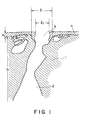
- Figure 1 is an enlarged cross-sectional view of an open cell-formed region in a porous polyurethane layer having interconnected cells in its interior and open cells on its upper surface and a film of a non-porous polyurethane on the upper surface.
- the sheet-form fibrous material contained in the grained artificial leather of the present invention there can be mentioned a woven fabric, a knitted fabric and a nonwoven fabric, which are composed of conventional natural fibers, regenerated fibers or synthetic fibers.
- the sheet-form fibrous material is preferably composed of moisture-absorbing fibers so that the backside of the artificial leather is rendered sweat-absorptive. Moisture-absorptive rayon fibers are suitable for this purpose.
- fibers having high mechanical strengths are preferable such as a polyethylene terephthalate fiber or other polyester fibers or a polyamide fiber or polyester/polyamide mixed fibers. It is also preferable to use a combination of a fiber having high mechanical strengths with a rayon fiber.
- a nonwoven fabric is preferable.
- the air-permeable base used in the present invention is comprised of the sheet-form fibrous material alone or a combination of the fibrous sheet-form material with a high polymer elastomer.
- a high polymer elastomer there can be mentioned those which have heretofore been used customarily as leather substitutes, such as polyurethane, polyurea, polyurethane-polyurea, a styrene-butadiene rubber and an acrylonitrile-butadiene rubber.
- these elastomers are used as an aqueous emulsion or a solvent solution for impregnating the sheet-form fibrous material therewith, and the aqueous emulsion or solution impregnated in the sheet-form fibrous material is coagulated whereby a base comprised of the sheet-form fibrous material and the high polymer elastomer is prepared.
- the base preferably has a thickness of from 0.3 mm to 2.0 mm at a bulk density of from 0.2 to 0.6 g/cm 3 .
- a porous polyurethane layer having interconnected cells in its interior thereof and having substantially no open cells on its exposed surface is formed on at least one surface of a base comprised of the sheet-form fibrous material alone or the sheet-form fibrous material plus a high polymer elastomer.
- polyurethane used for the preparation of the porous polyurethane layer all of the known polyurethanes can be employed, and as the method of forming the porous polyurethane layer, all of the known conventional methods can be employed.
- a method wherein one surface of a base comprised of a sheet-form fibrous material alone or a sheet-form fibrous material plus a high polymer elastomer is coated with a solution of polyurethane in an organic solvent, and the coated base is placed in a coagulating bath which is a non-solvent for the polyurethane and is miscible with the organic solvent of the polyurethane solution used, whereby the polyurethane solution coated on the base is coagulated; and a method wherein one surface of a base comprised of the sheet-form fibrous material alone or the fibrous sheet-form material plus a high polymer elastomer is coated with a W/O type emulsion which is prepared by finely dispersing water in a solution or dispersion of polyurethane in an organic solvent, and the organic solvent is selectively evaporated from the coated base whereby the polyurethane coating is coagulated.
- the porous polyurethane layer having interconnected fine cells in its interior thereof has preferably a thickness of 0.03 mm to 0.6 mm, more preferably 0.1 to 0.2 mm to obtain good abrasion resistance, surface smoothness, cushioning properties and bulk. If the thickness is smaller than 0.03 mm, the texture of the sheet-form fibrous material develops on the surface of the porous polyurethane layer, with the result of loss or reduction of surface smoothness. In contrast, if the thickness is larger than 0.6 mm, the artificial leather becomes rubber-like and the productivity is lowered.
- the porous polyurethane layer of the artificial leather which has interconnected cells in its interior must have an open cell structure, i.e., must have open cells extending through the thickness of the base comprised of a sheet-form fibrous material alone or a fibrous sheet-form fibrous material plus a high polymeric elastomer, to the exposed surface of the porous polyurethane layer.
- the surface layer portion of the formed porous polyurethane is dense and, even if a small air permeability can be obtained, when a solution of a finishing polyurethane in a solvent is applied, the open cells on the surface disappear due to dissolution in the solvent or the open cells are clogged by the formed finishing polyurethane film.
- a porous polyurethane layer is formed, it is possible to obtain open cells of a large diameter by using a porosity adjustor (i.e., coagulation adjustor).
- a porosity adjustor i.e., coagulation adjustor
- the main point of the process for making a grained artificial leather of the present invention lies in that open cells having an appropriate diameter are formed in the surface layer of a porous polyurethane layer prior to the formation of a finishing polyurethane film, the diameter of which is such that, when the finishing polyurethane film is formed, an appropriate air permeability is kept.
- a liquid comprising a good solvent i.e., a solvent capable of dissolving the porous polyurethane is applied as dots interspersed on the entire exposed surface of the porous polyurethane layer.
- the solvent capable of dissolving the porous polyurethane can be used alone or in combination with a poor solvent, i.e., a solvent incapable of dissolving the polyurethane but capable of swelling the polyurethane, or with a non-solvent, i.e., a solvent incapable of dissolving or swelling the polyurethane.
- the good solvent there can be mentioned polar solvents such as dimethylformamide, tetrahydrofuran and dioxane, for polyurethane synthesized from an aromatic diisocyanate.
- polar solvents such as dimethylformamide, tetrahydrofuran and dioxane
- ketones such as methyl ethyl ketone
- alcohols such as isopropyl alcohol
- aromatic solvents such as toluene.
- water A typical example of the non-solvent, there can be mentioned water.
- the solubility of the polyurethane used can be adjusted so as to develop open cells having a desired diameter. If a solvent exhibiting too strong dissolving power is used, open cells are once formed but the open cells are then undesirably closed in the step of evaporation of the solvent. In contrast, if a solvent exhibiting too weak dissolving power is used, open cells do not develop.
- a gravure mesh roll For applying the polyurethane/solvent mixed liquid in dots onto the surface of the porous polyurethane layer, a gravure mesh roll is preferably used.
- the mesh size of the gravure mesh roll greatly influences the diameter of the formed open cells. Namely, if a gravure mesh roll having a small mesh size is used, open cells having a relatively small diameter develop. If a gravure mesh roll having a large mesh size is used, open cells having a relatively large diameter develop.
- the gravure mesh roll preferably has a mesh size of from 70 to 200 mesh.
- the coating pressure of the gravure mesh roll also influences the diameter of the resulting open cells. Namely, the larger the coating pressure, the larger the open cell diameter, and the smaller the coating pressure, the smaller the open cell diameter.
- the gravure mesh roll is preferably used at a coating pressure of from 0.1 to 10 kg/cm 2 .
- a coating pressure of from 0.1 to 10 kg/cm 2 .
- open cells having a desired diameter, i.e., preferably 5 ⁇ m to 40 ⁇ m, more preferably 10 ⁇ m to 30 ⁇ m, are developed.
- the non-closed open cells have a diameter of from 1 ⁇ m to 25 ⁇ m. If the relative amount of non-closed open cells having a diameter smaller than 1 ⁇ m is large, the air permeability and water vapor permeability are reduced and the stuffiness increases. In contrast, if the relative amount of non-closed open cells having a diameter exceeding 25 ⁇ m is large, fine dusts are liable to enter the open cells, and the surface smoothness is injured and the refined appearance is lost.
- the non-porous polyurethane film extends into the open cells, namely, spreads on the inner wall of each open cell toward the interior thereof without substantial clogging of the open space thereof whereby narrowed open spaces are formed.
- Figure 1 illustrates the state wherein the narrowed open cell is formed. Namely, an open cell 2 having a diameter of l 1 is formed in the surface layer portion of a porous polyurethane layer 1 having a thickness of d 2 and having interconnected fine cells in the interior thereof, and a non-porous polyurethane film 4 having a thickness d 3 is formed on the porous polyurethane layer 1.
- the non-porous polyurethane film 4 spreads over the shoulder of the open cell 3 and on the inner wall thereof toward the interior without substantial clogging of the open space thereof whereby a narrow open cell 3 having a diameter l 2 is formed.
- the narrow open cell Due to the formation of the narrow open cell, the abrasion resistance and durability as well as the stain resistance and surface smoothness are enhanced. Adequate narrow open cells are formed by suitably selecting the kind of solvent used for the preparation of a polyurethane solution, and the viscosity of the polyurethane solution.
- the viscosity of the polyurethane solution for the non-porous polyurethane film greatly influences the coating amount on the inner wall of the open cells, and the spreading depth of the non-porous polyurethane into the porous polyurethane layer.
- the viscosity of a generally adopted gravure coating solution i.e., a viscosity of 80 centipoise to 200 centipoise, preferably 10 centipoise to 140 centipoise is suitable for the formation of the above-mentioned narrow open cells.
- the kind of an organic solvent used for a solution for the formation of the non-porous polyurethane film greatly influences the diameter of the finally formed open cells. If a solvent having a too large dissolving power for the porous polyurethane layer having interconnected fine cells is used, the walls of the open cells once formed in the porous polyurethane layer are undesirably dissolved and the cell diameters are reduced. The smaller the dissolving power of the solvent, the less reduced the diameter of the open cells developed on the surface of the porous polyurethane layer.
- the solvent should have a dissolving power to an extent such that a good adhesion between the porous polyurethane layer having interconnected fine cells and the non-porous polyurethane film is obtained.
- the open cells of the porous polyurethane layer is reduced to some extent by the formation of the finishing non-porous polyurethane film. Therefore, in order to produce a grained artificial leather having open cells on the surface, at least 70% in number of which have a diameter of 1 ⁇ m to 25 ⁇ m, the open cells of the porous polyurethane layer before the formation of the non-porous polyurethane film should have a diameter of 5 ⁇ m to 40 ⁇ m.
- the coating amount may be the same as that employed for the finishing film of the conventional artificial leather, i.e., in the range of 3 g/cm 2 to 20 g/cm 2 , preferably 5 g/cm 2 to 10 g/cm 2 , as the solid content.
- the thickness of the finishing non-porous polyurethane film is preferably in the range of 0.001 mm to 0.002 mm.
- the thickness (d 1 ) of the base, the thickness (d 2 ) of the porous polyurethane having interconnected fine cells and the thickness (d 3 ) of the non-porous polyurethane film satisfy the following formulae (1) and (2) in order to obtain a good balance between the feeling as felt typically when bent, and the processability.
- auxiliaries can be incorporated in the finishing non-porous polyurethane film depending upon the intended use of the artificial leather.
- a pigment or a dye can be incorporated to enhance the aesthetic effect.
- the leather since the grained artificial leather of the present invention has interconnected cells extending from the back to the upper surface, the leather has an air permeability and thus it is possible that, when the leather is used for shoe uppers or clothes, water such as rainwater penetrates the shoe uppers or clothes. Therefore, a water repellant should be incorporated in the finishing polyurethane film to impart water repellency to the leather.
- a permanent water repellency can be obtained by using a fluorine-modified polyurethane for the finishing polyurethane film and further using a water repellant.
- the water repellant there can be mentioned Crysbon asister FX-3, supplied by Dainippon Ink and Chemicals Inc., which has a good compatibility with polyurethane. urethane.
- the fluorine-modified there can be mentioned Leatheroid FF4110 and FF4115, supplied by Dainichiseika Color & Chemicals Mfg. Co.
- a silicone-modified polyurethane can also be used.
- Other auxiliaries for the finishing polyurethane film include, for example, an antioxidant, a mildewproofing agent and an ultraviolet light absorber.
- the grained artificial leather of the present invention has a permeability to air and other gases such as NO x gases, it is possible that the polyurethane is discolored.
- the polyurethane constituting the porous polyurethane having interconnected fine cells is generally synthesized from an aromatic diisocyanate, and is readily discolored. Therefore, polyurethanes which are not readily discolored are preferably used for the finishing polyurethane.
- polyurethanes there can be mentioned those which are synthesized from an aliphatic diisocyanate such as 1,6-hexane diisocyanate and from an alicyclic diisocyanate such as isophorone diisocyanate or 4,4'-methylenebis(cyclohexyl isocyanate).
- the polyurethane constituting the finishing polyurethane film is spread into open cells in the porous polyurethane layer and covers part of the inner wall of each open cell, and thus, discoloration of the leather can be prevented or minimized.
- any desired pattern can be formed by using an embossing roll, as generally carried out in the production of conventional artificial leathers.
- the embossing can be carried out before or after the development of open cells in the porous polyurethane layer, or during or after the formation of the finishing polyurethane film.
- care should be taken so that the surface dense layer portion of the porous polyurethane layer having interconnected fine cells does not become more dense and the development of open cells does not become difficult.
- a grained artificial leather having open cells on the surface at least 70% in number of which have a diameter have a diameter of from 1 ⁇ m to 25 ⁇ m, can be produced. If the diameter of the open cells is too small, the resistance against transmission of air is too large to attain the intended air permeability and water vapor permeability. In contrast, if the proportion of open cells having a diameter larger than 25 ⁇ m is too large, fabricated articles such as shoe uppers, shoe interiors and clothes stain easily when worn, and the stain enters in the open cells and will not easily be removed. Fine particles forming stain generally have a diameter of at least approximately 30 ⁇ m.
- the number of the open cells formed on the surface of the grained artificial leather of the present invention is 100 to 3,000/cm 2 , and preferably 500 to 3,000/cm 2 .
- the air permeability of the leather varies depending upon the particular diameter and number of the open cells, and therefore, when the diameter is small, the number should preferably be increased, and when the diameter is large, the number may be decreased.
- the water vapor permeability varies greatly depending upon the particular number of the open cells and the number of the open cells should generally be at least 100/cm 2 . If the number of the open cells is too small, the desired water vapor permeability is difficult to obtain.
- the upper limit of the number of the open cells should be such that the total area of the open cells exposed on the surface is preferably not larger than 1% and more preferably in the range of 0.1% to 0.3%, based on the total surface area of the leather. If the total area of the open cells exposed on the surface exceeds 1%, the stain resistance and abrasion resistance are greatly reduced irrespective of the diameter and number of the open cells.
- the grained artificial leather of the present invention has an air permeability of from 2 liter/cm 2 ⁇ hr to 9 liter/cm 2 ⁇ hr, and has a water vapor permeability of 2.0 mg/cm 2 ⁇ hr to 30 mg/cm 2 ⁇ hr and preferably 8 mg/cm 2 ⁇ hr to 14 mg/cm 2 ⁇ hr. If the air permeability and the water vapor permeability are too small, when used for fabricated articles such as shoes and clothes, these articles are stuffy similarly to conventional artificial leathers.
- a grained artificial leather composed of a sheet-form fibrous base material and a high polymer elastomer layer has a special structure, it is possible that the leather does not have the desired air permeability and water vapor permeability.
- the air permeability and the water vapor permeability become poor. Therefore, the formation of a dense elastomer layer should be avoided in the grained artificial leather of the present invention.
- a nonwoven fabric composed of polyester fibers and having a weight of 330 g/m 2 and a thickness of 1.0 mm was impregnated with a solution of polyester polyurethane (synthesized from p,p'-diphenylmethane diisocyanate) in dimethylformamide having a concentration of 13%.
- One surface of the impregnated nonwoven fabric was coated with 650 g/m 2 of a solution of the same polyurethane as used for the above-mentioned impregnation in dimethylformamide having a concentration of 18%.
- the coated nonwoven fabric was immersed in water to coagulate the coating, washed with water and then dried to obtain a base-1 having a porous polyurethane layer.
- the base-1 had a sheet-form fibrous layer having a thickness of 1 mm and a porous polyurethane layer having a thickness of 280 ⁇ m.
- the exposed surface of the porous polyurethane layer of base-1 was coated with a mixed liquid composed of 40% of methyl ethyl ketone and 60% of dimethylformamide at a coating pressure of 4 kg/cm 2 by using a gravure coater having a gravure mesh roll with a 110 mesh size, and the coated base-1 was dried.
- Observation of the surface of the porous polyurethane layer of base-1 by a scanning electron microscope revealed that a multiplicity of open cells having a diameter of approximately 30 ⁇ m were formed.
- the exposed surface of the open cell-developed porous polyurethane layer of base-1 was coated with a coating solution-1 prepared according to the following recipe, by using a gravure coater having a gravure mesh roll with a 110 mesh size, and then dried.
- a coating solution-1 prepared according to the following recipe, by using a gravure coater having a gravure mesh roll with a 110 mesh size, and then dried.
- the coating/drying was repeated three times, and the coated base-1 was subjected to an embossing treatment under heating whereby a pattern imitating the grain of leather skin with pores was formed.
- the surface of artificial leather-1 was white and had about 1,700 open cells per cm 2 which had a diameter of about 13 ⁇ m.
- the inner wall of each open cell was covered by coating solution-1 and coating solution-2.
- the areal ratio of the total area of the open cells to the total area of the surface of artificial leather was 0.23%.
- Artificial leather-1 had good air permeability and water vapor permeability, which were comparable to those of the conventional grained artificial leathers, and exhibited a good stain resistance. Properties of leather-1 are shown in Table 1.
- One surface of the impregnated nonwoven fabric was coated with 400 g/m 2 of a solution of the same polyurethane as used for the above-impregnation in dimethylformamide having a concentration of 18%.
- the coated nonwoven fabric was immersed in water to coagulate the coating, washed with water and then dried to obtain a base-2 having a porous polyurethane layer.
- the base-2 had a sheet-form fibrous layer having a thickness of 1.3 mm and a porous polyurethane layer having a thickness of 210 ⁇ m.
- the exposed surface of the porous polyurethane layer of base-2 was coated with a mixed liquid composed of 30% of methyl ethyl ketone and 70% of dimethylformamide at a coating pressure of 3 kg/cm 2 by using a gravure coater having a gravure mesh roll with a 110 mesh size, and the coated base-2 was dried.
- Observation of the surface of the porous polyurethane layer of base-2 by a scanning electron microscope revealed that a multiplicity of open cells having a diameter of approximately 25 ⁇ m were formed.
- the exposed surface of the open cell-developed porous polyurethane layer of base-2 was coated with a coating solution-3 prepared according to the following recipe, by using a gravure coater having a gravure mesh roll with a 110 mesh size, and then dried.
- a gravure coater having a gravure mesh roll with a 110 mesh size was coated with a coating solution-3 prepared according to the following recipe, by using a gravure coater having a gravure mesh roll with a 110 mesh size, and then dried.
- the coating/drying was repeated twice, and the coated base-2 was further coated with a coating solution-4 prepared according to the following recipe, by using
- the surface of artificial leather-2 was white and had about 2,200 open cells per cm 2 which had a diameter of about 10 ⁇ m.
- the inner wall of each open cell was covered by coating solution-3 and coating solution-4.
- the areal ratio of the total area of the open cells to the total area of the surface of artificial leather was 0.17%.
- Artificial leather-2 had good air permeability and water vapor permeability, which were comparable to those of the conventional grained artificial leathers, and exhibited good stain resistance and water-repellency. Properties of leather-2 are shown in Table 1.
- the exposed surface of the open cell-undeveloped porous polyurethane layer of base-2 prepared in Example 2 was coated with a mixed liquid composed of 30% of methyl ethyl ketone and 70% of dimethylformamide at a coating pressure of 5 kg/cm 2 by using a gravure coater having a gravure mesh roll with a 200 mesh size, and the coated base-2 was dried to obtain a base-3.
- the exposed surface of the open cell-developed porous polyurethane layer of base-3 was coated with a coating solution-3 prepared in Example 2, by using a gravure coater having a gravure mesh roll with a 200 mesh size, and then dried.
- the coating/drying was repeated three times, and the coated base-3 was further coated with a coating solution-5 prepared according to the following recipe, by using a gravure coater having a gravure mesh roll with a 200 mesh size, and dried.
- the coating/drying was repeated twice and the coated base-3 was subjected to an embossing treatment under heating whereby an artificial leather-3 having a pattern imitating the grain of leather skin with fine wrinkles was obtained.
- the surface of artificial leather-3 was white and had about 3,100 open cells per cm 2 which had a diameter of about 7 ⁇ m.
- the inner wall of each open cell was covered by coating solution-3 and coating solution-5.
- the areal ratio of the total area of the open cells to the total area of the surface of artificial leather was 0.12%.
- Artificial leather-3 had good air permeability and water vapor permeability, which were comparable to those of the conventional grained artificial leathers, and exhibited good stain resistance and water-repellency. Properties of leather-3 are shown in Table 1.
- the exposed surface of the open cell-developed porous polyurethane layer of base-2 prepared in Example 2 was coated with a coating solution-6 prepared according to the following recipe, by using a gravure coater having a gravure mesh roll with a 110 mesh size, and then dried.
- the surface of artificial leather-4 exhibited a uniform gray color, although the porous polyurethane layer was colored white.
- the surface of artificial leather-4 had open cells which had the same configurations and approximately the same characteristics as those in artificial leather-2 prepared in Example 2. Properties of artificial leather-4 are shown in Table 1.
- the exposed surface of the open cell-undeveloped porous polyurethane layer of base-1 prepared in Example 1 was coated with a coating solution-1 prepared in Example 1, by using a gravure coater having a gravure mesh roll with a 110 mesh size, and then dried.
- the coating/drying was repeated three times, and the coated base-1 was subjected to an embossing treatment under heating whereby a pattern imitating the grain of leather skin with pores was formed.
- the embossed surface was coated with a coating solution-2 prepared in Example 1, by using a gravure coater having a gravure mesh roll with a 110 mesh size, and dried to obtain an artificial leather-5.
- artificial leather-5 was white and had an appearance similar to that of artificial leather-1 prepared in Example 1. However, observation of the surface by a scanning electron microscope revealed that there were no open cells. Artificial leather-5 exhibited no air permeability and exhibited a water vapor permeability which was similar to those of the conventional artificial leathers. The properties of artificial leather-5 are shown in Table 2.
- the surface of artificial leather-5 made in Comparative Example 1 was subjected to a mechanical needling treatment to be thereby pierced with 9 holes per cm 2 . Each hole had a diameter of 150 ⁇ m at the surface of the leather.
- the thus-prepared artificial leather-6 exhibited an air permeability but the water vapor permeability was approximately the same degree as those of the conventional artificial leathers.
- the artificial leather-6 was fabricated into shoe uppers. The shoes were easily stained and the stain was difficult to remove.
- the properties of the needled artificial leather-6 are shown in Table 2.
- a nonwoven fabric composed of polyester fibers and having a weight of 330 g/m 2 and a thickness of 1.0 mm was impregnated with a solution of polyurethane in dimethylformamide by the same procedure as described in Example 1.
- One surface of the impregnated nonwoven fabric was coated with 90 g/m 2 of the same polyurethane solution in dimethylformamide as used in Example 1.
- the coated nonwoven fabric was immersed in water to coagulate the polyurethane coating, washed with water and then dried to prepare a base-3.
- the base-3 was composed of a sheet-form fibrous layer having a thickness of 1.0 mm and a porous polyurethane layer having a thickness of 38 ⁇ m.
- the base-3 was subjected to an open cell-developing treatment, a finishing polyurethane film-forming treatment and then an embossing treatment by the same procedures as those employed in Example 1, whereby an artificial leather-7 having a pattern imitating the grain of leather skin with pores was obtained.
- the artificial leather-7 had open cells on the surface, the number and diameter of which were approximately the same as those of artificial leather-1 obtained in Example 1.
- the air permeability and the water vapor permeability of artificial leather-7 were similar to those of artificial leather-1.
- the surface of artificial leather-7 was rough and had a poor smoothness, and, when stretched, the fibrous texture of the sheet-form fibrous layer developed on the outer surface.
- artificial leather-7 was of poor quality.
- the properties of artificial leather-7 are shown in Table 2.
- the exposed surface of the open cell-undeveloped porous polyurethane layer of base-1 prepared in Example 1 was coated at a coating pressure of 4 kg/cm 2 with a mixed liquid composed of 50% of methyl ethyl ketone and 50% of dimethylformamide by using a gravure coater having a gravure mesh roll with a 70 mesh size, and then dried. Observation of the coated surface by a scanning electron microscope revealed that a multiplicity of open cells having a diameter of about 45 ⁇ m were developed.
- the open cell-developed base-1 was subjected to a finishing polyurethane film-forming treatment and an embossing treatment by the same procedures as those employed in Example 1 whereby an artificial leather-8 was obtained.
- Artificial leather-8 had about 850 open cells per cm 2 on the surface, which had a diameter of about 40 ⁇ m, and the areal ratio of the total area of the open cells to the total surface area was 1.07%.
- the air permeability and the water vapor permeability of artificial leather-8 were superior to those of the conventional artificial leathers as shown in Table 2, but artificial leather-8 was easily stained.
- Artificial leather-8 was fabricated into shoe uppers. The shoes were easily stained, and the stain was difficult to remove because the stain deeply penetrated in the open cells. Further the shoes were easily abraded, and the diameter of the open cells increased and the leather was increasingly stained with an increase of the wearing time.
- the exposed surface of the open cell-undeveloped porous polyurethane layer of base-1 prepared in Example 1 was coated at a coating pressure of 4 kg/cm 2 with a mixed liquid composed of 50% of methyl ethyl ketone and 50% of dimethylformamide by using a gravure coater having a gravure mesh roll with a 200 mesh size and a mesh area ratio of 60%, and then dried. Observation of the coated surface by a scanning electron microscope revealed that a multiplicity of open cells having a diameter of about 15 ⁇ m were developed.
- the open cell-developed base-1 was subjected to a finishing polyurethane film-forming treatment and an embossing treatment by the same procedures as those employed in Example 1 whereby an artificial leather-9 was obtained.
- Artificial leather-9 had about 630 open cells per cm 2 on the surface, which had a diameter of about 6 ⁇ m, and the areal ratio of the total area of the open cells to the total surface area was 0.02%.
- the air permeability and the water vapor permeability of artificial leather-9 were superior to those of the conventional artificial leathers, as shown in Table 1.
- the exposed surface of the open cell-undeveloped porous polyurethane layer of base-1 prepared in Example 1 was coated at a coating pressure of 2 kg/cm 2 with a mixed liquid composed of 70% of methyl ethyl ketone and 30% of dimethylformamide by using a gravure coater having a gravure mesh roll with a 200 mesh size and a mesh area ratio of 60%, and then dried. Observation of the coated surface by a scanning electron microscope revealed that a multiplicity of open cells having a diameter of about 9 ⁇ m were developed.
- the open cell-developed base-1 was subjected to a finishing polyurethane film-forming treatment and an embossing treatment by the same procedures as those employed in Example 1 whereby an artificial leather-10 was obtained.
- Artificial leather-10 had about 150 open cells per cm 2 on the surface, which had a diameter of about 3 ⁇ m, and the areal ratio of the total area of open cells to the total surface area was 0.001%.
- the air permeability and water vapor permeability of artificial leather-10 were 0.1 liter/cm 2 ⁇ hr and 3.7 mg/cm 2 ⁇ hr, respectively, as shown in Table 2.
- Artificial leather-10 was fabricated into shoe uppers. The shoes were stuffy in wear which was similar to the conventional artificial leathers.
- the artificial leathers prepared in the above-mentioned examples and comparative examples were fabricated into shoe uppers, and, tennis sneakers were made from the shoe uppers.
- the grained artificial leather of the present invention has good air permeability, water vapor permeability and stain resistance, and smooth surface and good appearance. Especially, a preferable grained artificial leather having narrowed open cells on the surface has further good abrasion resistance and durability as well as the above-mentioned properties.
- the grained artificial leather of the present invention is useful for uppers of shoes such as sport shoes, gloves, a seat and/or a back of chairs, coats and other clothes.
Landscapes
- Chemical & Material Sciences (AREA)
- Chemical Kinetics & Catalysis (AREA)
- Dispersion Chemistry (AREA)
- Engineering & Computer Science (AREA)
- Textile Engineering (AREA)
- Synthetic Leather, Interior Materials Or Flexible Sheet Materials (AREA)
- Laminated Bodies (AREA)
Applications Claiming Priority (5)
| Application Number | Priority Date | Filing Date | Title |
|---|---|---|---|
| JP74995/93 | 1993-03-10 | ||
| JP05074995A JP3081405B2 (ja) | 1993-03-10 | 1993-03-10 | 銀付調人工皮革およびその製造方法 |
| JP5096459A JP3071337B2 (ja) | 1993-04-01 | 1993-04-01 | 銀付調人工皮革から成型された靴構造物 |
| JP96459/93 | 1993-04-01 | ||
| PCT/JP1994/000388 WO1994020665A1 (fr) | 1993-03-10 | 1994-03-10 | Similicuir pleine fleur, procede pour sa production et article fabrique en cette matiere |
Publications (3)
| Publication Number | Publication Date |
|---|---|
| EP0640715A1 EP0640715A1 (en) | 1995-03-01 |
| EP0640715A4 EP0640715A4 (en) | 1995-06-14 |
| EP0640715B1 true EP0640715B1 (en) | 1999-05-06 |
Family
ID=26416154
Family Applications (1)
| Application Number | Title | Priority Date | Filing Date |
|---|---|---|---|
| EP94909298A Expired - Lifetime EP0640715B1 (en) | 1993-03-10 | 1994-03-10 | Full-grain artificial leather, process for producing the same, and article fabricated therefrom |
Country Status (7)
| Country | Link |
|---|---|
| US (1) | US5518800A (mo) |
| EP (1) | EP0640715B1 (mo) |
| KR (1) | KR100188849B1 (mo) |
| CN (1) | CN1051345C (mo) |
| DE (1) | DE69418266T2 (mo) |
| TW (1) | TW294738B (mo) |
| WO (1) | WO1994020665A1 (mo) |
Families Citing this family (30)
| Publication number | Priority date | Publication date | Assignee | Title |
|---|---|---|---|---|
| GB2288993B (en) * | 1993-11-05 | 1998-02-25 | Asahi Chemical Ind | Composite material and process for production of same |
| DE69625004T2 (de) * | 1995-09-07 | 2003-08-21 | Teijin Ltd., Osaka | Mikroporöses Material, Kunstleder mit Substrat aus solchem Material und Verfahren zu seiner Herstellung |
| US6024661A (en) * | 1997-10-28 | 2000-02-15 | Wilson Sporting Goods Co. | Sweat-absorbing game ball |
| JP3187357B2 (ja) * | 1997-11-10 | 2001-07-11 | 帝人株式会社 | 皮革様シート状物およびその製造方法 |
| WO2002000427A1 (en) * | 2000-06-23 | 2002-01-03 | Milliken & Company | A woven fabric-elastomer composite preferable for transfer or film coating |
| US6475562B1 (en) | 2000-06-23 | 2002-11-05 | Milliken & Company | Textile-lastomer composite preferable for transfer on film coating and method of making said composite |
| US6599849B1 (en) * | 2000-06-23 | 2003-07-29 | Milliken & Company | Knitted fabric-elastomer composite preferable for transfer or film-coating |
| ES2219174B1 (es) * | 2003-03-27 | 2006-02-01 | Chemplate Materials, S.L. | "procedimiento para la fabricacion de placas para circuitos impresos y maquina para el mismo". |
| JP4454631B2 (ja) | 2003-11-15 | 2010-04-21 | ビーエーエスエフ ソシエタス・ヨーロピア | 基体に仕上材が設けられた基材 |
| DE20317670U1 (de) * | 2003-11-15 | 2004-03-11 | Schaefer, Philipp | Flächiges Material mit einem Grundkörper aus Leder und einem Vliesmaterial |
| US20070207687A1 (en) * | 2004-05-03 | 2007-09-06 | San Fang Chemical Industry Co., Ltd. | Method for producing artificial leather |
| TWI297369B (en) * | 2004-06-04 | 2008-06-01 | Taiwan Textile Res Inst | A method for treating surfaces of textile |
| TWI275679B (en) * | 2004-09-16 | 2007-03-11 | San Fang Chemical Industry Co | Artificial leather materials having elongational elasticity |
| US20060223403A1 (en) * | 2005-04-05 | 2006-10-05 | Asif Mahboob | Three Layer Thermoplastic Synthetic Leather Product and Macufacture Thereof |
| TWI297049B (en) * | 2005-05-17 | 2008-05-21 | San Fang Chemical Industry Co | Artificial leather having ultramicro fiber in conjugate fiber of substrate |
| TW200641193A (en) * | 2005-05-27 | 2006-12-01 | San Fang Chemical Industry Co | A polishing panel of micro fibers and its manufacturing method |
| US20080220701A1 (en) * | 2005-12-30 | 2008-09-11 | Chung-Ching Feng | Polishing Pad and Method for Making the Same |
| KR20080083317A (ko) * | 2006-01-16 | 2008-09-17 | 가부시키가이샤 구라레 | 인공 피혁용 기재 및 그 제조 방법 |
| TWI286583B (en) * | 2006-03-15 | 2007-09-11 | San Fang Chemical Industry Co | Artificial leather with even pressing grain and the manufacturing method thereof |
| EP1887128B1 (de) * | 2006-08-09 | 2009-10-14 | Konrad Hornschuch AG | Verfahren zur Herstellung eines atmungsaktiven mehrschichtigen Kunstleders sowie atmungsaktives mehrschichtiges Kunstleder |
| TW200825244A (en) | 2006-12-13 | 2008-06-16 | San Fang Chemical Industry Co | Flexible artificial leather and its manufacturing method |
| CN101446043B (zh) * | 2007-11-27 | 2011-05-04 | 欧诺法装饰材料(上海)有限公司 | 一种家私革及其制造方法 |
| WO2009107246A1 (ja) * | 2008-02-26 | 2009-09-03 | 帝人コードレ株式会社 | 皮革様シートおよびその製造方法 |
| JP4891376B2 (ja) * | 2008-10-08 | 2012-03-07 | 本田技研工業株式会社 | 伸縮性合成皮革 |
| JP4875179B2 (ja) * | 2009-03-31 | 2012-02-15 | 本田技研工業株式会社 | 車両内装材用合成皮革及びその製造方法 |
| JP6026784B2 (ja) * | 2012-06-06 | 2016-11-16 | 太陽工業株式会社 | フッ素樹脂シートへの印刷方法 |
| US9885148B2 (en) * | 2012-12-18 | 2018-02-06 | Kyowa Leather Cloth Co., Ltd. | Laminated sheet and method of manufacturing the same |
| JP7464406B2 (ja) * | 2019-02-26 | 2024-04-09 | 株式会社クラレ | ポリウレタン膜状物及びポリウレタン膜状物の表面加工処理方法 |
| KR102176215B1 (ko) * | 2019-04-01 | 2020-11-09 | 주식회사 디케이앤디 | 통기성과 신장회복율이 우수한 은면형 인조피혁의 제조방법 |
| JP7576448B2 (ja) * | 2020-12-09 | 2024-10-31 | 株式会社クラレ | 銀付調人工皮革及びその製造方法 |
Family Cites Families (12)
| Publication number | Priority date | Publication date | Assignee | Title |
|---|---|---|---|---|
| US3968293A (en) * | 1966-03-07 | 1976-07-06 | Porvair Limited | Artificial leather sheet material |
| US3982335A (en) * | 1966-03-07 | 1976-09-28 | Porvair Limited | Shoe uppers |
| DE2137048A1 (de) * | 1970-07-24 | 1972-03-30 | Etablissements Hutchinson Compagnie Nationale du Caoutchouc, Paris | Verfahren und Vorrichtung zur Herstellung eines Lederersatzproduktes |
| US4190572A (en) * | 1976-06-14 | 1980-02-26 | Kuraray Co., Ltd. | Method of producing a leather-like sheet with a delicate appearance and a deluxe hand |
| US4434205A (en) * | 1979-11-01 | 1984-02-28 | Toa Nenryo Kogyo Kabushiki Kaisha | Artificial leathers |
| JPS58197381A (ja) * | 1982-05-10 | 1983-11-17 | 株式会社クラレ | 低滑り特性を有する皮革様シ−ト物 |
| JPS59116479A (ja) * | 1982-12-23 | 1984-07-05 | 東レ株式会社 | 皮革状シ−ト物 |
| DE3882319T2 (de) * | 1987-09-28 | 1994-02-17 | Kuraray Co | Lederartiges Schichtprodukt und Verfahren zu dessen Herstellung. |
| JPH01124689A (ja) * | 1987-11-02 | 1989-05-17 | Kanebo Ltd | 通気性人工皮革の製造方法 |
| JPH0633578B2 (ja) * | 1989-03-15 | 1994-05-02 | 株式会社クラレ | 皮革様シート状物の製造法 |
| JPH0618921B2 (ja) * | 1989-08-23 | 1994-03-16 | 帝人コードレ株式会社 | W/o型エマルジョンおよび多孔質の形成方法 |
| JP2883126B2 (ja) * | 1989-10-27 | 1999-04-19 | 帝人株式会社 | 多孔質構造物の製造方法 |
-
1994
- 1994-03-10 CN CN94190073A patent/CN1051345C/zh not_active Expired - Lifetime
- 1994-03-10 KR KR1019940703082A patent/KR100188849B1/ko not_active Expired - Lifetime
- 1994-03-10 DE DE69418266T patent/DE69418266T2/de not_active Expired - Lifetime
- 1994-03-10 US US08/284,661 patent/US5518800A/en not_active Expired - Lifetime
- 1994-03-10 EP EP94909298A patent/EP0640715B1/en not_active Expired - Lifetime
- 1994-03-10 WO PCT/JP1994/000388 patent/WO1994020665A1/ja not_active Ceased
- 1994-03-22 TW TW83102486A patent/TW294738B/zh not_active IP Right Cessation
Also Published As
| Publication number | Publication date |
|---|---|
| US5518800A (en) | 1996-05-21 |
| EP0640715A1 (en) | 1995-03-01 |
| CN1051345C (zh) | 2000-04-12 |
| WO1994020665A1 (fr) | 1994-09-15 |
| EP0640715A4 (en) | 1995-06-14 |
| DE69418266T2 (de) | 1999-09-09 |
| DE69418266D1 (de) | 1999-06-10 |
| KR950700457A (ko) | 1995-01-16 |
| CN1102532A (zh) | 1995-05-10 |
| TW294738B (mo) | 1997-01-01 |
| KR100188849B1 (ko) | 1999-06-01 |
Similar Documents
| Publication | Publication Date | Title |
|---|---|---|
| EP0640715B1 (en) | Full-grain artificial leather, process for producing the same, and article fabricated therefrom | |
| KR101027365B1 (ko) | 피혁형 시트상물 및 그 제조 방법 | |
| KR100526910B1 (ko) | 부직포 및 인공피혁 | |
| WO2003012190A1 (en) | Leather-like sheet and method for production thereof | |
| US5151240A (en) | Leather-like material having excellent water vapor permeability and suppleness and its manufacture | |
| Lomax | Coated fabrics: part 1—lightweight breathable fabrics | |
| JP2003193377A (ja) | 立体感を有する合成皮革およびその製造方法 | |
| JP3081405B2 (ja) | 銀付調人工皮革およびその製造方法 | |
| JP3059849B2 (ja) | 銀付人工皮革 | |
| JPH02242979A (ja) | 皮革様シート状物の製造法 | |
| JP3117996B2 (ja) | 銀付調人工皮革およびその製造方法ならびにその二次製品 | |
| JPH03287880A (ja) | 皮革様シート状物 | |
| KR100225600B1 (ko) | 통기성을 가진 인공피혁 및 그 제조방법 | |
| JPWO1994020665A1 (ja) | 銀付調人工皮革およびその製造方法ならびにその二次製品 | |
| JP3071337B2 (ja) | 銀付調人工皮革から成型された靴構造物 | |
| KR102176215B1 (ko) | 통기성과 신장회복율이 우수한 은면형 인조피혁의 제조방법 | |
| JP3009346B2 (ja) | 皮革様シート状物およびその製造方法 | |
| JPS6017871B2 (ja) | 皮革様シ−ト物の製造方法 | |
| JP4690159B2 (ja) | コーティング布帛の製造方法 | |
| JP7576448B2 (ja) | 銀付調人工皮革及びその製造方法 | |
| JP5226407B2 (ja) | グリップ性の優れるボール用人工皮革の製造方法 | |
| JP2003119673A (ja) | 透湿防水性コーティング布帛の製造方法 | |
| JP2813410B2 (ja) | ヌバック調皮革様シート | |
| JPH06346379A (ja) | ヌバック調の外観を有するシート材およびその製造方法 | |
| JP2003301382A (ja) | 皮革様シート |
Legal Events
| Date | Code | Title | Description |
|---|---|---|---|
| PUAI | Public reference made under article 153(3) epc to a published international application that has entered the european phase |
Free format text: ORIGINAL CODE: 0009012 |
|
| 17P | Request for examination filed |
Effective date: 19941216 |
|
| AK | Designated contracting states |
Kind code of ref document: A1 Designated state(s): DE FR GB IT |
|
| RIN1 | Information on inventor provided before grant (corrected) |
Inventor name: SASAKI, KUNIHIKO, I-45,KANNUSHI Inventor name: SUZUKI, YOSHIYUKI, I-294-1, OODA Inventor name: OKAWA, NOBUO, 467-12,HONGO |
|
| A4 | Supplementary search report drawn up and despatched | ||
| AK | Designated contracting states |
Kind code of ref document: A4 Designated state(s): DE FR GB IT |
|
| 17Q | First examination report despatched |
Effective date: 19951214 |
|
| GRAG | Despatch of communication of intention to grant |
Free format text: ORIGINAL CODE: EPIDOS AGRA |
|
| GRAG | Despatch of communication of intention to grant |
Free format text: ORIGINAL CODE: EPIDOS AGRA |
|
| GRAH | Despatch of communication of intention to grant a patent |
Free format text: ORIGINAL CODE: EPIDOS IGRA |
|
| GRAH | Despatch of communication of intention to grant a patent |
Free format text: ORIGINAL CODE: EPIDOS IGRA |
|
| GRAA | (expected) grant |
Free format text: ORIGINAL CODE: 0009210 |
|
| AK | Designated contracting states |
Kind code of ref document: B1 Designated state(s): DE FR GB IT |
|
| ET | Fr: translation filed | ||
| REF | Corresponds to: |
Ref document number: 69418266 Country of ref document: DE Date of ref document: 19990610 |
|
| PLBE | No opposition filed within time limit |
Free format text: ORIGINAL CODE: 0009261 |
|
| STAA | Information on the status of an ep patent application or granted ep patent |
Free format text: STATUS: NO OPPOSITION FILED WITHIN TIME LIMIT |
|
| 26N | No opposition filed | ||
| REG | Reference to a national code |
Ref country code: GB Ref legal event code: IF02 |
|
| PG25 | Lapsed in a contracting state [announced via postgrant information from national office to epo] |
Ref country code: IT Free format text: LAPSE BECAUSE OF NON-PAYMENT OF DUE FEES Effective date: 20080310 |
|
| PGFP | Annual fee paid to national office [announced via postgrant information from national office to epo] |
Ref country code: IT Payment date: 20120327 Year of fee payment: 19 |
|
| PGFP | Annual fee paid to national office [announced via postgrant information from national office to epo] |
Ref country code: GB Payment date: 20130321 Year of fee payment: 20 |
|
| PGFP | Annual fee paid to national office [announced via postgrant information from national office to epo] |
Ref country code: DE Payment date: 20130416 Year of fee payment: 20 |
|
| PGFP | Annual fee paid to national office [announced via postgrant information from national office to epo] |
Ref country code: FR Payment date: 20130412 Year of fee payment: 20 |
|
| REG | Reference to a national code |
Ref country code: DE Ref legal event code: R071 Ref document number: 69418266 Country of ref document: DE |
|
| REG | Reference to a national code |
Ref country code: GB Ref legal event code: PE20 Expiry date: 20140309 |
|
| PG25 | Lapsed in a contracting state [announced via postgrant information from national office to epo] |
Ref country code: GB Free format text: LAPSE BECAUSE OF EXPIRATION OF PROTECTION Effective date: 20140309 Ref country code: DE Free format text: LAPSE BECAUSE OF EXPIRATION OF PROTECTION Effective date: 20140311 |