EP0552931B1 - Hybridization assay using branched nucleic acid probes - Google Patents
Hybridization assay using branched nucleic acid probes Download PDFInfo
- Publication number
- EP0552931B1 EP0552931B1 EP93300377A EP93300377A EP0552931B1 EP 0552931 B1 EP0552931 B1 EP 0552931B1 EP 93300377 A EP93300377 A EP 93300377A EP 93300377 A EP93300377 A EP 93300377A EP 0552931 B1 EP0552931 B1 EP 0552931B1
- Authority
- EP
- European Patent Office
- Prior art keywords
- nucleic acid
- target
- arm
- regions
- probe
- Prior art date
- Legal status (The legal status is an assumption and is not a legal conclusion. Google has not performed a legal analysis and makes no representation as to the accuracy of the status listed.)
- Expired - Lifetime
Links
Images










Classifications
-
- C—CHEMISTRY; METALLURGY
- C12—BIOCHEMISTRY; BEER; SPIRITS; WINE; VINEGAR; MICROBIOLOGY; ENZYMOLOGY; MUTATION OR GENETIC ENGINEERING
- C12N—MICROORGANISMS OR ENZYMES; COMPOSITIONS THEREOF; PROPAGATING, PRESERVING, OR MAINTAINING MICROORGANISMS; MUTATION OR GENETIC ENGINEERING; CULTURE MEDIA
- C12N15/00—Mutation or genetic engineering; DNA or RNA concerning genetic engineering, vectors, e.g. plasmids, or their isolation, preparation or purification; Use of hosts therefor
- C12N15/09—Recombinant DNA-technology
- C12N15/10—Processes for the isolation, preparation or purification of DNA or RNA
- C12N15/1034—Isolating an individual clone by screening libraries
- C12N15/1068—Template (nucleic acid) mediated chemical library synthesis, e.g. chemical and enzymatical DNA-templated organic molecule synthesis, libraries prepared by non ribosomal polypeptide synthesis [NRPS], DNA/RNA-polymerase mediated polypeptide synthesis
-
- C—CHEMISTRY; METALLURGY
- C12—BIOCHEMISTRY; BEER; SPIRITS; WINE; VINEGAR; MICROBIOLOGY; ENZYMOLOGY; MUTATION OR GENETIC ENGINEERING
- C12Q—MEASURING OR TESTING PROCESSES INVOLVING ENZYMES, NUCLEIC ACIDS OR MICROORGANISMS; COMPOSITIONS OR TEST PAPERS THEREFOR; PROCESSES OF PREPARING SUCH COMPOSITIONS; CONDITION-RESPONSIVE CONTROL IN MICROBIOLOGICAL OR ENZYMOLOGICAL PROCESSES
- C12Q1/00—Measuring or testing processes involving enzymes, nucleic acids or microorganisms; Compositions therefor; Processes of preparing such compositions
- C12Q1/68—Measuring or testing processes involving enzymes, nucleic acids or microorganisms; Compositions therefor; Processes of preparing such compositions involving nucleic acids
- C12Q1/6813—Hybridisation assays
- C12Q1/6816—Hybridisation assays characterised by the detection means
- C12Q1/6823—Release of bound markers
-
- Y—GENERAL TAGGING OF NEW TECHNOLOGICAL DEVELOPMENTS; GENERAL TAGGING OF CROSS-SECTIONAL TECHNOLOGIES SPANNING OVER SEVERAL SECTIONS OF THE IPC; TECHNICAL SUBJECTS COVERED BY FORMER USPC CROSS-REFERENCE ART COLLECTIONS [XRACs] AND DIGESTS
- Y10—TECHNICAL SUBJECTS COVERED BY FORMER USPC
- Y10T—TECHNICAL SUBJECTS COVERED BY FORMER US CLASSIFICATION
- Y10T436/00—Chemistry: analytical and immunological testing
- Y10T436/14—Heterocyclic carbon compound [i.e., O, S, N, Se, Te, as only ring hetero atom]
- Y10T436/142222—Hetero-O [e.g., ascorbic acid, etc.]
- Y10T436/143333—Saccharide [e.g., DNA, etc.]
Definitions
- This invention concerns hybridization assays and nucleic acid probes for use in such assays.
- Nucleic acid is formed from nucleotide bases, e.g., uracil (U) cytidine (C), adenine (A), thymine (T) and guanine (G), formed as a single-stranded linear molecule.
- nucleotide bases e.g., uracil (U) cytidine (C), adenine (A), thymine (T) and guanine (G), formed as a single-stranded linear molecule.
- Such a linear molecule can form a hybrid complex, or double-stranded molecule (also called a duplex), with another linear molecule by forming specific base pairs, e.g., between A and T, A and U, or G and C.
- Such paired molecules are called complementary molecules.
- Nucleic acid hybridization is a method in which two single-stranded complementary molecules form a double-stranded molecule. This method is commonly used to detect the presence of one single-stranded molecule in a sample (the target nucleic acid) by use of a labelled probe formed of a complementary single-stranded molecule.
- a labelled probe formed of a complementary single-stranded molecule.
- Muran et al., WO 87/04165 published July 16, 1987, describes a probe having a single-stranded region complementary to the nucleic acid to be detected, and a double-stranded region having a non-radioactive label.
- the general uses and design of nucleic acid probes are well known in the art, see e.g., Mifflin 35 Clin. Chem. 1819, 1989 and Matthews and Kricka, 169 Anal. Biochem. 1, 1988.
- WO 90/03446 describes use of nucleic acid probes having a region complementary to a target sequence and two arm regions capable of hybridizing to each other only when the probe is not hybridized to a target.
- EP-A 0450494 discloses DNA hybridization assays employing an oligonucleotide probe which is capable of simultaneously hybridizing to a target sequence and interacting with further oligonucleotides via hybridization to a bridging oligonucleotide to provide a branched nucleic acid structure with detectable labels.
- DNA hybridization assays are also known employing more than one probe sequence on different oligonucleotides to hybridize to the target.
- Khikakukan describes a number of DNA hybridization assays, including such an assay employing two probe sequences on separate oligonucleotides which when hybridized to the target are detectable by means of interactive labels.
- the present invention also provides hybridization assays based upon the use of probe sequences which form a detectable structure only in the presence of a target nucleic acid.
- detection of hybridization does not depend upon probe DNA extension. At least two probe sequences (which may be on different molecules) must hybridize with the target nucleic acid. Thus, the probe ensures that little or no false positive results are observed.
- probes can be used to detect nucleic acids and also can be used as therapeutic agents. They allow novel detection methods to be practised, independent of the structure of the target nucleic acid. In addition, amplification of a label signal can be readily achieved, such that the probes allow extremely sensitive levels of detection of target nucleic acid.
- the invention features a method for detecting the presence or amount of a target nucleic acid in a sample comprising the steps of:
- the detecting step includes contacting the arm regions with a resolvase (by which term is meant an enzyme able to resolve a junction by junction-specific cleavage, e.g. , a 4-way junction or a 3-way junction) and detecting cleavage of the one or more nucleic acid molecules by the resolvase, performing a DNA footprint analysis of the one or more nucleic acid molecules, observing the mobility of the one or more nucleic acid molecules within a gel matrix, detecting the binding of an intercalator to the one or more nucleic acid molecules, contacting the one or more nucleic acid molecules with S1 nuclease and detecting any cleavage of the one more nucleic acid molecules by the nuclease, contacting the one or more nucleic acid molecules with a restriction endonuclease and detecting cleavage of the one more nucleic acid molecules by the endonuclease, or determining the thermal stability of the one or more nucle
- the one or more nucleic acid molecules include an intercalating molecule or nucleic acid binding molecule, e.g. , an acridinium ester, or other molecule which is susceptible to chemical modification by an acid or a base, or other modification, when that molecule forms part of a single-stranded nucleic acid molecule or a double-stranded nucleic acid molecule, and is not susceptible to such chemical cleavage when the molecule is present in the other of the single-stranded nucleic acid molecule or double-stranded nucleic acid molecule; and the detecting step includes contacting the one or more nucleic acid molecules with the chemical and determining the amount of chemical modification of the molecule; at least one of the one or more nucleic acid molecules has a target region having between eight and 30 (or 8-100) complementary bases in a region of 50 (or 1000) contiguous bases of the target nucleic acid; the arm regions form a duplex in the absence of target nucleic acid with
- one nucleic acid molecule is provided and the nucleic acid molecule has a loop region connecting the at least two arm regions; the one or more nucleic acid molecules consist of two nucleic acid molecules each having a target region and an arm region; the one or more nucleic acid molecules consist of three nucleic acid molecules each having at least one arm region, and at least two of the nucleic acid molecules having a separate target region, wherein the three nucleic acid molecules hybridize with the target nucleic acid to form at least two separate hybridized or duplex arm regions; the one or more nucleic acid molecules consist of four nucleic acid molecules each having at least one arm region, and at least two of the nucleic acid molecules have separate target regions, wherein the four nucleic acid molecules and the target nucleic acid hybridize to form at least three separate duplexes between the arm regions.
- the target regions hybridize with the target nucleic acid, and the arm regions hybridize together to form an arm, such that a junction is formed at the base of the arm between the two separate target regions.
- the one or more nucleic acid molecules or the target nucleic acid may include nucleic acid adjacent the junction which does not form a duplex with the arm regions or the target regions or the target nucleic acid, and loops out from the junction.
- the target regions include along their length, or at the ends distant from the arm regions, nucleic acid which does not form a duplex with the target nucleic acid and therefore either loops from a duplex formed between the target nucleic acid and the target region, or extends as a single-stranded region from the end of the target region
- the arm regions include nucleic acid which does not form a duplex with the other arm region and forms a loop extending from the arm region or extends as a single-stranded molecule from the end of the arm region distant from the target region.
- the target regions hybridize with the target nucleic acid, and the arm regions hybridize together to form an arm, and a junction is formed at the base of the arm between the two separate target regions
- One or both arm regions further has a single-stranded region at the end furthest from the target region which fails to hybridize to the other arm region, and thus is available for duplex formation with another nucleic acid molecule to form a second arm.
- the one or more nucleic acid molecules may include a portion able to form a duplex with the single-stranded regions to form a second or third arm and a second junction between the arms.
- the at least two arm regions form an arm when hybridized with the target nucleic acid, and this arm includes a biologically or chemically active site, e.g. a restriction endonuclease site, a promoter for an RNA polymerase, which can be transcribed to form a plurality of RNA transcripts, a DNA-RNA duplex susceptible to cleavage by RNAseH or a chemical active to cleave adjacent duplex nucleic acid, e.g. , Fe ⁇ EDTA.
- a biologically or chemically active site e.g. a restriction endonuclease site, a promoter for an RNA polymerase, which can be transcribed to form a plurality of RNA transcripts, a DNA-RNA duplex susceptible to cleavage by RNAseH or a chemical active to cleave adjacent duplex nucleic acid, e.g. , Fe ⁇ EDTA.
- an arm region or target region may include a single-stranded region which is able to loop over a duplex region to form triple-stranded nucleic acid.
- triple-stranded structures are well known in the art and can be readily designed as part of the present invention.
- Such a single-stranded nucleic acid may also be provided separate from the rest of the nucleic acid molecules, if desired, and can be labelled by standard methodology. Alternatively, it may form part of an arm or even target region. Detection of triple stranded nucleic acid is readily performed by methods known in the art.
- the method may also include the step of contacting the one or more nucleic acid molecules and the target nucleic acid with other nucleic acid molecules able to hybridize with the arm regions, or single-stranded regions extending from these arm regions, to form one or more duplex regions or arms, and these other nucleic acid molecules are then able to further hybridize among themselves to form a plurality of arms or arm regions.
- the above probes can be incubated under suitable hybridization conditions with a sample suspected of containing the target nucleic acid, and detection of hybridization of the complementary arm regions used as an indication of the presence of target nucleic acid.
- the probe is formed from two or more separate nucleic acid molecules, e.g. , strands of lengths between 20 and 50 bases; and the presence of hybridization is monitored by detection of an acridinium ester within the strands.
- the invention features a method for creating a biologically or chemically significant site which may be distant from the target nucleic acid yet is formed only in the presence of the target nucleic acid.
- This site is a segment of nucleic acid which is relatively inert in relation to a specific chemical or biochemical activity when it is in the single-stranded form, but becomes active in relation to specific chemical or biochemical activity when it is hybridized with its complementary strand, or vice versa .
- Examples of chemical or biochemical activity include, but are not limited to, a site susceptible to double-strand specific chemical cleavage (e.g.
- RNAse H digestion one strand of the duplex is RNA and one strand is DNA
- RNAse H digestion one strand of the duplex is RNA and one strand is DNA
- sites which can be acted upon by a T7 RNA polymerase Other examples include sites which are digested when in the form of single-stranded nucleic acid (with S1 nuclease) but are protected from such digestion when in a double-stranded form.
- the nucleic acid hybridization probe having this site is designed as described above, except that it includes such a site, or such a site is created when the probe is hybridized with a complementary arm region.
- the probe is thus incubated with target nucleic acid to form a branched nucleic acid structure, as well as the desired site. Further chemistry or biochemistry is then performed as desired. This can be used, e.g. , as a mode of detection, a mode of amplification, or a mode of target-mediated cleavage of nucleic acid.
- the invention features a method for mediating a biological activity within a target cell by hyridizing a probe, similar to those discussed above, to a specific target site.
- a probe is incubated with target nucleic acid to form a branched nucleic acid structure, including a duplex region formed between complementary arm regions.
- target nucleic acid in this method include essential sequences within the genome of a pathogenic organism, essential mRNA sequences produced by a pathogenic organism, and essential sequences within cancer cells.
- the duplex region formed between complementary arm regions of the probe is designed as a specific recognition site for one of a variety of therapeutic approaches, including a sequence-specific antibody recognition site (a specifically bound antibody will mediate therapy through any of a variety of well known mechanisms, e.g. , a cell toxin linked to the antibody will kill the cell), and a sequence specific protein/enzyme binding (therapy is mediated by enzymatic cleavage, blocking of transcription, blocking of translation, and the like).
- a sequence-specific antibody recognition site a specifically bound antibody will mediate therapy through any of a variety of well known mechanisms, e.g. , a cell toxin linked to the antibody will kill the cell
- a sequence specific protein/enzyme binding therapy is mediated by enzymatic cleavage, blocking of transcription, blocking of translation, and the like.
- the junction between nucleic acid strands can serve as the recognition site for such antibodies or proteins.
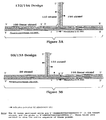
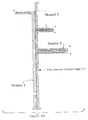
- FIGS. 1A and 1B there is shown one example of a probe of this invention demonstrating the general structure of each probe of this invention.
- the probe shown is formed from two separate strands 10, 12 each of which possess a target-specific region 14, 16 able to hybridize under hybridizing conditions to a target nucleic acid 15.
- Each strand also possesses an arm region 18, 20 which hybridize together to form an arm 22 generally only in the presence of the target nucleic acid.
- an arm is formed so also is a junction 21 between the arm and hybridized target regions.
- Arm regions and target specific regions can be designed so that hybridisation of the target specific regions to target nucleic acid is observed under hybridization conditions only when both strands are present in the hybridization mixture, and both are hybridized to target nucleic acid and to each other at their arm regions.
- nucleic acid hybridization probes of this invention form branched nucleic acid structures (i.e. , structures having at least one arm extending from a target nucleic acid and not directly hybridized with the target nucleic acid) upon interaction with and hybridization to a target nucleic acid.
- the probes are designed so that formation of this branched structure is target-dependent. Therefore, detection of branch formation is a measure of the presence and the amount (if detection is quantitative) of target nucleic acid in a sample. More than one branch can be formed, but only one branch must be formed in a target-dependent manner.
- the probe can be a single nucleic acid strand or can be multiple strands.
- the strand can be DNA, modified DNA, RNA, modified RNA, or various combinations thereof.
- modified DNA or RNA is meant any nucleic acid structure differing from naturally occurring DNA or RNA molecules, e.g. , DNA or RNA, containing modified bases (e.g. , methyl cytosine, or inosine), or modified internucleotide linkages (e.g. , phosphorothioate, or methyl phosphonate).
- the probe must have at least two separate regions that hybridize specifically with the target nucleic acid, and at least two arm regions ( i.e.
- regions that do not hybridize with the target that are complementary to one another and form a stable duplex only in the presence of target. Since these complementary arm regions hybridize only in the presence of target nucleic acid, detection of this duplex region is the preferred method to assay for the presence of the target nucleic acid.
- junction specific cleavage with a resolvase enzyme e.g. , where cleavage of a labelled probe strand is detected
- DNAse footprinting e.g. , where cleavage of a labelled probe strand is detected
- gel retardation assays e.g., gel retardation assays
- binding of a labeled, junction specific intercalating compound e.g., binding of a labeled, junction specific intercalating compound.
- purified 4-way junction cleaving resolvases are known in the art
- 3-way junction cleaving enzymes and other junction specific enzymes can be readily purified by art known methods, for example, by purifying enzymes biochemically which have an activity which cleaves a desired 3-way junction.
- Examples of detection of the duplex formed between complementary arm regions include DNAse footprinting, S1 nuclease digestion (an arm region is labelled; if the arms form a duplex, they will not be digested with nuclease S1; if the arms do not form a duplex, they will be digested with nuclease S1), restriction endonuclease cleavage of a site created by duplex formation between complementary arm regions, capture of target nucleic acid followed by analysis of the thermal stabilities of the associated duplex(es) (using a labelled probe strand(s); the complete branched nucleic acid structure will have a higher thermal stability than any partial formation; if no formation has occurred, a different signal will be associated with the captured target nucleic acid compared to when a branch is formed).
- the preferred method of detection is the use of the Hybridization Protection Assay (HPA) described by Arnold et al., 35 Clin. Chem. 1588, 1989.
- HPA Hybridization Protection Assay
- This method utilizes a chemiluminescent acridinium ester (AE) label covalently attached to a synthetic oligonucleotide probe.
- AE chemiluminescent acridinium ester
- the assay format is completely homogeneous (i.e. , requires no physical separation steps) and is based on chemical hydrolysis of the ester bond of the AE molecule, cleavage of which renders the AE permanently non-chemiluminescent. Conditions have been developed where the hydrolysis of this ester bond is rapid for unhybridized AE-labeled probe (AE-probe) but slow for hybridized AE-probe.
- the reaction conditions are adjusted so that the chemiluminescence associated with unhybridized AE-probe is rapidly reduced to low levels, while the chemiluminescence associated with hybridized AE-probe is minimally affected.
- any remaining chemiluminescence is a direct measure of the amount of duplex formed.
- This assay method is used in the present invention by attaching one or more AE labels to one or more of the nucleic acid strands of the probe and assaying for duplex formation using the differential hydrolysis procedure described above.
- FIGS. 1A and 1B One configuration of branched nucleic acid probe used for the detection of target nucleic acids is shown schematically in FIGS. 1A and 1B.
- the probe consists of two separate nucleic acid strands; these strands are preferably synthetic oligonucleotides.
- Each strand possesses a probe region which hybridizes with the target nucleic acid and an arm region.
- the two arm regions are complementary to one another (by which is meant not that they are necessarily perfectly complementary, since they may possess portions that are not complementary to each other at all, but that under hybridizing conditions a stable duplex is formed).
- Tm melting temperature
- the Tm is defined as the temperature at which 50% of a given nucleic acid duplex has melted ( i.e. , has become single-stranded).
- the Tm is dependent on environmental conditions such as the cation concentration of the solution.
- the desired Tm is typically achieved by manipulation of the length and nucleotide base composition of the complementary regions.
- duplex Tm can also be utilized to adjust duplex Tm, including but not limited to incorporation of mismatches, replacement of some or all of the guanosine residues with inosine, and modifying the phosphate backbone, e.g. , with phosphorothioate internucleotide linkages.
- the preferred length of exactly complementary, unmodified arm regions is approximately 8 to 20 contiguous bases (dependent on base composition and sequence). Other environmental conditions would potentially lead to a different size range; this is easily determined empirically.
- the probe regions of the two strands Upon contacting the probe with a solution containing the target nucleic acid, the probe regions of the two strands will hybridize to their respective target regions, which are typically adjacent to one another, as shown in FIG. 1 (they do not have to be immediately adjacent, see infra ). When this occurs, the arm regions of the two probe strands are constrained to be in close proximity to one another, thus increasing the stability of the associ-ated duplex.
- the arm regions are designed such that the Tm of the duplex formed in the presence of target is approximately equal to or above the operating temperature of the assay, preferably 4°C above (more preferably 7°C or 10°C) the operating temperature such that the arms will form a duplex. As indicated above, when utilizing the HPA format at 60°C, the preferred length of the arms is approximately 8 to 20 contiguous complementary bases (dependent on base composition and sequence).
- the probe regions of the two separate strands can be designed in a variety of manners. For example, these regions can be designed similarly to the arm regions in that the Tm of either region alone ( i.e. , one probe strand plus the target strand) is below the operating temperature, but is above the operating temperature when both probe strands and the target strand are present and the arm regions are hybridized. They can also be designed such that the Tm's of the probe regions are both above the operating temperature, or they can be designed such that one Tm is above and one Tm is below the operating temperature. Whatever design is chosen, the requirement that the arm regions form a stable duplex only in the presence of target must be met.
- the probe regions are preferably between 8 and 50 nucleotides in length, more preferably between 8 and 30 nucleotides in length. These regions can be longer, but most applications do not require this additional length, and synthesis of these longer oligomers is more costly and time consuming than the shorter oligomers.
- One or both probe sequences is chosen to react with the desired target nucleic acid(s) and preferably to not react with any undesired target nucleic acid(s) ( i.e. , cross-react). If one probe region hybridizes with an undesired target but the other probe region does not, the assay will still function properly since both probe segments have to hybridize in order for the arm regions to hybridize.
- the AE label When utilizing the HPA format, the AE label is typically placed in the arm region of the probe. In the absence of target, this region will be single-stranded and the AE will be susceptible to rapid ester hydrolysis. In the presence of target, this region will be double-stranded and the AE will be protected from ester hydrolysis.
- An AE label can be placed in one strand, the other strand, or both strands (thereby leading to an increase in signal and assay sensitivity). Multiple labels can be placed in each strand, further improving assay sensitivity.
- the AE label can also be placed in one or the other (or both) of the probe regions. Multiple labels could also be used in this configuration. Furthermore, AE could be utilized in any combination of the placements just described.
- the following general procedure is used: 1) add the branched nucleic acid probe to the sample, 2) incubate to allow annealing of the appropriate regions to occur, 3) add a reagent to effect differential hydrolysis of the AE label(s), and 4) detect any remaining chemiluminescence as an indication of the presence or amount of any target nucleic acid present.
- the annealing conditions can be varied depending on the exact application, the design of the probe, the nature of the target nucleic acid and the composition of the sample in which the target is contained. The conditions must be chosen, however, to fulfill the Tm requirements stated above.
- the incubation temperature is preferably between 5 and 70°C, more preferably between 30 and 65°C;
- the pH of the annealing step is preferably between 4.5 and 8.5, and most preferably between 4.5 and 5.5 (greater stability of the AE during the annealing step is achieved in the lower pH range; however, methods exist to stabilize the AE in the higher pH range, as described by Hammond et al., 6 J. Biolum. and Chemilum. 35, 1991).
- the concentration of the monovalent salt counterion is preferably between 50 and 1000mM, more preferably between 200 and 800mM; it is preferred to include detergent in the annealing step (this prevents the AE from aggregating and from sticking to the walls of the tube, and the pipet tips), preferably at concentrations between 0.1 and 10% (w/v), and more preferably between 1 and 10%.
- concentrations between 0.1 and 10% (w/v)
- w/v concentration of w/v
- FIGS. 1C-1F where various loops (labelled L) are shown in an arm, target nucleic acid or at a junction, and where single-stranded nucleic acid (labeled S) may also be present (e.g. , for later duplex function with more probes as described below).
- L loops
- S single-stranded nucleic acid
- FIG. 2A A specific example of the general configuration shown in FIG. 1 is shown in FIG. 2A.
- the target strand is a synthetic DNA oligomer 43 bases in length with a sequence corresponding to a region of the 23S ribosomal RNA (rRNA) subunit of Mycobacterium tuberculosis .
- the 2 strands of the branched nucleic acid probe form a 3-way junction with the target strand as shown in FIG. 2A.
- a single AE is covalently tethered to strand 1 between a T and an A residue as shown.
- Oligonucleotides were synthesized using standard phosphoramidite solid-phase chemistry (Caruthers et al., 154 In Methods Enzymol. 287, 1987) on a Biosearch Model 8750 or ABI 380A DNA Synthesizer and purified using standard polyacrylamide gel electrophoresis. Strand 1 was AE-labeled as previously described by Arnold and Nelson, PCT Publication No. WO 89/02896, published April 6, 1989.
- the following annealing reactions were carried out for 1 hour at 60°C in 30 ⁇ l of 0.1M lithium succinate buffer, pH 5.2, 2mM EDTA, 2mM EGTA, and 10% (w/v) lithium lauryl sulfate: Hybrid - 0.5 pmol of target strand, 0.05 pmol of probe strand 1 (the AE-labeled strand), and 2.5 pmol of probe strand 2. Control 1 - 0.05 pmol of probe strand 1, and 2.5 pmol of probe strand 2. Control 2 - 0.05 pmol of probe strand 1. Reagent Blank - No target or probe.
- the temperature range and the exact temperature intervals used can vary with the exact characteristics of the AE-oligomer being characterized.
- Tm's of the various structures depicted in FIG. 2B-2E in 8mM lithium succinate buffer, pH 5.5, 100mM NaCl, 10mM MgCl 2 , and 10mM Tris-HCl (this reagent replaces the diluting reagent in step 1 of the above protocol).
- FIGS. 2B-2E Other possible configurations for acridinium ester label locations, or use of a restriction enzyme ( Bst III) for duplex detection are shown in FIGS. 2B-2E.
- FIGS. 3A and 3B Another example of the general structure shown in FIG. 1 is shown in FIGS. 3A and 3B.
- ribosomal RNA (rRNA) from Neisseria gonorrhoeae is the target nucleic acid. All oligomers were synthesized and AE-labeled as described in Example 1 above. Two basic designs were evaluated, with junctions at slightly different locations within a given region of the rRNA (99/135 FIG. 3B and 132/146 FIG. 3A designs). A variety of linker-arm placements were evaluated, as indicated below. Furthermore, the exactly complementary target nucleic acid ( N . gonorrhoeae ) as well as a potentially cross-reacting target nucleic acid with 2 mismatches ( N . meningitidis ) were evaluated.
- RNA Target nucleic acid
- Oligo 99 Oligo 135
- Sample Type Amount Label Amount
- Label Amount Label Amount 1 N.gon. 0.6 pmol AE 0.1 pmol none 2 pmol none 2 pmol 2 N.gon. 0.6 pmol none 2 pmol AE(1) 0.1 pmol none 2 pmol 3 N.gon. 0.6 pmol AE 0.1 pmol AE(1) 0.1 pmol none 2 pmol 4 N.gon. 0.6 pmol none 2 pmol AE(2) 0.1 pmol none 2 pmol 5 N.men.
- Hybridizations with N . gonorrhoeae were performed at 60°C; hybridizations with N . meningitidis were performed at 45 or 50°C; controls contained all the components except target; linear oligonucleotides 100 and 146 are "helper" probes that open the secondary structure of the rRNA, and are not related to the branched nucleic acid probes of this invention.
- the following results were obtained: Hydrolysis Half-life(min) Sample Target Tm(°C) Hybrid Control D.H.
- the DH ratios for the N . gonorrhoeae target clearly demonstrate that the arm regions form a stable duplex only in the presence of an RNA nucleic acid target. These two designs each have a strand with a long probe region and a strand with a short probe region, thus demonstrating the flexibility of this design parameter. Furthermore, the data demonstrate that several different AE placements yield similar results, including 2 AE's per probe (one per each strand; samples 3 and 11). Some AE placements yield higher DH ratios than other placements, but all show protection only in the presence of target.
- the Tm data for the N . gonorrhoeae target show that all structures tested yield Tm's well above the operating temperature (60°C in this case).
- the data generated with the N . meningitidis target demonstrate that the system can be tuned to not significantly cross-react with a closely related target nucleic acid, thus improving its utility as an assay.
- the differences in Tm for each structure between N. gonorrhoeae and N . meningitidis range between 9.2 and 13.5°C.
- the 99/135 system was also evaluated for its ability to detect decreasing amounts of target nucleic acid ( N . gonorrhoeae ); cross-reaction with 10 -1 ⁇ g (63fmol) of N . meningitidis was also tested.
- the assay format was as follows: Target and probe were annealed in 100 ⁇ l of 0.1M lithium succinate buffer, pH 5.2, 2mM EDTA, 2mM EGTA, and 10% (w/v) lithium lauryl sulfate for 60 min at 60°C. 300 ⁇ l of 0.15M sodium borate buffer, pH 7.6, containing 5% Triton X-100 detergent were added, vortexed and incubated at 60°C for 10 minutes.
- Chemiluminescence was measured in a luminometer (LEADER I, Gen-Probe, CA) by the automatic injection of 200 ⁇ l of 0.4N HNO 3 , 0.1% H 2 O 2 , and then 200 ⁇ l of 1N NaOH, followed by measurement of signal for 5 seconds.
- Probe mix 1 - 0.1pmol of AE-labeled oligo 99, 0.5pmol of oligo 135, and 2 pmol of oligo 146
- Probe mix 2 - 0.1pmol of AE-labeled oligo 135, 0.5pmol of oligo 99, and 2 pmol of oligo 146
- Probe mix 3 - 0.1pmol of AE-labeled oligo 99, 0.1pmol of AE-labeled oligo 135, and 2 pmol of oligo 146.
- Probe Mix [N,gon.] ( ⁇ g) 1 2 3 5 X 10 -2 370,848 188,161 475,161 10 -2 66,398 37,016 112,844 10 -3 9,242 4,730 14,249 [N,men.] ( ⁇ g) 10 -1 2,358 5,363 2,362
- probe mix 3 which contains 2 AE-labeled strands instead of 1 (as in probe mixes 1 and 2).
- Cross-reaction with the very closely related N was minimal for probe mixes 1 and 3; the slight cross-reaction seen in probe mix 2 is approximately 100-fold lower than the positive signal, and was reduced to minimal levels by slightly increasing the operating temperature of the assay.
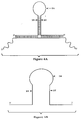
- FIGS. 4A and 4B Another configuration of branched nucleic acid probe used for the detection of target nucleic acids is shown schematically in FIGS. 4A and 4B.
- the probe consists of a single nucleic acid strand.
- the desired characteristics are the same as those described for the design shown in FIG. 1, but now the 2 strands of the probe are connected and therefore become 1 strand.
- a segment 24 connecting the two halves of the probe can be nucleotide or non-nucleotide in nature, and should be of a length that yields the desired probe characteristics described above.
- the preferred length of the complementary, unmodified arms 25, 27 in this configuration is somewhat shorter than described for the design shown in FIG. 1 due to the intra-molecular nature of the interaction. Therefore, the preferred arm length is approximately 4 to 16 bases.
- other environmental conditions would potentially lead to a different size range; this is easily determined experimentally by standard procedures.
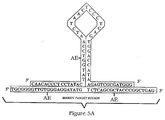
- FIG. 5A An example of the general structure shown in FIG. 4 is shown in FIG. 5A.
- the target strand is a synthetic DNA oligomer 43 bases in length with a sequence corresponding to a region of the 23S rRNA subunit of Mycobacterium tuberculosis . All oligomers were synthesized and AE-labeled as described in Example 1 above.
- the branched nucleic acid probe forms a 3-way junction with the target strand as shown in FIG. 5A.
- a single AE is covalently tethered to the probe between a T and an G residue as shown.
- An AE was also placed in the target strand at one of the two locations indicated in certain analyses as described below.
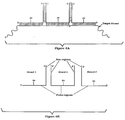
- FIGS. 6A-6H Other configurations of branched nucleic acid probes used for the detection of target nucleic acids are shown schematically in FIGS. 6A-6H.
- the probe consists of three or more nucleic acid strands which form one or more nucleic acid junctions with the target nucleic acid.
- such structures can be designed within a single nucleic acid molecule. Virtually any combination of junctions is possible as long as the arm regions form a stable duplex only in the presence of target (the possibility of some of the arm regions forming a stable duplex even in the absence of target will be discussed later).
- the guidelines for designing such a system are essentially the same as those described above for the configuration shown in FIG. 1.
- AE can be placed in some or all of the arm regions as well as some or all of the probe regions.
- One advantage of this configuration is that there are many sites for AE, thus greatly increasing the label amplification potential of the assay.
- the sequence around the AE site can be the same for each arm region, leading to uniformity of AE hydrolysis characteristics (AE hydrolysis rates are sequence-dependent) and improving overall precision of the assay.
- the lengths of the probe regions can be manipulated to achieve certain assay performance goals. For instance, cross-reaction with closely related targets can be minimized by adjusting the lengths of the various probe segments.
- probe regions 30, 32 of probe strands 1 and 3 can be relatively long and therefore form stable duplexes with target and even closely related non-target nucleic acids that possess homologous sequences in these regions.
- Probe region 34 of probe strand 2 can be relatively short, and span a region that contains one or more mismatches 36 to non-target nucleic acids. This probe segment will form a stable duplex with perfectly matched target, but by virtue of its relative shortness will not form a stable duplex with mismatched targets.
- FIGS. 6E and 6F show three way junctions between an arm and two target regions.
- Four way junctions can be created with three probes (although they may be formed as a single molecule) as shown in FIGS. 6E and 6F with separate arm regions (labelled A) and probe regions (P). Similar examples are shown in FIGS. 6H and 6G.
- FIG. 7 A specific example of the general configuration shown in FIG. 6A is shown in FIG. 7.
- the probes are labelled 99 strand, 135 strand and 146 strand.
- ribosomal RNA (rRNA) from Neisseria gonorrhoeae is the target nucleic acid. All oligomers were synthesized and AE-labeled as described in Example 1 above.
- Two basic designs were evaluated, both containing three probe strands that form two three-way nucleic acid junctions with the target strand. The only difference between the two designs is that one contains loop-out (L) bases at the junctions as indicated in FIG. 7. (More loop bases can be included in probes of this invention if desired; as can non-nucleotide bases.
- probes may be formed which create a non-fixed, or mobile, junction.)
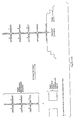
- Hybridization characteristics of the different regions were evaluated using differential hydrolysis and Tm analyses as described in Example 1 with the following specific conditions: Structures 1-18 represented schematically in FIG. 8 were analyzed always using 0.6 pmol of the target strand, 0.1 pmol of AE-labeled probe strands, and 2 pmol of unlabeled probe strands; in samples 10-12 the target was N . meningitidis ; in all the other samples, the target was N . gonorrhoeae ; samples 1,2,4-6,10,11,13, 14,16 and 17 contained loop-out bases as shown in FIG. 7; the remaining samples did not contain loop-out bases. The resulting data are represented in tabular form in FIG. 8.
- FIGS. 9A-9F Another configuration of branched nucleic acid probe used for the detection of target nucleic acids is represented schematically in FIGS. 9A-9F.
- This configuration is very similar to the one just described above in that the probe consists of three or more nucleic acid strands, e.g. , shown as 40, 42, 44, which form two or more nucleic acid junctions, but in this case one or more of the junctions are formed with the target nucleic acid (such as 1 in FIG. 9A) and one or more of the junctions are not associated with the target (such as junction 2 in FIG. 9A) but are still formed only in the presence of target.
- the target nucleic acid such as 1 in FIG. 9A
- junction 2 junction 2 in FIG. 9A
- FIGS. 9A-9F Virtually any combination of junctions is possible as long as the arm regions form a stable duplex only in the presence of target (the possibility of some of the arm regions forming a stable duplex even in the absence of target is discussed infra ).
- FIGS. 9A-9F Several examples of structures of this nature are represented schematically in FIGS. 9A-9F.
- FIG. 10 A specific example of the general configuration shown in FIG. 9 is shown in FIG. 10.
- the target is a synthetic DNA 60mer (T) with a sequence corresponding to the major genetic translocation associated with chronic myelogenous leukemia (see Example 6 below).
- the probe consists of three strands, two of which form a 3-way junction with the target, and one of which forms a 3-way junction with the other two. This third strand contains only arm regions, and as such is a potential universal detection oligomer as discussed above.
- a single AE labeling site is detailed in this example, but AE can be placed in other regions as well.
- a branched nucleic acid probe can be used to detect a chimeric nucleic acid target.
- a chimeric nucleic acid is a nucleic acid made up two or more segments that each originate from different sources or are otherwise unique ( e.g. , the chimeric DNA only exists in a portion of a population of organisms) in some way.
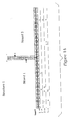
- An example of such a chimeric target is the product of a genetic translocation as represented schematically in FIG. 11A. In this case, a segment of one chromosome is translocated onto another chromosome (and vice-versa in a reciprocal translocation), creating a chimeric DNA molecule (this may or may not result in a chimeric mRNA).
- FIG. 11B represents a case in which 3 separate breakpoints on chromosome 2 reassociate with one breakpoint on chromosome 1.
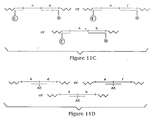
- FIGS. 11C-11F Chimeric targets of this kind can be detected in a number of ways, examples of which are given in FIGS. 11C-11F.
- Method 1 (FIG. 11C) is a sandwich assay that requires a physical separation step. This method utilizes a capture probe specific for chromosome 1 (this capture probe is labeled with a specific capture agent, C, which allows it to be specifically removed from solution; for example, C may be biotin and the specific capture support may be avidin agarose), and 3 separate detection oligomers (each labeled with a reporter group) specific for the three different translocated regions of chromosome 2.
- C specific capture agent
- Method 2 is a homogeneous assay that utilizes an AE-labeled probe specific for each translocation product (this is accomplished by designing the probes to "bridge" the breakpoint junction).
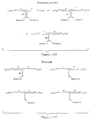
- Method 3 utilizes the method of this invention, in which a branched nucleic acid structure is formed around the breakpoint junction (other structures are possible, such as those shown in previous FIGS. in this application).
- Strand a is universal for all translocation products, and strands d, f and h are specific for the corresponding translocation products. In this particular example, strand a is the only strand that is AE-labeled.
- This system has several advantages, including the following: it is homogeneous, not requiring the physical separation steps required in Method 1; it has a universal sequence for AE-protection, leading to uniform differential hydrolysis characteristics for each target; it has only 1 AE-labeled strand, minimizing complexity and cost and lowering backgrounds; it is less sensitive to mismatches (which can occur in the breakpoint junction region) than Method 2 (see Example 7).
- the guidelines for designing such a system are essentially the same as those for the configuration described in FIG. 1 above.
- FIGS. 12A-12C A specific example of the general configuration shown in FIGS 11 is shown in FIGS. 12A-12C.
- the chimeric targets are synthetic DNA oligomers (80mers) homologous to 3 different genetic translocations between a constant abl region of chromosome 9 and various regions of chromosome 22. Two are the most common translocations associated with chronic myelogenous leukemia (CML) and one is associated with acute lymphocytic leukemia (ALL). Each chimeric target contains an identical abl region, whereas all regions from chromosome 22 are different. An 80mer corresponding to the normal abl gene (bridging the breakpoint 40 bases on either side) was also synthesized.
- CML chronic myelogenous leukemia
- ALL acute lymphocytic leukemia
- a single AE-labeled strand specific for the abl region was designed as shown in FIGS. 12A-12C.
- Three different strands were designed to contain a probe region specific for one of the translocated chromosome 22 regions as well as an arm region complementary to the arm region of the universal detection oligomer.
- Target Probe mix 1 Probe mix 2
- Probe mix 3 AE-labeled strand only 1 202,187 1,354 1,265 889 2 2,950 167,614 1,343 1,107 3 1,307 2,319 131,670 729 normal abl 1,491 1,248 1,094 886 no target 624 614 506 451
- the probe mixes detect only the correct chimeric targets and do not cross-react significantly with either of the other two chimeric targets or the normal abl sequence, thus demonstrating the utility of this configuration for the detection of chimeric nucleic acid targets, and the use of a single AE-labeled probe strand for the detection of multiple targets.
- a branched nucleic acid probe is used to detect a variety of targets with related but non-identical sequences.
- DNA probe-based assays are designed to detect a specific target and to not cross-react with closely related targets.
- great effort has been expended to develop assays that will be sensitive to as little as one mismatch.
- an assay needs to be relatively insensitive to mismatches.
- An example of such a case is the detection of viruses such as HIV, which display significant genomic variation.
- the exact target strand is a synthetic DNA oligomer 78 bases in length with a sequence corresponding to a region of the gag gene in HIV-1.
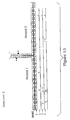
- Other synthetic 78mers were also constructed to contain a variety of mismatches as shown in FIG. 13 (these sequences correspond to various HIV strains that have been isolated and sequenced).
- Two branched nucleic acid structures were evaluated, which have identical probe regions but different arm regions (see FIG. 14). The probe regions were designed to be very stable at the operating temperature, thus increasing the overall stability of the branched nucleic acid structure once formed with the target.
- branched nucleic acid probes can tolerate 3 and 4 mismatches with little or no effect on performance characteristics, and can tolerate 6 mismatches with only a small decrease in performance characteristics. Therefore branched nucleic acid probes can be used in assay formats that require relative insensitivity to mismatches. Furthermore, these data again demonstrate the ability to include multiple AE's per probe design ( i.e. , label amplification).
- Structure 2 was further evaluated by detecting decreasing amounts of the perfectly matched target (target 1) in a full format assay as described in Example 4 (strands 1 and 2 AE labeled, 0.1 pmol each strand used; target concentrations given below). The results are as follows: [Target] (fmol) Signal (RLU) 30 840172 10 339581 3 114496 1 35022 0.3 11175 0.1 3755
- the target-dependent formation of a duplex between complementary arm regions of a branched nucleic acid probe can be detected using techniques other than the AE-label/differential hydrolysis technique discussed above. Furthermore, this differential duplex formation can give rise to a wide variety of biological or the chemical properties which are target-dependent.
- the two-strand branched nucleic acid probe described in FIG. 1 will be used as a model to discuss some examples of these properties, including alternate modes of detection. However, it will be readily recognized that these properties are applicable to any number of different branched nucleic acid probe configurations as long as the basic criterion that the arm regions in question form a stable duplex only in the presence of target is met.
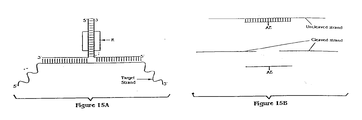
- arm region duplex formation creates an active (double-stranded) restriction enzyme cleavage site (R) removed from the target strand.
- Cleavage at this site with a restriction endonuclease can be detected in a variety of ways.
- one or both of the strands can be labeled with 32 P, and cleavage products can be detected using gel electrophoresis or other separation techniques.
- one or both of the strands can be labeled on one side of the cleavage site with a capture agent (such as biotin), and the other side of the cleavage site can be labeled with a reporter group (e.g. , 32 P, AE).
- a capture agent such as biotin
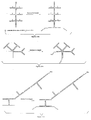
- a detection probe can be designed to react with the uncleaved strand but not the cleaved strand. This can be performed in a homogeneous or a separation assay (the homogeneous format is depicted in FIG. 15B).
- the cleavage site is designed to be close to the base (i.e., the portion near the junction) of the arm region duplex.
- the arm regions Upon cleavage with the restriction nuclease, the arm regions are almost entirely removed from the 3-way branched nucleic acid structure, thus reducing the stability of the overall structure. If the probe regions are designed to be stable only in the presence of intact arm duplex, once cleavage occurs the probe regions will melt off of the target. This will then allow uncleaved probe strands to hybridize with the target and start the process over again, thus increasing assay sensitivity by cycling multiple probes through a single target site.
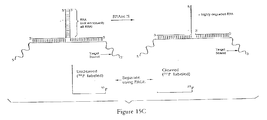
- one arm region is DNA and the other arm region (or portions thereof) is RNA.
- Formation of the arm duplex creates an active RNAse H cleavage site. Cleavage with RNAse H can be detected as described above for system 1. This system also has the potential for cycling as described above.
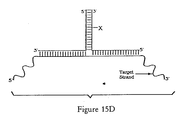
- a chemical cleavage agent such as Fe ⁇ EDTA or Cu ⁇ phenanthroline
- X such as Fe ⁇ EDTA or Cu ⁇ phenanthroline
- any other system that discriminates between single- and double-stranded nucleic acid is potentially applicable to the configuration generally described above, e.g. , specific monoclonal antibodies for double-stranded nucleic acid.
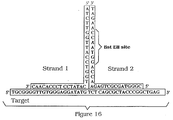
- FIG. 16 A specific example of the system shown in FIG. 15A is shown in FIG. 16. This structure is the same as that shown in FIG. 2, except that the AE label is not included.
- a Bst EII restriction endonuclease site is engineered into the arm regions as shown.
- strand 2 of the probe was first labeled with 32 P using the standard kinasing protocol. Probe was then hybridized with target using the following conditions: Hybrid: 0.6 pmol 32 P-labeled strand 2; 15 pmol strand 1; 3 pmol target strand. Control: Same as hybrid, except no target. As a control of enzymatic activity, strand 2 was evaluated ⁇ an exactly complementary DNA target strand.
- Linear-Hybrid and Linear-Control The amounts used were the same as above (0.6 pmol 32 P-labeled strand 2; ⁇ 3 pmol target strand). These annealing reactions were incubated for 60 min at 60°C in 60 ⁇ l of 50mM Tris buffer, pH 7.9 (at 25°C), 500mM NaCl. Aliquots of each annealing reaction were then digested with Bst EII under the following conditions: 10 ⁇ l of each reaction above diluted to 10 ⁇ l with the final conditions of 50mM Tris buffer, pH 7.9 (at 25°C), 100mM NaCl, 10mM MgCl 2 , 1mM DTT.
- this restriction site can be any one that is desired since the sequence of the arm regions is independent of the target sequence. In this manner, use of a restriction enzyme will not be dependent on finding the correct recognition sequence in the target to be analyzed.
- FIG. 21 A specific example of the general configuration shown in FIG. 6E is shown in FIG. 21.
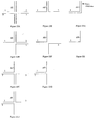
- the target strand is a synthetic 38mer oligomer; the probe strands form a 4-way junction with the target strand as shown. All oligomers were synthesized as described in Example 1 above. Hybridization characteristics of the structures shown in FIGS. 22A-22I (various schematic representations of the structure shwon in FIG. 21) were evaluated using DH analysis protocols described in Example 1; all operations were performed at 50°C.
- some of the duplexes formed between complementary arm regions are formed independent of target (as long as at least one such duplex is formed only in the presence of target).
- FIGS. 19A-19B Some examples of this configuration are shown in FIGS. 19A-19B.
- One of the utilities of this configuration is label amplification, since AE or another label can be placed in multiple regions of a "network" of branched nucleic acid structures.
- AE is the label
- this configuration allows for a universal detection complex that could be used for any desired target site. This structure will become associated with the target molecule when the two (or more) probe regions hybridize to target, thus stabilizing the "anchor" junction (as depicted in FIGS. 19A and 19B).
- the target with this associated label amplification network will then typically have to be separated from unassociated network by some heterogeneous method (e.g. , sandwich assay, hydroxyapatite capture of target nucleic acid).
- some heterogeneous method e.g. , sandwich assay, hydroxyapatite capture of target nucleic acid.
- the number of junctions formed with target can be unlimited (at least up to 5, or even 10, and depending on the size of the probe, can be several thousands, so long as the hybridized probes do not precipitate from solution), as can the formation of a detection network which may associate with probe before or after hybridization to target.
- FIGS. 20A-20C Some examples of this configuration are shown in FIGS. 20A-20C.
- This strategy can be used with a probe that forms a nucleic acid junction with the target strand (this junction is target-dependent in the sense that the full junction cannot form in the absence of target, but the duplex formed between associated arm regions is target-independent in that they form even in the absence of target), or a probe that does not form a nucleic acid junction with the target strand.
- the branched nucleic acid probe configurations described herein can also be utilized in a variety of therapeutic applications.
- the general configuration shown in FIG. 15, system 3 could be utilized by designing the probe regions to be specific for, e.g. , an infectious organism, or specific cancer cells, and the arm regions to code for a biologically active molecule.
- the probes will hybridize with the target site, the template strand filled in by endogenous polymerases (this step might be unnecessary), producing an active coding region which will then generate (again via endogenous activities) a biologically active molecule, such as an inhibitor of an essential transcription or translation factor, a peptide or other small molecule that is toxic to the organism or cell, or an antigen that renders the cell susceptible to removal by the immune system.
- a biologically active molecule such as an inhibitor of an essential transcription or translation factor, a peptide or other small molecule that is toxic to the organism or cell, or an antigen that renders the cell susceptible to removal by the immune system.
- the arm regions may form a double-stranded RNA region in a target-dependent manner, which in turn stimulates interferon activity.
- the junction formed with a target nucleic acid can be designed to form a site such that (at least) the target strand is cleaved by an endogenous resolvase enzyme. The probe will target a site where this cleavage would be lethal to the organism, or cell.
- the duplex arm regions may create a recognition site for an endogenous nuclease that binds to this recognition site but cleaves at a distal site located on the target strand, with this cleavage leading to death of the organism, or cell.
- the arm region duplex will create a recognition site that competes for the binding of an essential endogenous regulation protein, or interferes with the assembly of an essential regulation complex in a sequence specific manner.
- various combinations of probes could be designed to form stable branch points with an essential region of the target nucleic acid, thus blocking binding of sequence specific processing factors and thereby inhibiting replication.
Landscapes
- Chemical & Material Sciences (AREA)
- Life Sciences & Earth Sciences (AREA)
- Organic Chemistry (AREA)
- Health & Medical Sciences (AREA)
- Engineering & Computer Science (AREA)
- Zoology (AREA)
- Wood Science & Technology (AREA)
- Genetics & Genomics (AREA)
- Proteomics, Peptides & Aminoacids (AREA)
- Bioinformatics & Cheminformatics (AREA)
- Biotechnology (AREA)
- General Engineering & Computer Science (AREA)
- Molecular Biology (AREA)
- Biochemistry (AREA)
- Biophysics (AREA)
- Microbiology (AREA)
- General Health & Medical Sciences (AREA)
- Physics & Mathematics (AREA)
- Biomedical Technology (AREA)
- Analytical Chemistry (AREA)
- Immunology (AREA)
- Plant Pathology (AREA)
- Crystallography & Structural Chemistry (AREA)
- Bioinformatics & Computational Biology (AREA)
- Measuring Or Testing Involving Enzymes Or Micro-Organisms (AREA)
- Saccharide Compounds (AREA)
Applications Claiming Priority (2)
| Application Number | Priority Date | Filing Date | Title |
|---|---|---|---|
| US82702192A | 1992-01-22 | 1992-01-22 | |
| US827021 | 1992-01-22 |
Publications (2)
| Publication Number | Publication Date |
|---|---|
| EP0552931A1 EP0552931A1 (en) | 1993-07-28 |
| EP0552931B1 true EP0552931B1 (en) | 2000-05-24 |
Family
ID=25248124
Family Applications (1)
| Application Number | Title | Priority Date | Filing Date |
|---|---|---|---|
| EP93300377A Expired - Lifetime EP0552931B1 (en) | 1992-01-22 | 1993-01-20 | Hybridization assay using branched nucleic acid probes |
Country Status (6)
| Country | Link |
|---|---|
| US (2) | US5424413A (enExample) |
| EP (1) | EP0552931B1 (enExample) |
| JP (1) | JP3415150B2 (enExample) |
| AU (1) | AU665062B2 (enExample) |
| DE (1) | DE69328699T2 (enExample) |
| WO (1) | WO1993015102A1 (enExample) |
Cited By (1)
| Publication number | Priority date | Publication date | Assignee | Title |
|---|---|---|---|---|
| US7537938B2 (en) | 2000-04-28 | 2009-05-26 | Monogram Biosciences, Inc. | Biomarker detection in circulating cells |
Families Citing this family (324)
| Publication number | Priority date | Publication date | Assignee | Title |
|---|---|---|---|---|
| US5430136A (en) * | 1984-10-16 | 1995-07-04 | Chiron Corporation | Oligonucleotides having selectably cleavable and/or abasic sites |
| US6197556B1 (en) * | 1991-12-20 | 2001-03-06 | The University Of Chicago | Nucleic acid amplification using modular branched primers |
| NZ245771A (en) * | 1992-02-07 | 1994-08-26 | New England Medical Center Inc | Mammalian gastrin/cholecystokinin b (cck-b) receptor and antagonists |
| EP0652973B1 (en) * | 1992-07-31 | 1997-04-23 | BEHRINGWERKE Aktiengesellschaft | Method for introducing defined sequences at the 3' end of polynucleotides |
| US6277570B1 (en) | 1993-04-13 | 2001-08-21 | Naxcor | Nucleic acid sequence detection employing probes comprising non-nucleosidic coumarin derivatives as polynucleotide-crosslinking agents |
| US5616464A (en) * | 1994-12-27 | 1997-04-01 | Naxcor | Nucleic acid sequence detection employing amplification probes |
| US5767259A (en) * | 1994-12-27 | 1998-06-16 | Naxcor | Oligonucleotides containing base-free linking groups with photoactivatable side chains |
| US6495676B1 (en) | 1993-04-13 | 2002-12-17 | Naxcor | Nucleic acid sequence detection employing probes comprising non-nucleosidic coumarin derivatives as polynucleotide-crosslinking agents |
| US5846709A (en) * | 1993-06-15 | 1998-12-08 | Imclone Systems Incorporated | Chemical process for amplifying and detecting nucleic acid sequences |
| US5681697A (en) * | 1993-12-08 | 1997-10-28 | Chiron Corporation | Solution phase nucleic acid sandwich assays having reduced background noise and kits therefor |
| US6306657B1 (en) * | 1994-06-28 | 2001-10-23 | Kalyx Biosciences, Inc. | Polynucleotide probe and kit for amplifying signal detection in hybridization assays |
| ZA956776B (en) * | 1994-08-25 | 1996-03-20 | Akzo Nobel Nv | A process for making the product of a nucleic acid amplification reaction incapable of being a target for further amplification a diagnostic assay employing said process a kit and a container suitable for carrying out said process for assay |
| DE69535240T2 (de) * | 1994-10-28 | 2007-06-06 | Gen-Probe Inc., San Diego | Zusammensetzungen und Verfahren für die gleichzeitige Detektion und Quantifizierung von einer Mehrheit spezifischer Nuklein Säure Sequenzen |
| US5731153A (en) * | 1996-08-26 | 1998-03-24 | The Regents Of The University Of California | Identification of random nucleic acid sequence aberrations using dual capture probes which hybridize to different chromosome regions |
| US5783387A (en) * | 1995-02-06 | 1998-07-21 | The Regents Of The University Of California | Method for identifying and quantifying nucleic acid sequence aberrations |
| US5843650A (en) * | 1995-05-01 | 1998-12-01 | Segev; David | Nucleic acid detection and amplification by chemical linkage of oligonucleotides |
| US20020081577A1 (en) * | 1995-06-06 | 2002-06-27 | Robert L. Kilkuskie | Oligonucleotides speciific for hepatitis c virus |
| WO1996041017A2 (en) * | 1995-06-07 | 1996-12-19 | Gen-Probe Incorporated | Nucleic acid probes and amplification oligonucleotides for neisseria species |
| US5747252A (en) | 1995-06-07 | 1998-05-05 | Gen-Probe Incorporated | Nucleic acid probes and amplification oligonucleotides for Neisseria species |
| DE19537952A1 (de) | 1995-10-12 | 1997-04-17 | Boehringer Mannheim Gmbh | Verfahren zum Nachweis eines Analyten |
| EP0862651A2 (en) * | 1995-10-16 | 1998-09-09 | Chiron Corporation | Method of screening for factors that modulate gene expression |
| AU1565397A (en) * | 1995-12-22 | 1997-07-17 | Behringwerke Aktiengesellschaft | Detection of differences in nucleic acids |
| US6180777B1 (en) * | 1996-01-12 | 2001-01-30 | Bayer Corporation | Synthesis of branched nucleic acids |
| DE19610255B4 (de) * | 1996-03-15 | 2004-11-04 | Universität Heidelberg | Verfahren zur Herstellung von Nukleinsäuresequenzen und Verfahren zum Nachweis von Translokationen zwischen Chromosomen |
| US5824478A (en) * | 1996-04-30 | 1998-10-20 | Vysis, Inc. | Diagnostic methods and probes |
| US5898031A (en) * | 1996-06-06 | 1999-04-27 | Isis Pharmaceuticals, Inc. | Oligoribonucleotides for cleaving RNA |
| US9096636B2 (en) * | 1996-06-06 | 2015-08-04 | Isis Pharmaceuticals, Inc. | Chimeric oligomeric compounds and their use in gene modulation |
| US7812149B2 (en) | 1996-06-06 | 2010-10-12 | Isis Pharmaceuticals, Inc. | 2′-Fluoro substituted oligomeric compounds and compositions for use in gene modulations |
| US20040266706A1 (en) * | 2002-11-05 | 2004-12-30 | Muthiah Manoharan | Cross-linked oligomeric compounds and their use in gene modulation |
| GB9626074D0 (en) * | 1996-12-16 | 1997-02-05 | Cytocell Ltd | Nucleic acids amplification assay |
| CA2218439A1 (en) * | 1996-12-21 | 1998-06-21 | Henrik Orum | Method of identifying a nucleic acid using triple helix formation of adjacently annealed probes |
| US6194149B1 (en) * | 1998-03-03 | 2001-02-27 | Third Wave Technologies, Inc. | Target-dependent reactions using structure-bridging oligonucleotides |
| CA2289872C (en) * | 1997-05-05 | 2007-07-31 | Third Wave Technologies, Inc. | Target-dependent reactions using structure-bridging oligonucleotides |
| US7101672B2 (en) * | 1998-05-05 | 2006-09-05 | Third Wave Technologies, Inc. | Target-dependent reactions using structure-bridging oligonucleotides |
| US6849400B1 (en) * | 1997-07-23 | 2005-02-01 | Gen-Probe Incorporated | Methods for detecting and measuring spliced nucleic acids |
| US6342350B1 (en) * | 1997-09-05 | 2002-01-29 | The General Hospital Corporation | Alpha-2-macroglobulin diagnostic test |
| US5935791A (en) | 1997-09-23 | 1999-08-10 | Becton, Dickinson And Company | Detection of nucleic acids by fluorescence quenching |
| US20030165888A1 (en) * | 2001-07-18 | 2003-09-04 | Brown Bob D. | Oligonucleotide probes and primers comprising universal bases for diagnostic purposes |
| US6518017B1 (en) | 1997-10-02 | 2003-02-11 | Oasis Biosciences Incorporated | Combinatorial antisense library |
| ES2246546T3 (es) * | 1997-12-12 | 2006-02-16 | Digene Corporation | Valoracion de enfermedades relacionadas con el virus de papiloma humano. |
| CA2319757C (en) | 1998-01-27 | 2008-01-08 | Cytocell Limited | Method for detection of nucleic acid target sequences involving in vitro transcription from an rna promoter |
| AU752220B2 (en) * | 1998-01-27 | 2002-09-12 | British Biocell International Limited | Modified nucleic acid probes and uses thereof |
| WO1999042616A1 (en) * | 1998-02-20 | 1999-08-26 | Dade Behring Inc. | Methods for determining concentrations of nucleic acids |
| US6287772B1 (en) * | 1998-04-29 | 2001-09-11 | Boston Probes, Inc. | Methods, kits and compositions for detecting and quantitating target sequences |
| AU3775099A (en) * | 1998-04-29 | 1999-11-16 | Boston Probes, Inc. | Methods, kits and compositions for detecting and quantitating target sequences |
| JP3267576B2 (ja) * | 1998-11-09 | 2002-03-18 | 三光純薬株式会社 | プローブ高分子の形成方法 |
| AU1827200A (en) * | 1998-11-25 | 2000-06-13 | Isis Pharmaceuticals, Inc. | (in situ) binary synthesis of biologically effective molecules |
| US6492111B1 (en) | 1998-11-25 | 2002-12-10 | Isis Pharmaceuticals, Inc. | In situ binary synthesis of biologically effective molecules |
| NO986133D0 (no) * | 1998-12-23 | 1998-12-23 | Preben Lexow | FremgangsmÕte for DNA-sekvensering |
| US6900300B1 (en) * | 2000-09-19 | 2005-05-31 | Ingeneus Corporation | Quadruplex DNA and duplex probe systems |
| US6432642B1 (en) * | 1999-01-15 | 2002-08-13 | Pe Corporation (Ny) | Binary probe and clamp composition and methods for a target hybridization detection |
| GB9905580D0 (en) | 1999-03-12 | 1999-05-05 | Tepnel Medical Ltd | Enyzymatically catalysed signal amplification |
| US6514700B1 (en) * | 1999-04-30 | 2003-02-04 | Aclara Biosciences, Inc. | Nucleic acid detection using degradation of a tagged sequence |
| JP2002541825A (ja) * | 1999-04-08 | 2002-12-10 | オアシス バイオサイエンシーズ インコーポレイティッド | ユニバーサル及び/又は同義性塩基を含むアンチセンスオリゴヌクレオチド |
| JP2003517283A (ja) * | 1999-04-08 | 2003-05-27 | オアシス バイオサイエンシーズ インコーポレイティッド | プライマーペアの増幅及び配列決定並びにそれらの使用 |
| IL145778A0 (en) * | 1999-04-21 | 2002-07-25 | American Home Prod | Methods and compositions for inhibiting the function of polynucleotide sequences |
| US20030235832A1 (en) * | 2000-06-21 | 2003-12-25 | Ahmed Chenna | Multiplexed analysis by chromatographic separation of molecular tags |
| JP2004507203A (ja) * | 1999-07-29 | 2004-03-11 | サイトセル・リミテッド | Rnaポリメラーゼプロモーターからのインビトロ転写を伴う核酸標的配列の検出方法 |
| US7005261B1 (en) | 1999-07-29 | 2006-02-28 | British Biocell International Limited | Method for detecting nucleic acid target sequences involving in vitro transcription from an RNA polymerase promoter |
| US7824859B2 (en) * | 1999-10-29 | 2010-11-02 | Cytyc Corporation | Methods for detection of a target nucleic acid by forming a cleavage structure using an RNA polymerase |
| US7585632B2 (en) * | 1999-10-29 | 2009-09-08 | Hologic, Inc. | Compositions and methods for the detection of a nucleic acid using a cleavage reaction |
| US7118860B2 (en) * | 1999-10-29 | 2006-10-10 | Stratagene California | Methods for detection of a target nucleic acid by capture |
| US7534568B2 (en) | 1999-10-29 | 2009-05-19 | Hologic Inc. | Methods for detection of a target nucleic acid by forming a cleavage structure with a cleavage resistant probe |
| US7838225B2 (en) * | 1999-10-29 | 2010-11-23 | Hologic, Inc. | Methods for detection of a target nucleic acid by forming a cleavage structure using a reverse transcriptase |
| US6893819B1 (en) * | 2000-11-21 | 2005-05-17 | Stratagene California | Methods for detection of a nucleic acid by sequential amplification |
| US7381532B2 (en) * | 1999-10-29 | 2008-06-03 | Stratagene California | Compositions and methods for the detection of a nucleic acid using a cleavage reaction |
| ES2256067T3 (es) * | 1999-11-29 | 2006-07-16 | Diasorin S.P.A. | Oligonucleotidos y combinaciones de los mismos utiles en la deteccion de la presencia o ausencia de secuencias de acidos nucleicos diana en una muestra. |
| US7771929B2 (en) | 2000-04-28 | 2010-08-10 | Monogram Biosciences, Inc. | Tag library compounds, compositions, kits and methods of use |
| US20040067498A1 (en) * | 2000-04-28 | 2004-04-08 | Ahmed Chenna | Detection of nucleic acid sequences by cleavage and separation of tag-containing structures |
| US6511809B2 (en) * | 2000-06-13 | 2003-01-28 | E. I. Du Pont De Nemours And Company | Method for the detection of an analyte by means of a nucleic acid reporter |
| US7601497B2 (en) | 2000-06-15 | 2009-10-13 | Qiagen Gaithersburg, Inc. | Detection of nucleic acids by target-specific hybrid capture method |
| US7439016B1 (en) | 2000-06-15 | 2008-10-21 | Digene Corporation | Detection of nucleic acids by type-specific hybrid capture method |
| US6451588B1 (en) * | 2000-06-30 | 2002-09-17 | Pe Corporation (Ny) | Multipartite high-affinity nucleic acid probes |
| NO314206B1 (no) * | 2001-04-30 | 2003-02-10 | Erling Sundrehagen | Kvantitativt kjemisk analysemetode, anordning/innretning, samt anvendelse av nevnte metode og analysesett |
| WO2002102820A1 (en) | 2001-06-20 | 2002-12-27 | Nuevolution A/S | Nucleoside derivatives for library preparation |
| US8512953B2 (en) * | 2001-09-24 | 2013-08-20 | One Lambda | Diagnostic probe detection system |
| KR20040041529A (ko) * | 2001-09-28 | 2004-05-17 | 산코 준야쿠 가부시키가이샤 | Dna 칩의 시그널 증폭방법 |
| CN1166422C (zh) * | 2001-11-05 | 2004-09-15 | 北京源德生物医学工程股份有限公司 | 用于体外高能聚焦超声波治疗机的坐位架 |
| US20050053939A1 (en) * | 2001-11-09 | 2005-03-10 | Ahmed Chenna | Methods and compositions for enhancing detection in determinations employing cleavable electrophoretic tag reagents |
| GB0130268D0 (en) * | 2001-12-19 | 2002-02-06 | Molecular Light Tech Res Ltd | Methods of detecting modification of genetic material and monitoring processes thereof |
| SE0200531D0 (sv) * | 2002-02-22 | 2002-02-22 | Avaris Ab | Novel biomolecular complexes, method for their production and use |
| WO2003076655A2 (de) * | 2002-03-14 | 2003-09-18 | Gnothis Holding Sa | Verfahren zur bestimmung eines nukleinsäureanalyten |
| AU2003214031A1 (en) * | 2002-03-15 | 2003-09-29 | Nuevolution A/S | An improved method for synthesising templated molecules |
| US10731151B2 (en) | 2002-03-15 | 2020-08-04 | Nuevolution A/S | Method for synthesising templated molecules |
| FR2842827B1 (fr) * | 2002-07-26 | 2004-10-22 | Biocortech | NOUVELLE METHODE D'ANALYSE D'ACIDE NUCLEIQUE ET SON UTILISATION POUR EVALUER LE DEGRE D'EDITION DE L'ARNm DU RECEPTEUR 5-HT2c |
| WO2004013070A2 (en) * | 2002-08-01 | 2004-02-12 | Nuevolution A/S | Multi-step synthesis of templated molecules |
| CA2539890A1 (en) * | 2002-09-27 | 2004-04-08 | Carlsberg A/S | Spatially encoded polymer matrix |
| CN106337046B (zh) | 2002-10-30 | 2021-03-23 | 纽韦卢森公司 | 合成双功能复合物的方法 |
| EP1560840B1 (en) | 2002-11-05 | 2015-05-06 | Isis Pharmaceuticals, Inc. | Compositions comprising alternating 2'-modified nucleosides for use in gene modulation |
| GB2395556A (en) * | 2002-11-22 | 2004-05-26 | Dynal Biotech Ltd | Nucleic acid probe |
| EP2175019A3 (en) | 2002-12-19 | 2011-04-06 | Nuevolution A/S | Quasirandom structure and function guided synthesis methods |
| WO2005010201A2 (en) * | 2003-01-29 | 2005-02-03 | Naxcor, Inc. | Methods and compositions for detecting nucleic acid sequences |
| WO2004074429A2 (en) | 2003-02-21 | 2004-09-02 | Nuevolution A/S | Method for producing second-generation library |
| CN101410530B (zh) * | 2003-04-18 | 2013-03-27 | 贝克顿·迪金森公司 | 免疫-扩增 |
| ATE426681T1 (de) * | 2003-06-17 | 2009-04-15 | Keygene Nv | Mittel und verfahren zum nachweis von zielnukleotidsequenzen unter verwendung von ligationstests mit verbesserten oligonukleotidsondenpaaren |
| WO2005012548A2 (en) * | 2003-08-01 | 2005-02-10 | Dynal Biotech Inc. | Self-hybridizing multiple target nucleic acid probes and methods of use |
| US20060035242A1 (en) | 2004-08-13 | 2006-02-16 | Michelitsch Melissa D | Prion-specific peptide reagents |
| ES2539784T3 (es) * | 2003-09-02 | 2015-07-06 | Keygene N.V. | Procedimientos basados en OLA para la detección de secuencias de ácidos nucleicos objetivo |
| US11118215B2 (en) * | 2003-09-18 | 2021-09-14 | Nuevolution A/S | Method for obtaining structural information concerning an encoded molecule and method for selecting compounds |
| EP1531183A1 (en) * | 2003-11-14 | 2005-05-18 | bioMérieux BV | Method for amplification of RNA sequences |
| WO2005078122A2 (en) * | 2004-02-17 | 2005-08-25 | Nuevolution A/S | Method for enrichment involving elimination by mismatch hybridisation |
| US8569474B2 (en) | 2004-03-09 | 2013-10-29 | Isis Pharmaceuticals, Inc. | Double stranded constructs comprising one or more short strands hybridized to a longer strand |
| WO2005111242A2 (en) * | 2004-05-10 | 2005-11-24 | Parallele Bioscience, Inc. | Digital profiling of polynucleotide populations |
| US7884086B2 (en) | 2004-09-08 | 2011-02-08 | Isis Pharmaceuticals, Inc. | Conjugates for use in hepatocyte free uptake assays |
| JP2006166911A (ja) * | 2004-11-19 | 2006-06-29 | Wakunaga Pharmaceut Co Ltd | 核酸検出用核酸断片および核酸検出方法 |
| US20080311571A1 (en) * | 2004-11-19 | 2008-12-18 | Wakunaga Pharmaceutical Co., Ltd. | Nucleic Acid Fragments for Detecting Nucleic Acid and Method for Detecting Nucleic Acid |
| CA2594840A1 (en) * | 2005-01-13 | 2006-07-20 | Novartis Vaccines And Diagnostics Inc. | Elisa assays using prion-specific peptide reagents |
| WO2006076683A2 (en) * | 2005-01-13 | 2006-07-20 | Novartis Vaccines And Diagnostics Inc. | Isolation and detection of pathogenic prions |
| US20070026423A1 (en) * | 2005-03-16 | 2007-02-01 | Thomas Koehler | Method and test kit for the detection of target nucleic acids |
| EP1931806B1 (en) | 2005-10-07 | 2011-10-05 | California Institute Of Technology | Pkr activation via hybridization chain reaction |
| WO2007041774A1 (en) | 2005-10-07 | 2007-04-19 | Johnson & Johnson Research Pty Limited | Multicomponent nucleic acid enzymes and methods for their use |
| EP2400037A1 (en) | 2005-10-17 | 2011-12-28 | Gen-Probe Incorporated | Compositions and methods to detect legionella pneumophila nucleic acid |
| WO2007054682A1 (en) * | 2005-11-08 | 2007-05-18 | The University Court Of The University Of Edinburgh | Switchable biosensor devices |
| DK3305900T3 (da) * | 2005-12-01 | 2021-10-25 | Nuevolution As | Enzymatic encoding methods for efficient synthesis of large libraries |
| US8778845B2 (en) * | 2005-12-15 | 2014-07-15 | Genral Electric Company | Composition, device and associated method |
| US8741813B2 (en) * | 2005-12-15 | 2014-06-03 | General Electric Company | Composition, device and associated method |
| US7537897B2 (en) * | 2006-01-23 | 2009-05-26 | Population Genetics Technologies, Ltd. | Molecular counting |
| US20070196849A1 (en) * | 2006-02-22 | 2007-08-23 | Applera Corporation | Double-ligation Method for Haplotype and Large-scale Polymorphism Detection |
| US20080058218A1 (en) * | 2006-05-03 | 2008-03-06 | Gordon David B | Arrays of compound probes and methods using the same |
| US20070259344A1 (en) * | 2006-05-03 | 2007-11-08 | Agilent Technologies, Inc. | Compound probes and methods of increasing the effective probe densities of arrays |
| US20070259346A1 (en) * | 2006-05-03 | 2007-11-08 | Agilent Technologies, Inc. | Analysis of arrays |
| US20070259347A1 (en) * | 2006-05-03 | 2007-11-08 | Agilent Technologies, Inc. | Methods of increasing the effective probe densities of arrays |
| JP5154548B2 (ja) * | 2006-05-12 | 2013-02-27 | ジェン−プローブ・インコーポレーテッド | 腸球菌核酸を検出するための組成物及び方法 |
| US7759062B2 (en) * | 2006-06-09 | 2010-07-20 | Third Wave Technologies, Inc. | T-structure invasive cleavage assays, consistent nucleic acid dispensing, and low level target nucleic acid detection |
| US7745129B1 (en) * | 2006-07-12 | 2010-06-29 | Kenneth David Schatz | Methods for sequencing of a necleic acid |
| DK2066817T3 (da) | 2006-10-06 | 2014-10-13 | Speedx Pty Ltd | Molekylære afbrydere og fremgangsmåder til anvendelse deraf |
| US8778846B2 (en) * | 2006-12-04 | 2014-07-15 | General Electric Company | Composition, device and associated method |
| US8765643B2 (en) * | 2006-12-04 | 2014-07-01 | General Electric Company | Composition, device and associated method |
| AU2007336839C1 (en) | 2006-12-21 | 2013-12-19 | Gen-Probe Incorporated | Methods and compositions for nucleic acid amplification |
| NZ580129A (en) | 2007-04-05 | 2012-05-25 | Johnson & Johnson Res Pty Ltd | Nucleic acid enzymes and complexes and methods for their use |
| EP2155770B1 (en) * | 2007-05-16 | 2013-10-16 | California Institute of Technology | A versatile nucleic acid hairpin motif for programming biomolecular self-assembly pathways |
| AU2008269201B2 (en) | 2007-06-21 | 2011-08-18 | Gen-Probe Incorporated | Instrument and receptacles for use in performing processes |
| US8450058B2 (en) * | 2007-08-14 | 2013-05-28 | Eisai R&D Management Co., Ltd. | Method of detecting target substance |
| US9551026B2 (en) | 2007-12-03 | 2017-01-24 | Complete Genomincs, Inc. | Method for nucleic acid detection using voltage enhancement |
| EP2071035A1 (en) * | 2007-12-13 | 2009-06-17 | Epigenomics AG | Facilitator and method for amplification |
| EP2235214B1 (en) | 2007-12-26 | 2014-07-09 | Gen Probe Inc | COMPOSITIONS AND METHODS FOR DETECTING CANDIDA ALBICANS NUCLEIC ACID |
| WO2009134942A1 (en) * | 2008-04-30 | 2009-11-05 | Novartis Ag. | Assay for pathogenic conformers |
| US20100021904A1 (en) * | 2008-05-21 | 2010-01-28 | Pierce Niles A | Shielded cross-linking probes |
| US20100021901A1 (en) * | 2008-05-22 | 2010-01-28 | Peng Yin | Compositions and methods for detecting analytes |
| US20110207132A1 (en) * | 2008-08-04 | 2011-08-25 | University Of Maryland | Probes and methods for detecting analytes |
| AU2009320213B2 (en) | 2008-10-27 | 2016-06-16 | Qiagen Gaithersburg Inc. | Fast results hybrid capture assay and system |
| AU2010208311B2 (en) * | 2009-01-28 | 2016-07-07 | Qiagen Gaithersburg, Inc. | Sequence-specific large volume sample preparation method and assay |
| CA2750879C (en) | 2009-01-30 | 2018-05-22 | Oxford Nanopore Technologies Limited | Adaptors for nucleic acid constructs in transmembrane sequencing |
| CA2750900C (en) | 2009-01-30 | 2017-03-28 | Gen-Probe Incorporated | Systems and methods for detecting a signal and applying thermal energy to a signal transmission element |
| US9797000B2 (en) * | 2009-05-01 | 2017-10-24 | Qiagen Gaithersburg Inc. | Non-target amplification method for detection of RNA splice-forms in a sample |
| US20100316998A1 (en) * | 2009-06-15 | 2010-12-16 | Massachusetts Institute Of Technology | Methods and compositions for empirical selection of drugs or other molecules |
| WO2010150259A1 (en) | 2009-06-24 | 2010-12-29 | Fund For Medical Research Development Of Infrastructure And Health Services -Rambam Medical Center | Methods and kits for isolating placental derived microparticles and use of same for diagnosis of fetal disorders |
| AU2010266234B2 (en) | 2009-07-01 | 2013-07-25 | Gen-Probe Incorporated | Methods and compositions for nucleic acid amplification |
| WO2011032124A1 (en) | 2009-09-14 | 2011-03-17 | Qiagen Gaithersburg, Inc. | Compositions and methods for recovery of nucleic acids or proteins from tissue samples fixed in cytology media |
| US8975019B2 (en) * | 2009-10-19 | 2015-03-10 | University Of Massachusetts | Deducing exon connectivity by RNA-templated DNA ligation/sequencing |
| JP6147502B2 (ja) | 2009-10-27 | 2017-06-14 | スウィフト バイオサイエンシーズ, インコーポレイテッド | ポリヌクレオチドプライマー及びプローブ |
| JP2013510297A (ja) | 2009-11-04 | 2013-03-21 | ノバルティス アーゲー | モノマーからのタンパク質凝集体の分離における結合試薬としての正に荷電した種 |
| US8916349B2 (en) | 2009-11-23 | 2014-12-23 | Becton, Dickinson And Company | Assay method for target nucleic acid by signal amplification using probe hybridization and restriction |
| US8835358B2 (en) | 2009-12-15 | 2014-09-16 | Cellular Research, Inc. | Digital counting of individual molecules by stochastic attachment of diverse labels |
| US9315857B2 (en) | 2009-12-15 | 2016-04-19 | Cellular Research, Inc. | Digital counting of individual molecules by stochastic attachment of diverse label-tags |
| US9605303B2 (en) | 2010-01-29 | 2017-03-28 | Qiagen Gaithersburg, Inc. | Method of determining and confirming the presence of an HPV in a sample |
| AU2011210734B2 (en) | 2010-01-29 | 2017-02-09 | Qiagen Gaithersburg, Inc. | Methods and compositions for sequence-specific purification and multiplex analysis of nucleic acids |
| WO2011103274A1 (en) | 2010-02-17 | 2011-08-25 | Gen-Probe Incorporated | Compositions and methods to detect atopobium vaginae nucleic acid |
| JP5481250B2 (ja) * | 2010-03-26 | 2014-04-23 | 富士フイルム株式会社 | 複屈折パターンを有する物品 |
| CA2796457C (en) | 2010-04-21 | 2018-08-28 | Damon K. Getman | Compositions, methods and kits to detect herpes simplex virus nucleic acids |
| US8658780B2 (en) | 2010-05-18 | 2014-02-25 | California Institute Of Technology | Triggered covalent probes for imaging and silencing genetic expression |
| EP2572001A2 (en) | 2010-05-19 | 2013-03-27 | QIAGEN Gaithersburg, Inc. | Methods and compositions for sequence-specific purification and multiplex analysis of nucleic acids |
| EP2576840B1 (en) | 2010-05-25 | 2018-10-17 | QIAGEN Gaithersburg, Inc. | Fast results hybrid capture assay and associated strategically-truncated probes |
| US8962241B2 (en) * | 2010-07-20 | 2015-02-24 | California Institute Of Technology | Triggered molecular geometry based bioimaging probes |
| US9834439B2 (en) | 2010-07-20 | 2017-12-05 | California Institute Of Technology | Biomolecular self-assembly |
| US8877438B2 (en) * | 2010-07-20 | 2014-11-04 | California Institute Of Technology | Self-assembled polynucleotide structure |
| US8481292B2 (en) | 2010-09-21 | 2013-07-09 | Population Genetics Technologies Litd. | Increasing confidence of allele calls with molecular counting |
| WO2012046219A2 (en) | 2010-10-04 | 2012-04-12 | Gen-Probe Prodesse, Inc. | Compositions, methods and kits to detect adenovirus nucleic acids |
| WO2012061719A2 (en) * | 2010-11-04 | 2012-05-10 | President And Fellows Of Harvard College | Dna origami devices |
| NZ610584A (en) | 2010-11-19 | 2015-02-27 | Speedx Pty Ltd | Signal amplification |
| JP2014511182A (ja) | 2011-02-24 | 2014-05-15 | キアゲン ガイサーズバーグ アイエヌシー. | Hpv核酸を検出するための材料及び方法 |
| EP3498864B1 (en) | 2011-03-10 | 2024-10-09 | Gen-Probe Incorporated | Methods for the selection and optimization of oligonucleotide tag sequences |
| EP3604559A1 (en) | 2011-04-25 | 2020-02-05 | Gen-Probe Incorporated | Compositions and methods for detecting bv-associated bacterial nucleic acid |
| US10597701B2 (en) * | 2011-05-11 | 2020-03-24 | Navinci Diagnostics Ab | Unfolding proximity probes and methods for the use thereof |
| BR112014001699A2 (pt) | 2011-07-25 | 2017-06-13 | Oxford Nanopore Tech Ltd | método para sequenciar de um polinucleotídeo alvo de filamento duplo, kit, métodos para preparar um polinucleotídeo alvo de filamento duplo para sequenciamento e para sequenciar um polinucleotídeo alvo de filamento duplo, e, aparelho |
| WO2013036928A1 (en) | 2011-09-08 | 2013-03-14 | Gen-Probe Incorporated | Compositions and methods for detecting bv-associated bacterial nucleic acid |
| EP3604555B1 (en) | 2011-10-14 | 2024-12-25 | President and Fellows of Harvard College | Sequencing by structure assembly |
| WO2013059044A1 (en) * | 2011-10-18 | 2013-04-25 | Celedon Alfredo Andres | Detection units and methods for detecting a target analyte |
| US10837879B2 (en) | 2011-11-02 | 2020-11-17 | Complete Genomics, Inc. | Treatment for stabilizing nucleic acid arrays |
| DE102011120550B4 (de) | 2011-12-05 | 2013-11-07 | Gen-Probe Prodesse, Inc. | Zusammensetzungen, Verfahren und Kits zur Detektion von Adenovirusnukleinsäuren |
| WO2014163886A1 (en) | 2013-03-12 | 2014-10-09 | President And Fellows Of Harvard College | Method of generating a three-dimensional nucleic acid containing matrix |
| ES2991004T3 (es) | 2011-12-22 | 2024-12-02 | Harvard College | Métodos para la detección de analitos |
| GB2513024B (en) | 2012-02-27 | 2016-08-31 | Cellular Res Inc | A clonal amplification method |
| EP2820174B1 (en) | 2012-02-27 | 2019-12-25 | The University of North Carolina at Chapel Hill | Methods and uses for molecular tags |
| ES2741099T3 (es) | 2012-02-28 | 2020-02-10 | Agilent Technologies Inc | Método de fijación de una secuencia de recuento para una muestra de ácido nucleico |
| AU2013205110B2 (en) | 2012-04-24 | 2016-10-13 | Gen-Probe Incorporated | Compositions, Methods and Kits to Detect Herpes Simplex Virus Nucleic Acids |
| AU2013202354A1 (en) * | 2012-06-18 | 2014-01-16 | Speedx Pty Ltd | Target detection and signal amplification |
| WO2014013259A1 (en) | 2012-07-19 | 2014-01-23 | Oxford Nanopore Technologies Limited | Ssb method |
| CA2883219C (en) | 2012-08-30 | 2020-12-29 | Gen-Probe Incorporated | Multiphase nucleic acid amplification |
| US10876152B2 (en) | 2012-09-04 | 2020-12-29 | Guardant Health, Inc. | Systems and methods to detect rare mutations and copy number variation |
| KR20260025883A (ko) | 2012-09-04 | 2026-02-24 | 가던트 헬쓰, 인크. | 희귀 돌연변이 및 카피수 변이를 검출하기 위한 시스템 및 방법 |
| US11913065B2 (en) | 2012-09-04 | 2024-02-27 | Guardent Health, Inc. | Systems and methods to detect rare mutations and copy number variation |
| US20160040229A1 (en) | 2013-08-16 | 2016-02-11 | Guardant Health, Inc. | Systems and methods to detect rare mutations and copy number variation |
| AU2013205122B2 (en) | 2012-10-11 | 2016-11-10 | Gen-Probe Incorporated | Compositions and Methods for Detecting Human Papillomavirus Nucleic Acid |
| AU2013205090B2 (en) | 2012-12-07 | 2016-07-28 | Gen-Probe Incorporated | Compositions and Methods for Detecting Gastrointestinal Pathogen Nucleic Acid |
| SG10201705094SA (en) * | 2012-12-21 | 2017-07-28 | Univ Nanyang Tech | Site-specific induction of bimolecular quadruplex-duplex hybrids and methods of using the same |
| KR102282863B1 (ko) * | 2013-02-20 | 2021-07-27 | 에모리 유니버시티 | 혼합물 중 핵산의 서열분석 방법 및 그와 관련된 조성물 |
| SG11201507138RA (en) | 2013-03-08 | 2015-10-29 | Oxford Nanopore Tech Ltd | Enzyme stalling method |
| GB201314695D0 (en) | 2013-08-16 | 2013-10-02 | Oxford Nanopore Tech Ltd | Method |
| WO2014145620A2 (en) * | 2013-03-15 | 2014-09-18 | The Broad Institute, Inc. | Novel hybridization probes and uses thereof |
| US10510435B2 (en) | 2013-04-30 | 2019-12-17 | California Institute Of Technology | Error correction of multiplex imaging analysis by sequential hybridization |
| EP3626833A1 (en) | 2013-04-30 | 2020-03-25 | California Institute of Technology | Multiplex labeling of molecules by sequential hybridization barcoding |
| GB201310823D0 (en) * | 2013-06-18 | 2013-07-31 | Lgc Ltd | Fluorophore-based oligonucleotide probes with a universal element |
| US9856472B2 (en) | 2013-07-01 | 2018-01-02 | California Institute Of Technology | Small conditional RNAs |
| CN105531377A (zh) | 2013-07-30 | 2016-04-27 | 哈佛学院院长及董事 | 基于dna的定量成像和超分辨成像 |
| EP4697022A3 (en) | 2013-08-09 | 2026-06-03 | Luminex Corporation | Probes for improved melt discrimination and multiplexing in nucleic acid assays |
| WO2015023892A1 (en) | 2013-08-14 | 2015-02-19 | Gen-Probe Incorporated | Compositions and methods for detecting hev nucleic acid |
| AU2014312208B2 (en) | 2013-08-28 | 2019-07-25 | Becton, Dickinson And Company | Massively parallel single cell analysis |
| EP3055676B1 (en) | 2013-10-07 | 2026-07-08 | Augusta SpinCo Corporation | System for digitally counting features on arrays |
| EP3524694B1 (en) | 2013-12-28 | 2020-07-15 | Guardant Health, Inc. | Methods and systems for detecting genetic variants |
| GB201403096D0 (en) | 2014-02-21 | 2014-04-09 | Oxford Nanopore Tech Ltd | Sample preparation method |
| GB2559919B (en) | 2014-02-28 | 2018-11-14 | Gen Probe Inc | Method of isolating nucleic acid from specimens in liquid-based cytology preservatives containing formaldehyde |
| AU2014384731B2 (en) | 2014-02-28 | 2017-12-14 | Gen-Probe Incorporated | Method of isolating nucleic acid from specimens in liquid-based cytology preservatives containing formaldehyde |
| WO2016007839A1 (en) | 2014-07-11 | 2016-01-14 | President And Fellows Of Harvard College | Methods for high-throughput labelling and detection of biological features in situ using microscopy |
| US11091810B2 (en) * | 2015-01-27 | 2021-08-17 | BioSpyder Technologies, Inc. | Focal gene expression profiling of stained FFPE tissues with spatial correlation to morphology |
| GB201418159D0 (en) * | 2014-10-14 | 2014-11-26 | Oxford Nanopore Tech Ltd | Method |
| CA2962956C (en) | 2014-10-20 | 2023-09-05 | Gen-Probe Incorporated | Red blood cell lysis solution |
| US10612077B2 (en) | 2014-10-23 | 2020-04-07 | Ricardo Mancebo | Reagents and methods for isothermal chain reaction |
| CA2972475C (en) | 2015-01-09 | 2024-01-16 | Gen-Probe Incorporated | Methods and compositions for diagnosing bacterial vaginosis |
| WO2016116935A1 (en) | 2015-01-21 | 2016-07-28 | Yeda Research And Development Co. Ltd. | Use of rasa2 as a prognostic and therapeutic marker for melanoma |
| EP3766988B1 (en) | 2015-02-19 | 2024-02-14 | Becton, Dickinson and Company | High-throughput single-cell analysis combining proteomic and genomic information |
| EP3262192B1 (en) | 2015-02-27 | 2020-09-16 | Becton, Dickinson and Company | Spatially addressable molecular barcoding |
| CA2977821A1 (en) | 2015-03-16 | 2016-09-22 | Gen-Probe Incorporated | Methods and compositions for detecting bacterial nucleic acid and diagnosing bacterial vaginosis |
| JP7508191B2 (ja) | 2015-03-30 | 2024-07-01 | ベクトン・ディキンソン・アンド・カンパニー | コンビナトリアルバーコーディングのための方法および組成物 |
| EP4582556A3 (en) | 2015-04-23 | 2025-10-08 | Becton, Dickinson and Company | Methods and compositions for whole transcriptome amplification |
| US11124823B2 (en) | 2015-06-01 | 2021-09-21 | Becton, Dickinson And Company | Methods for RNA quantification |
| EP3332358A4 (en) * | 2015-08-07 | 2019-05-29 | President and Fellows of Harvard College | SUPER-RESOLVED IMAGING OF PROTEIN-PROTEIN INTERACTIONS |
| CN108026524A (zh) | 2015-09-11 | 2018-05-11 | 赛卢拉研究公司 | 用于核酸文库标准化的方法和组合物 |
| CA3008651A1 (en) | 2015-12-17 | 2017-06-22 | Guardant Health, Inc. | Methods to determine tumor gene copy number by analysis of cell-free dna |
| EP4249609A3 (en) | 2016-01-04 | 2023-12-20 | Gen-Probe Incorporated | Methods and compositions for detecting candida species |
| WO2017173279A1 (en) * | 2016-03-31 | 2017-10-05 | Arizona Board Of Regents On Behalf Of Arizona State University | Probes and methods for measuring tandem repeats |
| WO2017189525A1 (en) | 2016-04-25 | 2017-11-02 | President And Fellows Of Harvard College | Hybridization chain reaction methods for in situ molecular detection |
| US10563247B2 (en) * | 2016-04-27 | 2020-02-18 | Kent State University | Single-molecule mechanoanalytical DNA device for ultrasensitive sensing of analytes |
| CA3021914C (en) | 2016-04-27 | 2024-04-30 | Gen-Probe Incorporated | Blood cell lysis reagent |
| CA3019589A1 (en) | 2016-05-02 | 2017-11-09 | Cellular Research, Inc. | Accurate molecular barcoding |
| GB201609220D0 (en) | 2016-05-25 | 2016-07-06 | Oxford Nanopore Tech Ltd | Method |
| US10301677B2 (en) | 2016-05-25 | 2019-05-28 | Cellular Research, Inc. | Normalization of nucleic acid libraries |
| ES2979395T3 (es) | 2016-05-26 | 2024-09-25 | Becton Dickinson Co | Métodos de ajuste del recuento de etiquetas moleculares |
| US10202641B2 (en) | 2016-05-31 | 2019-02-12 | Cellular Research, Inc. | Error correction in amplification of samples |
| US10640763B2 (en) | 2016-05-31 | 2020-05-05 | Cellular Research, Inc. | Molecular indexing of internal sequences |
| AU2017278065B2 (en) | 2016-06-10 | 2020-09-10 | Gen-Probe Incorporated | Compositions and methods for detecting Zika virus nucleic acid |
| CN109689894A (zh) | 2016-06-19 | 2019-04-26 | 耶路撒冷希伯来大学伊萨姆研发有限公司 | 在人单倍体细胞中筛选化学疗法抗性 |
| IL290679B2 (en) | 2016-07-05 | 2023-10-01 | California Inst Of Techn | Hybridization chain reaction based on a minimal initiator |
| US12421540B2 (en) | 2016-08-01 | 2025-09-23 | California Institute Of Technology | Sequential probing of molecular targets based on pseudo-color barcodes with embedded error correction mechanism |
| WO2018044939A1 (en) | 2016-08-30 | 2018-03-08 | California Institute Of Technology | Immunohistochemistry via hybridization chain reaction |
| CN118853848A (zh) | 2016-08-31 | 2024-10-29 | 哈佛学院董事及会员团体 | 将生物分子的检测组合到使用荧光原位测序的单个试验的方法 |
| US11505819B2 (en) * | 2016-09-22 | 2022-11-22 | William Marsh Rice University | Molecular hybridization probes for complex sequence capture and analysis |
| AU2017331459B2 (en) | 2016-09-26 | 2023-04-13 | Becton, Dickinson And Company | Measurement of protein expression using reagents with barcoded oligonucleotide sequences |
| WO2018075633A2 (en) | 2016-10-19 | 2018-04-26 | Gen-Probe Incorporated | Compositions and methods for detecting or quantifying hepatitis c virus |
| SG11201903158RA (en) | 2016-11-08 | 2019-05-30 | Cellular Res Inc | Methods for cell label classification |
| JP7232180B2 (ja) | 2016-11-08 | 2023-03-02 | ベクトン・ディキンソン・アンド・カンパニー | 発現プロファイル分類の方法 |
| EP3541959B1 (en) | 2016-11-21 | 2026-06-24 | Gen-Probe Incorporated | Compositions and methods for detecting or quantifying hepatitis b virus |
| KR20180072480A (ko) * | 2016-12-21 | 2018-06-29 | 한국생명공학연구원 | 자가 형광 신호 증폭이 가능한 마이크로 rna 검출용 바이오 프로브 세트 및 이의 용도 |
| US10722880B2 (en) | 2017-01-13 | 2020-07-28 | Cellular Research, Inc. | Hydrophilic coating of fluidic channels |
| WO2018144240A1 (en) | 2017-02-01 | 2018-08-09 | Cellular Research, Inc. | Selective amplification using blocking oligonucleotides |
| CA3241807A1 (en) | 2017-03-24 | 2018-09-27 | Gen-Probe Incorporated | Compositions and methods for detecting or quantifying parainfluenza virus |
| FI3601618T3 (fi) | 2017-03-25 | 2024-10-24 | Gen Probe Inc | Koostumuksia, menetelmiä ja tarvikepakkauksia adenoviruksen, metapneumoviruksen ja/tai rinoviruksen nukleiinihappojen havaitsemiseksi |
| AU2018272848B2 (en) * | 2017-05-23 | 2022-03-31 | Rutgers, The State University Of New Jersey | Target mediated |
| WO2018226293A1 (en) | 2017-06-05 | 2018-12-13 | Becton, Dickinson And Company | Sample indexing for single cells |
| JP7292217B2 (ja) | 2017-06-07 | 2023-06-16 | ジーイーエヌ-プローブ・インコーポレーテッド | 試料中のバベシア種の核酸の検出 |
| US11542542B2 (en) * | 2017-07-18 | 2023-01-03 | Ohio State Innovation Foundation | Antisense fingerloop DNAs and uses thereof |
| EP3665309B1 (en) | 2017-08-11 | 2023-02-22 | Gen-Probe Incorporated | Compositions and methods for detecting staphylococcus aureus |
| EP3696275B1 (en) * | 2017-10-11 | 2025-12-24 | MGI Tech Co., Ltd. | Method for improving loading and stability of nucleic acid on solid support |
| JP7068451B2 (ja) | 2017-11-17 | 2022-05-16 | ジェン-プローブ・インコーポレーテッド | C1orf43核酸を検出するための組成物および方法 |
| JP2021506274A (ja) | 2017-12-15 | 2021-02-22 | ジェン−プローブ・インコーポレーテッド | 毒素産生Clostridium difficileを検出するための組成物および方法 |
| CN111492068B (zh) | 2017-12-19 | 2025-03-21 | 贝克顿迪金森公司 | 与寡核苷酸相关联的颗粒 |
| EP3788171B1 (en) | 2018-05-03 | 2023-04-05 | Becton, Dickinson and Company | High throughput multiomics sample analysis |
| CN118910215A (zh) | 2018-05-03 | 2024-11-08 | 贝克顿迪金森公司 | 在相对的转录物末端进行分子条形码化 |
| GB201807793D0 (en) | 2018-05-14 | 2018-06-27 | Oxford Nanopore Tech Ltd | Method |
| CH716454B1 (de) | 2018-06-13 | 2023-05-15 | Gen Probe Inc | Zusammensetzungen und Verfahren zum Nachweis der Nukleinsäure von Gruppe-B-Streptococcus. |
| JP7469290B2 (ja) | 2018-08-01 | 2024-04-16 | ジェン-プローブ・インコーポレーテッド | エプスタイン-バールウイルスの核酸を検出するための組成物および方法 |
| US11441182B2 (en) * | 2018-08-08 | 2022-09-13 | Virginia Commonwealth University | Multiplexed and recyclable single-molecule sensors for quantitative analysis of nucleic-acid biomarkers |
| WO2020041414A1 (en) | 2018-08-21 | 2020-02-27 | Gen-Probe Incorporated | Compositions and methods for amplifying, detecting or quantifying human cytomegalovirus |
| KR20260133951A (ko) | 2018-08-24 | 2026-09-04 | 젠-프로브 인코포레이티드 | 세균성 핵산을 검출하고 세균성 질염을 진단하기 위한 조성물 및 방법 |
| CA3317532A1 (en) | 2018-09-27 | 2026-08-05 | Gen-Probe Incorporated | Compositions and Methods for Detecting Bordetella parapertussis Nucleic Acid |
| ES2992135T3 (es) | 2018-10-01 | 2024-12-09 | Becton Dickinson Co | Determinar secuencias de transcripción 5 |
| WO2020076976A1 (en) | 2018-10-10 | 2020-04-16 | Readcoor, Inc. | Three-dimensional spatial molecular indexing |
| CN113195743A (zh) | 2018-10-22 | 2021-07-30 | 简·探针公司 | 扩增,检测或定量人类多瘤病毒bk病毒的组合物和方法 |
| IL262658A (en) | 2018-10-28 | 2020-04-30 | Memorial Sloan Kettering Cancer Center | Prevention of age related clonal hematopoiesis and diseases associated therewith |
| JP7618548B2 (ja) | 2018-11-08 | 2025-01-21 | ベクトン・ディキンソン・アンド・カンパニー | ランダムプライミングを使用した単一細胞の全トランスクリプトーム解析 |
| IL263184A (en) | 2018-11-21 | 2020-05-31 | Yarden Yosef | Method of treating cancer and compositions for same |
| WO2020123384A1 (en) | 2018-12-13 | 2020-06-18 | Cellular Research, Inc. | Selective extension in single cell whole transcriptome analysis |
| TW202030333A (zh) | 2018-12-20 | 2020-08-16 | 美商簡 探針公司 | 用於檢測瘧原蟲物種核酸之組成物及方法 |
| US11371076B2 (en) | 2019-01-16 | 2022-06-28 | Becton, Dickinson And Company | Polymerase chain reaction normalization through primer titration |
| EP3914728B1 (en) | 2019-01-23 | 2023-04-05 | Becton, Dickinson and Company | Oligonucleotides associated with antibodies |
| EP3914732A1 (en) | 2019-01-25 | 2021-12-01 | Gen-Probe Incorporated | Detection of drug-resistant mycoplasma genitalium |
| CN113454238B (zh) * | 2019-01-25 | 2025-02-11 | 哈佛大学校长及研究员协会 | 用于合成核酸的组合物和方法 |
| WO2020167920A1 (en) | 2019-02-14 | 2020-08-20 | Cellular Research, Inc. | Hybrid targeted and whole transcriptome amplification |
| EP4407046A3 (en) | 2019-03-22 | 2024-10-16 | Gen-Probe Incorporated | Compositions and methods for detecting group a streptococcus |
| US11965208B2 (en) | 2019-04-19 | 2024-04-23 | Becton, Dickinson And Company | Methods of associating phenotypical data and single cell sequencing data |
| CA3144452A1 (en) | 2019-07-03 | 2021-01-07 | Gen-Probe Incorporated | Oligonucleotides for use in determining the presence of trichomonas vaginalis in a sample |
| US11939622B2 (en) | 2019-07-22 | 2024-03-26 | Becton, Dickinson And Company | Single cell chromatin immunoprecipitation sequencing assay |
| GB201910635D0 (en) * | 2019-07-25 | 2019-09-11 | Ttp Plc | Detection of target oligonucleotides |
| ES2987640T3 (es) | 2019-11-08 | 2024-11-15 | Becton Dickinson Co | Uso de cebado aleatorio para obtener información de V(D)J de longitud completa para la secuenciación del repertorio inmunitario |
| US11649497B2 (en) | 2020-01-13 | 2023-05-16 | Becton, Dickinson And Company | Methods and compositions for quantitation of proteins and RNA |
| EP4090764A1 (en) | 2020-01-13 | 2022-11-23 | Becton, Dickinson and Company | Cell capture using du-containing oligonucleotides |
| EP4471155B1 (en) | 2020-01-29 | 2026-09-16 | Augusta SpinCo Corporation | Barcoded wells for spatial mapping of single cells through sequencing |
| EP4097251A1 (en) | 2020-01-29 | 2022-12-07 | 10X Genomics, Inc. | Compositions and methods for analyte detection |
| EP4111168A1 (en) | 2020-02-25 | 2023-01-04 | Becton Dickinson and Company | Bi-specific probes to enable the use of single-cell samples as single color compensation control |
| CN115698325A (zh) | 2020-05-07 | 2023-02-03 | 盖立复诊断解决方案公司 | 用于检测SARS-CoV-2核酸的方法和组合物 |
| WO2021231779A1 (en) | 2020-05-14 | 2021-11-18 | Becton, Dickinson And Company | Primers for immune repertoire profiling |
| US12157913B2 (en) | 2020-06-02 | 2024-12-03 | Becton, Dickinson And Company | Oligonucleotides and beads for 5 prime gene expression assay |
| US11932901B2 (en) | 2020-07-13 | 2024-03-19 | Becton, Dickinson And Company | Target enrichment using nucleic acid probes for scRNAseq |
| CA3188657A1 (en) | 2020-07-17 | 2022-01-20 | Gen-Probe Incorporated | Detection of macrolide-resistant mycoplasma genitalium |
| EP4189112A1 (en) | 2020-07-31 | 2023-06-07 | Becton Dickinson and Company | Single cell assay for transposase-accessible chromatin |
| US20220049303A1 (en) | 2020-08-17 | 2022-02-17 | Readcoor, Llc | Methods and systems for spatial mapping of genetic variants |
| CN116113710A (zh) * | 2020-09-17 | 2023-05-12 | 横河电机株式会社 | 核酸序列测定方法以及核酸序列测定用试剂盒 |
| WO2022079719A1 (en) | 2020-10-15 | 2022-04-21 | Yeda Research And Development Co. Ltd. | Method of treating myeloid malignancies |
| EP4247967A1 (en) | 2020-11-20 | 2023-09-27 | Becton, Dickinson and Company | Profiling of highly expressed and lowly expressed proteins |
| EP4263859A1 (en) | 2020-12-15 | 2023-10-25 | Becton, Dickinson and Company | Single cell secretome analysis |
| US11873485B2 (en) | 2021-01-26 | 2024-01-16 | California Institute Of Technology | Allosteric conditional guide RNAs for cell-selective regulation of CRISPR/Cas |
| WO2023010008A1 (en) | 2021-07-27 | 2023-02-02 | Gen-Probe Incorporated | Compositions and methods for detecting gastrointestinal pathogens |
| WO2024054924A1 (en) | 2022-09-08 | 2024-03-14 | Gen-Probe Incorporated | Method of detecting nucleic acid analytes using dual-specificity primers |
| US20260218268A1 (en) | 2022-12-19 | 2026-07-30 | Gen-Probe Incorporated | Compositions and methods for detecting gastrointestinal pathogens |
| EP4389887A1 (en) | 2022-12-21 | 2024-06-26 | Mobidiag Oy | Isolating and lysing cells |
| EP4389911B1 (en) | 2022-12-21 | 2026-07-22 | Gen-Probe Incorporated | Methods and systems for isolating an analyte |
| WO2024161179A1 (en) | 2023-01-31 | 2024-08-08 | Mobidiag Oy | Compositions and methods for detecting stx nucleic acids |
| WO2024192338A1 (en) | 2023-03-16 | 2024-09-19 | Gen-Probe Incorporated | Compositions and methods for detecting gastrointestinal parasites |
| FI132220B1 (en) | 2023-06-12 | 2026-09-09 | Gen Probe Inc | Method for isolating microbial analyte |
| WO2026050332A1 (en) | 2024-08-29 | 2026-03-05 | Gen-Probe Incorporated | Methods and compositions for amplifying and/or detecting rotavirus nucleic acids |
| GB2644434A (en) * | 2024-08-30 | 2026-04-15 | Nunabio Ltd | Junction Regions, Templates and Methods for Nucleic Acid Synthesis |
| WO2026096250A1 (en) | 2024-11-01 | 2026-05-07 | Gen-Probe Incorporated | Macrolide-resistant mycoplasma genitalium assay with reduced incidence of false-positive reporting |
| WO2026161317A1 (en) | 2025-01-21 | 2026-07-30 | Gen-Probe Incorporated | Methods and compositions for amplifying and/or detecting clostridioides difficile nucleic acids |
| CN120591089A (zh) * | 2025-08-08 | 2025-09-05 | 上海金福康制药工程技术有限公司 | 基因检测设备及分时释放的试剂 |
Citations (1)
| Publication number | Priority date | Publication date | Assignee | Title |
|---|---|---|---|---|
| US4820630A (en) * | 1984-11-23 | 1989-04-11 | Digene Diagnostics, Incorporated | Assay for nucleic acid sequences, particularly genetic lesions, using interactive labels |
Family Cites Families (14)
| Publication number | Priority date | Publication date | Assignee | Title |
|---|---|---|---|---|
| CA1190838A (en) * | 1981-07-17 | 1985-07-23 | Cavit Akin | Homogeneous nucleic acid hybridization diagnostics by non-radiative energy transfer |
| EP0151631A1 (en) * | 1983-08-03 | 1985-08-21 | The Research Foundation Of State University Of New York | Nucleic acid branched junctions with precisely defined migrational mobility |
| US4647529A (en) * | 1984-06-01 | 1987-03-03 | Rodland Karin D | Hybridization method of detecting nucleic acid sequences with probe containing thionucleotide |
| US4775619A (en) * | 1984-10-16 | 1988-10-04 | Chiron Corporation | Polynucleotide determination with selectable cleavage sites |
| EP0253894A1 (en) * | 1985-12-27 | 1988-01-27 | Toray Industries, Inc. | Dna probe and method of preparing the same |
| DE3639109A1 (de) * | 1986-11-15 | 1988-05-19 | Merck Patent Gmbh | Verfahren zur bestimmung von nucleinsaeuren |
| JP3787352B2 (ja) * | 1987-09-21 | 2006-06-21 | ジェン−プローブ・インコーポレイテッド | ハイブリダイゼーション保護検定 |
| US5030557A (en) * | 1987-11-24 | 1991-07-09 | Ml Technology Venture | Means and method for enhancing nucleic acid hybridization |
| DE68911648T2 (de) * | 1988-03-24 | 1994-06-23 | Univ Iowa Res Found | Katalytische hybridisierungs-systeme zum nachweis von nukleinsäuresequenzen, die auf deren aktivität als kofaktoren in katalytischen reaktionen basieren in denen eine komplementäre, markierte nukleinsäureprobe gespalten wird. |
| US5118801A (en) * | 1988-09-30 | 1992-06-02 | The Public Health Research Institute | Nucleic acid process containing improved molecular switch |
| JPH04506152A (ja) * | 1989-06-19 | 1992-10-29 | ザ・ジョーンズ・ホップキンス・ユニバーシティー | ヌクレオシドオリゴマーを用いる二重鎖dnaの三重らせん複合体の形成 |
| NO904633L (no) * | 1989-11-09 | 1991-05-10 | Molecular Diagnostics Inc | Amplifikasjon av nukleinsyrer ved transkriberbar haarnaalsprobe. |
| CA2039517C (en) * | 1990-04-03 | 2006-11-07 | David Segev | Dna probe signal amplification |
| CA2040896C (en) * | 1990-04-20 | 2002-01-29 | Edwin F. Ullman | Double receptor polynucleotide assay method |
-
1992
- 1992-09-04 US US07/940,652 patent/US5424413A/en not_active Expired - Lifetime
-
1993
- 1993-01-20 EP EP93300377A patent/EP0552931B1/en not_active Expired - Lifetime
- 1993-01-20 DE DE69328699T patent/DE69328699T2/de not_active Expired - Lifetime
- 1993-01-21 JP JP51330193A patent/JP3415150B2/ja not_active Expired - Fee Related
- 1993-01-21 AU AU35866/93A patent/AU665062B2/en not_active Ceased
- 1993-01-21 WO PCT/US1993/000486 patent/WO1993015102A1/en not_active Ceased
-
1994
- 1994-06-07 US US08/255,553 patent/US5451503A/en not_active Expired - Lifetime
Patent Citations (1)
| Publication number | Priority date | Publication date | Assignee | Title |
|---|---|---|---|---|
| US4820630A (en) * | 1984-11-23 | 1989-04-11 | Digene Diagnostics, Incorporated | Assay for nucleic acid sequences, particularly genetic lesions, using interactive labels |
Cited By (1)
| Publication number | Priority date | Publication date | Assignee | Title |
|---|---|---|---|---|
| US7537938B2 (en) | 2000-04-28 | 2009-05-26 | Monogram Biosciences, Inc. | Biomarker detection in circulating cells |
Also Published As
| Publication number | Publication date |
|---|---|
| US5424413A (en) | 1995-06-13 |
| JP3415150B2 (ja) | 2003-06-09 |
| US5451503A (en) | 1995-09-19 |
| AU3586693A (en) | 1993-09-01 |
| AU665062B2 (en) | 1995-12-14 |
| DE69328699D1 (de) | 2000-06-29 |
| EP0552931A1 (en) | 1993-07-28 |
| JPH07503139A (ja) | 1995-04-06 |
| DE69328699T2 (de) | 2000-09-07 |
| WO1993015102A1 (en) | 1993-08-05 |
Similar Documents
| Publication | Publication Date | Title |
|---|---|---|
| US5451503A (en) | Method for use of branched nucleic acid probes | |
| US6573048B1 (en) | Degradable nucleic acid probes and nucleic acid detection methods | |
| US6001614A (en) | Methods of synthesizing labeled polynucleotides by ligation of multiple oligomers | |
| EP1427847B1 (en) | Methods and compositions for generation of multiple copies of nucleic acid sequences and methods of detection thereof | |
| EP1778867B1 (en) | Methods and compositions to detect nucleic acids in a biological sample | |
| EP0843735B2 (en) | Glycosylase mediated detection of known nucleotide sequences | |
| US7914989B2 (en) | Capture moieties for nucleic acids and uses thereof | |
| CN1882703B (zh) | 通过断裂双链脱氧核糖核酸进行多元核酸分析 | |
| AU6854596A (en) | Nucleic acid capture moieties | |
| EP0912767A2 (en) | Methods for detecting and amplifying nucleic acid sequences using modified oligonucleotides having increased target specific t m? | |
| EP0639648B1 (en) | Oligonucleotide screening assay | |
| JP3923917B2 (ja) | ターゲットの製造方法、標的配列検出方法、ターゲットおよび標的配列検出用アッセイキット | |
| EP1017855B1 (en) | Methods of synthesizing polynucleotides by ligation of multiple oligomers | |
| WO2003072721A2 (en) | Detection by sliding template amplification | |
| CA2128530C (en) | Method for use of branched nucleic acid probes | |
| AU2001259096A1 (en) | Degradable nucleic acid probes and nucleic acid detection methods |
Legal Events
| Date | Code | Title | Description |
|---|---|---|---|
| PUAI | Public reference made under article 153(3) epc to a published international application that has entered the european phase |
Free format text: ORIGINAL CODE: 0009012 |
|
| AK | Designated contracting states |
Kind code of ref document: A1 Designated state(s): CH DE FR GB IT LI SE |
|
| 17P | Request for examination filed |
Effective date: 19930729 |
|
| 17Q | First examination report despatched |
Effective date: 19951102 |
|
| RAP1 | Party data changed (applicant data changed or rights of an application transferred) |
Owner name: GEN-PROBE INCORPORATED |
|
| GRAG | Despatch of communication of intention to grant |
Free format text: ORIGINAL CODE: EPIDOS AGRA |
|
| GRAG | Despatch of communication of intention to grant |
Free format text: ORIGINAL CODE: EPIDOS AGRA |
|
| GRAG | Despatch of communication of intention to grant |
Free format text: ORIGINAL CODE: EPIDOS AGRA |
|
| GRAH | Despatch of communication of intention to grant a patent |
Free format text: ORIGINAL CODE: EPIDOS IGRA |
|
| GRAH | Despatch of communication of intention to grant a patent |
Free format text: ORIGINAL CODE: EPIDOS IGRA |
|
| GRAA | (expected) grant |
Free format text: ORIGINAL CODE: 0009210 |
|
| AK | Designated contracting states |
Kind code of ref document: B1 Designated state(s): CH DE FR GB IT LI SE |
|
| REG | Reference to a national code |
Ref country code: CH Ref legal event code: NV Representative=s name: PATENTANWAELTE SCHAAD, BALASS, MENZL & PARTNER AG Ref country code: CH Ref legal event code: EP |
|
| REF | Corresponds to: |
Ref document number: 69328699 Country of ref document: DE Date of ref document: 20000629 |
|
| ITF | It: translation for a ep patent filed | ||
| ET | Fr: translation filed | ||
| PLBE | No opposition filed within time limit |
Free format text: ORIGINAL CODE: 0009261 |
|
| 26N | No opposition filed | ||
| REG | Reference to a national code |
Ref country code: GB Ref legal event code: IF02 |
|
| PGFP | Annual fee paid to national office [announced via postgrant information from national office to epo] |
Ref country code: SE Payment date: 20040107 Year of fee payment: 12 |
|
| PGFP | Annual fee paid to national office [announced via postgrant information from national office to epo] |
Ref country code: CH Payment date: 20040319 Year of fee payment: 12 |
|
| PG25 | Lapsed in a contracting state [announced via postgrant information from national office to epo] |
Ref country code: IT Free format text: LAPSE BECAUSE OF NON-PAYMENT OF DUE FEES Effective date: 20050120 |
|
| PG25 | Lapsed in a contracting state [announced via postgrant information from national office to epo] |
Ref country code: SE Free format text: LAPSE BECAUSE OF NON-PAYMENT OF DUE FEES Effective date: 20050121 |
|
| PG25 | Lapsed in a contracting state [announced via postgrant information from national office to epo] |
Ref country code: LI Free format text: LAPSE BECAUSE OF NON-PAYMENT OF DUE FEES Effective date: 20050131 Ref country code: CH Free format text: LAPSE BECAUSE OF NON-PAYMENT OF DUE FEES Effective date: 20050131 |
|
| EUG | Se: european patent has lapsed | ||
| REG | Reference to a national code |
Ref country code: CH Ref legal event code: PL |
|
| PGFP | Annual fee paid to national office [announced via postgrant information from national office to epo] |
Ref country code: FR Payment date: 20101221 Year of fee payment: 19 |
|
| PGFP | Annual fee paid to national office [announced via postgrant information from national office to epo] |
Ref country code: GB Payment date: 20101215 Year of fee payment: 19 |
|
| PGFP | Annual fee paid to national office [announced via postgrant information from national office to epo] |
Ref country code: DE Payment date: 20110131 Year of fee payment: 19 |
|
| GBPC | Gb: european patent ceased through non-payment of renewal fee |
Effective date: 20120120 |
|
| REG | Reference to a national code |
Ref country code: FR Ref legal event code: ST Effective date: 20120928 |
|
| PG25 | Lapsed in a contracting state [announced via postgrant information from national office to epo] |
Ref country code: GB Free format text: LAPSE BECAUSE OF NON-PAYMENT OF DUE FEES Effective date: 20120120 Ref country code: DE Free format text: LAPSE BECAUSE OF NON-PAYMENT OF DUE FEES Effective date: 20120801 |
|
| REG | Reference to a national code |
Ref country code: DE Ref legal event code: R119 Ref document number: 69328699 Country of ref document: DE Effective date: 20120801 |
|
| PG25 | Lapsed in a contracting state [announced via postgrant information from national office to epo] |
Ref country code: FR Free format text: LAPSE BECAUSE OF NON-PAYMENT OF DUE FEES Effective date: 20120131 |