EP0484187B1 - Positives aktives Material für sekundäre Batterie mit nichtwässrigen Elektrolyten - Google Patents
Positives aktives Material für sekundäre Batterie mit nichtwässrigen Elektrolyten Download PDFInfo
- Publication number
- EP0484187B1 EP0484187B1 EP91310178A EP91310178A EP0484187B1 EP 0484187 B1 EP0484187 B1 EP 0484187B1 EP 91310178 A EP91310178 A EP 91310178A EP 91310178 A EP91310178 A EP 91310178A EP 0484187 B1 EP0484187 B1 EP 0484187B1
- Authority
- EP
- European Patent Office
- Prior art keywords
- charging
- active material
- discharging
- lithium
- battery
- Prior art date
- Legal status (The legal status is an assumption and is not a legal conclusion. Google has not performed a legal analysis and makes no representation as to the accuracy of the status listed.)
- Expired - Lifetime
Links
- 239000007774 positive electrode material Substances 0.000 title claims description 75
- 239000011255 nonaqueous electrolyte Substances 0.000 title claims description 18
- WMFOQBRAJBCJND-UHFFFAOYSA-M Lithium hydroxide Chemical compound [Li+].[OH-] WMFOQBRAJBCJND-UHFFFAOYSA-M 0.000 claims description 63
- 229910001416 lithium ion Inorganic materials 0.000 claims description 37
- 239000000203 mixture Substances 0.000 claims description 33
- 239000011149 active material Substances 0.000 claims description 32
- 229910052744 lithium Inorganic materials 0.000 claims description 32
- WHXSMMKQMYFTQS-UHFFFAOYSA-N Lithium Chemical compound [Li] WHXSMMKQMYFTQS-UHFFFAOYSA-N 0.000 claims description 29
- 239000002131 composite material Substances 0.000 claims description 29
- 229910052723 transition metal Inorganic materials 0.000 claims description 24
- 239000011777 magnesium Substances 0.000 claims description 23
- 239000000463 material Substances 0.000 claims description 22
- 150000001875 compounds Chemical class 0.000 claims description 21
- 239000010936 titanium Substances 0.000 claims description 20
- 229910052751 metal Inorganic materials 0.000 claims description 19
- 239000010949 copper Substances 0.000 claims description 17
- PXHVJJICTQNCMI-UHFFFAOYSA-N nickel Substances [Ni] PXHVJJICTQNCMI-UHFFFAOYSA-N 0.000 claims description 17
- 238000010438 heat treatment Methods 0.000 claims description 16
- 229910052752 metalloid Inorganic materials 0.000 claims description 14
- 229910052719 titanium Inorganic materials 0.000 claims description 13
- ZOXJGFHDIHLPTG-UHFFFAOYSA-N Boron Chemical compound [B] ZOXJGFHDIHLPTG-UHFFFAOYSA-N 0.000 claims description 12
- 229910052796 boron Inorganic materials 0.000 claims description 12
- 230000000737 periodic effect Effects 0.000 claims description 12
- 229910003006 LixMy Inorganic materials 0.000 claims description 11
- 229910052802 copper Inorganic materials 0.000 claims description 11
- 238000000034 method Methods 0.000 claims description 11
- 230000008569 process Effects 0.000 claims description 11
- 229910052784 alkaline earth metal Inorganic materials 0.000 claims description 10
- 229910021446 cobalt carbonate Inorganic materials 0.000 claims description 10
- ZOTKGJBKKKVBJZ-UHFFFAOYSA-L cobalt(2+);carbonate Chemical compound [Co+2].[O-]C([O-])=O ZOTKGJBKKKVBJZ-UHFFFAOYSA-L 0.000 claims description 10
- 229910000001 cobalt(II) carbonate Inorganic materials 0.000 claims description 10
- 229910052749 magnesium Inorganic materials 0.000 claims description 10
- 229910052755 nonmetal Inorganic materials 0.000 claims description 10
- 229910052725 zinc Inorganic materials 0.000 claims description 10
- FYYHWMGAXLPEAU-UHFFFAOYSA-N Magnesium Chemical compound [Mg] FYYHWMGAXLPEAU-UHFFFAOYSA-N 0.000 claims description 9
- 239000007773 negative electrode material Substances 0.000 claims description 9
- 150000002738 metalloids Chemical class 0.000 claims description 8
- 229910052698 phosphorus Inorganic materials 0.000 claims description 8
- 229910052710 silicon Inorganic materials 0.000 claims description 8
- 239000000126 substance Substances 0.000 claims description 8
- OAICVXFJPJFONN-UHFFFAOYSA-N Phosphorus Chemical compound [P] OAICVXFJPJFONN-UHFFFAOYSA-N 0.000 claims description 7
- 239000011574 phosphorus Substances 0.000 claims description 7
- XUIMIQQOPSSXEZ-UHFFFAOYSA-N Silicon Chemical compound [Si] XUIMIQQOPSSXEZ-UHFFFAOYSA-N 0.000 claims description 6
- 239000010703 silicon Substances 0.000 claims description 6
- QVGXLLKOCUKJST-UHFFFAOYSA-N atomic oxygen Chemical compound [O] QVGXLLKOCUKJST-UHFFFAOYSA-N 0.000 claims description 5
- 239000002184 metal Substances 0.000 claims description 5
- 229910052760 oxygen Inorganic materials 0.000 claims description 5
- 239000001301 oxygen Substances 0.000 claims description 5
- 229910052782 aluminium Inorganic materials 0.000 claims description 4
- 229910000733 Li alloy Inorganic materials 0.000 claims description 3
- HBBGRARXTFLTSG-UHFFFAOYSA-N Lithium ion Chemical compound [Li+] HBBGRARXTFLTSG-UHFFFAOYSA-N 0.000 claims description 3
- RTAQQCXQSZGOHL-UHFFFAOYSA-N Titanium Chemical compound [Ti] RTAQQCXQSZGOHL-UHFFFAOYSA-N 0.000 claims description 3
- 239000004411 aluminium Substances 0.000 claims description 3
- XAGFODPZIPBFFR-UHFFFAOYSA-N aluminium Chemical group [Al] XAGFODPZIPBFFR-UHFFFAOYSA-N 0.000 claims description 3
- 229910052732 germanium Inorganic materials 0.000 claims description 3
- 229910052808 lithium carbonate Inorganic materials 0.000 claims description 3
- 238000002156 mixing Methods 0.000 claims description 3
- 229910000480 nickel oxide Inorganic materials 0.000 claims description 3
- GNRSAWUEBMWBQH-UHFFFAOYSA-N oxonickel Chemical compound [Ni]=O GNRSAWUEBMWBQH-UHFFFAOYSA-N 0.000 claims description 3
- 238000002360 preparation method Methods 0.000 claims description 2
- BVKZGUZCCUSVTD-UHFFFAOYSA-L Carbonate Chemical compound [O-]C([O-])=O BVKZGUZCCUSVTD-UHFFFAOYSA-L 0.000 claims 2
- 239000001989 lithium alloy Substances 0.000 claims 1
- 238000007599 discharging Methods 0.000 description 127
- 229910032387 LiCoO2 Inorganic materials 0.000 description 27
- 125000004429 atom Chemical group 0.000 description 25
- 239000013078 crystal Substances 0.000 description 25
- 239000011701 zinc Substances 0.000 description 21
- 230000007423 decrease Effects 0.000 description 20
- 230000000052 comparative effect Effects 0.000 description 19
- 238000009830 intercalation Methods 0.000 description 19
- XLOMVQKBTHCTTD-UHFFFAOYSA-N Zinc monoxide Chemical compound [Zn]=O XLOMVQKBTHCTTD-UHFFFAOYSA-N 0.000 description 17
- 238000010298 pulverizing process Methods 0.000 description 12
- -1 TiS2 Chemical class 0.000 description 11
- 238000001816 cooling Methods 0.000 description 11
- 239000002245 particle Substances 0.000 description 11
- 230000002687 intercalation Effects 0.000 description 10
- 230000010287 polarization Effects 0.000 description 10
- 230000006866 deterioration Effects 0.000 description 9
- 238000006243 chemical reaction Methods 0.000 description 8
- 239000011229 interlayer Substances 0.000 description 8
- 239000004570 mortar (masonry) Substances 0.000 description 8
- 230000002441 reversible effect Effects 0.000 description 8
- 238000002441 X-ray diffraction Methods 0.000 description 7
- 239000003792 electrolyte Substances 0.000 description 7
- 238000012360 testing method Methods 0.000 description 7
- 239000010935 stainless steel Substances 0.000 description 6
- 229910001220 stainless steel Inorganic materials 0.000 description 6
- 150000003624 transition metals Chemical class 0.000 description 6
- 239000011787 zinc oxide Substances 0.000 description 6
- OKTJSMMVPCPJKN-UHFFFAOYSA-N Carbon Chemical compound [C] OKTJSMMVPCPJKN-UHFFFAOYSA-N 0.000 description 5
- 230000000694 effects Effects 0.000 description 5
- 229910052759 nickel Inorganic materials 0.000 description 5
- XTHFKEDIFFGKHM-UHFFFAOYSA-N Dimethoxyethane Chemical compound COCCOC XTHFKEDIFFGKHM-UHFFFAOYSA-N 0.000 description 4
- 229910011620 Lix My Inorganic materials 0.000 description 4
- 150000001342 alkaline earth metals Chemical class 0.000 description 4
- 229910052799 carbon Inorganic materials 0.000 description 4
- 230000003247 decreasing effect Effects 0.000 description 4
- 239000002905 metal composite material Substances 0.000 description 4
- 239000008188 pellet Substances 0.000 description 4
- 238000000634 powder X-ray diffraction Methods 0.000 description 4
- 230000002194 synthesizing effect Effects 0.000 description 4
- 229910015836 LixMyO2 Inorganic materials 0.000 description 3
- ZMXDDKWLCZADIW-UHFFFAOYSA-N N,N-Dimethylformamide Chemical compound CN(C)C=O ZMXDDKWLCZADIW-UHFFFAOYSA-N 0.000 description 3
- VYPSYNLAJGMNEJ-UHFFFAOYSA-N Silicium dioxide Chemical compound O=[Si]=O VYPSYNLAJGMNEJ-UHFFFAOYSA-N 0.000 description 3
- JFBZPFYRPYOZCQ-UHFFFAOYSA-N [Li].[Al] Chemical compound [Li].[Al] JFBZPFYRPYOZCQ-UHFFFAOYSA-N 0.000 description 3
- 239000013543 active substance Substances 0.000 description 3
- 239000011888 foil Substances 0.000 description 3
- 238000003780 insertion Methods 0.000 description 3
- 229910001486 lithium perchlorate Inorganic materials 0.000 description 3
- 229910052748 manganese Inorganic materials 0.000 description 3
- 125000004437 phosphorous atom Chemical group 0.000 description 3
- 150000003839 salts Chemical class 0.000 description 3
- YEJRWHAVMIAJKC-UHFFFAOYSA-N 4-Butyrolactone Chemical compound O=C1CCCO1 YEJRWHAVMIAJKC-UHFFFAOYSA-N 0.000 description 2
- 229910001148 Al-Li alloy Inorganic materials 0.000 description 2
- IJGRMHOSHXDMSA-UHFFFAOYSA-N Atomic nitrogen Chemical compound N#N IJGRMHOSHXDMSA-UHFFFAOYSA-N 0.000 description 2
- KMTRUDSVKNLOMY-UHFFFAOYSA-N Ethylene carbonate Chemical compound O=C1OCCO1 KMTRUDSVKNLOMY-UHFFFAOYSA-N 0.000 description 2
- 239000004743 Polypropylene Substances 0.000 description 2
- WYURNTSHIVDZCO-UHFFFAOYSA-N Tetrahydrofuran Chemical compound C1CCOC1 WYURNTSHIVDZCO-UHFFFAOYSA-N 0.000 description 2
- GWEVSGVZZGPLCZ-UHFFFAOYSA-N Titan oxide Chemical compound O=[Ti]=O GWEVSGVZZGPLCZ-UHFFFAOYSA-N 0.000 description 2
- 229910045601 alloy Inorganic materials 0.000 description 2
- 239000000956 alloy Substances 0.000 description 2
- 229910052788 barium Inorganic materials 0.000 description 2
- 230000008901 benefit Effects 0.000 description 2
- 229910052790 beryllium Inorganic materials 0.000 description 2
- 239000011230 binding agent Substances 0.000 description 2
- 229910052810 boron oxide Inorganic materials 0.000 description 2
- 229910052791 calcium Inorganic materials 0.000 description 2
- 150000004649 carbonic acid derivatives Chemical class 0.000 description 2
- 210000004027 cell Anatomy 0.000 description 2
- 150000004770 chalcogenides Chemical class 0.000 description 2
- 230000008859 change Effects 0.000 description 2
- 229910052804 chromium Inorganic materials 0.000 description 2
- 229920001940 conductive polymer Polymers 0.000 description 2
- 238000000354 decomposition reaction Methods 0.000 description 2
- JKWMSGQKBLHBQQ-UHFFFAOYSA-N diboron trioxide Chemical compound O=BOB=O JKWMSGQKBLHBQQ-UHFFFAOYSA-N 0.000 description 2
- GNPVGFCGXDBREM-UHFFFAOYSA-N germanium atom Chemical compound [Ge] GNPVGFCGXDBREM-UHFFFAOYSA-N 0.000 description 2
- 229910002804 graphite Inorganic materials 0.000 description 2
- 239000010439 graphite Substances 0.000 description 2
- 230000006872 improvement Effects 0.000 description 2
- 230000037431 insertion Effects 0.000 description 2
- 229910052742 iron Inorganic materials 0.000 description 2
- 229910052745 lead Inorganic materials 0.000 description 2
- 229910021437 lithium-transition metal oxide Inorganic materials 0.000 description 2
- CPLXHLVBOLITMK-UHFFFAOYSA-N magnesium oxide Inorganic materials [Mg]=O CPLXHLVBOLITMK-UHFFFAOYSA-N 0.000 description 2
- 229910044991 metal oxide Inorganic materials 0.000 description 2
- 150000004706 metal oxides Chemical class 0.000 description 2
- 150000002823 nitrates Chemical class 0.000 description 2
- 230000003647 oxidation Effects 0.000 description 2
- 238000007254 oxidation reaction Methods 0.000 description 2
- 229920001155 polypropylene Polymers 0.000 description 2
- RUOJZAUFBMNUDX-UHFFFAOYSA-N propylene carbonate Chemical compound CC1COC(=O)O1 RUOJZAUFBMNUDX-UHFFFAOYSA-N 0.000 description 2
- 229910052705 radium Inorganic materials 0.000 description 2
- 230000036647 reaction Effects 0.000 description 2
- 230000009467 reduction Effects 0.000 description 2
- 239000011347 resin Substances 0.000 description 2
- 229920005989 resin Polymers 0.000 description 2
- 239000007784 solid electrolyte Substances 0.000 description 2
- 229910052712 strontium Inorganic materials 0.000 description 2
- DLYUQMMRRRQYAE-UHFFFAOYSA-N tetraphosphorus decaoxide Chemical compound O1P(O2)(=O)OP3(=O)OP1(=O)OP2(=O)O3 DLYUQMMRRRQYAE-UHFFFAOYSA-N 0.000 description 2
- 229910052718 tin Inorganic materials 0.000 description 2
- 229910052720 vanadium Inorganic materials 0.000 description 2
- ZZXUZKXVROWEIF-UHFFFAOYSA-N 1,2-butylene carbonate Chemical compound CCC1COC(=O)O1 ZZXUZKXVROWEIF-UHFFFAOYSA-N 0.000 description 1
- WNXJIVFYUVYPPR-UHFFFAOYSA-N 1,3-dioxolane Chemical compound C1COCO1 WNXJIVFYUVYPPR-UHFFFAOYSA-N 0.000 description 1
- 229920003026 Acene Polymers 0.000 description 1
- 229910000838 Al alloy Inorganic materials 0.000 description 1
- QPLDLSVMHZLSFG-UHFFFAOYSA-N Copper oxide Chemical compound [Cu]=O QPLDLSVMHZLSFG-UHFFFAOYSA-N 0.000 description 1
- 239000005751 Copper oxide Substances 0.000 description 1
- 229910001290 LiPF6 Inorganic materials 0.000 description 1
- 229910001091 LixCoO2 Inorganic materials 0.000 description 1
- 229910020050 NbSe3 Inorganic materials 0.000 description 1
- 229920003171 Poly (ethylene oxide) Polymers 0.000 description 1
- 229910003092 TiS2 Inorganic materials 0.000 description 1
- 230000032683 aging Effects 0.000 description 1
- 238000005275 alloying Methods 0.000 description 1
- HSFWRNGVRCDJHI-UHFFFAOYSA-N alpha-acetylene Natural products C#C HSFWRNGVRCDJHI-UHFFFAOYSA-N 0.000 description 1
- 229910052787 antimony Inorganic materials 0.000 description 1
- WATWJIUSRGPENY-UHFFFAOYSA-N antimony atom Chemical compound [Sb] WATWJIUSRGPENY-UHFFFAOYSA-N 0.000 description 1
- 229910052785 arsenic Inorganic materials 0.000 description 1
- RQNWIZPPADIBDY-UHFFFAOYSA-N arsenic atom Chemical compound [As] RQNWIZPPADIBDY-UHFFFAOYSA-N 0.000 description 1
- 230000015572 biosynthetic process Effects 0.000 description 1
- 229910052797 bismuth Inorganic materials 0.000 description 1
- JCXGWMGPZLAOME-UHFFFAOYSA-N bismuth atom Chemical compound [Bi] JCXGWMGPZLAOME-UHFFFAOYSA-N 0.000 description 1
- 239000003795 chemical substances by application Substances 0.000 description 1
- 238000004891 communication Methods 0.000 description 1
- 239000006258 conductive agent Substances 0.000 description 1
- 238000007796 conventional method Methods 0.000 description 1
- 229910000431 copper oxide Inorganic materials 0.000 description 1
- 230000006378 damage Effects 0.000 description 1
- 230000007547 defect Effects 0.000 description 1
- 210000001787 dendrite Anatomy 0.000 description 1
- 238000011161 development Methods 0.000 description 1
- 230000018109 developmental process Effects 0.000 description 1
- 238000010292 electrical insulation Methods 0.000 description 1
- 238000003411 electrode reaction Methods 0.000 description 1
- 239000008151 electrolyte solution Substances 0.000 description 1
- 150000004679 hydroxides Chemical class 0.000 description 1
- 229910003480 inorganic solid Inorganic materials 0.000 description 1
- 150000002642 lithium compounds Chemical class 0.000 description 1
- IIPYXGDZVMZOAP-UHFFFAOYSA-N lithium nitrate Inorganic materials [Li+].[O-][N+]([O-])=O IIPYXGDZVMZOAP-UHFFFAOYSA-N 0.000 description 1
- IDBFBDSKYCUNPW-UHFFFAOYSA-N lithium nitride Chemical compound [Li]N([Li])[Li] IDBFBDSKYCUNPW-UHFFFAOYSA-N 0.000 description 1
- MHCFAGZWMAWTNR-UHFFFAOYSA-M lithium perchlorate Chemical compound [Li+].[O-]Cl(=O)(=O)=O MHCFAGZWMAWTNR-UHFFFAOYSA-M 0.000 description 1
- 229910001496 lithium tetrafluoroborate Inorganic materials 0.000 description 1
- 230000007774 longterm Effects 0.000 description 1
- 239000000395 magnesium oxide Substances 0.000 description 1
- AXZKOIWUVFPNLO-UHFFFAOYSA-N magnesium;oxygen(2-) Chemical compound [O-2].[Mg+2] AXZKOIWUVFPNLO-UHFFFAOYSA-N 0.000 description 1
- 238000005259 measurement Methods 0.000 description 1
- 150000002739 metals Chemical class 0.000 description 1
- 239000012046 mixed solvent Substances 0.000 description 1
- 229910052961 molybdenite Inorganic materials 0.000 description 1
- CWQXQMHSOZUFJS-UHFFFAOYSA-N molybdenum disulfide Chemical compound S=[Mo]=S CWQXQMHSOZUFJS-UHFFFAOYSA-N 0.000 description 1
- 229910052982 molybdenum disulfide Inorganic materials 0.000 description 1
- 229910052758 niobium Inorganic materials 0.000 description 1
- 229910052757 nitrogen Inorganic materials 0.000 description 1
- 150000002894 organic compounds Chemical class 0.000 description 1
- 239000005486 organic electrolyte Substances 0.000 description 1
- 229920001197 polyacetylene Polymers 0.000 description 1
- 229920000642 polymer Polymers 0.000 description 1
- 229920000128 polypyrrole Polymers 0.000 description 1
- 238000004080 punching Methods 0.000 description 1
- 238000012827 research and development Methods 0.000 description 1
- 230000035945 sensitivity Effects 0.000 description 1
- 239000000377 silicon dioxide Substances 0.000 description 1
- 235000012239 silicon dioxide Nutrition 0.000 description 1
- 239000002904 solvent Substances 0.000 description 1
- 239000007858 starting material Substances 0.000 description 1
- 239000003115 supporting electrolyte Substances 0.000 description 1
- 238000003786 synthesis reaction Methods 0.000 description 1
- 229910052715 tantalum Inorganic materials 0.000 description 1
- YLQBMQCUIZJEEH-UHFFFAOYSA-N tetrahydrofuran Natural products C=1C=COC=1 YLQBMQCUIZJEEH-UHFFFAOYSA-N 0.000 description 1
- OGIDPMRJRNCKJF-UHFFFAOYSA-N titanium oxide Inorganic materials [Ti]=O OGIDPMRJRNCKJF-UHFFFAOYSA-N 0.000 description 1
- 229910052721 tungsten Inorganic materials 0.000 description 1
Images









Classifications
-
- H—ELECTRICITY
- H01—ELECTRIC ELEMENTS
- H01M—PROCESSES OR MEANS, e.g. BATTERIES, FOR THE DIRECT CONVERSION OF CHEMICAL ENERGY INTO ELECTRICAL ENERGY
- H01M4/00—Electrodes
- H01M4/02—Electrodes composed of, or comprising, active material
- H01M4/36—Selection of substances as active materials, active masses, active liquids
- H01M4/48—Selection of substances as active materials, active masses, active liquids of inorganic oxides or hydroxides
- H01M4/485—Selection of substances as active materials, active masses, active liquids of inorganic oxides or hydroxides of mixed oxides or hydroxides for inserting or intercalating light metals, e.g. LiTi2O4 or LiTi2OxFy
-
- C—CHEMISTRY; METALLURGY
- C01—INORGANIC CHEMISTRY
- C01B—NON-METALLIC ELEMENTS; COMPOUNDS THEREOF; METALLOIDS OR COMPOUNDS THEREOF NOT COVERED BY SUBCLASS C01C
- C01B25/00—Phosphorus; Compounds thereof
- C01B25/16—Oxyacids of phosphorus; Salts thereof
- C01B25/26—Phosphates
- C01B25/45—Phosphates containing plural metal, or metal and ammonium
-
- C—CHEMISTRY; METALLURGY
- C01—INORGANIC CHEMISTRY
- C01B—NON-METALLIC ELEMENTS; COMPOUNDS THEREOF; METALLOIDS OR COMPOUNDS THEREOF NOT COVERED BY SUBCLASS C01C
- C01B33/00—Silicon; Compounds thereof
- C01B33/20—Silicates
-
- C—CHEMISTRY; METALLURGY
- C01—INORGANIC CHEMISTRY
- C01B—NON-METALLIC ELEMENTS; COMPOUNDS THEREOF; METALLOIDS OR COMPOUNDS THEREOF NOT COVERED BY SUBCLASS C01C
- C01B35/00—Boron; Compounds thereof
- C01B35/08—Compounds containing boron and nitrogen, phosphorus, oxygen, sulfur, selenium or tellurium
- C01B35/10—Compounds containing boron and oxygen
- C01B35/12—Borates
- C01B35/128—Borates containing plural metal or metal and ammonium
-
- C—CHEMISTRY; METALLURGY
- C01—INORGANIC CHEMISTRY
- C01G—COMPOUNDS CONTAINING METALS NOT COVERED BY SUBCLASSES C01D OR C01F
- C01G51/00—Compounds of cobalt
- C01G51/40—Complex oxides containing cobalt and at least one other metal element
- C01G51/42—Complex oxides containing cobalt and at least one other metal element containing alkali metals, e.g. LiCoO2
-
- C—CHEMISTRY; METALLURGY
- C01—INORGANIC CHEMISTRY
- C01G—COMPOUNDS CONTAINING METALS NOT COVERED BY SUBCLASSES C01D OR C01F
- C01G51/00—Compounds of cobalt
- C01G51/80—Compounds containing cobalt, with or without oxygen or hydrogen, and containing one or more other elements
- C01G51/82—Compounds containing cobalt, with or without oxygen or hydrogen, and containing two or more other elements
-
- C—CHEMISTRY; METALLURGY
- C01—INORGANIC CHEMISTRY
- C01G—COMPOUNDS CONTAINING METALS NOT COVERED BY SUBCLASSES C01D OR C01F
- C01G53/00—Compounds of nickel
- C01G53/40—Complex oxides containing nickel and at least one other metal element
- C01G53/42—Complex oxides containing nickel and at least one other metal element containing alkali metals, e.g. LiNiO2
-
- H—ELECTRICITY
- H01—ELECTRIC ELEMENTS
- H01M—PROCESSES OR MEANS, e.g. BATTERIES, FOR THE DIRECT CONVERSION OF CHEMICAL ENERGY INTO ELECTRICAL ENERGY
- H01M10/00—Secondary cells; Manufacture thereof
- H01M10/05—Accumulators with non-aqueous electrolyte
- H01M10/052—Li-accumulators
-
- H—ELECTRICITY
- H01—ELECTRIC ELEMENTS
- H01M—PROCESSES OR MEANS, e.g. BATTERIES, FOR THE DIRECT CONVERSION OF CHEMICAL ENERGY INTO ELECTRICAL ENERGY
- H01M4/00—Electrodes
- H01M4/02—Electrodes composed of, or comprising, active material
- H01M4/36—Selection of substances as active materials, active masses, active liquids
- H01M4/48—Selection of substances as active materials, active masses, active liquids of inorganic oxides or hydroxides
- H01M4/52—Selection of substances as active materials, active masses, active liquids of inorganic oxides or hydroxides of nickel, cobalt or iron
- H01M4/525—Selection of substances as active materials, active masses, active liquids of inorganic oxides or hydroxides of nickel, cobalt or iron of mixed oxides or hydroxides containing iron, cobalt or nickel for inserting or intercalating light metals, e.g. LiNiO2, LiCoO2 or LiCoOxFy
-
- H—ELECTRICITY
- H01—ELECTRIC ELEMENTS
- H01M—PROCESSES OR MEANS, e.g. BATTERIES, FOR THE DIRECT CONVERSION OF CHEMICAL ENERGY INTO ELECTRICAL ENERGY
- H01M4/00—Electrodes
- H01M4/02—Electrodes composed of, or comprising, active material
- H01M4/36—Selection of substances as active materials, active masses, active liquids
- H01M4/58—Selection of substances as active materials, active masses, active liquids of inorganic compounds other than oxides or hydroxides, e.g. sulfides, selenides, tellurides, halogenides or LiCoFy; of polyanionic structures, e.g. phosphates, silicates or borates
-
- C—CHEMISTRY; METALLURGY
- C01—INORGANIC CHEMISTRY
- C01P—INDEXING SCHEME RELATING TO STRUCTURAL AND PHYSICAL ASPECTS OF SOLID INORGANIC COMPOUNDS
- C01P2002/00—Crystal-structural characteristics
- C01P2002/20—Two-dimensional structures
-
- C—CHEMISTRY; METALLURGY
- C01—INORGANIC CHEMISTRY
- C01P—INDEXING SCHEME RELATING TO STRUCTURAL AND PHYSICAL ASPECTS OF SOLID INORGANIC COMPOUNDS
- C01P2002/00—Crystal-structural characteristics
- C01P2002/50—Solid solutions
- C01P2002/52—Solid solutions containing elements as dopants
- C01P2002/54—Solid solutions containing elements as dopants one element only
-
- C—CHEMISTRY; METALLURGY
- C01—INORGANIC CHEMISTRY
- C01P—INDEXING SCHEME RELATING TO STRUCTURAL AND PHYSICAL ASPECTS OF SOLID INORGANIC COMPOUNDS
- C01P2002/00—Crystal-structural characteristics
- C01P2002/70—Crystal-structural characteristics defined by measured X-ray, neutron or electron diffraction data
- C01P2002/72—Crystal-structural characteristics defined by measured X-ray, neutron or electron diffraction data by d-values or two theta-values, e.g. as X-ray diagram
-
- C—CHEMISTRY; METALLURGY
- C01—INORGANIC CHEMISTRY
- C01P—INDEXING SCHEME RELATING TO STRUCTURAL AND PHYSICAL ASPECTS OF SOLID INORGANIC COMPOUNDS
- C01P2002/00—Crystal-structural characteristics
- C01P2002/70—Crystal-structural characteristics defined by measured X-ray, neutron or electron diffraction data
- C01P2002/74—Crystal-structural characteristics defined by measured X-ray, neutron or electron diffraction data by peak-intensities or a ratio thereof only
-
- C—CHEMISTRY; METALLURGY
- C01—INORGANIC CHEMISTRY
- C01P—INDEXING SCHEME RELATING TO STRUCTURAL AND PHYSICAL ASPECTS OF SOLID INORGANIC COMPOUNDS
- C01P2004/00—Particle morphology
- C01P2004/60—Particles characterised by their size
- C01P2004/61—Micrometer sized, i.e. from 1-100 micrometer
-
- C—CHEMISTRY; METALLURGY
- C01—INORGANIC CHEMISTRY
- C01P—INDEXING SCHEME RELATING TO STRUCTURAL AND PHYSICAL ASPECTS OF SOLID INORGANIC COMPOUNDS
- C01P2006/00—Physical properties of inorganic compounds
- C01P2006/40—Electric properties
-
- H—ELECTRICITY
- H01—ELECTRIC ELEMENTS
- H01M—PROCESSES OR MEANS, e.g. BATTERIES, FOR THE DIRECT CONVERSION OF CHEMICAL ENERGY INTO ELECTRICAL ENERGY
- H01M4/00—Electrodes
- H01M4/02—Electrodes composed of, or comprising, active material
- H01M4/13—Electrodes for accumulators with non-aqueous electrolyte, e.g. for lithium-accumulators; Processes of manufacture thereof
- H01M4/131—Electrodes based on mixed oxides or hydroxides, or on mixtures of oxides or hydroxides, e.g. LiCoOx
-
- Y—GENERAL TAGGING OF NEW TECHNOLOGICAL DEVELOPMENTS; GENERAL TAGGING OF CROSS-SECTIONAL TECHNOLOGIES SPANNING OVER SEVERAL SECTIONS OF THE IPC; TECHNICAL SUBJECTS COVERED BY FORMER USPC CROSS-REFERENCE ART COLLECTIONS [XRACs] AND DIGESTS
- Y02—TECHNOLOGIES OR APPLICATIONS FOR MITIGATION OR ADAPTATION AGAINST CLIMATE CHANGE
- Y02E—REDUCTION OF GREENHOUSE GAS [GHG] EMISSIONS, RELATED TO ENERGY GENERATION, TRANSMISSION OR DISTRIBUTION
- Y02E60/00—Enabling technologies; Technologies with a potential or indirect contribution to GHG emissions mitigation
- Y02E60/10—Energy storage using batteries
Definitions
- the present invention relates to a positive active material for a non-aqueous electrolyte secondary battery. It relates more particularly to a secondary battery comprising a non-aqueous electrolyte, wherein lithium, or a material capable of absorbing and releasing lithium, is used as a negative active material and there is also used a lithium ion conducting non-aqueous electrolyte, and especially to an improvement in a positive electrode.
- a non-aqueous electrolyte battery using lithium as a negative active material has already been extensively used as a power source for memory backup, cameras etc, in the form of a primary battery since it has advantages such as a high voltage, a high energy density, a small self-discharge and an excellent long-term reliability.
- metal chalcogenides such as TiS2, MoS2, and NbSe3 and metal oxides such as Mn02, Mo02, V205, Li x Co02, Li x N102 and Li x Mn2 04 have been proposed as a positive active material for the secondary battery of the type as described above.
- the operating voltage is generally 3V or less, or typically 2V or less.
- a metal oxide is used as a positive active material, many of the batteries exhibit a high voltage of 3V or more and a high energy, so that the number of batteries to be connected in series can be reduced in many applications of the above-described equipment where a power source voltage of 5V or more is necessary, which renders these batteries advantageous particularly to a reduction in size and weight.
- the operating voltage of the battery has a defect that it is considerably lower than when metallic lithium is used as the negative active material.
- metallic lithium For example, when an alloy of Li and Al, Zn, Pb, Sn etc. is used, the operating voltage decreases by 0.2. to 0.8V.
- a carbonlithium intercalation compound decreases in the operating voltage by 0 to 1V. With an Li ion insertion compound of Mo02 or W02, the operating voltage is lowered by 0.5 to 1.5 V.
- a substance capable of absorbing and releasing an Li ion is used as a negative active material, and a secondary battery having a high voltage and a high energy density and possessing excellent cycle characteristics may be obtained by using a positive active material with the higher electrode potential versus Li.
- Lithium transition metal oxides Li x M y 02 having a ⁇ -NaCr02 type layer-structure such as Li x Co02 or Li x Ni02 among the positive active materials make an electrode reaction with a lithium negative electrode as shown in formula (2)
- Li x1 M y 02 Li x1-x2 M y 02 + x2 Li+ + x2 e ⁇ (2), in which x1 is the amount x of Li before charging, x1-x2 is the amount of Li after charging, and 0 ⁇ x1 ⁇ 1 and 0 ⁇ x1-x2 ⁇ 1.
- a lithium transition metal oxide Li x M y 02 having this layered structure as described in Japanese Unexamined Patent Publication No. 55-136131 is synthesized by mixing a lithium compound (Li2C03, LiN03, or Li0H) with a transition metal M or a compound thereof (carbonates or nitrates) at a specified ratio and baking the mixture in air or in an oxygen atmosphere at a temperature of 700° to 900°C.
- a lithium compound Li2C03, LiN03, or Li0H
- a transition metal M or a compound thereof carbonates or nitrates
- the charging and discharging reaction of a positive electrode in a battery using Li x M y 02 as a positive active material and lithium or a substance capable of absorbing and releasing lithium as a negative active material proceeds as shown in the above formula (2). That is, an Li ion formed is de-intercalated into the electrolyte from the crystalline structure of the positive active substance Li x1 M y 02 during charging, and is deposited into the negative electrode. Conversely, during discharging, an Li ion formed from the negative electrode passes through the electrolyte and is intercalated in the crystalline structure of the positive active material of the Li x1-x2 M y 02.
- the region in which an Li ion can reversely de-intercalate and intercalate namely the charging-discharging capacity
- the charging-discharging capacity is preferably as large as possible and 0 ⁇ x2 ⁇ 1.
- the effective charging-discharging capacities are small at a practical charging voltage and current density, and less than 50% of the theoretical. As the current is large, it becomes small. Furthermore, by polarization during discharging, the operating voltage greatly decreases.
- the increase of potential is extremely large so that within a practical range of a charging voltage and current density, this region cannot substantially be utilised.
- a positive active material for a non-aqueous electrolyte secondary battery being composed of a layer-like structure composite oxide of the formula, Li x M y L z 02, wherein 0 ⁇ x ⁇ 1.15 , 0.85 ⁇ y+z ⁇ 1.3 and 0 ⁇ z, M is a transition metal element and L is different from M and is one or more elements selected from the group consisting of non-metal, metalloid and semi-metal elements selected from Groups IIIB, IVB and VB of the IUPAC periodic table, alkaline earth metal, elements and metal elements selected from Zn, Cu and Ti, subject to the proviso that materials of formula: Li x Co 1-z Ti z 02, wherein 0.8 ⁇ X ⁇ 1.4 and 0 ⁇ Z ⁇ 0.4 are excluded.
- a non aqueous electrolyte secondary battery using Li x Co (1-y) M y O2 with 0.85 ⁇ x ⁇ 1.3 and 0.05 ⁇ y ⁇ 0.35 with M at least one of W, Mn, Ta, Ti and Nb is already known from EP-A-0 421 421. This document, however, is a publication under Art. 54(3) EPC.
- the invention comprises a non-aqueous electrolyte secondary battery comprising a negative electrode having lithium or a material capable of absorbing and releasing lithium as an active material and a lithium ion conductive non-aqueous electrolyte and a positive electrode of an active material according to the first aspect of the present invention.
- the invention also comprises a process for producing a positive active material for a non-aqueous electrolyte secondary battery, which comprises mixing lithium Li with a transition metal element M and an L element, as the simple substance or their compounds, and heating the mixture in air or in an atmosphere containing oxygen to produce a layer-like structure composite oxide of the formula Li x M y L z 02, wherein M is a transition metal element and L is different from M and is one or more elements selected from the group consisting of non-metal, metalloid and semi-metal elements selected from Groups IIIB, IVB and VB of the IUPAC periodic table, alkaline earth metal elements and metal elements selected from Zn, Cu and Ti, and x, y and z satisfy 0 ⁇ x ⁇ 1.15 and 0.85 ⁇ y+z ⁇ 1.3 and 0 ⁇ z, subject to the proviso that the preparation of material of formula: Li x Co 1-z Ti z 02, wherein 0.8 ⁇ x ⁇ 1.4 and 0 ⁇
- the invention uses a novel layer-like structure composite oxide (to be called a layer-like composite oxide) Li x M y L z O2 (1), Wherein M is a transition metal element, L is one or more elements selected from the group consisting of non-metal, metalloid and semi-metal elements selected from Groups IIIB, IVB and VB of the periodic table, alkaline earth metal elements and metal elements selected from Zn, Cu and Ti and x, y and z are 0 ⁇ x ⁇ 1.15, 0.85 ⁇ y+z ⁇ 1.3 and 0 ⁇ z, as a positive material of a battery of this type.
- M is a transition metal element
- L is one or more elements selected from the group consisting of non-metal, metalloid and semi-metal elements selected from Groups IIIB, IVB and VB of the periodic table
- Cu and Ti and x, y and z are 0 ⁇ x ⁇ 1.15,
- L element is selected from non-metal, metalloid and semi-metal elements such as boron B of Group IIIB of the IUPAC periodic table, carbon C, silicon Si, and germanium Ge of Group IVB of the periodic table, and nitrogen N, phosphorus P, arsenic As, antimony Sb and bismuth Bi of Group VB of the IUPAC periodic table; alkaline earth metal elements such as Be, Mg, Ca, Sr, Ba and Ra; and metal elements such as Zn, Cu and Ti.
- non-metal, metalloid and semi-metal elements such as boron B of Group IIIB of the IUPAC periodic table, carbon C, silicon Si, and germanium Ge of Group IVB of the periodic table, and nitrogen N, phosphorus P, arsenic As, antimony Sb and bismuth Bi of Group VB of the IUPAC periodic table
- alkaline earth metal elements such as Be, Mg, Ca, Sr, Ba and Ra
- metal elements such as Zn, Cu and Ti.
- the layer-like composite oxide comprising lithium, the transition metal and L element used as a positive active material of the battery of this invention can be produced in the following manner.
- the simple substances or compounds such as oxides, hydroxides, salts like carbonates or nitrates, or organic compounds of lithium Li, the transition metal element M and the L element are mixed at specified ratios.
- the mixture is heated at a temperature of at least 600°C, preferably 700° to 900°C, in air or an atmosphere having oxygen.
- the oxide or compound containing oxygen is used as the source of Li, M or L element, the mixture may be heated in an inert atmosphere.
- An adequate heating time is usually 4 to 50 hours.
- processes of heating, cooling and pulverizing may effectively be repeated several times.
- values of 0 ⁇ x ⁇ 1.15 are also possible.
- Preferred transition metal elements are Co, Ni, Fe, Mn, Cr and V. Especially Co and Ni have given excellent charging and discharging properties. If the amount z of the L element and the amount y of the transition metal M are limited to 0 ⁇ z and 0.85 ⁇ y+z ⁇ 1.3, a decrease in polarization (internal resistance) an increase in the charging and discharging capacity and/or a decrease in the cycle deterioration are obtained.
- the amount of charging and discharging capacity per cycle decreases when the amount z of the L element is too great.
- the values of z have a preferred range greatly depending upon the type of the L element.
- the L element is Zn, Cu or P
- the charging and discharging capacity is the greatest and therefore, the preferred range is 0 ⁇ z ⁇ 0.25.
- 0 ⁇ z ⁇ 0.5 is preferred and in the case of Ti and Mg 0.05 ⁇ z ⁇ 0.5 is preferred because the charging and discharging capacity is the greatest within these ranges.
- the electrolytes may be Li ion conducting non-aqueous electrolytes such as an Li ion conducting organic electrolyte solution in which are dissolved Li ion dissociating salts such as LiCl04, LiPF6, LiBF4 or LiCFS3 03 as a supporting electrolyte, in at least one solvent such as gamma-butyrolactone, propylene carbonate, ethylene carbonate, butylene carbonate, 1,2-dimethoxyethane, tetrahydrofuran, dioxolane and dimethylformamide, polymeric solid electrolytes having the Li salts dissolved in polymers such as polyethylene oxide or polyphosphazenc crosslinked product and inorganic solid electrolytes such as Li3N and LiI.
- Li ion conducting non-aqueous electrolytes such as an Li ion conducting organic electrolyte solution in which are dissolved Li ion dissociating salts such as LiCl04, LiPF6, LiBF4 or LiCFS3 03 as a supporting
- the layer-like composite oxide Li x M y L z 02 of this invention is used as a positive active material
- the range within which the Li ion can intercalate and de-intercalate at a practical charging voltage below the oxidation potential of the battery case and the collector or the decomposition voltage of the electrolyte and at practical charging and discharging current density is broadened by comparison with the use of the conventional Li x M y 02 ; that is, the effective charging and discharging capacity markedly increases.
- the polarization (internal resistance) of the battery using it decreases, the increase in the voltage at the time of charging and the decrease of the operating voltage at the time of discharging are very much improved. Thus, charging and discharging at a larger current become possible.
- the basic crystalline structure of the novel layer-like composite oxide Li x M y L z 02 as shown in the following Examples, have a structure similar to ⁇ -NaCr02 resulting from replacing a part of the transition metal element M of an ⁇ -NaCr02 type layer-like compound Li x M y 02 by an L element.
- the L element may also exist in the interstices between the lattices of the crystal or Li sites (substituted for Li).
- the presence of the L element changes the crystal structure and the electron state.
- the Li ion conductivity is enhanced and the electrode potential is somewhat decreased,.
- the Li ion can easily de-intercalate and intercalate. Since the increase of the battery voltage at the time of charging and the decrease in the operating voltage at the time of discharging are greatly inhibited, the effective capacities of charging and discharging markedly increase. Furthermore, with the repetition of charging and discharging, hardly any deterioration appears to occur in the crystalline destruction by intercalation and de-intercalation of the Li ion.
- Figure 1 is a sectional view of a coin-type battery showing one example of the invention.
- 1 represents a negative electrode can or housing concurrently acting as a negative electrode terminal, the negative electrode can 1 being produced by drawing a stainless steel plate having one outside surface thereof plated with Ni.
- 2 represents a negative current collector made of stainless steel net which is spotwelded to the negative electrode can 1.
- a negative electrode 3 is prepared by punching an aluminium plate of a specified thickness into a disc having a diameter of 15 mm, cementing it to the negative current collector 2, and press-bonding a lithium foil of a specified thickness punched to a diameter of 14 mm onto the aluminium disc.
- 7 represents a positive electrode can made of stainless steel plated with Ni on one outside surface, and it also acts as a positive electrode terminal.
- a positive electrode incorporating the present invention is integrally moulded with a positive current collector 6 made of a net of stainless steel.
- 4 is a separator made of a polypropylene porous film, and is impregnated with an electrolyte solution.
- 8 is a gasket composed of polypropylene, and exists between the negative electrode can 1 and the positive electrode can 7 to maintain electrical insulation between the positive electrode and the negative electrode. At the same time, an opening edge of the positive electrode 7 can is bent inwardly and caulked to seal up the battery content.
- the electrolyte employed was a mixed solvent composed of propylene carbonate, ethylene carbonate and 1,2-dimethoxyethane in a volume ratio of 1:1:2 in which 1 mole/l of lithium perchlorate LiCl04 was dissolved.
- the size of the battery was 20 mm in outside diameter and 1.6 mm in thickness.
- Zn-free conventional layer-like oxide LiCo02 was prepared in the following manner. Lithium hydroxide Li0H.H20, and cobalt carbonate CoC03 were mixed in a Li:Co ratio of 1:1. The mixture was heated at 850°C for 12 hours in air, and after cooling, the mixture was pulverized to a particle size of not more than 53 ⁇ m. This heating and pulverization were repeated twice to obtain a comparative material r1.
- the battery so prepared was allowed to stand for one week at room temperature and aged, and the following charging and discharging test was conducted.
- the lithium-aluminium laminated electrode as a negative electrode was sufficiently alloyed by contacting a non-aqueous electrolyte solution in the battery, and the lithium foil substantially became an Li-A alloy.
- the voltage of the battery was about 0.4V lower than when using metallic lithium alone as a negative electrode, and was stabilized.
- batteries A and R1 corresponding to positive active materials a and r1.
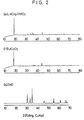
- Figure 2 shows X-ray diffraction patterns of using Cuka rays of the positive active materials a and r1 prepared as above and the starting zinc oxide ZnO (referred to as q) used in the synthesis of the active material a .
- the diffraction pattern of the compared active material r1 agrees with LiCo02 having an ⁇ -NaCr02 type layer-like structure shown in the ASTM card No. 16-427.
- the active material a has peaks from ⁇ -NaCr02 type layer-like compound crystal and minute peaks assumed from the starting Zn0 (for example, 2 ⁇ ⁇ 31.6° 34.3°, 36.2° and 47.4°).
- the active material a is a mixture of a composite oxide Li x Co y Zn z 02 having a layer-like structure similar to the ⁇ -NaCr02 type and a small amount of the unreacted material of the starting Zn0.
- the amount Z of Zn in the Li x Co y Zn z 02 is smaller than 0.25 mole added at the time of synthesizing but may be estimated to be rather large.
- the diffraction peak from Li x Co y Zn z 02 of the active material a is slightly shifted to a lower angle side as compared with the peak from LiCo02 or r1, and the relative strength of each peak shows some differences and otherwise there is hardly any variation.
- most of Zn atoms in Li x Co y Zn z 02 occupy the sites which are substituted for Co atoms in LiCo02, and there are a few which enter in spaces between crystal lattices.
- the interlayer spaces of Li x Co y Zn z 02 are estimated to be slightly broader than LiCo02.
- the cell reaction potential between Li and Zn0 is less than 2V.
- Positive active materials which react at 4 to 2V in the charging and discharging test mentioned below are all layer-like composite oxide Li x Co y Zn z 02 and the remaining Zn0 does not contribute to the reaction.
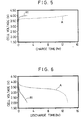
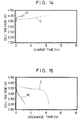
- the charging voltage is lower by 0.2V and 0.3V, and conversely the operating voltage of discharging is much higher.
- the polarization (internal resistance) of the battery is greatly improved, and charging and discharging at a large current is easy.
- the layer-like composite oxide Li x Co y Zn z 02 a part of the Co atoms of Lico02 are substituted by Zn atoms, and as a result, the interlayer spaces of the crystals becomes broadened and changes occur in crystal structure and electron state.
- the conductivity of the Li ion is increased, and at tne same time, the electrode potential is decreased by about 0.1V.
- Copper Cu was used as an L element constituting a positive active material. Except for the positive active material, a battery was prepared in the same way as in Example 1.
- a positive active material was prepared in the following manner. Lithium hydroxide Li0H.H20, cobalt carbonate CoC03 and copper oxide Cu0 were fully mixed in a mortar in a Li:Co:Cu mole ratio of 1:0.75:0.25. The mixture was heated at a temperature of 850° C in air for 12 hours, and after cooling, pulverized to a particle size not more than 53 ⁇ m. The heating and pulverization were repeated twice to prepare a positive active material b . For comparison, a conventional Cu-free layer-like oxide LiCo02 was used as r1.
- the batteries so prepared are abbreviated as batteries B and R1 corresponding to the positive active materials b and r1.
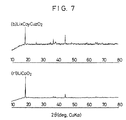
- Figure 7 shows the X-ray diffraction patterns using Cuka rays of the positive active materials b and r1 produced as shown above.
- the diffraction pattern of the comparative active material r1 agrees with that of LiCo02 , having an ⁇ -NaCr02 type layer-like structure shown in ASTM card No. 16-427.
- the active material b in accordance with this invention has the peaks from the ⁇ -NaCr02 type layer-like compound crystal and minute peaks assumed to correspond to the starting Cu0 or other oxides comprising Co, Li and Cu (for example, 2 ⁇ 26.0, 35.5° and 38.8°).
- the active material b in accordance with this invention is a mixture of a composite oxide Li x Co y Cu z 02 having a layer-like structure similar to the ⁇ -NaCr02-like and a small amount of the starting Cu0 or other Li, Co and Cu oxides.
- the amount z of Cu in the Li x Co y Cu z 02 is smaller than 0.25 mole, but assumed to be rather large.
- the diffraction peaks from the active material b namely Li x Co y Cu z 02 as compared with the peaks from LiCo02, r1 are shifted slightly to a lower angle side, and except for the fact that the relative strength of each peak is slightly different, there is no other change. So it is presumed most of Cu atoms in the Li x Co y Cu z 02 enter into positions resulting from substituting Co atoms in LiCo02 by Cu atoms and a very few enter the spaces between crystal lattices. Moreover, the interlayer space of Li x Co y Cu z 02 is assumed to be slightly widened as compared with the interlayer space of LiCo02.
- the positive active material which reacts at 4 to 2V in the charging and discharging test mentioned below is substantially only a layer-like composite oxide Li x Co y Cu z 02 and the coexisting Cu0, etc. do not participate in the reaction.
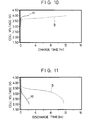
- the charging voltage is as low as about 0.3V, and conversely, the operating voltage of discharging becomes very much increased.
- the polarization (internal resistance) of the battery is greatly decreased, and charging and discharging at a large current become very easy.
- the layer-like composite oxide Li x Co y Cu z 02 which is the positive active material of the battery B, a part of the Co atoms of the LiCo02 are replaced by Cu atoms so that the interlayer space of the crystal is enlarged and changes occur in crystal structure and electron state.
- the conductvity of an Li ion is increased, and simultaneously the electrode potential decreases by about 0.1V.
- the batteries so prepared are abbreviated as batteries C and R1 corresponding to the positive active materials c and r1.
- the charging voltage was about 0.3V lower, and conversely, the operating voltage of discharging is very much increased.
- the polarization (internal resistance) of the battery is very much reduced, and charging and discharging at a large current are easy.
- the conductivity of an Li ion increases and intercalation and de-intercalation of an Li ion is assumed to become easy.
- Example 2 boron B as a metalloid element of Group IIIB of the periodic table was used as the L element constituting a positive active material. Except for the positive electrode, batteries were produced basically as in Example 1.
- a positive electrode 5 was prepared in the following manner. Lithium hydroxide LiOH.H20, cobalt carbonate CoC03 and boron oxide B203 were fully mixed in a mortar in a specified mole ratio of Li:Co:B. The mixture was heated in air at a temperature of 850°C for 12 hours, and after cooling, the mixture was ground to a particle size of not more than 53 ⁇ m. This heating and pulverization were repeated twice to prepare the positive active material. In this Example, two mole ratios were used, namely 1:0.95:0.05 (d1) (LiCo 0.95 B 0.05 02) and 1:0.8:0.2 (LiCo 0.8 B 0.2 02 (d2).
- a boron-free conventional layer-like oxide LiCo02 was prepared in the following manner. Lithium hydroxide LiOH.H20 and cobalt carbonate CoC03 were mixed at a Li:Co mole ratio of 1:1. This mixture was heated in air at a temperature of 850°C for 12 hours, and after cooling, pulverized to a particle size not greater than 53 ⁇ m. This heating and pulverization were repeated twice to obtain a comparative substance (r2).
- the battery so prepared was allowed to be aged at room temperature for 1 week, and subjected to the following charging and discharging test.
- the lithium-aluminium laminated electrode as a negative electrode contacted the non-aqueous electrolyte whereby the alloying proceeded very well.
- the lithium foil substantially completely became an Li-Al alloy.
- the voltage of the battery was about 0.4V lower than in the case of using metallic lithium alone as a negative electrode and became stabilized.
- the batteries so produced are referred to as batteries D1, D2 and R2 corresponding to the positive active materials d1, d2 and r2 used.
- Figure 16 shows X-ray diffraction patterns of the positive active materials dl and d2 and the comparative material r2 using Cuka rays.
- the diffraction pattern of the comparative material r2 agrees with that of the LiCo02 having ⁇ -NaCr02 type layer-like structure of ASTM card No. 16-427.
- the diffraction patterns of the active materials d1 and d2 of this invention are very similar to the diffraction pattern of the comparative material LiCo02. There is no clear difference in the positions of the individual peaks, and no unknown new peaks are seen. But differences are seen in the relative strengths of the diffraction peaks.
- the active materials d1 and d2 of this invention have a structure such that a part of the Co atoms in the oxide LiCo02 having an ⁇ -NaCr02-type layer-like structure are replaced by B atoms, and it is estimated that most of boron atoms B occupy the sites substituted for Co atoms and few are entered at the space between the crystal lattices and Li sites.
- the active materials dl and d2 of this invention have a layer-like structure like an ⁇ -NaCr02-type, and are judged to be lithium-boron transition metal composite oxides having the compositions LiCo 0.95 B 0.05 02 and LiCo 0.8 B 0.2 02.
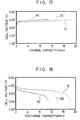
- the charging voltage was lower by 0.2 to 0.3V and the operating voltage of discharging increased to a very high level.
- polarization (internal resistance) of the batteries was very much improved, and charging-discharging at a large current becomes easy.
- a part of Co atoms is LiCo02 are replaced by B atoms and thereby changes occur in crystal structure and electron state so that the conductivity of an Li ion is enhanced and the intercalation and de-intercalation of the Li ion becomes easy.
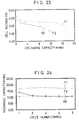
- the charging and discharging capacity decreases conversely when the amount z of boron is too large, and becomes a maximum at 0 ⁇ Z ⁇ 0.5. This range is therefore especially preferred.
- nickel Ni was used as the transition metal element M constituting a positive active material and boron B was used as a metalloid element of Group IIIB of the periodic table which is the L element. Except for the positive active material, batteries were prepared in the same manner as in Example 4.
- the positive active materials of this Example were prepared in the following manner.
- Lithium hydroxide Li0H.H20, nickel oxide Ni0 and boron oxide B203 were weighed in a specified mole ratio of Li:Ni:B, and fully mixed in a mortar. The mixture was heated in air at a temperature of 850°C for 12 hours, and after cooling, pulverized to a particle size of smaller than 53 ⁇ m. This heating and pulverization were repeated twice to produce the positive active materials.
- the Li:Ni:B mole ratio was varied in 1:0.95:0.05(e1)(LiNi 0.95 B 0.05 02) and 1:0.8:0.2 (e2) (LiNi 0.8 B 0.2 02).
- a boron-free conventional layer-like oxide LiNi02 was prepared in the following manner.
- the mixture was heated in air at a temperature of 850°C for 12 hours, and after cooling, pulverized to a particle size of not more than 53 ⁇ m. This heating and pulverization were repeated twice to form a comparative substance (r3).
- batteries were produced in the same way as in Example 4.
- the batteries so prepared were abbreviated as E1, E2 and R3 corresponding to the positive active materials e1, e2 and r3.
- the diffraction pattern of the comparative material r3 agreed with that of LiNi02 having an ⁇ -NaCr02 type layer-like structure of ASTM card No. 9-63.
- the diffraction pattern of the active material el of the invention is very similar to the diffraction pattern of the comparative material r3. No clear difference is seen in the positions of the diffraction peaks, and no unknown new diffraction peak is seen. But there is a difference in the relative strength of the diffraction peaks.
- the active material e1 of this invention has a structure wherein a part of Ni atoms in the oxide LiNi02 having an ⁇ -NaCr02 type layer-like structure are replaced by boron atoms B. It is estimated that most of boron atoms B exist in the positions substituted for Ni atoms,and few are placed in the interstices between crystal lattices or the Li sites.
- the active materials e1 and e2 of this invention have a layer-like structure similar to an ⁇ -NaCr02 type, and are assumed to be lithium-boron transition metal composite oxides having the compositions LiNi 0.95 B 0.05 02 and LiNi 0.8 B 0.2 0.2.
- the battery E1 has a much larger charging-discharging capacity than the comparative battery R3, and the reversible range of charging-discharging is very much widened.
- the battery E2 having a boron content z of 0.2 showed no improvement in a charging-discharging capacity, and is slightly lowered.
- the amount z of boron B is preferably 0 ⁇ z ⁇ 0.2.
- Example 4 a metalloid silicon Si as Group IVB was used as the L element constituting the positive active material. Except for the positive active material, batteries were prepared as in Example 4.
- the positive active materials were prepared in the following manner. Lithium hydroxide Li0H.H20, cobalt carbonate CoC03 and silicon dioxide Si02 were weighed in a specified mole ratio of Li:Co:Si and mixed fully in a mortar. The mixture was heated in air at a temperature of 850°C for 12 hours, and after cooling, pulverized to a particle size of not more than 53 ⁇ m. This heating and pulverization were repeated twice to synehesize the positive active materials of this invention. In the Example, two products, namely Li:Co:Si of 1:0.95:0.05(f1) (LiCo 0.95 Si 0.045 02) and 1:0.8:0.2 (f2) (LiCo 0.8 Si 0.2 02) were prepared. For comparison, a silicon-free conventional layer-like oxide LiCo02 was used as r2 of Example 4.
- the batteries so prepared were abbreviated as batteries F1, F2 and R2 corresponding to the positive active materials f1, f2 and r2.
- the charging voltage is as low as 0.2 to 0.3V.
- the operating voltage of discharging is extremely high, and the polarization (internal resistance) of the battery is greatly improved. Charging and discharging at a large current is very easy. This is because in the layer-like composite oxide Li x Co y Si z 02, the positive active materials of the batteries of this invention, the inclusion of silicon Si in the crystal structure changed the crystal structure and electron state and enhanced the conductivity of the Li ion. Thus, intercalation and de-intercalation of the Li ion are assumed to become easy.
- Mg as an alkaline earth metal was used as the L element constituting the positive active materials. Except for the positive active element, the batteries were produced in the same way as in Example 4.
- the positive active materials were produced in the following manner. Lithium hydroxide Li0H.H20, cobalt carbonate CoC03 and magnesium oxide Mg0 were weighed in a specified mole ratio of Li:Co:Mg. The mixture was fully mixed in a mortar,heated in air at a temperature of 850°C for 12 hours, and after cooling, pulverized to a particle size of not more than 53 ⁇ m. This heating and pulverization were repeated twice to synthesize the positive active materials. In this Example, two mole ratios of Li:Co:Mg were prepared, namely (g1) 1:0.95:0.05(LiCo 0.95 Mg 0.05 02) and (g2) 1:0.8:0.2(LiCo 0.8 Mg 0.2 02). For comparison, r2 of Example 4 was used as a magnesium-free conventional layer-like oxide LiCo02.
- the prepared batteries were abbreviated as G1, G2 and R2 corresponding to the positive active materials g1, g2 and r2.
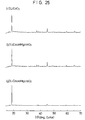
- Figure 25 shows X-ray diffraction patterns using Cuka rays of the positive active materials g1 and g2 and the conventional comparative material r2.
- the diffraction pattern of the comparative material r2 agrees with that of the LiCo02 having an ⁇ -NaCr02-type layer-like structure corresponding to ASTM card No. 16-427.
- the diffraction patterns of the active materials g1 and g2 of the invention are very similar to the diffraction pattern of the comparative active material LiCo02. No new unknown diffraction peak is seen. But the diffraction peak positions are shifted somewhat to a lower angle side.
- the active material g2 having a larger magnesium content z is shifted more than the active material g1 having a small magnesium content z.
- a difference is seen in the relative strengths of the diffraction peaks, and this difference becomes larger as the content of magnesium Mg is larger.
- the active materials of this invention g1 and g2 have a structure such that a part of Co atoms in the oxide LiCo02 having an ⁇ -NaCr02 type layer-like structure are replaced by magnesium atoms Mg, and the interlayer spaces of the crystal are widened. It is estimated that most of the Mg atoms are placed in the sites substituted for Co atoms, and very few of them are entered in the interstices of crystal lattices or in the Li sites.
- the active materials g1 and g2 in this Example are judged to be lithium-magnesium transition metal composite oxide having the compositions LiCo 0.95 Mg 0.05 02 and LiCo 0.8 Mg 0.2 02 similar to ⁇ -NaCr02 type layer-like structure.
- the polarization (internal resistance) of the batteries were very much improved, and charging and discharging at a large current became easy. Furthermore, these effects depend greatly upon the content z of magnesium, and it is more markedly seen in the battery G2 wherein 0.05 ⁇ z than in the battery G1 which has a small z. This is because in the layer-like composite oxide Li x Co y Mg z 02 the inclusion of magnesium widens the interlayer spaces of the crystal and a change occurs in crystal structure and electron state. It is estimated that as a result, the conductivity of the Li ion is enhanced, and the intercalation and de-intercalation of the Li ion become easy.
- magnesium was referred to as an alkaline earth metal, but with other alkaline earth metals such as Be, Ca, Sr, Ba and Ra, the same effect as in this Example can be obtained.
- phosphorus P as a non-metal element of Group VB of the periodic table was used as the L element constituting the positive active material. Except for the positive active materials, batteries were produced as in Example 4.
- the positive active materials in this Example were produced in the following manner. Lithium hydroxide Li0H.H20, cobalt carbonate C0C0 and phosphorus pentaoxide P205 in a specified mole ratio of Li:Co:P were weighed, and mixed fully in a mortar and the mixture was heated in air at a temperature of 850°C for 12 hours. After cooling, the mixture was pulverized to a particle size not more than 53 ⁇ m. This heating and pulverization were repeated twice to synthesize the positive active materials.
- the batteries produced are abbreviated as batteries H1, H2 and R2 corresponding to the positive active materials h1, h2 and r2.
- Figure 28 shows X-ray diffraction patterns using Cuka rays of the positive active material h1 of the present invention produced as above and the conventional comparative material r2 of the conventional method.
- the diffraction pattern of the comparative active material r2 agreed with that of LiCo02 having ⁇ -NaCr02 type layer-like structure according to ASTM card No. 16-427.
- the diffraction pattern of the active material h1 in accordance with the present invention is very similar to the diffraction pattern of the active material LiCo02.
- a small peak assumed to be the satellite peak is seen at a lower angle side of the diffraction peak at 2 ⁇ 37.3°, and no unknown new diffraction peak is seen.
- the active materials h1 and h2 have a layer-like structure similar to the ⁇ -NaCr02 type and are judged to be lithium-phosphorus transition metal composite oxides having the compositions of LiCo 0.95 P 0.05 02 and LiCo 0.8 P 0.2 02.
- the charging voltage is low, and conversely, the operating voltage of discharging is extremely high.
- the polarization (internal resistance) of the battery is very much improved, and charging and discharging at a large current become easy.
- the inclusion of phosphorus P in the crystal structure changed the crystal structure and electron state and enhanced the conductivity of the Li ion. It is therefore estimated that the intercalation and de-intercalation became easy.
- the negative electrode was shown only as the lithium-aluminium alloy. But the invention is not limited to the Examples. Lithium absorbing and releasing compounds, for example, metallic lithium, alloys of lithium and other metals such as Zn, Sn, Pb, or/and Bi, lithium-insertion compounds such as carbon, Mo02, Wo2 or Fe203, and conductive polymers capable of doping an Li ion such as polyacetylene, polypyrrole or polyacene, can be also used in the same manner.
- Lithium absorbing and releasing compounds for example, metallic lithium, alloys of lithium and other metals such as Zn, Sn, Pb, or/and Bi, lithium-insertion compounds such as carbon, Mo02, Wo2 or Fe203, and conductive polymers capable of doping an Li ion such as polyacetylene, polypyrrole or polyacene, can be also used in the same manner.
- the negative active material does not necessarily contain Li at the time of producing a battery. After assembling the battery, an Li ion in the electrolyte may be charged or an Li ion de-intercalated from the positive active material may be absorbed into the negative electrode.
- transition metal element M in the layer-like composite oxide Li x M y L z 02.
- the other transition metals such as Cr, Fe, Mn and V may be applied in the same manner.
- the present invention uses a novel layer-like composite oxide Li x M y L z 02 (M is a transition metal) containing at least the L element which is one or more elements selected from the group consisting of non-metal, metalloid and semimetal elements selected from Groups IIIB, IVB and VB of the periodic table, alkaline earth metal elements and metal elements selected from Zn, Cu and Ti.
- L element which is one or more elements selected from the group consisting of non-metal, metalloid and semimetal elements selected from Groups IIIB, IVB and VB of the periodic table, alkaline earth metal elements and metal elements selected from Zn, Cu and Ti.
- De-intercalation and intercalation of an Li ion at the time of charging and discharging capacity is markedly enhanced.
- the charging voltage is decreased and the operating voltage at the time of discharging is enhanced.
- excellent effects can be attained such as charging and discharging characteristics are markedly improved at a large current, and by the repetition of charging and discharging, cycle deteriorat
Landscapes
- Chemical & Material Sciences (AREA)
- Organic Chemistry (AREA)
- Inorganic Chemistry (AREA)
- Chemical Kinetics & Catalysis (AREA)
- Electrochemistry (AREA)
- General Chemical & Material Sciences (AREA)
- Engineering & Computer Science (AREA)
- Manufacturing & Machinery (AREA)
- Battery Electrode And Active Subsutance (AREA)
- Secondary Cells (AREA)
Claims (16)
- Positives aktives Material für eine sekundäre Batterie mit einem nichtwäßrigen Elektrolyten, wobei das Material aus einem Mischoxid mit schichtartiger Struktur der Formel LixMyLz0₂ aufgebaut ist, worin 0 < x ≤ 1,15, 0,85 ≤ y+z≤ 1,3 und 0 < z ist, M ein Übergangsmetallelement ist und L verschieden von M ist und eines oder mehrere Elemente, ausgewählt aus der aus Nichtmetall-, Metalloid- und Halbmetallelementen bestehenden Gruppe ist, ausgewählt aus den Gruppen IIIB, IVB und VB nach dem Periodensystem gemäß IUPAC, Erdalkalimetallelementen und Metallelementen, ausgewählt aus Zn, Cu und Ti mit der Maßgabe, daß Materialien der Formel: LixCo1-zTizO₂, worin 0,8 ≤ x ≤ 1,4 und 0 < z ≤ 0,4, ausgeschlossen sind.
- Positives aktives Material nach Anspruch 1, worin das Element L, das das Mischoxid mit schichtartiger Struktur der Formel bildet, mindestens ein Nichtmetall- oder Metalloidelement, ausgewählt aus Bor B, Silicium Si und Phosphor P, umfaßt.
- Positives aktives Material nach Anspruch 1 oder 2, dadurch gekennzeichnet, das das Element L, das das Mischoxid mit schichtartiger Struktur der Formel bildet, mindestens Magnesium Mg umfaßt.
- Positives aktives Material nach Anspruch 1, worin M Co ist und L Zn ist oder M Co ist und L Cu ist oder M Co ist und L Ti ist oder M Co ist und L B ist oder M Ni und L B ist oder M Co und L Si oder Ge ist oder M Co ist und L Mg ist oder M Co ist und L P ist.
- Sekundäre Batterie mit nichtwäßrigem Elektrolyten, umfassend eine negative Elektrode mit Lithium oder einem Material, das zum Absorbieren und Freisetzen von Li als ein aktives Material in der Lage ist und einen Lithiumionen leitenden nichtwäßrigen Elektrolyten und eine positive Elektrodenverbindung aus einem aktivem Material nach einem der vorhergehenden Ansprüche.
- Batterie nach Anspruch 5, dadurch gekennzeichnet, daß das negative, aktive Material eine Lithiumlegierung umfaßt.
- Batterie nach Anspruch 6, dadurch gekennzeichnet, daß das mit Lithium legierte Metall Aluminium ist.
- Verfahren zum Herstellen eines positiven, aktiven Materials für eine sekundäre Batterie mit nichtwäßrigem Elektrolyten, umfassend das Mischen von Lithium Li mit einem Übergangsmetallelement M und einem Element L entweder als einfache Substanz oder als ihre Verbindungen und Erhitzen des Gemischs an Luft oder in einer sauerstoffenthaltenden Atmosphäre, um ein Mischoxid mit schichtartiger Struktur der Formel LixMyLzO₂ zu bilden, worin M ein Übergangsmetallelement ist und L verschieden von M ist und eines oder mehrere Elemente, ausgewählt aus der aus Nichtmetall-, Metalloid- und Halbmetallelementen bestehenden Gruppe ist, ausgewählt aus den Gruppen IIIB, IVB und VB nach dem Periodensystem gemäß IUPAC, Erdalkalimetallelementen und Metallelementen, ausgewählt aus Zn, Cu und Ti und worin x, y und z 0 < x ≤ 1,15 und 0,85 ≤ y+z≤s 1,3 und 0 < z entsprechen, mit der Maßgabe, daß die Herstellung von einem Material der Formel: LixCo1-zTizO₂, worin 0,8 ≤ x ≤ 1,4 und 0 < z ≤ 0,4 aus Li₂CO₃, CoCO₃ und einem Oxid von Titan ausgeschlossen ist.
- Verfahren nach Anspruch 8, dadurch gekennzeichnet, daß das Element L, das das Mischoxid der Formel bildet, mindestens ein Nichtmetall- oder Metalloidelement, ausgewählt aus Bor B, Silicium Si und Phosphor P, umfaßt.
- Verfahren nach Anspruch 8 oder 9, dadurch gekennzeichnet, daß das Element L, das das Mischoxid der Formel bildet, mindestens Magnesium Mg umfaßt.
- Verfahren nach Anspruch 8, dadurch gekennzeichnet, daß Lithiumhydroxid als die Lithium-Li-verbindung verwendet wird.
- Verfahren nach Anspruch 11, dadurch gekennzeichnet, daß das Lithiumhydroxid ein hydratisiertes Lithiumhydroxid LiOH*H₂O ist.
- Verfahren nach Anspruch 8, 11 oder 12, dadurch gekennzeichnet, daß die Verbindung des Übergangsmetallelements M ein Carbonat oder Oxid von M ist.
- Verfahren nach Anspruch 8, 11, 12 oder 13, dadurch gekennzeichnet, daß die Verbindung des Elements L ein Oxid oder Carbonat von L ist.
- Verfahren nach einem der Ansprüche 8-14, dadurch gekennzeichnet, daß Lithiumhydroxid und Cobaldcarbonat mit einem Oxid des Elements L gemischt werden und das Gemisch an Luft bei einer Temperatur von 600 °C bis 900 °C erhitzt wird.
- Verfahren nach Anspruch 8, dadurch gekennzeichnet, daß Lithiumhydroxid und Nickeloxid mit einem Oxid des Elements L gemischt werden und das Gemisch an Luft bei einer Temperatur von 600 °C bis 900 °C erhitzt wird.
Applications Claiming Priority (21)
| Application Number | Priority Date | Filing Date | Title |
|---|---|---|---|
| JP29821390 | 1990-11-02 | ||
| JP298213/90 | 1990-11-02 | ||
| JP29821390 | 1990-11-02 | ||
| JP40520590 | 1990-12-21 | ||
| JP40520590 | 1990-12-21 | ||
| JP405204/90 | 1990-12-21 | ||
| JP405205/90 | 1990-12-21 | ||
| JP40520490 | 1990-12-21 | ||
| JP40520490 | 1990-12-21 | ||
| JP9246291 | 1991-04-23 | ||
| JP9246291 | 1991-04-23 | ||
| JP92462/91 | 1991-04-23 | ||
| JP107677/91 | 1991-05-13 | ||
| JP10767791 | 1991-05-13 | ||
| JP10767791 | 1991-05-13 | ||
| JP13924691 | 1991-06-11 | ||
| JP139246/91 | 1991-06-11 | ||
| JP13924691 | 1991-06-11 | ||
| JP253921/91 | 1991-10-01 | ||
| JP25392191 | 1991-10-01 | ||
| JP25392191A JP3162437B2 (ja) | 1990-11-02 | 1991-10-01 | 非水電解質二次電池 |
Publications (4)
| Publication Number | Publication Date |
|---|---|
| EP0484187A2 EP0484187A2 (de) | 1992-05-06 |
| EP0484187A3 EP0484187A3 (en) | 1992-09-02 |
| EP0484187B1 true EP0484187B1 (de) | 1996-02-07 |
| EP0484187B2 EP0484187B2 (de) | 1999-12-01 |
Family
ID=27565518
Family Applications (1)
| Application Number | Title | Priority Date | Filing Date |
|---|---|---|---|
| EP91310178A Expired - Lifetime EP0484187B2 (de) | 1990-11-02 | 1991-11-04 | Positives aktives Material für sekundäre Batterie mit nichtwässrigen Elektrolyten |
Country Status (4)
| Country | Link |
|---|---|
| US (1) | US5286582A (de) |
| EP (1) | EP0484187B2 (de) |
| JP (1) | JP3162437B2 (de) |
| DE (1) | DE69116978T3 (de) |
Families Citing this family (77)
| Publication number | Priority date | Publication date | Assignee | Title |
|---|---|---|---|---|
| US4258194A (en) * | 1979-09-10 | 1981-03-24 | Ciba-Geigy Corporation | Process for producing 2,3,5-trichloropyridine |
| EP0511632B1 (de) * | 1991-04-30 | 1997-11-19 | Sony Corporation | Sekundärbatterie mit nichtwässrigen Elektrolyten |
| JP2643046B2 (ja) * | 1991-12-27 | 1997-08-20 | シャープ株式会社 | 非水系2次電池 |
| CA2096386A1 (en) * | 1992-05-18 | 1993-11-19 | Masahiro Kamauchi | Lithium secondary battery |
| JP2997741B2 (ja) * | 1992-07-29 | 2000-01-11 | セイコーインスツルメンツ株式会社 | 非水電解質二次電池及びその製造方法 |
| JP3079344B2 (ja) * | 1993-08-17 | 2000-08-21 | セイコーインスツルメンツ株式会社 | 非水電解質二次電池及びその製造方法 |
| JP3010226B2 (ja) * | 1993-03-10 | 2000-02-21 | セイコーインスツルメンツ株式会社 | 非水電解質二次電池及びその製造方法 |
| EP0630064B1 (de) * | 1993-04-28 | 1998-07-15 | Fuji Photo Film Co., Ltd. | Akkumulator mit nicht-wässrigem Elektrolyt |
| US5780185A (en) * | 1993-06-07 | 1998-07-14 | Honda Giken Kogyo Kabushiki Kaisha | Cathode materials for lithium batteries and methods for producing the same |
| JP3079343B2 (ja) * | 1993-07-13 | 2000-08-21 | セイコーインスツルメンツ株式会社 | 非水電解質二次電池及びその製造方法 |
| ZA94750B (en) * | 1993-09-02 | 1994-09-29 | Technology Finance Corp | Electrochemical cell |
| CA2172378C (en) * | 1993-09-22 | 2001-05-29 | Hajime Kinoshita | Organic electrolytic cell |
| JPH07130400A (ja) * | 1993-11-02 | 1995-05-19 | Fuji Photo Film Co Ltd | 非水電解質電池の充電方法および充電装置 |
| JP2966261B2 (ja) * | 1993-11-02 | 1999-10-25 | 三菱電線工業株式会社 | リチウム電池用正極材及びその製造方法 |
| US5462821A (en) * | 1993-11-19 | 1995-10-31 | Dowa Mining Co., Ltd. | Gallium based active material for the negative electrode, a negative electrode using the same, and batteries using said negative electrode |
| US5503930A (en) * | 1994-03-07 | 1996-04-02 | Tdk Corporation | Layer structure oxide |
| JPH07263028A (ja) * | 1994-03-25 | 1995-10-13 | Fuji Photo Film Co Ltd | 非水二次電池 |
| CA2122770C (en) * | 1994-05-03 | 2000-10-03 | Moli Energy (1990) Limited | Carbonaceous host compounds and use as anodes in rechargeable batteries |
| US5609975A (en) * | 1994-05-13 | 1997-03-11 | Matsushita Electric Industrial Co., Ltd. | Positive electrode for non-aqueous electrolyte lithium secondary battery and method of manufacturing the same |
| JPH0831408A (ja) * | 1994-05-13 | 1996-02-02 | Matsushita Electric Ind Co Ltd | 非水電解質リチウム二次電池用正極およびその製造方法 |
| US5558961A (en) * | 1994-06-13 | 1996-09-24 | Regents, University Of California | Secondary cell with orthorhombic alkali metal/manganese oxide phase active cathode material |
| JPH08213052A (ja) * | 1994-08-04 | 1996-08-20 | Seiko Instr Inc | 非水電解質二次電池 |
| US5683834A (en) * | 1994-09-07 | 1997-11-04 | Fuji Photo Film Co., Ltd. | Nonaqueous secondary battery |
| CA2162456C (en) * | 1994-11-09 | 2008-07-08 | Keijiro Takanishi | Cathode material, method of preparing it and nonaqueous solvent type secondary battery having a cathode comprising it |
| JP3811974B2 (ja) * | 1994-11-22 | 2006-08-23 | 住友化学株式会社 | リチウム二次電池用正極とその製造方法およびリチウム二次電池 |
| JP2006128135A (ja) * | 1994-11-22 | 2006-05-18 | Sumitomo Chemical Co Ltd | 正極用活物質および正極の製造方法 |
| JPH08153541A (ja) * | 1994-11-28 | 1996-06-11 | Mitsubishi Cable Ind Ltd | リチウム二次電池 |
| CA2144037C (en) * | 1995-03-03 | 2000-12-05 | Jiayu Simon Xue | Carbonaceous insertion compounds and use as anodes in rechargeable batteries |
| US5721070A (en) * | 1995-04-13 | 1998-02-24 | Shackle; Dale R. | Alkali metal ion battery electrode material |
| US5631105A (en) * | 1995-05-26 | 1997-05-20 | Matsushita Electric Industrial Co., Ltd. | Non-aqueous electrolyte lithium secondary battery |
| JPH097638A (ja) * | 1995-06-22 | 1997-01-10 | Seiko Instr Inc | 非水電解質二次電池 |
| US5582935A (en) * | 1995-09-28 | 1996-12-10 | Dasgupta; Sankar | Composite electrode for a lithium battery |
| US5750288A (en) * | 1995-10-03 | 1998-05-12 | Rayovac Corporation | Modified lithium nickel oxide compounds for electrochemical cathodes and cells |
| US5616309A (en) * | 1995-12-01 | 1997-04-01 | Valence Technology, Inc. | Vanadium oxide-based cathode active material and method of making same |
| US6514640B1 (en) * | 1996-04-23 | 2003-02-04 | Board Of Regents, The University Of Texas System | Cathode materials for secondary (rechargeable) lithium batteries |
| US5670277A (en) * | 1996-06-13 | 1997-09-23 | Valence Technology, Inc. | Lithium copper oxide cathode for lithium cells and batteries |
| JP2002511179A (ja) | 1996-10-11 | 2002-04-09 | マサチューセッツ・インスティテュート・オブ・テクノロジー | 電池のための固体電解質、インターカレーション化合物及び電極 |
| US6277521B1 (en) | 1997-05-15 | 2001-08-21 | Fmc Corporation | Lithium metal oxide containing multiple dopants and method of preparing same |
| JP4461498B2 (ja) | 1997-12-16 | 2010-05-12 | パナソニック株式会社 | 非水電解液二次電池およびその負極 |
| US20040096741A1 (en) * | 1997-12-16 | 2004-05-20 | Shusaku Goto | Non-aqueous electrolyte secondary battery, negative electrode, and method of manufacturing negative electrode |
| JP3990808B2 (ja) * | 1998-03-26 | 2007-10-17 | Tdk株式会社 | 非水電解質電池用電極の製造方法 |
| US6190802B1 (en) * | 1998-05-22 | 2001-02-20 | T/J Technologies, Inc. | Transition metal based ceramic material and electrodes fabricated therefrom |
| US6267943B1 (en) | 1998-10-15 | 2001-07-31 | Fmc Corporation | Lithium manganese oxide spinel compound and method of preparing same |
| DK1137598T3 (da) | 1998-11-13 | 2003-08-18 | Fmc Corp | Lagdelte lithiummetaloxider, der er fri for lokale kubiske spinellignende struktuelle faser, og fremgangsmåder til fremstilling af samme |
| EP1135334B1 (de) | 1998-11-20 | 2002-10-09 | Fmc Corporation | Dotierte lithium-mangan-mischoxide und verfahren zur herstellung derselben |
| US6730435B1 (en) * | 1999-10-26 | 2004-05-04 | Sumitomo Chemical Company, Limited | Active material for non-aqueous secondary battery, and non-aqueous secondary battery using the same |
| AU1951601A (en) | 1999-12-10 | 2001-06-18 | Fmc Corporation | Lithium cobalt oxides and methods of making same |
| US6706447B2 (en) | 2000-12-22 | 2004-03-16 | Fmc Corporation, Lithium Division | Lithium metal dispersion in secondary battery anodes |
| US7276314B2 (en) | 2000-12-22 | 2007-10-02 | Fmc Corporation | Lithium metal dispersion in secondary battery anodes |
| US6998071B2 (en) * | 2001-08-03 | 2006-02-14 | Toda Kogyo Corporation | Cobalt oxide particles and process for producing the same, cathode active material for non-aqueous electrolyte secondary cell and process for producing the same, and non-aqueous electrolyte secondary cell |
| CN1327551C (zh) | 2001-10-29 | 2007-07-18 | 松下电器产业株式会社 | 锂离子二次电池 |
| JP2003146662A (ja) * | 2001-11-13 | 2003-05-21 | Nikki Chemcal Co Ltd | リチウム・ニッケル・マンガン複合酸化物、その製造方法および用途 |
| KR100570051B1 (ko) | 2001-12-06 | 2006-04-10 | 마쯔시다덴기산교 가부시키가이샤 | 리튬이온 이차전지 |
| US7482097B2 (en) | 2002-04-03 | 2009-01-27 | Valence Technology, Inc. | Alkali-transition metal phosphates having a +3 valence non-transition element and related electrode active materials |
| EP1505672A4 (de) * | 2002-05-16 | 2012-01-04 | Panasonic Corp | Aktivmaterial einer positivelektrode für eine sekundärbatterie mit wasserfreiem elektrolyt und prozess zu ihrer herstellung |
| KR100704277B1 (ko) * | 2002-06-21 | 2007-04-05 | 주식회사 엘지화학 | 전기소자용 활물질과 그의 제조방법 및 이를 포함하는리튬 2차 전지 |
| US20050130043A1 (en) * | 2003-07-29 | 2005-06-16 | Yuan Gao | Lithium metal dispersion in electrodes |
| GB0318942D0 (en) * | 2003-08-13 | 2003-09-17 | Aea Technology Battery Systems | Process for producing an electrode |
| US8231810B2 (en) | 2004-04-15 | 2012-07-31 | Fmc Corporation | Composite materials of nano-dispersed silicon and tin and methods of making the same |
| US7381496B2 (en) * | 2004-05-21 | 2008-06-03 | Tiax Llc | Lithium metal oxide materials and methods of synthesis and use |
| GB0414161D0 (en) * | 2004-06-24 | 2004-07-28 | Aea Technology Battery Systems | Anode for lithium ion cell |
| JP4639775B2 (ja) * | 2004-11-26 | 2011-02-23 | パナソニック株式会社 | 非水電解質二次電池 |
| JP4754209B2 (ja) * | 2004-12-16 | 2011-08-24 | 日本化学工業株式会社 | リチウムコバルト系複合酸化物粉末の製造方法 |
| US7771874B2 (en) * | 2005-06-29 | 2010-08-10 | Fmc Corporation | Lithium manganese compounds and methods of making the same |
| US7588623B2 (en) * | 2005-07-05 | 2009-09-15 | Fmc Corporation Lithium Division | Stabilized lithium metal powder for li-ion application, composition and process |
| US20070190422A1 (en) * | 2006-02-15 | 2007-08-16 | Fmc Corporation | Carbon nanotube lithium metal powder battery |
| US20090035663A1 (en) | 2006-10-13 | 2009-02-05 | Fmc Corporation, Lithium Division | Stabilized lithium metal powder for li-ion application, composition and process |
| US8137844B2 (en) | 2006-11-17 | 2012-03-20 | Nippon Chemical Industrial Co., Ltd. | Cathode active material for lithium rechargeable battery, manufacturing method thereof and lithium rechargeable battery |
| EP2337125A1 (de) | 2006-12-26 | 2011-06-22 | Mitsubishi Chemical Corporation | Lithium-Übergangsmetall-Pulver und Methode zu seiner Herstellung |
| US8021496B2 (en) * | 2007-05-16 | 2011-09-20 | Fmc Corporation | Stabilized lithium metal powder for Li-ion application, composition and process |
| JP5172231B2 (ja) | 2007-07-20 | 2013-03-27 | 日本化学工業株式会社 | リチウム二次電池用正極活物質、その製造方法及びリチウム二次電池 |
| US20090061321A1 (en) * | 2007-08-31 | 2009-03-05 | Fmc Corporation, Lithium Division | Stabilized lithium metal powder for li-ion application, composition and process |
| JP5436898B2 (ja) * | 2009-03-23 | 2014-03-05 | 三洋電機株式会社 | 非水電解質二次電池及びその製造方法 |
| KR101305462B1 (ko) * | 2009-07-10 | 2013-09-06 | 삼성에스디아이 주식회사 | 전극조립체 및 이를 구비하는 리튬 이차 전지 |
| US20110135810A1 (en) * | 2009-12-03 | 2011-06-09 | Marina Yakovleva | Finely deposited lithium metal powder |
| JP5508322B2 (ja) * | 2011-03-10 | 2014-05-28 | 日本化学工業株式会社 | リチウムコバルト系複合酸化物粉末、リチウム二次電池正極活物質及びリチウム二次電池 |
| KR102189550B1 (ko) | 2014-06-11 | 2020-12-11 | 삼성에스디아이 주식회사 | 리튬 이차 전지 |
Family Cites Families (5)
| Publication number | Priority date | Publication date | Assignee | Title |
|---|---|---|---|---|
| US3939008A (en) * | 1975-02-10 | 1976-02-17 | Exxon Research And Engineering Company | Use of perovskites and perovskite-related compounds as battery cathodes |
| FR2457018A1 (fr) * | 1979-02-16 | 1980-12-12 | Accumulateurs Fixes | Matiere active positive pour generateur electrochimique a electrolyte non aqueux et methode de preparation de celle-ci |
| FR2460042A1 (fr) * | 1979-06-27 | 1981-01-16 | Saft Leclanche | Matiere active positive pour generateurs electrochimiques, methode de preparation de celle-ci et generateur l'utilisant |
| US4542083A (en) * | 1982-06-01 | 1985-09-17 | At&T Bell Laboratories | Nonaqueous cell using mixed metal oxide positive electrode |
| JPH0732017B2 (ja) * | 1989-10-06 | 1995-04-10 | 松下電器産業株式会社 | 非水電解質二次電池 |
-
1991
- 1991-10-01 JP JP25392191A patent/JP3162437B2/ja not_active Expired - Lifetime
- 1991-11-01 US US07/786,431 patent/US5286582A/en not_active Expired - Lifetime
- 1991-11-04 DE DE69116978T patent/DE69116978T3/de not_active Expired - Fee Related
- 1991-11-04 EP EP91310178A patent/EP0484187B2/de not_active Expired - Lifetime
Also Published As
| Publication number | Publication date |
|---|---|
| DE69116978D1 (de) | 1996-03-21 |
| DE69116978T3 (de) | 2000-02-17 |
| DE69116978T2 (de) | 1996-06-13 |
| EP0484187A3 (en) | 1992-09-02 |
| US5286582A (en) | 1994-02-15 |
| JPH0554889A (ja) | 1993-03-05 |
| JP3162437B2 (ja) | 2001-04-25 |
| EP0484187B2 (de) | 1999-12-01 |
| EP0484187A2 (de) | 1992-05-06 |
Similar Documents
| Publication | Publication Date | Title |
|---|---|---|
| EP0484187B1 (de) | Positives aktives Material für sekundäre Batterie mit nichtwässrigen Elektrolyten | |
| US5620812A (en) | Non-aqueous electrolyte secondary battery | |
| EP0615296B1 (de) | Sekundäre Batterie mit nichtwässrigem Elektrolyten und Verfahren zu ihrer Herstellung | |
| US5401599A (en) | Non-aqueous electrolyte secondary battery and method of producing the same | |
| EP0840386A1 (de) | Nichtwässrige sekundärbatterie | |
| US8361658B2 (en) | Cathode material and non-aqueous electrolyte secondary battery using it | |
| EP1255311B1 (de) | Kathoden-Aktivmaterial und Zelle mit nicht-wässerigem Elektrolyt | |
| USRE35818E (en) | Non-aqueous electrolyte secondary battery and method of producing the same | |
| US20070082266A1 (en) | Non-aqueous electrolyte secondary battery and positive electrode active material therefor | |
| US6656638B1 (en) | Non-aqueous electrolyte battery having a lithium manganese oxide electrode | |
| JP3079344B2 (ja) | 非水電解質二次電池及びその製造方法 | |
| JPH0487268A (ja) | 非水電解質二次電池 | |
| JP3076887B2 (ja) | 非水電解質二次電池及びその製造方法 | |
| JP3354611B2 (ja) | 非水電解質二次電池及びその製造方法 | |
| JP3144833B2 (ja) | 非水溶媒二次電池 | |
| EP1164649A1 (de) | Positives aktives Material für Nichtwässrige-Sekundärbatterie, Verfahren zu seiner Herstellung und diese enthaltende Nichtwässrige-Sekundärbatterie | |
| JP2002184404A (ja) | 正極材料および非水電解質電池 | |
| JP3017847B2 (ja) | 非水溶媒二次電池 | |
| JP2000082459A (ja) | 非水電解質二次電池及びその製造方法 | |
| JP4161422B2 (ja) | 非水電解液二次電池 | |
| JP3013209B2 (ja) | 非水電解質二次電池及びその負極活物質の製造方法 | |
| JP2952367B2 (ja) | 非水電解質二次電池 | |
| JP2000077075A (ja) | 非水電解質二次電池及びその製造方法 | |
| JPH04181660A (ja) | 非水溶媒二次電池 | |
| JP2001110417A (ja) | 非水電解液二次電池 |
Legal Events
| Date | Code | Title | Description |
|---|---|---|---|
| PUAI | Public reference made under article 153(3) epc to a published international application that has entered the european phase |
Free format text: ORIGINAL CODE: 0009012 |
|
| AK | Designated contracting states |
Kind code of ref document: A2 Designated state(s): DE FR GB |
|
| PUAL | Search report despatched |
Free format text: ORIGINAL CODE: 0009013 |
|
| AK | Designated contracting states |
Kind code of ref document: A3 Designated state(s): DE FR GB |
|
| 17P | Request for examination filed |
Effective date: 19930112 |
|
| 17Q | First examination report despatched |
Effective date: 19940113 |
|
| GRAA | (expected) grant |
Free format text: ORIGINAL CODE: 0009210 |
|
| AK | Designated contracting states |
Kind code of ref document: B1 Designated state(s): DE FR GB |
|
| REF | Corresponds to: |
Ref document number: 69116978 Country of ref document: DE Date of ref document: 19960321 |
|
| ET | Fr: translation filed | ||
| PLBQ | Unpublished change to opponent data |
Free format text: ORIGINAL CODE: EPIDOS OPPO |
|
| PLBI | Opposition filed |
Free format text: ORIGINAL CODE: 0009260 |
|
| PLBI | Opposition filed |
Free format text: ORIGINAL CODE: 0009260 |
|
| 26 | Opposition filed |
Opponent name: ALCATEL ALSTHOM CIE. GEN. D'ELECTRICITE Effective date: 19961022 |
|
| PLBF | Reply of patent proprietor to notice(s) of opposition |
Free format text: ORIGINAL CODE: EPIDOS OBSO |
|
| 26 | Opposition filed |
Opponent name: BASF AKTIENGESELLSCHAFT, LUDWIGSHAFEN Effective date: 19961107 Opponent name: ALCATEL ALSTHOM CIE. GEN. D'ELECTRICITE Effective date: 19961022 |
|
| PLBF | Reply of patent proprietor to notice(s) of opposition |
Free format text: ORIGINAL CODE: EPIDOS OBSO |
|
| PLBF | Reply of patent proprietor to notice(s) of opposition |
Free format text: ORIGINAL CODE: EPIDOS OBSO |
|
| PLBQ | Unpublished change to opponent data |
Free format text: ORIGINAL CODE: EPIDOS OPPO |
|
| PLAB | Opposition data, opponent's data or that of the opponent's representative modified |
Free format text: ORIGINAL CODE: 0009299OPPO |
|
| R26 | Opposition filed (corrected) |
Opponent name: ALCATEL ALSTHOM CIE. GEN. D'ELECTRICITE * 961107 B Effective date: 19961022 |
|
| PLAW | Interlocutory decision in opposition |
Free format text: ORIGINAL CODE: EPIDOS IDOP |
|
| PLAW | Interlocutory decision in opposition |
Free format text: ORIGINAL CODE: EPIDOS IDOP |
|
| PUAH | Patent maintained in amended form |
Free format text: ORIGINAL CODE: 0009272 |
|
| STAA | Information on the status of an ep patent application or granted ep patent |
Free format text: STATUS: PATENT MAINTAINED AS AMENDED |
|
| 27A | Patent maintained in amended form |
Effective date: 19991201 |
|
| AK | Designated contracting states |
Kind code of ref document: B2 Designated state(s): DE FR GB |
|
| EN | Fr: translation not filed | ||
| REG | Reference to a national code |
Ref country code: FR Ref legal event code: RN |
|
| REG | Reference to a national code |
Ref country code: FR Ref legal event code: FC |
|
| ET3 | Fr: translation filed ** decision concerning opposition | ||
| PGFP | Annual fee paid to national office [announced via postgrant information from national office to epo] |
Ref country code: DE Payment date: 20001030 Year of fee payment: 10 |
|
| PGFP | Annual fee paid to national office [announced via postgrant information from national office to epo] |
Ref country code: GB Payment date: 20001101 Year of fee payment: 10 |
|
| PGFP | Annual fee paid to national office [announced via postgrant information from national office to epo] |
Ref country code: FR Payment date: 20001110 Year of fee payment: 10 |
|
| PG25 | Lapsed in a contracting state [announced via postgrant information from national office to epo] |
Ref country code: GB Free format text: LAPSE BECAUSE OF NON-PAYMENT OF DUE FEES Effective date: 20011104 |
|
| REG | Reference to a national code |
Ref country code: GB Ref legal event code: IF02 |
|
| GBPC | Gb: european patent ceased through non-payment of renewal fee |
Effective date: 20011104 |
|
| PG25 | Lapsed in a contracting state [announced via postgrant information from national office to epo] |
Ref country code: DE Free format text: LAPSE BECAUSE OF NON-PAYMENT OF DUE FEES Effective date: 20020702 |
|
| PG25 | Lapsed in a contracting state [announced via postgrant information from national office to epo] |
Ref country code: FR Free format text: LAPSE BECAUSE OF NON-PAYMENT OF DUE FEES Effective date: 20020730 |
|
| REG | Reference to a national code |
Ref country code: FR Ref legal event code: ST |
|
| REG | Reference to a national code |
Ref country code: FR Ref legal event code: ST |