EP0474597A2 - Arachidonsäurestoffwechselhemmende Diphenylverbindungen und ihre Verwendung in pharmazeutischen Zusammensetzungen - Google Patents
Arachidonsäurestoffwechselhemmende Diphenylverbindungen und ihre Verwendung in pharmazeutischen Zusammensetzungen Download PDFInfo
- Publication number
- EP0474597A2 EP0474597A2 EP91810685A EP91810685A EP0474597A2 EP 0474597 A2 EP0474597 A2 EP 0474597A2 EP 91810685 A EP91810685 A EP 91810685A EP 91810685 A EP91810685 A EP 91810685A EP 0474597 A2 EP0474597 A2 EP 0474597A2
- Authority
- EP
- European Patent Office
- Prior art keywords
- numbers
- compound
- formula
- chlorine
- oxygen
- Prior art date
- Legal status (The legal status is an assumption and is not a legal conclusion. Google has not performed a legal analysis and makes no representation as to the accuracy of the status listed.)
- Granted
Links
Classifications
-
- A—HUMAN NECESSITIES
- A61—MEDICAL OR VETERINARY SCIENCE; HYGIENE
- A61K—PREPARATIONS FOR MEDICAL, DENTAL OR TOILETRY PURPOSES
- A61K31/00—Medicinal preparations containing organic active ingredients
- A61K31/075—Ethers or acetals
- A61K31/085—Ethers or acetals having an ether linkage to aromatic ring nuclear carbon
-
- A—HUMAN NECESSITIES
- A61—MEDICAL OR VETERINARY SCIENCE; HYGIENE
- A61K—PREPARATIONS FOR MEDICAL, DENTAL OR TOILETRY PURPOSES
- A61K31/00—Medicinal preparations containing organic active ingredients
- A61K31/045—Hydroxy compounds, e.g. alcohols; Salts thereof, e.g. alcoholates
- A61K31/065—Diphenyl-substituted acyclic alcohols
-
- A—HUMAN NECESSITIES
- A61—MEDICAL OR VETERINARY SCIENCE; HYGIENE
- A61K—PREPARATIONS FOR MEDICAL, DENTAL OR TOILETRY PURPOSES
- A61K31/00—Medicinal preparations containing organic active ingredients
- A61K31/045—Hydroxy compounds, e.g. alcohols; Salts thereof, e.g. alcoholates
- A61K31/05—Phenols
-
- A—HUMAN NECESSITIES
- A61—MEDICAL OR VETERINARY SCIENCE; HYGIENE
- A61K—PREPARATIONS FOR MEDICAL, DENTAL OR TOILETRY PURPOSES
- A61K31/00—Medicinal preparations containing organic active ingredients
- A61K31/045—Hydroxy compounds, e.g. alcohols; Salts thereof, e.g. alcoholates
- A61K31/05—Phenols
- A61K31/055—Phenols the aromatic ring being substituted by halogen
-
- A—HUMAN NECESSITIES
- A61—MEDICAL OR VETERINARY SCIENCE; HYGIENE
- A61K—PREPARATIONS FOR MEDICAL, DENTAL OR TOILETRY PURPOSES
- A61K31/00—Medicinal preparations containing organic active ingredients
- A61K31/045—Hydroxy compounds, e.g. alcohols; Salts thereof, e.g. alcoholates
- A61K31/05—Phenols
- A61K31/06—Phenols the aromatic ring being substituted by nitro groups
-
- A—HUMAN NECESSITIES
- A61—MEDICAL OR VETERINARY SCIENCE; HYGIENE
- A61K—PREPARATIONS FOR MEDICAL, DENTAL OR TOILETRY PURPOSES
- A61K31/00—Medicinal preparations containing organic active ingredients
- A61K31/095—Sulfur, selenium, or tellurium compounds, e.g. thiols
- A61K31/10—Sulfides; Sulfoxides; Sulfones
-
- A—HUMAN NECESSITIES
- A61—MEDICAL OR VETERINARY SCIENCE; HYGIENE
- A61P—SPECIFIC THERAPEUTIC ACTIVITY OF CHEMICAL COMPOUNDS OR MEDICINAL PREPARATIONS
- A61P1/00—Drugs for disorders of the alimentary tract or the digestive system
-
- A—HUMAN NECESSITIES
- A61—MEDICAL OR VETERINARY SCIENCE; HYGIENE
- A61P—SPECIFIC THERAPEUTIC ACTIVITY OF CHEMICAL COMPOUNDS OR MEDICINAL PREPARATIONS
- A61P11/00—Drugs for disorders of the respiratory system
-
- A—HUMAN NECESSITIES
- A61—MEDICAL OR VETERINARY SCIENCE; HYGIENE
- A61P—SPECIFIC THERAPEUTIC ACTIVITY OF CHEMICAL COMPOUNDS OR MEDICINAL PREPARATIONS
- A61P11/00—Drugs for disorders of the respiratory system
- A61P11/06—Antiasthmatics
-
- A—HUMAN NECESSITIES
- A61—MEDICAL OR VETERINARY SCIENCE; HYGIENE
- A61P—SPECIFIC THERAPEUTIC ACTIVITY OF CHEMICAL COMPOUNDS OR MEDICINAL PREPARATIONS
- A61P17/00—Drugs for dermatological disorders
-
- A—HUMAN NECESSITIES
- A61—MEDICAL OR VETERINARY SCIENCE; HYGIENE
- A61P—SPECIFIC THERAPEUTIC ACTIVITY OF CHEMICAL COMPOUNDS OR MEDICINAL PREPARATIONS
- A61P17/00—Drugs for dermatological disorders
- A61P17/06—Antipsoriatics
-
- A—HUMAN NECESSITIES
- A61—MEDICAL OR VETERINARY SCIENCE; HYGIENE
- A61P—SPECIFIC THERAPEUTIC ACTIVITY OF CHEMICAL COMPOUNDS OR MEDICINAL PREPARATIONS
- A61P25/00—Drugs for disorders of the nervous system
- A61P25/08—Antiepileptics; Anticonvulsants
-
- A—HUMAN NECESSITIES
- A61—MEDICAL OR VETERINARY SCIENCE; HYGIENE
- A61P—SPECIFIC THERAPEUTIC ACTIVITY OF CHEMICAL COMPOUNDS OR MEDICINAL PREPARATIONS
- A61P29/00—Non-central analgesic, antipyretic or antiinflammatory agents, e.g. antirheumatic agents; Non-steroidal antiinflammatory drugs [NSAID]
-
- A—HUMAN NECESSITIES
- A61—MEDICAL OR VETERINARY SCIENCE; HYGIENE
- A61P—SPECIFIC THERAPEUTIC ACTIVITY OF CHEMICAL COMPOUNDS OR MEDICINAL PREPARATIONS
- A61P31/00—Antiinfectives, i.e. antibiotics, antiseptics, chemotherapeutics
- A61P31/04—Antibacterial agents
-
- A—HUMAN NECESSITIES
- A61—MEDICAL OR VETERINARY SCIENCE; HYGIENE
- A61P—SPECIFIC THERAPEUTIC ACTIVITY OF CHEMICAL COMPOUNDS OR MEDICINAL PREPARATIONS
- A61P37/00—Drugs for immunological or allergic disorders
- A61P37/08—Antiallergic agents
-
- A—HUMAN NECESSITIES
- A61—MEDICAL OR VETERINARY SCIENCE; HYGIENE
- A61P—SPECIFIC THERAPEUTIC ACTIVITY OF CHEMICAL COMPOUNDS OR MEDICINAL PREPARATIONS
- A61P43/00—Drugs for specific purposes, not provided for in groups A61P1/00-A61P41/00
Definitions
- the invention relates to pharmaceutical compositions with lipoxygenase and prostaglandin H synthase inhibiting active ingredients for preferably topical application in human and veterinary medicine. They are used in particular for the treatment of inflammatory skin diseases of non-microbial origin, e.g. Psoriasis, skin erythema, fibroproliferative diseases, allergic diseases and bronchial asthma.
- inflammatory skin diseases of non-microbial origin e.g. Psoriasis, skin erythema, fibroproliferative diseases, allergic diseases and bronchial asthma.
- Glucocorticoids are primarily used for the topical treatment of inflammatory and allergic diseases. It is common knowledge that these have undesirable side effects.
- Non-steroidal anti-inflammatory drugs that contain active ingredients such as Containing ketoprofen, BW 755 c, piroxicam, diclofenac or indomethazine, cannot be effective due to their inadequate skin penetration (see e.g. GB Kasting et al., Pharmacol. Scin., Vol. 1, pp. 138-153, Karger, Basel 1987) limited locally, but only applied systemically.
- Well-penetrating 2-hydroxy-diphenyl ether, 2-hydroxy-diphenyl methane and 2-hydroxy-diphenyl thioether as components of pharmaceutical preparations have so far only been claimed for antimicrobial activity (DRP 568.944, CH 428.758, DE 1.216.882) or used [e.g. H. Abdel Aal et al., J. Int. Med. Res. 15, 383 (1987)].
- the aim of the invention is to provide pharmaceutical compositions with pharmacologically valuable, in particular anti-inflammatory, antipsoriatric, cell proliferation regulating, anti-allergic, spasmolytic, gastroprotective and anti-asthmatic properties, in particular local and / or inhalative use.
- the object of the invention is the development of pharmaceutical compositions with anti-inflammatory, anti-allergic and other pharmacologically valuable properties, which are based in particular on the inhibition of the oxygenation reactions of the arachidonic acid metabolism and show no undesirable side effects when used locally.
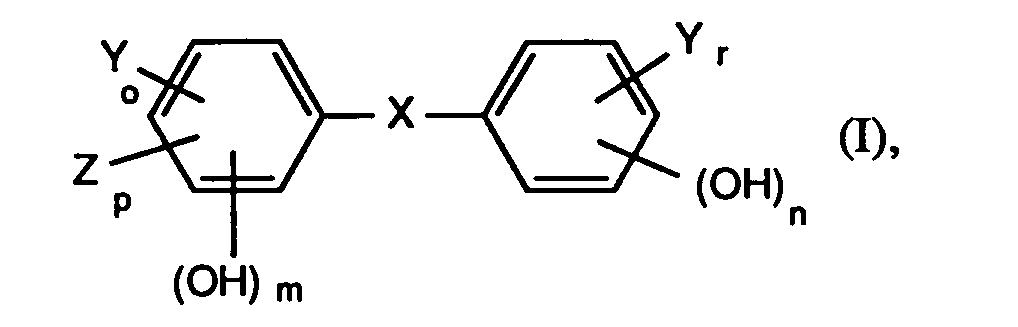
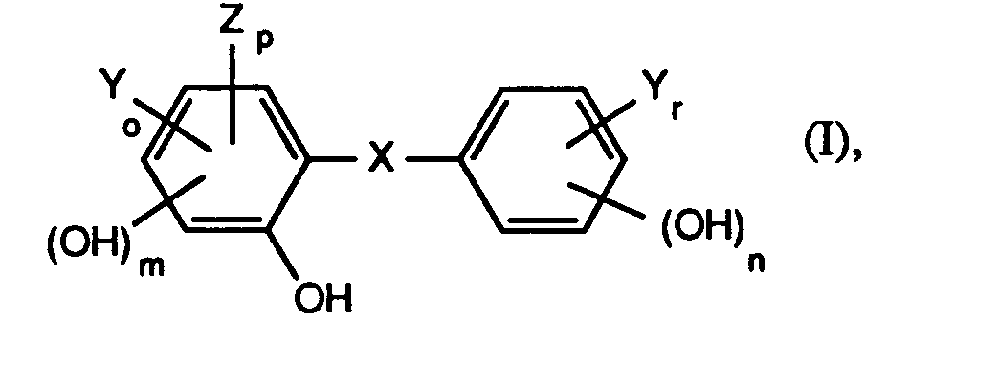
- X is oxygen, sulfur or -CH 2 -, Y chlorine or bromine and Z S0 2 H, N0 2 , or C 1 -C 4 alkyl
- r 0 to 3
- o 0 to 3
- p 0 or 1
- m 0 or 1
- n 0 or 1.
- the compounds of the general formula reduce, depending on the dose, the arachidonic acid-induced contraction of the isolated lung parenchyma strip and the isolated trachea spiral from guinea pigs (Example 1). In both cases, these are proven in vitro models for anti-asthmatic effects, which are based on an influence on the arachidonic acid metabolism in the lung tissue [J. Slapke et al., Biomed. Biochim. Acta 42: 1309 (1983); S.-E. Dahlén et al., Eur. J. Pharmacol. 86, 207 (1983)].
- the compounds I inhibit the purified erythroid 15-lipoxygenase from rabbits in low concentrations [according to Schewe, T .; kuhn, H .; Rapoport, S.M .; in: Benedetto, C .; McDonald-Gibson, R.C .; Nigam, S .; Slater, T.F. (Eds.): Prostaglandins and related substances, pp. 229, IRL Press, Oxford, Washington 1987] (Example 4) and the prostaglandin H synthase from sheep's seminal vesicles [according to Van der Ouderaa, F.J.G. et al., Methods Enzymol. 86, 60 (1982)] (Example 5).
- Eicosanoids which are formed by lipoxygenases or prostaglandin H synthase from arachidonic acid in mammalian cells, play a key role in the pathogenesis of bronchial asthma [Dahlen, S.-R. et al., Respiration 50, Suppl. 2, 22 (1986)], psoriasis [Greaves, M.W .; in Piper, P.J. (Ed.): The Leukotrienes: Their Biological Significance, pp. 175, Raven Press, New York, 1986], UV light-induced dermatitis [Sondergaard, J. et al., Photodermatol.
- the compounds I according to the invention are curative for all forms of bronchial asthma, allergic diseases, fibroproliferative diseases, psoriasis, skin erythema and other inflammatory diseases of non-microbial origin.
- Dosage forms for local (topical) and inhalation treatment are in particular galenic forms which contain the compounds of the formula. to understand.
- Compounds of the formula can also be contained in liposomes or with conventional carriers and / or penetration accelerators such as e.g. Urea, propylene glycol, oleic acid, etc. [see also Barry, B.W. in: Schroot, B .; Schaefer, H. (Eds.): Pharmacol. Skin., Vol. 1, pp. 121, Karger, Basel 1987] can be used in pharmacological preparations.
- compositions of the formula and the pharmaceutical preparations according to the invention are generally present in amounts of 0.01 to 15, preferably 0.1 to 4,% by weight of the total mixture.
- the pharmaceutical preparations according to the invention can also contain other active pharmaceutical ingredients for the treatment of the diseases mentioned, in addition to the compounds of the formula, e.g. anti-inflammatory, antipsoriatic, cell proliferation regulating, anti-allergic, spasmolytic, gastroprotective and anti-asthmatic agents.
- Triclosan and fenticlor are tested for anti-asthmatic effects in vitro on isolated trachea spirals and lung parenchyma strips from adult guinea pigs (250-500 g) of both sexes.
- the preparation of the trachea spirals is carried out according to the method described by Constantine [J.W. Constantine et al., J. Pharm. Pharmacol. 17, 384 (1965)]. Particular emphasis is placed on the complete removal of the surrounding connective tissue and the maintenance of the integrity of the epithelium [N.A. Flavahan et al., J. Appl. Physiol. 58: 834 (1985)].
- the preparation of the lung parenchyma strip is based on that of Del Monte [L. Del Monte et al., Naunyn-Schmiedebergs Arch. Pharmacol., 338, 417 (1988)].
- the contraction of the isolated organs is used as an isotonic displacement measurement under standardized conditions [J. Slapke et al., Biomed. Biochim. Acta 42, 1309 (1983)] in a multiple organ bath.
- the bath temperature is 37 ° C for lung parenchyma strips and 35 ° C for trachea spirals.
- the preparations are conditioned several times with 5. 10-4 M acetylcholine to obtain the normalization value with subsequent rinsing out of this substance.
- Arachidonic acid causes a concentration-dependent contraction with an ED 50 value on average of 10- 4 M for lung strips and 5 ⁇ 10-5 M for trachea spirals on both preparations.
- Triclosan in the concentration of 10 -6 M leads to a complete inhibition of the arachidonic acid-induced contraction (10- 7 - 10-3 M) on the isolated lung parenchyma strip.
- ketotifen in the concentration of 10 -6 M on the same preparation only causes a 25% inhibition and 5 ⁇ 10-5 M nordihydroguajaretic acid and 5 ⁇ 10-5 M BW 755 C each only 50% inhibition.
- Triclosan in concentrations> 10- ß M induces a pronounced dose-dependent relaxation on the isolated lung parenchyma strip under the same experimental conditions.
- Guinea pigs are grown using the method of Anderson [P. Anderson, Brit. J. Pharmacol. 77, 301 (1982)] with 10 ⁇ g ovalbumin and 100 mg aluminum hydroxide in 0.5 ml isotonic saline ip sensitized. After 14 days, an inhaled booster is carried out on the awake animal by atomizing a 0.1% ovalbumin solution. Only animals with a positive reaction were used for comparison from the 4th day after the booster. Guinea pigs with a body weight of 450-550 g are anesthetized ip with 1.3 g / kg ethyl urethane. A cannula is then tied into the tranchea.
- the animals breathe room air through the tracheostomy tube.
- the tidal volume V T is measured pneumotachographically.
- 1 mg / kg ovalbumin is instilled in 300 ⁇ l aqua intratracheally [G. Becher et al., Z. Krankg. Atm. Org. 166, 223 (1986)].
- Pretreatment with fenticlor significantly reduces the allergic reaction compared to the controls.
- the maximum bronchospasm was inhibited by 60% and after 25 minutes a regression to the initial volume was achieved.
- the lipoxygenase from rabbit reticulocytes is obtained in the electrophoretically and immunologically pure form according to the method described in the literature [SM Rapoport et al., Eur. J. Biochem. 96, 545 (1979)].
- the lipoxygenase activity is determined at 25 ° C. via the amperometric measurement of the 0 2 consumption using a Clark electrode in the following system: 0.1 M potassium phosphate pH 7.4 with 0.2% sodium cholate and 0.53 mM linoleic acid.
- the enzyme concentration in the measurement mixture is 25 nM.
- the substances to be tested are added dissolved in methyl glycol (freshly distilled).
- the dilutions of the compounds are chosen so that the final concentrations of methyl glycol in the pre-incubation set do not exceed 2%; under these conditions there are no significant inhibitions in the control approaches.
- the enzyme reaction is started by adding sodium cholate and linoleic acid.
- the titration curve of the inhibition and the concentration required for 50% inhibition is determined by varying the active ingredient concentration.
- Prostaglandin H synthase from sheep's seminal vesicles is produced according to the method described in the literature Van der Oudaraa, F.J.G .; Buytenhek, M .; Methods Enzymol. 86, 60 (1982).
- Enzyme activity is determined at 25 ° C by polarographic measurement of oxygen consumption with a Clark electrode.
- the substances to be tested are dissolved in methyl glycol and incubated for 10 minutes at 25 ° C. with the enzyme in the absence of arachidonic acid. The enzyme reaction is started with arachidonic acid.
- the titration curve of the inhibition and the concentration required for 50% inhibition are determined by varying the active substance concentration.
- the fatty substances and emulsifiers are melted together and the active ingredient is dissolved in them.
- the preservative is dissolved in water, and the solution is emulsified into the fat melt at elevated temperature and stirred cold.
- Preparation example 2 A cream containing 0.5% 2,4,4'-trichloro-2'-hydroxy-diphenyl ether can be prepared as follows:
- the acrylic acid polymer is suspended in a mixture of demineralized water and 1,2-propylene glycol. Triethanolamine is then added with stirring, giving a mucus.
- a mixture of isopropyl palmitate, cetyl palmitate, silicone oil, sorbitan monostearate and polysorbate is heated to approx. 75 ° and the active ingredient is dissolved in it. This fat phase is incorporated into the mucus, which has likewise been heated to about 75 °, with stirring and is cold-stirred.
- Cetyl alcohol, cetyl palmitate, the triglyceride mixture, stearic acid and glycerol stearate are melted together and the active ingredient is dissolved therein.
- the microcrystalline cellulose is dispersed in part of the water.
- Cetomacrogol is dissolved in the remaining part of the water and the propylene glycol and the mucus are mixed with it.
- the fat phase is then added to the water phase with stirring and stirred cold.
- the hydroxypropyl methyl cellulose is swollen in the water.
- the active ingredient is dissolved in a mixture of isopropanol and propylene glycol.
- the active ingredient solution is then mixed with the swollen cellulose derivative and, if desired, fragrances (0.1%) are added.
- Acrylic acid polymer and water are dispersed and neutralized with triethanolamine.
- the active ingredient is dissolved in a mixture of isopropanol and propylene glycol.
- the active ingredient solution is then mixed with a gel, it being possible, if desired, to add fragrance (0.1%).
- Cetyl alcohol, paraffin oil, isopropyl myristate, cetomacrogol and sorbitan stearate are melted together and the active ingredient is dissolved in them.
- Methyl and propyl paraben are dissolved in the propylene glycol and added to the hot water. The melt and the solution are then mixed. After cooling, chemoderm is added and water is added to the final weight.
- the ingredients are melted together and sterile filtered.
- Composition (for 1000 capsules)
- the active ingredient and the lactose finely ground are mixed well together.
- the powder obtained is sieved and filled into portions of 0.05 g in gelatin capsules.
Landscapes
- Health & Medical Sciences (AREA)
- Pharmacology & Pharmacy (AREA)
- Veterinary Medicine (AREA)
- Public Health (AREA)
- General Health & Medical Sciences (AREA)
- Chemical & Material Sciences (AREA)
- Animal Behavior & Ethology (AREA)
- Medicinal Chemistry (AREA)
- Life Sciences & Earth Sciences (AREA)
- Epidemiology (AREA)
- General Chemical & Material Sciences (AREA)
- Nuclear Medicine, Radiotherapy & Molecular Imaging (AREA)
- Chemical Kinetics & Catalysis (AREA)
- Organic Chemistry (AREA)
- Bioinformatics & Cheminformatics (AREA)
- Engineering & Computer Science (AREA)
- Pulmonology (AREA)
- Pain & Pain Management (AREA)
- Dermatology (AREA)
- Neurology (AREA)
- Biomedical Technology (AREA)
- Oncology (AREA)
- Neurosurgery (AREA)
- Rheumatology (AREA)
- Communicable Diseases (AREA)
- Immunology (AREA)
- Acyclic And Carbocyclic Compounds In Medicinal Compositions (AREA)
- Pharmaceuticals Containing Other Organic And Inorganic Compounds (AREA)
- Organic Low-Molecular-Weight Compounds And Preparation Thereof (AREA)
- Medicinal Preparation (AREA)
- Medicines Containing Plant Substances (AREA)
Abstract
Description
- Die Erfindung betrifft pharmazeutische Zusammensetzungen mit lipoxygenase- und prostaglandin H-synthasehemmende Wirkstoffen zur vorzugsweise topischen Applikation in der Human- und Veterinärmedizin. Sie dienen insbesondere zur Behandlung entzündlicher Hauterkrankungen nichtmikrobieller Genese wie z.B. Psoriasis, Hauterythemen, fibroproliferativen Erkrankungen, allergischen Erkrankungen und Asthma bronchialis.
- Zur topischen Behandlung von inflammatorischen und allergischen Erkrankungen werden vorrangig Glukokortikoide eingesetzt. Es ist allgemein bekannt, dass diese unerwünschte Nebenwirkungen haben.
- Nichtsteroidale entzündungshemmende Arzneimittel, die Wirkstoffe wie z.B. Ketoprofen, BW 755 c, Piroxicam, Diclofenac bzw. Indomethazin enthalten, können aufgrund ihrer unzureichenden Hautpenetration (siehe z.B. G.B. Kasting et al., Pharmacol. Scin., Vol. 1, pp. 138-153, Karger, Basel 1987) nicht wirkungsvoll lokal begrenzt, sondern nur systemisch angewendet werden. Gut hautpenetrierende 2-Hydroxy-diphenyläther, 2-Hydroxy-diphenylmethane und 2-Hydroxy-diphenylthioäther als Bestandteile von pharmazeutischen Zubereitungen wurden bisher nur für eine antimikrobielle Wirksamkeit beansprucht (DRP 568.944, CH 428.758, DE 1.216.882) bzw. eingesetzt [z.B. H. Abdel Aal et al., J. Int. Med. Res. 15, 383 (1987)].
- Die Behandlung von entzündlichen Erkrankungen durch die genannten Verbindungen, die auf einer Störung der endogenen Stoffwechselregulation beruhen, sind nicht bekannt.
- Ziel der Erfindung ist die Bereitstellung von pharmazeutischen Zusammensetzungen mit pharmakologisch wertvollen, insbesondere antiinflammatorischen, antipsoriatrischen, zellproliferationsregulierenden, antiallergischen, spasmolytischen, gastroprotektiven und antiasthmatischen Eigenschaften bei insbesondere lokaler und/oder inhalativer Anwendung.
- Aufgabe der Erfindung ist die Entwicklung von pharmazeutischen Zusammensetzungen mit antiinflammatorischen, antiallergischen und weiteren pharmakologisch wertvollen Eigenschaften, die insbesondere auf der Hemmung der Oxygenierungsreaktionen des Arachidonsäurestoffwechsels beruhen und bei lokaler Anwendung keine unerwünschte Nebenwirkungen zeigen.
- Ueberraschenderweise wurde gefunden, dass an und für sich bekannte 2-Hydroxy-diphenyläther, 2-Hydroxy-diphenylmethane und 2-Hydroxy-diphenylthioäther der allgemeinen Formel I

- Die antiinflammatorische, antiallergische und antiasthmatische Wirkungen wird in zellulären in vitro und un tierexperimentellen in vitro- und in vivo-Untersuchungen bestätigt.
- Hervorzuheben sind die Verbindungen der Formel

- Besonders interessant haben sich Verbindungen der Formel (I) erwiesen, worin X Sauerstoff, Schwefel oder -CH2- und Y Chlor oder Brom bedeuten, und m = 0, n = 0 oder 1, o = 1 oder 2, r = 1 oder 2 und p = 0 sind.
- Ganz besonders interessant haben sich Verbindungen der Formel (I) erwiesen, worin X Sauerstoff und Y Chlor bedeuten, und m = 0, n = 0, o = 1, r = 2 und p = 0 sind.
- Die Verbindungen der allgemeinen Formel reduzieren dosisabhängig die arachidonsäwe-induzierte Kontraktion des isolierten Lungenparenchymstreifens und der isolierten Tracheaspirale vom Meerschweinchen (Beispiel 1). In beiden Fällen handelt es sich um bewährte in vitro-Modelle für antiasthmatische Wirkungen, die auf einer Beeinflussung des Arachidonsäurestoffwechsels im Lungengewebe beruhen [J. Slapke et al., Biomed. Biochim. Acta 42, 1309 (1983); S.-E. Dahlén et al., Eur. J. Pharmacol. 86, 207 (1983)].
- Des weiteren wird duch die genannten Verbindungen 1 die spezifisch-allergische Bronchokonstriktion am Ovalbumin-sensibilisierten, narkotisierten und künstlich beatmeten Meerschweinchen [nach P. Andersson, Brit. J. Pharmacol. 77, 301 (1982)] erheblich reduziert (Beispiel 2).
- Im in vivo-Asthma-Modell der intratrachealen Instillation von Arachidonsäure beim Meerschweinchen [nach G. Becher et al., Z. Erkrank. Atm.-org. 171, 85 ( 1988)] wird durch die genannten Verbindungen die Bronchokonstriktion signifikant verringert (Beispiel 3).
- Weiterhin hemmen die Verbindungen I in niedrigen Konzentrationen die gereinigte erythroide 15-Lipoxygenase von Kaninchen [nach Schewe, T.; Kühn, H.; Rapoport, S.M.; in: Benedetto, C.; McDonald-Gibson, R.C.; Nigam, S.; Slater, T.F. (Eds.): Prostaglandins and related substances, pp. 229, IRL Press, Oxford, Washington 1987] (Beispiel 4) sowie die Prostaglandin H-Synthase aus Schafssamenblasen [nach Van der Ouderaa, F.J.G. et al., Methods Enzymol. 86, 60 (1982)] (Beispiel 5).
- Eicosanoide, die durch Lipoxygenasen oder Prostaglandin H-Synthase aus Arachidonsäure in Säugetierzellen gebildet werden, spielen eine Schlüsselrolle in der Pathogenese des Asthma bronchiale [Dahlen, S.-R. et al., Respiration 50, Suppl. 2, 22 (1986)], der Psoriasis [Greaves, M.W.; in Piper, P.J. (Ed.): The Leukotrienes: Their Biological Significance, pp. 175, Raven Press, New York, 1986], UV-Lichtinduzierter Dermatitis [Sondergaard, J. et al., Photodermatol. 359, 66 (1985)] und einer Vielzahl von allergischen Krankheitsbildern [Stenson, W.F. et al. Clin. Rev. Allergy 1, 369 (1983); Parker, C.W. in: Ring, J. (Ed.): New Trends in Allergy II, pp. 137, Springer-Verlag, Heidelberg 1985]. Demzufolge sind die Verbindungen I erfindungemäss direkt oder als Bestandteil galenischer Zubereitungen zusammen mit einem oder mehreren pharmazeutisch verwendbaren Trägermaterialien kurativ für alle Formen von Asthma bronchiale, allergische Erkrankungen, fibroproliferative Erkrankungen, Psoriasis, Hauterythemen und andere Inflammatorischen Erkrankungen nichtmikrobieller Genese wirksam.
- Als galenische Formen, die die Verbindungen der Formel enthalten, sind insbesondere Dareichungsformen für die lokale (topische) und inhalatorische Behandlung, wie Emulsionen, Salben, Gele, Sprays, Puder u.a. zu verstehen. Verbindungen der Formel können auch in Liposomen enthalten sein oder mit üblichen Trägerstoffen und/oder Penetrationsbeschleunigern wie z.B. Harnstoff, Propylenglykol, Oleinsäure u.a. [siehe auch Barry, B.W. in: Schroot, B.; Schaefer, H. (Eds.): Pharmacol. Skin., Vol. 1, pp. 121, Karger, Basel 1987] in pharmakologischen Zubereitungen eingesetzt werden. Verbindungen der Formel und die in erfindungsgemässen pharmazeutischen Zubereitungen sind im allgemeinen in Mengen von 0,01 bis 15, vorzugsweise 0,1 bis 4 Gew.% der Gesamtmischung vorhanden. Die erfindungsgemässen pharmazeutischen Zubereitungen können für die Behandlung der angeführten Erkrankungen ausserden Verbindungen der Formel auch weitere pharmazeutische Wirkstoffe enthalten, z.B. antiinflammatorische, antipsoriatische, zellproliferationsregulierende, antiallergische, spasmolytische, gastroprotektive und antiasthmatische Wirkstoffe.
- Die Prüfung von Triclosan und Fenticlor auf antiasthmatische Wirkqualitäten in vitro erfolgt an isolierten Tracheaspiralen und Lungenparenchymstreifen von erwachsenen Meerschweinchen (250-500 g) beiderlei Geschlechts. Die Präparation der Tracheaspiralen wird nach der von Constantine [J.W. Constantine et al., J. Pharm. Pharmacol. 17, 384 (1965)] beschriebenen Methode vorgenommen. Es wird besonderer Wert auf eine vollständige Entfernung des umgebenden Bindegewebes und der Aufrechterhaltung der Integrität des Epithels gelegt [N.A. Flavahan et al., J. Appl. Physiol. 58, 834 (1985)].
- Die Präparation des Lungenparenchymstreifens erfolgt in Anlehnung an die von Del Monte [L. Del Monte et al., Naunyn-Schmiedebergs Arch. Pharmacol., 338, 417 (1988)] beschriebenen Methode. Die Kontraktion der isolierten Organe wird als isotonische Wegmessung unter standardisierten Bedingunen [J. Slapke et al., Biomed. Biochim. Acta 42, 1309 (1983)] in einem Mehrfachorganbad erfasst.
- Für die Untersuchungen wird eine modifizierte Krebs-Henseleit-Lösung (pH = 7,4) folgender Zusammensetzung verwendet (m.mol 1-1): NaCl 134,8, KCI 5,9, Tris 10,02, CaC12 1,82, MgCI2 1,145, Glukose 1,11. Die Begasung erfolgt mit Luft. Die Badtemperatur liegt für Lungenparenchymstreifen bei 37°C und für Tracheaspiralen bei 35°C. Die Konditionierung der Präparate erfolgt mehrmals mit 5 . 10-4 M Acetylcholin zur Gewinnung des Normierungswertes mit anschliessendem Herausspülen dieser Substanz.
- In allen Untersuchungen wird die Kontraktionen durch Zugabe von Arachidonsäure in das Organbad in ansteigenden Konzentrationen induziert und kumulativ gemessen. Alle Messungen erfolgen in Gegenwart von 5 µM Indomethazin.
- Arachidonsäure bewirkt an beiden Präparationen eine konzentrationsabhängige Kontraktion mit einem ED50-Wert im Mittel von 10-4 M für Lungenstreifen und 5·10-5 M für Tracheaspiralen.
- Triclosan in der Konzentration von 10-6 M führt zu einer vollständigen Hemmung der arachidonsäureinduzierten Kontraktion (10-7 - 10-3 M) am isolierten Lungenparenchymstreifen.
- Im Vergleich dazu bewirkt Ketotifen in der Konzentration von 10-6 M an der gleichen Präparation nur eine 25 %ige Hemmung und 5·10-5 M Nordihydroguajaretsäure und 5·10-5 M BW 755 C nur je eine 50%ige Hemmung.
- Triclosan in Konzentrationen >10-ß M induziert unter gleichen Versuchsbedingungen eine ausgeprägte dosisabhängige Relaxation am isolierten Lungenparenchymstreifen. In Gegenwart von 5 . 10-s M oder 5 . 10-5 M Triclosan beträgt die Arachidonsäurekonzentration, die eine halbmaximale Relaxation hervorruft, ID50 =3·10-6M.
- Der entsprechende Wert an der Tracheaspirale beträgt IC50 = 10-6 M.
- isolierter Lungenparenchymstreifen:
-


- Meerschweinchen werden nach der Methode von Anderson [P. Anderson, Brit. J. Pharmacol. 77, 301 (1982)] mit 10 µg Ovalbumin und 100 mg Aluminiumhydroxyd in 0,5 ml isotonischer Kochsalzlösung i.p. sensibilisiert. Nach 14 Tagen erfolgt eine inhalative Boosterung am wachen Tier durch Vernebelung einer 0,1 %igen Ovalbuminlösung. Nur Tiere mit einer positiven Reaktion wurden ab 4. Tag nach der Boosterung zum Vergleich eingesetzt. Meerschweinchen mit einem Körpergewicht von 450-550 g werden mit 1,3 g/kg Ethylurethan i.p. narkotisiert. Danach wird eine Kanüle in die Tranchea eingebunden. Die Tiere werden mit 0,2 mg/kg Pancuroniumbromid i.V. relaxiert und in einem Tankrespirator beatmet (f = 20/min, p = 3 pPa, I:E=1:1). Die Tiere atmen Raumluft über die nach aussen geführte Tracheakanüle. Das Atemzugvolumen VT wird pneumotachographisch gemessen. Zur Auslösung des Spasmus werden 1 mg/kg Ovalbumin in 300 µl aqua intratracheal instilliert [G. Becher et al., Z. Erkrankg. Atm.-org. 166, 223 (1986)].
- In Abb. 1 ist der zeitliche Verlauf des Atemzugvolumens während unveränderter künstlicher Beatmung in Prozent des Ausgangswertes für die Kontrolltiere (n = 6) und für 2 h vor Versuch mit 100 mg/kg Fenticlor p.o. vorbehandelte Versuchstiere (n = 6) dargestellt.
- Durch Vorbehandlung mit Fenticlor wird die allergische Reaktion im Vergleich zu den Kontrollen deutlich gesenkt. Der maximale Bronchospasmus wurde zu 60 % gehemmt und nach 25 min wurde eine Rückbildung bis auf das Ausgangsvolumen erreicht.
- Die statistische Aufbereitung der Ergebnisse erfolgt mit dem parameterfreien U-Test nach Mann und Whitney, p ≤ 0,05.

- Bei gleicher Versuchsanordnung wie im Beispiel 2 wird bei nichtsensibilisierten Meerschweinchen durch intratracheale Instillation von 2 mg/kg Na-Arachidonat-Lösung in Phosphatpuffer pH = 7,4 ein Bronchospasmus ausgelöst [G. Becher et al., Z. Erkrankg. Atm.-org. 171, 85 ( 1988)].
- In Abb. 2 ist der zeitliche Verlauf des Atemzugvolumens während unveränderter künstlicher Beatmung in Prozent des Ausgangswertes für die Kontrolltiere (n = 6) und für 2 h vor Versuch mit 100 mg/kg Fenticlor p.o. vorbehandelte Versuchstiere (n = 6) dargestellt.
- Durch Vorbehandlung mit Fenticlor wird die arachidonsäure-induzierte bronchokonstriktive Reaktion ab der 5. Minute signifikant (parameterfreier U-Test nach Mann und Whitney p < 0,05) gehemmt. Der maximale Bronchospasmus wird zu 16,5 % gehemmt und nach 25 min wird eine Rückbildung bis auf das Ausgangsvolumen erreicht.

- Die Lipoxygenase aus Kaninchenretikulozyten wird nach dem in der Literatur beschriebenen Verfahren in elektrophoretisch und immunologisch reiner Form erhalten [S.M. Rapoport et al., Eur. J. Biochem. 96, 545 (1979)]. Die Bestimmung der Lipoxygenaseaktivität erfolgt bei 25°C über die amperometrische Messung des 02-Verbrauchs mittels einer Clark-Elektrode in folgendem System: 0,1 M Kaliumphosphat pH 7,4 mit 0,2 % Natriumcholat und 0,53 mM Linolsäure. Die Enzymkonzentration beträgt im Messansatz 25 nM. Die zu prüfenden Substanzen werden in Methylglykol (frisch destilliert) gelöst zugesetzt. Die Verdünnungen der Verbindungen werden so gewählt, dass die Endkonzentrationen an Methylglykol im Vorinkubationssatz 2 % nicht überstieg; unter diesen Bedingungen treten keine nennenswerte Hemmungen in den Kontrollansätzen auf. Die Enzymreaktion wird durch Zusatz von Natriumcholat und Linolsäure gestartet. Durch Variation der Wirkstoffkonzentration wird die Titrationskurve der Hemmung und daraus die erforderliche Konzentration für eine 50 %ige Hemmung ermittelt.
- Die Ergebnisse sind in Tabelle 1 dargestellt
-

- Prostaglandin H-Synthase aus Schafssamenblasen wird nach dem in der Literatur beschriebenen Verfahren Van der Oudaraa, F.J.G.; Buytenhek, M.; Methods Enzymol. 86, 60 (1982) erhalten.
- Die Bestimmung der Enzymaktivität erfolgt bei 25°C durch polarografische Messung des Sauerstoffverbrauchs mit einer Clark-Elektrode.
- Der Messansatz besteht aus 400 µg ml-1 Prostaglandin H-Synthase in 0,1 M Tris-HCI-Puffer pH = 8,0, 5 mM Tryptophan, 1 µM Haemin und 0,124 mM Arachidonsäure. Die zu prüfenden Substanzen werden in Methylglykol gelöst und 10 Minuten bei 25°C mit dem Enzym in Abwesenheit von Arachidonsäure inkubiert. Die Enzymreaktion wird mit Arachidonsäure gestartet.
- Durch Variation der Wirkstoffkonzentration werden die Titrationskurve der Hemmung und daraus die erforderliche Konzentration für eine 50 %ige Hemmung ermittelt.
- Die Ergebnisse sind in Tabelle 2 dargestellt

- Die nachfolgenden Beispiele illustrieren die oben beschriebene Erfindung ohne sie einzuscnränken. i emperaturen sind in Celsiusgraden angegeben-Präparatebeispiel 1: Eine Salbe enthaltend 0,05 % 2,4,4'-Trichlor-2'-hydroxy-diphenyl-ether kann wie folgt hergestellt werden:
-

- Die Fettstoffe und Emulgatoren werden zusammengeschmolzen und der Wirkstoff darin gelöst. Das Konservierungsmittel wird in Wasser gelöst, und die Lösung in die Fettschmelze bei erhöhter Temperatur einemulgiert und kaltgerührt.
-

- Das Acrylsäurepolymerisat wird in einem Gemisch aus entmineralisiertem Wasser und 1,2-Propylenglykol suspendiert. Unter Rühren wird hierauf Triäthanolamin zugegeben, wodurch ein Schleim erhalten wird. Ein Gemisch aus Isopropylpalmitat, Cetylpalmitat, Siliconöl, Sorbitanmonostearat und Polysorbat wird auf ca. 75° erwärmt und darin der Wirkstoff gelöst. Diese Fettphase wird unter Rühren in den gleichfalls auf ca. 75° erwärmten Schleim eingearbeitet und kaltgerührt.
-

- Cetylalkohol, Cetylpalmitat, das Triglyceridgemisch, Stearinsäure und Glycerinstearatwerden zusammengeschmolzen und der Wirkstoff darin gelöst. Die mikrokristalline Cellulose wird in einem Teil des Wassers dispergiert. Im restlichen Teil des Wassers wird Cetomacrogol gelöst und das Propylenglykol sowie der Schleim dazu gemischt. Die Fettphase wird anschliessend unter Rühren zur Wasserphase gegeben und kaltgerührt.
-

- Die Hydroxypropyl-methylcellulose wird im Wasser gequollen. Der Wirkstoff wird in einem Gemisch aus Isopropanol und Propylenglykol gelöst. Anschliessend wird die Wirkstofflösung mit dem gequollenen CelluloseDerivat vermischt und, wenn erwünscht, mit Riechstoffen (0,1 %) versetzt.
-

- Acrylsäurepolymerisat und Wasser werden dispergiert und mit Triäthanolamin neutralisiert. Der Wirkstoff wird in einem Gemisch aus Isopropanol und Propylenglykol gelöst. Anschliessend wird die Wirkstofflösung mit einem Gel vermischt, wobei, wenn erwünscht, Riechstoff (0,1%) zugegeben werden kann.
-

- Cetylalkohol, Paraffinöl, Isopropylmyristat, Cetomacrogol und Sorbitanstearat werden zusammengeschmolzen und der Wirkstoff darin gelöst. Methyl- und Propylparaben werden im Propylenglykol gelöst und dem heissen Wasser zugegeben. Die Schmelze und die Lösung werden anschliessend vermischt. Nach dem Abkühlen wird Chemoderm zugeführt und mit Wasser auf das Endgewicht ergänzt.
- 20 ml des Gemisches werden in eine Aluminiumdose eingefüllt. Die Dose wird mit einem Ventil versehen, und das Treibgas wird unter Druck eingefüllt.
-

- Die Bestandteile werden zusammengeschmolzen und steril filtriert.
- Präparatebeispiel 8: Zur Insufflation geeignete, 0,025 g 2,4,4'-Trichlor-2'-hydroxy-diphenylether enthaltende Kapseln können wie folgt hergestellt werden:
- Zusammensetzung: (für 1000 Kapseln)

- Der Wirkstoff und die Laktose feinst gemahlen werden gut miteinander vermischt. Das erhaltene Pulver wird gesiebt und in Portionen zu je 0,05 g in Gelatinekapseln abgefüllt.
Claims (18)



Applications Claiming Priority (2)
| Application Number | Priority Date | Filing Date | Title |
|---|---|---|---|
| CH2875/90 | 1990-09-05 | ||
| CH287590 | 1990-09-05 |
Publications (3)
| Publication Number | Publication Date |
|---|---|
| EP0474597A2 true EP0474597A2 (de) | 1992-03-11 |
| EP0474597A3 EP0474597A3 (en) | 1992-07-01 |
| EP0474597B1 EP0474597B1 (de) | 1997-08-06 |
Family
ID=4243541
Family Applications (1)
| Application Number | Title | Priority Date | Filing Date |
|---|---|---|---|
| EP91810685A Expired - Lifetime EP0474597B1 (de) | 1990-09-05 | 1991-08-27 | Arachidonsäurestoffwechselhemmende Diphenylverbindungen und ihre Verwendung in pharmazeutischen Zusammensetzungen |
Country Status (22)
| Country | Link |
|---|---|
| US (1) | US5185377A (de) |
| EP (1) | EP0474597B1 (de) |
| JP (1) | JP3264950B2 (de) |
| KR (1) | KR100201749B1 (de) |
| AT (1) | ATE156353T1 (de) |
| AU (1) | AU645599B2 (de) |
| CA (1) | CA2050569C (de) |
| CZ (1) | CZ279624B6 (de) |
| DE (1) | DE59108814D1 (de) |
| DK (1) | DK0474597T3 (de) |
| ES (1) | ES2106770T3 (de) |
| FI (1) | FI914185A7 (de) |
| GR (1) | GR3024440T3 (de) |
| HU (2) | HUT58998A (de) |
| IE (1) | IE913110A1 (de) |
| IL (1) | IL99376A (de) |
| MX (1) | MX9100917A (de) |
| NO (1) | NO913472L (de) |
| PT (1) | PT98874B (de) |
| RU (1) | RU2060731C1 (de) |
| SK (1) | SK279104B6 (de) |
| ZA (1) | ZA917005B (de) |
Cited By (3)
| Publication number | Priority date | Publication date | Assignee | Title |
|---|---|---|---|---|
| EP0528468A1 (de) * | 1991-08-08 | 1993-02-24 | Unilever N.V. | Verwendung von Triclosan zur Herstellung eines Arzneimittels zur Inhibierung der Cyclooxygenase |
| WO1994003149A3 (de) * | 1992-08-06 | 1994-06-23 | Beiersdorf Ag | Lipid lösliche thioether und dithioether in kosmetischen präparaten gegen die alterung der menschlichen haut |
| WO2001000138A3 (en) * | 1999-06-23 | 2002-07-11 | Jawaharlal Nehru Ct For Advanc | Use of hydroxydiphenyl ether class of chemicals, as exemplified by triclosan, as an antimalarial and identification of fatty acid synthesis as its target |
Families Citing this family (12)
| Publication number | Priority date | Publication date | Assignee | Title |
|---|---|---|---|---|
| US6440395B1 (en) | 1992-06-22 | 2002-08-27 | Barry M. Libin | Antiplaque mouth rinse |
| US5880146A (en) * | 1995-06-07 | 1999-03-09 | Fuji Immunopharmaceuticals Corporation | Inhibition of IL-12-induced IFN-γ synthesis by specific bis-phenol compounds as a method of immune modulation |
| EP0839031A1 (de) * | 1995-07-20 | 1998-05-06 | JUERGENS, Uwe R. | Verwendung eines nicht-steroidalen antiphlogistikums zur topischen und systemischen behandlung der akuten und chronischen polypoiden rhinosinusitis |
| AUPN814496A0 (en) * | 1996-02-19 | 1996-03-14 | Monash University | Dermal penetration enhancer |
| US6108850A (en) * | 1997-06-03 | 2000-08-29 | Mclaughlin; Gerald | Accelerated method and instrumentation for whitening teeth |
| DE19834355A1 (de) * | 1998-07-30 | 2000-02-03 | Henkel Kgaa | Entzündungshemmende Zahnpflegemittel |
| US7566740B2 (en) * | 1998-10-06 | 2009-07-28 | Bml Pharmaceuticals, Inc. | Method of treating mucositis |
| RU2200550C2 (ru) * | 1999-10-29 | 2003-03-20 | Научно-исследовательская лаборатория иммунохимиотерапии лепры и иммунотропных средств с клиникой и опытно-экспериментальным производством | Новые лекарственные формы димоцифона в терапии лепры, зудящих и аллергодерматозов, герпетиформного дерматита дюринга |
| WO2002050008A2 (en) * | 2000-12-20 | 2002-06-27 | Warner-Lambert Company Llc | Non-halogenated phenoxy and/or benzyloxy phenols and antimicrobial compositions containing them |
| EP1366763A1 (de) * | 2002-05-28 | 2003-12-03 | Ciba SC Holding AG | Hydroxydiphenyletherverbindungen als Entzündungshemmer |
| US20030229149A1 (en) * | 2002-05-28 | 2003-12-11 | Werner Baschong | Anti-inflammatory agents |
| JP2013532734A (ja) * | 2010-08-04 | 2013-08-19 | ユニバーシティ オブ バージニア パテント ファウンデーション | 炎症性疾患を治療するための組成物及び方法 |
Family Cites Families (8)
| Publication number | Priority date | Publication date | Assignee | Title |
|---|---|---|---|---|
| CA1199273A (en) * | 1982-07-15 | 1986-01-14 | Ctibor Schindlery | Anti-inflammatory composition |
| GB2148116B (en) * | 1983-10-27 | 1986-07-30 | Ciba Geigy Ag | Topical steroid preparations |
| GB8526093D0 (en) * | 1985-10-22 | 1985-11-27 | Beecham Group Plc | Composition |
| US4735802A (en) * | 1986-05-05 | 1988-04-05 | Le Bich N | Topical dermatological composition and method of treatment |
| US4942029A (en) * | 1986-09-19 | 1990-07-17 | Smith & Nephew United, Inc. | Medicated skin preparation |
| GB8629640D0 (en) * | 1986-12-11 | 1987-01-21 | Beecham Group Plc | Composition & method |
| GB8718026D0 (en) * | 1987-07-29 | 1987-09-03 | Smith & Nephew Ass | Pharmaceutical composition |
| AU610906B2 (en) * | 1987-07-31 | 1991-05-30 | Sumitomo Chemical Company, Limited | Method for preventing harm from bloodsucking insects |
-
1991
- 1991-08-27 AT AT91810685T patent/ATE156353T1/de not_active IP Right Cessation
- 1991-08-27 DK DK91810685.7T patent/DK0474597T3/da active
- 1991-08-27 ES ES91810685T patent/ES2106770T3/es not_active Expired - Lifetime
- 1991-08-27 EP EP91810685A patent/EP0474597B1/de not_active Expired - Lifetime
- 1991-08-27 DE DE59108814T patent/DE59108814D1/de not_active Expired - Lifetime
- 1991-09-03 MX MX9100917A patent/MX9100917A/es not_active IP Right Cessation
- 1991-09-03 CA CA002050569A patent/CA2050569C/en not_active Expired - Lifetime
- 1991-09-03 IL IL9937691A patent/IL99376A/en not_active IP Right Cessation
- 1991-09-04 NO NO91913472A patent/NO913472L/no unknown
- 1991-09-04 HU HU912866A patent/HUT58998A/hu unknown
- 1991-09-04 ZA ZA917005A patent/ZA917005B/xx unknown
- 1991-09-04 US US07/754,788 patent/US5185377A/en not_active Expired - Lifetime
- 1991-09-04 KR KR1019910015407A patent/KR100201749B1/ko not_active Expired - Fee Related
- 1991-09-04 RU SU915001448A patent/RU2060731C1/ru active
- 1991-09-04 FI FI914185A patent/FI914185A7/fi unknown
- 1991-09-04 SK SK2718-91A patent/SK279104B6/sk unknown
- 1991-09-04 CZ CS912718A patent/CZ279624B6/cs unknown
- 1991-09-04 IE IE311091A patent/IE913110A1/en not_active IP Right Cessation
- 1991-09-04 AU AU83640/91A patent/AU645599B2/en not_active Ceased
- 1991-09-05 JP JP22563191A patent/JP3264950B2/ja not_active Expired - Lifetime
- 1991-09-05 PT PT98874A patent/PT98874B/pt not_active IP Right Cessation
-
1995
- 1995-06-21 HU HU95P/P00310P patent/HU211292A9/hu unknown
-
1997
- 1997-08-13 GR GR970402083T patent/GR3024440T3/el unknown
Cited By (4)
| Publication number | Priority date | Publication date | Assignee | Title |
|---|---|---|---|---|
| EP0528468A1 (de) * | 1991-08-08 | 1993-02-24 | Unilever N.V. | Verwendung von Triclosan zur Herstellung eines Arzneimittels zur Inhibierung der Cyclooxygenase |
| US5240696A (en) * | 1991-08-08 | 1993-08-31 | Chesebrough-Pond's Usa Co., Division Of Conopco, Inc. | Treatment of periodontitis |
| WO1994003149A3 (de) * | 1992-08-06 | 1994-06-23 | Beiersdorf Ag | Lipid lösliche thioether und dithioether in kosmetischen präparaten gegen die alterung der menschlichen haut |
| WO2001000138A3 (en) * | 1999-06-23 | 2002-07-11 | Jawaharlal Nehru Ct For Advanc | Use of hydroxydiphenyl ether class of chemicals, as exemplified by triclosan, as an antimalarial and identification of fatty acid synthesis as its target |
Also Published As
| Publication number | Publication date |
|---|---|
| PT98874A (pt) | 1992-07-31 |
| JPH04257517A (ja) | 1992-09-11 |
| PT98874B (pt) | 1999-02-26 |
| AU645599B2 (en) | 1994-01-20 |
| IE913110A1 (en) | 1992-03-11 |
| EP0474597B1 (de) | 1997-08-06 |
| KR100201749B1 (ko) | 1999-06-15 |
| CS271891A3 (en) | 1992-03-18 |
| IL99376A0 (en) | 1992-08-18 |
| MX9100917A (es) | 1992-05-04 |
| SK279104B6 (sk) | 1998-06-03 |
| CA2050569C (en) | 2004-01-27 |
| US5185377A (en) | 1993-02-09 |
| IL99376A (en) | 1996-01-19 |
| HUT58998A (en) | 1992-04-28 |
| NO913472D0 (no) | 1991-09-04 |
| HU211292A9 (en) | 1995-11-28 |
| NO913472L (no) | 1992-03-06 |
| FI914185A0 (fi) | 1991-09-04 |
| DK0474597T3 (da) | 1997-10-20 |
| ATE156353T1 (de) | 1997-08-15 |
| KR920005988A (ko) | 1992-04-27 |
| AU8364091A (en) | 1992-03-12 |
| JP3264950B2 (ja) | 2002-03-11 |
| CZ279624B6 (cs) | 1995-05-17 |
| ES2106770T3 (es) | 1997-11-16 |
| CA2050569A1 (en) | 1992-03-06 |
| RU2060731C1 (ru) | 1996-05-27 |
| EP0474597A3 (en) | 1992-07-01 |
| ZA917005B (en) | 1992-04-29 |
| FI914185A7 (fi) | 1992-03-06 |
| GR3024440T3 (en) | 1997-11-28 |
| DE59108814D1 (de) | 1997-09-11 |
Similar Documents
| Publication | Publication Date | Title |
|---|---|---|
| DE60026826T2 (de) | Alterungsschutztetrapeptid, dieses enthaltende pharmazeutische zusammensetzungen und seine verwendung | |
| EP0060553B1 (de) | Präparat zur Behandlung von Wunden der Hautoberfläche und Verfahren zur Herstellung des Präparats | |
| DE69909794T2 (de) | Verwendung eines dipeptids für wiederherstellungsprozesse | |
| DE69317494T2 (de) | Zusammensetzungen, die mono oder polyhydroxylierte Aminosäuren zur Behandlung des Insulinunabhängigen Diabetes Mellitus enthalten | |
| EP0474597B1 (de) | Arachidonsäurestoffwechselhemmende Diphenylverbindungen und ihre Verwendung in pharmazeutischen Zusammensetzungen | |
| DE4244090A1 (en) | Deactivating agent for active oxygen - is amino-thiosulphonic acid cpd. useful in treatment of, e.g. lung or cardiovascular disorders, or diabetes | |
| DE69804130T2 (de) | Verwendung eines gemischs aus einem diol und einer alpha-hydroxysäure zur behandlung hyperkeratotischer hauterkrankungen | |
| CH644845A5 (de) | N-(4-acyloxyphenyl)-all-trans-retinsaeureamide. | |
| DE3209330C2 (de) | ||
| DE1620629C3 (de) | Verwendung eines Salzes von 2-Merkaptoäthansulf onsäure zur Herstellung von Mukolytica | |
| CH621334A5 (de) | ||
| DE69231222T2 (de) | Naphtochinonderivate zur Behandlung von chronischen Entzündungen | |
| WO1999047145A1 (de) | Verwendung von sphingosin-1-phosphat, sphingosin-1-phosphat-derivaten und/oder deren gemische zur behandlung von entzündlichen hautkrankheiten | |
| DE69513389T2 (de) | Dl-di od. tri hydroxyphenylglycinalkylester zur behandlung entzündlicher und allergischer zustände | |
| DE3633315A1 (de) | Mittel zur prophylaxe und behandlung von hautverbrennungen durch strahlen | |
| DE69434002T2 (de) | 2,3 diaryl-1-benzopyrame zur behandlung von dermatitis | |
| EP1305016B1 (de) | Verwendung von n-oleoylethanolamin zur behandlung der schuppenflechte (psoriasis) | |
| EP0442350A1 (de) | Arzneimittelzubereitung, enthaltend Stigmasta-4-en-3-on sowie deren Verwendung | |
| DE3827953C2 (de) | ||
| CH690816A5 (de) | Verwendung eines Teil- oder Vollextrates aus nicht fermentierter Camellia sinensis L. zur Herstellung eines Medikamentes, eines Medizinproduktes, eines kosmetischen Präparates oder eines Nahrungsergänzungsproduktes. | |
| DE2228187A1 (de) | Arzneimittel | |
| EP0241498B1 (de) | Schmerzstillendes und entzündungshemmendes arzneimittel auf pflanzlicher basis | |
| DE1692035C3 (de) | Arzneimittel mit bronchodilatorischer Wirkung | |
| AT259757B (de) | Verfahren zur Herstellung eines corticosteroid- und thiaminhaltigen Arzneimittels | |
| DE2803230A1 (de) | Salze von basischen aminozuckern oder basischen aminosaeuren, deren herstellung sowie diese enthaltende pharmazeutische praeparate |
Legal Events
| Date | Code | Title | Description |
|---|---|---|---|
| PUAI | Public reference made under article 153(3) epc to a published international application that has entered the european phase |
Free format text: ORIGINAL CODE: 0009012 |
|
| 17P | Request for examination filed |
Effective date: 19910831 |
|
| AK | Designated contracting states |
Kind code of ref document: A2 Designated state(s): AT BE CH DE DK ES FR GB GR IT LI LU NL SE |
|
| PUAL | Search report despatched |
Free format text: ORIGINAL CODE: 0009013 |
|
| AK | Designated contracting states |
Kind code of ref document: A3 Designated state(s): AT BE CH DE DK ES FR GB GR IT LI LU NL SE |
|
| 17Q | First examination report despatched |
Effective date: 19950111 |
|
| GRAG | Despatch of communication of intention to grant |
Free format text: ORIGINAL CODE: EPIDOS AGRA |
|
| RAP1 | Party data changed (applicant data changed or rights of an application transferred) |
Owner name: CIBA SC HOLDING AG |
|
| GRAH | Despatch of communication of intention to grant a patent |
Free format text: ORIGINAL CODE: EPIDOS IGRA |
|
| RAP3 | Party data changed (applicant data changed or rights of an application transferred) |
Owner name: CIBA SPECIALTY CHEMICALS HOLDING INC. |
|
| GRAH | Despatch of communication of intention to grant a patent |
Free format text: ORIGINAL CODE: EPIDOS IGRA |
|
| GRAA | (expected) grant |
Free format text: ORIGINAL CODE: 0009210 |
|
| AK | Designated contracting states |
Kind code of ref document: B1 Designated state(s): AT BE CH DE DK ES FR GB GR IT LI LU NL SE |
|
| REF | Corresponds to: |
Ref document number: 156353 Country of ref document: AT Date of ref document: 19970815 Kind code of ref document: T |
|
| ET | Fr: translation filed | ||
| REG | Reference to a national code |
Ref country code: CH Ref legal event code: EP |
|
| REF | Corresponds to: |
Ref document number: 59108814 Country of ref document: DE Date of ref document: 19970911 |
|
| ITF | It: translation for a ep patent filed | ||
| REG | Reference to a national code |
Ref country code: DK Ref legal event code: T3 |
|
| GBT | Gb: translation of ep patent filed (gb section 77(6)(a)/1977) |
Effective date: 19971007 |
|
| REG | Reference to a national code |
Ref country code: GR Ref legal event code: FG4A Free format text: 3024440 |
|
| REG | Reference to a national code |
Ref country code: ES Ref legal event code: FG2A Ref document number: 2106770 Country of ref document: ES Kind code of ref document: T3 |
|
| PLBE | No opposition filed within time limit |
Free format text: ORIGINAL CODE: 0009261 |
|
| STAA | Information on the status of an ep patent application or granted ep patent |
Free format text: STATUS: NO OPPOSITION FILED WITHIN TIME LIMIT |
|
| PGFP | Annual fee paid to national office [announced via postgrant information from national office to epo] |
Ref country code: NL Payment date: 19980630 Year of fee payment: 8 |
|
| PGFP | Annual fee paid to national office [announced via postgrant information from national office to epo] |
Ref country code: DK Payment date: 19980709 Year of fee payment: 8 |
|
| 26N | No opposition filed | ||
| PGFP | Annual fee paid to national office [announced via postgrant information from national office to epo] |
Ref country code: LU Payment date: 19980807 Year of fee payment: 8 |
|
| PGFP | Annual fee paid to national office [announced via postgrant information from national office to epo] |
Ref country code: AT Payment date: 19980831 Year of fee payment: 8 |
|
| PGFP | Annual fee paid to national office [announced via postgrant information from national office to epo] |
Ref country code: BE Payment date: 19981016 Year of fee payment: 8 |
|
| PG25 | Lapsed in a contracting state [announced via postgrant information from national office to epo] |
Ref country code: AT Free format text: LAPSE BECAUSE OF NON-PAYMENT OF DUE FEES Effective date: 19990827 Ref country code: DK Free format text: LAPSE BECAUSE OF NON-PAYMENT OF DUE FEES Effective date: 19990827 Ref country code: LU Free format text: LAPSE BECAUSE OF NON-PAYMENT OF DUE FEES Effective date: 19990827 |
|
| PG25 | Lapsed in a contracting state [announced via postgrant information from national office to epo] |
Ref country code: BE Free format text: LAPSE BECAUSE OF NON-PAYMENT OF DUE FEES Effective date: 19990831 |
|
| BERE | Be: lapsed |
Owner name: CIBA SPECIALTY CHEMICALS HOLDING INC. Effective date: 19990831 |
|
| PG25 | Lapsed in a contracting state [announced via postgrant information from national office to epo] |
Ref country code: NL Free format text: LAPSE BECAUSE OF NON-PAYMENT OF DUE FEES Effective date: 20000301 |
|
| NLV4 | Nl: lapsed or anulled due to non-payment of the annual fee |
Effective date: 20000301 |
|
| REG | Reference to a national code |
Ref country code: DK Ref legal event code: EBP |
|
| PGFP | Annual fee paid to national office [announced via postgrant information from national office to epo] |
Ref country code: GR Payment date: 20000719 Year of fee payment: 10 |
|
| REG | Reference to a national code |
Ref country code: GB Ref legal event code: IF02 |
|
| PG25 | Lapsed in a contracting state [announced via postgrant information from national office to epo] |
Ref country code: GR Free format text: LAPSE BECAUSE OF NON-PAYMENT OF DUE FEES Effective date: 20020209 |
|
| PGFP | Annual fee paid to national office [announced via postgrant information from national office to epo] |
Ref country code: CH Payment date: 20030702 Year of fee payment: 13 |
|
| PGFP | Annual fee paid to national office [announced via postgrant information from national office to epo] |
Ref country code: SE Payment date: 20030725 Year of fee payment: 13 |
|
| PG25 | Lapsed in a contracting state [announced via postgrant information from national office to epo] |
Ref country code: SE Free format text: LAPSE BECAUSE OF NON-PAYMENT OF DUE FEES Effective date: 20040828 |
|
| PG25 | Lapsed in a contracting state [announced via postgrant information from national office to epo] |
Ref country code: CH Free format text: LAPSE BECAUSE OF NON-PAYMENT OF DUE FEES Effective date: 20040831 Ref country code: LI Free format text: LAPSE BECAUSE OF NON-PAYMENT OF DUE FEES Effective date: 20040831 |
|
| EUG | Se: european patent has lapsed | ||
| REG | Reference to a national code |
Ref country code: CH Ref legal event code: PL |
|
| PGFP | Annual fee paid to national office [announced via postgrant information from national office to epo] |
Ref country code: ES Payment date: 20100923 Year of fee payment: 20 |
|
| PGFP | Annual fee paid to national office [announced via postgrant information from national office to epo] |
Ref country code: IT Payment date: 20100831 Year of fee payment: 20 Ref country code: FR Payment date: 20100915 Year of fee payment: 20 |
|
| PGFP | Annual fee paid to national office [announced via postgrant information from national office to epo] |
Ref country code: GB Payment date: 20100831 Year of fee payment: 20 |
|
| PGFP | Annual fee paid to national office [announced via postgrant information from national office to epo] |
Ref country code: DE Payment date: 20101029 Year of fee payment: 20 |
|
| REG | Reference to a national code |
Ref country code: DE Ref legal event code: R071 Ref document number: 59108814 Country of ref document: DE |
|
| REG | Reference to a national code |
Ref country code: DE Ref legal event code: R071 Ref document number: 59108814 Country of ref document: DE |
|
| REG | Reference to a national code |
Ref country code: GB Ref legal event code: PE20 Expiry date: 20110826 |
|
| PG25 | Lapsed in a contracting state [announced via postgrant information from national office to epo] |
Ref country code: GB Free format text: LAPSE BECAUSE OF EXPIRATION OF PROTECTION Effective date: 20110826 |
|
| REG | Reference to a national code |
Ref country code: ES Ref legal event code: FD2A Effective date: 20120510 |
|
| PG25 | Lapsed in a contracting state [announced via postgrant information from national office to epo] |
Ref country code: ES Free format text: LAPSE BECAUSE OF EXPIRATION OF PROTECTION Effective date: 20110828 |
|
| PG25 | Lapsed in a contracting state [announced via postgrant information from national office to epo] |
Ref country code: DE Free format text: LAPSE BECAUSE OF EXPIRATION OF PROTECTION Effective date: 20110828 |