EP0241498B1 - Schmerzstillendes und entzündungshemmendes arzneimittel auf pflanzlicher basis - Google Patents
Schmerzstillendes und entzündungshemmendes arzneimittel auf pflanzlicher basis Download PDFInfo
- Publication number
- EP0241498B1 EP0241498B1 EP86905810A EP86905810A EP0241498B1 EP 0241498 B1 EP0241498 B1 EP 0241498B1 EP 86905810 A EP86905810 A EP 86905810A EP 86905810 A EP86905810 A EP 86905810A EP 0241498 B1 EP0241498 B1 EP 0241498B1
- Authority
- EP
- European Patent Office
- Prior art keywords
- composition
- vol
- plants
- edema
- analgesic
- Prior art date
- Legal status (The legal status is an assumption and is not a legal conclusion. Google has not performed a legal analysis and makes no representation as to the accuracy of the status listed.)
- Expired
Links
Images


Classifications
-
- A—HUMAN NECESSITIES
- A61—MEDICAL OR VETERINARY SCIENCE; HYGIENE
- A61K—PREPARATIONS FOR MEDICAL, DENTAL OR TOILETRY PURPOSES
- A61K36/00—Medicinal preparations of undetermined constitution containing material from algae, lichens, fungi or plants, or derivatives thereof, e.g. traditional herbal medicines
- A61K36/18—Magnoliophyta (angiosperms)
- A61K36/185—Magnoliopsida (dicotyledons)
- A61K36/56—Loganiaceae (Logania family), e.g. trumpetflower or pinkroot
-
- A—HUMAN NECESSITIES
- A61—MEDICAL OR VETERINARY SCIENCE; HYGIENE
- A61K—PREPARATIONS FOR MEDICAL, DENTAL OR TOILETRY PURPOSES
- A61K36/00—Medicinal preparations of undetermined constitution containing material from algae, lichens, fungi or plants, or derivatives thereof, e.g. traditional herbal medicines
- A61K36/18—Magnoliophyta (angiosperms)
- A61K36/185—Magnoliopsida (dicotyledons)
- A61K36/28—Asteraceae or Compositae (Aster or Sunflower family), e.g. chamomile, feverfew, yarrow or echinacea
-
- A—HUMAN NECESSITIES
- A61—MEDICAL OR VETERINARY SCIENCE; HYGIENE
- A61K—PREPARATIONS FOR MEDICAL, DENTAL OR TOILETRY PURPOSES
- A61K36/00—Medicinal preparations of undetermined constitution containing material from algae, lichens, fungi or plants, or derivatives thereof, e.g. traditional herbal medicines
- A61K36/18—Magnoliophyta (angiosperms)
- A61K36/185—Magnoliopsida (dicotyledons)
- A61K36/63—Oleaceae (Olive family), e.g. jasmine, lilac or ash tree
-
- A—HUMAN NECESSITIES
- A61—MEDICAL OR VETERINARY SCIENCE; HYGIENE
- A61K—PREPARATIONS FOR MEDICAL, DENTAL OR TOILETRY PURPOSES
- A61K36/00—Medicinal preparations of undetermined constitution containing material from algae, lichens, fungi or plants, or derivatives thereof, e.g. traditional herbal medicines
- A61K36/18—Magnoliophyta (angiosperms)
- A61K36/185—Magnoliopsida (dicotyledons)
- A61K36/76—Salicaceae (Willow family), e.g. poplar
-
- A—HUMAN NECESSITIES
- A61—MEDICAL OR VETERINARY SCIENCE; HYGIENE
- A61K—PREPARATIONS FOR MEDICAL, DENTAL OR TOILETRY PURPOSES
- A61K36/00—Medicinal preparations of undetermined constitution containing material from algae, lichens, fungi or plants, or derivatives thereof, e.g. traditional herbal medicines
- A61K36/18—Magnoliophyta (angiosperms)
- A61K36/88—Liliopsida (monocotyledons)
- A61K36/896—Liliaceae (Lily family), e.g. daylily, plantain lily, Hyacinth or narcissus
Definitions
- the invention relates to a medicament with an analgesic and anti-inflammatory effect on a plant basis, in particular an antirheumatic.
- Plant-based antirheumatics are known in principle. As a rule, they comprise a large number of herbal components as carriers of their effectiveness. Such an anti-rheumatic (compilation 11) consists of the following aqueous / alcoholic extracts with the components mentioned. A similar drug with an additional 20 ml of Aristolochia D3 is from Unlisted Drugs (Nov. 1963), Vol. 15, No. 11 known.
- the object of the invention is therefore to provide a medicament of the type mentioned at the outset, which on the one hand is comparable in its therapeutic effect to chemical medicinal products, but on the other hand largely does not cause any side effects.
- the medicinal product according to the invention is distinguished by a reduction in the number of ingredients which are possible as carriers of the activity compared to known plant-based products. Its therapeutic effect occurs particularly when the coordination specified according to the invention
- phytopharmaceutical With the phytopharmaceutical according to the invention, therapeutic effects can be achieved at a significantly lower risk, which are of the order of magnitude of those of high-dose chemical (non-steroidal, for example indomethacin) antirheumatic agents (cf. FIG. 2).
- composition I aqueous ethanolic extracts from:
- the individual extracts were made from fresh plants. This means that the alcohol concentration can fluctuate by ⁇ 2.0%.
- composition II was included in the investigations based on animal experiments.
- the compilations I and II contain active plant substances which are distinguished by an antipyretic, analgesic and antirheumatic effect and are therefore particularly suitable for the treatment of acute and subacute rheumatic diseases.
- the anti-inflammatory or anti-exudative properties of the preparations were examined in the rat paw edema (dextran edema) model. Indomethacin served as a control and positive control.
- the dilution of the test specimens was carried out in such a way that the intragastric volume applied by gavage was 10 ml / kg body weight.
- Feed was withdrawn from the animals 16 hours before the start of the experiment.
- the test substances were administered 30 minutes before edema was set.
- 0.1 ml of a 6% dextran solution was injected intraplantar into the right hind paw.
- the water was withdrawn from the animals.
- the paw volumes were measured with the volume measuring device from Kemper et al 1 in ⁇ A (sensitivity level 11) one hour before the edema was set (blank value) and 1, 2, 4, 6 and 24 hours after the dextran injection.
- FIGS. 1 and 2 show all the results, while the course of the paw volumes, relative size of the paws and edema inhibition are shown in% in FIGS. 1 and 2.
- 3 shows the maximum effect achieved by the test preparations 6 hours after the edema induction.
- composition II 1.0 ml
- composition I 1.0 and 5.0 ml / kg body weight as well as indomethacin 4.0 mg / kg body weight
- the inhibition of dextran edema increased continuously up to the 6th hour, although the difference to Control group is not always statistically significant
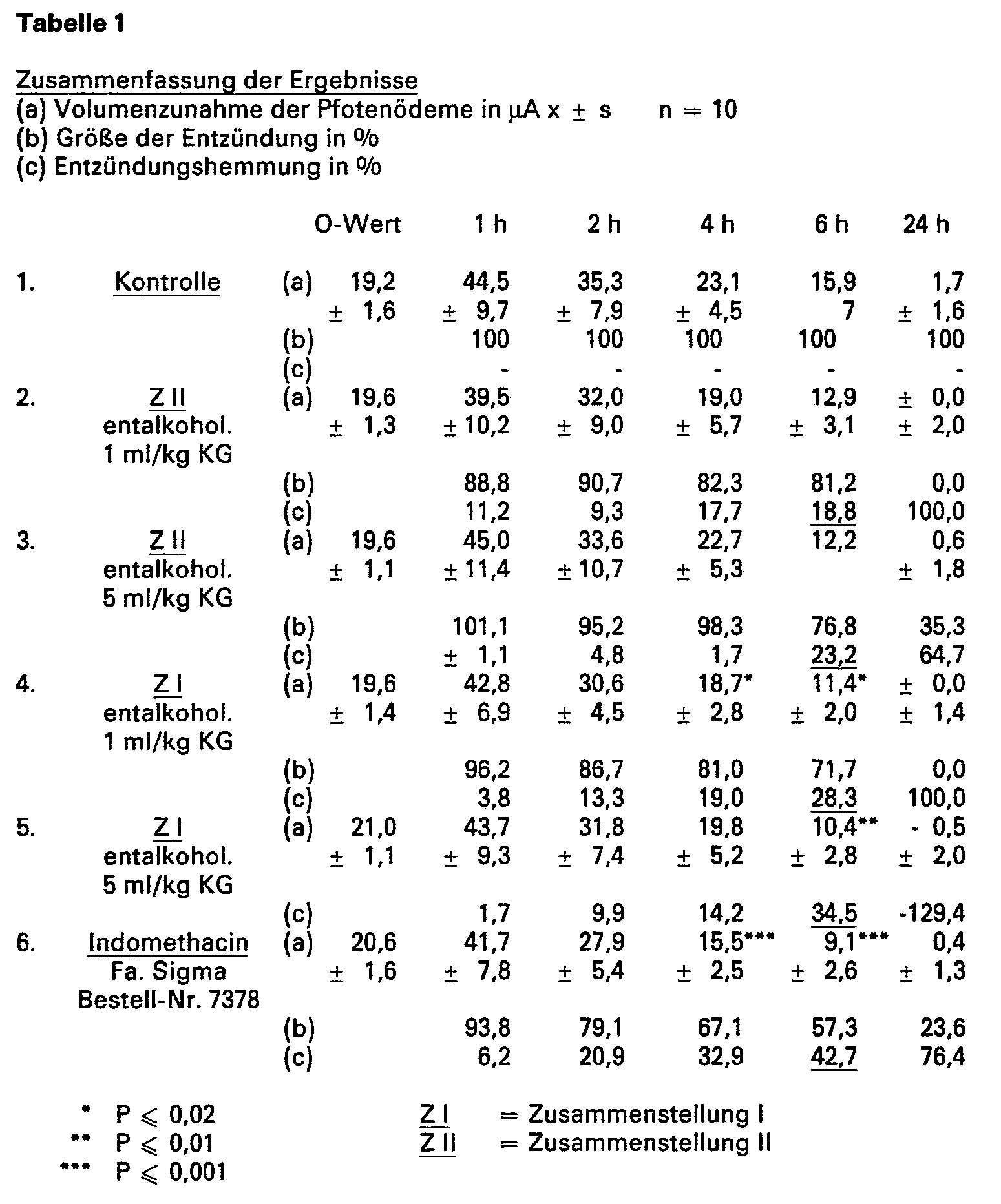
- composition 11 5.0 ml / kg body weight showed a statistically non-significant reduction (23%) of the edema only in the 6th hour after the edema was set (Table 1).
- FIG. 3 shows a dose-dependency of the effect of the compositions and the difference in edema inhibition between composition I and composition II 23%, an inhibition of 28 (P ⁇ 0.02) and 35% (P ⁇ 0.01) was registered with the composition 11.0 and 5.0 ml / kg body weight.
- the comparator indomethacin inhibited dextran edema by 43% (P ⁇ 0.001).
- composition I is superior to composition II by 1 1/2 times as an anti-inflammatory drug.
- composition I 1.0 ml (20 drops) and especially 5.0 ml (100 drops) with 35% edema inhibition (ED 35 ) is close to the effect of 4 mg indomethacin / kg body weight (ED 43 ) approach; consequently, composition I is to be regarded as a highly effective anti-inflammatory pytotherapeutic.
- the dose was 3 x 30 drops per day in all cases.
- the final assessment is: Very good 7 x, good 8 x, sufficient 3 x, not sufficient 1 x, cannot be assessed 1 x.
- composition 1 The assessment of patients who were only pharmacotherapeutic with composition 1 gave good or very good results in fifteen out of twenty cases. The findings of the doctor as well as those of the patients justify this with the proof of the reduction of the symptoms. To a similar extent, effects from the use of chemical non-steroidal anti-inflammatory drugs would have been expected. However, the rate of undesirable effects is much higher with these preparations. No side effects were observed from Composition I in any case. This is a very good result for a four-week uninterrupted therapy.
- the average age was 59.8 years, the average weight 68.9 kg.
- the Broca index was 101.9.
- NSAIDs nonsteroidal anti-inflammatory drugs
- the dose 3 x 30 drops was given to 14 patients, 3 x 40 drops to 17 patients.
- the score includes the doctor's findings, composed of movement pain, constant pain and restricted movement.
Landscapes
- Health & Medical Sciences (AREA)
- Natural Medicines & Medicinal Plants (AREA)
- Life Sciences & Earth Sciences (AREA)
- Chemical & Material Sciences (AREA)
- Engineering & Computer Science (AREA)
- Alternative & Traditional Medicine (AREA)
- Biotechnology (AREA)
- Botany (AREA)
- Medical Informatics (AREA)
- Medicinal Chemistry (AREA)
- Microbiology (AREA)
- Mycology (AREA)
- Pharmacology & Pharmacy (AREA)
- Epidemiology (AREA)
- Animal Behavior & Ethology (AREA)
- General Health & Medical Sciences (AREA)
- Public Health (AREA)
- Veterinary Medicine (AREA)
- Pharmaceuticals Containing Other Organic And Inorganic Compounds (AREA)
Description
- Die Erfindung bezieht sich auf ein Arzneimittel mit schmerzstillender und entzündungshemmender Wirkung auf pflanzlicher Basis, insbesondere auf ein Antirheumatikum.
- Antirheumatika auf pflanzlicher Basis sind grundsätzlich bekannt. Sie umfassen in der Regel eine größere Anzahl von pflanzlichen Bestandteilen als Träger ihrer Wirksamkeit. Ein solches Antirheumatikum (Zusammenstellung 11) besteht aus den folgenden wäßrig/alkoholischen Auszügen mit den genannten Bestandteilen.

- Seit geraumer Zeit geht das Bestreben der Ärzte bei der Arzneimittelverordnung dahin, die Belastung von Patienten durch Arzneimittel soweit wie möglich zu beschränken. Dies gilt sowohl für die Anzahl der Arzneimittelbestandteile als auch für deren Menge. Die Belastung der Patienten in dieser Hinsicht soll gering gehalten werden, um u. U. schädliche Nebenwirkungen auf ein Mindestmaß zu begrenzen.
- Die Aufgabe der Erfindung besteht somit darin, ein Arzneimittel der eingangs genannten Art zu schaffen, das zum einen in seinem therapeutischen Effekt mit chemischen Arzneimitteln vergleichbar ist, zum anderen aber weitestgehend keine Nebenwirkungen hervorruft.
- Überraschenderweise wurde gefunden, daß ein Arzneimittel auf pflanzlicher Basis mit Auszügen oder Inhaltsstoffen aus Populus tremula, Solidago virgaurea und Fraxinus excelsior, die der Erfindung zugrundeliegende Aufgabe löst.
- Das erfindungsgemäße Arzneimittel zeichnet sich durch eine Verringerung der Anzahl der als Träger der Wirksamkeit in Frage kommenden Inhaltsstoffe gegenüber bekannten Produkten auf pflanzlicher Basis aus. Seine therapeutische Wirkung tritt besonders dann ein, wenn die erfindungsgemäß vorgegebene Abstimmung
- seiner Inhaltsstoffe eingehalten wird. Es zeigt eine sehr gute Verträglichkeit. Es handelt sich mithin um ein überlegenes Produkt, dessen vorteilhafte Wirkung insbesondere ohne Steigerung der einzunehmenden Dosis gegenüber bekannten Arzneimitteln mit einer größeren Anzahl von Bestandteilen erzielt wird.
- Mit dem erfindungsgemäßen Phytopharmakon lassen sich bei wesentlich niedrigerem Risiko therapeutische Effekte erreichen, die in der Größenordnung derjeniger hochdosierter chemischer (nichtsteroidaler, z. B. Indomethacin) Antirheumatika liegen (vergl. Fig. 2).
- Die antiphlogistische sowie analgetische, d. h. antirheumatische Wirkung des erfindungsgemäßen Arzneimittels wird mit den folgenden Versuchsergebnissen dokumentiert.
- Die Versuche wurden mit der folgenden erfindungsgemäßen Zusammenstellung (Zusammenstellung I) durchgeführt: wäßrig äthanolische Auszüge aus:

- Die Einzelextrakte wurden aus Frischeflanzen hergestellt. Das bedingt, daß die Alkoholkonzentration um ± 2,0 % schwanken kann.
- In einigen Fällen wurde an Hand von Tierversuchen die bekannte Zusammensetzung (Zusammenstellung II) in die Untersuchungen mit einbezogen.
- Die Zusammenstellungen I und II enthalten Pflanzenwirkstoffe, die sich durch eine antipyretische, analgetische und antirheumatische Wirkung auszeichnen und sich deshalb besonders zur Behandlung akuter und subakuter rheumatischer Erkrankungen eignen. In den vorliegenden Untersuchungen wurde die antiphlogistische bzw. antiexudative Eigenschaft der Präparate im Rattenpfotenödem (Dextranödem)-Modell geprüft. Indomethacin diente als Vergleichssubstanz und positive Kontrolle.
- Männliche Sprague Dawley Ratten, SPF, Sut (Süddeutsche Versuchstierfarm), Körpergewicht um 200 g, Haltung 5 Tiere/Makrolonkäfig Typ IV im vollklimatisierten Raum, 23 ± 1°C, 55 ± 5 % rel. Luftfeuchtigkeit, 12/12h Hell-Dunkel-Rhythmus, Leitungs-Wasser und Futter (Altromin Diät 1324) ad libitum.
-
- Zusammenstellung 11, Chargen-Nr. 3511, entalkoholisiert und mit Wasser aufgefüllt;
- Zusammenstellung 1, Chargen-Nr. 4014, entalkoholisiert und mit Wasser äufgefüllt;
- Dextran-Lösung. Macrodex® 6%, Fa. Knoll AG
- Indomethacin Bestell-Nr. 7378, Fa. Sigma
- NaHCO3 Bestell-Nr. 6323, Fa. E. Merck.
- Randomisierte Zuteilung der Tiere in den Gruppen, jeweils 10 Tiere pro Gruppe:
- Gruppe 1: Kontrolle 0,1 M NaHC03 10,0 ml/kg KG
- Gruppe 2: Zusammenstellung 111,0 ml/kg KG; Verdünnung 1 : 10 mit 0,111 M NaHCO3-Lösung
- Gruppe 3: Zusammenstellung II 5,0 ml/kg KG; Verdünnung 1 : 2 mit 0,2 M NaHCO3-Lösung
- Gruppe 4: Zusammenstellung 11,0 ml/kg KG; Verdünnung wie in Gruppe 2
- Gruppe 5: Zusammenstellung 15,0 ml/kg KG; Verdünnung wie in Gruppe 3
- Gruppe 6: Indomethacin 4,0 mg/kg KG gelöst in 10,0 ml 0,1 M NaHC03-Lösung.
- Die Verdünnung von den Prüfpräparaten wurde so vorgenommen, daß das intragastral per Schlundsonde applizierte Volumen 10 ml/kg KG betrug.
- 16 Stunden vor dem Versuchsbeginn wurde den Tieren Futter entzogen. Die Prüfsubstanzen wurden 30 Minuten vor der Ödemsetzung verabreicht. Zur Erzeugung der Ödeme wurde 0,1 ml einer 6 %-igen Dextran-Lösung intraplantar in die rechte Hinterpfote injiziert. Unmittelbar danach wurde den Tieren das Wasser entzogen. Die Messung der Pfotenvolumina erfolgte mit dem Volumen-Meßgerät von Kemper et al1 in µA (Empfindlichkeitsstufe 11) eine Stunde vor der Ödemsetzung (Leerwert) und 1, 2, 4, 6 und 24 Stunden nach der Dextraninjektion.
- Die Differenz zum Leerwert bei jeder Messung ergibt die Größe des Ödems. Die Wirkung der Prüfpräparate wird wie folgt berechnet:
-

- Der statistische Vergleich zur Kontrollgruppe erfolgte mit dem Student t-Test für unverbundene Stichproben mit zweiseitiger Fragestellung.
- In Tab. 1 sind alle Ergebnisse zusammengestellt, während der Verlauf der Pfotenvolumina, relative Größe der Pfoten und Ödemhemmung in % in Fig. 1 und 2 dargestellt sind. Fig. 3 zeigt die maximal erreichte Wirkung der Prüfpräparate 6 Stunden nach der Ödeminduktion.
- Bei den Versuchsgruppen Zusammenstellung II 1,0 ml, Zusammenstellung I 1,0 und 5,0 ml/kg KG sowie bei Indomethacin 4,0 mg/kg KG stieg die Hemmung des Dextranödems kontinuierlich bis zur 6. Stunde, wenn auch der Unterschied zur Kontrollgruppe nicht immer statistisch signifikant ist, während Zusammenstellung 11 5,0 ml/kg KG nur in der 6. Stunde nach der Ödemsetzung eine statistisch nichtsignifikante Verminderung (23 %) des Ödems zeigte (Tab. 1).
- Die Fig. 3 zeigt eine Dosisabhängigkeit der Wirkung der Zusammenstellungen sowie der Unterschied in Ödem-Hemmung zwischen der Zusammenstellung I und der Zusammenstellung II. Während die Zusammenstellung II 1,0 und 5,0 ml/kg KG eine statistisch nicht signifikante Inhibition von 19 bzw. 23 % bewirkten, wurde mit der Zusammenstellung 11,0 und 5,0 ml/kg KG eine Hemmung von 28 (P ≦ 0,02) und 35 % (P ≦ 0,01) registriert. Das Vergleichspräparat Indomethacin inhibierte das Dextran-Ödem zu 43 % (P ≦ 0,001).
- In dieser Prüfung ist die Zusammenstellung I der Zusammenstellung II um 1 1/2faches als Antiphlogistikum überlegen.
- Die antiphlogistische Potenz der Zusammenstellung I 1,0 ml (20 Tropfen) und besonders von 5,0 ml (100 Tropfen) mit 35 %-iger Ödemhemmung (ED35) reicht nahe an die Wirkung von 4 mg Indomethacin/kg KG (ED43) heran; demzufolge ist die Zusammenstellung I als ein gut wirksames antiphlogistisches Pytotherapeutikum anzusehen.
- eine neue elektrische Methode zur Messung von Volumina, Druck und anderem sowie ein Beispiel ihrer Anwendung
- Z. ges. exp. Med. Bd. 131,407-411 (1959).
- Zur Auswertung kamen 20 Patienten, 10 Männer und 10 Frauen. Das durchschnittliche Alter betrug 46,3 2,1 Jahre, das durchschnittliche Gewicht 72,8 ± 2,7 kg. Der Broca-Index zeigt mit 108,6 ein leichtes Übergewicht an. Die Krankheitsdauer betrug zwischen einem und 33 Jahren. Keine Vortherapie erfolgte in 13 Fällen, während in 7 Fällen mit 3 verschiedenen, häufig verwendeten, nichtsteroidalen Antirheumatika vortherapiert wurde. 4 x mit Voltaren®, 1 x mit Musaril®, 1 x mit Arumalon® und 1 x mit Injektionen. Die eingeschlossenen Diagnosen waren 6 x Arthrosis deformans, 9 x HWS-Syndrom, 18 x Periarthritis humeroscapularis, 12 x Epikondylitis humeri. Hinzu kommen 10 sonstige Angaben (Mehrfachnennung möglich).
- Die Dosis betrug in allen Fällen 3 x 30 Tropfen pro Tag.
- Die Abschlußbeurteilung lautet: Sehr gut 7 x, gut 8 x, ausreichend 3 x, nicht ausreichend 1 x, nicht beurteilbar 1 x.
- In den Abstufungen 1 bis 4 (1 = nicht vorhanden, 2 = gering, 3 = mäßig, 4 = stark) wurden folgende Erhebungen dokumentiert:
- A) Feststellungen des Arztes

- B) Feststellungen des Patienten (angegeben als Abstand einer Strichmarkierung vom Ursprung einer 8 cm langen Linie - Größerwerden der Linie bedeutet Abnahme der Beschwerden).

-

- Die Urinbefunde zeigten keine Verschlechterungen. Nebenwirkungen wurden nicht beobachtet.
- Die Beurteilung der ausschließlich mit Zusammensetzung 1 pharmakotherapierten Patienten erbringt in fünfzehn von zwanzig Fällen gute oder sehr gute Ergebnisse. Die Feststellungen des Arztes ebenso wie die der Patienten begründen dies mit dem Nachweis der Verminderung der Beschwerden. In ähnlichem Ausmaß wären Effekte bei der Verwendung chemischer nicht steroidaler Antirheumatika zu erwarten gewesen. Allerdings liegt die Rate unerwünschter Wirkungen bei diesen Präparaten wesentlich höher. Durch Zusammensetzung I wurden in keinem Fall Nebenwirkungen beobachtet. Für eine vierwöchige ununterbrochene Therapie ist dies ein sehr gutes Ergebnis.
- Ausgewertet wurden 31 Fälle, 10 Männer und 21 Frauen. Das durchschnittliche Alter betrug 59,8 Jahre, das durchschnittliche Gewicht 68,9 kg. Der Broca-Index betrug 101,9.
- Die Diagnosen setzen sich wie folgt zusammen:
- 9 x chronische Polyarthritis,
- 11 x Arthrosis deformans,
- 4 x LWS-Syndrom,
- 5 x HWS-Syndrom,
- 2 x "Sonstiges"
- (beide Male Borbus Bechterew).
- Als Vortherapie wurden sieben verschiedene, häufig verwendete nichtsteroidale Antirheumatika (NSAR) verwendet. Sieben Patienten erhielten keine Vortherapie.
- Die Dosis 3 x 30 Tropfen erhielten 14 Patienten, 3 x 40 Tropfen 17 Patienten.
- 2 Patienten brachen die Behandlung ab: 1 Patient wegen eines entgleisten Diabetes, 1 Patient wegen exacerbierter Synovitis.
- Unter der Rubrik Nebenwirkung wird der entgleiste Diabetes genannt, der Zusammenhang ist nicht eindeutig. Andere Nebenwirkungen werden nicht genannt.
- 24 der 31 Patienten erhielten keine Zusatzmedikation.
- In den Abstufungen 1 - 4 (1 = nicht vorhanden, 2 = gering, 3 = mäßig, 4 = stark) wurden folgende Erhebungen dokumentiert:

- Der Score umfaßt die Feststellungen des Arztes, zusammengesetzt aus Bewegungsschmerz, Dauerschmerz und Bewegungseinschränkung.
-

- vor Therapie 3,4 ± 0,6
- nach 1 Woche 2,7 ± 0,8
- nach 2 Wochen 2,6 ± 1,0
- nach 4 Wochen 2,3 ± 1,1
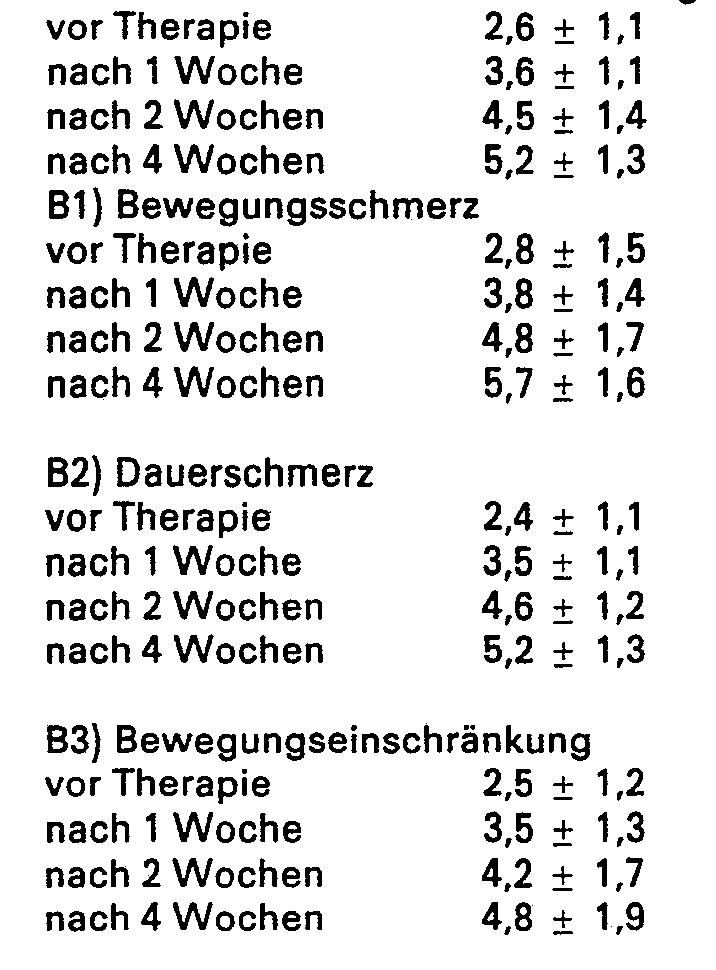
- B) Der Score der Beurteilung des Zustandes durch den Patienten selbst, berechnet aus den Einzelsymptomen Bewegungsschmerz, Dauerschmerz und Bewegungseinschränkung ergibt folgende Werte: (Minimum 0 = starke Beschwerden, Maximum 8 = keine Beschwerden).
- Beschwerdescore nach Feststellunq des Patienten
- Die Urinbefunde zeigten keine Hinweise auf Verschlechterungen.
- Entsprechend dem Typ der Untersuchung 2 als Beobachtungsstudie wurden im explorativen Sinn t-Tests für verbundene Stichproben nach trimming der Extrema der Verteilung gerechnet. Eine Differenz wurde dann als statistisch von Null verschieden betrachtet, wenn deren p-Wert unter einem kritischen von 0,05 lag.
- Danach ergibt sich für die Scores der klinischen Symptomatik:
- alle Differenzen sind mit einem p = 0.0000 von Null verschieden, so daß von einer deutlichen Besserung sowohl im Urteil des Arztes als auch in dem des Patienten ausgegangen werden muß.
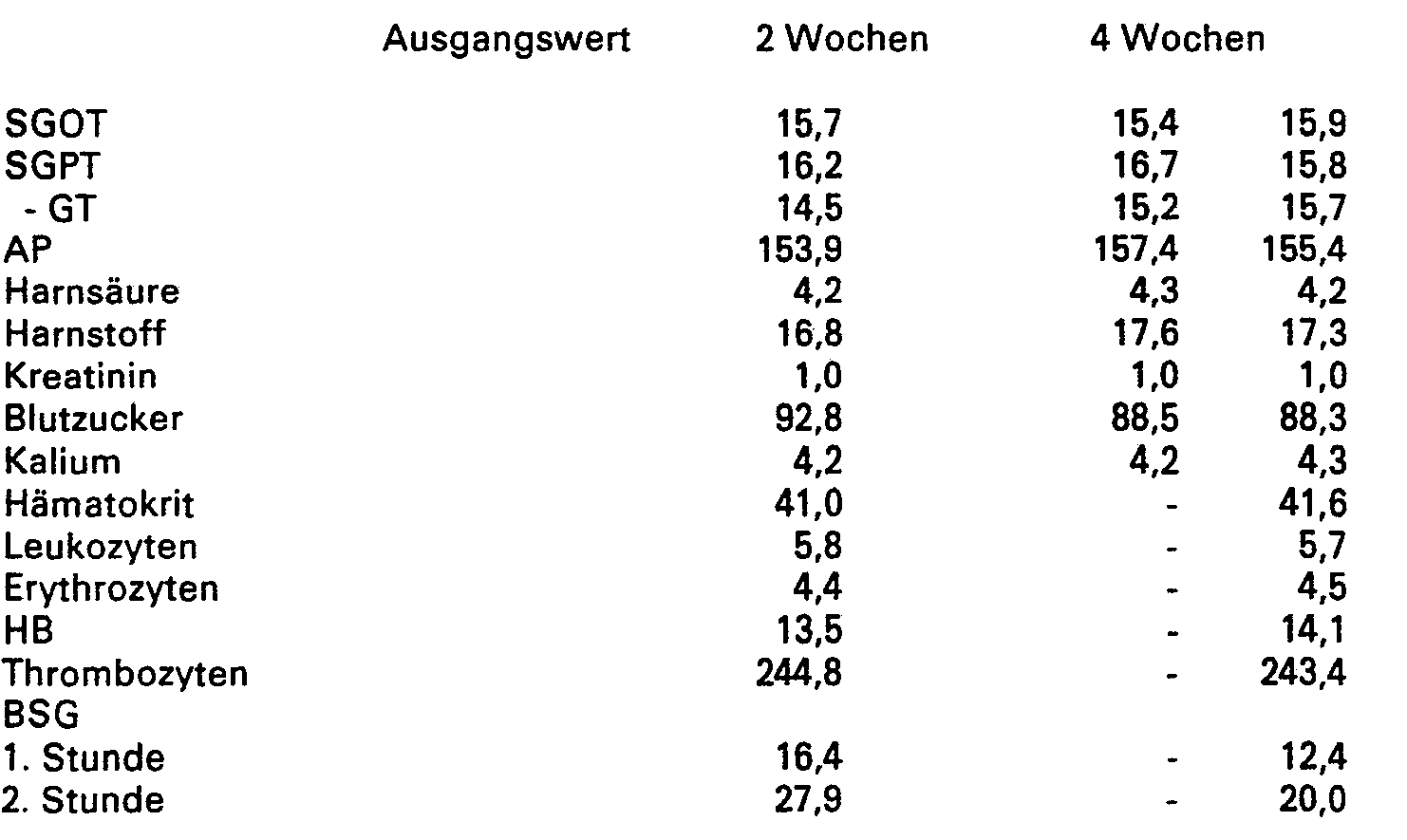
- Für die Reihe der Laborwerte ist folgendes festzustellen:
- - Anstieg des Harnstoffes von 0 nach 2 um 0,8 mg/dl p = 0,0192
- - Anstieg des Hb um 0,4 g/dl von 0 nach 4, p = 0,0004
- - Abfall der BSG 1. Stunde um 3,3 E von 0 nach 4, p = 0,0193
- - Abfall der BSG 2. Stunde um 6,7 E von 0 nach 4 p = 0,117
- Die oben mitgeteilten Veränderungswerte sind Mittelwertangaben.
- Die berichteten Ergebnisse zeigen, daß eine Reduktion der subjektiven Beschwerden (Schmerz) und auch der Bewegungseinschränkung in einem relevanten Ausmaß eingetreten ist. Eine vollständige Heilung ist bei der vorliegenden Erkrankung unmöglich. Die umfangreiche Literatur über die Behandlung der hier untersuchten Krankheitsbilder mit chemischen, nicht steroidalen Antirheumatika enthält Ergebnisse, die den hier mit der Zusammenstellung 1 erreichten entsprechen.
- Von besonderer Wichtigkeit ist die Verringerung der Blutkörperchensenkungsgeschwindigkeit (signifikant), die ein Maß für die systemische entzündliche Komponente der vorliegenden Krankheit ist. Seitens der pharmazeutischen Industrie werden große Bemühungen unternommen, um diesen Effekt auch mit anderen Produkten zu erreichen.
- Sowohl die Laborwerte als auch die ärztlichen Berichte zeigen, daß unerwünschte Wirkungen allenfalls in fraglichem Zusammenhang mit der Anwendung der Zusammensetzung I (entgleister Diabetes) aufgetreten sind. Aus ärztlicher Sicht ist der Zusammenhang mindestens fraglich.
Claims (5)
Priority Applications (1)
| Application Number | Priority Date | Filing Date | Title |
|---|---|---|---|
| AT86905810T ATE44466T1 (de) | 1985-10-18 | 1986-10-11 | Schmerzstillendes und entzuendungshemmendes arzneimittel auf pflanzlicher basis. |
Applications Claiming Priority (2)
| Application Number | Priority Date | Filing Date | Title |
|---|---|---|---|
| DE19853537160 DE3537160A1 (de) | 1985-10-18 | 1985-10-18 | Schmerzstillendes und entzuendungshemmendes arzneimittel auf pflanzlicher basis |
| DE3537160 | 1985-10-18 |
Publications (2)
| Publication Number | Publication Date |
|---|---|
| EP0241498A1 EP0241498A1 (de) | 1987-10-21 |
| EP0241498B1 true EP0241498B1 (de) | 1989-07-12 |
Family
ID=6283903
Family Applications (1)
| Application Number | Title | Priority Date | Filing Date |
|---|---|---|---|
| EP86905810A Expired EP0241498B1 (de) | 1985-10-18 | 1986-10-11 | Schmerzstillendes und entzündungshemmendes arzneimittel auf pflanzlicher basis |
Country Status (3)
| Country | Link |
|---|---|
| EP (1) | EP0241498B1 (de) |
| DE (2) | DE3537160A1 (de) |
| WO (1) | WO1987002248A1 (de) |
Families Citing this family (2)
| Publication number | Priority date | Publication date | Assignee | Title |
|---|---|---|---|---|
| ES2059648T3 (es) | 1989-07-11 | 1994-11-16 | Steigerwald Arzneimittelwerk | Medicamento analgesico y antiflogistico. |
| ES2065286B1 (es) * | 1993-07-20 | 1995-09-16 | Asins Antonio Gomez | Nuevo medicamento analgesico a base de extractos de plantas silvestres y procedimiento para su preparacion. |
-
1985
- 1985-10-18 DE DE19853537160 patent/DE3537160A1/de not_active Withdrawn
-
1986
- 1986-10-11 DE DE8686905810T patent/DE3664258D1/de not_active Expired
- 1986-10-11 WO PCT/EP1986/000584 patent/WO1987002248A1/de not_active Ceased
- 1986-10-11 EP EP86905810A patent/EP0241498B1/de not_active Expired
Also Published As
| Publication number | Publication date |
|---|---|
| DE3664258D1 (en) | 1989-08-17 |
| DE3537160A1 (de) | 1987-04-23 |
| EP0241498A1 (de) | 1987-10-21 |
| WO1987002248A1 (fr) | 1987-04-23 |
Similar Documents
| Publication | Publication Date | Title |
|---|---|---|
| DE3705151C2 (de) | ||
| DE69833333T2 (de) | Pharmazeutische zusammensetzung enthaltend geweihextrakte von cervus nippon mit wachstumsstimulierender aktivität auf hematopoietische stammzellen und megakaryozyten | |
| EP1037648A2 (de) | Verwendung von erythropoietin und eisenpräparaten zur herstellung von pharmazeutischen kombinationspräparaten zur behandlung von rheumatischen erkrankungen | |
| EP0989856B1 (de) | Verfahren und stoffe zur freisetzung eines wachstumsfaktors aus endothelzellen, und nach dem verfahren freigesetzter wachstumsfaktor sowie seine verwendung | |
| DE3883606T2 (de) | Verwendung von Fluoxetin zur Behandlung des Diabetes. | |
| DE3319282C2 (de) | ||
| DE69730214T2 (de) | Zusammensetzung und verfahren zur behandlung von herpes simplex | |
| DE1917283C3 (de) | Herstellung antimikrobieller Präparate | |
| DE3918543C2 (de) | ||
| DE4438589A1 (de) | Nasentherapeutikum | |
| DE60216292T2 (de) | Calciumtrifluoracetat mit zytotoxischer wirkung | |
| DE3150527A1 (de) | Pharmakologisches praeparat aus fructose-1,6-di-phosphat mit therapeutischer wirkung bei verbrennungen | |
| DE3537160A1 (de) | Schmerzstillendes und entzuendungshemmendes arzneimittel auf pflanzlicher basis | |
| EP0407634B1 (de) | Schmerzstillendes und entzündungshemmendes Arzneimittel | |
| DE69721077T2 (de) | Verwendung von 2-methoxyphenyl-1-methyl-5p-methyl-benzoylpyrrol-2-acetamido-acetat zur herstellung eines antientzündungsmittels mit vorbeugung von magenhypersekretion und nierenfunktionsstörung | |
| EP0002803B1 (de) | Cis-(3,3,5)-Trimethylcyclohexanol zur Verwendung bei der Behandlung von Galleleiden | |
| EP2548564B1 (de) | Pharmazeutisches Mittel, Ernährung für einen Patienten sowie Verfahren zur Gewichtsreduzierung | |
| DE4410594C2 (de) | Arzneimittel aus Arctostaphylos uvae-ursi | |
| DE2015877A1 (de) | Arzneimittel | |
| DE4238766A1 (de) | Natürliche Interspezies-Antikörper, ihre Verwendung und Verfahren der verwendungsgerechten Aufbereitung | |
| EP0291751B1 (de) | Pharmazeutisches Kombinationspräparat | |
| DE10059838A1 (de) | Arzneimittelzubereitung mit anti-arteriosklerotischer Wirkung | |
| DE19636252A1 (de) | Pharmazeutisches Kombinationspräparat zur Behandlung von rheumatischen Erkrankungen | |
| DE3447572A1 (de) | Mittel zur regenerierung und staerkung tierischer und menschlicher organismen koerpereigener abwehrkraefte und der haut sowie zu deren schutz aus aloe-wirkstoffen | |
| DE4313383A1 (de) | Mittel zur Milderung und/oder Heilung von Erkrankungen aus Bestandteilen von Sequoia gigantea (Mammutbaum) und dessen Verwendung |
Legal Events
| Date | Code | Title | Description |
|---|---|---|---|
| PUAI | Public reference made under article 153(3) epc to a published international application that has entered the european phase |
Free format text: ORIGINAL CODE: 0009012 |
|
| 17P | Request for examination filed |
Effective date: 19870708 |
|
| AK | Designated contracting states |
Kind code of ref document: A1 Designated state(s): AT BE CH DE FR GB IT LI LU NL SE |
|
| 17Q | First examination report despatched |
Effective date: 19880128 |
|
| GRAA | (expected) grant |
Free format text: ORIGINAL CODE: 0009210 |
|
| AK | Designated contracting states |
Kind code of ref document: B1 Designated state(s): AT BE CH DE FR GB IT LI LU NL SE |
|
| REF | Corresponds to: |
Ref document number: 44466 Country of ref document: AT Date of ref document: 19890715 Kind code of ref document: T |
|
| REF | Corresponds to: |
Ref document number: 3664258 Country of ref document: DE Date of ref document: 19890817 |
|
| ITF | It: translation for a ep patent filed | ||
| GBT | Gb: translation of ep patent filed (gb section 77(6)(a)/1977) | ||
| ET | Fr: translation filed | ||
| PLBE | No opposition filed within time limit |
Free format text: ORIGINAL CODE: 0009261 |
|
| STAA | Information on the status of an ep patent application or granted ep patent |
Free format text: STATUS: NO OPPOSITION FILED WITHIN TIME LIMIT |
|
| 26N | No opposition filed | ||
| ITTA | It: last paid annual fee | ||
| EPTA | Lu: last paid annual fee | ||
| EAL | Se: european patent in force in sweden |
Ref document number: 86905810.7 |
|
| PGFP | Annual fee paid to national office [announced via postgrant information from national office to epo] |
Ref country code: GB Payment date: 20010925 Year of fee payment: 16 |
|
| PGFP | Annual fee paid to national office [announced via postgrant information from national office to epo] |
Ref country code: FR Payment date: 20011018 Year of fee payment: 16 |
|
| PGFP | Annual fee paid to national office [announced via postgrant information from national office to epo] |
Ref country code: SE Payment date: 20011019 Year of fee payment: 16 |
|
| PGFP | Annual fee paid to national office [announced via postgrant information from national office to epo] |
Ref country code: LU Payment date: 20011026 Year of fee payment: 16 |
|
| REG | Reference to a national code |
Ref country code: GB Ref legal event code: IF02 |
|
| PG25 | Lapsed in a contracting state [announced via postgrant information from national office to epo] |
Ref country code: LU Free format text: LAPSE BECAUSE OF NON-PAYMENT OF DUE FEES Effective date: 20021011 Ref country code: GB Free format text: LAPSE BECAUSE OF NON-PAYMENT OF DUE FEES Effective date: 20021011 |
|
| PG25 | Lapsed in a contracting state [announced via postgrant information from national office to epo] |
Ref country code: SE Free format text: LAPSE BECAUSE OF NON-PAYMENT OF DUE FEES Effective date: 20021012 |
|
| EUG | Se: european patent has lapsed | ||
| GBPC | Gb: european patent ceased through non-payment of renewal fee |
Effective date: 20021011 |
|
| PG25 | Lapsed in a contracting state [announced via postgrant information from national office to epo] |
Ref country code: FR Free format text: LAPSE BECAUSE OF NON-PAYMENT OF DUE FEES Effective date: 20030630 |
|
| REG | Reference to a national code |
Ref country code: FR Ref legal event code: ST |
|
| PGFP | Annual fee paid to national office [announced via postgrant information from national office to epo] |
Ref country code: NL Payment date: 20030825 Year of fee payment: 18 Ref country code: BE Payment date: 20030825 Year of fee payment: 18 Ref country code: AT Payment date: 20030825 Year of fee payment: 18 |
|
| PGFP | Annual fee paid to national office [announced via postgrant information from national office to epo] |
Ref country code: CH Payment date: 20030826 Year of fee payment: 18 |
|
| PGFP | Annual fee paid to national office [announced via postgrant information from national office to epo] |
Ref country code: DE Payment date: 20030901 Year of fee payment: 18 |
|
| PG25 | Lapsed in a contracting state [announced via postgrant information from national office to epo] |
Ref country code: AT Free format text: LAPSE BECAUSE OF NON-PAYMENT OF DUE FEES Effective date: 20041011 |
|
| PG25 | Lapsed in a contracting state [announced via postgrant information from national office to epo] |
Ref country code: LI Free format text: LAPSE BECAUSE OF NON-PAYMENT OF DUE FEES Effective date: 20041031 Ref country code: CH Free format text: LAPSE BECAUSE OF NON-PAYMENT OF DUE FEES Effective date: 20041031 Ref country code: BE Free format text: LAPSE BECAUSE OF NON-PAYMENT OF DUE FEES Effective date: 20041031 |
|
| BERE | Be: lapsed |
Owner name: *STEIGERWALD ARZNEIMITTELWERK G.M.B.H. Effective date: 20041031 |
|
| PG25 | Lapsed in a contracting state [announced via postgrant information from national office to epo] |
Ref country code: NL Free format text: LAPSE BECAUSE OF NON-PAYMENT OF DUE FEES Effective date: 20050501 |
|
| PG25 | Lapsed in a contracting state [announced via postgrant information from national office to epo] |
Ref country code: DE Free format text: LAPSE BECAUSE OF NON-PAYMENT OF DUE FEES Effective date: 20050503 |
|
| REG | Reference to a national code |
Ref country code: CH Ref legal event code: PL |
|
| NLV4 | Nl: lapsed or anulled due to non-payment of the annual fee |
Effective date: 20050501 |
|
| PG25 | Lapsed in a contracting state [announced via postgrant information from national office to epo] |
Ref country code: IT Free format text: LAPSE BECAUSE OF NON-PAYMENT OF DUE FEES;WARNING: LAPSES OF ITALIAN PATENTS WITH EFFECTIVE DATE BEFORE 2007 MAY HAVE OCCURRED AT ANY TIME BEFORE 2007. THE CORRECT EFFECTIVE DATE MAY BE DIFFERENT FROM THE ONE RECORDED. Effective date: 20051011 |
|
| BERE | Be: lapsed |
Owner name: *STEIGERWALD ARZNEIMITTELWERK G.M.B.H. Effective date: 20041031 |