EP0453492B1 - Liant pour vernis - Google Patents
Liant pour vernis Download PDFInfo
- Publication number
- EP0453492B1 EP0453492B1 EP90902217A EP90902217A EP0453492B1 EP 0453492 B1 EP0453492 B1 EP 0453492B1 EP 90902217 A EP90902217 A EP 90902217A EP 90902217 A EP90902217 A EP 90902217A EP 0453492 B1 EP0453492 B1 EP 0453492B1
- Authority
- EP
- European Patent Office
- Prior art keywords
- acid
- poly
- values
- formula
- acylalkyleneimine
- Prior art date
- Legal status (The legal status is an assumption and is not a legal conclusion. Google has not performed a legal analysis and makes no representation as to the accuracy of the status listed.)
- Expired - Lifetime
Links
- 0 C[N+](*(*)C=C)[O-] Chemical compound C[N+](*(*)C=C)[O-] 0.000 description 1
Classifications
-
- C—CHEMISTRY; METALLURGY
- C09—DYES; PAINTS; POLISHES; NATURAL RESINS; ADHESIVES; COMPOSITIONS NOT OTHERWISE PROVIDED FOR; APPLICATIONS OF MATERIALS NOT OTHERWISE PROVIDED FOR
- C09D—COATING COMPOSITIONS, e.g. PAINTS, VARNISHES OR LACQUERS; FILLING PASTES; CHEMICAL PAINT OR INK REMOVERS; INKS; CORRECTING FLUIDS; WOODSTAINS; PASTES OR SOLIDS FOR COLOURING OR PRINTING; USE OF MATERIALS THEREFOR
- C09D179/00—Coating compositions based on macromolecular compounds obtained by reactions forming in the main chain of the macromolecule a linkage containing nitrogen, with or without oxygen, or carbon only, not provided for in groups C09D161/00 - C09D177/00
- C09D179/02—Polyamines
-
- C—CHEMISTRY; METALLURGY
- C08—ORGANIC MACROMOLECULAR COMPOUNDS; THEIR PREPARATION OR CHEMICAL WORKING-UP; COMPOSITIONS BASED THEREON
- C08G—MACROMOLECULAR COMPOUNDS OBTAINED OTHERWISE THAN BY REACTIONS ONLY INVOLVING UNSATURATED CARBON-TO-CARBON BONDS
- C08G73/00—Macromolecular compounds obtained by reactions forming a linkage containing nitrogen with or without oxygen or carbon in the main chain of the macromolecule, not provided for in groups C08G12/00 - C08G71/00
- C08G73/02—Polyamines
- C08G73/0233—Polyamines derived from (poly)oxazolines, (poly)oxazines or having pendant acyl groups
-
- C—CHEMISTRY; METALLURGY
- C09—DYES; PAINTS; POLISHES; NATURAL RESINS; ADHESIVES; COMPOSITIONS NOT OTHERWISE PROVIDED FOR; APPLICATIONS OF MATERIALS NOT OTHERWISE PROVIDED FOR
- C09D—COATING COMPOSITIONS, e.g. PAINTS, VARNISHES OR LACQUERS; FILLING PASTES; CHEMICAL PAINT OR INK REMOVERS; INKS; CORRECTING FLUIDS; WOODSTAINS; PASTES OR SOLIDS FOR COLOURING OR PRINTING; USE OF MATERIALS THEREFOR
- C09D7/00—Features of coating compositions, not provided for in group C09D5/00; Processes for incorporating ingredients in coating compositions
- C09D7/40—Additives
- C09D7/65—Additives macromolecular
-
- C—CHEMISTRY; METALLURGY
- C08—ORGANIC MACROMOLECULAR COMPOUNDS; THEIR PREPARATION OR CHEMICAL WORKING-UP; COMPOSITIONS BASED THEREON
- C08L—COMPOSITIONS OF MACROMOLECULAR COMPOUNDS
- C08L79/00—Compositions of macromolecular compounds obtained by reactions forming in the main chain of the macromolecule a linkage containing nitrogen with or without oxygen or carbon only, not provided for in groups C08L61/00 - C08L77/00
- C08L79/02—Polyamines
-
- C—CHEMISTRY; METALLURGY
- C08—ORGANIC MACROMOLECULAR COMPOUNDS; THEIR PREPARATION OR CHEMICAL WORKING-UP; COMPOSITIONS BASED THEREON
- C08L—COMPOSITIONS OF MACROMOLECULAR COMPOUNDS
- C08L79/00—Compositions of macromolecular compounds obtained by reactions forming in the main chain of the macromolecule a linkage containing nitrogen with or without oxygen or carbon only, not provided for in groups C08L61/00 - C08L77/00
- C08L79/04—Polycondensates having nitrogen-containing heterocyclic rings in the main chain; Polyhydrazides; Polyamide acids or similar polyimide precursors
- C08L79/08—Polyimides; Polyester-imides; Polyamide-imides; Polyamide acids or similar polyimide precursors
Definitions
- the present invention is in the field of lacquers and paints and relates to new oxidatively curing binders and their use.
- the paint film is formed from the binders (film formers, resins, plasticizers) dissolved or dispersed in the solvent by evaporation of the solvent without any further chemical reaction.
- the second case after the coating has been applied to the surface, a chemical reaction takes place which leads to crosslinking in the coating film, with the result that the redissolvability of the dried (hardened) film is drastically reduced compared to the original coating components.
- oxidative drying system in which the crosslinking reaction is triggered by atmospheric oxygen.
- the oxidative drying systems include the old oil varnishes and oil paints, which contain highly unsaturated oils, such as linseed oil and soybean oil (so-called drying oils) as oxidative crosslinking binders, together with siccatives (drying aids).
- drying oils highly unsaturated oils
- siccatives drying aids
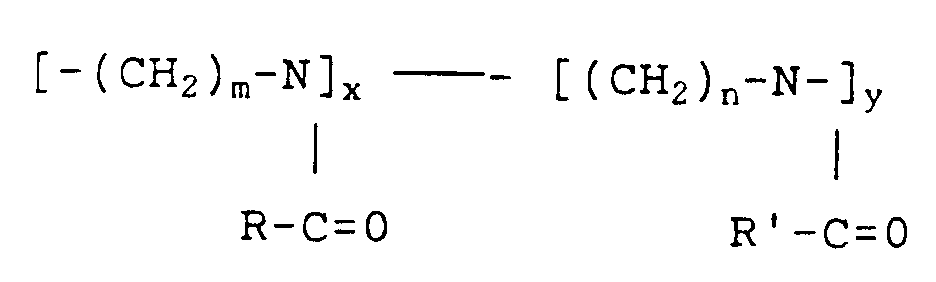
- the invention therefore relates to the use of poly-N-acylalkyleneimines of the formula as an oxidative cross-linking component in paints.
- R-CO is the acyl radical of a mono- or polyunsaturated aliphatic carboxylic acid with 16 to 22 C atoms or a mixture of such radicals
- R'-CO is the acyl radical of a carboxylic acid with 1 to 22 C atoms or a mixture of such radicals
- x and y are the proportions by weight of the respective polymer building blocks, where x can assume values from 20 to 100%, preferably 20 to 95%, and y values from 80 to 0%, preferably 80 to 5%.
- the indices m and n can independently have the value 2 or 3.
- the poly-N-acylalkyleneimines used in paints according to the invention can be easily and without special precautions in any composition can be produced reproducibly.
- the compounds are practically not susceptible to hydrolysis and provide fast-drying fit with good gloss and high hardness.
- the composition of the poly-N-acylalkyleneimines and thus their properties can be adapted within wide limits to the requirements of the various paints, so that both polymers and paints based on organic solvents and water-based paints can be produced with these polymers.
- the poly-N-acylakyleneimines according to the invention are preferably used in the paints as the sole binder or as the predominant proportion of the total binders present. However, it is also possible and, depending on the requirements of the lacquer, it may also be advantageous to add the poly-N-acylalkyleneimines together with larger proportions of other known binders, for example alkyd resins, nitrocellulose or chlorinated rubber, in a mixing ratio of from about 10: 1 to about 1:10 use.
- the paints can contain all other auxiliaries and additives that are common in paints and varnishes. Examples include only pigments, dyes, fillers, siccatives, reactive thinners, anti-skinning agents and leveling agents. This also includes plasticizers and resins, which are occasionally counted among the binders. When mixed with other constituents, the good compatibility of the poly-N-acylalkyleneimines according to the invention has an advantageous effect.
- poly-N-acylalkyleneimines of the formula I can be prepared by acylating polyalkyleneimines with carboxylic acids or carboxylic acid derivatives.
- polyoxazolines For the polymers produced exclusively from ⁇ 2-oxazolines, for example by the processes specified in DE 12 06 585, DE 15 70 213 or DE 19 04 540, the term polyoxazolines is also used; accordingly for the polymers produced from ⁇ 2-dihydrooxazines the designation polyoxazines.
- the 2-substituted oxazolines are in turn accessible, for example, from the ⁇ -chloroethylamides or from the ethanolamides of the corresponding carboxylic acids or carboxylic acid mixtures by dehydrohalogenation or dehydration.
- the dihydrooxazines can be obtained from the propanolamides of the carboxylic acids or corresponding derivatives.
- the molecular weight of the polymers can be determined primarily by the choice of the amount of polymerization catalyst (Brönstedt and Lewis acids, alkylating agents, etc.) vary within wide limits.
- Low molecular weights can also be obtained with a low catalyst concentration if substances which lead to chain transfers, for example alcohols or carboxylic acids, are also added.
- the targeted production of copolymers from two or more individual 2-substituted cyclic imino ethers is also unproblematic. Since the polymerization can in any case be carried out practically to the complete conversion of the monomers, the composition of the copolymers can be readily by Choice of monomer proportions can be determined. If one starts from the polymerization of monomer mixtures, copolymers with a statistical distribution of the individual building blocks are obtained.
- the monomer mixture can be composed of individually synthesized cyclic imino ethers or, depending on the synthesis method, can also be obtained in one step from a corresponding mixture of carboxylic acids or carboxylic acid derivatives. This second route is particularly preferred when the carboxylic acids or their derivatives are made from natural fats or oils.
- the sequence of the monomer units in the polymer can be influenced up to block copolymers.
- the polymers are preferably prepared from oxazolines, ie in formula I, m and n preferably have the value 2.
- R-CO is the acyl radical of a natural unsaturated fatty acid having 16 to 22 carbon atoms and / or a carboxylic acid which has been prepared by modifying a polyunsaturated fatty acid of this type.
- Modification reactions that can also be carried out on the finished imino ether are the alkali-catalyzed shift of one of the double bonds in the linoleic acid from the 9.12 position to the 9.11 or 10.12 position (with partial cis-trans -Isomerization to so-called conjuen fatty acid), the alkali-catalyzed cis-trans isomerization of individual double bonds and the partial epoxidation of linoleic or linolenic acid, optionally with subsequent opening of the epoxy ring with addition of water or lower alcohols with 1 to 3 C atoms (e.g. methanol, ethanol, ethylene glycol).
- the alkali-catalyzed shift of one of the double bonds in the linoleic acid from the 9.12 position to the 9.11 or 10.12 position with partial cis-trans -Isomerization to so-called conjuen fatty acid
- acyl radicals R-CO are those which are derived from the following carboxylic acids (c, t: cis or trans): Palmitoleic acid (9c-hexadecenoic acid) Petroselinic acid (6c-octadecenoic acid) Oleic acid (9c-octadecenoic acid) Elaidic acid (9t octadecenoic acid) Ricinoleic acid (12-hydroxy-9c-octadecenoic acid) Linoleic acid (9c, 12c-octadecadienoic acid) Linolenic acid (9c, 12c, 15c-octadecatrienoic acid) Gadoleic acid (9c-eicosenoic acid) Arachidonic acid (5,8,11,14-eicosatetraenoic acid) Erucic acid (13c-docosenoic acid) Brassidic acid (13t-docosenoic acid) Clupanod
- the acyl radical R'-CO which is different from R-CO, is derived from carboxylic acids having 1 to 22 C atoms, which can be saturated or unsaturated aliphatic or alicyclic carboxylic acids, aromatic or araliphatic carboxylic acids, which may be such substituents can wear that, such as hydroxyl groups, ether groups, ester groups and halogens, do not interfere with the polymerization reaction of the imino ethers.
- the properties of the polymer can also be selected by the choice of R'CO and the proportion of the relevant building block in the polymer vary within wide limits without losing the drying properties of these paint binders.
- incorporation of short-chain acyl residues R'-CO derived, for example, from acetic acid or propionic acid
- R'-CO can emphasize hydrophilic properties within certain limits
- incorporation of long-chain aliphatic acyl residues leads to increased solubility in Mineral oil leads.
- acyl radical R'-CO is derived from saturated aliphatic carboxylic acids, from ether carboxylic acids with 2 to 22 carbon atoms or from benzoic acid, in particular from saturated fatty acids with 8 to 22 carbon atoms.
- R'-CO particularly preferred as R'-CO are the acyl residues derived from the following carboxylic acids: Stearic acid Isostearic acid Palmitic acid Myristic acid Lauric acid 9,10- (hydroxy, methoxy) octadecanoic acid Behenic acid Benzoic acid
- the weight fraction y of the polymer building blocks with the radical R'-CO in the polymer is 80-0%, preferably 80-5% and in particular 50-5%.
- high-quality lacquers can be produced which give films of high strength with a short drying time.
- the films adhere to various Substrates so that paints for metal, wood, plastic, silicate building materials and other materials can be built on this basis.
- These paints generally contain the poly-N-acylalkyleneimines of the formula I or the preferred polymers of this type in amounts of from about 5 to about 80% by weight, but these limits can also be below or in particular below, especially if the agents contain other binders in addition to the poly-N-acylalkyleneimines.
- poly-N-acylalkyleneimines are used together with other binders, it may be expedient and advantageous to carry out the preparation of the poly-N-acylalkyleneimines in these other binders.
- these other binders for example alkyd resins, polyurethanes or polyacrylates, act as solvents, and the mixture of binders required for the preparation of the paints is obtained directly.
- the paints preferably contain 10 to 60% by weight of the poly-N-acylalkyleneimines.
- poly-N-acylalkyleneimines can be present in dissolved or dispersed form in addition to constituents which are customary in paints and varnishes, such as resins, plasticizers, pigments, siccatives and other auxiliaries and additives.
- solvents water and / or organic solvents
- other constituents are in the ranges customary for paints: solvents preferably 10 to 90% by weight, in particular 20 to 60% by weight; other binders preferably 0 to 60% by weight, in particular 3 to 30% by weight; Pigments preferably 0 to 50% by weight, in particular 3 to 40% by weight; other customary auxiliaries and additives, preferably 0 to 60% by weight and in particular 5 to 30% by weight, in each case based on the total weight of the paint.
- Oxazolines and dihydrooxazines substituted in the 2-position which predominantly consist of carboxylic acids or carboxylic acid ethyl esters via the hydroxyethyl- or 3-hydroxypropylamides by dehydrating cyclization according to one of the earlier applications EP 88118090.5, DE-P 39 14 133 and DE-P 39 14, served as starting materials 155 had been produced.
- paints of the following composition were produced by mixing the component at room temperature or with little heating.
- 65.0 g of poly-N-acylalkyleneimine according to the invention 0.5 g cobalt siccative, 6% by weight Co (Octa-Soligen-Co, Borchers) 2.5 g zircon-siccative, 6% by weight Zr (Octa-Soligen-Zr, company Borchers) 2.0 g butanone oxime 30.0 g crystal oil 30 (Shell)
- the homogeneous lacquers which are liquid at room temperature, were applied with a squeegee to glass plates or sheets of stainless steel and then air-dried at room temperature.
- Table 7 shows the results of the determination of the pendulum hardness according to König (according to the German standard DIN 53 157), the impact depth (on sheet metal, reverse, according to US standard ASTM-D 2795-69) for paints with various poly-N-acylalkyleneimines. and the gloss (visual), which were obtained after different drying times (1-14 days).
- the poly-N-acylalkyleneimines according to Examples 1 and 15 were dissolved 70% in a mixture of aromatic hydrocarbons (boiling range 162-176 ° C., Solvesso R 100). The pigment and some other additives were then introduced into this solution, and grinding pastes (a) which had the following composition (in parts by weight) were prepared therefrom while dispersing in a dissolver to a particle size of less than 10 ⁇ m: 49a 50a Poly-N-acylalkyleneimine according to Example 1 (70% solution) 117.5 Poly-N-acylalkyleneimine according to Example 15 (70% solution) 108.5 Calcium octoate (4%) 4.6 4.3 Wetting agent (non-ionic, 50%) 4.6 4.2 White spirit (boiling range 145-200 ° C) 73.2 67.8 Titanium dioxide (rutile) 303.1 280.2 These grinding pastes were then processed with the addition of a mixture (b) of the following components (in parts by weight) into spreadable white
- the water-based paint was applied to deep-drawn iron sheets using a doctor blade and then air-dried at room temperature. Dust dryness was reached after 2 hours. After 14 days the pendulum hardness (DIN 53 157) of the high-gloss film (thickness 50 ⁇ m) was already 78s.
- a solvent-based clearcoat was produced here by mixing the following components: 32.5 g of poly-N-acylalkyleneimine according to Example 26 43.3 g alkyd resin Alkydal R 681 (75% in white spirit, Bayer) 0.5 g cobalt siccative 2.5 g zircon siccative 2.0 g butanone oxime 19.2 g crystal oil 30
- the clear lacquer which was liquid at room temperature, was applied to glass plates using a doctor blade and delivered after Air-dry a high-gloss film with a thickness of approximately 30 ⁇ m.
- the pendulum hardness was after 1 d: 35 s, after 7 d: 53 s, after 14 d: 80 s.
Landscapes
- Chemical & Material Sciences (AREA)
- Organic Chemistry (AREA)
- Chemical Kinetics & Catalysis (AREA)
- Engineering & Computer Science (AREA)
- Materials Engineering (AREA)
- Wood Science & Technology (AREA)
- Life Sciences & Earth Sciences (AREA)
- Medicinal Chemistry (AREA)
- Health & Medical Sciences (AREA)
- Polymers & Plastics (AREA)
- Macromolecular Compounds Obtained By Forming Nitrogen-Containing Linkages In General (AREA)
- Organic Low-Molecular-Weight Compounds And Preparation Thereof (AREA)
- Polymers With Sulfur, Phosphorus Or Metals In The Main Chain (AREA)
- Paints Or Removers (AREA)
- Addition Polymer Or Copolymer, Post-Treatments, Or Chemical Modifications (AREA)
- Mold Materials And Core Materials (AREA)
- Organic Insulating Materials (AREA)
Claims (13)
- Utilisation de poly-N-acylalkylèneimines de formule (I) :
- Utilisation selon la revendication 1, dans laquelle x dans la formule (I) peut prendre des valeurs de 20 à 95 % et y des valeurs de 80 à 5 %.
- Utilisation selon la revendication 2, dans laquelle x dans la formule (I) peut prendre des valeurs de 50 à 95 % et y des valeurs de 50 à 5 %.
- Utilisation selon l'une des revendications 1 à 3, dans laquelle dans la formule (I) m et n représentent la valeur 2.
- Utilisation selon l'une des revendications 1 à 3, dans laquelle dans la formule (I) le reste acyle R-CO dérive d'un des acides carboxyliques suivants ou d'un mélange de ces acides carboxyliques :
acide palmitoléïque
acide pétrosélique
acide oléïque
acide élaïdique
acide ricinoléique
acide linoléique
acide linolénique
acide gadoléïque
acide arachidonique
acide érucique
acide brassidique
acide clupanodonique
acide gras conjugué
produits d'addition d'acide linoléique monoépoxydé et d'eau ou d'un alcool avec de 1 à 3 atomes de C. - Utilisation selon l'une des revendications 1 à 3, dans laquelle la poly-N-acylalkylèneimine présente un poids moléculaire de 1000 à 1000000, de préférence de 3000 à 50000.
- Poly-N-acylalkymèneimine de formule (I) selon la revendication 1 dans laquelle le reste acyle R-CO dérive de l'un des acides carboxyliques suivants ou d'un mélange de ces acides carboxyliques :
acide palmitoléïque
acide pétrosélique
acide oléïque
acide élaïdique
acide ricinoléique
acide linoléique
acide linolénique
acide gadoléïque
acide arachidonique
acide érucique
acide brassidique
acide clupanodonique
acide gras conjugué
procuits d'addition d'acide linoléique monoépoxydé et d'eau ou d'un alcool avec de 1 à 3 atomes de C,
et dans laquelle R'-CO, m, n, x et y ont la signification donnée à la revendication 1. - Poly-N-acylalkylèneimine selon la revendication 7, dans laquelle dans la formule (I) x peut prendre des valeurs de 20 à 95 % et y des valeurs de 80 à 5 %.
- Poly-N-acylalkyèneimine selon la revendication 8, dans laquelle x peut prendre des valeurs de 50 à 95 % et y des valeurs de 50 à 5 %.
- Poly-N-acylalkylèneimine selon l'une des revendications 7 à 9, dans laquelle dans la formule (I) m et n présentent la valeur 2.
- Poly-N-acylalkylèneimine selon l'une des revendications 7 à 9, dans laquelle dans la formule (I) R'-CO représente le reste acyle d'un acide carboxylique aliphatique saturé ou d'un acide éthercarboxylique avec 2-22 atomes de C, de préférence 8-22 atomes de C, ou de l'acide benzoïque ou un mélange de tels restes.
- Poly-N-acylalkylèneimine selon l'une des revendications 7 à 9 avec un poids moléculaire moyen de 1000 à 1000000, de préférence de 3000 à 50000.
- Peinture, contenant une poly-N-acylalkylèneimine selon l'une des revendications 7 à 12 en quantités comprises entre 5 et 80 % en poids, de préférence entre 10 et 60 % en poids.
Applications Claiming Priority (3)
| Application Number | Priority Date | Filing Date | Title |
|---|---|---|---|
| DE3900859 | 1989-01-13 | ||
| DE3900859A DE3900859A1 (de) | 1989-01-13 | 1989-01-13 | Neue lackbindemittel |
| PCT/EP1990/000019 WO1990008175A1 (fr) | 1989-01-13 | 1990-01-05 | Liant pour vernis |
Publications (2)
| Publication Number | Publication Date |
|---|---|
| EP0453492A1 EP0453492A1 (fr) | 1991-10-30 |
| EP0453492B1 true EP0453492B1 (fr) | 1994-05-25 |
Family
ID=6372023
Family Applications (1)
| Application Number | Title | Priority Date | Filing Date |
|---|---|---|---|
| EP90902217A Expired - Lifetime EP0453492B1 (fr) | 1989-01-13 | 1990-01-05 | Liant pour vernis |
Country Status (9)
| Country | Link |
|---|---|
| US (2) | US5233020A (fr) |
| EP (1) | EP0453492B1 (fr) |
| JP (1) | JPH04502640A (fr) |
| AT (1) | ATE106095T1 (fr) |
| BR (1) | BR9007020A (fr) |
| DE (2) | DE3900859A1 (fr) |
| ES (1) | ES2054337T3 (fr) |
| MY (1) | MY105183A (fr) |
| WO (1) | WO1990008175A1 (fr) |
Families Citing this family (11)
| Publication number | Priority date | Publication date | Assignee | Title |
|---|---|---|---|---|
| US5629396A (en) * | 1989-01-17 | 1997-05-13 | The Dow Chemical Company | Latex containing oxazoline for industrial coatings |
| DE3943112A1 (de) * | 1989-12-27 | 1991-07-04 | Henkel Kgaa | Wasserverduennbare bindemittelgemische auf basis von alkydharzen |
| DE4209925A1 (de) * | 1992-03-27 | 1993-09-30 | Henkel Kgaa | Verfahren zur Polymerisation von cyclischen Iminoethern |
| DE4226805A1 (de) * | 1992-08-13 | 1994-02-17 | Henkel Kgaa | Bindemittelgemische für Einbrennlacke |
| DE19900458A1 (de) * | 1999-01-08 | 2000-07-13 | Bayer Ag | Acylierte polymere Polyamine |
| US20020110180A1 (en) * | 2001-02-09 | 2002-08-15 | Barney Alfred A. | Temperature-sensing composition |
| CN102666657B (zh) * | 2009-12-17 | 2014-09-03 | 巴斯夫欧洲公司 | 水性涂料制剂 |
| US8629207B2 (en) * | 2009-12-17 | 2014-01-14 | Basf Se | Aqueous coating formulation |
| DE102017007671A1 (de) * | 2017-08-14 | 2019-02-14 | Universität Konstanz | Multifunktionelle Blockcopolymere zur Auflösung von atherosklerotischen Plaques |
| EP3492566B1 (fr) * | 2017-11-29 | 2022-01-19 | Infineum International Limited | Additifs d'huile lubrifiante |
| US20200032082A1 (en) * | 2018-07-27 | 2020-01-30 | Huzaifa Hatimbhai Matawala | Oil paints recycling |
Family Cites Families (7)
| Publication number | Priority date | Publication date | Assignee | Title |
|---|---|---|---|---|
| US3737408A (en) * | 1971-09-30 | 1973-06-05 | Commercial Solvents Corp | Baking enamel vehicle comprising the reaction product of an oxazoline with phenol |
| DE3036119A1 (de) * | 1980-09-25 | 1982-04-08 | Chemische Werke Hüls AG, 4370 Marl | Verfahren zur herstellung von 2-isopropyl- und 2n-propyl-(delta)-oxazolin-copolymeren |
| US4540747A (en) * | 1983-06-10 | 1985-09-10 | Sumitomo Chemical Company, Limited | Block copolymer |
| US4873293A (en) * | 1986-09-30 | 1989-10-10 | Union Carbide Chemicals And Plastics Company Inc. | Partially hydrolyzed, poly(N-acyl alkylenimines) in personal care |
| US4839446A (en) * | 1988-08-08 | 1989-06-13 | Ashland Oil, Inc. | Thermosetting bis oxazoline-polyphenol based resins for resin transfer molding which contain a monooxazine or monooxazoline diluent |
| JPH02255725A (ja) * | 1989-03-29 | 1990-10-16 | Kao Corp | ポリ(n―アシルエチレンイミン)系重合体の製造方法 |
| DE3924164A1 (de) * | 1989-07-21 | 1991-01-24 | Henkel Kgaa | Verfahren zur herstellung neuer vernetzter polymerer |
-
1989
- 1989-01-13 DE DE3900859A patent/DE3900859A1/de not_active Withdrawn
-
1990
- 1990-01-05 EP EP90902217A patent/EP0453492B1/fr not_active Expired - Lifetime
- 1990-01-05 AT AT90902217T patent/ATE106095T1/de not_active IP Right Cessation
- 1990-01-05 WO PCT/EP1990/000019 patent/WO1990008175A1/fr not_active Ceased
- 1990-01-05 DE DE59005826T patent/DE59005826D1/de not_active Expired - Fee Related
- 1990-01-05 JP JP2502565A patent/JPH04502640A/ja active Pending
- 1990-01-05 BR BR909007020A patent/BR9007020A/pt not_active Application Discontinuation
- 1990-01-05 ES ES90902217T patent/ES2054337T3/es not_active Expired - Lifetime
- 1990-01-05 US US07/721,514 patent/US5233020A/en not_active Expired - Fee Related
- 1990-01-12 MY MYPI90000055A patent/MY105183A/en unknown
-
1993
- 1993-04-26 US US08/053,072 patent/US5357039A/en not_active Expired - Fee Related
Non-Patent Citations (1)
| Title |
|---|
| Keine Entgegenhaltungen * |
Also Published As
| Publication number | Publication date |
|---|---|
| ES2054337T3 (es) | 1994-08-01 |
| DE59005826D1 (de) | 1994-06-30 |
| US5357039A (en) | 1994-10-18 |
| WO1990008175A1 (fr) | 1990-07-26 |
| MY105183A (en) | 1994-08-30 |
| US5233020A (en) | 1993-08-03 |
| ATE106095T1 (de) | 1994-06-15 |
| DE3900859A1 (de) | 1990-07-19 |
| JPH04502640A (ja) | 1992-05-14 |
| EP0453492A1 (fr) | 1991-10-30 |
| BR9007020A (pt) | 1991-11-12 |
Similar Documents
| Publication | Publication Date | Title |
|---|---|---|
| DE3706860A1 (de) | Thixotrope zubereitungen, verwendung von polycarbonsaeureamiden zu ihrer herstellung und mit polycarbonsaeureamiden beschichtetes siliciumdioxid | |
| EP0453492A1 (fr) | Liant pour vernis. | |
| DE2627070A1 (de) | Polyaminoamid-haerter fuer epoxidharze, verfahren zu ihrer herstellung und ihre verwendung zum haerten von epoxidharzen | |
| DE3442200A1 (de) | Lufttrocknendes lackbindemittel auf polybutadienbasis | |
| EP0507821B1 (fr) | Melange de liants diluables a l'eau a base de resines alkydes | |
| DE2541641B2 (de) | Strahlenhärtbare Bindemittel und Verfahren zu ihrer Herstellung | |
| DE1925941B2 (de) | Verfahren zur Herstellung von Epoxidpolyaddukten | |
| DE2833825C2 (de) | Verfahren zur Herstellung einer Acrylyloxyamidverbindung und deren Verwendung in Überzugsmassen | |
| DE69400906T2 (de) | Umweltfreundliche selbstoxidierbare Alkydüberzugsmittelzusammensetzung | |
| DE602004007295T2 (de) | Verfahren zur herstellung von thermisch gehärteten überzügen | |
| DE1720424A1 (de) | Verfahren zur mehrstufigen Herstellung haertbarer Fettsaeure-modifizierter Polykondensate auf Basis von Telomerisaten | |
| EP0482031A1 (fr) | Procede d'enduction | |
| DE2638857C2 (de) | Strahlenhärtbare Bindemittel und Verfahren zu ihrer Herstellung | |
| DE2350646A1 (de) | Beschichtungszusammensetzungen | |
| DE2558085A1 (de) | Feste anstrichfarbe | |
| DE2537968A1 (de) | Durch waerme aushaertendes anstrichmittel | |
| DE971199C (de) | Verfahren zur Herstellung von Kunststoffen | |
| DE2348896A1 (de) | Filmbildende massen | |
| AT330318B (de) | Verfahren zur herstellung wasserloslicher warmehartbarer bindemittel fur uberzugsmittel | |
| AT247614B (de) | Verfahren zur Herstellung eines fluorhaltigen Harzes | |
| EP0865471B1 (fr) | Procede pour produire une peinture aqueuse durcissant aux rayonnements | |
| WO1991009898A1 (fr) | Procede pour la fabrication de nouveaux polymeres contenant des groupes carboxyles | |
| DE2639667C2 (de) | Strahlenhärtbare Bindemittel und Verfahren zu ihrer Herstellung | |
| DE1520251C (de) | Verfahren zur Herstellung von fluor haltigen, harzartigen, in Kohlenwasserstof fen loslichen Polyestern, Polyepoxyden oder Polyurethanen | |
| DE2450621A1 (de) | Organische, polymere verbindungen mit semi-telechelatartiger, olefinischer unsaettigung |
Legal Events
| Date | Code | Title | Description |
|---|---|---|---|
| PUAI | Public reference made under article 153(3) epc to a published international application that has entered the european phase |
Free format text: ORIGINAL CODE: 0009012 |
|
| 17P | Request for examination filed |
Effective date: 19910705 |
|
| AK | Designated contracting states |
Kind code of ref document: A1 Designated state(s): AT BE CH DE ES FR GB IT LI NL SE |
|
| 17Q | First examination report despatched |
Effective date: 19930715 |
|
| GRAA | (expected) grant |
Free format text: ORIGINAL CODE: 0009210 |
|
| AK | Designated contracting states |
Kind code of ref document: B1 Designated state(s): AT BE CH DE ES FR GB IT LI NL SE |
|
| REF | Corresponds to: |
Ref document number: 106095 Country of ref document: AT Date of ref document: 19940615 Kind code of ref document: T |
|
| REF | Corresponds to: |
Ref document number: 59005826 Country of ref document: DE Date of ref document: 19940630 |
|
| ET | Fr: translation filed | ||
| REG | Reference to a national code |
Ref country code: ES Ref legal event code: FG2A Ref document number: 2054337 Country of ref document: ES Kind code of ref document: T3 |
|
| ITF | It: translation for a ep patent filed | ||
| GBT | Gb: translation of ep patent filed (gb section 77(6)(a)/1977) |
Effective date: 19940817 |
|
| EAL | Se: european patent in force in sweden |
Ref document number: 90902217.0 |
|
| PLBE | No opposition filed within time limit |
Free format text: ORIGINAL CODE: 0009261 |
|
| STAA | Information on the status of an ep patent application or granted ep patent |
Free format text: STATUS: NO OPPOSITION FILED WITHIN TIME LIMIT |
|
| 26N | No opposition filed | ||
| PGFP | Annual fee paid to national office [announced via postgrant information from national office to epo] |
Ref country code: SE Payment date: 19960119 Year of fee payment: 7 |
|
| PGFP | Annual fee paid to national office [announced via postgrant information from national office to epo] |
Ref country code: ES Payment date: 19960124 Year of fee payment: 7 |
|
| PGFP | Annual fee paid to national office [announced via postgrant information from national office to epo] |
Ref country code: GB Payment date: 19961227 Year of fee payment: 8 |
|
| PG25 | Lapsed in a contracting state [announced via postgrant information from national office to epo] |
Ref country code: SE Effective date: 19970106 |
|
| PG25 | Lapsed in a contracting state [announced via postgrant information from national office to epo] |
Ref country code: ES Free format text: LAPSE BECAUSE OF NON-PAYMENT OF DUE FEES Effective date: 19970107 |
|
| PGFP | Annual fee paid to national office [announced via postgrant information from national office to epo] |
Ref country code: FR Payment date: 19970109 Year of fee payment: 8 |
|
| PGFP | Annual fee paid to national office [announced via postgrant information from national office to epo] |
Ref country code: DE Payment date: 19970113 Year of fee payment: 8 |
|
| PGFP | Annual fee paid to national office [announced via postgrant information from national office to epo] |
Ref country code: AT Payment date: 19970114 Year of fee payment: 8 |
|
| PGFP | Annual fee paid to national office [announced via postgrant information from national office to epo] |
Ref country code: CH Payment date: 19970120 Year of fee payment: 8 |
|
| PGFP | Annual fee paid to national office [announced via postgrant information from national office to epo] |
Ref country code: NL Payment date: 19970130 Year of fee payment: 8 |
|
| PGFP | Annual fee paid to national office [announced via postgrant information from national office to epo] |
Ref country code: BE Payment date: 19970318 Year of fee payment: 8 |
|
| EUG | Se: european patent has lapsed |
Ref document number: 90902217.0 |
|
| PG25 | Lapsed in a contracting state [announced via postgrant information from national office to epo] |
Ref country code: GB Free format text: LAPSE BECAUSE OF NON-PAYMENT OF DUE FEES Effective date: 19980105 Ref country code: AT Free format text: LAPSE BECAUSE OF NON-PAYMENT OF DUE FEES Effective date: 19980105 |
|
| PG25 | Lapsed in a contracting state [announced via postgrant information from national office to epo] |
Ref country code: LI Free format text: LAPSE BECAUSE OF NON-PAYMENT OF DUE FEES Effective date: 19980131 Ref country code: FR Free format text: THE PATENT HAS BEEN ANNULLED BY A DECISION OF A NATIONAL AUTHORITY Effective date: 19980131 Ref country code: CH Free format text: LAPSE BECAUSE OF NON-PAYMENT OF DUE FEES Effective date: 19980131 Ref country code: BE Free format text: LAPSE BECAUSE OF NON-PAYMENT OF DUE FEES Effective date: 19980131 |
|
| BERE | Be: lapsed |
Owner name: HENKEL K.G.A.A. Effective date: 19980131 |
|
| PG25 | Lapsed in a contracting state [announced via postgrant information from national office to epo] |
Ref country code: NL Free format text: LAPSE BECAUSE OF NON-PAYMENT OF DUE FEES Effective date: 19980801 |
|
| GBPC | Gb: european patent ceased through non-payment of renewal fee |
Effective date: 19980105 |
|
| REG | Reference to a national code |
Ref country code: CH Ref legal event code: PL |
|
| NLV4 | Nl: lapsed or anulled due to non-payment of the annual fee |
Effective date: 19980801 |
|
| PG25 | Lapsed in a contracting state [announced via postgrant information from national office to epo] |
Ref country code: DE Free format text: LAPSE BECAUSE OF NON-PAYMENT OF DUE FEES Effective date: 19981001 |
|
| REG | Reference to a national code |
Ref country code: FR Ref legal event code: ST |
|
| REG | Reference to a national code |
Ref country code: ES Ref legal event code: FD2A Effective date: 19990405 |
|
| PG25 | Lapsed in a contracting state [announced via postgrant information from national office to epo] |
Ref country code: IT Free format text: LAPSE BECAUSE OF NON-PAYMENT OF DUE FEES;WARNING: LAPSES OF ITALIAN PATENTS WITH EFFECTIVE DATE BEFORE 2007 MAY HAVE OCCURRED AT ANY TIME BEFORE 2007. THE CORRECT EFFECTIVE DATE MAY BE DIFFERENT FROM THE ONE RECORDED. Effective date: 20050105 |