EP0387527B1 - Verfahren zur fermentativen Herstellung von L-Lysin - Google Patents
Verfahren zur fermentativen Herstellung von L-Lysin Download PDFInfo
- Publication number
- EP0387527B1 EP0387527B1 EP90102685A EP90102685A EP0387527B1 EP 0387527 B1 EP0387527 B1 EP 0387527B1 EP 90102685 A EP90102685 A EP 90102685A EP 90102685 A EP90102685 A EP 90102685A EP 0387527 B1 EP0387527 B1 EP 0387527B1
- Authority
- EP
- European Patent Office
- Prior art keywords
- lysine
- pcs2
- dna
- atcc13032
- aec
- Prior art date
- Legal status (The legal status is an assumption and is not a legal conclusion. Google has not performed a legal analysis and makes no representation as to the accuracy of the status listed.)
- Expired - Lifetime
Links
- KDXKERNSBIXSRK-YFKPBYRVSA-N L-lysine Chemical compound NCCCC[C@H](N)C(O)=O KDXKERNSBIXSRK-YFKPBYRVSA-N 0.000 title claims abstract description 58
- 238000000034 method Methods 0.000 title claims abstract description 14
- 230000008569 process Effects 0.000 title claims abstract description 8
- 239000004472 Lysine Substances 0.000 title abstract description 32
- 235000019766 L-Lysine Nutrition 0.000 title abstract description 17
- 238000012262 fermentative production Methods 0.000 title description 2
- 108010055400 Aspartate kinase Proteins 0.000 claims abstract description 47
- 239000012634 fragment Substances 0.000 claims abstract description 21
- 230000000694 effects Effects 0.000 claims abstract description 20
- 108090000623 proteins and genes Proteins 0.000 claims abstract description 20
- 244000005700 microbiome Species 0.000 claims abstract description 15
- 101150035025 lysC gene Proteins 0.000 claims abstract description 12
- 241000186216 Corynebacterium Species 0.000 claims abstract description 11
- 241000186146 Brevibacterium Species 0.000 claims abstract description 10
- 108020004511 Recombinant DNA Proteins 0.000 claims abstract description 9
- 238000004519 manufacturing process Methods 0.000 claims abstract description 8
- 108091028043 Nucleic acid sequence Proteins 0.000 claims abstract description 6
- 230000003831 deregulation Effects 0.000 claims abstract description 6
- 102000004169 proteins and genes Human genes 0.000 claims abstract description 4
- 239000013612 plasmid Substances 0.000 claims description 29
- 241000186226 Corynebacterium glutamicum Species 0.000 claims description 18
- 238000012217 deletion Methods 0.000 claims description 13
- 230000037430 deletion Effects 0.000 claims description 13
- 150000001413 amino acids Chemical class 0.000 claims description 9
- 238000000855 fermentation Methods 0.000 claims description 2
- 230000004151 fermentation Effects 0.000 claims description 2
- 238000003776 cleavage reaction Methods 0.000 claims 1
- 230000007017 scission Effects 0.000 claims 1
- 108020004414 DNA Proteins 0.000 abstract description 26
- 101710088194 Dehydrogenase Proteins 0.000 abstract description 11
- 239000013598 vector Substances 0.000 abstract description 11
- 238000002360 preparation method Methods 0.000 abstract description 5
- 235000018102 proteins Nutrition 0.000 abstract description 3
- 102000004190 Enzymes Human genes 0.000 description 25
- 108090000790 Enzymes Proteins 0.000 description 25
- AYFVYJQAPQTCCC-GBXIJSLDSA-N L-threonine Chemical compound C[C@@H](O)[C@H](N)C(O)=O AYFVYJQAPQTCCC-GBXIJSLDSA-N 0.000 description 23
- KDXKERNSBIXSRK-UHFFFAOYSA-N Lysine Natural products NCCCCC(N)C(O)=O KDXKERNSBIXSRK-UHFFFAOYSA-N 0.000 description 18
- 235000018977 lysine Nutrition 0.000 description 15
- 241000588724 Escherichia coli Species 0.000 description 12
- 229920001817 Agar Polymers 0.000 description 9
- 241001485655 Corynebacterium glutamicum ATCC 13032 Species 0.000 description 9
- 239000008272 agar Substances 0.000 description 9
- 230000029087 digestion Effects 0.000 description 9
- 101000833492 Homo sapiens Jouberin Proteins 0.000 description 8
- 101000651236 Homo sapiens NCK-interacting protein with SH3 domain Proteins 0.000 description 8
- 102100024407 Jouberin Human genes 0.000 description 8
- 101710159752 Poly(3-hydroxyalkanoate) polymerase subunit PhaE Proteins 0.000 description 8
- 101710130262 Probable Vpr-like protein Proteins 0.000 description 8
- 239000002253 acid Substances 0.000 description 8
- 150000007513 acids Chemical class 0.000 description 8
- 229930027917 kanamycin Natural products 0.000 description 8
- 229960000318 kanamycin Drugs 0.000 description 8
- SBUJHOSQTJFQJX-NOAMYHISSA-N kanamycin Chemical compound O[C@@H]1[C@@H](O)[C@H](O)[C@@H](CN)O[C@@H]1O[C@H]1[C@H](O)[C@@H](O[C@@H]2[C@@H]([C@@H](N)[C@H](O)[C@@H](CO)O2)O)[C@H](N)C[C@@H]1N SBUJHOSQTJFQJX-NOAMYHISSA-N 0.000 description 8
- 229930182823 kanamycin A Natural products 0.000 description 8
- 239000000203 mixture Substances 0.000 description 7
- 230000002018 overexpression Effects 0.000 description 7
- TWRXJAOTZQYOKJ-UHFFFAOYSA-L Magnesium chloride Chemical compound [Mg+2].[Cl-].[Cl-] TWRXJAOTZQYOKJ-UHFFFAOYSA-L 0.000 description 6
- 239000004473 Threonine Substances 0.000 description 6
- 238000010367 cloning Methods 0.000 description 6
- 230000029142 excretion Effects 0.000 description 6
- 238000012360 testing method Methods 0.000 description 6
- 229960002898 threonine Drugs 0.000 description 6
- 108700026244 Open Reading Frames Proteins 0.000 description 5
- 229940024606 amino acid Drugs 0.000 description 5
- 235000001014 amino acid Nutrition 0.000 description 5
- 108020004652 Aspartate-Semialdehyde Dehydrogenase Proteins 0.000 description 4
- 101150107204 asd gene Proteins 0.000 description 4
- 230000015572 biosynthetic process Effects 0.000 description 4
- 238000003780 insertion Methods 0.000 description 4
- 230000037431 insertion Effects 0.000 description 4
- 238000012163 sequencing technique Methods 0.000 description 4
- 235000014469 Bacillus subtilis Nutrition 0.000 description 3
- WQZGKKKJIJFFOK-GASJEMHNSA-N Glucose Natural products OC[C@H]1OC(O)[C@H](O)[C@@H](O)[C@@H]1O WQZGKKKJIJFFOK-GASJEMHNSA-N 0.000 description 3
- 239000007983 Tris buffer Substances 0.000 description 3
- 229960000723 ampicillin Drugs 0.000 description 3
- AVKUERGKIZMTKX-NJBDSQKTSA-N ampicillin Chemical compound C1([C@@H](N)C(=O)N[C@H]2[C@H]3SC([C@@H](N3C2=O)C(O)=O)(C)C)=CC=CC=C1 AVKUERGKIZMTKX-NJBDSQKTSA-N 0.000 description 3
- 238000004458 analytical method Methods 0.000 description 3
- 239000000872 buffer Substances 0.000 description 3
- 238000012512 characterization method Methods 0.000 description 3
- 239000013611 chromosomal DNA Substances 0.000 description 3
- 230000002068 genetic effect Effects 0.000 description 3
- 239000011521 glass Substances 0.000 description 3
- 239000008103 glucose Substances 0.000 description 3
- 239000003112 inhibitor Substances 0.000 description 3
- 230000005764 inhibitory process Effects 0.000 description 3
- 229910001629 magnesium chloride Inorganic materials 0.000 description 3
- 239000002609 medium Substances 0.000 description 3
- 239000002773 nucleotide Substances 0.000 description 3
- 125000003729 nucleotide group Chemical group 0.000 description 3
- 108091008146 restriction endonucleases Proteins 0.000 description 3
- 238000011451 sequencing strategy Methods 0.000 description 3
- 230000009466 transformation Effects 0.000 description 3
- LENZDBCJOHFCAS-UHFFFAOYSA-N tris Chemical compound OCC(N)(CO)CO LENZDBCJOHFCAS-UHFFFAOYSA-N 0.000 description 3
- YBJHBAHKTGYVGT-ZKWXMUAHSA-N (+)-Biotin Chemical compound N1C(=O)N[C@@H]2[C@H](CCCCC(=O)O)SC[C@@H]21 YBJHBAHKTGYVGT-ZKWXMUAHSA-N 0.000 description 2
- 108010052418 (N-(2-((4-((2-((4-(9-acridinylamino)phenyl)amino)-2-oxoethyl)amino)-4-oxobutyl)amino)-1-(1H-imidazol-4-ylmethyl)-1-oxoethyl)-6-(((-2-aminoethyl)amino)methyl)-2-pyridinecarboxamidato) iron(1+) Proteins 0.000 description 2
- 241000894006 Bacteria Species 0.000 description 2
- VTYYLEPIZMXCLO-UHFFFAOYSA-L Calcium carbonate Chemical compound [Ca+2].[O-]C([O-])=O VTYYLEPIZMXCLO-UHFFFAOYSA-L 0.000 description 2
- 102000012410 DNA Ligases Human genes 0.000 description 2
- 108010061982 DNA Ligases Proteins 0.000 description 2
- 101100364969 Dictyostelium discoideum scai gene Proteins 0.000 description 2
- PLUBXMRUUVWRLT-UHFFFAOYSA-N Ethyl methanesulfonate Chemical compound CCOS(C)(=O)=O PLUBXMRUUVWRLT-UHFFFAOYSA-N 0.000 description 2
- 108700039691 Genetic Promoter Regions Proteins 0.000 description 2
- XUJNEKJLAYXESH-REOHCLBHSA-N L-Cysteine Chemical compound SC[C@H](N)C(O)=O XUJNEKJLAYXESH-REOHCLBHSA-N 0.000 description 2
- CSNNHWWHGAXBCP-UHFFFAOYSA-L Magnesium sulfate Chemical compound [Mg+2].[O-][S+2]([O-])([O-])[O-] CSNNHWWHGAXBCP-UHFFFAOYSA-L 0.000 description 2
- 101100364971 Mus musculus Scai gene Proteins 0.000 description 2
- 241000194019 Streptococcus mutans Species 0.000 description 2
- XSQUKJJJFZCRTK-UHFFFAOYSA-N Urea Chemical compound NC(N)=O XSQUKJJJFZCRTK-UHFFFAOYSA-N 0.000 description 2
- XJLXINKUBYWONI-DQQFMEOOSA-N [[(2r,3r,4r,5r)-5-(6-aminopurin-9-yl)-3-hydroxy-4-phosphonooxyoxolan-2-yl]methoxy-hydroxyphosphoryl] [(2s,3r,4s,5s)-5-(3-carbamoylpyridin-1-ium-1-yl)-3,4-dihydroxyoxolan-2-yl]methyl phosphate Chemical compound NC(=O)C1=CC=C[N+]([C@@H]2[C@H]([C@@H](O)[C@H](COP([O-])(=O)OP(O)(=O)OC[C@@H]3[C@H]([C@@H](OP(O)(O)=O)[C@@H](O3)N3C4=NC=NC(N)=C4N=C3)O)O2)O)=C1 XJLXINKUBYWONI-DQQFMEOOSA-N 0.000 description 2
- 239000011324 bead Substances 0.000 description 2
- 230000001413 cellular effect Effects 0.000 description 2
- 238000006243 chemical reaction Methods 0.000 description 2
- 230000000295 complement effect Effects 0.000 description 2
- 238000002474 experimental method Methods 0.000 description 2
- 239000001963 growth medium Substances 0.000 description 2
- 230000012447 hatching Effects 0.000 description 2
- 238000013507 mapping Methods 0.000 description 2
- 238000005259 measurement Methods 0.000 description 2
- 231100000350 mutagenesis Toxicity 0.000 description 2
- 239000013642 negative control Substances 0.000 description 2
- GHSJKUNUIHUPDF-UHFFFAOYSA-N s-(2-aminoethyl)-l-cysteine Chemical compound NCCSCC(N)C(O)=O GHSJKUNUIHUPDF-UHFFFAOYSA-N 0.000 description 2
- 238000003786 synthesis reaction Methods 0.000 description 2
- TYBFYWFTPNZNIS-DKWTVANSSA-N (2s)-2-aminobutanedioic acid;phosphoric acid Chemical compound OP(O)(O)=O.OC(=O)[C@@H](N)CC(O)=O TYBFYWFTPNZNIS-DKWTVANSSA-N 0.000 description 1
- UKAUYVFTDYCKQA-UHFFFAOYSA-N -2-Amino-4-hydroxybutanoic acid Natural products OC(=O)C(N)CCO UKAUYVFTDYCKQA-UHFFFAOYSA-N 0.000 description 1
- IXZNKTPIYKDIGG-REOHCLBHSA-N 4-phospho-L-aspartic acid Chemical compound OC(=O)[C@@H](N)CC(=O)OP(O)(O)=O IXZNKTPIYKDIGG-REOHCLBHSA-N 0.000 description 1
- 102000002260 Alkaline Phosphatase Human genes 0.000 description 1
- 108020004774 Alkaline Phosphatase Proteins 0.000 description 1
- 229910017251 AsO4 Inorganic materials 0.000 description 1
- 102000004625 Aspartate Aminotransferases Human genes 0.000 description 1
- 108010003415 Aspartate Aminotransferases Proteins 0.000 description 1
- 108010054576 Deoxyribonuclease EcoRI Proteins 0.000 description 1
- 230000005526 G1 to G0 transition Effects 0.000 description 1
- AVXURJPOCDRRFD-UHFFFAOYSA-N Hydroxylamine Chemical compound ON AVXURJPOCDRRFD-UHFFFAOYSA-N 0.000 description 1
- 239000007836 KH2PO4 Substances 0.000 description 1
- CKLJMWTZIZZHCS-REOHCLBHSA-N L-aspartic acid Chemical compound OC(=O)[C@@H](N)CC(O)=O CKLJMWTZIZZHCS-REOHCLBHSA-N 0.000 description 1
- 239000004201 L-cysteine Substances 0.000 description 1
- 235000013878 L-cysteine Nutrition 0.000 description 1
- UKAUYVFTDYCKQA-VKHMYHEASA-N L-homoserine Chemical compound OC(=O)[C@@H](N)CCO UKAUYVFTDYCKQA-VKHMYHEASA-N 0.000 description 1
- ROHFNLRQFUQHCH-YFKPBYRVSA-N L-leucine Chemical compound CC(C)C[C@H](N)C(O)=O ROHFNLRQFUQHCH-YFKPBYRVSA-N 0.000 description 1
- FFEARJCKVFRZRR-BYPYZUCNSA-N L-methionine Chemical compound CSCC[C@H](N)C(O)=O FFEARJCKVFRZRR-BYPYZUCNSA-N 0.000 description 1
- GHSJKUNUIHUPDF-BYPYZUCNSA-N L-thialysine Chemical compound NCCSC[C@H](N)C(O)=O GHSJKUNUIHUPDF-BYPYZUCNSA-N 0.000 description 1
- ROHFNLRQFUQHCH-UHFFFAOYSA-N Leucine Natural products CC(C)CC(N)C(O)=O ROHFNLRQFUQHCH-UHFFFAOYSA-N 0.000 description 1
- 229910017912 NH2OH Inorganic materials 0.000 description 1
- 108091000080 Phosphotransferase Proteins 0.000 description 1
- 102000001253 Protein Kinase Human genes 0.000 description 1
- 238000012300 Sequence Analysis Methods 0.000 description 1
- 108091081024 Start codon Proteins 0.000 description 1
- JZRWCGZRTZMZEH-UHFFFAOYSA-N Thiamine Natural products CC1=C(CCO)SC=[N+]1CC1=CN=C(C)N=C1N JZRWCGZRTZMZEH-UHFFFAOYSA-N 0.000 description 1
- AYFVYJQAPQTCCC-UHFFFAOYSA-N Threonine Natural products CC(O)C(N)C(O)=O AYFVYJQAPQTCCC-UHFFFAOYSA-N 0.000 description 1
- 241000319304 [Brevibacterium] flavum Species 0.000 description 1
- BFNBIHQBYMNNAN-UHFFFAOYSA-N ammonium sulfate Chemical compound N.N.OS(O)(=O)=O BFNBIHQBYMNNAN-UHFFFAOYSA-N 0.000 description 1
- 229910052921 ammonium sulfate Inorganic materials 0.000 description 1
- 235000011130 ammonium sulphate Nutrition 0.000 description 1
- 230000001580 bacterial effect Effects 0.000 description 1
- 229960002685 biotin Drugs 0.000 description 1
- 235000020958 biotin Nutrition 0.000 description 1
- 239000011616 biotin Substances 0.000 description 1
- 235000010216 calcium carbonate Nutrition 0.000 description 1
- 229910000019 calcium carbonate Inorganic materials 0.000 description 1
- 238000011088 calibration curve Methods 0.000 description 1
- 239000004202 carbamide Substances 0.000 description 1
- 238000004113 cell culture Methods 0.000 description 1
- 238000011072 cell harvest Methods 0.000 description 1
- 238000005119 centrifugation Methods 0.000 description 1
- 230000008859 change Effects 0.000 description 1
- 230000002759 chromosomal effect Effects 0.000 description 1
- 239000002131 composite material Substances 0.000 description 1
- 150000001875 compounds Chemical class 0.000 description 1
- 238000010276 construction Methods 0.000 description 1
- 230000001276 controlling effect Effects 0.000 description 1
- 239000000287 crude extract Substances 0.000 description 1
- 230000002074 deregulated effect Effects 0.000 description 1
- 238000000586 desensitisation Methods 0.000 description 1
- 238000011161 development Methods 0.000 description 1
- 230000018109 developmental process Effects 0.000 description 1
- 238000000502 dialysis Methods 0.000 description 1
- ZBCBWPMODOFKDW-UHFFFAOYSA-N diethanolamine Chemical compound OCCNCCO ZBCBWPMODOFKDW-UHFFFAOYSA-N 0.000 description 1
- 238000009792 diffusion process Methods 0.000 description 1
- 239000012636 effector Substances 0.000 description 1
- 230000008030 elimination Effects 0.000 description 1
- 238000003379 elimination reaction Methods 0.000 description 1
- 238000006911 enzymatic reaction Methods 0.000 description 1
- 235000013312 flour Nutrition 0.000 description 1
- 230000014509 gene expression Effects 0.000 description 1
- 238000000338 in vitro Methods 0.000 description 1
- 230000002779 inactivation Effects 0.000 description 1
- 238000011534 incubation Methods 0.000 description 1
- 238000011081 inoculation Methods 0.000 description 1
- BAUYGSIQEAFULO-UHFFFAOYSA-L iron(2+) sulfate (anhydrous) Chemical compound [Fe+2].[O-]S([O-])(=O)=O BAUYGSIQEAFULO-UHFFFAOYSA-L 0.000 description 1
- 229910000359 iron(II) sulfate Inorganic materials 0.000 description 1
- 229910052943 magnesium sulfate Inorganic materials 0.000 description 1
- 235000019341 magnesium sulphate Nutrition 0.000 description 1
- SQQMAOCOWKFBNP-UHFFFAOYSA-L manganese(II) sulfate Chemical compound [Mn+2].[O-]S([O-])(=O)=O SQQMAOCOWKFBNP-UHFFFAOYSA-L 0.000 description 1
- 229910000357 manganese(II) sulfate Inorganic materials 0.000 description 1
- 229930182817 methionine Natural products 0.000 description 1
- 230000002906 microbiologic effect Effects 0.000 description 1
- 238000012986 modification Methods 0.000 description 1
- 230000004048 modification Effects 0.000 description 1
- 235000013379 molasses Nutrition 0.000 description 1
- 238000010369 molecular cloning Methods 0.000 description 1
- 229910000402 monopotassium phosphate Inorganic materials 0.000 description 1
- 235000019796 monopotassium phosphate Nutrition 0.000 description 1
- 230000035772 mutation Effects 0.000 description 1
- 229930027945 nicotinamide-adenine dinucleotide Natural products 0.000 description 1
- 230000008520 organization Effects 0.000 description 1
- 102000020233 phosphotransferase Human genes 0.000 description 1
- 238000007747 plating Methods 0.000 description 1
- 239000013641 positive control Substances 0.000 description 1
- GNSKLFRGEWLPPA-UHFFFAOYSA-M potassium dihydrogen phosphate Chemical compound [K+].OP(O)([O-])=O GNSKLFRGEWLPPA-UHFFFAOYSA-M 0.000 description 1
- 125000002924 primary amino group Chemical group [H]N([H])* 0.000 description 1
- 239000000047 product Substances 0.000 description 1
- 230000001105 regulatory effect Effects 0.000 description 1
- 238000012552 review Methods 0.000 description 1
- 230000035945 sensitivity Effects 0.000 description 1
- 239000000243 solution Substances 0.000 description 1
- 241000894007 species Species 0.000 description 1
- 238000003756 stirring Methods 0.000 description 1
- 239000011550 stock solution Substances 0.000 description 1
- 239000000126 substance Substances 0.000 description 1
- WPLOVIFNBMNBPD-ATHMIXSHSA-N subtilin Chemical compound CC1SCC(NC2=O)C(=O)NC(CC(N)=O)C(=O)NC(C(=O)NC(CCCCN)C(=O)NC(C(C)CC)C(=O)NC(=C)C(=O)NC(CCCCN)C(O)=O)CSC(C)C2NC(=O)C(CC(C)C)NC(=O)C1NC(=O)C(CCC(N)=O)NC(=O)C(CC(C)C)NC(=O)C(NC(=O)C1NC(=O)C(=C/C)/NC(=O)C(CCC(N)=O)NC(=O)C(CC(C)C)NC(=O)C(C)NC(=O)CNC(=O)C(NC(=O)C(NC(=O)C2NC(=O)CNC(=O)C3CCCN3C(=O)C(NC(=O)C3NC(=O)C(CC(C)C)NC(=O)C(=C)NC(=O)C(CCC(O)=O)NC(=O)C(NC(=O)C(CCCCN)NC(=O)C(N)CC=4C5=CC=CC=C5NC=4)CSC3)C(C)SC2)C(C)C)C(C)SC1)CC1=CC=CC=C1 WPLOVIFNBMNBPD-ATHMIXSHSA-N 0.000 description 1
- 239000006228 supernatant Substances 0.000 description 1
- 235000019157 thiamine Nutrition 0.000 description 1
- KYMBYSLLVAOCFI-UHFFFAOYSA-N thiamine Chemical compound CC1=C(CCO)SCN1CC1=CN=C(C)N=C1N KYMBYSLLVAOCFI-UHFFFAOYSA-N 0.000 description 1
- 229960003495 thiamine Drugs 0.000 description 1
- 239000011721 thiamine Substances 0.000 description 1
- RWQNBRDOKXIBIV-UHFFFAOYSA-N thymine Chemical group CC1=CNC(=O)NC1=O RWQNBRDOKXIBIV-UHFFFAOYSA-N 0.000 description 1
- 230000005030 transcription termination Effects 0.000 description 1
Classifications
-
- C—CHEMISTRY; METALLURGY
- C12—BIOCHEMISTRY; BEER; SPIRITS; WINE; VINEGAR; MICROBIOLOGY; ENZYMOLOGY; MUTATION OR GENETIC ENGINEERING
- C12P—FERMENTATION OR ENZYME-USING PROCESSES TO SYNTHESISE A DESIRED CHEMICAL COMPOUND OR COMPOSITION OR TO SEPARATE OPTICAL ISOMERS FROM A RACEMIC MIXTURE
- C12P13/00—Preparation of nitrogen-containing organic compounds
- C12P13/04—Alpha- or beta- amino acids
- C12P13/08—Lysine; Diaminopimelic acid; Threonine; Valine
-
- C—CHEMISTRY; METALLURGY
- C12—BIOCHEMISTRY; BEER; SPIRITS; WINE; VINEGAR; MICROBIOLOGY; ENZYMOLOGY; MUTATION OR GENETIC ENGINEERING
- C12N—MICROORGANISMS OR ENZYMES; COMPOSITIONS THEREOF; PROPAGATING, PRESERVING, OR MAINTAINING MICROORGANISMS; MUTATION OR GENETIC ENGINEERING; CULTURE MEDIA
- C12N15/00—Mutation or genetic engineering; DNA or RNA concerning genetic engineering, vectors, e.g. plasmids, or their isolation, preparation or purification; Use of hosts therefor
- C12N15/09—Recombinant DNA-technology
- C12N15/11—DNA or RNA fragments; Modified forms thereof; Non-coding nucleic acids having a biological activity
- C12N15/52—Genes encoding for enzymes or proenzymes
-
- C—CHEMISTRY; METALLURGY
- C12—BIOCHEMISTRY; BEER; SPIRITS; WINE; VINEGAR; MICROBIOLOGY; ENZYMOLOGY; MUTATION OR GENETIC ENGINEERING
- C12N—MICROORGANISMS OR ENZYMES; COMPOSITIONS THEREOF; PROPAGATING, PRESERVING, OR MAINTAINING MICROORGANISMS; MUTATION OR GENETIC ENGINEERING; CULTURE MEDIA
- C12N15/00—Mutation or genetic engineering; DNA or RNA concerning genetic engineering, vectors, e.g. plasmids, or their isolation, preparation or purification; Use of hosts therefor
- C12N15/09—Recombinant DNA-technology
- C12N15/63—Introduction of foreign genetic material using vectors; Vectors; Use of hosts therefor; Regulation of expression
- C12N15/74—Vectors or expression systems specially adapted for prokaryotic hosts other than E. coli, e.g. Lactobacillus, Micromonospora
- C12N15/77—Vectors or expression systems specially adapted for prokaryotic hosts other than E. coli, e.g. Lactobacillus, Micromonospora for Corynebacterium; for Brevibacterium
Definitions
- the invention relates to a method for the fermentative production of L-lysine.
- Corynebacterium glutamicum and related genera such as B. Brevibacterium lactofermentum and Brevibacterium flavum are known as amino acid-forming microorganisms.
- Examples of artificial mutants generated in this way are e.g. B. Lysine-producing strains of Corynebacterium glutamicum which, in addition to an AEC resistance (AEC ⁇ S-2-aminoethylcysteine), show a homoserine and leucine auxotrophy coupled therewith (US Pat. No. 3,708,395) or are sensitive to methionine (US Pat. PS 3 871 960).
- EP-A-0219 027 describes a process for the production of various amino acids, in which microorganisms of the genera Corynebacterium and Brevibacterium are transformed with recombinant DNA, thus increasing the amount of amino acids excreted.
- the recombinant DNA contains a DNA fragment coding for the synthesis of aspartate semialdehyde dehydrogenase or aspartate aminotransferase.
- EP-A-88166 also only shows that a strain of C. glutamicum lysine is excreted after it has acquired the phenotype of AEG resistance by transformation.
- the recombinant plasmid pAec5 used for this purpose contains a 3.9 kb fragment of chromosomal DNA inserted at the BglII site of the vector pCG 11.
- the object of the invention is to change the regulatability of an important enzyme of lysine biosynthesis in a microorganism of the genus Corynebacterium or Brevibacterium in such a way that either a lysine eliminator results or the rate of lysine excretion is increased.
- the invention relates to a process for the preparation of L-lysine, which is characterized in that recombinant DNA, which consists of a DNA fragment, which is used for the production of proteins which lead to an aspartyl- ⁇ -semialdehyde dehydrogenase (asd) Activity and lead to deregulation of aspartate kinase (lysC), has a coding genetic sequence that originates from a microorganism of the genus Corynebacterium or Brevibacterium and consists of vector DNA, inserted into an optionally lysine-producing microorganism of the genus Corynebacterium or Brevibacterium transformants obtained in this way are grown in a suitable medium known per se and the L-lysine formed is separated therefrom using known methods.
- recombinant DNA which consists of a DNA fragment, which is used for the production of proteins which lead to an aspartyl- ⁇ -semialdehyde dehydrogenase (asd) Activity
- All, preferably L-lysine-producing bacteria of the genus Brevibacterium and Corynebacterium can be used as donor strains, which contain the corresponding DNA sequences, but especially Corynebacterium glutamicum DM 58-1, which was developed by mutagenesis of Corynebacterium ATCC 13032 with ethyl methanesulfonate and AEG resistance shows.
- This strain is deposited under number DSM 4697, where it serves as the host bacterium for the plasmid pDM6. The person skilled in the art can remove this by known processes and thus obtain the strain DM58-1.
- the chromosomal DNA is extracted from the donor in a known manner and treated with restriction endonucleases. After the recombinant DNA has been constructed by introducing the chromosomal DNA fragment into a vector, the microorganism is transformed with the plasmid obtained in this way, for example according to the invention with pCS2, the restriction map of which is shown in FIG. 2, and that in the strain Corynebacterium glutamicum DM2- 1 / pCS2 under the number DSM 5086 was deposited with the German Collection for Microorganisms and Cell Cultures according to the Budapest Agreement.
- a preferred vector system is pZ1 (deposited in Corynebacterium glutamicum DM 274-2 under the number DSM 4241) or also pCV34, pCV36, pCVX4, pCVX10, pCVX15, pZ9 and pZ8-1 (DE-OS 3841 454.6) or pCV35, pECM3, pECM1 (DE-OS 3841 453.8).
- the composite plasmids known from EP-A-93 611 can also be used insofar as they replicate themselves in Corynebacteria or Brevibacteria themselves, in particular pAJ 655, pAJ 611, pAJ 440, pAJ 1844 and pAJ 3148 but also pCG 11, pCE 54 (see EP-A 0 233 581), also pUL330 (Santamaria, RI et al., J. Bacteriology 162 (1985) 463-467).
- the application also relates to the use of recombinant DNA-containing microorganisms of the genera Corynebacterium or Brevibacterium for the production of L-lysine by fermentation.
- the cloned DNA fragment contains only a fraction of the aspartate kinase gene (lysC) and the complete gene of aspartyl- ⁇ -semialdehyde dehydrogenase (asd), as can be seen from the sequence analysis.
- the fraction of this aspartate kinase gene has a DNA sequence homologous to the ⁇ -subunit of aspartate kinase II from B. subtilis.
- ASA-DH aspartyl- ⁇ -semialdehyde dehydrogenase
- the strong overexpression of the ASA-DH that occurs when the DNA fragment according to the invention is cloned with the aid of pCS 2 and derivatives derived therefrom ensures efficient implementation of the product of the aspartate kinase reaction, the ⁇ -aspartyl phosphate, which accelerates the aspartate phosphate which can no longer be inhibited. Kinase reaction occurs.
- the strain DM58-1 was developed by mutagenesis of Corynebacterium glutamicum strain ATCC13032 with a usual concentration of ethyl methanesulfonate. The selection was made by plating the mutant mixture thus obtained on minimal agar of the composition 20 g glucose; 10 g (NH4) 2SO4; 2.5 g urea; 1 g KH2PO4; 0.4 g MgSO4 ⁇ 7H2O; 2 mg FeSO4 ⁇ 7H2O; 1.5 mg MnSO4 ⁇ H2O; 300 »g biotin; 900 »g thiamine and 20 g agar per 1 Aquadest (pH 7.0), which contained a suitable concentration of 5-2-aminoethyl-D, L-cysteine (AEC).
- AEC clone that can be divided on this medium and is isolated from such a selection medium, later referred to as DM58-1, bears no other genetic brands besides its AEC resistance.
- the strains ATCC13032 and DM58-1 were cultivated under directly comparable conditions in Standard I broth (Merck Art. No. 7882) with additional 4 g / l glucose and 1 mM MgCl2 at 30 ° C. and 150 rpm until the early stationary phase was reached and separated from the culture medium by centrifugation. Wash 3 times with 100 mM Tris / HCl (pH 7.5); 1mM DTT and suspend the wet cell mass in a volume of the same buffer.
- the cells thus suspended were disrupted in a ball mill (B. Braun Melsungen - MSK homogenizer, IMA disintegrator S) by stirring with a suitable amount of glass beads.
- the cell homogenate was separated from the glass beads using a glass suction filter and centrifuged for 30 minutes at 30,000 ⁇ g.
- Aspartate kinase test 100 mM Tris / HCl (pH 7.5), 1 mM DTT, 400 mM (NH () 2SO4, 20 mM MgCl2, 400 mM NH2OH ⁇ HCl, 300 mM L-aspartate, 40 mM ATP and various amounts Enzyme preparation.
- Aspartate kinase test 100 mM Tris / HCl (pH 7.5), 1 mM DTT, 400 mM (NH () 2SO4, 20 mM MgCl2, 400 mM NH2OH ⁇ HCl, 300 mM L-aspartate, 40 mM ATP and various amounts Enzyme preparation.
- the enzyme activity given in »Mol / mg ⁇ min (U / mg) is calculated from the aspartyl-beta-hydroxamate concentration determined photometrically ( ⁇ E 540 nm ) using the calibration curve method.
- the associated protein concentrations were determined using the method of Lowry et al. (Lowry et al. J. Biol. Chem. 193 , 265 (1951)) or Bradford (Bradford Anal. Biochem. 72 , 248 (1976)).
- the aspartyl- ⁇ -semialdehyde dehydrogenase test contains 120 mM diethanolamine (pH 9.0); 40 mM Na AsO4; 1mM NADP+; 5 mM L-threonine; 1.3 mM aspartyl-beta-semialdehyde and various amounts of enzyme preparation in a total volume of 1 ml.
- the activity given in »Mol / mg ⁇ min (U / mg) is calculated using the NADPH synthesis rate determined photometrically ( ⁇ E 540 nm ).
- Table 1 contains the specific enzyme activities of both enzymes in crude extracts of identically grown and processed cells from C. glutamicum ATCC13032 and DM58-1.
- the AEC-resistant mutant DM58-1 contains approximately 5-fold increased aspartyl- ⁇ -semialdehyde dehydrogenase activity compared to the wild type.
- Table 1 shows that the data already published by K. Nakayama et al. (K. Nakayama et al. Agr. Biol. Chem. 30 , 611 (1966)) and by SN Kara-Murza et al. (SN Kara-Murza Prikladnaya Biokhimiya; Mikrobiologia 14 , 345 (1978)) we were able to reproduce the inhibition of the C. glutamicum wild-type enzyme that was investigated in more detail. This is contrasted by the clearly different character of the enzyme of the AEC-resistant mutant DM58-1, whose aspartate kinase can no longer be inhibited in concert by L-lysine + L-threonine.
- the enzyme of the mutants is also only slightly influenced by the substances S-aminoethyl-D, L-cysteine (AEC), which act analogously on the enzyme from ATCC13032.
- AEC L-cysteine
- Table 1 Enzyme content and properties of aspartate kinase (AK) and aspartyl- ⁇ -semialdehyde dehydrogenase (ASA-DH) from C.
- Total DNA was derived from C. glutamicum strain DM58-1 as described by Chater et al. (Chater et al. Curr. Topics Microb. Immunol. 96 , 69 (1982)), isolated and partially digested with the restriction enzyme PstI.
- the vector pZ1 (Fig. 1), which is described in German patent application 3737729.9, was linearized with PstI and dephosphorylated by treatment with alkaline phosphatase.
- Vector DNA and DM58-1 DNA were mixed and mixed with T4 DNA ligase as described by Maniatis et al. (Maniatis, T et al. Molecular Cloning, A Laboratory Manual, Cold Spring Harbor Laboratory 1982).
- C. glutamicum ATCC13032 was transformed with the ligation mixture as described in Thierbach et al. (Thierbach G. et al. Applied Microbiology and Biotechnology 29 , 356 (1988)).
- Figure 1 Restriction map of plasmid pZ1.
- the thick line represents the pHM1519 portion and the thin line represents the pACYC177 portion of pZ1.
- the transformation mixture was plated on RCG / E agar with 300 »g / ml kanamycin and the agar plates were incubated at 30 ° C. for one week.
- the agar plates were then stamped onto MM agar (Katsumata, R. et al. J. Bact. 159 , 306 (1984)) with 50 mM AEC and 50 mM L-threonine and incubated at 30 ° C. for one day.
- a colony that was able to grow on this agar was streaked on MM agar which additionally contained AEG, L-threonine and 10 ⁇ g / ml kanamycin in order to obtain single colonies.
- Plasmid DNA was isolated from such a clone, designated pCS2 and used to transform C. glutamicum ATCC13032. 59 of 62 kanamycin-resistant transformants tested were found to be resistant to inhibition by 50 mM AEC and 50 mM L-threonine.
- the plasmid pCS2 was further characterized by restriction mapping. It contains an approximately 9.9 kb insertion in the PstI interface of the vector pZ1, which has a length of 6.9 kb.
- the restriction map of pCS2 is shown in Figure 2.
- Figure 2 Restriction map of plasmid pCS2 in linearized form.
- the upper part of the figure shows the position of the various restriction sites. Different regions of plasmid pCS2 are shown in the lower part of the figure. The insertions of DM58-1 DNA are shown as an open bar. The ampicillin resistance gene of pZ1 is highlighted in black, the kanamycin resistance gene is marked by puncturing. The remaining pZ1 parts of pCS2 are highlighted by hatching. Abbreviations: BamHI, B; BclI, C; SalI, S; Sca, A; SmaI, M; XhoI, X.
- Aspartate kinase activity was measured in strain ATCC13032 / pCS2, as a positive control in strain DM58-1 and as a negative control in strain ATCC13032.
- the strains were cultivated in standard I broth, which was supplemented with 4 g / l glucose, 10 »g / ml kanamycin and 1 mM MgCl2. Culture conditions, cell harvest, cell disruption and determination of the aspartate kinase were carried out as described under 1.2.
- the effectors L-Lys, L-Thr and AEC are each added as stock solutions in 100 mM Tris / HCl buffer with a pH of 7.5.
- Aspartate kinase content and inhibibility of the ATCC13032 / pCS2 enzyme are shown in Table 4. Although the strain showed no increased specific activity, a clear desensitization to the inhibitors mentioned could be demonstrated, the extent of which, however, did not reach the level of deregulation of the enzyme from the gene donor DM58-1 (partial deregulation).
- a 100 ml Erlenmeyer flask with baffles is filled with 10 ml of the following culture medium: 12 g / l ammonium sulfate, 240 g / l molasses, 60 ml / l soy flour hydrolyzate and 10 g / l CaCO3.
- the cultures are incubated for 72 hours at 30 ° C and 300 rpm.
- the lysine determination was carried out in the centrifuged supernatant using amino acid analyzers.
- the aspartate kinase activity and the inhibibility of the enzyme activity by mixtures of lysine or AEC and threonine were determined in the constructed clones. Cultivation, digestion and activity determination were carried out as described above. The ability of the different clones to excrete L-lysine was also examined. An agar plate diffusion test with an L-lysine auxotrophic indication strain from C. glutamicum was used for this. It can be seen from Table 4 that all AEC-resistant strains have a partially deregulated aspartate kinase activity and are able to excrete L-lysine.
- the upper part of the figure shows the derivatives derived from pCS2, the lower part shows the derivatives derived from pCS23.
- the ampicillin resistance gene of pZ1 is highlighted in black; the kanamycin resistance gene is shown in dotted lines; the remaining pZ1 portions of pCS2 are marked by hatching.
- the insertion of DM58-1 DNA is shown as an open bar. The deletions are marked with a line.
- the nucleotide sequence of the 2.1 Kb PstI-XhoI DNA fragment was determined using the method of Maxam and Gilbert (Maxam, AM et al., Proc. Natl. Acad. Sci. USA 74 , 560-564 (1977)) with the modifications of Arnold and Pühler (Arnold, W. et al., Gene, 70, 171 ff (1988)).
- the subcloning for sequencing was based on the plasmid pCS24 (Fig. 4). This was transformed according to E. coli MM 294 (Meselson, M.
- the sequencing strategy is shown in Fig. 4.
- the nucleotide sequence was determined from both DNA strands with overlapping clones.
- the piece of DNA sequenced is 2112 bp long. It carries restriction sites for the enzymes BglII, DraI, EcoRI, HindIII, NaeI, PstI, SalI and XhoI, with which the subclones were also produced (Fig. 5).
- the nucleotide sequence was processed with the sequence analysis program package ANALYSEQ (Staden, R. et al., Nucl. Acids Res. 14 , 217-232 (1986)).
- Fig. 4 Deletion analysis and sequencing strategy of the chromosomal fragment of the plasmid pCS2.
- ORF long open reading frames
- ORF There are 2 long open reading frames (ORF) on the sequenced piece of DNA. Both are arranged from the PstI interface to the XhoI interface. There is only a small area of 26 bp between the two.
- RBS ribosome binding site
- An RBS was also located within the 1st ORF (AGGA, 268-271 with start codon GTG).
- the ORF1 has a length of 264 amino acids (AS), calculated from the PstI site and 172 AS (corresponding to 18.6 k Dals) from the internal RBS.
- ORF2 is 342 AS (36.1 K Dals) long.
- the terminator here has a stability of more than -40 kcal / mol at 30 ° C.
- ORF2 A possible promoter for ORF2 was identified within ORF1 (409-437, TTGACA-17 bp-TATTCT).
- the -35 region and the distance to the -10 region correspond exactly to the E. coli consensus promoter (Hawley, DK et al., Nucl. Acids Res. 11 , 2237-2255 (1983)), the -10- Region is very similar to the E. coli consensus region (TATAAT).
- ORF1 and ORF2 The amino acid sequences translated by ORF1 and ORF2 were compared with the known sequences of aspartate kinases (AK) I (Cassan, M. et al., J. Biol. Chem. 261 , 1052-1057 (1986)) from E. coli and AK II from B. subtilis (Chen, N.-Y. et al., J. Biol. Chem 262 , 8737-2255 (1987)) or the AS sequences of the aspartate semialdehyde dehydrogenases (ASA-DH) from E. coli (Haziza, C. et al., Embo J.
- AK aspartate kinases
- ORF1 with B. subtilis AK II is obvious to the person skilled in the art.
- AK II consists of overlapping subunits (Chen, N.-Y. et al., J. Biol. Chem 262 , 8787-8798 (1987)).
- the ⁇ subunit corresponds to the C-terminus of the ⁇ subunit. Since the position of the RBS found in ORF1 exactly matches the RBS of this AK, it can be concluded from the analogy that the cloned ⁇ -subunit of the C. glutamicum AK is present here.
Landscapes
- Health & Medical Sciences (AREA)
- Genetics & Genomics (AREA)
- Life Sciences & Earth Sciences (AREA)
- Engineering & Computer Science (AREA)
- Organic Chemistry (AREA)
- Chemical & Material Sciences (AREA)
- Zoology (AREA)
- Wood Science & Technology (AREA)
- Biomedical Technology (AREA)
- Biotechnology (AREA)
- General Engineering & Computer Science (AREA)
- Bioinformatics & Cheminformatics (AREA)
- Microbiology (AREA)
- Molecular Biology (AREA)
- Biochemistry (AREA)
- General Health & Medical Sciences (AREA)
- Plant Pathology (AREA)
- Biophysics (AREA)
- Physics & Mathematics (AREA)
- Chemical Kinetics & Catalysis (AREA)
- General Chemical & Material Sciences (AREA)
- Micro-Organisms Or Cultivation Processes Thereof (AREA)
- Preparation Of Compounds By Using Micro-Organisms (AREA)
- Enzymes And Modification Thereof (AREA)
Description
- Die Erfindung betrifft ein Verfahren zur fermentativen Herstellung von L-Lysin.
- Corynebacterium glutamicum und verwandte Gattungen wie z. B. Brevibacterium lactofermentum und Brevibacterium flavum sind als Aminosäuren bildende Mikroorganismen bekannt.
- Um die Produktivität zu erhöhen, führt man künstliche Mutationen durch.
- Beispiele für so erzeugte künstliche Mutanten sind z. B. Lysin produzierende Stämme von Corynebacterium glutamicum, die neben einer AEC-Resistenz (AEC ≙ S-2-Aminoethylcystein) eine damit gekoppelte Homoserin- und Leucin-Auxotrophie (US-PS 3 708 395) zeigen oder sensitiv gegenüber Methionin sind (US-PS 3 871 960).
- Neben dieser klassischen Methode wurden Vektorsysteme entwickelt, die die Transformation von Mikroorganismen der Gattungen Corynebacterium und Brevibacterium ermöglichen (DE-OS 3737719, DE-OS 3841453, Thierbach G., Schwarzer A., Pühler A, Appl. Microbiol. Biotechnol. 29 (1988) 356-362).
- In der EP-A-0219 027 wird ein Verfahren zur Herstellung verschiedener Aminosäuren beschrieben, bei dem man mit rekombinanter DNA Mikroorganismen der Gattungen Corynebacterium und Brevibacterium transformiert und so die Ausscheidungsmenge von Aminosäuren erhöht.
- Die rekombinante DNA enthält dabei ein für die Synthese von Aspartatsemialdehyd-Dehydrogenase oder Aspartataminotransferase kodierendes DNA-Fragment.
- Aus der US-PS 4,346,170 ist die Klonierung einer die Lysinbildung kontrollierenden genetischen Information in E. coli bekannt, die aus einem Stamm derselben Gattung mit einer Resistenz gegen eine L-Lysin-analoge Verbindung wie z.B. AEC stammt.
- Der Gegenstand der US-PS 4,560,654 liegt auf demselben Gebiet. In diesem Fall wird jedoch in einem Lysin-auxotrophen Stamm von Corynebacterium glutamicum eine genetische Information aus einem AEC-resistenten Stamm derselben Gattung kloniert mit der Folge, daß Lysin ausgeschieden wird.
- Die Identität des kloniertenDNA-Fragments wird nicht offenbart.
- Auch der EP-A-88166 ist nur zu entnehmen, daß ein Stamm von C.glutamicum Lysin ausscheidet, nachdem er durch Tranformation den Phänotyp der AEG-Resistenz erworben hat.
- Das für diesen Zweck eingesetzte rekombinante Plasmid pAec5 enthält ein 3,9 kb Fragment chromosomaler DNA eingefügt an der BglII-Schnittstelle des Vektors pCG 11.
- Aufgabe der Erfindung ist, die Regulierbarkeit eines wichtigen Enzyms der Lysin-Biosynthese in einem Mikroorganismus der Gattung Corynebacterium oder Brevibacterium so zu verändern, daß entweder eine Lysin-Ausscheider resultiert oder die Rate der Lysin-Ausscheidung erhöht wird.
- Die Erfindung betrifft ein Verfahren zur Herstellung von L-Lysin, das dadurch gekennzeichnet ist, daß man rekombinante DNA, die aus einem DNA-Fragment, das eine für die Produktion von Proteinen, die zu einer Aspartyl-β-semialdehyd-Dehydrogenase (asd) Aktivität und zur Deregulation der Aspartat-Kinase (lysC) führen, kodierende genetische Sequenz aufweist, die von einem Mikroorganismus der Gattung Corynebacterium oder Brevibacterium stammt, und aus Vektor DNA besteht, in einen gegebenenfalls Lysin-produzierenden Mikroorganismus der Gattung Corynebacterium oder Brevibacterium inseriert, den so erhaltenen Transformanten in einem geeigneten, an sich bekannten Medium züchtet und das gebildete L-Lysin daraus mit bekannten Methoden abtrennt.
- Als Donorstämme können alle, bevorzugt L-Lysin produzierende Bakterien der Gattung Brevibacterium und Corynebacterium dienen, die die entsprechenden DNA-Sequenzen enthalten, insbesondere aber Corynebacterium glutamicum DM 58-1, das durch Mutagenese von Corynebacterium ATCC 13032 mit Ethylmethansulfonat entwickelt wurde und AEG-Resistenz zeigt.
Dieser Stamm ist unter der Nummer DSM 4697 hinterlegt, wo er als Wirtsbakterium für das Plasmid pDM6 dient. Dieses kann der Fachmann nach bekannten Verfahren abtrennen und so den Stamm DM58-1 erhalten. (FEMS Microbiology Review 32 (1986) 149-157)
Die chromosomale DNA wird aus dem Donor auf bekannte Weise extrahiert und mit Restriktionsendonucleasen behandelt.
Nach der Konstruktion der rekombinanten DNA durch Einführung des chromosomalen DNA-Fragments in einen Vektor erfolgt die Transformation des Mikroorganismus mit dem so gewonnenen Plasmid, erfindungsgemäß beispielsweise mit pCS2, dessen Restriktionskarte in Abb. 2 dargestellt ist, und das in dem Stamm Corynebacterium glutamicum DM2-1/pCS2 unter der Nummer DSM 5086 bei der Deutschen Sammlung für Mikroorganismen und Zellkulturen nach dem Budapester Abkommen hinterlegt wurde. - Ein bevorzugtes Vektorsystem stellt pZ1 (hinterlegt in Corynebacterium glutamicum DM 274-2 unter der Nummer DSM 4241) dar oder auch pCV34, pCV36, pCVX4, pCVX10, pCVX15, pZ9 und pZ8-1 (DE-OS 3841 454.6) oder pCV35, pECM3, pECM1 (DE-OS 3841 453.8).
Verwendbar sind aber auch die aus der EP-A-93 611 bekannten zusammengesetzten Plasmide, soweit sie in Corynebakterien oder Brevibakterien selbst replizieren, insbesondere pAJ 655, pAJ 611, pAJ 440, pAJ 1844 und pAJ 3148 aber auch pCG 11, pCE 54 (s. EP-A 0 233 581), ebenso pUL330 (Santamaria, R.I. et al., J. Bacteriology 162 (1985) 463-467). - Gegenstand der Anmeldung ist ebenso die Verwendung rekombinante DNA enthaltenden Mikroorganismen der Gattungen Corynebacterium oder Brevibacterium zur Herstellung von L-Lysin durch Fermentation.
- Das klonierte DNA-Fragment (s. Abb. 2) enthält nur einen Bruchteil des Aspartat-Kinase Gens (lysC) sowie das vollständige Gen der Aspartyl-β-semialdehyd-Dehydrogenase (asd), wie aus der Sequenzanalyse erkennbar ist.
- Der Bruchteil dieses Aspartat-Kinase Gens besitzt eine zur β-Untereinheit der Aspartat-Kinase II aus B.subtilis homologe DNA-Sequenz.
- Alle Tranformanten, deren Plasmid diese Sequenz aufweist (pCS2, pCS21, pCS22, pCS23, pCS24, pCS26, pCS233), enthalten eine verglichen mit dem chromosomal codierten Enzym aus ATCC 13032 bezüglich der feed-back Inhibitoren L-Lysin und L-Threonin deutlich desensibilisierte Aspartatkinase und zeigen AEC-Resistenz.
- Die aus Homologievergleichen gezogenen Schlüsse nach denen das Pst I - XhoI Genfragment aus DM58-1 nur ein Teil des lysC Gens (AK), aber das vollständige asd-Gen beherbergt, konnten durch Enzymmessungen eindeutig bestätigt werden.
- Kein mit pCS2 oder einem pCS2-Derivat transformierter C.glutamicum ATCC13032 Stamm enthält überraschenderweise eine gegenüber dem Empfängerstamm erhöhte Aspartat-Kinase Aktivität (Tabelle 4, Spalte 3).
- Demgegenüber ist in allen Transformanten, deren Plasmide das asd-Strukturgen enthalten, eine starke Überexpression der Aspartyl-β-semialdehyd-Dehydrogenase (ASA-DH) nachweisbar (Tabelle 4, Spalte 2, Abb. 3 und 4). Die Plasmide pCS23 und pCS23-Derivate führend erwartungsgemäß nicht zu einer Überexpression der ASA-DH.
- Die bei Klonierung des erfindungsgemäßen DNA-Fragments mit Hilfe von pCS 2 und daraus abgeleiteten Derivaten eintretende starke Überexpression der ASA-DH gewährleistet eine effiziente Umsetzung des Produkts der Aspartat-Kinase Reaktion, dem β-Aspartylphosphat, wodurch eine Beschleunigung der nicht mehr inhibierbaren Aspartat-Kinase Reaktion eintritt.
- Aufgrund der hohen Labilität der ASA-DH schwanken die Faktoren der aus der spezifischen Aktivität kalkulierbaren Überexpression von 31 - 65.
- Gegenüber dem Stand der Technik ergibt sich eine wesentliche Vereinfachung daraus, daß erstens nur ein Bruchteil des lysC Gens, der zu einer Deregulation der Aspartat-Kinase führt, isoliert werden muß, um eine Lysin-Ausscheidung zu bewirken oder zu verbessern, und zweitens aufgrund der Organisation von lysC und asd in einem Operon so dass, das asd-Gen ohne zusätzlichen exp. Aufwand aufgrund der mit dem mutierten lysC-Gen auftretenden AEC-Resistenz zusammen mit dem lysC-Gen isoliert werden kann.Umgekehrt kann mit Hilfe von asd-Mutanten das lysC + asd enthaltende DNA-Fragment isoliert werden und zwar unabhängig davon, ob lysC mutiert ist oder nicht.
- Der Stamm DM58-1 wurde durch Mutagenese von Corynebacterium glutamicum Stamm ATCC13032 mit einer üblichen Konzentration an Ethylmethansulfonat entwickelt.
Die Selektion erfolgte durch Ausplattieren des so erhaltenen Mutantengemischs auf Minimal-Agar der Zusammensetzung 20 g Glucose; 10 g (NH₄)₂SO₄; 2,5 g Harnstoff; 1 g KH₂PO₄; 0,4 g MgSO₄·7H₂O; 2 mg FeSO₄·7H₂O; 1,5 mg MnSO₄·H₂O; 300 »g Biotin; 900 »g Thiamin und 20 g Agar pro 1 Aquadest (pH 7,0), der eine geeignete Konzentration an 5-2-Aminoethyl-D,L-Cystein (AEC) enthielt. Ein auf diesem Medium teilungsfähiger von einem solchen Selektionsmedium isolierter Klon, später als DM58-1 bezeichnet, trägt neben seiner AEC-Resistenz keine weiteren genetischen Marken. - Die Stämme ATCC13032 und DM58-1 wurden unter direkt vergleichbaren Bedingungen in Standard I Bouillon (Merck Art. Nr. 7882) mit zusätzlichen 4 g/l Glucose und 1 mM MgCl₂ bei 30°C und 150 rpm bis zum Erreichen der früh stationären Phase kultiviert und durch Zentrifugation vom Kulturmedium getrennt. Man wäscht 3 Mal mit 100 mM Tris/HCl (pH 7,5); 1 mM DTT und suspendiert die Feuchtzellmasse in einem Volumenteil des gleiche Puffers.
- Die so suspendierten Zellen wurden in einer Kugelmühle (B. Braun Melsungen - MSK-Homogenisator, IMA-Disintegrator S) durch Verrühren mit einer geeigneten Menge an Glasperlen aufgeschlossen. Das Zellhomogenat wurde mittels Glasfilternutsche von den Glasperlen getrennt und 30 Minuten bei 30000 x g klarzentrifugiert.
- Nach 15stündiger Dialyse in Enzym-stabilisierendem Puffer wurden die Enzymaktivitäten in folgenden Testgemischen bestimmt:
Aspartat-Kinase Test: 100 mM Tris/HCl (pH 7,5), 1 mM DTT, 400 mM (NH₄)₂SO₄, 20 mM MgCl₂, 400 mM NH₂OH·HCl, 300 mM L-Aspartat, 40 mM ATP und verschiedene Mengen Enzympräparation.
Durch Zugabe von 750 »l einer Lösung aus 10 % Fe Cl₃ 6H₂O; 3,3 % TCA; 0,7 N HCl zu 500 »l des Enzymtestgemisches wird die Enzymreaktion nach 30 minütiger Inkubation bei 37°C gestoppt. Aus der mittels Eichkurvenverfahren photometrisch (ΔE540 nm) bestimmten Aspartyl-beta-Hydroxamat Konzentration wird die in »Mol/mg·min (U/mg) angegebenen Enzymaktivität kalkuliert. Die zugehörigen Proteinkonzentrationen wurden nach der Methode von Lowry et al. (Lowry et al. J. Biol. Chem. 193, 265 (1951)) oder Bradford (Bradford Anal. Biochem. 72, 248 (1976)) durchgeführt.
Der Aspartyl-β-semialdehyd Dehydrogenase Test enthält 120 mM Diethanolamin (pH 9,0); 40 mM Na AsO₄; 1 mM NADP⁺; 5 mM L-Threonin; 1,3 mM Aspartyl-beta-semialdehyd und verschiedene Mengen Enzympräparation in einem Gesamtvolumen von 1 ml. Die in »Mol/mg·min (U/mg) angegebene Aktivitat wird über die photometrisch (ΔE540 nm) bestimmte NADPH Synthesegeschwindigkeit berechnet. - Tabelle 1 enthält die spezifischen Enzymaktivitäten beider Enzyme in Rohextrakten identisch gezogener und aufgearbeiteter Zellen von C. glutamicum ATCC13032 und DM58-1. Neben vergleichbaren Gehalten an Aspartat-Kinase beider Stamme enthält die AEC resistente Mutante DM58-1 im Vergleich zum Wildtyp ca. 5fach erhöhte Aspartyl-β-semialdehyd Dehydrogenase Aktivität.
- Tabelle 1 zeigt, das die bereits von K. Nakayama et al. (K. Nakayama et al. Agr. Biol. Chem. 30, 611 (1966)) angedeutete und von S.N. Kara-Murza et al. (S.N. Kara-Murza Prikladnaya Biokhimiya; Mikrobiologia 14, 345 (1978)) genauer untersuchte Hemmbarkeit des C. glutamicum Wildtyp-Enzyms durch uns reproduziert werden konnte. Dem gegenübergestellt ist der deutlich differente Charakter des Enzyms der AEC resistenten Mutante DM58-1, deren Aspartat-Kinase nicht mehr konzertiert durch L-Lysin + L-Threonin hemmbar ist. Durch die am Enzym aus ATCC13032 Lysin-analog wirkenden Substanzen S-Aminoethyl-D,L-Cystein (AEC) wird das Enzym der Mutanten ebenfalls nur noch gering beeinflußt.
Tabelle 1 Enzymgehalt und Eigenschaften von Aspartat-Kinase (AK) und Aspartyl-β-semialdehyd Dehydrogenase (ASA-DH) aus C. glutamicum ATCC13032 und DM58-1) Stamm ATCC13032 DM58-1 AK (U/mg) 0,016 0,011 ASA-DH (U/mg) 0,06 0,33 Hemmstoff-Kombinationen AK-Hemmung (%) 10 mM L-Lys 89 12 1 mM L-Thr 10 mM L-Lys 95 2 10 mM L-Thr 100 mM L-Lys 99 21 10 mM L-Thr 10 mM AEC 12 0 1 mM L-Thr 10 mM AEC 41 0 10 mM L-Thr 100 mM AEC 95 7 10 mM L-Thr Abkürzungen: AEC S-(Aminoethyl)-D,L-Cystein - Gesamt-DNA wurde aus C. glutamicum Stamm DM58-1, wie bei Chater et al. (Chater et al. Curr. Topics Microb. Immunol. 96, 69 (1982)) beschrieben, isoliert und partiell mit dem Restriktionsenzym PstI verdaut. Der vektor pZ1 (Abb. 1), der in der Deutschen Patentanmeldung 3737729.9 beschrieben ist, wurde mit PstI linearisiert und durch Behandlung mit alkalischer Phosphatase dephosphoryliert. Vektor-DNA und DM58-1 DNA wurden gemischt und mit T4 DNA-Ligase, wie bei Maniatis et al. (Maniatis, T et al. Molecular Cloning, A Laboratory Manual, Cold Spring Harbour Laboratory 1982) beschrieben, behandelt.
Die Transformation von C. glutamicum ATCC13032 mit dem Ligationsgemisch erfolgte, wie bei Thierbach et al. (Thierbach G. et al. Applied Microbiology and Biotechnology 29, 356 (1988)) beschrieben. -
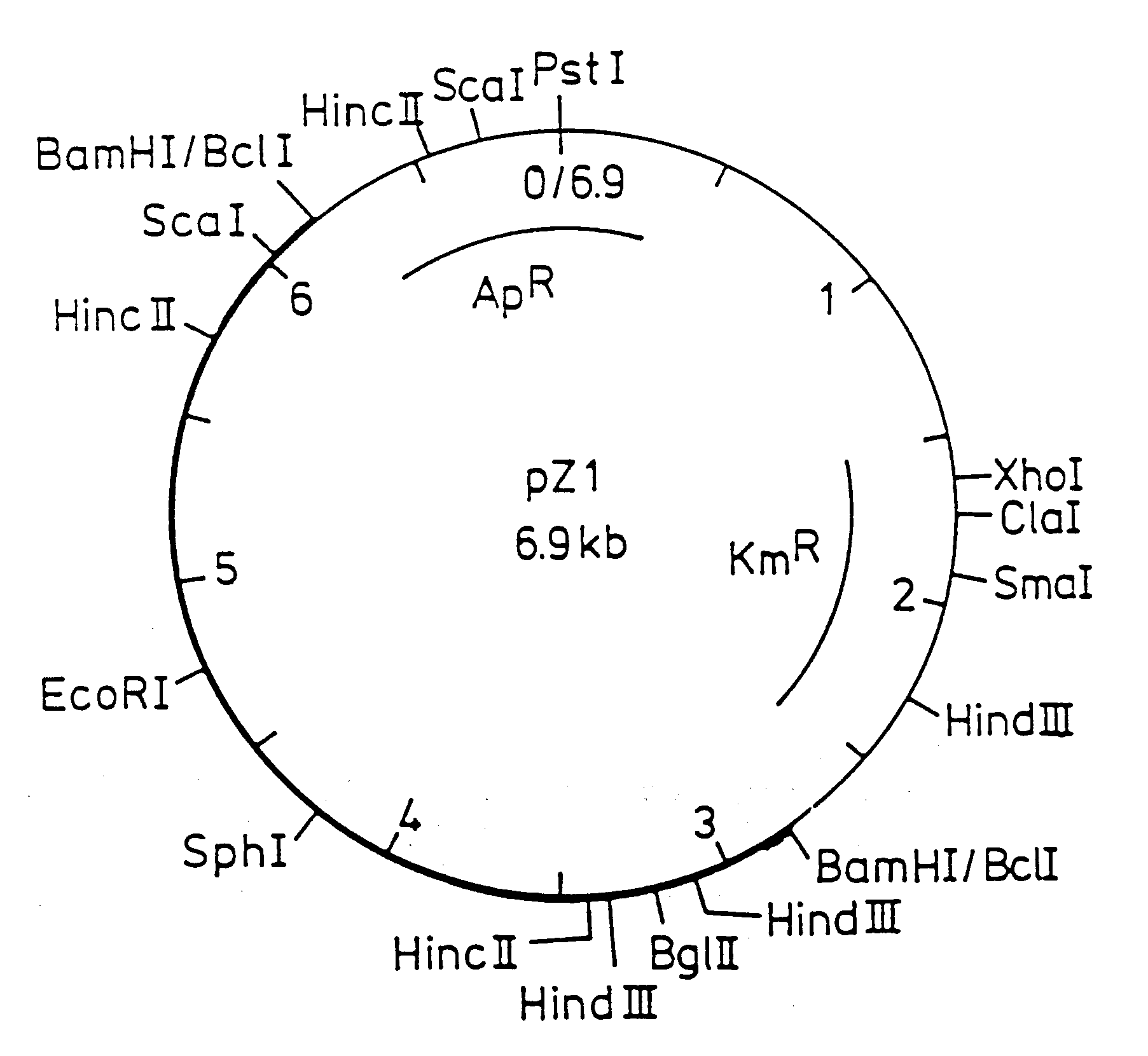
Das Transformationsgemisch wurde auf RCG/E-Agar mit 300 »g/ml Kanamycin ausplattiert und die Agarplatten eine Woche bei 30°C inkubiert. Anschließend wurden die Agarplatten auf MM-Agar (Katsumata, R. et al. J. Bact. 159, 306 (1984)) mit 50 mM AEC und 50 mM L-Threonin übergestempelt und einen Tag bei 30°C bebrütet. Eine Kolonie, die auf diesem Agar wachsen konnte wurde auf MM-Agar, der zusätzlich AEG, L-Threonin und 10 »g/ml Kanamycin enthielt, ausgestrichen, um Einzelkolonien zu erhalten. Plasmid DNA wurde aus einem derartigen Klon isoliert, als pCS2 bezeichnet und zur Transformation von C. glutamicum ATCC13032 verwendet. 59 von 62 überprüften Kanamycin-resistenten Transformanten erwiesen sich als resistent gegenüber der Hemmung durch 50 mM AEC und 50 mM L-Threonin. Das Plasmid pCS2 wurde weiterhin durch Restriktionskartierung charakterisiert. Es enthält eine ca. 9,9 kb lange Insertion in der PstI-Schnittstelle des vektors pZ1, der eine Länge von 6,9 kb hat. Die Restriktionskarte von pCS2 ist in Abbildung 2 dargestellt. -

Der obere Teil der Figur gibt die Position der verschiedenen Restriktionsschnittstellen wieder. Im unteren Teil der Figur sind verschiedene Regionen von Plasmid pCS2 dargestellt. Die Insertionen von DM58-1 DNA ist als offener Balken dargestellt. Das Ampicillin-Resistenzgen von pZ1 ist schwarz hervorgehoben, das Kanamycin-Resistenzgen ist durch Punktierung gekennzeichnet. Die übrigen pZ1-Anteile von pCS2 sind durch Schraffur hervorgehoben. Abkürzungen: BamHI, B; BclI, C; SalI, S; Sca, A; SmaI, M; XhoI, X. - Aspartat-Kinase-Aktivität wurde in Stamm ATCC13032/pCS2, als positive Kontrolle in Stamm DM58-1 und als negative Kontrolle in Stamm ATCC13032 gemessen. Die Stämme wurden in Standard I Bouillon, das mit 4 g/l Glucose, 10 »g/ml Kanamycin und 1 mM MgCl₂ supplementiert war, kultiviert. Kulturbedingungen, Zellernte, Zellaufschluß und Bestimmung der Aspartat-Kinase wurden, wie unter 1.2 beschrieben, durchgeführt. Die Effektoren L-Lys, L-Thr und AEC werden jeweils als Stammlösungen in 100 mM Tris/HCl Puffer mit einem pH von 7,5 zugegeben.
- Aspartat-Kinase-Gehalt und Hemmbarkeit des Enzyms aus ATCC13032/pCS2 sind in Tabelle 4 dargestellt. Obwohl der Stamm keine erhöhte spezifische Aktivität zeigte, konnte eine deutliche Desensibilisierung gegenüber den genannten Hemmstoffen nachgewiesen werden, deren Ausmaß den Grad der Deregulation des Enzyms aus dem Genspender DM58-1 allerdings nicht erreicht (partielle Deregulation).
- Die Fähigkeit, Lysin auszuscheiden, wurde in Stamm ATCC13032/pCS2 und als negative Kontrolle in Stamm ATCC13032/pZ1 bestimmt. Nach Zusatz von 10 »g/ml Kanamycin wurde die Kultur, wie unten beschrieben, durchgeführt. Das Ergebnis des Versuches ist in Tabelle 2 zusammengefaßt.
Tabelle 2 Ausscheidung von L-Lysin durch verschiedene C. glutamicum Stämme. C. glutamicum Stamm Konzentration an ausgeschiedenem L-Lysin·HCl (g/l) ATCC13032/pZ1 0,0 ATCC13032/pCS2 (≙ DM 2-1/pCS2) 7,1 - Ein 100 ml Erlenmeyerkolben mit Schikanen wird dabei mit 10 ml des folgenden Kulturmediums befüllt: 12 g/l Ammoniumsulfat, 240 g/l Melasse, 60 ml/l Sojamehlhydrolysat und 10 g/l CaCO₃. Nach Animpfen werden die Kulturen 72 Stunden bei 30°C und 300 rpm inkubiert. Die Lysin-Bestimmung erfolgte im zentrifugiertan Überstand mit Hilfe von Aminosäureanalysatoren.
- Durch vollständige oder partielle Verdauung von pCS2 mit verschiedenen Restriktionsenzymen und anschließender Behandlung mit T4 DNA-Ligase bei niedriger DNA Konzentration wurden verschiedene Deletionsderivate konstruiert. Die Herstellung der verschiedenen Deletionsderivate ist in Tabelle 3 zusammengefaßt und die Position der Deletionen in den verschiedenen Derivaten in Abbildung 3 dargestellt. In Abbildung 3 ist ebenfalls das Resistenzverhalten der von C. glutamicum ATCC13032 abgeleiteten Stamme gegenüber AEC eingetragen. Auf diese Weise konnte die AEC-Resistenz vermittelnde DNA-Region auf ein ca. 1,5 Kb langes DNA Fragment eingegrenzt werden, welches in Plasmid pCS233 durch die PstI-Klonierschnittstelle und eine EcoRI-Schnittstelle begrenzt wird.
- Die Aspartat-Kinase-Aktivität und die Hemmbarkeit der Enzymaktivität durch Mischungen von Lysin bzw. AEC und Threonin wurde in den konstruierten Klonen bestimmt. Anzucht, Aufschluß und Aktivitätsbestimmung wurden, wie oben beschrieben, durchgeführt. Außerdem wurde die Fähigkeit der verschiedenen Klone untersucht, L-Lysin auszuscheiden. Hierfür wurde ein Agarplatten-Diffusionstest mit einem L-Lysin-auxotrophen Indikationsstamm von C. glutamicum verwendet. Aus Tabelle 4 ist zu entnehmen, daß sämtliche AEC resistenten Stämme eine partiell deregulierte Aspartat-Kinase-Aktivität besitzen und in der Lage sind, L-Lysin auszuscheiden.
Tabelle 3 Herstellung und AECR/S-Phänotyp verschiedener Deletionsderivate des Plasmids pCS2 Plasmid Konstruktion AECR/S-Phänotyp pCS21 hergestellt nach Verdauung von pCS2 mit BamHI R pCS22 hergestellt nach Verdauung von pCS2 mit BamHI und BclI R pCS23 hergestellt nach partieller Verdauung von pCS2 mit SalI R pCS24 hergestellt nach partieller Verdauung von pCS2 mit XhoI R pCS26 hergestellt nach Verdauung von pCS2 mit ScaI R pCS231 hergestellt nach partieller Verdauung von pCS23 mit PstI S pCS232 hergestellt nach partieller Verdauung von pCS23 mit DraI S pCS233 hergestellt nach partieller Verdauung von pCS23 mit EcoRI R Zeichenerklärung: R = Resistenz,
S = Sensitivität -

Der obere Teil der Figur zeigt die von pCS2 abgeleiteten Derivate, der untere Teil zeigt die von pCS23 abgeleiteten Derivate. Das Ampicillin Resistenzgen von pZ1 ist schwarz hervorgehoben; das Kanamycin Resistenzgen ist gepunktet dargestellt; die übrigen pZ1 Anteile von pCS2 sind durch Schraffur gekennzeichnet. Die Insertion von DM58-1 DNA ist als offener Balken dargestellt. Die Deletionen sind als Strich gekennzeichnet. Abkürzungen: BamHI, B; BclI C; DraI, D; EcoRI, E; SalI, S; ScaI, A; SmaI, M; XhoI, X:Tabelle 4 Mikrobiologische und biochemische Charakterisierung rekombinanter C. glutamicum Stämme Stamm ASA-DH (U/mg) AK (U/mg) AK Restaktivität (%) in Anwesenheit von AECR Lysin-Ausscheidung 10mM Lys 1mM Thr 10mM Lys 10mM Thr 100mM Lys 10mM Thr 100mM AEC 10mM Thr ATCC13032 (pZ1) 0,06 0,016 9 5 3 7 - - ATCC13032 (pCS2) 3,9 0,013 55 55 28 56 + + ATCC13032 (pCS21) n.b. 0,016 46 50 24 n.b. + + ATCC13032 pCS22 n.b. 0,015 40 41 22 n.b. + + ATCC13032 (pCS23) 0,03 0,014 51 57 30 56 + + ATCC13032 (pCS24) 2,07 0.011 65 65 40 62 + + ATCC13032 (pCS26) 1,88 0,015 64 63 39 60 + + ATCC13032 (pCS231) 0,060 0,013 11 14 4 10 - - ATCC13032 (pCS232) n.b. n.b. n.b. n.b. n.b. n.b. - n.b. ATCC13032 (pCS233) n.b. 0,011 56 62 36 57 + n.b. DM58-1 (pZ1) 0,330 0,009 83 100 79 93 + + Abkürzungen: ASA-DH: Aspartyl-β-semialdehyd Dehydrogenase
AK : Aspartat-Kinase
n.b. : nicht bestimmt - Die Nukleotidsequenz des 2.1 Kb PstI-XhoI-DNA-Fragments wurde nach der Methode von Maxam und Gilbert (Maxam, A.M. et al., Proc. Natl. Acad. Sci. USA 74, 560-564 (1977)) mit den Modifikationen von Arnold und Pühler (Arnold, W. et al., Gene, 70,171 ff (1988)) bestimmt. Die Subklonierung zur Sequenzierung ging dabei vom Plasmid pCS24 aus (Abb. 4). Dieses wurde nach E. coli MM 294 (Meselson, M. et al., Nature 217, 1110-1114 (1968)) transformiert und entsprechende Fragmente in die Sequenziervektoren pSVB21, 25 und 26 (Arnold, W. et al., Gene, 70,171 ff (1988)) kloniert. Im E. coli-Stamm JM83 (Messing, J. Recombinant DNA Technical Bulletin NIH Publication No. 79-99 2, 43-48 (1979)) konnte Insertionsinaktivierung mittels XGal-Test (5-Bromo-4-chloro-indolyl-β-D-galactopyranosid) nachgewiesen werden.
- Die Sequenzierstrategie ist in Abb. 4 wiedergegeben. Die Nukleotidsequenz wurde von beiden DNA-Strängen mit überlappenden Klonen ermittelt.
- Das sequenzierte DNA-Stück ist 2112 bp lang. Es trägt Restriktionsschnittstellen für die Enzyme BglII, DraI, EcoRI, HindIII, NaeI, PstI, SalI und XhoI, mit denen auch die Subklone hergestellt wurden (Abb. 5).
Die Nukleotidsequenz wurde mit dem Sequenzanalyse-Programmpaket ANALYSEQ (Staden, R. et al., Nucl. Acids Res. 14, 217-232 (1986)) bearbeitet. -

Deletionsanalyse: die Plasmide pCS23 und pCS24 vermitteln ebenso wie der Klon pCS2 AEC-Resistenz und Lysin-Produktion. Die schraffierten Balken stellen den Vektoranteil der Plasmide dar.
Sequenzierstrategie: das 2.1 kb PstI-XhoI-Fragment des Plasmids pCS24 wurde mit den eingezeichneten Restriktionsschnittstellen subkloniert. Die Pfeile geben jeweils den sequenzierten Bereich und die Leserichtung an. Eingezeichnet sind die Restriktionsschnittstellen der Enzyme DraI (D), EcoRI (E), BglII (G), HindIII (H), NaeI (N), PstI (P), SalI (S) und XhoI (X). Darunter sind die 2 offenen Leseraster gezeigt, die für die Untereinheiten der Aspartatkinase und für Aspartat-β-Semialdehyd-Dehydrogenase codieren (s. Text). - Es finden sich 2 lange offene Leseraster (ORF) auf dem sequenzierten DNA-Stück. Beide sind von der PstI-Schnittstelle zur XhoI-Schnittstelle hin angeordnet. Es befindet sich nur ein kleiner Bereich von 26 bp zwischen beiden. Vor dem 2. ORF befindet sich eine Ribosomenbindungsstelle (RBS) (806-809 AGGA gefolgt von dem Startcoon ATG). Ebenso wurde innerhalb des 1. ORF's eine RBS lokalisiert (AGGA, 268-271 mit Startcodon GTG).
Der ORF1 hat eine Länge von 264 Aminosäuren (AS), gerechnet von der PstI-Stelle und von 172 AS (entsprechend 18,6 k Dals) von der internen RBS aus. ORF2 ist 342 AS (36,1 K Dals) lang.
Direkt hinter dem ORF2 befindet sich eine mögliche Transkriptionsterminationsstruktur, eine sogenannte Haarnadelschleife, gefolgt von mehreren Thyminresten (1864-1900). Diese Anordnung ist charakteristisch für ρ-unabhängige Terminationssignale in E. coli und anderen Bakterienspezies (Ahyda et al. Ann. Rev. Biochem. 47, 967-996 (1978)). Der hier vorliegende Terminator hat eine Stabilität von mehr als -40 kcal/mol bei 30°C. - Ein möglicher Promoter für ORF2 wurde innerhalb des ORF1 ermittelt (409-437), TTGACA-17 bp-TATTCT). Die -35-Region und der Abstand zur -10-Region entsprechen genau dem E. coli-Consensus-Promotor (Hawley, D.K. et al., Nucl. Acids Res. 11, 2237-2255 (1983)), die -10-Region ist der E. coli-Consensus-region (TATAAT) sehr ähnlich.


- Die von ORF1 und ORF2 translatierten Aminosäuresequenzen wurden mit den bekannten Sequenzen der Aspartat-Kinasen (AK) I (Cassan, M. et al., J. Biol. Chem. 261, 1052-1057 (1986)) von E. coli und der AK II von B. subtilis (Chen, N.-Y. et al., J. Biol. Chem 262, 8737-2255 (1987)) bzw. den AS-Sequenzen der Aspartatsemialdehyd-Dehydrogenasen (ASA-DH) von E. coli (Haziza, C. et al., Embo J. 1, 379-384 (1982)) und Streptococcus mutans (Cardineau, G.A. et al., J. Biol. Chem. 262, 7, 3344-3353 (1987)) verglichen. Dazu wurden die Programme MALIGN (Sobel, E. et al., Nucl. Acids Res. 14, 363-374 (1986)) und DIAGON (Staden, R. et al. Nucl. Acid Res. 14, 217-232 (1986)) benutzt. Es zeigten sich signifikante Übereinstimmungen zwischen ORF1 und den AK-Sequenzen einerseits und ORF2 und der ASA-DH-Sequenz von S. mutans andererseits. Zur E. coli ASA-DH zeigten sich nur schwache Homologien, vornehmlich allerdings im Bereich des aktiven Zentrums (Haziza, C. et al., Embo J. 1, 379-384 (1982)).
- Aus den Computeranalysen ergibt sich folgendes:
- ORF1 entspricht dem C. Terminus der Aspartat-Kinase, d.h. es fehlen etwa 160 AS vom N-Terminus sowie die komplette Promotorregion.
- ORF2 entspricht der Aspartatsemialdehyd-Dehydrogenase.
- Die Homologie des ORF1 mit der B. subtilis-AK II ist für den Fachmann augenfällig. Die AK II besteht aus überlappenden Untereinheiten (Chen, N.-Y. et al., J. Biol. Chem 262, 8787-8798 (1987)). Dabei entspricht die β-Untereinheit dem C-Terminus der α-Untereinheit. Da die im ORF1 gefundene RBS in ihrer Position genau mit der RBS dieser AK übereinstimmt, kann im Analogieschluß gefolgert werden, daß hier die klonierte β-Untereinheit der AK von C. glutamicum vorliegt.
- Die Identität des ORF2 mit dem asd-Gen konnte durch Komplementation des asd-negativen E. coli-Stammes RASA 6 (Richaud, F. et al., C.R. Acad. Sc. Paris, 293, 507-512 (1981)) durch die Plasmide pCS2 und pCS24 belegt werden. pCS23, bei dem etwa 50 Aminosäuren vom C-Terminus der ASA-DH fehlen, komplementiert nicht. Keines dieser Plasmide war in der Lage, den AKI-III negativen E. coli Gif 106 M1 (Boy, E. et al., Biochemie 61, 1151-1160 (1979)) zu komplementieren.
- Die unter 4.3 aus Homologievergleichen gefolgerten Analogieschlüsse, nach denen das PstI-XhoI Genfragment aus DM58-1 nur ein Teil des lysC Gens (AK), aber das vollständige asd-Gen beherbergt, konnten durch Enzymmessungen eindeutig bestätigt werden.
- Kein mit pCS2 oder einem pCS2 Derivat transformierter C. glutamicum ATCC13032 Stamm enthält eine gegenüber dem Empfängerstamm erhöhte Aspartat-Kinase Aktivität (Tabelle 4, Spalte 3).
- Demgegenüber war in allen Transformanten, deren Plasmide das asd-Strukturgen enthielten, eine starke Überexpression der ASA-DH nachweisbar (Tabelle 4, Spalte 2, Abbildung 3 und 4). Die Plasmide pCS23 und pCS23-Derivate führten erwartungsgemäß nicht zu einer Überexpression der ASA-DH. Aufgrund der hohen Labilität der ASA-DH schwanken die Faktoren der aus der spezifischen Aktivität kalkulierbaren Überexpression von 31 - 65.
- Die für ATCC13032 pCS2 nachgewiesene L-Lysin Ausscheidung von 7,1 g/l in 72 Stunden (Tabelle 2) läßt sich damit auf zwei gentechnisch realisierte Veränderungen zurückführen.
- a) Klonierung der Regulationsuntereinheit der Aspartat-Kinase aus DM58-1 ohne Erhöhung des zellulären Enzymgehaltes,
- b) Klonierung der Aspartyl-β-semialdehyd-Dehydrogenase aus DM58-1, die zur 31-65fachen Erhöhung des zellulären Enzymgehalts führt.
Claims (5)
- DNA-Fragment, im wesentlichen bestehend aus einer genetischen Sequenz, mit der Länge von 2,1 kb, begrenzt durch eine Pst I- und eine Xho I-Schnittstelle,
gekennzeichnet durch die in Abb. 5 wiedergegebenen Aminosäuresequenz, die für die Produktion von Proteinen, die zu einer Aspartyl-β-semialdehyd-Dehydrogenase (asd) Aktivität und zur Deregulation der Aspartat-Kinase (lysC) führen, kodiert, enthalten in dem Plasmid pCS2, dessen Deletionskarte Abb. 3 zu entnehmen ist, hinterlegt in Corynebacterium glutamicum unter DSM 5086. - Aus dem Plasmid pCS2 gemäß Anspruch 1 abgeleitete rekombinante DNA mit den den Bezeichnungen pCS26 entsprechenden Deletionskarten, wiedergegeben in Abb. 3.
- Aus dem Plasmid pCS2 gemäß Anspruch 1 abgeleitete rekombinante DNA mit den den Bezeichnungen pCS23 oder pCS223 entsprechenden Deletionskarten, wiedergegeben in Abb. 3
- Verfahren zur Herstellung von L-Lysin durch Fermentation von diese Aminosäure ausscheidenden Mikroorganismen der Gattungen Corynebacterium oder Brevibacterium,
dadurch gekennzeichnet, daß die Mikroorganismen das Plasmid pCS2 gemäß Anspruch 1 oder eine davon abgeleitete rekombinante DNA gemäß den Ansprüchen 2 und 3 enthalten. - Verfahren gemäß Anspruch 4,
dadurch gekennzeichnet, daß man Corynebacterium glutamicum DSM 5086 einsetzt.
Applications Claiming Priority (2)
| Application Number | Priority Date | Filing Date | Title |
|---|---|---|---|
| DE3908201A DE3908201A1 (de) | 1989-03-14 | 1989-03-14 | Verfahren zur fermentativen herstellung von l-lysin |
| DE3908201 | 1989-03-14 |
Publications (2)
| Publication Number | Publication Date |
|---|---|
| EP0387527A1 EP0387527A1 (de) | 1990-09-19 |
| EP0387527B1 true EP0387527B1 (de) | 1994-06-22 |
Family
ID=6376268
Family Applications (1)
| Application Number | Title | Priority Date | Filing Date |
|---|---|---|---|
| EP90102685A Expired - Lifetime EP0387527B1 (de) | 1989-03-14 | 1990-02-12 | Verfahren zur fermentativen Herstellung von L-Lysin |
Country Status (6)
| Country | Link |
|---|---|
| EP (1) | EP0387527B1 (de) |
| JP (1) | JP3000087B2 (de) |
| AT (1) | ATE107699T1 (de) |
| DE (2) | DE3908201A1 (de) |
| ES (1) | ES2056263T3 (de) |
| SK (1) | SK122890A3 (de) |
Cited By (1)
| Publication number | Priority date | Publication date | Assignee | Title |
|---|---|---|---|---|
| RU2197528C2 (ru) * | 1995-06-07 | 2003-01-27 | Адзиномото Ко., Инк. | Способ получения l-лизина (варианты) и рекомбинантная днк, используемая для его осуществления (варианты) |
Families Citing this family (36)
| Publication number | Priority date | Publication date | Assignee | Title |
|---|---|---|---|---|
| DE3943117A1 (de) * | 1989-12-27 | 1991-07-04 | Forschungszentrum Juelich Gmbh | Verfahren zur fermentativen herstellung von aminosaeure, insbesondere l-lysin, dafuer geeignete mikroorganismen und rekombinante dna |
| JPH07108228B2 (ja) * | 1990-10-15 | 1995-11-22 | 味の素株式会社 | 温度感受性プラスミド |
| JP3473042B2 (ja) * | 1992-04-28 | 2003-12-02 | 味の素株式会社 | 変異型アスパルトキナーゼ遺伝子 |
| JP3783065B2 (ja) * | 1994-03-04 | 2006-06-07 | 味の素株式会社 | L−リジンの製造法 |
| JP4075087B2 (ja) | 1996-12-05 | 2008-04-16 | 味の素株式会社 | L−リジンの製造法 |
| DE19924364A1 (de) | 1999-05-27 | 2000-11-30 | Degussa | Verfahren zur fermentativen Herstellung von L-Aminosäuren unter Verwendung coryneformer Bakterien |
| JP4623825B2 (ja) * | 1999-12-16 | 2011-02-02 | 協和発酵バイオ株式会社 | 新規ポリヌクレオチド |
| US6927046B1 (en) | 1999-12-30 | 2005-08-09 | Archer-Daniels-Midland Company | Increased lysine production by gene amplification using coryneform bacteria |
| EP1307476A1 (de) * | 2000-08-02 | 2003-05-07 | Degussa AG | Nukleotidsequenzen die für das mete-gen kodieren |
| AU2001287631A1 (en) * | 2000-08-02 | 2002-02-13 | Degussa A.G. | Nucleotide sequences which code for the metf gene |
| EP1307475A1 (de) * | 2000-08-02 | 2003-05-07 | Degussa AG | Nukleotidsequenzen, die für das meth-gen kodieren |
| US6958228B2 (en) | 2000-08-02 | 2005-10-25 | Degussa Ag | Nucleotide sequence which code for the metH gene |
| US6942996B2 (en) | 2000-08-02 | 2005-09-13 | Degussa Ag | Isolated polynucleotide from Corynebacterium encoding a homocysteine methyltransferase |
| US6812016B2 (en) | 2000-09-02 | 2004-11-02 | Degussa Ag | Nucleotide sequences which code for the metY gene |
| DE10109690A1 (de) * | 2000-09-02 | 2002-03-14 | Degussa | Neue für das metY-Gen kodierende Nukleotidsequenzen |
| DE10044681A1 (de) * | 2000-09-09 | 2002-03-21 | Degussa | Neue für das lldD2-Gen kodierende Nukleotidsequenzen |
| WO2002020573A2 (en) * | 2000-09-09 | 2002-03-14 | Degussa Ag | Nucleotide sequences which code for the gpmb gene |
| WO2002022670A1 (en) * | 2000-09-12 | 2002-03-21 | Degussa Ag | Nucleotide sequences coding for the ftsx gene |
| AU2001285878A1 (en) * | 2000-09-12 | 2002-03-26 | Degussa A.G. | Nucleotide sequences which code for the roda gene |
| DE10046625A1 (de) * | 2000-09-20 | 2002-04-11 | Degussa | Neue für das ndkA-Gen kodierende Nukleotidsequenzen |
| DE10047864A1 (de) * | 2000-09-27 | 2002-04-11 | Degussa | Neue für das truB-Gen kodierende Nukleotidsequenzen |
| US7026158B2 (en) * | 2000-09-27 | 2006-04-11 | Degussa Ag | Nucleotide sequences which code for the mikE17 gene |
| AU2002218223A1 (en) * | 2000-10-28 | 2002-05-06 | Degussa A.G. | Nucleotide sequences encoding the hemd and hemb genes |
| AR032570A1 (es) | 2001-02-08 | 2003-11-12 | Archer Daniels Midland Co | Construcciones de polinucleotidicas para aumentar la produccion de lisina |
| DE10155505A1 (de) | 2001-11-13 | 2003-05-22 | Basf Ag | Gene die für Glucose-6-Phosphat-Dehydrogenase Proteine codieren |
| DE10210527A1 (de) | 2002-03-09 | 2003-09-18 | Degussa | Allele des aceA-Gens aus coryneformen Bakterien |
| ATE525457T1 (de) | 2004-12-06 | 2011-10-15 | Sage Biosciences Inc | Verfahren zur züchtung von bakterien zur abgabe von bioaktiven verbindungen an das intestinum von wiederkäuern |
| DE102014208199A1 (de) | 2014-04-30 | 2015-11-05 | Evonik Degussa Gmbh | Verfahren zur Produktion von L-Aminosäuren unter Verwendung eines alkaliphilen Bakteriums |
| EP2940143B1 (de) | 2014-04-30 | 2020-02-05 | Evonik Operations GmbH | Verfahren zur Produktion von L-Aminosäuren unter Verwendung eines alkaliphilen Bakteriums |
| EP2940039A1 (de) | 2014-04-30 | 2015-11-04 | Evonik Degussa GmbH | Verfahren zur Produktion von L-Aminosäuren in Corynebakterien unter Verwendung eines Glycin spaltenden Systems |
| EP3467099A1 (de) | 2017-10-05 | 2019-04-10 | Evonik Degussa GmbH | Verfahren zur fermentativen herstellung von l-aminosäuren |
| RU2019128538A (ru) | 2018-09-26 | 2021-03-11 | Эвоник Оперейшенс ГмбХ | Способ ферментативного получения l-лизина |
| WO2022191357A1 (ko) * | 2021-03-09 | 2022-09-15 | 대상 주식회사 | L-라이신 생산능이 향상된 코리네박테리움 글루타미쿰 변이주 및 이를 이용한 l-라이신의 생산 방법 |
| US20250340893A1 (en) | 2022-05-18 | 2025-11-06 | Evonik Operations Gmbh | Biotechnological production of desferrioxamines and analogs thereof |
| CN119212692A (zh) | 2022-05-18 | 2024-12-27 | 赢创运营有限公司 | 比苏卡林、去铁胺及其类似物的单体的生物技术生产 |
| CN119212691A (zh) | 2022-05-18 | 2024-12-27 | 赢创运营有限公司 | 比苏卡林、去铁胺及其类似物的生物技术生产 |
Family Cites Families (3)
| Publication number | Priority date | Publication date | Assignee | Title |
|---|---|---|---|---|
| JPS58126789A (ja) * | 1981-12-29 | 1983-07-28 | Kyowa Hakko Kogyo Co Ltd | レースレオニンの製造法 |
| JPH0655149B2 (ja) * | 1985-03-12 | 1994-07-27 | 協和醗酵工業株式会社 | L―リジンの製造法 |
| JPH06102028B2 (ja) * | 1985-10-04 | 1994-12-14 | 協和醗酵工業株式会社 | アミノ酸の製造法 |
-
1989
- 1989-03-14 DE DE3908201A patent/DE3908201A1/de not_active Withdrawn
-
1990
- 1990-02-12 ES ES90102685T patent/ES2056263T3/es not_active Expired - Lifetime
- 1990-02-12 DE DE59006167T patent/DE59006167D1/de not_active Expired - Fee Related
- 1990-02-12 AT AT90102685T patent/ATE107699T1/de active
- 1990-02-12 EP EP90102685A patent/EP0387527B1/de not_active Expired - Lifetime
- 1990-03-14 JP JP2061308A patent/JP3000087B2/ja not_active Expired - Fee Related
- 1990-03-14 SK SK1228-90A patent/SK122890A3/sk unknown
Cited By (1)
| Publication number | Priority date | Publication date | Assignee | Title |
|---|---|---|---|---|
| RU2197528C2 (ru) * | 1995-06-07 | 2003-01-27 | Адзиномото Ко., Инк. | Способ получения l-лизина (варианты) и рекомбинантная днк, используемая для его осуществления (варианты) |
Also Published As
| Publication number | Publication date |
|---|---|
| ES2056263T3 (es) | 1994-10-01 |
| ATE107699T1 (de) | 1994-07-15 |
| SK279719B6 (sk) | 1999-02-11 |
| DE59006167D1 (de) | 1994-07-28 |
| JPH03219885A (ja) | 1991-09-27 |
| DE3908201A1 (de) | 1990-09-27 |
| EP0387527A1 (de) | 1990-09-19 |
| SK122890A3 (en) | 1999-02-11 |
| JP3000087B2 (ja) | 2000-01-17 |
Similar Documents
| Publication | Publication Date | Title |
|---|---|---|
| EP0387527A1 (de) | Verfahren zur fermentativen Herstellung von L-Lysin | |
| DE68924227T2 (de) | DNA-Fragment. | |
| EP0435132B1 (de) | Verfahren zur fermentativen Herstellung von Aminosäuren, insbesondere L-Lysin, dafür geeignete Mikroorganismen und rekombinante DNA | |
| DE60025976T2 (de) | DNA die für eine mutierte Isopropylmalatsynthase kodiert, Microorganismus, das L-Leucin produziert, und Verfahren zur Herstellung von L-Leucin | |
| DE60011974T2 (de) | Verfahren zur Herstellung von L-Aminosäuren mittels Fermentation eines Escherichia Stammes, transformiert mit einem Pyruvat-carboxylase Gen aus Bacillus subtilis | |
| DE69727260T3 (de) | Verfahren zur Herstellung von L-Lysin | |
| DE69736699T2 (de) | Verfahren zur Herstellung von L-Lysin | |
| DE69330518T2 (de) | Dna, die aspartokinase iii-mutanten kodiert und ihre verwendung zur herstellung von l-threonin durch fermentation | |
| DE69534801T2 (de) | Neues lysin decarboxylasegen und verfahren zur herstellung von l-lysin | |
| EP1155139B1 (de) | Verfahren zur mikrobiellen herstellung von l-valin | |
| DE60207685T2 (de) | Verfahren zur herstellung von l-threonin | |
| DE69530306T2 (de) | Verfahren zur herstellung von l-lysin und l-glutaminsäure durch fermentation | |
| DE69514914T2 (de) | Ein aus corynebakterien abstammendes gen und seine verwendung | |
| EP1015621A2 (de) | Verfahren zur mikrobiellen herstellung von aminosäuren der aspartat- und/oder glutamatfamilie und im verfahren einsetzbare mittel | |
| JPS6279788A (ja) | アミノ酸の製造法 | |
| EP0472869A2 (de) | Neue Plasmide aus Corynebacterium glutamicum und davon abgeleitete Plasmidvektoren | |
| DE69629299T2 (de) | Prozess für die produktion von l-lysin durch fermentation | |
| EP1067193B1 (de) | L-Lysin produzierende coryneforme Bakterien und Verfahren zur Herstellung von Lysin | |
| EP1067192A1 (de) | L-Lysin produzierende coryneforme Bakterien und Verfahren zur Herstellung von L-Lysin | |
| DE10354024A1 (de) | Verfahren zur Herstellung von L-Aminosäuren unter Verwendung von Methylotrophen | |
| DE3823451C2 (de) | Rekombinante DNA, damit transformierte Mikrooganismen und Verwendung dieser Mikroorganismen zur Herstellung von L-Lysin mit Hilfe dieser Mikroorganismen | |
| DE69022631T2 (de) | Verfahren zur Herstellung von L-Tryptophan. | |
| DE69131015T2 (de) | Rekombinante zellen, die stark chromosomal-integrierte heterologe gene exprimieren | |
| DE60036615T2 (de) | Verfahren zur fermentativen herstellung von l-aminosäuren durch verstärkung des tkt-gens | |
| WO1995010613A1 (de) | Gene für den butyrobetain/crotonobetain-l-carnitin-stoffwechsel und ihre verwendung zur mikrobiologischen herstellung von l-carnitin |
Legal Events
| Date | Code | Title | Description |
|---|---|---|---|
| PUAI | Public reference made under article 153(3) epc to a published international application that has entered the european phase |
Free format text: ORIGINAL CODE: 0009012 |
|
| 17P | Request for examination filed |
Effective date: 19900212 |
|
| AK | Designated contracting states |
Kind code of ref document: A1 Designated state(s): AT BE DE ES FR GB IT NL |
|
| 17Q | First examination report despatched |
Effective date: 19930430 |
|
| GRAA | (expected) grant |
Free format text: ORIGINAL CODE: 0009210 |
|
| ITF | It: translation for a ep patent filed | ||
| AK | Designated contracting states |
Kind code of ref document: B1 Designated state(s): AT BE DE ES FR GB IT NL |
|
| REF | Corresponds to: |
Ref document number: 107699 Country of ref document: AT Date of ref document: 19940715 Kind code of ref document: T |
|
| ET | Fr: translation filed | ||
| GBT | Gb: translation of ep patent filed (gb section 77(6)(a)/1977) |
Effective date: 19940627 |
|
| REF | Corresponds to: |
Ref document number: 59006167 Country of ref document: DE Date of ref document: 19940728 |
|
| REG | Reference to a national code |
Ref country code: ES Ref legal event code: FG2A Ref document number: 2056263 Country of ref document: ES Kind code of ref document: T3 |
|
| PLBE | No opposition filed within time limit |
Free format text: ORIGINAL CODE: 0009261 |
|
| STAA | Information on the status of an ep patent application or granted ep patent |
Free format text: STATUS: NO OPPOSITION FILED WITHIN TIME LIMIT |
|
| 26N | No opposition filed | ||
| PGFP | Annual fee paid to national office [announced via postgrant information from national office to epo] |
Ref country code: GB Payment date: 19970113 Year of fee payment: 8 |
|
| PGFP | Annual fee paid to national office [announced via postgrant information from national office to epo] |
Ref country code: BE Payment date: 19970116 Year of fee payment: 8 |
|
| PGFP | Annual fee paid to national office [announced via postgrant information from national office to epo] |
Ref country code: AT Payment date: 19970128 Year of fee payment: 8 |
|
| PG25 | Lapsed in a contracting state [announced via postgrant information from national office to epo] |
Ref country code: AT Free format text: LAPSE BECAUSE OF NON-PAYMENT OF DUE FEES Effective date: 19980212 Ref country code: GB Free format text: LAPSE BECAUSE OF NON-PAYMENT OF DUE FEES Effective date: 19980212 |
|
| PG25 | Lapsed in a contracting state [announced via postgrant information from national office to epo] |
Ref country code: BE Free format text: LAPSE BECAUSE OF NON-PAYMENT OF DUE FEES Effective date: 19980228 |
|
| BERE | Be: lapsed |
Owner name: DEGUSSA A.G. Effective date: 19980228 |
|
| GBPC | Gb: european patent ceased through non-payment of renewal fee |
Effective date: 19980212 |
|
| NLS | Nl: assignments of ep-patents |
Owner name: DEGUSSA-HUELS AKTIENGESELLSCHAFT Owner name: DEGUSSA AG |
|
| REG | Reference to a national code |
Ref country code: ES Ref legal event code: PC2A |
|
| REG | Reference to a national code |
Ref country code: FR Ref legal event code: TP |
|
| PGFP | Annual fee paid to national office [announced via postgrant information from national office to epo] |
Ref country code: IT Payment date: 20060228 Year of fee payment: 17 |
|
| PGFP | Annual fee paid to national office [announced via postgrant information from national office to epo] |
Ref country code: NL Payment date: 20070213 Year of fee payment: 18 |
|
| PGFP | Annual fee paid to national office [announced via postgrant information from national office to epo] |
Ref country code: DE Payment date: 20070216 Year of fee payment: 18 |
|
| PGFP | Annual fee paid to national office [announced via postgrant information from national office to epo] |
Ref country code: ES Payment date: 20070227 Year of fee payment: 18 |
|
| PGFP | Annual fee paid to national office [announced via postgrant information from national office to epo] |
Ref country code: FR Payment date: 20070212 Year of fee payment: 18 |
|
| NLV4 | Nl: lapsed or anulled due to non-payment of the annual fee |
Effective date: 20080901 |
|
| PG25 | Lapsed in a contracting state [announced via postgrant information from national office to epo] |
Ref country code: NL Free format text: LAPSE BECAUSE OF NON-PAYMENT OF DUE FEES Effective date: 20080901 |
|
| REG | Reference to a national code |
Ref country code: FR Ref legal event code: ST Effective date: 20081031 |
|
| PG25 | Lapsed in a contracting state [announced via postgrant information from national office to epo] |
Ref country code: DE Free format text: LAPSE BECAUSE OF NON-PAYMENT OF DUE FEES Effective date: 20080902 |
|
| PG25 | Lapsed in a contracting state [announced via postgrant information from national office to epo] |
Ref country code: FR Free format text: LAPSE BECAUSE OF NON-PAYMENT OF DUE FEES Effective date: 20080229 |
|
| REG | Reference to a national code |
Ref country code: ES Ref legal event code: FD2A Effective date: 20080213 |
|
| PG25 | Lapsed in a contracting state [announced via postgrant information from national office to epo] |
Ref country code: ES Free format text: LAPSE BECAUSE OF NON-PAYMENT OF DUE FEES Effective date: 20080213 |
|
| PG25 | Lapsed in a contracting state [announced via postgrant information from national office to epo] |
Ref country code: IT Free format text: LAPSE BECAUSE OF NON-PAYMENT OF DUE FEES Effective date: 20070212 |