EP0380392A2 - Abkömmlinge von Benzocycloalkenyldihydroxyalkansäuren, Verfahren zu deren Herstellung und diese enthaltende Pharmazeutika - Google Patents
Abkömmlinge von Benzocycloalkenyldihydroxyalkansäuren, Verfahren zu deren Herstellung und diese enthaltende Pharmazeutika Download PDFInfo
- Publication number
- EP0380392A2 EP0380392A2 EP90400161A EP90400161A EP0380392A2 EP 0380392 A2 EP0380392 A2 EP 0380392A2 EP 90400161 A EP90400161 A EP 90400161A EP 90400161 A EP90400161 A EP 90400161A EP 0380392 A2 EP0380392 A2 EP 0380392A2
- Authority
- EP
- European Patent Office
- Prior art keywords
- formula
- phenyl
- dihydroxy
- erythro
- compounds
- Prior art date
- Legal status (The legal status is an assumption and is not a legal conclusion. Google has not performed a legal analysis and makes no representation as to the accuracy of the status listed.)
- Granted
Links
- 0 C*C1=C(C=*)C(C(C=C[*@@](C)*)=CC=C*)=CC(*)(*)*1 Chemical compound C*C1=C(C=*)C(C(C=C[*@@](C)*)=CC=C*)=CC(*)(*)*1 0.000 description 1
Images




Classifications
-
- C—CHEMISTRY; METALLURGY
- C07—ORGANIC CHEMISTRY
- C07D—HETEROCYCLIC COMPOUNDS
- C07D333/00—Heterocyclic compounds containing five-membered rings having one sulfur atom as the only ring hetero atom
- C07D333/50—Heterocyclic compounds containing five-membered rings having one sulfur atom as the only ring hetero atom condensed with carbocyclic rings or ring systems
-
- A—HUMAN NECESSITIES
- A61—MEDICAL OR VETERINARY SCIENCE; HYGIENE
- A61P—SPECIFIC THERAPEUTIC ACTIVITY OF CHEMICAL COMPOUNDS OR MEDICINAL PREPARATIONS
- A61P3/00—Drugs for disorders of the metabolism
- A61P3/06—Antihyperlipidemics
-
- A—HUMAN NECESSITIES
- A61—MEDICAL OR VETERINARY SCIENCE; HYGIENE
- A61P—SPECIFIC THERAPEUTIC ACTIVITY OF CHEMICAL COMPOUNDS OR MEDICINAL PREPARATIONS
- A61P31/00—Antiinfectives, i.e. antibiotics, antiseptics, chemotherapeutics
- A61P31/10—Antimycotics
-
- A—HUMAN NECESSITIES
- A61—MEDICAL OR VETERINARY SCIENCE; HYGIENE
- A61P—SPECIFIC THERAPEUTIC ACTIVITY OF CHEMICAL COMPOUNDS OR MEDICINAL PREPARATIONS
- A61P7/00—Drugs for disorders of the blood or the extracellular fluid
- A61P7/02—Antithrombotic agents; Anticoagulants; Platelet aggregation inhibitors
-
- A—HUMAN NECESSITIES
- A61—MEDICAL OR VETERINARY SCIENCE; HYGIENE
- A61P—SPECIFIC THERAPEUTIC ACTIVITY OF CHEMICAL COMPOUNDS OR MEDICINAL PREPARATIONS
- A61P9/00—Drugs for disorders of the cardiovascular system
-
- C—CHEMISTRY; METALLURGY
- C07—ORGANIC CHEMISTRY
- C07C—ACYCLIC OR CARBOCYCLIC COMPOUNDS
- C07C17/00—Preparation of halogenated hydrocarbons
- C07C17/093—Preparation of halogenated hydrocarbons by replacement by halogens
- C07C17/10—Preparation of halogenated hydrocarbons by replacement by halogens of hydrogen atoms
-
- C—CHEMISTRY; METALLURGY
- C07—ORGANIC CHEMISTRY
- C07C—ACYCLIC OR CARBOCYCLIC COMPOUNDS
- C07C45/00—Preparation of compounds having >C = O groups bound only to carbon or hydrogen atoms; Preparation of chelates of such compounds
- C07C45/45—Preparation of compounds having >C = O groups bound only to carbon or hydrogen atoms; Preparation of chelates of such compounds by condensation
- C07C45/46—Friedel-Crafts reactions
-
- C—CHEMISTRY; METALLURGY
- C07—ORGANIC CHEMISTRY
- C07C—ACYCLIC OR CARBOCYCLIC COMPOUNDS
- C07C45/00—Preparation of compounds having >C = O groups bound only to carbon or hydrogen atoms; Preparation of chelates of such compounds
- C07C45/61—Preparation of compounds having >C = O groups bound only to carbon or hydrogen atoms; Preparation of chelates of such compounds by reactions not involving the formation of >C = O groups
- C07C45/67—Preparation of compounds having >C = O groups bound only to carbon or hydrogen atoms; Preparation of chelates of such compounds by reactions not involving the formation of >C = O groups by isomerisation; by change of size of the carbon skeleton
- C07C45/68—Preparation of compounds having >C = O groups bound only to carbon or hydrogen atoms; Preparation of chelates of such compounds by reactions not involving the formation of >C = O groups by isomerisation; by change of size of the carbon skeleton by increase in the number of carbon atoms
-
- C—CHEMISTRY; METALLURGY
- C07—ORGANIC CHEMISTRY
- C07C—ACYCLIC OR CARBOCYCLIC COMPOUNDS
- C07C47/00—Compounds having —CHO groups
- C07C47/20—Unsaturated compounds having —CHO groups bound to acyclic carbon atoms
- C07C47/235—Unsaturated compounds having —CHO groups bound to acyclic carbon atoms containing six-membered aromatic rings and other rings
- C07C47/238—Unsaturated compounds having —CHO groups bound to acyclic carbon atoms containing six-membered aromatic rings and other rings having unsaturation outside the aromatic rings
-
- C—CHEMISTRY; METALLURGY
- C07—ORGANIC CHEMISTRY
- C07C—ACYCLIC OR CARBOCYCLIC COMPOUNDS
- C07C47/00—Compounds having —CHO groups
- C07C47/20—Unsaturated compounds having —CHO groups bound to acyclic carbon atoms
- C07C47/24—Unsaturated compounds having —CHO groups bound to acyclic carbon atoms containing halogen
-
- C—CHEMISTRY; METALLURGY
- C07—ORGANIC CHEMISTRY
- C07C—ACYCLIC OR CARBOCYCLIC COMPOUNDS
- C07C47/00—Compounds having —CHO groups
- C07C47/20—Unsaturated compounds having —CHO groups bound to acyclic carbon atoms
- C07C47/277—Unsaturated compounds having —CHO groups bound to acyclic carbon atoms containing ether groups, groups, groups, or groups
-
- C—CHEMISTRY; METALLURGY
- C07—ORGANIC CHEMISTRY
- C07C—ACYCLIC OR CARBOCYCLIC COMPOUNDS
- C07C49/00—Ketones; Ketenes; Dimeric ketenes; Ketonic chelates
- C07C49/587—Unsaturated compounds containing a keto groups being part of a ring
- C07C49/657—Unsaturated compounds containing a keto groups being part of a ring containing six-membered aromatic rings
- C07C49/665—Unsaturated compounds containing a keto groups being part of a ring containing six-membered aromatic rings a keto group being part of a condensed ring system
- C07C49/67—Unsaturated compounds containing a keto groups being part of a ring containing six-membered aromatic rings a keto group being part of a condensed ring system having two rings, e.g. tetralones
-
- C—CHEMISTRY; METALLURGY
- C07—ORGANIC CHEMISTRY
- C07C—ACYCLIC OR CARBOCYCLIC COMPOUNDS
- C07C57/00—Unsaturated compounds having carboxyl groups bound to acyclic carbon atoms
- C07C57/30—Unsaturated compounds having carboxyl groups bound to acyclic carbon atoms containing six-membered aromatic rings
-
- C—CHEMISTRY; METALLURGY
- C07—ORGANIC CHEMISTRY
- C07D—HETEROCYCLIC COMPOUNDS
- C07D309/00—Heterocyclic compounds containing six-membered rings having one oxygen atom as the only ring hetero atom, not condensed with other rings
- C07D309/16—Heterocyclic compounds containing six-membered rings having one oxygen atom as the only ring hetero atom, not condensed with other rings having one double bond between ring members or between a ring member and a non-ring member
- C07D309/28—Heterocyclic compounds containing six-membered rings having one oxygen atom as the only ring hetero atom, not condensed with other rings having one double bond between ring members or between a ring member and a non-ring member with hetero atoms or with carbon atoms having three bonds to hetero atoms with at the most one bond to halogen, e.g. ester or nitrile radicals, directly attached to ring carbon atoms
- C07D309/30—Oxygen atoms, e.g. delta-lactones
-
- C—CHEMISTRY; METALLURGY
- C07—ORGANIC CHEMISTRY
- C07D—HETEROCYCLIC COMPOUNDS
- C07D311/00—Heterocyclic compounds containing six-membered rings having one oxygen atom as the only hetero atom, condensed with other rings
- C07D311/96—Heterocyclic compounds containing six-membered rings having one oxygen atom as the only hetero atom, condensed with other rings spiro-condensed with carbocyclic rings or ring systems
-
- C—CHEMISTRY; METALLURGY
- C07—ORGANIC CHEMISTRY
- C07D—HETEROCYCLIC COMPOUNDS
- C07D335/00—Heterocyclic compounds containing six-membered rings having one sulfur atom as the only ring hetero atom
- C07D335/04—Heterocyclic compounds containing six-membered rings having one sulfur atom as the only ring hetero atom condensed with carbocyclic rings or ring systems
- C07D335/06—Benzothiopyrans; Hydrogenated benzothiopyrans
-
- C—CHEMISTRY; METALLURGY
- C07—ORGANIC CHEMISTRY
- C07D—HETEROCYCLIC COMPOUNDS
- C07D407/00—Heterocyclic compounds containing two or more hetero rings, at least one ring having oxygen atoms as the only ring hetero atoms, not provided for by group C07D405/00
- C07D407/02—Heterocyclic compounds containing two or more hetero rings, at least one ring having oxygen atoms as the only ring hetero atoms, not provided for by group C07D405/00 containing two hetero rings
- C07D407/06—Heterocyclic compounds containing two or more hetero rings, at least one ring having oxygen atoms as the only ring hetero atoms, not provided for by group C07D405/00 containing two hetero rings linked by a carbon chain containing only aliphatic carbon atoms
-
- C—CHEMISTRY; METALLURGY
- C07—ORGANIC CHEMISTRY
- C07D—HETEROCYCLIC COMPOUNDS
- C07D409/00—Heterocyclic compounds containing two or more hetero rings, at least one ring having sulfur atoms as the only ring hetero atoms
- C07D409/02—Heterocyclic compounds containing two or more hetero rings, at least one ring having sulfur atoms as the only ring hetero atoms containing two hetero rings
- C07D409/06—Heterocyclic compounds containing two or more hetero rings, at least one ring having sulfur atoms as the only ring hetero atoms containing two hetero rings linked by a carbon chain containing only aliphatic carbon atoms
-
- C—CHEMISTRY; METALLURGY
- C07—ORGANIC CHEMISTRY
- C07C—ACYCLIC OR CARBOCYCLIC COMPOUNDS
- C07C2602/00—Systems containing two condensed rings
- C07C2602/02—Systems containing two condensed rings the rings having only two atoms in common
- C07C2602/04—One of the condensed rings being a six-membered aromatic ring
- C07C2602/10—One of the condensed rings being a six-membered aromatic ring the other ring being six-membered, e.g. tetraline
Definitions
- the present invention relates to new derivatives of benzocycloalkenyl dihydroxy alkanoic acids, the processes for preparing these compounds and the pharmaceutical compositions containing them.
- mevalonic acid is inhibitors of the enzyme hydroxy-3-methyl-3-glutaryl coenzyme A reductase, responsible for the biosynthesis of cholesterol, (cf. SINGER et al., Proc. Sc. Exper. Biol. Med., 102 , 275, 1959).
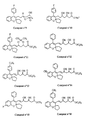
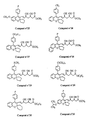
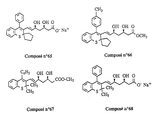
- the invention relates more particularly to the compounds of formula 1 , numbered to allow a better understanding of the invention and by way of example only as indicated, in which, X represents a methylene link -CH2-, an oxygen atom or a sulfur atom.
- R1 and R2 which may be the same or different, represent hydrogen atoms or alkyl radicals of 1 to 3 carbon atoms.
- R1 and R2 can also together form an alkylene chain: - (CH2) n -, if necessary symmetrically substituted by one or two alkyl radicals of 1 to 3 carbon atoms and whose number n of links, can take the values 4 or 5.
- R3 and R4 which may be the same or different, represent hydrogen atoms, halogen atoms (fluorine, chlorine, or bromine), radicals: trifluoromethyl, N, N-dialkylamino of 1 to 3 carbon atoms, alkyl from 1 to 4 carbon atoms, alkoxy from 1 to 5 carbon atoms, alkylthio from 1 to 3 carbon atoms, or phenyl optionally substituted by at most two substituents which may be the same or different and represent radicals: alkyl from 1 to 3 carbon atoms, alkoxy of 1 to 3 carbon atoms, or halogen atoms (fluorine or chlorine), provided that when one of the substituents R3 or R4 represents the radicals: trifluoromethyl, N, N-dialkylamino, phenyl or substituted phenyl, it is on the vertices 3 ′, 4 ′ or 5 ′ (meta or para) according to formula 1 and the other substituent represents a hydrogen atom
- R5 and R6 which may be the same or different, represent hydrogen atoms, halogen atoms (fluorine, chlorine or bromine), radicals: trifluoromethyl, alkyl of 1 to 3 carbon atoms, alkoxy of 1 to 3 atoms of carbon, or a phenyl radical, optionally substituted by at most two substituents which may be identical or different and represent radicals: alkyl of 1 to 3 carbon atoms, alkoxy of 1 to 3 carbon atoms, or halogens ( chlorine or fluorine) provided that when one of the substituents R5 or R6 represents the radicals: trifluoromethyl, phenyl or substituted phenyl, it is found on vertices 6 or 7 according to formula 1 and the other substituent denotes an atom of hydrogen.
- substituents chlorine or fluorine
- the substituents R7 and R8 each represent a hydrogen atom or together form and with the existing CC bond, a double bond of trans geometry (E).
- the substituents R9 and R10 each represent a hydrogen atom or together form a dialkylmethylene residue of 1 to 3 carbon atoms.
- R11 may represent a hydroxyl radical, in which case the compounds of formula 1 are carboxylic acids, in free form.
- the compounds of formula 1 can also be obtained in the form of esters and amides which are also part of the invention.
- esters and amides of formula 1 in which the substituent R11 represents alkoxy radicals of 1 to 4 carbon atoms, benzyloxy, alkylamino or N, N-dialkylamino of 1 to 3 carbon atoms, imino from 4 to 6 carbon atoms, cycloalkylamino from 3 to 6 carbon atoms or amino or benzylamino radicals.
- the compounds of formula 1 in the form of salts that is to say in the formula of which, the substituent R11 represents a residue of formula -O ⁇ M+ in which M+ denotes a pharmaceutically acceptable cation, also form part of the invention ; among these, the sodium, potassium, magnesium and ammonium salts are more particularly preferred.
- the compounds of formula 1 can exist in the form of ⁇ -lactones, when the substituent R11 forms with the substituent R g a single bond; the compounds of formula 1 in ⁇ -lactone form also form part of the invention.
- the subject of the invention is the compounds of formula 1 in which the substituents R1 and R2 are identical or form an alkylene chain: - (CH2) n -, unsubstituted with the number n of links is equal to 4 or 5.
- R1 and R2 when they denote alkyl radicals of 1 to 3 carbon atoms is for example methyl.
- n when the substituents R1 and R2 form an alkylene chain, - (CH2) n -, is for example 4.
- substituents R3 and R4 are by way of example only, - when it represents a halogen atom: fluorine or chlorine; - When it represents an alkyl radical of 1 to 4 carbon atoms: methyl or ethyl; - when it represents an alkoxy radical of 1 to 5 carbon atoms: methoxy or ethoxy; - When it represents an alkylthio radical of 1 to 3 carbon atoms: methylthio; - When it represents a substituted phenyl radical: phenyl substituted in para by a fluorine atom, by a methyl or methoxy radical.
- a particular value of p when the substituents R3 and R4 form an alkylenedioxy diradical: -O (CH2) p O- is for example 1.
- radicals R3 and R4 are, for example made when R3 and R4 denote alkyl radicals of 1 to 4 carbon atoms and / or halogen atoms, or a halogen atom and an alkoxy radical of 1 with 5 carbon atoms; when one of the substituents R3 or R4 is a halogen atom, or an alkyl radical of 1 to 4 carbon atoms, or an alkoxy radical of 1 to 5 carbon atoms, or an alkylthio radical of 1 to 3 atoms of carbon and the other represents a hydrogen atom.
- radicals R3 and R4 are, for example made, when they represent methyl radicals in position 3 ′ and 5 ′, a fluorine atom in position 4 ′ and a methyl radical in position 3 ′, atoms of fluorine in position 3 ′ and 4 ′, a fluorine atom in position 3 ′ or 4 ′ and a hydrogen atom, a methyl or ethyl radical in position 4 ′ and a hydrogen atom, a methoxy radical in position 3 ′ or 4 ′ and a hydrogen atom, a chlorine atom in position 3 ′ or 4 ′ and a hydrogen atom, or hydrogen atoms.
- a particular meaning of any of the substituents R5 and R6 is, by way of example, - when it represents a halogen atom: fluorine or chlorine; - When it represents an alkyl radical of 1 to 3 carbon atoms: methyl; - when it represents an alkoxy radical of 1 to 3 carbon atoms: methoxy; - When it represents a substituted phenyl radical: a phenyl radical substituted in para by a fluorine or chlorine atom or by a methoxy radical.
- a particular value of m when the substituents R5 and R6 together form an alkylene chain - (CH2) m - is for example the value 4.
- radicals R5 and R6 are produced, for example, when they represent halogen atoms (fluorine, chlorine, bromine), alkyl radicals of 1 to 3 carbon atoms or alkoxy radicals of 1 to 3 carbon atoms or when one of the substituents R5 or R6 represents a halogen atom which may be fluorine, chlorine or bromine, or represents an alkyl radical of 1 to 3 carbon atoms or an alkoxy radical of 1 to 3 carbon atoms and the other substituent represents a hydrogen atom.
- halogen atoms fluorine, chlorine, bromine
- alkyl radicals of 1 to 3 carbon atoms or alkoxy radicals of 1 to 3 carbon atoms or when one of the substituents R5 or R6 represents a halogen atom which may be fluorine, chlorine or bromine, or represents an alkyl radical of 1 to 3 carbon atoms or an alkoxy radical of 1 to 3 carbon atoms and the other substituent represents a hydrogen atom.
- radicals R5 and R6 are, for example, produced when they represent methyl radicals in positions 5 and 7, a chlorine atom in position 6 and a hydrogen atom, a methoxy radical in position 6 and a hydrogen atom, a fluorine atom in position 6 or 7 and a hydrogen atom, a methyl radical in position 6 or 7 and a hydrogen atom, a fluoro-4 phenyl radical in position 6 or 7 and an atom of hydrogen, or two atoms of hydrogen.
- a particular meaning of the substituents and R9 and R10 when they form a dialkylmethylene residue is for example dimethylmethylene.
- substituent R11 are, by way of example only, - when it represents an alkoxy radical of 1 to 4 carbon atoms: methoxy or ethoxy; - When it represents an alkylamino radical of 1 to 3 carbon atoms: methylamino, ethylamino, or isopropylamino; - When it represents an N, N-dialkylamino radical of 1 to 3 carbon atoms: diethylamino; - when it represents an imino radical of 4 to 6 carbon atoms: pyrrolidino.
- the compounds of formula 1 in which the substituents R9 and R10 each denote an atom of hydrogen are preferred to compounds in which the substituents R9 and R10 form a dialkylmethylene residue.
- non-lactonic compounds of formula 1 are preferred to ⁇ -lactonic compounds.
- esters, amides and salts are generally preferred to free acids.
- the erythro stereoisomers are preferred to the threo stereoisomers (the terms erythro and threo referring to the relative orientation of the groups OR9 and OR10).
- trans stereoisomers are preferred to cis stereoisomers (the terms cis and trans referring to the relative axial or equatorial positions of the two substituents of the ⁇ -lactone ring).
- Each compound of formula 1 contains at least two centers of asymmetry which are the two carbon atoms carrying the residues OR9 and OR10, when the substituents R9 and R10 each represent a hydrogen atom or together form a dialkylmethylene residue or else which are the hydroxylated carbon and the tertiary carbon located in the alpha position of the intracyclic oxygen atom when the substituents R9 and R11 together form a bond.
- each compound, free acid, ester, amide, salt, or ⁇ -lactone, corresponding to formula 1 can exist in the form of at least four stereoisomers two to two diastereoisomers, designated using the usual configuration notations R and S by RR, SS, RS and SR or in the form of racemate diastereoisomeric mixtures, RR-SS and RS-SR.
- the compounds of formula 1 may contain more than two centers of asymmetry, in particular when the substituents R1 and R2 are different, which generates additional stereoisomers which are also part of the invention.
- physiologically acceptable ester and amide is meant an ester or an amide of a compound according to the invention, which when it is hydrolyzed under physiological conditions, generates under such conditions a physiologically acceptable alcohol or amine, it is to say non-toxic at the desired doses.
- alkyl means a saturated hydrocarbon chain, linear or branched, derived from the corresponding alkane by deletion of a hydrogen atom.
- alkoxy is meant an alkyl radical as defined above, linked to the parent molecule by an oxygen atom.
- alkylamino means a nitrogen atom substituted by a hydrogen atom and by an alkyl radical as defined above, the free valence being used to establish the bond with the parent molecule.
- N, N-dialkylamino means an alkylamino radical as defined above, the hydrogen atom of which is replaced by an alkyl radical, as defined above.
- amino means a dialkylamino radical, as defined above, the two alkyl radicals of which together form an alkylene chain.
- dialkyl ... of 1 to x carbon atoms means that each of the two alkyl radicals making up the dialkyl radical can independently contain from 1 to x carbon atoms.
- the aldehyde compounds of formula 2 in which the substituents R1, R2, R3, R4, R5, R6, R7 and R8 have the particular or general meanings already defined are subjected to aldolic condensation with the suitable acetoacetate in the form of a mixed sodium and lithium disel of formula 3 in which R11 has the general or particular meanings already defined, within a polar solvent, such as THF (cf. KRAUS et al., J. Org. Chem., 48 , 2111, 1983), to give the hydroxy-5-oxo-3-heptene-6-oate-7-substituted of formula 4 .
- a polar solvent such as THF (cf. KRAUS et al., J. Org. Chem., 48 , 2111, 1983)
- Esters 4 in solution in an inert solvent, such as THF or ether, treated with an alkaline borohydride, preferably sodium borohydride (method A) lead to compounds 1 in the form of a mixture of threo and erythro isomers , which can be separated by the usual physicochemical methods such as chromatography for example.
- an alkaline borohydride preferably sodium borohydride (method A)
- a complexing agent preferably a trialkylborane such as tributylborane (cf. NARASAKA, Chem. Letters, 1415-1418, 1980) or an alkoxy dialkylborane such as methoxydiethylborane (cf. CHEN et al., Tetrahed. Lett. 28 (2),
- the compounds of formula 5 in which X, R1, R2, R3, R4, R5 and R6 have the general or particular meanings already defined are subjected to a Vilsmeier reaction with N, N-dimethylamino -3-acrolein (cf. ULLRICH and BREITMAIER, Synthesis 8 , 641-645, 1983), in an inert solvent such as acetonitrile and at a temperature between 20 ° C. and the reflux temperature, to give the compounds 2 of trans geometry as indicated by spectroscopy
- the compounds of formula 5 are subjected to a bromination reaction with N-bromosuccinimide (NBS) within N, N-dimethylformamide (DMF) or a chlorinated solvent such as carbon tetrachloride or methylene chloride, to produce the corresponding 3-brominated compounds 6 , which are successively treated with butyllithium in an appropriate solvent, preferably an ether such as for example diethyl ether and then with 3-ethoxy-acrolein or N, N -dimethylamino-3-acrolein to form aldehydes 2 in trans form as indicated by NMR spectroscopy.
- NPS N-bromosuccinimide
- DMF N, N-dimethylformamide
- chlorinated solvent such as carbon tetrachloride or methylene chloride
- the compounds of formula 5 are subjected to a Vilsmeier reaction with N, N-dimethylformamide (cf. JACKSON and Coll. J. Am. Chem. Soc. 103 , 533, 1981) within '' an inert solvent to form the corresponding aldehydes 7, which are subjected to a WITTIG reaction with ethoxy- or methoxy-carbonyl methylene triphenyl phosphorane, or with a methyl or ethyl phosphonoacetate (cf. Organic Reactions, 14 , 273, 1965) to give the 3-substituted propenoic esters 8 whose geometry as indicated by NMR spectroscopy is trans.
- An alternative for preparing the intermediate compounds of formula 8 which is particularly preferred when X denotes a sulfur atom consists in reacting a brominated compound of formula 6 with an alkyl acrylate, preferably methyl or ethyl acrylate in the presence of a basic agent such as triethylamine or sodium bicarbonate, palladium dispersed on carbon or a palladium derivative such as palladium dichloride or its acetate and a ligand, preferably a triarylphosphine such as for example triorthotolyl phosphine in a suitable solvent, such as N, N-dimethylformamide.
- a basic agent such as triethylamine or sodium bicarbonate
- palladium dispersed on carbon or a palladium derivative such as palladium dichloride or its acetate
- a ligand preferably a triarylphosphine such as for example triorthotolyl phosphine in a suitable solvent, such
- the esters 8 are reduced, by diisobutylaluminum hydride (DIBAL) in a solvent, generally diethyl ether or THF, to the corresponding 3-substituted propenol 9 trans which are then subjected to an oxidation controlled by the oxalyl chloride in DMSO (cf. SWERN et al., J. Org. Chem., 43 , 2480, 1978), or by manganese dioxide in a suitable solvent such as for example THF, to give the aldehydes of formula 2 of trans geometry.
- DIBAL diisobutylaluminum hydride
- R12 represents an alkyl radical from 1 to 4 carbon atoms, preferably methyl or ethyl in the presence of an acidic resin or alternatively to an acid-catalyzed reaction with an alcohol of formula R12OH in which R12 has the above meanings or may
- the compounds 10 are then hydrogenated, preferably under low pressure and in the presence of a metal catalyst, such as for example palladium dispersed on carbon, in a suitable solvent such as for example THF or an alcohol such as methanol, to the acetals of the 3-substituted propanaldehydes 11 corresponding, which can then be deacetalized to propanaldehydes 2 by the usual deacetalization methods, which include for example the treatment of acetal with an acidic resin in an acetone-water mixture or more generally with an acid catalyst , in a suitable solvent or mixture of solvents.
- a metal catalyst such as for example palladium dispersed on carbon
- a suitable solvent such as for example THF or an alcohol such as methanol
- An alternative for preparing the aldehyde compounds of formula 2 in which the substituents R7 and R8 each represent a hydrogen atom consists in reacting the brominated compounds of formula 6 with allyl alcohol in the presence of a basic agent such as triethylamine or sodium bicarbonate, of palladium dispersed on carbon or of a palladium derivative such as palladium dichloride or its acetate and of a ligand, preferably a triarylphosphine such as for example triorthotolyl phosphine in a solvent suitable as N, N-dimethylformamide.
- a basic agent such as triethylamine or sodium bicarbonate
- palladium dispersed on carbon or of a palladium derivative such as palladium dichloride or its acetate and of a ligand
- a triarylphosphine such as for example triorthotolyl phosphine in a solvent suitable as N, N-dimethylformamide.
- the compounds of formula 5 can be prepared according to the sequence illustrated by the following scheme VI, according to which the ketone compounds of formula 12 , in which X, R1, R2, R5 and R6 have the particular or general meanings already defined, are treated by the appropriate lithian or magnesian of formula 13 , in which R3 and R4 have the general or particular meanings defined above, to give by addition 1-2 the corresponding alcohols 14 , which are dehydrated to the desired compounds 5 by the action of a dehydrating agent such as potassium acid sulfate or paratoluenesulfonic acid.
- a dehydrating agent such as potassium acid sulfate or paratoluenesulfonic acid.
- the cyanoesters of formula 15 are hydrolyzed and decarboxylated by the glycolic potassium to the corresponding acids 16 which are cyclized to the compounds 12 by heating in an acid medium.
- the compounds of formula 15 are prepared according to the method described by PROUT et al., Org. Synth., Coll. flight. IV , 93, 1963.
- the compounds of formula 1 in ester form can also be prepared by transesterification of compounds of formula 1 , different by the substituent R11, or by alcoholysis of compounds of formula 1 in ⁇ -lactone form, or by O-alkylation of the compounds of formula 1 in the form of salts, preferably the sodium salts, with a bromide or an iodide of formula R11-Br (I), in which, R11 has the general or particular meanings defined above.
- esters corresponding to formula 1 in which the substituents R7 and R8 each represent a hydrogen atom can also be prepared by hydrogenation of the corresponding esters of formula 1 , in which the substituents R7 and R8 form a bond, preferably under low pressure, in the presence of a metal catalyst palladium or platinum oxide in a suitable solvent such as THF for example.
- the compounds of formula 1 in the form of salts can be prepared by basic hydrolysis, for example, by soda or potassium hydroxide, in a suitable solvent, preferably an alcohol, of the corresponding compounds of formula 1 in ester form, preferably the methyl or ethyl esters, or in ⁇ -lactone form.
- the ⁇ -lactonic compounds of formula 1 in which the substituents R7 and R8 together form a bond can be prepared by reacting the corresponding compounds of formula 1 in the form of salts, preferably the sodium salts, with a chloroamine, preferably chloro-2-ethyl-N, N-diethylamine in an appropriate solvent, preferably carbonylated such as acetone or butanone.
- a chloroamine preferably chloro-2-ethyl-N, N-diethylamine in an appropriate solvent, preferably carbonylated such as acetone or butanone.
- the ⁇ -lactonic compounds of formula 1 are prepared by lactonization of the corresponding acids of formula 1, that is to say in the formula of which R11 represents a hydroxyl radical: lactonization reaction is preferably carried out by heating the acids in an inert aromatic solvent, such as benzene, toluene, xylene or their mixture, if necessary in the presence of a dehydrating agent, such as, for example, the acid paratoluenesulfonic; another highly appreciated process for preparing the ⁇ -lactonic compounds of formula 1 , in which, R7, R8 and R10 represent a hydrogen atom, consists in hydrogenating, in heterogeneous phase, the corresponding unsaturated compounds of formula 1 say in the formula of which, R7 and R8, respectively R9 and R11 together form a bond, in the presence of a metal catalyst, preferably, palladium dispersed on carbon or else platinum oxide, in an appropriate solvent
- the acid compounds of formula 1 in which R9 and R10 each denote a hydrogen atom can be prepared by acidification of the corresponding compounds of formula 1 in the form of salts or also by hydrogenolysis, in the presence of palladium dispersed on carbon, corresponding benzyl esters, that is to say compounds of formula 1 in which R11 represents a benzyloxy residue.
- the compounds of formula 1 in amide form are prepared by aminolysis by an excess of amine in a polar solvent, preferably methanol or ethanol, corresponding esters of formula 1 , preferably methyl or ethyl esters or compounds. correspondents of formula 1 in ⁇ -lactone form.
- the compounds of formula 1 in which the substituents R9 and R10 together form a C1-3 dialkylmethylene group, are prepared by reaction of the corresponding compounds of formula 1 , in which R9 and R10 each denote a hydrogen atom with the alkoxyalkene suitable (the term alkoxyalkene meaning, an alkene of 3 to 7 carbon atoms substituted on the double bond by an alkoxy radical, as defined above, preferably methoxy) in an appropriate solvent such as N, N-dimethylformamide for example and in the presence of an acid catalyst such as paratoluenesulfonic acid.
- alkoxyalkene suitable the term alkoxyalkene meaning, an alkene of 3 to 7 carbon atoms substituted on the double bond by an alkoxy radical, as defined above, preferably methoxy
- an appropriate solvent such as N, N-dimethylformamide for example and in the presence of an acid catalyst such as paratoluenesulfonic acid.
- the mixtures of stereoisomers (cis, trans, threo, erythro, enantiomers) can be separated, by the usual methods, at that of the stages of the synthesis which is most suitable.
- the present invention also relates to the processes for preparing these synthetic intermediates.
- the compounds of formula 1 have the property of inhibiting 3-hydroxy-3-methyl-glutaryl coenzyme A reductase, and consequently, have a powerful cholesterol-lowering effect.
- the compounds of formula 1 are also capable of antagonizing the thromboxane A2 receptors, a property which results in an anti-platelet aggregating action.
- compositions of the invention make their use particularly advantageous as a medicament for the treatment of various cardiovascular conditions such as, for example, the thrombotic manifestations of diabetes, atherosclerosis, hyperlipoproteinemias.
- the compounds of the invention are endowed with antifungal properties which give them great interest as medicaments with antimycotic action.
- the ED 50 values of 0.17 mg / kg, 0.6 mg / kg, 0.09 mg / kg and 0 were obtained for compounds 1, 2, 19 and 65 in test A, respectively. 38 mg / kg and for Lovastatin, under the same conditions, the ED 50 of 0.39 mg / kg.
- the present invention also relates to the drugs constituted by the compounds of general formula 1 taken as such, in the pure state or in the form of combinations with any other product acceptable from the pharmaceutical point of view which may be inert or physiologically active.
- these drugs can be administered in a wide variety of different dosage forms such as tablets, capsules, capsules, powders, granules, etc.
- the active ingredient is mixed with one or more inert diluents such as lactose or starch, furthermore, these compositions can comprise substances other than diluents, for example lubricants such as talc or magnesium stearate; when aqueous suspensions, elixirs or syrups for oral administration are desired, the essential active ingredient may be combined therewith with various sweeteners and / or flavorings, if necessary emulsifiers and / or suspending agents at the same time as diluents such as water, ethanol, propylene glycol, and various similar combinations.
- compositions according to the invention suitable for oral administration and presented in the form of a unit dose, contain from 1 to 500 mg of active principle.
- EXAMPLE Active ingredient... 10 mg Lactose... 104 mg Wheat starch... 30 mg Talc... 2.5 mg Polyvidone excipient ... 3 mg Magnesium stearate ... 0.5 mg
- the invention is illustrated by the following nonlimiting examples in which: - All evaporations are carried out, unless otherwise indicated, in a rotary evaporator under reduced pressure. - Temperatures are expressed in degrees centigrade (° C). - When it is indicated “room temperature", it is a temperature between 18 and 25 ° C. - Unless otherwise indicated, the progress of the reaction is monitored by thin layer chromatography (TLC). - The new compounds are where appropriate characterized by their physical constants, melting point noted PF or boiling point noted Eb possibly followed by the indication of the pressure expressed in millibars. - The yields that may be indicated are given for illustrative purposes only and are not as high as possible.
- the infrared spectra of the compounds are recorded from samples dispersed in potassium bromide in the case of solid compounds or else in film in the case of liquids.
- the mixture is stirred for 2 hours at room temperature and then it is poured into an ice-cold aqueous solution of ammonium chloride in large excess relative to the stoichiometry; the sufficient quantity of dilute hydrochloric acid is added to completely dissolve the suspension, then the organic phase is decanted; washed with water to neutral pH, dried over sodium sulfate, filtered and the solvent is evaporated; 30 g of oil are obtained which is used as it is in the rest of the synthesis.
- the operation is carried out under a nitrogen atmosphere, in a reactor, protected from humidity. Unless otherwise indicated, for the duration of the following operations, the temperature of the reaction mixture is maintained at -20 ° C.
- a solution of 20.9 g (0.2 mole) of N, N-dimethylamino-3 acrolein in 200 cm3 of acetonitrile 29.1 g (0, 19 mol) of phosphorus oxychloride; stirring is continued for 10 min, then 11.2 g (0.04 mole) of compound of stage 2, dissolved in 100 cm3 of acetonitrile, are added over 15 min.
- the mixture is then left to return to ambient temperature and then heated to reflux until the starting product disappears, controlled by thin layer chromatography; in this case the necessary heating time is 40 hours.
- the organic layer is washed with water, dried over sodium sulfate, filtered, 1000 cm3 of hexane is added thereto and the mixture is stirred in the presence of 100 g of silica gel.
- (+, -) - 6E - ((Fluoro-4-phenyl) -4-spiro (2H-benzopyranne-1-2,1′-cyclo pentyl) -3) -7-hydroxy-5-oxo-3-heptene -6-ethyl oate (Scheme I - formula 4 ).
- the operation is carried out under a nitrogen atmosphere and protected from humidity, maintaining, unless otherwise indicated, the temperature of the mixture at -20 ° C.
- To a suspension of 1.2 g (0.05 mole) of sodium hydride in 300 cm3 of tetrahydrofuran (THF) is added 5.6 g (0.043 mole) of ethyl acetoacetate dissolved in 25 cm3 of THF ; the mixture is stirred for 20 min and then there is added over the course of 15-20 min, 27 cm3 of a 1.6 N solution of butyllithium in hexane (ie 0.043 mole of BuLi); stirring of the mixture is continued for 20 min and then a solution of 8.7 g (0.026 mole) of stage 3 aldehyde in 140 cm3 of THF is added dropwise.
- THF tetrahydrofuran
- (+, -) - 6E-Erythro - ((fluoro-4-phenyl) -4-spiro (2H-benzopyranne-1-2, 1′-cyclopentyl) -3) -7-dihydroxy-3,5-heptene- 6-ethylate (compound n ° 1).
- the operation is carried out under a nitrogen atmosphere, in a reactor protected from humidity. Unless otherwise indicated, for the duration of the following operations, the temperature of the reaction mixture is maintained at -70 ° C.
- a solution of 3.25 g (0.007 mol) of the keto ester of stage 4 in a mixture of 65 cm3 of THF and 15 cm3 of methanol 7.7 ml are added over the course of 5 minutes, with stirring.
- cm3 of a 1N solution of diethylmethoxyborane in THF i.e. 0.007 mole + 10% borane. Stirring of the mixture is continued for 40 min and then 0.29 g (0.007 mol + 10%) of sodium borohydride is added thereto.
- a mixture of 292 g of polyphosphoric acid and 860 cm3 of xylene is heated to between 70 and 80 ° C., and 48.7 g (0.253 mole) of the compound of stage 2 dissolved in 550 cm3 is added at this temperature xylene.
- the mixture is heated to reflux for 6 h 30, then cooled, the xylene phase is decanted; 2000 cm3 of water are added to the remaining mineral phase and extracted with xylene.
- the organic phases are combined, washed with a 10% aqueous sodium hydroxide solution and then with water, then dried over sodium sulfate. It is filtered, the solvent is evaporated and the residual oil is distilled.
- the operation is carried out under a nitrogen atmosphere, in a reactor protected from ambient humidity.
- a mixture of 20.1 g (0.055 mole) of compound of stage 3, 27.5 cm3 (0.254 mole) of ethyl acrylate, 130 cm3 of N, N-dimethylformamide, 130 cm3 is heated at reflux for 4 hours.
- the operation is carried out under a nitrogen atmosphere in a reactor protected from ambient humidity.
- the operation is carried out in a reactor protected from ambient humidity; a mixture of 14.63 g (0.0427 mole) of compound of stage 5, 22.26 g (0.0427 x 6 moles) of manganese dioxide and 300 cm3 of dichloromethane is stirred at ambient temperature for 48 h; the mixture is then filtered, the dichloromethane is evaporated from the filtrate, the solid residue is dispersed in the sufficient amount of diisopropyl ether, it is drained and dried.
- the mixture is heated to 60 ° C. so as to obtain a clear solution, 2.14 g (0.0046 mole) of compound No. 4 in 30 cm3 of ethanol, then this solution is cooled to room temperature and a aqueous sodium hydroxide solution previously prepared by dissolving 0.18 g (0.0046 mol) of soda pearls in 100 cm3 of water.
- the mixture is stirred for 30 min, filtered and evaporated to dryness; the residue is dried by heating at 60 ° C under reduced pressure (0.5 mm Hg) for 1 hour.
- the residual oil is chromatographed on 15 g of silica gel using an ethyl acetate-hexane mixture: 30 - 70%.
- the fraction II collected provides after evaporation of the solvents, a solid which is dispersed in diisopropyl ether. The solid is drained and dried.
Landscapes
- Chemical & Material Sciences (AREA)
- Organic Chemistry (AREA)
- Health & Medical Sciences (AREA)
- Chemical Kinetics & Catalysis (AREA)
- Life Sciences & Earth Sciences (AREA)
- Animal Behavior & Ethology (AREA)
- Veterinary Medicine (AREA)
- General Chemical & Material Sciences (AREA)
- Medicinal Chemistry (AREA)
- Nuclear Medicine, Radiotherapy & Molecular Imaging (AREA)
- Public Health (AREA)
- Pharmacology & Pharmacy (AREA)
- General Health & Medical Sciences (AREA)
- Bioinformatics & Cheminformatics (AREA)
- Engineering & Computer Science (AREA)
- Diabetes (AREA)
- Hematology (AREA)
- Communicable Diseases (AREA)
- Cardiology (AREA)
- Obesity (AREA)
- Heart & Thoracic Surgery (AREA)
- Oncology (AREA)
- Pharmaceuticals Containing Other Organic And Inorganic Compounds (AREA)
- Acyclic And Carbocyclic Compounds In Medicinal Compositions (AREA)
- Organic Low-Molecular-Weight Compounds And Preparation Thereof (AREA)
- Heterocyclic Compounds Containing Sulfur Atoms (AREA)
- Pyrane Compounds (AREA)
Applications Claiming Priority (2)
| Application Number | Priority Date | Filing Date | Title |
|---|---|---|---|
| FR8900790A FR2642065B1 (fr) | 1989-01-24 | 1989-01-24 | Derives d'acides benzocycloalcenyl dihydroxy alcanoiques, procede de preparation et medicaments les contenant |
| FR8900790 | 1989-01-24 |
Publications (3)
| Publication Number | Publication Date |
|---|---|
| EP0380392A2 true EP0380392A2 (de) | 1990-08-01 |
| EP0380392A3 EP0380392A3 (en) | 1990-09-12 |
| EP0380392B1 EP0380392B1 (de) | 1994-04-20 |
Family
ID=9378002
Family Applications (1)
| Application Number | Title | Priority Date | Filing Date |
|---|---|---|---|
| EP90400161A Expired - Lifetime EP0380392B1 (de) | 1989-01-24 | 1990-01-22 | Abkömmlinge von Benzocycloalkenyldihydroxyalkansäuren, Verfahren zu deren Herstellung und diese enthaltende Pharmazeutika |
Country Status (28)
| Country | Link |
|---|---|
| US (1) | US5082859A (de) |
| EP (1) | EP0380392B1 (de) |
| JP (1) | JP2561354B2 (de) |
| AR (1) | AR247206A1 (de) |
| AT (1) | ATE104666T1 (de) |
| AU (1) | AU629602B2 (de) |
| CA (1) | CA2008341C (de) |
| CZ (1) | CZ278567B6 (de) |
| DD (2) | DD291749A5 (de) |
| DE (1) | DE69008205T2 (de) |
| DK (1) | DK0380392T3 (de) |
| DZ (1) | DZ1390A1 (de) |
| ES (1) | ES2055350T3 (de) |
| FR (1) | FR2642065B1 (de) |
| GE (1) | GEP19971017B (de) |
| HU (1) | HU206307B (de) |
| IE (1) | IE64243B1 (de) |
| IL (1) | IL93124A (de) |
| MA (1) | MA21737A1 (de) |
| NO (1) | NO173992C (de) |
| NZ (1) | NZ232226A (de) |
| OA (1) | OA09190A (de) |
| PT (1) | PT92945B (de) |
| RU (1) | RU2012554C1 (de) |
| SK (1) | SK34190A3 (de) |
| TN (1) | TNSN90008A1 (de) |
| YU (1) | YU48227B (de) |
| ZA (1) | ZA90511B (de) |
Cited By (4)
| Publication number | Priority date | Publication date | Assignee | Title |
|---|---|---|---|---|
| WO1994000424A1 (en) * | 1992-06-25 | 1994-01-06 | G.D. Searle & Co. | Phenyl amidine alkanoic acids and lactones useful as platelet aggregation inhibitors |
| FR2772761A1 (fr) * | 1997-12-23 | 1999-06-25 | Lipha | Nouveaux derives de n-phenylamide et n-pyridylamide, leur procede de preparation et compositions pharmaceutiques les contenant |
| US6365186B1 (en) | 1997-11-05 | 2002-04-02 | Geltex Pharmaceuticals, Inc. | Combination therapy for treating hypercholesterolemia |
| EP2359826A1 (de) | 2006-07-05 | 2011-08-24 | Nycomed GmbH | Kombination von HMG-CoA -Reduktase-Inhibitoren, wie z.B Roflumilast, Roflumilast-N-Oxide mit einem Phosphodiesterase-4-Inhibitor, Rosuvastatin, zur Behandlung von entzündlichen Lungenerkrankungen |
Families Citing this family (14)
| Publication number | Priority date | Publication date | Assignee | Title |
|---|---|---|---|---|
| FR2630110B1 (fr) * | 1988-04-13 | 1990-07-27 | Adir | Nouveaux derives heteroarotinoides, leur procede de preparation et les compositions pharmaceutiques qui les contiennent |
| FR2630111B1 (fr) * | 1988-04-13 | 1990-07-27 | Adir | Nouveaux derives trieniques de structure chromenique, leur procede de preparation et les compositions pharmaceutiques qui les contiennent |
| EP1054860B1 (de) * | 1997-12-19 | 2007-04-25 | Pfizer Ireland Pharmaceuticals | Verfahren zur herstellung von 1,3-diolen |
| JP2007531697A (ja) * | 2003-07-11 | 2007-11-08 | プロ−ファーマシューティカルズ,インコーポレイティド | 疎水性薬剤のデリバリーのための組成物と方法 |
| US20050053664A1 (en) * | 2003-09-08 | 2005-03-10 | Eliezer Zomer | Co-administration of a polysaccharide with a chemotherapeutic agent for the treatment of cancer |
| EP1718146A2 (de) * | 2004-02-13 | 2006-11-08 | Pro-Pharmaceuticals, Inc. | Zusammensetzungen und verfahren zur behandlung von akne und candida |
| WO2006017417A2 (en) * | 2004-08-02 | 2006-02-16 | Pro-Pharmaceuticals, Inc. | Compositions and methods for the enhancement of chemotherapy with microbial cytotoxins |
| WO2006064016A1 (en) * | 2004-12-15 | 2006-06-22 | Solvay Pharmaceuticals Gmbh | Pharmaceutical compositions comprising nep-inhibitors, inhibitors of the endogenous endothelin producing system and hmg coa reductase inhibitors |
| US7776889B2 (en) * | 2005-03-31 | 2010-08-17 | Schering Corporation | Spirocyclic thrombin receptor antagonists |
| US20070048351A1 (en) * | 2005-09-01 | 2007-03-01 | Prescient Medical, Inc. | Drugs coated on a device to treat vulnerable plaque |
| CN101570510B (zh) * | 2008-04-30 | 2011-08-31 | 上海医药工业研究院 | 喹啉类化合物及其药物组合物、制备方法和应用 |
| AU2013214693B2 (en) | 2012-02-02 | 2017-02-23 | Kenneth Gek-Jin OOI | Improvements in tear film stability |
| MY160723A (en) * | 2013-12-30 | 2017-03-15 | Univ Putra Malaysia | An anticoagulant |
| JP2020507621A (ja) | 2017-01-23 | 2020-03-12 | ドン ファ ファーマシューティカル カンパニー リミテッド | HMG−CoA還元酵素阻害剤およびクロピドグレルを含む複合製剤 |
Family Cites Families (7)
| Publication number | Priority date | Publication date | Assignee | Title |
|---|---|---|---|---|
| EP0020018B1 (de) * | 1979-05-19 | 1983-06-01 | Beecham Group Plc | Chroman-Derivate, Verfahren zu ihrer Herstellung und sie enthaltende pharmazeutische Zusammensetzungen |
| US4556676A (en) * | 1979-11-01 | 1985-12-03 | Pfizer Inc. | Antidepressant derivatives of trans-4-phenyl-1,2,3,4-tetrahydro-1-naphthalenamine |
| ATE60571T1 (de) * | 1984-12-04 | 1991-02-15 | Sandoz Ag | Inden-analoga von mevalonolakton und ihre derivate. |
| JPH0681745B2 (ja) * | 1986-01-16 | 1994-10-19 | シェリング・コ−ポレ−ション | 縮合ベンゾアゼピン |
| JPS62181276A (ja) * | 1986-02-06 | 1987-08-08 | Sagami Chem Res Center | 2h−クロメン誘導体 |
| GB8611837D0 (en) * | 1986-05-15 | 1986-06-25 | Plessey Co Plc | Photochromic spiropyran compounds |
| EP0298466A3 (de) * | 1987-07-10 | 1990-10-24 | F. Hoffmann-La Roche Ag | Substituierte Alkencarbonsäureamide und Derivate |
-
1989
- 1989-01-24 FR FR8900790A patent/FR2642065B1/fr not_active Expired - Lifetime
-
1990
- 1990-01-22 AT AT9090400161T patent/ATE104666T1/de not_active IP Right Cessation
- 1990-01-22 IL IL9312490A patent/IL93124A/en not_active IP Right Cessation
- 1990-01-22 DK DK90400161.7T patent/DK0380392T3/da active
- 1990-01-22 ES ES90400161T patent/ES2055350T3/es not_active Expired - Lifetime
- 1990-01-22 EP EP90400161A patent/EP0380392B1/de not_active Expired - Lifetime
- 1990-01-22 DZ DZ900008A patent/DZ1390A1/fr active
- 1990-01-22 DE DE69008205T patent/DE69008205T2/de not_active Expired - Fee Related
- 1990-01-23 IE IE26090A patent/IE64243B1/en not_active IP Right Cessation
- 1990-01-23 DD DD90337274A patent/DD291749A5/de not_active IP Right Cessation
- 1990-01-23 HU HU90239A patent/HU206307B/hu not_active IP Right Cessation
- 1990-01-23 MA MA21999A patent/MA21737A1/fr unknown
- 1990-01-23 RU SU904743212A patent/RU2012554C1/ru active
- 1990-01-23 DD DD344416A patent/DD300422A5/de unknown
- 1990-01-23 NO NO900309A patent/NO173992C/no unknown
- 1990-01-23 AR AR90315991A patent/AR247206A1/es active
- 1990-01-23 CA CA002008341A patent/CA2008341C/fr not_active Expired - Fee Related
- 1990-01-23 OA OA59728A patent/OA09190A/xx unknown
- 1990-01-24 NZ NZ232226A patent/NZ232226A/xx unknown
- 1990-01-24 TN TNTNSN90008A patent/TNSN90008A1/fr unknown
- 1990-01-24 US US07/469,121 patent/US5082859A/en not_active Expired - Fee Related
- 1990-01-24 YU YU12490A patent/YU48227B/sh unknown
- 1990-01-24 SK SK341-90A patent/SK34190A3/sk unknown
- 1990-01-24 ZA ZA90511A patent/ZA90511B/xx unknown
- 1990-01-24 CZ CS90341A patent/CZ278567B6/cs not_active IP Right Cessation
- 1990-01-24 AU AU48797/90A patent/AU629602B2/en not_active Ceased
- 1990-01-24 PT PT92945A patent/PT92945B/pt not_active IP Right Cessation
- 1990-01-24 JP JP2012746A patent/JP2561354B2/ja not_active Expired - Lifetime
-
1993
- 1993-03-30 GE GEAP1993645A patent/GEP19971017B/en unknown
Cited By (8)
| Publication number | Priority date | Publication date | Assignee | Title |
|---|---|---|---|---|
| WO1994000424A1 (en) * | 1992-06-25 | 1994-01-06 | G.D. Searle & Co. | Phenyl amidine alkanoic acids and lactones useful as platelet aggregation inhibitors |
| US6365186B1 (en) | 1997-11-05 | 2002-04-02 | Geltex Pharmaceuticals, Inc. | Combination therapy for treating hypercholesterolemia |
| FR2772761A1 (fr) * | 1997-12-23 | 1999-06-25 | Lipha | Nouveaux derives de n-phenylamide et n-pyridylamide, leur procede de preparation et compositions pharmaceutiques les contenant |
| WO1999033825A1 (en) * | 1997-12-23 | 1999-07-08 | Merck Patent Gmbh | N-phenylamide and n-pyridylamide derivatives, method of preparing them and pharmaceutical compositons containing them |
| US6339097B1 (en) | 1997-12-23 | 2002-01-15 | Merck Patent Gmbh | N-phenylamide and N-pyridylamide derivatives, method of preparing them and pharmaceutical compositions containing them |
| US6509362B2 (en) | 1997-12-23 | 2003-01-21 | Merck Patent Gesellschaft Mit Beschraenkter Haftung | N-phenylamide and N-pyridylamide derivatives, method of preparing them and pharmaceutical compositions containing them |
| EP2359826A1 (de) | 2006-07-05 | 2011-08-24 | Nycomed GmbH | Kombination von HMG-CoA -Reduktase-Inhibitoren, wie z.B Roflumilast, Roflumilast-N-Oxide mit einem Phosphodiesterase-4-Inhibitor, Rosuvastatin, zur Behandlung von entzündlichen Lungenerkrankungen |
| EP2363130A1 (de) | 2006-07-05 | 2011-09-07 | Nycomed GmbH | Kombination von HMG-CoA -Reduktase-Inhibitoren mit Phosphodiesterase-4-Inhibitoren zur Behandlung von entzündlichen Lungenerkrankungen |
Also Published As
Similar Documents
| Publication | Publication Date | Title |
|---|---|---|
| EP0380392B1 (de) | Abkömmlinge von Benzocycloalkenyldihydroxyalkansäuren, Verfahren zu deren Herstellung und diese enthaltende Pharmazeutika | |
| US5447954A (en) | Phenylderivate as inhibitors of ATP citrate lyase | |
| EP0557171B1 (de) | Azaindole, deren Herstellungsverfahren und sie enthaltende Arzneimittel | |
| EP0506532A1 (de) | Indolderivate, Verfahren zu deren Herstellung und diese enthaltende Arzneimittel | |
| FR2661676A1 (fr) | Derives d'amino benzocycloalcanes, procedes de preparation et medicaments les contenant. | |
| FR2618437A1 (fr) | Nouveaux derives du benzopyranne, leur preparation et les medicaments qui les contiennent | |
| EP1315709A1 (de) | Aminoalkykbenzoyl-benzofurane oder benzothiophene, verfahren zu ihrer herstellung und die enthaltende zusammensetzungen | |
| US5409956A (en) | Indan derivative and thromboxane antagonist containing the same | |
| EP0621255A1 (de) | Substituierte Phenoxy-isobuttersäuren und ihre Ester | |
| CA2044699A1 (en) | Derivatives of 2-aminoalkyl-5-arylalkyl-1,3-dioxanes, their preparation and their therapeutic application | |
| EP0591046A1 (de) | Chromen-Derivate mit einer Trien-Kette zur Verwendung bei der Behandlung der Osteoporose und der entzündlichen Erkrankungen | |
| EP0338895B1 (de) | Heteroarotinoid-Derivate, Verfahren zu deren Herstellung und diese enthaltende pharmazeutische Zusammenstellungen | |
| LU81676A1 (fr) | Nouveaux derives d'aurones,leur procede de preparation et leur utilisation comme produits pharmaceutiques | |
| CH644603A5 (en) | Aurone derivatives and process for their preparation | |
| EP1828125B1 (de) | Arylpiperazinderivate und deren verwendung als für den dopamin-d3-rezeptor selektive liganden | |
| US5183924A (en) | Derivatives of benzocycloalkenyldihydroxyalkanoic acids, processes of preparation and medications containing them | |
| CA2062407A1 (fr) | Derives du benzopyrane leur procede de preparation et les compositions pharmaceutiques qui les contiennent | |
| EP0233801B1 (de) | Substituierte Amide, ihre Herstellung und diese enthaltende pharmazeutische Zubereitungen | |
| LU87143A1 (fr) | Intermediaires et procedes pour la preparation de tetrazoles antihypercholesterolemiques | |
| FR2714058A1 (fr) | Dérivés de 1,3-dioxane trisubstitués, leur préparation et leur application en thérapeutique. | |
| FR2581645A1 (fr) | Derives de l'acide octenoique | |
| HRP920760A2 (en) | Process for the preparation of benzocycloalkenyl dihydroxy alkane acid derivatives and medicaments containing them | |
| FR2478105A1 (fr) | Nouveaux 1,4;3,6-dianhydro-2.5-diazido-2,5-dideoxy-hexitols, procede de preparation de ces composes et compositions pharmaceutiques les contenant | |
| FR2670785A1 (fr) | Derives de (methoxy-4 phenyl)-2 (methylamino-2 ethyl)-5 dihydro-2,3 5h-benzothiazepine-1,5 one-4, leur preparation et leur application en therapeutique. | |
| FR2514762A1 (fr) | Nouveaux composes a la pyridine et composition pharmaceutique les contenant |
Legal Events
| Date | Code | Title | Description |
|---|---|---|---|
| PUAI | Public reference made under article 153(3) epc to a published international application that has entered the european phase |
Free format text: ORIGINAL CODE: 0009012 |
|
| PUAL | Search report despatched |
Free format text: ORIGINAL CODE: 0009013 |
|
| 17P | Request for examination filed |
Effective date: 19900125 |
|
| AK | Designated contracting states |
Kind code of ref document: A2 Designated state(s): AT BE CH DE DK ES FR GB GR IT LI LU NL SE |
|
| AK | Designated contracting states |
Kind code of ref document: A3 Designated state(s): AT BE CH DE DK ES FR GB GR IT LI LU NL |
|
| 17Q | First examination report despatched |
Effective date: 19921125 |
|
| GRAA | (expected) grant |
Free format text: ORIGINAL CODE: 0009210 |
|
| AK | Designated contracting states |
Kind code of ref document: B1 Designated state(s): AT BE CH DE DK ES FR GB GR IT LI LU NL SE |
|
| REF | Corresponds to: |
Ref document number: 104666 Country of ref document: AT Date of ref document: 19940515 Kind code of ref document: T |
|
| REF | Corresponds to: |
Ref document number: 69008205 Country of ref document: DE Date of ref document: 19940526 |
|
| ITF | It: translation for a ep patent filed | ||
| REG | Reference to a national code |
Ref country code: ES Ref legal event code: FG2A Ref document number: 2055350 Country of ref document: ES Kind code of ref document: T3 |
|
| REG | Reference to a national code |
Ref country code: DK Ref legal event code: T3 |
|
| GBT | Gb: translation of ep patent filed (gb section 77(6)(a)/1977) |
Effective date: 19940817 |
|
| REG | Reference to a national code |
Ref country code: GR Ref legal event code: FG4A Free format text: 3012648 |
|
| EAL | Se: european patent in force in sweden |
Ref document number: 90400161.7 |
|
| PLBE | No opposition filed within time limit |
Free format text: ORIGINAL CODE: 0009261 |
|
| STAA | Information on the status of an ep patent application or granted ep patent |
Free format text: STATUS: NO OPPOSITION FILED WITHIN TIME LIMIT |
|
| 26N | No opposition filed | ||
| REG | Reference to a national code |
Ref country code: FR Ref legal event code: TP |
|
| PGFP | Annual fee paid to national office [announced via postgrant information from national office to epo] |
Ref country code: SE Payment date: 19990107 Year of fee payment: 10 |
|
| PGFP | Annual fee paid to national office [announced via postgrant information from national office to epo] |
Ref country code: FR Payment date: 19990111 Year of fee payment: 10 |
|
| PGFP | Annual fee paid to national office [announced via postgrant information from national office to epo] |
Ref country code: DK Payment date: 19990113 Year of fee payment: 10 Ref country code: AT Payment date: 19990113 Year of fee payment: 10 |
|
| PGFP | Annual fee paid to national office [announced via postgrant information from national office to epo] |
Ref country code: LU Payment date: 19990118 Year of fee payment: 10 |
|
| PGFP | Annual fee paid to national office [announced via postgrant information from national office to epo] |
Ref country code: GB Payment date: 19990121 Year of fee payment: 10 |
|
| PGFP | Annual fee paid to national office [announced via postgrant information from national office to epo] |
Ref country code: ES Payment date: 19990125 Year of fee payment: 10 |
|
| PGFP | Annual fee paid to national office [announced via postgrant information from national office to epo] |
Ref country code: GR Payment date: 19990126 Year of fee payment: 10 |
|
| PGFP | Annual fee paid to national office [announced via postgrant information from national office to epo] |
Ref country code: NL Payment date: 19990131 Year of fee payment: 10 |
|
| PGFP | Annual fee paid to national office [announced via postgrant information from national office to epo] |
Ref country code: DE Payment date: 19990201 Year of fee payment: 10 |
|
| PGFP | Annual fee paid to national office [announced via postgrant information from national office to epo] |
Ref country code: CH Payment date: 19990210 Year of fee payment: 10 |
|
| PGFP | Annual fee paid to national office [announced via postgrant information from national office to epo] |
Ref country code: BE Payment date: 19990324 Year of fee payment: 10 |
|
| REG | Reference to a national code |
Ref country code: CH Ref legal event code: PFA Free format text: LIPHA, LYONNAISE INDUSTRIELLE PHARMACEUTIQUE TRANSFER- LIPHA S.A. |
|
| PG25 | Lapsed in a contracting state [announced via postgrant information from national office to epo] |
Ref country code: LU Free format text: LAPSE BECAUSE OF NON-PAYMENT OF DUE FEES Effective date: 20000122 Ref country code: GB Free format text: LAPSE BECAUSE OF NON-PAYMENT OF DUE FEES Effective date: 20000122 Ref country code: DK Free format text: LAPSE BECAUSE OF NON-PAYMENT OF DUE FEES Effective date: 20000122 Ref country code: AT Free format text: LAPSE BECAUSE OF NON-PAYMENT OF DUE FEES Effective date: 20000122 |
|
| PG25 | Lapsed in a contracting state [announced via postgrant information from national office to epo] |
Ref country code: SE Free format text: LAPSE BECAUSE OF NON-PAYMENT OF DUE FEES Effective date: 20000123 |
|
| PG25 | Lapsed in a contracting state [announced via postgrant information from national office to epo] |
Ref country code: ES Free format text: LAPSE BECAUSE OF NON-PAYMENT OF DUE FEES Effective date: 20000124 |
|
| PG25 | Lapsed in a contracting state [announced via postgrant information from national office to epo] |
Ref country code: LI Free format text: LAPSE BECAUSE OF NON-PAYMENT OF DUE FEES Effective date: 20000131 Ref country code: GR Free format text: LAPSE BECAUSE OF NON-PAYMENT OF DUE FEES Effective date: 20000131 Ref country code: CH Free format text: LAPSE BECAUSE OF NON-PAYMENT OF DUE FEES Effective date: 20000131 Ref country code: BE Free format text: LAPSE BECAUSE OF NON-PAYMENT OF DUE FEES Effective date: 20000131 |
|
| REG | Reference to a national code |
Ref country code: CH Ref legal event code: NV Representative=s name: HUG INTERLIZENZ AG |
|
| NLS | Nl: assignments of ep-patents |
Owner name: LIPHA |
|
| BERE | Be: lapsed |
Owner name: S.A. LIPHA Effective date: 20000131 |
|
| PG25 | Lapsed in a contracting state [announced via postgrant information from national office to epo] |
Ref country code: NL Free format text: LAPSE BECAUSE OF NON-PAYMENT OF DUE FEES Effective date: 20000801 |
|
| EUG | Se: european patent has lapsed |
Ref document number: 90400161.7 |
|
| GBPC | Gb: european patent ceased through non-payment of renewal fee |
Effective date: 20000122 |
|
| REG | Reference to a national code |
Ref country code: CH Ref legal event code: PL |
|
| PG25 | Lapsed in a contracting state [announced via postgrant information from national office to epo] |
Ref country code: FR Free format text: LAPSE BECAUSE OF NON-PAYMENT OF DUE FEES Effective date: 20000929 |
|
| NLV4 | Nl: lapsed or anulled due to non-payment of the annual fee |
Effective date: 20000801 |
|
| REG | Reference to a national code |
Ref country code: DK Ref legal event code: EBP |
|
| PG25 | Lapsed in a contracting state [announced via postgrant information from national office to epo] |
Ref country code: DE Free format text: LAPSE BECAUSE OF NON-PAYMENT OF DUE FEES Effective date: 20001101 |
|
| REG | Reference to a national code |
Ref country code: FR Ref legal event code: ST |
|
| REG | Reference to a national code |
Ref country code: ES Ref legal event code: FD2A Effective date: 20011010 |
|
| PG25 | Lapsed in a contracting state [announced via postgrant information from national office to epo] |
Ref country code: IT Free format text: LAPSE BECAUSE OF NON-PAYMENT OF DUE FEES;WARNING: LAPSES OF ITALIAN PATENTS WITH EFFECTIVE DATE BEFORE 2007 MAY HAVE OCCURRED AT ANY TIME BEFORE 2007. THE CORRECT EFFECTIVE DATE MAY BE DIFFERENT FROM THE ONE RECORDED. Effective date: 20050122 |